County Lines FALL 2014
County Experience
County Sheriff
AAC Conference
28
34
42
trickling up to legislature
seeks jail funding solutions
recap in photos
4
COUNTY LINES, FALL 2014
In This Issue Former county elected officials bring unique insight to state legislature.
28
fall 2014
Features AAC applauds Senators...............................................................................................25 Faulkner County Justice Building unveiled...............................................................25
Inside Look AAC Board profile..........................................................................................................37 Circuit Clerks meet in Benton County.......................................................................38
Public, private partners tackle road maintenance, species protection.
Assessors observe 60th annual education conference.........................................39 County Clerks explore 10 Simple Principles of Life................................................41 AAC Conference recap in photos...............................................................................42
30
Randy Kemp golf tourney raises $8,600.................................................................50 AAC staff profile............................................................................................................52
Departments From the Director’s Desk............................................................................................... 7 President’s Perspective................................................................................................. 9 Attorney General Opinions..........................................................................................11 Legal Corner...................................................................................................................12 From the Governor........................................................................................................13 Sebastian County Sheriff Hollenbeck sets sights on jail solutions.
34
County Law Update.......................................................................................................14 Savings Times 2............................................................................................................15 Legal Update..................................................................................................................18 Research Corner...........................................................................................................16 Legislative Lines............................................................................................................19 Seems to Me..................................................................................................................20
T
Cover Notes: House chamber dome ( A AC Photos/ C hristy L. Smith) he Arkansas House Restoration project began in June and was completed in October. As part of the project, 330 panes of stained glass were removed one by one to be cleaned and repaired. Nineteen different shades of paint were used to restore the dome in the House Chamber back to its original colors from 1911. The chandelier, which weighs 600 pounds, is a small-scale replica of the chandelier in the State Capitol Rotunda. The drapes, which were added in 1914 to reduce glare and temper acoustics, were removed during restoration to bring the Chamber back to its original splendor. Members of the state House and Senate will convene for their 90th General Assembly on Jan. 12, 2015.
“
Change is the law of life. And those who look only to the past or present are certain to miss the future. — John F.
Kennedy
”
— Courtesy of Arkansas House of Representatives
COUNTY LINES, FALL 2014
5
Calendar
of
Events
5102-4
» » » » » » » » » » » » » » » » » » » » » » »
December 4-5 County Collectors Comfort Suites, Hot Springs
February 18-20 Treasurers Embassy Suites, Little Rock
December 5 AAC New Officials Seminar Crown Plaza, Little Rock
February 25-27 County Clerks Wyndam, North Little Rock
December 6 QCT New Elect Seminar Crown Plaza, Little Rock
March 25-27 Assessors Wyndam, North Little Rock
February 8-10 Judges Wyndam, North Little Rock February 10-12 Circuit Clerks Doubletree, Little Rock
CONTACT AAC Association of Arkansas Counties 1415 West Third Street Little Rock, AR 72201
Calendar activities also are posted on our Web site:
www.arcounties.org
Brenda Emerson, ACE Program Coordinator bemerson@arcounties.org
Mark Whitmore, Chief Legal Counsel mwhitmore@arcounties.org
Jonathan Greer, General Counsel jgreer@arcounties.org
Scott Perkins, Communications Director sperkins@arcounties.org
(501) 372-7550 phone (501) 372-0611 fax www.arcounties.org
Lindsey Bailey, Legal Counsel lbailey@arcounties.org
Cindy Posey, Accountant Chris Villines, Executive Director cvillines@arco cvillines @arcounties.org unties.org
Jeanne Hunt, Executive Assistant
jhunt@arcounties.org jhunt @arcounties.org
cposey@arcounties.org
Christy L. Smith, Communications Coordinator
csmith@arcounties.org
Whitney Barket, Secretary / Receptionist wbarket@arcounties.org
» » » » » » » » » » » » » » » » » » » »
Mission Statement: The Association of Arkansas Counties
T
he Association of Arkansas Counties supports and promotes the idea that all elected officials must have the opportunity to act together in order to solve mutual problems as a unified group. To further this goal, the Association of Arkansas Counties is committed to providing a single source of cooperative support and information for all counties and county and district officials. The overall purpose of the Association of Arkansas Counties is to work for the improvement of county government in the state of Arkansas. The Association accomplishes this purpose by providing legislative representation, on-site assistance, general research, training, various publications and conferences to assist county officials in carrying out the duties and responsibilities of their office.
Risk Management / Workers’ Compensation Debbie Norman, Risk Management & Insurance Director, Risk Mgmt Services dnorman@aacrms.com Debbie Lakey, Workers’ Comp Claims Manager dlakey@aacrms.com Cathy Perry, Administrative Assist./Claims Analyst cperry@aacrms.com Kim Nash, Workers Comp Claims Adjuster knash@aacrms.com Renee Turner, Workers Comp Claims Examiner rturner@aacrms.com Kim Mitchell, Administrative Assistant kmitchell@aacrms.com Brandy McAllister, RMS Counsel bmcallister@arcounties.org Becky Comet, Member Benefits Manager bcomet@arcounties.org Barry Burkett, Loss Control Specialist bburkett@aacrms.com Amber Krum, Administrative Assistant akrum@aacrms.com Elizabeth Sullivan, Admin. Assistant/Receptionist esullivan@arcounties.org
6
COUNTY LINES, FALL 2014
AAC
Family & Friends
County Lines
Magazine
County Lines is the official publication of the Association of Arkansas Counties. It is published quarterly. For advertising inquiries, subscriptions or other information relating to the magazine, please contact Christy L. Smith or Scott Perkins at 501.372.7550. Executive Director / Publisher Chris Villines Communications Director/ Managing Editor Scott Perkins Communications coordinator/ Editor Christy L. Smith
AAC Executive Board: Mike Jacobs – President Roger Haney – Vice President Judy Beth Hutcherson – Secretary-Treasurer Sherry Bell Debra Buckner Sue Liles Bear Chaney Andrea Billingsley Jimmy Hart John Montgomery Patrick Moore Rhonda Cole Joe Gillenwater David Thompson Bill Hollenbeck Will Jones Debbie Wise National Association of Counties (NACo) Board Affiliations Alvin Black: Public Lands Steering Committee. He is the Montgomery County Judge.
Roger Haney: Board of Directors. He is the Washington County Treasurer and is also on the Telecommunications & Technology Steering Committee.
Ted Harden: Finance & Intergovernmental Affairs Steering Committee. He serves on the Jefferson County Quorum Court.
Haze Hudson: Transportation Steering Committee. He serves on the Miller County Quorum Court.
David Hudson: Vice Chair of NACo’s Justice and Public Safety Steering Committee. He is the Sebastian County Judge and member of the Rural Action Caucus Steering Committee.
Mike Jacobs: NACo Board of Directors, the Membership Committee and the Agricultural & Rural Affairs Steering Committee. He is the Johnson County Judge.
COUNTY LINES, FALL 2014
» » » » » » » » » » » » » » » » » » » » » » » » » » » » » » » » » » » » » » »
Jail budget shortfall is tantamount to a crime
Director’s Desk
I
magine, if you will, a middle class family with a Chris Villines young son somewhere in suburban Arkansas. The AAC family chemistry is wonderful, they spend time Executive Director together recreating and enjoying life, attending church on Sundays and heading out for dinners and movies as time allows. One day the parents call the son into the kitchen and initiate the all too familiar family conference. “Son,” the father says “your mother and I have been doing some thinking. You are now 13, and all that you do is dependent on us. You are, for all intents, a subdivision of our family. We are tasked with the responsibility of caring for you and as such we believe we’ve done a pretty good job of clothing you, feeding you, providing a house for comfort and safety and generally giving all the sustenance that a young man could need, wouldn’t you agree?” “Sure,” replied the son. “You are the best parents a growing boy could have!” The mother engaged, “That’s great to hear, Junior, because we believe these things to be our responsibility, and we are happy to provide you with what you need.” She continued, “Junior, our budget has ups and downs, and we have to squeeze things around here from time to time to make ends meet … you know that, right?” “I do,” said Junior. The dad interjected, “Good, good ... so we are all on the same page. Junior, your mother and I need to do some financial juggling, so we have come up with a plan that will work well for all of us as we move forward. Right now we pay about $2,400 per year for your health insurance, and we have determined that the best way to handle this from this point forward is to let you pay this health insurance yourself.” Junior, not even knowing he had health insurance, was perplexed to say the least. Dad continued, “So, today, we called our insurance agent and asked that he start sending you the bill for this insurance — but don’t worry, we will give you a $200 allowance per month so you can pay the bill.” Junior replied, “Well, I guess that will be alright, but I don’t quite understand.” “Wait a minute,” mom interjected. “It’s all taken care of, we are here for you and we want to make this work.” Junior paused and reflected for a minute. He thought back to his 7th grade accounting class and the lessons Mr. E. Jones was teaching him, and he wisely asked, “Well, I have learned about inflation, and I know from watching all the political ads lately that my insurance is going to go up, so will you continue to increase the pay as my insurance gets more expensive?” Dad sat back, thought for a minute, and said, “Well, son, inflation does happen, but it might not. I think we’re pretty firm at the $200 per month because that’s all we can really afford … you know we haven’t had a raise in years and sometimes we >>> 7
Director’s
Desk
» » » » » » » » » » » » » » » » » » » » » » » » » » » » » » » » » » » » » » »
just have to make sacrifices. In fact, your mother voluntarily cut her salary recently to keep her employer happy.” Junior could not hide the expression of disappointment on his face. “Now Junior,” said mom. “We all have to face the unknown, and you are no different. I would like to tell you one other part about this, and I don’t want you to get upset about it. But your father and I are going to be a bit short for a while, so we can only give you $100 a month until we get a bonus sometime next year. At that point, if we get the bonus, we will pay you back all that we owe you! Isn’t that great!” At this point, Junior, red in the face, couldn’t help himself … he stood up and ran outside as quickly as he could. Pretty far-fetched, don’t you think? There’s no way a family could really operate this way … it makes no sense. From a financial standpoint this is a recipe for disaster. From a relational standpoint there’s no way possible for Junior and his parents to reconcile. Budgeting is hard, but laying the responsibility on Junior is certainly not the right way to handle it. Not accounting for inflation is a major short-sightedness, and not having the money to pass to Junior for payment is tantamount to a crime. As much as I’d like to tell you a situation like this could never happen, I cannot. As we close out the 2014 year the jail funding/overcrowding crisis has put the counties (Junior) in this exact position with Arkansas state government (Mom and Dad). It’s an incredibly sophomoric comparison, but the facts are that counties as a subdivision of state government are under the gun from the parent that should be there to protect our interests. At the date of this writing, more than 2,500 state inmates are sitting in our county jails. These jails were designed to detain wrongdoers in our communities. Instead they serve collectively as the largest state prison unit. Approximately 30 percent of the beds that you and your counties voted to create through taxing initiatives to house local criminals are stacked with hardcore felons awaiting bed space to open up in our state prison units. The results are predictable: Inefficient jails; lack of threat of incarceration, which perpetuates crime and non-payment of fines; riots; early released non-violent offenders who repeat their crimes; unsafe conditions; and worst of all — felons training misdemeanants to commit hardcore and more violent crimes. The perfect criminal justice storm has hit Arkansas. Overcrowding and a lack of funding have delivered our counties the Rocky Balboa left-right jabs resulting in two black eyes. From a budgeting standpoint, our counties find themselves in a budgeting cycle with more than $7 million owed to us by the state … all calculated on an incredibly low and long-standing estimated cost of $28 per day, per inmate, despite the fact that our annual reports compiled and submitted to the state show a more realistic cost of almost $50 per day, per inmate. An argument recently emerged that our reports must be inaccurate because they include capital costs in their calculation. This argument is short sighted in that our capital costs and new jail construction are indeed a valid expense. Were it not for state inmates bloating our local jails many of our counties would not have taken on 8
aggressive jail building. In FY2015 (July 1, 2014 – June 30, 2015) our state did something unprecedented in prisoner per-diem funding. To understand this, we all first need to understand how the state budget works. Under the Revenue Stabilization Act, all funding from the state of Arkansas is divided into categories “A,” “B,” “C” and so on. This is best explained by delineating the “needs” versus the “wants.” Needs are higher up on the category list, wants further down — and it is only after the needs are funded that the state begins to allocate money to the wants. Category “A,” or the “needs,” is fully funded by taking collections and dividing them out over a 12-month period. If the revenue exceeds the forecasts, then category “B” gets funded, but only at the end of the fiscal year — say June of 2015. Historically all of our jail reimbursement money has been funded in category “A.” This is very logical as we are housing prisoners that are a state responsibility and nobody has ever questioned the fact that this is a need. Just like K-12 education, the safety of our communities sits at the pinnacle of state responsibilities when it comes to her citizens. But this year, for some reason, the state funded approximately $9.5 million in category “A” and $7 million in category “B.” Why jail funding would ever be in category “B” is a mystery. To further complicate things, if we maintain an average daily holding of more than 2,500 inmates in our jails, the real responsibility of the state should be closer to $25.5 million. Instead of getting about $2 million per month from the state, our counties are collectively receiving only $750,000 per month in reimbursements. This gap that the state owes but can’t pay exceeds $7 million right now … and it grows each passing month. Poor Junior. This problem must be fixed. Counties could very well see layoffs and lack of services across the board, not to mention communities battling an increased wave of crime. In county government, we do not have the luxury of spending time figuring out the best way to handle the criminal justice system. We fix problems on an hour-by-hour basis, day by day. We deal with the shortages as they come to us. Counties have not asked for more than they deserve. My guess is that we, like Junior, would be fine with the arrangement of paying with inflation adjustments and true budgeting because we would rather solve problems — together, like a family. We do not make it a habit of making the perfect the enemy of the good. Junior did not look his parents in the eye and ask for $300 a month. He would have been fine with the $200. He, like counties, would want to be realistic about the problem and do what he could to help the family out. Our counties feel the same way. With a legislative session on the horizon, we ask that each of you take a hard look at where your county stands with regards to overcrowding and outstanding invoices to the state. It is only through education and outreach from each of you that we can effectively communicate this issue to our communities and our legislators. There are many issues we must deal with in the near future, but none so critical and paramount to the interests of our counties as this one. Sometimes Junior has to be the leader. COUNTY LINES, FALL 2014
AAC
Family & Friends
» » » » » » » » » » » » » » » » » » » » » » » » » » » » » » » » » » » » » » »
AAC’s board president bids adieu
I
t has been my sincere pleasure to serve on the Board of Directors of the Association of Arkansas Counties for the past 18 years, 15 years of which have been as president. There have been highs and lows while serving in this position, but at the end of the day, serving on the AAC board has been a rewarding experience that I will remember with pride and respect for years to come. During my tenure as president, I have served with four different AAC executive directors — Jim Baker, Brenda Pruitt, Eddie Jones and Chris Villines. Each one had a unique personality and style of leadership, but all had the common goal of making the AAC the best organization it could be. All four executive directors improved and expanded the services that AAC offers to the counties. As the umbrella for the nine elected official organizations, one of the AAC’s top priorities is to maintain peace and unity among its members. I feel the staff and board have done a magnificent job of keeping all our organizations on the same page to reach our common goal — improvement of county government in Arkansas. Since serving on the board, I have seen the AAC building expanded on two different occasions. Each expansion was needed to provide the space necessary for the growing number of services and programs that are so important to county government. Can you imagine being a newly elected official and not having this organization available to provide the guidance and legal expertise to help you in your job? After being county judge for 24 years, I still call on our AAC office for information and direction on a regular basis. Do I always get the answer I want to hear? No, but the AAC staff is always there to help us navigate the troubled waters we face daily in county government. Just think how difficult our jobs would be without the staff at AAC. Over the years as county judge, I have never called the AAC without hearing a pleasant voice on the other end asking, “How may we help you?” And helped me they have. In the Bible we read in Ecclesiastes 3:1, “To every thing there is a
President’s season, and a time to every purpose under Perspective the Heaven.” A couple of years ago, I came to the realization it was time for me to step aside as county judge in Johnson County. My mind wanted to stay, but in my heart I knew it was time for a younger generation with new ideas and the energy level to bring them to reality. As a result, I did not run for re-election. Therefore, this is my last president’s page for the County Lines magazine. I want to say, “thank you,” to all the elected officials in this great state of Hon. Mike Jacobs Arkansas, especially the County Judges’ AAC Board President; Johnson County Judge Association for allowing me to serve on this board for so many years. I have had the pleasure of serving with some of the greatest people on Earth — public servants. A very special “thank you” to my wife, Sandra, who has supported me in all I have endeavored to do at the county, state and national levels. The future of the AAC is bright, and with the quality leadership of Chris Villines and the board of directors, the sky is the limit.
The Honorable Mike Jacobs Johnson County Judge / AAC Board President
Arkansas State Capitol SNAPSHOTS
The Arkansas Fallen Firefighters Memorial, located west of the Capitol and near the headquarters of several state agencies, is a 50-by-70-foot plaza with a bronze statue of four firefighters and a child, a fountain, memorial wall bearing the names of Arkansas firefighters who died while on duty, an amphitheater and two walkways. The idea for the memorial started in the 1980s; ground was broken in March 2013. COUNTY LINES, FALL 2014
9
AAC
Family & Friends
» » » » » » » » » » » » » » » » » » » » » » » » » » » » » » » » » » » » » » »
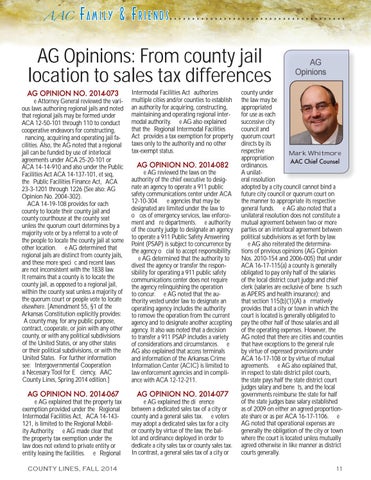
AG Opinions: From county jail location to sales tax differences
AG OPINION NO. 2014-073
The Attorney General reviewed the various laws authoring regional jails and noted that regional jails may be formed under ACA 12-50-101 through 110 to conduct cooperative endeavors for constructing, financing, acquiring and operating jail facilities. Also, the AG noted that a regional jail can be funded by use of interlocal agreements under ACA 25-20-101 or ACA 14-14-910 and also under the Public Facilities Act ACA 14-137-101, et seq, the “Public Facilities Finance Act,” ACA 23-3-1201 through 1226 (See also: AG Opinion No. 2004-302). ACA 14-19-108 provides for each county to locate their county jail and county courthouse at the county seat unless the quorum court determines by a majority vote or by a referral to a vote of the people to locate the county jail at some other location. The AG determined that regional jails are distinct from county jails, and these more specific and recent laws are not inconsistent with the 1838 law. It remains that a county is to locate the county jail, as opposed to a regional jail, within the county seat unless a majority of the quorum court or people vote to locate elsewhere. [Amendment 55, §1 of the Arkansas Constitution explicitly provides: “A county may, for any public purpose, contract, cooperate, or join with any other county, or with any political subdivisions of the United States, or any other states or their political subdivisions, or with the United States.” For further information see: “Intergovernmental Cooperation a Necessary Tool for Efficiency,” AAC County Lines, Spring 2014 edition.]
AG OPINION NO. 2014-067
The AG explained that the property tax exemption provided under the “Regional Intermodal Facilities Act,” ACA 14-143121, is limited to the Regional Mobility Authority. The AG made clear that the property tax exemption under the law does not extend to private entity or entity leasing the facilities. The “Regional COUNTY LINES, FALL 2014
Intermodal Facilities Act” authorizes multiple cities and/or counties to establish an authority for acquiring, constructing, maintaining and operating regional intermodal authority. The AG also explained that the “Regional Intermodal Facilities Act” provides a tax exemption for property taxes only to the authority and no other tax-exempt status.
AG OPINION NO. 2014-082
The AG reviewed the laws on the authority of the chief executive to designate an agency to operate a 911 public safety communications center under ACA 12-10-304. The agencies that may be designated are limited under the law to offices of emergency services, law enforcement and fire departments. The authority of the county judge to designate an agency to operate a 911 Public Safety Answering Point (PSAP) is subject to concurrence by the agency official to accept responsibility. The AG determined that the authority to divest the agency or transfer the responsibility for operating a 911 public safety communications center does not require the agency relinquishing the operation to concur. The AG noted that the authority vested under law to designate an operating agency includes the authority to remove the operation from the current agency and to designate another accepting agency. It also was noted that a decision to transfer a 911 PSAP includes a variety of considerations and circumstances. The AG also explained that access terminals and information of the Arkansas Crime Information Center (ACIC) is limited to law enforcement agencies and in compliance with ACA 12-12-211.
AG OPINION NO. 2014-077
The AG explained the difference between a dedicated sales tax of a city or county and a general sales tax. The voters may adopt a dedicated sales tax for a city or county by virtue of the law, the ballot and ordinance deployed in order to dedicate a city sales tax or county sales tax. In contrast, a general sales tax of a city or
AG Opinions
county under the law may be appropriated for use as each successive city council and quorum court directs by its respective Mark Whitmore appropriation AAC Chief Counsel ordinances. A unilateral resolution adopted by a city council cannot bind a future city council or quorum court on the manner to appropriate its respective general funds. The AG also noted that a unilateral resolution does not constitute a mutual agreement between two or more parties or an interlocal agreement between political subdivisions as set forth by law. The AG also reiterated the determinations of previous opinions (AG Opinion Nos. 2010-154 and 2006-005) that under ACA 16-17-115(a) a county is generally obligated to pay only half of the salaries of the local district court judge and chief clerk (salaries are exclusive of benefits such as APERS and health insurance); and that section 115(b)(1)(A) affirmatively provides that a city or town in which the court is located is generally obligated to pay the other half of those salaries and all of the operating expenses. However, the AG noted that there are cities and counties that have exceptions to the general rule by virtue of expressed provisions under ACA 16-17-108 or by virtue of mutual agreements. The AG also explained that, in respect to state district pilot courts, the state pays half the state district court judges salary and benefits, and the local governments reimburse the state for half of the state judges base salary established as of 2009 on either an agreed proportionate share or as per ACA 16-17-1106. The AG noted that operational expenses are generally the obligation of the city or town where the court is located unless mutually agreed otherwise in like manner as district courts generally. 11
AAC
Family & Friends
» » » » » » » » » » » » » » » » » » » » » » » » » » » » » » » » » » » » » » »
Incentive Payment Program brings revenue to counties, stops federal benefits to inmates
T
he Social Security program provides disability, retirement and survivors benefits to qualified individuals and their families based on the worker’s earnings. Supplemental Security Income (SSI) is a federal program that provides monthly payments to people who are 65 or older, or who are blind or have a disability and who have little or no income and resources. The Social Security Administration (SSA) manages both programs. In most cases, Social Security or SSI benefits cannot be paid to people who are in prisons or county jails. Sheriffs and administrators of county jails can help SSA by reporting information about confined or incarcerated people. Authority for Incentive Payments Federal law permits incentive payments to local correctional institutions. The incentive payments are for providing information that: • Results in the suspension of SSI payments to people whose confinement began in March 1997 or later; or • Results in the suspension of Social Security retirement, survivors or disability insurance benefits to people whose confinement began in April 2000 or later.
payment for information received after 90 days of confinement.
How Payment Process Works When reports are received, the Administration will: 1. Verify that required inmate data has been furnished by each participating correctional institution; 2. Confirm that Social Security Number data matches information JONATHAN GREER in the administration’s files; General Counsel 3. Review payment records to find out if any inmates are receiving Social Security or SSI benefit payments. 4. Notify the inmate that Social Security or SSI payments must be suspended; 5. Determine the incentive payments or every Social Security to each participating facility or instituor Supplemental Securi- tion; 6. Transmit monthly incentive payments via electronic funds transfer to the ty Income recipient that is suspend- financial account specified by each participating institution or facility; and 7. Send a monthly notice to each pared as a result of information providticipating institution informing it of: • The total number of Social Secued by the participating institution, rity or SSI recipients whose benefits were suspended as a result of inforthe Social Security Administration mation provided; • The total monthly incentive payment; and will pay the institution. • The date the electronic funds transfer was transmitted to its financial account.
“F
Participation in Incentive Program Local correctional institutions that want to participate in the incentive payment program, with the concurrence of the county judge, must sign an agreement with the Commissioner of Social Security. Under the agreement, the institutions must provide the following information every month about all newly admitted inmates: • Social Security Number; • Name; • Date of birth; • Date that confinement or incarceration began; and • Other identifying information about the inmate. In addition to monthly reports of new admissions, correctional institutions must provide initial reports containing this information for their total inmate population. Participating institutions must forward the information to Social Security electronically. Amount of Incentive Payments For every Social Security or SSI recipient that is suspended as a result of information provided by the participating institution, the Social Security Administration will pay the institution: • $400 for information received within 30 days of the confinement; or • $200 for information received after 30 days but within 90 days after confinement. The Social Security Administration will not pay an incentive 12
Legal Corner
”
Greene County has been participating in the program since the summer. According to Greene County Treasurer Debbie Cross, “The Incentive Payment Program is a win-win for the citizens of Greene County. Not only does it bring much needed revenue to the county, it also stops payments to inmates who are no longer entitled to receive those federal benefits.” If you have any questions about this incentive program, you should contact any Social Security office for the name and address of the regional prisoner coordinator. The coordinator will assist you in enrolling in the program or answering any questions you may have. For more information, visit the Social Security Administration website at www.socialsecurity.gov or call toll-free 1-800772-1213 (for the deaf or hard of hearing call the TTY number, 1-800-325-0778). Social Security can answer specific questions and provide information by automated phone service 24 hours a day. All calls are treated confidentially. Information for this article was taken from SSA Publication No. 05-10088 found at http://www.ssa.gov/pubs/EN-05-10088.pdf (October, 2014). COUNTY LINES, FALL 2014
AAC
Family & Friends
W
» » » » » » » » » » » » » » » » » » » » » » » » » » » » » » » » » » » » » » »
Transition
From The
ith the 2014 campaigns and elections now and in nearly all those instances, a Governor behind us, the focus of state government shortened sentence did not result in shifts to transition. I have begun meeting an immediate release. with Governor-elect Asa Hutchinson to talk While I have received an about both the work of being governor and the operations of increase in requests for pardons this office. The departments within my office have prepared and commutations, Arkansas law transition documents to help the incoming administration prevents me from granting any lastprepare for the duties and services provided by this governor’s minute requests even if I wanted to. office. I anticipate that this will be a smooth transition from the There is a process prescribed in the 45th to the 46th Arkansas governor. law for any such application, and Just because transition is a priority, that does not mean that it is one that takes many months. citizen services will stop between now and January. Although Any application for clemency or Hon. Mike Beebe a governor’s staff dwindles in the final months of a term, we pardons submitted now will not Governor of Arkansas will still have people here to carry out the duties of the office. reach the governor’s desk until well However, because of certain into the next state laws, some services are limited in these final, postadministration. election months. I am also obligated to propose a have begun meeting with The most noticeable balanced budget for Fiscal Year 2016, difference will be with even though I won’t be in office when the Governor-elect Asa Hutchin- final budget is decided upon during the appointments to state boards and commissions. Over 2015 session. In fact, I will propose two son to talk about both the work of the years, I’ve appointed possible budgets, which will be presented thousands of Arkansans to to the Legislature and discussed in detail serve on more than 300 here next week. As with any budget, being governor and the operations of boards and commissions that there will be tough decisions facing the oversee and regulate much Hutchinson administration and the 90th this office. of our government. But, General Assembly. a law passed in the 1980s I have spoken for months of my prevents the vast majority gratitude to the people of Arkansas of these appointments for making it possible for me to serve from being made during as governor, and you will hear more from Ginger and me on the final months of an outgoing governor’s term. Between the this subject as I prepare to leave office in January. For now, we November 4 election and my departure in January, I will be will all witness one of the greatest parts of our democracy, the filling only vacancies that arise and making a handful of other peaceful transition of power after an election. appointments. My office is also currently receiving more inquiries about pardons and other forms of clemency. During my time in Mike Beebe office, I have issued hundreds of pardons to people who have served their time, completed all terms of their sentences, and shown themselves to be good citizens after paying their debt The Honorable Mike Beebe to society for their mistakes. In only a few circumstances have I ever commuted the sentence of someone currently in prison, Governor of Arkansas
“I
”
We want your news
Did an aspect of county government “make news” recently in your county?
COUNTY LINES, FALL 2014
13
AAC
Family & Friends
» » » » » » » » » » » » » » » » » » » » » » » » » » » » » » » » » » » » » » »
Exploring the issue of county official conflict of interest
A
county official cannot contract with himself or with his spouse, child, parents, or other persons standing in the first degree of relationship, or for those with whom he has a substantial financial relationship that is not available to others. Any such contract would constitute a clear conflict of interest and would require quorum-court approval based upon “unusual circumstances.” Ark. AG Op. No. 2002-327
Public Policy: The common law provides that “a public office is a public trust ... and the holder thereof may not use it directly or indirectly for personal profit, or to further his own interest, since it is the policy of law to keep an official so far from temptation as to insure his unselfish devotion to the public interest. Officers are not permitted to place themselves in a position in which personal interest may come into conflict with the duty which they owe to the public, and where a conflict of interest arises, the office holder is disqualified to act in the particular matter and must withdraw.” 67 C.J.S. Officers § 204. From AG Opinion No. 99-349. See also AG Ops. Nos. 98-275; 94-283; 94-446, citing Van Hovenberg v. Holman, 201 Ark. 370, 144 S.W.2d 719 (1940); Madden v. United States Associates, 40 Ark. App. 143, 844 S.W.2d 374 (1992); Acme Brick Co. v. Missouri Pacific R.R., 307 Ark. 363, 821 S.W.2d 7 (1991); 63A Am. Jur. 2d Public Officers and Employees § 321; Ark. AG Op. No. 2003-012. ACA 14-14-1202(a): “PUBLIC TRUST. The holding of public office or employment is a public trust created by the confidence that the electorate reposes in the integrity of officers and employees of county government. An officer or employee shall carry out all duties assigned by law for the benefit of the people of the county. The officer or employee may not use his office, the influence created by his official position, or information gained by virtue of his position to advance his individual personal economic interest or that of an immediate member of his family or an associate, other than advancing strictly incidental benefits as may accrue to any of them from the enactment or administration of law affecting the public generally.” ACA 21-8-304(a): “No public official shall use his position to
County a L w p U date
secure special privileges or exemption for himself, his spouse, child, parents, or other persons standing in the first degree of relationship, or for those with whom he has a substantial financial relationship that is not available to others except as may be otherwise provided by law.” Mike Rainwater
ACA 14-14-1202(c)(1): “No offiRisk Management cer or employee of county government Legal Counsel shall ... be interested, either directly or indirectly, in any contract or transaction made, authorized, or entered into on behalf of the county or an entity created by the county, or accept or receive any property, money, or other valuable thing, for his use or benefit on account of, connected with, or growing out of any contract or transaction of a county. Quorum Court Approval Permitted if Unusual Circumstances: “If the quorum court determines that it is in the best interest of the county, the quorum court may by ordinance permit the county to purchase goods or services directly or indirectly from quorum court members, county officers, or county employees due to unusual circumstances. The ordinance permitting such purchases must specifically define the unusual circumstances under which such purchases are allowed and the limitations of such authority. Any quorum court member having any interest in the goods or services being considered under these procedures shall not be entitled to vote upon the approval of such goods or services. ACA 14-14-1202(c)(2)(A)&(B). (Mike Rainwater, a regular contributor to County Lines and lead attorney for AAC Risk Management, is principal shareholder of Rainwater, Holt, and Sexton, P.A., a state-wide personal injury and disability law firm. Mr. Rainwater has been a lawyer for over 30 years, is a former deputy prosecuting attorney, and has defended city and county officials for over 25 years.)
www.arcounties.org 14
COUNTY LINES, FALL 2014
AAC
Family & Friends
» » » » » » » » » » » » » » » » » » » » » » » » » » » » » » » » » » » » » » »
What a bunch of losers we are!
H
ealth and wellness are hot topics. Reality TV shows like “The Biggest Loser” contributed to a raised awareness of the health conditions caused by being overweight. Then there is the “elephant in the room” — that AAC’s Member Benefits Manager was on the show three years ago. Mix all that together, and we have a recipe for a “Biggest Loser” competition for county government employees and elected officials. In putting this competition together I wanted to put into practice some of the things I learned through my own “Biggest Loser” experience about weight loss and weight related health problems. I thought it important to incorporate important health measures along with weight loss. Consequently, I chose to include waist circumference and blood pressure. Furthermore, I wanted this to be a long-term program so people would have an opportunity to create healthy habits and incorporate them into their lifestyle. From there, the 2014 Biggest Loser competition was born — a six-month competition in which the winning team would have to lose weight, lose inches and improve their blood pressure. It was no easy task. However, in true form, the county employees and officials faced the challenge head on and with gusto. We started with just over 200 people and, although not everyone crossed the finish line with us, we saw amazing results. Collectively, the group: • Lost approximately 2,000 pounds. Yes, we lost a ton of weight! • Lost 677 inches in waist circumference. That is a little over 56 feet. • 71 percent of finishers lowered their blood pressure. I could not be more proud of the hard work and perseverance exhibited by all these folks. Way to go! Here are the final team standings: 1st Place: “Reducing Government Waist,” Saline County 2nd Place: “Love Handle Losers,” Monroe County 3rd Place: “Calorie Counting Carb Cutting Clerks,” Crawford County 4th Place: “Thin2Win,” Pope County 5th Place: “Sugar Town Muffin Tops,” Arkansas County Although this was always a team competition, I feel obligated to share the names of some individuals who worked hard and had terrific results. Here are the Top 15 individuals:
Savings times 2
and encourage increased physical Wallet & waistline activity. The AAC received a grant from the Arkansas Blue & You Foundation to purchase pedometers for all team members. Using their pedometers, the teams kept track of the number of steps they took in a month. The team with the highest average steps per person won and kept the traveling Step Champion trophy until the next month’s winner was announced. Franklin County came in first place in both May and June, with Monroe and Jefferson Counties coming Becky Comet in second and third, respectively. In AAC Member July, Monroe County was able to take Benefits Manager the trophy from Franklin County, which came in second, with Jefferson County holding on to third place. So many people asked to continue the Step Competition that we started it up again in October. However, this time it is open to anyone who wants to take part, not just “Biggest Loser” participants. We will keep the competition going as long as people want to compete. So, if you missed out this month, jump in next month. Walking is a great stress reliever as well as a terrific workout. A great big thank you to all who participated in this program, whether you finished with us or not. It takes a lot of courage to put yourself out there and step on the scales that first time. I am so proud of all who even dared to take that first step. Another giant thank you to all those who weighed, measured, kept track of numbers and sent them to me every other week. That was a huge undertaking along with all the other things you have to do. We could not have started without you. You played a key role in this competition and in the lives of those on your team. Thank you so very much. Well that’s a wrap on the 2014 AAC Biggest Loser competition. I hope that you all will take what you have learned in your journey and pay it forward . . . for the health of it.
1. Joye Hickman, Monroe County 2. Holly Gwatney, Saline County 3. Jim Ed Gibson, Pope County 4. Stephanie Stanton, Jefferson County 5. Carrie Kilgore, Crawford County 6. Marie Giles, Saline County 7. Jennifer Heidelberg, White County 8. Carol Cloud Jacobs, Arkansas County 9. Nette Curtis, Saline County 10. Kristen Edwards, Crawford County 11. Renee Neal, Monroe County 12. Sharon Blount Baker, Crawford County 13. Kristy Lewis, Little River County 14. Pam Neel, Crawford County 15. Tina Roscoe, Jefferson County Congratulations to all on a job well done. You have made healthy lifestyle changes that will affect you and those around you forever. On a side note, during the course of the six-month “Biggest Loser” competition we started a “Step Competition” to promote COUNTY LINES, FALL 2014
Saline County’s “Reducing Government Waist”: Holly Gwatney, Vickey Jordan, Marie Giles, Nette Curtis, Tammy Shores, Kathy Carlise and Sandy Rial. 15
AAC
Family & Friends
» » » » » » » » » » » » » » » » » » » » » » » » » » » » » » » » » » » » »
Exploring the adverse impact of unfunded mandates for jails
W
e are currently under several unprecedented unfunded mandates. Our jails are holding unprecedented levels of state and local inmates, and there is no end at sight. Our state mental health system ranks 50th among the states. These major failures of the state to provide for these state priorities are adversely impacting public safety and the ability of county governments to perform the priority duties assigned to counties by law. Recently, the Association of Arkansas Counties’ Board of Directors respectfully requested the various county officials and justices of the peace to join them, the County Judges Association of Arkansas (CJAA) and the Arkansas Sheriffs Association (ASA) by adopting a resolution to express the adverse impact of the jail overcrowding crisis to their community and to provide a copy to their members of the General Assembly and local press. Approximately 2,528 state inmates are currently being held in county jails. Until the past couple of years, the previous record of inmate backup in the county jails was approximately 1,850. The sheriffs of Arkansas have determined that our county jails statewide can hold collectively 1,600 inmates and a cap should be set and respected by the state in order to secure public safety. The prolonged unprecedented overcrowding and long-term detention of convicted felons in our local jails creates an unnecessary danger to the public, prison staff and inmates. Many of our county officials, law enforcement officers, prosecutors, district judges and circuit judges see first-hand the revolving door of misdemeanor violators and deterioration of law and order in our communities that has been caused by the unprecedented prolonged back up of state prisoners in our county jails. Protecting Arkansas communities is at issue, and the safety of our citizens should be a funding priority for our state officials. However, the General Assembly appropriated and funded only about $9 million dollars under category “A” for payment of county jail reimbursement (which at $28 per day for 365 days would pay for only 880 state inmates for the current state fiscal year, FY 2015). Reasonable estimates of the total jail reimbursement necessary for payment to counties for 2,300 state inmates held in county jails for fiscal year FY 2015 would exceed $23 million dollars (July 1, 2014 to June 30, 2015; at $28 per day for 365 days). County jail reimbursement for FY 2015 will far exceed the $9 million dollars appropriated and funded under category “A,” and the state of Arkansas currently owes counties in excess of $6.8 million for county jail reimbursement. This unpaid government debt is increasing by approximately $1.3 million dollars per month. The continued delay in payment of jail reimbursement until calendar year 2015 creates an unnecessary and severe economic hardship on county governments and local taxpayers. It is well documented that counties are reimbursed only $28 per day for state inmates, which is, on average statewide, $20 per day per 16
Research Corner
prisoner shy of what it actually costs. The most recent average daily cost from Legislative Audit is $49.35 per day. The failure of the state to pay actual costs (even at a $45 a day rate) has inflicted a state-created UNFUNDED MANDATE upon county governments and local taxpayers Mark Whitmore in excess of $18 million dollars for AAC Chief Counsel holding state prisoners. It is vital that the state of Arkansas take responsibility for its inmates and discharge the paramount duty under the Arkansas Constitution and laws of Arkansas to protect the public and provide for the detention of convicted felons. There is no single tool to address the overcrowding crisis. Some evidence-based tools were initially provided under Act 570 of 2011 in the form of $2.2 million dollars in “performance incentive” grants. These grants to counties were for programs of the county’s choice to reduce recidivism such as: smart sentencing, specialty courts (such as drug court, swift courts, mental health courts or veteran’s courts) or crisis intervention teams, etc. Meetings were held and follow up meetings scheduled but thereafter canceled in fall 2012. However, the money was spent on community correction agency needs. So in the midst of the worst prison and jail-overcrowding crisis in history, the nationally accepted means for reducing prison recidivism enacted by the General Assembly had funding pulled. Prior to the end of the 2014 fiscal session, state agency officials proposed that the counties should use some of their underfunded county jail reimbursement to contract with out-of-state independent contractors to hold state inmates. Attorney General Opinion No. 2013-058 explains that the state of Arkansas may contract with out-of-state contractors to hold state inmates, but that counties generally do not have that legal authority. We then suggested that the state of Arkansas amend its budget to provide funds for contracting for the detention of state inmates. It’s definitely part of the solution, especially considering that it may take the state of Arkansas three years to build a 1,000-bed prison. We continue to make that plea. Also, please note that independent contractors can build 1,000bed prisons in a fraction of the three years projected by the state and at a fraction of the $100 million sot projected by the state. These independent contractors hold state prisoners for other states at a fraction of the actual costs per inmate of the Arkansas Department of Corrections, which exceeds $65 dollars a day. It seemed like a good idea for agency officials to suggest to counties a few months ago. Needless to say there is now bureaucratic resistance by state agency officials to use of independent contractors. Many other states during times of crisis have had to increase COUNTY LINES, FALL 2014
AAC
Family & Friends
» » » » » » » » » » » » » » » » » » » » » » » » » » » » » » » » » » » » »
double bunking and increase their capacities outside preferred or million as of January 1, 2014 and additional cuts of $7 million as accredited levels. The Bureau of Justice reported that as of Decem- of July 1, 2014. This topic was covered more fully in the article: ber 2013, Arkansas prisons were at 103 percent capacity and other “How Caring for the ‘Least Among Us’ Is a Matter of Public states’ prisons are significantly above their capacity. Yet corrections Safety” in the County Lines, Winter 2014 edition. This is despite officials resist taking in more state prisoners into the state prison the federal cases of Terry v. Hill, 232 F. Supp. 2d 934 (US Dist. system — even knowing the adverse impacts on your communities E.D. Ark. 2002); and Winters v. Ark. Dept. of Health and Human and that they like other states can take in more state prisoners. Services and John Selig, et al., 491 F. 3rd 933 (8th Cir. 2007). In Additionally, our county jails are holding approximately 200 pa- Terry the court found mentally ill pretrial detainees’ due process rolees awaiting a preliminary hearing or revocation hearing by the rights had been violated by the Arkansas Department of Human board or their designee (that are not covered under the $28 a day jail Services (DHS) and that delay in transfer to the pretrial detainees reimbursement). Over the past year, thousands of parolees without to the Arkansas State Hospital for evaluation and treatment along new charges filled our county jails and the time lapse before schedul- with the prolonged wait in confinement violated the U.S. Coning and conducting parole hearings has taken months. Under Ar- stitution. The Court attributed the violations to the entire state kansas law, local jails are to be used for “the custody of persons accused and to the executive and legislative branches. In Winters the court or convicted of crimes.” See: ACA 14-14-802(a). Sheriffs, prosecu- noted that “no party suggests that jail is an appropriate treatment tors and the courts should not be diverted from their priority duties facility for a mentally ill person” and said “jails should not become under the law in order to assist the state in its administrative hear- our mental hospitals by default.” ings processes over parolAAC, ASA and the CJAA ees not arrested under new have been working with charges. ACA 16-93-705(a) DHS for years now seekauthorizes a parolee to be ing tangible improvement. detained at a “suitable deCutting funding by almost tention facility” pending an $9 million in 2014 is clearly administrative preliminary not progress. DHS officials parole revocation hearing by initially indicated that the he sheriffs of Arkansas have determined the board or their designee. proposed cuts in services ACA 16-93-705(b) explicitthat our county jails statewide can hold col- would not affect the services ly provides if the hearing ofto the mentally ill in Arkanficer finds there is reasonable sas due to the funding and lectively 1,600 inmates and a cap should be set and recause that he has violated a services to be established condition of parole then the by Medicaid expansion and spected by the state in order to secure public safety. hearing examiner may order the private option. Howevthe parolee returned to the er, Andy Allison, the DHS custody of the Department of Medicaid Director at the Corrections for a revocation time, acknowledged in a hearing before the board. public meeting earlier this Under a proper action the year that it may take years circuit court in a judicial for the funding to establish district may find that absent the necessary services lacknew charges, the law does not require detaining parolees in the couning in Arkansas (that they would not be established overnight). ty jail. Also, the court may find a nearby detention facility of the state Yet, the proposed cuts to CMHCs statewide went forward. is a “suitable dentition facility” for state parolees and for remanding a DHS officials are scheduled to engage members of the Generparolee into the custody of the Department of Correction. A county jail al Assembly in upcoming budget hearings to their plan to proat 140 percent capacity is not a suitable detention facility for holding vide treatment for the mentally ill. It is imperative that the plan parolees absent new charges. Finally, Arkansas Constitution, Article 19, §19 mandates: “It is immediately implemented by the State of Arkansas to fulfill shall be the duty of the General Assembly to provide by law for the the obligation under Arkansas Constitution, Article 19, §19, treatment of the insane.” However, the mental health system in “to provide by law for the treatment of the insane.” All persons in the state of Arkansas ranks 50th among the states, according to the industry should know well that we have an urgent need for National Alliance on Mental Illness (NAMI) in the 2006 and services such as inpatient treatment, outpatient treatment, crisis 2009 “Report of America’s Health Care System for Serious Men- services, crisis stabilization units, crisis intervention teams, dital Illness.” NAMI determined that Arkansas urgently needed version and in-jail services (like those available in other states). evidence-based practices, crisis services, crisis stabilization units, Please contact your legislators. Help convey the need for them crisis intervention teams and diversion services like those avail- to urgently provide for these priority state services and to preable in other states. Recently, the General Assembly cut funding vent further improper use of local facilities and resources paid for Community Mental Health Centers (CMHC): cuts of $1.9 for by local taxes for state functions.
“T
COUNTY LINES, FALL 2014
”
17
AAC
Family & Friends
» » » » » » » » » » » » » » » » » » » » » » » » » » » » » » » » » » » » »
Personal use of county vehicles increases potential liability
A
e L gal p U date
CA 21-9-301 provides statutory negligence im- protected by the statutory immumunity to counties. In addition, the Arkansas Su- nity normally afforded a county preme Court has held that the immunity provided and its officials and employees. in ACA 21-9-301 also applies to the officials and If judgment is rendered against employees of the county [Doe v. Baum, 348 Ark. 259, 270 the official in excess of the pol(2002); See Cousins v. Dennis, 298 Ark. 310 (1989)]. However, icy limits on the vehicle, most there is a limited exception to the tort immunity of counties likely state minimum limits of and their employees, and that rests in the area of automobile $25,000/50,000/25,000 as disnegligence and liability. cussed above, then the official Arkansas law requires counties to carry minimum liability would be responsible for payment Brandy McAllister limits of $25,000 for injury or death of one person, up to of the excess judgment. Using our Risk Management $50,000 per accident if more than one person is injured and example, if the plaintiff was awardLegal Counsel $25,000 for property damage per accident [ACA 21-9-303(a)]. ed judgment against the official in The county and its officials and employees are not immune to the amount of $60,000 for bodily the extent they have insurance. Thus, if a county carries the injury of one person and the protection limits were $25,000, minimum liability limthen the county official its, it is immune from would be responsible for suit above and beyond payment of the excess those limits. Similarly, judgment of $35,000. if a county elects to purAdditionally, if an off an official or employee uses a county vehicle at chase additional coverficial or employee uses a age, its immunity exists county vehicle while he above and beyond those a time other than when he is working on official is working, but he uses higher limits. the vehicle for a nonThis means that councounty business, he is potentially exposed to additional li- work related purpose, ties, county officials, there is also potential liand county employees ability over and above the auto protection provided by the ability exposure. For exare statutorily immune ample: a county employfrom motor vehicle negee is at work and driving county’s insurer or self-insurance risk pool. ligence liability exceeda county vehicle, he ing $25,000 bodily indecides to drive to Waljury per person, $50,000 Mart or run several erbodily injury per occurrands on his lunch break rence and $25,000 propin the county vehicle, erty damage per occurrence, unless waived by the purchase of and in the process he causes an accident. The accident results additional insurance. in a lawsuit, and judgment is rendered against the employee However, there is a stipulation to when county officials and for $55,000 for bodily injury of one person. Even though the county employees are protected by these immunities: at the time of the accident the official or employee must have been accident occurred during the county employee’s workday, the working in the course and scope of his county employment. fact that he was driving to take care of personal business can [Carlew v. Wright, 356 Ark. 208, 216 (2004), See Cousins v. put him outside of the course and scope of his employment for tort immunity purposes. This means the county employDennis, 298 Ark. 310 (1989)]. If an official or employee uses a county vehicle at a time ee would be liable for the amount of the judgment in excess other than when he is working on official county business, he of any available coverage amount. If the policy would pay is potentially exposed to additional liability over and above $25,000, then the employee would be personally responsible the auto protection provided by the county’s insurer or self- for the difference of $30,000. The best way to ensure that county employees and officials insurance risk pool. For example: A county official takes his vehicle home every night, and on the way home he stops to who drive county-owned and insured vehicles outside of the pick up dinner. When leaving the restaurant parking lot, he course and scope of their employment duties are adequately causes an accident that results in a lawsuit against him. Since protected is for each driver to check with his own personal the official was not operating the vehicle within the scope and auto insurance carrier and find out if his policy provides seccourse of his employment at the time of the accident, he is not ondary coverage for him if he is driving another vehicle.
“I
”
18
COUNTY LINES, FALL 2014
AAC
Family & Friends
» » » » » » » » » » » » » » » » » » » » » » » » » » » » » » » » » » » » »
Onward to the session
T
he November General election is in the books. Most voters grew wary of the negative images and messages we endured on various media throughout the campaign this year in several races. So let’s do what we should after every election in our state and our country and quickly tend to any wounds incurred and collectively pull our heads up out of the trenches and focus on serving Arkansans to the best of our ability. It was an historic campaign and election for the GOP. Governor-elect Asa Hutchinson has already begun his transition, and his first hire was a great one. Arkansas legislature veteran and former state Senate Pro Tempe Michael Lameureux joined the governor’s staff as chief. The 90th Arkansas General Assembly will be here before we know it, and there is much work to be done. Much adversity and many challenges await the 100 (64 Republicans, 36 Democrats) House members and 35 (24 Republicans, 11 Democrats) senators who will soon announce their chambers are open for the state’s business. I believe the 90th will be etched in stone as one of the most critical general assemblies in modern history as Arkansas finds itself at a paramount crossroad with a new majority party from the top down. We are at an intersection of increasing costs versus decreasing revenues while major issues stand on the corners hoping to cross the street to find the funding and solutions they desperately need. Arkansas’ crafted private option might be in the balance while ensuing tax cuts and decreased revenue seem to be the most significant hurdle for the state’s challenges, and those needs are substantial. Remember the private option has about $80 million in state savings tied to it in the budget. And many Republicans ran on the fact they would demolish the private option. Other crises exist, as well, including jail overcrowding, county reimbursement and broadband infrastructure needs for education and economic development and many more. In this pre-session time period, associations and organizations are busy planning and prepping for success for their stakeholders while weighing and projecting what the atmosphere will be in the legislature. One aspect of the atmosphere is clear — there’s not enough funding to go around and everybody ran on tax cuts. Sound solutions and modernization will be necessary for us to move in a positive direction for the state. Every fall members of the Association of Arkansas Counties
Legislative lines
Legislative Committee take part in the process of finalizing the AAC legislative package. The AAC board of directors ultimately approves the legislative package before it is presented to the world so to speak. We then traditionally present it to City, County & Local Affairs committee of both chambers and begin working toward the end of recruiting sponsors, submitting drafts to the Bureau of Legislative Research and devising strategies aimed at sucScott perkins cessful passage of AAC’s proposed bills. Communications Even with the general election beDirector hind us, there remains some uncertainty in what Arkansas lawmakers will focus upon and what hot topics will rise on their agendas. Speaker Designate of the House Jeremy Gillam told the Society of Professional Lobbyists this fall that amidst the uncertainty the House will be open for business and ready to lead in January. He mentioned increased training for new House members and alluded that transportation will be one of the focuses of the 90th General Assembly. We expect a general revenue sharing piece of legislation to once again emerge, however, probably in different attire this time. Gillam also touched on several budgetary factors and challenges in revenue that he expects to face come 2015. The AAC legislative package has been approved and policy staff has worked the plan since the beginning of the fall. We have about 25 bills in our package. County jail reimbursement rate for housing state inmates and the responsibility of the county to bear medical expenses for those inmates in the first 30 days are two of AAC’s hot-button issues. AAC has also identified a burden that was intended to be temporary in 1999 as a major priority. At this time, counties continue to pay about $5 million a year for deputy prosecuting attorney salaries out of county turn back funds. We have several other goals and proposed pieces of legislation to make county government better in the 90th, and we look forward to the rest of the year as we continue to build a coalition in support of tackling Arkansans’ needs head on. Enjoy the holidays, and we’ll see you at the Capitol.
75 Counties - One Voice COUNTY LINES, FALL 2014
19
AAC
Family & Friends
» » » » » » » » » » » » » » » » » » » » » » » » » » » » » » » » » » » » »
Changing of the Guard
A unique opportunity for moving in a positive direction
T
he phrase “changing of the guard” was originally used to refer to the event when guards of Buckingham Palace would change so that new guards would replace them to take on a different shift. This event became an elaborate ceremony that people still watch today. Although I have just described the origin of the phrase, the common use of the phrase “changing of the guard” is now used to refer to a situation in which there is a dramatic or big change. A “changing of the guard” is basically a time in which new people are replacing other people in positions of importance. In January we will see the “changing of the guard” at many levels of government, but I want to speak directly about state and county government in Arkansas. At the state level we will have a new Governor. In fact, we will see new officials in at least five of the seven state constitutional offices, and the other two incumbent state officials have opposition in the November general election. Over one-third of the state House of Representatives will be new, along with several new members of the state Senate. And there will be dozens of new county and district officials. I trust that all newly elected officials, as well as you who retain office — at any level — will not be so dogmatic that you cannot accomplish anything. Because accomplishing good things for the people of Arkansas is what public service is all about, regardless of party label. Many that decide to try their hand at political office are too far right or too far left to do anyone any good. The vast majority of the populace is somewhere near the middle in their political thinking, and that is the vantage point from which one can effectively govern. If you are somewhere near the middle you can find common ground on most issues to help solve problems. Changing of the guard could and should be a positive event. Even if you have not thought about it, an elected official is a leader — or should be. There are a number of important qualities or traits that should be evident in an elected leader. Some sit around and pontificate about whether leaders are made or born. The true leader ignores those discussions and concentrates on developing the leadership qualities needed to lead and serve because a true elected leader is also a servant. We’re going to talk about five of those traits — five qualities that come from Kouzes and Posner’s research into leadership that was done for the book The Leadership Challenge. Here they are: 1. Honest 2. Forward-Looking 3. Competent 4. Inspiring 5. Intelligent Your ability to exhibit these five leadership qualities is strongly connected with people’s desire to follow your lead. It is important to exhibit and display these traits. Simply possessing those traits is not enough; you have to display them in a way that people notice. People want to see their leaders actively demonstrate these leadership qualities and won’t just assume that you have them. 20
Seems To Me...
Honesty People want to follow an honest leader. It was not that long ago that people assumed their elected leadership was honest simply because of the authority and status of the position. With all of the modern-day scandals, this is no longer true. When you start your elected leadership position, you must assume that Eddie A. Jones many people will think you are a little County Consultant dishonest. In order to be seen as an honest individual and leader, you will have to go out of your way to display honesty. The electorate will not assume you are honest simply because you have never been caught lying, stealing, or any of those other things that exhibit a person’s dishonesty and have been the subject of so many scandals of the elected leader. One of the most frequent places where leaders miss an opportunity to display honesty is in handling mistakes. Even as a leader you are still human — and humans make mistakes. Naturally, as an elected leader, you will try new approaches and refine ideas and procedures. Sometimes the new does not work. Leaders, of course, always want to avoid failure, sometimes to the extent that they don’t admit their mistakes. Bottom line? An elected leader should be honest to a fault. Opportunities to display honesty on a large scale may not happen every day. As a leader, showing people that you are honest even when it means admitting a mistake, showcases an important trait that people are looking for in their leaders. Honesty and wisdom are close kin. As Thomas Jefferson said, “Honesty is the first chapter of the book of wisdom.” Forward-Looking The whole point of leadership is figuring out where to go and how to get there. The real leadership part is communicating those ideas effectively. Warren Bennis, a pioneer in the field of leadership studies who died in July, said, “Leadership is the capacity to translate vision into reality.” When a leader doesn’t have a clear vision for the future, it is usually because they are spending too much time on today. That can be solved simplistically by setting time aside for planning, strategizing and thinking about the future. Many times when a leader has no time to think and plan for the future, it is because they are doing a poor job of leading in the present. They have created an organization, system or staff that relies too much on the leader for input at every stage. [I am so “hands-on” that this is probably my weakest point as a leader.] On the other hand, some leaders have a clear vision, but they are hesitant to share it. They are concerned that they will lose credibility if they share a vision that does not “pan out.” I suppose this is a legitimate concern. So just do your best to completely vet your ideas, trying to make sure that your vision of where to go and how to get there is attainable. Don’t let fear of communicating your vision hamper your leaderCOUNTY LINES, FALL 2014
AAC
Family & Friends
» » » » » » » » » » » » » » » » » » » » » » » » » » » » » » » » » » » » »
ship potential. People need to know that their leader has a strong vision for the future and a strong plan for moving forward.
either something you’ve got — or you ain’t.” I disagree. Developing intelligence is a lifestyle choice. Any formal education you may have is just the beginning, although it does give you a good foundation for Competency lifelong educational experiences. People want to follow someone who is competent. That does not Competence, which I have already addressed, and intelligence are mean you have to be an expert on everything. It does mean that close cousins, but they are not the same. To develop leadership intelyou need to be capable, adept and masterful at connecting the dots, ligence, you need to commit to continual learning. The field of govwhether that’s in a political scenario, understanding and implementernment and public service is perfect for continual learning because ing new law, understanding your vision and actively communicating things are constantly changing. It requires a lot of study and reading it, or in an almost endless list of other situations leaders find themto stay informed and able to perform within the perimeters of the selves in. U.S. President Martin Van Buren said, “It is easier to do a law. You can develop a great deal of intelligence by investing a reasonjob right than to explain why you didn’t.” able amount of time reading on a daily basis. Did you know that if For a leader to demonstrate they are competent, it is not enough to you spent 30 minutes of focused reading every day you would amass just avoid displaying incompetency. You must demonstrate compe182 1/2 hours of study time each year? That’s almost 23 workdays. tency in a way that people notice — mainly by having full command As a leader you can demonstrate your intelligence by affably leadof the facts of whatever you are dealing with. This, of course, can be a ing people toward understanding, even when you know the answer. delicate balance because you do not want to appear arrogant. Your focus needs to be on helping and leading others to learn, not on One of the best ways to diffuse any thought of arrogance is to demonstrating how smart you are. Intelligence is like underwear: It is always share team achievements. Whether you are an elected leader important that you have it but not necessary that you show it off. at the state or local level, you are a part of a team and the competent Some leadership traits should be displayed, but trying to display leader always shares the glory of accomplishments — great or small. your intelligence will be counterproductive. One of the greatest When people under your leadership look at an action you have signs of someone who is truly intelligent is humility. I believe that is taken and think or say, “that just goes to show why he/she is the one because the greater your education, whether formal or otherwise, the in charge,” you are demonstrating competency. greater your understanding of how little we really understand and how much there is to learn. Inspiration As unintuitive as it may seem, I want to be inspired. one of the best ways to exhibit Everyone wants to be intelligence is by asking quesIntelligence is like underwear: It is important that inspired. Many people will tions. Learning from the people follow an inspiring leader, you lead and represent by asking you have it but not necessary that you show if off. even when that leader has intelligent, thoughtful questions no other real qualities. will do much to enhance your That, of course, can be intelligence credibility. dangerous if the leader ofYour ability to demonstrate fers only inspiration and nothing else. respect for the intellect of others will probably do more to influence I have found that inspiration is the arrow that is missing in the the perception of your intellect than your actual intelligence. quiver of many elected leaders. If you are missing the trait of inspiration it could very well be that all you lack is passion. Being inspiring Summary of Leadership Qualities is usually just a matter of communicating clearly and with passion. By consciously making an effort to exhibit these traits, people will A great example of inspiration is when Steve Jobs stole the CEO be more likely to follow you, and you will be able to grow your influfrom Pepsi by asking him, “Do you want to sell sugar water for the ence as a leader to its full potential. rest of your life, or do you want to change the world?” A leader who Most elected officials, whether at the county or state level, have is inspiring is a leader who can share his vision in such a way as to cre- a staff — and that makes them a boss. In addition to the leaderate in living color the “big picture” and help those around him — his ship qualities that have already been discussed, there are certain constituents or employees — see beyond their narrow focus of “this is qualities that make great bosses — bosses that are memorable. how it’s always been” or “this is the way we’ve always done it” or “why Whether you are a part of the “changing of the guard” or an change.” An inspiring leader inspires positive change. official that will simply start another term at the first of the year, Some, especially those with charisma, seem to have a natural talent these leadership qualities and qualities of a memorable boss are for inspiration. If you lack charisma, learning to be inspiring is not applicable to you. easy. However, it can and must be learned if you want to be a great All of us remember our bosses. Some were bad. Some were leader. Take note of people who inspire you and analyze the way they good. Some were tolerable. But have you had one that was truly communicate. Look for ways to passionately express your vision. It memorable — in a good way? I have had bosses, and I have been may be as simple as developing your ability to tell stories that coma boss. I truly hope that some of my former employees can say municate on an emotional level and leave an imprint much stronger that I was memorable. than anything you can achieve through a simple stating of the facts. If you aspire to be the great leader and boss you will want to have To quote John Quincy Adams, “If your actions inspire others the following qualities in your repertoire. to dream more, learn more, do more and become more, you are a leader.” There is no inspiration without passion. 1. See opportunity in instability and uncertainty. When unexpected problems and major crises arise, most bosses take down the Intelligence Intelligence can be difficult to develop. In fact, many will say, “it’s See “CHANGING” on Page 23 > > > COUNTY LINES, FALL 2014
21
AAC
Family & Friends
» » » » » » » » » » » » » » » » » » » » » » » » » » » » » » » » » » » » »
CHANGING sails, batten the hatches and hope to wait out the storm. A few see a crisis as an opportunity. It’s difficult to make major changes, even necessary ones, when things are going smoothly. Memorable bosses see instability and uncertainty as an enabler. They reorganize and reshape to reassure, motivate and inspire. 2. Wear your emotions on your sleeves. Memorable bosses are highly professional and yet openly human. They show excitement when things go well. They show appreciation for hard work and extra effort. They celebrate, they empathize, and they worry. Sometimes they even get frustrated or angry. In short, they’re human. And, unlike many bosses, they act like it. Professionalism is admirable. Professionalism with a good blend of humanity is inspiring. 3. You’ve been there, done that … and still do that. Dues aren’t paid, past tense. Dues get paid every day. The true measure of value is the contribution we make on a daily basis. That’s why no matter what you may have accomplished in the past, memorable bosses are never too good to roll up their sleeves, get dirty and do the “grunt” work. No job is ever too menial for the memorable boss. 4. You lead by permission, not authority. Every boss has a title. That title gives them the right to direct others, to make decisions, to organize and instruct and discipline. Memorable bosses lead because their employees want them to lead. Their employees are motivated and inspired by the person, not the title. Through their words and actions they cause their employees to feel they work with, not for, a boss. Many bosses don’t ever recognize there’s a difference. There is.
COUNTY LINES, FALL 2014
Continued From Page 21
<<<
When Mitch Miller died in July 2010, most people remembered him as the man who invited everyone to sing along. On his popular 1960s TV program “Sing Along with Mitch,” an all-male chorus sang well-loved songs while the words appeared on the screen so viewers could join in. A Los Angeles Times obituary cited Miller’s belief that one reason for the program’s success was the appeal of his chorus: “I always made a point of hiring singers who were tall, short, bald, round, fat, whatever — everyday-looking guys.” From that unified diversity came beautiful music in which everyone was invited to participate. My point? At the beginning of the year we will experience the “changing of the guard.” Arkansas will have many new leaders in place in state constitutional offices, the state legislature and in county courthouses. At the same time there will be many office holders re-elected to their current office. The scene will look a lot like Mitch Miller’s chorus — quite diverse. There will be male and female; Democrat and Republican, as well as a few from other parties; ultraliberal, liberal, moderate, ultra-conservative and conservative; and the list of differences could continue. However, there is no reason the outcome could not be the same as Mitch Miller’s chorus — unified diversity. If every elected official will take on the leadership traits we espoused, much good can be accomplished for their constituents and employees — the citizens of this great state. What a unique “choir” we belong to in Arkansas.
23
AAC
Family & Friends
» » » » » » » » » » » » » » » » » » » » » » » » » » » » » » » » » » » » »
AAC applauds Senators’ teamwork on Private Landowner Protection Act
eS sn . rP o y r dna o B oznam co-so p sn or rP“ ivta e o dnaL enw r rP otection Act”
T
By Scott Perkins AAC Communications Director
he Association of Arkansas Counties welcomes Sen. Mark Pryor’s and Sen. John Boozman’s engagement to the modernization of the Endangered Species Act. Rep. Rick Crawford introduced H.R. 4319 in July, and the Senate bill closely matches the language in that measure. H.R. 4319 has all four of Arkansas’ congressman as cosponsors, as well as 27 co-sponsors from 16 different states. “All of Arkansas’ Congressional delegation and our two senators have obviously decided to stand together on this issue facing Arkansas counties and citizens,” said Chris Villines, AAC executive director. “It makes sense and is the right thing to do for landowners — public and private — to require cumulative economic analysis studies when designating critical habitat areas. Landowners deserve transparency, sound economics and the ability to publicly comment on these designations. These two bills address protecting those rights.” AAC and Farm Bureau continue to educate and increase awareness with their cohorts in other Southern states and will now focus on adding signatures and support for the two bills. “We have a unified Arkansas delegation with the Senate and House bills. We’re thrilled our General Assembly, Gov. Mike Beebe, Attorney General Dustin McDaniel, the Southern Legislators Council and the Western State Land Commissioners
Association have all engaged in this effort,” Villines said. Comments on proposed rules AAC and the Arkansas Farm Bureau Federation (AFBF) submitted official comments Oct. 10 on the U.S. Fish and Wildlife Service’s and the National Marine Fisheries Service’s proposed rules to implement changes to the regulations for designating critical habitat and a proposed rule on the definitions of destructive or adverse modification of critical habitat under the Endangered Species Act. Arkansas Attorney General Dustin McDaniel also submitted official comments on the proposed rules. According to the AAC and AFBF official comments: “The AFB and AAC have always supported the notion that the use of private property to sustain and feed a growing population and public property to provide a wide range of services and employment is not inconsistent with the protection and survival of the species that share the landscape. It seems to be the conclusion of the Services that agriculture and other public land uses are knowingly and seemingly even with premeditation altering the landscape to harm any given species. The associations’ comments argue that assumption is blatantly false and shows little understanding of the stewardship practiced by landowners, public and private.” The U.S. Fish and wildlife Service has not posted a decision on the proposed rule changes but could do so as soon as December 8.
Faulkner County Justice Building Unveiled The Oct. 2 dedication of the new Faulkner County Justice Building attracted elected officials from the state, county and municipal levels. Arkansas Supreme Court Chief Justice Jim Hannah delivered the keynote address, saying he hopes the Justice Building will serve as a “model” for other counties. Faulkner County Judge Allen Dodson said the building was constructed to accommodate growth and offices that could no longer be housed in the historic courthouse because of its deteriorating condition. The approximately 73,000-square-foot Justice Building has six courtrooms and modern security features such as metal detectors just inside the front door and secure elevators. The county will continue to use the first floor of its historic courthouse, built in 1936, to house the county clerk’s office. COUNTY LINES, FALL 2014
25
26
COUNTY LINES, FALL 2014
cover
story
Trickling Up
Former county elected officials bring unique experience, perspective to state Capitol
A
pproximately 15 of the 135 legislators who will convene at the state Capitol in January previously served as county elected officials. They hail from across the state and bring with them a combined total of more than 100 years of experience in positions such as justice of the peace and county judge. As such, they know their constituency personally and recognize their communities’ unique needs and talents. “Of the 3 million Arkansans, few can identify more than three or four legislators, but you can rest assured most of them know who the sheriff, judge, coroner, assessor or collector are in their county,” said Chris Villines, executive director of the Association of Arkansas Counties In addition to being accustomed to serving a constituency, these former county elected officials are familiar with government operations and the need to prioritize funding in the 28
budget process before they even reach the Capitol steps, according to AAC consultant Eddie Jones. “There is no better training ground for a legislator, in my opinion, than having served in local government,” Villines emphasized. “It is here that the mandates and policies of the state meet the practicality (or impracticality) of implementation … To understand government from the ground up is an incredible advantage for our legislators with a county government background as they work through bills and study them from both a policy and administration standpoint.” Editor’s Note: In this two-part feature we will identify members of the 90th General Assembly who have county government experience, highlight their work in the legislature to date and explore what their priorities will be during next year’s session. COUNTY LINES, FALL 2014
Rep. John Baine
Rep. John Baine (D, Dist. 7) Rep. John Baine will serve his second term in the House during the 90th General Assembly. Born and raised in El Dorado, he represents District 7, which includes portions of Union, Ouachita and Calhoun counties. 1. What position did you hold in county government, and what years did you serve? I served as a Justice of the Peace on the Union County Quorum Court for six terms from 2001-2012. 2. How did your county experience influence your service to the state? My 12 years as a county legislator gave me a perspective on local issues. Our actions do have consequences at both the county and state levels. My time in county government gave me the background to be effective in state government. It gave me the tools to better handle government budgeting and to handle the issues our people feel passionately about. 3. What legislation are you most proud of? There are several including requiring the State Parole Board to revoke those arrested for violent crimes and sexual abuse; a new law that makes it easier to investigate unethical behavior in the judicial branch; and I was honored to carry Erin’s Law that created a task force to identify evidence-based age-appropriate education options for children and the parents of children to prevent child sexual abuse. 4. What issues will you focus on going into the 90th session of the General Assembly? The Private Option will once again take a prominent role as we COUNTY LINES, FALL 2014
story
cover
Rep. Joe Farrer
Rep. Mike Holcomb
continue to find more ways to innovate the cost saving program and support our rural hospitals. Do we have the funding to build a new corrections facility to alleviate the county jail overcrowding? What should be the per diem rate to house state inmates in county facilities? Also making sure that counties are reimbursed over a reasonable amount of time is also top of mind for many legislators for the upcoming regular session. The competition for funds will be daunting for many with calls for tax cuts as well. I will carry several bills that apply to local law enforcement, county government, updates to Erin’s Law, and work to make sure that we are doing everything to enable the private sector to bring job opportunities to the district.
property damaged in the line of duty and any money spent on equipment bought to perform those duties.
Rep. Joe Farrer (R, Dist. 44) Rep. Joe Farrer will serve his second term in the Arkansas House, representing District 44, which includes portions of Lonoke, White and Faulkner counties. 1. What position did you hold in county government, and what years did you serve? I served on the Lonoke County Quorum Court as Justice of the Peace, District 1 for two years. 2. How did your county experience influence your service to the state? Serving as JP was my first experience in politics. It helped me see how the process works — the meetings, how committees work, writing ordinances and working with other government departments. 3. What legislation are you most proud of? I’m proud of a tax cut for all volunteer fire firefighters for personal
4. What issues will you focus on going into the 90th session of the General Assembly? I will continue to work on Arkansas’ health care. I also have a tax cut proposal that I’m working on.
Rep. Mike Holcomb (D, Dist. 10) Rep. Mike Holcomb, who lives in Pine Bluff, is serving his second term in the Arkansas House, representing District 10, which includes portions of Lincoln, Cleveland, Grant, Drew and Jefferson counties. 1. What position did you hold in county government, and what years did you serve? Two terms, Jefferson County Quorum Court, 2003-2006; three terms, Jefferson County Judge, 2007-2012. 2. How did your county experience influence your service to the state? It was a great advantage to have served as county judge. I understood the funding process of state government, being familiar with state aid programs, ADEQ, DHS, DYS, highway projects cost and procedure, county and municipal funding, tax collections, jail overcrowding, unfunded mandates, juvenile court and detention. As you well know, I could go on and on. 3. What legislation are you most proud of? There were a number of accomplishments in the 89th General I was proud of — funding for the first super See
“90TH SESSION” on
Page 33
>>>
29
Top left: A road at Gulf Mountain Wildlife Management Area in Van Buren County showcases runoff flows leading to erosion and poor driving condition. Top right: The road following reconstruction and implementation of best management practices, including placing gravel in the road surface and crowning it to drain water from the road surface. Bottom left: A shallow crosspipe and rock armor installed at an angle diverts water away from the road, into a stable outlet with a slash apron, and into a forested area. Bottom right: One of the best management practices is to compact the aggregrate with a pavement roller. Adding proper-sized road aggregate, and then crowinng and compacting the material with heavy equipment significantly upgrades the road to prevent erosion and keep aggregate and base material in place.
Photos and photo information courtesy of The Nature Conservancy
A Balancing Act
Public and private partners cooperate on road maintenance and species protection
T
By Michael Dougherty For County Lines
he Arkansas Unpaved Roads Program is not yet two years old. But the group is opening the eyes of a number of its members and other observers in its early success in reaching a consensus on attacking sedimentation — a problem that’s shared by many for a number of different reasons. Program officials said eroding unpaved roads sometimes channel runoff from the rain in a manner that increases erosion and sediment delivery to streams, rivers and lakes. That makes the challenge a significant one in a state in which more than 85 percent of county roads are unpaved. Besides making for rougher rides and causing wear and tear on vehicles, the problem of deteriorating roads means maintenance problems for road crews (in this case, those of Arkansas counties) and a major bite on road maintenance funds in those counties. The erosion can damage land and clog stream beds that serve as habitats to game fish and non-game fish and other aquatic species. Program officials also said the 30
increased sediment deposits make treatment of drinking water more expensive and decreases lake capacity in such sources of drinking water. Jim Boggs, field supervisor of the Arkansas Ecological Services Field Office of the U.S. Fish & Wildlife Service, said the Arkansas Unpaved Roads group was formed in a political atmosphere that often stymies such activity. “A number of the members had different reasons for working with the person across the table,” Boggs said. “But the willingness to look beyond agendas and motives and listen to the needs of other members to achieve a common goal seems to be working as the Unpaved Roads group moves to the halfway point of its first project, replacing a small bridge in Polk County.” The group was formed to develop ways to solve the problem that sedimentation causes — from the deterioration of the roads themselves to the erosion of soil from the edges of the roads to nearby land and river banks and the deposits that build up in streams and rivers that eventually may change the course of the river and restructure the beds that are home to the Arkansas fatmucket and other mussels and organisms in the state. COUNTY LINES, FALL 2014
The program’s partners are the Association of Arkansas Counties; the U.S. Fish & Wildlife Service; The Nature Conservancy; the Arkansas Game & Fish Commission; the Arkansas Association of Conservation Districts; the Arkansas Highway and Transportation Department; the Arkansas Forestry Service; the Arkansas Forestry Association; Farm Bureau of Arkansas; the Arkansas Natural Resources Commission; the County Judges Association of Arkansas; the Natural Resources Conservation Service; the U.S. Department of Agriculture; and the University of Arkansas. Polk County Judge Brandon Ellison and Stone County Judge Stacey Avey were elected co-chairmen of the group. Several members credited Jeff Sikes, the now-retired legislative director for the Association of Arkansas Counties, with the genesis of the group, stemming from various conversations he had with representatives from a number of organizations with which AAC works. “I think Jeff Sikes came up with the original idea of the partnership,” said Boggs, of the Fish & Wildlife Service. “He had had lunch with me one day, discussing the process of how we try to protect species and that sort of thing. A few days later, I think, he had a discussion with Scott Simon [who is state director] of The Nature Conservancy about what they face in trying to protect the lands in the state, and, of course, with his job at AAC, Jeff was aware of the problems that county judges experience in trying to maintain roads and bridges and the constant strain that causes on their budgets. “The common denominator there was sedimentation, and I think it was Jeff who first came up with the idea of getting everyone together to discuss the problem and how it affected all of us. His thought was that maybe we could all work together to try to get ahead of the problem. “In the case of what we do here at Fish & Wildlife, that meant possibly solving the sedimentation problem in a time frame that allowed us to protect a species’ habitat before we had to place it on the endangered species list.” Though such a group of disparate members working to solve a common problem is new to this part of the country, the original organization on which the Arkansas Unpaved Roads Program is based is not. “It is modeled after a program in Pennsylvania,” said Ellison, the Polk County judge. “They have been doing it [working to improve unpaved roads] for about 30 years.” After a few meetings, group members decided that by using best management practices, known by road engineers and maintenance professionals as BMP, the organization could try to turn the tide against the damage being caused by sedimentation and erosion. Officials at The Nature Conservancy’s Arkansas field office in Little Rock reported to the group that it had experienced some success in sponsoring training sessions that taught BMP to construction and road maintenance personnel at demonstration sites across the state. Scott Simon, the state director, said the first two “barely” organized workshops, with small demonstration unpaved road BMP projects, were presented in 2005 in Sharp County (at Strawberry) and Carroll County (at Kings Rivers). “A lot of work and learning from county judges and staff [occurred] in the interim,” Simon said, noting that TNC’s first formal workshop and completed unpaved road BMP demonstration project was in February 2009 in Russellville (Pope County), with the demonstration site just over the line in Johnson County. Eventually the Unpaved Road group decided to take on its first project: the replacement of a deteriorating center-pier bridge where County Road 61 crosses Macks Creek in rural Polk County, southeast of Mena, the county seat. The financing of that $82,452 job came from three partners: Polk County ($31,705); The Nature Conservancy (25,747); and U.S. Fish & Wildlife Service (25,000). “[Polk] County Road 61 is a part of Wolf Pen Gap, a 42-mile trail system for ATVs that is located on U.S. Forest Service land,” Polk County Judge Ellison said. “Because it doesn’t have enough traffic on it, we would have had to put off [replacing the bridge] until we had the money to do that job. Using this as the program’s pilot project incentivizes it for us.” Ellison said the program has a number of advantages for counties, with the obvious one being the economic assistance it offers. “As we do grant applications for various projects,” Ellison said, “training will be required that uses best management practices. Partners in this group, such as the University of Arkansas and the Arkansas Highway and Transportation Department, will sometimes be helping with that aspect. “I think that other county officials such as the judges and the heads of the road See
COUNTY LINES, FALL 2014
“PARTNERS” on
Page 32
>>>
Polk County Judge Brandon Ellison addresses members of the Arkansas Unpaved Roads Working Group.
Unpaved pilot project underway in Polk County
U
npaved roads play an important role in Polk County. Making up about 1,000 of the county’s 1,300 miles of road, they are essential to transportation. They also provide the path to a number of recreational sites for residents and thousands of visitors who come to the western Arkansas county for recreation. That’s why Polk County Judge Brandon Ellison is among the county officials participating in the Arkansas Unpaved Roads Program, an association of a number of governmental and private groups working to prevent damage and erosion to the roads, surrounding lands, and rivers and creeks where the sediment sometimes settles. Program partners include the Association of Arkansas Counties; County Judges Association of Arkansas; U.S. Fish & Wildlife Service; The Nature Conservancy; Farm Bureau of Arkansas; and nine other public and private groups. Ellison and Stone County Judge Stacey Avey are cochairmen of the organization. Members chose as the group’s pilot project the replacement of a center-tier bridge where Polk County Road 61 crosses Macks Creek, a tributary just off Board Camp Creek, about three miles south of state Highway 8, southeast of Mena, the county seat. Board Camp Creek flows into the Ouachita River, which is the home of the Arkansas fatmucket mussel. It is on a federal list of threatened species. Ellison said the gravel road is a key part of the Wolf Pen Gap system of trails in the county. That trail system in the Ouachita National Forest was ordered closed to off-highway vehicles and all-terrain vehicles 32 weeks of the year by the U.S. Forestry Service to prevent damage to the environment. “As hard as it is to believe,” Ellison said, “we have 35 to 40 couples who regularly visit our county just to use the trails for off-road vehicles and all-terrain vehicles. See
“UNPAVED ROADS” on
Page 32
>>>
31
PARTNERS Continued From Page 31
<<<
maintenance crews are going to find that, as they become involved in projects like the one we’re doing at Wolf Pen Gap, there is very little difference in good construction practices and environmentally sound practices.” Simon seconded that premise. “Significantly eroding unpaved roads are costly for counties to maintain and increase erosion and sediment into our drinking water reservoirs and streams,” he said. “This becomes a costly maintenance issue not only for the county road crews but also for Arkansas’ drinking water treatment facilities. By building and maintaining unpaved roads using the latest best management practices, counties see cost savings in many areas and our water quality and fisheries improve. “When our unpaved roads erode less, the driving experience is better, the counties spend less in maintenance, our drinking water costs less to treat, and our fisheries are healthier.” Boggs agreed: “That’s what’s great about this program,” he said. “We have these various groups getting together and talking about something that is a problem for all of us, though in some cases for different reasons, and we’ve found something that we believe will help each group solve its problem. “It will help county judges stretch their budgets farther because they won’t have to have their road crews grade a particular road as often as they would have. It will help The Nature Conservancy and groups like that to protect the rivers and streams. It will help the Forest Service protect its forests and it will help us keep species off the endangered lists before that causes problems for construction in the first place.” Ultimately, program officials said, the goals of the Arkansas Unpaved Roads Program are to: • Establish dedicated funding sources and mechanisms for distribution of the funds; • Fund safe, efficient and environmentally sound projects for the maintenance of dirt and gravel roads that have been identified as sources of sediment or dust; • Provide training to road maintenance professionals on techniques of dirt and gravel road maintenance that minimize negative impacts to water and air quality; and • Conduct demonstrations of new and innovative techniques of dirt and gravel road construction and maintenance to assist in training of road crews and to more broadly share BMPs. The officials said they see a program that will provide a source of funds to start projects, training sessions and demonstrations. Counties will help with funding for projects by matching one-to-one with cash or in-kind contributions and they’ll be eligible to apply for funding after they’ve completed an unpaved roads BMP training workshop. The program’s board of directors will consider proposals for projects. It will give preference to projects “in priority watersheds, which are identified by a criteria committee to include endangered species, drinking water sources and other important characteristics,” according to a brochure issued by the group. Program officials said they hope to get the Arkansas Unpaved Road Program affiliated with the state of Arkansas, with hopes of acquiring state funding to at least establish administration of the groups projects. The Nature Conservancy hosted group members and about 15 legislators Oct. 6 at the Association of Arkansas Counties office in Little Rock to propose such a plan. Several Unpaved Road Program officials said the meeting “went well” and that they were encouraged by the legislators’ response. “The program has been very successful because of the great leadership of Judge Ellison, Judge Avey and the Association of Arkansas Counties and the collaborative style of the many partners working together to develop the program,” Simon said. “It is a classic Arkansas story. When faced with a big challenge, a group of partners come together to develop and implement a plan to address it. Everyone is working positively together and bringing something to the table: be it funding, technical support, policy ideas, etc.” Anyone wanting more information about the program is encouraged to contact Roger W. Mangham, director of conservation programs at The Nature Conservancy of Arkansas. He is at TNC’s Arkansas Field Office, 601 N. University Ave., Little Rock, AR 72205. His email address is rmangham@tnc.org or he can be reached by phone at (501) 614-5091. 32
UNPAVED ROADS Continued From Page 31
<<<
Those people and other visitors to Polk County that make up our tourism industry represent a substantial part of our economy.” A 2010 economic impact study by UALR’s Institute for Economic Advancement estimated the potential loss of tourism to be $58.6 million annually. Ellison said the project has gone well, with construction crews pouring the foundations for the bridge, which has no center pier, in early October. “We’re waiting on those foundations to cure,” he said, “and the pre-fabricated bridge will arrive October 17. We will close the road that day for about four or five hours to use a giant crane to install the bridge. Once that’s set, we’ll need to do some dirt work to the road.” November 14 is the estimated date for finishing that phase of the project. It will include raising the road level, relocating some springs away from the road and replacing some rock that will help water run away from the road rather than stand on its surface. Ellison said soil stabilizer can be added to the road after that. When the project is complete, county crews should not have to grade the road for a year. Ellison said that stretch of CR 61 before improvements might have needed grading three to four times in the same period. He noted that the new road-improvement methods being taught as a part of the Unpaved Roads Program eventually will mean a substantial savings in funds to Polk County. Those economic savings, he said, are one reason why he believes that the program will be successful — as more county officials see what the training for better methods to road and construction crews mean to them economically, more counties will sign on. Scott Simon, state director of The Nature Conservancy, said his group has been pleased with the prospects of working with other members of the group, especially in connection with its pilot project. “We are all excited about the latest pilot project … in Polk County,” he said. “Judge Ellison and the county staff are just great to work with.” Jim Boggs, field supervisor of the Arkansas Ecological Office for the U.S. Fish & Wildlife Service, based in Conway, said the Wolf Pen Gap bridge project was an excellent choice for a pilot program for the Arkansas Unpaved Roads Program. “It shows what this group can do by working together,” he said. “Judge Ellison and his crew are showing what can be done to address the problem of sedimentation in a way that helps his county stretch its maintenance funds, helps the U.S. Forest Service and The Nature Conservancy protect the national forest there and helps us protect a species before it is placed on the endangered list.” Ellison noted that by building a short bypass around the old bridge, the Polk County crews have been able to keep CR 61 open during the bridge replacement project. The only time the road was scheduled to be closed is the four- to five-hour window on the day the pre-fab bridge is set on its foundation. The large crane must be located on the bypass as it moves the bridge into place. — Michael Dougherty COUNTY LINES, FALL 2014
90TH SESSION
Continued From Page 29
<<<
89th General Assembly Facts
n 40 of 100 House members were freshmen n 15 of 35 Senators were firstterm senators n 2,628 total House and Senate bills and resolutions filed n 12% increase in number of filings over previous General session Rep. Mark McElroy
Sen. Alan Clark
project in Arkansas (Big River Steel), which I think is going to be huge in the steel industry and will attract other supporting industry; only an increase of 2 percent in our state budget, most of which went to education; a bipartisan effort for health care, which I hope works — we will know more next session after numbers are collected on health care data; millions of dollars in tax cuts for industry, agriculture and veterans. I sponsored HB 1389, Act 299, which was increasing the minimum bid amount for state aid roads for Arkansas counties. I also sponsored HB 1779, Act 1468 to permit electronic display of proof of watercraft liability insurance coverage for proof of insurance and registration purpose. There were a number of other bills I sponsored and co-sponsored.
2. How did your county experience influence your service to the state? My experience in that capacity taught me that a seemingly good idea can have far-reaching consciences. My 20 years preparing budgets has really been helpful as I serve on Joint Budget, one of only three freshmen that serve on this committee.
Garland County, 1992-96.
3. What legislation are you most proud of? I carried a bill that made levee taxes more fair and equitable. The folks in the city limits paid $290 in levee taxes and [those living] in rural areas in the same size house paid 15 cents. Bad part, my house went up by $290. My wife was so proud!!!
3. What legislation are you most proud of? The School Choice Act; Act 746, which defines a journey for the purposes of carrying a firearm in your vehicle and provides for carrying a firearm in your vehicle if you do not have “illegal intent”; Act 1253, which provides for lifetime hunting and fishing licenses for disabled veterans at the lowest possible price allowed by the constitution; Act 567, which allows quorum courts to further regulate dogs in unincorporated areas without requiring a leash law for the entire county; Act 1319, which allows quorum courts to regulate towing within their county; Schools of Innovation, which was sponsored by Sen. Elliot [and] that allows a public school to apply to make any part of their school like a charter school and be granted waivers for that purpose.
4. What issues will you focus on going into the 90th session of the General Assembly? I have a large number of concerns regarding the 90th General Assembly. Just to name a couple: jail overcrowding for counties and the cost of housing state inmates; state highway funding; economic development for Southeast Arkansas.
Rep. Mark McElroy (D, Dist. 11) Rep. Mark McElroy will serve his second term in the Arkansas House during the 90th General Assembly. He was elected in 2012 to represent District 11, which includes Desha and Chicot counties and a portion of Ashley County. 1. What position did you hold in county government, and what years did you serve? I served as Desha County Judge for 20 years. COUNTY LINES, FALL 2014
4. What issues will you focus on going into the 90th session of the General Assembly? I don’t plan on running a lot of legislation this session. Last session we handled almost 3,000 bills. Trust me, Arkansas does not need that many new laws! I can be more effective for the people of this state by killing bad legislation. My true love is county government. You folks are more able to change folks’ lives for the better. Here I am just one vote out of 100!
Sen. Alan Clark (R, Dist. 13) State Sen. Alan Clark will serve his second term during the 90th General Assembly. He represents District 13, which includes Hot Spring County and parts of Garland, Grant and Saline counties. 1. What position did you hold in county government, and what years did you serve? Quorum Court, District 1,
2. How did your county experience influence your service to the state? I have a unique view of unfunded mandates and how they affect local governments. I was also well versed in the importance of the committee process.
4. What issues will you focus on going into the 90th session of the General Assembly? Obamacare, Education Reform, Broadband, Tax Reform, Prisons, Grandparents’ Rights, Tort Reform, School Security. 33
C ounty O fficial
P rofile
Above: Sebastian County Sheriff Bill Hollenbeck and other county officials prepare to attend a Legislative Budget Committee hearing at the state Capitol in October. Right: He is the newest member of AAC’s Board of Directors and an Arkansas Sheriff’s Association executive board member.
Crowded House Sebastian County Sheriff Bill Hollenbeck sets his sights on a solution for state inmates stuck in county jails
B
By Jennifer Barnett Reed For County Lines
ill Hollenbeck came into the Sebastian County sheriff’s office in January 2011 with a fairly intimidating to-do list: Improve training for deputies and other employees; plug security gaps that led to inmates escaping or being released unintentionally; and give the department’s public image a makeover. An overhaul of the state parole system in 2013, sparked by the arrest of a recently released parolee in a high-profile murder case in Little Rock, added another item: Do something to ease overcrowding at the county jail caused by a spike in the number of state inmates — many of them parole violators — waiting for a bed in a state prison. As the end of Hollenbeck’s second two-year term approaches, he can point to significant progress on the first three points. The fourth, though, remains a problem — one he’s worked to address in 2014 as the newest member of the Association of Arkansas Counties’ Board of Directors and an executive board member of the Arkansas Sheriff’s Association, and one he an34
ticipates will dominate his activities in 2015 as well. “It’s not just a problem for me — it’s a big problem for every sheriff,” Hollenbeck said. “We need the state to lead the conversation and find the solutions. Right now we have the Arkansas Sheriff’s Association and the Association of Arkansas Counties that seem to be leading the conversation. This is a state issue. I have our local media asking us what needs to be done, but I am the county sheriff. I’m not the director of the Department of Corrections.” As county sheriff, Hollenbeck has tried to ease overcrowding in the 356-bed Sebastian County Adult Detention Center by working with other county officials to develop a community service sentencing alternative. Instead of sentencing someone to jail for a nonviolent, misdemeanor offense or because they can’t afford to pay a fine, the program lets the court “sentence them to the sheriff” instead, Hollenbeck said. Each day anywhere from 5 to 15 individuals participate in the community service program, he said. They wash patrol cars, mow grass, pick up trash, and work at the county’s parks, among other jobs. In 2013, people sentenced through the program provided 1,842 days of community service worth about $100,000 to Sebastian County. COUNTY LINES, FALL 2014
“You’ve got to be financially smart on how you punish people.Are we financially smart
putting people who can’t pay a fine in jail, and now we’re paying for their meals, their doctor’s visits? We’re paying for everything.”
— Bill Hollenbeck Sebastian County Sheriff
P rofile
C ounty O fficial
“You’ve got to be financially smart on how you’re going to punish people,” he said. “Are we financially smart putting people who can’t pay a fine in jail, and now we’re paying for their meals, their doctor’s visits? We’re paying for everything.” But Hollenbeck said the back-up of state inmates in the county jail is putting pressure on his department to release additional county inmates. “We’re having to release people to make room for people who should be in the penitentiary,” he said. “Jails are meant to house misdemeanor offenders and to temporarily hold felony offenders until they’re handed over to the state.” It’s also a financial hardship for counties. The state reimburses counties $28 a day for each state inmate they house — roughly half the actual cost. And even that money is often slow coming. Hollenbeck, a Fort Smith native, served on the legislative committees for the Association of Arkansas Counties and the Arkansas Sheriff’s Department, which were instrumental in the proceedings of a special legislative session called last summer by Gov. Mike Beebe to address the prison overcrowding issue. The result: The General Assembly passed a bill to provide $6 million to fund an additional 604 prison beds in state facilities, and appropriated $1 million for the DFA to use toward reimbursing counties for their costs to house state inmates. “But that’s a Band-Aid,” Hollenbeck said. “We have to address the entire criminal justice system.” Hollenbeck, a Fort Smith native, brings 32 years of law enforcement experience to the table. After graduating from Northside High School, he enrolled at the University of Arkansas at Fort Smith with an eye on a career in law enforcement. After two years he transferred to UA-Fayetteville, but his academic career was soon derailed by a recruiter from the Dallas Police Department. “He was in his uniform looking all sharp and ‘spit-polished,’ and I’m working full time trying to go to school, and like any other student, starving, and he said you only have to have two years to work for us, so come to Dallas,” Hollenbeck said. Hollenbeck worked for the Dallas Police Department from 1982 until 1990, when he came back to Fort Smith and the Sebastian County Sheriff’s Department. There, he worked
first as a patrol officer and then in the criminal investigations division until he took a leave of absence in 2009 to run for sheriff. During that time he completed a degree in organizational management from John Brown University and attended the FBI National Academy, a three-month leadership course for law enforcement executives that combines academic study and physical fitness training. He has also taught criminal justice classes at UA-Fort Smith. Hollenbeck was elected in 2010 and took office Jan. 1, 2011. He said his first priority was the county’s adult detention center, which houses a total of about 15,000 inmates each year. He said the building was deteriorating physically, inmates had escaped and been accidentally released, technology was outdated if not nonexistent, it was overcrowded and understaffed, and what employees it did have received almost no training in how to do their jobs. “It really was in distress,” Hollenbeck said. Now, jail employees are required to complete at least 40 See
COUNTY LINES, FALL 2014
“HOLLENBECK” on
Page 36
>>>
35
AAC
Family & Friends
» » » » » » » » » » » » » » » » » » » » » » » » » » » » » » » » » » » » »
HOLLENBECK
Continued From Page 35
<<<
hours of training through an online training academy, and year, he said. Initially the new ethics policies resulted in an increase in all of them have exceeded that, Hollenbeck said. They learn about the law, search and seizure tactics, officer survival, com- infractions as deputies got used to the higher standards, Hollenbeck said, but then the number of issues began to decrease. munity awareness and other topics. “At first we went through some growing pains,” he said. The jail also has a new computer system, technology that provides an immediate ID for fingerprints, and an inmate “We did deal with some issues, some discipline and corrective tracking system called Guardian RFID that the AAC and ASA measures. But if you don’t seek a certain amount of positive worked to select and provide to all county sheriffs who are change, you’re going to be stagnant. We will never be perfect, we know that. We all make mistakes, me included. Then you members of the AAC Risk Management Fund. “We worked really hard to get the Guardian interface,” Hol- deal with it, address it, and try to learn from it.” Hollenbeck himself faced perhaps the ultimate ethical challenbeck said. “It allows you to physically and electronically track lenge earlier this year when his adult son was arrested on drug the movement of inmates in and out of jail.” charges. Hollenbeck released a public statement saying that Hollenbeck has also hired an additional 20 deputies to he had authorized the work at the detention investigation himself center. Previous staffand that his son would ing levels were danger“answer for his crime ously low, he said. At first we went through some . We did just as any other perAll of that costs deal with some issues, some discipline and corrective measures. son“Itwould.” money, of course, and was very difficult Hollenbeck said payfor our family,” said But if you don’t ing for the improveHollenbeck, who has ments has been a , you’re going to be stagnant. We will never be four other children. challenge, even with it also proved one perfect, we know that. , me “But the support and assisthing — not one family tance of the Sebastian included. Then you deal with it, address it, and try to learn frominit.this country has not County Quorum been negatively affected Court and the county by drugs,” he said. — Bill Hollenbeck judge. A county-wide Hollenbeck said he Sebastian County Sheriff sales tax for public also used that experisafety improvements ence to drive home the has helped, but Hollesson to deputies that lenbeck said holding on to the deputies he’s hired is difficult not everyone who commits a crime is a bad person. because their salaries — which start at just over $24,000 a “I’ve been saying to detention deputies and patrol officers year — are lower than other law enforcement agencies. that this is a bad moment in their life, they’re making a bad “When you have a deputy who’s not making enough to sup- choice, but that doesn’t define who they are,” he said. port a family, of course he or she is going to be looking for In 2015, Hollenbeck will continue to work through the work elsewhere,” Hollenbeck said. “We’re working very hard AAC and the ASA to push for statewide action on the jail to get our detention deputies better pay so we can keep that overcrowding issue. institutional knowledge within our walls.” “We’re going to be working hard on that this year throughImproving the department’s image in the community has out the session, communicating with legislators on finding also been a priority, Hollenbeck said. The training has helped, some solution for this,” he said. and so has changing the design of the department’s patrol cars A $3 million review of the system and options for building and deputies’ uniforms. a new prison is in the works, and Department of Corrections “They were wearing combat [fatigues] for patrol,” Hollen- officials have said they plan to ask legislators for $100 million beck said. “We’re not at war with our citizens. We serve them.” to build a 1,000-bed facility. The Arkansas Sheriff’s AssociaHollenbeck also established an ethics and professional stan- tion has also floated an idea to legislatively cap the number of dards commission in the sheriff’s department, and every dep- state inmates allowed in county jails at 1,600 — about 1,000 uty must complete a mandatory ethics course each year. fewer than the current number. “We’ve got to fund this properly,” Hollenbeck said. “I’m all “I don’t know if we had any more ethical problems than any other sheriff’s department, but law enforcement is about about not spending wastefully, but public safety is one of the public trust,” he said. Deputies need regular training in ethics highest priorities that government should be involved in.” just like they have to requalify in firearms proficiency each
“
tive change
growing pains
seek a certain amount of posiWe all make mistakes
”
www.arcounties.org
36
COUNTY LINES, FALL 2014
AAC
Board Profile ANDREA BILLINGSLEY
Office: Little River County Circuit Clerk. County I was born in: Little River What I like most about my county: The lights on our beautiful courthouse! The best thing about living in Arkansas: It’s very rural, laid back. We have some of the most friendly people.
My favorite meal: Anything Mexican. When I’m not working I’m: Making memories with my beautiful granddaughter, Rhiannon! The accomplishments of which I am most proud: I’ve been married to Tom Billingsley for over 42 years. The hardest thing I have ever done is: Losing a child. If I wasn’t a county treasurer/collector, I’d be: At home working in my flower beds, swimming in my swimming pool, taking oil painting lessons and working on my Bucket List.
I got started in county government because: I was looking for a career opportunity Andrea Billi ngsley, L ittle Riv for my future. I worked in the Little er Cou nty You might be surprised to learn that: I am terrified River County Collector’s office and have over 30 years of bookkeeping experience. The circuit of birds! clerk position came open, and I jumped at the opportunity with excitement. I have now served for four terms, and I am My pet peeve is: “Passing the Buck.” looking forward to working until retirement.
COUNTY LINES, FALL 2014
37
AAC
Family & Friends
» » » » » » » » » » » » » » » » » » » » » » » » » » » » » » » » » » » » »
Circuit Clerks’ agenda includes courthouse tour Above: The Arkansas Circuit Clerks’ Association held its fall continuing education meeting in Rogers. The clerks were shuttled to the Benton County Courthouse and Administraive building, where they toured several offices and learned about e-recording. Left: Benton County Circuit Clerk Brenda DeShields goes over some erecording handouts and discusses the tour with the other clerks before they leave the Holiday Inn in Rogers. Bottom Left: The circuit clerks gather around a computer to watch the various steps involved with e-recording. Bottom Right: AAC’s newest legal counsel, Lindsey Bailey, answers questions following her presentation on criminal and civil evictions.
38
COUNTY LINES, FALL 2014
AAC
Family & Friends
» » » » » » » » » » » » » » » » » » » » » » » » » » » » » » » » » » » » »
Assessors’ gather for 60th annual education conference
Top Left: Logan County Assessor Kay Tanner visits with a vendor during a break between sessions. The assessors met Oct. 22-24 at the DoubleTree Hotel and the Statehouse Convention Center in downtown Little Rock. Top Right: Jefferson County Assessor Yvonne Humphrey and Auddy Doss of EFS GeoTechnologies catch up Thursday morning. Middle Left: Those attending the 60th Annual Arkansas Assessors’ Conference had the opportunity to show off their musical skills on the giant piano mat the ladies from ACT brought with them. Middle Right: Retiring Craighead County Assessor Eddie Thomas enjoys a cup of coffee and a hug from Polk County Assessor-elect Jovan Thomas, who is replacing retiring Polk County Assessor June Wiles. Right: The Assessment Coordination Department offered several items in its raffle benefiting The Wounded Warriors Project, including an Arkansas Razorback football autographed by Coach Bret Bielema. COUNTY LINES, FALL 2014
39
AAC
Family & Friends
» » » » » » » » » » » » » » » » » » » » » » » » » » » » » » » » » » » » »
Judges log three-day session in September
Above Left: Lee County Judge Jim Keasler, Preston Scroggin, director of the Arkansas Livestock and Poultry Commission, and Conway County Judge Jimmy Hart catch up during a break in sessions. Above Right: Larry Galehouse, executive director of the National Center for Pavement Preservation at Michigan State University, speaks to the judges about pavement management. Right: Lonoke County Judge Doug Erwin walks through the vendor area between sessions. Bottom Left: Judges David Jansen of Randolph County, Larry Brown of Sharp County and Robert Griffin of Independence County listen to a speaker and peruse the handouts. Bottom Right: AAC Chief Legal Counsel Mark Whitmore with retiring Judge Wallace Martin of Hempstead County.
40
COUNTY LINES, FALL 2014
AAC
Family & Friends
» » » » » » » » » » » » » » » » » » » » » » » » » » » » » » » » » » » » »
Clerks hold fall meeting in North Little Rock
Top Left: Sebastian County Clerk Sharon Brooks and Garland County Clerk Sarah Smith go over some paperwork during the fall meeting. Top Right: Phillips County Clerk Linda White and Sebastian County Chief Deputy Clerk Nesa Bishop visit during a break in the session. Left: Guest Speaker JC Comet presents his “10 Simple Principles of Life” to those attending the fall meeting of county clerks. Bottom Left: Polk County Clerk Terri Harrison, president of the Arkansas Association of County Clerks, addresses the group. Bottom Right: Little River County Clerk Deanna Sivley, Little River Chief Deputy Clerk Karen McElhannon and Hempstead County Clerk Sandra Rodgers catch up in the hallway before the session begins.
COUNTY LINES, FALL 2014
41
AAC
Conference Recap
» » » » » » » » » » » » » » » » » » » » » » » » » » » » » » » »
»
Top Right: Guest Speaker Sallie Clark, commissioner of El Paso County, Colorado and first vice-president of the National Association of Counties calls the Hogs alongside AAC Board President Mike Jacobs and AAC Executive Director Chris Villines before she takes the podium.
About 700 county officials, employees, vendors and sponsors assembled at the Marriott Little Rock and Statehouse Convention Center August 2022 for the 46th annual AAC Conference. “Great Counties Under Construction” was the theme for this year’s event, which for the first time featured a 6 a.m. wellness walk. Photos by Christy L. Smith and Mike Kemp
Above: Miss Arkansas 2014 Ashton Campbell sings patriotic songs to kick off the conference. Right: Pulaski County Sheriff Doc Holladay welcomes conference attendees prior to AAC Executive Director Chris Villines conducting the roll call of counties. 42
COUNTY LINES, FALL 2014
AAC
Conference Recap
» » » » » » » » » » » » » » » » » » » » » » » » » » » » » » » »
»
Tammie Brown, chief deputy treasurer for Sebastian County, Randolph County Circuit Clerk Debbie Wise and Faulkner County Cirkeeps with the construction theme of the conference. cuit Clerk Rhonda Wharton lead their association meeting.
Above Left: Faulkner County Coroner Pat Moore is president of the Arkansas Coroners’ Association. Above Right: Cross County Clerk Melanie Winkler speaks during the clerks’ association meeting. Right: AAC Legal Counsel Jonathan Greer speaks to the Circuit Clerks Association. Far Right: RMF Legal Counsel Mike Rainwater addresses the Quorum Court Association. COUNTY LINES, FALL 2014
43
AAC
Conference Recap
» » » » » » » » » » » » » » » » » » » » » » » » » » » » » » » »
»
Top Left: Boone County Justice of the Peace David Thompson and Pulaski County Justice of the Peace Paul Elliott prepare for the Quorum Court Executive Board meeting. Top Right: Jackson County Justice of the Peace Elwanda Templeton and Perry County Justice of the Peace B. H. “Bill” Gipson chat prior to the Quorum Court Executive Board meeting. Middle Left: Miller County Justice of the Peace and AAC Board of Directors member Joe Gillenwater prepares for the start of the Quorum Court Executive Board meeting. Middle Right: Sallie Clark, first vice president of the National Association of Counties, visits with Sebastian County Judge David Hudson and his wife, Tracy, at the Southern Fish Fry. Left: AAC Communications Director Scott Perkins and Debra Buckner, AAC board member and Pulaski County Treasurer/Collector, enjoy the Southern Fish Fry at the River Market Pavilion. 44
COUNTY LINES, FALL 2014
AAC
Conference Recap
» » » » » » » » » » » » » » » » » » » » » » » » » » » » » » » »
»
Left: AAC Member Benefits Manager Becky Comet led the first-ever wellness walk through the Vogel Schwartz Sculpture Garden alongside the Arkansas River. Middle Left: Retiring Auditor of State Charlie Daniels addresses conference attendees during the Thursday morning session. Middle Right: Arkansas Gov. Mike Beebe greets Phillips Circuit Clerk Lynn Stillwell before taking the stage to speak to conference attendees. Bottom Left: Guest Speaker Matt Knight, director of education and marketing for Mid-South Health Systems, entertains the lunch crowd. Bottom Right: White County Collector Sue Liles tries to duck out of the way of a photo featuring Johnson County Judge and AAC Board President Mike Jacobs, AAC Executive Director Chris Villines and Marvin Caston, former Arkansas fullback and Arkansas Razorback Foundation associate director.
COUNTY LINES, FALL 2014
45
AAC
Conference Recap
» » » » » » » » » » » » » » » » » » » » » » » » » » » » » » » »» » »
Top Left: Mark Aesch, client partner with TransPro Consulting, discusses how to build successful management. Top Middle: Ken Dalley, Guardian RFID president, talks about his company’s inmate monitoring system. Top Right: Gina McDonald, an Alabama attorney and NBC “Biggest Loser” alum, talks to conference-goers about remodeling bad habits and healthy living. Middle Left: Attorneys Stuart Jackson and Regina Young address best employment practices. Middle Right: Sen. Missy Irvin, chair of the City, County and Local Affairs Senate Committee addresses witnesses. Right: Yell County Judge Mark Thone, a member of the Blue Ribbon Commission on 911, listens to one of several presentations that were made to the group. 46
COUNTY LINES, FALL 2014
AAC
Conference Recap
» » » » » » » » » » » » » » » » » » » » » » » » » » » » » » » »
Top: The AAC hosted a Gubernatorial forum featuring candidates for governor, Asa Hutchinson and Mike Ross. Journalist Roby Brock served as moderator. The group prepares to begin the forum. Middle Left: Governor-elect Asa Hutchinson answers a question during AAC’s candidate forum. Middle Right: Candidate for governor and former Congressman Mike Ross discusses county-related issues during AAC’s forum. Left: Johnson County Judge and AAC Board President Mike Jacobs, accompanied by governor candidates Asa Hutchinson and Mike Ross and AAC Executive Director Chris Villines, closes the conference with “You are My Sunshine.” COUNTY LINES, FALL 2014
47
AAC
Conference Recap
» » » » » » » » » » » » » » » » » » » » » » » » » » » » » » » »
Arkansas Democratic Party 1300 W. Capitol Little Rock, AR 72201 (501) 374-3387 www.arkdems.org
Arkansas Department of Environmental Quality 5301 Northshore Drive N. Little Rock, AR 72118 (501) 682-0609 www.adeq.state.ar.us Arkansas Electric Cooperatives, Inc. P.O. Box 194208 Little Rock, AR 72219 (501) 570-2200 www.aecc.com
2014 Exhibitors and Sponsors AAC Risk Management Services 1415 West Third Street Little Rock, AR 72201 (501) 375-8805 www.arcounties.org AAMSCO 9811 I-30, Suite 3 Little Rock, AR 72209 (501) 562-3737 www.aamsco.net
A-Lert Roof Systems – A Division of Centurion Ind.
810 N. Main St. Erie, KS 66733 (800) 344-0609 www.centurionind.com
Alexander Open Systems 5315 Highland Dr., Ste. B Little Rock, AR 72223 (501) 801-9200 www.aos5.com American Municipal Svcs. 3724 Old Denton Road Carrollton, TX 75007 (469) 568-1149 www.amsltd.us
Access Credit Management, Inc. P.O. Box 22267 Little Rock, AR 72221 (501) 664-2922 www.arcollectors.com
American Petroleum Sales & Services 1705 E. 5th Street N. Little Rock, AR 72114 (501) 955-2502 www.ampet1.com
ADEM/Federal Surplus Property 8700 Remount Road N. Little Rock, AR 72118 (501) 683-6700 www.adem.arkansas.gov
American Stamp & Marking Products, Inc. 500 Fee Fee Road Maryland Heights, MO 63043 (800) 872-7840 www.americanstamp.com
AEP-SWEPCO 400 W. Capitol, Suite 1610 Little Rock, AR 72201 (501) 379-1127 www.aep.com www.swepco.com
Apprentice Information Systems, Inc. 900 N. Dixieland, Suite 102 Rogers, AR 72756 (479) 631-8054 www.apprenticeis.com
48
Arkansas Attorney General 323 Center St., Suite 200 Little Rock, AR 72201 (501) 682-6072 www.arkansasAG.gov
Arkansas Auditor of State 230 State Capitol Building Little Rock, AR 72201 (501) 682-6030 www.auditor.ar.gov Arkansas Broadcasters Association 2024 Arkansas Valley Drive, Suite 403 Little Rock, AR 72212 (501) 227-7564 www.arkbroadcasters.org Arkansas CAMA Technology, Inc. 2900 Percy Machin, Ste. 1 N. Little Rock, AR 72114 (501) 771-2985 www.arcamatech.com Arkansas Commissioner of State Lands 109 State Capitol Building Little Rock, AR 72201 (501) 683-3031 www.cosl.org Arkansas Correctional Industries 2403 East Harding St. Pine Bluff, AR 71601 (870) 489-4255 www.acicatalog.com
Arkansas Farm Bureau Federation P.O. Box 31 Little Rock, AR 72203 (501) 224-4400 www.arfb.com Arkansas Federal Credit Union P.O. Box 9 Jacksonville, AR 72076 (501) 982-1000 www.afcu.org Arkansas Game & Fish Commission #2 Natural Resources Dr. Little Rock, AR 72205 (501) 223-6301 www.agfc.com Arkansas Geographic Information Office 1 Capitol Mall, Suite 6D Little Rock, AR 72201 (501) 682-2767 www.gis.state.ar.us Arkansas Secretary of State 256 State Capitol Little Rock, AR 72201 (501) 682-1010 www.sos.arkansas.gov Arkansas Tax Associates, Inc.
P.O. Box 1552 Jonesboro, AR 72403 (870) 802-2666 www.arktax.com
Arthur J. Gallagher & Co. 5401 Rogers Ave., Ste. 202 Fort Smith, AR 72903 (479) 452-3000 www.ajg.com AT&T 1111 W. Capitol, Rm 1096 Little Rock, AR 72201 (501) 373-8084 www.att.com Bank of the Ozarks P.O. Box 1620 Benton, AR 72108 (501) 860-8384 www.bankozarks.com BIS Digital, Inc. 1350 NE 56th St., Ste. 300 Fort Lauderdale, FL 33334 (800) 834-7674 www.bisdigital.com Blackmon Auctions, Inc. 5423 Kavanaugh Blvd. Little Rock, AR 72207 (501) 664-4526 www.blackmonauction.com Brown Hiller Clark & Associates P.O. Box 3529 Fort Smith, AR 72913 (479) 452-4000 www.bhca.com Connect Arkansas 200 River Market Ave., Suite 400 Little Rock, AR 72201 (501) 374-9247 www.connect-arkansas.org CoreLogic Tax Service 1 Corelogic Drive Westlake, TX 76262 (866) 640-8457 www.corelogic.com Crews & Associates 521 President Clinton Ave., Suite 800 Little Rock, AR 72201 (501) 978-7953 www.crewsfs.com Cromwell Architects Engineers/Dewberry 101 S. Spring St. Little Rock, AR 72201 (501) 372-2900 www.cromwell.com
COUNTY LINES, FALL 2014
AAC
Conference Recap
D.I.S.C., Inc. 15 Shackleford Drive, Suite A Little Rock, AR 72211 (501) 223-2236 www.discllc.com
» » » » » » » » » » » » » » » » » » » » » » » » » » » » » » » »
Financial Intelligence 124 W. Capitol Ave., Suite 876 Little Rock, AR 72201 (501) 276-4213 www.financial-intel.com
Henry M. Adkins & Son, Inc. 331 Independence Avenue Clinton, MO 64735 (800) 633-5503 www.adkins-printing.com
DataScout, LLC 1953 N. Green Acres Road Fayetteville, AR 72703 (479) 521-5607 www.datascoutpro.com
First National Bankers Bank 325 W. Capitol, Suite 300 Little Rock, AR 72201 (501) 371-0535 www.bankers-bank.com
Information Network of Arkansas 425 W. Capitol, Suite 1620 Little Rock, AR 72201 (501) 324-8908 www.ark.org
Department of Information Systems One Capitol Mall Little Rock, AR 72201 (501) 682-2701 www.dis.arkansas.gov
Friday, Eldredge & Clark 400 West Capitol Little Rock, AR 72201 (501) 370-1517 www.fridayfirm.com
Department of Rural Services 101 E. Capitol, Suite 202 Little Rock, AR 72201 (501) 682-6011 www.arkansas.gov Document Storage Solutions/Vital Vaulting Svcs. 1401 Murphy Drive Maumelle, AR 72113 (501) 374-7775 www.vitalvaulting.com EFSGeoTechnologies 360 Airport Road Monticello, AR 71657 (870) 460-9994 www.efsgeotech.com Emergency CallWorks 19000 International Park Dr., Suite 300 Birmingham, AL 35243 (256) 542-1411 www.emergencycallworks.com Employer Support of the Guard & Reserves Camp Robinson, Box 27 N. Little Rock, AR 72199 (501) 212-4018 www.esgr.org Fidlar Technologies 350 Research Parkway Davenport, IA 52806 (563) 345-1200 www.fidlar.com
FIS 601 Riverside Avenue Jacksonville, FL 32204 (800) 822-6758 www.fisglobal.com Forte Payment Systems 500 W. Bethany Drive, Suite 200 Allen, TX 75013 (866) 290-5400 www.forte.net GeoConex Corporation 6923 Maynardville Pk., PMB#109 Knoxville, TN 37918 (865) 686-0411 www.geoconex.com GovDeals, Inc. 5907 Carmichael Place Montgomery, AL 36117 (334) 387-0532 www.govdeals.com Guardian RFID 12805 Highway 55, Suite 202 Plymouth, MN 55441 (855) 777-7343 www.guardianrfid.com H&E Equipment Services, Inc. 2801 W. 65th Street Little Rock, AR 72209 (501) 568-7867 www.he-equipment.com
COUNTY LINES, FALL 2014
Justice Solutions 316 Lamar Austin, TX 78703 (615) 519-6321 www.justicesolutions.com Liberty National Life Insurance Company 15 Shackleford Drive, Suite G Little Rock, AR 72211 (501) 225-5556 www.libertynational.com Metro Disaster Specialists P.O. Box 959 N. Little Rock, AR 72115 (501) 758-2845 www.metrodisaster.com Moore Equipment Co. 447 Locust Street Chillicothe, MO 64601 (800) 467-3370 www.mooreequipment.com National Association of Counties 25 Massachusetts Ave., NW Washington, DC 20001 (202) 393-6226 www.naco.org National Medtest, Inc. 601 Southwest Drive Jonesboro, AR 72401 (870) 931-1993 www.nationalmedtest.com Nationwide Retirement Solutions 8671 Hawkeye Pass Edmond, OK 73034 (405) 282-3577 www.nrsforu.com
Potlatch Corporation P.O. Box 390 Warren, AR 71671 (870) 226-1177 www.potlatchcorp.com Rainwater, Holt & Sexton, PA 6315 Ranch Drive Little Rock, AR 72223 (501) 868-2500 www.callrainwater.com
Systemedic Corporation 10809 Executive Center, Suite 105 Little Rock, AR 72211 (501) 227-5553 www.systemedic.com TaxPro 124 West Capitol, Suite 876 Little Rock, AR 72201 (501) 246-8060 www.gowithtaxpro.com
Raymond James 100 Morgan Keegan Drive, Suite 200 Little Rock, AR 72202 (501) 666-1566 www.raymondjames.com
TeleCommunication Systems, Inc. 275 West Street Annapolis, MD 21401 (800) 557-5869 www.telecomsys.com
Rogers Group, Inc. 1221 S. Front Street Conway, AR 72032 (479) 225-7162 www.rogersgroupinc.com
The Arlington Resort Hotel & Spa 239 Central Avenue Hot Springs, AR 71901 (501) 609-2566 www.arlingtonhotel.com
Ryburn Law Firm 10825 Financial Centre Pkwy, Suite 136 Little Rock, AR 72211 (501) 228-8100 Southern Health Partners 2030 Hamilton Place, 140 Chattanooga, TN 37421 (888) 231-2890 www.southernhealthpartners.com
Southern Paramedic Service P.O. Box 88 Brinkley, AR 72021 (870) 589-2206 www.southernparamedic.com
Southern Tire Mart 529 Industrial Park Road Columbia, MS 39429 (877) 786-4681 www.stmtires.com Southwestern Energy Co. P.O. Box 789 Conway, AR 72034 (501) 548-6819 www.swn.com Sutterfield Technologies, LLC
1206 N. Hwy. 81, Suite 26B Duncan, OK 73533 (580) 786-4390 www.sutterfieldtechnologies.com
TIPS 4845 US Hwy. 271 N. Pittsburg, TX 75686 (866) 839-8477 www.reg8.net Total Assessment Solutions Corporation (TASC) P.O. Box 499 Glenwood, AR 71943 (870) 356-4511 www.totalassessments.com UALR Institute of Government 2801 S. University, RH622 Little Rock, AR 72204 (501) 569-8572 www.ualr.edu U of A Cooperative Extension Service 2301 S. University Ave. Little Rock, AR 72204 (501) 671-2284 www.uaex.edu Vital Records Control /Information Vaulting Services 1401 Murphy Drive Maumelle, AR 72113 (501) 374-7775 www.vitalvaulting.com
49
AAC
Conference Recap
» » » » » » » » » » » » » » » » » » » » » » » » » » » » » » » »
Scott Moody tees off on hole No. 12 during the Randy Kemp Memorial Scholarship Golf Tournament. Below: Pike County Judge Don Baker loads his clubs into his golf cart. Bottom: State Land Commissioner John Thurston prepares to hit the course before the shotgun start.
Golf Tournament raises $8,600 for scholarship Almost 50 golfers teed off at Eagle Hill Golf and Athletic Club in Little Rock on Aug. 19 to raise funds for the Randy Kemp Memorial Scholarship. Kemp was the AAC’s first communications director. He joined AAC in 2008 after a successful career in newspapers. He died in a motorcycle accident in August 2011. The Randy Kemp Memorial Scholarship aims to raise funds for scholarships for descendents of county officials or employees who intend to pursue a college degree in communications. The 2014 Randy Kemp Memorial Scholarship was awarded to Katherine Kemp, a graduate of Conway High School and the granddaughter of deceased Independence County Justice of the Peace James Kemp. Katherine also is the great-niece of the scholarship’s namesake. She is pursuing a degree in mass communications at Ouachita Baptist University in Arkadelphia. AAC appreciates all who support the fund and the golfers who participated. Tournament Results First Flight Dan Lovelady and Nathan Rutledge — 59 Cory Scott and Phillip Carper — 65 Kevin Sexton and Larry Crone — 65 Second Flight Allan Faulkner and John Boyce — 70 Jimmy Dorney and Tony Washington — 70 Don Baker and Wes Fowler — 70 Longest Drive — Arlene Welch Closest to the Pin No. 6 — Wes Fowler Closest to the Pin No. 12 — David Mayo
The top three in each flight, the longest drive and the closest to the pins earned gift cards. 50
COUNTY LINES, FALL 2014
AAC
Conference Recap
» » » » » » » » » » » » » » » » » » » » » » » » » » » » » » » »
Top Left: Golfers practice their putts before the start of the tournament. Top Right: David Rivera with Apprentice hits out of the fairway. Middle Left: Jackson County Judge Jeff Phillips hits the ball out of the sand while his partner, Woodruff County Judge Charles Dallas, watches. Middle Right: RMF Attorney Mike Rainwater, AAC Executive Director Chris Villines and ACD Property Assessment Manager Monty Davenport catch up during the tournament. Bottom Left: Max Tackett, executive director of the Upper Southwest Regional Solid Waste Management Division, tees off at hole No. 12.
COUNTY LINES, FALL 2014
51
AAC
Family & Friends
» » » » » » » » » » » » » » » » » » » » » » » » » » » » » » » » » » » » »
Worker’s Compensation Claims Adjustor — Renee Turner Family information: Married to Allen; one son, Matthew; daughter-in-law Stephanie; grandson Shane; granddaughter Addison; dog Gabriel; and two granddogs, Fred and Dixie.
You might be surprised to learn that: Believe it or not, I am really a very shy person. My pet peeve is: My husband would say dried milk in a glass, but I would say inconsiderate people.
My favorite meal: Can’t decide between sushi and Italian.
Motto or favorite quote: “If you are not a better person tomorrow than you are today, what need have you for a tomorrow?”
When I’m not working I’m: Spending time with grandkids and/or family, cooking/baking or just reading. The accomplishment of which I am most proud: Raising a God-loving son who is a wonderful man, husband and father. The hardest thing I have ever done: Losing my parents and feeling like an orphan. (I was in my 40s).
Renee Turner
At the top of my bucket list is to: [It’s a] toss up between going to Australia and doing an African safari.
52
How long have you been at AAC and can you describe some of your successful AAC projects? I started at AAC on August 5. I successfully survived my first conference AND successfully survived being on the same dance floor with Mark [Whitmore]. I have stayed busy reviewing and becoming familiar with my Workers’ Compensation claims.
What do you like most about your position at AAC? Definitely the people and the positive work environment they generate. They made me feel part of the team from Day 1.
COUNTY LINES, FALL 2014
AAC
Association of Arksna sa Cout n ies o W rkers’ Comep sn ta ion rT su t
Conference
» » » » » » » » » » » » » » » » » » » » » » » » » » » » » » » » » » » » » » »
W
hen you participate in the A A C Wo r k e r s ’ C o m p e n s a tio n Tru s t, you can relax in the hands of professional staff members who are going to take care of your needs. The AAC team has decades of experience in handling county government claims – t h e y ’ r e s i m p l y t h e b e s t a t w h a t t h e y d o ! Did we mention that participants in our plan are accustomed to getting money back? Since we started paying dividends in 1997, the AAC Workers’ Compensation Trust has declared almost $ 2 5 MI L L I O N dollars in dividends, payable to members of the fund. In fact, we mailed $1,000,000 in savings back to member counties in August 2014.
The service is available for any size county government and other county government-related entities. We’ve got you
c ov e r e d!
Members enjoy dividends! $25 Million paid since 1997
We’ve got you
Experienced & licensed examiners
covered
Debbie Norman
Risk Management & Insurance Director 501.375.8247
Debbie Lakey
Claims Manager 501.375.8698
Kim Nash
Renee Turner
Barry Burkett
Kim Mitchell
Elizabeth Sullivan
Claims Adjuster
Claims Examiner
Loss Control
Admin. Assistant
Admin. Assistant
501.375.8805
501.375.8805
501.375.8805
501.375.8805
501.375.8805
514 tse dWrihTte r S • eltiL ro,kc sankrA 1027
Brandy McAllister RMS Counsel 501.375.8805
AAC
Family & Friends
» » » » » » » » » » » » » » » » » » » » » » » » » » » » » » » » » » » » »
About NACo – The Voice of America’s Counties
www.naco.org Montgomery County Judge participates in NACo PILT meetings in Washington Montgomery County Judge Alvin Black traaveled to Washington, D.C., in September to urge members of Congress to approve immediate and long-term funding for the PILT program. He was part of a NACo group comprised of more than a dozen county officials from 15 states. On Sept. 18, days before its congressional authorization expired, NACo held a briefing with a bipartisan group of lawmakers and launched a new online resource center with national and county-specific information about the PILT program. Sixty-two percent of counties have federal lands within their boundaries. They provide significant support for national parks and forests, wildlife refuges, recreation areas and other land that covers roughly 640 million acres, or nearly 28 percent of the U.S. More than 280 million people visit America’s national parks and other federal public lands each year. This year, the PILT program provided $437 million to approximately 1,900 counties and other local governments to offset forgone tax revenues due to the presence of substantial acreage of federal land in their jurisdictions. Despite not being able to collect property tax on federal lands, county governments must still provide important services for their residents and visitors to public lands, including solid waste disposal, law enforcement, road and
National Association of Counties (NACo) is the only national organization that represents county governments in the U.S. NACo provides essential services to the nation’s 3,068 counties. NACo advances issues with a unified voice before the federal government, improves the public’s understanding of county government, assists counties in finding and sharing innovative solutions through education and research and provides value-added services to save counties and taxpayers money.
bridge upkeep and emergency medical services. The authorization for PILT expired Sept. 30. Draft ozone rule set for December release By Julie Ufner In early October, the U.S. Environmental Protection Agency (EPA) sent its draft rule on ozone to the White House for review. The EPA is under a court-ordered deadline to release the new rule by Dec. 1 and has already completed a scientific assessment. And it is anticipated that the agency will propose a tightening of current ozone standards. The ozone standard was last set in 2008 at 75 parts per billion. Areas that do not meet the air pollution standard are considered in “non-attainment.” Currently, more than 200 counties are in non-attainment under the ozone standard. Non-attainment areas must submit plans to the federal government on how they intend to reduce emissions. The plans usually include stricter emission controls and counties in non-attainment areas have indicated challenges with attracting and maintaining businesses and industries that must also meet the standards. Between 2009–2011, the EPA floated a revised, more restrictive ozone standard, which would have affected approximately 650 rural and urban counties, in addition to the hundreds of counties currently under non-attainment. It would have lowered the current 2008
A d vertiser R e source I n dex
AAC Risk Maneg ment ........................................................................ AAC o W rkers’ Compensta ion rT ust . . . . . . . . . . . . . . . . . . . . . . . . . . . . . . . . . . . . . . . . . . . . . . . . . . . . . . . . . . . DataScout . . . . . . . . . . . . . . . . . . . . . . . . . . . . . . . . . . . . . . . . . . . . . . . . . . . . . . . . . . . . . . . . . . Apprentice Io nf rmta ion ysS tems, Inc ............................................................ Crews adn Associates.. . . . . . . . . . . . . . . . . . . . . . . . . . . . . . . . . . . . . . . . . . . . . . . . . . . . . . . . . . . . . . . Guardian RFID .............................................................................. Ero g n Asphalt & viPa ng ....................................................................... iF nacial Intellieg nce ......................................................................... Nta ionwide Insru ance ........................................................................ Ria wtna er Holt & Sexton, A P ................................................................... Southern Tire Mar t .......................................................................... ax T Pro .................................................................................... Time Striping, Inc ............................................................................
54
standard of 75 parts per billion to a revised range between 60–70 ppb. But in 2011, the White House scrapped the plans after the cost of implementation was estimated to range between $19 billion and $90 billion. The December ozone proposal is anticipated to propose an ozone decrease to below 70 ppb levels. Under the National Air Ambient Quality Standards (NAAQS), a federal law governing air pollution, the agency is required to regulate six principle pollutants: ozone, carbon monoxide, lead, nitrogen dioxide, particle pollution and sulfur dioxide. Under NAAQS, the current standard threshold for each pollutant must be reassessed every five years. Controlling ozone can be challenging. Ozone is not a directly emitted pollutant; it is formed when certain gases interact in sunlight, which is why it is generally known as a summer pollutant. Examples of sources that contribute to ozone formation include, but are not limited to vehicle emissions, industrial facilities, paints and solvents and dry cleaning. In recent years, ozone has been detected in more rural counties near oil and gas drilling operations in the winter. According to the American Lung Association, more than 119 million people live in areas considered in ozone non-attainment. Ozone, a key component of smog, is blamed for increased health care costs for bronchitis, acute asthma, hospital and emergency room visits, non-fatal heart attacks and premature deaths.
35 Inside rF ont Cover 25 Bc a k Cover 32 01 42 2 5 72 62
4
3
This publication was made possible with the support of these advertising partners who have helped to underwrite the cost of County Lines. They deserve your consideration and patronage when making your purchasing decisions. For more information on how to partner with County Lines, please call Scott Perkins at (501) 372-7550.
COUNTY LINES, FALL 2014
Association of Arkansas Counties 1415 West 3rd St. Little Rock, AR 72201
PRSRT STD U.S. Postage
PAID
PERMIT No.
2797