7-Front Cover fp 4c Final.qxp_Layout 1 7/13/22 3:18 PM Page 1
www.simmental.org
7-CattleMax Software fp 4c.qxp_Layout 1 7/8/22 11:12 AM Page 2
7-Little Creek Cattle fp 4c.qxp_Layout 1 7/15/22 8:34 AM Page 1
Contents JulyAugust TREG 2022.qxp_Layout 1 7/14/22 2:37 PM Page 2
CONTENTS the Register u July/August 2022 u Volume 35, Number 9
10
ASA Spotlight
SimGenetics Takes Roth Farm & Ranch into the Future by Lilly Platts Roth Farm and Ranch, located near Sterling, Kansas, has found success in both their commercial cow-calf operation and seedstock herd through SimGenetics.
18
18
22
26
The Word with Wesner by Lilly Platts ASA Board chairman Barry Wesner discusses programs and key issues facing ASA.
2022 Golden Book Awards by Dan Rieder Longtime breeders and an ASA executive are recognized with the Association’s highest honor.
Kansas State Recognized as ASA Lifetime Promoter by Lilly Platts The Lifetime Promoter Award recognizes those who make significant contributions to the Simmental breed.
26 28
Young Leaders Gather at STYLE by Luke Bowman ASA hosted the inaugural conference in Oklahoma City, Oklahoma.
28
30
2022 Walton-Berry Graduate Student Support Grant Recipients by Lilly Platts The Walton-Berry Graduate Student Support Grant honors Dr. Bob Walton’s lifelong efforts in animal breeding.
32
32
34
38 2
Register / July/August 2022
Iowa State Honors Bob Walton by Dan Rieder A distinguished animal scientist with strong Simmental ties is recognized.
The Value of Heterosis by Lane Giess Research has shown that crossbred calves are far superior to their straightbred counterparts.
38
Kay Thayer, 84, Passes by Dan Rieder
7-Logland Farms fp 4c.qxp_Layout 1 7/15/22 2:33 PM Page 1
Contents JulyAugust TREG 2022.qxp_Layout 1 7/15/22 2:14 PM Page 3
CHECK US OUT ONLINE
CONTENTS the Register u July/August 2022 u V olume 35, Number 9
ASA Voices
Industry Insight
8 V iewpoint 46 AJSA Connection
49 Newsmakers 50 International 54 Beef Business
Data & DNA
56 Cutting Edge 64 Corporate Report
40 Most Prolific Donors 42 Back to Basics 65 ASA Fee Schedule
Sales & Shows
ASA & State Updates 48 52 61 62
Fleckvieh Forum Bulletins State Scene New Members
58 Sale Results 61 Circuit 66 Date Book
Cattle Trivia 49 Cow Sense
The Fine Print www.simmental.org
68 Rates & Policies 70 Advertisers’ Index
Have you visited simmental.org lately?
Scott Riddle, Gib Yardley, and Wade Shafer are recognized with the Association’s highest honor.
The main page of the website has a new look highlighting ASA spotlight articles, industry news, and easy to navigate location for articles in a series.
simmental.org makes it easy for you. Sections include: © Industry News and Events © ASA Spotlight © EPD FAQs © Women of ASA © Down to the Genes
About the Cover
the Register (Issn: 0899–3572) is the official publication of the American Simmental Association, published monthly, except bimonthly, in December/January, May/June, and July/August by ASA Publication, Inc., One Genetics Way, Boz eman, Montana 59718, and is a wholly owned, for-profit subsidiary of the American Simmental Association. Periodicals Postage paid at Boze man, MT, and at additional mailing offices. Subscription Rates: $ 50 ( US) , $ 100 ( US) First-Class, $ 150 ( US) All International Subscriptions. POSTMASTER: Send address changes to the Register, One Genetics Way, Boze man, Montana 59718.
Printed in USA
4
Register / July/August 2022
7-ASA CMP If Beef is your business fp 4c.qxp_Layout 1 7/8/22 11:27 AM Page 1
LRS Rarity 983J ASA# 3887226 Class of 2022
The American Simmental Association Carcass Merit Program (CMP) is the beef industry’s most demanding and informative young sire test. The program is a hallmark of ASA breed improvement for economically relevant carcass traits. Commercial producers play an integral part in this project.
Participants receive: u $65 for each AI-sired calf with carcass information u Free semen on top young herd sires u Free ASA Genetic Evaluation on your cowherd u Free genotyping on terminal progeny u Keep any or all replacement females Become a Carcass Merit Program test herd today To learm more about the CMP visit www.simmental.org, then click Carcass Merit Program under the Commercial tab. Questions, contact cmp@simmgene.com for more information regarding this program.
*The CMP is a structured young sire progeny test. Participating cooperator herds will random sample their cowherd with CMP semen, and the resulting male (or female) progeny will be harvested with individual carcass data gathered. ASA Staff will work with cooperator herds to provide bulls that fit the general criteria of your management program, however only bulls nominated into the CMP program may be used. Producers are encouraged to be somewhat proficient in Microsoft excel for accurate and consistent record keeping.
7-8-22 Masthead.qxp_Layout 1 7/14/22 10:45 AM Page 2
OSF Classic – Quality Has No Substitute!
STANLEY MARTINS FARMS
141 Hwy 18 • Postville, IA 52162 563-419-2444 (c) • 563-864-7305 (h) www.stanleymartinsfarms.com
We sell bulls every month of the year. 90% of our bulls sell from $3,000-5,000.
BOARD OF TRUSTEES Executive Committee: Doug Parke, Vice Chairman Steve Eichacker, Treasurer Randy Moody Brandon Callis
Barry Wesner, Chairman
Published By ASA Publication, Inc. One Genetics Way, Bozeman, Montana 59718 USA 406-587-2778 Fax: 406-587-9301 www.simmental.org Email: register@simmgene.com Canada Publications Agreement Number: 1875183
CEO Wade Shafer, PhD
Business Manager Linda Kesler
General Manager Jim Largess
Managing Editor Jackie Atkins, PhD
Art Director Cynthia Conner
Sales Manager Nancy Chesterfield
Editor Lilly Platts
Design/Production Joel Coleman
Advertising/ Editorial Assistant
Editorial Consultant Dan Rieder
Media/ Website Administrator Kathy Shafer
Accounts Receivable Megan Jimerson
Rebecca Price
ASA PUBLICATION, INC., BOARD Chairman Doug Parke
Vice-Chairman Brandon Callis
Barry Wesner Steve Eichacker Randy Moody
Executive Secretary-Treasurer Wade Shafer, PhD
u u u u u
American
Simmental Association
One Genetics Way, Bozeman, Montana 59718 USA 406-587-4531 Fax: 406-587-9301 www.simmental.org Email: simmental@simmgene.com
6
Register / July/August 2022
Executive Vice President: Wade Shafer, PhD Immediate Past Chairman: Randy Moody
North Central Area: Kent Brunner (2023)
Western Area: Tom Nelson (2023)
Steve Eichacker (2023)
Chad Cook (2024)
3559 Upland Road Lost Springs KS 66859 / 785.466.6475 kent@cowcampbeef.com 25446 445th Ave Salem, SD 57058 / 605.421.1152 es@triotel.net
5831 Hwy 7 Wibaux, MT 59353 / 406.939.1252 nlcsim@midrivers.com PO Box 174 Walsh, CO 81090 / 719.529.0564 bridlebitsimm@gmail.com
Tim Clark (2024)
Maureen Mai (2025)
Loren Trauernicht (2025)
Ryan Thorson (2025)
1999 18th ST NW Turtle Lake, ND 58575 / 701.799.7752 Tim.Clark@hubbardfeeds.com 901 E Pine Rd Wymore, NE 68466 / 402.230.0812 mtrauernicht@diodecom.net
427 Peaceful Way Bonners Ferry, ID 83805 / 208.660.2726 rymocattle@gmail.com 207 3rd ST Glendive, MT 59330 / 406.694.3722 ryanthorson7@gmail.com
Eastern Area: Randy Moody (2023)
South Central Area: Dr. Gary W. Updyke (2023)
Barry Wesner (2023)
Brandon Callis (2024)
811 Frank Hereford Road New Market, AL 35761 / 256.655.5255 randymoody@ardmore.net 1821 W 700 S Chalmers, IN 47929 / 219.863.4744 wesnerlivestock@yahoo.com
Chris Ivie (2024)
PO Box 264 Summertown, TN 38483 / 931.215.0316 iviejc@usit.net
Doug Parke (2024)
153 Bourbon Hills Dr Paris, KY 40361 / 859.421.6100 office@dpsalesllc.com
107030 S. 4250 Road Checotah, OK 74426 / 918.843.3193 garyupdyke38@gmail.com 26123 State HWY 152 Minco, OK 73059 / 979.204.1265 callissteer@yahoo.com
Victor Guerra (2024)
PO Box 92 Linn, TX 78563 / 956.607.5515 vgg03@aol.com
Joseph Hensgens (2025)
136 Deer Park LN Rayne, LA 70578 / 985-992-9119 joehensgens@yahoo.com
7-ASA API All Purpose More Profit (Grant) fp 4c.qxp_Layout 1 7/8/22 11:33 AM Page 1
7-8-22 Trustee Viewpoint.qxp_Layout 1 7/13/22 1:43 PM Page 2
TRUSTEE VIEWPOINT
by Chris Ivie First let me say it’s humbling to have been elected by my peers in this industry to serve as a trustee for the eastern region. I take this responsibility as a servant of the membership very seriously and will do my very best to represent all aspects of the Simmental industry for every member. As one of 16 trustees I’m proud to say in my 18 months of service, everyone treats each other with respect and honors each other’s opinions. This is not to say that we always agree, but the respect everyone displays on this board has allowed the group to be productive in moving forward. I must admit that going into my first meeting in Bozeman I anticipated some division and was prepared for our time in Bozeman to be a struggle. But I’m most happy to report that my assumption was flat-out wrong! Each trustee may have a deeper passion in some areas than others do, but at the end of the day we ALL just want to see the American Simmental Association, SimGenetics, and our membership thrive in this industry. I feel this board is committed to the right philosophy of not trying to reinvent the wheel, but rather a strategic plan of continuous improvement of the best product in this industry.
8
Register / July/August 2022
The April board meeting was very productive and educational for me as a member, and as a trustee. As chairman of the Growth and Development Committee I’m pleased to say we passed a resolution to permanently reduce the female other breed registration fee to $5. We also passed a directive to renew the contract with the Grant Company for fiscal year 2023 for our promotional and advertising campaigns. I want to thank our staff for giving us a deep-dive presentation of IGS, which was very informative and helped me tremendously in my understanding. We were able, as a board, to spend valuable time together discussing issues and the future direction of the ASA. I feel the ability to brainstorm and each having the opportunity to express their regional successes as well as their concerns was time well spent, and I’m excited to see what the continuation of those sessions at Fall Focus produces for our membership. The AJSA Eastern Regional, held in Lebanon, Indiana, was successful and well-attended, and as I write this we are preparing to head to Madison, Wisconsin, for the National Classic. This is by far the largest gathering of the ASA membership in one location. This is not only a time of competition for our juniors, but in a lot of ways I view it as a family reunion. Nowhere in our breed can you go to one spot and find the quantities, and certainly the quality, of cattle from all across the country. The fellowship of like-minded folks is a time I’m looking forward to, and hearing their stories about family and their operations. This event also gives breeders a chance to see all the different sire groups that are represented, which helps tremendously with our future breeding decisions. At this year’s event I’m excited for our membership to have one of two opportunities to attend a town hall-style meeting with staff. This Q&A is the membership’s opportunity to directly ask questions of staff about current and future programs, as well as the short- and long-range plans the ASA has in place. In my view, the AJSA National Classic is a can’t-miss event, regardless of the type of operation you have, or region you live in. It’s the place to be the last week of June 2022! It’s very easy to sit here as I write this and see we continue to be in a unique position with our Simmental cattle being at an alltime high in demand across all types of programs and in every region. I warn each of us not to take our foot off the gas pedal. We must continue to focus on and improve our product every day. I can guarantee you that our competition will not sit back and hope we come back to them. I challenge our membership to become educated about the programs that are offered by the ASA and I will bet everyone can find a program that fits their operation. The more each of us knows and understands about the programs and tools we have in our toolbox, the better equipped we are to promote our product. It’s vital to our continued success that membership takes the time to report data on your herd. No matter the size of your operation, your data matters to the overall success. Attending events hosted by ASA such as Fall Focus, which is coming up in late August in Roanoke, Virginia, is another way the membership can become informed. In addition to all the great activities lined up for our membership, the ASA staff will host the second Town Hall Meeting, which gives every member the opportunity to have their questions answered and concerns discussed. I look forward to visiting with each of you soon, and will leave you with this, “As iron sharpens iron, so a friend sharpens a friend.” (Proverbs 27:17 NLT) n
7-ASA Is Carcars Merit Vital to your business CMP and CXP fp 4c.qxp_Layout 1 7/15/22 8:26 AM Page 1
We would like to work with you on your sire-identified, terminal calves.
u Free semen on the nation’s top herd sire prospects u Free genetic evaluation (EPDs and Selection Indexes) on your cowherd u $65 paid per CMP sired carcass record u DNA tests performed on terminal calves *This is a structured young sire test so please inquire about qualifications and expectations.
u Free 100K GGP DNA test on all sire-identified terminal calves with carcass data u DNA Parentage included u Tissue Sampling Units provided at no cost *This is an ongoing research project, participants are limited so please inquire about availability.
For more information regarding both programs,contact: cmp@simmgene.com for CMP inquiries lgiess@simmgene.com for CXP inquiries
Roth Farm Feature.qxp_Layout 1 7/14/22 11:23 AM Page 2
SimGenetics Takes Roth Farm & Ranch into the Future Roth Farm and Ranch, located near Sterling, Kansas, has found success in both their commercial cow-calf operation and seedstock herd through SimGenetics. Siblings Cami and Colton Roth recently returned to the family operation, representing the next generation of young producers. by Lilly Platts
A Century in Agriculture Norman Roth always knew that he wanted to remain on the family farm and ranch, located on the productive Kansas plains near Sterling. “I don’t remember ever wanting to do anything else. I think you’re born with it in your blood.” His family has a deep history in south-central Kansas. “We have some land that has been in the family since 1899, and have three tracts that have been in the family for over 100 years. We have both tracts of land where my mom and dad were born,” Norman explains. His first experience with Simmental was in the 1970s when his father Charles took a detour from the dairy business. Norman recalls, “I grew up on a dairy. I was a sophomore when my dad quit his dairy. In the
10
Register / July/August 2022
early 70s my dad bred some of the lower-end Holstein cows to Simmental, and we realized the amount of beef it put on an animal and the growth. There’s been a Simmental bull on the place since we got into the beef business.” He remembers Charles buying a group of Angus cows in 1977, one of which was a mousy-colored gray cow that stood out as being Simmental. This cow always weaned the biggest calf, introducing him to the importance of crossbreeding. “I’ve alway known that crossbreeding is important. We’ve had a few different crosses of cows and settled on Angus as a good female. Angus can’t do it by themselves, but the Simmental bulls on Angus-based cows have worked well,” he says. Cindy Roth, Norman’s wife, explains that their children, Cami and Colton, also grew up with a desire to stay
Roth Farm Feature.qxp_Layout 1 7/14/22 11:24 AM Page 3
“My parents gave me a bred heifer for Christmas when I was eight years old, and I was able to start my own herd at that point and have grown from there. Being around cattle is what I’ve alway loved. As I’ve gotten older, I’ve learned more about it and been able to take on more responsibility, not just as day labor but also in management and the work behind making it better.”
on the family operation. “Cami and Colton have always loved the farm, since they were very little, and they always wanted to come back and be here. Cami came back after attending Kansas State University, and Colton came back after attending Hutchinson Community College. They are doing what they always said they wanted to do,” she says. She adds, “Farming is a very good place to raise kids because they have to learn responsibility. We gave them each a bred heifer when they were seven or eight years old, and they were responsible for the bills, and have since grown their herds. They both enjoyed everything about the farm, with the outdoors and everything that goes with it.”
Cami and Colton both echo their parents’ recollections of their early passion for agriculture. Cami says, “I don’t remember not liking cattle. When I was a tiny kid I would be out in the pen sitting with the heifers and they would surround me and make friends with me. As I got older, I continued to enjoy it more. My parents gave me a bred heifer for Christmas when I was eight years old, and I was able to start my own herd at that point and have grown from there. Being around cattle is what I’ve alway loved. As I’ve gotten older, I’ve learned more about it and been able to take on more responsibility, not just as day labor but also in management and the work behind making it better, growing it for the future, improving the quality of the genetics, the quality of the animals, the quality of the grass that we have, and exploring what can I do to make this more profitable and better for the future.” Colton says, “I grew up on the farm and just always loved being outside and doing work. Before I was even in school I would be out with my dad looking at cows, or going out in the fields with him. If it got too late he would help convince my mom that I could stay out later if I could take a nap in the tractor. Through school I worked in the summers, and after school if I had time, and as I got older I just knew this is what I wanted to do. I graduated from Hutchinson with a farm and ranch degree, and came back to the farm full time after that.” (Continued on page 12) July/August 2022 / Register
11
Roth Farm Feature.qxp_Layout 1 7/15/22 2:21 PM Page 4
SimGenetics Takes Roth Farm & Ranch into the Future (Continued from page 11)
The Operation Today Roth Farm and Ranch currently consists of a commercial cow-calf herd, a registered Simmental herd, and dryland farming. Each member of the family balances responsibilities, with each focusing on the things they enjoy. Simmental is an important part of both the commercial herd and the registered seedstock business, and Cami’s day-to-day tasks revolve around their cattle. She is focused on using data and management information to improve the cow herd and calf crop each year. The operation’s goal is to breed cattle that are moderateframed, deep-bodied, and docile. Certain terminal lines produce high-growth bulls, while others are focused on raising calving-ease heifer bulls. While the registered herd is small, emphasis is placed on producing bulls that will work in the commercial environment and yield the same quality as any of the larger breeders. Bulls are sold by private treaty both locally and out-of-state. Additionally, they sell a group of two-year-old commercial cow-calf pairs each year. Overall, they focus on balancing EPD and phenotype. Cami explains, “EPD are such a great tool. You can pick out the prettiest animal in the herd but that doesn’t mean that’s the most productive or profitable animal. The EPD tells you a lot about the behind-the-scenes, under-theskin things that really matter. You want the balance of
phenotype and genotype to make good animals. With Total Herd Enrollment (THE) you know you’re getting a good solid data set and that your info isn’t skewed just to the good animals. With the incorporation of genomics and DNA you get so much more information at an earlier age and you know it’s more accurate. Those tools, data, and information are a game changer for improving animals and being more profitable.” Norman adds, “We pay attention to EPD and frame score. We always want a thicker animal but not a taller one. Our goal is to have fast growth and then shut it off.” SimGenetics have helped the Roth family improve their cow herd, raise the kind of bulls they want to keep themselves, and sell calves and bulls with confidence. Cindy says, “The growth from Simmental gives us pounds, which is how we get paid. That has worked really well with the Angus and Simmental cross.” Cami adds, “Angus is the most popular breed, but the research says there is so much benefit to the crossbred animal. Heterosis is the closest thing to a free lunch in this industry. We select for a more maternal Angus side and we bring the Simmental in to get pounds and quality. Simmental has improved so much and become such a solid breed. Crossbreeding really improves profitability and makes high-quality animals.” In addition to the benefits of heterosis, Cami points to cow size and docility as benefits of the breed. “If you look
Stayability, maternal calving ease, and udder quality are prioritized for their maternally focused females.
12
Register / July/August 2022
Roth Farm Feature.qxp_Layout 1 7/15/22 2:22 PM Page 5
at a catalog you will see that Simmental are actually some of the most moderate-framed cows. A recent study was done on cow size in the US cow herd and Simmental are not the biggest, or even at the top. There are a lot of traditional beliefs that Simmental are big cattle, and if you select for that they can be, but in the modern breed they have done a really good job of selecting for moderate cattle.” She adds, “I’ve really noticed good docility in Simmental cattle. Those animals want to be friends with you, work well with you.” The registered and commercial herds are managed with specific goals in mind. The registered cow herd calves in December and January, and the commercial herd mostly calves in the spring, with a small group calving each fall. The farming operation consists of wheat, corn, milo, alfalfa, and soybeans. Cattle graze crop residue, wheat pasture, and cover crops throughout the winter.
The Kansas plains are a productive, beautiful place to run cattle.
Dedicated to Data The Roth family utilizes data to make management decisions and pays close attention to collecting this information throughout the year. Beyond standard measurements, Cami explains that DNA testing and genomics have become a part of their process. In addition to THE, they have participated in the Cow Herd DNA Roundup and Calf Crop Genomics programs. All of their registered cows and calves are DNA tested, and ASA’s programs have been instrumental in testing a larger number of animals at a lower cost while improving the genetic evaluation for the benefit of all members. Cami explains, “We take TSUs on all of the registered calves and send them in to ASA. We get gnomically enhanced EPD on every animal and we use that in our selection decisions. Our animals have to look nice, but they also have to be productive. We use that EPD information to choose which bulls and heifers we keep. It gives us more information on how we market our bulls as well.” The Feeder Profit Calculator (FPC) is another tool the Roth family utilizes in marketing their feeder calves. Cami explains, “We sell all of our cattle at our local sale barn and that’s a great relationship for us. We have built a reputation in the community and with the buyers at that sale. People know our cattle. We bring the FPC information to the sale every year. The sale barn posts it online beforehand so order buyers can see that information, and we hand it out to these buyers as well. We don’t want to sell just straight commodity cattle. We want everything to be value added. We want people to know we’ve done a good job, we’ve done the genetic selection, and put the management into them.” She adds, “Even if someone hasn’t seen the FPC, I can hand them a piece of paper that shows them what I’ve done, that I’ve done the work, produce good cattle, and that I care about what I’m selling.” (Continued on page 14) July/August 2022 / Register
13
Roth Farm Feature.qxp_Layout 1 7/15/22 2:22 PM Page 6
SimGenetics Takes Roth Farm & Ranch into the Future (Continued from page 13)
A Family Business Building a business in agriculture that can sustain multiple generations is no small feat, and the Roth family is continuing to make careful decisions that will carry the business forward. Cami’s passion for the beef industry is evident, and she is dedicated to improving the quality and profitability of the cow herd. “I just want to keep getting better with each year and every calf. There are a lot of good breeders across the country, but no one has created that perfect animal yet. We all have room for improvement, which is the exciting and challenging part. I would love to expand the cow herd to support our operation. I think we’re on a great path and I just want to keep getting better,” she says. Norman recognizes Cami and Colton’s passion for farming and ranching. “They are both smart, they remember things, and they have a passion for what they do,” he says. Cindy concludes, “I’m glad they found something they enjoy and are able to continue it. That’s what we have worked for: to help them succeed and continue the family farm, and enjoy it for themselves, and possibly the next generation. Our Christian faith is the most important thing to our family, and we are thankful to make our living as stewards of God’s creation.” n Editor’s note: Roth Farm and Ranch was featured by Grant Company in the Stand Strong Simmental series.
Roth family, left to right: Colton, his wife Kaitlyn, Cindy, Norman, Cami, and Charles.
14
Register / July/August 2022
7-ASA Demand Driver (Grant) fp 4c.qxp_Layout 1 7/8/22 11:53 AM Page 1
7-ASA Best Practices for Seedstock Producers 2pg 4c.qxp_Layout 1 7/8/22 11:55 AM Page 2
Best Practices to Receive the Most Accurate Genetic Predictions
1
Clearly define breeding objectives
2
Use whole herd reporting
Jackie Atkins, PhD
Matt Spangler, PhD
Bob Weaber, PhD
Wade Shafer, PhD
With the ability to increase the rate of genetic change comes the possibility to make mistakes at a faster pace. Breeding goals need to be clearly identified to ensure that selection at the nucleus level matches the profit-oriented needs of the commercial industry.
Inventory-based reporting captures more complete phenotypes on reproduction and longevity traits, and thus creates more accurate genetic selection tools.
3
Properly define contemporary groups
It is important for the precision of the genetic evaluation to group animals treated uniformly. Proper reporting of contemporary groups reduces bias in EPD.
4
Take data collection and reporting seriously
Phenotypes are the fuel that drives the genetic evaluation. Take pride in collecting accurate data. Report records on the complete contemporary group in order to paint the most accurate picture of the genetics in these cattle. If possible, collect additional phenotypes like mature cow weight, cow body condition score, udder scores, feed intake, and carcass data.
5
Make both thorough and accurate phenotypic data collection for economically relevant traits a high priority
The quantity and quality of fertility traits need to dramatically improve. Providing disposal codes to identify why females leave the herd is vital. Commercial data resources, where the true economically relevant traits exist, are going to become more critical to capture. Breeders can help prove the genetics of their own seedstock by encouraging their commercial customers to join ASA’s Commercial Total Herd Enrollment (THE) option and add valuable data to the evaluation.
6
Use index-based selection
As the list of published EPD continues to grow, using economic selection indices will become even more helpful to reduce the complexity of multiple trait selection. If the number of EPD increase, tools to reduce the complexity of sire selection for commercial producers must continue to develop. Breed associations and seedstock producers have the obligation to aid commercial clientele in making profitable bull selection decisions.
16
Register / July/August 2022
7
Use genomics
Genomic selection offers an opportunity to increase the rate of genetic change and break the antagonistic relationship between generation interval (the average age of the parents when the next generation is born) and the accuracy of selection (e.g., accuracy of EPD) — two components that determine the rate of genetic change. However, as with any tool, genomic information must be used correctly and to its fullest extent.
Adding a DNA test to your decision is like knowing . . . u 25+ calving ease scores u 22 birth weights u 25+ weaning weights u 25+ yearling weights u Stayability/productivity records on 15 daughters u 6 carcass weights u 10 marbling scores u 8 ribeye area measurements
All this from a test you can complete before you wean the calf.
7-ASA Best Practices for Seedstock Producers 2pg 4c.qxp_Layout 1 7/8/22 11:56 AM Page 3
Total Herd Enrollment (THE)
Best Practices for Genomic Testing
1
All animals within a contemporary group should be genotyped.
If genomic data are meant to truly enable selection decisions, this information must be collected on animals before selection decisions are made. The return on investment of this technology is substantially reduced if it is used after the decision is made. The ASA’s Calf Crop Genomics (CCG) program offers 50% off GGP100K test for breeders who commit to genotype the entire calf crop. See sidebar for more details.
2
Both male and female animals should be genotyped.
The promise of genomic selection has always suggested the largest impact is for lowly heritable and/or sex limited (e.g., fertility) traits or those that are not routinely collected (e.g.,disease). This is indeed true, but it necessitates that genotyped animals have phenotypes. For sex-limited traits, this becomes a critical choke point, given that historically the vast the vast majority of genotyped cattle are males. If producers wish to have genomic-enhanced EPD for traits such as calving ease maternal and heifer pregnancy, they must begin or continue to genotype females. The ASA has a unique program called the Cow Herd DNA Roundup (CHR) to help herds collect female genotypes. See sidebar for more details.
3
Genotypes can provide useful information in addition to predictions of additive genetic merit.
Do not forget the value in correcting parentage errors, tracking inbreeding levels, identifying unfavorable haplotypes, estimating breed composition, and estimating retained heterozygosity. All of these can be garnered from populations that have a well-defined set of genotyping protocols. The beef industry should be congratulated for the rapid adoption of genomic technology, but there is a lot of work to do. Of critical importance is the fact that genomic technology will continue to change and does not replace the need for phenotypes nor the fundamental understanding of traditional selection principles including EPD and accuracy.
A cow inventory reporting program, THE requires participants to provide annual reproductive and inventory status on their cow herd. THE is designed to improve quality of data submitted for the genetic evaluation, and in turn improve and develop reproductive EPD. By submitting data on the entire calf crop or contemporary group, breeders will receive more accurate predictions of their cattle. The ASA has four THE options to fit most seedstock and commercial operations.
Cow Herd DNA Roundup (CHR) The Cow Herd DNA Roundup (CHR) is designed to increase the number of female genotypes to better predict maternal traits, such as maternal calving ease. Genotyping entire herds reduces bias created when only the best cattle are genotyped. Gathering massive amounts of genotypes on entire cow herds will significantly improve the genomic predictions and rate of genetic progress. As parentage testing is included, CHR herds will have pedigrees validated through DNA. Participating breeders benefit from having genomically enhanced EPD on the entire cow herd — equivalent to a lifetime number of calf records in several traits for an exceptionally low cost.
Calf Crop Genomics (CCG) Calf Crop Genomics, a research project launched by the ASA in collaboration with Neogen Genomics, offers 50% off GGP100K genomic test including parentage ($25 compared to $50 equivalent test) to participating breeders who test their entire calf crop. Genotyping entire calf crops is important to use genomically enhanced EPD (GE-EPD) for selection decisions, reduce selection bias in genomic predictions, and increase the volume of genotyped animals for future improvements to genetic predictions. The latter two points make any singular genomic test in the future better for all members using genomics.
Carcass Expansion Project (CXP) Despite the importance of carcass traits to our industry, few producers devote resources to collecting and recording actual carcass data. While the Carcass Merit Program (CMP) is a valuable progeny test, it is limited in the number of records produced. We cannot depend on the CMP alone to bring in carcass data. In the age of genomics, it is clear we need genotypes on animals with actual carcass phenotypes. Adding another layer of commitment to predicting carcass traits, the ASA initiated a new program, called the Carcass Expansion Project, in the fall of 2018 to increase the number of carcass records on genotyped animals. The ASA is are ramping up both phenotypic and genotypic data collection on terminal calves — a vital part of our vision. July/August 2022 / Register
17
Wesner Chairman Interview.qxp_Layout 1 7/13/22 1:50 PM Page 2
The Word with Wesner by Lilly Platts
ASA Board chairman Barry Wesner discusses programs and key issues facing ASA.
Platts: Tell us about your background, family, and operation. Wesner: I was born in Chalmers, Indiana, on a diversified operation composed of row crops, commercial hogs, and purebred Shorthorn cattle. I’m the youngest of three boys. After high school graduation and being highly active in FFA, I attended Purdue University, where I majored in agriculture education and was a member of the livestock judging team. Post graduation from Purdue I went to work in the cooperative system selling feed, animal health products, and livestock equipment. Toward 18
Register / July/August 2022
the end of my time in the animal product sales business I worked through the vertical integration of the swine industry, focusing on contract production for my clients. I also had exposure to the meat business, selling products to retailers. In 2000 I left the animal product sales business and became a multi-line insurance agent, which I still do today. I currently own and operate Wesner Livestock Enterprises (WLE), a seedstock operation consisting of Simmental, SimAngus, and Angus. I live back on the home farm in Chalmers.
Wesner Chairman Interview.qxp_Layout 1 7/13/22 1:51 PM Page 3
Along the way I was fortunate to help raise three daughters, Courtney, Carly, and Bailey, who I still rely on to provide advice on the direction of the WLE program. There is absolutely no better place to raise children than on the farm and through programs like AJSA. I’m extremely proud of the type of adults that my girls have become, and I’m very excited that Carly Wensner-Riley, with husband Philip, have my first two grandchildren, Reagan and Dakota. The team at WLE is proud of our accomplishments over the last 30 years raising, showing, and promoting multiple national champion animals that made contributions to this breed. We have and will continue to host the Our Vision, Your Future production sale on the first Sunday in October each year, and the private sale of bulls and females. I have been fortunate to have been asked to judge cattle across the US on all levels. I’m currently the chairman of the Hoosier beef congress junior show, and I’m very humbled that I was inducted into the Indiana Livestock Breeders Hall of Fame.
Platts: What are you considering as you take on the role of chairman? What are your priorities? Wesner: I’m really excited about it. I feel fortunate to follow Randy Moody. I’ve been on this board long enough to know that the times we are in right now are exciting. We can offer our membership opportunities like never before. Our finances are good, and our product is in high demand. One of my big focuses is improving the communications across our various relationships. We want to continue reviewing and refining policies to make sure they are current for today’s breeders. I think one of the great things about ASA is its history. We need to make sure we’re sitting in a spot that responds to what our membership has to deal with right now. We have a staff that is doing a really good job. Platts: How is the Simmental breed currently positioned within the industry? Wesner: If you look at the bull sales and female sales that have happened this year, the participation in the show ring, and more, and you can see that Simmental has arrived. When I first got in the business you had to work hard to convince someone to buy a Simmental and bust the myth that they’re all ten-frame, hard-calving cattle. Today, it’s a very small part of what we have to worry about. To make it clear, our breed has moved off of the “do not buy” list to the top of the “do buy” list.
Barry Wesner
Platts: What is the importance of International Genetic Solutions (IGS)? Wesner: Because it’s out of the box, or nontraditional breed association thinking, there was opposition and pushback to it in the beginning. We’ve gone from that to a database with two million data points, which is very powerful. It is now a huge collaboration with recognition across the industry. I think the key here is to again bring people up to speed. We need to talk about the maintenance of IGS, and more importantly, what we have to do to ensure its sustainability. We’re perfectly positioned to lead collaboration, but we have to have a plan in place on how we do that. Platts: Discuss the importance of the American Junior Simmental Association (AJSA). Wesner: My daughters came up through the AJSA, which was a very important part of their upbringing. Thinking about what our Classics and Regionals used to look like, people always appreciated that they were a family affair, and we had more laid-back shows compared to other breeds. Those days are over. We’re one of the big dogs now and we’re close to having as many or more entries than any other breed. I’m an agriculture teacher by education so there is no question that I believe in the power and value of using livestock projects to teach youth. I think our program does an excellent job of that because of the addition of educational contests, over and above just showing livestock. I do think that ASA owes it to our membership who are raising and selling show heifers to have a large platform to sell those cattle to drive a profit, so they continue to do business with ASA. (Continued on page 20) July/August 2022 / Register
19
Wesner Chairman Interview.qxp_Layout 1 7/13/22 1:52 PM Page 4
The Word with Wesner (continued from page 19)
WLE also produces wind power and row crops.
“Without the founding folks having that discipline, it would have been easy for Simmental to get off the path and conform with what everyone else thought was right.”
Platts: How does Total Herd Enrollment (THE) continue to impact ASA? Wesner: With the fee structure that ASA has, if you’re a person who registers and transfers a high percentage of your animals, the financial benefits of being in THE are huge. Additionally, if we look back at a traditional model years ago where breeders were only registering their best ones, how did we ever get a comparison, or validate or solidify the differentiation between the best and the worst of our cattle? There is no question that THE is powerful. I don’t think a lot of people realize that even though it’s been around a long while, there are continual changes being made to increase the power and predictability.
20
Register / July/August 2022
Platts: Discuss the Progress Through Performance (PTP) program. Wesner: There is absolutely no question that following Focus 2000, PTP was huge for getting cattle back in a place that made more sense for the commercial industry. There is just no question. Frame size, performance, EPD, hide color — you can just go down the list of things PTP has impacted. Today, it’s still there and available in the show program. Some may put more emphasis on it than others, but it’s the guardrails to keep us from going off the road again. If you take it a step further, the addition of the Ring of Champions has expanded the program. I’ve been fortunate to have a couple of champions through this, and I think it’s something you use to promote your program. Not everyone will put faith in it, but it’s the fact that you aren’t just winning one show but have a consistent animal evaluated by several different people. I think that’s pretty powerful. I think we have to continue to look at these things because using the show ring as a promotional tool to sell seedstock has diminished over the years and we can say that it’s diminished for several reasons, but I would contend that in 2022, with the cost of putting a string of cattle on the road and doing all of the things you have to do, we have to continue to make sure there’s a reason our people want to get out and participate in it, and continue to be a great billboard for our breed.
Wesner Chairman Interview.qxp_Layout 1 7/13/22 1:53 PM Page 5
Platts: As DNA technology continues to progress, what role do you see it playing for ASA members? Wesner: Without question, the shortening of the genetic interval in raising seedstock has been sped up through DNA. When you can pull a DNA sample and get data that’s as powerful as twenty-some offspring in some cases, it’s huge. I think it’s going to continue to evolve as more markers are identified, and we find markers working together or against each other. I think it will continue to become more powerful. As good as DNA technology is, I am always going to contend that you can’t just make cattle on a computer, or just based on DNA data. You still have to have enough form and function to fit the environment, and application for where those cattle are going to go. When you put both together you have something. It’s the phenomenon of one plus one equals three. If you have one or the other there is still value, but putting them together becomes amplified.
Wesner is a recent inductee into the Indiana Livestock Breeders Hall of Fame.
Platts: What sets ASA apart in the industry? Wesner: ASA is a different group. We take a very nontraditional approach. We believe in a pull-through concept instead of push-through. We don’t beat our chest and say “breed ’em all Simmental.” We’re a membershipdriven organization, and knowing that there may be a difference of opinion, I believe we could do a few more things to promote Simmental directly, rather than just use the pull-through concept in all cases. Our history is also unique. If you look at the thought process of our founders, we’re a science-based breed association that has taken a more nontraditional approach to the seedstock business than most other breed associations. As it started to evolve and Simmental became a larger player, I think without the founding folks having that discipline, it would have been easy for Simmental to get off the path and conform with what everyone else thought was right. The fact that we can always go back and look at our history is powerful.
WLE uses the show ring to promote their breeding program.
Platts: Why is member participation important? Wesner: It’s our nature. We’re a grassroots organization working for our membership, and if they are unwilling to communicate, it won’t work. We need members carrying buckets of water to put out fires instead of buckets of gasoline to pour onto fires. The only way you do that is to involve yourself and give your opinion. My door is always open and my phone is always on. I can’t promise to do everything for everyone, but I definitely can’t do anything if I don’t know what members are thinking. n
Wesner and daughter Carly assess a class at a show.
July/August 2022 / Register
21
Golden Book Awards.qxp_Layout 1 7/13/22 2:05 PM Page 2
2022 Golden Book Awards A pair of longtime breeders and an ASA executive are recognized with the Association’s highest honor. by Dan Rieder
Scott Riddle, Hubbard, Texas With deep roots in the cattle industry dating back to 1841, Scott Riddle was among the earliest members of the American Simmental Association, holding number 16, the oldest active membership in the organization. An astute manager with a focus on the bottom line, Riddle immediately became interested when he heard about the big red and white cattle being imported to North America from Europe in the late 1960s. Believing that there would be a great demand for Simmental seedstock, he joined the ASA as a charter member and named his operation Simmentals of Texas (SoT).
Scott and Pat at the ranch with great-grandsons Kevin and Cavan.
Shortly thereafter, Riddle and a number of other early Simmental breeders gathered to form the Texas Simmental Association (TSA), later to become the Texas Simmental & Simbrah Association. Riddle served as an officer, on the board of directors, and on various committees during those early years. Along with several other Texas pioneers, he provided time, input, and financial support for the TSA, which was the first state Simmental association in the nation. Over the years he traveled to Germany, Austria, Mexico, and Canada in search of genetics to support his preferred breed. In an effort to expose commercial cattle producers to the merits of the breed, he founded North American Simmental magazine, a breed publication that provided information to interested cattle producers while expounding the many benefits the breed could provide through crossbreeding. That magazine eventually served as a forerunner to Simmental Shield and the Register. After a half century of promoting the value of the breed as both a seedstock and a commercial producer, Riddle recently made the decision to purchase the prized Granbury-based Buzzard Hollow Ranch cow herd and contracted with former BHR manager Fred Schuetze to continue to head the program. That purchase brought the entire spectrum of SimGenetics — Full Fleckvieh, black and red purebred Simmentals, SimAngus, and Simbrah — to the SoT operation. It also included BHR Lady SIEG C235E, the only Fleckvieh Simmental female in the world with a complete DNA profile. The Riddle operation continues as a family ranching institution to this day and includes his wife Pat, their two daughters Donna and Pam, and granddaughters Jennifer Cooper and Kathryn Batish.
Wade Shafer, PhD, Bozeman, Montana In 2013, Wade Shafer became the sixth executive vice president of the American Simmental Association, joining Dale Lynch, Don Vaniman, Earl Peterson, Brian Kitchen, and Jerry Lipsey. He has maintained a legacy of management that has enabled the organization to continue its leadership within the beef cattle industry. Shafer grew up on his parents’ Shoestring Ranch located near Detroit Lakes, Minnesota, the oldest child and only boy in a family that included his four sisters.
22
Register / July/August 2022
Shoestring Ranch began a half-century affiliation with the Simmental breed in 1972. He matriculated at nearby North Dakota State University, receiving a bachelor’s degree in animal science; then enrolled at Colorado State University where he earned a masters and PhD in animal breeding and genetics, while concentrating on quantitative genetics and bio-economics simulation modeling. Returning home to manage the ranch, he expanded what had been a hobby farm to 500
Golden Book Awards.qxp_Layout 1 7/13/22 2:06 PM Page 3
head and added cooperators representing around 500 head. During that period, up to 200 bulls were marketed annually. The herd was dispersed in 2001. A life-long fascination and understanding of science led him to accept a position with the ASA under Dr. Jerry Lipsey. When Lipsey retired in 2013, Shafer was the obvious choice to move into the EVP position. Now in his ninth year at the helm, he has reinforced and enhanced a continued emphasis on beef cattle science, which has been the lifeblood of the Association since its inception. He has assembled a staff of industrious, dedicated professionals who worked tirelessly to support members and keep the organization on an even keel during the difficult COVID-19 pandemic. Under his watch, International Genetics Solutions (IGS) has grown beyond expectations to include over 20 beef cattle organizations from four countries, and is now the largest genetic evaluation of beef cattle in the world. Significantly, Shafer also directed the creation and integration of ASA’s economic indexes and oversaw changing of the field staff model. In addition, Shafer engineered sale of the original ASA headquarters, resulting in enough capital to build a new,
Kathy and Wade Shafer
modern building, while providing an infusion of funds for the ASA treasury. Shafer and his wife Kathy have four children and four grandchildren.
Gib Yardley, Beaver, Utah Gilbert “Gib” Yardley traces his ranching operation back to 1856, when his great-grandfather and 13 other men settled in the Beaver River Valley of south-central Utah and focused on making a living with cattle of mixed breeding. Over the years, various breeds have been used. In 1920 and again in the late 1930s and ’40s, Herefords were brought to the area from Kansas and Colorado. A few years later, Angus bulls were introduced in a crossbreeding scenario. Then in the late 1960s, when Simmentals and other European breeds were first brought to North American, Yardley took a trip across the Canadian border to check them out and liked what he saw. In fact, he liked them so much that he promptly introduced Simmental and Maine Anjou bulls, providing beneficial heterosis. Older cows are required to winter on open range without hay, must calve on their own and bring in a profitable calf. Cows that cannot hold their own under those conditions are rigidly culled. This past spring, Yardley held his 49th Annual Sale. As usual, cattle sold to repeat buyers from several states throughout the West and beyond. He is a strong believer in promotion through attendance at major livestock events, maintaining a presence at such events as the National Western in Denver; the Cow Palace in San Francisco; the Royal in Kansas City; the North
The extended Yardley family gathers for a photo.
American in Louisville; and the Pacific International in Portland. In 2006, he was singled out for honors during the National Western’s 100th anniversary celebration. He has built a reputation as a keeper of his faith, his family, his cattle, and his land. Though a confirmed bachelor for many years, shortly after being trampled by a rank cow while ear-tagging her calf, Gib asked Denise Evans to marry him, even while he was being patched up in the emergency room. Gib and Denise are parents to seven girls and one boy. Not surprisingly, his kids can brand a calf and know how to read a pedigree. In a joint statement, Gib’s children were effusive in their praise. “All of us grew up working right beside Dad and we think we learned from the best. Yardley Cattle Company is a family operation where family values are core to our business success. Dad has believed as much in raising solid children as in producing solid cattle.” n July/August 2022 / Register
23
Golden Book Awards.qxp_Layout 1 7/13/22 2:07 PM Page 4
Golden Book Award Recipients 1982 to Present The World Simmental-Fleckvieh Federation (WSFF) Golden Book Award recognizes individuals and organizations that have made significant contributions to the development of the Simmental/Simbrah breeds. Jerry Moore, ’82, Canton, OH Dr. Horst Leipold, ’82, Manhattan, KS Dr. Harry Furgeson, ’82, Anaconda, MT Don Vaniman, ’85, Bozeman, MT Dr. Ray Woodward, ’86, Miles City, MT Lou Chesnut, ’86, Spokane, WA Jess Kilgore, ’87, Three Forks, MT Arnold Brothers, ’87, McIntosh, SD Rob Brown, ’88, Throckmorton, TX Bob Dickinson, ’88, Gorham, KS Tom Abell, ’89, Wharton, TX Ron Baker, ’89, Hermiston, OR Albert West, III, ’90, San Antonio, TX Miles Davies, ’92, Deer Trail, CO Henry Fields, ’92, Claude, TX Dr. Earl Peterson, ’92, Littleton, CO Colville Jackson, ’92, Gloster, MS Ancel Armstrong, ’93, Manhattan, KS Javier Villarreal, ’94, Acuna Coah, Mexico Dr. Harlan Ritchie, ’94, East Lansing, MI Bud Wentz, ’94, Olmito, TX Kay Thayer, ’95, Bozeman, MT Walt Browarny, ’95, Calgary, AB Steve McGuire, ’96, Bozeman, MT H.W. Fausset, ’96, Worland, WY Hugh Karsteter, ’97, Cushing, OK Nina Lundgren, ’97, Eltopia, WA Don Burnham, ’99, Helena, MT Dr. Bob Schalles, ’99, Manhattan, KS
24
Register / July/August 2022
The ASA Board, which nominates and approves Golden Book Awards, authorizes up to three awards annually. Recipients of the award receive a plaque from the WSFF and a framed citation signed by the ASA Chairman of the Board.
Tom Risinger, ’99, Crockett, TX Bill Spiry, ’00, Britton, SD Bob Christensen, ’00, Malvern, IA Kay Klompien, ’01, Bozeman, MT Robert Haralson, ’01, Adkins, AR Dr. John Pollak, ’02, Ithaca, NY Dr. Dick Quaas, ’02, Ithaca, NY Dr. Jerry Lipsey, ’03, Bozeman, MT Marty Ropp, ’03, Bozeman, MT Jim Taylor, ’03, Wallace, KS Dr. Joe & Mary Prud’homme, ’04, Tyler, TX Dr. Bob Walton, ’05, DeForest, WI Sam Smith, ’05, Prague, OK Emmons Ranch, ’05, Olive, MT Hudson Pines Farms, ’06, Sleepy Hollow, NY Dan Rieder, ’06, Bozeman, MT Silver Towne Farms, ’07, Winchester, IN Gateway Simmental, ’07, Lewistown, MT Dr. Larry Cundiff, ’07, Clay Center, NE Reese Richman, ’08, Tooele, UT Clifford “Bud” Sloan, ’08, Hamilton, MO Sally Buxkemper, ’09, Ballinger, TX Nichols Farms, ’09, Bridgewater, IA Triple C Farms, ’09, Maple Plain, MN Linda Kesler, ’10, Bozeman, MT Stuart Land & Cattle, ’10, Rosedale, VA Powder Creek Simmentals, ’10, Molena, GA Tom Clark, ’11, Wytheville, VA Harrell Watts, ’11, Sardis, AL
Frank Bell, ’12, Burlington, NC John Christensen, ’12, Wessington, SD Bob Finch, ’12, Ames, IA Willie Altenburg, ’13, Fort Collins, CO Tommy Brown, ’13, Clanton, AL Roger Kenner, ’13, Leeds, ND Dr. Michael Dikeman, ’14, Manhattan, KS Val & Lori Eberspacher, ’14, Marshall, MN Hounshell Farms, ’14, Wytheville, VA Verlouis Forster, ’15, Smithfield, NE Jennie Rucker, ’15, Hamptonville, NC Dr. Mike Tess, ’15, Bozeman, MT Bill Couch, ’16, Owensville, IN Billy Moss, ’16, McCormick, SC Pine Ridge Ranch, ’17, Dallas & Athens, TX Dr. Calvin Drake, ’17, Manhattan, KS Jim Berry, ’17, Scales Mound, IL Reflected R Ranch, ‘18, Sugar City, CO Swain Select Simmental, ‘18, Louisville, KY J.W. Brune, ‘19, Overbrook, KS Doug Parke, ‘20, Paris, KY Bob Volk, ‘20, Arlington, NE Gordon Hodges, ’21, Hamptonville, NC Steve Reimer, ’21, Chamberlain, SD Fred Schuetze, ’21, Granbury, TX Tom Hook, ’21, Tracy, MN Kevin Thompson , ’21, Almont, ND Parke & Nina Vehslage, ’21, Brownstown, IN
7-ASA Simbrah SimGenetics Feedout fp 4c.qxp_Layout 1 7/8/22 11:59 AM Page 1
Lifetime Promoter Awards 2022.qxp_Layout 1 7/14/22 11:38 AM Page 2
Kansas State Recognized as ASA Lifetime Promoter by Lilly Platts Editor’s note: Started in 2019, the Lifetime Promoter Award recognizes those who make significant contributions to the Simmental breed. Recipients of this distinguished award are selected based on major contributions to the promotion and advancement of SimGenetics and the American Simmental Association. The Kansas State University (KSU) Department of Animal Science and Industry, which includes the Purebred Beef Teaching Unit, has been chosen as the recipient of the 2022 Lifetime Promoter Award. Since the Simmental breed first found its way to the US, the University has had a significant impact on its development and leadership.
because it is engineered entirely by students, giving them hands-on, practical experience in purebred cattle marketing. Each year, hundreds of students gain education, real-life experience, and knowledge on breeding, science, and technology through the Purebred Beef Teaching Unit. Since Simmental first landed at KSU, it has been a part of significant research and the advancement of management and genetic practices in the breed and industry. The University has also actively promoted the Simmental breed with a presence at shows throughout the nation. Several influential studs have come out of the KSU program, backed by the University’s longtime commitment to management and data collection. The KSU Department of Animal Science and Industry’s significant impact is evident in the number of influential leaders, members, breeders, educators, and students who have a connection to both the University and Simmental breed.
Simmental has been an important part of the KSU program for decades.
KSU made an early effort to stay at the forefront of the beef industry, which led to its use of Simmental genetics early in the breed’s US history. A commitment to science and advancing the industry as a whole aligned well with ASA’s mission; the connection between the two entities has remained for decades thanks to many shared goals. The KSU beef herd started in the mid 1970s, and holds ASA member number 000701. Many leaders in the Simmental breed obtained their education through KSU, served as educators at the institution, and even held positions as KSU faculty and ASA board members simultaneously. Several KSU educators, retired and active, continue to promote the breed, assist in educational efforts, and breed Simmental cattle themselves. Today, SimGenetics is a significant part of the KSU beef herd, with bulls and females marketed through the annual Legacy Sale. This sale is unique to the nation
26
Register / July/August 2022
The KSU Purebred Beef Teaching Unit.
The Kansas State University (KSU) Department of Animal Science and Industry will be presented with the ASA Lifetime Promoter Award during their Cattleman’s Day on March 3, 2023.
Previous Award Recipients 2019 Ron Miller, Plattsmouth, Nebraska 2020 Carlos and Sister Guerra, La Muñeca Cattle Company, Linn, Texas 2021 Larry Martin, Clinton, Illinois 2021 Keith “Sundance” Ruff, Pleasant Hill, Illinois
n
7-ASA IGS Greater Good (Grant) fp 4c.qxp_Layout 1 7/8/22 12:01 PM Page 1
STYLE 2022.qxp_Layout 1 7/14/22 11:32 AM Page 2
Young Industry Leaders Gather at STYLE by Luke Bowman, director of SimGenetic Development
The American Simmental Association (ASA) hosted the inaugural SimGenetic Training for Young Leaders and Entrepreneurs (STYLE) conference in Oklahoma City, Oklahoma, June 17–19, 2022. The conference, led by ASA director of Science and Education Dr. Jackie Atkins, and director of Commercial and Industry Operations Chip Kemp, was jam-packed with motivational programming and educational seminars hosted by some of the beef industry’s most trusted voices. Attendees represented more than 30 young breeders from all over the continental US; from Tennessee to Oregon and from Montana to Texas. In addition, a delegation from Canada joined the group, along with Canadian Simmental Association general manager Mr. Bruce Holmquist. The conference kicked off with an inspiring discussion from author of Simmental’s American Journey, Dr. Bob Hough. Hough discussed the founding tenets of ASA and explained the timeline of the Association’s high and low points over the 54-year history. SimSpecialist and CMP coordinator Susan Russell covered ASA’s governance structure for attendees to better understand their association. She hit on the importance and effectiveness of the ASA Board of Trustees’ acting committees, the process of policy development, and the advantage of being a grassroots organization with a focus on strong state associations. Also in attendance were several former members of the ASA Board of Trustees, who served as mentors to attendees throughout the weekend; they helped to guide and answer questions of conference participants in a very fluid fashion. A presentation by Fresno State University graduate student Blake Gobeli explored research he performed on the implementation of survey efforts and focus groups, which collected information that went into the development of the STYLE conference. ASA members’ and leaders’ perceptions, as well as information garnered on the wants and needs of membership, were paramount in the foundation of this first-ever event. Fresno State associate professor Dr. Avery Culbertson worked with the crowd on discovering individual values, personal awareness, and leadership development. This discussion really helped set the tone of
28
Register / July/August 2022
the program where participants picked up the skills to self-reflect on how they can become more effective ASA members and leaders. However, the pace of the conference was set on the evening of the first day with ASA executive vice president Dr. Wade Shafer who spoke about how some of the world’s most successful individuals and corporations reached their elite levels of success and influence by focusing on “why” they do what they do, rather than “what” product or message they develop. STYLE attendee Garrett Stanfield of Windsor, Colorado, best described Shafer’s points: “At times, it is much simpler to focus on what we have, whether that be our cattle, genetics, etc. Nonetheless, the best messaging and marketing material we have as producers is to express to our client base why we do what we do. Although our ‘why’ may be different from breeder to breeder, our ‘why’ is what will resonate with our customers and lead to sustainability in an industry where there are many options.” The second day was started by Dr. Jackie Atkins and myself discussing leadership concepts and lessons learned from the timeless book, Good to Great, by Jim Collins. Chip Kemp took the reins and gave a talk on The Defining Decade, how SimGenetics and the ASA has launched into a leadership role in the industry in science and innovation over the last ten years. The afternoon of the second day was very industryfocused and opened the eyes of nearly all participants in the room. Diving into a segment the average ASA seedstock producer is less connected with, Dr. Scott Howard of Meyer Foods and Colorado State University talked to the group
STYLE 2022.qxp_Layout 1 7/14/22 11:33 AM Page 3
about the modern beef packing industry. “Dr. Howard gave a presentation on perspective from the packing industry that walked participants through every step of processing carcasses from feeding out different breed types and compositions to the final retail end-product,” said STYLE participant Sam Hodges of Houston, Texas. “It was formative for me to realize just how much more about the industry I need to continue to educate myself on. If we as a breed want to continue to be at the forefront of the industry, we must continue to challenge ourselves to be lifelong learners about every step in the pipeline of beef production, not just the areas we encounter in our operations. We should be utilizing every opportunity we have to provide more educational outlets for our clients and colleagues if we want to continue to grow and develop creative solutions to tackle the increasing challenges facing our industry,” said Hodges. Following Howard’s talk, a panel discussion with Howard and other industry allies such as Bill Rishel, Travis Arp, and Justin Mills took place. This time slot was an interactive opportunity for the participants to ask questions and share their impressions and experiences with the room. On the morning of the third day, a panel discussion with STYLE Mentors took place. The panel provided a formal opportunity for attendees to ask questions to these more experienced breeders on issues facing today's seedstock producers. The weekend's mentors were six former members of the ASA Board of Trustees, including Susan and Curt Russell, Tim Smith, Tim Curran, Tom Hook, and Jimmy Holliman. Holmquist also served as a mentor. The conversation covered many topics, including smart investments for young breeders, the future of other proteins, public perception of the industry, succession planning, collaborating with other breeders, the importance of prioritizing family, helping customers succeed, ASA programs, and “confronting the brutal facts,” a topic covered in the assigned reading, Good to Great.
The final speaker of the conference was renowned seedstock producer from North Platte, Nebraska, Mr. Bill Rishel. Discussing cycles that the seedstock and commercial beef industries have followed over the decades he has been in business, Rishel explained about his own personal inspirations and offered sage advice to the attendees as the conference wrapped up. Stanfield said, “As a cattleman, Mr. Rishel has watched trends pass by, but has stayed disciplined and focused on his approach to breeding livestock. He presented the paradigm shifts in the industry seen throughout his lifetime and encouraged us to ask ourselves the tough questions. What will your role in this future industry be as a seedstock provider? What do you need to do to keep your fellow producers, your commercial customers in business? As I considered these questions, I recalled a quote he earlier displayed by Peter Drucker: ‘Quality in a service or product is not what you put into it. It is what the client or customer gets out of it.’” Stanfield shared some final thoughts after the conference closed out early Sunday afternoon: “The STYLE conference assisted in laying the groundwork for me to continue focusing on the vision I have within my operation, and for the industry. I feel confident that future conferences will do the same for other young industry enthusiasts and would encourage anyone to attend. Before I left, I wrote down one phrase. ‘Be intentional. Focus on my why.’ I implore others to do the same.” n
ASA’s Dr. Jackie Atkins and Chip Kemp lead STYLE attendees through a session.
STYLE attendees participated in a tour of the Oklahoma City National Memorial and Museum.
July/August 2022 / Register
29
Walton Berry 2022.qxp_Layout 1 7/14/22 12:20 PM Page 2
2022 Walton-Berry Graduate Student Support Grant Recipients High-impact research focuses on fertility and improved selection indexes by Lilly Platts Two graduate research projects are recipients of the 2022 Walton-Berry Graduate Student Support Grants. Each will receive a $5,000 grant through the ASA Simmental-Simbrah Foundation. The aim of these grants is to help train future leaders in animal breeding, and advance our knowledge of applied livestock genetics by aiding in the professional development, success, and experiences of young animal scientists at the regional and national level. This grant is available to all agricultural disciplines; however, focus is on the genetic improvement of livestock. The Walton-Berry Graduate Student Support Grant, initiated by Jim Berry of Wildberry Farms, honors Dr. Bob Walton’s lifelong efforts in animal breeding and raising Simmental cattle.
University of Nebraska–Lincoln “Revisiting Economic Selection Index Construction: Planning Horizons and Benchmarking Progress” Dr. Matt Spangler, Department of Animal Science; and graduate student Hunter Valasek
Dr. Matt Spangler
Hunter Valasek
The aims of this project are twofold: first, to investigate the impact of planning horizon in the development of selection indexes; and second, to develop indexes in retrospect to benchmark genetic selection for improved commercial level net profit. Economic selection indexes are arguably one of the most essential tools in the animal breeder’s toolkit. Using iGENDEC software that enables the construction of economically optimized selection indexes, researchers will investigate the impact of a planning horizon. Simply put, planning horizon defines the length of time (in years) that the programmed simulation mimics the annual production of cattle in various breeding scenarios. Though selection indexes have been available to US beef producers for nearly two decades, their
collective impact on the beef industry is unknown. Selection indexes, such as $API and $TI, often compete with their components (the many individual trait EPD) in selection decisions. Consequently, it is possible that the aggregate selection decisions are not economically optimal. One way to investigate this is by using the concept of an index in retrospect. An index in retrospect uses the genetic response in component traits (i.e., traits for which EPD exist) to define how they must have been weighted in decision-making. Such a process could be used to benchmark breeds relative to their genetic advancement of commercial-level net profit, and to quantify the difference between the index in retrospect and economically optimized indexes constructed using iGENDEC.
Auburn University “Identifying Genomic Biomarkers to Improve Beef Heifer Fertility” Dr. Wellison Diniz, assistant professor of animal genomics, Department of Animal Sciences; and graduate student Nicholas Kertz
Dr. Wellison Diniz
Reproductive failure is still a constraint for the sustainability of beef production systems. Since fertility traits are not highly heritable, tracking their progress has been limited using traditional approaches. The focus of Dr. Diniz’s research with graduate student Nicholas Kertz is to identify blood biomarkers that underlie heifer fertility. By combining genomics, bioinformatics, and machine learning methods to identify blood biomarkers, the long-term goal is
Nicholas Kertz
30
Register / July/August 2022
to identify how to select fertile replacement heifers accurately. Preliminary work shows that metabolic biomarkers can be used to identify fertile versus infertile heifers from blood samples taken at the time of artificial insemination. Work is underway in their laboratory to link metabolic and genomic biomarkers to improve the power of prediction from tissue samples obtained well before breeding time. n
Walton Berry 2022.qxp_Layout 1 7/13/22 2:35 PM Page 3
Past Recipients 2021 – Drs. Troy Rowan, Sarah Moorey, and Jon Beever at the University of Tennessee Institute of Agriculture. Funds used to leverage sequence-level genomics to examine multiple components of beef cattle genetics. 2021 – Drs. Scott Speidel, R. Mark Enns, and Milton Thomas, with PhD student Lane Giess at Colorado State University. Funds used to develop IGS multi-breed heifer pregnancy EPD (second of two-year funding). 2020 – Drs. Scott Speidel, R. Mark Enns, and Milton Thomas, with PhD student Lane Giess at Colorado State University. Funds used to develop IGS multi-breed heifer pregnancy EPD (first of two-year funding). 2020 – Dr. Megan Rolf and MS student Andrew Lakamp, at Kansas State University. Funds used to research the genetic control of methane production in beef cattle. 2019 – Dr. Hao Cheng, University of California. Funds used to build a faster genomic prediction tool. 2019 – Dr. Jared Decker, University of Missouri. Funds used to support graduate research to study abroad at the University of Edinburgh’s Roslin Institute in Scotland, looking at genomic signatures of selection to apply to population genetics. 2018 – Dr. Jason Ahola, Colorado State University. Funds used to study beef cow mature size across varying environments. 2018 – Dr. Lauren Hanna, North Dakota State University. Funds used to characterize efficiency traits in the commercial beef cow herd.
2017 – Dr. Jared Decker, University of Missouri. Funds used for graduate student travel to Beef Improvement Federation meetings and develop extension publications. 2017 – Drs. Scott Speidel, Milton Thomas, and R. Mark Enns, Colorado State University. Funds used to investigate stayability genetic predictions using endpoints beyond six years of age. 2016 – Dr. Jerry Taylor, University of Missouri. Funds used to identify potentially lethal haplotypes in beef cattle. 2015 – Dr. Heather Huson, Cornell University. Funds used to study the genetics of Digital Cushion Thickness and pay travel expenses for a graduate student to present research findings at an international conference in Sweden. 2015 – Dr. Megan Rolfe, Oklahoma State University. Funds used to analyze genetic links to water intake in beef cattle. 2014 – Dr. Jennifer Thomson, Montana State University. Funds used to study the genetics and objective measurements of temperament in beef cattle. 2014 – Dr. Stephanie McKay, University of Vermont. Funds used to characterize the brain methylome in steers with extreme measures of docility. 2013 – Drs. Jennifer Bormann, Bob Weaber, Dan Moser, and Mike MacNeil from Kansas State University. Funds used to support graduate student stipend and living expenses for a collaborative research project in quantitative and molecular genetics in beef cattle at the US Meat Animal Research Center.
July/August 2022 / Register
31
Walton Honored.qxp_Layout 1 7/13/22 2:49 PM Page 2
Iowa State Honors Bob Walton A distinguished animal scientist with strong Simmental ties is recognized. by Dan Rieder Robert “Bob” Walton, who earned his doctorate in animal science from Iowa State University in 1961, has been presented ISU’s Distinguished Alumni Award for “preeminent contributions to his life’s work.” The presentation occurred April 29 on the ISU campus. It is the highest honor given by the ISU Alumni Association. Walton’s life work centered on animal breeding and genetics, and began with a bachelor’s degree in agriculture and animal breeding from Oklahoma State University, followed by his PhD in animal breeding from ISU, while studying under the renowned Dr. J.L. Lush. His entry to academia occurred when he joined the faculty at the University of Kentucky. Subsequently he spent nearly 30 years with American Breeder’s Service (ABS), including 20 years as the organization’s president.
32
Register / July/August 2022
The ISU citation described Walton as “a man who became widely recognized as one of the top agribusiness leaders in the nation and globally respected for his contributions in genetic research.” As ABS CEO, he implemented progeny testing of bulls and developed a mathematical formula for evaluating bulls that revolutionized the dairy cattle genetics industry and was adopted by the US Department of Agriculture. He championed use of frozen semen and direct herd marketing to make quality genetic material available to producers in remote locations, leading to development of artificial insemination training schools across the nation. There is little question that Dr. Walton’s work transformed the dairy industry, and his efforts also played a significant role in both beef cattle and plant genetics. Walton is well connected to the American Simmental Association, having signed on as one of the organization’s earliest members, receiving membership number 722. He maintained his own Simmental herd for 43 years on his farm near DeForest, Wisconsin, before dispersing in 2011. In 2005, he was recognized with ASA’s prestigious Golden Book Award. In 2013, Walton’s longtime acquaintance Jim Berry, a fellow Simmental breeder and owner of Wildberry Farms near Hanover, Illinois, established a grant to honor Walton’s ongoing dedication to animal breeding and Simmental cattle. Initially, the aptly named Walton-Berry Graduate Student Support Grant provided $8,000 annually to advance graduate research programs with preference given to the area of genetics in livestock species. By 2021, the grant had awarded more than $80,000 to research focused on advancing genetic awareness in beef cattle, while also helping to train the next generation of animal breeding and genetic researchers. ASA Executive Vice President Dr. Wade Shafer expressed his admiration for Walton: “Bob has devoted his life to furthering the cause of animal agriculture around the world. ASA has been blessed to have him in our midst. Due to the generosity and insight of his good friend, Jim Berry, the Walton-Berry scholarship continues to give to animal agriculture in the names of two members who have already given so much.” Jackie Akins, PhD, who has worked with Walton as ASA’s director of Science and Education, offered these thoughts: “Dr. Walton is a model scientist and agriculturalist. His charm, thoughtfulness, and genuine desire to improve beef cattle genetics comes through in every conversation I have with Bob. I learn something new every time we visit. From how he rose through ABS, the creation of Interbull, and philosophy on using science to improve cattle genetics, he is a wealth of knowledge and firsthand experience.” n
7-ASA More Per Head Period (Grant) fp 4c.qxp_Layout 1 7/8/22 1:28 PM Page 1
Value of Heterosis.qxp_Layout 1 7/13/22 2:56 PM Page 2
The Value of Heterosis by Lane Giess, director of Commercial & Nontraditional Data Programs The adage “Our breed can do it all” has — and may continue to be — pressed by some breed association representatives and certainly some seedstock producers. This concept alone is false and in some small way can be attributed to holding back the beef industry and more importantly the commercial cattle producers. Not a single breed by itself can capture heterosis. The economic stability of commercial producers is of great importance, and continuing to push singular breed usage is a detriment to farm and ranch longevity at all levels. The value of heterosis is a reduction of production
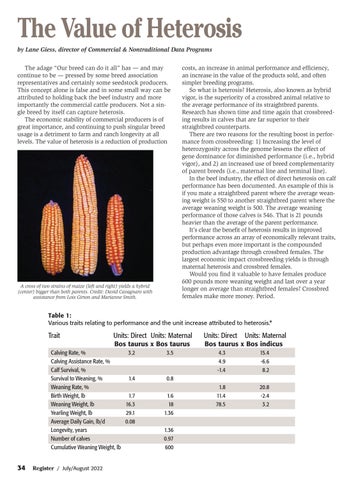
A cross of two strains of maize (left and right) yields a hybrid (center) bigger than both parents. Credit: David Cavagnaro with assistance from Lois Girton and Marianne Smith.
costs, an increase in animal performance and efficiency, an increase in the value of the products sold, and often simpler breeding programs. So what is heterosis? Heterosis, also known as hybrid vigor, is the superiority of a crossbred animal relative to the average performance of its straightbred parents. Research has shown time and time again that crossbreeding results in calves that are far superior to their straightbred counterparts. There are two reasons for the resulting boost in performance from crossbreeding: 1) Increasing the level of heterozygosity across the genome lessens the effect of gene dominance for diminished performance (i.e., hybrid vigor), and 2) an increased use of breed complementarity of parent breeds (i.e., maternal line and terminal line). In the beef industry, the effect of direct heterosis on calf performance has been documented. An example of this is if you mate a straightbred parent where the average weaning weight is 550 to another straightbred parent where the average weaning weight is 500. The average weaning performance of those calves is 546. That is 21 pounds heavier than the average of the parent performance. It’s clear the benefit of heterosis results in improved performance across an array of economically relevant traits, but perhaps even more important is the compounded production advantage through crossbred females. The largest economic impact crossbreeding yields is through maternal heterosis and crossbred females. Would you find it valuable to have females produce 600 pounds more weaning weight and last over a year longer on average than straightbred females? Crossbred females make more money. Period.
Table 1: Various traits relating to performance and the unit increase attributed to heterosis.*
Trait
Units: Direct Units: Maternal
Units: Direct
Bos taurus x Bos taurus
Bos taurus x Bos indicus
Calving Rate, % 3.2 Calving Assistance Rate, % Calf Survival, % Survival to Weaning, % 1.4 Weaning Rate, % Birth Weight, lb 1.7 Weaning Weight, lb 16.3 Yearling Weight, lb 29.1 Average Daily Gain, lb/d 0.08 Longevity, years Number of calves Cumulative Weaning Weight, lb
34
Register / July/August 2022
3.5
Units: Maternal
4.3 4.9 -1.4
15.4 -6.6 8.2
1.8 11.4 78.5
20.8 -2.4 3.2
0.8 1.6 18 1.36 1.36 0.97 600
Value of Heterosis.qxp_Layout 1 7/13/22 2:57 PM Page 3
Table 2: Summary of crossbreeding systems by amount of advantage and other factors.*
Type of System 2-breed rotation 3-breed rotation 2-breed rotational/ terminal sire
terminal cross w/ straightbred females terminal cross w/ purchased F1 females rotate bull every 4 years composite breeds
rotating unrelated F1 bulls
% of Cow Herd
% of Marketed Calves
Advantage (%) +
Retained Heterosis (%)
Number of breeds
A*B rotation A*B*C rotation
100 100
100 100
16 20
67 86
2 3
A*B rotational T x (A*B) Overall
50 50 100
33 67 100
21
90
3
T x (A)
100
100
8.5
0
2
T x (A*B)
100
100
24
100
3
A*B rotation A*B*C rotation 2-breed 3-breed 4-breed
100 100 100 100 100
100 100 100 100 100
12–16 16–20 12 15 17
50–67 67–83 50 67 75
2 3 2 3 4
A*B x A*B A*B x A*C A*B x C*D
100 100 100
100 100 100
12 16 19
50 67 83
2 3 4
+ Measured as the advantage in percent increase in lbs. of calf weaned per cow exposed
And maintaining crossbred females in your production system is not as difficult as some may think. There are many types of crossbreeding programs that range from two or three breed rotations to terminal crosses using purchased F1 females. However, perhaps the most popular and simplest to use is by integrating a composite breeding program with hybrid seedstock where two, three, or four breed composites are developed. These systems exist today and are perpetuated by the rise in composite seedstock bulls available in the market. Determining the right breeds needed for a composite program can be evaluated through admixing complimentary breeds — where the strengths of one breed are integrated to address the weakness of another breed. Table 3 provides a glimpse at some of the complimentary options for developing composite programs. While these breed groupings provide a start to developing composites, the more useful tool at your disposal are breed agnostic Expected Progeny Differences (EPD). Being able to compare parent animals across breeds for the same economically relevant traits without adjustment factors provides commercial producers with targeted tools for hybrid development.
The EPD generated from the International Genetic Solutions (IGS) genetic evaluation incorporates data from millions of animals across numerous breed populations. The resulting EPD are directly comparable across breeds and are a targeted tool to help commercial cattle producers develop and amplify composites. The suite of tools available from IGS benefit from many breed associations sharing their data and developing more relevant and reliable predictions. An example of one of these tools is the Feeder Profit Calculator (FPC), where anyone can use the free service to estimate the relative genetic and management value on commercial feeder calves. The tool takes into consideration vaccination protocols, weaning dates, sex, and age of the calves, but perhaps most importantly it appropriately weights the value gained from crossbreeding. Comparing side-by-side populations of straightbred calves to crossbred calves with the same management, the FPC takes into consideration the boost in performance and can determine how much the crossbred calves should make on a $/cwt basis. The tool also recognizes that good genetics cannot overcome bad management. (continued on page 36) July/August 2022 / Register
35
Value of Heterosis.qxp_Layout 1 7/13/22 2:58 PM Page 4
The Value of Heterosis (continued from page 35)
Table 3: Breed strengths for performance traits, where increasing number of Xs indicate higher levels of the trait.
Breed Group
Growth Rate & Mature Size
% Retail Product
Age at Puberty
Angus Hereford Shorthorn South Devon
xxx xxx xxx xxx
xx xx xx xxx
xx xxx xxx xx
Milk Production xxx xx xxx xxx
Brangus Santa Gertrudis Brahman Nellore
xxx xxx xxx xxx
xx xx xxx xxx
xxxx xxxx xxxxx xxxxx
xx xx xxx xxx
Braunvieh Gelbvieh Maine Anjou Salers Simmental
xxxx xxxx xxxxx xxxxx xxxxx
xxxx xxxx xxxx xxxx xxxx
xx xx xxx xxx xxx
xxxx xxxx xxx xxx xxxx
Limousin Charolais Chianina
xxx xxxxx xxxxx
xxxx xxxx xxxx
xxxx xxxx xxxx
x x x
Research informs us that crossbred females and crossbred calves perform better and are more valuable than their straightbred counterparts. These studies are backed by controlled efforts like the tri-county futurity, which showcased that SimAngus and Simmental-sired calves by English mothers were worth $15 to $24 more than the straightbred English calves. The beef industry demands crossbreeding alternatives for the simple fact it makes commercial cattle producers more profitable. We are already seeing the rise in demand for hybrid bulls, but I suspect as we look into the not-sodistant future of this industry, the concept of “one breed can do it all” will be firmly relegated to the past. n For questions on crossbreeding programs and hybrid utilization, contact Lane at lgiess@simmgene.com. * Adapted from Beef Sire Selection Manual: Crossbreeding for Commercial Beef Production. Ritchie et al., 1999; Gregory and Cundiff, 1980
36
Register / July/August 2022
7-ASA Your Date Their Future (Version #3) fp 4c.qxp_Layout 1 7/8/22 1:30 PM Page 1
Kay Thayer, Passes.qxp_Layout 1 7/13/22 3:06 PM Page 2
Kay Thayer, 84, Passes by Dan Rieder
Bozeman native Jeannette Kay Thayer passed away on June 22 at the age of 84 after a brief battle with cancer. She first joined the staff at the fledgling American Simmental Association as personal secretary to Don Vaniman in 1970, and continued to fill A fervent football fan, Kay posed with that role until her retireChamp, the team mascot of Montana ment 36 years later. State University. After nearly a decade as Vaniman’s proverbial “right hand,” she bridged the gap to Earl Peterson, who succeeded Vaniman as CEO. When Brian Kitchen replaced Peterson in 1990, she continued seamlessly. And, six years later, she helped Jerry Lipsey launch his 13-year tenure as CEO. Not only did she handle voluminous amounts of correspondence, board minutes, and telephone inquiries, she also worked tirelessly to keep members of the Board of Trustees in the ASA loop. In fact, trustees looked on her not only as a friend, but as a reliable, dependable source — overseeing airline travel and hotel arrangements, while providing an endless fountain of needed information for keeping meetings timely and productive. In fact, the Board held her in such high esteem that in 1995, they recognized her with the prestigious Golden Book Award, the American Simmental Association equivalent of the Hall of Fame. Born on October 15, 1937, to Bill and Rae Jenkins in Bozeman, she was the middle of three children in a family that also included an older sister, Jan, and a younger brother, Buck. A graduate of Bozeman High School, Kay married Dick Thayer. Shortly thereafter the newlyweds moved to Renton, Washington, where their two sons, Russ and Ted, were born. She was preceded in death by her husband, parents, sister, and brother. She is survived by sons Russ (Teri) and Ted (Dalyce); four grandchildren, Tawni (Justin) Jetter, Nicki (Todd) McGraw, Mark (Jenna) Thayer, and Joel (Kylee Koch) Thayer; and four great-grandchildren. A natural athlete, she was a woman of many passions, having developed a deep appreciation for the beauty of nature and all it had to offer. She was in her element whether she was snow-skiing, water-skiing, camping, hiking, snowmobiling, or rafting. In addition, she was a loyal fixture at area sporting events for decades, cheering on the Montana State Uni-
38
Register / July/August 2022
versity Bobcats, the Bozeman High School Hawks, and the American Legion Baseball team. On the national level, she was an ardent Seattle Seahawks fan, and loved watching Larry Bird when he was lighting up the NBA back in the 1980s and ’90s.
A Coworker’s Memories “I was so sad to hear about Kay’s passing. She was my good friend and I will miss her. We all recall that Kay wasn’t one to beat around the bush; she called things as she saw them. My first trip with Kay was in 1991 when we attended the Calgary Stampede to promote the 1992 World Simmental Congress in Dallas. When they played both the US and Canadian national anthems, I got tearyeyed. Kay gave me a look like I was crazy, and said ‘snap out of it, you can almost see your house from here,’ and we started laughing,” said Kay’s friend and co-worker, Paulette Cochenour. “Kay was a lot more than Simmental. She was an outdoor enthusiast and enjoyed being outdoors in the beautiful place where we lived,” Cochenour continued. “The nice thing about being a certain age is that we are who we are. The struggle is over for Kay, who long ago came to accept who she was and then lived a good life.”
Words from the First CEO Vaniman worked hand-in-hand with Kay to successfully establish the American Simmental Association as an organization that earned great respect and prominence throughout the US and global beef industry. After his tenure at ASA,Vaniman assumed a career in farm and ranch real estate but continued to maintain a close personal friendship with Kay and her family. “I was the first and only full-time employee of the American Simmental Association in December of 1969 and personally recorded our 100th member, and handregistered Parisien as number 1 and Bismark as number 2 in the Herd Book. I did all the membership certificates and cattle registrations on my little electric typewriter by myself. “It was not very long before I realized that I could not keep up with all the work. I needed help! I had a friend who was the personnel director for Security Bank in Bozeman. He had a pile of applications for employment about 15 inches high. I asked him who was next on top of his list if he were to hire someone on that day, and Kay Thayer was his suggestion. I could not have found a friendlier, more willing-to-learn-the-cow-business, or a more efficient and loyal individual.
Kay Thayer, Passes.qxp_Layout 1 7/13/22 3:07 PM Page 3
An ASA employee for more than three-and-a-half decades, Kay Thayer served as an indispensable assistant to four chief executive officers. “When I resigned as Executive Secretary of the American Simmental Association in 1978, I had 65 employees working for me. To this day, Kay still stands out as my very best hire! Kay worked for me for ten years, then stayed on with American Simmental for a total of 36 years. “At first, the ASA Board promoted the Swiss origin of Simmental, so for the first few National Conventions, I got some Swiss dress patterns and had the gals we took to help with the Convention make what I thought were colorful, good-looking Swiss dresses. Later, I was told these dresses were not too popular with the gals. However, Kay had a wall in her home covered with Simmental memorabilia. Prominent among them was a large photo of Kay and some of the gals in their Swiss dresses, welcoming Parisien in the front door of the American Simmental office.” Vaniman will miss his old friend. “There was only one Kay Thayer and there will never be another. Heaven will be a brighter place with Kay there!” he concluded. n
Kay Thayer, left, with co-workers Steve McGuire and Paulette Cochenour, during an ASA Annual Meeting.
Taking a breather during one of her beloved mountain hikes.
Kay and Paulette on the slopes.
July/August 2022 / Register
39
Most Prolific Donor Cows_22.qxp_Layout 1 7/13/22 3:14 PM Page 2
This list is sorted by total number of calves reported, and includes the top 50 females. $API = All Purpose Index
Animal # Name
Birth Date
$TI = Terminal Index
Breed # of Progeny $API
$TI
Owner Name
2106820
SOSF Ebonys Joy L-123
2/3/2001
PB SM
287
124.3
62.8
Walsh-Groves-Double S-Janssen
2446017
Miss Werning KP 8543U
2/17/2008
PB SM
285
123.5
70.9
Dale Werning & Rust Mountain View Ranch
2584182
HF Serena
2/8/2011
PB SM
263
112.6
79.2
Trennepohl Family Farm/H2Os Farm
2711735
Haras Hairietta Clone H4W
1/23/2009
3/4 SM 1/4 AN
237
98.6
57.5
Hara Farms
2410956
EKHCC Red Jewel 760
4/25/2007
PB SM
236
111.5
70.3
Jaron & Kevin Van Beek
2385520
Miss Knockout 74T
3/15/2007
PB SM
229
92.9
61.2
Scott Hobbs-Jones Cattle-102 Cattle Co
2291327
GCF Miss Caliente
1/1/2005
PB SM
225
90.4
49.4
Dr Josh Ervin
2304803
Miss Werning 534R
3/26/2005
PB SM
225
85.7
55.5
Dale Werning
2289443
Lazy H Burn Baby BurnR34
5/11/2005
PB SM
223
105.2
62.3
Rocky Hill Farms
2317687
LRS Ms Dakota 559R
3/21/2005
PB SM
221
114.4
75.6
Taylor Farms
2575604
TJ 22X
3/16/2010
PB SM
220
144.1
84.3
Eagle Pass Ranch
2437282
HS Stop and Stare U118L
2/13/2008
PB SM
217
102.1
72.5
Brooke Polzin
2529932
TJ MS 38W
1/26/2009
PB SM
210
161.3
82.7
Bichler Simmentals/Lazy C Diamond Rch
2387869
SS Magnificent Dreams
1/8/2007
PB SM
203
126.3
67.1
Kasl Simmentals
2481646
STF Onyx 451W
1/2/2009
PB SM
201
96.3
51.4
Dbl Bar D/Z Henthorn/Sloup SM/Fenton Frm
2527626
CCR Ms Apple 9332W
9/21/2009
PB SM
199
114.6
74.1
Bichler Simmentals
2184078
3C Melody M668 BZ
5/20/2002
PB SM
191
124.2
73.2
Wager Cattle Co
2154953
SVF NJC Magnetic Lady M25
2/16/2002
PB SM
190
124.0
66.9
Sloup Simmentals
2334099
Hooks Sonya 20S
2/21/2006
3/4 SM 1/4 AN
175
185.1
89.0
Sonya Profit Partnership
2334127
Hooks Sarita 4S
2/12/2006
3/4 SM 1/4 AN
172
139.6
74.2
Clear Springs Cattle Co
2186256
Kappes Sadie M166
3/21/2002
PB SM
169
94.3
70.6
Kappes Simmentals
2435038
LLSF Cayenne Up401
4/1/2008
PB SM
160
94.4
63.9
Jerry or Barb Lee
2637396
WHF/PRS/HPF Alley 247Y
9/7/2011
PB SM
158
117.9
71.5
Brooke Polzin
2288113
HPF Ms Honey R007
1/18/2005
PB SM
152
95.5
55.4
S&S Simmentals
2427972
Miss CCF Sheza Babe U2
1/3/2008
PB SM
147
97.5
55.6
Double J Ranch
2435596
JS Flatout Flirty 46T
9/15/2007
PB SM
143
96.9
62.6
Loschen Farms
2399540
TJ 8T
1/10/2007
1/2 SM 1/2 AN
137
161.4
90.8
Lazy C Diamond Ranch
2764813
HILB Crazy N Love A475S
3/8/2013
PB SM
136
98.3
59.6
HILB/Jass
2409588
JF Ebonys Joy 709T
2/19/2007
PB SM
135
123.8
65.2
Hoffman Ranch
2247919
HSF Victoria P30
3/9/2004
PB SM
134
126.5
60.8
Hecksel`s Simmental Farm
2251896
AJE-RCC Lizzys Pearl P4
5/2/2004
PB SM
134
98.7
57.6
Hecksels Simmental-Boesl Farms
2281576
AJE Gabby R7
2/18/2005
PB SM
127
120.6
74.6
Hilbrands Cattle Co
2606756
KS Penny X395
2/27/2010
PB SM
127
120.4
72.4
Roger A Kenner
2357410
KA TCF Independence S30L
7/4/2006
PB SM
124
100.0
55.6
Windy Ridge Simm & Gonsior Simm
2374428
Kenco Miley Cottontail
10/13/2006
PB SM
123
110.3
72.2
Barrett G Billingsley
2341061
JF Ebonys Joy 612S
3/13/2006
PB SM
122
129.1
65.6
Janssen-Silverstone-Hodgen-Carpenter
2587614
SWC Ruby Yetti 143Y
3/18/2011
PB SM
120
108.8
71.8
Shipwreck Cattle - Ruby Cattle Co
2974794
WS Miss Sugar C4
1/16/2015
PB SM
119
178.6
106.3
Lazy C Diamond/Kellers Broken Heart Rch
2390630
Double J Miss T739
2/20/2007
PB SM
117
109.9
72.4
Double J Farms
2476049
JM Steel My Heart
12/13/2008
PB SM
117
85.7
57.5
Cramer Schneider/Bill Sloup/Fenton
2584931
HPF/Borne Knockout Y030
1/17/2011
PB SM
117
97.7
69.3
Shoal Creek Simmental
2544686
Bailey`s Ms Dreamy 946W
5/7/2009
PB SM
116
112.5
68.6
Bailey Livestock
2623258
Miss Star Above
3/9/2011
3/4 SM 1/4 AN
115
96.6
65.8
Kori McLaughlin/Tree Lane Farms
2482168
Hook`s Upper Limit 117U
3/18/2008
1/2 SM 1/2 AN
114
114.1
69.7
Hook Farms
2385142
Double R Miss 29G T18
2/2/2007
PB SM
113
102.4
72.9
Hailey Eads
2521166
KLS Diamond W516
5/15/2009
PB SM
113
118.6
68.0
Jones Show Cattle & Campbell Land/Cattle
1585473
Miss Triple T Marie
1/4/1992
PB SM
111
94.0
55.8
Sloup Simmentals
2290840
SVF NJC Ebonys Charm R29
3/4/2005
PB SM
111
109.3
71.4
Welsh Simmentals
2295057
DMN Daisy Mae
3/3/2005
5/8 SM 3/8 AM
110
75.9
54.5
HTP Simmentals
2995924
JBSF Proud Mary
3/7/2015
PB SM
106
113.4
67.8
Sara Sullivan
40
Register / July/August 2022
n
7-State Marketplace bus card ads.qxp_Layout 1 7/14/22 3:31 PM Page 2
State Marketplace California
Indiana
Red River Farms 13750 West 10th Avenue Blythe, CA 92225 Office: 760-922-2617 Bob Mullion: 760-861-8366 Michael Mullion: 760-464-3906
THE PERFORMANCE IS BRED IN – BEFORE THE BRAND GOES ON!
DICKINSON SIMMENTAL AND ANGUS RANCH
Simmental – SimAngus™ – Angus
Colorado
Quality Red & Black Simmental
John & Barbara 812-546-5578 15633 E Jackson Rd. Hope, IN 47246
Dan, Jill, Luke & Chase 812-371-6881 Ben, Ashley, Gracie & Laynie 812-371-2926
Kirk • 785-998-4401 (phone & fax) 2324 370th Ave. Gorham, Kansas 67640 www.dickinsonranch.com
March 18, 2023 51st Annual Production Sale At the Ranch
Dixson Farms, Inc. Carol Dixson, Kevin Dixson, & Lyle Dixson, D.V.M.
13703 Beaver Creek Rd • Atwood, KS 67730 785-626-3744 • drlyle@live.com www.dixsonfarms.com
DX
JENSEN SIMMENTALS Steven A. Jensen • 913-636-2540 40532 John Brown Highway Osawatomie, KS 66064 jensensimmentals@gmail.com
Iowa
H
In our 6th decade breeding Simmental cattle.
www.jensensimmentals.com
Joe & Kim Mertz 785-458-9494 Abram & Dani Mertz 785-456-3986 7160 Zeandale Road Manhattan, KS 66502
Illinois
www.rivercreekfarms.com
33rd Annual “Built to Work” SimAngus Bull Sale, February 8, 2023
Kansas Owner: Jim Berry
Commercially Targeted Seedstock
Cattle Manager: Ben Lehman 563-920-0315 6502 Rt. 84 South Hanover, IL 61041 815-297-5562
Cow Camp Ranch Kent, Mark and Nolan Brunner 3553 Upland Rd. Lost Springs, KS 66859-9652 785-466-6475 Kent 785-466-1129 Nolan 785-258-0173 Mark nolan@cowcampbeef.com
Annual Production Sale March 17, 2023
Simmental Angus SimAngusTM
Steve & Mary Gleason • Jake, Becky, Ben, Joe & Sam
12410 Blazingstar Rd • Maple Hill, KS 66507 Phone: 785-256-6461 • Steve: 785-640-8060 • Jake: 785-640-8062 www.Sunflowergenetics.com
(Continued on page 43)
Spring Bull Sale – Friday, February 3, 2023
www.wildberryfarms.net
July/August 2022 / Register
41
7-8-22 Back to the Basics.qxp_Layout 1 7/13/22 3:23 PM Page 2
BACK TO BASICS Digital Certificates Now Available After September 1, 2022, ASA will no longer scan and email or fax copies of printed certificates for registered animals. ASA recently launched a new feature on Herdbook allowing members to download digital certificates for registered animals. Digital certificates are the easiest, most reliable way to obtain a copy of the registration certificate quickly. At the time of download, they include the most up-to-date EPD and pedigree information. The official record is the Herdbook Services record. After September 1, 2022, ASA will no longer scan and email or fax copies of printed certificates. Printing digital certificates will replace scan, email, or fax copies of certificates. If you are
the current owner of record, these can be printed directly from herdbook.org without contacting the ASA office. Digital certificates are accepted for check-in at ASA’s five Major PTP Shows and ASA is encouraging other shows and events to accept digital certificates. Not all shows accept a digital certificate; please check each event to verify if digital certificates are accepted or if you must plan ahead to receive a paper registration certificate.
How to print a digital certificate: n
Log in to your Herdbook member account.
n
Select Animal Search and enter the registration number.
If you are the current owner of record and the registered animal record is in good standing, you’ll find a blue button named: Digital Certificate. n
Select Digital Certificate, located at the bottom righthand corner under the pedigree.
n
You will now have a downloaded copy of the certificate ready to print.
Please contact the registrations department with any questions at simmental@simmgene.com or give us a call at 406-587-4531.
Please note:
42
Register / July/August 2022
n
Digital certificates cannot be used as transfer documents.
n
Digital certificates cannot be requested in email form; they must be accessed by the current owner by logging in to herdbook.org.
n
If you have an animal registered in your name but you do not have a login, contact ASA for login information. n
7-State Marketplace bus card ads.qxp_Layout 1 7/14/22 3:25 PM Page 3
State Marketplace (Continued from page 41)
Minnesota
Montana 180 Black Simmental, SimAngusTM and Angus Bulls to Sell
Bill Begger 482 Custer Trail Road Wibaux, MT 59353 Bill: 406-796-2326 John: 406-795-9914 darbegger@gmail.com
“Red and Black, Polled, Pigmented Simmentals”
J&C SIMMENTALS Black Simmental Bulls & Females Purebred to Percentage
Performance with Quality
Matt Aggen Mobile: 701-866-3544 Home: 507-772-4522 Email: mattaggen@hotmail.com
Just 20 minutes off I-80
JC
Dr. Lynn Aggen Office: 507-886-6321 Mobile: 507-421-3813 Home: 507-886-4016
Verlouis Forster Family 74096 Road 434 Smithfield, NE 68976-1039 Ph 308-472-5036 Verlouis 308-991-2208 Alan Cell Email: alan_forster@hotmail.com
JC
Wednesday, February 1, 2023 • at the ranch, Wibaux, MT
FORSTER FARMS
Jay & Kim Volk Clark & Leslie Volk Bob & Jeanette Volk
Jay 402-720-7596 • Clark 402-720-3323
Harmony, MN 55939 www.oakmfarm.com
20604 US Hwy 30 • Arlington, NE 68002 volkjk@aol.com • www.jandcsimmentals.com
J&C Annual Bull Sale – January 28, 2023
Missouri
JD Anderson
FOUR STARR GENETICS Greg Starr, DVM – Owner 26441 West 109th Terrace Olathe, KS 66061 913-634-3494 dvmfleckvieh@me.com www.fourstarrgenetics.com Find us on Facebook
LUCAS CATTLE CO.
lassleranchsimmentals.com
Clay & Marianne Lassle Sarah & Ryan Thorson 42 Road 245 Glendive, Montana Clay: 406.486.5584 Ryan: 406.694.3722 lrsbeef@midrivers.com
Arapahoe, NE 308-962-6146 powerlinegenetics.com powerlinegenetics@gmail.com
Registered Simmentals, SimAngus & Angus Cattle TM
L
Forrest & Charlotte Lucas, Owners 26511 County Rd. 50 Cross Timbers, MO 65634 Office 417-998-6512 www.lucascattlecompany.com Visitors Always Welcome Cleo Fields 417-399-7124 Jeff Reed 417-399-1241
402-641-2936 Cell
Prickly Pear Simmental Ranch Birthplace of the first Polled Black Simmental Bull Made in Montana Sale • February 4, 2023 Troy Wheeler, Cattle Manager: 406-949-1754 Gary Burnham: 406-439-2360 2515 Canyon Ferry Road • Helena, MT 59602 ASA No. 174 E-mail: ppsranch@gmail.com
Nebraska
Nick and Andrea 303 Northern Heights Drive • Seward, NE 68434 sloupsimmentals@gmail.com • sloupsimmentals.com
Join us at the Farm, October 8, 2022 for our 28th Annual Production Sale.
Triangle J Ranch Darby & Annette Line
35355 Arrow Road • Miller, NE 68858 308-627-5085 Darby Cell www.trianglejranch.com
Bull Sale last Sunday in January and Female Sale first Sunday in November.
(Continued on page 45)
July/August 2022 / Register
43
ASF Fundraising Update.qxp_Layout 1 7/13/22 3:38 PM Page 2
ASF Fundraising Update by Mia Bayer, Youth and Foundation Coordinator The American Simmental-Simbrah Foundation Board has been extremely busy raising funds to benefit the Foundation and its vision of serving youth, education, and research. Fundraising efforts for 2022 were kicked off at the Cattlemen’s Congress in Oklahoma City, Oklahoma. Several unique items were auctioned off, including hunts, advertising opportunities, and the Foundation Female during the Bricktown National sale. The sale of the Foundation Female has been raising money for the AJSA Merit Scholarship program since 1997. This year BCR Time to Shine J014 was donated by Buck Creek Ranch, Yale, Oklahoma. Over 50 breeders came together and purchased the female for a record-setting $67,000. Contributors’ names were then put into a drawing for the female and Diamond J Simmentals from Texas ended up having their name drawn as the winner. This record-selling female helped to push the total raised from Foundation Female sales to over $588,000 since it began. The next fundraising effort for 2022 took us to Denver, Colorado, during the National Western Stock Show. The One SimMagic sale took place on January 15, 2022, and several generously donated items were auctioned off to support the junior merit program. The highlight of the night was undoubtedly the “Gun and Fun” raffle,
PERFORMANCE BREEDERS
Who collect records on complete contemporary groups. Let the numbers show that you are serious about performance . . . become a Performance Advocate.
Go to Herdbook.org and check out the new dashboard for ease of tracking data.
For more information: Call 406-587-4531 44
Register / July/August 2022
“Fundraising through the ASF is important for the future of our breed. The ASF encompasses research, education, and our youth, and all three parts are equally important. That is what is neat about the makeup of our board: we all work together, but we each have areas that we’re passionate about.” ~ Tonya Phillips, longtime ASF board member donated by Eichacker Simmentals. Ten bottles of liquor were auctioned off for a chance at winning an elite rifle. At the end of the night Circle M Farms came out as the rifle winner, and almost $20,000 was raised collectively by all the items sold for the Foundation. The month of January ended on a high note in Fort Worth, Texas, at the Cowtown Classic. Again, many donated items were auctioned off. Sale highlights included the sale of the back cover of the National Classic show program for the 2022 National Classic held in Madison, Wisconsin, June 24–30. Innovation AgMarketing was the winning bidder of that advertising opportunity. Other items being sold included a toy pedal tractor donated by Red River Farms of Texas and semen donated by ABS. Over $6,500 was raised thanks to generous Foundation supporters. Another fundraising effort gaining momentum is the Legacy Lot program. The Foundation Legacy Lot program provides breeders a chance to commit to donating the proceeds of either an animal or a genetic lot sold in their annual sale. Proceeds will be designated by the donor to any of the four pillars (Research & Technology, Youth, Education, and General) within the Foundation. Several breeders have stepped up to offer legacy lots on their sales. This year, Dixie National hosted the MississippiDixie Simmental sale, which included the sale of a Legacy Lot that generated lots of excitement and money for the program. Thanks to generous breeders and buyers, it is the hope of the Foundation board that the Legacy Lot program will continue to grow and support the many pillars of the Foundation. The ASF is lucky to have the support of so many breeders and contributors. Newly formed memorials such as the Ronnie G. Miller scholarship and the Sammi Long Memorial are also great ways to get involved by honoring those who made an impact on our breed, while keeping their memory alive. Thank you to all the past and future donors for your continued support of the Foundation. Please contact me or any Foundation board member to get involved in fundraising or to make a donation. n
7-State Marketplace bus card ads.qxp_Layout 1 7/14/22 3:26 PM Page 4
State Marketplace (Continued from page 43)
Phone: 701-384-6225 Cell: 701-741-3045
Terry Ellingson & Family
Nebraska cont. 5065 125th Ave. NE • Dahlen, ND 58224 tellings@polarcomm.com • www.ellingsonsimmentals.com Annual Production Sale, January 27, 2023
Fleckvieh & Fleckvieh-Based Simmentals • SimAngusTM • Simbrah
Scott Riddle Fred Schuetze 817-894-0563 2649 Pear Orchard Road Granbury, Texas 76048 Website: simmentalsoftexas.com • Email: sotsimmentals@yahoo.com
)
Western Cattle Source
(
JF
Jock & Brenda Beeson 100 Wohlers Drive Crawford, NE 69339 308-665-1111 (home) 308-430-2117 (mobile) 308-430-0668 (mobile) Email:wcsbeeson@bbc.net
North American Fullblood Breeders 23098 Gunder Rd • Elkader, IA 52043 Jerry: 563-245-2048 • Preston: 563-880-2075 jbrink@alpinecom.net Visit our website: www.brinkgenetics.com
Steven A. Jensen • 913-636-2540 40532 John Brown Highway Osawatomie, KS 66064 jensensimmentals@gmail.com
Edge of the West Bull and Female Production Sale each February
R
K
Roger, Jeanette, & Erika Kenner
5606 57th St. NE Leeds, ND 58346 Phone 701-466-2800 Erika 406-581-1188 erika.kenner@gmail.com Fax 701-466-2769 www.kennersimmental.com
SIMMENTALS
REGISTERED SIMMENTAL F-1 REPLACEMENTS REGISTERED BRAHMANS
MYRA NEAL MORRISON 8800 Row-Cab Line Rd. • Rockwell, NC 28138 704-279-3128 • 704-202-6171 Cell E-mail: myram@morrisonfarm.com www.morrisonfarm.com
JENSEN SIMMENTALS
Claye and Michelle Kaelberer and Family 4215 County Road 85 • New Salem, ND 58563 701-220-3124 (cell) • 701-843-8342 (home)
ENNE
North Carolina
BRINK FLECKVIEH
Kaelberer Simmentals
QBVJT
VJT Ranch
Power by Design Quandt Brothers 701-710-0080
701-710-0843 Oakes, ND Sale Feb. 21, 2023
H
In our 6th decade breeding Simmental cattle.
www.jensensimmentals.com
North Dakota ” “BBAS RK OF
SIMMENTAL CATTLE 6322 Highway 35 Adams, North Dakota 58210
THE M ... Joe: 701-331-0344 • Mark: 701-331-3055 ...QUALITYAnnual Production Sale • February 10, 2023
TNT Simmental Ranch
38th Annual “Carrying On” The Genetic Explosion Bull Sale! Friday, February 10, 2023 • At The Ranch, Lehr, ND www.tntsimmentals.com
DVAuction.com
Shanon & Gabe Erbele Kevin & Lynette Thompson Lehr, ND Almont, ND S 701-527-5885 • G 701-426-9445 H 701-843-8454 • K 701-391-1631 gserbele@hotmail.com kevinandlynette@westriv.com facebook.com/tntsimmentalranch
Wilkinson Farms Simmentals
Terry and Cathy Schlenker Family 7649 49th Street SE Montpelier, ND 58742 701-489-3583 (home) 701-320-2171 (cell) www.wilkinsonfarmssimmentals.com
July/August 2022 / Register
45
7-8-22 AJSA Connection.qxp_Layout 1 7/14/22 11:29 AM Page 2
AJSA CONNECTION Developing leaders through friendship, networking, and communication skills! 2022–2023 American Junior Simmental Association Board of Trustees
by Emerson Tarr Making connections during the week of the National Classic is a huge part of what the AJSA stands for. The goal of the AJSA is for the exhibitors to come out of the week not only with new friends and new skills, but the Classic also provides the opportunity to connect with many industry leaders. Many industry leaders and Simmental breeders have a hand in making the event possible. It is important to thank the sponsors and volunteers. This year I had a firsthand look at how much work my mother and so many others did behind
the scenes. It takes a substantial number of volunteers. For example: 75 sales talk judges, 65 public speaking judges (and 32 timers), 40 quiz readers, 35 judging contest volunteers, and so many more. The countless hours that our Illinois coordinators put in to fundraise, organize, and plan for the classic can go unnoticed, but a simple thank you can make anyone’s day. Who knows, it might be the reason they smile that day! I hope you all enjoyed the 2022 AJSA National Classic. It could not have happened without the sponsors, volunteers, and people behind the scenes. So please consider writing a thank you note to let them know you appreciate them. Taking the time and making a connection with someone could impact your future in ways you can’t even imagine. n
Below is an example of a thank you note written for one of the many sponsors of the 2022 National Classic:
Dear Sponsor, I attended the 2022 AJSA National Classic and had a great time! I wanted to thank you for your donation and support of this event because without you it would not have been possible. Your contribution allowed me to make connections with other exhibitors from across the country, while still competing in contests and improving on skills that will benefit my future career. Thank you again, Emerson Tarr
Eastern Region Luke Harker Hope, IN 812-371-7976 lukeharker2252@gmail.com Walker Housley Dayton, TN 423-599-8346 walkerhousley@gmail.com Matt Koverman Minford, OH 740-988-0203 koverman.18@osu.edu Garrett Walther Centerville, IN 765-238-8584 gwalther55@gmail.com
North Central Region Jazlynn Hilbrands Holloway, MN 320-297-1611 jmhilbrands@gmail.com Martha Moenning Hayfield, MN 504-923-1114 marthamoenning@gmail.com Emerson Tarr LeRoy, IL 309-205-0860 eleetarr2021@gmail.com
South Central Region Rylee Abney Watonga, OK 405-446-7588 rabney914@icloud.com Kaitlyn Cloud Carthage, MO 417-793-7824 kcloud2002@gmail.com Hallie Hackett Texarkana, TX 903-748-0345 halliehack10101@gmail.com Blake Henrichs Okarche, OK 405-831-1672 bhenrichscattleco@gmail.com
Western Region
www.juniorsimmental.org 46
Register / July/August 2022
Bella Beins Deweyville, UT 435-452-1548 bella.beins@gmail.com Blake Fabrizius Carr, CO 970-556-9115 bwfabrizius@gmail.com Jonna McCullough Fort Benton, MT 406-868-0253 mcculloughjonna1@gmail.com Sydney Schwenk Sandy, OR 503-847-6828 sydney.schwenk55@gmail.com
7-State Marketplace bus card ads.qxp_Layout 1 7/14/22 3:28 PM Page 5
State Marketplace (Continued from page 45)
Ohio
Oklahoma Gary and Cindy Updyke Checotah, OK • 918-473-6831 (H) • 918-843-3193 (C) garyupdyke38@gmail.com www.facebook.com/UpdykeSimmentals
Steve & Cathy Eichacker 605-425-2391 or 605-421-1152 email: es@triotel.net 25446 445th Ave Salem, SD 57058
Willis Simmentals 5759 Enville Road Marietta OK 73448 willissimmentals@arbuckleonline.com
Annual Bull Sale • March 3, 2023
Quality Simmental Breeding Cattle 10 miles east on Hwy. 32, 1/4 mile north on Enville Road.
Jon 580-795-4601
Bobby 580-276-2781 (ph. & fax)
Clay Ekstrum 605-778-6185 (H) 605-730-1511 (C)
PO Box 127 Harrod, OH 45850 419-648-9196 (home) 419-648-9967 (office) 419-230-8675 (cell)
Troy Jones & Randy Jones
jonesshowcattle@hotmail.com • jonesshowcattle.com
South Dakota’s Source for Outcross Performance Simmentals!
John Ekstrum 605-778-6414
South Dakota
– Specializing in Hard to Find Red Breeding Stock – 36220 257th St., Kimball, SD 57355 clayekstrum@midstatesd.net • ekstrumsimmentals.com
Benda Simmentals Jim and Jay Benda 26106 366th Ave. Kimball, SD 57355 605-778-6703
Jim: 605-730-6703 (Cell) Jay: 605-730-0215 (Cell) bendaranch@midstatesd.net
Black and Red Breeding Stock
Bruce and Sandra Flittie
Harley – 605-680-0845 Dawn – 605-680-4224 Kari – 605-680-4386 Home – 605-894-4464 Simmental Cattle – Club Calves Harley, Dawn and Kari Cable 2344 Rocky Road • Pukwana, SD hdcable@midstatesd.net
Christensen H Dunsmore
3C Christensen Ranch
John Christensen, Cam & Tyler Fagerhaug 37273 216th Street • Wessington, SD 57381 605-458-2218 home • 605-458-2231 fax 605-350-1278 cell 458-350-2018 Cam
10904 387th Avenue Frederick, SD 57441
Kerry, Justin, and Travis Hart 605-252-2065 (Kerry) 605-216-6469 (Justin) 605-252-0894 (Travis) 4hooves@nvc.net www.hartsimmentals.com
3 C
Annual Production Sale March 17, 2023 • Wessington, SD
NLC Simmental Ranch Rick & Nalani L. Christensen Dunsmore & NaLea, Chase & Swayzee 21830 372nd Ave • Wessington, SD 57381 605-458-2425 • 605-354-7523 cell 605-350-5216 cell
11913 342nd Ave • Hosmer, SD 57448 605-283-2662 • flittiesimm@valleytel.net
NLC
Dan Lehrman 605-530-5903 605-523-2551 (Res) • lehrmanvd@triotel.net 43058 245th Street • Spencer, SD 57374
R&R Cattle Company Steve & Elaine Reimer & Family 25657 345th Avenue Chamberlain, SD 57325 Phone: 605-234-6111 Email: rrcattle@midstatesd.net
(Continued on page 50)
July/August 2022 / Register
47
7-8-22 Fleckvieh Forum.qxp_Layout 1 7/13/22 3:41 PM Page 2
FLECKVIEH FORUM by Larry H. Maxey, founder and superintendent, NAILE Fullblood Simmental Shows larryhmaxey@gmail.com
Editor’s Note: This is the twentieth in the series Our Pioneers.
Is there a Simmental pioneer who you would like to see profiled in this series? Reach out to Larry Maxey or the editor to submit your suggestions: larryhmaxey@gmail.com editor@simmgene.com
Our Pioneers — Charles “Charlie” Redd (May 8, 1889 — March 30, 1975) Charlie Redd was born May 8, 1889, in Bluff, Utah. He was the sixth of eight children of Lemuel Hardison Redd, Jr., and Eliza Ann Westover, a devout family of the Mormon faith. Most likely our readers are not familiar with his name. However, in the early to mid-twentieth century, many people in the West and Northwest would most certainly have known of him, from the humble farmers and ranchers of the era to those in the highest public offices around the world. Merriam-Webster defines “audacious” as “daring; reckless; bold.” Leonard J. Arrington, in his biography of Charlie, chose the title Utah’s Audacious Stockman: Charlie Redd (Utah State University Press and the Charles Redd Center for Western Studies, Brigham Young University, 1995) — a most fitting word to describe the character and personality of this uniquely gifted person. During my research for the February 2021 edition of this column, and my second piece profiling Travers Smith, the name Charlie Redd first appeared. Smith had been in contact with numerous people exploring the idea to import Simmental cattle from Europe to North America. In 1966, Smith corresponded with Redd about his plans and Redd commented: “If you ever get a permit, I want to pick the bull for you.” When the time came, Redd had a scheduling conflict. Smith would have to go it alone. The rest, as they say, is history. However, it is safe to conclude that Smith highly valued the knowledge and experience that Redd possessed. Those attributes came from a life dedicated to ranching and the hard work of a stockman. Redd attended Brigham Young University where he studied agriculture and business. He was active in sports, politics, and debate. In 1913, after completing missionary work, he returned to La Sal in southeastern Utah where he became manager of the newly organized La Sal Livestock Company. He eventually assumed full ownership of it and its successor Redd Ranches. The terrain around La Sal is rugged. To survive in that environment, the people and animals had to match that ruggedness. Redd was up to the challenges. Large herds of sheep and cattle were kept on a vast expanse of land. His practice of continually adapting and innovating got him and his ranching enterprises through the toughest of times, from regular droughts to the Great Depression. Countless setbacks made him ever more committed to succeed.
48
Register / July/August 2022
From 1924 to 1930, Charlie served in the Utah House of Representatives. He was highly regarded by his peers, and his dedication to advance policies he firmly believed in was noteworthy. He left the legislature in 1930 believing that a person should serve a limited time in a public capacity and then step down. In 1931, Charlie married Annaley Naegle, claiming it to be the best day of his life. Together, they had nine children. They were indoctrinated in the hard, neverending work of ranch life. As far back as 1918, Charlie saw the need to develop cattle to match the harsh conditions of his area. He decided a purebred herd was required and he bought a registered Hereford bull in Idaho. His objective was to develop bulls that would work for ranchers in the region. Until 1959, the bulls were sold through private treaty. Charlie grew tired of the time-consuming process and felt a one-day auction would be better, a practice that continues to this day at Redd Ranches. During the spring and summer of 1957, Charlie and Annaley toured Europe and parts of Asia. In correspondence during his travels he noted: “The livestock have been my first interest. Pastures and crops, second. Statues, museums, and art galleries take a poor third.” He was particularly impressed with the Swiss farmhouses and their orderliness and tidiness. He discussed at length his observations of Charolais and Simmental cattle. Perhaps these interests eventually led to his relationship with Smith. The size and scale of Charlie’s ranching enterprises is hard to comprehend. Robert C. de Baca, author of Courageous Cattlemen, recalled a meeting with Charlie in the 1960s where Charlie told him that he was in control of a million or more acres. Could this be true? The historic Scorup-Somerville Ranch — the S and S — was probably the largest cattle ranch in Utah dating back to the 1800s. In 1965, Charlie purchased the S and S for $2.1 million in cash. Including deeded land and ranch permits, it exceeded 1.5 million acres. Combine this with his other massive land holdings in southeast Utah and northwest Colorado and one can easily see that his statement to de Baca was, in fact, true. Today, his legacy continues. One of his sons, Paul, operates Redd Ranches with two purebred herds and crossbred cattle. Our SimGenetics are part of the mix. When we look at the life and long list of achievements for this incredibly talented man, Charlie Redd, one word comes to mind — audacious! n
7-8-22 News Makers.qxp_Layout 1 7/13/22 3:50 PM Page 2
COW SENSE Listed below are ten questions designed to test your knowledge of the beef industry. Elite: 9–10 correct Superior: 7–8 correct Excellent: 5–6 correct Fair: 3–4 correct Poor: 1–2 correct 1. What is the primary function of iron as a trace mineral? 2. What are the common names for the genetic defect known scientifically as brachygnathia inferior? 3. An animal’s olfactory system is associated with what sense? 4. What is the maximum age at which a steer or heifer can still grade Prime or Choice? 5. What single part of the animal comprises the largest part of total byproduct value? 6. Weaning weight records are considered “irregular” if taken outside of what age range? 7. As a bull produces more and more progeny what happens to the accuracy of evaluating his genetic merit as a sire? 8. What percentage of the genetic makeup of a calf does its greatgranddam contribute? 9. In performance terms, what do the letters WDA signify? 10. The loss of weight an animal experiences during shipping is known by what common term? Answers:
NEWSMAKERS
Iowa Man Wins LMA Championship Will Epperly, Dunlap, Iowa, has been named 2022 World Livestock Auction Champion. The annual championship is under the auspices of the Livestock Marketing Association (LMA) and the 58th annual finals were held in Shipshewana, Indiana. A self-taught livestock auctioneer, Epperly works for Dunlap Livestock Auction in Dunlap and for West Point Livestock Auction, located in West Point, Nebraska. This was Epperly’s twelfth year of competing in the LMA Championship.
In Memoriam… Baxter Black
Benson, Arizona Dr. Baxter Black, DVM, practicing veterinarian who turned legendary cowboy poet, storyteller, and philosopher about rural life, died June 10, at the age of 77. It had been reported earlier that he was in poor health, suffering from blood leukemia and a form of dementia. Recently, Black had been in hospice care at his home in Benson, Arizona. Many ASA members will fondly recall that Black was a guest speaker at the 1982 ASA Summer Conference held in Pasco, Washington. Black was born in Brooklyn, but grew up in Las Cruces, New Mexico.
Steve Sellers
Long Park, Georgia Steven Kent Sellers, of Long Park, Georgia, who served for several years in the 1990s as a sales representative for ASA’s Register and SimTalk magazines, passed away on April 19 after a lengthy hospitalization. Born in Fort Sill, Oklahoma, he had a lifelong passion for music, often writing songs and strumming his guitar. At the time of his death, Sellers was employed as the director of Communications for the Georgia Cattlemen’s Association. He is survived by CeCe, his wife of 40 years; two daughters, Megan (Phillip) Hackle and Sarah (Nick) Evans; a sister, Jenny Garrett; and six grandchildren.
Roxana Tom
San Antonio, TX Roxana Tom, a matriarch of the legendary Tom Brothers Simbrah ranch operation of Campbellton, Texas, passed away April 22 at the age of 83. A Texan through-and-through, she was born in San Antonio, raised in Victoria, lived 45 years in Campbellton, and spent the last five years in San Antonio. An honors graduate of the University of Texas in accounting, she ran the Tom Brothers ranch financial side for more than 30 years. She was preceded in death by her husband John Lytle, Jr., and son John Lytle, III. Survivors are two daughters, Nancy and Roxana; son Phillip (Jessica); two brothers, Venable (Becky) Proctor, and Fred (Chris) Proctor; four grandchildren; and one great-grandchild. n
July/August 2022 / Register
49
Answers: 1. Formation of hemoglobin; 2. Parrot mouth or short lower jaw; 3. Smell; 4. 42 months; 5. Hide; 6. 160 to 250 days; 7. It increases; 8. One-eighth or 12.5%; 9. Weight per day of age; 10. Shrinkage.
Pages 50 and 51.qxp_Layout 1 7/15/22 4:07 PM Page 2
State Marketplace (Continued from page 47)
INTERNATIONAL
Tennessee
South Dakota cont.
Texas
ZZ
Simbrah, SimAngusTM HT, SimAngusTM & Simmental
FILEGONIA
CATTLE
TRAXINGER SIMMENTAL
Reds, Blacks • Bulls and Females Private Treaty Sales
Mike and Terri Traxinger 11176 – 406th Avenue Houghton, SD 57449 Home: 605.885.6347 Mike’s cell: 605.294.7227 mtrax@nvc.net www.traxinger.com
Joe & Beth Mercer 327 CR 459 COMPANY Lott, TX 76656 Cell: 956-802-6995 Home, Office: 254-984-2225 bethmercer1974@gmail.com www.filegoniacattle.com
Jud and Margie Flowers 12111 N. Bryan Road • Mission, TX 78573-7432
956-207-2087 email: judf@lonestarcitrus.com
“No Nonsense” Simbrah Cattle
Australia Approves Patent on “Exercising” Cultivated Meat Israel’s MeaTech 3D Ltd. has been awarded a patent in Australia for a technology that will help create whole cuts of cultivated meat, applying external forces to cultivated muscle tissue “that result in the development of high-quality, structured meat,” the company said in a news release. After cultivating the muscle and fat cells, and bioprinting them into a cut of meat, MeaTech’s system applies forces that are meant to replicate the exercise a steer would get naturally. “Our patented systems and methods strengthen and enhance cultured muscle tissues in a way that mimics how a cow’s muscles are developed while it walks and grazes,” MeaTech chief technology officer Dan Kozlovski said in the release. “We are excited about the first patent approval of our novel technology and processes,” MeaTech CEO Arik Kaufman is quoted as saying. “This achievement strengthens the company’s IP, which we believe will help speed up MeaTech’s entry into the market as the leading producer of high-quality cultivated whole cuts of meat.”
USDA Sees Higher Food Prices for 2022 vs. Previous Forecast Pine Ridge Ranch Pine Ridge Ranch Pine Ridge Ranch LLC
ATHENS, TX
Jane and Bill Travis billtravis@simbrah.com
www.simbrah.com
9876 PLANO RD. DALLAS, TX 75238 Cell: 214-850-6308
Washington Trinity Farms
Angus SimAngusTM Simmental
Generations of Excellence Sale...first Saturday in March Robb & Debbie Forman Mike & Paulette Forman 509-201-0775 509-968-4800 2451 Number 81 Rd. Ellensburg, WA 98926 www.trinityfarms.info • Email: trinity@fairpoint.net
50
Register / July/August 2022
USDA’s latest forecast regarding food prices indicates that consumers will continue to spend more on all food, including meats, pork, and poultry, through the end of the year. The agency’s Economic Research Service (ERS) reported that food prices climbed 1.1% between April and May this year and were 10.1% higher last month compared with prices in May 2021. As a result, ERS also forecast that all food prices will increase between 7.5% and 8.5% versus prices at the end of 2021, with food away from home costing between 6% and 7% more than in 2021. The double-digit inflation that consumers have been dealing with all year also is expected to affect prices of all meat, ERS predicted. The forecast for meat, poultry, and fish prices features an increase of between 8.5% to 9.5% for all of 2022 compared with the same period last year. Beef and veal are expected to cost between 6% and 7% more than last year by the end of 2022, while pork prices
Pages 50 and 51.qxp_Layout 1 7/19/22 9:37 AM Page 3
Livestock Services will climb between 7% to 8% higher than year-ago figures, ERS said. Poultry prices are forecast to rise between 13% and 14% versus 2021 levels.
Auctioneers and Marketing
An R-CALF Checkoff Challenge Reaches End of the Road The US Supreme Court denied a petition on June 27, 2022, from Ranchers-Cattlemen Action Legal Fund, United Stockgrowers of America, asking the justices to hear its legal challenge to the beef checkoff. R-CALF contends that money collected by the checkoff program funds “private speech” rather than “government speech.” The group originally filed its case against the Montana Beef Council in 2018, and later extended the case to more than a dozen other state beef councils. R-CALF lost the Montana case in January 2020, and the appellate court affirmed the lower court’s ruling last August. R-CALF did not release a statement right away. But Colin Woodall, CEO of the National Cattlemen’s Beef Association, said in a statement, “The Supreme Court’s rejection of R-CALF’s petition confirms the Beef Checkoff, and its overseers, are adhering to the letter and spirit of the laws that protect and guide producer investments in the program.” R-CALF has a separate lawsuit filed in the federal District Court for the District of Columbia alleging that USDA did not have the authority to enter the contracts with the state checkoff programs because the agency did not first conduct a public notice and comment period. That case is still pending.
Semen Available on Today’s Hottest AI Sires 573-641-5270 www.cattlevisions.com
ROGER JACOBS
Auctioneer P.O. Box 270 Shepherd, MT 59079 406-373-6124 Home 406-698-7686 Cell 406-373-7387 Fax auctions@jacobslivestock.com
WILLIAMS Land & Cattle Auction Co.
MIKE WILLIAMS, Auctioneer 18130 Brush Creek Road Higginsville, MO 64037 PH: 660-584-5210 • Cell: 816-797-5450 Email: mwauctions@ctcis.net
Insurance
4812 McBreyer Pl Fort Worth, Texas 76244-6083 817-562-8980 Office • 817-562-8981 Fax 815-762-2641 Cell jim@jamesfbessler.com
www.jamesfbessler.com
Genetics
UK Commits $1.9M to Fight Bird Flu Outbreaks The United Kingdom will spend nearly $1.9 million researching new ways to fight avian influenza, the British government announced this week. Scientists from eight leading UK laboratories are joining forces to devise new strategies to fight future outbreaks of bird flu in the wake of the UK’s largest and longest outbreak of highly pathogenic avian influenza (HPAI). The outbreak started earlier than in previous years after the virus continued to circulate in Europe over summer 2021 and led to more than 100 cases across the UK, the government said. (Continued on page 55) July/August 2022 / Register
51
7-8-22 Bulletins.qxp_Layout 1 7/14/22 3:20 PM Page 2
BULLETINS
DNA Updates
Digital Certificates Available
1.) Samples must be sent to the lab within six weeks. Effective immediately, any 1.) pre-labeled/assigned DNA kit or 2.) samples where paperwork has been processed and sent to the member for shipping (including TSUs) must be received at the lab within six weeks of the initial request date. If not received at the lab within six weeks, Neogen will delete the order and the ASA DNA Department must be notified to reprocess the request.
ASA recently launched a new feature on Herdbook allowing members to download official digital certificates for registered animals. After September 1, 2022, ASA will no longer scan and email or fax copies of printed certificates, and is encouraging shows, sales, and other events to utilize digital certificates. Digital certificates are the easiest, most reliable way to obtain an official record quickly. To download a digital certificate, search for your registered animal on Herdbook. If you are logged in and the animal is registered in good standing, there will be a button to download a digital certificate. Only the current owner of an animal can access the digital certificate. Please contact the registrations department with any questions at simmental@simmgene.com.
2.) DNA Price Changes. As of April 2022, ASA’s Board of Trustees approved a new DNA pricing structure to offset testing cost increases from Neogen. The new price adjustments are in addition to the Diluter cost increase that went into effect December 2021. To view the most up-to-date and comprehensive testing offered at ASA, please visit the DNA page on simmental.org. 3.) DNA Certificates. The ASA DNA Department works with Neogen to supply DNA certificates at $15 per animal. Certificate requests must come from an authorized representative listed on the billing account (not necessarily the current owner of the animal). Requests will not be accepted from export companies, ASA members who do not own rights to DNA sample, or any third parties. 4.) DNA Research Fees. DNA research fees are $1/minute and are applied but not limited to: DNA re-checks with more than two alternate parents, multi-sire pasture parentage, misidentified samples, mailing DNA samples to ASA headquarters (excludes research orders) or to the lab without the necessary paperwork, and excessive time to process a DNA request. Each case is unique, so to request an estimate for DNA research fees please contact the DNA department (dna@simmgene.com).
Fall Focus 2022 Fall Focus 2022 will be held August 26–30, in Roanoke, Virginia. See the program insert in this issue or go to fallfocus.org to view speakers, schedule, hotel information, registration, and more.
Open-Breed Registration Rate Will Remain Nominal Last year, the ASA Board of Trustees passed an open-breed promotion to dual-register cows that are registered with another breed association at the nominal rate of $5.00 per head; recently they chose to make this price permanent. The rate applies to any female cow that is registered with another recognized breed association. Any person can apply for registration on an animal registered with another breed association. To get started, email a list of the other breed association numbers with tattoos to simmental@simmgene.com.
2022 Year-Letter is K In accordance with the Beef Improvement Federation guidelines, the year-letter animal identification for 2022 is K, and will be followed by L in 2023, and M in 2024. The letter J was the year-letter designated during 2021. Per the BIF guidelines, the following letters are not used: I, O, Q, and V.
52
Register / July/August 2022
Herdbook Update to Birth Weight Ratio and Collection Method The ASA Board of Trustees has passed a resolution to change the direction of the ratio for birth weights so that larger ratios are assigned to animals with heavier birth weights in their contemporary group and vice versa. This resolution came about to standardize the direction of the ratios so that higher ratios uniformly mean more of that trait. Additionally, breeders can now indicate if they use hoof tape to estimate birth weight in Herdbook. There is a column called “BwMethod” next to the column where birth weights are entered in the animal entry page. If the weights were estimated using hoof tape, then simply put a T in the “BwMethod” column. If birth weights were obtained using a scale, there is no need to enter anything.
Calf Crop Genomic Testing Project Calf Crop Genomics (CCG) is a recent program launched by the American Simmental Association in collaboration with Neogen. Calf Crop Genomics offers a 50% off GGP-100K genomic test including parentage ($25 compared to $50 equivalent test) to participating breeders who test their entire calf crop group. Genotyping entire contemporary groups is important to: 1. use genomically enhanced EPD (GE-EPD) for selection decisions. 2. reduce selection bias in genomic predictions. 3. increase the volume of genotyped animals for future improvements to genetic predictions. The latter two points make any singular genomic test in the future better for all members using genomics. ***Please visit simmental.org to review the program requirements. These samples include at least 90% of the birth group born in the same season (i.e all female calves born in the same season, all male calves born in the same season, or all calves born in the same season). Calves with a removal code or sold will still count toward the total number (they are not an exception).
7-8-22 Bulletins.qxp_Layout 1 7/14/22 3:21 PM Page 3
SimmApp Available In the event when at minimum 80% of the birth group has a DNA sample submitted but 90% is unattainable, in order to qualify for the research genomic price, the member will be responsible to pay the difference between the cost of DNA tests submitted on the birth group and the cost of testing 90% of the birth group as a fulfillment fee. If a member does not reach 90% of the birth group with a genomic test, they will not qualify for the rebates offered for phenotypic reporting. The fulfillment fee is nonrefundable even in the event the member sends in samples on the same calf crop later.
Receive the latest beef industry news, ASA alerts, SimTalk and the Register magazines, Sire Source, press releases, industry events, deadlines, educational articles, and the ASA’s YouTube channel all in one place. Sign up to receive push notifications and get immediate announcements tailored to your needs. SimmApp can be found on Google Play, Apple Store, or Amazon Appstore. n
American Simmental-Simbrah Foundation
Cash Cow Fundraiser Fall Focus • Roanoke, Virginia • August 26-30, 2022
Cow Herd DNA Roundup Continues The ASA Board of Trustees approved Phase II of the Cow Herd DNA Roundup. The project will continue to accept new herds at $25 per sample for a GGP-100K genomic test. Members must test 90% of their calving-age cows to qualify for the reduced price. When members submit mature cow body weights and body condition scores or hip heights on 90% of their calving-age cows, they will receive a $5 credit to their account for each reported cow. Cows must be 18 months of age or older when mature cow measurements are taken to qualify for the $5 credit. The $5 credit will only be applied once in an animal’s life. For example, if a member received a credit for the phenotypes in 2018 for that cow, they cannot receive another credit for the same cow with a new weight and BCS in 2019. With the advent of the Calf Crop Genomics Project, the ASA Board has amended the CHR program for females younger than calving age. Heifer calves and replacement heifers are no longer eligible for the CHR research rate as of January 1, 2021, but calving-age cows and new purchases of calving-age cows will remain eligible for the research rate.
95 5
Selling 95 ear tags for $100 each.
Purchase one or more of the 95 ear tags for a chance to be in the final draw-down during the Fall Focus Recognition Dinner.
5 ear tags will be auctioned at Fall Focus.
A total of 10 will participate in the final draw-down. Five tags drawn from the 95 sold throughout the week; the other five will be auctioned off during the dinner. You’ll receive $2,000 cash if you have the last ear tag number drawn!
Winning ear tag will receive $2,000 cash! For more information or to purchase an ear tag: Mia Bayer 715-573-0139 Cathy Eichacker 605-421-1138 Or any Foundation Board Member fallfocus.org July/August 2022 / Register
53
7-8-22 Beef Business.qxp_Layout 1 7/13/22 4:40 PM Page 2
BEEF BUSINESS
Helping Cattle Cope with Summer Heat by Erin Laborie, Bovine Veterinarian Ready or not, summer heat has arrived. After a major heat stress event in parts of Kansas and Nebraska, the loss of over 10,000 cattle is nothing short of devastating. The combination of hot temperatures, high humidity, and lack of air movement can cause severe cases of heat stress for cattle. This can result in reduced intakes and gains, and in extreme cases, death. Cattle do not handle heat stress as well as humans. The range of temperature in which cattle do not use additional energy to maintain core body temperature is referred to as the thermoneutral zone. This zone generally ranges from 32°F to 75°F for cattle but can vary depending on metabolic size. When temperatures exceed the upper critical temperature, cattle expend energy in an attempt to dissipate heat. Panting and elevated respiration and heart rate are signs that this is occurring. When temperatures remain above 70°F during the night, cattle are unable to recover before the next episode of heat exposure.
Some heat stress mitigation strategies to consider include:
n First and foremost, providing plenty of water and space around water tanks for each animal. When the temperature is above 80°F, cattle require nearly twice as much water (up to 30 gallons per head per day). n Sprinklers with a large droplet size can be effective in cooling cattle and pen surfaces in dry conditions; however, limit use when humidity and moisture are high. n Removal of excess manure is critical. When manure builds up, it holds moisture and increases humidity. n Bedding pens is also an option to help lower the temperature of the pen surface. n Providing shade can help reduce the heat load on cattle up to 20 degrees. Again, providing adequate space per animal is important when using shade structures. Overcrowding will have very little production benefit. n Avoid working or transporting cattle during extreme temperatures. If necessary, handle cattle early in the mornings and not any time after 10 AM. n Consider reducing the amount of feed delivered in the morning to help lower the heat load on cattle, starting the morning before a heat event occurs. n Improve air flow by incorporating tall mounds and placing cattle in pens with fewer windbreaks in the summer. n Monitor weather frequently for potential heat events. Keep an eye out for predicted temperatures in the high 80s and 90s, especially following a rain and in situations where the wind speed is going to be less than five mph for several days. Being proactive rather than reactive is important for avoiding major problems when it comes to heat stress.
Beef Prices Supported by Other Proteins by Derrell S. Peel, Oklahoma State University Extension The question of beef demand for the remainder of this year is an interesting comparison to exceptionally strong wholesale and
54
Register / July/August 2022
retail prices in the second half of 2021. In the first quarter of 2022, retail and wholesale beef prices were sharply higher compared to last year. Retail all-fresh beef prices in May were 9.5% higher year-over-year. However, beef prices rose sharply in the second quarter of 2021 and remained high for the remainder of the year. Retail beef prices reached a record high in October 2021 with an all-fresh price of $7.548/lb. The all-fresh retail price has since decreased slightly to a May 2022 level of $7.374/lb. Despite higher prices for most all products and record gasoline prices, domestic beef demand appears to be holding quite strong thus far. Wholesale and retail beef prices have moderated slightly from the robust domestic demand and record beef exports in 2021. Most beef wholesale prices are currently below last year’s sharply higher prices. The typical May pre-grilling season boost in beef products was more muted or absent this year, but prices have generally increased in June, leading to higher Choice boxed beef prices the past several weeks. Prices for major steak products including tenderloin, ribeye, strip loin, and top sirloin are lower compared to last year, but do not indicate appreciable demand weakness at this point. Brisket prices are significantly lower year-over-year and steady in the second quarter, but still high compared to recent years. The increasingly popular sirloin tri-tip has increased sharply the past several weeks and is more than 25% above the 2021 average price. The ground beef market has remained consistently strong for the last year with prices for 90% lean trimmings holding close to the record high levels achieved one year ago. Broiler product prices have continued to rise and may be helping to support beef prices. Wholesale chicken breast meat prices rose more than 69% from the beginning of the year to a peak in late May before pulling back slightly. More recently, chicken leg and leg quarter prices have jumped sharply. In contrast, chicken wing prices have decreased to the lowest levels in two years. From 2017–2021, wing prices averaged 1.65 times breast meat prices — but in 2022 have averaged about one half of breast meat prices. Retail broiler prices have continued to increase in 2022 in absolute levels and relative to retail beef prices. In May, the ratio of retail all-fresh beef price to the retail broiler composite price dropped to the lowest level since early 2019, meaning that broilers are relatively more expensive compared to beef. Retail pork prices have also risen relative to beef prices, with the ratio of retail pork to retail beef prices at the lowest level in a year. Prices are generally higher for all major wholesale pork products including loin, ham, and shoulder products (Boston butt and picnic). Demand for beef and other proteins will continue to be challenged by higher prices for food, gasoline, and everything else. Thus far, however, beef prices indicate continued strong demand. Strong prices for broilers and pork mean that beef continues to be a relative value among proteins.
Drought Raises Questions About When, How to Cull Cattle Herds by Hunter Gibson, Oklahoma State University As current drought conditions in the western portion of the United States worsen past what they were in 2010 and 2011, cattle producers are faced with making difficult herd management decisions.
7-8-22 Beef Business.qxp_Layout 1 7/17/22 7:10 AM Page 3
Culling is a routine practice used to manage the stocking rate on the ranch and maintain a productive, healthy, and problemfree herd. In fact, cull cows account for approximately 20% of the gross income for a commercial cow operation. While regular culling of lower-producing cows is not uncommon, a lack of grazing land and resources caused by widespread drought requires additional culling consideration. According to Oklahoma State University Extension beef cattle specialist David Lalman, producers should always plan to destock (reduce stocking rate) sooner rather than later. Lalman advises to market livestock before sale prices in the drought region become depressed. “The profit from culled cattle can be vital in keeping the rest of the herd fed during a dry season,” Lalman said, “which is why it’s important to ensure your cattle are in the best condition possible when they go to market.” Emaciated cattle garner less revenue for the producer due to poor red-meat yield. These cattle are also more susceptible to bruising, excessive carcass trim, increased condemnations, and are more susceptible to disease as a result of poor nutrition. Agriculture/4-H Educator Greg Hartman said the dry fall and spring have caused producers to consider additional culling. “People still remember the 2010–2011 drought,” Hartman said. “It’s fresh in producers’ minds because there were quite a few who had to liquidate everything.” Hartman said there are a lot of variables involved in droughtrelated culls. His advice is to make the easy culls as soon as possible to stretch the resources that are currently available. After several months of abnormally dry conditions, Hartman predicts that there will likely be some level of liquidation throughout the summer. He advises producers to make their culling decisions now, even if cattle are sold prematurely. “The best thing that can happen when you cull too early is that the grass gets a rest during a dry year,” Hartman said. When a cow becomes too old or lame to continue as a breeding animal, it must be culled. However, there are economic reasons why a producer may cull a younger or more productive animal. If the cow herd has already been culled for old and unproductive cows, then one might give serious consideration to marketing heifers retained as replacements, Lalman said. “While these replacement females should represent an operation’s best genetics,” Lalman said, “they will require the greatest amount of time to generate revenue and will be the most difficult to breed back once they calve for the first time.” Culling replacement heifers is a tough decision, but it might be the most economical choice for the producer. According to Lalman, these animals have a high potential to generate excellent market value in a separate part of the country not affected by drought.
Act Now to Add Value to Weaned Calves by Mark Z. Johnson, Bovine Veterinarian Added value can be captured through marketing preconditioned weaned calves or retained ownership past weaning. Along with weaning at least 45 days, preconditioning includes several practices that add value to cattle for the buyer and seller. Beyond this, additional weight gain can be added by growth implants, adding further value to your calves.
n Bovine respiratory disease is the biggest issue for stocker operators and feedlots. Fully vaccinated and preconditioned calves have been shown to have reduced sick pulls in the receiving pens by 90% and decreased chronics by over 70%. n Castrated steers bring $5–10/cwt more than bulls, and as they get bigger, discounts for bulls increase. Intact bull calves are 1.5 to 2.5 times more likely to get sick, and total gain during receiving is reduced, affecting total performance for the entire ownership period. n Dehorning adds value to horned cattle. Often, discounts for horned cattle can match or exceed discounts for bull calves. n Discounts for horned bulls can reach up to $25/cwt compared to dehorned or polled steer calves. n Implants can increase gains by 10–20%. For the cost of $2 or less, the 18 pounds of added weight at sale can be worth over $25. n Producers often think they can leave bull calves intact and increase weaning weights due to natural testosterone. Testosterone production is very low until puberty, so weaning weights are not heavier for intact bulls compared to steers. Weaning weights of implanted steers are often much heavier than intact bull calves. n Getting Beef Quality Assurance (BQA) certified can add a safeguard to the public image of the products being taken to market. For spring-calving herds, now is the time to castrate, dehorn, implant, and get the first-round vaccinations into calves when they are two to four months of age. The second round of vaccinations can be given at, or prior to, weaning. Act now to add value at weaning and beyond. n
INTERNATIONAL (Continued from page 51) Microbiologists, epidemiologists, virologists, and genomics specialists from the Animal and Plant Health Agency; the Pirbright Institute; the Royal Veterinary College; the Roslin Institute; Imperial College London; and the universities of Cambridge, Leeds, and Nottingham all are part of the consortium working on the project. The UK’s chief veterinary officer, Christine Middlemiss, said in a statement that the task force would increase the speed and quality of research, “hopefully in time to reduce the impact on the poultry sector.” Animal health officials in the UK in early May lifted mandatory housing measures for poultry and captive birds introduced across the UK to help stop the spread of bird flu. In the US, avian influenza has been confirmed in 372 commercial and backyard flocks, with more than 40 million birds affected, according to USDA’s Animal and Plant Health Inspection Service (APHIS). n
July/August 2022 / Register
55
7-8-22 Cutting Edge.qxp_Layout 1 7/14/22 8:58 AM Page 2
CUTTING EDGE
France Bans “Meat” Terms on Plant-based Products France will ban the use of common meat terms such as “steak,” “bacon,” and “sausage” on plant-based foods, in accordance with a new decree published yesterday, reported Reuters. When the law — “Transparency of information on agricultural and food products” — takes effect in October 2022, France will be the first country in the European Union to impose labeling restrictions on plant-based meat products. The official decree reads: “It will not be possible to use sectorspecific terminology traditionally associated with meat and fish to designate products that do not belong to the animal world and which, in essence, are not comparable.” The decree says that the law is intended to prevent confusion for consumers. But the law, which was spearheaded by farmer and parliamentary member Jean-Baptiste Moreau and backed by the French meat industry, only applies to products produced in France, not imported products. Opponents of the act say it will do nothing to prevent consumer confusion but will limit France’s emerging plant-based economy. “The government has just published a decree prohibiting the use of ‘animal’ names on vegetable alternatives. This is the result of long lobbying work by livestock unions,” wrote Nicolas Schweitzer, CEO of La Vie on LinkedIn. The company makes the plant-based bacon that’s on the menu in Burger King France. “Vegetable steaks produced in Spain or Austria and marketed here? No problem. French vegetable bacon produced in France? ‘Oh no, consumers may be mistaken!’ It's not a typo. We produce 100% of our product in France, and we will therefore be among the only products on the shelves penalized by this law.” On the other hand, France’s largest farm union, FNSEA, argues that the law doesn’t go far enough. “This remains insufficient and will not avoid any confusion among French consumers, in particular for meats,” the organization said in a release on its website. “Indeed, if the decree applies to products manufactured and marketed on French territory, then it won’t apply to those products imported from the EU. We therefore ask the French State to extend the scope of application to all products, whatever their origin.” The French ruling was initially adopted in 2020 but was never enforced. EU parliamentarians rejected a similar proposal about plant-based meat analogues in 2020. But the terms “milk,” “butter,” and “cheese” are already banned from being used in the descriptions when advertising plant-based alternative dairy products in the EU.
Low Methane Beef A Swedish retailer is introducing a new claims-based category in its beef department: “methane-reduced” beef that will be sold under the LOME (Low On MEthane) brand name at selected Coop Sweden stores beginning the end of this month. Coop Sweden said in a report in European Supermarket Magazine that the product is the first of its kind on retail shelves, the result of a pilot program between the retailer, the biotechnology company Volta Greentech, and the food company Protos.
56
Register / July/August 2022
Volta Greentech, also a Swedish company, developed Volta Seafeed, a feed supplement for cattle based on a red algal species that reduces methane emissions. As part of the pilot project, ten bulls on a farm on Gotland island received Volta Seafeed as part of their daily feed for about three consecutive months before slaughter. The study tested different ways of feeding the animals, and most reached over 90% methane reduction, with the average for the period remaining at 80%. In addition, new methods were discovered during the study to integrate the feed into the farm’s daily work, which will make it easier for more farms to implement the solution in the future. Charlotta Szczepanowski, head of sustainability and quality at Coop Sweden, said, “This is a project that is really at the forefront in the field of food tech and the transition to a more sustainable food chain. We look forward to being the first in the world to offer our customers and members a unique product in our stores.” LOME products will be sold for a limited time in select stores, including 500-gram packs of ground beef priced at about SEK 59 ($5.82). The retailer will also sell other selected cuts, such as sirloin steak and beef filet, over the counter. The parties have already begun planning for the future launch of additional products, the retailer noted.
Canada Reverses Position on Ground Meat Health Labels The Canadian government has abandoned a proposed amendment that would have placed a special health label on ground beef products in the country. Part of a comprehensive effort at requiring front-of-package labels for foods high in sodium, sugars, and saturated fats, the policy was initially going to exempt labels for whole-muscle meat products, but require them for ground beef and ground pork. The labels will come into effect in January 2026. However, in the final rules that Health Canada released earlier today, ground meats and poultry appear under a “technical exemptions” category that does not require labels. “While these products, unlike whole cuts of meat and poultry, have a nutrition facts table, they are of similar nutritional value as whole cuts,” Health Canada stated. “Requiring a symbol on ground meats and poultry and not on whole cuts of meat may lead people in Canada to erroneously believe that all whole cuts are healthier than ground.” Health Canada stipulated, though, that the exemptions will be lost if any such health claims are made, or if salt, saturated fat, or certain spices are added to the ground meat products. In a press conference that The Globe and Mail covered, Health Minister Jean-Yves Duclos said Health Canada’s reversal was for the sake of clarity. “There were some proposals to distinguish between the two,” Duclos said. “But in the end, for clarity and avoiding all sorts of confusion — and to treat the two types of meat equally — we ended up with this result, which I believe is a result that both farmers and consumers will appreciate.”
7-8-22 Cutting Edge.qxp_Layout 1 7/14/22 8:59 AM Page 3
In a statement earlier this month, Canadian Cattlemen’s Association president Reg Schellenberg spoke out against the initial ground meat label. “Farmers and ranchers produce a high-quality, accessible, affordable, and nutritious protein,” Schellenberg stated. “Health Canada is not sending the right message to consumers.”
Animal Protein Preferred According to a new survey conducted by the University of Minnesota, 80% of US consumers prefer beef, pork, poultry, and fish as their primary source of protein. However, the survey also found that plant protein is growing in popularity, with 31% of those who were surveyed saying they will eat more of it over the next five years. The research was conducted by the university’s College of Food, Agricultural and Natural Resource Sciences (CFANS) and consisted of a survey of 1,010 US adults conducted during May of 2022. “Consumers continue to demand traditional protein options, but they are clearly signaling an expectation of the animal protein industry to do more to address environmental concerns,” said Dr. Mike Schultz, professor and head of the Department of Animal Sciences. “It is our responsibility as a research institution to discover new ways to feed a growing population while preserving and protecting our planet.”
While meat is clearly a traditional American protein staple, 36% of animal product consumers do express a clear concern about the environmental impacts from the industry. Schultz and his colleagues are tackling this environmental challenge in a variety of ways, including exploring ways to formulate swine diets to reduce environmental impacts. Dr. Gerald Shurson recently spoke on the topic at the International Swine Industry Symposium in China, noting the impact of greenhouse gas emissions in global animal production stemming from feed production, processing, and transportation. Food waste also has a major role to play in the world of animal feed. The researchers take a holistic approach to improving the growth and health of food-producing animals in ways that support environmental sustainability. Their research has shown that the feeding value of several food waste sources is equal to, or exceeds, traditional ingredients like corn and soybean meal for pigs, suggesting that food waste could be repurposed from being an enormous environmental burden into a valued resource in pig diets. The survey also found that demand for plant-based products is growing across certain market segments. Generation X-aged consumers indicated the highest preference for plant protein at 26%, compared to 20% across other consumer segments. Their younger Generation Z counterparts expressed the most willingness to pay more for plant protein options at 44%. Greater environmental awareness and health consciousness are key drivers for plant protein’s popularity. n
July/August 2022 / Register
57
7-8-22 Sale Results.qxp_Layout 1 7/14/22 9:52 AM Page 2
SALE RESULTS
Brink Genetics Annual Fleckvieh Bull and Female Sale
Wildberry Farms Annual Production Sale
March 10, 2022 • Elkader, IA
March 26, 2022 • Hanover, IL
No. 46 6 7
Category Yearling Full Fleckvieeh Bulls Bred Full Fleckvieh Females Open Full Fleckvieh Heifers
Average
No.
$7,418 $3,666 $5,500
61 27
Bulls Bred Females and Pairs
$4,575 $2,755
88
Total Lots
$4,017
Representing ASA: Bert Moore (post-sale visit) $24,000 – Bull, “BRINK J1003 ET,” s. by Brink Ambrose X038, sold to Inner Mongolia Zhon Xing Breeding Cattle, China. $15,500 – Bull, “BRINK J1001 ET,” s. by Brink Pol Canvas F837, sold to Inner Mongolia Zhon Xing Breeding Cattle, China. $15,000 – Bull, “BRINK J1004 ET,” s. by Brink Pol Canvas F837, sold to Inner Mongolia Zhon Xing Breeding Cattle, China. $11,750 – Bull, “BRINK J1043,” s. by Brink W960, sold to Ledbetter Cattle, Okmulgee, OK. Volume Buyers: Neal Cattle Co., OK; and Ledbetter Cattle, OK. Comments: Cattle were pre-priced and then auctioned off by phone and sold into 13 states and China.
Vertical Edge Genetics Sale March 25, 2022 • Bancroft, ID 51 35 86
Category Yearling Bulls Yearling Heifers Bull and Heifer Lots
Average
Auctioneer: Randy Gill, IL/WI Representing ASA: Bert Moore
High-Selling Lots:
No.
Category
Average
High-Selling Lots: $9,000 – Pick of 127 2021-Born Open Heifers, sold to All Beef LLC, Normal; and Shields Simmentals, Fisher. $8,250 – Black SimAngus™ Bull, “WBF Absolute J034,” s. by TJ Stone Cold 336G, sold to Bar 20 Ranch, Donnellson, IA. $8,000 – Black SimAngus Bull, “WBF Cash J015,” s. by TJ Stone Cold 336G, sold to Kennedy Cattle Co., Atlantic, IA; and Herdbuilder, Hanover. $7,750 – Black SimAngus Bull, “WBF Granite J014,” s. by Werner Flat Top 4136, sold to Scott Olson, Joy. $7,250 – Black SimAngus Bull, “WBF Homer J063,” s. by KBHR High Heat G087, sold to Truelson Farms, DeWitt, IA. $3,600 – Black Simmental Cow/Calf Pair, “WBF Blackbird H861,” s. by WBF Ironclad E053, Calf s. by WBF Rest Easy U085, sold to Dr. Cal Schafer DVM, Galena. Volume Bull Buyers: Benesh Cattle Co., Polo; Dehn Land and Cattle, Woodbine, IA; DeBaillie Bros., Milan; and Felt Farms, Wakefield, NE. Volume Female Buyer: Emily Trumm, Cascade, IA.
$4,357 $1,506 $3,197
High-Selling Bulls: $9,750 – “VE Juneau Roster 1J,” s. by OCC Juneau, sold to Peak Genetics, Broadus, MT. $8,250 – “VE Cut R Eclipse 32J,” s. by VE Cut Right, sold to Brick Pugsley, Park Valley, UT. $5,750 – “VE Cut R Blacksmith 57J,” s. by VE Cut Right, sold to Caleb Valdez, Montrose, CO. $5,750 – “VE Brick Sioux 130J,” s. by TCM Tri-Star Mr Brick, sold to Hawbush Ranches, Holden, UT. $5,250 – “VE Cut R Oline 83J,” s. by VE Cut Right, sold to Jack Whitworth, Ellis. Comments: Also selling was one Draft Horse Team for $17,000.
A raw, windy sale day.
Full bleachers and added chairs were necessary.
Belles and Bulls of the Bluegrass April 2, 2022 • Lexington, KY
Inside the sale facility.
58
Register / July/August 2022
No.
Category
Average
82
Total Lots
$5,886
Auctioneer: Tommy Carper, IN Sale Manager: DP Sales Management, LLC, KY Sale Staff: Jacob Schwab, Mike Berger and Todd Alford
7-8-22 Sale Results.qxp_Layout 1 7/14/22 9:53 AM Page 3
High-Selling Lots:
High-Selling Lots:
$58,0000 – Choice of Females by, “WHF Summer 365C,” s. by SO Remedy 7F, cons. by Wayward Hill Farm, sold to Sullivan Farms, IA. $35,000 – Choice of Females by, WHF Andie 365A,” s. by KCC1 Exclusive 116E, cons. by Wayward Hill Farm, sold to Eli Mundy, TN. $15,500 – Bull, “WHF Next H243,” s. by Damar Next D852, cons. by Wayward Hill Farm, sold to C-W Cattle, NE. $9,000 – Cow/Calf Pair, “WHF 032H,” s. by OBCC CMFM Deplorabull D148, Bull Calf s. by WHF Point Proven, cons. by Wayward Hill Farm, sold to Jesse Haugh, MN. $8,750 – Bull, “WHF Innovator H33,” s. by CDI Innovator 325D, cons. by Wayward hill Farm, sold to Scottie Smith, KY. $8,250 – Bull, “WHF Epic H804,” s. by ES Epic EB94, cons. by Wayward Hill Farm, sold to Randy Roberts, IN. $8,000 – Bull, “WHF Bankroll H371,” s. by W/C Bankroll 811D, cons. by Wayward Hill Farm, sold to Clay Kaelberer, ND. $7,300 – Cow/Calf Pair, “WHF Alley 247H,” s. by OBCC CMFM Deplorabull D148, Heifer Calf S. by WHF/JS/CCS Double Up, cons. by Wayward Hill Farm, sold to Bluegrass Genetics, KY.
$5,000 – Bull, “Lyle Mr Marked and Ready,” s. by JASS On The Mark 69D, cons. by C. Lyle Cattle, sold to Loren Fogle, VA. $3,800 – Cow/Calf Pair, “HFCC Dixie Erica 865F,” s. by Yardley High Regard, Heifer Calf s. by JSUL Something About Mary, sold to Robert Cooper, VA. $3,600 – Open Female, “CTF Ms Daisy J139,” s. by HILB Oracle C003R, cons. by Fogleson Farm, sold to Katie Wood, VA. $3,500 – Open Female, “HFCC Cream Soda J103,” s. by GEFF County O, cons. by Harvester Farm, sold to Brad Somers, VA. $3,200 – Bull, “TX Huckleberry,” s. by W/C Executive Order 8543B, cons. by TX Enterprises, sold to Brittany Linton, VA. $3,000 – Cow/Calf Pair, “C Squared Elba F30,” s. by LRS Elevate 213B, Heifer Calf s. by CCR Cowboy Cut, sold to Wyatt Holloway, VA. $2,600 – Open Female, “VPI Savannah J174ET,” s. by SFG Cowboy Logic D627, cons. by Virginia Tecy, sold to Tammy Lynch, VA. $2,550 – Open Female, “CTF Ms Jewel J153,” s. by HILB Oracle C003R, cons. by Fogleson Farm, sold to Gander Island Farm, VA.
RS&T Simmentals’ “Performance & Pounds” Bull and Female Sale
The Spring Turnout April 9, 2022 • Worthing, SD No.
Category
Average
73
Total Lots
$4,000
Auctioneer: Tracy Harl, NE Sale Manager: DP Sales Management, LLC, KY Sale Staff: Kelly Schmidt and Auston Sorenson
High-Selling Lots: $17,000 – Open Female, “HLTS Jewel J16,” s. by W/C Loaded Up 1119Y, sold to Kurt Hamburger, OK. $13,000 – Bred Female, “HLTS Jewel F811,” s. by Mr. CCF 20-20, bred to LCDR Favor, sold to Ron Gilliland, CA. $10,500 – Bull, “HLTS Executive Order H002,” s. by WHF Executive Oder E39, sold to Corey VanHorn, MO. $10,000 – Open Female, “HLTS Jewel J32,” s. by Mr. HOC Broker, sold to Matt Knock, SD. $9,450 – Embryos out of “CLRWTR HTP Looking Good C457A,” s. by SAM, FRKG/CKCC Platinum, and ES Right Time, cons. by Hilltop/ HTP Simmentals, sold to Chad Higgins, IN; Hadden Simmental, IA; and Corey Schuiteman, IA. $6,500 – Cow/Calf Pair, “WRS Goddess G902,” s. by W/C United 956Y, Heifer Calf s. by CDI Mainline, cons. by Hilltop/HTP Simmentals, sold to BF Black Simmental, NE. $6,500 – Bull, “HLTS Pinnacle J107,” s. by W/C Pinnacle E80, sold to Kevin VanBeek, SD. $6,500 – Bull, HLTS Mr. 20/20 J115,” s. by Mr. CCF 20-20, sold to Nick O’Connell, SD.
Virginia SimSensation Sale April 14, 2022 • Harrisonburg, VA No.
Category
Average
29
Total Lots
$2,225
Auctioneer: Tommy Carper, IN Sale Manager: DP Sales Management, LLC, KY Sale Staff: Smith Reason and Jacob Schwab
April 16, 2022 • Maryville, MO No. 31 8
Category
Average
Bulls SM and SimInfluenced Cow/Calf Pairs
$3,726 $3,638
Auctioneer: Dustin Carter, SD Sale Manager: Eberspacher Enterprises (EE) Inc., MN Marketing Representatives: Val Eberspacher (EE); Austin Brandt, Midwest Marketer, IA; Eric Lee, Livestock Plus, WI; and Buddy Robertson, OK.
High-Selling SimInfluenced Lots: $8,100 – Bull, “RS&T Supreme Touch J010,” s. by Mr SR 71 Right Now E1538, sold to White Farms – Generation II, Cherokee, OK. $6,000 – Bull, “WS Mr Pinnacle G24,” s. by W/C Pinnacle E80, sold to Kevin Westergaard, Adair, IA. $6,000 – Bull, RS&T Irish Bank J008,” s. by W/C Bankroll 811D, sold to Shaun Gebauer, Otis, CO. $5,300 – Cow/Calf Pair, “RS&T Red Lady Jackpot G165,” s. by STCC Jackpot 4160, Bull Calf s. by WS Proclamation E202, sold to Sophia Levett, Macon. $5,100 – Cow/Calf Pair, “RS&T Red First Lady F003,” s. by W/C Executive Order 8543B, bull Calf s. by WS Proclamation E202, sold to Sophia Levett, Macon. $4,900 – Bull, “RS& T Rhythm Lad H312,” s. by RS&T Rare Built C303, sold to Sylvester Land & Cattle, Wamego, KS. $4,600 – Bull, “RHF/RS&T Vision H006,” s. by Mr CCF 20-20, sold to 4E Simmentals, Plaza, ND. $4,500 – Bull, “RHF/RS&T Bond H007,” s. by W/C Relentless 32C, sold to Sylvester Land and Cattle, Wamego, KS. Comments: Also selling were 12 Angus Bred Females at an average of $2,217. Guest consignors included White Wing Simmentals and Wayne Miller Angus.
(Continued on page 60)
July/August 2022 / Register
59
7-8-22 Sale Results.qxp_Layout 1 7/14/22 9:53 AM Page 4
SALE RESULTS (Continued from page 59)
Heartland Simmental and Angus Performance With Class Sale April 23, 2022 • Waverly, IA No.
Scott Cowger assisted with phone bids at his sale.
Cody Davis was a sale consultant for the sale.
60 53 9 122 1
Category Bulls Cow/Calf Pairs Bred Females
Average $5,014 $3,330 $2,789
Live Lots
$4,120
Embryo Lot
$5,550
Auctioneer: Phil Schooley, IA Sale Manager: Eberspacher Enterprises (EE) Inc. MN Marketing Representatives: Val Eberspacher (EE); Mike Sorenson, Livestock Plus, IA; Austin Brandt, Lee-AgriMedia, IA; Joel Edge, IA; Greg Miller, WI; Marshall Ruble, IA; and Mariah Miller, LiveAuctions.TV, IA. Representing ASA: Bert Moore
High-Selling Lots: John Cowger is the senior partner of the RS&T Simmental program.
Bill Graebe of the RS&T program welcomed the buyers.
Clear Choice Customer Sale April 23, 2022 • Milan, IN No.
Category
Average
69
Total Lots
$3,365
Auctioneer: Tommy Carper, IN Sale Manager: DP Sales Management, LLC, KY Sale Staff: Jacob Schwab, Mike Berger, and Clay Cutter
High-Selling Lots: $13,500 – Bred Female, “BREY Sheza Star J12,” s. by WLE Uno Mas X549, bred to BESH Bull GA34, cons. by JB Cattle Company, sold to Millstone Farms, GA. $7,000 – Open Female, “R-CC/AJF1 Bankin On Love,” s. by W/C Fort Knox 609F, cons. by Ridgeland Cattle and Fritsch Farms, sold to Rebecca Ellington, KY. $6,700 – Open Female, “R-CC/AJF1 Love and Money,” s. by W/C Fort Knox 609F, cons. by Ridgeland Cattle and Fritsch Farms, sold to Rorey Clark, IN. $5,300 – Open Female, “BRRN Sweet Gemma 141J,” s. by W/C Fort Knox 609F, cons. by Barron Simmental, sold to Carlee Burks, TX. $5,100 – Open Female, “CLRWTR Mavis J414,” s. by WHF F241, cons. by Maverick Dwenger, sold to H20s Farm, IN. $5,000 – Bull, “CLRWTR Point Made H4D,” s. by LlSF Vantage Point, cons. by Clear Water Simmentals. $5,000 – Cow/Calf Pair, “CLRWTR Lady Luck F5105A,” s. by TKCC Carver 65C, Heifer Calf s. by GEFF County O, cons. by Bluegrass Genetics, sold to Pine Lane Farms, MS. $4,700 – Open Female, “CLRWTR Belle K5A,” s. by TJ Rage 437H, cons. by Clear Water Simmentals, sold to Chad Higgins, IN.
60
Register / July/August 2022
$10,500 – Bull, “HL Red Paint J36,” s. by PBF Red Pain F88, sold to Special K Farms, Inc., Troy, IL. $8,000 – Bull, “HL Mayhem J43,” s. by WMCC Mayhem 810F, sold to Dan Lechtenberg, Nashua. $7,250 – Bull, “HL Pepperjack J46,” s. by HL Pepperjack 24F, sold McKenna Farms, Mabel, MN. $7,000 – Bull, “HL Guardian J155,” s. by CLRS Guardian 317G, sold to Steve Jensen, Osage. $7,000 – Bull, “HL Guardian J15,” s. by CLRS Guardian 317G, sold to Chris Drazkowski, Fountain City, WI. $6,750 – Bull, “EKRD/HL Mr Enforcer H709,” s. by BMR Enforcer B23, sold to Kerwin Schmudlach, Fredericksburg. $6,500 – Cow/Calf Pair, “HL Ms Smooth Criminal H68,” s. by SK Smooth Criminal E174, Heifer Calf s. by CLRS Guardian 317G, sold to Darin Storms, Strasburg, IL. $6,000 – Cow/Calf Pair, “EKRD Ms OTM H51,” s. by Jass On The Mark 69D, Bull Calf s. by PBF Red Paint F88, sold to Dillan Dight, Rockford. Comments: Guest consignors included Willie Morris Cattle, Echard Farms, and Denio Cattle. Cattle sold into nine states.
Marshall Ruble (plaid shirt) was a consultant for the Heartland Sale.
Kirk Lynch discusses sale details with parents, Tom and Cora.
Mel and Vickie Peck purchased females.
Steve Jensen (blue shirt) is a longtime customer of the Heartland program. n
7-8-22 State Scene.qxp_Layout 1 7/14/22 10:13 AM Page 2
SHOW CIRCUIT
Colorado Junior Simmental Elects Officers
“Breed Bash” Multi-Breed State Field Day Date: June 5, 2022 Location: Brush, CO Judge: Dr. Clint Rusk, Kansas City, MO
STATE SCENE
Supreme Champion and Grand Champion PB SM Cow/Calf Pair “KLER Rain Marie 083J,” s. by KMCC/KLER Game On, Bull Calf s. by WLE Uno Mas X549, exh. by Blake Fabrizius, Carr.
Colorado Junior Simmental Association (CJSA) youth elected officers at its annual meeting, held in conjunction with Breed Bash, the state’s multi-breed youth field day. New CJSA officers are Blake Fabrizius of Carr, president; Bradie Midcap of Wray, vice-president; and Scarlett Carney of Carbondale, secretary. At Breed Bash, held June 4–5, CJSA members participated and placed in salesmanship, photography, speech, and quiz bowl competitions. They also were part of breed-specific shows and all-breed showmanship contests, judged by Dr. Clint Rusk.
Grand Champion PB SM Bull “FABZ Prince 083K,” s. by WLE Uno Mas X549, exh. by Blake Fabrizius, Carr. Reserve Supreme Champion, Grand Champion, and Junior Yearling Champion PB SM Female “KLER/HLL Rain Marie J33,” s. by Profit, exh. by Easton Hill, Nunn.
Grand Champion and Junior Yearling Champion Percentage Female “Lees Dixie Erica 1299,” s. by KCC1 Folsom 512F, exh. by Easton Hill, Nunn. n
CJSA officers from left to right: Brandyn Hill, outgoing president; Blake Fabrizius, incoming president; Scarlett Carney, secretary; and Bradie Midcap, vice-president. n
Bronze (Under $500): • Name listed in Fall Focus program (must commit by June 10). • Name included on sponsor poster. • Name on fallfocus.org. • Group photo at the event.
Silver ($500-$999): In addition to the above perks, donors will also receive the following: • Banner ad on fallfocus.org • Your business brochure included in the registration packets (Design and printing fees will apply). • Designed poster — 20 x 30 inches. • eNews recognition. • Tabletop space by registration desk for business promotion. • Slide show promotion during breaks.
Gold ($1,000-$3,499): In addition to the above perks, donors will also receive the following: • An article about the donors in the Register and online.
Platinum ($3,500 and above): In addition to the above perks, donors will also receive: • Ten minutes to address attendees.
7-8-22 New Members.qxp_Layout 1 7/14/22 10:16 AM Page 2
NEW MEMBERS
ALABAMA Lacy Legacy Farm 419 Wakefield Rd Delta, AL 36258
CALIFORNIA Blake Debernardi 2267 Berryessa Ln Santa Maria, CA 93455
COLORADO Olivia Land & Cattle Co LLC 120 S Cherry St Denver, CO 80246
FLORIDA Taycojac Farms 420 North State Road 21 Hawthorne, FL 32640 Complete Clearing Connection LLC 16111 E Grand National Dr Loxahatchee, FL 33470
GEORGIA Pleasant Valley Cattle 1363 Loughridge Rd Chatsworth, GA 30705 Blaze Beasley 8011 Morey Hill Rd Doerun, GA 31744 Ken Hendrix 768 Fairview Farms Cir Lavonia, GA 30553 3 Hearts Farm 427 E Atlanta Hwy Rutlege, GA 30663
IOWA Mike Fleener 5101 40th Searsboro, IA 50242 Miller Farms 2129 105th St Winfield, IA 52659 Brent Badger 738 300th St Bagley, IA 50026
ILLINOIS Clay Sundberg 22307 3150th E St Arlington, IL 61312 Camp Family Farms 7557 N 600th St Altamont, IL 62411
62
JC Beef 8771 E 2450 N Rd Cornell, IL 61319
INDIANA Charletta & Steven Turner 1044 Old US Hwy 50 E Bedford, IN 47421
KANSAS Todd Arnold 301 S Cedar Hillsboro, KS 67063 Rick and Janet Peterson 3237 Germann Dr Manhattan, KS 66503 Taylor Frank 1511 Lowe Ave El Dorado, KS 67042
KENTUCKY K&W Cattle Company 242 Boggess Dr Almo, KY 42020 Lukas Vaughn 4420 Hwy 2003 McKee, KY 40447
MARYLAND Sydney Hudson 22910 Sparks Road Ridgely, MD 21660
MISSOURI Erickson Stock Farm 804 E 430th Rd Bolivar, MO 65613 Thomas Livestock and Land Stewardship 5820 W Wilhite Rd Columbia, MO 65202 Cole Schuster 14992 Billingsville Rd Boonville, MO 65233 Tyler Wassmann 15998 Billingsville Rd Boonville, MO 65233
MISSISSIPPI Bock Farms 4243 Old West Point Rd Starkville, MS 39759
MONTANA Baragree Cattle Company PO Box 562 Absarokee, MT 59001
Register / July/August 2022
NORTH DAKOTA TK Livestock 4912 CR 140 New Salem, ND 58563
NEBRASKA Tyler Perrin 261 Road East 30 Ogallala, NE 69153 Josh Berg 841 SW 140 Lincoln, NE 68532 Heath Reimers 2993 22nd Rd Clarks, NE 68628
NEW YORK Chris Jackson 53 Bear House Rd Windsor, NY 13865
OHIO Fulks Simmental 14599 State Route 140 South Webster, OH 45682 Mottice Cattle 335 Skyview Dr Akron, OH 44319 Madison Huck 42688 State Route 145 Lewisville, OH 43754 Blood Money Cattle Company 46225 Piatt Park Rd Woodsfield, OH 43793
OKLAHOMA Narrow Gate Farm 402546 W 2800 Rd Ramona, OK 74061
PENNSYLVANIA Victoria Craig 400 East Washington Ave Connellsville, PA 15425 Joshua Kraushaar 56 Jansen Rd Claysville, PA 15323
SOUTH DAKOTA Stacked K Cattle 46242 230th St Wentworth, SD 57075 Trifecta Cattle Company 17615 480th Ave Clear Lake, SD 57226
Brandon & Wanda Mitchell 24509 SD Hwy 248 Belvidere, SD 57521
TENNESSEE CJ Cattle Co 300 Fire Tower Rd Pulaski, TN 38478 San Jose River Farm LLC 322 Rambo Rd Fayetteville, TN 37334 Crazy K Ranch 833 N Prather Rd Michie, TN 38357
TEXAS Twin Creeks Simmental PO Box 1770 Van, TX 75790 Caleb Martin 1023 CR 162 Gainesville, TX 76240 ST Genetics 22575 State Hwy 6 South Navasota, TX 77868 Brent Falkenberg 1357 State Highway 194 Plainview, TX 79072 Acorn J Land and Cattle 4442 State Hwy 137 Ackerly, TX 79713 Tim or Diane Brown 5936 FM 1833 Robstown, TX 78380 Bee Cattle 737 CR 161 Kenedy, TX 78119
VIRGINIA Sangria Acres 1590 Miller Rd Edinburg, VA 22824 Randall Miller 613 Phoebe Ln Luray, VA 22835
WISCONSIN Rolling Knoll Farm 7212 N County Rd KK Milton, WI 53563 Stumptown Cattle 6629 Stumptown Rd Platteville, WI 53818 Lauterbach Windy Acres 885 68th St Amery, WI 54001 n
page 63 two ads.qxp_Layout 1 7/14/22 10:21 AM Page 1
July/August 2022 / Register
63
7-8-22 Corporate Report.qxp_Layout 1 7/14/22 10:25 AM Page 2
CORPORATE REPORT Kraft Heinz to Purchase Renewable Energy for US Operations Kraft Heinz Co., whose brands include Oscar Mayer, Lunchables, and Smart Ones and Weight Watchers prepared meals, announced a power purchasing agreement with a renewable energy company for its US operations, the company said in a news release. The agreement is designed to enable Kraft Heinz to achieve its goal of procuring the majority of its electricity from renewable sources by 2025, a key focus area of the company’s net-zero emissions plans, the packaged foods giant said. “As one of the world’s largest food and beverage companies, we are committed to contributing to global efforts to reduce the ongoing threat of climate change,” said Kraft Heinz CEO and board chair Miguel Patricio. “In 2020, we committed to buy the majority of our electricity from renewable sources by 2025. This agreement with BHE Renewables helps put us on track to accomplish that aspiration and brings us one step closer to achieving net-zero emissions by 2050.” By the end of 2022, Kraft Heinz plans to purchase enough renewable energy from BHE Renewables, a Berkshire Hathaway Energy business, to offset more than 15% of the energy usage at its US manufacturing sites. By the end of 2025, the amount is expected to increase to about 60%. The renewable energy is planned to come from BHE Renewables’ 158-megawatt Gopher Creek wind farm in Scurry County, Texas.
Beyond Steak Beyond Meat is getting ready to launch a meat substitute that mimics sliced steak later this year, CEO Ethan Brown told The Wall Street Journal’s Global Food Forum this week. The item will hit retail stores first, followed by restaurants, according to the report. It will be the company’s first attempt at a whole-muscle meat alternative. Beyond’s current offerings include plant-based sausages, tenders, burgers, and meatballs.
Greater Omaha Packing Donates Beef to Ukraine Greater Omaha Packing has committed to sending 67,600 pounds of beef to Ukraine, which is enough to feed more than 270,000 people. According to a PR Newswire release, 27,600 pounds of ground beef have already arrived in two separate shipments, and the remaining 40,000 pounds will arrive in July. “It was a privilege to put our familiarity with the supply chain to good use while delivering beef to Ukraine,” said Mike Drury, Greater Omaha Packing president. “Greater Omaha Packing has customers in 70 countries around the world, and our employees mobilized those networks to accomplish this logistical feat.”
Processors Targeted Grocery retailer Giant Eagle is the latest protein buyer to take aim at meat processors with an antitrust complaint, filing a suit in the US District Court in Chicago against the nation’s top beef
64
Register / July/August 2022
packers. Giant Eagle is accusing Cargill, JBS, National Beef Packing, Tyson Foods, and several other subsidiaries of exploiting their market power by conspiring to limit the supply of beef sold by purchasers in the US wholesale market. Beginning as early as January of 2015 and continuing through the end of 2021, the suit contends the defendants colluded to cut production and artificially constrain the supply of boxed and case-ready meat entering the domestic supply chain to artificially inflate beef prices. The suit notes that the US Department of Justice and USDA have launched investigations into whether the processors fixed beef prices, and argues that anticompetitive practices in the highconcentrated industry have attracted congressional attention. The suit alleges that “these practices intentionally led to shortages in the beef market. These artificial conditions, in turn, boosted the prices defendants charged, and which Giant Eagle had no choice but to pay, for beef. The results intended and achieved by the defendants were higher profit margins than would have otherwise existed in a competitive market, and injury and damage to Giant Eagle’s businesses and property.” Antitrust litigation has ensnared meat processors across the beef, poultry, and pork industries in recent years, and settlement agreements have been reached in a number of cases. In February, JBS USA agreed to pay $52.5 million to settle price-fixing allegations brought by a class of direct purchasers, prompting the National Cattlemen’s Beef Association to demand that the DOJ release the findings of its probe. The DOJ is currently prosecuting five poultry executives in a federal jury trial in Denver for allegedly conspiring to fix broiler prices. Privately held Giant Eagle, with more than $9.7 billion in annual sales, operates about 470 stores in western Pennsylvania, Ohio, northern West Virginia, Maryland, and Indiana.
Cargill Protein Business Helps Fund New Culinary School Cargill’s North American protein business is providing a $400,000 grant to Wichita State University (WSU) Tech to support the creation of a new culinary arts institute in downtown Wichita, Kansas, the school announced. Earlier this year, WSU Tech broke ground on the new National Institute of Culinary and Hospitality Education campus, a stateof-the-art facility that will be based in the historic Henry’s Building in downtown Wichita. Cargill’s donation will support the creation of a demonstration kitchen and provide scholarships to underrepresented students looking to pursue an education in culinary arts and hospitality. The culinary arts campus will feature commercial kitchens, classrooms, a demonstration kitchen, and an open-to-the-public food hall. Cargill’s donation to the WSU Tech Foundation will outfit the demonstration kitchen with professional cookware and equipment. “Our culinary team is deeply engaged with WSU Tech, supporting curriculum development and serving as adjunct faculty,” chef Pete Geoghegan, culinary director of Cargill’s North American protein business, said in a press release. In addition to support for WSU Tech, Cargill’s Wichita protein headquarters made a recent $100,000 donation to Empower, a Wichita-based nonprofit working to revitalize the city’s North End neighborhood. n
7-8-22 ASA Fee Schedule.qxp_Layout 1 7/14/22 10:35 AM Page 2
ASA FEE SCHEDULE DNA Services
(Contact ASA For Testing Kits)
Genomic Tests:
Genetic Conditions Panel . . . . . . . . . . . . . . . . $25
*GGP-100K . . . . . . . . . . . . . . . . . . . . . . . . . . . . . . . . . . . $50 GGP-uLD . . . . . . . . . . . . . . . . . . . . . . . . . . . . . . . . . . . . . $33 *Add-on tests available Stand Alone
(Must run with GGP-100K)
Arthogryposis Multiplex (AM) Neuropathic Hydrocephalus (NH) Developmental Duplication (DD) Tibial Hemimelia (TH) Pulmonary Hypoplasia with Anasarca (PHA) Osteopetrosis (OS) Contractural Arachnodactyly (CA)
Add-on
SNP Parental Verification . . . . . . . . . . . . . . . $18 STR Parental Verification. . . . . . . . . . . . . . . . . $33 Coat Color. . . . . . . . . . . . . . . . . . . . . . . . . . . . $22 Red Charlie . . . . . . . . . . . . . . . . . . . . . . . . . . . $26 Horned/Polled . . . . . . . . . . . . . . . . . . . . . . . . $33 PMel (Diluter) . . . . . . . . . . . . . . . . . . . . . . . . $22 Oculocutaneous Hypopigmentation (OH) . . $25 BVD PI . . . . . . . . . . . . . . . . . . . . . . . . . . . . . . . . $5
Free $15 $9 $16 $22 $2 $16
**Research Fee charged at $1.00/min – Includes but is not limited to: DNA re-checks to more than 2 additional parents, multi-sire pastures, excess time spent to confirm parentage, mis-identified samples, and samples arriving at lab without proper ASA paperwork. ***Prices are subject to change
DNA Collector Fees: Allflex TSU - $20.00 (box of 10) • Allflex Applicator - $40.00 • Blood Cards - $1.00 ea. (processing fee) Hair Cards - $5.00 ea. (processing fee) • Sample Pull Fee – $2.00 ea.
THE Enrollment Spring 2022 THE Enrollment — (dams calve January 1–June 30) — Early enrollment open October 15 through December 15, 2021. Late enrollment available until February 15, 2022.
A re-enrollment fee of $35.00 applies to any dam that is removed from inventory and re-enters the herd at a later date.
Fall 2022 THE Enrollment — (dams calve July 1–December 31) — Early enrollment open April 15 through June 15, 2022. Late enrollment available until August 15, 2022. Option A (TR)
Option B (SR)
Option C
Option D (CM)
Early Enrollment
$15.00
FREE
$7.50
$500/herd
*Late Enrollment
$16.00
$1.00
$8.50
$500/herd
A member who has dropped out of THE and wishes to return, may do so for the next enrollment season. Re-enrollment fee is $35 per animal (maximum of $350) plus enrollment fees. Non-THE registration fees will apply to the calendar year when a member did not participate in THE.
*Late enrollment fees
American Simmental Association Fees First Time Membership Fee: Adult First Time Membership Fee* . . . . . . . . . . . . . . $160 (Includes: $50 set-up fee and $110 ASF)
Junior First Time Membership Fee* . . . . . . . . . . . . . . $40 Prefix Registration . . . . . . . . . . . . . . . . . . . . . . . . . . . . $10 *After January 1: $105 for Adults and $40 for Juniors
Annual Service Fee (ASF)*: Adult Membership . . . . . . . . . . . . . . . . . . . . . . . . . . . $110 Junior Membership . . . . . . . . . . . . . . . . . . . . . . . . . . . $40 Fiscal year runs from July 1 – June 30
Registration Fees: Registration Fees enrolled in THE Enrolled in Option A . . . . . . . . . . . . . . . . . . . . No Charge Enrolled in Opt B or C <10 months . . . . . . . . . . . . . . $30 Enrolled in Opt B or C 10 months <15 months. . . . $40 Enrolled in Opt B or C 15 months. . . . . . . . . . . . . . . $50
Transfer Fees: First Transfer . . . . . . . . . . . . . . . . . . . . . . . . . . . No Charge Subsequent Transfers Within 60 calendar days of sale . . . . . . . . . . . . . . . . $10 Over 60 calendar days after sale . . . . . . . . . . . . . . . $30
Additional Transactions: Priority Processing
(not including shipping or mailing) .
. . . . . . . . . . . . . . . . . . $50 Corrections . . . . . . . . . . . . . . . . . . . . . . . . . . . . . . . . . . . $5
Registration Foreign/Foundation Fees: Register Foundation Cow . . . . . . . . . . . . . . . . . . . . . . . $5 Register Foundation Bull . . . . . . . . . . . . . . . . . . . . . . $25
Registration Fees not enrolled in THE: Non-THE <10 months . . . . . . . . . . . . . . . . . . . . . . . . $42 Non-THE 10 months <15 months . . . . . . . . . . . . . . $52 Non-THE 15 months . . . . . . . . . . . . . . . . . . . . . . . . . $62 July/August 2022 / Register
65
7-8-22 Date Book.qxp_Layout 1 7/15/22 7:02 AM Page 2
DATE BOOK SEPTEMBER 3 10 10 17 17 17 18 21 22 24-25 24 26-27 30
North Carolina Fall Harvest — Union Grove, NC ETSSA and HOTSSA Fall Fest Sale — Henderson, TX Kentucky Simmental Fall Sale — Lexington, KY Andersland Simmental’s Complete Dispersal Sale — Emmons, MN (pg. BC) Family Matters Sale — Auburn, KY Fleckvieh Heritage Sale — Roland, OK (pg. 3) Illini Elite Simmental Sale — Shelbyville, IL Gonsalves Ranch's Bulls Eye Breeders Angus and SimAngus Bull Sale — Modesto, CA Circle Ranch Beef Solutions Bull Sale — Ione, CA Simbrah Synergy — Giddings, TX, 202 The Seedstock Connection Sale — Nolensville, TN Ohio Simmental Association’s Fall Fiesta Online Sale — www.ohiosimmental.com Southern Jewel Cattle Company’s Precious Gem Sale — Victoria, TX
OCTOBER 1 1 1 2 7 7 8 8 8 8 14 15 15 15 16 22 22 22 22 22 28 28 29 29 29 29 29 29 29 30
Buckeye’s Finest — Zanesville, OH (pg. 47) Generation After Generation Sale — Blountville, TN Horstman Cattle Company's Factory Direct Sale — Lafayette, IN Our Vision, Your Future Sale — Chalmers, IN Mississippi State Elite Heifer and Bull Sale — Jackson, MS Red River Farms’ Ladies of the Lonestar Sale — Grand Saline, TX Ponderosa Farms and Guest 3rd Annual Bull and Commercial Female Sale — Taylorsville, MS The Black Label — Grandview, TX The New Direction Sale — Seward, NE (pg. 43) Trinity Farms' 5th Annual Generations of Excellence Female — Ellensburg, WA Buckles and Banners Sale — West Point, IA Fred Smith Company’s Extra Effort Sale — Clayton, NC Houck Rock Creek Ranch’s Fall Private Treaty Bull Sale — Allen, KS Indiana Performance Bull Test Sale — Springville, IN WSA Midwest Fall Round Up Sale — Fennimore, WI Clear Choice Female Sale — Milan, IN (pg. 41) The Magnolia Classic — Starkville, MS (pg. 1) MN Beef Expo - White Satin On Ice and All Breeds Sale — Minneapolis, MN New Day Genetics' Fall Sale — Salem, MO Pennsylvania Fall Classic Sale — Waynesburg, PA 28th Annual Hokie Harvest Sale — Blacksburg, VA Yon Family Farms’ Fall Female Sale — Ridge Spring, SC 7P Ranch’s 47th Annual Production Sale — Tyler, TX Bred For Success Sale — Marion, MI Cattlemen’s Preferred All Breed Bull and Commercial Female Sale — Harrison, AR Deep South Genetics Sale — Troy, AL H2Os Farm's Laser Focused Production Sale — Walkerton, IN Red Hill Farms’ Bulls and Females of Fall VIII — Lafayette, TN Yon Family Farms’ Fall Bull Sale — Ridge Spring, SC Cattlemen’s Preferred All Breeds Bull and Commercial Female Sale — Harrison, AR
NOVEMBER 5 5 5 5 5 5 6 7 12 15 19 19 19 20
66
Register / July/August 2022
26th Annual Southern Showcase Sale — Armuchee, GA Cason's Pride and Joy Elite Female Sale — Russell, IA Dakota Ladies Sale, Worthing, SD Irvine Ranch’s 18th Annual Production Sale — Manhattan, KS Missouri Simmental Association's "Fall Harvest" Sale — Springfield, MO Moser Ranch’s Annual Bull Sale — Wheaton, KS Triangle J Ranch’s Female Sale — Miller, NE (pg. 43) Hanel’s Black Simmentals’ Annual Female Sale — Courtland, KS Gibbs Farms' 17th Annual Bull and Replacement Female Sale — Ranburne, AL Elliott Livestock and Wild Rose Cattle Company's Bull and Bred Heifer Sale — Clifford, ND 11th Annual Strickland-Driggers Bull Sale — Glennville, GA Callaway Cattle Company's AFFORDABULL SALE, Hogansville — GA Next Step Cattle Co.'s 10th Annual "Boot Brand" Genetics Bull Sale 49th Annual MSA Simmental Sale — Cannon Falls, MN
7-8-22 Date Book.qxp_Layout 1 7/15/22 7:03 AM Page 3
21 26 26 26
Bichler Simmentals’ 18th Annual Production Sale — Linton, ND Great Lakes Beef Connection Female Sale — Clare, MI The Event, Vol. III, at Tucker Cattle Company — Pleasant Dale, NE Trennepohl Farms’ Right By Design Sale — Middletown, IN
DECEMBER 2-4 3 3 3 3 10 10 11
Hoosier Beef Congress Sale — Indianaoplis, IN Jewels of the Northland — Clara City, MN T-Heart Ranch’s Fall Female Sale — La Garita, CO Tom Brothers' Private Treaty Sale (Opening Day) Western Choice Simmental Sale — Billings, MT NDSA Classic Simmental Sale — Mandan, ND North Alabama Bull Evaluation Sale — Cullman, AL Trauernicht Simmental's Nebraska Platinum Standard Sale — Beatrice, NE 12 Cattle Connect at Franzen Simmentals — Leigh, NE 16 Buck Creek Ranch’s Grand Event Vol. III — Yale, OK
JANUARY 2023 8 Bricktown National Simmental Sale — Oklahoma City, OK 13 Diamond Bar S Bull Sale — Great Falls, MT (pg. 43) 27 Double J Farms’ 49th Annual Bull and Female — Garretson, SD (pg. 47) 27 Ellingson Simmentals' Annual Production Sale — Dahlen, ND (pg. 45) 28 J&C Simmentals' Annual Bull Sale — West Point, NE (pg. 43) 29 Reck Brothers-N-Sons Genetic Advantage Production Sale — Blakesburg, IA 29 Triangle J Ranch’s Annual Bull Sale — Miller, NE (pg. 43)
FEBRUARY 1 Begger’s Diamond V Ranch’s Big Sky Genetic Source Bull Sale — Wibaux, MT (pg. 43) 1 Lazy C Diamond Ranch's Annual Sale — Kintyre, ND 1 Michael Erdmann Angus Production Sale — Aberdeen, SD 2 Stavick Simmental’s Annual Sale — Veblen, SD (pg. 50) 3 Cow Camp Ranch’s Annual Spring Bull Sale — Lost Springs, KS (pg. 41) 3 Kunkel Simmentals’ Annual Bull and Bred Female Sale — New Salem, ND 4 41st Annual Klain Simmental Production Sale — Ruso, ND 4 Blue River Gang’s 38th Annual Production Sale — Rising City, NE 4 Prickly Pear Simmentals’ “Made In Montana” Sale — Helena, MT (pg. 43) 4 Springer Simmental’s Value Based Genetics Sale — Decorah, IA 6 43rd Annual Gateway "Breeding Value" Bull Sale — Lewistown, MT 8 River Creek Farms’ 33rd Annual “Built To Work” SimAngus Bull Sale — Manhattan, KS (pg. 41) 8 Traxinger Simmental’s Annual Bull Sale — Houghton, SD 9 Felt Farms’ Bull Sale — West Point, NE 9 Houck Rock Creek Ranch’s Spring Private Treaty Bull Sale — Allen, KS 9 Lassle Ranch Simmentals’ 30th Annual Bull Sale — Glendive, MT 10 Bata Brothers/Bell Family Annual Joint Simmental Bull and Female Sale — Rugby, ND (pg. 45) 10 Bred For Balance Sale — Starbuck, MN 10 TNT Simmentals’ 38th Annual Bull Sale — Lehr, ND (pg. 45) 11 Dixie National Simmental Sale — Jackson, MS 11 Kenner Simmentals' 27th Annual Production Sale — Leeds, ND 13 Dakota Power Bull Sale — Hannaford, ND 13 Nelson Livestock Company’s Production Sale — Wibaux, MT 14 Edge of the West Production Sale — Mandan, ND (pg. 45)
15 15 17 17 17 17 18 18 18 19 19 20 21 22 23 24 25 25-3/4 27
Hart Simmental’s Beef Builder Bull Sale — Frederick, SD Jackpot Cattle Company’s Bull Sale — Wessington, SD Dakota Xpress Annual Production Sale — Mandan, ND (pg. 45) Mader Ranches’ 34th Annual Bull Power Sale — Carstairs, AB R & R Cattle Company's Annual Production Sale — Chamberlain, SD Sandy Acres’ Bull Sale — Neligh, NE (pg. 43) 7P Ranch 29th Annual Spring Bull and Female Sale — Tyler, TX Flittie Simmental/Schnabel Ranch Simmentals/Lazy J Bar Ranch’s Joint Production Sale — Aberdeen, SD (pg. 50) Yon Family Farms’ Spring Sale — Ridge Spring, SC K-LER Cattle’s Annual Production Sale — St. Charles, MN (pg. 43) Trauernicht Simmentals' Bull Sale — Beatrice, NE Bulls of the Big Sky — Billings, MT (pg. 43) Quandt Brothers Cattle Company’s 11th Annual Production Sale — Oakes, ND (pg. 45) C Diamond Simmentals’ Annual Bull and Female Sale — Dawson, ND Illinois Performance Tested Bull Sale — Springfield, IL Mid-America Sale — Springfield, IL Emmons Ranch Sale — Olive, MT Hofmann Simmental Farms' "Buy Your Way" Bull Sale — Clay Center, KS Lehman Family Farms’ Production Sale — Mitchell, SD
MARCH 1 Klein Ranch's Heart of the Herd Sale — Atwood, KS 2 19th Annual Cattleman’s Kind Bull Sale — San Saba, TX 2 Keller Broken Heart Ranch’s Annual Production Sale — Mandan, ND (pg. 45) 3 Eichacker Simmentals’ Annual Bull Sale — Salem, SD (pg. 47) 3 KSU’s Annual Legacy Sale — Manhattan, KS 4 Cason's Pride and Joy Bull Sale — Russell, IA (pg. 41) 4 Trinity Farms' Generations of Excellence Sale — Ellensburg, WA (pg. 50) 5 Gold Bullion Group's 21st Annual Bull Sale — Westmoreland, KS 6 Hanel’s Balck Simmental’s 5th Annual “Black and White” Bull Sale — Courtland, KS 6 Sweet 16 Online Bull and Female Sale – www.sconlinesales.com 7 Doll Simmental Ranch 43rd Annual Production Sale — Mandan, ND 11 Carcass Performance Partners Bull and Female Sale — Lucedale, MS 11 Dikeman and Huninghake Premium Genetics Bull Sale — Frankfort, KS 11 Gonsior Simmentals' 23rd Annual In The Heartland Sale — Fullerton, NE 14 Schrader Ranch's 21st Annual Bull Sale — Wells, KS 17 3C Christensen Ranch and NLC Simmental Ranch 52nd Annual Production Sale — Wessington, SD (pg. 47) 17 Black Summit Bull Sale — Powell, WY 17 Sunflower Genetics' Annual Sale — Maple Hill, KS (pg. 41) 18 Dickinson Simmental and Angus Ranch 52nd Annual Production Sale — Gorham, KS 18 Eastern Spring Classic Sale — Columbus, OH 18 Red Hill Farms’ “More Than a Bull” Sale XVIII — Lafayette, TN 18 Rockin H Simmental’s Production Sale — Canby, MN 18 Triangle J Ranch and Altenburg Super Baldy Ranch's Colorado Bull Sale — Fort Collins, CO 20 Bridle Bit Simmentals’ All Terran Bull Sale — Walsh, CO (pg. 41) 22 Diamond H Ranch's Annual Production Sale — LaCrosse, KS (pg. 41) 25 T Heart Ranch High Altitude Bull Sale — La Garita, CO (pg. 41) 25 Wildberry Farms’ Bull and Bred Heifer Sale — Hanover, IL 29 Cox Cattle Company’s Spring Private Treaty Sale — Woodbine, KS
n July/August 2022 / Register
67
7-8-22 Rates and Policies.qxp_Layout 1 7/14/22 10:37 AM Page 2
RATES & POLICIES Serving as American Simmental Association’s (ASA) official publication, the Register is mailed nine times annually, has a circulation of 5,500+, and is focused primarily on ASA’s paid membership. the Register is an 8 1/8 x 10 7/8 inch glossy, full-color publication that provides a direct and consistent line of communication to the ASA membership.
Ad Sales Staff For All Your Advertising Needs
Space and four-color rates for the Register: Space Rates
Non-Contract
5X Contract
9X Contract
1 page $770 $730 $700 2/3 page $660 $630 $600 1/2 page $440 $420 $400 1/3 page $330 $315 $300 1/4 page $220 $210 $200 1/8 page $150 3-inch mini $100 2-inch mini $85 2-inch card $700/year, 9 insertion $135 1-inch card $390/year, 9 insertions $90 Classified Ads $.60/word, $12.00 minimum, must be prepaid
Four Color $300 $200 $150 $100 $75 $50 $30 $15
the Register Deadlines for Publication: Issue
Sales Close
Ad Materials
Camera Ready
Mail Date
September ’22 October ’22 November ’22 Dec ’22/Jan ’23 February ’23 March ’23 April ’23 May/June ’23
August 1 Sept 1 Sept 26 Nov 15 Dec 27 Feb 1 March 1 March 31
August 10 Sept 9 Oct 3 Nov 18 Jan 4 Feb 10 March 10 April 10
August 17 Sept 20 Oct 20 Dec 5 Jan 18 Feb 17 March 17 April 21
Sept 6 Oct 4 Nov 4 Dec 21 Feb 7 March 7 April 4 May 9
Nancy Chesterfield 406-587-2778 nchesterfield@simmgene.com
Rebecca Price
406-587-2778 rprice@simmgene.com
Subscriptions • Domestic $50/year • First Class $100/year • All International $150/year (US)
ASA Publication, Inc One Genetics Way Bozeman, Montana 59718 USA 406-587-2778 • Fax 406-587-8853 register@simmgene.com
68
Register / July/August 2022
Send all ad materials to: register@simmgene.com or Fax: 406-587-8853 A non-refundable fee of $50.00 will be assessed if a client does not meet deadlines or if the client commits to advertising and cancels after the deadline or if the ad must be dropped to ensure on time publication. Advertising materials (including photos) must be in the Register office by the dates listed above. the Register, which mails by periodicals rate, assumes no responsibility for actual receipt date.
Design Charges Advertising rates are for camera-ready ads only. Additional design charges will apply to any ad that is designed by ASA Publication, Inc.
Layouts & Proofs Every effort will be made to provide proofs on all ads — if all ad material arrive in the Register office prior to the deadline and a correct email address or fax number is provided.
Advertising Content the Register and its staff assume no responsibility or obligation to verify the accuracy and truthfulness of advertising copy submitted to the Register. However, the Register reserves the right to reject any advertising copy or photo which the Register deems unsuitable for publication for any reason, including copy or photographs which are false or misleading.
the Register assumes no responsibility for the accuracy and truthfulness of submitted print ready ads. Advertisers shall indemnify and hold harmless the Register for any claims concerning advertising content as submitted. Advertising containing pedigrees or statements regarding performance must conform to records kept by the American Simmental Association. Copy deviating from official records may be changed as necessary without advertiser consent.
Editorial Policy Opinions expressed are the writers’ and not necessarily those of the Register. Photographs are welcome, but no responsibility is assumed for material while in transit or while in the office.
Terms All accounts are due and payable when invoiced. Interest charges of 1.5 percent per month (18 percent APR) will be added to accounts 30 days past due. If an account becomes 60 days delinquent, all ASA Publication, Inc. work may be suspended until full payment is made. After review by the ASA Executive Committee, ASA privileges may be denied to those with accounts over 90 days delinquent.
7-ASA Balanced the Scales (Grant) fp 4c.qxp_Layout 1 7/8/22 1:33 PM Page 1
7-8-22 Advertiser Index.qxp_Layout 1 7/15/22 7:13 AM Page 2
ADVERTISER INDEX 3C Christensen Ranch . . . . . . . . . . . . . 47
Double J Farms . . . . . . . . . . . . . . . . . . 47
LiveAuction.TV. . . . . . . . . . . . . . . . . . . BC
Sales Call . . . . . . . . . . . . . . . . . . . . 45, 51
ABS Global, Inc. . . . . . . . . . . . . . . . . . . 47
Eberspacher Enterprises Inc . . . . . . . . BC
Livestock Services . . . . . . . . . . . . . . . . 51
Sandy Acres Simmental. . . . . . . . . . . . 43
All Purpose Index ($API) . . . . . . . . . . . . 7
Ediger Simmental . . . . . . . . . . . . . . . . 43
Logland Farms . . . . . . . . . . . . . . . . . . . . 3
Schnabel Ranch Simmentals. . . . . . . . 50
Altenburg Super Baldy Ranch, LLC . . . 41
Eichacker Simmentals . . . . . . . . . . . . . 47
Lucas Cattle Company. . . . . . . . . . 43, 66
Secondino, Krieger, Jame . . . . . . . . . . 51
American Live Stock Inc. . . . . . . . . . . . 51
Ekstrum Simmentals . . . . . . . . . . . . . . 47
Magnolia Classic . . . . . . . . . . . . . . . . . . 1
Select Sires® Inc. . . . . . . . . . . . . . . Insert
American Simmental Association . . 4, 5, . . . . . . . 7, 8, 9, 15, 16, 17, 24, 25, 33, 36, . . . . . . . . . . . 37, 44, 57, 63, 69, 71, Insert
Ellingson Simmentals . . . . . . . . . . . . . 45
Mark Barnell and Cattle Company . . . . . . . . . . . . . . Insert
Shipman, Jered, Auctioneer . . . . . . . . 51
American SimmentalSimbrah Foundation . . . . . . . . . . 53, 61
Feeder Profit Calculator™ (FPC) . . 32, 50
Andersland Simmental Farm . . . . . . . BC
Fall Focus. . . . . . . . . . . . 24, 53, 61, Insert
Ferguson Show Cattle . . . . . . . . . . . . . 47 Filegonia Cattle Company . . . . . . . . . . 50
ASA Performance Advocate . . . . . 43, 44
Fleckvieh Heritage . . . . . . . . . . . . . . . . . 3
ASA Publication, Inc. . . . . . . . . . . . . . . 63
Flittie Simmental . . . . . . . . . . . . . . . . . 47
Balance the Scales . . . . . . . . . . . . . . . . 69
Forster Farms . . . . . . . . . . . . . . . . . . . . 43
Bata Bros.. . . . . . . . . . . . . . . . . . . . . . . 45
Four Starr Genetics . . . . . . . . . . . . . . . 43
Begger’s Diamond V . . . . . . . . . . . . . . 43
Fred Smith Company Ranch . . . . . Insert
Benda Simmentals, Jim . . . . . . . . . . . . 47
Gateway Simmental & Lucky Cross . . . . . . . . . . . . . . . . . Insert
Bessler Inc, James F . . . . . . . . . . . . . . . 51 Best Practices for Seedstock Producers . . . . . . . . . . 16, 17 Bovine Elite, LLC. . . . . . . . . . . . . . . . . . 51
GENEX™ . . . . . . . . . . . . . . . . . . . . . Insert Gibbs Farms . . . . . . . . . . . . . . . . . . Insert Greater Good . . . . . . . . . . . . . . . . . . . . 27
Bridle Bit Simmentals. . . . . . . . . . . . . . 41
Haley Farms . . . . . . . . . . . . . . . . . . . . . 47
Brink Fleckvieh. . . . . . . . . . . . . . . . . . . 45
Harker Simmentals . . . . . . . . . . . . . . . 41
Brush Country Bulls. . . . . . . . . . . . . . . 50
Harl, Tracy Auction Company . . . . . . . 51
Bulls of the Big Sky . . . . . . . . . . . . . . . 43
Hart Simmentals . . . . . . . . . . . . . . . . . 47
Cable Ranch . . . . . . . . . . . . . . . . . . . . . 47
Hofmann Simmental Farms . . . . . . . . 41
Calf Crop Genomics (CCG) . . . . . . 17, 71
IGS Multi-breed Genetic Evaluation . . 16
California Breeders . . . . . . . . . . . . . . . 41
Illinois Simmental Breeders . . . . . . . . 41
Martin Farms . . . . . . . . . . . . . . . . . . . . 50 McDonald Farms . . . . . . . . . . . . . . Insert Miller Simmentals . . . . . . . . . . . . . . . . 43 Minnesota Simmental Breeders . . . . . 43 Missing Rail Simmentals . . . . . . . . . . . 47 Missouri Simmental Breeders. . . . . . . 43 Montana Simmental Breeders . . . . . . 43 Monte Christo Ranch & Investments . . 50
Shoal Creek Land & Cattle, LLC. . . . . . 43 SimAngus™ . . . . . . . . . . . . . . . . . . . . . 15 Simbrah-SimGenetics Feedout . . . . . . 25 SimGenetics Profit Through Science . . . . . . . . . . 5, 7, 9, 15, . . . . . . . 24, 25, 33, 37, 57, 63, 69, Insert Simmentals of Texas . . . . . . . . . . . . . . 45 SimTalk. . . . . . . . . . . . . . . . . . . . . . . . . 63 Sloup Simmentals . . . . . . . . . . . . . . . . 43
More Per Head Period. . . . . . . . . . . . . 33
South Dakota Simmental Breeders . . . . . . . . . . 47, 50
Morrison, Myra Neal . . . . . . . . . . . . . . 45
Springer Simmental . . . . . . . . . . . . . . . 41
National Corn Growers Associations . . . . . . . . . . . . . . . . . Insert
Stanley Martins Farms. . . . . . . . . . . . . . 6
NCBA. . . . . . . . . . . . . . . . . . . . . . . . Insert Nebraska Simmental Breeders . . . 43, 45 Neogen®. . . . . . . . . . . . . . . . . . . . . Insert NLC Simmental Ranch . . . . . . . . . . . . . 47 North American Fullblood Breeders. . 45 North Carolina Simmental Breeders . . 45 North Dakota Simmental Breeders . . 45 Oak Meadow Farms . . . . . . . . . . . . . . 43
Stavick Simmental . . . . . . . . . . . . . . . . 50 Steaks Alive . . . . . . . . . . . . . . . . . . . . . 43 Sunflower Genetics, LLC . . . . . . . . . . . 41 T-Heart Ranch. . . . . . . . . . . . . . . . . . . . 41 Tennessee Simmental Breeders . . . . . 50 Texas Simmental & Simbrah Breeders 50 the Register . . . . . . . . . . . . . . . . . . . . . 63 TNT Simmental Ranch . . . . . . . 45, Insert
Ohio Simmental Breeders . . . . . . . . . . 47
Total Herd Enrollment (THE). . . . . . . . 17, 37, 41, 43, 45, 47, 50
Oklahoma Simmental Breeders . . . . . 47
Traxinger Simmental . . . . . . . . . . . . . . 50
One Penny Ranch . . . . . . . . . . . . . . Insert
Trennepohl Family Farm . . . . . . . . . . . 41
Opportunity Knocks. . . . . . . . . . . . . . . 57
Triangle J Ranch . . . . . . . . . . . . . . . . . . 43
J & C Simmentals . . . . . . . . . . . . . . . . . 43
ORIgen . . . . . . . . . . . . . . . . . . . . . . . . . 51
Trinity Farms . . . . . . . . . . . . . . . . . . . . 50
Cattle Visions. . . . . . . . . . . . . . 51, 72, IBC
Jacobs, Roger, Auctioneer . . . . . . . . . . 51
Pine Ridge Ranch, LLC . . . . . . . . . . . 2, 50
Triple Z Simmental. . . . . . . . . . . . . . . . 45
CattleMax Software . . . . . . . . . . . . . . IFC
Jensen Simmentals. . . . . . . . . . . . . 41, 45
Powerline Genetics. . . . . . . . . . . . . 31, 43
Updyke Simmentals. . . . . . . . . . . . . . . 47
Check Us Out Online . . . . . . . . . . . . . . . 4
Jones Show Cattle . . . . . . . . . . . . . . . . 47
Prickly Pear Simmental Ranch . . . . . . 43
ClearWater Simmentals. . . . . . . . . . . . 41
K-LER Cattle . . . . . . . . . . . . . . . . . . . . . 43
Quandt Brothers (QBVJT) . . . . . . . . . . 45
Virginia Simmental Association . . . . . . . . . . . . . . . 24, Insert
Colorado Simmental Breeders . . . . . . 41
Kaelberer Simmentals. . . . . . . . . . . . . 45
R&R Cattle Company . . . . . . . . . . . . . . 47
Cow Camp Ranch. . . . . . . . . . . . . . . . . 41
Kansas Simmental Breeders . . . . . . . . 41
Red River Farms . . . . . . . . . . . . . . . . . . 41
Cow Herd DNA Roundup (CHP) . . . . . 17
Keller Broken Heart Ranch . . . . . . . . . 45
Dakota Xpress . . . . . . . . . . . . . . . . . . . 45
Kenner Simmentals . . . . . . . . . . . . . . . 45
Reduction in Foundation Animal Registration Fees . . . . . . . . . . . . . . . . 57
Carcass Expansion Program (CXP) . . 9, 17
Indiana Simmental Breeders. . . . . . . . 41
Carcass Merit Program (CMP). . . . . . . . . . . . . . . . 5, 8, 9, 47, 63
International Genetic Solutions (IGS). . . . . . . . . . . . . . . . . . . . . . . 27, 32
Cash Cow Fundraiser. . . . . . . . . . . . . . 53
Iowa Simmental Breeders . . . . . . . . . . 41
Cason’s Pride & Joy Simmentals . . . . . 41
Demand Driver. . . . . . . . . . . . . . . . . . . 15 Diamond Bar S. . . . . . . . . . . . . . . . . . . 43 Diamond H Ranch . . . . . . . . . . . . . . . . 41 Dickinson Simmental and Angus Ranch . . . . . . . . . . . . . . . . . . . 41 Dixson Farms, Inc. . . . . . . . . . . . . . . . . 41
70
VJT Ranch . . . . . . . . . . . . . . . . . . . . . . . 45 Volk Livestock. . . . . . . . . . . . . . . . . . . . 45 Washington Simmental Breeders . . . . 50 Werning Cattle Company . . . . . . . . . . 50
Reserve Your Ad Space . . . . . . . . . . . . 63
Western Cattle Source . . . . . . . . . . . . . 45
Rincker Simmental. . . . . . . . . . . . . . . . 41
Wildberry Farms . . . . . . . . . . . . . . . . . 41
Kulp Genetics. . . . . . . . . . . . . . . . . . . . 45
River Creek Farms . . . . . . . . . . . . . . . . 41
Wilkinson Farms Simmentals . . . . . . . 45
Lassle Ranch Simmentals. . . . . 43, Insert
Rolling Hills Farms Simmentals LLC . . 47
Williams Land & Cattle Auction Co. . . 51
Lehrman Family Simmentals. . . . . . . . 47
Rugged R Cattle Co. . . . . . . . . . . . . . . . . 3
Willis Simmentals. . . . . . . . . . . . . . . . . 47
Little Creek Cattle. . . . . . . . . . . . . . . 1, 45
Rust Mountain View Ranch . . . . . . . . . 45
Your Data. Their Future. . . . . . . . . . . . 37 n
Keystone International Livestock Exposition . . . . . . . . . . . . . 39
Register / July/August 2022
7-ASA Calf Crop Genomics fp 4c.qxp_Layout 1 7/8/22 1:35 PM Page 1
7-Cattle Visions #1 #2 Lots of Bulls 2pg 4c.qxp_Layout 1 7/8/22 11:16 AM Page 2
NEW 3/4 SimAngusTM
NEW
Full brother to W/C Bankroll
W/C Fort Knox 609F
W/C Pinnacle E80
W/C Night Watch 84E
DMCC Black Velvet 5E
By W/C Bankroll 811D EPD: CE: 12 $API: 147 $TI: 88
By W/C Loaded Up 1119Y EPD: CE: 14 $API: 126 $TI: 72
By CCR Anchor 9071B EPD: CE: 17 $API: 153 $TI: 86
By Pays To Believe EPD: CE: 5 $API: 105 $TI: 71
NEW
NEW
SSC Shell Shocked 44B
THSF Lover Boy B33
JC King of the Road 468H
Ruby NFF Up The Ante 9171G
By Remington Secret Weapon 185 EPD: CE: 17 $API: 138 $TI: 76
By HTP/SVF Duracell T52 EPD: CE: 13 $API: 151 $TI: 92
By KBHR High Road E283 EPD: CE: 17 $API: 178 $TI: 96
By Ruby`s Currency 7134E EPD: CE: 11 $API: 119 $TI: 71
NEW
NEW
NEW
ACLL Fortune 393D
W/C Double Down 5014E
Ruby SWC Battle Cry 431B Mr SR 71 Right Now E1538
By MR TR Hammer 308A ET EPD: CE: 9 $API: 92 $TI: 69
By W/C Executive Order 8543B EPD: CE: 15 $API: 115 $TI: 73
By MR HOC Broker EPD: CE: 10 $API: 95 $TI: 72
NEW
By Hook`s Bozeman 8B EPD: CE: 15 $API: 152 $TI: 94
NEW
3/4 NAILE and NWSS Champ
SimAngusTM
GSC GCCO Dew North 102C
PAL/CLAC Meant To Be 823E Reckoning 711F
TJSC King of Diamonds 165E
By HTP/SVF Duracell T52 EPD: CE: 14 $API: 113 $TI: 81
By Mr HOC Broker EPD: CE: 12 $API: 701 $TI: 67
By LLSF Pays To Believe ZU194 EPD: CE: 12 $API: 115 $TI: 71
NEW
By W/C Relentless 32C EPD: CE: 9 $API: 117 $TI: 68
NEW
NEW
PBF Red Paint F88
SC Pay the Price C11
JASS On The Mark 69D
W/C Relentless 32C
By W/C Executive Order 8543B EPD: CE: 14 $API: 127 $TI: 76
By CNS Pays to Dream T759 EPD: CE: 7 $API: 117 $TI: 80
By W/C Loaded Up 1119Y EPD: CE: 11 $API: 114 $TI: 72
By Yardley Utah Y361 EPD: CE: 9 $API: 116 $TI: 75
NEW 3/4 SimAngus
TM
NEW
NEW
NEW 3/4 SimAngusTM
WLE Copacetic E02
Holtkamp Clac Change Is Coming 7H
W/C Cyclone 385H
LLSF Vantage Point F398
By HPF Quantum Leap Z952 EPD: CE: 13 $API: 117 $TI: 79
By WLE Copacetic E02 EPD: CE: 13 $API: 107 $TI: 75
By W/C Bankroll 811D EPD: CE: 12 $API: 144 $TI: 84
By CCR Anchor 9071B EPD: CE: 13 $API: 131 $TI: 86
EPD as of 6.15.2022
7-Cattle Visions #1 #2 Lots of Bulls 2pg 4c.qxp_Layout 1 7/8/22 11:17 AM Page 3
NEW WS Revival B26
LLSF Pays To Believe ZU194 W/C Bankroll 811D
CLRS Guardian 317G
By LLSF Uprising Z925 EPD: CE: 10 $API: 103 $TI: 68
By CNS Pays To Dream T759 EPD: CE: 9.3 $API: 126 $TI: 79
By Hook`s Beacon 56B EPD: CE: 15 $API: 207 $TI: 118
NEW
By W/C Loaded Up 1119Y EPD: CE: 12 $API: 121 $TI: 78
NEW
NEW
KSU Bald Eagle 53G
WLE Black Mamba G203
FELT Perseverance 302F
W/C Express Lane 29G
By Hook`s Eagle 6E EPD: CE: 13 $API: 176 $TI: 103
By WLE Copacetic E02 EPD: CE: 12 $API: 137 $TI: 82
By W/C Executive Order 8543B EPD: CE: 15 $API: 119 $TI: 76
By Rubys Turnpike 771E EPD: CE: 14 $API: 143 $TI: 86
NEW
NEW
NEW
MR CCF The Duke G42
Erixon Bitten 203A
LCDR Favor 149F
SFG The Judge D633
By Mr CCF Vision EPD: CE: 10 $API: 115 $TI: 73
By NCB Cobra 47Y EPD: CE: 14 $API: 152 $TI: 88
By LCDR Witness 541C EPD: CE: 10 $API: 152 $TI: 99
By CCR Cowboy Cut 5048Z EPD: CE: 9 $API: 158 $TI: 97
NEW
NEW
NEW
NEW
TL Ledger 106D
GPG Focus 135F
OBCC Kavanaugh F236
WS Proclamation E202
By Profit EPD: CE: 10 $API: 112 $TI: 69
By Mr CCF 20-20 EPD: CE: 5 $API: 113 $TI: 76
By OBCC Unfinished Business EPD: CE: 13 $API: 143 $TI: 81
By CCR Cowboy Cut 5048Z EPD: CE: 12 $API: 169 $TI: 105
NEW
NEW
NEW
JBSF Logic 5E
WHF/JS/CCS Double Up G365
TJ 50K 485H
W/C Style 69E
By W/C Relentless 32C EPD: CE: 8 $API: 116 $TI: 74
By W/C Double Down EPD: CE: 14 $API: 114 $TI: 68
By TJ Teardrop EPD: CE: 15 $API: 166 $TI: 90
By Style 9303 EPD: CE: 17 $API: 132 $TI: 67
Call for your free book
573-641-5270
NEW
NEW
NEW
RRF Trading Up E777
HRCC Hondo 035
CDI Innovator 325D
By Pays to Believe EPD: CE: 13 $API: 136 $TI: 77
By W/C Bankroll EPD: CE: 12 $API: 114 $TI: 77
By TJ Main Event 503B EPD: CE: 12 $API: 139 $TI: 92
EPD as of 6.15.2022
Entire lineup online at:
www.cattlevisions.com Semen available on the best Angus and Clubbie sires too.
7-Andersland Simm fp 4c.qxp_Layout 1 7/14/22 2:47 PM Page 2