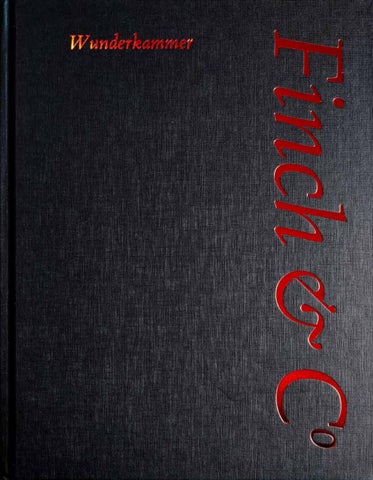
Wunderkammer Wonder Chamber
by appointment: England : Suite 744, 2 Old Brompton Road, London sw7 3dq Mobile : + 44 [0] 77 68 23 69 21 Belgium : Rue Ernest Allard 32, 1000 Brussels Mobile : + 32 [0] 470 64 46 51 USA : 717 Madison Avenue, 5/a New York, NY, 10065 Email : enquiries@finch-and-co.co.uk Website : www.finchandco.art
1
A Fine Dance Ornament Chakana
2
A Finely Cast Corpus from an Altar or Processional Cross
3 A Nias Standing Figure of a Male Figure with a Stylised Palm Crest and a Scroll Back Knot
4
A Noh Mask of Fukai
5a Roman Gold Finger Ring
5b A Finely Set Ring with an Engraved Period Jasper Intaglio Depicting a Portrait of the Roman Empress Julia Domna
5c A Roman Gold Set Ring with a Garnet Intaglio of Minerva
5d A Fine Temple Ring Set with a Rough Garnet and Raised Lobed Bezel
5e A Fine Greek Finger Ring Set with a Garnet Intaglio of a Lion
6
An Exceptional and Rare Renaissance Silver Gilt Mounted Rhinoceros Horn Cup with foliate acanthus leaf mount
7 A Carved and Metal Mounted Casket with Remnants of Pastiglia Decoration
8
A Dan Mask
9 A Rare Ancient Celtic Bust of a Radiate Deity Sol Invicta Wearing a Halo of the Rays of the Sun
10
An Unusual Collection of Eleven French Oils on Canvas Depicting Various Conditions of Ocular Disease as seen through an early Ophthalmoscope
11
A Finely Carved Wood Netsuke of Two Puppy Dogs Playing
12
A Superb Pipe-Case Musozutsu
13 An Unusually Large Napoleonic Prisoner of War Carved Bone Working Model of the French Revolutionary Guillotine
14 A Medieval Cloak Pin of Octagonal Form with Four Polished Garnets to each Corner
15 A Rare Sculpture of Saint Denis
16
A Spectacular View of Jerusalem / Map Ramon Ramirez 1787
17a An Early Christian Rock Crystal Intaglio set in a Gold Swivel Ring
17b A Banded Agate Intaglio Engraved with the Chi-Rho Symbol set in a Gold Ring
17c A Rare English High-Carat Gold Signet Ring
17d A Gold Finger Ring Set with a Nicolo Intaglio of Eros Driving a Biga Two-Horse Chariot
17e A Gold Swivel Ring Set with a Heliotrope Intaglio of Hector, Andromache, and Astyanax
18
A Fine and Rare Celtic Head of a King or Crowned God
19 A Rare Travelling Devotional Orthodox Plaque Depicting St John the Baptist Holding His Own Head
20
A Cameo Brooch Depicting Venus and Cupid
21
An Unusual Small Carved Plaque of a Horned Devil or Demon
22
A Fine and Large Baule Goli Society Dance Mask
23 A Finely Carved and Metal Mounted Casket Minnekästchen
24 A Very Fine and Unusual Carved Red Lacquer Netsuke
25 A Rare Hinoki Mask of Ja
26
An Imposing and Powerful Celtic Head
27 A Fine Abstract Standing Figure / Statue
28
A Rare Pair of Inuit Snow Goggles
29 A Finely Cast Renaissance Model of an Owl
30 A Large Rare Celtic Apotropaic Sandstone Head of Cernunnos the Horned Deity
31 A Rare Pair of Kalasha Peoples Carved Funerary Figures
32 A Rare and Tall Turned Rhinoceros Horn Cup
33
A Fine Noh Mask of Imawka
34 Two Curious French Naive Carved Walnut Architectural Models
35a An Early and Rare Byzantine Finger Ring with High Calyx-Shaped Bezel set with a FlatTopped Conical Garnet
35b A Merovingian Frankish Gold Finger Ring with a Re-used Late Imperial Carnelian Intaglio
35c A Migration Period or Early Medieval Slavic Finger Ring with Hemispherical Bezel
35d A Romano-British Finger Ring with Filigree Wire Decoration and a Carnelian Military Intaglio
35e A Fine Finger Ring set with a Heliotrope Intaglio of a Warrior
35f A Fine Medieval Finger Ring set with a Cabochon Garnet
36 A Powerful Carved Green Man with Piercing Eyes and Protruding Tongue
37 A Rare Example of a Tuscan Carved Walnut Bracciale used for Pallone Col Bracciale
38 A Powerfully Carved Corbel Label Stop or Hood Mould
39 A Rare and Large Painting Depicting the Tree of Jesse Castilian School
40 A Fine Dance Ornament Chakana with Heraldic Emblems
A comprehensive and detailed description of each item in this catalogue is available on our website www.finchandco.art Alternatively, you may scan the QR code located on the Wnal page of the catalogue.
1
A Fine Dance Ornament Chakana Aymara Feather Mosaic Lichiwayu Tropical bird feathers, aquatic reeds, cotton twine, glue Province of Camacho, Bolivia 18th to 19th Century s i z e: 14 cm high, 52 cm wide – 5½ ins high, 20½ ins wide p rov e na nc e: Ex South American collection Ex Private USA collection formed in South America Ex private collection For a detailed description of Chakana, please refer to entry number 40.
2
A Finely Cast Corpus from an Altar or Processional Cross The crowned head slightly downcast with long flowing hair to Christ’s back and over his shoulders Pierced for attaching and hollow to the back Bronze Eastern France 12th Century s i z e: 19 cm high, 15 cm wide – 7½ ins high, 6 ins wide p rov e na nc e: Ex Private European collection The Romanesque copper-alloy corpus of the crucified Christ, likely originating from Eastern France during the second half of the 12th century, is depicted being from either an altar or processional cross. This highly stylised corpus
belongs to a recognisable group documented by Peter Bloch in his comprehensive study, Romanische Bronzekruzifixe, as V D. Bloch identifies the type in Eastern France, primarily based on an example preserved at the Besançon Musée des Beaux-Arts et d’Archéologie (V D 7). A second, related corpus is housed in the collection of the Detroit Institute of Arts (V D 8). Both corpora are supported by a wedge-shaped suppedaneum with legs parallel and knees slightly bent.
3 A Nias Standing Figure of a Male Figure with a Stylised Palm Crest and a Scroll Back Knot, Ribbed Necklace, Crossed Arms and Erect Penis Raised upon its original base titled: in typical yellow paint Sumatra Wood Indonesia, Nias Peoples 19th Century s i z e: 62.5 cm high – 24½ ins high / 71.5 cm high – 28¼ ins high (with base) p rov e na nc e: William Downing Webster (1868–1913) Lieut. General Augustus Henry Lane Fox Pitt Rivers (1827–1900) c f: The Pitt Rivers archives record this figure in Volume 4, pl. 1343, as Bought of Webster on October 20th 1896. The entry lists two wooden carved Sumatra Idols, male and female and with watercolour drawings of both showing two views. They were exhibited at the Farnham Museum, room, 9, case no. 104. Nias, the largest of 131 smaller islands situated oV the western coast of Sumatra, Indonesia, bears a title that has been erroneously attributed to its wooden base. This misattributed title is inscribed in
the distinctive script commonly associated with Pitt Rivers.
4 A Noh Mask of Fukai The classic representation of a middle aged woman with narrow eyes, vertical dimples to either side of the mouth, and start loose hairs around the face, bearing traces of perspiration beneath the nostrils Unsigned, inscribed Fukai in red to the reverse Wood, polychrome Japan 18th Century s i z e: 20 cm high – 7¾ ins high c f: compare with two Fukai masks in the Steven Marvin collection, Hawaii, illustrated in Heaven has a Face, so Does Hell vol. 2. pg. 124–127
5a. Roman Gold Finger-Ring Set with an un-engraved Nicolo Gem Roman Empire Circa 3rd Century a d s i z e: 52 (EU) L 1/2 (UK) 5 7/8 (US) w e ig h t: 26.6 grams p rov e na nc e: Ex Private Canadian collection Ex Private collection
5b. A Finely Set Ring with an Engraved Period Jasper Intaglio Depicting a Portrait of the Roman Empress Julia Domna Roman Empire 3rd Century a d s i z e: 58 (EU) Q 3/4 (UK) 8 1/2 (US) w e ig h t: 6.3 grams p rov e na nc e: Ex French collection Ex Private collection
5c. A Roman Gold Set Ring with Garnet Intaglio of Minerva In the Guiraud Type 2 style Roman Empire 2nd Century a d / Guiraud Type 2 (widely common in Gaul) s i z e: 57 (EU) P 1/2 (UK) 7 3/4 (US) w e ig h t: 9.6 grams p rov e na nc e: Ex French collection Ex Private collection
5d. A Fine Temple Ring with a Rough Garnet and Raised, Lobed Bezel Resembling a Temple Tower or Lotus Calyx Kingdom of Champa 12th – 14th century ad s i z e: 57 (EU) P 1/2 (UK) 7 3/4 (US) w e ig h t: 13.9 grams p rov e na nc e: Ex G. Theuermann collection Ex Private collection
5e. A Fine Greek Finger Ring Set with a Garnet Intaglio of a Lion Greece Hellenistic Hellenistic period / 2nd Century b c – 1st Century a d s i z e: 63 (EU) V (UK) 10 5/8 (US) w e ig h t: 17.3 grams p rov e na nc e: Acquired from an important collection of antiquities, including ancient rings, 2021 Ex St. James Ancient Art, London Ex Canadian collection Ex Private collection
6
An Exceptional and Rare Renaissance Silver Gilt Mounted Rhinoceros Horn Cup with foliate acanthus leaf mount, above a turned stem and repoussé oval base
with displaying military trophy emblems, the cup surmounted with a silver gilt Roman Soldier in armour holding a shield and spear to his sides Rhinoceros horn, silver, gilt German / China Late 16th Century to Early 17th Century / 1580–1620 s i z e: 15 cm high – 6 ins high (to tip of figure) p rov e na nc e: Ex Private collection c f: old collectors number: SIL/2046A/A to underside The Chinese rhinoceros horn libation cup was an early exotic and luxurious import to the Western world, particularly Europe. It was believed to possess both high value and protective properties, making it a soughtafter item. Consequently, they found their way into Royal Courts across Europe, where skilled silver and goldsmiths competed to embellish them with their individual fantasies. For instance, the artisan crafted a finely detailed silver-gilt support, enhancing the cup’s aesthetic appeal. The cup was then placed in the Court’s kunstkammer, a collection of artistic treasures, where it was admired and appreciated for its artistic significance. However, it was also occasionally used for drinking, as the rhinoceros horn rendered any poisonous liquid safe for the Princely patron to consume !
7 A Rare Carved and Metal Mounted Casket with Remnants of Pastiglia Decoration retaining the original lock plate Wood, iron, polychrome Catalonia, Spain 14th Century s i z e: 17 cm high, 44 cm wide,
14 cm deep – 6Å ins high, 17⅓ ins wide, 5½ ins deep p rov e na nc e: G. Zeberg, Tefaf, Maastricht Ex Private Belgium collection During the Renaissance in Italy, the minor arts encompassed the intricate ornamentation of small wooden boxes with reliefs cast in a plastic material. This material was applied while yielding and hardened to the firmness of a soft stone. These boxes were commonly referred to as jewelcaskets, although they were also utilised for various purposes, including the storage of documents and valuables that necessitated secure protection.
8
A Dan Mask Wood, Old metal staple repair West Africa – Côte d’Ivoire 19th / early 20th Century – circa 1900 s i z e: 22 cm high, 13 cm wide – 8⅔ ins high, 5¼ ins wide p rov e na nc e: Ex John Hewitt, London Private collection, London Ex Private UK collection Dan masks exhibit a diverse range of designs, spanning from naturalistic to highly stylised. The Dan employed a bewildering variety of masks for various purposes. These masks could undergo transformations during their lifespan, adapting to diVerent forms of masquerade or dance rituals. The men who donned these masks and performed within them were believed to have received visions from the mask spirits. While masks could be passed down through generations through inheritance, the masquerade itself was dependent on the dream, which served as an acknowledgment from the
mask. Consequently, a mask could remain dormant for a generation until a new dancer was visited by a dream. The re-emergence of the mask might be accompanied by a distinct masquerade, incorporating the costume, movements, and musical accompaniment dictated by the dream.
9 A Rare Ancient Celtic Bust of a Radiate Deity Sol Invicta Wearing a Halo of the Rays of the Sun Limestone British 1st Century bc – 1st Century ad s i z e: 42 cm high, 40 cm wide, 20 cm deep – 16½ ins high, 15¾ ins wide, 8 ins deep p rov e na nc e: Ex Private collection West Country U.K. Ex Finch and Co, item number 1, catalogue number 30, Summer 2018 Ex Private collection c f: Dr Anne Ross Pagan Celtic Britain no. 916, for a similar Stone Radiate Deity The brilliance of Celtic art resided in the harmonious fusion of various disparate styles into a singularly unique and distinctive expression. In both Celtic and subsequent classical religious contexts, the sun god, known as Sol Invictus (the unconquered sun) or Apollo as the Romano-British revered him, possessed oracular and healing attributes. The human head was regarded by the Celts as a symbolic representation of divinity and otherworldly powers. The recurring theme of the head throughout Celtic religious tradition is not a distinct cult but an integral component of all other Celtic cults.
10
An Unusual and Interesting Collection of Eleven French Oils on Canvas Depicting Various Conditions of Ocular Disease as seen through an early Ophthalmoscope Each one numbered and titled on a black background Service de M Rollet and in red with the particular condition such as Neuro Retinite Desceadanite Retinite Proliferate Diabete’ and Choroïdite Myopique perhaps from an Ophthalmologists Surgery Second half 19th Century s i z e: approx: 27 cm high, 18.5 cm wide – 10½ ins high, 7¼ ins wide (each) approx: 29 cm high, 21 cm wide – 11½ ins high, 8¼ ins wide (each) (framed) p rov e na nc e: Ex Finch and Co, item number 87, catalogue number 27, winter 2016 Ex Private collection Johannes Kepler (1571–1630) formulated an optical model of vision, which revolutionised fundamental scientific thinking about optics and the eye. However, it was only with the introduction of the ophthalmoscope by Hermann von Helmholtz in 1851 that the optics of the eye could be observed and studied. Nevertheless, ophthalmologists still had to learn to perceive and interpret the instrument’s findings. The misinterpretation of the ophthalmoscopic appearance of the optic nerve persisted and influenced the understanding of the causes of eye diseases. In 1871, Thomas CliVord Allbutt (1836–1925), a surgeon at Leeds, remarked that the number of physicians working with the ophthalmoscope in England
was limited. Many, like Jabez Hogg (1817–1899), a surgeon at Westminster ophthalmic hospital, believed that the ophthalmoscope enabled clinicians to distinguish between sensorial blindness, which originated in the retina, optic nerve, or tubercle, and large numbers of cases of amaurosis, which originated not in the eye but in the sympathetic irritation caused by diseases of near or remote organs. These included tooth decay, excessive smoking or chewing tobacco, disordered stomach, bowels, liver, kidney, or uterus. Hogg, despite the welldocumented association of these diseases with sudden loss of sight, did not anticipate observing ocular pathology.
11
A Finely Carved Wood Netsuke of Two Puppy Dogs Playing The playful puppies with inlaid horn eyes Boxwood, Horn. Signed: Kokei Japan Circa 1820–50 s i z e: 3.5 dia. – 1⅓ ins dia. p rov e na nc e: Ex Private French collection
12
A Superb Pipe-Case Musozutsu Carved from a single walrus tusk, with Jo standing at the base of a large pine tree, a branch of which forms the cord attachment The trees trunk is suggested by the crystalline core of the tusk, and the Uba’s presence is indicated by the brush of her besom appearing from behind the tree, while overhead flies a gold applied crane Walrus, Gold Signed: Chomin (with seal) Japan Circa 1880 s i z e: 20.5 cm long – 8 ins long
p rov e na nc e: Jacques Carré collection Ex Private collection l i t e r at u r e: M. Rutherston, Kitsuengu, October 2018, no. 7 Widely known as Kiseru Zutsu pipe cases, these exquisite examples of Japanese decorative art harmoniously blend aesthetic appeal with a distinct purpose. Crafted from diverse materials such as papier-mâché, wood, ivory, bone, and stags’ antler, single-section pipe cases are designated as Senryu-Zutsu. The origins of tobacco smoking in Japan can be traced back to the latter half of the 16th or the commencement of the 17th century, introduced by the Portuguese and subsequently reintroduced from Korea by soldiers of the Hideyoshi campaign. Despite governmental attempts to suppress this habit, it swiftly gained popularity among both men and women.
13 An Unusually Large Napoleonic Prisoner of War Carved Bone Working Model of the French Revolutionary Guillotine The Recumbent Body of the Queen, Marie Antoinette, Lying on a Podium below the blade her decapitated head rolling into a waiting basket A Priest by her side providing the last rites the waiting guards below with moveable arms Late 18th – Early 19th Century s i z e: 58.5 cm high, 24 cm deep, 19.5 cm wide – 23 ins high, 9½ ins deep, 7¾ ins wide p rov e na nc e: Ex Private East Anglian collection Ex Finch and Co, item number 62, catalogue number 23, winter 2014 Ex Private collection s e e: Finch & Co catalogue no. 6,
15 item no. 80, for another guillotine model The guillotine, a device for swift execution, was invented by Joseph-Ignace Guillotin (1738–1814), a French physician and revolutionary. As Deputy, he proposed that the Constituent Assembly use a decapitating instrument. This proposal was adopted in 1791, and the machine was named after him.
14 A Medieval Cloak Pin of Octagonal Form with Four Polished Garnets to each Corner the pin with engraved feathering decoration Silver, garnet Britain, probably East Anglia 13th to 14th Century s i z e: 3.4 cm dia. – 1⅓ ins dia. (max) p rov e na nc e: Ex Private English collection Bought 1980’s Norfolk Ex Private collection During the Middle Ages in Europe, brooches were a highly fashionable accessory. They were fastened to the neck with a buckle. Medieval brooches exhibited a diverse range of shapes and designs, from simple to elaborate, as exemplified in this exquisite example. Some brooches were inscribed with religious or devotional prayers, messages of love and friendship, or other symbolic messages. Common gemstones used to adorn these miniature pieces of jewellery included pearls, amber, coral, jet, and, as in our case, polished garnet.
A Rare Sculpture of Saint Denis Carved in high relief, the decapitated bishop holding his head to his chest, raised upon a canted pedestal Dark colour and rich patina Oak France 14th Century s i z e: 89 cm high – 35 ins high p rov e na nc e: Ex Private collection Ex Private UK collection Denis of Paris, a Christian martyr and saint, was appointed bishop of Paris (then Lutetia) in the third century. He was subsequently martyred for his faith by decapitation. The renowned statue of St Denis, situated to the left portal of Notre Dame de Paris, commemorates his life. The first chapel constructed in his honour is situated at the site of his burial in Saint-Denis. This chapel was subsequently expanded into an Abbey and Basilica of Saint-Denis.
16
A Spectacular View of Jerusalem / Map Oil on canvas Signed Ramon Ramirez (active; Mexico 18th Century) lower right: ‘Ramon Rẽz. (Ramirez) F. Ano de 1787 Mexico 18th Century s i z e: 198 cm high, 243 cm wide – 76 ins high, 95¾ ins wide p rov e na nc e: Ex Private Spanish collection Ex Derek Johns Ltd, London Ex Private collection r e l at e d l i t e r at u r e: Prof. Rubin, Rehav; Image and Reality: Jerusalem in Maps and Views, The Hebrew University Magnes Press, Jerusalem, 1999 (pp. 110–122)
p rov e na nc e: Ex Private French collection Ex Private collection
17b. We extend our sincere gratitude to Ariel Tishby, Curator of the Norman Bier Section for Maps of the Holy Land, Department of Prints and Drawings at the Israel Museum, for his invaluable assistance and guidance in cataloguing this extraordinary work. The comprehensive description is available on our website at www.finchandco.art The 1787 painted map of Jerusalem closely follows the most influential map by Christian van Adrichom (1533–1585), a Catholic priest and erudite biblical scholar and theological writer. Born in Delft, he was active during most of his life in Köln. In 1584, he published Jerusalem’s map accompanied by a booklet titled Ierusalem… et suburbanorum… brevis descriptio, Coloniae Agrippinae (Köln, 1584). Originally published in Latin, the book and map were later translated into various languages in numerous editions, primarily as chapters in a broader publication about the Holy Land divided into the Tribes titled Theatrum Terrae Sanctae (Köln, 1590).
17a. An Early Christian Rock Crystal Intaglio set in a Gold Swivel Ring Gold, rock-crystal Eastern Mediterranean 3rd–4th century ad (intaglio) Mount – 19th Century s i z e: 59 (EU) R (UK) 8 5/8 (US) w e ig h t: 17.9 grams
A Banded Agate Intaglio Engraved with the Chi-Rho Symbol set in a Gold Ring Gold, agate Late Roman or Early Byzantine / 4th – 6th century a d (intaglio) Mount 20th Century s i z e: 56 (EU) O 1/2 (UK) 7 1/4 (US) w e ig h t: 12.5 grams p rov e na nc e: Ex Private French collection Ex Private collection
17c. A Rare English High-Carat Gold Signet Ring Gold England Circa 1600 / late 16th or early 17th Century s i z e: 54 (EU) N (UK) 6 1/2 (US) w e ig h t: 6.2 grams p rov e na nc e: Ex Private English collection Ex Private collection
17d. A Gold Finger-Ring Set with a Nicolo Intaglio of Eros Driving a Biga Two-Horse Chariot Gold, gemstone France 19th Century s i z e: 51 (EU) K 1/2 (UK) 5 3/8 (US) w e ig h t: 4.6 grams p rov e na nc e: Ex Private French collection Ex Private collection
17e. A Gold Swivel Ring Set with a Heliotrope Intaglio of Hector, Andromache, and Astyanax
Gold heliotrope (bloodstone) Rome (Vatican City hallmark) 18th Century s i z e: 57 (EU) P 1/2 (UK) 7 ¾ (US) w e ig h t: 4.3 grams p rov e na nc e: Ex Private English collection Ex Private collection
18
A Fine and Rare Celtic Head of King or Crowned God Sandstone British 1st Century bc to 1st Century a d s i z e: 29 cm high – 11½ ins high / 42 cm high – 16½ ins high (with base) p rov e na nc e: Bought at auction on the Welsh borders by a local family 1950s Thence by descent Private UK collection Celtic heads are commonly associated with shrines situated near springs or sacred groves. Found in Britain, Ireland, and Western Europe, they exhibit stylistic similarities that can be traced back to obscure origins in Central Europe during the late Bronze Age, approximately 1200 bc . Their final demise occurred in the Western Isles in the 6th century ad.
19 A Rare Travelling Devotional Orthodox Plaque Depicting St John the Baptist Holding His Own Head Walrus Ivory Aged patina and colour, aged fissures consistent with age and use Old label to the reverse Novgorod, Russia 15th / 16th Century s i z e: 8 cm high, 5 cm wide – 3 ins high, 2 ins wide
21 p rov e na nc e: Ex Private USA collection, formed in the 1960’s / 70’s Ex Private Irish collection The Cathedral of St Sophia stands as the oldest Orthodox Church in Russia, having been constructed between 1045 and 1052. Notably, St Sophia Cathedral was the pioneering church in Slavic lands to incorporate local characteristics that diverged from the Byzantine style prevalent in the Eastern Church. These Byzantine features and style are distinctly evident within the intricately carved panel. Historically, Novgorod served as a crucial juncture on the ancient trade route connecting the Varangians to the Greeks.
An Unusual Small Carved Plaque of a Horned Devil or Demon Oak. Superb colour and patina Continental 16th Century s i z e: 11 cm high, 9 cm wide – 4⅓ ins high, 3½ ins wide p rov e na nc e: Ex Private collection A meticulously crafted and imposing plaque, featuring the distinctive portrayal of a horned devil or demon. It is plausible that this panel originated from a casket or screen. The exceptional quality and dimensions of our panel suggest that it was crafted by a highly skilled artisan.
22 20
A Cameo Brooch Depicting Venus and Cupid Gold-Mounted Hard-stone cameo, gold 18th Century Italy s i z e: 3.8 cm dia. – 1½ ins w e ig h t: 26.5 grams p rov e na nc e: Ex Private collection, Salzburg Ex Private collection Produced in workshops in Rome or Naples, cameos of this caliber were renowned for their classical poise and technical finesse. Set within a smooth, high-carat gold mount, this brooch encapsulates the equilibrium of elegance and simplicity that defined the late Baroque and early Neoclassical aesthetic, harmoniously blending antique inspiration with refined Italian craftsmanship.
A Fine and Large Baule Goli Society Dance Mask Wood, pigment and metal Cote d’Ivoire, West Africa Late 19th / early 20th Century s i z e: 81 cm high, 51 cm wide – 31¾ ins high, 20 ins wide p rov e na nc e: Ex Casali collection, Italy Ex Private Italian collection, 2006 Ex John GiltsoV, catalogue 2011 Ex Kevin Conru Ex Private collection c f: a very similar mask was used on the cover of Herbie Hancock’s 1973 album; Head Hunters Goli, a traditional dance and masquerade of the Baule people of Ivory Coast, originated among the Wan people, their neighbours. It was adopted by the Baule between 1900 and 1910, possibly in response to the disruption caused by European colonialism.
Performed on significant occasions such as funerals or for entertainment, Goli is a remarkable feat, with a single performance lasting up to an entire day.
23 A Finely Carved and Metal Mounted Casket Minnekästchen with original lock plate Wood, steel, vellum lining Superb colour and patina Upper Rhine Germany 14th Century s i z e: 11 cm high, 24.5 cm wide, 17 cm deep – 4⅓ high, 9⅔ ins wide, 6⅔ ins deep p rov e na nc e: Private collection Switzerland Cesati, Tefaf, Maastricht Ex Private collection c f: Old label to base, No. 23 .. (?) and etched number / date (?) 1541 Crafted in the Upper Rhine region during the 14th and 15th centuries, these caskets primarily served as betrothal vessels, with some instances of commemorative function. Characteristic of this period’s craftsmanship are the iron mounts and flower-head terminals. Frequently, the caskets are adorned with heraldic motifs or dedicatory inscriptions, often placed above intricate latticework backgrounds.
24 A Very Fine and Unusual Carved Red Lacquer Netsuke The reverse lacquered black Signed: Hosai Japan Circa 1890 s i z e: 4.7 cm high – 1⅔ ins high p rov e na nc e: W.L. Behrens collection ( Joly cat. no. 190, ill. on pg. IV) Albert Brockhaus collection
Sold Christies, London 25th November 1980, lot 183 Ex Private collection
25 A Rare Hinoki Mask of Ja Painted with an earthen red polychrome over gesso, with fine sparse hair, the cheeks with distinctive v-shaped markings, suggestive of dragon’s whiskers, the eye balls in inset gilt copper Wood, gesso, metal, gilt, pigment Japan Edo Period / 17th to 18th Century s i z e: 26 cm high – 10¼ ins high p rov e na nc e: Au Bon Marche, Paris, (label from the early 20th Century) Ex Private French collection Ex Irish collection It is probable that this mask was not intended for theatrical purposes, but rather as a temple oVering. The inscription appears to refer to a specific location (Nakabashich ̄o) and an individual or donor (Tenya J̄ubei). Ink inscription on the reverse: nakabashichō tenya jūbei
26
Imposing Powerful Celtic Head With a moustache and goaty type of beard beneath a slightly protruding lower lip, with a strong nose and pierced bulbous eyes, the hair parted in the centre Limestone France 1st to 2nd Century ad s i z e: 25 cm high, 16.5 cm wide, 17 cm deep – 9¾ ins high, 6½ ins wide, 6¾ ins deep p rov e na nc e: Ex Private French collection Ex Private UK collection The Celts held the head in high regard as a symbol of divinity and the otherworld’s influence. They
regarded it as the most crucial component of the human body, the very seat of the soul. Although this reverence had roots in Europe and Britain predating the Celts, they developed it into an intricate cult, making it a distinctive aspect of their religious expression. The current head, with its striking and robust features, could signify a chiefly figure, warrior, or revered ancestor.
27 A Fine Abstract Standing Figure Wood, polychrome (pigment) Yaka Peoples Democratic Republic of the Congo Old museum inventory number (paint) L.E.769.S Early 20th Century s i z e: 54 cm high – 21¼ ins high p rov e na nc e: Ex Musée de la vie indigène (Inventory number L.E.769.S.) Ex Private British collection
28
A Rare Pair of Snow Goggles Etched eyebrows and two holes pierced to each side for fixing Superb golden colour with worn patina Walrus Ivory Punuk Culture Circa 8th Century a d s i z e: 13 cm wide – 5¼ ins wide p rov e na nc e: European Private collection Ex Patrick Mestdagh Gallery Ex Private European collection The Eskimo are the most dispersed indigenous group globally, spanning approximately 4,000 miles primarily along the northern peripheries of the American and Russian continents. Their 3,000-year-old culture is distinct and not shared with any other subpolar peoples, such as the Lapps.
Their nomadic lifestyle instilled in them an extraordinary resilience in preserving their culture over vast distances.
29 A Finely Cast Renaissance Model of an Owl Naturalistically modelled with feathers and wings, large claws to the feet and a wonderful expressive wise looking eyes above a polished beak Rich brown patina Bronze South German 16th Century s i z e: 12 cm high – 4¾ ins high p rov e na nc e: Ex Private European collection c f: For an almost identical model, see, Sothebys, London, European Works of Art and Sculpture, 7th July, 1988, lot 59 Birds, alongside horses, bulls, snakes, and crabs, were among the most popular subjects of Renaissance animal bronzes. These sculptures were likely inspired by the ancient votive antiquities of Egyptian, Greek, and Roman origin. They were frequently housed in their own designated cabinets of naturalia within the princely courts of Europe.
30
A Large Rare Celtic Apotropaic Head of Cernunnos the Horned Deity with Typical Eyes Triangular Nose and Slit Mouth Sandstone Britain 1st Century bc – 1st Century a d s i z e: 47.5 cm high, 39 cm wide, 33 cm deep – 18¼ ins high, 15¼ ins wide, 13 ins deep / 52 cm high – 20.5 cm high (with base) p rov e na nc e: Ex Private English collection Cernunnos was a horned god and
one of the most ancient Celtic
deities. He predates Roman influence in Western Europe with images occurring from as early as the 4th century b c. Known as the Lord of the Animals essentially he was a god symbolising fertility and fecundity in nature. As the patron god of hunters his horned head was an appropriate symbol for a people who decapitated their enemies and revered the head, a people given to fighting, cattle lifting and hunting. The horned god was their leader in war, symbolic of virility, lawgiver in times of peace, protector in times of danger. He was an all purpose tribal god and his deep rooted nature and association with fertility made him unacceptable to emerging Christianity who destroyed any maternalistic traces of his cult whenever they could. The Romans, however, took great care not to antagonise the god of place, the named warrior of the Celts, and equated him with a member of the more familiar classical pantheon such as Pan, or as an armed warrior equivalent to Mars. In Dr. Anne Ross’s 1967 book, Pagan Celtic Britain, she dedicates a chapter to The Horned God in Britain, exploring the cult of the human head, which she argues is the most widespread, typical, and enduring Celtic cult. Cernunnos was extensively depicted in Celtic art across a vast region, encompassing Northern Italy, Romania, France, and Denmark, as well as Great Britain and Ireland. Celtic cult images of Cernunnos from the pre-Roman Iron Age
are scarce, such as the one found on the 1st-century bc Gundestrup Cauldron. In contrast, during the Roman period, over fifty representations of this god are recorded, primarily concentrated in northeastern Gaul.
31 A Rare Pair of Kalasha Peoples Carved Funerary Figures Depicting a Male and rarely seen Female Figure Cedar-Wood, Quartz Pebble, polychrome Dry aged patina North Eastern Afghanistan once known as the Hindu Kush 19th Century s i z e: male: 44 cm high – 17⅓ ins high female: 42.5 cm high – 16¾ ins high p rov e na nc e: Ex Private collection s e e: Finch and Co, catalogue number 33, autumn 2019, item number 81 for a rare equestrian figure from Kafiristan c f: A seated female figure in the British Museum, As1930,1023.2 wearing a similar headdress / crown In the remote north-eastern corner of Afghanistan lies Kafiristan, known as the land of the infidels or pagans. This region of the Hindu-Kush was once the exclusive domain of a group of peoples related to the IndoEuropeans. Some believed they were descended from Alexander the Great and his Macedonian invaders. Herodotus mentioned their reputation for barbarity, while Marco Polo described them as crafty idolators with a peculiar language. Timur invaded their valleys but found the expedition unprofitable and soon left. It was much later, in the last years of the 19th century, that Sir George Scott Robertson
wrote The Kafirs of the Hindu Kush (1896). In this book, he described the making and traditions surrounding the funeral eYgy figures. From Robertson’s account and that of other British visitors to Kafiristan before the Muslim conquest, it was evident that the people worshipped one god known as Imra, along with idols of ancient heroes whose intercession was believed to enable union with the divinity. Later known as Zorastrians, they did not bury their dead. Instead, they placed the body fully dressed in a large coYn and placed it on the side of a hill. Beside it, a wooden eYgy, male or female, varied from a simple standing figure to one seated on a square throne or mounted on a horse. Occasionally, these cedar-wood sculptures were larger than life-size, but their shape was always simple and conventionalised, with the eYgies of male ancestors given turbans. All of these eYgies were made as representations of deified ancestors and were once covered in polychromatic decoration. Sometimes, they would be set up on the top of a pole outside a village to warn strangers against trespassing. The Kafir religion believed in a paradise called Burry-Li-Boule, accessible through sacrifices to the gods and hospitality. They observed four feasts annually, with goat sacrifices made in the spring and New Year, a practice similar to the Greeks and Romans. Robertson’s account of a famous shrine of Imra is significant, as all traces of these temples and eYgies vanished during the ruthless 1896 invasion and subsequent subjugation of the Kafirs, destroying their ancient religion. This devastated region was renamed Nuristan, the Country of Light.
The female figure from our pair is particularly rare, both figures were probably housed indoors, as a reminder of previous important family ancestors.
already familiar to the Wanli Emperor, and the beliefs associated with its magical powers and abilities had originated over a millennium earlier in China.
32
33
A Rare and Tall Turned Rhinoceros Horn Cup Rhinoceros Horn Mogul / India 17th / 18th Century s i z e: 17 cm high – 6¾ ins high p rov e na nc e: Ex Finch and Co item number 16, catalogue number 39, 2022 Ex Private collection Rhinoceros horn held immense value in the Middle and Far East, renowned for its purported medicinal properties as an antidote to both poison and melancholy, as well as its rarity and aesthetic appeal. Consequently, numerous European rhinoceros horn carvings were produced as a direct consequence of contact with these intricate carvings originating from China. However, the exact arrival of vessels crafted from rhinoceros horn in Europe remains uncertain. The earliest documented evidence of such vessels dates back to the end of the 16th century, when a vessel adorned with rhinocerosbone ornaments and silver was presented to the Governor of Portugal by a group of Japanese Christians traveling on a Portuguese ship. These traveler’s visited southern Europe between 1584 and 1586. In 1601, it is recorded that un corno di rino ceronte was among several rare and precious articles taken to Beijing by the Jesuit missionary Father Matteo Ricci. Ricci likely believed he was presenting the Chinese Emperor with an object he had never encountered before. Unbeknownst to him, this rhinoceros horn was
A Fine Noh Mask of Imawka The ogee brows forming a deep frown A red painted inscription above a distinctive ka ̄o to the reverse Wood, polychrome Japan Late 18th Century s i z e: 20 cm high – 7¾ ins high
34 Two Curious French Naive Carved Walnut Architectural Models Probably based on the Louvre Palace in Paris Both Carved with Napoleonic Associations A cylinder with fretwork rose window to the top possibly used to insert discs of coloured glass to create a light box in front of a window beside which stand two pairs of gentlemen arm in arm and shaking hands underneath them inscriptions J E Rome / Pierre and Napoleon a Dre To the centre pediment is carved a battle scene with the Emperor on horseback on the left another shows Napoleon on his famous horse Marengo on the right a scene of a Soldier holding a gun preventing the Emperor’s entrance and underneath the motto On N . Passe Pas Some losses to chain and cannon Circa 1810–1820 A second architectural model signed and dated to the cylinder barrel Boularot to 1849 and to the other side POC Rochel Bonaparte PC
Paris a central figure of Napoleon standing with his telescope upon a concentric ball Four Figures of Gentlemen with Inlaid Glass Eyes stand Two to each side with Uplifted arms acting as Supporters to the Emperor. Underneath the left pair the words Pierre 3 and Louis N2 and on the right Napoleon 2 the central cylinder barrel with fretworked rose window hung about with interlinking chains the reverse has a hinged door to the bottom revealing a narrow chamber and carved with Boularot Aveyron NCA Estaing 1812 Circa 1812 to 1849 (the figure of Napoleon 1880–90) s i z e: 69 cm high, 45 cm wide, 16 cm deep – 27¼ ins high, 17¾ ins wide, 6¼ ins deep / 65 cm high, 48 cm wide, 15.5 cm deep – 25½ ins high, 19 ins wide, 6 ins deep p rov e na nc e: Ex Private collection Ex Finch and Co, item number 58, catalogue number 27, winter 2016 Ex Private collection Aveyron is a department situated in the northern region of Occitane, Southern France, named after the Aveyron River, which flows through the prefecture of Rodez. Establiement is a commune located within the Aveyron department. Boularot is a family name associated with the area during the 18th and 19th centuries. It is plausible that this particular model was crafted by three generations of the Boularot family. The model was commenced in 1812, with additional modelling completed in 1849.
35a. An Early and Rare Byzantine Finger-Ring with High CalyxShaped Bezel set with Flat-Topped Conical Garnet Gold, garnet Constantinople Late 5th Century s i z e: 64 (EU) V 1/2 (UK) 10 1/2 (US) w e ig h t: 12.8 grams p rov e na nc e: Formerly Hanns-Ulrich Haedeke collection, former Director, German Sword Museum, Solingen, and author of Schmuck aus drei Jahrtausenden: Sammlung Hanns-Ulrich Haedeke (Köln: Rheinland Verlag, 2000) Ex Private collection
35b. A Merovingian Frankish Gold Finger-Ring with a Re-used Late Imperial Carnelian Intaglio Gold, carnelian Probably Neustria / Western Frankish Kingdom (including the Paris region) Last quarter of the 6th Century The intaglio: Western Empire, probably Gaul, circa 3rd century ad s i z e: 51 (EU) K 1/2 (UK) 5 3/8 (US) w e ig h t: 4.9 grams p rov e na nc e: Ex Private US collection Ex Private collection
35c. A Migration Period or Early Medieval Slavic Finger-Ring with Hemispherical Bezel Decorated with Collared Granules and Garnet Cabochon Gold, garnet Migration Period / possibly Moravia (modern Eastern Czech Republic) 9th Century
s i z e: 59 (EU) R (UK) 8 5/8 (US) w e ig h t: 14.9 grams p rov e na nc e: Formerly Hanns-Ulrich Haedeke collection, former Director, German Sword Museum, Solingen, and author of Schmuck aus drei Jahrtausenden: Sammlung Hanns-Ulrich Haedeke (Köln: Rheinland Verlag, 2000) Ex Private collection
35d. A Romano-British Finger-Ring with Filigree Wire Decoration and Carnelian Military Intaglio Gold, carnelian Romano-British Late 4th or Early 5th Century a d s i z e: 53 (EU) M 1/2 (UK) 6 1/2 (US) w e ig h t: 8.3 grams p rov e na nc e: Formerly Hanns-Ulrich Haedeke collection, former Director, German Sword Museum, Solingen, and author of Schmuck aus drei Jahrtausenden: Sammlung Hanns-Ulrich Haedeke (Köln: Rheinland Verlag, 2000) Ex Private collection
35e. A Fine Finger-Ring set with a Heliotrope Intaglio of a Warrior Gold, heliotrope Germany Circa 1550 / 16th Century s i z e: 57 (EU) P 1/2 (UK) 7 ¾ (US) w e ig h t: 8.3 grams p rov e na nc e: Ex English Private collection Ex Private collection
35f. A Fine Medieval Finger-Ring set with a Cabochon Garnet Gold, garnet Europe Early 15th Century s i z e: 59 (EU) R (UK) 8 5/8 (US) w e ig h t: 4.9 grams p rov e na nc e:
Ex Private English collection Ex Private collection
36 A Powerful Carved Green Man with Piercing Eyes and Protruding Tongue Walnut English Late 15th Century to Early 16th Century s i z e: 29 cm high, 23.5 cm wide – 11½ ins high, 9¼ ins wide p rov e na nc e: Old Collection; numbers: 70, 61 (?) and painted: DO. 23. 24 Ex Private collection The enigmatic origins of the Green Man, also known as the Wildman of the Woods and Jack in the Green, have captivated scholars worldwide. His ubiquitous image spans across continents, from the ancient Aztec and Mayan civilisation’s of Mexico to the Swayambhunath Temple in Kathmandu. In Britain, the Green Man’s presence is evident in over a hundred cathedrals and churches. However, Christian doctrine lacks a definitive explanation for the universal representation of the Green Man. In Christianity, the colour green symbolises new life and the triumph of life over death, mirroring the green spring that emerges from winter. As a deity of nature, the Green Man personifies forests, and there is speculation about his connection to the Greek God Dionysus, depicted with branches protruding from his head, and possibly the ancient Egyptian God Osiris, whose portrait in the Nefertari tomb was painted in green.
37 A Rare Example of a Tuscan Carved Walnut Bracciale used for
Pallone Col Bracciale a traditional team game played with a hollow spiked glove gripped on the inside and worn on the forearm The protruding wedge shaped blunted spikes known as Bischeri An armorial of the owner or team carved to the fist guard Wood, Metal Italy Late 17th / Early 18th Century s i z e: 21 cm high, 20 cm dia. – 8½ ins high, 8 ins dia. p rov e na nc e: Ex Private Italian collection Ex Private European collection s e e:for other examples, Finch and Co item no. 73, catalogue number 16, 2010, item no. 42, catalogue number 28, Summer 2017 and item no. 39, catalogue number 29, Winter 2017. Also a Veneto Istrian marble sculpture depicting a player of the Renaissance game wearing a Spiked wooden Bracciale, item no. 38, catalogue number 29, Winter 2017
From the mid-16th century, when Antonio Scaino of Salÿ formulated the first oYcial regulations, Pallone con bracciale emerged as a prominent street sport. Participants engaged in this activity using heavy, spiked hollow walnut cylinders, which were worn over the right or left forearm. These cylinders were employed to strike inflated balls back and forth on courts that were frequently established in town squares or streets. A designated server, known as a mandarino, initiated the game by placing the ball in play. However, each receiving player retained the right to reject any serve. The scoring system, akin to tennis, employed fifteens and tens,
with the team securing 12 games emerging victorious in the match. Weighing up to two kilograms, the bracciale posed a significant risk of causing severe injuries among players. It is reported that the 16th-century Renaissance artist Veronese was temporarily exiled from Verona for inflicting an eye injury on another player through an ill-judged swing.
38 A Powerfully Carved Corbel (Label Stop or Hood Mould) Depicting Asenath, wife of Joseph, daughter of Potiphera York-Stone England 14th Century / Circa 1320–40 s i z e: 37 cm high – 14½ ins high p rov e na nc e: Ex Beverley Minster, Yorkshire By family descent Ex Private collection c f: Removed from Beverley Minster during the late 19thcentury restoration work undertaken by George GilbertScott. Originally situated in the high North or South aisles at the vault’s termination, it was reported that nine figures were removed. This example was retained by the stone mason responsible for the masonry work and subsequently passed down through his family. Asenath, a high-ranking, aristocratic Egyptian woman, appears as a minor character in
the Book of Genesis. She was the wife of Joseph and the mother of his sons, Manasseh and Ephraim. There are two distinct Rabbinic interpretations of Asenath. One perspective posits that she was an Egyptian woman who converted to marry Joseph. This viewpoint implies that she had already embraced God prior to their union and subsequently raised her sons in the principles of Judaism. According to the Hebrew Bible, Asenath’s father, Potiphera, a priest of the ancient Egyptian city of On, is mentioned in Genesis 41:45 and 41:50. Potiphera was the father of Asenath, who was presented to Joseph as his wife by the Pharaoh. Her name, which translates to he whom Ra has given, signifies her divine origin.
39 A Rare and Large Painting Depicting the Tree of Jesse Sarga cloth and distemper laid on canvas Circa 1500–1510 Anonymous Castilian School s i z e: 194 cm high, 160 cm wide – 76 ins high, 63 ins wide p rov e na nc e: Ex Private collection The Tree of Jesse is an artistic representation of Jesus Christ’s ancestors, presented as a branching tree, originating from Jesse of
Bethlehem, the father of King David. It pioneered the use of family trees as schematic representations of genealogies. The Tree of Jesse has its origins in a biblical passage in the Book of Isaiah, which metaphorically describes the Messiah’s descent. Christians interpret this passage as referring to Jesus. The figures depicted in Jesus’ lineage are drawn from the names listed in the Gospels of Matthew and Luke. The subject of the Tree of Jesse is frequently depicted in Christian art, particularly during the medieval period. The earliest known example is an illuminated manuscript dating back to the 11th century. Medieval psalters are rich in examples of the Tree of Jesse due to its connection to King David, son of Jesse, and the author of the Psalms. Further examples can be seen in stained glass windows, stone carvings around medieval cathedral portals, wall and ceiling paintings. The iconography continues to appear in other period art forms such as embroideries and ivory carvings.
40 A Fine Dance Ornament Chakana with Heraldic Emblems Aymara Feather Mosaic Lichiwayu Tropical bird feathers, wood slat, cotton twine, glue Department of Law Paz, Province of Camacho, Bolivia 18th to 19th Century s i z e: 23 cm high, 68 cm wide – 9 ins high, 26¾ ins wide p rov e na nc e: Ex South American collection Ex Private USA collection formed in South America Ex Private collection The existence of Pre-Columbian feather-work was initially documented by Spanish
conquistadors in the 16th century. Francisco Pizarro observed that textiles served as a means of recording religious narratives, functioning as a form of religious text for the native Andean people. Over the years following European conquest, feather-work gradually declined from most native textile traditions. However, in Bolivia, it persisted well into the 20th century and may still be found in remote villages today. Various 19th-century traveler’s to Bolivia, including the French etymologist Alcide d’Orbigny and the German ethnographer Charles Weiner, documented the existence of feather-work. Nevertheless, it was in a publication by the German archaeologist Max Uhle that we first encountered a meticulously drawn image of a chacana (Uhle 1890, pl. 20). The term chacana is derived from the Quechua and Aymara languages and refers to an assemblage of attached feathercovered reeds or sticks that form a wide, flexible belt, typically worn over the shoulder. The structural materials used in chacanas distinguish the two types currently recognised. Those associated with the Sica-Sica region near Lake Titicaca utilise reeds as their base element, while those from further away from the lake employ recycled wooden crates. The precise meaning of the imagery depicted on these two chacanas remains elusive. While evidence suggests Pre-Columbian beliefs in the mystical power of animals, there are also indications of Christian influences. It is known that chacanas and their associated headdresses were primarily worn during dance festivals, and dance imagery, encompassing both humans and animals, is
prominently featured. These exquisite objects, characterised by their vibrant colours, delicate craftsmanship, and exceptional quality, serve as contemporary reminders of the profound significance and power of feather-work in the PreColumbian world. A Comprehensive Collection of Ninety-Six Roundels from a Ganjifa Game Ganjifa, also known as Ganjapa or Gânjaphâ, is a card game and type of playing cards The circular cards are polychromed, featuring various scenes of daily courtly life, battles, and hunting. They are housed in a rectangular box, which is also profusely decorated with hunting scenes and courtly processions The cards are housed in their original rectangular case with a sliding lid, which is also adorned with processional scenes Paper, card, wood, polychrome India 19th century s i z e: roundels 5.2 cm dia. – 2 ins dia. / box: 7 cm high, 14.5 cm wide, 7 cm deep – 2¾ ins high, 5¾ ins wide, 2¾ deep p rov e na nc e: Ex European collection Originating in Persia, the cards are now widely associated with Mughal India. Traditionally handprinted by artisans, they gained immense popularity at the Mughal Court, where elaborate sets were crafted, including our exquisite example. The game in India has a history dating back to approximately 1600, with the serving rules established from that era.
Design by Prof. Phil Cleaver & Yejin Jang (장예진) of etal-design, etal@etal-design.com Photography by Phil Connor, phillip_connor@icloud.com Printed and bound in Great Britain by Dave Davies of dlm creative © 2026 Finch Co i s b n 978-1-912930-54-8 No part of this publication may be reproduced, stored or transmitted, in any form or by any means, without the permission in writing of the publisher.