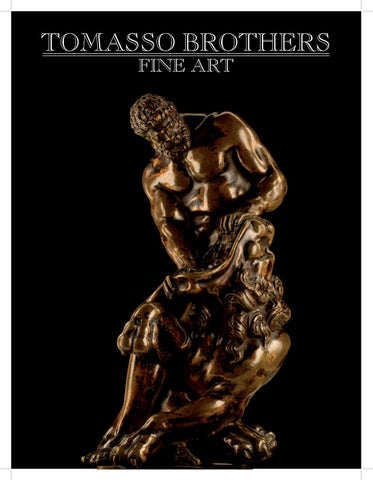
Tomasso Brothers Fine Art is the dynamic partnership of three brothers, Dino, Giovanni and Raffaello and was established in 1993. The founding of the company came as a result of their education in fine art from an early age and a passionate love of the art world. Whilst they are recognized internationally for their broad understanding and taste in the world of European sculpture dating from the Medieval to the Neo-Classical periods, they also have interests in several other fields, including old master paintings, antiquities and fine furniture. However their main speciality is sculpture and through their taste and knowledge, they have developed a particular forte in European Renaissance bronzes and marbles. Since 1999 Tomasso Brothers Fine Art has been based at Bardon Hall, an impressive 19th villa, which is nestled in the verdant location of Far Headingley, Leeds, just a short distance from both the city centre and Leeds Airport. The spacious galleries showcase a key collection of objects from ancient times to the early 19th Century that emphasize the antique and its reinvention through the ages. The three brothers take great pride and pleasure in successfully enabling connoisseurs and museums to enhance their collections and are delighted to have assisted in developing several world class private collections and institutions both across Europe and the United States of America. Tomasso Brothers Fine Art is honoured to be part of the innovative Art3 exhibition. The catalogue has an emphasis on French sculpture from the 1500’s to the early 19th century and aims to reflect some of the beauty that sculptors achieved throughout this period.
EXHIBITION ART
3
GALERIE BAILLY 25, QUAI VOLTAIRE 75007 Paris
14th September – 30th October 2010
1. Maestro delle Virtù di Sant’ Ansovino Italian 14th century
Pair of Stylobate Lions White marble 56 cm (22 in.) high, 83 cm (32 5⁄8 in.) long, 31 cm (12 1⁄4 in.) wide PROVENANCE Stefano Bardini, 1918, Florence
Stylized recumbent lions such as this majestic pair, which formerly constituted the bases of columns, are known as stylobate lions; a famous pair form part of the collection at the Isabella Stewart Gardner Museum, Boston. Originating in the Romanesque period, this type of column support was used throughout Europe, but especially in Italy. Stylistically the exhibition lions lie somewhere between pure Romanesque (such as the pair in Verona marble supporting the portico of Parma Cathedral) and the Renaissance set which support the monument of Vitaliano and Giovanni Borromeo in the chapel of Palazzo Borromeo, Isola Bella, Lago Maggiore. They are made of white Carrara marble and date from the late fourteenth century. Their manes have quite clearly been differentiated, one being of a fuller shape with more exuberant curls, and we may assume that they represent a lion and lioness. It is interesting to note that many of America’s foremost collectors from the early to mid twentieth century strove to include examples of this type and quality of Italian sculpture in their collections. Related literature V. Niemeyer Chini, Stefano Bardini e Wilhelm Bode, Mercanti e Connaisseur fra Ottocento e Novecento, Edizioni Polistampa, 2009, ill p. 196, pl. 93
N°1
6
7
2. FRENCH Circa 1500 KING LOUIS XII OF FRANCE Polychromed oak with extensive traces of the original paint and silvering 110.5 x 36 x 20.5 cm (39 ½ x 14 x 8 ½ in.) PROVENANCE The Cloisters Collection, Metropolitan Museum of Art, New York (Gift of George Blumenthal, 1941) Published Blumenthal, George and Florence Collection. Catalogue comp.by Stella Rubinstein- Bloch, vol.II, 1926, pl. IX (right)
This beautiful and serene oak figure of Louis XII, King of France (1468-1515), circa 1500, retains the majority of its original polychrome. Carved statues of French Kings in the round are exceptionally rare from this period and this sculpture, which is perhaps from an altarpiece, was possibly dismantled during the Revolution. Louis XII is presented in royal vestment; he wears a blue mantle with gold fleur-de-lis ornament, a gold and jewelled trimming and a large fur collar. On his head he wears a crown, the design of which conforms to the type subsequently attributed to the French Princes of the Blood as illustrated in Le trophee d’Armes Heraldiques, Paris, 1650, plate 24 and in the Grand Armorial de France, plate 1. His left arm is raised and he probably held an original sceptre. Around his neck he wears the collar of The order of Saint Michael, which consists of scallop shells linked on a chain with a badge showing Saint Michael killing the dragon. The original polychrome on the face is carefully rendered to create a subtle dark shadow for the beard and delicate rosy cheeks create a wonderfully realistic and sensitive depiction of the French King.
N°2
8
9
3. GIAMBOLOGNA (JEAN DE BOULOGNE) (Douai 1529 –Florence 1608)
Prometheus bringing Fire to Mankind Gilt bronze 23.7 cm (9 3⁄8 in.) high PROVENANCE Comtesse de Chabannes, Château de la Bredé, Bordeaux
Prometheus was a Greek demigod, one of the race of Titans. After the Great Flood he recreated mankind from clay and water (or with his own tears). He bore a silent grudge against Zeus (Jupiter) and the gods of Olympus for having destroyed the other Titans, and favoured mortals over them. Zeus, feeling cheated at the cunning way in which Prometheus had divided up the divine and mortal allocations of the sacrificial ox to favour the mortals, decided to withhold fire from them. Prometheus therefore stole a firebrand from the forge of Hephaestus (Vulcan) and, hiding it in a hollow stalk, took it down to earth. Whilst mankind benefited, Prometheus paid for his wiles by being chained to a rock and having his liver pecked at by an eagle for all eternity. The statuette shows Prometheus performing his generous, but incautious, deed. Holding a classical torch (flames downward, perhaps for the sake of concealment from Zeus), he is stepping boldly forward across a terrain on which a vine is resprouting from an old root. The athletic, mature bearded male nude pauses in a contrapposto stance: his left shoulder and arm are advanced in front of the weight-bearing right leg, while his right shoulder is withdrawn and the arm is bent akimbo, thus counter-pointing the left leg, which trails behind as the pace is about to be completed, with only three of its toes still resting on the ground. The Titan, with his beetling brow and fine head of curly hair, looks pensively downward to his left as though assessing the plight of humankind, which he is about to ameliorate with his gift of fire. When a newly discovered masterpiece emerges from obscurity, identifying the authorship can be problematic. In this case, however, it is a straightforward process, for the work bears all the hallmarks of Giambologna. Starting from first principles, the type of figure and its pose immediately recall those of a popular statuette by Giambologna, the so called Mars, Gladiator, or Executioner (see illustration overleaf). The features that the two statuettes have in common are too many and too obvious to need enumerating. Clearly, though, from the elbows downward, the action of the arms and hands differ according to the subject. The piling up of the curly forelock above the noble forehead, with the flanking bumps of curls projecting sideways and the ‘walrus’ moustache that all but conceals the lips above the temples, is even more pronounced in the case of Prometheus. This type of thickly bearded head is omnipresent in Giambologna’s sculpture, not only in his monumental works but in the many panels of narrative relief that he produced mid-career for the Salviati Chapel in San Marco, Florence (1581–87) and for the Grimaldi Chapel in Genoa (c. 1585–87, now in the University). Among the former series, one might single out the foremost onlooker at the left, who looks down towards the viewer and points back towards St Antoninus (Gibbons 1995, p. 42, fig. 32); or, among the latter series, the rabbis on horseback at the left upper corner of the scene showing The Way to Calvary (Gibbons 1995, p. 117, fig. 58b).
10
N°3
11
GIAMBOLOGNA The profile of the face, when looking to the viewer’s right, may also be compared with that of Hercules in the ‘prototype’ group, with a centaur, in Vienna, as may be the hand, with its pronounced, squaredoff knuckles and fingernails (Gasparotto 2005, pp. 130–31). The design of Prometheus’s left hand, with the fingers fanning out, though bent, under the extended index fingers, is, again, a motif beloved of Giambologna: it is to be found, for example, in the marble statues of Neptune (from the Fountain of Ocean, but now in the Bargello) and on St Philip (Gasparotto 2005, pp. 109, 153), to name but two. Other features that the Prometheus shares with numerous documented pieces by Giambologna are the ‘starfish’ pattern of curls radiating from the crown of the head, the triangular shape of the navel and the large ‘dimple’ of contracted muscles on the hips and buttocks (for the hair, see a detail of a Mars in Seipel 2006, p. 225.). While the subject of this figure does not appear among those listed among Giambologna’s works by official documents or contemporary writers, nor do those of many other statuettes that are today universally held to be by him. The relatively small size and careful, though ‘sculptural’ (as opposed to goldsmith-like) finish, combined with the rarity of this cast, all suggest that it may have been created quite early in Giambologna’s career, when he was only just beginning to work for the Medici. Comparative literature C. Avery, Giambologna: The Complete Sculpture, New York 1987 D. Gasparotto, Giambologna (I Grandi Scultori, no. 12), Rome 2005 M.W. Gibbons, Giambologna: Narrator of the Catholic Reformation, Berkeley 1995 W. Seipel, ed., Giambologna: Triumph des Körpers, exh. cat., Kunsthistorisches Museum, Vienna 2006
N°3
12
13
N°3
N°3
14
15
4. BARTHELÉMY PRIEUR (c. 1536–1611) Hercules slaying the Nemean Lion Bronze, rich brown patina with extensive traces of red lacquer 17.8 cm (7 in.) high Provenance Wadsworth Athenaeum, Hartford, Conneticut Barthélemy Prieur, like many other great sculptors from north of the Alps, was drawn to the Italian peninsula to further his studies of sculpture. It is known that he was in Rome as early as the 1550s, presumably having finished his initial training in France. From 1564 to 1567 he was employed as court sculptor to Duke Emanuel Philibert of Savoy, and after this appoint- ment had come to an end he returned to Paris in 1571. Prieur was already making small-scale bronzes in the 1570s and 1580s, a fact recorded in the inventory drawn up on the death of his first wife in 1583. King Henri IV is known to have taken a liking to Prieur’s smaller bronzes, which is probably why the artist began working for him from 1594 in Paris, where he spent the remainder of his career. The quality of the cast and chiselling, along with the extremely fine colour and condition of the bronze, allows us to place this bronze in the highest milieu of Prieur’s small-scale works. It also depicts a rare subject-matter, one which tests his artistic and technical abilities. Prieur has successfully rendered a large-scale subject on an intimate scale and has captured a heightened sense of tension and power, as the muscular body of Hercules prises open the jaws of the wild beast. Although the form is quite clearly Mannerist, it is evident that Prieur’s early years spent in Rome armed him with an extensive understanding and knowledge of ancient sculpture, which is formatively expressed in our bronze. RelateD literature G. Brière and M. Lamy, ‘L’ Inventaire de Barthélemy Prieur, sculpteur du Roi’, Bulletin de la Société française de philosophie, XCVI–XCII, April–June 1949, pp. 41–68 R. Seelig-Teuwen, Barthélemy Prieur (1536-61), PhD thesis, Ludwig Maximilian University of Munich, 1973
N°4
16
17
5. GIANLORENZO BERNINI (1598-1680) and
WORKSHOP, ROMAN c. 1640
Ornamental cartouche with the coat-of-arms (“stemma”) of Cardinal Richelieu (1585-1642) Marble 90 cm (35 ½ in.) x 55 cm (21⅝ in.) This apparently unpublished, but magnificently decorated and carved, heraldic achievement bears all the hallmarks of a design by Gianlorenzo Bernini. The fact that the arms are those of Armand-Jean Du Plessis, Duc de Richelieu, corroborates the connection with Bernini: the sculptor, a protégé of Pope Urban VIII Barberini and of Cardinal Antonio, carved in Rome a portrait of Richelieu in 164041, based on a triple-headed portrait by Philippe de Champaigne (National Gallery, London: Avery, 1997, pl. 335). This was intended to constitute the head and shoulders of a full-length statue, but the commission fell through owing to political changes, followed by Richelieu’s death. These arms must have come from some now demolished building with which he was connected, either in Rome or in the town and palace of Richelieu. The point d’appui for the design is a series of eight - equally monumental and ornate - Barberini coats-of-arms that mark the outer faces of the huge marble pedestals supporting Bernini’s bronze “barley-sugar” (properly-speaking “Salomonic”) columns beneath the huge canopy over the tomb of St. Peter in his Basilica in Rome. These share the rather un-heraldic, lobed shape of shield, the elaborate curvilinear cartouche formed out of “strap-work” and – most tellingly – the mask and face above and below. Much has been made of these curious adjuncts to the papal arms, including the stories told over centuries by local guides and sometimes relayed in some old guide-books. Suffice it to say here, the faces in St. Peter’s are above the shield, seven of them depicting females in various mental states while the eighth – and possibly the last – shows a cherubim, a cousin of the one below Richelieu’s arms. Another such cherub features above Urban VIII’s coat-of-arms on the former Convent of Santa Maria Maddalena de’Pazzi in Florence (Fehl, pl. 41). As Philipp Fehl perceptively wrote in 1976: “A stemma is normally composed of two parts: the emblazoned shield proper, and an outer part, the frame or cartouche around the shield. The heraldic design on the shield is, of course, carefully prescribed, and its meaning precisely defined. …The cartouche, however, like all ornament, lives in the land of fancy. Here artists were free to invent variations and luxuriate in the exercise of playfulness. Because a cartouche has no ‘significant meaning’, iconographers do not normally discuss what it shows. Nonetheless, the cartouche is an important part of the stemma it decorates. In all but the dullest renderings its relation to the shield expands the meaning of the device in a fashion that is curiously and engagingly complementary”. In St. Peter’s, Bernini’s grotesque masks form a pendant to the cartouches, in some cases looking like the head still attached to a flayed animal’s hide – like the tiger-skin “rugs” beloved of the British Raj! Here instead the mask is above, but still seems to be an integral part of the leathery-looking cartouche, as its grotesque face peers out beneath a pair of curled ends capped with the cockle-shell, which visually form a sort of turban. It remains to be established whether the distinctive cockle-shell – normally the emblem of St James of Compostela and hence of pilgrims in general - has a particular significance in the case of Cardinal Richelieu. N°5
18
19
GIANLORENZO BERNINI (1598-1680) and WORKSHOP, ROMAN c. 1640 The mask itself is very carefully modelled and excavated with the drill (Bernini’s favourite tool) into a semblance of the large mask against which Michelangelo’s statue of Night leans in the New Sacristy of San Lorenzo, Florence (commonly known as “The Medici Chapel”, as though it was the only one!). The sunken, hollow eyes (beneath beetling brows), the dilated nostrils, and the mouth opened to reveal the teeth, beneath a moustachioed upper lip, all framed by wild, flowing locks of hair and beard, are too close for the similarity to be by chance. Bernini must have wished to wittily to rival his great predecessor for all to see. All in all, this stemma is a magnificent example, emphasizing the power and prestige of its owner, through the imagination and technical skill of the greatest sculptor of his age, probably aided in its actual production by his able workshop. COMPARATIVE LITERATURE Charles Avery, Bernini, Genius of the Baroque, London, 1997, pp. 231-32. Philipp Fehl, “The ‘Stemme’ on Bernini’s Baldacchino in St. Peter’s: a forgotten Compliment”, The Burlington Magazine, CXVIII, July 1976, pp. 484-91. Anne Thackray, “Richelieu”, in J. Turner (ed.), The Dictionary of Art, 27, pp. 348-49.
N°5
20
21
6. ROME 17th century The Farnese Bull Bronze, reddish brown patina, over rich red lacquer 50.2 cm (20 ½) high, 36.8 cm (14 ½ ) wide, 38.7 cm (15 in.) deep PROVENANCE Private collection, France Although the casting suggests an Italian origin for this reduction of the famous marble it is interesting to note that casts of the Farnese Bull were owned by Cardinal Richelieu, before 1642, by François Girardon, and by the Grand Dauphin, who had one in his apartment at Versailles by 1687, and so a French attribution cannot be ruled out. The fabled sculpture had been excavated at the Baths of Caracalla in Rome in 1545 and had been moved at the end of that year to the Palazzo Farnese, Rome. By around 1550, on the advice of Michelangelo, the excavated marble was partially restored and is known to have been placed in the second courtyard of the Farnese Palace, where it was to serve as a centrepiece for a fountain. This proposal was never executed, however, and by 1588 the plan had been abandoned. In 1788 the marble was moved to Naples by sea, being escorted, because of its importance and fame, by a warship until it arrived in port. Once in Naples, after further restoration, it was erected in the Villa Reale at Chiaia in 1791, and there finally become the centrepiece for a fountain. It was exhibited publicly for the first time in 1826 at the Museo Borbonico, which later became the Museo Nazionale in Naples. Known in the sixteenth century as “the mountain with the bull and four statues around it” (Haskell and Penny 1981, pp. 165–67, no. 15), by the 1580s this colossal masterpiece had been restored in accordance with Pliny’s account of the large marble group carved in antiquity by Apollonius and Tauriscus of Rhodes. The present bronze reflects its state at that time. RELATED LITERATURE Ed. C. Avery, A. Radcliffe and M. Leithe-Jasper, Giambologna 1529–1608. Ein Wendepunkt der Europäischen Plastik, Royal Scottish Museum, Edinburgh; Victoria and Albert Museum, London; Kunsthistorisches Museum, Vienna, 1978Ð79, p. 262, nos. 180 and 181 F. Haskell and N. Penny, Taste and the Antique: The Lure of Classical Sculpture 1500–1900, New Haven and London, 1981 Ed. V. Krahn, Von Allen Seiten Schön – Bronzen der Renaissance und des Barock, exhibition catalogue, Skulpturensammlung, Staatliche Museen zu Berlin, Berlin, 1995–96, pp. 450–53, no. 157
N°6
22
23
7. GUILLAUME BERTHELOT (c. 1583–1648) The Borghese Gladiator Bronze, dark-brown patina with extensive traces of original lacquer 33 cm (13 1⁄8 in.) Guillaume Berthelot, although not widely known to modern scholars and collectors, was, during his lifetime, an important French sculptor, having worked for the kings and queens of France and Cardinal Richelieu. It is recorded that during his youth he was in Rome working on various sculptural projects, including works at Santa Maria Maggiore and Santa Maria in Vallicella. He is credited as the author of the pair of bronzes of Henri IV as Jupiter and Maria de’ Medici as Juno which are held by the Walters Art Gallery, Baltimore. The present bronze is a reduction of the celebrated Borghese Gladiator, which, upon its excavation in c. 1610, immediately entered Cardinal Borghese’s collections. It was then purchased by Napoleon Bonaparte from his brother-in-law Prince Camillo Borghese, in 1807. Since this exchange it has resided in Paris and has always commanded great esteem. Its fame was far reaching and the great French sculptor Hubert Le Sueur is known to have made copies for Charles I of England. In 1638 François Perrier, the great antique enthusiast, published four views of the Gladiator – twice as many as he had ever previously dedicated to a statue. It was also counted amongst the primary classical models of which plaster casts were taken by Velázquez for Philip IV of Spain. Although the antique marble only reached Paris in 1808, the taste for Rome’s most famed models reached its zenith in France during the seventeenth century. A number of French bronzes representing the Borghese Gladiator are known and most of them seem to originate from this early period. Its size and French origin, along with the Medusa-headed shield, places our bronze close to two models (see related examples), which have been ascribed to Roger Schabol (fl. 1680–after 1714). However, several stylistic attributes of the bronze are closer to the Diana and Stag recently ascribed to Berthelot and featured in the Cast in Bronze, French Sculpture from Renaissance to Revolution exhibition at the Louvre, the Metropolitan Museum of Art and the J. Paul Getty Museum. The most significant, although subtle, differences in detail are the full delineation of the pupils and the modelling of the individual teeth, which are not found on the later bronzes. It is also noted in the exhibition catalogue that Berthelot’s posthumous inventory lists small-scale bronzes of the Borghese Gladiator. Related examples Leithe-Jasper and Wengraf 2005, p. 298, fig. 1 European Sculpture and Works of Art, Sotheby’s, London, 8 July 2005, lot 59 Related literature G. Bresc-Bautier and G. Scherf, eds., Cast in Bronze, French Sculpture from Renaissance to Revolution (French edn Bronzes Français de la Renaissance au Siècle les Lumières), exh. cat., Musée du Louvre, Paris; Metropolitan Museum of Art, New York ; The J.P. Getty Museum, Los Angeles, 2009, pp. 62, 17275, no. 43 M. Leithe-Jasper and P. Wengraf, European Bronzes from the Quentin Collection, exh. cat., Frick Collection, New York, 2004-05, p. 298, fig. 1 N°7
24
25
8. JEAN RAON (1630–1707) (Circle of)
A Bust of a Young Faun wearing a Pine Wreath and a Goatskin White marble 72.5 cm (28 1⁄2 in.) Provenance Feray collection, Hôtel Tannevot, Paris This spirited French bust, which depicts a mischievous faun, is based on ancient prototypes, of which the most famous is the Albani example in Rome. Our bust was sculpted in France during the reign of Louis XIV, when the gôut Italien was at the height of fashion. It is likely to have been carved by one of the court sculptors working at Versailles, and Jean Raon is the most probable candidate. Raon was the author of a set of six hermed busts inspired by the Antique that are now at the Château de Thoiry, one of which is signed. Amongst this set of busts is a model of a young faun who wears a crown of ivy and a goatskin around his shoulders and can be compared with the present bust both for the modelling and in the playful character conveyed in the faun’s expression. Jean Raon entered the Académie Royale in 1666, the same year in which he was sent by the king to Rome along with Jean-Jacques Clérion and François Lespingola to study at the French Academy. Raon was appointed to oversee the antiquities, which entered France for the royal collection – a position which would have greatly embellished his understanding of classical sculpture. The famous compositions by Raon and his son are in herm form, and the present marble is unusual in that it is represented as a true bust. Related literature L. Murat and R. Scherzen, Les Grandes Demeures de France, Paris 1991, p. 334 F. Souchal, French Sculptors of the 17th and 18th Centuries: The Reign of Louis XIV, Oxford 1981-93, vols. III–IV, pp. 212-28, illus. p. 224, and pp. 180-85
N°8
26
27
9. ETIENNE LE HONGRE (1628–1690) (attributed to)
Equestrian Portrait of King Louis XIV of France Bronze 33 cm (14 in.) high PROVENANCE The Hon. Mrs Dorothy Rose Burns (d. 1985), daughter of Lord Duveen of Millbank; private collection, United Kingdom Since antiquity the equestrian monument has been considered one of the most symbolically potent and artistically challenging forms of sculptural commemoration. Whether it be a peaceful image of a king guiding a calmly advancing horse, or a more dramatic image of a ruler controlling a rearing steed, for centuries the equestrian monument has served as a symbol of an assured leader in control of the future. The famous bronze statue of Marcus Aurelius (166–180 AD; Capitoline Museum, Rome) is the sole survivor of this genre from ancient Roman times and has always been one of the eternal city’s most treasured antiquities. It served as both a model and a touchstone for later artists tackling the technical challenges of the form, which requires that the enormous weight of horse and rider be supported on the rather slender supporting elements of the horse’s legs. Italy’s most famous artists of the Renaissance – Donatello, Verrocchio, Leonardo, Michelangelo and Giambologna – designed equestrian monuments for leaders ranging from Italian condottieri and Medici dukes to the kings of France, England and Spain. Inspired by this tradition, in 1665 King Louis XIV of France commissioned his own equestrian statue from Italy’s foremost artist, Gianlorenzo Bernini. When Bernini’s marble statue of Louis XIV on a rearing horse finally arrived in Paris twenty years later, it was rejected; it was transformed by the sculptor François Girardon into an image of Marcus Curtius throwing Himself into the Flames and was displayed in a remote corner of the gardens of Versailles. It certainly is no coincidence that, beginning in the same year, a series of equestrian monuments was planned to promote the image of the King in the provinces. France’s most important sculptors were entrusted with these prestigious commissions, among them François Girardon for the Place Louis-le-Grand (now the Place Vendôme) in Paris, Antoine Coysevox for the city of Rennes, Pierre Mazeline and Simon Hurtrelle for Montpellier, Martin Desjardins for Lyons, and Etienne Le Hongre for Dijon. As discussed by Michel Martin in his extensive study of the equestrian monuments of King Louis XIV, the general design all of the monuments was laid out by Jules-Hardouin Mansart, then the most important architect at the royal court. According to Martin, Mansart oversaw the projects from their inception in 1685 until his death in 1708. He provided preparatory drawings for the sculptors to use as guidelines for their work, but allowed them to alter certain details of the designs as long as the final project maintained the proper decorum. All of the designs were based upon the equestrian statue of Marcus Aurelius, of which there was a plaster cast in the courtyard of the Louvre. Like Marcus Aurelius, Louis XIV was shown riding a trotting horse without stirrups, in the antique manner. With the exception of his voluminous perruque, the ruler was also dressed all’antica, wearing a cuirass and sandals, with a billowing mantle clasped at the shoulder. N°9
28
29
ETIENNE LE HONGRE All of the large-scale equestrian monuments of Louis XIV were destroyed during the French Revolution, but the designs of many are known from surviving drawings, engravings, models and reductions. While the present group does not appear to correspond exactly to any of the known monuments as finally executed, it is closely related to preparatory works for at least two projects – Martin Desjardins’s monument for the Place Bellecour in Lyons, and Etienne Le Hongre’s monument for the Place Royale in Dijon, both commissioned in 1686. Two of Mansart’s designs for the monument at Lyons are closely comparable to the present work. In both drawings the king is shown in the same pose as in our bronze statuette: he holds the reins with his left hand, while resting the end of a baton on his right thigh and looking out over his right shoulder. The position of the horse is also comparable. In both drawings the horse’s head is turned to the left. Also similar is the placement of the horse’s legs, with one foreleg raised while the tip of the opposite rear hoof rests lightly on the ground (in the sculpture, however, the rear hoof is raised slightly off the ground). One of the Lyons drawings shows the horse with the right foreleg raised as in our bronze. The Lyons monument as finally executed by Desjardins, however, differed from Mansart’s drawings and from our bronze statuette in several ways. As attested by Benoît and Jean Audran’s 1720 engraving of the Lyons monument in situ (Martin 1986, fig. 78) and several surviving bronze reductions from the Desjardins workshop (Martin 1986, figs. 79–91), in the Lyons monument the king looked out over his left shoulder, away from the baton in his right hand, and was seated on a saddlecloth decorated with a distinctive sunburst, while his horse advanced with its left foreleg. These differences suggest that, despite its similarities to the designs for it, the present bronze group was not produced in connection with Desjardins’s Lyons monument. Two drawings by Mansart also survive for the equestrian statue of Louis XIV by Etienne Le Hongre, formerly at the Place Royale in Dijon. These, too, are comparable to the present bronze. The first depicts the monument in profile and shows the king raising his baton and looking straight ahead, while the horse’s right foreleg is lifted as in our group. The second shows the monument head on, with the king resting the end of the baton against his right thigh while his horse raises its right foreleg, as in the present bronze. The latter drawing differs, however, in that the king looks out over his left shoulder. The pose of our statuette, therefore, reflects a combination of the two designs shown in Mansart’s drawings for Dijon. Martin lists one plaster and seven bronze statuettes of varying quality (Martin 1986, pp. 162–163, figs. 97–102) that correspond to Mansart’s designs for Dijon and are believed to record the monument as finally executed by Le Hongre. The present bronze differs from those reductions in one significant way: the king looks out over his right shoulder rather than his left. In spite of this difference, however, our group corresponds more closely to the bronze reductions associated with Le Hongre’s Dijon monument than to any other statuettes of the king’s equestrian monuments. Significant points of comparison include the treatment of the horse’s mane and tail, which hangs freely; the arrangement of the king’s cloak, which is secured by a clasp at the right shoulder and blown by the wind over his left upper arm, settling into a backwards s-curve where it meets the saddle blanket; the form of the ornamented flaps on the skirt, which split down the middle and terminate in two corkscrew curls; the type of saddle blanket with tasselled, undulating edges decorated with fleurs-de-lis; the manner in which the fabric sags and crumples under the king’s weight; and the inclusion of a sword, although its exact placement differs slightly among the statuettes. N°9
30
31
ETIENNE LE HONGRE Martin considers the varying quality, details and dimensions (36–38 cm high) of the seven bronze statuettes associated with the Dijon monument and concludes that they were produced by more than one source, with the finest examples, such as those formerly in the Straus and Meyer collections (Martin 1986, figs. 97 and 100, respectively), originating in Le Hongre’s own workshop, where they may have been produced as gifts for important patrons. Martin believes that the statuettes of lesser quality probably date to the time of the statue’s inauguration in 1725, or slightly thereafter. The quality of the present group suggests that it is a product of Le Hongre’s workshop, and the fact that it differs slightly from the others, in that the king looks towards his right rather than his left, suggests that it may record an earlier model by Le Hongre for the Dijon monument, made before he had settled on the final composition. The present group appears to be the only surviving example of this particular model. While no written record of such a model from Le Hongre’s workshop is known, the practice of artists or members of their workshops casting reductions after the master’s models was not unusual at this time. Girardon himself cast and signed a reduced version of his equestrian monument for the Place Louis-le-Grand, now in the Louvre. Furthermore, models of Desjardins’s monument for Lyons are recorded in the posthumous inventory of the artist’s studio and were used by his descendants to cast bronze statuettes. One such reduction survives, with its moulding vents intact, in the Museum of Decorative Arts, Copenhagen.
In addition to his work for the king, Le Hongre also received commissions to create works for many important private patrons in Paris and elsewhere, such as Louis de Cossé, Duke of Brissac; Louis Potier, Marquis of Gesvres; Jacques Souvré de Courtenvaux, Grand Prior of the Order of the Knights of Malta; the Condé family; and Anne-Marie-Louise d’Orléans, Duchess of Montpensier. Related literature S.A. Callisen, ‘The Equestrian Statue of Louis XIV in Dijon’, Art Bulletin, xxiii, 1941, pp. 131–46 L. Camins, Glorious Horsemen: Equestrian Art in Europe, 1500–1800, exh. cat., Museum of Fine Arts, Springfield, MA (and tour), 1981-82, esp. pp. 33–37 S. Lami, Dictionnaire des Sculpteurs de l’Ecole francaise sous le regne de Louis XIV, Paris 1906, pp. 306–12 M. Martin, Les Monuments équestres de Louis XIV: Un grand enterprise de propagande monarchique, Paris 1986 P. Quarre, ‘La statue equestre de Louis XIV sur la Place royale’, Mémoires de la Commission des Antiquités du Département de la Cote d’Or, XXV, 1959–62, pp. 89–92 F. Souchal, French Sculptors of the 17th and 18th Centuries: The Reign of Louis XIV, Oxford 1981-93, vol. II, pp. 300–31 80
Etienne Le Hongre’s monument to Louis XIV for the Place Royale of Dijon was commissioned in 1686 by the États de Bourgogne, led by the Prince of Condé, for whom the artist had already worked on several occasions. Le Hongre completed the full-scale model shortly before his death in 1690, and the statue was cast in two separate pieces by two of his students, Roger Schabol and François Aubry. Although completed and ready for transport in 1692, the process of transferring the sculpture from Paris to Dijon was a complicated affair that took twenty-nine years. The monument arrived in 1721 and was finally inaugurated in 1725. Its appearance in situ is recorded in a drawing and two engravings by Lallemand and Antoine (Martin 1986, figs. 94–96; for discussion of the monument’s history, see pp. 157–64). Le Hongre’s Dijon project was not the artist’s first encounter with a royal equestrian statue. In 1673, in the courtyard at the Academy in Paris, he exhibited a maquette of King Louis XIV mounted on a pre-existing bronze horse that had been made by the Chaligny brothers in 1621 for the city of Nancy as part of a never-completed monument to Duke Charles III of Lorraine. When Louis XIV occupied Nancy in 1670 he had the horse transferred to Paris to be ‘completed’ by Le Hongre. Le Hongre’s effigy was probably made in plaster or stucco, as it was described a few years later as already having suffered from the ravages of time.
Etienne Le Hongre was from a large artistic family. His father was a master-joiner in Paris who worked in Notre-Dame and at the Louvre and maintained friendships with many wellknown artists and architects, such as François Mansart (the great uncle of Jules-Hardouin Mansart), Louis Le Vau, Simon Vouet and Jacques Sarazin, all of whom became godparents of Etienne or one of his eight siblings. Etienne trained with the sculptor Jacques Sarazin in Paris before travelling to Rome in 1653 with a grant from the king. In 1663 he was approved by the Académie Royale de Peinture et de Sculpture, and was accepted as a full member in 1667. In 1687 Le Hongre became assistant rector and was granted lodgings in the Louvre. From 1663 he was involved in the royal works of Louis XIV and created numerous works for the château and gardens at Versailles, and for the châteaux of Val, Clagny and Marly.
32
33
10. JAN CLAUDIUS DE COCK (1667–1735) A Pair of Figures representing Air and Fire Both signed: J.C. de Cock Inscribed: AYER and IGNIS Terracotta, 27 cm (10 5⁄8 in. high) (Air) and 26 cm (10 1⁄4 in.) high (Fire) Jan Claudius de Cock joined the Antwerp Guild in 1688/89, where he quickly excelled in his craft and became an independent master. His principal influences came from other prominent Flemish sculptors, such as François Duquesnoy and Artus Quellinus the Elder. The legacy of Duquesnoy is evident in de Cock’s adoption of the three-quarter profile and the undulating hair in the model of Air. Whilst de Cock did produce several notable sculptures of religious inspiration, he is more widely recognized for his intimate renditions of children that personify allegories, in both marble and terracotta. Seen here is a previously unrecorded pair of terracottas showing a young European boy holding aloft a chameleon whilst being supported by billowing clouds; he represents Air. His counterpart, a young Moorish boy, who holds an exotic fruit, possibly a pomegranate, stands before a flaming urn; he represents Fire. No known marbles for these modelli exist, but it would be feasible that they represented two of the continents, namely Europe and Africa, giving the models a dual symbolism. Inspired by Italian prototypes – popular in Northern Europe during the late seventeenth and eighteenth centuries – these slightly chubby animated figures captured in playful stances are typical of de Cock’s lively style. Although both the models are signed and inscribed they are not dated. However, if we compare these terracottas with the well-known marble by de Cock held by the Rijksmuseum, Boy with Mural Crown: Africa, which is dated 1704, a date of c. 1705 would make stylistic and chronological sense. Related literature J. Leeuwenberg and W. Halsema-Kubes, Beeldhouwkunst in het Rijksmuseum, Amsterdam 1973, pp. 253–54, no. 339A Sculpture and Works of Art, exh. cat., Thomas Agnew & Sons Ltd., London, 10 October–11 December 1981, no. 8
N°10
34
35
11. PIETRO CIPRIANI (c. 1679–1745) A highly important pair of busts: Geta and Plautilla Bronze, warm brown patina, reddish gold lacquer; socles verde di Prato Both 47 cm (18 ½ in.) high, 15 cm bases (6 in.) high, 62 cm (24 ½ in.) overall PROVENANCE Commissioned from the artist by Thomas, 1st Earl of Macclesfield in 1722, thence by descent to Richard, 9th Earl of Macclesfield Pietro Cipriani was Massimiliano Soldani-Benzi’s most able and competent assistant in Florence at the beginning of the eighteenth century. Thanks to his position he enjoyed direct contact with the milordi on the Grand Tour in one of Italy’s most cultured cities. He gained the commission for this pair of bronze busts from Lord Parker, 1st Earl of Macclesfield, in 1722, through the recommendation of his master. At the time of the commission Soldani was working on an ambitious project for a monumental tomb for Fra Marcantonio Zondadari, Grand Master of the Order of Saint John of Malta. That he should pass such an illustrious commission on to Cipriani bears witness to the high esteem Soldani held for his protégé. Since the plaster moulds of antique models that were used for the casting of the busts were highly prized and fiercely protected by Soldani and that he should entrust them to Cipriani is another testament to his unshakeable faith in his most favoured assistant. This pair of busts, along with a life-size pair of bronzes depicting a Dancing Faun and the Medici Venus, were Cipriani’s most important commission and represent the pinnacle of his career. Lord Parker’s tutor, Edward Wright, wrote that Cipriani had promised that his bronzes “should at least equal Soldani’s, and be the most exact that were ever made” (Wright 1764, p. 412). Lord Parker discussed the bronzes in a letter dated 18 October 1724 to the architect Alessandro Galilei. The subjects for the busts are the Empress Plautilla, wife of Caracalla, and his brother and co-emperor Geta. The original Roman marbles were part of the Medici collection held at the Uffizi, and the busts had been united as a pair under the reign of Grand Duke Cosimo III. This pair of busts of exceptionally fine quality, both in their casting and chasing, enables us to appreciate the exquisite technical ability of the Florentine masters of the late seventeenth and early eighteenth century. The art of bronze casting in their hands has rarely been surpassed in the annals of history – including antiquity. The busts have been in situ at Shirburn Castle, following Lord Parker’s purchase, for approximately 280 years, and they have retained all their original rich Florentine gold-red lacquer. To find bronzes in this original, untouched condition is very rare and a complete pleasure for the discerning eye. The amount of hours of cold chiselling dedicated to the supreme finishing of these remarkable bronzes is impossible to calculate, and the labour involved is especially manifest in the high detail both of the formal hairstyle of Plautilla and of the more baroque and informal style worn by Geta. She, as a young empress, is portrayed wearing a classical Roman over-garment, which is wrapped around her body and then is brought over her left shoulder, introducing easiness to her overall pose. She gazes downwards to her right as if in quiet contemplation, which creates an air of pathos around her. Dressed in stricter attire, complete with a fibula attached to his tunic, Geta conveys a more official aura, alluding to his position as younger brother and co-emperor to Caracalla.
N°11
36
37
PIETRO CIPRIANI RELATED LITERATURE T.P. Connor, ‘The Fruits of a Grand Tour – Edward Wright and Lord Parker in Italy, 1720–1722’ Apollo, July 1998, pp. 23–30, fig. 5, p. 26 G. Mansuelli, Galleria degli Uffizi – Le Sculture, Rome, 1961, II, pp. 113, 114, nos. 139, 141 Die Bronzen der Fürstlichen Sammlung Liechtenstein, exhibition catalogue, Museum alter Plastik, Frankfurt, 1986–87 Ed. G. Pratesi, Repertorio della scultura fiorentina del Seicento e Settecento, 3 vols., Turin, 1993 E. Wright, Some Observations made in Travelling through France and Italy in Years 1720, and 1722, London, 1730; 2nd edition, 1764
N°11
N°11
38
39
12. JEAN-PIERRE-ANTOINE TASSAERT (1727–1788) (attributed to)
Bust of a Child Terracotta, on mottled grey marble socle. 38.5 cm (15 1⁄8 in.) high Tassaert was born in 1727 in Antwerp, the son of a sculptor. After a few years spent in London he went to Paris to train in the studio of Michel-Ange Slodtz, a fellow-countryman. He was belatedly and grudgingly received into the Académie Royale de Peinture et de Sculpture as an associate in 1769, but never worked for the court. His principal patrons were the fermier- général Bouret and the contrôleurgeneral des finances abbé Terray. In 1774 Tassaert was appointed court sculptor to Frederick the Great of Prussia and in 1775 moved to Berlin, where he carved a number of striking portraits, as well as further allegorical pieces. He was influenced by the sculptor Bouchardon and the painter Boucher, and was the master of the German Neoclassicist Johann Gottfried Schadow. This bust of a charming child, probably a little boy, may be attributed convincingly to Tassaert on stylistic grounds. It compares closely with a bust of Cupid which he signed and dated A. TASSAERT 1769, as well as with putti in some other of his sculptures. The Cupid is an autograph excerpt made by the sculptor from his own major group Love preparing to fire an Arrow, in the Louvre (inv. no. 1314). There is a copy of the group in the Wallace Collection; both original and copy are initialled F.G., as is a copy of the extracted head in Waddesdon Manor. These are the initials of Messrs V. Fontaine and Ganet the Elder, who repaired the original in the Louvre in 1871 and took the opportunity of making casts from which to manufacture marble replicas (Catheu 1938). There is another copy without initials in the Jones Collection at the Victoria and Albert Museum (inv. no. 1173-1882). The pronounced eyebrows, large, wide-set, staring eyes, rounded face with its plump cheeks, and the exuberant curls of hair in the present terracotta look like a rendering of the boy in Tassaert’s Cupid when younger. The irises are minutely rendered by little indentations made with the tip of a stylus, while the pupils have a highlight suggested by a tiny dib of clay left at the top of the incised cavity. The bouffant hair is laid on to the cranium in layers of clay that have been smoothed down with the fingers and then curled with a spatula, the individual strands being indicated with a stylus. Children with very similar heads appear in Tassaert’s major allegorical group of Painting and Sculpture in the National Gallery of Art, Washington, DC: the little boy representing the art of Sculpture is slightly older and has a more business-like, shorter haircut, to enable him to work unimpeded by curls. RELATED LITERATURE C. Avery in U. Middeldorf, Sculptures from the Samuel H. Kress Collection: European Schools XIV– XIX Century, Oxford 1976, pp. 104–05, figs. 176–78, 180 F. Catheu, ‘L’Amour de Tassaert’, Gazette des Beaux-Arts, vol. XIX, March 1938, pp. 185–87 T. Hodgkinson, Sculpture, The James A. de Rothschild Collection at Waddeson Manor, Friburg 1970, p. 72, no. 26 S. Lami, Dictionnnaire des sculpteurs de l’école française au dix-huitième siècle, Paris 1911, vol. II, pp. 352–56 J.G. Mann, Wallace Collection Sculpture, London 1931, p. 10, no. S31 L. Réau, ‘Un sculpteur flamand francisé du XVIIIe siècle: Tassaert’, Revue belge d’archéologie et de l’histoire de l’art, vol. IV, 1934, pp. 289–309 J. Turner, ed., The Dictionary of Art, London and New York 1996, vol. XXX, p. 353 (with further literature)
40
N°12
41
13. JEAN-ANTOINE HOUDON (1741–1828) A Portrait Head of Voltaire Signed and dated HOUDON. 1778. Bronze, rich, dark-brown patina 33.5 cm (13 1⁄2 in.), socle 10.2 cm (4 in.), 43.8 cm (17 1⁄2 in.) overall Provenance Colonel David Hargreaves Born in Versailles, Jean-Antoine Houdon was a child prodigy. Having studied under Michel-Ange Slodtz, in 1761 he won the Prix de Rome, and was sent to Rome in 1764 as a pensionnaire of the king. Upon his return to Paris in 1769 he was made a full member of the Academy, and quickly became recognized as the outstanding sculptural genius of the French Enlightenment period. The present bust of Voltaire with naked chest portrays the philosopher and poet in the guise of an ancient Roman Republican. While representing Voltaire as if he were a classical figure, Houdon succeeds in capturing the features of a wise and truly modern thinker naturalistically. Over his lifetime Voltaire was depicted numerous times by many artists although none of the portraits were received as well by Voltaire himself, as the present model, and none of them became as iconic as Houdon’s serene and graceful depiction. RELATED LITERATURE H.H. Arneson, The Sculptures of Houdon, London, 1975 L. Réau, Houdon: Sa vie et son oeuvre, Paris, 1964, II, p. 44, no. 202
N°13
42
43
14. PIERRE PETITOT (1760–1840) The Giustiniani Minerva Marble Signed: Petitot fil. 1795 105 cm (41 1⁄4 in.) high Petitot was a pupil of François Devosges and Jean-Jacques Caffieri and went on to exhibit at the Paris Salon between 1793 and 1817. The formation of the French Empire towards the end of the eighteenth century brought a renewed fascination with ancient Rome, and with this came the dissemination of classically inspired ideals in art and culture. Petitot’s style epitomizes many of the principles of the antique taste adopted by the French Empire as a way of communicating to the nation a new style representing a new regime. He is known to have made versions of antique statues and this is a beautiful example from his oeuvre. The Giustiniani Minerva is one of the most recognized icons of the goddess and the present example is also enriched by being signed and dated. The model exudes the Roman admiration for all things Greek and is probably based on the Athene made by Phidias for the Parthenon. The Giustiniani Minerva was celebrated throughout the eighteenth and nineteenth centuries, but seldom has it been executed in marble to such a high standard as that presented here. Related literature F. Haskell and N. Penny, Taste and the Antique, New Haven and London 1981, p. 269
N°14
44
45
15. LORENZO BARTOLINI (1777–1850) Napoleon Bonaparte Signed B F ; inscribed on the reverse 55 c. 1810 White marble 62.3 cm (24 ½ high) x 35.6 cm (14 in.) wide
Lorenzo Bartolini was born near Prato, Tuscany and early in his career went to study in Paris in the studio of the greatest French artist of his day, Jacques-Louis David. After the death of Canova he became the best-known Italian sculptor in Europe, but strongly associated with the Emperor Napoleon and his government. He became a friend of Ingres and their friendship was cemented by Ingres’s portrait drawing of Bartolini of 1805 and oil painting of 1806, reciprocated on Bartolini’s part by a sculpted portrait of the great painter. Bartolini was sent by the Emperor in 1808 to Carrara, Bartolini’s own home ground, to set up a workshop for the production and dissemination of sculptural images of the Bonaparte family. Many of these busts were produced for political purposes but also for private use. The exhibition marble differs from most other recorded examples in bearing the hallmarks of its original sculptor, above all the high quality of its finish – the resonance of the master’s chisel cannot be mistaken in the vigorously sculpted hair, and the deeply carved eyes and eyelids further confirm the hand of this master carver. Napoleon’s role as head of the new empire is conveyed in the pensive tension of his furrowed brow and the slightly pursed lips, set within the highly polished and smooth surface of the flesh, creating the illusion of a powerful and almost divine figure. The power presented in this heroic portrayal of the Emperor in full maturity pays homage to the heroic portraits of the ancients with whom Napoleon constantly associated himself for the purposes of political gain. The over life size marble bust here presented is taken from a prototype by Antonio Canova, c. 1805, versions of which exist in the Hermitage in St Petersburg, in the Louvre in Paris and in Chatsworth House in Derbyshire. We are indebted to Hugh Honour for clarifying the issue of the monogram B F (Bartolini Fecit) on the marble and its socle. The bust was discussed with Hugh Honour (June 2008) in a conversation in which he fully endorsed the attribution to Bartolini.
RELATED LITERATURE F. Licht, Canova, Abbeville Press, 1983, pp. 36, 97, 101, ill. p. 99 G. Pavanello, L’opera completa del Canova, Milan, 1976, p. 109, no. 142, illus. p. 109 Antonio Canova, exhibition catalogue, Museo Correr, Venice, and Gipsoteca, Possagno, 1992, p. 306, no. 138, ill. p. 307
N°15
46
47
Bardon Hall, Weetwood Lane, Leeds, United Kingdom LS16 8HJ Tel +44(0)113 275 5545 Fax +44(0)113 275 5565 info@tomassobrothers.co.uk www.tomassobrothers.co.uk