Architecture /Milan Triennale October - December 2022 ITALY
ERICA GIUSTA
IN CONVERSATION WITH MARCO SAMMICHELI from Milan’s Triennale
E
arlier this year, in September, the Malta International Contemporary Art Space (MICAS) hosted a conference centred around the most relevant question of what the role of contemporary art in public spaces is or should and could be. After the stimulating keynote speeches of professors Richard Noble (Head of the Art Department at Goldsmiths College, University of London) and Jean-Paul De Lucca (associate professor of Philosophy at the University of Malta), the discussion was animated by a panel of both local and international speakers from different creative disciplines, including Marco Sammicheli (director of the Museo del Design Italiano and curator of the design, fashion, and crafts sector at the Triennale di Milano). A leading figure on the European design scene, he found some time, after the event, to delve deeper into certain aspects of the public conversation, to discuss his work at Triennale and to share his views on the local scene too. educed by the timeless charm of the Maltese limestone, he is particularly intrigued by the ambiguous relationship between indoor and outdoor generated by spaces like Teatru Rjal: a roofless yet enclosed space, historically and culturally very layered. Marco works a lot with and within this duality, exploiting its layering in an effort to produce open spaces: both physically open, “roofless”, as he likes to describe them, and conceptually open, to conversations, encounters and exchanges. The installation commissioned to Francis Kerè for the currently ongoing 23rd International Exhibition, or the Triennale installations at the airport of Milano Linate are just two of several examples of “roofless spaces” that successfully brought art and design in the public realm. As the director of the most prominent design institution in Italy, Marco is committed to reaching out to as many people as possible, not afraid to step out of the stunning Triennale palazzo in the elitist
No.20__ Artpaper / 026
last few decades is the very backbone of the show. When asked what similarities he sees between questions of the past, exploring new lifestyles, new economies and new social values, and today’s challenges, revolving around the fall of those values, the climate change emergency and the general crisis of the status quo, he speaks about a specific research-based attitude as the common denominator which always characterised, and still characterises, Italian designers as innovative.
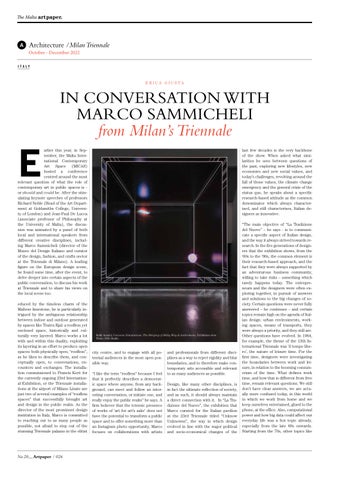
Refik Anadol, Universe Simulations: The Merging of Milky Way & Andromeda. Exhibition view. Photo: DSL Studio
city centre, and to engage with all potential audiences in the most open possible way. “I like the term “roofless” because I feel that it perfectly describes a democratic space where anyone, from any background, can meet and follow an interesting conversation, or initiate one, and really enjoy the public realm” he says. A firm believer that the totemic presence of works of ‘art for art’s sake’ does not have the potential to transform a public space and to offer something more than an Instagram photo opportunity, Marco focuses on collaborations with artists
and professionals from different disciplines as a way to reject rigidity and blur boundaries, and to therefore make contemporary arts accessible and relevant to as many audiences as possible. Design, like many other disciplines, is in fact the ultimate reflection of society, and as such, it should always maintain a direct connection with it. In “La Tradizione del Nuovo”, the exhibition that Marco curated for the Italian pavilion at the 23rd Triennale titled “Unknow Unknowns”, the way in which design evolved in line with the major political and socio-economical changes of the
“The main objective of “La Tradizione del Nuovo” – he says - is to communicate a specific aspect of Italian design, and the way it always strived towards research. In the five generations of designers that the exhibition shows, from the ‘60s to the ‘90s, the common element is their research-based approach, and the fact that they were always supported by an adventurous business community, willing to take risks – something which rarely happens today. The entrepreneurs and the designers were often exploring together, in pursuit of answers and solutions to the big changes of society. Certain questions were never fully answered – he continues – and certain topics remain high on the agenda of Italian design: urban environments, working spaces, means of transports, they were always a priority, and they still are. Other questions have evolved. In 1964, for example, the theme of the 13th International Triennale was ‘il tempo libero’, the nature of leisure time. For the first time, designers were investigating the boundaries between work and leisure, in relation to the booming consumerism of the time. What defines work time, and how that is different from free time, remain relevant questions. We still don’t have clear answers, we are actually more confused today, in this world in which we work from home and we keep ourselves entertained, glued to the phone, at the office. Also, computational power and how big data could affect our everyday life was a hot topic already, especially from the late 60s onwards. Starting from the 70s, other topics like