




iSSUe 49 /// Winter 2025
PUBLiSHer & eDitOr Brian Christensen
CreAtiVe DireCtOr Amanda Joy Christensen
SeniOr WriterS
Carrie Dow
Reade A. Huddleston, MSc.
COntriBUtOrS
Jason Barrett
Corey Day
Sailor Guevara
Doug Hall
Jake Holshue
Paul Hughes, Ph.D.
Justin Koury
Aaron Linden
Maria Lozonschi
Steve McGarvey
Josh Brasted
Amanda Joy Christensen
Carrie Dow
PHOtOGrAPHerS
Rich Manning
Gabe Toth, MSc.
David Schuemann
Gary Spedding, Ph.D.
Haley Spurlin, BSc.
Brett Steigerwaldt
John P. Thomas, II
Lisa Truesdale
Margarett Waterbury
iLLUStrAtOr Francesca Cosanti
Brendan Wheatley
Scott Winters
Tom Woods
David Brendan Hall Scott Meyers
SALeS & MArKetinG Ashley Monroe
ArtiSAn SPirit is a quarterly publication by Artisan Spirit Media. www.artisanspiritmag.com facebook.com/ArtisanSpiritMagazine ArtisanSpiritM

General Inquiries (509) 944-5919 Advertising (509) 991-8112 PO Box 31494, Spokane, WA 99223
All contents ©2024. No portion of this magazine may be reproduced without the written consent of the publisher. Neither Artisan Spirit Media nor ArtiSAn SPirit magazine assume responsibility for errors in content, photos, or advertisements.
While ArtiSAn SPirit makes every effort to ensure accuracy in our content, the information is deemed reliable but not guaranteed. We urge our readers to consult with professional service providers to meet their unique needs.
At ArtiSAn SPirit, we take the opportunity to enjoy many different craft spirits and adult beverages. However, it’s also our responsibility, and yours, to always drink responsibly. Know your limit, and never drink and drive.
ArtiSAn SPirit’s number one goal is to share and celebrate the art and science of artisan craft distilling. But please remember to follow all the laws, regulations, and safety procedures. Be safe, be legal, and we can all be proud of the industry we love. Using a base spirit can significantly reduce the costs associated with processing raw materials. Leverage our economies of scale to your advantage.


Our mission at Artisan Spirit Magazine is to share and celebrate the art and science of artisan craft distilling. We are humbled by the support of our sponsors. With their help, we can further our common goals of supporting creativity, innovation, and integrity within the industry we all love so much.

The American Spirits Exchange is a national importer and distributor serving the alcoholic beverage industry (spirits, wine, and beer). We provide domestic and international companies with access and support to the U.S. market. Regardless of your size — from micro, craft distiller to publicly traded multinational — our focus fuels your growth. Our flagship Foundations™ program provides companies with access to the U.S. market. We handle your business-to-business functions from start to finish: permitting, brand approvals, purchase order processing, invoicing, and compliance.
Every element of Cage and Sons equipment is designed and crafted to provide you with the very best distilling experience at an affordable rate because we know that bottom line matters, but so does function. At Cage and Sons, adequate is never an option, and we continue to develop and design new high functioning, cutting-edge distillation systems that enhance the distillation industry. Cage and Sons works every day to bring you the very best distillation systems for the very best value.

For nearly 50 years, CF Napa Brand Design has set the standard for alcohol beverage branding.
Led by Owner & Creative Principal David Schuemann for the past 22 years, we focus on translating brand ethos visually, never using a one size fits all approach for projects. The result is a bespoke solution rooted in strategy and, most importantly, a design that sells.
CF Napa’s expertise lies in the intricacies of our process — from project conception to conclusion, our team brings a strategic yet thoughtful eye to every detail. We understand the market and target audiences on a global stage. We balance listening with leading to execute a design that the client loves, and the consumer buys again and again.
The Distilled Spirits Council of the United States (DISCUS) is the leading voice and advocate for distilled spirits in the United States. Representing producers and marketers of distilled spirits, DISCUS advocates on legislative, regulatory, and public affairs issues impacting the distilled spirits sector at the local, state, federal, and international levels; promotes the distilled spirits sector, raising awareness and opening markets in the United States and around the globe; and encourages responsible and moderate consumption of distilled spirits as part of a healthy adult lifestyle based on evidence-based research and policy. DISCUS also powers Spirits United, a grassroots platform for the distilled spirits industry. Spirits United is comprised of a community of advocates united with a common goal: to ensure adult consumers can enjoy distilled spirits where they want, how they want, and when they want. Learn more at distilledspirits.org and spiritsunited.org.
We’ve been in this industry for over 100 years, during which time we’ve learned a thing or two about what makes a great barrel to age great spirits. Our R&D team and account managers have hundreds of barrels currently in experimentation. Partnering with distillers, we think outside the box to develop new products that push your vision forward.
Our Mission: To craft world-class oak barrels and other cooperage products so our employees, customers, and communities flourish.

With an impressive legacy spanning over 30 years in the printing and label domain, Jack Vogel stands as a respected authority in the Spirits industry. For the past 23 years, he has been a steadfast and trusted advisor, contributing significantly to the evolution of label standards and practices. Jack's journey includes leadership roles at top label printers within the Spirits sector. Having transitioned into an independent consultant, he continues to channel his wealth of knowledge towards empowering brands to achieve excellence. As an original founding sponsor and advisor to organizations such as ADI (American Distilling Institute), ACSA (American Craft Spirits Association), and Artisan Spirit, Jack has played a pivotal role in shaping industry standards. At the core of Jack's professional philosophy is the belief in industry education as a catalyst for stability and growth. By imparting knowledge and insights, he contributes to the overall advancement of the Spirits label landscape.
Lallemand Biofuels & Distilled Spirits is the industry leader in supplying fermentation products and valueadded services to the distilled spirits industry. We specialize in the research, development, production, and marketing of yeast and yeast nutrients as well as a solid belief in education of the distilled spirits industry.
A vital part of the alcohol production process, fermentation products from Lallemand Biofuels & Distilled Spirits have been designed and selected to create value by tailoring objective solutions to distillery needs.


Moonshine University is located in Louisville, Kentucky on the Beverage Campus with its sister company, Flavorman. Moonshine University offers a variety of classes for enthusiasts, entrepreneurs, industry professionals, and those seeking careers in the distilling industry. Our distillery was designed as part of our classroom, and all classes incorporate hands-on learning and sensory evaluation in order to provide a complete and comprehensive education. In addition to its knowledgeable instructors, Moonshine University hosts a range of renowned industry experts for specialized instruction and training.
RahrBSG is focused on supplying craft distillers with the best ingredients from around the world. The craft distilling market trusts RahrBSG to deliver the finest ingredients at competitive prices, without sacrificing customer service. With distilling malts and grains from Rahr Malting Co, Weyermann®, Simpsons, Crisp, Gambrinus, Dingemans, and Malting Company of Ireland, as well as a full range of yeasts, yeast nutrients, enzymes, botanicals, and finishing products, we have a wide range of distilling ingredients to help you create high-quality, artisanal spirits.


Founded in France in 1897 and based in the USA for more than 30 years, Saverglass provides for the premium & super premium spirits and wines. Over the years, the Saverglass Group has distinguished itself by its undeniable quality of glass coupled with innovative decoration techniques.
Today, one of Saverglass’ main asset lies on its product offer: 110 original designs and 425 references which represent the largest selection on the market! Thirsty for genuineness, Saverglass has created exclusive bottles dedicated to Artisanal distilleries: The Craft Spirits collection is designed to convey the image of authentic, locally sourced and rare high-quality products. Recently, the Group has strengthened its presence and service offering in the U.S. by opening an ultra-modern bottle manufacturing and decorating plant in North America.
Southern Distilling Company is one of the largest artisan distilleries in the nation. We offer product development, contract distilling (standard and custom mash bill whiskeys, rum, and agave spirits), barrel warehouse aging, batching, blending, bottling, and co-packaging of award-winning products. We also keep an extensive inventory of aged bourbon and rye whiskey available year-round.
Our spirits are distilled in top-of-the-line Vendome Copper & Brass Works continuous column stills. Our product development services include working with you to perfect an existing recipe and consultations to help you create your own recipe. We can barrel and warehouse age your product to meet both short and longterm goals. At Southern Distilling Company, you get standout spirits that make brands unforgettable.
Stave & Thief Society was founded in 2014, and is the first bourbon certification program recognized by the bourbon industry and the only to be recognized by the Kentucky Distillers Association as its “Official Bourbon Education Course.” The programs were developed by professional distilling and spirits educators and advised by a panel of experts in the bourbon and hospitality industries to provide a premium, standardized bourbon education that is accessible and holds real value.

For over 60 years Tapi USA has produced cork stoppers and a wide variety of bottle closures. Family-owned and operated since its inception, our company continues to develop new products and enter new markets. Tapi USA is proud to support the growth of the artisan distillery industry and is honored to be the Bottle Closure Sponsor for Artisan Spirit Magazine.
Founded in 1999 in Thousand Oaks, California, the Thousand Oaks Barrel Co. manufactures a wide selection of products for distillery gift shops. We work with large and small distilleries and wineries, marketing and catalog companies, retailers, and web-based e-tailers. Our craftsmen provide made to order products or distilleries can select from our tried-and-true products such barrel heads, quarter barrels, flasks, and barrel key chains, to name a few, each with your distillery logo and branding. We look forward to providing you some of the best promotional products on the market and are sure they will be top sellers in your product line.

Total Wine & More is the country’s largest independent retailer of fine wine, beer, and spirits. Our strength is our people. We have over 5,000 associates, who must demonstrate comprehensive beverage knowledge before they are invited to join our team. After coming on board, all of our team members undergo an extensive initial training program. We believe that an educated consumer is our best customer. We want to demystify the buying experience for our customers so they will feel confident in choosing the bottle that is perfect for them. Total Wine & More works closely with community and business leaders in each market it operates to support local causes and charitable efforts.

Led by Director of George Dickel & Luxury American Whiskey, Nicole Austin, the team at Cascade Hollow Distilling Co. continues the tradition of producing award-winning whisky at our historic distillery with high standards of authenticity and craftsmanship. George Dickel is behind some of the most beloved whisky of our time including Dickel Bourbon, George Dickel x Leopold Bros Collaboration Rye, award-winning Bottled in Bonds, the Cascade Moon series, and a variety of luxury variants like the rare, premium offering — Dickel Bourbon Aged 18 Years. Learn more about the incredible history and creativity that lives at Cascade Hollow at GeorgeDickel.com.


Rahr GN Zero Malt is a premium distilling malt comprised of Glycosidic Nitrile-free North American 2-Row barley.

*GN0 is defined as less than 0.5 g/MT of GN
Excellent neutral base malt with earthy, grainy characteristics and slight notes of bread crumb and sprouts.
Produced exclusively at Rahr's fossil-free malthouse in Shakopee, MN, Rahr GN Zero Malt offers an environmentally sustainable method for reducing EC in your spirit. Ideal for bourbon or American Single Malt Whiskey, its technical specifications and flavor profile make it an excellent option for any whiskey or spirit requiring barley malt.


It may be the winter issue, but my mind is already on spring—specifically, how we can leverage the next issue of Artisan Spirit Magazine to uncover new opportunities in the industry. The timing is auspicious, as the spring issue will not only mark the beginning of 2025 but also celebrate the 50th edition of this publication. That may not seem like many issues in the grand scheme of things, but it's monumental for us. Each edition of ASM is essentially a short book filled with individual stories of distillation, science, and entrepreneurship. I won’t wax too philosophical just yet, but you can expect plenty of that soon enough.
That said, it wouldn't be fair to shortchange this winter edition of ASM. Many incredible people contributed to what I believe is some of our best content yet. In these pages, you’ll find a strong emphasis on distillation sciences. We offer in-depth education covering the pH of gin (page 105), botanical extraction techniques (page 59), the future of gene editing for raw ingredients (page 54), tips on handling rye viscosity (page 108), and (you guessed it) so much more.
As you read through this winter issue, I hope you're inspired by the wealth of knowledge, innovation, and passion that makes this industry so unique. While I eagerly anticipate celebrating the milestones ahead, I won’t take for granted the journey it took to get here.
With greatest appreciation,

Brian Christensen
(509) 944-5919 /// brian@artisanspiritmag.com /// PO Box 31494, Spokane, WA 99223

DistilaZyme® AA, an Alpha Amylase enzyme selected for its ability to rapidly break mash viscosity caused by gelatinization of starch and converting it to dextrin chains.

DistilaZyme® BG, a liquid β-glucanase enzyme complex, selected especially for its ability to break down β-glucans, resulting in reduced viscosity, making pumping easier after mashing.

DistilaZyme® GA, a selected gluco-amylase enzyme used in distilleries for saccharification, and for simultaneous saccharification and fermentation (SSF) of whole grain mashes and starch substrates to fermentable sugars.


Fusion Glassworks specializes in glass bottle manufacturing and more, MAKING IT A ONE STOP SHOP FOR ALL YOUR PACKAGING NEEDS
• High Quality Custom Glass
• Decoration
• Caps/Corks and Tamper Evidence
• Custom Printed Case Boxes
• Low Mold Costs and MOQ’s
“Fusion Glassworks is unequivocally the best in the glassmaking industry. At Smokeye Hill, we uphold the highest standards of quality in everything we do, from our whiskey to our packaging, and beyond. Fusion not only met but exceeded these rigorous expectations. Time and time again, they continue to deliver exceptional products paired with outstanding customer service. Their reliability, and extensive expertise are indispensable to our success.”
Blake Johns, Founder/CEO of Smokeye Hill Whiskey
OWNED AND OPERATED FOR OVER 20 YEARS
Fusion-glassworks.com
sales@fusion-glassworks.com (855) 503-8746


DISTINGUISH YOUR BRAND. CUSTOMIZE YOUR BOTTLE.


It’s no surprise that the state guild updates include a mixed bag of concerning economic news, but thankfully there are a number of positive legislative victories that help soften the blow. Big legislative wins for direct-to-consumer in California and New York sit alongside community growth efforts in Maryland and South Carolina. These guilds, and others, are doing all they can to strengthen and support the distilling community through legislative action, promotional events, and strategic partnerships
Brian Christensen
ACSA just wrapped an eventful fall and it’s full steam ahead into 2025.
In September more than 40 craft spirits producers from across the country headed to Washington, D.C. to advocate for the industry’s top federal legislative and regulatory priorities at our annual Legislative Fly-In. Craft producers met with their U.S. Senators, Representatives, and regulators at the American Craft Spirits Association’s 2024 Legislative Fly-In to address a number of issues, including:
> Helping American craft distillers by ensuring regulations are not overly burdensome
to small business manufacturers
> Maintaining and expanding tax incentives for America’s small craft distillers to remain competitive
> Enhancing market access by allowing spirits to be shipped through the U.S. Postal Service in states in which DtC is allowed
> Ensuring that the Alcohol and Tobacco Tax and Trade Bureau (TTB) remains open and has adequate funding to provide vital services to craft distillers
> Ensuring that the federal agencies tasked
with updating the U.S. dietary guidelines have appropriate authority, are transparent, and use clear preponderance of current scientific evidence
The day before the Capitol Hill visits we unveiled the 2024 Craft Spirits Data Project (CSDP) at our annual Craft Spirits Economic Briefing. The CSDP, a proprietary research initiative conducted with our partner Park Street since 2016, aims to provide a solid and reliable fact base for evaluating performance and trends in the U.S. craft spirits industry. The latest edition of the CSDP highlighted the urgent market access improvements needed to provide a lifeline to craft distilleries, which experienced, for the first time in CSDP’s history, volume and revenue declines.
A few weeks later we were back to the nation’s capital, this time at Cotton & Reed’s new production facility, where we welcomed nearly 30 experts from across the industry to judge nearly 400 whiskeys, gins, brandies, rums, vodkas, specialty spirits, and RTDs in ACSA's 2025 Craft Spirits Competition. The judges awarded gold, silver and bronze medals, as well as Best of Category, Best In Show, and Innovation Award honors. The
results will be unveiled during ACSA’s 2025 Convention & Expo in Tucson, Arizona, March 10-12, 2025. We’d like to extend special thanks to Cotton & Reed, all of our judges and stewards, and judging chairs Colton Weinstein and Jeff Wuslich.
While we’re on the topic of medals, we’ll also be awarding plenty of them in ACSA/ Craft Spirits magazine’s fifth annual Craft Spirits Packaging Awards. We accepted entries through December and judging for excellence in craft spirits bottle, can, label, and closure design wraps up in January.
But even before the final entries arrived, we made a stop in Chicago for ACSA’s Second Annual American Craft Spirits Festival, once again at Binny’s Beverage Depot’s Lincoln Park location. Forty of the country’s top craft distillers poured their spirits for consumers and select members of the trade. Attendees also received the official Festival Cocktail Book, which included recipes from most of the participating producers. Thank you to all who made it out to Binny’s on November 13, all of our event sponsors, festival chair Dan Farber and, of course, Binny’s.
Our next event is actually our biggest: the aforementioned 2025 Convention & Expo
The American Distilling Institute celebrated a successful 21st annual conference in Baltimore earlier this year. It was terrific to see more than 1,700 old and new friends, learn from industry luminaries, and taste some incredible craft spirits. Thanks to everyone who was able to join us at the Baltimore Convention Center. We’re looking forward to another great conference next year, but we need your help to make it even better. If you’ve got an idea for a panel, presentation, or workshop, we’d love to hear about it. We have an open call for proposals for 2025 conference speakers through early January — all the details are on our website: www.distilling.com.
Until then, there are several new ways to get engaged with ADI, level up your skills, learn something new, and get inspired. The next season of
Voices of Distilling, our podcast and video series highlighting inspiring leaders, makers, and legends in the distilling industry, dropped in November. You can subscribe wherever you get podcasts, or check out ADI’s YouTube channel for episodes. We’ve also launched a private Facebook group called The Spirit Safe where ADI members can connect with one another and share resources, provide or seek wisdom, and have a little fun.
Registration for ADI’s 19th annual International Spirits Competition is now open. Early bird rates end on Feb. 8, 2025. All entrants receive written feedback from expert judges, maximizing value for competitors. Best in Class winners will be awarded medals on stage at the 22nd Craft Spirits Conference Gala in 2025 and will be invited to schedule meetings with major retail
in Tucson. Registration is now open for the March 10-12 convention, so head over to americancraftspirits.org to register, if you haven’t already. This year’s program includes:
> Dozens of hours of educational courses
> A trade show floor with vendors and suppliers to the craft spirits industry
> Countless opportunities to share meaningful connections with craft spirits producers and suppliers
> Special events like our Distillery 101 Course, distillery tours and 5K fun run and walk
> An awards ceremony to announce the results of our Craft Spirits Competition and Craft Spirits Packaging Awards
> And much more!
Happy New Year and we hope to see you in Tucson!
Kelly Woodcock Partner & General Manager, Oregon, Westward Whiskey President, ACSA Board of Directors
partners like Binny’s Beverage Depot, K&L Wine Merchants, and Total Wine.
We’ve also got a number of educational opportunities coming up. Visit our website to see the full calendar for our monthly webinar series, which covers topics from maintaining your distillery equipment to transforming your tasting room into a community hub. Subscribe to our weekly newsletter, The Heartbeat, to stay in the loop about everything coming up.
Finally, our thoughts continue to be with our friends and colleagues in North Carolina and elsewhere across the Southeast after a devastating hurricane season. We’re committed to supporting distillers across the region as they recover from the damage, help their communities, and rebuild a thriving craft industry in the months and years to come.
Erik
President, American Distilling Institute

Craft Malt Month Recap: A Celebration of Flavor, Craftsmanship, and Community
In September 2024, the Craft Maltsters Guild rolled out the first-ever Craft Malt Month. The September event, which will be an annual occasion in the future, brought together beer lovers, spirits enthusiasts, and craft malt advocates for 30 days of all things craft malt. The event, held in partnership with breweries, distilleries, and industry professionals, was a fantastic opportunity to showcase the creativity and craftsmanship that
craft malt brings to the world of brewing and distilling.
In addition to many tastings and collaboration beers, Craft Malt Month also featured the release of a Copperworks Distilling American Single Malt whiskey aged for eight years and three months, distilled from Alba barely grown in 2015 in Burlington, Washington.
The event wasn’t just about the drinks or end products, though. Craft Malt Month also included educational opportunities led by
Join us at the 2025 DISCUS Annual Conference March 26-28 in Washington, D.C.!
Registration is now open! The DISCUS Annual Conference is the premiere event for America’s spirits industry leaders, decision makers, and supply chain partners.
DISCUS' Sixth Annual Conference will take place on March 26-28 at the Hyatt Regency on Capitol Hill. The event will feature robust conference programming — hear the latest on mission-critical policies, connect with spirits business executives at networking events, learn from industry thought leaders, and walk away with tangible insights to boost business.
This year’s conference will include a trade show where spirits industry partners can showcase their products and services, as well as a rooftop reception overlooking the U.S. Capitol where attendees can connect with members of Congress, spirits business executives, and industry VIPs.
Over 1,000 Letters Sent to TTB Urging Final Rule on a Formal American Single Malt Whiskey Category
DISCUS and the American Single Malt Whiskey Commission (ASMWC) generated more than 1,000 letters to Treasury
Department’s Alcohol and Tobacco Tax and Trade Bureau (TTB) Administrator Mary Ryan urging immediate action to finalize the official standard for the American Single Malt Whiskey category.
The monthlong campaign, powered by DISCUS’ Spirits United, generated letters from across the country sent in by distillers, consumers, and supporters of the spirits sector.
The letters highlighted that it has been two years since the bureau issued its notice of proposed rulemaking and urged TTB officials “to follow through with developing an official standard for the American Single Malt Whiskey category, which stands as one of the fastest-growing categories of American Whiskey over the past decade.”
Publisher’s note: Shortly before publication TTB approved the classification of both American Single Malt, and Straight American Single Malt.
> INCREASING MARKET ACCESS: We were thrilled to help secure more than 10,000 private beer and wine retail outlets to be eligible to sell spirits-based ready-to-drink cocktails (RTDs) in Pennsylvania. In the
experts in brewing, distilling, malting, and farming that provided deeper insight into the science behind malt, the nuances of flavor development, and the role of sustainability in the craft industry.
As Craft Malt Month wraps up, we’re incredibly grateful for the support of all our participants and partners. The enthusiasm and passion for craft malt have been inspiring. We can’t wait to see what the future holds as we continue to celebrate this key ingredient in the craft beverage world.
first two weeks of the bill being in effect, more than 1,400 permits have been issued for the expanded spirits-based RTD sales.
> DEFEATING TAX THREATS: Together with our craft distillers and industry partners, we were able to defeat Nebraska Gov. James Pillen’s proposal to increase the excise tax on distilled spirits from $3.75/gallon to $14.50/gallon (a 287 percent increase) in a special session.
> MODERNIZING THE MARKET: The North Carolina ABC omnibus bill eliminated the state’s mixed beverage tax ($20/ four liters) for on-premise sales of spirits-based RTDs. The bill also allows permanent cocktails to-go, including by distilleries and via delivery and third-party delivery, and off-premise sales of spirits on New Year’s Day, July 4, and Labor Day.
DISCUS remains engaged in the states that are still in regular session and is prepared to guard against any other potential threats.
It’s Time to 86 Harassment
DISCUS is a proud industry sponsor of the Women of the Vine & Spirits’ 86 Harassment initiative aimed at addressing sexual harassment and gender-based violence within the beverage alcohol and hospitality industries. 86 Harassment offers:
> CUSTOMIZED TRAINING for the beverage alcohol and hospitality industries on setting boundaries and bystander intervention, de-escalation training, and more.

A barrel should be more than an aging vessel, it should be a partner in achieving your desired flavor profile. Using science-based research and experimentation, ISC barrel experts collaborate with world-class distillers to create innovative barrel solutions for their unique spirits.
> AN INDUSTRY-SPECIFIC DEDICATED CONFIDEN TIAL CRISIS INTERVENTION HOTLINE operated by staff at RAINN. Telephone crisis intervention services are available in English and Spanish. The hotline staff are available 24/7 to support communities with industry-specific crisis intervention, empathetic listening, and warm handoffs to designated local service providers.
> CENTRALIZED RESOURCE HUB including a glossary of key terms and phrases, articles, reports, newsletters, and educational resources for anyone in the beverage alcohol and hospitality industries.
We ask that you join us in the effort to create a community where everyone feels safe and valued in their workplace.
Responsibility.org Commemorates Enactment of Noah’s Law
Leslie executive director of Responsibility. org, joined Maryland highway safety advocates, legislators, and partners to commemorate the passage of legislation to close the loophole in Noah’s Law. The law, which went into effect on Oct. 1, ensures every DUI offender will be required to have an ignition interlock installed in their vehicle, including offenders who have received Probation Before Judgement.
After years of staunch advocacy, it is a proud moment for Responsibility.org, legislators, and advocates to see this loophole closed and the original intent behind Noah’s Law realized.
Good Friends, Good Choices, Good Tidings
There is nothing better than having friends and family over to celebrate a holiday, watch sports, or simply to catch up. But as a host,
2025 Beam Institute Industry Conference
The Beam Institute’s annual industry conference returns on March 17-19, 2025. The James B. Beam Institute annual conference brings members of Kentucky’s spirits industry together to share best practices, explore new discoveries, and advance the global growth and sustainability of the American whiskey industry. Conference topics include innovation and technical research, workforce education, environmental sustainability, and community and social responsibility. Held on the University of Kentucky’s campus, this venue creates an opportunity for industry partners to network and build collaborative partnerships that further advance the growth and sustainability of Kentucky’s signature industry. For more information, please visit beaminstitute.ca.uky.edu.
Harmonie Bettenhausen Joins the Beam Institute
Harmonie Bettenhausen is joining the institute as a faculty lecturer at the James B. Beam Institute. With a focus on grains, malts, beer, spirits, dough, and breads, Bettenhausen brings her extensive expertise to both research and hands-on testing. She earned her Ph.D. from Colorado State University, specializing in omics-based research and biochemistry of small grains, with a diverse publication record including work on peppers, wheat, and chocolate.
Her dedication to research, innovation, and education makes her a key asset to both the academic and professional communities.
The Beam Institute distillery is designed to support new discoveries and to train the next generation of distillers. Used throughout the last year for hands-on learning, the distillery allows frequent student and faculty access to
make sure that you are ready to welcome guests to your space in a responsible way. Remember to never serve anyone under the legal drinking age, provide plenty of food and no-alcohol beverages for your guests, and ensure everyone has a safe ride home. It is also important to always know what is in your drink and what constitutes a standard drink. Be sure to explore the Virtual Bar app to see how alcohol will affect your blood alcohol content so you can continue to model responsible behaviors. With these simple guidelines in place, your gathering will not only be enjoyable; it will also set an example for all on how to be a responsible guest. No matter your role, remember to always enjoy responsibly.
Chris R. Swonger President & CEO, Distilled Spirits Council of the United States
a full-scale production facility and elevates assignments analyzing spirits production equipment and hazard analysis. Rather than paper-only exercises, the students put on full PPE to instill a practical safety culture and add a solid dose of reality to each assignment. In addition to teaching, craft-scale distilling research projects are underway on our classic 12-inch Vendome column still with a 50-gallon doubler. Our distiller, Glenna JoyceWelsko, worked with a team of student interns to produce more than 1,000-proof gallons of spirit to support an industry-funded student research project on water reuse. These findings will be published by project leaders Ryan Sarhan and Tyler Barzee. Additional federaland industry-funded projects are underway, evaluating everything from raw materials, alternative energy, and process automation. If you are interested in collaborating with the Beam Institute on a research project, please reach out to brad.berron@uky.edu.
Brad J. Berron
James B. Beam Institute for Kentucky Spirits, Chemical and Materials Engineering, University of Kentucky, Lexington, Kentucky

No-GN barley, assuring low levels of Ethyl Carbamate
Designed for all-malt whiskeys
Sweet & bready, with notes of honey
Available in whole kernel and flour
The California legislative year ended with several positive bills being signed by the Governor. California Distillers Association (CDA) sponsored AB No. 3203 Craft distillers: direct shipping, supported AB No. 2589 Additional liquor licenses in Placer & El Dorado County, and AB No. 2609 Soju and Shochu production in California.
CDA board of directors, with direction from Alex Villacana (President), moved forward with an application of a Specialty Crop Block Grant from the U.S. Department of
Despite the industry headwinds, the Maryland Distillers Guild has seen growth over the last year, including new DSPs and several Maryland-based brands that have joined the guild. The focus of the guild continues to be on strengthening the distilling community through education and industry promotion through tourism-based events. The guild has benefited from the Maryland
Manufacturer direct-to-consumer (DTC) shipping for distillers is law in New York. Governor Kathy Hochul signed a bill that passed the Legislature in June and it took effect on Nov. 16, just in time for holiday shopping.
Governor Hochul invited the Guild to celebrate the signing at The New York State Fair in an event that included her, Chair of the New York State Liquor Authority Lily Fan, and other senior leaders from her administration, as well as representatives of the New York State Cider Association, whose members also gained the ability to ship DTC under the new
Agriculture. This would be a three-year program to assist in expansion of CDA operations. The focus would be on our website and marketing of how distillers use California agricultural products. Members of CDA would enjoy enhanced listings and links while nonmembers would also be given basic listings to promote everyone statewide. This would be a great benefit to drive traffic to tasting rooms, links between DSPs and local farmers and an overall awareness of the distilling industry.
There are many DSPs across California who continue to avail themselves of the benefits of being a CDA member but are not members. By joining the statewide member-run
Alcohol Manufacturing Promotional Fund (MAMPF) which is a grant pool drawn from state excise taxes of beer, wine, and distilled spirits producers. As a nonprofit organization, the guild is able to apply for grants that help to “advance a well-connected craft beverage industry through research, promotion, and agricultural business development.” The guild won a grant to help promote the Spirits of Maryland event series, which helps bring producers to new customers around the state, and a second grant to continue the promotion
law. The Guild was thrilled to be part of this long-standing tradition of celebrating agriculturally related legislation at the Fair.
New York State distillers are now able to ship DTC to their fellow New Yorkers and into a limited number of states that allow DTC shipping.
As we write this, the Guild is expecting guidance from our primary state regulator, the New York State Liquor Authority (the SLA). The SLA, which was instrumental in enacting the legislation, has met with the Guild to hear members’ concerns and questions relating to implementation of the law.
The Guild appreciates the SLA’s work under one of its “core functions,” as identified on the SLA website: “To the extent possible,
association, you support the programs that directly benefit the DSP community. Call a board member and ask how to get involved. We have an economic contraction in California. All three sectors of wine, beer, and spirits are all seeing slower traffic and sales statewide. A larger than normal number of DSPs are closing doors. CDA is here as a resource and will try to provide resources and advice to members. We all look to a positive 2025 and passing legislation to make DTC permanent.
Cris Steller
Executive Director,
of the Rye Revival festival, which is set to return in March of 2025.
After a successful legislative session in the spring, which saw the ability to deliver, with an employee, and a lift on the cap of bottle sales to a consumer from your premises become a permanent part of Maryland law, the guild anticipates a relatively quiet session in 2025.
Eli Breitburg-Smith
Head Distiller/Co-Owner, Baltimore Spirits Company Diploma in Distilling, Institute of Brewing and Distilling President, Maryland Distillers Guild
the SLA supports economic growth, job development, and the state’s alcoholic beverage production industries and its tourism and recreation industry.”
The Guild is optimistic that this enactment will encourage other states to allow manufacturer DTC, giving craft distillers across the country access to a critical path to markets they now struggle to reach. If you’d like to learn more about how DTC became law in New York, the New York State Distillers Guild would be happy to talk to you. You can reach us at NewYorkStateDistillersGuild@ gmail.com.
The Guild is poised to help its members market their products and will soon launch an online Passport program and app that will


help consumers plan visits and order spirits from producers. Guild marketing efforts also include supporting members’ participation in consumer events and improving retailers’
The South Carolina Craft Distillers Guild has been busy preparing for when our state legislators return to the statehouse in January 2025. We plan to introduce a bill with several priority issues as well as reintroduce Sunday sales, which received favorable reports in the 2024 legislative session. As we work toward those goals, we have planned meetings with stakeholders and are hosting distillery tours with legislators to familiarize them with the distilling industry and its impact on the SC economy.
In September, our members, both distillers
access to members’ products, including those who self-distribute. The Guild is steadily building a program to become identified as the essential route for event organizers,
and affiliates, gathered in Charleston, SC, at our annual meeting and luncheon event to hear Farmer Josh Johnson, a local SC farmer with Old Tyme Bean Company. Johnson spoke to members about the variety of grains used in distilling spirits and how important the agriculture business in SC is to the state’s economy and specifically to South Carolina distilling. Johnson is one of several farmers in the midlands of SC that plant, grow, and harvest the infamous “Jimmy Red Corn” grain used to produce whiskey. The partnership between the agriculture business and the
influencers, and others to reach New York’s craft spirits producers.
Teresa
Casey Executive Director, New York State Distillers Guild
distilling industry in SC affects many of our SC distilleries. In fact, 90 percent of the ingredients used in SC distilled spirits are South Carolina grown, so maintaining a good relationship with each other is critical to the SC economy. Our distiller members are proud to use SC crops in their spirits.
The South Carolina Craft Distillers Guild is feeling confident heading into 2025!
IS YOUR GUILD OR ASSOCIATION MISSING? Don’t miss out on this opportunity to reach a national audience of distillers and suppliers! Share your latest victories, recruit supporters, request suggestions to solve your latest challenges, and inspire fellow groups. Email brian@artisanspiritmag.com to get involved!


Over the past several years, the availability of bulk spirits has exploded.
While distillers have often turned to bulk spirits, the combination of increased production by both larger rectifiers and craft distillers has resulted in an excess of available product. This ample supply has driven down prices and increased accessibility to high quality bulk spirits. In turn, these factors have spurred opportunities to create marketing-driven brands and private label products.
The term “bulk spirits” refers to finished distilled spirits that are available for purchase. Once obtained, they are ready to be bottled and sold immediately or they can be blended or further aged by the owner to put their own signature touch on the final product. This category has grown to include everything from unaged products like vodka and gin to aged whiskies to lesser-known regional spirits from all over the world.
The unfortunate realities of the current market have been hitting the craft distilling community. “Consumer purchasing power has been significantly impacted by inflation, rising costs of living, and economic uncertainty. When consumers are financially strained, discretionary spending — such as craft spirits — naturally declines,” according to the Wine & Spirits Wholesalers of America.1 Health concerns and the rise of the “sober-curious” trend have also given consumers reasons to cut back on their alcohol consumption. These factors, and many others, have all contributed to slowing alcohol sales and, in some cases, the closure of distilleries. With the downturn in sales of alcohol, many distilleries find they have produced more product than they could sell and defunct distilleries have inventories that need to be liquidated, both of which have contributed to an excess of supply.
1 https://www.wswa.org/news/wswa-responds-us-craft-distilleries-are-crisis
While the market landscape is challenging, there remain opportunities for those who can utilize this flood of products on the market, no matter the size or tenure of your distillery.
▶ New Distillery: Utilize bulk spirits to rapidly get to market and generate cash flow to fund the build of your equipment and distillery. There is currently an amazing supply of high-quality whiskey to take advantage of while you build up and age your inventory of in-house products.
▶ No Distillery: Utilize bulk spirits exclusively to set up a marketing-driven spirits brand. This path is a huge time and cost saver, allowing you to re-allocate money that would have been spent on a facility and equipment to instead develop your brand packaging, marketing, sales, and distribution. Creating a portfolio sourced from bulk spirits does not mean forgoing creative control. Many distilleries continue to age or blend the spirits — creating entirely unique products that stand out in the market for a fraction of the cost of in-house distilling from the start.
▶ Existing Distillery — Expand Your Portfolio: An existing brick-and-mortar distillery can take advantage of bulk spirits to expand a portfolio. Use your still and equipment to produce your core offerings and turn to bulk spirits for new products that are outside of your standard spirits, such as limited edition items, lower-priced
While there are many companies that provide bulk spirits, here is a selection of a few you can consider to fulfill your needs.
▶ Bardstown Bourbon Company
▶ ClearSource
▶ Corning & Company*
▶ EUS Distilling
▶ J.B. Thome & Co., Inc.
▶ MGP Ingredients/Luxco
▶ Middle West Spirits
▶ Monson Ranch Distillers*
▶ Southern Distilling Company
▶ The Strategic Sourcing Hub
▶ Ultra Pure LLC
▶ Victory Spirits
entry products, or testing a new offering and getting customer feedback before committing to producing it at your distillery. Bulk spirits also allow distilleries to rapidly scale a product or their brand without worrying about bandwidth in their facility.
▶ Niche Opportunities: Another advantage of bulk spirits is the ability to be nimble and respond to unique and time-sensitive opportunities. Grocery stores, liquor stores, bars, restaurants, hotels, cruise ships, and airlines are frequently interested in pursuing private label brands with distillers. Often, these partnerships come with breakneck timelines and competitive pricing. In these situations, having access to a wide variety of products with a fixed price that are ready to taste, bottle, and ship puts you in an advantageous position to be awarded the contract.
The bulk spirits market continues to grow, providing a diversity of products at a variety of price points. They give you the flexibility to build and expand your portfolio and take advantage of opportunities that were once only available to the largest producers. There are many ways in which you can incorporate bulk spirits into your business model. Determine what works best for you to take advantage of the opportunity they can provide.
David Schuemann is the owner and creative director of CF Napa Brand Design. For more information, visit www.cfnapa.com or call (707) 265-1891.


Boosting your brand perception is easy with O-I glass. Our in-house design team offers a full spectrum of services including label design, engraving, and full shape and color customization. Bring your beverage to market with the bottle manufacturer that knows it best.
Discover the packaging possibilities.

Written by tOM WOODS and COreY DAY

f you go dig out your Winter 2021 issue of Artisan Spirit Magazine, you’ll see my previous article on things to consider if you’re going to have a recurring subscription service for your distillery. This would likely take the form of a recurring monthly, semimonthly, or quarterly shipment to customers that is automatically charged to their credit card. At the time, I warned about the varying laws that you need to comply with to do so — the most broadly applicable being the Restore Online Shoppers’ Confidence Act (“ROSCA”).
Well…there have been developments in the intervening four years. In a significant move to protect consumers from “deceptive” subscription practices, the Federal Trade Commission (FTC) has introduced a new rule relating to ROSCA.1 These changes aim to provide clearer guidelines and stronger protections for consumers who engage in “negative option contracts,” which include automatically renewing subscriptions.2 Simultaneously, California has updated its Automatic Renewal Law (CARL) aligning closely with these federal changes, signaling a broader trend toward stricter regulation of subscription services.3 So if you have customers set up on a recurring payment plan, à la a distillery club, it’s time to brush up on the changes and be prepared to implement them.
1 https://www.ftc.gov/news-events/news/press-releases/2024/10/federal-trade-commission-announces-final-click-cancel-rule-making-it-easier-consumers-end-recurring
2 https://www.ftc.gov/system/files/ftc_gov/pdf/p064202_negative_option_rule.pdf
3 https://www.gov.ca.gov/2024/09/24/governor-newsom-signs-consumer-protection-bills-targeting-medical-debt-overdraft-fees-and-unfair-subscription-practices
Navigating the New FTC Rule on ROSCA and California’s Updated Automatic Renewal Law
The FTC’s amendments to ROSCA are designed to address the persistent consumer complaints relating to these recurring payment contracts. Customers often complain of unexpected charges due to their not understanding the terms and cancellation processes. The new rule aims to create a more consumer-friendly environment by focusing on three main areas:
Clear and Conspicuous Disclosures: Businesses must now provide clear and conspicuous disclosures of all material terms before obtaining a consumer’s billing information. This includes details about the recurring nature of charges, the deadline to cancel to avoid charges, the amount or range of costs, and the cancellation process.
Express Informed Consent: The rule requires businesses to obtain consumers’ express informed consent before charging them. This consent must be obtained separately from any other part of the transaction, ensuring that consumers are fully aware of what they are agreeing to.
Simple Cancellation Mechanisms: To prevent consumers from having to take multiple steps to terminate subscriptions, the FTC mandates that businesses provide simple and straightforward cancellation mechanisms. This means that if a consumer signed up online, they should be able to cancel online just as easily.
These changes are a response to the FTC’s findings that the current landscape of laws and regulations is inconsistent and often fails to protect consumers adequately. By standardizing these requirements, the FTC hopes to reduce consumer harm and increase trust in subscription services.
Just before the FTC dropped its final rule, California amended its Automatic Renewal Law, though the changes will not take effect until July 1, 2025. While the amended CARL tracks fairly closely to the FTC’s new rule, there are slight differences. In relevant part for distilleries, the law requires businesses to allow customers to cancel their subscriptions in the same medium used to enroll or in the medium the consumer is accustomed to interacting with the business. For example, if a subscription was initiated in the distillery, the business must provide an easy way for them to terminate the subscription in the distillery. Further, companies must notify consumers annually about their subscription status, regardless of whether any changes have been made to the contract. Additionally, any price changes or material changes to the terms must be communicated to the consumer.
To prepare for compliance with the new FTC rule on ROSCA and an updated CARL, businesses should start by thoroughly reviewing their current subscription and cancellation processes to identify areas that need adjustment to meet the new requirements. At a minimum, ensure that all material terms are clearly and conspicuously disclosed to consumers before obtaining their billing information. So if you’re using a paper form or an online signup, this disclosure must occur before the customer fills in their billing information. The more clearly demarcated the sections, the better. Additionally, businesses must implement processes to obtain express informed consent from consumers, separate from other transaction elements, to ensure that consumers are fully aware of what they are agreeing to. This means having separate language that they are consenting to the contract. Clicking “accept and pay” on an online form will likely be challenged.
Simplifying the cancellation mechanisms is also crucial; businesses should develop and test these mechanisms to ensure they match the ease of the signup process.
Finally, if you have customers in California, be prepared to send them annual reminders about the terms of their agreement, even if nothing has changed.
By taking these steps, businesses can align their practices with the new standards and be ready when the amendments take effect.
However, businesses should be aware of a recent lawsuit challenging the FTC’s new rule on ROSCA. On October 24, three large trade organizations — the Electronic Security Association, Interactive Advertising Bureau, and Internet & Television Association (NCTA) — filed a petition for review in the U.S. Court of Appeals for the Fifth Circuit. The location is important, as lately the Fifth Circuit has been extremely wary of new rules proposed by administrative agencies. The petitioners seek to vacate the FTC’s final rule. This legal challenge adds a layer of uncertainty for businesses as they navigate the new regulatory landscape.
While the ROSCA rule has been challenged, there does not appear to be a similar challenge mounted against the amended CARL yet…
Conclusion
While we wait for the dust to settle in the courts, if the FTC’s new rule on ROSCA and California’s updated CARL stands, this represents significant changes in a distillery’s subscription practices. You should prepare now to align your business with these new standards so that you are ready if the amendments take effect.
DISCLAIMER : This article is intended to be a source of general information, not an opinion or legal advice on any specific situation and does not create an attorney-client relationship with our readers.
Tom Woods is a Partner with the law firm Stoel Rives LLP, where he is a commercial dispute and consumer practices litigator. He can be reached at tawoods@stoel.com or (916) 319-4748.
Corey Day is an alcohol beverage attorney and litigator at Stoel Rives LLP and can be reached via email at corey.day@stoel.com or by phone at (916) 319-4670.





and available to the entire distilling community.
Read all peer-reviewed articles online now.

SIGN UP TODAY for access to the digital version of the publication visit journaldistilling.com


Peer-reviewed, original scientific papers
• Reporting significant research
• Technical reports
• Applicable analytical techniques and methods


• Biology/microbiology

• Reviews Scientific and technical disciplines applied to the distilling of high-quality, potable alcoholic beverages
• Chemistry/ biochemistry

• Molecular biology
• Physics and engineering



International board members, contributors, and audience
• Universities and colleges
• Research institutes and industrial laboratories

SPECIAL THANKS TO THE SPONSORS MAKING THIS POSSIBLE


• Distilleries
• Raw materials producers
• Allied industries supporting the testing and quality control functions of distilling operations


WRITTEN BY MARIA LOZONSCHI AND JOHN P. THOMAS, II
The Alcohol and Tobacco Tax and Trade Bureau
(TTB) is shaking up the conversation around what you may see on your favorite bottle of wine, spirits, or malt beverages. With new labeling requirements potentially on the horizon, the TTB is requesting consumers and businesses to weigh in: Do we know enough about what we are drinking, or is time for more transparency? From alcohol content to calories, allergens to ingredient lists, this TTB notice could transform how consumers choose their drinks and impact how businesses operate in the alcohol industry.
Background: What Led to the TTB’s Notice?
On Jan. 31, 2024, the TTB made waves by publishing notice in the Federal Register, signaling potential changes to the federal labeling requirements for alcoholic beverages.1 If approved, these changes would impact labeling and advertising regulations for wine, distilled spirits, and malt beverages’ brands.2 The TTB’s notice was largely fueled by the U.S. Department of Treasury’s February 2022 report
1 Labeling and Advertising of Wine, Distilled Spirits, and Malt Beverages With Alcohol Content, Nutritional Information, Major Food Allergens, and Ingredients, 89 Fed. Reg. 6171 (proposed Jan. 31, 2024).
2 Id.
on “Competition in the Markets for Beer, Wine, and Spirits,” which recommended the TTB revive or initiate rulemaking in this area, specifically labeling alcoholic beverages with nutrition, major food allergen, and ingredient information.3 The Treasury Department issued its report following the issuance of Executive Order (EO) 14036, “Promoting Competition in the American Economy,” which encouraged various federal agencies like the TTB to offer the public opportunities to participate in regulatory actions.4 The goal of the EO was to “promote equitable and meaningful participation by a range of interested or affected parties, including underserved communities.”5 As a result, the TTB scheduled two virtual listening sessions and also provided an option for the public to submit comments on their main page based on the questions outlined below.6
The TTB’s listening sessions began by providing an overview
3 Id.
4 Id.
5 Modernizing Regulatory Review, 88 Fed. Reg. 21879 (Apr. 11, 2023).
6 Labeling and Advertising of Wine, Distilled Spirits, and Malt Beverages, supra note 1, at 6172-73.
of the TTB’s legal authority and current regulations.7 The TTB’s authority over alcohol beverage labeling and advertising comes from the Federal Alcohol Administration Act (or FAA Act).8 This law authorizes the USDT secretary to prescribe regulations that will provide adequate information as to the identity and quality of alcoholic beverages.9 This authority has been delegated to the TTB, and the relevant regulations are outlined in Title 27 of the Code of Federal Regulations — specifically, Parts 4, 5, and 7, covering wine, distilled spirits, and malt beverages, respectively.10
Current regulations under these parts require that labels for wine, distilled spirits, and malt beverages include information
7 Transcript, First Listening Session on TTB’s Proposed Notice to Require Labeling and Advertising of Wine, Distilled Spirits, and Malt Beverages With Alcohol Content, Nutritional Information, Major Food Allergens, and Ingredients (Feb. 28, 2024), https:// www.regulations.gov/document/TTB2024-0002-0100; Transcript, Second Listening Session on TTB’s Proposed Notice to Require Labeling and Advertising of Wine, Distilled Spirits, and Malt Beverages With Alcohol Content, Nutritional Information, Major Food Allergens, and Ingredients (Feb. 29, 2024), https://www.regulations.gov/ document/TTB-2024-0002-0102.
8 Transcript, First Listening Session, supra note 7.
9 Id.
10 Id.
such as the brand name, class designation or standard of identity, name and address of the bottler, net contents, and, with a few exceptions, alcohol content.11 Generally, TTB regulations do not require alcohol beverage labels to disclose a full list of ingredients, major food allergens used in their production, or nutritional information, such as the number of calories or the amount of carbohydrate, protein, fat, or other nutrients per serving.12 However, the TTB does require disclosures for certain ingredients that the U.S. Food and Drug Administration has determined poses a recognized health risk and has issued guidance on voluntary calorie, nutrient, and allergen content statements.13
The TTB is now considering whether the disclosure of the information currently subject to voluntary standards should instead be mandatory, whether required alcohol content disclosures should be expanded to a broader scope of beverages, and, if so, how the information should be presented.14 The TTB
11 Id.
12 Id.
13 Id.
14 Id.

posed the following questions during two offered listening sessions to facilitate input from a broad range of stakeholders:
> Do consumers believe that they are adequately informed by the information currently provided on alcohol beverage labels?
> Is alcohol content per serving and nutritional information (such as calories, carbohydrates, protein, and fat) per serving important for consumers in deciding whether to purchase or consume a particular alcohol beverage? Would a full list of ingredients and/or major food allergens be important information for consumers in making their purchasing or consumption decisions? In what ways would this information be useful, and in what ways could it be misleading? Is some of this information more important than others?
> What types of per-serving nutritional information, such as calories, carbohydrates, protein, and fat, should be included?
> Would requiring this information on labels be expected to increase the cost of the products and, if so, by how much? To what extent are businesses already following voluntary guidelines for this information? Are there alternative ways of providing the information — for example, by allowing information to be provided through a website using a quick response code (QR code) or website address on the label?
> How would any new mandatory labeling requirements particularly affect small businesses and new businesses entering the marketplace?15
The proposed revisions to the alcohol labeling regulations could result in certain industries within the wine, distilled spirits, and malt beverage realm to reassess their business strategies and operations. For consumers, these new rules may influence purchasing decisions, potentially leading them to gravitate toward different products on the market.
A review of the feedback from the TTB’s listening sessions highlights several concerns, particularly for small business owners.16 Many expressed concern that the potential alcohol labeling mandates would disproportionately affect them compared to large beverage producers and multinational corporations.17 Notably, a small, family-owned artisanal producer in California argued that implementing nutrition labeling on their spirits would impose significant burdens.18 With limited resources, the costs of testing and printing nutritional labels for each bottling could stifle their ability to bring their products to market at a competitive price.19
On the consumer side, there was largely a positive response to the TTB’s proposed regulatory changes. Greater transparency and consistency in labeling are expected to improve trust and brand loyalty, as buyers increasingly value clear product information.20 Businesses that
16 See Transcript, First & Second Listening Session, supra note 7.
17 Id.
18 Transcript, First Listening Session, supra note 7.
adapt early to these changes may gain a competitive edge, positioning themselves as leaders in compliance and consumer safety.
Trade Secrets and Innovation Concerns
While not addressed during the TTB’s virtual listening sessions, more than 5,000 comments were submitted to the agency, some of which also raised the issue of businesses’ ability to protect their trade secrets under the new TTB guidelines.21 Some businesses in the distilled spirits industry argued the TTB’s potential mandatory labeling requirements, specifically the inclusion of ingredient lists, could expose trade secrets and stifle innovation.22 Notably, a small distilled spirits manufacturer highlighted requiring ingredient disclosure would force companies to reveal sensitive information about proprietary formulas to their customers, many of whom are fellow manufacturers.23 As a result, this disclosure could give competitors insight into the proprietary processes and ingredients that are crucial to businesses maintaining their competitive
21 See Endless West, Comment Letter on TTB’s Proposed Notice to Require Labeling and Advertising of Wine, Distilled Spirits, and Malt Beverages With Alcohol Content, Nutritional Information, Major Food Allergens, and Ingredients (Mar. 29, 2024), https://www.regulations. gov/comment/TTB-2024-00020405.
edge.24 Consumers, on the other hand, feel disclosing ingredient information on alcoholic beverages would leave them more satisfied and better informed in their purchasing decisions.25
Is the U.S. Set to Follow the EU’s Lead on Alcohol Labeling?
As the U.S. considers revamping its alcohol labeling requirements, one of its major trading partners has already taken significant measures in this direction. The European Union (EU) in December 2023 introduced a law requiring “new rules on labeling of ingredients and nutritional values of wine and aromatized wine products.”26 With the EU already enforcing mandatory labeling requirements for the wine industry, aligning the U.S. standards with those of the EU could offer advantages for U.S. producers selling in EU cross-border markets. Specifically, it may help reduce compliance costs for producers by eliminating the need for multiple labeling formats. In fact, one significant innovation from the EU is the adoption of QR codes for wine labeling, which allows businesses to

15 Labeling and Advertising of Wine, Distilled Spirits, and Malt Beverages, supra note 1, at 6172.
19 Id.
20 See Transcript, First & Second Listening Session, supra note 7.
22 Id.; Christina Taylor, Comment on TTB’s Proposed Notice to Require Labeling and Advertising of Wine, Distilled Spirits, and Malt Beverages With Alcohol Content, Nutritional Information, Major Food Allergens, and Ingredients (Mar. 29, 2024), https://www.regulations.gov/comment/TTB-2024-0002-0387.
23 Endless West, supra note 21.
24 Id.
25 Manny Bones, Comment on TTB’s Proposed Notice to Require Labeling and Advertising of Wine, Distilled Spirits, and Malt Beverages With Alcohol Content, Nutritional Information, Major Food Allergens, and Ingredients (Mar. 26, 2024), https://www.regulations.gov/comment/TTB-2024-0002-0298.
26 Directorate-Gen. for Agric. & Rural Dev., New Rules for Wine Labeling Enter into Application, Eur. Comm’n Agric. & Rural Dev. (Dec. 7, 2023), https://agriculture.ec.europa.eu/news/new-rules-wine-labelling-enter-application-2023-12-07_ en.
update information without reprinting physical labels.27 U.S. businesses that participated in the TTB’s listening session expressed support for the EU’s QR code option, seeing it as a cost-efficient solution that could ease the regulatory burden for producers.28
The TTB’s potential changes to alcohol labeling regulations present a complex challenge that must balance transparency for consumers with the economic realities and competitive concerns of businesses. However, by adopting
27 Id.
28 Transcript, First & Second Listening Session, supra note 7.

thoughtful, flexible approaches, the TTB has the opportunity to modernize alcohol labeling in a way that may benefit both consumers and businesses alike and strike the right balance between consumer information and business practicality in the
evolving alcohol industry landscape. Given the potential upcoming changes to the labeling requirements, it is important to consult with a licensed professional if you have any questions about compliance with these new regulations.
Maria Lozonschi is an associate in GrayRobinson’s Tampa office and a member of the firm’s national Alcohol Law Team. Prior to becoming an associate, Maria was a law clerk supporting the national Alcohol Law Team, where she developed an understanding of the three-tier alcohol beverage system, tied-house issues, trade practice compliance, and federal and state alcohol licensing. With a strong background in research, analysis, and client advocacy, Maria navigates complex legal landscapes, offering thoughtful solutions across areas such as compliance and international regulation. Throughout her career, Maria has worked across various sectors, including human rights, judiciary practice, and policy development. Prior to joining GrayRobinson, Maria interned for the Honorable Julie S. Sneed at the U.S. District Court for the Middle District of Florida, as well as conducted policy research for The Market Project to support survivors of trauma and exploitation, focusing on mental health and employment initiatives in Uganda, Myanmar, and Ukraine. For more information, call (813) 273-5085 or email maria.lozonschi@gray-robinson.com.
The TTB’s potential changes to alcohol labeling regulations present a complex challenge that must balance transparency for consumers with the economic realities and competitive concerns of businesses.
John P. Thomas, II is an associate in GrayRobinson’s Tampa office and a member of the firm’s national Alcohol Law Team. John works with all three tiers and all three segments of the alcohol industry, including substantial work experience with distillers. Prior to joining GrayRobinson and while in law school, John served as a senior judicial intern at the U.S. District Court for the Middle District of Florida for the Honorable Amanda Arnold Sansome. Subsequently, he became a gubernatorial fellow for the Florida Gubernatorial Fellows Program, where he served within the Florida Department of Management Services. For more information, call (813) 273-5046 or email john.thomas@gray-robinson.com.

learn more, visit us at
BEYOND the BOTTOM LINE
Written by Gabe Toth /// Photos provided by Bainbridge Organic Distillers
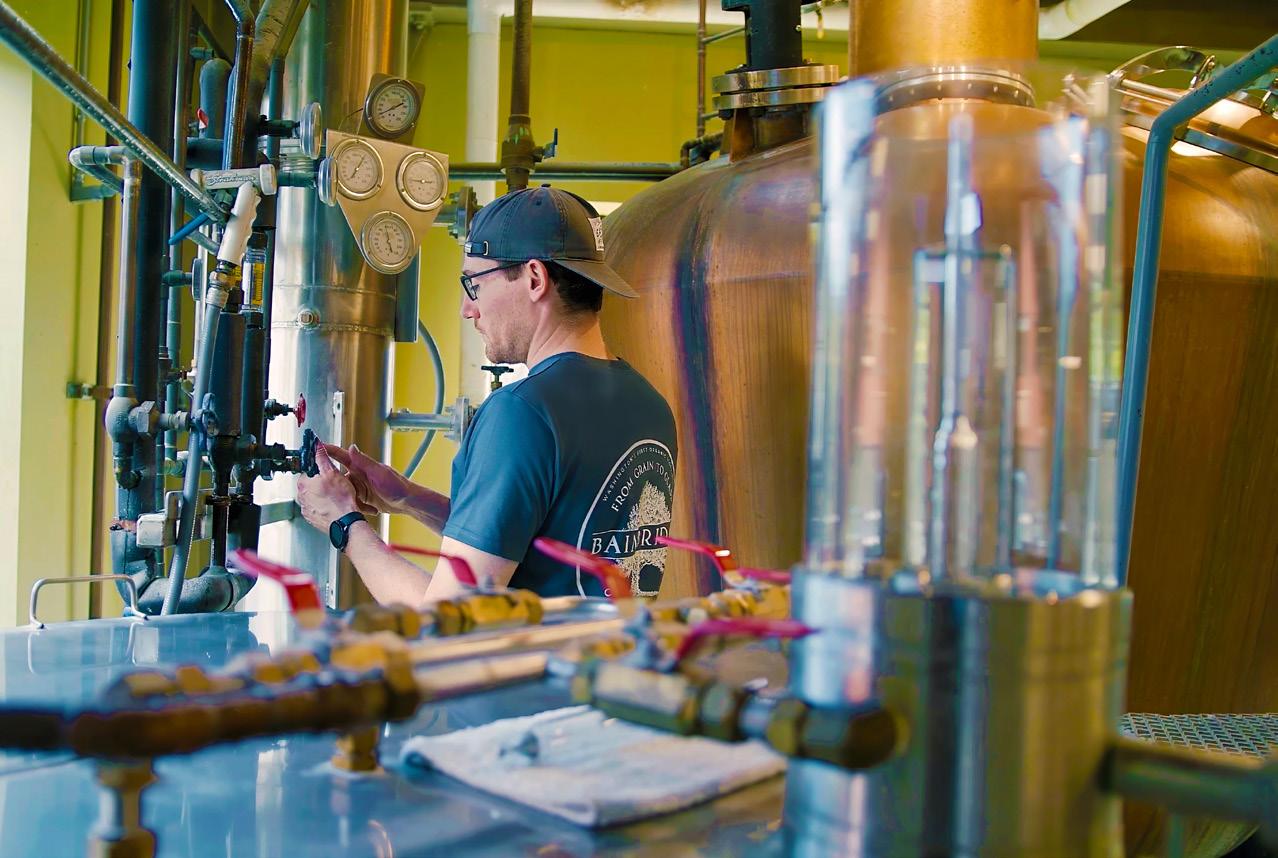
AtBainbridge Organic Distillers outside of Seattle, being organic isn’t rooted in some health crusade or making a philosophical statement. It’s all about finding the best flavor and tying that back to the best ingredients.
Founder Keith Barnes has had a 40-year career in the spirits industry through his marketing company Motive Marketing Group, helping some of the largest spirits companies such as William and Grant, Pernod Ricard, and Diageo, with brand development and programming. He was familiar with the commodity ingredients being tapped by the big players when he opened Bainbridge, and he knew that he wanted to do something different.
“The challenge and the goal was to figure out how to distill organically, which isn’t easy, and to kind of prove the case that you can make spirits that are every bit as good or better than the other high-end spirits that are out there now being made conventionally and with the benefit of modern inputs,” he said. He said this approach allowed them to harness some of the things that organic agriculture is good at, primarily that it has a smaller footprint and taps into the flavor of heirloom grains.
“That’s really tough to get when you’re using commodity inputs,” he said. “You taste the difference between heirloom grain just eating it out of the bin, and commodity grain if you’re brave enough to eat it out of the bin, with all the crap that’s on it. The difference is night and day.”
He said the raw material character in spirits constitutes some of the most persistent flavors, among the last things to get distilled out of neutral spirit. He noted the first vodka boom in the 1960s, when vodka went from being a more flavorful niche product to a neutral, industrially produced spirit.
“The vodka industry had to learn how to distill vodka neutrally. It was kind of neutral, but it wasn’t neutral the way that the industry needed to make it,” Barnes said. “Vodka production shifted from being spring and fall into year round, [and] started having to use inputs that they’d never used before. They struggled for two years trying to make vodka that every batch and every season tastes the same way. The simple answer is, let’s distill the tar out of

“The
challenge and the goal was to figure out how to distill organically, which isn’t easy, and to kind of prove the case that you can make spirits that are every bit as good or better than the other high-end spirits that are out there now being made conventionally and with the benefit of modern inputs.”
it and get rid of everything, including as much of the flavor of the grain as possible. And it’s the flavor of the grain that’s the last thing to go. You get rid of everything else, and the grain’s still there.”
His takeaway was that, if it takes so much effort to remove the grain flavor from a spirit,
— Keith Barnes
then he needs to have more desirable grain flavor going in to lead to better flavor in the spirit. The other factor that drove him toward organic was the realization that a lot of the inputs, including yeast, enzymes, and even chemical salts or acids, are all prepared as simply as possible. His enzymes, for example,
were developed during World War I and have to be sourced from Europe, where they’re still produced because of the regulations around genetically modified organisms. This means his ingredients aren’t as optimized for yield as modern inputs, but they offer better flavor.
The enzyme, for example, “is not quite as robust, but it does a good job with older varieties of grain, and you get a lot more of the spectrum of flavors that you’re after, versus just high-out[put],” he said. “People go, ‘We got 18 percent alcohol using some kind of turbo yeast.’ Well, the last time I looked at my high-speed gas chromatography readout, there’s about ten different types of alcohol that we’re making during fermentation. It seems to me that you get a lot more of the good stuff, but you get a lot more of the shitty stuff, too. What’s the point? I don’t need to get up there to 12 or 14 percent, something astronomical.”
Barnes is also a vintage spirits collector with bottles that go back to the beginning of the 20th century. Those old whiskies offer what he describes as a “balanced abundance” of flavor not often found in modern whiskies.
“The flavors of old whiskey, especially bourbon, American whiskey, and Canadian whisky, are usually very full and rich, have great balance, and exhibit several pronounced notes, common ones being cinnamon and true baking spice, cherries and berries, chewy caramel, citrus and vanilla, and both deep and spicy oak,” he said. “Similar notes are found in modern whiskeys, but rarely in balance and in so much abundance. I feel that we are getting there in recapturing this profile.”
In developing the concept for Bainbridge, he saw that maintaining an organic designation effectively constrains him to using the same materials that were used in making the “phenomenal” pre-Prohibition spirits he’s
tasted.
“We have an opportunity to turn the clock back and kind of recapture a slice of the golden age of whiskey making,” he said. “That’s kind of what’s fueled the whole thing: doing it in a different way and doing production with inputs and techniques that are more old-school. It gets you to a place where you don’t get to when you have the German guys that made your still come in and set the algorithms up so you can set it and forget it, and the computer’s making the cuts for you.”
The organic designation also doesn’t allow for the sort of modern chemical applications that raise red flags for him. Barnes said that most or all of the heirloom varieties he works with are hardy enough to grow on their own, without being propped up by a regimen of chemicals.
“I think that the chemical input part of it has been a self-fulfilling prophecy,” he said.

“The bio-ag companies wanted to have the market on seed, and they wanted to have the market on chemicals, and what better way to do that than to grow shitty monoculture seed that’s too pathetic to grow on its own in the wild, and then you happen to have this fabulous array of chemicals that’ll help you bring in a crop.”
Hand-in-hand with his feelings toward modern grain crops, Barnes’ sentiment toward the multiple applications of chemicals on food products is even less favorable.
“When you put poison on something, it’s poison. I don’t know if agriculture is ever going to wake up,” he said. “We heard for 30 years that glyphosate had no adverse effects on anybody, and now you’ve got lawsuits aplenty.”
“If you go to the grain co-op, and you want to taste a sample of the product, they have to give it to you, they have to make sure it’s clean. You can’t just grab stuff out of a sack. They don’t dye that shit blue sometimes for no reason. It’s, ‘Don’t eat this shit, don’t feed this to your cattle.’ So what’s good about that?”
As Barnes began fleshing out the ideas for his distillery more than 20 years ago, he started distilling single malt and raw grains at a small scale, aging batches for a year or two in one- and two-gallon barrels. When Washington State changed the laws in 2008 to allow for a small distillery with a consumer-facing sales operation on premise, he was ready to pull the trigger.
“It was something I had wanted to do for a long time, but it hadn’t been tenable here

until that law passed, where you could drive revenue from the front,” he said.
For production, he settled on a Vendome pot still with a four-plate column for whiskeys and a 26-foot Sulzer Mellapak column for gin and vodka. In a very wheat-centric

agricultural region, the whiskies include a wheat whiskey and a bourbon using wheat and rye.
“We focused on wheat recipes because the majority of the grain that’s grown here and what we’re known for is really super high-quality soft white wheat,” he said. “Even in Australia and Russia, where they grow their own wheat, they still import Washington soft white wheat.”
He initially trialed 20 different yeasts and blends of yeasts with different products, aging them in small barrels, then called in industry people he was friendly with from his other company to taste and provide feedback.
“We found that using two kinds of yeast in the same mash didn’t work very well, but combining mashings made with different yeasts gave us more character that we couldn’t get from one,” Barnes said.
The distillery is named for the island it’s located on, across Puget Sound from Seattle. The island is home to about 26,000 people,
with a small downtown and a Main Street and a lot of buildings from the early part of the 20th century. “We really wanted to be a product that was from a place,” he said, and they chose Bainbridge Island “because we really wanted to have that maritime influence in the aging process.”
The initial product line included a vodka using soft white wheat with an atypical yeast that provides notes of citrus and vanilla, and Battle Point organic wheat whiskey, which uses a combination of Irish and Scottish yeasts fermented and distilled separately then blended before barreling. It’s aged for six to seven years and bottled at 86 proof. They also offer Battle Point in a line of cask-finished versions called the Two Island series, with Islay (Scotch cask), Hokkaido (mizunara oak), and Barbados (rum cask) variations.
“Since we’re on an island, when we wanted to do some barrel-finished product, we went to other islands that have whiskey making or
spirits making that spin off barrels that would be conducive to doing finish maturation,” he said.
He later introduced a bourbon — “really more of an old-school bourbon,” with 66 percent corn, 22 percent rye, and 11 percent wheat — that he named Whiskey Forty Saloon after an establishment that used to be on the island in the 1850s until about the early 1900s. It was an old distillery, about 40 feet from the property line of a dry mill town that used to exist on the island. “This was a relatively colorful area to be in at the time. You can imagine all of the mill workers drifting up the hill to the distillery after a shift,” Barnes said.
One of their most successful products has been Yama whiskey, made from unmalted barley and aged entirely in Japanese mizunara oak casks. He said they purchase new 260-liter mizunara casks for Yama and get two charges out of each barrel.
“They’re beautiful, they’re super expensive, and they’re finished the way we would finish
American barrels, with char and heavy toasted heads. That whiskey is probably the most unique thing that we make,” Barnes said.
They also offer a couple of gins — one unaged and one aged about a month in virgin barrels — made using whole botanicals, Douglas fir, and spruce. He said he sampled a lot of gins to develop theirs, including about 60 modern gins and 20 from the 1920s through the 1950s, covering a broad spectrum of sub-styles, flavors, and finishes.
“Other than the stuff that was poorly made or that was one-dimensional, I pretty much liked all of it. I found that I could go to a restaurant and if they don’t have my gin, with a clear conscience I could find a gin that I loved,” Barnes said. “When I started this, I wasn’t a gin drinker, but I’ve come to really enjoy gin. Not just our gin, and our gin is definitely unique, it’s a little softer. The most common comment, when people come in and taste the gin, is ‘I love your gin, and I don’t even like gin.’ We make a lot of converts here.”

The barrel-rested version, he said, changes in unexpected ways. “I find that the juniper is a little fruitier, and the evergreens, the fir and spruce, a little more dimensional. They’re just discernible in a different way,” he said. “[They’re] a little softer in the regular, and it’s a little more defined in the oaked. It’s the opposite of what I would have imagined.”
Barnes continues to work with the same farmers he’s partnered with for the past 15 years, the Williams brothers, who were introduced by another farmer who didn’t grow organic but understood what Barnes was looking for. “They have taught us volumes about grains growing in Washington State, and working with them is always a true pleasure,” Barnes said. They grow all of Bainbridge’s grain — corn, wheat, barley, and rye.
The farm is installing a malting system to begin malting their own grain. He said he’ll likely take some for the distillery, but “it’s a five-years-down-the-road proposition” to see how it turns out. They’ve grown a selection
of heirlooms for Bainbridge over the years, including some that date back as far as the 1940s.
“We have farmers come in, it’s funny, we’ll take them in the back, and we’ll have a oneton super sack of wheat that we’re feeding into the mill. These guys will just stand there, big meaty hand with 15 little kernels that they’re poking around,” Barnes said. “It cracks me up, they say it the same way every time, they’ll go, ‘My, that’s pretty little wheat.’”
He feels the ingredients are making an impact on his spirits, giving them “a more oldschool vibe,” and judges have agreed on the quality. Yama was named Craft Whiskey of the Year by Whisky Advocate in 2017, and for the last seven years has been the reigning best American grain whiskey at the World Whiskies Awards. The bourbon, wheat whiskey, and gins have also tallied several gold, double gold, and platinum awards over the years. Ultimately, though, he’s looking at his spirits through a longer lens.
“I’m very bullish on the spirits industry, and I recognize that from a quality standpoint, in the past there have been unbelievably high quality spirits, and today, in a certain sector of the spirits market, it’s as good as it gets,” Barnes said. “There are spirits out there that are so good that they’re going to stand the test of time and they’re going to stand on their own. If we couldn’t do something different and something where there was a benefit, a multifaceted benefit like organic production, what’s the purpose of doing it? The world didn’t need another small spirits distiller. If it doesn’t have anything that’s unique about it, you’re just camping your tent on somebody else’s space.”
Bainbridge Organic Distillers are located in Bainbridge Island, Washington. For more information visit www.bainbridgedistillers.com or call (206) 842-3184.
Report highlights downward trends in craft sector
Written by SAILOR GUEVARA
In September, the American Craft Spirits Association (ACSA) and Park Street presented highlights from the 2024 Craft Spirits Data Project (CSDP) at its Annual Craft Spirits Economic Briefing. ACSA CEO Margie A.S. Lehrman, Kelly Woodcock of Westward Whiskey and ACSA President, and Emily Pennington, Park Street’s Head of Content and Senior Marketing Manager, shared key insights from the 2023 report such as the number, size, and impact of craft spirits producers in the U.S.
The 2023 report, released this August, revealed that craft spirits sales were in decline for the first time since the first CSDP in 2016, stating, “In 2023, the U.S. craft spirits category performed in line with the larger spirits market, experiencing its first decline since the creation of this report in 2016. The craft spirits category represented 13.5 million cases (versus 14 million in 2022) and $7.8 billion in sales for the year, representing a volume decrease of 3.6 percent and value decrease of 1.1 percent.”1
The key findings from the report states:
• The number of active craft distillers in the U.S. grew by 11.5 percent to reach a total of 3,069.
• The U.S. craft spirits category volume was more than 13.5 million 9L cases
1 2024 Craft Spirits Data Project - Page 3, Executive Summary Paragraph 1.
in retail sales in 2023, marking a -3.6 percent growth rate year-over-year. In value terms, the market was $ 7.8 billion in sales representing a -1.1 percent growth rate.
• Craft spirits market share of total U.S. spirits decreased to 4.6 percent by volume and 7.5 percent by value in 2023, down from 4.9 and 7.7 percent in 2022.
• Exports of U.S. craft spirits increased, reaching 179,000 9L cases, marking about a 5 percent increase from the prior year.
• Employment numbers within the U.S. craft market continued to increase post-pandemic, reaching 29,373 fulltime domestic employees, up from 27,368 in 2022.2
While the CSDP report shows overall sales in decline along with craft distillery closures (an estimation of about 45 closures), it also shows that the number of craft distilleries increased by 11.5 percent in 2023.
In an interview published in September for the Robb Report, a publication that tracks luxury products and services, Becky
2

Harris, founder of Catoctin Creek and ACSA government affairs lead, said this report did not come as a surprise to her and that, while many will say this is the result of broader economic conditions, that’s not the whole picture. “Since 2017, there has been consistent, if slowing, growth in craft spirits sales as a share of the larger market in both value and volume. After a somewhat flat year in 2022, this year we see the first decrease in both. Yes, spirits as a category is down, but craft spirits producers are hurting more.” She points to consolidation at wholesale and retail levels and antiquated routes to market as having a major effect. “Compounding this issue is the narrowing of the wholesale funnel,” she said, “an issue ACSA has highlighted quite significantly of late which continues to steadily choke off market access to newer and less heavily capitalized brands.”3
Harris also called for regulatory changes at the state and federal levels to make it easier for craft distillers to self-distribute their products, streamline the bureaucratic paperwork, and allow distilleries to ship via the U.S. Postal Service.
3 Robb Report, Why Craft Spirits Sales Are Down for the First Time in Nearly a Decade, Jonah Flicker, paragraph 3, September 18, 2024 - https://robbreport.com/food-drink/spirits/craft-spirits-salesslumping-1235869675/.
“Compounding this issue is the narrowing of the wholesale funnel. An issue ACSA has highlighted quite significantly of late which continues to steadily choke off market access to newer and less heavily capitalized brands.”
BECKY HARRIS
“We've seen craft spirits companies at all sizes and ages turn a profit; it just depends on their financial strategy and business model.”
Emily Pennington, senior manager of marketing and content for Park Street Companies, said there are ways distilleries can adapt and succeed amidst declining numbers. “Despite challenging times, there are still avenues of opportunity for brand owners in the craft spirits space, but it requires discipline and a thorough understanding of both your own numbers and the larger trends within the industry,” she said. “Small business owners often wear many hats at their own distilleries, so they can get caught up in deadlines, projects, or the next round of funding and deprioritize keeping track of larger movements that could impact their business. I would advise craft producers to be ruthless with the aspects of their business that are not returning tangible results and double down on the strategies or products that are at a time like this.”
Pennington added that there remained avenues for small producers to succeed in their local market and beyond.
“The craft spirits category is an ecosystem with a number of different business models, which is good because not everyone can be a nationally distributed brand that sells to an international drinks company,” she said. “Some business owners aren't looking for that. Instead, they're happy to be local or regional companies making a sustainable profit. We've seen craft spirits companies at all sizes and ages turn a profit; it just depends on their financial strategy and business model.”
With the current trends impacting brands large and small, though, Pennington emphasized the importance of marketing and outreach as distilleries — especially smaller ones — work to maintain and expand their customer base.
“I don't think it's a stretch to say the current economic environment and resulting consumer trends are more difficult on craft producers than major producers,” she said. “During the original craft spirits boom, when the category was in the discovery phase for many consumers, marketing and advertising weren't always high priority because consumers were already avidly seeking out new premium, local products. Now, consumers are being more intentional and cautious with their spending in 2024. That means, if you weren't already putting resources behind
Senior manager of marketing and content, Park Street Companies
digital marketing to reach new audiences, you better be now. It's become an essential part of growing a brand.”
It’s clear that Direct-to-Consumer (DTC) sales and shipping are one answer to the problems craft producers are facing.
An article published in Food & Wine by Jake Emen, titled “U.S. Craft Distillers Are In Crisis,” explored the issue of the distribution crunch inhibiting the industry's growth.
“The best solution for small producers contending with a competitive and monopolistic distribution landscape is providing them with the type of direct consumer access that wineries have long enjoyed. It's also something distributors are fighting against,” he wrote. “Wineries have legal interstate DTC shipping in 47 states plus the District of Columbia, while distilleries are afforded the same rights in only 8, plus D.C. This is harmful to those small- and medium-sized producers who are contending with distribution inadequacies, yet are barred from alternative paths to reaching consumers at the same time.”
In the same article, Jordan Cotton, co-founder and CEO of Cotton & Reed Rum Distillers, told Emen, “If a business doesn’t want to distribute my products, fine, that is their right. But opposing small distilleries' right to sell a bottle directly to a consumer, or to a store? To serve a tasting flight? To offer cocktails? To sell online? That doesn’t serve consumers.”4
After Emen’s article was published, the ACSA and the Wine & Spirits Wholesalers of America (WSWA) traded statements on the subject, with the WSWA publishing claims in opposition to the call for parity and more access to DTC shipping for spirits producers on Aug. 1.
“Jake Emen’s recent article ‘U.S. Craft Distilleries Are in Crisis’ ignores the realities of today’s challenging spirits marketplace in favor of an overly simplistic
4 Food & Wine, U.S. Craft Distilleries Are in Crisis, How a distribution crunch is inhibiting the growth of the industry. Jake Emen, July 31, 2024 - https:// www.foodandwine.com/craft-distilleries-in-crisis-8686337.
and factually inaccurate argument that the distribution tier is to blame for recent craft spirits decline. Below Wine & Spirits Wholesalers of America (WSWA) sheds light on the broader economic conditions of today’s market and correct the most glaring inaccuracies:
The challenges faced by large and small wine and spirits brands are fundamentally tied to broader economic conditions. Consumer purchasing power has been significantly impacted by inflation, rising costs of living, and economic uncertainty. When consumers are financially strained, discretionary spending — such as craft spirits — naturally declines. It is overly simplistic to attribute the current craft spirits market decline solely to distribution issues without acknowledging the pivotal role of broader economic factors.
The article posits that direct-to-consumer (DTC) sales could be a panacea for the craft spirits industry’s woes. However, data shows that DTC sales in the wine and spirits sector have been declining year over year. This trend suggests that consumer interest and purchasing power are not strong enough to support significant growth through DTC channels alone. The assumption that opening this channel would single-handedly resolve the industry’s struggles is unfounded.”5
Shortly after, the ACSA responded to the WSWA’s statements: “As WSWA contends, it is true that market conditions today are challenging, and we welcome an open dialogue on these matters, but respectfully, with inflation, rising costs of living and market uncertainty plaguing the entire economic landscape, we cannot afford to overlook the need for new
5 WSWA Responds: U.S. Craft Distilleries Are in Crisis. Aug 01, 2024, WASHINGTON, D.C. - https://www.wswa.org/news/wswa-responds-uscraft-distilleries-are-crisis.
tools for craft distillers — particularly those that allow them to sell in the way today’s consumer demands.”6
WSWA also offers a page on their website titled “Direct-To-Consumer Shipping of Alcohol: Know the Whole Story,” which states that the organization “strongly opposes the interstate direct-to-consumer (DTC) shipment of alcohol.” However, many in the craft spirits industry felt that WSWA made unsupported claims about the dangers of DTC shipping and released a slew of inaccurate evidence to back them up. They feel that WSWA’s position is harmful to the spirits industry as a whole by creating divisiveness rather than placing the health of U.S. craft spirit producers as the objective.
In October 2024, global tax compliance technology leader Sovos and the ACSA released the 2024 Direct-to-Consumer Spirits
6 Spirits Business, Debate arises over craft distillers’ distribution access, 08 August 2024, Ted Simmons.
Shipping Report. The report featured data from more than 2,000 U.S. adults and 641 regular craft spirits drinkers. It highlights the continued high demand among craft spirits enthusiasts who wish to legally purchase their preferred beverages through DTC shipping. The report showed that the desire of consumers to purchase via DTC has increased to 85 percent, up from 80 percent in 2022.7
Another key finding was that nearly all regular craft spirits drinkers who are likely to purchase craft spirits via DTC shipping and find a product they enjoy would likely search for that same product at a traditional retail outlet.
The report states that although the demand for DTC shipping has increased, the regulatory landscape remains a significant hurdle.
“It is time to modify and modernize regulations to align with consumer demands for
7 2024 Direct-to-Consumer Spirits Shipping Report, SOVOS ShipCompliant, American Craft Spirits
choice and convenience, and create open and fair competition for this innovative industry,” Lehrman said.
The report of U.S. craft distillery closures and declining sales paints a picture of the struggles and pressure craft distilleries face, yet it’s not all gloom and doom. Hiring is up, the number of craft distilleries grew, and craft producers continue to reinvest in their businesses. After facing four turbulent years of divisive political leadership, a years-long pandemic, slow removal of market access roadblocks, and ongoing taxation issues, the craft spirits industry is hanging on and proving that the U.S. craft spirits industry is here to stay.
Sailor Guevara is a veteran of the spirits and hospitality industry, the 2020 winner of the World of Whiskey Icon award, and an author and contributor to several spirits publications. As an acclaimed podcast host and published mixologist, Sailor enjoys sharing her passion for spirits and music

WRITTEN BY Justin Koury

It was December 2019, and most of the wine industry was reporting that 2020 would be sluggish and sales would fall between 2 percent and 9 percent, a devastating number. By contrast, the outlook for distilling spirits, bars, ready-to-drink cocktails, and restaurant trends looked stable, if not promising. Many wine teams were rewriting predictions and preparing to cut staff, cancel imports, and refocus. In January, the United States and the world were instead focused on the threat of COVID-19 and by March, the world was in shambles, along with millions of jobs and shuttered businesses.
The COVID-19 pandemic left an indelible mark on many sectors, but few as profoundly affected as the hospitality industry. Among the most brutally hit were bartenders — frontline workers who thrive on social interaction and community engagement. To fully understand the extent of the changes they've faced, we turned to two seasoned industry veterans, Shaun Stewart and H. Joseph Ehrmann. Their insights revealed a story of resilience, adaptation, and the evolution of bartending in a post-pandemic world. While they work on opposite sides of the United States, both were impacted in identical ways and have, like most of the industry, struggled to reclaim what was once a robust sector of the economy.
With no customers and no revenue, Ehrmann, better known as H., faced the difficult choice of laying off his staff at Elixir.
“When COVID hit, most of us had to lay off our team because we simply couldn’t afford to keep them. It felt devastating to say goodbye to people who had become family,” he reflected. Although the Paycheck Protection Program (PPP) provided temporary relief, the uncertainty left many bar owners scrambling to find solutions.
Stewart, who was in Nashville then, shared a similar experience. “We went from packed nights to empty rooms,” he remembered. With restrictions limiting capacity to just a fraction of what it used to be, he and his team had to think outside the box. “We could only have 12 people in the bar, and we had to make that work,” he explained. In a desperate attempt to keep their business afloat, Stewart collaborated with a friend in Baltimore to create bottled cocktails, allowing them to serve customers confined at home.
The shutdowns forced bartenders across the country to think creatively. As Ehrmann noted, many turned to new ways of reaching customers. “Some people started making cocktails to-go, batching them at home, and delivering them to friends. It was a lifeline,” he recalled. For Ehrmann, selling cocktail kits and whiskey bottles became essential to maintaining his business. “I was able to bring people back to work as delivery drivers or to help pack kits,” he added. This adaptability kept the lights on and fostered a sense of community during isolation.
Stewart echoed this sentiment, noting that the pandemic accelerated trends already emerging in the industry. “We focused on quick service — people were used to getting their cocktails fast at home, so we had to adapt,” he explained. The traditional bar experience shifted as customers became accustomed to speed and convenience over presentation and atmosphere. This change challenged bartenders to balance quality with efficiency, a skill that would prove essential during those months.
As the pandemic unfolded, it prompted many bartenders to reassess their careers and future. Ehrmann observed a significant shift: “COVID gave a lot of people who were burnt out the chance to reflect and decide if they wanted to keep working in the industry. A lot didn’t come back.” This mass exodus of experienced bartenders and a lack of new entrants into the field left many bars struggling to find qualified staff. “People have moved on to different careers, and the new generation wasn’t given the same opportunities,” he continued.
The hospitality industry lost much of its energy and vibrancy. Many bars found themselves in a precarious position, unable to hire skilled workers, which made recovery even more challenging. In addition to workforce shortages, the pandemic highlighted existing industry disparities. Stewart pointed out that bartenders often lack job security and benefits, which became even more apparent during the pandemic. “The crisis forced many of us to confront that we don’t have a safety net. When the shutdowns happened, many
converted my classroom into a warehouse for shipping,” Ehrmann said.
One interesting and unexpected change was the integration of slushy machines and other non-traditional bar equipment, which spirit companies provided to help bars offer new products. “We created a slushy program during the pandemic, and it became a new part of our business. It was something fun and different, and people loved it,” he recalled. The willingness to innovate, supported by spirits companies providing equipment and guidance, transformed how bars operated.
"I would have never had a slushy machine," Ehrmann shared, but adapting to new service forms was essential. Canning and bottling drinks to-go also became more popular during the pandemic, thanks to support from spirits companies that provided equipment like canning machines and helped with labeling.
However, not all changes lasted. “To-go cocktails were something I thought would stick around, but they didn’t in California. That was disappointing,” he admitted. This highlights the ongoing struggle of adapting to a rapidly changing industry, where some innovations were welcomed while
The pandemic also amplified existing social trends that were already reshaping the industry. Ehrmann noted, “Young people today are drinking less and socializing differently. It’s not just COVID; it’s a shift in how people engage with the world.” The rise of food delivery services and home entertainment options made traditional bar experiences less appealing to a younger demographic. “We used to rely on happy hour crowds and late-night drinkers, but those habits have changed,” he said.
Stewart elaborated on these shifts, particularly in urban areas that saw a decline in foot traffic. “With more people working from home, downtown bars are suffering. In places like Baltimore, the recovery has been slow,” he explained. The changing nature of work and socialization has forced bars to rethink their strategies to attract customers, often focusing on unique experiences or niche offerings.
Both Ehrmann and Stewart expressed a sense of resilience and adaptability in the face of these ongoing challenges. Ehrmann emphasized the importance of contingency planning. “I thought earthquakes were the biggest threat to my business, but now I realize another pandemic could happen sooner than we think. I’ve adapted my business

The impact of COVID-19 on the bartending industry has been profound, altering not just the operational landscape but also the workforce and consumer behavior.
with staff. This system simplifies tasks like splitting bills, ordering drinks when ready, and checking out without waiting for a server. The efficiency also helps with staffing, as fewer employees are needed for order-taking and processing payments. “People have become accustomed to these conveniences, and we need to meet those expectations,” he added.
Despite the challenges, the pandemic underscored the importance of community within the bartending world. Both Ehrmann and Stewart emphasized how crucial it was to support each other during such trying times.
“We relied on our network. Other bar owners shared resources, ideas, and strategies,” Ehrmann recalled. Stewart shared stories of bartenders
organizing fundraisers for laid-off staff or coming together to create awareness campaigns about mental health. “It was inspiring to see the industry rally together. It reminded us that we’re all in this together,” he said. The bonds formed during this challenging time have strengthened the sense of community, fostering collaborations and initiatives to uplift the industry.
The impact of COVID-19 on the bartending industry has been profound, altering not just the operational landscape but also the workforce and consumer behavior. As we move forward, we must recognize the lessons learned from this
crisis. The need for flexibility, mental health awareness, and community support will be paramount in shaping the future of bartending. As bars adapt to a new normal, the stories of Ehrmann and Stewart illustrate the industry’s resilience and offer hope for recovery and growth in the hospitality sector.
Justin Koury is a transplant to California from Chicago, where he spent 10 years in wine and spirits retail. He is a graduate of Purdue University’s Hospitality and Tourism Management program and has taught culinary school, spirits classes, and wine training, and he has written extensively on the craft business.


Good day to you, dearest readers of Artisan Spirit Magazine,
This issue, we’re going to deal with a topic that vexes the insurance-verse more than any other issue. The topic at hand is often overlooked yet still plagues craft beverage manufacturers all across this great land. What could it be? It is …
Many folks are of the belief that insurance carriers love hard market cycles, and thus, insurance agents also love these times because the premiums are higher, commissions are higher, and those “insurance buggers” are all just rolling around in piles of money. How disgusting they must be to be reveling in the pain and at the expense of the insureds. In reality, this is not entirely true. Yes, more money is being made in premium and commission, but it is often offset by fewer insurance policies being sold, insureds choosing to go without certain coverage or insurance at all, or the inability to provide coverage at a reasonable price, so the business goes elsewhere. If you are in the artisanal spirits space, transportation is one of the more significant coverage issues that you face. We all likely know someone affected, or have been directly affected ourselves, by an auto incident. We spend a lot of time in our vehicles traveling from place to place throughout our days, whether it is for a commute, leisure, or to run errands for our business. Therefore, issues are certain to arise at some point. There are so many types of auto coverage available that it may make it difficult to know if you have the right one for your business. Without getting too far down the auto insurance rabbit hole, I will say that on a standard commercial auto coverage form you have nine different “symbols” that represent the type of coverage you may have. Here is an example of each...
= Symbol 1 Any “Auto”
= Symbol 2 Owned “Autos” Only
Only those “autos” you own (and for Covered Autos Liability Coverage any “trailers” you don't own while attached to power units you own). This includes those “autos” you acquire ownership of after the policy begins.
= Symbol 3 Owned Private Passenger "Autos” Only
Only the private passenger “autos” you own. This includes those private passenger “autos” you acquire ownership of after the policy begins.
= Symbol 4 Owned “Autos” Other Than Private Passenger "Autos” Only
Only those “autos” you own that are not of the private passenger type (and for Covered Autos Liability Coverage any “trailers” you don't own while attached to power units you own). This includes those “autos” not of the private passenger type you acquire ownership of after the policy begins.
= Symbol 5 Owned “Autos” Subject To No-fault
Only those “autos” you own that are required to have no-fault benefits in the state where they are licensed or principally garaged. This includes those “autos” you acquire ownership of after the policy begins, provided they are required to have no-fault benefits in the state where they are licensed or principally garaged.
= Symbol 6 Owned “Autos” Subject To A Compulsory Uninsured Motorists Law
Only those “autos” you own that because of the law in the state where they are licensed or principally garaged are required to have and cannot reject Uninsured Motorists Coverage. This includes those “autos” you acquire ownership of after the policy begins, provided they are subject to the same state uninsured motorists requirement.


Almost every personal auto insurance policy excludes any business use aside from a regular commute. If you are using your personal auto to conduct any kind of business outside of a commute, you have no coverage.
The very best symbol that you can have is a symbol 1, which would cover the business in “any auto.” This covers the entire gamut of autos and therefore includes symbols 8 and 9 within it, but this coverage is difficult to acquire if you do not own any autos in the name of the business.

= Symbol 7 Specifically Described “Autos"
Only those “autos” described in Item Three of the Declarations for which a premium charge is shown (and for Covered Autos Liability Coverage any “trailers” you don't own while attached to any power unit described in Item Three).
= Symbol 8 Hired “Autos” Only
Only those “autos” you lease, hire, rent, or borrow. This does not include any “auto” you lease, hire, rent, or borrow from any of your “employees,” partners (if you are a partnership), members (if you are a limited liability company), or members of their households.
= Symbol 9 Nonowned “Autos” Only
Only those “autos” you do not own, lease, hire, rent, or borrow that are used in connection with your business. This includes “autos” owned by your “employees,” partners (if you are a partnership), members (if you are a limited liability company), or members of their households but only while used in your business or your personal affairs.

“OK,” you might say, “That is all fine and well, but why are we talking about this? I use my own vehicle if I need to run around and do things during the day and I have a personal policy.” Did you know that if you are taking product to a tasting, picking up a flange from the hardware store, or taking a sample to a local venue for them to try out, and you are involved in an auto incident, not only can you be held personally liable for any injury or damage you cause, but the business can also be dragged into a lawsuit?
Furthermore, almost every personal auto insurance policy excludes any business use aside from a regular commute. If you are using your personal auto to conduct any kind of business outside of a commute, you have no coverage. I have an insured who got into an auto accident while driving his personal auto picking up parts for a repair at his facility. My client was at fault, and when the victim found out he was on an errand for his distillery in the police report, they sued him both personally as well as the distillery. In this case, the insured was protected because they had at least symbols 8 and 9 on their policy. Symbol 8 — hired autos only — is autos you lease, hire, rent, or borrow. Symbol 9 — nonowned autos only — refer to autos that you do not own, lease, hire, rent, or borrow that are used in connection with your business. Since the distillery did not “own” the auto being driven during the incident (symbol 9 coverage) and my client owned it personally (excluded under his personal auto coverage for business use), he knew that he had $1 million worth of coverage for the distillery to settle any claims brought against the business. Had he not had this simple coverage and had the lawsuit been big enough, it could have cost him his life’s work.
If you have a vehicle that you do own in the name of your business (that is titled in the entity name), then you would look to have at least a symbol 7 on your policy, which would cover “specifically described autos.” This would be at a minimum, but it should still always be paired with symbols 8 and 9 since you never know when the need may arise to use a different automobile.
We could go deep into the “description of covered auto designation symbols” and how you can pair a symbol 2 with 8 and 9, or a 5, 6, 8, and 9 depending on your state and the requirements, and so on. Suffice it to say, a symbol 1 is always the best, the pinnacle, the pièce de résistance of auto symbol coverage, but again, you have to own an auto in the name of the entity to obtain this coverage. At a minimum, you should never carry less than a symbol 8 and 9 on your commercial package or commercial auto policy.
Some carriers (many that I personally use), will include the commercial auto within the overall commercial insurance package, and they will offer symbols 8 and 9 included in the overall policy. If you fall outside of such a package option, there are many carriers that will write a standalone auto policy that can offer the symbol 8 and 9 to you. The point here is to make sure that you have some sort of commercial auto coverage that protects your business because it is just a matter of time before the unexpected becomes reality.
What if your business uses trailers? Trailers are somewhat their own thing. Although the liability for a trailer is covered by the vehicle towing the trailer, what happens if the trailer becomes detached while being towed, or it is sitting somewhere and something happens? Without the proper coverage, there would be no coverage for property damage or liability on the trailer. Oh, the list goes on and on with auto/trailer coverage. See why this is the most vexing insurance issue that one can deal with on a daily basis? So many coverages, so much involvement, so much vexation. The lesson learned here is: If you drive anything related to your business, you need some type of commercial auto coverage.
Another question that I often receive when dealing with commercial auto coverage is, “if I have a symbol 7, 8, and 9 that cover me for my specific autos, as well as hired and non-owned, and I am flying off to a convention and renting a car, do I have all the coverage I need?” Well, it is not that easy. Technically, yes, you are “hiring” an auto in the sense that you are renting it from a rental agency and you have liability coverage not only under the commercial auto policy but likely
have some personal liability coverage policy as well. However, rental car agencies can be “creative” should something happen while you are in possession of one of their vehicles. You may be covered for damage and injuries under your commercial and personal policy, but neither of those policies (nor does your credit card), protect you from things like “loss of use” or “layup time,” “diminution of value,” and the other “creative” costs that rental car agencies may put upon you in the case of an accident. “Loss of use” or “layup time” is a clause in the rental agreement that states that you are accountable for the lost income that vehicle could have brought in while it is out of service awaiting repair, or laid-up. This clause can be quite costly depending on the rental agreement. “Diminution of value” is the difference in value of the vehicle, or the trade-in value, since the rental agency can not obtain the top dollar amount it could have if the vehicle had not been involved in an accident, another potentially
You can avoid all of these “creative” charges in the case of a rental car incident by buying the coverage they offer. It really is “walk away” coverage, for the most part, and only costs you dollars a day. If something is to happen, you simply hand in the keys and walk away. No more having the kid go around the vehicle upon return and question whether that scratch was there or not, if the windshield had a chip/crack, or if the bumper is gone. You just bring the vehicle back and walk away, plain and simple. I highly recommend buying this coverage every time. I know I do.
Take heart, loyal reader, and fret not. I know this topic can cause angst; however, you are here reading this, so you are now armed with 90 percent more knowledge about commercial auto insurance than most

of the populace. If you remember nothing else, remember this:
= Symbol 1 is bar-none.
= Symbol 7, 8 and 9, you are doing just fine.
= At least symbol 8 and 9 all the time.
= When renting a vehicle, recall the episode of “Seinfeld” where he rents the car. He is asked, “Would you like insurance?” To which he replies, “Yeah, you better give me insurance, because I’m going to beat the hell out of this car.”
Until next time, dearest reader.
Stay Vigilant, Aaron Linden
a.k.a. Insurance Man
Aaron Linden is a professional purveyor of insurance policy products proposed to protect people proactively against perceived perilous perils and pitfalls, primarily. He has been in the insurance industry for 23 years, has specialized in craft spirits insurance for the last 15 years, and literally wrote the book (ok, the insurance forms)


If you’re in the U.S. craft spirits industry, you might belong to several trade organizations, such as the American Craft Spirits Association (ACSA), the American Distilling Institute (ADI), or the Distilled Spirits Council of the United States (DISCUS), to name a few. Being a member of these trade organizations has its benefits. Some are responsible for critical work regarding regulations in our industry. In addition, they provide a wealth of ongoing educational opportunities, empowering you with knowledge and skills and, perhaps just as important, a sense of community.
In addition to the valuable work carried out by these organizations, their annual conventions present a variety of exceptional opportunities, including networking, high-level education, engagement with suppliers, and recognizing high-achieving producers. However, many brand owners face challenges in attending these conferences due to financial constraints and the responsibilities of managing their businesses while traveling from afar. This often leads to difficult decisions about whom to bring along and which events to prioritize, sometimes resulting in attendance at only one convention per year. Additionally, small producers frequently express a desire to include more of their team members, as they recognize the benefits of shared educational experiences and the strengthening of community ties that come from connecting with colleagues and meeting new industry peers.
So what are the benefits of attending these conventions, and is the investment worth it?
Ronnell Richards, ADI's chief marketing officer, shared his thoughts on craft brand owners investing in industry events and whether he feels it’s a worthy investment when budgets are tight.
“What I have observed in the craft distilling community during my time in this business is truly unusual and rare. I have had the privilege of working in many different industries, and the sense of community and camaraderie that exists in this field is remarkable. Conferences and events provide distillers with the opportunity to network, gain knowledge, and build stronger business relationships, which are especially important during challenging times.
“These events can also allow distillers to save substantial costs, as many potential suppliers and vendors are present. When distillers find themselves in a position to cut costs, events can serve as an effective way to connect with vendors and establish relationships that can help them navigate tough situations. As a lifelong entrepreneur, I recognize the importance of community. During difficult times, it often feels as though we are alone, which can lead to feelings of isolation and even depression. For me, having a supportive community — people who understand my challenges but are neither employees nor family — has been invaluable. It not only helped me through those tough times but also provided relief in knowing that I wasn’t alone.
“That’s why, especially in challenging times, it is crucial to invest in being part of your community. This is particularly true in the craft spirits community, which is so nurturing. Engage with your community, find support, and get re-energized.”
Erica Fields, a supplier and president of Fields Consulting, echoed Richard's statements on networking and creating relationships with suppliers.
“Attending conferences is an opportunity to network with other industry members, learn from seminars and presentations, and also see what’s new in products, supplies, and suppliers. Whether you are an established craft distiller or a relatively new operation, the type of networking is important. You need to create relationships with other producers who can help you grow and improve, and developing these relationships is stronger when done in person. It also is an opportunity to engage in industry-focused advocacy by getting involved with the organization. By being a part of a larger organization, you have a stronger voice in policy and programs to improve the industry. I’m a bit old-school in that I believe that in-person gatherings are important and online engagement can’t fully replace it.”
Written by Sailor Guevara
Fields went on to say, “Suppliers get three things from attending conferences. First is the opportunity to present their products to their current customers and potential new customers. Second, by being at a conference they have the opportunity to network with many of the industry participants they know or want to get to know all in one place at one time. Third, they get to see the direction of the industry both by the atmosphere of the event and by seeing who is also attending versus prior years. The success of attending a conference is not judged by contacts or sales made but really by gauging the temperature of the industry by observing as much as you can about who is attending, the subjects offered, and the conversations you have with fellow industry participants.”
The success of attending a conference is not judged by contacts or sales made but really by gauging the temperature of the industry by observing as much as you can about who is attending, the subjects offered, and the conversations you have with fellow industry participants.”
ERICA FIELDS , Fields Consulting




Alicia Burton, distilling market development specialist for Scoular, believes having a plan in place before attending industry conferences and trade shows can optimize results.
“While it may seem like a significant expense, attending at least one trade show per year is a strategic investment that often pays for itself in the long run. For smaller craft brands with limited marketing budgets, trade shows offer a concentrated opportunity to gain exposure, learn from industry leaders, and connect with potential buyers or distributors who can help scale their business. The knowledge gained from seminars and panels can also be applied to improving production, marketing, or distribution strategies. By putting a plan in place beforehand — such as outlining goals, listing key contacts, and preparing questions — you can ensure that every interaction at the event is purposeful and focused on achieving longterm growth. Ultimately, the relationships, knowledge, and visibility gained from attending are difficult to replicate elsewhere.”
Suppliers play a crucial role in the distilling industry, and attending trade shows helps them stay in tune with the specific needs and innovations in the market.”

As a supplier, Burton shared Field’s perspective on brands connecting with suppliers and the importance of suppliers learning from distillers and brands at these events while underlining the importance of planning ahead.
“Suppliers play a crucial role in the distilling industry, and attending trade shows helps them stay in tune with the specific needs and innovations in the market. These events are an excellent opportunity for suppliers to meet distillers face-to-face, understand their challenges, and offer tailored solutions — whether it’s unique grains, new equipment, or packaging innovations. Networking between suppliers and brands can be enhanced by planning ahead, much like brands do. Setting up one-on-one meetings in advance and taking advantage of social hours where informal conversations often lead to stronger relationships is key.”
Regarding costs that smaller brands may find challenging to manage, Philip Rawleigh, senior vice president of business development for Distillery 291 and frequent convention attendee, shared his advice.
“I feel it’s crucial for craft brands to participate in trade shows and conferences. However, this can be challenging for smaller brands due to limited budgets compared to larger companies. In the past, I have worked with trade shows and conferences to create accommodations for smaller brands, such as reducing fees or even providing free tables when possible. This approach makes it easier to justify the costs associated with travel, accommodation, meals, and other expenses that the brand must cover. When the financial burden of attending these events is lessened, it benefits both the brand and the organization. Increased attendance at these events ultimately serves all of us better.”
While preparing for this article, I had many casual conversations, some of which were very frank about the costs of attending industry events. So, I reached out to ASCA’s CEO, Margie Lehrman, to ask for her perspective on why it's important for craft brands to attend industry trade shows and conferences.
“The current economic climate demands a careful evaluation of ROI for any dollars devoted to operations,” she said. “However, rather than think of marketing expenses allocated to trade shows, conventions, consumer festivals, or spirits competitions as an operational line item, it should be thought of as an investment opportunity to expand the business and fulfill the business goals of the company. Investment dollars are just that: putting money into an asset to increase value over time. Similarly, membership dues are more akin to mooring a boat: securing a dock line or a line to a buoy-mooring ball provides safety and security. In some cases, it prevents a sunken ship.
“Not only does a membership organization, in this case ACSA, prevent port, starboard, or gunnel from destruction, it is precisely designed to allow the boat to operate as it should — free from harm and keeping the business afloat and steady. Moreover, in the scheme of industry sectors, the craft spirits industry remains relatively new. Legislators at both the state and federal level and agency executives require alcohol beverage training 101. Most have little knowledge of a three-tier system, replete with antiquated rules and regulations that don't neatly fit the way craft spirits distillers — our small business manufacturers — operate. Since laws are revised to meet the demands of changes in social, economic, and political landscapes, it is essential for growth of our industry to speak with one voice. Market access is necessary to help distillers thrive. Associations like ACSA can make that difference and make sure our voice is heard again and again and again.”
During our discussion, I asked if Lehrman could share an example of a success story in relation to an industry event.
“Money well spent outside of typical overhead or operational expenses was travel, lodging, food, and drink to attend an ACSA Legislative Fly-In during the FET fight. For decades, members were paying $13.50 excise tax per proof gallon. It took years, but in 2020, an FET reduction of $2.70 per proof gallon was realized by the US Congress. In short, the majority of members now save $10.80 per proof gallon. Imagine the thousands of dollars that stay at the distillery instead of going into the government's vault. Could ACSA or any other trade [association] make this happen without constituents who in person — in real time — share their stories of severe economic challenges? In short, NO. It takes a collective body to effect change at both the state and federal levels. ACSA can only fulfill its mission — to elevate and advocate for a community of craft spirits producers — through a strong network of members.

“Presently, ACSA is advocating for easier shipment of spirits through the USPS, TTB regulatory reform including reduction in reports, a designated office to handle small business issues, and right to cure provisions to remain compliant, among other considerations. At that same time, we are working with other groups to make certain dietary guideline research and reporting, which oftentimes guides consumer behavior with food and drink, is executed fairly, without bias, with full transparency. A legislative flyin last month brought together almost 50 members who were willing to give of their time and part with their own funds to begin to change the laws for the good of the entire industry.”
Attending conventions can be a pivotal part of your business strategy while navigating the dynamic landscape of the craft spirits industry. Ronnell Richards, Erica Fields, and Alicia Burton's insights underscore the multifaceted benefits of these gatherings, from

building community connections to exploring new products and advocating for industry improvements. Adaptability is paramount to successful businesses, irrespective of the product or service offered. Associations can provide the critical tools for making changes that matter, regardless of the social, economic, or business climate and the speediness needed to change course.
Preparation is key to truly maximizing your experience at these events. Start by setting clear goals for what you want to achieve, whether it's making specific connections, attending targeted seminars, or exploring new supplier options. Create a schedule that balances educational sessions with networking opportunities, and make sure to allocate time for informal discussions that can lead to valuable insights and partnerships.
Lastly, consider the value of bringing team members. Diverse perspectives can enhance learning experiences and foster stronger team dynamics upon returning to your home base. While financial constraints may pose challenges, remember the long-term benefits of investing in relationships and knowledge that can lead to growth and innovation.
In this vibrant and supportive craft spirits community, attending conventions is more than just a box to check off on your calendar; it's an opportunity to fuel your passion, expand your horizons, and strengthen the bonds that make this industry unique. Embrace the chance to reconnect with your peers, learn from one another, and cultivate the relationships that will support your journey in the craft spirits realm.








Written by GABE TOTH

by Lallemand
Exploring advancements in engineered microorganisms for spirits production
The realm of engineered microorganisms — organisms whose genomes have been modified in a laboratory in order to favor the expression of desired physiological traits — is a rapidly advancing field that affects beverage alcohol production. Used in a variety of consumer goods, such as fuel ethanol, pharmaceuticals, and foodstuffs, the future of this field holds many opportunities for the distilling industry and beyond.
With this in mind, Artisan Spirit has worked alongside Lallemand — a global presence in the industries noted above — studying internal documents and intra-industry presentations, interviewing team members who represent the company’s diverse range of interests, and assembling a broader perspective on the past, present, and potential future of genetic engineering in the microbial world.
Yeast is one of the primary flavor drivers in spirits production and arguably the flavor driver for beer. Those who wish to debate the point should start by tasting an unfermented wash or wort and then a fermented one. Humans have used yeast for millennia, but it wasn’t observed under a microscope until 1680 by Antonie van Leeuwenhoek, an early Dutch microbiologist who didn't consider yeast as a living thing. Yeast has since been used as a model organism offering insights into how other organisms work.
Jumping ahead to modern time, in 1996, Saccharomyces cerivisiae was the first eukaryotic genome to be sequenced, making it a ripe target for ongoing research and development, though most or all of the engineered yeasts mentioned later in the article did not reach the plant-scale research phase or become commercially available. Genetically modified yeasts date back to 1994, when a brewing yeast containing a glucoamylase gene and copper resistance was approved in the United Kingdom. (It could be argued that genetically modified S. cerevisiae has been on the market since the 1980s, when insulin produced by bioengineered yeast was approved for usage.) In 2001, a self-cloned sake yeast that offered increased levels of ethyl caproate at the lab scale was approved in Japan. In 2003 (United States) and 2006 (Canada) an R&D wine strain was approved that contained a malate transport gene and a malolactic gene to eliminate malolactic processing time. In 2006 an R&D wine yeast was engineered to reduce production of ethyl carbamate, a known carcinogen currently being targeted by malting barley breeders, and another wine strain was approved in 2011 for reduced hydrogen sulfide production.
Seibel1 reported that a lab team had created a yeast strain appropriate for lower-alcohol production, shifting some of the carbon

flux toward glycerol production and away from ethanol. The same paper mentions the saturation of the beer market and the increased demand for new yeast-driven flavors, with researchers developing a yeast capable of producing monoterpenes to increase hoppy notes in the finished beer. Key compounds in hop character include linalool and geraniol, which are synthesized from geranyl pyrophosphate via monoterpene synthase. The researchers theorized that by adding monoterpene synthases into brewer’s yeast using current genetic-engineering technology, they could increase the yeast's natural, but limited, ability to create linalool and geraniol.
“Created strains were tested in a fermentation which was analyzed via LC/MS, HPLC and GC/MS. A taste panel evaluated the beer produced by the optimized strains and determined a range of hop flavors. [They] concluded, that yeast-built monoterpenes give rise to hop flavor in the finished beer and provide more consistency than traditional hopping.”1
Researchers have been able to modulate various yeast-produced flavors in the lab
Yeast is one of the primary flavor drivers in spirits production and arguably the flavor driver for beer.

using genetic engineering.2 Researchers have modulated ester production, introducing new pathways for vanillin,3 raspberry ketone,4 or saffron flavors5 into yeast to alter their sensory profile
Lallemand's Elena Fossati and Haley Churchill offered a presentation at The Alcohol School in Montreal on Aug. 21, 2024, to examine a yeast that was recently brought out of the lab and trialed at a commercial scale. A starting yeast was selected that fermented efficiently in both whiskey and rum washes. They made a single modification to the yeast genome to achieve a new flavor profile. Testing showed dramatic increases in ester content across all four acetate ester compounds in molasses fermentation and in a bourbon style mash bill.
They started with a control yeast that fermented efficiently in both whiskey and rum washes. Both media showed dramatic increases in ester content across all four compounds in a molasses fermentation and a bourbon-style mashbill. Batch distillation was performed both with and without recycling heads and tails from a previous batch. In their presentation, they described how they could clearly distinguish the different esters coming off the still during the spirit run, from ethyl acetate and isoamyl acetate to the tropical note of isobutyl acetate and finishing with a pleasant floral aroma near the tails cut.
Their conclusions from the trial were that yeasts genetically engineered for flavor will be a significant contributor in the future of the distilling industry. Flavor-enhanced yeasts will allow for novel blending possibilities that were previously unimaginable. Having access to a pallete of flavor-potent spirits could be a game changer for the production of blended spirits, both in terms of sustainability and cost saving, as it would significantly reduce the volume of aged distillate necessary to reach the flavor complexity typical of these products. Researchers speculate that new yeasts could be tailored to produce congeners to increase the broad organoleptic characteristics deriving from the fermentation processes (fruity, floral, spicy), similar to the high-acetate-ester strain noted above, but also to produce

currently used feedstocks, as the biofuel experience has shown us.”
Genetic engineering is only the most recent, technologically advanced, iteration of a drive that is as old as civilization: to modify organisms in ways that increase their benefit. For thousands of years, humans have been genetically modifying plants and animals through selection to meet a wide variety of goals — fewer input requirements, shorter time to maturity, resistance to diseases and pests, and increased size or yield. Despite being unseen and unrecognized for most of human history, certain microbes have also felt evolutionary pressures for factors such as stress tolerance or desirable flavor development. As an MBAA review6 stated, “Enhancing and modifying desirable traits in economically essential organisms has been the driving force behind agricultural advancements for millennia.”


As the same paper noted, terminology issues exist around genetically modified organisms and the biotechnology industry. Some regulatory agencies have no definition for GMOs. The public often equates the term “genetic modification” with biotechnology or genetic engineering, but it could be broadly applied to any organism that’s been modified, including through the oldest conventional methods such as selection, breeding, and domestication. These are cisgenic approaches to modification — combining sexually compatible organisms to create a novel organism.
“Genetic modification is a broad term that encompasses any change to an organism’s DNA. Thus, genetic modification can refer to random mutagenesis, breeding, domestication, or recombinant DNA techniques. In contrast to the common use of the term ‘GMO’ as a broad term referring to transgenic organisms, scientific terminology is more specific to the method that was used to introduce the genetic change or the type of change that was introduced,” the MBAA paper explained.
Classical approaches to genetics do not involve any DNA being incorporated from outside
Editor’s Disclaimer: Lallemand is a sponsor and advertiser of Artisan Spirit, but AS maintains its philosophy of never taking money for content or articles. We often work with vendors and industry partners to present education and share knowledge, but we continue to eschew all monetary compensation. Simply put, AS has not received compensation in any way for this, or any, article. We pride ourselves on maintaining editorial integrity and being transparent with you the readers.

the existing genome, or the existing genomes in the case of mated or fused strains. These techniques include mating and somatic fusion (also known as protoplast fusion) in yeast which create a hybrid yeast containing chromosomes from both yeast. These methods are imprecise, requiring high throughput for screening, and are limited to improving existing traits. However, with the exception of somatic fusion, organisms created with these approaches could occur through natural mutations and are not required to be labeled as GMOs or biotechnology in the United States.
Genetically engineered (GE) organisms, on the other hand, are those created by incorporating exogenous DNA in the genome (transgenic modifications), relocating or increasing the number of copies of DNA already within the genome (cisgenic modifications), suppressing or removing sections of existing DNA in the genome, or modifying specific genes in the genome (e.g. directed mutagenesis). These can also be referred to as “bioengineered” organisms. The first approaches to transgenic modification were expensive and less precise, but technical and social barriers have continued to fall, allowing for genetically engineered organisms to be increasingly incorporated for both industrial uses, such as the production of drugs and enzymes, as well as used in the food and beverage sectors. Regulatory obstacles and consumer perception remain hurdles to bringing new products to market, but the ability of the current genetic engineering technology allows for precise modification of specifically targeted genes, and the falling costs of genome sequencing allow for fast and affordable testing to ensure that no unintended changes were made. These factors make development of new GE products faster and easier than ever on the technical side, though social and regulatory boundaries remain.
Seibel1 noted the level of pushback from some corners. “Arguments for GMO restriction range from the harm to non-target species and negative health effects, to crop failure resulting in the collapse of the food system and possible human extinction.” However, the National Academy of Sciences released a lengthy review of genetically engineered crops in 20167 that, in part, examined the health impacts of GE foods. While the
reviewers noted the difficulty of determining the impacts of any individual food and the lack of long-term epidemiological studies that directly examined GE food consumption, the review concluded that “available time-series epidemiological data do not show any disease or chronic conditions in populations that correlate with consumption of GE foods. The committee could not find persuasive evidence of adverse health effects directly attributable to consumption of GE foods.”
The first GE product approved by the U.S. government was pharmaceutical-grade insulin produced from a GE bacterium, approved by the FDA in 1982. The FlavrSavr tomato, engineered to increase shelf life, was approved for production by the USDA in 1992 and for consumers by the FDA in 1994. While the first commercial bioengineered yeast was approved 30 years ago, early entries into the category failed to gain traction. However, the MBAA review6 noted that the biotechnology industry increased 112-fold from the mid1990s to 2019: engineered corn, soy, cotton, and canola now dominated the market for these global staples.
On the regulatory front, the U.S. government developed the Coordinated Framework for the Regulation of Biotechnology, which was released in 1986 and has been continually updated. The Cartagena Protocol on Biosafety, an international agreement to protect biological diversity, has been in place since 2003, though the United States is not a signatory. While the European Union acted earlier, GE-containing foods have been required to be labeled in the United States since 2022, though a crucial caveat is that beverage alcohol falls under the labeling jurisdiction of the Federal Alcohol Administration Act rather than the Federal Food, Drug, and Cosmetic Act, so this rule doesn't apply to spirits.
The development of new technologies such as CRISPR (“clustered regularly interspaced short palindromic repeats”) paired with the use of specific nuclease enzymes, including Cas9 and others, offers much greater precision, stability, and efficiency over previous methods for modification.
“The efficiency of Crispr/Cas9 allows for the editing of each chromosome allele in diploid or polyploid organisms and can even be used to target multiple sites in the genome at
once … ” the MBAA review6 stated. While CRISPR/Cas9 allows for precise adjustments, insertions require a DNA package that includes more than just the target change, incorporating a promoter and terminator bracketing the primary gene to signal for the package to turn on and off as well.
With the falling cost of genome sequencing as the 21st century progresses, screening experimental GE organisms for unintended genetic changes has become faster and easier than ever. As Seibel noted in Brewing Science,1 the technology resulted in a Nobel Prize in 2020 and created a sea change in the world of genetic engineering. “There are not many techniques which revolutionized their field overnight. CRISPR/Cas9 is such a rare example and the current de facto standard for gene editing.”
Lallemand was founded in Montreal, Canada, near the end of the 19th century. Its first production location was built in 1915 on Préfontaine Street, where yeast production in Montreal is still located today. Mascoma, a New Hampshire startup based on technology developed at Dartmouth College’s Thayer School of Engineering and founded in 2006, was acquired by Lallemand in 2014. While Lallemand had some existing research capacity regarding engineered yeast prior to acquiring Mascoma, the company had focused primarily on conventional techniques such as mating and selection. Mascoma was founded with a focus on lignocellulosic ethanol production — yeast and bacteria expressing enzymes to break down wood-based cellulose and hemicellulose into fermentable sugars and ferment the sugars to ethanol— and later focused on optimizing the grain fuel ethanol process by reducing non-ethanol metabolic byproducts, including glycerol.
GE yeasts have been used for years in a variety of industries, including biofuels, protein production for items such as hormones or industrial enzymes, fragrances, and other chemicals, and vaccines and other pharmaceuticals. Emerging GE markets include food

alternatives such as meat-free protein and non-dairy milk and cheese, narrowly-targeted insecticides, bio-based chemicals, beverage and food flavors, and further efficiency improvements in biofuels.
According to a presentation at the World Distilled Spirits Conference (WDSC) from Lallemand’s Emily Stonehouse, there are a variety of avenues to creating more economic value from a yield/processing standpoint, or by developing novel traits for producers. Possible targets for improvement that she noted include increased ethanol yield through reduction of undesired byproducts, increased stress tolerance, improved usage of nutrients, reduced need for production aids, and improved flavor in beverage alcohol products through adjustments in naturally occurring compounds and creation of novel flavors.
Lallemand’s first foray into the world of GE yeasts for fuel ethanol, TransFerm®, came out in 2012. It was aimed at driving profitability by increasing yield and lowering input costs by incorporating glucoamylase production into the yeast. The next generation, TransFerm® Yield+, was released in 2014 and included a genetic adjustment to reduce glycerol production. TransFerm® Yield+ showed an average of 2.4 percent increase in ethanol yield, a 27 percent reduction in glycerol production, and a 29 percent reduction in the use of exogenous glucoamylase based on data from product trials carried out at nine commercial biofuel plants. An internal Mascoma paper by Stonehouse noted that the average large corn ethanol plant will spend more than $1 million on purchased glucoamylase every year, and the first generation of TransFerm® followed 40 years of attempts at developing a yeast that creates glucoamylase.
A presentation Stonehouse gave at the 2017 WDSC said that the first generation of TransFerm® Yield+ was engineered to include a bacterial ethanol pathway that provides an alternate electron acceptor to glycerol production, boosting yield. She noted in the paper that overall gains in commercial facilities using it provided a savings of about $3 million dollars. More than half of the U.S. corn ethanol market had transitioned to using GE yeast strains, and she commented that
the TransFerm® yeasts have been the largest deployment thus far of a GE microorganism.
In 2017, an industry presentation by Lallemand discussed the potential of increasing average industry yields from 2.85 gallons of ethanol per bushel of corn to more than three gallons per bushel. It noted the need to minimize unconverted starches and sugars, losses to secondary yeast metabolic byproducts (glycerol, acetic acid, acetaldehyde, butanediol, and succinic acid), and losses to contaminating bacterial byproducts (lactic acid). The presentation also noted that 3 to 5 percent of sugars in conventional fermentation can be consumed in glycerol production by the yeast. As stated in the presentation notes, “After ethanol and carbon dioxide, glycerol is the highest-concentration metabolite in fermentation.” Glycerol production in the yeast offsets a metabolic imbalance created during anaerobic biomass production and helps yeast to manage stress due to osmotic pressure. However, sugar consumed in glycerol production is sugar that is lost to ethanol production.
Released in 2016, Lallemand’s TransFerm® YP3 produced an additional 7 percent reduction in glucoamylase required compared to their second-gen TransFerm® Yield+ in production facility trials, reduced production of glycerol by 54 percent, and increased ethanol yield by 1.7 percent. This pushed the potential per-bushel yield up by at least 2.5 percent relative to conventional yeast to 2.92 gallons per bushel.
The presentation also mentioned the potential for optimizing co-products by increasing protein content in dried distillers grains and creating opportunities for cellulosic ethanol fermentation. Conversion of all cellulose, hemicellulose, and residual starch at a 90 percent efficiency would offer a 0.4 gal/bu increase in ethanol, but hemicellulose and residual
starches are more easily accessed than cellulose. Calculating a 10 percent conversion rate for cellulose, converting 60 percent of residual starches and hemicellulose remaining in DDGS to ethanol would increase yield by 0.15 gallons ethanol per bushel, but the yeast used must be able to ferment xylose and arabinose (from residual xylan and arabinan). Used in parallel with regular corn fermentation, Lallemand’s C5 Fuel yeast or a comparable option could boost that yield number beyond three gal/bu with moderate levels of cellulosic and other secondary conversion.
With 28 percent of the world's ethanol production coming out of Brazil (compared to 53 percent from the U.S., five percent from the E.U., and smaller pieces of the pie from various other countries, according to the Renewable Fuels Association 2024 pocket guide), Lallemand also designed SucraMax to ferment sugarcane to ethanol with reduced glycerol production. These yeast are intended to continue fermentation through the entire Brazilian sugarcane production season, being acid washed and repitched more than 400 times over the course of more than 200 days.
The significant gains in the fuel ethanol sector have been the result of a combination of approaches: modulating (turning on, off, up, or down) existing genes, the introduction of specific genes from other yeast/fungi, and the introduction of specific genes from bacteria. There is also protein engineering — adjusting the optimal function, rate, or operating temperature of an enzyme, or the physical location of the enzyme inside the yeast cell or the ability of the yeast to secrete the enzyme protein.
Incorporation of a lactate dehydrogenase gene into the Saccharomyces cerevisiae genome through homologous recombination.
Homologous sequences
Homologous recombination
Mascoma Sourvisiae®

Genome sequence
Looking beyond the industrial sector, Lallemand has a GE beer yeast that it released in 2019, Sourvisiae®, which contains a single modification. The addition of a lactate dehydrogenase gene from a food microorganism, added via homologous recombination, allows for the production of both ethanol and lactic acid during fermentation, eliminating the initial souring stage for beers such as kettle sours. With Sourvisiae®, the same amount of sugar is consumed as with a standard (non-dextrin-reducing) ale yeast, but a small amount of that metabolic energy is diverted to lactic acid, leading to the same level of real attenuation and slightly lower ABVs. The yeast will drop the pH of finished beer to 3.0-3.2, with lactic acid concentrations of 8-15 g/L — very sour, but leaving the option for the yeast to blend the resulting beer with other beer for a less tart final product.
Lallemand has no other commercially available GE brewing yeasts, though some are under development or are being trialed. While there have been significant research efforts in GE beverage yeast, and we see examples increasing in brewing, there are no commercially available GE distilling yeast on the market.
(1) Seibel, Katharina & Mesmaeker, Mathias & Weiland, Florian. (2022). CRISPR-Cas9 and its application potential in the brewing industry. BrewingScience. 75. 2636. 10.23763/BrSc22-03seibel.
(2) Dzialo MC, Park R, Steensels J, Lievens B, Verstrepen KJ. Physiology, ecology and industrial applications of aroma formation in yeast. FEMS Microbiol Rev. 2017 Aug 1;41(Supp_1):S95-S128. doi: 10.1093/femsre/fux031. PMID: 28830094; PMCID: PMC5916228.
(3) Hansen EH, Møller BL, Kock GR, Bünner CM, Kristensen C, Jensen OR, Okkels FT, Olsen CE, Motawia MS, Hansen J. De novo biosynthesis of vanillin in fission yeast (Schizosaccharomyces pombe) and baker's yeast (Saccharomyces cerevisiae). Appl Environ Microbiol. 2009 May;75(9):2765-74. doi: 10.1128/AEM.02681-08. Epub 2009 Mar 13. PMID: 19286778; PMCID: PMC2681717.
(4) Lee D, Lloyd ND, Pretorius IS, Borneman AR. Heterologous production of raspberry ketone in the wine yeast Saccharomyces cerevisiae via pathway engineering
As researchers look to the future of GE yeast in the beverage industry, they have the opportunity to learn from GE yeast development and long-term use in the fuel ethanol sector. One of the key takeaways has been to develop a thorough understanding of how the yeast will be used so that the process can be accurately scaled down from the industrial scale to the lab and back up to commercial scale to be able to meaningfully measure performance. To that end, they’ve learned the importance of developing industry partners who can help to evaluate new approaches at both pilot and production scale once a new strain has passed regulatory muster.

and synthetic enzyme fusion. Microb Cell Fact. 2016 Mar 4;15:49. doi: 10.1186/s12934016-0446-2. PMID: 26944880; PMCID: PMC4779194.
(5) Kumar, A.S. Sathish, and Neelankarai Chennai. Methods for Recombinant Production of Saffron Compounds, US Patent Application 15/305,582, filed April 24, 2015, published Feb. 16, 2017.
(6) Browning, Molly, Laura Burns, Chaz Rice, and Avi Shayevitz. 2022. Genetically Engineered Yeast—A Review of Terminology, Science, and Regulation. MBAA Technical Quarterly vol 59, no 3: 136-143.
(7) National Academies of Sciences, Engineering, and Medicine. 2016. Genetically Engineered Crops: Experiences and Prospects Washington, DC: The National Academies Press. https://doi. org/10.17226/23395.

A typical regulatory process requires detailed information about how a microorganism was developed, how it will be used, any byproducts of the process, an environmental risk assessment (ERA), and detection methods for GE microorganisms that allow for surveillance around the commercial process utilizing the organisms and in the surrounding environment. An ERA considers effects of a GE microorganism (such as toxicity, pathogenicity, and the effect on gut microbiota and persistence within it) on consumers, including humans and animals, ability to inactivate the GE microorganism, as well as whether any antimicrobial resistance markers are present in the GE microorganism, and, if so, the potential for persistence, presence, and potential spread of antimicrobial resistance in the environment.
An example of the product-development cycle begins with identifying an opportunity, identifying the
regulatory considerations, and developing methodologies to design the experiment, selecting the parent strain, and developing the new strain. From there, an initial screening occurs to test fermentation robustness under simulated production conditions and organoleptic profiles of the resulting fermentation product or lab distillate. Testing is then performed to ensure the new yeast can be accommodated by the yeast production process, and regulatory review of the new yeast is carried out, before trials are finally conducted with the new yeast. The entire genome of a trial yeast is sequenced to ensure that no unintended DNA is present, no antibiotic markers or mutations that cause antibiotic resistance are present, and the intended DNA has been integrated into the chromosome in the right location.
When approaching the development of a new yeast, determining the feasibility of the project itself can take three to nine months, according to internal documents. The development and iterative process of optimizing a new strain, along with clearing any regulatory requirements and protecting the company’s intellectual property, can take years. Steensels8 notes that S. cerevisiae is by far the most widely used industrial yeast, but the fermentation industry represents only a very small fraction of the available genetic diversity among S. cerevisiae strains, leaving a huge pool of untapped wild strains.
“The existing natural diversity of yeast strains provides a rich, yet underexplored source of strains with industrial potential. Recent advances in next-generation sequencing technologies have allowed scientists to chart the diversity to an unprecedented level of detail. This revealed that the genetic diversity of currently employed industrial strains is relatively limited.”8 While CRISPR/Cas9 has revolutionized gene editing in the last dozen years, it seems clear that the wide and deep pool of genetic possibilities — from yeast, but also bacteria and other sources — is only just beginning to be explored and a flavorful future awaits distilling yeast.
(8) Steensels J, Snoek T, Meersman E, Picca Nicolino M, Voordeckers K, Verstrepen KJ. Improving industrial yeast strains: exploiting natural and artificial diversity. FEMS Microbiol Rev. 2014 Sep;38(5):947-95. doi: 10.1111/1574-6976.12073. Epub 2014 May 8. PMID: 24724938; PMCID: PMC4293462.
Gabe Toth, M.Sc. is an accomplished distiller, brewer, and industry writer focusing on the beer and spirits worlds. With a background in journalism, he has written books on floor malting and fermented food, as well as numerous articles for Artisan Spirit, The New Brewer, Brewer and Distiller International, and several other publications. He holds brewing and distilling certificates from the IBD and a master’s from the Rochester Institute of Technology, where his graduate studies centered on supply chain localization and sustainability. When not working, he can be found gardening, messing around in the kitchen, or enjoying the mountains. He can be reached at gabetoth@hotmail.com.

One of the foundations of today’s distilled spirits industry can be traced back to the notion of delivering health benefits from botanicals to the patient. In particular the “essential oils,” a term that implies hydrophobicity and therefore poor solubility in water, are solubilized to a greater extent in a less polar solvent. Adding ethanol to water reduces the polarity of the mixture, so it is safe to assume that oily, hydrophobic compounds dissolve to a greater extent if ethanol is present. The higher the concentration of ethanol, the greater the interactions between solvent and oil components, which translates into the greater the favorable solubility of essential oil components.
Let's consider some of the production features of the common botanical spirit categories, such as gins, aquavits, and absinthes. It becomes apparent that what we are trying to achieve is a consistent and good quality sensory performance. For botanical spirits, we can distinguish between liquors that louche and those that do not. We make this distinction because louching spirits, such as absinthe and ouzo, when mixed with water, generate a fine and often highly stable emulsion, with initial droplet sizes typically 1–1.5 μm in diameter. This is around a third of the diameter of a yeast cell — or, put another way, it would take around 30 (approximately 33) balls of oil to occupy the same space as a single yeast cell. Spirits that do not louche, such as gins, are nonetheless almost always mixed, allowing the flavor-active essential oils
FOR BOTANICAL SPIRITS, WE CAN DISTINGUISH BETWEEN LIQUORS THAT LOUCHE AND THOSE THAT DO NOT, EACH OFFERING UNIQUE SENSORY QUALITIES.
to transfer from spirit to palate. However, for the purposes of this paper, the focus is on essential oil components transferring from the initial botanicals to the final spirit during the production process.
The delivery of essential oils into a distilled spirit can be achieved in one of three ways:
1. Maceration (i.e., soaking) of botanicals, typically overnight, and distillation of the resulting extract.
2. A basket containing botanicals that ethanol-water mixtures are distilled through, so that the hot, ethanol-rich vapor strips volatiles from the botanicals.
3. “Cold compounding” or infusion by adding botanicals to ethanol/water mixtures post-distillation to extract a broad range of botanical components.
None of these approaches are mutually exclusive, so one or more can be used to tailor the final product. It is, therefore, useful to understand the underlying mechanisms
of essential oil recovery for each approach during the production of a botanical spirit.
The maceration of botanicals (often in the still but can also be carried out in a separate vessel) relies on the extraction of oils from the botanicals into the macerating liquid that will subsequently be available for distillation. Intuitively, this is logical. Extraction is enhanced by higher concentrations of ethanol, but higher ethanol concentrations also represent increased fire and explosion risks. Production decisions here are arbitrary. For instance, absinthe macerations prior to distillation are typically executed at around 85 percent ABV. This facilitates the transport of botanically bound compounds into the bulk liquid phase.
Whilst we usually think of the “solvating power” of ethanol-water mixtures, a classic study (Wyman, 1931) clearly shows that increasing the temperature of ethanol-water mixtures reduces the dielectric constant1, making the ethanol-water mixture more hydrophobic. In principle, we can assume that essential oil extraction will perform more effectively at warmer temperatures, albeit to a minor extent.
There is a barrier to the idea of elevating temperatures during maceration. Primarily, this is due to the greater risk of fires and explosions when heating high-proof liquids. So it might seem that these issues hamper the distillation of macerates. However, because of hydroselection, distillation of essential oil components performs more efficiently at lower ethanol concentrations.
Briefly explained, dilution of a macerate with water enhances the recovery of essential oil components, as the presence of water acts to exclude less polar compounds, which in turn enhances the volatility of such compounds. As an example, for some of the typical fermentation volatiles and “unwelcome” compounds such as acetaldehyde and acrolein, higher water contents assist in the efficiency of separation from ethanol by distillation
1 The dielectric constant is a rather involved concept but essentially, the higher the dielectric constant, the more polar a molecule is. Examples include a vacuum (constant = 1.0), ethanol (24.3) and water (80). Few compounds exceed that of water, although liquid hydrogen cyanide (HCN) is a counter-example. Fortunately liquid HCN is rare in the spirits industry!
FIGURE 1. Relative volatilities of common spirit components relative to ethanol. In most cases higher concentrations of ethanol reduce the volatilities of the various components, which rationalizes the hydroselection operation. Methanol is the exception here and is most effectively removed by distillation at very high proofs (Ingledew et al., 2009).
(Fig. 1: based on Ingledew et al., 2009). This phenomenon of hydroselection is employed extensively in the alcohol industry, not only enhancing the quality (i.e., purity) of rectified spirits, but also enhancing the yield of essential oils from botanicals.
Interestingly, one of the few volatiles present in fermented liquids that is more volatile than ethanol is methanol. As seen in Fig. 1, the relative volatility of methanol and ethanol is enhanced at higher ethanol concentrations, in contrast to the lower polarity compounds mentioned above. So, methanol separation by distillation from ethanol-rich liquids is best performed at high ethanol concentrations. Thus, demethylation is most effective at the end of neutral alcohol preparation.2
So, with these considerations in mind, we can extend these arguments to the case of botanical volatiles. Most, if not all, of these components are less polar than ethanol, so the hydroselection principle applies for the distillation of a macerate. Thus, the optimum ethanol concentration for extraction is generally higher than that for distillation. For macerated botanicals, it is generally good practice to dilute a macerate prior to distillation. (It is
2 Not all spirits require demethylation. However, fermented stone fruit and potato feeds require attention to reduce levels of methanol in final spirits.
worth noting that a higher yield of botanicals in a distillate does not necessarily equate to better-quality spirits.)
For the case of botanicals held in a basket, the concentration of ethanol in the still takes on a slightly different role. For a simple pot still containing 40–80 percent ABV, the initial vapor composition is typically 75–80 percent ABV. This insensitivity of vapor composition to liquid composition in the still is well recognized. Therefore, does the concentration of ethanol in the still matter? The short answer is yes. The higher the concentration of ethanol in the pot, the longer the vapor composition stays at 75–80 percent ABV. This allows for more complete oil recovery from the botanicals, especially the less polar components. That is not to say that lower ethanol concentrations in the vapor are necessarily undesirable. Indeed, it can assist with recovery of more polar components such as certain terpenoids and fatty acids.
Some botanicals do not perform well in conventional pot stills, either as a macerate or in a basket. Examples include flower petals, such as rose, or cucumber. This is due to thermal stress on the botanicals resulting in physical and chemical degradation. Infusion of such botanicals or extracts like these offer a useful alternative. However, as there is no distillation applied to infused botanicals,
non-volatile components can be extracted, such as tannins and glycosylated volatiles. In some circumstances, these non-volatiles may be undesirable. For instance, the roots of the iris species contain a substance known as iridin, known to cause dermatitis if handled. This is not ideal for a substance that is consumed.
As a final point, it is worth remembering that intact botanicals such as juniper and coriander seeds present a barrier to solvent penetration. Unpublished work from our lab has shown that oil yields from macerated juniper are an order of magnitude greater than for an intact control (Evans, 2014). Again, this is not meant to imply better or worse quality, but for some expensive botanicals, such as cardamoms and vanilla pods, some physical comminution could help to reduce inventory costs.
The considerations explored above offer additional production parameters beyond the botanicals selected, which in turn can contribute to product innovation. Conversely, increased production complexity can be more challenging for consistency from batch-to-batch. No one ever said that production of high quality spirits was easy!
Evans, G., unpublished work, 2014.
Ingledew, W.M., Kelsall, D.R., Austin, G.D. and Kluhspies, C., (eds). The Alcohol Textbook, 5th ed., Nottingham University Press, 2009, p. 439. Wyman Jr., J., “The dielectric constant of mixtures of ethyl alcohol and water from – 5 - 40° (sic. Celsius), J. Am. Chem. Soc., 1931, 53, 3292-3301.
Paul Hughes, Ph.D. is assistant professor of food science and technology at Oregon State University in Corvallis, Oregon. For more information visit www.oregonstate.edu or call (541) 737-4595.
I would like to thank a former student and friend, Gerard Evans, for detailed discussions on how to shape gins and how to design gin stills. On one occasion we left a bar without paying the bill, but we were called to account on our next visit! Come to think of it, I ended up settling the bill. For former HeriotWatt students, this happened at the Riccarton Inn in Currie. There are other stories, one in particular involving Sazerac cocktails and the American Bar at the Savoy in London, but that’s for another day.

Written by Reade Huddleston
Distilling can be a dangerous profession. From overloaded barrel racks tumbling down to sparks igniting ethanol fumes, there seems to be an almost incalculable number of ways that distilleries — and, by extension, distillers — can be damaged. This is part of the reason safety is such a prominent topic among distillers, and when you get enough distillers together in a room it’s only a matter of time before tips and tricks to be more safe start being swapped. However, there is one danger that distillers on the whole don’t seem to talk much about: tank implosions. And it’s time for that to change.
Before we can talk about the dangers of tank implosions, we first must understand what they are. The official definition of the term implosion is “a sudden, often violent, collapse inwards.” What this means in the context of distillers and their tanks: It’s an event in which the negative pressure inside of the tank exceeds the structural limits of the vessel, causing the tank to deform inwards in a violent nature. In essence, it’s a reverse explosion.

Tank implosions are very powerful and often happen unexpectedly. Imploded tanks lose their structural integrity, causing them to spill their contents and putting them at risk of falling over. This makes them very dangerous for distillers and other nearby personnel who may be in the splash or fall zones. Furthermore, tank implosions often render equipment unsalvageable, which results in costly replacement fees and decreased operational capacity for the distillery. For these reasons, it is of the utmost importance that distillers do everything they can to reduce the possibility of tank implosions occurring.
Tank implosion : an event in which the negative pressure inside of the tank exceeds the structural limits of the vessel, causing the tank to deform inwards in a violent nature.
As mentioned previously, tank implosions are the result of strong negative pressure fluctuations happening within a vessel. The cause of these fluctuations, or vacuums as they are colloquially called, can be numerous and multifactorial, which makes determining the reason a particular tank imploded difficult, if not impossible. Nevertheless, there are a few situations in distilleries where strong negative pressures do occur, and consequently these situations are the ones that will be focused on in this article.
The first situation where negative pressures strong enough to cause implosions can occur is when tanks are being emptied of their contents using a pump. Pumping liquid from vessel to vessel is an unavoidable reality of running a distillery, and most distillers see emptying a tank as a relatively mundane and low-risk task. Unfortunately, this is not always the case. The withdrawal of the liquid volume from a tank naturally causes negative pressure in proportion to the volume of the liquid removed. For small volumes or when using gravity to empty a vessel, there is no real concern; however, when using a mechanical aid to empty a tank, this can become a problem. This is because as the liquid volume removed increases, the negative pressure also increases. Many pumps, especially air-operated diaphragm pumps like the ones frequently found in distilleries, are capable of removing large quantities of liquid from a tank very quickly. This sudden removal of liquid volume can create enough negative pressure to cause a tank to implode. This danger is increased when tanks have small dents or defects that create stress concentrations. If enough negative pressure is put upon an overly stressed weak point, the entire tank is at risk of collapsing. A second common situation where strong negative pressures can occur is when distillers rinse tanks. For many distilleries, it is
standard practice to rinse tanks before and after almost every operation. Burst rinsing processing vessels in between packaging runs and fermenters after cleanings helps to eliminate cross contamination, confirms CIP effectiveness, and is considered a cornerstone of good manufacturing. The problem with this practice, though, is that it often does not take into account the large temperature differentials that can arise between the rinse water and the tanks being rinsed. When cold rinse water is quickly added to a hot tank, the cold water will cause a sudden temperature change in the vessel. This temperature change results in the air within the vessel literally shrinking, thus creating negative pressure.

Danger is increased when tanks have small dents or defects that create stress concentrations.
Ideal gas law : the volume and pressure of a gas is in part dictated by the temperature of the gas.
For those readers who paid attention in chemistry class, this is due to the ideal gas law, which states that the volume and pressure of a gas is in part dictated by the temperature of the gas. This means that the lowering of temperature of a gas must also be accompanied by either or both the lowering of the volume and pressure of that gas. In cases where the temperature change is drastic enough, this negative pressure will be strong enough to cause an implosion. Luckily, the temperature differentials needed to produce dramatic enough changes in pressure to implode tanks are only normally found directly after hot caustic or steam cleaning of tanks or when rinse waters are extremely cold. The best way to avoid this danger is to always build in rest times to allow the temperature to come into equilibrium.
Finally, the last situation that can cause negative pressures strong enough to implode a tank comes from the use of caustic cleaners in high CO2 environments. Using caustic sodas for cleaning is a generally accepted practice in many distilleries and is especially common when cleaning fermenters or other vessels that have high biological solid loads. Part of the reason caustic sodas are so effective in cleaning biological solids is because
they typically contain a chemical called sodium hydroxide (NaOH), which is powerfully basic. Sodium hydroxide has several unique chemical properties, but the one that is important for this discussion is that when exposed to CO2 it rapidly sequesters the CO2 to form sodium bicarbonate (NaHCO3), more commonly known as baking soda. This reaction is so rapid and prolific that if there is enough NaOH present it will quickly capture all of the CO2 available in the atmosphere, literally sucking it out of the air. This sudden removal of CO2 from the environment creates negative pressures that in some cases can be incredibly strong. This reaction is important for distillers to look out for especially when cleaning fermenters, which often contain lots of CO2 left over from the yeast. Using a strong caustic cleaner in a fermenter still filled with CO2 is one of the most common ways for tanks to implode.
Note : this type of implosion is not limited to fermenters and extends itself to any tank that may contain significant amounts of CO2. For distillers producing carbonated RTDs, caution should be used when cleaning vessels that have contained such products.
Lessening the risks of tank implosions is relatively straightforward, and some ways have already been mentioned. Nevertheless, there is always room for improvement, and it is important that distillers know the most common methods for reducing risk.
The first, and perhaps simplest, recommendation for reducing tank implosions is to outfit all tanks with specialized safety valves commonly referred to as vacuum breakers. These valves, which can be incorporated into existing PRVs, are designed to open the tanks to the atmosphere if the pressure inside drops below a preset level. This allows air to enter the vessel, equilibrating the pressure and reducing the chances of a tank implosion.
Although vacuum breakers are incredibly effective, they do come with a caveat. Before installation, it is critical that distillers talk to a manufacturer or an engineer about getting them correctly sized. Undersized vacuum breakers do not allow enough air in to equilibrate pressures fast enough and therefore have little chance of preventing a tank implosion.
A second recommendation for reducing the risk of tank implosions is build safety checks and practices into SOPs that either reduce or negate risk . Requiring operators to open manways or other piping when conducting operations that may cause implosions is one way to help reduce the threat of implosion significantly, and there are many other ways that operators can diminish hazards. True, there are some operations that inherently risk implosions, but when distillers
take the time to analyze their processes, they are often able to find areas where they can improve significantly.
The final, and perhaps most important, recommendation for mitigating the risks of tank implosions is for distillers and other affected employees to undergo awareness training. These trainings can be as simple as teaching participants how to understand and identify the warning signs of a possible tank implosion, and they can be incredibly beneficial. Most industry experts believe that a majority of tank implosions can be attributed to operator error. A well-educated, alert workforce is the best line of defense against these kinds of accidents.

Having a tank implode in a distillery can be both a dangerous and expensive incident.
Having a tank implode in a distillery can be both a dangerous and expensive incident. There are many everyday distillery tasks that carry the risk of having a tank implode. This risk is often exacerbated by general ignorance and operator error. That is why it is important that all tanks are outfitted with the correct safety valves and SOPs constantly updated to reflect best practices. Operators should also learn what conditions cause tank implosions and be able to identify situations where risks are increased. By following these steps, distillers can confidently and consistently operate around tanks without any fear of implosion.
Reade A. Huddleston, MBA & MSc. in Brewing and Distilling, is the Director of Distillation and Spirits for Monster Brewing Company and an industry consultant based in Tampa, Florida. He is fascinated with all things drinkable and is always searching for strange and forgotten aspects of beverage production. If you would like to contact him about this, or anything else, please email him at ReadeHuddleston@gmail.com.




Written by MARGARETT WATERBURY
Two producers in Czechia and Slovakia take Central European traditions in different directions
I’m sipping a five-year-old whiskey while I watch a bikini-clad woman astride a muscular chestnut quarter horse slalom through a barrel course, clearing each obstacle by the width of her spaghetti straps. People around me dig into platters of grilled meat at picnic tables overlooking the arena. On the horizon sits a row of silos I know to be filled with wheat, corn, and rye awaiting their turn to be milled, mashed, fermented, and distilled. Ice-cold beer flows freely. Behind me, a gaggle of teens shares a hubcap-sized wheel of fried dough topped with cheese. They’re talking about how excited they are to see the biggest rapper of their generation perform that evening, but I can’t understand a single word because I’m in northeastern Slovakia — a very long way from bourbon country.
Slovakia and its neighbor to the west, Czechia, share many of the same distilling traditions. Eau de vie made from all kinds of fruit — especially plums — factors prominently in farmhouse traditions. Herbal products like borovička, which is made with juniper, and bitter or spiced liqueurs like Becherovka and balsam are also important. With historic links to Poland, vodka is especially popular in eastern Slovakia, while Czech absinthe maintains a certain level of

notoriety, at least among bachelor partygoers in Prague. There’s also beer, of course — the world owes Bohemia a debt of gratitude for gifting us with the pilsner, named after its town of origin Plzeň in southwestern Czechia — as well as wine in the southern reaches of Moravia on both the Czech and Slovak sides, which border Austria. Slovakia even includes a tiny corner of the Tokaj region, which is otherwise mostly in Hungary and famous for producing some of the world’s greatest botrytized wines.
In other words: There isn’t much Czechia and Slovakia can’t do — and do well — when it comes to making beverages. But the events of the 20th century took a serious toll on distilling culture here. The history of the R. Jelínek distillery in Vizovice, a village in Moravia, a southeastern region of Czechia famous for its fruit, tells the tale in microcosm. The distillery, which specialized from the beginning in slivovitz, was founded in 1891 by former distillery worker Zikmund Jelínek. During World War II, the distillery was seized by the Nazis and “Aryanised” while most members of the Jewish Jelínek family were killed in concentration camps. One son managed to continue the business after the war until 1948, when it was seized again and nationalized by the newly installed Czechoslovakian communist government. That it still exists today — operated by a new group of private shareholders — feels miraculous.
The last few decades, fortunately, have brought less tumultuous conditions for distillers in this part of the world. As the Czech and Slovak distilling traditions continue to evolve, they’re interpreting global craft spirits trends through a local lens in some unusual and exciting ways.
The High Tatras mountain range spans the border between southern Poland and northern Slovakia. Craggy peaks speckled with alpine lakes and ringed with dense fir and spruce forests shelter rare creatures like endemic chamois and marmots, brown bears, and Eurasian lynx — and an equally rare spirit, Slovak whiskey.
Nestville Distillery is in Hniezdne, a village in the rural Spiš region in northeastern Slovakia. Like pretty much everywhere in Central Europe, the area has a complicated history. Over the centuries it has been part of both Hungary and Poland, and it has historically had significant populations of Germans and Jews. In 1918 it became part of the newly formed Czechoslovakia, which was occupied by Germany during World War II and then liberated by the Soviets, who involved themselves in Czechoslovakian politics until the country broke in two during the “Velvet Divorce” in 1993, creating the modern borders of Czechia and Slovakia.
Nestville was originally founded in 2001 as
an industrial ethanol refinery producing bulk neutral spirit sold across Europe. But in 2008, owner Marián Gurega decided to introduce a house line of spirits, including a flagship line of whiskeys billed as Slovakia’s first. That necessitated an expansion of the distillery, which now has the capacity to produce a million liters of alcohol annually and operates 24 hours a day.
With a Ph.D in microbiology and a love for fermentation, master distiller Lucia Jakubikova oversaw the launch of the new product lines. She started at the company in 2005 after her husband, an astrophysicist, accepted a position in a Ph.D program at an observatory in the mountains nearby. She initially stayed at her university position in Bratislava, but after deciding 300 kilometers was simply too much distance for a long-distance relationship, she started looking for a job near the observatory.
“Biotechnology is a great, great field. You can do everything from replicate DNA to make whiskey,” she says. After a couple of years producing ethanol, the owners of the company
“Biotechnology is a great, great field. You can do everything from replicate DNA to make whiskey.”

brought her a new challenge: whiskey. “I had never drunk whiskey before!” he said with a chuckle. “But we studied. We learned every month. It’s so different from how it exits the column to the barrel — it’s like a second life.”
Jakubikova said it was a major shift from distilling vodka, which strives to eliminate virtually all congeners, to distilling whiskey, which depends on them for flavor.

“The builders said, ‘You are crazy to produce whiskey here,’” she said. Tax control also posed a problem. Slovakia has no tradition of barrel aged spirits, so no mechanisms existed for accounting for evaporation. Nestville’s early sampling results now serve as the authority’s baseline for evaporative loss.
While many continental European producers focus primarily on single malt, Nestville has an unusually broad concept of what whiskey can be. Jakubikova and her team have experimented with corn, wheat, malt, rye, and triticale, a rye/wheat hybrid particularly well adapted to harsh central European winters. They’re also open-minded when it comes to barrel selection. Nothing is off-limits in the warehouse: new American oak casks and sherry butts sit next to casks seasoned by Slovak Tokaj and fruit brandy, and those made from chestnut, acacia, sour cherry, and mulberry.
That eclectic approach draws on the freedom that comes with being a local pioneer. But while domestic whiskey may be new to modern Slovakia, it’s not the first time people have distilled flavorful spirits from grain in this valley. Historical records from the nearby Lubovňa Castle suggest that residents were making a pot-distilled grain spirit called gorzałka, a Polish word that means something like moonshine, in the 1700s. Because efficient column distillation technology was not yet available, it likely tasted something like moonshine, too. “I think that whiskey and gorzałka are much closer than Scotch and bourbon,” said Lucia.
Speaking of bourbon, it’s hard to escape the sense that there’s a throughline between the enveloping visitor experiences of American distilleries and the experience of visiting the Nestville distillery, which is located inside a larger complex called Nestville Park. Walk through the doors of the onsite tasting room and restaurant,

and you could practically convince yourself you’re in Tennessee. The waiting area is packed with saddles and 10-gallon hats, and Top 40 country hits ooze from the speakers. In addition to making spirits, the property is also used to breed horses and cattle, brew beer, and make chocolate. There’s an onsite market stocked with Slovak specialties, a playground, places to rent bicycles and — in winter — an ice-skating rink. You can even stay the night in guest rooms overlooking the distillery.
The Nestville Summer Festival, which brings a rodeo, musical performances, food carts and bouncy castles to this already-bustling distillery village, is also the opportunity for Nestville to release its annual special release, Nestville Master Blender. The 2024 Master Blender selection was finished in pear brandy casks from Nestville’s sister distillery, Castle Distillery, which sits just outside the ramparts of Ľubovňa Castle overlooking the valley. Where Nestville is high-tech and modern, the tiny Castle Distillery dedicates itself to Slovakia’s traditional fruit spirits, carrying on the tradition of those gorzałka-makers from centuries ago. The combination of lightly smokey whiskey and aromatic pears feels like an apt homage to the crosscurrents of new and old at Nestville.
Famously used by farmers and peasants to preserve the excess of harvest season, distilling has always had thrifty roots. The notion of growing things specifically and exclusively to be distilled is a distinctly modern one. And while many contemporary distilleries are implementing sustainability practices that offset the impact of their operations, few have fully embraced distilling’s historic role as a kind of rural clean-up crew with the same zeal as Landcraft Spirits.
Located in Tursko, a small village about 30 minutes north of Prague, Landcraft is dedicated to the concept of circularity: relying on potential waste as a key source for product ingredients. Founded by business partners Ondra Kopička and Petr Alexander in 2020, Landcraft operates from the ground floor of a large stone house originally built in the 17th century — with the meter-thick walls to prove it. Alexander lives upstairs, and the backyard is filled with herbs, fruit trees, and grapevines used in the distillery.
In an industry and economy obsessed with consistency, standardization, and an abiding dread of out-of-stocks, Landcraft has embraced the ephemeral and unique. They make tiny batches of every product — sometimes as little as a single barrel — and feel no obligation to make the same product twice. Of their year-round offerings, vintage variation is par for the course. Inspiration comes from plants, the land, and opportunities that arise through collaboration — such as a product called Circular Orange, which uses the peels from Sicilian oranges from a nearby Italian grocery store that sells fresh juice.
One of their most recent collaborations is with an online grocery store based in Czechia called Rohlík, which started about a decade ago but grew dramatically during

the pandemic. As its scale increased, Rohlík found itself with more surplus product approaching its sell-by date. “They call it shrink,” says Kopička. “It’s about to spoil, but it hasn’t spoiled yet.” After meeting Kopička at an entrepreneur event, the grocery CEO was enamored by the idea of transforming this shrink into spirits and asked Kopička if he’d ever be interested in collaborating. Kopička agreed. It didn’t take long before the phone rang. “The next day, they call and say ‘We have four pallets of blueberries. Do you want them?’”
“I would much rather do the things I like, having a little money and having so much fun, than running a company that would be boring.”
— Ondra Kopička co-founder of Landcraft Spirits

Over the last year, Landcraft has made several different products using Rohlík grocery shrink. In the fall of 2024, they launched three “upcycled” products at Rohlík — a bitter orange spirit, a blueberry and chocolate liqueur, and a gin made from a base of distilled fruit shrink and aromatized with herbs from their garden and juniper. The releases are part of a larger collection highlighting all kinds of products made from shrink, like beer made from stale bread, ice cream from cream near its
sell-by date, and crackers made from spent brewing grain. “They claim to be the first vendor in Europe to dedicate this much space to upcycled products,” says Kopička.
Landcraft also has a new gin coming out in fall 2024 made in collaboration with the Prague Botanical Garden that uses many of the Southeast Asian plants in the garden’s heated greenhouse, like ginger and turmeric. Kopička’s visit to the garden to collect the botanicals coincided with an exhibit of giant butterflies that takes place every year. “We were free to roam around and cut whatever we wanted and distill that while exotic butterflies flew around,” he says. “It was like a dream.” Kopička says he and Alexander are often approached by prospective investors with big plans to help them expand, but so far, they’ve turned everyone down. “We’re having so much fun doing these things, and we don’t really care if we can expand and build and grow,” says Kopička. A bigger company might make more money, but it would almost certainly leave fewer opportunities for the creative work of making things in the first place. “I would much rather do the things I like, having a little money and having so much fun, than running a company that would be boring,” says Kopička. “That’s probably the most important thing for me.”
Margarett Waterbury is an award-winning writer, editor, and author who covers drinks, food, agriculture, and place. She is the author of Scotch: A Complete Introduction to Scotland’s Whiskies (Sterling 2020) and is the editor-in-chief of Distiller. Her work has appeared in Food & Wine, Epicurious, Whetstone, Whisky Advocate, and many other publications. Visit www.margarettwaterbury.com for more information.
Written by BRENDAN WHEATLEY
SOURCE: D. Kervégant – Rhum and Cane Eau-de-vie (1946) chapter 6 p. 197-198
want to talk about a concept that I think is useful that I haven’t heard discussed much in our industry. It is called K’ or K Prime which is a numerical value representing a purification coefficient. It's a measurement developed to compare the volatility of substances in a primarily ethanol and water solution during distillation. Based on the value of K’, the substance is more or less likely to volatilize than the solution. When we're distilling spirits using traditional alambic double distillation without the aid of modern columns, understanding how impurities behave is crucial for making the best spirit. For me, the purification coefficient K’ has been instrumental in this process.
In a perfect world, the charge liquid — whether wine, wort, or mash — would have the perfect desired amounts of every value that we can quantify (e.g., ABV, VA1, congeners). There would be no undesirable yeast stress or spoilage. Our goal should naturally be a good fermentation to start us off right, but sometimes reality has other plans. Using K’ comes in handy when things aren’t going as planned.
The first time I read about K’ (I didn’t know its name), I looked over charts like the one on the left. I thought I understood the concept and that it confirmed what I knew about the separation of compounds during distillation. It wasn’t until years later while studying in France that I was introduced to its application in practical distillation. Before we get into that, let me tell you a little bit more about K’.
“The past should be a springboard, not a hammock.”
— Ivern Ball
Historically, distillers faced challenges in producing spirits of consistent quality, primarily due to the complex behavior of impurities during distillation. The introduction of K’ provided a scientific basis for understanding these challenges. The concept of using K’ in practical distillation began in the late 19th and early 20th centuries, a period rich in scientific exploration of distillation. Scientists and engineers were keen to understand how different components in a liquid solution separated during distillation.
While there are many people who laid the foundational work, it was the French engineer Emil Augustin Barbet (my man!) who introduced the purification coefficient K’. Barbet recognized the need for a practical parameter that distillers could use to predict and manage the behavior of impurities during distillation. Using K’ distillers could predict the behavior of impurities in ethanol solution, including which impurities would concentrate in the heads, hearts, or tails for each run at different spirit strengths. The truth is, K’ values can be created for any solution, but for our needs that solution is ethanol and water.
While the application of K’ has been particularly influential in the production of traditional fruit spirits, I’ve not seen as much conversation on it by grain distillers. My speculation is that the flaws that K’ reduces can be more easily addressed for grain based spirits through the process of starch conversion and fermentation. Fruit-based spirits have more seasonal variation, so K’ is a way to adjust the concentration of different substances in what you’re collecting. I believe that when K’ is applied to grain and cane distillations, it offers another tool to tailor the final spirit's character depending on the desired outcome (e.g., complexity or faster maturation).
Many distillers who run pot stills simply run the low wines to remove water and then make their critical cuts during the second distillation. There is nothing wrong with this process, as it does make a fine spirit. However, there are opportunities that can be missed if K’ isn’t considered during distillation. That said, a good fermentation should be the first goal. Try to avoid corrections if you can because you remove both positive and negative aromatics. K’ can help with pulling potentially defective eau de vie2 (EDV) back to a more neutral or rustic style of EDV.
K’ = (
Impurity in Vapor )
Ethanol in Vapor ( Impurity in Liquid )
Ethanol in Liquid
• K’ > 1: The impurity is more volatile than ethanol at that concentration and tends to concentrate in the vapor phase — appearing in the early distillate (heads).
• K’ < 1: The impurity is less volatile than ethanol and remains in the liquid phase longer — appearing in the later distillate (tails).
In distillation, understanding and managing K’ values allows the distiller to better understand how to control compounds. For our example we’ll use acetic acid and acetaldehyde. Both of these can be sides of the same coin, which can contribute to sharp, aggressive flavors if not properly handled. Acetic acid and ethanol, under heat, undergo
2 Eau de vie is a clear, colorless spirit. The term, which translates to “water of life” in French, refers to spirits that are freshly distilled and retain the essence of their base ingredients without aging or additives.
esterification to form ethyl acetate, which can impart off-putting fruity or solvent-like aromas at high levels. Distilling fermentations with high volatile acidity (VA) can lead to significant ethyl acetate formation. This is influenced by the concentration of acetic acid and ethanol, as well as the heat and duration of the process. By leveraging the shift in K’ values at different alcohol solution strengths, distillers can mitigate these effects to produce a smoother, more balanced spirit, while avoiding quality issues that can be further exacerbated by evaporation losses during barrel aging.
When addressing acetic acid, at lower ABV levels (6-12%) during the first distillation (wine run), the K’ value is high at this stage, meaning these acids vaporize early and can be captured. The heads collection should be increased (try more than 0.5 percent of the total volume of the charge) to remove these volatile acids early in the process. Avoiding heads recycling ensures these acidic compounds do not re-enter the distillate. Again, maintaining the outflowing EDV temperature at 68°F (20°C) aids in vaporizing and removing VA efficiently.
For acetaldehyde, which has a high K’ value, a similar strategy applies but at higher ABV levels (30 percent to 40 percent) and vaporizes early, the goal is to remove its sharp, green apple-like flavors by increasing the heads collection during the second distillation (spirit run) to more than 0.5 percent of the total volume. Avoiding heads recycling prevents acetaldehyde from re-entering the distillate, resulting in a smoother eau-de-vie. Maintaining the temperature of the fruit distillate coming out of the still at 68°F (20°C) facilitates the efficient removal of acetaldehyde, which is most volatile in this range.
Increase second heating heads collection by more
Increase first heating heads collection by more than 0.5% of the total volume
No heads recycling No heads recycling
Maintain EDV temperature at 68°F (20°C)
Maintain EDV temperature at 68°F (20°C)
Expected EDV Neutral or traditional Neutral or traditional
K’ adds precision in managing compounds at different alcohol concentrations, providing distillers with greater control over the distillation process. By using K’ values, distillers can tailor their spirits, addressing flaws or enhancing nuance without complicating the process. Whether striving for a refined spirit or something with a more rustic character, K’ offers an effective way to achieve the desired outcome. This makes it another valuable tool in my distiller’s toolkit and now hopefully yours. I encourage you to try it out in your lab still and see for yourself. Then consider what other compounds you distill into your spirit that would benefit from utilizing K’.
Brendan Wheatley is founder of Plethora Brands Company. “If you want to make beautiful spirits, make beautiful choices.” Visit www.pb.company for more information.


Written by LISA TRUESDALE
There are nearly four dozen unique distilleries in the Hoosier State, but here are three you can get to in a day. Heading south from Indianapolis, it’s easy to make a circle from Bloomington to Nashville to Columbus (or vice-versa) and then back to Indy. Better yet, spend a relaxing long weekend in one of these small towns, each with its own distinctive personality.
When founding Cardinal Spirits in 2015, Jeff Wuslich and Adam Quirk set a number of ambitious goals for their new distillery. They wanted to celebrate creativity and make something they could hold in their hands. They wanted to create a workplace where their employees would enjoy showing up and feel fulfilled with their work. And, they wanted a place where they could help foster connections in the community.
Nearly 10 years later, the two co-founders have definitely met those initial goals and more. Their distillery in Bloomington has it all — a tasting room, informative tours, a cocktail bar, a restaurant, and a spacious patio overlooking the B-Line walking and biking path. It’s a popular gathering place where

people meet, not just for unique and delicious cocktails but also for trivia and game nights, cocktail classes, and live music, including a holiday series.
Wuslich and Quirk, along with their two

choose to focus on only a handful of spirits, the folks at Cardinal make several varieties of whiskey, rum, vodka, and gin, plus amaro, brandy, and specialty liqueurs, most of which are distributed to a dozen states so far, and they also ship to 38 states. They’re hyper-focused on ingredients too, using only fresh botanicals, fruits, and spices, and never anything artificial. Amazingly, there’s a full pound of locally roasted coffee in every six bottles of the
popular Songbird Coffee Liqueur, and every bottle of Valencia Triple Sec is made using the peel of three full oranges.
New releases include Butcher’s Bourbon, distilled of heirloom Bloody Butcher red corn grown in the county, and an annual release of Nocino, a liqueur made from hand-harvested walnuts from trees belonging to Quirk’s family. “This is one of our most popular releases,” said Erica Sagon, the distillery’s director of communications. “People get very excited about this one because we only make it if there’s a good harvest from those particular trees.”
Wuslich and Quirk have also had great success with their canned cocktails, introduced in 2018, two years before other distilleries turned to them during the pandemic.
“These cocktails get us into occasions we weren’t at before, like tailgate parties that used to only have Bloody Marys,” said Wuslich, laughing about how it used to be that if you brought a bottle of something to a party, you’d get stuck making cocktails with it all night long.
Why so much variety at Cardinal?
“Per Indiana law, we’re only allowed to serve spirits that we produce ourselves,” Wuslich explained. “To be a good craft distillery, of course you could just do whiskey. But we wanted to be able to offer a full bar.”
Choosing the distillery’s name was easy. “The cardinal is Indiana’s state bird, and it’s the only songbird that doesn’t fly south in the winter,” Wuslich said. “The triangle logo is because the triangle is the strongest shape, and it resembles the crest of the cardinal.”
Cardinal Spirits is located in Bloomington, Indiana. For more info visit www.cardinalspirits.com or call (812) 202-6789.

Guests aboard the S.S. Hard Truth, a thatched-roof pontoon boat, enjoy a relaxing cruise, with gentle breezes off the water, authentic tiki cocktails, and a fascinating talk on tiki culture. However, they’re not sailing off the coast of a tropical island but swaying gently on a small pond in the middle of the woods near the tiny town of Nashville.
Hard Truth Distilling Co. was born in 2015, in a small room above a pizza restaurant about a mile away, but the three co-founders knew almost immediately that they would need more space for their ambitious plans. In 2017, they purchased 80 wooded acres then jumped on the chance when surrounding acreage became available. The Hard Truth
“campus” is now a whopping 325 acres, with plenty of room for what they call “an adult theme park.”
An excursion to Hard Truth can easily take up a full day. Besides the tiki cruise and a traditional distillery tour, visitors can also be chauffeured through the woods on the Get Lost ATV Tour, learn the art of mixology at special classes, splurge on immersive experiences like making their own moonshine, relax to live music on the outdoor patio, or enjoy a meal at the onsite restaurant, which also serves beer from Quaff ON!, one of Hard Truth’s sister companies.
As exciting as all that is, it doesn’t take away from the fact that Hard Truth makes a variety of award-winning spirits. “We’re a grain-to-glass distillery dedicated to perfecting the perfect pour,” said Jeff McCabe, one of the co-founders. They make sweet mash whiskeys and bourbons, plus craft spirits like cinnamon vodka, maple bourbon cream,


cocktails. They offered five limited releases this fall, including an extremely smallrun maple brûlée rye that spent a year in maple brûlée barrels after aging for more than three years in new, charred, American white oak barrels.
Available in 24 states and counting, Hard Truth’s offerings have become so sought-after across the country that the distillery had to move up construction of their third rackhouse in order to meet future demand. It was completed this summer, bringing the distillery’s total onsite storage capacity to more than 20,000 barrels.
“Our pioneering spirit has been the secret ingredient for us from day one,” said Ed Ryan, another of the co-founders. “It keeps us moving forward and helped us grow from a few hundred square feet to a 325-acre whiskey wonderland.”
Hard Truth Distilling Co. is located in Nashville, Indiana. For more information visit www.hardtruth.com. or call (812) 720-4840.
At 450 North Spirits, head distiller Ken Klehm keeps working while visitors are passing through on their tours, but he’s always eager to answer any questions they might have when they see what he’s doing. The comment he hears most often is that he looks like a “mad scientist” when he’s bent over the mash tun or peering at the dials on the 600-gallon ABE pot still.
“I’m not a mad scientist, though,” he said. “I’m a happy scientist!”
450 North Spirits is located on a farm that’s been in the Simmons family since 1850, earning it a “Hoosier Homestead Farm” designation, awarded to farms that have been in the same family for more than 100 years. David and Brenda Simmons opened Simmons Winery on the property in 2000, and they opened 450 North Brewing, complete with a restaurant, in 2012. When you already have a successful winery and a brewery with a restaurant, what’s next? A distillery, of course. They opened 450 North Spirits in 2023.
“Diversity has always been the key to our success,” said Brenda. “Our farm has always provided us with the ingredients we need, and now it’s also supplying the distillery.”
out at farmers’ markets, just as David and Brenda’s kids did when they were little.
The diversity Brenda speaks of extends to the product lineup of all three divisions. The winemakers at Simmons Winery make more than two dozen varieties, all along the spectrum from dry to sweet. In the brewery, the twin brothers have crafted a little of everything: IPAs, ambers, porters, stouts, pilsners, fruited sours, bourbon cream sodas, and canned slushy drinks. The full-service restaurant, while known for pizzas made in the brick oven, also offers sandwiches, wraps, salads, pasta, and classic brewpub appetizers.
On the distillery side, Klehm’s offerings are just as varied, with vodka, gin, rye whiskey, wheat whiskey, sunset red whiskey, Indiana straight bourbon, and agave. He’s always up for trying new things, and he’s especially excited about some “unusual stuff” he recently put into a barrel, though he’s not ready to reveal what that is.
“Diversity has always been the key to our success. Our farm has always provided us with the ingredients we need, and now it’s also supplying the distillery.”
— Brenda Simmons
With so much going on at the Simmons farm, the couple is happy to have all three of their adult children as full-time employees — sons Aaron and Daron on the brewery side, and daughter Lauren as the restaurant GM and “general dynamo,” according to Klehm. Their young grandchildren help out too, planting seeds in the greenhouse, riding tractors, and helping
“One of the joys of working at a farm distillery is that we have full control over the ingredients we use, specifically the corn we use,” Klehm said. This includes a modern, non-GMO red corn grown on the farm that will be ready for this mad — er, very happy — scientist to incorporate into something exciting and new next year.
450 North Spirits is located in Columbus, Indiana. Visit www.450northproducts.com for more information.
Written by Gary Spedding, Ph.D.
ABSTRACT With more than 250 touted ingredients used in the many expressions of gin around the world, knowing where to begin to create flavor harmony, shelf stability, and a standout-fromthe-crowd competitive gin is important today, more so than ever before. In the last issue of Artisan Spirit we discussed seven unusual to rare ingredients, now found in a few newer gins. As also noted, some recent publications are helping reveal the secrets behind creating a more well-integrated flavor expression and leading the way forward in assessing which ingredients will work best together synergistically — to effectively marry well in the next flavorful product. In addition, studies from the perfume industry can guide gin producers to develop more novel and flavor-stable gins. A recent preparation of articles (graphic maps) about perfume flavors led to the discovery of an older paper covering some better-known and more frequently used botanical ingredients incorporated into food, spice flavorings, flavored beverages, and, of course, gin. This article will provide a brief glimpse into essential oils and, more specifically, those obtained from ginger, cloves, peppers, and an ever-growing number of hops (Humulus lupulus — Cannabaceae family). Exploring the details of these four ingredients, along with the juniper, will hopefully lead to a better understanding of flavor integration while avoiding too much of one essential oil source versus another in newer gin formulations, thus prompting distillers to look more closely at their own formulations and to the many other ingredients now available to them for the next generation of gin production. It is important to better understand the components and amounts of key terpenes and other flavor molecules in each of the formulation ingredients and the final gin and how they work together or against each other. Moreover, it is important to understand how the human sensory system best interprets the overall aroma cloud emanating from the glass.
In the last issue of Artisan Spirit, a recent paper was cited to provide insight into a novel algorithm for predicting which gin botanicals will work well together along with which ones might prove terpenic overload when used with certain flavor notes (1). The vast world of plant terpenes is regarded as the key source of flavors and aromas for most gins, starting with the quintessential components found in juniper. From that work, a Gin Flavor Map illustrating the vast array of flavor notes found in a plethora of gins was created (1). A review of perfumery literature has led to findings on botanicals more traditionally used for gins. In fact, perfume ingredients number amongst

the 160-250 or more botanicals also found in the gin world, including classics and some lackluster products. Therefore, much can be learned from the world of perfumery, even though the focus is aroma and not taste (flavor), including the nebulous “gin fixative” effect.
How are delicate volatile ingredients — the main flavor notes — retained in a quality shelf-stable gin? Included in the study of perfumery was another paper discussing the similarity of volatiles/components in four ingredients — ginger, hops, cloves, and pepper (including several types of peppers or peppery-like botanicals) (2). This could lead to some interesting experiments to see how this set marries with juniper and if they work for or against each other in the overall gin flavor profile. Readers may refer to the algorithm noted in Reference 1 to see how using such ingredients works alongside in-house botanical formulations. And then build from there — only several hundred ingredients to go!
The following is a written and pictorial look at these key components and their essential oil constituents. This paper does not consider the vastly wider range of terpenes (incidentally the largest class of plant compounds) and other flavorful constituents of gin botanical-use oils. Rather, the focus is on the most prevalent components and how they might work together, providing a look at the nature of formulations from a fresh and guided perspective. Gin formulation can be simple or complex depending upon the quality and choice of ingredients — including juniper. Broader outlines on the topic can be found elsewhere (3-6). To start the journey, Figure 1 presents a concise definition of essential oils and their use. Two websites for detailed information about compounds and associated flavor notes are The Good Scents Company1 (open and free access) and the Leffingwell programs2 (some open access, most paid subscription).
A glimpse of terpene classes now rounds out the introduction. Monoterpenes in such botanicals and oils as discussed below include α-pinene, camphene, myrcene, and α-phellandrene. Oxygenated monoterpenes in such botanicals include geranial, citronellal, neral, linalool, borneol, and α-terpineol. Sesquiterpenes include α-farnesene, β-farnesene, ar-curcumine, zingiberene, zingiberenol, copaene, and cadinene. Flavor notes for some of these compounds are covered below and in the figures. The vast and fantastic world of terpenic compounds is also discussed in a pictorial chart form by James Kennedy.3 When teaching courses in sensory evaluation, understanding the brand products in a portfolio, judging at a competition, or purely for quality control reasons, it is always important to learn names of flavor compounds and their descriptors along with their origins and control parameters. Interest in the actual chemical structural details is not required.
1 http://www.thegoodscentscompany.com
2 http://www.leffingwell. com/products.htm
3 https://jameskennedymonash. wordpress.com/2014/01/18/meetthe-terpenes-a-visual-introductionfrom-isoprene-to-latex/

Of course, it begins with juniper, so we start there. Gin by definition is quintessentially the flavor of juniper — the largely terpenic contributions from the essential oil of this key botanical. Figure 2 shows the key features of five key flavor components found in juniper essential oils. These are α-pinene, β-myrcene, β-pinene, limonene, and terpinen-4-ol. It’s worth getting to know more about these before assessing the first impressions of any gin flavor profile and then building from there.
There are two structural isomers (distinct configurational shapes) found in nature: α-pinene and β-pinene. Both are important constituents of pine resin, and they are also found in the resins of many other conifers. Selective oxidation of pinene with various catalysts used within the chemical industry gives rise to many components for pharmaceutical use and the generation of artificial odorants. (See Ref. 7 for an extensive account on the pinenes).
Alpha-pinene [DL-pin-2(3)-ene] is described by The Good Scents Company as “intensely woody, piney, resinous, and terpy with camphoraceous (cooling) impact and a turpentine note — and with herbal, spicy, and slightly tropical nuances.” It goes on to say, “Alphapinene is one of the lowest boiling of all the monoterpenes, and therefore the most diffusive of odors and the poorest tenacity (retention).” The primary oxidation product is verbenone (pin-2en-4-one — with spicy, minty/mentholic/ camphoric notes and with a hint of pine, celery, and safranal [herbal crocus/saffron, tobacco nuanced] aromatics). Oxidation may occur readily in traditional gin distillation production but less so under reduced pressure and temperature. This topic has only recently been touched upon in the scientific literature, though it’s likely known about by the major players in the gin industry.

Beta-pinene [2,2,6-trimethyl bicyclo(3.1.1)hept-2-ene] is described as “a colorless liquid, soluble in alcohol, but not water … It occurs naturally also in rosemary, parsley, dill, basil, and rose” and is noted as “fresh, piney, woody, terpy, and resinous with a slight minty, camphoraceous quality and with a spicy nuance.”
β-myrcene [7-methyl-3-methylene-1,6-octadiene] is a pleasantsmelling, olefinic acyclic unsubstituted monoterpene that occurs naturally in many plant species, especially in the essential oils of plants such as hops, cannabis, lemongrass, verbena, and bay, as well as in citrus fruits and citrus juices. (Olefinic: unsaturated hydrocarbon compounds containing at least one carbon-to-carbon double-bond.) Myrcene provides cannabis with most of its earthy, musky, and herbal scent profile. In thyme, myrcene can be up to 40 percent of the weight of wild thyme leaves. In addition to the four main ingredients discussed herein, we can begin to see where other botanicals would or could fit into formulation pictures (as seen in Reference 1). The Good Scents website described the taste of myrcene as “woody, vegetative, citrus, fruity with tropical mango and slight leafy, minty nuances” and the odor as “sweet-balsamic-resinous ‘gum’ odor of poor tenacity” and including the terms terpy/terpenic, herbaceous, woody, rosy, laurel-leaf, celery-spice, and nuanced carrot characteristics. Again, the note on poor tenacity means it might not persist long in a gin once the bottle is opened and subject to evaporative losses, ultraviolet light exposure, and/or oxidation via air ingress into the bottle. Research is currently underway into these degradative conditions and features with further details on this flavoring and aroma agent found elsewhere (8).
Limonene [aka. dextro-limonene, D-limonene] takes its name from the Italian limone and is a colorless liquid aliphatic hydrocarbon classified as a cyclic monoterpene. (+)-Limonene is a major component of the aromatic scents and resins characteristic of numerous coniferous and broadleaved trees, and is also the major component in the volatile oil of citrus fruit peels. Limonene is also a key chiral molecule, and biological sources are stated as producing primarily the one enantiomer. Enantiomers can be distinguished by how they rotate polarized light, (+)-/dextro-/d- or (-)-/laevo-/l-, referring to right/clockwise or left/ counterclockwise respectively. Enantiomers are also mirror images of each other but are not identical to each other.] The principal citrus fruit contains (+)-limonene (D-limonene), which is the (R)-enantiomer [(R )-(+)-Limonene]. The Good Scents descriptions are “harsh, terpene, citrusy, fruity, orange, berry, tart, and fresh light and sweet citrusy odor with strong resemblance to orange peel oil.” The (+)-isomer is touted as occurring more commonly in nature, and often noted as yielding the fragrance of oranges. The less common (-)-isomer [(S)-(-) limonene] description, now under contest, is said to be piney, turpentine-like odor with a lemony character (“lemony” is the note in question here — see below), and is found in the edible parts of such plants as caraway, dill, and bergamot plants. And, of course, both isomers form
part of what makes juniper and gin, well… juniper-y (no factual issues there). As noted for the pinenes, terpenes tend to polymerize by oxidation and D-limonene is said to potentially form carvone-L over time in alcoholic perfumes (and therefore in alcoholic beverages). Descriptors include sweet, minty, spearmint, carvone, and caraway.
An important account on limonene that cleared up some confusion about this chemical and flavor appeared in the Journal of Chemical Education (JCE) in 2021 (9). As noted elsewhere in this article, there is often no need to know or see the structures of molecules, nor to understand their chemical, physical, racemic, or isometric enantiomeric features. However, it is important to know when the early descriptors for flavor and the amounts of or mere presence of key molecules have been the source of scrutiny and revision along with any challenges to safe use. This is the case for limonene (9).4
Noting the three key statements from the former link reference sums this up nicely: “There’s a myth behind why oranges and lemons smell different, and it’s incredibly pervasive. The myth has made its way into textbooks, research articles, and across the internet.” (And elsewhere.) “According to the myth, the difference between orange and lemon scents is due to the two enantiomers of the molecule limonene” [Described in text above]. “Rumor has it that orange oil has one limonene enantiomer — (R)-limonene — that smells like oranges, and lemon oil contains the lemon-scented mirror-image molecule, (S)-limonene. This is false. Actually, both oranges and lemons contain mostly (R)-limonene. Only one to four percent of the limonene in either fruit is in the (S) configuration. As for what these enantiomers really do smell like, (R)-limonene does have a pleasant, citrusy aroma, but does not smell like oranges. Instead, various other fragrant molecules found in orange oil carry the odor. At high purity, (S)-limonene carries notes of turpentine and lemon. However, this enantiomer is barely present in lemons and is unlikely to contribute much to their aroma. As with orange odor, several different molecules in lemon oil contribute to lemons’ fresh scent.”
And as reported in the JCE (Ref 9 and as noted above):
There is hardly any (S)-(−)-limonene in lemons
(S)-(−)-limonene does not convey lemon odor.
(R)-(+)-limonene does not convey orange odor.
Orange oil consists mainly of (R)-(+)-limonene and, in addition, more than 100 components in quantities less than 2 percent. Other compounds among such many are those that evoke orange odor.
Lemon oil consists mostly of (R)-(+)-limonene, β-pinene, and γ-terpinene and, in addition, more than 100 minor components. Among the latter is citral (neral and geranial) that contributes to lemon odor.”(9)
4 A cogent summary also appears here: https://www.acs.org/content/dam/ acsorg/pressroom/reactions/infographics/why-do-oranges-and-lemons-smelldifferent.pdf and in a little video clip here: https://phys.org/news/2019-01-videolimonene-myth.html.
The ACS article’s final notes remind the producer of any fragrance, food, perfume, and beverage (gin) that odor chemistry, and its perception by the human sensory apparatus, “is often complex, and smells are almost never caused by just one compound,” and that reactive chemistry can alter situations quickly or slowly. The oxidative changes in limonene are also discussed in other references (incl. 9).
Terpinen-4-ol [aka. 4-carvomenthenol, 4-terpinenol, 4-carvomenthenol] “is a kind of natural terpene alcohol isolated from essential oil; An isomer of terpineol that is naturally also found in turpentine oil and lavender oil. It appears as a pale-yellow viscous liquid” with aroma/ flavor descriptors including, “cooling/ mentholic, woody, weedy, herbal, spicy, citrus, earthy-green notes, and with slightly peppery-woody undernotes.” Again, adding to the profile of juniper-y gins.
Clove (Syzygium aromaticum L. Myrtaceae) (aka. (Eugenia aromatica, Eugenia caryophyllus, Eugenia caryophyllata Thunb, and Caryophyllus aromatica) is an aromatic plant belonging to the Myrtaceae family and widely cultivated in tropical and subtropical countries, rich in volatile compounds and antioxidants such as eugenol, eugenol acetate, β-caryophyllene, and α-humulene.5 S. aromaticum is an evergreen tree. Leaves are glabrous (smooth, especially having a surface without hairs or projections), with numerous oily glands on the lower surface. Small flowers are produced in clusters at the end of each peduncle (main stalk of an inflorescence) — bearing three or four stalked flowers. Fruits in the shape of an olive, with a single seed, are popularly called “mother of the clove.” Most parts of the plant are fragrant (leaves, flowers, and bark). The buds of brown, dried, unopened flowers are called cloves, a name that comes from the French word for “nail.” The generic name is derived from the Greek syzygios (paired), due to the leaves and twigs that grow in several species at the same point. The specific epithet means aromatic.
5 https://www.mdpi.com/1420-3049/26/21/6387

Eugenol (4-allyl-2-methoxy-phenol) is the major compound, accounting for at least 50 percent of the extracted material components and responsible for the pungent smell of cloves. The remaining 10–40 percent consists of eugenyl acetate, β-caryophyllene, and α-humulene.6 Steam distillation of the dry flower buds of S. aromaticum yields about 7 percent (w/w) of the pure light-yellow oil. Flavor descriptors: Eugenol (sweet, warm, spicy, clove, phenolic, woody), Eugenyl acetate (spicy-estery, clove, allspice, carnation), Caryophyllene, {isocaryophyllene} (woody, spicy). Several other terpenes and terpenoids including those mentioned immediately above are also noted as components of clove oils. Figure 3 relates common compounds found in cloves and pepper (discussed later) and distinctly different aspects of the oil and flavor profiles for these botanicals.
6 Id.
Ginger (Zingiber officinale R.) belongs to the Zingiberaceae family, order Zingiberales (2,10). It is a plant native to South Asia and East Asia. It later spread to China and parts of Australia, Japan, Jamaica, Latin America, and Africa. The genus name comes from the Greek term “Zingiberis,” which comes from the Sanskrit word “Shringavera,” which means “deer horn shaped.” This plant produces an orchid-like flower with greenish yellow petals streaked with purple color. The part of the plant used is the underground rhizome, the familiar structure with a firm, striated texture. Bioactive principles have been noted in the literature in relation to nutrition and health. For example, antioxidant activity is due to the presence of phytochemicals such as flavones, isoflavones, flavonoids, anthocyanin, coumarin, lignans, catechins, and isocatechins — especially 6-gingerol.
The antioxidant property of ginger is an extremely potent factor that can be used as a preventive agent against several plant diseases and may (speculatively on the author’s part) assist in gin shelf-life flavor stability. Note, all plants also include flavonoids — important for health, antioxidant potential, colors of plants (fall foliage color changes), and often resultant foods and beverages. The ginger bioactive phenolic compounds are known to be gingerols, shogaols, and paradols. Overall, studies show that the ginger rhizome contains essential

On
oil (1.5–3 percent), starch (6–20 percent), fixed oil (40–70 percent), ash (9–12 percent), protein (3–8 percent), fiber (8 percent), cellulose, water, trace minerals, and saccharides. Ginger essential oil has been divided into three major groups: a volatile part, a non-volatile part, and diarylheptanoids. [The diarylheptanoids, aka diphenylheptanoids, are another class of plant secondary metabolites with interesting aromatic properties and uses.] The essential oil of ginger contains a volatile compound mix composed of terpenes (monoterpenes), sesquiterpenes, and their oxygenated products. The non-volatile part of the ginger essential oil primarily consists of phenolic compounds classified into the gingerols, shogaols, paradols, zingerones, gingerdiones, and gingerdiols. The volatile and non-volatile components, such as 6-gingerol, 6-shogaol, 6-paradol, give it a pungent, spicy, and pleasant aroma, as well as the volatile compounds that give ginger flavor. Aldehydes, esters, aliphatic alcohols, and ketones are the other volatile constituents of the oils. The presence of terpenes such as zingiberene, camphene, farnesene, geraniol, β-bisabolene, neral, β-sesquiphellandrene, linalool, α-pinene, citronellal, and borneol are also important for ginger essential oil’s antibacterial and anti-biofilm building action.
Variations in oil yields and chemical composition are due to the different cultivars and climatic conditions such as harvesting time, region (terroir), distillation conditions, and the plant’s stage of ripeness. Other studies reveal as active chemicals the aforenoted zingiberene, as well as citral, ar-curcumene, and geranial. Geraniol (at 25.5 percent) was found, in one study, to be the most abundant element of ginger essential oils, followed by (Z)-citral, eucalyptol, and camphene with yields of (13.3 percent), (9.19 percent), and (6.17 percent), respectively. Minor compounds as noted by others include, β-myrcene, linalool, (E)-citral, neryl acetate, α-zingiberene, curcumene, and α-amorphene.
When ginger is dried or mildly heated, gingerol undergoes a dehydration reaction forming shogaols, which are about twice as pungent as gingerol. This explains why dried ginger is more pungent than fresh ginger. Ginger also contains [8]-gingerol, [10]-gingerol, and [12]-gingerol, collectively deemed gingerols. Key components — aroma/flavors terms and facts: Zingiberene (most abundant sesquiterpene, up to 30 percent of ginger oil — spicy, fresh, sharp), Gingerols: (6)-gingerol — fresh rhizomes, flavor and aroma, (6)-shogaol (phenolic usually found in old/processed ginger, not in the fresh rhizomes), α-zingiberene (spicy, fresh, sharp) β-sesquiphellandrene (herbal, fruity, woody — delicate aroma, peppery, minty, sl. citrusy), (E,E)-α-farnesene (fresh, green, vegetable, celery, hay, fatty, tropical, fruity), Geraniol (floral, sweet, rose, fruity, citronella, citrus). Cineol (eucalyptol) (camphor/ cooling), Citral (Lemonal — the E-isomer is geranial or citral-A with strong lemon odor). Figure 4 summarizes some of this data.
A vast number of hop varieties are now available to brewers with a wide range of flavor notes to contribute to beer. Its chemistry is well known. Such flavors arise from terpenes, thiols (sulfur compounds), and other chemical class species. (See Figure 5) Historically, hops were used in some early gin recipes, and distillers have rediscovered their potential. Hops and beer, perfumes, cannabis, and gin all rely on the vast flavorful world of terpenes and aldehydes, acids, esters, and alcohols. As there is a keen overlap of terpenic components for juniper and hops, the details are kept short here and, as noted above, summarized in Figure 5. A vast number of hop producer websites and publications can be readily consulted for key information.7 Hops can add herbal, floral, fruity, spicy, and resinous notes, plus vegetal, sulfury onion/garlic notes (if desired), and more. Classic markers in all hop varieties include myrcene (resin, citrus, fruity), humulene (woody, spicy), caryophyllene (pepper, woody, herbal), farnesene (fresh, green, floral) and β-pinene, linalool, geraniol, and selinene.
There are many types of peppers of course and some that find use in gins. The authors of the paper that was chosen as the base for this current work dealt with three types or species: Aframomum (grains of paradise — regarded as a false pepper and often confused with black pepper even though this West African spice is in fact part of the ginger family) and black pepper and capsicum (“hot”) peppers (2). “Grains of paradise are a bit like black pepper with extra attitude” (website note). Bombay Sapphire is a gin distilled with grains of paradise giving the liquor “warm and peppery overtones.” Interestingly, the company was sued recently over the use of this ingredient by a Floridian, basing his claim on the fact that using grains of paradise in cooking is not allowed in The Sunshine State. Fortunately, this ridiculous claim was thrown out of court, but bears testimony to a distiller needing to do their due diligence in sourcing and using ingredients.
So, several different pepper oils were considered by Ameh, Ibekwe and Ebeshi (2): Aframomum Peppers, Eugenia, Piper, and Capsicum Peppers. Let’s consider each in turn.
Aframomum melegueta (Roscol) K. Schum — a “false pepper” is a species in the ginger family, Zingiberaceae, and closely related to cardamom. Also known as the seed of the Melegueta pepper plant, which is native to West Africa. The seed — which is found in the plant's fruit — is also known as Guinea pepper, Melegueta pepper, or sometimes simply melegueta. The grains contain higher levels of the pungent principle [6]-gingerol than does ginger and offer up a distinct flavor and aroma and functional properties. Grains of paradise then offer up
7 A neat site is https://beermaverick.com/hops/hop-substitutions-char.

a complex flavor: woody, peppery, and herby, with a warm subtle heat — imparting a pungent, black-pepper-like flavor with hints of citrus. Flavors of ginger, cardamom, citrus, coriander, nutmeg, and juniper are noted in the powerfully packed little seeds. The Aframomum oils are also like ginger oil in containing the aromatic ketone, 6-paradol (1-(4-hydroxy-3-methoxyphenyl)decan-3-one — spicy!) and related compounds as key aroma active molecules. The oils contain α-terpineol, β-pinene, β-phellandrene (minty), cineol, humulene, limonene, menthone (cooling, mentholic, minty, woody), myrcene, and sabinene (woody, terpy, citrus, pine-like, with a spice nuance) as aromatic-active compounds. Note the presence of some similar compounds in hop oils, too (Fig. 5). See also Figure 3 for a comparison of cloves and grains of paradise and Figure 4 for aspects of ginger flavor chemistry. Samples of A. melegueta from various locations showed widely different essential oil profiles, thus again showing the need to look for regional and seasonal variations in compositions and quality of gin botanical raw materials.
Black pepper [Piper nigrum (L.), Family: Piperaceae] is a flowering vine cultivated for its fruit, the peppercorn, which is usually dried and
used as a spice and seasoning. The fruit is a drupe (stone fruit), which is about 5 mm (0.20 in) in diameter (fresh and fully mature), dark red, and contains a stone that encloses a single pepper seed. Peppercorns and the ground pepper derived from them may be described simply as pepper, or more precisely as black pepper (cooked and dried unripe fruit), green pepper (dried unripe fruit), or white pepper (ripe fruit seeds). Its spiciness is due to the chemical compound piperine (spicy, peppery, animalic), which is a different kind of spiciness from the capsaicin characteristic of chili peppers (11). Black pepper contains many other aroma-active molecules — including α-phellandrene (p-mentha-1,5-diene; fresh-citrusy and peppery-woody odor — green/black pepper with a discretely minty note), α-pinene, α-thujone (cedar, thujonic), β-caryophyllene, β-bisabolene, β-farnesene (wood, citrus, herbal, sweet), β-pinene, (+)camphene (minty, cooling, woody, pine, fir needle, resinous, medicinal, citrus, lime eucalyptus), limonene, linalool (bois de rose, green, blueberry, citrus, orange, lemon, floral, waxy, aldehydic, woody), myrcene, sabinene, and terpinen-4-ol (warm-peppery, mildly earthy, misty-woody). Compounds 2,3-diethyl-5-methylpyrazine and 2-isopropyl-3-methoxypyrazine are responsible for musty and moldy off-flavors in black pepper (11). Not only is black peppercorn flavor quite complex, the fact that its essential oil contains chemical components in common with juniper and other potential gin ingredients make this a compelling consideration.

Capsicum pepper, especially the variety called chili pepper (Capsicum annuum), contains capsaicin, dihydrocapsaicin, and nordihydrocapsaicin as its intensely spicy phytochemicals. They are neither liquids nor oily but are crystalline substances. C. annuum is a fruiting plant from the family Solanaceae, within the genus Capsicum, which is native to the northern regions of South America and to southwestern North America. The plant produces berries of many colors including red, green, and yellow, often with pungent taste. As this pepper deals less with terpenic components and was only covered briefly by Ameh, Ibekwe, & Ebeshi (2), the topic is ended here with respect to this botanical, though some nice gins are out there that make use of “hot peppers” in the formulation mix. Capsicum annuum — jalapeño sees great application in Revivalist Jalapeño Gin — Dragon Dance for example. [Of course, terpenes are also present in the peppers that contribute to “hot”
peppery-flavored spirits. Additional details from the author on many gin botanicals in infographic chart format including details on those “peppers” (true and false peppers) noted above and others too.]
The five botanicals discussed herein provide a broad overview of the complexity of gin formulation even when using only a few ingredients. Do these botanicals marry well if all used together or not? That is the question we must gingerly ask here. How to spice things up? A dash of pepper here, a slice of ginger there. The set of five botanicals chosen here were discussed together in a separate publication — their similarities and differences (2). Gin historically and even today can be made just with juniper of course, though a triumvirate of “keys” is routinely considered to include juniper, angelica root, and coriander seed. Orris root (a putative fixative) and a citrus fruit or citrus-flavored botanical are often considered next in line of importance or frequent use (3-5). One gin uses only three ingredients — Death’s Door (juniper, coriander, and fennel seeds). Some use many more. Monkey 47 Schwarzwald Dry Gin (Germany) uses a whopping 47 botanicals. But how much is too much?
With an increasing knowledge base of the terpenes and other flavor volatiles found within various botanicals, and some new algorithms to tie them together, “distance mapping” of complex mixtures of ingredients like the ones mentioned in this article is now possible (1) to examine how similar or different the overall oil compositions are in a new formulation. Enabling one to see which botanicals will potentially complement or clash with each other will help in saving time and money in sourcing ingredients for potential formulation exercises, as well as aid in creating unique expressions for an ever more crowded gin market. The interested distiller could start with this set of five using the algorithm noted above (1), see how that pans out as a guide, and then begin their in-house experiments with a few botanicals.8 It is important to know the composition of the oils from the used botanicals or at least the major flavor volatiles present and adjust formulations to account for batch-to-batch variations/differences.
Gary Spedding, Ph.D. is a brewing, distilling, and sensory analytical chemist, and owner of Brewing and Distilling Analytical Services, LLC in Lexington, KY.
8 In addition to the above details, US distillers Tom Anderson (Pinckney Bend, Missouri), Molly Troupe (Freeland Spirits, Oregon), and Sydney Jones (Heaven Hill, Kentucky) British distiller Jamie Baxter, and New Zealander Marcel Thompson write about, consult on, and teach about gin formulation and production (3). Molly and I created an article on the topic for Artisan Spirit (Issue 23, 2018, pp. 60-67), and we advise readers to seek back issues of this magazine for articles by others, including those by gin guru Aaron Knoll and Paul Hughes on key gin topics.

in April, the US Department of Labor raised the minimum salary required before a job can be considered exempt from overtime pay. The change will be implemented in two phases. Effective July 1, 2024, the annual salary threshold increased to $43,888; on Jan. 1, 2025, it will rise again to $58,656. Further adjustments are expected every three years, starting in 2027. This change will benefit many employees and will surely frustrate many employers. The ruling will, undoubtedly, be challenged, as was a proposed change in 2016. But no matter what ultimately happens, it spotlights a critically important issue for employers: the risk when an employee's exempt status is questioned.
Employees in the US are either exempt or non-exempt from overtime pay. The default is non-exempt, meaning an employee is entitled to overtime pay, at 1.5 times their regular rate, for all hours worked exceeding 40 in a week. The link between hours worked and compensation is tenuous for some job positions. Mainly when a particular skill or training is required or the role directly influences the management and operation of a business, the Department of Labor recognizes specific job types as potentially exempt, but only if they meet strict criteria.
Determining a job position’s exempt status can be tricky. Under the Fair Labor Standards Act (FLSA), a handful of job categories are identified as potentially exempt from overtime compensation. An exempt determination can only be justified if three category-specific conditions are met: salary level, salary basis, and job duties. For each job category, minimum criteria must be met in these three conditions — the three “tests”
for exempt eligibility. If any “test” fails, the job position cannot be considered exempt, and the employee is entitled to overtime compensation. This also means the employer is required to maintain a record of hours worked.
Simply because an employer and employee might agree that the position is exempt does not make it so. Countless lawsuits are filed yearly by disgruntled former and current employees, claiming they were improperly classified and are entitled to overtime pay. The employer has the burden of proving that a thoughtful determination was made and that the employee’s position meets all three test criteria for that exemption category. The costs associated with improper classification can be high, exposing the employer to legal action.
The three condition tests required for all exempt job categories are salary level, salary basis, and job duties. Each is described below, followed by the FLSA job categories that could be exempt if their specific test conditions are met.
A minimum salary level is required before an overtime exemption can be considered. This can either be an annual or a per-week salary determination. Compensation includes commission and non-discretionary bonuses but excludes benefits (e.g., fringe, medical, reimbursements, retirement plan contributions). Discretionary bonuses don’t count toward annual compensation.

The standard salary level was $35,568. This changed to $43,888 on July 1, 2024, and will be $58,656 on Jan. 1, 2025. The weekly pay rate is the annual salary level divided by 52.

The standard basis is that an employee must be paid a predetermined salary each pay period. A weekly pay period cannot be less than one week, or seven continuous days. Compensation must be fixed and cannot vary based on the quality or quantity of work performed or the employer’s discretion of operations (e.g., not paying employees due to weather closures).
Administrative and professional employees can also be paid on a “fee basis,” meaning a predetermined amount for a specific, single task regardless of the time required for completion. The fee basis is only available for single, exceptional projects and does not apply to standard or repetitive duties or deliverables.
Each exempt job category has specific duty requirements, but some general considerations exist. First, the role must be non-manual labor. Second, most of the employee’s time and effort must be spent performing these duties. The Department of Labor is concerned with an employee's “customary and regular” duties, not what they do occasionally. Third, the employee has to be able to exercise discretion in decision-making and the execution of their duties. Fourth, all employees with the same job description must have the same exempt classification.
The following is a list of the job categories that might be considered overtime-exempt if the required conditions are met.
A special exemption exists for employees who own 20 percent or more of the business’s equity and are actively engaged in management. In this case, neither the salary level nor salary basis tests apply. But the job duties test does. The employee must actively manage the business operations and meet the job duties test criteria under one of the other exemption categories (i.e., executive, administrative, or professional).
Applicable to employees actively engaged in managing the business.
Salary Level Test: standard level
Salary Basis Test: standard basis
Job Duties Test: All three of the following conditions must be met:
= The primary duty must be to manage the business or a recognized department.
= At least two full-time employees (or the equivalent) must report to the role.
= They must have the authority to manage their employees, including hiring or firing, promoting, and determining compensation.
This is the most common type of exemption claimed by employers, yet the criteria for meeting the job duties test are vague and subject to interpretation. Pay careful attention to this one, seeking legal counsel as needed.
Salary Level Test: standard level
Salary Basis Test: standard salary basis OR fee basis
Job Duties Test: Both of the following conditions must be met:
= Primary duty must be (a) office, non-manual, based, and (b) directly related to the operation of the business or the employer’s clients.
= The employee must have sufficient authority to act on their judgment in matters significant to the business. For example, the work cannot simply enter data or follow standardized procedures.
Applicable to job functions requiring specialized knowledge obtained through extended study.
Salary Level Test: standard level
Salary Basis Test: standard level OR fee basis
Job Duties Test: All three of the following conditions must be met:
= Primary duties must be predominantly intellectual.
= Performance of duties requires the authority to exercise discernment and judgment.
= The advanced knowledge required to perform primary responsibilities is acquired through specialized instruction and coursework (e.g., in the sciences).
This is a particular type of professional exemption applicable to creative professionals.
Salary Level Test: standard level
Salary Basis Test: standard level OR fee basis
Job Duties Test: The primary duty is to create or perform original, inventive works recognized as artistic or creative (e.g., music, writing, acting, graphic arts).
This particular type of professional exemption applies to computer-related professionals, such as programmers and software engineers.
Salary Level Test: standard level OR $27.63 per hour OR fee basis
Salary Basis Test: standard test OR hourly basis
Job Duties Test: The employee’s primary duty must consist of:
= The application of techniques to analyze software or hardware requirements to establish functional requirements by a user.
= The design, deployment, or management of computer systems or programs to achieve user specifications.
= The design, deployment, or management of computer systems or programs related to machine operating systems.
= Some combination of the first three duties, requiring the same level of knowledge and skill as any of them independently.
A special exemption for company employees with a primary duty of generating sales.
Salary Level Test: not applicable
Salary Basis Test: not applicable
Job Duties Test: Both of the following conditions must be met:
= The primary duty is to obtain sales, orders, or contracts from clients for the business.
= Duties are conducted away from the company’s office or facilities.
A special exemption exists for retail employees whose salaries are based on commissions.
Salary Level Test: Both of the following conditions must be met:
= More than 50 percent of total earnings for a representative period (see salary basis below) come from commissions.
= Total compensation for the representative period divided by the number of hours worked must exceed 1.5 times the minimum wage.
Salary Basis Test: A representative period is no less than one month.
Job Duties Test: Must be employed by a recognized retail or service establishment that receives 75 percent or more of its revenue from selling goods or services to end customers.
This special exemption is for highly compensated individuals who perform office or non-manual work per the job duties under the executive, administration, or professional exemptions.
Salary Level Test: Previously, annual compensation was $107,432, which changed to $132,964 as of July 1, 2024, and will change to $151,154 as of Jan. 1, 2025.
Salary Basis Test: standard level
Job Duties Test: Must meet the criteria for either the executive, administrative, or professional exemptions.
If you are wondering if something counts or not toward meeting any of the tests for a specific job position, then you are probably so close to making a mistake that it is worth asking a lawyer.


You can proactively correct the situation if you realize you improperly classified an employee. The Department of Labor provides a onemonth grace period at the end of the year to make any corrections, including payment of any overtime wages owed. But, if an employee contests their exempt status and claims they are entitled to previously earned overtime pay, things can get more complicated. First, they can file a claim with the Wage and Hour Office of the US Department of Labor as a violation of the FLSA. If an agreement cannot be reached, the department’s Wage and Labor Division can bring a suit against the employer. In addition, the employee can bring a civil suit against the employer in federal court. In both instances, the employer will be responsible for overtime wages for a two-year look-back period plus an equal amount in liquidated damages. If it is determined that the employer willfully misclassified the employee, intentionally or by not making a reasoned determination, the look-back period for compensation and damages extends to three years.
An employer's biggest headache is a civil suit. In addition to the overtime compensation owed and liquidated damages, if the employer loses the case, they must pay the employee’s attorney and court fees. And it’s here that things get messy. First, in such cases, the courts place the burden of proof on the employer. Employees can make a claim without justifying why they feel their status was improperly designated or even if they actually worked the hours claimed. The suit will be allowed to proceed based on the assumption that the claim would be justified if the employee’s assertions are factual. Consequently, a summary judgment dismissing the case is nearly impossible since the parties disagree about the material facts. The case is almost certainly destined for trial.
Second, if the employer wins at trial, they are not automatically entitled to recoup their legal fees. The cost to defend the suit rests solely with the employer. The only possible way to recoup their legal fees is, after winning the first case, to sue the employee, demonstrating that the original suit was frivolous. While possible, this is often impractical. Even if the employee has the resources to pay if they lose, most courts set the bar so high for proving a case is frivolous that the likelihood of winning is close to nil.
Third, there are law firms that specialize in employment matters and are willing to accept FLSA cases like these on contingency. While most lawyers honestly pursue legal remedies for clients who have been legitimately wronged, a handful see these suits as a quick payday. Their tactic is to saber-rattle and run up costs with the hope of a pre-trial settlement. The time and cost of dealing with discovery and depositions add up fast, and the expense of defending a suit in federal court is non-trivial. Even if one is confident of victory, settling a case becomes a cost-benefit analysis: Will the settlement be cheaper than the defense costs? Bad actors rely on such a calculus, independent of the case's merits.
As if that was not enough, former employees, regardless of the conditions under which they left, can bring a suit against their former employer within two years of their last day or three years if the employer willfully violated the FLSA.

The best thing you can do is be proactive. The following is a good, albeit minimal, list of actions.
= For each employment role (which should be associated with a job description), examine the three test criteria (i.e., salary level, salary basis, and job duties) and make sure it squarely meets the threshold required by one of the specific job categories. Keep a record of this determination. And have a lawyer experienced with employment matters review your determination to ensure it is correct.
= Have a written job description for each employment position. If the position is overtime exempt, articulate the job’s responsibilities in the job description to reflect all the required job duty criteria for the specific exemption category you intend. Make sure all employees with comparable job positions are treated the same. If an employee’s role or responsibilities change, update their job description and review the exempt determination.
= For each exempt employee, ensure their salary meets the minimum threshold, excluding impermissible items. If it does not, they are not exempt. Additionally, ensure that your company policies follow the salary basis rule.
= Make sure you are keeping track of your employees’ hours. This doesn’t mean they must clock in or out if they are exempt. But, you should track their regular work week hours. If a claim is made, the burden is on the employer to have documented hours.
= If an employee raises an issue about overtime pay or even working excessive hours, address it immediately.
US Department of Labor’s Small Entity Compliance Guide to the Fair Labor Standards Act’s Exemptions: https:// www.dol.gov/agencies/whd/overtime/rulemaking/ small-entity-compliance-guide#salaryLevelTest
US Department of Labor’s Frequently Asked Questions regarding the recent Final Ruling on exemptions: https:// www.dol.gov/agencies/whd/overtime/rulemaking/faqs
US Department of Labor Factor Sheet on Exemptions under the Fair Labor Standard Act: https://www.dol.gov/ agencies/whd/fact-sheets/17a-overtime
Overtime pay in general: https://www.dol.gov/agencies/ whd/overtime
This is a portal to all things “overtime pay” for the US Department of Labor. Some highlights include prepared Fact Sheets for the various exemption categories (e.g., Fact Sheet #17C for the administrative exemption) and prepared presentations that provide an overview of the material issues.

Proactively reviewing your employees' exempt status and job descriptions is much cheaper than defending yourself against a claim, even if you are in the right.

The goal in this article was to bring attention to an issue so you might avoid complicated and costly future problems. While this is a starting point, it is far from comprehensive. This article is not intended to take the place of legal advice, and nuanced aspects of all the requirements cannot be covered in a single article. For example, space precludes discussing everything that may or may not be considered compensation for a given role. Real-life situations can be complicated. For employers, the problem is that any

ambiguity will always be interpreted in the employee’s best interest.
Consequently, businesses face a real risk of being victimized by bad actors with nefarious intentions. So, the concluding advice is to be vigilant, explicitly document the method you used to determine exemptions, and seek legal counsel if you have any questions. Proactively reviewing your employees' exempt status and job descriptions is much cheaper than defending yourself against a claim, even if you are in the right.
Scott Winters is Co-Founder of The American Spirits Exchange, which provides business-to-business functions for the alcohol industry. Scott is a serial entrepreneur of 15 years following a career as an academic scientist. His ventures have ranged from entertainment, through consumer goods to healthcare. Highlights of his career include the development of the world’s most technologically advanced pediatric cancer center. He has served on the board of directors for multiple entrepreneurial ventures as well as international non-profits. Throughout his career he has published 2 books, over 50 technical articles and popular papers, and amassed over 750 hours of public speaking. Scott received his Ph.D. from the University of Pennsylvania in two simultaneous programs (Ecology, Evolution and Biodiversity and BioInformatics and Computational Biology), received his M.B.A. from the Wharton School of Business, and is Phi Beta Kappa.

Answering common questions about spirits bottling lines
In all of the time we’ve been involved with small-scale bottling, by far the most common question I hear is: “How easy is it to do it myself?” Whether it’s vintners and distillers with decades of experience with this type of equipment or those who have no experience, our answer is always the same: “It’s very easy.”
We get asked a variety of questions from all different-sized distilleries and vineyards regarding small-scale bottling. For those without bottling experience, the thought of taking this on can be daunting. We get it. Of the many questions we get asked at trade shows, on our website, and through emails, I’ve taken the most popular ones and wanted to share them with you. Hopefully, we can publish a second part to this article to cover some of the more obscure (but still important!) questions that we get. So, in no particular order, let’s begin:
How much room does a small-scale bottling line require?
A: Many customers operate their entire bottling line on a single eight-foot long bench top. With limited space inside of their facility, they have easily made this work within a small footprint. Different manufacturers carry equipment of varying sizes, but typically an entire small-scale bottling line can fit on (two) six-foot bench tops. This includes the bottle filler, corker (or capper),
Q: I have zero experience in bottling. Can I really do this myself?
A: Absolutely! Small-scale bottling equipment is specifically designed to be simple to operate. Watch any video on YouTube of small-scale bottling in action, and you will see for yourself how simple the process is. For instance, with a four-nozzle gravity filler, the bottles fill themselves and automatically shut off when full — it’s designed to prevent overflow. It’s really that simple. The cork/cap is then inserted into the bottle by the push of a button. The labeler will also apply the label by simply pushing a button as well.
Q: How many people do I need to operate a small-scale bottling line?

A: A small-scale bottling line can be operated by one person. You will be able to move faster if you have a partner helping, but you can easily operate the different parts of the bottling line by yourself, depending on the volume you’re trying to achieve.
Q: How fast is the equipment?
A: We believe the two biggest benefits to bottling your own are simple: cost and convenience. If you’re currently using a co-packer, the cost of a basic small-scale bottling line will pay for itself after just a few runs. Co-packers provide a great service to the spirits and wine industries, but if you have the opportunity to bottle yourself, you will definitely save money in a short amount of time. A complete bottling line can start for under $7,500.
The other benefit to bottling yourself is the convenience. You’ll be able to bottle whenever you’d like. And you’ll be able to bottle as much or as little as you’d like. It’s up to you. You’ll also be able to keep a close eye on your product — it never leaves your building or your sight.


Q: Will I need any formal training?
A: No. This equipment is designed to be simple to operate. The equipment comes with basic operating instructions that are easy to follow. Most of our customers are able to get up and running on their own, with very few technical questions directed back to us, but we’re always here to assist you just in case.
Q: When should I consider manual vs automated equipment?
A: Our rule of thumb for moving from manual to an automated system is about 10,000 cases per year. However, once distillers purchase an automated system, many of them still hold onto their small-scale equipment for secondary lines. It is much easier to bottle a single barrel on the manual line than it is to fire up the larger production line at that point.
Q: What type of pump do you recommend?
A: When it comes to pumping product from your barrel/tote/ container to your bottle filler, we really recommend the diaphragm-style pumps. They are low-maintenance, low-cost, and extremely durable. Diaphragm pumps are safe running dry, which could be significant when liquid supply can be inconsistent. They are also self-priming, which makes your bottle filling session go faster. Diaphragm pumps are compact, portable, and chemical- and corrosion-resistant for higher proof spirits. And they can be safe — pneumatic pumps are explosion proof since they require no electricity.

A: For small-scale bottle filling equipment, the maintenance is minimal. Typically, after tens of thousands of filling cycles, a simple O-ring change might be needed. When you purchase your bottle filler, replacement O-rings are included so you don’t have to guess which replacement size is needed. The labeling machines, with a mechanical sensor, will need to have the sensor occasionally wiped with a cotton swab. The models with optical sensors will never need to be cleaned or adjusted. Pneumatic corking machines will occasionally need fluid topped off (depending on usage), which is easily done. The heat-shrink machines will operate maintenance-free for the life of the unit. Any maintenance steps needed can be easily done by even the most novice of users.
So, there you have it — answers to the top questions regarding small-scale bottling!
If you have any additional questions or have any suggestions for our next Q&A article, please email steve@crusystems.com.

Slovakia’s Toison Gin Takes a Patient Approach to Global Growth

WWritten by RICH MANNING
e all know there are spirits in Europe that do not have American distribution. If you’re lucky enough to taste one that’s exemplary, this knowledge morphs into curiosity that inevitably boils down to a single question: Is this bottle ever going to make it to the U.S.? (There’s also the question of how many bottles of the juice can fit into your luggage, but that’s another question for another article).
It’s not a question easily answered. But the journey toward finding that answer can be quite fascinating,
especially if the spirit in question comes from a country that does not carry a reputation for distilled products. The gin comes from Slovakia, the landlocked Central European country that was once under communist rule as part of Czechoslovakia. While Slovakia is known for producing a few known commodities in the global bar scene (read: internationally acclaimed bartenders), spirits is a different animal. However, Toison may very well flip this script in a few years.

Toison Gin started as a challenge. Back when co-founder Michal Hajský was a bartender and brand ambassador for Koval whiskey, he developed a penchant for sharing passionate opinions on spirits and their use in cocktails with others. One day, his nowbusiness partner Pavol Sirotný threw down the gauntlet.
“Pavol told me, ‘You’re always talking to people and asking them about spirits,’” Hajský recalled. “‘Why don’t you just go and make one yourself?’”
The dare ignited the spark. The two joined forces to launch Spirit Company in 2016, setting up shop in Trenčianske Teplice, a small town roughly 90 minutes northeast of Bratislava with a reputation for its spas. They both loved gin, so they knew what they were going to produce, yet much like a fledgling
American distiller, they had to deal with the kind of government red tape that can make launching a new brand frustrating.
“Slovak legislation is complicated,” Hajský said. “After we decided to do this, it took us three and a half years to build our distillery.”
While the distillery was under construction, Hajský focused his energy on creating a gin that would highlight Slovakian grains and the local water, which was tied to a regional legend involving a pond’s waters healing a sick sheep. Hajský and Sirotný also decided to reference the legend through the bottle itself: “Toison” means “sheep’s fleece” in French, and the bottle’s tight, curled etchings represent sheep’s wool.
The recipe was a work in progress, even after it hit the shelves. “Toison started at 47 percent ABV because we wanted something unique and stronger on the market,” explains Igor Lakatos, Toison’s brand and export manager. “But we lowered [it] to 41.7 percent based on customer feedback and also the
global trend of drinking lower-ABV spirits.” Sirotný’s initial challenge to Hajský and the decisions that followed have paid off rather handsomely thus far. Since launching in late 2019, Toison has snapped up several awards for flavor and bottle design. Both are well-earned. The bottle conveys a story that encourages craft spirit fans to dive deeper into Toison and its origin. From a flavor perspective, perhaps the best note to give about the gin isn’t a specific botanical that leaps out. Rather, it’s a remarkably clean gin both on the nose and on the palate. It’s a cleanliness that makes it easier to pick up on the different flavors imparted by the local botanicals used in the distillate.
Toison’s endgame is to land in the United States. The first steps on this journey began
with a mantra that may sound familiar to U.S.-based distillers trying to make their way. “It sounds weird to say that we own our backyard, but we have,” said Lakatos, who also is quick to point out a caveat. “This may also be because there are very few handcrafted gins coming from Slovakia.”
They don’t want to cross the pond just to say they did. Their path to the U.S. is a slow-growth extension of their current European strategy, which relies on patiently targeting the right kind of customer.
“We’re not selling directly through our website,” Hajský explained. “Instead, we’re selling through ambassadors, third-party affiliates, and premium bottle shops. We see this strategy as a way to be near and visible to the customer base that appreciate craft spirits.”
Because Toison hails from Slovakia, Lakatos feels it is important for them to bake personal connections into their


growth strategy. “The awards are important to us because they prove that we’re not just some random gin from Slovakia,” he explained. “But it’s still tough to ‘cold call’ by going to events all over Europe to find distribution, especially since there is so much out there. For us, it’s important for us to approach potential new markets and customers with a personal touch.”
This strategy has led to a unique distribution pattern. Toison can be found in neighboring countries like Czechia and Austria, but they’re also the only Slovakian spirit distributed in Sweden — a channel that directly opened due to a conversation Lakatos had with a Swedish brand ambassador at a bar and spirits convention. Their approach takes time, and they have no intention of trying to speed things up to land into bigger markets. While they would love to be in the U.S. sooner rather than later, Lakatos said they are realistically looking to make American inroads in about three to four years.
The plans to eventually come to the U.S. are partially due to legislative changes. The TTB’s 2021 decision to allow brands to bottle at 700 mL

instead of requiring 750 mL was a godsend for Toison. “We have our own custom molds for our bottle design,” Hajský said. “It would have been very risky for us to create a new mold just to try and enter a market that doesn’t know us yet. We see the allowance of 700 mL bottles as a huge opportunity. We wouldn’t have sent bottles to U.S. competitions otherwise.”
In a way, Toison Gin is a liquid surveyor, charting a pathway for more products produced by Spirit Company to further penetrate the market as brand awareness expands. This includes other gin styles under the Toison label, such as a mead barrel-finished version, a ruby red iteration made with strawberries and raspberries, and a non-alcoholic expression. They also plan on going back to Toison’s original formula and creating a Navy strength version. In addition, they produce a ginger liqueur and an herbal liqueur named Dr. Oscar Kramer, a cheeky nod to the days when potent elixirs doubled as medical prescriptions. For now, the focus isn’t to use Toison as a means for world domination in the spirits space or even to take the American market by storm. Their goal is to produce a delicious gin that will not only connect with the right consumers at the right time, but to also demonstrate that an exceptional distilled spirit can come from unexpected places, such as Slovakia.
Toison Gin is located in Trenčianske Teplice, Slovakia. Visit www.toisongin.sk/en for more information.

Written by Jason Barrett
The craft distilling industry is facing unprecedented challenges. Ten years ago, craft distilling was an exciting sector filled with the promise of growth. New local distillers sprouted in garages and small warehouses across the country, mostly fueled by vision and excitement. Today, our industry is faced with rising costs, intense competition, and shifting consumer preferences. As we look to 2025, competition has never been fiercer, and the dominance of the major players makes it difficult for smaller distilleries to succeed.
Let’s be honest — 2023 and 2024 have been the worst years in the alcohol industry in the last 30 years.
Gone are the days when being the first distillery in your state or hometown was enough. There are lots of distilleries to go around. Today, craft distillers need a good product, a solid route to market and enough money to find a way to compete with the big boys. In this highly centralized industry, the five major international producers each have over 100 years of experience, Wall Street money, and deeply engaged routes to market on their side. Trying to disrupt the status quo is expensive and time-consuming.
You might be surprised to read, however, that I think individual craft distillers can disrupt this model and continue to carve out a
place for ourselves in this market. How? To navigate these turbulent waters in 2025 and beyond, craft distillers must adopt a laser-like focus on their core strengths.
As the market becomes increasingly saturated, distilleries that can carve out a unique niche are more likely to thrive. Let’s examine the critical role of specialization in ensuring long-term success.
:
The adage “you’ve got to own your own backyard” rings true, now more than ever. Black Button Distilling currently sells 99 percent of our product in New York state. We’ve tried other markets and failed. Two years ago, with COVID, we restricted sales to New York, and that’s where we remain focused and where our team continues to grow. It’s been hard work and expensive, but we have an attentive team that is dedicated to selling our New York whiskey to New York consumers. And it’s paid off: While national alcohol sales are down overall — and craft is cratering — we’re actually up 4 percent year over year on our branded sales.
Proliferation : Black Button Distilling has 45 branded products, yet only four of them account for 91 percent of sales.
To navigate these turbulent waters in 2025 and beyond, craft distillers must adopt a laser-like focus on their core strengths.
The more time and attention we give to those four, the better off we will be.
In the early days of craft distilling, consumers snapped up special editions. We had 11 different cask-strength whiskies in our gift shop, some single barrel, some unique finishes, some double-barrel single barrels. However, 11 is too many. The average consumer standing in my gift shop is overwhelmed by the options, so we’ll be removing some and re-releasing them later. Even we got a little carried away with having something new all the time. We must focus on the products that move the needle.
:
Lots of distilleries make vodka, whiskey, and gin. Those are the big sellers. How can you find your niche? Here are some examples of craft distilleries that have successfully focused, or specialized, and gone on to great success.
> Tito's Handmade Vodka: I always thought it was hard to launch a vodka. It’s odorless, tasteless, colorless. But Tito’s has crushed the category, and they’re one of the most successful “craft” vodka brands in the world. They have achieved success by focusing on a high-quality product and a consistent brand message.
> Barrow’s Intense Ginger Liqueur: This distillery specializes in a unique ginger liqueur that is perfect for making cocktails. Their focus on a single
product has allowed them to gain national attention and distribution. They have fewer than 12 employees, but their product is critical for adding subtle spice and heat to cocktails. They have a singular focus on a niche product, and now they have national accounts and the sales to show for it because they’re not competing with 100 other brands on a myriad of different things.
What’s next? Who will bring obscure liquors like baijiu to the U.S.? Or real Dutch genever made with authentic Dutch malt wine? Find these niches, do the hard work, and you’ll be the dominant brand. Doing what others say is crazy, and being right is what allows you to be an industry leader.
Distribution is a hurdle, with consolidation limiting options for craft brands. The middle tier of the three-tier distribution system has been consolidated, with the top 10 companies of 10 years ago becoming the top two today. In today’s market, even mid-size distributors now have thousands of items, so standing out and getting distributor attention has never been harder.
Yet, distributors are growing. In the top regions (New York, New Jersey, Florida, California, and Illinois) there are 15 percent more distributors than there were five years ago. These are smaller distributors; they’re catering to higher-end brands and stores. They
might be a better fit for a craft company than one of the national players where you’re one of 50,000 brands.
Before signing up with any distributor, craft distillers must have a plan of attack, their own resources in the market, and the proper marketing strategy to support the market. Otherwise, it’s not a winning proposition. If you can’t afford boots on the ground, can you afford to sell in that market?
There’s no denying that we’re seeing a generational shift with relationships with alcohol. We can’t ignore that the younger generations are going to drink differently, and that is only likely to accelerate as health and well-being becomes more of a key focus in our society. This can be an opportunity to further define and focus on your target market. Craft distillers may not want to spend their time and treasure going after a harder-to-reach population if that’s not their true mission. However, finding those brand advocates — those folks that will not only buy your products but tell their friends about them — is critical to leveraging your brand into new spaces. How can you connect with people in authentic ways? Is it in your tasting room during market events? Online or through social media? How do you


make consumers feel special and heard? How do you share your passion for spirits with like-minded consumers so that your products become a part of their daily lives?
In the end, all these industry challenges are a sign of a maturing market and proof that craft distilleries are something that consumers want. We have gone from being a curiosity to a fundamental part of people’s social fabric, so even with the challenges ahead, I’m optimistic. By focusing on specialization, craft distilleries can position themselves for success in the competitive marketplace in 2025 and beyond. Cheers to that!
Jason Barrett is the Founder/Master Distiller of Black Button Distilling, the first craft distillery in Rochester, New York, since Prohibition. This summer, Black Button Distilling is celebrating a decade of crafting grain-to-glass craft spirits. A New York State Farm Distillery, Black Button Distilling is the first distillery in New York to obtain the New York State Grown and Certified status for commitment to locally sourced ingredients and high standards of quality. Named New York Distillery of the Year (2016 & 2021) at The New York International Spirits Competition, Black Button Distilling has produced more than 2 million bottles of spirits and has been named to the Inc. 5,000 list of fastest-growing privately owned companies four times. To learn more about Black Button Distilling, visit www.blackbuttondistilling.com.

Pivoting makes a comeback at Tales of the Cocktail
Written by RICH MANNING

They say timing is everything. They don’t say that sometimes, timing can really suck Such was the case with the 2024 iteration of Tales of the Cocktail. The weekend when most people were making their way to New Orleans to attend the annual international drinks convention coincided with CrowdStrike’s enormous software update blunder. The security vendor’s now-infamous snafu crippled the airlines, leading to massive flight delays and cancellations.
Logistical issues started piling up almost immediately after the screw-up, which started the Friday before the convention’s start. Calls from all over the world started pouring in from suddenly stranded brand partners,
board members, and workers coming to New Orleans to prepare for the convention. While convention organizers plan for things going south, this disaster left them scrambling for solutions.
“We always have a plan A, B, and C in place in case something unusual happens,” explained Tales of the Cocktail CEO Eileen Wayner. “This year, I don’t know what plan we were on — maybe Plan H, I, J, or K.”
Whatever letter the committee landed on worked. The 2024 version of TOTC ended up succeeding thanks to a combination of creative maneuvering and the level of support that can only come from the spirits, drinks, and hospitality industries.
Everyone who attended Tales this year knows one or more people impacted by the CrowdStrike disaster. There was more than a decent chance that these people had Delta tickets. According to the flight data tracking website FlightAware, roughly one in three Delta flights in the U.S. were canceled on the Sunday when events were slated to begin.
These stories are an unshakable part of the 2024 Tales narrative, if only because they highlight the occasionally brutal nature of modern air travel. For example, I was caught in Delta’s Sunday crossfire. Spending 18 hours at LAX before going home is just as fun as it

sounds. Some people (like me) sucked it up and ponied up extra dough to fly out on other carriers a day or two later. Others turned to alternative measures both creative and drastic to get to the Crescent City. “I know of one bartender that rented a bus from the West Coast,” Wayner said. “They ended up picking up other stranded people along the way.”
Members of the Tales of the Cocktail’s Board of Directors were not immune. “I was supposed to arrive Friday evening. I finally arrived Sunday evening,” explained Tess Posthumus, board member and co-owner of acclaimed Amsterdam bars Dutch Courage and Flying Dutchman. Posthumus’ journey from Amsterdam to New Orleans included an eight-hour delay at her home airport, being stuck in Atlanta’s airport for two days and sleeping on its unkempt carpeting, lost and delayed luggage, and other miscellaneous forms of ridiculousness. “We were in a queue with the airline to get information, but at one point they apparently just said ‘fuck this’ and closed the queue,” she said. “It was an absolute shit show. A shocking bit of non-hospitality.”
She eventually made it after purchasing other plane tickets to complete the leg from Atlanta to New Orleans. She hasn’t fully recovered from the misadventure — she’s still

embroiled in a dispute over luggage transfer costs. Her account is one of many, but most of the stories end the same way: finally arriving, spotting colleagues and friends, receiving joyful hugs from people who are over the moon that the weary traveler was here at last.
“Tales of the Cocktail is a bit like Comic-Con: We’re all a bunch of nerds that are passionate about drinks and spirits, and we need to be there for each other.”
TESS POSTHUMUS Board member and co-owner of Dutch Courage and Flying Dutchman
“There was such good energy when I finally made it,” said Posthumus. “It makes sense. Tales of the Cocktail is a bit like Comic-Con: We’re all a bunch of nerds that are passionate about drinks and spirits, and we need to be there for each other.”
The copious flight delays caused a substantial ripple effect that impacted Tales’ educational seminars and roughly 400 scheduled events. This unwanted shuffling compelled the Tales board to lean into everyone’s least favorite COVID-era action verb and pivot like a basketball center in the low post. They connected brands with people who could help them replenish missing supplies needed for activations. Seminars
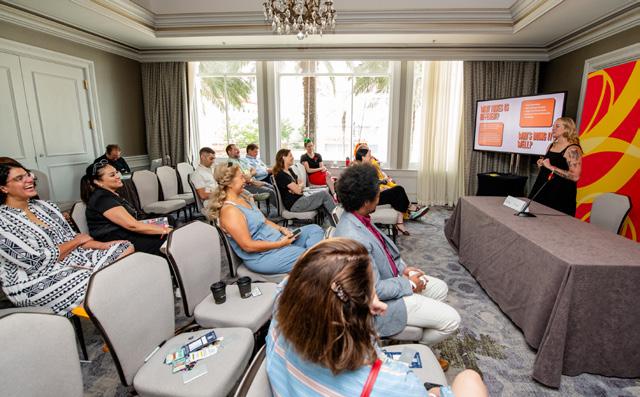
slated for Monday were pushed back to later in the week. Local bartenders were brought in to help prepare for events in lieu of missing participants.
The board also shifted to a hybrid model for one of the educational seminars, having a speaker join their scheduled talk via Zoom. This decision produced a silver lining that could have a positive impact on future Tales events.
“We had discussed the possibility of using Zoom as part of a hybrid seminar, and 2024 gave us the chance to test it out in real time with our AV partners,” Wayner said. “I don’t think it will be our first choice, but for some panels, a hybrid model could be a beautiful thing. It could be a possible opportunity for us to expand global reach.”

“I don’t think it will be our first choice, but for some panels, a hybrid model could be a beautiful thing. It could be a possible opportunity for us to expand global reach.”
EILEEN WAYNER Tales of the Cocktail CEO
“It’s great to be flexible and have contingency plans, but when you use a Zoom, you’re missing out on fully interacting with others, especially after a seminar,” added Posthumus. “Those unexpected moments of interaction are a big part of hospitality.”
Not even a catastrophic IT event could keep the drinks industry scene from descending upon New Orleans. “We had larger than anticipated numbers across the board both nationally and internationally,” Wayner said. "We felt truly humbled by the community rallying the way it did. The support we got from our attendees was energizing and inspiring.”
It goes without saying that the Tales board of directors hopes that 2024’s logistical nightmare will be a one-time affair. However, Wayner says working through the issues helped them identify strengths and highlighted areas of improvements that could make them ready to stand up even stronger if CrowdStrike 2.0 were to ever occur.
“One of the things we learned is that we have a really exceptional list of resources we can share at the ready,” she said. “We also know that we have the virtual tools we need to create content if we need to. The one thing that we may build in the future is to have a tier of subject experts on deck to help moderate and facilitate at a moment’s notice.”
These preparations are important because, when it comes to Tales of the Cocktail, the show must go on. It’s expected. In some ways, it’s needed. If 2024 is any indication, it doesn’t matter how many flights are delayed or canceled. People in the industry, from veteran master distillers to novice bartenders, will figure out a way to get to Tales. This indefatigable desire to willingly go to New Orleans during the city’s hot, humid season to learn and connect not only shows how critical Tales is to the community, but it also demonstrates why the alcohol industry and its many branches are the greatest industries on the planet.
“If we were an accounting conference, everyone would have said ‘forget this’ and just canceled,” Wayner stated. “But Tales of the Cocktail is such a recharging moment for the industry. People feel they need to be here, so we need to be there for them.”
Visit www.talesofthecocktail.org for more information.


Need high-purity for beverages? Our grain neutral spirits do that.
If you are looking for a clean, consistent taste profile, you’ve come to the right place. Our grain neutral spirits are perfect for vodkas, gins, and spirits-based RTDs. Available as Non-GMO Project Verified.
Protect your brand with our superior GNS and quality control. Contact GPC today.
Two DSP Locations Gluten Free


Oak alternatives are a popular way of adding body, structure, and organoleptic characteristics to spirits in a relatively controlled and predictable manner. That said, it isn’t without its share of challenges. First, we’ll discuss the thought process behind using these tools and techniques to gain specific characteristics. Then we’ll present planning and quality considerations. Finally, we’ll cover techniques for overcoming the dreaded “over-oaked/over-extracted” notes that occasionally happen when the “readiness window” is missed.
As seen in Tables 1 and 2, there are many options to consider. When working with these oak alternatives, it’s best to begin with your final product vision in mind, particularly when discussing your idea(s) with suppliers, as they are here to help and ultimately want you to be successful. These early conversations will help dial in your wood rate (an iterative process) and knowing what toast/char levels will bring about ideal characteristics for your base distillate/liqueur. Working with many of these alternatives is done on a by-weight basis, but occasionally suppliers offer a surface area option for those seeking to mimic the surface area exposure of traditional casks/staves.
TABLE 1 Small list of oak alternative suppliers, indicating oak/wood types and toast/char levels.
Supplier
Innerstave
https://innerstave.com/products/
Barrel Mill
https://thebarrelmill. com/infusion-spirals/ infusion-spirals-spirits/
Black Swan Cooperage
https://blackswanbarrels.com/ our-products
Heinrich Oak Alternatives
https://heinrichoakalternatives. com.au/portfolio/
Oak Solutions Group
https://oaksolutionsgroup.com/ evoak/high-proof/
Important questions to consider:
→ What characteristics (flavor, tannins, body, etc.) are you looking to gain and how can they benefit your spirits?
→ What oak/wood types would be best for your desired profile?
→ Which oak alternative types are best to achieve this in a timely manner (i.e., consistent, repeatable, predictable)?
→ Will infusion take place during primary maturation (i.e., in barrel/ tank) or pre/post-maturation?
→ What type of filtration methods will work best to maintain these added characteristics? Should primary filtration be performed before infusion?
→ Will these additional oak/wood “sessions” be incorporated into overall marketing strategies to aid product differentiation (i.e., multi-wood finishes, novel “finishing techniques,” etc.)?
American oak, French oak, Revere oak Medium, medium plus
American White Oak, French Oak, 50/50 American/French blend, Sugar Maple, Cypress, Spanish Cedar, Amburana, Cherry, Aspen, Mizunara
Cherry, Hard Maple, Hickory, Red Oak, Sassafras, Soft Maple, White Ash, White Oak, Yellow Birch
American oak, French oak
ēvOAK – many customized charred/toasted infusion staves/ cubes/chips that yield specific organoleptic characteristics to the distillates
Light, Medium, Medium Plus, Heavy, Char #3
Not directly specified for oak alternatives.
Medium, Medium Plus, Heavy, Maximum Impact, Aromatic Reserve and Structure Reserve
Specific levels to yield specific characteristics to distillate

Unlike traditional maturation techniques (i.e., barrels, casks, and larger), some use cases for these alternatives don’t allow the oxidative reactions needed to break down some of the extracted oak compounds. This isn’t necessarily a bad thing if their use is clearly defined in your protocols and can be beneficial to a point (i.e., add flavor, body, structure, tannic balance to flavors). But once they over-extract, they will be detrimental (i.e., too tannic, astringent, dry, not balanced) and will decrease overall quality and enjoyment. This will be iteratively determined and working with suppliers will help reduce the chances of this happening. So, how can we avoid this?

Working on a by-weight basis (g/L or lb/ Gal) allows you reasonable predictability for a “readiness window,” i.e., when desired characteristics are best presented for a given

Types
Flour/ powder
Benefits & Characteristics Quantity
References
Masks vegetal overtones, improves texture and mouthfeel. Maximum surface area exposure to liquid, fastest extraction time (2-5 days). Racking + filtration required to remove sediment from product/bottles.
https://innerstave.com/oak-flour-and-powder/

Chips/fines
Cubes
Chain of oak
Bag of block
Staves
Stave fan packs
Honeycombs
Spirals

Adds structure, aromatic integration, and complexity. Great surface area exposure to liquid, quick extraction (2 – 12 weeks).
https://innerstave.com/oak-chips/
Adds structure, aromatic integration, and complexity. Great surface area exposure to liquid, good extraction (1 – 6 months).
https://innerstave.com/oak-cubes/
Adds structure, aromatic integration, and complexity. Easily combine multiple toast levels, inserted through bung hole. Great surface area exposure to liquid, good extraction (3 – 12 months).
https://innerstave.com/chain-of-oak/
Adds structure, aromatic integration, and complexity. Easily combine multiple toast levels in floating/anchored infusion bag. Great surface area exposure to liquid, good extraction (3 – 18 months).
https://innerstave.com/bag-of-block/
Adds structure, aromatic integration, and complexity. Full extraction after 24 months. Barrel quality staves offer scalable options for small and large tank sizes.
https://innerstave.com/tank-staves/ https://innerstave.com/tank-innerstave/
Adds structure, aromatic integration, and complexity. Good extraction (3 – 18 months). Barrel quality stave packs float freely in tank, offer economy of scale.
https://innerstave.com/fan-pack/
High surface area/volume ratio with fast extraction (6 weeks). Fully customizable to fit specific production needs.
https://blackswanbarrels.com/our-products
Options: wood type, toast level, and char level. Customizable, variety of size options, fast extraction (3 – 6 weeks).
https://thebarrelmill.com/infusion-spirals/ infusion-spirals-spirits/

Stainless steel customizable container, with 6 – 40 wood panels and countless wood combinations. Options: wood type, stave style, toast level, and char level. Sizes: 10 – 60 gallons.
https://blackswanbarrels.com/our-products/ https://www.squarrelbarrels.com/the-barrel
timeframe, especially when working with non-stave/spiral/honeycomb options. Temperature also plays a role in extraction speed (warmer = faster, colder = slower). Sampling should be more frequent when working in warmer areas to ensure the readiness window isn’t missed. During initial trials, record the start time and date, then sample daily and record your sensory notes (including color if applicable) and the ambient temperature. As you approach the readiness window, sampling frequency should increase and be performed every few hours over the course of the workday, until your desired characteristics are reached. Note the time frame (hours or days) and average the recorded temperatures. You now have a starting point for future planning. But what do we do if we miss the readiness window or if the alternatives over-extract?
I define over-extraction as excessive astringent wood character/tannins, presenting as dry, sour, and generally displeasing, causing imbalance in the profile. Often this is caused by infrequent sampling, lack of a standardized sampling/ documentation plan, or production challenges/scheduling issues where the readiness window is missed and the wood is removed too late. This situation can be exacerbated if the wood/volume ratio is high, as the increased uptake speed will produce greater over-extracted characteristics and make resolving the issue significantly more difficult. So, how can we resolve these issues as much as possible? As with many things in this industry, the options available (Table 3) depend at what point in the production process the infusion took place, the severity of over-extraction, product-specific characteristics, product release timeframe, and your facility resources. There will be trade-offs to each of the below methods. Options 1-3 are for those cases where the window was just missed or if the
TABLE 3 Corrective actions to “fix” over-extracted cases and their tradeoffs.

Blend into subsequent batches at a fixed ratio (determined iteratively in small-scale blends).
Put liquid into larger (53G or greater) neutral barrel to breakdown tannins via gentle oxidation.
Continuous pump loop through fine stainless-steel mesh drum filter (5 – 10 μm) setup above liquid level, until astringency is broken down/ reduced to acceptable level.
Filtration (charcoal, plate and frame, cartridge, lenticular, etc.).
Redistill product to recoup alcohol.
Tank/vessel will continue to be occupied until fully blended out.
Very slow. Product characteristics could be affected. Will delay product release.
Product characteristics could be affected due to increased oxidation & repeated filtrations. Frequent sampling required to ensure success.
Can remove astringency. Will affect other characteristics (highly dependent on filtration type).
Last resort. May require further processing (i.e., charcoal filtration) before reuse.


Oak alternatives are a novel method for adding desirable characteristics to your distillates that are easy to use and relatively predictable, but they come with specific sets of challenges.
alternatives extracted slightly more than expected. Option 4 is for cases where high wood/volume ratios were used, and the extraction window was missed by several days. Depending on the filtration method used to remove the astringency, the remaining product characteristics may not be all that affected from your idealized version. If this is the case, great! You can process it as normal and bottle. If not, you may consider blending it into subsequent batches. Option 5 is the worst-case scenario and is usually the next step if Option 4 fails. Here, your goal is to recoup as much alcohol as possible in the resulting distillate. Depending on the product, the next step may be to use a charcoal filter to remove non-standard characteristics and then designate this for liqueurs. However, if you have a column still, you could always process it into a neutral distillate.
Oak alternatives are a novel method for adding desirable characteristics to your distillates that are easy to use and relatively predictable, but they come with specific sets of challenges. Lean into suppliers for guidance and work with them to determine your preferred
wood rates so that you can avoid (hopefully) having to “fix” any over-extracted cases. If this happens, the above options are a great starting point for any potential issues you may face.
Lastly, don’t hesitate to reach out if you have follow-up questions or want to chat about the exciting world of oak alternatives and how they can help your facility. Cheers!
Brett Steigerwaldt is the head distiller for Windon Distilling Company, the home of LYON RUM, in Saint Michaels, Maryland, and the chair of the Maryland Distillers Guild Education Committee. He is committed to exploring how distilling can solve real world problems and strengthen communities, such as his volunteer work with DomSetCo in Dominica. There, he is the head distiller for Rosalie Bay Distillery in Rosalie, Dominica, the world’s first nonprofit rum distillery/ocean conservation center. He holds a BSc and MSc in mechanical engineering and an MSc in brewing and distilling (Heriot-Watt 2023), where he investigated novel fermentation techniques to create organoleptically complex rums with minimal additional process complexity.


When Florida unlocked restrictions around craft distilling a decade ago, some enterprising people in Jacksonville — Florida’s largest city — jumped in, creating a robust industry today.
Written
While it seems like craft distilleries have proliferated in every corner of the country, it’s easy to forget some states still make opening one extremely difficult. But as America’s appetite for unique local spirits increases, many states are rethinking the laws on their books that have governed spirits production since Prohibition. Florida is one such state. Today, Florida’s spirits business is booming, not only creating new businesses and revenue, but delicious new products for people to enjoy. One destination where that is most evident is in Florida’s largest, most populous city: Jacksonville, where there are seven craft distilleries. Here are three of their stories.
WEBSITE: www.greymatterdistillery.com
OWNER: Paul Grey
FOUNDED: 2014
NEIGHBORHOOD: Jacksonville Beach
EMPLOYEES: 1
WHERE THE NAME CAME FROM: A friend suggested it because his last name is Grey
FLAGSHIP PRODUCT: Carve Vodka
WHAT ELSE: Live Oak Whiskey, Mayport Moonshine, and Ribault Rum
AVAILABILITY: Carve Vodka in stores around Northeast Florida, everything else at the distillery
When the State of Florida loosened the restrictions around craft distilling a decade ago, Paul Grey of Grey Matter Distillery was the first in Jacksonville to jump in.
“We were the first craft distillery to start in Jacksonville,” he said. “Which is really cool because we didn’t have the money and budget of a lot of people that started in this industry.”

An Atlanta transplant, Grey admits that surfing is what initially drew him to the area. He was in medical sales when the idea of a vodka distillery came to him since vodka is his tipple of choice. He bought a book called “How to Start a Micro-Distillery for Under $50,000” by Thomas Germann to learn more. “It’s like this thin,” he said with a laugh holding his index finger and thumb a centimeter apart. “I did open for a little over that, but we still did it on a very small budget.”
Grey also took a weeklong distilling class
from Six and Twenty Distillery in Greenville, South Carolina, thinking he would only learn about the distilling process. Instead, they offered a program that covered not only all kinds of spirits, but every aspect of the business.
“They had a day for whiskey production,” he began. “It was cool, but I was like, ‘I don’t care about this because I just wanted to make vodka.’ I wasn’t passionate about whiskey at the time. Then they had a whole day on rules


and regulations. I met some great contacts… That was the most useful part…meeting people and being able to ask them questions.”
Grey Matter was originally in a 1,500 square foot warehouse near downtown Jacksonville, where Grey began selling his 100 percent corn vodka Carve, named from the surfing term for the technique used to quickly change the board’s line and direction on a wave. Due to the constraints of Florida’s three-tier system, he couldn’t find a distribu tor and was mostly selling bottles to friends and curious visitors who stumbled upon the distillery. He ended up living in the distillery for a while because he couldn’t afford rent. It wasn’t until Carve was picked up by a local craft beer distributor — after being turned down by Florida’s big distribution players — that he was able to get on Jacksonville store shelves, generating steady revenue and in creasing production. During the pandemic, he moved into a 2,000-sq. ft. former scooter store near Jacksonville Beach in a strip mall on the busy Highway A1A, the coastal Florida road Jimmy Buffet made famous.
“This wasn’t what I envisioned as a space, but the price was right and when COVID hap pened, I wasn’t really doing much,” he noted. “In a way it [COVID] was great for my busi ness actually because it gave me the opportu nity to step back and look at the business as
a whole.” Opened in 2021, Grey and his wife remodeled the space themselves, creating a refined yet rustic tasting room filled with dark woods, leather bar stools, and long bar with a white granite top, even though Florida didn’t

“If I’d stayed in that [medical sales] profession, I’d probably have a lot more money,” he ruminated, “but it wasn’t what I wanted to do…Going into work every Monday, I love
WEBSITE: www.fourfathersdistillery.com
OWNERS: Tim Daniels and Dan Jones
FOUNDED: 2017
NEIGHBORHOOD: Northwest Jacksonville
WHERE THE NAME CAME FROM: Even though it’s the alchemy symbol for sugar, the logo looks like two f’s
EMPLOYEES: 4 sometimes 5
FLAGSHIP PRODUCT: Black Copper Rum
WHAT ELSE: Oxbox 120 Rye Whiskey and Patriot Vodka
AVAILABILITY: State-wide
After 24 years as a product research chemist at Bacardi’s Jacksonville facility, Tim Daniels had a dream for himself.
“I wanted to have what Jack Daniels had,” said Daniels, no relation, “a little town and there’s nothing there but Jack Daniels. I wanted to find a small town in Kansas because I’m originally from Kansas. I wanted to have that little town, buy up some beautiful old buildings, and make it into that.”
Technically, he did do that, but first he opened a distillery in northwest Jacksonville with business partner Dan Jones. He makes a small collection of spirits, but what kept the lights on those first few years was contract distilling and private labels, mostly for local corporate clients. Now he’s ready to produce and promote his own brands, Black Copper Rum, Oxbox 120 Rye Whiskey, and his just-released Patriot Vodka, made from red wheat and blue and white corn.
“We’ve been doing a lot of fun stuff and doing things for other people, but we kind of got stuck doing that,” he noted. “We were wanting to do our


own product and get it out there. It seems like you’re always doing something for everyone else and all.”
While he’s no longer at Bacardi, he still likes to tinker in the lab. His distillery features a tiny laboratory with smaller versions of the equipment he used to use to help Bacardi formulate new products.
“This is where we look at things on a molecular level,” he said, pointing out the liquid and gas chromatography spectrometers, an electron capture detector (ECD), and a pharmaceutical vacuum distillation test still. “A lot of big guys use a laboratory like this,” he said. “Most small guys don’t because, first off, they can’t afford it, and second, they don’t know how. Not that I’m a genius, but that’s what I did. My degree is in chemistry. I love this stuff.”
He also uses vacuum distillation on his production still in the back of the building. The still features an impressive 50-gallon glass globe. Daniels runs the glass vacuum distillation still along with both a copper pot still and a column still, using solar thermal energy from a giant metal apparatus in the yard next to the building that looks like a set of stadium bleachers. Solar thermal power is different from traditional solar because it doesn’t use photovoltaic panels. Instead, the bleacher-like contraption contains tubes filled with water and glycol. The sun heats up the liquid to 320 degrees, and then it flows inside the building to boiler tanks where it’s released as steam to heat the stills. He’s not to the point where he

can run entirely on solar thermal, but when he does, he believes his will be the only solar thermal-powered distillery in the country.
Daniels also pulled his love of molecules into the distillery’s logo. What looks like two italic lowercase f’s is the ancient alchemy symbol for sugar. With sugar’s importance in fermentation, he knew it would make a great logo but didn’t have a name for the distillery itself. Then at a backyard BBQ he asked his three best buddies what he should name the distillery. One of them mentioned that since the symbol looks like two f’s and they were all fathers, why not Four Fathers? It stuck.
He currently sells his own products to locals who know enough to call or show up and ring the doorbell so he can let them inside (the distillery doesn’t have set open hours).
Often, he and his customers would catch up on their families over a sip of rum, or he’d have them sample new products for their opinions. It’s a part of the business he relishes, but wanting to increase sales, he recently signed with a large distributor to sell his products state-wide. A staff member is also setting up online shipping.
And that distillery in Kansas?
“We started that in 2018,” he explained. “Sedan, Kansas. It’s not where I grew up,
but it’s a tiny town of about 900 people. Spent two years there. We brought in some investors, an oil company, and they pretty much took it over.” He realized he didn’t want that dream anymore.
“I got a place back in Kansas,” he said wistfully, “got several acres and a place on the lake. It’s beautiful, but I’d rather be here. Something about North Florida. I like what I got here.”


WEBSITE: www.sound-of-spirits.com
OWNERS: Michael and Verena Rinner
FOUNDED: 2022
WHERE THE NAME CAME FROM: They’re from Austria, duh
NEIGHBORHOOD: EverBank Stadium/ Downtown Jacksonville
EMPLOYEES: 2 (3 if you count their dog Dexter)
FLAGSHIP PRODUCT: Sense
Vodka and SoS flavored vodkas and cream liqueurs
WHAT ELSE: Sundial canned cocktails
AVAILABILITY: North Florida and Margaritaville Resort Jacksonville Beach, New England (Sundial only)
The outside of Sound of Spirits Distillery looks like a typical metal building found in any big city’s warehouse district, except for one noticeable detail. Looming over the property’s western edge is the shadow of EverBank Stadium, home to the NFL’s Jacksonville Jaguars, the Gator Bowl, and the FloridaGeorgia game.
“I found this warehouse online,” said co-owner and head distiller Michael Rinner. “I had no idea the stadium was next door. No idea!” Rinner and his wife, Verena, are Austrian transplants who moved to Florida during the pandemic specifically to open a distillery because European shutdowns prevented them from doing so in their native Salzburg.
“They shut down everything and we said, ‘Ok, what are we going to do’?” he said. “We made a lot of vacations before in Florida, and we love it here. So we take the money and run! We have been here almost four years.”
They started in Fort Myers, but Rinner said that didn’t work out, so they moved north to Jacksonville because they thought the weather was better. They had no idea what American football was when they began renovations.
“First time I saw it was preseason, and it was insane,” he began.
“Pre-season,” Verena emphasized.
“The parking lot was full,” he continued. “The coffee roaster next door was filling up. I said, ‘What is happening?’ Last Sunday we had the Browns. The Packers, the cheeseheads. The Texans! Then there’s the GeorgiaFlorida game. That gets crazy.”
“They come down a week before the game,” Verena added.
Unfortunately, that first year they didn’t have all their permits and compliances, like ADA restrooms. They could start production but couldn’t serve or sell anything.
“We lost a whole season, but we were patient,” he explained. “We had the sign up, so we talked to people. We said next year, you will see. Now they come back and hang out, watch the game, chat. Every time we open the shop and people show up, it’s like Christmas.”
The Rinners make a variety of flavored vodkas and cream liqueurs, the types of spirits they would drink in Austria. However, they’ve noticed that American palates are different.
The Rinners make vodka from 100 percent corn. They also make rum but have no plans to make whiskey because he believes the market is oversaturated and, with little exposure to it in Austria, they’re simply not interested. They hand-label bottle-by-bottle using a $60 wooden block called a Label Wizard. Rinner says it takes forever, but it’s more accurate and less expensive than any machine he’s tried. They also partnered with a Massachusetts company to make canned cocktails under the name Sundial, sold in the New England area. The partnership has helped sustain their nascent business because, like other Florida distilleries, they ran into the brick wall of three-tier distribution.
“The three-tier system, you’re always at the mercy of the distributor,” he said. “We waited two years. Nobody picks you up, and nobody cares. You have to beg, beg, beg and then they finally pick you up.” Shortly thereafter, another opportunity presented itself.
“Margaritaville [Resort Jacksonville Beach] picked us up,” he announced. “They kicked out some other big brands and took us in. We must have done something right!” However, they had to provide specific cream liqueur flavors for the resort’s frozen cocktail program.
“[The bar manager] said, ‘We need five flavors — strawberry vanilla, creme de cocoa, piña colada, coconut cream, and do you have pineapple?’ I said we don’t, but I gave it a try. So, I made a tiny bottle just for him. He tasted it and said, ‘Wow.’
“And he kept the bottle,” added Verena.

“Everything starts in our kitchen,” he said. “We got all the flavors there, maybe hundreds, and we do all the blending. It’s difficult because you have to find the right balance… Do I like it? Maybe. We mix stuff we don’t even drink ‘cause it’s not our taste. Pumpkin spice? Key lime? Nah. But people want it, so we do it.”
Despite the ups and downs, the Rinners love running a distillery and can’t imagine doing anything else.
“The magic doesn’t happen here,” he said, waving his hand toward the still.

Due to the FDA’s stringent dairy regulations, they bring in cream liqueur from another manufacturer and work their flavor-blending magic on it.
“The magic happens when somebody comes in and says, ‘Hey, I want to try this. Can I have a sip?’ You give him a sip and you see his expression. Does he like it? I hope he likes it. And then he says, ‘This is good. Can I buy a bottle?’” Rinner snaps his fingers with a loud crack. “That’s it! Then you know you’re on the right way.”


Gin, one of the most consumed alcoholic spirits in the world, is a combination of three main ingredients, ethanol, water, and key botanicals with juniper being the bestknown and legally required. About 160-250 other non-juniper botanicals, as well as a sundry other non-botanical ingredients, are also used, creating thousands of possible formulations. Recently, several questions were posed to me regarding pH in gin specifically, seeking out as to which gins were closer to neutral in pH value. Analyzing the pH of 45 different
gins from around the world, we found the average pH to be 6.1 (slightly acidic) while the lowest pH was 3.3 (acidic) and the highest pH was 8.6 (alkaline). Knowing that acidity in foods and beverages can affect dental health by causing tooth decay (1-3) and also cause acid reflux or heartburn (4,5), further work was undertaken to better understand this wide range of gin pH values. Because the pH of a beverage or food also impacts its flavor perception, it is important to consider pH for both the effects on the
gins vs. pH values with reference pH scale.

Written by HALEY SPURLIN,
resulting flavor of gin profiles and with regards to the consumer and health. As noted above, several questions from consumers were related to which gins have higher pH to enable them to enjoy certain brands without risk of dental decay or heartburn. While the issue of pH also pertains to other distilled spirits and beverages, for now the focus is on gin.
As mentioned earlier, we found a range of pH from 3.3 to 8.6 in the 45 gins assessed. Figure 1 shows a plot, via color coordination to the pH scale, of the 45 gins analyzed. To provide context, the pH scale shows wellknown examples of familiar fluids from across the range of pH values, including both consumable and non-consumable products. The pH value indicates the concentration of hydrogen ions in a solution, with the lower concentration of hydrogen ions more alkaline and the higher concentration of hydrogen

Wild Botanical Gin 6.91
Black Robin 6.91
Bareksten 7.1
Akori Cherry Blossom 7.14
Gindu 7.17
Martin Miller's Winterful 7.37
Amazzoni 7.46
Pergote 7.48
Only Premium 7.5
Opihr 7.64
ions more acidic. The pH is measured logarithmically from a scale of 0 (most acidic) to 14 (most alkaline) with 7 being neutral (6).
Acidity is related to a sour/tart taste and caused by the presence of acids in foods and beverages. These acids can enhance or balance other tastes in those commodities (7, 8). There are five different acids commonly found in food and beverages that produce unique and complex flavors: citric acid, acetic acid, tartaric acid, lactic acid, and malic acid (7). Acidity can also aid in digestion by stimulating digestive enzymes, assisting in regulating blood sugar levels (via antibacterial action in the preservation of foods) and by assisting nutrient absorption. However, acids can also — as noted above — cause tooth decay by eroding tooth enamel as well as cause heartburn or acid reflux, which can lead to esophageal cancer.
The pH 5 Gins
Glendalough Rose
Rose infused
Four Pillars
Spiced Negroni
Oranges, Ginger, Cubeb, Grains of Paradise
Chon Gaew
Thai Inspired. Lime leaf, Jasmine, Citrus.
Badhai Ho!
Indian Inspired. Tamarind, Fenugreek.

Chaim! Israeli Inspired. Honey, Apple — Mellow notes.
Dr. Squid Ink Gin Real Squid Ink!
Buddah's Hand
Chinese inspired. Pomelo, Sichuan pepper, Star anise, Ginger, and Chrysanthemum Walheim Ranch
Oranges, Earl Grey tea, Fennel, Bergamot oils
Indlovo Pink
Prickly Pear and Vanilla. Elephant Foraged Botanicals.
Gin Lane 1751
Old Tom
Cassia bark, Angelica, Sicilian lemon, Coriander, Orris root, Seville orange, Juniper, Star anise
Agatha's Tears
Cardamon and Cubeb Infused
Batch Gin
Lemon, Juniper, Citrus
FIGURE 3 Thirteen gins with pH values in the range of pH 5.0 to 5.97. Plus, botanicals listings.
Grape
Juniper, Blackcurrant, Pineapple, Grapefruit, Kaffir Lime, Green Pepper
Pinkster Raspberries


Four Pillars
Christmas Gin Aged in barrels,Muscat classic Rutherglen Muscat
Indlovu Citrus
Orange and Marula. Elephant Foraged Botanicals
Indlovu Original
Elephant Foraged Botanicals
Acid reflux, or heartburn, is caused when the acids from food and beverages flow back up the esophagus due to the failure of the esophagus valve, which separates the esophagus and stomach. Some gins can cause heartburn by loosening the esophagus valve thus inhibiting the valve from closing, causing acid from the stomach to come back up. It should be noted that spirits with higher ethanol content have not been known to stimulate stomach acid secretion compared to lower ethanol spirits. However, if one mixes their gin with citrusy juices, carbonated beverages, or caffeinated beverages, this could cause heartburn to flare up (5).
Of the 45 different gins sampled (Fig. 1), the average pH was 6.1. Most of the gins tested were indeed on the acidic side with 36 gins evaluated between 3.3 and 6.9 and 11 gins between 7.01 and 8.6.
FIGURE 2 Nine gins with pH values in the range of pH 3.2 to 4.98. Plus, botanicals listings
Strange Nature Barrel Aged
Juniper, blackcurrant, toffee, orange peel, cinnamon, makrut lime
Killowen Small Batch Irish
Rhubarb, Heather, hibiscus, wild angelica root, juniper, fuchsia flower, lemon zest, meadow sweet
Lavender Elysian Fields
Juniper, Lavender, Honey
Angry Ant
Lemon grass, currant bush, mulla mulla, and purple vetch. An ant in bottle.
Ingredients affecting gin pH include botanicals such as juniper, citrus, and spices that can affect the level of acidity. So far little has been reported about gin formulation and final resulting pH values. For example, which botanicals (other than citrus fruits) lead to more acidity and lower-pH gins? Which ones lead to a more neutral or alkaline pH gin? With so little information out there, more research is needed.
Figures 2-5 present the pH values, ABV levels, and a listing of the botanicals used (based on labels and website information) in the gins studied (Fig. 2 — pH 3 and 4 gins), (Fig 3. — pH 5 gins), (Fig. 4 — pH 6 gins), and (Fig, 5 — pH 7 and single pH 8 gins).
A caveat here: Not all labels or gin producers provide a complete listing of the ingredients used in their proprietary gin formulations and branded products. However, with the availability of low-cost, easy-to-use pH meters, distillers should play the formulation game and see what the pH values of their formulations and final gins will be. Noting that each botanical can
Twelve gins with pH values in the range of pH 6.0 to 6.91. Plus, botanicals listings
play with or against each other in various physicochemical ways and impact sensory detection and evaluation, sensory evaluations of products created by tweaking formulas with similar ingredients but with varying pH values should be undertaken.
When making or consuming most spirit beverages, little thought is given to their pH and acidity. As described here, though, this is an important topic for consideration. When asked, most distillers guessed that the pH would be about 4.0 for gins in general (see Fig. 2). It was surprising to us when researching the topic further that
The pH 7 ( + 1 pH 8 Example) Gins
Bareksten N/A — See web

the first papers to pop up were related to dentistry along with the heartburn/acid reflux issue and spirit beverages. In addition, pH will affect gin flavor and the perception of those flavors (as for other spirits too). Therefore, the gin distiller should consider the pH value both for creating a desirably flavored gin and to help preserve the teeth and stomachs of their consumers, perhaps ensuring they will come back for that second or third bottle!
Haley Spurlin, BSc. is a lead analytical chemist at BDAS, LLC. She oversees basic analyses of beer and spirits, distillation, sensory evaluation, and social media aspects of the business. Prior expertise includes the use of GC systems and assisting in testing beverages and materials for educational courses.
Akori Cherry Blossom
Cherry Blossom, Kumquat, Juniper, Ginger Gindu Rosemary, Saltbush, Light pepper
Amazzoni N/A — See web
ONLY Premium Gin
Juniper, Jasmine, Veronica, Violet, Rose petals, Lavender, Orange blossom, Mallow, Pansies, Lemon Balm, Hibiscus
Ant Gin
Includes Black ants
Martin Millers
Winterful
Ornabrak
Irish Single Malt
Eorna Braiche — Malted barley, Juniper, Angelica root, Douglas fir needles, Lemon peel
The pH 6 Gins

Baobab
Spirits Pine, floral, and citrus notes described on bottle Holi Gin Chai Spices
FreelandForestSpirits Gin
N/A
See web
Da Mhile Organic
SevillaTanqueray Orange Orange Flavored Gin
Glendalough Wild Botanical Juniper, Citrus, Pine, SummerAutumnflowers, fruits, Winter spices
FIGURE 5 Ten gins with pH values in the range of pH 7.1 to 7.72 with one gin at pH 8.59. Plus, botanicals listings
Mandarin and Cinnamon —Notable UV-visible Fingerprint
Pergote
Juniper, Wormwood flowers, Iris, Lemon balm, Sage, Grapefruit, Coriander, and Orange
Opihr
Martin Millers Juniper and Citrus

Cubebs, Cardamom, Tellicherry pepper
Monkey Schwarzwald Complex “47 handpicked botanicals” incl. Lingonberries
Four
Pillars Fresh Yuzu Yellow yuzu, Citrus, Lemon, Cumquat,Mandarin,Grapefruit, Ginger, Turmeric, Sencha genmaicha (Green tea)
Vara High Desert Juniper, Coriander, Sage, and Citrus
Wollersheim Garden Gate
Lavender and Chamomile
Uncle Val's Peppered Gin Capsicum annuum
Black Robin 11 botanicals distilled 5 times. Spicy, citrus flavors
(1) Akter, R.; Asgor, M.; Sheikh, B.; Khalequzzaman, M.; Das, S. pH and titratable acidity levels of alcoholic and non-alcoholic beverages contrast with the threshold pH level for tooth enamel demineralization. JARIIE-ISSN(O)-2395-4396. 2023, Vol-9 (4); 1185-1191.
(2) Reddy, A.; Norris, D. F.; Momeni, S. S.; Waldo, B.; Ruby, J. D. The pH of beverages in the United States. J Am Dent Assoc 2016, 147 (4), 255-263. DOI: 10.1016/j.adaj.2015.10.019.
(3) Definitive Drinking Guide. “Is Vodka Acidic? Uncovering the Truth about Your Favorite Spirit’s pH Level.” Definitive Drinking Guide, 29 Dec. 2023. https://www.cocktailmagic. com/is-vodka-acidic.
(4) Feldman, M.; Barnett, C. Relationships between the acidity and osmolality of popular beverages and reported postprandial heartburn. Gastroenterology 1995, 108 (1), 125-131. DOI: 10.1016/0016-5085(95)90016-0.
(5) “Can Drinking Alcohol Cause Heartburn?” Alcohol and Heartburn: Can Drinking Alcohol Cause Heartburn?, https://www.tums.com/about-heartburn/causes/ heartburn-from-alcohol.
(6) Dornbusch, H. “pH.” The Oxford Companion to Beer, Oxford University Press, New York, NY, 2012, pp. 647–648.
(7) “The Sour Truth: Understanding Acidity in Taste.” FasterCapital. [updated June 24, 2024] https://fastercapital.com/content/The-Sour-Truth--UnderstandingAcidity-in-Taste.html.
(8) Spedding, G. “Acid”, “Acidity” The Oxford Companion to Beer, Oxford University Press, New York, NY, 2012, pp. 6-7.
Written by Mitch Codd /// Illustrated by Francesca Cosanti

Rye whiskey can be really frustrating to produce, which is a bummer because it tastes so great! The composition of the grain itself is unlike all the others we typically use, lending to its rough reputation, lower yields, and sticky, foamy, thick messes. While we could dive deep into rye’s interesting peculiarities, let’s focus on a few practical solutions for your troubles.
Most of the solutions I’ll propose target the viscosity of the mash to ease these troubles. We typically break viscosity in two ways: enzymes and dilution. Since dilution means more water content and therefore lower sugar content, we also end up with lower ABVs. Typically, you will see rye whiskies starting around 17 degrees Brix or so, whereas a bourbon is in the mid 20s without any issues. Since we usually
don’t want to run our fermentations any lower in ABV, further dilution is probably out of the question.
Enzymes come next. These wonderful little pieces of biological machinery are integral to our process, whether we get them from a bottle or from the malted barley in the grain bill. We typically focus on two enzymes, alpha-amylases (AA) and gluco-amylases (GA) to do our conversion from starch to sugars. If the AA can’t do its job fully, we can end up with a partially converted mash, with thick dextrins and starch complexes making a thick mash to ferment, prone to low yields and foam-overs. It’s really important to be sure you have the right temperatures and times, as well as pH levels to get the most out of those enzymes in your cook.
Assuming the AA and GA enzymes are doing their job, the next thing to look into is the enzyme that breaks down the “unique” components of rye grain: beta glucans (BG). These non-starch, soluble fibers are difficult to work with and need their own niche enzyme to break them down. This BG enzyme is typically added into the water before grain goes in and rested around 150 degrees F to get an efficient break. I also prefer to see a second addition and rest after we take the grains to higher temperature for the AA rest, as it can further reduce viscosity, increase yields, and speed cooling efficiency. A lot of the times I troubleshoot messy rye fermentations, the cause is a suboptimal BG rest.
Despite my confidence in the BG enzymes’ amazing powers, it’s worth noting that the fermentations can still be difficult, even
with efficiently broken beta glucans and starch complexes. The next tool in my tool belt is also an enzyme but a pretty cool one: a protease. Using a protease, preferably just after the second BG enzyme addition, can destroy the proteins that are inherent in the grain, degrading down into small peptides and amino acids. These proteins can be responsible for foam that is difficult to “pop” and remains structurally sound while fermentation is going. If we break those proteins down, we end up with a much weaker foam layer, and it doesn’t reach as high in the fermenters and spill out. The beautiful part of this is that the product of protein degradation is amino acids, and our yeast cells LOVE amino acids. They are a healthy source of organic nitrogen, and they allow our yeast to be more efficient, higher yielding, and create better flavors. Proper use of a protease can be quite powerful for your production and keep it much cleaner.
The last few tools I would test in this situation are much more
biological. If we can’t control the mess by making the mash less thick and easier to work with, we will control the fermentation itself. Honestly, properly using all these tools is likely our best approach. The way we do this is to “slow” our fermentation a bit in the early stages, primarily through choosing the right yeast strain and strategic temperature management. In this case, we want a strain that starts a little slower on Day 1 so that it doesn’t blow over
the top right away and just gradually approaches max fermentation rate. This alone can make quite a difference, but if we further control the temperature at which that strain is fermenting, we can really capitalize on this tool. A fermentation set at 70 or 75 degrees F at yeast pitch is going to ferment slower until it creates enough heat to really get going. This gives us a more controlled evolution of CO2 and less foaming.


That concludes the first entry in our new “Dear Troubleshooter" series. If you have any questions for the troubleshooter, please let us know. No question is too eccentric or obscure. Until next time!
Mitch Codd is a microbiologist by trade and a certified craft spirits nerd. He started his career working for a biotech company, engineering yeast strains for improved performance in Brazilian sugarcane fermentations, where he gained invaluable knowledge of yeast metabolism, stress responses, microbial interactions, and the ecology of fermentations. This knowledge transferred seamlessly to his current role with Lallemand Biofuels and Distilled Spirits, where he works with US craft producers to improve and innovate their production process by applying sound biological principles and a deep understanding of the process. This question came up several times while Brian and Mitch were speaking with craft distillers at The Alcohol School this past August. They were brainstorming this column with the delegates as a way to share frustrations and solutions to issues that aren’t simple or don’t have just one cause. Educational and social events like The Alcohol School are invaluable ways to learn from experts and share knowledge with colleagues. We hope that this column can function as that as well, in a small way. Please email Mcodd@Lallemand.com your troubles in mashing/cooking, fermentation, and distillation topics, and we may feature it here and share some solutions we have seen around the industry. Or, if you have unique solutions to some of the problems posed, we would love to hear from you too!


Written by Jake Holshue

We are sometimes just seen as a “necessary cost of doing business” versus human beings capable of contributing so much more than our line item on a spreadsheet would suggest.
Ernst Toller once said, “We were all of us cogs in a great machine which sometimes rolled forward, nobody knew where, sometimes backwards, nobody knew why.” After 12 years in craft spirits, I’ve never felt these words more deeply. I’m one of the COGs — the distillers, maintenance workers, operators, packagers, coopers, and artisans who keep the spirits flowing but rarely share in the perceived successes of the industry. It’s a double entendre with Cost of Goods Sold, as we are sometimes just seen as a “necessary cost of doing business” versus human beings capable of contributing so much more than our line item on a spreadsheet would suggest.
I’ve watched the craft spirits boom of the last quarter century from the production floor, and now that we’re facing our first major downturn, I need to speak about the human cost behind these bottles. We COGs have mortgaged our time, both physical and mental health, and relationships for businesses that often view us as expendable when balance sheets turn red. I know because I’ve been there, missing my kid’s milestones, traveling to tasting events in other states, and pushing through exhaustion to meet production deadlines at personal risk to myself and those around me.
“Rising tides raise all ships” — I used to believe in this promise. We all did. I used to shout it from the rooftops! It suggested success would be shared equally among everyone. But like many beautiful lies, it failed to account for the seaworthiness of these vessels or the competence of those at the helm.
I’ve watched countless craft distilleries taking on water, kept afloat only by the relentless efforts of my colleagues bailing in the background. I stood shoulder-to-shoulder with my fellow COGs, bearing the burden of long hours, physical strain, and mental exhaustion. We are often the ones missing family dinners, working weekend shifts, and sacrificing our well-being to maintain production schedules.
This current industry downturn has exposed the cracks in our foundation. When financial pressures mount, I’ve not seen executives take accountability, financially or otherwise. It’s always the COGs’ hours, benefits, and ultimately jobs that get slashed. What we end up with are pizza parties celebrating another “successful OND” instead of the promised raises or time off.
Every bottle that leaves our distilleries represents countless decisions, hours, blood, sweat, and tears. I’ve seen what happens when veteran distillers or skilled packagers leave, taking years of institutional knowledge with them. The true cost of treating COGs as disposable assets becomes painfully clear only after we’re gone.
Our industry has built its marketing around authenticity and craftsmanship yet fails to properly value those of us who embody these very qualities. They put our faces on promotional materials but conveniently forget us during profit-sharing discussions. But here’s what’s changing: We’re talking to each other now. Through social media, industry forums, and latenight conversations after shift changes, we’re sharing our experiences, our frustrations, and our worth.
As I navigate this downturn alongside my colleagues, I want distillery owners to understand that their margins depend on our dedication and expertise. The next generation of craft spirits professionals are watching, taking notes, and asking hard questions about whether this path is worth the sacrifice. They’re increasingly aware of their worth, and they’re not afraid to discuss it. The problem we face is that we are coming up short on finding suitable answers that do not perpetuate the way things have been for the last quarter century.
The solution isn’t simple, but it starts with recognition — not just of individual contributions, but of our collective value. I’ve seen the difference in a few forward-thinking distilleries that have invested in their workforce through fair compensation, profit-sharing programs, and genuine professional development. They consistently produce better products, maintain more stable operations, and ultimately protect their bottom lines during these uncertain times. Those are the ships that will remain afloat when the waters grow rough.


Easily offer over 60 premium cocktails made with your in-house spirits. Bartesian turns any operator into a world-class mixologist using our all-natural cocktail capsules and your spirits.


When hosting special events, Bartesian gives your customers the ability to choose from more than 60 premium cocktails, select their own custom cocktail menu, and gives your distillery the opportunity to offer an enhanced bar package

Tasting Room
Turn anyone working in your tasting room into a mixologist while using your very own whiskey, vodka, tequila, gin, or rum.







research by the Eureka! Ranch on thousands of new products finds that the No. 1 predictor of sustained success is how “meaningfully unique” a product is.
In the case of whiskey, this means that consumers perceive the taste of your spirit to be something that is different in a good way versus all others. When consumers find that your product taste is meaningfully unique, they reward you with word of mouth referrals and repeat purchases. The result is that you enjoy sustained growth in sales and profits.
When your product is “nothing special,” then you are a commodity. And commodity offerings eventually realize spiraling declines in sales and profitability.
FiVe OPtiOnS
Sadly, a recent research study of whiskey consumers in the U.S. finds that today, nearly two out of three whiskey consumers believe that “New bourbons tend to have a great story and package, but the liquids are often nothing special.”
UGH! Not being unique is the “kiss of death” for a new whiskey brand.
And to be clear, you can’t achieve meaningful uniqueness with marketing magic. Marketing can get consumers to try your product. Meaningfully unique taste gets them to repeat purchase.
Similarly, you may offer unique processing features such as grain-to-glass spirits, heritage grains, your family recipe from your great-great-grandfather, or any other marketing smoke and mirrors. But those don’t make your product meaningfully unique, unless when tasting it blind and without the marketing narrative, consumers rate it 7 or higher on a scale of 10 in both purchase and uniqueness.
To create a meaningfully unique taste, you have to do something meaningfully different AND follow good manufacturing processes, such as cleanliness and advanced filtration.
1)
FiniSHinG WitH UniQUe WOODS
Seventy percent of the flavor of wood-aged spirits comes from the interaction of the new-make spirits with the wood. By using unique woods (staves, inserts, additives, etc.) for aging, you can create meaningfully unique taste experiences. The choices of wood are endless. They range from vintage 200year oak, cherry wood, maple, smoked oak, and dozens more.
2) FiniSHinG in SeASOneD CASKS
Similar to option one, aging in something like a sherry oak cask, as The Macallan has done since it was founded in 1842, offers a meaningfully unique taste. The range of options for cask finishing is endless, from sauterne to port to pinot noir or cabernet sauvignon, etc. Unlike simply finishing with wood additives, it can also open new marketing angles if you are able to reference where the casks originated from.
3) Air DrieD BArreLS
The doubling of bourbon over the past 10 or so years has put pressure on the supply of new American oak barrels. As such, instead of 100 percent air dried barrels, most are kiln dried. The difference in taste is noticeable. To counteract this, we finish our bourbon using 100 percent air dried woods; it’s not a perfect substitute, but it makes a meaningful difference in the taste.
4) CreAte UniQUeneSS tHrOUGH BLenDinG BArreLS FrOM UniQUe AGinG enVirOnMentS
Storing your barrels under a wide variety of environmental conditions — such as varying humidity levels, temperature ranges, altitudes, and seasonal cycles — creates unique flavors and aromas. These unique notes give your blender more options to work with. Even what we consider bad-tasting barrels can have value to a great whiskey maker. As one renowned Scotch whiskey maker explained, “When a barrel is bad I don’t throw it away. Rather, I use odd tasting barrels as my ‘spice cabinet’ — often in very, very small amounts.”
5) MOSt iMPOrtAnt OF ALL — SWeAt tHe DetAiLS tO KeeP YOUr WHiSKeY GreAt
Having gone to the trouble of creating a meaningfully unique tasting experience, it’s critical to maintain its quality. This starts with outstanding cleanliness in your tanks, pumps, and bottling line, as well as leveraging the art and science of proper filtration.
At our distillery, George Quigley and Dave Bowers of Proof 33 Provisions have been invaluable resources in understanding filtration. Bowers explained, “Filtration done right removes variation that can cause off flavors or poor-looking spirits.” Without skilled filtration, he noted, “microscopic wood fibers and other elements” can turn your great product into a bad one.
Quigley went on to explain, “Proper filtration does not impact flavor. Rather, it creates consistency, clarity, and stability. Said another way, it helps make sure that the consumer gets the taste you intended.”
These are by no means the only strategies you can use to implement a more unique set of flavors, but it should help create a foundation to build upon. The spirits market is going to become even more competitive as the price of quality spirits is driven down with the glut of bulk products on the market. If you can't compete with cheap, you better be unique.
Doug Hall is the co-founder and CEO of Brain Brew Custom WHISKeY, WoodCraft Bourbon Blender Franchising and founder/chairman of the Eureka! Ranch. He has spent 40+ years creating and commercializing innovations for companies such as Nike, Walt Disney, Diageo and over the past 22 years The Macallan of Scotland.


ELIXIR is the invention of a new shape from the fusion of Distil’er and Mixologist, two existing models in the SAVERGLASS catalog. The attributes that have made these two great classics so successful have been retained, with a height of 173.5 mm and an optimized glass weight of just 537 grams. Highly versatile, ELIXIR adapts divinely to both white and brown spirits.