DO OR DO NOT. THERE IS NO TRY: the STATE of DISTILLING

WINTER 2023
BATTLE ROYAL : THERMAL OIL vs STEAM DISTILLATION THAT DARNED cat! TALES of TERROIR




BRAND STRATEGY | STORY DEVELOPMENT | NAMING LOGOS | PACKAGING | CUSTOM BOTTLES | PRINT | DIGITAL DRINK WITH YOUR EYES ® 2787 NAPA VALLEY CORPORATE DR, NAPA, CALIFORNIA 94558 T | 707 265 1891 WWW.CFNAPA.COM CFN216_ArtisanSpiritsAd_2_ FALL_2022.indd
TABLE of CONTENTS
A LETTER FROM THE EDITOR 10
QUARTERLY GUILD & INDUSTRY REPORTS 13
Updates from guilds and associations within states, across the nation, and beyond!
WHY WORKING WITH A BRANDING EXPERT MATTERS 27 Brand Buzz with David Schuemann
THERMAL OIL DISTILLATION VS STEAM DISTILLATION 31 From the Good Guy Distillers
ETHANOLIC ODDITIES 35
Three obscure spirits from around the world
A GENUINE NEVADA PARADISE 39
Frey Ranch delivers award-winning craft whiskey from an unexpected place
THE STATE OF THE CRAFT DISTILLING INDUSTRY 44 Part 1: The distillery’s viewpoint

MCCLINTOCK DISTILLING LOOKS CLOSE TO HOME 48 Beyond the Bottom Line
DIARY OF NOMADIC DISTILLING 53 The journey continues
A TRUE TEXAS PEACH 56
Dietz Distillery brings Old World distilling to the heart of Texas
WHEN IT COMES TO SPIRITS AND COCKTAILS PRODUCTION, SHOULD YOU CAN IT? 60 Part two
INSIGHT AND INNOVATION 66
How kaizen helps teams identify improvement projects
SWAMP SPIRITS 69
Sugarfield Spirits makes craft expressions in Louisiana’s climate
OUTSIDE-THE-BOX EVENTS OFFER DISTILLERS
ADDITIONAL OPPORTUNITIES 72 Learn, network, and witness new perspectives
THE HISTORIC ART OF THE INDEPENDENT BOTTLER 76 Pushing the bounds of history and tradition
GLYCOSIDIC NITRILE AND ETHYL CARBAMATE IN MALTING BARLEY 78 How serendipity leads to GN0 varieties and an outlook for the barley supply chain
GROWING NEW CUSTOMERS IS THE BEST WAY TO GROW TASTING ROOM SALES 83 Building a bigger base
MIDWEST VALUES 85 Worker-owned Switchgrass Spirits strives to bring manufacturing back to St. Louis
THROW AWAY YOUR MBA 90 Going small to grow big
GREEK SPIRITS 93 Tsipouro, mastiha, and ouzo.
WELCOMING THE FIRE DEPARTMENT 96 Fire and Life Safety Corner (AW,
RE-WRITING HISTORY 102 After a decade of damning distilled spirits, WanderFolk aims to transform Oklahoma’s narrative
THE EXPANDING DEFINITION OF TERROIR 106 Tracking the intersection of culture, nature, and production
DISTILLERY ANALYSES: PART ONE 109 Basic analyses: Giving context to analytical requirements
UNAPOLOGETIC 113
The couple behind Wisconsin’s Plank Road Distillery take big pride in the little things
THE HUMBLE FELINE 116 Honoring the renowned distillery protector ADVERTISER INDEX 118
from the COVER Greenbar Distillery in Los Angeles, California. Image by Amanda Joy Christensen. See the story on
page 44
IT’S
MAW YOU’RE JUST JEALOUS)
THE YEASTIE BOYS 98 Let Me Tell You What I Wish I’d Known
Carrie Dow
SENIOR WRITERS
Reade A. Huddleston, MSc.
Gabe Toth, MSc. Devon Trevathan
Jason Barrett
CONTRIBUTORS
Harmonie M. Bettenhausen, Ph.D. Kris Bohm

Scott P. Fisk
Doug Hall
Patrick M. Hayes, Ph.D. Paul Hughes, Ph.D. Adam Lawrence David Letteney Rich Manning

PHOTOGRAPHERS
Campbell P. Morrissy
Michael T. Reardon, P.E. David Schuemann Caley Shoemaker
Gary Spedding, Ph.D. William Thomas, Ph.D. Lisa Truesdale Mark A. Vierthaler Margarett Waterbury Wes Wooddell
ARTISAN SPIRIT

Save the date for our 20th anniversary Craft Spirits Conference & Vendor Expo! August 23-24 2023 more infomation at distilling.com
41 /// WINTER 2023
EDITOR
ISSUE
PUBLISHER &
Brian Christensen CREATIVE DIRECTOR Amanda Joy Christensen
SALES & MARKETING Ashley Monroe ARTISAN SPIRIT is a quarterly publication by Artisan Spirit Media. www.artisanspiritmag.com facebook.com/ArtisanSpiritMagazine ArtisanSpiritM ArtisanSpiritM General Inquiries (509) 944-5919 Advertising (509) 991-8112 PO Box 31494, Spokane, WA 99223 All contents ©2022. No portion of this magazine may be reproduced without the written consent of the publisher. Neither Artisan Spirit Media nor ARTISAN SPIRIT magazine assume responsibility for errors in content, photos, or advertisements. While ARTISAN SPIRIT makes every effort to ensure accuracy in our content, the information is deemed reliable but not guaranteed. We urge our readers to consult with professional service providers to meet their unique needs.
ARTISAN SPIRIT, we take the opportunity to enjoy many different craft spirits and adult beverages. However, it’s also our responsibility, and yours, to always drink responsibly. Know your limit, and never drink and drive.
Whitney Barclay Amanda Joy Christensen Carrie Dow David Letteney Devon Trevathan
At
’s number one goal is to share and celebrate the art and
But please
to follow
the laws,
and
Be safe, be legal, and we can all be
the industry we love.
science of artisan craft distilling.
remember
all
regulations,
safety procedures.
proud of
Where S cience Meets Ar t
Yeast, Nutrients, and Process Aids


At La l l e m a n d D ist i l l i n g, o u r si n g l e s o u rce p h i l o s o p hy p rovide s t h e hig h es t q u a l i t y i n g redi e nt s, t a i l o re d te c h n i c a l s e r v i ce a n d e d u c at i o n , a n d i n d u s t r y l e a di n g experi e n ce to s u p p o r t yo u r n ee d s. Yo u r spirit s a re o u r p a ss i o n , yo u r needs a re o u r m o t i vati o n . Contac t us to learn more today. w w w.lallemanddistilling.com


Cage and
THANK YOU TO ALL OUR SPONSORS.
Our mission at Artisan Spirit Magazine is to share and celebrate the art and science of artisan craft distilling. We are humbled by the support of our sponsors. With their help, we can further our common goals of supporting creativity, innovation, and integrity within the industry we all love so much.
The American Spirits Exchange is a national importer and distributor serving the alcoholic beverage industry (spirits, wine, and beer). We provide domestic and international companies with access and support to the U.S. market. Regardless of your size — from micro, craft distiller to publicly traded multinational — our focus fuels your growth. Our flagship Foundations™ program provides companies with access to the U.S. market. We handle your business-to-business functions from start to finish: permitting, brand approvals, purchase order processing, invoicing, and compliance.
Boelter is a strategic partner to the most successful distilleries, breweries, beverage distributors, wineries, and cidermakers in the country. With over 90 years of beverage industry experience, we provide guidance and essential promotional products to ensure that through every service and season, our partners are performing at their peak. Our key product categories include glassware, tap handles, coasters, cups, and barware, but we pride ourselves on our willingness to work hard to serve our customers — whatever their need may be. We are passionate and enthusiastic because we believe we have a purpose that transcends the day-to-day work that we all do.

BSG is focused on supplying craft distillers with the best ingredients from around the world. The craft distilling market trusts BSG to deliver the finest ingredients at competitive prices, without sacrificing customer service. With distilling malts and grains from Rahr Malting Co., Weyermann®, Simpsons, Crisp and Malting Company of Ireland, as well as a full range of yeasts, yeast nutrients, enzymes, botanicals, and finishing products, we have a wide range of distilling ingredients to help you create high quality, artisanal spirits.
Distilling Systems build premium distillation systems and equipment

for premier distilleries.
Every element of Cage and Sons equipment is designed and crafted to provide you with the very best distilling experience at an affordable rate because we know that bottom line matters, but so does function. At Cage and Sons, adequate is never an option, and we continue to develop and design new high functioning, cutting-edge distillation systems that enhance the distillation industry. Cage and Sons works every day to bring you the very best distillation systems for the very best value.
Sons
6 WWW. ARTISANSPIRITMAG .COM
Unlike other agencies that work within a blinding myriad of industries; our focus is 100% within the spirits, wine, beer, and other alcohol sectors. This specialization has allowed us to become experts in the alcohol beverage category. We have an exceptional understanding of design that sells, complemented by professional project management and flawless production oversight. The result has been strategic solutions that consistently produce both critical acclaim and strong measurable return on investment for our clients.


The Distilled Spirits Council of the United States (DISCUS) is the leading voice and advocate for distilled spirits in the United States. Representing producers and marketers of distilled spirits, DISCUS advocates on legislative, regulatory, and public affairs issues impacting the distilled spirits sector at the local, state, federal, and international levels; promotes the distilled spirits sector, raising awareness and opening markets in the United States and around the globe; and encourages responsible and moderate consumption of distilled spirits as part of a healthy adult lifestyle based on evidence-based research and policy. DISCUS also powers Spirits United, a grassroots platform for the distilled spirits industry. Spirits United is comprised of a community of advocates united with a common goal: to ensure adult consumers can enjoy distilled spirits where they want, how they want, and when they want. Learn more at distilledspirits.org and spiritsunited.org.
Trusted Oak Expertise Since 1912.
We’ve been in this industry for over 100 years, during which time we’ve learned a thing or two about what makes a great barrel to age great spirits. Our R&D team and account managers have hundreds of barrels currently in experimentation. Partnering with distillers, we think outside the box to develop new products that push your vision forward.
Our Mission: To craft world-class oak barrels and other cooperage products so our employees, customers, and communities flourish.
Lallemand Biofuels & Distilled Spirits is the industry leader in supplying fermentation products and valueadded services to the distilled spirits industry. We specialize in the research, development, production, and marketing of yeast and yeast nutrients as well as a solid belief in education of the distilled spirits industry. A vital part of the alcohol production process, fermentation products from Lallemand Biofuels & Distilled Spirits have been designed and selected to create value by tailoring objective solutions to distillery needs.
Standing out in a crowded marketplace is an ongoing challenge for wine and spirits producers today. MCC’s experienced team of label engineers take a consultative approach, helping guide your project from inception to finished label. Whether it's an existing design, or a highly embellished new project, we are poised to give your brand the look it deserves. Housing many different printing technologies under one roof allows us to match our passion and expertise to your project, each and every time, without compromise. This ensures that your final packaging always achieves the desired look. With MCC and Fort Dearborn recently joining forces, we are poised to provide all spirits customers with amazing service and quality products.

WWW. ARTISANSPIRITMAG .COM 7
Moonshine University is located in Louisville, Kentucky on the Beverage Campus with its sister company, Flavorman. Moonshine University offers a variety of classes for enthusiasts, entrepreneurs, industry professionals, and those seeking careers in the distilling industry. Our distillery was designed as part of our classroom, and all classes incorporate hands-on learning and sensory evaluation in order to provide a complete and comprehensive education. In addition to its knowledgeable instructors, Moonshine University hosts a range of renowned industry experts for specialized instruction and training.
Founded in France in 1897 and based in the USA for more than 30 years, Saverglass provides for the premium & super premium spirits and wines. Over the years, the Saverglass Group has distinguished itself by its undeniable quality of glass coupled with innovative decoration techniques. Today, one of Saverglass’ main asset lies on its product offer: 110 original designs and 425 references which represent the largest selection on the market! Thirsty for genuineness, Saverglass has created exclusive bottles dedicated to Artisanal distilleries: The Craft Spirits collection is designed to convey the image of authentic, locally sourced and rare high-quality products. Recently, the Group has strengthened its presence and service offering in the U.S. by opening an ultra-modern bottle manufacturing and decorating plant in North America.

Southern Distilling Company is one of the largest artisan distilleries in the nation. We offer product development, contract distilling (standard and custom mash bill whiskeys, rum, and agave spirits), barrel warehouse aging, batching, blending, bottling, and co-packaging of award-winning products.
We also keep an extensive inventory of aged bourbon and rye whiskey available year-round.
Our spirits are distilled in top-of-the-line Vendome Copper & Brass Works continuous column stills. Our product development services include working with you to perfect an existing recipe and consultations to help you create your own recipe. We can barrel and warehouse age your product to meet both short and long-term goals. At Southern Distilling Company, you get standout spirits that make brands unforgettable.
For over 60 years Tapi USA has produced cork stoppers and a wide variety of bottle closures. Family-owned and operated since its inception, our company continues to develop new products and enter new markets. Tapi USA is proud to support the growth of the artisan distillery industry and is honored to be the Bottle Closure Sponsor for Artisan Spirit Magazine.
Total Wine & More is the country’s largest independent retailer of fine wine, beer, and spirits. Our strength is our people. We have over 5,000 associates, who must demonstrate comprehensive beverage knowledge before they are invited to join our team. After coming on board, all of our team members undergo an extensive initial training program. We believe that an educated consumer is our best customer. We want to demystify the buying experience for our customers so they will feel confident in choosing the bottle that is perfect for them. Total Wine & More works closely with community and business leaders in each market it operates to support local causes and charitable efforts.
8 WWW. ARTISANSPIRITMAG .COM

A LETTER FROM THE EDITOR:

Where do we go from here? It’s a question I’ve found myself asking, alongside a not-insignificant portion of the distilling community. Personally, the question is predicated on recently celebrating 10 years publishing in the industry. That means reflecting on what works and what can be improved, and searching out what readers need most, now and for the next 10 years to come. For many others in the distilling industry, the question is based on having come through a global pandemic and preparing for the likelihood of a recession alongside continued economic pressures such as inflation and supply chain issues.
Honestly, it's not all roses and fresh-faced optimism like it was 10 years ago. Not every distillery will make it. That hurts to say, but it doesn't mean it's going to be all bad, or even mostly bad. It just means the industry has to adapt and do what it does best: Support our peers, share our knowledge, educate our customers, and build our communities.

I still firmly believe these are the foundational elements of what makes this industry so damn special. So, that’s what we are going to do. Share more, listen more, and keep reaching out to every distiller, vendor, and professional in this industry to keep the communication going while strengthening our ecosystem of nerds, entrepreneurs, and friends.
With that in mind, I want to again give a special thanks to our amazing writers and contributors. I’m really proud of this edition. It has some of the best hard science and technical content we have published to date, along with a strong showing of spotlights, business strategy, marketing, and industry news roundups. I’ve always joked that half the reason we run this trade publication is because I selfishly want to read these articles, and that hasn't changed yet.
To summarize in technical terms, things may suck for a while, but you are not alone. You will get through these times, and if it ever feels like you won’t, then pick up the phone or send an email to us or to other people in the industry who care. There are so many more than you think. We have your back, and we are incredibly grateful that you have ours, too.
greatest appreciation, Brian Christensen
///
10 WWW. ARTISANSPIRITMAG .COM
With
(509) 944-5919
brian@artisanspiritmag.com /// PO Box 31494, Spokane, WA 99223


QUARTERLY REPORTS
QUARTERLY GUILD & INDUSTRY REPORTS

The end of the year marks the OND sales rush, but that doesn’t mean state distilling guilds are putting off their dreams of future legislative action. From California to Oklahoma, distilling guilds are laying the groundwork for legislation to expand spirits availability in stores, make direct-to-consumer (DTC) avenues permanent, and even tackle recycling within their state. We wish the best of luck in 2023 to all the guilds and associations out there that work together to improve the industry for us all
Brian Christensen Editor, Artisan Spirit Magazine
AMERICAN CRAFT SPIRITS ASSOCIATION
The American Craft Spirits Association is looking forward to celebrating its ten-year anniversary and the first convention on the West Coast in a number of years. I look forward to connecting with many of you in February with an incredible lineup of education, networking, and mingling with our partners in the industry. Our education committee has been raising the bar on the offerings on all three tracks: technical, business, and sales and marketing to reflect the rapidly changing landscape we all operate in. Our trade show is a perfect opportunity to connect with our supplier partners, meet vendors with new offerings, and even connect with distributors. There is nowhere like the ACSA convention to really gauge the state of the
industry and connect with its key players.
In 2022, ACSA has also been investing in its ability to effectively advocate in the interest of small independent distillers. We welcomed Michael Walker to the team as our state policy advisor to help ACSA better follow and advocate in the interests of our members at the state level. Michael has an extensive background in government affairs relating to alcohol policy, and we are looking forward to being able to deploy this expertise to further state level initiatives like DtC shipping. I encourage every distiller to join their state guild if they have not already. Making progress in our ability to connect with our customers in a modern way is crucial for distilleries navigating a landscape of
UPDATES FROM GUILDS AND ASSOCIATIONS WITHIN STATES, ACROSS THE NATION, AND BEYOND!
13
increased consolidation in the wholesale and retail tiers. These changes will not come overnight and they will not be easy to gain.
As always, we encourage distillers to join ACSA if they are not already members at
www.americancraftspirits.org. We are a nonprofit trade association owned by distillers to support and advocate for small, independent distilleries. We are craft spirits.
AMERICAN DISTILLING INSTITUTE
Thank you to all that attended ADI 2022 — it was a huge success! With approximately 1,500 attendees and over 200 vendors in attendance, ADI’s annual conference was once again the largest conference of distillers in the world, for 19 years running. Highlights included a keynote by Dr. Anne Brock of Bombay Sapphire, sold-out workshops on topics ranging from corn whiskey to botanical spirits, the wonderful hospitality of St. Louis, and a casino party previewing next year’s 20th anniversary conference in Las Vegas.
Major updates from ADI include work on direct-to-consumer (DTC) sales and gearing up for our 20th anniversary celebration in 2023.
DTC Is the New FET
Over the past year, ADI has continued to work diligently to support legislative efforts towards DTC laws. The stakes could not be clearer. The permanent reduction in federal excise taxes enacted at the end of 2020 was ultimately a huge win for craft distillers, lifting bottom lines and allowing distillers to keep tens of thousands of dollars per year.
We must now get permanent DTC legislation passed. The Ship My Spirits coalition, composed of ADI, ACSA, and DISCUS, recently added the California Artisan Distillers Guild. The goal of this coalition is to support DTC legislation that follows two principles:
1) Applies to all distillers
2) Allows for shipping in and out of state
Like FET, which was originally introduced as only for craft distillers but gained momentum when it was changed to include distillers making over 100,000 proof gallons, all distillers must be part of the solution. There are numerous opponents to DTC, including beer and spirits distributors, labor unions,
and retailers. Kentucky, which currently allows DTC in-state and to 16 other states, is a valuable case study. There are many large distilleries in Kentucky, and DTC privileges have not caused a decrease in sales among craft distillers in allowed destination states.
Thirty years of Wine Institute data makes it clear who will benefit the most: small craft producers.
2022 brought many DTC setbacks, with craft distillers in multiple states losing their ability to ship as temporary COVID-related measures were allowed to lapse. To win this fight, we must engage beyond distillers and their opponents. The efforts in state capitals are a conflict between two groups of businesses. DTC is ultimately about consumer access to spirits. Consumers must contact their legislators, and that contact must be initiated in tasting rooms, where bartenders and servers can educate customers about the importance of getting legislation passed in your state. The Ship My Spirits program makes it easy for distilleries to facilitate direct consumer contact with legislators. (Visit www.shipmyspirits.org for details.)
New legislation will be proposed for DTC access in 2023, and the Ship My Spirits coalition will support all legislation that meets the principles stated above. I hope all the distillers and all their customers can get on board with the coalition to make the big push to get this done.
Celebrating 20 years
Twenty-something years ago, ADI founder Bill Owens had the idea to drive around the country to visit the 24 very small craft distilleries in the U.S. After he finished that trip, he came home and founded the American Distilling Institute.
As a veteran of the brewing industry, he
Rebecca L. Harris
had a front-row seat for the explosive growth of the brewing industry and the formation of an amazing community of brewers, and he knew that the distilling industry was poised for the same growth. He organized the first ADI conference in Alameda, California, in 2003. About 60 people showed up.
Next year, ADI will host its 20th conference in Las Vegas August 23-24. ADI 2023 will be a celebration of the community of spirits lovers, artists, entrepreneurs, and visionaries that has formed over the past two decades, and of the explosive growth of craft distilling. Like all ADI conferences, we look forward to welcoming distillery founders, craftspeople, employees, media, and vendors of all types, including suppliers like Forsyth, Vendome, and Tapi who were at the original conference way back in 2003.
Our conference will have many of the same elements we have had this year, including a whiskey summit, a gin summit, the largest expo floor in the world, and the largest gathering of distillers in the world. Instead of a single keynote speaker, Distillery of the Year recipient Robert Cassell will host a panel of six distillers who were in business 20 years ago and are still operating successful distilleries today. It turned out that Bill was correct about the growth of the industry. American distilling has been forever changed by those 24 pioneers, evolving into the amazing community we have today.
Distilling Research Grant
Over $3500 was generated by the auction, and MGP donated an additional $6000 to raise a total of $9500. Thank you to all of you that donated goods and services. The next round of requests for proposals will be open Feb 1 to March 31, 2023.
Erik Owens President, American Distilling Institute
President, Head Distiller, Catoctin Creek
Secretary, Board Member, STEPUP Foundation President, American Craft Spirits Association
14 WWW. ARTISANSPIRITMAG .COM
Your Source for All ings Fermentation
Our mission is simple: to help you cra the best beverage possible.
To do that, we curate the most comprehensive and ever-expanding portfolio of ingredients and products in the industry.
But being a complete supplier means more than having the biggest catalog –we’re also a leader in innovation, technical expertise, and novel solutions for your business.
at’s why BSG is a trusted partner to distillers everywhere.
Learn more at www.BSGcra .com

CRAFT MALTSTERS GUILD
Barley harvests took place across North America over the past few months. Winter barley is typically harvested in June throughout much of the eastern United States. Spring barley is harvested in August or September across the midwest and western portions of the country. Spring barley represents a large portion of malting-quality material and 2022 helped replenish stocks after a dismal harvest in 2021. This year’s winter barley quality and yields were above average.
In September, the Guild hosted our third Craft Malt Week, designed as a celebration of the craft malt community, and we were thrilled to see companies from across the
small-grain supply chain show up digitally. Member (and some non-member) malthouses, beer and spirits producers, barley researchers, and even industry vendors posted educational information and stories about why craft malt matters on their social media accounts.
Several Craft Malt Certified breweries and distilleries used this week as an opportunity to share that commitment, with a handful of them even offering events and special beer and spirits releases. Craft maltsters across the globe leveraged Craft Malt Week to remind their audience about the essential agriculture that drives the industry. It was exciting to see
so many operations in the thick of the colorful harvest season.
We are excited to announce that Rob Arnold, author of The Terroir of Whiskey: A Distiller’s Journey Into the Flavor of Place, will be providing the keynote address at our sixth annual Craft Malt Conference in Portland, Maine this coming March 16-18, 2023. Arnold, along with a wide variety of academics, maltsters, and brewing and distilling industry professionals will present to an in-person audience for the first time since 2020. Visit www.craftmalting.com to learn more and register for the event.
DISTILLED SPIRITS COUNCIL OF THE UNITED STATES
Celebrating Bourbon Heritage Month
It was great to celebrate our nation’s native spirit during the 15th anniversary of National Bourbon Heritage Month alongside bourbon producers, consumers, and advocates throughout September! DISCUS hosted its annual Bourbon Caucus event on Capitol Hill and presented Representative John Yarmuth (D-KY) with a commemorative bottle to thank him for supporting the industry and founding the bi-partisan Bourbon Caucus in 2009. Representative Andy Barr (R-KY) joined Yarmuth, cochairs of the Bourbon Caucus, in penning an op-ed in The Hill for National Bourbon Heritage Month celebrating the pride of Kentucky and the meteoric rise of bourbon distilleries across the country. The congressmen said, “This bourbon heritage month, let’s raise a glass to this truly American spirit, and its ability to create jobs, revitalize towns and sectors, and help us make new friends — even across the aisle.” Although our month-long celebration has come to an end, it’s never too late to
visit a bourbon producer and enjoy this distinctive product of the U.S. by planning your next trip through Destination Distillery. This new initiative, powered by DISCUS, is the perfect place for spirits enthusiasts to discover distilleries and trails across the U.S.: Destinationdistillery.com.
Bringing Industry Advocates Together
Read op-ed by Reps John Yarmuth (D-KY) and Andy Barr (R-KY)
The DISCUS/American Craft Spirits Association Public Policy Conference was a great opportunity to engage with elected members on Capitol Hill. We had more than 200 distillers from 41 states participating in more than 120 virtual congressional visits. Attendees heard from senior officials from the Tax and Trade Bureau (TTB), Representative Dan Newhouse (R-WA), and Senator Gary Peters (D-MI) before splitting off into more localized meetings. Advocates discussed the importance of distilleries to their local communities and the national economy, as well as policy issues impacting the industry. It is critical that legislators see the impact their local distillers have not only on the spirits industry, but on farming, manufacturing, tourism, and so much more. This year’s conference closed with a virtual toast honoring World Central
Kitchen with the first-ever Humanitarian Spirit Award and by raising a glass with Shannon Mustipher, winner of the Tales of the Cocktail Pioneer Award. Thank you to all who joined us for a memorable two days of advocacy and we hope to see advocates in person next year.
New Report Highlights Rapid Growth of Spirits-Based RTDs
DISCUS recently issued a research report analyzing the growth of spirits-based readyto-drink (RTD) cocktails, including new poll data identifying consumer preferences driving the overall RTD market.
“What’s clear from our research is that when it comes to RTD beverages, the majority of alcohol consumers prefer those that are spirits-based,” said Robert Blizzard, partner at Public Opinion Strategies. “American consumers are increasingly prioritizing convenience, taste, variety, and quality in their choice of beverages.
Spirits-based RTDs fit squarely in this trend, so it’s no surprise these products
Read full spirits-based RTDs research report
Brent Manning Board President North American Craft Maltsters Guild
16 WWW. ARTISANSPIRITMAG .COM




Join The Fight at NASID.org AFTER 30 YEARS LEADING THE FIGHT TO ELIMINATE DRUNK DRIVING RESPONSIBILITY.ORG ESTABLISHED NASID TO CONTINUE THE FIGHT AGAINST MULTI-SUBSTANCE IMPAIRED DRIVING.
are leading the spirits category in both market growth and consumer popularity.”
The report, which is based on a recent consumer survey conducted by Public Opinion Strategies and economic data from DISCUS and IWSR Drinks Market Analysis, found that premixed cocktails, which include spirits-based RTDs, were the fastest growing spirits category in both revenue and volume in 2021. Nearly two thirds of survey respondents consider themselves to be regular or occasional consumers of RTD beverages.
Additionally, the report highlighted that adult consumers overwhelmingly want greater access to spirits-based RTDs in the marketplace, including at restaurants and bars, grocery and convenience stores, and entertainment venues like concerts and sporting events.
Success with FDA Hand Sanitizer Information Request Letters
DISCUS staff and other distilling community members met with leaders at the Food and Drug Administration (FDA) to address concerns regarding FDA letters many distillers received requesting information about hand sanitizer they produced early in the pandemic under FDA’s temporary policies. DISCUS urged the FDA to rescind these requests and accept a less onerous response, such as certification that distillers are no longer producing, distributing, or selling
sanitizer. We’re pleased to report the FDA has agreed that distillers may provide a more limited set of information in response to these letters, which may be sufficient to alleviate concerns for most distillers.
Underage Drinking at Historically Low Levels
We are glad to see underage drinking at historically low levels, but there is still work to be done to continue the progress. Together, we must continue to work to keep alcohol out of kids’ hands and drive this number even lower. You can join us in continuing to show your commitment to never serving, selling, or providing alcohol to teens or anyone below the legal drinking age by taking part in the We Don’t Serve Teens campaign dedicated to reducing underage drinking and stopping teens’ easy access to alcohol. This campaign was first launched in 2006 in a partnership with the Federal Trade Commission and other public and private sector organizations. Numerous control state agencies, state retail associations and alcohol manufacturers, distributors and wholesalers are all recommitting to the We Don’t Serve Teens campaign and getting this important message out — underage drinking is not acceptable.
In the upcoming weeks, We Don’t Serve Teens partners will be able to:
1) Order We Don’t Serve Teens materials to distribute at their places of business, to display on their cold cases or entrances, or at point-of-sale registers, kiosks, or on receipts. These materials will be available via BrandMuscle — both in their current asset portal as well as a custom We Don’t Serve Teens portal. They are also available in a Digital Toolkit.
2) A We Don’t Serve Teens webinar will have taken place on November 1, 2022, to hear the details of the campaign and how they can participate.
3) Starting on November 14, post their support on social media and educate their followers about their commitment to never provide, serve, sell or otherwise make alcohol available to teens or anyone under the legal drinking age. Social images and content are included in the Digital Toolkit as well.
4) Share the We Don’t Serve Teens campaign information to other industry partners and encourage them to participate as well.
We look forward to continuing the important work of reducing underage drinking.
R. Swonger
AMERICAN STATE GUILDS
CALIFORNIA
CALIFORNIA ARTISANAL DISTILLERS GUILD

California Artisanal Distillers Guild (CADG) has had success in 2022 with our legislation AB 920, allowing DTC shipping for craft distillers. Our previous effort, AB 620, was killed by the process at the end of August. A quick Hail Mary last minute play
was assembled that is AB 920. The CADG executive team pulled together with legislative advocate Nate Solov of Nossaman LLC. In less than a week, the new DTC shipping bill was written and passed in both the assembly and senate during the last week of the legislative session. The bill language and unanimous votes show the support small distillers have gathered in the capitol. Governor Gavin
Newsom gathered a group of bills designed to help small businesses, signing the bill and making the privilege to ship immediately available. As of September 29, 2022 until December 31, 2023, Type 74 DSPs can ship to California consumers. Countless hours and all of our budget was spent chasing this important privilege that is vital to so many of us.
Chris
President & CEO Distilled Spirits Council of the United States and Responsibility.org
18 WWW. ARTISANSPIRITMAG .COM
Learn more about the We Don’t Serve Teens campaign
INNOVATIVE SOLUTIONS since 1912
A barrel should be more than an aging vessel, it should be a partner in achieving your desired flavor profile. Using science-based research and experimentation, ISC barrel experts collaborate with world-class distillers to create innovative barrel solutions for their unique spirits.
iscbarrels.com
We are working on the permanent bill now for introduction in the 2023 legislative session. This will be a major effort and will bring CADG into a consortium with ACSA, DISCUS, ADI, various distributor industry groups and others that may include the California Family Wine Makers, The Wine Institute, California Craft Brewers Association, and other interested parties. The permanent bill will include concerns that include Granholm Compliance and the inter-state shipping issue, along with labor compliance or other industry issues. CADG also wants to represent all our members and will
work on including Type 4 & Type 7 licensee’s and out of state issues. DTC shipping is a hot-button subject in California, but also across the country.
California also will have a recycling program for wine and distilled spirits bottles. SB #1013 was signed by Governor Newsom Sept. 28, 2022 and goes into effect July 1, 2024.
Membership for 2023 will be critical to success on this major legislative push. The hope is to increase membership and unify statewide DSPs of all license types, welcome vendors and allied supporters to help. California
is a large state with many regions and CADG hopes to represent all DSPs on a statewide basis. Regional groups can play a big part in the success of CADG and we hope to work with all to continue the legislative success.
These efforts are not magic, nor do they come by somebody else doing our work.
California needs a unified voice at the state level working on all the issues important to us all. We welcome all to join and become part of the voice for California distillers.
ILLINOIS
ILLINOIS CRAFT DISTILLERS ASSOCIATION
The Illinois Craft Distillers Association (ICDA) is currently focused on enacting direct-to-consumer shipping in Illinois. To this end the ICDA has engaged a government affairs organization that previously helped Illinois distilleries achieve a legislative victory in 2019 when we successfully updated the state licensing structure to achieve greater
parity with other beverage alcohol producers.
This guild is also very excited to be planning the first public tasting event since 2018, where member distilleries will showcase the breadth of spirits from across the state of Illinois. In order to achieve the highest turnout, ‘Distillinois’ will be held in June 2023 to coincide with the DISCUS conference in Chicago.

In the first three quarters of this year, our guild has been able to increase distillery participation rate as well as supplier membership.
In order to build on this, ICDA membership voted during its third quarterly meeting for the Board to spend the coming months gaining input from other distillery trade organizations to better understand the potential to create a broader membership and governance structure.
Please contact us at President@ IllinoisDistillers.org if you would like to join our community as a distillery member or industry sponsor, or otherwise connect.
MARYLAND
MARYLAND DISTILLERS GUILD
Maryland now boasts nearly 50 distilleries, with more in the licensing process. The vast majority are members of the Maryland Distillers Guild (MDG), and a number are joining together to create “Spirits of Collaboration,” unique collaborations that are donated to the guild to raise funds to support its efforts. The first two spirits are:
> VOLUME 1 – GIN : Gray Wolf Craft Spirits
and McClintock Distilling Company. This Spirit unites eastern and western Maryland distillers. The flavor profile of this gin is vapor infused with 23 different botanicals and is inspired by Maryland’s native flavors.
> VOLUME 1 – RUM : Lyon Rum and Puerto Rico Distillery. Tamarind Honey Flavored Rum (almost sold out!)
MDG and its members joined the ACSA/ DISCUS Policy Conference to help support
the push for USPS Shipping Equity Act as well as a few other agenda items relative to our industry. In quarter four, we’re finalizing our plans as a guild to address a few legislative items we need to help our business advance forward, including pursuing extensions of emergency provisions afforded the industry during the pandemic.
Finally, November was Maryland Spirits Month, and various restaurant and retail accounts highlighted locally-produced spirits through promotions and events.
Brian Treacy Co-Founder & President, Sagamore Spirit
Cris Steller
Executive Director, California Artisanal Distillers Guild
Ari Klafter President, Illinois Craft Distillers Association Head Distiller, Thornton Distilling Company
20 WWW. ARTISANSPIRITMAG .COM

WHEN GLASS IS A TASTE EXPERIENCE. BY YOUR
Vetroelite Inc T: +1 646 559 0674 T: +1
984 3178 www.vetroelite.com ORIGIN LINES - VETROELITE ∧ SELF PROMOTION
SIDE, SINCE 1994.
(518)
NEW YORK
NEW YORK STATE DISTILLERS GUILD
A broad broad swath of the New York State Distillers Guild’s more than 100 members gathered virtually in October to share information, experiences, and ideas on public policy, marketing, and industry developments.
The guild is closely monitoring legislative elections in New York State, which will shape our efforts to regain the ability to ship DTC, a privilege the industry had temporarily during the COVID-19 emergency. The guild is also building on a significant legislative win in 2022 that brought parity with other beverage manufacturers on several fronts under the state’s Alcoholic Beverage Production Credit. The guild is closely monitoring the actions of a new Commission to Study Reform of the Alcoholic Beverage Control Law and is keeping our members abreast of developments
and weighing in to the greatest degree possible. The guild is also monitoring enhanced producer licensing legislation and recycling proposals in New York and in other states.
Our public policy efforts benefit strongly from collaboration with New York’s other craft beverage manufacturing trade associations, as well representatives of the agricultural sector. We recommend that other guilds reach out to form similar alliances wherever possible. Across the 50 states opponents of our public policy goals have long-standing influence and relationships with public policymakers, so collaboration and cooperation will be key to victories on major issues like DTC and parity. The guild also enjoys strong ties with our national spirits trade association partners, which provide infrastructure to help catalyze consumer contacts with their elected representatives on DTC.
The guild is as strong as it has ever been, with a robust membership and a sponsorship program that brings benefits to our membership as well as our related industry partners. We have completed a major initiative to increase representation of our membership on our consumer-facing website, NYDistilled. com. The site shows the strength and diversity of our membership — highlighting a wide variety of products produced in every region of the state and in big cities, small towns, and on farms and in orchards.
The Guild’s membership is looking forward to gathering in person in the first quarter of 2023 in the Empire State’s capital region. The meeting, which will take place near the capitol during the legislative session will provide excellent opportunities to engage with elected officials and executive branch regulators and economic development officials.
NORTH
CAROLINA
DISTILLERS ASSOCIATION OF NORTH CAROLINA
The Distillers Association of North Carolina (DANC) held its fall meeting on September 29 at Mystic Farm and Distillery in Durham, North Carolina. The meeting was well attended, including representatives from 25 distilleries and 12 vendors who showcased their services and products for distillers.
Chairman Hank Bauer of the North Carolina ABC Commission provided an update on how the commission is modernizing its operations including improving their website, offering online permitting, and updating their pricing system. The commission has also begun planning for a new state
warehouse building.
Bruce Tyler, DANC vice resident and owner of Weldon Mills Distillery, presented a proposal on how DANC can market North Carolina’s growing distilling industry that builds on the state’s long history of producing spirits prior to Prohibition. The proposal was well-received by DANC members, and the association will continue to focus on promoting our industry to North Carolinians and out-ofstate visitors.
In October, DANC sponsored the Spirited Pie Competition at the North Carolina State Fair, which offered cash prizes for the best pies made using a DANC member’s spirits as a pie ingredient. The pie event received 34 entries — the most entries of all the state fair cooking
competitions. The judges were very busy tasting and comparing so many pies! DANC’s state fair sponsorship included the opportunity for distilleries to offer free tastings of their products on the same day as the pie competition. Ten DANC distillery members poured free samples for state fair attendees during the event, which was the first time that legal spirits were served at the North Carolina State Fair. The state fair also invited Broadslab Distillery, the state’s first farm distillery and a DANC member, to exhibit and demonstrate distilling throughout the ten-day State Fair. DANC appreciates our partnership with the North Carolina Department of Agriculture and Consumer Services and the opportunity to promote our industry at the fair.
OKLAHOMA
OKLAHOMA DISTILLERS GUILD
Back in 2016, the passage of Oklahoma Senate Bill 424 (allowing full-strength beer
to be sold at breweries) and Oklahoma State Question 792 (allowing wine and all beer to be sold at grocery and convenience stores and enabling liquor stores to sell cold beer) were among the hallmarks in Oklahoma alcohol
reform. Originally the lobbyists hired by private companies had wanted to go after liquor in grocery as well, but had decided to wait until a later date in hopes of just getting ‘something’ through. It seems as though the time
Teresa Casey Executive Director, New York State Distillers Guild
Leah Howard President, Distillers Association of North Carolina, CEO, Cultivated Cocktails
22 WWW. ARTISANSPIRITMAG .COM
The soul is in the details.
We’re a branding and design agency built to show brave brands a way forward. We deliver strategy, storytelling and package designs that move products off shelves as fast as they’re stocked.


See more examples of our branding and label design work


creaturetheory.com
Photography: Andrew Welch
has come and this next legislative session is where the new liquor bill will be presented to congress. The bill will likely begin as a push for liquor sales in all grocery and convenience stores, but it could very well end in

an agreement for liquor and spiritous RTDs in grocery stores with an allowance for spiritous RTDs of only 17 percent ABV or less in convenience stores.
We don’t have much else to share at this
time, though that piece of legislation will obviously be a massive change to our culture here in Oklahoma.
SOUTH CAROLINA SOUTH CAROLINA CRAFT DISTILLERS GUILD



Since partnering with its association management partner, Sweatman Strategies, this year, the South Carolina Craft Distillers Guild (SCCDG) has seen tremendous growth and organization come to the guild.
As part of its new initiatives, the SCCDG has been busy planning and preparing for its first ever Meeting and Trade Show on November 10, 2022, at
High Wire Distilling in Charleston, SC. This event, a landmark for the South Carolina guild, will bring together more than 15 members and over 10 new affiliate members for a day of networking, industry education and association operations updates. Due to overwhelming participation, this not only be the first fundraising event for the guild but also its most successful event.
The SCCDG is excited for the many upcoming events this year,
as well as the 2023 legislative session and continued growth.
IS YOUR
Share your latest victories, recruit supporters, request suggestions to solve your latest challenges, and inspire fellow groups. EMAIL BRIAN@ARTISANSPIRITMAG.COM TO GET INVOLVED!
GUILD OR ASSOCIATION
MISSING? Don’t miss out on this opportunity to reach a national audience of distillers and suppliers!
Jeffrey Alan Cole Spirits Director/Distiller, WanderFolk Spirits
24 WWW. ARTISANSPIRITMAG .COM
Campbell Mims Association Manager, South Carolina Craft Distillers Guild
The
ClearSource is a premier supplier of high-purity alcohol products specializing in grain neutral spirits made from New York corn.

Distilled seven times through nearly 600 feet of distillation, our world-class distillation system produces alcohol products that contain virtually no impurities and no detectable organoleptic characteristics.


Request A Sample
Clear Choice for Your Grain Neutral Spirit Needs clearsourceus.com Medina, New York sales@clearsourceus.com 585.798.6695


WHY WORKING WITH A BRANDING EXPERT MATTERS
When new customers encounter your brand, they meet your packaging before anything else — after all, we drink with our eyes first.
You’ve spent so much time and money to start your brand and your heart and soul are in every sip. While it may be a bargain at first glance, hiring an amateur is risky and will likely cost you far more time, money, and lost sales in the long run. Experts never seem expensive once you’ve paid amateurs.
Experts don’t exist by accident either. Years, often decades, of experience separate experts from the rest. But experience doesn’t always equal expertise — experts will not only have deep and broad industry knowledge but an abundance of focused creativity paired with deep market insights on what will sell.
Here’s how to identify experts in the alcohol beverage industry:
> First and foremost, the alcohol beverage industry is highly regulated — an expert will be fluent in TTB regulations. They will be able to deliver final files that are legally compliant, and if issues or questions arise, they’ll navigate these alongside you to solve them.
> Experts ask the crucial questions up front, setting clear aesthetic and strategic goals at project kickoff. They will make sure they understand key objectives and budget restrictions, and their creative and strategic questions are answered
before starting work, to save budget and time. They will work with you to understand your business plan, tiering structure, and sales objectives.
> An industry expert understands supply chain challenges. They can help you navigate this complex landscape and will have best-in-class vendor relationships that you will be able to leverage to get the best materials and thus, the best packaging results possible.
> Experts will help manage the production process, gather bids, and negotiate the best possible pricing. Once vendors are chosen, they will conduct meetings to avoid pitfalls and leverage cost savings.
> An expert will have a high level of technical knowledge on bottling, canning, and other downstream production processes to ensure your design produces seamlessly.
> They are experts in materials and sourcing — they will recommend paper, print methods, and other packaging solutions that make sense within your budget.

BRAND BUZZ
BY
WWW. ARTISANSPIRITMAG .COM 27
WRITTEN
DAVID SCHUEMANN
> Industry experts will have numerous in-category examples to share. They will have a defined process and case studies that prove their work’s return on investment.
Measure twice, cut once. It’s always worth it to engage an alcohol beverage brand expert to get your story, logo, and packaging done right the first time. Expertise may come with a higher price tag, but avoiding costly missteps and developing the proper horsepower behind your branding will more than cover extra fees.

Potential red flags when vetting a branding partner

> They are not subject matter experts in alcohol.
> Fee structure is time and materials with a low hourly rate but are not clear about timing or total fees to complete your project. (Surprise invoices forthcoming?)
> Few or no pertinent client testimonials or case studies outlining their agency’s ROI/increased sales created by their work.
> Unsure of TTB regulations and the nuances of label requirements.
> Doesn’t ask the proper questions to set parameters of your project, doesn’t have a formal written briefing process or benchmarks for you to judge their project work.
> Willingness to provide a strategic or design solution up front to win business before they even have been engaged and fully immersed in your project’s challenges.
> No examples of how they have built brand systems that allow for brands to grow and expand clearly into additional products.
> Weak or nonexistent relationships with vendors, little or no knowledge of materials and production treatments/ requirements.
> Does not guide production or the actual execution of your project. This means they’ll likely deliver your design and say goodbye, leaving you to figure out production and cost of goods challenges.
28 WWW. ARTISANSPIRITMAG .COM
YOUR COCKTAILS DESERVE A PREMIUM PACKAGE to be enjoyed from home, no extra glass needed! glass-catalog.com #chooseglass #drinktainer
CONTRACT DISTILLING NEW FILLS CUSTOM MASHBILLS BARREL STORAGE CRAFTING YOUR VISION www.corsairdistillery.com/bulk 615-351-9442
THERMAL OIL DISTILLATION VS STEAM DISTILLATION
There are many factors that influence the character of single malt whiskey. Barley varietal and malting style, mashing and fermentation factors, water, still type, cut points, and maturation are just a few. One often overlooked and critical factor is the heating and temperature of the still when distilling. Beginning in the early 1500s, distilled spirits made in Scotland were traditionally produced on stills heated by open fire. This method of heating was used for hundreds of years until the late 20th century, when many of the Scotch distilleries converted their heat sources to steam. There are many advantages to using steam for heating distillation. The efficiency of heat recovery and regeneration is maximized, and the explosive concerns of using open fire to heat ethanol is mitigated. The majority of steam boilers being used have a maximum temperature of 135 degrees Celsius. This temperature is more than sufficient to boil wort for distilling, making it an obvious draw, but there is much more to distillation than merely boiling wort.
There are many complex reactions that occur simultaneously with distillation. For the first distillation, wort containing significant
amounts of unfermented sugars is heated in a pot still. When sugars are heated, caramelization and Maillard reactions take place. Maillard reactions happen when an amino acid and a reducing sugar combine in the presence of heat to form a wide variety of non-enzymatic browning reaction products. These reactions are responsible for non-enzymatic browning, which is why a seared steak is brown, or a cookie fresh out of the oven is darker. Some of the classes of compounds that are created from Maillard reactions are pyrazines, pyrans, and furans. These compounds have nutty, coffee, roasted, and caramel aromas and flavors associated with them. Maillard reactions require a minimum temperature of 140 degrees Celsius. Caramelization reactions produce similar compounds (furans) via the oxidation of sugars that are present in the wort. Different sugars undergo caramelization reactions at different temperatures. Above 110 degrees Celsius, fructose begins to caramelize, while glucose and galactose require 160 degrees Celsius and maltose not until 180 degrees Celsius. The products of Maillard and caramelization reactions are a sign of quality and complexity
In a thermal oil system, thermal oil is heated and run through an external calandria heat exchanger to heat the wash for distillation.

in the single malt market. If Maillard reactions don’t begin until 140 degrees, and most of the caramelization happens above 160 degrees Celsius, does this mean the future of Scotch whisky is going to be devoid of these complex and delicious characters?
To combat this problem, a thermal oil heating system was designed and built, by Briggs of Burton Engineering Firm, for Bently Heritage. Instead of using steam or direct fire for the heating of the stills, a thermal oil system was implemented. In this system, thermal oil is heated and run through an external
GOOD GUY DISTILLERS
PHOTOGRAPHED BY DAVID LETTENEY
WRITTEN AND
WWW. ARTISANSPIRITMAG .COM 31
FIGURE 1:
RESEARCH FINDINGS
calandria heat exchanger to heat the wash for distillation. The temperature and flow rate of the thermal oil, as well as surface area contact in the calandria, can be controlled to fine tune the exact amount of energy that is being introduced to the system. The thermal oil can be heated from a minimum of 135 degrees Celsius (the same temperature as steam heating) all the way up to 190 degrees Celsius. Although the thermal oil cannot obtain temperatures as hot as direct fire stills, which have hot spots that exceed 200 degrees Celsius, the thermal oil is able to heat into the Maillard and caramelization reaction range, which is often of higher importance for achieving a particular type of character in single malt whiskey. It had been theorized that the conversion of many Scotch whisky distilleries to steam heating would have a major quality shift because of the lack of the Maillard and caramelization reactions present in the wash still. This is a shift that would not be felt for years because of the minimum aging requirements. Furthermore, it was hypothesized that the thermal oil system would combine the high quality of spirits with
maximized efficiency of heat recovery and safety required for modern distillation. Tom Barnett of Briggs of Burton flew to Minden, Nevada, to work alongside the team to design and implement a testing protocol.
To begin the testing protocol, the same batch of malt was used for all testing, to minimize the variation of sensory characteristics not due to wash still heating temperature differences. In addition, mashing profiles and fermentation parameters were consistent for the four test batches. Each batch was mashed to a final sugar concentration between 15 and 15.5 brix, and then fermented for 92 hours which resulted in a final ABV of 6.1 to 6.6 percent ABV. Increasing wash still temperatures were tested from 140 degrees Celsius to 180 degrees Celsius (namely 140 degrees, 155 degrees, 170 degrees, and 180 degrees) in four different runs. No cuts were made on the wash still. Cut points for the first and second cut on the spirit still were 69.88 and 69.98
percent and 59.09 to 59.81 percent ABV respectively. Once distillations commenced samples were taken and analyzed for chemical profiles using gas chromatography mass spectrometry (GCMS) by Barry Harrison of the Scotch Whisky Research Institute. Sixtythree compounds of interest were tracked, and two components were identified for use in Principal Component Analysis (PCA). In addition, sensory profiles were analyzed using a trained sensory panel.
The use of GCMS and PCA analysis yielded significant differences between Scotch whisky new make samples obtained from the market and new make samples obtained from Bently. The 63 compounds of interest were investigated including key congeners such as esters, aldehydes, acids, ketones, phenols, and furals. PCA is a statistical method which summarizes large data sets using “summary indices'' to make the larger data sets easier to interpret and plot. For the analysis, component one depicts the difference between our new make and the new make of the Scottish distilleries, and component two indicates the effect of heating profiles on the new make samples. Figure 1 shows the correlation of our samples being very similar in component one, which is to be expected because the samples were distilled from the same batch of malt, as well as similar mashing and fermentation profiles. In addition, the figure shows
PC2
-8
6
PC1 (43.1%)
(20.5%)
-6 -4 -2 0 2 4 6
8 2 4 -2 0 -4
Direct Fired 200+°C
Thermal Oil 180°C Thermal Oil 170°C Thermal Oil 155°C Thermal Oil 140°C Steam 135°C Steam (HEX) 135°C TVR (HEX) 107°C
Principal Component Analysis of Bently Heritage Single Malt and Scotch Whisky new make.
32 WWW. ARTISANSPIRITMAG .COM
It had been theorized that the conversion of many Scotch whisky distilleries to steam heating would have a major quality shift because of the lack of the Maillard and caramelization reactions present in the wash still.
2:
BRIGGS TRIALS SENSORY FLAVOR COMPARISON
Radar Plot of Sensory
the increasing amount of component two with increased wash still temperature for the Bently samples. This data verifies that component two is strongly correlated with wash still temperatures. The circular cluster of Scottish new make samples indicates that there is insufficient data to correlate them for component one (because of their difference in production methods), but it does show that the Bently samples are unique compared to the Scottish samples. Finally, the similar levels of component two in both the direct fire sample and the high-temperature thermal oil sample from Bently implies the thermal oil system is capable of catalyzing the caramelization and Maillard reactions desired.
Sensory analysis was conducted on site at the distillery using the distilling, quality assurance, and production staff as summarized in figure two. Each sample was given to the sensory panel and rated for seven aroma attributes and 10 taste attributes. Not all attributes were shown to have a step increase in each of the categories associated with the caramelization and Maillard reactions. All distillations were conducted above 135 degrees Celsius, which would account for this lack of correlation (e.g. all distillations had caramelization and Maillard reaction products present). The attributes that showed a marked increase correlating to the increase in temperature of the wash still were toast and finish. The toast component most likely corresponds to the pyrazines and furans that were produced at higher levels due to the caramelization reactions of glucose, galactose, and maltose. Panelists were asked to provide descriptors for each of the samples provided. For the lower-temperature runs (140 degrees and 155 degrees), the most common descriptors were malt, apple, floral, and lavender. For the higher-temperature runs (170 degrees and 180 degrees), the most common descriptors were nutty, caramel, toast, toffee, and almonds. These descriptors show a key difference in the sensory of the new make
Finish Viscosity
Harsh-Smooth
3.00 2.00 1.00 0.00
Oily Floral
Fruity
spirit. In order to conduct a more exhaustive exploration into the sensory characteristics and differences at varying wash still temperatures more trials need to be performed with a larger sensory panel size to validate or nullify this data.
New make single malt whiskey is a minuscule market compared to that of aged products, because of its generally harsh and unpleasant characteristics. Because of this, care and attention are placed on the full scope of maturation. There are many factors that influence maturation, such as barrel size, type of wood, toast or char level, and environment in which the barrels lie. Single malt whiskey is a longer aged product (Scotch has a minimum requirement of three years) as compared to its American counterparts (straight bourbon has a minimum requirement of two years). Many distilleries choose to age Scotch whisky for 10 years or more. One requirement of American bourbon is the use of new, charred oak barrels. The use of used bourbon barrels in single malt whiskey allows the aging spirit to mellow and esterify over a much longer period without over-extracting oak, which can be seen in bourbon with similar age statements. At Bently Heritage, the use of a climate controlled rickhouse, which mimics the temperature and humidity of Scotland, allows the single malt to age as if it were in a rickhouse in Scotland. This should lead to
Toast
Roasted
Nutty
Carmelization
very similar barrel maturation as that of the Scottish distilleries.
Using the thermal oil heating system we were able to test this article's introductory hypothesis by increasing temperatures used for heating the wash still. Using GCMS and PCA, correlation was seen between the increase in wash still heating temperatures and the component related to the associated reaction products. Sensory analysis was also conducted and a small correlation was seen with the wash still temperature and the amount of “toast” tasted in each sample. The sensory descriptors given by the panel indicated that the presence of congeners associated with the Maillard and caramelization reactions was increasing with a corresponding increase in wash still temperature.
Because of the nature of single malt whiskey, time is needed to see how these differences in reaction products and congener loads develop over maturation. Will the products from Scotch whisky be markedly different on the market over time because of the conversion to steam heating? Only time will tell, but the implementation of a thermal oil system yields energy efficiency paired with the positive flavor attributes that are characteristic of a great glass of single malt.
David Letteney is quality assurance technician at Bently Heritage Estate Distillery.
FIGURE
data acquired at Bently Heritage on single malt new make with varying wash still temperature.
140C 155C 170C 180C 4.00 3.00 2.00 1.00 0.00 WWW. ARTISANSPIRITMAG .COM 33

ETHANOLIC ODDITIES
Three Obscure Spirits from Around the World
It’s that time again! Those of you that are familiar with my articles will know that I like to do deep dives into strange and obscure spirits. Typically, my articles only cover one spirit; however, in my research and reading I sometimes come across spirits that have so little documentation that it is difficult to confirm they even exist, much less write a whole article about them. Once I have collected enough of these ethanolic oddities, I like to write a single article that gives what little information I have been able to find on each. My hope is that by just informing readers about each spirit’s existence, they will be given a glimpse into how interesting and vibrant the distilling world truly is.
BÄRENFANG
Bärenfang is a type of spiced honey liqueur. Honey is a common addition to many liqueurs, such as Polish Krupnik, and indeed, it can be difficult to tell the differences between many honey liqueurs. Nevertheless, Bärenfang is uniquely German and any visitor to the country would be hard pressed to find a house without a bottle tucked away somewhere.
The first records of Bärenfang production date back to the 15th century in Eastern Prussia, where many peasants made versions for at-home consumption. In German,
Bärenfang means bear trap, and it has been said that bear hunters, or in German, Bärenjägers, used the honey liqueur to lure out their prey. Each hunter had his own specific recipe, and it was common for the drink to vary wildly between producers. Tuecke & Koenig introduced the first commercial brand of Bärenfang, named Bärenjäger, in the 18th century and rapidly found success in the market. They were quickly joined by many other brands that each built up regional followings.
The process of making Bärenfang is relatively straightforward, though it does require careful attention to detail. The first step is to select the honey that will be used to flavor the drink. Different kinds of honey can have wildly different tastes, so it is important that the honey used be clean in flavor with no hint of bitterness. Once the honey is selected the base spirit must be chosen. Customarily, Bärenfang uses neutral spirit as a base, though other spirits can be used. Finally, the spices are chosen. Each producer uses their own unique blend of spices to produce Bärenfang, with vanilla, cinnamon, clove, and gentian being some of the most common. All these ingredients are then mixed together and allowed to marry for a set amount of time. The resulting beverage is normally between 30 percent and 45 percent ABV and should taste sweet but have enough spice to keep it from being cloying.
Today, most Americans’ only experience with Bärenfang comes from a chance encounter with Tuecke & Koenig’s original Bärenjaäger. Indeed, the brand, which was
taken over by spirits powerhouse Schwarze & Schlichte, is the top-selling Bärenfang brand in the world and the only one regularly imported to the states. However, there are still plenty of small regional producers in Germany — and even more home producers. If you get the chance to pick up one of these bottles, you won’t be disappointed.
PASITA
If you have never heard of Pasita, that’s not surprising. Of all the strange spirits that I have covered over the years, Pasita is probably the most obscure; however, it is also one of the most fascinating. In short, Pasita is a raisin liqueur whose production and consumption is isolated to a single bar in Puebla, Mexico. Despite this inauspicious description, Pasita is world famous, and it plays a central role in the life of many a citizen of Puebla.
raisin liqueur
The story of how Pasita came to be created is confused at best. What is known is that at some point in the last century a man named Emilio Contreras Aicardo started a small grocery store called El Gallo de Oro in the neighborhood of Los Sapos. (I have seen a number of different dates put forward about when this supposedly happened.) Among the items that Aicardo offered at the store was a range of homemade liquors, specifically one that he
spiced
fro m
N Y A TYPE O F
Written by READE A. HUDDLESTON, MSC.
honey liqueur
GERMA
fr o m MEXIC O A TYPE O F WWW. ARTISANSPIRITMAG .COM 35
named Pasita, or little raisin in English. The popularity of his Pasita grew so quickly that eventually he decided to do away with the grocery part of the store and turn the business into a bar/liquor store. Taking the moniker La Pasita, after the popular drink, the bar has become a staple of Puebla, and Pasita consumers come from miles around to sip the beverage and sometimes take a bottle home.
The exact recipe for Pasita is a closely guarded secret, known only to the Aicardo family, which continues on production of Pasita and operations at the bar, and the employees of La Pasita. That said, there are numerous recipes online that claim to mimic the exact taste. The majority of these recipes agree that Pasita is a mixture of brandy, raisins, and sugar; though few agree on the exact measurements of each, and it is recommended that you mix each batch to your preferred tastes.
What really makes Pasita unique is
the way it is consumed. Traditionally Pasita is consumed in a tequila shot glass called a caballito and it is garnished with a raisin and a piece of goat cheese. The salt from the cheese and the sweetness from the liqueur mix to create a unique experience that often leaves the consumer wanting more. This has sparked a long standing challenge by La Pasita’s owners that if anyone can drink 100 Pasitas in a single sitting they will have their bar tab covered (it should be noted that only one person has been said to ever have accomplished this and he allegedly died shortly after).
Although Pasita is not distributed in the traditional way and the only way to get a bottle is from the bar that created it, this does not diminish its importance. Booze is all about stories, and Pasita has that in spades. If you ever get a chance to visit Puebla, Mexico, I recommend you head to La Pasita and have a drink or two, but probably not 100.
EUCALITTINO
Finally, we head to Italy for our last spirit on this list: Eucalittino. Eucalittino is a type of Italian amaro produced by members of the Trappists order of monks that live and work at the Tre Fontane Abbey in Rome. Although Italy is famous for its dozens, if not hundreds, of unique amaros, Eucalittino stands out as one of the most unique.

amaro
The Tre Fontane Abbey sits on the believed site of St. Paul’s beheading at the hands of the Emperor Nero. Supposedly, Paul’s head bounced three times after being cut off, creating three natural springs that still flow today and give the name to the abbey. The original abbey was supposedly founded in the seventh century, but it was slowly abandoned and, for many years, lay vacant. In the late 1800s, the Cistercian Order of the Strict Observances, today known as the Trappists, purchased the land from the Italian government on the condition that they improve the land. One of the required
TYPE O F 36 WWW. ARTISANSPIRITMAG .COM
Italian
f r om ITALY A
improvements was that the monks had to plant eucalyptus trees on the property to improve drainage and help fight off malaria. The venture was a success, and the land quickly became some of the most fertile in the region. Eventually, the monks realized that the eucalyptus trees could be useful in other ways, and they began mixing the leaves of the tree into their homemade liqueurs, birthing the first Eucalittino. Since then, the abbey has been producing and selling Eucalittino to the public.
The process for making Eucalittino is exceedingly easy, yet a bit laborious. First, eucalyptus leaves are picked and crushed by hand. They are then macerated with neutral grain alcohol and sugar and are allowed to infuse for several weeks before being filtered out. Unlike other Amaros, no other spices are traditionally used by Tre Fontane, though some other recipes include cinnamon and mint. Nevertheless, the resulting drink is sweet and minty — a perfect digestif after a large meal.
Although Eucalittino does not have a large following outside of Italy, it can still sometimes

be found at various liquor stores in the U.S. If you ever get the chance to purchase a bottle, I highly recommend it. It is excellent served either neat or poured over ice.
Hopefully this article has opened your eyes to some new spirits. The alcohol industry is ever-changing, with new products being created and old products rediscovered each day. Sometimes, all it takes is a brief trip down to the corner bar or local liquor store to find a spirit that you have never heard of before. Happy hunting.
REFERENCES
*Final note: Some will note the absence of formal citation in this article, as I mentioned previously the proper documentation of these drinks is shaky at best. I have included below what little written reference I have found to help anyone interested in exploring further.
1. Graham, C., 2022. What is Bärenjäger Honey Liqueur. Available from <https://www.thespruceeats.com/barenjagerhoney-liqueur-760264> [October 10, 2022]
2. Drink Secrets, 2022. Bärenfang Honey Liqueur. Available from <http://www.drinksecrets.com/ingredient/barenfang-honeyliqueur--/i1113c6> [October 11, 2022]
3. Bärenjäger., 2022. Bärenjäger Honey Liqueur. Available from <https://barenjagerhoney.com> [October 10, 2022]

4. Chavez-Busch, L., 2022. Pasita. Available from <https://www. atlasobscura.com/foods/pasita> [October 11, 2022]
5. Zoldos, M., 2018. La Pasita: The Most famous bar in Puebla, Mexico. Available from <https://theculturetrip.com/northamerica/mexico/articles/la-pasita-the-most-famous-bar-inpuebla-mexico> [October 11, 2022]
6. Gerson, F. 2010. My Sweet Mexico. Ten Speed Press. Berkley, California.
7. Global Beer Network, 2022. Tre Fontane. Available from <https://www.globalbeer.com/breweries/tre-fontanetrappist-tripel> [October 15, 2022]
Reade A. Huddleston, MSc. in Brewing and Distilling, is a beverage industry consultant based in Tampa, Florida. He is fascinated with all things drinkable and is always searching for strange and forgotten spirits. If you would like to contact him about said spirits, or anything else, please email him at ReadeHuddleston@gmail.com.
8. Sala, L., 1931. Il Liquorista Practico. Casa Editrice Bietti. Milano, Italy.
9. Van Allen, S., 2022. Eucalittino. Available from <https://www.atlasobscura.com/ foods/eucalittino-eucalyptusliqueur-tre-fontane> [October 15, 2022]
1 8 6 25 6 2 7 0 0 + 9 0 + V I S I
T M O O N S H I N E U N I V E R S I T Y . C O M
WWW. ARTISANSPIRITMAG .COM 37
•
•
•
•
• Biology/microbiology


•
•
•
•
•
•
•
•


THE
SPECIAL THANKS TO
SPONSORS MAKING THIS POSSIBLE Peer-reviewed, original scientific papers
Reporting significant research
Technical reports
Applicable analytical techniques and methods
Reviews Scientific and technical disciplines applied to the distilling of high-quality, potable alcoholic beverages
Chemistry/ biochemistry
Molecular biology
Physics and engineering International board members, contributors, and audience
Universities and colleges
Research institutes and industrial laboratories
Distilleries
Raw materials producers
Allied industries supporting the testing and quality control functions of distilling operations
SIGN UP TODAY for access to the digital and print versions of the publication visit www.journaldistilling.com The FIRST EDITION of the peer-reviewed Journal of Distilling Science has arrived.
A GENUINE NEVADA PARADISE
It’s 3 p.m. when I exit the Reno airport, just in time to see my hotel shuttle leave the pick-up area. The smoke and haze from the horrific forest fires blazing nearby in California makes the shuttle pick-up area look like 7 a.m. on a foggy Pacific coastline. I hop aboard the next shuttle that arrives some 20 minutes later and peer out at the thick, translucent shroud blanketing the self-proclaimed “biggest little city in the world” as we drive through the streets.
The next day, I arrive at Frey Ranch in Fallon, Nevada, about an hour east of Reno, and experience a different type of surrealism that’s considerably more pleasant. Tall rows of corn stalks flank the driveway. Generous swaths of
grass stretch out in front of rustic buildings. Vibrant green fields of rye nearly kiss the horizon. There’s no smoke from the fires, but there’s also no dusty desert bleakness, either. It’s unfair to call it an oasis because it’s better than an oasis. There is whiskey made here.

The award-winning bourbon and rye produced by co-founder Colby Frey and master distiller Russel Wedlake make the previous day’s unpleasantness disappear, but their exceptional taste is just the endgame. Frey Ranch’s bottles are the final result of a letter-perfect encapsulation of self-sufficiency, sustainability, and community.
Written by RICH MANNING
Frey Ranch Delivers Award-winning Craft Whiskey from an Unexpected Place WWW. ARTISANSPIRITMAG .COM 39
Photos provided by FREY RANCH
A Farm That Distills

Built in 1854, Frey Ranch’s 1,500-acre farmland is older than Nevada statehood by ten years. “It was called Ranch One when it was built, because it was literally the first ranch built in Nevada,” Frey said. His family purchased the property in 1944, and it serves as the perfect playground for Frey, a fifth-generation farmer who founded the distillery with his wife Ashley in 2005. For him, the property and its purpose satisfy two deep interests. “I always wanted to be a farmer as
a boy, and I liked whiskey as a grownup,” he said. “I figured making whiskey was the best way I could show off Frey Ranch’s grains and express both of my passions.”
Frey calls the ranch a whiskey farm, because bourbon and rye are all they produce here. The grain used to produce these spirits by master distiller Russel Wedlake is grown entirely onsite. They’re growing the ingredients via sustainable slow-growth techniques that emphasize natural processes and eschew methods designed to produce more grain at
greater efficiency. While this process yields less grain, it improves their quality. According to Colby and Ashley, this trade-off produces a richer, rounder expression that allows the grain to shine through. “Using a lot of fertilizer helps make more grain, and that’s great for feed, but it’s bad for whiskey,” Colby said. “Slow growing the grains makes the whiskeys cleaner. They don’t have that moonshine-y funk right off the still that you’d normally get.”
“In other whiskeys, you get lots of flavor imparted from the barrel,” added Ashley. “We

40 WWW. ARTISANSPIRITMAG .COM

wanted our whiskeys to highlight more of a grain, cereal quality. With our process, we feel like you can really taste the grains in the glass.”

The reason the Freys can grow their crops in the manner they best see fit — and the reason the property exists in the first place — comes down to geography. Fallon sits in a valley in one of the lowest parts of Nevada, and its low elevation and position in western Nevada enables it to receive enough snowmelt from the nearby Sierra Nevada mountain range to turn the area into a verdant space where crops can flourish.
Yet even with this rationale in place, the property still feels like a fever dream, especially if all you know about Nevada is gaudy casinos and former nuclear testing sites. It’s a wonderful revelation. According to Ashley, this sense of surprise grows further when visitors drop by and tour the facility. “A lot of our customers are blown away by how transparent we are,” Ashley said. “We run our distillery like a farm, which puts everything out in the open — our barrel rooms, our tasting room, the fields where we’re growing our corn and grain. Everything’s out there.”
A Commitment to Community
There’s a motto stamped on each bottle of Frey Ranch: “Be Good to the Land, and the Land Will Be Good to You.” The distillery’s gold medals from the likes of Whiskies of the World and the San Francisco Spirits Competition provide an apt demonstration of the credo’s second half. It certainly validates Colby’s commitment to making sure his distillery’s “ground to glass” philosophy truly means something and isn’t just a marketing slogan.
At the same time, Colby’s desire to be a good steward to the land extends past his property. For instance, he gives all his distillery’s spent grain to the dairy farm next door for feed. He’s also an enthusiastic supporter of programs designed to help bring aid and opportunities to fellow farmers, whether they’re a local nonprofit like Fallon Food Hub or a nationwide organization like Farm Aid.
While his advocacy partially comes from a yearning to keep small family farms strong and out of the hands of big farming corporations, it also comes from a sense of communal camaraderie that doesn’t feel too far removed from
42 WWW. ARTISANSPIRITMAG .COM
the craft distilling world. “All of us farmers get along with each other because we have to,” he said. “Farming is family, and we need to watch out for each other in order to survive. It’s our way of life.”

A Future Beyond the Bottle
Frey Ranch’s slow, meticulous approach to distilling also mirrors their distribution plans. They’re producing copious amounts of whiskey according to Colby, but they’re currently only available in Nevada and California. The goal is to expand well beyond the two states down the road, but only if they can handle the expansion in the right way. “We want to be in all fifty states one day,” Frey said. “However, we want to make sure we’re taking care of the states we’re in now.”

As much as Colby loves making whiskey, his passion for the land runs deeper. It’s a passion that helps make this unexpected oasis stand out even further in a state often marked by desert desolation. While such fervor will help deliver great juice to the masses, it will also ensure this property stays strong for years to come. “We’re all just temporary stewards of
this land,” Colby said. “If we don’t take care of it, our kids will have no future. That’s why taking care of the land should never be looked at as trendy. It’s just the right thing to do.”
Frey Ranch is located in Fallon, Nevada. For more information visit www.freyranch.com or call (775) 423-4000.
“We run our distillery like a farm, which puts everything out in the open — our barrel rooms, our tasting room, the fields where we’re growing our corn and grain. Everything’s out there.”
WWW. ARTISANSPIRITMAG .COM 43
— Ashley Frey
THERE IS STILL POSITIVITY AMID ALL THE NEGATIVE STUFF
The COVID-19 pandemic may not technically be over, but it feels safe to say that society is by and large done dealing with technicalities. It also feels like an appropriate time to check the pulse of craft distilling in what appears to be a post-pandemic world, from the people making the juice to the organizations and communities supporting their efforts. In this first of a three-part series, we look at the state of the craft distilling industry from the perspective of the distilleries themselves.
THE STATE OF THE CRAFT DISTILLING INDUSTRY
WRITTEN BY RICH MANNING
PART
THE DISTILLERY’S
1:
VIEWPOINT
Nobody knew what craft distilling would look like once COVID mercifully subsided. We know now, and it’s ugly. The supply chain is still screwed up. The economy is brutal. Tourism dollars are slow to return. Climate change isn’t doing any favors.


And yet, there is positivity. It’s a feeling that exists somewhere between determination and hope. Making it through the weirdest worldwide ordeal they will likely ever go through probably has something to do with this outlook, but not just because their distillery survived. They’ve emerged ready to apply the business strategies and lessons learned during the pandemic to an industry that’s at full capacity despite the roadblocks.
“We’re stouter and more efficient as a business than we were before the pandemic,” explains Chris Joseph, founder and CEO for Cascade Spirits in Portland, Oregon. “We’re still bearing bruises and scars, but we’re getting better.”
“We didn’t expect the current environment, but we know we’ll get through it,” adds Brian Treacy, President of Sagamore Spirits in Baltimore, Maryland. “We’re really looking forward to good days ahead.”
THE ONGOING POWER OF THE PIVOT
From the moment distilleries switched from producing spirits to pumping out hand sanitizer, “pivot” became a dirty word. It was a necessary verb that encapsulated the industry’s need to adapt to shifting regulations, public health needs, and logistical boondoggles, but its ubiquitous
use became bothersome.
On the other side of the pandemic hump, the word seems to have a much better connotation. For some distilleries, the word’s usage in
a post-pandemic context marks a careful return to familiar business plans that weren’t consistently executable for the last two years. “We focused on off-prem during the pandemic because it
“Some of what we did was a supercharged effort to stay alive, but these decisions ended up giving us a more diverse book of business.”
MELKON KHOSROVIAN, CEO and “spirits maker” of Greenbar Distillery in Los Angeles, California
“We’re stouter and more efficient as a business than we were before the pandemic. We’re still bearing bruises and scars, but we’re getting better.”
CHRIS JOSEPH, founder and CEO of Cascade Spirits in Portland, Oregon
Photo courtesy of Cascade Spirits
WWW. ARTISANSPIRITMAG .COM 45
Photo by Maker Walk LA
was necessary, and that allowed us to expand on retail,” Treacy said. “Now, we can get back to focusing on supporting our onprem accounts, getting back out there, and educating new bartenders on our products.”
For other distilleries, the radical business models and strategies produced by pandemic pivots ended up being positive disruptions that impact their current plans. “The distillery now doesn’t look anything like it did in 2019,” explained Melkon Khosrovian, CEO and “spirits maker” at Greenbar Distillery in Los Angeles. “Some of what we did was a supercharged effort to stay alive, but these decisions ended up giving us a more diverse book of business.”

In Greenbar’s case, surviving meant blowing up their distribution model. Prior to the pandemic, Khosrovian estimates some 80 percent of their business was on-premise. The forced shift to off-premise during the pandemic doubled their business. These numbers compelled Khosrovian to maintain an ongoing heightened focus on the off-premise sector even as the bars and restaurants fully reopened.
For Khosrovian, it also meant changing his perspective on ready-to-drink beverages (RTDs) from reluctantly exploring the category to embracing it with zeal. “We refitted our distillery to install a canning line for our RTD cocktails,” he said. “We hesitated about doing RTDs at first. We were worried that it didn’t fit with our efforts to encourage people to drink better. But then we came to realize that RTDs can change what you drink 100 percent of the time — a canned cocktail like ours can have the same ABV as an IPA,
for instance. It helped us realize that it could make our goal of getting people to drink better more attainable than ever before.”
Greenbar’s jump into RTDs wasn’t an isolated incident. Thanks to the pandemic, canned cocktails are now a prime mover in today’s craft distilling landscape. “We talked on and off about getting involved with RTDs at the end of 2019, but it didn’t make sense to us at the time,” Treacy said. “This was a different story by summer 2020.”
MODERN PROBLEMS
The pandemic has prepared distilleries to handle a wide range of operational issues that they’ve had to apply to the here and now. Dealing with the economy’s spiral provides the biggest test, as the skyrocketing costs of everything from glass to cardboard has
BRIAN
ballooned astronomically.
“The jump in costs due to the economy was immediate and noticeable,” Treacy explained. “It wasn’t just a five percent increase, either. The spikes were 15, 20, even 30 percent. It was well beyond the numbers we had budgeted for.”
The skyrocketing costs of the current economic landscape dovetail with remaining supply chain woes. “I’ve either gone to or been involved with six discussion panels about the supply chain this year, and the
consensus is that it’s gotten worse,” Joseph said. “We’ve had to readjust a lot of things because the supply chain is so rocky.”
Some distilleries point out how climate change also plays a role. “Climate change has had a huge impact on ingredient sourcing for us,” Khosrovian stated. “It’s impacted yields, and it’s forced us to change the way we get certain items, like juniper berries for our gin.” Climate change’s residual effects have also forced distilleries to make some tough but necessary production
“We didn’t expect the current environment, but we know we’ll get through it. We’re really looking forward to good days ahead.”
TREACY, President of Sagamore Spirits in Baltimore, Maryland
46 WWW. ARTISANSPIRITMAG .COM
Photo courtesy of Sagamore Spirits
decisions. “We make a marionberry vodka through our Wild Roots label, and when it hit 118 degrees in Oregon last year, it fried 99 percent of the marionberry crop,” Joseph said. “Suddenly, the cost for marionberries jumped from $58 to $320 a gallon. Because of that, we ended up making just enough to sell in our control states.”
Ultimately, these issues combine to pose a difficult puzzle for distilleries to solve: How to keep costs down, keep employee compensation fair and strong, and minimize the consumer burden. This has spurred several resolutions, such as slight yet reluctant price increases, using more localized sourcing partners, and self-shipping products to existing accounts when possible. These are resolutions designed for the long haul — distillers anticipate these economic disruptions until the end of 2023 at the earliest.


CONNECTING WITH THE COMMUNITY
Although tasting rooms are back open and distillery tours again on schedule, the results are uneven thus far. Some distilleries
continue to struggle with guests dropping by, while others are close to pre-pandemic numbers. Distilleries like Sagamore have noticed two distinct aspects emerge in their visitation patterns.
“We’re about 50 percent down on our paid tours, compared to 2019, and the tours are what tourists usually do,” Treacy noted. “However, our local community events have tripled in size. The community has been really excited to be able to come back out and do things again.”
Even among distilleries where visits are down, there still exists the anticipation of a bounce back. “Our numbers are currently a shadow of itself, but we know it will be a slow trickle,” Khosrovian explained.

“It may take a year or two to get back to normal, but it will get there.”
This timeline — and concurrent attitude — seems indicative of the distilling industry. Things aren’t ideal in COVID-19’s aftermath, and nobody is pretending they are. Yet nobody is preaching a future of doom and gloom for the industry, either. Things may not be great now, but they're better than they were, and they're going to be a lot better in the future.
SafSpirit™
NEUTRAL

SPIRITS
Rich Manning is a freelance food and drink writer based in Fountain Valley, CA. He lives about 15 minutes south of Disneyland, but he hasn’t gone there in ages — he’d rather visit the nearby breweries and distilleries instead. You can check out some of his other written hackery by visiting richmanning.pressfolios.com. He can be reached at richmanning72@gmail.com.
HIGH
FOR
THE OBVIOUS CHOICE FOR
EXCELLENT NEUTRAL ALCOHOL FOR VODKA SafSpirit TM GR-2
GRAVITY FERMENTATION S af S pirit ™ HG-1
VERY HIGH QUALITY ALCOHOL S af S pirit ™ C-70
WWW. ARTISANSPIRITMAG .COM 47
Mc CLINTOCK DISTILLING LOOKS CLOSE to HOME in QUEST FOR SUSTAINABLE STANDOUT FLAVOR
 Written by Gabe Toth /// Photos provided by McClintock Distilling
BEYOND the BOTTOM LINE
McClintock
Distilling is what happens when a couple of environmental science students take a passion for local and organic agriculture, crank up their level of fermentation science knowledge from “homebrewing” to “distilling,” and spot an opportunity when their home state opens up the laws for craft distilling.
Operating for six years (plus a couple for build-out) in Frederick, Maryland, McClintock is the brainchild of Braeden Bumpers and Tyler Hegamyer. Friends and classmates at Elon University in Elon, North Carolina, Bumpers and Hegamyer said they brewed a lot of beer during their college days.
They soon moved on from brewing to distilling, both apprenticing under Robert Birnecker at Koval Distillery, when an opportunity presented itself.

“It was ten years ago that Maryland, where we’re both born and raised, changed the laws to allow small distilleries,” Bumpers said. “We wanted to come back home and restore a lot of the history and heritage of distilling that we have here in Maryland.” .
The company is named for a local inventor, McClintock Young, who lived back in the pre–Civil War era. Bumpers said the deceased inventor still has about 150 patents on file, items ranging from the modern-day harvester to the velocipede — the often caricatured old-timey bicycle with a sixfoot front wheel. Hegamyer was granted stewardship of a parcel of natural space outside of Frederick, which included an old stone shack that turned out to be Young’s house and contained paperwork such as old patents, designs, and drawings.
“That was when we were first
talking about starting a distillery, so we took his name, because a lot of what he did was taking processes that had been around forever and revolutionized the technology,” Bumpers said. “He’s a forgotten piece of Frederick history that we’re trying to bring recognition back to.”
The distillery is best known for their gin and whiskeys, he said, in particular their rye. “We do a really traditional Maryland-style rye,” Bumpers said. In their region, that means working with the grains that were available in an area dominated, in pre-Prohibition times, by the dairy industry. In other words, a rye finished with wheat. They also produce a rotating lineup of vodka cordials and specialty spirits, including single releases like brandies, eau de vie, and genever. “A bunch of weird stuff that we’re passionate about that maybe isn’t the most marketable stuff,” he added.
They’re the first and only certified organic distillery in the state of Maryland, focusing on raw materials to set themselves apart. “We wanted to work with local farms to bring back non-GMO, more heirloom-type grains to restore what it was that made Maryland rye whiskey special in the 1700s and 1800s,” Bumpers said.
Initially it was a challenge to get local growers on board. Despite being in a county where agriculture is still the largest industry, they’re competing with national meat supplier Perdue Farms, which is based in Maryland, and Bumpers estimates accounts for more than 90 percent of the local grain demand. He said local farmers have a safe, if low-margin, avenue for sales, providing commodity GMO corn for chicken feed at nine cents per pound.
— Braeden Bumpers
“We couldn’t find anyone to grow for us, so we ran into that problem early on of, do we want to focus on local, or do we want to focus on organic? Because we can’t do both, at least to start with.”
WWW. ARTISANSPIRITMAG .COM 49
“We couldn’t find anyone to grow for us, so we ran into that problem early on of, do we want to focus on local, or do we want to focus on organic? Because we can’t do both, at least to start with,” he said. They also found that almost everyone using organic methods was growing produce, since the best return is on fruits and vegetables.
Bringing in organic grain from Kentucky and Indiana, the distillery showed local farms how much demand they could produce and that they’re profitable, strengthening the case that it makes financial sense to switch from commodity to organic. Bumpers also explained that Maryland has a robust agriculture department with a lot of resources for organic growers, and they were soon able to start the transition process with a small group of farmers.
“We showed that we can buy 100 percent of the grain grown at four farms right now in Maryland,” he said. “We found a really sweet spot with mid-sized family-owned farms.”
They source Danko and Abruzzi heirloom
ryes, VNS rye (a non-heirloom variety that Bumpers called “a great place to start” for operations that are moving towards heirlooms), Warthog wheat, Red Fife wheat, and Yellow King corn.
“Obviously the grain is the core of the flavors you’re getting out of your finished product, especially the whiskey and gins, so we want to be selecting the highest-quality grains possible, and this is a good way to do that,” Bumpers said. “It has a really different flavor than what you would get from a large-scale distillery.”
He said the distinct flavors are a result of the underlying composition of the grain, where heirloom grains, compared to commodity varieties, contain quantifiable differences in protein, starch content, oil content, “the whole spectrum” of components that make up the grain. An heirloom grain is going to look very different from a commodity or genetically modified variety on a certificate of analysis, because commodity grains are generally bred for resiliency — the ability to be
grown in a wide variety of environments — or to maximize their value as feed, Bumpers said.
“By using these heirloom grains, I find that you have a more balanced selection of aldehydes and other complex fusel oils that gives you a different flavor palette than if you were using a grain that is very commonly grown and very commonly used in distilling,” he explained. “There are so many ways to take Monsanto Yellow Dent Corn Number 2 Variant Z14. A lot of people distill with it. A lot of people grow it everywhere. You can make it taste fairly different — fermenting it differently, distilling it differently, barrel-aging it differently — but at the end of the day the core variables that give you flavor are the same. There are complex aldehydes that I can create using my Danko rye that you just can’t get out of a normal feedstock varietal.”
In addition to the flavor aspect, using organically grown heirloom varieties meets an environmental goal for the distillery.
“We created this core mission of our

50 WWW. ARTISANSPIRITMAG .COM
company before we even started going to the banks to start fundraising, which was based on the triple-bottom-line business model,” Bumpers said. “Everything we do, we’re looking at product, people, and planet. Is it going to make us the best product possible? Is it going to help us bolster the people in the community or our employees? And what kind of impact is it going to have on the planet?”
When it comes to sourcing grain, locally grown, organic, and heirloom checks all the boxes. It allows them to eliminate all of the pesticides, herbicides, and fungicides that are commonly used. “All of that stuff that gets washed into the Chesapeake Bay, which is already a huge problem here in Maryland,” Bumpers said.
They’re also able to support multigenerational, family-owned farms that were barely squeaking by growing commodity grains. “We’re now giving them an avenue to make a lot more money doing something that they’re proud of,” he said. “These guys that were barely making it are now making eight times the amount of money they were making growing for Purdue.”
McClintock is working to minimize their environmental impact beyond raw ingredients, as well. The production operation is set up to be as waste neutral as possible. All of the distillery’s byproducts — grain, botanicals, and water — get recycled, with grain going to a local farm for feedstock and gin botanicals going to a local ginger beer manufacturer or local restaurants after usage. Other
production byproducts (glass, cardboard) all go to the recycling plant. They’ve also set up closed-loop cooling systems to reduce and recycle wastewater and are finding ways to recapture some of the energy in the water that gets heated.
Because they weren’t allowed to install solar panels on their building, which is located in a historic district, McClintock works with a third-party company called Clean Choice Energy to ensure they’re fully powered by renewable energy, primarily wind energy from West Virginia. Going beyond their immediate energy usage, known as scope one emissions,
Bumpers said they’re now looking at the distillery’s upstream and downstream energy demand and carbon emissions (known as scope three emissions), which largely consists of distribution and raw materials shipping, as well as offsets for scope two, and other direct uses of energy such as sales and other staff travel.
As part of his work with the American Distilling Institute (ADI), Bumpers put together a pathway to carbon neutrality for distillers, consisting of guidelines to analyze and make decisions to reduce their carbon impact. It’s not a full, forensic carbon audit,

“Everything we do, we’re looking at product, people, and planet. Is it going to make us the best product possible? Is it going to help us bolster the people in the community or our employees? And what kind of impact is it going to have on the planet?”
WWW. ARTISANSPIRITMAG .COM 51
— Braeden Bumpers
“We would love to be a true three-phase, carbon-neutral distillery. It’s challenging. It’s really hard with how much shipping and traveling there is in our industry. We could easily spend the next five to ten years working on this and make some really good headway.”
— Braeden Bumpers
which would run upwards of $50,000, but it’s a good way to ballpark a distillery’s carbon impact. He ran McClintock’s operations through the calculator and identified where improvements could be made.
Thankfully, he said, they get most of their organic materials (grain and botanicals) locally, which looks good on the calculator. But there are more challenging parts of the supply chain.
“All the stuff that’s shipping from overseas, it’s such a glaring number,” he said. “All the stuff that we can control and we can make better, we’ve made better. Now it’s upstream stuff that we can start working on to start getting those numbers down.”
The minimal leverage that a small distillery has doesn’t help the situation: “When you look at all of the stuff coming over from China, when you look at the numbers, it’s scary, and we’re just a teeny-tiny drop of that,” Bumpers said.

A big part of the challenge is supporting manufacturing in the United States, but it’s a difficult problem to tackle. Their original choice of domestically produced bottles, for example, has become a casualty of consolidation. When McClintock first opened, they found a manufacturer that had a stock bottle in Tennessee. “They were bought by Bruni and moved production up to Canada, and we were like, ‘Ah, we’ll live with it’,” Bumpers said. “Bruni was bought by Berlin Glass, one of the biggest glass manufacturers in the world, which moved it right over to China, and that’s not really achieving what we want anymore, but we’re having a hard time moving back.”
Even the domestically produced goods they buy have complications. In a global supply chain, nearby products might be made using raw materials from all over the world, potentially masking their true carbon impact. “We get our cardboard boxes made locally, right up the road in Hagerstown, but that wood pulp is coming from China,” Bumpers said. “We would love to be a true three-phase, carbon-neutral distillery. It’s challenging. It’s really hard with how much shipping and traveling there is in our industry. We could easily spend the next five to ten years working on this and make some really good headway.”
Not to look past their own staff and community, McClintock is aiming to build on their existing benefits, which includes health insurance and a 401(k), by looking at the feasibility of a profit-sharing program.
Bumpers said they’re also “deeply involved with the community,” working with local charities in Frederick, hosting events, and donating to a variety of nonprofits, including the LGBTQ-plus organization the Frederick Center, the Hartley House (domestic abuse), and agricultural partnerships and extensions, particularly ones that offer grants for organic farming.
“We do a lot of work with a lot of different organizations. We focus on a different organization every month,” he said.
In the distilling community, Bumpers has been helping fellow distillers get a better grasp on their environmental impacts, as well as opportunities to improve by providing articles and carbon calculators through an ADI sustainability group. He also hosted the first sustainability summit at ADI this year, which involved distillers ranging from startups all the way to Beam and Heaven Hill.
“I’m always pleasantly surprised in how many people are actually interested in this, because we’ve been trying to make this a big thing, and it’s been a struggle for a few years but now it seems like people really do care,” Bumpers said. He emphasized how fast-moving public opinion can be, and that consumers are increasingly looking for tangible commitments from the brands they support.
“I always tell the craft guys, the Diageo and Suntory brands are already doing this,” he said. “They know, ten years from now, sustainability and environmental stewardship are high, high buying factors for the next generation. If you’re not actively trying to get there, you’re behind.”
McClintock Distilling is located in Frederick, Maryland. For more info visit www.mcclintockdistilling.com or call (301) 825-5921.
52 WWW. ARTISANSPIRITMAG .COM
DIARY OF NOMADIC DISTILLING

The Journey Continues
In mid-February 2020, our plane from Amsterdam touched down on a clear day in Innsbruck, Austria. My business partner Colton Weinstein, the other cofounder of our nomadic distilling company Liba Spirits, and I were still bleary as we collected our luggage from the carousel. We’d been in New York only 30 some hours before. Internally it didn’t feel like it should have been daytime, and yet the strong morning sun was there, streaming into the airport at a slant.
Fortunately for us we didn’t have to worry about organizing travel from the airport to the distillery — Florian, one of the two Kuenz brothers currently managing their distillery near Lienz in the Austrian Alps, had offered to pick us up, taking us back to his house where we would stay for less than a full day before we were off yet again, this time driving with Florian down into northern Italy.
When we decided that we wanted to make our spirits by dropping into other people’s distilleries and using their equipment — nomadically, as we refer to it — the next logical concern was whether these distillery owners would even let us do that. Uncertain about how appealing this arrangement would be to a practical stranger, and interested in having as much goodwill with everyone present for our first production run as possible, we decided to lean on existing relationships.
Gin
Florian Kuenz was no stranger to us; he had come to Nashville and stayed with Colton for three months in 2016 when he interned at Corsair Distillery. The Kuenz family has lived and worked on the same parcel of land in the Austrian Alps since 1643 — hence the name of our first product, 1643 Alpine Gin. In the centuries since, it became an orchard and distillery. For years the family focused on the production of traditional distillates for the region — things like eau de vies, schnapps, and
kirsch — but in the later aughts they shifted gears. They began to steer their production towards categories of spirit that had been made popular or revitalized by the global craft distilling boom, including gin and whiskey, becoming especially curious about using smoke in their whiskey distillation. Corsair, with the onsite smoker that they built out of a shipping container, was a natural fit for Florian to learn alongside Colton, their head distiller at the time.
Four years after Florian had come to Nashville, we packed up our bags and headed his way. After an afternoon at the distillery,
and photographed by DEVON TREVATHAN
Written
WWW. ARTISANSPIRITMAG .COM 53
the three of us piled into a sprinter van and drove south, weaving through the Dolomites into Italy. This was an essential part of our production. We’d known that we wanted to make a gin well before we’d even arrived in Europe. Florian had sent us a variety of samples that he distilled, and we liked what we tried, particularly the citrus quality in the distillates. This trip had been planned around the seasonal availability of the lemons, so, naturally, the first order of business was to stock up on our citrus.
The market in Verona that we were going to had kicked off around two or three a.m., and by seven a.m. most of its vendors had begun to pack up. After a couple hours searching through the citrus available inside the massive space, we ended up with a van full of fresh Italian lemons, oranges, and mandarins, some to be used for Florian’s spirits and some for our own.
When we got back to the distillery in Austria, we set to hand peeling our citrus right away. The process was labor intensive, as it tends to be when handling fresh citrus. Peeling for distillation is not the same as peeling a garnish for the bar — you want as little pith on the peel as possible, taking off only the very top layer of skin where the oil is stored. After a day and a half of peeling by Colton, myself, and four other members of
the Kuenz staff, we were left with buckets of oily, rich citrus peels ready to macerate.

This trip had been planned around the seasonal availability of the lemons, so, naturally, the first order of business was to stock up on our citrus.

Though Colton had distilled gin countless times before, this was the first run we would be doing for Liba, which meant we were making a product with a limited budget on a system that was new to him. We needed to get it right. With all of those variables in mind, we opted not to distill our gin in the more ‘traditional’ manner — we would not be macerating all the botanicals together at once. Instead, we did a separate maceration and distillation for the lemon peels, the orange peels, the spice blend — which included cardamom, coriander, rosemary, ginger, nutmeg and black pepper — and the essential ingredient for gin, juniper.

The juniper we used in this distillation provided an integral character to 1643 Alpine Gin. It was an Italian varietal with a unique flavor that we opted to use fresh rather than dried. When the juniper berries arrived at the distillery they were big, plump, and had a tiny bit of sweetness, different from any we had worked with in the past. Following the distillation of the berries, we realized that
the character of this juniper was special. It was floral without having been distilled with any actual flowers, familiar yet new, and totally lush. Anyone who tried it would know right away that this flavor came from juniper but it was distinct. Most importantly, it exhibited a sense of the place that we had traveled to in order to make this product. It was Alpine, but it was also Tyrolean. Tyrol is a region in the Alps that stretches across northern Italy and western Austria. It has an extensive and beautiful agricultural bounty that offers more than the flavors of gentian or elderflower. This juniper gave our gin that same quality, and we ended up with a high proportion of juniper distillate after we’d blended the components simply because we loved the way it tasted.
Rum
While 1643 Alpine Gin had a unique flavor profile because of the source of the ingredients, our second product, Lafcadio Botanical Rum, was a true original right down the line. Months after we’d returned to the U.S. following completion of our Alpine gin, we packed up and drove down to New Orleans, Louisiana. Our friend Jason Zeno had been running production at Porchjam Distillery — the site of our rum distillation — for years, and it was a place that we had always considered to make a spirit.
Making a rum was a natural choice as soon as we’d decided to go down to New Orleans. Louisiana is one of a handful of states in the U.S. where sugarcane grows; we were eager to
54 WWW. ARTISANSPIRITMAG .COM
make use of that raw material, plus Colton and I had become bonafide rum fanatics by this point. What we hadn’t anticipated, however, was how hard the Louisiana sugar industry was to break into. We typically try to tap into existing supplier relationships unless we have a particular source in mind. This reassures us that we are working with trusted companies who have been vetted by people we know and respect. In the case of Lafcadio, however, we sought out new suppliers at the same time as Zeno, since this would be the first rum made by Porchjam, as well. We quickly realized that accessing quality sugarcane juice or molasses wasn’t as easy as picking up the telephone. Initially we’d toyed with the idea of working with sugarcane juice but when a quality molasses provider crossed our paths we jumped at the chance to use that raw material instead.
The molasses was from Louisiana, sourced from a refinery not far from the city, but we were distilling in New Orleans. It’s a place with a rich history and unique local character — there’s nowhere else like it in the U.S. We could have made an excellent rum from Louisiana molasses and called it a day, but we wanted to bring in the unique experience that is visiting New Orleans. To be in the city is to experience an assault on nearly every sense — it is loud, bright, hot, wet, and, especially in the Quarter, extremely pungent. Our rum needed to match that intensity.
We turned to one of our favorite parts of the Big Easy for inspiration: the food. Poring over classic Creole and New Orleans dishes, we found bay leaf and peppercorn were nearly universal. So Colton and I decided to infuse these two ingredients into our rum through maceration and redistillation. Of course, bay leaf and peppercorn were not going to make a complete profile, and we are committed to making exceptional tasting spirits first and foremost. To round out the profile, we included fresh orange peel, cardamom, and a little cherry bark in the maceration. Following the fermentation and initial distillation of our molasses, and as the still was heating up for the second run, we steeped the botanicals
into the distillate.
After the second distillation was complete we began assessing the distillate. It was tasty, but the intensity of the bay leaf was overwhelming. We decided to do another run, this time infusing only fresh orange peel between the first and second distillations. We blended the resultant distillate into the first batch, and what came from this process was truly a one-of-one spirit. Lafcadio Botanical Rum is expressive and decidedly savory on the nose. Notes of bay leaf and orange jump right out at you, but the palate is more mild and integrated than one might expect from the way it smells. To me, it is New Orleans in a glass.
Making a rum was a natural choice as soon as we’d decided to go down to New Orleans.

To name this spirit, I turned again to the history of New Orleans, this time taking inspiration from an influential figure. Lafcadio Hearn was a writer and world traveler. Born in Greece, he moved at a young age to Ireland before emigrating to the United States at 19 years old. After starting his journalism career in Cincinnati, he eventually relocated to New Orleans. There he wrote not only of the city but its people, the Creole population, its distinct food scene, and the magic that exists in the Big Easy. His influence on the city of New Orleans, journalism, and myself is too great
to detail here, but suffice it to say Lafcadio Hearn was a lifelong nomad and sensational writer with a sustained interest in the human condition. Ultimately he did not stay in New Orleans; he moved on and spent time in the West Indies before relocating permanently to Japan, where he married a Japanese woman and took a Japanese name. His writing, however, always integrated place, including where he was at the time and where he had been before.
Closing
If we can do anything with this company, I hope that we leave a legacy not dissimilar to Lafcadio Hearn’s. We are nomad distillers, making each of our spirits in a new location. I hope that what we produce captures something indelible about the place where it was made — its history, tradition, taste, and preference. We will, however, always be represented in these products too. Spirits with character; they are meant to transport you. A one-way ticket to a new destination by merely opening the bottle.
Devon Trevathan is the co-founder and president of Liba Spirits. Visit www.libaspirits.com for more information.

WWW. ARTISANSPIRITMAG .COM 55
Written by LISA TRUESDALE Photos provided by DIETZ DISTILLERY
A TRUE TEXAS PEACH
Dietz Distillery Brings Old World Distilling to the Heart of Texas

Dietz Fischer knows peaches. Growing up on his family’s peach farm in Fredericksburg, Texas, his earliest memories are from around age five, perched in the bed of a pickup truck, cruising up and down the rows of peach trees. “I can’t imagine I was lending much of a hand then,” said Dietz, a fifth-generation Texan, “but everyone certainly made me feel like I was helping.”
When he was older, Dietz would help out after school at Fischer & Wieser’s Das Peach Haus, where his dad and Mark Wieser make gourmet jams, jellies, dips, sauces, salad dressings, and more — many using fresh peaches and other fruits grown right there on the family farm.
Peaches in Texas? Definitely. Fredericksburg, on the western edge of Texas Hill Country, was founded by German immigrants in 1846. Around the 1920s, the settlers began planting peach trees, realizing they had the perfect combination of factors for growing the fruit successfully: limestone-rich soil, cold (but not freezing)
winters, hot summers, and a favorable temperature swing from day to night. There are now an estimated half-million peach trees planted statewide. From about mid-May to mid-August each year, dozens of peach varieties are available at roadside farm stands and family-run orchards; baked into famous cobblers everywhere you turn; and incorporated into entrees, desserts, and cocktails at nearly every restaurant in town.
When it was time to head to college, Dietz temporarily left all the peaches behind. He studied mechanical engineering at Texas A&M, and though he finished his degree, it wasn’t his true calling. Somewhere along the way he gained an interest in distilling, so when he wasn’t attending classes he was interning in the distilling biz and soaking up as much knowledge as possible. He spent some
56 WWW. ARTISANSPIRITMAG .COM
time at Garrison Brothers Distillery in Hye, Texas — about 20 minutes east of his hometown — then later traveled to Austria, where he studied under master distiller Marcus Wieser (no relation to Mark). Along the way, he also earned a diploma from the Institute of Brewing and Distilling.

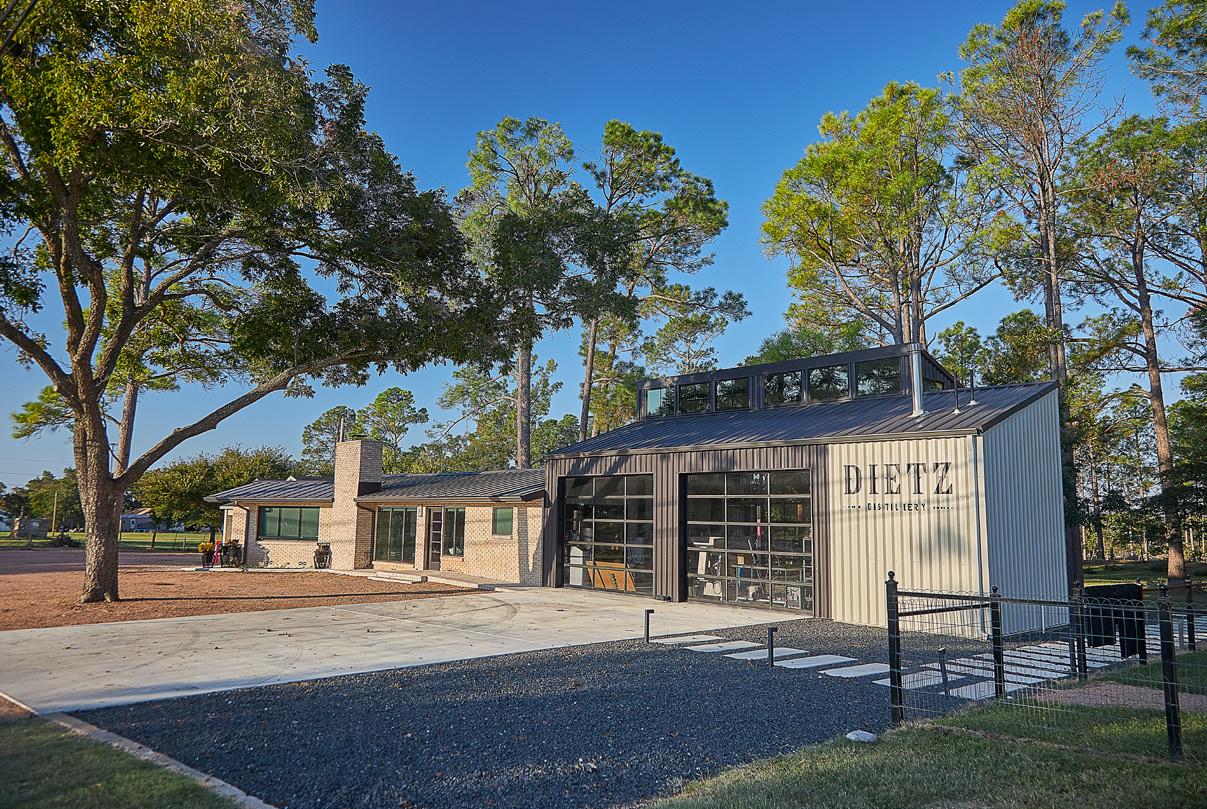
Back home after college, Dietz started formulating an
interesting plan. What if he opened a distillery on his family’s property, but in the tradition of those found in Central Europe? “Most distilleries in the United States come from a more Southern moonshining background,” he explained. “But farm distilleries have such a long-standing tradition in Central Europe, and I thought it would be neat to be able to do that style of distilling here, using high-quality fruit, which is so important to us.”
He began “collecting” distilling equipment, including a German-style still (with no moving parts), similar to the one he had worked with in Austria. It sat in storage for two or three years while he continued planning. (He also thought it would be fun to take apart the still, then put it back together.) He drew up his own plans for his still house and tasting room with a CAD program, then presented the plans to a local friend, a machinist and welder. His friend prefabbed the structure at his shop, hauled the pieces to the site, and assembled it atop the concrete slab with the help of just one other guy.
“I wanted that old industrial look with the clerestory windows and the big glass
WWW. ARTISANSPIRITMAG .COM 57
garage doors,” Dietz said, explaining his vision for the building. “I insisted that the clerestory windows would be able to open, in case I wanted more airflow in there.”
Dietz also acquired another crucial piece of the puzzle during that time — his sister Elle, a merchandising and marketing professional who had just moved back home from New York City during the pandemic. “I needed some help and my mom said, ‘What about your sister? She needs a job,’” Dietz said, laughing.
Dietz and Elle opened Dietz Distillery on the Fischer & Wieser farmstead, a literal stone’s throw from Das Peach Haus, on November 18, 2021. Their first product release was Five Judges Gin, a 95-proof,

juniper-forward, dry, London-style gin that features notes of cardamom, pink peppercorn, and pink grapefruit peel. “We make it with Rio Grande Valley citrus, which makes it uniquely Texan,” Dietz said. The name “Five Judges” is in hon or of the five judges who have called the peach farm home over the past cen tury, including Mark Wieser, a former county judge.

Dietz’ Himbeere, a raspberry vodka, pays tribute to his time spent learning about distilling in Austria, as “himbeere” means “raspberry” in German. He makes it by macerating ripe raspberries in his neutral spirit for four to five days. As the fruit soaks, the alcohol pulls out the flavor. “You get the full essence of the fruit, but without the syrupy

58 WWW. ARTISANSPIRITMAG .COM
sweetness,” explained Elle.
In true farm-to-bottle style, Dietz also makes peach and pear eau de vies and un-oaked fruit brandies featuring local fruits. “They always sell out,” he said, “and I get all the fruit from our own orchard or other area orchards, because it’s important to support local growers.”
Dietz and Elle recently hired their first full-time employee to help out in the tasting room. “With her working behind the bar, I’ve been able to work on more product development that I’ve been dying to do,” Dietz said. That includes creating a citrus spirit using Rio Grande Valley citrus, like he uses in his gin. “I’m not sure exactly what it’s going to end up being, maybe a limoncello or an orange liqueur similar to Cointreau.” He’s also formulating a rum, and he’ll continue with what he calls his “passion project” — various brandies made from Hill Country native fruits.
“Everything at Dietz Distillery is still hand-bottled and hand-labeled, which is very time-consuming, but also very rewarding,” Elle said. Despite plans for expanding their variety of spirits, Dietz plans on staying small, as he believes their customers appreciate all the personal touches.
“We really enjoy every aspect of what we are doing, and I think our visitors can see and feel that when they visit,” he said. “We’re going to work really hard to keep it that way.”
Dietz Distillery is located in Fredericksburg, Texas. For more information visit www.dietzdistillery.com or call (830) 990-8057.
Since 2007, ADI has upheld the highest standards in the industry by giving our judges the freedom to only award the very best, and being the first competition to provide written feedback for every entry. We accept entries in all classes and categories of distilled spirits, RTDs, cocktail bitters, no/low spirits, mixers, aperitifs & fortified wines.
Deadlines

Deadline to apply for COLA Waiver for International Spirits: February 3, 2023


Deadline for Spirits Registration: March 3, 2023
Deadline for Earlybird Registration: before February 3, 2023
Deadline for Receiving Entries: March 9, 2023
For more information on how to enter visit www.distilling.com/adi-isc


2023
“We really enjoy every aspect of what we are doing, and I think our visitors can see and feel that when they visit. We’re going to work really hard to keep it that way.”
WWW. ARTISANSPIRITMAG .COM 59
— DIETZ FISCHER
WHEN IT COMES TO SPIRITS AND COCKTAILS PRODUCTION, SHOULD YOU CAN IT?
WRITTEN BY GARY SPEDDING, PH.D.
Part Two
I
n this section we first address the microbial problems that may occur, then we move on to the corrosion factors, the damage that can ensue, and potential mitigation factors when canning spirits and cocktails. Areas for quality control and testing by the distiller or other beverage manufacturer are also considered, along with questions to be asked of raw material suppliers and the can manufacturer.
Microbial issues and cans
Alcohol content, carbonation levels, low pH, and the preservative nature of hops have assisted brewers in maintaining the quality of traditional beer beverages and safety of packaging in bottles and, since the 1960s, cans. Brewers moving to sour beers began to see issues, as have seltzer makers, kombucha producers, and cider makers. With these new products and cans with new liner-barriers, inhouse, third-party, or can manufacturer due diligence through testing and research is called for.
Problems arise when microbes — cultured yeast cells, wild yeast strains from the environment, or bacteria — make it into the can. This can occur even with pasteurized products or lessthan-stellar good manufacturing practices (GMP), and/or with poor hygienic bottling/canning operations.

Significant amounts of viable yeast cells are harbored in fresh fruits and fruit juices
and therefore are sometimes introduced unintentionally to beverages via these ingredients, or during the production and packaging of the beverage. Residual sugars and free amino nitrogen (FAN or YAN — yeast assimilable nitrogen as it’s known in the wine world) can provide enough nutrients in lower alcohol cocktails, flavored vodkas, and other mixer, to allow any contaminating microorganisms to start refermentation. This results in increased carbonation which can not only lead to off-flavor issues but the failure or explosion of the cans.
The carbonation of products and gas laws needs to be understood in relation to the packaging of fizzy beverages and the maximum amount of CO2 expressed, usually measured in volumes, based on the type of package used. The can lid seamers used must also be excellent quality. For example, a bar in Europe was making canned cocktails to go — canning at the bar — and the cans were exploding as the seal was made! (Known from personal communications with our facility team.) While we were not privy to the full details in this case, a little note on carbonation, gushing, and explosion factors is in order here. Sodas and other carbonated beverages are fizzy due to dissolved carbon dioxide which creates carbonic acid. The carbon dioxide is dissolved in the liquid under high pressure. As a can is opened, carbonic acid converts back to the gaseous carbon dioxide creating the familiar bubbles and some of the refreshment factor as these bubbles “burst” in the mouth. The bubbles need a kick start to form via nucleation, meaning a few bubbles first clump together, which can be enhanced by fruit pulp, tiny bits of matter, haze, or sedimentary particles in a product. At a certain point, the bubbles explode forth usually to a desired end effect, though sometimes not. Surface
60 WWW. ARTISANSPIRITMAG .COM
A general overview on exploding cans can be found here:
imperfections in the can’s liners and the metal itself also promote nucleation. When this happens too fast, fobbing and/or gushing (explosive release) of gas and liquid occurs. Since gasses are also subject to solubility and temperature factors, over-carbonation can lead to can (end) buckling, implosions and, more disastrously, explosions as CO2 bubbles expand their volume when opening a bottle or can. With any sudden temperature increase, the gaseous CO2 becomes less soluble in solution (soda, beer, or any other liquid) and erupts from the container — can or bottle. In addition, since CO2 pressure in the bottle or can (the liquid phase) is high, upon opening the pressure falls to equilibrate with partial CO2 pressure in the air (the gaseous phase) resulting in spontaneous over-foaming. Impurities originating from the cans, bits of fruit, or other ingredients used in flavored beverages, may also contribute to product gushing upon opening. Cracks in the can’s rough internal surfaces or liner imperfections might also contribute to gushing by trapping small gas bubbles. With these issues occurring far too frequently of late, due diligence and knowledge seeking is important here (3).
In summation, variations in chemical behavior during handling due to factors such as temperature, pressure, and concentrations can cause cans to fail, even after passing initial testing.
Besides the “re-activation” of cultured yeast, if cell counts are too high in the packaged liquid — thus providing a good nutrient base for growth and allowing refermentation activity — other unwelcome microorganisms can gain a foothold. One problematic wild yeast is Zygosaccharomyces (a genus in the family Saccharomycetaceae). The sufficient yeast counts for spoilage are detailed elsewhere (4). An issue for pouched cocktails many years back, spoilage is now proving to be an issue for canned beverages. (Pouched beverages information via personal communication with a retired
beverage consultant.) One recent reference shows the damage to cans (blown cans) attributed to this organism (4). While consumers may not recognize the issue as yeast spoilage, they do realize when something is wrong or different to a product that they have had before. “All spoilage symptoms are (considered) noticeable and objectionable” to a consumer “and all will cause complaint by any customer purchasing the food” (or beverage) (4).
Zygosaccharomyces was first described under the genus Saccharomyces, but was reclassified to its current name in 1983 (see: https://en.wikipedia.org/wiki/ Zygosaccharomyces and references cited therein). This yeast has a long history as a well-known spoilage agent within the food industry, because several species in this genus are significantly resistant to many common food preservation methods. For example, the biochemical properties that give the species Z. bailii this resistance includes high sugar tolerance (50-60 percent), high ethanol tolerance (up to 18 percent ABV), high acetic acid tolerance (2.0-2.5 percent), very high sorbic and benzoic acid tolerance (up to 800–1000 mg/l), high molecular SO2 tolerance (greater than three mg/l), and high xero tolerance. [Xerotolerant microorganisms: extremophiles (“extreme condition” and “loving”) that can survive in environments with extremely limited water availability.] A thorough introduction to this organism, its applied microbiology, and role in food biotechnology has been presented recently (5). This article by Solieri covers the good and bad with respect to the roles of two main species within the genus, Z. rouxii and Z. bailii. A significant point here is that Z. bailii is also quite tolerant of weak organic acids such as lactic, ascorbic, and acetic (5) and potentially other acids associated with fruits such as malic (apples, cherries) and citric (citrus fruits, mango, guava pineapple, raspberries, and strawberries) All of these are common seltzer and cocktail ingredients. Further discussion of food spoilage and the potential for flavor problems and “blown cans,” plus control strategies and the types of preservatives to use and avoid are covered by Escott, et al. (6).
Interlude: pH and Acidity
Brewers and distillers are often told to watch the pH when bottling or canning a product. While this is important, acidity and pH, while related terms (see below), must be accounted for together because acid type and its dissociation of hydrogen ions under particular pH conditions is more important from a corrosion viewpoint. Foods and beverages contain acids and will measure out with a certain pH value. So, what are acids? Acids are inorganic or organic molecules that can dissociate to produce protons (hydrogen ions) in solution. Acids found in juices and wines are termed “weak acids” because they only partially dissociate, unlike the inorganic or mineral “strong acids” such as hydrochloric, sulfuric, or nitric acids which completely dissociate.
For an understanding of beverage chemistry in general, and corrosion in particular, well-known wine chemist and UC Davis distinguished professor Roger Boulton, PhD, presented a set of three important definitions (7). These are (largely from his notes):
1. Total acidity: The proton equivalence of the amount of organic acid anions present in a wine (or other beverage type as we discuss here). This is the number of protons (also called hydrogen ions, hydroxonium ions or simply H+) that organic acids (lactic, succinic, citric, acetic, and sulfurous acids) would contain “if they were undissociated.” It is calculated by measuring the acid anion concentration — the number of molecules per volume — and then multiplying by the number of protons that would result from complete dissociation.
2. Titratable acidity: The number of protons recovered during a titration with a strong base to a specified endpoint. Many people use titratable acidity and total acidity as synonyms, but they are not. The titratable acidity is always less than the total acidity, because not all the hydrogen ions expected from the acids are found during the determination of titratable acidity. However, titratable acidity is easier to measure.
3. pH: Logarithm of the concentration of
WWW. ARTISANSPIRITMAG .COM 61
free protons, expressed with a positive sign (7).
Thus endeth Boulton’s neat lesson, but note the need to understand these terms from the text. Dissociation of the acids play a role in corrosion and in acid base chemistry.
The role of hydrogen ions in relation to aluminum can corrosion is shown below. The corrosion factors dealing with aluminum in soft drinks and in acidic and alkaline media are covered in two notable works (8, 9). An understanding of the acidity or the “converse” alkalinity (the amount or level of an alkali being a substance with the opposite effect or chemical behavior to an acid) in the beverage you are canning is also important to know (8).
A quick guide to asking will it go in a can or will it not?
When considering all the factors above, it is best to ponder questions of risk assessment and incorporate testing or have tests done in
relation to canned product issues. Figure 1 provides the basic flowchart.
Posing these questions is important for each type of beverage you wish to can. Questions include, but are not limited to: Is the product a low-alcohol beverage? Will it be pasteurized? Carbonated or not? It is recommended to force test under both warm and cold conditions. After such incubations, ask yourself these questions: Do the cans leak? Are there end buckles? Are there any implosions, indentations, or, worse, exploded cans? Are cans firm to the hand-squeeze if appropriately carbonated or squishy, indicating loss of pressure and therefore of carbon dioxide? Are there pin-prick leaks anywhere on the can, or bubbling or solids building up near crown top seals? Will you test for or have products evaluated for microbial contamination issues? Do beverages fob or gush upon opening? If so, how violently? What does the product look like inside the can or upon pouring? Has the color changed? Any odd aromas or tastes?
Are colorants, added sugars, sweeteners, or fruit additions used? Are the pH conditions conducive to effective preservative action?
[Note: Preservatives are often active only at certain pH values and it is not a simple matter to use them without knowing the other parameters the “active” component will have and understanding if they will work effectively under the conditions they find themselves in. This is where pH dependencies on dissociation of salts — into their anions and cations — and acids and the activities of bases and hydrogen and hydroxyl ions come into play.] Learn what the appropriate and optimal pH values are for effective preservative action. If the product is of high alcohol content, it may be potentially microbiologically stable. Yet prior microbial action can still lead to off-flavor notes later. For the use of flavors and additives, consult manufacturer specifications to see if these additives are present in alcohol or what other components are present along with the desired flavoring compound(s). How will these other compounds behave in the can? And how will they impact flavor, positively or negatively?
An ocean of possible corrosion
As detailed in part one of this series, many factors are involved with can issues beyond prospective microbial concerns. Another major concern is corrosion or destruction of the can liners and metal surfaces caused by acids (acid-base chemistry), certain food coloring agents, preservatives — such as sodium benzoate — and, most aggressively, by copper ions and chlorides. Some cans harboring lower alcohol cocktails or mixers might not suffer from copper-related corrosion, nor might cans filled with vodka, but whiskies and other spirits distilled in copper stills might have enough copper (and chlorides) present to be of concern. Not much research has been done, or at least not with details available to the wider craft beverage producer, with an exception for hand sanitizer (10). However, several papers related to other beverages

are available FIGURE 1 A flowchart of canny questions. Can you or can you not? DOES IT GO WELL IN A CAN? NO Do you know or guess it will? YES Will you risk it? Are you really sure? NO YES NO YES NO PROBLEM LIKELY MAYBE Test novel products before committing to the can NO PROBLEM
62 WWW. ARTISANSPIRITMAG .COM
Read Part One of Should You Can It?
FIGURE 2
A diagram modeling beverage-in-aluminum-can corrosion based on copper and chloride ion chemistry and electrochemistry.
The model shows the formation of corrosion pits in the aluminum can. Four “layers” are seen in the model: the spirit or cocktail liquid, the liner coating with the so-called oxide layer underneath and sitting on top of the metal surface. Damage or tears in the liner exposes the oxide layer which acts as an electrical cathode. The exposed aluminum metal then becomes a “sacrificial” anode which becomes susceptible to the corrosion. The liner, oxide layer, and metal are all thin and, with successive corrosion events, pin prick-sized holes can form and promote mist spray leading to liquid loss. These pits might reseal with deposits filling the crevices. This sometimes makes it difficult to see where liquid and gas pressure losses occurred. The attack by copper ions is also shown in the model along with electron flow pathways, and hydrogen ions and gaseous hydrogen involvement. As noted in the text, copper (and iron) can plate out on the corroded metal surfaces though it would only be visible under powerful microscopy. Hydrogen might also combine with sulfides to generate potently odiferous sulfur compounds such as hydrogen sulfide with rotten egg-like aroma. Further details are outlined in the text.
and provide insight into the decision-making process, and how spirits or cocktails might behave, both short and longer term, under shelf-life storage conditions, and how they age in cans. If issues do arise, this information will hopefully help the distiller address any problems and assist in conversations with can manufacturers, distributors, and any consumer lodging complaints (8-16).
While tequila has not seen much packaging in metal cans, some tequila cocktails are being canned. Therefore, a discussion of metal corrosion with respect to tequila contact is important to note (12), as are observations of the corrosive behavior of copper in some commercial beverages as presented in an SMTA proceedings publication available online. The later comment is important with respect to the storage or serving of cocktails in copper and brass cups. Take the Moscow mule for example. According to an Advanced Mixology web article on cocktails served in
Read the SMTA proceedings publication
copper mugs, “Drinks in copper mugs are safe. Copper poisoning can only happen if the acidic level of the drink is high enough to result in the corrosion of the copper lining inside. Thankfully, the Moscow mule is not acidic enough to break down the copper.” The website also adds, “There are still several safety measures that should be observed for a worry-free drinking experience.” Larger distillery groups have recently questioned brass and copper drinking vessels and more importantly storage/sales of beverages in containers made of such metals and alloys. Using novel or new types of packaging should not be taken lightly and needs further research.
Introducing galvanic corrosion
A model of corrosion is presented in Figure 2. This model figure was built from details found in several works (14, 16, 17) and here: https://aluminium-guide.com/ en/tochechnaya-korroziya-alyuminiya/. The
base details show the interaction of metal (here copper) and chloride ions in forming pits in the aluminum can. Four layers are seen in the model: the spirit or cocktail liquid, the liner coating, the so-called oxide layer underneath, and sitting on top of the metal surface. Damage (minor imperfections are always present) to the liner exposes the oxide layer which acts as an electrical cathode. Electrochemistry can then occur leading to decay of the anodic aluminum and to pitting and potentially pin-prick leaks. When a metal (M) is immersed in a solution containing its ions (M+), several reactions may occur. The metal may lose an electron (corrosion) to form metal ions, or the metal ions in solution gain electrons (reduction) and enter the solid metal state (11). The oxide layer or film is composed of elements of oxygen and aluminum forming oxides and hydrated oxides. These components at the surface become unstable in solutions with pH values below 4.5. Accelerated corrosions then occur with Cu++ and Cl- ions, oxygen, sanitizer residues, certain preservatives (e.g., sodium or potassium benzoates), and food colorings including Red #40. Pitting corrosion occurs through passive film breakdown and nucleated pit formation, embryonic pit formation, metastable pit development, stable pit formation and pit growth, and then pit arrest. These full details and other forms, types, and sub-types of metal corrosion are covered elsewhere (22, 23). These mechanisms and variations are incredibly complex. Fortunately, we do not need to all know the physiochemical details to better
 Read Advanced Mixology's web article
LINER COATING OXIDE LAYER ALUMINUM ALLOY SPIRIT OR COCKTAIL Tear/imperfection Forms the electrical cathode Eventual — possible pin-prick leak AlCl2(OH) or Al(OH)2Cl? Al(OH)3 Cu++ ClAl+++ Pit Acids = H+ H+ H2 +ve -ve 3eAnode WWW. ARTISANSPIRITMAG .COM 63
understand what we need to look for in our canned beverage programs and formulas.
To sum up the details, aluminum is a highly reactive metal with a high affinity for oxygen. It is also, however, highly resistant to most atmospheres and chemicals. The resistance is due to the inert and protective character of the aluminum known as the (microscopically thin) oxide film which forms on the metal surface and which rapidly reforms if damaged (See above and Figure 2). Such oxide layer growth is modified by impurities and certain component additions, and is accelerated by increasing temperature and humidity, or exposure to liquids. The protective film inhibits corrosion as it is resistant to dissolution, and it forms a good insulator. The insulation restricts electrons produced via oxidation of the metal from participating in cathodic reactions accompanying the oxidation reactions as noted above (Figure 2) (11). If the protective effect of the oxide film is overcome by scratching or amalgamation, the underlying metal can be attacked under ordinary conditions by alkaline hydroxides, various nonmetals and even water. As this occurs, traces of Cu2+ or Fe 3 + in solution then react with the aluminum resulting in the deposition of metallic copper or iron on the aluminum surface (18). Thus galvanic corrosion can occur when two dissimilar metals (or other dissimilar chemical species such as a cation and an anion) are in close contact with each other and an electrolyte (beverage). The driving force for corrosion is the potential difference (depending upon electrical potentials) between species; electric currents produced by chemical action. Think car battery here! The can and solutions with pits are like tiny batteries in action. When aluminum comes in contact with a more cathodic material it acts as a sacrificial anode and becomes susceptible to corrosion. It has also been reported that the addition of aggressive anions like chlorides, thiocyanate, hydroxide, sulfide, nitrate, formate (from formic acid) and acetate (anion of acetic acid) leads to extensive localized attack in all cases. The breakdown of the passive film makes the migration of aggressive anions to the metal-film interface more favorable. As a result, aluminum ions form compounds with the aggressive anions which then dissolve
into the medium — the beverage (18). Two extensive works cover the corrosion of aluminum by chlorides (19, 20). These works include nice microscopic images of the surface damage. The initiation of pitting and growth of pits are also covered elsewhere (17, 20). Some beverages are so corrosive that no amount of coating (oxide layer and liner) will protect their cans. It is suggested that many of the newer breed of energy drinks for example are too corrosive to put in cans (See https:// www.wired.com/2015/03/secret-life-aluminum-can-true-modern-marvel/ for general accounts on the overall corrosion topic here with notes from Ball Corporation chemists).
What measures should be included in your quality control evaluation of canned beverages?
As noted above, products in cans (or bottles, pouches, etc.) should be subject to forced testing. Place samples in warm and cold conditions (not simply at typical ambient temperatures for your location and/or season of production). Keep some stored at ambient temperature as “control” for anticipated distribution conditions and in case of customer complaints or recalls. Following the forced incubation periods, look for damage to the cans, especially pin prick leaks with possible slow loss of contents and pressure if carbonated. Things to look for: Are body-tolid seals intact, showing no oozing of liquid or even dried residues? Seams and pin-prick leak holes can reseal via sediment build up in the crevices or drying of sugars or other materials/components within the beverage. They can also be masked if using sleeved cans. Leaks can go unnoticed but the pressure in the cans may be diminished, so squeeze cans to see if pressure has indeed been lost. Pour out contents and look for product color changes (we noted several with whiskey-based cocktails for example), fobbing or gushing of contents, can liner fragments floating in solution, hazes, sediments, or flocculating matter. Some haze or fruit pulp may naturally be present and not unexpected but still lead to gushing. Is the product as carbonated as expected? If it is not a carbonated beverage but shows evidence of gas release, the cause needs to be found. Assess aroma for moldy taints, sulfury
notes (hydrogen sulfide = rotten egg notes). Is the flavor profile as expected? Do not rely simply on one set of nose/mouth/pair of eyes to look for changes or defects. Others may detect what you cannot. Next, examine the insides of the can. Is the liner intact? Are there deposits in the base of the can? Is there liner damage or, worse, metal surface damage? Copper can electroplate out, but it would take electron microscopy to see such plating. This level of testing is not likely needed, but a highly specialized testing facility would be needed if so. If there are any sulfury notes, request a sulfides profile and address where and how such aromas could have arisen (see the appropriate cited references). Test for copper and chloride levels, the acid content, and assess the concentration of specific organic acids. Are preservatives used? Are they detrimental with respect to corrosion of metals? Are they effective at the pH of the product contained within? Are colorants used?
Check all specification sheets for any ingredients or additives and the potential addition of preservatives used for those ingredients, liquid flavorings, etc. If possible, try to work with the can manufacturer to have them check your product in their cans or advise you based on a full analysis of your liquid if it will work in their cans. If a flavor house assists in product formulation, ensure they too give you the facts on the composition and/or have them do the forced tests described above. It is important to always understand specification sheets and the full specifications for any product, no matter how it will be packaged.
What more do we glean from some of the cited papers?
A quick synopsis of some of the cited papers shows us that BPA-based epoxy liners fared better with alcohol-based sanitizers than the BPA-free resin-liners with respect to corrosion in aluminum cans. This was attributed to alcohol-induced corrosion and, while sanitizers are not the focus here, it shows that the move to BPA-free liners with respect to beverages containing alcohol might not be as straightforward as many have hoped (10). An earlier published paper by Šeruga and Hasenay illustrated issues with citrate-based soft drinks and that corrosion of aluminum
64 WWW. ARTISANSPIRITMAG .COM
in such soft drinks evolved slowly in a time-dependent and complex process (8). Moreover, that system was shown to be strongly influenced by passivation, complexation, and adsorption processes and that the corrosion occurred principally due to the presence of acids. The corrosion rate rises with increased acidity in the drinks, meaning with an increase in the content of total acids. The passive oxide layer discussed above and shown in Figure 3 differs (has different properties) depending upon the type of acid present. For cocktails and seltzers made with fruit, thus adding high citric acid content, this could be problematic and a cause for concern (8).
A few more summary points about the model of pitting corrosion. Chloride ions are very aggressive with respect to pitting corrosion. The small ions pass through small defects in the can liner/ varnish and initiate the growth of the corrosion pits in aluminum alloys. The rate of metal corrosion depends on the dissolved oxygen concentration (air/oxygen content in package), pH and salts, ions, and molecules present, plus temperature, pigments, and several species of metallic ions. Preservatives can also be problematic, so a combination of factors needs to be considered (14, 16). Not discussed heavily here are the consequences to the color, overall flavor, and potential health effects of the leaching of metals from iron, tin, and aluminum cans into the liquid, but the cited references delve more into these issues (21). Some of these detrimental changes can be seen, smelled, and tasted, as can the evidence for sedimentation, liner fragmentation, and floc formation. Sensory evaluation will be a big part of the quality equation for the evaluation of these beverages. It has been noted that 90 percent of damaged cans (scratched or dented) are found to have lost their lacquer integrity to some extent, so a full evaluation of cans upon delivery and as prepared for packaging is also needed as part of a full quality control program (13).
Pitting studies that included the use
of citric acid with solutions at pH 3.0 have shown conclusions that there may be, for some beverages, a need to create alloys less prone to pitting corrosion and to the development of new coatings less favorable to acidic aqueous solution permeation (16). The model for pitting corrosion is covered in: https://aluminium-guide.com/en/tochechnaya-korroziya-alyuminiya/ and elsewhere (15, 22, 23). Overall, it should be noted that copper ions and chloride anions act synergistically, and this is a speculative concern for spirits producers and the use of copper stills. Via evaluation of systems of chloride and citric acid (pH 3.0), plus or minus copper ions, the presence of chloride in corroded regions has been confirmed (15). Can manufacturers set the limits for copper, chloride, and several other “suspects” in relation to their own products. At the very least, products should be tested for the concentration of those “set point” parameters, and maximum tolerable carbonation levels if necessary. Such parameters to be reassessed if the specifications for the aluminum can production change or when changing to a new source for the cans. Otherwise, it might be out of the still and into the frying can.
End note
Hopefully, this article and cited references allow for a better understanding of the activity and behavior of beverages packaged into cans. There have been too many issues ranging from recalls and product loss (based on the discovery of pools of the spirit or cocktails under stacked pallets) to buckled and damaged cans due to NOT ENOUGH DUE DILIGENCE in this arena. We will cap the canned conversation here by encouraging happy, safe, and profitable canning adventures.
Gary Spedding, Ph.D. is a brewing, distilling, and sensory analytical chemist, and owner of Brewing and Distilling Analytical Services, LLC — with two facilities (Lexington, KY and Denver, CO).
REFERENCES
1. Lumley, R.N. Chapter 1: Introduction to aluminium metallurgy. In Fundamentals of aluminium metallurgy: Production, processing and applications. Edited by Roger Lumley. 2011 Woodhead Publishing Limited.
2. Deshwal, G. K.; Panjagari, N. R. Review on metal packaging: materials, forms, food applications, safety and recyclability. J Food Sci Technol 2020, 57 (7), 2377-2392. DOI: 10.1007/ s13197-019-04172-z.
3. Mastanjević, K.; Mastanjević, K.; Krstanović, V. The Gushing Experience—A Quick Overview. Beverages 2017, 3 (2), 25.
4. Stratford, M. Food and Beverage Spoilage Yeasts. In Yeasts in Food and Beverages, Querol, A., Fleet, G. Eds.; Springer Berlin Heidelberg, 2006; pp 335-379.
5. Solieri, L. The revenge of Zygosaccharomyces yeasts in food biotechnology and applied microbiology. World Journal of Microbiology and Biotechnology 2021, 37, 96. DOI: 10.1007/ s11274-021-03066-7.
6. Escott, C.; Fresno, J.; Loira, I.; Morata, A.; SuárezLepe, J. Zygosaccharomyces rouxii: Control Strategies and Applications in Food and Winemaking. Fermentation 2018, 4, 69. DOI: 10.3390/ fermentation4030069.
7. Boulton, R. The relationship between total acidity, titratable acidity and pH in wine. American Journal of Enology and Viticulture 1980, 31(1): 76-80.
8. Seruga, M.; Hasenay, D. Corrosion of aluminium in soft drinks. Z Lebensm Unters Forsch 1996, 202 (4), 308-312. DOI: 10.1007/bf01206102.
9. Oi, A.; Owoeye, F.; Sa, O. Investigation of Aluminium Behaviour (Corrosion) in Acidic and Alkalinity Media. The Journal of Scientific and Engineering Research 2016, 3, 181-186.
10. Thomson, E. L.; Bullied, A. R. Corrosion Resistance of Aluminum Beer Cans Containing Hand Sanitizer. Journal of the American Society of Brewing Chemists 2020, 78 (4), 279-283. DOI: 10.1080/03610470.2020.1784634
11. Birbilis N.; Hinton, B. Chapter 19: Corrosion and corrosion protection of aluminium. In Fundamentals of aluminium metallurgy: Production, processing and applications. Edited by Roger Lumley. 2011. Woodhead Publishing Limited.
12. Estrada-Vargas, A.; Casillas, N.; Gomez-Salazar, S.; BarcenaSoto, M.; Valderrama, R.; Avalos, J.; Carreón, A. Corrosion of Aluminum, Copper, Brass and Stainless Steel 304 in Tequila. International journal of electrochemical science 2012, 7, 7877-7887.
13. Boda M. C.; Popa M. E. 2013, STUDY ON THE INTERACTION BETWEEN THE FOOD MATRIX AND THE METAL FOOD CANS. Scientific Bulletin. Series F. Biotechnologies, 2013, Vol. XVII, ISSN 2285-1364, 123-126.
14. Soares, B. M. C.; Anjos, C. A. R.; Faria, T. B.; Dantas, S. T. Characterization of Carbonated Beverages Associated to Corrosion of Aluminium Packaging. Packaging Technology and Science 2016, 29 (1), 65-73. DOI: https://doi.org/10.1002/ pts.2187.
15. Soares, B.; Dantas, S.; Anjos, C. Corrosion of aluminum for beverage packaging in acidic media containing chlorides and copper ions. Journal of Food Process Engineering 2017, 40, e12571. DOI: 10.1111/jfpe.12571.
16. Soares, D. S.; Bolgar, G.; Dantas, S. T.; Augusto, P. E. D.; Soares, B. M. C. Interaction between aluminium cans and beverages: Influence of catalytic ions, alloy and coating in the corrosion process. Food Packaging and Shelf Life 2019, 19, 56-65. DOI: https://doi.org/10.1016/j. fpsl.2018.11.012.
17. Wong, K. P.; Alkire, R. C. Local Chemistry and Growth of Single Corrosion Pits in Aluminum. Journal of The Electrochemical Society 1990, 137 (10), 3010-3015. DOI: 10.1149/1.2086150.
18. Afzal, S. N.; Ali Shaikh, M. A.; Mustafa, C. M.; Nabi, M.; Ehsan, M. Q.; Khan, A. H. Study of Aluminum Corrosion in Chloride and Nitrate Media and Its Inhibition by Nitrite. J. Nepal Chem. Soc. 2007, 22, 26-33.
19. Oki, M. Corrosion of Aluminium in Chloride Environments. IRJPAC 2013, 3, 147-158.
20. Natishan, P. M.; O’Grady, W. E. Chloride Ion Interactions with Oxide-Covered Aluminum Leading to Pitting Corrosion: A Review. Journal of The Electrochemical Society 2014, 161 (9), C421-C432. DOI: 10.1149/2.1011409jes.
21. Amelia, B.; Gutt, G.; Sonia, A.; Dabija, A.; Constantinescu, G. Study regarding the tin and iron migration from metallic cans. J. Agroal. Proc. Tech 2012, 18, 299-303.
22. Baroux, B. Chapter 9: Further Insights on the Pitting Corrosion of Stainless Steels. In Corrosion Mechanisms in Theory and Practice. Edited by Philippe Marcus. 2012. CRC Press.
23. Popov B. N. Chapter 1: Evaluation of Corrosion. In Corrosion Engineering. Principles and Solved Problems. Branko N. Popov. 2015. Elsevier.
WWW. ARTISANSPIRITMAG .COM 65
INSIGHT AND INNOVATION
How
Kaizen
Helps Teams Identify Improvement Projects
I have had the opportunity to facilitate and lead over 300 kaizen events (continuous improvement intervention usually focused on manufacturing) globally throughout my 30-plus year career. I have worked in many industries and processes, including bottling, fabrication, packaging, distribution, and nonprofits. I have made many mistakes along the way and have learned from those mistakes to improve the facilitation process. One of the most frequent questions asked of me is, “how do you ensure that your kaizen teams identify the most critical things to work on during a

by ADAM LAWRENCE
Written
66 WWW. ARTISANSPIRITMAG .COM
kaizen event?” I’m going to give you an insider’s view of my process that aims to accomplish just that.
Start with a charter. The charter is a contract between the sponsor, leader, facilitator, and the team. It defines the business problem to be solved, the value of solving it, the objectives and what winning looks like for the team by the end of the event. As the facilitator, I use the charter to keep the team focused on the problem to be solved, within the boundaries of the event. I learned long ago that once a team realizes it has authority and autonomy to solve a critical problem, they want to solve every problem they see. We must keep them focused, or we won’t accomplish our objectives, which is the reason we’ve been put together in the first place.
Once we have a clearly defined charter, design the plan for the kaizen event to assure that the team has everything it needs to win (the term I use for accomplishing the kaizen objectives). First, build the training specific to the problem you are working to solve then expose team members to new ways of thinking. For example, if we are trying to reduce the time it takes to change over from one product to the next by 50 percent or more, introduce team members to (or reinforce) the concept of SMED (Single Minute Exchange of Die). Let’s follow this path for a moment.
SMED has four elements (with a little artistic license exercised by me):
1. Observe the changeover and separate elements into internal and external. Internal means that elements are done while the process has stopped. External means that elements are done while the process is still running.
2. Convert internal elements to external elements. The challenge here is to identify things that can be done in preparation for the changeover that are currently being done while the line is stopped. One example of this is to have the tooling or vital equipment ready to go at the line, rather than chasing it down after the line has been shut down. It’s surprising how many companies don’t do this naturally.
3. Streamline internal elements and then external elements. This involves finding ways to simplify steps during the changeover. For example, replacing a bolt that must be turned 15 times to tighten it with a clamp that tightens in one simple motion, without the use of tools.
4. Eliminate adjustments and implement sustaining processes — In this step, we want to make it easy for anyone to complete the changeover without having to figure out where to go to optimize the process. Locking down, pinning, and welding are examples. To sustain the changes, I help the team implement a system I have developed called the Wheel of Sustainability. This
topic alone holds enough importance to be covered in a book. In fact, there are some great resources available that are worth checking out if you want to get serious about sustaining change within your business. If you want to know more, start by searching for The Wheel of Sustainability on Amazon. I highly recommend this one.
In the early stages of the kaizen event, after training, I take my team on a Gemba Walk (a walk out in the process) to observe and generate ideas to improve the process and accomplish our charter objectives. If we’re in a changeover reduction event, we’ll observe the changeover as it’s being conducted by the employees on the line. We’ll look for opportunities to apply SMED elements and I’ll provide tools such as spaghetti diagrams (the path of the people doing the work — which helps to identify excess movement), process observation sheets (identifying all elements and classifying them as internal and external), and other ways to identify improvement opportunities (sticky notes, videotaping, and others).
Once the Gemba Walk (in this case the changeover) is complete, team members write down their ideas on sticky notes and share them with each other. It’s not unusual to generate more than 100 ideas. One thing I have learned over the years is we will run out of time before we run out of ideas. Because of this, we must prioritize the improvements to work on.
The most efficient way I know to prioritize many ideas is a method I call “multi-voting with criteria.” It works this way:
1. Each team member has five votes (sometimes more, sometimes less, depending on the quantity of ideas generated and number of team members).
2. Each team member votes for the ideas they value the most, using these criteria:
a. The idea, when implemented, will help accomplish the charter objective(s).
b. The idea will benefit both the people who do the work and the customer.
c. The team member wants to personally work on the idea.
d. The idea can be completed within the time of the kaizen event. There can be no homework.
3. The ideas with the most votes are the ones that we’ll work on first. As those are completed, the next idea(s) with the most votes are worked on.
4. The team is divided up into small groups (three or four per group), so that the team can work on many ideas at a time. I ask team members to put their name(s) on the idea they personally want to work on. We get more done when people are working on something they care about personally.
WWW. ARTISANSPIRITMAG .COM 67
Idea prioritization and project assignment typically takes 15 minutes and builds strong team consensus and identifies the priority of all ideas, from highest (most votes) to lowest (no votes). As I said earlier, we will always run out of time before we run out of ideas, so at least we’re working on the top priority items first.
Once work starts on the ideas, it’s important to frequently check in with all team members to ensure their work is helping to accomplish the charter objectives. If not, we adjust or move on to the next highest priority idea.
At some point, it’s time to stop the work and put in the sustaining processes, to make sure the team’s innovation and effort lives on. Because I am partial to the Wheel of Sustainability, I teach team members how to implement it as they are developing their ideas. That way, there’s no homework, which I do my best to avoid.
Toward the end of the kaizen event, we test our changes against the charter objectives. I have facilitated more than 50 changeover events over the years, and we’ve never failed
to reduce changeover time by 50 percent or more. We also improve safety and install the standard work and sustaining processes so that the organization gets the benefit of the changes from now on.


Some kaizen events are designed in such a way that we won’t know immediately if our changes impact the results to the degree we are tasked with. In all cases, we install measures of success, so the organization can tell if their investment in the kaizen event paid off. Typically, try to follow up with the team leader and sponsor every 30 days to see if things are going as they should and if there’s any other support that can be provided.
I am always amazed by the creativity and enthusiasm team members demonstrate during kaizen events. I believe you can get that from your employees as well, once you give them a chance to look at their processes in a new way and share their ideas with you. Unleash their ideas and creativity; you won’t regret it!
68 WWW. ARTISANSPIRITMAG .COM
Adam Lawrence has over 30 years of experience in process improvement activities, focused on manufacturing, distribution, and business processes. With more than 300 kaizen events in multiple industries across North America, Europe, and Asia, Lawrence engages and empowers teams to solve complex problems in a sustainable way. at www.pi-partners.com.
SWAMP SPIRITS
Sugarfield Spirits Makes Craft Expressions in Louisiana’s Climate
Let’s talk about terroir. It seems like an easy discussion to have in the distilling industry these days. More producers in the craft sector are embracing the notion of expressing regional terroir through their brands. As more of these conversations occur, the bulk of the chatter tends to be around the synergy that exists between the grain and the surrounding environment.
Sugarfield Spirits co-founders Drew and Thomas Soltau deeply appreciate this synergy. In a way, they have no choice. The
brothers — the former serves as the COO, and the latter is its master distiller — operate their distillery in Gonzales, Louisiana, a modest-sized town in between New Orleans and Baton Rouge. This means they’re subject to Louisiana’s weather, which can fluctuate between unforgiving and brutal. Meeting their goal of producing high-quality spirits and liqueurs that properly interpret the flavors of Louisiana’s agriculture and the influence of its past requires them to fully understand the impact such conditions have on the distilling
process. It’s an understanding that compels them to interpret the concept of terroir in spirits in much broader terms.
IT'S THE HEAT AND THE HUMIDITY
Climate plays a sizable role in distilling. Ask your average Texas distiller about the whiskey making process, for instance, and they will inevitably bring up the challenges of dealing with the Lone Star State’s summertime

RICH MANNING
Written
by
WWW. ARTISANSPIRITMAG .COM 69
heat. Thomas also has to deal with heat, but he faces a different meteorological hurdle — humidity.
In an intensely humid environment like Louisiana, the temperature-induced reactions between the cooler distilling equipment and the warmer air tends to suck the moisture from the atmosphere and produces excess amounts of condensation. While this can cause a different subset of maintenance issues, like the development of mold, it also causes the water evaporation to occur at a much slower pace.
“We tend to lose more proof here than we would elsewhere,” Thomas explained. “What may end up at around 110 to 115 elsewhere may come out at 105 proof here. We also lose a smaller volume of angel’s share in our spirits compared to other parts of the country.”
Louisiana’s high summertime temperatures must also be considered. While not as high as Texas, they typically land somewhere around the mid-80s. This puts their temperatures roughly twenty degrees higher than
the summertime temperatures in Scotland, a place also known for heavy, humid air. These temperatures mean aging happens faster as the juice rests in the barrel, adding an extra layer of complexity to the process.
THE IMPACT: THE KNOWN vs. THE UNKNOWN
Distilling in these conditions is a work in progress, depending on the spirit involved. Thomas already has the process dialed in for the distillery’s rum production, which uses sugar cane fully sourced from within the state. “Barrel aging here is much more like the Caribbean than it is in Kentucky, Texas, or Indiana,” he explained. “We knew rum would work very well here.”
Some variables are still at play with their bourbon. Sugarfield currently sources their juice from Virginia — something the brothers are quite up-front about — and the home version of their mashbill won’t be ready to
bottle for a couple more years. Still, the acclaim the sourced bourbon has received from around the state has set a benchmark for quality that Thomas knows must be replicated, regardless of the state’s unique weather conditions. This means figuring out how to work within the parameters of Louisiana’s highheat, higher-humidity conditions to replicate the complexity their fans enjoy now. While they’re up for the challenge, they’re fully aware of the risks involved. “It will be treated like we treat all of our spirits,” Thomas said. “If it’s not super high quality, we’re not putting it out there.”
A WINEMAKER’S APPROACH
Neither Drew nor Thomas was fully in the distilling industry when they launched Sugarfield Spirits in January 2020. Drew came from a hospitality background. Thomas had some training as a distiller, but he worked in neonatology, treating newborns
70 WWW. ARTISANSPIRITMAG .COM
and occasionally providing care to NICU patients. They freely acknowledge their rawness within the industry. “We don’t know everything, and we know there’s a lot to learn,” Thomas admitted.
At the same time, their lack of industry experience provides them with a perspective that those attached to the industry for decades may not have. This may be most evident in how they discuss terroir. While they agree that the synergy between the ingredients, land, and climate is crucial, they also feel the elements within the distilling process should be included in the definition, such as what equipment was used or the skill of the distiller. It’s a perspective on terroir that borrows influence from traditional winemaking, which is the point. “We look at it as applying a New-World attitude to an old-world process,” Drew stated.

While this broader approach to terroir delivers a more holistic conversation on how Sugarfield’s products are made, the goal is to highlight the flavors of the Louisiana
landscape. This draws the focus back to the elements that make their spirits noteworthy for craft spirits fans: The freshness and quality of local ingredients like sugar cane or satsumas and the connection they have to the region and its history. It’s the sense of place a spirit can evoke when enjoyed on its own or in a cocktail. All are important components allowing the Soltau brothers to use their spirits to cut through the thick, oppressive humidity and shine a light on Louisiana’s goodness. “When you go to different places, you pick up on their influences,” Drew said. “We have tons and tons of influences from all these other places in Louisiana, from France, from Spain, from the Caribbean, and they brought their flavors with them. This influence of flavor still thrives, and it’s important to us that we do what we can to honor that influence through our spirits.”
Sugarfield Spirits is located in Gonzales, Louisiana. For more info visit www.sugarfieldspiritsla.com or call (225) 647-2029.


“We have tons and tons of influences from all these other places in Louisiana, from France, from Spain, from the Caribbean, and they brought their flavors with them. This influence of flavor still thrives, and it’s important to us that we do what we can to honor that influence through our spirits.”
WWW. ARTISANSPIRITMAG .COM 71
— DREW SOLTAU
Distillers and distillery owners, like professionals in many fields, have a standard set of industry-specific conferences. However, a broader view that includes similar and related industries offers a variety of additional learning opportunities and new perspectives.
As Jesse Bussard, executive director of the Craft Maltsters Guild commented, it can be valuable to see what other similar industries are doing. Businesses that share processes or ingredients can be valuable resources, especially if they’re in sectors that are more mature and developed. Industries that use spirits as an input, such as cocktails and bartending, can provide networking opportunities.
Kellie Shevlin, executive director at Craft Beverage Expo, said she founded CBE specifically to take advantage of this potential for synergy. “We find that all of the categories are like alligators and crocodiles, they don’t know how much they have in common until they’re sitting in a room together,” she said. The distillers can look and see where the brewers are, because they were there ten years ago and there’s a lot of camaraderie.”
With this in mind, Artisan Spirit has compiled a short list of potentially valuable events that may fall outside of the average distiller’s field of view. Most of these event organizers were still finalizing their schedules and speaker lineups, but some details were generally available for all events.
OUTSIDE-THE-BOX EVENTS OFFER DISTILLERS ADDITIONAL OPPORTUNITIES
TALES of the COCKTAIL
Tales of the Cocktail is an annual spirits- and cocktail-focused event held in New Orleans, consisting of educational sessions, tastings, and industry networking. The 2023 Tales is scheduled for July 23-28.

Bar takeovers and bartending events allow distillers an opportunity to share their products. Neal Bodenheimer, co-chair of the Tales board of directors, said the networking opportunities are one of the prime opportunities for attendees.
“While on the ground at Tales, distillers can plug into a network of professionals that they may not have access to every day,” he said. “I have seen distillers completely build their brands on-site at Tales by just serving their spirits in bars and restaurants and allowing so many people to taste products.”
In addition to the bar and restaurant opportunities, distillers can get feedback and meet industry members at tastings and networking events. “One of our marquee events, Meet the Distillers, is dedicated to having distillers share their products with the community including media, industry professionals, bartenders, and others to raise awareness for any product,” he said.
For more information, visit talesofthecocktail.org
Written by GABE TOTH
2022 Review of Distiller Gatherings
72 WWW. ARTISANSPIRITMAG .COM
CRAFT MALT CONFERENCE
The Craft Malt Conference, scheduled for March 16-18, 2023 in Portland, Maine, presents an opportunity for distillers to take a deep dive into their raw ingredients and connect with upstream members of their supply chain.
According to Bussard, the conference is a chance “to understand how the ingredients are actually made, how they’re developed agronomically, and also some of the other things that are going on with their peers who are working in that local grain space. The craft malt conference is going to be a valuable opportunity for distillers to better understand the raw ingredients that they work with, specifically the grains, and how to better use those.”
Speakers will include David Griggs of Crisp Malting to talk about distillers malt, Mark Sorrells of Cornell University to talk about the creation of Excelsior malting barley and the effort that went into developing a new varietal, and the keynote will be Rob Arnold, master distiller
and author of The Terroir of Whiskey. The program was still being finalized, but she added that talks were underway with the Single Malt Whiskey Commission to include a discussion panel looking at what the designation means for the malting industry and how craft maltsters can help grow the category.
“I think there’s going to be a lot of really valuable content for distillers at the 2023 Craft Malt Conference,” Bussard said. “There’s definitely going to be a big emphasis on distilled spirits.”
Becky Harris, co-founder of Catoctin Creek Distilling Company, will offer a presentation on behalf of the American Craft Spirits Association, and the week will include tours of local facilities such as the University of Southern Maine Beer Quality Lab, Blue Ox Malthouse, and Allagash Brewing Company. For distillers interested in taking a deep dive into malting or possibly operating their own maltings, the Advanced Class in Craft Malt Production will precede the conference, running from March 13-16.
For more information, visit craftmalting.com
FANCY FOOD
SHOWS
The Fancy Food Shows are organized twice a year, with the upcoming shows scheduled in Las Vegas on January 15-17, 2023, and in New York City on June 25-27, 2023. Though ostensibly a food-centric event, a variety of related industries are often represented, including bitters, mixers, ready-to-drink products, and barrel-aged products.

While scheduling was still in process at press time, Jennifer Cohan, public relations consultant for the organizing entity Specialty Food Association, said the program would include a diversity pavilion, a pavilion featuring upand-coming companies, exhibitors from around the world and state-specific pavilions, leadership awards, educational programming, live cooking demonstrations, and a Trendspotter Panel scouting the show for the next big trends.
"One of the greatest things about attending the Fancy Food Shows is the potential for discovery," Cohan said. "We have exhibitors from around the world showcasing innovative products that can serve as an inspiration — and maybe even potential collaboration — for distilling industry professionals.”
For more information, visit specialtyfood.com

WWW. ARTISANSPIRITMAG .COM 73
CRAFT BREWERS CONFERENCE

The Craft Brewers Conference, along with the biennial World Beer Cup, is slated to return May 7-10, 2023, in Nashville, Tennessee, with a theme of “Beer and Beyond.” While distillers may not benefit from learning about the latest dry-hopping techniques, the conference offers a variety of content for members of the beverage alcohol industry.
With 40 years of experience putting on the CBC, the Brewers Association (BA) is offering nine separate educational tracks, some of which may offer valuable cross-industry learning opportunities. These include Quality and Ingredients, which focuses on sensory and quality programs, as well as approaches to source, analyze, and make the best use of high-quality ingredients. The Business and Leadership track includes topics such as finance and accounting, hiring and staff motivation, and leadership tools for owners and managers who want to more effectively oversee their teams.
Safety and Sustainability includes sessions focusing on creating a safe and healthy environment for employees, as well as opportunities to put the business on a more environmentally friendly path. The THRIVE initiative offers a view into the BA’s approach to addressing diversity, equity, and inclusion in the craft beer industry, as well as related human resource topics and physical and mental wellness issues. The program’s aim is to establish “thriving human beings” alongside safety, quality, and sustainability as cornerstones of the industry by engaging topic experts to provide informative and actionable content to help meet this goal.
DRINKS AMERICA
Drinks America is returning to New York on March 8-9, 2023, once again co-located with the wine event Vinexpo America. The two-day event will feature educational sessions and exhibitors showcasing spirits, beer, sake, RTDs, and industry-adjacent products and services.

After launching Drinks America and pairing it with the rebranded Vinexpo in 2022, organizers said the event would continue to draw buyers from across the range of beverage alcohol categories, offering them a one-stop opportunity for sourcing a variety of products, especially capitalizing on a forecasted increase in consumption of spirits and RTDs. “The response from exhibitors and attendees was tremendous. This momentum continues for our upcoming edition,” event director Beckie Kier said.
Additional tracks that may offer insights include Sales, Distribution, and Marketing; Export Development; and Government Affairs and Legal. The BrewExpo America trade show floor will also feature nearly 600 exhibitors, from raw materials and packaging to equipment and small-business financing.
For more information, visit craftbrewersconference.com
In addition to the exhibits and buyers, master classes, demonstrations, conferences, and discussions will feature topics and products from the spirits world, presented by leaders in the industry. Sessions in 2022 included presentations on the world of Japanese alcohols, U.S. beverage alcohol trends, post-COVID wine and spirits sales, managing supply chain disruptions, and navigating a career in beverage alcohol.

CRAFT BEVERAGE INSURANCE FOR OVER 30 YEARS DISTILLERIES & BREWERIES property | general liability | liquor liability workers compensation | auto equipment breakdown Northampton MA 413.586.1000 distilleryinsurance.net 74 WWW. ARTISANSPIRITMAG .COM
While details are still being finalized for 2023, the upcoming event will feature additional master classes focused on spirits and an overall focus on increasing the number of both spirits exhibitors and buyers in 2023. They will also continue to work with Sonoma State University to provide education for brands that are looking to enter or expand in the United States.
One registration provides access to both events, including a business matchmaking platform that helps buyers and exhibitors to schedule meetings onsite.
For more information, visit drinksamerica.com

CRAFT BEVERAGE EXPO
The Craft Beverage Expo returns on March 29-31, 2023, moving to Pittsburgh, Pennsylvania, with an expanded program and a partnership with its new home city.
In addition to the educational content and the expo floor that have been features of the industry-focused program in previous years, CBE will now feature consumer-directed events. There will be a tasting event at the 2023 show and at Visit Pittsburgh as part of the expo’s new partnership with the city’s official tourism office. Visit Pittsburgh is also organizing Craft Beverage Week in coordination with CBE featuring events such as pairings, tap takeovers, and tours at local breweries and distilleries.
Shevlin said the expanded scope would fill
a void she felt since beginning the expo in 2015, even as it continued to grow through a strong 2019 and a good rebound in 2022 (with two years of virtual events in between). “The one thing that I felt at all of our events, even ’19, which was great, it felt like we were in a vacuum,” she said. Making it a more citywide event will help the expo itself to continue growing and support the city’s goal of continuing to become a craft beverage hub.
Despite the added focus on consumers, CBE will still be a business and marketing conference, heavily oriented towards education that begins with products — beer, wine, spirits, sake, cider, and mead — already in a tank or barrel and looking at how to get it into consumers’ hands. She said the educational content is a point of pride, as the expo is able to draw on speakers from a variety of related industries. The program also features Women in Craft, a whole day of programming (open to men as well as women) that includes an inspirational keynote speaker, as well as sessions on diversity and equity. Julia Hertz headlined the day in 2022, speaking on the Me Too movement in beer.
She said the expo floor features “everything a small craft producer would need to get their business up and running,” down to small
producers who can provide materials for 100, 400, or 1,000 cases, rather than companies who won’t answer the phone for less than 50,000 or 100,000 units.
For more information, visit craftbeverageexpo.com
BAR CONVENT BROOKLYN
Bar Convent Brooklyn, scheduled for June 13-14, 2023, is a trade-only event that focuses on the premium and craft spirits industry and the cocktail industry. The 2022 session saw nearly 4,000 attendees and dozens of educational sessions, as well as more than 150 exhibitors, the bulk of which were spirits or distilleries.
Bar Convent Brooklyn staff did not respond to interview requests regarding the 2023 event, but sessions at the 2022 show included topics such as frozen drinks, stress and burnout, sustainability, and farm-to-glass approaches. The show also featured live demonstrations and tastings.
For more information, visit barconventbrooklyn.com
Gabe Toth, M.Sc. is lead distiller at The Family Jones’ production facility in Loveland, Colorado and an industry writer focusing on the beer and spirits worlds. With a background in journalism, he has written books on floor malting and fermented food, as well as numerous articles for Artisan Spirit, The New Brewer, Brewer and Distiller International, and several other publications. He holds brewing and distilling certificates from the IBD and a master’s from the Rochester Institute of Technology, where his graduate studies centered on supply chain localization and sustainability. When not distilling or writing, he can be found gardening, messing around in the kitchen, or relaxing in the mountains. He can be reached at gabetoth@hotmail.com.
WWW. ARTISANSPIRITMAG .COM 75
The Historic Art of the INDEPENDENT BOTTLER

Distillers often look to history when developing marketing narratives, but it may be time to examine history in order to re-envision the business model itself. For the past 50 years, the major players in the U.S. spirits industry have been fully vertically integrated; some even down to their barrels and the farms where they grow their grain, and it’s only within somewhat recent history that Scotch brands originated from the distillery where they were made. However, If we look back 100-200 years, distilleries made the casks and sold them to warehousemen and independent grocers, who would then blend and bottle their signature whiskey product.
Even in the U.S., we have seen what people have turned bulk-made bourbon from Kentucky and Indiana into. Whether it’s through cask finishing, barrel aging, or aging in different weather conditions, different products can be produced out of the same facility. As long as we are transparent about where things come from and how they are made, most consumers will embrace these products.
While there are some businesses with the capital and resources needed to function at a fully-integrated level, there is also an entire realm of artistry and opportunity — and a place in the market — for startups and young brands that are not vertically integrated. Historically, they have been
Written by JASON BARRETT
Pushing the Bounds of History and Tradition
called independent bottlers. These are artists and entrepreneurs who don’t always have the capital, the knowledge, or possibly the desire to necessarily run all of the equipment.
An Opportunity for Craft Distillers
This presents a major opportunity for craft distillers, not only on the bottling side, but on the production side. For example, if a distillery is capable of making 1,000 barrels a year but only produces 500 for the branded business, they’re leaving a lot of cash on the table. If those 500 additional barrels were produced for another person or company, the business might be able to afford to make 100 more for itself.
Some of the fastest-rising craft brands in the U.S. today are independent bottlers who are sourcing high-quality spirits from around the world and we have the opportunity to build on that as a craft industry — again, as long as we keep in mind the transparency.
In my ten years of running Black Button Distilling, I have found that some
consumers love that we make every drop of our spirit from New York-grown ingredients in the heart of western New York. But I’ve also found consumers who didn’t care a bit and are more focused on the barrel aging, the technique, taste, or price point. The market is wide and diverse. Having the opportunity to fit these wide and diverse profiles is important, whether you’re a production distiller who can and should maximize their capacity to sell to these entrepreneurs, or you’re simply looking to expand your brand.
A Canvas / Hybrid Model
We’re also starting to see a lot of hybrids in this model. For instance, you may have a distiller who makes their whiskey grain-to-glass, but they don’t have the facilities to make really great grain-neutral spirits in order to make a base of gin. By partnering with another institution to bring in that grain-neutral spirit, they can make a wonderful gin, amaro, or other liqueur without having to ferment and distill that original base.
I once heard it said that most great artists don’t stretch their own canvas. I think this
76 WWW. ARTISANSPIRITMAG .COM
also applies to the creation of spirits and the decisions that drive the final taste. I applaud those who make it all in-house, as we do at our distillery, but I also applaud those who find the partnership to bring in a grain-neutral spirit, do something unique to it in their
Barrett is
facility, and tell an honest story about how their product came into this world.
If we look back 100 years ago, independent bottling was a huge portion of the market. I think we will find that it continues to grow and become a larger portion of the market

Distilling, the first
distillery
over the next 10-20 years, while taking nothing away from the grain-to-glass folks. Independent bottling will provide more opportunities for an ever-more-diverse public to be represented and recognized in their flavor profiles.
since Prohibition. This summer,
a decade of crafting grain-to-glass craft spirits. A New York State Farm Distillery, Black Button Distilling is the first distillery in New York to obtain the New York State Grown and Certified status for commitment to locally sourced ingredients and high standards of quality. Named New York Distillery of the Year (2016 & 2021) at The New York International Spirits Competition, Black Button Distilling has produced more than million bottles of spirits and has been named to the Inc. 5,000 list of fastest growing privately owned companies four times. To learn more about Black Button Distilling, visit www.blackbuttondistilling.com.
is

WWW. ARTISANSPIRITMAG .COM 77
Jason
the Founder/Master Distiller of Black Button
craft
in Rochester, NY
Black Button Distilling
celebrating
Glycosidic nitrile and ethyl carbamate in malting barley

(sugar) moiety
Malting process
Barley
Written by Campbell P. Morrissy1 2, Dr. William Thomas3, Dr. Harmonie M. Bettenhausen4 , Scott P. Fisk1, and Dr. Patrick M. Hayes1
1 Department of Crop and Soil Science, Oregon State University, Corvallis, OR, U.S.


2 pFriem Family Brewers, Hood River, OR, U.S.
3 James Hutton Institute, Invergowrie, Scotland, U.K.
4 Center for Craft Food and Beverage, Hartwick College, Oneonta, NY, U.S.
Cyanogenic moiety

Epiheterodendrin (EPH), cyanogenic glycoside, defense mechanism for plants
ß-glucosidase inactive at mashing temps, but new ß-glucosidase is introduced from yeast through arginine (amino acid) metabolism.
Malt
whisk(e)y is a category that is firmly rooted in Scotland but has spread globally and is now being produced by distillers worldwide. The category in the United States is more than three decades old and has recently received a boost with a formal designation from the federal Tax and Trade Bureau currently in review (as of October 2022). Despite being a growing industry there is little domestic barley grown and malted specifically to meet the needs of malt whiskey producers in the United States. As the category grows in North America, there has been an increased interest and focus on glycosidic nitrile (GN) in barley and malt and the resulting ethyl carbamate concentration in final spirit. While other spirits are known to contain ethyl carbamate (EC) — particularly stone fruit brandies — much of the work on the topic has focused on malt whiskey due to global category size. The emphasis in the industry has resulted in breeding efforts that have successfully released barley varieties that are non-producers of glycosidic nitrile
Isobutyraldehyde cyanohydrin (IBAC)
Hydrogen Cyanide (HC)
Ethyl Carbamate (EC), urethane

Figure 1. Pathway from epiheterodendrin to ethyl carbamate showing the catalysts involved at each step. Adapted from Bringhurst, 2015 (1).

How serendipity lead to GN0 varieties and an outlook for the barley supply chain
+
Fermentation Heat Distillation Ethanol and Copper (Cu) react with HC
HO N N CH O O NH2 OH H3C 78 WWW. ARTISANSPIRITMAG .COM
Glycosidic
HO HO OH OH O O N CH3 CH3
(GN0). Here we will provide a quick background of the compounds and their development in barley and distilling, a brief genetics lesson, and finally provide insight to how breeding in the United Kingdom and North America is providing options for distillers of all sizes.
What is glycosidic nitrile and ethyl carbamate?

First identified in whiskey in 1985, ethyl carbamate is of concern in fermented and distilled beverages due to its recognition by the International Agency for Research on Cancer as a “probably carcinogenic” compound. In the U.K., European Union, and Canada (among other countries) this is regulated with a hard upper limit of 150 parts per billion (ppb), whereas in the U.S. it is regulated as a voluntary limit of 125 ppb. The nebulous nature of voluntary regulation has left this as a low priority for many small distillers. This is coupled with few current domestic options for malt produced with GN0 barley varieties.
In whiskey, small molecules play a critical role in the overall flavor profile. Manipulation of malting, mashing, fermentation, distillation, and maturation all impact the relative con centration of these con geners lending the unique brand flavor to a distill er’s offerings. Similarly, throughout the process, glycosidic nitrile present in barley is converted via a multi-step pathway into ethyl carbamate as shown in Figure 1. Glycosidic nitrile is a broad term for a range of hydroxynitrile glucosides, of which epi heterodendrin (eph) is one type and the most relevant in this conversa tion. While trace EC will be produced in fermen tation and can be found in most fermented beverages, ethanol and copper are major catalysts for its

formation resulting in an increase of nearly an order of magnitude.
The state of GN0 in North America and the UK
Barley breeding and malting research efforts are driven by the needs of industry and this is reflected in the respective variety release pipelines for malt in North America and U.K. Unlike the U.K., where the Scotch whisky industry is the dominant player, developing barley lines specifically for the distilling industry has historically not been a focus in North America. Barley malt plays an important but minor role in bourbon, rye, and other grain whiskey production and, like its adjunct beer counterpart, provides the heavy lifting of enzymatic activity and yeast nutrition. Conversely, the desires for malt whiskey makers are low protein, high extract grain that produces optimal spirit yield and the desired flavors for the brand. When sourcing malt for malt whiskey in the U.S., most distillers rely on domestic brewer’s malt geared for all-malt brewers, very few of which are produced with GN0 barley, or imported distilling malt from purveyors in the U.K. This trend also plays out
in the availability of and focus on GN0 barley. There is only one GN0 variety on the current American Malting Barley Association’s list of recommended malting barley varieties (LCS Odyssey, a U.K. bred variety) and none on the current recommended list published by the Canadian Malting Barley Technical Centre.
Comparatively in the U.K., the Maltsters’ Association of Great Britain (MAGB) produces a list of recommended varieties specifically for brewing, all-malt distilling, and grain distilling respectively. All recommended distilling varieties are GN0, as breeding efforts there have made this a priority. In fact, producers of GN are no longer considered for evaluation for either type of distilling and GN0 varieties now make up approximately two-thirds of all malting barley purchases (Figure 2) by member companies of MAGB. This trait is controlled by a single gene, which will be outlined below, and molecular markers have been identified. Barley breeders are now able to screen material in a high-throughput manner for selection of GN0 lines for further evaluation. Additionally, there is a high throughput method for quantifying the amount of GN present in barley samples using a spectrophotometer. This can be completed in an afternoon for maltsters and breeders to
1991 1992 1993 1994 1995 1996 1997 1998 1999 2000 2001 2002 2003 2004 2005 2006 2007 2008 2009 2010 2011 2012 2013 2014 2015 2016 2017 2018 2019 2020 2021 2000000 1800000 1600000 1400000 1200000 1000000 800000 600000 400000 20000 0 (tonnes) Optic Concerto Other Prods Propino RGT Planet Pearl (WB) Cocktail Chariot Halcyon (WB) Pu n (WB) Fanfare(WB) Prisma Regina (WB) CarmargueAlexis Laureate Oxbridge Pipkin (WB) Other Nulls Derkado Figure 2. Malting barley purchases (tonnes) by MAGB member companies over the previous 30 years. Producers of GN are in red and GN0 varieties are in blue. Named varieties were purchased in excess of 200kt in any one year with the remainder grouped as ‘others’. In 2021, GN0 varieties made up approximately two-thirds of all malting barley purchases. Note: Pipkin was primarily used as a brewing variety. WWW. ARTISANSPIRITMAG .COM 79
quickly screen samples. These tools collectively have allowed for the complete removal of this trait in the U.K. distilling pipeline.
Focus on GN0 — just do it
Production of glycosidic nitrile is not a yes-or-no proposition; there are barleys that are non-producers (GN0), low producers, and high producers. A distiller interested in reducing the likelihood of ethyl carbamate in their product, by using GN0 or low-GN malt, will be faced with the question, “Go low or go all the way to zero?” A low producer under the right conditions will likely work just fine for a maltster and distiller, but the EC specter will always be present. We recommend going all the way to zero for three reasons: 1) the degree of “lowness” can be affected by the environment in which the variety is grown, 2) malting protocols can influence the levels present in malt, and 3) there is no guarantee the regulated EC levels won’t be reduced in the future. Generally these variables are out of most distillers’ control. On top of that, there are an increasing number of GN0 varieties in North America for users to choose from. A brief review of the genetic basis of GN production will help to explain why we think zero is the way to go.
In the big picture, hydroxynitrile glucosides are present in all types of plants, where they may serve protective roles against insects and diseases. In barley there are five hydroxynitrile glucosides and these are produced via biosynthetic pathways whose players are encoded by one tight cluster of multiple genes. In most barleys, all genes are expressed and all glucosides, including eph, are expressed. The result will be high-GN (e.g. high eph) malt. In a subset of varieties, a huge piece, as in one megabase of DNA, of the cluster is absent, and the result is no eph production and GN0 malt: no genes, no pathway, no product (2). Low-GN malts result from barleys where the gene cluster is intact, but the expression of the genes is modulated to some degree. Modulation of expression, in turn, can be determined by a range of factors including environmental conditions during the growing season and their effect on a variety’s genetic constitution. Because environmental conditions can vary year to year (think 2021
crop), and are increasingly volatile with climate change, levels of GN in low producers can vary. Another way to think of this GN quantity picture is as a light switch with three options — on (high GN), off (GN0), and dimmer switch (low GN). If you don’t want the light on, why mess with a dimmer switch?
Because the cluster of genes leading to zero, low, and high GN is inherited as a single unit, it is as straightforward for plant breeders today to breed for GN0 as it was for Mendel to breed for white flowers in peas (albeit with the help of molecular markers and rapid assays). Twenty-first-century plant breeders also have access to another cool tool unavailable to Mendel — gene editing. As compared to transgenics (think GMO), gene editing (the most familiar current manifestation is CRISPR) involves modifying a single gene already present in the organism through the addition, substitution, or deletion of DNA. Ah, “deletion” you say? Then why not quickly CRISPR your way to GN0 in any high GN barley variety? Possible, but not as simple as it may seem for at least three reasons: 1) inducing very large deletions in DNA, as in the case of what is now naturally occurring in GN0 barley, is technically challenging; 2) some members of the gene cluster belong to a class of genes called cytochrome P450’s, a huge class with thousands of family members, and an edit intended for one member could have unintended consequences on other members, and 3) even if a GN0 version of a high-GN variety could be developed, intellectual property considerations could price the new variety right out of the marketplace. For now, maltsters and distillers can revel in the increasingly diverse portfolio of GN0 varieties developed through plant breeding, not editing.
Looking into the malthouse, differing steeping and germination conditions can impact the level of GN in malt. Increases in steep-out moisture have a significant, positive malting protocol by variety effect on the levels of GN (3,4). Some varieties are more impacted than others, with some known lowGN producers getting bumped into the high GN category as steep-out moisture increases. Further, increasing germination time and temperature had similar interaction effects. Longer germination times resulted in higher

malt GN, but some varieties responded at a greater magnitude. All three of these variables are tools in the maltster’s tool belt to promote modification and manage malt quality in variable barley years. Therefor, this is further evidence for turning the dial all the way down to zero.
The history of the GN0 allele and Scotch Whisky
As we’ve mentioned, the concern regarding GN has been on U.K. breeders’ radars for some time. The malting barley supply chain in the U.K. is influenced heavily by the Scotch whisky industry, with more than 50 percent of the malt produced going to distilleries. Further, in Scotland, the market is almost entirely GN0 with more than 90 percent of barley acreage planted to GN0 varieties. The U.S. is taking advantage of these U.K. bred varieties, with commercial maltsters of varying sizes, such as Great Western Malting, Briess Malting, and Skagit Valley Malting, offering GN0 identified malt using varieties developed overseas.
Selection of the GN0 allele may have all come about serendipitously as a knock-on effect of selective breeding for other traits. It is thought that the causal agent of the barley pathogen powdery mildew (Blumeria graminis f. sp. hordei) uses eph as a recognition factor and attacks leaf epidermal cells where there is an accumulation of the hydroxynitrile glucosides. As breeders have selected for powdery mildew resistance, they may have unintentionally selected for low GN or GN0 lines. The Saudi Arabian landrace Arabische was identified as a source of mildew resistance and used in a back-crossing program to produce the Dutch variety Emir, which was released in the early 1960s. Because Emir had an effective mildew resistance, many other breeders used it in their crossing programs in the 1960s and 70s. When varieties were surveyed in the late 1980s for the GN production, the so-called low producers could all be traced back to Emir. As none of Emir’s other parents were GN0, Arabische is most likely the donor of the GN0 trait. Emir inherited Arabische’s strong mildew resistance and the GN0 allele likely hitchhiked along as the two genes are linked on the same chromosome
80 WWW. ARTISANSPIRITMAG .COM
arm; its lasting contributions to U.K. and European barley genetics can be seen in Figure 3. Emir also had resistance to stripe rust, another trait thought to hang out with eph on chromosome 1H. Arabische is, however, susceptible to stripe rust and it is therefore possible that Emir was the result of a recombination between the two disease resistance loci and selection for mildew and stripe rust resistance led to the preservation of most of this section of chromosome 1H, including GN0, in breeding lines derived from Emir. It is possible other varieties that came before have also conferred the GN0 phenotype but it is clear that the current U.K. portfolio of GN0 varieties all derive from Arabische. There is evidence of the GN0 allele in other landraces but none of the popular heritage varieties confer this phenotype — the venerable Maris Otter and Golden Promise are both regrettably producers of GN.
North America — not keeping their head in the GN sand
Assured there’s a portfolio of GN0 barley varieties in the U.K., how are we faring in North America? Thankfully, we are not far behind. In addition to direct imports of European GN0 varieties, such as Odyssey, there are a number of North Americandeveloped varieties available and many more in the pipeline. The first known GN0 variety released in North America was Full Pint, a spring 2-row released in 2014 by Oregon State University. Its GN0 status was purely serendipitous, and the allele has been traced back to the former barley breeding program managed by Hugo Vivar at CIMMYT facilities in Mexico. Before that, the trail grows cold — most likely one of the earlier European GN0 varieties such as Emir found its way into Vivar’s very diverse breeding program as Galena is in Full Pint’s pedigree. The Full Pint GN0 allele has since found its way into
Figure 3. The lineage of GN0 barley varieties in the United Kingdom. Blue octagons are GN0 lines, green squares are GN+, and gray circles are unknown. Pedigree view produced with Helium (5) pedigree viewer (https://helium.hutton.ac.uk/#/).
Oregon Promise and Butta-12. The former was recently released by Oregon State and the latter a release from the University of California-Davis. In Canada, TR14167 is now available, and is like Full Pint in having a similar serendipitous history of being a lucky, inadvertent GN0.

With more focus on GN0 lines in North America, breeding efforts for the trait have accelerated and gone from serendipitous success to intentional selection. A survey of North American breeding programs indicates that a number of new GN0 varieties are under development. GN0 alleles have made their way into programs across the U.S. and Canada and
we should soon see a selection of GN0 varieties on the market. Perhaps as importantly, there is a focus on introducing the allele into winter-habit barley. As every step in the malt barley supply chain focuses on sustainability, winter barley is on the forefront of people’s minds due to higher yields and inherent eco-system services such as reduced water usage and lower input requirements. The introgression of this trait into winter lines isn’t novel per se — there is evidence of GN0 winter lines from
Laureate Null Sane e Prod Concerto Null Minstrel Null Westminster Prod Summit Prod Yard Prod 99-27 NSL 97-5547 Null Decanter Null Century Prod Barke Prod Heron Null Dallas Prod Cooper Prod Cross/ F1 Grit Null Sherpa Prod Stanza Prod Corniche Null Cross/ F1 Cross/ F1 Cross/ F1 Emir Null HOR 3270 HA46132/ 58 Atem Prod Egmont Prod Diamant Prod ST 14029/64/ 6 Cross/ F1 Delta Prod Agio Prod BC3 Kenia Kenia Prod Arabische Null Shweigers Georgine DE480-68 Cross/ F1 HA55474/ 67 HA 46459/68 Cross/ F1 Union Prod HA1119159 LCS Odyssey Null Quench Prod Overture Null SY Vessel Null SY Venture Prod
WWW. ARTISANSPIRITMAG .COM 81
the U.K. that were developed as far back as the 1970s — but only recently has development of these lines gained more traction across all levels of the industry. SY Vessel, a new variety from Syngenta in the U.K., has recently been released and is being evaluated for approval as a winter distilling variety. SY Vessel is a grand-daughter of Concerto and thus is another entry in the Arabische family tree.
Two GN0 winter selections from OSU are close to release and have been picked up by an international and craft maltster respectively. DH162310 and DH170472 are experimental lines that are both granddaughters of Full Pint. They both show promise as agronomically successful malting lines with potential for use in the distilling industry. DH162310 is of particular interest as it has shown both the high extract required of malt whiskey distillers and provides a high enzyme and FAN package for grain whiskey producers.
This article is certainly not a mandate to cut malt contracts, dump silos, and seek out
an entirely new supply chain. Thankfully, an informal survey of American malt whiskey producers who have had this topic on their radar shows acceptable levels of EC in finished spirit even when using GN producers. This article is geared to be thought provoking and shed light on the work barley breeders have done to bring a selection of GN0 offerings to the North American market. There are already a few options available and in the coming years there will be even more. It is a word of caution that as climate change impacts barley crops and forces maltsters to change their malt protocols, watching the levels of EC off the stills is of concern and should be on distillers’ radars.

The environmental stress effect of drought and heat on GN content is not well known and reliance on historical data may not bear fruit in a hotter, drier world.
Email Campbell.Morrissy@oregonstate.edu for more information.
LITERATURE CITED
1. Bringhurst TA. 125th Anniversary Review: Barley research in relation to Scotch whisky production: A journey to new frontiers. J Inst Brew. 2015;121(1):1–18.

2. Ehlert M, Jagd LM, Braumann I, Dockter C, Crocoll C, Motawia MS, et al. Deletion of biosynthetic genes, specific SNP patterns and differences in transcript accumulation cause variation in hydroxynitrile glucoside content in barley cultivars. Sci Rep. 2019;9(1):1–10.
3. Cook R, McCaig N, McMillan JMB, Lumsden WB. Ethyl Carbamate Formation in Grain‐Based Spirits: Part III. The Primary Source. J Inst Brew. 1990;96(4):233–44.
4. Macleod A, Zuluaga G, Turner HM, Sherman J. Levels of glycosidic nitrile in North American malting barley cultivars. In: ASBC/MBAA Brewing Summit [Internet]. San Diego; 2018. Available from: https://www.montana.edu/ barleybreeding/documents/posters/GN Management.pdf
5. Shaw P, Kennedy J, Graham M, Milne I, Marshall D. Helium: Visualization of Large Scale Plant Pedigrees. BMC Bioinformatics. 2014;15:259.
82 WWW. ARTISANSPIRITMAG .COM
new GROWING new CUSTOMERS
IS THE BEST WAY TO GROW TASTING ROOM SALES
Written by DOUG HALL

To grow your tasting room sales your first priority should be growing your customer base. Several studies have found that growing new customers generates 2.8 times more impact than focusing on existing customers. The data finds that those brands, products, and services that grow the fastest share a true commitment to growing their customer base.
Gaining new customers requires you to invest energy in outreach programs. Outreach is not “organic." It requires you to find and educate potential customers on the good news about what your distillery offers. The foundation of your outreach efforts can and should be internet advertising. Internet advertising is placing targeted advertisements and boosting your social media posts so they reach new customers. It is important to note that posting on your social media channels is generally NOT new customer outreach, as these posts typically only reach your existing customers.
A cost-efficient way to reach new customers is to participate in charitable events. The appeal of bourbon is so great today that we are often able to do these events with no outof-pocket cost. The event organizer pays for the whiskey, and we simply provide staffing for pouring samples or cocktails (remember to check to make sure this is legal in your state).
Another thing we do with charities is support their silent auctions. We offer gift certificates for four people to attend our custom bourbon experience ($140 value). Offering experiences cost us less out of pocket than giving bottles that require tax payments, etc.
Private events have also proven to be a very successful way to grow new customers. In fact, just before writing this column, we did a private event for 80 people, mostly new customers. The event was organized by someone who had attended another private event at our distillery before, illustrating the benefits and domino effect that can come from hosting events. This includes events at our distillery, consumers' homes, or commercial venues. We offer our Custom Bourbon Experience as well as bar service with our bourbon blending machine. However, it requires a little work to stay legal. For example, in our state of Ohio, the consumer must come to our distillery to buy the bourbon from us as we are not allowed to deliver.
WWW. ARTISANSPIRITMAG .COM 83
A simple way of sparking new customers is by igniting the “fear of missing out” through limited-time special offers. Each week we have a cocktail of the week that we advertise. Stopping in to taste a unique craft cocktail is low risk for consumers, and once they are in the door, we can share with them what we do.
We also do special releases to celebrate events. For example, during Kentucky Derby week, we offer a very limited-release bottling of our Horses & Juleps custom bourbon. We have also done limited edition bourbons for local bands who share them with their fans on social media. This holiday season, we are doing a special holiday cocktail class called the Charles Dickens Bourbon Smash during November and December.
The final way we develop new customers is through aggressive marketing of gift cards for our Custom Bourbon Experience during Father's Day and the holiday gifting season. Once a year, on Black Friday and Cyber Monday, we offer our only discount of the year — a “buy three get one free” offer for four people to attend our custom bourbon experience. The gift cards drive customers to our distillery during January and July, with most being new customers.

I realize that the suggestions above require you to invest some time, energy and money into your distillery. The good news is the payback is often very fast. And, when your staff embraces the idea of driving new customers, what was at first hard now becomes easy.

Doug Hall is co-founder of WoodCraft Bourbon Blender and the Brain Brew Distillery with locations just outside Cincinnati and on Whiskey Row in Louisville. He is also founder and chairman of Eureka! Ranch International, an innovation training and invention firm.
O


Sales@TheTierraGroup.com ww w.TheTi er r aG r oup. c o m 1 . 844 . 825 . 828 2 100% ORGANIC BLUE AGAVE CONCENTRATE PREMIUM 100% BLUE AGAVE SPIRITS - USA 100% BLUE AGAVE TEQUIILA - MEXICO TEQUILA MIXTO - MEXICO AGAVE DISTILL - MEXICO AGAVE SYRUP
R GA N I C B L U E A G A V E G R O W N • H A R V E S TED • P R OD U CE D
84 WWW. ARTISANSPIRITMAG .COM
MIDWEST VALUES
Worker-Owned Switchgrass Spirits Strives to Bring Manufacturing Back to St. Louis
 Written by MARGARETT WATERBURY /// Photography by WHITNEY BARCLAY
Starting
a business is a chance to be creative. Hopefully, it’s also a way to make money. And for an increasing number of entrepreneurs, it’s also an opportunity to make choices aligned with their values.
Values-based businesses can take many forms. Some might make donations to a particular cause a centerpiece of their operations. Others might focus on creating jobs for people who need them, purchasing ingredients directly from local suppliers, or building community by offering space for local groups to meet.
For the founders of Switchgrass Spirits in St. Louis, Missouri, creating a business aligned with their values meant intentionally
forgoing one of entrepreneurship’s most prized perks: total control. Founded in 2016 by business partners Sarah Miller, Patrick (Pat) Grosch, and Nick Colombo, Switchgrass Spirits is a worker-owned distillery with an unusual goal: Eventually shift decision-making power from the founders’ to the workers’ hands.


That’s not Switchgrass’ only aim, of course. Making fine grainto-glass spirits is another, as is returning manufacturing vitality to north St. Louis. “We are interested in doing business the way we think business should be done,” explained Miller. “With respect for labor, respect for resources, and respect for the Midwest.”
Switchgrass’ story begins, however, in Washington D.C., where the three were living in the mid-2010s. With each ready for a career change, they began to brainstorm about starting a business. “We knew there were more than enough breweries in the world at the time, and we knew that we had patience and that we had the ability to not get paid right away — which is a part of patience,” said Miller. “We also had the ability to do a ton of paperwork. And those are the things you need to run a distillery.”
The trio invested serious time in designing an operating agreement that reflected their values and avoided pitfalls they’d experienced in previous careers. “Two-thirds of us have large nonprofit experience, and we worked for organizations where you see what we’d call ‘founder syndrome.’ The company can only grow as large as the founder wants it, because they don’t want to let go of
“We are interested in doing business the way we think business should be done. With respect for labor, respect for resources, and respect for the Midwest.”
86 WWW. ARTISANSPIRITMAG .COM
— SARAH MILLER

things,” said Miller. They also wanted everyone who worked in the business to have decision-making power, instead of concentrating that power in the hands of absentee investors uninvolved in day-to-day operations.


Their final operating structure centered around the idea of worker-ownership. All workers had to either buy in via cash investments, sweat equity, or a combination. Those investments were bolstered by investor-owners who purchased promissory notes, which entitled them to be paid back over time but not to make major decisions on behalf of the business. Importantly, once the business grows to a certain size, all of the founders must be bought out by the workers. “I can still be part of it,” explains Miller, “But I won’t have special status as a founder owner. I’ll just be a regular worker.”
After securing investors and completing a feasibility study, they began looking at potential locations. Washington D.C. and other major metro areas on the East Coast were too expensive, so they cast their eye towards the middle of the country. Both Colombo and Grosch are originally from St. Louis, where real estate is cheaper and state laws favor craft distilling. So they bought a former American Legion Hall on the north side of town. It needed some work, but they were sold on its spectacular roof — a vaulted wood ceiling with nary a leak that reminded them of being inside a barrel.
If you’re interested in making American whiskey using local ingredients, there are few better places to do it than Missouri. Missouri-grown white oak is the benchmark for the American bourbon industry, and the state is home to some of the nation’s largest cooperages. Corn, wheat, and malted barley are easy to source in-state. Even the glass bottles Switchgrass uses are made within an hour’s drive from the distillery.
The Switchgrass team was committed to making only aged spirits via an entirely grain-to-glass model, which means product rollout was slow. The first Switchgrass products hit the market in February 2020. “A lot of distilleries, when they start, will buy and bottle. We did not do that. We have just been patient. It’s been hard,” said Miller. A dedication to doing “everything the hard way” includes sweet mashing, slow and controlled temperature fermentations, and pot distillation using a five-plate column. “A lot of our decisions mean our whiskey is more difficult to make, but tastes better coming out of the still,” she said.
Switchgrass’ current portfolio includes a 92-proof bourbon, a 100-proof rye, and an apple brandy made entirely from Jonathan apple cider pressed in the town of Washington, Missouri, about an hour’s drive west of St. Louis. It also offers two bottled cocktails: A rock and rye that combines Switchgrass rye whiskey with Belgian rock candy sugar, citrus, horehound, and warm spices; and Gold Dust, which pairs Switchgrass bourbon with ginger, lemon, and honey.
At a time when many distillery businesses have reimagined themselves as tourist destinations, complete with shiny new
88 WWW. ARTISANSPIRITMAG .COM
visitors’ centers, onsite cocktail bars and restaurants, and even onsite lodging, Switchgrass Spirits has taken a different path. “Our distillery is really a factory for making whiskey,” said Miller. There’s no formal tasting room or visitor experience, although they do offer occasional tours on request for people with a special interest in their process.
Instead, Switchgrass is focusing primarily on distribution. Its products are currently available in Missouri and Indianapolis, with plans to expand into southern Illinois next. Miller says their story has resonated with many bartenders. “People want something that is made well by people who care and people who are treated well,” she explained. Missouri’s lower cost of doing business also means Switchgrass’ prices are approachable. The straight bourbon and straight rye are each priced at about $41 retail, with the younger one-yearold version of each priced at just over $32. “We worked to make our bottle not super expensive, so it’s an easy choice for people to make,” said Miller. “‘You treat workers well, I can afford you for rail? Done. Let’s make the change.’”
The business still hasn’t brought on any new worker-owners beyond the founders, although they plan to hire two or three new people this year. The plan is for new workers to have a trial period. Once they’re fully hired, part of the work during the trial period goes towards the workers’ buy-in, with options for sweat equity or cash investment. “Not everyone can work for free or at a discount,” said Miller. “We truly do respect labor, and that’s why we’re waiting until we can actually pay somebody respectfully.”
It’s more work — and more commitment — than hiring a traditional employee, but Miller hopes it will ultimately lead to better outcomes for the business as a whole. “When you work, who are you working for? If you’re working for yourself, do you do it differently? Are you more invested? We thought we might be a more successful company if our workers are more invested.”
Switchgrass Spirits is located in St. Louis, Missouri. For more info visit www.switchgrassspirits.com or call (314) 203-6539.
You’ve come to the right place. Our grain neutral spirits have a clean and consistent taste profile perfect for hard seltzers and RTD cocktails and are available as Non-GMO Project Verified.


Help your brand stand out in an increasingly crowded space! Contact GPC today.
U.S. Produced | Gluten Free
For more information, call 563.264.4265 or visit us at grainprocessing.com/alcohol ©

2022 Grain Processing Corporation
2232007_GPC_Seltzer_ArtisanSpirit.indd 1 4/12/22 2:32 PM WWW. ARTISANSPIRITMAG .COM 89
When
you need high-purit y grain neutral spirits for se tz er s
THROW AWAY YOUR MBA Going Small to Grow Big
When it comes to creating the next generation of spirits and liquor, forget everything your MBA taught you. While ROIs, ROEs, and fundamental business KPIs will never go away, the new world order is more about thinking smaller in order to grow bigger. And by smaller, I mean way, way smaller than you’ve ever thought before.
In the past, companies pursued YOY (year over year) growth by starting with their TAM (total addressable market), whittling down to their SAM (serviceable addressable market) … and maybe they’d hazard a guess at their SOM (share of market). Wow, that was a lot of acronyms. Sure, this old playbook might work if you’re a spirits industry Goliath (meaning you have $10M worth of infrastructure and ample distribution systems at your beck and call, for example). Goliaths, this article isn’t addressed to you.
If you’re a startup in the spirits industry, then don't go head to head in a sword fight with Goliath — David uses a smaller, mightier, unexpected approach. We’ll get to this in a minute. First, it’s important that we understand the current state of the industry; we need to acknowledge that while it’s taken more than 50 years, the pendulum has somewhat swung away from mass brands. What’s the takeaway from this insight? Craft has become the new mass that’s ready for disruption. That's a bold assertion, but please bear with me.
CRAFT = MASS
Just like craft coffees, craft beers leveraged their smallness to be more unique and relevant to consumers than the big brands. But now buzzwords like “small batch,” “hand-crafted,” “hand-made,” and “home-made” have oversaturated the market to such an extent that they’ve become almost meaningless. They’re all watered down versions of the same thing. Need proof? The lawsuits surrounding the use of phrases “handmade” products and “homegrown” recipes within the industry should more than speak for itself.
Now, I’m not hating on our “handmade” craft forefathers. In fact, we owe a lot to the first movers and brands who instigated the shift from mass to craft. We wouldn’t be here without them. But we also need to recognize that running the same brand positioning playbook is no longer an option, as today’s brands don’t have the luxury of being the first to market in craft spirits.
The important question now: Who are the brands that will lead the next phase of categorical evolution?
YOUR CRAFT APPROACH DOESN’T SET YOU APART
While the song implies that one might take 99 bottles of beer off the wall, consumers are only grabbing one bottle of spirits at a time. You must be different from the other 99.
Of course you’re going to make great bourbon, gin, tequila, vodka, etc. However, it's your packaging, design, and marketing that set the stage for your flavor, not the other way around.
This means your story needs to be real, real-specific, and really to the point. Because there are so many brands on the shelf, it’s critical to quickly communicate your specific — and relevant — perspective. Again, that doesn’t mean your ingredient sourcing, type of still, or distillation process. Everyone aims to make good products, so everyone makes these claims. Instead, you’ll need to be precise, tiny almost. Be as precious with your narrative as you are with your ingredients, copper pots, and tastings. Be narrow. Be focused.
by WES WOODDELL
Written
90 WWW. ARTISANSPIRITMAG .COM
EXAMPLE from ANOTHER SATURATED INDUSTRY
As mentioned, coffee saw the same saturation we’ve seen in alcoholic spirits. While coffee is meant to wake up and enliven the morning, the same old Fair Trade and bean-sourcing stories have become prevalent enough to bore us all back to sleep.
But there are brands that have done things differently. Black Rifle Coffee took inspiration directly from U.S. special forces — they were exclusive. While their competitors preached “Fair Trade,” they yelled “F*ck Yeah! Freedom Fuel!” They calibrated in on a very specific target. They deliberately didn’t try to appeal to everyone. By selling smaller, their reputation grew exponentially greater.


Going smaller is a scary tactic for brand owners because it appears to leave people out or limit the demographic of potential consumers. But there’s a difference between a sales demographic target and a brand target. A brand target is much tighter and far more aspirational, but its specificity allows a larger demographic to resonate with that aspiration. As a result, this demographic is more likely to not only purchase the product, but also adopt it as part of their life rhythm (and even their personal identity).
Black Rifle Coffee found success not in looking for solutions, but for looking closely
at actual problems. Their solution wasn't "better coffee," because subpar coffee was never the issue. Instead, they provided a solution that answered the needs of their specific consumer base: a daily fuel that would inspire the Average Joe to pursue their unique badassery in whatever manner they so desired. While this "Average Joe'' may not have been a Green Beret themselves, they still found a sense of identity in sipping the same brew as the brand’s aspirational target. Where these consumers found a holistic connection worth their dime, they found success despite saturation.
ONE MORE EXAMPLE
Another example of a brand that found fortune in their fearlessness is Bitchin’ Sauce, a small, family-owned dipping sauce company from southern California. After their booming farmer’s market popularity, owners Starr and L.A. Edwards faced a big decision when expanding

their business in 2010: They could market their sauces in accordance with the latest diet trend like the rest of their “better-for-you” competitors, or they could stick to their guns and leverage a flavor profile so delicious it could only be described in one small (albeit mildly controversial) word: bitchin’.
As expected, not every consumer could get on board with seeing expletives in their local grocery aisles. But as the success of both Black Rifle Coffee and Bitchin’ Sauce exemplify, appealing to every consumer was never really the goal. Rather than leading with the trendiest vegan, keto, or paleo health claim, they led with their attitude. The Edwards family went SMALL to go BIG, and now their tasty dips fly off the shelves of retailers like Target, Whole Foods, Walmart, and Costco. In targeting a tighter, edgier messaging, Bitchin’ Sauce disrupted the health-food industry and challenged the stigma that “better-for-you” foods must sacrifice indulgent flavors, tastes, and textures.
So whether it’s “keto” or it’s “craft,” buzzwords lose their buzz as markets ebb and flow. Today, sticking around and finding success on the shelf comes down to dreaming big by thinking small.
an
WWW. ARTISANSPIRITMAG .COM 91
WHAT’S NEXT?
As the old quote ascribed to Henry Ford goes, “If I had asked people what they wanted, they would have said faster horses.”
Consumers don’t need a better craft whiskey, they need what they don’t even know to ask for.

What we do know is that culture has shifted tremendously. Today, life’s richest experiences come not in smaller batches, but in fleeting moments of magical creation. Think NFT’s, self-published books, and single batches of bourbon. The world doesn’t need another whiskey to taste. It needs a personal whiskey experience. An experience that feels precious, small, and cared-for.
What are the details that you can highlight that no other brand can? Can you go deep into origin stories or even a farm-to-bottle approach? (Again, I’m talking small — more
What we do know is that culture has shifted
tremendously. Today, life’s richest experiences
come not in smaller batches, but in fleeting moments of magical creation.
like exact farm to exact harvest small.) Can you pull back the curtain to give consumers an ultra-personalized, almost scientific explanation of what they’re sipping? Is there a small detail about your founder story that could be emphasized to catch attention? Can you validate those details with consumer research to ensure that they are aspirational and relevant to a large enough consumer base? And then can you tell those stories through your branding and packaging in a
fraction of a second with print technology, glass form, color, typography, and illustration? You might notice from my examples that there is something more important than aesthetic excellence in design. Creative execution is critical, but it’s impossible to have lasting success if you don’t first focus on the most precise details to achieve white space and successful brand positioning. Before you can go big, you must go small.
Wes Wooddell is founder and CEO of unpack’d. Visit www.unpackd.com for more information.
92 WWW. ARTISANSPIRITMAG .COM
GREEK SPIRITS
WRITTEN BY DEVON TREVATHAN
Greece is known for a multitude of delicious dishes, but equally appealing spirits are made there. Though exportation is limited, many products are available for purchase in the United States. Regardless of specific distillation techniques and final flavor profiles, one thing is consistent about Greek beverages: They are meant to be enjoyed with friends.
TSIPOURO

Similar to other Mediterranean spirits like grappa from Italy or Portuguese bagaceira, tsipouro is made by distilling fermented grape pomace.
Pomace, or marc, is the solid waste obtained following the extraction of grape juice during winemaking, consisting mostly of skins and seeds, and to a varying degree stalks. Pomace may also contain residual sugar (unfermented marc) or ethanol from fermentation (fermented marc). Traditionally, grape pomace would be stored in closed containers, possibly in anaerobic conditions, following pressing for juice and prior to distillation; this promotes spontaneous fermentation of any residual sugars. In this environment yeast metabolizes sugars mainly into ethanol and secondary fermentations produce volatile by-products. Key during this stage is to ensure that the time between pressing and distillation is not too long, on average three days, so as not to allow spoilage.
Following this process, pomace is traditionally distilled in alembic copper pot stills in a fractional distillation style, retaining
the hearts and discarding the rest. Cuts are done based on the distiller’s tastes and experience, and they are crucial in creating the character of the final spirit. Following distillation, spirits made from marc or pomace are typically blended and proofed down; maturation in oak or other types of containers is not necessary, though market demand has made the practice more popular. Once proofed down, tsipouro is ready to be bottled and shipped out to stores and restaurants or bars.
Consumption of tsipouro is as important as its production — it’s traditional for tsipouro to be consumed with a selection of small dishes called ‘meze’ or ‘mezze’ as well as conversation. The spirit itself is usually taken unadulterated with the exception of some water or ice, but the use of tsipouro in a cocktail is a modern twist. The key element, however, to most native Greeks is that the process of drinking tsipouro is a long one, it’s not done in a shot or even an hour, but as part of a greater experience. The pleasure of the company is as important as the quality of the spirits, sometimes more so. The informal rule is 1:1:1 — one bite of food, one sip of tsipouro, and one more opportunity to talk with whoever you’re out with.
WWW. ARTISANSPIRITMAG .COM 93
MASTIHA

Mastiha, or mastika, is a unique and distinct Greek liqueur thanks to the dominant source of its flavor — mastic. Mastic, a resinous, semi-transparent sap, is produced exclusively in the southern part of the island of Chios. It has been harvested and used by the local population for centuries, documented in ancient texts of Galen, Theophrastus, and Dioscorides. The mastic bush, also called the lentisk (Pistacia lentiscus), is a distant relative of the pistachio tree, and despite growing elsewhere in the Mediterranean, the island of Chios is the only place where it sheds its resinous ‘tears.’ Harvested from cultivated trees maintained by the inhabitants of the villages at the southern end of the island, mastic’s creation is thought to be thanks to a variety of environmental factors. The island’s volcanic red soil as well as the Aegean Sea’s undersea volcanoes contribute to the mastic tears.
To make mastiha, Greek producers must first wait for the

mastic resin to be ready for harvest. Once the resin is harvested from the trees, it’s left to harden and then submerged in alcohol and distilled to extract its flavor. Following distillation, the final spirit will be dosed with sugar as mastiha is a sweet liqueur and then brought down to bottling strength, the minimum of which is 15 percent ABV. Mastiha is traditionally served cold and unadulterated at the end of a meal as a digestif; modern bartenders and chefs, however, have begun to use mastiha in their drinks and dishes to much acclaim, thanks in large part to mastiha’s distinct flavor.
Mastiha as a product is unique to Chios, but the word is used widely in countries around Greece and the southern Balkans for anise-flavored liqueurs. The word comes from ‘mastikhein’ an ancient Greek verb that means to chew and shares origins with the current English word ‘masticate.’ Mastic and its uses have been documented throughout history, as far back as the fifth century B.C. It is famously considered the original chewing gum, used by the ancient Greeks, Romans, Byzantine Greeks, and later the Venetians, Genoese, and the Ottoman Turks.
94 WWW. ARTISANSPIRITMAG .COM
OUZO

Considered Greece’s national drink, ouzo is a popular anise-flavored spirit. Its production starts out not unlike tsipouro — it apparently was popularized by a group of monks that flavored their tsipouro with anise. It’s made from grape pomace usually leftover from the wine making process, however modern ouzo is distilled to a higher alcohol percentage prior to infusion.
Anise is added to the base spirit but it’s not the only flavor found in ouzo. Fennel, cardamom, cloves, coriander, and cinnamon are also typical. Most ouzo distillation doesn’t involve any fermentation; the base spirit is made elsewhere and then
obtained for the maceration. From there the spirit will be redistilled with the final ABV hitting between 37.5 and 50 percent.
Like other Greek spirits, the consumption of ouzo has its own traditions. It is most often served with food, or mezedes, but many Greek people and fans of ouzo drink it unadulterated. Served chilled in a shot glass, ouzo is an aperitif in authentic Greek restaurants. Cocktails are not a common way for ouzo to be enjoyed, but as the Greek bar scene develops and expands, there are bartenders who are becoming more experimental with their use of ouzo.
Devon Trevathan is the co-founder and president of
Since we first began more than 15 years ago we have been satisfied Prospero customers. We’ve continued to go back to them for all of our production equipment needs. No matter the category, we are always met with unique and effective solutions. From bottling lines and packaging support equipment to brew houses and now distillation systems, Prospero offers solutions for our production needs. We congratulate them on 50 years of bringing innovative solutions to the craft beverage community, and we look forward to continuing to work with them.
SCOTT VACCARO
Founder • Current Spirits

1-800-953-3736 info@prosperoequipment.com
Liba Spirits. Visit www.libaspirits.com for more info.
PROSPEROEQUIPMENT.COM WWW. ARTISANSPIRITMAG .COM 95
WRITTEN BY MICHAEL T. REARDON, P.E. PHOTOS COURTESY OF THE LAUREL VOLUNTEER FIRE DEPARTMENT NO. 1, INC. LAUREL, MARYLAND
WELCOMING the FIRE DEPARTMENT
Our communities rely on local fire departments to protect us from all sorts of emergencies: medical emergencies, fires, hazardous material incidents, motor vehicle accidents, and even the occasional cat stuck in a tree. The training involved to handle the vast variety of emergencies is extensive and takes each first responder years to develop. When a fire department responds to an address, it may be their first time handling an emergency situation within that facility. A lack of familiarization of a facility presents significant challenges for the responding personnel which could delay response to the emergency, lead to additional damages to property, and more importantly increase the risk of injury to first responders.
One tactic that most local fire departments utilize to prepare for an incident is called pre-incident planning. Pre-incident planning is often utilized for large, complex, or unique facilities and is critical for safe and effective firefighting operations. The National Fire Protection Association (NFPA) defines a pre-incident plan as “a document developed by gathering general and detailed data that is used by responding personnel in effectively managing emergencies for the protection of occupants, responding personnel, property, and the environment” (NFPA 1620, 2020 Edition). Information gathered by the fire department during a pre-incident plan includes key information to assist during a variety of emergencies and is documented and kept on the responding apparatus. Pre-incident plans will contain written information and graphic plans which show the overall facility layout with key information showing the location(s) within the facility. Many fire

departments keep hard copies of pre-incident plans and update them as necessary; however, with today’s technology, many fire departments have access to computer programs that allow access to information with the push of a button.
A pre-incident plan contains basic information such as:
> Building address and cross streets
> Building/tenant owner information and contact numbers
> Building construction type, size, and height
> Building use and occupancy type(s)
> Roof construction
In addition to the basic information, additional information may be added based on unique hazards present or unique building designs. Additional information such as:
> Fire alarm and protection system information
> Fire hydrant locations
> Fire apparatus placement
> Hazardous material locations and quantities
> Building access points
> Special equipment shutdown/control procedures
> Utility shut off locations
LIFE
FIRE AND
SAFETY CORNER
96 WWW. ARTISANSPIRITMAG .COM
Your distillery contains unique equipment and processes, along with hazards which are not typical in most facilities. While most first responders may be aware of the purpose of a distillery, they may not be familiar with the actual processes and hazards. Every distillery is unique and may not contain the same level of hazards. Distilleries may contain significant flammable liquid storage while others may only contain distilling operations and store products in other facilities. Many distilleries contain adjacent tasting rooms/taverns in which higher occupancies introduce additional concerns for first responders.


Whether you are in the process of designing your new distillery or are currently in operation, offering a tour of your facility to the local fire department will assist them in further improving their pre-incident plan. This tour will allow first responders to visually see the layout of your facility, understand your operations, and allow them to ask questions regarding hazards and procedures to shutdown or control your equipment. By educating and showing local first responders your distillery, you not only assist with giving them an additional level of comfort, you also provide them with the training and education they need
to protect your facility and occupants should the need arise.
Everyone knows first responders are ready to respond at any moment and we rely on that response day or night to protect us and protect our property. No one wants an emergency in your facility and we design these facilities to lessen the risk of that occurring. However, emergencies can still occur and we need to provide first responders with as much information as possible to not only protect them but protect you, your staff, your customers, and your business.
Michael T. Reardon, P.E. is a fire protection engineer and president of Reardon Fire Consulting, P.C. For more information visit www.RFCFireProtection.com.
Bavarian Breweries & Distilleries Efficiency is a matter of experience. For 32 years, Serving the Industry With Excellence. (310) 228-0905 or lh@potstills.com G W K E ! FDC Hydrant Electric Shut Off Water Shut Off Gas Shut Off Knox Box Diacetyl Fire Dept Conn LEGEND FDC G W E ! N C D A B Parking Lot Exit Suite 101 Suite 103 Suite 105 Suite 107 K Exit 100 102 104 106 108 Vending Storage 25 feet from building 110 112 114 116 109 111 113 115 117 119 121 WWW. ARTISANSPIRITMAG .COM 97
Whether you are in the process of designing your new distillery or are currently in operation, offering a tour of your facility to the local fire department will assist them in further improving their pre-incident plan.
(AW, MAW YOU’RE JUST JEALOUS) IT’S THE YEASTIE BOYS
WRITTEN BY MARK A. VIERTHALER

The first time I saw a fermentation start to sputter out and die? Oh. Oh, aye. I remember that.
The sinking pit in your stomach. The creeping onset of confusion. The immediate rejection and eventual acceptance of the betrayal.
“Why now?” you start to wonder.
“Why is this yeast — which has carried me so far from recipe to recipe, which has bubbled the most beautiful bevy of brandies you could have ever breathed life into — suddenly breathless? Why is this yeast that quickly consumed the sugars of your lithe all-barley whiskey stiff-legged, halfdrunk, and lurching to an undignified less-than-fully-attenuated death?”
I mean, it really should be simple. After all, it’s one of the key functions that has to take place for us to even do our jobs as distillers.
THE BASICS OF FERMENTATION
Fermentation is the process of sugars being broken down by enzymes of microorganisms in the absence of oxygen. There are a number of microorganisms present in different proportions during fermentation. It’s the cooperation of these microorganisms that produces various byproducts, flavor profiles, and consumable (and sometimes inedible) organic matter.
ETHANOLIC FERMENTATION
For the sake of this article we’re going to be focusing on ethanol fermentation and how important your yeast selection is when it comes to not just the viability of your base fermentation but also the end flavor profile(s) you’re seeking.
In even simpler terms: Take a sugary substrate. Add saccharomyces cerevisiae. Wait. Bingo-bango-booze!
And there is good news: There are lots of workhorse yeasts. Yeasts that will gobble up just about any bit of sugar you put
In this type of fermentation, pyruvate molecules in sugars are broken down by yeasts into alcohol and carbon dioxide molecules to produce wine and beer. This is the delicious chemical compound that we’re after to condense down during distillation.
LET ME TELL YOU WHAT I WISH I’D KNOWN:
98 WWW. ARTISANSPIRITMAG .COM
FERMENTATION IS THE PROCESS OF SUGARS BEING BROKEN DOWN
BY ENZYMES OF MICROORGANISMS IN THE ABSENCE OF OXYGEN.
before them. The biggest struggle with these brawler-type yeasts — what I refer to as “sledgehammer” yeasts — is that the resulting fermentation doesn’t really taste like much of anything.
These are efficient yeasts that get the job done. But, once you decide it's time to break away from your training wheels as a distiller, you’ll discover the wild world of proper yeast selection.
THE FAILURES
The first time I adjusted yeast, I was simply a young distiller’s padawan. I assumed that yeast was one-to-one, that any type of yeast could be used to convert any type of sugar. I had read enough to be dangerous, but not enough to be efficient. My at-the-time small experiments going from yeast to yeast had yielded positive results, which only poured fuel onto the burning pyre that was my hubris.
And, just as my small-scale experiments had shown, the full-sized fermentations showed promise. It was time to flip the switch and usher the distillery from the apparent stone ages of yeast usage into the shining retro-futurism of FANCY yeasts.
However, as soon as the temperature began to drop, problems began to settle over the distillery. Enthusiastic bubbling slowed to a ponderous, swamp-like gurgle from time to time. Fermentations that had completed in five days were suddenly drawing out to seven. Then eight. Then FOUR-TEEN days?!
Clearly, small-scale experimentation had betrayed me and the data sets were flawed based on volume. Not quite. It was quickly discovered a handful of issues had conspired to stymie the best laid plans of mice and eukaryotes.
The good news is my years as a journalist had paid off in the form of obsessive note-taking. I immediately went back to my notes to discover the exact type of yeast I had been using, and then was able to backtrack my research to determine if I had been meeting the proper guidelines to make that strain of yeast happy.
THE LIKELY CULPRITS
> TEMPERATURE : The new yeast was happiest and healthiest between 80 and 90 degrees F. This was great news for summer fermentations, but once the temperature swings began — aggressive evening temp dips occasionally up to 30 degrees — the yeast ended up becoming sluggish and unable to maintain its usual vigor.
> HIGHER STARTING GRAVITIES :
Around the same time new yeast was introduced, I had switched over from using a roller mill to a hammer mill — resulting in highersugar washes. When I say higher sugar washes, I mean going from 1.060 average starting gravities to 1.100 and above. With higher SGs, this particular yeast was essentially eating themselves to death, gorging on initial sugars and promptly passing away, causing stress on the yeast and making it unable to completely attenuate.
> HIGHER PH LEVELS : At the time I hadn’t even begun to dig into water chemistry, and so I was allowing the starting wash pH to tread much closer to the 7.0 line than is ideal for just about any

yeast. By adding brewers salts — or sometimes even acidulated malts — I was able to adjust the wash down to a more acidic base, resulting in less-stressed yeast and more gung-ho fermentations.
The silver lining in this: Any yeast producer worth their salt is able to supply the ideal pH, temperature range, sugar content range, and estimated time to “full attenuation.” If you’re taking notes (which you really should be), you’ve been keeping close track of each data set.
You can then take your notes and place them side-by-side with your current yeast’s preferred environment.
HOW WE WERE ABLE TO FIX 'EM
> TEMP : Any additional cooling that was dropping the ambient temperature in the stillroom was winterized or turned off during the colder months. Because we were lucky enough to have automated temperature control systems, we were able to adjust the controls to warmer temperatures for fall/ winter fermentations to make up for the lower nightime temps. The initial two days of fermentation top temperatures were tweaked five degrees upwards, and then slowly cooled over the remaining two days.
> HIGHER SG : Higher SG/Brix starters can be fixed by doing a double yeast pitch. The first half gets pitched during transfer, then the remainder would get pitched about two days after the initial pitch. The other option was taking a closer look at higher-Brix yeast strains that would be able to power
WWW. ARTISANSPIRITMAG .COM 99
through the increasing ethanol content as fermentation went along.
Multiple distilleries I’ve worked with have used a specific maroon-hued astronomical body’s Distiller’s Active Dry Yeast as their beginning yeast. And while this particular yeast is a sledgehammer, you can still achieve more nuanced congeners, and actually push your fermentations a little bit further.
By switching over to a yeast with a lower pitch rate and specifically developed to consume the sugars present within your wash or mash, you can create a higher quality end product, increase our yields, and defray the costs of inputs with more yield-perbushel on your fermentations.
EXPERIMENTATION, EXPERIMENTATION, EXPERIMENTATION
A few years ago, I conducted an experiment with a variety of yeast from another more craft-focused yeast producer that showed initial promise, but was quickly stymied by the wide temperature fluctuations of where we were fermenting as well as the aforementioned high-sugar starts.
It was decided that this particular strain of yeast was not ideal for what we wanted it for because it couldn’t handle some of the natural constraints of where they were fermenting without sacrificing the higher yields and better mouthfeel we were aiming for.
We then switched again. This new yeast was chosen for its specific traits: fermentation of maltose, maltotriose and other sugars of malted barley substrate. Equally (if not more) important was this particular yeast’s tolerance of high-sugar/high-ethanol worts and a wider range of temperature tolerance from 75.2 to 91.4 degrees F.
And while we didn’t want to start utilizing exogenous enzymes, we did begin utilizing nutrients for multifold purposes as well.
The addition of nutrients served a purpose. It mainly functioned as a source of nitrogen and other necessary nutrients for the yeast to ferment to completion.
By pitching 300 mL of nutrient during mash-in, we were able to keep the finer grind of the hammer mill, allowing us to increase average sugar extraction from 1.081 SG/19.53 degrees Brix to 1.084 SG/20 degrees Brix without sacrificing post-mash transfer time.
An additional pitch of 75 mL of nutrients into the fermenter at the 24 hour mark also allowed us to push our finishing gravity to an average of 1.000 or even the odd 0.999.
This meant an increase of average yield-per-fermentation to 11.16 percent, an entire 1.84 percent ABV per batch, or 19.23 percent increase. Spread across an entire production year, that extra yield could potentially account for an additional 476.25 OPG per year in production. This could amount to an additional 218 9L cases produced, just by adjusting yeast and nutrient pitching rates.
We also began measuring our fermentations based on the following qualitative and quantitative guidelines to ensure we weren’t just blindly increasing yields without a focus on consistency and flavor:
Yeast Pitch Rates
Nutrient Pitch Rates
Transfer Speed
Starting SG/Brix Readings
Kinetic Graph of Attenuation Rates
Acidity
SUCCESS OR FAILURE
The parameters that will determine whether the experiment is a success or a failure are as follows:
> SUCCESS : The adoption of the new yeast and nutrients would be considered a success if the following conditions are met:
• BASELINE SUCCESS : Yields are increased by enough to waylay the increased cost of the yeast and nutrients without any negative impact on the qualitative measurements.
• SUCCESS : Yields are increased by the measures listed above, with an increase in wort transfer speed while improving on the qualitative measurements.
• EXPONENTIAL SUCCESS : All goals are met and exceeded.
> FAILURE : The adoption of the new yeast and nutrients would be considered a failure if the following conditions are met:
• Yields are not increased in any way
• There is no change or a decrease in the qualitative measurements.
• Anything else that happened during the initial yeast experiment:
Stalled fermentations
Ultra-slow transfers
Incomplete attenuation

>
>
>
>
>
>
>
>
> Spirit
> Heads > Hearts > Tails
>
Sugar Conversion
Termination SG/Brix Readings
Stripping Run OPG Yields
Run OPG Yields
> Beer Qualitative Measurements > Nose > Flavor > Sourness
100 WWW. ARTISANSPIRITMAG .COM
BRINGING IT ALL TOGETHER
All of this is a long winded way of saying that you could be leaving positive qualitative and quantitative changes on the table if you’re not paying attention to the type of substrate you’re using, the benefits and shortcomings of your yeast strains, the physical constraints your production area puts on your fermentations, and you’re not taking notes.
The good news — The third yeast experimentation showed initial and sustaining positive impacts on the bottom line of production. Blind tasting of the new make coming off of the still has also resulted in 100 percent approval of higher-quality spirits going into barrels.
The final test will — of course — be how the aged spirit tastes when it’s finally ready to be pulled from the barrels and bottled. But, if the initial data is anything to go off of, things are looking bright. And if what we pull from the barrel turns out to not be what we wanted, we’ve tracked all of our data, and it’s easy to go back to where we were.

Mark A. Vierthaler is the Head Distiller at Hamilton Distillers Group, Inc. in Tucson, Arizona — the makers of international-award-winning Whiskey Del Bac American Single Malt Whiskey. He lives just outside Tucson on the edge of Saguaro National Park with his wife Jennifer, their Silver Labrador Moose, and a cat named Rump Roast. He is on the Board of Directors for the American Craft Spirits Association, and also serves on their Education, Guild, and Government Affairs Committees. Is there something you wished you’d known when you first got started? Email him at mark@whiskeydelbac.com.

WWW. ARTISANSPIRITMAG .COM 101
RE-WRITING HISTORY
After a Decade of Damning Distilled Spirits, WanderFolk Aims to Transform Oklahoma’s Distilled Spirits Narrative

Oklahoma has a sordid history with alcohol. Carry Nation found her way there after hatcheting her way through Kansas. Prohibition wasn’t repealed on the state level until 1959. From 1959 to 1984, the state participated in what was colloquially known as “liquor-by-the-wink,” an oft-ignored law where people could only get a cocktail if they joined a “private club” (read: a bar), and brought in their own bottles. Oklahoma is also roughly 43 percent Native-American territory,

land that was subject to an unfair distillation ban from 1834 to 2018.
Derek Duty at WanderFolk Spirits in Guthrie, Oklahoma, knows these historic touchstones all too well. They are the items that have colored Oklahomans’ perception of what spirits are like right down to the existence of state-produced juice. “There are a lot of people in Oklahoma that we talk to that still have no idea there are distilleries here,” explained Duty, who serves as WanderFolk’s general manager and director of sales and marketing. “It’s still a gut punch to hear.”
Absorbing these blows is worth it for Duty because they ultimately spur his mission to increase statewide awareness of WanderFolk’s three distinct brands: the vodka and gin labels Prairie Wolf Spirits and Garden Club, and the whiskey label Same Old Moses. Boosting awareness is part of an overarching goal to make the Oklahoma craft spirits scene relevant inside and outside
by RICH MANNING
Written
WANDERFOLK 102 WWW. ARTISANSPIRITMAG .COM
Photos provided by
of state borders. “Our goal is to help put Oklahoma craft spirits on the map nationwide,” Duty said. “We want to show that making craft spirits matters in this state.”


A History Lesson
Duty’s mission to put Oklahoma spirits into the national consciousness would be a remarkable course correction for a state that’s displayed decades of legal animosity toward liquor. Understanding this stance requires digging into Oklahoma’s pre-statehood past. The usual suspects of religion and the temperance movement contribute to the narrative, but so does assumption. “Before Oklahoma became a state, it was split into two territories: Indian Territory and Oklahoma Territory,” explained WanderFolk’s Spirits Director and distiller Jefferey Alan Cole. “Native Americans were given power over Indian Territory by the government, but there was a caveat — they weren’t allowed alcohol.
Oklahoma Territory didn’t have that law, but a lot of people just assumed they did.” This assumption transmuted into decades of wariness toward liquor, which took the form of extended statewide Prohibition and deep blue laws.
As bad as it was, Oklahoma’s past makes for good storytelling and as such plays heavily into WanderFolk’s branding. Same Old Moses is named for Moses Weinberger, an Oklahoma bartender who opened the first bar in Oklahoma Territory in 1891 and purportedly coined the anti-temperance phrase “All nations welcome except Carry.” The two ladies gracing the bottle of Garden Club gin are a pair of Nation’s hatchet-wielding disciples, their images lifted from an archived newspaper. The branding is cheeky, if not slightly subversive, but it makes sense given that Nation herself lived in Guthrie from 1901 to 1905. It also helps connect the present with a past that isn’t all too far behind. “We wanted to lean into history with
DEREK DUTY
—
WWW. ARTISANSPIRITMAG .COM 103
“Our goal is to help put Oklahoma craft spirits on the map nationwide. We want to show that making craft spirits matters in this state.”
everything we did,” Duty said. “We need to because some of it is still so fresh. I mean, the repeal of the state’s ‘liquor-by-thewink’ law happened in my lifetime.”

WanderFolk has its own intriguing history. The distillery, originally named Prairie Wolf Spirits by brothers Hunter and Blake Merritt, opened in 2013 two blocks from Weinberger’s bar. In 2018, a new ownership arrived, changed the name, and expanded the portfolio to its current trio of brands. Duty came on in 2020 after making his bones in Oklahoma’s brewing scene and recalibrated the brand’s mission into something far more ambitious than just producing juice. Others took note. “When Derek joined, it was like night and day,” Cole said. “It felt like he turned it from a hobby into a legitimate business.”

Part of a Transformation
There is a push to transform Oklahoma into a cool place to visit. Oklahoma City is this movement’s epicenter, with efforts to turn it into the state’s answer to Austin are well underway. Food and drink play a central role in this endeavor and with Guthrie only 30 miles to the north, this has great ramifications for WanderFolk. Duty feels being in proximity to an ongoing renaissance can put them in a unique position of a mutually beneficial ambassadorship. “We want to be the local source that shows Oklahoma is a cool place,” he said.

Recognizing an opportunity to parlay Oklahoma City’s metamorphosis into something beneficial for the state’s fledgling spirits scene, they’re starting to lay the groundwork. For instance, Cole is coordinating efforts to create a statewide distilling trail, thus shining the spotlight on Oklahoma’s craft sector


Mash Made in Kenosha, WI Model Sizes 2” - 3” 1 or 3 Phase Wireless Remote www.americanwinepump.com Pumps www.americanbeerpumps.com John McGinn (262)-909-7267 104 WWW. ARTISANSPIRITMAG .COM
(currently consisting of fewer than a dozen distilleries) as it grows. These strategies dovetail with WanderFolk’s own recognition beyond the state. Their Garden Club gin and Same Old Moses bourbon both earned medals at the 2022 San Francisco World Spirits Competition. According to Duty, such acclaim furthers their ability to show what’s going on elsewhere. “It would be great to hear people say, ‘I like Oklahoma-style bourbon’ one day,” he said.
While this may take some time, Oklahoma already has the agricultural infrastructure to make Duty’s vision possible. According to the USDA, the state planted the most rye in the country by acreage in 2022, and only North Dakota harvested more. They also planted the fifth largest acreage of wheat in the country and harvested the fourth largest acreage. While this bounty is currently earmarked for other purposes — “It’s a damn shame the rye is mostly used as animal feed,” Cole said — it’s not difficult to imagine using it for liquid purposes if the scene flourishes.
Serious, But Not Too Serious
Duty’s mission to use WanderFolk to promote Oklahoma’s craft distilling scene carries a palpable sense of gravitas. However, this seriousness stops when the bottles open. Indeed, Duty’s a firm believer in using his spirits as a conduit for camaraderie and happy times, like any proper spirit should. This stems from sage advice he once got from Bill Murray — yes, that Bill Murray.
“I ran into Murray at the High West Distillery in Park City, Utah, right after my college days,” he said. “We had a drink and started talking. During our conversation, he told me, ‘Always be the guy in the room that looks like he’s having the most fun.’ What’s weird is that I ran into him again ten years later in Scottsdale. I got to tell him his advice worked.”
If Duty and his WanderFolk portfolio can turn more people onto what Oklahoma’s doing with craft distilling, after decades of damning distilled spirits, he will likely continue being that guy in the room.”


WanderFolk is located in Guthrie, Oklahoma. For more information visit www.wanderfolkspirits.com or call (405) 445-6448.
 The maltsters at Pauls are steeped in tradition—they’ve been perfecting their craft since 1842—but still aren’t afraid to try new things when it comes to developing consistently great, innovative malts. That’s why we’re proud to bring their robust lineup of legendary British malts across the pond to American craft brewers like you.
PRMALT082-Pauls Malt_ArtisianSpiritMagazine_3.687x4.687
Our World Is Yours. www.prairiemalt.com
“It’s a damn shame the rye is mostly used as animal feed.”
— JEFFEREY ALAN COLE
WWW. ARTISANSPIRITMAG .COM 105
Read the USDA's complete Small Grains 2022 Summary
TRACKING THE INTERSECTION OF CULTURE, NATURE, AND PRODUCTION
WRITTEN BY CALEY SHOEMAKER
Terroir: A French term often used to describe how environmental factors affect the overall character of wine crops. The Oxford Dictionary defines terroir as “the complete natural environment in which a particular wine is produced, including factors such as the soil, topography or climate.” Or alternatively: “The characteristic taste and flavor imparted to a wine by the environment in which it is produced.”
Terroir was born as a wine term, defining how the soil chemistry, specific climate factors and terrain (is the altitude high? Is the vineyard on a slope?) impacted the way the grapes grow and as a result, the wines the winemaker could achieve. This definition has expanded with time to include all environmental factors. The natural yeast present in the fermentation environment, the tradition of winemaking of the region and even the techniques of the winemakers themselves
define the terroir of each individual expression. Terroir is what sits at the intersection of culture, nature, and production.

Terroir is a beautifully complex concept, with a definition that evolves with humanity, describing our unique relationship with place. Distilled spirits can offer a unique kind of terroir, though their shelf stability and our global economy have allowed them to stray far from it. Distillation was useful to our ancestors as a preservation tool, allowing an excess of fruit to become eau de vie, or the byproduct of sugar refining to become rum. These early manifestations of distillation relied on every aspect of the environment to bring them into being. This interaction between place and distilling has given us peat notes in scotch, dry gins, and a deep diversity of mezcal.
As spirits production has become industrialized and global distribution has become the norm, big-brand spirits have begun to homogenize. Market-driven new product innovation often takes the form of trend chasing, with one flavored vodka after another melting into a race between RTDs. This creates a sea of similar offerings, most likely produced at a short list of facilities around the world. Each bottling is produced in large volume and sent throughout the market, reaching out to
consumers as frequently as possible to establish brand recognition.
As craft distillers, competing with these ultra-cost-effective brands is difficult; most of us struggle to balance our costs and margins while producing at a smaller scale. Instead, we can preserve and celebrate our region through creating terroir in our spirits.
I have found so much inspiration in exploring the interpretation of terroir by American craft distillers. Our community started with distillers innovating for the small scale. Nowhere is this more evident than at one of the oldest craft distilleries in the U.S., St. George Spirits. I got to know Dave Smith and Lance Winters during my time as their neighbor while building the Hangar 1 Distillery. The work done at St. George is a fantastic example of distillery terroir in action, and nowhere is this more evident than in their (aptly named) Terroir Gin. Here, Winters chose botanicals grown on the California coast: Douglas fir, bay laurel, fennel, sage. The team at St. George describes tasting this gin as akin to the experience of “hiking in the Coastal Range”. As I began to try to make my home in Northern California, this stuck with me — and I found myself noticing those very scent notes as my partner and I drove the coast each
106 WWW. ARTISANSPIRITMAG .COM
weekend, exploring our new state.
Hangar 1 was created by the team at St. George, then acquired by Proximo Spirits. I had begun my career at Stranahan’s Colorado Whiskey — making American Single Malt distilled from a craft beer recipe, a different kind of terroir. Proximo Spirits had acquired Stranahan’s, and a few years later, I found myself tasked with building the new Hangar 1 Distillery when they added the brand to their portfolio.
As I began making the Hangar 1 recipes, I found an intimacy with the botanicals that would spark a passion for ingredients, and the experience of place. I grew up in Denver, Colorado, and as I began losing my sense of time in the muted seasonal change of the bay area, I instead poured myself into learning about my new home through the ingredients at the farmers market, marking the change in seasons through the available produce. I found a profound sense of connection to the farmers growing our botanicals as they updated us on crop timing and quality. I sought out chefs using ingredients I found inspiring, wanting to experience them prepared and paired in unique ways as I brainstormed new single-botanical spirits. It felt like an awakening, learning to appreciate and source

ingredients in a way that I had never envisioned as a distiller.
St. George is far from the only distillery creating such unique expressions of place. Distilleries throughout the U.S. are creating spirits using a variety of techniques, ingredients, and cultural influences to bring a sense of place to their spirits. As craft grows alongside consumer demand for our artisanal products, the vendor marketplace grows with us, making more boutique ingredients available than ever before — or at least since the beginning of the post-Prohibition craft movement. Distillers are contracting with small farms, sourcing single-origin grains or botanicals for gin, amaro, and aperitifs. Local coopers now make barrels from oak sourced nearby, allowing for a finishing cask influenced by the climate and terrain of the region.
Craft distillers are connecting with their communities and consumers by embracing the tradition, climate, and ingredients of their place. With this movement, new “craft spirits regions” are slowly being created. Aquavit is a favorite of distillers in the Pacific Northwest, alongside fruit spirits and eaux de vies. Midwestern whiskey is booming as distillers embrace local grains, and the Gulf Coast offers an ever-growing list of cane spirits and rums.
Individual spirit types are experiencing unique transformation based on place as well, with standard offerings such as vodka undergoing interpretation based on environment through technique, presentation, and ingredient selection. Even unintentionally, each decision we make as craft distillers creates a sort of terroir, fusing our own traditions and inspirations into our spirits.
The distilled spirits marketplace is a crowded one, and creating spirits deeply influenced by place gives us the opportunity to differentiate ourselves as we connect with our neighbors, community, and culture. Specifically choosing ingredients and styles of our region makes sense holistically, providing a robust brand story and allowing us to source ingredients from close to home — saving on freight costs and being kind on the climate. This style of spirits-making creates authentic expressions, easy for our local communities to adopt with pride and for visitors to our areas to enjoy as they experience our cities and towns. This choice gives us the ability as distillers to support the types of ingredients, farming, and sustainability practices we want to see in the world; voting with our dollars in a more impactful way than is possible on an individual level and showcasing these unique partnerships.
WWW. ARTISANSPIRITMAG .COM 107
Terroir is a beautifully complex concept, with a definition that evolves with humanity, describing our unique relationship with place.
As my passion grew for experiencing a place through spirits, I began to find examples of terroir in places I’d never thought to look. Montanya Distillers’ unique rum, aged at high altitude in Crested Butte, Colorado could not be reproduced anywhere else, as their environment creates a unique style of maturation influenced by altitude and barometric pressure. Similarly, as more farm distilleries join the market such as Frey Ranch and Three Roll Estate, it is fascinating to see the farm

to bottle process so common in winemaking blossom in distilled spirits as well.
As my time at Hangar 1 ended, I found myself moving into a new role consulting for craft distillers and building a brand of my own in Santa Fe, New Mexico. My time in California was deeply influential to my distilling approach and I find myself looking to create a sense of place with intention in each expression we create. This process, to me, feels like creating
intimacy with our ingredients and process. I’m learning how the weather affects our apricot harvest each year, influencing the sweetness and quantity our local trees produce.
I’m taking time to study how to spot piñon trees with sufficient resin for sustainable harvest (this is a key ingredient in our gin).
I’m learning how our high-altitude season change affects barrel maturation and how our still runs. Most of all, I am seeking connection to my community, our environment, and our consumers through terroir — all in the pursuit of creating spirits that showcase “the characteristic taste and flavor imparted … by the environment in which [they] are produced.”
A Colorado native, Caley Shoemaker got her start in craft spirits at Stranahan’s Colorado Whiskey before moving on to take the helm at Hangar 1 Distillery in Alameda, California. In early 2020, Caley left Hangar 1 and relocated to Santa Fe, New Mexico where she offers consulting services through her consulting firm, Desert Sage Group. She also founded Altar Spirits with her husband and business partner Jeff Gust. Altar is craft distillery and contract manufacturing facility in Santa Fe.
they just took down the biggest spirits company in the world.
FRED MINNICK
Against all odds
2022 whiskey of the year


108 WWW. ARTISANSPIRITMAG .COM
As my passion grew for experiencing a place through spirits, I began to find examples of terroir in places I’d never thought to look.
DISTILLERY ANALYSES Part One
Basic Analyses
Giving Context to Analytical Requirements
Food and drink manufacturers are beholden to understanding the quality of their products, both during production and before releasing for sale. The sophistication of laboratory testing can vary from some of the simplest of analyses, such as measuring temperature, to NMR (nuclear magnetic resonance) to determine carbon isotope distribution, and beyond. This threepart overview of distillery-relevant analyses is intended to put analytical requirements in the context of product and process management, with this first part focusing on the simpler analytical measurements.
The motivation for analysis is to derive data that can be converted into actionable information either by direct or indirect measurement. For instance, when mashing malted barley during whiskey production, sufficient enzyme activity is essential for the economical conversion of malt starch to fermentable sugars. A combination of data and information helps to ensure this, including:
▶
A certificate of analysis (CoA) declaration of diastatic power
▶
Acceptable levels of calcium in the mashing liquor
▶
Grist and water temperatures that ensure effective mashing in
▶
Grist particle size distribution commensurate with any existing mash separation equipment used
▶
Appropriate pH for effective enzyme activities.
This simplified example demonstrates the requirement for chemical, biochemical, and physical data that are disparate but nonetheless reduce the risk of sub-optimal starch conversion into fermentable sugars. The inclusion of the CoA declaration is an indication of the maturation of supply chain management and logistics since the 1990s, a recognition that suppliers and customers work together to help achieve consistent win-win business interactions.
The requirements for analysis are diverse, ranging from legal requirements, such as sufficiently accurate determination of proof in the final spirit, to nice-to-know. The latter are to some extent elective depending on the strategy of the business. As an example, color is often more critical for lighter colored products because small deviations are more readily apparent in such products. (This is also true of flavors: A flavor defect in a delicately-flavored product is more readily detected compared with the same defect in a more robustly flavored product.)
Propagation
* Water is required for many duties, such as proofing. These inputs are omitted for clarity.
Fig. 1. Simplified flowchart identifying typical distilling plant inputs, and product output. The bold dotted line represents the spirits manufacturing unit, whilst the red boxes delineate inputs to the unit that can legitimately expect specifications to be supplied, for instance in the form of a Certificate of Analysis.
So the question remains as to what to measure and where? Such decisions should be driven primarily by what the distiller needs to know to produce a consistent, quality product.1 Distillers have a broad spectrum of business models available to them, from fermenting sugars and producing final alcohol to contracting production in a more hands-off approach. One is not better than the other; they are merely different approaches to the spirits business that may require different types of data.
Using the example of a grain-to-glass operation, there are various points at which analyses will be helpful (see Fig. 1 for operations that
1 “Quality” however defined, is a strategic decision, influenced by many factors such as product positioning, competition, and retail price.
Product water*
Cereals
Fermentable carbohydrates
Fermenting microbes
Casks, chips
Filter aids Packaging materials
Sugar conversion
Distillation
Tank bottoms, spent yeast Heads, tails, pot ale, etc.
Proofing, filtration Packaging Distribution Maturation Fermentation
Written by PAUL HUGHES, PH.D.
WWW. ARTISANSPIRITMAG .COM 109
MONITORING/ANALYSIS EXAMPLE APPLICATIONS
Temperature
Density
Numerous, especially proofing
Numerous, including proofing, deciding on cuts, and syrup sugar content
Weight Raw materials
Flow measurement
Cell count
Color
Clarity
Liquid metering into vessels, such as mashing liquor
Determine pitching rate
Final product check
TYPICAL INSTRUMENTS
Thermometer, thermal imaging camera
Hydrometer, densitometer, refractometer, pycnometer
Stress gauges, scales, balances
Various, including rotamers and mass flowmeters
Microscope with hemocytometer
Visual, Lovibond Comparator
Final product check Visual, haze meter
Aroma Cask assessment, final product
Flavor quality Go/no go for release
in principle require analyses for management). In this article we will present the more straight-forward analytical options in the context of production and product evaluation.
The simplest analyses to perform are often required at multiple points throughout production, but even here, care needs to be taken to ensure that the data collected is sufficiently accurate to allow the correct information to be extracted. For instance, temperature at mashing should ideally be controlled to within ± 0.5°C, whereas the TTB require temperature determination at proofing to be within ± 0.1°F. The latter is the most exacting requirement for temperature measurement, so one approach would be to ensure all required and desired temperature measurements are measured to this degree of accuracy.
However, higher accuracy and precision requires more effort and resources to achieve, even if it is reasonable to control mash temperatures to such an extent. The point here is that for any analysis made there are three basic questions to ask:
▶ Will the analysis result in potentially actionable information? If not, why do it?
▶ What instrumentation will be used to generate the required data? Does it meet accuracy and precision needs?
▶ Who will make the measurement and assess the data? Implies the need for training, skills, and experience.
The remainder of this article will consider the essential necessary monitoring and analysis requirements (Table 1). The ability to measure temperature revolutionized many manufacturing industries with the inception of the thermometer in the early 18th century. The London and Country Brewer (written in various editions between 1734 and 1759) recommends that, for optimum mashing, water should be heated until it looks its clearest (i.e., ex-gassed and little to no vapor clouds above the liquid surface), which happens to be around 70°C at atmospheric pressure, close to an ideal strike temperature for traditional mash tun operations. It does beg the question as to how such a discovery was made!
Trained personnel
Trained personnel
Thermal imaging cameras can also be useful in a distillery, helping to identify hot surfaces. If the camera is sufficiently sensitive, it can be used to identify “cold spots” on casks to help understand points of highest evaporation. However these needs do not seem to be absolutely essential for routine distillery operation.
Density measurements are almost always a necessity. Traditionally this was performed using a hydrometer, appropriately calibrated. The TTB recommends the hydrometer for determining density of no- or low-obscured liquids and obscured liquids that have been distilled, thus removing obscuring solids from the spirit. As density is temperature-sensitive, it is essential to determine temperature and density simultaneously and use data such as that in the Gauging Manual (available freely online from the TTB website), to determine temperature-corrected proof.
More recently hydrometers have been superseded to some extent by electronic densitometers. These can be hand-held or bench-top, and have two advantages: They can work with smaller samples (ca 2 ml vs. 100 ml for a hydrometer) and they can automatically correct for temperature, thus removing the need to consult the Gauging Manual. For an informative overview of proofing methods see the TTB website (www.ttb.gov/distilled-spirits/ proofing-tutorial).
Pycnometry is a venerable technique. It relies on a flask with a close-fitting stopper that has a capillary bored into the stopper to allow the flask to be filled completely (Fig. 2). The flask is accurately calibrated for volume and weighed empty and full. Knowing the volume of the ‘flask + capillary,’ density is simply calculated:
Density (g/ml) = (Massfull (g) – Massempty (g))/volume (ml)
syrups, refractometry can be used to estimate sugar concentration. In the absence of a stated sugar content, this is an important measurement, as miscalculation can result in unexpected fermentation performance. Underestimation of density may lead to excessive sugar in the initial fermentation and, worst case, may restrict or stall fermentations due to undue osmotic stress on the fermenting organism. Overestimation of
Table 1. Examples of essential monitoring and analysis for distilleries.
110 WWW. ARTISANSPIRITMAG .COM
density can result in low-proof fermentations, putting additional thermal demand on the distilling operation.
The equipment required for determining weight is dependent on the amount that needs to be weighed. At the ton scale, strain gauges — under vessel supports and weigh bridges — are appropriate. For smaller quantities, scales and balances are commonplace.
Accuracy is an important practical consideration when weighing. As an example, a five-hectoliter mash for whiskey production will need on the order of 75–100 kg of milled malted barley. If this is delivered in 25 kg sacks, then three to four sacks can be used as is, or pre-weighed to check. Accuracy to 0.5 kg implies a potential maximum error of around 2 percent which is arguably adequate for mashing in requirements. For botanicals used to make gin, a five-hectoliter infusion typically requires 20 g of cardamom. Clearly the flavor intensity of cardamom is such that an error of one percent or less is appropriate, which is accurate to within 200 mg. Thus, for consistent production a suite of weighing devices is generally required, depending on the products created.
Flow measurement can be measured indirectly by weight, or more directly using devices such as rotameters. (Rotameters can also be applied to the flow of gasses.) These are placed in-line with the traditional design having a sight-glass and a float that buoys up to a level that is dependent on the flow rate of the liquid or gas being monitored. Variations in the flow rate of monitored fluids are readily detected by visual inspection of the rotameter sight-glass or inspecting built-in dials or electronic outputs.
Consistent fermentation performance is dependent not only on the reliable delivery of fermentable extract, but also water quality and the fermenting organism itself. While the detailed discussion of fermentation is outside the scope of this chapter, two key attributes of, say, yeast, are cell concentration and cell health. The former is traditionally performed using a microscope and a hemocytometer. The latter is a microscope slide, with a precision laser-etched grid that helps to define nanoliter-scale volumes. Application of a cell suspension to fill the hemocytometer volumes and counting of the cells using the microscope allows for the calculation of cell concentration per unit of volume. In turn this value can be used to calculate cells added per volume of fermentable extract.
microscope to show which are metabolically active and which are not. Both approaches can help to improve fermentation consistency. Unlike flavor, color and clarity are often shared experiences and crucially are often appraised by consumers in advance of any flavor attributes. Visual appraisal of color and clarity is a low-cost approach, although quantification is in the realm of psychophysics.2 An alternative method for determining color is by using a colorimeter or spectrophotometer to derive color parameters, such as CIELAB color space parameters.3 A lower-cost alternative is to use a color comparator, such as the Lovibond Comparator. Here a visual comparison is made between a sample of interest and the colors of glass discs. Fast forward to the 21st century and a value-added approach would be to take photographs of samples in a “photographically neutral” environment to record samples for posterity, and for comparison, presumably on-screen. Software evaluation of digital images can provide additional information and allows for the creation of a time-independent database of visual properties.
Fig. 2. Example of a pycnometer. Note the presence of the capillary in the stopper to ensure complete filling of the flask (from Wikimedia Commons courtesy of the creator Slashme).

Clarity, in common with color, can often be a shared visual experience. Distilled spirit-based products generally have clarities that are prescribed in the product specifications. Liqueurs such as those based on cream, or oils (such as limoncellos), are not expected to be brilliantly clear. More often clarity issues are due to the formation of time-dependent hazes that convey the concept of instability to the consumer. Less commonly, emulsions and suspensions may separate or precipitate, again indicating product instability. There is a range of instrumentation available to assess haze. The turbidimeter has long been used by brewers to assess clarity. The instrument is sensitive, in that it can distinguish products that are bright, but not brilliant. Alternatively spectrophotometric methods can also be adequate. Indeed, microbiologists often use spectrophotometry as a quick method for estimating cell counts, typically at wavelengths of 580–620 nm. The assessment of aroma and flavor performance requires the intervention of individuals with the training and ability to reduce the risk of unacceptable products reaching the market. Again, this falls into the realms of psychophysics and, unlike
Cell count is helpful for estimating the cells per unit volume added to fermentable extract, but implicitly suggests that each cell has equivalent fermentative ability. Intuitively this can range from 0–100 percent, zero being inactive and 100 being of ‘full fermentative capacity.’ By application of various stains, yeast cells can be “lit up” under the
2 Psychophysics is the discipline that attempts to relate the intensity of a stimulus to human perception. Beyond sensory experiments it can be invoked for other judgments such as the severity of sentencing by judges at court. For more information see SS Stevens Psychophysics text.
3 CIELAB color space defines a color sphere, where the diameter through the “north” and “south” poles runs from black (south) to white (north). The “equatorial plane” defines color and hues. For more information see, for instance, Hutchings, Food Colour and Appearance.
WWW. ARTISANSPIRITMAG .COM 111
visual properties, is generally more difficult to develop a shared agreement of flavor properties. Details of sensory evaluation are outside the scope of this article but suffice to say that estimating the magnitude of a flavor property is fraught with pitfalls. After all, one or a small sample of numerical judgments on their own has no indication of accuracy or precision.4 Not all numbers are created equally! There are several standard texts that can guide the execution of good quality sensory measurements (e.g., Meilgaard et al., 2015; Lawless and Heymann, 2010). In the following article analytical rather than sensory approaches to understanding flavor will be explored in more detail.
Distillers have a broad range of analysis and evaluation options to help ensure the consistent delivery of their products. Selection of the appropriate methodologies depends on a range of factors including:
▶ Absolute requirements (e.g., alcohol determination for final product)

▶ Specific demands based on own product portfolio (e.g. sugar content of syrups/honey)
▶ Broader interests in own and/or competitors’ products.
For any analysis that you undertake, it is always worthwhile to ask, “What do I do with the data provided?” If it is difficult to answer in terms of practical benefit, maybe it is worth thinking twice about the cost and resources required.
Paul Hughes, Ph.D. is assistant professor of food science and technology at Oregon State University in Corvallis, Oregon. For more information visit www.oregonstate.edu or call (541) 737-4595.
References
Hutchings, Food Colour and Appearance, 2nd ed. Springer, New York, 1999.
Lawless, HT and Heymann, H, Sensory Evaluation of Food: Principles and Practices (Food Science Text Series), 2nd ed. Springer, NY, 2010.
Meilgaard, MC, Civille, G and Carr, BT, Sensory Evaluation Techniques, 5th ed. CRC Press, Boca Raton, FL, 2015.
Stevens, SS, Introduction to Its Perceptual, Neural and Social Prospects, Routledge, Abingdon, U.K., 1986.
4 Precision: an indication of the repeatability of repeated measurements under unchanged conditions. Accuracy: the closeness of a measurement to the “true value.”
SCAN TO LEARN MORE! YOUR TURNKEY SOLUTION FOR CANNED RTD COCKTAILS! Unmatched Expertise & Service –Over 150 million cans filled, IHC will guide you through the canning process! Quality – Guaranteed seams, Dissolved O2 analysis, in house lab capabilities! Fl Flexible Can Sizes – 187ml to 19 2 oz, sleek, and slim cans! Materials Sourcing & Co-packing Partners – Whatever your situation we can get you product packaged! PROUDLY PARTNERING WITH MORE DISTILLERIES THAN EVER BEFORE!
112 WWW. ARTISANSPIRITMAG .COM
UNAPOLOGETIC
The couple behind Wisconsin’s Plank Road Distillery take big pride in the little things
WRITTEN AND PHOTOGRAPHED BY CARRIE DOW
Gelhar stands next to his 26-gallon still in his 1,250-sq. ft. almost 175-year-old building that holds maybe a couple dozen whiskey barrels in the basement. His Australian labradoodle Shatzi sits by the back door, warily eyeing the stranger talking to her papa. I could easily toss a tennis ball from one end of the room to the other, if Shatzi were interested. She’s not. Gelhar, however, is more than happy to explain why the distillery he runs with his wife Michele is so small.
Jarin
“When we travel,” he explained, “we always seek out the local, small, kitschy craft, whatever it is, brewery, winery, distillery. Doesn’t even have to be drinking. Wherever the locals hang out, we want to go experience that. We said we should open something like that.”
The former mechanical engineer and his accountant spouse plotted and planned (and sampled and saved) for seven years before opening Plank Road Distillery. Choosing to wait until the youngest of their

WWW. ARTISANSPIRITMAG .COM 113
three boys was, in his words, a “fully non-practicing adult” before acting on this idea. They settled on distilling for several reasons. Some were business related, like believing that Wisconsin’s craft brewing scene was oversaturated, but mostly their reasons were personal. They like making spirits, they like drinking cocktails, and they like sharing those things with others, but only on their terms.
“We’re pretty small and we’re unapologetic for it,” Gelhar acknowledged while checking the timer he set on his phone for the still. “We’re in a town of 9,500. I tell people we want to own Plymouth and a 25-mile radius,” he added with a laugh.
The Gelhars named the distillery for the road that brought settlers, visitors, and goods into Plymouth in the mid-1800s. The road was constructed of ‘half planks,’ trees cut in half with the rounded side buried and the flat side up. Coming from Sheboygan, the road allowed goods and people to move from Lake Michigan to the state’s interior more easily. Well, easily for the 1800s. The stiff wagons jostled on the planks and then had to cross the Mullet River before arriving in Plymouth. And the first building these wagons would have met now houses the Gelhars’ distillery.
“Originally there was no dam or bridge across the river,” Gelhar explained, “so along the Plank Road Trail you would have had to ford the river with your team and your wagon.” Originally known as the Flint House, it was built as a carriage repair shop next to the river. Jarin says guest rooms were added above where people could wait for their repairs in comfort. By 1848 business increased enough that a new, larger inn was built diagonally across the street. The original building was sold to a pair of blacksmithing brothers named Schwartze, who added a lean-to where the tasting room’s sitting area is today. “If you needed repairs,” he continued, “here’s the blacksmith and here’s the inn. You get
your wagon repaired and have a drink while you have a place to stay.”
Inside this tiny, historic building, Gelhar makes an array of spirits because he likes the challenge each one presents.
“For being so small, people are impressed because we have vodka, gin, rum, and bourbon,” he said. “We do a barrel-strength bourbon. We’ve got single malt, corn whiskey, and we just introduced a rye whiskey and we’re one of two distilleries in the state to make a ‘faux-quila’ agave spirit.”
His batch runs are small, roughly 90 to 100 gallons of mash with the final output filling a single 10-gallon barrel. It’s not much, but his aged

114 WWW. ARTISANSPIRITMAG .COM
spirits consistently sell out.
“We do a barrel-aged gin and a barrel-aged rum, but we’re out of both right now,” he said. “We’ve got some in the basement, but they’re not quite ready. And when we sell out, we’re unapologetic. Come back. We’ll let you know on social media when we have more.”

And you won’t find their products in the local liquor store because Gelhar doesn’t want to play the distribution game. He said that because they are so small, he’s fine only selling bottles on site and working the cocktail bar while they wait for Wisconsin to allow self-distribution.
“My fear,” he said, “is we get into distribution and the distributor is going to say, ‘I want your gin and your bourbon and I want this much of it by this date,’ and there’ll be no time to make tequila or the other fun things.” He mentions a collaboration with Switchgear Brewery in nearby Elkhart Lake.
“They made a pumpkin beer and forgot they had three kegs of it in the back of the cooler,” he said. “They found them in February and called me. I said, ‘Yeah, I’ll buy them off you.’ We ran it through the still and made, not really a whiskey, but we made drinks out of it. People loved it!” he exclaimed. “Those are the fun things we get to do because we are small.”
And Plymouth has responded to Plank Road in a big way. The special releases sell out quickly with people lining up outside the front door before the distillery opens, even in the bitter cold Wisconsin winter. Gelhar said that during their opening weekend in June 2019, the cocktail bar ran out of change, so patrons emptied their own pockets, purses, and wallets to keep the drinks flowing. For their latest achievement — with no advertising other than social media — Plank Road Distillery was voted the fourth “Best New Craft Distillery 2021” and second “Best Craft Rum Distillery 2022” by USA Today readers.
“The good feedback from people in the community, and people outside the community, they have kind words to say,” he said. “It’s cool we can be this small and people will still come and find us.” As for the future, Gelhar said he has a new 53-gallon still on order, but he’s not looking to increase production. He just wants to cut his run time from the current five to seven days down to three to five days, allowing him more time to tinker with the “fun stuff and one-offs.”
“We’re actually trying to fight growth,” he added. “We don’t want to get big.”
Why not?
“I don’t make a lot of tequila,” he answered. “I don’t care. I enjoy making it. That’s the fun part. If you lose that flexibility, then I should have just kept my day job, ya know?”
No apology needed.
www.rudolphresearch.com

– 973-584-1558 info@rudolphresearch.com

Plank Road Distillery is located in Plymouth, Wisconson. For more information visit www.plankroaddistillery.com or call (920) 892-0282. WWW. ARTISANSPIRITMAG .COM 115
Of all varieties of cats, there is one unique type that is prized for their skills and adored by many. This rare feline is known as the distillery cat, the one who protects its home. One might ask the question: How in the world could a cat protect a distillery? A cat is, in fact, the perfect distillery guardian. Grain attracts rodents and distilleries handle tons of grain in daily production. Rodents can be disastrous in a distillery and the cat, with its natural disposition to hunt, is the perfect companion to protect a distillery from these pests. There are some world famous distillery cats and some lesser known ones we will get to know. Selecting the perfect distillery cat can be challenging, but we are here to help. Let’s dive into this unique distillery member and see where it takes us.
THE HUMBLE FELINE
HONORING THE RENOWNED DISTILLERY PROTECTOR
WRITTEN BY KRIS BOHM
Cats have been protecting distilleries for centuries. Tracing our way back to Scotland, there are records as far back as 1775 of cats employed to guard distilleries. As mentioned previously, mice and rodents are attracted to grain (food) and warmth (home) and distilleries have an abundance of both. These cats served the simple yet critical role of keeping mice and rodents away by hunting them down before they could wreak havoc. The cats were not just guardians, they also kept the maltsters and distillers company. A famous cat featured in The Guinness Book of World Records served the Glenturret distillery in Scotland for 19 years. Named Towser, this cat had an estimated lifetime kill count of roughly 29,000 and supposedly brought every mouse it killed to the folks working in the distillery.
Now in the modern day, there is not nearly the same need for distillery cats as in past centuries. With modern pesticides and improved cleanliness, rodents are not as invasive as they used to be. This does not mean the distillery cat is a figure of the past. In fact, distillery cats are still a vital part of a distillery operation. Although some distillery cats spend their days hunting, most of them now serve as ambassadors and, with the advent of social media, these cats have become the darling of distillery tours often found purr-suading visitors to take their picture. The modern distillery cat has ascended to the same level of celebrity status as their home distillery. One modern distillery cat is a portly fellow by the name of Fatty. Fatty is a stout orange tabby who resides at the Hotel Tango Distillery in Indianapolis, Indiana. This cat is huge and we are not kitten. He weighs in at a whopping 35 pounds. With his bright orange fur and rotund figure, he is hard to miss. People who visit the Hotel Tango are more likely to be found snapping photos of Fatty than the people or the equipment. Even with all the hurrah and fame, these cats remain humble to their roots. Mostly interested in a scratch or a pet along with a good meal, these cats are the true characters of distilleries around the world.
If you are still reading then you are likely ready to get yourself a distillery cat, here is how to select the ideal facility feline.
STEP ONE: LET THE RIGHT PERSON DECIDE
A distiller is the prime candidate to go about selecting a distillery cat. Distillers are naturally independent, hardworking, and are known to get protective when unwanted guests start poking around their territory. A kindred spirit if there ever was one.

116 WWW. ARTISANSPIRITMAG .COM
STEP TWO:

LOOK AT CATS
Your local animal shelter is your best bet to find the perfect candidate. Shelters have every type of cat from the quiet short hair to the ornery manx, the fierce barn cat to the tame domestic, and the mangy alley cat to the bougie savannah. Cats come in many sizes, colors, and temperaments and any of them can transcend to become a distillery cat.
STEP THREE:
NARROW THEM DOWN

To narrow down potential candidates for your distillery mascot, try giving your candidates a few pets. If they seem friendly enough, chances are the cat is right for your distillery. It helps if the cat is photogenic, but there is nary a cat who is not photogenic once it settles in at your distillery.



STEP FOUR: TAKE YOUR CAT HOME
Taking the cat to your distillery and allowing the animal to settle in will set them up nicely to make your distillery their home. Also don't forget a litter box and some cat food.
STEP FIVE:

NAME YOUR CAT
This can be the most challenging part. Some folks opt for clever names like Copper or Barley. Others go with more traditional names like Bob or Frank. No matter what you name your cat, it will work out since cats rarely respond to their name being called anyhow.
Select the cat that seems right for you, but be prepared. Your distillery cat will likely soak up the bulk of admiration from your visitors. It’s for the best that your lovely cat is the one in the spotlight as it frees the distiller up to sneak away from those pesky paparazzi. If you need some help selecting your distillery cat, let us know and we can help you select the purrr-fect one for you.
Kris Bohm is the owner of Distillery Now Consulting. When not busy selecting distillery cats for folks, you can find him hunting down some cold local lagers and telling lame dad jokes. Distillerynow@gmail.com

WWW. ARTISANSPIRITMAG .COM 117
AGAVE RESOURCES
The Tierra Group 84
BARREL WAREHOUSING
White Dog Trading & Storage, LLC 88
BARREL RACKS
Western Square 94
BARRELS
Independent Stave Co. 7 & 19
BARWARE
Boelter 6
Thousand Oaks Barrel Co. 105
BOTTLE
& GLASS DECORATING
Loggerhead Deco 74
BOTTLE MANUFACTURERS & SUPPLIERS
Brad-Pak Enterprises 112
Imperial Packaging 71
Owens-Illinois 29
Phoenix Packaging 24
Saverglass 8 & 120
Vetroelite, Inc. 21
CANNING SERVICES
Iron Heart Canning Company 112
COMPLIANCE & BACK OFFICE MANAGEMENT
American Spirits Exchange Ltd. 6
CONTRACT DISTILLATION
Corsair Artisan Distillery 30
Southern Distilling Co. 8
CORKS & CLOSURES
Supercap 26
Tapi USA 8 & 119
ADVERTISER index
DESIGN, BRANDING, & MERCHANDISING
CF Napa Brand Design 2 & 7
Creature Theory 23
DISTILLERS
Jeptha Creed Distillery 101
Journeyman Distilling 108
DISTILLING EQUIPMENT
Bavarian Breweries & Distilleries 97
Cage & Sons Distilling Systems 6 & 11
Prospero Equipment Corp. 95
Rudolph Research Analytical 115
Specific Mechanical Systems 34
Vendome Copper & Brass Works 92
EDUCATION
DISCUS Academy 70
Moonshine University 8 & 37
ENZYMES & YEAST
AB Biotek 12
Ferm Solutions 75
Fermentis 47 Lallemand 5 & 7
FILLING EQUIPMENT
Fogg Filler 36
FLAVORING
Mother Murphy's 82
GNS & BULK SPIRITS SUPPLIERS
ClearSource 25
Grain Processing Corp. 89
Rum Central 115 Southern Distilling Co. 9
Strategic Sourcing Hub 104
INGREDIENTS
ARTISAN SPIRIT sponsors
TOTES & TANKS
TRADE EXPOS
American Distilling Institute 4
TRADE ORGANIZATIONS
Distilled Spirits Council 7 & 28
BSG Distilling 6 & 15 Prairie Malt 105 INSURANCE Whalen Insurance 74 LABELS Multi-Color Corporation (MCC) Premium Label Solutions 7 Niagara Label 117 PACKAGING Liquor Bottle Packaging 68 PUBLICATIONS
Journal of Distilling Science 38 PUMPS McFinn Technologies 104 RETAILERS Total Wine & More 8 SPIRITS COMPETITIONS American Distilling Institute 59
Spokane Stainless Technologies, Inc. 77
118 WWW. ARTISANSPIRITMAG .COM
Responsibility.org 17 Spirits United 117
info@tapiusa.com Making innovative bottle closures for over 60 years. Beginning production in the USA in 2022. www.tapiusa.com (610) 222-9109 1020 E. Main St. Norristown, PA 19401
SUPREME
UNRIVALED ELEGANCE
Combining strength and subtlety, the duality of the Supreme decanter’s geometric shapes is captivating. Solemnly erected on a solid glass pedestal, its charismatic silhouette consists of four square sides whose rounded edges will surprise you by contrasting the power of the straight lines with the gentleness of the curves. The Supreme is also a game of mirrors - an unusual construction of four astonishingly lustrous sides that appear to both join together and oppose one another at the same time.
Saverglass Inc. | www.saverglass.com | Haute Couture Glass 2950 Cordelia Road, Fairfield (CA) 94534: (707) 259-2930 | East Coast (NJ): (201) 825-7100 Pacific North West (OR): (707) 337-1479 | Mid West (KY): (502) 365-2333

