Fall 2026
Terroir IN THE CELLAR
KEEP BREAKDOWNS OFF THE SCHEDULE
CONTROL ISSUES
?
THINK AGAIN.
POUR SOME CAUTION ON ME YOUR PEOPLE NEED
MAINTENANCE, too
DRINK WITH YOUR EYES ®
BRAND STRATEGY | STORY DEVELOPMENT | NAMING | LOGOS PACKAGING DESIGN | CUSTOM BOTTLES | MARKETING | DIGITAL 2787 NAPA VALLEY CORPORATE DR, NAPA, CALIFORNIA 94558
|
707 265 1891 | CFNAPA.COM
24
40
54
TABLE of CONTENTS A LETTER FROM THE EDITOR
10
QUARTERLY GUILD & INDUSTRY REPORTS
13
Updates from guilds and associations within states, across the nation, and beyond!
THREE TRENDS
Assessing the industry’s health through a trio of distilleries
52
EVERY DISTILLERY HAS A PREVENTIVE MAINTENANCE SCHEDULE — WHY NOT PEOPLE? 54
SMALL STEPS TOWARD SUSTAINABLE GROWTH
20
THE RICHES ARE IN THE NICHES
22
DATA WITHOUT DISTRACTIONS
59
BACK TO THE MIDDLE
24
NEW RULES
61
HOW DO WE ADVANCE STILLAGE UTILIZATION?
65
Brand Buzz with David Schuemann
Go deeper, not wider
After almost 20 years, Ohio’s upstarts are now industry leaders
PROTECTING YOUR BUSINESS FROM DRAM SHOP LIABILITY 30 Recognizing risk in the tasting room
BEFORE LOOKING AT THE PREMIUM, LOOK AT THE PROTECTION
What’s under the hood of your insurance policy?
GIFT CARDS, GOLF TRIPS, AND GRAND JURIES What the Albertsons/Southern Glazer’s bribery case means for every tier
MISSION ACCOMPLISHED
SPYRT Worldwide brings Ukrainian vodka to the United States
33
WIG-ING OUT IN NEW YORK
The repeated battle over wine-in-grocery wages on
Grenada’s Welcome Stone Distillery introduces the first Caribbean whiskey
What’s next for distilleries and livestock systems
Control states help distilleries stay strong amidst economic turmoil
HIGH AND DRY 35
Why the federal hemp bill is bad for the liquor industry
70
AN OUNCE OF PREVENTION 72 38
A robust preventative maintenance schedule is worth a proof gallon of cure
BOOZE, BARS, AND BASKETBALL
75
EFFICIENT AT EVERYTHING
78
A BETTER PITCH FOR A TOUGHER MARKET
80
ADVERTISER INDEX
82
Bar Convent Brooklyn 2026 delivers a wild ride
How climate shapes a spirit’s character
In bourbon-style whiskey production
The most overlooked ingredient in distillery success
AT YOUR SERVICE 68
TERROIR OF THE CELLAR 40 GN0 BARLEY AND ETHYL CARBAMATE MANAGEMENT
What reliability engineering can teach us about building a sustainable workforce
44 49
A counter-rant on planning, productivity, and wasted effort
Five keys to raising money today
from the COVER Wiggly Bridge Distillery of York, Maine. Image by Amanda Joy Christensen.
More Options, Highest Quality, Less Cost
High quality RTD bases - Grape OTS and Agave Wine Premium grape spirits Produced and Shipped from the USA Always cost competitive
ISSUE 56 /// Fall 2026 PUBLISHER & EDITOR Brian Christensen CREATIVE DIRECTOR Amanda Joy Christensen ASSISTANT EDITOR George B. Catallo
OTS and Agave Wine, Ready To Ship
SENIOR WRITERS
Neutral and Aged Grape Spirits
Carrie Dow Reade A. Huddleston, MSc.
Apple Brandy, Gin, Dessert Wines, Table Wine
CONTRIBUTORS
Custom Distillation Services
PLEASE DRINK RESPONSIBLY. © 2026 O’NEILL VINTNERS & DISTILLERS.
Rich Manning Gabe Toth, MSc.
For inquires, please visit oneillwine.com
Brandon C. Akers Jason Barrett Brad J. Berron Harmonie M. Bettenhausen Maggie Campbell Gillian Garrett Doug Hall
Aaron Linden Phil Morgan Sean O'Leary Kurt A. Rosentrater, Ph.D. David Schuemann John P. Thomas, II James Warren, Ph.D.
PHOTOGRAPHERS Amanda Joy Christensen
Carrie Dow
ILLUSTRATOR Amanda Joy Christensen SALES & MARKETING George B. Catallo
Ashley Monroe
ARTISAN SPIRIT is a quarterly publication by Artisan Spirit Media.
www.artisanspiritmag.com facebook.com/ArtisanSpiritMagazine ArtisanSpiritM
General Inquiries (509) 944-5919 Advertising (509) 991-8112 PO Box 31494, Spokane, WA 99223 All contents ©2026. No portion of this magazine may be reproduced without the written consent of the publisher. Neither Artisan Spirit Media nor ARTISAN SPIRIT magazine assume responsibility for errors in content, photos, or advertisements. While ARTISAN SPIRIT makes every effort to ensure accuracy in our content, the information is deemed reliable but not guaranteed. We urge our readers to consult with professional service providers to meet their unique needs. At ARTISAN SPIRIT, we take the opportunity to enjoy many different craft spirits and adult beverages. However, it’s also our responsibility, and yours, to always drink responsibly. Know your limit, and never drink and drive.
ARTISAN SPIRIT’s number one goal is to share and celebrate the art and science of artisan craft distilling. But please remember to follow all the laws, regulations, and safety procedures. Be safe, be legal, and we can all be proud of the industry we love.
4
W W W . ARTISANSPIRITMAG . C O M
See the LBDS team at ADI 2026
BOOTH #317
THE NEXT BREAKTHROUGH STARTS WITH YOU Enroll in The Alcohol School and gain practical, production-ready insights, deep technical expertise and learnings from world-renowned biofuels and distilled spirits professionals. All designed to help you optimize performance and drive operational impact.
REGISTER TODAY August 24-28, 2026 | Louisville, Kentucky
THANK YOU
TO ALL OUR SPONSORS.
Our mission at Artisan Spirit Magazine is to share and celebrate the art and science of artisan craft distilling. We are humbled by the support of our sponsors. With their help, we can further our common goals of supporting creativity, innovation, and integrity within the industry we all love so much.
The American Spirits Exchange is a national importer and distributor serving the alcoholic beverage industry (spirits, wine, and beer). We provide domestic and international companies with access and support to the U.S. market. Regardless of your size — from micro, craft distiller to publicly traded multinational — our focus fuels your growth. Our flagship Foundations™ program provides companies with access to the U.S. market. We handle your business-to-business functions from start to finish: permitting, brand approvals, purchase order processing, invoicing, and compliance.
Every element of Cage and Sons equipment is designed and crafted to provide you with the very best distilling experience at an affordable rate because we know that bottom line matters, but so does function. At Cage and Sons, adequate is never an option, and we continue to develop and design new high functioning, cutting-edge distillation systems that enhance the distillation industry. Cage and Sons works every day to bring you the very best distillation systems for the very best value.
For 50 years, CF Napa Brand Design has set the standard in the global drinks industry. Under the leadership of Owner & Creative Principal David Schuemann for the past 24 years, we have developed and restaged countless brands through strategic portfolio architecture, story, packaging, and visual ethos to establish brands that live and grow beyond the limits of their packaging. CF Napa’s expertise lies in our process — from project conception to conclusion, we balance listening with leading to execute solutions rooted in strategy that connect strongly with consumers and drive sales, whether in the domestic or international marketplace.
The Distilled Spirits Council of the United States (DISCUS) is the leading voice and advocate for distilled spirits in the United States. Representing producers and marketers of distilled spirits, DISCUS advocates on legislative, regulatory, and public affairs issues impacting the distilled spirits sector at the local, state, federal, and international levels; promotes the distilled spirits sector, raising awareness and opening markets in the United States and around the globe; and encourages responsible and moderate consumption of distilled spirits as part of a healthy adult lifestyle based on evidence-based research and policy. DISCUS also powers Spirits United, a grassroots platform for the distilled spirits industry. Spirits United is comprised of a community of advocates united with a common goal: to ensure adult consumers can enjoy distilled spirits where they want, how they want, and when they want. Learn more at distilledspirits.org and spiritsunited.org.
6
W W W . ARTISANSPIRITMAG . C O M
With over 30 years of experience and more than 95,000 custom beverage formulations created, Flavorman offers comprehensive beverage development services including flavor creation, beverage formulation, analytical testing, regulatory guidance, process engineering, and commercialization support. It does not manufacture beverages, operate as a co-packer, or market consumer beverage brands. Instead, Flavorman assists clients in successfully moving from concept to commercial production by providing technical expertise and collaborating with qualified manufacturing partners.
Haskell is a diversified Architecture, Engineering, and Construction (AEC) firm with the resources to serve our clients across more than a dozen unique markets. Our worldwide team offers an unmatched depth of expertise, leveraging 2,600 subject matter experts across more than 20 design disciplines. With a dedicated beer, wine, and spirits team, Haskell provides integrated solutions for clients, specializing in sustainable facility design and complex manufacturing systems. Our team brings years of industry experience to breweries, wineries, and distilleries of all sizes. Whether it’s a turn-key can line, engineering expertise for a winery, or the design of a distillery, our team will work alongside you to determine the right solution. Learn more at www.Haskell.com.
We’ve been in this industry for over 100 years, during which time we’ve learned a thing or two about what makes a great barrel to age great spirits. Our R&D team and account managers have hundreds of barrels currently in experimentation. Partnering with distillers, we think outside the box to develop new products that push your vision forward. Our Mission: To craft world-class oak barrels and other cooperage products so our employees, customers, and communities flourish.
With an impressive legacy spanning over 30 years in the printing and label domain, Jack Vogel stands as a respected authority in the Spirits industry. For the past 23 years, he has been a steadfast and trusted advisor, contributing significantly to the evolution of label standards and practices. Jack's journey includes leadership roles at top label printers within the Spirits sector. Having transitioned into an independent consultant, he continues to channel his wealth of knowledge towards empowering brands to achieve excellence. As an original founding sponsor and advisor to organizations such as American Distilling Institute, American Craft Spirits Association, and Artisan Spirit, Jack has played a pivotal role in shaping industry standards. At the core of Jack's professional philosophy is the belief in industry education as a catalyst for stability and growth. By imparting knowledge and insights, he contributes to the overall advancement of the spirits label landscape.
Lallemand Biofuels & Distilled Spirits is a global provider of integrated biosolutions for ethanol and distilled spirits producers. Combining advanced fermentation science, innovative yeast and enzyme technologies, and hands-on technical support, the company helps producers optimize process performance, improve operational consistency, and maximize production value. As part of the global Lallemand organization, a privately held Canadian company with more than a century of expertise in microorganisms and their derivatives, Lallemand Biofuels & Distilled Spirits benefits from a worldwide network of production sites, research facilities, and technical teams. This global footprint, combined with deep market knowledge and long-standing industry partnerships, positions Lallemand as a leading partner for alcohol fermentation worldwide, supporting distilled spirits producers with reliable products, applied expertise, and innovation-driven solutions.
W W W . ARTISANSPIRITMAG . C O M
7
For more than 45 years, Phoenix Packaging has partnered with spirits brands and distilleries to bring distinctive packaging concepts to life — translating each product story into a premium shelf and back-bar presence. We source spirits packaging solutions globally across a wide range of materials, including glass, ceramic, plastic, wood, metals and more. From bottle design and manufacturing to decoration, closures, and logistics, we coordinate the end-to-end process to deliver packaging that elevates your brand and supports your growth.
Responsibility.org is a national not-for-profit that aims to eliminate drunk driving and work with others to end all impaired driving, eliminate underage drinking, and empower adults to make a lifetime of responsible alcohol choices. Responsibility.org is funded by the following distillers: Bacardi USA, Inc.; Brown-Forman; Campari Group; Constellation Brands; DIAGEO; Edrington, Hotaling & Co.; Mast-Jägermeister US, Inc.; Moët Hennessy USA; Ole Smoky, LLC; Pernod Ricard USA; Suntory Global Spirits; and William Grant & Sons. For more than 33 years, Responsibility.org has transformed countless lives through programs that bring individuals, families, and communities together to inspire a lifetime of responsible alcohol choices. To learn more, please visit www.Responsibility.org.
Since 2013, Statesville Contract Distilling has been producing award-winning, quality spirits at scale and doing it sustainably. Combining the artistry of distilling with cutting-edge technology and unparalleled customer service, we offer a diverse range of standard and custom new fill whiskeys, extensive aged barrel inventory, warehouse barrel storage, private label production, and co-packing for more than 150 brands globally. Partner with us to create spirits you can't get anywhere else, that you'll be proud to call your own. To learn more about our proven track record, visit statesvillecontractdistilling.com or call us at (704) 798-3447.
For over 60 years Tapi USA has produced cork stoppers and a wide variety of bottle closures. Family-owned and operated since its inception, our company continues to develop new products and enter new markets. Tapi USA is proud to support the growth of the artisan distillery industry and is honored to be the Bottle Closure Sponsor for Artisan Spirit Magazine.
BENEFACTOR SPONSORS Nestled on the rolling hills of Southern Indiana, Starlight Distillery is a seventh-generation, family-owned distillery where family traditions and innovation meet in every bottle. Operated by the Huber family, whose farming roots date back to 1843 on the families estate, the distillery embodies a true farm-to-glass philosophy — growing, milling, fermenting, distilling, aging, and bottling its spirits on the family estate. With over 850 acres of farmland, Starlight crafts award-winning bourbon, rye, gin and brandy using estate-grown grains and fruits with time-honored techniques refined throughout the seven generations. From heirloom grains to world-class maturation, every release reflects a commitment to authenticity, patience, and craftsmanship. At Starlight Distillery, tradition isn’t a trend — it’s a legacy poured into every glass.
8
W W W . ARTISANSPIRITMAG . C O M
A LETTER FROM THE EDITOR: You may have noticed something new tucked into your inbox alongside the fall edition of the magazine: Artisan Spirit Biweekly. It’s news, it’s finance, it’s industry churn, and it’s there to reach you between print issues of our first love, Artisan Spirit Magazine. I wanted to thread the needle of a daily news source (there are many amazing spirits dailies you should check out), and our quarterly. The biweekly does that by focusing on distilling industry closures, exit interviews, business restructuring, and bright spots of investment that are still showing up in our industry. You will find biweekly roundups of the most important industry news and original reporting from the ASM team. All feeding back to the quarterly flagship that I’m proud to say will still be printed and shipped directly to your doors. The first issue of the Biweekly centers on an exit interview with Jason Barrett of Black Button Distilling. It’s a candid account of how rapid growth, construction overruns, and market corrections can sink a company. It’s a hard read, but a useful one. If you haven’t subscribed, now is a good time. And shoutout to George B. Catallo, our assistant editor, who put his heart and soul into helping make the biweekly a reality. Elsewhere in the fall issue: Our quarterly association reports check in with ACSA, ADI, DISCUS, and more (page 13). We’re spotlighting Samuel Lerman’s distillery work in Ukraine (page 38), still operating under circumstances most of us thankfully will never face. Alongside profiles of Middle West Spirits (page 24) and Welcome Stone Distillery (page 61), our columnists cover ground from ethyl carbamate management (page 44) to New York’s retail legislation fights (page 49). Thanks for reading, and for giving the biweekly a shot. Hold fast, friends.
Brian Christensen (509) 944-5919 /// brian@artisanspiritmag.com /// PO Box 31494, Spokane, WA 99223
10
W W W . ARTISANSPIRITMAG . C O M
Unleash Unleash Unleash your your your true true true craft craft craft with with with Continuous Continuous Continuous Distillaion Distillaion Distillaion Scale Scale Scale with withExcellence with Excellence Excellence Grow Grow production Grow production production with with higher higher with higher extraction extraction extraction efficiency efficiency efficiency and and minimal minimal and minimal loss. loss. loss.
Speed Speed Speed Meets Meets Meets Precision Precision Precision Craft Craft your your Craft whiskey whiskey your whiskey your your way way your without without way without compromise. compromise. compromise.
Smarter Smarter Smarter Savings Savings Savings Lower Lower costs Lower costs per costs per bottle bottle perproduction. bottle production. production.
Tailored Tailored Tailored totoYour Your to Process Your Process Process Custom Custom Custom configurations configurations configurations designed designed designed toto fit fit to fit your your unique unique your production unique production production needs. needs.needs.
Easier Easier Easier Cleanup Cleanup Cleanup Spend Spend less Spend less time time less tidying tidying time up tidying up and and more upmore and more time time perfecting perfecting time perfecting your your craft. craft. your craft.
Beautiful, Beautiful, Beautiful, Dependable Dependable Dependable
Contact Contact Contact Us Us Us (403)-795-0602 (403)-795-0602 (403)-795-0602 info@cageandsons.com info@cageandsons.com info@cageandsons.com www.cageandsons.com www.cageandsons.com www.cageandsons.com
Since 1903
WORLD-CLASS DISTILLATION EQUIPMENT AND CUSTOM TANKS
New Highly Efficient Tank and Vessel Facility 150,000 square feet of manufacturing space ASME Stamped Pressure Vessels and API 650
729 Franklin Street Louisville, KY 40202
Toll Free: (888) 384-5161
www.vendomecopper.com
U P DATES FROM GU IL DS A N D A SSOC I AT I O N S WI T H I N S TAT E S , A C ROSS TH E N AT I O N , AN D B E Y O N D !
Y L R E T R QUA
& GUILD TRY S U D N I EPORTS R
AMERICAN CRAFT SPIRITS ASSOCIATION The American Craft Spirits Association (ACSA) continues to evolve in 2026, refining its structure and sharpening its focus on advocacy, education, and building community. SPIRIT Act Introduced to Support Small Distillers
Advocacy remains the cornerstone of ACSA’s mission. In June, the organization spearheaded the introduction of the SPIRIT Act (H.R. 9407), bipartisan legislation that would Learn more about give small spirits producthe SPIRIT Act (H.R. 9407) ers sourcing domestically a $2.35 Federal Excise Tax (FET) credit, lowering the rate to $0.35 per proof gallon. The next W W W . ARTISANSPIRITMAG . C O M
step is to continue building support from both state guilds and individual distilleries. To ask questions or find out more about how you can support the effort, reach out to legislation@americancraftspirits.org. Education in Focus
ACSA has combined its education and editorial teams into a single department with renewed efforts to increase the output and visibility of vital resources in challenging times. The result is more Visit ACSA’s frequent educational webinar library programming between conventions, free monthly webinars for members, a searchable archive of ACSA’s webinar library,
more timely written supplements, and more downloadable resources. CRAFT SPIRITS magazine has also moved from a quarterly digital publication to a web-based format at craftspiritsmag.com. Each piece now has its own searchable page, and content publishes on a rolling basis, so education reaches you as soon as it's ready instead of waiting for the next issue. Connecting the Industry
We talk often about distilleries facing headVisit ACSA's Vendor Directory winds, but the reality is suppliers and service providers are facing the same challenging environment. In an effort to support the larger ecosystem of craft spirits, ACSA transformed our 2026 Yearbook Directory into a digital directory, making it easier than ever for craft distilleries to find the services and partners they need. Inclusion in the directory is free. Email membership@americancraftspirits.org to verify your company is listed. 13
2026 Top Tasting Rooms
The inaugural list of 2026 Top Tasting Rooms debuted in May, highlighting 46 craft distillery spaces that set the standard for design, hospitality, and community impact
View ACSA's 2026 Top Tasting Rooms
across the industry. Each tasting room was evaluated on layout, atmosphere, brand expression, inclusivity, and the unique elements that make the experience memorable. We also hosted a Craft Spirits Roundtable
AMERICAN DISTILLING INSTITUTE I hope I got the chance to connect with many of you at ADI’s 23rd annual Craft Spirits Conference and Expo, presented by Clarendon Flavors in Miami this summer. I’ve been fascinated by rum recently, so the opportunity to taste so many amazing sugar cane spirits at the Florida Guild Tasting was a highlight for me, but I’m always happy to see so many old and new friends in person. If you weren’t able to make it to this year’s conference, I hope to see you next year at our 2027 conference in Pittsburg, Pennsylvania, August 24-25. Visit our website, distilling.com, to sign up for our weekly newsletter to stay in the loop. ADI’s next big event is hosting Nancy Fraley’s ever-popular Blending, Maturation, and Warehousing workshop at Ironroot Republic
Distillery in Denison, Texas, again in December 2026. This workshop is an unparalleled opportunity to gain practical, hands-on experience with some of the most challenging aspects of spirits production under the guidance of one of the industry’s leading experts. It always sells out, so don’t delay your registration. We also have a packed roster of engaging (and free!) webinars all year long on topics ranging from dealing with distributors and marketing in tough times, to technical deep dives on three-chamber stills and fermentation techniques. We’re also pleased to share that submissions for the ADI International Spirits Competition are now open. Since 2007, ADI has upheld the highest standards in the industry by giving our judges the freedom to only
DISTILLED SPIRITS COUNCIL OF THE UNITED STATES DISCUS Takes Action to Keep THC Hemp Loophole Closed in Congress
The 2018 Farm Bill included an unintentional loophole that led to a surge in unregulated, untaxed intoxicating THC hemp products, including beverages. These products can potentially be sold without age restrictions, testing, or federally approved labeling. Congress took an important step in late 2025 by passing DISCUS-supported legislation to close the loophole, with implementation set for November 2026. Once in effect, these THC hemp products will be illegal for sale. However, efforts are underway by THC hemp advocates to delay or reopen the loophole. DISCUS, working with other beverage alcohol supplier associations, is actively 14
engaged on Capitol Hill to ensure the law is implemented as intended. Keeping the loophole closed will prevent these unregulated products from continuing to proliferate in the marketplace without appropriate safeguards or oversight. Responsibility Starts Here: Join Us
As Responsibility.org's president and CEO, I am continually reminded that our strength lies not only in our mission, but in the commitment of our partners and contributors who bring that mission to life every day. Dedication to Responsibility.org represents far more than a formal affiliation; it is a shared pledge to advance the critical work of preventing underage drinking, ending impaired
webinar with three honorees. The honorees highlighted why these spaces stand out, discussing how thoughtful design and intentional programming shape guest experience. Emily Pennington CEO, American Craft Spirits Association
award the very best, and being the first competition to provide written feedback for every entry. We accept entries in all classes and categories of distilled spirits, RTDs, cocktail bitters, no/low spirits, mixers, aperitifs, and fortified wines. In addition to written feedback from our judges and free entry into our Excellence in Packaging Awards, competition winners receive a number of additional benefits, including placement opportunities with distribution and retail partners and importers. Remember: ADI members get discounts on submissions. Visit our website, www.distilling.com, for all the details. Wishing you a fun, busy, and prosperous OND, Erik Owens President, American Distilling Institute
driving, and promoting a culture of responsible alcohol consumption across the United States. At the heart of our organization is a simple but powerful belief: Alcohol responsibility is a collective effort, and responsibility starts here. No single sector can address these challenges alone. Our funders bring unique perspectives and expertise that drive meaningful, evidence-based solutions. This diversity is one of our greatest assets. It ensures that our programs are both practical and impactful, rooted in real-world understanding while grounded in rigorous research. In the past year, Responsibility.org has expanded, welcoming new partners under our revised partnership structure and broadening our reach across industries and communities. This growth reflects a shared recognition of the importance of our mission and the value of collaboration. Our work thrives because W W W . ARTISANSPIRITMAG . C O M
of the diversity of voices at the table, from beverage producers to distributors, retailers, hospitality partners, and advocates across the public health, safety, and education sectors. Membership in Responsibility.org is not just about participation: It is about leadership. It is about stepping forward to be part of a solution that saves lives, strengthens communities, and builds trust. Together, we are proving that, by working collaboratively and responsibly, we can create lasting change and a safer future for all. Preventing underage drinking remains a cornerstone of our work. Through partnerships with parents, educators, and communities, Responsibility.org develops and supports initiatives that empower adults to have informed, productive conversations with young people. Our funders play a vital role in amplifying these tools and messages, extending their reach into communities nationwide. Together, we are helping shape
healthier attitudes and behaviors among the next generation. Equally important is our commitment to eliminating drunk driving. Impaired driving is entirely preventable, and through collective action, we have made significant progress. Our partners support innovative programs, public awareness campaigns, and policy initiatives that reinforce the message that driving drunk or impaired is a choice that is unacceptable. By aligning industry leadership with public safety priorities, we continue to move closer to a future where impaired driving is no longer a cause of preventable tragedy. Promoting responsible alcohol consumption is the third pillar that guides our efforts. Responsibility.org convenes leaders in setting standards, investing in education, and supporting initiatives that encourage moderation and informed decision-making. Their thought leadership helps foster a culture where individuals are empowered and
NATIONAL ALCOHOL BEVERAGE CONTROL ASSOCIATION NABCA Engages with Organizational Partners
As a non-advocacy trade association with headquarters in Arlington, Virginia, the National Alcohol Beverage Control Association (NABCA) interacts with many partners operating within the beverage alcohol sphere. NLLEA & ACT Training in Vermont
In cooperation with the National Liquor Law Enforcement Association (NLLEA), and the Vermont Department of Liquor and Lottery, NABCA partnered to offer Alcohol Compliance Training (ACT) in Vermont in September. The two-day training was presented free to enforcement representatives. The ACT program, developed by NLLEA and NABCA, is setting a new national standard for alcohol enforcement and compliance. More than a training program, ACT represents a coordinated, forward-looking approach to strengthening regulatory consistency, supporting community safety, and equipping both regulators and licensees with the tools they need to prevent violations 16
before they occur. As communities continue to address evolving alcohol-related challenges, collaboration among law enforcement, regulatory, and public health professionals is essential. ACT provides a valuable opportunity to learn current enforcement strategies, share best practices, and strengthen partnerships that enhance public safety. ACT is designed for liquor law enforcement officers, regulatory and licensing personnel, state and local police, sheriff 's offices, campus police, highway safety professionals, public health agencies, prosecutors, and other community partners involved in alcohol compliance and prevention. Participants gained practical knowledge on current alcohol enforcement issues, investigative techniques, regulatory trends, and interagency collaboration while networking with peers from across the region. The overall intent of the program is to strengthen alcohol compliance efforts and improve public safety in communities.
equipped to make safe, responsible choices. I urge you to consider joining Responsibility.org. Responsibility starts here, and it continues together. For more info, please contact Joey Ford at (513) 226-1300 or joey.ford@responsibility.org. DISCUS 2027 Conference
We are delighted to welcome you back to Washington, D.C., for the 2027 DISCUS Conference, scheduled for March 15–17, 2027. As always, this premier gathering will bring together industry leaders, policymakers, and stakeholders for several days of insightful discussions, timely updates, and valuable networking opportunities in the heart of the nation’s capital. Chris R. Swonger President & CEO, Distilled Spirits Council of the United States
ACSA
In July, NABCA presented at the American Craft Spirits Association’s (ACSA) Legislative Fly-In, an annual event in Washington, DC. NABCA’s general counsel and director of public policy presented about legislative, legal, and enforcement trends they have seen across control jurisdictions in recent years. Given the volume of change since COVID, they also addressed how control state agencies continue to partner with both NABCA and their state stakeholders to support and grow within the beverage alcohol space. Community Anti-Drug Coalition of America
Also in July, three NABCA staff members, two from public policy and one from the communications department, participated at the Community Anti-Drug Coalition of America’s (CADCA) 25th Annual Mid-Year Training Institute in Orlando, Florida. NABCA sponLearn more sored a session featurabout Tall Cop Says Stop™ ing instructor Jermaine Galloway, the founder of Tall Cop Says Stop™, who presented emerging trends in substance use. It W W W . ARTISANSPIRITMAG . C O M
was standing room only for attendees eager to learn about the latest harms impacting their communities. Connecting with industry and public health organizations aligns with NABCA’s mission: supporting alcohol control systems
through resources, research, and relationship-building to ensure the responsible sale and consumption of alcohol beverages. NABCA’s well-received resources table also provided collateral materials and educational information for attendees to take and use in
WOMEN OF THE VINE & SPIRITS Investing in Today's Talent Shapes Tomorrow's Leaders
The Women of the Vine & Spirits Foundation, charitable arm of WOTVS, wrapped up July with the closing of their annual scholarship program. After receiving hundreds of applications from across the globe, applications are currently under review, and recipients will be announced later this fall. Established in 2017, the WOTVS Foundation has seen firsthand how a single scholarship can transform a career and how these individual successes strengthen our industry as a whole. Applications will be awarded in two categories — Continuing & Professional Education Scholarships and WSET Education. Thank you to the esteemed WOTVS Foundation Committee for your thorough review of this year’s applications. Thank you to our 2026 donors for your generosity in funding this year’s scholarships. Together, we are changing the face of the beverage alcohol industry. Free Training, 24/7 Hotline, & Online Resources for Sexual Harassment Prevention
Creating a safer, more inclusive industry remains central to WOTVS’s mission. Through its 86 Harassment initiative, the organization continues to provide free, industry-specific training and resources aimed at preventing
sexual harassment and violence in hospitality and beverage alcohol environments. With offerings that include expert-led training sessions, a 24/7 confidential hotline and chat service in both English and Spanish, and an extensive resource library, 86 Harassment equips individuals and organizations with the tools needed to foster respectful, accountable workplace cultures. WSET Qualification
Education remains a cornerstone of WOTVS’s impact. As an Approved Program Provider (APP) for the Wine & Spirit Education Trust® (WSET), Women of the Vine & Spirits offers fully online courses and exams for WSET Levels 1–2 Awards in Beer, Spirits, and Wine. As a national online provider, WOTVS welcomes students from across the U.S. who are seeking to advance their careers within the trade. Globally recognized as the international standard in wine, beer, and spirits education, WSET qualifications serve professionals at every stage — from those new to the industry to seasoned experts and passionate enthusiasts. Enrollment for 2026-2027 is open to women and men in the U.S., including both WOTVS members and non-members.
their respective communities. Margaret “Maggie” Barchine, APR Director, Communications National Alcohol Beverage Control Association
The Conversations Shaping our Industry
Women of the Vine & Spirits unites executives and professionals from every tier of the global beverage alcohol industry, including wineries, distilleries, breweries, importers, suppliers, distributors, retailers, hospitality, e-commerce, technology, and service providers. Our members gain access to a trusted community where ideas are exchanged, partVisit WOTVS Live Chat nerships are built, and leaders are developed on our WOTVS Live Chat Platform. The platform provides employees with direct exposure to how peer companies solve growth, category, and leadership challenges. Participation offers a continuous source of external ideas that feeds internal innovation. Corporate members can also host sessions, positioning their own experts as category authorities. Together, we are strengthening leadership, investing in talent, and building a more resilient, connected, and high-performing global beverage alcohol industry. Deborah Brenner Founder and CEO, Women of the Vine & Spirits
suppliers! tillers and is d f o e c n groups. onal audie reach a nati spire fellow in to d y n it a n u s, e rt g o st challen on this opp lve your late ’t miss out so n o to D s n ? G io st IN e TION MISS ED! quest sugg GET INVOLV OR ASSOCIA pporters, re TO D su M IL it O U G ru .C c G R A re U ries, IS YO SPIRITM latest victo N@ARTISAN Share your EMAIL BRIA
18
W W W . ARTISANSPIRITMAG . C O M
Introducing
PINNACLE™ Rum pombe: A World First in Distilling Yeast From the innovators behind PINNACLE™ MG+ and the PINNACLE™ Distinction range, AB Biotek breaks new ground with PINNACLE™ Rum pombe – the world’s first active dried Schizosaccharomyces pombe for distilling.
Flavor Excellence: A strong converter of wort precursors into flavor, delivering a rich and complex character.
Unmatched Resistance: Excels against traditional rum inhibitors and organic acids found in cane molasses, cane acid, dunder and muck.
pH Powerhouse: Performs robustly in low
35mm Diameter C = 30 M = 80 Y = 60 K = 15 Pantone 7523
pH conditions, ensuring consistent fermentation in both cane juice and cane molasses.
Boost Your Craft:
for outstanding results pair with Pinnacle™ Performance nutrients OptiStill Rum or OptiStill RS
PINNACLE™ Rum pombe
Leading the Way in Rum Innovation
www.pinnacledistilling.com
SCAN HERE for more info
BRAND BUZZ W RI TT E N B Y DAVID S C H U EMA N N
SMALL STEPS TOWARD
SUSTAINABLE GROWTH D
uring times of market uncertainty, building a new brand or sustaining an existing brand can be a daunting challenge. There are small steps to take that often require less capital, are easier to execute, and over time can build renewed market traction and sustainable growth.
EXISTING BRAND OPPORTUNITIES FOR BRAND REFRESHES, FOCUS ON EVOLUTIONARY CHANGES. Take a critical look at your packaging and choose a couple aspects to improve.
> MAXIMIZE IMPACT OF EXISTING
money in the long run? Is your label size optimized so there is minimal waste on the roll? Changing the size may require new tooling for the first run but could be worth it if you are able to get more labels per roll on every order in the future.
> REVIEW YOUR BRAND PORTFOLIO
Are there SKUs that aren’t performing as well, or offerings that are too similar and cannibalizing each other’s sales? It might be time to phase them out. Make sure your tiering is clear so your customers understand how your products differ and which are value vs. premium offerings. It’s never a bad idea to go back to basics and refocus on your core products.
ELEMENTS
What’s the first read your customer gets on store shelves? Can your brand name be seen from a distance, or are other elements on the label competing for attention? Would adding foil details or embossing help the brand name pop just a bit more?
> REVIEW YOUR PACKAGING COST OF GOODS
Can you streamline tooling or print techniques across multiple SKUs to save
20
REFRESH
YOUR
MARKETING
AND
In a world where first impressions are often made online, it can be greatly beneficial to spruce your online presence up to be more professional and contemporary. DIGITAL PRESENCE.
> CONSIDER MAKING SOME OF YOUR MARKETING PIECES DIGITAL
While these materials are fantastic resources, most end up getting thrown away. Create a media section on your website
where customers can access the materials 24/7. As a bonus, it gives journalists and other writers easy access to your content, presented exactly the way you want when they are writing about your brand.
> AMP UP YOUR KEY MARKETING LEAVE BEHINDS
Focus on a couple of key pieces and redesign them to look and feel more premium. A few, quality pieces will make a bigger impact on your customer than many, lower-quality pieces.
> EXPAND YOUR INSTAGRAM AUDIENCE
Sharing your customers’ posts about your brand and their experiences helps foster connection, which encourages them to keep sharing your brand with their followers. Reach out to local influencers and see if they would be willing to collaborate on posts or document a visit to your tasting room. When you have a particularly salient piece of content, you can boost it. However, the most successful social media accounts are those that stay authentic to the brand. Use influencer collaborations, sponsored posts, and trendy content sparingly and strategically so you don’t alienate your biggest fans.
W W W . ARTISANSPIRITMAG . C O M
> REFRESH YOUR WEBSITE
According to a research study by Clutch, 60 percent of consumers are discovering new brands online.1 It is critical that your website accurately reflects your brand ethos. You may not have the budget to take on a complete website overhaul, but smaller changes can have a huge impact on the way that your brand is perceived. ▷ Review your written content. Make sure that it
accurately conveys your brand story in a succinct way that is easily digestible for the reader, search engines, and LLMs. ▷ Update your photography. This can give a more
polished look to your website at a much more affordable cost than revamping the whole site. ▷ Consider building AI landing pages. According
to Search Engine Land, 37 percent of consumers are turning to AI for their internet searches instead of a traditional Google search.2 AI favors long-form content, which is contradictory to the consumer’s desire for quick reads. As a solution, many brands are developing landing pages specifically for AI that feature long-form content. These pages are not navigable from the main website but act as a gold mine of information that AI can pull from and reference during a search, making your website more likely to pop up in one of the coveted AI Overview spots. 1
https://clutch.co/resources/modern-brand-discovery
2 https://searchengineland.com/consumers-start-searches-ai-not-google-study-467159
What If? W W W . ARTISANSPIRITMAG . C O M
NEW BRAND LAUNCHES FOLLOW
THE
MARKETING-DRIVEN
MODEL FOR YOUR NEW BRAND. Under
this model, you source existing liquid or partner with a distillery to develop your spirits, rather than building your own distillery. This approach offers several major advantages when launching your new brand:
> LOWER UPFRONT INVESTMENT
Since you do not have to pay for a facility setup, you have more funds available to invest in brand development and marketing. You can always build a physical distillery, once cash flow improves and you have a better understanding of your place in the market.
> FLEXIBILITY TO RESPOND TO
CHANGING PRODUCT DEMAND
Because you aren’t reliant on your own still capacity, you can experiment with different offerings and scale up or down based on customer response.
> FASTER PATH TO MARKET
You aren’t waiting on construction, permitting, or aging liquid.
> ACCESS TO EXPERTS
Since you’re either purchasing bulk spirits or working with a distillery to produce your spirits, you have direct access to experienced distillers you can learn from.
PRIVATE LABEL BRANDS. If you’re an up-and-running distillery producing more product than you need for your own brand, consider using the liquid surplus for a private label offering instead of creating a new brand or tier within your current lineup. There are some real benefits to putting your spirits into a private label brand
> RELIABILITY
When you make a deal with a retailer for a private label brand, they can often give you visibility into their volume needs, allowing you to plan your supply availability and incoming cash flow.
> LESS MARKETING INVESTMENT
The retailer will often be responsible for the private label brand’s marketing efforts.
Whether you are launching a new brand or refining an existing one, you don’t have to make huge moves to set the stage for growth. Small, deliberate steps keep building momentum for your brand even through a down market. David Schuemann is the owner and creative director of CF Napa Brand Design. Visit www.cfnapa.com or call (707) 265-1891 for more info.
CRAFT BEVERAGE INSURANCE FOR 40 YEARS DISTILLERIES & BREWERIES property | general liability | liquor liability | auto barrel storage | workers compensation | equipment breakdown Northampton MA · 413.586.1000 distilleryinsurance.net
21
--
--
----
----------------
---
--
--
--
--
THE RICHES ARE IN THE NICHES >
Written by Jason Barrett
T
here is no doubt that being a small liquor producer is difficult, now more so than ever. But it has never been easy. Your main competitors have scale, relationships, often a 100-year head start, and access to Wall Street money. But that doesn’t mean that there aren’t great ways to carve out your path even in these difficult times. We all know that most craft distillers sell the vast majority of their spirits in their home state. Usually this is chalked up to local pride. But I would argue that it is more about the complexity of this market and that entrepreneurs find niches in the rules around them. In New York, we can self-distribute to local bars and liquor stores, we have no chain accounts, and we can sell our New York-made spirits at farmers markets. These avenues allow us to act as both the distributor and producer, forming deep relationships with farm-to-table accounts as well as pick up extra margin. It also allows us to experiment with smaller batches and still be able to operate profitably. Through a combination of licenses, a craft operator in New York can operate up to
G o D e e p er , N ot W id
six tasting rooms. No one has yet maxed that out, but that’s a very unique opportunity to grow your business and build a mini empire. Now as soon as you cross the state line, those rules all change. In New Jersey, you can call a product “New Jersey-made” just by producing it at your DSP. This is very loosely defined. As such, where most New York spirits are farm distilled, most in New Jersey are spirits brought in from bulk suppliers. I’m not claiming one system is better or worse, but these laws make very different business cases work in different locations. Cross the border again and you’re in Pennsylvania. The Pennsylvania Liquor Control Board (PLCB) is one of the largest buyers of spirits in the USA. If you can get them to put your spirits into their stores, then you can get mass distribution quickly as an in-state producer (they have a preference for Pennsylvania-made), but you won’t see much support beyond that. And as such, some folks like botld.com have found niches by opening multiple tasting rooms across Pennsylvania
er
that allow them to bring spirits to the public outside of the PLCB system. There used to be only one way to reach consumers in Pennsylvania, but now there are two. So, to be the only alternative to the PLCB system is quite the moat for those operators. Crossing another border into Virginia, the state liquor authority has a Virginia section in every liquor store, and they now allow distillers to sell in their tasting rooms. This was not always the case, and it has shaped how those distillers have to operate in that state in order to build a successful business. What are the particular constraints or opportunities that make your state a unique place to do business? If you’re struggling, there is often a desire to reach out and add states, to go wider. Rarely have I seen that work out well for small operators. Instead, it’s better to go deep, take a strategic retreat to your best markets, and put all your focus and energy into answering a niche that the big boys can’t compete in. Don’t fight Goliath head on. Survey the landscape and find the shade where they have not brought the light and be that solution that
go deep, take a strategic retreat to your best markets, and put all - -your - - -focus - - - -and - - - - into answering a niche that - -energy the big boys can’t compete in.
22
W W W . ARTISANSPIRITMAG . C O M
----
---------
-
--
--
You as the entrepreneur have to find what the market wants and deliver that at a price the market will pay. - - - - - - - - - - - - -
------------------
consumers will gladly pay you to fulfill. Find a natural product/market fit, and it will be an easier road to growth. Not necessarily easy, but easier. Here is the tough part: The market doesn’t necessarily care what you, the entrepreneur, want. You as the entrepreneur have to find what the market wants and deliver that at a price the market will pay. I say this having spent 14 years of my life working to bring New York-grown bourbon to market. It is my love, my one true passion. And we built a community that loved our spirits. But what we found was that the market only wanted $3M a year worth of our product. We continuously bumped up against that ceiling and
W W W . ARTISANSPIRITMAG . C O M
spent years and millions of dollars trying to break through it. Ultimately, to grow beyond that level we had to change our business and meet the market where it was by delivering products and services that were in demand by consumers. That was how we found a path to growth beyond our natural ceiling. So, what can you do at your operation, or in your state that others cannot? Because the riches are in the niches where others are not yet competing. Think of BuzzBallz. As a high school teacher, BuzzBallz founder Marrilee Kick saw a problem while grading papers by her pool: She wanted ready to drink cocktails that were pool-side safe. No glass, no fuss — just cooler and consumption ready. She then
carved out her niche as an early success story in the modern ready-to-drink space using tennis ball-inspired plastic cans. She went on to sell the company to Sazerac for an undisclosed amount in 2024. Conservative estimates valued the deal to be worth at least $500 million. Now her concept makes so much sense, but for 14 years she led the charge of a unique package of an RTD. Where will the market be in 14 years? Become the Goliath in that new niche now, and you will go far. Jason Barrett is the Master Distiller of Obsidian Manufacturing in Naples, NY.
23
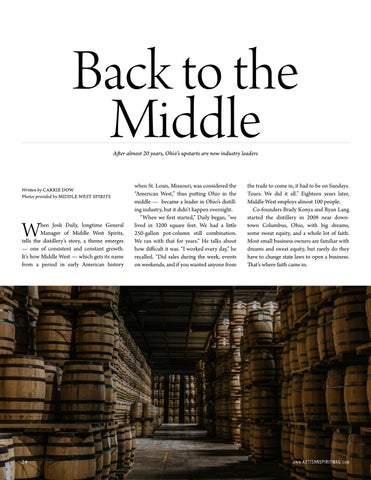
Back to the Middle After almost 20 years, Ohio’s upstarts are now industry leaders
Written by CARRIE DOW Photos provided by MIDDLE WEST SPIRITS
W
hen Josh Daily, longtime General Manager of Middle West Spirits, tells the distillery’s story, a theme emerges — one of consistent and constant growth. It’s how Middle West — which gets its name from a period in early American history
24
when St. Louis, Missouri, was considered the “American West,” thus putting Ohio in the middle — became a leader in Ohio’s distilling industry, but it didn’t happen overnight. “When we first started,” Daily began, “we lived in 3200 square feet. We had a little 250-gallon pot-column still combination. We ran with that for years.” He talks about how difficult it was. “I worked every day,” he recalled. “Did sales during the week, events on weekends, and if you wanted anyone from
the trade to come in, it had to be on Sundays. Tours. We did it all.” Eighteen years later, Middle West employs almost 100 people. Co-founders Brady Konya and Ryan Lang started the distillery in 2008 near downtown Columbus, Ohio, with big dreams, some sweat equity, and a whole lot of faith. Most small business owners are familiar with dreams and sweat equity, but rarely do they have to change state laws to open a business. That’s where faith came in.
W W W . ARTISANSPIRITMAG . C O M
“When we were going through (the building of) all of this,” Daily continued, “there were laws we had to change because they were Prohibition-style laws,” which limited the number of bottles a distillery could sell and how many gallons they could produce annually. Another law didn’t allow tasting rooms in distilleries, even though breweries and wineries had had them for years. “We started the Ohio Distillers Guild so we’d have a bigger voice together,” said Daily. That was around 2015, during which they “blew out the back wall” to increase the building’s size to 10,000 square feet. They also added a tiny little room to house wine-making equipment, just in case. Daily says that was because they went ahead and built a large tasting room and bar. “If that legislation didn’t change, I’d have a really pretty room I couldn’t use,” he said with a laugh. However, they were successful, and we are now sitting in that pretty room with a large ornate wooden bar filled three-tiers high with the 19 products the distillery currently makes as well as their partner brands. A wall 26
of windows shows off the distilling equipment. And it’s more than just a tasting room. The distillery now includes an on-site restaurant called Service Bar. However, that wasn’t the end of Middle West’s expansion. “We expanded our still and our fermenters until we came to a point where we were at capacity again. That’s when we went up,” Daily said gesturing to the distillery’s addition surrounded by giant translucent panels covering two stories of copper and steel, tanks and piping, and railings, steps, and platforms — a steampunk lover’s dream. The distillery now has three stills: a 24-inch round, two-story tall Vendome column still, a pot-column combo still from Kothe (much like the one they started with but larger), and a completely manual hybrid still. Daily says the manual hybrid is used to train their employees and distilling partners the finer points of distillation. “We wanted to be able to teach what happens when you turn it down a half inch. How does that affect the distillate coming off?” he said. “It’s easy to look at an iPad and do it, but you need to understand why you’re doing it. W W W . ARTISANSPIRITMAG . C O M
Having to turn a valve and then wait a minute and then taste it, we’re slowing (the process) down.” The hybrid is also used to make the company’s gins, Vim & Petal and Lux & Umbra. It has a botanical basket so large Daily simply refers to it as “the box.” He says they didn’t even make gin when they started. “We didn’t make gin because we didn’t have the right tools. The expansion was a great opportunity to get the right tools and make the right stuff.” The one thing that didn’t slow down was their growth. “Three years ago, we were running this operation 24/7, 365 just to keep up,” he said. “That’s when we decided to build another distillery.” The second distillery is located about 20 minutes away on Alum Creek. At 75,000 square feet, it uses a 60-inch column still and makes nothing but whiskey, while the downtown location makes all their clear spirits and small batch products. To give an idea of just how big that facility is, Daily said the downtown location has five fermenters that hold about 12,700 gallons, while Alum Creek has 14 fermenters that hold 50,000 gallons. Alum Creek’s bottling line can handle 10,000 bottles a shift. Daily also adds that the distillery has used a million and half bushels of grain this year, and the year isn’t over yet. Despite the operation’s growth, the one thing Daily says hasn’t changed is their commitment to high-quality spirits using Ohio-sourced ingredients made with North American-sourced equipment and packaging. “For us, it’s about owning it all the way from the ground to the glass,” explained Daily. He says they work directly with local farmers who grow the type of grains they want. They also avoid the middleman by cleaning and milling grains on site at the Alum Creek facility. “We control that process all the way from the farmer to the varietal to our end product,” continued Daily. “That way we can ensure the quality across the board.” That includes a special grain used in Middle West’s flagship spirit, dark pumpernickel rye. “It was a varietal we found a couple of years ago that we really liked. Nobody else was utilizing it.” He adds that they also use four grains in their whiskies instead of the typical three — the dark pumpernickel rye, non-GMO self-pollinating yellow corn, soft red winter wheat, and malted barley. W W W . ARTISANSPIRITMAG . C O M
27
Daily says the dark pumpernickel goes in a different flavor direction than more traditional rye. “It lends itself to being a bit more floral. A lot of ryes are more like black pepper. The dark pumpernickel is different, and rye is an emerging category.” However, he says some people still aren’t used to it. “It’s funny, when we do tastings, we get all the time, ‘This isn’t bad.’ What a ringing endorsement!” Another popular product is their cask strength wheated bourbon, also four grains, but with the emphasis on the soft red winter wheat grown in northern Ohio. “The climate up there is much colder, and there’s a lot of clay in the soil. The clay retains water, which makes a bigger, fatter berry for our wheat.” The spirit received a bronze medal at the 2026 World Whiskies awards, adding to the distillery’s collection of over 200 spirit awards throughout their existence. Daily says their success is directly tied to those local grains giving their products — including their wheatbased vodka — a unique taste while promoting Ohio’s terroir. Now that Middle West and those founding guild members have paved the way, Daily says that there are currently 80 distilleries in Ohio and that consumers’ choices and the state’s economic growth, specifically the agricultural industry, have benefited. “We had to prove to the state that there was value (in spirits),” he explained. “When we first opened there were only three retail licenses, one in Columbus, one in Cincinnati, and one in Cleveland. It was all based on population … We changed that because it needs to be fair for everybody. If you go to (the grocery 28
W W W . ARTISANSPIRITMAG . C O M
store) and see High Bank (Distillery) next to Middle West, you may know High Bank and not us or vice versa, and now you can try something new. It has really helped grow our industry.” Today they sell in 15 states and online nationwide through Speakeasy Co. Daily says the one thing Middle West will continue to do is innovate. Whether it’s through new products, new equipment, or talented new people, Middle West wants to be the best. “We’re always striving for better,” he explained. “We’re never going to be, like, we figured it all out. We’re done! Being independently owned allows us to do a lot of things where we’re not beholden to somebody else’s vision. It’s our vision.”
Middle West Spirits is located in Columbus, Ohio. For more info visit www.middlewestspirits.com or call (614) 229-2460.
W W W . ARTISANSPIRITMAG . C O M
29
Protecting Your Business from
Dram Shop Liability
Written by JOHN P. THOMAS, II
O
ne of the key features of most craft distilleries is the tasting room. For many, this serves to introduce customers to their products, explain what sets them apart, and provide an additional source of revenue. However, it also provides another, less welcome, type of exposure: dram shop liability. Generally, dram shop liability arises when an intoxicated individual causes injury or damages to a third party following their consumption of alcohol. The business that sold them the alcohol, or the dram shop, is then held liable for these damages in certain circumstances. These laws attempt to balance holding the individual accountable for their own actions, while also holding the business that served them liable if they do not follow certain laws or regulations. Dram shop liability is generally governed by state law, so the scope and specific considerations may vary from state to state. Distilleries should review the specific dram shop laws for the state in which they operate.
30
What is a dram shop? All businesses that sell and serve alcoholic beverages for consumption on the premises qualify as dram shops, with very limited exceptions. This includes restaurants, bars, taverns, pubs, and distilleries with tasting rooms. If a business sells and serves alcoholic beverages, it is subject to laws governing safe service of alcohol and is, therefore, subject to dram shop liability. The term “dram shop” is a reference to a unit of measurement that was commonly used in the past for the sale of liquor. W W W . ARTISANSPIRITMAG . C O M
What are dram shop laws? Dram shop laws confer liability to a business selling and serving alcoholic beverages for consumption on the premises for the harmful acts of intoxicated customers to Generally, third parties when that negligence is customer was negligently served alcohol by the the failure business. Most states have to act with the some form of dram shop level of care that laws, with some variation a reasonable in specific requirements person would between states. These laws generally attempt to exercise under limit the liability of the similar circumstances. business by limiting the application of these laws to two specific categories of customers and by requiring scienter — that is, that the establishment knew or reasonably should have known the customer was intoxicated or underage. Currently, only eight states do not have a version of dram shop laws:. These states are Delaware, Kansas, Louisiana, Maryland, Nebraska, Nevada, South Dakota, and Virginia. These laws tend to operate on a negligence standard. Generally, negligence is the failure to act with the level of care that a reasonable person would exercise under similar circumstances. Both actions and omissions can be considered negligent under this standard. Usually, only third parties who were harmed by the intoxicated individual can bring a cause of action against the dram shop, though certain states do allow the intoxicated individual to pursue damages as well. When evaluating the intoxicated individual and whether dram shop laws will apply, these laws are generally limited to two different types of individuals: obviously intoxicated or those who are under the legal drinking age.
Who counts as obviously intoxicated or a minor? There is no set standard for what constitutes “obviously intoxicated” across states, but the “reasonable person” standard from negligence law generally applies: Would a reasonable person recognize that the customer is obviously intoxicated? Signs of obvious intoxication include the customer having difficulty standing up or continuously falling over, difficulty walking or speaking, slurred speech, bloodshot eyes, difficulty handling money, or vomiting. All of these signs would point toward an individual who is obviously intoxicated. Some states will include individuals who are habitual drunkards or addicted to alcoholic beverages.
W W W . ARTISANSPIRITMAG . C O M
In both cases, service by a business to these individuals could open the pathway for a dram shop claim if they cause injury or damages to a third party. Dram shop liability can also arise from injury or damages caused by an intoxicated minor if they were served by a business. The liability will often arise when a server knows the customer is a minor, or when a reasonable person would know the customer is a minor. Ways that a reasonable person would know that a customer is a minor include failing to check identification, relying on the customer’s appearance instead of an ID, or failing to note the birth date of a customer on presented identification.
How does a business protect itself? There are many ways that a business can protect itself from claims by establishing training and operational best practices. For training, it is essential that all employees learn how to spot an obviously intoxicated individual or a habitually addicted individual. This includes training on the behaviors, outward signs, and activities often associated with these conditions. Employees should also be trained on the proper forms of identification used to verify that a customer is of legal drinking age. They should be knowledgeable about which forms of identification individual states allow to verify identification and common steps for spotting fake or altered versions of these documents. Businesses should also seek training provided by the state alcohol beverage regulatory agencies. While some states require all servers to hold service licenses or complete specific training, it is not universal. Some states provide server training on a voluntary basis. Even when not required, it is often viewed favorably by courts and regulatory agencies when an issue arises. Finally, businesses should provide both operational and technological support to the servers. No customer takes kindly to being refused service or cut off, and practices should For be established to give servers the confidence and support they need training, to refuse service to customers they it is believe are under legal drinking age essential or obviously intoxicated. Businesses that all should also evaluate whether there are options for implementing digital employees identification scanners or similar delearn how vices to verify age. Low-tech, simple to spot an solutions can also be implemented, obviously including signs noting the earliest intoxicated birthday allowed to order alcohol or signs noting that obviously intoxicatindividual or ed individuals will be refused service. a habitually Overall, the best approach for addicted businesses and servers is to exercise individual. caution.
31
What other areas should businesses consider? Several other areas matter for businesses and operators. Generally, dram shop liability concerns commercial alcohol providers, where alcoholic beverages are being sold and served. However, several states also have “social host liability,” which addresses private individuals who furnish alcohol at homes, parties, weddings, workplace gatherings, and similar events. While states often provide broader protection to social hosts than to licensed businesses, some states do recognize liability, especially when a host knowingly provides alcohol to a minor — worth noting if a distillery or its owners host a private event where alcohol is provided. Additionally, charging admission or operating what is effectively an unlicensed commercial event can complicate the distinction between a social host and an alcohol provider. Businesses facing dram shop liability may also face Businesses penalties beyond the civil cause of action. In most states, facing dram there are administrative or regulatory repercussions for shop liability violating the dram shop provisions. This could range may also face from warnings and fines to the suspension or revocation of the business’s license, depending on the specific facts penalties of the violation. In some jurisdictions, while dram shop beyond the liability cases are civil claims, there can also be criminal civil cause penalties for the service of alcohol to minors. of action.
32
What should businesses take away? Dram shop liability can feel daunting for businesses that serve alcoholic beverages, but careful preparation, training, and best practices can help a business operate with confidence that it is taking necessary steps to protect itself. This article only provides a high-level overview of dram shop laws and liability. Every business should thoroughly review the dram shop liability laws in its jurisdiction to determine the specific requirements for liability. Businesses should also consult with a qualified attorney for any questions about these liabilities and how best to protect against them. John P. Thomas, II is an attorney in GrayRobinson’s Tampa office and a member of the firm’s national Alcohol Law Team. He advises craft distillers and other alcohol beverage businesses on the laws governing the manufacturing, distribution, marketing, and sale of their products, including licensing, compliance, and liability matters across all three tiers of the industry. For more information email john.thomas@gray-robinson.com or call (813) 273-5046.
W W W . ARTISANSPIRITMAG . C O M
g n k i o o L e e for B , u m i m e r P e h t at e t h t a L ook n o i t c e Prot ood of Your What’s Under the H
Most Splendiferous of Days to You, Dearest Reader,
Sit back with a lowball of your favorite spirit, relax, and let me take you on a journey. Envision you are at a car dealership looking at your dream car. As you take in all of the outward details that draw you to this specific vehicle, you notice the exact same model right next to it. It appears to be the EXACT same vehicle that you are dreaming about, but something is different. The one that you have been eyeing is priced at the full MSRP, while the other one is a third of the price. Although they look almost identical to the eye from the outside, you cannot quite figure out why one vehicle costs so much less than the other. As it turns out, they are not the same. In fact, there are many differences that most people may not notice if they are not as into this vehicle as you are. The more expensive model is a pristine, 100 percent genuine “dream car.” The cheaper model has had the engine swapped out with a lesser quality one, there has been some body work done, it has far more miles on it than the other model, and it is missing some of the detailing and trim
Insurance Policy?
that you really wanted. From the outside looking in, they both appear to be identical. Once you start digging around and discover the truth, you understand the difference in pricing. Caveat Emptor! You may be asking yourself, “InsuranceMan, what does this have to do with insurance for me and my business?” I am so very happy you asked. I recently spoke to an acquaintance of mine who I had assisted with some bonds in the past for his distillery needs. We had often spoken about taking a look at the overall insurance package, but the timing was always a bit off, or something else came up that precluded us from making it happen. We would take a look at it “someday,” right? Fast forward to about a month or so ago. I received an email from this client, and he said that he did not care about the actual renewal date, he needed my assistance now. He essentially put up the “InsuranceMan ‘IM’ beacon” into the sky as a distress call. I answered. After sending over his policy and reviewing it via my super insurance-vision, I put together a list of questions and concerns. After careful deliberation with my distressed friend, it
WRITTEN BY AARON LINDEN
became obvious that the policy he had faithfully paid for over the years was worth far less than he believed it to be. We discovered that his building was undervalued by about half, his products were undervalued by nearly two thirds, his business income and extra expense (BI/EE) was not nearly what it should be, and lo, the bane of my existence … his general liability (GL) and liquor liability (LL) only had one classification description, “Beer, Ale, or Malt Liquor Mfg.” AAAGGGHHHHHHHHHH!!! That specific GL/LL code is my personal kryptonite. I see that description on distillery policies and am instantly weakened and almost become nauseous. That code is great for a brewpub or beer manufacturer and is even appropriate for a brewstillery or alternating use permit property, but it has ZERO business being the only classification code on a distillery. THE HORROR!!! Furthermore, I cannot begin to tell you
From the outside looking in, they both appear to be identical. But is your insurance policy a dream car or a stripped-down model? W W W . ARTISANSPIRITMAG . C O M
33
how often I see this classification used for a distillery. It must be two to three times a week, easily. There are usually two situations where this code should ever be used: Either the operation actually includes brewing, or the operation was never fully understood. This is part of the problem with insurance as a whole. You, Dearest Reader, are not a trained insurance professional, nor should you try to be. Just like the fact that I know my way around a distillery and understand the process, that knowledge alone does not make me a master distiller by any stretch of the imagination. Therefore, when you enlist the help of an insurance “professional” you assume that they know what you need and will take care of said needs. Oftentimes this can work out just fine for your homes, autos, and general insurance needs; however, for something as specialized as your distillery, brewery, alcohol manufacturing plant, or whatever you may have happening, you must vet your provider to make sure they know what they are doing. Your business is far too precious to trust it to an insurance generalist. Much like the dream vehicle that you were looking at in the beginning of this article, not everything is equal. Although two insurance policies can be made up of the same forms with similar legalese pages, and look like a “real insurance policy,” it is only after opening the “hood” of the policy, digging around, and making a thorough inspection that the
As your business evolves,
your insurance coverage should be evolving with it.
34
Your insurance policy’s value isn't
differences become clear. measured by what it costs. It's measured As you may have heard me say before, it is my “four corby what it does on the ners rule.” If the details of your worst day of your business . specific needs are not clearly listed within the four corners of the have been one of the greatest compliments I sheets of paper that make up the have ever received as an insurance professionpolicy, they don’t exist. If the only classificaal because it told me something. It told me he tion shown on your GL/LL schedule of hazfinally understood what he was purchasing, ards is “Beer, Ale or Malt Liquor Mfg.,” and and why. there is a claim, it could be denied in its entireThe lesson is, when you understand the valty due to “a material change of business.” ue of what you are getting weighed against the Manufacturing distilled spirits is a materiprotection that you actually need to take care ally different risk than making beer, wine, ale, of you during and after a loss, price becomes meads, etc., and had the carrier known the far less important. difference in the beginning, not just what the Somewhere along the way, our industry insurance agent told them, they may have detrained consumers to shop for insurance the clined to even offer a proposal. That informasame way they shop for gasoline or groceries, tion is best known upfront, not after a claim by finding the lowest price. Unfortunately, happens and coverage is denied. insurance isn't a commodity. Your insurance Not only should the classification of hazpolicy’s value isn't measured by what it costs. ards reflect each and every point of sale (POS) It's measured by what it does on the worst day of your operation, what do the property secof your business. tion coverages look like? Are they accurate Break the cycle! Distillers and craft alcohol depictions of your values? When were they artisans understand better than anyone that last changed? If it is like the case of my client, age creates value. Hand crafting creates value. it has been nearly five years. As your business You and your business create value. Like the evolves, your insurance coverage should be dream car in our scenario, a four-year bourbon evolving with it. is not priced like a four-month bourbon, even I went into InsuranceMan mode, and I put though they may look the same in a glass. Why together the dream vehicle that the client realthen would we expect insurance protecting ly wanted, not the stripped-down version that those assets to be treated with the same simhe had. Then I took my proposal to him and plicity? Your barrels deserve insurance that's said, “I know that there is going to be some as carefully crafted as the spirits inside them. momentary sticker shock, so prior to looking BUY PROTECTION. at the premium, let’s look at the coverage and NOT PREMIUM. what we fixed.” Now drive that dream car off the lot, rev it After going through everything and showup, and enjoy! ing side-by-side examples of where the Until next time, dearest reader… policy he had for the last five years was failing him compared to the corrected version I proposed, he said, “Yes, this is the policy and protection that I want!” Although the premium was THREE TIMES the amount that he had been paying, he stopped and thanked me. The premium tripled and he thanked me?!?! Now I was a bit shocked! That may
Stay Vigilant, Aaron Linden a.k.a. Insurance Man
Aaron Linden is a professional purveyor of insurance policy products proposed to protect people proactively against perceived perilous perils and pitfalls, primarily. He has been in the insurance industry for 23 years, has specialized in craft spirits insurance for the last 15 years, and literally wrote the book (ok, the insurance forms) on spirits coverage for many insurance carriers. For more information email aaron@latitudeins.com or call (307) 752-5961. W W W . ARTISANSPIRITMAG . C O M
GIFT CARDS, GOLF TRIPS, AND GRAND JURIES WHAT THE ALBERTSONS/ SOUTHERN GLAZER’S BRIBERY CASE MEANS FOR EVERY TIER W R I T T E N B Y G ILLIA N G A R R ETT
F
or most of the 90 years since the repeal of Prohibition, the three-tier system has run on a simple premise: Producers, distributors, and retailers stay in their lanes, and nobody buys their way onto the shelf. A stack of federal charging documents now working through a U.S. district court in California alleges that, for the better part of a decade, that premise was quietly for sale — and the Department of Justice (DOJ) is pursuing the
A sprawling federal prosecution that kicked off in 2025 is the first to charge retailers and unlicensed middlemen for commercial bribery. Distillers, take note — the statute in play covers spirits just as surely as it covers wine.
W W W . ARTISANSPIRITMAG . C O M
case with a theory of liability that should get the attention of anyone who makes, moves, or sells alcohol in America. The allegations describe a kickback machine that operated from at least 2016 through 2024, funneling millions of dollars in prepaid gift cards, luxury watches, designer handbags, golf and exercise equipment, and lavish trips to grocery-chain wine buyers in exchange for favorable shelf placement, larger orders, and promotional treatment. The money was allegedly laundered through false invoices dressed up as “holiday dinners” and “educational tasting seminars,” with the proceeds parked in individual “banks” that beneficiaries could draw down like expense accounts. 35
Who has been charged — and with what
The court filings identify the distributor at the center of the scheme only as “Distributor-1,” but a company spokesperson confirmed to reporters that the former employees charged had worked for Southern Glazer’s Wine & Spirits, the largest alcohol distributor in the country. The grocery chain, likewise unnamed in the indictments, has been identified in press coverage as Albertsons (also operating under its Vons banner in Southern California). The wine brand whose sales managers were charged has been reported as Deutsch Family Wine & Spirits, maker of Josh Cellars and importer of Yellow Tail. None of these companies have been charged. The individuals are another matter. The defendants fall into three groups. On the supplier side, Matthew Adler and Bryan Barnes, both former sales managers for Deutsch Family, were charged in February 2025 with commercial bribery under the Federal Alcohol Administration Act (27 U.S.C. § 205(c)); Adler also faced a conspiracy count. John Herzog, a supplier consultant, was charged with conspiracy. On the retail side, Patrick Briones, the former head wine buyer for Albertsons, was then charged in September with conspiracy, commercial bribery, and, critically, aiding and abetting. In the middle sat Jessica Goebel, owner of an event-planning vendor called J. Go Events, Inc., who was indicted in November. Prosecutors allege her company was the 36
pass-through: It bought the gift cards, booked the travel, cut the false invoices, and maintained the “banks,” typically taking a 10 percent cut. She was charged with conspiracy to falsify records to obstruct a federal investigation. Then in March, a grand jury handed up a fresh indictment naming five former Southern Glazer’s employees — Michael Dehdashtian, Ryan Dow, Stephen Magliocco, Loratina Muscara, and Adrian Ruiz — for conspiracy to commit bribery and obstruct investigations. Magliocco, Muscara, and Ruiz were also charged with falsifying records. The same indictment charged Michael Sean Salene, a salesman reported to have worked for a Napa winery, with Travel Act bribery and making false statements.
Where the cases stand
The early defendants have largely resolved their exposure. Adler, Barnes, Briones, and Herzog quickly pleaded guilty. Goebel took a different path, entering into a deferred prosecution weeks after her indictment — an outcome that typically signals cooperation with the government in exchange for eventual dismissal if she meets the agreement's terms. The five former distributor employees and the winery salesman charged in March are the ones fighting. They are
presumed innocent, made their initial appearances in Oakland in late March, and their cases are now moving toward the pretrial motions and plea-or-trial decisions that will define the next phase of the prosecution.
What’s still to come
The most immediate milestones are the sentencing hearings in October for the targets who have pled guilty — hearings that will offer the first real read on how aggressively the court intends to punish trade-practice crimes that, until recently, were handled almost entirely through the Alcohol and Tobacco Tax and Trade Bureau’s (TTB) civil enforcement process. The larger open question hanging over the industry is whether charges will reach the companies rather than only their former employees. To date, Southern Glazer’s, Albertsons, and Deutsch Family have not been charged. Each disavowed the criminal conduct and readily agreed to cooperate. But the companies remain squarely within reach of two separate enforcement tracks. The DOJ can pursue corporate criminal liability where employees acted within the scope of their employment, and TTB retains independent administrative authority to impose civil penalties and to suspend or revoke basic permits for trade-practice
violations. Whether either agency moves against the businesses themselves — and what a resolution might then look like — is the piece of this story the industry will be watching most closely.
Why this matters beyond the wine aisle
Two features make this case genuinely significant, and neither is confined to wine. The first is scale. This is not about a rogue rep at a boutique brand. The distributor is the dominant player in American wholesale, the retailer is a national grocery power operating hundreds of stores across California and other states, and the suppliers’ labels are among the best-selling in the country. When the largest firms in two tiers are alleged to have run a bribery scheme touching hundreds of stores over eight years, it reframes commercial bribery from a fringe compliance footnote into a structural risk that reaches the core of how products get to shelf. The second is the legal theory, and this is where distillers should lean in. Section 205(c) of the FAA Act — which applies to distilled spirits, wine, and malt beverages alike — has traditionally been understood to reach industry members: permit-holding suppliers and wholesalers who offer the inducement. The party on the
The larger open question hanging over the industry is whether charges will reach the companies rather than only their former employees.
W W W . ARTISANSPIRITMAG . C O M
receiving end — the retail buyer — generally was not the statutory violator, nor was an unlicensed vendor moving the money. This prosecution changes that calculus. By charging Briones, a retailer’s buyer, through conspiracy and aiding-and-abetting theories, and by charging Goebel, an unlicensed third-party events vendor, the DOJ has for the first time extended commercial-bribery liability to the receiving side of the transaction and to the pass-through middleman. In other words, “we’re not the licensee, so the trade-practice rules aren't our problem” is no longer a safe assumption for anyone in the chain.
The three-tier system was built to keep the shelf competitive. TTB’s case against Albertsons, Southern Glazer’s, and others is now testing how far the criminal law will go to keep it that way.
For spirits makers, the takeaways are concrete. The same conduct that generates a TTB civil penalty can now anchor a federal felony. Marketing and incentive spending routed through vendors invites scrutiny of what those invoices actually describe. And a distributor's or retailer's compliance failure is not a firewall — a supplier who funds an inducement can be charged as a conspirator regardless of who ultimately
handed over the gift card. The prudent response is not panic but hygiene: clean documentation, real deliverables behind every marketing dollar, and a hard line on anything that looks like paying for placement.
The three-tier system was built to keep the shelf competitive. TTB’s case against Albertsons, Southern Glazer’s, and others is now testing how far the criminal law will go to keep it that way.
Gillian Garrett is an alcohol regulatory attorney based in the San Francisco Bay Area who advises and represents clients across all three tiers of the industry. She is the author of Distilling Alcohol Law: Federal & California Unfair Trade Practices (2026), the first legal reference guide designed to help businesses more easily understand and navigate the complex array of unfair trade practice laws. You can reach her at gillian@gilliangarrettlaw.com.
StPats.com
4
CLOSEOUT of Filtrox Sheets + Modules
Up to 20% Below Filtrox' Best Wholesale Price!!
Activated Carbon Filters We carry a complete line of Filtration Equipment & Media • • • •
Lenticular Cartridge Plate and Frame Bag Filter
Bulk pricing on Valves and Fittings • Cartridge Filters • Lenticular Modules • StPats.com
W W W . ARTISANSPIRITMAG . C O M
37
Mission Accomplished
SPYRT Worldwide Brings Ukrainian Vodka to the United States Written by Rich Manning
A
t their purest form, distilled spirits can be a conduit for good. They can bring cultures together, build unique communities, and even be the foundation for this during times of conflict and danger. SPYRT Worldwide was born from one of the starkest international examples of spirits bringing people together. Founded in 2023, the company’s focus is bringing Ukrainian vodka to the United States. The mission stems from an encounter in the early days of the war between Ukraine and Russia, which, as of this writing, has been waged for more than 1,600 days. The journey to get Ukrainian wines and spirits to the U.S. is one of international camaraderie, harrowing adventure, and an indefatigable desire to highlight a country’s perseverance.
38
From Volunteerism to Vodka The driving force behind SPYRT Worldwide is its co-founder and CEO Sam Lerman, a military veteran who served in the U.S. Air Force as a Security Forces Technical Sergeant. He saw combat in Afghanistan for a decade and helped to provide domestic assistance in the post-Hurricane Katrina recovery effort before an injury ended his deployment. He switched to assisting with military defense, laying the groundwork for an unforeseen chapter in his service career. In 2022, Lerman was approached with a potential mission: Consult with Ukrainian allies for defense against the then-recent Russian invasion. “They had to call in special forces because the world wasn’t really responding to an ally getting invaded, and I would be put on a team to advise,” Lerman recalled. “It was a volunteer mission. They basically told me there would be no pay or any insurance before asking me if I wanted to come.” Lerman was nonetheless intrigued and talked it over with his wife. He decided to go, but
the choice was difficult for reasons beyond the lack of benefits. “When I was preparing for the mission, my wife found out she was pregnant with our second daughter,” he said. “She still encouraged me to go, so I went.” The mission led Lerman to a remote Ukrainian safehouse, where he’d share space with Ukrainian special forces. Spirits worked their community-building magic swiftly. “That first night was about getting to know our Ukrainian counterparts,” he stated. During the night, one of them put a bottle of Ukrainian vodka on the table and said, ‘Now we do cultural exchange!’” “Now, I had bad memories of vodka from my younger days,” he continued “You know, the ‘bad experience in college’ with American vodka. But I was blown away by how viscous and tasty it was. It had this character I never experienced before in vodka.” Lerman’s new friends informed him it was horlika, which was technically vodka, but technicalities make for horrible anecdotes. “They told me there was a difference between horlika and vodka,” Lerman said. “Horlika, they said, was Ukrainian and it opens your mind. Vodka is Russian and makes you angry.” W W W . ARTISANSPIRITMAG . C O M
A Different Mission Lerman eventually went back home once the mission was complete, but he left Ukraine with a new goal in mind: Bring the joys of Ukrainian vodka to his homeland. He quit his job in the military and used his connections and access to create a new role that allowed him to shuttle back and forth between Ukraine and the United States. While the new gig enabled him to provide in-person support to Ukraine, he wouldn’t exactly return home empty-handed. “I did some bootlegging, like any self-respecting guy would,” he recalled with a chuckle. “I’d pack suitcases with dozens of spirits and wine bottles, and I’d have to smuggle them from Ukraine and through Warsaw [Poland] before getting back to Dulles in D.C.” The operation went smoothly until it didn’t. “I was picked up at customs at a train station in Poland,” he recalled. “This guard comes by and starts asking me questions about carrying cigarettes and alcohol. As we were talking, he became more annoyed. I told him I had alcohol, and he asked, ‘How much? 1 liter?’ I said no. He then asked, ‘2 liters?’ I again said no. He then asked me how much I had, and I said, ‘about 40 liters?’ He then grabbed me and threw me in a chair. He made me unzip my jacket and opened some of my other bags. He sees the military gear I’ve packed. He then looks at me and tells me, ‘1 Liter! You go!’ and let me go. It was a wake up call for me, and I thought maybe smuggling the vodka was not a good idea!”
W W W . ARTISANSPIRITMAG . C O M
Fortunately, Lerman had the resources and connections to go legit. In 2023, he met up in Las Vegas with two former military officers and entrepreneurs, a Ukrainian named Maksym and an American named David (surnames redacted for security reasons). The meeting led to the formation of SPYRT Worldwide, a company designed to legally bring Ukrainian vodka and wine to the American masses. According to Lerman, there was more to the mission than bringing over high-quality spirits. “We wanted it to be a means of soft diplomacy,” he said. “We wanted to show the beauty of Ukraine through wine and spirits. We also wanted to show Ukraine was not just a victim like they were being portrayed by the media. They are a country with a population of 30 million that still have jobs, still go out at night, and still live their lives every day.” They also designed SPYRT Worldwide to be an organization that gives back to Ukraine in a meaningful way. 10 percent of all sales goes to Invictus Global Response, an organization dedicated to clearing out mines and bombs in Ukraine and educating Ukrainians on explosives to keep them safe. Lerman notes Invictus’ mission is as massive as it is necessary. “The Russians mined everything,” he said of the distribution of landmines. “Ukraine is the most mined country in the world. It’s going to take about 100 years to fully demine the country.”
“
We wanted it to be a means of soft diplomacy. We wanted to show the beauty of Ukraine through wine and spirits.” — SAM LERMAN Co-founder and CEO, SPYRT Worldwide
A Growing Presence Lerman admits operating a spirits business isn’t always easy. However, SPYRT Worldwide’s goal to get liquor to lips is simple and effective whenever it’s achieved. “Once people try our vodkas, they will have the same reaction that I had the first time I tried it in Ukraine,” he said. Some of their products have already turned heads. In 2025, the Wine and Spirits Wholesalers of America (WSWA) awarded Hetman Elite Vodka Best in Show honors for the vodka category, and Ukrainian Spirit was awarded a double gold. They’re also gaining a steady retail presence on United States Marine Corps bases and Veterans of Foreign Wars (VFW) posts. Additionally, they’re embarking on a campaign to further drum up interest in civilian on-premise
spaces, working with bars to replace the vodka-based cocktail Moscow Mules on menus with Kyiv Mules made with Ukrainian vodka and served in steel mugs. The latter is a crucial element to the drink. “Steel cups are strong like Ukraine,” Lerman stated. “Copper cups are weak like Russia.” Of course, the Kyiv Mule is more than just a cheeky take on a classic cocktail. It directs focus on the existence of vodka produced by Ukraine, a beautiful country populated by resilient people. Realizing this existence may be enough for some people to give it a shot and , Lerman is confident this is all that’s needed for people to remain invested in the long-term. “The first time someone may try Ukrainian vodka is to show support for freedom and democracy,” he said. “But they’ll keep drinking it because it’s good.” Visit www.spyrtworldwide.com for more information. 39
Wri t ten by M AGGIE CA M PB ELL
TERROIR of the
CELLAR HOW CLIMATE SHAPES A SPIRIT’S CHARACTER
LET’S TACKLE THAT TASTING
T
erroir is not just soil and raw materials; it is the Terroir is not just ambiance, the vibes, that surround every step of production. Having spent two decades in both wine soil and raw materials; and spirits simultaneously, I see the vein of terroir it is the ambiance, running through them, yet spirits’ terroir seems to the vibes, that surround be misunderstood, misapplied, and underutilized as a tool of character development in production and a every step of production. tool of enchantment in messaging. Terroir is not just raw material and soil: It is all aspects that nurture specific characteristics in the spirit (seasonality, humidity, elevation, diurnal shift — the swing between daytime and nighttime temps), and even certain elements of cultural know-how in production distinct to a region. Given all of these aspects, it should be clear to see that one of the most important and impactful areas where terroir has an effect is in the cellar, and this is true for both aged and unaged spirits. A few years ago, I tasted two samples of the same spirit that were the same age. The first one had crisp notes of white apple flesh and bright peach, a firm edge to the flavor definition, and a linear structure. The second one had a very broad structure, with an almost baking soda zest across the tongue adding a nice structural contrast, was far more spread, and the flavor definition was soft with all the golden and almost oxidized/mature fruitiness melding together on the palate. I immediately knew they had been aged in two different cellars because I have experience managing mature stocks in Mediterranean, maritime, and tropical environments. So how did each one of these tasting clues tell me where and how it was aged? Let me share with you how to taste and harness terroir in your own cellar.
A QUICK EXAMPLE In the wine world, Meursault wines in France are known for their rich, ripe-fruited, and sometimes almost oxidized character. Some of this is because the barrel cellars there are not dug very deep due to the high water table. This means warmer cellar temps, which increase the rate of chemical reactions such as oxidation (nutty and mature fruit tones), evaporation (concentration of texture and flavor), and higher extraction of more open wood grain (body, weight, and vanilla tones). Though wine is lower in alcohol than spirits, making it less stable, we still see these same reactions in spirits but at a slower rate.
TEMPERATURE In general, a warmer temperature activates the chemical rate of oxidation, leading to faster maturation. A colder temperature slows this process down. Does this mean we should artificially heat our spirits? Well, the history of those who have tried has shown quality and harmony can leave much to be desired. For now, I’ll address the Faster does not always mean better, natural ambiance of your own cellar and your distinct terroir can have because faster does not always mean betits own harmony and complexity ter, and your distinct terroir can have its own harmony and complexity that can that can be your signature. be your signature. W W W . ARTISANSPIRITMAG . C O M
SAMPLE ONE: If you remember, the first one had crisp white apple flesh and bright peach notes, which likely means cool climate-derived esters that retained their delicacy, which means summer would be mild-warm at most in the region. There was a firm edge to the flavor definition, which suggests a region with cool seasons, further pointing away from Mediterranean, subtropical, or tropical climes. A linear structure leans toward a more dry winter, humid summer maritime climate rather than more diver gent modestly humid and hot summer con tinental climes. DEDUCTION: I could taste that it was rum, and I recognized some character from the terroir of fermentation and dis tillation that told me it was produced in the Caribbean, meaning it most likely was matured in the UK as US producers tend to produce from scratch, instead of age unaged Caribbean stock. Experience told me Main Rum in Liverpool is where it had been aged in that case.
SAMPLE TWO: The second one had a very broad structure, which likely means a warm climate, and the baking soda zest across the tongue adding a structural contrast was evidence of high dry extract, so it was likely in older used barrels. This also meant a high entry proof, which is more common to tropical than subtropical climate. The flavor definition was soft with all the golden and almost ox idized/mature fruitiness melding together on the palate. This means the ABV dropped with maturation, which supports a humid and warm climate, so a tropical environ ment is confirmed. DEDUCTION: I knew I was tasting rum, and Jamaican rum at that, due to the terroir of the fermentation and cultural expression of distillation. Don’t even get me started on the terroir of fermentation, especially in rum. We could be here all year… 41
*CLIMATE GUIDE DESERT: Generally dry, high diurnal shift, hot summers and cold
winters This desert climate can generally have a firmer palate with etched flavor definition and bright top fruity aromas and flavors. The fruity ester notes tend to be orchard fruit and golden in character. Can capture some more precise impressions of the raw material on the nose and palate. TROPICAL: Consistent annual temperatures (~87F) with high humid ity, low diurnal shift
Tropical typically shows broader and fuller palate weight with rounder, juicy golden and dark fruit tone esters that have softer flavor definition with a mingling, layered character. With aging, baked or singed fruit notes may also appear. Can often show less literal notes of raw material with more evolution to more abstract character. SUBTROPICAL: Gentle winters ~(60F) and warm to hot summers
(~90+F) Subtropical character tends to have a bit more structure, running through the palate front to back, than tropical, and a softer melding of character with a bit more distinctive core flavors and less jammies, but it does not have the detailed, high-purity nose or palate flavors of something more continental. Golden, moderately jammy and juicy esters can be seen. MEDITERRANEAN : Mild winters, mild to warm summers, moderate
humidity, moderate diurnal shift Generally, Mediterranean character is soft and gentle with an underlying vibrancy and an element of purity to a soft yet perfumed nose and mid-pal ate flavors. A good melting of gentle or soft aromas and flavors and more detailed orchard fruit notes from fermentation and esterification, with moderate flavor etching, and good energy on the palate with soft round ness on the edges. Esters can appear as herbal, green, gold, red, and orange fruitiness. MARITIME: Coastal but further off the equator than Mediterranean cli mates, more marked winter and warm summer, humid summers and mod erate humid to dry winters
The moderating coastal influence can give a soft transition in and out of supple roundness contrasted by more edged and etched impressions of aro mas and flavors. The raw materials can show through the final spirit, but are often complemented by more abstract flavors. But in contrast, it does not have the breath, weight, or back palate presence of a tropical spirit. It can offer more softness and gentle transitions on the palate than more desert or continental-influenced climates; that said, it does not have the same ar omatic pop or detail as them. Esters typically show golden tree fruit notes. CONTINENTAL: Inland with less moderating influences, hot summers,
cold winters, relatively dry Can retain vibrant, detailed, and firmly etched aromatics and flavors across the palate, but rely on evaporation of sharper alcohols, oxidation, and po lymerization/esterification for a more supple mouthfeel on the palate. The alcohol can be quite linear, offering excellent structure and vibrancy. This climate captures aromas of the raw material quite notably. Esters express as red, green, and yellow orchard fruits in general. 42
Cold storage has benefits too. A colder liquid generally holds more dissolved gas. This is why a cold bottle of Coke opens with a soft fizz. The CO2 is dispersed throughout the liquid. Opening a warm one can explode out of the bottle because it releases all its gas quickly. What does this mean for spirits? Dissolved oxygen is a critical ingredient for esterification in maturing spirits (helped along by low-pH fermentations). If you have a cool cellar, some of these esters can be quite specific — think apple blossom, pear skin, white peach (as in glass number one mentioned previously). In a warm cellar where there is less dissolved oxygen, esters are often less pinpoint expressive and more dispersed and pillowy. You may even see a cultural element of the harnessing of terroir come into play. For example: When specific communities really amp up low pH fermentations to accentuate esters and potential esterification during maturation in warmer climates (e.g., Jamaican rum). That produces a very different long-chain fatty acid ester expression than cold cellar aged spirits. This might also explain why some folks mimicking these styles don’t always succeed. The rate of temperature affecting maturation is inherently tied to alcohol and its rate of controlling chemical reactions. Alcohol stabilizes — this is why a pinot grigio spoils faster than a port wine. The higher the alcohol, the more slowly your spirit shows oxidative and evolved maturation flavors, but the more actively it extracts oak character (and yes, different proofs accentuate different elements, but that is for another article). The lower the alcohol, the softer the pull on the barrel, the less dry extract on the palate, and the more evolved the oxidative and mature flavors show. (See my previous article, The Barrel Triangle, Winter 2014, for Read more info). But of course, paired with The Barrel Triangle temperatures, we can see how this can be accelerated or slowed in the terroir equation. And since alcohol is also affected by humidity, let’s keep pulling on this terroir thread.
HUMIDITY In general, a humid cellar will increase the rate at which alcohol in the barrel evaporates compared to water because there is a bunch of water in the air already, so it is less readily excited to move into the atmosphere. This causes proof to drop over the humid season in a continental or maritime climate*, or proof drops yearround, like in a tropical environment. The lower the proof, the less extraction of oak, the more readily fresh
W W W . ARTISANSPIRITMAG . C O M
flavors evolve into dry, marmalade, and mature/dessicated character, and the broader the texture seems to become. One terroir caveat: the know-how element. In the Caribbean, a tropical environment, entry proof is generally much higher than in continental North America and Europe because of the limited availability and expense of importing barrels, land and cellar space, plus the fact your proof will drop. The higher ABV retards the rate of chemical interaction of oxidation and keeps extraction elevated. This results in a subtle high dry extract character across the tongue, and leads to one of the biggest clues in glass number two from my previously described tasting. A dry cellar, like a desert, or a cellar in winter season, or in a maritime or continental climate, will cause proof to rise in the barrel as water eagerly evaporates. This can cause elevated barrel extraction, so wood quality becomes more important (think air-dried vs kiln dried). The fresher fruity notes derived from fermentation in a dry cellar can stay crisp and bright, and a linear structure can emerge on the palate. So you can see how a continental climate could have proof go up and down across the seasons, melding different characters, where a tropical or desert/high altitude climate may supercharge one direction of expression. If a barrel in a continental climate tastes loose and undefined at the end of summer, revisit it the following April; A dry winter could knit it together to become lively and structured again. If a barrel in April tastes a bit bitter, acrid, inaccessible, or dull in flavor, taste it again in September, and then again in October. It needs time to open and soften, or perhaps wet it with a splash of water if you need to.
THE MOMENT OF STRATEGY The way you ferment, distill, and nurture spirits in the cellar (tank resting, barrel wetting, timing of blending, oak regime) can all foster elements that can be pushed and pulled by harnessing your terroir. It can help you achieve an elegant and harmonious house style, and it can also help you untangle inventory challenges. Questions like: Why is this barrel so bitter? How can I bring it around? How can I bring that sensory note to the front of the tasting experience? How can I repeat that amazing honey barrel I can’t stop dreaming about? We’ve just begun to scratch the surface. Perhaps we can get into macro/meso and micro-climates of the cellar as well as barrel management techniques from around the globe next time! Maggie Campbell is the founder of Half Pint Co-Creation, where she advises spirits brands. She brings nearly two decades of experience from her time as President and Head Distiller of Privateer Rum, on the Leadership Team at Mount Gay, and as CEO of American Cane, where she launched Banter Rum. She studied distillation technology at Siebel, holds the WSET Diploma in both wine and spirits, and studied with the Institute of Masters of Wine. Maggie was named to the Imbibe 75 in 2026, Drinks International's Bar World 100 four times, and Wine Enthusiast's 40 Under 40. She is a WSET educator and has served as a two-term Board Member and Vice President of the American Craft Spirits Association.
FUELING BETTER FERMENTATIONS CHOSEN FOR QUALITY. BACKED BY SCIENCE.
From premium yeast and enzymes to cleaners and nutrients, Ferm Solutions is your one-stop resource for consistent results and operational excellence.
ferm-solutions.net customer@ferm-solutions.com 202-978-3376
W W W . ARTISANSPIRITMAG . C O M
SCAN HERE TO SHOP OUR FULL LINE OF PRODUCTS
43
--------------
---------
-----
-
--
------
---------------
-----
-----
-
-----
---------
-----
--
-
---------
------
--
---
-
----
-------------
---------
---------
---------
---
---------
-----
---------
---------
--------
---------
---
---
-
---------
-
-----
-----
--------
---------
---------
---
-
---
------------
---------
--
---------
--------
--
---------
------------
--------
-
------
MOISTURE (%)
EXTRACT (%)
COLOR (°SRM)
β-GLUCAN (MG/L)
SOLUBLE PROTEIN (%)
PROTEIN (%)
S/T (%)
FAN (MG/L)
DP (°L)
ALPHA AMYLASE (DU)
PH
GN (G/TONNE)
4.3
83.4
1.74
58
5.26
9.9
53.1
228
147
81.8
5.67
1.7
Top Shelf (GN0)
6.1
81.5
1.56
127
5.72
12.8
44.7
274
276
70.9
5.83
0.1
Vivar (GN0)
6.1
80.2
1.66
53
5.61
12.4
45.2
285
284
72.6
5.74
0.1
UC Tahoe (GN0)
6.2
74.1
2.01
578
5.19
13.3
39.0
247
190
54.2
5.66
0.1
UC Capay (GN0)
5.5
80.3
1.5
74
6
11.5
51.7
299
171
73.3
5.63
0.1
Butta12 (GN0)
5.8
78.0
1.16
80
4.89
13.6
36.0
196
194
73.6
5.95
0.2
LCS Genie (GN0)
5.1
80.4
1.61
57
5.46
12.2
44.8
230
164
66.7
5.94
0.2
Distillers Select Control (GN+)
5
79
1.5
90
6.5
12
54.1
280
265
90
n/a
1.4
LCS Odyssey (GN0)
4.5
82
1.5
100
4.5
10.5
42.8
200
125
60
n/a
0.2
VNS (GN0)
5.1
78
2.93
72
5.27
12.1
43.6
196
101
68.5
5.82
0.1
44
---------
--
---------
-----
-
---------
---------------
---
--
---------
---------
---------------
Thunder (GN+ Control)
-----
--
---------
-----
---------
--
-----
--
-----------------
-----
precursors, and trace compounds that can affect fermentation and spirit chemistry (Hill & Stewart, 2019; Campbell P. Morrissy et al., 2024; Schwarz & Li, 2011; Verges et al., 2023). One compound of concern in distilled spirits is ethyl carbamate (EC), also called urethane. EC can form in fermented and distilled products, and it is monitored because of its toxicological concern. In grain spirits, one important pathway starts with glycosidic nitrile (GN) from malted barley (Campbell P. Morrissy et al.,
TABLE 1. Malt Quality
DESCRIPTION
---------
----
--
---------
-------
-
---
----
W
hiskey production starts before the grain reaches the distillery. Barley variety, growing region, malting quality, and process behavior all affect what happens later in the mash, fermenter, and still. For distillers, malted barley is more than an enzyme source (Bringhurst, 2015; CuestaMarcos et al., 2016; Edney et al., 1996; Fox, 2010). It also contributes nitrogen, flavor
-----
---
-------
-----
---------
------
---------
---
---------
---------------
---
---------
INTRODUCTION
-----
---
---
---------
---
-----
---------
---------
--------
---------
--
---
---
----
---
---------
-----
IN BOURBONSTYLE WHISKEY PRODUCTION
-----
--
-
-----
---
---------
---------
-----
--
----------------------------------
---------
---------
------
---------
---------
---
---------
---------
---
---------
---------
--
---------
---
-------
GN0 BARLEY AND ETHYL C A R B A M AT E MANAGEMENT
------
---
-----
-
-----
-
--
----
---
-----
--
-
-------
------
-
-------
--------------------
---
WRITTEN BY HARMONIE M. BETTENHAUSEN, BRANDON C. AKERS, AND BRAD J. BERRON
W W W . ARTISANSPIRITMAG . C O M
--
-----
-
-----
------
--
---
-
---
---------
--
--
---
-----
-
-----
-----
-
---
--------
-----
------
---------
-
------
------
-
-
-----
---------
2024; Morrissy et al., 2023; Turner TABLE 2. Barley variety sources for materials included in this study. et al., 2023). The barley compound VARIETY / MATERIAL BREEDING PROGRAM OR PRODUCER LOCATION most often discussed in this pathway Top Shelf Oregon State University Corvallis, Oregon is epiheterodendrin (EPH), a cyanoVivar Oregon State University Corvallis, Oregon genic glycoside that can contribute UC Capay University of California, Davis Davis, California to EC formation during whiskey proUC Tahoe University of California, Davis Davis, California duction (Abt et al., 2021; Aylott et Butta 12 University of California, Davis Davis, California al., 1990; Berron et al., 2023; Berron U.S. operations headquartered et al., 2025; CFIA, 2022; Diachenko LCS Genie Limagrain Cereal Seeds in Fort Collins, Colorado et al., 1992; Gowd et al., 2018; IARC, U.S. operations headquartered LCS Odyssey Limagrain Cereal Seeds 2010; Morrissy et al., 2023). That in Fort Collins, Colorado connection is why distillers, maltDistillers Select Commercial distillers malt blend Commercial control sters, and barley breeders care about Thunder Oregon State University Corvallis, Oregon GN. Malt with higher GN creates VNS (Variety Not Stated Washington State University Breadlab Burlington / Mount Vernon, Washington more upstream EC precursor risk. Malt with very low or no measurable a single-variety story. Distillers are likely to see GN reduces that source of risk. GN0 more low-GN options from different breeding barley refers to barley varieties selected or bred METHODS IN BRIEF and malting programs, and those malts will not to produce very low GN in malt (del Blanco & All trials used a bourbon-style mash all behave the same way. Dubcovsky, 2024; Gallagher et al., 2020; C. P. bill of 80% corn, 10% rye and 10% maltThe malt quality data show the first practiMorrissy et al., 2024; Campbell P. Morrissy et ed barley. The malted barley was the main cal filter after GN. A low-GN malt may reduce al., 2024; Turner et al., 2023). For a distiller, variable. Pilot-scale trials were produced at one EC precursor risk, but it still has to do the GN0 malt is a starting point, not the whole the James B. Beam Institute for Kentucky job of malted barley in the mash. In a bourdecision. The malt still needs enough enzyme Spirits. Additional GN0 materials were bon-style mash bill where malted barley is only activity, enough free amino nitrogen (FAN), evaluated at lab scale using a small-scale about 10 percent of the grist, enzyme strength acceptable beta-glucan, and good process bebourbon whiskey production approach becomes part of the risk calculation. A malt havior in order to be considered for use. It also adapted from published lab-scale methwith lower DP or alpha-amylase may leave has to ferment normally and produce a spirit ods (Verges et al., 2023). Ethyl carbamate less margin for starch conversion, especially if that fits the intended product. This work evaluwas measured internally by gas chromathe rest of the mash is relying on that malt for ated GN0 and GN-positive malted barley matography-mass spectrometry (GC-MS). enzymatic support. The same is true for FAN, terials in bourbon-style production at lab scale This follows the same general analytical protein, beta-glucan and filtration behavior. and pilot scale. The mash bill was held constant approach used in recent bourbon EC work, FAN and protein help describe the nitrogen at 80 percent corn, 10 percent rye and 10 perwhere EC in distillate samples was meapackage available to yeast, which can affect cent malted barley, with malted barley as the sured by GC-MS (Berron et al., 2025). fermentation performance and downstream main variable. The pilot-scale set, produced Malt quality values, including extract, flavor chemistry. Beta-glucan gives an early at the James B. Beam Institute for Kentucky FAN, diastatic power, alpha-amylase, bewarning about viscosity and handling. A malt Spirits in Lexington, Kentucky, included Butta ta-glucan, protein and related certificate can have the desired GN profile and still create 12, LCS Genie, LCS Odyssey, and Distillers of analysis (COA) measurements (includproblems if it produces a thicker mash, slows Select. Butta 12, LCS Genie, and LCS Odyssey ing GN), were provided from malt analymovement through pumps or heat exchangers, were GN0 materials. Distillers Select was the sis provided by Hartwick College Center complicates solids handling, or creates diffiGN-positive pilot control (Tables 1 and 2). for Craft Food and Beverage (Oneonta, cult-to-clarify process streams. Top Shelf High New York). Volatile congeners, including Protein, Vivar, and Top Shelf looked stronger higher alcohols, aldehydes, esters and sefrom an enzyme and FAN perspective (Table lected acids, were measured by GC-based MALT QUALITY 1). Odyssey had a lower enzyme package than analysis. Sensory screening was conducted several other GN0 materials. UC Tahoe stood The barley materials came from several as an exploratory evaluation of new make out for high beta-glucan and slower, hazier breeding programs and commercial sources, distillates. Panelists screened for fruity, flofiltration. For distillers, those differences help including Oregon State University, University ral, grainy, green, spicy, sweet taste, ethanol separate low-GN malts that are ready for proof California–Davis, Limagrain Cereal Seeds, burn, astringent, and bitter attributes. The duction trials from materials that need more Washington State University, and commersensory results were used as a product-demalting, processing, or scale-up work before cial distillers malt suppliers (Table 2). That velopment screen, not as a formal trained adoption. range is important because GN0 is no longer descriptive panel. -----
---------
---
-------------------
-----
-
-----
----
---------------------------------------------
45
----
-------------
W W W . ARTISANSPIRITMAG . C O M
-----
--
------
--
-
---
-
ETHYL CARBAMATE (ppb)
ETHYL CARBAMATE (ppb)
----------
ETHYL CARBAMATE RESULTS
The pilot-scale EC data gave the clearest comparison between the GN0 materials and the GN-positive pilot MATERIAL 70 Butta 12 control (Figure 1). Across the pilot run, the GN0 malts Genie 60 were lower in EC than Distillers Select in low wines Odyssey Distillers Select and doubler bottoms. The largest separation appeared 50 in the doubler bottoms, where the GN-positive control 40 carried the highest EC concentration in the pilot set. High wines were lower overall across all four materials. 30 For a distiller, this is the useful part of the result. GN0 20 malt reduced the malt-derived EC precursor risk before distillation, and that difference was still visible in the 10 pilot-scale fractions. At the same time, EC was still mea0 surable in some GN0-derived fractions, which means malt selection is one part of EC management, alongLow wines High wines Doubler bottoms side distillation conditions, fraction behavior, and samPILOT-SCALE DISTILLATE FRACTION pling point. The lab-scale EC data add context for fraction behavior (Figure 2). Across the lab runs, low wines were generally higher in EC than FIGURE 2. Lab-scale EC concentrations by material and distillate fraction. Low wines generally showed higher EC than hearts or second-pass fractions. hearts or second-pass samples. That pattern is useful because it shows how much the sampling FRACTION 45 point can shape the EC result, even when the Low wines malted barley is the main variable. The lab-scale 40 High wines materials also varied from one another, but the 35 main takeaway is the fraction pattern. Low wines 30 carried more of the EC signal, while hearts and 25 second-pass samples were lower. UC Capay is included in the malt quality, lab EC, and sensory 20 data, but it was not included in the lab GC sum15 mary, so it is left out of the lab GC comparisons. 10 5
Odyssey
Vivar
Top Shelf
Top Shelf High Protein
UC Capay
UC Tahoe
VNS
COMPOUND CHEMISTRY
LAB-SCALE MATERIAL
FIGURE 3. Pilot-scale major congener concentrations for Butta 12, LCS Genie, LCS Odyssey and Distillers Select. Points show mean concentrations; error bars show standard deviation. 60
PILOT MATERIAL Butta 12 Genie Odyssey Distillers Select
50 CONCENTRATION (mg/L)
-------
---------
-----
---------
---
FIGURE 1. Pilot-scale ethyl carbamate (EC) concentrations by distillate fraction for Butta 12, LCS Genie, LCS Odyssey and Distillers Select. Points show mean EC values; error bars show standard deviation.
40
30
20
10
Acetaldehyde
Propanol
3M1B
MEASURED CONGENER
46
Phenethyl Alcohol
The pilot-scale GC data add flavor chemistry context to the EC results (Figure 3). EC tells us about one risk-management target. GC gives a broader view of the new make spirit by measuring volatile compounds that contribute to aroma, fermentation character and distillation profile. The main higher alcohol measured here, 3M1B, was similar across the four pilot materials. Other compounds varied more. Acetaldehyde was higher in the three GN0 pilot materials than in Distillers Select. Acetaldehyde is useful to track because it is volatile, responds to fermentation and distillation conditions, and can contribute green, sharp, or solvent-like impressions depending on concentration and matrix. Propanol showed a different pattern, with Distillers Select higher than the GN0 pilot materials. Propanol and other higher alcohols are normal fermentation products, and their
W W W . ARTISANSPIRITMAG . C O M
CONCENTRATION (mg/L)
10.0 7.5 5.0 2.5 0.0 -2.5 Ethyl Acetate
Isoamyl Acetate
SENSORY SCREENING Sensory screening was included because EC and GC data only answer part of the distiller’s question. A malt can reduce EC precursor risk and still produce a spirit that needs to be evaluated for product fit. Panelists screened the lab-scale and pilot-scale distillates for fruity, floral, grainy, green, spicy, sweet taste, ethanol burn, astringent, and bitter attributes (Figure 5). This was an exploratory screen. The goal was to identify product-relevant patterns that could guide future work, not to create a final descriptive sensory profile.
1.4
1.4
0.8
MATERIAL
0.6
Butta 12 ity
Fru
W W W . ARTISANSPIRITMAG . C O M
0.4 0.2
t rn ter icy ste en Spreen et ta picy ol buaste tringburn Bitgent ter Bit G we S han et t As ol in r t n S t s a E Swe A h Et SENSORY ATTRIBUTE SENSORY ATTRIBUTE y n te nt rn ral ter icy ee ain ge bu tas Sp Bit Flo Gr Gr rin ol et t n e s a A Sw Eth
SENSORY ATTRIBUTE
1.0 0.8 0.6 0.4 0.2
1.4 1.2 1.0 0.8 0.6 0.4 0.2
MEAN INTENSITY
1.0
Top Shelf High Protein Top Shelf High Protein UC Tahoe Top Shelf Top Shelf Vivar Distillers Select Distillers Select Top Shelf High Protein Odyssey Odyssey Top Shelf Genie Genie Distillers Select Butta 12 Butta 12 Odyssey ity en ral iny Floruity Graloral Grreainy Fru Genie F F G
1.2 MEAN INTENSITY
VNS
Vivar UC Capay
MEAN INTENSITY
1.2
MATERIAL
Vivar
Hexanoic Acid
The pilot-scale distillates separated into different sensory patterns. Butta 12 leaned grainy, sweet, and green. Genie leaned floral and bitter. Odyssey leaned grainy and spicy. Distillers Select showed more floral, grainy, and spicy notes. The lab-scale distillates also varied, which helped identify materials and attributes worth carrying into more focused sensory work. That is the role of lab-scale screening in this article. It helps narrow the field before larger pilot runs, production trials, or aging studies. For a distiller looking for a particular new make profile, the sensory screen is a first check on whether a malt is moving the spirit in a useful direction.
CONCLUSION
VNS
UC Capay UC Capay UC Tahoe UC Tahoe
Ethyl Octanoate
MEASURED ESTER OR ACID
FIGURE 5. Exploratory sensory screening of lab-scale and pilot-scale distillates. Mean intensity scores are shown for fruity, floral, grainy, green, spicy, sweet taste, ethanol burn, astringent, and bitter attributes. VNS
Ethyl Valerate
The results from this study are a first step, not the end of the EC story. GN0 malt addresses one important malt-derived precursor pathway, but residual EC risk can still come from several places in the production system (Figure 6). Yeast nitrogen metabolism, malt nitrogen composition, FAN, other grain inputs, distillation fraction, proof, copper contact, residence time, heat exposure, and handling and storage conditions can all shape the final EC result. That is why the next phase of work needs to look beyond the barley variety alone. A cleaner follow-up study should connect raw material chemistry, malt quality, fermentation behavior, distillation
47
----
12.5
---------
PILOT MATERIAL Butta 12 Genie Odyssey Distillers Select
15.0
-------
17.5
-
-------
MATERIAL
---
FIGURE 4. Pilot-scale ester and acid concentrations for Butta 12, LCS Genie, LCS Odyssey and Distillers Select. Compounds shown include ethyl acetate, isoamyl acetate, ethyl valerate, ethyl octanoate and hex anoic acid.
------
----
-
concentrations can reflect how the mash fermented and how the spirit was collected. Butta 12 stood out for phenethyl alcohol, which is often associated with floral or rose-like aroma. That does not make Butta 12 better or worse than the other materials. It means the pilot distillates were not chemically identical, even though the mash bill and process were held as consistent as possible. The ester and acid data add another layer of aroma context (Figure 4). Ethyl acetate, isoamyl acetate, ethyl octanoate, and hexanoic acid all varied across the pilot materials, although the ranges were fairly small. These compounds are useful to measure because they help describe aroma balance. Ethyl acetate can read as fruity or solvent-like. Isoamyl acetate is associated with banana or general fruit. Ethyl octanoate can contribute fruity or apple-like notes. Hexanoic acid can contribute fatty, cheesy, or sweaty notes at higher concentrations. For distillers, the point is not that one compound explains one sensory note. The point is that malt choice can be evaluated alongside the chemistry of the resulting spirit. For maltsters, this also matters because the maltster is a major driver of what the distiller receives. Variety, growing conditions, malting regimen, and finished malt specifications all shape how the malt performs in the mash and how it may carry through fermentation and distillation. GN0 status answers one EC-related question, but the maltster’s work still helps determine whether the final malt supports the flavor and process profile a distiller wants.
--
Bringhurst, T. A. (2015). 125th Anniversary Review: Barley research in relation to Scotch whisky production: a journey to new frontiers. Journal of the Institute of Brewing , 121 (1), 1-18. https://doi.org/10.1002/jib.192 CFIA. (2022). Ethyl Carbamate in Alcoholic and Non-alcoholic Beverages, Vinegars, Grain Based Breads and
48
Diachenko, G. W., Canas, B. J., Joe, F. L., & DiNovi, M. (1992). Ethyl Carbamate in Alcoholic Beverages and Fermented Foods (S. R. JW Finley, DJ Armstrong, Ed.). Edney, M. J., Henry, R. J., & Kettlewood, P. S. (1996). Cereal grain quality (Vol. null). Fox, G. P. (2010). Chemical Composition in Barley Grains and Malt Quality. In (pp. 63-98). Queensland Grains Research Laboratory. Gallagher, L. W., Silberstein, R., Prato, L., & Vogt, H. (2020). 'Butta 12', a two-rowed malting barley adapted to the California Central Valley with proven floor-malting success and craft brewer acceptance. Journal of Plant Registrations , 14 (3), 250-265. https://doi.org/10.1002/plr2.20067 Gowd, V., Su, H., Karlovsky, P., & Chen, W. (2018). Ethyl carbamate: An emerging food and environmental toxicant. Food Chemistry , 248 , 312-321. https://doi. org/10.1016/j.foodchem.2017.12.072
Malting barley for North American distillers: Novel GN0 winter barley varieties meet and exceed contem porary expectations. The Journal of Distilling Science, 3(1). https:// doi.org/10.61855/jds0301.02
Morrissy, C. P., Thomas, W., Bettenhausen, H., Fisk, S., & Hayes, P. (2023). Glycosidic Nitrile and Ethyl Carbamate in Malting Barley. Artisan Spirit (41). https://www.artisanspiritmag. com/spirit-mag-issues/winter-2023 Schwarz, P., & Li, Y. (2011). Malting and Brewing Uses of Barley. In Barley (pp. 478-521). Wiley-Blackwell. https://doi. org/10.1002/9780470958636.ch15 Turner, H. M., Sherman, J. D., Lachowiec, J., Bachman, D. W., & Macleod, A. (2023). Levels and management of glycosidic nitrile production in North American grown barley varieties. The Journal of Distilling Science , 2 (1), 8-14. https:// doi.org/10.61855/jds0201.01 Verges, V. L., Gollihue, J. W., Joyce, G., & DeBolt, S. (2023). Lab-Scale Methodology for New-Make Bourbon Whiskey Production. Foods , 12 (3). https://doi.org/10.3390/foods12030457
Harmonie M. Bettenhausen — James B. Beam Institute for Kentucky Spirits, Department of Horticulture, University of Kentucky, Lexington, Kentucky. Brandon C. Akers — James B. Beam Institute for Kentucky Spirits, Department of Agricultural Biotechnology, University of Kentucky, Lexington, Kentucky. Brad J. Berron — James B. Beam Institute for Kentucky Spirits, Department of Chemical Engineering, University of Kentucky, Lexington, Kentucky.
W W W . ARTISANSPIRITMAG . C O M
-----
---------------
Berron, B. J., Brown, J., Gambrell, J., Cantrell, T., Mcintosh, M., Wilson, S. A., Gollihue, J., & Bettenhausen, H. M. (2025). Impact of Bourbon Continuous Column Operations on Ethyl Carbamate Levels. Journal of the American Society of Brewing Chemists , 83 (3), 330-336. https://doi.org/10. 1080/03610470.2025.2475277
--------
---------
Berron, B. J., Brown, J., Gambrell, J., Cantrell, T., Mattingly, M., Wilson, S. A., Gollihue, J., & Bettenhausen, H. M. (2023). Distilling Research Grant Report: Eliminating Ethyl Carbamate Using Distillation Operations. Distiller (Summer). https://distilling.com/ distillermagazine/eliminating-ethyl-car bamate-using-distillation-operations/
ic nitrile-producer, two-row spring malting barley. Journal of Plant Registrations , 18 (3), 466-473. https:// doi.org/10.1002/plr2.20378
---------
------
-----
of Brewing , 96 (4), 213-221. https:// doi.org/10.1002/j.2050-0416.1990. tb01030.x
2
---------
---
-
--
-
-
3
----
---
---
--
----
-----
----
-------
-----
--
---
----------
--
---------
-------------
-----
conditions, and finished new make chemistry in the same experimental design. This study shows malt reduces one major malt-derived precursor pathway, but EC can still be shaped by yeast nitrogen that GN0 malt can reduce one important source metabolism, malt nitrogen composition, other grain inputs, distillation fraction, copper contact, residence time, heat, and handling and storage conditions. of EC risk in bourbon-style production. The next step is to understand how the rest of the process contributes to the EC that remains. The practical Yeast nitrogen Malt nitrogen composition metabolism message from this work is that EC management and FAN (arginine urea / citrulline begins with malt selection, then has to be carried through the rest of production. GN0 malt reducO es a major malt-derived precursor risk, and the pilot-scale results showed the clearest producNH HC O Rye and other Copper contact tion-level benefit. The lab-scale results add an imgrain contributions RE SID UA L and residence time E AT AM RB CA L portant process reminder: Sample fraction also ET HY RIS K shapes the EC result. The rest of the data connect that risk-management story to distillery use. The malt quality results show that low-GN materials Heat / handling / Distillation fraction storage conditions still differ in enzyme package, FAN, beta-glucan, and proof extract, and filtration behavior. The pilot GC and sensory results show that the distillates also differ in volatile chemistry and product-relevant attributes. For Hill, E. A., & Stewart, G. G. (2019). Crackers and Soy Based Products distillers, GN0 barley is a useful REFERENCES Free Amino Nitrogen in Brewing. April 1, 2016 to March 31, 2018 and starting point for lowering EC Fermentation , 5 (1). https://doi. April 1, 2020 to March 31, 2022 . Abt, E., Incorvati, V., Robin, L. P., & Canadian Food Inspection Agency org/10.3390/fermentation5010022 Redan, B. W. (2021). Occurrence risk in bourbon-style whiskey of Ethyl Carbamate in Foods and Cuesta-Marcos, A., Kling, J. G., Belcher, IARC. (2010). Alcohol Consumption production. The better question Beverages: Review of the Formation A. R., Filichkin, T., Fisk, S. P., Graebner, and Ethyl Carbamate. In (Vol. 96). Mechanisms, Advances in Analytical R., Helgerson, L., Herb, D., Meints, is which GN0 malt can move Morrissy, C. P., Filichkin, T., Fisk, Methods, and Mitigation Strategies. B., Ross, A. S., Hayes, P. M., & Ulrich, S. P., Helgerson, L., & Hayes, P. M. J Food Prot , 84 (12), 2195-2212. through the plant cleanly, ferS. E. (2016). Barley: Genetics and (2024). Registration of 'Top Shelf' https://doi.org/10.4315/JFP-21-219 Breeding. In C. Wrigley, H. Corke, K. ment well, produce the desired barley: The first glycosidic nitrile-null, Seetharaman, & J. Faubion (Eds.), Aylott, R. I., Cochrane, G. C., winter malting cultivar to be re congener profile, and fit the Encyclopedia of Food Grains (Second Leonard, M. J., MacDonald, L. S., leased in North America. Journal of Edition) (pp. 287-295). Academic Press. MacKenzie, W. M., McNeish, A. target sensory profile. That deciPlant Registrations , 18 (2), 241-249. https://doi.org/https://doi.org/10.1016/ S., & Walker, D. A. (1990). Ethyl https://doi.org/10.1002/plr2.20366 B978-0-12-394437-5.00208-4 sion depends on the variety, the Carbamate Formation in Grain Based Morrissy, C. P., Fisk, S. P., Gollihue, J. Spirits: Part I: Post-Distillation Ethyl del Blanco, I. A., & Dubcovsky, J. maltster, the distillery process, W., Sutton, H., Bettenhausen, H. M., Carbamate Formation in Maturing (2024). Registration of ‘UC-Alameda’, Berron, B. J., & Hayes, P. M. (2024). Grain Whisky. Journal of the Institute and the flavor goal. a California adapted, non-glycosid FIGURE 6. Potential contributors to residual ethyl carbamate (EC) risk after GN0 malt selection. GN0
WIG-ing OUT E
very few years, New York lawmakers revisit a familiar fight: Should grocery stores be allowed to sell wine? It is a contentious battle between the individually owned independent liquor stores and mega-grocers like Wegmans, Tops Friendly Markets, Aldi, Whole Foods, Trader Joe’s, etc. Currently in the committee stage, bills S9032 (wine and spirits in grocery) and S1279A (wine in grocery) could drastically shift the landscape of the beverage space. Bill S1279A has more legislative support, so that is the bill we will be exploring the potential effects of. Some of the best farm distillery laws in the country are in New York, which has made it home to the second-highest number of distilleries in the country behind California. So the question is: What would this mean for the 245 distilleries in New York?1 While the proposed legislation could significantly alter New York’s retail wine market, the potential impact on distilleries is less direct. S1279A would not authorize grocery stores to sell distilled spirits. Instead the concern among producers is that expanding grocery wine sales could weaken the independent liquor stores that remain a primary retail channel for their products. The current structure of New York’s alcoholic beverage industry is an independently run three tier system with moderate state regulation overseen by the New York State Liquor Authority (NYSLA). Beer is able to be sold to consumers for off-premise consumption in any properly licensed grocery 1 There are 325 active distilled spirits licenses in the state database distributed across 245 distilleries. The overlap is typically because of holding a combination of class A and D (farm) licenses. This database only denotes active licenses but doesn't track active production.
W W W . ARTISANSPIRITMAG . C O M
in
New York
or convenience store. Wine and spirits are both restricted to licensed retailers that are exclusively and explicitly only able to sell wine, spirits, and a very limited list of directly related items. Cider is considered both a beer product and a fruit wine and is in many instances interchangeable between both environments. Furthermore, all off-premise liquor licenses can only be individually held; no single entity or person can hold more than one. This prevents chains or monopolies from forming. In the almost 93 years since Prohibition, this system — one that may seem antiquated to some parts of the country and progressive to others — has been the foundation on which one of the strongest alcoholic beverage economies in the country has grown. According to DISCUS, the New York spirits industry had the fourth highest economic activity in the country with more than $12.3 billion in 2023, supporting 105,200 jobs. New York also has the second most wholesalers, third most importers, fifth most wineries, and second most breweries in the country. According to active license data with the NYSLA, there are 59,874 active liquor licenses in the state. 54,298 (90.7%) Retail (on/ off-premises), 2,738 (4.6%) Wholesalers, importers, direct shippers, 1,923 (3.2%) Wineries, distilleries, breweries, cideries, etc., and 915 (1.5%) other. There are 3,397 liquor stores in New York as of August 2026, and nearly all of them are licensed to sell both wine and spirits, sans a very small number of wine only licenses. Outside of tasting rooms,
Wr itten by GE ORGE B. CATALL O
The repeated battle over wine-in-grocery wages on.
these stores are the only retail outlet for distilleries in New York. There is very real concern over what wine in grocery stores could do to these retailers. For a still living and breathing case study of this exact scenario, we can look to Colorado, who passed Proposition 125 allowing wine to be sold in grocery stores in November of 2022. In the aftermath of this bill going into effect in 2023, liquor stores reported decreasing sales, including Argonaut Wine & Liquor reporting an 1115% annual decrease in sales and a 33% reduction in staff as of 2025. It was also reported that 10% of Colorado’s 1,600 liquor stores in 2024 closed that year, with the National Beer Wholesalers Association reporting in December 2024 that 400 more were in danger of closing by 2026. In April of 2025, Colorado passed Senate Bill 33 that banned the ability for grocers to buy out liquor store licenses in an effort to mitigate more economic harm to the state’s remaining independent liquor stores. Previously, grocers were allowed to purchase existing liquor store licenses to bypass restrictions and be able to sell spirits in addition to the already permitted wine and beer. According to ACSA estimates, the number of craft distilleries in Colorado has fallen from 119 in 2022 to 82 today. It is important to note that while there is a strong correlation between all of these factors and distillery closures, the causation is likely a much more diverse set of economic circumstances. Looking back to New York, in a phone conversation with the president of the
49
New York State Liquor Store Association (NYSLSA) Stefan Kalogridis, he cited the impact in Colorado as the basis for his projection of WIG in New York causing 80% of liquor stores to close within two to three years of passing and implementation. He stated that, “New York has been perfect how it is” and that there has been “no outcry from the public” over the lack of wine sales in grocery stores. He ended our conversation by stating, “I don’t care how tired we get, we’ll keep fighting.” If you make the mistake of reading social media comments on local news articles, you’ll see a variety of responses from the general public. In response to articles about the proposed legislation, you’ll see comments in favor citing convenience, how it’s “silly” or “unfair” that it isn’t already that way, or wanting more competition in the space. Other comments speak out against it for a variety of reasons, many of which are prohibitionist in nature — as you always see in any public discourse over alcohol. Some other comments echo concerns over protecting small and local businesses and that wine in grocery stores would decimate the independent liquor stores they love. There are also a number of comments from people who thought it was already this way. I had a conversation with an enthusiastic whiskey consumer in the Rochester, New York, metropolitan area, whom we’ll call “Mike.” He didn’t take a firm side in the fight but reminisced about what it was like as a consumer in Chicago. “In New York, obtaining allocated bottles requires spreadsheets, cultivating relationships, buying dozens of bottles of whiskey you don't actually want, answering your phone when the call comes, being at the drawing, and then you are still gonna pay over MSRP. In [Illinois], you just had to get there before supplies ran out.” Mike added that in Illinois he only paid MSRP for said allocated bottles. Illinois allows for all three main categories of alcohol to be sold in grocery stores. It is clear that highly fashionable rarities from brands like Sazerac still drastically shape consumer preferences and habits. In situations like this in New York, a consumer’s perception of what is in their best interest to attain their preferred products will shape their stance heavily. On the topic of production demands of grocery stores, an anonymous Finger Lakes region small business owner stated: “While distribution remains a primary challenge for any 50
small producer, the only way a craft distillery or winery could make enough product to satisfy a chain grocer contract is by scaling up to the point they've sacrificed the heart and soul of their operations. They likely can't survive on the low unit prices required by mass marketers, either.” They continued, “Most of us enter handmade niches like craft distilling and craft perfumery — first as consumers and then as artisans — because we feel we have something to offer that's inherently different from anything mass-made.” The concept of scale diluting identity isn’t uncommon. It’s an opinion we often hear in the craft spirits industry and is often a concern of many passionate small producers. The Finger Lakes business owner concluded, “Each expression carries the personal signatures of the farmers, distillers and vintners, coopers, and master blenders behind it. We recognize that our collective creative potential is realized only when there's sufficient diversity within the industry. Once small producers are shut out of retail environments, that diversity and innovation will evaporate.” For producers, the balance between maintaining their identity and achieving commercial scale is rarely simple. Changes to the retail landscape could create new opportunities for some business while making it more difficult for others to compete. Given that these pieces of legislation are currently in committee, it is important to look at what lawmakers have to say on the legislation they are supporting. ASM reached out to all sponsors and cosponsors of both bills. Unfortunately, the office of Senator Andrew Gounardes deferred comment to Senator Liz Krueger. Senators Liz Krueger, Jeremy Cooney, Luis R. Sepúlveda, and Julia Salazar did not respond to requests for comment. The questionnaire sent to the office of Senator Leroy Comrie can be seen unedited in its entirety among the following. Checking in with regulators, the New York State Liquor Authority also did not respond to a request for comment. The following are statements from Brian Facquet, the Chairman of the New York State Distillers Guild; Matt Yaeger, the owner of a boutique wine and spirits shop in Brighton, New York, that has been outspoken for years about this type of legislation; and the questionnaire that Senator Leroy Comrie responded to.
Statement from Brian Facquet, Chairman of the New York State Distillers Guild: “The New York State Distillers Guild has stood shoulder to shoulder with New York’s independent liquor retailers and has been a vocal opponent of the proposed Wine in Grocery Stores (WIGS) legislation. We support our retail partners in this fight because we believe they are an essential part of New York’s three-tier system and a critical partner to our state’s craft beverage industry. While we certainly wish more retailers would embrace and commit to stocking and promoting New Yorkmade products, that is not the issue before us. Our concern is that WIGS, as proposed, would not create meaningful new opportunities for New York manufacturers. Instead, we believe the greatest beneficiaries would be the large national and international brands with the resources to dominate grocery shelf space. At the same time, it could weaken independent liquor stores, which have long been the primary retail channel for New York craft distilleries and an important source of product education, discovery, and support for local producers. The NY manufacturing tier and the retail tier have been closely aligned on this issue, while the large distributors have been comparatively quiet. Given that distributors also rely on a healthy network of independent retailers, I would hope they become more vocal in support of the NY retail tier in this fight. The Guild’s position is rooted in strengthening New York manufacturing and preserving a healthy retail environment that allows small producers to compete. We support policies that create real opportunities for New York craft beverage manufacturers and not simply additional retail outlets that are likely to be filled by the largest national suppliers.” W W W . ARTISANSPIRITMAG . C O M
Statement from Matt Yaeger, owner of Pinnacle Wine and Liquor in Brighton, New York: “New York’s wine and spirits industry didn't become one of the country’s great success stories by accident. For decades, independent retailers, wineries, distilleries, distributors, and importers have built one of the most diverse beverage alcohol markets in the country. Just as importantly, New York consumers already enjoy some of the most competitive pricing in the nation because hundreds of independent retailers compete every day on price, service, and selection. Every independent wine shop makes its own buying decisions, creating opportunities for small local wineries, New York craft distilleries, family-owned producers around the world, and specialized importers that simply wouldn’t exist in a consolidated market. WIGS concentrates purchasing power into fewer hands. We’ve already seen what consolidation looks like in grocery. As buying becomes more centralized, the assortment narrows and private labels become a bigger part of the mix. That’s not a criticism of grocery stores, they’re optimizing for a different business model. But it shouldn’t become the model for New York’s wine industry. That means fewer opportunities for small producers, fewer choices for consumers, and fewer locally owned businesses keeping dollars in their communities. That’s not growth. It’s consolidation.” Questionnaire sent to the office of Senator Leroy Comrie:
Q : Do you believe this legislation would
be a positive for the state’s approximately 315 distilleries?2 If so, why? What data and collection methodology did you use to reach this conclusion?
A : Yes. I believe this legislation could benefit
New York’s distilleries by creating additional opportunities for them to market their products, reach new customers and expand their
2 This question was posed using data from when it was asked and not at the time of writing this article. This is the reason for the discrepancy in the number of distilleries in New York. W W W . ARTISANSPIRITMAG . C O M
sales. Increasing the number of locations where these products may be sold3 can help strengthen brand visibility and support the continued growth of New York-based producers. My position is informed by constituent feedback, discussions with stakeholders representing different perspectives, and my broader experience considering policies that affect small businesses, consumers, and economic development. My office did not conduct a formal independent study or utilize a specific data-collection methodology in reaching this position.
Q : What made you decide to sponsor this bill? What have constituents said?
A : I decided to sponsor this legislation be-
cause I believe consumers should have greater convenience and choice, while businesses should have more opportunities to bring their products to market. Constituents who have discussed the proposal with me have generally responded positively to the idea of being able to purchase these beverages at a wider variety of locations.
Q : What have your constituent distilleries
said? Can you attribute quotes to any specific distilleries?
A : At this time, I do not have comments from a specific constituent distillery that I can attribute publicly.
Q : Have lobbyists from either side of this
discussion approached you? If so, whom, and how did their arguments compel you or not compel you?
A : I have heard from stakeholders and ad-
vocates on both sides of the issue, and I took their concerns seriously. After considering the different arguments, I reached my own conclusion that expanding responsible access to these products could create additional opportunities for producers, retailers, and consumers. I understand the importance of protecting existing businesses, but I also believe that broader market access can encourage competition, improve convenience, and potentially make products more affordable. Ultimately, I 3 S1279A, the bill that Senator Comrie is a cosponsor of, does not have provisions that expand the sale of distilled spirits to new locations.
believe consumers generally benefit when they have more choices and businesses have more avenues through which to reach them.
Q : Many distilleries, including those
that have lost export business to Canada because of ongoing trade disputes, are concerned about losing the off-premise wine and spirits stores that have supported them for years. Do you have any comments to put their minds at ease regarding the possibility of losing their existing book of business?
A : I understand the concerns being raised by
distilleries and by the wine and spirits stores that have supported these producers and helped build their brands over many years. This legislation is not intended to diminish those longstanding relationships or take business away from existing retailers. Rather, I believe it can expand the overall marketplace by providing distilleries with additional opportunities to promote and sell their products. At a time when many producers are facing lost export revenue, rising costs, and uncertainty caused by federal trade policies and tariffs, creating new avenues for growth is especially important. My hope is that this legislation will help businesses reach new consumers, recover lost revenue, and remain competitive, while continuing to maintain the valuable partnerships they have already established. These types of legislative and regulatory shifts send out ripples that turn to waves and impact every aspect of the beverage alcohol industry. For New York distillers, the question isn’t simply whether consumers should be able to purchase wine at grocery stores. It’s whether expanding access in one part of the market could weaken the independent retailers that help sustain them. As lawmakers consider the legislation, distillers have an opportunity to make their concerns heard and help shape the retail landscape that will affect their business for years to come. George B. Catallo is Artisan Spirit Magazine's assistant editor and a consultant from Rochester, New York. He has more than 15 years experience in the wine and spirits industry which has spanned on and off premise management, distillation, brand development, and more. 51
Assessing the industry’s health through a trio of distilleries
THREE
I
TRENDS
n the years since the horrors of COVID “pivot” is still a dirty word. It’s also necessary thanks to economic uncertainty caused by fluctuations of consumer activity. This need to alter course has compelled distilleries to think outside the rickhouse to come up with creative ways to generate revenue and maximize profitability. Distillery merchandise can help provide a level of fortification. After all, why just drink your favorite brand when you can wear your favorite brand? For distillers in control states, developing a strong merch game can add a cushion to pre-existing strategies alongside working with a state’s liquor board to soften the blow of slower business. In this edition of Three Trends, we highlight a trio of distillers from control states — Pennsylvania, New Hampshire, and Oregon — to see if the combination of working with state officials and selling branded T-shirts and glassware help bring a semblance of stabilization to a chaotic timeline. A semblance is admittedly not the most robust of outcomes, but given the struggles the industry has dealt with over the last couple years, even a bit of stabilization can be counted as a victory. — AARON SELYA
We use “ merchandise
strategically for media outreach, partnerships, and community events, where long-term brand awareness can be just as valuable as direct sales.”
Director of Operations and Head Distiller of Philadelphia Distillery
52
Written by Rich Manning
PHILADELPHIA DISTILLERY Philadelphia, Pennsylvania
Craft gin fans may not recognize Philadelphia Distillery, but they likely know of their flagship product, Bluecoat Gin. This year marks the 20th anniversary of the label, and the benchmark comes at a time when the resurgent interest in martinis has sparked a bit of a classic gin revival, particularly in the craft sector. This renewed interest is great news for the brand in the here and now and, according to Philadelphia Distilling’s Director of Operations and Head Distiller Aaron Selya, the Pennsylvania Liquor Control Board (PLCB) played a key role in getting the label to this point. “We’ve built a strong relationship with the PLCB over the years, and they’ve been an important partner throughout Bluecoat’s history,” said Selya. “Pennslyvania remains our largest and strongest-standing market, and we’ve worked closely with the PLCB along with our Heaven Hill sales team and our distributor partners to create programs that resonate with consumers. While control states can certainly present unique dynamics, we’ve been fortunate to have collaborative partners who understand the value of supporting local brands.” Merchandise also plays a vital role in Bluecoat’s longevity. The collection of items ranging from apparel to fragrant candles housed in repurposed gin bottles fortifies the distillery’s bottom line — Selya states merch generates about one-sixth of their visitor center sales. They also help keep the label top-of-mind among consumers, something Selya credits to the brand’s strong in-state connections. “We use merchandise strategically for media outreach, partnerships, and community events, where long-term brand awareness can be just as valuable as direct sales,” he said. “Whether it’s apparel, glassware, or our locally made candles, those items become conversation starters that help introduce new consumers to the brand.”
W W W . ARTISANSPIRITMAG . C O M
TAMWORTH DISTILLING Tamworth, New Hampshire
Tamworth founder Steven Grasse is not one to mince words on the state of distilling. When asked about the industry’s direction, his response was blunt: “The biggest trend we are seeing is panic and all-out, utter chaos,” he said. “The breakup of RNDC [Republic National Distributing Company] has just made everything much, much worse. All these brands can’t find a distributor that actually cares about them now — if they can find a distributor at all.” Grasse predicts the industry’s ongoing shakedown will continue for the foreseeable future, and he also laments the current state of the three-tier system and the amount of influence big distributors have in the industry’s direction. At the same time, he is quick to point out how the support he’s received through the New Hampshire Liquor Commission (NHLC) has been instrumental in helping Tamworth stave off the perils of the industry’s precariousness. “God bless the NHLC! Honestly, being in a control state like New Hampshire has been a total blessing,” he said. “New Hampshire has been an amazing partner for Tamworth Distilling. The state has a mandate to buy local. And not only do they place our products in their stores, they actively help us promote and sell them.” Grasse is no slouch himself when it comes to promotion. He founded Tamworth’s parent company, Quaker City Mercantile, the acclaimed distillery and independent ad agency who created Hendrick’s Gin and — STEVEN GRASSE Sailor Jerry Spiced Founder of Tamworth Distilling Rum, which are two of the industry’s most recognizable brands. His background helps him ensure Tamworthbranded merchandise isn’t an afterthought. “Merch is a small but an essential part of the overall revenue mix,” he stated. “Anything with Tamworth’s logo on it sells well.”
Honestly, “being in a
control state like New Hampshire has been a total blessing... The state has a mandate to buy local.”
W W W . ARTISANSPIRITMAG . C O M
BIRD CREEK DISTILLERY Austin, Texas
Brand loyalty isn’t always expressed through purchasing bottles. This may be why merch factors heavily into this distillery’s business growth strategies. “In the long-term, I see merchandise being one-third of what we sell,” explained Bird Creek owner Mark Stell. “Branding really helps move the product.” Branded merch can also organically foster chatter about the juice itself, conversations that are crucial for Bird Creek’s bottom line. Their forte is American single malt, the fledgling category that may not be fully grasped by the casual brown spirits enthusiast. While Stell believes ASM will eventu— MARK STELL ally send shockwaves in the Owner of Bird Creek Distillery drinks space, finding unique pathways to generate conversations about the category via merchandising is necessary to increasing awareness. “Consumers are still unaware of what American single malt is,” he stated. “It’s still early in the game, so everyday education is necessary.” The abundance of awards earned this year by Bird Creek’s American single malt can pique interest, but such accolades don’t guarantee success. They’re moving bottles, but they’re also feeling the pinch of an economic pain that’s forced other Oregon distilleries to shutter. Fortunately, the Oregon Liquor and Cannabis Commission (OLCC) has provided much-needed allyship. They’ve granted distilleries the ability to sell their products at farmer’s markets and special events. They’ve also provided the distillery temporary tax breaks on products sold, something Stell hopes will eventually be permanent. These help, but Stell is fully aware of where the onus of survival stands. “If we’re not hustling,” he said, “our struggles are our own fault.”
long-term, “I Inseethemerchandise being one-third of what we sell.”
Rich Manning is a freelance food and drink writer based in Fountain Valley, CA. He lives about 15 minutes south of Disneyland, but he hasn’t gone there in ages — he’d rather visit the nearby breweries and distilleries instead. You can check out some of his other written hackery by visiting richmanning.pressfolios.com. He can be reached at richmanning72@gmail.com. 53
What reliability engineering can teach us about building a sustainable workforce Written by James Warren, Ph.D. /// Photography by Amanda Joy Christensen
Every Distillery Has a Preventive Maintenance Schedule —
Why not People?
T
he craft spirits industry has become remarkably sophisticated over the past decade. Distilleries have invested in laboratory testing, food safety systems, quality assurance programs, compliance tracking, preventive maintenance, and increasingly automated process control. We routinely spend thousands of dollars extending the useful life of our physical assets because replacing them is expensive. The same operational mindset should apply to the people whose experience, judgment, and craftsmanship determine whether those systems actually produce exceptional spirits. Walk into almost any distillery, and you’ll find evidence of preventive maintenance everywhere: These practices aren’t glamorous, but they are fundamental to running a successful operation. No one questions them because the economic impact is obvious. Industrial manufacturers estimate that unplanned equipment downtime costs businesses billions of dollars each year, while reactive maintenance routinely costs several times as much as preventing problems before they become major failures. According to industrial reliability benchmarks, emergency reactive repairs cost an average of 4.8 times as much per event as identical work performed on a preventive schedule — a massive financial penalty driven by rushed parts, premium contractor rates, and cascading structural damage. Every hour a still sits idle waiting on repairs means lost production, delayed shipments, disrupted schedules, and often frustrated customers. Preventive maintenance isn’t simply about protecting equipment — it’s about protecting the reliability of the entire operation. Distillers understand this instinctively: Reliability isn’t built by responding well to failures; it’s built by preventing them whenever possible. Yet many of us manage the most valuable assets in our distilleries very differently: We carefully monitor every critical piece of equipment in the building except the people responsible for operating it. The irony is difficult to ignore. We schedule downtime for stills, but often expect people to work continuously through production deadlines, seasonal demand, staffing shortages, festivals, expansion projects, and unexpected equipment failures. We perform routine inspections on machinery before something goes wrong, yet employees frequently receive attention only after performance declines, mistakes increase, or they decide to leave. From an operations perspective, that’s a run-to-failure strategy — and no reliability engineer would recommend it for equipment.
W W W . ARTISANSPIRITMAG . C O M
We carefully monitor every critical piece of equipment in the building except the people responsible for operating it. 55
The Cost of High-Strain Operations
By the time an experienced employee resigns, the organization has usually been receiving warning signals for months.
56
The financial drag of waiting for a complete human breakdown is staggering. Data published in the American Journal of Preventive Medicine show that workplace burnout costs employers an average of $3,999 per hourly worker annually, rising to $10,824 per manager. Crucially, research indicates that 89 percent of that financial drain is completely invisible; it is caused not by direct absenteeism (calling in sick), but by “presenteeism,” where physically present but mentally exhausted employees operate at a severely diminished capacity, leading to unforced errors, slow transitions, and safety lapses. The goal isn’t to make work easier or lower expectations. Craft distilling has never been easy, and that’s part of what attracts many of us to the profession. The goal is something much more practical: protecting the long-term reliability of the operation by recognizing that people, like equipment, perform best when organizations invest in their long-term health rather than waiting for failure. One reason preventive maintenance works so well is that it rarely begins with maintenance. It begins with monitoring. Long before a mechanic replaces a bearing or rebuilds a pump, operators are already watching for subtle changes. Pressure begins to drift outside its normal range. A motor runs slightly hotter than usual. Vibration increases. Flow rates decline. None of these measurements means catastrophic failure is imminent. Individually, they may not mean much at all. Together, however, they tell the story of a system gradually moving away from normal operating conditions. Experienced operators understand that failures are rarely sudden events. Most are the predictable outcomes of small changes accumulating over time. Reliability depends not on responding quickly after something breaks, but on recognizing those early warning signs while there is still time to intervene. Organizations behave much the same way. People also give us leading indicators, although they’re often easier to dismiss because they don’t appear on a digital display. Over time, it slowly increases. Vacation balances accumulate because no one feels they can take time away. Communication becomes shorter and more transactional. Production mistakes become more frequent. Cross-training is postponed because everyone is too busy meeting today’s production schedule. Compliance reporting becomes increasingly stressful as deadlines tighten with each reporting cycle. None of these observations necessarily indicates a struggling employee. More often, they indicate an organization operating under increasing strain. Research in occupational psychology has consistently reached a similar conclusion. Burnout rarely develops because of a single difficult week or an isolated stressful event. Instead, it emerges from chronic workplace conditions that gradually overwhelm an individual’s capacity to recover. In many ways, the process resembles metal fatigue or bearing wear. Nothing dramatic happens at first. Small stresses accumulate until the system eventually reaches a point where failure becomes much more likely. By the time an experienced employee resigns, the organization has usually been receiving warning signals for months. The resignation feels sudden because it is the first event impossible to ignore, but operationally, it is a lagging indicator — the final outcome of conditions that have existed for quite some time.
W W W . ARTISANSPIRITMAG . C O M
The encouraging news is that most distilleries already collect much of the information needed to recognize those conditions. We simply don’t think of these measurements as indicators of organizational reliability. Consider the metrics many businesses already review every month: overtime hours, vacation balances, safety incidents and near misses, quality deviations, training completion, cross-training coverage, open positions, production output, and TTB reporting status. Individually, each metric provides only a partial picture. Viewed collectively, however, they begin to resemble the instrument panel on a modern boiler. No experienced operator would make decisions based on a single gauge. Pressure, temperature, water level, and flow all contribute to understanding whether a system is operating normally. Organizations deserve the same perspective. A distillery experiencing steadily increasing overtime while employee vacation time remains unused may not have a staffing crisis today, but it may be quietly creating one. Likewise, rising production volumes paired with declining cross-training increase operational risk even if every production target continues to be met. This distinction between leading and lagging indicators is fundamental to reliability engineering:
A distillery experiencing steadily increasing overtime while employee vacation time remains unused may not have a staffing crisis today, but it may be quietly creating one.
• Employee resignations are lagging indicators.
• Burnout is a lagging indicator. • Safety incidents are lagging indicators. • Missed compliance deadlines are lagging indicators.
Leading indicators appear much earlier. Increasing overtime, declining recovery time, growing compliance backlogs, postponed training, and persistent understaffing all signal that the organization may be operating outside its sustainable range. The value of these measures isn’t that they predict the future with certainty. Their value lies in creating opportunities for intervention while solutions remain relatively inexpensive. Rather than asking, “Why did this employee leave?” we might ask, “What did our dashboard tell us six months ago?” That shift in thinking transforms workforce sustainability from a human resources conversation into an operational one.
W W W . ARTISANSPIRITMAG . C O M
57
Losing an experienced distiller means losing an unwritten web of institutional judgment.
Designing Reliable Organizations Treating people like critical assets doesn't require elaborate wellness programs or expensive benefit packages. It begins by designing organizations with the same intentionality we apply to production systems. Operations across industries that successfully pivot from a reactive framework to a structured, preventive framework reduce their overall operating expenses between 12 and 18 percent while cutting emergency repair outlays by up to 40 percent. By building human recovery cycles into our production schedules, we can achieve that same predictable, high-yield cost efficiency. Cross-training reduces single points of failure. Planned recovery after major bottling runs prevents accumulated fatigue from becoming chronic exhaustion. Routine workload reviews identify pressure points before employees become overwhelmed. Capacity planning helps ensure growth doesn't consistently outpace staffing. These practices aren't about lowering standards. They are about building systems that sustain high performance over time. This is particularly important in craft distilling, where organizations are often intentionally lean. A handful of experienced people may simultaneously oversee production, compliance, maintenance, packaging, sales, purchasing, and customer service. That versatility is one of craft's greatest competitive advantages, but it also creates significant operational risk. Losing an experienced distiller means losing an unwritten web of institutional judgment. This operational disruption carries a steep premium: Average turnover in food and beverage processing is the highest among manufacturing sub-sectors, at a punishing 28 to 36 percent annually. Replacing a single skilled production worker costs between $20,000 and $40,000 due to direct recruitment costs, slow onboarding curves, and premium overtime required to cover open shifts. Losing one experienced employee rarely means replacing one job; it means replacing years of institutional knowledge, technical judgment, customer relationships, production consistency, and operational continuity. Every distillery owner understands lifecycle cost. A still isn't valuable because of its purchase price. It's valuable because of what it reliably produces over decades of operation. The same principle applies to people. Experienced distillers recognize fermentation problems before laboratory results confirm them. Cellar operators notice subtle process changes that never appear in written standard operating procedures. Compliance managers develop instincts that software alone cannot replicate. Those capabilities are built slowly through experience and can disappear surprisingly quickly. The craft spirits industry has always celebrated craftsmanship. We obsess over ingredients, fermentation, barrel management, equipment reliability, and product quality because we know exceptional spirits result from exceptional systems, not isolated moments of brilliance. Perhaps the next step in the industry's evolution isn't another investment in stainless steel or automation, but applying those same principles to the people whose knowledge makes every other investment worthwhile. We would never purchase an expensive piece of equipment, ignore every warning sign it produced, and then act surprised when it failed during production. Yet organizations often do exactly that with the people operating those stills. Every distillery has a preventive maintenance schedule: Maybe it's time the people did too. Dr. James Warren is a brewer, distiller, and researcher who has spent more than a decade and a half working in craft beverage production and brewery leadership roles. His research examines burnout and organizational sustainability in the craft brewing industry. He writes about craft culture, industry changes, and the people who make the industry possible.
58
W W W . ARTISANSPIRITMAG . C O M
DATA WITHOUT DISTRACTIONS THE MOST OVERLOOKED INGREDIENT IN DISTILLERY SUCCESS
I
n today’s craft spirits market, success relies on a passionate and committed team, the seasoned intuition of the master distiller, high quality ingredients, compelling branding, and, perhaps, a bit WRITTEN BY PHIL MORGAN of luck. However, as competition intensifies across the market, it is becoming increasingly important to add another factor into this mix: a focus on operational efficiency, powered by data-driven insights. For many small and mid-sized distilleries, the idea of “data-driven operations” can feel intimidating, conjuring images of complex AI platforms or prohibitively expensive technology. In reality, many valuable insights are often already within reach. Data exists in every distillery, whether captured digitally or scribbled in a shift log. So how can it be leveraged most effectively? Improvement doesn’t need to start with technology. One of the most IMPROVEMENT DOESN’T NEED TO effective first steps is a structured, START WITH TECHNOLOGY. objective assessment of current operations. How can you know ONE OF THE MOST EFFECTIVE FIRST what you need to improve if you STEPS IS A STRUCTURED, OBJECTIVE don’t have a strong baseline? This ASSESSMENT OF CURRENT OPERATIONS. can often be accomplished in just
W W W . ARTISANSPIRITMAG . C O M
a few days on site by bringing together a small team of analytics specialists and experts in the nuances of distilling and bottling.
PILLAR ONE: SYSTEM OBSERVATIONS Effective system observation is not simply about watching production. This is an active process, involving things like measuring equipment speeds, validating sensor functionality, and recreating specific production scenarios to see how the system responds. To really understand the opportunities for improvements, it is important to consider all aspects of the system. Key areas of focus include:
→ Equipment performance and integration
→ Line balancing and controls → Storage and movement of materials
→ Traffic flow of pedestrians and vehicles
→ Operator roles and utilization 59
FOR SMALL DISTILLERS, THESE TOOLS CAN BE ESPECIALLY VALUABLE BECAUSE EVERY INVESTMENT CARRIES WEIGHT. The goal of this first step is to impartially identify sources of waste or inefficiency, which can come in many forms. For a small distillery, a warehouse study can identify time lost because grain, glass, barrels, packaging, or finished goods are stored where they are not easily accessible. A material flow traffic analysis can also reveal where forklift routes, pedestrian paths, pallet staging, or operator handoffs are creating avoidable congestion. And a detailed look at quality control processes can help reduce defects that lead to wasted product — literal money down the drain!
PILLAR TWO: STAKEHOLDER INTERVIEWS An outside perspective, removed from the day-to-day rhythm of production, can bring valuable insights, but even the most thorough observations cannot replace the lived experience of the people who know the system best. EVEN THE MOST From the bottling THOROUGH line operator to the OBSERVATIONS production scheduler CANNOT REPLACE or the maintenance THE LIVED manager, every team EXPERIENCE member experiencOF THE PEOPLE es the system from WHO KNOW THE a different vantage SYSTEM BEST. point, and each can offer valuable insights into operational challenges. Ask ten people where the biggest issues lie, though, and you’ll likely get ten different answers. All ten may be right, so the goal of an experienced, impartial interviewer is to develop a holistic 360-degree picture considering all these unique perspectives.
PILLAR THREE: ANALYZING THE DATA Data in a distillery takes many forms. Some facilities already leverage automated systems to track production metrics. Other forms of data such as production
60
logs, inventory reports, and even handwritten shift summaries can provide additional valuable information. When this documentary data is combined with the firsthand insights from the site observations and interviews, a clearer picture begins to emerge. Increasingly, automated data collection is becoming more accessible. Even small distilleries are finding that targeted data collection systems are often worth the investment, especially when they help track practical questions such as how long a bottling changeover really takes, whether utilities are keeping pace with production demand, or where proofing, blending, filtration, and packaging steps are creating delays. For distilleries not quite ready to make the leap to fully integrated data collection, external systems can be paired with existing equipment to monitor key metrics for anywhere from a few weeks to a few months. Just as important as the avail- DATA CAN DRIVE able data is how MEANINGFUL it’s used. Data can IMPROVEMENT, drive meaningful BUT IT CAN improvement, but ALSO LEAD YOU it can also lead you DOWN THE down the wrong WRONG PATH IF path if interpreted INTERPRETED incorrectly. INCORRECTLY.
NEXT STEPS: WHERE TO GO FROM HERE A successful assessment is not the end of the story but just the beginning. A data-driven mindset enables craft distillers to continuously refine operations, improve consistency, and make smarter, more strategic investments over time. As operations evolve, other analytical tools can further enhance decision-making. Capacity analysis, for example, can help determine whether a distillery needs a larger still, more tank capacity, additional bottling equipment, or simply a better production schedule. Simulation modeling and digital twins allow distilleries to test ideas in a virtual environment before committing capital
on the production floor, from high-level models for right-sizing equipment to more sophisticated simulations that examine product handling, total system throughput, utility loads, process timing, and the movement of personnel throughout the facility. For small distillers, these tools can be especially valuable because every investment carries weight. A digital twin or targeted simulation can help confirm that utilities and process systems are working efficiently together, supporting consistent product quality while reducing bottlenecks and helping produce the highest quality product in the shortest practical amount of time. By reducing uncertainty during design, expansion, or process changes, simulation and advanced analytics help prevent costly missteps and provide confidence that operational improvements will deliver their intended results.
TURNING INSIGHT INTO COMPETITIVE ADVANTAGE For craft distillers, embracing data isn’t about replacing craft with computation. It’s about supporting craftsmanship with clarity. By combining hands-on expertise with a disciplined approach to observation and analysis, distilleries of any size can uncover opportunities to operate more efficiently, reduce waste, and ultimately strengthen their position in the market. In a business defined by attention to detail, data is simply another way of adding even more clarity to every aspect of production. Stephen Daffron is the Manager of System Analytics at Haskell, leading a team of specialists in using advanced analytics and modeling tools to improve operational efficiency and support smarter decision-making during system design, commissioning, and operations. Stephen has 15 years of experience in manufacturing system integration and consulting across multiple market sectors including beer, wine and spirits, food and beverage, and consumer products. For more information, email Stephen.Daffron@haskell.com or call (678) 328-2964.
W W W . ARTISANSPIRITMAG . C O M
New Rules Grenada’s Welcome Stone Distillery Introduces the First Caribbean Whiskey
“I
was worried there wasn’t going to be any ready,” said distiller Lauren Maloy as we walked through a fallow field to rows of emerald-green corn about chin height. She looked over at the farmer, a young man named Jelo, who was the size of a defensive tackle, and asked why he had planted corn this time of year. “Plant with the moon,” he replied. I touched the long, glossy emerald leaves. Detasseling corn was my high school summer job, so the field was a familiar sight. However, the strip of blue Caribbean Sea on the horizon and the cricket field behind me signified this wasn’t the American Great Plains. It was the West Indies island of Grenada.
Written and photographed by Carrie Dow
W W W . ARTISANSPIRITMAG . C O M
61
Escape from New York I traveled to Grenada to meet Maloy and her husband Ryan Grosso and learn about their new distillery, Welcome Stone, and their flagship spirit, Caribbean Whiskey. They have determined that they are making the world’s first legal Caribbean whiskey, and being the first means they get to make the rules. “We’re big cocktail people,” said Grosso back at the distillery explaining what sparked the idea. “We were looking for different cocktail options, and there’s no good whiskey down here. We’re like, there’s no reason the Caribbean can’t make whiskey.” “We’re the first. We thought this can’t be true, but we did the research,” added Maloy. The couple originally lived in New York City with date nights revolving around the city’s famous cocktail and bar scene. Both had successful careers, he in tech and her as a hair stylist, but they wanted to do something different, something adventurous. Thinking they would buy a sailboat in the Caribbean and sail it back to New York, they began boat hunting. That search led them to Grenada, a Caribbean island closer to Venezuela than Florida. Then the pandemic hit. They ended up living on the boat instead of sailing it, but that hardship turned into a blessing. They fell in love with Grenada and decided to stay, getting married at the marina. Both also went back to work, again in tech and hair, but escaping that daily grind was how they came to Grenada. What could they do that was different? Make whiskey.
Ah, Shucks They began by experimenting on neighbor Jim Jardine’s still, founder of Blue Light Gin. They still share a space and some equipment with him today. For ingredients, they could only use what the island provided and Grenada, known as the Spice Island, grows quite a bit, including corn. But they couldn’t get enough of it, so whenever she was driving, Maloy picked up people who needed rides (because everyone knows everyone on an island, hitchhiking is common). Then she would ask if the person was a farmer or if they knew any farmers. That was how she found Jelo. Another issue, since corn was sold by the ear for people and animal food, there wasn’t a grain mill or shelling machine on the island. A nearby nutmeg facility had a mill, but it ground the corn into powder, too fine for the still. They ended up buying two tiny grain mills, one to use and one as a backup for when the first one breaks (it hasn’t yet). They shell the corn by hand with a knife. “That’s a bottleneck I need to figure out because farmers don’t want to do (shelling) for me,” Maloy said. “I want to bring one in, but where do we put it? I’d like to put it in a central location for people to use. I’ve been trying to work with the government, but they didn’t get back to me.”
The Heat Is On Whiskey production has always been challenging, but the Caribbean threw the couple some unique challenges. The biggest was heat. They stored their corn in refrigerators because it’s too hot and humid to keep in silos, where mold can grow. They also painstakingly ran sub-boiling wort through Jardine’s tiny heat exchanger before moving it into the fermentation tank. They weren’t complaining, though, because Caribbean heat had a surprising benefit. 62
W W W . ARTISANSPIRITMAG . C O M
PHOTO PROVIDED BY WELCOME STONE DISTILLERY
“It ages so fast,” said Grosso. “You know how there are these rules, three years, two years. Why can’t we write the rules? One year in a barrel rounds out nice here because we’re hot all the time.” Grosso instead looked to the history of Japanese whiskey to explain their differences from the traditional whiskey locales of Kentucky, Canada, and Scotland.”
What ‘Dey’ Is It? They called their first expression of Caribbean Whiskey “Deyfore” as an inside joke. It takes four days for their mash to ferment; however, living near the equator means daylight hours are the same length and there aren’t four seasons to experience, so they had trouble remembering what day of the week it was (still do). But Grosso said they never forgot fermentation ended on Day Four. Since they were constantly reminding each other when it was Day Four, Maloy, who also handles marketing, thought a “secret story” would be fun to put on the labels. Also, because they didn’t have enough of their own whiskey when they started, they blended Deyfore with 13 percent imported rye whiskey to round it out. They plan to continue doing that with Deyfore because they like the taste and it’s been selling well, even though importing foreign alcohol is costly and logistically complex. They are currently testing blends of their 100-percent corn whiskey for future expressions because they want to craft a fully Grenadian product.
W W W . ARTISANSPIRITMAG . C O M
63
Top Shelf
Better Spirits Start with a Better Base. Our grain neutral spirits offer a versatile, costefficient base that streamlines production and delivers consistent quality, batch after batch.
192-proof, carbon filtered or unfiltered. Packaging options include drum, tote, tanker, or rail. Contact us for a sample.
ClearSourceUS.com
Medina, NY
Their 86-proof whiskey is naturally sweet, and the quick aging time gives it a medium amber color, closer to golden maple syrup than wildflower honey. Maloy said that since islanders prefer rum, the whiskey’s sweetness fits in perfectly. “Since we’re a tropical island, we didn’t want anything too dry or too heavy,” said Maloy. She said they were also working on a spiced honey whiskey — this is the Spice Island after all — and moonshine because Grenada also grew sugar cane. The honey whiskey will be a lower proof, and both products will be a lower price point, made with locals in mind. “This is a little bit out of budget,” Maloy said, picking up one of their bottles, which is sold mostly in the cruise ship port and airport duty free shops in the island’s capital of St. George. “Grenadians only buy it for special occasions, birthdays, holidays,” added Grosso. However, almost every island restaurant and bar serves their whiskey, so it’s easy for people to find. “Women here, I’ve noticed, are scared to try whiskey, so I want something a little lower proof because I thought that would be a good entry point,” Maloy said of the honey whiskey. The moonshine will be designed with cocktails in mind. “Everyone wants to mix here,” Maloy explained. “They’re used to drinking rum, which needs to be mixed. And they want to stretch out their drinks because they want to go all day,” she added with a laugh. “It’s a little cheaper, so I’m more comfortable mixing it.”
A Welcoming Island Now that Welcome Stone, named for a famous overlook on the island’s eastern side, was on solid financial footing, Grosso and Maloy purchased their own still. Custom built by Canada’s North Stills, it sat in the corner of the facility when we spoke, not even hooked up yet. Grosso said that by moving on from Jardine’s 250L still to this 400L copper still, they’ll be able to make their whiskey batches in two runs instead of three or four. Grosso also proudly stated that their distillery was entirely self-funded with no outside investors or loans. Out in the corn field, Maloy mentioned that Jelo, at the ripe age of 26, was not just a farmer, but a Calypso singer with his own band. I asked what he thought of Caribbean Whiskey. “I love rum, but the whiskey is the best thing I ever drink,” he said. “You’re just saying that!” laughed Maloy. “I’m not exaggerating,” he continued. “The quality is for sure.” “Well, that’s because we put your corn in it,” said Maloy. “And it doesn’t give me a hangover,” Jelo added. Having spent an afternoon sipping a few Caribbean Whiskey Old Fashioneds from a palm tree-shaded Grenadian beach bar, I can confirm. That’s what I call an island welcome. Welcome Stone Distillery is located in Westerhall, Grenada. For more information visit www.welcomestonedistillingco.com. 64
W W W . ARTISANSPIRITMAG . C O M
OW DO WE H ADVANCE STILLAGE UTILIZATION? W H AT ’ S N EXT FO R D ISTILLE R IES AND L I V E S T O C K S Y S T E MS W R I T T E N B Y K U RT A . R O SE NTRATER, PH.D.
Y
es, another article about byproducts. Haven’t we already covered this topic? Building on many prior discussions, this paper moves beyond established practices to identify next-generation strategies for improving stillage processing, economics, and utilization. Stillage and other distillery byproducts have the potential to evolve from waste streams into valuable coproducts within integrated agricultural systems. In this article, I will talk about ideas for next steps for both whiskey producers and livestock end users, and I will highlight some opportunities for optimization, integration, and innovation. Distillery byproducts, including stillage, wet distillers grains (WDG), and dried distillers grains with solubles (DDGS), are well established as feed ingredients globally. They are secondary revenue streams for many alcohol producers. But many distilleries still put the stillage down the drain and pay the city fees. While many publications have clarified byproduct composition ranges, handling challenges, and baseline utilization in livestock diets, we haven’t really moved from understanding to implementation and optimization. This paper focuses on what comes next: how distilleries can improve processing efficiencies, reduce costs, enhance coproduct value, and better integrate with livestock systems while addressing economic and environmental constraints.
W W W . ARTISANSPIRITMAG . C O M
What do we currently know?
> Stillage contains recoverable solids with high feeding values
> Separation technologies reduce wastewater loading and create coproduct streams
> Wet products preserve nutritional value but have logistical and storage limitations (e.g., 5 days max during the summer)
> Drying expands market reach but increases energy cost and requires storage and loadout equipment
> Livestock can efficiently utilize distillers grains, particularly ruminants, but so can swine and poultry
How can you capture the inherent value consistently and economically?
The key constraint is economics. Primary cost drivers include:
> Energy use (especially for drying) > Transportation distance to the livestock farm
> Wastewater treatment and surcharges (which many companies pay because that is their disposal method of choice)
> Capital investment in separation and drying equipment (discussed in my previous articles)
> Increased labor requirements and operational complexity 65
On the other hand, key revenue impacts encompass:
> Feed value of DWG/DDGS — DDGS closely tracks that of corn; DWG is normally about half that.
> Local livestock demand — Many distilleries are located in urban settings where the local livestock markets may already be saturated with lots of distillery byproducts.
> Nutrient concentration and consistency — Depending upon the mash bills that you use, your nutrient content may shift frequently, which is not beneficial for livestock feeding. To truly capture the value in stillage and distillers grains, we must reduce cost variability and increase revenue predictability. The most important shift is treating stillage decisions as a dynamic optimization problem rather than a fixed processing pathway. Large distilleries have often implemented separation and drying technologies already, but many still have work to do. First, large plants should move toward flexible systems that shift between DWG and DDGS production based on real-time economics (energy price, feed demand, freight, etc.). Second, advanced heat recovery, hybrid drying systems, and integration with anaerobic digestion can significantly reduce net energy use and costs, and can impact sustainability aspects of beverage production. Third, rather than focusing solely on compliance, large facilities can maximize value recovery from wastewater through nutrient capture and biogas production. Fourth, implementation of plant-wide sensor and monitoring systems (e.g., total solids, BOD, nutrient flows) can be used to support predictive optimization models.
The most important shift is treating stillage decisions as a dynamic optimization problem rather than a fixed processing pathway.
66
What about small and craft distilleries?
These types of facilities often require different strategies due to scale constraints; therefore, development and adoption of low-cost, small-scale separation systems represent a major opportunity (see my previous articles). For example, direct integration with nearby livestock producers should be prioritized to eliminate/reduce transportation and drying costs. This requires building relationships and trust amongst the various parties. However, someone still has to transport the waste to the farm. It’s important to note that even modest solids recovery can significantly reduce discharge costs, as city surcharges will be minimized. As a result, craft distilleries should evaluate wastewater fees as a key component to their economic decisions. Shared infrastructure (for example, regional drying, separation, or digestion systems) may provide economies of scale for smaller producers,a business model that has worked for some distilleries located in close proximity.
The other side of the conversation: livestock producer perspectives
Livestock producers have successfully used stillage as well as wet and dry distillers grains for many years, but further improvements are needed. For example, improved nutrient prediction models and real-time analyses could allow better diet formulations, especially given the diversity of mash bills used. Systems to handle variability (including testing protocols and testing) can help improve ingredient consistency and thus animal performance. Coordinated delivery systems for wet coproducts could expand usage beyond immediate proximity to the beverage plant. And, managing phosphorus and nitrogen loading continues to be a critical issue requiring integrated nutrient planning, especially in terms of field application of manure. There are many integration opportunities for agricultural systems to achieve circularity.
Some of those with the greatest potential include:
> Co-location of distilleries and feedlots so that shipping costs are practically eliminated, resulting in closed-loop nutrient cycling systems
> Integration of renewable energy systems that utilize the byproducts for energy (biogas from anaerobic digesters, and capturing and using waste process heat)
> Hybrid processing systems combine feed, energy, and bioproduct outputs All of these systems move beyond linear supply chains toward circular bioeconomies, which can improve your plant’s bottom line as well as appeal to some consumer groups as it moves you toward more sustainable processing systems.
W W W . ARTISANSPIRITMAG . C O M
There are several potential innovations hitting the marketplace.
> Low-energy drying technologies are being rolled out for both new and existing drying equipment.
> Membrane-based separation systems can be used to separate dissolved solids from liquid streams, and they have a substantially lower energy consumption compared to centrifugal and drying systems.
> Shelf-life extension for wet coproducts using various preservative additives are also becoming common.
> Fractionation of stillage into multiple value streams, including concentrated yeast, protein, lipid streams, fiber, and other chemical streams.
> Conversion of soluble fractions
EXAMPLE BREAK-EVEN CURVES The following case study illustrates sales of drying stillage into DDGS versus selling wet cake. These example calculations assume DWG at 65 percent moisture, DDGS at 10 percent mois ture, a wet coproduct sale price of $55/ton as-fed, a DDGS sales price of $185/ton as-fed, wet hauling at $0.12/ton-mile, dry hauling at $0.09/ton-mile, and a drying energy intensity of 1,400 Btu per pound of water removed. Figure 1 compares delivered netback for a wet sale versus a dried DDGS sale across a range of delivery distance, under multiple natural gas price scenarios. Together, these curves illustrate that the preferred coproduct pathway is highly sensitive to both fuel price and local market geography. NETBACK ($ per ton of incoming WDG equivalent)
Other emerging technologies and opportunities
into high-value biochemicals via fermentation and other approaches. Any of these technologies could significantly expand the value of stillage beyond traditional feed markets.
60 — 50 — 40 — 30 — Wet sale (WDG)
20 —
Dried sale (DDGS), gas $4/MMBtu Dried sale (DDGS), gas $6/MMBtu
10 — 0 —
Dried sale (DDGS), gas $10/MMBtu
|
|
|
|
|
|
|
0
50
100
150
200
250
300
HAUL DISTANCE TO BUYER (miles)
FIGURE 1 Netback comparison for sale and delivery of DWG compared to DDGS. Under the assump tions used here, DWG is favored at shorter distances, while drying becomes more competitive as market radius expands; however, higher natural gas prices push the drying option downward and move the breakeven point farther out.
Unanswered questions and critical research needs
> How can the full value of wastewater streams be fully realized?
> How can small-scale separation be made economically viable?
> What are the best methods for stabilizing wet stillage?
> What is the optimal balance between wet and dry coproducts under varying market conditions?
Conclusions
The next phase of stillage and distillery byproduct utilization must be defined not by discovery (as we already know quite a lot about these materials), but by commercial implementation and optimization. Distilleries should adopt flexible, data-driven strategies that integrate processing, economics, and logistics. Livestock systems, on the other hand, should
adapt to better handle variability and improve nutrient efficiency. Together, these advancements can enable stillage to reach its full potential as a cornerstone of sustainable agricultural systems. Kurt A. Rosentrater, Ph.D. is with the Distillers Grains Technology Council in Ames, Iowa. For more info, email karosent@iastate.edu or call (515) 294-4019.
> What decision frameworks best guide plant-level investments and operational decisions?
W W W . ARTISANSPIRITMAG . C O M
67
AATT YOUR SERVICE T
he distilling industry has been besieged by rough economic times and taken hit after hit from different angles: tariffs, decreased alcohol consumption, reduced affordability caused by rising prices. Working through these myriad struggles may compel some craft distilleries to lean into alternative revenue streams. It can also necessitate various forms of allyship to form the rising tide meant to lift all boats. In control states, the boards overseeing liquor distribution and sales can be a crucial partner during rough patches. This may sound surprising to some industry professionals residing in these states, such as bartenders that complain about the lack of access to specific bottles. Yet looking past such grousing is more important than ever. Doing so reveals a massive support system with a robust capacity to influence.
68
A FORCE FOR
GOOD
It makes perfect sense for a control state’s liquor board to throw their weight behind the craft distilling sector. It’s ultimately in the state’s best interest because each sale can represent much more than just a person buying booze. Sales provide funding for key state programs ranging from education and the environment to elderly care and mental health initiatives. “It’s important for us to let people know what the money generated by liquor sales does,” explained Joseph Mollica, Chairman of the New Hampshire Liquor Commission (NHLC). “People are excited to know their money is going to help things like the environment or elderly assistance programs and not just going to, say, two brothers who own a big liquor store.”
Distilleries that operate within control states can play a key role in this critical revenue-generating strategy. Staterun liquor stores dedicate highly visible sections of their space to promote local- and state-produced alcohol. Some
“It’s important for us to let people know what the money generated by liquor sales does... People are excited to know their money is going to help things like the environment or elderly assistance programs and not just going to, say, two brothers who own a big liquor store.” — JOSEPH MOLLICA New Hampshire Liquor Commission Chairman
CONTROL STATES HELP DISTILLERIES STAY STRONG AMIDST ECONOMIC TURMOIL WRITTEN BY RICH MANNING
also offer special distribution programs that can make it easier for smaller brands to engage in hyper-targeted campaigns in select stores. Some of the funds generated through the stores’ sales get funneled toward the state’s distilling industry-related initiatives. In Pennsylvania, for instance, the Pennsylvania Liquor Control Board (PLCB) allocates $1 million toward marketing strategies like distillery trail development or multimedia promotions highlighting the state’s producers. Such investment points to an understanding of the greater good. “Pennsylvania has a long tradition of distilling, dating back to our earliest days as a colony and as the second state in the country,” said PLCB Chairman Darrell Clarke. “The PLCB is proud to help support that tradition because we know that when we help in-state distillers, we’re helping build their brands, stimulate the local economy, support small business, and support local agriculture.” W W W . ARTISANSPIRITMAG . C O M
GETTING
CREATIVE
In a struggling economy, distilleries don’t necessarily survive on juice alone. The right mix of merchandise can create revenue streams to mitigate some of the pain generated by sluggish spirits sales. There is certainly a market for periphery materials in control states — from June 2025 to June 2026 Pennsylvania’s Fine Wine & Good Spirits stores generated more than $9.9 million in sales revenue from gift sets and spirits accessories. On one hand, this data may incentivize a distiller to jump into the merch game to nab a slice of the revenue pie. At the same time, it may lead a distiller to face a whole new spate of business-related challenges in addition to the one-two punch of producing juice and operating a facility. If that distillery is in a control state, they don’t necessarily have to face this battle alone. In Oregon, the Oregon Liquor and Cannabis Commission (OLCC) works closely with the state’s distillers to help them enter the merchandising arena efficiently and effectively. “At OLCC, our retail services staff support distilleries by helping them to navigate licensing, trends within the market, and financial processes,” explained John Brady, OLCC’s Director of Communications. “That way, the distilleries can spend more time focusing on their own business.” The OLCC’s merch-moving guidance is part of Oregon’s Way, a comprehensive initiative that aims to help distilleries W W W . ARTISANSPIRITMAG . C O M
take a holistic, responsible approach to business. Part of this is a bit pragmatic — thriving distilleries consistently produce spirits, and local spirits sold in OLCC liquor stores generate liquor store revenue. Such pragmatism is more than justified in this case since the revenue funds programs designed to improve Oregonians’ quality of life. According to Brady, to fully support the state’s distillery industry requires the OLCC to continually learn how the distilling industry evolves. “As part of OLCC’s mission to support responsible businesses, we work with individual distilleries and groups like the Oregon Distiller Guild to understand the business environment,” Brady said. “This includes having the guild directly present to the [OLCC] on the state of the marketplace and its impact on the larger economy.”
USING DATA Every month, the National Alcohol Beverage Control Association (NABCA) furnishes a report tracking spirits sales within the country’s 17 control states, broken down by category. The data generated can often contain vital nuggets for control state boards looking to shape sensible sales strategies. “NABCA’s data offers a valuable lens into how individual states contribute to category trends,” stated Brady. “At the OLCC, our business services team closely monitors nationwide sales patterns while staying deeply connected to the day-to-day realities of Oregon’s independent liquor store operations. This allows us to make
informed decisions about inventory, ensure shelves reflect what customers are actually buying, and maintain fair pricing across the system.” While NABCA data can be an effective strategic barometer for control states, it’s also important to view the information through a contextual lens. In March 2026, for example, NABCA noted New Hampshire’s increased Scotchrelated promotional activity led to a 256.8% surge in Scotch sales, fueling an 11.2% uptick in 9-liter case volume for the category in control states. While impressive, the story behind the numbers may be even more eye-catching. That fuller tale indicates how the tiny state’s promotional efforts, be it Scotch or otherwise, have a power to reach outside its borders. “Half of our customers come out of the state,” explains NHLC spokesperson E.J. Powers, “Our aggressively competitive pricing attracts consumers from all over the region. Twenty-five percent of our business comes from Massachusetts alone.”
“We work every day to provide a modern retail experience while ensuring that the benefits of our operations are returned to the people and the communities we serve.” — DARRELL CLARKE Pennsylvania Liquor Control Board Chairman
A BUSINESS
SUPPORTING BUSINESSES The support a control state’s liquor board offers distilleries is both self-serving and an act of service. On one hand, it’s in the board’s best interest to keep their state’s distilleries healthy because it can generate revenue. In some cases, this can influence how a board approaches their relationships with anyone legally producing spirits within their borders. “Running the board is a lot like running a business,” stated Mollica. “Fortunately, our governor is very pro-liquor and wants us to run it like a business.” At the same time, liquor boards aren’t necessarily in the business of generating profits. In a way, they offer an esoteric form of hospitality, using their position in spirits as a means to help build and strengthen communities. “At its core, the PLCB’s role is about stewardship,” Clarke said. “We work every day to provide a modern retail experience while ensuring that the benefits of our operations are returned to the people and the communities we serve. We think that’s a story worth telling.”
Rich Manning is a freelance food and drink writer based in Fountain Valley, CA. He lives about 15 minutes south of Disneyland, but he hasn’t gone there in ages — he’d rather visit the nearby breweries and distilleries instead. You can check out some of his other written hackery by visiting richmanning.pressfolios.com. He can be reached at richmanning72@gmail.com. 69
H G I H and Y R D WHY THE FEDERAL HEMP BILL IS BAD FOR THE LIQUOR INDUSTRY Written by SEAN O'LEARY Illustrated by AMANDA JOY CHRISTENSEN
70
W W W . ARTISANSPIRITMAG . C O M
A RARITY IN WASHINGTON, DC THESE DAYS, bipartisan legislation has been introduced to address one of the fastest-growing sectors in consumer products: hemp-derived cannabinoids. Introduced by Representatives Andy Barr (R-Ky.) and Angie Craig (D-Minn.), the Lawful Hemp Protection Act would establish a federal regulatory framework for low-THC hemp products, replacing the patchwork of state laws that have developed since the 2018 Farm Bill legalized hemp. At first glance, the proposal seems reasonable. It would create a three-tier distribution system for hemp beverages modeled after the alcohol industry and prohibit vertical integration by requiring producers, distributors, and retailers to remain separate businesses. It would also impose new federal taxes on hemp products. For many in the alcohol industry, that sounds like a victory. If alcohol operates under a three-tier system, why shouldn't hemp? The reality is that the three-tier alcohol distribution system is under tremendous strain because of the distribution bottleneck that has left thousands of small suppliers struggling to obtain meanDistributors ingful wholesaler representation. increasingly Distributors increasingly concenconcentrate on trate on high-volume brands while high-volume brands smaller producers are left without a while smaller viable route to market. The financial producers are left collapse of RNDC has only exacerwithout a viable bated these problems, leaving suproute to market. pliers unpaid and further reducing distribution capacity. Rather than addressing those structural problems, this legislation would make them worse. Adding hemp beverages to an already overcrowded wholesale portfolio means distributors will inevitably devote shelf space, sales attention, and warehouse capacity to the industry's newest high-growth category. Those resources have to come from somewhere, and the losers will almost certainly be smaller spirits, wine, and beer suppliers who are already fighting for distributor attention. Congress is effectively proposing to load more passengers onto a ship that is already taking on water. Congress is For many small alcohol suppliers effectively — particularly those prohibited by proposing state law from self-distributing or shipto load more ping directly to consumers — the wholepassengers sale tier represents their only legal path to onto a ship market. If wholesalers increasingly priorithat is already tize hemp products, many existing alcohol brands will simply lose access to distribu- taking on water. tion altogether.
W W W . ARTISANSPIRITMAG . C O M
One would think Representative Barr, whose home state is synonymous with bourbon, would appreciate the consequences. Kentucky's independent distillers have spent years battling distribution challenges of their own. This legislation risks making those challenges even greater. There is another reason the alcohol industry should oppose importing the three-tier system into hemp. For years, the hemp industry has largely operated outside the traditional alcohol distribution model. While improvements in product standards and age verification are certainly warranted, there is little evidence that requiring a mandatory wholesale middle tier is necessary to protect public safety. The principal regulatory concern is preventing youth access — a goal that can be achieved through licensing, testing requirements, age restrictions, and meaningful enforcement against retailers that violate the law. Wholesalers are not law enforcement agencies. They do not check IDs. They do not prosecute illegal sales. Their existence does not inherently improve public safety. Instead, Congress is using hemp regulation as an opportunity to expand one of the most protectionist distribution systems in American commerce. The alcohol industry should think carefully before supporting this approach. If hemp is successfully regulated without requiring a mandatory wholesale middleman, it will provide policymakers with a real-world comparison to the alcohol industry. It will demonstrate that effective regulation can exist without legally mandated intermediaries. That type of competition in regulatory models should be welcomed, not suppressed. Rather than exporting the burdens of the alcohol system to another industry, lawmakers should be asking whether those burdens remain justified in alcohol itself. The liquor industry should embrace competition, innovation, and consumer choice, not seek to impose its own regulatory constraints on an emerging market. Without that shift in thinking, the reforms the alcohol marketplace desperately needs will never come. Sean O’Leary, the Irish Liquor Lawyer and the founder and President of O’Leary Law and Policy Group, LLC, is a national thought leader in liquor legal matters. He has been cited over 20 times in leading publications including Wine Searcher, Forbes, Meininger, and Decanter and has become a regular speaker at national liquor industry conferences. Mr. O’Leary attended the University of North Carolina at Chapel Hill (where he did not play on the basketball team). He received his law degree from Chicago-Kent College of Law. He lives in the Chicago suburbs with his beautiful wife, Crystal, and they are blessed to have an amazing baby boy named Brendan.
71
f o E C N An OU N O I T N PREVE
WR ITT EN BY RE AD
E A. HU DD LE ST ON
, MS C.
A robust pr
ce schedule is worth eventative maintenan
tillers. ious headache for most dis aintenance issues are a ser veycon a to fix a pump or repair Stopping production just profits and ed delays, which eats into or belt can cause unexpect fitable line of even the most pro can destroy the bottom menteri exp are distilleries distillery. That is why many nce, ena int preventive ma ing with a concept called intenance problems which is designed to fix ma ll-put-together before they happen. A we gram can preventive maintenance pro of time nts save considerable amou n ca ce an en nt ai of m Preventive and money for a distillery ounts of time any size. After all, as the old save considerable am saying goes, “an ounce of y size. an of y er ill st di a r fo prevention is worth a and money pound of cure.” building Before ventive pre n their ow gram, pro maintenance distillers first need to understand what the term means. As the name implies, preventive maintenance, or PM for short, focuses on maintenance that is designed to prevent problems before they occur. Many distillers are already engaging in some form of PM at their distillery, without even knowing it. For example, most operators regularly check the seals
M
72
a proof gallon of cure
s before use to on their centrifugal pump k. This is a form ensure that they do not lea rly employ conof PM. Facilities also regula like glycol and tractors to ser vice utilities another form of compressed air, which is olves work on PM. Basically, if a task inv an active probequipment that is not to fix d PM and can lem, then it can be considere ich a dedicated start as the core from wh d. PM program can be create take many Effective PM programs can four primary forms, though there are turing facilities types that most manufac d PM. Timease utilize. The first is time-b ling downtime based PM involves schedu equipment at to perform maintenance on anned intervals, regularly scheduled pre-pl ditions. These regardless of operating con haps just a few intervals can be short, per equipment, or hours for critical processes rly or even bi-anrelatively long, such as yea t is not regularnually for equipment tha tional life. The ly used or has a long opera PM plan is that advantage of a time-based urately schedule it allows distillers to acc t all equipment downtime and ensures tha replaced. The is regularly checked and/or ased PM promain disadvantage to time-b etimes cause grams is that they can som ally true if eci needless waste. This is esp frequently, thus a PM schedule is set too ement of parts causing unnecessary replac If a facility plans and increased downtime. , it is important to employ time-based PM ine the correct that they accurately determ equipment. schedule for each piece of W W W . ARTISANSPIRITMAG . C O M
is usage-based. The second type of PM ed PM also creates Like time-based, usage-bas intenance intervals; regularly scheduled ma are based on operahowever, these intervals e. This means that tional usage rather than tim formed more often maintenance would be per times and less often during peak operational es. For example, if during subsequent downtim enance on a piece of a distillery requires maint operational days and equipment after every 10 uously during the a distillery operates contin maintenance would month of November, then ee times. But if they need to be performed thr 20 days during the were only operational for y would only need next month, December, the on the equipment to perform maintenance ge-based PM is that twice. The advantage of usa waste, particularly it can eliminate unnecessary equipment have difbecause different types of ing on the task. This ferent workloads depend prefer it to timeis why some manufacturers age is it can create a based PM. The disadvant edule due to the more erratic downtime sch piece of equipment, unique usage rates of each l downtimes and releading to increased overal duced overall efficiency. known as condiThe third type of PM is n-based PM relies tion-based PM. Conditio tions as well as the on regular technical inspec a from sensors and collection of real-time dat ine when a piece controls installed to determ intenance. The idea of equipment requires ma is that equipment behind condition-based PM rable signs of decay will begin to show measu occurs, and that dilwell before a critical failure signs can help operaigent obser vation of these ugh condition-based tors prevent failures. Altho ctive maintenance, PM can seem like regular rea understand that to it is important that distillers ion-based PM equipcreate a successful condit ms must be detected ment program, the proble equipment begins to and resolved well before dition-based PM is fail. The advantage of con tely eliminate waste that it can almost comple downtime. The disand significantly minimize g a condition-based advantage is that creatin ive and difficult to PM program can be expens es infrastructure for maintain because it requir ion. For this reason, data collection and retent grams are typically condition-based PM pro e and/or complex implemented at ver y larg facilities. W W W . ARTISANSPIRITMAG . C O M
of PM known Finally, a new, fourth type must be menas predictive-modeling PM g PM utilizes tioned. Predictive-modelin current trends to past maintenance data and ate an entire PM produce algorithms to cre nimize downtime schedule designed to mi This type of PM and maximize efficiency. ly cheap to imcan be efficient and relative some downsides. plement; however, it has eling PM is still First, since predictive-mod es not as accurate in its infancy, it is sometim ond, and perhaps as other forms of PM. Sec distillers, predicmost important for craft large amounts of tive-modeling PM requires ly and therefore data sets to function proper t issues for newly will not accurately predic ere records are built facilities or places wh downsides are not accurately kept. These PM has not why predictive-modeling many distillbeen fully implemented by eries, both large and small. nded PM For distillers, a well-rou orate elements program will often incorp to produce opds of all of the above metho a distiller may use timal results. For example, ed and timea combination of usage-bas p. Another based PM for boiler upkee safety example is replacing key s afequipment like flame sensor op of urs ho ter every 15,000 g ctin eration while condu
ring their annuother basic maintenance du atively, a distiller al state inspection. Altern PM to monitor could use condition-based , while also using the state of a mixer’s motor le regular replacetime-based PM to schedu ler. The combinaments of the mixer’s impel facility managers tions are endless, and for or wherewithal to who do not have the time re are various serdevelop their own plan, the help. Regardless vices and programs that can at matters most of what method is used, wh is the results, as any good distiller will tell you.
TENAN PREVENTIVE MAIN Preventive maintenan
CE, DEFINED
ce (PM)
reduce unexpected before equipment fails to Maintenance performed e, efficient operation. ent life, and maintain saf ipm equ end ext e, tim wn do
Time-based PM
fixed Maintenance scheduled at monthly calendar intervals, such as how or annually, regardless of d. much the equipment is use
Usage-based PM
ording to Maintenance scheduled acc operating accumulated use, such as hours or operational days.
Condition-based PM
measurable Maintenance triggered by ntified signs of deterioration ide s, sen through inspections, sor or equipment monitoring.
Predictive-modeling PM
ng historical Maintenance scheduled usi forecast when data and current trends to d service. equipment is likely to nee
73
r program should cove ce an en nt ai m e tiv en A well-designed prev ment. irrespective of depart y, er ill st di a of ct pe every as t a PM proIt is important to note tha ly confined to gram’s usefulness is not on ese programs the production floor. Th tillery ’s entire can apply throughout a dis programs PM operation. For instance, op e erations can be instituted to manag tasting room like office IT systems and ting business HVACs, thereby preven well-designed A downtime and lost sales. every aspect PM program should cover of department. of a distillery, irrespective does come Creating a PM program , particularly with some challenges their operafor distillers, because of major chaltional complexity. One st overcome lenge that distillers mu en require oft is cost. PM programs s to develop large initial capital outlay
and acquire critical reeach aspect of the program can be difficult for displacement parts. This outlay however, these costs are tillers if budgets are tight; the savings in efficiency ameliorated over time by e, referred to on balance and reduction of downtim nt (ROI). sheets as return on investme distillers face when Another challenge that time investment. For a creating a PM program is sful, distillers need to PM program to be succes ng as well as planned dedicate time to staff traini difficult when facilities shutdowns. This can be speeds and the thought are operating at breakneck a second, seems unof shutting down, even for is important to allocate thinkable. Nevertheless, it s of a PM program, as sufficient time to all aspect downtime and increase overall it will reduce both production efficiency. important challenge The last and perhaps most l PM program is staketo implementing a successfu ms require total commitholder buy-in. PM progra just from operators but ment to be successful, not is means creating also from management. Th h the PM program policies and schedules wit m, even when it in mind and sticking to the professionally adwould be personally or ut a companywide vantageous to not. Witho gram and the surcommitment to the PM pro l undoubtedly fail. rounding principles, it wil tillery PM proWhile implementing a dis benefits are rewardgram can be difficult, the proing. Properly installed PM ent grams increase equipm de commitment , ncy Without a companywi cie lifespan, improve effi ance program and can even prevent safee preventive mainten th to o ty issues. They may als principles, and the surrounding y the as increase morale il. nit will undoubtedly fa show employees that ma the and m the agement is committed to th the advent of success of the company. Wi programs have ing companies to adopt AI, preventive maintenance leading many manufactur , ate cre to ier eas and r at the benefits it become even cheape e, they might be surprised sam the do to ers till dis them. Perhaps it’s time for will bring.
r of Distillation and Spirits g and Distilling, is the Directo win Bre in c. ted with MS & A MB Tampa, Florida. He is fascina Reade A. Huddleston, industry consultant based in an . If you and tion y duc pan pro Com ge g era win for Monster Bre otten aspects of bev com. searching for strange and forg ail. ays gm alw is on@ lest and le udd kab deH drin all things , please email him at Rea else g thin any or , this ut would like to contact him abo 74
W W W . ARTISANSPIRITMAG . C O M
WRITTEN BY RICH MANNING
///
P H O T O S P R O V I D E D B Y B C B B R O O K LY N
BOOZE, BARS, & BASKETBALL B A R C O N V E N T B R O O K LY N 2 0 2 6 D E L I V E R S A W I L D R I D E
E
very year, a discussion group devoted to Bar Convent Brooklyn (BCB Brooklyn) pops up on Whatsapp. The thread keeps track of the various bar pop-ups and brand-sponsored activations happening the days on and around the twoday Brooklyn-based fete. About a week before the conference, the Whatsapp chatter took a noticeable turn. While information on events and such still popped-up, it seemed like every third question involved a significantly different inquiry: “Will you be showing the Knicks game?” “Will the event have a TV?” “Can we watch the game at your event?” Thanks to the New York Knicks’ appearance in the NBA Finals — the team’s first since 1999 — the Big Apple came down with a serious case of Knicks fever. This grew white hot the week of BCB Brooklyn, officially held June 9 and 10. Game 3 went down the night before the conference, and Game 4 happened the night the conference officially wrapped up. The city was undeniably electric, and being immersed in the energy was a thrill. At the same time, that energy threatened to overshadow some events and caused a bit of nighttime chaos, particularly on game nights. Because of this, properly parsing the 2026 edition of BCB Brooklyn and its impact demands an examination in two parts. The first part is the event itself, which as a daytime activity located near the water in south Brooklyn, was relatively sheltered from the Knicks storm. The second part involves the activities outside the event, which, while not officially part of the show per se, are a major draw for industry professionals.
W W W . ARTISANSPIRITMAG . C O M
75
THE FLOOR SHOW At this point, BCB Brooklyn’s ability to maximize their presence within Industry City’s malleable multi-building structure isn’t a surprise. This year, they stretched their footprint in ways that made the event feel equally fresh and familiar. The event’s courtyard was more expansive and free-flowing. There were expanded communal areas for professionals to gather, network, and catch up. Unutilized space was minimized. This optimization felt organic, but it stemmed from careful strategic planning. “Every change we made was intentional,” explained Jackie Williams, Event Vice President for BCB Brooklyn. “The refreshed layout, expanded courtyard programming, and additional gathering spaces all helped people move through the event more naturally while creating more opportunities for networking, immersive experiential moments, and meaningful connections. That was exactly what we hoped to achieve.” BCB Brooklyn’s focus on the business of spirits and cocktails was also refreshed thanks in part to a few new elements. The biggest debut was their Workshop Stage, a hands-on area designed to give attendees practical insights on trends like AI and content creation as well as technical and scientific concepts such as blending techniques, terroir, and flavor development. According to Williams, the goal behind the Workshop Stage was to turn knowledge into something more tangible. “I think the biggest takeaway was that education is most valuable when it’s actionable,” she said. “Areas like AI, flavor development, and production techniques continue to shape both distilling and hospitality, so it felt important to provide a more interactive environment where people could learn by doing.”
76
BCB Brooklyn’s commitment to shaking things up did not come at the expense of their core elements. Their list of educational seminars covered sustainability, talent retention, workplace culture, and other key topics germane to the distilling and hospitality space. They acted as a launching pad for known brands debuting new expressions, and their Emerging Brand area provided small and fledgling craft brands an entire room to introduce attendees to their products and interact with industry professionals. Williams feels this commitment to championing new product lines and supporting brands in the craft sector positions BCB Brooklyn to be a more effective bullhorn for years to come. “As the event continues to grow, I expect we’ll see even more companies choosing BCB Brooklyn as the place to debut innovations,” she stated. “Brands aren’t launching here to generate awareness. They’re receiving immediate feedback from the people who ultimately influence purchasing decisions and menu development.”
THE SHOW BEYOND THE FLOOR Eli Servance III works as a market manager for Ten to One Rum as well as a brand consultant for Fernet Branca, and he was involved with putting together an event during Game 3. He’s also a hardcore Knicks fan that, like any self-respecting hardcore Knicks fan born after 1973, had been waiting to witness his team win a title in his lifetime. From the brand point of view, trying to run an event while the Knicks played was problematic. “It was a distraction,” he said. “There was
W W W . ARTISANSPIRITMAG . C O M
a struggle to figure out if we should let the DJ play all eve or only during commercials. It was supposed to be a party, but everyone was locked in on the game and not trying our guest bartenders’ cocktails.” As a basketball fan, watching the Knicks erase a 29-point deficit and score an improbable Game 4 victory provided an entirely different response. “It was absolutely a whirlwind of a ride to feel so low and then hit the ultimate high seeing OG [Anunoby]’s game-winning tip-in,” he stated. “It was one of the most surreal moments in my life to be with a large group of people all experiencing the same jubilance.” This juxtaposition of disruption and elation was the definitive vibe away from Industry City. Games 3 and 4 caused a level of disarray that either made it tough to get to some events or compelled people to alter their attendance strategies (present company included — I left a Campari event earlier than planned to avoid being caught in the bedlam of a Bryant Park watch party). It also forced local industry workers to be nimble enough to improvise.“Events I went to had to quickly find a way to show games to ensure not losing out attendance,” stated New York bartender and Empirical Spirits sales manager Sarah Ku. “My personal schedule also had to shift due to being called into work at the last minute so I can work busy shifts on game night.” Such business-related mayhem may sound rough in isolation. Still, the city’s Knicks-induced electricity was more than enough to ease the pain for the locals and event planners alike. “I don’t think it was a distraction from BCB, but rather a part of what New York City was like,” said Ku. “The beauty of a lot of bar and liquor trade events is the opportunity to experience the spirit of the city you’re visiting, and I don’t think there’s a purer moment than when all of the city comes together to root for the same team.” “Our focus is on creating an event that delivers value regardless of what’s happening elsewhere,” noted Williams. “I think this year demonstrated that a major sporting event and our event can take place at the same time and actually enhance the overall experience.” BCB Brooklyn could potentially face this same conflict next year. Already scheduled for June 8 and 9, this will theoretically put the event right in the middle of both the NBA Finals and the NHL’s Stanley Cup Final (a championship that the New York Rangers haven’t won in 32 years and the New York Islanders in 43). While it’s impossible to predict if a New York team will go as far as the Knicks did this year, Williams notes moving the event to avoid such a conflict in the future takes a complex, coordinated effort involving the venue, exhibitors, and partners. But a repeat of this year’s electric pandemonium is possible. That’s not necessarily a bad thing.
Turn your whiskey into something more. Your spirit. Our cream. An entirely new revenue stream.
CREATE A CLASSIC CREAM LIQUEUR OR RTD
C R EAMY C REATI ON.C OM INFO.US@C R EAMY C REATION.C OM
For more information visit www.barconventbrooklyn.com.
W W W . ARTISANSPIRITMAG . C O M
77
Efficient at Everything A Counter-Rant on Planning, Productivity, and Wasted Effort Written by George B. Catallo
EDITOR'S NOTE: As a lover of debate and good natured ribbing I’m pleased to allow two of our writers the opportunity to intellectually joust amongst the pages of Artisan Spirit Magazine. With that in mind we present to you a good old fashioned “rant” battle.
Read “Efficient at What?” by Reade A. Huddleston in Artisan Spirit's Summer 2026 issue.
78
effort into a task relative to the output. If there is a faster, leaner, or more streamlined way to achieve the optimum result, I’m doing it. I have three monitors on my computer just so I don’t have to jump back and forth between tabs and s you may have read in the last issue, windows while working on a project. I loathe there was a self described rant against even the smallest bit of wasted time and effort. the pursuit of efficiency. As someone who plans And so should you. their errands around the most efficient route Before I continue, I feel the need to clarify: possible while making sure that perishables are I am not advocating for the cutting of corners. picked up at the last stop before heading home, The end result of pursuing efficiency must be of I couldn’t quite abide by that. Now, I do know the same level or higher quality of output as your that the point of the rant was not “efficiency = typical methods. shit” and I am in no way saying Pursuing efficiency in a disthat Reade A. Huddleston’s untillery can take on many forms. If there is a derlying point was wrong. I’m Finding the perfect temperature faster, leaner, saying that efficiency is the single for fermentation to get all the esor more most important aspect of work of ters and alcohol you need while any kind. streamlined way also ensuring the lowest temperaI don’t know if I’m the hardture regulation costs is one form. to achieve the est-working lazy person, or the Another is planning warehouse optimum result, space around maximizing the laziest hard-working person, but I cannot stand putting too much volume you can hold while still I’m doing it.
A
W W W . ARTISANSPIRITMAG . C O M
maintaining clear organization and accessibility of all of your barrels, cases, and materials. You should never have to move three things twice just to get one thing. Then there is labor allocation. Sometimes too many cooks in the kitchen can make a task take longer, while other times an extra hand allows something to be achieved exponentially faster. For example, if you have a task that one person can complete in three hours but two can do it in one hour, you can potentially save 33 percent on your labor cost for that task and open up an extra hour of productivity for other tasks. Because so many things need to be considered, you have to zoom out and see the bigger picture in order to plan your efficiencies. Maybe the one hour you get from that second person puts another task behind more than an hour. Maybe having to move three things twice once in a while saves you more time day to day. Maybe being able to ferment a few degrees warmer requires more direct attention and labor costs than in utility savings. Like the old adage If you says, proper planplan your ning prevents pissefficiencies poor performance. If you plan your efahead of ficiencies ahead of time, you time, you can save can save headaches, time, headaches, money, and energy. And if you see me at time, a convention, please money, and chat with me about energy. increasing efficiency at your distillery.
George B. Catallo is Artisan Spirit Magazine's assistant editor and a consultant from Rochester, New York. He has more than 15 years experience in the wine and spirits industry which has spanned on and off premise management, distillation, brand development, and more.
W W W . ARTISANSPIRITMAG . C O M
79
A Better Pitch for 2 a Tougher Market
FIV E KEY S TO R A I S I N G MONE Y TODAY Written by DOUG HALL
T
he whiskey business has entered the difficult part of its classic cycle. Industry veterans often describe it as roughly twenty years of prosperity followed by seven years of contraction. Whether or not those numbers are exact, the reality is hard to ignore. Capital has become more difficult to find. Investors have become more selective. Lenders have become more cautious. I’m currently about 80 percent of the way through my third capital raise. Our first two rounds were oversubscribed during the bourbon boom. Raising money today is very different. The fundamentals haven’t changed — but the need for greater precision and clarity certainly has. Here are five lessons I’m learning...
80
1
Two Questions: Why Now? Why You?
Investors don’t begin by evaluating your whiskey. They begin by asking two questions: Why now? What problem are you solving? Why you? Why is your solution to the problem meaningfully unique? For me, the problem isn’t simply making better bourbon. It’s solving one of the industry’s biggest economic challenges: the enormous amount of capital tied up aging whiskey. We built technology that addresses that problem by dramatically reducing our working capital requirements while lowering production costs and still producing whiskey of the quality we strive for. That’s our “why”, but your answer may be completely different. Perhaps you’re preserving heritage grains. Building destination tourism. Revitalizing a farming community. Reinventing direct-to-consumer experiences. Whatever it is, define the problem before describing your solutions. Investors fund solutions to marketplace problems.
Investors Aren’t Looking for Liquid Poetry. They’re Looking for Business Poetry.
This may have been the hardest lesson for me. As founders, we naturally want to talk about mash bills, tasting notes, branding and packaging. Investors enjoy those stories. But they invest because of something else. They aren’t buying your bourbon. They’re buying the business your bourbon can become. Every conversation eventually comes back to competitive advantage, economics, scalability, intellectual property, customer acquisition, margins, and your pathway to scaling profitability. Your whiskey creates excitement. Your business model creates value. The sooner you recognize the difference, the more effective your fundraising conversations become.
3
Give People a Story They’re Excited to Repeat
People love talking about investments they’ve made. Help them tell a remarkable story to their friends and fellow investors. For us, that story began with winning Double Gold medals. It expanded when we demonstrated our reduction of capital requirements by up to 80% and lowering bottle-ready bourbon costs by as much as 45% while producing spirits of the same high quality. Your story will be different, but it should be simple enough that an investor can explain it over dinner in two minutes. Memorable stories travel. Complex explanations don’t. W W W . ARTISANSPIRITMAG . C O M
4
Make Every Dollar Have a Job
One of the quickest ways to lose credibility is saying you need capital “to grow the business.” Growth isn’t a plan. Investors want to know exactly what each dollar accomplishes. Will it fund equipment that permanently lowers production costs? Expand distribution? Increase production capacity? Build recurring revenue? Accelerate customer acquisition? The clearer you connect today’s investment with tomorrow’s enterprise value, the more confidence investors gain. Every dollar should have a clearly defined job that helps bring your business vision into reality.
GET INTO THE CANNING SPIRIT WITH IRON HEART! MOBILE PACKAGING • CO-PACKAGING (ALL MOQS) • BEVERAGE DEVELOPMENT CONSULTING • MATERIALS SOURCING - 100ML TO 19.2OZ CANS
CONTACT US TODAY!
WWW.IRONHEARTCANNING.COM | INFO@IRONHEARTCANNING.COM
5
Never Assume You Know Where the Money Will Come From
This lesson has surprised me during every capital raise. Some of the people you were certain would invest won’t. Others you’ve never considered become enthusiastic supporters. One of our largest investors ultimately came from a friend who introduced me to his brother’s friend. Another invested substantially more than I ever imagined because they immediately understood what we were trying to build. Take every meeting. Listen more than you talk. Ask for advice. Refine your presentation after every conversation. And never assume who has both the means and the conviction to invest. Sometimes the most valuable thing you leave with isn’t a check. It’s new insights and ideas for your distillery and pitch.
Walking the Talk Benjamin Franklin famously wrote, “We must all hang together, or most assuredly we shall all hang separately.” That feels particularly relevant today. The craft spirits community has always been remarkably generous in sharing ideas, successes, and failures. I’d love to continue that tradition. If you’re raising capital — or thinking about it — I would enjoy hearing what’s working for you, what’s not, and what lessons you’ve learned along the way. Doug Hall is the co-founder and CEO of Brain Brew Custom WHISKeY, WoodCraft Bourbon Blender Franchising and founder/ chairman of the Eureka! Ranch. He has spent 40+ years creating and commercializing innovations for companies such as Nike, Walt Disney, Diageo and over the past 22 years The Macallan of Scotland. W W W . ARTISANSPIRITMAG . C O M
81
ADVERTISER index ANALYTICAL EQUIPMENT
CONSULTANTS
Rudolph Research Analytical
77
BARREL RACKS
ENGINEERING
Cut Point Consulting
79
CONTRACT DISTILLATION
Western Square
32
BARREL WAREHOUSING
ENZYMES & YEAST
Statesville Contract Distilling
8
CORKS & CLOSURES
White Dog Trading & Storage, LLC
15
Tapi USA
Haskell 7
AB Biotek
19
Ferm Solutions
43
Lallemand Distilling
5
8 & 83
GNS & BULK SPIRITS SUPPLIERS BARRELS Independent Stave Co.
CREAM LIQUEURS
7 & 84
ClearSource
Creamy Creation
64
77
INSURANCE BEVERAGE DEVELOPMENT & FORMULATION
DESIGN, BRANDING, & MERCHANDISING
Flavorman
CF Napa Brand Design
7
Whalen Insurance
21
2&6
LABELS BOTTLE & GLASS DECORATING
DISTILLERS
Stanpac Ink
17
O'Neil Vintners & Distillers
4
Starlight Distillery
8
4
Imperial Packaging
29
Phoenix Packaging
8&9
Artisan Spirit Biweekly
81
Cage & Sons Distilling Systems
Journal of Distilling Science
81
6 & 11
St. Patrick's of Texas
37
Vendome Copper & Brass Works
23
TOTES & TANKS Vendome Copper & Brass Works
81
COMPLIANCE & BACK OFFICE MANAGEMENT American Spirits Exchange Ltd.
64
DISTILLING EQUIPMENT
CANNING SERVICES Iron Heart Canning Company
7
Niagara Label
PUBLICATIONS
BOTTLE MANUFACTURERS & SUPPLIERS Brad-Pak Enterprises
Jack Vogel
12
EDUCATION Lallemand Distilling
6
7
TRADE ORGANIZATIONS Distilled Spirits Council
6
Responsibility.org
8
ARTISAN SPIRIT sponsors
82
W W W . ARTISANSPIRITMAG . C O M
info@tapiusa.com
(610)222-9109
tapigroup.com
OUR COMMITMENT our commitment
Crafting Partnerships Crafting Partnerships Since 1912, finest Since 1912, we’ve we’veproudly proudlypartnered partneredwith withthe theworld’s world’s distillers united united by shared values of quality, and finest distillers by shared values of consistency, quality, creativity. consistency, and creativity.
Built Builtfor forthe theFuture Future are crafted from Our American Americanand andFrench Frenchoak oakbarrels barrels are crafted from sustainably managed ed programs sustainably managedforests foreststhrough throughcertifi certified programs SFI and including SFI and PEFC. PEFC.
Can Rely OnOn A Foundation FoundationYou You Can Rely is built forfor Our robust robustand andresponsive responsiveinfrastructure infrastructure is built flexibility and resilience today flexibility resilienceso soyou youcan cancount countononusus today and for generations to come. for generations to come.
Excellence Every Barrel Excellenceinin Every Barrel From forest inincraftsmanship at every From forestto tobarrel, barrel,we weinvest invest craftsmanship at every stage, combining teams with stage, combining the theexpertise expertiseofofour ourcooperage cooperage teams industry leading quality systems. with industry leading quality systems.
Innovation by Innovation byDesign Design We design pushing the We designand andproduce producebespoke bespokebarrels, barrels, pushing the boundaries of boundaries oftradition traditionwith withour ourextensive extensiveoak oakexpertise. expertise.
Evolving with Evolving withYou You As aa family-owned thinking, As family-ownedbusiness, business,we wevalue valuelong-term long-term thinking, multi-generational relationships, earned multi-generational relationships,and andthe thetrust trustwe’ve we’ve from thefrom world’s nest distillers. earned thefiworld’s finest distillers.
Contact Chad.Spalding@independentstavecompany.com Contact Chad.Spalding@independentstavecompany.com to discuss discussyour yourspirit spiritbarrel barrelneeds. needs. Subscribe totoour Subscribe ourblog blogatatwww.iscbarrels.com www.iscbarrels.com Join us Join uson onFacebook Facebookand andInstagram Instagram@iscbarrels @iscbarrels