ARTiculate
THE FIRST WORD ON ARTS, CULTURE AND HERITAGE IN THE COLUMBIA BASIN
ALLISON GIRVAN BUILDS A NEST

KOOTS COLLECTIVE PLAYS HIDE & SEEK
SHAKESPEARE ON THE SHORE: VAL CAMPBELL
ON THE ROAD AGAIN: BILL USHER
CLAIRE DIBBLE EXPLORES THE COLUMBIA
WKRAC / CKCA are grateful to carry out our work upon the traditional and unceded territories of the Sinixt, Ktunaxa, Syilx, Lheidli T’enneh, and Secwépemc people.
FALL/WINTER 2023 – 24
Our Place. Your Pace.
WHERE TIME IS WHAT YOU MAKE OF IT.
From embarking on a self-guided journey through quirky artisan studios, to uncovering the most captivating entertainment in the region, and all the culture you can absorb in between - live beyond the routine.

2 FALL/WINTER 2023–2024
#FINDINGAWESOME Ainsworth Hot Springs | Balfour | East Shore | Kaslo | Nelson | North Kootenay Lake
YOUR
FIND
RHYTHM. nklt.travel/arts
Photo by Greg Rogers
LOOKING FOR ART IN ALL THE RIGHT PLACES
With the summer winding down, it feels in my neck of the woods like we’ve narrowly avoided being hit by a bus. There were a few days there when the smoke was impenetrable and we were scrambling to organize our grab-and-go bag and making a town trip to buy non-perishables for the emergency
Rubbermaid box. Nearby wildfires were the major topic of conversation, along with nervous text messages to friends in the Okanagan who were sitting on pins and needles. Thankfully, the tail-end of tropical storm Hilary blessed us with a couple of days of rain, the skies cleared off, and the Rubbermaid box is waiting for next fire season. Inevitably. We didn’t spend the entire summer waiting for an evacuation order, however. We ferried across Kootenay Lake to Creston and took in a couple of venues during Columbia Basin Culture Tour weekend. I bought one of Alison Bjorkman’s beautiful ceramic mugs, tried my hand at resist dying and caught up with Alison Masters at Tilted Brick Gallery and ArtSpace. I learned that the gallery will be closed while it moves into the lower level of the Creston Valley Visitor Centre across the street. Keep an eye open for community art classes to resume in the fall.
Tons more art awaited, but after fish and chips at Tim’s, we just managed to squeak onto the ferry back home with the returning Starbelly Jam music festival crowd, scads of motorcyclists (they adore that winding East Shore road) and families galore in campers. Little did we know. Part of the fun of the ferry ride, besides the breathtaking scenery, is the opportunity it provides for people watching and eavesdropping on conversations. Is it just me, or is voyeurism one of your guilty pleasures, too?
But back to art. One theme running through this issue of ARTiculate is the notion of community-based arts that take viewers into unconventional places. In New Denver, director and movement specialist Val Campbell brought the Bard to the Kohan Reflection Garden this summer with a production dubbed Shakespeare on the Shore. Playgoers literally followed the action through the winding paths of the gardens, which are tucked into a beautiful stretch of property on the shore of Slocan Lake. Encore, please.
Not only has the Koots Artist Collective scooped up prizes at Castlegar Sculpturewalk for a number of years, but the trio of Yvonne Boyd, Christopher Petersen and Spring Shine has peppered the woods, trails and parks of the West Kootenay with their quirky, enchanting creatures (some clothed; most not). I sometimes unexpectedly encounter their work while walking through Millennium Park in Castlegar and it always brings a smile to my face. Finally, Nelson-based singer, composer, choir leader and artist Allison Girvan will use a forest creation she has dubbed the “Community Nest” as part of her soundscape/multimedia presentation Witness: Roots, Bark and Branches, coming to the woods near Nelson in spring 2024.
What more enticement do we need to get out and let nature take the edge off and feed our souls?
Margaret Tessman, editor
p.s. Congratulations to Anne Béliveau, whose Nakusp gallery, Studio Connexion, is celebrating its 15th anniversary.
FALL/WINTER 2023–2024
ISSUE #44
Editor: Margaret Tessman
Contributors: Sarah Beauchamp, Maureen Cameron, Jocelyn Doll, Moe Lyons, Barbara Maye, Greg Nesteroff, Margaret Tessman.
Allison Girvan explores the Community Nest.

Photo: Adrian Wagner
Design: Guy Hobbs
Proofreader: Anne Champagne


Project Management: Kallee Lins
Sales: Natasha Smith
ISSN #1709-2116
ARTiculate is produced in Nelson as a project of the West Kootenay Regional Arts Council: ph: 250-352-2421


email: articulate@wkartscouncil.com
The West Kootenay Regional Arts Council acknowledges the generous support of the following funders and corporate sponsors:
Reasonable care is taken to ensure that ARTiculate content is current and as accurate as possible at the time of publication, but no responsibility can be taken by ARTiculate or the West Kootenay Regional Arts Council for any errors or omissions contained herein, nor for any losses, damages or distress resulting from adherence to any information provided. The opinions expressed are those of the authors and do not necessarily reflect the views of ARTiculate, the West Kootenay Regional Arts Council or funders and supporters.
Copyright: The contents of ARTiculate magazine are protected by copyright and may be used only for personal, non-commercial purposes. All other rights are reserved and commercial uses, including publication, broadcast or redistribution in any medium, are prohibited. Permission to copy must be sought from the copyright owner. Contributors retain the copyright of their original work. By submitting work to ARTiculate for publication, contributors are granting permission to ARTiculate for one-time use in the print and digital/online versions.
ARTICULATE 3
Arts & Heritage News 4 Métis Art: Tegan Whitesel 7 Cover Story: Allison Girvan 8 Into the Woods: The Koots Collective 11 ARTiculate Events Calendar 14 Music Making: Bill Usher 18 River Run: Claire Dibble 20 The Bard in the Garden: Val Campbell 24 New & Noteworthy: Books & Music 27 Last Word: Editorial 30
ARTiculate
THE FIRST WORD ON ARTS, CULTURE AND HERITAGE IN THE COLUMBIA BASIN
ALFA GUILD GALLERY RENOVATION
The Arrow Lakes Fine Arts (ALFA) Guild Society was created in Nakusp in 2001. The society has had several temporary gallery spaces, the last in the Selkirk College learning centre on Broadway, but its presence in the community has been reduced in recent years to organizing summer Art Walk displays in Nakusp businesses. After a year and a half of negotiations, a 10-year lease has been finalized on the old forestry building on the corner of 1st Street and 5th Avenue in downtown Nakusp. Renovations are in full swing and anticipated to be completed by spring or summer 2024.
The building was constructed in 1946 and was used until the 1970s as a storage facility for forestry equipment. “It was built to last,” says ALFA Guild president Donna Mair. “The bones of it are very solid.”

ALFA Guild used its first grant money from the Nakusp and Area Community Foundation to replace the roof two years ago. Since then, Mair and society secretary/treasurer Karen Coon have fundraised a total of $145,500 through donations from local organizations and individuals, as well as Columbia Basin Trust, the BC Arts Council and the Regional District of Central Kootenay. Two successful bottle drives gave the society income for matching funding opportunities, while material and in-kind donations helped increase the visibility of the project and facilitate buy-in from the community.
Mair is a retired carpenter who used her expertise to draw up plans for the interior of the two-storey structure, which were then tweaked by Cover Architecture in Nelson. The building has undergone structural improvements such as upgrading the supports for the second floor and beefing up the exterior wall framing to make room for insulation. With only a project manager and one carpenter on the payroll, Mair and Coon have invested a ton of sweat equity into the work. “I haven’t swung a hammer since

I retired twenty years ago,” says Mair. “We couldn’t hire anyone to install insulation, so we did it ourselves,” adds Coon.
The society is clear that it has a responsibility to use public money wisely. “We want the community to know that we are serious, we are active, and we are revitalizing a space for everyone,” says Mair. The ground floor will house the gallery, while the second floor will be used as a workshop space to generate ongoing income.
ALFA’s goal is to use the gallery to promote regional artists and to give local youth and those with little art experience a venue for learning. The society hasn’t set a firm date for rolling out the welcome mat, but an occupancy permit is their next step. Stop by for a tour, but don’t be surprised if you are press ganged into helping out.
alfaguildgallery@gmail.com, facebook.com/ALFAArtsNakusp/
4 FALL/WINTER 2023–2024 NEWS
Clark Taylor and Nathan Woolcox at work on the ALFA Guild gallery reno.
The exterior of the ALFA Guild building will retain the traditional Forest Service white with green trim. Photos: nightMair Creative
SALMO ARTS COUNCIL COLLABORATES
For the past two years the Salmo District Arts Council has been sharing space in the Salmo Community Memorial Church. Over time four different denominations have used the church, which has a long history as a collaborative community hub. The structure was originally built in 1952 as a WWII memorial with $3,000 raised by the Legion Ladies Auxiliary.
The last decade has seen church numbers dwindle, creating concern about the legacy of the building. During COVID the Anglican Church stopped meeting regularly, so upkeep on the building was becoming an issue. The church reached out to the Arts Council, and the organization agreed to come on board as a collaborator for a $150 monthly rental. This relationship meant that the Church was able to apply for third-party insurance, allowing for use of the space by diverse other community groups.
Although the initial process of creating an arts space was slow, the venue is developing a funding base and physical infrastructure that will allow it to continue to grow and diversify. Gallery hanging hardware has been installed and the church was a stop on this summer’s Columbia Basin Culture Tour.
“It feels good to use the space to give artists a feel of a professional gallery,” says council president Cheryl Cook. “We are actively looking for funding so that we can start paying our artists.”
In the spring of 2022, a large cedar that had become a fire hazard was removed from the grounds of the church. Materials stripped from the tree will be used in future basket-making projects. In its place, the Arts Council installed a sculpture by Lethbridge artist Andy Davies entitled Saturn Bench. The piece was part of the 2019 Castlegar Sculpturewalk as well as the 2021 Penticton Public Sculpture Exhibit. “It’s a perfect Salmo sculpture,” says Cook. “You can sit on it and kids can climb on it.” The Arts Council is also actively working with the Village to rehome the first Salmo schoolhouse bell on the church grounds. Salmo Arts Council “defines arts and culture quite broadly” as an umbrella, says Cook. The church space is busy most days of the week with a seniors’ bridge club, Dungeons and Dragons players, AlAnon and hospice meetings, a women’s circle and community medicine making. “We want as much as possible to appeal to all segments of the community.”
304 Main St., Salmo
SILVERTON WRITES
Keith Liggett for many years spearheaded the Fernie Writers’ Conference. This fall he has organized a West Kootenay version of the writing workshops in Silverton. The full-day workshops will run Friday October 13 through Sunday October 15 at the Silverton Memorial Hall.
The three days of intensive classes will focus on the craft of writing and include panel discussions and open readings. Participants can sign up for four sections: Fiction/Non-fiction; Journalism; Fiction/Screenwriting; and Finding Your Voice. Each group will be led by an experienced writer who will guide critiques as work is presented. The safe and structured environment is designed to give new and emerging writers long chunks of time to write, experience working with their peers and opportunities for discovering how their work impacts others.
Confirmed workshop leaders are John Keeble, professor emeritus at Eastern Washington University, and Nelsonbased adventure journalist Jayme Moye. Keeble has published
extensively over a long career as a novelist, short story writer and journalist. His story “Synchronicity” won the O. Henry Award in 2019. Travel and mountain sports/culture are Moye’s areas of interest. She is currently a senior writer and podcast reporter for Kootenay Mountain Culture.
Early-bird registration will run until September 22. Tuition includes workshops, panel discussions, readings and dinner Friday and Saturday evening. Participants are responsible for their own lodging and meals. A limited number of full and half scholarships are available for local participants.
Liggett describes the workshops as an “intense, transformative writing experience,” a chance for writers to discover how to improve and create a stronger impact in a supportive environment. The MFA-style seminars will be limited to eight or nine participants. Panel discussions and evening readings will be open to the public at no cost.
For registration information contact t.keith.liggett@gmail.com or check silvertonwrites.ca.
ARTICULATE 5 NEWS
Teamwork, tenacity and community support have enabled Cranbrook Community Theatre (CCT) to maintain stewardship of the historic Studio Stage Door building since 1974. The structure was built by the Masons as a temple in 1909–10 in Cranbrook’s infancy and kept in its original state until 1963, when the upkeep became overwhelming.
In 1973 the bar next door offered $35,000 for the building, planning to tear it down for a parking lot. Fearing the loss of the landmark and needing a permanent home for theatre in Cranbrook, a delegation from CCT petitioned city council late that year to advocate for the society. Bud Abbott was the spokesperson. He was an engaging speaker who was passionate about theatre, and his involvement in numerous organizations made him “the poster person for volunteerism in Cranbrook,” says current CCT president Peter Schalk. He was joined by actor, director, teacher and author Phil Foster; award-winning actor and singer Cornel Sawchuck; Joan Paulson, Cranbrook Community Theatre president in 1973–74; David Stock, actor, director, producer and drama teacher; and Garry Anderson, president and driving force for the Cranbrook Archives, Museum and Landmarks Foundation.
Story has it that the mayor at the time, Ty Colger, stood up and said that “Cranbrook should support the arts more.” After that, the deal closed rapidly. An offer for $31,000 was made by the City and in October 1973 council passed a resolution to purchase. Cranbrook Community Theatre took over the stewardship of the building on January 1, 1974.
CCT took its role seriously, replacing over time the old knob and tube wiring and lath and plaster walls, rebuilding stairs and restructuring the theatre space. In 2021 all the theatre lighting and electrical were replaced. Schalk estimates that over the last 10 years the society has spent $300,000 in renovations with the assistance of grants from Columbia Basin Trust and other organizations.
CRANBROOK COMMUNITY THEATRE SOCIETY CELEBRATES 50 YEARS
“We used the money wisely,” says Schalk. “The work always came in under budget.”
Studio rentals created an income stream that allowed the society to leverage funding for matching grants. Studio Stage Door hosts everything from dance, martial arts and yoga classes to dog shows, and CCT produces three plays a year.

“We are in the maintenance stage of stewardship,” says Schalk. CCT was created in 1964, although community theatre groups had been around in Cranbrook since 1926. Fort Steele Theatre and the Mount Baker High School auditorium were used for past productions before the permanent space was acquired. “The group used to put on big musicals every year during Sam Steele Days,” says Schalk. “CCT has produced hundreds of plays for thousands of audience members over the years.”
The 84-seat theatre was designed with the stage positioned three feet from the front row. “It’s a very intimate and very cool place,” says Schalk. “We’re proud of the theatre and the shows we’ve put on.”
The love of theatre engendered by CCT has trickled out into the community. For example, College of the Rockies has offered a course teaching teachers to teach drama, using local Grade 5 and 6 students brought together to put on a play.
Anniversary celebrations start in January 2024 and will be held throughout the year. “We have a great group of volunteers who are excited to throw out ideas and step up,” says Schalk. “2024 will be the year!”
Details are still in the works for celebratory galas and dinners, but a couple of unique plans include a raffle of bears made by volunteers from old fur coats donated to the costume department over the years, and a 24-hour play-writing clinic, which Schalk describes as “like theatre games but a bit more advanced.”
As Schalk is proud to point out, “you can’t separate CCT from the building.” The longevity of both is definitely cause for celebration.
Studio Stage Door, 11-11th Ave. S., Cranbrook, 250-426-2490 facebook.com/CranbrookCommunityTheatre/
6 FALL/WINTER 2023–2024 NEWS
The Studio Stage Door has been hosting theatre in Cranbrook for decades.
Photo: Cranbrook Community Theatre Society
TEGAN WHITESEL
Beading, history and spiritual connection

 by Margaret Tessman
Kimberley artist and Métis Nation of B.C. citizen Tegan Whitesel’s passion is to ensure that traditional Métis culture and material skills continue to be taught and practised. “It’s a personal journey with my own identity, as well as the advocate side of me, to teach people what Métis people are,” she says. Whitesel’s ancestors are from the Red River and St. Francois Xavier areas in Manitoba. “There’s not a lot of visibility in B.C. in terms of Métis art. The Métis like to say that they never crossed the Rockies.”
Whitesel’s journey to her current roles as an artist and teacher meant looking for opportunities for learning and mentorship wherever she could find them. “I’ve always been an artist and wanted to learn Métis beading and the history and spiritual connection,” she says. Gregory Scofield, an award-winning B.C. Métis poet, teacher and bead worker, was an early influence. His book on Métis floral beadwork, Wapikwaniy, gave Whitesel a start on her path. “He’s an amazing man,” she says. A loombeading workshop with the Rocky Mountain Métis Association, a chartered community, followed. Two years ago, Whitesel received a grant to do an in-person mentorship with Lynette La Fontaine, a two-spirit artist on Vancouver Island. “At the time I was pregnant and had carpal tunnel,” she laughs.
Physical challenges aside, a six-month mentorship via Zoom followed, as well as a moccasin-making workshop and an octopus bag workshop with Scofield. Octopus bags were an essential part of a Métis man’s outfit, named for their eight-legged design and often constructed from black velveteen intricately beaded on both sides. They were traditionally used to hold tobacco, pipes, tinder and other essential tools for being on the land.
“Back home, I wanted to sit around and chat and bead, rather than work and learn in isolation,” says Whitesel. And she did just that. Whitesel has taught workshops on beading and caribou tufting with ANKORS staff and clients in the East Kootenay and has done talks with the Kimberley Youth Action Network. She is supported by a grant from the Trust through the Columbia Kootenay Cultural Alliance to learn and grow her skills.. “There’s a snowball of beading now that I have two toddlers and the least amount of time I have ever had in my life,” she says. Whitesel is also teaching herself metalwork and soldering for her jewellery making. “I’m watching a lot of YouTube and joined an Instagram community,” she says. “My dad is an artist and welder, but for bigger stuff. I’m a baby welder.”
Whitesel acknowledges that the trial and error of self-teaching can be frustrating. “Mentorships are so much easier than teaching yourself a new skill. It’s hard to be patient with the process and not getting to the finished product as quickly as I had imagined.” She is experimenting with intaglio etching on sheet metal brass, creating line drawings that are then etched onto the metal surface. Integrating the brass into a beaded jewellery piece takes finesse. “Combining metal design with a flat beaded piece is tricky. You need to be careful combining materials because the brass can oxidize the hide.” While Whitesel builds her jewellery inventory, she is continuing to take on custom work and to teach at Parkland Middle School in Cranbrook.
Métis is one of the three recognized First Nations in Canada. In the past the Métis were ridiculed for being Indigenous and European: not native enough or white enough. Whitesel wants to honour her ancestors by bringing beading to the community. “We’re a pretty proud people who like to share what it is to be Métis,” says Whitesel. “It’s nice to continue to pass the skill on. I love that I get to teach and that people are teaching others.
“I don’t want those arts to be lost.”
ARTICULATE 7
Deer hide earrings with elk tufting, seed and metal beads and gold-filled findings, 2022. Photos: Tegan Whitesel
Tegan built her backyard studio in spring 2023 with her husband and father.
WITNESS: ROOTS, BARK AND BRANCHES

COVER STORY
Music, art and social engagement
by Maureen Cameron
Allison Girvan is a professional singer, educator, arranger, choral director and innovative interdisciplinary artist who is respected for her diverse body of work. She was Nelson’s Cultural Ambassador in 2019 and is part of Tempo: Music for Climate Action, an international consortium of composers and scientists dedicated to exploring the way music can inspire action.
“I have long been exploring themes of identity and belonging. My entire career as a professional musician has been guided by the quest for community connection,” she says. “From my own solo recordings exploring music and language from around the world to my twenty-five years of local work bringing people together through directing choirs, my philosophy of finding commonality and celebrating difference have been the driving force.” This motivation may not be surprising, as coming from a biracial background Girvan speaks of growing up as “complicated.” Being neither white enough nor black enough to clearly self-identify or have a sense of belonging was a kind of grey experience for her. She speaks of the ambivalence this created in understanding relationships and her place in the world, and yet it also gave her a perspective beyond “either/or” and perhaps became the driving force for her lifelong quest for community connection. Add to that her deep interest in our relationship to the natural world and the role of language in negotiating our responses to today’s rapid pace of change and one cannot help but look forward to her upcoming
soundscape/multimedia art presentation, Witness: Roots, Bark and Branches.
Audience responses to Allison’s previous collaborative and experiential works exemplify her ability to touch lives. For example, a participant in Ripple Effect, a site-specific progressive sound installation at Yasodhara Ashram in 2018, commented: “It was a transcendent transformative experience.” In 2019 Girvan’s transdisciplinary performance Quintessence focused on themes of climate crisis, connection and nature. Comments from audience members included, “I find themes from it returning to me for deeper thought at different times,” and, “It was such a brave and thoughtful work.”

Call to Collaborate
Witness: Roots, Bark and Branches will explore our connection with each other and our natural environment. It is Girvan’s timely response to the global climate crisis and continuing ideological and racial divisions. Through the lens of her view of life as process, this exhibit—from initial concept, to research, all the phases of development and the final product—is less about answers, and more about being a container, an invitation to reflect. It’s a call to explore how we value the individual, acknowledge our shared human experience and celebrate our differences while acknowledging our role in community, including how we see ourselves in nature. The result of her dedication to her own process and goal of bringing people together will be reflected throughout the soundscape with an original choral piece, community voices, and in visual and video documentation.
ARTICULATE 9 COVER STORY
Opposite: The Community Nest forms a resting place in the forest near Nelson.
Photo: Adrian Wagner
The Witness research team cuddles up in the Community Nest.
The first part of the project began in July 2023. Following the theme of Roots, Bark and Branches, Girvan was one of four community-engaged musicians in Canada who were chosen to participate in a collaboration with Community Music Canada. The group’s interest lies in researching music-making for social impact. Deanna Yerichuk, Assistant Professor, Community Music, Wilfrid Laurier University, three research assistants and a researcher from Sibelius University in Helsinki travelled to Nelson as part of a video documentary project to study Girvan’s work.
The Community Nest
In a forested area in Nelson, the research team was joined by members of Girvan’s Lalin choir for three days and embarked on creating Girvan’s vision of a large nest as a liminal space, “a place of refuge and belonging, apart from the linear construct of time and in response to the human experience of disconnection. A place that accepts everyone and holds the occupant in the quiet and grace of ‘in between.’” Over shared meals and in vocal explorations, each person was invited to reflect individually and communally on the themes of nature as a metaphor. The resulting videos and choral piece featuring the Community Nest will be one aspect of the Witness exhibit.
Liminal is from the Latin word limen, which means threshold. Richard Rohr describes this space as, “where we are betwixt and between the familiar and the completely unknown. There alone

is our old world left behind, while we are not yet sure of the new existence. That’s a good space where genuine newness can begin.” (inaliminalspace.org)
Regional and Global Community Voices in Collaboration
Girvan is continuing to gather vocal and written responses to form the foundation of a soundscape over which will be woven the originally composed choral piece. She is reaching out to include responses from all ages and wants to hear from those whose first language may not be English. Forming the understory of the project are three prompts:
Roots: Who are your ancestors?
Bark: How do you self-identify?
Branches: Can you think of a specific story about a time when you felt either connected to someone—especially an unexpected connection—or a time that you felt disconnected?
For those who would like to be a part of the project by contributing their own reflections, Girvan will gather responses through December and can be reached by emailing alligirvan@ gmail.com. This exhibit is supported by the Trust through a Columbia Kootenay Cultural Alliance Major Project Funding Grant. Look for Witness: Roots, Bark and Branches to open in the spring of 2024.
COVER STORY
SCULPTING CONNECTION THROUGH PUBLIC ART
Catching up with the creators of the Koots
by Jocelyn Doll
If you decide to play hide and seek along the Kaslo River Trail, you just might find the best hiding spots are already taken. One figure ducks behind a boulder, another has covered itself in moss and lies in wait on the forest floor, still another leans into a rock, peaking over the top, feet sticking out behind it, all with gleeful looks on their faces.
Known as Hide and Seek, the sculptures of rock elementals in the Kaslo forest are part of the Discover the Koots series created by the Koots Artist Collective: sculptors Christopher Petersen, Spring Shine and Yvonne Boyd.

“We were hoping they would grow moss, but people cuddle with them too much, so they aren’t really growing too much,” Boyd says, with a laugh.
You will find another of the Koots, pushing its way up from beneath the earth, in Meadow Creek. Harvest was commissioned by the Lardeau Valley Opportunity Links Society to represent the valley’s connection to food security and respect for the land.
In the village of Slocan, a three-metre figure called Pathfinder sits at the head of the rail trail. Take a minute to sit on the bench and consider the past and future of the village.
Both Keeper and Steppin’ Out can be found in Castlegar. In Keeper, the Koot is protecting a newly planted tree. In Steppin’ Out, the elementals of the trees are on the move. Both pieces were installed as part of Castlegar Sculpturewalk.
Though these sculptures stand sometimes three metres tall and, in the case of the latest installation at a playground in Argenta, 10 metres long, they all start as a maquette made on a 2.5- to 30.5-centimetre scale.
Boyd is in charge of the maquettes.
“I would say that Spring gets to be the muse, and Christopher is the engineer and I get to make the figurative parts of it,” she said. Based on the maquette, the team welds a steel armature, carefully considering how the finished project will be moved. It is then covered in chicken wire and stuffed with burlap, or something like it, in order to keep parts of the sculpture hollow and the overall weight minimal. Concrete is applied by hand on top of the wire, almost like papier mâché on a balloon.
Sometimes the pieces are made in situ, either because they will be too big to move, or because they need to be adapted. For the Kaslo project Boyd added a pair of shorts to the grandfather figure onsite when concerns were raised from the public about the figures being “naked.”
“There are a lot of people viewing them and everyone sees them in
ARTICULATE 11 INTO THE WOODS
Peeker is one of eight sculptures in the Hide and Seek installation along the Kaslo River Trail.
a different way and what we really aim for is interaction,” Shine said.
The final touches to the sculptures include adding texture and colouring to the cement. In the case of their current project, a 10-metre dragon for a playground in Argenta, enamel will be used to give the figure shiny teeth and claws. In some cases, the team uses acid wash to get the effect that they want.
The trio of artists is based in the village of Argenta. Though they have been friends for 30 years, it is only recently that they started sculpting together. Shine participated in Castlegar Sculpturewalk for the first time in 2012. For a few years after that, he and Petersen worked side-by-side in Petersen’s shop on individual projects.
In 2015 Shine’s idea was too big to do on his own. “I mentioned it to Christopher and he said, ‘That’s dumb,’” Shine recalls. “Then I modified it slightly and then he thought it was a good idea.”
The result was Regeneration, a cedar stump made using 1,500 feet of logging cable. It ended up winning the Sculpturewalk People’s Choice Award.
In 2016 the duo, with the help of another friend, created a piece
built from cedar timbers called Sculpturewalk, a wonky brain teaser tunnel that viewers could walk through. It took home the Artistic Merit Award.
2018 was the beginning of the Koots series, and the onboarding of Boyd.
“She is one of the most talented artists any of us know. It was a real win, again, for us,” Shine said.
The Keeper won the People’s Choice Award that year and in 2020 Steppin’ Out also won the People’s Choice Award.
All of these sculptures have permanent homes, and the team has plans for Discover the Koots to be a circuit that a family could happily drive in an afternoon, with stops at all of the little towns in the Kootenays.
The Koots team also creates sculptures that are meant to be burned to the ground. Assembled over the course of a day, and up in flames within 15 minutes, the burning sculptures are a community effort. The trio creates a maquette and pre-cuts the wood, but friends come to assist with the building of the sculpture on the day of.
People gather around as it is lit and, inevitably, step back to avoid the heat as the flames grow.

12 FALL/WINTER 2023–2024 INTO THE WOODS
Fiery Embrace, Castlegar Sculpturewalk Awards Gala, 2022.
“The other part of it is, as the fire burns down, people come back, closer and closer, and it ends up being a nice fire circle again,” Shine said.
The team has burned mushroom- and dandelion-shaped sculptures, learning about fire along the way and discovering that it works best to design a sculpture like an oven with a chimney. The resulting dragons and phoenixes have been even more epic. Shine said the wings of the phoenix folded down and when the neck folded the second time, it was like the phoenix was kissing its chest.
The most recent burning sculpture was at the Castlegar Sculpturewalk Gala in the winter of 2022. The team designed a pair of battling dragons, ripping each other apart, fireworks coming out of their mouths. But when they burned to the ground, in the middle was a metal sculpture of two people embracing.

“The fighting dragons burned away and then there was some harmony inside it,” Boyd says.

All three sculptors moved to Argenta in the early ’90s: Boyd when her now-late husband took over managing the family woodlot; Petersen to apprentice in timber framing; and Shine after being arrested for protesting logging in Clayoquot Sound. Shine describes Argenta as “the end of the road, where all the eccentrics end up.” The village of approximately 100 people is located on the northeast corner of Kootenay Lake.

Keep your eyes open for another burning sculpture this winter and more elementals in a forest near you. The Koots just keep on creating. “It is constantly amazing to me how easy it is to work together,” Shine says. “It just flows.”
boydpetersenshine.com
StudioGift Sho p
ARTICULATE 13 INTO THE WOODS
A NOT-TO-BEMISSED SHOPPING EXPERIENCE IN GOLDEN,BC
true reflection of our western mountain culture… direct from the artist to you.
EXHIBITINGTHE WORKSOFOVER 150BASINARTISTS
Basin artists, if you would like to exhibit and sell your work with us, please get in touch.
The Koots Artist Collective and The Pathfinder at the head of the Slocan Valley Rail Trail: Yvonne Boyd, Christopher Petersen and Spring Shine.
Photos: The Koots Artist Collective
ONGOING/ RECURRING
Performance Capitol Theatre Season Series (including Hey Viola! and Anne of Green Gables)
Year-round Capitol Theatre, 421 Victoria St., Nelson 250-362-6363 boxoffice@capitoltheatre.ca capitoltheatre.ca
Exhibitions
Nelson Museum, Archives & Gallery (including Give or Take a Few Million Years, Elevation and visuALchemy)
Year-round
Nelson Museum, Archives & Gallery, 502 Vernon St., Nelson
250-352-9813
info@nelsonmuseum.ca nelsonmuseum.ca
Performance
Key City Theatre 2023/24 Season
(including Hey Viola!, As the Crow Flies, Moontricks and Jesus Christ Superstar)

Ongoing to May 2024
Key City Theatre, 20 14th Ave. N., Cranbrook
250-426-7006
info@keycitytheatre.com keycitytheatre.com
Performance
Cranbrook Community Theatre
2023/24 Season
(Don’t Dress for Dinner, Here on the Flight Path, Clue)
Oct. 13, 2023–May 4, 2024
Studio Stage Door, 11 11th Ave. S., Cranbrook
250-426-2490
crancommtheatre@gmail.com cranbrookcommunitytheatre.com
Performance
Rossland Council for Arts & Culture: Joe Hill Coffeehouse
Oct. 15, 2023–June 16, 2024
2023/24 Performance Series
(Amor de Cosmos, Andrew Collins Trio, Payadora Tango Ensemble)

Oct. 20, 2023–Mar. 26, 2024
Rossland Miners’ Hall, 1765 Columbia Ave., Rossland
250-512-9742
info@rosslandartscouncil.com rosslandartscouncil.com
OCTOBER 2023
Art
Avoiding Eternity with Elegance: Z’otz* Collective
Ongoing to Oct. 28, 2023
Kootenay Gallery of Art, 120 Heritage Way, Castlegar

250-365-3337 kootenaygallery@telus.net kootenaygallery.com
Art
Tracey Halladay, Kimberly Olson, Karsen Seel, Shane Haltman
Ongoing to Oct. 28, 2023
Pynelogs Cultural Centre & Art Gallery, 1720 Fourth Ave., Invermere 250-342-4423
info@columbiavalleyarts.com columbiavalleyarts.com
Art
Hayley Stewart and KUPS, and Members’ Show: Big & Bold
Oct. 26–Nov. 19, 2023
Revelstoke Visual Arts Centre, 320 Wilson St., Revelstoke
250-814-0261
info@revelstokeartgallery.ca revelstokeartgallery.ca
NOVEMBER 2023
Art
Basin Food & Buyer Expo: Food Packaging Art Challenge Exhibition
Nov. 3 & 4, 2023
Tilted Brick Gallery, 121 Northwest Blvd., Creston
250-551-9222 info@basinfood.ca basinfood.ca/art-challenge
Performance
A Kootenay Vaudeville Affair
Nov. 12, 2023–Nov. 18, 2024
The Royal, 330 Baker St., Nelson Bailey Theatre, 1501 Cedar Ave., Trail Key City Theatre, 20 14th Ave. N., Cranbrook 250-777-1027 dejalouve@gmail.com queencityburlesque.ca
Market
Kootenay Artisan Fair
Nov. 17–19, 2023
Nelson Prestige Lakeside Resort, Nelson 250-505-5444 kootenaychristmasfair@hotmail.com kootenayartisanfair.com
FEBRUARY 2024
Performance
Kootenay Burlesque Marathong
Feb. 10, 2024
The Royal, 330 Baker St., Nelson vespervalentinexo@gmail.com vespervalentine.com
MARCH 2024
Performance
Queen City Burlesque Expo
March 15–16, 2024
The Royal, 330 Baker St., Nelson Capitol Theatre, 421 Victoria St., Nelson 250-777-1027 queencityexpo@gmail.com queencityburlesque.ca
MAY 2024
Fashion
Art of Adornment 2024
May 11, 2024
Rossland Miners’ Hall, 1765 Columbia Ave., Rossland
250-512-9742 info@rosslandartscouncil.com rosslandartscouncil.com
Festival
Creston Valley Blossom Festival
May 17–20, 2024
Various locations, Creston 250-428-4284 info@blossomfestival.ca blossomfestival.ca
Event
Kootenay Co-op Radio Block Party
May 25
Location TBA, Nelson 250-352-9600 staff@kootenaycoopradio.com kootenaycoopradio.com
14 FALL/WINTER 2023–2024
EVENTS
ARTS, CULTURE AND HISTORY THRIVE IN KASLO


Over the 125+ years of its existence, the current Langham Cultural Centre has been a boarding house, a bank, a bar, a bottling plant and a boat factory. At its darkest moment, it was home to 80 Japanese Canadians who were forcibly interned during World War II. Today, the building is in great shape and—while honouring its history—serves as a significant arts and culture centre.
“It’s really the cultural hub of the North Kootenay Lake region,” says Paul Grace-Campbell, outgoing Executive Director of the Langham Cultural Society. Here, you’ll find art galleries, a performance theatre and studios rented to artists and community organizations. You’ll also find the Japanese Canadian Museum, plus regular programming focused on the Japanese Canadian
Trust has been hugely important in helping with a huge list of renovations,” Grace-Campbell says. These have included exterior paint; new carpet, theatre seats and doors; structural work in the basement and attic; improved ventilation; upgraded lighting and sound systems; the addition of a second art gallery. “It’s in really, really good shape.”
So good, in fact, that the Langham is a provincial and federal historic place, and was recognized by the Architecture Foundation of British Columbia as one of “BC’s



arts centre, a cultural centre or a heritage centre if it weren’t for the Langham building,” Grace-Campbell says. “It has really become such an important asset to the community.”

ARTICULATE 15
Jessa Gilberts
Mural at the Salmo Valley Youth & Community Centre (SVYCC).
A look inside Langham Cultural Centre


16 FALL/WINTER 2023–2024 EVENTS
Theshini Naicker Sarah Lawless
gallery 524 Central Avenue, Grand Forks, BC, V0H 1H0 gallery2grandforks.ca | 250 442 2211 Winter 2024 Exhibitions February 3 - April 27 Requiem for a Glacier Paul Walde Currents Kelsey Stephenson
Gift shop Jane Kidd
Paul Walde, Requim for a Glacier (still frame). 2013.
SATURDAY, OCTOBER 7, 2023
Hey Viola
WEDNESDAY, OCTOBER 25, 2023
Women in Blues

Miss Emily Jenie Thai

THURSDAY, NOVEMBER 2, 2023
The Paperboys


SATURDAY, DECEMBER 2, 2023

MILF & Cookies
Anne Marie Scheffler
FRIDAY, DECEMBER 8, 2023

Banff Mountain Film Fest World Tour

WEDNESDAY, JANUARY 24, 2024
Mariel Buckley

SATURDAY, FEBRUARY 10, 2024
Snow King’s MasqueParade
THURSDAY, FEBRUARY 15, 2024
Slocan Ramblers


WEDNESDAY, FEBRUARY 28, 2024
Okan

WEDNESDAY, MARCH 13, 2024
The Wilds by WONDERHEADS
FRIDAY, APRIL 12, 2024
MOTUS O DANCE THEATRE

Confessions of a Professional Dancer


TICKETS BOX OFFICE at ART GALLERY OF GOLDEN or call 250 344-6186
MORE INFO AT KICKINGHORSECULTURE.CA

ARTICULATE 17 EVENTS
2023 /24 LIVE KICKS IN THE GREAT HALL OF THE GOLDEN CIVIC CENTRE Wonderheads
BILL USHER TAKES IT ON THE ROAD
by Greg Nesteroff
Bill Usher is really excited—and really scared. In January, the singer-songwriter-drummer-percussionist from Golden will hit the road with a band on the first leg of a B.C. tour. Usher, who recently turned 77, is no stranger to the stage, but it’s been a while since he’s been front and centre.

“I had to start getting back in shape,” he says. “I mean, I feel good and look good. I swim, I go bicycling, I play pickleball. I’m fairly active. But could I get the chops back?”
Last year he took vocal improv courses with American singer Linda Tillery on Cortes Island. He spent six days strengthening his vocal cords and kept singing on his way home. He was pleasantly surprised by what he heard from his own throat.
“I went, ‘Holy, I never had a voice like this. Never has it sounded this good.’ So that was the inspiration.”
Usher has had an incredibly diverse musical career. In the 1970s he played with Bruce Cockburn and rock band Truck. In the 1980s he headed a children’s record label in Toronto and produced
18 FALL/WINTER 2023–2024
MUSIC MAKING
albums by Sharon, Lois and Bram (whose singing style he helped craft) as well as a Sesame Street album.
He won four Juno Awards along the way, including Best Children’s Album in 1987. He also worked for the Ontario Arts Council creating opportunities for other artists.

Usher embodied and embraced a term coined by his friend and neighbour, the late NDP leader Jack Layton: “cultural worker.” “I’ve fortunately never had to do anything else,” he says. “I’ve struggled in the arts trying to figure out a way to make money to feed my family.”
A major shift came in 2002 when he moved to Golden after his then-wife, who was originally from B.C., got a teaching job. Mountain living wasn’t a hard sell for Usher, but he needed to figure out what to do with himself. So, he started volunteering for the local arts council and soon became its chair. By his own assessment, he was a change agent.
New life was breathed into the group, which rebranded as Kicking Horse Culture and successfully pitched local government for operating funds. Usher became executive and artistic director of the organization, which grew from an annual budget of $50,000 and 35 members to a budget of over $500,000 and more than 700 members.
When they asked what the public wanted to see in the local cultural sector, the top answers were a dedicated art gallery, a performing arts centre and regular programming—goals that have all since been fulfilled.
In 2007 Kicking Horse opened the Art Gallery of Golden to sell the work of local and regional artists. Four years later, a $3.3-million restoration and revitalization of the circa-1948 Golden Civic Centre was completed, providing the long-desired performing space. It’s since hosted numerous concerts and community activities.
Pulling this off required Usher to call on all his strengths as a cultural worker as well as his natural enthusiasm and ability to persuade others to share his optimism. Today he’s justly celebrated in Golden for his accomplishments and occasionally the acts he books cite him as an influence.
A few years ago he contemplated retirement, but when the pandemic hit, he hunkered down, determined to see things through. In February of this year, he finally announced his pending departure. Succession planning has long been in the works and a replacement should be named this fall, freeing Usher up to return to performing.
Rehearsals began in July for what’s been dubbed the GoodGetting-Older Songs and Stories Tour, featuring the latest iteration of his band the SpaceHeaters, with Steve Briggs and Paul Pigat on guitars and Holly Hyatt on bass.
Briggs is a longtime collaborator. Usher has also known Pigat for years but while they’ve jammed together, they’ve never performed. Hyatt, from the Slocan Valley, has her own band and is among those Usher booked over the years.
He was pleased with what he saw on their rehearsal video. “It looks good and it sounds really good. And my friends in the audience were telling me ‘Now you got to do this.’”
They’ll perform songs Usher wrote in his 50s “after I first discovered that I could actually sing,” connected by stories drawn from throughout his life. Among the themes explored: becoming a grandfather. The songs and spoken-word pieces form a kind of memoir he expects to have cross-generational appeal.
Usher admits to some trepidation about heading back on tour but has his doctor’s blessing.
“The daily practice one needs to do is a curse and a blessing. I’m doing my [vocal] exercises in the car on the way to work. I’m singing all the time. There will be no nerves getting up on stage. It will be like racehorses being let out of the gate, like ‘Yeah, let’s go do this!’ Because it’s just so much fun.”
The tour’s first stretch includes performances at the Revelstoke Performing Arts Centre, Capitol Theatre in Nelson and Venables Theatre in Oliver. The second leg will be next October at the Key City Theatre in Cranbrook, the Bailey Theatre in Trail and points further west.
But it will all begin at the Golden Civic Centre, the veritable House of Usher.
“If I can’t sell out two nights in Golden,” he laughs, “I should hang this up and stop right now.”
ARTICULATE 19 MUSIC MAKING
Opposite: On tour with Bruce Cockburn, 1977. Bill’s current tour is supported by the Trust through a CKCA touring grant. Above: Bill with his Juno Awards. Photos: Bill Usher
AUTHENTICALLY WITNESSING

RIVER RUN
Gearing up to explore the Columbia River.
Photos: Claire Dibble
How one artist finds inspiration in the natural world
by Sarah Beauchamp
In 2019, Claire Dibble kayaked 2,000 kilometres over 112 days, crossing 14 dams in a skin-on-frame kayak she and her father built together.
For Dibble, Watershed Moments: Connecting Source to Sea on the Columbia River is one of her most impactful projects and continues to inspire her art, including her most recent installation. Neither Dibble nor her father, a professional boat maker, had ever built a skin-on-frame boat. “It was a very methodical process. We spent a week together building,” she says. Once the kayak frame was finished, lashed together without a single nail or screw, Dibble completed the final step on her own, gradually hand-sewing the nylon skin tightly over the body of the kayak—a piece of art, built with her own hands, that would take her on an incredible journey she is still unpacking today.

Over the four-month trip that took her from Canal Flats, B.C. to Astoria, Oregon, Dibble stopped every 10 days to restock and recharge. During this time, Dibble would often give talks or chat with locals about their connection to the Columbia River. As an artist, she had hoped these conversations would illustrate a commonality, but what she discovered on this trip threw her off course. She had expected to reveal something good about humans and the cleverness of the natural world but by the end, she had more questions than answers and perhaps even a little doubt.
Dibble admits it is impossible not to recognize the current faults of humanity, especially as we witness how our changing climate impacts the natural world around us, but she was particularly struck by just how much disparity there was between people’s interests and how people relate to the Columbia River. For her,

some conversations felt like muddy waters hard to unmix. Despite decision fatigue and overall exhaustion, Dibble felt calmest while on the water: noticing her senses beginning to change, she became more attuned to her surroundings. “I just really loved being with that river so intimately for so many days.” She particularly enjoyed the river sections after the 14 dams and it made her wonder what the water looked like before the damming. “It was like having a chance to meet an old friend,” she says. The journey became a sort of meditation on water, which inspired her most recent exhibition, Stilled Waters, a 2023 summer exhibit hosted by Hidden Garden Gallery in New Denver.
Stilled Waters is an extension of Dibble’s 2019 trip, focusing on water surfaces. “I wanted the exhibit to feel like a meditation and for people to feel a soothing quality,” she says. The exhibit showcased photos of water surfaces transferred onto 16 fabric panels. Dibble decided to use sheer chiffon fabric so that the images were readable from both sides, making it possible for attendees to view her work from anywhere in the gallery.
ARTICULATE 21
RIVER RUN
RUN
Claire and her father spent a week building the skin-on-frame kayak using no nails or screws.
Stilled Waters was an experimental exhibit for Dibble, the first time she showcased her work on such a large scale.

In the past, Dibble has worked with image transfers on wood and raw canvas but this time, she wanted to experiment with fabric. She admits that she has had some failures experimenting with transfers, but that is all a part of the process, and she loves the creative problem-solving of producing and showing her art. In this most recent exhibition, she knew she wanted to create a large-scale, immersive experience, but it also had to be mobile. “Fabrics can be folded up and transported in tiny little boxes. Some artistic choices are out of practicality,” she says.
Dibble’s transfers have always been black and white; however, in past work such as Arctic Outflow, she has also included found materials, including marine debris and other fibres (she once even used plastic rope from the shoreline in her art), which adds a pop of colour. She began experimenting with found objects during her 2017 expedition to the Arctic, a trip of a lifetime through the Arctic Circle Program. She set sail with 29 other artists to explore their craft in this annual expeditionary residency program, a voyage that deeply transformed her artistic practice.
“I went to the Arctic primed for awe and sort of frantically tried to capture it all and then realized that the energy wasn’t great—it felt extractive. And then after being at home, I realized I could be primed for awe in the same way in my own backyard.”
That trip to the Arctic was a perspective shift for Dibble. Not only did it open her mind to how she could use different mediums to express herself artistically, but it also made her realize that there is so much beauty to be witnessed. Raised by a boat-maker father and a botanist mother, Dibble considers both her parents creative geniuses, reminiscing on a childhood filled with literal napkin sketches all around their house, growing up being encouraged to take the time to pay attention to detail and be present with nature. “The natural world is the ultimate artist; I feel like I am just relaying that. Authentically witnessing,” she says.
While Dibble is a big fan of using found objects, often out of her concerns around consumption and waste, she also hopes to explore more multimedia. Something she would love to showcase in her next installation would be split-screen video and incorporation of sound into art, something she has used in an ongoing project, Dissonant Stillness
There is still so much for Dibble to uncover from her Columbia River journey that she feels it will continue to inspire her work for some time. But for now, one final bit of advice she offers other artists: seek opportunities, develop skills unrelated to your art that support your art and let go of the idea that constantly producing is the only measure of being a true artist.
For more information on Claire Dibble, including current and past projects, visit clairedibble.com.
22 FALL/WINTER 2023–2024
The Stilled Waters installation featured images transfer-printed onto 16 fabric panels.


ARTICULATE 23 FEATURING OVER 200 LOCAL AND CANADIAN ARTISTS & DESIGNERS 378 Baker St, Nelson B.C 250-352-3006 craft connection.org trail-arts.com 250-368-9669 Box Office 1501 Cedar Ave., Trail / Mon-Fri 12-4 Fri. Nov. 3 A Good Catch Casting Off Sat. Feb. 10 High Bar Gang Fri. Oct. 13 Hey Viola! Viola Desmond Sat. March 30 Arts Club Made in Italy $10 Tickets for Under 30s or low income patrons available for certain shows in The Bailey Theatre. A $25 Patron membership gets you perks incl. 20% discount on all of these shows and others. Plus, exciting cabaret club style Jazz and Classical shows with bar in our small space, The Griff. PAT Season
$164.
tickets
Gables $45 and
in Italy $40. Sun. Feb 18 iLumiDance: Rainbow Dance Sun. Apr. 28 Buzz Brass: The Pen of Perilous Pitfalls Fri. Nov. 17 Thurs. Jan. 25 Mariel Buckley Duo INDIVIDUAL SHOWS Thurs. Mar. 7 Julie Kim Live TECK FAMILY SERIES 19+ 19+
Pass
Individual
$30, except Anne of Green
Made
VALERIE CAMPBELL
Theatre in motion
by Moe Lyons
This past summer, the Kohan Reflection Garden in New Denver resonated with humour, passion, movement and Elizabethan language. Shakespeare had come to the village, accompanied by an enthusiastic troupe of thespians, some seasoned and some complete ingenues. This motley crew was led by educator, actor, director and movement specialist Val Campbell. Lovers and Liars was a huge hit both with the audience, who literally followed the action through the garden, and with the actors themselves, who in many cases discovered some hitherto

unrealized dramatic capabilities. The troupe ranged in age from 16 to 78 and in experience from nil to seasoned. Largely due to Campbell’s understated but deeply professional directing style, there was not a dud in the lot.
All this was made possible because Campbell has decided to make her home in the Kootenays, specifically in Slocan. “I was surprised when I came to the Valley,” she says. “I expected to find a developed theatre community.” She was, however, delighted to connect with the Valley Gems, led by Martina Avis and Marya Folinsbee. She began to work with both to offer the possibility of performing Shakespeare in the lower Slocan Valley and in Silverton.
Campbell led a few workshops and intensives, and then an idea began to form. How about putting together a selection of relatively accessible Shakespearean vignettes? New Denver resident Susie O’Donnell, who several years ago had spearheaded Shakespeare in the Park in Nelson, suggested the Kohan Reflection Garden, and before too long, they agreed to try to

24 FALL/WINTER 2023–2024 BARD IN THE GARDEN
Photo: Josée Gulayets Photography
make this work. They approached the Slocan Lake Garden Society, whose members enthusiastically agreed. One member, Barb Yeomans, came up with the working title “Shakespeare by the Shore,” and after a great deal of scrambling about for participants and vast amounts of work on everyone’s part, the idea became a reality.


Val Campbell had definitely made her mark here in the West Kootenay.
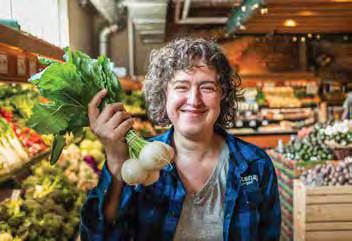


Campbell has an impressive resume. She is an Associate Professor Emerita, Drama, from the School of Creative and Performing Arts at the University of Calgary. She leads workshops and retreats combining her decades of experience in theatre and in movement modalities. “I have recently been referred to as a Shakespearean scholar, because of Lovers and Liars,” she says, “but that’s not exactly what I am. I am a theatre artist and movement educator.”
Campbell was invited to join the drama faculty at Calgary as a movement specialist because of her background, having developed
ARTICULATE 25 BARD IN THE GARDEN argenta gardens TRUE LOCAL SPOTLIGHT your community-owned grocery store 777 BAKER STREET, NELSON OPEN DAILY 8AM-8PM www.kootenay.coop eat well. be well.
The Shakespeare by the Shore cast take a curtain call.
Inset: Val Campbell is an enthusiastic teacher, director and theatre advocate.
Photos: Art Joyce
BARD IN THE GARDEN


a movement training curriculum for actors that she taught for 20 years. “Some people see me as a yoga teacher, some as an actor, some as a director. What I was doing,” she says, “was synthesizing all these kinds of things.”
“There was always a Shakespearean component and a whole raft of explorations. I emphasized incorporating a physical aspect to embody what we were presenting.”
She co-founded and for four years ran the Rocky Mountain Shakespeare Company in Lake Louise, a professional equity company. While they had tremendous community support, working in a national park proved to be complicated and often challenging. She persisted because it was her passion. “I did that so I could do Shakespeare.”
She also worked for several years with a group called MOMO, a mixed-ability dance theatre company. Product was inconsequential in this circumstance. The experience of doing theatre was the essence and the joy engendered in the process was inspirational.
“What I love doing,” she says, “is teaching. With teaching, I can give people the opportunity to express themselves. In my ideal world I would be doing weekly classes: people moving, creating.” Her arrival here, however, coincided with COVID, so she had to go “underground” for a while. She is finally happy that doing Shakespeare here has introduced her to the community and the community to the idea that theatre, and Shakespeare in particular, is for everyone.
“Shakespeare is about storytelling,” she says. “Unfortunately, people feel they have to be ‘smart’ to understand it. But kids just get it.” She points out the Elizabethan culture was an oral culture. Monastics and intellectuals could read books, but the common people’s experience was “We will hear this play.” She believes that fact was reflected in the show at the Kohan. “We proved it was pretty much accessible to anyone, both the actors and the audiences.”
“It does something to me when I get to speak that language. It changes me,” she says. “There’s an embodied sense of understanding. Something in me has to lift in order to do that. It’s bigger than my pedestrian life. Theatre people are privileged to perform Shakespeare but everybody who is drawn to it could be doing it.”
Campbell will lead two Saturday workshops entitled “Playing with Shakespeare” at Oxygen this fall on October 21 and 28. And she is already thinking about what to do with the Bard next year. Almost everyone who was involved in this year’s show is enthusiastic about being involved again. As well, she says that “Martina and Marya are keen to keep theatre culture alive here. And so am I.” She encourages people to think about joining in.
“Theatre has always been about collaboration,” she says. “I know there are people hiding out here who have incredible things to offer.”
THE PERFORMANCE SERIES


REVELSTOKE PERFORMING ARTS CENTRE STARTING OCTOBER 6, 2023
“Arts Revelstoke proudly presents a professional and diverse lineup of talent at the Revelstoke Performing Arts Centre. Join us this fall for The Performance Series—an enriching journey through theatre, music, films, discussions, and family events from October to December. Celebrate creativity, cultural experiences and connection at the Revelstoke Performing Arts Centre.”

REIMAGINING FIRE: THE FUTURE OF ENERGY
Durvile & UpRoute Books
May 2023
Review by Margaret
Tessman
“We need stories by the fire—essays, poems, art, fiction, all of it— to help guide and inspire us.”
—Chris Turner, author of How to Be a Climate Optimist
Eveline Kolijn is a visual artist, mainly working in printmaking and digital media, with a focus on biodiversity and climate change, specifically as they relate to marine life. With her 2020 project, Tidelectics, she followed in the tradition of print portfolio production with a collaborative letterpress work of essays and images. Kolijn lived in Curaçao in the Caribbean, where she connected with marine biologists and other printmakers, who shared their expertise in the creation of the portfolio.

“I decided I would like to do the same thing in Alberta, but looking at the regional energy transition sector,” says Kolijn. The result is Reimaging Fire: The Future of Energy, a portfolio and book that bring together science and art to examine topics

related to climate change, the oil industry and transitional energy.
Kolijn is a fellow with the Energy Futures Lab (EFL), a member of the Natural Step Canada network, a non-profit that fosters cross-sector initiatives and advisory services supporting the integration of sustainability within organizations. Natural Step describes itself as “part of the ‘radical middle’ in Alberta.” The organization works toward energy transition in a feasible way by engaging government, oil companies, academics and entrepreneurs.
Kolijn pitched her portfolio premise to the EFL of using art as a different angle from which to look at the issues, and secured funding for the project from them and the Alberta Foundation for the Arts. Her first step was to put out a call for submissions via her networks. She eventually narrowed the contributors to 20 printmakers, who were paired with 20 specialists who would each write a one-page essay.
ARTICULATE 27
Eveline Kolijn, Transition Prism, constructed etching.
Zoom meetings during the spring of 2020 introduced the contributors to their colleagues but getting 40 people together working electronically was an impossibility. Kolijn instead asked the writers to do a short presentation on their areas of expertise and “everyone started creating,” she says. “I created a rigorous framework for the process but within that contributors were free to do what they wanted.”
The artists experimented with an eclectic mix of subject matter and media including fabric, 3D construction and plastic for their prints, while the writers produced multifaceted stories that went beyond just fossil fuels and transitional energy and into the impacts on fish, water and soil. One ecologist in the group knew a publisher, Lorene Shyba, who was interested in turning the portfolio into a book. Kolijn submitted a proposal, which would expand the written sections. “I suddenly became an editor,” she says. “I asked for help and feedback from the authors. It was hectic, but we got it done.”
Jessica Semenoff is an emerging artist living and working in Calgary whose work is included in the portfolio and book.

A nature-based artist originally from Rossland, Semenoff has produced commissions for murals in Fernie, Trail and Kimberley. “Living in the Kootenays inspired my love of nature,” she says.
Semenoff responded to the call for submissions for the project and was paired with a writer who sent her a number of poems. “I chose one that resonated with me about fish in the Athabasca
ART GALLERY
River.” She was given the opportunity to speak to individuals in the environmental industry about toxins and the ability of the environment to heal itself. The result is “Cycle of Healing,” an eight-layer screen print.
The 13-by-19-inch portfolio prints and one-page essays were produced in a small run: one for each artist, two to circulate for gallery shows and two to cut up and assemble into folders each writer received, containing an original print, relevant text, portfolio cover and author bio page. VISAC Gallery in Trail will host an exhibit of the prints in March, and copies of the book will be available for sale.
Kolijn hopes that the book can be “a small drop to raise awareness and educate. People are afraid that there are no other options for Alberta beyond oil and gas and no one is trying to get a good dialogue going. We should panic, but not believe that there’s nothing to be done. The middle ground is the interesting ground versus denialism and uncertainty.”
Check visacgallery.com for the upcoming exhibition schedule.
28 FALL/WINTER 2023–2024
Winter Group Show Nov.16, 2023 to Jan.20, 2024.
NEW & NOTEWORTHY
Jessica Semenoff, Cycle of Healing, screen print, 13x19 inches.
Photos: Eveline Kolijn
A REAL SOMEBODY
DERYN COLLIER

Lake Union Publishing
July 2023
When Nelson writer Deryn Collier’s great-aunt June Grant died in 2014, Collier inherited what remained of her belongings, including some 20 boxes of books, papers, diaries, radio scripts, photo albums and letters. The papers became both a responsibility to be preserved and an inspiration for Collier’s new novel A Real Somebody. Set in post-WWII Montreal, the book centres on June Grant, who lives at home with her parents and is the sole breadwinner for the family. Like the real Aunt June, the fictionalized character works as a stenographer at an advertising agency but has the creativity and skill to become more. In an early scene, June is ordered by her boss to attend an Eaton’s department store fashion show and take notes on what she sees. Although her contributions are co-opted by a male co-worker, it’s clear where June’s future lies. Aunt June went on to have a 40-year career as an ad copywriter, a rare feat for a woman at the time.

Collier has fictionalized the rest of her family’s history (her great-aunt Daisy is the basis for the beautiful, troubled sister) to create tense subplots involving the darker side of ambition, greed and duty. Daisy’s secretive other life beyond wife and mother is a mystery that June is driven to unravel. With its evocative setting and well-drawn cast of characters, A Real Somebody shakes up traditional expectations of women, work and family and is a darn good sleuth tale, to boot.
Deryn Collier is the author of the Bern Fortin mysteries Confined Space, nominated for a Best First Novel Award by the Crime Writers of Canada, and Open Secret. deryncollier.com
BIG TREES OF THE INLAND TEMPERATE FORESTS OF BRITISH COLUMBIA

TERRY NELSON
Self-published 2022
Fernie author Terry Nelson’s field guide to big trees is a compilation of his outdoor adventures over a five-year period. The book is organized by region, with a bit of background on the various areas, directions to the big tree trails and descriptions of the trees themselves. Full-colour photos of the big trees hint at the majesty and magnitude of these incredible forest giants. I like that Nelson includes personal anecdotes about his hikes and what he encountered, including early spring snow, wildflowers and native plants, bears and sketchy terrain. He acknowledges the many individuals who contributed to the book, including foresters, naturalists, conservationists, big tree hunters and others who provided guidance and inspiration.
[ABOUT]NESS
EIMEAR LAFFAN
McGill-Queen’s University Press
September 2023
volume 81 in the Hugh MacLennan poetry series
Nelson poet Eimear Laffan’s language takes visible breaths. Forward slashes become rhythmic inhales and exhales on the page as she weaves words in her examination of self, God, mountains and insomnia. a field of grit rests beneath my prone consciousness / the moon does not think to seduce me / is a life redeemable I ask / why do I lack the proficiency / to say I would not cash it in / exchange my receipt for another torn piece of paper // over and over I wake to a pre-dawn snow / over and over I make the mistakes I denigrate / cold and if interior were assigned a colour / unequivocal blue Sometimes, phrases are arranged on the page in visual puns; sometimes, Laffan name drops (leading the reader to Google for context, at least in my case) to introduce others’ points of view. From Wittgenstein (the world is what we make of it) to Twin Peaks agent Dale Cooper (who is possessed by Killer Bob), Zbigniew Herbert (Polish poet and anti-communist) to the Punjabi song Tum Hi Ho (you are my world), Laffan’s affinity for the darker side is evident. Her search for meaning and purpose in her life opens the doors of longing and skepticism but, as Wittgenstein writes, “the world we see is defined and given meaning by the words we choose.”
Laffan’s prose poem, “My Life, Delimited,” was a finalist for the Bronwen Wallace Emerging Poetry Prize in 2022. [about]ness is her first book.
Nelson’s study area extends into the upper reaches of the Robson Valley in the north, the Cascade Highlands in the west, the Rocky Mountains in the east and along the Canadian border to the south. He says that an important inspiration for writing Big Trees was to help broaden public awareness for the need to protect and preserve B.C.’s ancient trees and forests. “My hope is that the book becomes the road trip companion for the readers, and they too can become immersed, as I have, in the offerings that only an old-growth forest provides.”
Whether a well-seasoned outdoors buff, a curious child or a nature-deprived urbanite, the book should appeal to anyone who recognizes that the natural world is what sustains the healthy wellbeing of the planet and its inhabitants. The trees and forests of the B.C. Interior surround us all, so why not have a look inside and let this gorgeous book be your guide? Stay posted for upcoming Big Tree talks this fall. bigtreesbc.com
ARTICULATE 29
NEW & NOTEWORTHY
Reviews by Margaret Tessman
PLEASE DO NOT TOUCH THE INTELLECTUAL PROPERTY
by Barbara Maye
There is nothing quite like that sinking feeling when we realize something has been taken from us. People say they feel violated walking into their home after it has been robbed, and that is exactly what it feels like when we see a blatant copy of our art. Our special style or series of pieces that took years and frankly, tiny bits of our soul to nurture into a unique and definitive body of work—suddenly not ours anymore?
Besides the shock, hurt and confusion that we feel, there may also be fear around talking about it. It’s kind of a sensitive subject, an elephant in the room with wavy lines around it. Are they intentionally copying us? Does anyone else see it? How will we be perceived for even pointing it out?

Obviously, the first thing to do is to talk to the person who we feel is copying our art. Maybe there is some misunderstanding, or maybe they don’t realize that they are hurting us. So yes, we need to have that difficult conversation setting our boundaries. We can still encourage them to create, nudge them into their own direction by highlighting their strengths, even offer to guide them. But what if, after being very clear and encouraging, even after expressing our hurt and disappointment, they continue copying us anyway?
Well, there is actually a lot we can do about it, starting with understanding our rights. CARFAC (Canadian Artists’ Representation/le Front des artistes canadiens) is a non-profit association started by artists for artists. Their mission statement reads in part: “We believe that artists, like professionals in other fields, should be paid for their work and share equitably in profits from their work. As the national voice of Canada’s professional visual artists, CARFAC defends artists’ economic and legal rights and educates the public on fair dealing with artists.”
Their deliciously informative website, carfac.ca, offers insights and workshops, including an article entitled Know Your Copyrights, where they make pretty clear the rights of authors of artistic works. Essentially, in Canada, “an artist’s original work [or body of work] is automatically protected once it is created” and your copyright continues even after your death. Another amazing resource is the Artists Legal Outreach Clinic (ALO, artsbc.org/alo-clinic), administered by Arts BC. Based
in Vancouver, the ALO Clinic is run by a team of volunteer lawyers and law students committed to working with artists and arts organizations. ALO offers free online or phone sessions for low-income artists in all disciplines, matching you with a knowledgeable and compassionate lawyer to discuss your specific situation and give summary legal advice (limited by resources, time and capacity).
Here are some suggestions and insights from these organizations:
• Figure out what the person is trying to get out of copying your work. Do they want to exhibit and sell? Are they lacking the confidence or guidance to trust their own creativity? Knowing their motive will help you know what steps to take.
• Don’t be afraid to tell people what is happening and how you feel about it. Find out how other artists handled the same situation if it has happened to them.
• Talk to galleries and venues. It is completely acceptable to ask if they will please not show work that is too similar to yours. Bringing the situation to their attention may inspire them to look at their policies, too.
• If you end up needing to talk to a lawyer, tell the person you did so and what you learned. Helping them understand that you are serious about protecting your art and standing up for your rights can lead to resolution.
• When all else fails, have the lawyer write them a letter. Be aware that this can come with a price tag and may lead further down the legal path.
Staying in our integrity during an emotional journey like this can be very challenging, but we can view it as a lesson in empowerment through speaking our truth and standing up for what is truly ours.
Taking something painful like the pinching of our intellectual property and turning it into something educational and hopeful for others can give the experience a better purpose, if we are strong enough to shift our perspective. There are always gifts in our most difficult journeys and this one is enriching the integrity, support, compassion and unity of our art communities.
Barbara Maye, BFA, is a multimedia artist, stone sculptor and art instructor who lives and creates on the unceded traditional lands of the Sinixt, which is also used and claimed by the Secwépemc, Ktunaxa and Syilx First Nations (Revelstoke, B.C.). barbaramayefineart.ca

30 FALL/WINTER 2023–2024
LAST WORD


ARTICULATE 31 DEAD MAN WALKING Saturday Oct 21 9:55am X: THE LIFE & TIMES OF MALCOLM X Saturday Nov 18 9:55am FLORENCIA EN EL AMAZONAS Saturday Dec 9 9:55am NABUCCO Saturday Jan 6 9:55am CARMEN Saturday Jan 27 9:55am LA FORZA DEL DESTINO Saturday Mar 9 9:00am ROMÉO ET JULIETTE Saturday Mar 23 9:55am LA RONDINE Saturday Apr 20 9:55am MADAMA BUTTERFLY Saturday May 11 9:55am Online seat booking is encouraged • www.royaltheatretrail.com 1597 Bay Avenue, Downtown Trail V1R 4B2 • Office (250) 231-5672 Doors open 30 minutes prior to showtimes

