◀ CONT'D | WINGS OF MANY ROOTS DIGITAL COLLAGE
DAIMARIS QUIÑONES RIVAS
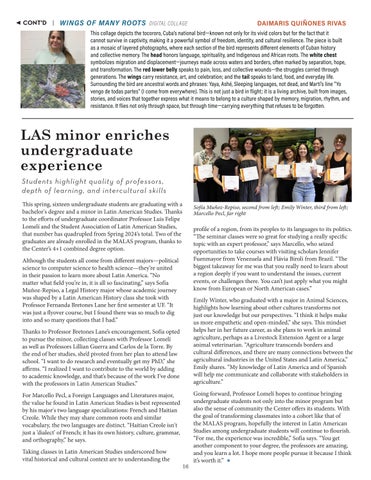
This collage depicts the tocororo, Cuba’s national bird—known not only for its vivid colors but for the fact that it cannot survive in captivity, making it a powerful symbol of freedom, identity, and cultural resilience. The piece is built as a mosaic of layered photographs, where each section of the bird represents different elements of Cuban history and collective memory. The head honors language, spirituality, and Indigenous and African roots. The white chest symbolizes migration and displacement—journeys made across waters and borders, often marked by separation, hope, and transformation. The red lower belly speaks to pain, loss, and collective wounds—the struggles carried through generations. The wings carry resistance, art, and celebration; and the tail speaks to land, food, and everyday life. Surrounding the bird are ancestral words and phrases: Yaya, Ashé, Sleeping languages, not dead, and Martí’s line “Yo vengo de todas partes” (I come from everywhere). This is not just a bird in flight; it is a living archive, built from images, stories, and voices that together express what it means to belong to a culture shaped by memory, migration, rhythm, and resistance. It flies not only through space, but through time—carrying everything that refuses to be forgotten.
LAS minor enriches undergraduate experience Students highlight quality of professors, depth of learning, and intercultural skills This spring, sixteen undergraduate students are graduating with a bachelor's degree and a minor in Latin American Studies. Thanks to the efforts of undergraduate coordinator Professor Luis Felipe Lomelí and the Student Association of Latin American Studies, that number has quadrupled from Spring 2024’s total. Two of the graduates are already enrolled in the MALAS program, thanks to the Center’s 4+1 combined degree option. Although the students all come from different majors—political science to computer science to health science—they’re united in their passion to learn more about Latin America. “No matter what field you’re in, it is all so fascinating,” says Sofía Muñoz-Repiso, a Legal History major whose academic journey was shaped by a Latin American History class she took with Professor Fernanda Bretones Lane her first semester at UF. “It was just a flyover course, but I found there was so much to dig into and so many questions that I had.”
profile of a region, from its peoples to its languages to its politics. “The seminar classes were so great for studying a really specific topic with an expert professor,” says Marcello, who seized opportunities to take courses with visiting scholars Jennifer Fuenmayor from Venezuela and Flávia Biroli from Brazil. “The biggest takeaway for me was that you really need to learn about a region deeply if you want to understand the issues, current events, or challenges there. You can’t just apply what you might know from European or North American cases.” Emily Winter, who graduated with a major in Animal Sciences, highlights how learning about other cultures transforms not just our knowledge but our perspectives. “I think it helps make us more empathetic and open-minded,” she says. This mindset helps her in her future career, as she plans to work in animal agriculture, perhaps as a Livestock Extension Agent or a large animal veterinarian. “Agriculture transcends borders and cultural differences, and there are many connections between the agricultural industries in the United States and Latin America,” Emily shares. “My knowledge of Latin America and of Spanish will help me communicate and collaborate with stakeholders in agriculture.”
Thanks to Professor Bretones Lane’s encouragement, Sofía opted to pursue the minor, collecting classes with Professor Lomelí as well as Professors Lillian Guerra and Carlos de la Torre. By the end of her studies, she’d pivoted from her plan to attend law school. “I want to do research and eventually get my PhD,” she affirms. “I realized I want to contribute to the world by adding to academic knowledge, and that’s because of the work I’ve done with the professors in Latin American Studies.” For Marcello Pecl, a Foreign Languages and Literatures major, the value he found in Latin American Studies is best represented by his major's two language specializations: French and Haitian Creole. While they may share common roots and similar vocabulary, the two languages are distinct. “Haitian Creole isn't just a ‘dialect’ of French; it has its own history, culture, grammar, and orthography,” he says. Taking classes in Latin American Studies underscored how vital historical and cultural context are to understanding the
Sofía Muñoz-Repiso, second from left; Emily Winter, third from left; Marcello Pecl, far right
16
Going forward, Professor Lomelí hopes to continue bringing undergraduate students not only into the minor program but also the sense of community the Center offers its students. With the goal of transforming classmates into a cohort like that of the MALAS program, hopefully the interest in Latin American Studies among undergraduate students will continue to flourish. “For me, the experience was incredible,” Sofía says. “You get another component to your degree, the professors are amazing, and you learn a lot. I hope more people pursue it because I think it’s worth it.” ◆