INSIDE: Law Seminar Photo Recap
Page 50



Insurance a top priority this year. 20 28


32 VISION AWARDS
Twenty individuals and companies honored for their achievements. EXECUTIVE CORNER
Are you truly a CEO?
2024
OF THE CALIFORNIA
Vision SPRING
THE VOICE
COMMUNITY MANAGEMENT INDUSTRY LEGISLATIVE UPDATE


Vision
THE
Spring 2024 • Vol. 33, no. 1
CEO tfreeley@cacm.org
| Thomas Freeley
| 949.916.2226, ext. 315
Chief Editor lbertrand@cacm.org
| Lynette Bertrand
| 949.916.2226, ext. 323
Advertising mhurtado@cacm.org
| Melissa Hurtado
| 949.916.2226, ext. 318
Contributor
Editorial Advisory Committee
Jeff Farnsworth, CAMEx, CCAM-PM.ND Steward Property Services, Inc.
Andrew Hay, CAMEx, CCAM-PM.ND
The Helsing Group, Inc., ACMC
Justin Sacoolas, CCAM Compass Management Group, Inc.
Lorena Sterling, CAFM Community Association Financial Services
| Dee Rowe, CCAM Scott Swinton, CCIP Unlimited Property Services, Inc.
Hamlet Vazquez, MCAM-HR Wilshire Terrace Co-Op
Kelly Zibell, CCAM Divergent Consulting Group
Vision Magazine is released digitally by CACM four times annually to members, industry partners and supporters of the California Association of Community Managers.
Magazine content copyrighted 2024. All rights reserved. No part of this publication may be reproduced without written permission from CACM.
Opinions expressed by authors do not necessarily reflect the policies of CACM. Mention of any product or service does not constitute an endorsement by CACM. CACM assumes no responsibility for return of photos or art and reserved the right to reject any editorial or advertising materials. CACM does not assume responsibility for the accuracy of articles, events or announcements listed.
Please address comments and suggestions to:
California Association of Community Managers, Inc. 23461 South Pointe Drive, Ste. 200, Laguna Hills, CA 92653 949.916.2226 | communications@cacm.org


Attention CACM members: Have you changed jobs or moved to a new location?
Reach out to us at communications@cacm.org to update your profile so you don’t miss your next Vision magazine or any other important CACM communications.


2 Vision Spring 2024 | cacm.org
VOICE OF THE CALIFORNIA COMMUNITY MANAGEMENT INDUSTRY
Do we know where you are? Follow us and stay up-to-date on industry news and info! Follow @CACMchat CHOOSE FROM THESE FORUM LOCATIONS SPRING REGIONAL FORUM ASK THE EXPERTS PRICING CACM Manager Member EARLY $45 REGULAR $55 WALK IN $65 CACM.ORG/EVENTS/SPRING-FORUMS-2024 EAST BAY LUNCH May 14 REGISTER NORTH BAY LUNCH May 15 REGISTER SACRAMENTO BREAKFAST May 16 REGISTER ORANGE COUNTY LUNCH May 21 REGISTER LOS ANGELES LUNCH May 22 REGISTER SAN DIEGO LUNCH May 23 REGISTER COACHELLA VALLEY BREAKFAST May 30 REGISTER Internal Dispute Resolution (IDR) and Alternative Dispute Resolution (ADR) are great tools to minimize conflict and find resolution between associations and homeowners. When should community managers choose one over the other and what are the differences? The forum will define each process and how to successfully use these tools to minimize litigation and legal fees. Examples and anecdotes provided as part of the discussion. Join us for breakfast or lunch and ask your most pressing questions of our industry experts during micro sessions. Attending industry partners will be on hand to discuss key issues and solutions. Note: MCAMs, CCAMs, & CAFMs earn 2 CEUs Effective Mediation Strategies and
to
When
Use Them

features
What “A Grand Adventure” it was! Thanks to all who participated in our 2024 Law Seminars. Check out our photo galleries on pages 50-53.


EDUCATION SPOTLIGHT:
REACH NEW HEIGHTS WITH THE MCAM
By Debbie Griffiths, Director of Education & Credentialing
WHY HOA FINANCIALS MATTER:
THE PERILS OF CARRYOVER LOSSES
By Jeff Farnsworth, CAMEx, CCAM-PM.ND
VISION AWARDS:
TOP PERFORMERS RECOGNIZED
THE EXECUTIVE CORNER:
ARE YOU TRULY A CEO?
By Adam Balkcom
TACKLING THE AGING PROCESS IN HOAS
By Scott Swinton, CCIP
THE CORPORATE TRANSPARENCY ACT:
WHAT YOU NEED TO KNOW
By Kelly Zibell, CCAM
ROOKIE MANAGERS’ SURVIVAL GUIDE
By Lorena Sterling, CAFM
HOW TO EFFECTIVELY MANAGE YOUR BOARD MEMBERS
By Andrew Hay, CAMEx, CCAM-ND.PM
PROACTIVE PLANNING: A GIFT TO FUTURE YOU
By Justin Sacoolas, CCAM
IS IT TIME TO RIGHT-SIZE YOUR ASSOCIATION’S DUES?
By Eric Churchill
BUILDING STRONG TEAMS WITH A STAFF MAINTENANCE STRATEGY
By Anne Lackey
LOCAL EVENTS
NORTHERN CALIFORNIA
SOUTHERN
cacm.org | Vision Spring 2024 3
news bits Members in the News You Said It Congratulations Managers & Industry Partners California Legislative Update New Individual Managers & Management Companies New Industry Partner Members Thank You Sponsors 6 14 17 20 22 27 56 4 12 54 CEO’s Message From the Roundtable Course Calendar departments
cover
in this issue
on the
PHOTO GALLERY
LAW SEMINAR HIGHLIGHTS
CALIFORNIA LAW SEMINAR HIGHLIGHTS 18 24 28 32 34 37 38 40 42 44 46 48 50 52 46 50 32

CEO’s message
Insurance? Are we talking about Insurance? How can I, leading an organization that advocates for managers and management companies, NOT be talking about insurance when every manager in the CID business is dealing with this crisis in California. The hard reality is there is no easy or quick fix. But that certainly doesn’t mean we suck it up and do nothing. So, we’re starting with a conversation.
The FAIR Plan has had a surge of new policyholders, thereby increasing the plan’s exposure to a level where it would be impossible to pay claims without imposing assessments on millions of policies. I don’t think anyone would argue that the FAIR Plan needs changes.
At the 2024 Executive Leadership Summit (ELS) in April, we’re going to talk to Juliana Svetlana Juarez, Director of Community Outreach with the California Department of Insurance (CDI), about potential changes to the FAIR Plan and what regulations Commissioner Ricardo Lara is planning.
That conversation will be followed by a conversation with the CEO of the California Building Industry Association, Dan Dunmoyer, who sponsored a proposed bill, AB 2996, carried by Assemblymember Alvarez (D-San Diego), that proposes to legislatively make changes to the FAIR Plan if passed. In my continuing effort to work with CAI-CLAC, Kieran Purcell, the Co-Chair of CLAC and attorney with Epsten Law, will join this conversation. Lastly, it would be awkward to have a conversation about insurance without a top-notch insurance broker, so Charlotte Allen with Socher Insurance will also be joining us.
Interested in the legislative process or this particular proposed bill? The current Bill Tracking report can be found on our website along with a copy of this proposed bill
As THE advocate for managers and management companies, our team and your Board of Directors understand your challenges. The CACM Board of Directors are all managers and management company executives working directly for managers and management companies. Our goal, and candidly this should be a universal goal, is to not only elevate the professionalism and success of managers, but to advocate in Sacramento to influence and impact policy and legislative issues that affect you, managers.
Interested in the legislative process and want to get involved? Email me at tfreeley@cacm.org. Managers play a major role in establishing and maintaining CACM’s position on bills and furthering CID management policy. I encourage you to be part of the process.
More to follow, for sure. I look forward to the opportunity to see you soon!
Respectfully,
 Thomas Freeley, CAMEx, CCAM CEO of CACM
4 Vision Spring 2024 | cacm.org


cacm.org | Vision Spring 2024 5 MANAGEMENT COMPANIES We are your best risk management asset CID Insurance Programs has successfully helped CACM Members with insurance & risk management protection for more than 23 years CACM Sponsored Insurance Programs f E&O Professional Liability f Employment Practices f Cyber Theft & Liability f Master Fidelity f Directors & Officers Liability f Business Office Insurance f Workers’ Compensation f Third Party Discrimination Phone: (800) 922-7283 Email: insurance@cacm.org www.cidprograms.com Don’t let business challenges bring you down...
members in the news

Riley Pasek Canty Welcomes New Law Clerk
Brandon Kanner recently joined Riley Pasek Canty (RPC) team as a Law Clerk. He’s spent the last 15 years advocating for community associations, ultimately inspiring Kanner to pursue a legal career. In addition to his work at RPC, he also sits on the Board of Directors of WESTCON, an organization that shares construction expertise and knowledge so that all may benefit.
Alana Walker Promoted at Reconstruction Experts
Recently, Teresa Agnew at Reconstruction Experts (RE) announced the promotion of Alana Walker to Senior Account Manager. While RE has over 40 Account Managers nationally, there are only a handful of Senior Account Managers. That makes this promotion a huge deal! Congratulations!

Lisa Triplett is Now President at Bay Area Property Services
In case you missed it, Bay Area Property Services (BAPS) recently promoted Lisa Triplett, CAMEx, CCAM, to President, replacing Founder Michael D. Porter. Triplett has big shoes to fill in carrying Michael Porter’s legacy forward, but we know she will be successful. Please join us in congratulating her on this promotion.

Heritage Bank Celebrates 30th Anniversary
Heritage Bank of Commerce (HBC) opened its doors at its first location in downtown San Jose in 1994. In 2024, 30 years later, HBC continues to serve the banking needs of local businesses, including homeowners associations. The company now has 17 locations across the San Francisco Bay Area. Heritage Bank focuses on investing in neighborhoods, giving back to communities, and supporting nonprofit organizations like CACM, of which it has been a member since 2008.

6 Vision Spring 2024 | cacm.org
Brandon Kanner
Lisa Triplett
Alana Walker
Silvercreek Association Management Shares Exciting News
Kimberley Flickner, CCAM-PM.LS.ND.AA.CID.LM, recently joined the Silvercreek family as the new Executive Director of Community Management. With over 17 years of experience in community association management, Flickner has the knowledge and experience to do well in this new endeavor. Her track record shows she excels at everything she does, from budgeting to managing a portfolio to leading a team. A volunteer instructor for CACM, Flickner also teaches many courses and often speaks at CACM educational events.
members in the news


New Faces and an Anniversary at Varsity Painting
There is exciting news at Varsity Painting. The company recently announced a new Marketing and Business Development Director - Larry Mellberg. Mellberg comes to the company with over 20 years of experience in business development and marketing. Varsity also welcomed Greg Morgan as Director of Client Success. Morgan has more than 25 years under his belt in the paint industry specializing in the property management side. Their expertise will undoubtedly contribute to the growth and success of the company. In addition to welcoming these two aboard, the company also is celebrating Mandi Newton’s 17 years with the company. She recently became a California Certified Industry Partner (CCIP) through CACM.
cacm.org | Vision Spring 2024 7
Kim Flickner
Larry Mellberg
Mandi
Newton
members in the news
Former Hollywood Producer Joins Seabreeze
Seabreeze Management Company announced new leadership for its Los Angeles region. Barry Tropp has been appointed as Vice President, overseeing the Los Angeles team. Before joining the community management industry, Tropp was in the film industry, producing movies for networks like Lifetime and Nickelodeon. Seabreeze’s CEO, Isaiah Henry, had this to say, “We are always looking to add incredible leaders to our team, and it was an easy choice to bring Barry on board.”

Alliance Association Bank Promotes
Katherine Young
Katherine Young has been promoted to Managing Director of Sales Operations & Marketing at Alliance Association Bank She has 35 years under her belt as a leader in the HOA banking industry and was part of a team that pioneered one of the first association banking programs in the country. “We are excited to see her take on this new role,” the company said.
Epsten, APC Adds Two to Team

Epsten APC ’s Board of Directors announced that Joe Sammartino was appointed Co-Chair of the Litigation Department. He litigated civil cases on behalf of and against major international companies and defended clients in state and federal courts throughout California and the United States. In addition, the firm also welcomed attorney Hannah I. Hughes as a Litigation Associate in the San Diego office. She focuses on civil litigation and provides a client-centered approach.


Baby News!
Congratulations are in order! Leala Oulalla of Action Property Management recently blessed with her third grandchild, Mason Wade Price. Born on January 15, he weighed 6 pounds and 1 ounce and measured 19 inches long. Isn’t he adorable?

8 Vision Spring 2024 | cacm.org g
Joe Sammartino
Katherine Young
Barry Tropp
Baby Mason


cacm.org | Vision Spring 2024 9 • Treasury Services • Web-Based Payment Portal • Integration Services • Operating and Reserve Accounts • Local Lockbox Processing • HOA Loans • Placement Services for Excess Reserves Your HOA Banking Specialist Give us a call today 844.489.0999 A Dedicated HOA Department Here For You Supporting Members of: www.HeritageBankofCommerce. bank Member FDIC
members in the news
A.J. Jahanian Makes Partner
Congratulations to A.J. Jahanian, Esq., on recently becoming Partner at Beaumont Tashjian. For more than 40 years, Beaumont Tashjian has provided common interest developments with the legal expertise and tools necessary to effectively safeguard and serve their communities and members. The firm represents common interest developments throughout California in all aspects of community association and real estate law. Jahanian is a frequent author for CACM’s Law Journal and also a speaker at CACM’s Law Seminar.


CM Squared Adds to Two to Team
CM Squared has expanded its team in Northern California with the addition of two new hires. Cynthia Heskett joined the company as VP of Client Relations, bringing with her over 30 years of experience in the industry, including 10 years as the Executive Director of Business Development for a large management firm. Meanwhile, Reggie DuPee has been appointed as Business Development Manager. DuPee played in the NFL for a few years before acquiring 20 years of experience in rental property management and residential remodeling.


fMore Baby News!
CINC Systems has a new boss: National Director of Sales Sarah Bloomberg’s baby girl, Ray Bloomberg. She arrived on January 16 weighing 8 pounds and 4 ounces and measuring 18.5 inches long. Parents report that she’s a bit needy but cute enough that they don’t mind. Welcome to the world, Ray Bloomberg!
10 Vision Spring 2024 | cacm.org
g
Cynthia Heskett
Reggie DuPee
A.J. Jahanian
Ray Bloomberg
Promotions and Record Growth at Powerstone
Powerstone Property Management, ACMC recently announced record personnel growth for the 12th consecutive year, adding 77 new staff and 82 clients in 2023. The company celebrated its 30th year in business in 2023 and is approaching nearly 300 employees.
Powerstone also announced a slew of internal promotions. Larisa Feng, Christine Fallon, and Connie Kozlowski were promoted to Senior Associate Managers. At the same time, Heather Oliveira became an Assistant Director of Associate Management, and Brittany Haack and Marie Wigler moved up to Directors of Associate Management.
Soon after, Kaycie Lambright, Wendy Miller, and Sarah Basko also received the Director of Associate Management title. But Powerstone still wasn’t finished! Kylie Decker, Karina Reta, and Elva Gonzalez moved up to Executive Directors of Management Services to complete this wave of promotions.
Congratulations to all!

cacm.org | Vision Spring 2024 11
in
news
members
the
Kylie Decker
Elva Gonzalez Karina Reta
Kaycie Lambright
Wendy Miller
Sarah Basko
Brittany Haack
Marie Wigler
Heather Oliveira
Larisa Feng
Christine Fallon
Don’t see your news listed? Update us at communications@cacm.org
Connie Kozlowski
from the roundtable
A MESSAGE FROM THE BOARD
As I sit down to write this article, I am thinking just how quickly the seasons are changing. We are already releasing the Vision Spring edition for 2024 and it feels like I just completed the article for the Winter edition of 2023.
This issue of Vision magazine focuses on “Operational Best Practices.” Margaret Rouse, writer for TechTarget, defines a best practice as a “technique or methodology that, through experience and research, has proven to reliably lead to a desired result. A commitment to using the best practices in any field is a commitment to using all the knowledge and technology at one’s disposal to ensure success.”
Finding one’s way to their choice and use of best practices is part of the experience that we attain through industry training, mentors, industry partners and peers. There is consistent change that requires us to stay engaged in the learning process but also for us to embrace the unknown.
Thinking back not too long ago, at least it feels that way for some of us, our method of communications were landline phones, mailed letters, and beepers strapped to our sides. Today we are looking at advancing to AI communication processes, constant emails, texts, and adding our computer (cell phone) strapped to our sides. As you begin to develop and change your operational best practices, it can lead to a more consistent work product, greater efficiency (time management, quality of life) and increased job satisfaction.

This edition of Vision magazine has several feature articles about best practices including how to formulate a long-term maintenance program for aging condos; tips to succeed as a rookie community manager; ideas on how to keep your board members engaged and organized; HOA financial management pitfalls and how to avoid them; the importance of calendars and planning for association management; and how to build stronger, more effective teams. This issue also includes the latest update on the Corporate Transparency Act and what it requires from community associations.
As always remember to embrace the journey, trust the process, and never stop learning!

12 Vision Spring 2024 | cacm.org
CACM Board Chair

cacm.org | Vision Spring 2024 13 First, we ask the right questions to be er understand your HOA’s needs. Then we develop a customized security plan that is right for your HOA. After all, it is about delivering on our promise to provide the best possible security services for your community. That’s Peace of Mind for everyone. Contact us for a quote today. 877.498.8494 | TeamSignal.com Reliability at the Ready


MEMBERSHIP
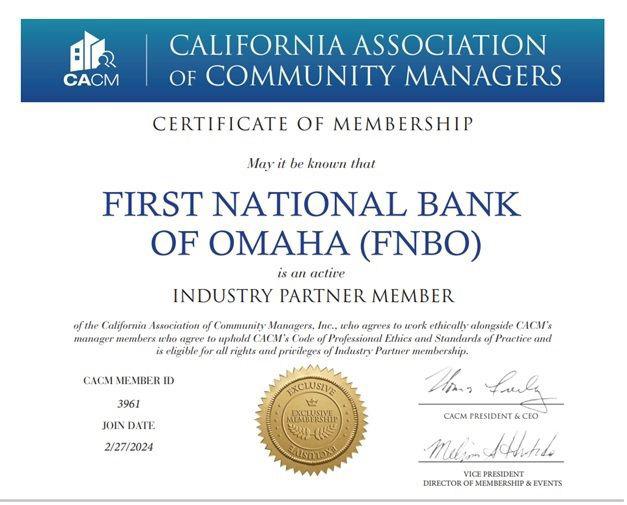
Thrilled to announce that we’ve recently joined California Association of Community Managers (CACM)! �� As someone deeply passionate about the association industry, I couldn’t be more excited to become a part of the CACM community.
CACM is renowned for its commitment to heighten the professionalism and success of California Community Association Managers. Joining this organization presents an incredible opportunity to connect with likeminded professionals, stay updated on the latest industry trends, and contribute to the advancement of our industry.
I’m looking forward to engaging with fellow members, sharing insights, and collaborating on projects that will drive innovation and excellence in our industry.
If you’re also a member of CACM, I’d love to connect and exchange ideas. And if you’re not yet a member, I highly encourage you to explore the benefits and consider joining this vibrant community!
Here’s to new beginnings and exciting opportunities ahead!

#NewMember #IndustryLeadership #Networking
— Kris Gjylameti, First National Bank of Omaha
SOCAL LAW SEMINAR
Reflecting on the incredible experience at the CACM SoCal Law Seminar & Expo last week! Huge shoutout to the dedicated team at CACM for orchestrating such an enriching event. Grateful for the chance to learn, network, and collaborate with fellow industry professionals. Looking forward to more opportunities to elevate our HOA communities together! #CACM #ACT #AdvanceConstructionTechnology #AGrandAdventure
— Tiana Fernandez, Director of Business Development at Advance Construction Technology
This was one of the best law seminars and expos that I have attended. All of the presentations which I attended were well worth it and covered lots of material.
Food was great and of course the location was perfect!! Good job to all who organized and coordinated the event.
My sincere thanks for a job well done! — Cheryl Leonard, Senior Community Association Manager, N.N. Jaeschke, Inc. – An Associa Co.

It’s with immense pride and gratitude that we reflect on the recent CACM Southern California Law Seminar & Expo 2024. This event brought together some of the brightest minds in community management, and we at Whitestone Industries were thrilled to be a part of it.
We’re humbled and honored to share that Whitestone Industries was awarded the Company Culture Award at this prestigious event. This recognition is a testament to our team’s unwavering commitment to fostering a positive, collaborative, and innovative work environment.
A heartfelt thank you to CACM for this incredible honor, and for organizing an informative and engaging seminar. The
insights shared and relationships forged will undoubtedly shape the future of community management.
To everyone who stopped by our booth to learn more about our services, from painting to stucco repairs, renovations, and beyond, thank you. Your support continues to motivate us to strive for excellence in all that we do.
Looking forward to next year’s seminar and the opportunity to continue learning, growing, and serving our communities.
#CACMSoCal2024 #CompanyCulture
#CommunityManagement #WhitestoneIndustries — Genaro Dacayanan, Account Executive, Whitestone Industries
14 Vision Spring 2024 | cacm.org yousaid
Follow @CACMchat
it!

What a fun CACM SoCal Law Seminar & Expo!

I’m so proud of my recent California Certified Industry Partner (CCIP) designation and was thrilled to walk the stage on Friday morning for the Oath Ceremony alongside the other amazing industry partners who achieved their designations as well.
That wrapped up the CACM SoCal Law Seminar & Expo this week. Feeling grateful to the staff at CACM that put this together, and the attendees for stopping by. This was an amazing few days with valuable learning sessions, elevated networking with vendor partners and decision makers at some amazing management companies!
Congratulations to our raffle winners Brandie Series from Next Step Community Management and Rocky Orozco from Property Advantage

These events provide meaningful opportunities to connect with the best
Taking home an award for our Behr Paint Company booth was another highlight of the event. Thanks to everyone who came out to support us!

#lifeatbehr #makelifemorecolorful #exteriorpainting #industryleadership #tradeshowsuccess #sclse24
— Bridget Nigh, CCIP, Behr Paint


of the best that take the time to learn and care for our beautiful HOA communities . I’m truly excited to be a part of CACM and future events.
#CACM #SCLSE24 #AGrandAdventure #SoCal #anaheimconventioncenter #ColumbiaHOAbanking division of #UmpquaBank #HOAexperts #HOAlender #HOA #HOAbanking #CID #AssociationBanking #Banking #CaliforniaBanker — Mary M., Columbia Homeowners Association Banking

NextStep SoCal team had a great time at the CACM SoCal Law Seminar. Thank you to CACM, sponsors and exhibitors. We made some new connections, continued our education and had a fun time doing it.
#SCSLE24 #agrandadventureCACM
— Next Step Community Management


cacm.org | Vision Spring 2024 15
it!
yousaid


16 Vision Spring 2024 | cacm.org This exclusive event is designed for management company decision makers. The collaborative atmosphere provides executives with the freedom to discuss challenging issues in an effort to find creative and collective solutions for the future of our industry. A Must-Attend For Management Company Decision Makers GUEST SPEAKER Julia Svetlana Juar ez Deputy Commissioner, Community Relations and Outreach California Department of Insurance The Meritage Resort & Spa | Napa, CA | April 25-26, 2024 CLICK HERE TO REGISTER CCAMs, CAFMS, and MCAMS Earn 6 CEUS for attending and CAMEx designees receive 5 points toward their annual recertification. Executive Sponsors THANK YOU SPONSORS Premier Session Sponsors Capital CS Group Socher Insurance Agency CINC Capital CINC Systems Enterprise Bank & Trust Epsten APC Fenton Grant Kaneda & Litt, LLP First Citizens Bank Gordian Business Solutions Heritage Bank of Commerce HOA Mailers J.J. Commercial Water Heaters Pacific Premier Bank Community Association Banking Pacific Western Bank Recon360, LLC Reconstruction Experts Sunwest Bank The Miller Law Firm Vantaca Vendor Information Verification Experts (VIVE) Whitney Petchul “The State of the Insurance Market” Keynote Sponsor Association Prime Powered by SouthState Bank Premier Sponsors Alliance Association Bank MindMe Technology
achieving professional excellence
Congratulations Managers & Industry Partners
It is with great pride that we recognize managers, and now industry partners, who have taken the next step in their professional career by pursuing advanced educational opportunities. Congratulations to our newest Certified Community Association Managers (CCAM), Certified Community Association Financial Manager (CAFM), California Certified Industry Partner (CCIP) and Specialty Certificate recipients for the period of November 3rd, 2023 through February 15th, 2024.
CCIP
Bridget Nigh, CCIP
Donna Vingo, CCIP
Elaine Gower, CCIP
Guillermo Amador, CCIP
John Rivera, CCIP
Jolen Zeroski, CCIP
Lorena Gomez, CCIP
Mandi Newton, CCIP
Mark Owens, CCIP
Megan Wright, CCIP
Scott Swinton, CCIP
Terin Reeder-Atkins, CCIP
Wendy B. Miller, CCIP
CCAM
Alejandra B. Neri, CCAM
Amber J. Andaya, CCAM
Angela Raffi, CCAM
Anika Porter, CCAM
Ann Sutcliffe, CCAM
Antoinette M. Medina, CCAM
Antonio Davila Cortez, CCAM
Ben Sloman, CCAM
Brian Gallegos, CCAM
Briana Shields, CCAM
Bruce Han Chung Chang, CCAM
Charlotte M. Banuelos, CCAM
Christina Dallenbach, CCAM
Christina Pacheco, CCAM
Christina Stevenson, CCAM
Ciara Preciado, CCAM
Daniel V. Alonso, CCAM
Darrell Muhammad, CCAM
Deanna N. Shelton, CCAM
Elisa Garibay, CCAM
Emily E. Krauss, CCAM
Emily M. Del Campo, CCAM
Gina M. Sordello, CCAM
Gina S. Bocage, CCAM
Helen Castro, CCAM
Ivonne N. Romano, CCAM
Jacquelyn L. Smith, CCAM
Jennifer E. Gomez, CCAM
Jennifer Weiss, CCAM
Jeroen Wright, CCAM
Jessica Lundgren, CCAM
Jessica M. Register, CCAM
Juanita A. Martin, CCAM
Kabir A. Nabi, CCAM
Keith Watts, CCAM
Ken Hicks, CCAM
Lacreasha A. Johnson, CCAM
Laura Amore, CCAM
Marcus H. Rivera, CCAM
Nicholas Z. Baratta, CCAM
Nicolas Gonzalez, CCAM
Pamm Birt, CCAM
Paradise Anderson, CCAM
Patricia J. Magdaleno, CCAM
Patrick C. Ryan, CCAM
Robert L. Morgan, CCAM
Roque Orozco, CCAM
Samantha Basham, CCAM
Sara R. Miller, CCAM
Sarah L. Zemer, CCAM
Seema Makwana, CCAM
Sheri-Jean Rodrigues, CCAM
Stephanie N. Hansele, CCAM
Susan C. Dawood, CCAM
Tara A. Gonyer, CCAM
Terry M. Oxford, CCAM
Tiana M. Dominguez, CCAM
Tina Parkin, CCAM
Tofuola Timoteo, CCAM
Veronica Nunez, CCAM
Victoria R. Thomas, CCAM
Wendy Lazcano, CCAM
CAFM
Cynthia Duffy, CCAM, CAFM
Juli Elliott, CCAM, CAFM
Sabrina Serrano, CAFM
Scott Newman, CCAM-LS.AA, CAFM
CAME x
Andrea Dunifon, CAMEx, CCAM
Tasha Parmelee, CAMEx, CCAM-PM
ACTIVE ADULT
Nicole Mulvany, CCAM-PM.ND.AA.CI
HIGH RISE
Jessika Rubalcava, CCAM-HR
Sajid Shabber, CCAM-HR.LS.ND
INDUSTRIAL CID
Nicole Mulvany, CCAM-PM.ND.AA.CI
Rick Rapp, CCAM-LS.CI
LARGE SCALE
Lynn Jensen, CCAM-LS Sajid Shabber, CCAM-HR.LS.ND
LIFESTYLE MANAGEMENT
Kimberley Flickner, CCAM-PM.LS.ND.AA.CID.LM
Vanessa Robertson, CCAM-LS.AA.LM
NEW DEVELOPMENT
Dawn Sims, CCAM-ND
Jeff Couwenhoven, CCAM-ND
Sajid Shabber, CCAM-HR.LS.ND
Victoria Ellis, CCAM-ND.PM
PORTFOLIO MANAGEMENT
Bradley Hay, CCAM-PM
Christina French, CAMEx, CCAM-LS.HR.PM.AA, CAFM
Cyndi Cochran, CCAM-PM
David Holbook, CCAM-PM
Victoria Ellis, CCAM-ND.PM
cacm.org | Vision Spring 2024 17
spotlight on spotlighteducation education

Elevate Your Career –It’s Time YOU
Earn the MCAM Designation
 By Debbie Griffiths, Director of Education & Credentialing
When you hear someone mention MCAM (Masters of Community Association Management), what immediately comes to mind? It’s not for me. It’s too hard to earn. Or perhaps you might not see how this prestigious designation could benefit you. Let’s debunk these thoughts.
1. It’s not for me.
Turn this statement around to “why not me?” Yes, it can be for you as long as you have held your CCAM and are in good standing for five years, then you should apply.
2. It’s too hard to earn.
Hmmm ... let’s look at this. You earned the CCAM, right? That meant you had at least six months of industry experience at the time of certification, took BAM (16 hours), the CA Law Series (16) hours, and Foundational Ethics (4 hours). In addition to attending these courses, you also took and passed exams for each of them. And, you continued to maintain your CCAM by taking other courses, including Ethics and attending a Law Seminar. Seems to me, that you already can do the “hard” things to earn a designation.
So what’s needed with the MCAM? Let’s take a look! You will need to have taken the following courses within three years of applying for the designation.
18 Vision Spring 2024 | cacm.org
BDA 300 – Fundamentals of Effective Governance
LDR 400 – Human Resource Management
LDR 550 – Ethics Mastery
INS 300 – Advanced Insurance Principles
INS 400 – Risk Management
FIN 320 – Strategic Financial Planning
There is a one hundred (100) multiple choice exam, as well as a written and oral presentation of a case study required to be completed within 180 days. The written paper should be, at minimum, twenty-five (25) pages and will address questions posed from a site visitation. You have 180 days, or six months, to complete the case study. With a manager’s busy schedule, this time frame to complete the process of writing your case study and conducting an oral presentation is quite fair and reasonable.
3. I don’t see the value in the designation
.
This statement leads me to wonder if you don’t value the designation or do you not value yourself enough to set yourself apart from the others? I suggest you ask an MCAM the next time you see one how earning the designation has benefitted them. As Hamlet Vazquez, MCAM-HR, who recently applied for a new position and was chosen because the recruiter, who saw his MCAM designation and highlighted it to the potential employer, was offered the position with a 30% compensation increase. Never sell yourself short as this could happen to you, too!
If you wish to be recognized as one of the leading community association managers in California, please visit the CACM website for more information and to apply or feel free to reach out to the Education Department at education@cacm.org. We look forward to seeing many of you earn this prestigious designation.
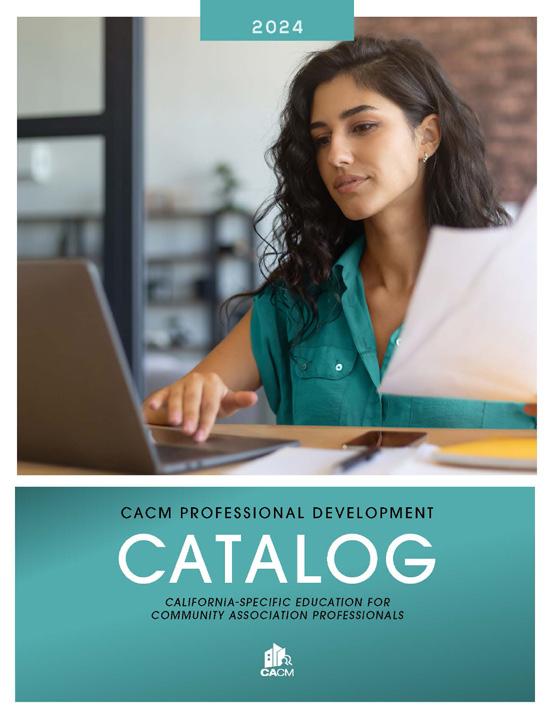
2024 Course Catalog Available
The 2024 Professional Development Catalog was released in January. Use this professional development guide to plan for certification, recertification or specialty designations in 2024. Every

Education Team Expands
Please help us welcome the newest addition to the Education Department, Korinna Peterson. She recently joined the team as Education and Credentialing Administrator. In this role she will oversee the logistics of scheduling and delivery of all CACM courses. This includes everything from scheduling sessions to securing course instructors to sending out course materials and conducting pre-source sessions with instructors and processing attendance and course survey data. You can reach her at kpeterson@cacm.org.
CACM course is included, as well as credits obtained, pricing and dates the course is offered. The catalog also explains each certification offered and the steps to attaining and maintaining it. Download it now.
cacm.org | Vision Spring 2024 19

INSURANCE COVERAGE A BIG FOCUS IN 2024
By Jennifer Wada, Esq.
Legislators in California introduced 2,124 bills in this year’s legislative session. Some of the bills focus on high-profile topics like artificial intelligence and retail theft. And, of course, a large number of them focus on housing affordability. As for legislation that directly impacts the management industry, here are some newly introduced key bills:
AB 2114
Irwin: Balcony Inspections
Current law requires the association board of a condominium project to conduct a visual inspection, by January 1, 2025, and at least every 9 years, of the exterior elevated elements for which the association has maintenance or repair responsibility. Current law requires the inspection to be conducted by a licensed structural engineer or architect. This bill would additionally authorize a licensed civil engineer to conduct the inspection.
AB 2159
Maienschein: Electronic Voting
This bill would authorize an association to conduct an election by electronic secret ballot unless the association’s governing documents provide otherwise. If an electronic secret ballot is conducted by internet website, the bill would require individual notice of the ballot be delivered to each member and would require that notice to also include specified information, including instructions on how to vote by electronic secret ballot. The bill would specify that an electronic secret ballot is effective when transmitted and irrevocable. The bill would prohibit the use of an electronic secret ballot unless the association creates procedures that provide an opportunity for members to vote by written secret ballot.
20 Vision Spring 2024 | cacm.org
AB 2460
Ta: Quorum Bill Cleanup
Last year, AB 1458 was enacted that allowed for a 20% quorum in the event an association failed to get quorum upon its first attempt. There was confusion in the industry as to whether governing documents with a lower quorum requirement were still valid in light of the bill. AB 2460 will amend the statutory notice provisions to clarify that upon failure to achieve quorum on the first attempt, the association may reconvene a subsequent meeting at which time the quorum will be 20%, unless the governing documents of the association provide for a lower quorum.
AB 2996
Alvarez: FAIR Plan and CIDs
The California FAIR Plan Association is a joint reinsurance association in which all insurers licensed to write basic property insurance participate in administering a program for the equitable apportionment of basic property insurance for persons who
are unable to obtain coverage through normal channels. This bill would, until January 1, 2028, require the FAIR plan to develop, maintain, and offer to sell basic property insurance common interest development policies and commercial farming enterprise policies with policy limits up to $20 million per structure. It would require the FAIR Plan to file a new rate application consistent with AB 2996 to the Insurance Commissioner within 30 days. The application must include a plan for the equitable apportionment for condo associations that are unable to procure basic property insurance through normal channels from an admitted insurer. Given the astronomical premium increases associations are facing, this bill has an urgency clause in it, which means it would be effective upon signature by the Governor. It also means that a 2/3 vote by the Legislature is required.

Insurance coverage will be a focus for the industry this year and CACM is partnering with many interest groups to try to alleviate the current crisis. We are in the beginning stages of the legislative process, with policy committee hearings just beginning. CACM will keep you apprised of developments as these bills move through the process.


cacm.org | Vision Spring 2024 21
Join fellow managers from across California who specialize in high rise and large scale communities for this two-day summit. Take a deep dive into your area of expertise, focusing on challenges specific to your discipline, finding creative solutions alongside professional and experienced managers. CCAM, CAFM and MCAM members earn 6 CEUs. REGISTER AT CACM.ORG Tommy Bahama Miramonte Resort & Spa Indian Wells, CA SEPTEMBER 26-27, 2024
Jennifer Wada, Esq., is an attorney, CACM’s legislative advocate and principal of Wada Government Relations in Sacramento.
maintaining high standards
New Individual Manager & Management Company Members
CACM members further their success in the industry and benefit by partnering with colleagues to share new ideas and best practices. Please join us in welcoming these new members from the fourth quarter of 2023 (October 1-December 31.)
MANAGER Pro
Tara Abakumoff
Patricia Alesi
Leslie Ambriz
Kassidi Armstrong
Charan Aujla
Lindsy Aylward
Frank Ball
James Ball
Alan Barnett
Gabriela Barraza
Valerie Benkie
Mervat Bentley
Jason Birkenstock
Gina Bocage, CCAM
Lisa Brown, CAFM
Brock Burger
Chevonne Clemons
Miguel Corona
John Cruz
Mirissa De Luna
Jennifer Dever
Rebecca Dolan
Anabel Estrada
Meridith Gill
Eric Howard
Joshua Howells
Barbra Johnson
Lacreasha Johnson, CCAM
Matthew Kennedy
Debra King
Emily Krauss, CCAM
Suzette Laffranchi
Erin LaFlamme
Romika Lottie
Karena Luttmers
Angelita Magana
Lisa Malby
Gina Marin
Andrew Marques
Angela McCambridge
Kimberly Mead
Antoinette Medina, CCAM
Kyle Meyette, CCAM
Sara Miller, CCAM
Sherri Morris
Tony Natividad
Kevin Oaks
Chris Plante
Jacob Rossi
Patrick Ryan, CCAM
Diana Scheer
Kaylee Silverberg
Kaisy Sirel
Suzanna Stein
Christina Stevenson, CCAM
Jennifer Swink
Victoria Taylor
Alla Tsymbal
Christina Turner
Abran Vargas
Sarah Zemer, CCAM
BUSINESS Plus
EB Community Managers, Inc. – an Associa Co.
Rohnert Park l (707) 540-9000
http://www.ebcommunitymgrs.com/
Park Glen Management
Granite Bay l (916) 269-9288
http://www.parkglenmanagement.com/
BUSINESS
Professional Realty Management, Inc.
Bakersfield l (661) 327-9323
http://www.prorealtymanagement.com/

22 Vision Spring 2024 | cacm.org

cacm.org | Vision Spring 2024 23

The clock on the wall is ticking, and your board packet is due for production. As the beads of sweat trickle down your forehead and fall into the deep crevasses of the copier, you clasp your hands together and pray that the machine won’t jam. You slap postage on what looks like a novel manuscript and hit upload on that one pesky portal program that always seems to time out. You remembered the proposals. Your meeting minutes are on point. The agenda is comprehensive and appropriate. You hit all the key metrics and return to your desk and the screaming demands of your inbox.
At the top is a message from the accounting firm that produces your client’s monthly financial reports. The subject line reads, “Insufficient funds to pay insurance invoice.
UNDERSTANDING THE OF COMMUNITY ASSOCIATIONS
FINANCIAL FABRIC
By Jeff Farnsworth, CAMEx, CCAM-PM.ND
Please advise.” You pull up the financial report you just sent to the client and notice the balance sheet reflects less than a thousand dollars in the association’s operating account. The sweat returns to your brow. You pick up the phone to call the board president. You wake up in a cold sweat right before the other end picks up, thankful it was only an anxiety dream.
As community association managers, we juggle a lot of plates. We barely have time to put out one fire before another pops up. Getting caught up in emails, texts, and phone calls is easy, but if we do not carve out time to focus on the financial health of the associations we serve, we do ourselves and our clients a huge disservice, and those anxiety dreams become real-life nightmares.
24 Vision Spring 2024 | cacm.org
WHY MANAGERS MUST PRIORITIZE FINANCIAL REVIEWS
Early Detection of Financial Discrepancies
Regular review of financial reports allows managers to identify anomalies or discrepancies early. This can include overdue assessments, unexpected expenses, or budgetary oversights. Simply tracking and understanding overbudgeted expenses can help your boards plan for the unexpected.
Ensuring Budgetary Compliance
Managers must ensure the association operates within its budget. Overspending in one area can lead to deficits, affecting overall financial stability. We all try our best to stay within our clients’ budgets, but we need to call this to the board’s attention early and help them devise a plan when the unexpected occurs.
Forecasting and Planning
Understanding financial trends is critical for effective planning. Managers can advise on future projects, reserve fund allocations, and potential assessment changes based on financial data if they focus on all the moving parts of the association.
Maintaining Cash Flow Health
A primary concern for any association is maintaining a healthy cash flow. Managers must monitor this closely to ensure sufficient funds are available for regular and unexpected expenses.
UNDERSTANDING THE PERILS OF CARRYOVER LOSSES
A carryover loss occurs when an association spends more than it earns in a fiscal year, creating a deficit that must be addressed in the following year’s budget. This scenario is more than just a temporary hiccup; it can have far-reaching implications.
Compromised Cash Flow
The most immediate impact of a carryover loss is on the association’s cash flow. Essential services and maintenance can be jeopardized as funds get redirected to cover past debts. This creates a domino effect where current obligations lack financing, leading to potential service cuts or delays.
Increased Assessments and Dues
Associations often resort to increasing assessments and dues to compensate for the deficit. This sudden hike can burden residents, especially those on fixed incomes, creating discontent and financial strain within the community. An alternate plan may be available, but you would need to consult with your accounting team to find out.
Delayed or Foregone Maintenance
Carryover losses often mean that less critical maintenance tasks are postponed or ignored, gradually deteriorating communal assets. This affects the aesthetic appeal of the community and can lead to more
BEST PRACTICES FOR FINANCIAL MANAGEMEN T
To avoid these pitfalls, managers should adopt a proactive approach, including:
Regular and Thorough Reviews
Take time out of your day to close your email and silence your phone so that you can spend time examining the financial reports. Did they spend more than they received? What items went over budget this month? Why? Do you recognize all the vendor names on the general ledger?
Professional Development
Managers should stay informed about best practices in financial management and seek training if needed. If your firm has an accounting department, schedule time with
them to ask questions and drill deeper. You can also take advantage of CACM’s financial education offerings
Transparent Communication
Keeping the board informed about financial matters builds trust and facilitates collective decision-making. Point out investment maturity dates, overbudgeted line items, and other anomalies that may require their attention. If you don’t know the answer, don’t make it up. Let the board know you will get back to them once you have more information. Then, actually follow up.
As community association managers, we wear many hats. We are expected to know everything about the clients we serve. Spending time learning and understanding the association’s financial health is just as critical as comprehending the governing documents. Many associations do not like to raise assessments. Still, if we can speak intelligently about their realistic expenses and the consequences of not budgeting appropriately, we will all sleep a little better at night.
significant, costly repairs down the line. Deferring maintenance can also lead to potential safety hazards for guests and residents.
Diminished Reserves
Associations typically maintain reserve funds for unforeseen expenses or significant repairs. Carryover losses can deplete these reserves, leaving the community financially vulnerable in emergencies.
Reduced Property Values
The cumulative effect of increased dues, neglected maintenance, and depleted reserves can lead to decreased property values. Prospective buyers or lenders may view the financial instability as a red flag, impacting the overall marketability of the community.
Legal and Compliance Issues
Financial mismanagement can also lead to legal complications. Associations are bound by governing documents and state laws, which often include financial stipulations. Ignoring these can result in legal challenges and hefty fines.
Collaboration with Financial Experts
The association’s CPA may be able to comment on trends over time or point out opportunities or challenges you may not see. Your reserve study analyst may be able to come up with varying approaches for funding large projects. Maybe one of the board members has a financial background and will be excited to lend a hand.

cacm.org | Vision Spring 2024 25
Jeff Farnsworth, CAMEx, CCAM-PM.ND, is the CEO of Steward Property Services, Inc, and has more than 15 years of experience providing management services in Northern California.

CACM DAY AT THE RACES
Join us for our first-ever CACM Day at the Races.

REGISTER NOW!

WHEN:
May 3, 2024
WHERE:
Santa Anita Park Arcadia, CA
WHAT:
Day of horse races, hat contests, food, and fun!
26 Vision Spring 2024 | cacm.org
serving your communities
New Industry Partner Members
CACM members further their success in the industry and benefit by partnering with colleagues to share new ideas and best practices. Please join us in welcoming these new members from the fourth quarter of 2023 (October 1-December 31.)
INDUSTRY PARTNER PLUS
DKI Services
Novato I (415) 688-0852 dkiservices.com
DrBalcony Tustin I (805) 312-8508 site.drbalcony.com
James Hardie Building Products
Mission Viejo I (888) 542-7343 jameshardie.com
Mission Landscape Companies, Inc. Irvine I (800) 545-9963 missionlandscape.com
R & L Plumbing
San Francisco I (415) 651-4977 rlplumbingsanfrancisco.com
Southwest Painting Construction & Renovation
Anaheim I (714) 719-2972 southwestpainting.net
SPS Condominium Remodeling Contractor
Needham I (800) 424-2468 sps.solutions
Superior Gate Services Lake Elsinore I (855) 747-4283 aautomaticgate.com
INDUSTRY PARTNERS
Blue Team Restoration, Construction & Roofing
Moreno Valley I (954) 928-3870 blueteamcorp.com
City Service Contracting, Inc., dba City Service Paving Placentia I (714) 632-6610 citypaving.com
Ethos Electric Inc.
San Jose I (415) 757-8706 ethosei.com
Flowing Water Plumbing & Drain Concord I (925) 270-3195 flowingwater.net
Great Scott Tree Care
Stanton I (714) 826-1750 greatscotttreecare.com
Green Air Solutions
Van Nuys I (818) 264-4001 gairsolutions.com
La Rocque Better Roofs, Inc. Rancho Cucamonga I (833) 527-4968 larocquebetterroofs.com
Landcare Logic
San Diego I (888) 882-7055 landcarelogic.com
Life Line Screening
Austin I (913) 706-3891 lifelinescreening.com
NPG Asphalt
Perris I (951) 940-0200 npgasphalt.com
RAM Independent
Concord I (510) 432-7825 ramindependent.com
Skylight Electrical Service
Fairfield I (707) 515-5503 skylightelectricalservice.com
Valet Living
Tampa I (877) 574-2587 valetliving.com

cacm.org | Vision Spring 2024 27

2024 VISION AWARD WINNERS
NORCAL • MANAGERS

RISING STAR
AMANDA MENG, CCAM, COMMUNITY OF HARBOR BAY ISLE OWNERS’ ASSOCIATION
After only thirteen months in the industry, Amanda Meng received her CCAM certification and took on three of the most challenging condo communities her company managed. These boards and homeowners had reputations for making other, more seasoned managers cry. After working with them for only a short time, upper management started receiving compliments from these formerly unhappy clients on her outstanding customer service, her ability to stay calm when others are angry, and her timely responses to requests. They are now raving fans! In addition, she keeps up morale by laughing at challenges and is described as “a joy to have in


INNOVATOR
LEADERSHIP
CHRISTINA FRENCH, CAMEX, CCAM-LS.HR.AA.CAFM, MORAGA COUNTRY CLUB HOA
Christina French is described as constantly mentoring and leading fellow managers. She’s also called “a rock to the association she manages” and is committed to seeing everyone around her succeed. She exhibits the belief that education can elevate the industry to new levels. Hence, she is heavily involved in CACM and is always sharing opportunities for education and networking with others. She is a dedicated team player and an example of what it means to be a leader.
 MELISSA HAJOSTEK, CAMEX, CCAM-PM.LS.ND, FOUNDATION COMMUNITY MANAGEMENT
Soon after leaving the safety of working for a large, reputable firm to start her own company, Melissa Hajostek took on a community with a long list of challenges to overcome. The board was inexperienced, and its relationship with the membership was dysfunctional. Two very significant maintenance projects had been started and all but abandoned by prior management. So, instead of focusing on growing her new company, she devoted herself to turning around life in this association, which happened to be the largest in the county. She focused first on educating the board and creating an “Open Door” policy of honest communication with the membership. She spent time getting to know the homeowners. She then revived the abandoned but crucial maintenance projects and came up with innovative and creative solutions where others saw only obstacles. Furthermore, she accomplished all of this in just a few months.
EDUCATIONAL EXCELLENCE
 LISA TRIPLETT, CAMEX, CCAM, BAY AREA PROPERTY SERVICES
Lisa Triplett contributed to educational excellence by educating legislators at the State Capitol on AB 1458 (reduced quorum for reconvened elections). She then spoke on harassment and bullying at the CACM Executive Leadership Summit. Lisa also presented strategies for reducing conflict at the CACM Spring Forum. She serves on the CACM Legislative Committee and as Vice President of Bay Area Property Services, where she commits herself to the growth and education of her team. Thanks to her contributions, NorCal managers, executives, and even state legislators are more educated about the needs and operations of common interest developments.

COMPANY CULTURE
MARTA WEISLER, CCAM, ASSOCIA NORTHERN CALIFORNIA
Marta Weisler is an integral part of the cultural identity of the branch she works at. She creates a sense of unity and positivity throughout the organization. Her contributions extend beyond her day-to-day responsibilities. She actively participates in the culture committee, organizing events and infusing fresh ideas. Her creative input fosters a vibrant and inclusive work environment.
One of her most notable qualities is her remarkable ability to welcome new team members with open arms. She makes newcomers feel like part of the family from the moment they join. She also provides training and support to staff transitioning into new roles, helping them adapt and excel. She embodies the power of teamwork, empathy, and a warm and welcoming spirit, making a positive impact on the company’s culture.
28 Vision Spring 2024 | cacm.org
2024 VISION AWARD WINNERS
NORCAL • INDUSTRY PARTNERS


RISING STAR & LEADERSHIP JOHN RIVERA, RECONSTRUCTION EXPERTS
While John Rivera has many years in the industry, he is newer to the Industry Partner role. In less than two years, he has impacted both the Northern and Southern California markets by taking time to develop authentic relationships with those he meets. He is excellent at remembering something you said in passing, and in doing so, he makes clients feel important. He uses social media to uplift and support others in finding new roles within the industry. John was voted to be Chair of the new Industry Partner Council that CACM started and takes every opportunity to learn more about the company he works for and the managers and communities they serve. He also helped create and review the new Industry Partner Certification courses. He truly is a Rising Star.
In addition to being a Rising Star, John also exhibited exceptional leadership ability in the past year. Serving as the chair of the Industry Partner Council, John has not only demonstrated exceptional leadership but has also fostered a culture of collaboration and active participation among members. One of his standout qualities is his commitment to mentorship. He has become a valuable resource for managers, even offering budget assistance! John played a pivotal role in connecting individuals with more rewarding career opportunities. He is a leader within his company and within the CID industry, earning him a Leadership award.
INNOVATOR
JACKIE ISHIMARU-GACHINA, GACHINA LANDSCAPE MANAGEMENT
Jackie Ishimaru-Gachina received this award for her commitment to regenerative landscaping practices, her commitment to her employees, and her commitment to her community. The company, which has been in business for over 35 years, is woman-owned, minority-owned, and family-owned. It is one of the few landscaping companies in the Bay Area that specializes in regenerative landscaping, a holistic approach to landscaping that focuses on creating healthy and resilient ecosystems.
Under her leadership, Gachina embraces sustainable practices such as using beneficial insects and owl and raptor boxes for pest management, goat herding for fire abatement, having a certified green roof technician on staff, and ensuring that products used are safe, effective, and environmentally friendly. She also pays her staff well and provides exceptional benefits. She is committed to elevating landscaping practices.



EDUCATIONAL EXCELLENCE
CALIFORNIA BUILDER SERVICES
California Builder Services (CBS) empowers clients with the knowledge necessary for achieving success.
In January 2023, the company’s resident was a guest speaker at an educational seminar for real estate professionals and community stakeholders in which he offered a comprehensive breakdown of the latest policy and regulation changes from the Department of Real Estate (DRE). Throughout 2023, CBS organized and facilitated informative events that provided valuable insights to managers within this complex and ever-changing industry. CBS also educates communities about projects and developments that will impact the membership and provides lunch and learn opportunities to local management company offices.
COMPANY CULTURE GORDIAN BUSINESS SOLUTIONS
Gordian began with the mission of helping companies find and, most importantly, retain employees. Gordian focuses on diversity and inclusion to elevate the industry. Its leadership teams visit local management companies to offer free consulting on navigating company culture, work-life balance, and working with remote employees. In addition to helping management companies and associations with their staffing needs, they also spend a lot of time and energy giving back to their community by donating shoes to children in need, raising funds to pay for cleft palate correction surgeries in economically challenged countries, supporting an orphanage in Guadalajara, Mexico, and providing human trafficking education and prevention programs to over 20,000 children. Now that’s a company culture to be proud of!

cacm.org | Vision Spring 2024 29
2024 VISION AWARD WINNERS
SOCAL • MANAGERS

RISING STAR
ASHLEY HERRERA, CCAM, POWERSTONE PROPERTY MANAGEMENT, ACMC
Ashley Herrera was hired in January 2022 and was promoted to Senior Community Manager in March 2023, just 13 months after starting with the company. Within this short time frame, she has distinguished herself as a highly successful and effective manager. Among her accomplishments: dealing with the aftermath of a shooting at one of her communities and taking on accounts when her director was out on medical leave. She also brought on several new accounts during that time. The transition was quick and a bit hectic, but the administrative staff and other managers expressed their gratitude for her leadership, mentorship, and support during that time.

COMPANY CULTURE ALBERT MANAGEMENT
Albert Management’s commitment to building a unique and vibrant company culture is truly outstanding. Their implementation of a fourday workweek to improve work-life balance, dedication to community service and social responsibility, and fostering of an inclusive, supportive environment make them a worthy nominee and winner of the Company Culture Award. They exemplify how a positive work culture can lead to increased employee satisfaction, higher productivity, and a lasting impact on the community and the world. Albert Management is not just a company; it is a community that thrives on collaboration, innovation, and the well-being of its team members. Their approach to business culture is a beacon of inspiration for others.
LEADERSHIP DAWN SUSKIN, CCAM-LS.CI, SEABREEZE MANAGEMENT COMPANY
Dawn Suskin has been the onsite manager of her large-scale, master-planned community for nearly 22 years. Now the general manager, more than a third of her team has been with the association for over 12 years. Why? Because she invests in her people. She actively engages with her team to find out what they’re interested in and helps them achieve their goals. She understands that when work is interesting, people are more excited to come to work. By making sure they feel appreciated and have opportunities to grow, she has cultivated an incredible culture that has allowed her to promote from within. While she may not agree with every decision her team makes, one thing is always certain: She will support her team no matter what. Her team knows that she will go to bat for them.

INNOVATOR HARMONY MCNAUGHTON, CCAM-LS, CANYON LAKE PROPERTY OWNERS ASSOCIATION
Harmony McNaughton consistently meets and exceeds senior management, the board, and colleagues’ expectations. Her tenacious spirit and work ethic is responsible for blossoming her career in the industry, starting as a pool attendant over 15 years ago and now a thriving corporate superstar. Her notable contributions include implementation of a robust orientation and HR training program for new and returning board members; the long overdue creation of an efficient records management program protecting millions of dollars’ worth of common interests and property for the membership and helping with the nearly $1.4 million sale of the association’s Fire Station property to a local agency. Her list of accomplishments is almost endless and has impacted the organization and community.

EDUCATIONAL EXCELLENCE POWERSTONE PROPERTY MANAGEMENT, ACMC
Powerstone offers a two-pronged educational approach: one for managers and another for their client board members. The company provides an assortment of training classes for their clients and an extensive in-house manager training program. The company’s in-house resource and education center for employee training helps new employees coming from outside of the industry build a career path and feel confident right out of the gate. There are roughly 20 to 25 core classes that managers in training take and over 30 electives. In addition, the company encourages its community managers to pursue Californiaspecific certification through CACM.

30 Vision Spring 2024 | cacm.org
2024 VISION AWARD WINNERS
SOCAL • INDUSTRY PARTNERS
RISING STAR MICHAEL LANAN, TOWNSQ
With just under a year in the industry, Michael Lanan has transformed his novitiate status into an asset rather than a limitation. One of his defining characteristics is his unquenchable thirst for knowledge. He displays a passion for learning from seasoned industry leaders. This eagerness to absorb insights serves as a foundation for his intuitive problem-solving skills. His dedication extends beyond the typical boundaries of the workday as he goes above and beyond to provide support to colleagues and industry partners. His willingness to contribute, even in the face of tight deadlines and difficult tasks, underscores his commitment to teamwork and his genuine desire to uplift others. His ethos is rooted in raising the bar and this is evident in his interactions with managers. His approach to service is characterized by a sincere intention to provide solutions that address immediate needs and anticipate future obstacles.


INNOVATOR
CHRIS BOOTH, WHITESTONE INDUSTRIES
Chris Booth consistently goes above and beyond to support, guide, educate, and uplift his team. What truly sets him apart his ability to think outside of the box. He consistently delivers new and innovative ideas that have helped propel his team’s growth and drive the company forward. His fresh perspective and creative approach have been instrumental in overcoming challenges and seizing opportunities. Under his leadership, the Whitestone team has achieved remarkable results. His inclusive and collaborative nature encourages open communication and the sharing of ideas. This not only enhances teamwork but also cultivates a culture of innovation and continuous improvement.
LEADERSHIP
ANDY HENLEY, PROTEC BUILDING SERVICES
One of Andy Henley’s significant achievements is his initiative to secure an exclusive in-person interview with Scott Stewart, the former manager of Champlain Towers South. Through his diligence and commitment, he ensured that valuable insights were shared with the industry at the 2023 CACM High-Rise and Large-Scale Summit. He also played a crucial role in shaping our industry’s direction through active involvement in various committees and councils. His service on the new CACM Industry Partner Council and his participation in two local committees exemplifies his commitment to improving the industry. What truly sets him apart is his unwavering commitment to upholding the highest ethical standards in our field.

EDUCATIONAL EXCELLENCE STEVE
ROSEMAN, ESQ.,
ROSEMAN LAW
Steve Roseman has over 30 years of experience and expertise in the community association industry and has dedicated his practice to not only supporting homeowners’ associations through his legal practice, but to an unwavering dedication to educating the industry, including managers, board members and fellow industry partners. He has dedicated his time teaching courses and speaking at CACM events including the 2023 CACM Law Seminar and the Spring Forum. He’s taught modules of the Basics of Association Management course and High-Rise Community Management course.
COMPANY CULTURE WHITESTONE INDUSTRIES
Whitestone Industries embodies an exceptional culture through its commitment to key values such as support, recognition, celebration, family-friendliness, positivity, community engagement, and work-life balance. Employees experience a deep sense of camaraderie and teamwork, fostering an environment where everyone feels valued and empowered. The company goes above and beyond to provide support not only in professional matters but also in personal well-being. It places great importance on acknowledging achievements through incentives, promotions or public recognition. Management believes in cultivating an atmosphere of healthy competition and continuous improvement.

cacm.org | Vision Spring 2024 31
the executive corner

DETERMINING AUTHENTICITY:
Are You Truly a CEO?
One of the biggest problems we see with owners and CEOs in the community management industry is that they are not fulfilling the “Chief Executive Officer” role within their business.
By Adam Balkcom
IF YOU FIND YOURSELF:
• Managing properties or doing accounting for your communities
• Meeting with every member of your team from the top down
• Dealing with non-essential problems/issues
• Filling the role of business development/sales for your company (except in special cases) then you are not an actual CEO. While some of these tasks are crucially essential pieces of the puzzle for any business, they are not the role of a CEO.
A CEO SHOULD SPEND THEIR TIME:
• Developing the company’s vision and promoting its culture
• Coaching executives and key employees
• Developing strategic objectives and direction
• Analyzing data and tracking critical KPIs
• Managing high-value clients and strategic relationships.
A CEO’s value lies in the wisdom of their decisions, not in the number of items they can complete on their task list in a day.
As you grow with an organization through being a manager, leading a division, joining the executive team, and ultimately filling the CEO role, more and more of your time should be spent on strategic/creative thinking. So many leaders spend far too much time on task-based tactical thinking. Without you fulfilling the role of an actual CEO, your company cannot be on a path of increasing success and profitability.
Whether you find yourself completely distracted from your proper role as CEO, wearing multiple hats across your business, or somewhere in between, there are concrete steps you can take to propel yourself into the authentic CEO role.

32 Vision Spring 2024 | cacm.org
A CEO’s value lies in the wisdom of their decisions, not in the number of items they can complete on their task list in a day.

HOW TO BRIDGE THE GAP AND FILL THE ROLE OF CEO FOR YOUR MANAGEMENT COMPANY:
Hire
a fractional CFO and COO
A fractional CFO and COO see into 100s of companies and bring that knowledge and those best practices to you. A CFO provides the financial structure, awareness, and accountability to get your company financially healthy. A COO will then help guide you in putting a structure in place that clearly defines everyone’s roles and identifies gaps in the team and operational structure that need to be filled to help move you into your role.
Let go of control
This is one of the biggest roadblocks for people to become an actual CEO. As you build your company, it can be hard to “pass the baton” on to someone else, especially if they do things differently than you have in the past. Your team will make mistakes as they’re learning to fill your shoes but allowing them to learn through first-hand experience will set them up for success in the future - and get you out of day-to-day operations.
Create
space for creative and strategic thinking
At least quarterly, get out of your office and get into a new environment that inspires you to think about your business from a 30,000-foot, big-picture perspective. Weekly, carve out time to take a break from crushing through tasks and consider whether your work is moving you closer to your vision for the company and your role.
Create space for working on your business
Pick one day a week where your entire focus is on tasks that improve your business and move you out of the day-today operations. The CFO and COO can help guide you on what tasks will significantly impact this.
Making these changes will take time. It has taken me years to slowly offload tasks and move myself into being the actual CEO of my two companies. At times, it can be two steps forward and one step back. Stay clear on your role and take a step towards it every day.
ABOUT THE EXECUTIVE CORNER
This is a new column for Vision Magazine that will be included in every issue. It is written by staff at CAM Leadership Institute, an organization that focuses on community management company owner and executive leadership development. CAM Leadership Institute hosts mastermind groups attended by almost 100 management companies from across the country every month, which gives them unique insight into the industry. In each edition, the staff at CAM Leadership Institute will provide a column specific to management company owners and executive leadership teams.

cacm.org | Vision Spring 2024 33
Adam Balkcom is the lead facilitator for CAM Leadership Institute.


TACKLING THE
AGIN G PROCESS
If you haven’t, now is the time to formulate a long-term maintenance program for aging condo communities. Here are a few steps on how to get this going.
By Scott Swinton, CCIP
Condos don’t fall from 30,000 feet with terrified passengers in tow. They don’t launch into outer space with astronauts onboard. They don’t intercept incoming enemy missiles…but if they did…I suspect their design, maintenance, and management would significantly differ from traditional common interest development (CID) care and usage.
My friend flies charter jets. I’ve seen him pre-flight his planes several times. He reaches into a tight space to verify a cotter pin is in place and rubs a surface, feeling for imperfections. He takes a sample of the fuel in a little jar and holds it up to peer at it in the sunlight. His efforts are both rigorous and reassuring. The airplanes he flies are designed to exact criteria, and the regulations that surround the design, assembly, and maintenance of airplanes are equally precise.
34 Vision Spring 2024 | cacm.org
Condominiums? Yeah, not so much. And it makes sense because condos don’t fall out of the sky…or do they? If the Champlain Towers tragedy in Miami taught us anything, it’s that multi-family construction and maintenance failures can be catastrophic. It also taught us that they are preventable.
When aircraft fall behind in maintenance or age to the point of failure, they are decommissioned and sent to be scrapped for their raw materials. When aging condos begin to fail, the failures are often overlooked and sold to an eager buyer. Worse, entropy has not been stagnant for the past 50 years. Due to uniquely poor building methods and materials used from the 1970s through the 1990s, aging has only accelerated over the past 10 to 20 years. Equal attention has not been given to the design and maintenance of condos and aircraft. If we are going to preserve our aging housing inventory, something about how it’s maintained needs to change.
The nearly mature Civil Code §5551 balcony law recognizes the danger of doing nothing and passing the problems to future owners, which, although unethical, is tempting to some boards. It attempts to get in front of the aging failures lurking below the surface and provide clear information to homeowners so that they can make informed decisions about repair to hidden and unforeseen damage. What it won’t and can’t do is change the way that maintenance is managed. That is something we must do.
Best practices in maintaining condominiums are a moving target and open to discussion. Factors such as building envelope choices, geographic situation, paint selections, and long-time budget decisions combine to make each community’s situation unique. Painting solutions across all CID communities with a broad brush isn’t helpful or wise. What can we do? Well, they’re not quite as exciting as pre-flighting and launching a Lear jet, but some realistic next steps will help you no matter the condition of your community.
1
GET OUT YOUR RESERVE STUDY AND…WELL…STUDY IT.
You can’t take the easy road on this one. Take the “road less traveled” and do the hard work of understanding what others have suggested be replaced and repaired over time. You’ll need your CC&Rs, too. Better brew some coffee. Are there any components on the study that shouldn’t be, such as amenities that were removed? Is there anything the community is not reserving for, such as the foundation and structural components of the building?
2 SEND THE RESERVE STUDY TO AT LEAST THREE INDUSTRY PROFESSIONALS.
These could be engineers, architects, design consultants, or trusted and experienced contractors. Even better, consult with one or more of each. Get a second, third, or fourth opinion. Reserve analysts are wonderful, but let’s face it: they have never replaced a roof or jackhammered concrete. They work with computer models and do not have real-life experience.
3UPDATE THE STUDY COMPONENTS in addition to updating the financial information! Your reserve study is based on 30-year criteria established by Davis Stirling and your original developer. It likely does not include components that have a lifespan of more than 30 years, like the actual foundation and structural elements of the building. If you manage a community built 30 years ago or more, carefully examine what might be missing. If you have components with a 60-year lifespan built in 1975, those probably aren’t on your reserve study. If they aren’t, be the wise person who advocates revising the study to add them because they will be at the point of failure in about 10 years.
4 BEGIN MAINTENANCE PROGRAM MANAGEMENT in your community and hire a firm to oversee this. Explain the expense to your boards this way:

• Maintenance program management identifies and oversees the various projects required to keep your organization healthy.
• It includes oversight of each project as it swings through its life cycle.
• Construction management is the responsibility of the designated team as a project enters the final stage of actual construction vs. planning.
In California, this kind of program management is mainly unheard of. However, had more of it been in place 40 years ago when the first CIDs were newer, today, their condition would certainly be more favorable to current owners. With the aged communities we have today, it is simply essential.
Construction management is essential and irreplaceable on large construction projects. But long before the construction manager has a role, a knowledgeable industry professional who understands the life cycle of CIDs in your area should be providing triage, guidance, and insight. Knowing which site and structure elements are likely problematic and which project to attack first is vital to attacking a given project well.
Managers are essential and should be integral to the program management process. Still, board members hoping they can perform the program or construction manager role is like hoping I can successfully pre-flight my friend’s jet – a terrifying prospect.
As communities age, more professionals are stepping up with expertise in maintenance program management. Bringing them onto the team of experts your community consults will reduce the aches and pains of the building aging process.

cacm.org | Vision Spring 2024 35
Scott Swinton, CCIP, is the General Contractor and Certified Construction Manager at Unlimited Property Services, Inc. He has many years of lessons learned under his belt in the CID industry.
ARE YOU LOOKING TO HIRE?
Let CACM help you!

CACM is committed to our members’ professional success. Whether you are hiring or looking for the next industry-specific position, the Career Center is your “go-to” resource. Bookmark the Career Center and visit often.
Jobs can be posted for 30 or 60 days and are optimized for mobile and SEO. Premium and enhanced posts include increased visibility.
On top of posting your job opening, CACM delivers new job posts directly into email inboxes through its monthly Job Watch email and in its monthly MyCommunity member newsletter – both are sent to all of CACM’s members.
JOB WATCH MONTHLY EMAILS:
Average open rate: 33%; Average click through rate: 7%
POSTING YOUR JOB IS AS EASY AS:
3 2
Please ensure you select your membership type before purchasing (we want to make sure you receive your discount!). You’ll also find there is a live chat feature on the page. Those individuals are ready to assist you with any questions you have in real time.
If, after this, you still need assistance, please feel free to reach out to help@ webscribble.com, and a representative from the company that supports CACM’s Career Center will further assist you in answering your questions and assisting you with your posting.

36 Vision Spring 2024 | cacm.org
CAREERS.CACM.ORG
By Kelly Zibell, CCAM
What You Need to Know
In 2021, the federal government passed the Anti-Money Laundering/Corporate Transparency Act. Included as part of this legislation is required reporting called Business Ownership Information (BOI). The act was intended to detect and report suspicious corporate financial activities related to money laundering and terrorism activities. Consequently, community associations, most of which are incorporated in the State of California, are caught up in these new reporting requirements. While industry associations are advocating for the Department of Treasury to exempt community associations from these new reporting requirements, it is unclear whether their efforts will be successful. For now, it is best to ensure all incorporated associations file a BOI report by the deadline. This article covers the important things you need to know.
WHEN IS THIS EFFECTIVE?
The new requirements are effective as of January 1, 2024. The deadline for existing corporations to file is January 1, 2025.
WHAT MUST BE REPORTED?
Associations will need to file electronically through the Financial Crimes Enforcement Network website at https://www.fincen.gov/ boi. You will need to gather the following information to submit the report:
• Association Name
• Board member information. This includes the legal name, birthdate, home address, and a driver’s license, state ID, or passport number for each board member.
• Identity information for any other individual with substantial financial control. It is unknown at this point if this information applies to developers who own a majority of lots in a developing association or to the manager or management company of the association – stay tuned for more information.
An association must report and update information within 30 days for any change in board members or their information (think annual elections, recalls, or board resignations).
WHAT HAPPENS IF AN HOA DOES NOT COMPLY?
Failure to file could result in civil penalties of $500 per day, criminal penalties of up to $10,000, and up to 24 months in prison. If in doubt, submit a report.
CAN AN ASSOCIATION GET AN EXEMPTION?
Tax-exempt associations under the IRS as a 501(c) organization are exempt from filing under the new requirements. Check with the CPA to determine whether an association is tax-exempt under this code.
In late February 2024, a federal court ruled that the Corporate Transparency Act was unconstitutional and blocked the government from enforcing it. The Federal government is expected to appeal this ruling meaning that compliance with the above requirements remains in question. Further information will be published by CACM as it becomes available from attorney industry partners.
As you can see from the above information, these new reporting requirements can have a significant administrative impact on associations and their managers. CACM encourages members to reach out to their elected Federal officials to request (1) a delay in the implementation of these requirements for community associations or (2) that all community associations and their managing agents be exempt from these new BOI reporting requirements.

cacm.org | Vision Spring 2024 37
Kelly Zibell, CCAM, a former community manager and executive, has overseen operations at all levels of community association management.
THE CORPORATE TRANSPARENCY ACT:
Y
ournewfoundcareerasacommunitymanagerhasyoujuggling responsibilities,learningrulesandregulations,andwearingdifferentexpert hats,andmayevenhaveyoufeelingasiftherearenotenoughhoursinthe daytoexceedexpectations.Furthermore,youmayfeellikeyoudidnotreceive enoughtrainingtohaveconfidencethatyouknowwhatyou’redoing.Staying afloatasarookiemanagercanbechallenging.That’swhyIwrotethissurvival guideforrookiemanagers,soyoucanstartyourcareeroffontherightfoot.If you’reanexecutiveorseasonedmanager,pleaseconsidersharingthisguidewith newmanagersontheteamsoeveryoneismoresuccessfulandlessstressed.
 BYLORENASTERLING, CAFM
38 Vision Spring 2024 | cacm.org
TAKE CARE OF YOURSELF FIRST
Wait a minute, doesn’t my boss want me to take care of the job first? While you do need to be checking off boxes on your to-do list, avoiding burnout is equally essential. As a manager, you must take time to nourish your mind, body, and spirit. Schedule time to unplug, charge up your vessel, and create a full glass to pour from. Delve into that hobby, move your body at least 30 minutes a day, do something that grounds you and releases any negative energy or stress accumulated, prioritize your sleep, and set boundaries. Foster and sustain your relationships in your private life. For at least a little while each day, act as if there is not a worry or task waiting for you. I promise they will be there when you return, and you’ll be better equipped to deal with them after some self-care.
LEARNING THE BASICS
Tap into resources such as CACM courses, industry experts, and attorney websites like Davis-Stirling.com to educate yourself on the requirements for board meetings, meeting minutes, financials, budgets, collections, governing documents, election protocols and timelines, and reserve studies. Each of these resources can guide you into the ABCs of management. Lean on your support team and supervisor.
EDUCATE YOURSELF BEYOND THE BASICS
I encourage all managers to get certified through CACM. The benefit is not just in obtaining a certification; it is in the continuing education opportunities offered to be in the know and connect with others in the industry. CACM is where we can all come together and share our experience and knowledge while obtaining our educational credits for recertification. Carve time out to participate in the offered courses. Show up, be attentive, connect, and practice being a well-rounded community manager. Take advantage of subjects outside of management courses, such as Enhance Your Professional Presence, to enhance your communication capabilities visually, verbally, and in writing.
TIPS FOR BETTER BOARD MEETINGS
Keep a running tab and action list in between
meetings to build your agenda. Handwritten notes for meeting minutes may slow your flow. Invest in a laptop to draft minutes as your meeting is in session. Listen actively without an intent to form an immediate opinion or response. Every board member has been elected for a reason and has something to offer. So, ensure each person can speak their opinion while keeping the board and homeowners on topic and maintaining a neutral, professional atmosphere.

STAYING ORGANIZED
,, I NEVER DREAMED ABOUTSUCCESS; I WORKED FOR IT
While I was attending a CACM dinner with Regional Director Alia Saouli, she mentioned this, and it stuck, “In an industry that is often misunderstood, ever-changing, and nonstop, we have busy schedules and to-do lists. The best plan of action is always to go after what is the most important. Think of juggling plastic and glass. If you drop something, you will most likely want it to be plastic, so the glass always comes first. We add in more plastic and glass, and the equation remains.” Procrastination will cause that glass to break and, in return, become a domino effect. Prioritize not breaking the glass, and you’ll be better able to juggle the plastic, too. A manager’s task list never ends, and that is OK. If your task list never ends, then you are in good company with high-achieving managers. That never-ending task list indicates that you have become a manager who notices and cares about improving the communities you serve.
RELATIONSHIP BUILDING BEST PRACTICES
Connect with and regularly communicate with board members, industry partners, and colleagues to gain knowledge of the industry. Rely on your team and gain support from your senior management team. Form relationships and step outside of the daily email and text. Lean into forming personable relationships with seasoned managers and board members through face-to-face meetups. Staying involved in the industry keeps you standing firm. Staying plugged in with CACM local events in your area may be the opportunity to
gain new working relationships as well. Our industry is small yet large. The more people you know, the more you benefit.
For example, part of my duties includes overseeing transitions when boards decide to switch management companies. Because I have spent time involving myself in the industry and forming relationships with my competitors when in need, I have the capability to pick up the phone and connect with the prior management to resolve any issues. This improves the reputation of the company I work for and of the other companies involved. In turn, the reputation of the entire industry is positively impacted.
Remember the words of Estée Lauder, who said, “I never dreamed about success; I worked for it.” There will always be something to accomplish and new things to learn as a community manager. Let that inspire rather than overwhelm you. Work hard, prioritize education and self-care, and know that you have an entire industry to back you up when you’re in need.

cacm.org | Vision Spring 2024 39 Lorena Sterling, CAFM, is the Controller at Community Association Financial Services (CAFS). She can be reached at lorena@cafshoa.com

to Manage Your Board Members Effectively
By Andrew Hay, CAMEx, CCAM-ND.PM
Managing an HOA effectively requires coordination and organization, particularly among board members who are pivotal in decision-making and community governance. As managers, we are essential in ensuring that board members stay organized and efficient in their responsibilities. In this article, we will explore various strategies that can be implemented to keep board members organized.
ESTABLISH CLEAR COMMUNICATION CHANNELS
Effective communication is the backbone of any successful organization. Establishing clear and transparent communication channels is necessary to ensure board members are well-informed about ongoing projects, issues, and decisions. This can include regular email updates, newsletters, or utilizing communication platforms to facilitate discussions. Providing a central hub for information ensures that board members can access relevant documents and updates easily. Don’t delay communicating problems or issues to your board of directors. Bad news does not age well, so communicate the initial issue as quickly as possible, even if you haven’t solved the problem yet. Be sure to continue providing updates as the situation progresses.
UTILIZE TECHNOLOGY AND MANAGEMENT SOFTWARE
Leveraging technology can significantly enhance organizational efficiency. Knowing the management software you are provided with and how to utilize it to your advantage is crucial. Suppose your company or association does not offer many software options. In that case, you can find software designed explicitly for homeowner associations and request that they purchase them to make everyone’s lives easier. These platforms often provide tools for document storage, task management, and communication, streamlining various administrative processes. Having all necessary information accessible in one centralized platform reduces the likelihood of miscommunication and promotes a more organized workflow.
ESTABLISH A COMPREHENSIVE CALENDAR SYSTEM
Board members often participate in various activities, from regular meetings to community events and project timelines. Remember, this is a passion project for them. Many have careers and families, and being on the board of directors is just a tiny fraction of the demands on their time. A comprehensive calendar system helps board members stay organized and plan their commitments effectively. Try using shared calendars that include important dates, meetings, and deadlines. This ensures everyone is on the same page and can plan their time accordingly, minimizing the risk of oversights or missed deadlines.

IMPLEMENT ROBUST DOCUMENT MANAGEMENT PROTOCOLS
A well-organized document management system is crucial for an association’s success. Establish clear protocols for document creation, storage, and retrieval. This includes meeting minutes, financial records, and community guidelines. Cloud-based storage solutions can facilitate easy document access, allowing board members to retrieve information promptly. Implementing version control and organizing documents into categories can further enhance efficiency.
FACILITATE REGULAR TRAINING AND WORKSHOPS
Board members may have varying levels of experience and expertise in HOA management. Some are elected with no previous experience. Providing regular training sessions and workshops can help board members stay informed about industry best practices, legal updates, and effective governance.
40 Vision Spring 2024 | cacm.org

REGULARLY REVIEW AND UPDATE POLICIES AND PROCEDURES
Policies and procedures serve as the guiding principles for the HOA’s operations. If your boards do not have established policies, I can guarantee you are working too hard. Policies and procedures establish how a board wants to operate the association and, in turn, help managers, vendors, and homeowners understand how the association works and what expectations exist. HOA managers should ensure that these documents are regularly reviewed and updated to reflect changes in legislation, community needs, and best practices. This guarantees that board members are working with the most current guidelines and helps prevent confusion or disputes arising from outdated information.
Keeping board members organized is critical for the effective functioning of homeowners associations. By implementing clear communication channels, leveraging technology, establishing comprehensive calendars, managing documents effectively, providing ongoing training, and establishing and updating policies, we can contribute significantly to the success of the communities we manage. With these strategies in place, board members can focus on enhancing the community they serve and ensure a positive living experience for members and residents.

Andrew Hay, CAMEx, CCAM-ND.PM, is a CACM board of directors member and has ascended the ranks to serve as CEO of The Helsing Group, Inc.
cacm.org | Vision Spring 2024 41
THE BEST MANAGERS PROACTIVELY
By Justin Sacoolas, CCAM
Are you one of them?
As a manager of homeowners associations, your to-do list is often longer than you are tall. You feel like you could work all day and night and still not accomplish it all. It may be tempting to stick to putting out the day-to-day fires and not worry about proactive planning. However, doing so is a recipe for chaos. This article explores the benefits of dedicating precious time to organizational pursuits and how this investment can lay the groundwork for a smoother year with fewer disasters. When you proactively plan, there are fewer panicked moments when you realize the deadline for that big project you never started is today. For most managers, the best time for organizational planning is the relatively quiet month of December. But, if you did not embrace that opportunity, the second-best time is now.
FINDING PHILOSOPHICAL MEANING IN PLANNING
At its core, planning embodies the philosophy of sacrificing short-term comfort for long-term gain. It is a differentiator between those doing enough to get through the day and those striving to improve. As a community manager, taking a step back from the day-to-day tasks to plan for the future is an investment in the community’s well-being. It will also pay dividends throughout the year by keeping your own time and calendar in good order.
42 Vision Spring 2024 | cacm.org
PLAN
EMBRACING THE POWER OF ANNUAL CALENDARS
The humble annual calendar becomes a beacon of order and foresight for the coming year. It serves as a visual roadmap, guiding HOA managers and board members through the upcoming year. Take the time to populate the calendar with crucial dates such as annual meetings, board meetings, and election deadlines. Be sure to include deadlines for all the pre-meeting and election mailings and tasks, not just the event dates. Doing so ensures that no crucial steps are missed along the way, and you help set yourself and your communities up for success.
BOARD MEETINGS: SETTING YOURSELF UP FOR SUCCESS
The rhythm of board meetings is the backbone of effective HOA governance. Once you learn how to harness this rhythm, the board meetings you facilitate will be much more productive. Here’s how to harness the rhythm of a board meeting that maximizes productivity:
1. START by establishing the dates of all meetings for the year and communicating those to the directors. This lets the board members know well in advance when they need to be available for decision-making sessions, helping to achieve a quorum.
2. THEN , establish the deadlines for any necessary pre-meeting tasks, such as posting agendas and sending board packets for advance review. Consider also setting up a reminder 3-5 days before the pre-meeting task deadlines so you don’t lose sight of them in the daily shuffle.
3. DURING meetings, take detailed notes on decisions made and tasks assigned by the board. The better your notes, the better your ability to execute the board’s vision.
4. WITHIN 3 days following a meeting, establish an Action List that outlines the tasks that need to be accomplished before the next meeting, such as sending draft meeting minutes for review, attending inspections, and preparing a summary report for the board, or requesting proposals for upcoming projects. Break larger tasks into smaller steps and set deadlines and reminders for every step. For example, set deadlines to request proposals within a week of the meeting, follow up on them a week or two before the next board packet needs to be prepared, and ensure you have them in hand by the time you assemble the packet.
ELECTION DEADLINES: UPHOLDING THE DEMOCRATIC SPIRIT
Democracy thrives when its processes are well-organized and transparent. Scheduling and communicating election deadlines well in advance show the HOA’s commitment to upholding democratic principles. It gives residents clarity on key dates, ensuring a fair and participatory election process. This advance scheduling and communication can also help communities achieve election quorum, which can be challenging even with the recent legislative changes enacted to help HOAs successfully hold elections.
THE RIPPLE EFFECT: CHAOS OR HARMONY
A manager either spends some time getting organized or a lot of time catching up. There is no in-between. When HOA managers and board members commit to proactive planning, they initiate a culture of productivity and incremental progress. Significant works are accomplished by continually progressing toward the community’s goals at each meeting. After all, the community wasn’t built (or the CC&Rs written) in a day. The calendar and clockwork of planning become a source of calm, instilling confidence in all involved that their community is well-managed, and their needs are being taken seriously.
PROACTIVE PLANNING IS A GIFT TO FUTURE YOU
Planning becomes not just a pragmatic exercise but a philosophical commitment to the well-being of the present and the legacy for future boards and managers to inherit. By investing a little time and energy now, you can save yourself a host of headaches in the future. You can also help establish yourself as a stellar HOA industry professional. So, break out those Annual Calendars and Action Lists, and start setting reminders today.

cacm.org | Vision Spring 2024 43
Justin Sacoolas, CCAM, works for Compass Management Group as the Regional Manager in Monterey.

 By Eric Churchill
IS IT TIME TO RIGHT-SIZE YOUR COMMUNITIES’ ASSOCIATION DUES?
How to guide boards to plan for the future.
Condominium living offers a unique blend of shared amenities, convenience, and a sense of community. In delivering these and other promised benefits, associations face complex financial decisions – how to allocate resources to provide the greatest long-term value. Differing opinions on these topics frequently cause paralysis. The result is often, “Let’s keep our HOA dues low and spend the same amount of money as we spent last year.”
This “set it and forget it”’ approach sacrifices long-term value for short-term expense reduction. It can make it challenging for community managers to feel they adequately uphold their commitment to guide fiduciaries. As associations age, maintenance, repair, and restoration needs change. Communities must keep pace with these changing needs. Work not performed today becomes a deferred expense – a measurable liability that will eventually need to be funded.
Deferring expenses is “kicking the can down the road.” Instead of addressing current maintenance, repair, and replacement needs, communities delay the work to “save money.” Yet, does delaying action save money? Does the need go away? Does the solution cost more now or in the future? How does this approach impact your ability to deliver high service and value to your communities?
Deferring expenses is like using a credit card to postpone immediate payment. While it might provide short-term relief and the illusion of saving money, it costs more in the long run. Here’s how:
• Deferring expenses often creates a compounding issue, just like credit card debt can snowball. For example, ignoring a small leak in the roof can cause structural damage, mold growth, and worse. This is like carrying a balance with compounding interest on your credit card.
• Unforeseen issues can become emergencies when deferred maintenance catches up with communities. Emergency repairs usually cost significantly more than planned maintenance, just as carrying an outstanding balance on a credit card results in higher interest payments than paying off the balance in full each month.
If we agree that the need does not go away and that fixing things tomorrow costs more than fixing things today, it follows that delaying costs more money. This additional cost can be called “the cost of delay.” The dollars associated with fixing current problems in the future, plus the cost of delay, should be accounted for now as a growing liability to the community.
Once the deferred expenses are measured, an action plan can be created, and results can be monitored. How? The following are five actions you can take to guide the communities you manage to right-size their association dues, eliminate deferred maintenance liabilities, and add long-term value.
Gather the Facts by Asking More Questions
Ask questions to understand all aspects of the current situation through the lens of your fiduciary responsibility to the community. What are their operating expenses? How much do you expect these expenses to increase each year? Are there
44 Vision Spring 2024 | cacm.org
foreseeable trends that need to be accounted for (for example, escalating insurance premiums)? What is the service life status of the common property, such as roads, retaining walls, shared amenities, roofs, siding, decks, etc.? Do these items require maintenance, repair, or replacement? If so, what are the actual current and future costs?
Quantify the Current Deferred Maintenance Liability
Start by reviewing the community’s reserve study. Consider updating the reserve study numbers if you are not confident. If there are line items at the end of their service life that have yet to be replaced, the cost to replace them is part of the community’s deferred replacement liability. Suppose items have aged and required maintenance (versus replacement). That maintenance cost is a component of the deferred maintenance liability. These numbers should be quantified and tracked in the association’s financial reporting.
Align the Association Board and the Community
Establishing the facts and quantifying the deferred maintenance liability creates a foundation for building alignment. Start with gaining alignment among the board. Establish a mutual understanding of your board members’ fiduciary responsibility, reach a consensus on the facts, and agree on the deferred maintenance liability calculation. Once the board is in sync, share the fact-finding process and outcomes with the community. Whether the consequences and implications are favorable or not, homeowners need to be in the loop. Prepare for questions, challenges, and disagreements. Remember, denial and anger often precede acceptance. Once there is acceptance, there can be action. A unified board and community manager acting in the best interest of the homeowners can lead a community with a plan and a solid path forward.
Consider the Options and Explore the Implications
Option 1:
Ignore the liability. If the liability is ignored, it does not go away. On the contrary, it grows, often exponentially. Ignoring the liability is commensurate
with telling future owners to pay extra because current owners did not pay enough.
Option 2:
Resolve the liability now. There are two choices here:
1. Assess current homeowners an amount equivalent to their beneficial interest shares of the liability to immediately fund the needed maintenance, repair, and replacement expenses.
2. Borrow the money needed to fund the work now. Current and future owners will pay for the solution over time. Often, the interest paid when financing is less than the added expense associated with the cost of delay.
Option 3:
Plan to resolve the liability over time. Create a plan that may include a strategic combination of regular assessment increases and financing to gradually dig out of the deferred expenses hole and share the costs between current and future owners.
Choose an Option and Create an Action Plan
To overcome the paralysis mentioned in the opening paragraph, your communities need an actionable plan.
First, decide what the plan must accomplish. What are their goals? How will you guide them to achieve these goals? When will the action plan be completed? How will you and the association board know the plan has been successful? How will you track and measure the results?
Action plans are not one-size-fits-all. Every community is different, and every plan is unique. Examples of goals you might use as inspiration include:
1. We will have a long-term plan in place by February 15.
2. We will right-size monthly HOA dues to fund all known expenses by December 2026.
3. We will gain community-wide support (75%) for our long-term plan.
4. We will eliminate our deferred liabilities by July 2026.

Of course, communities are not limited to these goals and action items. The key is to devise an actionable plan with measurable and shareable results.
Starting with the facts supports an informed approach to evaluating the current association dues structure and creating the best go-forward strategy. With these facts, community managers, association boards, and communities can align on a long-term plan to address the deferred maintenance liability, add value, and ensure the community will prosper.

Eric Churchill, Executive Vice President at SPS Condominium Remodeling Contractor, has worked closely with clients and management teams to deliver exceptional value and long-term solutions for condominium communities for over 30 years.
Frequently Asked Questions (FAQs)
It seems that every possible outcome results in homeowners paying more money. Why would our owners support an approach that costs more?
If we “right-size” our association dues, will our property values go down?
Specialty contracting, architecture, and engineering firms can all contribute. The key is collaboration. Communities benefit from the depth of knowledge and inherent checks and balances that come from well-managed collaboration. Q A Q A Q A
Deferring costs means current owners spend less now in exchange for them (or future owners) spending more in the future. Right-sizing your dues ensures they remain as low as possible over time. Spend a little now to save a lot more later.
This sounds logical. Yet, data confirms the opposite is true. People are willing to pay more if they get more. A restored community with right-sized dues is attractive to buyers. On the other hand, the lack of a long-term plan and rundown common property leads to surprise assessments and depressed property value.
Creating a plan seems like a big undertaking. Who can help us?
cacm.org | Vision Spring 2024 45
BUILDING STRONGER TEAMS:
The Importance of a Staff Maintenance Strategy
BY ANNE LACKEY
When the HVAC fails, what do you do? First, you develop a plan to keep the HVAC from failing in the first place. You establish a maintenance schedule and stick to it.
Planning keeps us healthy personally and professionally, right?
Managing a team is no different. As an executive at a management firm or an association manager with on-site employees, you need a personnel maintenance schedule if you want smooth operations. Furthermore, all managers can benefit from the following insights if they consider the boards and committees they work with as the “staff,” even though that is inaccurate. So, here are the best practices for staff maintenance:
a DOCUMENT THE 10,000-FOOT VIEW
HOA managers are swamped with massive workloads, which can leave big-picture thinking on the back burner. That’s why it’s essential to set aside time to produce your 10,000-foot view of what’s happening with your staff. Write an executive summary with perceptions of how well your staff or board meets the company or community’s strategic goals. Look at team relations, productivity levels, skill gaps, or training needs. What tasks are shortchanged due to a lack of people or an unfocused team member? This document will help you determine resource allocation, training programs, and any necessary restructuring to ensure your team can achieve the company’s objectives.
Next, refine your “raw” perspectives by engaging with team leaders, colleagues, and employees to gather their 10,000-foot insights on what’s working and what’s not. Challenging your perception with viewpoints from others strengthens your outlook. Consider producing this written assessment twice a year. Over time, these documents will tell a story that provides an even broader perspective.
a MATCH THE PROBLEM WITH THE SOLVER
Every person you manage was hired, elected, or appointed to solve a particular problem or set of issues. However, the focus can stray from the fundamental purpose. Here are three questions to help solidify focus with an employee or association volunteer:
1. Why did I hire you, or why did the community elect or appoint you?
2. What is the goal of your position, and how do you prioritize tasks to meet those objectives?
3. What obstacles or distractions pull your focus away from that objective?
Success requires an employee or volunteer’s actions to align with the company’s or community’s purpose. Ensure everyone understands their role and regularly inquire about challenges to their effectiveness. For paid workers, every employee must deliver a return on their salary investment. Ensure they know the path to do that and work with them to clear roadblocks.
46 Vision Spring 2024 | cacm.org
Cross-training brings fresh eyes and can identify inefficiencies: have someone from customer service spend a day in sales, or have the Treasurer and Secretary train each other on their functions.

a ALIGN HUNGER WITH POTENTIAL
The return on investment goes two ways. The employee or volunteer must also feel their time is worthwhile. So, what do they want? It varies. Some are content to do their job without much change over time. They want stability and do what’s required but not more. Others are hungry for more but may be in a position without upward mobility. As an executive or manager of on-site employees, never ignore the hunger in your best staffers. If you fail to match hunger with potential, another community or company will take care of that for you, poaching your best employees.
Can you offer a lateral move into a position with more potential for promotion? Another way to match hunger with potential is to create performance-based incentives. Establish the minimum required, and then set the bar for bonuses. The extra expense will be repaid in increased loyalty and productivity.
What if you don’t create separation between the “do-the-minimum” folks and those eager to achieve more? In that case, you invite an inverse incentive structure, where ambition turns into “no good deed goes unpunished” cynicism. Fuel the drive in those who have it! Set them up for success, and they’ll pay you back by shining.
a TRADE HATS TO REFINE OPERATIONS
You want your team, board, or committee to find satisfaction, but don’t be afraid to make them uncomfortable — in a fun way — with cross-departmental training. For instance, have someone from customer service spend a day in sales and vice versa. Or have the Treasurer and Secretary cross-train each other on their functions. This approach serves two critical purposes.
First, it cultivates a deeper understanding and appreciation of your organization’s functions and challenges. Employees and volunteers gain a broader perspective, increasing empathy and teamwork.
Second, this strategy allows you to assess and refine your processes and procedures. Crosstraining brings fresh eyes and can identify inefficiencies or areas for improvement that might not be evident to those entrenched in how it’s always been done.
Executives with great vision produce quality teams, and managers with great vision lead the communities they work with to success. Like any valuable asset, the team requires regular attention and care to perform at its best, whether paid or unpaid. If you’re interested in operational best practices, don’t wait until there’s trouble to set a personnel maintenance schedule. Establish that 10,000-foot view and put your sights on the road to your goal.

Anne Lackey is the Co-Founder of HireSmart Virtual Employees, a fullservice HR firm helping others recruit, hire and train top global talent.
cacm.org | Vision Spring 2024 47

LOCAL EVENTS


48 Vision Spring 2024 | cacm.org


cacm.org | Vision Spring 2024 49


2024 cacm Northern California law seminar







50 Vision Spring 2024 | cacm.org


cacm.org | Vision Spring 2024 51
2024 cacm southern California law seminar


52 Vision Spring 2024 | cacm.org




cacm.org | Vision Spring 2024 53
upcoming courses

Course Calendar
CCIP: HOA CORE PRINCIPLES
Zoom CIP 100
Session 1 of 5
April 2
8:00 AM - 10:00 AM
Session 2 of 5
April 9 8:00 AM - 10:00 AM
Session 3 of 5
April 16
8:00 AM - 10:00 AM
REGISTER
Session 4 of 5
April 23
8:00 AM - 10:00 AM
Session 5 of 5
April 30 8:00 AM - 10:00 AM
ASSESSMENT COLLECTIONS (4 CEUS)
Zoom FIN 210
Session 1 of 2
April 2
9:00 - 11:00 AM
REGISTER
Session 2 of 2
April 3 9:00 - 11:00 AM
PORTFOLIO MANAGEMENT (16 CEUS)
Zoom
Session 1 of 6
April 9 1:00 PM - 4:00 PM
Session 2 of 6
April 10 1:00 PM - 3:30 PM
Session 3 of 6
April 16 1:00 PM - 4:00 PM
REGISTER
Zoom
Session 1 of 2
April 18
9:00 - 11:00 AM ADVANCED ETHICS (4 CEUS)
REGISTER
Session 4 of 6
SPC 430
April 17 1:00 PM - 3:30 PM
Session 5 of 6
April 22 1:00 PM - 4:00 PM
Session 6 of 6
April 23 1:00 PM – 3:30 PM
LDR 500
Session 2 of 2
April 18 1:00 - 3:00 PM
EXPLAINING FINANCIAL STATEMENTS (6 CEUS)
Zoom INS 400
Session 1 of 2
April 4 9:00 - 12:00 PM RISK MANAGEMENT (6 CEUS)
Session 2 of 2
April 11 9:00 - 12:00 PM
REGISTER
BASICS OF ASSOCIATION MANAGEMENT (BAM)
Zoom
Session 1 of 8 CMM101
April 9 9:00 - 11:00 AM
Session 2 of 8 CMM101
April 10 9:00 - 11:00 AM
Session 3 of 8 CMM101
April 16 9:00 - 11:00 AM
Session 4 of 8 CMM101
April 17
9:00 - 11:00 AM
REGISTER
Session 5 of 8 CMM102
April 23 9:00 - 11:00 AM
Session 6 of 8 CMM102
April 24
9:00 - 11:00 AM
Session 7 of 8 CMM102
April 30 9:00 - 11:00 AM
Session 8 of 8 CMM102
May 1 9:00 - 11:00 AM
Zoom
Session 1 of 3
April 29
1:00 PM - 3:00 PM
Session 2 of 3
April 30
1:00 PM - 3:00 PM
REGISTER
FIN 220
Session 3 of 3
May 1
1:00 PM - 3:00 PM
FOUNDATIONAL ETHICS
Zoom CMM 130
Session 1 of 2
May 2 9:00 - 11:00 AM
REGISTER
Session 2 of 2
May 2 1:00 PM - 3:00 PM
54 Vision Spring 2024 | cacm.org
All educational courses through the end of the year are held on Zoom. Please contact a member of the Education Department for further details and schedule. Click on courses below to register
CALIFORNIA LAW SERIES
Zoom
Session 1 of 8 CMM121
May 7
1:00 PM - 3:00 PM
Session 2 of 8 CMM121
May 8
1:00 PM - 3:00 PM
Session 3 of 8 CMM122
May 14
1:00 PM - 3:00 PM
Session 4 of 8 CMM122
May 15
1:00 PM - 3:00 PM
REGISTER
Session 5 of 8 CMM123
May 21
1:00 PM - 3:00 PM
Session 6 of 8 CMM123
May 22
1:00 PM - 3:00 PM
Session 7 of 8 CMM124
May 28
1:00 PM - 3:00 PM
Session 8 of 8 CMM124
May 29
1:00 PM - 3:00 PM
CCIP: ENHANCE YOUR PROFESSIONAL PRESENCE
Zoom CIP 200
Session 1 of 2
May 7
8:00 - 10:00 AM
REGISTER
Session 2 of 2 May 28 8:00 - 10:00 AM
EFFECTIVE MEETING & ELECTION TOOLS (4 CEUS)
Zoom BDA 220
Session 1 of 2
May 7
9:00 - 11:00 AM
REGISTER
Session 2 of 2
May 8
9:00 - 11:00 AM
ETHICS MASTERY (4 CEUS)
Zoom LDR 550
Session 1 of 2
May 9
9:00 - 11:00 AM
REGISTER
Session 2 of 2 May 9 1:00 - 3:00 PM
LIFESTYLE MANAGEMENT (6 CEUS)
Zoom SPC 460
Session 1 of 2
May 28
9:00 - 11:30 AM
REGISTER
CCIP: FOUNDATIONAL ETHICS
Zoom CIP 300
Session 1 of 2
June 4
8:00 - 10:00 AM
REGISTER
Session 2 of 2
June 11
8:00 - 10:00 AM
HIGH RISE MANAGEMENT (16 CEUS)
Zoom SPC 400
Session 1 of 6
June 4 9:00 AM - 12:00 PM
Session 2 of 6
June 5 9:00 AM - 11:30 AM
Session 3 of 6
June 11
9:00 AM - 12:00 PM
REGISTER
Session 4 of 6
June 12 9:00 AM - 11:30 AM
Session 5 of 6
June 18 9:00 AM - 12:00 PM
Session 6 of 6 June 20 9:00 AM - 12:00 PM
BASICS OF ASSOCIATION MANAGEMENT
Zoom
Session 1 of 8 CMM101
June 4 1:00 PM - 3:00 PM
Session 2 of 8 CMM101
June 5
1:00 PM - 3:00 PM
Session 3 of 8 CMM101
June 11
1:00 PM - 3:00 PM
Session 4 of 8 CMM101
June 12
1:00 PM - 3:00 PM
REGISTER
Session 5 of 8 CMM102
June 17 1:00 PM - 3:00 PM
Session 6 of 8 CMM102
June 18
1:00 PM - 3:00 PM
Session 7 of 8 CMM102
June 25 1:00 PM - 3:00 PM
Session 8 of 8 CMM102
June 26 1:00 PM - 3:00 PM
ADVANCED ETHICS (4 CEUS)
Zoom LDR 500
Session 1 of 2
June 6
9:00 - 11:00 AM
REGISTER
Session 2 of 2
June 6 1:00 - 3:00 PM
FOUNDATIONAL ETHICS
Zoom CMM 130
Session 1 of 2
June 13
9:00 - 11:00 AM
REGISTER
Session 2 of 2
June 13
1:00 - 3:00 PM
CONFLICT RESOLUTION (4 CEUS)
Zoom CMM 220
Session 1 of 2
June 20 1:00 - 3:00 PM
REGISTER
Session 2 of 2
June 27 1:00 - 3:00 PM
EFFECTIVE GOVERNANCE (4 CEUS)
Zoom BDA 300
Session 1 of 2
June 25 9:00 - 11:00 AM
REGISTER
Session 2 of 2
June 26 9:00 - 11:00 AM
RESERVES – WHAT, WHY, HOW (3 CEUS)
Zoom
One session only
June 27
9:00 AM - 12:00 PM
REGISTER
FIN 200
Session 2 of 2
May 29
9:00 - 11:30 AM

cacm.org | Vision Spring 2024 55
Thank you to our sponsors for the fourth quarter of 2023 (October 1-December 31) for their generous contributions. The next time you encounter a CACM Sponsor, please join us in acknowledging the work and generosity of these supportive members.
A Plus Tree, LLC
A.C. Enterprises General Contractor
Accurate Termite & Pest Control
Advance Construction Technology, Inc. (ACT)
All County Environmental & Restoration
Alliance Association Bank
Allied Trustee Services
Alta Roofing & Waterproofing
Antis Roofing & Waterproofing
Apex Contracting & Restoration, Inc.
Aquatek Plumbing, Inc.
Arbor MD Tree Care, Inc.
Association Maintenance Services, Inc.
AvidXchange, Inc.
Axela Technologies, Inc.
Axis Construction
Berding I Weil LLP
Black Diamond Roofing Inc.
Blue Streak Lighting & Electric
BluSky Restoration Contractors
Brightview Landscape Services, Inc.
Briscoe Ivester & Bazel, LLP
BTC Bob Tedrick Construction, Inc.
Building Resource Management, Inc. (BRM)
C & A Painting
Cagwin & Dorward Landscape Contractors
CalPro Construction & Painting
CAM Construction & Painting
Capital CS Group
Cartwright Termite & Pest Control, Inc.
CG Landscape
Chapman & Intrieri, LLP
CID Insurance Programs

Citadel Roofing & Solar
CM Squared, Inc.
Community Legal Advisors, Inc.
Dunn-Edwards Paints
EmpireWorks Reconstruction
Epsten, APC
Fenton Grant Kaneda & Litt, LLP
Fiore Racobs & Powers, A PLC
Gachina Landscape Management
GAF
GB Group Construction & Painting
Gibbs Giden
GreenfieldFence, Inc.,
Giuliani Construction & Restoration, Inc.
Heritage Bank of Commerce
High End Development, Inc.
Hotwire Communications
Hughes Gill Cochrane Tinetti, PC
IQV Construction & Roofing
J.J. Commercial Water Heaters
JJ & S Asbestos Removal Inc.
Kelly-Moore Paint Co., Inc.
Kevin Hennessey Insurance Service
Kriger Law Firm
Life Specialty Coatings
Marsh McLennan Agency
McKenzie Mena, LLP
Medallion Landscape
MindMe Technology, Inc.
Mission Landscape Companies, Inc.
MPS Financial, LLC
Nextier Insurance Services, Inc.
Nissho of California, Inc.
Nordberg l DeNichilo LLP
O’Connell Landscape Maintenance
Pacific Western Bank
PCW Contracting Services
Popular Association Banking
Precision Painting and Reconstruction
PrimeCo
Pro Star Mechanical Services
Protec Building Services
R & L Plumbing, Inc.
Recon 360, LLC
Reconstruction Experts
Reliant Construction Management, LLC
Riley Pasek Canty LLP
Saarman Construction, Ltd.
SavATree
ServPro Team Brogdon
Sherwin-Williams
Signature Services
Socher Insurance Agency
Sunwest Bank
SwedelsonGottlieb
TARC Construction, Inc.
The Judge Law Firm
The Miller Law Firm
Total Landscape Maintenance
TownSq
Universe Painting & Construction
Urban Painting

Valley National Bank
Varsity Painting
Westcoat Specialty Coating Systems
Whitestone Industries
Whit’s Painting
Wolf, Rifkin, Shapiro, Schulman & Rabkin, LLP
56 Vision Spring 2024 | cacm.org

