
THE BATTLE OF IRPIN RIVER

FEBRUARY/ MARCH 2022


THE THE JOURNAL OF BRITISH MILITARY THOUGHT
2024 / ISSUE #187
REVIEW
BRITISH ARMY SPRING

THIS timely special edition of The British Army Review, appearing as it does two years on from the invasion of Ukraine in February 2022, offers us as readers an outstanding insight into the ongoing fight. It holds its true value, however, if the reader bears in mind two important things.
First, it is a fascinating analysis of personal accounts of a conflict that, with the vicissitudes of modern media and mediums, has largely otherwise been relayed to us through the filters of other people or agencies, each putting their own interpretation on events, on what they chose to show us and what they chose to leave out, and on what matters. The importance of first-hand accounts, of oral histories, of diaries, and of very human memories, has always been, and must surely remain, one of the cornerstones of the historian’s craft. As our ways of collecting and processing data become more and more prolific and more and more automated, and, dare I say it, more and more ‘artificial’, the need to remain focussed upon the very humanness of the experience of war is more vital than ever. Clausewitz, after all, reminded us repeatedly that war is, at the first and the last, a ‘human
“General Sir Rupert Smith uses an excellent analogy to caveat any collection of first-hand accounts of a battle, or a war. Such accounts, he says, are like listening to the post-event recollections of the audience of a huge gladiatorial contest, all of whom have watched the contest through their own individual drinking straws.”
complete view without offering, first-hand, the human experience.
But second, as the authors are quick to point out, this personal visceral and vivid view of events is but a narrow-lensed snapshot. General Sir Rupert Smith uses an excellent analogy to caveat any collection of first-hand accounts of a battle, or a war. Such accounts, he says, are like listening to the post-event recollections of the audience of a huge gladiatorial contest, all of whom have watched the contest through their own individual drinking straws. Each observer has processed only their own narrow tunnel
whole contest. Or, for those in the arena itself, their memories consist of the paradoxically blurred and sharp, intense and focussed pictures of the contest; the fight for personal survival has led, through a channelling of heightened senses, into a necessarily narrow and immediate field of view, with commensurately narrow but vivid memories. In this sense, the related experiences of either the gladiators or those who were watching the contest are immensely real and valuable – but flawed and incomplete.
The really outstanding work that has gone into producing this fascinating and, for the professional soldier, hugely valuable British Army Review is but a snapshot of a bigger picture; a few clips from the whole movie. It explores the experiences of a few people, in a single battle, in one of the opening campaigns of an ongoing and unfolding war. My word, we can learn a huge amount from this excellent publication; but, above all else, it really whets our appetite to devour more. The authors, therefore, have laid out at the end of their work a menu for further exploration, which allows this small and rewarding ‘amuse bouche’ to be consumed before going on to tackle the breadth, depth and context that Sir Michael Howard urges upon us. – Major


“It was difficult to calm down soldiers during the massive air and artillery strikes… sometimes it was hard to explain that we need to keep this position, however hard it was. Mine and my friend’s weight was very important at that time. We had to be an example for our soldiers. I was scared too. But I said to my soldiers that Russians are also flesh and blood… and your families are behind you, the enemy is cruel and has no mercy. I was convincing myself not to leave the position. Nobody left their positions. Neither my guys, nor those from other groups.”
– Interview with a Ukrainian who volunteered to join the army on the 24th February 2022 and led a team that held a position on the banks of the Irpin River, the frontline in the defence of northwest Kyiv
“Did you think the Russians would come to Kyiv?”
“No. I didn’t believe it, because we are in the centre of Europe, it’s the 21st Century, a global world. Huta (Mezhyhirs’ka) and Moshchun were two nondescript small villages that could become the end of Kyiv.”
– Interview with a Ukrainian special forces non-commissioned officer




28 THE FIRST CROSSING
35 THE BATTLE OF IRPIN RIVER
46 THE ARTILLERY FIGHT
49 REFLECTIONS
51 RESEARCH APPROACH
52 EXISTING LITERATURE

James Sladden is an historian and conflict researcher. He has worked as a high-risk adviser to international media, including the BBC, CNN and ITN, and as an international monitoring officer for the Organisation for Security and Cooperation in Europe’s Special Monitoring Mission to Ukraine. James is a former RAND Corporation researcher and a current PhD candidate in History at the University of Cambridge. He received a master’s degree from the Strategy and Security Institute at the University of Exeter, where he was an Excellence Scholar. Prior to this James served in the British military. James is an Associate Fellow of CHACR.
Liam Collins is the executive director of the Madison Policy Forum, a senior fellow with New America and a permanent member with the Council on Foreign Relations. A retired US Army Special Forces officer, he conducted multiple operational and combat deployments to Afghanistan, Iraq, Bosnia, South America and the Horn of Africa. From 2016 to 2018, Collins served as the executive officer to General (retired) John Abizaid, who was the US senior defence adviser to Ukraine. Dr. Collins is co-editor of the Routledge Handbook of U.S. Counterterrorism and Irregular Warfare Operations and co-author of Understanding Urban Warfare. He holds a Bachelor of Science degree in Mechanical Engineering (Aerospace) from the United States Military Academy at West Point, and a master’s in Public Affairs and a PhD from Princeton University’s School of Public and International Affairs.
Ben Connable PhD is a senior nonresident fellow at the Atlantic Council, adjunct professor of security studies at Georgetown University and an independent researcher and author. Ben is a retired US Marine Corps intelligence officer and foreign area officer, as well as a former senior political scientist at the RAND Corporation. Ben received a master’s degree from the Naval Postgraduate School and a PhD in war studies from King’s College London.
THIS special edition of The British Army Review tells the story of how Ukrainian forces stopped the Russian military from crossing the Irpin River and prevented the enemy from reaching the outskirts of northwest Kyiv in February and March 2022. Based on original oral interviews and field research, the narrative focuses on the defence staged by the 2nd Mechanized Infantry Battalion and supporting units of the Ukrainian Army’s 72nd Mechanised Brigade. It details the fighting that took place at Antonov Airport on the 24th February and the subsequent battle along the Irpin River at Horenka, Moshchun and Huta Mezhyhirs’ka. We have called it the Battle of Irpin River because the waterway became a natural front line – an operational obstacle that Russian forces had to overcome and, when the Ukrainian

military flooded the river, a barrier that became uncrossable. The battle raged until the end of March 2022 and ended in a Russian retreat.
With a grant from the Madison Policy Forum,1 the research team conducted dozens of oral interviews with Ukrainian soldiers and civilians, and walked as much of the battlefields as they could in 2022 and 2023. The field research in Ukraine is a demonstration of our belief in the importance of listening to the first-hand accounts of those involved in combat and the value of walking the battlefields.2 Oral interviews place people where they belong – at the centre of the story.3 Field research adds essential context which helps understand the impact of geography, the tactical effects of terrain and the geometry of forces as they faced each other on the battlefield.4
Crucially, listening to people’s stories and walking the battlefields to retrace events where they happened uncovers details and stories which might otherwise be occluded or lost. It can increase reader empathy, emphasising the visceral human aspects of combat. The traditional, on-the-ground research approach has direct relevance to the ways in which Western military forces understand and learn from contemporary combat.5
The account presented here should be understood and read as a rough first draft of a history; it is necessarily incomplete. We interviewed dozens of people who lived through battles in which thousands participated. Each interviewee offered their individual perspective of what is a much broader story. As much as we have worked to verify each account, in weaving together individual stories to try to create a coherent narrative, there will be errors and omissions. There are many stories still to be told and recorded. We also only interviewed

Ukrainians and so there is a missing half to this story.
Despite these necessary limitations, a remarkable story emerges from the Battle of Irpin River. It is a story of close-range modern combat, the human will to fight, adaptability and how the actions of individuals, both military and civilian, found a collective coherence against the odds. While many Ukrainians we interviewed thought that some form of fight with Russia was possible, few imagined that the Russian military would march on Kyiv. Many were taken by surprise on the 24th February.
The historian C.V. Wedgewood wrote: “History is lived forwards but written in retrospect. We know the end before we consider the beginning and we can never wholly recapture what it was to know the beginning only.”6 You know how this story ends. However, this research is an attempt to recapture what it was to know the beginning only. On the morning of the 24th February 2022, Ukrainians were
woken by the sound of explosions and the invasion of their country. They did not know what would happen next.
1madisonpolicy.org.
2Ben Connable and James Sladden, “Battle studies: The need for primary source research,” In-Depth Briefing No. 36, CHACR, 26 September 2022, 1.
3Ibid.
4James, Sladden, “On the Ground: Field Research in Ukraine,” InDepth Briefing No. 40, CHACR, 17 November 2022, accessed 29 August 2023.
5Two essential oral history reference texts are: Alistair Thomson and Robert Perks, eds., The Oral History Reader, 3rd ed. (New York: Routledge, 2016); and Stephen J. Lofgren, U.S. Army Guide to Oral History (Washington, DC: Center of Military History, 2006). Historian Eric Villard, a digital military historian at the U.S. Army Center of Military History, spoke about the importance of oral history and the practical challenges in researching during conflict in episode 15 of the Controversy & Clarity podcast series.
6C.V. Wedgewood, cited in: Douglas Wass, Decline to Fall, The Making of British Macro-economic policy and the 1976 IMF Crisis (New York: Oxford University Press, 2008).
“Today I initiated a phone call with the president of the Russian Federation. The result was silence.”1
– Ukrainian President Volodymyr Zelenskyy addressing the nation on the 23rd February 2022


RUSSIA’S objective was to control the state of Ukraine.2 On 24th February 2022, Russian forces launched attacks across multiple axes, breaking out from Crimea in the south, attacking across the Donbas in the east, advancing from the north on Kharkiv and Sumy, and attacking from Belarus towards Kyiv. The invaders’ main effort appeared to be the combined airmobile and ground assault towards the capital from the northwest, which was intended to rapidly overthrow the Ukrainian government by killing or capturing the country’s leadership or forcing them to flee. Once that was achieved, Russia planned to install a proRussian regime.3
The plan hinged on special forces operations inside Kyiv, synchronised with airborne forces establishing an airbridge at Antonov Airport, Hostomel, to enable a rapid advance. Follow-on forces would land at the airfield and then move quickly to the capital to force those in power to capitulate. Concurrent with the airmobile assault at the airport, ground forces would advance on Kyiv along two broad axes from the north on both sides of the Dnipro River. To the northeast, Russia’s 41st Combined Arms Army conducted what
probably was intended to be a supporting attack through the Chernihiv Oblast to destroy Ukrainian forces, secure the city as a logistics hub and to isolate the capital.4 This important supporting attack will be the subject of a future study.
1Al Jazeera, “Russia-Ukraine crisis: Zelenskyy’s address in full”, 24 February 2024. aljazeera.com/ news/2022/2/24/russia-ukraine-crisis-presidentzelenskky-speech-in-full, accessed 29 August 2023.
2Mykhaylo Zabrodskyi et al., Preliminary Lesson in Conventional Warfighting from Russia’s Invasion of Ukraine: February - July 2022 (London: Royal United Services Institute, 2022), 7.
3See, for example, Michael Schwirtz, David E. Sanger, and Mark Landler, “Britain Says Moscow Is Plotting to Install a Pro-Russian Leader in Ukraine,” New York Times, 24 January 2022, nytimes.com/2022/01/22/ world/europe/ukraine-russia-coup-britain.html, accessed 8 November 2023.
4Absent direct access to Russian planning documents, it is difficult to confirm if this was, indeed, a support effort and not the Russian main effort. This is a subjective interpretation of the Russian plan.
5Liam Collins, Michael Kofman, and John Spencer, “The Battle of Hostomel Airport: A Key Moment in Russia’s Defeat in Kyiv,” War on the Rocks, 10 August 2023, warontherocks.com/2023/08/the-battle-of-hostomelairport-a-key-moment-in-russias-defeat-in-kyiv, accessed 8 November 2023.
It is unlikely that the conventional ground forces were intended to take Kyiv militarily. It is more likely that Russian planners expected to capture the capital during the initial special forces and airmobile operation and then have the conventional ground forces drive into a city that had already surrendered.
The Russian military likely selected Antonov Airport for their airbridge because of its ability to receive heavy transport aircraft, its proximity to Kyiv and its location near to the E373 highway that leads directly into the capital.5 Rapidly seizing the airport would allow for the arrival of follow-on forces, supplies and ammunition, effectively turning Hostomel into the main transport and logistics hub for the northwest advance into the city.
Success at the airport depended on the rapid reinforcement of the small, light airmobile force – which lacked sufficient firepower to defend itself against a Ukrainian counterattack – by air transported troops and heavy ground forces moving by road from Belarus. What may have looked like a neatly synchronised and straightforward plan to the Russian military staff planners was, in fact, a risky bet dependent upon near flawless timing and
execution by forces who had not rehearsed for the operation. The plan also appears to have underestimated the possibility of strong Ukrainian resistance.
Significant portions of at least three Russian divisions and two independent brigades were task organised to secure the northwest approach to Kyiv for follow-on advance into the capital. While no significant Russian parachute landings were conducted in the initial phase of the war, this was primarily an airborne or VDV (Vozdushno-Desantnye Voyska/Воздушно-десантные войска России, ВДВ) operation.7
Higher-echelon commands included the 76th Guards Air Assault Division,8 the 98th Guards Airborne Division, the 106th Guards Airborne Division, the 155th Separate Marine Brigade and the 40th Separate Marine Brigade. The bulk of the fighting fell to the 331st Parachute Infantry Regiment, 215th Separate Scout Reconnaissance Battalion, 1065th Artillery Regiment, the 217th Airborne Infantry Regiment of the 98th Division, and at least two battalion-sized elements from the two Russian marine brigades.9 Elements of the 106th Division reinforced to support the
attack across the Irpin River in mid-March. Some Russian special forces elements are also likely to have fought at Moshchun and elsewhere.10 The organisation of the joint task group is unclear, though the 98th Division probably provided some overall control given its contribution of the preponderance of combat power.
According to the General Staff of the Armed Forces of Ukraine, the initial Russian ground force that advanced towards Kyiv from the northwest was made up of nine battalion tactical groups.11 They also reported that a further ten battalion tactical groups were held in reserve near the Belarusian-Ukrainian border.12 A battalion tactical group consisted of around 600-800 soldiers, ten or more tanks, an organic artillery unit, 40 BMP [Boyevaya Mashina Pyekhoty]-variant infantry fighting vehicles, and other fighting and support vehicles.13 It is not currently possible to provide a reliable estimate of total Russian troop strength involved in both the airport seizure and river-crossing operations. Based on rough estimates from peacetime standing force structure, it is likely that approximately 7,000 to10,000 ground troops, logistics support troops, attached air defence and communications elements, and special operations personnel (et al.) participated in the northwest attack.14
6Russia has not released a comprehensive order of battle for its own forces for this task force or campaign, so this section reflects a mix of primary- and secondary-sources listed in the footnotes below and literature listed on page 52.
7An airborne assault is conducted by parachute landing while an airmobile assault, like the one at Antonov Airport, is conducted by helicopter landing. This order-of-battle assessment was drawn from a mix of primary and secondary sources including pre-war analyses of the VDV, video evidence cited in this section, and historical analyses of VDV structure, equipment, and operations. For reference see: Jörgen Elfving, An Assessment of Russian Airborne Troops and Their Role on Tomorrow’s Battlefield (Washington, DC: The Jamestown Foundation, 2021); Lester W. Grau and Charles K. Bartles, The Russian Way of War: Force Structure, Tactics, and Modernization of the Russian Ground Forces (Fort Leavenworth, KS: Foreign Military Studies Office, 2016), 359-361; U.S. Defense Intelligence Agency, Russia Military Power: Building a Military to Support Great Power Aspirations (Washington, DC: Defense Intelligence Agency, 2017), 55-56.
8Сергей Морфінов, “Колона. Як і чому російська армія програла битву за Київ і відступила,” BBC Україна, 24 February 2023, bbc.com/ukrainian/news-64754500, accessed 22 June 2023.
9It is not clear from the cited sources which subordinate units from these brigades participated in the attack across the Irpin River.
10There are limited and generally unsubstantiated sources on Russian order of battle for their advance from the northwest. This unit list is drawn primarily from a detailed documentary on the battle conducted by Radio Liberty Ukraine that draws on cross-referenced open-source information collected by Ukrainians on the battlefield and from Russian press releases and social media. See, Radio Free Ukraine, “The battle for Kyiv | How did elite Russian troops fail?” YouTube, February 25, 2023. As of June 16, 2023: youtube.com/watch?v=qfDWi-VNdE0.

72nd Mechanised Brigade, Ukrainian Army
The 72nd Mechanised Brigade of the Ukrainian Army was tasked to defend Kyiv.15 Based in the city of Bila Tserkva, approximately 85 kilometres south of the capital, the brigade had returned from the Donbas the previous summer and was due to rotate back there some time towards the end of winter 2022. It consisted of:
n Brigade headquarters
n 1st Mechanised Infantry Battalion, equipped with BMP-2 infantry fighting vehicles
n 2nd Mechanised Infantry Battalion, equipped with BMP-2 infantry fighting vehicles
n 3rd Mechanised Infantry Battalion, equipped with BMP-2 infantry fighting vehicles
n Mortar Battalion, equipped with 82mm and 120mm mortars
n Tank Battalion, equipped with T64 tanks
n Brigade Artillery Group
n Headquarters and Reconnaissance
n 1st Artillery Division – self-propelled artillery, equipped with 2S1 Gvozdikas
n 2nd Artillery Division – self-propelled artillery, equipped with 2S3 Akatsiyas
n 3rd Artillery Division – rocket artillery, equipped with BM-21 Grad multiple launch rocket system
n 4th Artillery Division – anti-tank artillery, equipped with MT-12 Rapira field guns
n Anti-Aircraft Defence Battalion, equipped with Strela and Igla portable air defence systems
n Reconnaissance Company
n Engineer Battalion
n Engineer Recce Platoon
n Mining and De-mining Company
n Technical, Trade and Plant Company
n Radio and Electronic Platoon
n Repair Platoon
n Field water supply Platoon
n Logistic Battalion
n Maintenance Battalion
n Signal Company
n Radar Company
n Medical Company
There are no exact figures for the strength of the brigade or its sub units, but interviewees suggested that the brigade was severely understrength. For example, the Engineer Battalion was supposed to have a full strength of 170 soldiers, but on the 24th February it had only 36.16 The 5th Company, 2nd Mechanised Infantry Battalion had around 22 soldiers
Vibrant past: Kyiv had a pre-war population of nearly three million Eugene Chystiakov on unsplash.com
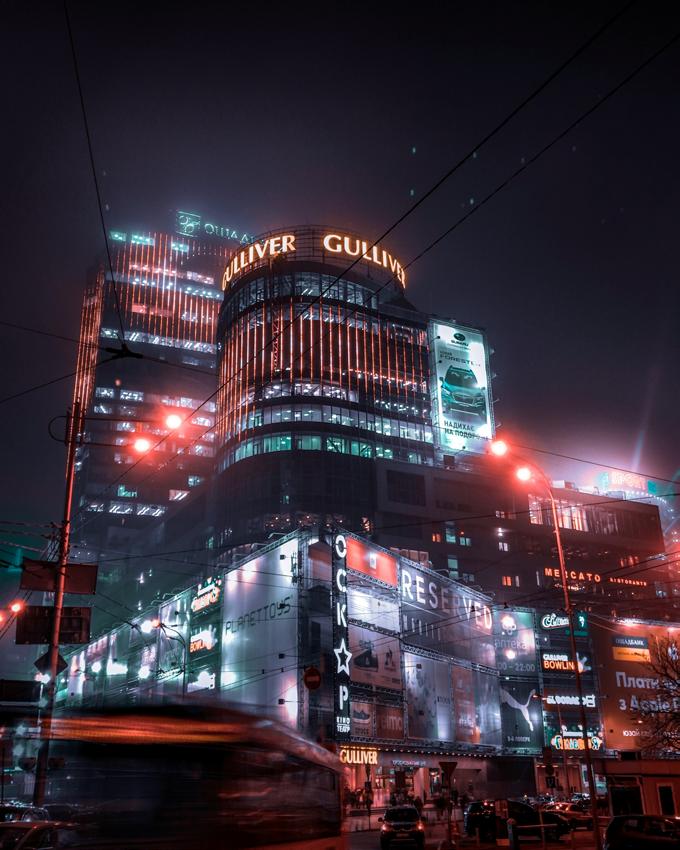
on the 24th February.17 Estimating based on interviews conducted, it is possible that the 2nd Mechanised Infantry Battalion had less than 150 soldiers in total.
4th Rapid Reaction Brigade of the Ukrainian National Guard Antonov Airport was defended by less than 200 rear echelon conscripts of the 4th Rapid Reaction Brigade of the Ukrainian National Guard.18 They were equipped with AKvariant rifles and 1970s-era Igla portable surface-to-air missile systems, and supported by two 122mm D-30 howitzers located near the airfield. The full brigade was well equipped with light infantry, tanks, artillery and surveillance drones. However, most of the brigade had deployed east to counter the expected Russian main attack.19
Other units. Additional units that took part in the fighting along the Irpin River included:
n Armed Forces
n 80th Air Assault Brigade – elements participated in the counterattack at Hostomel
n 95th Air Assault Brigade – elements participated in the counterattack at Hostomel
n 24th Separate Assault Battalion (Aidar)
n Artillery from the 128th Separate Mountain Assault Brigade
n Georgian Legion
n Separate Special Purpose unit “Omega”
n 3rd Special Purpose Regiment of the Special Operations Forces
n Rhinos Special Forces unit
n National Guard of Ukraine
n Azov Regiment, Ukrainian National Guard
n 1st Presidential Operational Brigade
n National Police
n Rapid Operational Response Unit (KORD), a specialist police unit
n Territorial Defense Forces (TDF), including 11th Company, TDF Special Forces
This issue of The British Army Review focuses on the 2nd Mechanised Battalion, 72nd Brigade and those who defended Antonov Airport.
THE GROUND NORTHWEST OF KYIV
Kyiv: One of Europe’s largest cities, Ukraine’s capital had a pre-war population of nearly three million.20 Located in the country’s central north, it is only 116 kilometres (by highway) from Belarus and 220 kilometres from Russia. Major populated areas just northwest of Kyiv include the small cities of Irpin (population 70,000), Bucha (37,000), Hostomel (17,000) and Ivankiv (10,000).21 The terrain to Kyiv’s northwest is predominantly woodland punctuated by small urban settlements, with farmland beyond the Irpin river. The woods immediately northwest – around Moshchun and Horenka – are dense enough to restrict
11-13Сергей Морфінов, BBC Україна, Колона. Як і чому російська армія програла битву за Київ і відступила, 24th February 2023, bbc.com/ukrainian/ news-64754500, accessed 22 June 2023.
14This is a rough estimate based on already uncertain troop strength numbers from the sources cited above. In all likelihood even the Russians did not know how many troops were engaged at either the point of contact or throughout the entire axis of advance. For a dated but generally thorough Western analysis of the VDV see: Rod Thornton, Organizational Change in the Russian Airborne Forces: The Lessons of the Georgian Conflict (Carlisle Barracks, PA.: U.S. Army War College Strategic Studies Institute, 2011), press.armywarcollege.edu/ cgi/viewcontent.cgi?article=1562&context=monographs. For a summary of the Russian naval infantry (marines) see: Dmitry Boltenkov, “The Russian Marine Corps,” Centre for Analysis of Strategies and Technologies, no date, cast.ru/eng/ products/articles/the-russian-marine-corps.html, accessed 16 June 2023.
15-16Interview with soldier 47, September 2023.
17Interview with soldier 13, August 2022.
18Interview with soldier 15, August 2022.
19Arsen Avakov, “The NGU Light Infantry Brigade Represents a New Model of Military Unit,” Ministry of Interior of Ukraine, 2 June 2016, web.archive.org/ web/20160921032727/http:/www.mvs.gov.ua/en/ news/1452_Arsen_Avakov_The_NGU_light_infantry_ brigade_represents_a_new_model_of_military_unit_ PHOTOS_VIDEO.htm, accessed 16 June 2023.
20“Kiev Population,” WorldPopulationReview.com, accessed 23 August 23 2023, worldpopulationreview.com/worldcities/kiev-population.
21“The timeline of tragedy: Buch massacure, nightmares of Irpin and Hostomel,” war.ukraine.ua, 6 March, 2022, https://war.ukraine.ua/crimes/the-timeline-of-tragedybucha-massacre-nightmares-of-irpin-and-hostomel/, accessed 15 February 2024.

vehicular movement to the roads and trails that run through them.
Rivers and waterways: The Dnipro River splits the country – and the capital (see photo below) – in half. There are five major bridges spanning the river within Kyiv and a single crossing point just north of the city over the dam at the Kyiv Hydroelectric Power Plant. The dam turns the river into a massive reservoir north of the city that is 110 kilometres in length and 12 kilometres in width.
There are several rivers to Kyiv’s northwest that generally flow southwest to northeast. While not particularly large, they are generally deep and wide enough – ranging from three to15 metres across in most areas – to make bridging or fording by military forces difficult. On both sides of these waterways, ground units run into cultivated farmland criss-crossed by dozens of irrigation ditches that run perpendicular and parallel to the rivers; all of these create potential micro-terrain obstacles to vehicle movement that are present on only the most detailed maps. Thus, vehicular movement is generally restricted to the roads and small bridges that cross these waterways.
Of these rivers, the Irpin is the closest to Kyiv’s western city limits. It flows generally from the southwest of the capital to the northwest,
joining the Dnipro River just south of the small village of Kozarovychi. In the early 1960s Soviet engineers dammed the river at the village of Kozarovychi and drained the flat marshlands. Water is pumped from the Irpin River into the Dnipro River because the dam at the Kyiv hydroelectric plant raises the latter’s water table six metres above the former. The reclaimed flood plains were cultivated for arable farming, criss-crossed by a network of canals and irrigation ditches, with sluice gates along the length of the river to manage the water levels.22 The towns of Hostomel and Bucha, and the small city of Irpin, lie on its west bank, while the town of Horenka and the villages of Moshchun, Huta-Mezhyhirs’ka and Lyutizh lie on its east bank.
The Bucha River runs between the cities of Irpin and Bucha and joins the Irpin River just east of Bucha. The Zdvyzh River is approximately 25 kilometres northwest of Kyiv, and the Teteriv River is approximately 60 kilometres northwest.
Roads: On the western side of the Dnipro, there are two main highways from Belarus to Kyiv: Highway P02, which runs through Rahivka, and Highway P56, which runs through Chernobyl. The highways merge outside the city of Ivankiv, approximately 50 kilometres northwest of the capital, with
P02 continuing to Kyiv, entering the city from the north. Between Ivankiv and Kyiv, several roads – running generally north to south – join highway P02 with highways E373 and E40, which enter Kyiv from the northwest and west respectively.
Bridges: From north to south, several bridges cross the Irpin River. First, there is a two-lane road that crosses the dam where the Irpin River joins the Dnipro River near the town of Kozarovychi (population 1,600). Five kilometres west, there is a two-lane bridge on highway P02 just south of Demydiv (population 2,300). Then 7,500 meters to its southeast is a small concrete bridge, suitable for one vehicle, for crossing between
22Details on the river, flood plain, and dam projects are derived from: Vladimir Starodubtsev et al., “Heroic Defense and Environmental Drama in the Irpin River Valley,” Grail of Science, no. 23 (2022); Lesia Yelistratova et al., “The Results of Socio-Ecological Monitoring During Military Operations in Ukraine Using Satellite Information,” Romanian Journal of Geography, vol. 66, no. 2 (2022): 117-136; G.M. Chepurda, “Ecological Problems of Ukraine After World War II,” Science and Education a New Dimension, Humanities and Social Sciences III, vol. 11, no. 67 (2015): 27-30; Paul R. Josephson, “Projects of the Century’ in Soviet History: Large-Scale Technologies from Lenin to Gorbachev,” Technologies and Culture, vol. 36, no. 3 (1995): 519-559; Vincent Mundy, “Ukraine’s ‘hero river’ helped save Kyiv. But what now for its newly restored wetlands?” The Guardian, 11 May 2022, accessed 7 November 2023.

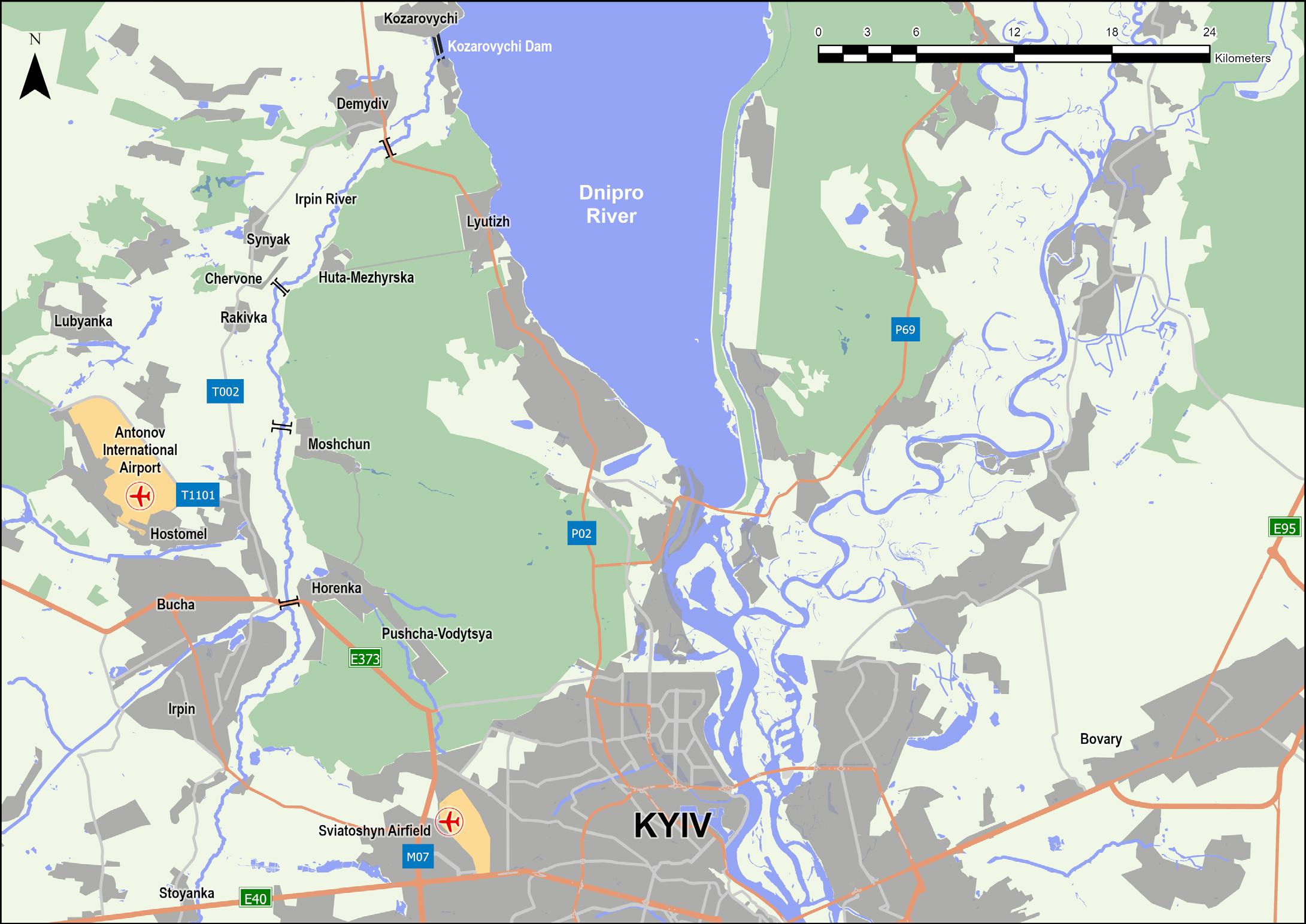
the tiny villages of Chervone (population 110) and Huta-Mezhyhirs’ka. It is another 7,000 metres south to the next bridge – a similar small concrete construction – that connects Hostomel’s northeastern outskirts and Moshchun (population 794). Then 6,500 metres further south is highway E373’s fourlane bridge between Hostomel and Horenka (population 5,300). To the city of Irpin’s southeast there are two railroad bridges, and to Irpin’s south is a two-lane bridge along a road. Finally, to Kyiv’s west is highway E40’s two two-lane bridges.23
Airports: There are several large airports on the outskirts of Kyiv proper and across its surrounding area. Boryspil International Airport, which includes a large military
23Populations come from city-facts.com, accessed 29 August 2023.
24Valius Venckunas, “Which airports can handle the Antonov An-225 Mriya,” Aerotime, 23 December 2021, aerotime.aero/articles/28718-which-airports-can-handlethe-antonov-an-225-mriya#:~:text=The%20home%20 base%20of%20Antonov,length%20for%20modern%20 air%20bases, accessed 29 August 2023.
25“Kyiv, Ukraine–Sunrise, Sunset, and Daylength, February 2022,” Time and Date, accessed 29 August 2023.
component, is located 10 kilometres eastsoutheast of the capital. Sikorsky International Airport is located within Kyiv’s city limits and is primarily used for domestic air travel. Antonov Airport, sometimes referred to as Hostomel Airport, is a former Soviet air base located 10 kilometres northwest of Kyiv next to the city of Hostomel. It has a 3,500 metre-long runway typical of modern air bases capable
of handling large cargo planes.24 It is used for international cargo and private aircraft.
Hours of darkness and weather: Sunrise in Kyiv on the 24th February was at 0652 and sunset at 1730.25 The weather that morning was cold, between 2-4 degrees Celsius, and cloudy with light rain. Temperatures dropped over the following days.
 Map 3: Northwest of Kyiv

“I watch TV every day and fall asleep to it. So I hear every day from TV [news]... ‘everything is okay, you can go and live your everyday lives, there are no [Russian] assault groups by the Ukrainian border, blah, blah, blah, everything is calm’. And I remember that almost every day I hear other reports of British saying there will be a big attack on Kyiv from Belarus side. But the former Ukrainian Minister of Defence says we have our reconnaissance and everything is okay – there are no assault groups by the border.” – Ukrainian civilian1
FACING an enemy dictating the ‘when and where’ and with a pre-war military strength of only 196,000 active personnel, it would have been extremely challenging for Ukraine to defend against any invasion along its almost 3,000 kilometre-long land border with Russia and Belarus. Consequently, in the lead up to the 24th February, the bulk of Ukrainian forces were postured to repel Russian attacks in the east and south of the country.3
The task of protecting Kyiv was assigned to the 72nd Mechanised Brigade, Ukrainian Army, which had to defend a 180-degree arc to the capital’s north, stretching from Stoyanka in the west of the city through to Brovary in the east – a frontage, straddling the Dnipro River, of approximately 70 kilometres.4 From interviews with those briefed on Ukrainian Army level planning, it is understood that commanders believed that if Russia did attack Kyiv from Belarus, its main assault would come from the northeast, through Chernihiv.
While the Ukraine military considered an attack on its capital was unlikely, it had conducted some high-level contingency planning before the invasion. On the 22nd December 2021, the 72nd Mechanised Brigade ordered its engineers to reconnoitre the Ukraine-Belarus border in the Chernihiv Oblast to assess crossing points that could
be used by Russian forces massed near Gomel. They were asked to make plans and preparations to destroy vulnerable routes5 and conducted the reconnaissance mission wearing civilian clothes to maintain a low profile. The engineers identified only one viable road for use by armoured forces – the E95 highway, which ran from Gomel, Belarus to Chernihiv and on to Kyiv6 – and a bridge in the small village of Novi Yarylovychi, just six kilometres south of the border, as being the best location to impede any advance. If the
1Interview with civilian 46, September 2023.
2A note on terminology: Russia invaded Ukraine in 2014 and illegally occupied Ukrainian territory. The February 2022 offensive was an escalation of their ongoing actions. For the sake of brevity we refer to it here as the ‘full-scale invasion’.
3Angela Dewan, “Ukraine and Russia’s militaries are David and Goliath. Here’s how they compare,” CNN 25 February 2022, edition.cnn.com/2022/02/25/europe/ russia-ukraine-military-comparison-intl/index.html, accessed 8 November 2023.
4Interviews with soldier 13 and soldier 18, August 2022.
5Interview with soldier 47, September 2023.
6Ibid.
7Interview with soldier 3, September 2023.
8Ibid.
9Interview with soldier 13, August 2022.
crossing was destroyed, it would significantly slow an approach from the northeast. However, neither this bridge nor others were ‘denied’ to the enemy before Russian forces entered Ukraine.
Given the expected course of enemy action, 72nd Brigade’s intent was to deploy the majority of its fighting power to the northeastern side of Kyiv, on the eastern bank of the Dnipro River, to defend against an attack from Chernihiv.7 This plan – and the brigade’s area of responsibility – was briefed by the brigade commander to senior officers at their base in Bila Tserkva (approximately 85 kilometres south of Kyiv) on the evening of either the 17th or 18th February. The orders saw 1st and 3rd Mechanised Battalions, 1st Division of 2S1, two batteries of BM-21 Grad multiple rocket launchers, two batteries of MT-12 Rapira anti-tank guns, and the majority of the Brigade Artillery Reconnaissance, along with the Brigade Headquarters and supporting elements, assigned to the eastern bank of the Dnipro.8
The 2nd Mechanised Battalion was tasked to shield Kyiv’s north-west from the western side of the Dnipro River. It would defend from the E373 highway through Horenka to the P02 highway and Lyutizh, a frontage of approximately 22 kilometres.9 The 2nd Battalion was made up of a headquarters,
three mechanised infantry companies (4th, 5th and 6th) and independent logistics, machine gun and anti-tank support platoons.10 It was supported by the Brigade Artillery Group’s 2nd Artillery Division of 2S3 Akatsiya self-propelled guns, one anti-tank battery of MT-12 Rapiras and one battery of BM-21 Grad multiple rocket launchers. An interviewee suggested an attack from the northwest was considered less likely and 2nd Battalion, which would be overseen by the deputy brigade commander,11 was given this role – one planners believed would be less dynamic – by virtue of it being understrength when compared to the 1st and 3rd Battalions,12 and because its attached self-propelled guns were heavier and less mobile than other platforms.13
Following the briefing, the brigade commander tasked his officers to reconnoitre their respective areas of responsibility.14 Elements of the 2nd Battalion’s headquarters and its company commanders conducted a ground reconnaissance of the south bank of the Irpin River on the 17th or 18th February.15 The battalion commander subsequently assigned 6th Company the area in and around the village of Huta-Mezhyhrs’ka and out to the P02 highway and Lyutizh; 5th Company the woods and dirt roads which led from the bridge at Chervone to the village of Moshchun; and 4th Company the town of Horenka and the main road into Kyiv from the northwest – highway E373, which crossed the Irpin River and linked Bucha and Hostomel to Kyiv (see map above right).16
Describing the weeks building up to the invasion, one soldier said: “Even before the New Year, everyone understood that something would happen. Vehicles, weapons, ammunition were prepared. Yes, it was somewhere at the top that they already understood that something would happen. The conversations among the middle officers –from battalion commander and below – were ‘most likely nothing will happen’.”17


“I didn’t believe in full scale invasion, I thought it was a political game or something, maybe they [the Russians] would cross the border somewhere, but just cross the border and go back, to scare people and that would be it.” – Ukrainian soldier24
The 1st and 3rd Battalions and supporting elements deployed from Bila Tserkva to Kyiv’s east on the 22nd February to ensure they were across the bridges over the Dnipro prior to any invasion.18 However, concerned that deploying all his forces at once might cause an increase in tension among the local people, the brigade commander held the 2nd Battalion and the 2nd Artillery Division of 2S1 at Bila Tserkva.19 The decision did little to ease the worries of those in uniform, according to one soldier: “Everyone was on alert, we did not sleep at night.”20

Having selected Pushcha-Vodytsya – a small suburb town surrounded by woods just south-east of Horenka – for its operational headquarters,21 2nd Battalion deployed a number of its signallers, with a small infantry force for protection, to the
location to test communications on the 20th or 21st February.22 On the 23rd February, the companies brought their vehicles to the loading stations in Bila Tserkva and the battalion’s command group held a planning meeting, agreeing to load the vehicles on to trains and move to the assembly area the following morning at 0500.23 The battalion
10Interview with soldier 23, August 2022.
11-13Interview with soldier 3, September 2023.
14Interviews with soldier 3, September 2023; and soldier 13 and soldier 23, August 2022. There is a conflict with the date of reconnaissance mission. Those interviewed at the 2nd Battalion and sub-unit level said they conducted reconnaissance around the 12th – 15th February. Yet other more senior officers say that the first time they were briefed on the brigade plan and told to conduct reconnaissance was around the 18th. It is possible, given the ad hoc and disparate nature, that sub units took the initiative earlier than the formal briefing. However, it remains unclear.
15Interviews with soldier 13 and soldier 23, August 2022. Conflict in dates as above.
16Interviews with soldier 11 and soldier 13, August 2022.
17Interview with soldier 23, August 2022.
18Interviews with soldier 3 and soldier 47, September 2023.
19Interview with soldier 3, September 2023.
20Interview with soldier 13, August 2022.
21Interview with soldier 18, August 2022.
22-23Interview with soldier 13, August 2022.
24Interview with soldier 3, September 2023.

commander allowed those who lived nearby to go home for the night.25 It did not, however, work out that way, as one soldier recounted: “On the 23rd, I was at the hotel. I was about to sleep. They called me and told me to come to the unit urgently. It was around eight or nine [at night]. There was an alarm, so the command already knew... I saw total chaos... someone was loading equipment into the vehicle, someone was sleeping, someone was running around. We went to the platform to load Javelins and NLAWs [Next generation Light Anti-tank Weapons]. Then, as it turned out, they were in another place. We went to another place. Their squabble went on for a couple of hours. Then everyone calmed down and we were sitting and waiting... we sat, waited, thought that it would not end with anything and that in the morning we would have to unload it. But in the end, we loaded into transport and drove away.”26
Another soldier recalled: “I arrived home about 2100, washed my hands, changed clothes, sat down at the table for dinner and received an urgent message that we were leaving at 2am. I called a taxi and in 40 minutes was in our military base. I gathered our mechanics,
platoon commanders and we went to the loading station. We started loading military equipment and armour onto platforms; BMP-1, BMP-2, MT-LB [tracked armoured vehicle] –the tank battalion was next. Until two in the morning, each company commander loaded his unit. We helped each other because it was raining and we did everything quickly because we had to leave at 0200.”27
With their equipment travelling by rail, the battalion’s personnel moved to the assembly area west of Kyiv by truck, bus and car. At approximately 0500 on the morning of the 24th February, Russian missiles struck targets across Ukraine28 – including a deserted warehouse on the base at Bila Tserkva.29 The soldiers – then travelling north – saw the strikes on Kyiv and, checking the news on their mobile phones, understood that the full-scale invasion had begun.30
Following the barrage of missiles, the Russians executed their ground and airmobile invasion. In Ukraine’s north, enemy forces moved south from Belarus, advancing on Chernihiv as the Ukrainians had anticipated. Another formation advanced south from Belarus on the western
side of the Dnipro, moving towards Chernobyl. The slow advance of armoured columns was accompanied by Russian attack and troopcarrying helicopters, which – travelling at pace – flew along the Dnipro River towards Antonov Airport.
At around 0600, the commander of 72nd Brigade gathered those sub-unit commanders still in Bila Tserkva and told them that the war had started. He ordered them to quickly gather their people, move to their positions and defend Kyiv.31
25Interview with soldier 23, August 2022.
26Interview with soldier 13, August 2022.
27Ibid.
28CNN, “Here’s what we know about how Russia’s invasion of Ukraine unfolded,” CNN, 24 February 2022, edition.cnn.com/2022/02/24/europe/ukraine-russiaattack-timeline-intl/index.html, accessed 9 November 2023.
29Interviews with soldier 9 and soldier 29, February 2023.
30Interview with soldier 13, August 2022.
31Interview with Soldier 47, September 2023.

“We were standing and talking, and then we hear a noise, helicopters, we couldn’t see them, only hear them because it was so cloudy, and we hear there were lots of helicopters, and next we saw rockets emerging from the clouds, and after that the helicopters emerged, so many of them. And the rockets started hitting the buildings and hangers.” – Civilian witness1
2
ANTONOV Airport is located on the northern outskirts of the town of Hostomel, ten kilometres northwest of Kyiv. The aviation hub, sometimes called Hostomel Airport, was an international cargo terminal and testing facility, and home to the Antonov State Company – a state-owned specialist designer and manufacturer of commercial aircraft. The subsidiary company Antonov Airlines owned and operated the Antonov An-225 Mriya (“the Dream”), which became the world’s largest cargo transporter when it was built in the 1980s.3 The airfield consisted of a 3,500 metre runway, one large aircraft hangar, a separate outdoor shelter for the Mriya, a control tower and smaller hanger, a five-storey office and dozens of other smaller buildings, located to the southeast of the landing strip.
The airport was defended by the 4th Rapid Reaction Brigade of the Ukrainian National Guard, which had a barracks next to the airfield.4 The National Guard base and the
airfield were divided by a railway track, with a single road crossing connecting the two sites. Immediately outside the main entrance of the airport were several five-storey apartment blocks for airfield workers and Antonov employees and their families, with a row of shops along the road serving the community.
The 4th Rapid Reaction Brigade had spent May and June 2021 training with Canadian Armed Forces that were deployed to Ukraine as part of Operation Unifier,5 before taking part in the annual US/Ukrainian Rapid Trident training exercise in September 2021.6 In December of that year, in line with expectations of a possible Russian attack, most of the unit deployed east. Therefore, in late February 2022, the airbase was defended only by a company of less than 200 personnel – a mix of rear-echelon conscripts and handful of professional contract soldiers.7 They were armed with AK-47s, AK-74s and grenades, had body armour and helmets for protection, and access to a few BTRs, which they used to move between the base and the airfield.
1Interview with civilian 46, September 2023.
2Co-author Liam Collins published an article on the battle for the airport: Liam Collins, Michael Kofman, and John Spencer, “The Battle of Hostomel Airport: A Key Moment in Russia’s Defeat in Kyiv,” War on the Rocks, 10 August 2023, warontherocks.com/2023/08/the-battle-ofhostomel-airport-a-key-moment-in-russias-defeat-in-kyiv, accessed 9 November 2023.
3Julia Buckley, “AN-225: Plans to rebuild the world’s largest plane confirmed,” CNN, 10 November 2022, cnn. com/travel/article/antonov-an225-mriya-rebuild-2022/ index.html, accessed 9 November 2023.
4Unit page: facebook.com/RapidReactionBrigade
5“Operation UNIFIER is the Canadian Armed Forces’ military training and capacity building mission in support of the Armed Forces of Ukraine. It was launched in 2015 at the request of the Ukrainian government, and in 2023, was extended until March 2026.” See, “Operation UNIFIER,” Canada.ca, accessed 23 August 2023, canada.ca/en/ department-national-defence/services/operations/militaryoperations/current-operations/operation-unifier.html.
6Chad Menegay and Aimee Valles, “US, NATO, Ukraine enhance interoperability with Rapid Trident exercise”, Army. mil, 21 September 2021, army.mil/article/250444/ us_nato_ukraine_enhance_interoperability_with_rapid_ trident_exercise, accessed 9 November 2023.
7Interview with soldier 15, August 2022.
The Guardsmen also had a small air defence element armed with Igla man-portable missile systems and at least one ZU-23 twin-barrelled 23mm anti-aircraft gun. One of the soldiers at the base noted that the “small number of officers” left to lead the defence were “financial officers” as opposed to infantry officers.8 Assigned defensive sectors, the soldiers were ordered to dig two-to-fourperson fighting positions.
In the weeks leading up to the invasion, working life carried on largely as normal for those civilians at the airport – with no restrictions placed on their movements.9 The only things out-of-the-ordinary for them to note would have been the arrival of a small number of people from Ukraine’s intelligence service in a pickup truck mounted with a large calibre machine gun10 and – from February 18th or 19th – the Rapid Reaction Brigade troops conducting daily drills, which saw them run to defensive positions along the runway and the base’s perimeter on the sound of an alarm.11
The Ukrainians were expecting an attack, but only one that would require them to repel a small reconnaissance force or sabotage group
made up of a couple of helicopters and a few dozen Russian special forces operatives. The reality proved a stark contrast, as one soldier described: “Of course, nobody expected 100 helicopters... so when the attack started, we were kind of surprised to see so many.”12
Between 0600 and 0700 on the morning of the 24th February, four Kalibr cruise missiles struck the airport and neighbouring National
8Interview with soldier 15, August 2022.
9Interview with soldier 36, February 2023.
10Interview with soldier 15, August 2022.
11Interview with soldier 36, February 2023.
12Interview with soldier 36, February 2023.
13Interview with civilian 46, September 2023; and War Archive, “Battle for Hostomel Airport,” YouTube, accessed 25 August 25 2023, youtube.com/watch?v=r0Ji7KqqEqg.
14War Archive, “Battle for Hostomel Airport.”
15Interviews with soldier 15 and civilian 7, August 2022.
16Mykhaylo Zabrodskyi et al., Preliminary Lesson in Conventional Warfighting from Russia’s Invasion of Ukraine: February—July 2022 (London: Royal United Services Institute, 2022), 11.
Guard base. One hit a parade field near the barracks; another the residential flats outside the airfield; and a further two lodged where they landed, unexploded.13
The Russian attack was staged from VD Bolshoy Bokov Airport in Belarus, approximately 170 kilometres north of Hostomel.14 Although some Ukrainians reported to seeing more than 100 helicopters,15 the assault force most likely consisted of approximately 34 helicopters and 200-300 Russian airborne soldiers from the 31st Guards Air Assault Brigade and 45th Separate Guards Spetsnaz Brigade. The helicopters included a mix of Mi-8 Hip transport aircraft, Ka-52 Alligator and Mi-24 attack helicopters.
The Russian Aerospace Forces (VozdushnoKosmicheskiye Sily or “VKS”) created an infiltration corridor for the air assault along the Dnipro River by jamming Ukrainian radars and suppressing air defence sites.16 To maintain an element of surprise, the Russian military had waited until the morning of the invasion to neutralise such targets and the airmobile force crossed the Belarusian border and entered Ukrainian airspace at approximately 0930. The airborne armada remained undetected


until they neared the dam at the Kyiv hydroelectric power plant just north of Ukraine’s capital, where the Ukrainians downed two of the lead aircraft with missiles. Trailing helicopters fired flares to avoid further losses and turned west towards Hostomel. Civilians in the villages along the T1002 road filmed the waves of Russian attack helicopters flying over their homes towards Antonov Airport,18 which was shrouded in thick, low cloud cover.19 Consequently, the National Guard commander was unaware of approaching helicopters until he heard the chopping of rotor blades at around 1100 – a sound, which moments later, was drowned out by rocket and heavy machine gun fire.
“It was cloudy and we heard the work of propellers – then the shelling started immediately,” recalled a civilian employee working at the base.20
Alerted by the earlier missile strikes and having taken up defensive positions, the National Guard soldiers were, however, ready. Approximately 20 personnel were in place to protect a radar at the northern end of the airport with a ZU-23 anti-aircraft gun,

18AFP News Agency, Helicopters seen flying low over Kyiv near Gostomel airbase, youtube.com/watch?v=ymikaAK0_bQ.
19Interview with civilian 46, September 2023.
20Ibid.
21Paul Sonne et al., “Battle for Kyiv: Ukrainian valor, Russian blunders combined to save the capital,” Washington Post, 24 August 2022, washingtonpost.com/nationalsecurity/interactive/2022/kyiv-battle-ukraine-survival/, accessed 9 November 2023.
22youtube.com/watch?v=AdOBo5B5QIU.
23Jack Watling et al., “RUSI Experts on Russia’s Invasion of Ukraine, One Year On,” RUSI, 21 February 21 2023, rusi.org/events/members-event-recordings/recordingrusi-experts-russias-invasion-ukraine-one-year, accessed 9 November 2023.
while the rest had moved to fighting positions around the southern end of the airfield. And the Ukrainians enjoyed some early success –downing one of the attacking Ka-52s. As the Russian aircraft was making a strafing run, a soldier attempted to engage it with an 9k38 Igla (SA-24) surface-to-air missile system, but his target was initially too close. However, as the Russian helicopter continued to fly past him, it moved beyond the minimum fire range, allowing him to re-acquire and engage. The missile hit the helicopter, sending it crashing onto the runway.21 That was the first of at least three helicopters shot down that day.
“One of the surprises that morning was that you can actually shoot down Russian Ka-52s – that famous flying tank – using just concentrated fire from your rifles.” 22
Despite the counter-fire, Russian forces were eventually able to insert airborne soldiers onto the airfield – landing between 200 to 300 personnel in two waves of ten helicopters.23 However, having disembarked on or near the runaway, the paratroopers found themselves with scant cover and vulnerable to attack.
Several Ukrainian soldiers remarked at how easy it was to shoot the invaders and when asked how they could be certain that they were hitting the enemy, one replied: “I know because I could see them fall.” 24
After more than an hour of intense fighting and having reported to superiors that his unit was running out of ammunition, the officer in charge of the defence forces was ordered to withdraw from the airfield and base.25 The National Guard conscripts began doing so having bloodied the nose of the superior Russian airborne forces – with a further two Ka-52s and one Mi-8 downed at the airfield using a mix of man-portable air defences, antiaircraft guns and small arms fire. And – as one Ukrainian soldier later reported – the majority of the defenders withdrew from the battle largely unscathed: “We didn’t lose any men, that seemed like a miracle.” 26
Those conscripts guarding the radar at the northern end of the airfield were not so fortunate and, unable to pull back, became some of the first prisoners of war.
During the National Guard’s withdrawal, two of the 4th Rapid Reaction Brigade’s D30 artillery guns, located in Horenka, were ordered to fire on the runway to prevent the Russians from using it as an airbridge. Two Ukrainian Air Force Su-24 bombers followed up the artillery strike27 and, later that night, 2S3 self-propelled guns from the 72nd Mechanised Brigade also fired on the runway.
When the attack began, airfield employees took cover in the bomb shelter under the Antonov office building. “When I came to the bomb shelter, there were already border guards, national guardsmen, Antonov guards and civilians there. The management of the plant was with us.”28

Residencies reduced to ruins: The remains of an apartment block at Antonov Airport, which was struck by a Russian cruise missile on the morning of the 24th February
in the bunker, gave their perspective of the battle: “There were about 100 of us there. Both military and civilians. And the National Guardsmen were armed with assault rifles. And someone says: ‘If the Russians break in here, there will be trouble. There may be a shoot-out in the room.’ Everyone was ready. And then… the National Guardsmen were given the command ‘withdraw’. Before that, they contacted their commander over the radio and said that there were many civilians in the bomb shelter. The commander ordered them to withdraw so that there would be no shoot-out.
“When the National Guard left, the chief manager of the plant came out. And I understood that the Russians asked if there were military personnel in the bomb shelter. And they were not there at that time. The chief manager told them that they were not there. So, they told everyone to get out. The State Emergency
24Interview with soldier 15, February 2023.
25It is not clear who gave the order. Some sources suggest it was the commander of the 4th Rapid Reaction Brigade, who was deployed east, others suggest it was a different senior officer.
26Interview with soldier 15, February 2023.
27Interview with soldier 15, August 2022.
Service has its own uniform, the border guards have their own, the guards have their own. And the Russians left the border guards in the bomb shelter because they were in uniform. They were asked: ‘Who are you? Border guards? Then stay in the bomb shelter.’ All the people left. And I remember that the Russians stood on both sides with rifles and machine guns. We walked a hundred meters. And they told us ‘now we will figure it out with you, we will talk, we will look at your documents’. They emphasised ‘we will let you all go’. It was a Russian. His uniform had no chevrons, no stripes, just a green uniform… only his eyes were visible. They communicated tactfully… calmly. It really affected me – here they shoot, but here they are so polite. They pretended to be polite people. The chief manager of the plant turned to this Russian and said to him ‘commander, many people came to work in their cars, will people be able to take their cars?’ Him – ‘don’t worry, take the cars.’ And I still remember him saying ‘and take your wounded’. Someone was already injured.”
On leaving the site, the civilian asked a Russian officer: “Will there be trouble again now? Are you going to bomb everything here now?” And was told: “No, we have already done our job. Everything will be fine. Do not worry.”
It was as our interviewee was walking away from the airfield, having got just a few hundred metres from the airport’s main gate, that a Ukrainian bomber flew overhead and dropped its payload on the runway.29
The Russian airborne soldiers may have seized the airport, but they were left in a precarious position. The planned rapid onward movement of troops by air never materialised. A force consisting of 1,000 to 5,000 soldiers had loaded on to 1L-76 transport planes at an airbase in Pskov, Russia (two hours flight time from Hostomel), but – despite as many as
No-fly zone: Wreckage of a Russian attack helicopter on the runway at Antonov Airport


have been due to the length of time that it took to seize the airfield, Ukrainian artillery and aircraft making the runway unusable, or concern about risking transport aircraft following the loss of six-to-seven helicopters during the assault. Whatever the reason, the planes never arrived and Russia failed to establish an airbridge.
The second set of reinforcements that were supposed to support the assault on the airbase were the mechanised and armoured forces advancing from Belarus. After crossing the border at 0500, these units only had to travel 130 kilometres to reach the airfield but were encountering difficulties of their own while fighting along the narrow corridor through Chernobyl and Ivankiv. As a result of the slow progress being made by road, it became clear that the Russian airborne forces would spend their first night on Ukrainian soil without any meaningful back up.
Recognising the urgency of the situation –chiefly, that if the Russians could establish an airbridge, the capital would be at grave risk –the Ukrainians launched a hasty counterattack to retake the airfield. The assault included whatever forces the military could cobble together at such short notice and ultimately included elements from the 80th Air Assault Brigade, 95th Air Assault Brigade, 72nd Mechanised Brigade and the 3rd Special Purpose Regiment of the Special Operations Forces. Air assault elements launched from Zhytomyr by helicopter (to rapidly transport soldiers based there to the ground attack), while the mechanised forces moved by land from Bila Tserkva.31 At around 1500 on the 24th February, President Volodymyr Zelenskyy declared: “Enemy paratroopers in Hostomel are blocked, troops are ordered to destroy them.”32 But the attack did not actually begin until sunset (around 1730), when strikes from artillery and Su-24 bombers were used to soften the Russian defences before ground troops advanced. Some of the Ukrainian soldiers charged with retaking the airfield noted that the enemy had failed to occupy strong defensive positions and were relatively easy to dislodge. One soldier described engaging
the minimally protected Russian forces on the airfield as being like “playing a video game, just shooting and knocking them down from our positions outside the airfield” 33 By 2100, the Ukrainians had retaken the airfield. The 4th Rapid Reaction Brigade posted an image on their Facebook page of soldiers celebrating the victory, but their stay was also short-lived.34 The Ukrainians knew that the Russian mechanised forces were closing in from the north and that they lacked the combat power to hold the airfield, so they withdrew. But as they did so, artillery and aerial bombardments were used to crater the runway to ensure that Russia could not exploit it.35
The following day, on the 25th February, the lead elements of the Russian ground forces finally reached the airport and took control once again. As one civilian who lived nearby recalled: “The first column was already on its way at lunchtime on the 25th. About 250 armoured vehicles. And in the second column there were 114. They were driving from Ivankiv towards Hostomel. I had the impression that they did not understand where they were. They were in such a mood, without bulletproof vests. I won’t say they were nervous. They were relaxed. I heard a sound like someone dragging a shovel across the asphalt. It looks like a child is carrying something. I looked out and saw a short Tajik. The muzzle of his gun scratched the ground. They asked me for a kettle. I explained that I only have an electric kettle. And they say ‘so give an electric kettle’. And I tell them ‘you have no electricity’. And they [said] ’we will put it on the fire and boil the water’. I answer them – ‘it’s plastic’. They don’t understand basic things.” 36
Having recaptured Antonov Airport, Russian forces fanned out to take positions along the western side of the Irpin River, using the airport as their main base and occupying Hostomel town and the nearby factories.37 During the early days of occupation, the soldiers lived in their armoured vehicles along the roadside but on the 1st and 2nd March they dismounted and began to dig trenches38 – creating positions on the high ground and in the tree lines adjacent to the T1002, which
runs from north to south in parallel with the Irpin River.39 Russian forces also occupied the village of Chervone. The field research team viewed evidence of checkpoints along the T1002 and interviews confirmed that Russian forces did not occupy the small settlement of Rakivka (population 330), but instead established a checkpoint outside of the village and conducted dismounted patrols into it. The field research team also saw evidence that – in addition to personnel at Antonov Airport – the Russians had a large concentration of forces in the woods outside of Lub’yanka, a small village seven kilometres west of Rakivka. It is possible that a Russian divisional headquarters was situated there. According to interviews, the enemy established a field hospital, an ammunition depot and helicopter landing site in the Lub’yanka area.40
30The number of aircraft that were airborne is not certain. A journalist reported 18 based on his government sources, but a senior defence official with intimate knowledge claimed it was 41. Christo Grozev (@christogrozev), X, 24 February 2022, twitter.com/christogrozev/ status/1496873022229073924; and interview with senior defence official, November 2023.
31War Archive, “Battle for Hostomel Airport”.
32Volodymyr Zelenskyy, “Address by the President of Ukraine,” President.gov.ua, 24 February 2023, president. gov.ua/en/news/zvernennya-prezidenta-ukrayini-73137, accessed 9 November 2023.
33Interview with soldier 55, June 2022.
34Бригада швидкого реагування Національної гвардії України, “Наші гвардійці зі своїм прапором, пошматованим уламками після сьогоднішнього бою. Передають вам усім вітання і кажуть, що ми переможемо!” Facebook, 24 February 2023, accessed 9 November 2023.
35Paul Sonne et al, “Battle for Kyiv: Ukrainian valor, Russian blunders combined to save the capital,” Washington Post, 24 August 2022, washingtonpost.com/nationalsecurity/interactive/2022/kyiv-battle-ukraine-survival/, accessed 9 November 2023; and War Archive, “Battle for Hostomel Airport”.
36Interview with civilian 7, August 2022.
37Field research team visit, February 2023.
38Interview with civilian 7, August 2022.
39Field research team visit in August 2022.
40Interview with civilian 7, August 2022.
From the top: Oleksandr Syrskyi, Commander of the Ground Forces of the Armed Forces of Ukraine, pictured in Kyiv in March 2022, is reported to have approved the blowing of the Kozarovychi dam

“Oleksandrovich Oleksandr Volodymyrovych by order of the command of the Ground Forces of Ukraine, Major Kapelin M.V. I order to release water into the Irpin River from the Kyiv Reservoir.”
–
The logbook entry authorising the blowing of the Kozarovychi Dam1
PRIOR to the Russian invasion, Kyiv-based businessman Andriy [pseudonym] serviced government contracts from a network of workshops across Ukraine – making bespoke vehicles and fittings for military and special forces units fighting in the Donbas. A car enthusiast, he also managed a chain of civilian garages and organised off-road race meetings and competitions in the forests and rough terrain surrounding the capital. On the morning of the 24th February, following Russian missile strikes on Ukrainian targets, the entrepreneur put a message on Facebook calling for his friends and employees to come to a facility he owned in Kyiv.3 The group that gathered immediately began offering support to any military vehicles and drivers in need of assistance and focused on collecting information on the events unfolding.
The following day, upon discovering that Russian forces had reached Demydiv, Andriy understood that the best way to slow the invaders was to flood the northeast-flowing Irpin River by breaching the dam where it joins the Dnipro River – 22 kilometres north of Kyiv and just south of the small village of
Kozarovychi. Due to a height difference of approximately six metres – a by-product of the infrastructure at the Kyiv hydroelectric power plant – water has to be pumped from the Irpin to the Dnipro. Well-connected and with friends in senior government, Andriy worked
1Dam logbook entry, provided to the field research team, February 2023.
2Two other important accounts are: Andrew Kramer, “They Flooded Their Own Village, and Kept the Russians at Bay,” New York Times, 27 April 2022, nytimes. com/2022/04/27/world/europe/ukraine-russia-warflood-infrastructure.html, accessed 9 November 2023; and Vincent Mundy, “Ukraine’s ‘hero river’ helped save Kyiv. But what now for its newly restored wetlands?” Guardian, 11 May 2022, theguardian.com/environment/2022/ may/11/ukraine-hero-irpin-river-helped-save-kyiv-butwhat-now-for-its-newly-restored-wetlands-aoe, accessed 9 November 2023.
3Interview with civilian 4 and civilian 35, February 2023.
4Ibid.
5Interview with civilian (4 or 35 - not sure which is which), February 2023; and Wiebe de Jager, “How Military and Civilian Drones are used int eh Russo-Ukrainian War,” Drone Watch EU, 28 February 2022, dronewatch.eu/ special-how-military-and-civilian-drones-are-used-inukraine, accessed 9 November 2023.
his contacts to secure a meeting with Colonel General Oleksandr Syrskyi, the commander of Ukraine’s ground forces.4
Before departing for the bunker from which General Syrskyi was orchestrating the defence of Kyiv, the businessman tasked his friend Vasyl [pseudonym] – a videographer experienced in using drones for film projects – to assess options at the dam. Like so many others, Vasyl leveraged his skills to support the war effort; using his piloting prowess to produce tactical information as part of an emerging army of civilian drone operators helping the military to protect the capital.5
Having persuaded an engineer to grant him access to the site and quickly discovering his first plan – reversing the flow of the dam’s pumps – was mechanically impossible, Vasyl, with others, attempted to breach the structure using a blowtorch, grinder and variety of other tools. However, with their methods mindful of the need to preserve the hard-to-repair pumps, which dated back to the 1960s, the would-be demolition team was left frustrated. Although unable to pierce a hole in the dam’s metal work, their endeavours at ‘sabotage’ did
serve to attract a small crowd of local citizens. Taking advantage of the audience, Vasyl told the interested bystanders of the plan and advised them to evacuate the small villages downstream. For the population of Kozarovychi, the only route to do so south was over the dam.6
As Vasyl conducted his investigations, Andriy drove to the bunker with his step-father and two employees. He was escorted deep underground to an enormous command room filled with military personnel. In the centre was General Syrskyi, huddled with his staff over a large table covered in maps. Andriy stood at the back and waited until, after several minutes, someone announced “there is someone here with a proposal” and he was ushered forward. Briefing from his laptop, Andriy outlined his plan – explaining the topography of northwest Kyiv and how, if the dam was blown, the usually narrow Irpin would be widened by several hundred metres, making the river and its surrounding farmland impassable. After listening to the explanation, General Syrskyi looked at the map, then at Andriy, and asked “what do you need?”. To which the businessman responded “an engineer and some explosives”. As Andriy described it, the meeting lasted only a few minutes, but it was decisive: “He immediately understood what it was about… I said I needed the coolest sapper to do the work like a jeweller.”7
With permission to take whatever explosives were needed and an engineer officer added to their number, Andriy’s team loaded nearly a ton of ordnance into two civilian 4x4 vehicles. The group – minus Andriy who remained in the bunker to advise – then departed for the dam despite the dangers associated with navigating the city. Kyiv – at that time – was under lockdown, with movement restricted amid growing fears that covert Russian soldiers were operating within the capital.8 One of the Ukrainian Special Forces operatives

tasked with hunting down enemy units reported seeing a high number of friendly-fire casualties.9 Arriving unscathed at the dam on the afternoon of the 25th February, the military engineer and his new civilian colleagues determined that blowing a small hole would deliver the desired effect without damaging the pumps, sacrificing the integrity of the whole structure or causing catastrophic flooding. It was deemed important to not damage the dam road and deny it to light vehicles or release an uncontrolled deluge that would put those communities on the flood plains at risk.10 Before any explosives could be set, an
employee at the dam insisted that a representative of the demolition party signed a logbook to make them accountable for what was to come. “You have to understand our system,” explained Vasyl. “There, people say: ‘Someone should be responsible for this.’ They say: ’Will you be responsible for this?’ I say:
6Interview with civilian 4 and civilian 35, February 2023.
7-8Interview with civilian 35, February 2023.
9Interview with soldier 18, August 2022.
10Interview with civilian 4 and civilian 35, February 2023.


‘I will’.” 11 Vasyl took charge of proceedings, satisfying the official that the correct procedure was being followed by creating some fictitious names and writing: “1330 – Oleksandrovich Oleksandr Volodymyrovych by order of the command of the Ground Forces of Ukraine, Major Kapelin M.V. I order to release water into the Irpin River from the Kyiv Reservoir.”
At around 1530, with the paperwork complete, the military engineer set the charges and blew a hole in the dam, immediately releasing a flow – which would ultimately amass to more than 31 billion gallons of water – into the Irpin River and across the surrounding farmland.12
Over the ensuing days, Andriy and his team monitored the flooding from the dam and used drones to surveil the length of the river.
Waterlines on trees seen by the research team suggest the level was eventually raised by at least three metres. While the flooding was significant on the northern portion of the Irpin there was originally no change in water level south of the bridge at Chervone as a
result of the sluice gate at a small dam near the crossing being closed. That the location of the problem gate was under Russian fire control made identifying the issue incredibly difficult. Speaking about a drone flight in the first week of March, Andriy noted: ”We did not see that the floodgate was closed. When our [unmanned aerial vehicle] was flying with another mission, I kept asking to see along the shore how the Irpin was spilling. We could not understand why the water was not coming. If this gateway had not been closed, there would have been no fighting in Moshchun [see pages 35-41]. Because the water would have gone further and they could not cross.”13
Attempts were made to destroy the sluice gate – firing on it from a tank in 6th Company’s position at Huta-Mezhyhirs’ka and using a heavy 203mm Pion 2S3 artillery – but proved unsuccessful; leaving one remaining course of action. “The only solution was to finally destroy the dam at Kozarovychy.”14
General Syrskyi ordered engineers from the 72nd Brigade to blow a larger part of the main dam on or around the 8th March,
increasing the flow of the water enough so that it overwhelmed the closed sluice gate and allowed the waters to finally break the Irpin’s banks south towards Moshchun.15
Following the explosions at the Kozarovychi dam, the Zdvyzh and Teteriv rivers were also deliberately flooded – leaving Russian forces with only one route, the P02 bridge at Ivankiv, to withdraw.16
By the 23rd March the Irpin river was fully flooded along its length.
11Interview with civilian 4 and civilian 35, February 2023.
12Eugene Siminov and Oleksii Vasyliuk, “Planes to rebuild Ukraine shaped by solutions for Irpin,” Ukraine War Environmental Consequences Work Group, 9 September 2022, uwecworkgroup.info/plans-to-rebuild-ukraineshaped-by-solutions-for-irpin, accessed 9 November 2023.
13-14Interview with civilians 4 and 35, February 2023.
15Another source says that this explosion was set off around the 7 March. Radio Free Europe, “The Battle for Kyiv: How did elite Russian troops fail?” YouTube, accessed 9 November 2023, youtube.com/watch?v=qfDWi-VNdE0.
16Interview with civilian 35, February 2024.

“There was panic in Kyiv. People wanted to leave the city. It was impossible to fuel a car. Shops, bankomats… chaos.” – A Ukrainian civilian who volunteered to fight with the 72nd Mechanised Brigade on the morning of the 24th February1


ONE of the most striking aspects in the defence of Kyiv was the many thousands of Ukrainian citizens who volunteered to fight on the 24th February and during the subsequent days and weeks. Some joined the Ukrainian Army or the Territorial Defence Forces, while others created ad hoc community defence groups or supported the war effort in other ways. This chapter focuses on those who stepped forward and found themselves on the front-lines of Kyiv’s defence as part of the 2nd Battalion, 72nd Mechanised Brigade.
As the Ukrainian military was deploying to defensive positions around Kyiv on the morning of the 24th February, crowds of residents were fleeing the city to the west. Shunning the long queues of traffic, however, were thousands of civilians who opted to join the growing lines outside the Army’s recruitment offices. One interviewee described the moment he decided he wouldn’t be departing: “We went to sleep [on the 23rd February] but this sleep was short-lived because there were military warehouses 30 kilometres from our village, and we woke up from the fact that our house was shaking. I went outside, saw a glow and realised that everything was really
“I couldn’t even cross the road, there were so many cars leaving.” – Ukrainian civilian in Hostomel 2
starting... I entered the house; my wife had already turned on the TV. They are already broadcasting the war. My wife and daughter became hysterical and I tried to calm them down. I already understood that I was going to defend the homeland, I did not tell them this yet. They began to pack a suitcase, no one understood anything. And then the wife asks ‘you are not staying with us, are you?’. I say ‘sorry, no because if I stay with you, then I won’t be able to help you’. We sat for a while, made a plan…“3
Common among interviewees was the desire to get to the recruitment offices as early as possible and many went with friends. They set up WhatsApp groups to coordinate with each other, to make arrangements for getting family members to safety and to share ideas about the best places to go to enlist. They ensured that their loved ones were taken care of first, putting them into cars and sending them west or personally driving them to safety before returning to join their nation’s defence.4
“In the morning we started calling each other,” one citizen-turned-soldier recalled. “Everyone is in such a state... everyone is in a hurry, everyone is trying to calm down their families, and be the first to go to the military commissariat. It was very fast.”5
Many of the military commissariats [offices] in towns and villages were simply not equipped to handle the volume of people that descended on them, with staff more accustomed to paying veterans’ pensions and completing basic administration for recruits than processing lines that snaked hundreds of metres down the street.
“There was chaos in the military commissariat,” said one new recruit describing the disarray. “There were a lot of people, volunteers, a crowd of people. The workers of the military commissariat were confused, they did not know what to do with such a large
1Interview with soldier 11, August 2022.
2Interview with civilian 46, September 2023.
3Interview with soldier 41, February 2023.
4Interviews with soldier 11 and Territorial Defence soldier 30, August 2022.
5Interview with soldier 41, February 2023.
number of people, probably more than a thousand.“6
Given the sudden surge in numbers of those wishing to serve, people’s experience of enlisting varied significantly – some were offered a choice of units to join while others were simply told where their military journeys would begin.7 Those with recent military service to their name had an obligation to re-enlist in the event of martial law being declared. Units and associated military offices kept contact information for these people and on the morning of the 24th February, veterans called military offices and military offices called veterans.8 “I called and went to the military commissariat,” explained one young soldier. “When I arrived there was a long queue. When I got there, I called this lieutenant colonel again and was taken out of line… I was told that I would go to Bila Tserkva. I asked what I would do there. They told me that I would receive weapons, body armour and a helmet, and then I would most likely return to Kyiv.”9
Others bypassed military commissariats and attempted to contact old comrades directly to
6Interview with soldier 41, February 2023.
7Interview with soldier 11, August 2022; and soldier 41, February 2023.
8Interview with civilian 7, August 2022; and soldier 36, February 2023.
9Interview with soldier 36, February 2023.
10Interview with soldier 27, February 2023.
11Interview with soldier 41, February 2023.
12Interview with soldier 11, August 2022.
13Interview with soldier 41, February 2023.
14Interview with soldier 27, February 2023.
15Interview with soldier 27, February 2023. Luke Mogelson wrote about returnees from abroad in, “How Ukrainians Saved Their Capital,” New Yorker, 2 May 2022, newyorker.com/magazine/2022/05/09/howukrainians-saved-their-capital, accessed 9 November 2023.
16Sarah A. Topol, “Ukraine’s 15,000-Mile Lifeline,” New York Times Magazine, 15 November 2022, nytimes. com/2022/11/15/magazine/ukraine-trains.html, accessed 9 November 2023.
17Interviews with soldier 41 and soldier 32, February 2023.
18Interview with soldier 36, February 2023.
19Interview with soldier 27, February 2023. The AntiTerrorist Operation zone was the Ukrainian designation for areas in the Donbas under Russian occupation from 2014 onwards. The so-called “Luhansk People’s Republic” and “Donetsk People’s Republic” were designated terrorist organisations by Ukraine. In 2018, the name was changed to the “Joint Forces Operations.” Ukraine Crisis Media Centre, “Old war, new rules: what comes next as ATO ends and a new operation starts in Donbas?” 4 May 2018, uacrisis.org/ en/66558-joint-forces-operation, accessed 27 July 2023.


“I saw the boys, they all had a fighting spirit, they all wanted to go to the front. But we sat and waited. The commanders told us ‘if you are sitting here, then everything is fine at the front. If things go badly at the front, you will go there immediately’.” – Ukrainian soldier14
establish how and where to join the fight. “I tried to get in touch with my former unit commanders, but there was no communication from them,” recounted one individual who re-enlisted at the gates of the 72nd Brigade at Bila Tserkva. “I just left (for the base) thinking one of them would be there. But they were already near Kyiv and there was no communication with them.”10
Initiative was also demonstrated at the military commissariats where overwhelmed staff found themselves supported by those queuing and members of the community, who brought those waiting tea, coffee and food. One volunteer said: ”We organised the work a little. We wrote down the phone numbers of those in town and sent them home to wait. And those who came from distant villages were the first to be let inside. The atmosphere was so powerful that I understood that I had something to fight for. People didn’t just come to see, to complain. People were so patriotic that I can’t put it into words.”11
Once registered, volunteers were loaded onto civilian buses and taken via different routes –to avoid enemy targeting12 – to their new units. Some recruits had to wait into the evening before being transported away.13
One interviewee was living abroad in central Europe when the war broke out: “I made the decision on February 24th when it all started. I managed to leave [country redacted] on February 26th because I had to agree on legal issues. In order not to be fired from the factory, I asked the director of the factory for a year’s leave at my expense… It was not difficult to get to the border, but it was difficult to get home due to constant rocket attacks.”15 The returning soldier, who had previously served in the Donbas with 72nd Brigade, was assisted in his journey home by the Ukrainian railways which – despite the Russian army’s advance –
continued to run, albeit disrupted, services.16 “I got home. It was about two o’clock in the afternoon [28th February]. I decided not to go anywhere, spent the night at home, spent time with my family, and in the morning after curfew I went to Bila Tserkva.”
After the 72nd Mechanised Brigade deployed to Kyiv’s north on the morning of the 24th February, its base at Bila Tserkva became a mobilisation centre and processed thousands of volunteers.17 Those stepping off the constant stream of buses were kept in groups based on where they had travelled from. Rumours of the unfolding war were rife, according to one volunteer: “The officers who checked us in and issued us equipment were nervous. They said that there are people who put tags on houses. We were also told to be ready for the fact that enemy paratroopers may appear near Bila Tserkva and we may be put in a car and taken there to meet them. But it was unreliable information. Everyone was nervous, they didn’t know what to expect, what was happening.”18
Those arriving came from all over Ukraine. “I was the only one who returned from abroad in this group. People were from different parts of Ukraine, some from Poltava region, some from Zhytomyr, Vinnytsia. We just talked to each other about who was doing what. We didn’t say where we were going, because we understood, and we tried not to screw ourselves up. We tried not to think about going to hell itself. Someone had their own business, someone worked on farms, in factories. But these people also had combat experience. They were in the [AntiTerrorist Operation] zone [in the Donbas] from 2014 to 2022.”19
While accounts of being on-boarded vary, the majority described the process as being both swift and basic.
“We passed the medical examination quickly. It was like ‘any health complaints? No’. Then we were dressed, fed, and in the morning got weapons and ammunition.”20
The ‘light touch’ applied to appraising the health of volunteers was also evident in the kit issue that followed – there was not enough body armour to go around, and most received only a partial uniform and two magazines of ammunition.21 Nor was there much comfort to be found, as one interviewee revealed: “We didn’t sleep all night. But this night was the most unforgettable in my life. Now I remember with tears in my eyes. Our group is about 60 people, we squeezed in (to the unit cultural centre), found a corner, laid down on our bags, all of us were tired. I wanted to sleep at least for an hour. We had just dozed off when we heard a voice, ‘the team from Uman, go to the formation area’. We jump off, run to the formation area and said ‘the team from Uman has come by order!’. And they tell us ‘nobody called you’. We return to the cultural centre and our places were already taken. There is nowhere to lie down. I said ‘okay, now we will do it for you’. We heard that a group from Berdychiv had arrived. The light is off... I stood around the corner... ‘the group from Berdychiv, go to the medical unit’. I see 60 people got up and leave. We took their places… that’s how it was.”22
The training afforded to newcomers was as in short supply as sleeping space – people were either immediately deployed after processing or simply remained at the base and waited.23
From the morning of the 25th February onward, newly mobilised soldiers were driven to a compound west of Kyiv that the 72nd Mechanised Brigade was using as a forward holding area.24 Here, depending on availability, they were issued more equipment, such as sleeping bags, bed rolls, body armour and helmets.
“We were divided according to the positions assigned to us,” explained one volunteer. “They wrote to me ‘commander of the mortar calculation’, so I went with the scouts and mortar guys in the same bus. We arrived in Kyiv at a small distribution point, where we were separated… there were 100-120 people in three buses. We were lined up and the officer says ‘20 volunteers’. I followed him for two hours at night, found out which mechanised battalion and which company would be stationed in the direction of Irpin, Bucha, Hostomel. And when they said that volunteers were needed in the 4th Company, I and two other boys from Bucha volunteered… they said it would be near Hostomel. We were not given exact information about the location of the enemy, only some hints. But since I am a local, I understood what it was about, so I roughly understood the situation.”25
Another volunteer, who had ‘2nd Battalion, 5th Company’ written on his papers at Bila Tserkva, arrived at the forward processing centre and was quickly reassigned: “They tell us… the Russians are breaking through the 4th Company. Who wants to reinforce the 4th company? Volunteers are needed. We volunteered.”26
An interviewee described how, on his first night at the forward processing centre, his group were awoken by a platoon officer: “We were given ten minutes to assemble, then we all gathered in the courtyard. We went there, we were counted, we were all in place, we loaded into the truck, and we all left. We had Kalashnikov assault rifles and that was it. Body armour, helmet, sleeping bag, foam mat. We took a minimum of things, a pair of socks and such, so as not to drag a lot of things.” 27
The recruits were driven to a sports hall in the village of Pushcha-Vodytsya just south of Moshchun, where the 2nd Battalion, 72nd Mechanised Brigade headquarters was
based, and arrived as the location was being shelled. Their stop at the facility – which was also then being used by Ukrainian Special Forces tasked with ambushing Russian armoured vehicles and conducting acts of sabotage – was short-lived. Around two hours after arriving they were loaded back on to trucks and taken to the outskirts of Moshchun, where they were met by an officer from the 2nd Mechanised Infantry Battalion and –under the cover of darkness – walked along a single lane road into the village while listening to the sound of artillery strikes ahead of them.
At around 2300 they reached the ‘datcha’ [country house] side of Moshchun, which had become the main rear area for the 5th Company, and were divided into groups by the company commander and appointed an officer-in-charge. When the chorus of falling shells allowed, they slept in a dug out armoured vehicle fighting position before rising at dawn to begin digging trenches in the wood line. While they worked, existing members of 5th Company stood on sentry and small groups patrolled into the village to look for buildings from which the Russians could be observed. Throughout that first day on the front, they were fired on by mortars and artillery, and could hear the enemy’s attack helicopters and Orlan drones circling above.28
20Interview with soldier 11, August 2022, and soldier 41, February 2023.
21Ibid.
22Interview with soldier 41, February 2023.
23Interview with soldier 27, February 2023.
24Ibid.
25Interview with soldier 36, February 2023.
26Interview with soldier 41, February 2023.
27Interview with soldier 27, February 2023.
28Ibid.


“The enemy understood that it was impossible to cross that bridge [at Stoyanka]. They started to search for other routes.” – A Ukrainian Special Operations Forces soldier1
THE 2nd Battalion, 72nd Mechanised Brigade’s leadership had reconnoitred its companies’ sectors on or around the 20th February but had not prepared any defensive positions. In the early hours of the morning of the 24th, just prior to Russia launching its ‘special military operation’, the battalion hastily mustered, issued weapons and ammunition, loaded its heavy vehicles onto trains and then moved by road from its base in Bila Tserkva – 85 kilometres southwest of Kyiv – through the city, to its assembly area in the capital’s west.2
With the nation under siege, progress was slow thanks to the military having to share the highways with those residents seeking refuge from the fighting. “We drove for a very long time because the roads were packed,” explained one soldier. “People fled from Kyiv. We read on the road that Russian missiles were striking Ukraine.”3 Another recalled: “We were going through Irpin and Hostomel. There were terrible traffic jams. But people let us through, they understood that we needed to go forward and take up defence.”4
The 5th Company arrived at their positions by late morning but their weapons did not. The vehicles carrying personal, platoon and
company weapons and ammunition had broken down en route.5 Some soldiers had AK47s, officers had only their pistols and some personnel had no arms at all. All, however, had shovels and so began to dig trenches –“the deeper the better” 6
A decision by the battalion commander to switch 5th Company’s focus to the bridge at Chervone – a deviation from the earlier recce – meant the company commander had to quickly assess his surroundings7 and that the first time his 22 soldiers saw their assigned area was when they dismounted from their trucks on the day of the invasion.
Two days later, Russian forces made their first attempt to cross the Irpin River using a bridge on the E40 highway that crosses from


Stoyanka into Kyiv – in the southwestern end of the 72nd Mechanised Brigade’s defensive arc – but the advance was successfully thwarted by fire from Ukrainian tanks and Javelin missiles.8 Until that point, the latter weapon system had been something of an unknown quantity to those having to take aim with it out of necessity. In 2017, the United States had approved a military aid package to Ukraine that included 37 Javelin launchers and 210 Javelin anti-tank missiles9, and this consignment was followed on the 18th February 2022 by an additional shipment
1Interview with soldier 13, August 2022.
2Interview with soldier 23, August 2022.
3Ibid.
4Interview with soldier 13, August 2022.
5Interview with soldier 13 and soldier 23, August 2022.
6Interview with soldier 13, August 2022.
7Ibid.
8Interview with soldier 18, August 2022.
9Melinda Haring, “Q&A: Ukraine’s Got Javelins Now. So What?”, Atlantic Council, 30 April 2018, atlanticcouncil. org/blogs/ukrainealert/q-a-ukraine-s-got-javelins-now-sowhat, accessed 10 November 2023.
from Estonia.10 However, while the weaponry had been hastily distributed, few soldiers within 72nd Mechanised Brigade had been instructed in its use. “Some units received training, but we did not,” remarked one officer. “In my company, if a position had a Javelin, one soldier dug a hole while the other watched a YouTube video on how to fire it.”11
With the brigade’s primary task to prevent river crossings, its engineers went on to destroy most of the bridges around Kyiv on the 25th and 26th February.12
The battalion commander assigned the 4th Company to defend the key terrain around Horenka13 – a town sitting on high ground overlooking the Irpin River flood plain and the four-lane bridge on highway E373 that connects Hostomel and Bucha with Kyiv. Between Horenka and the capital is a dense forest that runs for eight kilometres to Kyiv’s northwestern districts of Podil’s’kyi and Svyatoshyns’kyi. The first 4th Company elements arrived in Horenka late morning on the 24th February, taking up defensive positions in the buildings near the highway

and digging four-man fighting positions along the dirt road that parallels the east side of the river. The company established its headquarters in a house behind a supermarket and communicated between positions using handheld civilian Motorola radios.14
Soldiers dug trenches and prepared defensive positions as fast as they could, with the unrelenting noise of aircraft and drones overhead.15 One senior defence official recalled how friendly fire quickly became a problem for both the troops on the ground and the uncrewed aircraft buzzing above,16 with many soldiers simply assuming anything they

saw in the air belonged to the Russians and was a legitimate target.
The rate of incoming artillery fire was described as “constant”17 and the defenders hid in basements or their fighting positions during strikes and – when in the open – used narrow alleyways and holes in walls and fences to move without being seen.
A newly enlisted soldier, who reached Horenka
10“Estonia delivers javelin anti-tank missiles to Ukraine,” Reuters, 18 February 2022, reuters.com/world/europe/ estonia-sends-javelin-anti-tank-weapons-ukraine-202202-18/#:~:text=VILNIUS%2C%20Feb%2018%20 (Reuters),the%20Estonian%20defence%20ministry%20 said, accessed 10 November 2023.
11Interview with soldier 56, June 2022.
12Interview with soldier 57, June 2022.
13Interview with soldier 41, February 2023.
14Ibid.
15Ibid.
16Interview with senior defence official 1, November 2023.
17Interview with soldier 41, February 2023.
Special
Mechanised infantry section, 6th Company
Mechanised infantry platoon, 6th Company
Mechanised scout platoon, 5th Company
4th Company mechanised infantry, 2nd Battalion
2nd Battalion mechanised infantry, 72nd Brigade
72nd Brigade mechanised infantry
Self-propelled artillery battery, 2nd Battalion
Russian helicopter landing zone
Russian infantry
Russian airborne infantry
Russian mechanised infantry
by truck on the 26th February, recounted the scene on his arrival: “The boys are hiding behind the houses. The situation is such that it is not known whose aircrafts are flying, artillery is all around, everything is on fire, everything is exploding.” Within seconds of offloading his kit from the transport, the newcomer heard an “uncharacteristic hum” before a drone crashed into the side of the truck – narrowly missing killing anyone but leaving a few soldiers concussed. Describing the atmosphere in Horenka as “heavy”, the recent recruit reported seeing medics having to take away a large number of wounded personnel.18
By the 26th February, an influx of new soldiers had seen the Company swell to approximately 50 strong, with additional support afforded by elements of the National Guard and Territorial Defence Force.
In Hostomel, Russian soldiers could observe the Ukrainian positions in Horenka from high-rise flats near the river and would call in mortar fire whenever they spotted troops moving.19 On the Russian side of the bridge there was a fuel station and shops, and a line of industrial facilities – including a large

glass factory which dominated the area – and service railway ran parallel to the river.
Ukrainian engineers destroyed part of highway E373’s bridge on the 26th February

and set charges that would enable them to quickly blow up the remaining structure if events demanded.20 They also placed mines and anti-tank barriers on the serviceable part of the bridge to prevent Russian forces from easily advancing, but left a single lane clear to allow civilian traffic to continue to cross the river. And as one of the main roads connecting Hostomel and Irpin with Kyiv, it continued to be used by people attempting to escape the Russian side of the line or those crossing into enemy-controlled areas to collect family and take them back to the capital.21
With the crossing itself too exposed to guard, the decision was taken to set up a vehicle checkpoint further back from the river. Any Ukrainians arriving on foot were shepherded onto a – still running – public bus service and driven to Kyiv.“When [civilians] reached our trenches 20 metres away, we gave them commands to stop, raise their hands, and pass quickly one or two at a time, so that they would not go in a crowd. We understood that we might be exposing them to danger, but we did not want the Russians to break through our position and enter Horenka.”22
The jeopardy involved in crossing the bridge was highlighted in early March 2022 when Russian forces released a group of ten Ukrainian National Guardsmen they
18Interview with soldier 41, February 2023.
19Ibid.
20Interview with soldier 47, September 2023.
21Interview with soldier 41, February 2023.
22Ibid.
had captured at or near Hostomel during the opening hours of the war. As the freed prisoners approached, 4th Company personnel were readying themselves to open fire until they heard the group begin to sing Ukraine’s national anthem.23
On the 27th or 28th February [accounts differ], a Russian armoured column massed by the fuel station on the far side of the bridge and looked as if it was readying to cross towards Horenka.24 Responding to the threat, the 4th Company called for support and the enemy column was destroyed by fire from 2nd Artillery Division’s 2S3 Akatsiyas and Ukrainian T-64 tanks.25 The Russians did not make any further attempts to cross the bridge at Horenka.26
The battalion commander initially assigned the 5th Company the task of defending the village of Moshchun, the main trail through the surrounding forest and the river crossing point – a small one-lane concrete bridge, wide enough and strong enough for tanks to cross – opposite Chervone.27 However, on the morning of the 24th February, the officer assigned the defence of Moshchun to a unit not part of the 72nd Brigade.
The company commander positioned his rear elements and recce platoon on the edge of Moshchun, which sits on flat low ground on the eastern bank of the Irpin River and had a pre-war population of approximately 800 people.28 Built in an isolated, cleared area of woodland, Moshchun is accessible by a single road from Horenka, which lies four kilometres to its south. The village is long and narrow, surrounded by forests and is bounded by single lane roads – the majority of which are dirt tracks – on either side of residential buildings. The northern end of the settlement contains more modern houses built in a grid format, while a few hundred dachas (small country houses) are located to Moshchun’s northwest. Approximately 300 metres of open, flat flood plains made up of fields bounded by canals, irrigation ditches and reeds sit between the western end of the village and the river. A small, single-storey sawmill surrounded by fencing sits alone among the canals, between the village and a one-lane bridge. The opposite side of the river is flat open fields for the first 300 metres and then wooded as the elevation climbs to highway T1002 and the outskirts of the town of Hostomel, which is approximately 1,000 metres from the river.
The bridge near Moshchun (pictured above) connected the dirt roads that run through the

farm fields on either side of the Irpin River. It was a simple concrete structure, only wide enough for a single vehicle. The bridge was approximately 6,500 metres north of highway E373’s bridge at Horenka. This was the first of two small concrete bridges that crossed the Irpin River north of Hostomel. The second was located just east of Chervone, approximately 7,000 metres to the north. On the 27th February both remained standing.29
The company arrived in its designated sector late on the morning on the 24th February and, while digging fighting positions, observed “approximately 40 helicopters, led by a KA-52, flying low above our heads” heading west in the direction of Antonov Airport. “It’s a pity we had nothing to down them with.”30 At around midnight, 5th Company’s weapons and ammunition finally arrived31 – albeit the battalion as a whole had only five Westernprovided NLAW [Next-generation Light Anti-tank Weapon] rocket launchers and the majority of personnel were armed with just an AK-variant rifle, four magazines and a grenade,32 and many soldiers lacked body armour and other protective equipment.
The local population was, however, very much on the side of the Ukrainian military and were quick to guide their defenders through the woods, provide them with food and blankets and information on Russian activity. Residents in Chervone crossed the river to join civilians from Moshchun in helping soldiers to dig defensive trenches – one farmer even brought his tractor to help.33
23Interview with soldier 41, February 2023.
24Interviews with soldier 29 and soldier 41, February 2023.
25Interview with soldier 29, February 2023.
26Interviews with soldier 29 and soldier 41, February 2023.
27Interview with soldier 13, August 2022.
28Marc Bennetts, “Cold war looms for Ukrainians facing a winter without power,” The Times, 6 November 2022, thetimes.co.uk/article/cold-war-looms-for-ukrainiansfacing-a-winter-without-power-fqs2zw08h, accessed 9 November 2023.
29Interview with soldier 23, August 2022.
30Interview with soldier 13, August 2022.
31Ibid.
32Interview with soldier 23, August 2022.
33Interview with soldier 13, August 2022.

By the time low-flying Russian attack helicopters launched an assault on Moshchun on the 25th February, the village was already without electricity and access to mobile phone networks. Instead, locals were using Chinesemade handheld VHF radios to communicate. While most villagers hunkered down indoors, they continued to organise food deliveries to the soldiers. This involved one person driving from house to house and sounding their horn outside each property as a signal for people to load whatever containers of food they had prepared into the vehicle’s boot. The designated driver then delivered the homemade offerings to the soldiers’ positions.34
On the Russian-controlled side of the Irpin, Rakivka’s residents moved back-and-forth across the river for the first few days using crossing points that only they knew to evacuate family members and bring supplies and information to the 5th Company soldiers.35 They continued to cross until the Ukrainians blew up the single-lane bridge to deny its use to the Russians.
“For the first two days I carried food to our soldiers,” recalled one civilian. “They were behind the river. On the 25th and 26th. And then it became dangerous to do it after the bridge was blown up on the 27th.”36
One of the soldiers reflected that the support from locals was crucial to their ability to continue fighting during the first two weeks of the battle: “We did not cook food. We did not spend time and energy on it. We only fought. We lay in positions for days. It was snowing, raining. The locals came up in the dark and covered us with blankets and gave us sandwiches, lard… as soon as we dug in, they came to us the next day with food, water, mattresses.”37
34Interview with civilian 16, February 2023.
35Interview with civilian 7, August 2022.
36Ibid.
37Interview with soldier 23, August 2022.
38Interview with soldier 13, August 2022.
39Interviews with soldier 13 and soldier 23, August 2022.
40Interview with soldier 13, August 2022.
41Interviews with soldier 13 and soldier 23, August 2022.
42Interview with soldier 23, August 2022.
43Interview with soldier 13, August 2022.
44A Katsap is a derogatory term for a Russian. Interview with soldier 23, August 2022.
45Interview with soldier 13, August 2022.

On the night of the 24th February, mobilised volunteer soldiers began to reinforce 5th Company: “First about 30 soldiers arrived. Every day about 20 to30 more. Most had combat experience. Those who fought back in 2014-15. On the 25th there were about 70 soldiers already. Our defence line at that time was about three kilometres. There were some guys without any combat experience.”38
With the main highway bridge at Horenka partially destroyed and well defended, a company-sized Russian force consisting of 13 BMD-2s and one BMD command variant used the nearest river crossing point to Hostomel – the small concrete bridge at Moshchun – late in the morning of the 27th.39 Once across the Irpin, the enemy troops advanced along the dirt road at the edge of Moshchun, driving north and then turning east towards the village.40 Ordered by the battalion
commander to move to Moschun and engage the Russian patrol,41 the 5th Company commander deployed two BMPs42 to close on the enemy before following in a third a few minutes later.43
“I was in my trench when [the Company commander] ran up and shouted ‘jump on the BMP, we are going to kill Katsaps!’ I grabbed a weapon; I didn’t have the body armour. I had magazines and grenades in my pockets.”44
Unfamiliar with the terrain, the lead vehicles advanced south on a dirt road at the western edge of Moshchun that runs parallel to the river45 (see map 11 above) and by the time the village came into sight, the Russians had already made their turn east. Consequently, when the Ukrainian BMPs were in range they fired directly into what was the enemy’s flank. A group of Territorial Defence Force soldiers
located in the wood line on the north side of the dirt road also engaged the Russians with their weapons (see map 12).46
The company commander’s BMP arrived on the scene to fierce fighting, according to one combatant: “The closer we got, the more we heard the sounds of battle… approaching the village, I saw fire and smoke, and planes were flying in the sky. I don’t know whose. But one plane was shot down and it fell into the forest in front of my eyes. We break into the village. Fire and smoke all around. We don’t know where the enemy is. I see local people. They just walk and watch. And we started shouting to them, asking where the Katsaps were. And they look at us and do not understand. And then we saw three Russian armoured vehicles driving. They already fled the village because the first two BMPs scared them. When these three armoured vehicles drove out, our BMP began to shoot at them. We jumped off the armour. I started shooting at the reeds and throwing grenades from an under-barrel grenade launcher because I was afraid that there was infantry there.”47
The intensity of the fight left the buildings along the edge of Moshchun ablaze, as one soldier recalled: “Everything around was on fire, there was a lot of smoke.”48
Spotting the Russians retreating towards the sawmill, the company commander ordered his BMP-2 to open fire with its 30mm cannon. The vehicle advanced while he and another soldier took cover behind on foot, but were forced to use buildings for cover when the main gun jammed.49
A Ukrainian marksman had taken a position on the upper floor of one of the houses at the western edge of town. From this vantage point, the sharpshooter could observe the open fields, bridge and sawmill to the west and engaged Russian soldiers who were sat unprotected on top of their withdrawing

vehicles. Members of 5th Company handed the marksman one of their commercial twoway radios so they could share situational awareness.50
Hit during the retreat, a Russian BMD fighting vehicle was abandoned near the bridge and quickly attracted the attention of some of the Ukrainian defenders. “I decided to either destroy that BMD or take it away,” recalled one soldier. “We found out that it was a command vehicle. Maybe even brand new.”51
With the other Russian vehicles now around 300-400 metres away and the marksman relaying details of enemy movements, a group of Ukrainian soldiers closed on the BMD. Led by a soldier who had been based in Moshchun, they moved towards the sawmill, stopping just short of it to share a cigarette next to a chicken coop, before making their final approach to the vehicle.52 As they did so, three Russian BMDs came into view and began firing in their direction. The Ukrainians returned fire with an NLAW: “It flew over them. Either it hit
a tree or self-destructed. We saw an explosion in the air. And then they stopped shooting, and ran away, and we also ran away!”53
With the battle over, soldiers helped to treat injured civilians and evacuate families from the village,54 and that evening the battalion commander ordered the 5th Company to expand their sector to include Moshchun.55
46Interview with soldier 13, August 2022.
47Interview with soldier 23, August 2022.
48Interview with soldier 13, August 2022.
49Ibid.
50Interview with soldier 23, August 2022.
51Interview with soldier 13, August 2022.
52Interview with soldier 23, August 2022.
53-54Ibid.
55Interview with soldier 13, August 2022.

The battalion commander assigned 6th Company the area along the Irpin River from Huta-Mezhyhirs’ka56 to the village of Lyutizh – a front approximately 7,500 metres wide. Highway P02, one of the few high-speed routes from Belarus to Kyiv, passes through Lyutizh on its way to the capital.
Huta sits on higher ground above the Irpin and its flood plains and directly across the river from Synyak and Chervone. The 6th Company set its defensive positions in the woods surrounding the village, with one of its platoons occupying low ground a few hundred metres from the riverbank, and another digging in part way up the hill to Huta. The group in the lower position had a machine gun, a tripod-mounted SPG-9 recoilless rifle and personal weapons.
On the 26th February, 24 volunteer soldiers arrived at the company position at Lyutizh. With no forward positions along the riverbank yet in place, the company commander and recce platoon commander took two of the newcomers, who had been designated as group commanders, to reconnoitre the flood plain. The locations selected allowed 6th Company personnel to observe the enemy forces at close quarters – with the distance between Ukrainian and Russian positions only 400-700 metres. Although the Russian infantry had dug a number of trenches, it primarily made use of existing buildings.57
In the early morning of the 28th February, Russian troops engaged 6th Company’s forward positions with small arms and rocketpropelled grenades58 – a contact one of the group commanders suspected was a means of determining the strength and location of the Ukrainian soldiers. A few hours later, the Russians attacked again using 120mm mortars before, later still, sending helicopters to strafe the positions.59
The Ukrainian groups under fire were without radios, so communications were generally passed by messenger or via mobile phones –with the soldiers recognising the vulnerability of such means and careful not to disclose

any sensitive information during calls.60 The company commander did, however, visit the positions twice each day to update orders and deliver ammunition. Ukrainian special operations forces also stopped by to share information. Following visits from the company or battalion commander, group commanders would – out of necessity – disseminate the information and orders to their soldiers faceto-face despite the intensity of the fighting and risks associated with moving.61
Ukrainian special operations forces blew up the bridge at Chervone (pictured below) on either the 27th or 28th February. Subsequently, on the 1st March, 6th company observed Russian engineers attempting to lay a pontoon and immediately called in artillery on the exposed troops, which destroyed the military bridge.62 This incident appears to have been the only serious effort made by the Russians to cross the Irpin in 6th Company’s area, which represented the battalion’s most northern sector and was where the flooding river was widening at its fastest.
A Ukrainian soldier who fought there remarked that it was a good thing the Russians had
invaded in February as there was no foliage for the enemy to use as cover. If the fighting had been in the summer months, Russian soldiers or sabotage groups might have been able to use vegetation as cover to approach the Ukrainian trenches without being observed, and would have had a much better chance of overrunning them.63
While 6th Company were successful in their defence, Russian drones continued to fly overhead almost continuously, likely carrying out reconnaissance missions. Ukrainian soldiers fired at these ‘eyes in the sky’ – often unsuccessfully – with one soldier proffering his concern to the research team that doing so may have helped the enemy to identify positions.64
56Referred to as Huta from here on.
57-58Interview with soldier 11, August 2022.
59Interview with soldier 13, August 2022.
60-62Interview with soldier 11, August 2022
63Interview with soldier 18, August 2022.
64Interview with soldier 23, August 2022.

 Map 13: 6th Company sector, late February 2022


“We were physically exhausted. During the pauses between shelling, the survivors raised their heads from the sand. Then the shelling began again…” – A Ukrainian soldier1
On the 28th February, the 5th Company established its headquarters in the basement of an abandoned house near the western edge of Moshchun and its soldiers dug trenches that afforded them views of the flood plains and – in the distance – the village’s bridge. The fighting positions varied in size, with some only capable of holding two personnel and others able to accommodate up to ten, and – at the commander’s behest – became ‘home’ to 10-20 soldiers. Trenches previously dug by the recce platoon in a wood line approximately 400 metres to the rear became a secondary line of defence. The digging finished after dark, but even with the new positions, gaps of up to one to two kilometres remained in the Ukrainian line within the sector as a consequence of the Company lacking the necessary forces to cover such a long frontage from Moshchun to Chervone.2
From the 28th onward, the soldiers in Moshchun endured regular mortar, artillery and aviation attacks. The brunt of the Russian fires were felt by those in the forward defensive positions,3 however, they were spared from MLRS [Multiple Launch Rocket System] strikes; with the Russians, instead, reserving their use for deeper targets.4 Ukrainian soldiers watched what they described
as “chains” of enemy Mi-8, Mi-24, and Ka-52 aircraft moving back and forth to Hostomel5 and believed that the Russians had set up a helicopter base at Kozarovychi – an assessment confirmed by civilians in the area.6 The defenders also observed air sorties – first Su-25 fighters and Su-24 bombers and then attack helicopters – flying towards Kyiv. Residents evacuating from Russian-controlled areas would hand over photos, locations and notes relating to enemy personnel and equipment as they passed through Ukrainian lines.7 By early March, the fighting became so intense that 5th Company soldiers strongly urged any remaining civilians to leave Moshchun.
On 5th March, the enemy carried out a massive artillery bombardment and, after a brief lull, two BMPs and a tank crossed the Irpin to conduct a reconnaissance in force. That night the Russians crossed the river once more near the village of Rakivka using a pontoon bridge installed under the cover of heavy artillery fire.8 A platoon to company-sized element of approximately 30 Russian troops, likely airborne forces with a mix of BMP and BMD-variant armoured vehicles, advanced and entered the north side of Moshchun.9 A firefight quickly ensued with the Russian BMPs engaging the defensive positions. Two enemy BMPs were destroyed using Javelins but the skirmish ended in stalemate. The Russians
were able to establish a foothold in the north corner of the village and remained over night. Ukrainian special forces counter attacked in the early hours of the morning but were unable to drive the occupiers out, and were instead forced to withdraw when one of the team was shot.10
The opposing forces now occupied opposing positions at very close quarters and a further attempt by 5th Company to clear Russians from the village, probably on the morning after the assault, also proved unsuccessful,
1Interview with soldier 23, August 2022.
2Interview with soldier 13, August 2022.
3Interview with soldier 11 and soldier 13, August 2022.
4Interview with soldier 11, August 2022.
5Ibid.
6Field research team visit, August 2022.
7Interview with soldier 11, August 2022.
8Interview with soldier 13, August 2022.
9Soldier 13 claimed that up to 10 BMPs crossed the pontoons; soldier 11 described it as a platoon-sized element of up to 30. If there were 10 vehicles, then it was closer to two platoons or a company-sized element. Interviews with soldier 11 and 13, August 2022.
10Interview with soldier 13, August 2022.
with a Ukrainian BMP-2 forced to retreat under rocket-propelled grenade fire. In turn, Russian soldiers – working in groups of five or six – tried to work their way between houses to encircle the 5th Company headquarters and cut both it and the forward positions off from the rest of Moshchun. The company commander called forward a BMP-2 to clear the streets but it was hit by two RPG rounds, which seriously injured the driver and concussed the crewman.11 The Russians then mortared the command post, injuring and killing several Ukrainian soldiers,12 prompting the company commander to destroy the radio equipment on site and – with his remaining soldiers – fall back deeper into Moshchun to trenches in the tree line 400 metres to the east. What was intended as a rear area for the Company was now the front-line.13
On the 6th March the Russians attempted another river crossing near Rakivka, but this time were seen preparing to do so from the air. An Ukrainian Furia unmanned aerial vehicle [pictured below], which had been en route to try to locate a reported enemy divisional formation in the woods near the village of Lub’yanka, spotted the assault forces lining up.
“[The drone operator] turns the camera and here are the shots: 200 or 300 units of armoured vehicles were already standing in front of the pontoon to cross to Moshchun,” recalled Andriy, the businessman who spearheaded plans to breach the Kozarovychi Dam and was now helping coordinate both civilian and military drones overflying the area. “This is how we discovered these armoured vehicles… it flew over Rakivka, over Moshchun… and he [the drone operator] saw the pontoon… and in these woods there was a mighty force of armoured vehicles. And they are already crossing over to our side.”14
The Ukrainian artillery response was massive,

And Peonies15 from Troeshchyna, and Peonies from Boyarka, and the 72nd. Everyone was shooting there. And they just ran away.”16


Despite the ferocity of the barrage, some Russian forces still managed to cross and established a foothold on the Ukrainian side of the river, with positions in the woods opposite Chervone.17 Nearby, a group of five 5th Company soldiers positioned in the trees heard Russian being spoken and shared the
11-13Interview with soldier 23, August 2022.
14Interview with civilian 35 and 4, February 2023.
15When the civilian is referring to “peonies” he is referring to the “pion” round – pronounced “peony” – that is fired from the 2S7 203mm self-propelled howitzer that is nicknamed the Pion. The 72nd Brigade did not have any 2S7s, so it is likely that artillery from other units were firing in support. For more on the 2S7, see, “2S7 Pion,” WeaponsSystem. net, accessed November 7, 2023, weaponsystems.net/ system/144-2S7+Pion.
16Interviews with civilians 35 and 4, February 2023.
17Interview with soldier 11 and soldier 13, August 2022.

intelligence with their commander, who called in 120mm mortar fire on the location and then used brigade artillery to destroy the pontoons behind the bridgehead force. The Russians made repeated attempts to lay new pontoon crossing points between the 5th and 8th of March. Each time they had between 30 to 60 minutes to rush armoured vehicles and soldiers over to the other bank before the crossing points were spotted by Ukrainian Special Forces or drones, and Ukrainian artillery destroyed them.18
Ukrainian special operations forces and teams from the Main Intelligence Directory were active along the length of the Irpin. They set up observation posts to identify enemy
18-20Interview
21Interview
pontoons and crossing points and called in artillery and mortars. Every night they crossed the river, going behind enemy lines to attack Russian armoured columns as they assembled
– destroying vehicles and killing soldiers. As Russian forces gained a foothold on the eastern banks of the Irpin, Ukrainian special operations teams attacked them in the woods and even tried to convince the Russians to surrender using a loudhailer – an offer that was refused. As the Russians expanded their foothold into Moshchun, forcing 5th Company back, Special Forces conducted attacks and raids forward of 5th Company lines. They coordinated their tasks with the deputy brigade commander and battalion commander before briefing 5th Company’s commander and then heading on task each night.19
Ukrainian forces also put as many drones in the air as they could to observe the Russian military activity – “anyone who could fly, flew” 20 The intensity of the Russian attacks, however, increased between the 6th and 7th of March; “…all types of artillery and aviation were working against us” 21 And it was from their territory on the eastern bank of the Irpin that the invaders were able to launch onward assaults on Moshchun and Huta, with one account suggesting 30 paratroopers advanced on the former and a further 20 to the latter.
Approximately 20 of the Russian soldiers that had crossed the pontoon bridge advanced toward Huta-Mezhyhirs’ka from the woods to the village’s south. They entered a small triangle of dachas – situated 200 metres from the main residential area and separated from it by an irrigation ditch – on the southwestern side of the village.
An element from the Rapid Operational Response Unit (Корпус ОперативноРаптової Дії or KORD), a special purpose unit of the National Police of Ukraine, was tasked to defend Huta’s centre and successfully repelled the attack, forcing the enemy paratroopers to withdraw.


A few days later, the Russians entered the dachas again and tried to advance on the heart of the village for a second time. Ukrainian special operations forces on the high ground near Huta’s church spotted the enemy soldiers as they moved across open ground: “We saw people in white armbands coming out of the dachas. Yellow and white cannot be distinguished from a distance. So we looked through binoculars and saw the Russian uniform. We started firing at bushes and thickets with two machine guns [M240s]. They were shocked that there were positions here because their drones did not find us. Due to the fact that we were constantly moving, we were able to block that section of the front that was not controlled by anyone.”22
Forced to retreat once more, the Russians mortared Huta from Chervone.23 Ukrainian Special Forces used Stinger missiles to attack low flying helicopters in and around Huta and the downing of a Ka-52 brought an end to the Russian flyovers.24
From the 7th to 11th of March, the enemy forces conducted artillery and rocket strikes – often lasting three-to-four hours – against 6th Company positions, wounding several soldiers.25 A Ukrainian commander, whose group held a forward trench in Huta, recalled: “It was difficult to calm down soldiers during the massive air and artillery strikes… sometimes it was hard to explain that we need to keep this position, however hard it was. Mine and my friend’s weight was very important at that time. We had to be an example for our soldiers. I was scared too. But I said to my soldiers that Russians are also flesh and blood… and your families are behind you, the enemy is cruel and has no mercy. I was convincing myself

not to leave the position. Nobody left their positions. Neither my guys, nor those from other groups.”26
Around the 7th of March, with their troops already occupying what had previously been 5th Company’s forward trenches and the western side of Moshchun, and having established a headquarters and aid station in captured houses, Russian infantry pushed deeper into the village.27
In a tree line along the eastern side of the village, 5th Company occupied a series of trenches stretching approximately 200 metres to the north and south of a dirt road

running into the forest.28 Some 70 metres in front of this position the Ukrainians maintained an observation post in the attic of an abandoned two-storey building29 – meaning the forward elements of the opposing sides were no more than 100 metres apart.30 The defenders’ vantage point, however, was soon hit by a Russian artillery shell. The round failed to explode but its presence meant no one was willing to return and observe. “It just lay there – everyone was afraid that it would detonate,” recalled one of the two soldiers who finally volunteered to return to the property. “I went to that house, examined the projectile, said that it will lie still if it is not touched. It will explode only if another projectile hits it or a fire breaks out. We watched in that house.”31
The soldiers at the observation post were equipped with a Motorola radio, binoculars and thermal imager – and while one kept watch through the hole punched in the roof by the shell, the other rested. Any information was relayed via radio to the company
22-23Interview with soldier 18, August 2022.
24Interview with soldier 18, August 2022.
25Interview with soldier 13, August 2022.
26Interview with soldier 11, August 2022.
27Interview with civilian 16, February 2023.
28Interview with soldier 13, August 2022.
29Interview with soldier 27, February 2023.
30Interview with civilian 16, February 2023.
31-33Interview with soldier 27, February 2023.
headquarters, which in turn shared information with the battalion headquarters using an encrypted military radio.32
“The night from the 9th to the 10th, it was quiet, they did not fire on us. And it caused anxiety. Because there was constant shelling elsewhere, but here it was quiet. We watched until about 0430 [on the 11th]. Then they began massive artillery shelling in front of our positions and along Moshchun. It was a dense shelling. And then we realised that there would be an assault.”33
On the morning of the 11th, between 0700 and 0800, the Russians launched a major attack34 and fired on the observation post: “The first shots rang out in our direction. They shot at our house with [a rocket-propelled grenade]. I was standing in the far room and the projectile flew into the front room, there was an explosion. And shots from automatic weapons began. From the depth of the room, through the doorway, I was looking through the binoculars through the window in another room. And a shell flew into this first room.”35 The observation post radioed news of the attack to the company commander, who ordered the two men to remain in the house until the firefight was over and not to advance on the enemy.36
The Russian soldiers began advancing east through the narrow streets, moving from house to house. They made holes in the metal fences so they could use the buildings as cover and avoid exposing themselves on the open dirt road to the incoming fire from Ukrainian positions. During a short lull in the fighting,
5th Company’s trenches and, advised that it was clear to do so, sprinted across the open ground to relative safety. Their timing proved impeccable, reaching the trenches just as a Russian BMP-2 began firing and advancing down the street to restart the battle. In the ensuing firefight, the house that had been home to the observation post was set ablaze, eventually cooking off the unexploded shell and destroying the property.37
Late in the morning, after several hours of artillery and rocket attacks, the Russians began their main assault.38 One soldier recalled the strenuous nature of combat: “We were already physically exhausted. Artillery mixed us with the ground. During the pauses between shelling, the survivors raised their heads from the sand. Then the shelling began again.”39 As the Russians continued their advance, a Ukrainian soldier fired an NLAW at an enemy BMP – missing his intended target and instead hitting the civilian vehicle next to it. The resulting explosion, however, was enough to convince those in the infantry fighting vehicle to withdraw. Another Ukrainian successfully engaged a BMP that had advanced down a track towards the trenches, killing the soldiers behind it and causing the Russians to abandon the damaged vehicle.40
Using fences to conceal their movements, enemy paratroopers closed to within ten metres of the defenders’ line but were finally spotted by their feet as they passed panels with the bottom boards missing.41 On the northern flank of the trench line, a group of Russian soldiers had manoeuvred, unnoticed,
through the woods and made it to within 1520 metres before shouting at the Ukrainians to surrender.42“[The Russians] came up [to the 5th Company trench] and started talking to them. Ours did not know that they were Russians. They saw that some people approached. For this reason, the guys did not immediately understand who was [behind] them. But the Russians spoke first. They said with a smile ‘aah, you are here, and we almost threw grenades at you’. And [our soldier] saw a George ribbon43 on the hand of one of them. And he immediately shot him and killed him. And then the rest realised who was in front of them. They started firing from all sides. It is because of people such [as] him that we won near Kyiv. He was not a professional soldier. He was mobilised. He had not fought before. After you saw a person, talked to him, then it is already very difficult to shoot. But he did it and everyone immediately woke up and started shooting too.”44
34Interviews with soldier 13 and soldier 23, August 2022.
35-37Interview with soldier 27, February 2023.
38Interview with soldier 13, August 2022.
39Interview with soldier 23, August 2022.
40-42Interview with soldier 27, February 2023.
43St. George’s Ribbons are orange-and-black strips of cloth which are distributed in Russia on the eve of World War II’s Victory Day. These were the colours that were used for the Victory over Germany medal. Some soldiers used the cloth ribbons to identify themselves. See, Brandon Schechter, “St. George’s Ribbon,” Perspectives on History, 29 March 2023, historians.org/research-and-publications/ perspectives-on-history/april-2023/st-georges-ribbon,


Interview with soldier 23, August 2022.
Another Ukrainian soldier described the ensuing fight: “The enemy managed to get around us from the rear right. Because the right flank was open... they started shouting ‘give up!’. A soldier, who heard this, immediately opened fire and our soldiers began to throw grenades at them, so that the Russians retreated. The enemy was forced to withdraw by the right flank because their group leader, an officer, was badly wounded. They did not have a commander, they did not know what to do, so they had to retreat.”45 When it was safe to do so, a Ukrainian soldier crawled from the trenches to the body of a fallen paratrooper, retrieving the Russian’s radio and returning it to his company commander. “We listened on that radio station. The assault groups were told to retreat and wait for artillery fire. And then storm again and capture our soldiers as much as possible.”46
In a lull in the shelling, the deputy brigade commander, ‘Granite’ [nom de guerre], arrived with five special forces soldiers and two tanks, which were split between positions on the north and south sides of the road as reinforcements.47 The commander joined the fight, climbing into the trenches with the 5th Company soldiers and correcting artillery fire.48
With a direct line to the 2nd Division artillery commander and utilising a drone flying
“The attack was repulsed with rifles and hand grenades. If they had not shown determination, then our trench would have been destroyed.”
overhead, Granite called in 152mm fire from 2S3 self-propelled guns on to Russian infantry at danger close range, only 200-300 metres in front of the trenches.49
Listening to the captured radio, the Ukrainians’ heard that a counter-attack was incoming: “Their commander received an order: ‘Gather people again and go on an assault’. He says: ‘What kind of assault when two tanks have already arrived there? We cannot storm’.”50
The enemy communication was followed by further heavy shelling and, using the artillery and fires from a BMP-3 as cover, the advance of infantry personnel. The aerial bombardment continued regardless of the Russian troops being at risk of friendly fire. “They didn’t even spare their own people. Their shells could fall on their soldiers.”51
The Russians were now attacking the 5th Company in Moshchun on three sides. One
soldier described the terror of the battle: “Shrapnel from our shells flew in our direction. But we had no other choice. We needed to drive out the enemy. We can say that we called the fire on ourselves. They retreated, and we had the opportunity to regroup. At that time, I had already been shell-shocked several times, my soldiers were wounded and shell-shocked.”52
Without the services of a field ambulance, the Ukrainians evacuated their wounded soldiers using civilian cars. “I took the wounded man, he could walk on his own, although he had a terrible wound. The meat dangled from the thigh. We get in the car and leave for [the battalion aid station at] Pushcha-Vodytsya. I leave him there. I want to go back but I needed a car. But the doctors won’t let me go. They say that you are shell-shocked, you need to evacuate. I refuse and return by medical transport… they were afraid to go. They dropped me off [near Moshchun].”53
45-47Interview with soldier 27, February 2023.
48Interviews with soldier 13 and soldier 23, August 2022.
49Interview with soldier 23, August 2022.
50Interview with soldier 27, February 2023.
51-52Interview with soldier 13, August 2022.

The battle for the village was a constant back and forth. “They advanced, we fired back, they retreated, the artillery worked on us. They manoeuvre, and we sit still.”54
One soldier described how leadership by example was crucial to sustaining the fight and holding the line: “There were about 15 people in this trench. The company commander and the deputy brigade commander were also there. I believe that it was the deputy brigade commander’s merit that the soldiers did not run away from this trench. He instilled confidence. He didn’t just sit, he fought. Out of 15 people, maybe five shot. The remaining ten lay terrified in the trench. Someone helped load the weapon. The deputy brigade commander fired from everything – from a grenade launcher, a machine gun, an RPO-A Shmel.55 Granite was wounded, but he continued to shoot.
“The attack was repulsed with rifles and hand grenades. If they had not shown determination, then our trench would have been destroyed.”56 During the battle, the Ukrainians destroyed the Russian pontoon bridge spanning the river using 120 mm mortars, preventing additional enemy forces from entering Moshchun.57 After hours of fierce fighting, and many wounded and killed, the battle paused and many in 5th Company were medically evacuated to a hospital. In the days after the 11th of March, 2nd Company, 1st Battalion relieved 5th Company and took over the fighting at Moshchun.58
Some of the sources interviewed in this research paper were among those medically evacuated. One soldier detailed how the battle on the 11th marked the start of a week of intense fighting for control of the village.59 During that period, Ukrainian soldiers withdrew from the positions on the eastern side of the dachas as the Russians continued their advance eastward. The same soldier noted that


between the 15th and 18th of March, enemy forces occupied most of Moshchun and pushed the Ukrainian troops back to the eastern most edge of the village.60 At times it seemed as if the Russians might be successful in establishing the bridgehead they so badly needed.
In an interview for Radio Free Europe, the commander of the 72nd Brigade recounted that on occasions he thought that the Ukrainians would lose the fight. The Commander in Chief of the Ukrainian Armed Forces, General Valerii Zaluzhnyi, and the Commander of the Ukrainian Ground Forces, Colonel General Syrskyi, both visited the Brigade at Moshchun during the fighting and were informed by the brigade commander that it might not be possible to stop Russian forces from taking the village and that a retreat was necessary. General Zaluzhnyi replied that Moshchun was ‘the road to Kyiv’.61
Ultimately, the second detonation at the Kozarovychi dam and the increased flooding it prompted made the ever-widening Irpin impassable. This effect was realised during the critical fighting between the 15th and 18th of
March.62 By the 19th, Ukrainian forces had begun the process of pushing back the isolated Russian forces now stuck on the eastern bank of the Irpin River and were slowly retaking the village. By the time one injured 5th Company soldier returned to Moshchun on the 23rd of March, the fighting was largely over.63
For the next two weeks, Russian forces fumbled their way around the north west arc of the capital, working south to try to find a way into the city. Unable to make progress, around the end of March they began to withdraw north, pursued and harassed by Ukrainian forces, and by the beginning of April they had fully withdrawn from the Kyiv Oblast.
53-54Interview with soldier 23, August 2022.
55-56Interview with soldier 23, August 2022. An RPO-A Shmel is a thermobaric shoulder launched rocket system.
57-58Interview with soldier 13, August 2022.
59-62Radio Free Europe, ‘The Battle for Kyiv: How did elite Russian troops fail?’, YouTube, accessed 9 November 2023, youtube.com/watch?v=qfDWi-VNdE0.
63Interview with soldier 23, August 2022.
 Moshchun (from left to right): Looking east towards the wood line and location of 5th Company’s trenches; a trench line; and the view back to the village from the forward trench


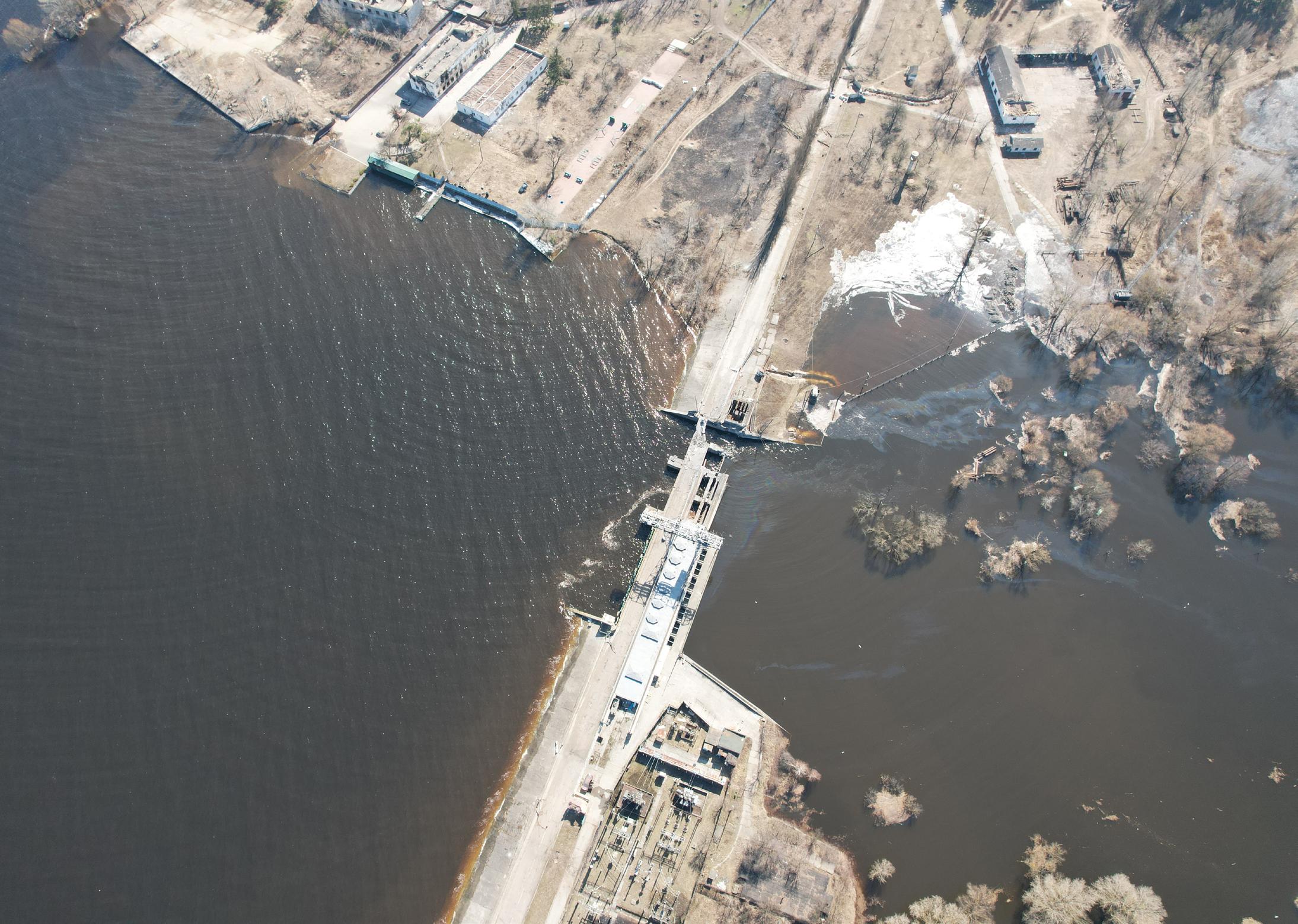

“All these days became monotonous. Shoot, shoot, move, shoot. That’s all, there was nothing else. It happened that there was not even time to eat or go to the toilet… we worked for three days without sleeping or eating. We reloaded and fired, reloaded and fired and that was it.” – A Ukrainian 2S3 Artillery Commander1

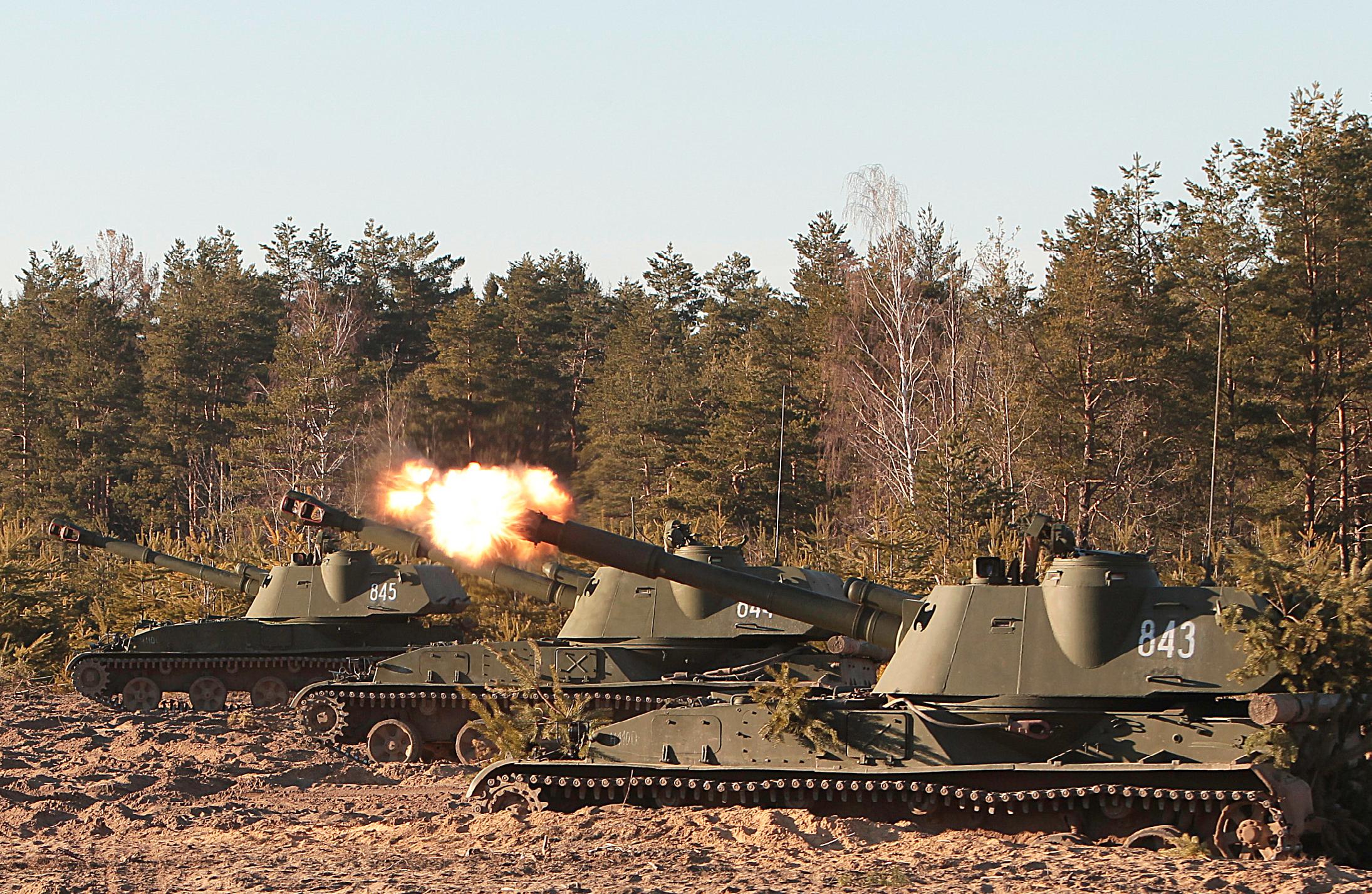
IT should come as no surprise that artillery played a pivotal role in the defence of Kyiv. As a means of combat it has a proven pedigree – inflicting 60 per cent of all casualties during World War I, 70 per cent of casualties on the Eastern Front during World War II and an estimated 85 per cent of the casualties suffered during Ukraine’s war in the Donbas in 2014-15.2 Known as the ‘King of Battle’, artillery’s reign endures, with some observers believing the current war has seen it hit figures as high as 80 to 90 per cent.3
Artillery within the 72nd Mechanised Brigade was organised under the Brigade Artillery Group, which – commanded by a colonel –consisted of 120mm and 82mm mortar batteries and four artillery ‘divisions’ (each equipped with a different weapon system). The brigade had 20 mortars in total, which were dispersed to the mechanised battalions in twos to provide close support. Each of the divisions was led by a lieutenant colonel and consisted of:
n 1st Division was equipped with 2S1 Gvozdika self-propelled 122mm guns, which have a range of 15.3km, require a crew of four and weigh 16 tonnes.
n 2nd Division was equipped with 2S3 Akatsiya self-propelled guns. The 2S3 has
a 152.4mm D-22 howitzer with a range of 18.5km, requires a crew of four and weighs 28 tonnes.
n 3rd Division was equipped with BM-21 Grad self-propelled multiple rocket launchers, which have 40 x 122mm tubes with a range of around 20km, require a crew of three and weigh 13.7 tonnes.
n 4th Division was equipped with MT-12 Rapira anti-tank guns. A towed smooth-bore 100mm gun, the MT-12 has a range of 3km in direct fire, 8.2km in indirect fire and has a crew of seven.
The Brigade Artillery Group also included a reconnaissance group equipped with one A1CM Furia drone and one Leleka-100 drone.4
This chapter is based on the accounts of soldiers of the 2nd Artillery Division, 72nd Brigade, which had 12 2S3 Akatsiyas to its name, was made up of a headquarters consisting of a chief of staff, logistics officer, weapons officer and intelligence officer; and three batteries, each with four Akatsiyas, two MT-LBs (armoured command and control vehicles), two Urals (heavy mobility trucks) and one GAZ-66 (4x4 military truck). At full strength there should have been 48 people in
each battery, however, all were at half strength at the start of the war. Each gun had 46 152mm shells. The reconnaissance group had around 20 soldiers, split into three batteries and equipped with basic optics including binoculars, telescopes and a range finder.5 The 1st Division had a similar structure.
Under the defensive plan, the brigade assigned all of 1st Division’s 2S1s, two BM-21 batteries from 3rd Division, two batteries of MT-12 Rapira anti-tank guns from 4th Division and the majority of brigade artillery reconnaissance (including the two drones) to the east bank of the Dnipro River to support the 1st and 3rd Mechanised Battalions.6 The
1Interview with soldier 9, February 2023.
2“Artillery,” The National WWI Museum and Memorial, no date, accessed 7 November 2023.; and Jonathan B.A. Bailey, Field Artillery and Firepower (Newport, RI: Naval Institute Press, 2004), ISBN 978-1-59114-029-0; and Phillip Karber, “Lessons Learned” from the Russo-Ukrainian War (Washington, DC: Potomac Foundation, 2015).
3Stephen Biddle, “Back in the Trenches: Why New Technology Hasn’t Revolutionized Warfare in Ukraine,” Foreign Affairs, 10 August 2023, foreignaffairs.com/ ukraine/back-trenches, accessed 9 November 2023.
4-6Interview with soldier 3, September 2023.
brigade assigned all of 2nd Division’s 2S3s, one of 3rd Division’s Grad batteries and one of 4th Division’s anti-tank batteries to the west side of the Dnipro River in support of the 2nd Battalion. Heavier and less mobile than other systems, the 2S3 self-propelled guns were deployed where it was believed the fight would be less dynamic.7
On the 18th and 19th February, the Brigade Artillery Group and the division commanders conducted their first recce of the brigade area of responsibility.8 On the 21st February, the 2nd Division commander gathered his three battery commanders at their base in Bila Tserkva and told them they would be departing at 0500 the following morning on a reconnaissance mission to determine their positions in Kyiv.9 To maintain a low profile, they wore civilian clothes and drove in a civilian vehicle. For two days, they toured the capital, walking potential firing positions in clearings in woods, abandoned compounds or other sites that would allow them to fire while offering some degree of concealment.10 They identified three locations, one near Lyutizh, one in Pushcha-Vodytsya and one near Chaiky (a small suburb town, west of Kyiv on the E40 highway). The battery commanders asked senior officers about the likelihood of an invasion but no one wanted to speak about it.11
In the days leading up to the 24th February, the 72nd Mechanised Brigade loaded their heavier equipment on to trains. The brigade planned to transport their tracked vehicles – tanks and heavy artillery guns – and supplies from Bila Tserkva to Irpin station where they would be unloaded and moved to their positions.12 By the evening of the 23rd February, the 2nd Mechanised Battalion had assembled all its vehicles and the 2nd Artillery
7-9Interview with soldier 3, September 2023.
10-11Interview with soldier 29, February 2023.
12Interview with soldier 3, September 2023.
13Interview with soldier 29, February 2023.
14Interview with soldier 3, September 2023.
15Interview with soldier 29, February 2023.
16Interview with soldier 9, February 2023.
17Interview with soldier 3, September 2023.
18Interview with soldier 29, February 2023.
19Interview with soldier 3, September 2023.
20-21Interview with soldier 29, February 2023.
22Interview with soldier 9, February 2023.
23Interviews with soldier 9 and soldier 29, February 2023.
Division’s 2S3s were lined up at the train station ready to be loaded. A Russian missile hit a warehouse on the base in Bila Tserkva just before 0500 on the day of the invasion. “The first impression was fear, frenzy, hands were shaking,” recalled a soldier. “We lined up. The commander said that we should now take the equipment from the ramp and go… we started moving at a crazy pace.”13
At his flat in Bila Tserkva, the 2nd Artillery Division commander’s phone lit up with messages from subordinates asking him what they should do. He told them to go to the railway station immediately and, as he drove there himself, could hear explosions around the city. By the time he arrived, the train – loaded with infantry vehicles but not his guns – had already reached Irpin and was in the process of being unloaded. The need for urgency meant the only option, as confirmed during calls with both the brigade commander and brigade artillery commander, was to reach northwest Kyiv by road. Efforts by the artillery division headquarters to find local truck companies that could load and take the self-propelled guns to the capital proved futile and, consequently, the 28-tonne 2S3s were going to have to drive nearly 100 kilometres to reach their positions.14
The 2nd Artillery Division’s commander ordered the 1st Battery to Vynogradar district, the 2nd Battery to the Stoyanka area and the 3rd Battery to the Obolon district, all in Kyiv’s northwest.15 The commander dispatched the 2nd Battery first, staggering the departure of the other two batteries in two to three-hour intervals to prevent the Russians from targeting them at the same time on the jammed roads.16 During his drive north, the division commander received messages and phone calls from former artillery personnel offering to help and advised them to meet the unit as it travelled along the E95 highway.17 In one case, a veteran 2S3 driver, now a civilian and dressed in jeans and a t-shirt, flagged down one of the guns and took the place of the younger and less confident soldier that had been at the
the driver-mechanic sitting in civilian clothes, pants and sneakers. I approached and asked ‘what are you doing here?’. He says: ‘Combat. War. I have to help’.” 18
The 2nd 2S3 Battery arrived at Stoyanka around 1700 but 1st 2S3 Battery did not get to the Vynogradar district until later that evening as their self-propelled guns kept breaking down. Eventually the division commander managed to get hold of a transport company able to help. “I told them (over the phone) ‘just drive along the Bila Tserkva-Kyiv E95 highway, if you see some heavy equipment that is either moving slowly or just stopped because the oil has leaked, load it and take it to Kyiv’. On the way they picked up a couple of tanks from the 72nd. Throughout the day these truckers were picking up everyone they could see and taking them towards Kyiv.”19
From the moment 2nd Battery arrived in position, the gunners went straight to work20 having received an order from the deputy brigade commander to fire on the Antonov Airport to deny the runway to the enemy. Intelligence suggested that several IL76 transport planes – carrying hundreds of follow-on forces intended to support Russian special forces in Kyiv – were inbound from Belarus. The artillery division commander duly sent the firing order to the battalion commander via WhatsApp and, at around 1730, the 2nd 2S3 Battery fired its first rounds of the conflict at the airport.21 After completing its inaugural fire mission, the battery was instructed by the artillery division commander to move to Pushcha-Vodytsya, a leafy suburb east of Horenka.22
The 2nd Artillery Division deployed three to four-person observer teams with each of the three infantry companies to coordinate and adjust fires. While none of these ‘spotters’ had drones at the start of the war, by early March each team was equipped with a single Mavic 3 [pictured below].23 Civilians also played an


important role in passing target information. “A lot of the local population contacted the brigade command and told them where [the Russians] were hiding, where they were standing and where to shoot. For example ‘there is a blue ATB supermarket and 300-400 metres to the left, five tanks or something else were hidden’.”24
The pace of firing was often unrelenting. “All these days became monotonous. Shoot, shoot, move, shoot. That’s all, there was nothing else. It happened that there was not even time to eat or go to the toilet.”25
“We worked for three days without sleeping or eating. We reloaded and fired, reloaded and fired, and that was it.”26
Each battery rotated between four positions within their area: setting up, firing a 12-round salvo, then moving to the next position to avoid Russian counter battery fire, before starting the cycle again. They rotated through all four positions at least twice each day and became efficient at doing so – taking only 15 minutes to set up at each station.27
In terms of ammunition, each 2S3 carried 46 rounds, each battery had two support vehicles – each loaded with a further 45 rounds, and further ammo was stocked nearby. The artillery division’s initial supplies covered the first three days of fire missions and thereafter ammunition had to be transported, several times a day, from Bila Tserkva.28
Worked hard, the guns regularly required maintenance and, more often than not, only three of each battery’s four artillery pieces were operational at any given time. For the 2nd Artillery Battery this problem was compounded by being a gun light until several days into the fight as a consequence of it breaking down en route from Bila Tserkva.29
The deputy brigade commander, 2nd Mechanised Battalion commander and the 2nd Artillery Division commander collocated themselves in Pushcha-Vodytsya to coordinate the fight in the northwest.30 The artillery headquarters had a single Starlink unit and secure military radios to communicate with each artillery division. WhatsApp and other encrypted apps, however, were relied on by the 2nd Artillery Division to conduct a significant amount of communication with the batteries.31
In addition to artillery assigned to the 2nd Mechanised Battalion, there were six D30 howitzers, under the command of Major General Andriy Malinovsky (the head of artillery in Army HQ), which the deputy brigade commander could call on.32
The deputy brigade commander determined the targeting priorities on the west side of the river in consultation with the artillery division commander.33 Initially tanks were the highest priority target followed by armoured columns of BTRs and armoured personnel carriers. After the 28th February, bridges, pontoons and vehicles at crossing points topped the list.34 As one soldier succinctly summed up: “Everything that led to Kyiv, everything [had to be] destroyed.”35
“It was difficult to hit the pontoon because the howitzer is not a sniper rifle. But we tried, all three batteries tried to destroy this pontoon in turn, and we hit once.”36
“At night there was an opportunity to take a nap, but the sound of the phone immediately woke you up. Cold, hunger – that is no longer important. People had such passion that simply cannot be expressed in words. People were ready to perform the assigned tasks at any moment.”37
From the beginning of March, the guns focused on supporting the 5th Company at Moshchun and targeting the pontoons.“They [the Russians] constantly brought troops on armoured personnel carriers and BMPs when the pontoons were being laid. Groups of 1520 people. We poured shells at them, 20 or so men ran away, the next day the same thing happened again… it felt like they were never running out of living resources.“38
When the Russians attacked Moshchun on the 11th March, the deputy brigade commander moved forward to the village from the headquarters at Pushcha-Vodytsya to help command the defence by calling in artillery fire. Frequently, all three batteries
were simultaneously conducting firing missions in support of the defence at Moshchun. One soldier noted how critical the artillery was to holding the line: “The [artillery] division commander said ‘the infantry is crying and thanking us on the radio’.”39
Towards the end of March, the Russian attack slowed and the batteries were able to alternate – two firing, one resting. The artillery division did not encounter enemy artillery fire until the morning of the 27th March when Russian towed guns targeted them – up to that point the invaders’ counter battery fire had been focused on Ukrainian targets in the rear areas and on larger calibre weapons.
A battery commander recalled how he learned of the Russian withdrawal: “My battery was on duty. I still remember this moment. It was either 31st March or 1st April. I got into position and am waiting for the command. And I write to the [artillery division] commander [on WhatsApp] ‘give me a goal’. And he writes ‘wait, I’m looking’. Half an hour passed. I told him again ‘give me a goal’. He said ‘there is nothing, there is no one’. So, the Russians left.”40
24-25Interview with soldier 29, February 2023.
26Interview with soldier 9, February 2023.
27Interview with soldier 29, February 2023.
28Interview with soldier 3, September 2023.
29Interview with soldier 29, February 2023.
30-33Interview with soldier 3, September 2023.
34-35Interview with soldier 29, February 2023.
36Interview with soldier 9, February 2023.
37-39Interview with soldier 29, February 2023.
40Interview with soldier 9, February 2023.


“Everyone was necessary, no one could do without the other.” – Ukrainian artillery officer
THE Battle of Irpin River was a closerun thing. As one soldier put it: “(The Russians) could have done everything on the 27th (February)… if they immediately made an assault, with tanks, infantry, while there was still a bridge, I think that it would be very difficult for us… they didn’t know the area and didn’t know how many of us there were. And that was their big mistake. Maybe they were afraid. Confident that Kyiv will be captured in three days. They did not expect such resistance from the Ukrainian armed forces and the people.”1
Russia’s attack on Kyiv from the northwest was a shock but not a surprise. Ukrainian commanders had to make difficult resource allocation choices. An attack on Kyiv from Belarus was the most dangerous course of enemy action, but because it was audacious it was also deemed least likely. An attack in the east and south of Ukraine was the most likely course of action, therefore Ukrainian forces were primarily arrayed against this.
The defensive line around Kyiv was thin. The 5th Company of the 72nd Brigade deployed with only 22 soldiers. Numbers swelled over the initial days of the invasion as newly mobilised troops arrived, but the company and many of its sister units were persistently understrength compared to the Russian units across the river. That the bridges along the river were not destroyed on the morning of the invasion nearly cost Ukraine its capital.
“The hiatus allowed defensive lines to consolidate and gave the Ukrainians time to blow the bridges and the dam, mobilise new soldiers and rush to the ramparts.”
A Russian army more prepared to fight probably could have pushed through in those first few days.
The attack on Antonov Airport was a pyrrhic victory. As has been widely reported elsewhere, Russian forces were clearly unprepared to face the kind of aggressive defence posted up by even the thinnest part of the Ukrainian lines. Elite VDV (VozdushnoDesantnye Voyska) airborne forces that seized the airport were destroyed that first night and the crucial airbridge necessary to cement Russia’s hold on the northwest approach was never established. Through subterfuge in the days leading up to the invasion, Ukraine retained its air defence capability, limiting Russian air options even as the Russians seemed to abjure the use of their own airpower.
Ground forces that eventually arrived at the Irpin River area were not initially intended to seize Kyiv through urban assault. The initial plan having failed, the Russian Army paused. They were now situated on the wrong side of the largest natural barrier north
of Kyiv. The hiatus allowed defensive lines to consolidate and gave the Ukrainians time to blow the bridges and the dam, mobilise new soldiers and rush to the ramparts. Russian commanders had no option but to push forward in linear columns with ill-prepared forces into still thin, but now far more robust and prepared defences. What followed appears to have been tactical actions in search of an operational plan.
Still, the sheer mass of its forces meant the Russian military came close to breaking through the lines in late March. The decision to employ flooding as a defence on 25th February, however, was probably the reason the Ukrainian capital did not fall. “The 72nd Brigade and Irpin River saved Kyiv. But mostly the river. It’s a kind of miracle… the river turned into a sea.”2
The Irpin river had stood as formidable obstacle to land forces attempting to capture Kyiv. In what may have been an apocryphal 14th Century battle, a Lithuanian force advancing to sack Kyiv was stopped cold and defeated on the river’s banks.3 During World War II, German and Soviet forces engaged in both directions across the river, first during the
1Interview with soldier 13, August 2022.
2Interview with soldier 18, August 2022.
3Volodymyr Sayuk, “The Battle of Irpin in 1323,” Модест Чорний, 2015.
Wehrmacht’s 1941 advance and then during the Soviet 1943 counter-offensive.4 In 2022, were Russian military planners aware of the river’s importance in previous battles for Kyiv? If so, did they consider the possibility that the Ukrainians might conduct what is generally referred to as hydraulic warfare and release flood waters into the plain?
Even after interviewing key players in the decision to flood the Irpin River, it remains unclear if the flooding emerged as a formal military option before the 24th. Whether or not it had been considered, Ukrainian adaptability succeeded where Russia’s failed. It is remarkable that a Ukrainian businessman and his band of off-road vehicle and drone enthusiasts played such an important role in this battle.
The will to fight demonstrated by Ukrainian civilians and their military played an equally decisive role in the outcome of the Battle of Irpin River. While many people fled the city, enough remained to take up arms even in the face of what seemed to be overwhelming odds. The will to fight of the army was demonstrated in numerous individual but important ways.5 In one example, we interviewed soldiers who held a trench for two weeks under daily artillery fire and only left when medically evacuated.
Some of the most remarkable stories are of those who were civilians on the 23rd and who volunteered to fight on the morning of the 24th. Ukrainians queuing at recruitment offices or turning up to the gates of military bases saw the images and videos on social media of the Russian columns bearing down on Kyiv. Many we spoke to did not think they would win, but they believed they had to do something. Some had prior military experience in the Donbas, but many had none. Mobilisation was chaotic but essential – these initial volunteers went on to make up a significant portion of the forces that defended Kyiv.
Local communities helped Ukrainian forces in the important first few days. They provided food and supplies, helped dig defensive positions and provided information on the enemy. Ukrainian soldiers and commanders described being inundated with messages and phone calls with information. Civilians often acted at great risk to themselves and their families.
This battle was a combined-arms fight in the fullest sense. Our research suggests a relatively even application of arms. A Ukrainian artillery officer put it best: “Everyone was necessary, no one could do without the other.” Just a handful of Ukrainian brigade and battalion
Heavy toll: A growing number of photographs and tributes adorn the wall of remembrance for the fallen defenders of Ukraine near St. Michael’s Cathedral in Kyiv

commanders in the 2nd Battalion area of operations rapidly and continuously directed armour, infantry, artillery, air, special forces, irregular forces, local militias and police to manoeuvre and bring their fires to bear on the invading Russian forces.
Balance between the role of artillery and infantry illustrates the interconnectedness of the battle. Primarily unguided artillery fires delivered by Soviet-era cannons were crucial to the defence. Ukrainian artillery denied the Antonov Airport runway and destroyed Russian armour as it massed to cross the Irpin. During the battle of Moshchun, mass fire for area effect prevented a Russian breakthrough. Fighting was so intense that Ukrainian forces relied on artillery just to temporarily disrupt Russian attacks to enable resupply, casualty evacuation and rotation of forces in front-line positions.
While artillery played an important role, defence of the Irpin River line still required Ukrainian infantry to hold the line for weeks. Ground holding units suffered heavy losses. They received support and assistance from a variety of other units including national police, national guard, special forces and Territorial Defence, but that support was sustained often only for short periods. A 2nd Battalion soldier said: “[Other units] came, saw what was happening, turned around and left… when they see that the (Russian) artillery is working, they leave… other units did important things and caused damage to the enemy. They successfully did their job due to the fact that they constantly moved and manoeuvred; and we sat in one place like woodpeckers… we created a line of defence. And the other forces fought. We took the fire on ourselves. Because of this, we have such losses. We are sitting, we are running out of people, others come to us, they also run out, then the next ones come.”6
The desperate success of Ukrainians along the Irpin River line denied the Russian army a route to the suburbs of Kyiv from the north west. On the eastern bank of the Dnipro, the rest of the 72nd Brigade also held Russian forces back. In late March, the Russian ground forces and VDV elements began to move from the north of Kyiv around the western side of the city
to the south. At the time the fear was that the Russian army was trying to encircle the city to lay siege. We now know that the Russian Army, unable to break through in the north, was more likely groping about in the dark to find new ways into the capital. Unable to do so, Russian forces withdrew from the Kyiv Oblast at the end of March and beginning of April 2022. What was perceived to be an attempted encirclement disaggregated into a slow-motion defeat.
It is difficult to accurately account for the scale of destruction and death attributable to the defence of Kyiv. In Moshchun alone, over the course of the battle 2,000 of the village’s 2,800 buildings were reported to have been damaged or destroyed.7 It is unknown how many civilians were injured or killed. Those in Horenka, Moshchun and Huta-Mezhyhirs’ka are beginning to take stock of losses and to reclaim and rebuild their homes, communities and lives.
Following the defence of Kyiv, the 72nd Brigade was deployed east to continue the fight. We asked one of the soldiers why he was willing to share his story with us...
“I give interviews so as not to forget. Every day I recall new details. I don’t want to forget it. I don’t want people to forget this.”8
4Charles River Editors, The First Battle of Kiev: The History of the Soviet Red Army’s Most Disastrous Defeat of World War II, ebook, 2016, location 407. Also see: David Stahel, Kiev 1941: Hitler’s Battle for Supremacy in the East, New York, N.Y.: Cambridge University Press, 2012.
5On the importance of will to fight see: Ben Connable, Michael J. McNerney, William Marcellino, Aaron Frank, Henry Hargrove, Marek N. Posard, S. Rebecca Zimmerman, Natasha Lander, Jasen J. Castillo, and James Sladden, Will to Fight: Analyzing, Modeling, and Simulating the Will to Fight of Military Units (Santa Monica, CA: RAND Corporation, 2018).
6Interview with soldier 23, August 2022.
7RFE/RL, “Before and After Satellite Photos Reveal Destruction in Ukraine after Russia’s Invasion,” RFE/ RL, 22 February 2023, rferl.org/a/satellite-photoscapture-ukraine-udestruction/32281347.html, accessed 7 November 2023.
8Interview with soldier 13, August 2022.
This edition of The British Army Review is based on interviews with Ukrainian soldiers who fought at the battles described and civilians who witnessed events. These first-person accounts are combined with evidence and insights gathered from visits to the battlefields in June and August 2022 and February and September 2023 by the research team.
The field research and interviews were conducted with permission and accreditation from the Ukrainian Ministry of Defence. We were free to work unescorted and without supervision. However, the research was not sponsored nor should it be considered an authorised nor official history in any way. Those who spoke to us, did so voluntarily and individually. The team interviewed 40 people, eight civilians and 32 soldiers. Interviewees included volunteers, soldiers, non-commissioned officers and company-grade officers. Two
All good scholarship is a collaborative and collective endeavour. Each individual effort builds off either those with whom we collaborate directly or, most often, those whom we draw on for clues, inspiration, challenge and verification. The account we offer in this British Army Review expands on existing work as cited and, we hope, makes a contribution to continuing efforts to both tell the story and understand what happened. We offer here a brief list of literature and media that we found useful.
lieutenant colonels and one general officer were interviewed, but the team were unable to speak to the commanders of 2nd Battalion or 72nd Brigade, or anyone at Army level outside of the aforementioned general officer.
Those who did share their stories mostly did so in person, in Ukraine, and – when possible – at the site the action unfolded. When this was not feasible, maps were used to assist in understanding the battle’s flow and in the event individuals were deployed but willing and able to speak online, interviews were conducted remotely.
All interviews were committed to voluntarily and interviewees were fully informed about the project, our research questions and the intended outputs of our work. They were free to withdraw consent at any time and this was checked throughout the process. Interviews were conducted in whatever language the
interviewee felt most comfortable using. Some were recorded, others were not, with transcripts created from those that were. Quotes in this British Army Review are primarily from the transcribed accounts, though some are taken from written records of nonrecorded interviews.
Subjects were able to consult both Google Maps and the MAPS.ME app during interview. The maps included in this account should be taken as approximations, which are based on combining information from interviews with the research team’s first-hand observations of the referenced locations.
Photographs used in this paper were taken by the research team unless otherwise indicated. This paper has been written mindful of ongoing Ukrainian operational security. The war continues and while the battles we discuss have ended, some details have been withheld.
It is important to recognise the significant body of work and contribution of Ukrainian journalists, researchers and scholars. It is easy to overlook local sources when one does not speak the language and instead be drawn to the easily accessible and digestible papers of records in one’s first language. There are many important works by Ukrainian authors that tell some of the most detailed and carefully researched stories which are essential reading. With the ready availability of translation programmes, sources from a wide range of
languages are increasingly accessible.
The Only Easy Day Was Yesterday is an interview with a member of ‘Omega’ – a National Guard special forces unit – about the defence of Kyiv.1 The subject gives a first-hand

1Serhii Haraluzhiy, Mykyta Korobochkin, Yevhen Motolyhin, Dmytro Temchenko and Serhii Veselukha, ‘The Only Easy Day Was Yesterday’, National Information Portal “Tysk”, 10 November 2022, Translated by Illia Morozenko, teletype.in/@tysknip/HostomelEN.

account of the battles for Antonov Airport and Moshchun and offers his views on the conduct of conflict in those early days.
How and why the Russian army lost the battle for Kyiv and retreated is a BBC News Ukraine Service article2 that describes the Russian war plan for Kyiv, based on analysis provided to them by the General Staff of the Armed Forces of Ukraine. It details Russian military intentions, plans and the units involved. It offers an account of how events unfolded and how the Ukrainian military stopped the advancing Russian army column.
The Battle that Saved Ukraine, published by The New Voice of Ukraine, is one of the most comprehensive accounts of the battle for Kyiv – synthesising an impressive range of both Ukrainian and international sources.3 It provides detailed information about the Kremlin’s plans, expectations and failures. It also describes both the planned and actual routes and the advance of Russian forces towards Kyiv and an explanation regarding special markings for different types of troops. It includes an hour-by-hour chronology of the battle for Hostomel, as well as a detailed description of the battle for Moshchun. It also describes the fighting on the left bank of Kyiv towards Brovary, an area defended by the 3rd Battalion, 72nd Brigade.
How Gostomel was defended: 24 hours of fighting for the airport, where they tried to land Russian troops to storm Kyiv is a television documentary report on the fight for Antonov Airport.4 It combines archive footage of the battles with interviews with eyewitnesses, including airport staff and soldiers who fought there.5
The battle for Moshchun – an outpost of Kyiv, published by Censor.Net, is a long and detailed interview with the commander of 5th Company and one of his soldiers.6 It offers a comprehensive account of the fight by 5th Company to defend Moshchun from the first Russian incursion to the eventual medical evacuation of the two subjects. It is a raw account of the battle. The interview was given
when both were in hospital and when the outcome of the battle for Moshchun was still in the balance.
The Battle for Kyiv: How did elite Russian troops fail? is an investigation by Radio Free Europe into the battle for Moshchun from beginning to end, using archival footage and interviews with participants.7 The analysis reveals the Russian units involved as well as the names and details of the Russian causalities. It also provides a detailed narrative of the battle.
Battle Of Kyiv. Moshchun. Hostomel Direction from Ukrainian Military TV contains interesting footage of Ukrainian Army and special forces during the fighting in Moshchun in mid-March 2022.8 CNN also got hold of important footage – recorded by Ukrainian soldiers – of the fighting.9
Battle for Kyiv: Ukrainian valor, Russian blunders combined to save the capital,10 published in The Washington Post, and The Ragtag Army That Won the Battle of Kyiv and Saved Ukraine,11 published in The Wall Street Journal, are among the most comprehensive accounts of the defence of Kyiv, detailing the fight on both the east and west bank of the city. The New York Times’ How Kyiv Has Withstood Russia’s Attacks,12 published in the days after Russian troops withdrew from around Kyiv, offers both a useful snapshot of early analysis and usefully integrates and orientates the narrative with mapping. The New York Times’ Putin’s War13 is based on a large number of interviews, intercepts and Russian documents, and is one of the most important pieces based on primary sources. Other notable long form pieces include The New Yorkers’ How Ukrainians Saved Their Capital,14 which tells the story of the defence of Kyiv through a Ukrainian who returned and joined a medical organisation and contains a number of interesting details.
Finally, both Andrew Bowen’s Russia’s War in Ukraine: Military and Intelligence Aspects,15 published by the Congressional Research Service, and Mykhaylo Zabrodskyi, Dr Jack Watling, Oleksandr V Danylyuk and Nick
Reynolds’ Preliminary Lessons in Conventional Warfighting from Russia’s Invasion of Ukraine: February–July 2022,16 published by RUSI, provide important accounts and initial assessments of the opening months of the war.
2Сергей Морфінов, BBC Україна, Колона. Як і чому російська армія програла битву за Київ і відступила, 24 February 2023, bbc.com/ukrainian/news-64754500. 3nv.ua/ukr/ukraine/events/bitva-shcho-vryatuvalaukrajinu-rik-tomu-rosiyan-vitisnili-z-pid-kiyeva-yakvidstoyali-stolicyu-rekonstru-50314634.html?utm_ source=telegram.
4Андрей Кузаков, Как защищали Гостомель: 24 часа боев за аэропорт, где пытались высадить российский десант для штурма Киев, Настоящее Время, 24 февраля 2023, currenttime.tv/a/kak-zaschischaligostomel-24-chasa-boev-za-aeroport/32285196.html.
5Настоящее Время or ‘Current Time’ is a digital news network which is produced by Radio Free Europe/Radio Liberty (RFE/RL) in cooperation with the Voice of America (VOA).
6Віолетта Кіртока, ‘Битва за Мощун - форпост Києва Джерело’, Цензор.НЕТ, 24 March 2022, censor. net/ua/resonance/3328167/bytva_za_moschun_forpost_ kyyeva.
7Radio Free Europe, ‘The Battle for Kyiv: How did elite Russian troops fail?’, February 2023, youtube.com/ watch?v=qfDWi-VNdE0.
8youtube.com watch?v=NdZVNU93Bvs&t=7s.
9‘Remarkable video obtained from Ukrainian soldier shows battle for Kyiv’, The Lead. edition.cnn.com/videos/ tv/2022/05/05/tl-4p-rivers-jake-tapper-live.cnn
10Paul Sonne, Isabelle Khurhudyan, Serhiy Morgunov and Konstantyn Khudov, “Battle for Kyiv: Ukrainian valor, Russian blunders combined to save the capital,” Washington Post, washingtonpost.com/national-security/ interactive/2022/kyiv-battle-ukraine-survival/.
11James Marson, “The Ragtag Army That Won the Battle of Kyiv and Saved Ukraine” Wall Street Journal, 20 September 2022, wsj.com/articles/russian-invasionukraine-battle-of-kyiv-ragtag-army-11663683336.
12Anjali Singhvi, Charlie Smart, Mika Gröndahl and James Glanz, “How Kyiv Has Withstood Russia’s Attacks,” New York Times, 2 April 2022, https://www.nytimes.com/ interactive/2022/04/02/world/europe/kyiv-invasiondisaster.html.
13Michael Schwirtz, Anton Troianovski, Yousur Al-Hlou, Masha Froliak, Adam Entous and Thomas Gibbons-Neff, “Putin’s War,” New York Times, 16 December 2022, nytimes.com/interactive/2022/12/16/world/europe/ russia-putin-war-failures-ukraine.html.
14Luke Mogelson, “How Ukrainians Saved Their Capital,” New Yorker, 2 May 2022, https://www.newyorker.com/ magazine/2022/05/09/how-ukrainians-saved-theircapital.
15Andrew Bowen, Russia’s War in Ukraine Military and Intelligence Aspects, Congressional Research Service, 14 September 2022, crsreports.congress.gov/product/pdf/R/ R47068/5.
16Mykhaylo Zabrodskyi, Jack Watling, Oleksandr V Danylyuk and Nick Reynolds, Preliminary Lessons in Conventional Warfighting from Russia’s Invasion of Ukraine: February–July 2022 (London: RUSI, 2022), https://www.rusi.org/explore-our-research/publications/ special-resources/preliminary-lessons-conventionalwarfighting-russias-invasion-ukraine-february-july-2022.
We wish to express our gratitude to the Ukrainians who so generously shared their time and their stories with us.
This would not have been possible without the generous support of the Madison Policy Forum or the access granted by the Ukrainian government for repeated research trips to Kyiv and the surrounding battlefields.1
We wish to specifically thank Oleksandra (Sasha) Titorova for her extraordinary professionalism, dedicated effort, unflagging cheer and collegiality as she worked to facilitate this research in the field and from the greater Kyiv area in the midst of an ongoing war. Sasha set up interviews, researched events and translated for us. She did her work with compassion and empathy for those we interviewed. We are indebted to her.
We also wish to thank Zoe Flood, Phil Jones OBE, Svitlana Sudak, Alina Frolova, Lieutenant General (retired) Sir Paul Newton and Jenny Klochko for their advice and support.
We are grateful to Nicholas Riggs for producing the mapping featured in this publication and offer thanks to Andrew Simms for his tireless work in putting this special edition of The British Army Review together as editor. Any mistakes, errors or omissions are the authors alone.
James Sladden: I am grateful to Viktor Kovalenko who served in the Ukrainian Army and fought in the battle for Debaltseve in 2015. He wrote a blog about his experiences during the fighting. Viktor kindly met with me not long after the battle to talk about his experiences. Listening to him impressed on me the power and importance of each individual’s story in making sense of history.
1madisonpolicy.org.

“THE PURPOSE OF THE BRITISH ARMY IS TO PROTECT THE UNITED KINGDOM BY BEING READY TO FIGHT AND WIN WARS ON LAND.”

