Bringing Together Women, Peace and Security Photograph: NZDF.
Amy Brosnan
2025 marked the 25th anniversary of the United Nations Security Council Resolution (UNSCR) 1325 on Women, Peace and Security. Reflections on what has been achieved since are mixed, indicating both progress as well as ‘backsliding’ on the principles of gender equality that underpin this important resolution. This article explores New Zealand’s response, and highlights the release of, and commitment towards, a revised National Action Plan on Women, Peace and Security. A critical underpinning of this commitment is the recognition that within a global security context that has seen a resurgent focus on war and warfighting, issues of gender equality remain critical to peace and security.
2
025 marked the 25th anniversary of United Nations Security Council Resolution (UNSCR) 1325 on Women, Peace and Security (WPS) – the first resolution of its kind to acknowledge the disproportionate impact of war on women and children, and which recognises that women are not simply
victims of war, but also critical agents of peace. UNSCR 1325 urges protection of women and children from the impacts of violence and conflict whilst encouraging increased participation of women in decision-making, peacebuilding and conflict resolution. Since 2000, nine further Security Council resolutions have been passed on issues such as conflict related sexual violence (CRSV) and the participation of women as peacekeepers. Together these ten resolutions constitute the WPS Agenda.
Celebrating (or Commiserating) 25 Years of 1325
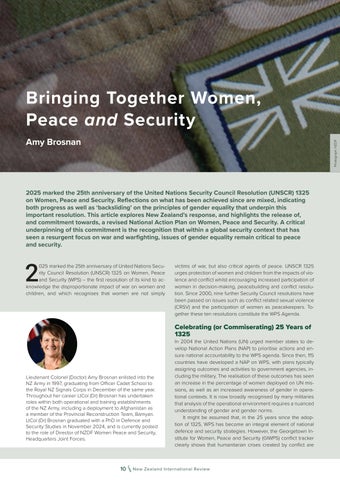
Lieutenant Colonel (Doctor) Amy Brosnan enlisted into the NZ Army in 1997, graduating from Officer Cadet School to the Royal NZ Signals Corps in December of the same year. Throughout her career LtCol (Dr) Brosnan has undertaken roles within both operational and training establishments of the NZ Army, including a deployment to Afghanistan as a member of the Provincial Reconstruction Team, Bamyan. LtCol (Dr) Brosnan graduated with a PhD in Defence and Security Studies in November 2024, and is currently posted to the role of Director of NZDF Women Peace and Security, Headquarters Joint Forces.
10
In 2004 the United Nations (UN) urged member states to develop National Action Plans (NAP) to prioritise actions and ensure national accountability to the WPS agenda. Since then, 115 countries have developed a NAP on WPS, with plans typically assigning outcomes and activities to government agencies, including the military. The realisation of these outcomes has seen an increase in the percentage of women deployed on UN missions, as well as an increased awareness of gender in operational contexts. It is now broadly recognised by many militaries that analysis of the operational environment requires a nuanced understanding of gender and gender norms. It might be assumed that, in the 25 years since the adoption of 1325, WPS has become an integral element of national defence and security strategies. However, the Georgetown Institute for Women, Peace and Security (GIWPS) conflict tracker clearly shows that humanitarian crises created by conflict are
New Zealand International Review