The Magazine of the Arkansas Alumni Association Inc.
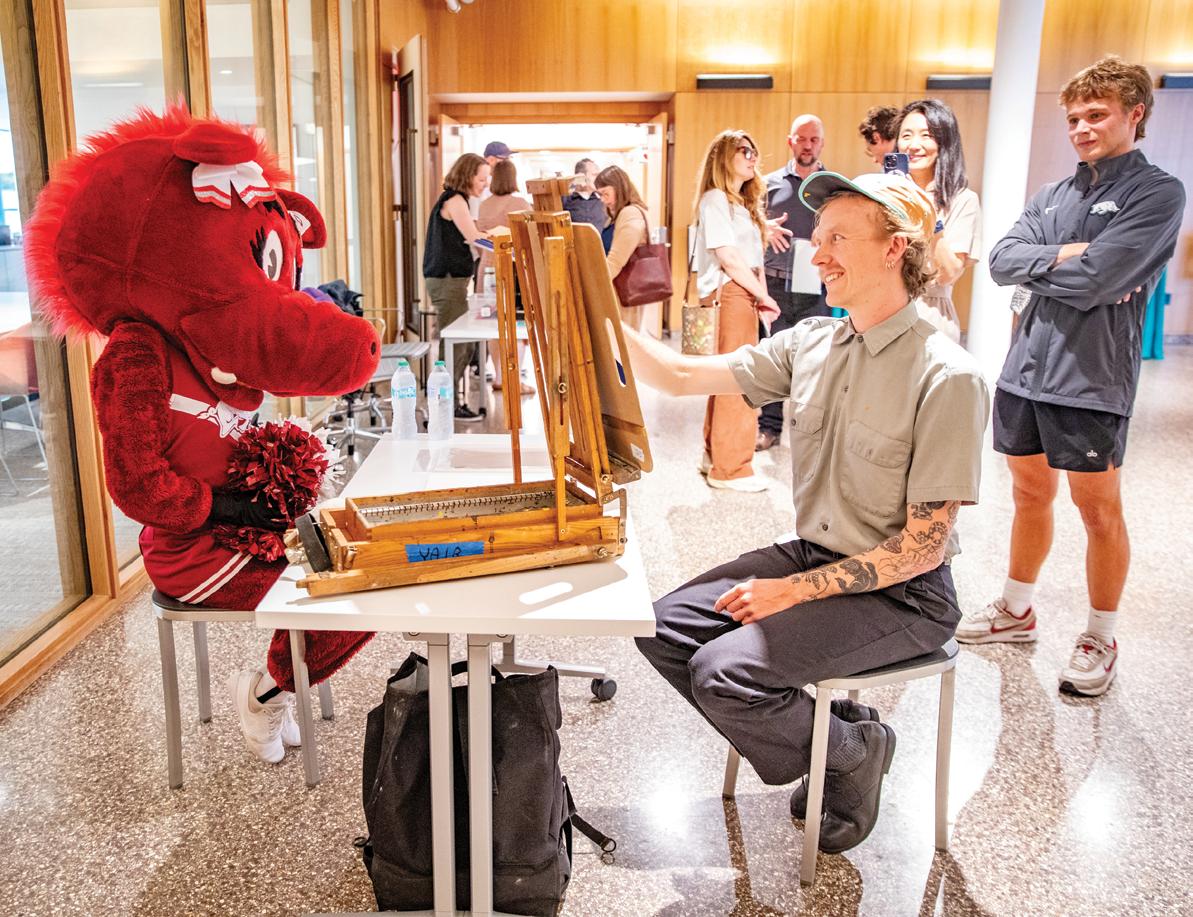
Arkansas Razorback mascot Sue E. poses for a portrait with MFA student Yair A. R. Sikorski at the Fine Arts Center Grand Reopening.
Above:
Photo by Philip Thomas, Novo Studio.
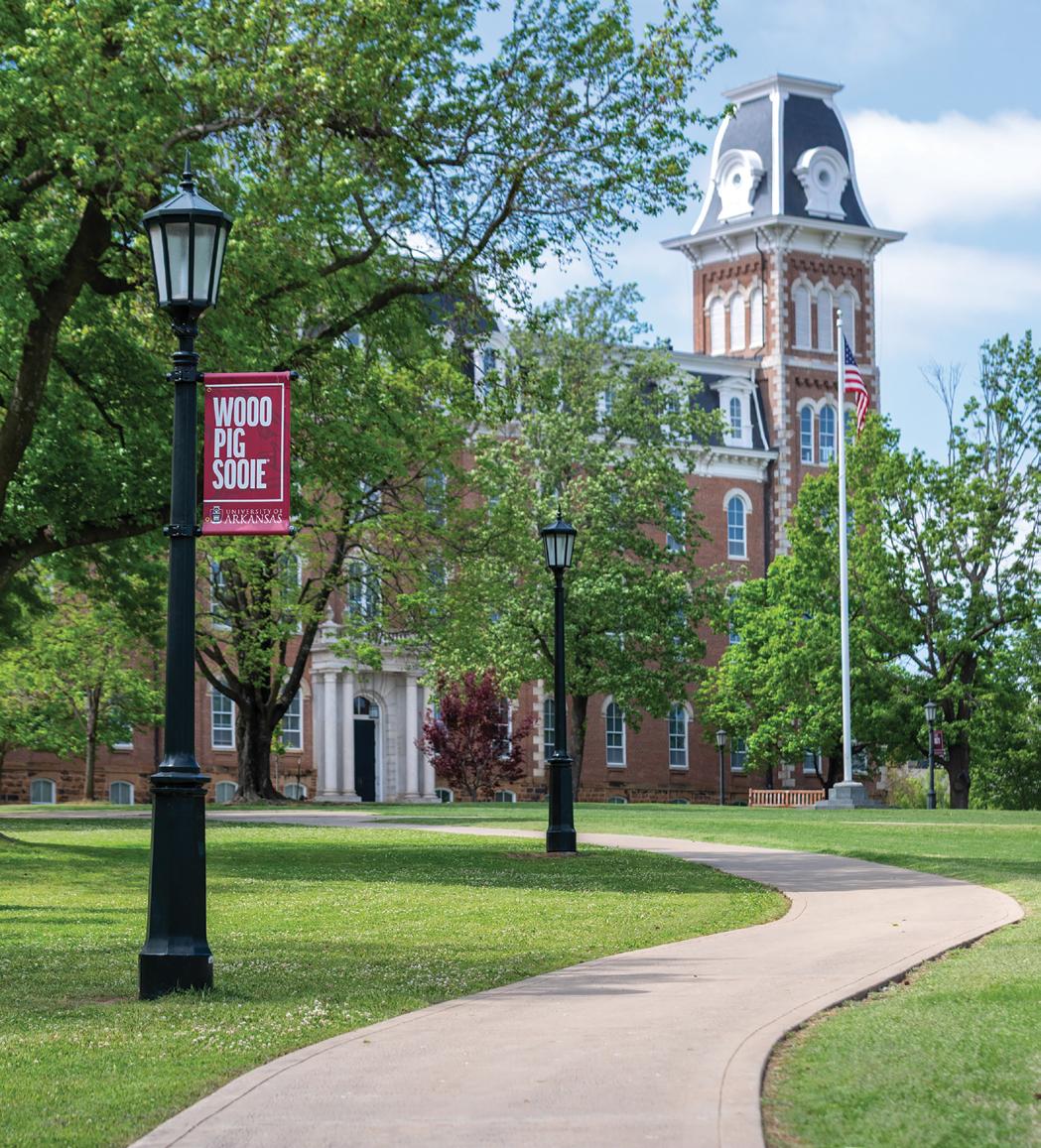
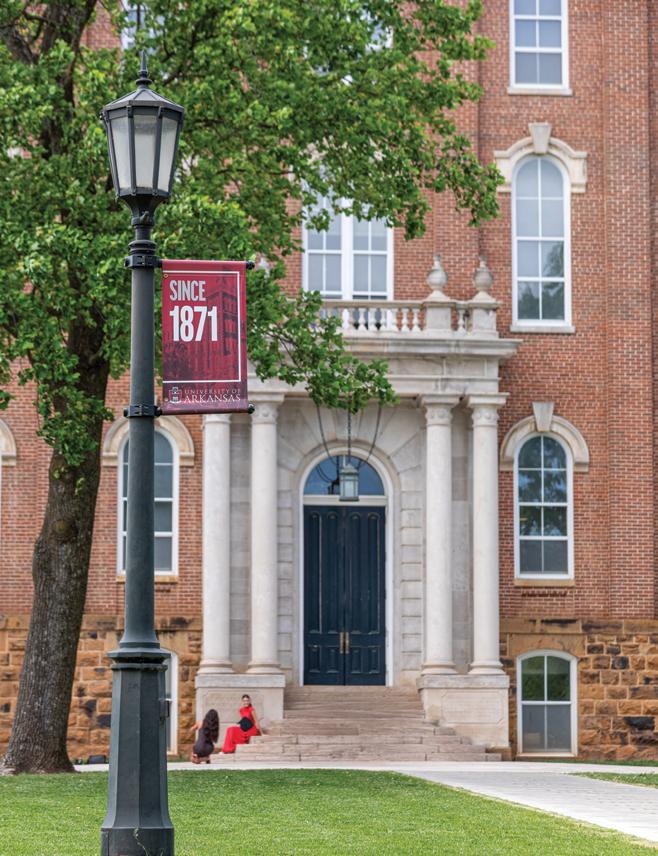
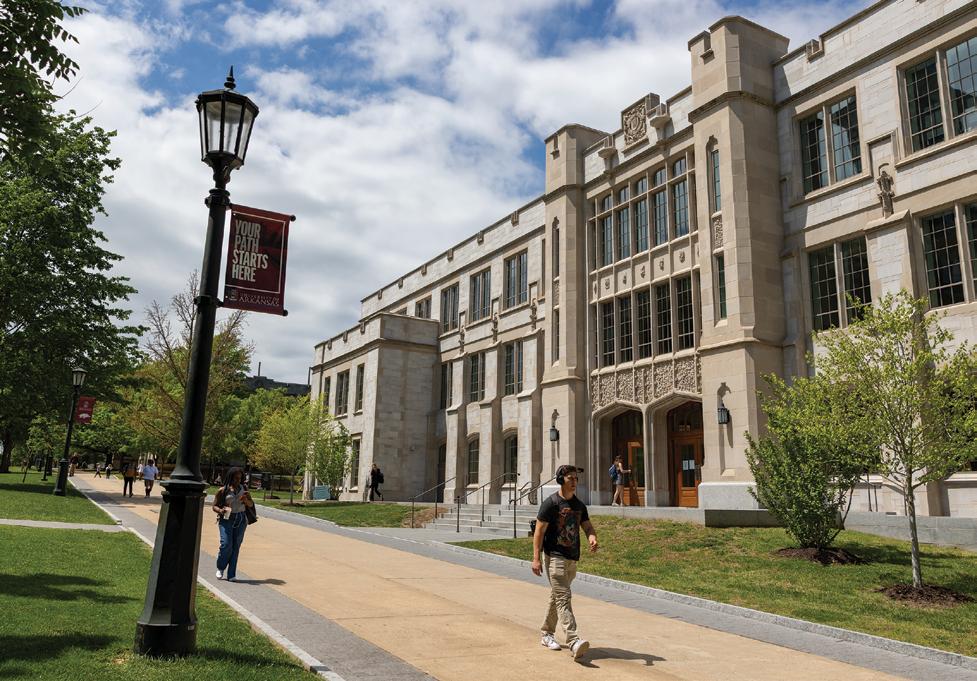
Cover: Old Main is framed in green for the summer. Wooo Pig Sooie.
Photo by Chieko Hara, University Relations.
ARKANSA S
Charles F. Robinson Chancellor
Dear Alumni and Friends,
The theme of this issue of Arkansas magazine is Greater Impacts, which seems particularly fitting following another standout year in the history of the University of Arkansas.
In 2025-26, we set records in several areas that are critical to fulfilling our landgrant mission to improve lives through education, research and service. We enrolled more students than ever before, including a record number of Arkansans. We set a record for research activity with $252.9 million in expenditures in FY25, an increase of more than $90 million in only four years. And, most importantly, we celebrated a record graduation rate of 70.9%, over 25 percentage points higher than it was in the year 2000. At that time, the university awarded fewer than 3,000 degrees and certificates each year. This year, we awarded more than 8,000.
Those numbers are worth celebrating, but their real impact is found in the lives they represent. More students are gaining access to the transformative benefits of higher education, more communities are gaining talented graduates, and more research
is being put to work to solve real-world problems across Arkansas and beyond.
That’s what Greater Impacts look like at the University of Arkansas: lives changed, communities strengthened and knowledge put to work for the public good. As you read these stories about people and programs that are making a difference, I hope you take pride in knowing that every member of the Razorback family has played a role in getting the U of A to where it is today.
You can also be proud that even after 155 years, the university’s best days are still ahead. This fall, we expect to welcome one of our largest freshman classes, which will include our first cohort of Land of Opportunity Scholars. Not long ago, we launched the scholarship campaign with a transformational $100 million gift from Jane Hunt and Bryan and Mandy Hunt on behalf of the J.B. and Johnelle Hunt family. Now, we’re about to turn that vision into reality.
I’m grateful to all of you who have helped us get to this point. There’s still work to do to reach our $200 million goal, which will allow us to help support hundreds more promising Arkansas students each year, but we’ll get there.
In the meantime, we anticipate another meaningful increase in our graduation rate when new data is released this fall, thanks in part to specialized student success programs that are helping more Razorbacks stay on track, persevere and graduate. And with all three of our new, world-class research facilities now fully operational, there will be plenty of Greater Impacts on the research front in the years ahead.
As always, thank you for your continued support. I hope you enjoy the issue.
Sincerely,
Charles F. Robinson Ph.D. Chancellor
M.F.A.'24
Dominic Rossetti B.A.’23
Patti Sanders B.S.A.’08
Christopher Spencer Kaslyn Tidmore M.A.’25
Advertising Sales Collin Brunner B.S.H.E.S.’10
MEMBERSHIP SYMBOLS 1871 Member Life Member Student Member
All U of A graduates are standard members of the association. This status is indicated by the degree letters and years following the first instance of their name within an article.
LETTERS TO THE EDITOR
Letters to the editor are accepted and encouraged. Send letters for publication to Arkansas magazine, Arkansas Alumni Association, at PO Box 1070, Fayetteville, AR 72702. Letters should be no longer than 250 words and may be edited for length. Typewritten letters are preferred. Anonymous letters will not be published. Submission does not guarantee publication. Arkansas, the Magazine of the Arkansas Alumni Association Inc. (ISSN 1064-8100) (USPS 009-515) is published quarterly by the Arkansas Alumni Association, Inc. at 491 North Razorback Road, Fayetteville, AR 72701. Life membership dues are a lump sump payment per household, a portion of which is allocated for the subscription to Arkansas. The total payment is between $500 and $1,000 depending upon length of time since graduation and other factors. All other membership levels may access the magazine digitally. Single copies are $6. Production is provided through the Richland Group. Direct inquiries and information to P.O. Box 1070, Fayetteville, AR 72702-1070, phone (479) 575-2801, fax (479) 575-5177. Periodical postage paid at Fayetteville, AR, and additional mailing offices.
POSTMASTER: Send address corrections to P.O. Box 1070, Fayetteville, AR 72702-1070.
ARKANSAS ALUMNI ASSOCIATION
Mission Statement
The Arkansas Alumni Association connects and serves the University of Arkansas Family.
Vision Statement
The Arkansas Alumni Association will be nationally recognized as a model alumni relations program.
Value Statement
The Arkansas Alumni Association values:
service
excellence
collaboration
relationships
learning
creativity
Arkansas Summer 2026
Please recycle this magazine or share it with a friend.
Building a Foundation for Growth
The University of Arkansas Builds on Its Legacy to Expand Opportunity and Impact
BY JENNIFER HOLLAND M.ED.'08
The University of Arkansas continues to set records — including enrolling more students (and more Arkansans) than ever, reaching new heights in research, and forging new partnerships across the state and the nation. Today, students step onto a campus defined by growth, innovation and expanding opportunity, a foundation built over generations that continues to strengthen the value, reach and impact of a degree from the U of A.
With Honors (and More)
“With all the opportunities available at Arkansas and with the help and support from the Razorback community, it is no wonder students are attending the U of A in record numbers, and from here pursue ambitious post-graduate study and professional career options wherever they choose. The world awaits them, and they are ready to shine.”
- Dr. Suzanne McCray B.A.’78, M.A.’80, M.A.’90 vice provost for enrollment and dean of admissions and nationally competitive awards.
Students seeking an intellectually vibrant community feel at home at the U of A. Across campus, students engage deeply with challenging ideas and pursue meaningful inquiry across disciplines, working side by side with professors who are leaders in their fields. Programs like the Honors College — now strengthened by a transformational $200 million gift from the Walton Family Foundation — build on a long tradition of academic rigor where ambitious students participate in undergraduate research, service learning and international education — while benefitting from competitive funding opportunities that support and enhance those experiences. In the School of Art and Fay Jones School of Architecture and Design, students are pushing the limits of their creativity in modern, immersive facilities. And in our award-winning Sam M. Walton College of Business, students are engaging with industry leaders, participating in career-shaping internships, and creating solutions to pressing realworld problems in the McMillon Innovation Studio. With resources and support from dedicated faculty, top students push their own limits and go on to pursue their academic and professional dreams.
John Samuel Sooter, a 2026 graduate of the U of A, is one such example. Sooter was recently named a Churchill Scholar — one of just 18 students nationwide selected for the scholarship, which supports a fully funded year of graduate study at the University of Cambridge in the U.K. Sooter will pursue his master’s degree at Cambridge, where he plans to conduct research at the intersection of physics, mathematics and neuroscience, applying advanced computational and theoretical tools to better understand how large networks of brain cells coordinate behavior. Sooter’s work has resulted in peer-reviewed publications, including a co-first-author paper in Science Advances, international presentations, and a pending U.S. patent. His path reflects a trajectory made possible at Arkansas — through faculty mentorship, handson research and opportunities that open doors far beyond Fayetteville — now amplified on a global stage.
Ngan Le, an associate professor in the Department of Electrical Engineering and Computer Science, was awarded a prestigious National Science Foundation Faculty Early Career Development award to advance her research on developing artificial intelligence systems that are trustworthy, reliable and sustainable in real-world environments. Le is just one example of the upand-coming faculty at the U of A who are making headlines for their work.
Recognitions and Research
The U of A consistently ranks among the top 10 public institutions for Truman Scholars, top 20 public institutions for Goldwater Scholars, and top 40 public institutions for Rhodes Scholars. In 2026, the U of A achieved the “triple crown” for prestigious national awards with three students receiving Goldwater, Truman and Udall Scholarships. We have had 174 graduate research fellows recognized by the National Science Foundation, and three of our students or alumni were recognized on the Forbes 30 Under 30 list for 2026. These recognitions signal more than academic prestige — they reflect a university whose reputation continues to rise, strengthening the value of every U of A degree.
This success is driven in part by research on campus. With world-class faculty experts in power and energy research, state-of-the-art facilities, and some of the topcited researchers in the world, the university is achieving its highest level of research activity in its history. In the last two years alone, the university opened three new cutting-edge research facilities, including a one-of-a-kind semiconductor fabrication facility, one of the nation’s top mass-timber buildings, and a public research institute advancing health sciences and technology. This growth in research helps position Arkansas as a destination for discovery and innovation and marks a significant expansion in the university’s scope, influence and impact.
Location, Location, Location
Northwest Arkansas has evolved alongside the university, emerging as a nationally recognized hub for business, innovation and quality of life. The surrounding area is home to three Fortune 500 companies and is ranked 40th on a 2023 Forbes list of the best places for business and careers. This growth has created a dynamic environment where students and the broader Arkansas network benefit from deep connections to industry. After graduation, numerous career opportunities are available to students, prompting many who initially enrolled from out of state to remain in Arkansas, creating a sustainable workforce for Arkansas.
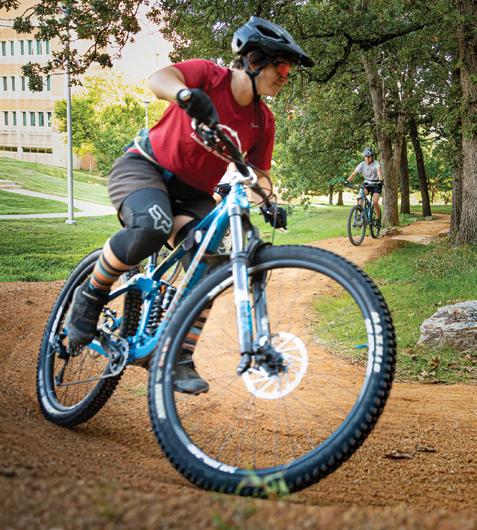
Adding to the burgeoning job market, Arkansas offers an inviting natural environment where students can enjoy the outdoors. The university is situated within the mountain biking capital of the world, giving students access to a safe and sustainable way to explore the region. Students can even take a scenic route as they navigate campus by using an 18-mile nature trail that weaves through the core of campus and connects to existing community trails, creating an opportunity for students, faculty and staff to mix and match commuting with recreation.
The Fayetteville Traverse trail at the U of A provides a sustainable and scenic route for students to navigate campus.
Land of Opportunity
Access and affordability continue to be a priority of the U of A. A major fundraising campaign was launched in 2024 to reach students in all 75 counties in Arkansas.
The U of A benefits from the continued engagement and support of a generous and dedicated community. Beginning in 2026, Arkansas students with financial need will have access to the university’s most ambitious scholarship initiative in its history: the Land of Opportunity Scholarship. The Land of Opportunity Scholarship Campaign will expand access to education, continue to boost graduation rates, increase engagement with Arkansas businesses, and advance the university’s landgrant mission. This $200-million initiative will create scholarships to close the financial gap by covering tuition, mandatory fees and housing for those with the greatest need, while also providing every scholar with personal mentorship, guidance and career coaching. At the U of A, the Land of Opportunity Scholarship will be more than just aid — the awards will provide wraparound support, helping students achieve success after graduation.
These scholarships will add to a growing network of support provided to our students. In fiscal year 2025, the university awarded over $137 million in scholarships and grants to undergraduate students. Scholarship funding for Arkansas students, in particular, has grown by $6.5 million since 2019. In fact, in our most recent academic year, 98 percent of first-year students from Arkansas who applied for scholarships received an award.
Reaching Rural Communities
In a similar vein, the U of A is ensuring students from rural and small-town America have the support they need to enroll and graduate from the college or university of their choice, thanks to our involvement with the Small Town and Rural Students (STARS) College Network. The network includes 32 of the nation’s most prominent institutions and underscores the university’s focus on enrollment efforts in rural communities. This program helps expand the university’s ability to engage with rural students, highlighting the value of a college degree, ways to fund it and the career opportunities that follow.
Extending the Impact
For generations, U of A students have stepped onto campus with ambition and left prepared to make their mark. Today’s students are doing the same, but with expanded access to research, global experiences and industry partnerships. The opportunities that once defined the foundation of the U of A experience have grown in scale and reach.
Beyond the Text Libraries Digital Project Explores Arkansas Constitution’s Origins
BY KELSEY LOVEWELL LIPPARD B.A.'11, B.A.'13, J.D.'14
For the first time, the debates and decisions that shaped Arkansas’ current constitution are available online in an interactive digital format through a collaboration between the University of Arkansas Libraries and the Quill Project at the University of Oxford, with sponsorship and support from Arkansas Attorney General Tim Griffin.
The project brings the 1874 Arkansas Constitution to life by allowing researchers, students, alumni and the public to trace how delegates debated proposals, worked through committees and ultimately crafted the governing document still in use today. Arkansas alumni can access the records free through the University Libraries.
Rather than presenting only the final text, the Quill Project platform reconstructs the convention process itself, showing how ideas evolved through negotiation, amendment and compromise.
“The Quill Project platform’s visual presentation of complex, negotiated documents such as the Arkansas state constitution provides users with a unique perspective on delegate interests and decision making in creating such important texts,” said Jason Battles , dean of Libraries.
Directed by historian Nicholas Cole of Pembroke College at the University of Oxford, the Quill Project uses digital humanities tools to model the creation of major constitutional and political documents. Interactive features offer users a closer look at how foundational texts take shape over time.
Battles said the collaboration between the U of A Libraries, the Quill Project and the Office of the Arkansas Attorney General has stood out among similar efforts nationwide.
“This is an excellent partnership,” Battles said. “We’ve been told by the Quill Project that the level of engagement from a state attorney general and a flagship university is unique among the state projects they are working on.”
University of Arkansas students also played a key role in preparing the materials. Student research assistants Ashlyn Fox, Brock Manasseri B.A.’25 and Kailee Rowe helped transcribe convention proceedings, research delegate biographies and organize committee records for digital visualization.
The Arkansas initiative is part of the Quill Project’s broader effort to digitally reconstruct the creation of major state constitutional documents across the United States. Future phases will expand the archive to include materials related to the 1836 and 1868 Arkansas constitutions, as well as the more than 100 amendments added to the 1874 Constitution.
“The goal is to help people better understand how these foundational documents came together,” Battles said. “It gives a clearer picture of the discussions, negotiations and decisions that shaped the constitution we still use today.”
One Day. One U of A. One Powerful Show of Support.
BY DOMINIC ROSSETTI B.A.'23
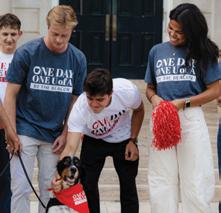
On April 9, Razorbacks everywhere came together to support the people and programs that make the University of Arkansas stronger. By the time One Day, One U of A ended at midnight, supporters had raised more than $275,000 for 31 projects across campus — a powerful demonstration of what collective generosity can accomplish.
In its second year, the initiative grew to garner the support of 824 donors, who made 1,128 gifts, contributing to a 35% increase in participation and a 51.7% increase in dollars raised compared to the inaugural event.
Of the 824 donors this year, 630 were alumni and friends, 109 were members of the U of A faculty and staff, and 61 were U of A parents. Supporters in Arkansas led the way with 777 gifts, followed by Texas with 115. The initiative also had 156 first-time donors.
Projects represented nearly every corner of campus and reflected a wide range of priorities, from student emergency funds and academic programs to experiential learning opportunities and support for the UAPD K9 unit. In total, 22 projects reached full funding, with some boosted by matching gift challenges that encouraged participation throughout the day.
“What I love about One Day, One U of A is how our community shows up with intention,” said Stacy Glover , associate director of annual giving. “People support the projects that matter to them, and that collective effort makes a real difference for our students and across campus. Seeing that growth this year really speaks to the momentum we’re building and the opportunity ahead.”
Throughout the day, members of the campus community gathered in the Arkansas Union to track progress and celebrate milestones together. Cheers broke out as the initiative reached the $100,000 mark, prompting a spirited Hog Call. There were even some very special visitors to the event, including Sue E. and Raven, the newest member of the UAPD K9 unit.
The project-based crowdfunding model connects participants directly to the causes they care about most. Making its debut this year, the One Day After Party extended that connection, inviting the Razorback community to continue championing projects beyond April 9 and extending the impact of One Day, One U of A.
To learn more about One Day, One U of A, please contact the Office of Engagement at annualfd@uark.edu or visit oneday.uark.edu
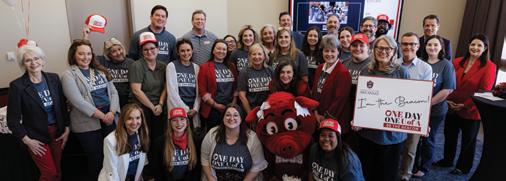
1. Members of the U of A staff gather at the Arkansas Union to celebrate and support One Day, One U of A.
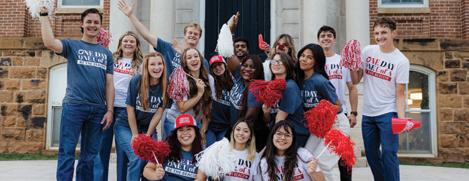
2. U of A students gather at Old Main to support One Day, One U of A.
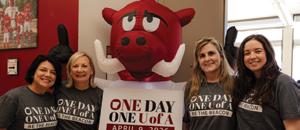
3. Shannon Magsam, Sara Eichmann , Tracee Norris and Brittany Packard from the College of Education and Health Professions join the celebration at the Arkansas Union.
4. UAPD K9, Raven, joins the One Day, One U of A Arkansas Union celebration sporting a campaign bandana.
5. Missy Kincaid B.A.'87 and Jessica Hampton B.A.'21 celebrate One Day, One U of A at the Arkansas Union.
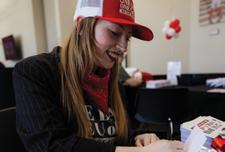
6. Breeanne Carter B.A.'18, M.A.'20 takes a break from the celebration to write a personal thank-you note to a supporter.
7. UAPD K9, Kane, steals the spotlight during a One Day, One U of A photo shoot.
Photos by Brandon Ngo.
Three Families, One Community, Lasting Impact
Northwest Arkansas Families Invest in the Future of University of Arkansas Students
BY DOMINIC ROSSETTI B.A.'23
In a historic Northwest Arkansas neighborhood where professional paths and personal relationships intersect, three families have built lasting connections through work and community life. Those ties shaped how each chose to invest in the future of University of Arkansas students.
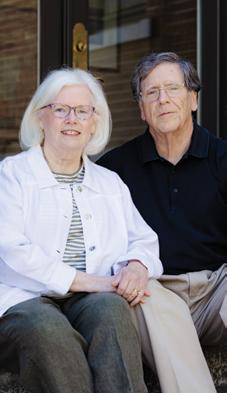
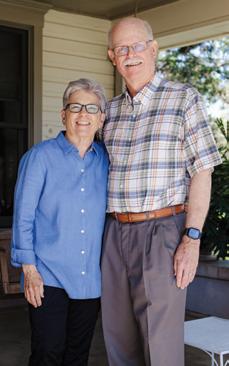
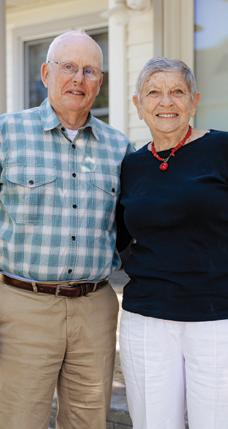
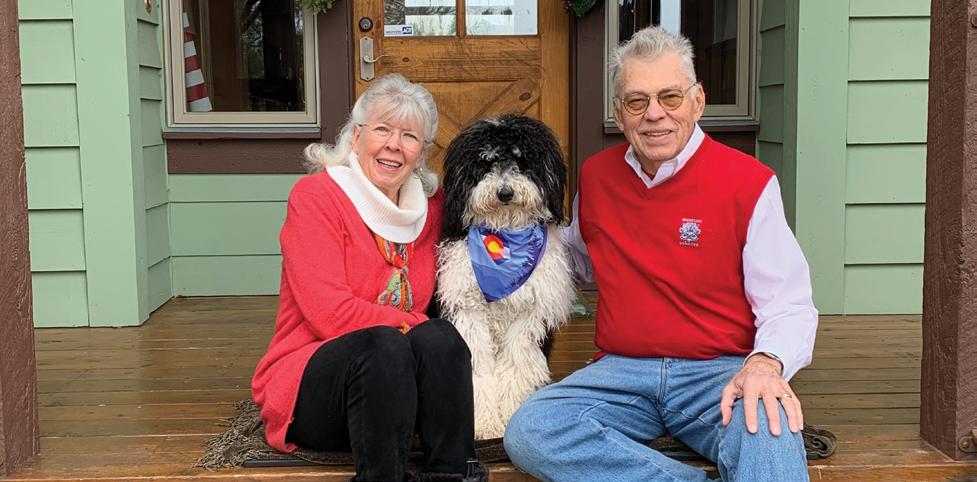
John and Harriet Mack, Jim and Nancy Swearingen, and David and Marilyn Swearingen have recently established scholarships at the University of Arkansas. Several are U of A alumni, and all are Rogers residents with deep roots in Northwest Arkansas. As architects, John Mack, Jim Swearingen and David Swearingen have helped shape many of the places and spaces that define the region today.
Two of the gifts — made by John and Harriet Mack and Jim and Nancy Swearingen — support the Land of Opportunity Scholarship, which expands access to higher education for Arkansas students with high financial need. In addition to financial support, Land of Opportunity Scholars receive mentorship, academic coaching and financial planning, along with access to career-building opportunities such as undergraduate research, study abroad and internships.
Photo by Brandon Ngo.
The third gift — made by David and Marilyn Swearingen — establishes the Swearingen Family Endowed Scholarship in the Fay Jones School of Architecture and Design. The Swearingen Family Scholarship provides long-term support for students pursuing careers in architecture and related disciplines.
Together, the scholarships create lasting opportunities for students, ensuring that a U of A education remains accessible to talented students regardless of financial circumstance.
“The Mack and Swearingen families have strengthened Northwest Arkansas in lasting ways through their careers and service,” said Chancellor Charles Robinson . “These scholarships will extend that legacy by giving generations of University of Arkansas students the support they need to earn degrees and make lasting contributions of their own. We are grateful for their generosity and their commitment to our students and the communities they will serve.”
John and Harriet Mack
John Mack B.Arch.’73, a Fay Jones School alumnus, earned his Bachelor of Architecture in 1973 and has practiced architecture for more than five decades in Northwest Arkansas. As a principal at JKJ Architects in Rogers, he has led projects across educational, medical, historic, commercial and religious sectors, earning recognition at both the state and national levels through the American Institute of Architects.
Harriet Mack B.S.H.E.’71, M.S.’77 earned her bachelor’s degree from the Dale Bumpers College of Agricultural, Food and Life Sciences, followed by a Master of Science from the U of A. Her career has included work in home economics and the U of A Cooperative Extension Service, as well as small business ownership in downtown Rogers.
The Macks’ support for architecture students reflects a long-standing connection to design education.
“We have had a wonderful relationship with The Cooper Union, where our youngest son studied architecture,” Mack said. “In his memory, we established a thesis fellowship to allow students to travel and conduct primary research during their thesis year. Over time, more than 100 students have benefited from that support.
We have also had an important relationship with the Fay Jones School, and we realized it was time to lend a hand to its students. Our hope is that a Land of Opportunity Scholarship will help them complete their studies and contribute to the architecture community and our state in a meaningful way.”
Jim and Nancy Swearingen
Jim Swearingen B.Arch.’75, B.A.’75 earned his Bachelor of Architecture from the Fay Jones School in 1975 and spent much of his career with Crafton Tull in Rogers, contributing to projects across Northwest Arkansas, including work for public schools and higher education institutions, as well as municipal, religious and health care projects, before retiring in 2017. His work extended beyond the firm through consulting and community involvement, including leadership and support for professional and service organizations.
Nancy Swearingen M.Ed.’93 earned a Master of Education from the University of Arkansas in 1993 and served as an elementary school principal in the Rogers School District. Since retiring in 2012, she has remained active in nonprofit and volunteer leadership, including involvement with Circle of Life Hospice.
For the Swearingens, supporting the Land of Opportunity Scholarship is a natural extension of their commitment to education and community.
“Both Nancy and I were fortunate to grow up in families that valued education and supported our pathways to professional careers,” Jim Swearingen said. “Because we appreciate the power of education to unlock potential and realize that many people face financial barriers that limit their opportunities, we chose to pay back our gratitude for the advantages we have had by paying it forward for others through the Land of Opportunity Scholarship.”
Harriet and John Mack.
Photo by Brandon Ngo.
Nancy and Jim Swearingen.
Photo by Brandon Ngo.
Campus
David and Marilyn Swearingen
David Swearingen B.Arch.’72, B.A.’72 earned a Bachelor of Architecture from the Fay Jones School in 1972, launching a career centered on community-focused design. At Crafton Tull in Rogers, he rose to senior vice president of architecture and helped lead projects shaping the region, including the Rogers High School campus, the Circle of Life Hospice facility in Springdale and the Genesis Cancer Center in Hot Springs.
Marilyn Swearingen, a retired educator, spent more than a decade teaching in the Rogers School District. She remains deeply involved in volunteer service in Rogers, including leadership with Circle of Life Hospice, where she has been recognized for her commitment to the organization’s mission.
For David Swearingen, supporting future architects is deeply personal, shaped by early experiences that sparked a lifelong interest in design and education.
“My interest in architecture began with Cy Sutherland, a high school classmate of my parents,” David Swearingen said. “Our family spent time with Cy and Martha Sutherland at the architecture school, and that exposure stayed with me. Over time, architecture became my pathway to a rewarding career. It is a pleasure to share that opportunity with a new generation who have the same passion for architecture.” Cyrus “Cy” Sutherland and Martha Sutherland M.A.’63, M.A.’00 were faculty members at the U of A.
The Collective Impact of Community
Read the story behind this gift:
Create a Greater impac t
“I don’t even like to call it ‘life insurance’—I think of it as a gift-multiplication tool. An investment of under $50,000 ultimately becomes a quartermillion-dollar scholarship endowment and a much larger legacy.”
– Charles Zimmerman, B.S.C.E.’85
To learn more, contact the Office of Planned Giving 479-575-7271 • legacy@uark.edu
Outside of their professional lives, the families share close friendships and a long history of community involvement. They have built their lives in historic downtown Rogers, raised their families together and supported a wide range of local organizations, along with long-standing involvement in First United Methodist Church and its ministries.
“This story is such a powerful reminder that philanthropy often grows out of relationships, shared values and a deep belief in community,” said Scott Varady B.A.’85, vice chancellor for advancement. “The Mack and Swearingen families have each contributed to Northwest Arkansas in meaningful ways throughout their lives and careers, and now they are investing in students who will help shape the future of our state. We are deeply grateful for their generosity and for the example they continue to set through their investment in student success.”
While each family made its gift independently, their combined support reflects a shared conviction: education creates opportunity not only for students, but for families, communities and the state of Arkansas.
Together, their generosity shows how closely connected people can amplify their impact — opening doors for future Razorbacks and strengthening the communities they will one day serve.
David and Marilyn Swearingen.
Photo by Brandon Ngo.
A Year on the Trail Ahead Reinforcing
a Collective Sense of Purpose
BY COLTON MORGAN
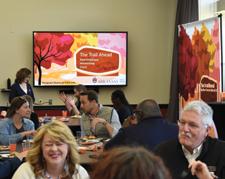
For generations of alumni, the University of Arkansas has been more than a place to study or work; it’s a place where traditions were learned, friendships were formed and lifelong connections took root. Today, the university is intentionally fostering that same sense of belonging for those who join the campus community as employees through a program called The Trail Ahead
Developed as part of the university’s 150 Forward vision, The Trail Ahead reflects a long term investment in people and culture. Its purpose is simple but powerful: to help new members of the campus community understand the university’s story, experience its traditions and build meaningful connections that endure well beyond their first year.
Much like a student’s first year on campus, The Trail Ahead is designed as a journey rather than a single moment. Participants are introduced to the history and mission of Arkansas’ flagship, land grant institution while being encouraged to explore the campus beyond their everyday routines. Through shared experiences, conversations and guided opportunities to engage with the university’s people and places, connections are formed that reach across colleges, units and roles.
Central to the program is a focus on institutional pride. Employees learn not just what the university does, but why it matters to students, to the state and to generations of Razorbacks who carry the university with them long after they leave campus. Exposure to traditions, landmarks and shared values reinforces a collective sense of purpose.
Equally important is the emphasis on community. By bringing people together intentionally over the course of a year, The Trail Ahead creates relationships that might otherwise never form. These connections strengthen collaboration, deepen understanding of the university as a whole and reinforce the idea that everyone on campus plays a role in advancing its mission. By the end of the first year, employees have built confidence, pride and a deeper bond to the University of Arkansas. It’s a connection alumni know well: one built over time, rooted in shared experience and carried forward with lasting loyalty.
Through The Trail Ahead, the university is not only welcoming new members to campus but also strengthening the fabric of the Razorback community.
2. The Trail Ahead intentionally connects employees areas of campus together to build a stronger Razorback community.
3. Kendra Thompson, Academic Program Coordinator within the College of Engineering, completed The Trail Ahead’s scavenger hunt, exploring key colleges, essential support units and important campus locations like Old Main.
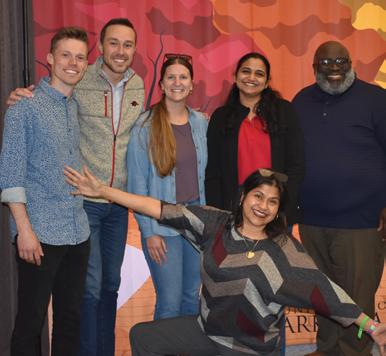
4. First-year employees connect at the first employee networking event hosted in Spring 2025.
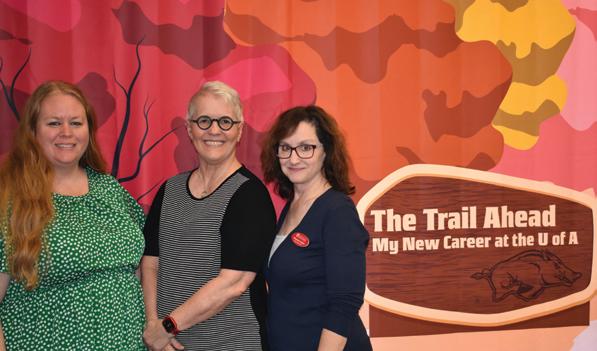
1. Ashley Ingram, Anne Shelley and Shannon Siebler within the Office of Human Resources lead the Trail Ahead program.
Fine Arts Center Marks 75 Years
Restoration and Grand Reopening
BY ELIZABETH MUSCARI B.A.'20, M.F.A.'24
A $38 million restoration of the historic building brings Edward Durell Stone’s landmark building back to life and back to its purpose of providing access and collaboration.
When the Fine Arts Center on the U of A campus opened in 1951, noted architect and U of A alumnus Edward Durell Stone called it a "Bauhaus composition," evoking a modernist approach that emphasized openness and functionality not only in design, but also in the disciplines it would house. The Arkansas native who designed both the original Museum of Modern Art in New York and the Kennedy Center in Washington had conceived a philosophy made physical — that the fine arts were strongest when in conversation with one another. He designed a building with an open and centralized gallery spine, flexible studios fit for art, dance, music and theatre, and large classrooms overlooking an amphitheater.
David Durst, the art department’s founding chair, had commissioned Stone to join the fine arts under one roof. His thought was that, in one continuous flow of space, a painting student might pass a play rehearsal, or a musician might linger in a gallery, and architecture students and thespians could share the same corridors, and, not incidentally, exchange ideas that would lead to convergent projects.
In the 50s, Fayetteville was a small college town of about 15,000 residents and roughly 4,000 university students. The Fine Arts Center’s opening felt, to many who witnessed it, like an announcement. The inaugural exhibition drew loans from the Museum of Modern Art, the Whitney Museum, the Art Institute of Chicago and the San Francisco Museum of Modern Art. Works by Pablo Picasso and Edward Hopper were on display.
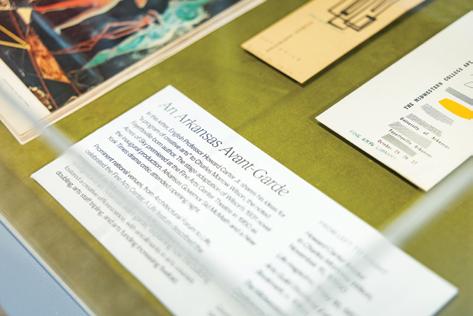
Several Alexander Calder mobiles had been hung throughout the building, written into the building budget by Stone as “light fixtures.” The new Fine Arts Center attracted national attention, with some accounts describing it as the emergence of an “Arkansas avant-garde.” Stone himself later reflected that in the years after the opening, “discussions of Picasso and Braque were now being held over cornbread and turnip greens.”
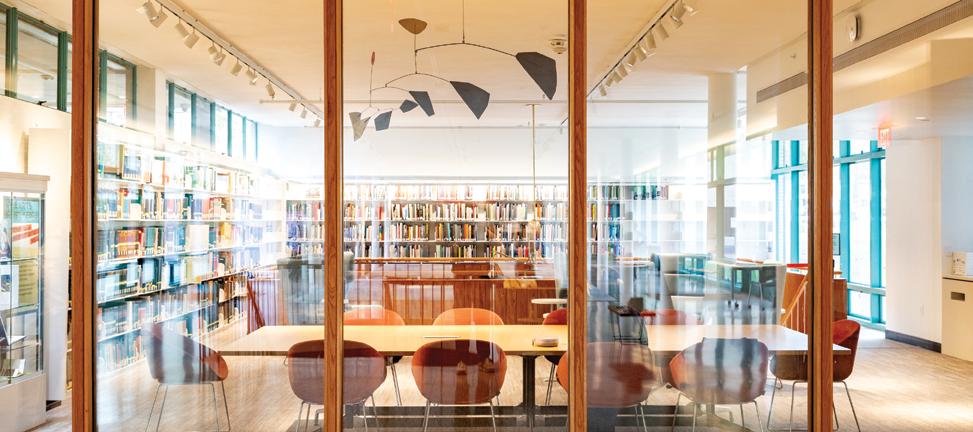
An Alexander Calder mobile hangs in the Fine Arts Center Library.
Photo by Whit Pruitt, University Relations.
It wasn’t hyperbole. The building worked as it was designed. Faculty held office hours in its corridors beneath paintings and sculptures, lounging on chaise longues that Stone had designed himself and had manufactured by Fulbright Industries. Modern dance pioneer Eleanor King and writer Charles Morrow Wilson B.A.1926 presented work in the performance spaces. New faculty joined, art majors surged, and collaborations deepened across disciplines.
For decades, it held that character. Then, gradually, it changed.
By the early 21st century, many of Stone’s spatial ideas had become difficult to read. Walls had been moved, studios rearranged, surfaces painted over. None of it was careless, as each change had addressed a real need at a real moment, but the logic behind Stone's design had been obscured. The building still housed the arts, but the disciplines had become more siloed into their respective corners and wings.
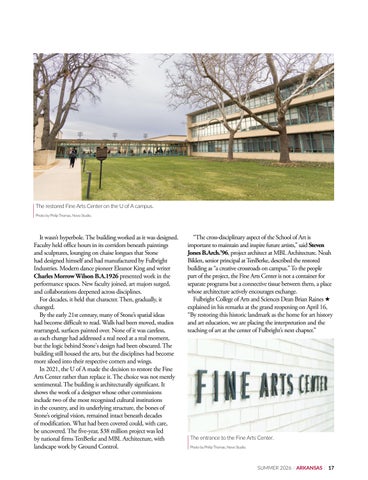
In 2021, the U of A made the decision to restore the Fine Arts Center rather than replace it. The choice was not merely sentimental. The building is architecturally significant. It shows the work of a designer whose other commissions include two of the most recognized cultural institutions in the country, and its underlying structure, the bones of Stone’s original vision, remained intact beneath decades of modification. What had been covered could, with care, be uncovered. The five-year, $38 million project was led by national firms TenBerke and MBL Architecture, with landscape work by Ground Control.
“The cross-disciplinary aspect of the School of Art is important to maintain and inspire future artists,” said Steven Jones B.Arch.’96, project architect at MBL Architecture. Noah Biklen, senior principal at TenBerke, described the restored building as “a creative crossroads on campus.” To the people part of the project, the Fine Arts Center is not a container for separate programs but a connective tissue between them, a place whose architecture actively encourages exchange.
Fulbright College of Arts and Sciences Dean Brian Raines explained in his remarks at the grand reopening on April 16, “By restoring this historic landmark as the home for art history and art education, we are placing the interpretation and the teaching of art at the center of Fulbright’s next chapter.”
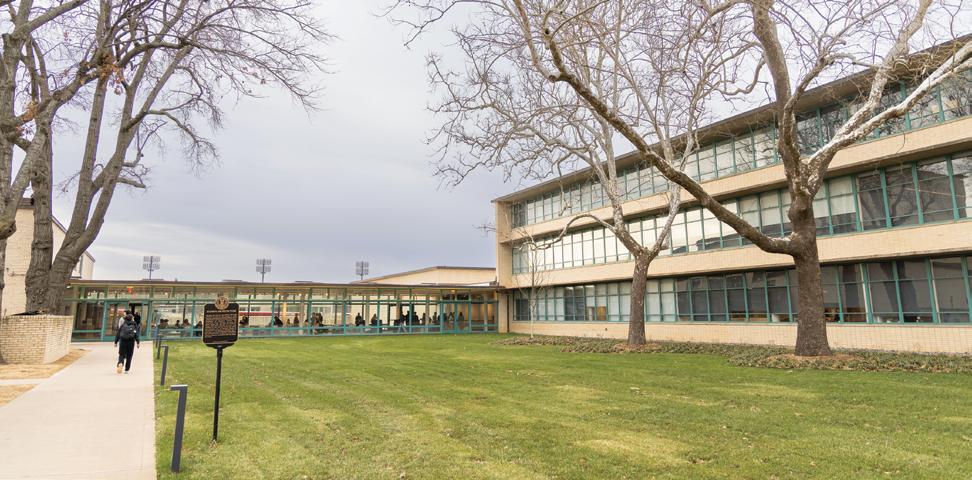
The restored Fine Arts Center on the U of A campus.
Photo by Philip Thomas, Novo Studio.
The entrance to the Fine Arts Center.
Photo by Philip Thomas, Novo Studio.
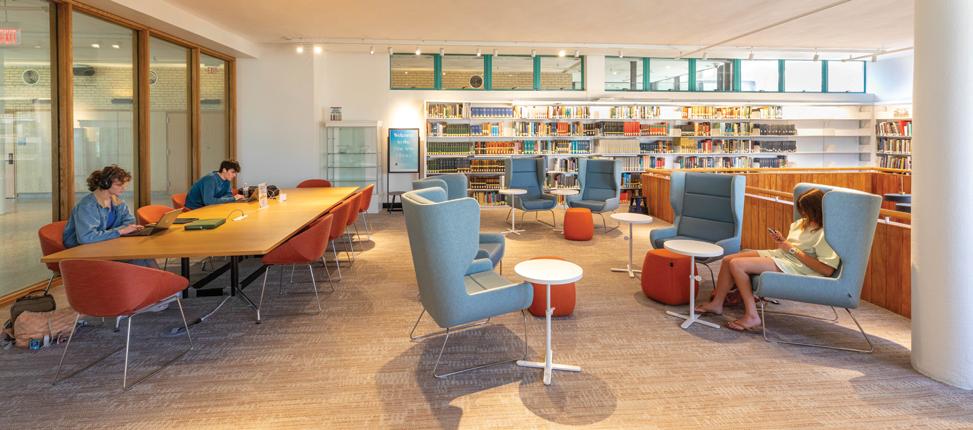
These motives are evident in the restored building. The lobby and central gallery have been returned to their original open layout, restoring the spatial flow that Stone had used to pull visitors through the building and into contact with work being made on its edges. The turquoise-green window frames — a signature detail that had disappeared under layers of renovation — have been reintroduced throughout. The original open stairs and railing, descending through the center of the lobby to a velvet-carpeted ground level, is now restored alongside metal mesh ceilings and wood finishes. Large storefront windows have reopened, looking out over the courtyard and the small amphitheater that anchors the building’s exterior.
But light, more than anything, tells the story of what has been recovered. Stone had designed the building to let people and creations actively take up space, to make the galleries feel inhabited rather than sealed. Walking through the Center today, the light shifts from room to room, and flexible spaces like the new teaching gallery and wide classrooms with flexible configurations feel adaptable to many kinds of practices, because they are.
One of the original Calder mobiles has been reinstalled in the Center’s library, which was doubled in size to accommodate expanded resources for student and faculty scholarship. The University Theatre received its own careful restoration, led by design consultancy Charcoalblue: the stage was extended, state-of-the-art theatrical lighting installed, and the space returned to something capable of supporting serious production work. In the three-story classroom wing, flexible learning spaces can now be configured for discussions, lectures
and workshops across disciplines, recapturing the spirit of the original design.
“These updated and flexible spaces — from the teaching gallery to studios and classrooms fit for various disciplines –promote creative discovery. When we provide this kind of access to art, excellence follows,” said School of Art Director Rachel Debuque . “And our community sustains this work.”
Debuque shared at the April 16 celebration how the mission of the Fine Arts Center thrives at the School of Art. Research initiatives within the school, such as the Prairie Pedagogy Project, bring together horticulturists, Indigenous communities and art educators to explore Arkansas prairies as sites for teaching and making. The Technology Empowered Storytelling Lab, in collaboration with the Sam M. Walton College of Business, is developing a novel virtual reality system for emotional regulation with potential clinical applications. At the international level, School of Art students and faculty have coordinated performance art pieces with dancers and musicians from across the globe for the preview weekend of the Venice Biennale, one of world's most prestigious art exhibitions.
Alumni listened to her words, carrying newspaper clippings and photographs from their college years. Others sat next to children and grandchildren, marking several generations of Razorbacks within their families. Students and faculty who had watched the construction from the outside finally stood in the restored spaces. Many simply explored the lobby and looked at the open staircase and the window frames in their original color, with the particular recognition of people seeing something they had known, or had heard described, or had imagined, finally made real.
The Fine Arts Center Library.
Photo by Russell Cothren, University Relations.
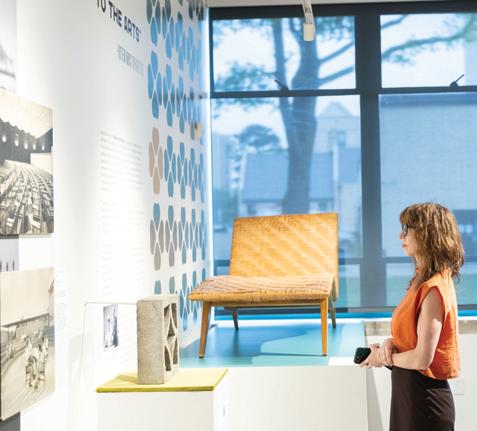
Fulbright departments collaborated to make the evening a holistic celebration of the arts. U of A Theatre performed in the restored University Theatre. The music department played a spring concert in the same concert hall where generations of students heard live classical music for the first time. The exhibition “Fine Arts First Years,” organized with art history program director John Blakinger, the University Libraries Special Collections Division and curator Catherine Wallack, with support from the U of A Museum, documented the building’s inaugural era in the teaching gallery. It included original architectural elements, archival photographs, early exhibition programs and the works of former art faculty.
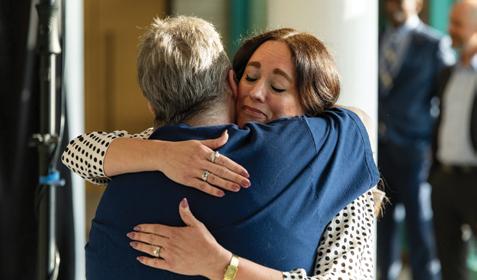
Among those honored that evening was Cathy Padgett B.A.’91, M.A.’00, M.Ed.’05, who had worked in the Fine Arts Center first as a work-study student and then, for thirty years, as an administrative assistant. She was recognized as a symbol of true commitment to the fine arts. David Durst, the founding chair whose original commission had set everything in motion, was honored through his family, present that evening, and through his own works hanging in the teaching gallery where he had spent so much of his career. Their presence — in person and in memory — was a reminder that the Fine Arts Center has accumulated the weight of everything that has happened inside it: collaborative partnerships formed, long rehearsals and remarkable shows, useful art critiques and influential exhibitions, and classes that have left lasting impressions on current and former Razorbacks. From plays with live music to exhibitions inspired by architectural elements, the Fine Arts Center’s restoration renews a hub for collaborative creative activity. This is a charge close to the Fulbright College's vision for the future: that Arkansas can be a place where art is accessible to all, and where someone, on any given day, might be experiencing something for the very first time.
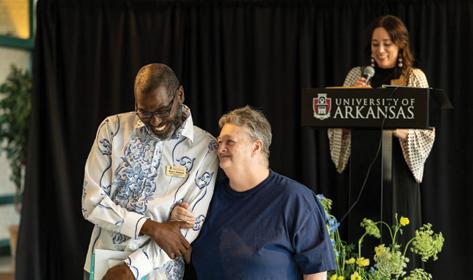
School of Art Director of Communications and Chief of Staff Kayla Crenshaw hugs guest of honor Cathy Padgett at the Fine Arts Center Grand Reopening.
Photo by Philip Thomas, Novo Studio.
The Fine Arts Center Teaching Gallery.
Photo by Philip Thomas, Novo Studio.
Work included in The Fine Arts First Years exhibition.
Photo by Philip Thomas, Novo Studio.
Hayes Walton III, School of Art associate director of operations, laughs with guest of honor Cathy Padgett at the Fine Arts Center Grand Reopening.
Photo by Philip Thomas, Novo Studio.
A White Rose for Theresa Endowed Scholarship Honors the Women Who Shaped Sigma Nu
BY MICHELLE BRADFORD B.A.'94
Decades after leaving the University of Arkansas, alumnus Jason Gaskill found a way to give back that was deeply personal – honoring a fraternity brother’s wife of 37 years through an endowed scholarship meant to support students for generations to come. This is alumni generosity at its finest.
A newly established endowed scholarship at the University of Arkansas Division of Student Affairs will honor the women connected to Sigma Nu’s Gamma Upsilon Chapter.
The Sigma Nu Women of the White Rose Endowed Scholarship was created through a $25,000 gift from alumnus Jason Gaskill, in memory of Theresa Pascal Fender B.S.H.E.’87
A graduate of the University of Arkansas, Theresa Fender was a member of the Sigma Nu Little Sisters auxiliary. Her ties to the chapter remained strong through her husband, David Fender B.S.A.’88, a fellow Sigma Nu brother and friend of Gaskill’s.
Theresa and David were junior high sweethearts. They graduated from college together and built a life over the course of their 37-year marriage. In 2025, after a three-year battle with pancreatic cancer, Theresa passed away, leaving behind David and their two daughters, Hannah O’Donnell B.S.B.A.’15 and Ashton Fender; son-in-law, Tyler O’Donnell B.S.M.E.’15, a member of Sigma Nu; and her beloved grandchildren Eli and Heidi O’ Donnell. Theresa Fender.
Theresa Fender, second from left, was part of the Sigma Nu Sweetheart Court while in college. Photos submitted.
When Jason Gaskill heard what his Sigma Nu brother had lost, he knew what he wanted to do. He reached out to Katy Nelson-Ginder B.A.’87, M.A.’91, U of A national director of philanthropy, Western Region, for options to consider. Jason himself had pancreatic cancer, having undergone surgery for the disease. He has had no recurrence since February 2021.
After speaking with his wife, Debbie , Jason established the Women of the White Rose Endowed Scholarship in memory of Theresa Fender. The scholarship is through the Gaskill Family Trust, which the couple manages. The scholarship is meant to honor the mothers, sisters, sweethearts and spouses of Sigma Nu members.
“I thought what a fitting way to honor Theresa,” Jason Gaskill said. “It honors her, and it reflects the Sigma Nu values and my family’s philanthropic mission.”
Student Affairs Director of Development Loria Oliver said the gift represents more than a lasting tribute. It reflects how alumni philanthropy can advance student success while honoring the relationships and values that shaped their own collegiate experience.
“I am thankful that my colleague, Katy Nelson-Ginder, brought this opportunity to Student Affairs,” Oliver said. “We are grateful to Jason and Debbie for establishing this endowed scholarship, an investment that transforms student lives and serves as a powerful engine for alumni support.”
At Sigma Nu, the phrase “Women of the White Rose” carries deep meaning. Drawn from Sigma Nu’s symbolic flower, the phrase reflects the fraternity’s long-held values of respect and appreciation for the women who support its members and mission.
“One of Sigma Nu’s principles is to always treat women with the utmost respect. It was part of the founders’ main priorities. The sweethearts, the sisters and each member’s mother are held in high regard. The White Rose is a symbol of that respect.”
- Jason Gaskill
Gaskill pledged Sigma Nu at the U of A in the fall of 1985, after beginning his college career at Missouri Southern State University. Raised in Joplin, Missouri, by his late parents, Jim and Carol Gaskill, he credits his upbringing and his time in the fraternity with shaping his outlook on life.
“Being an only child and then immediately gaining 35-plus pledge brothers was quite a shock for my system,” he said. “I learned a lot about life and made friendships I still have today.”
While Gaskill left the university for a career in the Missouri auto auction business, his ties to Arkansas remained strong. After his father’s passing, he managed the family’s real estate holdings alongside his mother. Later, he and Debbie assumed leadership of the Gaskill Memorial Trust.
The trust’s mission — to help students achieve their educational goals — is now being carried out through this new scholarship.
“My wife and I are very lucky to be able to carry this mission forward,” he said.
David Fender is deeply grateful to Jason and the Gaskill family for establishing the White Rose scholarship.
“Jason, Theresa, and I — we were all so blessed by our affiliation with Sigma Nu, and this program highlights the power of those bonds formed so many years ago,” Fender said. “The generosity creates meaningful opportunities and helps carry forward a legacy of strength, dedication and support for others. What a beautiful and meaningful way to provide much-needed support for current and future Sigma Nu students, while also honoring my wife, Theresa.”
The White Rose Scholarship will annually honor a student affiliated with Sigma Nu or its mission. Gaskill intends for the endowment to serve as a catalyst, inspiring other fraternity members to support the university.
“I would hope that all members of Sigma Nu would contribute to the fund and honor their mother, sister or sweetheart,” Jason Gaskill said. “It would be nice to see other chapters follow suit.”
To learn more about giving to the University of Arkansas, visit giving.uark.edu
Jason and Debbie Gaskill.
3 Under 30 Three Engineering Alumni Honored by Forbes
BY CHRISTOPHER SPENCER
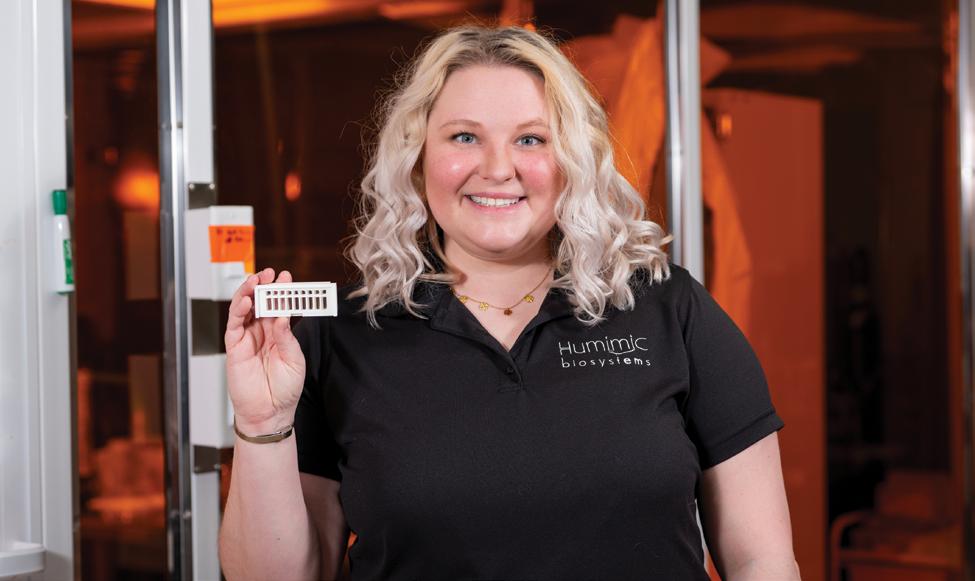
Lexi Applequist B.S.Bm.E.’21 did not set out to become the CEO of her own company.
She came to the U of A to study biomedical engineering. She stayed for a Ph.D., working in a lab where researchers were building models that mimic human organs to test how drugs work. It was good science. It was also, she realized, stuck in the lab with little way to reach the market that needed it.
The work helps medical treatment reach more people by speeding up and reducing the cost of drug testing. It would also spare hundreds of thousands of animals from testing each year. But none of that would happen inside a university lab. So, Applequist and her adviser, Kartik Balachandran, the College of Engineering’s associate dean for research, co-founded Humimic Biosystems to take the technology to market. She became the company’s CEO while still finishing her doctorate.
In December 2025, Forbes named her to its 30 Under 30 list in Science.
“Being on Forbes never crossed my mind. My goals were to publish, to patent, and to contribute positively to the world through my science. God’s plan for that contribution was through building my own company, something I had never even imagined for myself,” Applequist said.
And she was not the only U of A engineer on the list this year.
Alex O’Brien B.S.Ch.E.’19, B.S.’19 was named in Manufacturing and Industry for co-founding AtoMe, a company producing advanced metal composites for aerospace, energy and the frontier of nuclear fusion. He earned his Ph.D. at MIT.
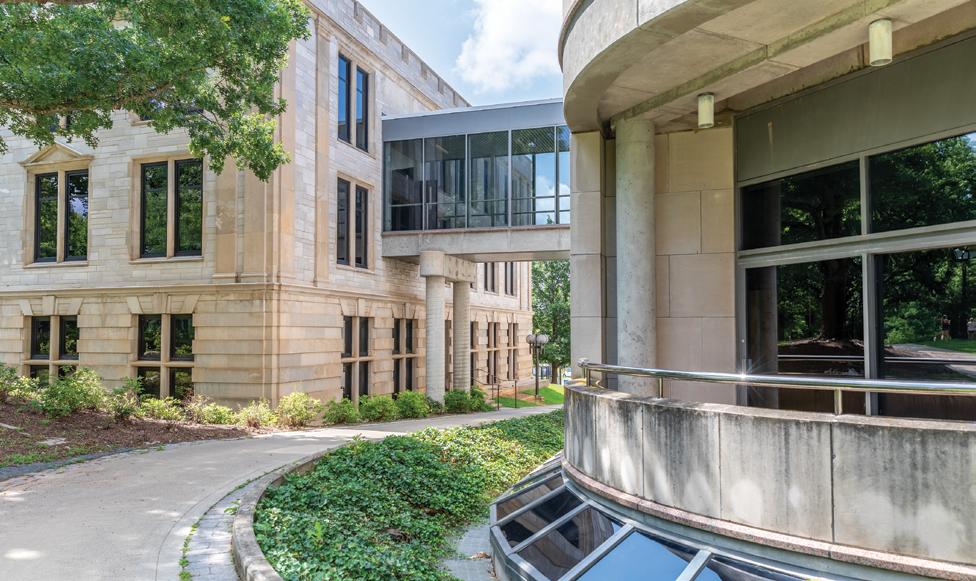
Pathways connecting the John A. White Jr. Engineering Hall and the Bell Engineering Center
Photo by Chieko Hara, University Relations.
Karlton Haney B.S.I.E.’20 was named in Venture Capital for co-founding Meridian Ventures, a seed-stage fund that has raised more than $35 million to back technology startups. He earned his M.B.A. at Harvard Business School.
Three engineers. Three co-founders. All from the U of A College of Engineering.
“What excites me is how consistent their stories are. Each one took fundamentals from the classroom, identified a real need in the world, built an innovative solution that addresses it and knew how to leverage the faculty expertise and resources around them to make it happen. You can see that in each of their journeys,” said Laura Moix B.A.’02, M.A.’06, the college’s innovation and impact strategist.
The college makes innovation and commercialization a priority at every level, creating opportunities for students, faculty and staff to move ideas from the classroom and lab into the world. For Moix, seeing three Forbes honorees emerge from the same college in the same year is a reflection of that culture, not a coincidence.
“This is what happens when an entire college commits to helping engineers see problems as opportunities. These three are a great example of that.”
The Scientist
Applequist’s company, Humimic Biosystems, builds organ-on-chip platforms with names like the CoCo Chip and the NICE Chip. They are small, engineered models that organize human cells the way they exist in the body and introduce mechanical stresses, such as blood flow and breathing, to simulate real conditions. The idea is to replace the flat glass petri dishes and animal models that have defined drug testing for decades.
The company has developed models for the heart, skeletal muscle, nasal airways, heart valves and the blood-brain barrier. Applequist has raised more than $500,000 in non-dilutive funding and placed in international pitch competitions from Bangkok to Silicon Valley.
“As a researcher, you’re trained to see a problem and build a solution. At some point, I realized the solution wasn’t just the science. Nobody was going to knock on the lab door and ask for it. Somebody had to build the bridge between the lab and the industry. That’s what engineers do,” she said.
Lexi Applequist showcases the platform designed to measure cell contractility and improve preclinical drug screening non-invasively
Photo by Reid Williams.
The Builder
O’Brien was a chemical engineering and physics double major from Springdale and an Honors College Fellow who played saxophone in the Razorback Marching Band for all four years.
At MIT, he zeroed in on a problem hiding inside nuclear fusion research: the metals holding experimental reactors together would degrade within six months under the heat and radiation. He found a way to combine metals with small amounts of ceramic and lock them together using 3D printing, a process no traditional manufacturing method could achieve.
By 2023, he had results he was proud of. He expected the fusion industry to be ready. It wasn’t. The companies told him the materials’ work was promising, but the plasma physics still needed solving. They would circle back.
“I spent my entire Ph.D. working on this technology,” O’Brien said. “It feels wrong to just leave it there when we felt like it was a success.”
So, he didn’t. He co-founded AtoMe and started producing enhanced nickel superalloys for aerospace and energy customers who need better metals now. He runs a multi-ton-per-year production facility in New Jersey.
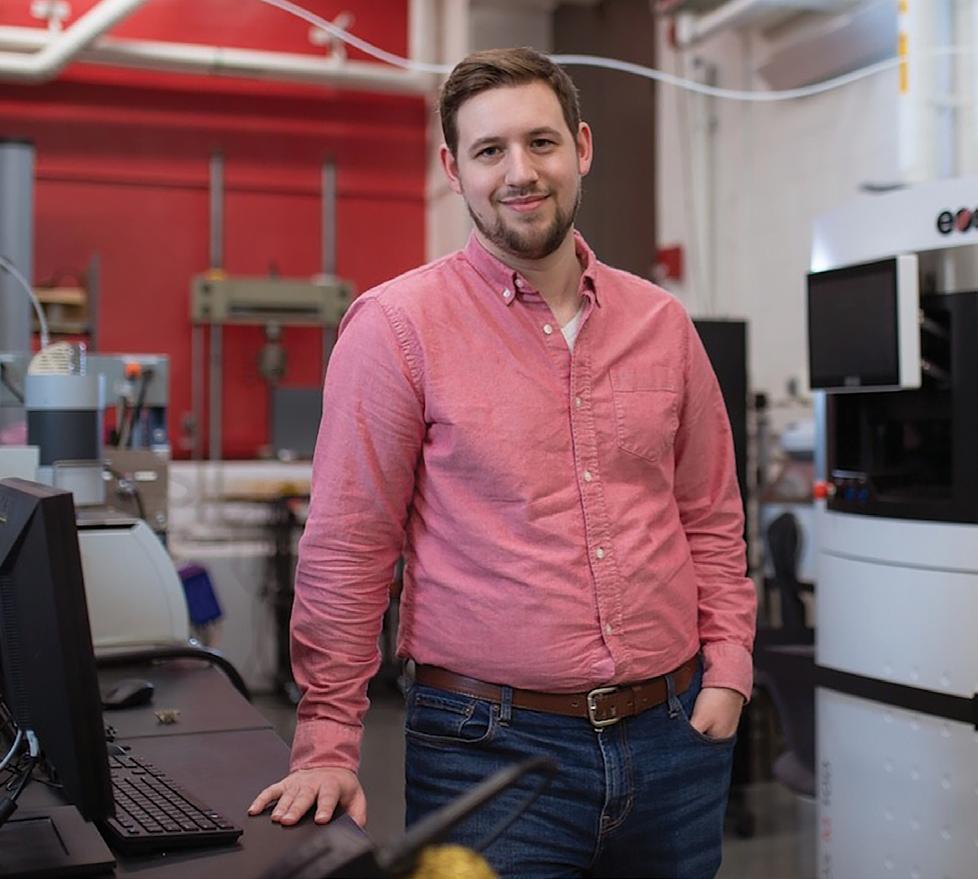
Alex O’Brien is using 3D printing to build better metal.
Photo by Gretchen Ertl.
The Investor
Haney sold eggs from the family farm as a boy in Little Flock, delivered them to teachers at school and deposited the money in a brokerage account the day he turned 18. He switched from pre-med to industrial engineering at the U of A because medicine did not feel entrepreneurial enough. A leadership seminar taught by chancellor emeritus John White led him to Harvard Business School, where he and a classmate, Devon Gethers, quit their jobs and launched a venture capital firm before orientation started.
Meridian Ventures invests in seed-stage technology startups founded by graduates of top M.B.A. programs. The thesis came from a Stanford study showing that roughly 20 percent of all venture-backed billion-dollar companies in the United States over 25 years had a founder with an M.B.A. from one of 10 schools. Their classmates, many from elite undergrads and coastal backgrounds, did not find the data remarkable. Haney and Gethers did.
“We were state school guys,” Haney said. “We felt like we won the lottery. I want to take a big swing. I want to see how amazing this could be. And I’m willing to take a lot of risk, because if I fail, I’m already head and shoulders above where I thought I would be.”
Their first investment, a cloud-computing company called Cast AI, is now valued at more than $1 billion. The firm has made more than 60 investments and manages more than $35 million.
Engineering Entrepreneurs
None of them started as founders. Applequist wanted to publish and patent. O’Brien wanted to solve the materials problem for fusion. Haney switched from medicine to industrial engineering while at the U of A. In each case, the engineering training did not just prepare them for a career. It gave them the instinct to build what did not yet exist.
“It’s not surprising that three of our engineers would go on to create successful companies,” said Kim Needy , dean of the College of Engineering. “What we teach here is how to innovate and iterate toward solutions. When the solution doesn’t already exist, forming the company to build it is a natural next step.”
They were not chasing Forbes. They were solving problems. The recognition found them anyway.
Read the full stories behind all three honorees on Arkansas News:
• Applequist: news.uark.edu/articles/80544.
• O’Brien: news.uark.edu/articles/80833.
• Haney: news.uark.edu/articles/81110.
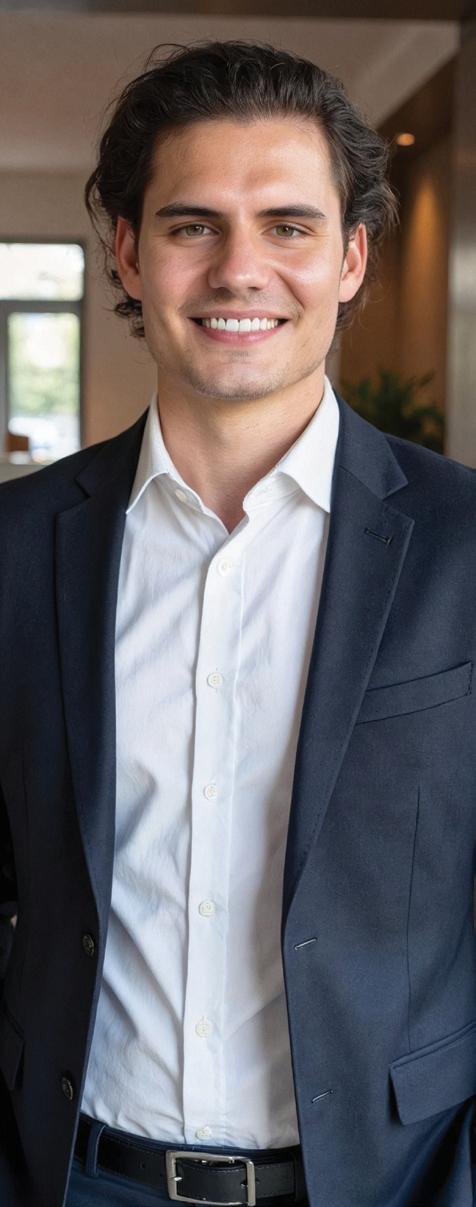
Karlton Haney is the co-founder and managing partner of Meridian Ventures.
Photo submitted.
Leah Hales B.L.A.'94
Connecting People to the Natural World Through Design
BY KASLYN TIDMORE M.A.'25
After a childhood spent backpacking the mountains of Arkansas, Leah Hales didn’t arrive at landscape architecture with a carefully mapped career plan. Instead, the path emerged naturally, shaped by experience. By high school, reading topographical maps, navigating by compass and practicing backcountry survival skills were second nature. She found comfort and clarity in the quiet of the forest, a sensibility that would later define her professional life.
When it came time to choose a college major in 11th grade, Hales narrowed her options by asking two simple questions: What would lead to a job? And what would take the least amount of time? Landscape architecture — then a five-year program — rose to the top, edging out a backup plan in genetic engineering.
She considered programs at Texas A&M University and the University of Arizona. Arizona was ultimately removed from the list after its program lost accreditation that year, and staying in Arkansas felt like the right fit.
“Being an Arkansan and a Razorback fan my entire life, it only made sense to stay in my home state and go to a really great school,” Hales said.
At the Fay Jones School of Architecture and Design, studio culture left a lasting impression. Several faculty members also played an important role in her education, including Karen Rollet-Crocker, Judy Brittenum B.S.E.’66 and Karen Hanna M.A.’93. A fifth-year history of urban form course taught by the late Jeff Shannon B.Arch.’70 was particularly influential. She credits long hours in studio with teaching her the time and commitment required to do meaningful design work.
In her more than 30 years as a landscape architect, Hales has devoted her career to designing spaces that strengthen people’s relationship with the natural world, a philosophy she believes will improve both community life and ecological health.
“My greatest passion has been creating places for people across the world and in my own community,” Hales said. “I believe the world is a better place by connecting people to the land by creating places they are invested in, which in turn makes them care for the land and the world in which we exist.”
Though much of her professional work involves designing hospitality and destination environments, she emphasizes that the same principles apply to public spaces. Conservation, preservation, sustainability, health and wellness are priorities across all her projects.
“The majority of my design work has been in the world of imagination, creating destinations of hospitality and pleasure,” Hales said. “I also believe this translates, not only in the luxury for some, but in the public open spaces for all.”
One of her most memorable projects was a resort development in Nicaragua. The hands-on nature of the work, such as staking building locations and developing on-site plant nurseries, made the project stand out.
“The best part was the people,” she said. “The client, the design team and the local residents are what made that project great.”
That emphasis on collaboration continues to shape her work today. Hales works to engage with a wide range of voices — not only designers and clients, but the communities who will ultimately inhabit these spaces. Through that process, she has also become more aware of the broader conversations surrounding the built environment, particularly the assumptions that come with discussions of sustainability.
“People hear the word ‘sustainable’ and add an imaginary price tag to it,” she said. “There is nothing wrong with building things to last, building environments with diversity and thinking wholeheartedly about the future of our land.”
Hales is now a director and landscape architect at LandDesign’s office in Dallas, Texas. She credits the firm’s culture of collaboration for continually improving the quality of its work. With teams that span multiple offices and disciplines, the firm encourages dialogue, critique and shared ownership of ideas, which Hales says challenges designers.
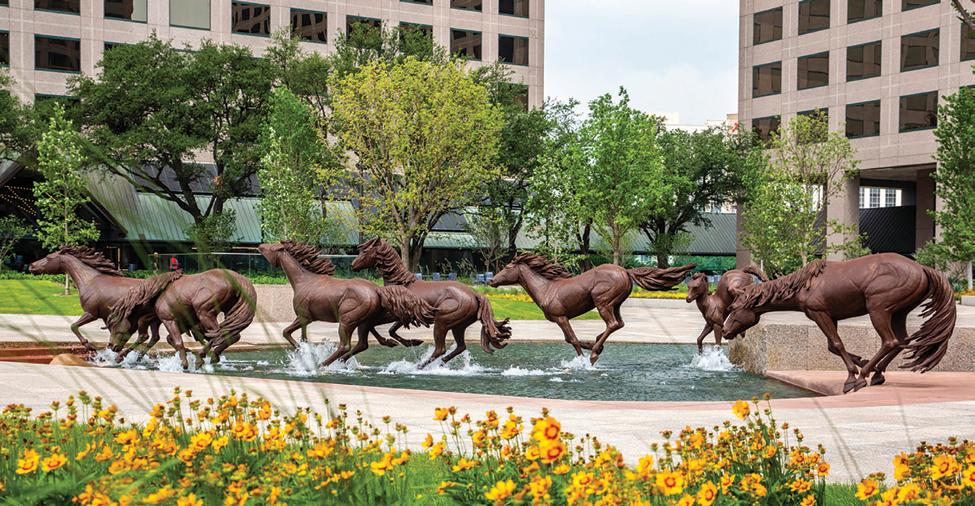
Recent design updates to Williams Square in Irving, Texas, included refurbishing the plaza’s horse sculptures within their signature water feature.
Image courtesy of Leah Hales.
Leah Hales on a site visit for the Williams Square project in Irving, Texas.
Image courtesy of Leah Hales.
Campus
That collaborative mindset has been shaped not only by her professional experiences but also by the places she has lived. At 42, Hales relocated her family to Shanghai, a move that proved to be a formative year for them all. In a dense global city vastly different from her own, Hales gained a new understanding of how people rely on the built environment in their daily lives.
“I truly learned to live in a city: rely on public transportation, use public parks and open spaces, walk almost everywhere, buy fresh groceries every day, and live in a culture completely foreign to my own — not understanding the language or the place,” Hales said.
Her experiences in quiet forests and in some of the world’s most densely populated urban centers continue to inform Hales’ perspective as both a designer and a leader in the field of landscape architecture. As a LEED Accredited Professional, she focuses on creating environments that support human well-being across hospitality, healthcare, mixed-use and park and open space projects, while remaining a strong advocate for sustainability, mentorship and the future of the profession.
Hales received a 2021 Distinguished Alumni Award from the Fay Jones School and is currently serving in her seventh year as a member of the Fay Jones School’s Dean’s Circle. Earlier this year, she also invested in the future of higher education by committing $500,000 to the U of A’s Land of Opportunity Scholarship Endowment. The planned gift will help cover the costs of college attendance while connecting scholarship recipients to resources that improve academic success and longterm outcomes for students with high financial need.
“College changed my life. For students across Arkansas — especially in rural communities — this scholarship opens doors they might never imagine on their own,” Hales said.
Hales is recognized as a Thoroughred for her consecutive years of giving and is included in the Towers of Old Main, a giving society for the university’s most generous benefactors. She is a Life Member of the Arkansas Alumni Association.
Outside of her professional practice, Hales’ interests reflect the same values that guide her design work. She spends much of her free time cooking, gardening and bringing people together around shared meals with conversation and connection.
That sense of care extends beyond her work and into her family life. Hales credits her family as her greatest source of support, particularly her children, who grew up watching her balance a demanding career with frequent travel and long hours.
“My children have grown up with a mom that was working late, on an airplane, or out of the country, sometimes for a week or more,” Hales said. “I think it instilled in them that hard work pays off, and I’m very proud of the women they have become.”
Photo
Mukul Resort in Guacalito, Nicaragua.
Photo by David Lloyd.
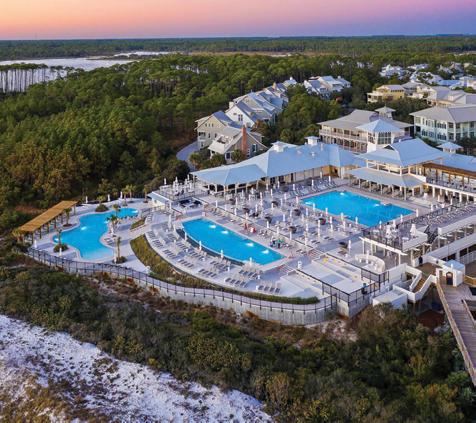
WaterColor Beach Club in Santa Rosa Beach, Florida.
Image courtesy of Leah Hales.
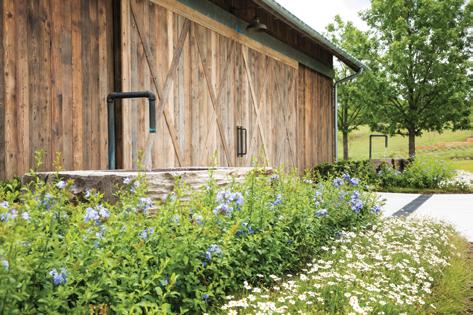
Circle T Ranch in Westlake, Texas. Image courtesy of Leah Hales.
Creating Pathways for Arkansas Students
Coles Deepen Investment in Honors Education
BY SHELBY GILL B.A.'14
Alumna Carolyn W. Cole B.A.’94, M.A.’98 knows firsthand that the path through higher education isn’t always a straight line. After returning to college at age 45, she earned both her bachelor’s and master’s degrees in English from the Fulbright College of Arts and Sciences, an experience that left a lasting impression. Now, she and her husband, Nick, are deepening their investment in future students, pledging $250,000 to support Path Scholars in Fulbright College.
The couple’s latest gift builds on a long-standing commitment to the university and to expanding access through the Honors College Path Program.
Their initial $250,000 gift in 2014 established the Nick and Carolyn Cole Honors College Path Endowed Scholarship, designed to support high-achieving students with demonstrated financial need. For Carolyn, this most recent gift is also a reflection of her own journey at Fulbright College.
“Fulbright has a very special place in my heart,” she said. “My experience there shaped me in so many ways.”
That kind of transformational experience is what the Coles hope to make possible for other students.
“Fulbright College is where students discover not only what they want to study, but who they are meant to become,” said Brian Raines , dean of the Fulbright College of Arts and Sciences. “A transformational education means more than earning a degree. It also means developing the confidence, curiosity and sense of purpose to lead meaningful lives and careers. Nick and Carolyn Cole understand the lasting power of that experience, and their generosity helps ensure more Arkansas students can find that same sense of possibility here at Fulbright.”
The Coles see the Path Program as a way to ensure these experiences are accessible to more students. The Path Program connects talented Arkansas students with mentoring, academic resources and opportunities for research, study abroad and leadership, helping them transition to and succeed at the university. Through both gifts, the Coles have continued to invest in creating pathways for students who might not otherwise have access to an honors education.
(Continued on page 59)
College of Education and Health Professions Alumni
‘Risk-takers, Friend-makers, Dreamers and Doers’
BY SHANNON MAGSAM
The College of Education and Health Professions prepares teachers, nurses, speech-language pathologists, exercise scientists, public health practitioners, sport management leaders, occupational therapists, outdoor recreation experts and more.
As students, they are immersed in hands-on learning through internships and practicums, gaining valuable knowledge while also positively impacting the lives of those they serve in schools, hospitals, clinics, sports fields and myriad real-world settings. As alums, their impact continues to grow, creating an ever-widening ripple effect in their roles as everyday heroes in the caring professions.
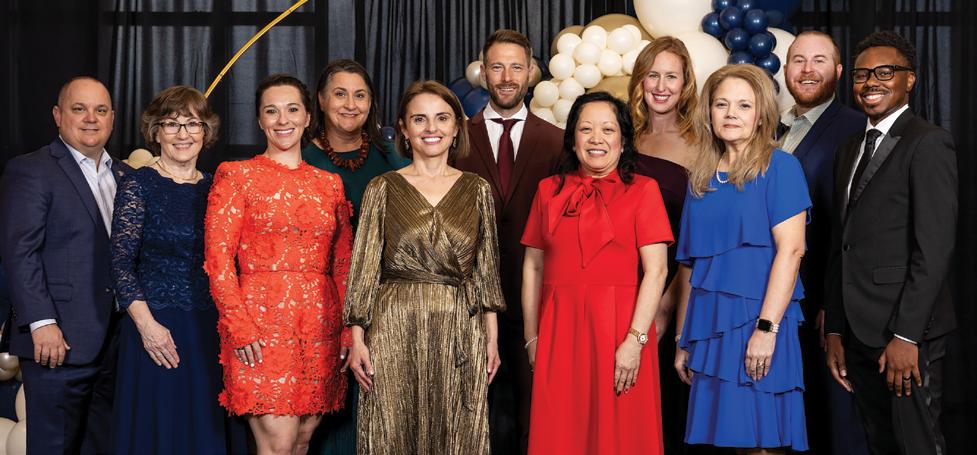
Recently, the college honored 12 of these heroic alumni at an awards banquet, celebrating their remarkable contributions.
Dean Kate Mamiseishvili referred to them as heroic, based on the definition from a collection of short stories by acclaimed children’s book authors, edited by Olugbemisola Rhuday-Perkovich, titled The Hero Next Door. The book includes powerful stories that highlight everyday heroes, describing them as “ordinary people who do extraordinary things and the individuals who just might be magic … the risk-takers, the friend-makers, the dreamers and doers.”
Mamiseishvili said that this definition “perfectly captures the spirit” of the college’s alumni awardees and shared several inspiring examples.
“Our alumni heroes take risks, like Angela Watson, who took a leap of faith and returned to school after a 20-year career in a different field to pursue a Ph.D. in education policy. They become friend-makers like Nathan Morris, who has built a culture of strong friendships and relationships through innovative, character education programming, which has led to better student achievement and community across his entire school district,” she said.
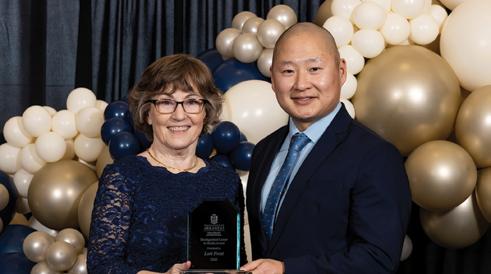
2026 Alumni Award winners pose with Dean Kate Mamiseishvili at the annual spring banquet. From left, Nathan Morris B.S.'98, M.A.T.'99, Lori Frost B.A.'81, Katie Babcock M.AT.'16, Angela R. Watson B.S.E.'14, Ph.D.'19, Dean Kate Mamiseishvili , Kurt Andrews M.AT.'11, Gigi Secuban B.A.'95, M.S.'01, Ed.D.'11, Lindsey Gabbard M.S.'19, Susan "Toni" Lockhart B.S.E.'89, Matthew Holden B.S.'09, M.S.'13, M.A.T.'18 and Tim Lampkin Ed.D.'22. Not pictured: Samantha Crouch B.S.N.'15
Photo by Beth Hall.
“Our alumni heroes are doers, like Kurt Andrews, who sprang into action in the middle of the night when his athlete was hurt and developed a medical plan for them even though he was thousands of miles away. They are dreamers, like Lori Frost, who, frustrated by the lack of strategies to help nonverbal children with autism communicate, dreamed big and developed a system that revolutionized how therapists and children communicate.”
The evening culminated in the presentation of the Dean’s Circle of Care Award to Susan Patton B.S.N.’74, M.S.N.’11, Ph.D.’16, who has dedicated her career to advancing nursing practice, education and leadership.
Dean Mamiseishvili closed the event with heartfelt gratitude: “Thank you for taking risks, making friends, dreaming boldly and working tirelessly. And thank you, everyone, for bringing your magic to this beautiful celebration and for being part of our community filled with risk-takers, friend-makers, dreamers and doers.”
2. The Distinguished Career in Health Award went to Lori
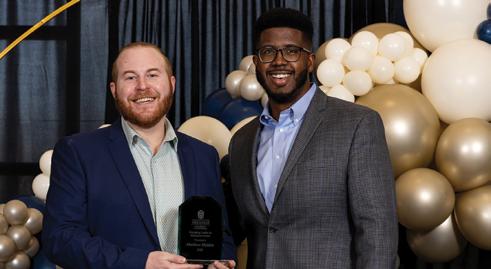
3. The college’s Emerging Leader in Education Award was presented to Matthew Holden, an acclaimed science teacher at Fayetteville High School, by Malachi Nichols.
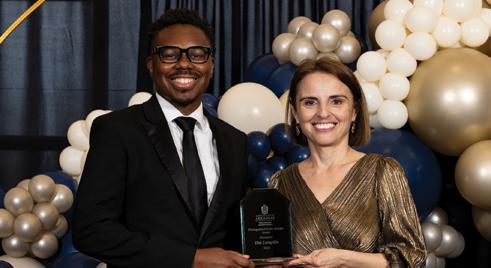
4. Tim Lampkin, founder and executive director of the nonprofit Higher Purpose Hub (HPH), received the college’s Distinguished Public Service Award from Dean Mamiseishvili.
5. Dean’s Circle of Care Award winner Susan Patton (second from right) takes time for a group photo with her family following the awards ceremony.
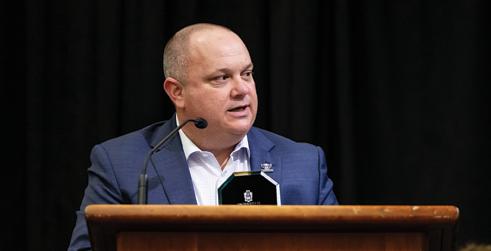
6. Distinguished Career in Education Award winner Nathan Morris, the inspirational superintendent of the Cross County School District in Cherry Valley, delivers a brief thank-you speech.
Photos by Beth Hall.
2.
1.
3.
4.
5.
6.
1. Kurt Andrews, director of sports medicine for Major League Soccer’s Sporting Kansas City, earned the Emerging Leader in Health Award.
Frost, an internationally recognized speech-language pathologist. Derek Lee presented the award.
Empowering the Next Generation of Artists
School of Art Welcomes Young Artists for Eighth Annual Summer Arts Workshop
BY ELIZABETH MUSCARI B.A.'20, M.F.A.'24
For many young artists, the path to a serious creative life begins with a single moment of recognition. That is the animating idea behind the School of Art’s Summer Arts Workshop, now in its eighth year.
Each summer, nearly 100 rising 10th- through 12th-grade students from across Arkansas and the United States arrive on the University of Arkansas campus for a weeklong residential program built around studio practice, critique and exploration. Housing, meals, materials and instruction are provided at no cost through support from the Walton Family Charitable Support Foundation.
The workshop is modeled directly on the School of Art’s college experience for undergraduate art majors: hands-on, process-driven and built around constructive feedback. Participants explore drawing, painting, ceramics, photography, printmaking, design and interdisciplinary art under the close guidance of School of Art faculty.
This year, the School of Art offered courses such as Collage Strategies, Unlocking Creativity: Automatism, Photo as Object, Antique and Alternative Process Photography, Artist Books, Self-Portraiture, Performance Art and Video Art.
Alongside their studies, participants discussed college readiness with peer mentors and visit local institutions, including Crystal Bridges Museum of American Art and the Momentary, to expand their networks and take what they have learned outside of the classroom. The week culminated in a public exhibition of their artwork at the school’s Studio and Design Center, open to families and mentors.
“The Summer Arts Workshop is one of the School of Art’s most meaningful recruitment and outreach programs because it gives high school students an opportunity to experience our faculty, facilities and creative community,” said Alexis Freeman-Pickett B.A.’18, director of recruitment and outreach at the School of Art. “For many students, this program helps them see themselves pursuing art at the college level, and it is especially meaningful when past workshop participants later choose to enroll at the School of Art.”
One student, Aylah Lackey of Wesley, Arkansas, reflected on last summer’s workshop experience,
explaining that she felt her “perspective on art has changed for the better.”
School of Art Director Rachel Debuque said that is the program’s ultimate objective.
“The School of Art’s commitment to arts access is what fuels this program,” she said. “Participants may come from areas where there are limited opportunities to visit galleries, museums or art classes. We want every student who attends the workshop to have a fulfilling visual art experience.”
The workshop has grown alongside the School of Art, housed in the Fulbright College of Arts and Sciences, after it was elevated from a department in 2017 following a landmark $120 million gift from the Walton Family Charitable Support Foundation. The workshop’s core purpose has remained constant since the beginning: removing obstacles between young artists and the education they seek.
Each summer, the campus becomes a place where high school students can explore collegiate careers in the arts. And for many of them who pass through the School of Art, that week is where the rest of their artistic journeys begin.
Applications for the School of Art’s Summer Arts Workshop open in the spring each year. For more information, visit art.uark.edu.
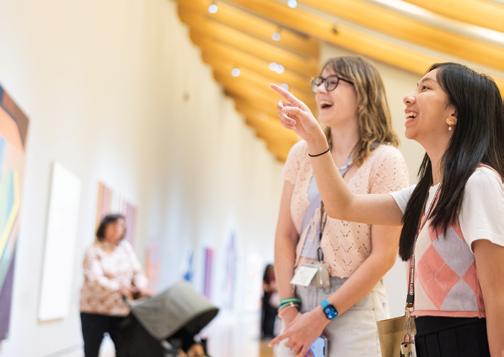
1. A participant examines artwork during a visit to Crystal Bridges Museum of American Art.
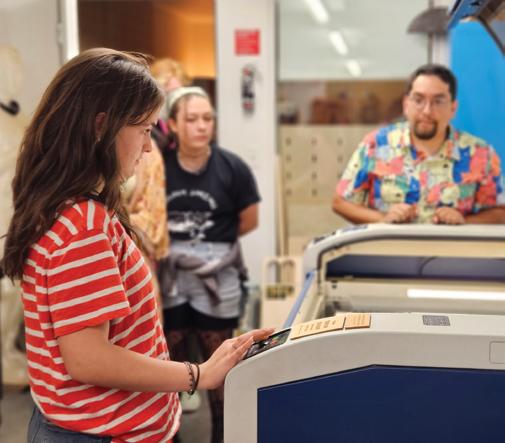
2. Participants learn about advanced technology in art during one of the Summer Arts Workshop classes.
3. Participants visit the Crystal Bridges Museum of American Art during the Summer Arts Workshop.
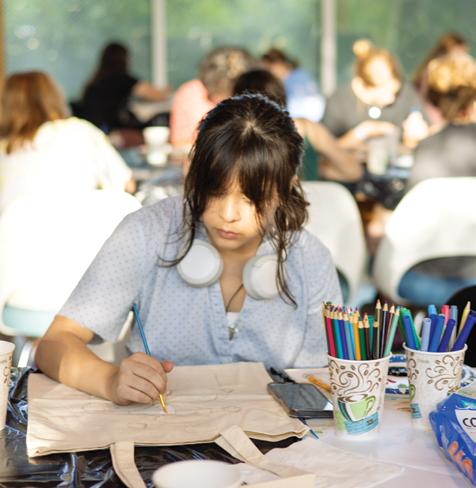
4. A participant designs a tote bag during the Summer Arts Workshop.
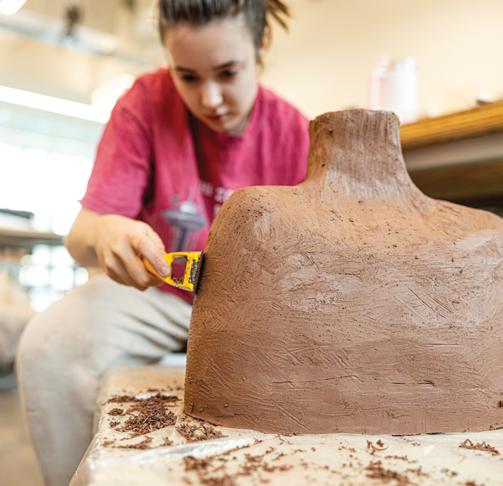
5. A participant practices sculpting during the Summer Arts Workshop.
Photos by Philip Thomas, Novo Studio.
4.
5.
THE CHANCELLOR’S SOCIETY brings together alumni, parents and friends whose annual support helps advance the University of Arkansas and its land-grant mission.
Their generosity strengthens the areas of campus they care about most while advancing priorities that reach far beyond the university — including the Land of Opportunity Scholarship.
Rooted in loyalty and leadership, the Chancellor’s Society represents a shared investment in the future.
Engraved in Stone. Connected for Life.
Share the pride, traditions and connections that define the U of A experience.
Give a Life Membership in the Arkansas Alumni Association to someone you love.
Photo by Russell Cothren.
Greater Impacts, Shared Purpose
President’s Message
Dear Alumni and Friends,
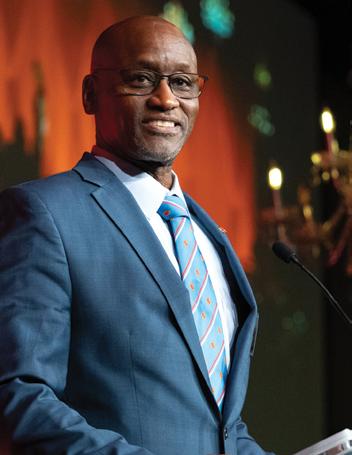
It is an honor to write my first letter to you as president of the Arkansas Alumni Association National Board of Directors. I step into this role with deep gratitude for those who have led before me, especially Regina Hopper B.A.'81, J.D.'85, whose steady leadership and commitment to the university helped guide the association through an impactful and forward-looking two-year term. Her service strengthened our alumni network and reinforced the important role this association plays in connecting Razorbacks across generations and around the world.
As I reflect on this issue’s theme, “Greater Impacts”, I am reminded that the University of Arkansas has always been defined not only by what happens on campus, but by what Razorbacks go on to do beyond it. The stories in this issue reflect that truth in meaningful ways. You will read about alumni building businesses from the ground up, donors investing in students with financial need, faculty and campus leaders shaping lives through mentorship and innovation, and alumni honoring the people and experiences that helped shape their own journeys. Together, these stories illustrate the many ways the Razorback community continues to lead, serve and give back.
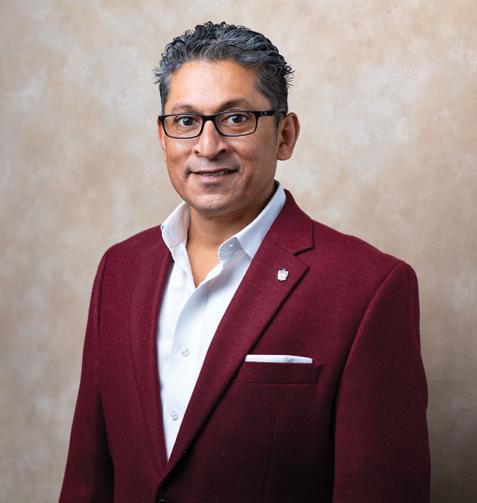
My journey, like so many others, has been shaped by unexpected turns, meaningful relationships, and places that became home. Born in India and raised in Kuwait, I arrived in Fayetteville, Arkansas, in 1985 after graduating from the American School of Kuwait. I still remember stepping onto the University of Arkansas campus for the very first time and immediately feeling welcomed by the genuine kindness and southern hospitality of the people around me. What began as a new chapter far from home quickly became one of the most meaningful periods of my life.
The friendships I formed during those early days remain some of my greatest blessings. More than 40 years later, those friends are still like family, even though life has carried us across the United States, Canada, the UAE, India, Pakistan, Singapore, Kazakhstan and beyond.
College life brought both joy and challenges. At one point, I lost sight of my academic priorities, but meeting a wonderful young woman from Southwest Arkansas changed everything. With her encouragement and support, I found my focus again. We graduated together, moved to the Dallas area in 1991, and have now shared 34 wonderful years of marriage. The stories and memories we shared with our children inspired our daughter to become a proud Arkansas alumna herself, while our son, who recently graduated from his CRNA program, remains one of the Razorbacks’ biggest fans.
One of the things I value most about the Arkansas Alumni Association is that our impact reaches far beyond events, traditions or gatherings. Those things matter because they help create belonging and connection, but they also serve a larger purpose. They remind us that being a Razorback is a lifelong relationship built on shared experiences, shared pride and shared responsibility.
Across the state and across the country, Arkansas alumni are mentoring students, opening doors professionally, supporting scholarships, leading communities and representing the university with integrity in every field imaginable. That collective influence is powerful. It strengthens the university, supports future students and helps position Arkansas for continued growth and opportunity.
This issue highlights several examples of alumni and friends stepping forward to support Land of Opportunity Scholarships, an initiative that reflects the university’s commitment to expanding access and student success across all 75 counties in Arkansas. The impact of those gifts
will extend far beyond financial assistance. They will create opportunities for students to pursue degrees, experiences and futures that may have once felt out of reach.
That spirit of investment in others is something I see often in the Arkansas alumni family. Whether through philanthropy, mentorship, volunteerism or simply staying engaged with the university community, our alumni continue to demonstrate that success is measured not only by personal achievement, but also by how we help others succeed along the way.
As president of the National Board, I look forward to helping advance that mission and working alongside alumni leaders, volunteers, staff and university partners who care deeply about this institution and its future. I also look forward to listening and learning from alumni across our network as we continue building an association that reflects the energy, diversity and ambition of the Razorback community today.
My hope is to give back to the University of Arkansas in the same way it gave so much to me. I want to help ensure the university and the association continue to grow as a place where people from all backgrounds, cultures, and experiences feel welcomed, valued and connected. One of the things that has always made the Arkansas community so special is its ability to bring together people from different walks of life and make them feel at home.
The Arkansas Alumni Association represents that spirit
beautifully. It is a community built on connection, pride and shared experiences, and I truly believe its strength comes from the diversity of its alumni family. My hope is that we continue building bridges across all colleges, generations and communities so that the association can keep growing and inspiring future Razorbacks for years to come.
The University of Arkansas is experiencing extraordinary momentum, and alumni remain an essential part of that story. Every graduate who mentors a student, attends an event, supports a scholarship, advocates for the university or simply stays connected contributes to something larger than themselves. Those individual efforts, multiplied across generations of Razorbacks, create the greater impacts we celebrate in this issue.
Thank you for the many ways you support the university and the Arkansas Alumni Association. I hope you enjoy this issue of Arkansas magazine, and I look forward to what we will accomplish together in the years ahead.
Wooo Pig Sooie!
Faheem Khan B.S.B.A.’91 President, National Board of Directors Arkansas Alumni Association
THANK YOU New Life Members
By becoming life members, U of A alumni and friends help lay a strong foundation for the future of the Arkansas Alumni Association. We welcome the newest life members, listed in alphabetical order:
James H. Akin B.A.’73
Wendy Westerlund Akin M.A.’77
David Glen Akridge Ph.D.’98
Jannette Cunningham Akridge Ph.D.’98
Sally Altman-Holt B.A.’72
Abby Baldwin
Blake A. Baldwin B.S.M.E.’09, M.B.A.’15
Trisha M. Blau M.Ed.’10
Beverly Block B.A.'76
Carol Brantley B.S.E.’85, M.Ed.’87
Gen Broyles A.D.N.’76
Sudsahara M. Callaway B.S.B.A.’05
Kasey S. Carolina B.A.’10
Bradley D. Center B.S.B.A.’82, B.S.B.A.’83
Henry Chaney B.S.A.’82, M.S.’87
Regina Chaney
Kristen Noelle Compston B.A.’07
Stephen Jacob Compston B.S.I.E.’07
Diane Cothern
Douglas K. Cothern M.B.A.’82
Ken Dick B.S.B.A.’77, M.B.A.’78
Rhonda Dick
James E. Dickson J.D.’77
Baylus S. East B.S.D.H.’77
Michael D. East
Betty Jo Buford Eldridge B.S.B.A.’66
Blaine Embley
Alan D. Epley B.S.B.A.’68, J.D.’74
Sherry Epley B.A.’74
Syard Gail Evans B.A.’06, M.S.’08, Ph.D.’17
Melinda P. Faubel B.S.I.E.’80
Steve Faubel B.S.B.A.’80
Laura S. Faulkner
Martin B. Faulkner B.A.’81
McKinzee R. Fisher
Wayne Flora
Richard F. Gerety B.S.B.A.’81
Dwight H. Gilbert M.Ed.’82
Sara E. Gilbert B.S.E.’76, M.Ed.’82
John R. Hamilton B.S.M.E.’68
Max Hamilton
Donna Danielle Hardcastle B.Arch.’96
Jeff Bernard Hardcastle B.S.I.E.’95
Elizabeth Hardwick B.S.B.A.’94
Kristin N. Hardy
Nicholas J. Hardy
Albert B. Harper B.S.B.A.’82
Brayden R. Hartwig B.A.’25, B.A.’25
Treneie Hedgecock M.S.E.’84
Howard Philip Hendrickson B.S.’87, Ph.D.’96
Tina Hendrickson
Jane P. Henry B.S.B.A.’99
R. Mathew Henry
Gregory T. House B.A.’84, J.D.’88
Cynthia L. Hughes M.Ed.’88
Randall Clifford Hughes B.S.I.E.’81, M.B.A.’84
Charles Edward Kalb B.S.B.A.’85
Caroline Elizabeth Kilo B.S.N.’25
John M. Largent B.S.B.A.’84, M.B.A.’85
Telma Largent B.S.B.A.’99
Glenn Lockeby B.S.E.E.’86, B.S.M.E.’87
Sarah Katherine Long
Cathy A. Luetje
Paul A. Luetje
David G. Mee
Sandra A. Metheny B.S.A.’85
Ken Murphy
Pattie Murphy
Robert G. Osment B.S.B.A.’23
Bret Alan Park B.Arch.’91
Stacey Issinghoff Park B.Arch.’94
Christopher Bates Parkerson J.D.’99
Kimberly A. Parkerson
Karen R. Ratcliff
Scott Ratcliff B.S.C.E.’01
Joe Mark Rogers B.A.’65, LL.B.’68
Jenny Rowland
Reese C. Rowland B.Arch.’90
Rebecca W. Ryburn
Tom Ryburn B.Arch.’75
Hope Sanchez
Rico Sanchez
Jack F. See Jr. B.Arch.’58
Judy Park See B.S.B.A.’58
Carie L. Siria B.S.E.’22
Joshua L. Siria
Bob Sliva B.S.B.A.’85
Karen S. Sliva
Josh Smith
Phillip A. Smith B.S.A.’79, M.S.’81, Ph.D.’95
Terry Lynn Smith B.S.B.A.’81
Kevin G. Sparks B.A.’20
Mike Stewart B.S.B.A.’76
Virginia L. Stewart B.S.H.E.’76
Lindy V. Swindell
William G. Swindell B.A.’72
Debbie Orintas Teague B.A.’94
Michael Teague B.A.’93
Audwin Vaughan B.S.A.’86
Jenni Wood Vaughan B.S.E.’86
Austin L. Watts B.S.C.E.’98, M.S.C.E.’00
Jennifer L. Watts
Elizabeth P. Wenger
Robert J Wenger Jr. B.S.’00, M.S.’02
Traci Williams B.S.B.A.’94
Introducing New National Board Members
Class of 2029
BY DYLAN HOLLUMS B.S.E.'10
The Arkansas Alumni Association proudly welcomes five distinguished individuals to its National Board of Directors. Representing a wide range of industries, expertise and geographic areas, these new members bring a shared passion for the University of Arkansas and a strong commitment to advancing alumni engagement and student success.
Vickie Fielitz B.A.'91
Vickie Fielitz of Daniel Island, South Carolina, is the owner and founder of the Leadership Lab. She has a passion for developing talent to create high-performance teams in world-class organizations. Her business acumen was developed during more than 18 years as a leader at The Walt Disney Company. In addition to her extensive Disney experience, Vickie worked in commercial market account sales for AT&T. She also led marketing efforts for a joint-venture operation between Bass Pro Shops and The Bluegreen Corporation, where she was instrumental in bridging gaps between different corporate cultures and building one of the most successful sales and marketing organizations in the industry.
Donald (DK) Keels Jr. B.S.B.A.'04
Known affectionately as “DK”, Donald Keels Jr. has been an avid supporter of the NWA Chapter of the Arkansas Alumni Association, previously serving as vice president, president and past president. While working as a procurement category manager at Tyson Foods, he still makes time to serve as an annual scholarship reviewer,
attend Alumni Awards Celebration, and show his Razorback pride by representing the association on Pig Trail Nation Game Day Show with DJ Williams. DK and his wife, Melissa , are residents of Fayetteville.
Reese Rowland B.Arch.'90
Reese Rowland received his degree from the Fay Jones School of Architecture and Design in 1990. As a Principal Architect with Polk Stanley Wilcox, Rowland has received over 60 national, regional and state design awards. He is one of roughly 3,000 architects nationwide elected to the American Institute of Architects College of Fellows. He has designed some of Arkansas’ most recognized buildings, including Acxiom’s River Market Tower Headquarters, Bank OZK Headquarters, Heifer International Education Center, and the Little Rock Regional Chamber of Commerce.
Jissel Esparza B.S.B.A.'21, J.D.'24
Jissell is an associate in the Litigation Department at Lewis Rice in St. Louis, Missouri. Her general litigation practice centers on complex commercial matters, where she helps clients navigate high-stakes disputes. During law school, Jissel spent two summers as a summer associate at Lewis Rice and served as Editor-in-Chief of the Arkansas Law Review, demonstrating both leadership and a commitment to legal scholarship. As an undergraduate studying accounting and finance, she served as treasurer of the Associated Student Government and earned the Arkansas Alumni Association’s Senior Honor Citation in 2021.
Joy Secuban B.A.'99
Joy serves as the chief of strategy and programs for the Clinton Foundation in Little Rock. She oversees key components of the Presidential Center, including the strategic direction and execution of year-round programming and exhibitions; operations and facilities; marketing and communications; and identifying opportunities for growth and overseeing the budget. Previously, she served as director of programming and exhibitions at the Clinton Presidential Center and as chief of staff to Chelsea Clinton in New York. While Joy pursued her bachelor’s degree in journalism, specializing in advertising and public relations, she was also the inaugural “Pork Chop” mascot for Razorback athletics due to her diminutive size and passionate spirit.
More about the National Board of Directors
The Arkansas Alumni Association is honored to welcome these five new alumni to the board and looks forward to their future contributions.
In addition to our new board members, the Class of 2029 includes the following board members returning for a second term: Stacie Fujii B.A.’98, J.D.’02, Janie Hipp LL.M.’96 and Charles Zimmerman B.S.C.E.’85. Faheem Khan B.S.B.A.’91 began his term as Board of Directors president on July 1.
BOARD
OF DIRECTORS
─ CALL FOR NOMINATIONS ─
* To be eligible for the FY28 (Class of 2030), nominations must be received by Nov. 20, 2026. Nominations received after this date will be considered for the next board class. Board selection will be made by the Nominating Committee of the Arkansas Alumni Board of Directors at the winter meeting each year. Nominations are kept in a pool for a minimum of three years and life membership in the Arkansas Alumni Association is required.
Jeffrey Froude II Ph.D.'08 Returns to Campus 2026 Johnson Fellow
BY DYLAN HOLLUMS B.S.E.'10
When Lieutenant Colonel Jeffrey W. Froude II stepped back onto the University of Arkansas campus in April 2026, it was not simply a homecoming — it was a full-circle moment grounded in service, science and a lifelong connection to the U of A.
An alumnus of the Fulbright College of Arts and Sciences, Froude earned his Ph.D. in chemistry from the U of A in 2008 while serving as a chemical and intelligence officer in the Arkansas National Guard’s 142nd Fires Brigade. Nearly two decades later, he returned to Fayetteville as the Arkansas Alumni Association’s 2026 Johnson Fellow, bringing with him an extraordinary career that spans military leadership, infectious disease research, toxicology and national biodefense strategy.
Today, Froude serves as the chief of molecular biology at the U.S. Army Medical Research Institute of Infectious Diseases (USAMRIID). He has held notable prior senior scientific and leadership roles across the Department of Defense, including the Walter Reed Army Institute of Research, the Defense Threat Reduction Agency, Commander of the Forensic Toxicology Drug Testing Lab, and as a liaison to the French Ministry of Health. His research has contributed to the development of medical countermeasures against some of the world’s most dangerous pathogens, including Ebola and Marburg, and he served as the Director of Pilot Biomanufacturing during the Department of Defense’s response to the COVID 19 pandemic.
Jeffrey Froude II, Dr Johnson, and Robyn Starling-Ledbetter B.A.’00, M.A.’06 in the UATV Studio with journalism students on Wednesday, April 8, 2026.
Jeffrey Froude II is next to his name on Senior Walk.
But throughout his distinguished career, Froude has remained deeply connected to the education and mentorship that shaped him.
Froude visited the campus April 6-9 as the 16th Johnson Fellow, a distinguished program created in 2009 by an endowment from Dr. Jeff Johnson B.A.’70 and his wife, Marcia, to bring esteemed alumni back to the University of Arkansas campus to engage and inspire students, faculty and staff. Froude was accompanied on his campus visit by his son, Jimmy, a University of Arkansas freshman majoring in engineering.
“Marcia and I were honored to have Dr. Jeff Froude visit the campus,” said Dr. Jeff Johnson. “It was fascinating watching him share the story of his remarkable career with students.”
Froude began his visit on Monday afternoon as the featured guest lecturer at the Chemistry Department Seminar, where he delivered a talk titled “Real-World Lessons in Antibody Therapies: Perspectives Beyond the Curriculum.”
“Froude’s seminar showed that effective antibody therapies depend not just on binding, but on where binding occurs,” reflected one faculty member. “That was a new perspective for me.”
“It was striking to see how distinguished his career has become and the real-world impact of his work,” said Josh Sakon, professor in the Department of Chemistry and Biochemistry. “His efforts in developing treatments for viruses that must be handled in BSL-4 [Biosafety Level 4 Labs] facilities, along with his contributions to the national COVID-19 response, were particularly impressive. I’m very proud of him. His visit was also a powerful reminder to our students of the impact a career in science can have beyond the classroom.”
The following morning, Froude visited Tamara Roth’s Artificial Intelligence & Tech Ethics class, where the students discussed key ethical decisions related to infectious diseases and AI in health, specifically in medical treatment development and diagnostics.
That afternoon, Froude and the Johnsons toured the recently opened Institute for Integrative & Innovative Research (I3R) building. The collaborative facility is intended to deploy interdisciplinary research and economic development through partnerships with industry, community and philanthropic organizations. The group learned about the facility’s state-of-theart laboratories as they were guided through the Human Health, Materials & Characterization and the Pre-Clinical & Surgical Innovation Wings of the 144,000 sq. ft. building.
To cap the day, Froude was selected to throw out the first pitch at Baum-Walker Stadium for an Arkansas Baseball game versus in-state rival, UALR, Tuesday night, April 7, with the Razorbacks winning 7-0.
Froude’s leadership perspective came into focus during his Wednesday morning interview with U of A journalism students at UATV Studios, where he discussed ethical responsibility, public communication during crises, and the human dimension of scientific decision-making.
Froude’s story resonated because it reflects a rare combination of scientific research and military service. He began his career as an enlisted soldier before commissioning as an officer, eventually deploying to Iraq and later leading scientific teams in highcontainment laboratories and global health emergencies.
Jeffrey Froude II presents to students from the Biochemistry II class on Wednesday, April 8, 2026.
Dean Brian Raines of the J. William Fulbright College of Arts and Sciences with Jeffrey Froude II and Dr Johnson.
Jeffrey Froude II and Dr Johnson tour the Institute for Integrative & Innovative Research (I3R) building on Tuesday, April 7, 2026.
The Wednesday itinerary also included presentations to an Organic Chemistry II class taught by Maggie He, assistant professor in the Department of Chemistry and Biochemistry, and professor Suresh Thallauranam’s Biochemistry II course, where the topics ranged from forensic toxicology practices and the application of workplace drug testing programs to next-generation sequencing and considerations of antibody therapeutics. Froude then spent his lunch with students from the Biology Graduate Student Association (BioGrad).
“The visit provided a unique look into biological research within the military. It was interesting to hear from someone with that level of experience and to hear how interdisciplinary research can help solve complex, real-world health challenges,” said Isabella DeAnglis, biology graduate student and teaching assistant. “The BioGrad students were grateful to have the chance to talk to Froude and learn about his research and alternative career paths in science.”
Another student noted that hearing about antibody therapies “changed how I think about drug design — it’s not just whether something binds, but where and how it binds that determines whether it actually works.”
The highlight of the week came on Wednesday night during the Johnson Fellows Official Reception and presentation, where Froude was formally recognized for a career dedicated to protecting public health and national security.
Thursday’s schedule included visits to the Elements in Biochemistry, taught by assistant professor Chenguang Fan, and Biomolecular Engineering, taught by assistant professor Rebekah Samsonraj. The day concluded with a Department of Biology presentation for gathered students, faculty, staff and researchers.
“During my meeting with Froude, I recognized that his research is well outside my wheelhouse, and I was struck by how diverse the field of biology truly is,” remarked Remington R. Motte, Ph.D. student and teaching assistant. “His nontraditional career path — applying research outside of academia to create tangible impact, particularly during the pandemic — broadened my own thinking about what a scientific career can look like. Above all, his perspective on restoring public trust in science resonated deeply. In an era of skepticism toward research and persistent funding challenges, his emphasis on building trust through everyday relationships is both timely and actionable.”
For the U of A, Froude’s visit reinforced the power of alumni engagement and the long-term impact of a Fulbright College education. For students, it offered a living example of how scientific training can lead to meaningful service on a global scale.
During his multi-day visit, Froude immersed himself in the university’s academic life, engaging with students at nearly every level. From large undergraduate courses in biochemistry and biomolecular engineering to graduate seminars and interdisciplinary discussions on artificial intelligence and ethics, he shared real-world perspectives that bridged theory and practice.
And for Froude, the Johnson Fellow experience reaffirmed the importance of mentorship. “It represents more than personal recognition; it reflects the responsibility we all share to mentor others, continue learning throughout our lives, and reach back to help the next generation of leaders succeed. Some of the most meaningful opportunities in my life came from people who invested their time, guidance and belief in me,” Froude said.
Froude resides in Walkersville, Maryland, with his wife, Kira, and their two daughters, Samantha and Anne. In addition to his military service and research, Froude is an adjunct professor in Advanced Academic Programs at Johns Hopkins University in Baltimore, Maryland, and an instructor at the Uniformed Services University of the Health Sciences in Bethesda, Maryland.
Jeffrey Froude II and Maggie He during her Organic Chemistry II class on Wednesday, April 8, 2026.
Dr Jeffrey Johson, Jeffrey Froude II, and Brandy Cox, executive director & associate vice chancellor of the Arkansas Alumni Association, at the Johnson Fellow official reception.
A New Wave of Razorbacks
Arkansas Alumni Association Welcomes the 2026 Alumni Endowed Scholars
BY PATTI SANDERS B.S.A.'08
Spring on The Hill always feels like an excited, two-handed, full-arm wave. As the University of Arkansas community celebrates graduates stepping into their next chapters, we are already preparing to welcome a new class of students to campus. For the Arkansas Alumni Association, that season of transition is perhaps best reflected in the alumni scholarship program — a tradition that connects generations of Razorbacks while investing in the university’s future.
Each year, Arkansas Alumni Association members volunteer their time to review thousands of scholarship applications that include incoming freshmen from across the state and beyond. Through that process, two students are selected to become the newest Alumni Endowed Scholars. Each recipient receives a $7,000 renewable scholarship along with the opportunity to serve on the Student Alumni Association Leadership Team, better known as SALT.
This year’s Alumni Endowed Scholars are Isabelle Lunsford of White Hall and Lexie Castillo of Gravette — two students already demonstrating a passion for leadership, service and creating meaningful impact in their communities.
Isabelle Lunsford
Lunsford plans to major in journalism with an emphasis in sports broadcasting. However, she is also keeping an eye on law school as she continues exploring her interest in advocacy and public service. Even before beginning college, she completed an internship with the Pulaski County Prosecuting Attorney’s Office, an experience that strengthened her desire to help others.
“I hope to use my education to advocate for others, promote justice and make a meaningful difference in the lives of those who need it most,” Lunsford said.
She said the U of A stood out because of its strong academic programs, vibrant campus culture and opportunities for personal and professional growth.
“I chose the University of Arkansas because of its strong academic programs, school spirit and the opportunity to grow both personally and professionally while being part of a community I have always admired,” she said.
Lexie Castillo
Castillo also brings a strong commitment to community involvement as she prepares to begin her studies in architecture with a minor in urban planning and design. Beyond the classroom, she looks forward to attending campus events, supporting Razorback athletics, building connections and joining service-oriented organizations that allow her to continue giving back.
“Because of this alumni scholarship, I am able to dream bigger and pursue a future centered on designing spaces that positively impact communities,” Castillo said.
She hopes to “one day pay this kindness forward by using my education and career to serve others and create meaningful change.”
More About Arkansas Alumni Scholarships
Alumni generosity of time and financial gifts allows the association to continue supporting more than 500 students through almost $1.3 million in scholarship awards each year. For the Arkansas Alumni Association, scholarships represent far more than financial support. They create opportunities for students to build lasting relationships, develop leadership skills, and establish a lifelong connection to the university community. Through programs like the Student Alumni Association — and its student leadership team, SALT— scholars are introduced to alumni, traditions and service opportunities that help make the university feel like home.
As the Arkansas Alumni Association waves “welcome to campus” this fall to its newest scholars, the organization remains committed to helping students connect to campus resources, find community and discover a home away from home during one of life’s biggest transitions. And while one group of Razorbacks may be leaving campus this spring, another is already arriving — ready to carry the spirit of Arkansas forward.
Celebrating Students’ Achievements and Contributions to the U of A 2026 Senior Awards Recipients
BY KATIE LEONARD CHANCE B.S.B.A.'19
It would take a dictionary full of positive words to fully describe the leadership, community engagement, extracurricular involvement and academic excellence demonstrated by the students who participated in the Senior Awards Program during the 2025-26 academic year.
The Arkansas Alumni Association has supported the Senior Honors Citations program for more than 50 years. After expanding the program twice, the current Senior Awards Program honors excellence in leadership, academics and cocurricular involvement through a three-tier recognition program. Beginning with Seniors of Significance, members of this first tier are selected through selfnominations and nominations from colleges and units on campus. A committee of alumni and staff reviews applications, and the top 20 applicants are named Razorback Classics, with the top two named Senior Honor Citations.
This year, more than half of the Seniors of Significance were members of the Honors College. Many have published research, presented their work nationally, founded organizations, mentored fellow students and volunteered throughout their communities. All of them share a strong commitment to academic excellence and service.
With a record-breaking number of honorees, the Arkansas Alumni Association was proud to recognize 302 students as Seniors of Significance during the annual ceremony held on April 29, 2026. Students from every college across campus, as well as representatives from student affairs and athletics, were celebrated for their achievements and contributions to the University of Arkansas community. Twenty students were named Razorback Classics during the Seniors of Significance ceremony. The excitement in the room was evident as students celebrated one another throughout the afternoon. The support and encouragement shown among classmates and friends reflected the strong sense of community shared by these students.
On May 5, 2026, during the Cardinal and White ceremony honoring the twenty Razorback Classics, Chancellor Charles Robinson announced Abbi Melton B.S.W.’26 and Jared Noel B.S.Ch.E.’26, B.S.’26 as the 2026 Senior Honor Citation recipients.
2026 Razorback Classics.
Photo by Whit Pruitt.
Abbi Melton
Abbi Melton graduated in May with a degree in social work and a minor in legal studies from the Fulbright College of Arts and Sciences.
Melton distinguished herself through leadership, advocacy and service as a social work honors student at the University of Arkansas. Her academic work and community engagement reflect a strong commitment to mental health advocacy, justice reform and support for underserved populations throughout Arkansas. Her honors research examined the relationship between Greek Life affiliation and alcohol misuse among university students, contributing to ongoing conversations surrounding student well-being and public health. Beyond the classroom, she made a meaningful impact through her work with the Arkansas Justice Reform Coalition, where she established the organization’s first social work internship role and served as a social work lead supporting individuals involved in the justice system. She also helped establish Washington County’s first Mental Health Court, assisting clients in securing critical resources and support services.
A respected campus leader, Melton was selected as the 2025 University of Arkansas Homecoming Queen and founded Community Against Cancer, an organization dedicated to supporting students impacted by cancer while raising funds for cancer research. Through leadership roles across campus organizations, mentorship initiatives and volunteer service, she consistently demonstrated compassion, integrity and dedication to supporting others. Melton plans to move to New York City to attend Columbia University and pursue a Master of Science in Social Work.
Following graduation, he will pursue a Ph.D. in molecular engineering in the David Baker Lab at the University of Washington as a recipient of the National Science Foundation Graduate Research Fellowship, one of the nation’s most competitive awards supporting graduate researchers in science and engineering.
A 2025 Barry Goldwater Scholar, Noel conducted research spanning computational biology, genomics, neuroscience and biomaterials engineering. His honors thesis research in the Department of Chemical Engineering focused on developing personalized computational models to predict cardiac fibrosis responses, combining engineering, biology and machine learning to address complex biomedical challenges. He also completed competitive NSF Research Experiences for Undergraduates at the National Institute for Theory and Mathematics in Biology in Chicago and The Jackson Laboratory in Maine, contributing to research in computational neuroscience and genetic mapping. His work has resulted in multiple manuscript submissions and presentations at regional and national conferences. In addition to his research accomplishments, Noel demonstrated a strong commitment to mentoring future engineers and researchers through his role as a teaching assistant in the First-Year Engineering Program’s Honors Research Experience course.
More About Senior Awards
As the newest Senior Honor Citation recipients, both Melton and Noel received honorary life memberships in the Arkansas Alumni Association. The Senior Awards Program serves as a powerful reminder that the University of Arkansas is home to students who are not only accomplished scholars but also compassionate leaders, thoughtful mentors and engaged citizens. Their achievements are impressive, but the impact they have on the people around them is what truly sets them apart. Their future contributions as leaders, mentors and advocates will undoubtedly continue long after graduation. Scan the QR code to see all the Senior Award recipients and learn more about the program.
Jared Noel of Paragould graduated in May with degrees in chemical engineering and applied mathematics from the College of Engineering. Noel distinguished himself through interdisciplinary STEM research, mentorship and academic leadership during his time at the University of Arkansas.
Photo by Russell Cothren.
Jared Noel
Pho to by Russell Cothren.
Towers of Old Main Celebrates 25 Years of Transformational Impact
BY DOMINIC ROSSETTI B.A.'23
The University of Arkansas marked a significant milestone on April 10 with the 25th anniversary celebration of the Towers of Old Main giving society, honoring the philanthropic leadership of its members and inductees. Held at the Fayetteville Public Library Event Center, the evening reflected on 25 years of philanthropic leadership and the transformative impact of members who have advanced the university's mission.
The program reflected on the founding vision of Towers of Old Main and the growing legacy of this distinguished group. Twenty-five years ago, the celebration began with the purpose of recognizing those who generously supported the University of Arkansas. Created in 1999, the giving society is a tribute to the physical towers of Old Main, an enduring icon of higher education across Arkansas. What began with 275 members has grown to 1,118 alumni and friends whose philanthropy has expanded opportunity, and advanced priorities across the university. Collectively, members have contributed more than $759 million in support for students, faculty, projects and programs across campus.
Special recognition was given to Chancellor emeritus Dave Gearhart J.D.’78, Ed.D.’89 and Jane Gearhart B.S.E.’74, whose vision and leadership were instrumental in creating the Towers of Old Main. Their enduring legacy continues to shape the university and its philanthropic culture.
The NWA Jazz and More Orchestra entertained attendees with big band music throughout the event.
Photo by Russell Cothren.
1.
2. Veronica and Dusty Graham, Beverly and Tim Graham.
3. Chris and Jamie Fowler, Bob and Becky Alexander
4. Trevi Soto and Collier Wright, Marshall and Kristen Wright, Brooks Callahan, and Syble Wright.
5. Mike Frazier, Gerald Jordan, Larry and Nancy Bittle.
6. Panneer and Chitra Selvam.
7. U of A System President Jay Silveria, Elizabeth and Gerald Jordan, Chancellor Charles Robinson.
During the program, UA System President Jay Silveria and Chancellor Charles Robinson recognized 80 Towers of Old Main inductees with medallions and pins, honoring their dedication to advancing campus priorities and creating pathways for student success.
The future of student access and opportunity was also central to the evening. As members reflected on 25 years of philanthropic impact, the Land of Opportunity Scholarship served as a reminder of the transformative power of giving. Supported by a historic $100 million commitment from Jane Hunt B.S.E.’76, Bryan Hunt B.S.B.A.’85 and Mandy Hunt on behalf of the J.B. and Johnelle Hunt family, along with the generosity of many supporters, the initiative will welcome its first cohort of scholars this fall, expanding access and ensuring students from every corner of Arkansas can attend the University of Arkansas and thrive once they arrive.
Musical performances by faculty and students elevated the celebration, while the Paths of Possibility student panel highlighted the personal impact of philanthropy through the stories of five inspiring students. The program concluded with a stirring performance of the “Arkansas Fight Song” by the University of Arkansas Children’s Choir.
(Continued on page 46)
U of A System President Jay Silveria, Bryan and Mandy Hunt, Chancellor Charles Robinson
Photos by Chieko Hara.
2026 Towers of Old Main Honorees
• Bob B.S.B.A.’77 and Becky Alexander B.A.’77
• Ross B.S.I.E.’64 and Marianne Anderson
• Larry B.S.B.A.’71 and Nancy Bittle B.S.E.’72
• Sherman B.S.E.E.’87 and Lynette Black B.S.B.A.’87
• Tracy Gilmer Black B.S.’87 and Scott Black
• Jim Carruth
• Phyllis Carruth
• Marty B.S.B.A.’74 and Ginger Casteel B.S.E.’75
• William B.S.B.A.’91 and Christy Clark
• Robert Cross B.S.Ch.E.’57 and Laurie Schuler
• Vickie Fielitz B.A.’91 and Robert Fielitz
• Chris and Jamie Fowler
• Donna Lucas Graham B.S.H.E.’70, M.Ed.’78
• Dusty B.Arch.’04 and Veronica Graham B.A.’24
• Tim B.S.B.A.’78 and Beverly Graham
• Leah Glover Hales B.Arch.’94
• Joe B.S.B.A.’81 and Pat Hays
• Tracy Henderson B.A.’84
• Gregg Herrell
• Charles C. Hill Jr. B.Arch.’73
• Bryan and Mandy Hunt
• Jane Hunt
• Doug B.Arch.’88 and Melodie Hurley B.Arch.’92
• Elizabeth and Gerald Jordan B.A.’70
• Chris Lewis B.Arch.’79
• Larry and Sandy Mahoney B.S.B.A.’87
• Paula Marie Marinoni
• Mac B.S.’78, M.S.’82 and Karen McGilvery B.A.’82
Pregame in San Jose
The Arkansas Alumni Association and Razorback Foundation hosted a pregame social on March 26 in San Jose before the Razorbacks took on the Arizona Wildcats in the Sweet Sixteen of the NCAA Men’s Basketball Tournament.
• Lance and Judy McReynolds
• Victor Mirontschuk B.A.’72, B.Arch.’74 and Lucy Bugea B.A.’73
• Charles and Charlotte Nabholz
• Kim and William Needy M.S.O.M.’15
• Chris B.S.M.E.’94 and Ginger Oliver
• Russel and Lucretia Plumley
• Danielle Hefley
• Mary Ryan B.A.’70
• Patrick B.S.C.E.’97 and Jessica Schueck
• Denton and Cathy Seilhan
• Panneer and Chitra Selvam
• Robert B.S.B.A.’76 and Maureen Stella
• Dan B.Arch.’90 and Terry Tate
• Gary L. Tidwell B.S.B.A.’74, J.D.’77
• Charlie B.S.B.A.’63 and Cappy Whiteside B.S.B.A.’65
• Dottie Patton Wilson
• Brian Wolff B.A.’89
• Bruce B.Arch.’89 and Rebecca Woody
• James T. B.S.B.A.’68 and Kathleen Wright
• Kristen B.A.’98, J.D.’01 and Marshall Wright B.S.B.A.’98, J.D.’01
Ruby, Gold, Silver
To learn more about Towers of Old Main, contact Tory Gaddy with the Office of Engagement at gaddy@uark.edu.
Photo by Kevin Trainor.
Big Easy Bash
On Tuesday, Feb. 10, the Arkansas Alumni Association brought Mardi Gras to Fayetteville with the Big Easy Bash at the Janelle Y. Hembree Alumni House. Life Members and University of Arkansas faculty and staff gathered for a festive Razorback basketball watch party featuring New Orleans–inspired food, drinks and plenty of Razorback spirit as the Hogs rolled to a 91–62 victory over LSU.
Razorbacks vs. Gators Basketball Watch Party & Canned Good Challenge
Razorbacks and Gators gathered for a spirited basketball watch party hosted by the NWA Gator Club and the MSOM Society! In the spirit of friendly competition and community service, they hosted a Canned Good Challenge: Arkansas vs. Florida. Donations benefitted local families in need.
Law Alumni Reunion
The University of Arkansas School of Law and the Law Alumni Society Board hosted the Law Alumni Reunion Dinner, honoring the recipients of the 2026 Law Alumni Society Awards. The awards highlight alumni and friends whose leadership, dedication and impact strengthen the legal community and the School of Law's mission.
During the evening, 50-year graduates from the classes of 1975 and 1976 were also recognized and presented with commemorative medallions.
The 2026 honorees included:
• Commitment to Justice Award: Bobby E. Shepherd J.D.'76, U.S. Circuit Judge for the Eighth Circuit Court of Appeals.
• Commitment to Justice Early Career Award: Chris Hussein B.S.H.E.S.'14, J.D.'17, partner at Taylor Law Partners LLP.
• Veterans Award: Colonel (Ret.) Jane Ellen Paschall J.D.'90, U.S. Army’s senior legal adviser to the Judge Advocate General and the Army Staff
• Veterans Award (posthumous): Rear Admiral Everette Don Stumbaugh, JAGC, USN (Ret.) B.S.B.A.'59, LL.B.'59, U.S. Navy’s 32nd Judge Advocate General.
• Public Service Award: Jason Bailey J.D.'15 - senior counsel for the NAACP Legal Defense and Educational Fund.
• Career Champion Award: Friday, Eldredge & Clark LLP.
1. Dean Cynthia Nance with members of the Class of 1975: formerArkansas Gov. Asa Hutchinson J.D.'75, H.T Moore J.D.'75 and Gary McDonald B.A.'72, J.D.'75
2. Dean Cynthia Nance with members of the Class of 1976: Justice John Dan Kemp B.A.'73, J.D.'76, Raymond Abramson J.D.'76, Judge Bobby Shepherd J.D.'76, David Throesch J.D.'76, Senior Associate Dean Jim Miller B.S.B.A.'65, J.D.'76 and Richard Clark J.D '76
3. Jason Bailey accepts his award from Dana McGee, Law Alumni Society Board member.
4. Chris Hussein accepts his award from Dana McGee B.A.'19, J.D'22, M.A.'23, Law Alumni Society Board member.
5. Col. (Ret.) Jane Ellen Paschall accepts her award from Maj. Austin Todd J.D.'17, Law Alumni Society Board vice president.
6. Dean Cynthia Nance presents an award to Jason Bramlett B.S.B.A.'98, J.D.'01 from Friday, Eldredge & Clark LLP.
7. Judge Bobby Shepherd receives his award from Dean Cynthia Nance.
Photos by Stephen Ironside, Iron Lotus Creative.
2.
1.
Roy Reed Lecture
The School of Journalism and Strategic Media hosted the 2026 Roy Reed Lecture featuring Emmy-winning alumnus Larry Foley B.A.'76. The Lemke Journalism Alumni Society is a proud supporter of this annual J-Days event.
1. Foley delivers his lecture “The Truth Matters.”
2. The prelecture reception also served as a retirement reception for professor Foley
3. The lecture was held in Boyer Hall at the Janelle Y. Hembree Alumni House.
Photos by Kyle Payne. 1. 3. 2.
Alumni Baseball Cookout
On April 14, the Central Arkansas Chapter hosted its annual Alumni Baseball Cookout at CHI St. Vincent Field at Dickey-Stephens Park for the Razorback baseball game vs. UAPB.
1. Central Arkansas Alumni Chapter leadership with U of A RBI girls.
2. Becky Afonso , assistant director of external relations, and Ribby.
3. Calling the Hogs at the game.
by BeckyAfonso.
AFAS Graduation Celebration
The Armed Forces Alumni Society hosted its inaugural AFAS Graduation Celebration, honoring veterans and cadets graduating in the spring or summer of 2026. Participating graduates were nominated by Air Force ROTC, Army ROTC and the Veterans and MilitaryAffiliated Student Center.
Photos
2026 Spring Méritos Latinos
The Latino Alumni Society hosted its annual spring Méritos Latinos celebration on Friday, May 8, celebrating the accomplishments of students, alumni and the community.
The Latino Alumni Society honored 40 graduating students from across campus. U of A faculty and staff nominated these students who have proven themselves academically and demonstrated leadership and involvement.
The Latino Alumni Society Board honored alumni and staff in three award categories. The 2026 awardees are:
• Peer Mentor Award: Miguel Marin Ponce B.S.I.B.'23, manager, marketplace finance at Wal-Mart.
• Maurizio Lorenzetti Latino Award: Kevin Flores J.D.'19, attorney at Pearson, Sholk & Hernandez Law
• Outstanding U of A Staff Award: Anaid Espinosa, research advancement specialist in the College of Education and Health Professions.
1. The event was held in the Arkansas Union’s Verizon Ballroom.
2. Anaid Espinosa poses with her Outstanding U of A Staff Award. Carolina Cruz applauds her in the background.
3. A highlight of the event was the distribution of graduation stoles to outstanding graduating students.
4. Miguel Marin Ponce receives his award from Carolina Cruz B.A.'19. LAS board member Eric Pacheco B.S.B.A.'20, M.S.'24 is in the background on the stage.
5. Former City of Springdale Councilman Kevin Flores holds his Maurizio Lorenzetti Alumni Award.
Hog Calls & Farewell
The Arkansas Alumni Association celebrated and welcomed graduating seniors into the Arkansas Alumni family during Hog Calls & Farewell. The event, held Thursday, April 30, at the Arkansas Union, honored students as they took their final steps toward Senior Walk and their first steps as lifelong alumni. Graduates enjoyed celebrating together as they were officially welcomed into the Razorback alumni community
Food Pantry Tour
On May 1, 2026, members of the association’s National Board of Directors participated in a tour of the Jane B. Gearhart Full Circle Food Pantry. Board members learned about the pantry’s mission and service to the campus community
Learn more about the pantry at service.uark.edu/services/pantry/.
by Kevin Trainor.
Photos
Yesteryear
Yesteryear
In 1946, temporary quarters are erected to house the booming increase in student population as a result of GIs returning from World War II. Three temporary housing villages — Lloyd Halls, Camp Leroy Pond and the Veterans Village — use temporary barracks moved to the university.
Photo by Ed Puska courtesy of the 1947 Razorback yearbook.
150 Years Ago
• James J. Sevier, a member of the Cherokee Nation from Webbers Falls, Indian Territory, becomes the first known Indigenous student to enroll in the university.
140 Years Ago
• The Arkansas Valley Route, the old Little Rock & Fort Smith Railroad, offers reduced fares for university students traveling to Fayetteville
110 Years Ago
• Julia Vaulx B.A.1892, head of the university library, organizes a Fayetteville Library Association to help the city build a public library building.
100 Years Ago
• Grading work begins for the construction of two new academic buildings, the Agriculture Building and the Engineering Building, now known as the John A. White Engineering Hall.
• The university’s new radio station changes its call letters from KFMQ to KUOA. The radio station plans to hold its second fiddlers’ contest on air.
• The university receives its first electric bell with which to signal dismissal of classes.
90 Years Ago
• Drawings for a new field house to be built on Garland Avenue are unveiled. Today the building is the James and Joyce Faulkner Performing Arts Center.
• The new Sigma Alpha Epsilon chapter house is opened. The fraternity members had been living in temporary quarters on Church Avenue.
• The first Band Building opens for use by the Razorback Marching Band and the ROTC Cadet Band. It was located near the present-day location of Ferritor Hall.
80 Years Ago
• Seeking to finish a degree he started in 1881, W.E. Whitford, 80, reenrolls in the College of Arts and Sciences at the university.
70 Years Ago
• Architects unveil a drawing of a new two-story modern Pi Beta Phi chapter house to be built at the corner of Maple and Wilson. Their first house was on Oakland Street and became home to the Alpha Delta Pi sorority when Pi Beta Phi moved to Maple and Wilson, where today they’ve built a third chapter house.
• Students who need a break from summer school studies find their way to George’s Majestic Lounge on Dickson, which offers air-conditioning and a newfangled color television.
• The University of Arkansas Board of Trustees approves a measure to prohibit students who have less than a 1.5 GPA from using a car on campus.
60 Years Ago
• Gray Hall, a men’s residence hall built in 1906, is demolished to make way for construction of Mullins Library
• Reid Hall, named for Martha Reid, an associate professor of Latin and the first full-time dean of women, is opened for student housing. Before it was officially named, students began referring to it as Hotz Hall No. 2, because it looked exactly like Hotz Hall.
50 Years Ago
• For the first time in the university’s history, the presidents of Associated Student Government and Black Americans for Democracy, the editors of the Razorback yearbook and The Arkansas Traveler and the president pro tempore of Student Senate are all women.
40 Years Ago
• Faculty, staff and students pledge $150,000 to begin a year-long fundraising drive for the renovation of Old Main. Restoration costs were expected to be $7 million.
30 Years Ago
• The John William Tyson Poultry Science Building is dedicated, and the Tyson Center for Excellence in Poultry Science is established.
• Lawrence A. Davis Sr. Ed.D.’60 is inducted into the Arkansas Black Hall of Fame. He served as president of the Arkansas Agricultural, Mechanical and Normal College in Pine Bluff from 1943 until his resignation in 1973. During this time, he oversaw the school’s 1972 transition from college to university status as a part of the University of Arkansas System. The merger entailed a name change to the University of Arkansas at Pine Bluff (UAPB). His son, Lawrence A. Davis Jr. M.S.’60, also later served as Chancellor of UAPB.
20 Years Ago
• Emma Kelly Rhodes Ed.S.’84, Ed.D.’87, a prominent educator and social activist who established a series of nonprofit education centers across Arkansas, is inducted into the Arkansas Black Hall of Fame. Rhodes, who dropped out of high school to raise her own children, took classes at Capital City Business College in Little Rock, earned a B.A. from Philander Smith College, a master’s degree from UCA and then an Education Specialist degree and Doctor of Education from the U of A. She was awarded the Arkansas Alumni Association’s Citation of Distinguished Alumna in 2019.
10 Years Ago
• An international team led by the U of A discovers drastic changes occurring in the material properties of a group of two-dimensional materials being investigated as candidates for the next generation of opto-electronic devices.
In the university's first building boom, six buildings are opened for use in 1906: Carnall Hall, Gray Hall, the first Chemistry Building, the Infirmary, the Agriculture Hall (now called the Agriculture Annex) and the Dairy Building Three of them are still standing.
Photo courtesy of the 1907 Cardinal yearbook.
From Senior Walk
Let us know about your milestones and anything else you would like to share with your classmates — births, marriages, new jobs, retirements, moves and more. Please include your degree, class year, and when applicable, your maiden name. To provide the most thorough coverage of alumni news, we publish notes about graduates and other members of the Arkansas Alumni Association and
will indicate membership status for reference. You may send us news or simply update your information. Since the next issues of Arkansas are already in production, it may be a few issues before your item appears. Submit your news online at www.arkansasalumni.org/classnotes; by mail: From Senior Walk, Arkansas Alumni Association, P.O. Box 1070, Fayetteville AR 72702; or by email: alumnews@uark.edu
These symbols indicate Alumni Association membership:
Student Member
1871 Member
Life Member
All U of A graduates are standard members of the association. This status is indicated by the degree letters and years following the first instance of their name within an article.
Class Notes
1940s
Maurice Britt BA'41 was posthumously inducted into the Lemke Journalism Hall of Honor.
1950s
Everette Stumbaugh BSBA'59 LLB'66 was posthumously honored with the Veterans Award from the School of Law.
1970s
Pho to submitted.
Ben Hyneman BSBA'71 and Janet Hyneman BA'71 support the Land of Opportunity Scholarship endowment with an investment of $50,000.
The Honorable Bobby Shepherd JD'76 received the Commitment to Justice Award from the School of Law.
Pho to submitted.
Charlie Kinslow III MA'77 was recognized by the Ronald McDonald House Charities of Arkansas and North Louisiana at a ribbon-cutting ceremony for Charlie’s Toy Workshop, a toy closet for children staying in the Ronald McDonald House while they or their siblings undergo hospital treatment in Little Rock on March 20. Kinslow, a Little Rock philanthropist and El Dorado native, made a significant donation to give the toy room a makeover and full restock.
1980s
Charles Allen FS'81 celebrates his 90th birthday with his wife, V. Anne Hart Allen BSE'62, MED'67, EDS'83
Russell Turner BA'83 was inducted into the Lemke Journalism Hall of Honor.
Wood BSCHE'84 led the engineering and design of NASA’s Space Launch System rocket core stage, helping power the Artemis missions that sent astronauts toward the moon.
Denise Beeber BA'85 is an editor for the Dallas Morning News and was inducted into the Lemke Journalism Hall of Honor.
Philip Purifoy BARCH'87 received a Merit Award in Architecture for 360 N. Ridge Rd at the Fay Jones School's 2025 Alumni Design Awards Competition.
Phillip McKnight BSBA'89 is a retired professor of finance. After earning his Ph.D. from the University of Bath (UK), he held faculty positions at the University of St. Andrews in Scotland and Cardiff University in Wales. He remains a productive researcher, actively publishing in peer-reviewed academic finance journals.
1990s
Jane-Ellen Paschall JD'90 received the Veterans Award from the School of Law.
Reese Rowland BARCH'90 received an Honor Award in Architecture and Interior Design for the Pinnacle Mountain State Park Visitor Center, an Honor Award in Architecture and Interior Design for the U.S. Marshals Museum in Fort Smith, and a Merit Award in Architecture and Interior Design for the Evermore Boathouse in Orlando, Florida, at the Fay Jones School’s 2025 Alumni Design Awards Competition.
Daniel Tate BARCH'90 and Terry Tate gifted $1.5 million to the Fay Jones School of Architecture and Design. The Honorable John Threet JD'90 is an Arkansas Circuit Court Judge who delivered the 2026 U of A School of Law Commencement address.
David Rogers BARCH'91 received an Honor Award in Architecture and Interior Design for the Pinnacle Mountain State Park Visitor Center, an Honor Award in Architecture and Interior Design for the U.S. Marshals Museum in Fort Smith, and a Merit Award in Architecture and Interior Design for the Evermore Boathouse in Orlando, Florida at the Fay Jones School's 2025 Alumni Design Awards Competition.
Craig Curzon BARCH'92 received an Honor Award in Architecture and Interior Design for the U.S. Marshals Museum in Fort Smith at the Fay Jones School's 2025 Alumni Design Awards Competition.
Bradley Edwards BARCH'93 received an Honor Award in Architecture and Interior Design for Springdale Onyx Coffee Lab (SPRONYX) and a Merit Award in Architecture and Interior Design for Trout Farm ADU in Springdale at the Fay Jones School's 2025 Alumni Design Awards Competition.
Brad Barkley MFA'94 authored a new young adult novel, The Reel Life of Zara Kegg, which was released on June 16.
Kevin Trainor BA'94 MA'05 was inducted into the College Sports Communicators Hall of Fame in June 2026 in Las Vegas, Nevada. Trainor is also serving as PRSA (Public Relations Society of America) Southwest District Chair for 2026.
to submitted.
is a singer and founder/ lead vocalist of two bands: the award-winning dance cover band April and the Funk Junkies and Man! I Feel Like Shania, a Shania Twain tribute act.
Tanner Weeks BLA'98 received an Honor Award in Landscape Architecture for the Pinnacle Mountain Visitor Center at the Fay Jones School's 2025 Alumni Design Awards Competition.
T.J. Holmes BA'99 is a podcaster for iHeartRadio and was inducted into the Lemke Journalism Hall of Honor.
Pho to submitted.
Michael
Pho to submitted.
Pho to submitted.
Pho
April Mosebrook BA'96
Senior Walk 2000s
Marco Barker BSIE'00 is the chief, diversity, equity and inclusion officer for San Francisco Public Utilities Commission. In this role, he collaborates across all enterprises and bureaus to advance equitable and inclusive outcomes and drive organizational cultural change.
Dean Scarbrough MS'00 PHD'02 received the Award of Distinction for 2026 from the U of A Department of Animal Science.
Michael Frazier BA'01 is the executive vice president of public affairs in the New York office of SKDK and was inducted into the Lemke Journalism Hall of Honor.
Walter Jennings BARCH'01 received a Merit Award in Architecture for Falling Leaves Pavilion at the Fay Jones School's 2025 Alumni Design Awards Competition.
Timothy Maddox BARCH'02 received two Merit Awards in Architecture for Eclipse Ridge in Newton County and the Wilson Park Hub in Fayetteville at the Fay Jones School's 2025 Alumni Design Awards Competition.
Chris Baribeau BARCH'03 received a Merit Award in Interior Design for Verve St. Louis in St. Louis, Missouri, at the Fay Jones School's 2025 Alumni Design Awards Competition.
Chris Lankford BARCH'03 received a Merit Award in Interior Design for Verve St. Louis in St. Louis, Missouri, at the Fay Jones School's 2025 Alumni Design Awards Competition.
Leanne Baribeau BARCH'04 received a Merit Award in Interior Design for Verve St. Louis in St. Louis, Missouri, at the Fay Jones School's 2025 Alumni Design Awards Competition.
Jordan Lemaster BARCH'04 received a Merit Award in Architecture for the Wilson Park Hub in Fayetteville at the Fay Jones School's 2025 Alumni Design Awards Competition.
Jason Wright BARCH'04 received a Merit Award in Interior Design for Verve St. Louis in St. Louis, Missouri, at the Fay Jones School's 2025 Alumni Design Awards Competition.
Wendell Kinzler BARCH'05 received a Merit Award in Architecture and Interior Design for the Evermore Boathouse in Orlando, Florida, and an Honor Award in Architecture and Interior Design for the Pinnacle Mountain State Park Visitor Center at the Fay Jones School's 2025 Alumni Design Awards Competition.
Lori Santa-Rita BARCH'05 received a Merit Award in Architecture for Falling Leaves Pavilion at the Fay Jones School's 2025 Alumni Design Awards Competition.
Amanda Sturgell BARCH'09 received a Merit Award in Interior Design for Verve St. Louis in St. Louis, Missouri, and won an Honor Award in Architecture and Interior Design for the Pinnacle Mountain State Park Visitor Center at the Fay Jones School's 2025 Alumni Design Awards Competition.
Erin Wos BS'09 and Samuel Wos announce the birth of Luna Kathleen Wos on November 18, 2025.
Jackie Lawrence BA'10 MA'14 is the vice president of people relations at J.B. Hunt Transport Inc.
Jody Verser BARCH'10 received a Merit Award in Interior Design for Verve St. Louis in St. Louis, Missouri, at the Fay Jones School's 2025 Alumni Design Awards Competition.
Kevin Cruce, Jr. BARCH'11 received a Merit Award in Architecture for the Wilson Park Hub in Fayetteville at the Fay Jones School's 2025 Alumni Design Awards Competition.
Chelsea Hodge BM'12 MA'14 PHD'20 was selected for a prestigious international program focused on strengthening academic collaboration between North America and Germany. Hodge will participate in the German Academic Exchange Service’s “Germany Today” Information Tour 2026,
Ben Williamson MS'12 received the Award of Distinction for 2026 from the U of A Department of Animal Science.
Joseph Weishaar BARCH'13 received a Merit Award in Architecture and Landscape Architecture for the National World War I Memorial in Washington, D.C at the Fay Jones School's 2025 Alumni Design Awards Competition.
Chris Hussein BSHES'14 JD'17 received the 2026 Commitment to Justice Early Career Award from the School of Law.
The Honorable Kolby Harper JD'15 was elected Circuit Judge for Hempstead and Nevada Counties in Southwest Arkansas.
Daniel McFarland BSA'15 received the 2026 Award of Distinction from the U of A Department of Animal Science.
Mary Patterson BLA'15 received an Honor Award in Landscape Architecture for the Pinnacle Mountain Visitor Center at the Fay Jones School's 2025 Alumni Design Awards Competition.
Seth Spradlin BARCH'15 received a Merit Award in Architecture for Eclipse Ridge in Newton County and a Merit Award in Architecture for the Wilson Park Hub in Fayetteville at the Fay Jones School's 2025 Alumni Design Awards Competition.
David Rogers BSBA'16 received two Honor Awards in Architecture and Interior Design for the Pinnacle Mountain State Park Visitor Center and the U.S. Marshals Museum in Fort Smith, as well as a a Merit Award in Architecture and Interior Design for the Evermore Boathouse in Orlando, Florida, at the Fay Jones School's 2025 Alumni Design Awards Competition.
Joshua Upshaw BA'17 MA'21 received an award for Innovation Pacesetter of the Year by the Arkansas Business Publishing Group at the Arkansas Business of the Year Awards.
2020s
Emily Weaver BARCH'21 received a Merit Award in Architecture for Eclipse Ridge in Newton County at the Fay Jones School's 2025 Alumni Design Awards Competition.
Pho to submitted.
Pho to submitted.
Pho to submitted.
Courtney Ewin BARCH'22 received a Merit Award in Architecture for Falling Leaves Pavilion at the Fay Jones School's 2025 Alumni Design Awards Competition.
Kayla Ho BARCH'22 received a Merit Award in Architecture and Interior Design for Trout Farm ADU in Springdale at the Fay Jones School's 2025 Alumni Design Awards Competition.
Sarah Wood BARCH'22 received an Honor Award in Architecture and Interior Design for Springdale Onyx Coffee Lab (SPRONYX) and won a Merit Award in Architecture and Interior Design for Trout Farm ADU in Springdale at the Fay Jones School's 2025 Alumni Design Awards Competition.
Pho to submitted.
Madison Hunt BSA'23 joined U of A's Dale Bumpers College of Agricultural, Food and Life Sciences as a development specialist.
Tania Salgueiro Ponce de Leon BARCH'23 '25 received a Merit Award in Architecture and Interior Design for Trout Farm ADU in Springdale and won an Honor Award in Architecture and Interior Design for Springdale Onyx Coffee Lab (SPRONYX) at the Fay Jones School's 2025 Alumni Design Awards Competition.
Anna Mathis '24 was a finalist for the Marshall Scholarship, which funds up to two years of graduate study in the United Kingdom and recognizes exceptional academic achievement, leadership and ambassadorial potential. Pho to submitted.
Creating Pathways for Arkansas Students continued from
p. 27)
“Nick and Carolyn Cole embody selfless giving,” said Lynda Coon , dean of the Honors College. “The Coles’ steadfast support of the Path Program hinges on their acute understanding of the potential and star power of these young scholars.
They know, instinctively, that their money is being put toward building a better America for communities in our state. Simply brilliant philanthropy!”
For Carolyn, the decision is rooted in both gratitude and perspective. Supporting firstgeneration students and others who have had a more difficult road, she said, felt like “a no-brainer.” Through their generosity, the Coles hope to make that path a little smoother for students working to achieve their goals at the U of A.
“I think about a first-generation student, from Arkansas, coming in and having the Honors College for support — the dorm, [the study lounge], a place to go for activities, to study, to find mentors and make connections,” Carolyn said. “I just think that would be such a benefit. It’s hard to even put into words what a big difference that could make.”
That commitment is closely tied to their belief in the impact of the Honors College experience and the role it plays in helping students grow academically and personally.
“Many honors students have been in a class by themselves academically and may not have always been challenged or even realized what they’re capable of,” Nick said. “The Honors College really pushes them to discover that potential while supporting them along the way. When we visited and saw the space where they gather and build community, it really impressed me. I find myself wishing I could have been part of something like that, so supporting it feels like the next best thing.”
For high-achieving students, that kind of encouragement can be transformative. One of the students experiencing it firsthand is Victoria Castillo, an animal science major from Tontitown who received a Path Scholarship funded by the Coles’ endowment.
“As I continue my college experience, I want to be courageous,” Castillo said. “Taking any opportunities that come my way, in the name of pursuing my passion. I want to unapologetically be myself and not have to constantly think about others’ opinions about me. Attending the Path [Bridge Program] has started breaking my shell and has pushed me to be the best version of myself. I can now say I embrace change and will courageously face the unknown.”
Nick and Carolyn Cole have a history of philanthropy at the university. They are members of the Towers of Old Main, the Chancellor’s Society, and Carolyn is a member of the Women’s Giving Circle.
Their previous gifts to the university have supported a variety of programs, including the Carolyn Walton Endowed Fund in Creative Writing, the Carolyn F. Walton Graduate Fellowship in Creative Writing, and the Jim and Joyce Faulkner Performing Arts Center. Carolyn and Nick Cole are members of the Honors College Dean’s Advisory Board, and Carolyn is a life member of the Arkansas Alumni Association and a past member of the Campaign Arkansas Steering Committee.
Senior Walk
In Memoriam
1950s
Ethel Dunklin BSSW'50 of Pine Bluff on March 31.
Patricia Benz FS'55 of Little Rock on March 21.
Bob Brooks BS'55 of Phoenix, Arizona, on Feb. 26.
Carolyn Kittrell BSBA'55 of Augusta on March 18.
Margaret Carpenter BS'56 of Monument, Colorado, on Feb. 20.
Patricia Welker BSE'56 of Wichita, Kansas, on March 17.
Carole McCune MED'57 BM'57 of Little Rock on Dec. 3, 2025.
Carolyn Shanks BSHE'57 of Springdale on March 14.
Shirley Moreland BSE'58 MA'70 of Midland, Texas, on March 11.
Ducote Haynes BA'59 BS'61 of Little Rock on March 6.
Col. Bob Zierak BSBA'59 of San Antonio, Texas, on March 30.
1960s
Dwain Kitchel BSEE'61 of Tulsa, Oklahoma, on Feb. 19.
Mason Andres BSBA'62 of Texarkana, Texas, on March 18.
Nancy Moore BA'62 of Chapel Hill, North Carolina, on March 22.
W. Maynard BSBA'63 of Little Rock on March 17.
Glenn Babb BSE'64 MSE'71 of Pine Bluff on April 2.
Joe Coots BSE'66 of Calhoun, Georgia, on Sept. 8, 2022.
Richard Rogers BA'66 MA'68 PHD'71 of Memphis, Tennessee, on March 24.
Jeremy Thornton BSBA'69 of Mena on March 21.
1970s
Michael Stroud BSEE'70 of Pataskala, Ohio, on Feb. 23.
Jerry Moody BA'71 MED'75 EDS'81 EDD'84 of Benton on Feb. 17.
Laura Redden BSE'71 of Little Rock on March 17.
Harry Tolliver BSBA'72 MBA'73 of Fayetteville on March 2.
Michael Aanderud MS'78 of Peoria, Arizona, on Feb. 3.
1980s
David England BSE'80 of Fayetteville on Nov. 7, 2025.
Dennis Tool MFA'80 of St. Helena Island, South Carolina, on March 25.
Janet Holman BM'81 of Fayetteville on Nov. 23, 2025.
Peter Linstrom BARCH'81 of Nashville, Tennessee, on April 1.
Patricia Kelly EDS'85 EDD'89 of Fayetteville on Feb. 6.
1990s
Terry Polinskey EDD'90 of Fort Smith on March 23.
Terry Efird MA'91 PHD'94 of Prairie Grove on April 6.
James Witherington BA'92 of Bella Vista on March 20.
Terry Rhew BSBA'95 of Rogers on March 22.
Kathy Riggle BSBA'95 of Fayetteville on March 24.
Douglas Braeckel BA'96 of Jacksonville, Florida, on March 21.
2000s
Brian McCain BA'04 of Fayetteville on Feb. 19.
John Martel Norwood
Jan. 11, 1949-Feb. 15, 2026
John Martel Norwood, 77, a longtime professor at the University of Arkansas, died from complications of dementia in New Orleans, Louisiana.
He was born to Colvin Gamble Norwood Sr. and Dorothy Elise Pecot Norwood and grew up in Franklin, Louisiana., with his two siblings. Norwood graduated from Hanson Memorial High School in 1966 at the top of his class. He was awarded a Bachelor of Arts degree in 1970 from LSU in Baton Rouge and a Juris Doctor degree from Tulane Law School in 1973. In 1977, Norwood returned to LSU to earn his MBA. A few months before he was to graduate from law school, he noticed a posting from Northeast Louisiana University in Monroe (NLU) seeking a recent JD to teach business law. He applied for and got the job, beginning a career that brought him immense personal satisfaction and high marks from his students.
In 1981, Norwood accepted a position teaching business law at the U of A. He was a respected mentor and founder of the Walton Honors Program. Many students have expressed their gratitude, acknowledging his guidance and influence on their careers. The winner of several teaching awards over the years, Norwood loved his profession and approached it from the start with enthusiasm and dedication. He was a member of the U of A Teaching Academy and had served as its president. Norwood retired in 2021 after 40 years at the University of Arkansas.
Norwood supported the U of A in many ways and was inducted into the Towers of Old Main giving society in 2013.
Hayden McIlroy Jr. B.S.B.A.'62
Nov. 22, 1939-April 19, 2026
Hayden McIlroy died at age 86. He was born on November 22, 1939, in Fayetteville, the only child of William Hayden McIlroy Sr. and Corin Kays McIlroy, and a member of a founding family of the Fayetteville community.
The University of Arkansas was founded on the McIlroy family farm in 1871. Hayden was raised in the family home at 201 Ozark Street, which later became part of the University campus and now houses the University of Arkansas Press.
Hayden McIlroy graduated from the University of Arkansas in 1962 with a degree in finance. At age 21, just after his father’s passing, he began working as a teller at McIlroy Bank. After working his way through various departments, he became chairman and chief executive officer. After 25 years at the helm, he sold McIlroy Bank and moved to Dallas, Texas, where he became involved in real estate investments. McIlroy founded HM Investments, of which he was the chair and CEO. He was a principal investor in numerous companies.
Throughout his life, McIlroy remained actively engaged in civic and community leadership. He served on numerous boards and commissions, including the Arkansas Industrial Development Commission, the Arkansas Bankers Association, the Fayetteville Chamber of Commerce, the State Chamber of Commerce, and the Northwest Arkansas Film Commission, where he was instrumental in its early development. His
involvement extended across initiatives that supported economic growth, youth development and the cultural life of the region.
McIlroy maintained a deep and sustained connection to the U of A throughout his life. He was a life member and former board member of the Arkansas Alumni Association. He received the association’s Citation of Distinguished Alumnus in 2019. He also served on the Campaign for the Twenty-First Century Steering Committee. In 2005, Hayden and his wife, Mary Joe McIlroy, established the McIlroy Family Distinguished Visiting Professorship in Performing and Visual Arts. Hayden and Mary Joe returned to Fayetteville in 2021, where he spent his final years.
"The McIlroy family holds a special place in the history of the University of Arkansas, and Hayden added to that legacy in ways that will continue to enrich our campus and community for generations," said Chancellor Charles Robinson . "We are grateful for his commitment to our students, his support of the arts and his many contributions to the cultural life of our region. Our thoughts are with his family and all who were fortunate enough to know him."
He is survived by his beloved wife of 54 years, Mary Joe; three daughters, including Melissa McIlroy Hawkins B.A.’83 and Melinda McIlroy B.S.B.A.’86, J.D.’95; two grandchildren, including Anne-Elise Hawkins Parker B.A.’12 and Walker Kays Hawkins J.D.’18; and four great-grandchildren.
Past Presidents of the Arkansas Alumni Association Board of Directors
OFFICERS
President
Faheem Khan ’91, Lewisville, TX
Past President
Regina Hopper '81,85, Alexandria VA
Treasurer
Amy May Hopper '91, Belton, MO
BOARD OF DIRECTORS
Class of 2027
Amber Bynum ’08, Shenzhen, Guandong, China
Drew Goesl ’98, Washington, DC
Amy May Hopper ’15, Belton, MO
Faheem Khan ’91, Lewisville, TX
Darrin Malone ’88, ’90, Paragould
Oliver Sims III ’85, Carrollton, TX
Kristine Stover ’81, Tulsa, OK
Cedric Williams ’93, of Forrest City
Ebony Wyatt ’03, Minneapolis, MN
Class of 2028
Heba Abdelaal ’11, Belleville, IL
Kimberlea Archer ’84, Manhattan Beach, CA
Judy Simmons Henry ’81, ’84, Little Rock
Erica Holliday ’84, ’95, ’02, West Fork
Daniel McFarland ’15, Jersey City, NJ
Elizabeth Lilly McLaughlin ’96, Fayetteville
John Monroe B.A.’90, Little Rock
Baxter Sharp ’91, Brinkley
Class of 2029
Stacy Fujii '98, '02, Smryna, GA
Vickie Fielitz '91, Daniel Island, SC
Janie Hipp '96, Edmond, OK
Donald (DK) Keels Jr. '04, Fayetteville
Reese Rowland '90, Conway
Jissel Esparza '21, '24, St. Louis, MO
Joy Secuban '99, Little Rock
Charles Zimmerman '85, Springdale STAFF
Associate Vice Chancellor for Alumni and Executive Director of the Arkansas Alumni Association
Brandy Cox M.A.’07, Ph.D.’23
Associate Executive Director and Chief Operating Officer
Kevin Trainor B.A.’94, M.A.’05
Chief Business Officer
Vickie Marler
Director of Alumni Programs and Special Events
Deb Euculano
Director of Strategic Alumni Services
Lisy McKinnon B.A.’97
Becky Afonso , Assistant Director of External Relations
Catherine Baltz B.S.’92, M.Ed.’07, Associate Director of Collaborative Services
Tim Barker, Fiscal Support Analyst
Collin Brunner B.S.H.E.S.’10, Associate Director of Revenue Management
Katie Leonard Chance B.S.B.A.’19, Assistant Director of Scholarships & Student Programs
Michelle Donohue, Associate Director of Accounting
Dylan R. Hollums B.S.E.’10, Executive Project Manager
Shamima Majid , Fiscal Support Analyst
Rebecca Mason , B.S.E.’96, Assistant Director of Facilities & Revenue
Elaine Olson , Administrative Specialist
Kyle Payne B.S.E.’09, Assistant Director of Internal Relations
Patti Sanders B.S.A.’08, Associate Director of Alumni Scholarships and Student Programs
Kalen Williams B.S.B.A.’20, M.Ed.’22, Assistant Director of Member Services
Timothy R. Williams B.A.’14, Associate Director of Alumni Programs & Special Events
1923-24 Joseph Kirby Mahone B.A.’07
1924-25 Robert Hill Carruth B.A.’11
1925-26 James E. Rutherford B.A.’22
1926-27 Winston Lee Winters B.S.C.E.’06
1927-28 J.L. Longino B.S.E.E.’03
1928-29 Alfred Boyde Cypert B.A.’12
1929-30 James William Trimble B.A.’17
1930-31 G. DeMatt Henderson B.A.’01, LL.B.’03
1931-32 Dr Jasper Neighbors M.D.’18
1932-33 Scott D. Hamilton B.A.’24
1933-34 Charles A. Walls B.A.’07
1934-35 Arthur D. Pope B.A.’06
1935-36 John C. Ashley B.A.’11
1936-37 Beloit Taylor B.A.’19
1937-38 John P Woods B.A.’09
1938-39 Glen Rose B.S.E.’28, M.S.’31
1939-40 Claude J. Byrd B.S.A.’25
1940-41 Charles Frierson Jr. ’29
1941-42 John B. Daniels B.S.A.’33
1942-44 G. DeMatt Henderson B.A.’01, LL.B.’03
1944-45 Dr. M. L. Dalton M.D.’32
1945-46 Jack East B.S.E.’24
1946-47 Steve Creekmore B.S.B.A.’11
1947-48 Maupin Cummings B.A.’32
1948-49 Roy Milum B.A.’04, LL.D.’58
1949-50 Paul Sullins J.D.’37
1950-51 Francis Cherry LL.B.’38
1951-52 J.C. Gibson B.A.’24, M.S.’38
1952-53 George Makris B.S.B.A.’37
1953-54 Edward B. Dillon Jr. LL.B.’50
1954-55 Beloit Taylor B.A.’19
1955-56 Louis L. Ramsay Jr. LL.B’47, LL.D.’88
1956-57 Stanley Wood B.A.’23
1957-58 A.L. Whitten M.S.’40
1958-59 W.R. “Dub” Harrison B.A’.20
1959-60 E.M. “Mack” Anderson B.A.’32
1960-61 Warren Wood LL.B.’32
1961-62 Owen Calhoun Pearce B.S.B.A.’38, LL.B.’41
1962-63 James C. Hale B.A.’33
1963-64 Jack East Jr. B.S.B.A.’48
1964-65 J. Fred Patton B.A.’29 M.A.’36
1965-66 P.K. Holmes Jr. B.A.’37 LL.B.’39
1966-67 William H. Bowen LL.B.’49
1967-68 Guy H. Lackey B.S.B.A.’49
1968-69 Robert P Taylor B.S.B.A.’47, M.S.48
1969-70 John Ed Chambers B.A.’39, LL.B.’40
1970-71 Chester H. Lauck ’25
1971-72 Nathan Gordon J.D.’39
1972-73 Charles E. Scharlau LL.B.’51
1973-74 Carl L. Johnson B.S.B.A.’47
1974-75 R. Cecil Powers B.S.B.A.’30
1975-76 J.C. Reeves ’25
1976-77 Elizabeth (Sissi) Riggs Brandon B.S.E.’55
1977-78 Roy Murphy B.S.I.M.’49
1978-79 J. Fred Livingston B.S.B.A.’55
1979-80 Tracy Scott B.S.E.’53
1980-81 Edward W. Stevenson B.S.B.A.’60
1981-82 J. Fred Livingston B.S.B.A.’55
1982-83 Don Schnipper B.A.’63, J.D.’64
1983-84 Mary Trimble Maier B.A.’49
1984-85 Bart Lindsey B.S.B.A.’67
1985-86 W. Kelvin Wyrick B.S.E.’59
1986-87 Larry G. Stephens B.S.I.E.’58
1987-88 Rebecca Shreve B.S.E.’60, M.Ed.’63
1988-89 Robert T. Dawson B.A.’60, LL.B.’65
1989-90 Gregory B. Graham B.S.B.A.’70, J.D.’72
1990-91 Blake Schultz B.A.’51
1991-92 Chuck Dudley B.S.B.A.’76, M.B.A.’77
1992-93 Harriet Hudson Phillips B.A.’72
1993-94 Richard Hatfield B.S.B.A.’65, LL.B.’67
1994-95 Jenny Mitchell Adair B.A.’62
1995-96 Jack McNulty B.S.B.A.’67 J.D.’70
1996-97 Sylvia Boyer B.S.E.’63
1997-98 Morris Fair B.S.B.A.’56
1998-00 H. Lawson Hembree IV B.S.A.'82
2000-02 Jeffrey R. Johnson B.A.’70
2002-04 Edward Bradford B.S.E.’55, M.Ed.’56
2004-06 Brian M. Rosenthal B.S.B.A.’84
2006-08 Kenny Gibbs B.S.B.A.’85
2008-10 Gerald Jordan B.A.’70
2010-12 Steve Nipper B.S.B.A.’71, M.B.A.’73
2012-14 John Reap B.S.B.A.’70
2014-16 Stephanie S. Streett B.S.’91
2016-18 Don Eldred B.S.B.A.’81
2018-20 Teena Gayle Gunter J.D.'92, LL.M.'97
2020-22 Ron Rainey B.S.A.’91, M.S.’93, Ph.D.’01
2022-24 Don Walker B.S.A.’74
2024-26 Regina Hopper B.A.'81, J.D.'85
cash back bonus offer*
The Arkansas Alumni Association Customized Cash Rewards credit card
Maximize your cash back by choosing how you earn rewards, now with a double cash back offer in your choice category for the first year!
Get a $200 cash back bonus if you make at least $1,000 in purchases in the first 90 days of account opening.*
Earn 6% cash back for the first year in the category of your choice: gas and EV charging stations; online shopping, including cable, internet, phone plans and streaming; dining; travel; drug stores and pharmacies; or home improvement and furnishings. You’ll automatically earn 2% cash back at grocery stores and wholesale clubs, and unlimited 1% cash back on all other purchases. After the first year from account opening, you’ll earn 3% on purchases in your choice category 1
Earn 6% and 2% cash back on the first $2,500 in combined purchases each quarter in the choice category, and at grocery stores and wholesale clubs, then earn unlimited 1% thereafter. After the 3% first-year bonus offer ends, you will earn 3% and 2% cash back on these purchases up to the quarterly maximum.
This offer is unique to this solicitation. Our credit card offers may vary, and this offer may not be available elsewhere. You can take advantage of this offer when you apply now. Carry the only card that helps support the Arkansas Alumni Association
To apply, please visit:
go.bofa.com/arkansasalumni
For information about the rates, fees, other costs and benefits associated with the use of this card or to apply, please visit go.bofa.com/arkansasalumni
Residents of the US and its territories only. See full disclosure for details.
* Bonus Cash Rewards Offer. You will qualify for $200 bonus cash rewards if you use your new credit card account to make any combination of purchase transactions totaling at least $1,000 (excluding any fees) that post to your account within 90 days of the account open date. Returns, credits, and adjustments to this card will be deducted from purchases, even if this card was not the original payment method. Cash Advances and Balance Transfers are not considered purchases and do not apply for purposes of this offer. Limit 1 bonus cash rewards offer per new account. This one-time promotion is limited to customers opening a new account in response to this offer and will not apply to requests to convert existing accounts. Your account must be open with active charging privileges in order to receive this offer. Other advertised promotional bonus cash rewards offers can vary from this promotion and may not be substituted. Once you qualify, you will receive your cash rewards within your next 1–2 billing cycles. The value of this reward may constitute taxable income to you. You may be issued an Internal Revenue Service Form 1099 (or other appropriate form) that reflects the value of such reward. Please consult your tax advisor, as neither we, nor our affiliates, provide tax advice. Earn an additional 3% cash rewards bonus (equal to $0.03 for every $1) on Net Purchases in the Choice Category you have selected that are made with the card each billing cycle and post to your account within 365 days of the account open date. This offer is in addition to the 3% cash rewards you will earn in the Choice Category you have selected for a total of 6% cash rewards. This offer is subject to the $2,500 quarterly limit for Bonus Categories in which eligible Net Purchases made in both the 2% and
3% Bonus Categories earn bonus cash rewards on the first $2,500 of combined Net Purchases posted to the account each calendar quarter. Once the $2,500 quarterly limit is reached, additional Net Purchases will not earn the additional 3% cash rewards earn offer until the first day of the next calendar quarter; instead, they will earn the standard 1% base cash rewards for that period. Cash Advances and Balance Transfers are not considered purchases and do not apply for purposes of this offer. Limit 1 bonus cash rewards offer per new account. This one-time promotion is limited to customers opening a new account in response to this offer and will not apply to requests to convert existing accounts. Your account must be open with active charging privileges in order to receive this offer. This offer will not apply to any customer bonus or account opening bonus, nor will you receive any Bank of America Preferred Rewards® bonus on the additional cash rewards earned from this offer. The value of this reward may constitute taxable income to you. You may be issued an Internal Revenue Service Form 1099 (or other appropriate form) that reflects the value of such reward. Please consult your tax advisor, as neither we, nor our affiliates, provide
Members, alumni, friends and family – anyone can travel with Razorbacks on Tour .
Galapagos Island
Jan. 12-19, 2027
Tour Operator: Orbridge Starting from $6,395/pp
European Tapestry
March 29 to April 7, 2027
Tour Operator: Odysseys Unlimited Starting from $6,389/pp
The Panama Canal and Costa Rica
Jan. 16-25, 2027
Tour Operator: Gohagan & Company Starting from $8,495/pp
Enchanting Ireland
April 18-30, 2027
Tour Operator: Odysseys Unlimited Starting from $7,492/pp