#5 | the spectacle issue
2|
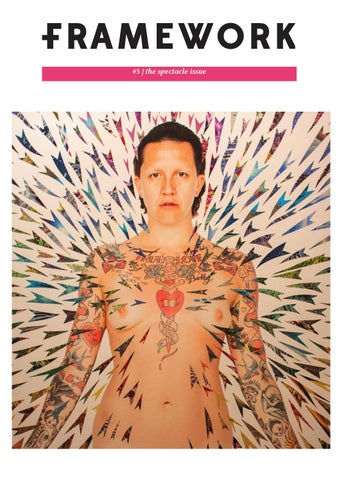
01. No Human Being Is Illegal (In All Our Glory), Deborah Kelly + collaborators, Photo: N.E Skinner, Courtesy the artist and Gallery Barry Keldoulis
Editorial
Welcome to the first issue of Framework for 2014. This issue, the Spectacle Issue, attempts to start the year off with a bang. Huge thanks to Liz Nowell who established the publication in the first part of 2013, and to Kate Britton who consolidated the tone of Framework in the latter half of the year. With five issues under our collective belt I look forward to exploring various themes with you, our online readership, in 2014. For those of you who are new to COFA (like I am) Framework celebrates critical dialogue within the COFA community, and showcases the talents of past and current students. Framework is a great opportunity to be published and I urge those with an arts writing practice to consider contributing to our next issue: the ‘Place and Space’ issue. This edition of Framework looks at ‘Spectacle’ in it’s many forms. From simply something that can be viewed, to an elaborate and remarkable performance or display, to a public and controversial scene. Simply, ‘Spectacle’ lends itself to contemporary aesthetics of visual art and performance in our current context. I’d like to thank the wonderful Arc @ COFA staff Penelope Benton, Ramesh Nithiyendran, Ella Drinkwater, Misha Turovskii and Dara Gill. It’s exciting to be working with such a dynamic and supportive team. A big thank you also must go to Jennifer Hamilton, Chris Moore and Amelia Wallin. And, of course, many thanks to our contributors. If you would like to contribute to the upcoming ‘Place and Space’ issue, please get in touch: m.white@arc.unsw.edu.au We hope you enjoy this SPECTACULAR issue of Framework.
- Maria White
THE SPECTACLE ISSUE
|5
MONSTA GRAS by Kieran Bryant and Lachlan Herd
NO HUMAN BEING IS ILLEGAL
(IN ALL OUR GLORY)
THE PAST, PRESENT AND FUTURE OF THE ARI
feature on Deborah Kelly by Annie Murney
MELBOURNE
NOW
VOLUME 2, ISSUE 1
EDITOR
Maria White CONTRIBUTORS
Kieran Bryant & Lachlan Herd Deborah Kelly Annie Murney Alyce Neal Maria White Olivia Welch DESIGN
Chris Verrnon THANKS
by Alyce Neal
Arc@COFA ENQUIRIES
cofa@arc.unsw.edu.au arc.unsw.edu.au/ cofaframework
TIME TO LOOK
AT THE ART by Maria White
Front cover image
RESCUE, GATHER & COLLECT by Olivia Welch
No Human Being Is Illegal (In All Our Glory), 2014 Deborah Kelly photography by N.E. Skinner Courtesy the artist and Gallery Barry Keldoulis, Sydney
Copyright 2014 Authors, Artists, Contributors and Arc@COFA
6|
MONSTA GRAS AND THE SPECTACLE OF PERFORMANCE by Kieran Bryant and Lachlan Herd
A much anticipated yearly tradition, Mardi Gras weekend is a chance for a wide range of individuals to both performatively express their individuality and creativity, and engage in a spectacle driven process of self-expression. The weeks leading up to Mardi Gras and the weekend itself produce a plethora of queer-centric events which feature performance artists engaging with the atmosphere of the celebratory spectacle. One of the most interesting events of the weekend was the Monsta Gras party at Red Rattler Theatre in Marrickville, curated and created by the Glitter Militia. Within this event the audience found themselves immersed in an arena of high energy performances occurring simultaneously throughout the evening. Audiences were presented with and confronted by larger than life interventions. For example Kelli Jean Drinkwater, a walking ode to the female mammary gland, adorned with multiple bulging breasts and dragging baby politicians from umbilical cords. Behaving as a true Monsta they would periodically pause to feast upon the distasteful young, which included Tony Abbott and members of the Liberal Party. Other roving Monsta’s ranged from Hanako UFO’s attention-driven amalgamation of the beauty
and the beast, to the Madonna and child vision of Willurai’s demonic shrine as they gorged upon the innards of their plush companion. These artists were united in their daring use of colour, non-traditional staging, fantastical costumes and attention hungry movements that personalised their work and defined them in the cacaphony of the celebratory atmosphere. In this way the artists were, in a sense, making a spectacle of themselves. The performance artist as a spectacle does not however conjure negative connotations in the sites created by Monsta Gras and tonally similar events. These artists utilise and engage with the atmosphere of a nightclub event as an alternate platform for spectacle driven performance. In nightclub events there is an exchange of energy that doesn’t resonate in traditional and formal gallery settings. This exchange between artist and audience establishes a reciprocal relationship of catharsis as the peformer unpacks and releases forces of taboo, empowerment and raw emotion. As the audience has this expelled upon them they in turn regurgitate and feed the spectacular force of the performance.
|7
These alternate performance spaces are prominent in the nightlife of Sydney and contemporary Australia. Venues in Sydney such as the Red Rattler Theatre, Tokyo Sing Song, House of Mince events, Performance Space, and national festivals such as Mona Foma in Hobart, specifically the afterparty Faux Mo. Performance star and beauty queen Betty Grumble has performed at many of the above mentioned venues and sites. Emma herself has expressed a reverence for the energy exchange which occurs when performing as an artistic spectacle, specifically at Glitter Militia events and Faux Mo, stating ‘I respect and adore the sacred spaces of traditional theatres and galleries but there is an unlocking and abandon that is magically transcendent that one can enter when bearing witness to performance amidst a heaving mass of bodies’.
01. Monsta Gras, The Red Rattler Theatre, Photo: Liz Ham
She wholeheartedly believes of the importance in the function of these sites as platforms for the ever-relevant art of spectacle ‘Here, we seep out of the places we are meant to be and transform. This deeply political and necessary seepage gives us fuel to deal with the status quo. It’s an ancient force, still mysterious as we don’t always get it right... But when we do... we generate a way forward’. This transformation amidst the throng of the party is evident in the transformation of party-goers to Monsta’s in the atmosphere created by the Glitter Militia. Monsta Gras and similarly curated events stand as a necessary function of catharsis in contemporary Australia and a valuable exhibition space for the art of spectacle.
8|
No Human Being Is Illegal (In All Our Glory) feature on Deborah Kelly + Collaborators
For the 19th Biennale of Sydney: You Imagine What You Desire, Australian artist Deborah Kelly presents a new suite of 19 life-sized portraits at the Art Gallery of NSW. Realised as and through a series of meetings and workshops, No Human Being Is Illegal (In All Our Glory) (2014) has been developed through weekly teaching and learning sessions, intensive collaborative artmaking and facilitated discussions. The collaboration centres upon the nude photographic portraits of individuals who continue to be involved in the process. Workshop participants have and will barnacle the portraits with layers of archival and contemporary imagery specific to the subjects’ interests, attributes and vision, conveyed to the ensemble (through written, online or personal communications) by the portrait subjects themselves. Participants have been invited through public callout to appear as subjects of the works; study and transmit technique; labour on the portraits; and donate archival imagery, envisaged primarily as obsolete reference books. The portraits, in process and complete, form a monumental company of amplified humanity with the metaphorical superpowers, cooperative skills, species empathy and historical knowledge to face the intersecting urgencies of our times. The project is designed to render the institution permeable and productive, lively and uncertain. The process is devised to demystify artmaking, produce a creative milieu, and experiment with democracy’s applicability to collective artistic endeavour. This ambiguity of authorship, the process of exchange (of knowledge, skills, stories, trust) among the participants, the cumulative character and the open-endedness of the project itself, is proposed as an allegory for
an idealised art institution and the sedimentary characteristics of its sandstone foundations. For the better part of the last three decades, Kelly has created a prolific body of mixed-media artworks that are at once unexpected, humorous, provocative, egalitarian, challenging and profound. Often politically motivated, her artworks explore ideas of discrimination in all its manifestations, highlighting racial, sexual and religious prejudices that exist in society today. Kelly’s artistic output can be loosely divided into two spheres: the public and the private. Many of her best-known works have occurred in the public realm, utilising highly visible canvases including billboards, bus shelters, postcards and human bodies. For Beware of the God (2005), commissioned by the Museum of Contemporary Art Australia, Sydney and later shown at the 2nd Singapore Biennale (2008), Kelly projected the work’s title (a spoonerism on the warning ‘Beware of the Dog’) on to evening clouds over Sydney Harbour. The work also consisted of 30-second videos screened at train stations in Sydney’s CBD, as well as stickers for the public with instructions from the artist on the back to ‘Pop the sticker somewhere that’s plagued by holy rollers, God botherers, or bearded blokes wielding vengeful-deity theories’. Kelly frequently encourages viewers to participate in her work, as with Tank Man Tango (2009), an interactive and ephemeral memorial to mark the twentieth anniversary of the Tiananmen Square massacre in Beijing. Inspired by the footsteps of ‘tank man’, the iconic lone man standing before the tanks attempting to drive out of the square after the massacre, Tank Man Tango contained instructions for
|9
The suite of life-sized photographic portraits graces the long corridor of the Art Gallery of NSW. In collaborative workshops and artmaking sessions, photographs of naked participants are barnacled with imagery meticulously collected from a range of archival sources. In this way the original photograph is de-contextualised and the series of portraits unified. Over the course of the Biennale, the portraits will continue to develop and evolve, with each new layer of collage reinforcing the idea that the gallery can be a space for process and production as well as presentation – with uncertain and exciting outcomes.
01. Photo: N.E Skinner 02. Photo: N.E Skinner
10 |
a choreographed dance, broadcast on YouTube in four different languages. On the twentieth anniversary of the massacre, the dance was performed in over 20 cities across Australia and internationally, including Bristol, Leipzig, Mexico City, Philadelphia, Auckland, Athens and Brussels. Kelly granted participants licence to interpret the work in their own way, with each group adding a new dimension to its meaning. In 2001, Kelly co-founded the group boat-people.org, a collective comprised of artists and media activists. Created in the heat of the Howard government’s controversy over asylum seekers, the group sought to respond creatively and purposefully to the government’s border regime. During the 2001 election campaign, the group projected a First Fleet tall ship with the words ‘BOAT PEOPLE’ on to the Sydney Opera House’s sails. Since then, it has continued to make public art around topics of race, nationhood, history and borders. In recent years, Kelly has created a unique body of work in the form of collages which focus on themes of feminine representation. For the series Tender Cuts (2010) and Awfully Beastly (2011), she mixed images of high-end women’s fashion with cutouts of flora and fauna. This humorous look at popular and unquestioned depictions of women combined feathers, shells and bugs with leather handbags, brightly coloured lipsticks and fur. Significant solo shows of Kelly’s work include The Miracles, Counihan Gallery, Melbourne (2013); Make More Monsters, Artspace, Sydney (2011); Deborah Kelly, Contemporary Art Centre of South Australia, Adelaide (2009); and Big Butch Billboard, Australian Centre for Photography, Sydney (2009). Her work has been included in several Australian group shows, and in international exhibitions including the 2nd Singapore Biennale (2008) and the 50th Venice Biennale (2003).
Collaborators: Tony Albert (teacher); Kate Andrews; Gemma Avery; Roslyn Baker; Lucy Barker; Prudence Black; Ruth Braunstein; Shuxia Chen; Jodi Clark; Dean Cotter; Jane Crowley; Bec Dean; Jenny Du; Helen Duckworth (team leader); Michele Elliott; Amy Emerson; Sally Evans; Alex Falkiner; Janette Gay; Caitlin Gibson; Su Goldfish; Karen Golland; Daniel Green; Lydia Grossmann; Jane Guthleben; Matthew Hamra; Lynette Hearne; Rebecca Heffernan; Amanda Holt (team leader); Camille Howard; Yang-En Hume (team leader); Jan Idle; Chris Isgro; Linda Jaivin (reader); (reader); Nicolette Katsouras; Zina Kaye; Mary Kellam; Sergej Kolke; Freddie Landgraf; Xio Ledeux; Carli Leimbach; Tania Leimbach; Lex Lindsay (team leader); Farhan Mahmud (team leader); Tea Mäkipää; Paul Matthews; Mahalia McConkey; Michael McIntyre; Catriona Moore; Frank Motz (reader); Alison Murphy Oates (reader); Kathie Najar; Elena Ortega; Rujunko Pugh (team leader); Bernadette Roberts; Michelle Robin Anderson; Meara Robinson; Megan Rushton; Penny Ryan; Gary Samuels; Bron Shipway; Justin Shoulder; N.E. Skinner (archivist); Kim Spinks; Latai Taumoepeau (reader); Ilaria Vanni; Cath (Zoo) Davies (reader). Subjects: Jeremy Anderson, Hannah Armstrong, Mirek Craney, Catherine (Zoo) Davies, Ruth Desouza, Julia Featherstone, Ally Garret, Trevor Grahame, Lia Incognita, Kris Jepsen, Aku Kadogo, Athol Herrick Kelly, Emmanuel Moneke, Alison Murphy-Oates, Ramesh Mario Nithiyendran, Simone O’Brien, Emma Price, Justin Shoulder, Latai Funaki Taumoepeau, Louis Wicherts. Deborah Kelly is an MFA candidate at COFA. Her proposed research project, Picturing Politics, involves investigating in my practice the historical lineage of photomontage and its abiding possibilities for enlivening contemporary discourse.
03. No Human Being Is Illegal (In All Our Glory), Deborah Kelly + collaborators, Photo: N.E Skinner, Courtesy the artist and Gallery Barry Keldoulis
| 11
The Past, Present and Future of the ARI: A Reflection on SafORUM by Annie Murney
01. Photo: Annie Murney
| 13
IN SOME WAYS, THE CONTEMPORARY ARTIST RUN INITIATIVE (ARI) IS THE ANTITHESIS OF SPECTACULAR ART. WITH ITS DIY APPROACH TO CULTURE-MAKING, THERE’S A LITTLE LESS GLAMOUR IN GRASSROOTS. SINCE THE 1970S, THESE SPACES HAVE BEEN A FIRM FIXTURE IN SYDNEY’S ART SCENE. THEY BOLSTER COMMUNITY SPIRIT AND INCUBATE THE NEXT GENERATION OF CREATIVE GO-GETTERS. HOWEVER, THE STABILITY OF THESE SPACES IS HEAVILY DEPENDENT UPON SOCIAL, POLITICAL, AND ECONOMIC REALITIES. AS GOVERNMENTS ANNOUNCE AND RENOUNCE THEIR FINANCIAL AND IDEOLOGICAL SUPPORT, THE ARI IS FORCED TO BE EVERMORE RESOURCEFUL AND QUICK-FOOTED. IT IS THIS MIDDLE TIER OF ART MAKING AND EXHIBITING THAT IS FORCED TO OPERATE IN CONSTANT DIALOGUE WITH ITS CONTEXT, FOR BETTER OR FOR WORSE.
As we know, SafARI is the unofficial fringe event of the Biennale that addresses precisely these issues. The companionship of these two events is important in drawing a trajectory from emerging to established artists. It’s perfectly timed to generate a spirit of optimism and enthusiasm for local talent. Illuminating the deeper practicalities of the ARI, SafORUM was a panel discussion featuring an international spread of ARI affiliated curators, artists, and writers, brought together to discuss the history, logistics, and changing shape of the ARI. The event was divided into three themes: The Contemporary Scenario, Alternative Models, and Past and Future. The following is a fleshing out of the highlights, the key speakers and their insights. With panellists representing Auckland, Adelaide, Sydney and Melbourne, a variety of visions coloured the discussion regarding the contemporary ARI. Of course, the issue of funding was a central driver. Particularly insightful were Nick Spratt’s contributions. Coming from across the Tasman, he is the co-director of RM, Auckland’s longest running ARI. Describing a multi-functional space, this peripheral perspective had glimmers of a more progressive and supportive political sphere. However, what is also interesting is the transparency of process attached to the ARI: it is a workshop, an exhibition space, and houses archives. This begs questions regarding the layout and accessibility of the space. In addition to nurturing the
work of emerging and experimental artists, the ARI is a laboratory for curatorial ideas. Spratt’s inclusion in the discussion also draws attention to the lack of connectivity between the Australian and New Zealand art scenes. There is surely a gap to be filled between these two great Southern lands. For one thing, Australia could certainly learn from New Zealand’s rejuvenation of Indigeneity, artistic and otherwise. Another interesting position came from Lisa Radford of TCB, a space reeking of Melbournian grit and grunge that has launched the careers of hundreds of artists. As one of the city’s leading independent spaces, it may be surprising to hear that TCB is entirely self-funded. In addition to maintaining a strong vision, it has kept afloat due to the generosity of supporters and past members. In some ways, it is perhaps the sheer difficulty to attain funding that constitutes the character of the contemporary ARI. Faced with financial struggles and ideological barricades, it becomes a breeding ground for radical politics, activism and innovation. Another constituent for this is the democratic structure of its operations. In drawing from multiple viewpoints, the ARI gives rise to a rich community spirit and implicitly takes on a social responsibility. Representing a ‘regional’ context, or perhaps as a counterbalance to east coast insularity, Brigid Noon from Adelaide’s Fontanelle Gallery elaborated on
14 |
the South Australian art scene. The space is partially funded by Renewal SA, an initiative aimed at promoting the semi-industrial inner suburb of Bowden as new, progressive and vibrant. This arrangement reveals how ARIs have the capacity to spark urban renewal. Evidently, there is a tangible cultural and economic benefit to supporting these spaces. Noon’s contributions also highlighted a necessity to launch greater inter-state dialogue and cultural exchange. Broadening the definitions of ‘space,’ it seems more and more galleries are leaving behind the sterile white walls of the 20th century gallery. Opting for industrial and ‘warehouse’ aesthetics, there is a rejuvenated interest in coalescing art with the ordinariness of everyday life. The consistent popularity of Cockatoo Island as a contemporary art space speaks to this trend. The fact that spaces are discreetly tucked into residential areas highlights a shifting of the parameters we use to consume art. It’s no longer a priority to filter the imperfections of a surrounding environment in order to glean some sort of message. However, there’s also the more pragmatic concern of skyrocketing real estate prices weeding out emerging art spaces with inadequate financial backing. Although the sphere of commercial property may be a tricky one to break into, the potentiality of the residential space has been seized upon. This is exemplified by Brisbane’s Accidently Annie Street, as represented by Louise Bennett, and Sydney’s now deceased Pelt, directed by Caleb Kelly. Accidently Annie Street had its genesis as a student share house-cum-gallery. Imbued with a DIY spirit of rebellion, the directors also arranged (or commandeered) impromptu spaces to exhibit their work, such as motel rooms. Although the space now has a permanent residence, it is testament to committed and innovative thinking that this nomadic gallery has managed to sustain a following. In a similar vein, Kelly’s gallery operated out of an apartment. However, with an emphasis on sound art and new media, the logistics of installing, insulating, and exhibiting the works resulted in complaints and complications. It seems these kinds of spaces, in spite of their ambition, have shorter life spans due to their chosen locations.
You might say Mike Parr is the patron saint of the Sydney ARI, otherwise known as the man who made Australian art ‘contemporary.’ What Parr does exceptionally well is articulate the political and social conscience of art. He co-founded Inhibodress in 1970, breaking new ground in terms of the kind of art that was being created, the way it was exhibited and by whom. Kickstarting this democratization, Parr and his collaborators were responding to a repressive and bureaucratic government. Bearing in mind Australia’s somewhat Draconian censorship laws and closed economy at the time, this space can be conceived as a point of rupture; an effort to dislodge Australia from its cultural isolation and introduce artistic trends and philosophies that were circulating globally. In this way, ARIs are intrinsically reactionary spaces, and as such, Inhibodress set the tone for Sydney’s ensuing grassroots culture and activism. A panel discussion on artist run spaces would not be complete without reference to Firstdraft, Sydney’s longest running ARI. Will French weighed in as a former director, speaking fondly of his term. With a recently revamped home, the Firstdraft family is a tight-knit crew of creators. A committed cultural community and a strong support base have ensured that this initiative continues to produce more and more successful exhibitions and reach an ever-broadening demographic of art-lovers. Firstdraft and Inhibodress are two of Sydney’s most prominent success stories when it comes to the ARI. These two examples bespeak the way in which artist run spaces are deeply capable of transforming a city’s landscape; they are the blueprint for the cultural mainstream of the future. We might ask, what is the future of the ARI? Through an incremental process, it seems the curatorial run space is steadily overlapping the ARI. Also, there is the ever-present tension between supporting emerging artists and balancing funding. And on this note, the ARI is largely able to exist through governmental and philanthropic support, often without a long-term guarantee. Frighteningly, Parr’s reflection on the conservative Sydney of the 1970’s bears a strikingly similarity to the one we see today under the Abbott government. In spite of this climate of uncertainty, the innovation of the contemporary ARI preaches faith in a long line of radical culture-making.
| 15
02. Photo: Lara Merrington. Image coutesy of SafARI
16 |
MELBOURNE NOW by Alyce Neal
| 17
WELL DONE. IT’S BEEN A LONG EXHAUSTIVE JOURNEY AND YOU’VE REACHED THE END, I’M PROUD OF YOU. YOU HAVE PONDERED PAINTINGS, CREATED SOME JEWELLERY, READ JOURNALS AND LISTENED TO SOME INTERESTING SOUND WORKS. THE MARATHON THAT IS MELBOURNE NOW HAS TAUGHT YOU THAT THERE ARE A LOT OF CREATIVE PEOPLE IN THE VICTORIAN CAPITAL AND THEY WANT TO SHARE THEIR INNOVATIVE SPIRIT WITH YOU.
Melbourne Now really is a highly ambitious exhibition with an extensive range of works from new and emerging creative Melbournians. The sheer size is astounding and very difficult to comprehend in one day. Six hours certainly was not enough. As a collaborative venture at the National Gallery of Victoria, Melbourne Now aims to “promote engagement with contemporary art in new and dynamic ways by harnessing the creative energies of Melbourne’s wider community”. This is demonstrated through the broad range of artists such as Brook Andrew, Reko Rennie, Bianca Hester and Matt Hinkley and Charlie Sofo. Despite being so ambitious, the overarching narrative of the exhibition is slightly convoluted and inconsistent. However it is the use of the everyday and humour by artists such as Sofo and collective Greatest Hits that sees them transcend the fanfare that is Melbourne Now. Glue sticks, keys, and vegetable peelers to film cases, marbles, USB cables and Stanley knives, find their way down Charlie Sofo’s trouser leg. These everyday elements champion a personal domestic investigation of the body. Entitled 33 objects that can fit through the hole in my pocket 2013, this understated work initially seems slightly silly. As a work that is easy to pass by, this video requires patience; slowly drawing the audience into a meditative play on the possibilities of the everyday. Including the viewer into the artist’s personal and domestic sphere, a unique bond is forged, prompting audiences to reflect on their own sense of self. By moving the domesticality of the
body and everyday into the public domain removes the spectacle that such exhibitions and biennales can operate on. You navigate your way across to Federation Square, the secondary site of Melbourne Now. As you reach the final floor of the exhibition, ascending the escalator between levels two and three of the Ian Potter Centre, a black motorised cat ambiguously greets you, cutting through that hazy fog of art exhaustion. This work from collective Greatest Hits Untitled 2012 (Black Cat) while initially humorous, becomes foreboding. The artists intervene playfully drawing of dual meanings of a black cat such as within Japanese culture it is known as ‘maneki-neko’ and yet can also be an ominous symbol. Visitors feel at a crossroads, caught between spaces of the museum, heightened by the ambiguity of the unflappable black waving cat. Considering the greater narrative of Melbourne Now, this piece from Greatest Hits allows us to move beyond the spectacle of the exhibition, transcending institutional authority embedded within the space prompting an individual investigation of the exhibition. As you sit there and take in the delicious fruity flavours of your drink, you try and collect the memories of the exhibition. Playful works, such as the ones discussed, remain with you. They initially can be taken as superficial, yet require time to unfold. Works such as these necessitate patience and a willingness to think, if you have the time to spare. Such works forge relationships with audiences, embedding visitors like yourself within the creative fabric of Melbourne.
01. Greatest Hits, Untitled 2012 Black cat, electronic components. Dimensions variable, Courtesy of the artists and Tristian Koenig Image credit: Christo Crocker
18 |
| 19
Time To Look At The Art A reponse to the boycott of the 19th Biennale of Sydney and the interconnectedness of politics and art.
by Maria White
After engaging with various artist-run forums about art and corporate sponsorship in relation to the 19th Biennale of Sydney, I was looking forward to the Biennale-run panel discussion. On the 19th of March I received the following email:
Flowers in a residential space called Earlwood Farm. Most people present at de Vietri’s working bee were keen gardeners who used power tools confidently and could carry heavy loads. I am not very skilled in these areas, and was present for complex reasons.
A Message from Biennale of Sydney:
The debate around the Biennale and corporate sponsorship is live. It is changing all the time. Whenever I have seen a new voice or opinion enter the Transfield / Biennale debate I have resisted committing any of my own thoughts to paper, lest they become obsolete within the next twenty-four hours. After receiving the aforementioned email, it seemed like an appropriate time to initiate more dialogue around the Biennale and the boycott. I want to respond to the Biennale’s desire to separate art from politics.
Please note the panel discussion previously scheduled for Thursday, 27 March with Radio National has been postponed for the duration of the 19th Biennale of Sydney… There has been much discussion in recent weeks, and plenty of time for future discussion around these important issues. For now, we believe it’s time to look at the art. I found this disappointing. We have recently seen a glimpse of active political discussion and engagement with ideas relating to art and corporate sponsorship, as well as refugee rights. We have witnessed the response from panicked politicians. I hoped that the Biennale would prioritise these important discussions, rather than slow the momentum of the debate. From my point of view, the 2014 Biennale event, the artist boycott, and the politics associated with it are now interrelated. A small group of people spent a Saturday assisting Gabrielle de Vietri install her work Garden of Bad
01: Image Courtesy of Earlwood Farm
Juliana Engberg, Director of the 19th Biennale of Sydney, has said that spectacle ‘need not be dumb’ and I think she is right. [1] It’s easy for the media to write-off this kind of controversy as a farce, but in art as well as politics ‘spectacle’ can be nuanced and important. Earlier this year, fifty-one artists signed a letter to the Board of the Biennale requesting that they end their funding arrangement with Transfield. When the Biennale board refused, five artists withdrew from the program. Soon four more withdrew their work, totalling nine ‘pesky’ artists. [2] As one letter to the editor articulated: ‘What’s it got to do with them, anyway?’ [3]
20 |
Of spectacle in its most literal sense Juliana Engberg says ‘contemporary art uses the tactic of the spectacle pretty well; it lures people to it with a kind curious libido of dazzle, then hopefully it engages people with its deeper aesthetic and ideas.’ [4] This is how I feel about de Vietri’s large-scale work, Garden of Bad Flowers, within the context of her withdrawal from the Sydney Biennale. Her work refers to the 19th Century publication The Language of Flowers, where common plants have negative connotations. I imagine de Vietri at Earlwood Farm, in situ amongst the aloe (grief/ affliction), lavender (distrust), mandrakes (horror), and cypress (mourning)… For me, these feelings suddenly become so relevant to the refugee debate. I Imagine What I Desire? de Vietri’s act of defiance is a measured one. It’s informed and uncompromising like an important artwork. Her desire to remove herself completely from the Biennale is clear, making her involvement with the boycott and her politics inextricable from the work itself. Garden of Bad Flowers has moved to a new location and taken on a new meaning. Transfield Holdings executive Luca Belgiorno-Nettis resigned as Chairman of the Sydney Biennale. Before this controversy was initiated, Belgiorno-Nettis had been Chair for 14 years. His father helped found the Sydney Biennale. Until recently Transfield Services had been involved with construction projects, they had no background in welfare services, yet they now operate and profit from offshore detention centres. Following Belgiorno-Nettis’ departure from the board, Biennale organisers ‘severed all ties’ with Transfield. [5]
Enter 36th Attorney General of Australia and Minister for the Arts, George Brandis. Brandis has become vocal in response to the Biennale’s divestment from Transfield, desiring to punish arts organisations that ‘unreasonably’ refuse to accept corporate sponsorship (even from tobacco companies he says, despite the fact that the Liberal Party refuses to accept such sponsorship). How does Brandis want to punish arts organisations that reject unethical sponsorship? By denying them government funding. Brandis has urged the Australia Council to draw up a policy to prevent a situation like this from occurring again. [6] Was the Biennale’s decision to postpone the panel discussion related to Brandis’ outrage? Of the ideas posed by George Brandis, the Biennale Artists’ Working Group had this to say: ‘The Attorney General’s letter to the Australia Council is an attempt to shift public focus away from mandatory detention and onto control over arts funding. If the government wants to save taxpayers’ money, (they should process) asylum seekers quickly onshore.’ [7] Companies such as Transfield, Serco and Toll are neatly entwined with government policies such as mandatory detention and offshore processing. These government policies are set up in such a way that if a policy fails publicly, the government can blame the contracted company and vice versa. The ease with which blame can be shifted is deliberate. Moreover, there is money to be made in offshore processing. This is a multi-billion dollar industry. [8] Within our economic context, between Operation Sovereign Borders, military spending and mining subsidies, arts funding is a drop in the ocean. Therefore Brandis’ plan
| 21
02. Image Courtesy of Earlwood Farm 03. Image Courtesy of Earlwood Farm
22 |
04. Gabrielle de Vietri, Image Courtesy of Earlwood Farm 2014
| 23
to undermine the arts is a political performance of outrage. Why are you so worried, Brandis? Who is this performance for? What are you trying to prevent? After Belgiorno-Nettis’ resignation and mounting pressure from artists, the Attorney General called the Biennale’s rejecting of Transfield’s funding ‘preposterously unreasonable’. Moreover, Malcolm Turnbull, the darling of the centre-left, described the actions of the boycotting artists as ‘vicious ingratitude.’ [9] The Biennale campaign has struck a nerve with our current government as well as within the realm of philanthropy and sponsorship. This leads me to think that the art world holds more power than many artists (including myself) originally thought, however not nearly enough to singlehandedly shut down the detention centres at Nauru and Manus Island. What then, is the best way to wield our specific amount of power in order to help end the horrors of mandatory detention? The Biennale is visible, local and exists within the public sphere; this gives it a particularly tangible weight. It is more visible to most Australians than detention centres on Manus Island and Nauru, which I would describe as racist Foucauldian heterotopias of control. That is, an offshore detention centre is separate (even invisible) to the average Australian
but largely seen as necessary to maintaining existing power structures, which are perceived as natural. Perhaps the immediateness of targeting the Sydney Biennale is what’s attractive about this campaign. In terms of the effectiveness of this campaign? In the words of Human Rights Professor Sarah Joseph ‘there is no “effectiveness” criterion for legitimate political action’.[10] From de Vietri’s point of view, hers was simply an act of conscience. Again, I think it is a shame that, despite the Biennale’s break with Transfield, they are trying to back away from the politics of the situation. Is it an attempt at creating an aesthetic experience devoid of, or separated from politics? Of course it is ‘time to look at the art’, but naturally a political context will exist in and around the art. Of the nine artists who withdrew from the Biennale seven have, in conversation with Juliana Engberg, re-entered the program. Melbourne-based artists Charlie Sofo and Gabrielle de Vietri have decided not to do so. At Earlwood Farm there sits ten heavy planter boxes, thirteen tonnes of soil and hundreds of little ‘bad’ plants. At the working bee I looked on as the pregnant de Vietri calmly arranged her many seedlings, with a view of the Sydney CBD beyond the cliff, in the distance.
[1] Raymond Gill, ‘Juliana Engberg: Why Spectacular Need Not Be Dumb’ http://dailyreview.crikey.com.au/juliana-engberg-why-spectacular-neednot-be-dumb, 17/02/14 [2] ‘Statement by the Biennale Artists’ Working Group Responding to Key Points’ http://xborderoperationalmatters.wordpress.com/2014/03/19/ 19bos-workinggroup-statement/, 19/03/14 [3] Ross Chambers, letter to the editor, Sydney Morning Herald, 12/03/14 [4] Raymond Gill, ‘Juliana Engberg: Why Spectacular Need Not Be Dumb’ http://dailyreview.crikey.com.au/juliana-engberg-why-spectacularneed-not-be-dumb, 17/02/14 [5] Michael Safi and Paul Farrell, ‘Sydney Biennale chairman quits over company’s links to detention centres’, www.theguardian.com/artanddesign/2014/mar/07/sydney-biennale-chairman-quits-transfield-detention, 07/03/14 [6] Lisa Cox, ‘George Brandis defends blocking funds to arts groups’ www.smh.com.au/federal-politics/political-news/george-brandis-defendsblocking-funds-to-arts-groups-20140314-34sd6.html#ixzz2we5wiTbS, 15/03/14 [7] ‘Statement by the Biennale Artists’ Working Group Responding to Key Points’ http://xborderoperationalmatters.wordpress.com/2014/03/19/ 19bos-workinggroup-statement/, 19/03/14 [8] Ben Butler, ‘Immigration detention centre contracts: Big money in the business of misery ‘, www.smh.com.au/business/immigration-detentioncentre-contracts-big-money-in-the-business-of-misery-20140228-33rau.html#ixzz2we4NRSWk 01/03/14 [9] Sarah Joseph, ‘The Biennale Boycott Blues’, www.theconversation.com/the-biennale-boycott-blues-24694, 22/03/14 [10] ibid, 22/03/14
24 |
Rescue, Gather and Collect: Leslie Oliver + Melinda Le Guay A Curator’s Perspective
by Olivia Welch
Characteristically, Melinda Le Guay was a little early and Leslie Oliver, a little late. Knowing that these two respected artists had only ever met briefly and informally, and that I had to therefore facilitate their meeting, was a tad daunting. Working as an assistant for Brenda May Gallery throughout my degree with the College of Fine Arts in Sydney, I have been familiarised with many of the Gallery’s artists via databases full of images and archives bursting with information. Last year I had the opportunity to cocurate Mighty Small, which focused on artworks where a small-scale was integral to the desired impact. I found that I almost exclusively selected work by artists that the Gallery already had a relationship with. When invited to curate another show this year, In Tandem was quickly devised, taking my knowledge of these artists and pairing them based on similar sensibilities,
aesthetics or thematic tendencies. Equipped with cold water, ginger biscuits and the attention of the Gallery’s Director Brenda May, who has represented and supported both Le Guay and Oliver for many years, it was time to get the ball rolling… The pairing of Le Guay and Oliver to collectively create pieces for the exhibition In Tandem was cemented via May’s suggestion. Throughout their artistic practices both artists have successfully experimented with various materials in sculptural and two-dimensional mediums. The two artists began referring to part of their respective processes as rescuing materials; saving battered paper for Le Guay and salvaging objects that would otherwise be landfill in Oliver’s case. A comparable affection for materials and objects revealed itself as common ground.
| 25
01. Leslie Oliver, ‘Lithe Friend’ (work in progress) 2013, painted wood, 116 x 40 x 16cm. Image courtesy of the artist and Brenda May Gallery
26 |
02. Melinda Le Guay, ‘Take Care’ exhibition install, 2009. Image courtesy of the artist and Brenda May Gallery.
Melinda Le Guay and Leslie Oliver will be one of three creative duos in the exhibition In Tandem on view from 22 April to 17 May at Brenda May Gallery in Sydney.
03. Meeting at Brenda May Gallery for In Tandem. Pictured: (left to right) Leslie Oliver, Brenda May, Melinda Le Guay. Image courtesy of Brenda May Gallery.
With the topic changing to both artists’ pending exhibitions also in 2014, images of work for Oliver’s Walking Sticks – Crooks, Staves and Scepters provoked a spirited reaction from Le Guay, who was instantly reminded of her work Take Care from 2009. In both cases the artists similarly use thin wooden objects as a base, giving them a vertical presentation that allows for a play of shadow along the surface of the wall. Where Oliver uses stripes and geometric patterns of rich colour, Le Guay embellished her fronds with feathers and bound them with string. Discussing each other’s work, Le Guay remarked that there is a whimsicality present in Oliver’s sculptures that she finds appealing and he commented on the beauty of her stitch work. As his works are injected with life and animation through colour and her palate often pertains to muted tones, an obvious appreciation for one another’s differing aesthetic emerged. At this point in the conversation the seating was unconsciously rearranged so that Le Guay and Oliver were sitting as to face each other and myself, outside
of the conversation looking in. I was no longer needed as the conversational compère and sunk comfortably into my role as curator, observing the birth of a creative relationship. With both artists continuing to chat until time caught up with them, they agreed to begin searching for materials for each other, like a joint rescue mission. With the discussion continuing over email, there have been mentions of weathered chicken wire, copper dish scourers, cellophane bags, curled apple green wrapping paper, sticks and iridescent thread among other things. As to whether all or any of these materials make an appearance in Le Guay and Oliver’s joint venture, that cannot be certain until the day before the work is due to arrive at the Gallery, having worked with both artists in the past. However, this attentive process of gathering and collecting with each other in mind has revealed itself as an integral part of their artistic partnership, a partnership I am afforded the fascinating opportunity to watch unfurl and evolve – a curator’s dream, really…