Continuing the legacy Story by Rev. Dr. Paul V. McCullough III For over 200 years, brave men and women have fought and died protecting the freedoms that we cherish deeply as Americans. Although the vast majority of the citizens of the United States now respect and appreciate the tireless work of service members, this has not always been the case and the sacrifice of our military is not fully understood by most people. Americans have become content with uttering the phrase “Thank you for your service” when they pass men and women in uniform, usually without giving a second thought to all that is encompassed with the honor and privilege of wearing our nation’s cloth. When service members raise their right hand, they not only swear an oath to protect the Constitution against all enemies foreign and domestic, but they also are promising to give their very lives in defense of the nation should the situation call for it. This is a very heavy obligation that is only entered into by a few other professions, like firefighters and police officers. This burden is on top of everything else that comes with serving in our military, such as frequent moves, rigorous physical training requirements, monetary compensation that is less than civilian counterparts, and numerous deployments or training events that take service members away from their families. Given all this, you might ask yourself why anyone would want to join the military? I believe the most fundamental answer to this question can be found in John 15:13, which says “Greater love has no one than this, that someone lay down his life for his friends.” Numerous surveys have demonstrated that although financial incentives offered by the military are appealing, the top reasons why people sign up is because of their love of country and desire to continue the legacy of service of their friends and family members. When the men and women of our armed forces look at the American flag, they see something that is worth protecting, something that is worth dying for if it will protect the freedoms enjoyed by their loved ones. Therefore, they are willing to endure physical hardship, and even make the ultimate sacrifice, in defense of their country and the service member to their left or right.
12
AT E A S E | M a y 2 0 2 4
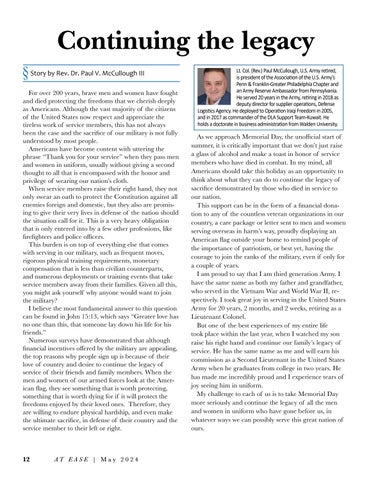
Lt. Col. (Rev.) Paul McCullough, U.S. Army retired, is president of the Association of the U.S. Army’s Penn & Franklin-Greater Philadelphia Chapter and an Army Reserve Ambassador from Pennsylvania. He served 20 years in the Army, retiring in 2018 as deputy director for supplier operations, Defense Logistics Agency. He deployed to Operation Iraqi Freedom in 2005, and in 2017 as commander of the DLA Support Team-Kuwait. He holds a doctorate in business administration from Walden University.
As we approach Memorial Day, the unofficial start of summer, it is critically important that we don’t just raise a glass of alcohol and make a toast in honor of service members who have died in combat. In my mind, all Americans should take this holiday as an opportunity to think about what they can do to continue the legacy of sacrifice demonstrated by those who died in service to our nation. This support can be in the form of a financial donation to any of the countless veteran organizations in our country, a care package or letter sent to men and women serving overseas in harm’s way, proudly displaying an American flag outside your home to remind people of the importance of patriotism, or best yet, having the courage to join the ranks of the military, even if only for a couple of years. I am proud to say that I am third generation Army. I have the same name as both my father and grandfather, who served in the Vietnam War and World War II, respectively. I took great joy in serving in the United States Army for 20 years, 2 months, and 2 weeks, retiring as a Lieutenant Colonel. But one of the best experiences of my entire life took place within the last year, when I watched my son raise his right hand and continue our family’s legacy of service. He has the same name as me and will earn his commission as a Second Lieutenant in the United States Army when he graduates from college in two years. He has made me incredibly proud and I experience tears of joy seeing him in uniform. My challenge to each of us is to take Memorial Day more seriously and continue the legacy of all the men and women in uniform who have gone before us, in whatever ways we can possibly serve this great nation of ours.