26
Trauma, pelvis
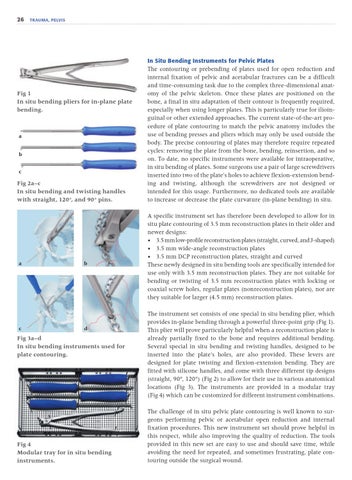
Fig 1 In situ bending pliers for in-plane plate bending.
a b c
Fig 2a–c In situ bending and twisting handles with straight, 120°, and 90° pins.
a
c
b
d
Fig 3a–d In situ bending instruments used for plate contouring.
Fig 4 Modular tray for in situ bending instruments.
In Situ Bending Instruments for Pelvic Plates The contouring or prebending of plates used for open reduction and internal fixation of pelvic and acetabular fractures can be a difficult and time-consuming task due to the complex three-dimensional anatomy of the pelvic skeleton. Once these plates are positioned on the bone, a final in situ adaptation of their contour is frequently required, especially when using longer plates. This is particularly true for ilioinguinal or other extended approaches. The current state-of-the-art procedure of plate contouring to match the pelvic anatomy includes the use of bending presses and pliers which may only be used outside the body. The precise contouring of plates may therefore require repeated cycles: removing the plate from the bone, bending, reinsertion, and so on. To date, no specific instruments were available for intraoperative, in situ bending of plates. Some surgeons use a pair of large screwdrivers inserted into two of the plate's holes to achieve flexion-extension bending and twisting, although the screwdrivers are not designed or intended for this usage. Furthermore, no dedicated tools are available to increase or decrease the plate curvature (in-plane bending) in situ. A specific instrument set has therefore been developed to allow for in situ plate contouring of 3.5 mm reconstruction plates in their older and newer designs: • 3.5 mm low-profile reconstruction plates (straight, curved, and J-shaped) • 3.5 mm wide-angle reconstruction plates • 3.5 mm DCP reconstruction plates, straight and curved These newly designed in situ bending tools are specifically intended for use only with 3.5 mm reconstruction plates. They are not suitable for bending or twisting of 3.5 mm reconstruction plates with locking or coaxial screw holes, regular plates (nonreconstruction plates), nor are they suitable for larger (4.5 mm) reconstruction plates. The instrument set consists of one special in situ bending plier, which provides in-plane bending through a powerful three-point grip (Fig 1). This plier will prove particularly helpful when a reconstruction plate is already partially fixed to the bone and requires additional bending. Several special in situ bending and twisting handles, designed to be inserted into the plate's holes, are also provided. These levers are designed for plate twisting and flexion-extension bending. They are fitted with silicone handles, and come with three different tip designs (straight, 90°, 120°) (Fig 2) to allow for their use in various anatomical locations (Fig 3). The instruments are provided in a modular tray (Fig 4) which can be customized for different instrument combinations. The challenge of in situ pelvic plate contouring is well known to surgeons performing pelvic or acetabular open reduction and internal fixation procedures. This new instrument set should prove helpful in this respect, while also improving the quality of reduction. The tools provided in this new set are easy to use and should save time, while avoiding the need for repeated, and sometimes frustrating, plate contouring outside the surgical wound.