The Focus Area Tissue Morphology performs routine histological processing and staining but is specialized in hard tissue evaluation techniques including resin embedding for bone samples with implants, hard tissue microtome sectioning, modified stainings for thicker resin sections, and subsequent qualitative, semiquantitative or quantitative analysis. Custom set up for immunhistological staining are routinely performed, immunofluorescence microscopy and surface evaluation by electron microscopy (SEM) and profilometry complete the spectrum of available techniques. The Focus Area Surgery together with the FA Animal Care has performed research in the fields of bisphosphonate related osteonecrosis of the jaw (BRONJ), bone infection, bone healing and cartilage regeneration. Several studies addressing clinically relevant problems have been conducted. In particular, models to investigate different aspects (diagnosis, treatment, applied research) of bone infection have been standardized and characterized such as infected intramedullary nail models in sheep and rabbits and infected implant models in rabbits and rodents. Studies are performed with highly qualified staff specialized in laboratory animal medicine (ECLAM), anesthesia (ECVAA) and surgery (ACVS / ECVS) in order to keep up to date with new technologies and developments. One particular achievement has been receipt of accreditation by the "Association for Assessment and Accreditation of Laboratory Animal Care" (AAALAC). The Focus Area CT Imaging is an interdisciplinary team to investigate bone quality by means of computed tomography and image analysis. The core competences are micro Computed Tomography (microCT), CT, image analysis and image based biomechanics.
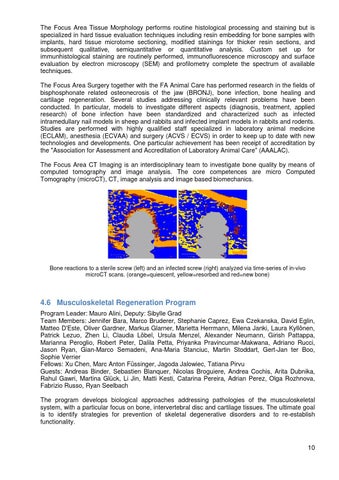
Bone reactions to a sterile screw (left) and an infected screw (right) analyzed via time-series of in-vivo microCT scans. (orange=quiescent, yellow=resorbed and red=new bone)
4.6 Musculoskeletal Regeneration Program Program Leader: Mauro Alini, Deputy: Sibylle Grad Team Members: Jennifer Bara, Marco Bruderer, Stephanie Caprez, Ewa Czekanska, David Eglin, Matteo D'Este, Oliver Gardner, Markus Glarner, Marietta Herrmann, Milena Janki, Laura Kyllönen, Patrick Lezuo, Zhen Li, Claudia Löbel, Ursula Menzel, Alexander Neumann, Girish Pattappa, Marianna Peroglio, Robert Peter, Dalila Petta, Priyanka Pravincumar-Makwana, Adriano Rucci, Jason Ryan, Gian-Marco Semadeni, Ana-Maria Stanciuc, Martin Stoddart, Gert-Jan ter Boo, Sophie Verrier Fellows: Xu Chen, Marc Anton Füssinger, Jagoda Jalowiec, Tatiana Pirvu Guests: Andreas Binder, Sebastien Blanquer, Nicolas Broguiere, Andrea Cochis, Arita Dubnika, Rahul Gawri, Martina Glück, Li Jin, Matti Kesti, Catarina Pereira, Adrian Perez, Olga Rozhnova, Fabrizio Russo, Ryan Seelbach The program develops biological approaches addressing pathologies of the musculoskeletal system, with a particular focus on bone, intervertebral disc and cartilage tissues. The ultimate goal is to identify strategies for prevention of skeletal degenerative disorders and to re-establish functionality.
10