News for Members
& Friends

fall-winter 2009 a quarterly publication of the anthroposophical society in america including the rudolf steiner library newsletter
Evolving...
v technology and community the web as will and idea invocation to sophia eurythmy and the post-enchanted world
RECOGNIZING THE WAY FORWARD...
The Threefold community puts into practice ideas inspired by the work of Rudolf Steiner. As part of that community, Threefold Educational Center is happy to share this sample of projects, initiatives and affiliations we’re working on right now!
Education, Research and the Arts
• Expand nature education and gardening programs for children and adults; professional training for teachers
• Further develop biodynamic agriculture training in collaboration with the Biodynamic Association and the Agriculture Section
• Facilitate the development of a Waldorf-based, communityoriented educational program for children with alternative learning styles
• Develop seminars and workshops featuring practical exercises in social threefolding and economics

• Renew research in biodynamic agriculture and qualitative methods
• Develop educational programs on food and nutrition centered on the Threefold Café
• Expand performances and exhibitions

Facilities
• Threefold Auditorium: continue renovations and capital projects
• Increase biodynamic gardens and research plantings
• Expand ecological landscaping and storm water management
• Create a Library and Research Center for visiting scholars, incorporating the planned archives of Ehrenfried Pfeiffer (biodynamics, qualitative research methodology) and Ralph Courtney (social threefolding and economics)
• Create agricultural research facilities
• Expand conference facilities

New Initiatives and Affiliations
• Wellspring Living Arts (community building through environmental awareness and experiential learning)
• Neighbor to Neighbor community gardening program
• Rockland Farm Alliance (re-establishing farm culture in Rockland County, NY)
Please contact Rafael Manaças, Executive Director, for more information about any of these projects: rafael@threefold.org.
Image: Transforming Capacities Art and Science Exhibition in Threefold Auditorium
Inspired by the work of Rudolf Steiner, the Threefold Educational Center initiates and nurtures programs exploring and enriching the human body, soul and spirit. The caretaker and steward of a property of 140 acres, Threefold is home to initiatives that teach and promote forward-thinking practices in education, agriculture, the arts, spirituality, and social life.
Green Meadow Waldorf School • The Pfeiffer Center

• The Outdoor Lesson • Eurythmy Spring Valley
• Creative Speech Spring Valley • Sunbridge College
• Fiber Craft Studio • The Fellowship Community • Threefold Mystery Drama Group • Pro Tem Players • Threefold Café • The Hungry Hollow Co-op
260 Hungry Hollow Road Chestnut Ridge, NY 10977 845-352-5020 info@threefold.org www.threefold.org
root of artistic form is a spiritual content which intrinsically points beyond the whole sensory sphere into a higher realm of activity that supports ritual practice, esoteric instruction, and the whole process of initiation. In this absorbing and beautiful work Van James brilliantly weaves a most stunning tapestry from the most ancient times up to today...a visual blast not to be missed.
Dennis Klocek artist, author, Director of Consciousness Studies Program at Rudolf Steiner College


Van James is a teaching artist and an international advocate for the arts. He is the editor of Pacifica Journal and an award winning author of several books on art and archaeology, including Ancient Sites of Hawai’i and and Art Pictures of the Transformation of Consciousness. He is a graduate of the San Francisco Art Institute (BFA), USA; Emerson College (Dipl.), UK; and the Goetheanum Painting School (Dipl.), Switzerland. His paintings are in numerous private collections and his graphic designs and illustrations are recognized throughout the world. He has been teaching at the Honolulu Waldorf School for the past twenty-five years.
Have an article, news, letter? Want to propose one?
Just email editor@anthroposophy.org and let us know.
Was this issue passed along?

You are welcome to view or download previous issues online. To receive the next printed copy you may contact the society with your postal address and ask to be added to the friends list.
Would you like to advertise? Call Cynthia Chelius at 734-662-9355 — or email editor@anthroposophy.org


Would you like to support this publication and at the same time make your service or product known to our thoughtful readers? Call soon to reserve space in the next issue. And if you have an existing ad or flyer but no design time to adapt it for us, we can usually work with what you have already created.

3 Fall-Winter 2009 Contents From the Editor 4 Letters to the Editor 5 What’s Happening at the Rudolf Steiner Library 8 The Romantic Economist (RSL book review) 10 New Books on Curative Education (RSL book review) 10 The Secret Language of Form (book review) 11 Nicanor Perlas: Very important news / Why vote for Nick? 13 Feature Articles The Web as Will and Idea 15 Evolving Our Perceptions of Community and Technology 21 The Mercury in America Bus Tour 23 Our Hellenic Odyssey 26 Economic Life at the Threshold 28 Invocation to Sophia 30 Reverberations of Light & Silence 33 Eurythmy and the Post-Enchanted World 34 News for Members An Annual Meeting in the Spirit of Michaelmas 37 The Michael Support Circle 39 Rudolf Steiner House Improvements 39 Work with the Theme of the Year in North Carolina 40 Boston: Making a Home for a Vibrant Society 41 Rudolf-Steiner-Archive Magazine 41 Michaelmas 2009 in the Berkshire Taconic Region 42 “The Portal of Initiation” 44 Thresholds Harvey Lisle 46 Danilla Rettig 46 Lyn Willwerth 47 Ron Richardson 48 Gertrude Teutsch 48 Members who have died 49 New Members of the Anthroposophical Society in America 49
ISBN 978-945803-88-10 9 789458 038810 90000 p.11 p.21 p.26 p.44 p.15 p.23 p.42 p.48
Rudolf Steiner College Press
From the Editor
The AGM
The Annual General Meeting—AGM—is our regular point of contact as a national society. It moves back and forth across this wonderful continent, making a new design each year in the weave of our relationships and shared destinies. This was only the second AGM your editor has attended, the previous one being in the last century, but this year felt exceptionally hopeful. We can’t report on the whole event, but share some observations and thoughts on page 37.
Anthroposophy & Science


Our sister publication, the Journal for Anthroposophy, has disappeared from view for many. It has been in “classics mode,” which might seem like mere repackaging, and long-time members would already have all that material, right? Actually the new volumes have proven exceptional, mining decades of insight and adding outstanding new introductory essays. The latest, “Anthroposophy and Science,” is edited and introduced by Arthur Zajonc, of course. Call the office or order online.
Personals?
We’ve had only a handful of comments, all favorable, on the idea of personal ads, online or in this publication. Some mentioned that extra work would be required to organize and look after this sort of information, and for now that is an obstacle.
Correction!
Author and historian Kevin Dann has kindly shared his work with us twice now, and he wrote to say that he enjoyed the last issue’s article about Threefold, which included an excerpt from his book—about which he added, “I love that you’ve retitled it!” To set the record straight, the book is titled Across the Great Border Fault: The Naturalist Myth in America, and it is an outstanding juxtaposition of the projects and mindset of early twentieth century “naturalism” with the new ideas at the nearby anthroposophical summer school at Spring Valley, NY, that began in 1933.
A Year of Evolving
This issue completes a year of being an “evolving” publication, which the name will reflect for one more issue. You have been kind with your comments! This evolving is a stretch, though it fulfills only a fraction of the potential. Much energy has gone into the new format and making use of the visual possibilities. More and more we hope to connect the work here with other communications work going on, whether in groups and branches, from the sections of the School for Spiritual Science and our many initiatives, internationally, or online at anthroposophy.org
— John Beck,

Editor, Evolving News for Members & Friends
Email:
Waldorf

Part-time Programs
Summer
Summer
nthroposophy cDermott teiner oan Almon 2005 magination Kate F ell 2006 ultur ouglas Sloan 2007 ober Sardello 2008 oposophy ober Hill 2008 onald Melcer 2009 oposophy thur Zajonc 2009 ughes and John Kettle 2010 oposophy Mattke and Heidi Violand 2010 actice ude Reif Hughes 2011 NUMBER 81 MICHAELMAS 2009 SCIENCE AND ANTHR OPOSOP HY JOURNA L FOR ANTHR OPOSOP HY CLASSICS FROM THE JOURNAL FOR ANTHROPOSOPHY Selected and Introduced by Arthur Zajonc Series Editor: Robert McDermott Science and 4 Evolving News for Members & Friends
editor@anthroposophy.org Chestnut Ridge, NY www.Sunbridge.edu info@sunbridge.edu 845.425.0055 x18 Phone and E-mail Orders Welcome! 845.425.0983 Bookstore@Sunbridge.edu
ON Waldorf Education, Anthroposophy, Parenting Gardening, Art, Math, Medicine, Science, and More!
FOR Children, Young Adults, Parents, Teachers GREAT FINDS! Gifts, Art Prints, Stationery, Postcards, Musical Instruments Come study on 140 beautiful acres just 40 minutes from New York City in a community of institutions and initiatives centered on promoting spiritual values in all aspects of human life since 1926.
BOOKS
BOOKS
NOW ENROLLING Biography & Social Art
2010
Early Childhood Teacher Education
March
Waldorf
2010
Elementary Teacher Education
2010 Visit our Website to find out more about: Open Houses Information Evenings Short-Courses & Lectures new weekend conferences in Wisdom Studies Learning • Spiritual Renewal • Inspiration!
Waldorf Education • Anthroposophy • the Arts
Letters to the Editor
New possibilities for work
In the last three years several friends who had chosen to train and work in the “anthroposophical arts”—speech, eurythmy, painting, sculpture,—have unexpectedly lost their work at a Waldorf school or center for adult education after 25-30 years. Perhaps one can sense karmic lawfulness in some cases, but these are quite special pursuits, and there are gaps in the artistic and economic field which need to be seen from many sides.
The thought comes that we all owe our life to our mother—and we realize sooner or later that she has the deepest and most immediate understanding for her child. In this mood we would like to share this problem with members and friends of the Anthroposophical Society. We are open to all kinds of responses, including practical situations that we may not be aware of; but also simply to being taken up and held for a time in your consciousness.
Brigida Baldszun
825 Chestnut Ridge Rd. #G Spring Valley NY 10977 email: brigida.b@mail.com
Editor’s note:
Besides replying to Brigida, please check out the Job Board at anthroposophy.org (linked at the bottom of each page) where you can share available openings or a search for new opportunities.
Thanks for Bento and Wendt
I’d just like to thank you for printing the wonderful review by William Bento of Joel Wendt’s book and also the following article by Joel Wendt.
Ever since I heard Mr. Wendt speak at the plenum of a conference several years ago I have been intrigued by his views and the challenges he makes. It’s a wonderful breath of fresh air to have him brought to the forefront and highlighted so we can honor his hard work with attention and discussion. He keeps anthropos -
ophy alive and vital, inspiring us all to pay attention to the world around us and see it clearly.
Anthroposophy has many types of students flung far and wide across the earth. I’m happy to see that the News for Members is expanding the articles to speak to a wider variety of those students with writers like Mr. Bento and Mr. Wendt.
Christine
Steinerism?
Bazzett
The Summer/Fall issue of News for Members and Friends contains an insightful review of Joel A. Wendt’s book American Anthroposophy by Willie Bento, who mentions the author’s concerns about Sergei Prokofieff’s role in the contemporary Anthroposophical Society:
to use the term “Steinerism” to describe this system of beliefs.”
(page 233)
In this edition of News for Members and Friends, I, in turn, take issue with Prokofieff’s reading of the “signs of the times,” specifically the role being played by the internet in modern spiritual life. Lest this begin to look like “open season” on Sergei Prokofieff, I want to state that my criticisms are directed at his conclusions, not his mode of inquiry, and they are certainly not directed at Prokofieff himself.
My Adventure by Rom Landau is helpful here. Landau, who knew Steiner personally and explored many other spiritual paths, contrasted Steiner’s attitude about his students with those of more narcissistic spiritual teachers of his time.) In spite of daily pleading of the initiate who stood right before them, the worshipful “Steinerists” were not easily deterred, and were already firmly embedded in the fledgling anthroposophical movement.
.
. . . This section is followed by a critique of the Russian anthroposophist Sergei Prokofieff and many of his admirers, who are said to espouse a form of Steiner idolatry. Wendt perceives this influence as a significant barrier to truly understanding the core principles of a practiced anthroposophy:
“Real knowledge never comes through another, but only out of our own activity such that we are able to unite experience (percept) and thought (concept), which is a major reason why Steiner repeatedly insisted we not use him as an authority (the other major reason is that we are not to make our thinking dependent on him; otherwise we are not inwardly—spiritually—free).
“What this social process (the almost universal assumption that a reading of a Steiner text provides knowledge) means is that not only have we failed to appreciate the true value of these texts for enlivening our understanding, but we may have allowed this material to enter the soul as mere belief. In this way then the teachings of Spiritual Science become in the soul religious—not scientific, which is why I have been forced
Thomas Jefferson once said, “I can disagree with your position and still adhere to your principles.” Prokofieff’s energy, devotion, and literary output are near marvels, especially considering the workload that an Executive Council member at the Goetheanum must carry. In the shadow of Steiner’s remarkable opus, there has been too little of lasting significance written by anthroposophical authors. Prokofieff is a notable exception here, and I can only be grateful for his deeply researched and refreshingly contemporary books.
There is merit in the concern that Wendt raises about the “Steinerists” who number themselves among Prokofieff’s followers, but I would contend that in this area Prokofieff is far more sinned against than sinning. The question of whether anthroposophy is meant to be a path of activity or a belief system (or both) is well worth raising, and I appreciate Wendt’s efforts to begin this dialogue. I also think it unfair, and possibly divisive, to present Prokofieff as advocating for or even representing only one pole of a very dynamic spectrum. Two examples:
Throughout his career, Rudolf Steiner himself had to ceaselessly prevail upon his students to remain his students and not to become his acolytes. (God is
LETTERS TO THE EDITOR are welcome, subject to editing for length. Email to editor@anthroposophy.org or to: Editor, News for Members 1923 Geddes Avenue Ann Arbor, MI 48104-1797
The second example stems from my own experience. I have been involved with Anthroposophy for forty-two years, and, like many in my generation (I am 64) came to Rudolf Steiner’s teachings as a safe and secure port in the maelstrom of the late 1960s and early 1970s. This was the Golden Age of Gurus in America, and many young people found their way to anthroposophy after having already made a deep connection to one or another charismatic guru or leader, e.g. the “Lord of the Universe,” Maharaj Ji, or the self-realization dynamo Werner Erhard.
It was only natural that some of my generation would transfer their needs for an omniscient and all-providing spiritual guide to Rudolf Steiner and to anyone who represented him well. Former “premies” and “est” attendees tended to ignore the injunctions of representatives of anthroposophy to challenge Steiner’s statements and do their own research. Several leading anthroposophists had the courage and prescience to try to help these former acolytes stand on their own feet. Yet even these objective teachers were often bemused to realize that the younger generation’s need for gurus had been transferred to them.
Had Wendt written his book in the late 1970s, the role he assigns today to Sergei Prokofieff as the putative perpetrator of “Steinerism” among the membership might have easily fit Francis Edmunds, or Werner Glas, or René Querido. Like Prokofieff, they all
Letters continue on page 7
5 Fall-Winter 2009
Getting Old:
Excerpts from Rudolf Steiner‘s Complete Works


(compilation and commentary by Gisela Gaumnitz, translated by Harold Jurgens) Getting Old: Excerpts from Rudolf Steiner’s Complete Works provides a penetrating look at many rarely noticed inner and outer aspects of the aging process.

(289 pp) $22.50
W What Are We Really Eating? by Otto Wolff,
M.D.
The substance of the foods we consume is examined in the context of discussing practical nutrition topics including: a raw foods diet, meat consumption, fats, dairy products, and sugars.
(113 pp) $15
A Art Therapy in Practice
by Eva Mees-Christeller (a new translation by Charlotte Rogers)

The practice of making art is discussed in the context of therapeutic aspects associated with the process of drawing, painting, sculpting and making music. Techniques and benefits presented are of value to both therapists and artists.


(73 pp) $9
A Compendium for the Remedial Treatment of Children, Adolescents, and Adults in Need of Soul Care Experiences and Indications from Anthroposophic Therapy compiled by Bertram von Zabern, M.D.

(167pp) $16
N Nursing the Human Being: An Anthroposophic Perspective
by Tessa Therkleson
A New Zealand registered nurse developed this book out of her personal study and practice as a mainstream complementary anthroposophic nurse. Topics include understanding of inner meditative life, reflection, and the anthroposophic perspective of the human being as a force for healing.
(54 pp) $21.50
O Other new and stock titles are available, including lectures by Rudolf Steiner.

Mercury Press is a small independent publisher within the Fellowship Community, an intentional, inter-generational community primarily concerned with enlivening elder care and realizing the ideas of Rudolf Steiner. From our beginnings in the early 1970s, we have existed to promote continuing education in the study of little known anthroposophical literature. Mercury Press has continued its original mission of publishing significant lectures and books by Rudolf Steiner along with related reading material. Our objective is not to meet popular interest, but to revive the slumbering spirit within the human being for the 21st century.

S E L E C T N E W P U B L I C A T I O N S
EDUCATION * NATURE * AGRICULTURE * LANGUAGE * LITERATURE * SOCIAL ISSUES * PHILOSOPHY * SCIENCE * ARTS
E
W e w i l l g l a d l y s e n d a c o p y o f o u r n e w c a t a l o g P l e a s e w r i t e , p h o n e , o r e m a i l M E R C U R Y P R E S S , 2 4 1 H u n g r y H o l l o w R o a d , C h e s t n u t R i d g e , N Y 1 0 9 7 7 8 4 5 4 2 5 9 3 5 7 m e r c u r y p r e s s @ f e l l o w s h i p c o m m u n i t y o r g
Letters continued from p.5 too often had this mantle “thrust upon them” no matter how much they resisted it.
So the “Steinerists” will always be with us! And I am not sure that this is an entirely bad thing. In our increasingly post-literate age I am grateful that there are still a few (of my generation at least) who are willing to do the hard and rarely praised work of studying Steiner’s texts and making sure that anything claiming to “represent” anthroposophy has at least has some relationship to what Steiner may have said. I cannot imagine a single anthroposophical institution that now thrives in North America without the selfless “Steinerists” whose blood, sweat, and tears helped to form and maintain it. Indeed, as the time draws near when a great many of the “Steinerists” will be retiring from the institutions they nurtured, we will see how much there is to replace them. In the Waldorf movement, at any rate, I have witnessed a steady decline in teachers’ interest in anthroposophy, and a marked growth in participation in Buddhist paths or other paths or no paths at all.
Whether unalloyed “Steinerism” will weather the turmoil and unpredictability of the twenty-first century is an open question, and I applaud Wendt for being one of the first to voice this question and present some alternatives. I would only emphasize that “Steinerists” were there long before Prokofieff joined the Executive Council and they are very likely be around long after he has assumed his tasks in the councils of Heaven. Sergei Prokofieff is more the effect than the cause. I don’t always agree with him, but his strong stands and stimulating research help guard against the specter of uniformity of opinion—“Steinerism”?—in the anthroposophical movement. I wish him the freedom to continue on his indefatigable path.
Eugene Schwartz Kimberton, PA info@millennialchild.com
Opening up dialogue
I wish to commend your editorial skills and courage to open up dialogue among the members and friends of the Anthroposophical Society. Eugene Schwartz’s letter eloquently addresses the need to be mindful of our own blind side when it comes to assessing the works of those who stand before us as representatives of Anthroposophia. We need not only the discernment of critical thinking, but also the tactfulness to express our views respectfully. Schwartz’s letter is exemplary in this regard.
There can be no doubt that the times we are living in demand new thinking in all spheres of life. The present state of affairs of the Anthroposophical Society in America is no exception. In fact, a case can be made that it is all the more imperative that members and friends of the Anthroposophical movement be ever more engaged in a critical and compassionate examination of what the signs of the times are
revealing to us. By such examination, we may find the tasks incumbent upon us as a spiritual movement intent on contributing to the renewal of culture.
It is my hope that the newsletter can continue to offer more than reports and a calendar of events, but provide the reader with content for discussion and research. Whether it be challenging, controversial or provocative, let it be aired in an arena where earnest seeking can occur. With all good faith and serious intent I think we can find the Spirit of our Times through our willingness to enliven and enrich our dialogue in this medium of communication.
William Bento, PhD Fair Oaks, CA
Editor’s comment: Thoughts at their birth
While reviewing these letters the following passage came to attention, from Rudolf Steiner’s The Riddles of Philosophy, an important work of what today is being called “metaphilosophy”:
I believe that miso belongs to the highest class of medicines, those which help prevent disease and strengthen the body through continued usage. . . Some people speak of miso as a condiment, but miso brings out the flavor and nutritional value in all foods and helps the body to digest and assimilate whatever we eat. . .


 —Dr. Shinichiro Akizuki, Director, St Francis Hospital, Nagasaki
“The age of enlightenment as it appears in the eighteenth century is still convinced of finding its justification in thought itself. Herder develops beyond this viewpoint. He searches, not for the point of the soul where it reveals itself as thinking, but for the living source where the thought emerges out of the creative principle inherent in the soul. With this tendency Herder comes close to what one can call the mysterious experience of the soul with thought.
“A world conception must express itself in thoughts, but thought only then endows the soul with the power for which it searches by means of a world conception in the modern age, when it experiences this thought in its process of its birth in the soul. When thought is born, when it has turned into a philosophical system, it has already lost its magical power over the soul.
“For this reason, the power of thought and the philosophical world picture are so often underestimated. This is done by all those who know only the thought that is suggested to them from without, a thought that they are supposed to believe, to which they are supposed to pledge allegiance. The real power of thought is known only to one who experiences it in the process of its formation.”
Could this observation be a clue to the difference between being merely a “Steinerist” and someone who is partaking fully of the power of anthroposophy? But how then do we find our way to the birth of thoughts that have already been born into the culture? Can they be “born again”—into our individual consciousnesses? Apparently!
7 Fall-Winter 2009 Sign Up for E-News Sign up for Anthroposophy in America E-News on our website home page: anthroposophy.org.
www.southrivermiso.com WOOD-FIRED HAND-CRAFTED MISO Nourishing Life for the Human Spirit since 1979 unpasteurizedprobioticcertified organic SOUTH RIVER MISO COMPANY C onway , M assaChusetts 01341 • (413) 369-4057
What’s Happening in the Rudolf Steiner Library
 Judith Soleil, Library Director
Book Reviews. Here’s coeditor Fred Dennehy’s introduction to book reviews the library commissioned for this issue: John Keats’s concept of “negative capability” animates both of the longer reviews in this issue. Christina Root takes an exciting look at The Romantic Economist: Imagination in Economics by Richard Bronk, a British professor of European political economy. A recent bestseller by Richard Holmes, The Age of Wonder, widely available in bookstores and public libraries, investigates Romanticism’s contribution to the imaginative perspective that informed the passionate and groundbreaking investigations (often
and developmental challenges with the deep respect of an open eye, seeing them not in the way they deviate from the rest of humanity but for what they bring to humanity, particularly in the way of new meaning. Ms. Reilly, with her long-time direct experience in curative care (reflected in her writing), is especially suited to speak about the movement in general and these volumes in particular.
Book reviews begin on page 10.
Future. The society’s general council appointed a task force last year to evaluate the library’s space needs. Current quarters, while lovely, are damp, cramped, and at risk for fire. The task force recently reported on their work, and the council is considering several options. We’ll keep you posted.
Automation continues apace. There are now over 9000 volumes in the library’s online public access catalog: http://rsl.scoolaid.net . Contact us to create your own account, which will allow you to request books online.
borrowed titles in the past 11 months are:
1. Zajonc, Arthur. Meditation as Contemplative Inquiry: When Knowing Becomes Love.
2–4. Steiner, Rudolf. The Inner Realities of Evolution; An Outline of Esoteric Science; Education as a Social Problem.
5. Kühlewind, Georg. The Light of the” I”: Guidelines for Meditation.
6-8. Steiner, Rudolf. The Fifth Gospel; Karmic Relationships, vol. 1 and vol. 6.
9. Powell, Robert, and Kevin Dann. Christ and the Maya Calendar: 2012 and the Coming of the Antichrist.
10. York, Jamie. Making Math Meaningful: a Middle School Math Curriculum for Teachers and Parents.
Appeal. Please help the library end the year on a firm footing. It’s not too late to help us meet our annual appeal goal for 2009.
Library Annotations
Brief descriptions of new books available from the Rudolf Steiner Library [js=Judith Soleil, jk=Judith Kiely]
Anthroposophy—Rudolf Steiner
Eurythmy Forms for Tone Eurythmy, Volume IX , (K24), SteinerBooks, 2009, 191 pgs.
by amateurs) of astronomy, chemistry, evolution, and other disciplines in the nineteenth century. Bronk, similarly, takes the usual literary understanding of Romanticism far afield—here into the “dismal science,” economics. As Ms. Root points out so perceptively, the capacity to live in uncertainty, which is the essence of “negative capability,” implies an openness that rejects the habitual assumption that the answer to any question—economic, scientific, or literary—must necessarily come from the past.
Our second review, by Joyce Reilly, surveys a number of fine new books on curative education, all of which concern the Camphill movement or its roots in Rudolf Steiner’s curative education course. If there is a common theme among these five books it is the determination of Rudolf Steiner, Karl Koenig, and Paul Marshall Allen to look at children with special needs
Preservation. Assistant librarian Judith Kiely is approaching her final year of study for a master’s degree in library science. She recently attended a preservation workshop in Albany, NY. Judith Soleil will attend a book repair workshop in December.
Francis Edmunds. We recently received a set of vintage videocassettes: renowned educator Francis Edmunds lecturing on Shakespeare, with illustrative scenes acted by Emerson College (Great Britain) students. We intend to have them transferred to DVD so that they can be enjoyed widely. Unfortunately, number 6 in the set is damaged. Does anyone have a working copy we could borrow
Albert Steffen. We have extra copies of hardcover editions of Albert Steffen’s works in both English and German. Let us know if you’d like to purchase any of these ($10/volume includes shipping) and we’ll see if we have the titles you’re looking for.
Top Ten! It’s interesting to see what library patrons are reading. The ten most-
This volume, translated by Marsha Post, is a complete English edition of the German bibliographic # K24. Containing 160 reproductions of Steiner’s original tone eurythmy forms, the book also includes an introduction by Dorothea Mier; the introduction from the German edition by Eva Fröbose; two excerpts from lectures by Steiner: “Music in Comparison to the Other Arts” (December 3, 1906; GA 283) and “The Experience of Major and Minor” (February 19, 1924; GA 278); and an article by Hendrika Hollenbach, “The First Beginnings of Tone Eurythmy.” —jk
The Karma of Anthroposophy: Rudolf Steiner, the Anthroposophical Society and the Tasks of its Members, (from GA 237, 238 & 240), compiled and edited by Margaret Jonas and Matthew Barton, Rudolf Steiner Press, 2009, 179 pgs.
In this new compilation of lectures by Steiner from 1924 to members of the Anthroposophical Society, editors Margaret Jonas and Matthew Barton have brought together material that focuses on the karma of society members and their task to revitalize civilization. “Today humanity stands before a great crisis: either it will see all civilization collapsing into the abyss, or else spirituality will raise civilization up by the power of the
8 Evolving News for Members & Friends
Michael impetus, through which the Christ impetus works….” (p. 172; August 27, 1924)
The lectures in this book have previously been published in volumes 3, 4, 6, and 8 of the Karmic Relationships series. —jk
Anthroposophy—Architecture
The Figure of Christ: Rudolf Steiner and the Spiritual Intention behind the Goetheanum’s Central Work of Art, Peter Selg, Temple Lodge, 2009, 71 pgs.
Physician and historian Peter Selg explores the significance and origins of the “Representative of Humanity” sculpture created by Rudolf Steiner and Edith Maryon, which Steiner intended to be the “crowning” of the first Goetheanum. After the fire that destroyed that building (1922/23), Steiner stated that he wished “the group,” which survived the fire in a meadow near the original structure, to have a central position in the second Goetheanum.
Instead, the sculpture has stood in a special room in the Goetheanum where, Selg says, “…it cannot emanate an influence through the whole building.” Yet discussions about the possibility of moving the “group” “are of little relevance in so far as they overlook Rudolf Steiner’s real aims for the sculpture and the building, and the possibilities still open (or re-accessible) to the Anthroposophical Society and its School for working towards the Christological intentions formulated by Steiner.” —js
Anthroposophy—Art
Imagination Inspiration Intuition: Joseph Beuys & Rudolf Steiner, Allison Holland, ed., National Gallery of Victoria [Australia], 2007, 104 pgs.
This catalog of an exhibition in Australia (26 Oct. 2007–17 Feb. 2008) of a selection of blackboard drawings by both Rudolf Steiner and Joseph Beuys includes thoughtful and intriguing essays by scholars such as Shelley Sacks, Walter Kugler, and Wolfgang Zumdick (all in English). The exhibit curator states: “Two significant thinkers of the twentieth century…chose chalk and blackboard to
The Rudolf Steiner Library’s borrowing service is free for Anthroposophical Society in America members; nonmembers pay an annual fee. Borrowers pay round-trip postage, plus $1 handling per order. Requests can be made by mail (65 Fern Hill Road Ghent, N.Y. 12075), phone (518-672-7690), fax (518-6725827), or e-mail: rsteinerlibrary@taconic.net
communicate their message. Joseph Beuys and Rudolf Steiner shared more than just a method or medium—they sought to change the world with their ideas.” The large format accommodates excellent reproductions of about three dozen Steiner drawings and about ten by Joseph Beuys, as well as several photos of Beuys in action. —js
Anthroposophy—Child Development
The Toddler Years: Growth and Development from 1 to 4 Years, Paulien Bom and Machteld Huber, Floris Books, 2009, 157 pgs. Originally published in Dutch, this book is a sequel to the authors’ Baby’s First Year, which is also available from the library. Both books wonderfully complement Dr. Michaela Glöckler’s indispensible Guide to Child Health. With warm encouragement and acknowledgment of the different backgrounds and experiences we all bring to parenting, the authors (anthroposophical doctors and nurses) cover important aspects of raising young children: diet; play and creativity; toilet training; physical, mental, and emotional development; and advice on common illnesses (among many other topics). A primary resource for parents and caregivers. —js
Anthroposophy—Curative Education
Living with Genetic Syndromes Associated with Intellectual Disability, Marga Hogenboom, Jessica Kingsley Publishers, 2001, 143 pgs.
The author, a physician practicing in Camphill schools in the U.K., reviews the impacts of eight genetic syndromes, including Down, Angelman, and Prader-Willi. “An accessible introduction to genetics precedes detailed investigations of the ways in which young people are affected by genetic conditions: the extent to which their behavior is determined, the difficulties they face and the ways in which they can achieve independence and fulfillment. Case studies of individuals the author has worked with add to the personal approach of this book and help to ensure that ‘the child behind the syndrome’ is always visible.” [from the back cover] —js
Anthroposophy—Philosophy
Beholding the Nature of Reality: Possibility of Spiritual Community, Friedemann Schwarzkopf, Rudolf Steiner College Press, 1997, 138 pgs.
Author of The Metamorphosis of the Given —a revised version of his Ph.D. thesis written under the mentorship of George Kühlewind—Friedemann Schwarzkopf in this later series of essays explores the themes Annotations continue on page ##.
ANTHROPOSOPHY NYC
www.asnyc.org
138 West 15th ST • New York NY 212-242-8945
anthroposophynyc@yahoo.com
The NY Branch offers:
Lectures, Workshops, Study Groups, Art Exhibits, Festivals & more
The Rudolf Steiner Bookstore offers: Titles on Anthroposophy, Waldorf Education & more
H IGHLIGHTS
W INTER 20 09 /10
see websiteforprogramupdates& details
Dec 26 - Jan 5 – Festival
THE HOLY NIGHTS
Jan 6 – CommunityCelebration
EPIPHANY POT-LUCK DINNER
Jan - May – Eugene Schwartz
THE MEDIA & THE MESSAGE
3-Part Lecture Series
Jan 8 – The Computer
Mar 26 – The Movies
May 21 – From Telephone to Internet
Jan - Jun – David Anderson
GOETHEAN SCIENCE
10-Part Lecture & Clay Workshop Series
Jan 13/14 – [4] Zoology
Feb 10/11 – [5] Embryology
Feb 24/25 – [6] Geology
Mar 17/18 – [7]Physics

Jan 16 – LynnJericho
FROM PERCEPT TO CONCEPT
A Workshop on Freeing our Thinking
Jan 22-24 – Jennifer Kleinfercher
CLAY WORKSHOP
Jan 25, Feb 22, Mar 15 – Linda Larson
EURYTHMY WORKSHOP - monthly
Jan 27 & Feb 3 – Keith Francis
RUDOLF STEINER: ATOMS & QUANTA
2-Part Lecture
Jan 29 – ArtOpening
100 YEARS OF ANTHROPOSOPHIC ART IN THE U.S.
Mar 6-14 – MajorEvent
100TH ANNIVERSARY OF ST MARK GROUP
Co-Sponsored by NY Branch & Steiner Books
Apr 4 – CommunityCelebration
EASTER POT-LUCK DINNER
9 Fall-Winter 2009
centerpoint
Book Reviews / the Rudolf Steiner Library Newsletter
The Romantic Economist Imagination

in Economics
By Richard Bronk; Cambridge University Press, 2009, 382 pgs. Review by Christina Root
Richard Bronk, a visiting professor at the London School of Economics, spent seventeen years working in international business in the City of London; in his study The Romantic Economist: Imagination in Economics he combines the practitioner’s experience of how economists think with the historian’s knowledge of how things came to be the way they are. A neglected aspect of history that he considers most important is the Romantic reaction to the rise of industrialism and against utilitarianism, with its reductive vision of the human being as homo economicus. Generally, the Romantics are regarded as having stepped off the road toward progress, and, therefore, as having inevitably been left behind by history. Bronk disagrees vehemently with this assessment and seeks to recover both their critique and their alternative vision in order to apply them to present debates in economics.
His book, published in February of this year, is particularly timely. The urgency of the global financial crisis provides an opportunity to rethink business as usual, and Bronk’s book provides a thoughtful and provocative place to begin that process for economists and laypeople alike. In an article written since the book was published, Bronk argues that the present crisis stems, in part, from the entrenched refusal to recognize that the imagination, the faculty most prized by the Romantics, determines the future in ways that can’t be foreseen or measured no matter how sophisticated the methods of analysis and prediction.1 The activity of imagining guarantees that the future is always essentially unknowable because as yet uncreated. According to Bronk, failure to recognize the role the imagination plays got us into the crisis, but understanding and appreciating the imagination can help get us out of it. He calls for a new breed of thinker—the Romantic Economist—whose creativity will help transform the economic realm into one that embodies human possibilities more fully, with a broader perspective and greater humility.
Using the Romantics to deepen our understanding of the imagination is the book’s central focus, but Bronk provides other equally compelling reasons for turning to Romantic thinkers. He distills from Romantic thought a number of different ideas which together constitute a radical rethinking of the role economics should play in society.
1 Rorotoko, May 22, 2009. www.rorotoko.com/index.php/article/ richard_bronk_book_interview_romantic_economist_imagination_economics/
New Books on Curative Education
Review by Joyce Reilly
The Children of the Curative Education Course. Wilhelm Uhlenhoff, Floris Books, 2008. (German, 1994). 262 pgs.
The Therapeutic Eye: How Rudolf Steiner Observed Children. Peter Selg, SteinerBooks, 2008. 88 pgs.
Karl Koenig: My Task. Autobiography and Biographies Karl Koenig, edited by Peter Selg. Floris Books, 2000. 164 pgs.

Karl Koenig’s Path into Anthroposophy: Reflections from His Diaries. Peter Selg, Floris Books, 2006, 80 pgs.
A Rosicrucian Soul: The Life Journey of Paul Marshall Allen. Russell Pooler, Lindisfarne Books, 2009. 310 pgs.

A sociology professor of mine once said that most intentional communities, be they utopian or dedicated to a specific task, last about seventy years. The Camphill movement, the most visible, enduring, and widespread manifestation of Rudolf Steiner’s curative education, is entering its seventy-first year full of vigor and promise for the future. Besides being glad to see one more social truism debunked, I am heartened by the flourishing of this work and the recent publications that explore the foundations of curative education, the life and thought of its most well-known proponent, Karl Koenig, and a glimpse at the path of one of the great personalities who is associated with both Camphill and anthroposophy, Paul Marshall Allen.
••
In The Children of the Curative Education Course, Wilhelm Uhlenhoff takes us back to 1924, when Rudolf Steiner gave the curative education course. Ill and pressed for time, Steiner was extremely active in these days, and his tendency to teach with the participation of his audience was much on view here in this foundational course. This was not an open course (it was not advertised or generally announced, which was quite unusual) but a personal dialogue with people who worked directly with special children. Only three persons who were not directly involved with special children were admitted, and even the usual stenographer was not invited (notes were taken by various attendees). This was because individual children were to be brought to the lectures to meet course participants: here we
10 Evolving News for Members & Friends
The Secret Language of Form
Visual Meaning in Art and Nature
by Van James; Rudolf Steiner College Press.
Reviewed by Dennis Klocek
Richly illustrated, and thoroughly documented, The Secret Language of Form is a highly rewarding book. It is at once a sweeping reference work full of scholarly insight for historians, and an artistic banquet for visual artists wishing to become more adept in using symbols. This is to say nothing of the profound esoteric underpinnings of Van James’s thesis that at the root of artistic form is a spiritual content that intrinsically points beyond the whole sensory sphere into a higher sphere of activity that supports ritual practice, esoteric instruction, and the whole process of initiation. In this absorbing and beautiful work, Van James brilliantly weaves a stunning tapestry from the most ancient times up to today.
The initial part of the book explores the uses of artistic elements such as curved and straight lines, points, dots, circles, spirals, zigzags, ladder forms, symmetry, crosses, swastikas, and other fundamentals of the visual language. These elements are then lifted into expositions on fundamental motifs such as the mandala, the labyrinth, the thread, and the knot in both Eastern religious and Western alchemical art. Throughout this section, Van James reveals his superb mastery of and devotion to the spiritual foundations of art as revealed through art history and the spiritual traditions of indigenous peoples.


Most tribal patterns are, as Rudolf Steiner says about the graphic arts, “...derived from and pointing to the human form.”
However, all of this richness is just the appetizer, for in part two the book begins to soar into an invisible world of spirit found in the formative art of nature. This happens while we are continually being held and grounded by the author’s scholarly pacing and depth. In the lead chapter on the essential gesture, the artistic and the scientific are delicately blended into expositions of sensitive crystallizations, water-drop picture methods, Chladni plates, and the work of Hans Jenny, Lawrence Edwards, and Wolfgang Schad. These considerations explore the boundary between art, morphology, fluid dynamics, and the inherent hidden geometries at work
The Australian Aboriginies induct young men into the mysteries of manhood and tribal life by means of covering the neophite’s head so he can only see special forms carved into the ground as elders whisper the tales of the Dreamtime (the genesis) in their ear.
 The Maori art of New Zealand depicts the weaving life forces behind all growth and symbolized in the koru or spiral.
11 Fall-Winter 2009
behind natural forms. These studies segue into an economical and thought-provoking section on how these kinds of natural forces inform the work of architects, artists, and sculptors who are following the lead of Rudolf Steiner in their creations.
There is a language that the people of all lands, cultures, and times have spoken to communicate their deepest truths and aspirations. This very same language is the language Mother Nature speaks through all her creations. This is the universal language of form.
There is a language that the people of all lands, cultures, and spoken to communicate their deepest truths and aspirations. same language is the language Mother Nature speaks through creations. This is the universal language of form.
The Secret Language of Form is a history of art that organizes the vast array and diversity of art. In addition, it explores the spiritual worldviews and values of different cultures as expressed through artistic motifs and styles. The Secret Language of Form not only looks to the past but also the present. It introduces us to little-known avenues both in scientific research and artistic creation that are founded on a new science and art of form.
The Secret Language of Form is a history of art that organizes array and diversity of art. In addition, it explores the spiritual worldviews and values of different cultures as expressed through artistic styles. The Secret Language of Form not only looks to the past but present. It introduces us to little-known avenues both in scientific and artistic creation that are founded on a new science and art
It is not by chance that The Secret Language of Form comes when all cultures and peoples are in dire need of spiritual healing rejuvenation. For those who seek a path of spiritual development art, they will find a valuable starting point here.

It is not by chance that The Secret Language of Form comes at a time when all cultures and peoples are in dire need of spiritual healing and rejuvenation. For those who seek a path of spiritual development through art, they will find a valuable starting point here.
In the brief epilogue Van James dives more deeply into the esoteric streams that support his thesis. He reminds us that Rudolf Steiner said that today we must create a world of art in which the form reveals more than nature expresses. This is then followed by a jewel of an appendix on the renewal of the mandala in Western esotericism. As a lifelong devotee of the power of mandalic thinking, I could only jubilate that something so elegant, spare, and potent as this chapter has made its way into print. For me, this chapter is the ideal keystone of this most enjoyable, profound, and highly engaging work. Another appendix, this on the practice of form drawing, once again brings us down to earth, pointing away from the past into the future as the author brings his considerable knowledge and expertise into the realm of pedagogy. We could say that this final section ties an elegant bow on a marvelous journey into the potentials of artistic form to bring healing forces to an ailing humanity. A final appendix is a visual blast not to be missed.
African tribal communities still decorate homes with a language of form and color that indicates the status of those who live in the house.

 Michael Howard from the Foreword
Richly illustrated, and thoroughly documented, The Secret Language is a highly rewarding book. It is at once a sweeping reference historians full of scholarly insight, and an artistic banquet for visual wishing to become more adept in using symbols. This is to say of the profound esoteric underpinnings of Van James’ thesis root of artistic form is a spiritual content which intrinsically points the whole sensory sphere into a higher realm of activity that ritual practice, esoteric instruction, and the whole process of In this absorbing and beautiful work Van James brilliantly weaves stunning tapestry from the most ancient times up to today...a not to be missed.
Richly illustrated, and thoroughly documented, The Secret Language of Form is a highly rewarding book. It is at once a sweeping reference work for historians full of scholarly insight, and an artistic banquet for visual artists wishing to become more adept in using symbols. This is to say nothing of the profound esoteric underpinnings of Van James’ thesis that at the root of artistic form is a spiritual content which intrinsically points beyond the whole sensory sphere into a higher realm of activity that supports ritual practice, esoteric instruction, and the whole process of initiation. In this absorbing and beautiful work Van James brilliantly weaves a most stunning tapestry from the most ancient times up to today...a visual blast not to be missed.
Artist and author Dennis Klocek directs the Consciousness Studies Program at Rudolf Steiner College. Van James (right) is an international advocate for the arts, editor of Pacifica Journal and award winning author. A graduate of the San Francisco Art Institute, Emerson College, and the Goetheanum Painting School, he has taught at the Honolulu Waldorf School for 25 years.
artist, author, Director of Consciousness Studies
Rudolf Steiner
Dennis Klocek artist, author, Director of Consciousness Studies Program at Rudolf Steiner College

In the tombs and temples of ancient Egypt, the hieroglyphic writing, the painted pictures, and the design patterns all tell the same story in three different visual languages.
Van James is a teaching artist and an international advocate for is the editor of Pacifica Journal and an award winning author books on art and archaeology, including Ancient Sites of Hawai’i and Art Pictures of the Transformation of Consciousness. He is a graduate San Francisco Art Institute (BFA), USA; Emerson College (Dipl.), the Goetheanum Painting School (Dipl.), Switzerland. His paintings numerous private collections and his graphic designs and illustrations recognized throughout the world. He has been teaching at the Waldorf School for the past twenty-five years.
Van James is a teaching artist and an international advocate for the arts. He is the editor of Pacifica Journal and an award winning author of several books on art and archaeology, including Ancient Sites of Hawai’i and Spirit and Art Pictures of the Transformation of Consciousness. He is a graduate of the San Francisco Art Institute (BFA), USA; Emerson College (Dipl.), UK; and the Goetheanum Painting School (Dipl.), Switzerland. His paintings are in numerous private collections and his graphic designs and illustrations are recognized throughout the world. He has been teaching at the Honolulu Waldorf School for the past twenty-five years.
Rudolf Steiner College Press
Chromatography or Capillary Dynamolysis creates form pictures of the vitality of any given test solution. Here raw cauliflower juice shows vivid form structures when absorbed in filter paper. However, when cooked the resulting forms lose their dynamic character.
Rudolf Steiner College Press

ISBN 978-945803-88-10
90000
ISBN 978-945803-88-10
9 789458 038810
Theodor Schwenk’s Drop Picture Method captures images of fluid mobility in water. The waters vitality (etheric formative forces) is represented by the diverse form structures; polluted, lifeless water has little form variation.

9 789458 038810
Similarly, the forms in Sensitive Crystallization experiments can be read to determine heathy or unsound solutions samples. Ehrenfried Pfeiffer developed this method to test the blood of cancer patients (for which he received an honorary Doctor of Medicine degree from the University of Philadelphia).

 Michael from the
Dennis
Michael from the
Dennis
12 Evolving News for Members & Friends
From: seth jordan
Very important news
Hello all, I’m writing a pretty personal email because I feel strongly that I should reach out to as many folks as possible who might care. There’s something happening that I believe is of world-historic significance... that is by far the most important positive event taking place in the world today. I’m worried that not enough people will recognize it while it has a short window of opportunity and therefore it won’t succeed.
So I’m bringing it squarely to your attention: there is someone alive today, a person with tremendous spiritual depth and insight, who is poised to become a major catalyst for healthy social change at the global level. This individual understands the intimate relationship between inner states of consciousness and outer social forms. He has the capacity to help individuals and groups overcome differences and access deeper sources of creativity - a necessary skill if we hope to create healthy social dynamics and institutions that are right for the future. But it’s not about this individual. It’s about society freeing itself from dead forms and untrue perceptions. It’s about society recognizing its own path, it’s true humanity, the higher potential of all human beings. It’s about all of us becoming active, empowered global citizens.
How will we break the bonds of consumerism and overcome the blindness of materialism? How will we heal the social and spiritual diseases that we suffer from? How will we achieve a comprehensive form of sustainability and regeneration? We need to move forward and we desperately need leaders who can help clear some of the obstacles from our collective path.
Nicanor Perlas is such a leader. He is running for President of the Philippines in 2010. The Philippines is the second most corrupt country in Asia. If he was elected president, his example there would have a major impact on global affairs and would bring a voice of sanity to the table. The election is in 6 months.
Many of you know nothing about Nicky. All I’m asking is that you read a brief, one-page description on his website called “Why vote for Nick” [www.nicanor-perlas.com/Nicanor/why-vote-fornicky.html, at right]. If ever a revolutionary understanding of societal transformation was condensed onto one page—this is it. This is real, powerful, systemic change—not just tinkering with the same old corrupt system. If you disagree, I’d love to hear why.
I’m writing this because I want more people to see who Nicky is and what he stands for—what governance could be. If, after reading it, you also feel called to action—great. Please donate to his campaign (they need money!), spread the word wherever you’re able, and join “A People for Perlas”—an online community of global citizens striving to contribute in whatever ways they can. Thanks.
Seth Jordan is a co-founder and the executive director of Think OutWord, a peer-led training in social threefolding for young adults (www.thinkoutword.org ). He lives and works in Great Barrington, Massachusetts.
From Nicanor Perlas Official Website Why vote for Nick?
Systemic Strategic Agenda
Nicanor Perlas is often praised as a globally renowned environmentalist. But he is not a one-issue person. He has made significant and outstanding contributions in other issue areas important to the future of the country (the Philippines). These include: poverty reduction, anti-corruption, education, peace building, sustainable agriculture, trade policy, globalization, leadership formation, science and technology, among others. Systemic challenges require systemic responses, an approach Perlas is comfortable with. He can place his wide-ranging talents and track record in the systemic and structural renewal of the Philippines. See www.nicanorperlas.com or www.nicanor-perlas. com for more details.
Societal Threefolding Partnerships
We face deep problems in governance. But we also are confronted with many other kinds of challenges that are cultural, economic, and societal in nature. These include poverty, corruption, unemployment, low quality education, unsustainable population levels, conflict, drugs, environmental degradation, and others. A purely political approach, while important, will not be enough. Solving these problems requires harnessing the collective resources, skills, and intelligence of the three key actors in society: civil society in culture, government in politics, and business in the economy, hence the term societal threefolding partnership. Nicanor Perlas is a world authority on societal threefolding. His book, Shaping Globalization: Civil Society, Cultural Power, and Threefolding has become a global bestseller and has influenced diverse institutions including the United Nations, global thinkers, and local governments in the Philippines.
Mainstreaming of Positive Initiatives

There are thousands of promising initiatives throughout the country. These initiatives address dozens of problem areas and give positive solutions to most, if not, all the problems we face in the country. We have initiatives in renewable energies, ecotourism, solid waste management, participatory governance, sustainable agriculture, poverty reduction thru micro-finance, meaningful artistic and cultural festivals, drug rehabilitation, and so on. Yet past governments simply chose to ignore these hotbeds of societal innovation. Through appropriate means, Nicanor Perlas will harness these points of light into a powerful network of excellence that will be the basis for creating a visionary Philippines.
Importance of Civil Society and Cultural Transformation
Structural and systemic transformation is important. But human beings populate and manage the political, cultural, and economic institutions of this country. Thus, in the end, mind -
13 Fall-Winter 2009
sets, values, attitudes, and habits of people, in short, its culture, will determine the ultimate success of efforts to create a better country. The heart and mind of any revolution is the revolution of hearts and minds. In partnership with and in support of civil society, the key actor in culture, Perlas will encourage a cultural revolution that is peaceful, creative, and celebratory. This will be the foundation, the living basis for massive reforms in government and business that will propel the renaissance of the Philippines, domestically and globally.
While most political leaders have no idea of the nature and capabilities of civil society and have often been in conflict with its active citizens, Perlas has been a leader in civil society for over 40 years and has written one of the most influential books on civil society in the world. Perlas will use his expertise and competence in this area to encourage wide-ranging partnerships with civil society to lay the cultural basis for renewing Philippine society.
Inner Change and Creativity as Basis of Societal Transformation


Computer science has a saying: garbage in, garbage out. The wrong software can render the most sophisticated computer hardware dysfunctional and worthless. The same is true in societal transformation. We may create the most wonderful constitution, sets of laws, and structures of governance, but if people remain lazy, cynical, apathetic, corrupt, and hopeless, then our structural reform will never take off. Profound societal transformation can only be done on the basis of inner change.
Past and present governments, with rare exceptions, have no understanding of and appreciation for the importance of human development within a societal transformation context. But Nicanor Perlas has had extensive experience in socially engaged human and leadership development. Perlas will harness his competence in this area to secure the long-term renewal of government institutions on the basis of self-directed inner change of its key leaders, management, and staff.
Tayong Lahat! Ngayon! (All together! Now!)
Systemic transformation, societal threefolding partnerships, positive initiatives, cultural transformation, and inner-change all point to one reality. No single person, no matter how brilliant and competent, can change the country alone. It will require the engagement of millions of citizens to renew a country. Most governments do not appreciate the genius of its people, no matter what economic class they may belong to. But Nicanor Perlas has been facilitating national and global workshops on harnessing the collective intelligence of groups of people. With his rally cry, TAYONG LAHAT! NGAYON!, Perlas will become the first Philippine President, if voters say so, to harness the collective intelligence of a nation to realize its highest aspirations and to change its destiny forever.
As accessed 11/25/2009 at www.nicanor-perlas.com/Nicanor/whyvote-for-nicky.html Evolving News for Members & Friends does not endorse political candidates. The opinions expressed above are those of the authors.
Duringits44-yearhistory,GlobalCollege(previouslyFriendsWorld Program)hasestablisheditselfasoneofthenation’sleadingexperiential educationprograms.Studentsbenefitfrominternationalexperiencesaswell asabroad-basedliberalartseducationofferedbyoneofthelargest,most comprehensiveprivateuniversitiesinthecountry.GlobalCollegeistheonly globalstudiesprograminthenationthatintegratesaseriesofyear-long culturalimmersionsintoaprogressive,four-yearBachelorofArtsdegree.


JOB9-034 7.5X5 ANTHROPOSOPHICALSOCIETY 718.780.4312 • www.brooklyn.liu.edu/globalcollege globalcollege@liu.edu letthejourneybegin…
14 Evolving News for Members & Friends
australia • china • costarica india • taiwan • thailand • turkey
The Web as Will and Idea
Eugene Schwartz
In the summer of 1984 I was invited to the Goetheanum by the Section for Belles-Lettres1 to help lead an English-language conference on the influence of Albert Steffen in the West. Throughout the conference week the leaders would gather in the evening in the office of Hagen Biesantz, the Section leader. One night, after a long and lively conversation, we made ready to leave, only to discover that we were locked inside the building. Even in those pre-9/11 days the Goetheanum had a vigilant security team who, though they saw us walking through the hallways, had no intention of releasing us. The sight and sound of those men in brown uniforms calling out commands to their police dogs in harsh Swiss-German, evoked some unpleasant associations in the mind of this Jewish boy from Brooklyn. I was relieved when Dr. Biesantz said that he knew of another way out of the building.
Down, down, down we went into passages so constricted and labyrinthine that they seemed to confirm the Goetheanum’s stature as a modern mystery center. The exit was in sight, but before we came to it Dr. Biesantz drew us to the nondescript door of a storage room. “Come in,” he said, unlocking the portal and switching on the light, “Look!”
There it rested, immutable, bland, and mostly plastic: the Goetheanum’s first (and only) computer. “We don’t know what to do with it,” Dr. Biesantz confided to our pale and shaken group (first the police dogs, and now . . . . this. And it was 1984!). He went on. “It is the unmentionable,” he intoned, and placed his forefinger against his lips. We understood that we were pledged to silence.
Today, of course, the idea of a solitary computer is all but unthinkable. In the Goetheanum, as in many centers of anthroposophy worldwide, computers work in tandem, whether through internal networks or the internet. In spite of the remarkable proliferation of computers throughout the anthroposophical movement (compared, say, to devices such as televisions or iPods) very little has been written about them. We must therefore be especially grateful to Sergei Prokofieff for “The Being of the Internet,” an article that appeared in the English-language Pacifica Journal three years ago.2 The article is no less germane now than it was in 2006, and with the hope of making it known to a wider audience I offer the following elucidation.
As is only to be expected, Prokofieff’s article is concise and
1 This section is now known in the USA as the Section for the Literary Arts & Humanities.
2 Editor’s note: Pacifica Journal noted prior publication in the newsletter of the Anthroposophical Society in Great Britain. The first US E-News pointed the article out online last spring, and the San Miguel Branch newsletter in San Diego reprinted the article this fall.

well researched. He touches on so many important points in such a compressed way that it would be far beyond the scope of this article to speak to them all. Therefore, in this commentary I want to address only three of the myriad issues he raises:
1. Who stands behind the internet?
2. The question of the compression of spiritual content.
3. Our responsibility vis-à-vis the internet.
The Imagination of the Spiderweb
“It is frightening,” Prokofieff writes, “how poignantly Rudolf Steiner describes this spirit world in comparison with the world situation of today,” and he then presents a lengthy quote from Perspectives on Human Development, a May 13, 1921 lecture. Because this lecture is not readily available, I, too, will quote his excerpt in full:
And from the earth will well up terrible creations of beings who in their character stand between the mineral kingdom and the plant kingdom as automative beings with a super-natural intellect, an immense intellect. When this development takes hold, the earth will be covered, as with a web, a web of terrible spiders, spiders of enormous wisdom, which, however, in their organization doesn’t even reach the plant status. Terrible spiders which will interlock with each other, which will imitate in their movements all that which humanity has thought of with their shadowlike intellect that was not inspired by a new imagination, through that which is to come through Spiritual Science. All man’s thoughts of this kind, which are unreal, will come alive. The earth will be covered […] with terrible mineral-plant like spiders, which will link up with empathy but evil intention. And man […] will have to unite with these terrible mineralplant like spider creatures.
Prokofieff goes on to say,
These spider creatures will be of a distinctly ahrimanic character. When you read these prophetic words of the spiritual scientist today, in an era of world wide connections via computer and the internet you may be disheartened to find how quickly this prophecy has become a reality on earth. It is as if Rudolf Steiner, with his spiritual gaze, described today’s internet from beyond the threshold, categorically warning humanity that in a not too distant future, with the unification of the moon and earth, this whole internet-computer-web and in fact everything connected with the development of artificial intellect will suddenly come alive . . . .
Steiner’s 1921 lecture is unusual for its strongly prophetic tone. As if the nearly apocalyptic picture of the spider webs and their spinners were not enough, Steiner also spoke of “Supermen,” super-human beings who began to descend to the earth
15 Fall-Winter 2009
from the planetary spheres in the late nineteenth century and will continue to appear for the foreseeable future. (The content of this short lecture was felt to be sufficiently sensational that the editors of the Golden Blade, where it appeared in English in 1960, had to compare it to science fiction.)
So timely and important was this information that Steiner was not alone in presenting these inter-related Imaginations of intelligent spiders and world-saving supermen. In her book, Woody, Hazel, and Little Pip, of around 1915 (this page), the beloved children’s author Elsa Beskow pictured the telephone network as a web spun by a spider, while E. B. White’s popular American story, Charlotte’s Web (1946) depicted a clever spider who utilized her remarkable intelligence to save the life of a pig bound for slaughter. Demonic spiders, often with machine-like natures, and always gigantic in size and strength, have also figured plentifully in popular literature. In J. R. R. Tolkien’s The Hobbit, Bilbo Baggins and his dwarf comrades were woven into webs and nearly stung to death by their spider captors; the film The Matrix pointed to a “real” world, underlying the maya of the visible world, in which super-intelligent insect-beings sucked the life forces out of human beings; and the Spiderman comic book and movies tell of a highly intelligent and very neurotic student at the Bronx High School of Science who is transformed into a spider and superhero, a somewhat sardonic homage to Kafka’s modern classic, The Metamorphosis.

And it is certainly no coincidence that in the 1930s, in the very years that Steiner had spoken of the possibility of humanity participating in the etheric reappearance of the Christ being, the imagination of the supermen that Steiner had given in the previous decade appeared, in however distorted a form, in the medium of the comic book (the addictive mid-century equivalent of the video game) as figures such as Batman, Plastic Man, the Green Lantern, Wonder Woman, and of course Superman, the prototype of them all. The figure of the superhero has retained undiminished popularity among boys of all ages even into our century, and figures ever more strongly in video games.
Although Prokofieff speaks of the spider webs appearing “in a not too distant future,” and then implies that they are already here in the form of the world wide web, Steiner is clear in his lecture that the physical webs he describes will not manifest until the unification of Earth and Moon some five to six thousand years from now. We might say that the idea of the web, with its shadowy concordance of human information, points to such a future, but it is far from the very clear and literal picture that Steiner presents. (Steiner also notes that at this same time— the seventh millennium—“the bodily nature will be capable of development only until the 14th year of life. Women will then become barren.” Although I observe numerous adults in the United States acting like fourteen year-olds even now, I would still contend that Steiner is speaking of a global physiological
change occurring several thousand years in the future.)
Certainly, the imaginations of one age may very well become the realities of the age to come. In the course of his article, however, Prokofieff tends to compress the vast time period envisaged by Steiner so that the prophesied events become appear to be predicted for the present time:
… [Y]ou may be disheartened to find how quickly this prophecy has become a reality on earth.
The net of ahrimanic spider beings developing out of the internet around the earth stands right from the beginning in a direct relationship to Ahriman appearing in a physical body…. Here the attempt is made in purely ahrimanic form to create a worldwide web that connects as many people as possible but in a way that mankind becomes increasingly separated from the cosmos and the hierarchies and thus bound up with what was described above as an ahrimanic spider web.
Here I would strongly beg to differ with Prokofieff’s conclusions. My concern is that, if we latch on to the world-wide web as being the actual manifestation of the webs that Steiner described, we may be prone to precipitate the very phenomenon of which Steiner speaks. The adjectives that Prokofieff uses to describe the phenomenon—“It is frightening how poignantly Rudolf Steiner describes ”, “ you may be disheartened to find how quickly this prophecy has become a reality ”, “The frightening picture of an insect caught in the net ” (all italics mine)—suggest that we can only recoil in fear and dismay at the power of Ahriman. To the best of my understanding, such pusillanimity is precisely what Ahriman hopes to sow in us, opening us up even more to his impulses.
The question that Prokofieff’s powerful and prescient article poses is, just how can we deal with the ahrimanic phenomena that act ever-more invasively upon us in this new millennium? The balance of my response will attempt to explore this question.
Created With Intent
Prokofieff alludes to Steiner’s concern that “there are certain occult circles who are well aware of this approaching danger and who are intent on advancing it by deliberately keeping this secret.” He then points to several signs that these occult brotherhoods are working behind the scenes of the internet’s expanding power. The most prominent of these signs is the fact that these occult circles “ have also found a suitable name for the internet, the most appropriate instrument to achieve this future, and spread it like a secret code: www—world wide web.” Prokofieff then cites Steiner’s indication that, in the Kabala, all Hebrew letters have a numeric equivalent: “On this occasion Rudolf Steiner points out that the numeric equivalent of the letter W (Hebrew waw) is 6, the number 6. It follows that the occult meaning of ‘www’ is ‘666’ the number of the beast [of the Apocalypse] .” As further examples of the secret maneuvering
16 Evolving News for Members & Friends
Swedish illustrator Elsa Beskow’s 1915 spider-phone-web imagination.
of these English-speaking brotherhoods, Prokofieff mentions the German hotel chain “Sorat,” satellite dishes that display in big red letters the name “SatAn,” and the “internet browser ‘Mozilla’ which portrays the head of a red dragon.”
Some clarification may be helpful at this point. Gematria is a venerable methodology with Kabalistic antecedents that studies the numerical values of the Hebrew letters. Steiner drew on this tradition when he noted that the Hebrew letter Waw, whose European equivalent is “W,” also signifies the number 6. In Modern Hebrew, that letter is known as Vav, and is closer to an English “V” than to a “W.”
More important, however, is that Prokofieff’s understanding that the three letters Waw-Waw-Waw would signify “666” is not correct. As Steiner indicates in Lecture 11 of The Apocalypse of St. John, the source that Prokofieff cites, the only way the ancient Israelites—or contemporary Hebrew speakers— could express 666 would be as 60 plus 6 plus 200 plus 400, which is an entirely different sequence of letters: Vau, Resh, and Tau. Indeed, when Steiner describes the let ter Vau, not only does he not as an “O” (some Hebrew letters have multiple sounds), so that the letter/numbers form the word signified by 666. Steiner’s masterful application of gematria leads to a very different conclusion than the one described by Prokofieff.
The three Vau’s or Waw’s in succession only signify 6 plus 6 plus 6, or the number 18. “Arabic numerals” are the only nu merical system that could express the 666 as we know it. Not that there is anything insignificant about the number 18, either. In the gematria 18 is the numeri cal expression of the word Chai, meaning Life, i.e. those etheric forces which, in their deteriorat ed state, manifest as electricity. In either case, those three w’s are telling us something about what lies behind the internet. I do not doubt Prokofieff’s conclusion that the internet has arisen out of “evil intent,” but in the case of the significance of “www,” I believe that he is jumping to a conclusion not justified by Steiner’s numerical exegesis.
form a figure that is at once the face of Satan, horns and all, but that also suggests the form of a spider—a model of demonic graphic economy.
Laptop screen reflects autumn foliage through a

Unquestionably there is “intent” behind all of these names, logos and acronyms. However, if, as Steiner clearly indicated, the aim of these occult brotherhoods is to hide the approach of Ahriman, why are they doing just the opposite? Indeed, it could be said that the hotel chain, the satellite communications system, the browser, and the World Wide Web are literally advertising Ahriman’s incarnation. And for all of those who still don’t get it, the brotherhoods, through their minions in the “entertainment industry,” provide a never-ending spectacle of movies and video games replete with superheroes, giant insects, alien invasions, demonic automatons, and depressingly dystopic visions of the earth’s future (e.g. Bladerunner, Gattica, and Children of Men, which even portrays a world in which all women are barren). Short of shouting it from the rooftops, the occult brotherhoods that Prokofieff describes could hardly be broadcasting their aims for the future any more blatantly. For groups that consider themselves “occultists,” these brotherhoods aren’t very good at keeping a secret.
It should also be noted that, rather than the “head of a red dragon” that Prokofieff describes, Mozilla’s Firefox browser logo displays the body of a red fox encircling the world. From the time of Aesop, the fox has served as a symbol of cunning intellect and prevarication; somewhat less formidable that the Dragon, for sure, but certainly scary enough! Although I have not seen the SatAn satellite dishes mentioned by Prokofieff, there is the well-known “white hat” hackers’ web site whose acronym SATAN stands for Security Administrator Tool for Analyzing Networks. Its logo3 is a mass of wires that “randomly”
3 Editor’s comment: We omit this and two other ugly images which are easily searched for on the internet and have been surpassed by newer grotesqueries. As for “SATAN,” it is useful to note that this tool for defending computer networks also exposes weaknesses and could be used maliciously. So the name “SATAN” advertises consciousness of a moral dilemma rather than being a celebration of evil intentions.
Perhaps the brotherhoods are using these obvious occult symbols as a “front,” or smokescreen, that will hinder our ability to perceive what they are really doing. Or perhaps the brotherhoods are getting people accustomed to the notion of horrendous beings coexisting with humanity, even inculcating children with the feeling that such nefarious creatures are benign and perfectly ordinary. For at least a century now, the educational world has done everything in its power to make dinosaurs, the Dragon’s earthly manifestation, into objects of fascination and passionate interest for children. And at least from the time of the popular song “Puff, the Magic Dragon,” most dragons appearing in children’s literature have been presented as gentle, helpful, and misunderstood creatures that chafe at the prejudicial attitudes of the adult world (Tolkien’s Smaug is a noteworthy exception to this rule). The media could easily marshal its persuasive powers to convince children (of all ages) that giant spiders and clever automatons are, likewise, our friends and come “bringing peace.”
These two approaches—on the one hand, using powerful occult symbols and codes to obfuscate unpleasant realities, and, on the other hand, using them to habituate people to those very realities—may seem contradictory, but no more so than the common practice of American corporations giving generous gifts both to Republican candidates and to their Democratic opponents, “just in case.” The English-speaking brotherhoods have always proved adept at playing both sides of the game, and Prokofieff’s contention that the internet and its concomitant systems have been “created with intent” is well taken.
17 Fall-Winter 2009
Compression and “The Duad”
Prokofieff raises two more important issues, that, for the sake of economy, I want to address as two sides of the same coin. On the one hand, he points to the staggering power of compression that digitalization has brought about. He gives the example of the compilation of Rudolf Steiner’s works: the 350 volumes available in printed form, can all be transferred to “two or three DVDs” (the recent appearance of “double-sided” DVDs makes even greater compression possible). Prokofieff recollects the stirring image of Michael leading cosmic intelligence through “a massive process of compression or contraction” so that it could become earthly intelligence. The shadow side of this archangelic deed was that in its “compressed” form, intelligence could be seized by Ahriman:
Ahriman, making use of the forces of sub-nature, wants to penetrate the Michaelic intelligence with the artificial intelligence created by him, which includes the digitalization of thought. For him this is one of the ways in which he can gain power over earthly intelligence. This started with the fixation of human thoughts through the printing technique and continues now with its digitalization.
Prokofieff later points to the fact that the way in which computers process and store information is “built on the duad [arrangements of 0 and 1, using the binary system] which can endlessly and quantitatively be multiplied through repetition and differing compositions. Steiner has spoken of the “delusion of the duad.” As a counterpoise to the duad, Prokofieff cites Steiner’s words about the veiled “truth of the number three.” Ahriman works through the duad, but Michael’s impulses manifest as threefolding.
Throughout his article, Prokofieff draws pointed contrasts between the printed word and the digitalized word, the printing press and the computer. Although Steiner certainly pointed to the ahrimanic qualities of the printed word—and urged Waldorf educators to give children plenty of time before they were taught to read—he accepted the magazine and the printed book as means of making known his written works, and later reluctantly accepted the same medium for publication of his lectures. Prokofieff argues, by implication, that such aspects of the digital world as the “compression” and “duad” nature alluded to above would have led Steiner to oppose publishing the contents of his work in digital form. (It should be noted here that the Swiss telephone system that links the Goetheanum to the outside world is no less digitalized than the internet. I presume that, in spite of this, those phone lines are used to transmit conversations about Anthroposophy.)
The chronology that Prokofieff appears to portray is one in which the printing press was supplanted by the computer, with nothing in between. It would be helpful for us to adumbrate all of the factors that led to the invention of the computer and to examine the many intermediate steps that led to our widespread utilization of the duad. We do not have the space for a
study of such scope, but I would like to point to one incremental step in the unfolding of modern technology: the electrical telegraph.
From the time of its development in the early 1800s to the transmission of the first messages by Samuel Morse in 1837, the electrical telegraph brought about a powerful transformation of the economic, financial, and, not least, military life of the nineteenth century. So great was its allure that such influential figures as Edison, Tesla, Marconi, and Karl Friedrich Gauss all played a role in its development. The cables that transmitted messages over land were the first man-made, visible “web” to be woven wherever there were settlements or railroads, while the underwater cables that linked Europe and North America, India and Great Britain, and finally even reached Australia, were technological marvels. And it was the telegraph that figured in the achievement of the very first “wireless” transmissions of messages.
The maintenance and operation of the telegraph terminals were the province of mechanically-inclined and inventive boys—the techies of their time—who renounced fresh air, sunlight, and gross-motor movement so that they could sit for long days in cramped settings repetitively moving only one index finger. (Even today’s textmessage zealots get to move two thumbs.) To qualify for this coveted position, a boy had to master Morse Code, which reduced all letters, all words, all sentences, indeed all human converse, to the an elemental electrical duad: short or long, off or on.
At this time a bright and sensitive youngster was taken out of school so that he could be homeschooled. His father operated the telegraph system at a railway station near Vienna, and the boy found himself fatefully drawn to the telegraph terminal and the mystery of its wires stretching into infinity. It was a device that raised many questions in the boy’s soul, pointing to myriad riddles of time, of space, and of the secret world of codes. And, as it happened, no one saw the need to warn Rudolf Steiner away from his fascination with that world wide web of electrically transmitted code that Ahriman was already weaving 140 years ago.

By moving directly from the printing press to the internet, Prokofieff risks ignoring the incremental ways in which the present World Wide Web has developed, and the surprisingly nuanced way in which Steiner himself responded to that development (see “Protective or Proactive?” below). Drawing upon the momentum of the telegraph, the telephone and the radio served as means of conveying information from individual to individual, while the cinema and television utilized electrically “imprisoned” light and sound to powerfully affect groups.
It is interesting to consider that all of the aforementioned “media” have unfolded since Rudolf Steiner first began his teaching and developed Anthroposophy. In some ways, their develop -
18 Evolving News for Members & Friends
Rural electric grid: pole with transformer reflected in roadside puddle.
ment even parallels—in comic relief—the work of Spiritual Science in the world: Charlie Chaplin realized that running movie segments in reverse would make people laugh at the very same time that Steiner was suggesting the Rückshau as a contemplative exercise, and the premiere of the first Mickey Mouse movie in 1928 in Hollywood coincided with the opening of the first American Steiner school in New York. And yet, since the days of Steiner’s publication of Luzifer-Gnosis, the promulgation of his teaching has occurred though the printed book.
Film, radio, and television, despite their widespread use worldwide, have almost never been used to disseminate Steiner’s ideas. In fact, the attitude of anthroposophists towards those media vacillated between ignorance, dismissiveness, and antagonism. Throughout the 1930s, 1940s, 1950s, and 1960s, just as the media were attaining their greatest degree of power and influence, the anthroposophical world turned away, focusing instead on acrimonious internal struggles, many of which, ironically enough, concerned the books into which Steiner’s work had been compressed. In general there was little energy, and less interest, dedicated to the question of how the media might serve a higher cause.
On those rare occasions when the media took some notice of a Waldorf school, a eurythmy performance, or the Goetheanum, reporters and directors responded to anthroposophical endeavors with, well, ignorance, dismissiveness, or outright antagonism. Anthroposophists were invariably surprised at such negative responses elicited by their positive work, but why should the media look at us any differently from the way that we look at them?
I would contend that the internet is an something of an ahrimanic Gesamtstechnischewerk, a culminating technical creation. It has all of the media inventions of the twentieth century—the telephone, radio, film, television etc.—streaming through it. Throughout that century, anthroposophists missed their chance time and again to redeem or at least harness those inventions and the cultures they spawned. Now all of those media are in one place. It would be possible for anyone reading this article to stop reading, go onto the internet, and with a minimal amount of equipment and time actually start a web-based radio or television channel within less than an hour. Think of all the positive aspects of Anthroposophy that could be broadcast throughout the world by a few people who took the initiative to use the internet for a worthy purpose. It is as if we were being given one more chance, and it may be imperative that anthroposophists make every effort to redeem the web of shadowy
thoughts and images that Ahriman is weaving.
I agree that the internet that Prokofieff describes in such a cautionary way is all that he makes it out to be, but I think that he states his case too strongly at times:
…the ahrimanic forces possess extraordinary powers with which they will devise even bigger technical ‘wonders’ in the future than is the case so far. Don’t fall prey to the illusion that it is possible to ‘redeem’ the internet or CD/DVD in the way Rudolf Steiner indicated for printing. In the realm of sub-nature the obstacles are far greater.
Citing Steiner’s admonition that, in order to redeem the printed word we must cultivate reverent feeling for Michaelic wisdom, Prokofieff continues:
In contrast the internet or DVD puts everything on the level of purely abstract information that in addition comes in “bites” (this brings up the picture of Osiris cut into pieces by Typhon) and thus is spread amongst mankind in a way towards which no “reverent feeling” is possible.
The example of the Rosicrucians in 17th century Europe may be instructive here. In their time, from the perspective of their age, the printing press was primarily an instrument for polemics and war-mongering, and conservative clerics still looked upon it as a creation of the Devil. Yet the Rosicrucians had the courage to transform the printing press into an instrument of the spirit by utilizing it to disseminate esoteric literature. Within another two centuries, that printing press, now tamed by Rosicrucianism, could be used to body forth The Philosophy of Freedom.
Years after his boyhood experiences, Steiner was to say that there was nothing wrong with the telegraph in itself, but there was a lot left to be desired concerning the uses to which it was put. Steiner’s complaint was that people spent little time or energy using the telegraph to express anything of a spiritual nature. If Steiner was not inclined to advise people to stay away from the telegraph, a system that was clearly a precursor of the internet, then why should we assume that he would be so opposed to the internet itself as a channel for communications about the spirit?
Protective—or Proactive?
To begin with, let us recognize that anthroposophists are already nestled in the internet dragon’s skin, albeit semi-unconsciously and in a very advanced state of denial. As an example: I received my copy of Prokofieff’s article, with its stern warning about the internet, as an email attachment sent to me . . . via the
“The Sorcerer’s Apprentice”
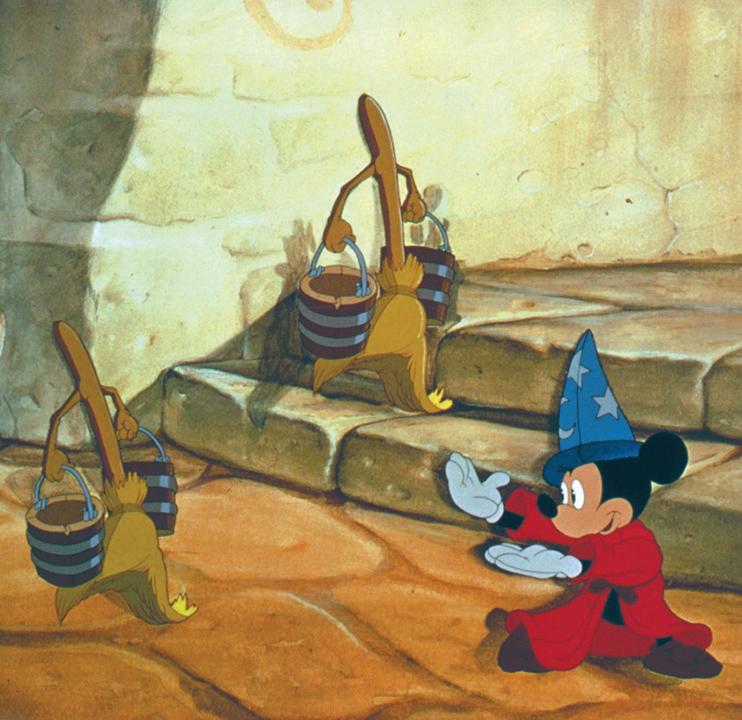
The discussion of the internet or any other expansive technology brings to mind the famous poem of Goethe, inspired by an ancient Greek tale by the satirist Lucian, where a magician’s helper learns to set inanimate things to work and does so while the master is away, but does not know how to stop them. At left a lithograph from an 1882 edition of Goethe; at right Walt Disney’s animation of the story in Fantasia, to music of Paul Dukas, with Mickey Mouse just getting started. — Editor

19 Fall-Winter 2009
internet. The “words” in that article are, of course, not words at all; on the computer they are an arrangement of 0s and 1s, and, on the ink-jet printed page, a carefully choreographed condensation of microscopic drops of ink. The powerful art works that accompany the article are said to be the dramatic and colorful creations of Van James and Michael Howard. When examined with a magnifying glass, however, they prove to be just a lot of pixels and sprayed ink. (At the end of the article, Michael Howard makes it possible to obtain a higher quality reproduction of his piece. He provides his email address so that you can order it…via the internet.)
There certainly are other ways to get hold of Prokofieff’s articles and a great deal of anthroposophical material, but more people seem to be less inclined to go to any source other than the internet. This past summer, Prokofieff appeared, “live and in person,” at Encircling Light, Expectant Silence, an inspiring conference in northern Canada. The stunning brochure that announced the gathering gave no fewer than 12 email addresses and/or internet URLs to use in signing up for and receiving information about the conference. Indeed, it would have been next to impossible to register, make flight arrangements, settle on a hotel room, and make plans for meals, without using the internet.
And one more example: When I cite a Steiner quote in a lecture to younger generation teachers, I can be sure that, within moments, one or two audience members will be on the internet (using a notebook computer or an iPhone), finding one of the many Steiner books that are already online and checking the accuracy of my citation. (This doesn’t bother me at all; before my lecture, I also visited the internet and checked my references in advance.)
Such internet dependency may sound dire, but what would it have taken to convene a fully-fledged anthroposophical conference in White Horse, Yukon Territories, without the internet? Probably something akin to transporting Sergei Prokofieff to northern Canada by dog sled rather than by plane. And how could we make Steiner’s writings so readily accessible to the many “Michaelites” who need them without publishing those works on the internet? Given the very limited number of people able to explain and interpret Steiner, and the small number of
Steiner books in print, there may be no other way to reach those potential readers who are spread all over the world. The internet may serve anthroposophy as the printing press once served Rosicrucianism—a means by which a relatively small number of individuals working out of the depths of esotericism can reach a much wider public. In the 17th century, that “public” numbered in the thousands; given the needs of our time and the power of opposing forces, today’s “public” must certainly number in the millions.
Should anthroposophists be protective of Steiner’s works or proactive and assertively public with them? Should we hide, or should we seek? These are questions that have long vexed our ranks, and the answer is probably not “either/or,” but closer to “both/and.” On the whole, over the past century, anthroposophists have done a better job “protecting” (remember those police dogs!) than “proacting,” yet, even so, Prokofieff tells us:
Already today one can find the most awful and defamatory attacks on Rudolf Steiner, anthroposophy, Waldorf schools, and other institutions connected with anthroposophy on the internet.
As one whose book, The Waldorf Teacher’s Survival Guide, has been the subject of such attacks, I can attest to the accuracy of Prokofieff’s statement. And, as one who has overseen a Waldorf-related web site for over a decade, and who has seen the internet articles and videos about Waldorf education that he posted draw tens of thousands of viewers annually, I can attest to the fact that one can find the most positive, revelatory, and deeply grateful statements about Anthroposophy on the internet as well.
“The best defense,” as they say in the courtroom, “is a good offense.” Steiner’s opponents are unlikely to cease their attacks whether or not we choose to go on the internet, and it is likely that their defamatory statements will only grow more virulent online and offline. We don’t have to go searching for those who oppose Anthroposophy, but we will have to be far more proactive to find those who seek it. In addition to the study groups, lectures, conferences, and performances that have represented us so well, we will have to use the means that the world provides and cast our net widely—even if that net is the internet.
The importance of Sergei Prokofieff’s article lies in the eloquent and impassioned case that he makes for being completely conscious about the internet’s provenance and sagaciously cautious about its utilization. I concur with his principles and admire his consistency. Prokofieff, I would contend, is invoking the shield of Michael, protecting the core of anthroposophy from the destructive forces ranged against it. I would also like to assert that there is merit in a very different approach to the internet, one that understands its dark challenge as a force that anthroposophy is empowered to meet. To face this challenge, however, it is not enough to invoke the shield. We must have the initiative and courage to wield Michael’s sword, as well.
Eugene Schwartz was a class teacher at Green Meadow Waldorf School for two decades, and worked with parents and colleagues on many media-related issues. He is now an educational consultant to Waldorf public and independent schools. His articles, podcasts of lectures, and links to videos about Waldorf education may be found on his web site, www.millennialchild.com . Starting January 8, 2010 he will give a series of lectures “The Media and Their Message,” at Anthroposophy NYC (www.asnyc.org ).

20 Evolving News for Members & Friends
Evolving Our Perceptions of Community and Technology in the Age of Michaël
Leslie Loy
This past July, on a warm afternoon, I found myself sitting in a circle on a grassy lawn in Sweden with twelve other people. Plucking grass stems at their bases and twisting them between my fingers, I listened as everyone collectively worked to better understand their definitions of community. One young woman from Germany remarked at one point to the group: “I don’t know if I consider something like Facebook to be a real community, because it doesn’t have a warmth to it, because it is disconnected from a reality I can grasp.” One of the other members of the circle, a new mother from Sweden, responded, “I disagree, because I actually have made deep connections with other people, and have been able to continue to meet my friends and share their lives.” The conversation twisted and turned just as the grass blades in my hand while my mind whirled. The conversation had, remarkably, evolved from one around “what is community in the twenty-first century?” to one that explored whether or not technology could create community, and how technology had actually created new definitions of community. These conversations were integral to my work with the anthroposophically-inspired organization, WeStrive (formerly NetworkM) and I found myself asking, How do we develop community in the twenty-first century if we don’t even all have the same definition of what a community is or how we access it?
In this day and age, we are no longer working with a dictionary definition of community. We are no longer able to concretely examine a body of people and say, “That is definitely a community” because we can rarely agree on what community is. This becomes problematic once one considers how often we use the word. A Google search brings up 1,360,000,000 references for the single word “community,” and its use ranges from scientific terms to social networking sites, such as Facebook and MySpace. This enormous number testifies to the fact that we liberally apply the word “community,” with whatever looselydefined understanding we have of its meaning, to any and all seemingly appropriate bodies. But we have to stop and think. As with many things, we have to be conscious of how we use this word and to understand how its meaning has evolved. We are challenged with the task to consider what community is, to examine how others view community, and to better understand how our pictures match up—at a time when be -
ing conscious is the hardest task of all. In light of this challenge, we must understand not only what community is but also how we create it, and what its value is in our daily lives.
With social networking sites humming away on servers across the globe, we find ourselves connecting with people we’ve never met through newly evolving media. Through our similar interests in books (GoodReads.com), movies ( IMDB.com), politics ( MoveOn.org), and other hobbies and interests ( Meet-up. com), we can create communities beyond the circle of friends we usually tend to connect with. Out of these broad social and specialized networks a new picture has arisen: evolving tools are empowering us to broaden our horizons or to deepen our interests, to reconnect, meet, and collaborate. These new technologies and our world’s increasing dependence on them highlight a very clear reality: some of us are more comfortable using these technologies than others. The discrepancy between those who rely on technology as a means to connect, whether with friends or colleagues, and those who shy away from it, is noticeable. Many would say that what divides those who use technology from those who do not is age, but my experience is that age is not the distinguishing factor that separates those who email, Skype, text, Tweet, and more from those who refrain. My grandmother, at the tender age of seventy-eight, learned how to email, thus my point that age is not the dividing factor here. I think the greatest reason why so many people avoid technology is fear, fear of the consequences of the technology and our unconscious use of it. Like our use of the word “community,” our fear of technology has the possibility of leading to great misconceptions, to gross misunderstandings of what technology is and how we engage with it. Like our conceptions around community, our relationship to the word “technology” highlights a lack of clear understanding of what technology is and how it appears in our lives. Technology is not just computers and cell phones, it is not just genetic engineering or great medical feats; technology is far simpler—it is knowledge. It is a tool or a means to address life, society, the environment, the sciences, and the arts.
The picture of both community and technology can be viewed as twofold. First, we have our perception of community as a body of people interacting with one another on a particular plane; it is an experience. Similarly, we view technology as a cold, discon -

21 Fall-Winter 2009
nected tool that is being thrust upon us by others who are unconscious of the consequences of their creations. Secondly, we have somehow begun to assume that community is a macrocosm whereas technology is a microcosm. Our definition of community has ballooned to mean so many things—organisms coexisting, colleagues working, a group of individuals united through a common connection (a school, the grocery store, a study group, the neighborhood)—while the word “technology” has come to represent for us a specific kind of tool. In this picture, community sits on one end of a spectrum as an experience and technology on the other end as knowledge.
Social networking sites, as they are commonly referred to, are a shared crux in the context of this picture because they rely and are founded upon technology (working within the above definition) while purporting to build community, thus uniting experience and knowledge into the very same encounter. How can this be? How can these sites be building community, which requires warmth and nourishment (from the least conscious organisms—bacteria—to the most conscious—humans) through a seemingly cold, indifferent medium? It is the factor of consciousness that is, in fact, what allows these sites to be successful and what furthers these media to evolve, because people are, on some level, aware enough to recognize their need for community and to strive toward building it; localized, general communities are no longer enough. We now seek more niche-formed communities that are more easily accessed through technology.
People drawn together through community and technology, united by a common factor they then explore using a kind of

knowledge that allows them to experience one another in new, and sometimes old, ways. This is the niche: where technology means everything from a pencil to a computer and community means everything from a grocery store to a nation. The times we live in call for a new understanding, for a recognition that we each work out of a different understanding, a different set of assumptions, of what is and is not community or technology.
My work with a community network that is committed to uniting people who are interested in taking initiative to create a new world relies upon evolving technologies—both those that involve computers and those that allow us to better communicate and share with others. What we share are often forms of knowledge, such as applied theories that inspire innovative thinking or social renewal. We live in times that require us to challenge our fears with courage; we can approach them with the knowledge that we are all human beings who have a greater task to meet in this life and the next. We can embody the Michaëlic spirit and strive forth into the world, and in our striving move beyond fears that resort to dictionary definitions of words and instead intuit our own sense of what these words represent in our lives, asking ourselves, “How am I demonstrating community? How am I interacting with technology consciously, so that it might contribute to the world in a healthy way?” This question is at the heart of my work, it is what underlies my questions around understanding and recognizing community. It inspires me to explore and to utilize, to the best of my ability, the tools that others have created out of their own communities to further our work together.
We are a Rudolf Steiner inspired residential community for and with adults with developmental challenges. Living in four extended-family households, forty people, some more challenged than others, share their lives, work and recreation within a context of care.
Daily contact with nature and the ar ts, meaningful and productive work in our homes, gardens and craft studios, and the many cultural and recreational activities provided, create a rich and full life.


For information regarding placement possibilities, staff, apprentice or volunteer positions available, or if you wish to support our work, please contact us at:
PO Box 137
603-878-4796
• Temple, NH • 03084
• e-mail: lukas@monad.net
lukascommunity.org
Community and technology in the twenty-first century, are partnered in an important way that challenges us to be conscious in our every gesture and to our utmost capacities; to act with an intention for conscious, collaborative striving. It is through this that new communities and new technologies will emerge. It is through this that we will truly be able to take our knowledge of the human being and infuse the world with our strength, which is lit by that great impulse of our times, the Michaëlic.

22 Evolving News for Members & Friends
Leslie Loy is Executive Director of WeStrive; visit westrive.org
SPIRIT •
THE ARTS •
MEANINGFUL WORK •
RECREATION •
A residential community for adults with developmental challenges
•COMMUNITY
•
•
•
Mercury in America
Onthe surface
a bus tour across North America
might appear as an unlikely subject for anthroposophical conversation. In actuality, the opposite is true. I was a member of the tour. I will endeavor in this article to present my observations of this subject. I will do so with the request that the reader not forget a fundamental truth: each one of the members of the tour had their peculiar and individual experience. This is not so obvious as it reads. Perhaps this is the truest road we traveled while crossing the United States, its cultural artifacts and our own soul expressions: each one of us harbors a unique and evolving spirit.

Before joining the tour, I did not ask, “What good can come from a four week excursion across North America?” I am an adventurer in disposition and deed. I thought this question would be first on the lips of outside observers. Instead what was asked most often, accompanied by a momentary expression of awe or bewilderment was, “And how was it?” I am sure I echo the thoughts and feelings of all the Mercury Travelers when I say to you: Ordinary conversation has little room for the fullness of the experience and the demands placed on our hearts and minds throughout the tour. At the journeys end we “installed” the bus behind the auditorium as a gesture towards the AGM.1 Some of us sat by the fire we kindled and tried to find words to convey our experience. It was cosy by the fire pit; our stories belong there. Some answered our invitation to share. It is in this mood I will relay my thoughts.
The next level of confession usually sprang forth from us with something like: “There was great joy and sorrowful tears; peaks of comprehension and of solemn experiences as well as darkened feelings and narrow divisiveness.” It was, in a brief statement, intense. The kind of “intense” you say while looking at the other unwaveringly in the
eyes and allow the silence at the end of that word to extend. The days seemed impossibly dense with happenings. It feels in retrospect that we were on the road for months! I have to note, that this is the result of extended periods of time where life and companions demand from us to be continuously present, very present. The kind of “very present” that I can only convey with a very emphatic ‘V’ and a absolutely eurythmic ‘T’ at its end. Present for ourselves and for the others. It is fitting to remark that this is the kind of cognitive texture that results from experiencing natural disasters, fears, battles and child bearing. Yet these were not our context. It was a bus tour across North America. We had come together for an experiment in three-folding, consciousness study and artistic expression. We had come together willingly with a thin introduction by way of our interest in anthroposophy and travel and we had no idea what the actual dimensions of our daring would be.
Amongst the shifting of forest branches in the fire pit and the pouring of tea I find it becomes practical to mention that we shared close quarters, camp sites, meals and long hauls on the highway. Not always but often we found ourselves together and often that took the form of sharing circles or eurythmy exercises, or study groups. This was not “a party” or “a vacation.” We found our selves in parched desert dust storms, fertile farm fields, lush mountain forest and the ever present “anywhere USA.”

The environment was ever changing. That became the context for our experiences. There was no time to sleep into our surroundings. Regardless of context our activity was always finding our self. Finding the other. Recognizing our shadow and our light, and learning to witness our shadow’s dance with each other. There were many and deep conversations, much honesty. There was all that as well as denial and the friction of impatience and the self pity of dissatisfaction.
All this while
23 Fall-Winter 2009
Reported by Ignacio Antonio Cisneros, with Jordan Walker
1 The bus tour ended in Spring Valley/Chestnut Ridge, NY, where the annual general meeting of the Anthroposophical Society in America was held in the Threefold Auditorium.
getting by with only our bare necessities and clearest being.

This is the point in the narrative of how was it? where the inevitable question came. “But why was it so difficult?” The short answer is that it was not so hard, but at the moment it did demand from us more than we expected to put forth. As a group we strove to remain united and committed to discovering what it meant for all of us to have come together there and then. We wanted to embody the spirit of our group and we staunchly enlivened our individual self while presuming this abstraction. Perhaps now we all can see the implicit contradiction in this. There was an obvious tension between a desire to be left as we were— which strove against the ideals of directed spiritual exercises. We aspired to a pseudo-monastic soul posture but were confronted with the demands of the long haul road trip. We preferred to be in our emotions despite their unclarity as long as we could leave our rationalizations unchecked to buttress our actions and social postures. In fact we were fully human in the contemporary version, but we also were informed by our spiritual aspirations.
and the story-filled minds reach back into their experiences, I have to add something that is at the very edge of our awareness and which became ever so clear to us on the tour. There were portions of the trip that brought us face to face with the naked manifestations of the adversary forces. I am not relating the inner character of our psychology with this. I speak of the fact that out in the world, where the tour rolled and visited, there lives today’s and tomorrow’s level of dehumanization. Our civilization harbors and encourages materialized and animalized behavior at an ever harsher pace. We were faced, on the tour, with the question: “How can we carry our an anthroposophical life in the world?”
We were confronted with the harsh reality that here in North America, the realm we set out to meet, the adversarial forces are fully and plainly active, to a degree that dwarfs that in Europe. This became the challenge that overshadowed all our strivings.
“Can we live and stand for spiritual science in the face of the shape and character of the North American culture and civilization?” As a representative of the Mercury in America tour, through this ink, I convey that question to you as our most pressing result.

fire pit was, “Know thou thy self!” This was accompanied by the gleeful countenance which the untried can offer to a description such as I have offered. The reader might suspect that this is the reason why the Mercury in America bus tour is, in fact, an anthroposophical topic, as if a deep voice had announced this off stage with a consciousness mocking effect. I caution all not to avoid the unbearable parallel between what I have described as the trials on our tour and what goes on, or should ensue, in our general meetings with other individuals that seek the spiritual path. Do we meet one another when we encounter each other in the halls or in our conversation groups? How deep can that be? On the Mercury tour we plumbed the depth of this idea with as much compassion as we could bring to bear.
Later in the evening, while the fire is receiving another feeding
This is the real experiment which the Mercury crew undertook. It is true that we lacked full awareness of this question at first. Yet we quickly found it loudly expressed through our interpersonal dynamics and group relations. We became a living study of this question, asked by North America to us, and of us to North America. We did so in the cities, in the wilderness, rolling down the highway at sixty-five mph. We asked this of our selves and of each other. We asked this as much as we asked our selves who am I and who is he or she. Do we have an answer? Many! As many answers as there were individuals on the tour. Can we remain steadfast despite the adversity? Maybe. With cooperation and wise planning. With love, peace, and understanding.
Above all, our main obstacle appears to have been how and when we dealt with the unconscious areas of our psyche. It is fitting that our tour rolled in to our community (Spring Valley) on the vespers of Michaelmas. In our language, if we are to embody the Michaelic being, I would have to say that it may take a “cha cha” or some other creative dance to constructively put our dragon to good service. This is among the lessons gleaned that the tour can most constructively share. In fact the youth

24 Evolving News for Members & Friends
The sharpest response from one of our friends by the
movement appears to be bursting with capacities to deal with this. I dare say the world responds wisely through the character of the youth. It would empower the Anthroposophical Society to notice this. The alternative enables our dragons, our shadow side, to obstruct and delay our shared course. Dealing with our shadows with brief conversations and polite dodging—that was never available for us on the tour. I dare say no one there was interested in that, although there were some bids to remain asleep.
Thisquestion
of confronting the world and its present future was not the only one we faced. We did embark with some very concise and pertinent questions which we asked ourselves. Following the study circle on the Philosophy of Freedom we asked what is freedom and what is the illusion of freedom. We asked what is consciousness of unconsciousness. We asked how we can perceive the “Word of the World.” We asked, what do our dreams bring as alchemical dew from the previous evenings retrospective. We asked, what does it mean to be I, and what does it mean to be you! We asked, how can we collaborate, be joyful, and not shun our inner growth. As well as asking of our selves not to lose our sense of direction, moral or physical, how and when to eat, sleep and travel. We asked why we were doing what we were doing uninterruptedly; perhaps it was a bit much?
In brief, seen from a distance the bus in which the expedition travelled appeared as a Kings County, Washington, Metro Bus. It was peopled by a heterogeneous crew composed of individuals from South Africa, Finland, Germany, Venezuela, Canada, USA. Our ages spanned from 21 to 49. The most unusual aspect of the effort was the shared interest held by these travelers in the work of Rudolf Steiner. It is not surprising that we made a family of it all, although for the most part we did not know one another before we gathered. I can write with confidence that crossing the continental US left a groove in our soul. It was partially successful, enormously rewarding and remains a clear format the details of which can be refined. The tour was not externally adventurous, American highways are very
traversable, especially if you carry your own BD greens. It was an adventure of the heart and an experiment in social dynamics and consciousness studies.
The Mercury in America Tour was envisioned by Dawn Stratton ( thesimplefool.org ) and Lachlan Grey and Jordan Walker of the new forms project (newformsproject.org ). The tour was loosely structured with each of the three taking on a sphere of the threefold social organism—the cultural, economic, and rights spheres respectively.
Lauryn Morley, born in South Africa and living in British Columbia, was our documentarian and brought her fresh-from the Youth Initiative Program (YIP) energy to the group.
Morgan Sobel, an American living in Seattle, tirelessly ran the on-bus, fine dining, all-organic all-thetime, Chez Alchemy.
Ignacio Cisneros, born in Venezuela and living in Seattle, was our spiritual scientist in residence and continually offered opportunities for us to play witness to our own consciousness and the greater context around us.
Meaghan Witri, born and raised in Spring Valley, NY, brought the tour singing and an improvemoment where the back of the bus became a playground and the passengers four-year-olds.
James Steil from Alberta, Canada, headed the Philosophy of Freedom study group and offered insights for his research on the Imagination, Inspiration and Intuition.
Jan and Teija Englund from Finland were the tour’s check and balance and worked with Monika Pudelka to create the amazing candlelit labyrinth in Central Park on Michaelmas.
Monika Pudelka from Germany and fresh from eurythmy training at the Goetheanum, led us in renegade eurythmy forms.
Cathy Samuel from Spring Valley, NY, took up the logistics of planning our menus and figuring out what twelve people’s worth of food looked like. She also helped lead our eurythmy circles.
Eka Joti was our shaman-in-training, leading us in sunrise chi gong and awareness meditation.


Nathan Rouse joined us at Burning Man as a spirit observer and connection to the Native American lineage of the country we were to travel through.

25 Fall-Winter 2009
l
ODYSSEY
Our Hellenic Odyssey

On June 28th nine questing souls met at Philadelphia airport for a three week exploration of ancient sites and mystery centers in Greece and Turkey with four guiding angels. Nassia in Greece and Hakan in Turkey were our knowledgeable local guides. Gillian Schoemaker ( picture right), co-leader and curative eurythmist, led us in healing movements appropriate to each sacred site; Glen Williamson (below), co-leader and New York-based actor and story teller, related and performed tales of the ancients, often on the very ground they trod.

The quest led into ancient Greek Mysteries and myths, and early Christianity; and also into ourselves, individually and as a traveling community. We tested capacities for sensing the evolution of consciousness described by Rudolf Steiner, as in the statuary, which reflected a gradual flowering from archaic and ancient Greek times through to early Roman.
Our senses were filled. The translucent blue of warm Aegean and Corinthian seas beckoned us to immerse ourselves. Soft summer breezes and cool shade trees became a welcome relief from 100 degree heat. Inner senses were stimulated by Glen’s stories and Gillian’s eurythmy. In Athens, as night fell on the rooftop garden of our hotel, Glen gave riveting scenes from his play Aeschylus Unbound, the Acropolis behind him. We visited Eleusis, the play’s setting, the previous day. In the mountainous region of Delphi, four brave souls joined Gillian the noonday sun for a special healing dance in the theatre just above the temple where Apollo’s oracle once spoke. The circle moved so eloquently that tourists alongside us on the path became still, and a hush fell upon this sacred place. Another one of our group, a music therapist, led us in spiritual songs, one being “Dona Nobis Pacem” in the Beehive Tomb at Mycenae. The resonances around us and within us were palpable. — From Athens’ Acropolis and Parthenon we traveled to ancient Ephesus in Turkey, an immense hillside metropolis situated at the meeting of Eastern and Western cultures. Nearby at the Temple of Artemis, now almost gone, Gillian’s eurythmy of the Zodiac felt deeply healing. Close by in the House of Mary, intensely meaningful for many of us,
Glen told The Incarnation of the Logos from Mary’s standpoint. The many stops on our Odyssey filled eye, heart and soul: the New Acropolis Museum; the Sounion peninsula at sunset with its Temple of Poseidon overlooking the sea, part of a perfect equilateral triangle with the exquisite hilltop Temple of Aphaia on the isle of Aigina, and the Parthenon; the hanging monasteries of Meteora with their wonderful wall paintings. And three less visited places with a quiet inward quality: the secluded healing center of Amphiarios with its abundance of fragrant, healing herbs; Thorikos, the oldest known theater of human size; the uniquely fortified citadel of Tiryns in the Peloponnese; ancient Mycenae’s massive structures of 1500–1200BC, with huge rock walls and impressive Lion Gate; and the deep healing center Epidaurus, where Racine’s Phedre was performed in wonderful acoustics for 15,000 people. Then island hopping to Hydra and Spetses for beach swimming and gentle idling, and a sunset cruise to Patmos, where island life is at its most languid. Here too, nestled in the mountainside, was the small Cave of St. John where he received the Revelation. We gathered within in silent meditation. Afterwards, in eurythmy Gillian recited the descent of the Holy City New Jerusalem. Our journey ended as beautifully as it had begun: a morning on the Isle of Samos, a final day on our own in Athens, and one final sharing on our last evening. We began with a Rückschau, looking back at all we had seen, opening a space for all to offer something from their hearts. Good byes were said over a dinner of authentic ancient Greek dishes. Heading home, though travel weary we felt inwardly renewed and refreshed.
Brenda and David Hollweger
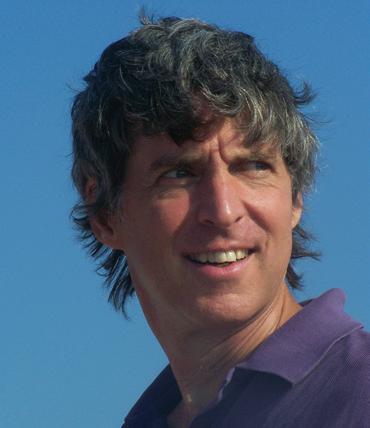
The Odysseys
An odyssey is a journey both outer and inner. After the fall of Troy, Odysseus voyaged homewards to his island where patient Penelope waited. The journey lasted ten long years—‘full of adventure, full of instruction’ (Constantine Cavafy). In short, the odyssey is a pathway of initiation, one that we are all traveling today, and ‘our friends and companions may be for us, though
26 Evolving News for Members & Friends
they may know but little of it, the terrible and wonderful actors in the ceremony of our initiation’.( Adam
Bittleston)
There are places once considered holy, sacred, numinous, where landscape was the habitation of divine beings. Ritual and ceremony conducted there resonated in the becoming of the earth and man. Now we see only ruins outwardly, remains of cultures rich in spiritual meaning. All that comes towards us can speak, and we can listen, if we prepare our eyes and ears with care.
When we stand there with 21st century consciousness, and speak, out of our striving and struggles, who and what we are—does it matter? Is it possible to give something back in gratitude? When we human beings create, in song, music, movement, we offer up something of our divine, essential nature. Doing eurythmy in such places means speaking there a language which was known and familiar, in forms appropriate to the age and culture. We give back our unique human creativity in the language of creation itself as a kind of acupuncture, with ourselves as shining needles on meridian points of the earth. We form a vessel together.
‘Your commandment’, he said, ‘is this world and it is written in your entrails. Read and strive and fight,’ he said ‘Each to his own weapons.’ And he spread his hands.
‘Here stand I, a young novice God, Creating pain and mirth together.’ (Odysseus Elytis)
The first Hellenic Odyssey was in 2002 with Dennis Klocek, artist and Goethean scientist, as co-leader. We considered how geology and geography contributed to the unfolding of mystery wisdom. Observation and drawing helped us enter into landscape and soulscape with awakened and attuned senses, then to offer eurythmy and song with focus and intention. There have been two further odysseys in Greece and two in Scotland, which sheltered the Mysteries of Hibernia, the Druids, early Christianity and the fugitive Templars.
This past summer’s odyssey to Greece, described at left by two participants, aimed to trace pivotal moments of the development of consciousness, from divine to purely human. With co-leader Glen Williamson we saw how Odysseus’ cleverness, Orestes’ new-found conscience, and Socrates’ indwelling guiding daimon were evidence of this.
Across a river of olives flowing towards the sea, Delphi, navel of the earth, is set high on its mountainside, home of the oracle of Apollo, god of the sun, where purification in the springs of Castalia were preparation for meeting him. In Hebrew Hallelujah means, ‘I purify myself from all that prevents me from beholding the Most High.’ This was offered in eurythmy on the light-filled airy heights in the ancient theater, evoking awe, recognition and intense gratitude in us, and that perhaps what we gave was received.
Eleusis is situated in the most industrialized part of Greece, near Athens. Here we heard of Demeter, goddess of cosmic Natura, and Persephone, her daughter carried off by Hades to
the underworld. How directly we could see his kingdom risen to the surface of the earth in the pollution of the smokestacks and refineries! Persephone, pure maiden of divine clairvoyance, how can she be revived? In eurythmy we experienced the downward “D,” and heavy falling trochee rhythm chaining us to weight and density on earth, where we struggled to retain our uprightness in “I,” and find the strength again for the uprising “T” and for lightness in the springing iambic. We experienced how we could find Demeter in ourselves in the TAO, how all of nature enters in us, giving rise to sense of self.
Ephesus, in Turkey, celebrated mysteries of the cosmic Word, the Logos, uniting space and time. St. John was bishop here; here Mary lived for some time after the Crucifixion. Nearby the mighty temple of Artemis was set close to the seashore, a wonder of the ancient world. Sister of Apollo, she reflects his radiant sun. Now is no trace of deep forests threaded by pathways, where priest and novice walked, speaking together in the moonlight. The sea receded, and standing upright in the marshy hollow there remains of the temple a single column on which a stork has built her nest. In this forlorn place we heard of Alexander the Great, born the night the great temple burned down, Artemis having left to preside over his birth. Here in eurythmy we tried to enter the space/time dynamic of the Zodiac, with its gifts of the consonants to the earth. A stork feather drifted gently down into our midst, like a blessing.
At the House of Mary, now an exquisite chapel on a wooded hillside, we heard of two Marys and two Jesus children—in a mood of infinite peace. Later we experienced the soul star, in eurythmy, of the ‘Ephesus’ verse given by Rudolf Steiner, which speaks of the planets bestowing their gifts, their vowels arising in our soul nature. Thus we united our twelve-fold with our seven-fold being.
It seems to me that the sacred places of our earth are asking something of us when we visit them. Their time is over, but we, who are alive and struggling into our spiritual inheritance, can recognize and honor their part in our story. They are waiting for that from us, and that we will indeed, one day, arise.
The Isles of Greece, the Isles of Greece!
Where burning Sappho loved and sung!
Where grew the arts of war and peace, Where Delos rose and Phoebus sung!
Eternal summer gilds them yet, But all, except their sun, is set!
Yet, later:
Let one living head, but only one, Arise . . . (Alfred Lord Byron)
Gillian Schoemaker
In July a new odyssey visits Athens, Delphi, Delos, Epidaurus, Mycenae, with eurythmy and dramatic choral speech. Also, Egypt at Christmas 2010, Scotland in July 2011. Information: 610 469 0864 or email: gillian_schoemaker@yahoo.com

27 Fall-Winter 2009
Economic Life at the Threshold

The 8th annual meeting of the Economics Conference(www. economics.goetheanum.org) was attended by members of the School of Spiritual Science under the theme of ‘Economic Life at the Threshold’. Presentations and subsequent discussion of the pre-distributed papers on true price, separating income and labor, basic income and the associative principle took place over the course of three days just outside Neuchatel, Switzerland. We generally spoke in English, mindful to speak deliberately and concisely for those German, French and Spanish speakers participating.

New Faculties of Knowledge
In his first lecture of his Economics Course 1922, Rudolf Steiner points to a world in which economic life has to be seriously rethought. The call is made to lift the thinking to a level above what it’s used to in natural science what clearly points to the knowledge faculties of Imagination, Inspiration and Intuition. These are needed to fully comprehend the true nature of commodities, labor and capital. In this mood, we started and ended the meeting by approaching the contents of the 15th lesson of the first class of the School of Spiritual Science. How can we re-find a ground for our three soul forces—thinking, feeling and willing—in the spiritual world?
Articles for Research and Review
Six papers were distributed among the participants in advance of the economics conference so that all could be familiar as they were presented. The ensuing dialogue and critique among peers provided a great opportunity to deepen our understanding and will result in a published revised conference document. The following is a partial review. A special thanks and appreciation are due for: Arthur Edwards, Marc Desaules, Marc Theurillat, Christopher Houghton Budd and Anita Grandjean.
True Price
The twin theory of value, the associative principle and the true price are axiomatic ideas from the Economics Course of 1922. True pricing points to the question of labor and income that are at the center of today’s financial crisis. The universal
practice of searching for the ‘lowest price’ seems efficient at first glance, but has resulted in the rise of indebtedness and the chronic reduction of incomes worldwide. The way out: “Capitalizing the balance sheets of the countless individuals whose initiative is thwarted merely for the want of credit.” This means connecting income to human creative intelligence as it manifests through what we do for one another – the division of labor. In practice, this will also require the capitalization of the initiatives and related intuitions of individuals instead of putting capital into land. When individuals are properly remunerated (income/expense statement) and capitalized (balance sheet) a new paradigm can come to expression. We can free ourselves from the financial system the more we realize and comprehend that money is accounting and accounting money. A true price is not absolute and cannot be determined in advance, but needs to be ‘sensed’, as prices are in constant flux. Price is derived from the future interplay of values ever fluctuating and difficult to define. “When you exchange value for value, price which arises in the process of exchange is a fluctuating thing raised to the second power.” (Lecture II R. S. July 25, 1922)
Daniel Osmer
Egoism: Separating Income & Labor
“The important point is that working for one’s fellowmen and the object of obtaining so much income must be kept apart.”
Rudolf Steiner, World Economy, 1922
To separate income from labor requires that egoism be taken out of the field of economic life, which then leads to true pricing, not a basic income. The nature of ‘labor’ isn’t something one does for oneself, but the field where one finds one’s mission. ‘Labor’ is really about unfolding one’s own karma and becoming oneself in doing what one is called to do in meeting the world’s and others’ needs. Fulfilling our destiny in meeting human needs. In this way we enter the mystery of the will, a central aspect of human incarnation. To free people from labor through an institionalized statewide unconditional basic income may result in undermining the will forces and the dignity of the human being in the long run.
28 Evolving News for Members & Friends
Report of a conference of the Section for the Social Sciences of the School of Spiritual Science, September 27th to 30th, 2009, at L’AUBIER, Neuchâtel, Switzerland
Instead of buying and selling labor, it is possible to contract with each other in a way that everyone becomes a co-entrepreneur. This is not piece-wages, but a contractual sharing system agreed too by all. Income then is derived contractually from price. This separates direct labor and income. How to enable that each has enough income? Pay the true price—pay enough so that a like product or service can be enacted again. Can we take into account the other side of the transaction as well as our own?
The example of the tailor making his own suit, mentioned in the economics lectures by Rudolf Steiner, demonstrates the importance of mobile imaginative thinking for clearly perceiving that the tailor, unwittingly, works against a healthy economy by insisting on making things for himself. This is the acid test for understanding why egoism needs to be removed from economic life.
Reciprocally Related Prices
The effect of each price, each local exchange, goes beyond the immediate circumstances of the transaction to which it relates and into the balance of the whole economy. Prices cannot be considered in isolation from one another because they are reciprocally related on a global level. Long ago Rudolf Steiner described it by saying that “local tram fares are affected by events in America“.
The current market paradigm and approach has set out the entire economic language in which debate occurs. The associative economic image of the concept of pricing is one of prices being behavior driven, whereas in the market concept of pricing, behavior is price-driven. “It simply will not do in economics to think … near at hand. Such thinking will lead to disaster if you let your thoughts be guided only by what lies in the immediate neighborhood.” This far-reaching thinking is also the secret to understanding the subtle, but economically powerful, effect of the tailor making his own suit.
Rudolf Steiner describes price as the cardinal question of economic life (as does modern economics) and gives the image of mercury in a thermometer corresponding to price that is an indicator of temperature, not a cause. The idea of true pricing is a much wider conception than it first appears. To work associatively, individuals need an instrument through which prices can be ‘perceived’. As an organ of perception, double entry accounting has the potential to educate us to our economic circumstances in a precise common language. The balance sheet makes the ‘life of rights between us’ visible to all that can understand, read and write, in this language.
Associative Principle
The rationale for our competitive economy comes from an idea of Adam Smith. Where two people meet, they will collude to make an economic gain, so if they are made to compete instead it will negate this possibility. On the other hand, it is possible to meet on the street in order to cooperate for the benefit of the whole without collusion—cooperation without collusion.

From Bernard Behrens’ elaboration of the 1948 edition of The
Social Future lectures: “In accordance with other numerous expositions given by Rudolf Steiner on this subject of capital accumulation, transfer and administration, without government interference, it can be said that the ‘company principle’ means a maintenance of an artificial, lifeless separation of finance-capital from the human being in his true social relationships, whereas the ‘associative principle’ in the economic sphere starts from the human being with all their capacities and abilities, working by means of capital placed at their disposal for really productive purposes for the common benefit of all.” Gift money as an economic category, is a corollary to true pricing that can act as counter balance to the ‘damming [up] of capital into land [values]’.
Does the method of capitalization allow the share company to be an expression and instrument of the associative principle rather than the company principle? The share company that Rudolf Steiner headed was called Der Kommende Tag, a collection of economic activities, commercial and cultural, where the idea seems to have been to devote the profits of the first to benefit the later, the cultural activities.
The Right-On Corporation is a modern attempt to continue this effort to transform the share company into a form that aids the initiative and intuition of the human being towards a balanced and healthy social life. (www.cfae.biz).
Michaelmas with the Local Branch
Marc Desaules and Anita Grandjean, founders of L’Aubier biohotel/restaurant/ farm, arranged for a Michaelmas outing to the village of Neuchâtel where we viewed a magnificent work of art completed in 1885 by local painter, Paul Robert. L’Aubier Restaurant provided sack dinners, while members of the local branch drove us to the center of town. Together we all listened as Anita described some of the outstanding detail of the painting and the riveting story of the painter. The entire life of the area can be seen through three two-story murals featuring a magnificent depiction of the Archangel Michael and hosts. We gathered again at L’Aubier Café-Hotel for a late night snack and drink, as we all appreciated the good will, warmth and hospitality of the members of the branch. Thank you for this special event.
L’AUBIER celebrated its 30th Anniversary (www.aubier.ch) the day before the conference, where hundreds of shareholders and friends gathered sowing seeds for the future over a very large tilled field. Strengths in both inner and outer aspects of maintaining a growing enterprise could be felt over the entire premises through a consistent experience of its elegant simplicity, beauty and the attention to detail. After sharing food together, the new 21 unit ‘green’ apartment complex/wellness center for seniors and young families were dedicated, followed by a tour of the well thought out space.
Daniel Osmer is a real estate professional in Sebastopol, CA, and a founding-participant of the Economics Conference inaugurated at the Goetheanum in 2002. —Photos courtesy of L’AUBIER.
29 Fall-Winter 2009
Invocation
I. Sophia, We Call to You 1
Like Emerson’s apology for his poetry (to his soon-to-be wife Lydian), my poetry voice is rather “husky” and “mostly prose.”2
With Emerson, America’s sophianic sage, we seek “an original relation to the Universe,”3 to its interior, to anima mundi. 4
This group and this place, both dedicated to you, invoke and invite you. With Sue’s goddess statue next door, and trust in the dissident daughter in the air, we’re in the right place to invoke Sophia. 5
We know you hear with the aged sagacity of Isis, with the suffering compassion of Mary, with the essential wisdom of Sophia.
We practice philo-sophy, knowing you as Isis-Mary-Sophia, three names for your singularity. 6
Who can count your images as Isis— Goddess as cow, pig, and bird; guardian of the underworld; Sirius; loving mother of your son Horus? 7
1 Th is invocation is indebted to Anne Baring and Jules Cashford, The Myth of the Goddess: The Evolution of an Image (NY: Viking/Penguin,1991)—with prodigious scholarship, this book depicts the evolution of the goddess within a framework influenced by the conception of consciousness developed by C. G. Jung and Joseph Campbell; and to Owen Barfield (who, in turn, acknowledges his debt to Rudolf Steiner).
2 Robert D. Richardson, Emerson: The Mind on Fire (Berkeley, CA: University of California Press, 1995), p. 179.
3 Ralph Waldo Emerson, Nature (1836), first paragraph.
4 “Soul of the world” is a key concept in Jungian arechetypal psychology.
5 See Sue Monk Kidd, who is associated with the Sophia Institute of Charleston, SC, and author of Dance of the Dissident Daughter and Secret Life of Bees.
6 For the essential identity of Isis-Mary-Sophia, see Christopher Bamford, “Introduction,” Mary-Isis-Sophia: Her Mission and Ours (Great Barrington, MA: Steinerbooks, 2003).
7 For Isis, see Baring and Cashford, chapter 6.
Robert McDermott, Ph.D., is president emeritus and chair of the Philosophy, Cosmology, and Consciousness Program at the California Institute of Integral Studies (CIIS). His publications include Radhakrishnan (1970); The Essential Aurobindo (1974, 1987); The Essential Steiner (1984); The New Essential Steiner (2009) and The Bhagavad Gita and the West (2009). He has also published on William James, Josiah Royce, M. K. Gandhi, the evolution of consciousness, and American thought. His administrative service includes
Robert McDermott composed this invocation for The Reemergence of Sophia in the 21st Century for the Transformation of Self and Society, sponsored by the Fetzer Institute, July 20-23, 2009, at The Sophia Institute, Charleston, SC.
We recall the litany of your images as Mary— holy mother of God, mother undefiled and faithful, queen of angels and saints, portal of heaven. 8 9
These many names and more point to you. Tao, sunyatta, Quan Yin, shakti also name you, but not one is your eternal name. Water, womb, silence, and mother, the inner and subtle, soul and spirit, mystery and secret, all try to name you.
As Tao you manifest, as Isis you weep, as Mary you comfort, as Sophia you inspire Plato’s Diotima10 and Dante’s Beatrice. 11
Such subtlety escapes us moderns long accustomed to the guy project, a brilliant Faustian bargain ending too slowly.
8 For a Jungian conception of the divine feminine, see Edward C. Whitmont, Return of the Goddess (NY: Crossroad Publishing Company, 1992). For Sophia in the western tradition, see Caitlin Matthews, Sophia, the Goddess of Wisdom: The Divine Feminine from Black Goddess to World Soul (London: HarperCollins/Grafton, 1991).
9 For Mary, see Jaroslav Pelikan, Mary through the Centuries: Her Place in the History of Culture (New Haven, CT: Yale University Press, 1996); George H. Tavard, The Thousand Faces of the Virgin Mary (Collegeville, MN: Liturgical Press, 1996); Charlene Spretnak, Missing Mary: The Queen of Heaven (NY: Palgrave Macmillan, 2004). The great contemporary mystic, Adrienne von Speyr, has written two small, profound books, Mary in the Redemption (San Francisco: Ignatius Press, 1999) and Three Women and the Lord (San Francisco: Ignatius Press, 1978). For an anthroposophical interpretation of Mary, see Emil Bock, Threefold Mary (Great Barrington, MA: Steinerbooks, 2003).
10 See Plato’s Symposium in which Socrates presents the Platonic ideal of love that he learned from the goddess, or seer, Diotima of Mantinea.
11 For Dante’s Beatrice, see Paradiso in Dante Alighieri, The Divine Comedy, trans. Allan Mandelbaum (NY: Knopf, 1980). See also Jaroslav Pelikan, Eternal Feminines: Three Theological Allegories in Dante’s Paradiso (New Brunswick, NJ: Rutgers University Press, 1980; Helen M. Luke, Dark Wood to White Rose: Journey and Transformation in Dante’s Divine Comedy (NY: Parabola Books, 1989); Peter S. Hawkins, Dante’s Testaments: Essays in Scriptural Imaginations (Stanford, CA: Stanford University Press, 1999).
president of the New York Center for Anthroposophy; president of the Rudolf Steiner [summer] Institute; chair of the board of Sunbridge College (New York) and of Rudolf Steiner College (California). He was a member of the council of the Anthroposophical Society in America (1996–2004). He is the founding chair of the board of the Sophia Project, an anthroposophic home in Oakland, California, for mothers and children at risk of homelessness. He is a Lindisfarne fellow, a Fetzer mentor, and a member of the Esalen Corporation.
30 Evolving News for Members & Friends
Robert McDermott
to Sophia
You reigned as Isis for three millennia, as Mary you inspired Christendom, as Sophia you revealed the Grail. 12
Then cosmic alienation seized the modern mind. We didn’t lose you in a day or a year. Cosmic transformations take a century or two. 13 A Cartesian-Newtonian billiard ball cosmos, not to mention the quest for gold, fueled passion for control and power. The modern project can’t handle interiors and subtleties: bring on the visible and solid, surfaces only; nothing too soft, fluid, or flexible. They say the takeover started with Enu Elish, in Baghdad—still in the news— as Tiamat you hung on a hook for three days.
Crucifixion has been a male specialty; no more the generative goddesses, give us the thunderbolt gods.
As goddess, you’re assigned to girls and crones, but empires need Marduk; a god’s gotta do what a god’s gotta do. On he came morphing and starring— as Zeus, ruling the sky and mountain tops, as YHWH, vengeful god of the garden.
All sin then traceable to a woman, childbirth a curse, males in charge, sin and salvation over service and generation. Your archetypal image surfaced in mediaeval European towns, hundreds of cathedrals to Notre Dame!
Too good to be unopposed, from Notre Dame of Paris to the Temple of Reason, analysis and argument over affectionate insight.
12 For the Grail, see A. E. Waite, The Holy Grail: The Galahad Quest in the Arthurian Literature (New Hyde Park, NY: University Books, 1933/61); Rene Querido, The Mystery of the Holy Grail: A Modern Path of Initiation (Fair Oaks, CA: Rudolf Steiner College Publications, 1991); Linda Sussman, The Speech of the Grail: A Journey Toward Speaking that Heals and Transforms (Great Barrington, MA: Lindisfarne Books, 1995); Sergius (Sergei) Bulgakov, The Holy Grail and the Eucharist (Great Barrington, MA: Lindisfarne Books, 1997).
13 For the fundamental disenchantment resulting from the Newtonian-Cartesian worldview, see Richard Tarnas, The Passion of the Western Mind (NY: Crown/Harmony, 1991), especially “The Post-Copernican Double Bind,” 416-22.
Following the dark side of the Enlightenment, knowledge and power over wisdom, nature on the rack, control at all cost.
Bacon is our Man: We will have knowledge, get the secret, blow the atom, take charge, go the limit, no price too high. And we did, and it feels good. We have dominion, even over death. Sort of. Why are we so depressed, fearful, and violent? What shall we make of the hard images, Kali and her company of destroyers? Are they you embracing all opposites?
Should we accept your embrace of suffering and evil— war, hunger, rape, HIV/AIDS, cancer, despair, suicide?
Does your hard mother-love find these useful?
Are you the source of such pain, illness, loss? We really need to know this!
Are you really Kali? 14
Were you behind Gettysburg, Verdun, Hiroshima? Could you have stopped them? What are you doing about sex slaves?
We believe you bind each nation’s wounds, comforting soldiers slain, and their widows and orphans. 15
But why are these? Why?
Is this your way to make us conscious?
For us to try harder? What a strange way!
And what of spiritual suffering?
Have you led the West to suffer the loss of your comfort?
14 For Kali, see Ajit Mookerjee, Kali: The Feminine Force (London: Thames & Hudson, 1988).
15 See Lincoln’s Second Inaugural Address, 1865: “With malice toward none, with charity for all, with firmness in the right as God gives us to see the right, let us strive on to finish the work we are in, to bind up the nation’s wounds, to care for him who shall have borne the battle and for his widow and his orphan, to do all which may achieve and cherish a just and lasting peace among ourselves and with all nations.”
31 Fall-Winter 2009
II. That We Lost You
III. Returning by Sight and Sound
There are signs, as your Christopher has written, 16 you are again arising like Venus. Some are seeing the hem of your mantle. 17
Searching for inner realities, seeing behind, and within, are we seeing your mantle?
We know such sightings are rare in a culture of denial, a time of “nothing but.”
What about the books on your behalf? Are they seeing you, or fantasizing your mantle, your image and sound?
Leonardo, Michael Angel, and Rapha-el Renaissanced your sacred image, Mama and Bambino, for all times, all hearts.
We see you through the holy Fra, Duccio and the Sienese School, 18 and the American Henry Ossawa Tanner. You’ve sent healing cosmic sounds to Bach, Mozart, and Beethoven. Deo gratias for Schubert’s “Ave.”
Shakespeare has revealed you:
“There are more things under heaven and earth.…”19 They are the invisible and powerful, wise and true.
Dante, Shakespeare, and Goethe, the greatest three, all know you in ambiguity, artistry, inner anthropos.
Goethe’s poetry and urplant, gentle science, alchemy, mysteries, polarities— and Faust, the rascal—all approach you. Your Gretchen, Faust’s victim and savior, in the end reveals your grace: “The Eternal Feminine draws us onward.” 20
16 Christopher Bamford, creative exponent of sophianic thinking, esoteric Christianity, and the practice of unconditional hospitality. See his An Endless Trace: The Passionate Pursuit of Wisdom in the West (New Paltz, NY: Codhill Press, 2003).
17 “Sophia’s mantle”: “Over the past centuries, the being of Sophia, or feminine Divine Wisdom, has been emerging from the mists of ancient history, like Venus from the waters, to become a sign and mystery of our times. Though it is difficult to say who she is, wherever we turn, we see traces of her coming—as if tracking the fringes of her mantle as it brushes aside the tangled, sclerotic cobwebs of centuries of cerebration. As she draws near, much that was forgotten is reentering consciousness, not only as memory but also from the future, as possibility.” “Introduction,” Isis-Mary-Sophia, p. 7.
18 For Duccio and the Sienese School, see Enzo Carli, Sienese Painting: From the Origins to Duccio (NY: Scala Books, 1983)
19 “There are more things….,” Hamlet, Act 1, Scene 5.
20 “The Eternal Feminine…,” Goethe, Faust, Part 2, Act 5 (last line).
You’ve sent us the mantras of wise women, mothers, teachers, poets, and children.
Abigail wrote to John, “Remember the Ladies.”21 Henry Adams, son and grandson of presidents, looked past the dynamo to the Virgin and saw the secrets of Chartres. 22
We still learn from Lao Tse, a correction for Confucian rigidity, bringing grace to order, surprise to tradition. Not mere chaos, Tao weaves subtly. After enlightenment the river remains. Jack teaches laundry after ecstasy.23
You’ve shown the interiors of exteriors. You are shakti, a hot knife through butter; you slice as needed, and at the joint.
No Rama without Sita, No Krishna without Radha, No Buddha without QuanYin.24
No Jesus without you, No Aurobindo without the Mother; 25 His Holiness, verily Avalokisteshvara. 26
We know you break through concrete, like the lily in the wall, like grass on Madison Avenue.
As prajnaparamita you teach us “gate, gate,” “Go beyond, beyond, Wisdom beyond knowledge, Emptiness beyond form.”27
21 Abigail Adams’s letter to her husband John, 1776: “Remember the Ladies, and be more generous and favorable to them than your ancestors.”
22 See Henry Adams, “The Dynamo and the Virgin,” in The Education of Henry Adams (NY: Bartleby, 1999/1918), ch. 25. See also: Henry Adams, Mont [Saint] Michel and Chartres (NY: Penguin,1986).
23 “Jack” refers to Jack Kornfield, After the Ecstasy, the Laundry: How the Heart Grows Wise on the Spiritual Path (NY: Bantam, 2000).
24 For the divine feminine in world religions, see Andrew Harvey, The Return of the Mother (Berkeley, CA: North Atlantic Books/Frog, 1995) and Shirley Nicholson, ed., The Goddess Re-Awakening: The Feminine Principle Today (Wheaton, IL: Theosophical Publishing House, 1989).
25 See Sri Aurobindo, The Mother (Pondicherry, India: Sri Aurobindo Ashram, 1972), Sri Aurobindo Birth Centenary, vol. 25; K. R. Srinivas Iyengar, On the Mother: The Chronicle of a Manifestation and Ministry (Pondicherry, India: Sri Aurobindo Ashram Press, 1994).
26 For the relationship between His Holiness the Dalai Lama and Avalokisteshvara, the goddess of wisdom and compassion, see Glenn H. Mullin, The Fourteen Dalai Lamas: A Sacred Legacy of Reincarnation (Santa Fe, NM: Clear Light Publishers, 2001), p. 90, and throughout.
27 For the text of the prajnaparamita sutra, see Robert A. F. Thurman, ed., Essential Tibetan Buddhism (Edison, NJ: Castle Books, 1995), pp. 171-72, and for a thorough interpretation see Lex Hixon, Mother of the Buddhas: Meditation on the Prajnaparamita Sutra (Wheaton, IL: Theosophical Publishing House, 1993).
32 Evolving News for Members & Friends
With Blofeld we see you as Quan Yin, in the crevice, arranging pregnancies, auspicious births, tending to the bereft.28
We know you as Notre Dame in blue veil, as the Virgin of Chartres, as Guadalupe in gold, revealed by the peasant, the pure, the peaceful. We still need our guide books, and fabulous icons—Greek, Russian, Bulgarian; we study the Grail, Dante, Hildegard,29 Julian.30
Recalling forgotten ancient wisdom, HPB announced your unveiling;31 did her Indian and Tibetan masters know you?
From Theosophy to Anthroposophy, Steiner said we have not lost Christ, but we have lost you.32
He teaches a divine coniunctio Anthropos and Sophia— Christ and Sophia.
Thank you for those Sophiologists, Soloviev,33 Bulgakov,34 Florensky, the wise Tarot meditator, Valentin Tomberg,35
And, of course, the profound Prokofieff. 36 Your dear friend Robert,37 celebrates you as Trinosophia—Mother, Daughter, Holy Soul. Now to the conference, and our attempt to reach to you, by loving-thinking, by sophianic conversation, by calling to you by your many names.
28 John Blofeld, The Bodhisattva of Compassion: The Mystical Tradition of Quan Yin (Boston, MA: Shambala, 1988).
29 See Matthew Fox, Illuminations of Hildegard of Bingen (Rochester, VT: Inner Traditions/Bear & Company, 2002).
30 See Julian of Norwich, Revelations of Divine Love (NY: Viking Press, 1982). In the mid-14th century Julian prayed: “As truly as God is our Father, so just as truly He is our Mother.”
31 See Sylvia Cranston, HPB: The Extraordinary Life and Influence of Helena Blavatsky (NY: G. P. Putnam’s Sons/Tarcher, 1993).
32 “It is not the Christ that we lack, but the knowledge and wisdom of Isis, the Sophia of the Christ.” “The Search for the New Isis (1),” Rudolf Steiner in Bamford, ed., Isis-Mary-Sophia, p. 211.
33 See Judith Deutsch Kornblatt, ed., The Divine Sophia: The Wisdom Writings of Vladimir Soloviev (Ithaca, NY: Cornell University Press, 2009).
34 See Sergei Bulgakov, Sophia: The Wisdom of God (Great Barrington, MA: Lindisfarne Press, 1993).
35 Valentin Tomberg is the “Unknown Author” of Meditations on the Tarot: A Journey into Christian Hermeticism, trans. Robert Powell (NY: Penguin/Tarcher, 1985/2002).
36 Sergei Prokofieff, The Heavenly Sophia and the Being Anthroposophia (London: Temple Lodge Press, 1996).
37 Robert Powell, president of the Sophia Foundation of North America, is author of The Most Holy Trinosophia (Great Barrington, MA: Anthroposophic Press, 1985) and The Sophia Teachings: The Emergence of the Divine Feminine in Our Time (NY: Booklight/Lantern, 2001).
Reverberations of Light & Silence
Reflections on the Conference on the North Anja Hovland

This conference attracted my attention early in 2009. In the depths of my soul live experiences from my youth in arctic Norway, and I have felt for several years an urge to paint something very Nordic, the Aurora Borealis Corona, as I saw it in 1946-47 in Elvenes, Sor-Varanger, Norway. I resisted, reasoning that I already had experienced the North in vero, but the urging insisted, and on August 2 I found myself in Whitehorse, Yukon Territory, Canada for “Encircling Light, Expectant Silence.”
I had great expectations. The schedule was hectic like my college days long ago, but the place was breathtakingly beautiful, and the conference was well organized, a strong manifestation of spirit in action. There was poetry, singing, myths of the past and prophecies about the future. The weather was favorable, and acrid smoke from a naturally occurring forest fire somewhere did not bother us one bit. There was no time.
Each day started with a delicious light breakfast, followed by the same First Class lesson, in a large classroom was filled to capacity, presented each day by a different, capable teacher. I heard for the first time the mantram read in Norwegian! Then we crossed to the arts building for a eurythmy performance of the “Foundation Stone Meditation” and the daily lecture or presentation on the importance of the North in the future, the history of Canada’s arctic regions, Norse mythology and the Finnish Kalevala, the first families, and life in Alaska. The international aspect was enlivening, a nice microcosm formed around a deep interest in the North. In one conversation group we worked with “Goethean conversation.”
Afternoons outings and hikes covered museums and local traditions and culture. During nature hikes many wild animals were seen in their own habitat: bears, wolves, foxes, eagles and moose. We learned how very important the salmon was and is for the people in the area.
A month has now passed since I returned home to San Diego, California. This morning I met with my fellows in our First Class, and shared briefly about my Yukon experience. I had had some time to reflect on the material piled up within me, my gratitude for the conference, and being part of the impulse generated. My listeners were moved to tears. The conference really was such an inspiring experience that its effects will reverberate on and on; its tone was not somber though the matters were taken seriously, and everything was interspersed with joy and surprise. There was a hilarious and utterly clever clown who brought a healthy laughter to our souls, and the food and serving was so serenely and caringly offered!
In my thoughts I still visit Whitehorse daily, and I’ll have plenty to keep me occupied for a long time. Thank you all who made it happen!
33 Fall-Winter 2009
Eurythmy and the Post-Enchanted World

Marguerite McKenna Introduction
There is a growing concern today among educators, artists, thinkers, and scholars regarding the experience of alienation that many people feel in relation to nature. An academic conference held in January, 2008 entitled “The Reenchantment of Nature” centered on themes from the contemporary academic book, The Reenchantment of the World, by Morris Berman. Berman’s central argument is that human consciousness needs to be transformed in such a way that the mind of nature can again become accessible to the human mind. He proposes that such a relationship between humanity and nature once existed in the prescientific—and what Berman also refers to as the “enchanted”—age. In this regard Berman puts forward the hope for a “reenchantment” of the world.
I introduced the art of eurythmy at this conference and presented the possibility that through it one can enter into a new kind of thinking, specifically a “living” or etheric thinking. This new living thinking, I suggested, allows the thinker more intimate contact with the worlds of both spirit and nature. This would not be a practice of re- enchantment but rather a path to a post- enchanted way of knowing and being.
The article below is an amended synopsis of the paper I presented at the conference. The paper was originally crafted in response to specific arguments from Berman’s book, but has been modified here to incorporate additional ideas from anthroposophy. The original paper included significantly more description of eurythmy, as well as a more intricate treatment of the topics presented. Although this rendering is written with an intention to elucidate the role of eurythmy, eurythmy does not occupy the central content of the article that appears here. Instead this abridged version strives to offer a small sample of
contemporary ideology concerning the evolution of consciousness, and how eurythmy is applicable within its context.
Scientific Revolution and the Birth of “I Am”
Berman’s premise is that starting with the scientific revolution, human beings fell into a state of “disenchantment” with nature. Berman defines disenchantment as, among other things, the then-new ability to perceive nature from the position of an objective witness as opposed to that of a subjective participant. Berman’s premise is consistent with Rudolf Steiner’s thought, but Berman adds that with the ability to objectively witness also comes an innate ability to experience one’s own inner self-consciousness. The linking of objective reasoning with selfconsciousness is understood within certain academic circles as the phenomenon of Cartesian duality.
Within this duality, one must separate oneself from the object one hopes to observe. In so doing she inadvertently experiences that there is a self that is distinct from that which the self seeks to understand. Accordingly, one gains an experience of one’s own “onlooker consciousness,” as it has been called, or more simply, one’s own being-ness.
This own being-ness is an idea that religious scholars refer to as the experience of “I Am” (Sanford, 308). The “I Am” is, in some cases, synonymous with the Word, or logos. Steiner indicates that it is precisely this capacity of self-awareness, this “I Am” that dwells within the human soul, that will enable humankind to move forward toward what one might call a postenchanted relationship with nature, one that is both self-aware and participatory.
Human self-consciousness was one fruit of the scientific revolution. Steiner’s arguments suggest that humanity can now use this fruit to transform the perceived human/nature duality.
34 Evolving News for Members & Friends
Symphonic Eurythmy, Mendelssohn 4th Symphony: photo by Charlotte Fischer for the Goetheanum
Although human beings now experience themselves as separate from nature, they can awaken the logos within themselves and use it to engage in a new kind of thinking. This new kind of thinking relies on human freedom while simultaneously encouraging an intimate unity with nature. One way this happens is through using one’s capacities of consciousness, one’s inborn logos, to think via one’s etheric body.
Etheric Thinking
Steiner indicates that before the scientific revolution, etheric thinking was the predominant mode of cognition. He writes: … up until the fifteen century, people … viewed themselves as submerged with their soul in the overall cosmic intellect …. This came about because … human beings predominantly employed their etheric body when they engaged in thinking. It was not that they decided to activate the ether body. But what they did sense—their whole soul mood—brought the etheric body into movement when thinking occurred. We can almost say: During that age human beings thought with their etheric body. And the characteristic thing is that in the fifteenth century people began to think with their physical bodies. … This is the great difference that becomes evident when we look at thinking before and after the fifteenth century” (Materialism and the Task of Anthroposophy, 178-179).
In the prescientific age, while people were still thinking with their etheric bodies, humanity enjoyed the experience of “being submerged with their soul in the overall cosmic intellect”. This is precisely the enchanted connection to nature and to the spiritual world that Berman recognizes as having existed before the scientific revolution. This is the same connection that Berman now longs for in his cry for readers to help him discover a “modern and credible form of reenchantment” (24). Berman longs for a paradigm in which human beings can commune with the spiritual core of nature in a personal and immediate way.
In the excerpt above, Steiner illuminates how employing one’s etheric body in the act of thinking involves submerging oneself, with one’s soul, “in the overall cosmic intellect.” He also acknowledges that thinking with one’s etheric body involves bringing that body into movement. One might imagine, therefore, that thinking occurred when the human ether body wove within the ether body of nature. Steiner’s writings indeed suggest that in the prescientific age thinking resulted from the interpenetration of the human soul with the larger cosmic soul.
With the advent of the scientific revolution, the activity of human thinking shifted into something entirely different. In place of engaging one’s etheric body in an enchanted dance with the larger etheric substance of nature, thinking now became a process of “combining abstract logical thoughts” (Nature Spirits, 165). Such thinking is understood to be an activity that takes place by virtue of one’s physical brain. Thinking shifted from being an activity that engaged the etheric body to one that now engages the physical brain.
The Descent of the Logos
It is possible that the descent of “thinking” from humanity’s ether body into the physical body is a picture of the descending logos itself. Regarding the transformation of consciousness that occurred during the scientific revolution, poet and scholar Owen Barfield writes: “the scientific revolution marked a crucial stage in that evolution from original to final participation, which is the progressive incarnation of the Word” (Saving the Appearances, 165).
Once this Word incarnated, humanity necessarily ceased experiencing the descending Word speaking into them from nature. For many this was a lonely and devastating experience. In place of a descending Word, however, the human being now experiences the Word ascending, striving upward from within. What the human being once heard in the enchanted lullaby that was spoken to her, now strives to become the Word spoken from within her out into the world. This new speaking will be an awakened song that can penetrate out from within the human being into the physical and etheric realms that surround her. Rudolf Steiner writes:
The stars spake once to [hu]man[kind]
It is world destiny that they are silent now.
To be aware of this silence
Can become pain for earthly [hu]man[ity]
But in the deepening silence
There grows and ripens
What [hu]man[kind] speaks to the stars
To be aware of this speaking

Can become strength for Spirit-[hu]man[ity].
Materialistic thinking itself may be the Word radiating out from within the confines of physical substance. As human beings employ the brain in analytic thinking, one can imagine that the logos is shining out its wisdom in the act of materialistic cognition. We have learned to think with our physical body. Humanity is now confronted with the opportunity to learn to think with our etheric body as well. Just as the Word may penetrate out through the physical body in the form of materialistic thinking, it may likewise also strive to penetrate out further through the
35 Fall-Winter 2009
etheric body in a form of etheric thinking. In preparing to think with one’s etheric body, one can begin by speaking with it.
Speaking with the Etheric Body
The human etheric body was engaged, through movement, in listening to the Word, which resulted in thinking. To recall Steiner’s statement from above: “… human beings predominantly employed their etheric body when they engaged in thinking. It was not that they decided to activate the ether body. But what they did sense–their whole soul mood–brought the etheric body into movement when thinking occurred” (Materialism, 179).
Just as the human ether body was engaged through movement in listening to the Word, it may now also strive to become engaged through movement in speaking the Word. The Word now strives to shine out from within the human soul through etheric movement, radiating back to the stars. In the enchanted world one’s ether body listened. In a post-enchanted world one’s ether body learns to speak.
Eurythmy
In the art of eurythmy, as with the art of speech formation, one practices “speaking” in such a way that the etheric body is brought into movement. Learning to speak in the language of etheric movement allows for the possibility of also learning to think via the language of etheric movement. In the same way that physical speech leads to physical thinking, etheric speech may also lead to etheric thinking. By speaking the etheric Word through eurythmy one begins to enter that realm of etheric language.
Etheric language is the Word, the logos, of nature. The logos, in its ancient Greek connotation, is recognized as, among other things, a divine consciousness that orders and gives life to organic substance. To enter the stream of etheric movement with one’s thinking is to invite a harmony of the free and independent human thinker with the all-pervasive consciousness of nature.
Conclusion
Thinking via the movement of one’s etheric body is a re-imagination of the enchanted worldview for which Berman advocates. By thinking with one’s etheric body, thinking again becomes a living process through which the human soul engages in the larger etheric realm of nature. Eurythmy is one activity that encourages etheric body movement in speech and thought. In this way, eurythmy may lead to new and needed capacities of consciousness that allow the Word to emerge from within us, and encourage a modern and appropriate cognition for the postenchanted world.
A recently graduated eurythmist, Marguerite McKenna is pursuing an MA in Logos Studies from Prescott College.
Bibliography
Barfield, Owen. Saving the Appearances. Middletown: Wesleyan University Press, 1988.
— Origin of Language. Sacramento: Rudolf Steiner College Press, 1976.
Berman, Morris. The Reenchantment of the World. Ithaca: Cornell University Press, 1981.
Sanford, John. Mystical Christianity New York: The Crossroad Publish -
ing Company, 1993.
Steiner, Rudolf. Cosmic Memory. Great Barrington: Steinerbooks, 1985.
— Materialism and the Task of Anthroposophy. Hudson: The Anthroposophic Press, 1987.
— Nature Spirits. Forest Row: Rudolf Steiner Press, 2003.
The Reappearance of Christ in the Etheric
A Centenary Celebration of Rudolf Steiner’s 1910 Announcement sponsored by the Novalis Branch of the Anthroposophical Society March 26-28, 2010
The Novalis Branch in Austin, Texas, will host a conference on Rudolf Steiner’s 1910 announcement of the Reappearance of Christ in the Etheric with guest lecturers General Secretary MariJo Rogers, Eastern Region Council Representative Judith BrockwayAventuro, David Booth and Stephen Usher.
A performance of scenes from the Mystery Drama: The Portal of Initiation, eurythmy performances, and projective geometry will enliven the striving to apprehend what anthroposophy means by ‘the etheric.’
The registration fee of $100 will include meals catered by Whole Foods of Austin.
For registration & information: 512.288.6130 or mbusher@sbcglobal.net
36 Evolving News for Members & Friends
An Annual Meeting in the Spirit of Michaelmas
At Michaelmas many elements flowed together in Spring Valley, New York, to make “Creating Living Connections,” the Anthroposophical Society in America’s 2009 annual general meeting or “AGM” an engaged, affecting, and sold-out community event. Kristen Puckett, who edits the newsletter for the Section for the Social Sciences, gave this concise account: Somewhere between 270 and 290 people registered for the full event. The Threefold Auditorium was actually standing room only at times and quite full at all other times, including the Sunday business meeting. The Youth Section was well represented in numbers and energy. All of this should be heartening to all who carry interest and concern about the health and future of the Anthroposophical Society. From a social point of view I was struck by the number of people visibly involved in executing the complicated processes of organizing us all; I felt that many hands were at work and had been all along, from the planning stages on. It was remarkable.
The AGM is carried with a sustained consciousness by the society, especially General Secretary MariJo Rogers and Direc-
tor of Administration and Membership Services Marian León. Added to that every year is a rhythmic, geographic shift as the event moves physically back and forth across America. MariJo and Marian have worked together to good effect on the AGM for several years, and this year’s local organizing group—and the Threefold Educational Center, the very capable host organization—clearly made the AGM a high priority in their lives, so that weeks of local special events led up to a Michaelmas Week that warmly embraced and energized the national conference.
In addition, there were a least a couple of other important threads woven in this year. One was a strengthened sense of unity, service, and leadership that grew out of a meeting at Threefold earlier this year. This had brought together for the first time the three qualitatively different organs of our movement—the society’s General Council, the Collegium of the School of Spiritual Science in North America, and the Council of Anthroposophic Organizations (“CAO”). The gathering lived very fully into the Whitsun spirit during which it was held!
The sections of the school for North America was established some years ago, but like any collaboration spiritual research requires time for human beings to work fully into productive relationships. The school and sections were much in evidence at this AGM, and their solidity and enthusiasm sounded a deep new undertone for all our work on this continent.
The
Anthroposophical Society in America
General Council Members
Torin Finser (General Secretary)
MariJo Rogers (General Secretary)
Gordon Edwards (at large)
James Lee (at large)
Virginia McWilliam (at large) Regional Council Representatives
Lori Barian (Central Region)
Joan Treadaway (Western Region)
Ann Finucane (Eastern Region)
Marian León, Director of Administration & Membership Services
Jerry Kruse, Treasurer
News for Members is published four times a year by the Anthroposophical Society in America

1923 Geddes Avenue, Ann Arbor, MI 48104-1797
Tel. 734-662-9355 Fax 734-662-1727 www.anthroposophy.org
Editor: John H. Beck
Associate Editors: Judith Soleil, Fred Dennehy
Please send submissions, questions and comments to: editor@anthroposophy.org or to the postal address above.
©2009 The Anthroposophical Society in America
The responsibility for the content of articles is the authors’.
The CAO by contrast is still almost unknown to members. It brings together individuals leaders in “practical” initiatives inspired by anthroposophy: pedagogy and adult education, social finance, intentional communities, communications, eurythmy, biodynamics. The CAO was originally asked only to help support the work of the society, but it too has evolved and now carries an important consciousness about our work in the world. So this newly affirmed triad—society, school, initiatives—was another strong presence at this AGM.
With these sustaining tones, with the many fine melodies of the ongoing life along Hungry Hollow Road, with a special buildup in local events, with well-planned, well-managed workshops and inspiring artistic programs for the conference, there was a happy occasion in prospect. Yet there was one element more.
Profoundly important and new for many of us was the presence of so many young people—gifted and idealistic, as youth often are, but also worldly and surprisingly wise—all of whom feel themselves deeply connected to Rudolf Steiner and his work. Anthroposophy’s youth movement is experiencing a flowering worldwide, and it is very dynamic on this continent. This year the North American Youth Section scheduled its annual meeting just before the AGM conference and after its spirited three hours, a great many of its young members and friends stayed to participate in and support the conference. Moreover, the Goetheanum was represented both by our dear friend Virginia Sease of the Executive Council and by the very thoughtful Elizabeth Wirsching, international leader of the Youth Section.
To go beyond reporting for a moment and offer an editorial comment, we know that Rudolf Steiner suffered greatly in his last years from a division between young and older friends of anthroposophy. And then the great wave of youth impulses of the 1960s largely passed by anthroposophy, to the detriment of both. So there is nothing more hopeful to this no longer young
37
Fall-Winter 2009
anthroposophist than to see emerging in this new century a movement that is unified across the generations.
Below are a few further observations about the AGM and its conference, and the events leading up to it. In the next issue we will have a first report on the work already beginning for the 2010 gathering in Chicago, which will have the strengths of this year’s event to build on.
The Editor
Pre-AGM: The Round Table on the Economy
I want to briefly picture the Section for the Social Sciencessponsored “Our Money, Our Lives: A Round Table on Current Economic Phenomena” which took place just before the AGM. I counted thirty-five to forty in attendance, which I thought considerable for a Thursday afternoon.
The six panelists represented various kinds of enterprise, with common threads, it turned out, in intentions and values. Meg Gorman introduced them in alphabetical order: Terry Brett from Pennsylvania, of Seven Stars Yogurt fame, described the growing enterprise of Kimberton Whole Foods; Dr. Gerald Karnow of Spring Valley, NY, a founding member of the Fellowship Community, told of how the community has grown consistently since its inception; Patrice Maynard of New York represented the Associated Waldorf Schools of North America; Alexander Rist of Seattle, Washington spoke both of his work on the board of a natural foods consumer coop and his professional world in waste management; Hannah Schwartz from Vermont represented the Heartbeet Lifesharing initiative and its active work in a group of local initiatives; and Jasper van Brakel spoke from his position as CEO of Weleda USA. Patrice and Alexander are Section members.
Panelists described their initiatives and current economic standing, then engaged in discussion; under Meg’s guidance we all took crayon in hand, filling a page with others, in a silence which became eloquent. Questions from the audience were posed and addressed. We ended with thoughts of how to move forward, less in the form (it seemed to me) of an imagination than of values to live by – a full view of the human being in body, soul, and spirit, including karma and reincarnation; education in the value of our work; engaging in community-building; trust in the spiritual world.
What most surprised me was that we heard not the tales of doom and gloom (Dire Economic Times) but, with the exception of Waldorf schools, the enterprises represented seemed healthy. Weleda, for example, experienced a temporary dip in their GROWTH – from 20% to 15%. It’s now back up to 20%. Kimberton Whole Foods is expanding. The Vermont consortium has found ways to support individual members in down-turn moments. Without analyzing or coming to conclusions about them, the positive aspects of valuing employees, educating the consumer, maintaining clear values were all named as contributory to economic well-being. Dr. Karnow twice emphasized his view that a “monoculture” enterprise (depending on one product / system / income stream) is “pathologic” and that community-building diversity is key to true success. This I have been pondering since.
Kristen Puckett
Kristen edits the newsletter of the North American Section for the Social Sciences
AGM Opening: “Recognizing my inner tools—the living Lemniscate,” guided conversations
Elizabeth Wirsching had invited Youth Section participants to come and share their questions, thoughts and ideas around the Lemniscate to help open the AGM on Friday afternoon. She brought to the forefront her own exploration around the lemniscate and then, as inspired, those who had taken her up on the invitation, stood up and spoke to the 300+ gathered AGM participants. Seth Jordan opened by drawing a lemniscate on the chalkboard and spoke to the Hero’s Journey, as outlined by Joseph Campbell. Each of the nine sharings was heartfelt, thoughtful and inspiring; each touched on a different theme or question, but were beautifully and organically woven together, coming to a close with Franz Ellers standing before the audience, arms outspread, proclaiming, “I want to know you.” From here, the entire audience broke into small groups to explore what the experience of watching, and listening, to these sharings inspired in the listeners. These conversations then returned to the larger group, where some shared their insights. Attendees then moved together through the leminscate with eurythmist Natasha Moss’ guidance. In this way, Elizabeth and the Youth Section helped set the tone for the entire AGM as one about connections not just between ideas and studies, but in the space between human beings in an effort to form new relationships.
The AGM Closing: Youth Section Presentation
The Youth Section was asked to present on its evolution within the last few years, and a group came together to plan what this presentation might look like. Elizabeth Wirsching’s presence at this year’s AGM was a critical statement of the important work that the Youth Section is doing, both internationally and continentally. MariJo Rogers graciously welcomed the Youth Section and demonstrated her support and enthusiasm for all that has been emerging within the past year or so, followed by a presentation from Elizabeth on the Youth Section, with an emphasis on the new energy that has now peaked across the globe in real-world activity. Nathaniel Williams then got up and spoke to the landscape of the initiative work within North America and the mood in which the Youth Section works on this continent. His task was no easy one, but he did it with humor, compassion and a deep appreciation for his peers and their enthusiasm. Afterwards, Matthew Cortez Temple and Leslie Loy presented on the new charter and organizational structure that a small group has been working on for the past ten months and invited AGM participants and Society members to truly engage with young people who are interested in anthroposophy by becoming a mentor or taking an active role in the Youth Section. The presentation was brought to a close with 40 young people streaming onto the stage, singing “Da Pacem Domine” and inviting the entire audience to do so, as well. It felt, at the end, as though the entire room had taken a deep, joyful breath and kindled something anew.
By the close of the AGM, the Youth Section participants were feeling a particular high, inspired by the four days of intense energy and engagement. Many important connections and conversations had taken place, including a community-wide examination of the nature of the anthroposophical movement in relation to the Society and the School and how young people
38 Evolving News for Members & Friends
felt about joining the Society. A new picture has emerged from this 2009 AGM and it is clearly now up to every single participant, regardless of age, to carry the work forward, in conscious partnership.

 Leslie Loy
Leslie is executive director of WeStrive (see westrive.org). Her full report on the North American Youth Section meeting is available at na.youthsection.org
The Michael Support Circle
We are thrilled to report that in the past few months the Michael Support Circle has grown to a total of 48 participants. Some are long time supporters of the Society, others are first time donors. Still others have increased their giving in order to participate. Our first year goal is 50, so we are just two people short of realizing this hope for 2009.
In the future, our aim is to further strengthen the financial basis of our Society by also enlisting participation of organizations and initiatives. We encourage members to send us suggestions of people and organizations that might be approached to more actively support the work of the Society and eliminate our structural deficits. The General Council is extremely pleased with the progress we have made thus far, and we thank everyone who has responded to this new initiative.
Torin Finser, General Secretary
Rudolf Steiner House Improvements

The Rudolf Steiner House is starting to look very handsome again, thanks to the many donations made by our members. The brick tuckpointing has been completed, many of the windows have new, double paned frames, and the inside has been repainted. The house looks fresher and cleaner, and is quieter and cooler thanks to the new windows.
This beautiful building at 1923 Geddes, which is our home, was built as a fraternity for the sons of Masons attending the University of Michigan. Recently, the two daughters and a grand-daughter of one of those fraternity boys from 1934 came by the office to visit the site of their father’s and grandfather’s early life. What was fascinating was the photo album they had with them with pictures of the house from that earlier era (right). There were rows of earnest young people, all dressed up in tuxedoes, with their dates in long formal gowns, for all of the dances that were held in what is now the lecture hall. When they weren’t dancing in it, the room was a lounge, with leather couches, a pool table and a moose head over the fireplace! Quite a change. The staff enjoyed

the walk down memory lane with these ladies who were thrilled to discover the building was not only still standing, but lived and worked in with such purpose.
Our large, lovely building draws quite a lot of attention in the neighborhood. The gardens are certainly a magnet for that attention. The curving semi-circular walkway from the sidewalk to our front door and back to the sidewalk, which meanders through the garden, makes a wonderful detour for kids on foot or bicycle. It’s not a shortcut, mind you, but an adventure. It has become a favorite rest stop for the running teams of the local high schools for a cool drink of spring water from the foyer. Many visitors stop by throughout the day: people drawn by curiosity about the building itself or the society which it houses, or by nostalgia for the place they lived in during their student years at the University of Michigan.
The Rudolf Steiner House has become a busy place, even on the weekend when the offices are closed. Of course we have many anthroposophical events taking place in the House: lectures, plays, festivals, eurythmy classes, research groups, business meetings, class lessons, workshops, etc. But we also rent the house to community groups for a large variety of happenings. There are many workshops and trainings, for various body-work techniques, meditation, Waldorf education, and different kinds of movement. We have also hosted cello recitals, christening receptions, silent retreats, cooking demonstrations, and classes. People attending these events from out-of-town are able to rent a room in the house. Others stay here while visiting their students at the University of Michigan, when they have appointments with the anthroposophic doctors in town, or when they are in town for weddings or the annual Art Fair. Always the feedback we get is the same: the house is beautiful to stay and work in; people experience a peaceful and grounded feeling from being here; the affordability of the rooms makes attending the events possible for many people; we are so much better than a hotel! We have many patrons bringing warm wishes and gratitude through our building.
There is still work to be done on our building. The remaining window upgrades need to be inserted, the upstairs hall and bedroom carpets badly need replacing, and certain upgrades need to be done in the kitchen. As of September 30, we have received $41,120 in gifts for this project. An additional $50,000 from a recently received bequest was allocated by the General Council. In order to complete the work, we need to raise another $80,000. Please help us by sending your donation of any size to The Anthroposophical Society (Rudolf Steiner House), at 1923 Geddes Avenue, Ann Arbor, MI 48104, or donate online at anthroposophy.org. Thank you!
Cynthia Chelius and Linda Connell for the Society staff and General Council
39 Fall-Winter 2009
Work with the
Theme
of the Year
“Thinking of the Heart as an Organ of Perception For Development and Metamorphosis” as observed in our North Carolina Branch
This year the Eastern Regional Council requested that each group and branch observe some aspect of the theme of the year at its Michaelmas celebration. The Anthroposophical Society announces the new theme every Easter and it is usually taken up by a community in some way the following Michaelmas. Often one of the recommended books is taken up in branch meetings or a guest speaker speaks on the topic.
For the past four years, the theme has been some aspect of “heart thinking.” In this year’s theme the “organ of perception” Rudolf Steiner refers to is of course not the physical heart, but what Eastern religions call the heart chakra or the twelve-petalled lotus, a spiritual area that surrounds the heart. By “metamorphosis” he is referring to the fact that through meditative practice and character development, this organ of perception evolves and develops new abilities.
This theme of “metamorphosis”—whose synonym is “evolution”—was chosen because this year marks the 200th birthday of Charles Darwin (February 12, 1809) and the 150th anniversary of the publication of his book Origin of the Species. The whole scientific community has commemorated this all over the world and it was felt important to shed some anthroposophical insight onto the theory. While Steiner felt that Darwin’s ideas were one-sided and materialistic, and that the philosophies that arose out of it (such as “natural selection” and “survival of the fittest”) were Ahrimanic, he also said that there is a “deeper understanding of Christianity that lies in Darwinism.” In other words, while Darwin had some misguided conclusions about evolution, the actual idea of evolution is extremely important, for all of creation is evolving, even the angels are evolving into archangels, the archangels into archai, and so on. Mankind is destined to become the tenth hierarchy, the Spirits of Love and Freedom. While Darwin’s theory holds that man is just a higher animal or “naked ape” (as in Desmond Morris’ book of that title), an anthroposophist might call the human being instead an evolving angel or a “dressed angel” (as an anthroposophical book by Paul Chu is entitled). The theme of evolution is involved in almost every topic Steiner addressed—spiritual development, the evolution of consciousness, and the metamorphosis of plants, to name a few.
Several suggestions were made for studying this year’s theme, one of which was to read Steiner’s mystery dramas from the perspective of how the characters evolve through their various incarnations. It is the last example which we observed in our community this Michaelmas with Marlene Joyce’s presentation of Goethe’s Fairy Tale of The Green Snake and the Beautiful Lily. As you probably know, Steiner was inspired to write his mystery dramas after reading Goethe’s tale and his characters are based on the tale’s archetypal characters. One could place this as the beginning of the study of those characters’ evolutions. This past summer, Margaretta and Bruce Bornhorst hosted a study group on the Portal of Initiation and we hope the work will continue in the coming year.
I would also like to mention one very interesting aspect of
the metamorphosis of the heart chakra, discovered in our local biography study group last year. We learned that empathy is one of the abilities that the awakened heart develops, and were amazed to hear that this word first coined only in 1912 (by the German psychologist Theodor Lipps; I had thought it was an ancient Greek word). The term was not used in America until 1928. Apparently this phenomenon, empathy, was undeveloped for centuries and then not recognized when it first began to manifest. It is still in its early phase, even though the word is now quite common and we speak of individuals being “empaths.” While it is related to sympathy and compassion, empathy is far more spiritually evolved. When you have sympathy for a person, you feel sorry for them, and that puts you in a superior position. Having empathy for someone makes you at one with them and on an equal level; you feel what they are feeling. It is a more Christ-like virtue than sympathy. Rudolf Steiner tells us that empathy will eventually lead us to an understanding of another person’s destiny. We will then know not only know what the other is feeling, but why and for what purpose. When we have developed our hearts to that point of empathy where we recognize the other’s destiny, Steiner says that our encounters with other human beings will become actual sacraments. This will develop during the sixth cultural epoch, starting in the next millennium, but we should begin striving for it now.
A Christian Community minister named Baruch Urieli has written a couple of really beautiful books about the development of empathy. Our biography study group read excerpts from these. Urieli’s books include: Learning to Experience the Etheric World, from which we read the chapters “Empathy, the After-image and a New Social Ethic” and “Karmic Experience, Karmic Research and the Power of Empathy.” He has also written Male and Female: Developing Empathy. Both books are from Temple Lodge Press.
Another “evolving” word that has been circulating around our community lately, which ties in very strongly with the concepts of empathy and destiny is “entelechy.” It stems from the Greek words enteles (complete), telos (end, purpose, completion) and echein (to have). Entelechy was first coined by Aristotle and said to mean “the condition of something whose essence is fully realized or actualized.” Thomas Aquinas also used the word and gave it a more Christianized meaning. The great enlightened Jesuit Pierre Teilhard de Chardin (much of whose work was forbidden to be published in his lifetime by church officials) revived the word and was said to ask one of his students “What is the entelechy of you?” He explained that “it is inside you like the butterfly is inside the caterpillar… It means the dynamic purpose that is inside of you.”
Our community member Renate Wend has been asking people a similar question: “Who are you in your entelechy?” She has told us that Steiner evolved this word further to mean the entire human being with the sum total of all their past lives One can surmise that this is a further evolution of the heart words mentioned above: sympathy –> compassion –> empathy –> knowledge of the other’s destiny –> knowledge of the other’s entelechy. Much food for thought and further research!
Kathleen Wright
Kathleen edits the Sophia Sun newsletter of the North Carolina branch and is a member of the Eastern Regional Council.
40 Evolving News for Members & Friends
Boston: Making a Home... ...for a Vibrant Society at the Heart of the Movement
The following is reprinted from the Boston branch newsletter.
The Anthroposophical Society in Greater Boston is fortunate to have healthy daughter movement organizations in its midst. We have a Waldorf K-8 and a Waldorf high school, a Christian Community, and other initiatives. When the Williams moved to upstate NY, the Society lost its center. Their home had been our home. Now we are gathering our strength to obtain a new and more permanent center. At this time, we look to our members and friends for support. One way is to send as soon as possible your membership dues and additional contributions to support the work and our goal to our treasurer, John L. de Ris, 12 Bentwood St., Foxborough, MA 02035. Please make your check payable to The Anthroposophical Society in Greater Boston, abbreviated as necessary. A guideline is $20 per individual or $30 per family. If this size donation is not possible, a $5 gift would be welcome in order to cover our mailing costs. Each of the past few years we have needed our dues to cover $3000 or more of expenses. This year, with our search for a new center, our expenses could be more. A special dues letter is also being mailed to members.
This autumn we have a reduced number of local talks, workshops, and performances scheduled in and around Boston but the ones scheduled should prove to be of high quality. Our Cape Ann group warmly invites us to attend activities there. We are working with groups in Wilton, NH and Amherst, MA to bring in speakers during the year and to share costs. Look for announcements later once these have been arranged. Moreover, we hope to add other events and to periodically mail event flyers and timely news. Please put the events described in the Newsletter on your calendars and come and bring friends whenever you can.
We again wish to encourage you to join and actively participate in one or more of the study groups. By participating, we not only cultivate our life in anthroposophy, but we have the opportunity to meet and to grow with one another. If you are unable to attend one of the groups listed in the newsletter, you are encouraged to gather with friends to read and to study anthroposophy.
Andrew Linnell, Secretary
The Anthroposophical Society in Greater Boston
Rudolf-Steiner-Archive Magazine
Excerpted from Anthroposophy Worldwide 2009 #6. A copy of the Archive Magazine is mailed to members with this issue of Evolving News for Members & Friends
Red. Red? Read Thread!
“We have to deal with two misperceptions,” says Vera Koppehel. “One is that Rudolf Steiner’s collected works (GA) are completely published [in German]. We have enough material for at least a further thirty books.” And the other? “That we receive a share of the membership contributions made to the General
Anthroposophical Society. The Rudolf-Steiner-Archive is financially and legally an independent institution.”
Sincere and unsettling
Koppehel puts the new Archive-Magazine on the table. It appears nondescript yet special. It does not have a typical front page. Instead it carries a facsimile of one of Rudolf-Steiner’s drawings. Over it is a red paper tape. There is no issue number. It is somewhat confusing—and not just that! The back is not properly glued so that one can see the binding—the red binding. Red? Is that the look of a magazine? If anything, it is the look of an unfinished book. It looks more like a book once it is open with a noble type face, modern and sincere, imparting an impression of substance, and here and there full page illustrations.
The concept which Vera Koppehel has developed with the graphic artist Philipp Tok works on the tension between sincere and unsettling elements. This has led them to a design which reflects the reality of the archive. Even documents can be unsettling. Despite their age they also speak of the present. That, indeed, is what the co-workers of the archive re-iterate: the future lies in the archives.
The archive originally wanted to offer young artists the opportunity to graphically express their impression of the archive. The first draft looked very fresh, but so irritated some people close to the archive that another method had to be found that would directly reflect the being of the work of the archive. So the archive’s material itself offers the model for the design, typically reflecting one of Rudolf Steiner’s notebooks.

Looking for Sponsors for the Collected Works
The Rudolf-Steiner-Archive can only be carried out through outside finance, a destiny shared with many scientific charities. Now and again the archive public funds support individual projects. But the collected works are sold below their actual cost—or is there too little demand?
With the new magazine the archive becomes pro-active and has found support. The first issue is distributed to members in Great Britain, Canada, the Netherlands, Austria and the USA; the participating anthroposophical societies fund the distribution. The recipients are invited to make a donation. In Germany and Switzerland only members of the Rudolf- Steiner-Archive support network automatically receive a copy, other interested parties, however, are able to order one.
In the magazine the archive co-workers write in a scientific, easily readable way about their editorial work and about finances and worldwide events. It is intended to publish the magazine biannually; how long the English edition continues will depend on the interest it meets. Response will show how deeply the collected works live within the consciousness of the members.
Contact: Rudolf-Steiner-Archiv, Postfach 135, CH–4143 Dornach, Tel. +41/(0)61 706 82 10, www.rudolf-steiner.com.
Donations: Internationale Fördergemeinschaft Rudolf-SteinerArchiv (Schweiz), Raiffeisenbank Arlesheim, Kto.-Nr. 12906 24, IBAN CH44 8077 6000 0012 9062 4, BIC RAIFCH22.
41 Fall-Winter 2009
Michaelmas 2009 in the Berkshire Taconic Region
How could the initiative group not support such an impulse? It was wholeheartedly endorsed by all members. Shortly thereafter, a parallel initiative got underway at Copake, where individuals got together to study Rudolf Steiner’s The Michael Mystery early each Tuesday morning. This outwardly less visible deed was intended to build a connection to the upcoming Dornach Michaelmas Festival, as well as to create a context for the Branch festival. The preparation for the “outer” festival got going in earnest in the middle of August, when Patrick Doyle stepped forward to oversee the whole festival, and Stephen Steen and Ben Madlock agreed to produce the play. From that date forward, an enormous amount of “visible” work got underway and, as befits any genuinely meaningful human endeavor, a great deal of personal sacrifice went into it as well.
In June 2009, senior members of the Camphill Copake community approached the initiative group of the Berkshire Taconic Branch to ask if the branch would support a Michaelmas festival built around a Michaelmas play by Karl Koenig. The thought was that this effort would reach out beyond the borders of Copake Camphill and be imagined and incarnated together with all in the wider community, including the Christian Community who felt moved to participate. For readers who have been following the “big picture,” what was just described is a kind of microcosm of what stood behind the 2009 MichaelmasConference in Dornach, Switzerland. The very same play was rehearsed and performed there. From the program notes of the Dornach conference:


“The theme for the Michaelmas Conference at the Goetheanum is Building Community in the Light of Michael. This conference has been prepared together with the Camphill Movement as a result of annual meetings between members of the Focus Group of Camphill and the Executive Council at the Goetheanum. To create intentional, lifesharing, therapeutic communities as a form of social renewal has been the task of the Camphill Movement since its founding by Dr. Karl König, a medical doctor, Viennese war refugee and humanitarian, in 1940 in Scotland. Community building is a central issue today in which on the one hand the individual seeking soul strives to become capable of community, and searches for new community forms that transcend traditional structures and ties. On the other hand each person in the age of the consciousness soul has to struggle consciously to build community out of the forces of the individual “I,” as this no longer arises by itself. To build and sustain communities in the context of the Time Spirit Michael, who champions individual freedom, is the theme to be explored in this Conference.”
Once the call to come and create the festival was sounded, a whole host of individuals answered. Musicians, singers, carpenters, set painters, eurythmists, cooks, actors, speech artists, technicians, and just plain willing hands all pulled together to engender the performance and all that was connected with it. Possibly the most remarkable aspect was the venue: the festival took place in an old foundry building near the Amtrak station in Hudson, New York, a small but dynamic city on the banks of the river from which the city gets its name. The building is now called Basilica Industria and is owned by Patrick Doyle, who poured his heart and soul and countless hours of time he didn’t have into the event. In the cavernous, dimly lit brick-walled former forge, a set was designed and built, towering flats painted to resemble an Egyptian temple. This backdrop soared up into the steel trusses that support the building’s terra cotta tile roof. A series of broad steps leading to the sealed temple doors comprised the stage. At great personal risk, Deena Pewtherer and Patrick Doyle cobbled a lighting system together out of salvaged bits and pieces, mounted it into the grid work of rafters and bracing, and made it operational. Meantime, rehearsals got underway. With their deeply felt culture of consciously celebrating festivals, the two area Camphill communities, Triform and Copake, contributed the bulk of the players, but many others outside Camphill got involved, so the hope of including the widest possible community went a long way to being realized. The play was rehearsed on Saturday afternoons. It has musical and speech choruses, some operatic solo parts, and a small orchestra with sound
42 Evolving News for Members & Friends
effects. Diane Barnes prepared and conducted the musical parts of the performance. As Michaelmas drew closer, activity intensified.
The day came. There was an air of quiet confidence amongst performers and others involved. With the sun setting behind the Catskill Mountains to the west, the audience streamed into the “hall,” led by Patrick Doyle and flag-bearing members of the Camphill communities. The building was no longer a gritty, dreary relic of America’s industrial greatness. Enormous paintings and drapes now adorned the walls. A harvest table decorated one end, and a simple but attractive supper was laid out at the other. Patrick then bounded up onto the stage and spoke briefly but forcefully to open the festival. He pointed to the fact that iron had formerly been forged and formed within the very walls of the building, and that it was that self-same iron that coursed through the blood of all those gathered, who were united in seeking to build community based on individual self-awareness. The applause and cheers from more than five hundred audience members quickly turned to listening silence when the Grasshopper Production eurythmy ensemble performed a part of a poem by Denise Levertov called “Two Threnodies and Psalm,” punctuated by the wail of an Amtrak diesel engine’s air horn hauling a passenger train into the nearby station.
Then the Michaelmas play commenced. For those who do not know the play, it is, according to the program notes, “an attempt to acknowledge the needs and aspirations of the human soul to understand the transformations that it must be willing to undertake in order to bring about a healthy social life and true goodness in the world.” The performance did not include eurythmy, but there was almost everything else in the way of performing arts: orchestral music, choral singing, speech chorus, dramatic acting, and operatic singing.
Christoph-Andreas
Lindenberg composed
the score for the play, and at least to this listener, the performers, a mix of professionals and amateurs, filled the very large space with strength and sensitivity.


The dramatic thread of the play is certainly unconventional. It is a relatively short one act play— though “play” doesn’t quite fit what is actually presented—in a series of tableaux that reveal aspects of the human soul’s experience. As the play builds towards the moment when the temple doors are opened by the words that the working man speaks, it gradually becomes clear that through suffering and sacrifice, what lies hidden is revealed, and wholeness is achieved out of what is broken or lost.
The performance ended with a procession of the speech chorus, singers and actors walking down the center aisle to the rear of the factory building while singing a hymn. Then Patrick Doyle went on stage to the sacred flame burning in front of the temple, lit a torch mounted on a long stick, and walked resolutely through the audience to two large torch lights mounted high on the rear walls, which he then ignited. This heart-stopping gesture signaled that it was supper time. Was the smoky torchlight a reminder that one festival was not enough to overcome the dragon? He smolders on. Much good work remains to be done, so all who initiated the event now will ponder how to make this festival impulse alive and active in the future.


At the same time that the regional Michaelmas festival took place in Hudson, the General Society’s festival was held in Dornach. Regional member Penelope Baring, who attended the Dornach event, reported back emphatically that “the community came to Dornach.” Here in the Berkshire Taconic region, the community came to Hudson.
Nick Franceschelli
43 Fall-Winter 2009
“The Portal of Initiation”
Conference at Spring Valley, NY — August 12-16, 2009
Where in the world is it possible to see an uncut performance in English of The Portal of Initiation, with superb eurythmy (bottom right), ingenious stage sets, costumes, makeup, lighting, even the first steps towards intriguing new music composed specially for this performance (left)? On Saturday, August 15, 99 years to the day after a Rosicrucian mystery was first presented to a circle of almost 800 theosophists at the Schauspielhaus in Munich, this mystery drama by Rudolf Steiner was performed for more than 150 people in the Threefold Auditorium in Spring Valley, NY. Folks had come from as far as Western Australia, and all generations from age 10 to 90 were there. Some had never seen or read a Steiner mystery drama, others knew them intimately. Together with the cast for this one magical day we formed a community participating in what ranged from dramatic destiny situations in the twenty-first century to imaginative scenes in supersensible realms, at times taking on the nature of a sacred ritual. What an incredible event! More than anyone else, Barbara Reynold made all this possible. She already saw the plays in Germany at age 18, and for more than two decades has produced all four of them in English. This spring she conceived the idea of a five-day summer festival to explore in depth the origins, development, and profound wisdom contained in this dramatic work.
On the first evening we were treated to an artistic portrayal of Goethe’s fairy tale of The Green Snake and the Beautiful Lily,


performed by Glenn Williamson and Laurie Portocarrero. At the opening of the first Goetheanum in 1920, Rudolf Steiner said “it is actually so that the Goethe fairy tale is the archetypal seed of this anthroposophical movement.” The following days offered presentations by people who have spent much time studying and working with the four plays, as well as conversation groups, artistic exhibitions, and lively sharing. We saw much of The Portal twice: on Thursday evening the prelude (right) through scene three, and on Friday afternoon scenes four through seven, with a dash of scene eleven in the evening, with Barbara’s brief but lively and insightful introductions. It was a tremendous gift to see the entire play then on Saturday, and many of us took in important details and subtleties missed in the first viewing. Steiner said several times that if anthroposophists had deepened their understanding of his mystery dramas, the thousands of lectures that he gave subsequently would not have been necessary, as “all of anthroposophy is contained in my mystery dramas.”

We participants in this festive conference felt deep gratitude to the performers and contributors, to the caretakers of the auditorium, to those who hosted and fed us, including the outstanding new chef in the Threefold Café, and especially to Barbara for her vision, perseverance, and contagious enthusiasm. We can only hope that further such gatherings will follow, enabling others to discover the riches contained in these plays.
Joan deRis Allen Kimberton Hills, PA
44 Evolving News for Members & Friends
Preparing The Portal of Initiation
It was quite a moment, the day in mid-July when some fifteen of us met in the side room of the Auditorium in Spring Valley, NY, ready to work together on the 99-year-old play The Portal of Initiation. I had always found these plays hard to relate to when read, even aloud: now we were on a journey of discovery that was to last five weeks.

Gradually the social connections formed, we ate meals together, met at the Co-op, and found the delicious swimming-pool. All the while the work went on. I was to play the part of Luna, the soul force connected to the will. I learnt that the text given to these forces teaches the voice by its very structure how to deliver the lines: the delivery develops with every practice. In addition I was working with ‘my own’ eurythmist at least every other day. This laid a fundamental structure, and then the task was to find freedom for the movement of the thought within that structure, to let it live. It was both artificial, in that it was pre-formed by being written down, and yet a living being when it was spoken aloud and was moved by a eurythmist.
It happened that we actors speaking the three soul forces were all from the same speech training at Artemis in Sussex, UK, and this provided a sheath for our work together: methods already laid down for us, and a certain style that bound us together. During the day, we would all try to watch scenes we were not in so as to get a sense of the whole play—so that its meaning gradually could speak to us. It was indeed an education in anthroposophy.
Vanessa Underwood
Inner Impressions of The Portal of Initiation:
From Laura, a musician—with the privilege of being involved yet viewing it as audience from the back of the auditorium.
Highly professional quality of performance, very uplifting and inspiring; but more than that.
Deep soul stirring.
Utmost seriousness of every moment and smallest details of life. Dissolving of usual “importances.” Being touched in spiritual essence.
Deep reverence for Spirit. Being drawn forward to spiritual goals of mankind; dropping away so much of the trivialities of ordinary life.
And an experience of a high canopy of spirit presence enveloping both stage presentation and audience as one.


 Laura Langford-Schnur
45 Fall-Winter 2009
Photos courtesy of Maria Ver Eecke, Gino Ver Eecke, Barbara Renold, Hsin-Shih Lai.
Harvey Lisle, Spiritual Scientist
1915-August 2, 2009
“For 68 years I have been involved in the organic movement. Each year taken by itself shows only slight growth, but when you add them all up, 68 years, the growth has been most gratifying.” —Harvey
Lisle, Quoted in LILIPOH Magazine, 2007
The biodynamic movement lost one of its elders when Harvey Lisle passed away in August of this year, he was ninety-three. Besides leaving behind three daughters, ten grandchildren, and thirteen great-grandchildren, his legacy will live on through his agricultural and nutritional research, and educational efforts that spanned almost seventy years and touched thousands of lives. He was widely known for his youthful spirit and the sparkle in his eyes, which he attributed to good genetics, biodynamic food, and good water. Harvey said that one of the reasons he chose to remain in rural Ohio was the access to fresh well water on his land.
Harvey was an avid naturalist, keeping life lists of birds. He was a beekeeper, a soil chemist and a grower of biodynamic fruit. Harvey and his wife, Louise, became deeply involved in the organic movement from its very beginnings, in the early 1940s. After graduating with a degree in chemical engineering from Ohio State University, Harvey had the privilege to work with professor of soils, Dr. William Albrecht. He worked for many years at the Brookside Agricultural Laboratory, which Albrecht helped to set up. Harvey recognized Rudolf Steiner as his teacher, and became a member of the Anthroposophic Society in 1950. He joined the Biodynamic Farming and Gardening Association in 1955, and served on the board for many years. Complementary to his work in biodynamics, he was an active dowser, and a member of the American Dowsing Society and the Ohio Ecological Food and Farm Association.
Harvey frequently lectured on dowsing, soil and composting. He authored Enlivened Rock Powders (Acres U.S.A.), where he articulated the spiritual/cosmic aspects of rock dusts (paramagnetic/diamagnetic), and growth and promotion of life forces in plants. He contributed numerous articles to Biodynamics, beginning in the 1970s, including: “The Oak Tree” (No. 122, Spring 1977), “Organic Orchardry” (No. 145, Winter 1983), “Sculpting with Nature” (No. 153, Winter 1985), “Taking a Hard Look at Our Horn Silica” (No. 241, May/June 2002), and “Some Thoughts on Stirring Biodynamic Preparations” (No. 256, Spring 2006).
Although well-known in biodynamic and organic agricultural circles, Harvey also did extensive research in the field of nutrition, particularly on the health benefits of sprouted grains and enzymes, and was a friend of Ann Wigmore (1909-1994), the founder of the Hippocrates Health Institute and popularly known as the mother of wheatgrass juicing and the raw food movement. He worked closely with Ann for many years. Harvey’s theory that enzymes in the living food diet can combat viruses, and his view on the spiritual nature of both enzymes and viruses, were quoted in her book, Rebuild Your Health With High Energy Enzyme Nourishment
His biodynamic-related research focused on subjects such as the proper grind of quartz in the horn silica preparation (BD #501), proper placement of a beehive on the land, vortex formation in stirring biodynamic preparations, and assessing the life forces in food. He was a friend to the nature spirits and invited high spiritual beings such as the Archangel Michael to bless his work. Harvey was actively researching up until the time of his death, focusing on furthering the development and understanding of spiritually-enlivened composting, specifically through the effects of earth forces, sun forces and zodiac forces. His spiritual scientific insights into the physical and spiritual realms of nature were a generous contribution indeed.
 Christy Korrow
Danilla Jean Patrick Rettig
March 17, 1932—July 16, 2009
The following biographical account, presented at the funeral service held at the Rettig’s home on July 19 by Rev. Cindy Hindes of the Christian Community, Los Angeles, has been slightly amended by Richard Rettig in consultation with Rev. Hindes.
Danilla was a teacher, and every inch an artist. She always created beauty in her surroundings, however humble. She dressed with elegance. And she devoted her life to art in many forms, especially music and the art of movement known as eurythmy. One of those forms was poetry, and one of her poems, “Radiant Gift—Marianne,” written for an aunt, seems fitting to read back to her here:
In the procession of the seasons
Our lives fan out behind us
Like gowns with long trains
Embroidered with pictures, memories…
Behind us comes our Angel, Whom we feed as we would feed deer in a forest, But, with our deeds, our compassion, our loving thoughts.
Ahead we stride,
Each into unknown aisles of light
Not realizing we are gradually unveiled
Until our true countenance is revealed
And the past is painted by our attitude—a Beatitude! You are our glorious teacher.
Danilla Rettig was born Danilla Jean Patrick on March 17, 1932 in Los Angeles. Her father was a fine-arts painter and illustrator and her mother served as librarian of the Los Angeles branch of the Anthroposophical Society. Her early school years were spent at the small boarding school that her mother and grand -
46 Evolving News for Members & Friends
Special thanks to Hugh Courtney, Woody Wodraska and Barbara Scott, Bob Luzader and Harvey’s daughter, Betty Keplar.
mother ran. In high school she boarded at the Brown School for Girls in Southern California.
She was gifted with enormous talent and perfect pitch. She graduated from San Jose State Teachers’ College with a double major in music and social studies, intending to become a concert pianist. But although she was accepted into Juilliard, at the last minute she decided to become a Waldorf teacher instead. She studied Waldorf education at the teachers’ training program at the Rudolf Steiner School in New York. Summers she was a counselor at Camp Glenbrook in New Hampshire, where she composed an exquisite operetta with lyrics from Tolkien’s Hobbit, and another about a local New England legend. Her artistic destiny continued to assert itself. She was able to go to Dornach, Switzerland, for six months to begin her studies in eurythmy. At the urging of the Rudolf Steiner School, she interrupted her training to return to New York to take a first grade class.
She met Richard Rettig at a young people’s study group at the home of Siegfried and Ruth Finser in 1956. They were married in The Christian Community in June 1957 when she was 25. Two years later their daughter, Chara, was born. The family moved to Spring Valley, New York, where Danilla quickly became involved in building the elementary grades and leading the faculty of the Green Meadow School. Five years later, she and Chara went back to Dornach so that Danilla could complete her eurythmy training. She returned to the Rudolf Steiner School in New York, where she was the first eurythmist to teach high-school students not only speech eurythmy, but also tone eurythmy. In 1970, she arranged another first—she took her high-school students on a summer trip to Dornach, where they performed onstage at the Goetheanum. Thus her teachers could experience the fruits of their own protégé’s work. She was thirty-eight years old.
Three years later the family moved to Wilton, NH, where the Pine Hill Waldorf School was just being established. Danilla took on a class. She also worked with Dr. Karl Ernst Schaefer to create the first summer conference for anthroposophical, homeopathic MDs in the US. And she went on to establish Waldorf Teacher’s Training as a master’s degree program at Antioch College, Keene, NH. The program, which started with 10-12 students, now enrolls 150. A scholarship fund is being established there in her name.
In 1985, in her early fifties, Danilla developed health problems, which prompted the family to return to Southern California. After a couple of jobs, an opportunity opened up for her to teach again at the Steiner School in New York City for two years. She later taught in the Pasadena Waldorf School until 1996, when a stroke forced her to retire at age sixty-four.
Her art and her artistic sensibilities were employed for the sake of others through her dedicated love of teaching. She not only taught eurythmy in the grades and high school, but also at the early-childhood level; she was a class teacher in the grades and a class advisor in high school; and finally, a teacher of teachers at the graduate level. She had an enormous openness and breadth of interests; this expansiveness was a felicitous complement to her strong personality and concentrated presence, for her strength and brilliance were not always easy for those around her. She crossed the threshold at home at age seventy-seven, during the festival season of St. John. She passed peacefully, with no pain, in the presence of her family.
Lyn Willwerth
Died August 21, 2009
Lyn was raised, as he often said, in a “chicken house”: his grandfather’s house was a converted chicken barn. Farm life surrounded him, so it was fitting that his first introduction to anthroposophy came by way of a book about biodynamics given to him by Dr. Henry Williams of Lancaster, Pennsylvania, when Lyn was an agriculture student at Penn State. Biodynamics remained close to his heart and during his retirement he took up inspections of BD farms and small industries for Demeter. Anne Mendenhall, executive director of Demeter at the time, recalls that Lyn’s background in food chemistry was extremely helpful during the inspection process.
Several years later, other books followed this introduction to anthroposophy. A trip to the Goetheanum introduced Lyn not only his future inlaws, the Dr. Ernst Herrmann family, but also to the first two mystery dramas. This immersion into the word of poetry and drama continued in various ways: acting, as Retardus, in Hans Pusch’s mystery drama group in Spring Valley, translating Steiner verses for the translator’s group, performing as “reader” for Magic Garden Puppets and at last as co-translator with his wife Kundry in the series of Hand Gesture books by Wilma Ellersiek.
Lyn participated actively in the anthroposophical study group which met regularly in Ithaca. He preferred to work with Rudolf Steiner’s basic books, assuring the group that all we needed was there. He donated copies of these texts to Namgyal Monastery in Ithaca, and the monks had told him “they were the only English books that made any sense”. Even when undergoing chemotherapy, he made an effort to attend study in Spring 2009 because some members had heartfelt questions about Buddha and Christ.

The third aspect of anthroposophy to which Lyn devoted himself was Waldorf education. His active teaching years were few. But he promoted the Waldorf education of his children and Kundry’s career as a kindergarten teacher in Ithaca. Called to the board of the Waldorf School of the Finger Lakes he again united his two special loves, education and farming, by advising the school’s farming committee.
During Lyn’s decade of service on the board of the Waldorf School of the Finger Lakes, he shepherded the school toward a greater understanding of the social responsibility of agricultural land ownership. In May 2004, when the school purchased 100 acres of rural land in Ithaca, Lyn led the farm committee to engage in a thoughtful relationship with young biodynamic farmers. Currently these farmers contribute to a community supported agriculture (CSA) collective, which serves over 450 families in the Ithaca area.
Lyn’s anthroposophical leadership provided a beacon by which the school community could navigate. He consistently nourished those around him, both literally and figuratively. It was not unusual for him to bring some recently harvested,
47 Fall-Winter 2009
lovingly cultivated biodynamic produce to meetings. He was a thoughtful teacher of adults and children: serving as St. Nicholas, pressing apples into cider, sharing insights on animal husbandry, apiculture or crop cultivation. Indeed, it is through the efforts of Lyn Willwerth that the Ithaca Waldorf School was recently recognized as a developing member by the Association of Waldorf Schools of North America. Any past, present or future successes of the farm-school program at the Ithaca Waldorf School are due in no small part to his work.
Even after the diagnosis of multiple myeloma in early 2008, Lyn found enormous personal courage, and remained a shepherd to us here in Ithaca. He presented us all with a beautiful picture of how to approach the end of one’s earthly life. His dignity and acceptance of his situation was both inspiring and humbling. As ever, he continues to contribute to our spiritual growth.
Emily Butler Board President, Ithaca Waldorf School
Ron Richardson
March 16, 1948—July 9, 2009
Ron Richardson was born on March 16, 1948, in Detroit Michigan. He was the only child of his parents and a surprise (his father was 57 and his mother was 44). He had only halfsiblings. Ron’s mother passed away when he was eleven years old. His grandfather was a Methodist minister who was preaching outdoors on a tree branch when the branch broke and he was killed. His father was a coal miner and then a worker in the Ford motor company factory. Ron exceeded expectations when he went to college, paying his own way. At age 21 he stopped school and went out on his own. He was a bricklayer, a steel worker and many other things in his interesting career before becoming a stellar class teacher.

He joined the army and when he figured it out, walked off the barracks. He eluded arrest and even tried to turn himself in a few times, but the officers on duty at the these times would not believe Ron. Eventually the authorities caught up with him and he was in a stockade for a number of months. There he read a book by Edgar Cayce. Thus began his pursuit of spiritual investigations. While visiting Virginia Beach Ron met Werner Glas and the rest was history.
In 1972 Ron met his future wife Barbara under a picture of Rudolf Steiner at Rudolf Wilhelm’s home in Detroit. He did his teacher training in Detroit and entered Speech School in London, England, in 1977. Barbara and Ron were married on Easter in 1981. That fall Ron began class teaching at the Chicago Waldorf School. Ron and Barbara moved to Detroit in the fall of 2003 to prepare teachers. But the teacher preparation institute could not continue and in January, 2005, Ron and Barbara moved to Maine. Ron took a first grade (again) there. This year he would have entered sixth grade with them.
Ron Richardson died on Thursday, July 9, 2009 between 6:30 and 7:10p.m. Last night a group of us gathered to stay with Ron in the little chapel at the Christian Community Church. We asked Barbara to recite the verse Ron spoke at the Pedagogical Section meeting in his presentation on Light:
In the beginning was the word and the word was with God and the word was God. The same was in the beginning with God. All things were made by Him and without this was not anything made except through Him. In him was life and the life was the light of men. And the light shines in the darkness and the darkness, made transparent through the warmth of love, was able to comprehend. (Michael Wilson)
Patrice Maynard
Gertrude Teutsch
March 19, 1918—June 21, 2009
As an active anthroposophist, Gertrude Teutsch was an enthusiastic pioneer in establishing the Waldorf School of San Diego. She contributed her many talents in any way the budding school needed her help—teaching German, designing logos, developing short-range and long-range plans and making decisions among much more. Gertrude often led study groups to acquaint interested people with the foundations of Waldorf education.
Gertrude Oettinger was born in Frankfurt, Germany, March 19, 1918 (St. Joseph’s Day). She lived with an aunt in Augsburg. As a young woman, she loved to sing so much that her aunt sent her to a chorus directed by a young man named Walter Teutsch whom she later married. Because both young people were Jewish, as a result of the dangers Jews faced in Germany, they felt impelled to leave, emigrating to America. Walter left first, Gertrude later. On her arrival in Manhattan, Gertrude immediately got a job in the fashion industry, having studied design in Italy.
Gertrude’s many years of study included work at Altschul Augsburg and the Freedwart School at the Goetheanum, Dornach, Switzerland; textile design in Milan, Italy; the Art Students League in New York City; her B.A. from California Western University; and her M.A. from San Diego State University. She encountered anthroposophy from her aunt who enabled her to attend the Freedwart School when Gertrude was 15, though she had to help out on the tuition by washing pots and pans.
Gertrude married Walter Teutsch in April 1941; they had two daughters, Karen and Miriam. The family moved to San Diego in the early 1950s. Gertrude taught art at Coronado High School for over 20 years. While in San Diego, she studied anthroposophy intensively, as an artist developing illustrations of elementals, picturing and sculpting the seals depicted by Rudolf Steiner and the capitals of the first Goetheanum. She led study groups,
48 Evolving News for Members & Friends
Photo of Ron Richardson (top right) and his Chicago Waldorf School eighth grade class (1997-98) from the Facebook memorial page.
served for over thirteen years as class holder for the School of Spiritual Science in San Diego, and in 1989 was one of the cofounders of the San Diego Branch of the Anthroposophical Society in America, designing the Branch newsletter’s masthead. She published three children’s books that she both wrote and illustrated: A Dandelion’s Cousin (Adonis Press); Nut-hat (Mercury Press); and Sleep Sheep (Switzerland, out of print). After her retirement, Gertrude and Walter continued to live in Point Loma where Gertrude loved to take daily walks to the beach with her dog, Spunky.
Anja Lasthaus, Waldorf School of San Diego, with contributions from family and friends
Other Members Who Have Died
Franklin G. Kane, Petaluma, CA; joined 1/9/1962; died 10/2009
Carsten Pank, Sprakers, NY; joined 3/8/1972; died 10/23/2005
New Members of the Anthroposophical Society in America
As recorded by the society from 9/1/2009 through 12/11/2009
Candice A. Achenbach, Lomita CA
Daniel Allen, Grass Valley CA
Shirley Alves, New York NY
Beverly Amico, Boulder CO
Claire Anacreon, Waquoit MA
Matthew Anderson, Mill Valley CA
James B. Ayers, Amherst MA
Robert Gary Bakelaar, Allendale NJ
Laura Barrett, Rifton NY
Kelley Bays, Sharon VT
Anne Hughes Kollender Bennett, Portland OR
Adrienne Berg, Grand Bay AL
Margarete Bodmer, Clearlake CA
Kristine Boshell, Santa Rosa CA
Jacob Tyler Boveri, Dornach Switzerland
Kristina Boving, Hope Valley RI
Anne Brookhyser, Paoli IN
Tina Brown, Salt Lake City UT
Joel T. Bundy, Chesapeake VA
Laura Coady, Tempe AZ
Thadd Coates, Grove OK
A black and white drawing from Nut-hat, the children’s book written and illustrated by Gertrude Teutsch. It included illustrations of the king of the Olms, called “Nut-hat, “for the acorn shell he wears for a hat. To help young children think about dying, Gertrude has the old king, Nut-hat, choose his successor and then, while the Olms watch, transform and become part of the branches of an elder bush. (Courtesy of the San Miguel Branch newsletter.)

I gaze into the darkness. In it there arises Light— Living Light.
Who is this Light in the darkness?
It is I myself in my reality. This reality of the I Enters not into my earthly life; I am but a picture of it.
But I shall find it again
When with good will for the Spirit I shall have passed through the Gate of Death.
Rudolf Steiner
Rebecca Rain Cohen, Spring Valley NY
Paige Ellen Coir, Jamesville NY
Caitlin E. Costello, Freeport ME
Lynne Curcio, Denver CO
Kim Delvo, Hamilton MT
Lorraine Dopson, Bismarck ND
K. Rainer Dornemann, Sarasota FL
Louise Drosse, Amherst MA
Nadia Ellis, Edmond OK
Pamela M. Engler, Seattle WA
Peggy Finnegan, Anchorage AK
Bruce Frantzis, Fairfax CA
Laura Gabelsberg, Spring TX
Deborah M. Gerard, Alford MA
Holly Gettinger, Birmingham AL
Camilla Gorham, Ann Arbor MI
Satu Gruenstein, Tacoma WA
Susan E. Hansen, South Lyon MI
Marleny Alfaro Hernandez, Dunedin FL
Robert Hickman, Fair Oaks CA
Carole Hicks, Montana City MT
Charlton Hughes, Baltimore MD
Jessica Johnson, Auburn MA
Maureen Karlstad, Viroqua WI
Robert Kellum, Portland OR
Belle Kent, Collinsville CT
Oksana Latimer, Sumner WA
Daniel LePorin, Sea Cliff NY
Leslie Loy, Glenmoore PA
Amelia MacDonald, Fair Oaks CA
Catherine Marcial, Bloomfield NJ
Susan McHenry, Naperville IL
P. Mark Miner, Clinton CT
Debbie S. Natzke, Tempe AZ
Norma Neal, Montana City MT
Patrick Nielsen, Baldwin NY
Francois Novotny, Airmont NY
Colleen O’Connors, Richmond RI
Coco O’Donnell, San Francisco CA
Sandy Olliges, Boulder Creek CA
Eileen O’Meacham, Dublin NH
Miriam Chaves- Ortiz, Bellerose NY
Santiago Ortiz, Bellerose NY
Marie-Eve Piche, Spring Valley NY
Tamara Potselueva, Clinton CT
David Putnam, Brooklin ME
Elizabeth J. Roosevelt, Decatur GA
Rudiger Earl John Ruckmann, Keene NH
Polly Sanford, Seattle WA
Ann D. Sawyer, Preston CT
Hilmar Schaumann, New York NY
Debra Shiba, Sacramento CA
Aurore Sibley, Saint Paul MN
Johanna Spears, Auburn MA
Linda Stasiak, Hampton Bays NY
Courtney Sullivan, Spencer NY
Elizabeth Uppenbrink, Palm Harbor FL
Amy Vickers, Amherst MA
Missy Whaley, Glouster OH
Laura D. Whyte, Great Barrington MA
Robert Wolf, Decorah IA
49 Fall-Winter 2009
The Romantic Economist, book review continued from page 10.
The very fact that he is treating the Romantics as practical guides to solving real-world problems will startle those readers who are used to thinking of Romanticism as defined by an otherworldly rejection of commercial enterprises in favor of nature and private, individual experience. Though Wordsworth famously stated “the world is too much with us late and soon/getting and spending we lay waste our powers,” he and his contemporaries remained fully engaged in that world and tried hard to influence debates over the accelerating pace of industrialization.
Bronk acknowledges that the eclectic group of thinkers he draws on, among them Wordsworth, Burke, Coleridge, Keats, and Hazlitt in England and Herder and Kant in Germany, never thought of themselves as forming a movement; nevertheless, as Bronk shows, together their ideas constitute a coherent critique. One of the great strengths of the book is his ability to explain a variety of Romantic positions without distorting or oversimplifying them, with due consideration of their original context as well as their current usefulness. Though he doesn’t mention Goethe, the book should be of particular interest to those engaged in recovering Goethe’s science, since the ideas explored by Bronk are exactly those that make Goethe also so contemporary.
The aspects of Romanticism Bronk explores most fully are, first, the Romantics’ commitment to an accessible style. Bronk stresses Wordsworth’s desire to write in the language “really spoken by men” as a guide to how economics should also proceed. He quotes the economist Alfred Marshall who argued, following the Romantics, that mathematics should be used sparingly and side by side with other ways of explaining methods and policies.
Second, in addition to the Romantics’ democratic attitude toward language, Bronk thinks we have much to learn from their hyper-awareness of the role language, particularly metaphor, plays in shaping our sense of reality. They were critical of the Enlightenment’s reliance on the language of physics as the foundation for understanding processes in nature and society. They argued that organic rather than mechanical metaphors come much closer to capturing how societies actually function and effectively remove the false expectation of equilibrium from economics.
Perhaps even more important than their recommendations of particular kinds of metaphors is their insistence on the constitutive nature of figurative language in general and the necessity of experimenting with different kinds of metaphors to cultivate multiple perspectives on particular issues.

That we “half-create” what we see and describe in language leads the Romantics to a pluralism that is Bronk’s third area of focus. The Romantics were convinced that there are no universal answers to the ethical or practical problems of life and that, therefore, no one method of proceeding or one theory can purport to explain all situations. They were interested in particulars, in the local, in the uniqueness of circumstances rather than in the ways they might fit into a theory. Herder, for example, argued that each country or region develops in a unique way depending on its particular history and language. The economics of a country should emerge organically out of its culture rather than be imposed from without, as was (say) the Washington plan implemented in Eastern Europe after the fall of the Soviet Union. While different cultures or nations may develop incommensurable visions, those visions would not, to the Romantic mind, be therefore unintelligible. To Bronk, this insistence on pluralism provides an important corrective to the tendency in modern politics and economics to assume that one size fits all, and that if an idea works in one place, it will work everywhere.
Bronk uses Keats’s famous exploration of “negative capability” as a model for developing the capacity to live in uncertainty “without irritably grasping after fact and reason.” That openness means not assuming that the answer will come from the past. Instead, it leaves a space for the imagination to begin to create a new vision.
In keeping with this pluralism and this awareness of language’s constitutive role, economists, according to Bronk, should borrow metaphors from other disciplines as often as they can in order to see how other ways of looking at the world enlarge and complement their own. Even if various discourses remain to an extent incommensurable and don’t add up to a full and seamless picture of the world, this practice of comparison will help keep the languages of different disciplines in dialogue with one another, without the expectation of any grand synthesis.
These various Romantic correctives to theorizing in isolation lead Bronk to argue that we should have a broader notion of what we hope to gain from knowledge. The truth of a theory should not lie in its predictive value alone. Meteorology, for example, offers a good analogy for economists: while we can’t predict the weather very far into the future, we can nevertheless learn a tremendous amount by studying weather patterns. One of the most radical aspects of the book is the degree to which it asks economists to scale back what they can with confidence predict.
Inside this 54 page Issue: • Mistletoe Uses and Anthroposophic Remedies • Information on Acupuncture and Therapeutic Touch • Lymphatic, Metabolic and Therapeutic Eurythmy Articles • Personal Stories, And Much More LILIPOH Magazine’s Lastest Special Issue: Living with Cancer Perspectives in the Pursuit of Health the spirit in life LIL I poh Integrative Therapies Embracing the Spirit Nourishing the Soul $5.00 perspectives in the pursuit of health SPECIAL EDITION: LIVING with CANCER $5 each, or receive discounted bulk rates when you order 10 or more copies. Available to order through www.lilipoh.com or by
610-917-0792. Makes a meaningful gift. 50 Evolving News for Members & Friends
calling
Bronk puts Kant squarely within the Romantic camp, and says it was from Kant that the poets learned that we “half-create” the world we see and experience, and that what we understand of the world is always partial. The Romantics’ fondness for fragments and aphorisms reflects this view, since the forms themselves suggest an incompleteness of thought and the sense that “we see by glimpses.” This is one area in which anthroposophical readers might disagree with Bronk’s assessment of Romantic thought, i.e., that they believe “what exists is brute and nameless” (262), and that the human mind orders that chaos according to its own necessities, for example, through the filters of time and space. Bronk doesn’t highlight the ways many Romantics differed from Kant, i.e., in believing that reality is in fact knowable on its own terms, but demands a spiritual training on the part of the observer to meet the challenge of participating in and thinking along with world processes. (This is an area in which Goethe would have been particularly helpful.) Nevertheless, emphasizing Romantic skepticism about conventional attitudes toward perception is salutary. Romanticism’s insistence on a multifold language moves us in a fruitful direction.
The first part of the book offers a fascinating history of challenges to standard economics not only from Romantic thinkers but from some of its purported champions, chiefly Adam Smith and John Stuart Mill. Their thinking was much less disciplinebound and much more open to other approaches than we tend to assume. Similarly, he draws on economists whose thinking resonates with the Romantics, notably Alfred Marshall, George Shackle, and recent economists who are employing ideas from complexity theory. These thinkers flesh out a context that supports the Romantic critique and bolsters it.

As a Romantic scholar, I was gratified to see these thinkers valued as they themselves hoped to be, as having contributions to make not only about individual experience, but also about how we relate to and see ourselves within society. Bronk’s writing is clear and accessible; he holds himself to the Wordsworthian standard he wishes economists would follow of being understandable to a broad audience.
However practical Bronk makes the Romantics sound, at heart what he and they offer is an ethics: the ideal of developing flexible thinking, of using the imagination and feeling as the means of empathizing with perspectives very different from our own. Globalization, undertaken Romantically, would look very different from any models currently under consideration; it would appreciate difference and not regard other ways of being as unintelligible or primitive.
Anthroposophists may finish the book wishing that Bronk had gone even further in envisioning different ways of structuring economies, but he has made an excellent start at thinking about how to reorient how we consider embedding economics within larger philosophical social and political contexts, and he proceeds so cogently and reasonably that he may lull some people into not noticing that he is actually advocating a full-scale reevaluation of the way we approach the economic sphere. Readers who are convinced of the helpfulness of his ideas will have come a long way toward readiness to entertain the more radical ways of doing business that Steiner’s Threefold Social Order advocates.
New Books on Curative Education, continued from page 10. can see Rudolf Steiner’s deep respect for the developing child, especially one with a heavy karmic burden to carry.
Following Steiner’s lectures, children from Ita Wegman’s Clinical Therapeutic Institute (both from Arlesheim and the Lauenstein) were brought into the room and Rudolf Steiner spoke with and about them. Steiner had a life-long connection to children with developmental challenges, as his brother Gustav, born in 1866, was both deaf and mute, and persons with all sorts of special needs appeared at the train stations his father managed. This book takes us into the lives of eighteen such children that Steiner was intimately acquainted with, including the sixteen who were a part of the curative course in 1924.
Uhlenhof devotes a chapter to each child describing his or her encounter with Rudolf Steiner, Steiner’s words about the child, and the reactions of his audience. He also includes life portraits of the children—some very short (two died in 1925) and some quite long (1996!). He also presents, when possible, personal accounts by these children as adults, and some reminiscences by their family members and friends, of this encounter with Rudolf Steiner and its significance in their lives. This is the most fascinating study I have seen of Rudolf Steiner’s impact on individual destinies, and it is presented in a most readable form, complete with photographs spanning the subjects’ life stages. This book weaves the content of the curative course, a portrait of Rudolf Steiner as a teacher and healer, and the personal accounts of the children and their families into a cogent and absorbing work.
51 Fall-Winter 2009
••
In The Therapeutic Eye, Peter Selg titles the first chapter “A Look Deepened by Love.” This says it all: witnesses describe how Rudolf Steiner’s encounters with “difficult” children in the Waldorf School, as well as with children in the curative homes, had a quality of warmth-laden interest that cannot be imitated, only developed from deep within. It is the unsentimental definition of compassion—to enter into the experience of the other, to suffer with. This quality of loving attentiveness was evident in all of Steiner’s work concerning children. Whether he was speaking about typologies or making a more general inference or statement about children, it was always clear that his remarks came out of his direct experiencing of individuals—and in individual evaluations, the predominance of the individuality is always respected. This small book, which includes facsimiles of Ita Wegman’s handwritten notes taken at Steiner’s curative education lectures, provides an excellent glimpse into the methods Steiner used and taught, amplified by one of his most famous students and colleagues, Ita Wegman. The “therapeutic eye” can be developed from within when we choose to follow the path of love and attentiveness.
••
The next two books, the first written by Karl Koenig and edited by Peter Selg, and the second, Selg’s own reflective work, can be seen as a whole. Peter Selg, a youth psychiatrist educated and working in anthroposophical clinics in both Germany and Switzerland, has given us a gift in his portrait of Karl Koenig. In Karl Koenig: My Task, Selg presents Koenig’s own reflections on his life as well as the impressions of two of Koenig’s close colleagues in the Camphill movement, Anke Weihs and HansHeinrich Engel. In just over forty pages, Koenig takes us from his childhood to the decision to answer the call to start the first Camphill house in Scotland. Koenig’s matter-of-fact style cannot hide the extraordinary drama of his life in Austria near the end of Steiner’s life during the rise of the National Socialist Party; his ultimate escape is a riveting story.
In Selg’s own account of Koenig’s life some details are filled in, and Koenig comes to life as a fascinating being, a courageous, challenging individual always balancing extremes of circumstance, always taking a definite stand, unafraid to initiate and ready to admit fault and begin again. Anke Weihs shares the story of her first encounter with Koenig, and her portrait is frank and clear. Dr. Engel portrays Koenig more from a professional standpoint, both as a student of medicine and as a physician. Knowing the profound impact that Dr. Koenig has had on so many thousands of lives, it is easy to forgive the sometimes lionizing, larger-than-life depictions—and indeed, “lion” was a word often heard in connection with Dr. Koenig!
In Karl Koenig’s Path into Anthroposophy, Selg reflects on Koenig’s diaries and depicts the course his subject took through melancholia and depression into an inner path of work and spiritual investigation. He goes on to describe how Koenig’s study and inner work led directly into the spiritual nature of the Camphill movement, and shows how Koenig’s watchword, “knowing and supporting the children,” led to the further development of the movement’s inner life even beyond his own life, which was comparatively short. Both books are aided by facsimiles of Koenig’s diary pages and photographs from his life, and are lively, accessible, and thought provoking.
In Russell Pooler’s book about the life of Paul Allen, we are taken into another sphere entirely. A Rosicrucian Soul: The Life Journey of Paul Marshall Allen, begins with the eloquent words of Allen himself, both in a foreword to an unfinished autobiographical work and in a most moving letter to his son Morven upon his twenty-first birthday. In the foreword mentioned above, Allen encourages us to look at the little turning points in life as expressions of the secret life of the soul and of the heart’s journey to attain meaning in this life. In his letter to Morven he describes his family’s path as early American settlers, as Quakers, and as upright and seeking souls. This is a wonderful beginning to the tale of an extraordinary life.
Paul Allen left the bosom of his family to study literature and art, both at American universities of the highest rank and in European cities, and returned to the United States as a teacher. After a rather mysterious account of the dissolution of his first family (a wife and two children), we get to know Paul in his relationship to the great actor and acting teacher, Michael Chekhov. From Allen’s question—“Who is Rudolf Steiner? —a world unfolds. We then begin the journey with Paul Allen, from meeting his wife Joan and her own especially gifted path and her interesting and impactful family; to his life as the “first American-born anthroposophical lecturer”; to his long relationship with the Camphill communities. We meet the towering personalities of the Camphill movement and the Anthroposophical Society, and experience Paul’s deep connection to the folk souls of Guatemala, Norway, and Celtic spiritual centers. Throughout the narrative, studded with photos, we get to know his family, and both his loving and challenging relationships. It becomes clear that this was a man of towering erudition. His Rosicrucian path of human connection within freedom unfolds through many stories and personal accounts. We are led through his triumphs and weaknesses to his last days, and read the moving tributes written after his death. There is a section on the impact of his life since his death, and a very helpful biographical timeline. The book ends with words of Paul Allen, the consummate “Human Being,” reflecting on what mattered most in his journey filled with study and beauty and inspiration. This is a beautiful book, a portrait of a life that seemed to contain many lives. It tells both a story of anthroposophy in America and the story of this one man of genius. It is an uplifting book, carrying the reader out into the panorama of a life lived through the span of the twentieth century—and also inward, to a life lived of and through the spirit. It is hard to imagine achieving an understanding of anthroposophy or Camphill—especially in America—without including the remarkable story of Paul Marshall Allen.
••
These five books are a very readable and illustrative introduction to Rudolf Steiner’s Curative Education; to the cornerstone personalities that shaped it (Steiner and Koenig); and to the life path of one who took up this work in a refreshingly unique way (Paul Allen). I recommend these works not only for anyone involved in education, but for anyone who wishes to study human biography from the standpoint of meeting meaning ; you will be gripped, inspired, and uplifted.
52 Evolving News for Members & Friends
••
Rudolf Steiner Library Annotations, continued from page 9. of community, education, nature, and healing. He examines what he calls “reality-in-becoming” as he considers questions such as, “Are you and I part of the same reality—by knowing?” Other topics in the book include silence, sharing, meaning and love, grace, hope and fear, along with exercises in meditative perception, prayer, and meditation. Beholding the Nature of Reality is a book to be worked with over time. —jk
Anthroposophy— Science
Space and Counterspace: A New Science of Gravity, Time, and Light, Nick C. Thomas, Floris, 2008, 128 pgs.
Building upon the work of Rudolf Steiner and George Adams, author Nick Thomas presents some of his ongoing research into the various phenomena of gravity, light, and time through the concept of counterspace, a kind of negative space that is “polar-opposite to our customary space both geometrically and in quality.”
Thomas’s approach involves “that other holistic aspect of the world accessible to those able to change their consciousness (temporarily) into a peripheral one” [from a “point-centered consciousness”]. Beginning with an examination of the “strain and stress” between space and counterspace, Thomas goes on to consider the ethers, the “subtle, super-physical realms” of warmth, light, chemical action, and life itself. —jk
Anthroposophy—Waldorf Education—Arts & Crafts
Making Picture Books with Movable Figures, Brunhild Müller, Rudolf Steiner College Press, 2008, 60 pgs.
In his autobiography, Rudolf Steiner spoke about the toys that especially captivated him as a child. “These were picture books with figures that could be made to move by pulling strings attached to them at the bottom.” Master kindergarten teacher Brunhild Müller created many such books with and for the children in her care, and offered adult workshops as well. This book, translated by her daughter, Johanna Müller Laurelin, gives step-by-step illustrated instructions for creating movable picture books with and for young children. —js
Anthroposophy—Waldorf Education—Early Childhood
Under the Sky: Playing, Working and Enjoying Adventures in the Open Air: A Handbook for Parents, Carers and Teachers, Sally Schweizer, Sophia Books, 2009, 276 pgs.
“The best classroom and richest cupboard is roofed only by the sky.” This observation by educator Margaret McMillan (who helped facilitate Rudolf Steiner’s lectures to British educators in 1923) serves as a motto for this lively book. Many Waldorf kindergartens today are embracing the idea of “forest kindergartens” where the children spend most of the morning outdoors, rain or shine. Schweizer’s book creates a living picture of this approach, with detailed suggestions for planning expeditions and projects (gardens, mosaics, outdoor baking, building, woodworking, etc.); songs, games, and verses; and a seminal chapter titled “Risks, Courage, Fear and Freedom from Anxiety.” The book is generously illustrated with both color and black-and-white photos. —js
Anthroposophy—Waldorf Education—Mathematics Curriculum
Making Math Meaningful: A Source Book for Teaching Math in Grades One through Five, Nettie Fabrie, et al., Whole Spirit Press, 2009, 84 pgs.
Jamie York, one of three authors of this book (the other is Wim
Gottenbos), is well known to teachers for his very popular “Making Math Meaningful” series of middle-school math curriculum guides. This new book provides detailed curriculum guidelines for first through fifth grades; an overview of child development in each grade; specific ideas for every math main lesson; and suggestions for working with struggling students. —js
Anthroposophy—Waldorf Education—Curriculum—Religion
A Kindergarten Teacher Looks at the Word GOD: Reflections on Goodness, Oneness and Diversity, Betty Peck, Rudolf Steiner College Press, 2008, 68 pgs.
We classified this unusual book with those on religion teaching because the author is a renowned Waldorf kindergarten teacher, but it could just as appropriately find a home on the “spirituality” shelf. For Betty Peck, GOD is an acronym for “goodness, oneness, and diversity.” She elaborates this by sharing anecdotes from her long and creative life, and also solicited comments from friends and former students to round out the text. The book also includes a colored triptych by artist Virginia Fordice ( a self-described “atheist”— you’ll have to read the book!) depicting the letters G, O, and D. —js
Anthroposophy—Waldorf Education—Pedagogy
Educating the Will (Waldorf Journal Project # 13, February 2009), compiled and edited by David Mitchell, AWSNA, 2009, 87 pgs.
This edition of the Waldorf Journal Project contains, among other articles, several translations of presentations given at the 8th annual Waldorf world teachers’ conference. Authors include Christoph Wiechert (“Awakening the Spiritual Powers of the Head: Educating the Will”); James Pewtherer (“Awaken the Spirit of the Head: Pyramids and Stars”); Betty Staley (“Bringing the Will into Thinking in Adolescence”); and Christopher Clouder (“The Push for Early Childhood Literacy: A View from Europe”); and more. These presentations of focused pedagogical research are invaluable. —js
Anthroposophy—Medicine
Diagnostic and Therapeutic Elements in Light-Darkness-Color: Research on Different Types of Depression, Chantal Bernard and Janny Mager, Rudolf Steiner College Press, 2009, 117 pgs.
Originally published in Dutch in 2008, “The goal of this publication is to show how Light-Darkness-Color therapy, for which Liane Collot d’Herbois gave the creative impulse, provides the basis for precise, complete and reliable diagnosis of a patient’s condition with regard to different symptoms and their interrelationships.”
The book is generously illustrated in both color and black and white. —js
The Menopause: A Time for Change, Eveline Daub-Amend, Temple Lodge, 2009, 132 pgs.
This thorough book by an anthroposophical gynecologist is a welcome addition to our shelves. The author is realistic and open minded, and encourages women to use their own best judgment when making important health decisions. She discusses how symptoms can be treated using natural methods; the pros and cons of hormone replacement therapy; and also addresses emotional and psychological processes and changes. —js
Anthroposophy—Psychology
A Woman’s Path: Motherhood, Love and Personal Development, Almut Bockemühl, Sophia Books, 2009, 200 pgs.
“A woman who wishes simultaneously to find herself as an individual and to devote herself to motherhood, is caught between two
53 Fall-Winter 2009
extremes that are hard to reconcile: how to integrate motherhood with one’s deepest, personal aims?” Writing out of the experience of a long marriage, the author studies this dilemma in women’s biographies, and reflects on the history of the women’s movement. She explores the spiritual dimension and meaning of motherhood, the profession of homemaking, successful relationships, and the clashes between life and work. —js
Education
Transforming History: A New Curriculum for a Planetary Culture, William Irwin Thompson, Lindisfarne, 2009, 157 pgs.
In this work, the author presents a curriculum for teaching cultural history from early childhood through grade twelve. Thompson focuses on the development of what he terms five “artistic-mathematical mentalities” through the teaching of cultural history: the arithmetic (ancient); geometric (classical); algebraic (medieval); “Galilean dynamical” (modern); and “complex dynamical” (contemporary). Writes Thompson, “A curriculum in cultural history should be a spinal column supporting all the other related studies in art, mathematics, and science.” In addition, he says, “It is better to study the scientific and mathematical idea or operation in the actual historical context in which it emerged.” Finally, says Thompson, the “stages of the child’s cognitive evolution” should be matched to the “stages of cultural evolution.” Thompson delineates three “organic” stages of growth—formative, dominant, and climactic—which he describes as parallel to Rudolf Steiner’s periods of human development in willing, feeling, and thinking.

The book presents a sweeping vista of cultural history, with detailed month-by-month suggestions for study in each grade. —jk
Esoteric Christianity
Free from Dogma: Theological Reflections in The Christian Community, Tom Ravetz, Floris, 2009, 143 pgs.
“The Christian Community is a religious movement which draws on the help and inspiration of Rudolf Steiner. One way in which it differs from other churches is that it does not demand adherence to any creed or view of the world…. Nevertheless, spiritual, philosophical and religious questions arise…. This book by a Christian Community priest is addressed primarily to those with some experience of the sacraments as practiced in that church. The first
Classics from the Journal for Anthroposophy
part of the book “moves through reflections on God, the Trinity, the creation, and the existence of evil. The second part describes the life and work of The Christian Community.” —js
History
A Book of Wonders: Marvels, Mysteries, Myth & Magic, Kevin Dann, Fortunatus Press, 2008, 214 pgs.
Modestly subtitled “a brief history of the modern world,” this bold and erudite sprint through the last five centuries travels a path blazed by Rudolf Steiner. Anthroposophical Society member and great friend of the Rudolf Steiner library Kevin Dann taught undergraduate history classes for many years, and created this tale of world destiny for his students. In it, he introduces the consciousness soul, Lucifer and Ahriman, secret brotherhoods, Kaspar Hauser, and Rudolf Steiner in chapters that elaborate the wondrous stories of Joan of Arc, Henry David Thoreau, Ghengis Khan, the Russian nation, Parsival, the Mexican mysteries, Leonardo, and many more. This is a fascinating, enlightening (and entertaining!) book with much to engage all our readers; those teaching history to high school and older students should not miss it. —js
Reincarnation
Pioneers of a New Consciousness: Witnesses of Karma and Reincarnation, Johannes M. Surkamp, AuthorHouse, 2008, 134 pgs.
This self-published book by a veteran Camphill coworker (and author of The Lives of Camphill: An Anthology of the Pioneers [Floris, 2007], also available from the Rudolf Steiner library) includes quoted passages from the works of many authors and researchers, “piecing together a mosaic, resulting in a valid rediscovery of the ancient truth of successive lives on Earth…. The attempt is made to parallel this with the discoveries of archaeology and history, revising our materialistic view of the world and ourselves.” —js
Science—Ecology
The Virtues of Ignorance: Complexity, Sustainability, and the Limits of Knowledge, Bill Vitek and Wes Jackson, eds., Univ. of Kentucky Press, 2001, 170 pgs.
The premise of this volume, a collection of twenty diverse articles on engineering, agriculture, philosophy, evolutionary biology, education, and economics, is that “uncritical faith in scientific knowledge has created many of the problems now threatening the planet” and that “recognizing ignorance may be the only path to reliable knowledge.” The collection not only looks at “what is misguided” about our prevailing worldview but “what might replace it.”
The book contains two articles by the senior researchers at the Nature Institute in Ghent, New York. Steve Talbott, in his article “Toward an Ecological Conversation,” considers “what it might mean to engage nature in a respectful conversation.” Writes Talbott, “The very first—and perhaps, the most important—conversational step we can take may be to acknowledge how we have so far failed to assume a respectful conversational stance.”
“Science and Anthroposophy” joins “Novalis” and other outstanding titles in the series “Classics from the Journal for Anthroposophy.” All issues can be ordered at anthroposophy.org. Each many-faceted volume is a fine introduction to anthroposophy with refreshing perspectives for long-time students.

Craig Holdrege (“Can We See with Fresh Eyes? Beyond a Culture of Abstraction”) examines the “strong propensity to take abstract conceptual frameworks more seriously than full-blooded experience.” Holdrege describes a “participatory, interactive” knowing that enables us to “acknowledge our ignorance” and to “begin forming concepts out of interaction with the world rather than imposing [concepts] on it.”
Also included are articles by Wendell Berry, Anna Peterson, Peter G. Brown, and others. —jk
Classics fr the nal for Anthroposophy ditor: ober eeting udolf elected and oduced y Almon Volume 75: all 2005 nthroposophy & magination Volume 76: 2006 Revisioning Society & Cultur Selected and oduced b Douglas loan 77: pring 2007 elected and oduced y Rober dello Volume 78: Spring 2008 Meeting Anthroposophy Selected and ntroduced b ober olume ichaelmas alis Selected and oduced b Donald Melcer Volume 80: Easter 2009 Science and Anthroposophy ajonc Volume 81: Michaelmas 2009 Waldor Education elected and oduced Diana Hughes and ohn Kettle oposophy Selected and oduced b Hans-Joachim Mattke and Heidi Violand Volume 83: Michaelmas 2010 Meditation and piritual actice y ughes Volume 84: Easter eddes Ann Arbor MI 48104 .anthroposophy.org NUMBER 81 MICHAELMAS 2009 SCIENCE AND ANTHR OPOSOP HY JOURNA FOR ANTHR OPOSOP HY CLASSICS FROM THE JOURNAL FOR ANTHROPOSOPHY Selected and I oduced by Arthur Zajonc Series Editor: Rober McDermott Science and
54 Evolving News for Members & Friends
2010 Spiritual Research Seminar
The Fifth Gospel, the Reappearance of Christ in the Etheric, and the Future of Christianity

MaRch 12–13, 2010 :: k iMMel centeR, new YoR k univeRSit Y 60 wa S hington S qua R e S outh, n Yc
“Knowing something of the significance of what Jesus lived through in preparation for the Mystery of Golgotha depends not so much on being able to recall the events I have tried to recount. It depends more on achieving a profoundly moving and shattering inner impression of what this person— Jesus of Nazareth—had to suffer in order to approach the Mystery of Golgotha and allow the Christ-Impulse to flow into earthly evolution. By reawakening these feelings and sensations of suffering in ourselves… we evoke a living impression of the ChristImpulse. The more we succeed in reliving the surging, weaving experiences of a being such as Jesus of Nazareth, the more deeply we delve into these mysteries.”
Rudolf Steiner
Peter Selg, author of a deep and moving book on this subject (see page 2), will lead the program. Other speakers, including Dr. Ibrahim Abouleish, the Founder of Sekem Community (see page 27) in Egypt and Winner of the Right Livelihood Award, will take up various themes in relation to spiritual life in our time.
Dr. Aboulish will speak on Islam and the Fifth Gospel from a Muslim perspective.
What was the human experience of Jesus? What is the meaning of the events as recounted in the Gospels for the future of humanity and the Earth? What is the significance of Jesus Christ’s suffering, death, resurrection, and ascension at this time of global crisis? What does the descent of the Holy Spirit mean for us today? How can we experience Christ today? In what sense and in what form does Christianity have a future?
Continuing our exploration of the esoteric Christianity that lies at the heart of Anthroposophy, our seminar this year will focus on the implications of Rudolf Steiner’s spiritual research into what he called “The Fifth Gospel.” For him, this research and its results—which followed his experience of and insight into Christ in the etheric—were the most precious gift, closest to him, and of an almost unbearable intimacy. Long overlooked, what he was able to bring forth in these lectures gives the clearest indication of how, for Rudolf Steiner, at the deepest level, the Christ is to be encountered.
The Fifth Gospel (still living in the akashic record and accessible through the consciousness of those who witnessed it) contains the life experiences that prepared Jesus, the one who became the Christ. Thus it reveals the experiences that underlie and lead toward Christ’s ministry and deeds. The events and pictures described in this “Gospel” (which Steiner was only able to begin to penetrate and went no further with—probably because at the time his listeners were not able to respond adequately) differ from his other Christological insights in that they are neither theoretical nor abstractly theological, but practical, affective, and existential, calling us, above all, to love: to the discovery and embodiment of the divine-cosmic Love, which is Christ, in all our encounters.
55 Fall-Winter 2009
WaT ch F or T he brochure and visi T our W ebsi T e soon F or more de Tails visit steinerbooks.org z email marsha@steinerbooks.org z phone 413 528 8233 ext. 203
f eatu R ing P ete R S elg and o the R S P eake RS
ANTIOCH UNIVERSIT Y NEW ENGL AND’S fully accredited, year-round and summer sequence master’s and certificate programs offer lively courses in the arts, anthroposophy, and a child-centered curriculum. Learn about our new program for experienced Waldorf educators. Waldorf Teacher Education ad 2/2/09 7.5˝ x 9.75˝ 40 Avon Street Keene, New Hampshire 800.552.8380 www.antiochne.edu Becausetheworldneedsyounow. REALIZE YOUR POTENTIAL in a transformational Waldorf Teacher Education Program REALIZE YOUR POTENTIAL in a transformational Waldorf Teacher Education Program
