Evolving... & Friends


spring-summer 2009 a quarterly publication of the anthroposophical society in america including the rudolf steiner library newsletter
Spring-Summer 2009
Nathaniel Williams: a summer
July 5-25, Stonehill College, Easton, Massachusetts
Welcome to this second issue of your newsletter-in-process! Thank you, first of all, to everyone who has offered encouragement and suggestions. Knowing how much you value the information and insights from others who are engaged with anthroposophy helps us get through the organizational slog of making this a faster and fuller service.
For thirty-five years individuals from all backgrounds and from around the world have gathered at the Rudolf Steiner Institute. The Institute provides an opportunity for individuals to meet one another and to participate in substantive, college-level courses taught by an exemplary international faculty and informed by an anthroposophical understanding of the world. Courses address a variety of themes that respond to the issues and concerns of our time.

This summer one emphasis is a trio of courses on the theme: Today’s Global Crisis: The Urgent Need for Social, Ecological & Spiritual Renewal. Robert Karp, Robert Hill, Clemens Pietzner, Jerry Schwartz, and Michael D’Aleo will lead courses addressing Community Building, Economics and Capitalism and Water, Energy and Climate Changes. Laura Summer will coordinate group social sculpture with each course.
Spiritual Inquiry, Education & Parenting, Creativity & the Arts, Social, Cultural & Ecological Renewal, Science & Spirit.
Courses are one and two weeks long and cover a wide range of themes and topics. The faculty is extraordinary. Embryology is brought in a new and astonishing way by Jaap van der Wal. Clowning with Vivian Gladwell introduces a unique way of meeting ourselves and others through the truth of the heart. Jack Petrash shares his deep insight into the Waldorf curriculum through the gift of humor and years of experience as a teacher. Puppets and stories will be created with Janene Ping. Nick Thomas brings his original research in Projective Geometry and another course in Karma and Reincarnation. Dennis Klocek, Nancy Mellon, Paul Matthews, Jeff Spade, Robert McDermott, Gertrude Hughes, Tim Hoffmann, Richard Dancey, Robert Sardello ,Cheryl Sanders-Sardello, Brigitte Bley-Swinston, Christopher Schaefer, Gail Langstroth, Joachim Mattke, Celia Riahi, Carol Petrash, Kevin Hughes, Louise DeForest and Jean-Marc Peladeau complete our expert and renowned faculty.
The Institute builds a spirit of collaboration and openness with earnest discourse balanced with humor and playfulness. Study, fellowship, and discovery can benefit not just the rest of the year but the rest of a lifetime. Programs led by experienced Waldorf teachers for children from pre-school through eighth grade make it possible for parents to attend with their families.
Go to steinerinstitute.org for course detail and biographical information; or call 410-358-0050 or email reg@steinerinstitute.org.
And a special 50% discount of registration fees is being offered to Waldorf alumni aged 18 to 35.
Several apologies and corrections are in order. In the first issue of Emerging News for Members & Friends we invited your suggestions about a new name for this publication, and gave a deadline of April 20 to receive them. Since many of you did not receive your copy until after that date, we are keeping the question open (and working to speed up mail delivery where we can). Do you have suggestions? Email editor@anthroposophy. org or write to John Beck at the Anthroposophical Society, 1923 Geddes Avenue, Ann Arbor, MI 48104-1797. Thanks to those have done so already.
This issue has some changes in order of content. Material of primary interest to members of the Anthroposophical Society is now in the second half of the publication, with a light gold border along the top of the page. Articles and reports of wider interest are moved up close to the front. Many event announcements for the summer are at the end, pages 46-47.
There were also omissions and errors in the last issue, and several in this one, too, no doubt! One important omission was full identification of our authors. Since we do not yet have that information for everyone, we are deferring that feature to the next issue, where we will celebrate all our authors to date, and express our gratitude appropriately.
A correction: William Bento of Rudolf Steiner College writes in a postscript: “In the ‘2009 North America Initiative Meeting Report’ Karl König’s poem is shared in quite a moving way. However, the last line, ‘They must learn to work side by side with angels.’ is not König’s. The words are mine. I offered this version at the end of a Psychosophy conference in Camphill Triform in 1995. You may want to let your readers know of this fact.” This is not the first time that a suitable extension has become part of a quotation, and been handed on as part of the original!
Also, Daniel Hafner’s article about Goethe’s Tale and the Mystery Dramas lost its footnotes by mistake. This could only be corrected fully by republishing the article. As a compromise, if you email or write the editor and ask, we will gladly send you a copy of the article with footnotes.
Other readers have written about many topics, but we are not yet publishing “Letters to the Editor” because ground rules are not yet established. So, if you send a communication to be considered as a letter for publication, please be sure to label it as a “letter to the editor.” Letters are welcome, but are always subject to shortening due to our limited space.
Finally, you can sign up now for the monthly E-News at the society’s homepage, and it will have its own web page soon. Some important bits of news from the first two E-News letters are shared on page 4.
— John Beck, Editor, Evolving News for Members & Friends
PS - For thoughts about the content of this issue, please see page 5.


 Judith Soleil, Library Director
The last issue of the Rudolf Steiner Library Newsletter (no.46) under its own imprint was published this April. Founded by librarian emeritus Fred Paddock to keep readers informed about the library’s collection, the newsletter was published for over a decade. We are very happy that in future our news, annotations, and reviews will appear in this new quarterly publication, which you hold in your hands. Now we will have the opportunity to communicate with a much larger audience, and we hope to encourage more society members—who enjoy borrowing privileges at no additional charge as a benefit of their membership— and friends, who can join the library for an annual fee, to use the library. We look forward to hearing from many of you.
Automation! I say this with a big grin. After researching options for almost five years, this fall we selected an electronic circulation program, OPALS (Open-source Automated Library System). This Web-based, open-source system is reasonably priced and quite user friendly. The vendors are personable and responsive. In December we started working with the program and by mid-February had already catalogued over 2000 holdings. Judith Kiely, assistant librarian and budding library scientist, initiated us into the arcane world of MARC (machinereadable cataloging), enabling our little crew to create catalog records that will be intelligible all over the world. Anyone can search the library catalog (not yet complete, but growing daily) and view a list of new books at http://rsl.scoolaid.net/bin/home
With a patron ID you can also reserve books and access your own records. Contact us to receive your patron ID; we prefer email: rsteinerlibrary@taconic.net; you may also use postal mail or phone us at (518) 672-7690. Choose a username and password, send them to the library, and we will create and send you a patron ID.
Volunteers. Our automation project is progressing quickly thanks to the help of some new volunteers: Hawthorne Valley School student Thaddeus Sipe, and community member Thomas O’Keefe. Our long-time volunteers Louisa Sierau and Elsie Helmke are exhibiting great patience as we work with the new and old systems simultaneously. William Furse, photocopier extraordinaire, has also contributed to the project with zest. Postage. Some patrons like to include a donation when they reimburse the library for postage (thank you!). When including extra funds, please note whether it’s a donation or “on account” for future postage charges.
Book search. The library needs another copy or two of “Thinking about Knowing,” a pamphlet by Alan Howard published by St. George Book Service in 1985. We are also looking for the Rudolf Steiner Press (London) edition of Knowledge of the Higher Worlds: How Is It Achieved? translated by D.S. Osmond and C. Davy. There have been several printings of that translation; we hope to obtain the blue and white paperback from 1969. Stay in touch. Contact us if we can help you prepare for a study group, research a particular topic, or need reading recommendations. The library is filled with treasures and we love to share them.
“Time for play in most kindergartens has dwindled to the vanishing point, replaced by lengthy lessons and standardized testing....”
The Alliance for Childhood has just released Crisis in the Kindergarten: Why Children Need to Play in School, by Edward Miller and Joan Almon.
“New research shows that many kindergartens spend 2 to 3 hours per day instructing and testing children in literacy and math—with only 30 minutes per day or less for play. In some kindergartens there is no playtime at all. The same didactic, test-driven approach is entering preschools. But these methods, which are not well grounded in research, are not yielding long-term gains. Meanwhile, behavioral problems and preschool expulsion, especially for boys, are soaring.”
In a foreword to the report David Elkind, author of The Power of Play, writes, “We have had a politically and commercially driven effort to make kindergarten a one-size smaller first grade. Why in the world are we trying to teach the elementary curriculum at
the early childhood level?”
The report is covered in the Harvard Education Newsletter (May/ June 2009), and Peggy Orenstein, who recently went looking for a kindergarten for her child, wrote in “Kindergarten Cram” in the New York Times (4/29/2009),

“I came late to motherhood, so I had plenty of time to ponder friends’ mania for soupedup childhood learning. How was it that the same couples who piously proclaimed that 3½-year-old Junior was not ‘developmentally ready’ to use the potty were drilling him on flashcards? What was the rush? Did that better prepare kids to learn? How did 5 become the new 7, anyway?”
The full report text is available free at allianceforchildhood.org
Robert Karp has assumed the important responsibility of executive director of the Biodynamic Farming & Gardening Association. A well-known food and agriculture activist, Robert is also a longtime anthroposophist known for his lectures, workshops, and writings. Interviewed by Rebecca Briggs on the association’s website, biodynamics.com, Robert briefly described his background:

was introduced to Wendell Berry and Wes Jackson. So biodynamics and the wider sustainable agriculture movement were always intimately connected, intertwined for me. When I was twenty-seven, I was a young man still looking for a vocation, searching for my initiative . . . I had studied theater and creative writing, taught a bit in Waldorf schools, considered becoming a priest in the Christian Community. I was interested in everything but didn’t know what to devote myself to.
“Monetary proliferation without social responsibility...” From the GlobeNet3 mailing list comes the news that Udo Herrmannstorfer’s important 1991 work Pseudo Market Economy has been translated into English, edited by Christoph Strawe. It is free to download at threefolding.net . Strawe writes, “Later generations will find it difficult to understand that critical texts such as this, containing constructive suggestions as to how to create dynamically sustained monetary stability, could have been so widely ignored.”
BerkShares are a local currency for the Berkshire mountain region of Western Massachusetts and adjacent New York state. Since their introduction in 2006 they have gotten a lot of national and international media coverage, most recently on NBC Nightly News (04/26/2009).

“At eighteen I encountered anthroposophy through my sister and this had a profound effect on me. I was exploring a lot of spiritual disciplines at the time, but anthroposophy was different and slowly it emerged as my core spiritual path. At nineteen I lived for a time in a small anthroposophical community in northern New Mexico, near the Colorado border, a stunningly beautiful place. That is where I encountered biodynamics. One of the founders of that community had been influenced by Alan Chadwick and the French intensive method. We grew a lot of our own food; we harvested our own wood for all our heat. It was a very influential experience. Around this time I also went to a Prairie Festival at the Land Institute in Kansas and
“Two decisive things happened. The first is that I became a member of one of the first CSAs in the country in Massachusetts, Sunways Farm, and became friends with the biodynamic farmer there, Hugh Ratcliffe. CSA revolutionized my thinking about farming and about community and my sense of task. I began to realize that there was a role for non-farmers in the agricultural transformation that I knew the country needed. Around this same time my brother John was killed in a plane crash in Iowa. It was the crash of United Flight 232, a DC 10, into a cornfield in Iowa. It was very dramatic—half the people lived and half died. It’s a long story to explain, but to put it simply, when I emerged from the fire and ash of this experience, I knew that my life’s work was with agriculture.”
Biodynamic agriculture appears to be on the threshold of significant new recognition. We wish Robert and his many colleagues great success.
Complementary currencies are expected to be one of the topics at the RSF Social Finance “Economics of Peace” conference this October, and the Fund for Complementary Currencies of the Rudolf Steiner Foundation was a sponsor of BerkShares. The project is closely related to the E.F.Schumacher Society (“small is beautiful”), with significant anthroposophical contributions. More at berkshares.org

Last January, when the national council was meeting with friends and members in East Troy, Wisconsin, my intermittent work with the ideas of Owen Barfield and Samuel Taylor Coleridge focused into one persistent thought. Anthroposophy connects human and cosmic spirit, and Coleridge seeks a similar connection in considering how the ultimate potentiality or power to become —what we perhaps ought to mean by the word “spirit”—enters into actual manifestation. To express its whole character, potentiality must stretch itself into a “polarity of contraries,” a pair of linked qualities in which one side increases only at the other’s expense. (Barfield’s great example is the polarity in language between exact communication and unique self-expression. The more you get of one, the less you have of the other. Pushed to either extreme, meaning itself disappears from the communication.)
Coleridge discerned that the cosmic creative gesture must unfold between limitless expansion and a pulling back into the minimum. On that bitter cold night in Wisconsin it struck me that Rudolf Steiner’s anthroposophy reaches out with the same gestures. On the one side it stretches and leads us out, to the beginning of time and to futures beyond imagination. On the other side it enters into particulars of our individual situation, right into the intimate space of free conscience in the human heart.
In this issue of Evolving News for Members & Friends polarities are at work as we listen in to the wonderful, multi-layered renewal of youth participation in the anthroposophical movement. On the next page Nathaniel Williams gives a wise and gentle account of the youth movement in Steiner’s time. Then Maika Munske shares the stark transcendent vision of the newly arrived young adult. And Caitlin Balmer speaks about the impulse of the recent Connect Conference at the Goetheanum, for Waldorf senior classes. In each account I hear, at different pitches, the isolation of individuality reaching to affirm that community—alongside self-development—is our avenue for regaining our higher identity.


Youth’s seeking challenges elders’ absorption into the fixity and exclusions of material existence, into the culture of death. And age notes youth’s uncertainties and inexperience and hesitant compassion. Meanwhile, some youth carry the sobriety of a staggering cosmic old age. And some very old persons reveal on this earth the enduring youthfulness of real freedom won.
Into these contrasts and disparities anthroposophy can bring understanding, good will, peace—if we open ourselves to the possibility. Whether we are reaching out beyond our comfort level to meet needs, or drawing back into the immense solitude of meditation, the work that Rudolf Steiner has led us into can accompany us. In life’s polarities anthroposophy reveals meaning and purpose that steadily become intelligible, a great fabric of conscious human being, woven by love.
In subsequent articles the theme of youth becomes hidden, but we can discern its spirit of renewal grappling with the isolation of farm life, with an old anthroposophical community’s need for social transition, with the general economic and ecological crises. And then, from young-old Herbert Witzenmann to the newest eurythmists going out into the world, the timeless speaks again into our mortal situations, and blesses them.
— John Beck, Editor
A youth movement is a riddle. Apathy might deliver an easy answer to this riddle but the ease and its lack of depth will simply leave us dull and dissatisfied. An independent youth movement is an amazing event. It is an event of testimony. It testifies to a fire in the young heart that does not find a suitable hearth to house it; it is colored light born into a society of grays. The young person walks with their light into the rules of society, the customs, the popular ideas and culture, the economic practices, and finds these places smothering and suffocating. As they cannot find a worthy field for their inspiration within society they create an independent space, a movement, outside of it.
To accept observations like these as eternally true whereever old and young meet, though it does possess some validity, is partially blinding. Reality demands more care. It is simply empirically untrue that every generation revolts in the same way against its elders. Some generations have found admiration, love, respect, and contentment when looking up toward their elders. Some generations have experienced only discord between those older than them and what they longed for and sought.
There is an inner force of tremendous significance in the relationship between generations. If we look to where in the world great strides were made we discover that whole groups were involved, groups fired up by some virtue, some justice, some truth. We have to see the difference between ideas about things and living, authentic sentiments that shape lives and relationships. We all learn about the Golden Rule. Our learning about it does not enter into our heart with transformative force and from there into our way of thinking and being. In some generations we see living sentiments, burning ideals. How are we to understand their origin? It is as if the world were clouded and gray, and then a portion of the great sky opens and the enlivening
sunlight brings the gray, blue-green field into a luminous green glow and all the rest of the world undergoes a similar awakening. Through a new generation the hills and valleys of the world acquire fresh and original significance. Out of the young, truly new virtues, abilities, and forces are making their way. They are like the gate into the creative foundation of the universe, and through them the most progressed melody is being played.
Two clear testimonies of this come to mind when looking back over the last century. The generation that came of age between 1950 and 1970 are the first and most familiar. The generations that came of age within the first quarter of the twentieth century are less familiar.1 Within the first decade of the century, small gatherings began that were to grow into international movements. Young people began striking out into the world of nature with their cities and towns at their backs. They were not engaged by their cities, customs, and education. These were alien and cold to them. Carrying umbrellas for protection from the elements they wandered out over hills and through valleys for days and days. They felt life in the flowing bird whistles, in the wide sky-colors, in the wind that was more noble and more worthy than the cliché of twentieth century civilization. They became “Wandervögel”—wandering birds.
1 Examples include the Wandervögel and Herman Hoffman; the Neueschar and Muck Lambarty; the Bruderhof and Eberhard Arnold; Lebensreform and people like Gustav Graser, Ludwig Hauesser, and Fidus. Hermann Hesse gives aspects of the life of these in his works Damian and Die Morgenlandfahrt

You wandering birds in the air, in the ether-shine, in the sun-aroma, in blue sky-waves, I
—Otto RoquetteNot everyone pursued this path. Some sought a worthy life in religious traditions, which they tried to embrace and even renew. Others tried to find something worthy by reaching far back into past civilizations and mythologies. Everyone had in common the search in other places, other times, other settings than those offered by their elders, where they could live a human life that satisfied them. Their elders could not inspire respect and admiration in them. Their elders testified to their impotence through their creation of the brutal insanity that was the First World War. Many of the young witnessed this testimony from the blood-spewn trenches. Who could be inspired by such a civilization?
Many in this young generation became aware of an elder who sparked some wonder and admiration in them. He was well known and controversial. He tirelessly traveled throughout Europe, lecturing, and was involved in a number of huge creative projects: the creation of the large work of art in Dornach, Switzerland, called the Goetheanum; the movement for a new social order; and leadership of a new and innovative school in Stuttgart called the Waldorf School. He was not just dreaming. He thoroughly understood the current state of civilization and culture and yet he did not find it sufficient. The culture that the older generation was so proud of, and in their pride were entrenched in, was materialistic natural science, it’s methods, results, and technologies. This man acknowledged the careful observations and the many fruitful insights and technologies this science made possible, yet he insisted that the remaining forces and mysteries of the universe had to be pursued as well. He maintained that so long as science only recognized one realm of the world as significant and existent, then such a science would yield illusion instead of truth, since it overlooked great portions of reality. He worked to reveal the need to further the knowable, and what is even more important, he actually pursued this furthering. He developed a spiritual science, which he came to call anthroposophy, by pursuing the inspirations that personalities like Goethe and Fichte had pursued and developing them to a new level of maturity. Besides this he recognized significance in many spiritual movements of his time, such as the Theosophical movement and Freemasonry. He worked with and within them. This man was Rudolf Steiner.
So the younger generation met an elder who was totally at home in his time, yet also pointed to its illusions and failures and developed ways forward. Many of his contemporaries may have viewed him as an eccentric standing at the fringes of society, but this was far from the truth. He stood fully within his time, as his work shows anyone willing to do some research. Among the younger generation to witness him at this point were such people as Arvia MacKaye, Karl Ege, Ernst Lehrs, Maria Roeschl, Lili Kolisko, and Herbert Hahn. Many of the real
carrying forces of the first Waldorf School were from this young generation.
The new melody the younger generation heard in their hearts found a harmonious resonance in an elder. It was not a simple harmony, either. Through Rudolf Steiner they heard the maturity of their songs, an enrichment and articulation they had only divined. Many came to discover that the inspiration they felt in themselves was also speaking through Rudolf Steiner and anthroposophy. Here they found an elder from whom they could strive to learn in total freedom. They felt they might not need an isolated and separate youth movement as they had found an elder who was creative, active, and in relationships that corresponded with their inner ideals.
Rudolf Steiner gave a course for a group of these young people2. He saw the fire in them as tremendously significant. It was a new fire. He saw in the dancing flames the sparks that would illumine a new age. He had been fueled by the same light in his work to develop anthroposophy. I know that it is difficult today to take such insights as indicating real facts; all the same, that is what is meant here. That there are real spiritual forces at work in our lives is a strange idea for most people today. What is strange is granting them the right to be as real as our skeletal system. By “real” I do not mean spatial extension and mass; these measurements are not the only way to validate positive existence. These forces have particular qualities, and there are forces that can bring our heart to jump in enthusiasm and to see the spirit and soul in the world as well as in other people, just as there are forces that humble us and fill us with receptivity and openness. Despite the unpopularity of this idea, it is an idea that corresponds with reality, and is an insight and experience that anyone can achieve given interest and a willingness to pursue it.
Yet the young who were trying to find their way into the meetings and activities of older anthroposophists were very disappointed. At times they met meek bookishness, contemplative restraint, and extreme arrogance. They wanted to see the fire they recognized in Rudolf Steiner in all other anthroposophists. Many elders did not live up to this ideal. The young wanted to deny the elders’ version of anthroposophy. Some older anthroposophists found the younger generation to be superficial, a nuisance at times, and a distraction from all the important work that had to be done. Rudolf Steiner encouraged the elders to distinguish between the essential and inessential and to make time for the younger people. He criticized their obsession with their work and their overlooking the importance of human relationships. He turned with some severity to the young, who were beginning to see themselves as the true anthroposophists, and struck down this vanity. He warned them that anthroposophy was for everyone, for old and young each in their own way. He revealed it to them as a power affecting humans in many conditions, in many different ways. He encouraged them to have compassion for the older generation who could not free themselves from the grayness of the nineteenth century. He told them that they possessed enthusiasm through their youth, but they would grow old and dull like everyone else if they did not actively awaken the spirit in themselves through working with anthroposophy. He pointed out that their instinctive, physiological youthfulness would wane and that only by establishing a
greet you as companions!
I am also a wandering bird, and my gift of song is my dearest possession.2 Rudolf Steiner, Becoming the Archangel Michael’s Companions (formerly The Younger Generation). SteinerBooks, 2007.
free and creative relationship with the spirit of the world could they retain their youth. Anthroposophy alive within the human being appeared as the fountain of youth.
There were changes in the heart of the world. The sunrise and the colors spreading through the sky were different. In these young hearts forces were flowing that pointed toward this change as well. An age of darkness was turning, and on its heels brilliant light and life were growing. Rudolf Steiner spoke to these young people in a way he had never spoken before. A whole new quality entered his expressions. This is perceptible throughout the two books that have been published in English as Becoming the Archangel Michael’s Companions (formerly,The Younger Generation) and Youth and the Etheric Heart. He spoke to the humanity of this new day. These two books are an indication of how Rudolf Steiner addressed modernity. Everyone reading this article has been born into that day.
I will only dwell on the advice he gave the youth for their work together, their movement. They were burning up, storming around him, wanting to engage in changing the world and to get organized and solidify their work together. They came forward and suggested officials, representatives, committees, and structures of this sort. Rudolf Steiner discouraged them in this. He testified to his own experience, which proved that these methods were ineffective and obstructive. To develop a living, vital, and healthy movement one should not start by trying to find a form, but rather focus on the authentic relationships between you and your companions, and in these relationships a form will unfold out of life. Life will make a form from inside out. There are conditions that will support this.
Find a few people who want to come together to work with anthroposophy in whatever way seems right and want to do so regularly. The real and pressing desire to be together is important, to want to meet. In the meetings there must be an authentic mood of tolerance; everyone should really feel free to articulate their thoughts and feelings. Don’t get caught up in the small stuff, in details of how things should be expressed or other technicalities. Instead of wasting your energy in that, pour it into listening with such empathy that you know, you feel, what the other person is experiencing when they speak even if their speech is clumsy. The clumsiness is beside the point. There will be disagreements. It will be difficult. Get over it. Develop loyalty to one another that does not exclude individuality. Stick together through all your lives. Don’t get caught up in simply philosophizing. Strengthen your thinking to the point that you start having experiences. Then forces, virtues, healing will flow from your ideas. This is needed. Anthroposophy appears in its most noble and healthy form where it unfolds among people sharing
“...is a full time, year long course based on the fundamentals of the art of painting as they appear and come to life through anthroposophy... The course will include study of the basic elements of anthroposophy, history of art as an image of evolution, philosophy of aesthetics (past and present), social questions in relation to art and economics... The course is open to all who want to pursue it.”
FreeColumbia.org, or contact Laura Summer at 518 672 7302.
authentic human relationships. This may seem trite and ineffective to many people. It can only seem so. The strength, the free and unhindered inspiration to take up a cause or creative project arises with natural force under these conditions. Those who think it is easy to create such conditions are mistaken; you need your whole life to do it, and your whole heart.
Over Christmas 1923 Rudolf Steiner led the refounding of the Anthroposophical Society and became its chairman. He organized the society with a school of spiritual science at its center. The school was organized into various sections for different realms of research and creativity. Besides the mathematical section, the literary section, and others, there was a youth section. Rudolf Steiner asked Maria Roeschl, one of the teachers at the Waldorf School in Stuttgart, if she would take on the leadership of this section. He discussed the goals of the section with her and the young people. This section was to be a place where courses and gatherings were designed for young people so that they could meet anthroposophy through older anthroposophists who could connect with them. The bridge between the generations was of tremendous importance and was a major part of this section. The youth section was to be responsible for creating books and literature for young people. Basic books were to be written for the young in a way that spoke to them where they were. However, before two years had elapsed after the founding of the school, Rudolf Steiner died. Maria Roeschl continued to work for six years toward these goals. After Rudolf Steiner died various individuals in the society began to experience extreme difficulties with one another. Parties developed. Young people were pulled to various sides. Maria Roeschl left the section in 1931, announcing that such conditions made the tasks of the section impossible. She returned to Stuttgart to help carry the work at the Waldorf School forward. The difficulties within the society continued to worsen. In 1935 an extreme was reached when the society was split through the exclusion of many leading individuals and even national societies.
Against the backdrop of these events the importance of Rudolf Steiner’s advice to the young takes on its warm brilliance. A question must arise in one’s heart through all of this: What if today, in the first quarter of the twenty-first century, we were to renew the youth movement founded on the virtues described above? What if these virtues were not viewed as secondary to our work but as primary and central? These simple inspirations can ignite the formation of small groups anywhere. They throw a whole new light on the significance of regionalization. Size is not the significant quality. What is significant is that people regularly seek each other’s company to work with spiritual truths, that they practice honesty, tolerance, empathy, and a thinking that lives. I can see groups forming everywhere, some smaller, some larger, all unique and special, sensing their unity with the greater movement through these virtues. I can see each group with a name, a sign, a song—and each would have space in our society given.
We come together in joy.
We seek anthroposophy each in our own way.
We seek loyalty that is not oppressive.
We seek speech that has reality.
We seek listening that is revelation.
We seek relationships that are enduring.
So the Human heals.
It’s the little things here that make me feel as a though we could learn to understand the nature of today’s gloom. We, in response to the instabilities of modern interests, are charged with the task of making agreements to change; to change the core of our sense of being and through this, to change the failing systems of the outside world.
The International Youth Initiative Program (YIP, www.yip.se) is a one-year social entrepreneurship training held in Järna, Sweden. As a group of young people varying in age and backgrounds, we have come together to pioneer a program that aims to give a method to our call for a new consensus. We live in a house filled with all the strife that comes with youthful responsibility, shared rooms, and no privacy. I see our living situation as the ultimate test of patience and sanity, while also being a central aspect of learning how to harmonize with community and settle with the imperfections of a collective.

Each week, a contributor brings a new workshop , with themes ranging from health and nutrition and economics to social activism and portrait painting. During our week spent with Orland Bishop (mentoring), he said something that struck me as one of the essential elements of what it is that we struggle against: “Our currencies have worth because there is a limited amount; obviously there is an intention that not everyone will have what is necessarily needed.” This is the type of rationale that we are trying to understand and spread in order to initiate consciousness in ourselves and the world.
The task of summarizing our week spent with Jaap van der Haar is somewhat comparable to that of cooking a pot roast in a sieve: it’s difficult to be thorough and complete. Although the week was interesting, his ideas were sometimes so unique that they were often hard to grasp or identify with. The topic we were mainly focused on was a branch of sociology dealing with
that one civilization was once better than another, it simply shows similarities in the development of a mindset. Nowadays, we carry the capacity to conceive such ideas as an automobile assembly line or powdered eggs, but only because of thousands of years of preconditioning and mental evolution. Before the Industrial Revolution, the human mind was focused on earthly survival and community; later however, value was put on production and money. Thus, the concept of addiction was born.
Due to Jaap’s personal history and involvement in Dutch politics (particularly the legal status of marijuana in Holland) we had many questions about the culture around this phenomenon. Is legalization of a drug actually the solution to addiction? Simple examination of history and some more recent statistics tell us that when one tries to control a substance the desire to experiment with it greatly increases. As we saw during Prohibition, outlawing alcohol only gave the business over to criminal organizations, as they took up the production and distribution of alcohol with gusto, allowing addiction and petty crime to flourish. The same scenario can be found in the United States’ current war on drugs; the country’s staggering number of addicts seems only more outrageous when placed next to
Holland’s relatively few (and legal) marijuana consumers. The freedom of choice makes quite a difference in how we treat the decision itself. The opposite of addiction is freedom; freedom to choose, freedom to create your own relations, freedom to follow any path.
the development of human consciousness throughout history.
We began on Monday by drawing comparisons between the overall state of consciousness in specific ancient cultures (such as the Persian and Egyptian civilizations) and the human mind. Using what is known of their history and social forms, we learned, for example, to connect the ancient Greeks with contemporary 21–28 year-olds. Throughout history, the Greeks advanced both technologically and intellectually in ways that an average mid-20 year-old mirrors; this is of course not to imply
Not unlike the oppression of Prohibition (and in close association), the church used to govern the political, scientific, and of course, spiritual standards in most cultures. However, individuals like Aristotle and Galileo broke this chain and kick-started the revolution of logical and sequential thinking, something that we consider to be the norm today. Instead of letting religion rule Western consciousness, we now are directed by a complex political structure and the insatiable desire for economic gain. In order for us to move past this destructive way of thinking, each person needs to be able to decide for themselves about how and what they want to follow. It is not difficult to imagine why people thought differently in the past; we form our belief systems from what is around us, from various inputs. When our surroundings change, our logic and spirituality also change. Humanity now has a choice to make: either we fortify our military presence in the world and let conflict and fear make reality, or we can make a conscious decision to spread a notion of global equality; a notion that everyone in this world is a grain of sand on the same beach and together we are Truth.
One year of making sense. The Youth Initiative Program (YIP) is a social entrepreneur training in Järna, Sweden, for youth aged 18 to 25 who want to create positive social change – a course in how to bring your own initiative into being. Application for 2009/2010 is now open for participants from around the world at www.yip.se
If I go
It Is better to dIe goIng forward.Maika Munske (age 19), Portland, OR reporting from Järna, Sweden
 Caitlin Balmer (right) from the Youth Section E-News
From April 19–23, the Connect Conference 2009 challenged over 500 people, mainly class 12 students from Waldorf schools all over the world, to work on this question: What kind of world do you want to live in? It is a question of our time, and it’s one we can ask every moment for lifetimes to come. We didn’t solve any major world crises (at least not that I know about yet!), but we found that we do have the capacity to create spaces in time where people can ask questions like this, where they can practice being the way they want to be, and where they can push to the edges of their everyday experience of the world. In spaces like this, Connect can happen.
The Connect Conference invites whole classes to come to the Goetheanum. The program is full, from student-led workshops to theater and eurythmy performances in the great hall of the Goetheanum. Connect has happened three times before (2003, 2005, and 2007). A new team organized this fourth one: Katha, Che, and I took on this challenging experiment. For us it was a dramatic learning experience, and a time of beautiful creativity. Many evening dinners and long train rides yielded conversations about society, about responsibility, about fundraising, and also about ourselves.


What was the shining star of the whole event? That’s impossible to say, but there were more than 143 workshops over the four mornings of Connect. Each student who came to Connect was invited to share their class 12 project in a workshop or presentation, and they did. We saw the meaning of the word professional —“a person who is expert at his or her work”—in action. I feel encouraged about the whole human race! A lot of the time there is not much to be hopeful about, and most
of the time young people get the bad reputation (you know— “disrespectful, obnoxious, immature”). But after the experience of Connect I have a hunch (or rather, I am convinced) that actually the hope we can have for creating a sustainable, livable future lies in the innovative, energetic, and sincere attitudes and actions of young people.


But it’s not just young people. We’re all in it together, and every single person took on a task at Connect—teachers, students, parents, children... We had over 7,000 Swiss francs worth of food donated to the conference from local farmers and shops. That means we had 350 kilos of potatoes and 300 kilos of carrots that had to be washed, peeled, and cut throughout the week in order for all of us to eat. During the closing, Che asked everyone who had peeled a potato to stand up. I have to tell you, very few people were left sitting, and they probably had really good excuses (when I say very few, I mean that about 450 people stood up!). What I’m getting at in a round-about way is this, and it’s something we all know to be true: if everyone does their part, and a bit extra, then we’re going to be just fine. Even better, we’re going to live in a society that we all want to live in, because we all had a hand in creating it, not just a few people. I think for everyone who took part in this conference, it was an experience of some kind of personal development. It was designed actually in a way that would push everyone to that edge, because each and every one of us was responsible for creating Connect.
We live in a society that doesn’t actually value individuality or community, rather some bizarre mix of the two in which the amount of consumption a person does is how valued they are. We want to practice living in a world where people can truly be themselves, and where we actually live in community. That’s what we tried out at Connect this year, and I think it was a success. Next time, we’re going to risk even more and try even newer things, because by continuously taking courage and stepping to that edge, we can let human creativity flourish.
“Novalis” is the latest in the series “Classics from the Journal for Anthroposophy”; all issues can be ordered at anthroposophy.org Each many-faceted volume is a fine introduction to anthroposophy.
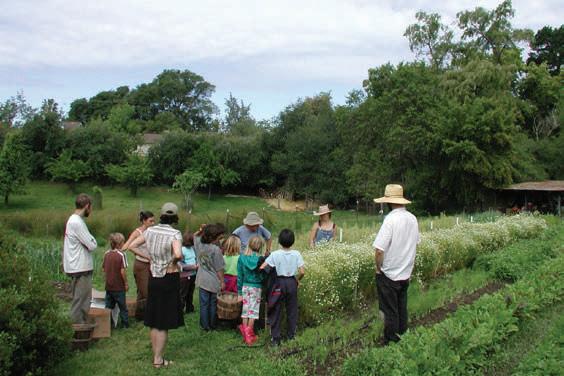
In February, the North American Biodynamic Apprenticeship Program was officially inaugurated with the first Farmer-Mentor Circle workshop, held at Hawthorne Valley Farm in Harlemville, New York. Thirty-one biodynamic and organic farmers and gardeners gathered for a weekend of presentations and discussions exploring the art of on-farm mentoring. As the group members shared their experiences, challenges, successes, and strategies for working with apprentices, they began to formulate a common vision of the gift that they as farmer-mentors might offer to the next generation of young farmers.
This vision was thoughtfully developed by Nathaniel Thompson (left) in the final presentation of the weekend. Nathaniel, who manages Remembrance Farm in Trumansburg, NY, offered a reflection on the ways in which a more collaborative approach to farming has enabled him to develop a balance between his inner and outer life, a difficult challenge that every farmer faces. It is part of the mentor farmer’s responsibility, he suggested, to model a healthy lifestyle and to support young farmers in developing the same for themselves. Nathaniel encouraged the group of mentors to consider how the development of cooperative farming communities might allow beginning farmers to envision and create high-quality lives.
In Nathaniel’s twelve years as a farmer, he has experienced a lot of transitions and encountered many obstacles. Through trial and error, he has succeeded in building a business that is both financially viable and supportive of his personal needs. Remembrance Farm along with two other farms is part of a cooperative Community Supported Agriculture (CSA) venture, known as the Full Plate Farm Collective. The collective preserves the CSA marketing model while allowing each farm to focus its efforts on specialized crops. Thus, each farm operation is streamlined, but can still maintain a connection to the broader community through the CSA. Administration and bookkeeping is managed by a third party non-farm-family member, and the association is strengthened by the friendship and trust that exists among the farmers involved. Nathaniel has found that working within the collective has relieved a great deal of the pressure he felt when farming on his own. He can produce a higher quality product and, with less stress and more time, live a more complete life.
The collective model has also opened doors to greater community outreach. The Full Plate Farm Collective is collaborating with several other local farms and the Cornell Cooperative Extension to launch the grant-funded Healthy Food For All program, which offers lower-priced CSA shares to low-income community members. Because there are several farms involved, there is more grant funding available for the project. Funds for this program are also raised at all participating farms through
events such as on-farm dinners. For Nathaniel, the opportunity to engage in this kind of broader community outreach is a key part of a fulfilling life, an aspect he could not have developed to such an extent without this kind of collaboration.
Nathaniel spoke about the painful experience of watching many of his farmer friends struggle and “tread water” as “slaves to the farm or to their off-farm jobs.” Why, he asked, are so many young farmers resigned to lives of financial destitution? It is possible, albeit difficult, to make a living as a farmer, especially given the growing demand for local, organic produce. What is lacking, Nathaniel suggested, is guidance from farmer-mentors beyond the apprentice’s initial training experience on the farm. The farmer-mentor must offer guidance to beginning farmers as they craft their business plans and envision their futures. How, Nathaniel asked, might we begin to grow a community that can encourage and support the possibility of a successful and balanced life for the young farmer?
Kimberly BarnesThe consensus in the group was that the work has already begun in earnest. The Farmer-Mentor Circle workshop is a first step in the development of a strong farmer-mentor network, which will provide support and opportunities in a number of ways. First, it is the foundation for a culture of guidance. Through workshops and conferences, mentor farmers will help each other to become better teachers. They will develop the ability to provide their apprentices with a fuller understanding of what it is to be a farmer.
The farmer-mentor network will also serve as a valuable pool of advice and support for the apprentices beyond the two-year program. A mentor might use the network to direct young farmers to appropriate partnerships or to resources that might help them gain experience and insight. Because of the network, farmer-mentors may know, for example, who might be hiring an assistant manager, who has an excellent poultry operation, or who has experience working with land trusts.
Of course, each mentor farmer can benefit from the network in the same way, using the network connections to build collective CSA ventures, share equipment, order bulk supplies, or get advice on a production problem. This collaboration and mutual support creates a lower stress, higher quality of life for the farmer-mentor, and this support system ultimately becomes a living example of collaboration for apprentices to observe and take advantage of in the future.
As Nathaniel explains on his website, “I wish to lead a life in which the outer conditions of life support and nurture my inner search for self-knowledge.” This is an ideal to which we all can dedicate ourselves as we progress on our journeys, and this awareness is perhaps the greatest gift that can be offered to the young farmers who find their way to the mentor farms of the North American Biodynamic Apprenticeship Program. May we succeed in providing it to them!
Read more about Nathaniel Thompson and the Full Plate Farm Collective at remembrancefarm.org and fullplatefarms.org. For the North American Biodynamic Apprenticeship Program, visit bdtraining.org. This article was forwarded from the Agriculture Section in North America of the School of Spiritual Science.

The Courtney farm in the Blue Ridge Mountains of Virginia, home of the Josephine Porter Institute for the last twenty-three years, was approved in November for a conservation easement through the Virginia Outdoor Foundation. A conservation easement provides for the land to remain in agricultural use rather than being subject to commercial or residential development, and results in a decrease of the market value of the land. Such a decrease will allow JPI to eventually purchase the land from the Courtney family, insuring a home for the preparations-making into the future.

Autumn is a busy time at JPI. At the last annual Fall Prep-Making Workshop and Conference more than thirty people gathered to learn how to make biodynamic preparations and to hear renowned biodynamic soil and vineyard consultant, Philippe Armenier.
The fall issue of JPI’s newsletter Applied Biodynamics featured an in-depth article by Hunter Francis on Manfred Klett’s 2008 visit to Rudolf Steiner College. Former head of the agricultural section in Dornach, Klett is author of many important books and lectures on biodynamics.
The institute’s 2009 educational events range from one-day workshops to the five-day fall preparation-making event. Topics include learning to make and use horn manure, horn silica, valerian, yarrow, stinging nettle; composting, harvesting of sheaths and working with planting calendars.
“The key is one’s attitude in working the land. Transform what you think and feel in your daily work! Even a conventional farmer with great care and devotion becomes a great fertilizer. We fertilize the earth through our work being penetrated and carried by our thinking and feeling.”
–Manfred Klett quoted in “Working in the Midst of Polarity: Manfred Klett’s Further Reflections on Biodynamics,” by Hunter Francis, in the Spring issue of Applied Biodynamics
The winter issue of Applied Biodynamics presented a revised and updated version of Ehrenfried Pfeiffer’s original farm survey questionnaire. This document was to furnish in-depth biographical information about the farm individuality in anticipation of a future visit by Pfeiffer to guide the farm into biodynamic agriculture. The
Maria Mihok attended the fall workshop and described its meaning for her. “Having now been a part of the process of the preparations from creation to application to witnessing the results, I have a whole new appreciation and reverence for them. I also have a much deeper level of gratitude for the plants, animals, trees, minerals, and human efforts involved. I have no plans to make the preparations on my own; however, I think I would be able to if necessary. And I know absolutely that every part of the experience of this workshop will live on in me whenever I buy, work with, apply, and speak about the preparations... I highly recommend this workshop to anyone of any level of experience with an interest in biodynamics. It will change your life.”
To get either single issues or subscriptions to Applied Biodynamics, email info@jpibiodynamics.org or call 276-930-2463. Upcoming events including preparation-making are listed at jpibiodynamics.org

In recent months the “local transition initiative” has generated a lot of interest in Spring Valley, NY. On Friday, April 24, it hosted a well attended focus evening. This summary of the introductory presentation was published in The Listener.

Flying in an airplane over the typical American suburb, you receive an interesting impression. Everyone has claimed a private kingdom, as big as his or her resources allow, and rules there as an autonomous monarch. Looking a bit more closely, you see that a breathtaking arsenal of material goods has been accumulated to make this lifestyle possible and comfortable, keeping anything that threatens it at bay.
This way of life seems to function, and may even initially seem desirable, but as we look closer yet, we see that it is beset by some significant problems. For instance, it consumes resources at a rate that would necessitate four to six Earths if every person around the globe lived like this. It also may not make us nearly as happy as we thought it might. It is hard to imagine that it doesn’t contribute in some degree to the isolation, loneliness, fear, depression, and anx iety that are so prevalent today. Considering the entire picture, we can see that this way of life is simply not sustainable in the long-term. Its use of energy, its impact on the environment, and the current state of the economy are all saying that it will need to change.
This way of life is fundamentally oil-based. Most of the products we use, including much of our food, were produced using large amounts of oil—be it in the production of plastics, in the pesticides and fertilizers used by modern agriculture, in the energy used to create and transport goods, or in many other ways. In addition, we consume large amounts of fossil fuels to provide heat and light, run appliances, and fuel the transport of goods and people to and from their homes.
We know that fossil fuels are finite resources that will simply be used up at some point. While that point may still lie somewhat in the future, evidence clearly points to the fact that demand for fossil fuels is on the verge of overtaking supply. In other words, especially as the populations of China and India begin to aspire to lifestyles similar to our own, it is not possible to produce enough oil to fuel them all. At some point in the very near future, fuel prices will skyrocket as the battle for increasingly limited resources intensifies. This shift, called “peak oil,” is well known to experts in the field.
Four-dollars-per-gallon gas a year ago was certainly an initial effect of peak oil. Through the current economic downturn, the effect has receded for the moment as demand has temporarily dropped. To be realistic, we need to expect gas prices to go far beyond that in the near future, making the way we live now essentially unfeasible. Experts also agree that alternative sources of energy can never come close to replacing the amount of oil we consume now.
Peak oil is telling us: it’s time for fundamental change.
In the last couple of years, most people have come to accept global warming and the destabilization of climate as realities. Some still question how much human beings are contributing to it, but it’s clear that we should not be contributing any more than absolutely necessary.
The scientists studying climate change seem to be much more worried than the rest of us. In her book How Fast Is Global Warming Happening? Sharon Astyk writes: “One of the disturbing things about listening to scientists studying climate change is the fear in the voices and words of people not accustomed to be fearful, and the sense that generally speaking, scientists are far more worried than most of us are.”
What makes climate change particularly frightening is the issue of the “tipping point.” There are a number of feedback loops that at a certain point can no longer be reversed. The best known is the melting of the polar ice caps. White surfaces deflect solar radiation. As the ice melts, this radiation is increasingly absorbed by the growing dark surfaces, generating warmth and melting more ice.
There are a number of other feedback loops. For instance, uncondensed water vapor thickens the atmosphere, increasing the heat that evaporates more water and further thickens the atmosphere. It is known that forests, plankton, and the ocean itself reabsorb CO2, but the large amounts of CO2 that the ocean is absorbing has made its surface more acidic. This surface layer of acidic water, which is also warming, is killing off the plankton, which then absorbs less CO2
The forests also absorb less CO2 as heat and dryness affect them negatively. They dry and burn, and whole ecosystems go from being carbon sinks to being carbon sources. A huge amount of peat bog is melting in the north, releasing large amounts of methane into the atmosphere, which has a warming impact about twenty times that of CO2. This naturally results in more peat bog melting.
There are still other feedback loops, and they all work together to create a process that at a certain point becomes irreversible and continues escalating on its own. If we haven’t reached that point yet, it cannot be far off. The climate is obviously telling us: it’s time for fundamental change.
America grew strong on its ability to produce. Today we
because others have been willing to lend us the money to do so. That willingness is obviously ending. We look down and find that we are standing on a pile of debt rather than on solid ground. As borrowed money is gradually yanked away, our lifestyle cannot continue as it has. You can’t live on credit indefinitely. The economy is obviously saying: it’s time for fundamental change.
Looking at all of this, we can see a few possible reactions: a) What problem? (the ultimate head-in-the-sand attitude) b) Someone will find a technological magic bullet, allowing us to continue as we are. c) Buy some canned tuna and a gun, and find a cave—we’re doomed! (the survivalists). Or d) Take responsibility individually and collectively to prepare for what is coming anyway. This could involve five C-words:
» Consciousness raising —understanding the situation.
» Conscience —what is appropriate for each of us to consume? What is our responsibility?
» Curtailment—realistically we would probably have to find ways to cut our consumption by 70-80%.
» Community —our strength lies in working together.
» Commerce —developing local economies will be essential. This brings us to the idea of “transition,” which assumes that the changes called for can actually have a very positive outcome.
Rob Hopkins (at right) was teaching permaculture in Ireland when he encountered the concept of peak oil. This led him to develop ideas on how a town can power down, skill up, and develop the resilience needed to meet the inevitable changes. Together with his students he created an “energy descent plan” for the Irish town of Kinsale that was later adopted by the town government.
In 2006 he decided to implement his ideas more completely in the English town of Totnes. This became the first “transition town,” and the idea took off like a rocket. Today there are about 150 official transition towns around the world, of which 24 are in the United States. All are working to some degree with their town governments to turn transition goals into official policy. In addition, there are a very large number of initiatives in the process of becoming. In the United States, there are official transition towns of all sizes all over the country. Well-known ones include Boulder and Denver, CO; Santa Cruz, Sebastopol, Laguna Beach, Los Angeles, Mount Shasta, and San Luis Obispo, CA ; Ashland and Portland OR; Montpelier, VT; and Portland, ME.
Rob Hopkins’s approach is not top-down; he does not supply a recipe. Each location is dealing with a different set of circumstances and will need to develop an individual approach. But he makes many suggestions of what could be done, and how communities can work together to develop the ideas they will need.
In marked contrast to survivalists, Hopkins is firmly of the opinion that the changes called for can lead to a richer and more enjoyable life than we have now. He also believes that community and working together are essential ingredients.
In 2008 he wrote The Transition Handbook, which features many of his ideas as well as descriptions of a variety of transi -


Would you enjoy shared farm projects, independent pursuits, inspired conversation and community? We’re looking for a good-natured person or couple to purchase part of our land and co-farm alongside us, sharing the work and bounty of our spirit-filled ten acres. On our biodynamic farm we teach sustainable living skills and how to have a kind-hearted relationship with nature. We are in a quiet valley a half hour from Portland, OR. and the land has always been organic. The farm is Certified Naturally Grown and on the WA Historic Register.
Our tiny village of 3,000 has a general store, small church and historic community center. We have a roomy farm-house, workshop, guest cottage, farm buildings and large barn. Room for another house, cottage and more farm buildings. We have orchards and forest, a milk cow, beef cattle, chickens, turkeys, honeybees, gardens, pasture and mild enough winters for a year round garden. Pristine well water, friendly neighbors, a wide Milky Way at night.
Cost is $265,000. Partial owner contract possible.
Read about the farm at www.FriendlyHaven.com Joseph & Jacqueline Freeman h Contact us at FriendlyHaven@gmail.com or 360-687-8384
tion towns. For information online, go to transitionus.org.
This community (Chestnut Ridge/Spring Valley, NY; Hungry Hollow Road is pictured, right) is unique in several ways. Two very relevant things that have been cultivated here since the 1920s are consciousness change on the one hand, and biodynamic agriculture on the other. If we look at all of the problems mentioned, we can see that we are mainly dealing with a consciousness problem. Humanity at large has been living with the attitude: What can I do for myself? If everyone around the world could change that to: What can I do for the world? there is no problem we couldn’t solve. We need to fundamentally shift from being consumers to being caretakers of the earth. Anthroposophy provides a powerful support for this shift in consciousness and the inner growth needed to make it possible.
That is a great plus, but there are also significant drawbacks. The anthroposophical community has not always been good at reaching beyond its boundaries, and often exhibits an introverted gesture. We have created little islands in which we feel we are cultivating something essential, and wonder why the rest of the world doesn’t always find it as essential as we do. Rudolf Steiner spoke of the many Michaelic souls in the world. We have shown a tendency to devalue what they are doing if it isn’t anthroposophy.
Ours is a community in a crisis. It displays more dying than flourishing tendencies. If it stays as it is, it is hard to see how that can be turned around.
On the other hand, we can see Michaelic souls in the world doing things that have real vibrancy and future in them, things that are urgently needed in our time, things that strike a powerful chord in many people today. If we can begin to work together and join our strengths with theirs, a great revitalization and
renewed blossoming of the community is very conceivable.
Many people have taken a great interest in this process. We are asking ourselves: What does this community need to achieve long-term health, viability, and resilience? (We consciously avoid defining the borders of “this community,” and would like to include anyone in the lower Hudson Valley who takes an interest.) We see important economic issues to work on, such as increasing local food production, distribution, processing, and storage; developing alternative energy sources; developing green building techniques, preferably with local materials; developing systems of reclamation and salvage to reuse materials already present; and generally growing a local economy. We also see important social issues to work on, such as creating networks to interact more strongly with our neighbors; creating systems to share resources and equipment; helping those in need; and facilitating communication. In the long term, we see cultural issues to work on. Who wouldn’t like to live in a community with a vibrant cultural life, with active dialog and exchange of thoughts, with artistic activities, and with spiritual nourishment, especially as our reliance on electronic media for entertainment diminishes?
Some of these things are already present or have at least begun. These are in need of support. Much of it has hardly begun to be envisioned, and there is plenty of room for creative, imaginative engagement. How this moves forward depends upon the initiative of each person involved. To get involved, visit the website localtransition.ning.com where you can find all sorts of information and join the email list. We are planning a series of events on food next, and after that renewable energy.
“Where spirit and nature meet”


This summer’s Rudolf Steiner Institute presents a special block of three classes, coordinated with Think OutWord, a peer-led training in social threefolding. Each course will meet separately for two sessions of each day to address pressing societal challenges from one perspective. Participants from all three courses come together in the third session to work artistically and collaboratively in prototyping of new social forms, led by Laura Summer. Evening programs during this first week are in the format of a community colloquium that integrates artistic presentations, talks by guest speakers, and two panel discussions. Those participating in the course concentration will present the explorations and findings that arise from their collaborative efforts. The courses are open to all, with a special invitation to the young and to anyone interested in starting, continuing, or connecting with socially progressive initiatives. There is a special discount for Waldorf graduates age 18-35. Go to steinerinstitute.org, call 410-358-0050 or email reg@steinerinstitute.org

With Robert Karp. Profound new social and spiritual impulses are emerging within humanity. In the last thirty or so years, for example, thousands of new “communities of interest” have sprung up that are working in one way or another for the ecological, economic, social and spiritual renewal of civilization. The coming decades will determine whether these communities can evolve and work together in such a way as to forge a worldwide movement capable of giving civilization an upward turn, or whether they will prove too fragmented, competitive, narrow and sectarian to meet the challenge of the times. In this course we will draw on the insights of Rudolf Steiner as well as contemporary thinkers in order to penetrate the mysteries of this decisive time and what it is asking of us.
Some of the questions we will take up include: Where do we see new social and spiritual impulses emerging in twentyfirst century America? How can those who carry the impulse of anthroposophy best work together with those from other movements who share our goals? What are the principles of community building and social transformation from a spiritual scientific perspective? How can we begin to embody these principles more fully in and between our initiatives, businesses, and organizations? Can a new community building impulse emerge from the heart of the anthroposophical movement?

With Jerry Schwartz, Clemens Pietzner, Robert Hill. If ever there was a part of our societal structure that cries out for change, that urgently needs to be re-imagined, it is western free-market capitalism. How could it have gone so wrong, become so out of balance as to require massive governmental intervention around the world to prevent global depression? The complexity and scale of this gargantuan economic network would seem to defy one’s efforts to understand or re-imagine it. However, if one examines this aspect of societal life, as Rudolf Steiner, in context of the spiritual/psychological make-up of the threefold human being, the picture that emerges is remarkably straightforward and instructive of what must be done to create balance and stability not only within our economic lives, but more broadly within the human community.
Using the framework and insights of the threefold social structure, we will address the questions that both experts and laypersons are asking: what lies at the roots of the current financial chaos; what attitudes, knowledge and practices must one acquire in order to navigate in this economic turmoil; what are the inner and outer remedies called for if we are to create a healthy social order; what new ways of thinking and financial habits or behaviors should one adopt to become part of the solution; what must change if western market-driven capitalism is to be prevented from destroying itself? The course will be led by three individuals who represent a broad spectrum of experience within the economic world: Jerry Schwartz has been a Wall Street broker and is president of Arista, a financial management firm; Clemens Pietzner is founder and president of Triskeles, a non-profit foundation that manages philanthropic donor advised funds, works with youth who are struggling to find their way into the economic world, and provides an organizational umbrella for start-up non-profits whose mission is community building; Robert Hill was president and CEO of a mid-sized management consulting firm that served a wide range of companies.

With Michael D’Aleo. Each one of us regularly hears stories about environmental destruction in the daily news. We long to do something about these problems but often feel overwhelmed by the magnitude of what is reported. Most of us find ourselves accepting the stories as reported and we feel ourselves ill prepared to deal with both the outer and inner issues that arise from such a startling and often bleak picture.
The course will offer three approaches to help establish a renewed and healthier relationship between our self and our environment. The first morning sessions will focus on helping ourselves to reconnect to the foundation for knowing the world: the relationship between the sensory and conceptual elements of our experiences. This activity will help us to breakthrough the limited view that we are encouraged to accept by many elements of our modern western culture. The second set of sessions will involve an investigation of some of the contemporary environmental issues: what is really happening, what needs to be done and what aspects do we need to be less concerned with. The third aspect of the course will consist of a group artistic activity in the sculptural arts.

[Republished from Revisioning Society & Culture: The Journal for Anthroposophy #77, which is third in the series of “Classics” available at anthroposophy.org. The original article was probably written in the 1960s or early 1970s.]

When we regard the situation of today, we see that it comes to meet us with a particular demand. Concerning this particular demand, the historian Toynbee has made a significant statement in a recently published essay. He points out that one of the most characteristic and serious symptoms of the present is the increase in violence in all areas of the earth and that, alongside this symptom of the increase in violence, there exists yet another symptom, the increase in pitilessness, which is evidenced among other things in the fact that nowadays there is no longer any underprivileged class of society, but that in all classes and levels of the populace there are underprivileged people; that is to say the old, the weak, such people who are not provided for by large-scale organizations. These two symptoms of violence and lovelessness are drawing humanity into a constantly worsening state of brutality. Toynbee states that every government is really based on force and that no improvement can be expected as long as nations do not discard the two principles of force and pitilessness.
In response to such an utterance, we can feel the challenge of the times appealing to our own hearts to find a style of working that can confront this violence and pitilessness with a positive example: the working together of free individualities. Certainly, Rudolf Steiner has said that people will and must become more and more individualized and differentiated, that this will and must bring about an increasingly greater danger of estrangement, that there will be no guarantee of safety in the future—this future has in the meantime become the present—and that there will only be one remedy, to live with trust in the spiritual world, which expresses itself in single human beings as the impulses of the individual.
Now, to these symptoms I have mentioned with reference to Toynbee, I should like to add a third that is significant and characteristic for everyone, but particularly, I think, for young people, and that is the wish to escape from being a consumer and being part of a society consisting of consumers. This dissatisfaction, this wanting to escape from a society of consumers with its forced production and its surplus of goods, is one of the deepest impulses of our time, especially in young people. Here we encounter a situation similar to the one that confronted Rudolf Steiner at the end of the First World War with regard to the proletariat.
The proletariat at that time wanted to escape from a society based on property and commercial interests and it possessed tremendous forces, impulses of will, to do so, but it only had the old manner of thinking and habits of feeling. It wanted to escape
from this old situation with old forces. That was the tragedy at that time. And the whole of present-day humanity is in a similar situation. The whole of humanity has actually become the proletariat. Fundamentally, everyone wants in his innermost being— even those who are at home in this society of consumers—to escape from it, particularly young people. But they do not yet know how to do so, and consequently they slip back again and again into the old habits of thinking and feeling, into the very attitudes that brought about this consumer situation. Progress can only be made when people learn to overcome the consumer situation in themselves and instead of being consumers, become producers in the sense of Rudolf Steiner’s words: “My whole work is only the apparatus on which one learns gymnastics.” The consumption of this work has no value. If one wants to help, and particularly to help young people, the first thing is not necessarily to provide answers—of course, one must also in a tactful way provide answers, as far as one can—but it is much more important to try to lead people to the point where they create the prerequisites in themselves, whereby they can answer their own questions and provide their own counsel. Wilhelm von Humboldt said that if you really want to counsel someone you should not give him advice. If young people are to help themselves through an inner exertion of will, through inner discipline and exercise, then it is just the overcoming of the consumer mentality that is urgent. In this sense, I should like to attempt a brief contribution. I should like to take as my starting point something one often meets as a question particularly from young people. This is the question concerning the path of inner training, of meditation. I intentionally choose the most delicate question just because it cannot receive a direct answer, since the best and most productive course is not to speak of the results and experiences of meditation if one wishes to make progress in one’s meditative life. Nevertheless, in the preparatory stage leading to meditation one can make significant observations. I should like to present observations of this kind as they might emerge in a living way during the course of a conversation, observations that need in no way be adopted by others, but may serve as a stimulus to develop out of oneself whatever corresponds to one’s own nature.
Let us consider the seed meditation, which you all know. Not only can it be meditated, it allows one to observe the preparatory stage of consciousness—that which precedes supersensible impressions or presentiments—with the sober, reflective calmness of the scientist. Out of a seed, we can let the plant appear before us in an inner formative process in somewhat the same wonderful way in which it occurs in Goethe’s elegiac lines on metamorphosis. Then we see rising before this inner, active process a growing, a striving from the darkness of the earth into light, from the formless to the formed, from the colorless to the
colorful, from the arid into the juicy. We follow these metamorphoses of plant growth, their expansions and contractions, closing to complete the ring of growing and becoming, which in turn becomes a link in the chain of life. But if at the same time we fix our observant gaze on ourselves, we notice that this meditation can only succeed if we produce a stronger power of will than we do in ordinary life. In ordinary life, our will is actually drawn along by that to which we are accustomed, by outer influences and coercions. It actually submerges itself in our activity and therefore eludes our consciousness. When we meditate, however, we must make a free decision to activate our will. And it is through this effort that we become conscious of it.
But it enters our consciousness in a strange way. Under ordinary conditions, it is always directed outward. Now it is directed inward. A complete reversal of the will occurs. And now as a consequence, the following experience can perhaps make itself delicately felt. This reversal of the will, which is directed inward on the seed or on any other phenomenon or being of the world, is like sending down roots into the essential nature of things. From these roots of will, the trunk of our own being begins to grow up.
We notice, when we continue this self-observation, that our life of feeling also undergoes a transformation. We feel ourselves wondrously refreshed through living like this in the growth of a plant. Green shoots begin to sprout in us, and perhaps even to blossom, and we notice that, in this sprouting and blossoming, we overcome the consumer attitude, the consumer mentality. No longer do we consume the seed, as we do not only by chewing it with our jaws but which we also consume by simply accepting it, or simply accepting any other object of knowledge in order to nourish our soul-life with it. But now within the “greening” in our soul, in our feeling life, the seed begins to unfold its leaves all over again. It achieves, so to speak, a new dimension to grow in. Not only does our relationship to the world change in that we provide the beings that are part of it with a new opportunity of growth rather than consuming them; no, our relationship to ourselves also changes, as I have already touched on, for we begin ourselves to spring up and grow out of the elements and the beings of which the world is composed.
imagined the world as a winged oak. This feeling life that is no longer confined to its own narrow limits and, in its limitation, is estranged from the world, now lives at one with the world and gives us the wings that support us in the world.
Thirdly, something changes in the life and events of our cognitional faculty. The processes that underlie our cognitional life, our representational faculty, usually elude our observation. Only in exceptional circumstances do they enter into our consciousness in a living way. Usually we only have the dead final products of these processes of our cognitional life in our consciousness. This means that we move in a bloodless world of shadows. But when, in meditation, we send down the roots of the will into things and spread the wings of feeling, we experience the law of plant growth, of the formative force that lives both in us and in things themselves. In this way, our cognitional life is now two-sided, like a Janus head, its gaze turned both in an inward and an outward direction. And now on this winged trunk with its roots sent down by the will, blossoms begin to appear, the blossoms of cognitional knowledge. The blossom, too, has two aspects toward which it turns. With its perfume, its radiant beauty of color, the blossom turns outward; inwardly it conceals the seed.
We notice, when we continue this self-observation, that our life of feeling also undergoes a transformation. We feel ourselves wondrously refreshed through living like this in the growth of a plant. Green shoots begin to sprout in us, and perhaps even to blossom, and we notice that, in this sprouting and blossoming, we overcome the consumer attitude, the consumer mentality. ... Not only does our relationship to the world change in that we provide the beings that are part of it with a new opportunity of growth rather than consuming them; no, our relationship to ourselves also changes...for we begin ourselves to spring up and grow out of the elements and the beings of which the world is composed.
But this springing growth is evinced in the sphere of our feeling life by still another change of direction. Previously, we reversed the will from a going-outward to a going-inward movement. In ordinary life our feelings are turned inward and are tremendously interested in themselves. In meditation, our life of feeling turns outward. We feel ourselves inside the being and becoming of things, and this allows another delicate experience to present itself. Attached to the trunk that is growing from the roots of the will, now, suddenly, wings appear, wings of feeling, for in the spiritual sphere roots and hovering do not contradict each other, just as Pherecydes, the European forebear of us all,
If we now ask ourselves: What has actually taken place, what are the forces through which our own being is conjured up once more out of the being of things as something that takes root and blossoms and has pinions? How does this seed ripen in our meditative experience? Then we must answer: It ripens, it grows, not through the force of nature, but through a force that lies in our own being. And when, now, to conclude, we inquire as to the nature of this force, we can say: It is a force that counteracts the forces of death that are also at work in our being. These death forces are just the opposite of the process I have been describing. They lead us away from the world, let us become estranged from the world, constrict our feeling life within the narrow limits of what is subjective and egoistic, and finally destroy our physical form. These forces, however, that allow us to sprout roots and blossoms and pinions, build up our spiritual form, they widen our feeling life beyond its narrow limits out to the periphery, into the encircling horizon, and they unite us finally with the being of the world. They are not the forces of death, but Easter forces of resurrection. And it is these forces of resurrection that spread and move the wings of this blossom- and root-sprouting sapling, in that we ourselves allow our own being to spring up and grow out of the beings of the world. These forces carry our being through incarnations and through the progressive development of consciousness.
Perhaps this may serve as a stimulus to overcome the attitude of the consumer in favor of an inner state of productive soul alertness.
Of all Rudolf Steiner’s works, the most important to Georg Kühlewind was The Philosophy of Freedom, or as he preferred it titled, Intuitive Thinking as a Spiritual Path. Nearly every book he wrote may be viewed as a response to Steiner’s injunction in that seminal work to experience —to realize—our own spiritual path.

The Light of the “I” was written in English—the only one of Kühlewind’s works that was, to my knowledge. Like most of his later writings it is brief, and was composed in a meditative state. It is a practical guide, a “how-to” book in the finest sense, designed to help his readers find the inner path and stay on it.
In the last thirty years, no anthroposophist has written with more erudition and ease on the epistemological and ontological foundations of anthroposophy than Georg Kühlewind. Witness, as only one example, his Logos-Structure of the World —as radical and profound a work of philosophy as was produced in the latter part of the twentieth century. But while he was as able as any of his contemporaries to present a dialectical exposition or defense of the inner path of anthroposophy, Kühlewind’s preferred focus was not argument but praxis. In his daily life he was always ready to serve as a mentor, a guide, and a friend to meditants attempting to achieve the meditative life, to practice what Rudolf Steiner called “the only really fully free deed possible in this human life,” the only way in this world to become “completely free.”
For those who were fortunate enough to attend workshops and study groups with him, reading The Light of the “I” will be a remembrance. So many who attended those sessions would not have thought to take notes at any other similar gathering. They would break that rule with Georg, however; then, puzzling over their own scribblings later that night or early the next morning, would ask other participants for their notes unless they were asked first. But what was conveyed in those privileged meetings was, in Kühlewind’s words, “vertical,” directed toward the source of meaning, and note taking is “horizontal,” that is, broken, associative, and object-directed. It is as if, in The Light of the “I,” we are finally given the perfect set of notes, horizontal and vertical, beginning with ordinary consciousness and leading up toward the source.
No one should read The Light of the “I” without first reading the introduction by Christopher Bamford, who presents Georg Kühlewind personally, provides keys to his relationship to The Philosophy of Freedom, and emphasizes Steiner’s aim in that book not to create a universal methodology, but rather to show how he himself had “walked” the “inner path.” The Philosophy of Freedom was not didactic but provocative, urging every reader to find his or her own path—to walk, as Antonio Machado said, like Jesus on the water. Mr. Bamford eases newcomers into Kühlewind’s arresting, perhaps initially off-putting, non-dialectical style. Kühlewind’s injunction is to act—to begin on an inner path and then make that path our own.
The structure of the book is simple. The first section, “What Are We Looking For?” is a meditatively sequential presentation of the central insight of The Philosophy of Freedom, transposed into Kühlewind’s own vocabulary of “attentiveness,” “emptiness,” “the witness,” and the “I Am.”
The second section, “Exercises,” is a detailed, practical guide to the development of our attention through “concentration” exercises. Kühlewind presents not one but a multitude of possible practices, advice on how to cope with distractions, and finally, in prose that smiles at our tendency toward dutiful imitation, hard will, and “cramped” effort, a gentle reminder to be playful.
The third section is the fruit of his own forty years of meditation, not only the textual meditation for which he is best remembered, but symbolic image meditation and perceptual meditation. While it is tempting to say that this is the end of the path, it is in fact where we must always be—“in beginning.”

Kühlewind ends his book with a personal afterword and a sequence of meditative sentences that may be worked with together or separately.
Books on the inner life have been plentiful, even fashionable, for some time. These books typically trace a predictable narrative of awakening to inspiration, often characterized by generalizations, a loftiness of tone, and a depiction of inner bliss.
You won’t find that here. This book is for readers who want to do anthroposophy rather than hear about it. Kühlewind outlines paths to the source through the humblest of methods and the simplest of exercises. What other writer would point the way to the kingdom of heaven through concentrated attentiveness to the distinction between “that” and “this”? For those who take the doing of anthroposophy seriously, for those who understand the inner path to be not an object of interest but a need, this is a book to read, to reread, and to keep close at hand. Georg Kühlewind gave so very much to so very many. This is the last of his written gifts.
Kim Chotzen invited Dr. Christopher Houghton Budd from Canterbury, England to hold a “town square”-style economic workshop in Viroqua, WI in October 2008. The economic crisis had already brought bank failures, record job losses, plummeting real estate prices, and dire financial bottom lines for three major US auto manufacturers.
Over the course of the weekend, Christopher gave two workshops with practical and timely details regarding the inner and outer aspects of associative economics. He covered a wide range of topics that pictorially described the journey of money from the old to the new mysteries and explored Rudolf Steiner’s place in economic and monetary history and in wider social evolution. Particular consideration was given to the refounding of the Anthroposophical Society and the inauguration of the School of Spiritual Science.
Christopher characterized the current economic situation as a result of a change in consciousness. Citing Rudolf Steiner’s “shell to its nut” analogy, Christopher described economic life as the shell of our inner life, just as the human body reflects an individual’s spirit. As general human consciousness has become abstract, so too has our economic life.
In ancient times economic transactions were sacred, and for long ages money in principle reflected essentially the “goods” side of economic life. There was little in the way of “credit,” which was confined to those with a greater consciousness of social life, such as priests and elders. Today, with electronic money and credit, our economy is 97% “money,” 3% goods. Money has gone from the realm of the visible to the realm of the invisible. If we are to become the masters of money rather than money mastering us, we need the will to engage with money and economics as a transparent bookkeeping process for which we are all now responsible. What we do with each economic transaction has impacts around the world and consequences for ourselves. We now have a one-world economy, which Steiner foresaw and addressed in his 1922 lectures.
Christopher says, “To this day, money links the inner and outer life of the human being, a characteristic which in our times needs to be placed in the foreground, not only so that monetary affairs become ‘soul sized,’ but also that the world of finance can be mastered by everyone.”
The entire weekend was recorded, and audio CDs are being prepared. Contact Rose Passafero (rosepassafero@gmail.com or 800-898-8215) for more information.
Michael stares taciturnly at humanity, awaiting deeds that are born of the spiritual world by human beings who tread the fine line between Lucifer and Ahriman. Anthroposophists know this as a spiritual quest and, especially today, as a battle for the soul - a seemingly permanent struggle to avoid inflammation and sclerosis. It is the same “event” that stands behind humanity’s recent experience of cheap money coupled with the idea that the value of assets can rise out of nothing and supposedly without constraint, on the one hand, and the sudden cramping of economic life and the intensification of state regulation, on the other. The combined effect on the soul is to disorient it, to make human beings disbelieve in themselves. More precisely, to refute by their deeds the fact that they are spiritual beings.
Undoubtedly, occult forces and manipulative actions are at work in today’s situation, but one should beware of locating the cause of the crisis in such things. That would be to mistake the sail for the ship. A Michaelic response would be to steer a course between extremes, and also to take seriously Rudolf Steiner’s concept of history as symptomatology.
For example, does the so-called credit crunch betoken a quickening in the unfolding of the Michaelic period, now in its 130th year? Is Michael trying to speak to humanity? And what is his message? It is very important not to underestimate this possibility; and not to focus overmuch on Ahriman’s role. For it is almost a platitude to see his signature in the current tightening of finance. The challenge, clearly, is not to respond in kind.
Seen as a phenomenon of the spiritual world, finance is a Guardian-like experience. It both reflects the human soul and one’s spiritual state, but also provides support for any change consequent on addressing the issues by which one finds oneself confronted. In such matters it is crucial not to locate the cause and the cure of the problem “out there.” It is also important not to forget that all human action is allied, as it were, to one god or another, so that it serves little real purpose to attribute today’s money problems to bankers, the rich, or other “agents.” What matters is whether our own financial behavior is Michaelic. Take care not to look at the dragon by seeking to attribute cause beyond ourselves.
The human being should stand firm on the fact that his home is on the other side of the threshold; the laws of that world have the power to order human existence (ergo, the caricaturing of this fact by what is known as “the market”).
To give expression to this, however, human beings need to ground their actions in the kind of economics that Rudolf Steiner describes. They need to be properly remunerated for their contribution but also properly capitalized. This will give expression to a new paradigm, the very absence of which is arguably the “cause” of today’s travails.
For example, when we sell or buy do we give thought to “true prices”? 1 It is persistent underpricing 2 that removes purchase money from the world, requiring people to borrow the difference and thus become party to the phenomenon of too much capital or loan money in the world.
Concerning the latter problem, Rudolf Steiner (among others, of course) gave clear warning. But we do not appreciate the full incisiveness of Steiner’s comments until we question what we are doing when we “save”
1 See lecture 6, Economics – The World as One Economy, Rudolf Steiner. New Economy Publications, Canterbury 1996.
2 See explanation of exploitation in Anthroposophy and the Social Question, 1905.
money by putting it in banks on condition that it is not lost, that is, not put at risk. We thereby, albeit unwittingly, give the foundation – savings supposedly not at risk – for modern credit creation, which could not be there otherwise. If we do not like undue credit expansion, therefore, we need to step beyond the cult of savings (for such it is) and begin to develop two distinct but related habits instead. On the one hand, we need to practice lending at risk. But that means to stop hiding behind the banks and begin direct investing – in the real-estate side of a biodynamic farm or a Waldorf school, for instance.
On the other, we need to learn to give money freely. Generally, of course, but in our movement specifically for work done by the sections of the School of Spiritual Science, provided, however, that this activity is evidently bona fide public benefit in character. A clear example of this is the Goetheanum Fund (Fonds Goetheanum) 3 recently launched in Switzerland by the Swiss Anthroposophical Society, the genesis of which lies in a question put to Rudolf Steiner by Mr. Van Leer at the Christmas Conference.
just as the closing entries in accounting are effected through the income statement and balance sheet, so gift money is of a higher order than and works through purchase money and loan money, which, it is important to notice, are also not of the same kind. In all examples, the lower two are explicit, the higher one present by implication.
If we gave thought to these ideas two things would result, and may indeed already be in the offing. Firstly, our own understanding of big economic issues, as also our day-to-day conduct, would become more precise (and therefore less vulnerable to Luciferic and Ahrimanic influences). Secondly, we would thereby help provide the ground for the key change needed in humanity’s general monetary understanding – namely, the need to perceive such pairings as cash and credit, income and capital, purchase money and loan money, as identities that belong to contrasting realities, each with its own logic. It is this fact –that cash and credit are not of the same kind – that is calling for our attention today. In a word, two kinds of money, not one, as is the convention. But not three, either.
Thereby also our actions will become more aligned with Rudolf Steiner’s monetary analysis, which remains, for the most part, unknown both in the world at large and in our own movement. A key part of this is his insight that, nowadays, money is synonymous with accounting – an evolutionary step that Rudolf Steiner clearly points to at the end of his lectures on economics. 4 This step we will not take, however, until we really act as if money is accounting and accounting is money. Then humanity will stand free of the so-called financial “system,” which in reality is a reflection of the way we behave, which in turn is an expression of the way we think. If ever thoughts were things it was in modern economic life.

Crucial to this process is the need to overcome too strong a focus on the idea of three kinds of money when, arguably, we should be paying attention to two: purchase money and loan money, income and capital. The “third” one – gift money – is not so much money as awareness of the need to maintain the balance between the other two, along with the technique for doing so. More precisely stated, just as hearing is a function of having two ears, so gift money works through the other two. And
3 See www.fondsgoetheanum.ch/en/home.html
4 Economics, op.cit.
To revisit the idea of three kinds of money in this way has a further, double consequence. On the one hand, it calls on the entire anthroposophical movement to review its monetary understanding of itself, while on the other, it renders Rudolf Steiner’s work understandable and tractable for academics and policy makers in the financial world, with whom detailed dialogues are currently underway concerning the contribution Rudolf Steiner’s ideas could make to the very specific technical problems that modern finance faces, especially today.
nIt is the signature of Michael that human beings separate things in their minds so that the I of man can make the world whole again. Michaelic finance is not therefore about the market versus the state, or liberalized or regulated banking; but whether humanity can take the step from one to two kinds of money. A Michaelic act, however, has one other key feature: it is accomplished while incarnate. This means that someone, somewhere needs to enact Michaelic finance if it is to play its part in human history. And not just someone, but many. Would that our movement as a whole became a first mover in this respect.
[This article was published some weeks ago in The Listener, a glimpse of that moment when artists turn from long training to challenges in the world. The photos by Charlotte Fischer show a performance by the Goetheanum’s resident eurythmists.]
By now everyone in the community is aware that our large class of sixteen women from many nations of the world graduates from Eurythmy Spring Valley in May. People are usually surprised when we tell them that it takes at least four years to finish studying eurythmy. Why so long? In eurythmy training we are not just training our bodies to move harmoniously and learning certain skills. Rudolf Steiner referred to eurythmy as a kind of soul gymnastics, and indeed this is what it feels like!
Eurythmy is a spiritual path through which we transform what is most unconscious in us—our movement. We can consider the movement not only of our physical body but of our thoughts and feelings as well. We are striving to awaken our whole being, from the depths of our heart to the tips of our fingers, and to express through our bodies what is shining within us, once it has been awakened. The women in our class have sacrificed much for the love of this art form, eurythmy, and for the most part the world around us has no idea what we are up to! It is quiet work here in a little valley and we are slowly growing from seeds into flowers, offering our colors and fragrances to the world. Each one of us has a special message to bring.
This summer, our class will have the opportunity to visit Dornach, Switzerland and perform on the world stage of eurythmy at a conference at the Goetheanum. As many as fifteen schools from around the world will show work from their graduation programs in many different languages and styles.


The only thing we are still missing to make our trip possible are all the funds! Our class has held several fundraisers: craft activities for children, lectures by special guests, a jazz café, a raffle, and
Victoria Sandler, for the class of 2009 more events and some lovely concerts to come. We have also mailed out a detailed fundraising letter to family, friends, and community members. A longstanding friend of eurythmy has offered a $1500 challenge grant. As we are still short of our goal, we are hoping to meet his generous challenge.
Some may still have the question that our donor posed to us: “Why does the graduating class go to Dornach? Why not somewhere else less expensive, or perhaps more fun, like Paris?” We felt that it would be good to share our reasons with everyone.
First, when you are pursuing a relatively unheard-of art form (consider that we are the only sixteen women in this country graduating with a diploma in eurythmy this year!), it is important to see as much as possible in order to be inspired and feel that artistic eurythmy is alive and well. In Dornach we will meet many students and professionals who support our efforts, and through mutual enthusiasm new capacities will surely develop.
The Goetheanum building and the surrounding area are very special to anyone working out of anthroposophy. It is a sacred and symbolic place where many eurythmists and great personalities have worked and made contributions to the work of anthroposophy. Also, the first Goetheanum was built by Rudolf Steiner, with the help of an international crew, at the same time that eurythmy came to birth. Steiner describes that for him the Goetheanum and eurythmy came from the same source of inspiration. How exciting, therefore, for us to visit and move in a place that is itself full of eurythmy in design and intent.
We believe that in Dornach we can offer our work in a place that will receive and nourish it, and perhaps even bless it as we carry it out into every corner of the world.
[The graduates should be in Dornach as you read this! To offer help, contact Eurythmy Spring Valley at (845) 352-5020 x13.]
PAAM (Physicians’ Association for Anthroposophical Medicine) and AAMTA (the association for anthroposophical health professionals) are holding their annual conference at the site of the Rudolf Steiner Institute, in Easton, MA, south of Boston, from the evening of Thursday, July 9th through noon on Sunday, July 12th. A meeting for members of the First Class and Medical Section of the School for Spiritual Science will precede the conference on the 9th. Call 410-358-0050 or email reg@steinerinstitute.org for more information and to register.
The threefoldedness of the nervous system will be studied from different therapeutic perspectives to get an insight into its role as bearer of soul and spirit. Presenters include Branko Fuerst, MD, on the peripheral nervous system; Cathy Sims-O’Neil, DO, on the central nervous system; Gerald Karnow, MD, on the autonomic nervous system; Jef Saunders on art therapy; Miriam Karnow on eurythmy; Marion Van Namen on music therapy; and Elisabeth Sustick, RN, LMT, on rhythmical massage.
“The etheric body is predominantly active in the sympathetic nervous system, which is present throughout the digestive organs. The nerve organs concerned are essentially organs that are live by nature. The astral and the I organization do not organize them from inside but from outside. This means that the influence of the I and astral organization active in these nerve organs is powerful. Affects and passions have a continuous, significant effect on the sympathetic system. Worry and cares will gradually destroy it.
“The astral organization is predominantly active in the nervous system in the spinal marrow with all its branches. This makes it the vehicle for the soul aspect of the human being, of reflex processes, but not for anything that happens in the I, in the self-aware mind and spirit.
“The actual cerebral nerves are the ones that are subject to the I organization. In them the activities of the etheric and astral organization are less marked. We see that this results in three regions within the sphere of the total organism.”
The
Anthroposophic medicine and therapies constitute a holistic and human-centered approach to healing and understanding human illness. These approaches recognize and utilize modern medicine’s vast information and rigorous methodology. Each anthroposophic therapist is fully credentialed in his/her profession.
The anthroposophic approach goes further than conventional modern therapeutics, adding knowledge of the laws of the living organism, the psyche, and the spirit. This knowledge is derived from a spiritual scientific methodology, which expands on conventional science. It requires—besides the ongoing professional, personal, and moral development required of every true health professional— an active meditative life.

This inner activity leads to a deepened capacity for apprehending the whole human being. Such a meditative journey was outlined by Rudolf Steiner in many books and lectures, and has been practiced and written about by many authors since that time. The result is an integrated image of the whole human being in illness and health. This makes possible a holistic but also rational approach to the healing professions. — [From the conference invitation.]
Medical, Artistic and Spiritual Approaches
Information available at paam.net, “Calendar of Events”
International Annual Conference of the Medical Section at the Goetheanum in Dornach, Switzerland, September 17–20, 2009
“Joys are gifts of destiny, which prove their worth in the present. Sufferings, in contrast, are sources of knowledge whose significance lies in the future.”
— Rudolf Steiner GA 40, p. 252

Dynamic watercolor painting is a therapeutic modality using the wet-on-wet method of bringing liquid color onto moistened paper. Its purpose is to create an experience of—and to (re-)establish an inner resonance with—the fluid, formative processes associated with life and development. We share these processes with the rest of the natural world. These developmental processes of life are most visible in the metamorphoses and transformations of plants, and in animal embryonic development. They are manifestations of our etheric, or life body
Color and music may both be seen as nonverbal languages with correspondences to our feelings, emotions, and moods, and to the moods of nature. They are languages of the soul (or psyche or astral body). They “speak” to us—we feel “moved” by them. The resonance between our inner world of feeling and the moods of outer nature is universal to human experience. Color as mood even appears as idiom in our various languages; feeling blue, seeing red, seeing things in a rosy light, and so on. Further, the seasons of the year, the time of day, the phases of life, all share resonance with one another as color-mood qualities of developmental processes. We can see these relationships broadly sketched as follows:
Spring Summer Autumn Winter
Sunrise Midday Sunset Night
Awakening Active Tired Sleeping
Unfolding Open Closing Dormant
Sprouting Growing Fruit-bearing Seed Dispersal
Birth Youth Adulthood Death
Warming Hot Cooling Cold
Light Bright Dimming Dark
New Potential Fullness of Being Fulfilled Future Impulses
Bringing these archetypal qualitative relationships into conscious alignment in the imagination through brief discussion before a painting session strengthens the exercise and makes the resulting images more potent.
The term dynamic implies energy, activity, movement (both inner and outer)—it denotes an activating principle. Through this therapeutic painting method, healthy developmental life processes (such as, in this case, the growth of a tree) are recreated on the paper through movement of color and form, activating the resonance between inner and outer, and mirroring (or imprinting) the healthy process within.
Dynamic watercolor painting is based on the premise that healthy images and processes that are taken up into the soul life through an individual’s own active participation— willed activity—work in a corrective/self-corrective manner, gradually
Spring-Summer 2009
replacing the unhealthy or damaged process with a healthy one.
This painting method engages individuals in rhythmic and harmonious experiences that strengthen their etheric/formative forces and make them aware of their inner connection to the world. The process can be seen as a reeducation of the inner life of the individual through a form of guided imagery.
With the image of the tree we experience not only a profound connection to its threefold nature—its roots firmly anchored and seeking sustenance in the darkness and depths, the strength and verticality of its trunk, and the outward-reaching, sheltering limbs that interface and breathe with the environment—we also feel an equally deep connection to the developmental processes that give the tree its life and form and that will continue to be the source of its unfolding potential into the future.
Since the root of much of our somatic illness is the psyche, dynamic painting of the tree, an image of how we perceive ourselves as living, developing beings in the world, serves as a psychosomatic therapy.
A developmental process takes place in time between past and future; it is a metamorphic process, that is, the idea or goal of the process is already embodied in the starting point of the impulse, as the idea of the oak is already in the acorn. In dynamic watercolor painting of the tree, we know what we are going to paint before we begin. How we get there, the process, is the developmental journey of our painting exercise.
In our lives, just as with the tree, there are periodic winters and springs, periods of dormancy and of new growth leading toward an eventual fulfillment of purpose; the sprouting acorn becomes a magnificent tree, the fetus becomes an infant, and the infant becomes an adult, fulfilling the purpose of the species. And in the human, that purpose is fulfilled in the development of individuality.
As humans, we have become increasingly individualized beings with a purpose distinct from the purely biological goals of our genes—and we need to seek this purpose within our own individual biographies (the human developmental process) in order to experience a true sense of self, and the connectedness of that self to other selves within human society. The idea that the life of each individual is not only purposeful but uniquely purposeful, and, as with the image of the tree, will develop and unfold over time, is both life-affirming and self-affirming.
Yet unlike the tree in nature, we as ego-beings need to unfold the seeds of our individual strivings with increasing intentionality. That means becoming active participants in our own development and in our own healing. The image of the living, growing, solitary tree is therefore offered as a kind of modeling clay into which we project ourselves quite visibly, and in which we can then effect change through our willed activity according to our own individual capacity to see “what is wrong with this picture.”
My role in the therapeutic process is that of a guide charting the way through unknown terrain, but never directing the individual journey or commenting on the significance of its outcome. I encourage individuals to look at their trees by asking questions, and I let it be known that help—therapeutic as well as technical—is available should it be needed. I note the difficulties and struggles of each individual during the painting session and use those as my guide for further therapeutic work.
Water is often called the substance of life. Everything that lives is composed mostly of water. Its qualities are associated with aliveness—mobility, mutability, fluidity, moistness, freshness. It changes form constantly, conforming to any vessel, moving with ease between vapor, crystal, and fluid. Things float on it, are carried by it, dissolve in it. It is the medium of life’s ongoing transformative processes. The developing fetus floats in the fluids of the womb in the process of becoming. Water is an enabler, a facilitator of flow, movement, change, and growth— and of infinite possibility. The qualities of water are antithetical to rigidity, isolation, and death.
Dynamic watercolor painting is thus oriented to process rath -

er than to finished product. Colors flow and change before one’s eyes, and forms evolve out of color. Everything remains mobile as the painting comes into being. That the paintings are also beautiful is testimony to a truthful process. Although producing beautiful paintings is a desired outcome that instills confidence and reinforces a desire to pursue the activity further, it is never a primary objective. I always clarify for newcomers that they are not attending a painting class
Although it is bright white, our painting paper is really a little bit of the earthly element—the non-living mineral substance of the world—though of organic origin, just like the earth. Wetting the paper, or watering the earth, is our first step in preparing to work with the life-process of a developing tree on that paper. By moistening the paper we make it receptive to the flowing colors and forms we are about to bring to it, and in faithfulness to our metaphor we moisten the paper from above downward, as rain would fall to the earth.
Nothing that we do from beginning to end of this painting exercise is arbitrary, and the predominant mood is one of attention and intention.
We all breathe the same air. In fact, we breathe one another’s air. What one exhales, the other inhales. The physical breathing process—a rhythmic receiving (of oxygen) and giving back (of carbon dioxide)—is our primal mode of interaction with the world. At birth we take our first breath of air, and it is now known that the fetus in utero breathes amniotic fluid with its lungs. The smells and tastes of our world come to us both physically and metaphorically through our capacity to receive them into ourselves. In this way we breathe in the moods of the world and of others, and we are likewise perceived and received —breathed in by the world. Conversation can be seen as a kind of breathing process between two individuals. All social interaction in fact, can be seen as a breathing process between individuals. It is also our atmosphere, diffusing and scattering sunlight, that gives us our blue daytime sky, the brightness of our day, the rainbow, and the changing colored moods of sunrise and sunset.
A tree does not extend its limbs into a void. It reaches out to receive the atmosphere of the garden and to give something back. Without being able to breathe physically, all living beings die. Without being able to breathe in our soul lives, we become ill and die inwardly. Without being able to breathe socially, we languish in isolation. We need others to breathe us in—to see us, hear us, validate us.
“‘Which color is cold darkness?’ I’ve always loved this strong and stout tree on the left, by a very petite lady in her 80s—petite, but not to be messed with! The tree at right is a tad more elegant, by a young adult female. I don’t speak of age or temperament in the article…”

Seasonal mood and daily weather determine what colors are offered—each season has its own palette of color and hue. Our inner mood or weather, affected by our physical and mental health, emotional state, as well as individual temperament, will determine how we use those colors—in what proportion and intensity. Given a warm summer palette, it is entirely possible for an individual to produce a very wintery looking scene. But the elderly, who find themselves in the winter years of their lives, and who often take particular pleasure in painting winter scenes, are not particularly prone to winterizing a summer scene. Interestingly, chronological age seems to have little effect when it comes to inner mood-states. A winteriness would need to have penetrated into the soul, not just the physical body, for this to occur. In fact, many elderly people experience themselves as quite youthful; and all of us have known periods of inner bleakness. A winter mood can also embody deep peace and serenity. Each season of the year, and every conceivable manifestation of weather, finds its reflection in the human soul.
While the colors are being handed out and before we begin painting, we have a brief discussion of the qualities of the current season and weather. In an effort to bring the colors before us into a living relationship with the quality of mood we are about to paint, I will ask, “Which color is warm sunlight? Which color is cold darkness?” and so on, so that as much as possible we will be painting with mood qualities rather than paints. (Illustrations above.) I then give descriptive pictures, such as “the sky is stormy and dark,” or “bright warm sunlight shines onto the cold spring earth.” It is rare for someone not to know what color I am referring to or what to do with it. The color in our cups is now no longer only the blue or yellow of our subjective meaning, but embraces an objective universality as well—we get a picture of the mood that’s in the air
When we paint the atmosphere, our papers are quite wet. This makes it possible for the colors to flow into one another and to be moved easily across the paper without becoming fixed. Working this way from out of an archetypal image (bright, warm sunlight) rather than out of an intellectual concept (yellow), painting is a pure expression of our feeling
and breathing (of our heart and lung regions). Painting at this stage is very free, mobile, and airy, and we have the least control over the fluid element.
With dementia, stroke, mental retardation, and other conditions in which a cognitive or physical deficit impairs an individual’s ability to control the application and intensity of color, prediluted color is offered. I always test the strength of the colors in relation to one another ahead of time to insure a pleasing, positive aesthetic experience for those who would otherwise experience frustration and ineptness—both very counterproductive reactions. This intervention reduces the likelihood of ugly and unsatisfying results. We want people to enjoy the activity, look forward to future sessions with anticipation, and reap real therapeutic value from the ongoing process.
A tree is always in a landscape. While trees generally grow in forests where the group has dominance over the individual, the solitary individual tree—the individualized tree with which we identify always stands


alone (or in a small family group) on cleared or cultivated land. Many of these trees have been planted for shelter, food, or beauty. The landscape, the garden in which the tree grows, has been tended by human hands and is the chief source of sustenance for the solitary tree. The tree can achieve its full potential only when there is a garden to nourish it—when it is rooted in a sustaining substrate. The image of the tree, then, cannot be separated from the image of the garden. It is our garden, our inner resources—our capacity (as adults) to self-nurture—that feeds or starves our developing selves.
Once the atmosphere of the garden has been established, we are ready to create the landscape. We prepare the garden to re-
picture. The portraits we are about to make of our trees will be a window on a moment suspended in time. We recognize our tree portraits season after season, as we recognize the reflection of our own changing image in a mirror. Observation has shown that each individual paints a specific tree that reappears with almost no deviation in form from season to season (illustrations below and next page center). The trees (as well as painting styles) are so individual as to be identifiable with a specific person, much as one’s handwriting is. And each individual develops a kinship with his or her tree—an intimacy and fondness that is only strengthened by repeated seasonal visits. We look forward to these periodic visits, to seeing how our trees are doing.
Despite our greatest efforts, the trees we paint are often not everything we would wish them to be. And even when they


ceive the tree. Each individual is encouraged to create a personal garden. It is the solid, physical ground on which we stand, and it contains the plants, rocks, and other features we choose to place there. It can be a lush paradise or a barren, rocky hillside.
By this time our paintings have dried somewhat and can now receive more (or stronger) color. Though still moveable, our colors now flow and spread minimally. The placement and blending of colors is now more controlled and intentional, and the mood in the room has become noticeably inward and meditative.
Now we arrive at the central theme of this exercise: growing the tree—placing the projected image of ourselves into the
grow beyond our expectations in strength, grace, and beauty, we are somehow still aware of structural anomalies, areas of fragility, parts that are broken, disconnected, or congested (three illustrations next page, at right). Our trees are as perfect and imperfect as we are.
Usually, the healthy part of us feels called upon to heal that which we perceive as ailing in our trees. The awareness of weakness and the response to heal sets a relationship of caring attentiveness in motion. The trees are ours (even when not consciously perceived as being us). We want them to do well.
Preceding or following a major event such as stroke (illustration previous page, bottom right), onset or lifting of depression, certain changes in medication (illustrations at bottom of page
30 ), and before (natural) death (illustrations at top of page 31 ), some individuals will paint completely different trees. They are usually surprised by the unexpected new picture and in awe of the process that led to its expression contrary to their intention or accustomed skill.
Those who see anomalies in their painted tree images and express the wish to correct or repair them, or ask for help in doing so, are already capable of a certain level of objective awareness and are encouraged to proceed with this self-corrective activity. This suggests that they are capable of effecting positive change in their own lives—strengthening their internal locus of control. This is a major objective of this therapeutic painting process. Through self-initiated, intentional corrective activity based on a relationship of attentiveness (caring) for our projected trees, we become their gardeners, actively participating in our own healing and development.


Trees can be distinguished by type into two broad categories: the deciduous trees that change visibly with the seasons, go through a winter dormancy period, and have the characteristically branched crowns that most of us envision when we think of a tree; and the conifers, the needle-leaved evergreens (the Christmas trees) with their more typically upright form.
As noted, plants take in carbon dioxide and release oxygen: the mirror image of our breathing process. The plants that form the earth’s green mantle can be seen as its breathing organs, especially the trees of its great forests. The deciduous trees in particular, with their open branching pattern and broad leaves, are mirror images of the branching bronchia and air sacs of our own lungs. It is also in the sheltering crowns of the deciduous trees that most birds and other animals make their homes, and under which we seek shelter from rain and summer sun. These trees are also major food producers.
The conifers, by contrast, have no crowns. Their fine branches jut rhythmically from a stout, central, vertical shaft. Conifers remain fully cloaked year round, frequently down to the ground, keeping their forms well hidden. Their gestures are less gracious than those of deciduous trees, they are home to fewer creatures, provide less to humanity, and are less individualized. The bare conifer form is evocative of the spine and nerves, our sensory system, rather than of the lungs. This can alert us to possible nervous system involvement when it is presented (illustration page 27, bottom right). In addition, the solitary conifer densely cloaked to the ground in deep green presents an isolated and impenetrable presence—closed, secretive, unwelcoming, and unsocial—when it is not specifically a Christmas tree.
“Despite our efforts, the trees are often not everything we would wish them to be....parts are broken, disconnected, or congested.“
...with almost no deviation in form from season to season.“


Where time and endurance allow, we pause in our painting session between the creation of the garden and the placement of the tree. This pause has a twofold purpose: it gives us a chance to talk about the nature of the tree, our own personal connection to specific trees in our lives, and to explore why we feel a resonance with the solitary tree. The discussion strengthens the living image of the tree in our consciousness, helping us to paint a living, growing entity that is intimately connected with its environment. This pause also gives our paintings time to dry out sufficiently so that our painted trees can maintain integrity of form.

All living beings have a “skin” that contains them and separates them from the world. In addition to this physical boundary that defines our form, our egos define us from one another as individuals —as separate selves. In our paintings, we want our trees to have both integrity of form and inner substance. We do not want them to bleed out or merge into the environment (illustration above, right), or to be transparent or empty (three illustrations above, left). To accomplish this we have to gain a certain amount of control over the fluid element through our will—this translates into increased capacity to control the etheric-for-
mative processes of our development. This activity of the ego strengthens our sense of self and our capacity for self-control. When the ego is weak, such aberrant images can emerge.
Our paintings are now damp but no longer wet, and we paint our trees slowly, carefully, and consciously, with less fluid on the brush, exerting as much control as we are able while forming our emerging trees. We grow them from the ground upward and outward, in the direction of the flow of sap. They are drawn toward the light and air, the way a tree would grow in nature. The healthy tree will be rooted in the earth of the garden, grow upright with outward reaching branches, and stand well-defined against the sky.
With elderly or weak individuals, where each task can be slow and laborious, the tree-painting exercise is spread over two sessions, with the first devoted to the establishment of the atmosphere and the garden. We then re-moisten our paintings in the second session, and re-establish the continuity of the exercise as well as the relationship between the garden and the tree, by “working in the garden a bit” before planting our trees there. This activity of recollection and recapitulation bridges the gap between sessions, eases us back into the process, and makes it possible for our painted trees to be fully united with the landscape.

The full form of the tree is now visible, including its size, type, placement, proportions, rootedness, uprightness, solidity, integrity, gesture, the branching pattern of its crown, and its relationship to its environment. The archetypal tree image is essentially complete at this point. We are now ready to bring the optional seasonal elements of foliage (green or autumnal), flowers, and fruit into our paintings.

I designate these as optional, because it has been my experience that many individuals feel satisfaction and completion after the intense labor of bringing the full tree-form into their paintings, and either have no wish or no energy to go further. For these individuals, then, as well as for those who do wish to continue, we pause briefly at this point in order to look with wonder and admiration at one another’s trees. Everyone is left free, no one feels pressured. Those who are finished will sign their paintings and either leave or stay to watch.
“These were both painted shortly before a woman’s death from cancer; they show an increased letting go. The second painting (right) shows the tree in a “weeping” version.“


The formed elements in the painting, the garden and the tree, are initially painted in blue. Blue is the color that is closest to darkness. Matter, physical substance, is impenetrable to light to varying degrees, and so we use blue, the color of darkness, to give things initial form. Therefore when sunlight (yellow) shines onto the earth (blue), plant life (green) naturally appears. Likewise, when our trees (blue) are warmed by the sun (orange-red), they become brown, as does the warmed earth that is visible to us. In the same way, the foliage growing from the branches of our summer tree (blue) into the surrounding heat and brilliance (warm yellow) of a summer day, becomes at once a rich green canopy. As in nature, the branches in summer become clothed with a mantle of green, and the tree’s form is no longer clearly visible. And, just as the real tree does not bypass making branches to produce foliage, it is from the branches of our trees that the foliage grows. Not only are we being true to a natural process in painting our trees this way, but we get to see their underlying form regardless of the season.
In autumn we condense and trap the sunset colors of the sky (visible through the branches of the tree) into the rich, warm, and often fiery foliage of the crown. Our autumn tree glows against a background that echoes its mood. In spring, we likewise condense the soft, pastel tints of wafting fragrance or of sunrise (visible through the branches of the tree) into a blossoming crown of varying delicate hues.
Although fruit is mentioned in our seasonal, pre-painting discussions, I have never specifically requested it. Fruit often appears spontaneously in the paintings of some individuals, and men as well as women will ask if they may also add fruit to their trees. While the appearance of fruit may sometimes represent one’s offspring, bearing fruit in one’s life can also be seen as the fertile culmination of a particular period of struggle and
growth for an individual, and at the same time the beginning of new impulses toward the future: fruits contain seeds. One of my most enthusiastic painters was ninety-nine years old. He developed a zest for life he claimed was lacking in his younger years. His spirit seemed ageless.
The therapeutic approach described here developed into its current form through my work with a group of elderly members and mildly developmentally delayed young adults at the Rudolf Steiner Fellowship Community in Chestnut Ridge, New York; with adults attending the self-development seasonal tree painting workshops I offered at the New York Branch of the Anthroposophical Society; and from workshops offered at therapeutic recreation conferences. Much more can be said about the therapeutic value of this work, just as more can be read from the content and mood of the paintings, but that is beyond the scope of this article.

About the Author: Phoebe Alexander received her diploma in anthroposophic art therapy from “De Wervel,” Academie vor Kunstzinnig Therapie, The Netherlands; training in Waldorf pedagogy/ remedial pedagogy from Emerson College in England; certificates in gardening and horticulture from the New York Botanical Garden, Bronx, NY; and her MSEd in therapeutic recreation education from Lehman College, CUNY. She maintained a weekly therapeutic painting group at the Fellowship Community for about 15 years, and has offered courses and workshops on this and other areas of anthroposophical art therapy at the New York Branch of the Anthroposophical Society, at conferences, and other venues. Anyone seeking further information on the topic of this article or on other aspects of anthroposophical art therapy should feel free to contact her directly at 212-744-0257 or phoebe@artopathy.com. For more information about anthroposophical art therapy in North America, go to www.aaatna.org
This August 1-8, participants from many countries will come together in Whitehorse, Yukon, for the week-long conference Encircling Light–Expectant Silence [encirclinglight.ca]. As I continue to prepare for this week, it seems good to bring together intentions, questions, insights, and nuances from some of those who will take part in it.
When Edna Cox from Port Alberni, British Columbia, traveled to Whitehorse in August 2006 to begin preparing for the conference, she wondered “just how my anticipation of the north and its reality would fit together.” Such a question may also live in other participants, especially Canadians for whom “north” is a strong imagination of who they are, yet one that can seem remote from where they actually live. In the words of Alexandra Günther, a workshop leader from Ontario, “Central to my long-standing wish to be part of something like this is the question: What is it about the north that draws us there, we who are not its creatures? And what is the idea of north in the Canadian mind and heart, and in other people who have never been there?”
Canadians carry varied, powerful, and conflicting images of their north, a fact that has fueled countless books, articles and works of art. Yet certain images are pervasive. West Vancouver participant Robbie Black pictures a drive northward from Edmonton, Alberta. The city falls behind, then the farms, then the last cluster of houses, until only the forest lies ahead: “When the car comes to rest, the silence descends…a subtle awareness emerges of all that lies in hiding, out of sight of the casual glance.”
Other participants are drawn northward by the silences they intuit from or have experienced in that part of the globe. Marjorie Nordås, a Canadian now teaching at the Norstrand School just south of Oslo, once traveled northward with a group from an army base in Toronto: “We made a performance right up between Russia and Canada, at a base called Alert. I was 20 years old but it was my first strong experience of the light, and what touched us most was the silence.”
Jef Saunders, who emigrated from Britain to Toronto, is also drawn to the “expansive light-filled days” and “deep, yet expectant silence”; he also wonders what spiritual intentions might be hidden in that landscape, waiting to be drawn out. Or are these intentions hidden in ourselves, waiting to be unveiled within this northern setting? At the close of the nineteenth century, prospectors from around the world flooded into the Yukon looking for gold. Workshop leader Anthony Perzel, who is concerned with understanding the activity of elemental beings in the north’s mineral wealth and Luciferic and Ahrimanic influences in our exploitation of it, observes: “The seeking of precious metals and diamonds is analogous to seeking the ‘precious’ within ourselves.”
For at least two participants, the conference will provide a context for understanding the importance of the places where they live. Olga Kornienko from Ekaterinburg, Russia, writes: “Here in the middle of the Urals we have extreme variations of temperature, from -40C to +40C, with northern snowy winters and hot southern summers. The mountain range itself looks a lot like a spinal column; in the history of Russia it always played a spinal role. People here are strong and courageous, especially the women. Being a barrier and a gate, the Urals gathered dif-
ferent peoples and religions. So too, meeting different people from different parts of our planet helps you to meet yourself and know your native land better; the other side of the earth reflects your own land.”
And from Anchorage, Alaska, Mary Lee Plumb-Mentjes, with her Fairbanks colleague Lisa Del Alba, is trying to understand Alaska’s spiritual meaning in the world by observing its landscape, the angle of the sun, the caricatures of its people in the press, its 50th anniversary as a state of the United States: “How are we the same as and different from other northern lands? The not knowing is exciting. This is my first explicit, prolonged anthroposophical research; it is also very daunting.”
For Jorun Carlsen of Tønsberg, Norway, the conference could be an opportunity to carry forward many years of research, as an extension of Nordic anthroposophical summer conferences held in Scandinavia and Finland and later, Iceland, since 1949: “Now I feel this impulse has expanded to the American continent, to Canada, and maybe next time it will be the Nordic East—in Russia. Nothing should be static; it has to change according to the time. I feel it is very important that we anthroposophists connect to and cooperate in a conscious way with the spiritual world in different places in the world.”
On a similar note, Marie Kolmos of Copenhagen, Denmark, wonders: “I’m curious about what a conference in the north could be like: Are anthroposophical thoughts and themes different from ones in the south of Europe? What can happen in a northern conference not held in a Scandinavian context?”
One contrast is evident: A conference hosted at 60 degrees latitude in the Nordic countries is supported by the presence of the Anthroposophical Society, anthroposophical initiatives and one hundred years of anthroposophical activity. Virtually all of Finland lies north of 60 degrees, as does most of Norway and much of Sweden. Iceland has only a few members of the society and one Waldorf school and biodynamic farm, but all are active north of 60 degrees; so too in Alaska, with the Waldorf school in Anchorage and the four members of the School of Spiritual Science in Fairbanks who meet weekly to work with the class lessons. In Canada there is a single anthroposophical initiative at 60 degrees—the Waldorf preschool Chalia Tuzlak cares for in Whitehorse, where she has lived for twenty years. After having to travel thousands of miles over that time to go to pedagogical conferences elsewhere, Chalia is amazed and excited about the

conference that will be held on her doorstep this coming summer: “Some people call me a keeper of the flame in this part of the world, but with no one to discuss thoughts on an anthroposophical level, I haven’t had many opportunities to grow on that path. So for me this conference is an opportunity to gain a new understanding of what supports my everyday life, as well as a new perspective of the north.”
Two further themes gleam through the thoughts of participants. One is a wish to meet and interact with First Nations peoples for whom the north is their homeland—an intention and responsibility acutely felt by Seija Zimmermann and Paul Mackay when they met last August in Whitehorse with the council of the society in Canada. For Jonitha and Paul Hasse of Hillsdale, New York, a meeting with First Nations friends stands in the context of a larger question raised by the failure of European cultures “to listen, to learn, to honor and to share the spiritual gifts of different peoples.”
The second theme is that of discovering the Christ in a new way: How can the light and silence and expansive landscape of the north support an expanding and deepening understanding of the etheric Christ in our time? In the words of a participant who lives near Edmonton:
I have never been to the North This in itself is reason enough to go. There is a mystery about this place— undiscovered truths waiting to be understood.
From hence the Christ is coming, Christ in the Earth, Christ in us.
Last summer I stood at midnight on a bluff north of the Arctic Circle, overlooking the Inuit hamlet of Kugluktuk and the Arctic Ocean at Coronation Gulf. The sun hovered a few degrees above the northern horizon—as if it were about to return to the place from which it once left the earth. Yet after a time sunset became sunrise; the sun journeyed back into the sky, as if to remind me that Christ-sun comes to the north along another path, the path of warm, human activity.
And from Paul Mackay: “This conference in Whitehorse is of a special nature... Every step was silently contemplated and carefully designed; the contacts with those involved were taken care of in a most human way. All this creates a wonderful basis for the conference to unfold: May the encircling light shine over this conference!”
What are the essential tasks of the Anthroposophical Society?

This is a question that has occupied the general secretaries in their meetings for two sessions, most recently again in our April meetings in Dornach. The executive council had prepared four aspects for our conversations:
Experiencing the “destiny of the age” through the human encounter. To quote from Paul Mackay: “Anthroposophy itself must be understood as something with its own living quality. Anthroposophy knocks at the door of the heart and says: ‘Let me in, for I am your true human being!’ This being is not given by nature – it must be sought by human beings though study, practical schooling, and meditative deepening. The Anthroposophical Society is meant to prepare the ground for this work. This deepened self-knowledge leads to an experiential understanding of karma and reincarnation. Self-knowledge becomes world-knowledge. Life itself becomes an expression of karmic relationships.”
Accessing the inherent “I am.” A characteristic of our Michaelic age is that self-knowledge leads us increasingly to a
greater connection to the inherent “I am.” Since the crucifixion, when Christ’s blood poured into the earth, the greater “I am” of the Christ can be experienced in humanity in general. This becomes a creative force toward a new universal culture.
The reappearance of the Christ in the etheric. To quote Sergei Prokofieff, “The whole of anthroposophy can be seen as a preparation. It is a modern path on which the spiritualization of human thoughts can begin to consciously penetrate into the world of imagination where the etheric Christ can be perceived today.
How can we read the signs of our times? Today people everywhere are confronted with social and personal situations that cannot be understood without the benefit of spiritual insight. How can we help decipher what is being asked of us, and how can we respond?
These themes are further developed in recent issues of Anthroposophy Worldwide, which is readily available to readers online through the society’s web page ( goetheanum.org).
Editor: John H. Beck
General Council Members
Torin Finser (General Secretary)
MariJo Rogers (General Secretary)
Gordon Edwards
James Lee
Regional Council Representatives
Lori Barian (Central Region)
Linda Connell (Western Region)
Ann Finucane (Eastern Region)
Marian León, Director of Administration & Membership Services
Winnie Han, Director of Financial Services
Jerry Kruse, Treasurer
Associate Editors: Judith Soleil, Fred Dennehy
Please send submissions, questions and comments to: editor@anthroposophy.org or to the postal address above.
©2009 The Anthroposophical Society in America
The responsibility for the content of articles is the authors’.
In addition to these ongoing conversations, we heard reports on the mystery dramas, society finances, and the recent meetings of the executive council and collegium with Judith von Halle. Many of us had a chance to experience the new productions on the large stage that demonstrate Rudolf Steiner’s attempt to give form to the inner life of the human being. In regard to finances, many questions were raised as to the future support of the society given stable or declining membership (minus about 1,000 last year); the decline of unrestricted donations; and the ever-present needs to repair and maintain the building that so vividly represents anthroposophy on the earth.
In her report on recent meetings with Judith von Halle, Elizabeth Wirsching (head of the youth section) spoke of how we can strive to get beyond sensationalism and find perspective in freedom. She warned of the danger of polarization and the potential for factions to develop among different points of view. She asked what it might mean as a sign of our time that so many members have responded to this call to meet the Christ?
Regarding more external matters, we heard that the Aktion ELIANT has now gathered 720,000 signatures in their petition to the European authorities regarding homeopathic remedies and alternative approaches to healing. More signatures are still needed to reach one million, so please participate! We also heard about further efforts to transform the publications of the society arising in Dornach, and I was able to circulate our Evolving News for Members and Friends just off the press. It received many positive reviews.
Finally, I want to draw your attention to several important events in the future: We have in the year ahead the 100th anniversary of the St. Mark’s group in New York City; in 2011 the 150th anniversary of Rudolf Steiner’s birth, and in 2012 a planned conference in Ann Arbor with the executive council, most likely the first week of August 2012. We have set as a tentative theme Health and Illness. So please mark your calendars.
Sincerely,
Torin M Finser General SecretaryThe theme of evolution is present everywhere this year. The occasion is the commemoration of the anniversary of Charles Darwin‘s book The Origin of Species and his birthday 200 years ago. To begin with, we associate Darwinism in an anthroposophical context with the frightening battle of existence and a materialistic world view. Conversely, his insight into natural evolution was to Rudolf Steiner one of the three conditions for the appearance of modern spiritual science (Notes for Eduard Schuré, Sept 1907 from the so called “Barr document”, GA 262 - Rudolf Steiner and Marie Steiner-von Sivers: Correspondence and Documents 1901-1925 ). Further, Rudolf Steiner speaks in his lecture of 1913 about “a deeper understanding of Christianity that lies in Darwinism” and that “in our time the Darwinistic impulses are born out of the Christ impulse” (GA 148, The Fifth Gospel ). We would like to take this anniversary as an opportunity to propose a deepening of the theme of evolution. In addition, we want to advance the idea that the many controversial thoughts regarding this theme living in our culture today can be complemented by anthroposophy.
There is hardly a subject in anthroposophy that does not include the theme of evolution, from the development towards a free human being in the great presentation about the evolution of man and the world to Rudolf Steiner’s last great work, the founding of the Free School of Spiritual Science. Ultimately it is all about evolution and self development, one cannot exist without the other! For that reason it is noteworthy that the modern idea of evolution only came about in the late 18th century through Johann Gottfried Herder, Johann Wolfgang Goethe and others.
Before this time the word evolution was understood as the unfolding of something that was already there, in other words, predestined in the original sense of the word. Now it is about a striving to become different, the achievement of something new that was not already there. This is the reason why Goethe avoided the old word as much as possible. This new concept of evolution is the one that Darwin picked up on to understand how new species come about in the earth evolution. The thought of evolution taken in this way certainly belongs to the great achievements of post Christian times.
In recent years the themes of the year were connected with the thinking of the heart. When you try to observe how you take in and think about evolution or metamorphosis, you can discover that much of what Rudolf Steiner
describes about the thinking of the heart (March 30, 1910, GA 119, Macrocosm and Microcosm) relates to it. Thinking about evolution is not a logical cause and effect but a sculptural participation that ends with insight into the relationships under consideration. You can experience this in a simple sequence of leaves. In this way we are able to connect with the larger question of evolution. We mention two more questions here.
If you have an encompassing view of evolution everything can become different, and we know well that Rudolf Steiner also describes the evolution of spiritual beings. This means that nothing remains the same. Then again one can only speak of evolution when something remains the same, identical with itself. How could one otherwise recognize in the new phase that which is evolving? How could one otherwise speak in the Saturn state about the germs of human beings? Rudolf Steiner discusses this question from various points of view in the lectures Evolution, Involution and Creation from Nothing (June 17 1909, GA 107 – Spiritual-Scientific Knowledge of the Human Being) and in the lecture Polarity of Duration and Evolution (September 15, 1918, GA 184 – The Polarities of Duration and Development in the Life of the Human Being. The Cosmic Pre-History of Humanity).
A completely different aspect opens up when you look to Darwin for the origin of the thought struggle of existence. Darwin describes how the social scientist [Thomas] Malthus inspired him with that thought. Malthus had observed in the early 19th century something similar in the capitalistic English industrial society. Thus the thought was not derived from nature but from human behavior. And later, in the 20th century, the thought was reversed to justify the worst human behavior in the sense that it was only natural that the fittest would survive. You also find a connection between social science and natural science with Rudolf Steiner, but reversed: that from the natural sciences we learn and practice new ways of thinking which can lead to formative ideas that are fruitful in the social realm. Rudolf Steiner talks about this connection in the opening cycle in the First Goetheanum: Boundaries of Natural Science (GA 322).
With all that has been said here, a theme clearly comes to light that penetrates the whole of anthroposophy regarding the concept of evolution. The future of evolution depends on how human beings give it form out of freedom! This thought about evolution is worthwhile when it finds entrance into our present culture.
(translated by Jannebeth Röell)
A time of crisis is very often the birth moment for important new initiatives. It is with that awareness that we are proposing a new funding program, the Michael Support Circle, to complement the membership dues that are our financial foundation. For the Anthroposophical Society in America, the worldwide economic crisis comes on top of several years of declining annual income. For 2009 our deficit before legacies is approximately $50 per member. Over the last year your national council has taken a number of steps to reverse this situation.
» We have examined and trimmed costs, and our treasurer, Jerry Kruse, a real expert in nonprofit finance, is strengthening our accounting practices to give a clear focus on meeting current expenses with current income.
» We are also restructuring some of the positions of the Ann Arbor office to help us minimize costs and yet help us better meet the evolving needs of our membership and the times in which we live.
» We commissioned a task force to evaluate, and have undertaken an overhaul of, our communications processes: upgrading this printed quarterly, adding a monthly news report delivered by email, and redesigning our website (a project still in process), with further ideas in discussion.
» A second task force is examining the purpose, collection and facility needs of the Rudolf Steiner Library. Its excellent newsletter is being folded into this quarterly where it will reach a much larger readership.
» At the end of May we will have a meeting of the CAO, Collegium and General Council to explore enhanced collaboration and mutual understanding among these leadership groups.
» We are making our strategic planning more sustained, and we want to make it more inclusive of all the representative and leadership groups in the society.
» We are encouraging new approaches to meetings like this fall’s AGM, and we have scheduled another very special national conference for early August 2012 with the full executive council from Dornach.
These steps the council has taken are important, but even more important is the continuing creative work and success of individuals and groups around the country. The many visible initiatives out of anthroposophy—artistic, therapeutic, educational, ecological, agricultural, social, financial, and spiritual— are deepening and extending their work and services. Recognition of this work has been growing. And the research work in the sections of the School for Spiritual Science continues to gain strength.
Now we are all further challenged by the global economic crisis—but this is a time when anthroposophical research, insights, and practical experience are even more valuable and needed.
At this challenging moment we need two things from every friend and member. One is for you to participate fully and fearlessly in the new initiatives and community building that are springing up quite remarkably both from young people engaged with anthroposophy, and from many established groups as well. Participate in groups and meetings, use and support the new re -
sources, and make new connections with those around the USA and beyond who share your particular interests and concerns.
Our second need is for you to reaffirm your financial support. Everyone can help. Many anthroposophists have very limited resources, but the deed that stands behind the smallest gift remains both economically and spiritually important.
There are also members and friends who can increase their financial commitment. Ernst Katz, MariJo Rogers, and I are personally contacting individuals who we feel might be able to join in this effort. We propose to create a circle of donors who are willing and able to invest in the society at this difficult time. As we work to improve the society’s work and the fabric of the life of anthroposophy in this country, we hope that the members of this Michael Support Circle would help overcome our operating shortfall by pledging an annual unrestricted donation of at least $1,000 through at least the next five years. If you can consider joining this effort and haven’t yet heard from Ernst, MariJo, or myself, feel free to contact any one of us through the national office.
We stand at a critical juncture in world affairs and in our Anthroposophical Society. As we continue our building and rebuilding efforts, a budget that is truly balanced would allow us to turn our full attention to the essential tasks of the society and become more visible and active through member initiatives and the human encounter. I am convinced there are many people who want to work with us, if only we can become more visible and active!
Torin M Finser General Secretaryof the Anthroposophical Society in America will be held on Sunday, October 4, 2009 at the Threefold Auditorium, 285 Hungry Hollow Rd., Chestnut Ridge, New York. The meeting will begin at 9:00 a.m. and conclude at 1:00 p.m.
Members are invited to submit proposals to be considered for the meeting. Items for consideration may be addressed to the General Council and must be submitted in writing and sent via first-class mail postmarked by August 4, 2009 at the latest. Send your request to the Society office at 1923 Geddes Avenue, Ann Arbor, Michigan 48104.
Thank you.


On April 4, the Eastern Regional Council met in Spring Valley with representatives from regional branches and organizations. The idea of celebrating festivals along a common theme arose during planning for the 2009 Annual General Meeting conference, which will be held the weekend immediately following Michaelmas Day this year. Like the adage “think globally, act locally,” the idea of embarking on a common theme during a festival holds the possibility for local institutions, branches, and communities to connect across geographical distances. Might we share our thoughts and plans for this year’s Michaelmas celebration and perhaps discover some common threads that weave in response to the needs of our time?
While seeking a theme to bridge multiple activities, we took note of the General Anthroposophical Society’s theme for 2009/10: Heart Thinking as Organ of Perception for Development and Metamorphosis. There are two late-summer conferences planned in Spring Valley: Inner Transformation and Social Renewal with Gary Lamb, August 8-11, and The Portal of Initiation and Its Relationship to Goethe’s Fairy Tale, August 12-16. The Annual General Meeting conference October 2-4 is titled Creating Living Connections: Christian Rosenkreutz and the Social Impulse
One bridging thought might be the theme of point and periphery, expressed by the fact that only through the transformation of the individual can the world be changed. Conversely, self-transformation becomes spiritual egotism unless it is performed in service to the whole of humanity. We transform ourselves in service to the world to transform the world.
Rudolf Steiner speaks about the importance of renewing the festivals. Particularly, he tells of how a renewed Michaelmas celebrated in a way that speaks to the whole human Gemüt would be the solution to the social problems of our day.
How can we find a way to help one another, regionally and nationally, to develop such a festival celebration?
How can we bring the spirit of that celebration to the Anthroposophical Society’s annual meeting in October?
Jordan Walker ( Jordan@threefold.org ) for the AGM Conference Planning Committee, Spring Valley.
On Palm Sunday weekend (April 3-5), the five members of the Eastern Regional Council(ERC) met in Spring Valley April 3-5. There was great enthusiasm in the exchanges and much being planned around the region in the coming year.
Part of the work was to meet with members from the Threefold Branch, NYC Branch, the Michaelic Group from Connecticut, the Youth Movement, the 2009 AGM conference planners, and with Barbara Renold to hear about the August Mystery Drama conference. Spring Valley will be bustling with activity from August through October beginning with a workshop with Gary Lamb (“Social Transformation,” August 8-12) and including an art and science exhibit. This will lead into the Mystery Drama conference August 12-16. Barbara Renold will be directing both Steiner’s Portal of Initiation and Goethe’s Fairy Tale; she observed that the Portal will be performed on the 99th anniversary of the first performance of the play. [See more information on both conferences on page 47.]
The October AGM will take place at the time of Michaelmas. Ray Manacas shared some thoughts about Michaelmas and its importance. This year the AGM conference will be open to friends, as well as members of the society and there will be a talk by Virginia Sease for members only with pink cards required. An alternative lecture by Torin Finser at the same time will be open to all. All agreed with the suggestion that a way be found to begin connecting the Michaelmas festivals taking place across the country in members’ consciousness. [See Jordan Walker’s thoughts on the previous page.]
Also discussed were ERC plans for a full day “communications summit” on Saturday, May 23 that will bring together many people from the region who are involved with communications to talk with John Beck about how there can be greater collaboration and exchange of information.
Another item of discussion among ERC members was the possibility of adding two more members to the council. The idea would be that instead of the entire council visiting just one or two areas per year, its members would travel in pairs to areas close to them, saving on travel expenses and visiting more groups more frequently.
Walter Alexander announced that this year is the 100th anniversary of the oldest continuing anthroposophical group in America, the St. Mark’s Group. The New York Branch is planning a celebration in March and Virginia Sease has been invited to speak. Suggestions were voiced to begin planning a week long celebration.

During the afternoon’s conversation the wish surfaced to consciously hold and form a bridge from the summer activities and the AGM to what is formed for the 100th anniversary celebration in New York City in March, and then to continue to consciously connect the fruits of those events to future activities.
Many other items were discussed or mentioned during the meeting: What should be done when factions arise over controversial individualities; or things are published that are contrary to what Rudolf Steiner said; or the society or a particular member is criticized? What should a community do when members are giving time and energy to daughter movements but little if any to the society? How can we bring the many spiritual streams within anthroposophy into greater harmony and reach the Michaelic groups out in the world with whom we share common goals? Which branches have their own web sites and what are they? The national website expects soon to have a page for each branch in the country. Should the ERC contact new members, and how? How does our outreach work? How about starting an Eastern region speakers’ bureau? As is typical, the most interesting conversations were held among individuals during the snack breaks. This writer [KW] posed a question to youth movement representative Jordan Walker about why it is that years ago, the youth and the older members worked together and now there seem to be two separate movements within the society. Jordan said that he hears this question all the time. We both agreed that we need to work together more, as we both have different things to offer each other, each vital to the society’s future.
During the AGM in October, the ERC will be available for anyone who wants to meet, in the Threefold Auditorium during the Saturday lunch break.
(Combined from reports by Kathleen Wright and Ed Scherer for the Eastern Regional Council.)
As with the seasons of the year, the Goetheanum reflects an in- and out-breathing rhythm in regard to the world Society. This is essential for its possibility to perceive and support anthroposophy in its manifold expressions worldwide. The Goetheanum frequently hosts diverse initiatives and their representatives from around the world in conferences, meetings and professional trainings; a kind of in-breathing. And there is ongoing active engagement from the Goetheanum with these representatives and concerns in all parts of the world. Both contribute to a strengthening process of anthroposophy that is essential for the Society and movement.
One aspect of this rhythm is the renewed engagement with Rudolf Steiner’s Mystery Dramas. This is an artistic and research undertaking of significant proportions, giving expression to essential anthroposophical content in artistic form. The Goetheanum may be the only place in the world that one can hope and expect to experience the four Mystery Dramas in their entirety on a regular basis.
However, this needs a commensurate financial commitment. The work on the Dramas is not subsidized through state or government agencies. It needs to be carried by the financial will and enthusiasm of members, friends and institutions! For 2009, with the presentation of three Dramas, the Goetheanum has commitments that need to be covered through extra fundraising efforts of 1.1 million Sfr. We must therefore turn to members and friends with a request for additional financial support. We have already been enormously encouraged by challenge grants totalling


The New York Branch d 212-242-8945 138 West 15th Street, New York City
A friendly anthroposophical oasis in the heart of NYC Lectures, workshops–see the calendar listings; weekly and monthly study groups, eurythmy, drawing, singing classes


The Rudolf Steiner Bookstore—NYC’s largest stock of books by Rudolf Steiner, on Waldorf education and more—call for hours... Gallery 138—art exhibits through the year... Visit www.asnyc.org for our schedules, sign up for e-news, and come visit when you are in the city!
250,000 Sfr. This amount needs to be met by the end of August, 2009! If members and friends donate or pledge, it will be matched one a one-to-one basis to the total amount of 250,000 Sfr. We are making this generous initiative known with the hope that many of you can make a financial commitment now to help the Mystery Dramas. The Goetheanum is also turning to foundations with the request for special funding for this central activity.
Cultural work on the stage, and the hundreds of events each year at the Goetheanum are made possible by the unique spaces and sheath that the Goetheanum itself provides. This monumental building needs care and attention. Over ten years ago significant renovations were made to the Great Hall, and a start was made to preserving the concrete exterior. It is now time to complete the work on the forms and face of the Goetheanum, and repair the exquisite but failing slate roof and exterior terrace. These urgent repairs cannot wait. They will also require the extra financial support of those who feel connected to the Goetheanum building. Estimated costs for these three building projects are 3.7 million Sfr. We turn to you with this special appeal to inform you of this pressing need and warmly invite your direct participation. Although we will require leadership financial commitments to make this possible, all donations - also pledges continuing over the next three years - are most welcome!
Please consider your possibility to donate to these two extraordinary initiatives. We would be pleased to send you more details, or respond to any questions you may have. These are two significant priorities which extend beyond the ongoing and annual funding needs of the School of Spiritual Science. Therefore we turn to you now with this request to invite your support of the Mystery Dramas and the Goetheanum itself. Please make your donation directly to your country Society (with a notation for the Goetheanum and which project).
Thank you very much for your support and engagement!
Cornelius Pietzner Treasurer, General Anthroposophical SocietyThe Anthroposophical Society in America in collaboration with the Threefold Educational Center is pleased to present Creating Living Connections: Christian Rosenkreutz and the Social Impulse. Join us in exploring the many faces of anthroposophy, where inner work manifests in practical forms to bring about social transformation.

Creating Living Connections: Christian Rosenkreutz and the Social Impulse is intended to give anthroposophic organizations, initiatives, groups, and individuals the opportunity to meet, interact, and share their work. A rich array of talks and discussions, artistic activities, and social events promise ample opportunities to Create Living Connections among individuals and initiatives.
Beginning with the Threefold Community’s Michaelmas festivities on Tuesday, September 29, groups, initiatives, and organizations working out of anthroposophy are invited to arrive early and take advantage of Threefold’s facilities for preconference meetings on Wednesday and Thursday, September 30 and October 1. Planned social and artistic events will enable participants to meet and share ideas and information about their work; a morning forum on Friday, October 2, will offer a unique opportunity for those present to exchange perspectives, identify common concerns, and see what else is going on in the movement. Groups, organizations, and initiatives interested in participating in this pre-conference activity should contact Jordan Walker (845.352.5020 x19; Jordan@threefold.org).
Torin Finser, PhD, is chairperson of the Education Department and Director of the Waldorf Teacher Education Program at Antioch University New England. He is a founding member of the Center for Anthroposophy in New Hampshire and has been an educator for three decades, as well as a keynote speaker at conferences in Asia, Europe, and throughout North America. He is the author of many books on Waldorf education and on organizational development. Torin has been General Secretary of the Anthroposophical Society in America since 2007.
Gerald Karnow, MD, has been a physician and co-worker at the Fellowship Community for more than 30 years. He is active in training physicians in anthroposophic medicine, and a member of the Physician’s Association for Anthroposophic Medicine (PAAM). He is an active lecturer, writer, translator, and editor in a wide range of subjects related to Rudolf Steiner and spiritual science. In addition to his busy medical practice, Gerald is also school physician at Green Meadow Waldorf School and at the Rudolf Steiner School in New York City.
Michael Ronall has taught anthroposophical subjects in the Foundation Year and Teacher Education programs of Sunbridge College, the Fellowship Community, Eurythmy Spring Valley, and the New York Branch, and has joined the faculty of the Foundation Studies Cycle in Princeton, NJ. A writer and editor, he is an alumnus of the Rudolf Steiner School in New York, received his MA in Philosophy from the New School for Social Research, and trained in teaching high school English and history at the Center for Anthroposophy in Wilton, NH.
Virginia Sease, PhD, has been a member of the Executive Council (Vorstand ) of the General Anthroposophical Society at the Goetheanum since 1984, and has been responsible for the Goetheanum’s English-language Anthroposophical Studies Program since October 2001. An alumna of the Waldorf Teachers Seminar in Stuttgart, Virginia took a class through eight grades at Highland Hall Waldorf School. She has served on the Western Regional Council and the National Council of the Anthroposophical Society in America. She received her PhD in German literature from the University of Southern California.
Elizabeth Wirsching has been the worldwide representative of the Youth Section since 2000 and a member of the Collegium at the Goetheanum. Born in Norway, she grew up in Kristiansand, traveled to Asia, then studied history of art (including a course of studies in Rome), literature, and philosophy. With a group of colleagues she founded the Rudolf Steiner School in Nesodden, near Oslo, where she taught for 17 years. In addition to teaching, she has traveled extensively through China, North Africa, and South America.
Conference Fees: Members fee for the conference is $150; non-members, $180; students (25 and under) and Seniors, $50. The conference fee covers all lectures, evening performances, workshops, and Saturday lunch and dinner. There is no fee for the Class lesson, nor for the Annual General Meeting.
If you need financial assistance to attend the conference, please contact Marian León at the Society’s office, 734.662.9355. A few scholarships are available. Donations will be gratefully accepted, and will be added to our scholarship fund to make it possible for others to attend.
Identification: The lecture by Virginia Sease is open only to members of the Anthroposophical Society; you will need to show your pink membership card to attend. If you cannot locate your pink card, please contact the office immediately (734.662.9355), and we will request a replacement card for you from the Goetheanum. Class members are reminded to bring their blue cards for admission to the Class lesson.
Purification of the soul allows for the individual and the cosmos to unite. This holy union happens on the altar of the human heart. In this workshop, we will discover the color spectrum anew, finding within it both the source of wisdom and the source of love. We will find the Rosicrucian recipe for reversing the color spectrum and artistically represent our findings. We will use Goethe’s Rosicrucian Fairy Tale as our artistic point of departure to experience a new path to Christ where love becomes wisdom and wisdom becomes love. Karine Finser.
In this workshop, we will attempt to demystify the idea and practice of spiritual research—grounding it in the existential challenges of our biographies and the disciplines of artistic work and social initiative. We will also explore how to metamorphose our communities of spiritual study into communities of spiritual research, so as to better meet the urgent needs and challenges of our time.
Michael Howard & Robert KarpWe will draw on the movement and acting techniques of the great Russian actor and anthroposophist Michael Chekhov to explore characters and atmosphere in a scene from Rudolf Steiner’s third Mystery Drama, The Guardian of the Threshold Wear comfortable clothes; no previous acting or movement experience is necessary. Glen Williamson.
Sculptor Frank Chester’s exploration of the relationship between form and spirit led him to do deep creative research on the number seven. By applying an alchemical transformative process to his seven-sided form, he has discovered many previously unknown geometric structures that demonstrate a remarkable correlation to the form and functioning of the human heart. These forms and Frank’s artistic process have much to teach us about the objective realities of Living Thinking.
Frank Chester.Though its practical benefits are remarkable, anthroposophy is a challenging subject to talk about. Why? It just doesn’t “define” well, in the sense of finding its limits. It’s an active process, not a body of knowledge. And its goals are outside the usual scope of contemporary thinking. In an era of glibness and empty speech, we may lose visibility and support if we cannot direct attention toward the true identity of this living cultural force. Can we find the words? Yes, we can. John Beck

Registration materials will be mailed to members and friends shortly. You can also get more information on the sponsor web sites, anthroposophy.org and threefold.org, and by phone to 734.662.9355.
Rudolf Steiner predicts (Karmic Relationships Vol. 6, 7/19/1924) that the future of civilization hinges on properly realizing the culmination of anthroposophy at the end of the 20th century. If, and only if, anthroposophists work in the way intended by Michael will “modern civilization emerge from decline.” Otherwise “humanity will stand at the grave of civilization.” We will discuss the background that gave rise to these predictions and where to go from here. Suggested reading: Karmic Relationships Vol. 6, July 18, 19, 1924. Stephen Usher, Judith Brockway, and other members of the Friends of Rudolf Steiner Group
The purpose of this workshop is to explore that edge where presence opens into response, where language forms the living bridge between inside and outside, and where our spoken and written words stimulate others to think and act creatively. Through the practice of presence, movement, interactive exercises and writing and speaking we will encourage each other to awaken and activate our true voices. John McManus and Diane Rossman.
A conversation with Virginia Sease and Elizabeth Wirsching.

Join us for a moderated question and answer session with some of the artists and scientists who have their work exhibited as part of the “Transforming Capacities” exhibit. The exhibit, which runs from August 8th, will close October 4th. AGM Conference participants are invited to inquire about leasing pieces for their home organizations and communities.
For over a month, a biodiesel bus named Mercury will cross the country, stopping at an arts festival in the desert of Nevada, providing transportation for a northeast speaking tour, and visiting anthroposophical initiatives and communities in-between. Join us for an experiential presentation of the creative community and social alchemy that we experienced along the way. Dawn Stratton and the New Forms Project
A participatory workshop exploring how eurythmy can contribute to working with the Foundation Stone Meditation. Dorothea Mier
Friday, October 2
» Recognizing My Inner Tools – The Living Lemniscate

» Guided conversations with Elizabeth Wirsching
» Lecture: Finding One Another in a Spiritual Task –Building Community – Elizabeth Wirsching
» Performance: Eurythmy for Michaelmas – Eurythmy Spring Valley
» Lecture: How Can We Meet Christian Rosenkreutz and Rudolf Steiner Today? – Gerald Karnow
» Evening Café featuring Walking the Dog Theater
Saturday, October 3
» Class Lesson 8 for members of the School for Spiritual Science (blue cards required )
» Community Eurythmy with Brigida Baldszun (open to all )
» Concurrent Lectures: The Living Connection Between Rudolf Steiner and Christian Rosenkreutz – Virginia Sease; for members only ( pink cards required ) What is the Relationship Between the Anthroposophical Society and the Anthroposophical Movement? – Torin Finser

» Workshops (see descriptions following)
» Artistic Activity for All: Speech-Formation with Michael Steinrueck
» Lecture: Living Thinking – Michael Ronall
» Meetings of Initiatives
» Honoring Henry Barnes: Recollections – Virginia Sease and Gerald Karnow
» The Portal of Initiation Scene 7 and Scene 11, produced by Barbara Renold
» Evening Café with dessert and live Balkan music.
Sunday, October 4
» Annual General Meeting of the Anthroposophical Society in America
» Honoring the Dead
» Reports
» Guided conversation with members
As recorded by the Society from February 2009 through April 2009
Linda Abelkis, Niwot CO
Veronica Achon, Miami FL
Joseph J. Allam, Livonia MI
Alicia Allen, Santa Fe NM
Barbara Andrus, Niskayuna NY
Carol Ayers, Amelia VA
John Azzizzi, Berkeley CA
Sarah G. Barron, Birchrunville PA
Susan Beck, Austin TX
Howard Berg, Renton WA
John L. Carpenter, Annandale MN
Adam Collins-Torruella, Auburn CA
Catherine Commerford, Suffern NY
Virginia R. Cooper, Riner VA
Svetlana Correa, Cincinnati OH
Catherine H. Decker, Chatham NY
Denise Deneaux, Crockett CA
Lucas C. Dreier, Belchertown MA
John K. Fallon, Delmar NY
Richard Frost, Alfred ME
Lauralee Guttridge, Ithaca NY
Karina M. Haedo, Monsey NY
Catherine Lycett Hogan, Hillsdale NY
Judy Hughes, Winchester VA
Virginia A. Jonas, Cambridge MA
Allyssa Aurellia Kadlitz, Warren MI
Brigitte Keane, Philmont NY
Sandra Khan, North Syracuse NY
Jimmy Jet Klansnic, Seattle WA
Jane Lorand, Ross CA
Daniel Louton, Providence RI
Jeffrey Lydic, Toledo OH
Melinda Martin, San Anselmo CA
John Masar, Sacramento CA
Terryann Stillwell Masotti, Lamy NM
Jennifer Mitchell, Brooklin ME
Carrie Monroe, Saugerties NY
Kelly G. O’Hearn, Kinderhook NY
Kara Osselmann, Boxborough MA
Emilie Papas, Copake NY
Joseph Papas, Copake NY
Lawrence Peers, Boston MA
Patricia G. Pierce, Camp Hill PA
Mauricio Prado, Santa Cruz CA
Barbara M. Ray, Chattanooga TN
Luis Felipe Rego, Austin TX
Gloria Reitz, Denver CO
Peg Rosenkrands, Ann Arbor MI
Willow Rosenthal, Berkeley CA
Nicole Roy, Englewood CO
Max Sassenfeld, Portland ME
Marlies Schade, Carmichael CA
Jeffrey Steele, Madison WI
Tra-Ling Tu, Boulder CO
Katherine E. Viek, Austin TX
Maureen L. Waters, Salt Lake City UT
Benjamin A. Wilson, Marengo IL
Wanda Zebroski, New York NY
J. Leonard Benson, Hillsdale NY joined 11/12/1952; died 4/4/2009
Sabine B. Bertsche, Kimberton PA joined 6/13/1968; died 11/30/2008
Ekkehard Heyder, Saint Charles MO joined 12/12/1985; died 1/28/09
Sylvia Miller, Stamford CT joined 2/12/1948; died 7/10/2008
Michael Somerson, Westport MA joined 11/19/1999; died per notice 4/24/09

Elisabeth Berlin Franceschelli, or Lisl as she was known by most who knew her, was by any standard a devoted anthroposophist for her entire adult life. She lived to be just five months shy of ninety. She loved to relate how as a very young child she was asked to step forward and shake Dr. Steiner’s hand. In her silver years she began to question the details of this event. Did she really step forward and shake hands? Had she been too shy and hidden behind her mother’s skirts? Did she really remember the occasion or only others telling her of it?
She was born in Dambach, Germany, not far from Nuremberg, into a culture so different from ours today that it beggars the imagination. Her family was free-thinking, well-educated, and moderately well-to-do, but little Lisl loved nothing better than to go over to the nearby farms to watch her neighbors as they worked with earth, plant, and beast. Her mother, Ilse Berlin-Neubart, one of the first women in Germany to receive a doctorate in sociology, had been a member of the Theosophical Society. She became an anthroposophist when Steiner left the Theosophists. Ilse saw to it that her four children were sent to the Stuttgart Waldorf School as soon as they were old enough to board with a host family in Stuttgart. Lisl’s oldest brother Hans, a trained chemist and later a corporate executive, was a pioneering Waldorf educator and translator of anthroposophy in Mexico. Her sister Susl became a highly-respected Waldorf educator in the United States, and her brother Heinrich, the “quiet” Berlin, became an archaeologist, doing pioneering work in the deciphering of Mayan glyphs.
Some of Lisl’s most treasured memories were of the years at that first Waldorf school, where she was taught by such legendary founding teachers as Hermann von Baravalle and Karl Ege. Her education coincided with the appalling rise of National Socialism; her last year in school was shortened by an accelerated graduation so that her male classmates might be conscripted into the military. As long as Lisl’s memory remained intact, her experience of the school’s tragic, final closing assembly in April 1938, ordered by the Nazis, was indelibly burned into her being. Because Lisl’s father, Philip, was of Jewish descent, the Berlin family found itself in a life-threatening situation. But the immediate family was remarkably and fortunately spared the harshest ravages of the Holocaust. Philip was able to trade his once flourishing business for a tiny toy importing company in Mexico, thereby at least being able to secure a means of economic survival. His wife and Lisl were to follow him in September 1939, having booked passage on a vessel of
the NordDeutscher Lloyd. But solely on a hunch and an instinctive liking of the name “Holland America Line,” Ilse changed her booking to a vessel with that company. The Dutch ship would arrive safely in Mexico; the German vessel, departing only three days later, was called back to port thirty-six hours after sailing: the authorities had ordered that the passenger ship be pressed into the service of the German Navy. Ultimately, parents and all four children were finally reunited in Mexico. The Berlins were an extraordinarily close-knit and harmonious family who put down firm roots in their newly adopted country. Mexico made a profound impression on Lisl: she mastered Spanish, continued her study of the violin, and immersed herself in botany. She spent considerable time in the jungle, assisting in the search for yams which were used in the manufacture of therapeutic steroids.
But there were not a few setbacks in Lisl’s life. A serious hearing defect, which she developed in childhood, contributed in no small part to her becoming neither a Waldorf teacher nor a eurythmist. After completing her botanical studies at Adelphi University in Garden City, New York, she worked for a time at Dr. Ehrenfried Pfeiffer’s lab in Spring Valley, New York, but that stint was to be short-lived: There in Spring Valley, at a conference at the “Threefold” in 1951, she met Amos Franceschelli, an idealistic and able math teacher. He had asked a question at the end of a lecture. Lisl, not seeing who it was who had spoken, thought to herself: “The man with that voice I will marry.” At the time Amos was seeking to enrich his teaching through the Waldorf method. After a rather genteel, almost formal courtship, they were married in 1953 and moved to New York City, where Amos became an integral part of the Rudolf Steiner School. Perhaps not coincidentally, that school is also a first—the first of its kind in North America.
Lisl’s life was occupied for many years thereafter with raising her two sons. All the creativity she could not manifest professionally she poured into her children’s education. She saw to it that they had the same opportunities that she had had in her childhood: to experience the best of European culture, the wondrous expressions of the natural world, and the inspiration from adults around them. When the children were older, Lisl began a dedicated and fruitful career as a fundraiser at the New York Steiner School. Renate Soybel, a senior teacher at the school, contributed the following eloquent and telling description of Lisl’s life there:
“I met Lisl about forty-eight years ago as a fellow parent in the Manhattan Rudolf Steiner School. Our children were in the same class. Very early in our acquaintance I became aware that here was a rather special lady sitting in our parent-teacher meetings, making very different kinds of suggestions and contributions than the rest of us. Or maybe it was just the way she
spoke about the expectations she had for her children as well as for all the children in the class. Lisl was supportive of the teachers and those of us who were innocently ignorant parents. Many of us appreciated her knowledge, her caring, and the way she tried to set the tone and uphold the high moral and educational standards she remembered so well from her own school days at the Stuttgart Waldorf School in the 1930s.
“As the years went by, Lisl became a very important member of our school community. She traveled in from Queens—and later from Spring Valley—twice a week to work on the annual giving campaign for the scholarship fund. Long before computers came to our school she maintained meticulous records, carefully collected on three-by-five cards, of all the graduates, and she kept in touch with them. I am sure that there must have been hundreds if not thousands of personal letters she wrote, thanking friends and former students for their gifts, or just giving them a bit of news about the school to encourage their interest in supporting us.
“Lisl wrote the most beautiful letters, always finding just the right word to express gratitude, or comfort, or a note of joyous remembrance to someone. She spoke a language that came from her heart but was also deeply imbued with clear thought.
“It was this heart-thought quality that was felt throughout the school community. She would bring suggestions and ideas culled from her experiences at the Stuttgart school which were of invaluable help to new and old teachers alike. She was the source of much pedagogical knowledge and spiritual insight. Countless are the times I heard it said in school: ‘Let’s ask Lisl; she will know.’ She usually did—and when she didn’t, she went out of her way to find out.
“We all know how much she loved the school and how much she was committed to its mission. Her devotion to anthroposophy and to Rudolf Steiner’s ideas on education made us listen deeply to her many presentations during faculty meetings and her legendary faculty festivals, which were always filled with music, poetry, and lectures. We knew and experienced that her contributions were drawn from a life truly lived out of anthroposophy.
“It would be a major omission not to mention Lisl’s sense of humor, which was an essential part of her nature. A small group of us in the third floor office frequently got a taste of what I call the quintessential ‘Berlin humor’: dry, direct, and sparkling with wit. Sometimes we could hear the old class teacher Mr. (Rudolf) Copple laughing ever so heartily in the hallway and knew that it must be Lisl sharing a little joke with him. What a gift she had to make all of us, young and old, feel good about ourselves.
“Lisl was not one for pretty words; she despised sentimentality, but she could always readily find the best and the highest in us—and would never forget to greet or thank us.
“Permit me to end this with a personal anecdote. During the time that I taught German at the school, Lisl would always encourage me and support my efforts by bringing special materials to my class room. So every year in late February—after Christmas, Epiphany, and Fasching had passed, you could be certain that the first snowdrops— Schneegloeckchen —would appear in my German classes, straight from Lisl’s garden. Never once did she forget them. Generations of students connect this pure white, exquisite little flower with the kind lady on the third floor and with all that is beautiful in the German language because around this gift I could build my lessons during the
early spring weeks. And then on May 1st, she would do the same for the French teacher, now bringing lilies of the valley from her garden once again to bring joy to the class room.
“And so, in one way or another, Lisl Franceschelli lives on in our school and in our hearts, and in the hearts of so many children who knew her over the decades.”
Lisl would spend her golden years in Spring Valley, first in her own home in a quiet neighborhood, then lastly at the Rudolf Steiner Fellowship Community, where she was reunited with many former colleagues and fellow anthroposophists and made many new friends. She suffered from a laundry list of illnesses, but never seemed to lose her wry wit and love of a joke, nor did her genuine concern and appreciation ever waiver for those who cared for her so selflessly.
Lisl was in many ways a devoted soul. She devoted herself, among other things, to keeping in touch with family and friends far and near, to cultivating flowers, and to creating beauty. Her devotion to truthfulness, humility, and moral rectitude were an expression of a spirit that wanted to serve a higher purpose, a greater good. Anthroposophy in its many expressions was for Lisl this purpose.
Nicholas FranceschelliEkkehard Heyder, the Waldorf School of Princeton’s founding grade school class teacher, passed away on January 28, 2009. He was a man with tremendous energy and will, and gave both generously to the Waldorf School of Princeton from the time he began teaching here in 1985 until the time of his retirement to Missouri after graduating the Class of 2000. Mr. Heyder was born in Germany, and grew up during the war years, living in a small farming village until the age of 13. He enrolled in the Waldorf School in Hannover for tenth grade, and experienced a major turning point in his life. When he entered the school, his new teacher extended a welcoming, outstretched hand and at that handshake, Ekkehard “knew” he was being handed his own life’s work. Following high school, Mr. Heyder completed his university degree at Paedagogische Institut in Jugenheim an der Bergstrasse, now a part of Frankfurt University, and then continued his studies in the U.S. where he studied German literature and taught German language as a graduate student at the University of Oklahoma. It was here that he met his wife, Betty. Returning to Germany, he taught at a public school for handicapped children before taking his Waldorf teacher training in Stuttgart. At the age of 25 he took on his first grade school class at the Waldorf School in Marburg. Following this he moved to the Hiberniaschule in Wanne-Eickel, where he taught two classes from first through eighth grade. In July

1985, the Heyders along with their three children returned to America and moved to Princeton, where Mr. Heyder took on the school’s pioneering combination first and second grade class which became the first graduating class in 1992. In the fall of that same year, he turned around once more to take a new group of children in the first grade—the Class of 2000. Alumni parent
I am in my imagination and memory.
September 1998
2002
Lorette Pruden writes, “Ekkehard really held the spirit of Waldorf education for me, guided me through many questions, and led by his bright example in so many ways. This world will miss him; the next is surely rejoicing.”

This story and these poems are reprinted from Windy Hill, the annual report of the Waldorf School of Princeton, NJ, with the kind permission of the authors.
I am in my imagination and memory.
Mr. Heyder does not sit still but strides forward, still[ed] controlled, through strawberry-less Strawberry Field—up, up, up, to the crest of the hill. Everything about him is large and solid: his feet in boats of shoes
[sturdy tanned hide]
Mr. Heyder does not sit still but strides forward, still[ed] controlled, through strawberry-less Strawberry Field—up, up, up, to the crest of the hill. Everything about him is large and solid: his feet in boats of shoes
He kindle[s] curiosity about world as it is and as it could be meaningful creative imaginat[ion] not
He kindle[s] curiosity about world as it is and as it could be meaningful creative imaginat[ion]
[sturdy tanned hide]
and his leg trunks encased in corduroys thinning at the seat, speak of simple practicality, of frugality, just like his shirt of kaleidoscopic primary plaid, in desperate need of replacement
[his thinning hair whispers this, echo].
and his leg trunks encased in corduroys thinning at the seat, speak of simple practicality, of frugality, just like his shirt of kaleidoscopic primary plaid, in desperate need of replacement
not
[his thinning hair whispers this, echo].
He leaves its first button open so he can [in]hale the deepest breaths of crispclean early autumn, that forgets a world outside of itself.
Strong Smooth Speckled
He leaves its first button open so he can [in]hale the deepest breaths of crispclean early autumn, that forgets a world outside of itself.
isolated measurement and time outside but-in laws of nature in beautiful intersection with the universe human being[s] and human connections He is respect-wonder-responsibility Balanced
isolated measurement and time outside but-in laws of nature in beautiful intersection with the universe human being[s] and human connections
He is respect-wonder-responsibility Balanced
Strong Smooth Speckled
hands, leathered and weathered face, broad with almost-vulnerable honesty and set-jawed stubbornness; eyes that storm with shadows of horrors hardly remembered but never forgettable sparkle now in the glory of a peaceful pause.
He exhales half-words that scrape sandpapered “Achs”
hands, leathered and weathered face, broad with almost-vulnerable honesty and set-jawed stubbornness; eyes that storm with shadows of horrors hardly remembered but never forgettable sparkle now in the glory of a peaceful pause.
He exhales half-words that scrape sandpapered “Achs”
at his aching joints of over sixty years; but his laugh comes from somewhere deep [deep] in the earth like his feet have roots, drawing out the secret truths from the very core.
He bends down, knees folding lanky limbs, hovering in the long grasses, first to just listen to their music and then, softly, to harmonize in a distantthunder bass. Cousin to the crickets, he is at home under a blue-skied ceiling.
at his aching joints of over sixty years; but his laugh comes from somewhere deep [deep] in the earth like his feet have roots, drawing out the secret truths from the very core.
He bends down, knees folding lanky limbs, hovering in the long grasses, first to just listen to their music and then, softly, to harmonize in a distantthunder bass. Cousin to the crickets, he is at home under a blue-skied ceiling.
Just as he is at home in nature he has brought nature into his workspace—the classroom. [His natural habitat]. An oaken desk of thirty-six teaching years and one ocean crossing bears handbound books and all else that is elemental, crystals and fossilized creatures and musical instruments handmade and creek-clay pots and dusty feathers and beeswax candles.
Curiosities gathered with bottomless curiosity.
Just as he is at home in nature he has brought nature into his workspace—the classroom. [His natural habitat]. An oaken desk of thirty-six teaching years and one ocean crossing bears handbound books and all else that is elemental, crystals and fossilized creatures and musical instruments handmade and creek-clay pots and dusty feathers and beeswax candles.
Philosopher scientist architect artist a unique spirit anchor[ed] in intention nurturing healthy disciplined music[al] movements of the mind and body and spirit dramatic interplay dynamics of seasons, of light harvesting harmonies and bursting with grace and complexity, with symmetry and synergy in song and speech.
He is for[ever] eight grades, the compass guiding [but not the source] of our self-knowledge practical artistic intellectual play always ability teacher with a natural[exceptional] capacity for awareness
Philosopher scientist architect artist a unique spirit anchor[ed] in intention nurturing healthy disciplined music[al] movements of the mind and body and spirit dramatic interplay dynamics of seasons, of light harvesting harmonies and bursting with grace and complexity, with symmetry and synergy in song and speech.
He is for[ever] eight grades, the compass guiding [but not the source] of our self-knowledge practical artistic intellectual play always ability teacher with a natural[exceptional] capacity for awareness
He celebrates the space of each child to grow to create to bring to life.
HEAD HEARTS HANDS. whole.
Curiosities gathered with bottomless curiosity.
He celebrates the space of each child to grow to create to bring to life.
NOTED IN THE LAST ISSUE (Winter/Spring) of NEWS FOR MEMBERS & FRIENDS:
Summer Arts Festival, Bay Area Center for Waldorf Teacher Training (June/July; page 15); info@bacwtt.org or 415 332 2133.
Renewal Courses, Center for Anthroposophy in Wilton, NH (June/July; page 16); www.centerforanthroposophy.org or 603 654 2566.


Summer Events, Sunbridge College, Chestnut Ridge, NY (June/July/August; page 17); summer@sunbridge.edu or 845 425 0055 x16.
REPORTED ON PREVIOUS PAGES OF THIS ISSUE of NEWS FOR MEMBERS & FRIENDS:
Rudolf Steiner Institute, Stonehill College, Easton, MA (July 5-25, inside front cover and page 16); steinerinstitute.org, 410-358-0050 or email reg@steinerinstitute.org. Note special 50% discount of registration fees is being offered to Waldorf alumni aged 18 to 35.
The Threefold Nervous System, Annual PAAM/AAMTA Conference (July 9-12; page 23); 410-358-0050 or email reg@steinerinstitute.org. Encircling Light-Expectant Silence, Whitehorse, Yukon, Canada (August 1-8, pages 32-33); www.encirclinglight.ca
SUMMER CONFERENCES at RUDOLF STEINER COLLEGE, Fair Oaks, CA
Handcrafts Conference June 28 through July 3: Craft Work—An Aid to Incarnation, Embody and Activate the Senses through Intentional Movement. A collaboration with Ruskin Mill College, one of three colleges in England based on the pedagogical work of Rudolf Steiner and created to meet needs of young people with various life challenges. Aonghus Gordon who developed these outstanding initiatives is the keynote lecturer, joined by two well-known faculty members of RSC, Dennis Klocek and William Bento Master craftsmen from Ruskin Mill will offer the day long hands-on workshops. Of interest to all educators, including therapeutic educators, and inspiring for all those interested in crafts.
Language Conference June 28 through July 3: Moving Language: The Art of Teaching Foreign Language, is inspired by the recently published book The Art of Foreign Language Teaching: Improvisation and Drama in Teacher Development and Language Learning by Dr. Peter Lutzker, a long time educator and Waldorf teacher in Germany. Master of improvisation, Vivian Gladwell from England, will join him. Also onboard are Waldorf language educators who will offer much to enliven and inspire aspiring and current language teachers.
Textile and Craft Conference July 5 through July 10: Reading the Wisdom of the Earth through Textiles and Other Crafts, with Dr. Gerda Kramer, founder of a village crafts center in Spain and investigator of the earth body and human cultures for 30 years. In this conference she traces the history of human populations and the earth’s being. Her daily lectures will be further enhanced by artistic work in Weaving on the Inkle Loom with Carol Clifton and portraiture of the temperaments in Clay with Gosha Karpowicz
More information: www.steinercollege.edu – Registration: conferenceregistration@steinercollege.edu
At the Los Angeles Branch (110 Martin Alley, Pasadena, CA); 5-6:30pm, potluck dinner; 7:00pm talk by Dr. Sease. The Fifth Gospel has special importance in the work of Rudolf Steiner, and for us in our time; it is grounded in Steiner’s awareness that “The only true name of Christ is ‘I am’.” Now, when every human being has the possibility of encountering the “I am” of humanity in the etheric realm, anthroposophy can make a significant contribution to such a heartfelt recognition. Virginia Sease has made an in-depth study of Rudolf Steiner’s work concerning the Christ Being. A member of the executive council of the General Anthroposophical Society at the Goetheanum, she also has responsibility for its Anthroposophical Studies Program in English. In Southern California she was a teacher at Highland Hall, earned her PhD in German at USC, and taught German at Occidental College. Please bring a dish and share in this rare opportunity to meet with Virginia in a social setting. All donations given this evening will go directly to the work of the Goetheanum. Information: www.anthroposophy-socal.com or call Jane Hipolito, Branch Chair, at 714 993 6498.
August 7 to 11, Intensive Art Retreat with Jennifer Thomson Orange…Green…Violet — exploring the complementary colors will be our focus. Mornings devoted to ‘exploring color & form’ through veil watercolor painting in the studio. Afternoons filled with light/dark charcoal, Cezanne’s approach to motif, space & composition by sketching & painting outdoors, painting on different surfaces and paper sizes & motif practice. Explore artistic freedom while working with charcoal, pencil, gouache paints and ink. Our color work based on Goethe’s color theory, and Rudolf Steiner’s color indications. Opportunities to soak/swim in nearby hot springs or hike in the national forest or the Sand Dunes National park, Crestone’s 8000 ft. alpine valley, or visit spiritual centers. Talks & Presentations: Philip Incao: “What is Health?”
Jennifer Thomson: “Life & work of Paul Cezanne” Wade Cavin: Goethean color observation session. Location: Sun Studio in Crestone, Colorado. Sign up & information: Jennifer Thomson, PO Box 894, Crestone, CO. 81131, 719-256-5747 or jtcolorist@fairpoint.net.

CONFERENCE • ART AND SCIENCE EXHIBITION
August 8-11, 2009 • Chestnut Ridge, NY
SPONSORED BY THREEFOLD EDUCATIONAL CENTER, THE CENTER FOR SOCIAL AND ENVIRONMENTAL RESPONSIBILITY AT HAWTHORNE VALLEY, AND THE SOCIAL SCIENCES SECTION OF NORTH AMERICA
Henrike Holdrege is a mathematician, biologist, teacher, and co-founder of The Nature Institute, Ghent, NY.
WORKSHOP LEADERS * Henrike Holdrege, mathematician, biologist, teacher, and co-founder of The Nature Institute, Ghent, NY. * Michael Howard teaches sculpture, edited Art as Spiritual Activity: Rudolf Steiner’s Contribution to the Visual Arts, wrote Educating the Will on art in education. * Gerald Karnow, MD, physician and co-worker at the Fellowship Community for more than 30 years, lecturer, writer, translator and editor. * Gary Lamb , founder of the Institute for Social Renewal, director of the Center for Social and Environmental Responsibility at Hawthorne Valley. * Mac Mead, Program Director at the Pfeiffer Center, Chestnut Ridge, NY, resident farmer at the Fellowship Community’s Duryea Farm 1997- 2005. * Ulrich Roesch, social scientist at the Goetheanum; author of From Social Science to Social Art; An Elucidation of Joseph Beuys’ Concepts of Money and Capital and Another World Is Possible. * Michael Steinrueck , founder, Creative Speech Spring Valley; speaker-in-residence, Eurythmy Spring Valley. * Laura Summer, teacher at Bright Wing Studio, Harlemville, NY; her work has been shown at the National Museum of Catholic Art and at the Sekem Community in Egypt. * Think OutWord, a peer-led training in social threefolding for young adults. * Nathaniel Williams studied art at the neueKUNSTschule in Basel, Switzerland, co-founded Free Columbia with Laura Summer. MORE INFO: www.threefold.org/events
What spiritual capacities must we develop to address today’s crises, and create a renewed political, economic, and cultural life for the future? How can a spiritualized art and science help to develop these capacities and create a community life that fosters peace and prosperity?

CONTACT: Lory Widmer: events@threefold.org / 845-352-5020 x18.
Michael Howard teaches sculpture to adults and children. He edited Art as Spiritual Activity: Rudolf Steiner’s Contribution to the Visual Arts, and wrote Educating the Will on the role of art in education.
Gerald Karnow, MD, a physician and co-worker at the Fellowship Community for more than 30 years, is an active lecturer, writer, translator and editor.
Social change that draws on conventional ways of thinking never seems to get to the root of our problems. In this conference, artists, researchers, doctors, and farmers who work from a spiritual scientific foundation will identify inner capacities we will need to effect meaningful social renewal — and how to develop them.
Artistic activities, workshops, talks and guided conversations will lead to stimulating and thought-provoking experiences. A concurrent art and science exhibition will highlight the themes of inner transformation and social renewal.
Wednesday—Sunday, August 12-16, 2009 — Threefold Auditorium, Spring Valley, NY: The Green Snake and the Beautiful Lily and The Portal of Initiation performed, with lectures and conversation groups.

Supporting Organizations: The Fellowship Community • Institute for Social Renewal • The Nature Institute • Bright Wing Studio • The Pfeiffer Center • Think OutWord • Free Columbia
Cost: $285 plus room and board
Early Registration Discount: $255 before June 1

Financial constraints should not prevent anyone from attending. Please contact us for financial assistance.
Michael Steinrueck is the founder of Creative Speech Spring Valley, and speaker-inresidence with Eurythmy Spring Valley.
Laura Summer teaches adults and children at Bright Wing Studio in Harlemville, NY. Her work has been shown at the National Museum of Catholic Art and at the Sekem Community in Egypt.

Think OutWord is a peer-led training in social threefolding for young adults.
Nathaniel Williams studied art at the neueKUNSTschule in Basel, Switzerland. He is co-founder with Laura Summer of Free
Contact Lory Widmer: events@threefold.org / 845-352-5020 x18
Schedule and registration information: www.threefold.org/events
Accompanied by
Transforming Capacities: An Art and Science Exhibition


August 8 –

October 4

525020 x18
Barbara Renold has directed Rudolf Steiner’s Mystery Dramas since 1984. She resides in Spring Valley, NY. * Herbert O. Hagens has taught courses on Rudolf Steiner’s Mystery Dramas at the Rudolf Steiner Institute and in the Anthroposophical Studies Program at the Goetheanum. Herbert serves as cochair of the Circle of Class Holders in North America and is president of the Board of Trustees for the Threefold Educational Foundation in Spring Valley, NY. * Joan Allen founded “Camphill Architects at Bottom Village” and with her late husband Paul wrote The Time is at Hand: The Rosecrucian Nature of Goethe’s Fairy Tale and the Mystery Dramas of Rudolf Steiner. * Joan Almon has frequently performed the Green Snake as a large marionette show with the Washington, D.C. Green Snake Players. A Waldorf early childhood educator for over 30 years and former General Secretary of the Anthroposophical Society in America, she is currently director of the Alliance for Childhood. * Els Woutersen worked as a restorer at the Metropolitan Museum of Art in New York City and was a keynote speakers at the first Pan-American Conference in San Diego. She has helped organize the Heartbeet Youth Conferences and recently organized the Young Economist Course at the Goetheanum with her husband Tiemen. * Daniel Hafner is a priest of the Christian Community, currently in Toronto. For more information contact Barbara Renold (845-356-0674 barbararenold@yahoo.com). Sponsored by the Threefold Mystery Drama Group, Threefold Educational Foundation and the Eastern Regional Council.

in this issue: youth, community, society, economy images of self: painting the tree study theme of the year 2009-10