being human
anthroposophy.org rudolfsteiner.org
personal & cultural renewal in the 21st century
Four Domains of a Healthy Culture (p.14)
Emerge with Us! (p.16)
Virtual Presence, Social Distancing (p.18)
Eurythmy as Personal Practice (p.24)
Why Novalis?
Why Now? (p.27)
Peter Bruckner: Poems, Gallery (p.28)
The Key to Digital Freedom (p.36)
Sacramental Conversation (p.44)
a quarterly publication of the Anthroposophical Society in America summer-fall issue 2020
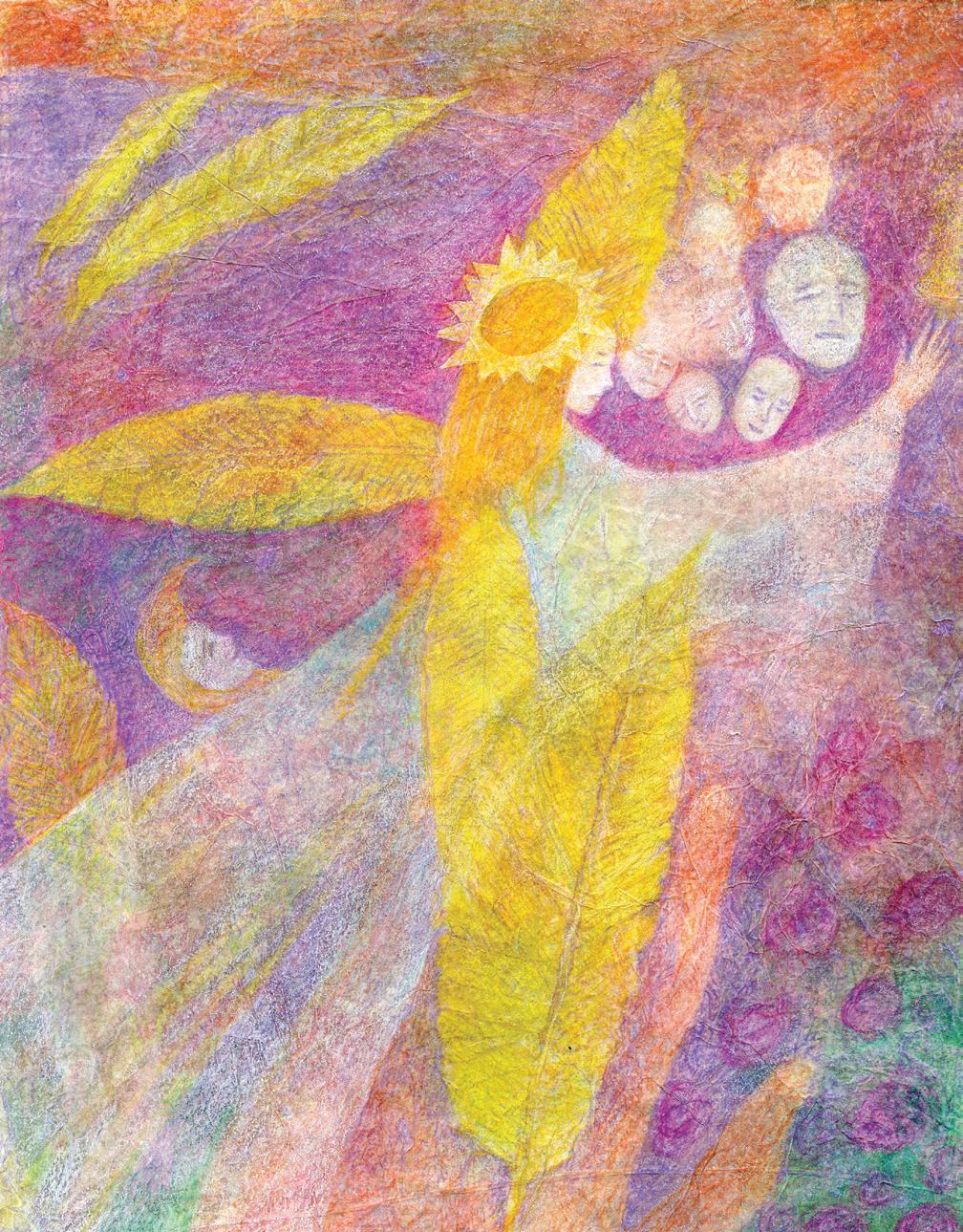
 Laura Summer, Genesis series: Day 6, Creation of the Human Being, detail
Planning for the life you want to live and for the world you want to live in.
M o n e y a t w o r k i n t h e w o r l d i n t h e s e r v i c e o f t h e c o m m o n g o o d .
W e a r e a f i d u c i a r y , e t h i c a l l y b o u n d t o a d v i s e f o r o u r c l i e n t ' s i n t e r e s t s f i r s t a n d f o r e m o s t . O u r t a s k i s t o s u p p o r t o u r c l i e n t s t o f u l f i l l t h e i r i n d i v i d u a l l i f e ' s i n t e n t i o n s t h r o u g h f i n a n c i a l p l a n n i n g a n d a s s e t m a n a g e m e n t t h a t i s c o n g r u e n t w i t h t h e i r p e r s o n a l a n d s p i r i t u a l v a l u e s a n d a s p i r a t i o n s .
O U R S E R V I C E S I N C L U D E :
F i n a n c i a l P l a n n i n g
I n v e s t m e n t C o n s u l t i n g
P o r t f o l i o D e s i g n & M a n a g e m e n t
I n s u r a n c e P l a n n i n g

E s t a t e P l a n n i n g
J e r r y M S c h w a r t z , C F P ®
B e r n a r d C M u r p h y , C F P ®
K i m b e r l y M . M u l l i n , F P Q P ™
W e i n v i t e y o u t o c o n t a c t u s t o d a y !

A R I S T A A D V
C O M 5 1 8 4 6 4 0 3 1 9 | I N F O @ A R I S T A A D V C O M
.
Emerge with us!
Applied Anthroposophy is a transformative immersion in the core wisdom of anthroposophy and its application in today’s world. Meeting weekly on Zoom from September 2020 through May 2021, the online course unfolds through four themes: Freedom, Love, Initiative, and Service


Leading Thoughts keynote presentations weave with individual artistic work and small group conversation in this pioneering course. Please explore at appliedanthroposophy.org for the latest information on the faculty, format, schedule, cost, and other frequently asked questions.
Get in touch: emerge@appliedanthroposophy.org An initiative of the Anthroposophical Society in America.

“The butterfly you see is created out of light, but light had to first take up matter, form a case and be turned into threads inside the Chrysalis….”
Rudolf Steiner, October 8 1923
Artwork: Christopher Scappaticci
Go to www.anthroposophy.org/podcast for Director of Programs Laura Scappaticci’s “conversations when you want them”

Courage, Fear and a Deep Breath with Dr. David Gershan and Chris and Jerilyn Burke
Dr. Lakshmi Prasana - Healing, Educating, & The Twelve Senses
Give More Than You Take ~ Voices From The 2019 Biodynamic Association Conference
Paul Chappell – Beyond The Basic Human Needs Towards Peace

Hazel Archer Ginsberg – Preserve The Light
Sergio Gaiti – Threefold Awareness
Nancy Poer – Every Human Moment
Nathaniel Williams – The Philosophy of Freedom Now
Mary Stewart Adams – The Story in Our Stars
Lisa Romero – Strength Through Meditation
Joaquin Munoz – Trauma, Resilience, & Education
Joan Sleigh – Connection, Disconnection & the Unknown Love is Greater than Loss – Linda Bergh
415 479 4400
Early Childhood, Grades and High School Tracks
www.bacwtt.org tiffany@bacwtt.org
Embark on a journey of self development and discovery Study with us to become a Waldorf Teacher The Anthroposopher
D igned for working teach s.
DENVER COLORADO | SUMMER 2021
Grade-Level Preparation (ECE to Grade 8) for the 2021-2022 school year
Experienced Waldorf instructors at each grade level and inspiring guests from the greater community. Classes cover a variety of information designed to ready the teacher with stories, art, academics and pedagogically appropriate content for the next grade level. Recommended for all teachers working in public or independent schools inspired by Waldorf pedagogy.
EXPLORING Di rsity, Inclusi , and Acc sibility IN NORTH AMERICAN SCHOOLS
SAVE YOUR SPOT:
ACCREDITED BY
Accrediting Council for Continuing Education & Training


Nationally Accredited Teacher Training
for Independent and Public Schools
Inspired by Waldorf Principles


NEW COHORT BEGINS SUMMER 2021
DENVER, COLORADO
Gradalis training for Early Childhood and Grades

Teachers is taught over 26 months, in seven semesters. Courses provide anthroposophical foundations, rich artistic training in visual & temporal arts, inner development, insights for child observation, and working with special needs. Plus, field mentoring, curriculum and school culture.
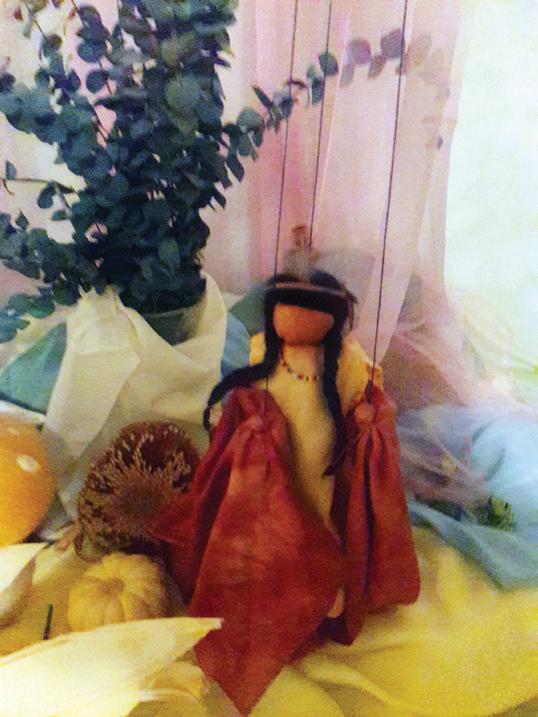

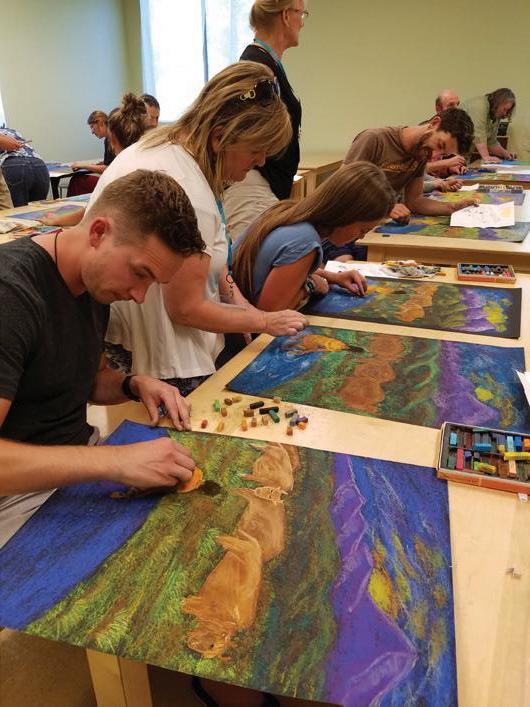
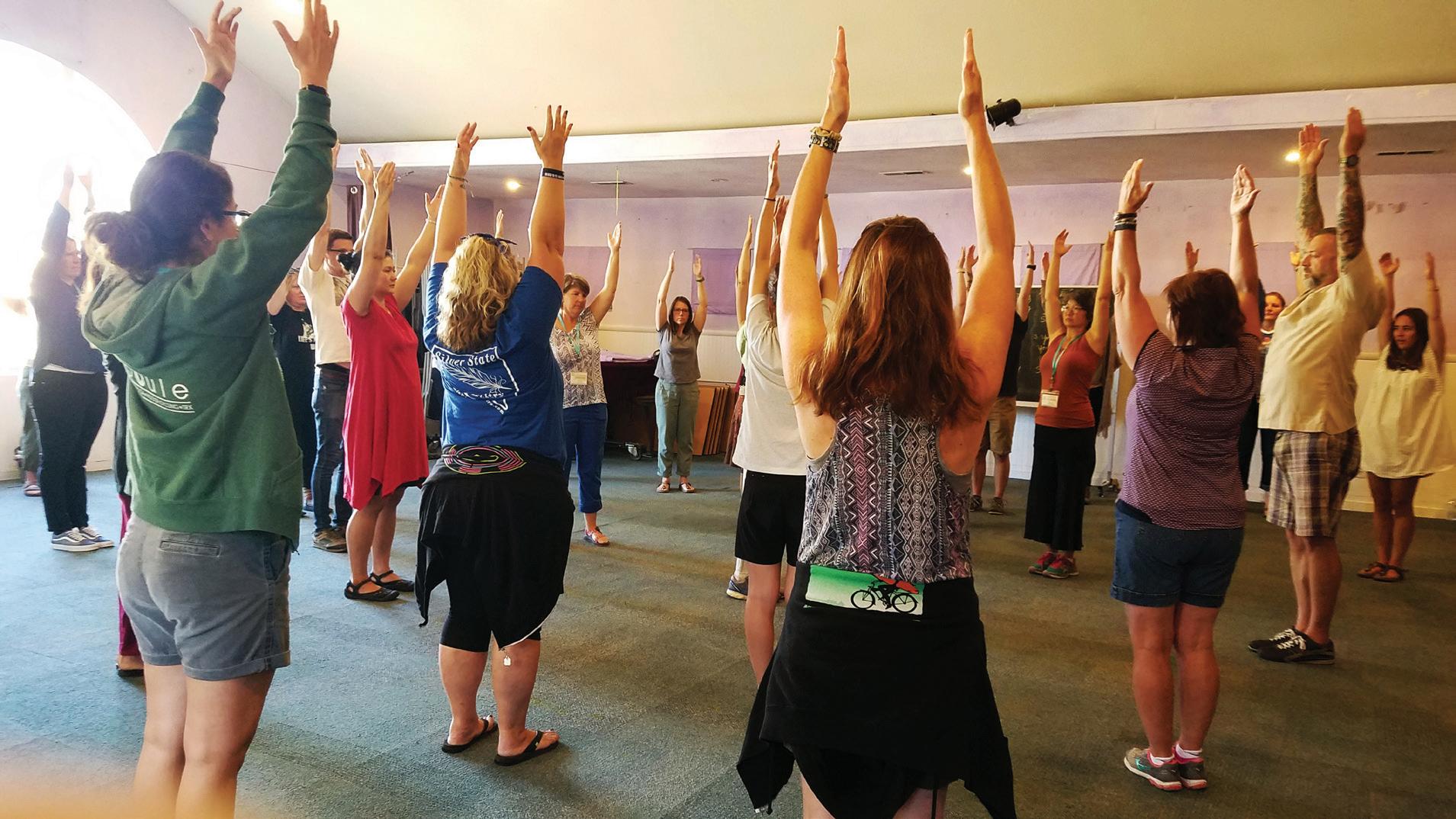
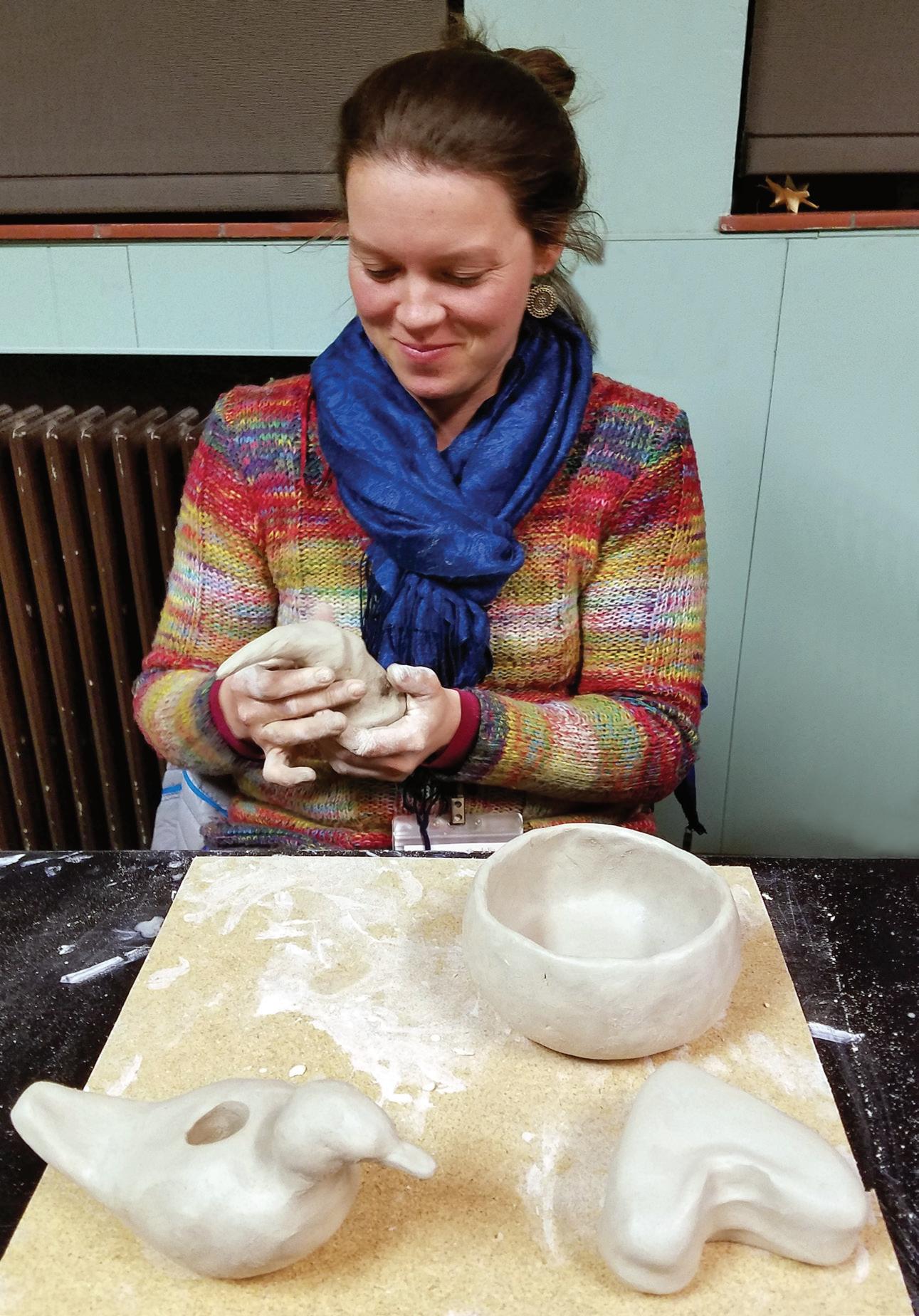
Includes: 3 two-week Summer Intensives; 4 Practicum Weekends; and on-line Interactive Distance Learning (8.7% of program) to support the working teacher with monthly pedagogical and main lesson support through two school years.
LEARN MORE: gradalis.edu
QUESTIONS 720-464-4557 or info@gradalis.edu

‘Teaching as an Art’
Inspiring Education
Since 1967
Low-Residency Waldorf Elementary & Early Childhood Teacher Education Programs with MEd Option Scholarships Available
•
Specialized Subject Intensives

• Courses & Workshops in Waldorf Education & Anthroposophy

• See our website for upcoming events
www.sunbridge.edu
plus... The Vigil of the Heart • The Soul’s Journey Through the Spheres After Death • Acknowledging the End • After Deathcare as a Healing Art • Sacred Burial Ceremony • Borning In & Borning Out
6 • being human
Pacific Eurythmy Join a Part-time Eurythmy program in Portland Oregon F o r m o r e i n f o r m a t i o n v i s i t P a c i f i c E u r y t h m y c o m o r e - m a i l : P a c i f i c E u r y t h m y @ g m a i l . c o m New Classes begin September 2021
Conscious Living, Conscious Dying and the Journey Beyond
16 Emerge with Us - Anthroposophy Applied, a new course from the ASA
Visual Presence, Social Distancing, by Dennis Dietzel
Crossing Bridges – Being Human: 100 Years of Anthroposophic Medicine
The Key to Digital Freedom: Learning to Deal with Discomfort, by Boyd Collins
Pleasure Rare & Transitory, review by Fred Dennehy of Philip Thatcher’s Fine Matter
The Illusion of Separation, review by Fred Dennehy of the book by Giles Hutchins
Sacramental Conversation: Experiencing Our Humanity, by Christopher Schaefer
48 The Foundation Stone Meditation as Gift, Friend, Helper, and Key, by Rudiger Janisch, Sherry Wildfeuer, Helen Lubin, and Frank Agrama, representing sections of the School for Spiritual Science
by Deb Abrahams-Dematte
summer-fall issue 2020 • 7 Contents 8 from the editors 11 book notes
16 initiative!
18
23
24 arts & ideas 24 Eurythmy
Practice,
26 Gail Langstroth’s
27 Why Novalis? Why Now? by
28 Seven Poems, by Peter Bruckner 32 Gallery: Other Arts of Peter Bruckner 36 research & reviews 36 39 40 4 4
14 Four Domains of a Healthy Culture, by Paul Gierlach
as Personal
by Cynthia Hoven
firegarden / jardin-de-fuego
Bruce Donehower
news
48
for members & friends
52 The Art and the
of Conversation,
53 New Western Regional Council Members 54 A Note from Katherine Thivierge 55 New Members of the Anthroposophical Society in America 56 Members Who Have Died 56 Patti Smith 58 Lora Valsi 59 John Moses 60 John Roger Cunningham 60 Richard Rettig 62 Margaretta Bornhorst 6 4 ASA Annual Conference: Willing the Good: Love,
Healing
Joy
Action,
The Anthroposophical Society in America
GENERAL COUNCIL
John Bloom, General Secretary & President
Dave Alsop, Chair (at large)
Dwight Ebaugh, Treasurer (at large)
Nathaniel Williams, Secretary (at large)
Micky Leach (Western Region)
Marianne L. Fieber (Central Region)
David Mansur (Eastern Region)
Helen-Ann Ireland (at large)
Hannah Schwartz (at large)
LEADERSHIP TEAM
Deb Abrahams-Dematte, Director of Development
Katherine Thivierge, Director of Operations
Laura Scappaticci, Director of Programs being human
is published by the Anthroposophical Society in America

1923 Geddes Avenue
Ann Arbor, MI 48104-1797
Tel. 734.662.9355 www.anthroposophy.org
Editor: John H. Beck
Associate Editor: Fred Dennehy
Proofreader: Cynthia Chelius
Headline typefaces by Lutz Baar (Baar Sophia, Baar Metanoia)
Past issues are online at www.issuu.com/anthrousa
Please send submissions, questions, and comments to: editor@anthroposophy.org or to the postal address above, for our next issue by 12/10/2020. being human is free to members of the Society (visit anthroposophy.org/join). Sample copies are sent to friends who call, write, or email us at the address above.
©2020 The Anthroposophical Society in America. Responsibility for the content of articles is the authors’.
from the editors
Dear Friends,
Our fall conference in October (see back cover) will be an online “art dispersal”—an initiative to de-commodify art and create community stewardship of art works. Artist and teacher Laura Summer has been central to this work, and for a cover for this issue we found a remarkable painting of hers: the human creation in Genesis I with a spirit-lifting blue background!
There’s a lot in this issue about a new “applied anthroposophy” course starting already in September. Do go see about it: appliedanthroposophy.org — it may be just the inspiration you were looking for.
Somehow poetry came together in a big way for this issue. The health crisis has altered time for all of us, it seems, and making time for poetry may be good therapy. Poetry takes time, opens time, restores the true character of time. Eliot’s Four Quartets, may favorite longer poem, opens by unfolding “time present and time past” which “are both perhaps present in time future...” And slow reading made Emerson’s poems accessible to me; I had thought him a terrible poet! Anyway, Peter Bruckner, who last time introduced paintings of his mother Ninetta Sombart, is back with his own work, including wonderful poems. Gail Langstroth and Philip Thatcher join in.
Last time I made a long list of breakthroughs, and as the issue was being delivered, our world changed. One way involved a terrible human sacrifice to demand our attention to “race relations.” Having been very present in the 1960s, I found myself groping for a new way to see this challenge. I’m finding it is simply the lie of group superiority. White people in the USA have either embraced this openly, or accepted it privately (to our benefit), and everyone else has suffered, severely. It is the destructive shadow of the great social experiment that is this nation. Let’s imagine, in Eliot’s words again, “the whole consort dancing together...” Imagine a true “Team America” on the way to “Team Humanity” — which is clearly anthroposophy’s vision.
The other issue is public health, and perhaps there’s a relationship. Health is the focus of hundred-year-old Anthroposophic Medicine. Robust health is the best prevention and cure for illnesses, novel or otherwise. We are all in this together, it seems, yet those with the least support for their wellbeing are the ones who are suffering worst in this pandemic.
I’m delighted at the extent to which technology has gained our attention as anthroposophists. This issue is full of careful uses of it to overcome distance and separation, and of careful reminders to be highly conscious of it. And we must not forget how profoundly new “social media” are affecting our relationships; a topic for another time.
Finally, corrections of some serious mis-identification last time. The Rev. Craig Wiggins is the current North American leader of the Christian Community, and we hope that their ASK conference planned for Atlanta will find new dates soon. MC Richards is Mary Caroline Richards. And Andrea Paz is a vibrant young member, not one who has crossed the threshold!
It is an old greeting: be strong, be well!
John Beck
are

Jane Hipolito (May 12, 1942– Sept 25, 2019)
In 1998, Joyce Reilly and I were trying to put together a celebration of the life of Owen Barfield, which we called The Barfield Centenary. It was an ambitious project for anyone outside academia; there would be more than a dozen speakers, from all parts of the United States as well as from England, and joint sponsorship by Teachers College at Columbia University and Drew University. The whole project was a good deal more complicated than we’d bargained for.
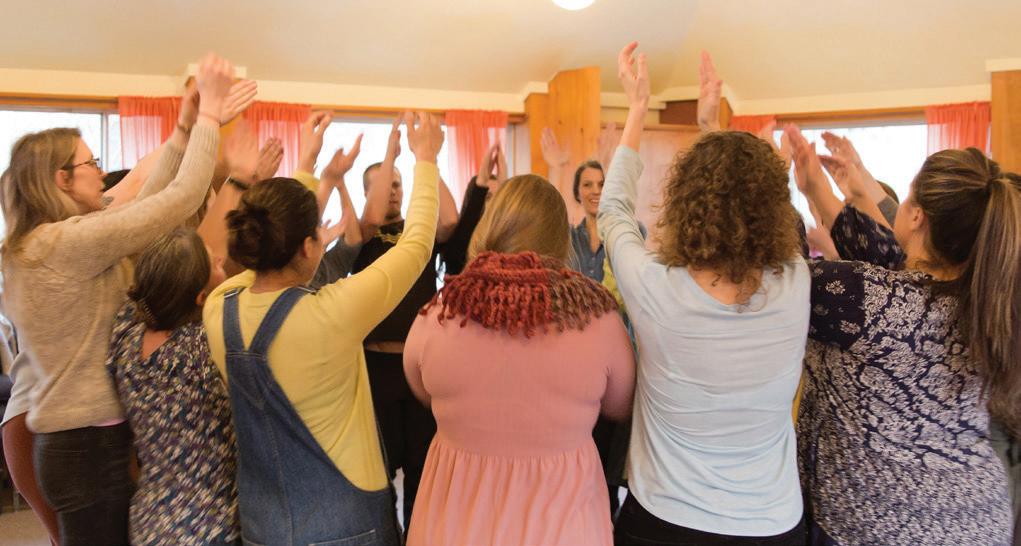
Anthroposophy is a source of spiritual knowledge and a practice of inner development. It cultivates our capacity to embrace the full dimensions of human experience, and the world in which we live, work and create. It is the inspiration for a wide variety of practical work including Waldorf education, biodynamic farming, medicine, arts, finance, social change and therapeutic approaches for people with disabilities. Our world needs anthroposophy. In a time of cultural conflict, environmental destruction and widespread personal distress, anthroposophy offers deep insight and practical solutions.
Inspiration Community
EXPLORE HUMANITY’S PATH AND YOUR OWN.
BECOME A MEMBER TODAY!
WELCOME! We look forward to meeting you!
Name
JOIN ONLINE AT www.anthroposophy.org/membership



Street Address
City, State, ZIP

Telephone
Questions? Contact us at info@anthroposophy.org or 734.662.9355, or visit www.anthroposophy.org
Email
Occupation and/or Interests
Date of Birth
The Society relies on the support of members and friends to carry out its work. Membership is not dependent on one’s financial circumstances and contributions are based on a sliding scale. Please choose the level which is right for you. Suggested rates:
❑ $180 per year (or $15 per month) — average contribution
❑ $60 per year (or $5 per month) — covers basic costs
❑ $120 per year (or $10 per month)
❑ $240 per year (or $20 per month)
❑ My check is enclosed ❑ Please charge my: ❑ MC ❑ VISA


Card #




Exp month/year 3-digit code




Signature
Complete and return this form with payment to: Anthroposophical Society in America 1923 Geddes Ave, Ann Arbor, MI 48104 Or join and pay securely online at anthroposophy.org/membership
summer-fall issue 2020 • 9
EXPLORE BECOME WE INVITE YOU TO
ANTHROPOSOPHICAL SOCIETY
IN AMERICA
Insight Inspiration C
ANTHROPOSOPHICAL SOCIETY IN
AMERICA
Insight
www.anthroposophy.org/legacy

Legacy Circle
Many thoughtful and caring members have provided legacy gifts for the Anthroposophical Society in America through their estate planning. We are humbled and deeply grateful for the generosity of these dear friends since 1992:
Rudolf Steiner Library
The Rudolf Steiner Library continues! This represents an accomplishment in itself! The stewarding non-profit, The Rudolf Steiner Cultural Foundation (RSCF), established in late 2018 to receive the Rudolf Steiner Library from the Anthroposophical Society (ASA) is getting its feet underneath it. The very transfer agreement took months to finalize so that both ASA and RSCF felt clear, complete and friendly about it—and it has paid off in responsible and warmhearted collaboration continuing between ASA and RSCF!
Payroll continues smoothly to our dedicated staff. New accounting and payroll services, rental agreements, insurance all take their own good time to settle clearly. As a board we have fielded a number of opinions about the way things ought to be and be done. We appreciate the interest and concern, and have retained focus and kept the course as best we can.
Soon you will be hearing our first appeal for support. We hope you will participate in keeping the Library vibrant and operating. Many of us stand in the beautifully lazured space, graced by additional gifts of prints and original paintings now, and marvel at the whole future of humanity in the stacks. You agree with us, perhaps, that this is the all-important goal of keeping the Library open and available to all!
Erika V. Asten* • Betty Baldwin • J. Leonard Benson*
Susanne Berlin* • Hiram Anthony Bingham*
Mrs. Hiram A. Bingham • Virginia Blutau*
Iana Questara Boyce* • Marion Bruce*
Helen Ann Dinklage* • Irmgard Dodegge*
Raymond Elliott* • Lotte K. Emde* • Hazel Ferguson*
Marie S. Fetzer • Linda C. Folsom* • Gerda Gaertner*
Susanna Gaertner • Ruth H. Geiger* • Ray German
Harriet S. Gilliam* • Chuck Ginsberg
Hazel Archer-Ginsberg • Alice Groh
Agnes B. Granberg* • Bruce L. Henry*
Ruth Heuscher* • Christine Huston • Ernst Katz*
Cecilia Leigh • Anna Lord* • Seymour Lubin*
Gregg Martens* • Barbara Martin • Beverly Martin
Helvi McClelland • Robert S. Miller*
Ralph Neuman* • Carolyn Oates
Mary Lee Plumb-Mentjes • Norman Pritchard*
Paul Riesen* • Mary A. Rubach* • Margaret Runyon
Ray Schlieben* • Lillian C. Scott* • Fairchild Smith*
Patti Smith • Doris E. Stitzer* • Katherine Thivierge
Gertrude O. Teutsch* • Catherina Vanden Broek*
Randall Wadsworth • Anonymous (19)
* indicates past legacy gift
Please contact Deb Abrahams-Dematte at deb@anthroposophy.org or (603) 801-6584 for information about planned giving & the Legacy Circle.
Many have now contributed books as bequests or downsizing gifts. Our first priority is the Library. Books in better condition will be used to replace existing items in the stacks, or will enhance the number of copies available to study groups, faculties, and the like. Others will be shared with the Prison Outreach program. Lastly, we will hold book sales and contribute books to the Book Barn and Goodwill. We are so grateful to you who think of us when deciding how to distribute no longer needed books!
The Corona Virus Pandemic necessitated closing the Library and all “nonessential” operations. We are a member of the Capital District Library Council (CDLC), and are following their guidelines on reopening. We have developed a lengthy safety plan for slow re-opening. For the month of July, curbside service is available during regular Library hours (10 to 3 Wednesday through Saturday). A call to the staff ahead of time can get your needs prepared for pickup. They can then let you know when your book(s) is (are) ready. On August 1st, three-at-a-time, people will be able to come into the building with masks, of course, here in New York State. Visit our web site for additional information: www.rudolfsteinerlibrary.org
The board has been increasingly appreciative in these demanding times of our two assistant librarians, Kathleen Bradley and Martin Miller. We would be lost without them. They have been attentive, available and caring throughout the time of lockdown. It’s wonderful to have them back!
Rudolf Steiner Library 351 Fairview Avenue, Suite, 610 Hudson, NY 12534 rudolfsteinerlibrary@gmail.com
(518) 944-7007
10 • being human
Book Notes
Space permits only a few book reviews in each issue, so this page lists some of the many others we encounter. Except as specified, the notes are from the publishers — Editor I Give You My Word: Women’s Letters as Life Support, 19731987, by Signe Eklund Schaefer, 364 pp. (Green Fire Press, 2019)

A forgotten box of letters in a dark attic corner, messages from women friends written decades ago. An intimate record of a time of great transition in how women experienced their daily lives and imagined their future. During the 1970’s and 80’s, Signe Eklund Schaefer and her young family moved often, within the United States and abroad. Handwritten letters, now relics of a pre-Internet world, were vital to her ongoing connection with friends and to her evolving sense of self. From the surprising discovery of these old letters she has woven a moving account of the reflections, mutual support and multi-dimensional exchanges between women friends, which offer a record of women’s lives five decades ago, and speak powerfully to contemporary social concerns. Exploring relationships, motherhood, children, personal development, career and friendship itself, the letters touch on the emerging women’s movement, efforts for world peace, and individual spiritual striving. The Epilogue offers new letters from these articulate and impassioned women, now in their 70’s and 80’s.
Painting with Hand, Head and Heart: A Natural Approach to Learning the Art of Painting , by Van James, 247 pp. (Available on Amazon.com from August 15, 2020.)

Reading this book is like sitting at the foot of a master who shares his life experience, insights, knowledge. Yet, it is so accessible that I wanted to take a brush, paint, and paper and work my way through the chapters. James not only makes the case for the importance of painting and color in the learning process, but he characterizes child development, Waldorf curriculum, Rudolf Steiner’s depth of understanding, and the role of creativity in being human. In addition to these broad topics, James also clarifies misunderstandings in teaching painting from kindergarten through high school, from wet and dry painting to blackboard drawing. This is an essential book for every teacher to have before stepping into the classroom, as well as a treasured gift for anyone who wants to enter the creative process through color and form.
—Betty Staley, Waldorf educator, author, and lecturer

Knowledge of the Higher Worlds through Entheogens, Prayer, and Nondual Awareness, by Shelli Renée Joye, PhD, 180pp. (Inner Traditions, Rochester, VT, 2019.)

From the introduction by Robert McDermott: In her seventy years, Shelli Joye has sought to understand the miraculous, the transcendent, and the inner nature of things. She has practiced spiritual disciplines and sought deep insights. As is elaborated in this stunning book, she has gone even further, presenting a scientific basis for her extraordinary experiences. When twenty-first-century individuals read a book by or about Steiner, or attend a lecture elaborating his ideas, they often seek more evidence to support his claims. This book offers such evidence. That she has titled her book Developing Supersensible Perception tells us that her life experience in many chapters makes a powerful claim that she has in fact accomplished what Steiner presented as natural for him and difficult, but certainly possible, for others. Like Steiner, and many of those drawn on in this book to support esoteric principles with physics, Joye began her career in the hard sciences, first studying physics at Rice University and graduating with an electrical engineering degree. Steiner’s own undergraduate degree from the Viennese Polytechnic Institute gave him a healthy respect for the scientific method, validated results, and affirmative evidence. He was certain that, in time, others would eventually validate his claims, even those claims that have until now been considered implausible by scientific criteria. This book represents a significant contribution toward providing a comprehensive scientific framework to support the worldview that Steiner and Joye hold in common and advance a century apart from each other.
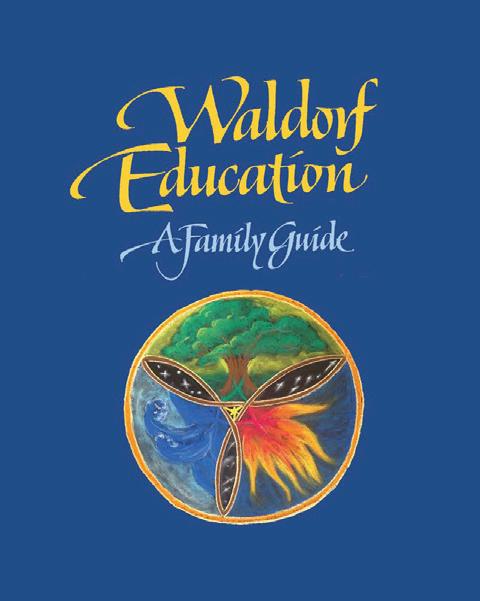
Waldorf Education: A Family Guide, Completely Revised Second Edition, Edited by Pamela Johnson Fenner, Illustrated by Marybeth Rapisardo, 300 pp. (Michaelmas Press, Amesbury, MA, 2020) www.michaelmaspress.com
From the Foreword by Robert Schiappacasse: As a Waldorf school administrator and director for more than 30 years, and a parent of three Waldorf-educated children, I know how informative and helpful this book has been to a generation of parents and families. Since Waldorf Education: A Family Guide first
summer-fall issue 2020 • 11
appeared in 1995, the number of Waldorf/Steiner Schools worldwide has more than doubled from 600 to 1214 in 67 countries. In addition, there are over 1850 early childhood centers in 54 countries. This rapid, and largely “grass roots” expansion of Waldorf education on six continents is evidence of the growing appeal of Waldorf education for children and families around the globe. This second edition of Waldorf Education: A Family Guide appears fortuitously at the 100th anniversary of global Waldorf education. It offers readers an updated and expanded selection of articles that outline Waldorf’s unique educational philosophy, arts-enriched academic curriculum, teaching methods, and school culture. By presenting an overview of the education as seen through the eyes of lifelong Waldorf teachers, school leaders, and parents, this volume offers an excellent firsthand introduction for parents, and those of you new to Waldorf education.

Meditation: An Introduction to the Anthroposophical Practice of Meditation, by Heinz Zimmermann & Robin Schmidt. (Les Editions Perceval, Dunham, QC; percevalbooks2001@gmail.com.)

From the foreword by Virginia Sease: Meditation itself is the deter mining factor and the method arises as a practical guideline to permeate more deeply into the spiritual essence latent in the meditation. Few books approach this theme in a comparable manner. Heinz Zimmermann was a true master of the word in his moth er tongue, German. For this reason, his work with Rudolf Steiner’s many meditations represent real keys which often unlock levels of comprehension which might have remained inaccessible even to those persons familiar with the specific meditation. But the help which the authors of this book offer also speaks to the meditative process in itself which may at first have eluded even an earnest seeker. A summary of the content: the elements of self-transformation / construction of an interior space / forms of meditation: meditations with images, texts and symbols / knowledge and art / meditation and self-knowledge / group meditation. At the end, the most important meditations and exercises by Rudolf Steiner are presented and explained.

A Secret History of Christianity: Jesus, the Last Inkling, and the Evolution of Consciousness , by Mark Vernon
From the introduction: Something is going wrong with Christianity. In the western world, it’s not hard to make the case that something’s gone terminally wrong. People are abandoning churches in their droves or, more commonly, simply steering clear of the services that nourished their forebears. In spite of sustained attempts to reverse the decline, and notable exceptions to the rule, nothing seems able to stop it. This book is a response to the crisis, though it differs from others. It focuses on the inward aspect of Christianity’s troubles. It

12 • being human
https://www.bluepearlarts.com Anthroposophically based Mentor · Counseling by Telephone tel. 360.473.7777 alicia@bluepearlarts.com Dr. Alicia Marroquin, PhD & Chap. Scholar Esoteric Rel. Studies, MA Counseling Psychology Biography · LivingYourHistory · Sidereal Chart Sponsored Member Anthroposophical Society since 1990 Flexible Fees & Hours
Book Notes
Order now Among the themes covered in this book the reader will find: The elements of self-transformation; Creating an inner space; The various forms of meditation (using pictures, language, and symbols); The artistic path and the meditative path; Meditation and self-knowledge; Meditative work in groups. Perceval Heinz
MEDITATION An Introduction to the Anthroposophical Practice of Meditation With a foreword by Virginia Sease
Zimmermann Robin Schmidt
approaches the problem at a felt or mystical level. ... I was lucky enough to find a guide in this task. He’s the Oxford Inkling, Owen Barfield. He is sometimes known as the “last Inkling” because he was the last of the celebrated group to die, in 1997. A close friend of C.S. Lewis and J.R.R Tolkien, they both thought he had the most penetrating ideas. ... His core idea is readily understood, and radical. He has an account of our spiritual predicament that is illuminating. Barfield realized that the human experience of life shifts fundamentally over periods of cultural time. Our awareness of things evolves. Our consciousness changes dramatically across history. Editor’s note: The author’s appreciation for Owen Barfield is genuine, but there is no mention at all of Rudolf Steiner; aimed for Anglican church readers?
Viral Illness and Epidemics: in the Work of Rudolf Steiner, edited and translated by Daniel Jonathan Hindes, 131 pp. Collected in this book are all of Rudolf Steiner’s statements on viral illnesses and epidemics. Spanning 40+ years in chronological order, these extended excerpts are drawn from 35 separate volumes of the Collected Works. Several have never before been published in English. Newly translated from the latest German editions, an invaluable resource for anyone interested in exploring Steiner’s views on health and illness in relation to pathogens and infectious diseases.

Making Soft Dolls: Simple Waldorf designs to sew and love, by Steffi Stern, 128 pp. (Hawthorne Press, 2020)

“Another gem of a book from the wonderfully talented Steffi Stern... her designs are so easy to make and beautifully explained but endlessly adaptable.” Stuart Hillard, Quilter and Semi-finalist on The Great British Sewing Bee.
Large and small, knitted and sewn, beautiful handmade dolls with no sewing machine required; full stepby-step instructions with clear drawings and templates; detailed directions to make 10 character dolls and their accessories. — Why do Waldorf dolls have such simple facial
Book Notes

features? What is it about dolls that captures the imagination of children and adults around the world? This book answers these questions and highlights the power of dolls when used for therapeutic purposes, recognising that soft dolls aren’t just for children. From the simplest rag doll to more complex characters, this book gives clear instructions, a guide to buying your materials and upcycling materials you already own. These dolls are easy to make and are a perfect present that will be loved for generations.
Adventures in Hexameter, written and illustrated by Katherine Rudolph, 90 pp. Available on Amazon.com
These poetic stories offer a glimpse into Phantasy, Fairy Tale, and a Quest for the Grail. The rhythmic hexameter actually helps to harmonise and balance the beat of heart and lung. Katherine has devoted many years to developing Therapeutic Speech and Visual Art. She has been inspired by Rudolf Steiner, and the works of Homer, Longfellow, and Yeats, to reawaken this meter which may now be of benefit to children of all ages. — Editor’s note: Many beautiful pictures, plus “The Rose Family Stories”, the Grimms’ “Faithful John,” and a children’s version of Parzival’s Quest. A helpful introduction is complemented with “Hexameter and Healing” at the end of the volume. The lines are marked for speaking the hexameter, and the tales are full of nature observation and wisdom. More at the author’s website: www.exploringtheword.com.au
summer-fall issue 2020 • 13
Four Domains of a Healthy Culture
by Paul Gierlach
I have great hope in the future because I have faith in the individual human being. I know that the human being has from time immemorial lived in such a way with others that together they have created viable societies. It seems to me that our challenging times need to be understood within this framework. We can experience that not just our beliefs but our very consciousness of self is challenged daily.
Of course there is much that divides us from each other, both as individuals and as members of society, but at the same time one identical cry is heard from all who are participating in the protests, rebellions, perhaps revolution of our times. We hear that “new forms are needed.” What are they? The economic structure of the United States being what it is, I feel completely helpless when following the news in this arena. I act as a consumer, trying to protect a modest savings.
The political structure of the United States being what it is, I feel almost completely helpless when following the news in this arena. Democracy is messy at the best of times and seldom offers immediate relief. Yet, it does work. When law itself is challenged as a legitimate social force, however, the notion of “being in charge” easily replaces the demands of justice.
The cultural structure of the United States being what it is, I feel that I can make a difference. It is in this arena that I can meet other individuals in an honest way. And, more importantly, I can be a co-creator of a “new form.” This actually is what gives me such hope for the future.
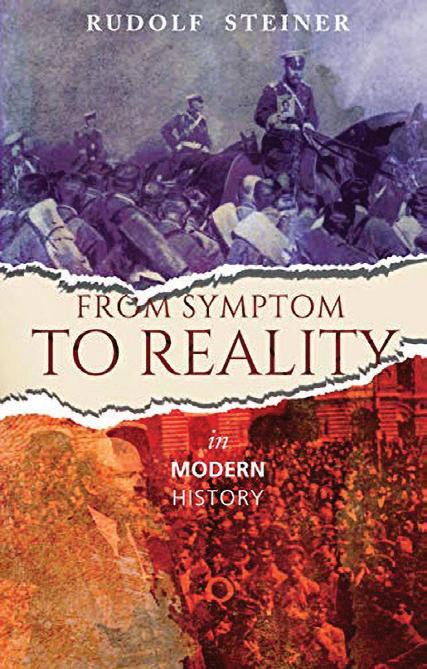
Let me share the foundation of that optimism. Rudolf Steiner gave a series of lectures entitled From Symptom to Reality in Modern History in 1918. In this cycle, and other war-time lectures, he warned us repeatedly that society would continue to experience more and more turmoil and destruction until we human beings created social forms that could respond to the times that environ us. These times, which he calls the Consciousness Soul epoch, are dynamically different from all preceding epochs of human history in that the cognizing activity of individuals comes to the fore: with our intellect, we form our opinions of others and also create the technological world that supports us in our thought-structures. We are in the habit of solving problems with our thinking. We are told to be awake at all times; the very nature of our cities and use of ubiquitous telecommunications seem to further that goal.
In reality, we are not awake to that fundamental
component of our societies: other human beings! We take them for granted; we use them for our own ends: they are voters; they are consumers and/or employees; we treat them as if they were ideas; as if their entire existence were a function of one particular issue that they just won’t compromise any more! We might even think that they, and we, are simply clever animals. With all this social baggage, no wonder we are crying out for “new forms.” As we will see, those will arise out of our connections with other individuals and not out of our ideas about them.
In lecture 5 of From Symptom, Rudolf Steiner gave concrete suggestions on how we can work positively in the cultural sphere. He called them the “Four Domains.” At first sight, they manage to seem both commonplace and strange.
First Domain: “We must comprehend human beings symbolically. . . . We must approach human beings in such a way that we no longer see them as a combination of bones, muscles, blood, et cetera , but as the image of their eternal, spiritual being.” (120, 121)
Second Domain: “Human beings must learn to see through words; they will have to acquire the capacity to grasp the gesture in language. . . the soul will be heard through language and this will lead to a totally different community life. A large part of the so-called forces of evil must be transformed . . .” (124)
Third Domain: “When we as human beings confront one another, we will experience in our own respiration the emotional configuration of the other. In future time respiration will adapt itself to the affective life of the other person who confronts us.” (125)
Fourth Domain: “When we are compelled to will this or that in common with another, or will to want it, we shall have inner experiences akin to those which we have in a primitive form today when we consume a certain food.” (125)
The “new form” arises not out of the words on the page but out of the deeds they provoke, and the deed of paramount importance lies in the mystery of the fourth
14 • being human
domain. I worked with a group of friends for 14 months on these domains. It was not difficult for us to work with the first three: for the thought that lies behind the first was shared by us all; the actions portrayed in the second we could experience from time to time, especially in its negative manifestation; the inclination to be co-extensive in some way with another we called empathy. But the fourth! Eventually we hit upon self-sacrifice, which was fine. However, when we understood the mandate of the fourth domain as a sacrifice of the self, then we opened ourselves to so much.
Only with that awareness could we make real sense of the domains and, more importantly, our work with them. When dealing with the social, outer, non-personal aspect of the domains, we identified the first as “natural law,” the second as “propaganda,” the third as an “indoctrination,” and the fourth as “egoity.” After we recognized our own “egoity” and began to live in the sequence all over again, we made the most important discovery of all: that our changed-self related quite differently to the challenges of the domains. We did not really begin to see others as spiritual beings until we uncovered our own spirit.
Our personal, human experience in the first domain was to meet many people whom we did not know. We did not want to pass them by. We talked with so many people! And really cared. Within the second domain, we recognized the impulse to listen more carefully when others were talking, and to actually talk only when necessary. We noted the inwardness of this activity. In the third domain, we noticed a different kind of inwardness: a discretion. In particular, those of us who are “naturally empathetic” struggled to be discerning. And the fourth! We did not share much about this domain. At first, I didn’t know why, but I am sure now that it was the result of a kind of privacy, one that speaks of an existential modesty.
I think it is fair to say that working with the domains leads one to a deeper awareness of one’s self as a manifestation of the spirit, which, in turn, strengthens our intention when living with others and trying to see them as spiritual beings. In fact, Rudolf Steiner says that we come in touch with the angels. This is no little accomplishment. But the story is far from over. This contact with the four domains has brought three elements of life into a new focus.
As a student of anthroposophy, I noticed that the
four domains correspond to the same spiritual “law” that creates the four-fold human being; the four stages of the Christian Community service; the seasons; human cognition of everyday perception, Imagination, Inspiration, Intuition; the first four planets of planetary evolution: Saturn, Sun, Moon, earth; the last four planets of planetary evolution: earth, Jupiter, Venus, Vulcan; the relationship of human beings to the third hierarchy, of Angels, Archangels, Archai. To name a few. Working within these analogues strengthens one’s conscious relationship with the spirit and spiritual realities.
As a citizen of the United States, I noticed that I could faithfully try to work with the principle contending forces of our times when I included issues of race and heredity in the first domain, a range of diversity issues in the second, inclusivity issues and rampant nationalisms in the third, and bewilderment of intentions and identity in the fourth. Living with the issues in this context helped me bring the spirit gained from my own self-work into a faithful meeting with the individuals I meet. In every society, there are people and there are issues.
I purposely wrote “bring the spirit,” not “bring my idea of the spirit.” It is not hard to have ideas about the spirit, but that is not enough these days. There are many ideas in our social world these days. They quickly become issues. The “new form” that is cried out for will emerge only when individuals bring whatever aspect of spirit they have managed to incorporate into their selves so that they can, consciously, want to sacrifice some part of that self for the benefit of another.
Call it by its name: love. Let it be a love founded on wisdom of our own striving. And let that striving reach out to embrace all whom we meet, all whom we confront, in our social networks; may it stretch us beyond our limits as we “dedicate ourselves in selfless cultivation of the spiritual life.” (The closing words of Christmas Conference, 1924.) This self-same gesture among individuals can consciously create a wholesome, representative society.
Paul Gierlach (paulgierlach@gmail.com) has worked in Waldorf schools since 1979, for most of his career as class teacher and high school humanities teacher. Retired from full-time teaching, he teaches main lessons in different schools, mentors teachers, advises on use of the Waldorf curriculum to teach students with a wide variety of learning styles, and participates in teacher training programs to advance anthroposophical historiography in 21st century high schools.

summer-fall issue 2020 • 15
IN THIS SECTION:
Drawing on several years of face-to-face and online learning and gatherings, Director of Programs Laura Scappaticci has gathered a team for a year-long learning initiative.
Dennis Dietzel gently probes the face-to-face and online difference, finding a difference of senses.
September at the Goetheanum: Anthroposophic Medicine

celebrated and renewed.
Emerge with us!
The ASA carries its online experience into a year-long course...
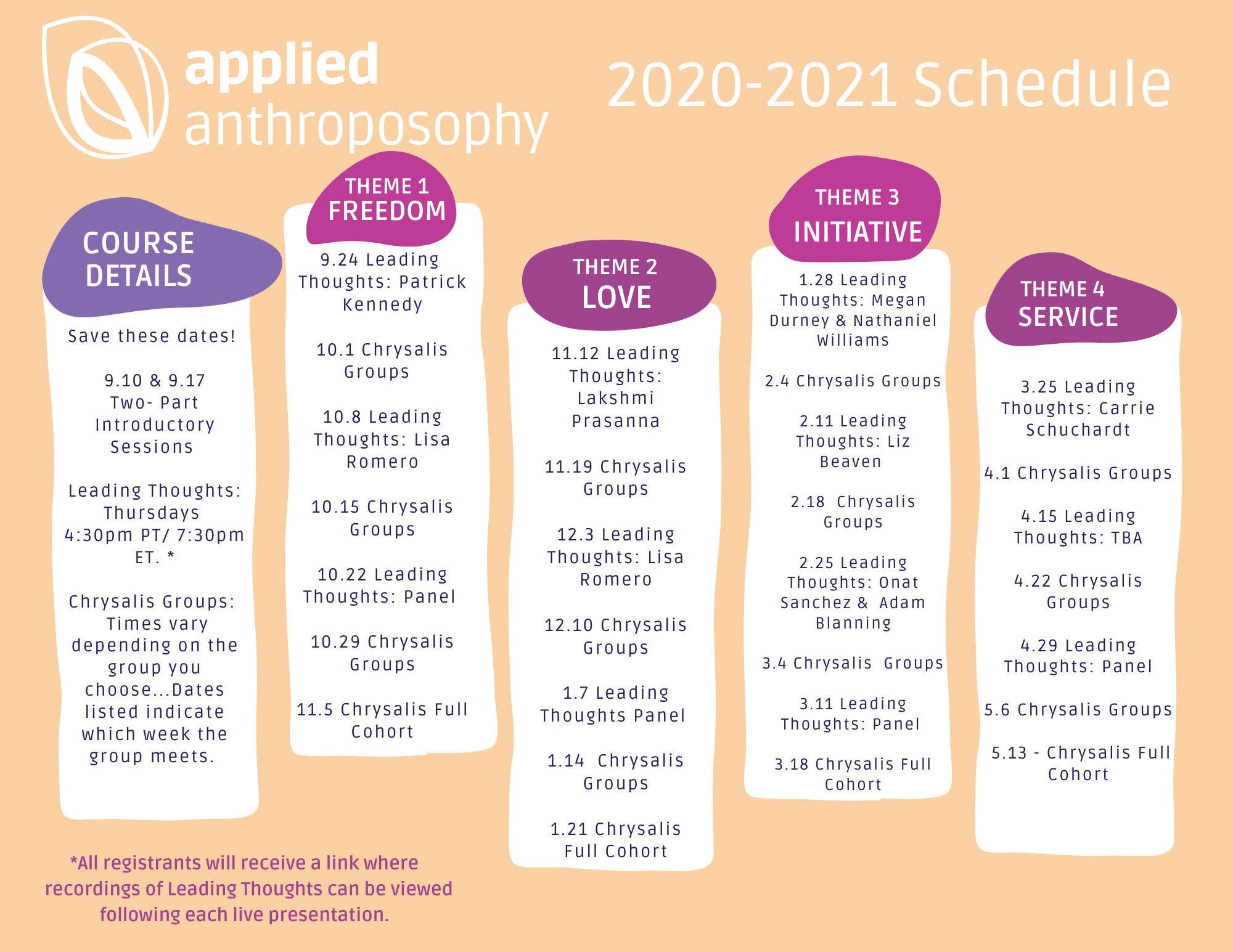
Applied Anthroposophy is an online course meeting weekly from September 2020 through May 2021. Experience transformative content with keynote speakers, and the alchemy of deep group and inner work. Join this pioneering course to explore the urgent issues of our time through the lens of a spiritual philosophy that awakens meaning, inner reflection, and outer action. All details are online at appliedanthroposophy.org
Applied Anthroposophy proceeds through four themes: Freedom in Thinking, The Power of Love, Individual Initiative, and Service to Humanity. The course is for beginners as well as those already connected to anthroposophy who feel called to experience it in a new way. Be a part of this diverse community of learners, as we work with our life stories, the deeper meaning in life and current events.
Course Elements
The butterfly you see is created out of light, but light had to first take up matter, form a case and be turned into threads inside the Chrysalis….”
— Rudolf Steiner, Oct 8 1923
The course will unfold through a series of four themes: Thinking in Freedom, the Power of Love, Individual Initiative, and Service to Humanity. Each week will alternate between keynote speakers sharing Leading Thoughts, and small discussion meetings called Chrysalis Groups. Each theme concludes with a Full Cohort Meeting where all enrolled participants gather together on one call. Complementary offerings include a two-part Introductory Session prior to the first presentation, and an ongoing meditation practice group on the Six Basic Exercises through Zoom (15 min daily).
Leading Thoughts Presentations
Presentations will take place throughout the course on Thursdays at 4:30 PT / 7:30ET. Leading Thoughts presenters will include Rev. Patrick Kennedy, Lisa Romero, Lakshmi Prasanna, MD, Chris Burke, Ph.D, Anne de Wild, and Linda Bergh.
Chrysalis Groups
“The caterpillar completely surrenders to the light, it dies in the light… it spins its own body into these threads and so forms the cocoon…”
— Rudolf Steiner Oct 8, 1923
A Chrysalis Group is a small cohort of the same 12-16 course participants who will meet on the alternate weeks from Leading Thoughts presentations. Each Chrysalis Group will have its own dedicated facilitator and share in conversation, journaling, and artistic practices. The goal is to establish a small learning community that allows you to integrate content from the presentations, expand your understanding of yourself, and work through the bigger questions in life. There will three ninetyminute time slots to choose from based upon timezone and personal schedule.
Once each theme (four times for the year), all course participants will come together.
Basic Concepts of Anthroposophy in Seven Steps: A Crash Course for Beginners is included with full course registration—or may be purchased separately as a stand alone course.

Elements covered in the Introductory Sessions:
1. Body, Soul and Spirit
2. The Soul between Body and Spirit, and the Mystery of the Human ‘I’
3. Compare Mineral, Plant, Animals and Human (Four-Fold Human Being)
4. Sleep, Death, Life After Death, and Reincarnation
5. Evolution (Origins and Goals)
6. Evolution of Human Consciousness
7. Representative of Humanity and a new paradigm of Good and Evil
16
• being human initiative!
Two Part Introductory Sessions with Sherry Wildfeuer and Alex Tuchman
Daily Meditative Exercise Practice
Every weekday at 12 noon ET, Angela Foster and Friends lead a 15 minute online meditation practice. This practice follows Rudolf Steiner’s six “basic” or complementary exercises. These meetings are optional (and free!) for all Applied Anthroposophy course participants.
FAQuestions
“Is this course flexible enough for my busy schedule?”
A: The course takes place online one night a week for about 1.5-2 hours each session. You can plan on spending about that same amount of time with optional pre-reading and/or journalling each week. All of the Leading Thoughts keynote presentations will be recorded, so if you can’t make one
live, you’ll can watch the recording at your convenience! “I’m completely new to Rudolf Steiner’s work. Is this for me?”
A: Applied Anthroposophy has been designed with beginners in mind and seeks to be widely accessible. The course begins with two introductory sessions for people new to anthroposophy. If you aren’t yet familiar with Rudolf Steiner’s work, please use our Resource Guide to access introductory articles, audio files, plus other web links.
“The caterpillar…has the time to create this sheath, to hang it up, so the sun forces, imprisoned inside, can now create the butterfly which is then able to fly out and enjoy the activity of a sunbeing.”
“How will I participate in the Chrysalis Groups?
A: Chrysalis Groups allow for a deeper, more personal exploration of course topics through biography, art, and journaling. You are encouraged to share your thoughts/ ideas in these small groups, but you will never be required to share more than what feels right to you.
summer-fall issue 2020 • 17
“...when you come across a chrysalis you are really seeing pure sunlight spun around this earthly matter in the pattern of the sunbeam. ”
— Rudolf Steiner, Oct 8, 1923
— emerge@appliedanthroposophy.org
— Rudolf Steiner, Oct 8, 1923
www.appliedanthroposophy.org
Virtual Presence, Social Distancing
by Dennis Dietzel
In this odd time of social distancing, many of us find ourselves in virtual communications for meetings, conferences, or just talking with friends and family. Though the technology is quite amazing, most of us would agree that it falls far short of being in the actual physical presence of other human beings. Virtual communication has vastly improved in the last few years as the underlying technologies have improved—internet speed, hardware, and software—but it is still virtual, not real. I would like to explore how this technology has evolved over time, what it is that we are experiencing and not experiencing, and a few strategies for how we might compensate for some of what is lacking.
I do not wish to discourage anyone from using these virtual communication technologies. There are many obvious benefits: the ability to reach out to many people regardless of geographic location, savings of time and travel resources, and the efficiency of quickly pulling together a meeting. Because of the current times, use of virtual communication has been accelerated way beyond the business and government communities where it has been in use for some years. When we come out on the other side of the virus, I’m sure many will continue to use these technologies in useful ways.
My hope is to bring more consciousness to what we are dealing with. The world of electricity is a world of subnature and the playground of the being Rudolf Steiner refers to as Ahriman. This being represents all the cleverness in the material world, active at a level that we as human beings can harness for our uses, but which also can have an almost magical hold on us. In his last Leading Thought from March, 1925, Steiner says the following:
In the age of Technical Science hitherto, the possibility of finding a true relationship to the Ahrimanic civilization has escaped human beings. We must find the strength, the inner force of knowledge, in order not to be overcome by Ahriman in this technical civilization. We must understand Sub-Nature for what it really is. This we can only do if we rise, in spiritual knowledge, at least as far into extra-earthly SuperNature as we has descended, in technical sciences, into Sub-Nature… There can be no question here of advocating a return to earlier states of civilization. … Electricity, for instance, must be recognized in its true
character—in its peculiar power of leading down from Nature to Sub-Nature. Only the human being must beware lest we slide downward with it.
Anthroposophical Leading Thoughts, March, 1925, Pg 218
Technology
I’ll attempt to give a thumbnail overview of the technology. Here are a few significant dates to start with:
» 1876—first U.S. patent for the telephone by Alexander Graham Bell.
» 1879—beginning of the current Michael age (according to Rudolf Steiner)
» 1969—beginning of the internet (ARPAnet, funded by the US Department of Defense)
» 1980’s—World Wide Web began to emerge
» 1990’s—digital phone service supplanted analog
It’s interesting to note that the date attributed to the invention of the telephone is in 1876, three years before Rudolf Steiner indicates that the beginning of the current Michael age began in 1879. That these two dates coincide so closely is almost certainly not a coincidence. Perhaps the forces representing Ahriman knew that it was necessary to get a toe-hold before the Michael Age began.
I recall as a youngster in the 1950’s that we had a party line where several families shared the same dial tone, meaning that if someone else on our line was using the phone we could pick up and hear their conversation—not exactly a secure situation. My father (a very patient man) would have to ask the neighbor girls, who would play music over the phone to each other, to hang up so he could make a call. I’m sure there are quirky aspects of today’s technology that will evoke humor sixty years from now.
The switch from analog to digital telephones made a huge difference in what was possible, especially as phone technology came together with the internet to make it feasible to send not just audio but also video (or any data that can be represented by 1’s and 0’s) across the wire. Of course, from one end of a digital conversation to another it is not necessarily all on a wire, but can include satellites, cell towers, fiber optic cable, etc. On average an internet connection from your device to a website takes 8 to 12 hops, a hop being from one router/server to another. At each hop your data (voice/video) has to be routed on to
18 • being human initiative!
the next spot and to its eventual destination. The internet is literally a web of inter-connected servers with rules for routing and data formatting. The internet was conceived as a very open and decentralized communication protocol with just enough rules to make it work, thus security becomes an issue. It’s not a wild west, but close.
For example, on a Zoom call your device has to translate input from the microphone and camera to digital 1’s and 0’s (including routing information to connect to Zoom), then send it on to your router (probably via WiFi) which connects out to the web where it hops around (812 hops) to Zoom where their servers work some magic, then send it back out to everyone else on the call (more hops). In the internet world there are many agreed on protocols for how data is represented and routed. It is quite amazing that it all works as well as it does. Of course, sometimes you get weird boingy sounds or ghost images which could be caused by any number of issues along the circuitous route your data has taken. As the internet becomes better (i.e. faster—think 4G, 5G, 6G...) more data can be sent more reliably and what we see and hear is rendered more realistically. Given our appetite for more virtual communication the march towards faster internet technologies seems inevitable. From this point forward I will refer to virtual communication technology as Zoom, even though Zoom is a brand that is just one of many virtual communication platforms.
The Twelve Senses
To the familiar five senses—sight, hearing, touch, taste, smell—Rudolf Steiner added seven more—senses of ego, thought, word, warmth, balance, movement, life. It is important to be aware that as human beings we have the capacity to sense much more than sight and hearing, the main senses engaged in virtual communication. This points to the main issue we might be referring to when we say, “These Zoom conversations are okay but not like really being with people.” What happens with all the other senses? Are we able to compensate for the fact that digital communication only transmits
a facsimile of image and sound?
In the series of lectures Spiritual Science as a Foundation for Social Forms Steiner speaks about how, through the sense of sight, “we penetrate outward with our soulspiritual being by leaving behind our organs of sight. Particularly, when we leave our corporeality through the eyes and move about the world, seeing with our soul eyes, yet leaving the physical eyes behind, we arrive in that region where Imagination holds sway.” (pg 43) In relation to hearing he says, “Now when we leave our body through the ear, through the sense of hearing, we come out into the soul-spiritual world and experience Inspiration.” (pg 44) Regarding the sense of warmth, “When we emerge through the sense of warmth, we also attain to Imaginations but to a kind that have sympathetic and antipathetic soul effects, affecting us with warmth or coldness of soul.” (pg 44)
Steiner says much more about the other senses, but the senses at the bottom of the chart he refers to as more inward (life, movement, balance, touch, smell). Of these, we can imagine that we get an artificial sense of movement through what we see on the screen, but usually it is often just a head that we are seeing and then it is only a semblance of movement. The camera captures certain moments in time, but not the continuous movement we sense when in someone’s physical presence. The other “inward” senses are not really present in a virtual communication.
The possibilities with each individual sense are numerous, but with the interaction of the senses, as happens in a real-life situation, the possibilities become as numerous as the various human beings that we are. For example, imagine you are walking down the street and smell a freshly baked loaf of bread. You think (from a previous concept), there must be a bakery nearby, and sure enough you see a bakery and following your nose you go inside to be greeted by a friendly person (senses of ego, warmth, life, movement) behind the counter. The sense of warmth, both physical and soul, goes into overdrive and, of course, you buy the loaf of bread and now add the senses of touch and taste as you tear off a chunk (perhaps adding some butter) and put it in your mouth. When we are awake we

summer-fall issue 2020 • 19
are constantly engaged with our senses. We weren’t really looking for a bakery, but our sense of smell began a small journey that led us there. This simplistic experience may suffice to illustrate the richness of how our senses interact. How much more our senses are engaged when we are in the midst of an actual human conversation.
If we had never experienced the smell of freshly baked bread, the sense of smell would still have picked up the scent, but we would not necessarily connect it with a bakery. Likewise, if we are on a call with other people it will be different if we have met a person in the flesh before or not. The memory of the other’s ego and soul warmth can be awakened by seeing a facial image and hearing a voice, but if we have not met someone before it may still be an experience of the other, but perhaps less full because we haven’t had an actual meeting. Earlier in my life, as a musician, I had the experience of hearing recordings of a contemporary avant-garde saxophonist. I just couldn’t relate to the music through the sense of hearing alone. I then heard that this person was coming to a local jazz club and I jumped at the opportunity to hear him in person. The music was the same (well, as “same” as jazz can be), but my experience was entirely different. I connected at a soul level that allowed me to hear the music in a way that was not possible before and his music had a profound impact on my life. Even though music would seem to be wholly out of the sense of hearing, my experience was greatly altered by his physical presence and the interaction of the other senses.
For an individual who has always only had carrots from the grocery store the expectation of a carrot is that it is an orange, crunchy, slightly sweet (if you’re lucky) vegetable. If, perchance, the same individual happens on a farmer’s market and buys a carrot from a biodynamic farmer the previous concept of a carrot is blown away. The flavor, sweetness and crunchiness are beyond anything imaginable. How could I have been deceived into thinking that orange thing from the store was a carrot? Likewise with communication: Are my senses being dumbed down to expect that the sound of someone’s voice does not correspond to the movement of their lips?
As a child our family always went to Dr. Meyer when there was an illness. Dr. Meyer’s office was full of little bottles, filled with I knew not what, and not smelling particularly good. But that smell was, for me, always associated with healing, and often the very presence of Dr. Meyer in his environment would bring healing; such as the time I went to see him for warts. Several of my friends
were having their warts burned off, so I thought I would go to Dr. Meyer and have him burn off my warts. He looked at my hands and after a few moments of contemplation said, “I think they’ll go away on their own.” Sure enough within a few weeks the warts were entirely gone. I can’t say what was at work here, but something about the interaction with my senses, my conceptual world, my physical body, and Dr. Meyer brought about healing.
Confluence:
Lockdown & Virtual Communication
As human beings we have a deep need to communicate, even more so at this time when we are isolated physically from each other. Most of us have experienced various forms of virtual calls: lectures, workshops, church services, friends and family, etc. A confluence of the social isolation, our need to communicate, and the availability of virtual technology has occurred that has brought about the current situation. If the pandemic had happened just five years ago the technology would not have been mature enough to be workable, at least not the visual part of it. Let’s consider a few aspects of this confluence.
Before the lockdown there were conferences and inperson meetings scheduled and all was well. All of a sudden these could not happen and choices had to be made. Someone in the group bravely ventured to say they had experienced a Zoom call at work or had just heard about it. Most people looked warily at their device, swallowed hard (not being very tech savvy) and agreed to give it a try. How would it work to bring real spiritual content into a Zoom environment and keep it living? The speed at which Zoom has been adopted is dizzying and my hope is to step back and look at a few situations.
If we consider painting, we can imagine that the sense of sight becomes augmented with senses of color, form, perspective, and balance. It’s like an interplay where sight leads to Imagination, then an imagination comes back into sight and into the materials being worked with. It is a back and forth where the painting on the paper influences our Imagination which then comes back to our paper and so on. How is this for painting teachers in an on-line situation? In my experience, the good teacher is able to sense my imagination and to help guide my physical representation through a delicate balance that does not squelch my own creativity. I will leave it to the painting teachers with on-line experience to fill in the details, but it would be interesting to hear how this is working in the virtual space.
20 • being human initiative!
The act of making music together with others depends on a heightened sense of each other through rhythm, harmony, and melody. Much amazing music is happening online, but at the expense of the immediacy of the sense of the other musicians. Making music in the virtual space only works because everyone is following a metronomic pulse or a pre-recorded track that keeps everyone together. It is endemic of the technology that there is a lag time (think of the many hops) between individuals on a call and thus it is virtually impossible to respond in real-time to the other musicians. Online music made by musicians who are separated in time and space is a laudable effort at connection, but a poor replacement for a live concert.
Eurythmy is an art form of movement which extends beyond the physical to the supersensible. If one has never experienced eurythmy in real life it may be difficult to experience how the movements and sounds, whether speech or music, are not just physical but also engage the life and soul elements of the human being. Many eurythmists have been working online for some time now and have developed ways of communicating what one is attempt-


more rosy-cheeked or less wrinkly or whatever, and with a virtual filter I will look 10 years younger. I don’t mean to judge those who use virtual backgrounds, but it can be misleading and potentially untruthful (of course, it can also hide the fact that I haven’t cleaned up the pizza boxes for a few days).
If one is a presenter in a physical gathering one gets immediate feedback from the participants through various senses that allows one to adjust timing, content, or whatever. In an online situation, it can feel that you are talking to silence. People may mute their audio, or turn off their camera, and though feedback may come later, it is difficult to get an immediate feel for what is happening for participants. It is perhaps more efficient to present virtually because, assuming one is prepared, one can just go through with the presentation with very little alteration; whereas in a real-life situation stuff happens that throws the plan off-track. A bit of alteration and even improvisation is often called for to meet whatever is happening. Of course, in the Zoom world, all kinds of technical issues can come up that require last minute changes as well.
summer-fall issue 2020 • 21
working towards health, not away from illness. S T E I N E R H E A L T H 7 3 4 - 2 2 2 - 1 4 9 1 A N N A R B O R , M I s t e i n e r h e a l t h . o r g / B e i n g H u m a n I n t e n s i v e r e t r e a t s • S u p e r v i s e d F a s t i n g • L i v e r D e t o x
has to do with the good will with which we meet each other and the artfulness of how the gathering is held. Past and future karma is in the making which requires full human presence with all our senses. This is still true on a Zoom call. Though we see each other’s faces, we are still not able to be as fully present to each other as when we are physically together.
Another situation which arises at a physical gathering is the seemingly chance meeting with another individual. These meetings can be comfortable or not, but also are opportunities for karmic working with each other. When we leave a conference these karmic meetings can be the most valuable thing we take away. It may not be impossible but is much less likely to happen in a virtual meeting. Somehow the random breakout rooms that one can experience in a Zoom call lack the individual will or interest in the other that often leads to a real meeting.
In anthroposophical gatherings, we often begin or end our meetings with a verse. A verse may invite the presence of other spiritual beings to accompany and help our work. What does it mean to invoke the presence of a being such as Michael into a virtual space? The following quote might shed some light:
Michael himself, in his essential being, does not wish to come into contact in any way with the physical present in earthly life. He wishes to remain in the nexus of forces, which existed for spirits of his kind, and for human beings, in the past . Any contact with that with which, in present earthly life, man is obliged to come in contact—this Michael could only consider as a pollution of his being. (pg 122)
The emphases are Rudolf Steiner’s. Michael can only come as close to the earth as the realm of life—the etheric. This being cannot come into the realm of the physical earth much less the sub-nature of electricity. As human beings we must raise ourselves up to this etheric realm to enter into communion with Michael. This activity is also known as the “reverse ritual.” We must be careful of our expectations of other spiritual beings when we meet virtually. Are there practices that can invoke the mood we are trying to create without compromising the spiritual beings we want to participate with?
Rudolf Steiner explains this in the Michael Letter, “Hindrances and Helps to the Michael Forces in the Dawn of the Age of the Spiritual Soul” and the Leading Thoughts numbers 132, and 133. (The Michael Mystery, December 14, 1924, GA 26)
What to do?
Zoom technology is happening and will continue to happen in ways we cannot even imagine at this point— science fiction being everyday reality. There will be some who will resist but most of us will accept this as the new norm. From my considerations above, I hope it is apparent that we must remain awake to the opportunities and as well as the limitations of virtual technology. As the technology gets better, the lines between reality and virtual reality will become more blurred. Being truly human requires the full integration of all our senses and awareness of both the physical and the spiritual worlds.
We might liken this to the advent of the printing press. Prior to widespread printing, words were primarily communicated from mouth to ear in the physical presence of the speaker and the listener. With printing the words became present on paper and their life depended on the individual reader bringing them back to life. How do we bring life and humanity to virtual technologies? Can we redeem this realm of Ahriman so that goodness can be served?
Amazing things are happening online. When a virtual conversation is handled well one can experience at times that there are almost two conversations happening: one through the electronic technology with all its limitations and one on a spiritual level. Lighting a candle and other simple rituals can be a help. Taking a moment out of our online talking to imagine the others on the call, not from the view on the screen, but as full human beings. This is, of course, easier to do if we have already met people in the flesh, but worthwhile in creating the spiritual conversation.
If we bring a conscious awareness of our full humanity and all our senses can we, in some small way, transcend the technology while at the same time recognize its limitations? Perhaps we are preparing for a future where physical presence is less important and our communion with each other will be purely spiritual. And let us not forget the hidden (at least not mentioned by Rudolf Steiner) thirteenth sense of humor, without which we would certainly fall prey to the dehumanizing forces of fear and hopelessness.
Dennis Dietzel (dennis.dietzel@gmail.com) lives in Roseville, MN, with his wife Marianne. He is a Class Holder of the School for Spiritual Science, served on the Central Regional and General Councils, and chaired the ASA General Council. He worked in data management technology and plays the saxophone.
22 • being human initiative!
Crossing Bridges – Being Human
The Human Being Is a Bridge: 100 Years of Anthroposophic Medicine
September 12–20, 2020, at the Goetheanum, we want to celebrate together 100 years of Anthroposophic Medicine and prepare impulses for the next 100 years! (Please see the website (at the end) for the latest situation.)
The anthroposophic medical movement began with a motif: the bridge between spirit and matter. The bridge between thinking and willing, love and freedom, future and past. Moreover, there are bridges connecting various health care professionals, different therapeutic methods and integrative medicine, as well as practice and science.
Becoming healthy
The World Conference will focus on the upcoming 100 years and present the latest research, by looking at the contemporary question of how to become healthy
The World Conference has been organized by a young, interdisciplinary preparatory group which started their preparation work together with the Medical Section at the Goetheanum in 2017. We want to organize a festive week that continues the impulse of our “Enlightening the Heart” conference seven years ago. In this spirit, we would like to invite you to this festive work to jointly create bridges with us!

Each day has its motif
The human being is a bridge
100 Years of Anthroposophic Medicine
Crossing Bridges –Being Human !
World Conference
Celebrating 100 Years of Anthroposophic Medicine
September 12 to 20, 2020 at the Goetheanum
The lectures called “the bridge lectures,” given by Rudolf Steiner in 1920, now celebrating their centenary, will provide the substance for this festive week. Each day will start with a theme taken from these lectures. The themes will be deepened in profession-specific and crossdisciplinary workshops, all focusing on Anthroposophic Medicine. In the evenings, artistic performances and sessions focused more on spirituality will round out the conference. Those sessions will enable us to perceive the different layers of the human being and develop new perspectives for everyday practice.
Prior to the start of the World Conference, there will be a research-oriented congress on integrative medicine at the University of Basel on Saturday, September 12, 2020. And, at the very heart of the World Conference, there will be a centenary celebration for Anthroposophic Medicine.
To structure various perspectives on Anthroposophic Medicine and enable an organic approach, each day has its specific motif, taken from the “bridge lectures.”
» Sunday: the four elements —earth, water, air, fire. What insights relate to modern medicine?
» Monday: experiencing the life forces —warmth, light, tone or chemical, and life ethers.
Grasp the future
Through what has been, Hope for what will become through what is complete. So seize what is in what will be; So seize what will be in what is.
» Tuesday: four states of consciousness —deep sleep, dreamless sleep, dreaming, waking consciousness.
» Wednesday: the psychology of enthusiasm —how enthusiasm can inflame vitality.
» Thursday: the accompaniment of freedom is an illusion. Can thinking penetrate to the true essence?
» Friday: if consciousness can’t penetrate, blind force can rule. How love can overcome that blind force
» Saturday: the resurrection of matter. What part does substance play in modern medicine?
Brochure: anthroposophy.org/am-conf-2020
Site:
medsektion-goetheanum.org/en/anthroposophic-medicine/bridges/
summer-fall issue 2020 • 23
the past And future existence; The present is momentary; The moment as bridge. Spirit turned to soul
Between
In matter‘s shell, It comes from the past; Soul turning to spirit In seed encased, It is future bound.
Rudolf Steiner for Ita Wegman, Christmas, 24 December 1920
The preparatory group
The impulse for this followed on from the international young medics conference "Enlightening the heart" which
How did the preparatory group for the world conference come together and develop? On a sunny afternoon in June 2017, a motley group of young people met at the Goetheanum in Dornach. All of them had followed the invitation to come together to dream and so approximately twenty-five young people from the greatest variety of professional groups (medicine, nursing, obstetrics, special needs education / social care, social therapy, pharmacy, art and music therapy, teaching) dreamt of something communal, something that would connect the world.
Design: www.lierl.de
The young medical-therapeutic workers of the prepatory group for this conference.
arts & ideas
IN THIS SECTION:
Cynthia Hoven would have us take inspiration through the Zoom-scape and, shutting off the computer, resurrect in ourselves the spirit of eurythmy.
Eurythmist
Gail Langstroth demonstrates such resurrection in poems across two languages.
Bruce Donehower and members of the Literary Arts and Humanities Section are living into the mystery of Novalis.
Peter Bruckner has lived a life of many arts, but the thread is poetry.
Eurythmy as Personal Practice
by Cynthia Hoven
I have worked in the Goetheanum stage group, worked for decades with eurythmy therapy in hospitals and private practice, taught in schools, founded and led a eurythmy training program, and taught thousands of people at Rudolf Steiner College and in my overseas workshops. I deeply understand that eurythmy comes alive through the power of presencing.

Yet in 2014 a group of people asked me to use the carefully crafted teaching style I had developed to offer an online curriculum—an opportunity for people who might never take a live eurythmy class to learn how to do it at home. I knew I could only do so if the presentations could help people internalize the power of eurythmy, the power of the Logos, and thereby resurrect the teachings through their own understanding, their own practice.
So EurythmyOnline.com was born. My aim was for people to have their own “eurythmy as a personal practice.” It took nearly two years to create a comprehensive website curriculum that offered the quality of work I wanted. Since then, thousands of people have visited my website, and hundreds have written to thank me for what they found. Some object that eurythmy should never be shown online, but those who actually followed the lessons found that this method of learning worked for them.
My own personal learning journey in this has been profound. I prepared my words, my pacing, my delivery style, and my handouts with great care. And I had to learn to work with my own etheric forces very carefully. Hundreds of people around the world were moving with me in real time, yet not in the same place. If I extended my consciousness too far, I felt fragmented. I learned to use peat moss body oils and copper ointments to help protect me. I learned to speak softly and not project my voice too broadly. I learned to be very calm, in order to project a truly heart-centered energy to those who were out there, “in the dark,” where I could not see.
Many anthroposophical initiatives have now turned to the internet to deliver programs. Even school eurythmy teachers have tried teaching eurythmy through Zoom projects. EurythmyOnline seems to have come of age. This summer a generous gift of the Rudolf Steiner Charitable Trust allowed ATHENA (the Association for Therapeutic Eurythmy in North America) to support several eurythmists in creating videos to share across the country. I was honored to be the first presenter in this project. For the Eurythmy as Personal Practice classes that I offered, over 600 people registered, and hundreds participated in the six hour-long eurythmy lessons. The sessions covered:
» Laying the Foundation: Learning to move from the Heart
» Harmonizing the three centers in the body: head, heart and limbs
» Overcoming stress, increasing immune strength with Reverence
» Learning to ground into the body with Hope
» Finding Peace with Love
» Tying it all together: the Immune sequence
24 • being human
Again, the most important factor is that people must watch the lessons and aspire to internalize the experience —and then turn off the computer and re-create everything out of their own inner initiative.
Scores of people have written to describe what they experienced. Their words confirm that it is possible to convey the depth of the eurythmy experience online. The essential is that they be given all the keys they need to internalize the movements, to discover their own power of heart and will.

It’s a good thing you have a large and powerful presence that can reach around the world. There are spiritual forces and beings that really want us to succeed. MH
Thank you for these sessions! At this time in life, I wouldn’t be able to receive Eurythmy any other way. I appreciate your light through the digital world. BA
My soul has been starving for this experience. I drink in your words of experience and explanation. They bring the art to life in such a beautiful way. I have loved eurythmy for a long time. JH
Your teaching has brought my being into a new movement towards wholeness ... a daily practice of uniting spirit with physicality. SL
It’s the only movement modality I’ve experienced that engages both our human place on the earth (and all that entails—form, matter, weight, the senses, time, space) with our spiritual source (and resource). All by engaging the body and the imagination. JJ
In response to the gratitude and eagerness to continue, I am designing an ongoing journey of weekly or bi-weekly “live” online webinars through EurythmyOnline.com, on a donation or a membership basis. Please, join us!
Cynthia Hoven lives in fair Oaks, California, where she had been core faculty at Rudolf Steiner College SF for nearly 30 years, teaching eurythmy and lecturing on anthroposophical studies. Recently, she has been traveling and giving workshops in China and Taiwan, and directing the Waldorf teacher teaining in Guatemala City. She especially enjoys offering joint workshops with her husband, Harald Hoven, a specialist in biodynamic agriculture.
Essential Webinars
from the Anthroposophical Society in America
At anthroposophy.org/webinars you will find a wide range of outstanding programs:
The Art of Human Becoming (three-part) on Biography and Social Art
Phases Of Life: The Human Being Between Earth and Cosmos (three-part) with Patti Smith and Chris Burke
The Challenge of Evil (three-part) with Rev. Bastiaan Baan
Healing Forces (three-part): Dr. Adam Blanning, Dr. Carmen Hering, Elizabeth Sustick RN, and Dr. Steven Johnson
The Challenges and Spiritual Gifts of Aging (three-part) with Dr. David Gershan, Dr. Renee Meyer, and Dr. Pat Hart
Death & Meaning: Sacred Gateway 2019 (three-part): Deana Darby, Karen Van Vuuren, Lisa Romero
Sacred Gateway 2018 (three-part): Rev. Julia Poulter, Karen Van Vuuren, Lynn Stull, and Maureen Flannery
2019 Atlanta Keynotes: Patrick Kennedy, Andrea De La Cruz
2018 New Orleans Keynotes: Orland Bishop, Joan Sleigh
Rev. Patrick Kennedy: Initiation of the Heart 2018
Lisa Romero: Strengthening Foundations of Inner Work
Who Are the Honeybees? with Alex Tuchman and Gunther
Hauk of Spikenard Honeybee Sanctuary
Craig Holdrege: Metamorphosis and Living Thinking
Spirit of Money (three-part): Gary Lamb, Kelley Buhles, Stephanie Rynas, and John Bloom
Steiner & Kindred Spirits: Robert McDermott
Seasons of the Soul
Michaelmas: Hearts are Beginning to Have Thoughts with Rev. Patrick Kennedy
Hazel Archer-Ginsberg: The Origin of All Souls
Lynn Jericho: Inner Advent
Holy Nights Journal with Mary Stewart Adams & Patricia DeLisa
Compass Rose of Wind & Stars with Mary Stewart Adams & Patricia DeLisa
Rev. Jonah Evans: The Heart of Easter
Rev. Julia Polter: St. John’s Tide, Depth of Soul, Cosmic Flight
Mary Stewart Adams: The Story in Our Stars
Dr. Adam Blanning: Building a Space for Rest: helping children release anxiety
Lisa Romero: Working Holistically with Gender & Sexuality anthroposophy.org/webinars
summer-fall issue 2020 • 25
firegarden / jardín-de-fuego
by Gail Langstroth
Award winning poet Ross Gay (The Book of Delights and Catalogue of Unabashed Gratitude) writes about Langstroth’s debut book:
Gail Langstroth asks early in her beautiful, brilliant, luminous book firegarden , “Do we take this window with us for the next life?” And it occurs to me that these poems—shimmering, tactile, bodily, bodying—are themselves windows, all looking into the next life, throwing themselves open to the next life, which is one of the places we go after reading these poems. Which is to say, these are poems of transformation and transcendence. Poems of wonder and reaching. Which is to say, they will change us together.
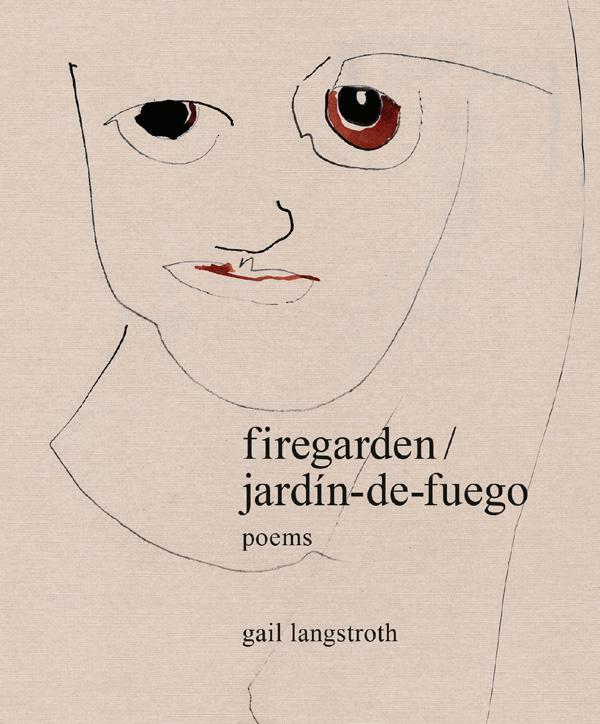
Since my twenty-first birthday the Iberian Peninsula has been a source of inspiration for me: its land, language, poetry and music. Sitting in Spanish cafes between rehearsals and classes, with moments to muse and write, I began to translate my own poems. The next phase occurred around kitchen tables with friends and native speakers.
One Saturday morning in Madrid, I met one of the two individuals living in all of Spain who knew anything about anthroposophy. The day publisher
Roberto Garcia of Get Fresh Books accepted my bi-lingual poetry manuscript, I celebrated that my first book would be in Spanish and English!
I wanted to include eurythmy, for if a poem is poem it says move me! So I asked NYC-based actor, David Deblinger, to help me stage a selection of firegarden’s poems. I wanted my solo show to be practical and portable.
I make a five square-meter area into a stage, bring two props, find a chair on site, and begin. The performance can be in both Spanish and English, or either language alone. Following the performance is a book signing.
horse-hay simple when you step solo—turf-infinite & you in-body swallow flames that no fire wants— when you step solo you shed ash that is left simple paja cuando tú andas solo—tierra-dentro y tragas en tu cuerpo las llamas que ningún fuego quiere— cuando tú andas solo arrojas la ceniza que queda
firegarden / jardín-de-fuego is now in print. Launch and release events have been postponed due to the pandemic, but we eagerly forge ahead.
Normally in a book presentation, the poet is introduced then proceeds to a microphone and reads a selection of poems. As a eurythmist presenting my own book,
I also offer dynamic Wordmoves
Writing Workshops in which we awaken language and the poem locked in our bodies. Out of movement we write, and then we move what we have written. Consider inviting me to your community to share the joys of Eurythmy and Poetry! No previous experience needed!
Gail Langstroth (gplcampostella@gmail.com) poet, eurythmist, teacher, and stage artist Gail Langstroth has collaborated and performed with international artists in North and South America, Japan, Spain, Germany, Russia, and Romania. She is online at www.wordmoves.com; for more about her book visit Get Fresh Books at gfbpublishing.org/shop. She has a portfolio online at bakerartist.org/portfolios/gail-langstroth.
arts & ideas 26 • being human
Photo by Georg Tedeschi georgtedeschi.com
Why Novalis? Why now?
by Bruce Donehower
In these times of crisis and “Shelter in Place,” the local group in Fair Oaks, CA of the Section for Literary Arts and Humanities has begun to meet online in an enhanced weekly rhythm to study the German romantic poet Novalis. Our group has met regularly every six weeks or so for the past nine years. But when the crisis hit, we like many others in the world community moved to Zoom.
At first it was challenging, but as the saying goes, with practice things improve. Our Section group even sponsored a three-part Zoom presentation at the Faust Branch on the “Significance of Novalis for Our Time.” These zoomed Branch presentations were ongoing during this month of May.
Why Novalis? Why now? Well, although Novalis, or Friedrich von Hardenberg (1772-1801), did not experience a biological pandemic, he did come of age during an “ideational pandemic.” That is to say: the French Revolution, the American Revolution, the Industrial Revolution—all those “revolutions” that still impact our world.
Like Goethe with the Fairy Tale written in 1795, Novalis responded to those “signs of his times,” which he recognized as symptomatic events that had their origin in the spiritual world. Hence, like Goethe with the Fairy Tale, Novalis chose to work with pictures and imaginations—and he thought that fairy tales (or Märchen, as the genre is called in German) were the highest form of poetic art.
We know from Rudolf Steiner’s many lectures how great an importance the Rosicrucians placed on pictures and imaginations. Novalis, like the Rosicrucians, thought that these picture-ideas work homeopathically, so to speak. His magical idealism is a challenge to become active with our imagination.
Many have found over the decades that an acquaintance with Novalis and his magical idealist practice can
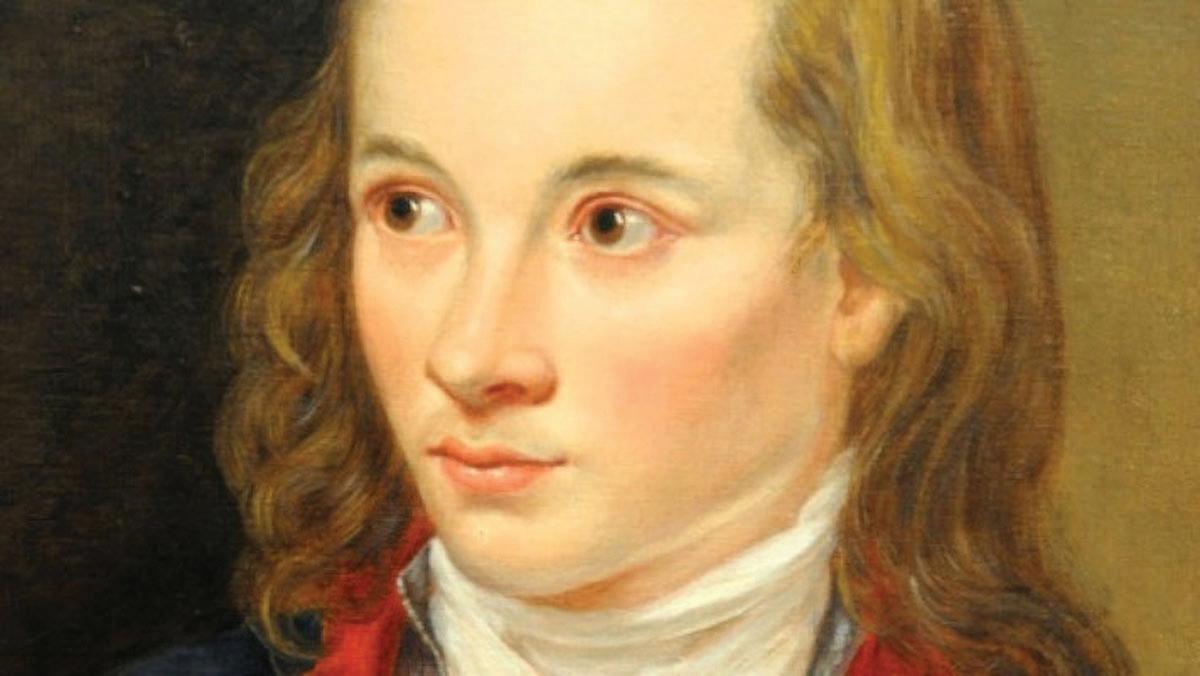
bring to us inspirations for self-renewal and creativity. But to receive these inspirations, Novalis, like Goethe, exhorts us to become active. “Start now!” Without this magical idealist activity of the imagination, we sit as passive spectators on a world from which we rightfully feel estranged.
Inward goes the secret path. Eternity with its worlds, the past and the future, is in us or nowhere. We dream of journeys through the cosmos — Is the cosmos not then inside us? Inside us, or nowhere, is eternity with its worlds — the past and the future.
Although at first our little group in Fair Oaks felt baffled by the crisis at hand, we have found some flakes of fallen light amid the gloom. As we follow our hero Heinrich of Novalis’ brilliant novel, Heinrich von Ofterdingen, we hear words that remind us of Rudolf Steiner’s many indications: that Novalis is needed at this time. Indeed, Novalis is a mystery, but as with all challenges in literature, we find our way slowly and patiently step by step through the maze.
“And then, who knows into what heavenly mysteries a charming, underworld inhabitant might initiate us?”
Those who might be interested on further reports of this literary adventure should contact me at BruceDonehower@gmail.com. If you wish to have information on the Section for Literary Arts and Humanities, I can provide that as well. Stay well, and in the words of those intrepid miners that Novalis celebrated: “Glückauf!”
Bruce Donehower (BruceDonehower@gmail.com) is Emeritus Lecturer in the University Writing Program at the University of California at Davis. He is the author of Miko, Little Hunter of the North, illustrated by Tom Pohrt (1990); The Singing Tree: An Alchymical Fable (2004); Ice: A Novel of Initiation (2004); and SancXtuary: A Novel (2012). He is translator and editor of The Birth of Novalis (2007). Most of his books are available from the Rudolf Steiner Library (rudolfsteiner.org/rsl).
summer-fall issue 2020 • 27
Seven Poems
by Peter Bruckner
E ntry
Quietly, I enter the dark room and shut the door. At peace within this void, I lie and listen to my breath, aware of nothing else.
Here, time does not pass, it gathers, slowly learning to be still. Heavy with sleep, it sinks, shade upon shade, the way leaf shadows deepen the mud of the pond.
I wait.
I know the world will find me, will find this space, and enter. But not as a wild turbulence that whirls the mortal wheel.
It has a yearning greater than the reckless wind. It will enter as a rain of seed falling through shafts of gold, seeking a place to begin.
It has a thirst the wide, bright sea can never quench: the need to know the self within. The world enters as a story, longing to be told.
W ith th E E asy G rac E of h is Po Etry
Rumi shows us How to flip a coin –How an august profile, Convinced of its own dignity, May find itself, a moment later, Upside down – how the other side Will always tell a different tale.
Just as we have grasped There may be more To what we know for sure, He stands the coin Up on its edge and Rolls it off the table. We do not even hear it
Hit the ground. Now what must we think?
Though still alive, we sense that Something old in us has died. Uncertainty opens up around us. This once familiar place Now feels unsafe.
Suddenly, bright peals of Laughter strike the air –Catch us unaware: Rumi is laughing. “Why ever were you Looking for the truth Out there?”
arts & ideas
28 • being human
“
All know that the drop merges into the ocean, but few know that the ocean merges into the drop.” —Kabir
t h E M ast E r
How does he do that? Even the angels do not know. And they watch him closely, always, as one must watch one’s master to learn a craft; every gesture, every pause must be mirrored in one’s soul. But this ... this ability to make himself small, so small
that a mouse will run into his hand for safety, so small that a child will not look up from play to see who has handed it the red block needed to complete the bridge, so small
that even the battle-worn adults, who sense with every gain their growing loss, don’t put on their faces, their reasons, justifications - their excuses, but can look into his quiet eyes and find that meaning that had been lost even in the midst of meaningfulness ... How does he make himself so small,
he who breathes out the spaces of the sun, that he may be a common man, offering an open hand to a common beggar, so small that the beggar wonders if the giver has anything more to give than love
c onc E rnin G G od
Is it possible to watch an insect propel itself across the void and not have thoughts concerning God?
For we know that if that frail creature, so exquisitely made, is navigating about in infinite space
Without some sacred sort of destination, without a trace of meaning to its flight, it is lost.
And we are damned. We too have slipped the maker’s mind -have been forgotten.
Not even forsaken with intent. Just that the context for our making is now gone; we won’t be missed.
Mislaid pieces of a game no longer played, why come look for us? We won’t be found.
Yet see how it now flings itself with such tremendous trust upon the buoyant air!
Where is the doubt that creature and creator are not one? Although our mind has caused this rift,
The wound may be no greater than what made it; a slender blade of flickering light,
Not bright enough to illumine a whole world, but sharp enough to blind us. God still might find us.
summer-fall issue 2020 • 29
a ssassin
I carry my death inside of me. It hides in the green branches of my life, a shadowed thing. The leaves shift uneasily where it has been, yet it remains unseen.
Whether the gleaming white of clean-picked bone, the crow-black of the cut off claw, or unctuous grey, a lethal ghost of fume, it waits, tenaciously.
One day it will murder me - in my sleep, on the way to the bank, in my sick bedI cannot know when. Yet of all the many moments that could be last
Only one will be the one in which I die, as I was born just when, and only then, the stars were just the way they were. My death knows this. An assassin only acts on orders.
So why this power play of fear, lurking like a Halloween cut-out in the intervals between my breath and heart beat?
Come out and walk the road ahead of me! Sit on the curb when you get tiredI’ll be along soon enough, my gaze fixed on the horizon;
An imaginary boundary that, like you, loses its finality as one draws near.
Till then may my pulse meld those moments meant for me with lifemay my breath be free.
i MPE rf E ction
You can divide a circle
By its radius into segments. Your curving compass cut Will mark out equal parts. A pattern of six petals will appear.
It may remind you of a star on high Or of the sky a tulip holds within. Either way, you sense a law That binds the earth to heaven –Simple, profound, and almost perfect.
Though not quite. For this division into six is not exact. Our world, ruled by geometry, Is not airtight: there is a flaw, a crack, That opens like a door not tightly shut.
Look! A little light is seen; The slightest sliver of a sickle moonQuite small, yet wide enough to Let a breeze slip in, Blow cold between the stars.
You shudder as the unknown element of life, And with it chaos, doubt and error, enter. Just then you notice libertyThat off-hand gift all imperfection gives, And how you breathe more freely than before.
arts & ideas 30 • being human
W indo W Pan E
Whenever a window is broken light crosses unhindered into another room.
Air circulates differently, passes like breath into the stillness and brings that stillness into breath.
Two spaces begin, slowly, to become each other.
Large expanses of air pour into a tiny room, that is always small, matched to the ocean air, and a thin vapor dissipates, rising to that vastness of embrace that is so much like nothingness. Light continues its unhindered entry. It enters the room much the way a god would do, changing it forever.
The windowpane may have been clear. More often it was not.
It may have been a colored jewel, puddling the fluid light, painting blue deep pools of air or staining them bright red.
More often it was dim with grime, the brittle bodies of a dozen flies dead at its unopened door. But now it is clear. Perhaps it was a rock that did it, a bullet even, having been a target of an aimless hate. Even strain will shatter.
Age can also crack that thin membrane that keeps the outside out. But now it is within.
Deeply it has pierced the separateness of place as death does –or a knife. Now it is here.
But it is not a knife, there is no death.
The light enters without hindrance. Air enters the room.
A windowpane was broken, a doorway has been opened. Things have begun to change.
About the Poet
Whenever asked to write a bio, I am never able to use the same note twice. When filling out an application for a craft fair, where I sell the energetic jewelry I design and make, the fact that I have traveled the world (literally) teaching the twelvefold art curriculum of the Waldorf School is irrelevant. To the editor of a poetry journal it is confusing information to know that I have three children and five grandchildren. That I am well thought of as a writer of short stories, plays, fairytales, and am working on the sequel to my novel Castle in the Clouds is of little interest to a committee commissioning a stained glass window for their church or community center. That I lived in a Camphill Community for twenty-five years and was a Waldorf school teacher for sixteen, and co-creator with my wife Tina, of The Marionette Theatre of the Stars for fourteen years, even I find hard to believe, although I have photographs to prove it and still meet people who
fondly remember the songs, the stories, the pageants, the magic.
Although I have worn a variety of hats and will still occasionally try on yet another one, here I am only introducing myself as a poet which is the one constant golden thread that runs through my biography, as I have always considered myself to be a poet, dictating poems before I was able to write and bringing a poetic sensibility to all my endeavors. With this selection I have tried to balance those that speak directly to our present time with those that have a more universal, uplifting mood.
Presently I am “putting out to the Universe” the wish to find a poetic dwelling-place where I can focus on my writing, as I have reached the age when the light at the end of the tunnel grows brighter with each passing day.
—Peter Bruckner ( pbwindrose@aol.com ) www.facebook.com/WindroseStudio
summer-fall issue 2020 • 31




arts & ideas o th E r a rts of P Et E r B ruckn E r
Stained-glass windows (in the Karl Koenig Schoolhouse of Beaver Run, Camphill Special Schools, condensed to show all three) illustrate the “Child of Light” fairytale of Rudolf Steiner.
Left: Father Truth; Center: the Child of Light; Right: an imagination of the three soul forces, protected by the rainbow from Ahriman (green, far right).
Energetic gemstone jewelry
Hand-painted scarves







painted scarves Poster for the play “The Judgment of Paris” A short video gives a feel of the production at www.youtube.com/watch?v=P01fUXMzeaM
Above, drawings “The Poignant Moment”
Hand
arts & ideas
 St.George / St. Michael and the Dragon, silk banner 4x5 ft
 Waterfall in Iceland “Golfoss”, watercolor
IN THIS SECTION:
Boyd Collins brings us further insights at the intersection of anthroposophy and technology and suggests we be conscious of where we place our attention.
Philip Thatcher’s poems take us back from tech obsessions to absorption in the natural world.
Giles Hutchins questions the fragile modern worldview with its dogmatic reliance on selfishness.
Christopher Schaefer suggests we examine the community life now interrupted to recover its spiritual power.
The Key to Digital Freedom: Learning to Deal with Discomfort
by Boyd Collins
How can we master the flow of our attention online? A lost soul...
The tall, spindly guy standing in the doorway to my office had the whitest face I had ever seen. As I watched him stare at the floor with a skewed grin, I felt an overwhelming sense that this case would not be easy. Due to my background in user interaction design, I had long practiced the art of taking control over user attention in the interests of my clients. In the right hands, this set of practices can create user habits that generate rich profits for platforms such as Facebook. Though I’m not a professional counselor, on occasion parents and friends have asked for my help in freeing loved ones from the demons I helped unleash.
He was a young man in his mid-20s who had a hard time talking about himself, but after twenty minutes or so of coaxing I found that he had studied data science at a top-ranked university and earned straight A’s. But after two years, he had dropped out and started sitting alone in his room all day long. He would start the day with Facebook and the hours would fly by chatting about random YouTube videos with his “friends.” Then he would binge on videos hour after hour, particularly cosmological visions and urban design experts unfolding their fantasies of the metropolitan future.
In this way, the morning would merge into the afternoon and the afternoon would darken into the evening. He had no job, no school, and no prospects. He refused to engage with anything more threatening than a microwave meal. I spoke with his parents. They had struggled to find the right therapist, the right job, the right school, or maybe to just get him out of the house and on a bench in the city park once a week, but without success.
One day during my bi-weekly meeting with him, he shared with me that a monkey lived inside his brain and steered his online obsessions. It told him what to watch on YouTube and made him binge on videos hour after hour. Later, he would plunge into Facebook and alert his “friends” about the neverending crises reported on social media. At the end of the session, he asked me with a sigh of desperation if I could wrench the steering wheel back from the monkey for him.
I began to work with him using some of the techniques described below. Once I convinced him that they might make the monkey relax its grip, he tried them for a few weeks. Gradually, the color of his face got a shade or two less white than new-fallen snow on a sunny day. His voice began to project a sense of self-ownership that sounded like insolence, but which signaled the emergence of a delicate new identity that needed a shield. I believe he’s slowly wrestling the driver’s wheel out of the monkey’s grip.
Monkey Brains
There is a part of us that enjoys letting go of the self-control that shapes the core of our humanity. It often seems as if the internet was intentionally designed to induce the mental state called the “zone” by machine gamblers. Natasha Dow Schull, who studied gambling addiction for many years, describes the “zone” as “… the world-dissolving state of subjective suspension and affective calm [gamblers] derive from machine play.” [1] The book that summarizes her research, Addiction by Design, is a detailed exploration of how video slot machines can become so compulsive that many gamblers habitually “play to extinction” — until their funds are exhausted. Similar principles are used by the major social media plat-
36 • being human research & reviews
forms and generate comparable “time-on-device” metrics.
To “enter the zone” means to surrender to a stream of stimuli devised to monopolize our attention. Recent studies have correlated Facebook addiction with the “flow” state that many Facebook users experience. [2] A “flow” state is a mode of action in which we become so engrossed in an activity that our normal sense of time disappears. One proven way to induce “flow” is to aim images, sound bytes, and texts directly at the amygdala located deep within the temporal lobes of the brain where emotional memories are stored and triggered. Like television news, social media tends to focus on content that activates a sense of impending crisis. By appealing to primitive survival instincts, experience experts can ensure obsessive user engagement.
A clue as to how social media manipulates users is contained in a leaked memo from Facebook, which reveals that Facebook’s algorithms can determine, and allow advertisers to pinpoint, “moments when young people need a confidence boost.”
If that phrase isn’t clear enough, Facebook’s document offers a litany of teen emotional states that the company claims it can estimate based on how teens use the service, including “worthless,” “insecure,” “defeated,” “anxious,” “silly,” “useless,” “stupid,” “overwhelmed,” “stressed,” and “a failure.”” [3]
Psychological studies correlate depression with increased user engagement. Shoshana Zuboff reports the results of a three-phase investigation conducted in 2014 which “… found that spending a lot of time browsing profiles on Facebook produced a negative mood immediately afterward. Then, upon reflection, those users felt worse, reckoning that they had wasted their time. Instead of walking away, they typically chose to spend even more time browsing the network in the hope of feeling better, chasing the dream of a sudden and magical reversal of fortune that would justify past suffering.” [4] What level of emotional stability can be maintained when Facebook users consume the precious hours of their lives justifying past suffering? Depressive emotions can keep us locked in a hopeless struggle for approval.
Anxiety, envy, and irritation are thus tailor-made for feed-based social media platforms. Our desire to overcome them powers a feedback loop that continually presents new crises with every refresh … Nothing holds our attention better than our own discomfort. [5]
Social media often traps us in a maze constructed out of our own feelings from which we hope to break out of through more and more interaction. But these anxieties are expertly orchestrated to keep users algorithmically poised on the edge of a fulfillment that it never actually delivers.
Unfortunately, trying to douse anxiety by using social media is like trying to put out a fire with petrol. As Shoshana Zuboff puts it,
We are lured to the social mirror, our attention riveted by its dark charms of social comparison, social pressure, social influence … As we fixate on the crowd, the technologically equipped commercial harvesters circle quietly and cast their nets. [6]
Compulsive social media users continually struggle to break out of crisis mode, and this might well be because that is the state in which their behavior is most easily exploited for profit.
To regain control, we need to stop monitoring the “crisis” for new developments. Compulsive involvement reinforces the often-delusive belief that our actions are contributing to a solution. As one social media analyst suggested,
These negative feelings give us a feeling of control in the midst of a barrage of updates by spurring in us a desire to find cathartic solutions to perpetual problems. [7]
When we act to bring the crisis to a resolution, this reinforces our sense of control and heightens the intensity of our engagement—exactly the behavior that provides the optimal outcome for the platform. Social media serves up a stream of stimuli meticulously devised to benefit the platform’s paying customers—the advertisers. The more we surrender to this flow, the more predictable and profitable we become for those able to emotionally manipulate us. Once we outsource our attention, we also outsource our identity.
Knowledge is Born from Pain
My formula for freedom from digital addiction rests on these principles and practices:
1. Self-regulation guided by a deep sense of self-respect;
2. Developing the capacity to focus on one topic or task for a significant length of time, and
3. Learning to bear life’s necessary pain.
For these principles to be effectively implemented, the addict needs to identify a focal point around which a new identity can form. Attention control is not the main is-
summer-fall issue 2020 • 37
sue—it tends to follow naturally once we find activities that bring us joy in living. As Cal Newport says, “When the void is filled, you no longer need distractions to help you avoid it.” [8] If we can’t generate our own intentions, outside powers will gladly provide them for us.
The young man’s retreat from life was triggered by an inability to handle social discomfort. His pain management strategy was to hide in his room and numb the guilt of his dereliction with digital hypnosis. The high level of social approval currently accorded to digital media allows us to treat it as an acceptable substitute for a life fully lived. By constantly assuring us that artificial intelligence will soon rule modern society, we are provided with the perfect excuse to abandon what’s left of our humanity. However, the fundamental issue is our inability to bear life’s necessary pain long enough for it to communicate its much-needed message.
Most people no longer have the inner resources to creatively cope with the pain of emptiness. Levels of boredom that a few years ago would have been considered almost imperceptible have now become intolerable. In earlier times, learning to endure empty moments was not optional for most people, but with smartphones, we now have continual access to instant relief.
To stem an addiction, one needs to become aware of the craving as soon as it emerges and “surf the urge” [9] without immediately grasping for relief. For example, as soon as we feel the presence of empty moments such as when we’re stuck in traffic, the urge to grab the smartphone is often as automatic as lighting up was to previous generations. What we can do during such moments is to pour consciousness into this urge so that our action is no longer a mechanical reflex. Researchers have found that if we can delay gratification for even a few seconds, the heightened consciousness aroused by the effort can be sufficient to weaken the habit. We need to feel the moment’s emptiness rather than avoid it. Practical wisdom is the result of accepting the pain that is essential to growth.
Overturning the Idols of Attention
So how has the young man begun to wrest the steering wheel back from the monkey? Essentially, he has identified the false god that had taken over his attention. A metaphor for this digital control mechanism can be found in the Tibetan tradition. His “monkey” might be called a “tulpa”—a psychic entity invoked through visualization and willpower. The young man now understands that the online services managed by this algorithmic tulpa were de-
signed to plant intentions in his mind that he falsely identified as his own. He had accepted a manufactured identity that kept his attention engrossed in digital fantasies.
He also began to understand that perception is an active process that is learned and can be creatively developed. The act of perceiving the world around us is not the mere acceptance of canned content as we are led to believe. Instead, we actively fabricate reality by sewing together inner and outer perceptions. Though it usually happens in a flash, we combine visual and auditory fragments with memories of similar scenes and talk ourselves through the result using abstract thinking until the scene around us gains coherent form. Douglas Rushkoff put it this way:
Our ability to be conscious—to have that sense of what-is-it-like-to-see-something—depends on our awareness of our participation in perception. We feel ourselves putting it all together. And it’s the openended aspects of our experience that keep us conscious of our participation in interpreting them. Those confusing moments provide us with opportunities to experience our complicity in reality creation. [10]
It is the “confusing moments” that allow us to experience our ownership of the act of perception. Instead of letting his intentions be modeled by digital stimuli, the young man now forms them for himself.
His obsession with digital distractions was due to an inability to understand that life is a participatory task. I assigned him attention exercises in which he had to focus on a non-digital artifact such as a blooming sunflower for several minutes at a time. He would try to memorize every detail of the flower. Eventually, he was able to hold his attention steady on a single object for up to five minutes. By focusing on living forms, he activated a participatory thinking which is impossible with digital images. It was at that point that his voice took on an insolent-sounding tone that signaled the awakening of a self worth protecting.
One day, he stepped into my office with a crazy grin and asked excitedly, “Do you know about Deep Q Networks?” After we had chatted for a few minutes, it became clear that the overwhelming void that had taken over his life was starting to be filled by a fascination with neural networks. Evidently, he had stumbled onto one of the little-known principles of attention mastery. In the words of Nir Eyal,
… Instead of running away from our pain or using rewards like prizes and treats to help motivate us, the idea is to pay such close attention that you find new
38 • being human
research & reviews
challenges you didn’t see before. Those new challenges provide the novelty to engage our attention and maintain focus when tempted by distraction. [11]
The young man had discovered a source of keen enjoyment beyond the digital bubble, a field of play in which his attention is no longer managed by the platform, but by himself. By turning to pursuits that awaken new powers in ourselves, we can transform the machine agents which seek to control us into intelligent and loyal servants. We achieve this by thinking through the role that smart devices play in our lives so that they obey our conscious intentions rather than merely blasting our inner emptiness with digital noise. As Steve Talbott says, We can be positive about technology, in other words, only by being negative about it — that is, only by recognizing its downward pull and exerting ourselves against this pull. If we do this, the gift that technology holds out for us is the gift of our own highest capacities. [12]
Boyd R. Collins (boydcster@gmail.com) was a web application architect for several large multi-national corporations over an IT career of 22 years. Previous to that, he worked as an academic librarian in Rutgers University. As an environmental activist, he contributed articles to the influential Dark Mountain Project (http://darkmountain.net) in the U.K., “… a network of writers, artists and thinkers who have stopped believing the stories our civilization tells itself.” Feeling the need for a spiritual foundation for his ecological efforts, he began an intensive study of the works of Rudolf Steiner. In
these works, he discovered an inspiring vision of spiritual evolution that provides a solid foundation for hope. He is currently retired and living in the Philippines where he dedicates his time to writing articles on anthroposophy and related topics.
Endnotes
[1] Natasha Dow Schull, Addiction by Design: Machine Gambling in Las Vegas, (Princeton University Press, 2012. Scribd Edition) p. 41.
[2] J. Brailovskaiaa, H.-W. Bierhoff, E. Rohmann, F. Raeder and J. Margraf, “The relationship between narcissism, intensity of Facebook use, Facebook flow and Facebook addiction” Addictive Behaviors Reports, February 2020. <https://www.sciencedirect.com/science/article/pii/ S2352853219301695>.
[3] S. Machkovech, “Report: Facebook helped advertisers target teens who feel ‘worthless’,” Ars Technica , 01 05 2017. <https://arstechnica.com/ information-technology/2017/05/facebook-helped-advertisers-targetteens-who-feel-worthless/>.
[4] Shoshana Zuboff, The Age of Surveillance Capitalism: The Fight for a Human Future at the New Frontier of Power, (New York: Hatchette Book Group, 2019. Kindle Edition), p. 464.
[5] Stefan Higgins, “Crisis Mode: Platforms thrive on making you feel bad,” Real Life, 7 November 2019. <https://reallifemag.com/crisis-mode/>.
[6] op. cit. note 4, p. 467.
[7] op. cit. note 5.
[8] Cal Newport, Digital Minimalism: Choosing a Focused Life in a Noisy World , (New York: Penguin Publishing Group, 2019) p. 169.
[9] S. Bowen and A. Marlatt, “Surfing the Urge: Brief Mindfulness-Based Intervention for College Student Smokers,” Psychology of Addictive Behaviors, pp. 666–71, December 2009.
[10] Douglas Rushkoff, Team Human , (New York: W. W. Norton & Company, 2019. Kindle Edition) p. 136.
[11] Nir Eyal, Indistractable: How to Control Your Attention and Choose Your Life, (Dallas, TX: BenBella Books, Inc., 2019) p. 57
[12] Steve Talbott, Devices of the Soul: Battling for Ourselves in the Age of the Machine, (Sebastopol, CA: O’Reilly Media. Kindle Edition, 2008) p. 215.
Pleasure Rare & Transitory
Fine Matter, by Philip Thatcher; (Les Éditions Perceval, 2020, order at percevalbooks2001@gmail.com), 102 pages
review by Fred Dennehy
Owen Barfield, in characterizing the experience of poetry as “a felt change of consciousness,” goes on to pinpoint poetic pleasure to be “rarer and more transitory,” something dependent upon the precise moment of change itself. If you pass a coil of wire across two magnetic poles, you will generate a current of electricity, but only during the moment of transition, when the coil is being brought into the lines of force or being taken away. At rest, the current disappears. It is the movement that is all important.
The poems in Philip Thatcher’s Fine Matter live and breathe in this movement. They take us through places alive with elemental forces that connect to what is stirring within us just beneath the surface, as well as swimming in
the far cosmos. Thatcher’s landscapes are northern, of the Pacific Northwest, or Finland, or Russia, or the Canadian Shield, stretching from the sparse provinces of west and central Canada, down to the Great Lakes and up through Hudson Bay to the Arctic and as far east as Greenland. This is geography as old as the Precambrian and as new as the unexplored frontier. His lyrics delight in Native place names like Kaloloch, Naikoon, Nunavut, and in words from the Gitxsan people of the Skeena Watershed of British Columbia—words like adaawk (stream of story); amlax (Old Salmon); and ‘Nax’nihl (listen). Everywhere you encounter stones, and along with stones, snow, tundra, and the long snaking fogs of some of the world’s most demanding terrain. We feel the challenge of the emptiness, the openness, and the sheer possibility that arises when
summer-fall issue 2020 • 39
the familiar is left long behind us. Thatcher’s verse can curve like a river, with rhythmic word recurrences unfolding through narratives of sentient surprise. He is also an accomplished novelist (The Raven Trilogy), and he speaks to us in pitch perfect tones, while refusing to allow his lines to say anything not truly heard. In three poems that follow one another in Fine Matter, “Dawn Reconnaissance,” “Holy Saturday,” and “About Creation,” Thatcher conjures an almost preternatural mood of expectancy, sounding along the edges of doubt, through Good Friday, Holy Saturday, and into Easter Sunday. When Easter arrives, it is not with the ringing of bells and the unqualified joy of Resurrection, but instead with keener questionings, finer longings:
Borne on the first sharp rush of Easter breath can I speak only words about creation?
Or can I start to stammer water to wine wine into warm living blood?
Fine Matter
yet even the tip of a finger can be touch enough A word may mean what it says or close enough or its opposite sounding its own truth between the lines –Listen
The very last poems in Fine Matter unfold almost entirely in a mood of passage. They include “Aging,” “This Late Winter Tree,” “Towards 81” and the delicately graceful “To the End of the World,” reminiscent to me of the delicate sorrow of Antonio Machado.
There are diverse voices here: the intimate admonitions of a spiritual teacher in the selections from “Mask of the Sun”; the calm, accepting tones of age for what it knows will have to be; and the taut, controlled sketching of the wonders of frozen, barren vistas. Always there is resonance between outer landscape and inner experience.

Transitions of all kinds are recurring themes. Here is a commencement address that I wish had been given to my own graduating class:
FOR THE CLASS OF ‘92
Listen between every line Jump at nothing and doubt only what you want to hear Despise nothing but your need to despise Know your hands are not tied, though they may fumble at what they love
Thatcher’s north can open to hidden events of the past, or to wordless inner discoveries; or to a sudden restoration of purpose and resolve. My own favorite is “An Arctic Fox Odyssey,” the story of the 3500 kilometer, two and a half month journey of a female fox from Norway to Nunavut, in the Canadian Arctic Circle. We see her losing her trackers as she finds at last an ice bridge to Canada. I suppose there may be better feminist poems, but it is difficult to recall them. Thatcher dedicates this poem to Joan Almon.
The 57 poems of Fine Matter, spanning fifty years, are arranged into five collections: “About Creation,” “Along the Edges,” “Turning the Earth,” from Mask of the Sun,” and “A Brush of Light.” Revelation is their medium. Don’t deny yourself the experience.
The Illusion of Separation
The Illusion of Separation: Exploring the Cause of our Current Crises, by Giles Hutchins; (Floris Books, 2014), 199 pp
review by Fred Dennehy
There is an old Chinese proverb saying that “in times of great winds, some build bunkers and others build windmills.” Giles Hutchins, with this proverb in mind,
tells us that the decision makers of today, threatened with “an epic storm of economic, social, psychological and environmental catastrophe,” are frantically searching for quick fixes instead of looking for root causes. The
40 • being human research & reviews
Perceval
Philip Thatcher
symptoms of catastrophe are undeniable. From the social and psychological perspective, more and more people are caught in an economic net of unending debt, while fewer and fewer are able to afford even the basic care their bodies need. This predicament is even now forcing some to choose who in the family lives and who dies. Systemic racism eases life for the many by sacrificing the few. The use of anti-depressants and opioids skyrockets, and despair lies hidden behind casual chatter until its release in the strangled cry of a suicide. From the global perspective, our time on Earth is fast approaching a “century of hell” as our carbon debt comes due. We are left to face the prospect of cities disappearing under rising seas, apocalyptic heat waves, sudden outbreaks of disease, raging fires, monster hurricanes, global scale migrations, and much more. The vast majority of species on the planet are quietly being destroyed. Our oceans are accumulating islands of plastic the size of countries. We know all this, but we can’t muster enough will to stop it or even slow it down. The storm is “epic” because of what it augurs for the future. Things will get worse. It turns out not only that catastrophe has been written into the program of the Western paradigm, but that the program accelerates at a faster speed than anyone had foreseen. That is, assuming that anyone had been looking.
Mr. Hutchins is a British business organizations specialist, a consultant to corporations struggling to navigate the challenges posed by such a future. Early on, he recognized that traditional modes of organizational learning and leadership development were inadequate to the emerging environment. He understood that rather than the application of classical or modern business principles and methods, what was needed was an entirely new cognitive capacity, not only for sensing the future, but for embodying and enacting it. He saw that in order to cultivate such an “extended epistemology,” it would be necessary for us not so much to acquire new skills as to transform ourselves. His own business model accordingly changed from advice and consultation to consciousness raising, “deepdive” nature immersions and working with indigenous embodiment practices in order to “become human.”
In The Illusion of Separation, Hutchins hopes to transfer his insights from contemporary business practices to the much larger theater of Western civilization. Just as he had found the traditional modes of business learning inadequate for helping organizations looking toward the future, he sees the monetary and technological fixes applied to today’s social problems as ineffectual if
not outright counterproductive. Society’s ills are deeprooted, and implementing “downstream” solutions with measures rooted in the same paradigm as “upstream” systemic causes, actually exacerbates those problems. In Part One, Hutchins examines today’s problems beginning with those nearest at hand, and then moving progressively “upstream” to more profoundly rooted causes, until he arrives at the primal source, “the delusion of separation.” In Part Two he proposes to pierce the veil of this delusion in order to glimpse a deeper reality, and in Part Three to find new ways of embracing life within that reality.
Hutchins begins with the everyday scrimmage of consumerism. The artificial inflation of desire is the corporate vehicle of choice here for growing debt and keeping demand constantly ahead of supply. At the same time, the gratifying illusion of self-determination is brandished for the public ego to feast on. It becomes increasingly rare for anyone to follow an authentic calling. The only jobs that pay well enough are those tendering their employees roles scripted narrowly for the consumerist culture. And it is not just the minor players who are being manipulated. The principals are being driven to act out their tyrannies through a passively imbibed diet of hyper-competitive impulses.
The source of our systemic competition, in the author’s view, is the evolutionary paradigm that finds its most militant expression in Neo-Darwinism, and signally in the writings of Richard Dawkins. For Dawkins, life at any level, whether gene or species, is invariably one of competitive struggle. Though it may be played out at times in partnerships of convenience, the “motive” (to default, as Neo-Darwinism invariably does, to an anthropomorphic metaphor) cannot be other than selfish exploitation. Hutchins disagrees; if such behavior were the rule, nature would not be “fit” to “survive.” Unremitting competition must end in a community where diversity is destroyed, biological resilience is subverted, and evolutionary potential is undermined. “The cancer ends up destroying itself.”
If the necessity of antagonistic competitiveness is one pillar of Neo-Darwinism, chance variation is the other. The invocation of “chance” or “randomness” or “radical contingency” as a scientific term is so ingrained in our discourse that we sometimes forget that the very purpose of a hypothesis is to rescue us from the refuge of “chance” as an explanation. Chance, to put it plainly, is not a hypothesis. But the lure of a self-contained evolutionary mechanism is so hypnotic that, to invoke the wit of Owen Barfield, … few of us notice that the impressive vocabulary
summer-fall issue 2020 • 41
research & reviews
of technological investigation is actually being used to denote its breakdown; as though, because it is something that we can do with ourselves in the water, drowning should be included as one of the different ways of swimming.
But Hutchins’s strongest case for abandoning the Neo-Darwinian picture of “selfish ascendance” and “oneway adaptation” is based on observation rather than argument. He draws from what he calls “Nature’s wisdom”— what we become aware of when we open to the inner and outer depths of the natural world around us, through, for example, Goethe’s “active seeing.” The attunement we find in the flocking of birds, the shoaling of fish and the swarming of bees; the natural diversity and complex webs of interconnection in microbial soil communities; and the astonishing resilience of nature’s regenerative cycles, contribute to a picture very different from the meaningless void that Dawkins and others call home. As Hutchins points out elsewhere, an oak tree in an English forest, using Darwinian logic, should be “interested” only in the acorn, its own genetic offspring. But through radioactive tracings, we find it is sharing nutrients with the genetically unrelated holly sapling in a different part of the forest. Areas rich in minerals are sharing with areas poor in minerals. Neo-Darwinism is led to devise increasingly convoluted ways to explain away such non-selfish behaviors, which we see everywhere once we look. These tortuous exemptions from the rule of self-interest are reminiscent of the epicycles of medieval astronomy, which, while they may have saved the appearances for the moment, were warnings of a coming paradigmatic shift.
As Hutchins continues his “upstream” journey in time, he traces the Neo-Darwinian separation of organism from environment back to the formational Cartesian worldview of “content separable from context,”—an “inner,” meaning-bestowing human psyche radically divorced from a meaningless, purposeless, “outside” world. Hutchins explores the origins of Western dualism, with welcome attention to Pierre Gassendi. It was Gassendi who was largely responsible for the catabasis of the idea of God in Western imaginings from a loving, if occasionally angry, Father, into a dour, reclusive watchmaker.
Hutchins goes on to pursue the etiology of the twentieth century’s ruling idea of positivism back to the shift from medievalism to modernism, and the eventual eviction of the spirit from philosophical discourse.
The farther “upstream” he navigates, the more Hutchins sees the unfolding of a recurring pattern in the West’s “logic of separation.” A convenient “working hypothesis” is employed for a limited practical purpose, and then left untended in the intellectual landscape. There it metastasizes from a heuristic model to a generalized concept, convincing enough to take the field one day as a new reality. Owen Barfield, in Saving The Appearances, named this habit of mind “idolatry.”
Hutchins is strongest here, in Part One of The Illusion of Separation, when he speaks to the dangers of the modern Western paradigm. He draws a convincing connection between today’s “epic storm” of societal dangers, and reductionism’s shrinking of humanity to peripheral islands of awareness vainly seeking meaning in an accidental universe. His call for a change in consciousness resonates not so much from the cogency of his argument as from his own unmistakable vibrancy with the world around him. Hutchins tells us of wide harmonies between human and nonhuman systems, usually unnoticed, and foretells an authentic awakening to what is creative and loving within us. The thin reasoning of reductionism, which once had the cache of a lone bravery in the face of nothingness, seems strikingly unequal to the richness of Hutchins’s canvas.
But when Hutchins, in Parts Two and Three, turns to the explication of new modes of consciousness and new ways of embracing life, there is a falling off. While he casts a wide net for thinkers from antireductionist movements that have surfaced and resurfaced in our time, he betrays an unwillingness to explore their work with sufficiently close attention. He refers us enthusiastically to Jungian psychology, ecopsychology, anthropology, phenomenology, a smorgasbord of abstruse twentieth century philosophies, meditation, the imaginal realm of Henry Corbin, indigenous wisdom, the quantum void, string theory, the Black Hole Principle, and Alan Rayner’s perceptual philosophy of “natural inclusion.” But in surveying these disciplines and movements to find allies, Hutchins has opted

42 • being human
for inclusiveness over informed, hard won insights. What he gains in breadth he loses in depth.
For instance, in a chapter largely devoted to Owen Barfield’s Saving The Appearances, Hutchins falls victim to the very oversimplifications he finds endemic to reductionist logic. He presents Saving The Appearances as a rather straightforward chronicle of civilization’s long honeymoon with the “embodied experience” of participation, followed by its gradual estrangement through rationalism in the form of “alpha thinking,” and culminating in a prodigal’s chastened return to “final participation.” In picking and choosing terms for his immediate purposes, he misses the subtleties. And he ignores Barfield’s complex and minutely nuanced philosophy of polarity, which could have served as a foundational thought structure for the awakened consciousness he dreams of for our future.

Hutchins (not an anthroposophist) has a tendency to enlist a thinker as a laborer in the vineyard of his new reality so long as there is anything in that thinker’s work
that questions the old paradigm. In addition to the modern anthroposophical writers Owen Barfield, Henri Bortoft, and Otto Scharmer, Hutchins invokes Goethe and Rudolf Steiner, but for little more than to mark their enlistment in his camp. A chapter devoted to a thorough and inclusive consideration of any of these thinkers would have given the latter part of the book some of the sharp edges that it lacks. This problem is by no means peculiar to Hutchins, whose book should be a source of both enlightenment and encouragement to anthroposophists. We find here what we likely already know. It is one thing to chronicle the passing of an old paradigm, and quite another to render an account of a new one.
Frederick Dennehy (fred.dennehy9@gmail.com) is Associate Editor of being human, a Class Holder of the School for Spiritual Science, actor, and retired lawyer.
The ASA invites you to join the
Michael Support Circle
our major donor circle. THANK YOU to the 51 individual members, and to these organizations, whose gifts provide generous and on-going support to bring Rudolf Steiner’s vision more fully into the world, for the future of the world.
Anthroposophical Society of Cape Ann
Anthroposophy NYC
Association of Waldorf Schools of North America
Bay Area Center for Waldorf Teacher Training
Biodynamic Association
Camphill School
Carah Medical Arts
Cedarwood Waldorf School
Center for Anthroposophy in NH
Council of Anthroposophical Organizations
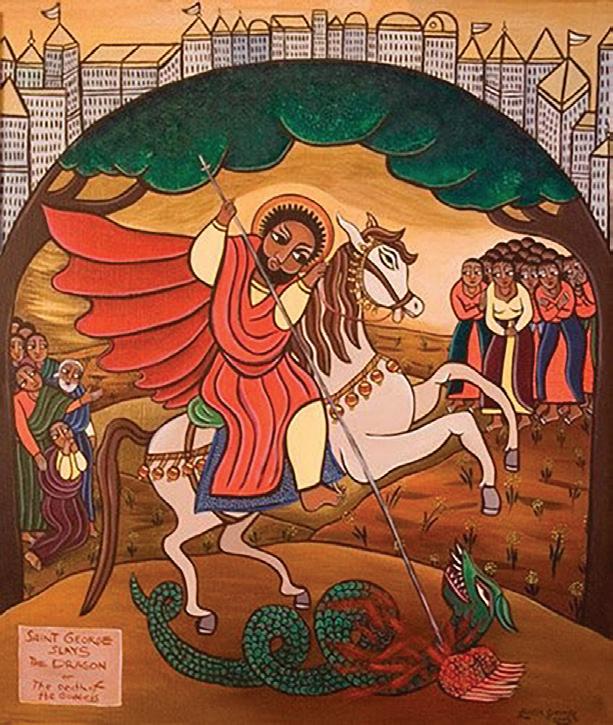
GRADALIS Waldorf
Consulting & Services
Great Lakes Branch
Heartbeet Lifesharing
High Mowing School
House of Peace
Monadnock Waldorf School
RSF Social Finance
Rudolf Steiner College
Rudolf Steiner Fellowship Foundation
Shining Mountain Waldorf School
Michael Support Circle members pledge gifts of between $500 and $5000 per year for five or more years. They help the Society to grow in capacity and vitality—the basis for increased membership, new learning opportunities, and greater impact in the world.
To learn more about how you can support the strength and sustainability of our movement, contact Deb at deb@anthroposophy.org
summer-fall issue 2020 • 43
Saint George Slays the Dragon, by Laura James
Sacramental Conversation: Experiencing Our Humanity
by Christopher Schaefer
This article is based in part on a public Zoom talk to members of the North American Council for Anthroposophical Curative Education and Social Therapy, (www.nacouncil.org ), on April 24, 2020.
If you don’t know the kind of person I am And I don’t know the kind of person you are A Pattern that others made may prevail in the world. And following the wrong God home We may miss our star... 1
In the last six months we have had two extraordinary experiences, the ongoing pandemic of Covid 19 and the widespread demonstrations for Black Lives Matter following the killing of George Floyd in Minneapolis. Each experience raises the question of what it means to be human in this time, to be afraid, to face illness, isolation and possibly death, and to be prejudiced or systematically to be discriminated against, incarcerated, or murdered because of the color of your skin. So when and where do we experience our humanity and our mutual indebtedness most strongly and directly and what can such experiences teach us about the values needed to heal ourselves and society?
The Intentional Nature of Community Life
Those of you active in curative education and social therapy have the gift of being in a community of service, living in a house or village dedicated to the mutuality of sharing life with people of differing abilities. This life in community, even if you are now isolated in individual homes, offers perspectives and activities which are deeply life and humanity affirming because behind the activity of service lies a rich image of mutuality, of interdependence and of the abiding value of human encounter and conversation.
Implicit in this statement, which holds true for many life sharing communities and communities of service, are a number of principles made quite explicit within Camphill communities and many other initiatives inspired by anthroposophy. These I would like to explore while focusing in particular on the gifts of human meeting and conversation, which are now being severely challenged by the pandemic.
Perhaps the most fundamental of these principles or attitudes is the view that human beings are spiritual beings now living in a body and a soul. How we manifest in this particular life, with our gender, race, temperament, age, disposition, and abilities is never a full expression of our eternal being or higher self. A connected thought is that the teacher and child in school, or the co-worker and resident in a curative home, or indeed all of us in relationship, serve the other in our journey of becoming. Furthermore, these relationships can be seen as having an intentional karmic quality, that we intended to be together, to learn and serve each other in this life, in this place, even when such learning is difficult.
This understanding of the mutuality of karma rests on a picture of repeated earth lives, of reincarnation, described in some detail by Rudolf Steiner.2 According to his research, we create the outline of our earthly destiny together with our karmic brothers and sisters before birth and then enact these intentions in life, seeking to become wiser, more loving beings. So it is ultimately we, and our friends, community members, colleagues, partners and children, who sculpt the learning plan for our lives while life itself becomes the great school. We therefore all provide “support and are allies” to each other in life, even if we are often not aware of it. Martin Luther King gave a true picture of this reality when, describing racial prejudice in his “Letter from a Birmingham Jail,” he stated:
All men are caught in an inescapable network of mutuality, tied in a single garment of destiny. Whatever affects one directly, affects all indirectly. I can never be what I ought to be unless you are what you ought to be. And you can never be what you ought to be unless I am what I ought to be.”
Our mutual destiny expresses itself most directly through human meeting and conversation. It is, after all, through relationship that we are born, learn language, become part of the human community, and discover who we are. It is through the gifts of our parents, siblings, teachers, friends, and colleagues that we become ourselves, with our
44 • being human research & reviews
1 William E. Stafford, “A Ritual to Read to Each Other”
2 Rudolf Steiner, Karma and Reincarnation: Two Fundamental Truths of Human Existence, Rudolf Steiner Press, 2001
unique talents and limitations. It is also through meeting and conversation that the whole social world is created. Families, shops, schools, concerts, curative communities, towns, and nations are all created and sustained through human dialogue. This is why Rudolf Steiner refers to human meeting and conversation as the “archetypal social phenomena,” the source of our human becoming, and that activity from which the entire social world emerges.
The Gifts of Conversation
We have all had the experience of deep conversations and meetings with another in which we have felt met and understood. We experienced ourselves as fuller, more creative and insightful, and also more trusting and hopeful about the future. Perhaps in moments such as these we have also felt our kinship, our deep karmic bond with the other, feeling gratitude for the soul sister or brother we have had the joy of meeting.
My great concern about the present pandemic and its likely evolution is that this central human experience will be curtailed and distorted, blocking the deeper experience and awareness of our karmic mutuality. Socially distanced, masked, and resorting to Zoom or other electronic media, while helpful, will not give us the eye-toeye contact, the face-to-face meeting, in which the full experience of our humanity and karmic bond can be felt, not to mention the sense of co-creating with the spirit that often accompanies deeper one-to-one conversations or intimate group dialogue.
Here I am reminded of a recent article in the NY Times by Kate Murphy called “Why Zoom is Terrible.” 3 She argues that Zoom is exhausting and distorting because the images it gives of the other are altered, spliced, patched, and synthesized, with the result that we are uncertain and confused as our subconscious facial cues of authenticity, truthfulness, and interest are undermined. I would add that in face-to-face meetings we have real eye-to-eye contact and that our etheric and soul bodies connect and interact adding a rich, subconscious, and humanity-affirming context to our meetings, which cannot happen through the medium of a screen.
Suppose the virus never goes away entirely, and that the costs of using teachers in schools, of meeting and being together at work, and of travelling to conferences is seen as prohibitive in a new time of austerity. The virus then provides the perfect rationale for curtailing and in many cases
3 April 29, 2020
eliminating face-to-face meetings, resorting to electronic communication and blocking the working of human destiny. From this perspective Covid-19 is the perfect tool for those forces in the human and spiritual world seeking to undermine the experiences of our spiritual and karmic possibilities, attempting to rob us of our future as beings trying to learn to love in freedom. The very same forces behind the corruption and decline of our institutions, namely greed, egotism, fear, suspicion, dislike, and hatred, can then be further strengthened by the media, and will not be balanced by the healing leaven of personal meetings.
So I turn to you and ask whether you as members of healing, life-sharing communities, based on a deeper imagination of what is truly human, can dedicate yourselves once again and newly to be guardians and protectors of authentic human meeting and conversation. I believe that within Camphill Communities there is a canon that is often sung in gatherings—“Guardians of the light we have been given, Living Light for which the Gods have striven…” Can we all, but especially people living in communities dedicated to the living light in each of us, cultivate a new awareness of the blessing and deep soul and spirit working which happens in personal meetings between two or more people? And if we bring our conscious attention to such meetings and develop a new dedication to the practice of mutuality in dialogue we will, I am sure, have experiences that answer many of the challenges which Covid-19 and which the racism and corruption in our social life present us with.
You and I meet. We speak, listen, and develop some level of mutual understanding. This is itself a small miracle since in speaking we are transforming a thought or feeling, an aspect of our consciousness, into audible sounds which the other person hears and is able to then integrate into their awareness. Through deep listening and conscious speaking, through focusing our attention on the other, and through speaking to and responding to what is said, we are manifesting interest. While this activity is mainly happening in the mind, it is accompanied by feelings and intentions. If these too are open and attuned, we are manifesting not only an open mind and an open heart but a caring will, a desire to serve a genuine meeting between two or more people. This builds trust and a feeling for mutuality.
If we pay attention, we will also notice a dance in our consciousness in conversations between being awake to the other in listening, though more asleep to ourselves, but in speaking the reverse—awake to ourselves and what
summer-fall issue 2020 • 45
we want to express, and more asleep to what is happening in the other. Deep listening, when we are allowing the other into our soul, is a supersensible experience, like true meditation, and we resist it and often quickly resort to judgements, and comments such as, “Have you thought of...” or “How can that be true?” or the classic, “Yes, but...”
Steiner suggests that a remarkable process of karmic recognition is happening just below the surface of consciousness in our speaking and listening. In listening to the other we for a moment have an image of our future karmic connection to the other and in speaking a tableau of our past connections.4 We have had moments of karmic recognition on meeting someone for the first time, or on seeing each other after a long separation, where we feel here you are again, my heart has longed for you and missed you. Perhaps that experience can give us an inkling of what possibilities lie within human encounter and dialogue as a way of awakening to the reality of our mutual karma. In 1913 in London, Steiner suggested that the ability to bring these imaginations of past and future karmic connections to consciousness would be a birthright of increasing numbers of people in the 21st century, if such capacities were not destroyed.5 I believe that biography work, as well as dyad work and other dialogue methods are a preparation and foreshadowing of these important karmic experiences.
There are of course many distractions and disturbances which stand in the way of a deeper and authentic meeting and conversation between people. These are also important to pay attention to because they reveal what needs to be transformed in us and in the world. These forces can be described as anti-social in nature and they live strongly on our thinking, feeling and willing life.
In my experience they manifest a kind of polarity. In our thinking life doubt and criticism on one side and dogmatism and fanaticism on the other. We listen for a moment to the other and then we are off, expressing either criticism or asserting the truth of our own opinions. I frequently experience this in myself when trying to listen to my older brother, a conservative Republican, but also know it only too well in everyday life.
Our feeling life is strongly affected by the polarity of likes and dislikes, of sympathy and antipathy. Such feelings are strengthened by the media, advertising, and our
4 Steiner, Approaching the Mystery of Golgotha, SteinerBooks, 2006, pp.8,9
5 See the inspiring book by Harry Salman, The Social World as Mystery Center: The Social Vision of Anthroposophy, Threefold Publishing, 1999, in particular pp. 99-134
peers, and they color our reaction to everything, especially people. They influence our perceptions and behavior and are often enemies of true meeting as they tell us more about ourselves than about others. As such feelings are often semi-conscious it takes considerable work to unmask them and to avoid the phenomena of projection, where we ascribe to others what lives strongly in our own soul. We see this playing out in the political arena quite forcefully during this presidential campaign.
Our will, expressed in acting, is largely unconscious and swings between the polarity of anxiety and fear on the one side and an illusionary egotism or magical belief in self on the other.
The three soul forces of thinking, feeling and willing help us to have self-consciousness, but without schooling they become anti-social, strengthened by all the manipulations of our “me first” culture. Steiner suggests that the anti-social forces in our soul also represent aspects of our shadow, our double, which need to be transformed if we are to realize our true nature as human beings. Thus others, our children, partners and colleagues are often the annoying mirrors showing us what needs to be worked on in ourselves. Yet they are also an invitation to develop interest in the other, to experience empathy toward the other in our feeling life, and to engage in acts of love and mutual service. Thus relationships, meetings, and conversation are truly the mystery centers of modern life, the place where a soul and spirit drama of mutual transformation takes place.6
In the diagram you will note that development of interest in the other, of empathy for the other and of love for
I Behold the Other (I) with Interest (II)
Doubt/Criticism.........................................Dogmatism/Being Right Thinking/Open Mind with Empathy (III)
Dislikes/Hatred.........................................................Likes/Self Love Feeling/Open Heart with Love (IV)
Fear/Anxiety................................................................Ego-Inflation Willing/ Serve the Other
Anti-Social Forces............................................................Anti-Social Forces Conscious Social Forces which make visible the reality of Karma
the other is a balancing activity in our thinking, feeling and willing life between the anti-social extremes of doubt and dogmatism, dislikes and likes and fear and egotism. It represents the invitation which others provide us with
46 • being human
research & reviews
in meeting and conversation. And it is the mutual practice of “Love thy neighbor as thyself.”
Sacramental Conversation
Conversations and small group gatherings can have a sacramental nature. This is not only because we can experience the mutuality of our destiny connections and the spiritual striving of the other, but also because we have the possibility of co-creating with and being aware of the inspiring presence of spiritual beings. Most of us have had moments of startling insight in conversations, a sense that we have been given a gift from the Gods. We have also had a fleeting sense of what I would call a star-filled space between us in small group gatherings, aware that an invisible being is present with us for a shorter or longer time. The possibility of such conscious co-creating with spiritual beings is described by Rudolf Steiner as the raising of our collective consciousness into the angelic realm. When we manifest a living interest in the other through deep listening to word and gesture, a warm feeling toward the other arises. When this has occurred and is not interrupted by likes and dislikes, lengthy monologues, or expressions of impatience, a certain soul space is created which allows feelings of mutual empathy to live. Into this heart space positive-working spiritual beings can manifest, creating a communion experience, a Whitsun event. This is implied by the four stages suggested in the diagram above. We enter a common space and behold each other as beings of body, soul and spirit (I). We then listen to the other and the conversation with deep interest (II). We then, out of deep listening, develop empathy for the other, and openness, wonder at what is unfolding in this meeting and conversation (III). Lastly we can have a communion experience, a sense of spirit blessing (IV). These can be seen as the four stages of the reverse ritual, as described by Athys Floride in Human Encounters and Karma or as the “Four Domains” presented by Paul Gierlach in this issue on page 19.7
Rudolf Steiner expresses the horizontal/social and vertical/spiritual dimension of sacramental conversation beautifully in the Threefold or America Verse:
May our feeling penetrate into the center of our Heart, And seek in Love to unite itself with Human Beings sharing the same Goals,
And with Spirit Beings, Who Bearing Grace
And Strengthening us from Realms of Light, and Illumi7 Athys Floride, Human Encounters and Karma, Anthroposophic Press, 1990
nating our Love
Are Gazing Down upon our earnest Heartfelt Striving!
Another way of describing the conditions and activities of Sacramental Conversation in more common language was developed at a series of conferences in the late 1990’s on the topic of Group Synergy sponsored by the Fetzer Institute and the Institute of Noetic Sciences. The participants at these conferences noted both a needed horizontal gesture of human warmth, interest and commitment, and a vertical one of co-creating consciously with spirit. The conditions mentioned included:
» A mutual commitment to each other and a clear shared human and spiritual purpose.
» Developing an atmosphere of safety, confidentiality and trust.
» Speaking from the heart and out of experience.
» Respect toward different spiritual orientations.
» An ability to deal with differences and conflict.
» Creating a sacred space open to spiritual guidance and inspiration.
» A joint commitment to inner development and learning.
» A meeting that is prepared, held and guided by a clear process and form of facilitation.8
When these conditions are met, and a sacramental mood achieved, we feel an enhanced level of trust, mutual encouragement, a sense of spiritual presence and guidance, and greater creativity and will to serve the world.
Practicing Sacramental Conversation and Group Dialogue can thus become a powerful antidote to the ravages of Covid 19 and the ever present anti-social qualities of racism, prejudice, and egotism. So let us commit to conscious listening and dialogue. It can work small miracles and perhaps great ones, giving us an experience of what it means to be human in these difficult times.
Christopher Schaefer, PhD (christopherschaefer7@gmail.com) is most recently the author of Re-Imagining America: Finding Hope in Difficult Times (Hawthorn Press, 2019), reviewed in our last issue. He lives with his wife Signe in Great Barrington, MA, and is co-director of the Hawthorne Valley Center for Social Research.
summer-fall issue 2020 • 47
8 Fetzer Institute, Robert Kenny, Group Service and Group Synergy, Kalamazoo, MI, 2001
for members & friends of the Anthroposophical Society in America
The Foundation Stone Meditation as Gift, Friend, Helper, and Key
Here are four contributions from members of Sections of the School for Spiritual Science, toward a deeper engagement with Rudolf Steiner’s Foundation Stone Meditation. The meditation was given during the Christmas Foundation Meeting for the refounding of the Anthroposophical Society, from 12/25/1923 to 1/1/1924. The text is given first, from a new brochure.
The Foundation Stone Meditation
Human Soul!
You live within the limbs
Which bear you through the world of space
Into the spirits’ ocean-being:
Practice spirit-recalling
In depths of soul,
Where in the wielding World-Creator-Being
Your own I
Comes into being In the I of God;
And you will truly live In human world-all being.
For the Father-Spirit of the heights holds sway
In depths of worlds begetting life.
Spirits of Strength:
Let ring forth from the heights
What in the depths is echoed,
Speaking:
Out of the Godhead we are born.
Human Soul!
You live within the beat of heart and lung
Which leads you through the rhythms of time
Into the feeling of your own soul-being:

Practice spirit-sensing
In balance of the soul, Where the surging deeds Of World-evolving
Unite your own I
With the I of the world; And you will truly feel In human soul’s creating.
For the Christ-will encircling us holds sway, In world rhythms, bestowing grace upon souls.
Spirits of Light: Let from the east be enkindled What through the west takes on form,
Speaking: In Christ death becomes life.
Human Soul!
You live within the resting head Which from the grounds of eternity
Unlocks for you world-thoughts: Practice spirit-beholding In stillness of thought, Where the gods’ eternal aims
Bestow the light of cosmic being On your own I
For free and active willing. And you will truly think In human spirit depths.
At the turning point of time
The Spirit-light of the world Entered the stream of earth existence.
Darkness of night
Had ceased its reign; Day-radiant light
Shone forth in human souls: Light
That gives warmth
To simple shepherds’ hearts; Light
That enlightens
The wise heads of kings.
And you whose Stone bear order strong because by what direct make And ourselves will here. star. lead
This is heard by the spirits of the elements
In east, west, north, south: May human beings hear it!
This is heard by the spirits of the elements
In east, west, north, south: May human beings hear it!
For the Spirits’ worldthoughts hold sway In cosmic being, imploring light.
Spirits of Soul: Let from the depths be entreated What in the heights will be heard,
Speaking: In the spirit’s cosmic thoughts the soul awakens.
This is heard by the spirits of the elements
In east, west, north, south: May human beings hear it!
Light divine, Christ-Sun, Warm our hearts; Enlighten our heads; That good may become What from our hearts
We are founding, What from our heads
We direct, With focused will.
~ Rudolf Steiner
news
48 • being human
Ninetta Sombart, Jacob’s Wrestling with the Angel
1923 Geddes
Rudiger Janisch, General Section
At the Christmas conference in 1923, Rudolf Steiner introduced an activity that can be taken up by every human being. Through this activity they can find their spiritual essence within their soul and body. In this process, they can also find the way to the spiritual essence of other human beings and to the spirit in the world. The activity is meditating and contemplating the foundation for a new human society from now into the future—a community built on the power of unselfishness. The activity is to speak, think, and enact words which are intimately connected to every person.
Numerous people have explored and several people have shared ways of working with these words, which are seed words to begin a fundamentally new way of looking at human beings and the world, words known as the Foundation Stone Meditation
In the light of working within the Section for Anthroposophy, common to all, the General Anthroposophical Section, I would like to suggest a few further possibilities for working with this meditation:
1.
This approach is relevant if there is a person or group of people in need of support or with whom I have a conflict. I visualize those in question as vividly as possible, best at a regular set time and for a determined period: three days, a week, a month, etc. I can also add to the visualization a certain space, a room, a building into which I have invited that person or those people to add the feeling of protection and safety. Such a space can be imagined as a hut for contemplation, a chapel for devotional practice, or even a building, the temple of knowledge, visualized for example like the first Goetheanum. Beholding those people within the imagined space, I can then speak quietly to them, either outwardly or inwardly, the words of the Foundation Stone Meditation. This disciplined approach could be a valuable contribution to harmonizing or even healing karma, a contribution to world peace.
2.
In living with the Foundation Stone Meditation, the following questions might arise: Who speaks these words initially? Is it one source or several? Or is it one source which speaks through different beings? And another question: Who is addressed as the “Human Soul”?
Initially one thinks of any human soul being ad-
dressed and that is certainly so, and at the same time, who is the “Human Soul”? Is this a specific identity which all human souls are a part of?
In the Curative Education course, Rudolf Steiner makes a distinction between the reflected or mirrored soul life (all that we experience and perceive between waking up and falling asleep) and the permanent soul life (that which spiritually configures our bodily constitution, the supersensible members of our being). Could it be that both of these aspects are addressed? Then: who is this “Human Soul”? Could it be that being which we are spiritually part of, which is woven spiritually into our constitution? And who is it then who brings to our awareness the reality of our supersensible spiritual, soul, bodily nature?
I do not mean to find a clear, defined answer. I mean that when we live with these questions, do the words of this meditation make visible someone who is hidden within these words and who could become a friend of ours, even a guide for the ways of our life?
3.
The central task of the School of Spiritual Science is research in the field of the spirit. Many questions, concerns, problems, needs of our current earthly situation are so complex that it needs perspectives from various fields of experience. Not one alone, but a right number together can more fruitfully find ways to help. Such a collaborative way of working has been described by several people like Karl König, Bernhard Lievegoed, Otto Scharmer, Jan Goeschel, and others.
As a first step, someone in the group articulates a research question. Then, together we need to form a picture of all that has led to the current situation. This step can be done under the wings of the first stanza of the Foundation Stone Meditation.
The next step is reflecting on this picture. What does it tell us? In the light of the spirit, how can we understand what lies before us? Such a question can point towards the inner gesture of what needs to happen. This step can be founded in the second stanza of the Foundation Stone Meditation.
If these two steps are attempted towards the evening, we can carry the questions, pictures, and thoughts into the night, to invite helping spirit beings to collaborate with us when we continue the process after waking on the next day or over several days. We want to be attentive to what speaks out of the night.
Whenever the quest continues, the third stanza of the
summer-fall issue 2020 • 49
Foundation Stone Meditation can open this space to bring together ideas for what can be answers to our questions. This segment can be concluded with the words from the fourth part of the Foundation Stone Meditation. Of course, what follows is actually doing what this process has led us to: developing models and prototypes of solutions. The Foundation Stone Meditation is like a helper, a facilitator.
4.
When Rudolf Steiner introduced the Foundation Stone Meditation, he pointed to the existential challenge each one faces as a student on the path to self-knowledge. The challenge is to build the bridge between the deepest inner esoteric striving and the working in the public, representing anthroposophy in life. After pointing out this challenge Rudolf Steiner only says each one has to solve this challenge for themselves. Without further reference, he then continues introducing the Foundation Stone Meditation and the possibility to work meditatively with the rhythms which he gives day after day beginning on a Wednesday.
Working in this sequence, with the rhythms from Wednesday to the following Tuesday is like having a particular sequence of sounds: Ih, Oh, Ah, Uh, Au, Ei, Eh. This can indicate certain mysteries of the human being and the cosmos.
I could also work with these rhythms beginning with the Sunday rhythm. Then the sequence of the sounds would be: Au, Ei, Eh, Ih, Oh, Ah, Uh.
If we were to start with the Monday rhythm the sequence of the rhythms would compare to the sequence of the sounds: Ei, Eh, Ih, Oh, Ah, Uh, Au.
Tuesday: Eh, Ih, Oh, Ah, Uh, Au, Ei
Thursday: Oh, Ah, Uh, Au, Ei, Eh, Ih
Friday: Ah, Uh, Au, Ei, Eh, Ih, Oh
Saturday: Uh, Au, Ei, Eh, Ih, Oh, Au
In looking at these seven sequences, it becomes obvious that each sequence constitutes a different “word” though they are always the same sounds. It is the same principle according to which we form the many words in our languages. Only in this case, the words and phrases which are highlighted from the Foundation Stone Meditation as a rhythm are like one sound and the different starting point of the sequence of the seven rhythms brings about a different “word”. This process would be a key for learning “words” which reveal the mystery of the human being and its connection with the cosmos.
If some enthusiastic researchers in the spirit would take up this quest, a sharing of the fruits would be a beautiful celebration of knowledge, a beginning of a new script.
These exercises are just a few indications for working with the Foundation Stone Meditation from the point of view of the General Section of the School for Spiritual Science. Our life stories, our destinies, Steiner’s Christology, among other aspects of anthroposophy, are essential to all the professional and practical fields as guiding background and toward a common understanding of what it means to be a human into the future.
Sherry Wildfeuer, Agriculture Section
There are many correlations between the Foundation Stone Meditation , which expresses in words the ideal archetype of the human being, and Rudolf Steiner’s eight lectures on agriculture, which are the basis of biodynamics. This is not surprising since, as he said in the first lecture, “Seen from whatever perspective you choose, agriculture touches on every single aspect of human life.” Just a few of these correspondences will be touched upon here.
The first panel of the meditation turns to the mysteries of space and life. It calls on us to “Practice Spirit Recalling,” to look back into the spiritual evolution of the earth and humanity. There we discover that our own I has its source in the same spiritual beings that engendered all of the living world of nature. Thus, we do not confront nature as a stranger but as deeply kindred to our own being. The elemental beings “hear” this. Their perceiving is simultaneous with their understanding, in contrast to our perceiving, which requires a corresponding concept to complete the knowledge process. Through the call at the end of this and the next two panels, “May human beings hear it!” we are enjoined to find the spiritual concepts that correspond to our outer experiences of nature, and in the Agriculture Course we are given a wealth of such concepts to assist our knowing.
The second panel addresses the mysteries of time and rhythm. It calls on us to “Practice Spirit Sensing,” to see beyond the surface of things into their inner being. As an example of this, in the Agriculture Course we are led to experience the seasons as not merely a sequence of changes or even alternating conditions but as the breathing of a living earth. In winter its life forces are inhaled, and in summer they are exhaled into the atmosphere and
50 • being human
wider universe. Rudolf Steiner leads us to experience the mineral, plant, animal, and human realms in relation to the polarities of influences from the three planets closest to the earth (including the moon as a planet) and the three planets beyond the sun. Their rhythmic interaction creates life as we know it. And an example of “spirit sensing” is his statement that “It is easy for farmers to become clairsentient with regard to smell.”
The third panel enters the mystery of knowing with the call to “Practice Spirit Beholding.” In the agriculture lectures, the evolution of consciousness is addressed, validating the older instincts as having been quite specific and reliable, but he warns that
We are also faced with a great inner transformation in nature. The natural gifts, naturally inherited knowledge, traditional medicines, and so on that have been passed down from ancient times are all losing their value. We need to acquire new knowledge in order to be able to enter into all the interrelationships of these things…
In lecture three, after describing the inner nature of carbon, nitrogen, sulphur, oxygen, and hydrogen, the chemical constituents of protein, Rudolf Steiner speaks at length about meditation:
Let’s ask ourselves what we are actually doing when we meditate. In the Orient, people used to do it in a particular way. We in the West, in Europe, do it differently. Our kind of meditation is only indirectly dependent on the breathing process; we live in the rhythm of concentration and meditation. Nevertheless, what we do in devoting ourselves to these soul exercises still has a bodily counterpart, even though it is very delicate and subtle. In a very subtle way, the regular pace of our breathing, which is so closely tied to human life, is always changed during meditation. While meditating, we retain somewhat more carbon dioxide than we do in a state of normal waking consciousness. A little extra carbon dioxide always remains behind in us. Usually we are eager to thrust the full force of the carbon dioxide out there, into the environment that is filled with nitrogen [which he has previously described as the carrier of cosmic astrality]. We hold something back.
You see, if you bump your head against something hard—a table, for instance—you will only be aware of your own pain. If, however, you rub against it more gently, you will become aware of the surface of the table and so on. It is the same when you meditate. You gradually grow into an experience of the nitrogen
that surrounds you. That is the real process involved in meditation. Everything becomes known, including everything that lives in nitrogen. And this nitrogen is a very smart fellow who can teach you about what Mercury and Venus and the rest of them are doing, because it knows these things and is sensitive to them. Activities like meditation are based on very real processes.
Because Christ is not spoken of directly in the agriculture lectures, one might wonder how to find a correlation to the fourth panel of the Foundation Stone Meditation. The great ideal of the farmer, as described in these lectures, is the holy task of creating a “farm individuality.” Supported by the three practices that enable one to begin to “read the book of nature,” through uniting one’s own I with the I of the world, a truly new being can arise. It engages the mineral, plant, animal and human realms in a composite living organism that can gradually develop into a unique individuality. Such places, where the biodynamic preparations are used and where human beings must continually strive for harmony to sustain the activities, can become centers from which the Good can radiate on earth.
Helen Lubin, Performing Arts Section
From one point of view the Performing Arts Section carries a special task in relation to the Foundation Stone Mediation in that eurythmists and speech artists have the possibility, or carry the unique responsibility, to perform the verse for others. By manifesting the living being of the verse through the sounds and rhythms of speech and through the forms, colors, and gestures of eurythmy, these performances of the Foundation Stone serve the ongoing life of the Michaél School and the Christmas Foundation Meeting in a particular way. Eurythmy Spring Valley, for example, performs the verse regularly, following artistic indications given by Rudolf Steiner that were passeddown directly from the Goetheanum Stage and translated into English eurythmy. Many other eurythmists and speech artists also practice, research, or perform one or another or all four panels when time and opportunities allow. Through the ongoing activity of Foundation Stone workshops and performances, eurythmy and speech are able to support many other people’s meditative experience of the verse, providing a means for the power of its living qualities to be embodied and expressed.
summer-fall issue 2020 • 51
Frank Agrama, Section for the Spiritual Striving of Youth
Poet and social entrepreneur Frank Agrama works with an intrepid crew of young and old at the Elderberries Café in Los Angeles. They open the Café each morning with a recitation of the Foundation Stone Meditation. Frank’s work at the Café with young people as well as he, himself, form one epicenter of the youth section activity in North America. Here follows Frank’s consideration of the Foundation Stone Meditation on behalf of the spiritual striving of youth.
Lobbing a Stone across the threshold, with a blindfold and a prayer:
3 minutes, do I have 3 minutes? One for my will, as it meets up with grandfather Sky, speaking, “the clouds are remembering.”
Another minute finds my ears ringing, in waking conscience, can this flickering light, be helped into a billowing, by heart? By weaving rhythms in this our planetarium, day after day the rhythms gift us to open, wider and water, to deepen the floating world.
We invite all the friends to come help, my teachers, my creators, my stylist, the beings who move nature, and where it’s like the costume in their third grade recital. We share out this invitation, sending it pulsing from here through to the ends of all things. I hear it out loud, and how deeply do I hear it inwardly?
Chr-chri-Cry, woah, are we saying the name of the all-inclusive one, I stumbled o’er his name, though how
many times I have said Christ. This is not a prayer so much, is it?
We recite the Foundation Stone Meditation before we open up the café, standing in the doorway by morning light, the boulevard before us runs east-west.
We spoke it while driving south to the child detention center at the border, at the threshold between Americas, where a little line begets children to be put in cages, a line we stumble o’er, a line we stand in for hours in the hot sun. Mustn’t we transform this line into a spirit-seed? Is it not a seed for Christ’s will to find breath in, and encircle our Round, hold hands and sway?
We dig each day, to deepen our roots, the soil in a desert. Planted seeds, heads in spirit ground, trying to see in the dark, to see our thoughts, as Angels come wafting from behind with gentle smiling garments to deal o’er our shoulders, “Try this one on.”
The light and warmth streaming into young people, it pours in and surrounds the soul, the whole space, the whole river of the self, and stones move in the current, the babbling experience of soul seeking its form, with a choice to swim upstream, in a school. Then a scattering, then a finding again, wave after wave. When it comes to the social-spiritual-striving of young people, you can hear the murmur of the past, the frothing of the future, and hear the poetic-chaotic-crystallizing silent present. With singing purpose, linking up to our task.
May we find the words speaking out of us, as living beings of love, that shimmer in fresh movement.
The Art and the Joy of Conversation
by Deb Abrahams-Dematte
I’ve been spending a lot of time at home lately. I bet you have too. With the Coronavirus the change and the uncertainty just keep coming.
Most years, my work for the Society takes me various places around the country. The chance to get to know our members, learn together, and hear your stories is so precious to me. We gather as a Leadership Team and General Council in various locations, and along with the fruitful time with
one another, we meet members of the local community, sharing meals and conversation. Sometimes we are lucky enough to share music together as well.
Back in February we were fortunate to meet at the Rudolf Steiner Community Center in Pasadena, CA. The space is peaceful and beautiful, with a library (left) and a small theater. On Saturday evening, the LA Branch hosted a community gathering, including a performance of Dohnanyi’s Serenade by Lawrence and Anja Sonderling, violin and viola, and Margaret Shipman,

52 • being human
cello. Over fifty members and friends attended, and we heard about initiatives, asked questions, and shared news and inspiration. A biography exercise brought quiet attention to one another as individuals, new relationships were formed, and others strengthened. I met several members one-to-one and shared information about the Society and take part in a friendly and active study group in Ventura.
Then, Covid-19 arrived on the scene and in our consciousness. Events were cancelled, meetings moved online, and new ways of connecting with one another have necessarily grown. We have expanded our online events and continue to bring innovative content and experiences to members and friends across the country and beyond.
We are aware, also, that a number of our members do not use email and are not able to access content or connection online. Always, and especially now, we want to stay connected, share information, ask how you are, and offer support. With my travel cancelled, I’ve had more time to spend reaching out to you directly, and what a wonderful experience that has been. Instead of face-toface gatherings, I’ve had many enjoyable and profound phone conversations with members, checking in, catching up, and sharing news about the Society’s activities.
Many of you around the country have shared that you have taken up the practice of reading the Foundation Stone Meditation each morning (if you’d like a beautiful printed copy of the meditation email deb@anthroposophy.org ). I have also taken up this practice. In this time when we may have more space to think and meditate, this is another way we can join with others to bring the perspective and light of anthroposophy to bear on our current time.
The conversations and connections that have resulted from this unexpected time have been delightful and profound. I’ve heard stories of childhood, and received pictures of family farms. I’ve been inspired and comforted by anthroposophical insights coming from your years of study and practice. And I’m so grateful for the support and encouragement I hear from our members. I want you to feel supported and encouraged by all of us at the Society as well. We are thinking of you, and hope you are safe in this difficult and transformative time.
Legacy Circle News
We are pleased and grateful to announce a very generous bequest to the Anthroposophical Society from the estate of a dear carrier of anthroposophy, Erika V. Asten. Erika crossed the threshold on May 5th, 2018, shortly before her 90th birthday. She joined the Society in 1968 and was a member of the School for Spiritual Science, a Class holder, and a member of the Social Science Section. Erika was married to Dietrich Asten, ASA General Secretary from 1962 to 1974.

The General Council and Leadership Team are close to completing a strategic plan directed toward our centenary in 2023 and beyond. To this end, planned giving, as in Erika’s case and our Legacy Circle, make possible new initiatives that can expand services to members and the world. Visit anthroposophy.org/legacy-erika-asten/ to read more about Erika’s legacy and the transformative possibilities of legacy giving.
New Western Regional Council Members
Sandra Stoner
Sandra grew up in southwest Missouri on a farm, earned an AS at School of the Ozarks and a BS in Education, Vocational Home Economics, Southwest Missouri State University, graduate work in early childhood and library science. She taught home economics, spent several years in early childhood work, and then worked 23 years as Information Specialist for the Johnson County Library in Kansas. As an adult she lived for 40 years in the Kansas City area, moving to Sacramento in 2013.
Her spiritual journey and search for holistic education began with Disciples of Christ, continued with an A.R.E. study group (Edgar Cayce), Ecumenikos (an alternative ecumenical house church group), Unity Church, a trip to Ananda in Nevada City, and eventually to Waldorf Education. She took the Oak Meadow Waldorf Inspired Home Teaching Course and later attended the Associate Kindergarten program at Rudolf Steiner College. Back in Kansas she participated in study groups and worked with Waldorf-inspired education.
summer-fall issue 2020 • 53
Deb Abrahams-Dematte (deb@anthroposophy.org) is ASA Director of Development.
Her son Zachary in Alameda and daughter Amanda in Sacramento, along with three grandsons, lured her to the west coast. She was married for 28 years to their father, John Mutrux, and had a side career of working with him in his photography business along with home schooling. After they parted company, she married Dale Stoner who passed away in 2013.
In Sacramento she is a member of the Faust Branch Coordinating Committee, is a Class member and publishes an email newsletter of area anthroposophical events. She has recently hosted several local branch meetings via Zoom. She looks forward to working with the Western Region to support connections among our various branches and groups and further the study and work of Rudolf Steiner. Other interests are singing, gardening, hiking and a “Write to Heal” group.
Sebastian Heycke
Sebastian grew up with his two siblings in the flatlands of northern Germany. Both his parents were classically trained musicians and they instilled a sense of harmony in him. This helped him to become a keen observer of people and their challenges to interact harmoniously. With a lot of history in between, Sebastian eventually studied interaction design in Berlin, Germany.
For the past twelve years, Sebastian has been designing and researching in the technology industry, developing mobile products for startups and large tech companies. A major theme throughout his life has been the influence of technology on our lives and how technology can be shaped to (pre)serve our humanity.
When Sebastian is not pondering The Philosophy of Freedom by Rudolf Steiner he likes to run along the trails of the San Francisco Bay Area, where he currently resides.
A Note from Katherine Thivierge
The gardens of Rudolf Steiner House in Ann Arbor are glorious, under the artistry and loving care of Candace Acacia. She has made sure that something is in bloom from spring to hard freeze. Neighbors enjoy the garden on their walks, which are all the more common these days. We have even had donations from neighbors for the purchase of perennials.

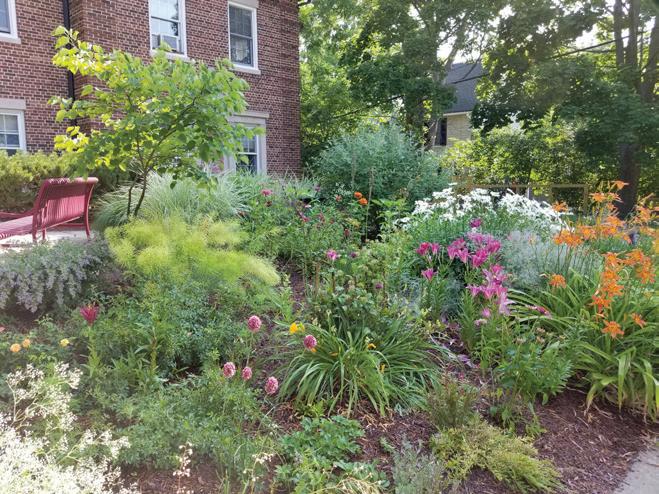
We have not had visitors inside Steiner House these past several months due to COVID-19 restrictions. Cynthia Chelius held down the fort on her own from midMarch, answering the phones and processing mail, new memberships, and other tasks. The rest of the staff at Steiner House did their best to work from home under Michigan’s stay-at-home orders. We came back to the office mid-June, with safety protocol to keep us all healthy. We do miss the enrichment of study groups, meetings and events in the house.
It was an eventful winter, when we were plagued by bursting hot water heating pipes. We never knew where
the next leak would spring, leading us to shut down the boiler in midMarch, when it was still mighty chilly. Those pipes are nearly 100 years old, and have simply reached the end of their service. We are presently investigating heating and cooling options, and will be replacing the system.
Steiner House was built in 1923 as a fraternity house for the sons of Masons and was purchased in 1974 for the Rudolf Steiner Insitute of the Great Lakes through a study group led by Dr. Ernst Katz, a physics professor at the University of Michigan. Ernst was the introduction to anthroposophy for many students and residents in the area through his anthroposophical courses at the university and study groups.
1923 is also the street number of Steiner House (on Geddes Avenue), and a most significant date in the history of the Anthroposophical Society.
Katherine Thivierge (katherine@anthroposophy.org) is ASA Director of Operations.
54 • being human
New Members
Anthroposophical Society in America, 1/22/2020 to 7/21/2020
Michael Aitken, Youngsville NY
Jineesa Allamani Stowell, Hazel Park MI
Christine Angeli, Anacortes WA
Diana M Baetz, Carbondale CO
Kathleen Baiocchi, Boulder CO
Melissa Becker, Pittsburgh PA
Julia Belgrave, Sammamish WA
Magdalena Anna Bermudez, Lexington MA
Sylvia Marina Biannucci, Wilmette IL

Natalie Brinkley, Charlottesville VA
Bill R Burdette, Miami FL
Jenny Calhoun, Eugene OR
Evalina W Carbonell, Philadelphia PA
Jenell D Carlson, Huntington Beach CA
Trino G Carrera, Washington Terrace UT
Mary Jo Cayley, Fargo ND
Colin Chase, Chicago IL
Jared Lafferty Coady, Miami FL
Robert Cornett, Mount Tremper NY
Jeremy A Crites, Dinwiddie VA
Jeremy Davis, Milwaukie OR
Christopher A Dawson, Williamsburg VA
Simone Demarzi, Yellow Springs OH
Felma Demecillo, Hudson NY
Aviva Derenowski, Staten Island NY
Elizabeth Dreyfuss, Shaker Heights OH
Walter O. Duncan, Waltham MA
Audrey A Evans, New Orleans LA
Casse L Forczek, Kelseyville CA
Karen M Gallagher, Point Richmond CA
Colleen G Glenn-Wilson, Lyons CO
Daniel Goldschmidt, Bellevue WA
Janet Gray, Frankenmuth MI
Sally G Greenberg, Mill Valley CA
Laurie Guzman-Perez, Henderson NV
Narissa Hadap, Martinez CA
Deborah Ham, Portland OR
Brittney P Hannah, Asheville NC
Dale R Hartka, Ghent NY
Christoph Hauenstein, Rochester MN
Robyn Hauenstein, Rochester MN
Siegfried G Heep, Sherman Oaks CA
Billie Innerfield, New York NY
John Johnson, Toledo OH
Sean PR Kaiser, Charlotte NC
Marlene Kenny, Harrisburg PA
Diane L Kocur, Glendale AZ
Tatiana Kovylina, North Falmouth MA
Natalya Kutner, Los Angeles CA
Lee R Lachance, Detroit MI
Jessica M Lawrence, Tulsa OK
Lucien Dante Lazar, Evanston IL
Faith J Lerner, Middleton WI
Christina Martinez Zuviria, Sauk Centre MN
Mireille C Mather, Chestnut Ridge NY
Jun Matsuo Keist, Westerly RI
Caitlin M McCoy, Missoula MT
Chris McInnis, Detroit MI
Kelley McKenna, South Royalton VT
Evan C Milburn, Santa Cruz CA
Era C. Montecillo, Chatham NY
Jennifer Morrison-Taylor, Colden NY
Louisa Nicholson, Winston Salem NC
Pamela S Oliveto, Ellijay GA
Nicholas W Peake, Washington DC
Gerson Perez, Santa Fe NM
Robert A Phinney, Princeton NJ
Amy A Picco, Bellingham WA
Julie Avana Pierce, Edmonds WA
Sue Pope, Amelia OH
Leah E Pruitt, Panama City Beach FL
Eric W Putt, San Diego CA
Jane Quadri, Mount Crawford VA
Rajeshwari Rajamani, Carlsbad CA
Benjamin M Reynolds, Englewood CO
Holly M Richardson, Carbondale CO
Mauricio Ernesto Salmeron, Oakland CA
Arelly Sanchez-Shackett, Lafayette CA
Elizabeth J Sanders, Harleysville PA
Stephanie Savarino, Ann Arbor MI
Patricia Scatena, San Diego CA
Jason Shepherd, Columbus MS
Michael Slane, Maumee OH
Wendy J Smallridge, Great Barrington MA
Grigory Smirnov, Chestnut Ridge NY
Joy L Steuer, Plumas Lake CA
Iris Stille, Reno NV
Otto Stoeterau, Weston FL
Trisha Sveistrup, Mill Bay BC
Teresa Thorman, Meadow Vista CA
Monika Van Dussen, Natick MA
Rebecca Vickrey, Springfield VA
Robert K Vollmar, Norman OK
Sean H Waters, Moravia NY
Aaron Weiss, Mountain View CA
Frank White, Golden CO
Dennis S Whitt, Chico CA
Solange F Williams, Severna Park MD
Courtney Hissong Wilson, Boulder CO
Joshua Wilson, Boulder CO
Robert Eric Wishner, Oroville CA
Timothy Work, Medina OH
Amanda L Wright, Denver CO
Kristin C Zay, Eugene OR
Kerstin Ruth Zurbrigg, Silver Spring MD
summer-fall issue 2020 • 55
Patti Smith 6/27/1951–6/24/2020
by


Signe Eklund Schaefer
Patti Smith crossed the threshold on St John’s Day, June 24th, 2020. Given her fiery nature, it was not difficult to imagine her rising like the sparks from a St John’s bonfire. Her funeral, with limited attendance due to Covid-19, was held on June 27th, which would have been her 69th birthday.
Patricia Ellen Smith was born in 1951, in Boston, MA. Her father was a Navy pilot, her mother a devoted homemaker for the growing family that moved every three years throughout Patti’s childhood. Four younger siblings joined the family along the way. Patti went to seven different schools, which she found challenging and increasingly painful. She described a gradual silencing of her voice by teachers who could not recognize her struggles, something which led her later in life to work tirelessly to help young people trust and practice using their own voices. Patti loved singing and acting; in high school drama she came to feel the beginnings of self-confidence.

In 1970, after a few years of college, her longing to
find herself out in the world was fired by an article she read in Look magazine about a commune in the Pioneer Valley of Massachusetts. Full of idealism, she hitchhiked to the Brotherhood of the Spirit, and immediately connected with its aim of working for the common good out of a living sense for the spirit. In the early years at the commune she appreciated the shared commitment to meditation, service, and thoughtful moral action. She helped to start a pizza business serving the local area and was active in organizing large community events. As the years went by, she increasingly struggled to connect her own acute sense of responsibility with what she experienced as a devolving and destructive leadership. After seven years she left the commune with her partner at the time, Andy Baer, and their newborn daughter Shannon. Here is how she described her personal search in the years after leaving the commune: “I sought spiritual practices that would enable me to muster inner courage, foster clarity in my decision making, and enhance my intuitive capacity to accept the circumstances life provided.” Within a few years she had found her way to the work of Rudolf Steiner and to Waldorf education, and she began a long connection with the Meadowbrook Waldorf School in Rhode Island. In the mid-1980’s the family, now including son Ezra, moved to Michigan, where Andy was a student at the
Members Who Have Died
Betty Louise Baldwin Beaverton OR joined 1979 died 4/03/2020
Margaretta Bornhorst Centreville VA joined 1988 died 6/02/2020
Sayre S. Burns Spring Valley NY joined 1950 died 9/25/2019
Margaret Chambers Wilton NH joined 1969 died 3/06/2020
Hugh J. Courtney Woolwine VA joined 1980 died 6/15/2020
Kurt Cramer Glasco KS joined 2011 died 10/16/2017
John Cunningham Eastsound WA joined 1984 died 2/25/2020
John H. Huber McLean VA joined 1971 died 4/13/2020
Reto W. Kaufmann Reston VA joined 1999 died 3/13/2020
Robert Kellum Portland OR joined 2009 died 2/21/2020
Karl Levin Canoga Park CA joined 1984 died 1/23/2020
John Moses Richmond VA joined 1962 died 2/05/2020
Chris Neely Santa Barbara CA joined 1992 died 1/04/2020
Shirley Pulido Hancock NH joined 1996 died 3/20/2020
Richard Rettig San Francisco CA joined 1956 died 3/05/2020
Peter R. Rizzo Chicago IL joined 1989 died 5/05/2020
Olinde Roye Stuttgart Germany joined 1974 died 12/26/2019
Michele SanzCardona Saugerties NY joined 1982 died 12/29/2019

Patti E Smith Richmond RI joined 1985 died 6/24/2020
Lora Valsi Huntington Woods MI joined 1980 died 5/11/2020
Pauletta WadsworthPaskal Fair Oaks CA joined 1989 died 4/30/2020
Elizabeth Wieting Portland OR joined 1980 died 7/16/2019
Frank Zderic Ashland OR joined 1998 died 12/08/2019
56 • being human
Waldorf Institute in Detroit, and Patti ran a small home day-care. She and I met at the Institute in a workshop on The Philosophy of Freedom led my Robert McDermott. Robert and his wife Ellen were to become especially dear friends of Patti’s; and she and I knew immediately that we had much shared work ahead of us.
Since the early 1980’s, Patti participated as both student and course leader at the Rudolf Steiner Institute (in Pennsylvania and Maine), forming deep friendships with many people through these summer adventures in learning. In this past year before she died, she was collaborating with several colleagues on an idea for a new summer study community for individuals and families.
The late 80’s found Patti teaching kindergarten at Green Meadow Waldorf School. She described this work with young children as the favorite of her many jobs through the years. She felt real joy at leaving all other concerns behind when she entered the classroom and readied herself to be fully present to the needs of the children. But private schools were hard for her. She had a deep longing for greater social equity in the world; she wanted to help improve public education, and so she decided to return to university, eventually completing her EdD.
For the rest of her professional life Patti worked in a variety of educational settings including Outward Bound Expeditionary Learning, Brown University and the National Academy Foundation, largely focused on bettering public high school education. While working on her doctorate, she was a research assistant to retired Professor Emeritus Edmund W. Gordon, a much-respected leader in urban education. He recently offered this characteristic picture of her vision about education: Patti practiced student development long before that conceptualization in education came to exist. Early in her work with me, it was she who insisted that we be concerned with the development of the person, first, and what else the person was learning came next. She felt that well developed learners will choose what they want to learn and learn it with our help. She saw her role as enabler of wholesome and holistic development.
Patti was also always engaged in side activities that allowed her to work more directly from her commitment to human development as elaborated by Rudolf Steiner. She was involved with several Waldorf public initiatives, including the Urban Waldorf School in Milwaukee, Wisconsin, and the Mariposa Initiative in Rhode Island. She also served as an executive producer for a documentary film series about Waldorf initiatives in public schools. She
was always awake to questions of equity, diversity, and inclusion and was a fierce advocate for attention to gender or racial disparity in many varied settings.
Patti was deeply inspired by the idea of life phases and other factors such as temperament and gender that enrich a human biography. In the late ‘80’s she and I began meeting weekly with two other friends at 6:30 in the morning, the only time that worked for our busy schedules, to study together and eventually offer workshops, courses, and conferences for parents through The Center for Life Studies of Sunbridge College. One of the largest conferences, “Who is Raising our Daughters? – Women Coming of Age for the 21st Century,” in 1995, led Patti and me to put together a parenting book, More Lifeways – Finding support and inspiration in family life (Hawthorn Press, 1997). It was such fun to work with Patti on a project like this; she had endless ideas and enthusiasm, and had no trouble badgering our many writers/friends to finish their chapters.
A person of tremendous initiative, Patti was involved in so many projects. In the mid-1990’s, she began Sideby-Side at Sunbridge, a summer program where young people from all parts of the country worked together to offer a camp experience for children from Harlem and Spring Valley. She was on the faculty of The Barfield School, a degree-granting initiative connected to Sunbridge. She joined the board of the Center for Biography and Social Art, offered biography workshops and retreats, and worked with colleagues to develop the Awakening Connection-Creating Community program, which brings biography work to Waldorf schools throughout North America. Patti had so many good ideas, she was impatient to make the world better, and she sometimes found it frustrating that others did not always rise to the task of bringing what she could envision into reality.
Patti was very inspired by Parker Palmer’s book Courage to Teach and the community that grew up around him, dedicated to helping teachers align their own inner lives with authentic ways of working with students. She trained as a facilitator in this work and some years later was offered a Courage and Renewal Fellowship where she sought to introduce biography activities to a wide audience through developing a program she called, “Covering Ground: Journeying across the Seasons of Your Life.” In these retreats people would do a lot of walking in nature and also practice deep listening to themselves and each other. The fellowship work took place at the Kirkridge Retreat and Study Center in the Poconos in Pennsylva-
summer-fall issue 2020 • 57
nia, where Patti was soon asked to join the board.
She was a great networker, always trying to bring together friends and colleagues who she felt should collaborate. For example, she saw common aims between biography work, the Courage and Renewal activities, and the Kirkridge Center. She worked hard to bring biography events to this beautiful retreat center, most recently by organizing a conference through the Center for Biography and Social Art on questions of karma, in the fall of 2019.
Patti felt that her ‘avocational communities’, as she called them, were an important source for her spiritual development. She found her day jobs satisfying, but described how she also needed the enrichment of working with “my people.” She was devoted to anthroposophy as her path of development. This did not waver. She was a daily meditant, and returned often to the lessons of the School for Spiritual Science, even during the final days of her life.
In addition to More Lifeways, Patti was involved in two other book collaborations. What could arise between people, in real conversation or even through reading, was a lifelong interest and motivation. She felt the power of hearing different voices on a common theme. In Thin Places, a book of stories by the Kirkridge Fellows, she wrote a chapter called, “Letting My Life Speak: The Power of Autobiographical Practices.” More recently she drew together stories from her women friends at the commune, looking at the history they had shared and what has become of them in the intervening decades. The book is in preparation for publication, now dedicated to Patti, and called, More Than Friends – Shaped by Flower Power: Women’s Stories from Brotherhood of the Spirit, THEN and NOW. Patti’s relationship with Andy ended in 1997. At the time she was living in Nyack, NY, but her work took her to many parts of the country. She could be on the road for weeks at a time. In 2001 she met Rob Swanson and together they created a beautiful home in Hope Valley, Rhode Island, to which she would happily return after her many professional trips. She and Rob loved to be out in nature together, hiking, biking, kayaking. She needed this regular immersion in outdoor physical activity; it helped to balance the demands of her many commitments and the intensity of her own strong personality.
Patti was diagnosed with a rare and fast growing cancer in February. In the few months she had to live, she prepared seriously for her death. She attended to areas still needing resolution, and said many conscious good-byes. She was lovingly cared for at home by Rob, her daughter Shannon, and her grandson Jeremiah. Her son Ezra and his partner Melissa were nearby, and Rob’s sons Robert (Jaclyn) and Everette (Deirdre) were in regular contact. Patti could be very self-critical, but in these months she practiced being compassionate with herself. She was deeply moved by the many words of gratitude that she received from so many whose lives she had touched.
Always devoted to helping the young, Patti had hoped to be available to coming generations as a thoughtful and nurturing elder. I have no doubt her legacy will grow on and her being will continue to inspire, within the circle of those who knew her personally, and beyond.
Lora Valsi
November 2, 1938–May 11, 2020
The only child of Adam Paciotti and Finalba Giaconi, Lora Valsi was born in Dearborn, MI, and grew up in the closely-knit Italian community. Although she was the first in her family to pursue higher education, she interrupted her piano studies at the University of Michigan in Ann Arbor to move to New York where she worked for an advertising agency on Madison Avenue. She moved to Italy in the mid-1960s and taught English in Turin for several years before returning to the Detroit area where she married Adelchi “Ed” Valsi on May 11, 1968.
Lora developed a passionate interest in early childhood education and became deeply involved with the Detroit Waldorf School and community. Further pursuing her own education, she earned a teaching degree through the Waldorf Institute and Oakland University. Lora was instrumental in founding the Waldorf Kinderhouse in Southfield, MI, and continued to pass on her experience as a trainer of new teachers.
Preceded in death by her parents and husband, she is survived by daughter Claudia Valsi-Sandmeier (Scott) of Freiburg, Germany, son Marco Valsi (partner Tammy Gallo) of Sedona, Arizona, grandchildren Paul and Ian, other
58 • being human
family members, and loyal friend Pavol Cellar. She will also be remembered by many friends who will greatly miss her wisdom, inspiration, and the warmth of her friendship. The family would like to especially thank her gentle caregivers and the nurses from St. Joseph Hospice Care.
John Herrick Moses, Jr. March 15, 1939-February 5, 2020
by David A. Schwartz
I am filled with joy as a long-time friend to remember and celebrate the life of John Herrick Moses, Jr. with the readers of being human. John crossed the threshold of death on February 5, 2020. His passing is an occasion to express gratitude for all he did for anthroposophy in America during his life. He had a lifelong passion for the work of Rudolf Steiner and endeavored throughout his life to cultivate and support Waldorf education. He was a member of the Anthroposophical Society and the School of Spiritual Science.
It is also an occasion to recognize and celebrate the group of contemporaries he belonged to through his anthroposophical work, individuals born around 19351945. These individuals formed the first new generation of anthroposophists in America after the founders. In 1963 some individuals belonging to this first new generation formed the Michael Youth Group to support the life of the Anthroposophical Society. John became part of this group. One of the founders of the Camphill community work in America, Carlo Pietzner, became the mentor to this group. This group connected with similar “new generation” youth groups that had formed in Europe. In the summer of 1970 an international youth conference took place at the Threefold Center in Spring Valley, New York (July 30-August 09, 1970) hosted by the Michael Youth Group. Six Hundred participants from Europe and American came to the Threefold Center for this conference. I was one of them. This conference was a uniting event for the worldwide Anthroposophical Society that was in the process of healing from the pain of thirty-five years of internal conflict. This summer is the fiftieth anniversary of this gathering.
John was born in New York City, Manhattan, on March 15, 1939. He spent the first years of his life (1940-
1951) in the Andes of Peru because his father was a geologist/engineer working there in the mining industry. At age twelve he moved to Little Rock, Arkansas, and graduated from high school there (1952-1957). Through his grandmother, who was a Goethe scholar, he met European culture and the work of Rudolf Steiner while still in high school.
John then attended Bowdoin College in Maine (19581962). There he met a professor named Fritz Koelln, a scholar of German literature and philosophy, and also a student of anthroposophy. While at Bowdoin John attended Dr. Koelln’s classes, as well as the anthroposophical study groups that Dr. Koelln organized. After graduating from Bowdoin, John went to Germany for a year abroad and taught at a college in Stuttgart (1963-1964).
In 1965 John returned to America and went to the Threefold Center in Spring Valley. Initially he became involved with the production of the Mystery Plays. Later he joined the Green Meadow Waldorf School and became a class teacher there. At this time he became part of the Michael Youth Group. Around 1971 he left Spring Valley and went to Washington, D.C., to assist the Waldorf School that had started there in 1969.
About 1975 John left the Washington Waldorf School and moved to Richmond, Virginia. He started working for the state of Virginia, a job he had until his retirement. He married there in 1979. In 1985 he and his wife, Sara, started a Waldorf School in their home. Sara was the primary teacher. For eleven years this modest effort to foster Waldorf education formed the seed for what became the Richmond Waldorf School in 1996. John was on the board of the Richmond Waldorf School until his death.
John and Sara had two children. They separated in 1991 and eventually divorced. John is survived by Sara, his two children and a grandchild. He is also survived by his partner, Gene Shelton. Gene helped me write this remembrance and I am deeply grateful for his help.
On a last note, as a close friend and a fellow gay man, I want to share that John encountered antipathy to gay women and men in the course of his life. Understanding John’s life requires an appreciation for the experiences he endured in this regard and the pain he carried resulting from these experiences. He was able to find peace through his higher life but it was not always easy. Fortunately, he was able to witness and experience the important changing attitudes of the last twenty years before his passing.
summer-fall issue 2020 • 59
John Roger Cunningham

06/14/1948-02/25/2020
John crossed the Threshold to join forces with our unseen world, early the morning of the 25th of February, his timing impeccably chosen to have potent astrological connection to his two greatest teachers, Marshall Rosenberg and Rudolf Steiner. John had joyfully dedicated his life to sharing the work of these two men within the communities of each. His passion and love for humanity permeated his work, as did his tremendous sense of humor. He traveled world wide to share Nonviolent Communication (NVC) after a 13-year career as a Waldorf teacher in Ashland, Oregon.
John loved music, of all kinds, and found tremendous satisfaction in discovering and listening to the newest releases of music from around the world. He was a skillful carpenter, a wonderful dancer, and an outdoor enthusiast. You might catch him swimming across Cascade Lake on Orcas Island or up river in southern Oregon.
His loving wife Cat, his daughters Sara, Lynn, and Adina, and his son Manu survive John. His brother Robert, and sisters Susie and Nancy also survive John, along with many nieces and nephews, grandchildren, bonus children and hundreds of friends and colleagues around the world.
John lived “Not I, but the Other in me” in his ability to listen deeply to others. Always with the question, “How can I help?” in his heart. To know John was to love him. His was truly a life well lived. We will miss him so. In honor of his life, slow down, take time to really hear what another is sharing and make their needs as important as your own.
—from The Chanticleer, Berkshire-Taconic Branch
Richard Rettig
March 31, 1929–March 5, 2020
by Joseph Rubano
with the help of several friends
Richard was a gentleman; soft spoken, deep thinker, a kind, caring man. He was interested in the life that goes on below the surface of most people’s awareness—in spiritual realities. In high school he sensed something below the surface that inspired and animated his favorite teacher; this lead him to his spiritual path. Also in high school
he became interested in the work of government agencies that worked beneath the surface of public awareness. This led him to his first job and opened his eyes in a new way.
Richard was the oldest of four children, one brother, two sisters, in Monroe, Wisconsin, a small farming community. Many were descendants of Swiss who immigrated after a famine around 1845. His father was a clergyman in the Town of New Glarus, moving to Indianapolis to be pastor of an old style German Evangelical church. Richard’s maternal grandparents were from Germany.
Richard started high school in Indianapolis with a thousand students in the freshman class. The teachers were excellent. But Richard’s aunt had a friend, Beulah Emmet, who had founded High Mowing Waldorf High School in Wilton, New Hampshire in 1942, and she needed some boys to join the class. Richard transferred to High Mowing when he was in the 11th grade; there were only five students, Richard made six. He went home Christmas traveling by trains and buses. This was the beginning of his independence and love of traveling.
To him it was a special place, and it was here that he was first exposed to anthroposophy. He made a special connection with his chemistry teacher, Hermann Poppelbaum, asked him the kind of questions that led him to give Richard and his friend, Fred Moyers, information about anthroposophy, thus planting a seed for the future.
Richard and his cousin were accepted into Harvard where he majored in history and literature. For the modern period from the French Revolution (1789 to 1939) Richard had to design his own course with a tutor. To study what he wanted to study, Richard had to do well, and he did. He also completed an intensive Bible as literature course and began reading Steiner with library books.
Richard graduated from Harvard in 1951 and did not have the money to go to graduate school. He wanted to work in the foreign service as a diplomat. While still at High Mowing, he had written to the State Department and was sent literature and an application. But when he was finally able to apply he did not have the money to fulfill the preliminary requirements. Instead he went to Washington DC and applied for work with the CIA and the NSA. He heard from the NSA first, was offered a job, and was going to accept, but the day before, the CIA of-
60 • being human
fered him a job which he preferred.
Richard worked for the CIA for about four-and-a-half years and traveled to a number of countries in Europe. He never told anyone, not even his wife, what he did in the CIA. All he would say is that he performed covert operations. He admired the people he worked with; he had fun and loved the work. Still, he knew that he did not want to make a career of the CIA because he was uncomfortable with not being truthful and having to hide so many things. He did say one thing about his work. Richard was trained in the Hungarian language, so he was involved in some way with questioning Hungarians trying to escape Hungary’s political environment.
After leaving the CIA in 1957, Richard moved to Manhattan where he joined the Anthroposophical Society. After two years he met Ehrenfried Pfeiffer who introduced him to the First Class. He jumped right in. Soon afterwards, Richard met his wife, Danilla who was teaching at Rudolf Steiner School in New York.
In Manhattan, Richard worked for one or two years as an assistant editor of Encyclopedia Americana. He recalled that it wasn’t so hard to get a job then. He had answered an advertisement, and the hiring managers were easily impressed by a graduate from Harvard!
After that Richard worked in public relations and marketing for a number of companies. He and Danilla moved to Spring Valley, NY, where she was a grades teacher and Richard agreed to teach for two years. Two years was enough; it was not the right career for him.
Eventually, Richard and Danilla moved to Wilton, NH, where she worked with Ann Pratt to develop the Pine Hill Waldorf School and where their daughter, Chara was born. Richard commuted to Andover, Mass., where he worked for a subsidiary of General Electric. This was the early days when a computer would be the size of a whole room. Richard spent about 40 percent of his time traveling overseas as a GE representative to Europe and Saudi Arabia. He traveled to Germany, Milan (which he loved), Rome and Venice. Once he took an ocean liner from Italy to New York. Richard also found time while in Wilton to be the Business Manager for High Mowing School (1971-1973).
After a while they moved back to Manhattan. Once there, Danella decided to go to Dornach to further her studies and training and Chara attended pre-school. Richard visited them and remembers going with his High Mowing classmate, Fred Moyer, to hear their favorite teacher, Hermann Poppelbaum, lecture in Stuttgart.
They even took a hazardous bus trip to Obergugle ski area, the highest village in Austria, where he skied for the first time.
In 1994, Richard, Danilla, and Chara moved to Oceanside, California, where they chose a location with a rural feeling and a view of the mountains to the northeast. Building boomed and they were soon surrounded by many new houses, but there they were and there they stayed. Richard found the other anthroposophists in North County and was part of a study group that met twice a month. During those early years, Danilla worked in the Pasadena Waldorf School, spending the week teaching Eurythmy and returning home on weekends. Meanwhile Richard got involved with Toastmasters.
Eventually, Danilla became ill. Richard took good care of her until she died. Then his daughter Chara became ill and he also cared for her until the end. No one ever heard him complain.
An excellent speaker and storyteller, Richard was an active member of Tick Talk Toastmasters in Carlsbad, CA, from 2000 to 2018. As one member said: “Richard is an excellent writer, a skilled wordsmith whose professionalism is legend in our organization.” Richard made many friends there and mentored new members, who appreciate greatly how much he helped them. He himself often gave talks on aspects of Rudolf Steiner’s teachings.
For many years Richard was the editor of the newsletter for the San Diego branch of the Anthroposophical Society. We always looked forward to his book reviews and his inspired writing about work being brought into the world by spiritually awakened individuals not connected with anthroposophy. As a member of the Social Science section of the School of Spiritual Science he was especially connected to Steiner’s social endeavors and the Threefold Social Order.
In the last ten years of his life, inspired threefolding ideals, Richard formed a company called I Control Communications. His goal was linking the organic food world, farmers, consumers and others: “By efficiently and appropriately linking one with the other, as a result of this sharing, a higher consciousness (awareness) of others develops among participants. A community of mutual interests, a conscious interdependence forms, whereby the whole becomes greater than the parts.”
“He worked very hard for years to bring his associative company idea to earth, teaching himself how to write a business plan and coding a web page,” said Stephen Vallus, a friend and business associate. Richard was still seek-
summer-fall issue 2020 • 61
ing seed money for his company when he became ill.
He also championed the idea of a flat tax and offered free presentations on the Fair Tax Initiative to organizations in San Diego County. As his friend Christopher Houghton Budd, an economist, author, and lecturer, remarked via email: “I always respected his fidelity to Rudolf Steiner’s social ideas, but especially his tenacity regarding the subject that most people stay away from— taxation,” said Christopher.
Richard cared. To the very end when you visited him he asked about your life, your projects, and your family. When you left his bedside you did not leave sad or depressed but somehow grateful and enlivened by the gentle openness, the deep thankfulness, the quality of the meeting, the quality of the giving and receiving that moved back and forth between you and him.
Margaretta Smith Bornhorst
July 12, 1947 - June 2, 2020
by Kathleen Wright
One of the pioneers of anthroposophic nursing in the USA, Margaretta Smith Bornhorst, was born and grew up in Trenton, NJ, eldest of three children and the only girl, in a Roman Catholic family. Margaretta was very devout from early childhood, but in the turbulence of the 1960’s, she began to explore other spiritual paths. During sophomore year of high school, Margaretta met the love of her life, Bruce Bornhorst, and he became her life partner and joined in her search for Truth.
Margaretta had dreams of becoming either an artist or journalist, but her father insisted she become a teacher or a nurse. Margaretta followed her Mother’s footsteps into nursing, and everyone who knew her discovered what a wonderful innate healing ability she had. She received her nursing degree at Mt. Sinai Medical Center in Manhattan and shortly afterward married Bruce. As the years progressed, Margaretta became more and more dissatisfied with allopathic nursing. Each year there was less and less hands-on care and more and more machinery and paperwork, plus a lack of respect from doctors.
Nurse Bornhorst was glad to get a little break when her first child was born in 1978. When litle Breeana was approaching her third birthday, she began telling stories about a little baby named Mary whom she played with “in heaven” when she would go to sleep and who couldn’t
wait to come to Earth and become her sister. Shortly afterword, Margaretta became pregnant with her second daughter whom she named Maryrose. The two girls played beautifully together all through their childhoods and have always been close and loving.
When it was time to think where Breeana should go to school, Margaretta discovered Waldorf education. With that she also began learning about anthroposophy, and Anthroposophic Medicine. She and Bruce decided that they wanted a full immersion and headed for the Waldorf Institute at Mercy College where Bruce did teacher training and Margaretta began meeting with anthroposophic nurses, there being no training at that time. Both participated in speech and drama work, a lifelong love.
At the completion of Bruce’s training, the couple visited Spring Valley, where I first met them, and later Chapel Hill, NC, where we met again at the Emerson Waldorf School. The Bornhorsts poured themselves into community work including the Oberufer Christmas plays. Margaretta loved the Festivals and took a very active role in the Festivals Committee on and off for many years. When word came of the possibility of a Christian Community affiliate starting here, she helped with everything and later organized retreats with Patrick Kennedy and others.
For our branch she helped organize workshops with such people as therapeutic artist Martha Loving Orgain, William Bento, and Karyn Martin-Kuri. She brought Barbara Renold here a few times for drama workshops and Margaretta and Bruce acted in scenes from the Mystery Dramas and helped guide our community production of “The Green Snake and the Beautiful Lily.”
When Mark Eisen, MD, returned from his anthroposophic medical training in Europe and opened a practice in Chapel Hill, Margaretta became his first nurse. She offered all manner of compresses, oil dispersion baths, injections, and massages. Together they offered workshops in home health care to Waldorf parents and workshops on anthroposophic medicine for staff at UNC Hospital.
One of the most exciting things Margaretta ever did was the Hauschka Rhythmical Massage Training in Böll, Germany, in the summers of 1988-90, under the direction of Frau Ermgard Marbach, who had studied under Dr. Ita Wegman. Frau Marbach gave her students not only medical knowledge, but spiritual insights, amazing stories, and excursions to holy and healing places. When her daughter Maryrose was diagnosed with a severe case of Type I diabetes, Margaretta bid farewell to Frau Marbach and returned home to care for Mary Rose. However,
62 • being human
Frau Marbach considered Margaretta one of the most talented therapists she had ever taught and not only gave her the certificate of completion but asked Margaretta and one other student to bring the massage work to America. And so for many years Margaretta both taught classes in Rhythmical Massage and had a private practice.
Margaretta was blessed with healing hands. I remember when she was teaching me embrocation (Die Einreibung ), I asked to see her hands palm-side up so I could understand the movements on their surface. She had developed sense organs and muscles where I’d never known there to be muscles, so that she could move a lemniscate within her palm at will. Her therapeutic presence of self, an attribute recognized in conventional nursing, included sensing a problem without it being stated by the patient, and often in the soul realm. I observed this on many occasions. She would tell me, “It’s our duty to meet people where they are in their development and, as nurses, accompany them on their journey toward healing.”
Some of the best healers are those who suffer. Margaretta struggled with an imperfect physical and astral body. It made her all the more compassionate, empathic, and perceptive in the struggles of others. She didn’t seem to realize how very special her capacities were. I mused that she was a choleric thinker, melancholic feeler, and sanguine doer, who required a phlegmatic support structure.
Margaretta was on the branch’s board, continued her work on the Festivals, and belonged to two study groups that she loved. The “Elective Affinities Group,” a biography study group, refers to the title of a Goethe novella about a group of friends who become like family because of their spiritual connections. At this study group, members read articles about empathy, karma and reincarnation in relation to our own biographies.
The second group was the Ita Wegman Group. We studied the life and works of this amazing anthroposophic woman doctor. We had all served in healing work and we identified in many ways with Ita Wegman.
Margaretta would not let suffering get in the way of the work she felt called to do. In addition to diabetes, heart and lungs problems, Margaretta had a rare genetic disorder, Ehlers-Danlos syndrome, which caused broken bones, surgeries, and painful joints. She needed a cane or walker for much of the last eight years or more. Six years ago, Bruce suffered a stroke and could no longer manage his business, so they moved to Virginia, close to their girls. It was very difficult to leave her beautiful home and possessions, not to mention thousands of books.
In Virginia they lived at a very small retirement home far from any anthroposophical centers or Christian Community. Because the need for community was so vital to her, Margaretta re-connected with the Catholic Church and became very active there, attending classes, joining the League of Mary and much more. Bruce’s cognitive functions declined, and Margaretta suffered a heart attack. Bruce moved to an assisted living facility, and Margaretta moved in with her daughter Breeana. Two wonderful things happened. Breeana gave birth in December 2017 and Margaretta was overjoyed with her little grandson Clayton. The second event was when her daughter Maryrose married a man from Holland and subsequently moved there, where she is able to get excellent medical treatment for her blindness that is unavailable here.
Margaretta suffered a stroke and was moved to the same facility as Bruce. One of her initiatives at the nursing home was the production of a Three Kings Play for the residents. Bruce was in his glory as the Red King Melchior. He is quite sociable and much beloved by everyone in the home. Margaretta offered a well received talk about the three kings based on Steiner’s insights.
Margaretta tried to bring a community spirit to the nursing home, but when the Covid-19 quarantine began, residents were required to stay in their rooms. Within a month of cases appearing there, Margaretta herself was diagnosed with it. She passed away just five days later, Tuesday, June 2, the final day of the three-day celebration of Pentecost, her favorite festival. As her daughter Maryrose wrote to us: “The world has lost a genuine and magnificent soul and heaven has gained a beautiful angel!”
Our anthroposophical community in Durham/Chapel Hill had a memorial gathering for Margaretta on Friday, June 5 during the lunar eclipse. Rev. Carol Kelly performed a memorial Act of Consecration for her on Sunday June 7 at the Christian Community in Washington D.C.
Margaretta recently told me that her favorite books were The Occult Significance of Forgiveness by Prokofieff, Building Stones for an Understanding of the Mystery of Golgotha by Steiner, and Secrets of the Stations of the Cross by Judith von Halle. And this was her favorite Steiner verse: So long as you
summer-fall issue 2020 • 63
feel the pain Which I am spared, The Christ unrecognized Is working in the world. For weak is still the Spirit While each is only capable of suffering Through his own body.

W I L L I N G T H E G O O D : L O V E , A C T I O N , H E A L I N G A S A A N N U A L C O N F E R E N C E O N L I N E O C T O B E R 9 , 1 0 , 1 1 2 0 2 0 W i l l i n g t h e G o o d b y p . h o m a n l y n c h REGISTRATION OPENS AUGUST 15, 2020 at www.anthroposophy.org/willingthegood ANTHROPOSOPHICAL SOCIETY IN AMERICA
