anthroposophy.org personal and cultural renewal in the 21st century a quarterly publication of the Anthroposophical Society in America summer-fall issue 2017 Toward an Architecture of Social Transformation (p.14) A Call to Garden! (p.18) The Formation of MysTech! (p.20) Pathos and Spiritus (p.22) Being Human and the Life-Cycle of the Plant (p.25) Professor Fritz Carl August Koelln: “Each Day Anew” (p.37) Anthroposophy & Science (p.40)
being human
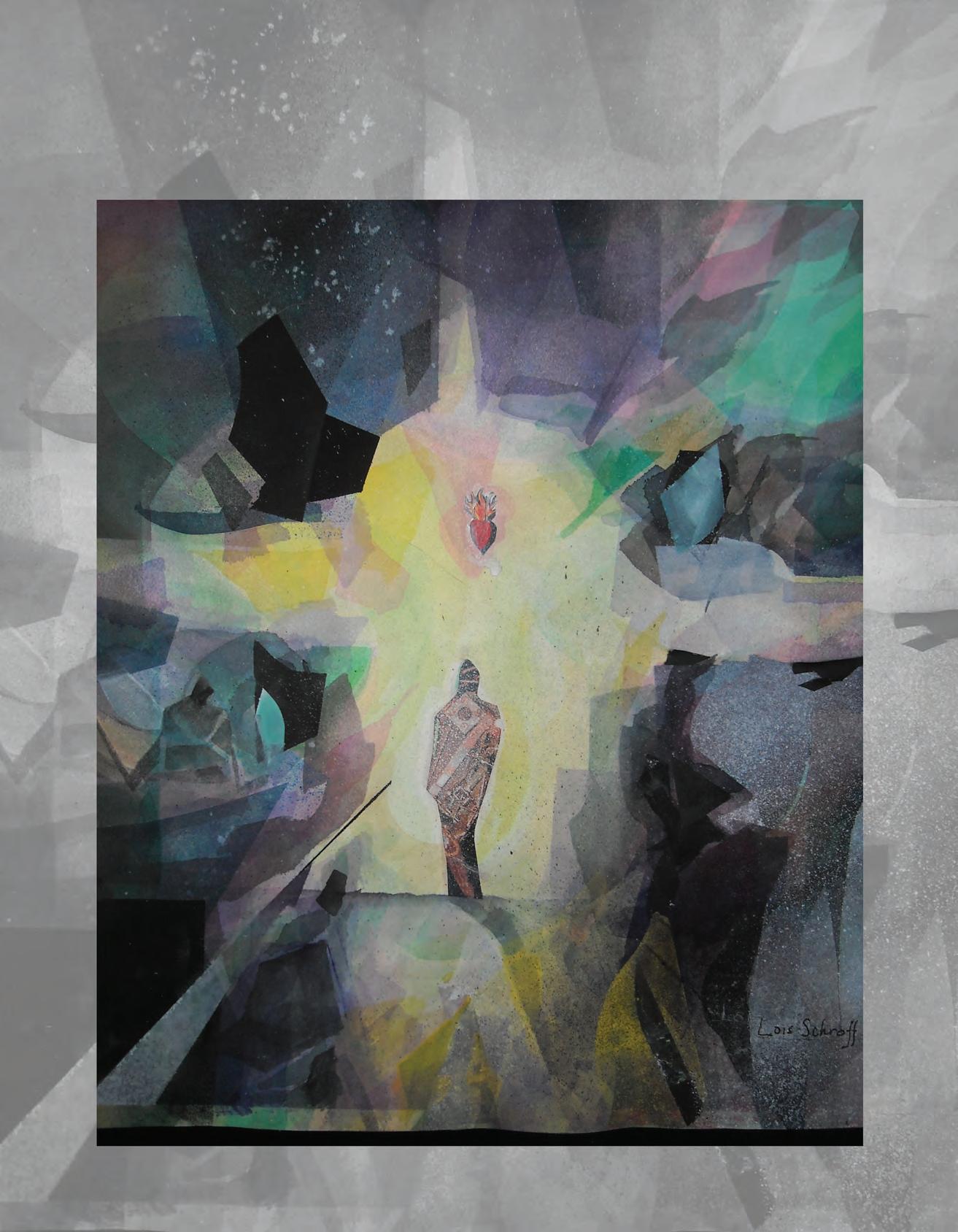
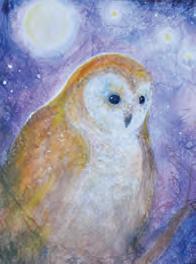
“Only a collection of DNA?” by Lois Schroff (see Gallery, page 31)
November 10-11, 2017
Programs and resources in visual arts eurythmy

music drama & poetry
Waldorf education spirituality

esoteric research economics
evolution of consciousness
health & therapies Biodynamic farming social action
self-development
WORKSHOPS
TALKS
STUDY GROUPS
CLASSES
FESTIVALS EVENTS
EXHIBITS
Regular Programs starting in September
MONTHLY LECTURES
by artist and educator David Taulbee Anderson
EVENING EURYTHMY WORKSHOP with Linda Larson
WATERCOLOR PAINTING WORKSHOPS
a new series with thirty-year Waldorf school and adult teacher Gosha Karpowicz
MONTHLY MEMBERS’ EVENINGS
“Light & Warmth for the Human Soul“
FESTIVAL CELEBRATIONS
Michaelmas, Advent Garden, The Holy Nights Plus special events & study groups...
MONTHLY GROUPS
Speakers Group and Reading for the Dead WEEKLY GROUPS
Meditation, Rudolf Steiner texts
(Toward Social Renewal, Occult Science, Theosophy )
Low-Residency
Elementary & Early Childhood Teacher Education Programs with MEd Option
• Specialized Subject Teacher Intensives
• Professional Development and Introductory Courses & Workshops
www.sunbridge.edu
Rudolf Steiner Bookstore
Open Tue-Thurs 1-5pm, Fri-Sat 12 noon-8pm, Sun 1pm-5pm; call for info: 212-242-8945
Steiner has “the most impressive holistic legacy of the 20th century...”
— NY Open Center co-founder Ralph White www. asnyc .org centerpoint gallery spiritual therapeutic world & outsider artists

The New York Branch
Anthroposophical Society in America 138 West 15th Street New York, NY – (212) 242-8945
Us As We Celebrate
Teacher
Join
50 Years of Inspiring Waldorf
Education
ANTHROPOSOPHY
2 • being human
NYC
INNER (SPIRITUAL) RESISTANCE
STEINERBOOKS , Great Barrington, Massachusetts USA & THE ITA WEGMAN INSTITUTE , Arlesheim, Switzerland
Invite you to our second CONFERENCE IN AUSCHWITZ, POLAND with PETER SELG

THURSDAY to SUNDAY NOVEMBER 2-5, 2017
Download our full conference brochure at www.steinerbooks.org
KRZYSZTOF ANTO ´ NCZYK & CHRISTOPHER BAMFORD
BOARD & LODGING: $250 (Sunday night, additional $60)
For those staying elsewhere, daily breakfast, lunch, and dinner at the Center is $30/day (lunch and dinner: $24).
CONFERENCE FEE : $500 usd
[ TOTAL : $750, or $810 including Sunday night]
DETAILED INFORMATION, AND TO REGISTER: E-mail or call Paul Haygood: seminar@steinerbooks.org or 413 528 8233, ext 1.
CONFERENCE LOCATION: Auschwitz Center for Dialog and Prayer, 1 M. Kolbego St. 32-602, O´swięcim, Poland. Participants will be staying and the Conference will be taking place in the Center for Dialog and Prayer, a modern facility founded in 1992 in Auschwitz, about ten minutes walking distance from the camps. All events and meals will take place there. There are also a number of small hotels nearby.
COn CEntRA t IO nS
Early Childhood, Elementary Grades 1-8, Working with Special Needs
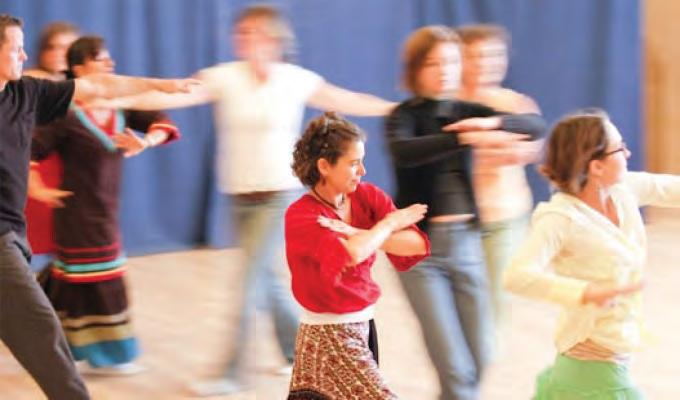
GRADALIS COURSES
INNER DEVELOPMENT
The imperative of inner work
WALDORF CULTURE
School governance, culture, leadership and community life
WALDORF METHODOLOGY
Monthly main lesson preparation
FIELD WORK
Mentoring and internship
TEMPORAL ARTS
Eurythmy, speech arts, music and spacial dynamics


VISUAL ARTS
Watercolor painting, drawing and sculpting
PHILOSOPHICAL FOUNDATIONS
Steiner’s world view and the evolution of consciousness
STUDENT STUDY
Accountabililty, standards and remedial approaches in Waldorf schools
t EAC h ER t RAI nInG
for independent & public waldorf school teachers
WhY GRADALIS? We support the working teacher ǀ GRADALIS courses provide the anthroposophical foundations of Waldorf education ǀ Our Faculty has years of experience teaching in both independent & public Waldorf schools ǀ GRADALIS training is taught over 26 months in 7 semesters, including: Three 2-week Summer Intensives in the Rocky Mountains; 4 Practicum Weekends; Mentoring & Internship in your own classroom ǀ Rich artistic instruction ǀ On-line Interactive Distance Learning (8.5% of program) provides monthly pedagogy & main lesson support through the school year ǀ Other: Summer Grade Level Prep week offered in Colorado.
Considering a meaningful career change? Become a Waldorf teacher! The movement needs teachers with a calling.
www.gradalis.com
We may seem new but we’ve been around!
Contact us at 303-518-0273
Donna Newberg-Long, Ph.D. | Bonnie River, M.Ed. | Thom Schaefer, M.A. | Prairie Adams, B.A.
Tim Long, MBA | Cristina Drews, M.S.Ed. | Hellene Brodsky-Blake, M.A. | Helen Lubin, M.A.
Lin Welch, M.A. | Gila Mann, M.A. | Karl Johnson, M.A. | Jane Mulder, B.A. | Janis Williams, M.E.
Sandra Kirschner, B.A. | Lee Sturgeon-Day | Thesa Callinicos | Susan Strauss | Tammra Tanner
Our Experienced Waldorf Faculty
Center for Anthroposophical Endeavors

A Place of Learning and Working in the World through Anthroposophy since 1982

Introducing
The North American Journal for the Mysteries of Technology

Mys
ech

MysTech is a bi-annual journal dedicated to the serious task of finding a moral path towards technology that enables a "welding together of the human and machine." MysTech is dedicated to building the mysteries of technology. It begins as the catalyst for ideas as well as for research and development of this new technology. This should be of great interest for those working out of the stream of Anthroposophy who have wrestled with this issue of technology and the future of mankind. Just as there are many aspects to the development of ourselves and to Moral Technology, so there will be a diverse array of writings and research on the many aspects of the human condition as it relates to technology, the biological and physical sciences, evolution, as well as to the human etheric body and to the three human soul activities of thinking, feeling and willing.
Please join us for our inaugural issue of MysTech with articles from: Andrew Linnell, Christina Sophia and Brian Gray. Issues can be purchased through: rudolfsteinerbookstore.com/membership and select MysTech
Please also consider becoming a MysTech Member of CFAE. Through your yearly support, contributions are made to a fund for education, research and development in Moral technology.

Also Available through the Dr. Rudolf Steiner Bookstore in Seattle are Paul Emberson’s books:

• From Gondhishapur to Silicon Valley Vol. 1 & 2
• Machines and the Human Spirit
• The Coming Force - Journal of the DewCross Center for Moral Technology (inquire about available issues)
• Anthro-Tech - The Journal of the Anthro-Tech Institute for R&D of Moral Technology (inquire about available issues)
Please email Frank Dauenhauer at info@rudolfsteinerbookstore.com to inquire about the purchase of these books and Journals as they are for sale by request only.
The Dr. Rudolf Steiner Bookstore is host to: Sound Circle Center Student Bookstore and the Center for Anthroposophy Student Bookstore (Found under Training Courses)
summer-fall issue 2017 • 5
Dr. Rudolf Steiner Bookstore & MysTech are a 501(C)(3) nonprofit under CFAE
Connect to the Spiritual Rhythms of the Year...
The Christian Community is a movement for the renewal of religion, founded in 1922 with the help of Rudolf Steiner. It is centered around the seven sacraments in their renewed form and seeks to open the path to the living, healing presence of Christ in the age of the free individual.
Learn more at www.thechristiancommunity.org
E arly C hildhood, Gra des and H igh Sch ool Tracks www.bacwtt.org tiffany@bacwtt.org 415 479 4400 Embark on a journey of self development and discovery Study with us to become a Waldorf Teacher 6 • being human A sacred service. An open esoteric secret: The Act of Consecration of Man Celebration of the Festivals Renewal of the Sacraments Services for Children Religious Education Summer Camps Study Groups Lectures
14 Rudolf Steiner: Towards an Architecture of Social Transformation, by John Bloom
16 Colorado’s Angelica Village, by Renata Heberton
18 A Call to Garden, by Sally Voris
19 A Psychology of Soul and Spirit: An Anthroposophic Psychology, by David Tresemer, PhD
20 The Formation of MysTech, by Andrew Linnell
21 “In the Spirit of Steiner” Festival, by Marke Levene
22 arts & ideas
22 Pathos and Spiritus, by David Tresemer, PhD
25 Being Human and the Life Cycle of the Plant, by Tom Altgelt
28 Biography Work: Bringing Social Artistry to Life, by Patricia Rubano
30 “ What Society do we want, and how do we get there?” by Martin Large
31 Gallery: Lois Schroff, artist, author, and teacher
36 Gratitude to Margaret Shipman and Rachel Schmid, by Peter Rennick
37 Professor Fritz Carl August Koelln: “Each day anew” by Neill Reilly
40 research & reviews
40 Anthroposophy, Quantum Physics, & Holistic Medicine’s Epistemology Crisis, review by Walter Alexander of Anthroposophy and Science 42 Sex Education and the Spirit by Lisa Romero, review by Daniel Mackenzie
47 news for members & friends
47 New Members of the Anthroposophical Society in America
48 New Members for the General Council: David Mansur, Joshua Kelberman
summer-fall issue 2017 • 7 Contents
8 from the editors 10 being human digest 13 articles on the internet 14 initiative!
45 No
6 Book Notes
Shore Too Far, by Jonathan Stedall 4
Kiely Retires
This is the Year,
Resiliency,
in Touch,
Members
First
Mid-Atlantic
Members Who Have Died
Uwe
49 Council Develops Values Statement, report by Dave Alsop 51 Judith
51
by Laura Scappaticci 52
Effort, Love, by Deb Abrahams-Dematte 52 Being
by Katherine Thivierge 53
Respond about the Library, report by Katherine Thivierge & Dwight Ebaugh 54
Annual
Gathering, Report by Dominic Nigito 55
56
Stave, MD • Rev. Richard Dancey 58 Patricia Thornburgh Zay Livingston 60 DoloresRose Dauenhauer 63 Rise Up: Life as a Labor of Love—ASA Fall Conference in Phoenix, Arizona
The Anthroposophical Society in America
General Council Members
John Bloom, General Secretary & President
Carla Beebe Comey, Chair (at large)
John Michael, Treasurer (at large)
Dwight Ebaugh, Secretary (at large)
Micky Leach (Western Region)
Dave Alsop (at large)
Marianne Fieber-Dhara (Central Region)
David Mansur (Eastern Region)
Joshua Kelberman (at large)
Leadership Team
Deb Abrahams-Dematte, Director of Development
Katherine Thivierge, Director of Operations
Laura Scappaticci, Director of Programs
being human is published by the Anthroposophical Society in America
1923 Geddes Avenue
Ann Arbor, MI 48104-1797
Tel. 734.662.9355
www.anthroposophy.org
Editor: John H. Beck
Associate Editors:
Fred Dennehy, Elaine Upton
Proofreader: Cynthia Chelius
Design and layout: John Beck
Please send submissions, questions, and comments to: editor@anthroposophy.org or to the postal address above, for our next issue by 5/15/2017.
©2017 The Anthroposophical Society in America. Responsibility for the content of articles is the authors’.
from the editor
Dear Friends,
Our summer-fall issue of 2016 included a “Path to 2023,” something of particular meaning to students of Rudolf Steiner’s work. At the end of 1923, Dr. Steiner presented a new form for the Anthroposophical Society and a meditative verse, the Foundation Stone Mantra, by which to approach the universal cosmic image and reality of the human being. So a century later, at the end of 2023, many who have taken up and carried the far-reaching work initiated by Rudolf Steiner intend to renew the vitality of these two great initiatives.
The “Path to 2023” suggested working yearly through Steiner’s six basic exercises. 2017 would consider anthroposophy’s extraordinary gift of ideas and concepts. A century ago, in 1917, the most remarkable new results of Rudolf Steiner’s research would involve soul and body, individual and society.
First came a sharing of research that related the three forces of the soul or psyche to the arrangement of the human organism; this correlation has sometimes been called a “somatic psychology.” In this issue you will find a report of the progress of anthroposophic psychology as an initiative with tranings in the USA (p.19), and then a substantial book excerpt, “Pathos and Spiritus” (p.22), which illuminates the power of this discipline.
Steiner’s second discovery shared first in 1917 concerned the evolving and necessary threefoldness or tri-unity of the organism that is human society. We all can experience thinking and feeling and intention, or will, as dynamic aspects of our own inner lives, even if the expression “soul forces” is new to us. Very few of us, however, have ever entertained the question whether a healthy society must have multiple processes, laws, and governance, for different areas of life, in order to let strong individuals live together harmoniously. John Bloom’s essay (p.14) and Martin Large’s report (p.30) speak into this very timely concern which is now, of course, a global question.
Perhaps a bridge between these two, psychology and societal studies, is “biography work and social art”—a practical activity at the heart of anthroposophy. Patricia Rubano unfolds this work on page 28, Neill Reilly gives us a literary example of it in his tribute to Prof. Fritz Koelln (p.37). Colorado’s Angelica Village (p16) shows its intensive application in “intentional community,” it stands behind Sally Voris’ “A Call to Garden” (p.18), and Tom Altgelt sees it from another side, relating in word and image the human life
HOW TO receive being human, or to comment or contribute Copies of being human are free to members of the Anthroposophical Society in America (visit anthroposophy.org/join or call 734.662.9355). Sample copies are also sent to friends who contact us at the address below. To contribute articles or art please email editor@anthroposophy.org or write to Editor, 1923 Geddes Avenue, Ann Arbor, MI 48104.
to the metamorphic life of plants (p.25). Daniel Mackenzie’s review (p.42) of Lisa Romero’s Sex Education and the Spirit extends the business of being human in another challenging direction. Jonathan Stedall perhaps rounds off the whole picture (p.45) with “No Shore Too Far,” poems of loss in which consciousness is heightened, and the loss finds new avenues of engagement.
In the last issue Fred Amrine gave us a stunning picture of Rudolf Steiner as a scientist overwhelmingly engaged with the discovery side rather than the proofand-justification side. Steiner himself noted that anthroposophy could not be “proven” in the modern materialist way, but that the more we know of it, the better it all hangs together. In this issue Walter Alexander’s review (p.40) of Anthroposophy and Science, written for holistic health practitioners not anthroposophists, shows a steady convergence of anthroposophy with the real scientific mainstream, even as popularized and commercialized accounts hang on to their deadly mechanical models. And as Andrew Linnell reports (p.20), even with the mechanical world we are creating there is a humane consciousness working to penetrate it with the goal of evolving “moral technology.”
It’s an exciting issue on the “path to 2023,” thanks to our contributors and the work they share. And the drama and beauty and seriousness of the painting of Lois Schroff echo this on the cover and in the gallery, while the painting by Eduardo Yi-Man on the back cover is meant to stir your enthusiasm for our fall conference in Phoenix in October. I hope to see you there!
Rudolf Steiner Library
Contact Information





Rudolf Steiner Library of the Anthroposophical Society in America , 351 Fairview Avenue Suite 610, Hudson, NY 12534-1259


(518) 944-7007 (voice & text)
E-mail: rsteinerlibrary@gmail.com
Hours: Wed–Fri, 10am–3pm.
Home page: www.anthroposophy.org/rsl


Library catalog: rsl.scoolaid.net




Questions? Contact us at info@anthroposophy.org or 734.662.9355, or visit www.anthroposophy.org

summer-fall issue 2017 • 9
ONLINE AT
Inspiration
HUMANITY’S PATH AND YOUR OWN. BECOME A MEMBER TODAY!
JOIN
www.anthroposophy.org/membership Insight
Community EXPLORE
John Beck
source a development.
dimensions the work and a wide Waldorf medicine, therapeutic disabilities. a environmental insight
WE INVITE YOU TO
EXPLORE
BECOME A MEMBER TODAY!
Benefits of membership
• Connecting with others
• The print edition of initiatives, arts, ideas,
• Membership in the community founded Switzerland

ANTHROPOSOPHICAL SOCIETY IN AMERICA
Insight Inspiration Community
EXPLORE HUMANITY’S PATH AND YOUR OWN. BECOME A MEMBER TODAY!
WELCOME! We look forward to meeting you!
JOIN ONLINE AT www.anthroposophy.org/membership
young children.
• Borrowing and research the Society’s national
• Discounts on the Society’s and store items
• After two years of Society for Spiritual Science, Are there requirements Steiner’s work in the world.
JOIN Questions? Contact or
Beverly Amico of AWSNA writes: “We are living in an unpredictable world which is constantly competing for our attention, so much so that we need to consciously create spaces for rest. One of the best ways we can help children learn to work with anxiety is to help them find healthy pathways into sleep. In this webinar we will look at how the four lower senses (the touch sense, balance sense, movement sense, and “life” sense) create the foun-

Questions? Contact us at info@anthroposophy.org or 734.662.9355, or visit www.anthroposophy.org
Name Street Address City, State, ZIP Telephone Email Occupation and/or Interests
Date of Birth
The Society relies on the support of members and friends to carry out its work. Membership is not dependent on one’s financial circumstances and contributions are based on a sliding scale. Please choose the level which is right for you. Suggested rates:
❑ $180 per year (or $15 per month) — average contribution
❑ $60 per year (or $5 per month) — covers basic costs
❑ $120 per year (or $10 per month)
❑ $240 per year (or $20 per month)
❑ My check is enclosed ❑ Please charge my: ❑ MC ❑ VISA
Card #
Exp month/year 3-digit code


Signature Complete and return this form with payment to: Anthroposophical Society in America 1923 Geddes Ave, Ann Arbor, MI 48104 Or join and pay securely online at anthroposophy.org/membership
human
AMERICA
10
being
HUMANITY’S PATH AND YOUR OWN.
the
Anthroposophical a variety of opportunities sharing the possibilities
Insight Inspiration C
ANTHROPOSOPHICAL
IN
SOCIETY
being human digest
dation for journey and how they help children find greater peace and resiliency.”
anthroposophy.org
No to digitalization of early years

In a related area, ELIANT, the campaign to protect and make know “applied anthroposophy” in Europe, has been asking support on “YES to constructive investment in education! NO to the digitalization of early years!” Its goal of gathering at least 50,000 signatures by mid-May was easily surpassed. The full scope of ELIANT’s concerns is visible on their news page: eliant.eu/en/news/.
SOCIETY
Lilipoh: Dance of Shadows in America
The spring 2017 issue of Lilipoh featured two articles in the social area. Christopher Schaefer offered “Navigating Chaos in the Age of Trump: A Call for Discernment,” and Seth Jordan reviewed a new volume from the Rudolf Steiner Collected Works: Architecture as Peacework. Seth’s review is available online:
For all the virtues that Steiner praises in other cultures, I have never seen him say a positive word for nationalism—for the activity of exalting the virtues of one’s own culture above others. On the contrary, he says again and again how this cultural egotism it is a destructive impulse in the world. In Architecture as Peacework he says “Esoteric truths go dark the moment
we put the interests of any particular group ahead of the interests of humanity as a whole.”
lilipoh.com/articles/when-nationalism-rears-its-ugly-head/
MEDICINE
USA vs. Europe in Integrative Medicine
Last November the Lili Kolisko Institute alerted its mailing list to a new challenge:
The FTC, the Federal Trade Commission, has released today an enforcement policy that hits hard at homeopathic remedies.
Essentially it emphasizes that potentized remedies are based on no better than the science from the 1700’s and must in the future be labeled as such in order to not be misleading to the consumer?!!
With this attitude it is imperative to support work like the research done at the Kolisko Institute. Our work for the last seven years shows that the effect of potencies on biological systems can be physically demonstrated and statistically validated. Remedies based on those results may therefore in the near future be based on 21st century analyses rather the “the 1700s.”
From Europe the ELIANT newsletter had reported a year earlier on a survey of attitudes there:
Between 60% and 70% of all European patients make use of natural medicines and complimentary therapies—with or without the knowledge of their doctor—alongside conventional treatments. A British study concludes that treatments involving natural medicine are far more closely aligned to what patients expect from an effective treatment. They are looking for a combined conventional and complementary approach to treatment and are keen to engage actively in the therapeutic process. They would also like to discuss the combined approach to conventional medicine, with their doctor (Little CV, The School of Health & Social Care, 2009). This way of working is known as “Integrative.” ... ELIANT seeks
summer-fall issue 2017 • 11
to ensure that doctors do not dismiss anything that might benefit patients—never mind how subjective it may seem! Patients seeking a co-creative approach to medicine need to campaign for the integration of the various methods. Without a strong commitment from civil society this new approach and way of thinking will not take hold.
So two other calls to action resound, off stage, while healthcare holds the attention of American lawmakers. See Walter Alexander’s very important review—for holistic practitioners—of Anthroposophy and Science, on page 40, for the deep background of this cultural struggle.
ART
Eurythmy: Back to Carnegie Hall
With financial support given by forty-seven backers on Kickstarter.com, the Gabrielle Armenier Eurythmy Agency brought a performance by Lee-Chin Siow, violin, Svetlana Smolina, piano, and Gabrielle Armenier, eurythmy, to Weill Recital Hall at Carnegie Hall in New York City. That’s where some of the first American students of Rudolf Steiner lived over a century ago. The program opened with silent eurythmy and featured French music before intermission and Singaporean and Chinese music after.
The agency had also presented a program in 2016 at the Harvard Divinity School: “The Spiritual Verticality of Biodynamic Agriculture.” An expert in biodynamics, Philippe Armenier, a fine pianist, Brigitte Armenier, and organizer and eurythmist Gabrielle Armenier addressed body, soul, and spirit. “The spirit of biodynamic agriculture is to be sought in the imaginative consciousness of the human being who sets his artistic capacities to the service of the becoming of the Earth.” And, “Biodynamic agriculture is to agriculture what eurythmy is to music.”

Born in France in 1989, Gabrielle Armenier moved to California at the age of 11. Graduating from the eurythmy training in Spring Valley, NY (2012), she went on to earn Bachelor’s and Master’s in Pedagogical Eurythmy in Oslo (2013) and Stuttgart (2014).
She is working to develop projects which integrate the movement art of eurythmy in both professional and educational environ-
www.eurythmyagency.com/

being
human digest
anthroposophicpsychology.org COLOR
We are all made up of Body, Soul and Spirit. How these parts interact and are successfully integrated is the exploration of Anthroposophic Psychology. Join us in discovering “the possible Human Being.”
nourishesthe soul AAP puts SOUL backintopsychology.
ARTICLES ON THE INTERNET
Articles we could not include in the printed being human are published at www.anthroposophy.org/articles

About The Ten Commandments in Evolution: A Spiritual-Scientific Study, by Ernst Katz. Foreword by Virginia Sease. A background report by translator Agnes Schneeberg-de Steur.
“Florensky, The Russian Leonardo”; a review by Tyson Anderson of At the Crossroads of Science and Mysticism: On the Cultural-Historical Place and Premises of the Christian World-Understanding, by Pavel Florensky. Translated & edited by Boris Jakim.
“Professor Fritz Carl August Koelln: ‘Each day anew.’” An expansion of Neill Reilly’s article on page 37.

“The Foundation Stone Meditation as the Being of Isis/Sophia. Some Results from Working with the Foundation Stone Meditation,” by Bill Trusiewicz.
Honeymoon of Mourning : a review by Christiane Marks of a book of poems by Maarten Ploeger, translated by Matthew Dexter; with sample poems.
“Re-Membering Anthroposophy: Reflections on Membership and the Renewal of the Anthroposophical Society,” by Christopher Schaefer, PhD
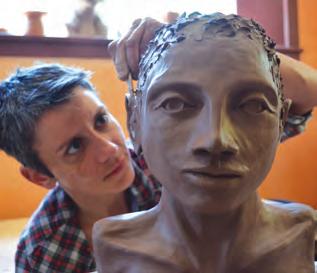
“Two Books by Paul Emberson”: a review by Stephen E. Usher, PhD (economist).
“Anthroposophical Society: What Ails Thee?” by Fred Janney, with a meditation and pictures of the original Executive Council members of the General Anthroposophical Society.

ALKION CENTER Waldorf Teaching or Early Childhood Education 2-year, part-time diploma programs includes comprehensive Foundation Studies in Anthroposophy [can be attended separately] Art & Education Summer Courses in late June Alkion programs are recognized by AWSNA + WECAN ALKION CENTER | alkioncenter.org 330 County Rte. 21C, Ghent, NY 12075 summer-fall issue 2017 • 13 being human digest
IN THIS SECTION:
To open, John Bloom explores the radically humane social vision Rudolf Steiner unfolded a century ago.
Renata Heberton describes this vision come to life at Angelica Village in Lakewood, Colorado.
Sally Voris of White Rose Farm in Maryland offers a simple “call to garden” which expands the view into the life of soil and out to embrace the living Earth.
Anthroposophy is truly holistic, engaging inner and outer, and David Tresemer updates the picture of the initiative for anthroposophic psychology in the USA.
Describing the formation of MysTech in Seattle, Andrew Linnell reminds us that our relations with world-changing technology will also be intimate and moral.
Rudolf Steiner: Towards an Architecture of Social Transformation
by John Bloom
In introducing any aspect of Rudolf Steiner’s work, it important to be clear from the outset that through his insights he not only pushed the boundaries of what we know, but also how we know. He offered guidance for both through his lectures, writings, and leadership during his lifetime. His spiritual worldview was cosmological in scope, yet much of his work focused on practical ways to be in the world with awareness of how spiritual forces are at work in and through it.
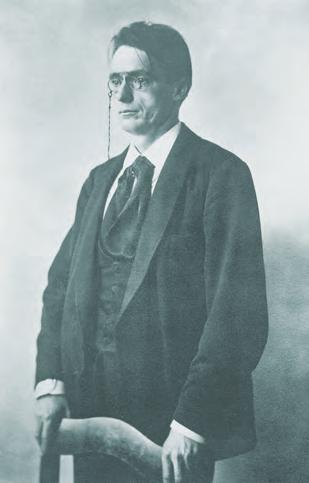
He urged his audiences to be interested in current affairs and states of knowledge, as he was, even while he often pointed out their limitations. In particular, self-development as a basis for knowing the world and the capacity for imaginative or intuitive thinking were at the heart of his hopes for anyone interested in grasping the spiritual foundation of knowledge. This approach is as relevant to understanding the nature of the human being as it is to re-enlivening the fields of agriculture, education, natural science, the arts, or, in the case of this essay, economics, money, and how best to organize our societies.
Through lectures in his own time, and in the transcriptions and writings that remain for us, Steiner asked repeatedly to be understood rather than believed. I think he also knew that the path of understanding would be the more difficult of the two, especially because it requires discipline and a continual openness to self-development. Such inner work can lead to a transformation of consciousness informed by multiple modalities of knowing—observation, practice, and reflection—and a fluid sense of time and space measured by the reality of experience rather than by clocks and rulers. He encouraged all students of his work to follow scientific methodology, despite the fact that the phenomenon being studied might not fit the conventional definition of research material.
The key to all science, and therefore all knowing, is observation. But Steiner, deeply inspired by the scientific work of Johann Wolfgang von Goethe, understood observation as a process of engagement, of seeing the physical reality as nothing more than a particular moment in a metamorphic process which itself can be “seen” in a context of time and space. This capacity for cognitive imagination, what Goethe described as “seeing his ideas,” plays an important part in working toward understanding Rudolf Steiner’s work, and it is a capacity patiently acquired.
At the core of Steiner’s work stands the human being. Each person is on a path of evolution unique to his or her individuality, a path that evolves across numerous incarnations. Each of us comes, according to William Wordsworth, “trailing clouds of glory.” This would be complicated enough to understand by itself, if only we did not need others in order to come into this world, into this body, at this time. But we do need others. We find ourselves on Earth, where we need to work with, live with, and love others, each of whom has a unique pre-history and a destiny path to map and follow that is different from our own. Thus, we struggle to find commonality, to find ways to get along, and to support each other along our paths.
No wonder social life, whether in a relationship of two or across a whole community, is complex. No
• being human
14
initiative!
wonder that conflicts and confluences in human relationships occur given the diversity and disjuncture of human beings and societies in different stages of cultural evolution. The invention and intervention of political boundaries and bodies of law, and the organic or competitive creation of economies simply to meet the needs of material existence add further layers of complication. Each of these domains—culture, polity, and economy—has its own logic, its own origins, and its own practices that have supported the evolution of individuals and humanity. At the same time, each of these domains has an equally powerful shadow side that, wrongly applied, has denied and oppressed human beings and the growth of human consciousness. If we are sensitive to currents at work in the contemporary world, we can sense that the shadows are quite present and active. Yet we lack clarity about each of the domains, and how they best function separately and together.
In the face of the catastrophe of World War I, Steiner articulated his vision of a threefold commonwealth as a way to bring peace and reorganize society based upon a principle of power with rather than power over. He linked freedom to the domain of culture, equality to the domain of rights and agreements, and compassionate interdependence (“brotherhood” in Steiner’s language) to the domain of economics. In doing so, he bridged his profound understanding of the threefold human being with an imagination of human beings organizing their public lives in congruent threefolding. By effecting this harmony between the inner integrity of each individual and a trifurcated high-functioning social organism, Steiner was putting in place the architecture of social transformation. Such architecture requires each individual to move past an ego-centric, self-interested view of the world to one motivated by interest in others and trust in the forces of reciprocity. He offered the tools for each person to do the inner work needed for this self-transformation and created an education that would support the development of such capacities for future generations. Steiner’s threefold principles provide a framework and tools with which to approach social life in a way that is regenerative, and inspired by an affirmation of the values of being human and being in community, albeit global in scale.
Within the threefold commonwealth, compassionate interdependence in the economic domain is probably least understood. Nothing in our current free market economic system speaks to an altruistic perspective, one which holds that we work to meet others’ needs as our needs are met through others’ work. Enlightened self-
interest, the notion that acting as if others mattered is in one’s best self-interest, has given way in current time to raw competitive self-interest. And, this self-interest has proven to be a failed, flawed, destructive concept.
As a guiding principle, self-interest may have worked at a time when moral and ethical boundaries, whether driven by church, community, or family, were operative in systems of self-governance. But, the fragmentation of such social forms and the atomization of individuals through the hyper-presence of technology have contributed to the atrophy of moral foundations in societies. As remedy, Steiner posited that all economic activity operates on the principle of brotherhood and sisterhood, and further, arises out of the interaction of land (or all natural resources), labor, and capital. The key point here is the interaction, particularly the production of commodities and services that emerge through those interactions. Contrary to how economics is typically conceived, what Steiner established was that the three basic elements are fundamentally not commodities in and of themselves. Imagine how different the world would be with the decommodification of land, labor, and capital. This is hard to grasp in an age when real estate and land is treated as investment rather than a means of production, labor is purchased on an hourly basis with workers regarded as replaceable parts in a production schema, and capital is used for nothing more than making more capital and is thus devoid of real value.
As part of this shift of economic paradigm, Steiner indicated that the management of interdependent practices was best done through freely formed associations. These associations would bring together producers, distributors, and consumers to determine how to steward natural resources, labor, and capital to assure that everyone’s material needs were met. As a result, setting prices was a key association function. Associative economics was Steiner’s antidote to what he perceived as the overreaching power of corporations and the state in managing economic affairs, which rightly belonged to the stakeholders most directly engaged in the economy activity, and who would reap the benefits and bear the consequences of their choices.
Steiner also understood money not as a thing but rather as a multifunctional servant—through purchase, loan, and gift—to the circulation of value and economic activity. Much of what he had to say resets these forms of money in their original purposes to support the creation of real value, and gives some powerful indications for how to work with money in a corrective healing way in our current distorted, inequitable system. One could look at
summer-fall issue 2017 • 15
money as a postmodern threshold experience, a mirror and magnifier of who we are as human beings. Money tends toward being anti-social in how we attach to it and it to us, even though each dollar is, as Steiner states, connected to all the division of human labor in the economy. In movement, in circulation, it reflects the pulse of material life. Money is both mystery and monster, misunderstood and misanthropic, a bearer of light and good intention, and evocateur of rapacious desire.
Money is as much a symptom of our inability to connect to the world as it is a symbol of just how deeply interdependent we are. Knowing money is a path to knowing oneself in relation to the economic world and its intersections with the political and wider cultural worlds. Money is social technology that pits self against the other and the world in the process of getting, and celebrates relationship in the world in the process of gifting and letting go. To see that we can live in multiple worlds and a multitude of transactions, maintain our integrity and recognize our interdependence through all of them, and still account for every penny, requires a new consciousness and a significant level of personal transformation.
Such transformation requires an architecture that acknowledges present reality with all its flaws, greed, corruption, and extreme inequity, and yet stands as a new structural system in which we can find aid and comfort, challenge and guidance, and above all, a way to live out of love and forgiveness rather than power and violence.
The task for our time is to bring practice and visibility to the social architecture that Rudolf Steiner described. What he articulated was that this structure is already there and further that we operate within it, but unconsciously. Through inner discipline, we can develop consciousness of the threefold nature of social life. Then, through that work, we can more fully inhabit the architecture of self and world in a way that brings about social harmony and supports a resilient structure—as the ancient cathedrals, temples, and mosques have stood the test of time—that is home to, honors, and inspires that which is spiritual in the human being and connects the individual with the wisdom of the cosmos.
John Bloom is General Secretary of the Anthroposophical Society in America and vice president for corporate culture of RSF Social Finance in San Francisco.
Adapted from John Bloom’s Foreword to Steinerian Economics by Gary Lamb and Sarah Hearn, Adonis Press, NY, 2014.

Colorado’s Angelica Village
It is the spring of 2016. A spicy aroma wafts out of the kitchen of 5520 W Virginia Avenue, Lakewood. Lodrigue pats a ball of chapatti dough as big as a soccer ball. Newly arrived from Uganda, he is making his home in the Denver suburbs, riding city buses, and attending the Waldorf school. He is joined by sister Bora, a slender eighteen-year-old with a knack for preparing chicken legs boiled in oil, and by younger brother Audry, more interested in the drumming studio in the garage than in cooking. These three joined the resident community of Angelica Village in May 2016, at that time including Amy and Renata from Denver, Diaz from Honduras, Alonzo from Guatemala, and Rosie from the Pine Ridge reservation in North Dakota.
Angelica Village was born in a small farmhouse across the street, home of Anamaria, Terri, and their toddler son Aaron. When a second baby was born, the farmhouse was bursting at the seams and, in perfect timing, the second farmhouse came up for sale. With extraordinary support from the Denver anthroposophical community as well as many other interested friends and donors, this house was purchased and a new chapter began in April 2016.

The vision of Angelica Village was born in Renata’s heart many years previously while still attending the Waldorf school. She carried it through college, obtaining her master’s degree in social work. It was nurtured further by her practicum at the House of Peace in Ipswich, Massachusetts, a community for refugee families and adults with developmental disabilities. [The story of the House of Peace was told in being human, summer 2013.]
Joining the workforce in Denver, Renata’s vision grew in urgency as she became painfully aware of the inadequacies of the social work system. A small support group formed to hold the intention of Angelica Village: to wel-


16 • being human initiative!
come those from all walks of life who want to create a community where all give what they can and receive what they need; where each individuality is held in the deepest regard and the collective strength holds all those who are engaged.
Specifically, the intention is to welcome those who have had the least opportunity to bring their full selves as a gift in this world, who have faced some of the dehumanizing experiences of violence, war, and homelessness. In the mainstream mindset, these individuals and families are seen as having little to offer the world and are placed in short term service programs which rarely serve their needs adequately. Families seeking refuge from war, individuals with special abilities, and parents who are homeless and single experience a unique set of challenges.
It is a harsh reality to recognize that all of these have been marginalized and underserved in many ways. In a world ravaged by war and displaying hostility toward those who are different, there is a growing sense of isolation for so many populations. When the strength of such individuals unites with a positive, peaceful community, the possibilities for healing and growth are immeasurable.
Communities dedicated to reversing these trends on micro and macro levels are critical. Built on the strengths of individuals from diverse backgrounds and focused on sustained relationships and mutual support, they can overcome structural oppression, celebrate differences, and work towards peace and healing. As a foundation for realizing this vision, Renata and her partner Amy trained as foster care parents for refugee youth and welcomed the first young people. Through the first year of rapid growth, they maintained full-time outside jobs while carrying out the tasks of parenting youth from diverse backgrounds. On any given day, this might include counseling, transportation, advocacy with social services and immigration, tutoring, instruction on how to ride the city buses, and driving lessons for the teenagers! All this on top of regular household tasks and particular needs like searching Craigslist for a reasonably priced set of drums for Audry and Lodrigue’s musical passion, or scouring the

city for jackfruit or cassava for a Ugandan evening meal.
The Farmhouse provides a home for the youth. A duplex down the road was purchased for two families coming out of homelessness; a long two years was spent fixing them up. One became the final home for a dear partner and board member Veola, who passed on due to terminal illness. After other patchwork arrangements, two families connected to Angelica Village who expressed a desire to participate fully and reciprocally in the community are moving in and making this duplex their home.
Two more youth have joined the residential community and additional adults and children have been called to join the impulse of Angelica Village, either as residents or frequent visitors, supporting in different ways while receiving what the community has to offer. The hope is to achieve the ideal balance between the individual and the greater community presented by Rudolf Steiner in 1920:
The healthy social life is only when
In the mirror of the human soul
The whole community forms itself
And in the community lives
The strength of the individual soul.
A first grant proposal seeks funds for a music and art studio, initially for the drumset that has become a focus of interest for the young people. (They are expanding their repertoire, and branching out to perform in city venues in local churches.) Individual donors are sought to make a monthly pledge. This will fund one full-time co-worker for the many daily tasks and provide some support for transportation, paying school, educational and vocational materials, diapers, food, clothing, and more.
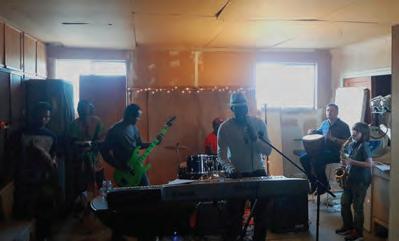
Angelica Village is eager to grow into its full vision including homes to welcome more individuals and families, a community garden with animals, a youth and community art and music space, and a corner store cafe. We are also eager to infuse community activities and rhythms with therapeutic offerings. All are welcome!
Contact : Renata Heberton (renheb@gmail.com) or visit www.angelicavillage.org

summer-fall issue 2017 • 17
A Call to Garden!
by Sally Voris
Insights sparked by a deep conversation with Shelden Luz. In 1924, Rudolf Steiner gave a series of eight lectures to farmers in Poland who wanted to understand why the quality of their food was declining. Those lectures form the basis of biodynamic agriculture. Steiner framed agriculture in the context of the cosmos. He said invisible spiritual forces, acting through the stars, the planets, the sun and the moon, were vital to life on Earth. He asked farmers to imagine their farms as individual living organisms and he gave specific practices to build farm vitality.
After some ten years of farming using biodynamic practices, I noticed that the produce nearly popped with energy and flavor. It was easier to farm. I felt like I was now dancing with a living partner—the farm. I realized that plants don’t just grow out of the soil; they lift themselves (or are they pulled?) heavenward. When we are fed by such plants, we get that lift. To come to full flowering; however, the farm needs a farmer to mediate and balance its life processes. As the weather gets more erratic and extreme, it takes more will and skill to keep life on the farm dancing and breathing together!
In other lectures, Steiner spoke about how the Earth exists for the spiritual evolution of human beings. He outlined epochs and cycles of development in humans. Steiner foresaw that forces focused on materialism would become very strong in our time. Those forces deny spirit. It is our challenge, Steiner said, to develop our ability to balance spirit and matter through our hearts. Nutrition is essential to our spiritual development, he asserted. We need food that feeds our souls, our wills, and our spirits.
Our current industrial food system completely ignores this aspect of nutrition. The system produces commodities for consumers. It separates us from Nature—the source of our most intimate and immediate connection with Creation. Plants are the hands of God, said worldclass gardener Alan Chadwick. When we use our hands in the garden, we touch those hands. There is something in us that goes out to meet every living thing, said theologian Thomas Berry. The inner world of man and the outer world of nature go together, he asserted. We are meant to connect with Nature and be fed by her!
There are, however, tremendous forces seeking to hide this essential truth. Government subsidies and agricul-
tural institutions now encourage farmers to move their operations into controlled environments: hoop houses, green houses, barns, and buildings. Plants and animals have less access to fresh air and sunlight. Farmers use well water to irrigate their crops. Well water has predominantly Earth energy, whereas rain water contains vital atmospheric energy. Our food is losing its connection with the cosmic, spiritual forces in sunlight, fresh air, rain, and natural rhythms. We become less able to meet the challenges we face—less able even to see the forces that are drawing us downward.
We are the essential players here. We can awaken to that truth. Our birthright is connection, and so is our calling. We are co-creators of our world: what we imagine becomes the future. Can we hold a vision of abundance and hope? Or do we carry the images of despair and devastation that are swirling around us? Can we engage in work to restore wholeness to our lives and to our Earth?
It is not just a matter of where we get our food and how it is grown; it is also vitally important where we give to Nature, how we give to Nature, and why we give to Nature. What we do to Nature, we do to ourselves. When we dance with Nature as our partner, we reweave the web of life. We restore health.
White Rose Farm and its Circle were born out of love for the Earth and love for life. People will give to this work because they want to cultivate their own souls, they want to honor those who have come before and/or they want to prepare a space of love for those who are coming after. Let’s make love the foundation of the New World! There is much to celebrate and much to do....
Sally Voris (sally@whiterosefarm.com) is owner and operator of White Rose Farm, Taneytown, MD (www.whiterosefarm.com).
Sally combines gardening, storytelling and writing, teaching and organizing. She has been recognized regionally and nationally for work sharing the stories of her home community of Elkridge and the Patapsco Valley. After her mother died, she came to the farm that her parents had bought in 1966. She completed a year-long part-time training program in biodynamic agriculture at The Pfeiffer Center in New York in 2008. The farm was recognized as a mentor farm for the North American Biodynamic Apprenticeship Training Program in 2010. Sally believes that as we build relationships with each other and the world around us, we create invisible threads that link us heart to heart.

18 • being human initiative!
Peggy Adams with flowers at White Rose Farm
A Psychology of Soul and Spirit: An Anthroposophic Psychology
 by David Tresemer, PhD
Rudolf Steiner is sometimes quoted as being against psychoanalysis and psychology. Quite the contrary! Many of Steiner’s lectures acknowledge and advance psychology as it was being developed in his time. His occasional criticisms must be seen in that context.
In a series of lectures called Pastoral Medicine (1924), Rudolf Steiner asserted that theologians and ministers should tend to human connections with spirit, medical doctors should attend to the needs of the physical body, and psychologists should attend to the needs of the soul. To that series of lectures, he invited theologians and medical doctors. At that time the field of psychology was inchoate, especially a psychology that recognized the importance of spirit.
Foremost among Steiner’s views on psychology is a series of nine lectures in 1909-1911 in Berlin, published as The Psychology of Body, Soul, and Spirit. His framework for anthroposophic psychology is a bit like Swiss cheese— an excellent structure with many holes. Had World War I not intervened, one feels that Steiner would have filled in those holes. Now it is up to us, through personal spiritual-scientific research, to do so.
Great teachers have furthered Steiner’s insights: Karl Koenig, Georg Kü hlewind, Christopher Bamford, Robert Sardello, Lisa Romero, and others.
A new initiative in anthroposophic psychology is growing in the United States. The Association for Anthroposophic Psychology (AAP) has recently graduated one group of twenty-two from our three-year certificate program (three seminars/year) in California, another group of seventeen in upstate NY, and is readying new three-year certificate programs in Pennsylvania and Wisconsin. We seek to offer a bridge from mainstream psychology to an anthroposophic psychology. People come to these trainings and adjoining lectures seeking an alternative to mechanical views of human beings ( genes determine chemicals determine behavior, with consciousness seen as a side effect), both in normal development and when people have veered off a
path of healthy development.
AAP faculty includes authors published or distributed by SteinerBooks:
» David Tresemer (PhD Psychology, editor and contributor to The Counselor…As If Soul and Spirit Matter and Slow Counseling );
» Roberta Nelson (PhD Counselor Education, Licensed Practical Clinical Counselor, and Licensed Addiction Counselor, chapters in The Counselor);
» Edmund Knighton (PhD, Psychology, President of Rudolf Steiner College, chapters in The Counselor);
» and James Dyson (MD, co-founder of the Park Attwood Clinic, England).
William Bento (PhD, deceased in 2015), wrote Lifting the Veil of Mental Illness, and founded this initiative in the United States.
The trainings are geared to:
» licensed mental health professionals (seeking CEs, continuing education credits, and new perspectives);
» professionals in other fields (educators, life coaches, hospice workers, pastoral counselors, ministers, etc.);
» individuals seeking self-development, which is often sorely lacking in our lives as well as too often absent in training programs for the helping professions. This diversity has enhanced the dynamism in the experiential learning that AAP provides.
SteinerBooks and its imprints have offered an essential platform from which to launch a psychology of embodied soul and spirit in the United States. The courses rely on these conceptual frameworks and we are grateful that they are there. They form a foundation for the many embodied experiences in the face-to-face trainings that form the core of the AAP courses. For more information, see the books mentioned as well as information at www.AnthroposophicPsychology.org.
summer-fall issue 2017 • 19
David Tresemer, PhD, teaches in the certificate program in Anthroposophic Counseling Psychology, and with his wife Lila via the IlluminatedRelationships.com initiative.
The Formation of MysTech
by Andrew Linnell
For decades the Center for Anthroposophical Endeavors (CFAE) has fostered programs in the Northwest US that cultivate anthroposophical ideals and initiatives. One of its latest is MysTech, a new organization forged in partnership with Andrew Linnell, a forty-year veteran of the tech industry and now lecturer on the topic of the human being in regards to the mysteries of technology.
MysTech will further work to realize Rudolf Steiner’s indications on the development of a “mechanical occultism” in America and the English-speaking world. CFAE offers a MysTech membership and will publish a biannual MysTech Journal with thought provoking articles, viable research, and tangible results in the field of “moral technology.” (The first issue, for May 2017, is at rudolfsteinerbookstore.com/product/mystech-issue/.
Since Steiner’s time, relatively few individuals have taken up the topic of moral technology. Some of explorers in this field have been Paul Emberson, David Black, Joel Wendt, Nicanor Perlas, Tarjei Straume, and Andrew Linnell. During a lecture in Seattle sponsored by Dolores Rose Dauenhauer of CFAE in 2012, Andrew first realized the potential for a home for MysTech in Seattle, where some of the biggest tech giants are based. Since her passing in December 2015, her son Frank Dauenhauer has been managing director of the nonprofit which includes the Dr. Rudolf Steiner Bookstore; he has continued to sponsor Andrew as guest speaker and to promote this effort.
Rudolf Steiner indicated that technology and the coming incarnation of Ahriman1 should not be feared; rather Ahriman must be confronted in a healthy way to learn from him what will be needed for our future work. MysTech will work in transforming the Ahrimanic forces of our times to realize a true and inwardly moral way forward for humanity’s future with technology. In light of this, MysTech seeks stakeholders who, as supporting members, can help steer the research and the development of this future technology along a trajectory Rudolf Steiner indicated almost a 100 years ago. Possible future steps include:
1 Editor’s note: Physical research on material objects necessarily speaks of “things”; research in consciousness and spiritual reality requires us to speak of “beings.” In Rudolf Steiner’s research Ahriman is the cosmic being whose activity stands behind technology and materialism; Steiner expected him to appear as a human being early in the third millennium.
» Develop an interface to machinery that will filter impulses by the user based on their emotion (this already exists in research labs) initially and later on their moral intention. One target market is Exosuits, wearable robotics;2 others are anticipated.
» Explore motion-based physics.
» Replace atomism.3
» Understand how resonance happens across boundaries (e.g. between etheric and physical).
» Promote technology based on the ‘Keely machine’ or resonance.
Impulse: Observations by Rudolf Steiner
What is essential for humanity in this fifth postAtlantean period is to enter into a special treatment of great issues of life that have been obscured in a certain way through the wisdom of the past. I have already pointed this out to you. One great issue of life can be characterized in the following way: an attempt will have to be made to place the spiritual etheric in the service of outer practical life. I have brought to your attention that the fifth post-Atlantean period will have to solve the problem of how human moods, the motions of human moods, allow themselves to be translated into wave motions on machines, how man must be brought into connection with what must become more and more mechanical. ... In such situations the will is there to harness human energy to mechanical energy. These things should not be treated by fighting against them. That is a completely false view. These things will not fail to appear; they will come. What we are concerned with is whether, in the course of world history, they are entrusted to people who are familiar in a selfless way with the great aims of earthly evolution and who structure these things for the health of human beings, or whether they are enacted by groups of human beings who exploit these things in an egotistical or in a groupegotistical sense. That is what matters. It is not a question of the what in this case; the what is sure to come. It is a question of the how, how one tackles these situations. The what lies simply in the meaning of earthly evolution. The welding together of the human nature with the mechanical nature will be a problem of great significance for the remainder of earthly evolution.
— Rudolf Steiner, Individual Spirit Beings and the Undivided Foundation of the World: Part 3, 25 November 1917, Dornach, GA/CW 178
2 biodesign.seas.harvard.edu/soft-exosuits
3 wn.rsarchive.org/Lectures/GA320/English/GSF1977/19191223p01.html
20 • being human initiative!
First, there are the capacities having to do with so-called material occultism. By means of this capacity—and this is precisely the ideal of British secret societies—certain social forms at present basic within the industrial system shall be set up on an entirely different foundation. Every knowing member of these secret circles is aware that, solely by means of certain capacities that are still latent but evolving in man, and with the help of the law of harmonious oscillations, machines and mechanical constructions and other things can be set in motion. A small indication is to be found in what I connected with the person of Strader in my Mystery Dramas. These things are at present in process of development. They are guarded as secrets within those secret circles in the field of material occultism. Motors can be set in motion, into activity, by an insignificant human influence through a knowledge of the corresponding curve of oscillation.... The capacity to set motors in motion according to the laws of reciprocal oscillations will develop on a great scale among the English-speaking peoples. This is known in their secret circles, and is counted upon as the means whereby the mastery over the rest of the population of the earth shall be achieved even in the course of the fifth post-Atlantean epoch.”
— Rudolf Steiner, The Challenge of the Times, lecture 3, 1 December 1918, Dornach, GA/CW 186
Leaving a Legacy of Will
“In the Spirit of Steiner” Festival
Built from the company that brought the 1995 Mystery Drama and 2005 Symphonic Eurythmy tours to North America, Lemniscate Arts has been preparing a new play, The Working of the Spirit. This play addresses indications from Rudolf Steiner as to what would follow his four Mystery Dramas of 1910-1913.
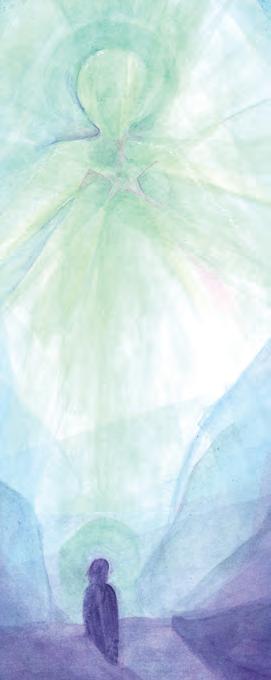

This work is part of a larger conception. Much of humanity has not experienced that spiritual questions can be brought to the stage with grace and dignity and performing art of high quality. We have designed a world tour, In the Spirit of Steiner, through which to share such experiences. The scope of the task means that there is no way to rush to completion. We continue to work on both the integrity of the ideas and information that we will present and the artistic merits that such work can embody, and hope to be moving close to completion.
There are several important developments. First, we now feel free to separate the component parts of our festival idea. This has let us move forward with planning an international Symphonic Eurythmy tour: “What was kindled in the East, through the West takes on form.” In the performance a series of meaningful speech pieces will be woven together with symphonic music of Arvo Pärt. The first eurythmy and speech auditions will take place in Dornach in October 2017 with the tour anticipated to begin in October 2018.
Second, a new play has been written on the biography of Rudolf Steiner. We continue to refine it and will report in the future on a possible tour.
Third, Lemniscate Arts has sponsored the development of the Speech and Drama Studio in Freeport, Maine. The Studio will offer its first five-day speech course this August 6th–11th. It will be taught by Craig Giddens, Geoff Norris, and Kim Snyder-Vine. For information please contact Craig at crggddns@gmail.com.
For more information, contact Deb Abrahams-Dematte at deb@anthroposophy.org
We expect to report further concrete developments in the next being human. Thanks to all who have been in support of our work these past few years. For the whole group that has worked on this project, Marke Levene, Lemniscate Arts www.inthespiritofsteiner.com
summer-fall issue 2017 • 21
An opportunity to make a gift which will bring expression to your intention, and love for anthroposophy into the future.
PlannedGiving_QTR AD_FINAL.indd 1 10/25/14 6:44 AM
arts & ideas
IN THIS SECTION:
David Tresemer already described the initiative for anthroposophic psychology; now he shows its helping power.
Tom Altgelt extends the holistic weaving with parallel development of plants and humans.
To know and be known: Patricia Rubano tells us how “biography work and social art” meets this real human need.
Martin Large, a social activist from the UK who toured last November, reports what he saw and heard from uneasy Americans. Words about Lois Schroff’s paintings in the gallery are blessedly unnecessary!
For Neill Reilly biography and the life of the mind intersected with one great professor named Fritz Koelln.
Pathos and Spiritus
by David Tresemer, PhD
A chapter from The Counselor …. As If Soul and Spirit Matter, published by SteinerBooks
The Diverse Needs for Counseling: Response to Pathos
Counselors need to be aware of the full spectrum of needs, even if they can’t serve every situation. We can picture the wide range of human problems, concerns, and ailments along a dimension of pathology—from -ology, or logos (pattern), of pathos (passion, suffering, the human drama): pattern of suffering. We are all entangled in the pathos of life to some extent or another. Too much pathos makes us dysfunctional; too little means we are not prodded to grow. A counselor joins in another’s pathos through em-pathy.
Antipathy means that the counselor feels revulsion for the client’s pathos—thus anti (against) pathy (pathos); a reaction of rejection has been triggered in the counselor that the counselor should explore. Sympathy means that the counselor identifies with the pathos of the client; the counselor loses his or her Self. Empathy means that the counselor understands through resonance what the client is going through, as on a parallel track, yet does not drown in it along with the client. In every case, the counselor observes and feels the client’s pathos, with empathy the healthiest approach.
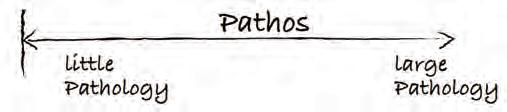
The pathos of human experience can range from little to large, creating a kind of Pathos Scale:

The popular Diagnostic and Statistical Manual (DSM, version IV, Axis V) features a parallel scale that it calls the GAF, for Global Assessment of Functioning: High on the Pathos Scale means low functioning. The DSM-5 uses the World Health Organization (WHO) Disability Assessment Schedule 2.0. These continua are bumpy and not smooth, just like pathos, just like life.
The writhing knots of pathos grind their constrained and painful cycles over and over in our lives. We respond to pathos with maturity, with pathology, or with both. For counseling, we can observe a series of situations escalating along the continuum of a Pathos Scale, understood by the way the human being responds to pathos:
This is obviously simplified, yet helps us understand the continuum of pathos. At the left end, at little pathos, people have no problems, and do not seek counseling; they simply live their lives. Those who have simple problems seek mentoring from friends and relatives; an aunt or uncle becomes a helpful mentor; a helpful piece of advice keeps them going for a long time. Those who have more problems (higher on the Pathos Scale) seek to work with those nagging issues through personal growth, motivational workshops, trainings of all sorts, ropes-courses, self-help books, and life-coaching. These
22
• being human
problems can appear as large obstacles in the road of life, but amenable to change: one life-coach training site advertises a course, “How to Change Your Life in Forty-Five Minutes.” At this lower level of pathos, such a claim may not be ridiculous. Rhonda Byrne’s book and movie, The Secret, sold many millions of copies; its formula of positive thinking, in the tradition of Emile Coué and Ernest Holmes, can be very helpful at this level of pathos. At this end of the Pathos Scale, simple fix-its can sometimes work large changes.
Further to the right, “The Top 3 Ways to Fix your Love Life” ceases to be adequate. One finds more serious problems that require better-trained counselors who can use methods such as Solution Focused Brief Therapy (SFBT), or Cognitive Behavioral Therapy (CBT), or Dialectical Behavioral Therapy (DBT). It makes a difference if the counselor is thumbing through a manual (in their minds or, as has been occasionally reported, in the session), or is meeting a human soul present in the room. Though Albert Ellis’s Rational Emotional Behavior Therapy (father to the three methods just mentioned) can sometimes seem reductionist in its application—“All you’ve been saying is merely Irrational Belief #5”—Ellis in person was dynamic, funny, intuitive, and confronting. Indeed, he was able to make the “irrational beliefs” come alive, and accomplish great transformations in just a few sessions. Therapists with a formulaic approach can be effective with those with less pathos. Greater pathos demands a more mature counselor.
The person with more pathos—more serious problems—seeks ongoing psychotherapy, suggesting issues more deeply imbedded in the psyche. Even Martin Seligman suggested that learned helplessness took many retrainings—in his studies with traumatized dogs up to sixty—to undo.
As pathos becomes more severe, medications may be brought in. One of the issues of our time is that drugs are brought in far too early, at a level of pathos where the problem could simply be endured, rather than drugged. As Robert Whitaker has documented, the drugs drive people more deeply into pathos when they needn’t have gone there. Whitaker calls this an epidemic of iatrogenic (doctor-caused) mental illness, a monumental failure of medicine whose impacts will increase over the coming years. In the terms of this continuum, powerful drugs may push the user up the Pathos Scale. There may be appropriate times when medication must be used, as in intractable schizophrenia, or to help stabilize a person in order
to allow for their personal development through therapy. With that said, there is a rampant over-use through prescriptions and self-medication in the world due to the influence of pharmaceutical corporations. There is also the cultural push toward immediate gratification and numbing from any pain. In the coming years, we must ready ourselves to care for the potential that there will be many thousands of people impaired by over-use of medications.
For the most serious levels of pathos, the human being has to be contained and held much more strongly. Increased suffering can lead to outbreaks of violence against self and others. Institutions, from psychiatric hospitals to prisons, have been set up by society to deal with those suffering high pathos.
Each of these levels of pathos requires a different kind of counseling. Many counselors advertise that they can meet any human being and address any problem, but in truth they cannot. Each of these levels on a Pathos Scale requires a different understanding of the human being and different techniques.
A common assumption in counseling psychology is that we must move the client’s Pathos-meter from right to left, from high pathos to less pathos, from suffering to comfort. We assume that our duty is to enable the pursuit of happiness—stated as a right, along with life and liberty, in the Declaration of Independence of the United States of America—indeed, to maximize happiness! But is this the best goal?
Spiritus and Pathos
To understand anthroposophic psychology in relation to a Pathos Scale, another dimension becomes very helpful, that of Spiritus—low on the scale meaning less developed capacities of soul and spirit, and higher on the scale meaning more highly developed capacities of soul and spirit. Moving vertically accomplishes the various steps of human development—not only to what Erik Erikson called intimacy and generativity, or what Lawrence Kohlberg called post-conventional moral development, or what Sri Aurobindo called self-realization—but further up to what Aurobindo called God-realization, and anthroposophy calls manas, buddhi, and atma. The point here is that there are states of development of Spiritus that are known and described. (Chapters 4 and 5 of The Counselor give other criteria for understanding the development of the human being vertically.)
What happens when we consider a dimension of Spiritus in relation to a dimension of Pathos? In the fol-
summer-fall issue 2017 • 23
lowing, the central horizontal line of the Pathos Scale is exactly as we framed it above. What happens above and below that line, however, differs.
One could easily argue that these shapes should be adjusted this way or that. And certainly there are overlaps and shadings of each approach. However, the essential picture of this diagram yields several realizations.
First, the gradations between types of Pathos along the horizontal middle line, and thus the appropriate types of counseling, do not hold true at all levels of development of Spiritus. Any one technique claimed to be good for every person and every condition yields only a partial solution to symptoms and to the course of maturation.
We don’t have a GAF or WHO Assessment Scale for Spiritus. In truth, you don’t go up and down in Spiritus the same way that you go right and left with your level of suffering. Psychologists can create stress scales to measure right and left. In Spiritus, we often sample many different states all in the same day. This picture depicts the journey of the main mass of one’s individuality, the essential progress of one’s personal development.
Lifting your Spiritus through soul development does not ensure freedom from pathology. Artists, for example, can often have the challenge of high Pathos; because of high development of soul capacities, this Pathos can be brought into constructive expression (documented in Kay Jamison’s amazing book, Touched with Fire). In that top right area—large Pathos and high Spiritus—can be found the lives of heroes and heroines who have braved extreme difficulties and then gone on to motivate others to over-
come great adversity (as in David Menasche’s and Janine Shepherd’s stories); while apparently stories of overcoming pathos, the real stories are a growth in Spiritus.
This upper right corner includes the work of the Spiritual Emergence Network, pioneered by Christina Grof and Emma Bragdon. Their approach has been that people with high Spiritus, and undergoing high Pathos, whether temporary or long-term, can become severely dysfunctional. Because their crisis involves maturation of Spiritus, they should not be drugged but rather cared for in a special way to support that development.
For a long time, people have been seeking these highSpiritus experiences, and expect that they come with a higher level of pathos (that is hopefully temporary). Here’s part of a poem from Rumi, writing in the 13th century: I want that kind of grace from God that, when it hits, I won’t get off the floor for days. And when I finally do stagger into a semblance of poise, I will still need a cane and a shoulder to help me walk, and I will need great patience from any who try to decipher my slurred speech.1
Rumi expects the high-Spiritus “peak experience” to bring him high-Pathos. Today these symptoms would warrant medication; for Rumi, that would undermine the thoroughness of the foray into high-Spiritus.
The studies from the pre-drug era (prior to the entry of Thorazine in 1954) showed that the great majority of people who experienced depression or anxiety (or any of the other common debilitating diagnoses, including schizophrenia) self-regulated and rejoined their lives after three to twelve months (this research from Whitaker). These were episodes of higher Pathos on a rough journey to work out a lift in Spiritus.
Anthroposophic psychology has a unique ability to assist those who have attained high development of Spiritus. Every point in this map of Pathos and Spiritus requires a different quality and content of whole-soul conversation to meet the individual along his or her unique path of development. Understanding the journey in terms of the dynamics of soul and spirit assists one to find the appropriate counseling response.
Exclusively cognitive approaches to therapy are more successful with people who have developed their soul capacities to some extent. Those who have developed more in Spiritus veer away from mechanistic models; they be-

24 • being human arts & ideas
1 From Daniel Ladinsky (2002). Love Poems from God. New York: Penguin Compass, p. 83.
come more interested in approaches that recognize soul and spirit in action. A good cognitive psychologist adapts to these differences in development of Spiritus.
Over the millennia, levels of pathos have always ranged from little to large, though some say that times are getting harder. Anthroposophy asserts that Spiritus for the mass of humanity moves upward over the centuries. Though there have always been those advanced in spiritual development, as well as those very little developed, anthroposophy posits that the bulk of humanity is slowly advancing in spiritual development. This has great importance for a counselor’s task in relating to a person in need.
Perhaps the most important revelation of this picture is this: Anthroposophic psychology does not measure success as how far a client moves to the left—diminishing pathos, solving problems, reducing suffering, finding more happiness, adapting more readily to the client’s surroundings. Rather, progress is seen when one lifts in the dimension of Spiritus, the strengthening and realization of soul and spirit, moving upward in this diagram. The world is seen as a school for soul growth, rather than as a vehicle for pleasure. Each moves toward the realization that life is not only about individual happiness, but about a task for each and all (more in chapter 6). Progress is thus seen when soul/spirit realities are integrated into awareness, in this picture when one moves vertically. Horizontal movement becomes less important.
Of course, crippling pathos has to be dealt with, in service of the increasing ability to develop oneself through stages of sophistication of soul and spirit. The counselor helps the client draw nearer the purpose of a single human life, and all human life—and one finds this through the warmth and interaction of love.
Being Human and the Life Cycle of the Plant
by Tom Altgelt
There are numerous ways to approach the mysteries of life and of who and what we are as human beings. Out of my work with Rudolf Steiner’s remarkable plethora of practical indications and spiritual teachings, I have evolved a useful analogy that offers a lucid map to effectively aid us on our quest for inner development. It utilizes the age-old universal symbol of the lemniscate to illustrate the close relationship between the stages of the life cycle of a plant and our own spiritual growth.

My opening into ever deepening clarity began when I came in contact with Steiner’s foundational book, How to Know Higher Worlds. Steiner’s teachings regarding the
The Counselor …. As If Soul and Spirit Matter can be ordered from SteinerBooks or Amazon. There is more about anthroposophic psychology programs at AnthroposophicPsychology.org.
summer-fall issue 2017 • 25
David Tresemer, Ph.D., teaches in the certificate program in Anthroposophic Counseling Psychology, and with his wife Lila via the IlluminatedRelationships.com initiative.
nature of the human being, the nature of the world, and the nature of the higher worlds, offers a way to lift the veils of obscurity to set us on a path of direct knowing. The first chapter of Higher Worlds outlines a safe journey for our own spiritual growth, which is astonishingly congruent with the developmental stages of a plant from seed to seed.
If we understand ourselves to be a microcosm of the whole, it makes sense to see our human spiritual development in terms of this metaphor. Already in the 18th century, one of Germany’s most renowned playwrights and ardent advocates of freedom, Frederick Schiller, had spoken of our innately human capacity to do consciously that which the plant does naturally.
To see how this works, we can visualize the process through the lemniscate, the primordial symbol for eternal flow. All life cycles appear to follow this archetypal movement pattern. In a continuous fluid whole, the lemniscate reveals the entire sequence of outer metamorphic processes and our inner transformations.
As can be seen in our diagram, the seed and the human heart are central to this correlation. They are poised at the transition or crossing over point of the lemniscate, between initiation into our deepest spiritual work and the natural evolution of our consciousness into outer fruition. The continual fluid movement of the lemniscate holds together the polarities of life and death, light and dark, beginnings and endings, weaving the resolutions of these polarities into our fruitful realizations. The seed, located in the heart of the lemniscate, encapsulates the whole of the earth’s impulses of inhalation and exhalation, night and day, expansion and contraction, and past and future.

Furthermore, the life-empowering, serpentine movement of the lemniscate also counters stagnation. When we are stuck, the health of our life and soul weakens, causing us to keep repeating the same mistakes over and again. By following the lemniscate we can move out of our mistakes and move towards natural regeneration and fluidity. By selflessly letting ourselves be worked on by this powerful current, we allow our innate gifts to grow. We are empowered to more readily let go of the past and to perceive our way forward into greater equanimity, compassion, and selfless service.
Most important, the lemniscate is an exceptional vehicle providing a living imagination to steer us clearly along our path of spiritual development as Steiner described.
In How to Know Higher Worlds, Steiner sets forth three principal phases of our spiritual awakening— Preparation, Illumination and Initiation—each of which can be said to be comprised of seven stages. For the plant, the first phase of Preparation is related to the seed falling into the soil and sending its root into the earth. This stabilizes and allows the growing plant to raise itself up in the next phase into the light of the sun, or, in our case, into the inner light of the higher self, the I AM, or Christ in our humanity. Our inner work during this phase is initially outwardly invisible, and our gesture is earthward and establishes our groundedness. This is directly related to Steiner’s admonition that “humility is the gateway to all higher knowledge.” A deepening into the inner mysteries is related to Sophia’s imminent wisdom, embodied in matter as the living heart of Mother Earth. Here, when our inner seeds of sincere seeking fall onto the fertile soil of our heartfelt reverence and devotion, they bear forth rich fruit.
arts & ideas 26 • being human
The second phase of Illumination with its seven stages is marked by the earth’s seasonal cycles of spring and summer. Here the plant sends up its sprout toward the sun, where in its light and warmth, it begins to grow leaves, followed by blossoms, which eventually bear fruit. This is a rich metaphor for the Illumination that occurs within us when we can speak of only being able to truly know that which we love.

The final phase of yet another seven stages, the phase of Initiation, begins with the formation of the seed within the fruit, which must eventually fall and die into the earth to begin a new life cycle. What an amazingly apt analogy this is for our own initiation. In this final phase, we clearly begin to recognize the cosmological origins of each species’ outer forms and growth patterns, as well as the radical metamorphosis they undergo in the fall, transcending life and death. It is in this Initiation stage that we die to the passing cycle, and where we consciously connect with higher divine spirits who facilitate our coming into a new level of being.
By contemplating the journey of the seed, we are better able to humbly understand with clarity the natural progression of our spiritual unfolding. And by using the lemniscate we utilize a visible practical means from which to realize that our being human is meant to bring the higher purpose in our heart up into
the light of day while becoming a bridge to manifest spirit down, through our heart, into matter.
Perhaps on this journey of recognition, of rethinking who we are and what the plant is, we can develop a feeling sense of what Goethe meant when he spoke of “die and become.”
It was Saint Francis, a man who was deeply connected with both the natural and the spiritual worlds, who said that it is in dying that we are born into eternal life. And it was Rudolf Steiner who suggested that we can look into the world to know ourselves and that we must look into ourselves to understand the world. Perhaps our own individual explorations of this analogy, between the life cycle of a plant and our uniquely human journey of inner development, can shed for each of us some further light on these thoughts and thereby allow us to ask better and better questions from the heart of who we are, as human beings co-creatively experiencing the world’s and our own evolution.
Tom Altgelt is a landscape architect and longtime student of anthroposophy. He facilitates study groups in Boulder, Colorado. Tom is preparing a book with related presentations and workshops on this topic, which he presented at the 2016 Biodynamic Conference in Santa Fe; please email him (altgelt@indra.com) for more information.
summer-fall issue 2017 • 27
Images © 2015, Thomas Altgelt, All rights reserved.
Biography Work: Bringing Social Artistry to Life
by Patricia Rubano
Biography work seems to be on the lips of every speaker addressing aspects of anthroposophy these days, and it is referred to in many articles. It seems that something that was perhaps misunderstood for a time is finding a resonance in many people now and the potential that it has for building bridges is being recognized.
So, what is biography work —and what is its relevance in today’s world? From the perspective held by the Center for Biography and Social Art that has been training people to use biography work in various fields for the past twenty years I will say: it is one of the most gentle and beautiful ways both to gain self-knowledge and to create community or social understanding.
Rudolf Steiner speaks of this in “How Can the Soul Needs of the Times Be Met?”:
When the science of spirit grows more and more away from abstractions into concrete life, there will appear among the circles which occupy themselves with this … a special kind of human social understanding, a way of awakening human interest. There will then be people who have certain capacities for teaching... about the different human dispositions…
This is one of the thoughts that serve as something of a job description for those of us who are developing this work. Through teaching and learning about human development—including life phases, temperaments, and soul types—and by relating these concepts to our own experiences and sharing in small groups, the most natural thing in the world is to become interested in those with whom we have shared. This deepened interest brings new understandings about both oneself and others.
There is a similarity in this Biography and Social Art way of working to what is offered to children through Waldorf education. We use an experiential approach so that we not only study ideas but engage our whole threefold nature of head, heart, and hands. Any theme can be related to the human being as we discover how different topics resound in our own lives, from the seasons of the year to the images of a fairy tale. Furthermore, by bringing our own experience into expression through drawing, modeling, writing, and other media, we activate memory
on a different level, moving out of our head into our creative will. This threefold way of working allows our mind to take in the subject that is offered and our interest to be enkindled as we consider its relevance to our own life. Then as our hands become active in expressing something in an unaccustomed way, we find new insights and meaning for our individual lives are revealed.
This way of working has nothing to do with looking at our life to find out what is wrong: “What is my problem and how can I fix it?” It is about looking at life as an evolution over time; as a process of development that includes crisis, change, metamorphosis, and transformation. This way of viewing one’s life and the world is supported by observation exercises where we learn to see these phases of growth, development, and change in the natural world. Inner work and self-development practices allow us to experience in ourselves, and to see in others, the transformation of old habits and the development of new capacities.
If we think of bio-graphy as life-writing, it is so much larger than an individual life or even human life; it includes the evolving world of nature and the universe. Can we begin to read the underlying spiritual script that connects everything and through which we find meaning?
In this way of working with others, we find, over and over, that people are grateful for even the smallest ways to share meaningfully about their own lives and to hear themselves reflected in the lives of others. This occurs consistently, whether from one brief exercise at the beginning of a meeting, a session in a conference, a full weekend workshop, or an on-going group. Whether someone is new to these ideas of human development and evolution or has studied anthroposophy for years, they discover new perspectives and familiar concepts are deepened.
The Biography and Social Art course was founded by Signe Schaefer, who recently wrote the book Why on Earth? Biography and the Practice of Human Becoming (reviewed in being human, spring 2014). The title gives a hint as to why someone would do biography work: the “practice of human becoming” is a process on-going throughout life. This is a work based on Rudolf Steiner’s constant
28 • being human arts & ideas
encouragement to review—from the daily review to the review of one’s life. He says in “The Inner Aspect of the Social Question” (Zurich 1919):
We can ask ourselves: How has this life of mine unfolded since childhood? But we can do this also in a special way. Instead of bringing before our gaze what we ourselves have enjoyed or experienced, we can turn our attention to the persons who have figured in our lives ... and we can summon before our soul the inner nature of each of these persons in place of our own. After a time we shall find ourselves reflecting how little we really owe to ourselves, and how much to all that has flowed into us from others.
Surprisingly, as we look back at our lives, it is not so much “about me” as one might think, but about the others that we have come together with in order to find and create our life’s destiny. We may even learn to see those who have appeared to be adversaries as helpers along our life’s journey.
Biography work finds its home within the Anthroposophical Society in the General Section of the School for Spiritual Science. Everyone has a life, a biography and a destiny, and all of us and our institutions can benefit
from working with Steiner’s fundamental teachings about what it is to be human.
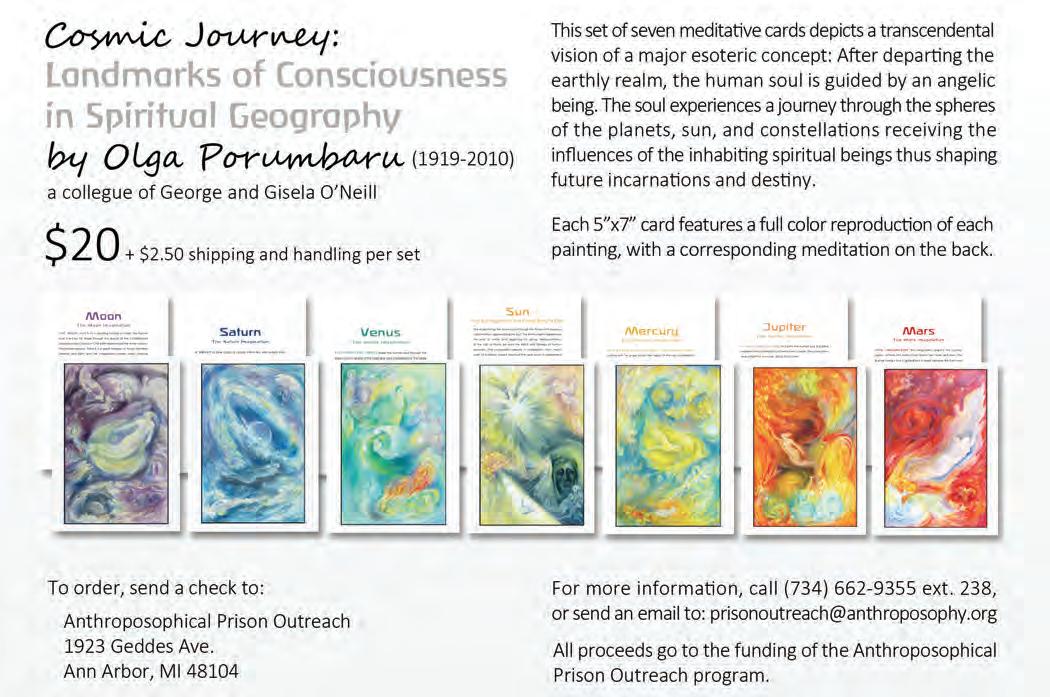
To learn about human and cosmic evolution is educational; to explore one’s life individually or with others is hygienic and often therapeutic. And sharing on this level with others creates social bonds and builds community. It is used by doctors and nurses, counselors and therapists, teachers and coaches and anyone who has the imagination to bring new life to individuals and social situations.
Biography work is needed at this time when anti-social forces are, of necessity, stronger than the natural social forces as they were present in the past. We must find many ways consciously and intentionally to bring social artistry to life: to connect to the spirit within and to the spirit in the other. I am happy to say that biography work is one way that holds transformative power over time.
Patricia Rubano directs the Biography and Social Art Program at the Center for Biography and Social Art. A member of the International Trainer’s Forum, she attended Biography Counseling Course in England and is a graduate of Spacial Dynamics. An early childhood educator and mentor, she offers classes and workshops on biography, parenting, relationships,communications and Spacial Dynamics. See biographysocialart.org for more information on the Center.
summer-fall issue 2017 • 29
Society do we want, and how do we get there?”
Action Research Questions for co-creating a threefold commonwealth society
by Martin Large
“What kind of society do we want, and how do we get there?” These were the burning questions that emerged from a November 2016 lecture tour (made possible by generous friends and hosts). This took me from NYC, through NY State, Massachusetts, New Hampshire, then California, to finish in Santa Fe, New Mexico, at the Biodynamic Association Conference.
This lecture tour was originally about Rudolf Steiner’s social threefolding vision for society and land trusteeship. However, it was ambushed by the surprise election of Trump on November 8th. Just as the Brexit referendum shook Britain on June 23rd, the Trump election also shocked many Americans. Some people even talked of “8/11” as a follow up to “9/11.”
So with a Sacramento audience we asked, “What kind of society do we want, and how do we get there?” We explored the Trump, Clinton, and Sanders visions for the USA, and then the relevance of Rudolf Steiner’s threefold commonwealth.
They contrasted Clinton’s neoliberal, market-fundamentalist, corporation-friendly approach with the Trump rentier-capitalist, xenophobic, macho, racist, narcissistic, tax-avoiding, protectionist, “America first,” approach. The Sanders vision of free higher education, better healthcare, jobs, fair taxes, social inclusion, affordable housing, and solidarity was seen as different, as was his personal integrity.
For me, a breakthrough light bulb moment was on the one hand to reflect on the comment and analysis coming from Brexit and the Trump election. On the other hand, it was possible to see these as societal turning points, where Steiner’s social threefolding vision could be distilled into four, simple yet profound, action research questions. We can then answer these questions practically, or with a particular personal reformulation of the question that works for us. Instead of feeling powerless and confused, we can take constructive action.
The questions are as follows:
» How are we developing a generative, mutual economy that works for all? (brotherhood)
» How are we caring for the earth? (sustainability)
» How are we engaging politically for human rights, a more participative democracy, social justice, social inclusion, equity, and peace? (equality)
» How are we enabling creative, dynamic cultural life where every person can develop and maintain their whole human potential? (freedom)
At Sacramento, we also discussed the historic opportunity offered by the collapse of the neoliberal, marketfundamentalist ideology to draw on Steiner’s seminal social thinking. The above four action research questions can be used personally, by groups and organizations. Such work can make a difference—cultural, political, environmental, and economic—at a local, city, and state level. We can start, or build further, from where we are. The Burlington, Vermont “model” where Bernie Sanders had been the mayor came up as an example close to social threefolding.
Some people said that we face such dangerous times that we need to prepare realistically for the worst, yet also prepare for the best. However, I saw signs of hope everywhere I went, the “blessed unrest” of individuals, groups, and movements making a difference. There were thriving social businesses, biodynamic farms, healthy towns, creative schools, community gardens, social movements like the Dakota pipeline protest, innovative housing schemes, civic initiatives, and impressive evidence of good old American “can do.” In New York, the city’s social landscape has been changed by the work of green guerrilla gardeners transforming waste lots, city parks, growing good food, addressing food poverty, increasing human security, and community building. In some small towns and city neighborhoods, you can see things like co-ops, community farms, free medical and dental services and signs of a thriving cultural life.
These green shoots can be seen as openings for a “commonwealth society.” This is emerging all over the world. We only need to see what is happening, inquire, understand what is emerging, and connect up the dots. We live in a creative, enterprising age, and the lid just cannot be put on this social ferment.
continues on page 35 »»
arts & ideas 30 • being human
“What
Gallery

Lois Schroff


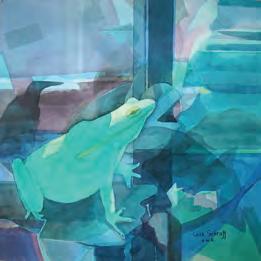

(lois.schroff@gmail.com), a member of the Anthroposophical Society, is a professional watercolorist and Artist Member of the Virginia Watercolor Society, selected by their national jurors for three separate yearly exhibitions. Her works also were accepted in two juried Baltimore (Maryland) Watercolor Society shows, and the juried Red River Watercolor Society show in North Dakota. Lois is also a writer, the author of a “how-to” video, Spirit In Watercolor, and the books Color, Its Relationship to Soul and Spirit, and Physical and Spiritual Experiences of Color: Therapeutic and Artistic Aspects
summer-fall issue 2017 • 31
Clockwise from right: “Sunrise Vision,” “Croaker,” “Mystery Woman,” “Mayan Couple,” “Symphony.”
“Spirit Creating Blossoms”
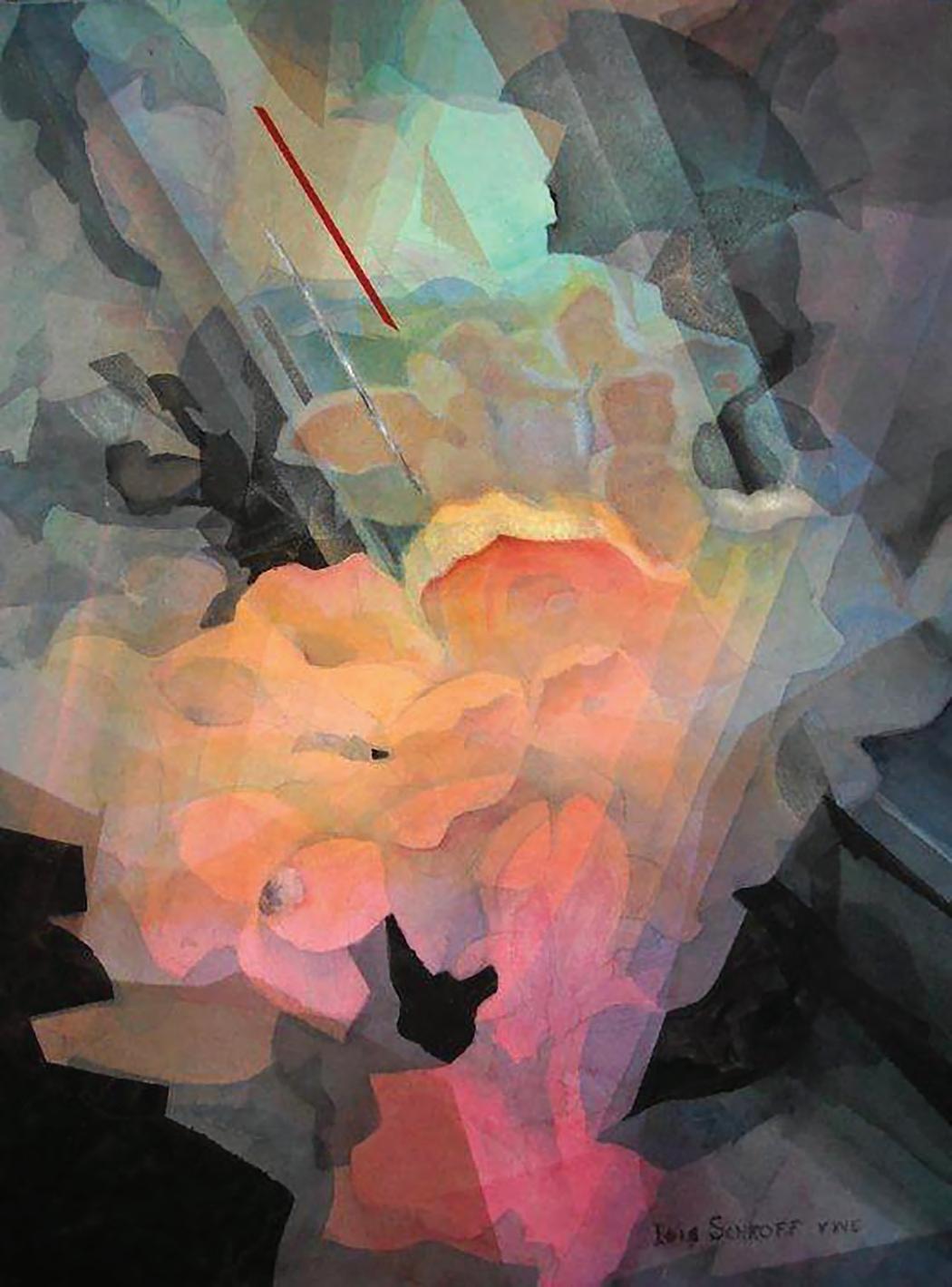

32 • being human

“Spirit Abstract” summer-fall issue 2017 • 33



34 • being human
Clockwise from above: “Striving Heavenward,” “Mexico Colors,” “Toucan, Too,”
“Michael Abstract,” and the artist, Lois Schroff, at an exhibit of her work.
«« continued from page 30
Just think how the invention of community supported agriculture (CSA), an application of Steiner’s associative economics, by the late Trauger Groh and others at the biodynamic Temple Wilton Community Farm in New Hampshire, has gone viral round the world. CSA offers a radical alternative to the “free market”; here consumers, distributors, and growers agree to associate with fair prices for growing good food, guided by clear agreements.
Why a “commonwealth society”? “Commonwealth” is an old word for society or state, meaning much more than just money. Massachusetts, Pennsylvania, Virginia, Australia, and Canada are formally commonwealths. “Common wealth” includes “commons” such as land, air, water, language, relationships, and culture, as well as industry, the economy, health service, and our democracy.
“Commonweal” is a connected term meaning common good . People long for a common good society.
I observed how social threefolding lived in the will of many people, seemingly just below the surface. They had an intuitive grasp of boundaries between culture, politics, and economy, and how to clarify these. This was expressed by proposals such as, “Let’s get the money out of politics,” or “Get the state and corporations out of education.” The shared understanding of the threefold separation of powers in the US Constitution, of the judiciary, legislature, and executive, easily leads to the clarification of the tripartite dynamics of the political, economic, and cultural systems.
It is vital to analyze the role of social media in order to answer the question of why people voted for Trump. These were expertly used to manufacture consent and votes. Many people now get their news and “information” from the social media, from trusted friends’ recommendations, and from the automatic recommendations of algorithms: “If you like this, then you will like this.” Many people see uncritically through the lenses of their social media and personal “filter bubbles.” Just as with the Brexit campaign, it was possible to spread malicious rumors, factoids, lies, and half-truths. The more vicious and shocking—like the allegation Hilary Clinton was a pedophile, which originated with some Macedonian youths—the more people clicked and forwarded their friends with a message, “Have you seen this? No smoke without a fire!” The more negative the information, the angrier and “pumped up” people got in their social media echo chambers. This was “post-truth politics” in action.
But such social media activation by Trump would not have resonated with people if there had not been real grievances to address. His campaign targeted a mixture
of social conservatives from all backgrounds, some with white supremacist and racist views, and “left behind” working class people who were economically more radical. Many jobs had gone to China and to Mexico, communities were run down, people were afraid for their jobs, health, houses, security, and their children’s education. Trump, was able to get through to such people and successfully blame the liberal capitalist elite such as Clinton for the loss of jobs.
From a deeper point of view, Trump also tapped into the many people who are suffering both psychologically and spiritually.1 They feel they have failed to achieve the American dream, they feel losers, half human. Having internalized the neoliberal ideology of competitive individualism and Social Darwinism, they have no one to blame but themselves. There is a deep lack of self worth, self-respect, and human dignity coming from not feeling that their work, if they have any, is respected and has value. Their labor is treated as a commodity to be bought and sold on the market, a point Steiner makes strongly in Towards Social Renew al (1917). Consequently, they feel bad, self-hurting, afraid, failures. Moreover “the liberals” try to make them ashamed of their socially conservative values. For example, the September 2016 quote by Hilary Clinton, used with deadly effect by Trump:
You know, to just be grossly generalistic, you could put half of Trump’s supporters into what I call the basket of deplorables. Right? The racist, sexist, homophobic, xenophobic, Islamophobic—you name it. And unfortunately there are people like that. And he has lifted them up…
So Trump was able to mobilize “left behind” people’s spiritual and psychological injuries, directing the hurt, resentment, and anger at scapegoats such as the immigrants, liberals, big Washington government, Muslims, “crooked Hilary,” even war heroes like Senator John McCain. We saw the same here in Britain with Brexit, where the Gloucestershire millionaire Arron Banks spent £7.5 million on a toxic social media campaign that pumped up just enough people to swing the vote to Leave.
From Steiner’s analysis of the social question, a crucial part of the answer to these deep human spiritual injuries is cultural. We need a dynamic renewal of creative education, the arts, sciences, spirituality, health, and our food culture so that people can develop and maintain their
1 See also Rabbi Michael Lerner in http://www.tikkun.org/nextgen/ psychopathology-in-the-2016-election-3
summer-fall issue 2017 • 35
spiritual, creative, human, and social potential. If you think of the cost of this, consider the huge costs of not educating people for creative human freedom and dignity.
Creative cultural life is breaking through, despite the capture of large areas of culture by the corporate media and by government. (If you want to control people, command the pulpit, the schoolroom, and the media.) But until we see culture, such as free creative education, as centrally important, the conditions for demagogues like Trump and Farage to flourish will continue.
What are the positive ways ahead? There is hope in the dark, as Rebecca Solnit writes so movingly (Hope in the Dark, 2016). Preferring not to react by becoming an alcoholic or committing suicide, I choose to remain an optimist! People across the USA told me that it is time to wake up, to keep creating positive alternatives. We have significant capabilities, not least to address the spiritual and psychological questions of people seeking creative personal and cultural renewal. We have the opportunity to answer in our own different ways the burning questions that emerge from Steiner’s societal thinking and help co-create a more free, equal, mutual, and earthcaring society.
Follow up: as we need to see how things work, a number of people whom I met are writing up case studies for an upcoming anthology of how they are working with Steiner’s social threefolding in practice. For more details please contact me.

Martin Large (martin@hawthornpress.com) facilitates cultural, social, & economic renewal. His motto is, “Better to light fires than fill buckets!” He has worked as an academic and in business; he enables community land trusts and social enterprise with Stroud Common Wealth.
Gratitude to Margaret Shipman and Rachel Schmid
by Peter Rennick
Desert Marigold School’s eurythmy room, in Phoenix, Arizona was the site of a full day of music & eurythmy, on September 17, 2016, brought by Margaret Shipman, musician, and Rachel Schmid, eurythmist, to a group of about 25 eager listeners and participants. How the human is a musical being, how the keys of music live in the soul forces of thinking, feeling, and willing and how music is a bridge to the spiritual world were all brought home forcefully and clearly by Margaret’s many examples.
All her wise words and musical illustrations culminated in the performance of Bach’s Prelude in E flat minor, with Margaret at the piano and Rachel providing her eurythmic expression of the music. It was a day rich in experience and pleasure, thoughtfully prepared and deeply enjoyed. Here is one member of audience’s experience of the performance:
Prelude
Another good reason
To be reincarnated is If you missed Bach’s Prelude in E-flat Minor
As played on a Saturday Morning on a not-quite Broken-in piano and a Woman in a silk gown
Accompanies each tone
With her flowing body
A butterfly in a garden
While everyone in the room
Is weeping inside up to the Final and only major chord
Which having seized your life
Gently gives it back again
arts & ideas 36 • being human
Diagram of the capture of politics and culture by the kleptocratic plutocracy, corporatocracy, mediocracy, for the acquiring of private wealth and power. (Large, M., Common Wealth, 2010)
Professor Fritz Carl August Koelln: “Each day anew”
by Neill Reilly
I was blessed to have had Prof. Fritz Koelln as my teacher. He taught a Bowdoin College Senior Seminar on Friedrich Nietzsche: A Problematic Thinker that was the most challenging and rewarding class I have ever taken. Prof. Koelln was 69 years old when he taught this course. He spoke seven languages. He was demanding, profound, and had an inner warmth that was truly heartfelt. The students could barely keep up with his intellectual vitality. He was like a stellar runner who sets the pace. Everyone else just tried to stay as close to him as we could. During class we respectfully called him Prof. Koelln, but he was affectionately known as Fritz.

Fritz walked into the first class in September of 1970. He had piercing blue eyes and a ruddy, choleric face that would become red when he was excited. He was about 5’7” with a body like a short, offensive tackle, broad and stout. His red hair had turned shocking white with age. He always wore a white shirt, tie with a tie clip, blue blazer and grey pants. He carried an old black leather book bag that was weighed down with multiple books. He muttered to himself and opened the book bag. As he took out each individual book, he checked and affirmed that he had brought his intended book and delicately placed each one on a table. If you have ever seen the clown car in the circus, you might have wondered how did so many clowns fit into the small car. Similarly, a dozen books emerged from Fritz’s book bag. Fritz assembled a small library on the table next to his chair.
Fritz left Germany in 1929 at the age of 28. His English still had a German accent that was mixed with a Cambridge pronunciation. At first it sounded a little stilted, but after you became accustomed to his pronunciation it sounded distinctively Fritz. When he arrived at Bowdoin, he audited a course from fellow professors every semester for 41 years. He laughed that he was the oldest, non-matriculating student in Bowdoin’s history. There is the famous quotation from Chaucer on the steps of the Bowdoin Moulton Union, “And gladly would he learn, and gladly would he teach.” The Canterbury Tales, General Prologue, line 310 This is a definition of the ideal teacher. Luckily, I had Fritz who loved to learn and teach.
Fritz outlined the course. He spoke in a slow, even-
pitched voice that was very effective. “The title for this course, Friedriech Niezsche: A Problematic Thinker, is meant to make you ponder. Why is Nietzsche a problematic thinker? I also hope to get Americans to pronounce Nietzsche the correct German way.” Fritz then laughed and described the requirements. “This is a Senior Seminar with limited enrollment. You are fortunate to have been selected. You must be prepared for class by rigorously reading the literature. The class will be run as a seminar and you are expected to be actively engaged in all discussions. If you do not participate, I will call on you and it will impact your final grade. You will select a thesis and present your thesis to me. After discussion with me you will write this thesis into a paper of no less than twenty pages. After I read your thesis, you will then present your paper to the class. Is this understood?”
Fritz started reading Thus Spake Zarathustra . He found a translation that he thought was a little off. He picked up his German version, retranslated the words into English, and we were off and running. At first Fritz seemed difficult to follow. We all thought in a linear fashion, A, B, then C. Fritz led us through thoughts that seemed disconnected. After a few classes, it became apparent that we were not working hard enough to realize that all his digressions and tangents were directly connected with the theme. We were comfortable with linear thoughts; Fritz operated with rhythmical thoughts that were more organic in nature. With Fritz you could almost see thoughts evolving. They had the structure of a gyre or a spiral. Like a falcon he circled an idea from various perspectives and then swooped down to make it his own. Fritz’s approach from radically different perspectives would not abide a one sided or dogmatic perspective. One of his constant phrases was, “Avoid dogma, avoid
summer-fall issue 2017 • 37
dogma.” In contrast to dogmatism, Fritz espoused creativity. One of his favorite quotations from Goethe was “each day anew.” The longer Goethe quotation is insightful into Fritz’s inner life. “This is the highest wisdom that I own; freedom and life are earned by those alone who conquer them each day anew.” (Faust II)
Fritz had the amazing ability to listen and to address your question. He was dramatic and funny. He would make you feel that you were in the presence of Nietzsche, Hegel, Wagner, and other great thinkers. He would start to read an English translation, shake his head and switch to the German which might have a reference to a Latin or Greek quotation which he would also recite or read. He was totally engaged in the subject matter. He would act out certain scenes. After vigorous lectures, he would literally work up a sweat.
During the seminar Fritz expounded on Nietzsche’s vision that Western civilization had gone into an intellectual and moral abyss and had lost its bearings. Reading and reciting Nietzsche with Fritz was like being in a storm with lightening and thunder all around and inside you. The thoughts were palpable. Nietzsche wrote dramatic scenes that engaged us, but while he presented the problem, Nietzsche did not offer a solution. Fritz hinted that the solution would come from another person. At the end of the last class he mentioned Rudolf Steiner and then ended the seminar, put his books into his book bag and left.
I was amazed that Fritz did not expound on Steiner and later went to his home. Fritz and his wife Bine resided at 7 Page Street in Brunswick which formed one of his favorite puns, “When in doubt, turn to Page 7.” This invitation was given to thousands of Bowdoin students and he meant it. I asked Fritz about Rudolf Steiner. He smiled, waved his index finger at me and stated, “Remember, you asked me that question.” For the next 15 years we discussed little else but Steiner. I asked why he did not teach a course on Steiner at Bowdoin. Fritz replied, “It cannot be done. Steiner is not an academic subject.” He paused for effect. “But if a student would ask me to give a free seminar on Steiner, got a classroom, a day and a time, I would consider it.” I got the hint and asked Fritz if he would allow me to do such. He smiled and said yes.
The free seminar was an oral ver-
sion of Theosophy with Fritz describing humanity’s spiritual nature. It was stunning in breadth and depth. Fritz did not use notes. He lived these thoughts and they were a natural progression for him, like a seed maturing into a plant. Sixty or more people attended his class on Steiner; twelve people from my class of 220 students became involved in anthroposophic activity after graduation. He introduced hundreds to Rudolf Steiner, the founder of Waldorf schools and anthroposophy. I have since read Steiner for over 45 years.
We became close friends, even thought Fritz was 48 years older than me. I would often visit his home. Fritz’s study was a small library with shelves of books, a desk, photos, a couch and a piano. To see Fritz playing the piano was the definition of choleric activity. He pounded the keys with joy and enthusiasm. This study became a sanctum sanctorum where Fritz would have deep conversations. During a conversation on kamaloca , Fritz described how each individual must purge his earthly desires upon entering the spiritual world. It would be very painful to have materialistic desires without a body to satisfy them. He stated it was very similar to the concept of purgatory. He then asked me. “What would you desire after you have left your body, what would you miss the most?” I was about to say running, but thought he would not understand that desire. So I went to numbers two and three: “Chocolate chip cookies and vanilla ice cream.” Fritz looked at me incredulously, shook his head, kindly smiled at my naiveté and said, “Maybe this part will not be so hard for you.”
Since Bowdoin was just going coed, the students were all male until 1970. Fritz and Bine had 3 daughters and no sons. However, if you were connected with Fritz, you became one of Fritz’s boys. It was an honorific term in anthroposophic circles. It meant that you had the good karma to go to Bowdoin and encounter this amazing man.

One of Fritz’s favorite questions was to ask Bowdoin seniors what they wanted after graduation. Fritz was stunned that most answered with a Hallmark superficiality. The most common answer was “I want to be happy.” Fritz would then state “Oh boy, do you have a lot to learn.” For Fritz happiness was a by-product of a meaningful life. Happiness was not a goal.
Fritz later taught at Emerson
arts & ideas 38 • being human
Fritz and Bine Koelln on the steps of 7 Page Street
College in England where I visited him. One day we were walking to Emerson College and Fritz asked me a question. “Two men, an old man like me and a young man like you, were walking together to a train station. The old man was carrying heavy luggage. The young man had no luggage. Who gets there first?” I answered the young man. Fritz smiled and asked me, “What part of together do you not understand?”
Fritz had the unique ability to judge how much someone could understand in complex ideas and go up to that point and then not go beyond the individual’s capacity. He could also remember where the last conversation had left off and proceed from there.
After retiring from Bowdoin at 70, Fritz taught a three-week Goethe class at the Kimberton Waldorf School where I taught. He stayed with my wife and me in our home. Each dinner time was an advanced course in Christology, Western Literature, Philosophy, and Anthroposophy. He did this for five years post retirement, from the age of 74 to 79.
One of the lasting images I have of Fritz is when we were standing outside Kimberton Farms School. Two young girls were waiting to be picked up by their mother after school. They were turning graceful cartwheels on the grass. Fritz looked at them, smiled and stated, “I can’t wait to come back and do that again!”
As he got into his 80s, he once walked me to the back of his home where carpenters were putting shelves in a back room. Fritz stated, “This is the room where I am going to die.” There was no bed yet, just shelves. “These shelves will have my favorite 3,000 books so I don’t have to go up or down steps.” These favorite books were his friends and companions during life and he wanted to visit them again and again.
Fritz experienced ideas as living realities, not as dead concepts. He suggested trying on an idea as you would a jacket and walk around in it for a while. If it fit, keep it. If not, discard it. Fritz thought of reincarnation as a Christian idea. We are given an opportunity to amend our previous transgressions and to improve our Christ-like nature. To Fritz it was hubris to assume we could do this in one life.
Two of Fritz’s grandchildren were children with special needs who luckily were part of a Camphill community. To see how this scholarly man and his wife lovingly interacted with their grandchildren was all you needed to see to understand Christian kindness. Fritz and Bine stated that these children were a gift, that the children incarnated sacrificially to bring love to the Koelln family and the world.
Finding four-leaf clovers was a special skill that Fritz practiced everywhere. He said you just had to wait and look for them and they would make themselves known. You would often find Fritz staring at the ground, seemingly in deep thoughts or meditation, or just lost. He was actually hunting for four-leaf clovers.
Fritz’s kindness extended to people he had never met. When my son Kevin was born, Fritz and Bine wrote him a birth greeting card with a four-leaf clover included. Here are his and Bine’s words of greeting to a newborn child. It almost reads as if from a fairy tale or a myth.
Dear little Kevin,
Thank you for coming to live your earthly life with mother Linda, father Neill, and sister Nicole and all others who will love you. May you be blessed with all the blessings heaven has in store for you. And may you be a blessing for everyone else who comes your way.
We wish that your dear mother will recover soon from giving birth to you and also thank your dear father very much for announcing unto us your happy arrival. We rejoice with them.
With love to you and your dear family.
Fritz and Bine Koelln
Fritz was Michaelic. He was not afraid of confronting evil. At one point he stated, “Your generation is very brave!” I had always thought the opposite, that my generation was weak and lacked grit. I looked puzzled. Fritz immediately started talking of how before we are born we view the world and its environs as we are incarnating. Fritz said to see the darkness of World Wars I and II and the Holocaust demanded brave souls who still wanted to incarnate. He then stated that you had to be brave to be born into a modern world that was so spiritually dark. He became emphatic.
You must carry the light through the darkness, no matter how dark it becomes. Always carry the light. I wish I could be here with you in the coming trials. Always carry the light and protect it.
Neill Reilly (neilldreilly@gmail.com) was born and raised on Long Island, NY. He was graduated from Bowdoin College with a BA in Philosophy and from The Waldorf Institute at Adelphi University with an MA in Waldorf Pedagogy. He taught high school English for seven years at two Waldorf Schools and a Catholic school, coached basketball, track and lacrosse, and directed plays. Later he worked as a salesperson at Merrill Lynch, Lehman Brothers, and Jefferies & Company. Neill was President of his own company, Bank Valuation, which did analysis of banks for institutional investors. He is married with two children.
summer-fall issue 2017 • 39
research & reviews
IN THIS SECTION:
While nimbly leading us into deep waters of knowledge-theory and culture war, Walter Alexander also shows how to write about the serious stuff for other readers.
Dan Mackenzie values the gifts of Lisa Romero and explores with us her deep, practical approach to “sex education and the spirit.”
Poetry wants real emotion, and loss provides it.
Jonathan Stedall shares how he became a poet after the death of his wife; the poems show both feeling and a lifetime of paying attention to life.
We’re grateful to our reviewers, but we haven’t space to review even a small fraction of what is coming available. “Book Notes” is a way of drawing attention to the important work of authors who are engaging humanity with consciousness.
Anthroposophy, Quantum Physics, & Holistic Medicine’s Epistemology Crisis
Book Review: Peter Heusser, MD. Anthroposophy and Science (An Introduction), Peter Lang GmbH, 2016 English edition, translated by Lynda Hepburn. Review first published in Holistic Primary Care (holisticprimarycare.net)
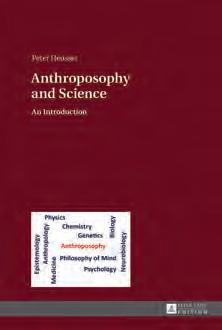 by Walter Alexander
Reviewer’s note: The following article appeared in March 2017 in Holistic Primary Care, an online/ print publication that goes to 100,000 physicians nationwide. For a freelance medical writer like myself, the constellation of tasks includes pitching story ideas over the phone to publication managing editors. You generally have a minute to three at best to convey why any particular story idea will grab their readers’ attention and hold it. In this case, pitching a review of Peter Heusser’s Anthroposophy and Science (An Introduction) represented a steep challenge. I knew that the editor was philosophically inclined to take the subject seriously, but I knew also that his readers, holistic practitioners scrambling to keep their practices viable in the face of hostile corporate forces, were likely to turn pale at the mere whisper of the word “epistemology.” So I put down my head and ran straight at it. The first few pages of the article outline the gist of the case I laid out. I am grateful to the editor for listening. It took more than three minutes.
The grave relevance of the themes in Heusser’s book does not stop short at the doorstep of medical professionals. Everyone is affected when the prevailing scientific view of body-mind-health relations is permeated by materialism and treatment of disease takes place under the deep shadow of a monetized medical industry. My own book project, Hearts and Minds: how we nearly lost them, targets a larger audience and will show the interconnected threads that led us to a fully mechanical model of the physical heart and the brain/mind. It also describes emerging scientific evidence for a more nuanced, humancentered perspective on these core organs, exploring several anthroposophical themes in the process. Please visit my website (www.wawrite.com) and click on the Hearts and Minds book project tab for more details. –WA
Why would someone with a busy holistic practice pause to read a book with an arcane title such as Anthroposophy and Science, and pages overflowing with—get ready— epistemology? You’d first have to recognize that holistic medicine has an epistemology problem. Which it does. And this is not an academic matter—it has very real, practical implications for practitioners and patients alike.
In its simplest definition, epistemology is concerned with the origins, nature, and limitations of knowledge. In short, it’s about how we know what we think we know. When it comes to many facets of holistic medicine, this is not such a simple question.
The epistemology crisis came to light last November, when the Federal Trade Commission (FTC) announced plans to hold homeopathic products to the same standards of scientific evidence as other products (ie. pharmaceuticals) making similar claims.
The FTC contends that for the vast majority of OTC homeopathics, “the case for efficacy is based solely on traditional homeopathic theories [from the 1700s] and there are no valid studies using current scientific methods showing the product’s efficacy.”
The latter clause echoes a statement on the National Center for Complementary and Integrative Health (NCCIH) website saying that there is little evidence to support homeopathy as an effec-
40 •
human
being
tive treatment for any specific condition.
Neither the FTC nor the NCCIH mentions the 2011 Swiss Health Technology Assessment (HTA) report outlining 20 of 22 systematic reviews favoring homeopathy, and the 24 out of 29 studies showing strong evidence for effectiveness in treatment of upper respiratory tract infection and allergic reactions.
The Swiss HTA report specifically discredited an earlier disparaging report in The Lancet (Shang A, et al. Lancet. 2005; 366 (9487): 726-732), and concluded that homeopathy, as practiced in Switzerland, is effective, safe and cost-effective, and led the Swiss government to include homeopathy on the list of services covered by the Swiss statutory health insurance scheme after a five-year trial period that began in 2012.
If the NCCIH takes a dim view on homeopathy, it is only slightly more accepting of Ayurveda. The NCCIH’s website includes the statement: “Do not use Ayurvedic medicine to replace conventional care.” This might as well be generalized to most if not all Asian medical systems and practices (Chinese medicine, acupuncture, osteopathy, chiropractic, yoga, tai chi, chi-gong, etc).
These are the very things that NICCH is supposed to study. Since these forms of medicine generally involve non-patentable products and procedures, few other entities outside government institutions have the incentive or resources to undertake meaningful studies.
An Unreimbursed Netherworld
But, given the high price tag for trials, the anemic funding for institutes like NICCH, and a new administration that’s not likely to prioritize research on unpatentable medical alternatives, these modalities will not likely get any serious research attention in the future, and will remain forever marginalized.
Practitioners of these modalities are then relegated to a weakly reimbursable netherworld at the margins of healthcare—tolerated but always at the whim of capricious, overzealous watchdogs.
Mainstream medicine has a particular animus toward homeopathy, largely because its purported mechanism seems implausible to a reductionist science that demands that all explanations of biological life—and ultimately of psychic life—be reduced to chemical reactions found in inert matter.
Francis Crick, of double-helix fame, summed it up in 1994: “You… are in fact no more than the behaviors of a vast assembly of nerve cells and their associated mol-
ecules…you’re nothing but a pack of neurons.” (Francis Crick. The Astonishing Hypothesis. The Scientific Search for the Soul. Simon & Schuster Ltd. London)
This view is hardly “holistic”; it is “part-istic”—or as we call it, reductionist : a view of life as assembled from below up. More and more, the reductionist model is being contradicted from many quarters, from quantum physics to open systems biology. Those atoms, those bits of indivisible hard stuff, ain’t what they used to be. Current physics tells us that the “building blocks” with extension1 in space (protons, neutrons) turn out to be made of sub-particles (up-quarks and down-quarks) without extension in space. The Cartesian 2 world we all find so comfortable to imagine has been carried off in a flood beneath the bridge.
An October 2015 article by John Markoff in the The New York Times underscored this shift. The piece detailed a Delft University experiment providing “the strongest evidence yet” to support the collapse of the wave function and the notion that “matter does not take form until it is observed [or measured].”
Markoff goes on to say that particles can “exist simultaneously in two or more places. Once measured, however, they snap into a more classical reality, existing in only one place.” Despite vast distances between them, two particles can be “entangled” in a manner such that they can instantaneously influence each other.
An Emergent World
The kickers here are twofold: first, our Cartesian world of sense is precipitated from an interconnected world of greater but not yet manifest possibility, and second, the precipitant is our own consciousness.
This represents a 180-degree turn away from Crick’s “pack of neurons” picture. It suggests a choice: we can continue to assert a science that holds human understanding and consciousness to be an essentially irrelevant froth, an exudate of invisible molecular processes, or we can embrace a science that recognizes them as an evolving sense organ integral to the actual progress of the cosmos.
This latter choice doesn’t abnegate the molecular processes, but it does expand the frame of our thinking to allow that causation may be rooted in something beyond the molecules. This is the threshold of holistic medicine’s epistemological crisis, and it’s where a seemingly esoteric book like Heusser’s Anthroposophy and Science becomes relevant.
1 “Extension” here refers to occupying width, depth, and height. –Editor
2 René Descartes in the 1600s popularized the use of a two- or three-dimensional grid to map space, thus opening it to mathematical analysis.–Ed.
summer-fall issue 2017 • 41
research & reviews
Heusser who is director of the Centre for Integrative Medicine at the University of Witten/Herdecke, Germany, is one of the world’s leading scholars of anthroposophic medicine in its theoretical aspects as well as its clinical application.
In the book, Heusser clearly states that matter is not exactly “made up of parts.” Rather, the things we see as parts, when chemically combined, become “sublated” or submerged into a new whole. From this viewpoint, water is an emergent phenomenon that is as elementary as hydrogen or oxygen
While hydrogen and oxygen are conditionally necessary for water, they are not causal , and once combined as water, they lose the individual qualities of hydrogen and oxygen. Moreover, the qualities and behaviors of water cannot be predicted from the qualities of oxygen and hydrogen taken by themselves.
“For every quantum ,” Heusser writes, “there is a quale ”—a perceived quality that is as essential as any part that is mathematically quantifiable. This aspect of emergence of new entities that are as primary as the components associated with their arising applies upward from cell to tissue, from tissue to organ, from organ to organism and to individualized being. At each level “all of these have their laws,” Dr. Heusser states. A medical science that works with these laws, he recognizes, needs rigor and discipline every bit as much as a science that restricts itself to the mathematical and statistical.
Dr. Heusser explores in detail the problems inherent to clinical trials of integrative modalities such as homeopathy. Truly treating the whole patient, he asserts, calls for a still objective but “cognition-based medicine” that encompasses the realities and subtleties of the individual patient as well as the elements revealed through an “evidence-based medicine.”
One of the unexpected and somewhat unwelcome children of post-quantum physics is the recognition that we, the world, and our cognition of it, are intimately and causally linked.
That is a lot to take in. In a sense it is a reversal of an intellectual and scientific movement that began in the 1600s with Francis Bacon’s experimental inductive methods and the attempt to exclude subjectivity from science. This movement gained momentum with John Locke’s emphasis on the primary sensory qualities of outer things. In short, the history of Western medical science has been governed by the belief that the quantitative is inherently more valid than the qualitative.
As Heusser clearly explains, modern physics is upending this long-standing invalidation of the qualitative. It urges medical science to take an evolutionary step and turn much more of its vast powers toward truly investigating “holism,” the reality of organisms, their identities, and their interrelated systems as they affect health, illness, and healing.
Anthroposophy and Science (An Introduction) surveys the development of the western understanding of knowledge as it has informed science and medicine.
Rudolf Steiner (1861-1925), anthroposophy’s founder, was trained as a scientist, and allowed only qualified MDs into his medical courses. Steiner asked always for disciplined observation and verification. On that foundation, he wished medical professionals to expand their understanding and perceptual capacities, and as clinicians to adopt a holistic and more nuanced view of factors affecting health, illness, and healing.
Peter Heusser’s narrative is thorough, clear, sometimes challenging, and often thrilling in its syntheses. As complementary/integrative practices step further out of the shadows, practitioners will be called upon increasingly to represent what they do in the face of both honest inquiry and fierce antagonism. Anthroposophy and Science (An Introduction) offers bedrock support.
Walter Alexander (walter@wawrite.com) is a medical writer and a former public and Waldorf school teacher. He has long been active at Anthroposophy NYC, and for a number of years as copresident of its Council.
Sex Education and the Spirit
Review of Sex Education and the Spirit, by Lisa Romero; Steiner Books, 2017; 140 pages
by Daniel Mackenzie
Sex Education and the Spirit, Lisa Romero’s latest contribution to her series of profoundly inspired books on spiritual development, growth and health, delivers far more than its title might suggest. The author is acutely aware that contemporary society has programmed us— even those who are eager to learn about a given topic—to seek quick facts, “life hacks,” and simple secrets of success. We gravitate towards clever bullet lists, opinion blogs, and colorful how-to videos, leaving those daunting books we know we should be reading to gather dust on
42 • being human
the night stand. Rather than cater to that current cultural impulse, Romero gives us what we need , not just what we want. The central premise of her book is that we must attend to our own spiritual transformation if we wish to attain the deeper understanding required to address sex education in a way that meets the demands of our time. Such transformation, whether we like it or not, requires dedicated, persistent work.
Though clear, straightforward and deliberately structured, the author’s writing is stripped of anything that might compromise either the content or the reader’s requisite effort to absorb it. Though her books are deceptively short, Romero’s chapters are long and demand more focus and attention than most works in both the education and self-development genres call for. This is not to say that her tone is dry or overly earnest. On the contrary, she manages to infuse even her more esoteric passages with down-to-earth examples drawn from daily life, as she covers vast terrain ranging from the lofty realms of spirit to the earthier subjects of masturbation and pornography. A reader more familiar with her understated brand of humor may even find cause for an occasional chuckle.
Even so, this is not the kind of book you can pick up late at night, read a few paragraphs from and then fall asleep; the reader is advised to allot a comfortable amount of fully alert waking time so as to absorb as much of each unfolding chapter as possible in one sitting. For those who give this book the time and attention it gently requests, the payoff is immeasurable.
Over the past two decades Romero has emerged as a premiere teacher of anthroposophical meditation and selfdevelopment, even while her work as a master homeopath, health practitioner, personal consultant, and educator of professional teachers and healers is ongoing. Her first two books, Inner Work Path and Developing The Self, distill much of the content she works with in her meditation retreats and three-day courses. Although the setting and form of those interactive and introspective workshops give rise to present-moment opportunities and inspirations that no book could capture, these two first volumes are rewarding handbooks for purposeful inner work. In Sex Education and the Spirit, the author’s experience as an educator of parents and teachers smoothly dovetails with her expert guidance in spiritual development. Though this book is highly recommended for teachers and parents, it is not exclusively geared towards them. It is compelling reading for anyone interested in self-development, inner work, and the matters of sex and gender in contemporary society.
Although Sex Education and the Spirit is indeed rich with insights about children’s delicate relationship to the experience of gender and sexuality through progressive stages of development, it delves deeply and at length into the inner growth processes of adults as well. Romero’s rigorous explorations of various aspects of spiritual selfdevelopment may initially strike her newer readers as tangential or off topic, yet these are not random digressions, nor gratuitous insertions. Each exercise presented speaks to a particular capacity that is essential to cultivation of a healthy, holistic understanding of sex-related issues.
The thrust of her teaching is that our own inner development is actually prerequisite to an understanding of any aspect of human life, including how healthy education about sex and gender must progress. Instead of merely alerting us to this truth, Romero provides us with the means—mostly by way of exercises and meditative verses from Rudolf Steiner—to do the relevant work. One crucial insight that arises from such work is that the human spirit itself is genderless and connected to a higher world that exists in eternity, beyond the ephemeral, material domain we spend most of our waking consciousness in. The author emphasizes the particular importance of this understanding now, at a time during which the prevalence of materialistic worldviews and values holds such sway over our cultural norms and habits. The outer world is constantly bombarding us with body-identification, sex-baiting, and gender stereotyping. The world of higher consciousness, however, wants us to understand the body as a mere vehicle for the human spirit, and to recognize the individual within each of us, whose essence is beyond sex, gender, and other generalized physical associations.
Romero guides the reader through an exploration of how not only the physical body, but also the other human sheaths (the life body, the astral body, and the “I am”) can generate varying forms of attraction. She explains the value of removing both shame and sentimentality from dialogues about puberty and sexual awakening, and why it is important that discussions about sex be gender-neutral and inclusive. The author admonishes us, however, that it is never enough to merely parrot the teachings and insights provided by spiritual research. A teacher or parent who is merely relaying data and facts—even those derived from someone else’s deep inner work—will be unable to guide, act, and interact with true understanding. We must not simply echo what she calls the “chatter” of contemporary teachings. Rather, we are called upon to hold and entertain deep questions about why things
summer-fall issue 2017 • 43
are as they are in the world today. Why are an increasing number of individuals expressing gender identifications and sexual preferences outside traditional norms? What effects does the ubiquity and unprecedented accessibility of pornography have on both children and adults? How should the way we talk to children about sex evolve as they pass through various stages of development? This profoundly engaged holding of questions is one of the essentially anthroposophical aspects of Romero’s work. Were anthroposophy merely some kind of belief system based solely on the static record of Rudolf Steiner’s life work, it might actually be what it is often misidentified as by uninformed detractors—a religion, or a personality cult. What qualifies anthroposophy as a vital movement, however, is that its founder shared not only the abundant fruits of his own spiritual research, but also a wealth of practical instruction in the field of spiritual selfdevelopment. Though Steiner’s legacy of esoteric insights, social initiatives, and artistic innovation is of a staggering scope and volume, he was less concerned with his own personal achievements and more interested in passing the torch of spiritual research to anyone with a sincere interest in continuing the work.
What Steiner shared came not from his personality, but from the vast domain of spirit, and he sought to teach us how to transcend the limitations of our own mundane identities and to access that realm ourselves. Steiner’s work tethers us to the foundation of what he called spiritual science, while exhorting us to tend to its evolution in response to present-day impulses and expand its reach into yet unexplored regions. Guided by Steiner’s specific indications, certain distinguished anthroposophists have thus endeavored to cultivate their own inner capacities, so that they might in turn contribute usefully to the ever-growing body of anthroposophical literature, course work, and world-transforming initiatives. Lisa Romero is among these torchbearers who propel the movement forward, working to meet the demands of our time with healthy forms.
It is powerfully evident in her writing that Lisa Romero’s deep engagement in her own inner development is faithfully and firmly rooted in Steiner’s teachings. She quotes him frequently, and in passages that convey his prescribed exercises and verses, her language does not stray far from his original texts. It is nevertheless equally obvious that the author is not merely repackaging the work of her teacher. The bulk of her offering—that which speaks directly to the challenges of our time—is
clearly produced through her own spiritual efforts and her considerable experience in the professional world. In this sense, Romero is both a strict Steiner loyalist and a generously productive spiritual researcher in her own right. She successfully balances the twofold task of sharing the fruits of her own labor, while teaching us how to grow our own trees. The author also shows veneration for other spiritual teachers from outside anthroposophy, freely sharing poignant bits of poetry and prose from the likes of Rumi, Hafiz, Rilke, and theosophist Mabel Collins.
Even for those who do not choose to actively pursue their own spiritual development, Sex Education and the Spirit provides a rich array of insights into the eponymous topic. Romero exposes commonplace errors in sex education, many of which are traceable to the root problem of identifying children with their gender-specific bodies and traditional social roles instead of treating and approaching them as spiritual, individual beings. Many of us carry unconscious gender biases, and tailor our speech differently to boys and girls; this only reinforces over-identification with the body and outmoded gender roles.
She explains how a deeper understanding of the human being and the distinct stages of child and young adult development can foster wiser methods of educational guidance. Primarily, therefore, the book is an inspiring exhortation to perform the inner work required to develop our capacities, open our thinking and feeling life to the vast wisdom of the spirit realm, and harness our will to enact what we have thus received in creative giving to the world. More specifically, if we wish to cultivate the healthiest possible approach to sex education, we must develop our own spiritual understanding of both children’s needs and the tasks of our time.
Those of us who feel drawn to the path of anthroposophy and called to take up the work of spiritual selfdevelopment and creative giving may dive headlong into the vast trove of Steiner’s collected lectures and books on the subject. This is the endeavor of a lifetime, and may be so challenging and intimidating as to be discouraging for all but the hardiest spiritual seekers. It is a great blessing to have a guide like Lisa Romero, an initiate who works out of genuinely anthroposophical impulses that she has arduously transformed into her own, helping us learn where to place our focus and how to apply our efforts in alignment with the higher impulses of our day and age.
44 • being human
research & reviews
Daniel Mackenzie in a professional musician and composer living in Los Angeles. He served on the Council of Anthroposophy NYC.
No Shore Too Far
by Jonathan Stedall
One challenge for all pupils in relation to their teachers is how gradually to make the essence of what they’ve learned their own; nor to be disheartened by how far those efforts fall short of the original work that inspired them. Rudolf Steiner’s extraordinary legacy represents a monumental example of this challenge.
Having spent a lifetime studying Steiner’s work, and along the way trying to communicate through documentary films and an autobiography what has interested and inspired me, I have recently turned to poetry through which to express what are my own humble efforts at an understanding of his essential message.
One of my recent poems attempts to address that most profound question of all, the meaning and significance of Christ’s incarnation—though the word Christ is deliberately not mentioned. I’ve called the poem “Vision.”
Without my eyes
I wouldn’t see the world; but what I never see are those two eyes themselves. And as I search for what it all might mean, these wonders I behold, I see not god as once we did –a god we call the sun.
Perhaps that god has come to us and lives in eyes of quite a different kind, through which we’ll see much more. And maybe such a power as that, which needs our trust to grow,
is heaven’s newest gift to us, and like the eyes we’ve had awhile, cannot itself be seen.
I began writing poetry just over a year ago, following the death of my wife Jackie, in the autumn of 2014. The early ones were almost entirely addressed to her, in the hope that this might be one way to express my gratitude and love, and in a more mysterious way to stay in touch. My mood at that time is expressed in a poem called “That Robin.”
That Robin who became so tame when you were ill is back again, but not so close.
Perhaps he knew –not in his tiny brain, but in his feathered being –that you would welcome such a friend when times were hard. For what keeps animals at bay comes tumbling down when people drop their guard and boundaries start to shrink. The garden was your world. You saw each flower and tree anew. Perhaps you saw them as the robin does. No wonder you became such friends.
Another example of how I tried to cope with my grief, but also to express the trust I felt that Jackie had not totally disappeared, is illustrated in the first verse of a poem called “Alive.”
‘It’s strange’, you said, ‘how well I feel;’ and then you spoke another word that helped me cope, that helped me see a deeper truth at work. ‘Alive’, you said, ‘so much alive.’ And as your body slowly died, that life in you it grew and grew and so outshone what met our eyes as words, too, fell away.
Gradually this experience of Jackie’s continuing presence found expression in a poem called “A Helping Hand,” which begins: My need to share,
to share with you, through poems that I write on life and death and love and hope, grows stronger by the day.
I go on to imagine in what way we might be continuing to help one another, ending with these lines: Perhaps we’re even holding hands, this hand with which I write; and what I try to share with you, it is perhaps your gift to me –the poems are by us.
Rudolf Steiner’s work has not been the only influence on my writing. The poet Gerard Manley Hopkins, the philosopher Thomas Nagel, economist E.F. Schumacher, psychiatrist Carl Jung, Mahatma Gandhi, and one particular paragraph in Kenneth Grahame’s The Wind in the Willows have all, in their different ways, inspired these poems—poems about time and space, angels and devils, memory, the night, Sleeping Beauty, Herod, and a war in heaven.
The title of my collection is No Shore Too Far, conveying, I hope, my sense that in our efforts to extend boundaries of every sort—and not just in connection with those who have died—there are no limits. It is a trust that I have tried to express in a poem called “Exploration.”
We feel so small, just tiny specks, the more we’re told, he more we learn about another billion stars that someone’s found while peering into space. And yet in other ways we’re huge, as huge as each new thought that takes us to those billion stars, and to a truth beneath our feet and in our hearts –a truth that knows no size.
Jonathan Stedall is a noted documentary filmmaker whose “The Challenge of Rudolf Steiner” is now in Chinese. No Shore Too Far was just published by Hawthorn Press www.hawthornpress.com
summer-fall issue 2017 • 45
Book Notes
Space does not permit us to review more than two or three books in each issue. This page is meant to acknowledge a few of the many others that come to our attention. Except as specified, notes are from the publishers. – Editor
SteinerBooks steiner.presswarehouse.com
The Connection between the Living and the Dead (CW 168), by Rudolf Steiner, translated by Aria Jackson; Introduction by Christopher Bamford.
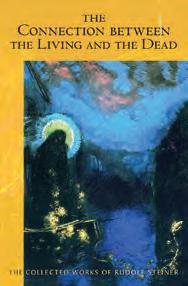
“What may be seen in the thoughts and memories left behind in the souls of those who love the dead is certainly added to the world that the dead need directly, but it also elevates, improves the existence of the dead. We could compare this to art in the physical world, but there is no comparison, because it is uplifting for the dead, an improvement, in a sense far superior to the way in which art improves the physical world for us. Thus, it has a deep meaning when we unite our thoughts with those of the dead.” Rudolf Steiner gave these lectures to members of the Anthroposophical Society in various European cities throughout 1916.
Toward Saving the Honeybee, Revised and Expanded 2nd Edition, by Gunther Hauk

“In times of crisis our consciousness soars to new heights, enabling us to rise up to challenges, to take action previously not possible. An impending threat to our well-being wakes us up from a comfortable sleep into the reality of potential danger.”
Gunther Hauk is cofounder and director of Spikenard Farm honeybee sanctuary. Toward Saving the Honeybee was first published in 2002, four years before the term “colony collapse disorder” was coined to describe the widespread and growing crisis of honeybee population loss.
The First Class Lessons and Mantras. The Michael School Meditative Path in Nineteen Steps. Rudolf Steiner, ed. by T. H. Meyer, trans. by Jannebeth Röell , Paul V. O'Leary, James Lee. This is the first English translation of T. H. Meyer's edition of Rudolf Steiner's First Class lessons, published in 2015. “Initiation is precisely this: that we are able to see from the other side of the threshold. There, seeing is not just looking but is also reading. We read the spiritual deeds of spiritual beings who have brought everything into existence. And if we read long enough in this silence, if we put our heart and soul into this reading, we begin to hear in the spirit, and then the gods speak to us. And when the gods speak to us we are within the spiritual world." —Rudolf Steiner (April 25, 1924)
The Seventh Shrine: Meditations on the African Spiritual Journey: From the Middle Passage to the Mountaintop, by Orland Bishop (Lindisfarne Books)
“When I navigate the currents of the soul, I find myself within my ancestral pool. I find myself swimming in their grief, and the longing during the great event and initiation called the Middle Passage. I find myself in their collective soul journey from a place of homeland to a dream of the Promised Land. This book is a telling of the soul striving of people of African heritage into the American experience of creating a community—a community created for the possibilities of new covenants within the larger collective sphere of human life.”
The Ten Commandments in Evolution: A SpiritualScientific Study, by Ernst Katz. Translated by Agnes Schneeberg-de Steur, Foreword by Virginia Sease.
In this book, Ernst Katz discusses the Ten Commandments in terms of the evolution of human consciousness, suggesting that we need to view this ancient moral guide in whole new ways. [A full background on this book by translator Agnes Schneeberg is published online at www.anthroposophy.org/articles.]
Other publishers
Trilogy: Rosenhart: The Sight, Kindred Spirits, Trial; by A. Roz Mar; www.bluepearlarts.co
Without the usual sensationalism and fantasyspinning, the Rosenhart series takes us on a quest with a very special group of medieval knights. Good reading for their own sake, the adventures have the true feel of significant legend. More than that, we are led to genuine mystery places in Europe and South America and are allowed to share in the knights’ sober worldview as they seek to preserve knowledge and spiritual resources of the past to meet what are present and future challenges. The battle with evil which concludes the third volume is no ‘sound and fury signifying nothing’; its significance brings us morally to the issues of our present times. Language is skillfully used throughout with just enough flavor of times past, and the whole experience provides, as the author intends, a quiet strengthening of the reader’s own sense of mission. – John Beck
An Artist's Workbook: Exercises in Observation, Memory, and Imagination, by Jennifer Thomson 48 pages, 45 artistic exercises (mostly color). “It is mean like a spring board to inspire and stimulate the artist in a new direction.” For book info go to www.jenniferthomson.net
46 • being human
Willi Sucher, the complete books and articles on astrosophy
The Astrosophy Research Center is offering a complete set of the books of Willi Sucher (10 books) to any bookstore or anthroposophical center or school. All of Willi Sucher's books and articles are also available to download freely on their website: www.astrosophycenter.com, or printed for a suggested donation per book is $10 to help with printing and shipping costs.
, by Melanie Richards
Interval Reflections is a series of eight compositions, each written using the actual musical interval. Inspired by Rudolf Steiner's descriptions of the intervals as well as her work as a pianist for eurythmy, Melanie Richards offers these meditations on the moods of the intervals for use in performing and teaching eurythmy, or as piano performance pieces within a relevant setting.
Borning In and Borning Out , written and illustrated by Marnie Muller, MLA (excellentwordworks@gmail.com)
Have you ever wondered how birth and death are aspects of our greater life process? In the 60's, before the hospice movement had taken root in America, Marnie was deeply inspired by a presentation she attended in which Elisabeth Kübler-Ross, MD, called for our society to embrace and respect the death process as much as it focused on the birth process. This simple, elegantly illustrated book warmly shares the mystery of passing through the Gate of Birthing and the Gate of Dying with one sentence per page, an invitation for people of all ages to reflect about our human life process.
Physics the Waldorf Way: A Manual for Teachers Grades

6-8 , by Roberto Trostli –
WaldorfPhysics.com
A newly revised edition that fully explains: Why? The anthroposophical background, curriculum, methodology, preparation, and practical aspects of physics teaching. What? Over 300 demonstrations, activities, and investigations in weekly schedules on a clear conceptual framework. How? Materials, sources, procedures, helpful comments, all the guidance necessary to teach with confidence. “A superb guide for systematically awakening scientific intelligence in today’s youth. It is filled with clear explanations and illustrations and with a wealth of inspiring insights for both students and teachers alike.” –Arthur Auer, MEd, Director of the Waldorf Teacher Education Program, Antioch University
New Members of the Anthroposophical Society in America, 1/30/2017 to 6/21/2017

Shelly Adrian, Tucson AZ
Jyles B. Airey-Filipello, Sonoma CA
Ushta Aryan, Bridgeport CT
Jeffrey Barth, Costa Mesa CA
Jennifer Batallas, Austin TX
Jason Benton, Prospect PA
Sabrina Mari Owen Carlson, Ann Arbor MI
Robert Comey, Carbondale CO
Michael Peter Cunningham, Hamden CT
Suzanna Didier, Hermantown MN
Mary Lee Dudley, Cincinnati OH
Stacy L. Durych, Anchorage AK
Blythe A. Fair, Corona del Mar CA
Peggy M. Fleming, Dade City FL
Kathy Marie Gohl, Mesa AZ
James Kevin Gregg, McKinney TX
Lisa A. Grubbs, McKinney TX
Kelby Flores Guerrero, Boca Raton FL
Heather Handy, Carbondale CO
Geoffrey Charles Henny, Ann Arbor MI
Kayti Henry, Panorama City CA
Lory Widmer Hess, Temple NH
April Louise Howerton, Maplewood MO
Bradley Stephen Hurley, Humble TX
Beth Ingham, Winchendon MA
Yasuko Inoue, Sunnyvale CA
John Date Koop, Surprise AZ
Anita Lucas, New London MN
Jan Lyndes, Keene NH
Susanna Mandel, San Francisco CA
Jim McMillan, Prescott Valley AZ
Carolyn Mina Meier, Winfield MO
David Merino, El Dorado Hills CA
Barry T. Neal, Danville CA
Tara Nichol, Seattle WA
Elisa Otter, Waterbury VT
Gregory J. Peters, West Plains MO
Janene Ping, Ghent NY
Jon Place, Proctor VT
Coeli Polansky, Berkeley CA
Helena Prieto, El Cerrito CA
Lucia M. Ruedenberg, Pittsburgh PA
Elisa Christina Saltet, Richmond CA
Kate Sandler, W Barnstable MA
Peter J. Swiatek, Kennebunk ME
Emily Thunberg, Salt Lake City UT
Diana Turner-Forte, Ellerbe NC
Rusty Vail, Costa Mesa CA
Joy Vrooman, Lawrenceville NJ
Nicole Jean Winkler, Lakeside CA
summer-fall issue 2017 • 47
for members & friends of
the Anthroposophical Society in America
New Members for the General Council
The General Council is pleased to announce two new members. Dave Mansur will serve as Eastern Regional Representative for a one-year term, with the possibility of renewal. Representatives from the southeast, mid-Atlantic and northeast areas of the Eastern Region came together in a conference call to update one another on what’s going on in their areas and decide on an eastern representative. They were supported in this process by General Council member Micky Leach. The Eastern Region form and structure continues to evolve, with a shared intention of local as well as regional health, communication and support.
Joshua Kelberman will serve as a member-at-large of the General Council for a three-year term. The Council's invitation to Josh was based on the Council's search for a younger person who is engaged in hands-on anthroposophical work.
David Mansur
Dave has been a member of the Anthroposophical Society since 1997 and during that time has been active in many aspects of the Anthroposophical movement.
Dave served on the Board of Trustees of The Cape Ann Waldorf School in Beverly, MA, for six years, serving three years as Board Chair. He currently sits on the Board of Directors of The House of Peace in Ipswich, MA, serving as Treasurer. He holds a certificate in Sustainable Biodynamic Beekeeping from Spikenard Farm in Floyd, VA, and has completed the one-year training in Biodynamics offered at the Pfeiffer Center in Spring Valley, NY. He manages the e-mail list for the Anthroposophical Society of Cape Ann and plays an active role in organizing events for that group. He also works occasionally as an instructor for the Center for Anthroposophy’s Foundation Studies course.
In his professional life, Dave holds a bachelor’s degree in Physics from the University of Massachusetts, and is employed as a Principal Project Engineer at Physical Sciences, Inc. of Andover, MA. He is a member of the International Society of Optical Engineers and has published several papers in the area of optical metrology and scene
generation. He and his wife, Mary, live in Ipswich, MA, where they have raised three sons to adulthood and now enjoy the company of grandchildren and honeybees.
Dave has been inspired by the process taken to reform the Eastern region of the Anthroposophical Society in America. The process has made clear to him the pressing need for human connection in our times, and the unique role that anthroposophy plays in forging those connections. He looks forward to working with the Society to develop new and meaningful ways that we may meet one another.
Joshua Kelberman grew up in the suburbs of Baltimore/Annapolis, Maryland in the early 80’s and 90’s. After a few years at SUNY Purchase studying anthropology and literature, he helped found an art collective in Baltimore. There he sang and played music, performed as an avant-garde clown, toured the United States, and co-directed regular music and arts events. He has lived in the New York City area since 2011, initially working as a licensed massage therapist, and now as a live-in guardian for a young man diagnosed with autism. In June 2017, he graduated from CUNY Hunter with a double major in Biology and Greek & Latin. In 2014 he began managing the Rudolf Steiner Bookstore of Anthroposophy NYC, the New York Branch, and joined its Council in 2015. He has facilitated a weekly Foundation Studies Group for two years, and is involved in a number of other branch activities, including outreach with local Waldorf Schools.
He has been a member of the ASA since 2007 and a member of the First Class of the School for Spiritual Science since 2015. His main interests are in Goethean phenomenology and holistic science, ancient mystery cults, the history of esotericism, philosophy and epistemology, linguistics, ritual and healing arts, and biography work. His bond with anthroposophy rests on a devotion to true and honest sharing of the innermost depths of experience and living in freedom and love with all beings in a recognition of the spirit.
48 • being human
news
Joshua Kelberman
Council Develops Values Statement
In January, members of the General Council, in collaboration with the Leadership Team, began work on a process of articulating an imagination of our “North Star”—that is, what constitutes our collective will for the current and future roles and activities of the Anthroposophical Society in America?
Under the leadership of General Secretary John Bloom, the Council and Leadership Team were asked, prior to the meeting, to work with the following verse by Rudolf Steiner:
The wishes of the soul are springing
The deeds of the will are growing
The fruits of life are ripening
I feel my destiny
My destiny finds me
I feel my star
My star finds me
I feel my goals in life
My goals in life are finding me
My soul and the great World are one
Life grows more radiant about me, Life grows more arduous for me, Grows more abundant within me.
Before the meeting, for three consecutive nights, we read the verse aloud before sleep, and then each wrote down images, thoughts, or feelings that arose in the morning. We then changed pronouns in the verse to reflect the whole leadership group, for example, “We feel our destiny, our destiny finds us…” Again, this was read aloud for three consecutive nights, and, in the morning, images, thoughts and feelings were written down. We brought these reflections to the January meeting in Ann Arbor.
John Bloom began the conversation with a chalk drawing on the blackboard to depict the North Star exercise, to relate the exercise to the first three panels of the Foundation Stone Meditation (recollecting, beholding, envisioning), and to focus on our experience of the verse, what comes from the verse, what patterns arose, and what motivates us. We shared reflections, which brought forth many forwardlooking comments and perspectives. A few examples:
We want to be able to point to concrete things and to say: these are the things that the Anthroposophical Society is doing to serve anthroposophy.
What qualities do we need to manifest? We need to
be a model, a beacon of the way to work together. For resources, we need imagination to figure out how to communicate.
How do we generate the heart forces to put ourselves in the other’s position?
Could we ask the “daughter” movements, how do you make your work more accessible to other people?
People want to meet “us” (active members of the Anthroposophical Society) as human beings, not just as carriers of Rudolf Steiner’s ideas.
On the next day, the “North Star” conversation began with the observation that the previous session was an expression of core values; it was more about our values (who we are) than about what we should do. We are trying to articulate the culture, not the strategy, and the culture is “who we are trying to be.” It was agreed that it would be better to change the focus of the “North Star” to “what values do we want to follow as a General Council?” Who are we trying to be as a General Council? What do we stand for rather than what do we want to do?
The group then used a flip chart to brainstorm the values held by Council and Leadership Team members, with the following result:
» recognition, freedom, safety
» being present
» inquiring
» connecting, connective and connections
» who are you (who am I, who are we)
» being human
» striving to see and meet the other despite opposing points of view
» inner tolerance (not offended)
» warmth, invitation, love, striving for understanding, accessibility
» authenticity (honesty, transparency, sincerity)
» standing in the world for anthroposophy
» courage
» calmness of soul.
This exercise energized and inspired the group—many insightful and reflective contributions were brought forth, regarding the import and impact that striving for these values could have on both the Anthroposophical Society work and the furtherance of anthroposophy in America.
summer-fall issue 2017 • 49
As the result of this work, the Leadership Team took up the task of drafting a new Values Statement document for the Council to review, for adoption at the May meet-
ing. After review during two further conference calls and once again during the May meeting in San Francisco, the Council adopted the following Values Statement:
Anthroposophical Society in America Mission and Values
What is the Society?
Founded in the work and inspiration of Rudolf Steiner, the Anthroposophical Society in America tends the wellspring that permeates the research and practical manifestations of Steiner’s work developed in such fields as education, agriculture, medicine, the arts, natural sciences, economics, and more.
Values
The Anthroposophical Society is open to anyone interested in Rudolf Steiner’s work. Those who are both on a journey of self-discovery in service to the world and who recognize the legacy of Rudolf Steiner’s insights into the human being and into humankind are welcome to join the Society.
Relationships and engagement are at the heart of the work of the Anthroposophical Society in America. The Society holds as core values inner freedom for the individual, and a social consciousness that recognizes authenticity and inquiry as essential to personal and cultural development.
We anticipate that this document will serve as a kind of guiding star, and that the General Council will be measuring its actions by this document—that is, that everything the Council does will be guided by this star. There are indeed many key activities pointed to within this document, and the Council extracted no fewer than
The Society serves its membership and friends through regional councils and local branches, conferences and gatherings, publications and opportunities for learning, and by encouraging initiative and enterprise committed to uplifting the human being and a more human future.
Mission
The Anthroposophical Society in America supports and furthers the work of Rudolf Steiner in the United States. It is an open membership organization that fosters self-development and inspired social engagement.

What is Anthroposophy?
Anthroposophy is a discipline of research as well as a path of knowledge, service, personal growth, and social engagement. Introduced and developed by Rudolf Steiner, it is concerned with all aspects of human life, spirit, and humanity’s future evolution and well-being.
twenty-two such activities from it. Each member then weighed these, and the results were tallied, resulting in the following prioritized list:
1. Inspired social engagement, openness, welcome, fostering of relationships and engagement.
2. Serve the membership.
3. Tend the wellspring.
4. Encourage initiative and enterprise.
5. Personal and cultural development.
6. Social consciousness.
Going forward, the General Council and the Leadership Team will work to further refine and define these priorities, and to weigh priorities in light of fiscal realities. We are pleased to have a clear and meaningful document that makes visible our collective will for the Anthroposophical Society in America, and trust that you will see the value in the process and its outcome. As always, your comments are welcome.
Dave Alsop, General Council Member
50 • being human
General Council and Leadership Team at the May meeting, outside RSF Social Finance offices; from left: Micky Leach, Katherine Thivierge, Laura Scappaticci, John Bloom, Carla Beebe Comey, Marianne Fieber-Dhara, Dave Alsop, Deb Abrahams-Dematte, Dwight Ebaugh, Dave Mansur.
The Traveling Speakers Program
Are you hoping to expand your study group or branch? Wishing for a local event to draw people together? Invite a speaker into your community with the Traveling Speakers Program, a low cost way to enliven and grow your community!
Contact Margaret Shipman at shipman2005@sbcglobal.net or 323-462-7703.
Judith Kiely Retires
Judith Kiely retired as Librarian of the Rudolf Steiner Library at the end of June 2017. She has worked at the library since 2001, with directors Fred Paddock until 2002, Judith Soleil until 2013, and Maurice York until 2015. A professional librarian since 2011, Judith has done extensive work in cataloging, digitization, and preservation. After overseeing the move into the library’s current location in Hudson, NY, Judith has overseen the day-today functioning and administration of the library and the training and coordination of its staff and volunteers.
Judith has always carried her dedication to the members of the Anthroposophical Society highly in her work. She will be missed! We are grateful for her devotion, care, and many years of service, and wish her all the best in her retirement.
We are pleased to announce that Nadia Bedard will return to the Rudolf Steiner Library this summer to carry its circulation functions and basic member services. Nadia worked with Judith Kiely at the library for 2½ years before graduate work at the Institute of Peace in Costa Rica. Jennifer Locke, a librarian who has been working with Judith, is off for the summer.
The
This is the Year
by Laura Scappaticci
This is the year. To connect. To start something new.
To further initiatives. To live into threefolding.
To listen and learn from each other.
To put our love into action.
To rise up through challenges.
To create a new mystery together.
The ASA annual conference and general meeting will be held in beautiful Phoenix, Arizona, October 13, 14, 15.
We are so lucky to be joined by amazing American presenters and artists like Teri DeSario and Kim SnyderVine, who along with Arizona artists are bringing great creativity to our Saturday night performance, and speakers like Shepha Vainstein whose work in the world is helping children in regions of conflict.
Carrying through on recent webinars, you can meet with Mary Adams and wander through the stars with her, or dig into Steiner’s thoughts about money with John Bloom. Explore innovative, healing uses of form drawing with Laura Embrey, or attend a workshop with John Beck on communicating anthroposophy, after joining Lee Sturgeon Day’s Love Stories biography session.
Most importantly, by attending this conference, you are creating a time in your life to open your mind and heart and connect with your labor of love. Our lives and what we do here are meaningful, and in Phoenix we will make this meaning together.
Register now at www.anthroposophy.org/phoenix2017. See the back cover for details, and see you in Phoenix!
Laura Scappaticci (laura@anthroposophy.org) is ASA Director of Programs.
Sacred Gateway Conscious Living, Conscious Dying, and the Journey Beyond
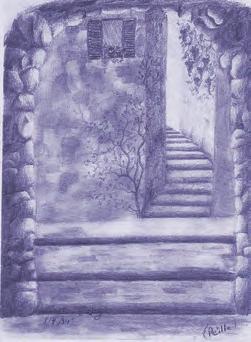
Friday–Sunday, April 6–8, 2018 — Sacramento, California
Join us for engaging workshops, deep discussions, artistic activities, and compelling keynotes as we deepen our understanding of the journey of body, soul, and spirit through the continuum of life, death, and beyond. www.anthroposophy.org/sacredgatewayconference (to register after Nov. 1st)
summer-fall issue 2017 • 51
Resiliency, Effort, Love
by Deb Abrahams-Dematte
What do we need—as individuals, initiatives, the Society itself—to successfully bring anthroposophy into the world? What tools and practices do we have to work with as we thoughtfully wrestle with and make manifest the inspirations that Rudolf Steiner has shared? How do we cope with challenging times, changing expectations, major cultural shifts and more?
Anthroposophy brings many possible answers, along with the freedom and responsibility to choose how to move forward in our lives and the world. The Society offers a place to come together in study, in action, in collaboration, and in transformation. Together we can make a difference.
We hold as core values inner freedom for the individual, and a social consciousness that recognizes authenticity and inquiry as essential to personal and cultural development, uplifting the human being and contributing to a more human future. Your support, interest and care are what brings resiliency and health to our Society. Thank you for all you do.
The Eastern Region continues a process of renewal through communication, shared activity, and positive intention. In February, I took part in a gathering in the Northeast, as part of the re-imagination of the Eastern region. Held at the House of Peace in Ipswich, MA, and over thirty people from five states attended. We studied together and shared about personal and group initiatives. And we talked deeply about what we believed a thriving Northeast area would look like. We finished off the day with a practical conversation about how we may support one another in our individual and group strivings.
New and renewed friendships blossomed and there was much enthusiasm for supporting one another through increased awareness and communication, and the possibility of collaboration at many different levels. This is only one example of the many different connections and activities which are happening all around the country.
Did you know? Michael Support Circle members provide generous and on-going support for the Anthroposophical Society. We are so very grateful! Michael Support Circle members are individuals, couples and organizations—people like you—who have committed to
give an unrestricted gift of $500 or more for 5 or more years. If you’d like more information about becoming a member of this sustaining Circle, please contact me at deb@anthroposophy.org
Spring Appeal Update and Thanks!!
Spring Appeal Update and Thanks!! This year, our Spring Appeal focused on re-engineering our web presence so it’s welcoming, clear and easy to use. We’re closing in on our goal of $25,000, with almost $20,000 raised as we go to press, thanks to 190 generous gifts received so far and a wonderful anonymous challenge matching gift which will help put us over the top! Special thanks for a generous gift from the Waldorf Educational Foundation Donor Advised Fund at RSF Social Finance, and for their support of this important project. You are all awesome! We are excited to move forward with the critical update and renewal of our online presence. Stay tuned!
Being in Touch
by Katherine Thivierge
How can we reach every member with our reports and questions? The Leadership Team and Director of Communications John Beck have been working on this challenge. The recent library survey was mailed to over 500 members for whom we either do not have email addresses or who have indicated that they prefer not to receive communications electronically. We are working on how to send them on a regular basis, perhaps quarterly, a packet of items which were emailed to other members.
I have been emailing financial reports to members quarterly. We do see that a significant number of people have not opened emails from the Society. If you have not received emails from us, check your spam and adjust your settings to allow email from anthroposophy.org. We will work from our side to help make sure they get through.
We have posted General Council meeting minutes on the website (anthroposophy.org) for members. Those can be accessed on the membership page once you have logged into your account on the drop-down menu, “What would you like to do?” The annual tax returns (IRS Form 990) are also posted on the “About the Anthroposophical Society” page. As always, please let us know if you have questions or suggestions (katherine@anthroposophy.org).
52 • being human
Deb Abrahams-Dematte (deb@anthroposophy.org) is ASA Director of Development.
It has been busy at Rudolf Steiner House in Ann Arbor. It is always exciting to visit with members who pass through Ann Arbor and stop in at Steiner House. The house also hosts meetings and trainings, some anthroposophical, some not. The General Council, Natural Science Section and Collegium met here over this past year, along with trainings for the Association of Healing Education and the Waldorf mentoring. The Great Lakes Branch has an active program at Steiner House, with festivals, the First Tuesday lecture series and a number of study groups. There are also local groups unrelated to anthroposophy who rent the facilities for their gatherings and trainings. We have nine guest rooms available for rental, so let us know if you are visiting southeastern Michigan.
Katherine Thivierge (katherine@anthroposophy.org) is ASA Director of Operations.
Full details on page 63...
Rise Up!
Life as a Labor of Love
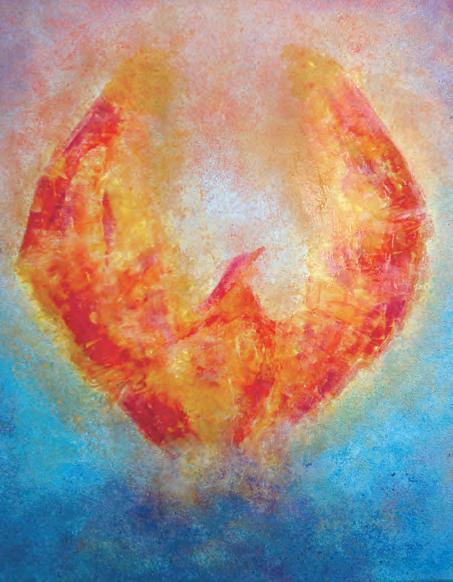
Members Respond about the Library
In early May, the General Council of the Anthroposophical Society sent a survey to Society members regarding the future of the Rudolf Steiner Library. The survey’s purpose was to hear what members thought of a proposal to transfer the library to a new, nonprofit, tax-exempt, anthroposophical entity. The reason for considering such a proposal is that, although the Anthroposophical Society is deeply committed to the library and its importance as a resource for our movement, it is unable to provide adequate support—funding, personnel, oversight and vision— while simultaneously supporting other worthy endeavors.
Over many years, the library was supported significantly by funds from the Society’s reserves. These no longer exist and the Society now operates on only what it is able to raise each year. The Library has survived over the past several years because of designated donations from generous Society members, the tireless work of its librarian, Judith Kiely, and the work of the good people of the Rudolf Steiner Library Circle of Friends, a nonprofit, tax exempt organization formed in 2016 to provide financial support for the library. Since 2016, the Friends and members’ donations have enabled the library to operate, but the General Council sees this as only a short term solution. In addition, the Friends do not expect their fundraising success to continue unless donors see a wellreasoned plan for the future.
Two members of the Circle of Friends, Harold Bush and Raimond Flynn, longtime anthroposophists and
active participants in the Library Circle of Friends, expressed to the General Council their willingness to bring together a board of directors, individuals who will carry the work of forming, governing, and operating the new entity. The Circle of Friends is supportive of this idea, but does not want to expand its role.
There were about 370 responses to the survey, 90.35% of the responding members were in favor and 9.65% did not support the proposal. With this support from the membership, the General Council will move to the next step of drafting and negotiating the terms of a written transfer agreement with no commitment to consummate a transfer unless a mutually satisfactory agreement can be reached. We expect that the transition process may take several years, during which time it is anticipated that the library will be open and providing lending services.
The aim is that the library be able to fulfill its potential and more abundantly serve our movement by being freed from the constraints of the Society’s budget. It will have its own group of people focused on the library’s work in the 21st century. With the Circle of Friends, the library began to have the engagement of others focused on fundraising. This model has now led to the new possibility.
The General Council thanks Society members for their response to the survey and their thoughtful comments.
Katherine Thivierge & Dwight Ebaugh General Council Library Committee
Artist: Eduardo Yi-Man
Anthroposophical Society In America Annual Conference and General Meeting
October 13, 14, 15, 2017 The Heard Museum of Native Cultures and Art Phoenix, Arizona Registration now open! Experience the art, culture, and natural beauty of Arizona!
summer-fall issue 2017 • 53
First Annual MidAtlantic Gathering
Report by Dominic Nigito
The first meeting of the newly formed Mid-Atlantic area of the Anthroposophical Society in America took place November 12 & 13, 2016 in Kimberton, PA. Attendees travelled from all over, “from Virginia up through New York, extending into Massachusetts to include the Berkshire-Taconic Branch.” The meeting’s focus was taken from the theme of the year: “World Transformation and Self-Knowledge in the Face of Evil.” Along with consideration of this theme, participants were encouraged to think of the future of regional gatherings: how it is and in what manner we come together in shared space.
We were warmly welcomed by Sherry Wildfeuer, who introduced the weekend and the purpose for gathering. Alan Thewless then led us in Common Singing. The opening address was given by Rev. Patrick Kennedy, who was articulate and on-point. We were challenged to not simply recognize the theme, but to dive into it and understand the various facets and implications of “facing evil,” “self-knowledge,” and “world-transformation.”
Then came the first of two conversation sessions which took the theme of the year, as well as the stimulating energy of the opening address, and focused it through each a different lens. There were five of these breakout groups which met once in the morning and once in the afternoon. The groups were as follows: Social Threefolding led by Sherry Wildfeuer, the Six Basic Exercises led by Jeff Kofsky, Cognitive Yoga led by Scott Hicks, Biography led by Diedra Heitzman, and Moral Technology (and the future of anthroposophical activity) led by Karl Andrek.
Following a break we engaged the first of two different artistic sessions. In consideration of the theme, four different workshops were available: Poetry led by Peter Bruckner, Drawing of the Planetary Seals led by Alan Thewless, Eurythmy with Natasha Moss, and Drama with Laurie Portocarrero. After lunch, we returned with Common Singing, a second artistic session, break, and the conversation groups formed in the morning. An Evening
of Eurythmy in Rose Hall brought everyone together after the long day. The performance was contributed to by the Pennsylvania Eurythmy Ensemble, Jeanne SimonMcDonald, Natasha Moss, and Evamaria Rascher.
Sunday morning all were invited to attend the community’s Festival of Offering in Rose Hall. The regional gathering resumed with Common Singing. We practiced and sang “Fall (The Road)” and “Finlandia,” which continued to resound in my soul for the whole week. We then practiced the fourth panel of the Foundation Stone Meditation, which we would speak together at the conclusion.
For me the highlight of the weekend was the large circle of all the participants, in Rose Hall. The space was opened for conversation regarding the “Future of our Region”: where will we meet, how we stay connected, challenges we face in this effort, etc. This was a time when people spoke about what was on their heart. Some expressed simple thanks for the weekend, and their enjoyment in coming together. Many felt the Kimberton Hills environment was a very appropriate setting for this type of gathering. It can be a struggle for those who live in areas where branch activity is not available; gatherings like this regional meeting allow them to feel that connection to the greater society, and also brings the greater society to them. In this way, this first regional meeting held the potential for a new gesture of our regional community.
The question of outreach and bringing in new members was discussed. Along with that concern was the striving of some, for example the Philadelphia group, who would like to bring more anthroposophical activity into their area. With these questions, the discussion took on the important topic of race, diversity and multi-cultural issues. Suggestions were heard on steps we can all take to bring in a wider range of potentially interested people, and actively to engage multi-cultural inclusiveness.
It was here that a heart-felt sharing warmed our space and brought the whole conversation full circle. Wesley Frazier is an anthroposophist local to southeast Pennsylvania, and he has had some great hurdles with his health this past year. Wesley gave us all a great gift by sharing a story about why he missed the first day of this regional meeting. It started with him describing how he met anthroposophy through a woman who, years ago, began a multi-cultural outreach initiative that hosts a yearly event. Wesley has continued and increased his involvement with the multi-cultural initiative, and each year they have held their event with varying degrees of success. But with all the challenges of this past year, he thought they would
54 • being human
have to cancel the event, and he was unfortunately poised to do so, which weighed on him greatly. However, two women, also related to anthroposophy and the local community, had recently joined Wesley’s initiative work, and they encouraged him to still hold the event stating to the effect, “no, we cannot cancel the event; it must go on.”
Wesley made the decision to hold the event, and it was on the previous day, Saturday, the first day of the regional gathering. As Wesley told us, “… it was the best event we ever had, and we almost didn’t have it.” In his joy he reflected, “I wish all of you here, my anthroposophist friends, could be there with me” to see the influence of anthroposophy and to experience the way we can live anthroposophy forward into the world, across many boundaries. In a way, Wesley is a testament to that.
We closed our meeting with the Foundation Stone Meditation. The first three panels were read by Sherry Wildfeuer and Laurie Portocarrero alternating, and then all the members joined in for the fourth panel. The connection between our common conversation and the Foundation Stone Meditation was not lost on me.
The two days of the regional gathering offered a two-fold experience of a three-fold theme. The first day we were presented with a penetrating contemplation in the opening address, then afforded the opportunity to further that contemplation through a focus group. Then we explored our own soul through artistic endeavors, experienced in a way that could afford us new practices to include on our individual path of self-knowledge. We returned to discuss through the lens of the focus group, and ended the day with the shared experience of the eurythmy performance. Day one had a balanced, oscillating, breathing rhythm from facing a common theme outward and bringing it inward. We penetrated in through smaller group meeting and artistic exploration, and then symmetrically came back out to community. Day two we were together the whole time, circular and facing in towards the space created together. Overall, we first faced evil on our path of self-knowledge, and by meeting it and working in different ways with our own inner evil, we prepared ourselves in an appropriate way that the self-transformation of each of us individually then came together to precipitate world transformation. We engaged a common thought, took it into ourselves, worked it over, brought it back into the realm of community, the world, and sealed our directive through the Foundation Stone Meditation. In this way, the 2016 Mid-Atlantic Regional Meeting was truly “anthroposophical activity.”

Members Who Have Died
Jeanette Bajorek Sacramento CA died 02/09/2017
Donald Bufano Baltimore MD died 03/29/2017
Richard Dancey Chicago IL died 02/13/2017
Bonnie L. Hedges Dearborn MI died 04/02/2017
John Hornor Gold River CA died 12/06/2016
Henry David Keesing Glendale CA died 01/21/2017
Sadasat K. Khalsa Fair Oaks CA died 04/25/2017
Patricia Livingston Great Barrington MA died 03/31/2017
Leon Matthews Fair Oaks CA died 03/27/2017
Uwe Stave Carmichael CA died 04/19/2017
Franziska Steinrueck Kimberton PA died 04/29/2017
William M. Toole Dripping Springs TX died 02/24/2017
Patrick Wakeford-Evans Carmichael CA died 05/09/2017
summer-fall issue 2017 • 55
Uwe Stave, MD
February 4, 1923–April 19, 2017
Dr. Stave passed peacefully on April 19, 2017 at his home surrounded by family. He is survived by his wife of 70 years, Liselotte, his children Holger (Julie), Christoph (Mary Beth), Caroline (Jane) and Simone (Alvaro), fifteen grandchildren and eleven great-grandchildren.
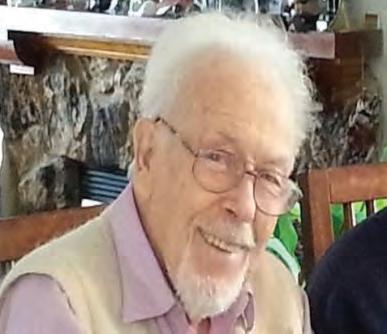
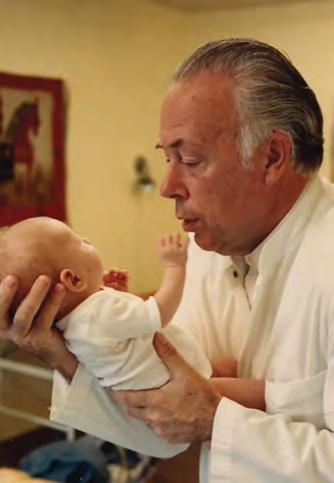
Uwe was born and grew up in Hamburg, Germany, surviving WWII despite being permanently wounded while having to serve on the Russian front. He met his wife Lotti at rehearsals for the Oberufer Christmas plays in Hamburg is 1945. His dedication to children and the welfare of the newborn brought him to the world of medicine, where his research and contributions were international. Both Lotti and Uwe were strong believers in the anthroposophical movement and the work of Rudolph Steiner. Dr. Stave focused on studying anthroposophical medicine on his own, which ended up being very influential in the movement and his later life. His research publications brought invitations to conferences in the United States, and to work at Fels Institute, in Yellow Springs, Ohio, from 1961 until 1975. His family enjoyed him through his love for woodworking, gardening, car trips, and travel. In 1975, Lotti and Uwe moved to Miami, Florida, where Dr. Stave worked at Jackson Memorial Hospital building the Neonatal Intensive Care Unit and teaching at Miami University, until 1979. His work and study in anthroposo -
phy led to his being invited to become the Dean of the Medical School at the Freie Universitaet, Witten/Herdecke, in 1979, also working as a pediatrician at the anthroposophical hospital in Herdecke, Germany. Lotti and Uwe lived there nine years until his retirement in 1988. With all their children in the US, Uwe and Lotti decided to move to Sacramento where the Rudolph Steiner College and the Raphael Medical Center would provide opportunity to continue lecturing and helping Lotti as prompter in the four Mystery Dramas. Over the course of his life his skills influenced upwards of 10,000 infants.
Rev. Richard Dancey
December 28, 1945 – February 14, 2017
by Michael Ronall
Through persistence, a drop of water hollows out a stone. – Choerilus of Samos, ca. 400 bc
Richard Dancey was one of the most consistently gentle human beings I have ever known. Through this gentleness, the interest with which he met you seemed to be, astonishingly, sustained and renewed, even deepened, at every subsequent encounter. It was clear that his receptive soul retained not only his exact impression of the previous meeting, no matter how far in the past it had been, but that he could sense, perhaps even better than you yourself could, what had happened in your life during the interim, and its positive, always positive, implications for the future. During intervals between conversations it was therefore immensely comforting to know simply that he was somewhere, doubtless carrying, whether actively or otherwise, one’s own concerns, and in so doing quietly, invisibly, persistently incubating and redeeming them through his confidence in every instantiation of humanity.
Dr. Stave and Lotti’s continuing participation in the activities of the Anthroposophical Society and community has given them a loving support through this time and into the future.
One vivid and enduring recollection of Richard’s understated style came from a weekend youth conference on the theme of human reproduction, presented by Richard and his colleague Rev. Gisela Wielki, both joined by physician Gerald Karnow at the Christian Community in New York City. Participants, who ranged in age from high-school students to thirty, were plunged very early on a Saturday morning into a format that, for all its abruptness, proved in retrospect to have been skillfully, even shrewdly engineered. Anticipating immediate if dignified enlightenment
56 • being human
on the perennially fascinating topic of Eros, the sleepy consciousness of those attending, some of whom seemed to have just tumbled down the stairs practically still in their sleeping bags, was blasted into alert sobriety by a dramatic illustrated lecture that Dr. Karnow held on the stages of embryological development. Thrust thus into the glare of day, we were snapped awake to the natural consequence of sexuality, evoking the wry Italian proverb that “Whoever says love must also say baby.”
Later that day, when Gisela Wielki guided us through a contemplation of the famous intrauterine photographs first published in Life magazine two decades earlier, she pointed out the slightly uneasy feeling that the pre-earthly human form can evoke in us, as if it contained the suggestion that we are not really yet worthy to be viewing it. Indicating the sanctity of that realm, each embryo and fetus, hands folded as though in prayer, appeared in fact wholly shrouded by a translucent physical veil.
It was the custom to conclude such weekend conferences by opening the final session to the public, so that on Sunday afternoon Richard spoke not only to the young participants, but also to anyone else in the congregation who had chosen to linger after the morning service to hear him. In
his address, Richard recounted having traveled by bus through Pennsylvania and noticing across the aisle an elderly black passenger whose modest apparel and bearing depicted him as a laborer, peacefully gazing out the window at the passing scenery. What struck Richard, so he told us, were the old man’s hands. Never had he recalled seeing such beautiful hands, occasioning him to imagine just what they had done over this man’s long life. And then:
I began to look down at my own hands, and I wondered, When I grow old, what will my hands have held and touched? Whom will they have touched? How will they have touched?
And there Richard left it, capping the weekend’s backward path from the awesome and irreducible facts of embryology, through an awakening in reverence to the preternatural nobility of the pre-incarnate human form, signaled in its veiled gesture of devotion, and arriving finally at our own options regarding the kind of interest we take in those around us. As Richard made clear, this last feature of our humanity entails responsibility for thus inevitably and lawfully shaping the world we share with others, consummating in the inscription of these choices on one’s own very form. Now, more than thirty years later, Richard’s account of the culmination of this journey—from the given body, through the responsive soul, and to the reflecting and initiating spirit— remains alive for least one participant whom he had invited, through a quiet hint, across the threshold of empathy and toward a vision of the consequences for how we use our freedom.
Richard’s gentleness thus concealed a fortress of moral insight and strength. This was evident during a
winter retreat to prepare the following summer’s children’s camp. Despite the entreaties of everyone else present that, in view of the frigid temperature, Richard should desist from celebrating the morning service in his thin vestments, he exhibited legendary endurance, confidently trusting to the supersensible warmth of the sacrament to provide sufficient insulation from a fallen nature’s stark indifference. His hopeful, expectant trust in providence extended also to the invisible future concealed in daily life: It was evident in the unabashed, affectionate delight with which he performed on the guitar the song he had composed for his infant daughter; in his scripting and directing countless prophetic dramas and expositions; in his inspiring stories for children; and in his stamina for lending consolation and meaning to human suffering. In this last capacity he showed an apparently limitless ability to bear with others’ repeated anguish, bewilderment, and, so I learned through a friend, sometimes copious floods of tears.
Now that his own form is freed from the sheath of matter and the tasks that it imposes—to warm the frost, soften the hardness, and illumine the darkness cast over the world and its enchanted inhabitants—Richard is doubtless drawing ever closer to the spring of life that sacrificially hollowed out for us the stone of death. That stone had formed the substance of the tomb whose emptiness on Easter morning Richard’s vocation celebrated, and which gave rise to the fullness of heart Richard’s life embodied. It was that fullness of heart, in which he rejoiced and which he unstintingly radiated to his contemporaries, that can now also open up to us his continued presence and unmediated outpouring of love.
summer-fall issue 2017 • 57
Patricia Thornburgh Zay Livingston
March 16, 1924–March 31, 2017
by Vivian Jones-Schmidt
I first met Patti in the fall of 1999. I’d been invited to join the Editorial Board of Renewal , which met twice each year at Patti’s home; and Patti graciously invited me to stay with her for the weekend of the meeting. I was a little anxious about this arrangement. Compared with Patti’s life-long immersion in Waldorf Education, I was a mere infant; but Patti’s welcome was warm and sincere, and I quickly felt at home. Our time together soon fell into a comforting rhythm: we’d talk, cook, talk, walk, nap, gather for our meeting, and then—when everyone had left—we’d eat her favorite Ben & Jerry’s ice cream, confessing that we felt guilty but then laughing because we really didn’t. Of such simple things is a friendship forged.
Patti had retired from classroom teaching in 1983; but she still traveled as a mentor and served on the boards of the Great Barrington Steiner School, the Hartsbrook School, and others. Waldorf Education was a central theme of her life. Her parents met in London, where her mother Eileen Horner and grandmother, who attended Steiner’s lectures there, were studying anthroposophy and her father, W. Henri Zay, an Ohio emigre, was a vocal coach. Her mother became one of her father’s students and introduced him to anthroposophy. When World War I started, as a resident alien he was required to return to New York. Her mother then boarded what turned out to be the last ship out for civilians and followed him, abandoning her aristocratic family as well as her fiancé.
In Manhattan, the newlyweds quickly established themselves in the
budding anthroposophical community. The first North American productions of the Oberufer plays occurred in their townhouse. Patti was only three when her father died unexpectedly, leaving her mother with four young children: Willibus (“Billie,” aka Sabina Nordoff); Eileen Marchese; and one-year old Thorn. (Patti was named after the famous soprano Adelina Patti, in recognition of her lung power as a baby.) Her mother worked as a vocal coach and depended upon the kindness of anthroposophical friends to support her family. They moved several times, each time to a smaller apartment at a less attractive address.
Patti was a little curly-headed brunette in one of the first kindergarten classes of the Steiner School of New York City, but her mother enrolled her and her little brother Thorn at the Birch Wathan School when they received scholarships. It was here that Patti met Ted Livingston. Friends in high school, they began dating after World War II and married in 1946. Ted was handsome, he had a good job and was a fabulous dancer. Not only did he make her laugh, but he
was also interested in anthroposophy. How could she say no?
As a young married couple, they delighted in taking long automobile trips. One journey took them to the Berkshires, where they found an traditional New England farmhouse offered for sale at a price they could afford. They often commuted back and forth on weekends even after Ted contracted multiple sclerosis, which caused his death in 1973. Patti moved to the farmhouse full time when she retired.
Patti returned to the Steiner School as handwork teacher when she enrolled her children there. Patti knew exactly what she was doing in her handwork classes, and she knew how important that work is. The strength of her authority comes through in her writing:
Through beauty, color, and form, handwork and crafts help to lead the children from play to imaginative thinking as adults, forming a kind of bridge between the two.
She taught hundreds of children before retiring from the classroom, and I have no doubt that though they might not remember how to crochet, they do remember the calm, orderly, and intelligent presence of their teacher. Patti wrote, Handwork should be relaxing and fun, and at the same time productive… Nothing happens if you don’t use your hands and get to work! Working to transform the materials of the earth fosters inner growth and a sense of wellbeing in the children.
Once, when I asked her about a particular child who was struggling, her response went straight to the heart of the child:
Try taking that child on your lap and talking softly to him as
58 • being human
Patti Livingston in 1998
he knits. You need to calm his anxiety, let him know it’s okay to make mistakes. Then he’ll learn.
Soon after retiring from the classroom, Patti’s friend René Querido encouraged her to travel to California to mentor young teachers. Somewhat reluctantly, Patti flew to San Francisco and began her career as an active mentor. I think she enjoyed her second career almost as much as she had her first. She spoke to me often of her experiences in the schools, of how much in need of support our teachers are, of how the simplest affirmation from her could bring a smile of confidence and hope to a young teacher’s face.
I also experienced this support, for when I visited her, she wanted above all else to hear about my students and my struggles as a class teacher. Always, she listened intently, considering both my words and what lay behind them. Always, she responded with questions that helped me clarify my thinking, renew my confidence, and find the courage to try something new or to continue the approach I’d chosen.
In 1979, the Rudolf Steiner School of New York City celebrated its fiftieth anniversary. At the time, Patti was the Faculty Chairman, and she wrote in the school newsletter: One should be all wise, but since one isn’t, there are new challenges and opportunities for growth and learning. My life at Rudolf Steiner has always been active and deeply satisfying. It continues to be a life of constant striving and

transformation.
Patti was capable of great understanding, compassion, and sensitivity. I believe her deep understanding and acceptance of human life as a path of inner development was one reason she was so effective as a teacher—of children, of teachers, and of friends—of anyone, in fact, who knew her and was open to the possibilities of selftransformation.
I can’t think of Patti without thinking of the things she loved: her life in New York City, where simply walking on the sidewalks gave her energy; her sister-in-law Jean Zay; wildflowers; jazz, Irish folk songs, Broadway hits; Tanglewood and all the musical richness of the Berkshires; the color and form of modern art; Irish history and daydreaming about the long lost family estate in Ireland; her work as a founding member of the Renewal Editorial Board; her garden, long walks, sunflowers; Pamela’s pottery, David’s work with wood; the Sunday New York Times, the food co-op; her grandchildren; playing remembered music on her mother’s piano; butternut squash, Ben & Jerry’s, the opera; the New Yorker, public radio, everything about her amazing family (past and present); and of course, her scarves.
Every time we met, she was full of appreciation and delight at the small things that informed her days. After all she had suffered and survived in her personal life, she could still advise me that,
Everything happens for a reason. There are no accidents. Drop the regret; regret is self-indulgence.
Turning 85 was rather a shock to her, I think, and she fretted over both the reality and the responsibility of advanced age.
What I have to do is to figure out how I’m going to live my life now that I’m 85. It’s so unexpected, just impossible really, that I should be so old!
I’m not sure she ever figured it out, but she did take it upon herself to attempt to go through all those stacks of papers she’d been saving for so many years. She had in fact begun this process around the time she turned 80, as she was determined to lessen the burden on Pamela and David. Unfortunately, she’d started with the piles of old New Yorkers, and remarkably, the writing was just as good in 2007 as it had been in 1954!
After a few years of indulging herself with E.B. White and James Thurber, she was finally able to turn to personal papers. To her dismay, these files quickly became overwhelming: newspaper clippings, school newsletters, solicitations from charities, family letters. Once she exclaimed, “There’s so much life! It’s just all too much!” That’s something for all of us to think about; what will we do, when our turn comes to look back on all that life?
Patti lived a full, rich life; and I can say with some confidence that, if she had any regrets, they were minor. May we all be so fortunate. We will miss Patti, but her gracious presence, her courage, determination, sense of humor, and wisdom will continue to brighten and encourage the lives of all who knew her, and the children in our lives.
summer-fall issue 2017 • 59
Zay family at Threefold Farm; Patti as model in NYC, early 1940s; at Threefold, 1940s; Livingston family at Round Hill Road, early 1960s
DoloresRose Dauenhauer
August 30, 1941–December 16, 2015
by Frank C. Dauenhauer Jr.
It is a year and a half since DoloresRose’s passing, yet her presence, as in life, is still felt strongly. I often feel her gentle guidance and loving gaze as I navigate the nonprofit and bookstore she stewarded for more than 30 years through the rough waters of uncertainty to a more hopeful future.

Her life was full of uncertainties, but when something needed to be done, she didn’t stop to worry but went headlong into it until she saw it through to the end. Whether starting Waldorf schools, puppet theaters, running businesses, managing nonprofits, or completing a bachelor’s degree, she never let things go until she was done with the task or the task was done with her.
DoloresRose was born in Queens, New York, on August 30, 1941, to immigrant parents, her father from Germany and her mother Sicilian. Her German sternness, with outbreaks of Sicilian passion, and with the bluntness of a New Yorker, often left some bewildered or resentful, while others formed deep and lasting friendships with her. There was no denying that her inner being magnified the qualities of her personal heritage. The ingenuity and organizational skills of German people, the artistic and devotional nature of Italians, and the practicality and pragmatism of a New Yorker—all were put to good use throughout her full and active life.
Dolores’s father was a house painter, and her grandfather on her mother’s side was a cobbler. Her parents were devout Catholics. Dolores
was educated in a Catholic school from kindergarten through most of high school. The early formative years, especially around eight years of age, were the hardest for her, due to the sternness of the Catholic nuns and her own choleric resistance of their authority.
Dolores had few friends during this time, because of her disposition but also because of her father’s German descent, which brought out the worst in adults.
In this time Dolores also had a deep love of nature and compassion for animals. Birds she found wounded, she nursed back to health. But often animals in her care were taken from her and disposed of without her foreknowledge. A great many negative things worked so intensely on her that she fell ill with croup and began to suffocate. She prayed intensely to God to take her from this loveless world. After a badly administered tracheotomy, she was hospitalized for nearly two months. Recovery came slowly only after she recognized the love in her parents’ gaze as they suffered through her childhood illness.
During her stay in the hospital, she had a small record player on which she played an old Spanish tale of love, devotion and courage, over and over again. She loved stories, singing, the rhythms of the festival and the pageantry surrounding them. She loved art of all kinds, and it was this story during her stay in the hospital that cemented in her the possibility of finding love where there seemingly is none to be found and having always the courage and devotion to seek it.
Right after high school, she attended a USO dance for military personnel and met the man, Frank Dauenhauer, who would be her husband for life. It was an odd twist of fate that she was there at all since she didn’t care for men in uniform back then; it just so happened the military man who won her heart was the only one not in uniform that night. One year later they were married by a justice of the peace on the day before her husband was to be shipped to France. Dolores soon flew out to be with him and while in France had two children, Richard Lauren and Robert William.
They got married twice more while in France, once by the Mayor of Chaumont as required for foreign military personal. Right after this they got married by the Catholic priest on the Air Force base where Frank was stationed. This was done by request of Dolores’ ailing father.
Her time in France was very lonely for her. But she had an experience at the age of 21, visiting the birth place of Joan of Arc, that was of great significance to her. Her sense of another’s soul intent was opened up to her, and this was to guide her to spiritual sources not too much later in life.
At about the same age came the death of her father. Their relationship had been rocky through her teens and being by his side during his last days proved to be no different. His death set her on a path to understand this mystery and its secrets.
A few years later she had her third and final child, Frankie Charles, named after her husband. When Frank was discharged from the military, he moved his family out to his home state of Washington. They bought a house in Seattle’s Wedgwood neighborhood in 1967, and have lived all their lives there.
60 • being human
Honored at the 35th Anniversary of the Seattle Waldorf School in 2015
The move was a shock to Dolores, as her notion of city life was not what Seattle resembled at that time. In the beginning, she spent her days looking after her children and sewing: clothing, drapes, table cloths. Any pattern she could purchase, she sewed it.
A few years after her move Dolores met a woman who introduced her to numerology and astrology. She was always good at math and the prospect of knowing more about the hidden nature of people through their connection with the stars interested her strongly. She got good enough to teach classes in beginning astrology. From this she met two other, older women, who introduced her to Rosicrucianism. These were the first of her guides in understanding spiritual matters. She held study groups at her home until 1975, when she was introduced to anthroposophy.
A lecture on anthroposophy was given by Steven Roboz, invited down from Canada by a man named Ronald F. Moss. This began a friendship that endured beyond his passing in 1995. That first introduction was the answer to questions she had asked all her life—the meaning of love, the soul’s journey, and the true nature of life and death. She knew that she had found her home, her purpose, her future, in anthroposophy.
And so, she got to work! In 1976, a year after the Steven Roboz lecture, Ron Moss started the Dr. Rudolf Steiner Bookstore in Seattle, the first anthroposophical initiative in the Northwest. Together, Dolores and Ron took their books to fairs around Seattle, where eventually Dolores put out a sign-up sheet for those interest-
ed in starting a Waldorf school.
Dolores had a strong feeling for Waldorf education because it reflected back to her the education that she so desperately longed for while attending Catholic school. By 1977 she had collected over a hundred signatures of parents interested in Waldorf education. In 1978, she sent Frankie to attend the Vancouver Waldorf school in Canada, the closest one at that time.
With the help of a long time anthroposophist, Susanne Szekely, Dolores set to work. In 1980, after two years of intense work, the Seattle Waldorf School (SWS), the first Waldorf school in Seattle, opened its doors.
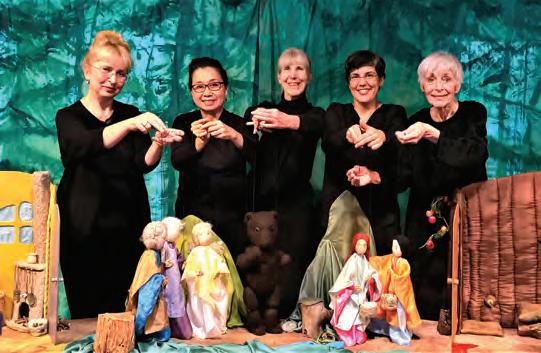
ing people from all over the country and the world to come speak.
“Practically applying anthroposophy” was what Dolores was all about at her core. From 1982 to 1990 Ron Moss and she organized and operated the Golden Garden Waldorf School across town from SWS. The board of SWS saw it as a split in effort, but Dolores’s sights were set on a future Waldorf high school, knowing that one school of children would not be adequate to establish this. In 1990 this second school had to close, but during those years as a school administrator, teacher, counselor, event coordinator, and fundraiser she founded the Silver Star Glove Puppet Theater. Dolores developed half a dozen fairy tale scripts, along with puppets, backdrops and props. Ron Moss built the theater and lighting. It performed for the children of the school but also for the public, especially during summer months at public festivals and fairs and always in conjunction with the Dr. Rudolf Steiner Bookstore.
The work Dolores did with organizing events, inviting speakers and teachers, holding study groups, and finding suitable places to hold their classes, along with Ron Moss’s work in writing and filing non-profit paperwork for the school, was all valuable experience, and it turned out to be just a warm-up for Dolores.
In 1982 Dolores left the board of the SWS and with Ron Moss founded Friends of Anthroposophy (FoA), a nonprofit dedicated to educating the greater community in anthroposophy. During its first ten years, Dolores coordinated nearly a hundred lectures, workshops, events and festivals, invit-
After the Golden Garden Waldorf school closed, Dolores shifted her work from education to art therapy. Now fifty years of age, she went back to get a BA in Psychology and Art Therapy from Antioch University. Research papers written on her subject studies used therapies such as Color Bath Therapy, Sand Play Therapy, Color Therapy with colored blind individuals, and internships at hospitals and clinics. She also traveled to Maine two summers for the Rudolf Steiner Institute to learn lazuring and veil painting from Lois Schroff. For three consecutive summers Dolores attended the Emerald Foundation in
summer-fall issue 2017 • 61
Mishinka and the Bear, three months before Dolores’ passing; she is on the right.
the Netherlands to study the painting therapy of Liane Collot d’Herbois.
In 1995, Dolores founded the Willow Branch Puppet Theater which performs Grimm fairy tales using 12inch silk marionettes set against ten feet of staging. All the marionettes, staging, story composition and songs were designed, made and written by her. Two full-stage marionette opera performances, the Green Snake and the Beautiful Lily and The Blue Mountain, each had their own staging, ten to twenty 16-inch marionettes, performers, speakers and orchestra. Through puppetry Dolores found the true medium of her life’s expression: art in motion through song and story. She continued with her small dedicated troupe of women artists to the very last days of her life.
In 1992 Dolores and Ron Moss renamed Friends of Anthroposophy as the Center for Anthroposophical Endeavors (CFAE) to reflect better the original mission—to found a place of learning and working in the world through anthroposophy. The Dr. Rudolf Steiner Bookstore became part of CFAE. A few years later Ron Moss, her friend, mentor and partner in so much, passed away.
Through the next 10 years Dolores continued organizing and teaching. Whatever learned, she always learned well enough to teach others. In 2002 a friend of Dolores’s traveling through the country of Georgia came across a group of anthroposophist’s who had started their own toymaking company. Dolores agreed to import their toys and established Gregorian Wood Toys. Three years later, with an inheritance from her mother’s passing, Dolores purchased a house on the corner of Lakes City Way and
98th Street, a few blocks from the Seattle Waldorf School. CFAE, Dr. Rudolf Steiner Bookstore, and the now added Children’s Shop, found their present home here. In 2012, Georgian Wood Toys became part of CFAE.
Between 1992 and her passing in 2015, Dolores never stopped her work with CFAE, inviting speakers and artists from every part of the globe. But in 2013 she was diagnosed with multiple myeloma. She controlled the cancer with help from friends who
hearsal on the day of the performance at the Three Cedars Waldorf School in Bellevue, she collapsed in pain and was carried out by her troupe and brought back home, where she passed away three days later.
Dolores’s last two days on Earth continued to be as full as had been her whole life. Many visitors came to speak with her for the last time. Her last wish was that she would make it through Christmas, and although this was not to be, the evening before her passing her room was decorated to her satisfaction. Her last day was quiet and somber, and at 8pm on December 16, 2015, surrounded by loved ones, including her physicians, she let out her last breath, crossing the threshold quietly and peacefully.
were naturopathic physicians until the sudden onset of pancreatic cancer in May 2015, the illness that took her father years earlier.
Her youngest son took over the running of the bookstore. But Dolores still came to the store, ordered supplies and maintained the accounts.
She continued to perform Marionette shows with her troupe— Mishinka and the Bear in September and her all-time favorite The Elves and the Shoemaker in December.
The Elves and the Shoemaker held a special place in her heart, perhaps because of her grandfather the cobbler. Every Christmas Eve she would have her grandchildren help her perform the hand-puppet version of the story for the family before opening gifts. The December, 2015 performance would be her last. During re-
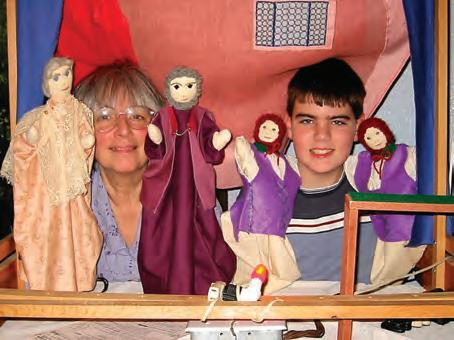
DoloresRose Dauenhauer was a woman of action, a doer of anthroposophy. She continually learned, created and taught all that she knew to others. She provided the community with influential speakers, artistic performances and festival events throughout her forty years in anthroposophy. She built up organizations and institutions that were in service to all but especially for children. Her artistry in life was always for others and never for herself. She was a force in the world with a mission. A true student of the Michaelic school of our time. A mother, a grandmother, a great grandmother and a godmother. A student and teacher to many hundreds of adults and children.
DoloresRose was my mother with shoes so great that I cannot possibly hope to fill them, but I will never stop being inspired, by her, to try.
62 • being human
The Elves and the Shoemaker hand puppet rehearsal with her grandson Alexander
Anthroposophical Society In America Annual Conference and General Meeting
October 13, 14, 15, 2017
The Heard Museum of Native Cultures and Art Phoenix, Arizona
Life as a Labor of Love
Rise Up!
Gather together as we rise up in love!

Highlights include:
Group singing, eurythmy, and speech throughout the conference
Keynote discussion with Shepha Vainstein of reGeneration
Interactive workshops with Mary Adams, John Bloom, Laura Embrey, John Beck, Lee Sturgeon Day and more.
Lively panel discussions on collaboration and communication.
Delicious meals in a beautiful setting
New this year: Become a conference exhibitor
–Share your service or product with a national anthroposophical audience!
Present during our participant research sessions!
–Share your research and initiatives with your peers
Register now at: www.anthroposophy.org/phoenix2017 $250-375 sliding scale*. Includes museum passes, Friday night reception and Sunday brunch. * Financial resources should not hinder participation. Contact us with questions at community@anthroposophy.org
Artist: Eduardo Yi-Man
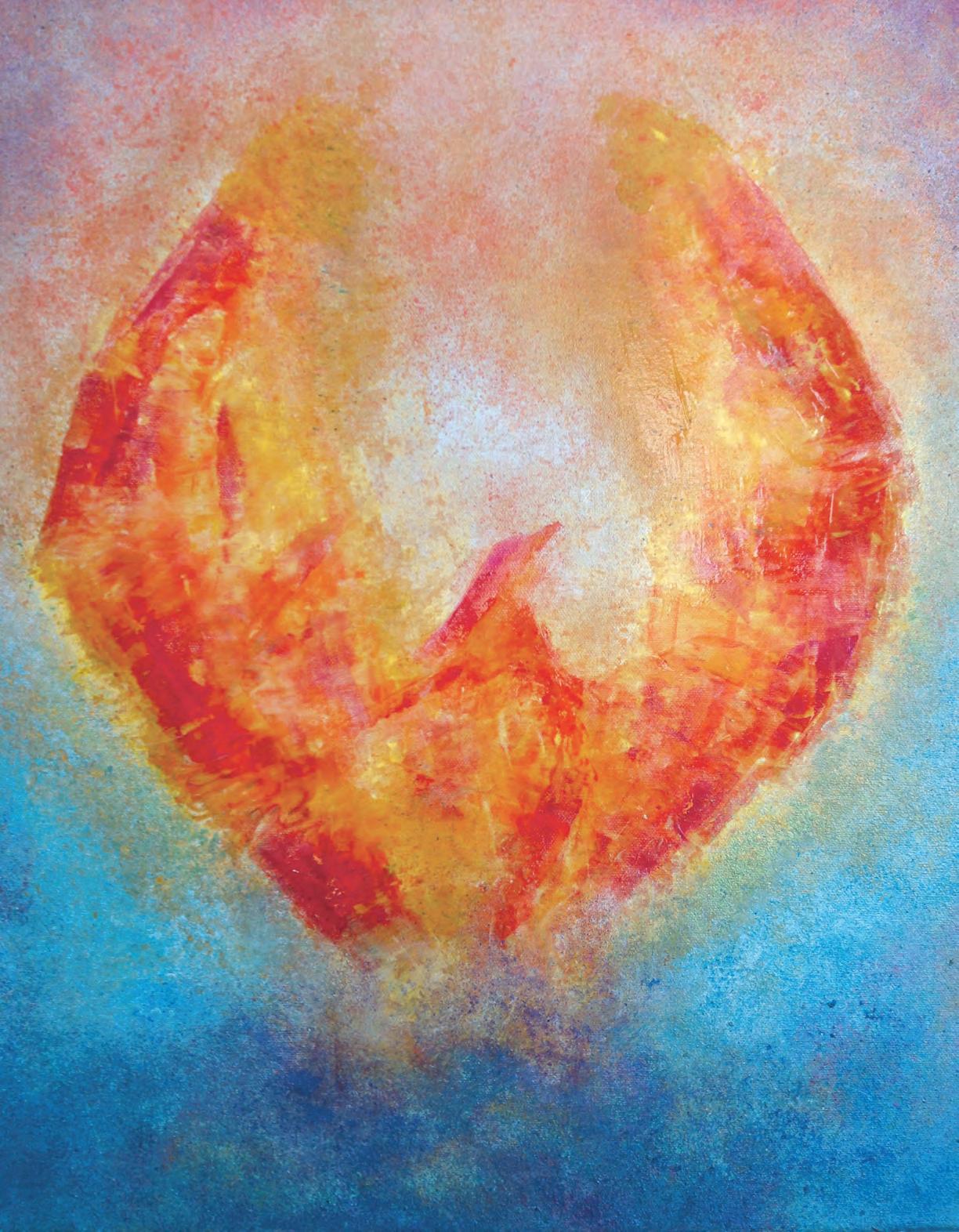
Artist: Eduardo Yi-Man
Anthroposophical Society In America Annual Conference and General Meeting
Rise Up!
13, 14, 15, 2017 The Heard Museum of Native Cultures and Art
Arizona Registration now open! Experience the art, culture, and natural beauty of Arizona! Full details inside
Life as a Labor of Love October
Phoenix,
