11 minute read
Anthroposophy & the Ecozoic: Rudolf Steiner & Thomas Berry

by Eve Olive
This paper was presented at the “Colloquium on Thomas Berry’s Work: Development, Difference, Importance, Applications,” co-sponsored by the Center for Ecozoic Societies and the Carolina Seminars of the University of North Carolina, May 28-30, 2014, in Chapel Hill, NC.
Advertisement
Some people are nonplussed by the word “anthroposophy”—others are startled by the word “Ecozoic.” And of course, there are many who have heard of neither. Are these just two curious words, which have nothing to do with oneanother, or are they somehow related? “Anthroposophy” came into the world through the work of Rudolf Steiner (1861-1925). The word comes from two Greek words, and it can be translated, variously, as “the wisdom of the human being”, or “consciousness of one’s humanity”... or, as stated more fully by Steiner in 1924, “Anthroposophy is a path of knowledge which arises as a need of the heart and leads from the human mind and spirit to the Mind and Spirit of the Cosmos.” “Ecozoic” is a term coined by Thomas Berry (1914- 2009). Berry’s observations of the world, as it is now, and the vast sweep of evolutionary history, led him to point to the fact that we have entered a different age which needs its own name.

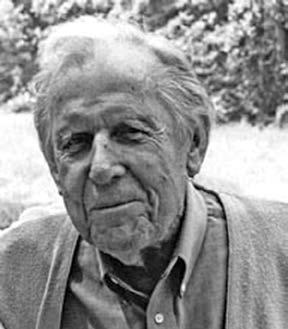
“Thomas Berry” by Caroline Webb.
Licensed under Creative Commons Attribution 3.0 via Wikimedia Commons
The most recent period, the Cenozoic, which started 65 million years ago, saw the gradual emergence of the natural world we know now, with its beautiful flowers, its majestic forests, its clear flowing streams and sparkling oceans, its great variety of animal life, and finally the human being. Ah! The human being... This Being of free will, this Being with a kind of consciousness that the animals do not possess. Here we are, each with our individual egos, free to do as we please . . .
And what have we done? We have brought the Earth, which sustains us, to a tipping point. We have created mass extinctions of animal and plant life. We are busy destroying the lungs of the earth as, hour-by-hour, great swaths of forest fall. We have upset the balance of carbon dioxide to a dangerous degree with our extractive economy. We are destroying our home.
Thomas Berry has said that we will not save or protect that which we do not regard as sacred. How do we come to a sense of the sacred? Is it something we are born with? Can it be developed? There are many ecologically-inspired organizations out there doing wonderful work, and maybe it is because they all have a sense of the sacred—though they may not name it.
It is this sense of the sacred, this experience of the numinous, this feeling for, this awareness of something more than the surface appearance of things that interests me in the Ecozoic movement and that encourages me to see a connection between the work of Thomas Berry and Rudolf Steiner—between the Ecozoic and anthroposophy.
Some of you may know that Steiner’s view of the human being as a spiritual being, clothed in a physical body, was developed philosophically in profound ways, in his many books and lectures. In the last third of his life, after the first World War, this wisdom entered into life in very practical ways, inspiring many different professions—agriculture, medicine, political/social life, the arts—architecture, sculpture, painting, music, drama, poetry, eurythmy (a new art of movement), and of course education, with the founding of the first Waldorf School in Stuttgart, Germany in 1919. I would like to read you the verse which Steiner wrote for the students of the Waldorf School, and which they, from fifth grade on through high school, recite each morning:
I gaze into the world
In which the sun is shining,
In which the stars are sparkling,
In which the stones repose,
Where living plants are growing,
Where sentient beasts are living,
Where human souls on
Earth Give dwelling to the Spirit.
I gaze into my soul
That lives within my being.
The world Creator weaves
In sun light and in soul light,
In world space there without,
In soul depths here within.
To thee, Creator Spirit,
I will now turn my heart
To ask that strength and blessing
For learning and for work
May grow within my inmost being.
One can see that this verse encourages a sense of the sacred, both when looking out into the world, and when looking within—without any sense of dogma or coercion.
Now, when we look out into the cosmos with our great telescopes and space probes, we see that creation continues. The universe is not fixed, not finished. When we look within, we know that we are not fixed, not finished—we have the option, with our free will, to continue the work of creation on ourselves—to perfect and refine our attitudes and ideals, to become more centered, more aligned with the highest we can imagine.
One wonders if these two great men, Steiner and Berry, had met in this life, if they would have found a connection with each other, or whether it is up to us to make that connection now? Steiner was born first, and had a relatively short life—64 years. Berry, born 53 years later, was a boy of 11 when Steiner died. If Steiner had lived into his 95th year, like Berry, Berry would have been 42 when Steiner died. There is the chance they would have known of each other’s work. However, that is not to say they would have admired each other’s work, or found a colleagueship with each other.
Those of you who know anything about Steiner know how much his work followed on from that of Goethe (1749-1832), both in a scientific and in a literary way, and yet, Steiner said that if he and Goethe had met in life, they would not have been congenial! Sometimes it is significant that two beings, whose life work is related, need to be born apart in time, and the connections discovered later and developed further. In this case, with Steiner and Berry, I am suggesting that this is our work, if we choose to take it up, to find the connections. Right now, these two great beings are in the spiritual world, with a perspective they could not have had on earth. Both were deeply concerned for the earth and humanity. Now they are able to contemplate possibilities they might not have connected with when they were here on earth.
For me, these two life works, these two biographies, are like two pieces of a puzzle that fit together, that inform and enrich each other. One can say that the one brought the answers before the problems and the questions, articulated by the other, were even apparent.
Steiner foresaw a time when the earth would be devastated, when human life on the planet would be sparse and very difficult. This picture haunts us now in relation to the legacy we are leaving our children, our grandchildren, and our great-grandchildren. Thomas Berry has spelled it out for us with great clarity and urgency. Individually and within all our institutions, we need to wake up. I doubt that Steiner, speaking in the early years of the 20th century, thought that this vision of the earth might become a reality as soon as it now appears possible.
Steiner recognized that we are citizens of two worlds. This world, in which we appear in physical bodies—and the spiritual world, in which we exist as souls, and from which all the splendour of the universe has emanated, and is still emanating, in a great ongoing work of creation.
As souls, we exist before our birth, and at death, we return to our spiritual home. We have been on earth before, and we will return again. We were ancient Greeks and Romans, the monks, nuns, knights, peasants of the Middle Ages. The earth is our schoolroom. The physical evolution which gave us our upright bodies and eyes that could gaze at the stars is complete. Now our task is the evolution of consciousness, and coming to an awareness of the divine spark within us—something we can ignore, or consciously choose to do. When we contemplate the possibility of a devastated planet, it is we who will inherit it.
The idea of reincarnation, of repeated earth lives, may be problematic for some, and the subject is probably not often discussed in academic settings. I have come to realize that not everyone has the same idea of what reincarnation means. We are certainly not talking here of transmigration of human souls into animal bodies. Nor is this some kind of system of easy second chances. The picture presented by an Indian gentleman I met recently— “As Hindus, we believe that four days after death, the soul enters another body”—does not ring true for me.
If there is such a thing as reincarnation and karma, it must be logical—it must help to explain, for instance, the inequities of life. Looking at the different destinies of people, it can be hard to believe in a “God of Love.” Some of us are well clothed, well fed, well educated, while others are starving, illiterate, or mentally or physically handicapped. One life? The possibility of multiple lives can help make sense of this conundrum. And here I should like to dispel the notion that misfortune in this life is a punishment. It may be a consequence. It may be a conscious sacrifice. There are an infinite number of possibilities.
With our consciousness after death, we look back upon the life just lived. We experience all our interactions with others from the viewpoint of the other person, and so we understand the full import of our actions, our thoughts, and our words. We judge ourselves.
It is this understanding, this self-judgment, which leads us to desire to do better in the future life. With great artistry, high spiritual beings help to work on our karma, creating possibilities for the next life on earth, for our continuing biography. But that next life maybe several hundred years away—will there be an earth for us to return to? Will there be healthy bodies for us to inhabit?
If reincarnation and karma are realities, they are part of the story—The Great Story—and we need to include them. We ignore them at our peril. Steiner considered it an important part of his mission in this life to bring to humanity a clear, modern understanding of the reality of reincarnation and karma. It is something we need to consider. Just as we see a need to integrate a religious or spiritual world view with the scientific world view, as Thomas Berry and Brian Swimme encourage us to do in The Universe Story, and as Michael Dowd encourages us to do in Thank God for Evolution—so there is yet another step for us to take.
Behind all natural science stands what we may term spiritual science. Is this what Thomas Berry sensed in his observation, that everything we see has a psycho-spiritual aspect? Rudolf Steiner devoted his life to this realm of spiritual science. His meditative observations and spiritual research are recorded in over twenty books and 6,000 lectures—a treasure there for us, if we wish to dip into it.
Another thing I find interesting and encouraging about the Ecozoic movement is the interest in culture, in the arts. Yes, yes, yes! If we are going to transform society, the arts must be there—all of them. This is another area where there is a great resonance with the work of Rudolf Steiner. Steiner was in one way or another involved with all the arts—from designing the First and Second Goetheanum buildings to writing four great Mystery Dramas which, by the way, will be performed this summer in Spring Valley, New York. This is the first time all four of them will be performed in English on this continent, in a great nine-day festival. Each play takes a day to perform!
And of course there is eurythmy—the art of movement, which came into being through Rudolf Steiner, together with the art of creative speech. I visualize performances of eurythmy celebrating the beauty of our world in the words of some of our first “environmentalists”, the romantic poets—Wordsworth, Shelley and others, Gerard Manley Hopkins and Yeats.
I hear a yet-to-be-written oratorio, celebrating the creation of our world in a different seven-fold-ness, based on Steiner’s spiritual vision and research. Is there a new mystery drama for our time, waiting, yet to be written and performed? Will the greatest art form of all—that of the social order—be accomplished in our time, or at least start to be consciously worked upon? And will the great gifts of biodynamics be used to heal the earth before it is too late?
Many questions, many challenges, but maybe, as in the finale to Christopher Fry’s play, A Sleep of Prisoners, we too can say:
Thank God our time is now when wrong
Comes up to face us everywhere,
Never to leave us till we take
The longest stride of soul Man ever took.
Affairs are now soul size.
The enterprise
Is exploration into God.
Where are you making for? It takes S
o many thousand years to wake,
But will you wake for pity’s sake!
Eve Olive is a eurythmist, poet, and teacher, and the author of "Cosmic Child: Inspired Writings from the Threshold of Birth."
