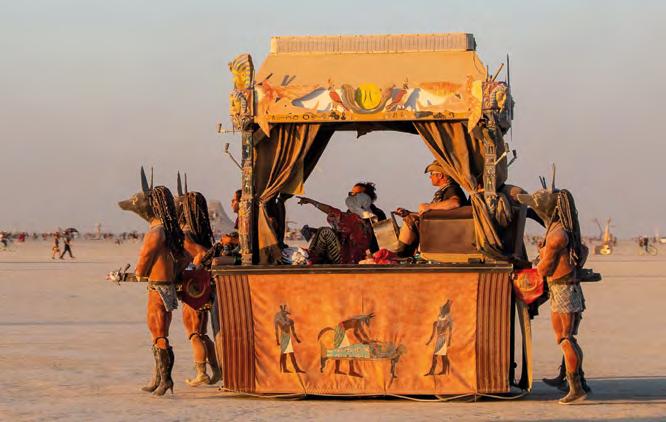
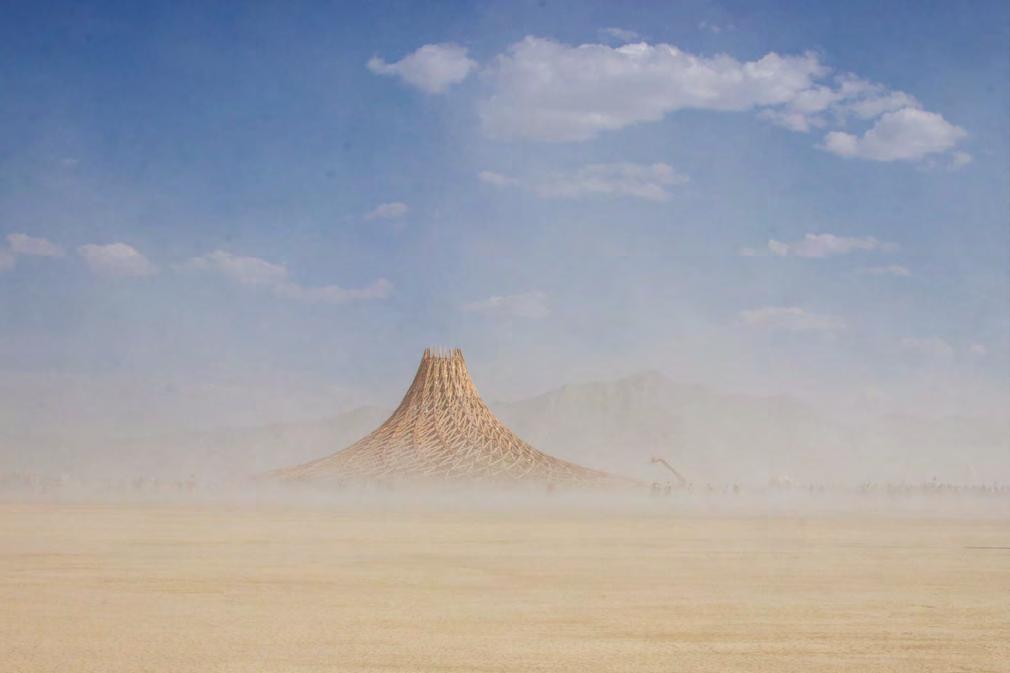
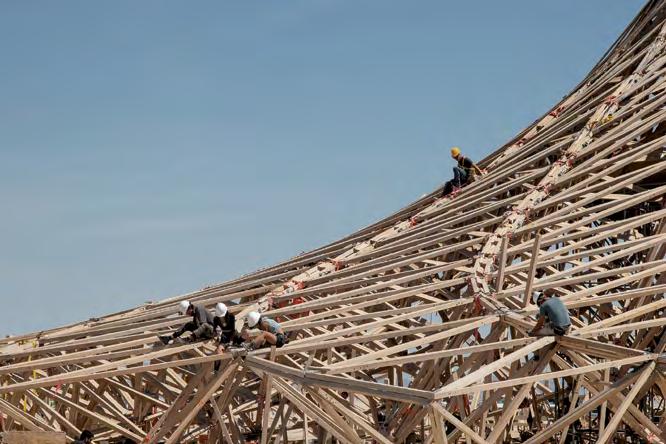
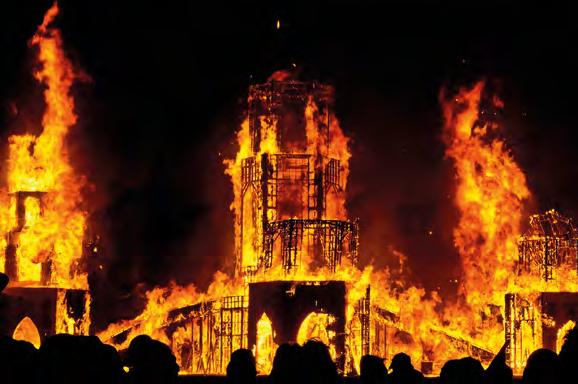
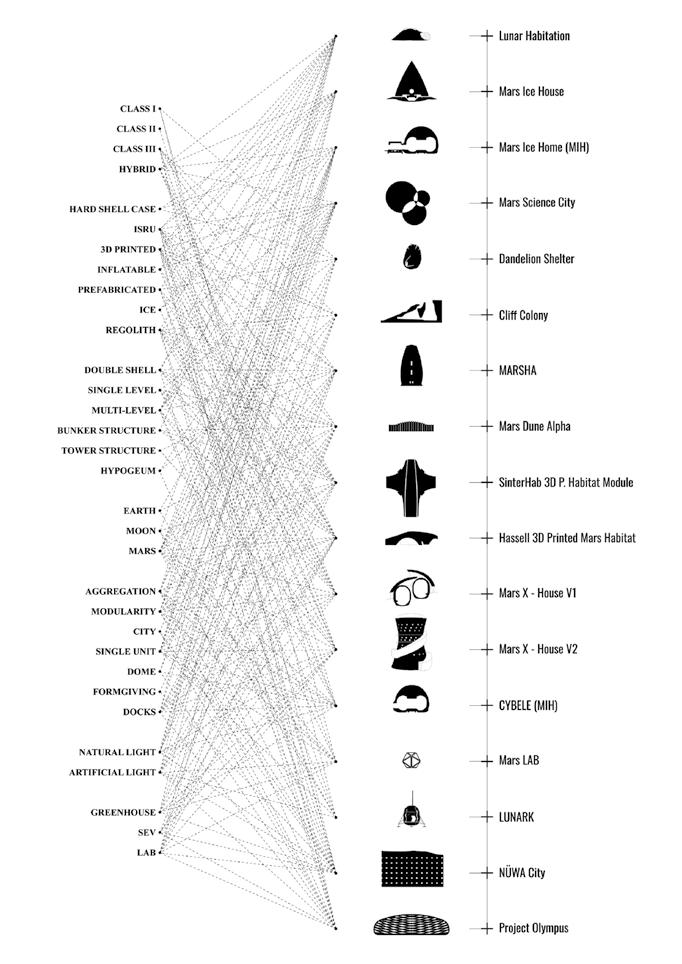
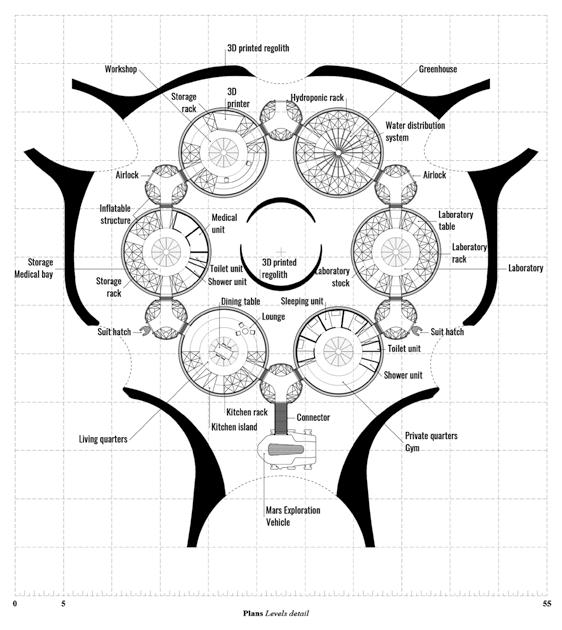
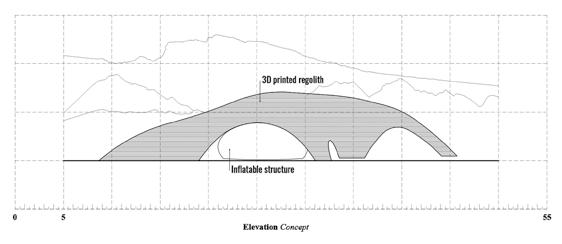
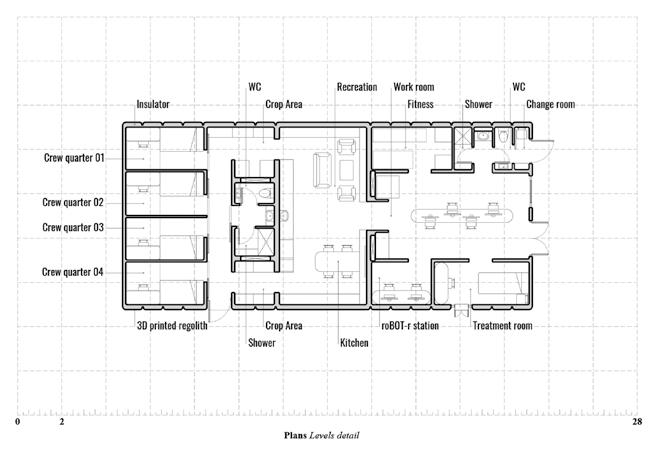
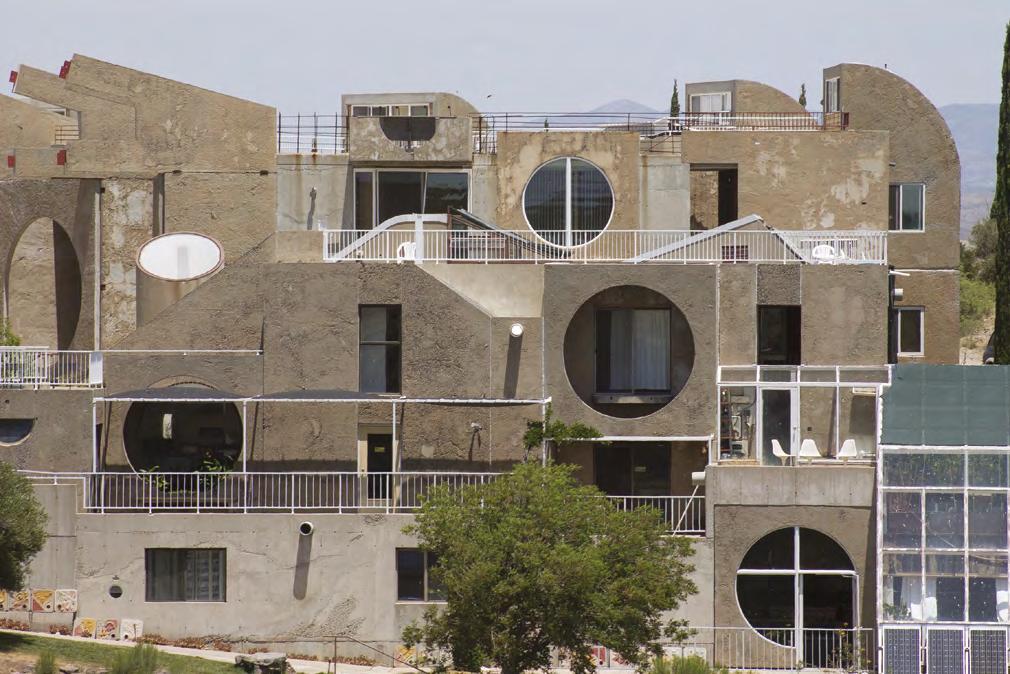
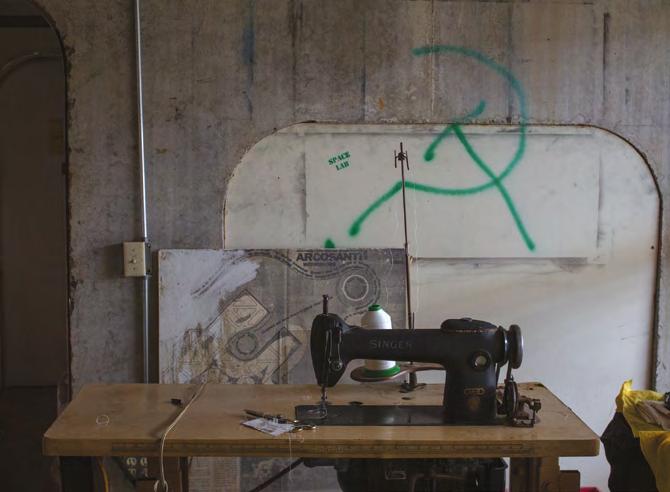
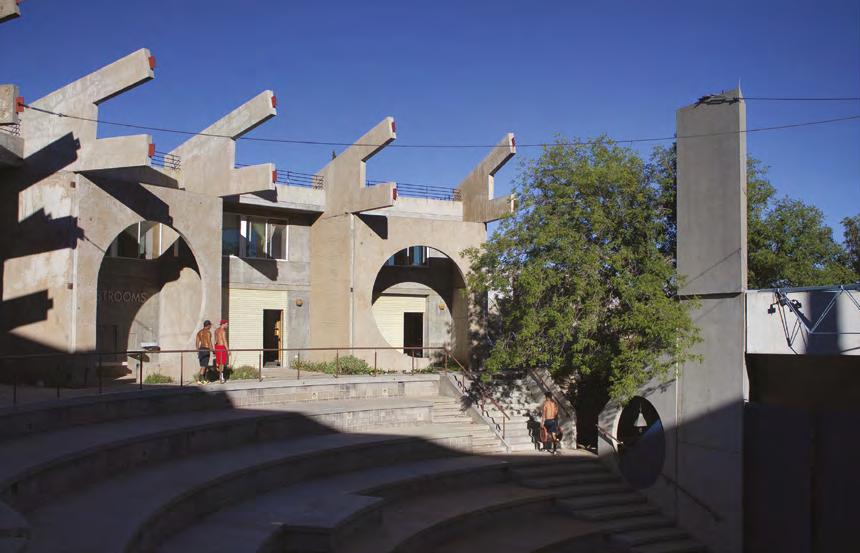
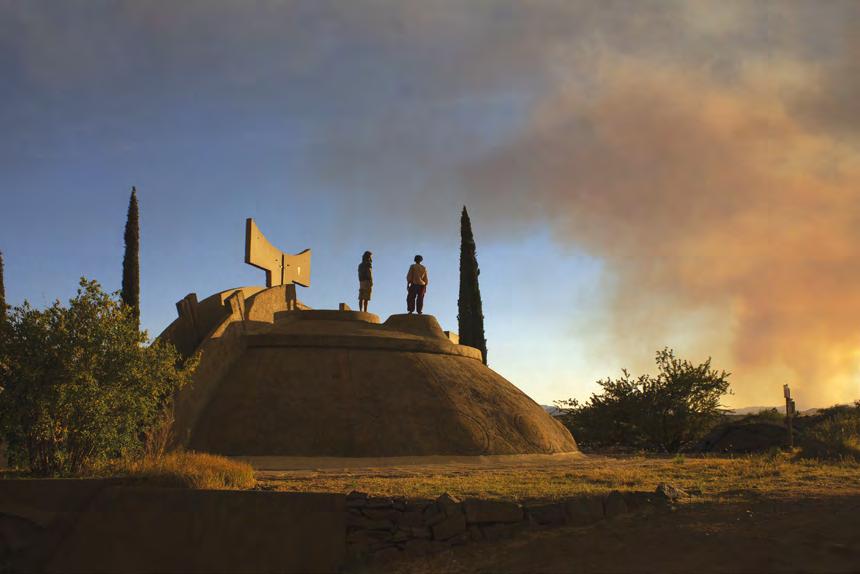
Nel mondo naturale e antropico si possono trovare le risorse per dare forma alle idee che si progettano. È necessario superare una visione antropocentrica trascendendo la dicotomia tra ciò che siamo noi e il resto attorno a noi, provando a immaginare una simbiosi; un’interazione molto forte tra organico e artificiale, tra umani, territori, animali, piante, tecnologia ed energia in un cambio totale di prospettiva che si interroga sul perché salvare il mondo quando è possibile progettarlo?
Ecce
Lontano dai luoghi comuni
Nell’immaginario collettivo i deserti sono luoghi aridi, caldi o freddi, ma sempre inospitali e scarsamente abitati. Spesso al deserto sono associate condizioni di povertà ed emarginazione, identificando così ambiti territoriali dove non è facile sopravvivere. Nel linguaggio comune un “luogo deserto” è uno spazio vuoto, privo o quasi di vita, uno spazio sterile, asettico, dove tutto sembra immobile e immutabile. La realtà, raccontata anche da alcuni dei saggi raccolti in questo numero di OFFICINA*, è assai diversa: i deserti sono luoghi ricchi di vita, di storia e spesso sono crocevia di merci e conoscenze che si sono spostate e tuttora si spostano attraverso di loro. Certamente non sono luoghi facili: le condizioni climatiche estreme, la variabilità e imprevedibilità delle precipitazioni insieme a condizioni geopolitiche spesso limitanti fanno delle aree desertiche le zone meno densamente popolate del globo. Eppure la scienza, già da tempo, ha dimostrato come la varietà di specie animali e vegetali che abitano questi territori sia tutt’altro che scarsa, con l’incredibile capacità di queste forme di vita di adattarsi a contesti estremamente siccitosi, poveri di risorse nutritive e con temperature estreme; e l’uomo non è di certo escluso dalla lista di chi, in un modo o nell’altro, vive nei territori desertici. Dal Sahara in Nordafrica al Gobi in Asia, fino al deserto di Nazca in Sudamerica, sono decine le testimonianze storiche e archeologiche di insediamenti, vie commerciali e talvolta anche vere e proprie civiltà che hanno abitato queste aree oggi aride e inospitali. Ma sono ancora più numerosi gli esempi contemporanei di “colonizzazione” di aree desertiche, basti pensare a città come Dubai, Abu Dhabi e Doha, il cui recente sviluppo, legato al commercio del petrolio, le ha trasformate in vere e proprie metropoli nel deserto; o ancora a progetti come The Line e New Murabba (nella penisola araba) che propongono megalopoli futuristiche, ipertecnologiche e sostenibili collocate in regioni remote, isolate e caratterizzate da climi aridi e del tutto ostili alla vita. Ma forse è proprio in questa intraprendenza umana, e nella volontà di dare a questi luoghi una possibilità, che i deserti trovano la loro più autentica rappresentazione, che li vede come luoghi vasti, dai paesaggi aspri e plasmati dal sole ma punteggiati di oasi verdi e attraversati da lunghe e fruttuose vie di commercio.
Una rappresentazione tutt’altro che moderna, che ritroviamo già nelle Tebaidi del XII e XIII secolo, pitture tipiche dell’epoca in cui il deserto era rappresentato come un luogo ricco di animali, di alberi da frutto e di oasi fiorenti: un luogo solitario, di grande quiete e silenzio, dove i monaci usavano ritirarsi per vivere in preghiera e in solitudine, coltivando la terra arida e facendola rifiorire. Forse, dunque, non è tanto il clima proibitivo o la scarsità di risorse a fare di un luogo un deserto, quanto la mancanza di volontà da parte dell’uomo di prendersene cura. Emilio Antoniol
Comitato scientifico Federica Angelucci, Stefanos Antoniadis, Sebastiano Baggio, Matteo Basso, Eduardo Bassolino, MariaAntonia Barucco, Martina Belmonte, Giacomo Biagi, Paolo Borin, Alessandra Bosco, Laura Calcagnini, Federico Camerin, Piero Campalani, Alberto Cervesato, Sara Codarin, Silvio Cristiano, Federico Dallo, Lavinia Maria Dondi, Paolo Franzo, Jacopo Galli, Silvia Gasparotto, Gian Andrea Giacobone, Giovanni Graziani, Francesca Guidolin, Beatrice Lerma, Elena Longhin, Antonio Magarò, Filippo Magni, Michele Manigrasso, Michele Marchi, Patrizio Martinelli, Fabiano Micocci, Mickeal Milocco Borlini, Magda Minguzzi, Massimo Mucci, Maicol Negrello, Corinna Nicosia, Maurizia Onori, Valerio Palma, Damiana Paternò, Elisa Pegorin, Ilaria Pittana, Laura Pujia, Silvia Santato, Roberto Sega, Gerardo Semprebon, Chiara Scanagatta, Chiara Scarpitti, Giulia Setti, Francesca Talevi, Alessandro Tessari, Oana Tiganea, Massimo Triches, Ianira Vassallo, Luca Velo, Alberto Verde, Barbara Villa, Paola Zanotto
Redazione Davide Baggio, Luca Ballarin, Giulia Conti, Martina Belmonte, Silvia Micali, Libreria Marco Polo, Sofia Portinari, Marta Possiedi, Tommaso Maria Vezzosi
Chiuso in redazione il 2 agosto 2024, con i Giochi in corso, senza tregua olimpica.
Copyright opera distribuita con Licenza Creative Commons Attribuzione - Non commerciale - Condividi allo stesso modo 4.0 Internazionale
L’editore si solleva da ogni responsabilità in merito a violazioni da parte degli autori dei diritti di proprietà intelletuale relativi a testi e immagini pubblicati.
Direttore responsabile Emilio Antoniol Registrazione Tribunale di Treviso n. 245 del 16 marzo 2017
Pubblicazione a stampa ISSN 2532-1218 Pubblicazione online ISSN 2384-9029
Accessibilità dei contenuti online www.officinajournal.it
Prezzo di copertina 10,00 € Prezzo abbonamento 2024 32,00 € | 4 numeri
Per informazioni e curiosità www.anteferma.it edizioni@anteferma.it
OFFICINA*
“Officina mi piace molto, consideratemi pure dei vostri” Italo Calvino, lettera a Francesco Leonetti, 1953
Trimestrale di architettura, tecnologia e ambiente N.46 luglio-agosto-settembre 2024 Deserto
Il dossier di OFFICINA*46 – Deserto è a cura di Viola Bertini e Filippo De Dominicis.
Hanno collaborato a OFFICINA* 46: Carmen Armenteros Puchades, Matteo Benedetti, Viola Corbari, Giacomo D’Amico, Salma Samar Damluji, Jacopo William de Denaro, Federico Di Cosmo, Bendetta Di Donato, Eleonora Fanini, Santiago Gomes, Marco Manfra, Caterina Padoa Schioppa, Cristina Pallini, Claudia Pirina, Andrea Quartu, Luca Reale, Ivan Severi, Marina Tornatora, Francesca Tosetto, Laura Villa Baroncelli, Lucia Concetta Vincelli.
OFFICINA* è un progetto editoriale che racconta la ricerca. Tutti gli articoli di OFFICINA* sono sottoposti a valutazione mediante procedura di double blind review da parte del comitato scientifico della rivista. Ogni numero racconta un tema, ogni numero è una ricerca.
OFFICINA* è inserita nell’elenco ANVUR delle riviste scientifiche per l’Area 08.
Desert
n•46•lug•ago•set•2024
Ecce Homo Andrea Quartu
INTRODUZIONE
Desertofilia: di deserti desiderati e progettati
Desertphilia: of desired and designed deserts
Viola Bertini, Filippo De Dominicis
Cities of the Desert Route
Le città della rotta del deserto
Salma Samar Damluji
Sotto la buccia della terra Under the Skin of the Earth
Claudia Pirina
ESPLORARE
Spunti da visitare a cura di Eleonora Fanini
SCIENTIFIC DOSSIER
Tracciando una linea Drawing a Line
Carmen Armenteros Puchades, Lucia Concetta Vincelli
Prove generali di vita comunitaria Rehearsal of Community Life
Fare il deserto nella foresta Making Deserts in the Forest
Michele Tenzon
Abitare l’inabitabile Inhabiting the Uninhabitable
Marina Tornatora, Giacomo D’Amico
Il fascino dell’oblio The Oblivion Charm
Stefania Mangini
COLUMNS
Il deserto bianco di Reinhold Messner Reinhold Messner’s White Desert
Luca Reale, Francesco Tosetto
Il ritmo del deserto
The Rhythm of the Desert
Matteo Benedetti
De deserti dignitate
De deserti dignitate
Federico Di Cosmo
IL PORTFOLIO IL LIBRO I CORTI
Il giardino come oasi di resistenza The Garden as an Oasis of Resistance
Viola Corbari, Benedetta Di Donato
Amereida
Amereida
Santiago Gomes
Laggiù nell’Arizona Over there in Arizona
Cristina Pallini
Il cavallino immobile
The Immobile Horse
Letizia Goretti
Questa non è una comune. In dialogo con Pete Seiter This is no Commune. In conversation with Pete Seiter a cura di Laura Villa Baroncelli, Marco Manfra, Ivan Severi
Il deserto val bene una messa a cura dei Librai della Marco Polo
(S)COMPOSIZIONE
Falsi miti
Emilio Antoniol
Environments by Women Artists II
10 aprile – 20 ottobre 2024
Maxxi, Roma maxxi.art
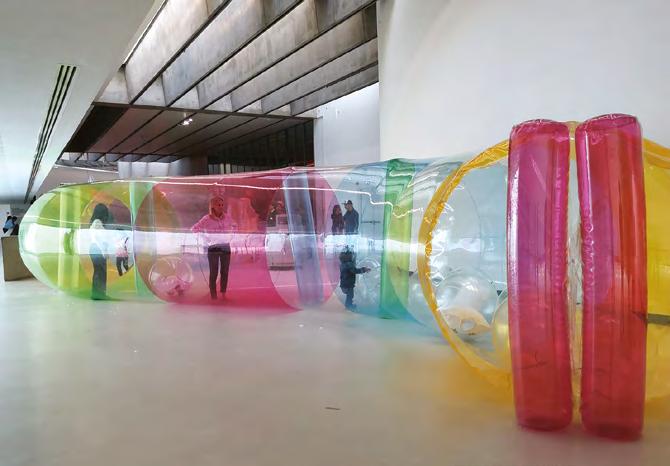
Ambienti 1956-2010. Environments by Women Artists II è il secondo atto della mostra Inside Other Spaces. Environments by Women Artists 1956-1976 intrapresa alla Haus der Kunst di Monaco di Baviera, curata con passione da Andrea Lissoni e Marina Pugliese con il contributo di Francesco Stocchi. L’esposizione che ha luogo al Maxxi va oltre l’apparenza del titolo: è un affascinante viaggio attraverso il tempo e lo spazio che svela il ruolo fondamentale delle donne artiste nella storia delle opere ambientali, non ponendo quindi il focus sulla questione di genere, ma celebrando l’arte femminile nella sua forma più pura. Avere come guida una prospettiva femminile per esplorare la storia dell’arte del secondo Novecento attira l’attenzione sulle peculiarità che contraddistinguono l’arte femminile e permette di confrontarsi con esperienze legate alla sfera della donna.
L’esposizione, in linea con dinamiche attuali, offre anche un potente specchio per riflettere sul presente: le opere immersive di artiste come Lea Lublin e Pipilotti Rist hanno anticipato temi critici quali la riproduzione, il corpo femminile, e la natura attraverso un’ottica moderna e innovativa; opere come Spectral Passage di Alexandra Kasuba e If You Lived Here... di Martha Rosler non
solo sfidano le convenzioni tradizionali, ma ampliano anche il discorso artistico verso questioni urgenti come l’ambiente e la crisi abitativa.
In sintesi, Environments by women II non solo riscrive la storia dell’arte attraverso una lente femminile, ma invita anche il pubblico a esplorare il potere trasformativo dell’arte nel contesto contemporaneo, evidenziando il suo ruolo cruciale nel plasmare il nostro modo di vedere e comprendere il mondo. E.F.
Diorama – Generation Earth
05 luglio – 10 novembre 2024 Museo MAN, Nuoro museoman.it
Diorama: s. m. [dal fr. diorama (1822), comp. del gr. δια “attraverso” e ὅραμα “veduta”, sul modello di panorama] (pl. -i). Far vedere attraverso contesti abitati da frammenti naturali e innaturali che si mescolano con flora e fauna artificiali; è disorientare quel confine tra reale e irreale. Partendo dalla formazione della Terra, interpretata come una natura artificiosa contenuta e plasmata dall’uomo, la centralità del percorso ricade sulla rielaborazione di un nuovo creato, figlio dei mutamenti ecologici a cui siamo continuamente sottoposti.
Diorama – Generation Earth vuole generare un pensiero profondo e critico, invitandoci a riflettere sul nostro rapporto con la biosfera; gli artisti, italiani e internazionali, come alchimisti del cam-
biamento, con la loro capacità di scorgere oltre il visibile, oltre il reale, quasi formulando realtà distopiche, tentano di farci immaginare un orizzonte dipinto di inclusività e rispetto per tutti gli organismi viventi. E.F.
Burtynsky: extraction/abstraction 21 giugno 2024 – 12 gennaio 2025 M9 Museo del ’900, Mestre m9museum.it/mostre/
Scatti di grande formato ritraggono paesaggi industriali, miniere, cave, estrazioni di petrolio e altre forme di sfruttamento delle risorse su larga scala, scatti di testimonianza immaginifica che sono messaggi emotivi per esplorare il complesso rapporto tra progresso e ambiente. La trasformazione di questi scenari in opere d’arte astratte, il grande impatto visivo e la forte carica narrativa permettono di suscitare riflessioni sull’impatto ambientale che l’industria reca al nostro pianeta e sulle conseguenze della nostra sete di risorse. In aggiunta, l’inclusione della sezione Process Archive e delle fotografie commissionate sugli effetti della Xylella sugli ulivi pugliesi evidenzia l’importanza anche dei fenomeni ambientali più localizzati e immediati.
Edward Burtynsky, fotografo canadese, è il protagonista di questa raccolta di 80 fotografie e 10 murales, che danno vita alla sua più ampia esposizione mai realizzata, curata da Marc Mayer con progetto allestitivo di Alvisi Kirimoto. E.F.
Fabrizio Plessi. Nero oro 06 giugno – 13 ottobre 2024
Fondazione A. Peruzzo, Padova fondazionealbertoperuzzo.it
La mostra Fabrizio Plessi. Nero Oro, curata dalla Fondazione Alberto Peruzzo e allestita per la prima volta nell’ex Chiesa di Sant’Agnese a Padova, rappresenta un omaggio intenso e multisensoriale all’arte contemporanea italiana. L’esposizione celebra Fabrizio Plessi, noto artista veneziano, in occasione della 60. Esposizione Internazionale d’Arte e del suo 84° compleanno.
Equilibri. Fiera del libro di Venezia 28-29 settembre 2024
Chiostro dei Tolentini, Venezia facebook.com/veneziainvita/
Ricercatrice TDB, Composizione architettonica e urbana, DiAP, Sapienza Università di Roma. viola.bertini@uniroma1.it
Filippo De Dominicis
Professore associato, Composizione architettonica e urbana, DICEAA, Università degli Studi dell’Aquila. filippo.dedominicis@univaq.it
Desertofilia: di deserti desiderati e progettati
Parlare di deserto e architettura può sembrare una contraddizione. Lo è anche nella visione disciplinare allargata di William Morris (1881), che – parafrasando – considerava impossibile sottrarsi all’architettura a eccezione che nel puro deserto. Per l’essere umano tuttavia il deserto ha sempre rappresentato un inarrestabile orizzonte progettuale, tanto più presente quanto più complesse diventavano le possibilità di adattamento, dentro e fuori il deserto. In quel resto di mondo, cioè, in cui le condizioni di vita si facevano più difficili, o si rappresentavano come tali per imprimere svolte che avrebbero fatto epoca. È Aldous Huxley a parlarne pubblicamente a Parigi ne La doppia crisi, manifesto delle ansie e delle incertezze che agitavano anche le menti più aggiornate della generazione. Per uscire dalla crisi tanto economica quanto affettiva che affliggeva il mondo postbellico, esortava Huxley ancora nel 1948, era necessario uno sforzo progettuale senza precedenti; uno sforzo che accanto alle incoraggianti prospettive di incremento demografico avrebbe richiesto nuove aree e nuovi spazi. La risposta, naturale, era nel deserto, nelle grandi estensioni deserte di Asia e Africa che niente altro sembravano attendere se non l’arrivo di esseri umani che le rendessero abitabili.
In questo orizzonte il deserto diventava scenario, sede per forme di azione e trasformazione su vastissima scala, talvolta globali, spesso condotte in accordo con, o come premessa di, vaste operazioni di displacement o resettlement. L’obiettivo tuttavia era spesso e volentieri più ampio: al di là degli aspetti di natura politica, presenti tanto nei piani para-nazisti di Hermann Sörgel quanto nelle visioni liberali degli Stati Uniti post-bellici, il deserto sembrava l’unico spazio in grado di celebrare al suo massimo grado tutta la hybris dell’uomo moderno, ridisegnando il rapporto fra l’essere umano e la sua creatura intellettuale più importante, la natura. Fra Otto e Novecento il deserto diventa quindi il luogo del progetto moderno, spazio di esercizio prefigurativo rispetto a un potenziale tecnico in vertiginoso sviluppo, spazio di dominio di cui disporre per spingersi ben oltre i limiti del conosciuto. Questo non solo rispetto ai tanti proving ground che nel de-
Desertophilia: of desired and designed deserts
Talking about desert and architecture may seem like a contradiction in terms. This is also the case of the expanded disciplinary vision of William Morris (1881) who, to paraphrase, deemed the escape from architecture impossible anywhere but in the desert. For the humankind, however, the desert has always represented an inexorable horizon of design, even more as the possibilities of adaptation have become more complex, both inside and outside the desert. That is, in that rest of the world, where living conditions have become more difficult or have been presented as such in order to bring about epochal changes. Aldous Huxley publicly discussed this in Paris in The Double Crisis, a manifesto of the fears and uncertainties involving even the most modern minds of that generation. In 1948, in order to overcome the economic and emotional crises that had gripped the post-war world, Huxley called for an unprecedented creative effort; an effort that, alongside the encouraging prospects of demographic growth, required new territories and spaces. The natural answer laid in the desert, in the vast extensions of Asia and Africa that seemed to await nothing more than the arrival of humankind to make them inhabitable.
In this context, the desert became a stage, a place for large-scale actions and transformations, sometimes global, often carried out in conjunction with, or as a prelude to large-scale displacement or resettlement operations. However, the aim was often broader: beyond the political aspects present in both the para-Nazi plans of Hermann Sörgel and the liberal visions of the post-war United States, the desert seemed to be the only space capable of celebrating the hybris of modern man, reshaping the relationship between man and his most important intellectual creation, nature. Between the Nineteenth and Twentieth centuries, the desert thus became the place where anticipatory exercises disclosed the terrific potential of technological development, a domain for pushing beyond known limits. This was true not only of the many proving grounds set up in the desert – architec -
Opportunities in the emergence | V1. Jacopo William de Denaro
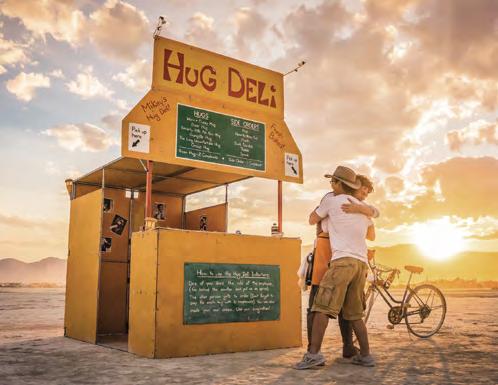
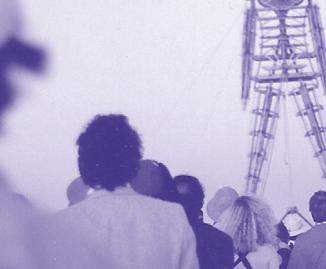
serto troveranno sede, insieme ad architetture realizzate solo per essere distrutte o a nuove forme minerali generate da esplosioni atomiche, ma anche in relazione a esperimenti nati quando dal deserto era stato necessario difendersi, spesso proprio a causa dell’azione antropica. Basti pensare all’immane sforzo intrapreso dall’amministrazione Roosevelt per riparare ai danni causati dal Dust Bowl, i dieci anni di tempeste di sabbia a cui l’ingegnere forestale Robert Zon avrebbe risposto attraverso la messa a dimora di 220 milioni di alberi estesi su più di 48.000 km2. Un disegno epico, al pari dell’epopea steinbeckiana dei Joad, che dalle piane insabbiate dell’Oklahoma erano fuggiti anni prima in cerca di fortuna e che oggi, in altre forme, una confederazione di stati africani e la FAO tentano di far rivivere con il progetto della Great Green Wall, una muraglia di alberi a ridosso della frontiera meridionale del Sahara ipotizzata per la prima volta già nel 1935. Al di là dell’epica, nelle sue varie forme, il deserto è tuttavia anche lo spazio per un’alternativa: pur sempre sperimentale ma stavolta eccentrica – talora antitetica – rispetto a traiettorie di sviluppo di cui il deserto sembra contenere i codici per il tradimento, o il disinnesco. È il deserto degli esuli, di coloro che nel deserto trovano lo spazio per operazioni di resistenza: dalla mitologica fondazione di Mesa City, sogno millenarista realizzato pietra su pietra, concio su concio, alla performance del Burning Man, la riunione sacra in cui l’enorme sforzo logistico preparatorio si dissolve in un’apparente assenza di tracce visibili. A parità di obiettivi, per Soleri come per i Burners il deserto sembra quindi offrirsi come ambiente disponibile ad approcci ed esiti fra loro anche molto distanti, comunque impensabili persino laddove un’abbondanza di risorse ne avrebbe reso possibile l’esistenza.
Se si pensa al deserto come ambito complesso, nel quale –come scrive Samia Henni nell’introduzione al volume recensito in queste pagine – si coagulano “immagini, immaginari, climi, paesaggi, spazi e storie”, esso non può che essere interpretato come oggetto polisemantico, la cui lettura richiede il contributo di più ambiti del sapere. Su tale presupposto è costruito questo numero di OFFICINA*: un numero che si propone di indagare
tures built only to be destroyed – or the new geological forms originating from atomic explosions, but also of the experiments born with the need to defend oneself against the desert, often in the wake of anthropogenic action. Think of the immense efforts made by the Roosevelt administration to repair the damage caused by the Dust Bowl, the ten years-long sandstorms to which the forestry engineer Robert Zon responded by planting 220 million trees across a surface of more than 48,000 km2. An epic undertaking, like Steinbeck’s Joads’ exodus from the sandy plains of Oklahoma in search of fortune, which today, in various forms, an African confederation of States and the FAO are trying to revive with the Great Green Wall project, a barrier of trees planted along the southern Sahara border, first proposed in 1935.
Beyond the epic, the desert, in its various forms, also represents a space for alternative practices: still experimental, but this time eccentric – sometimes antithetical – to those development trajectories that desert may feed but also dismantle. It is the desert of exiles, of those who find in the desert a place for resistance operations, from the mythical founding of Mesa City, Soleri’s millenarian dream realised stone by stone, to the Burning Man performance, a sacred gathering where extensive logistical preparations dissolve into an apparent absence of visible traces. With similar aims, both for Soleri and the Burners, the desert seems to offer an environment for approaches and outcomes that are also very different, however inconceivable even where a plenty of resources might have made their existence possible.
If we consider the desert as a complex realm where “images, imaginaries, climates, landscapes, spaces and stories” converge, as Samia Henni writes, it must be interpreted as a polysemic object that requires contributions from different fields of knowledge. It is on these premises that this issue of OFFICINA* has been conceived: an issue that aims to explore some of the ways in which the desert has been traversed, inhabited, produced, trans -
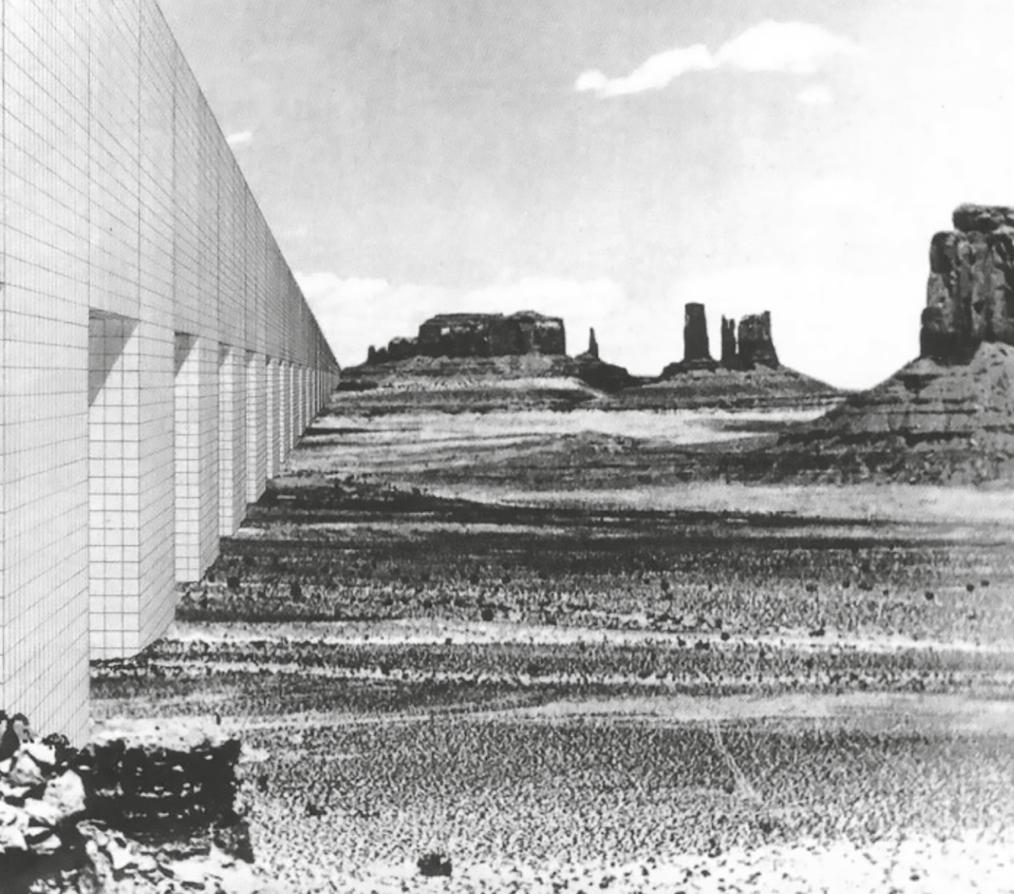
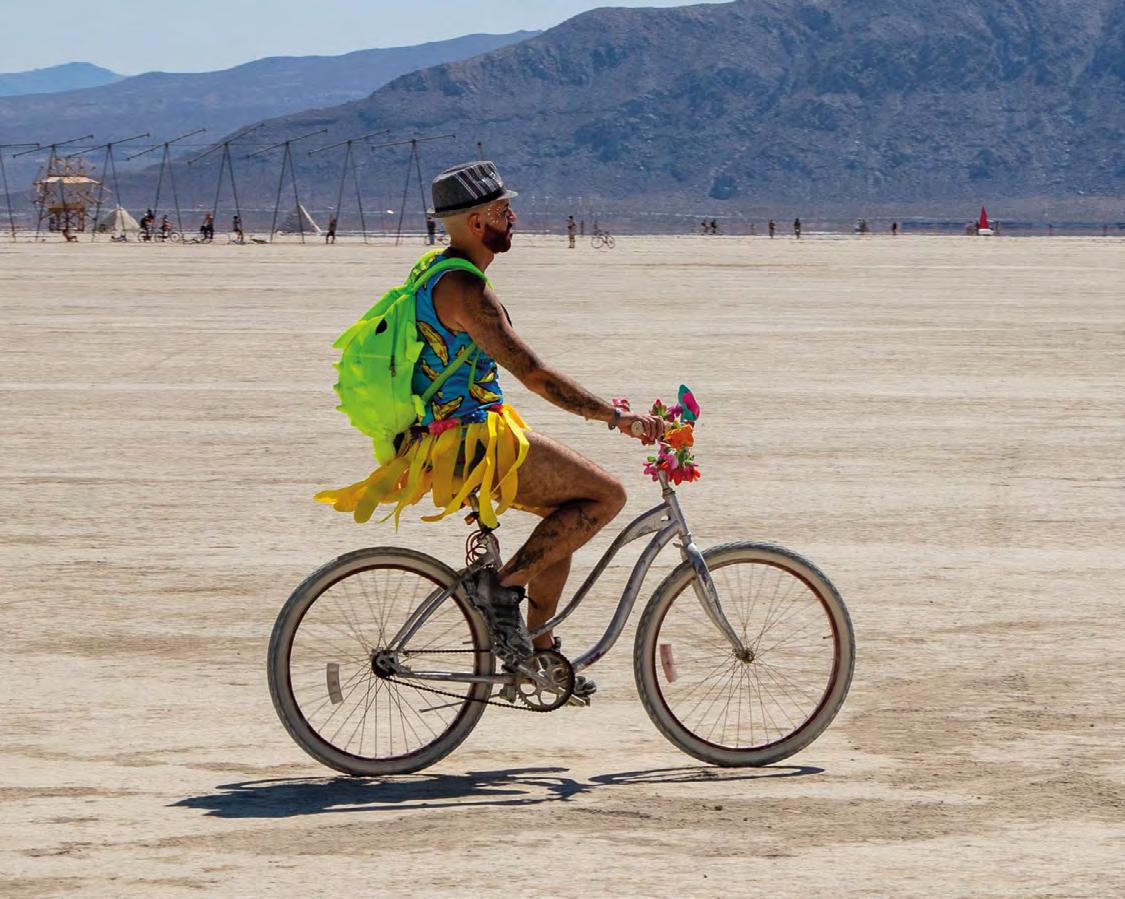
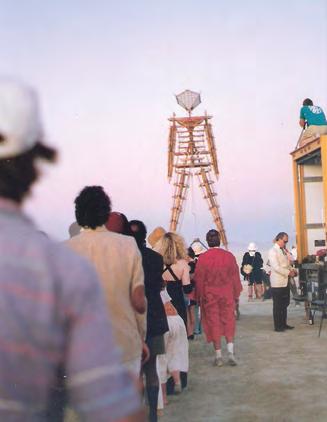
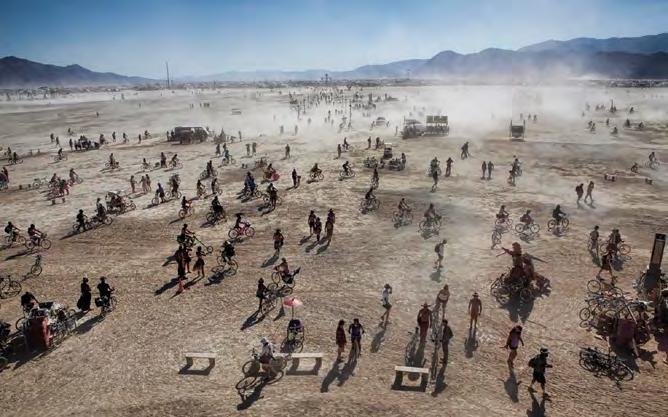
alcune delle forme in cui il deserto è stato attraversato, abitato, prodotto, trasformato, utilizzato e interpretato attraverso contributi che affrontano il tema in relazione ai modi in cui l’architettura ha conferito significato politico, economico, sociale e culturale a uno spazio così profondamente connotato dal punto di vista ambientale. Senza pretesa di esaustività, questa raccolta di saggi ha l’ambizione di tracciare la varietà e la diversità di senso che il deserto ha acquisito attraverso l’architettura, in un racconto che procede da un passato ancestrale a un futuro di mondi non più necessariamente, o non più soltanto, terrestri. Sui fenomeni di lunga durata e le relazioni tra passato e presente sono incentrati i contributi di Salma Samar Damluji e Claudia Pirina. Damluji sviluppa la propria riflessione sul Sahara come luogo solcato da un articolato sistema di scambi e rotte carovaniere: traiettorie conduttive orizzontali, a supporto di quella incessante trasmissione di saperi, idee, conoscenze tecniche e linguaggi che, ancora oggi, è possibile riscontrare nelle analogie tra forme costruite lontane anche migliaia di chilometri. Pirina si concentra invece sulla dimensione verticale, esaminando l’azione di scavo come dispositivo architettonico attraverso il quale è stato possibile realizzare spazi dell’abitare ricavati nello spessore del suolo, e rintracciando nella tradizione alcuni principi insediativi che hanno costituito il modello per sperimentazioni contemporanee. Nel testo di Carmen Armenteros Puchades e Lucia Concetta Vincelli il deserto è inteso come “spazio transitorio per artisti, migranti, biodiversità e commercio” nel quale si intrecciano linee che spaziano dall’economia all’ecologia, dalla cinematica al desiderio, veicolando plurimi significati e immaginari in un processo di progressiva astrazione dal reale. La città-carovana del Burning Man nel deserto del Nevada – luogo dell’abitare (in?)-sostenibile, temporaneo e performativo per eccellenza – è oggetto del contributo di Caterina Padoa Schioppa, che ne esplora “complessità, occasioni e opportunità” in relazione all’ambiente nel quale ciclicamente si insedia e si riproduce, in una paradossale materializzazione e perpetuazione dell’accampamento di Vita-Supersuperficie dei Superstudio. Sui processi di produzione di nuovi deserti, anche laddove la vege-
formed, used and interpreted, through contributions addressing how architecture has given political, economic, social and cultural meaning to an environment so deeply defined in climatic and physical terms. Without claiming to be exhaustive, this collection of essays aims to trace the variety and diversity of meanings that the desert has acquired through architecture, in a narrative that moves from an ancestral past to no longer or not necessarily terrestrial futures.
The contributions by Salma Samar Damluji and Claudia Pirina focus on long-term phenomena and the relationship between past and present. Damluji develops her reflection on the Sahara as a place traversed by a complex system of exchanges and caravan routes: horizontal trajectories supporting that incessant transmission of knowledge, ideas, technical skills and languages, which can still be observed today in the similarities between built forms thousands of kilometers apart. Pirina, instead, focuses on the vertical dimension, examining excavation as an architectural operation for creating living spaces carved into the ground, and identifying some traditional settlement principles that have served as models for contemporary experiments. In the text by Carmen Armenteros Puchades and Lucia Concetta Vincelli, the desert is seen as a “transitory space for artists, migrants, biodiversity and trade”, where lines intersect from economy to ecology, from kinematics to desire, conveying multiple meanings and imaginaries in a process of progressive abstraction from reality. The caravan city of Burning Man in the Nevada desert – an exemplary space for (un?)-sustainable, temporary and performative living – is the subject of Caterina Padoa Schioppa’s contribution, which explores its “complexity, occasions and opportunities” in relation to the environment in which it cyclically settles and reproduces, in a paradoxical materialisation and perpetuation of Superstudio’s Vita-Supersuperficie camp. Michele Tenzon’s text focuses on the processes that produce new deserts, even where vegeta -
tazione è tra le più rigogliose, si concentra il testo di Michele Tenzon, che tratta della “desertificazione fisica e metaforica come premessa allo sviluppo” nel bacino del fiume Congo e offre l’occasione per riflettere sulle conseguenze ambientali determinate da uno sfruttamento iniquo delle risorse. Al deserto come proving ground per l’architettura spaziale è infine dedicato il saggio di Marina Tornatora e Giacomo D’Amico, che propone una duplice lettura dell’ambiente desertico come ambito di sperimentazione per la prefigurazione di soluzioni architettoniche e insediative al di fuori dell’ambiente terrestre e luogo fecondo per la costruzione di immaginari cosmici.
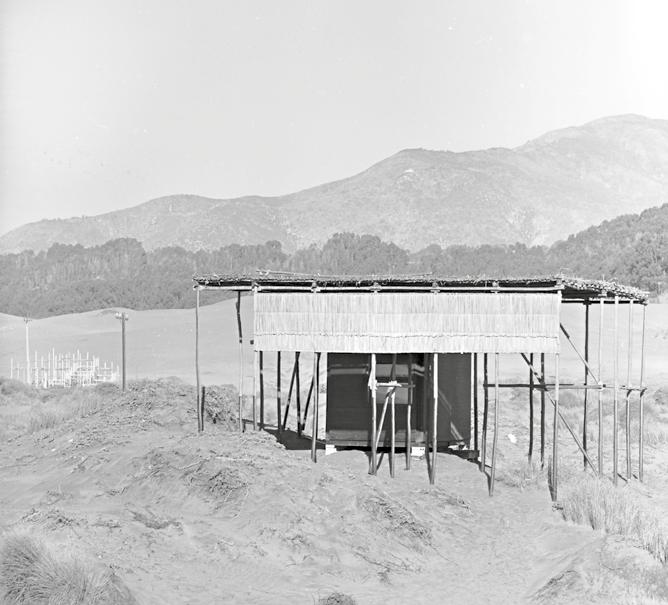
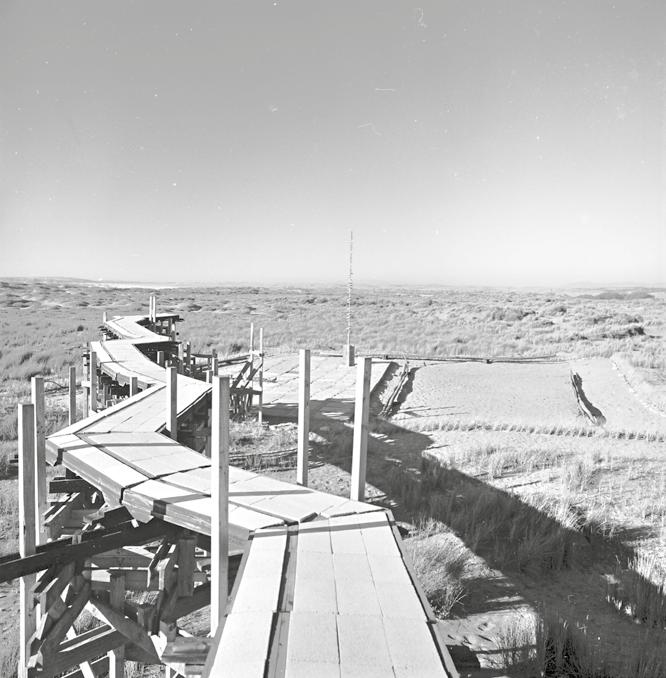
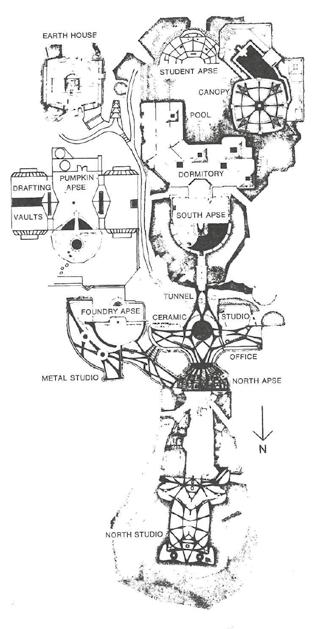
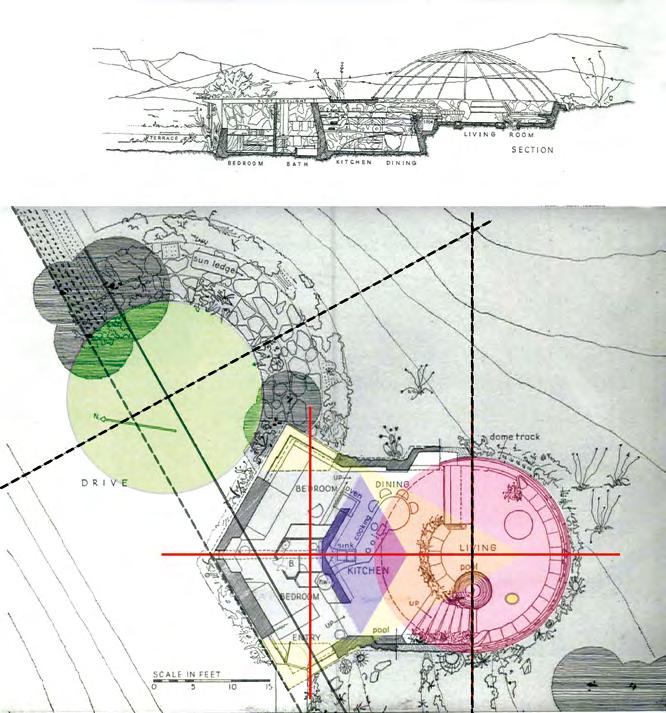
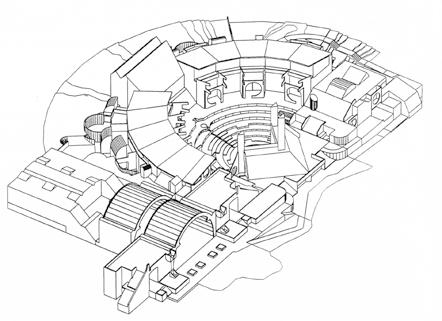
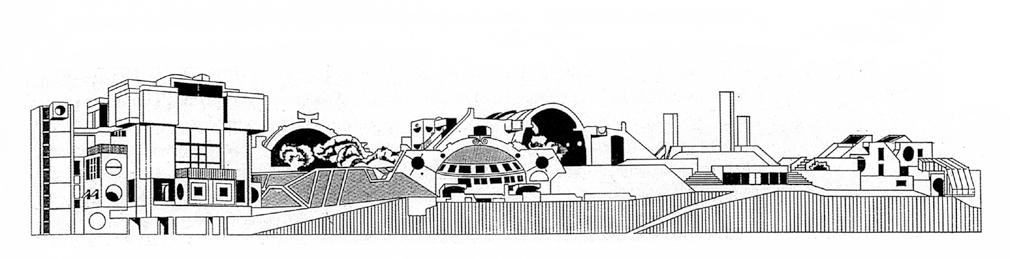
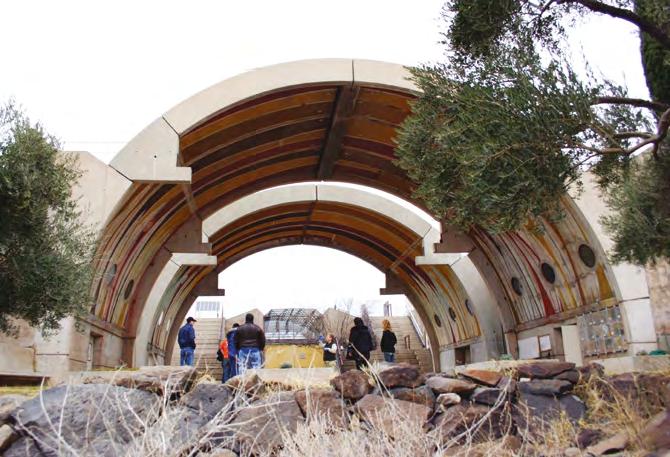
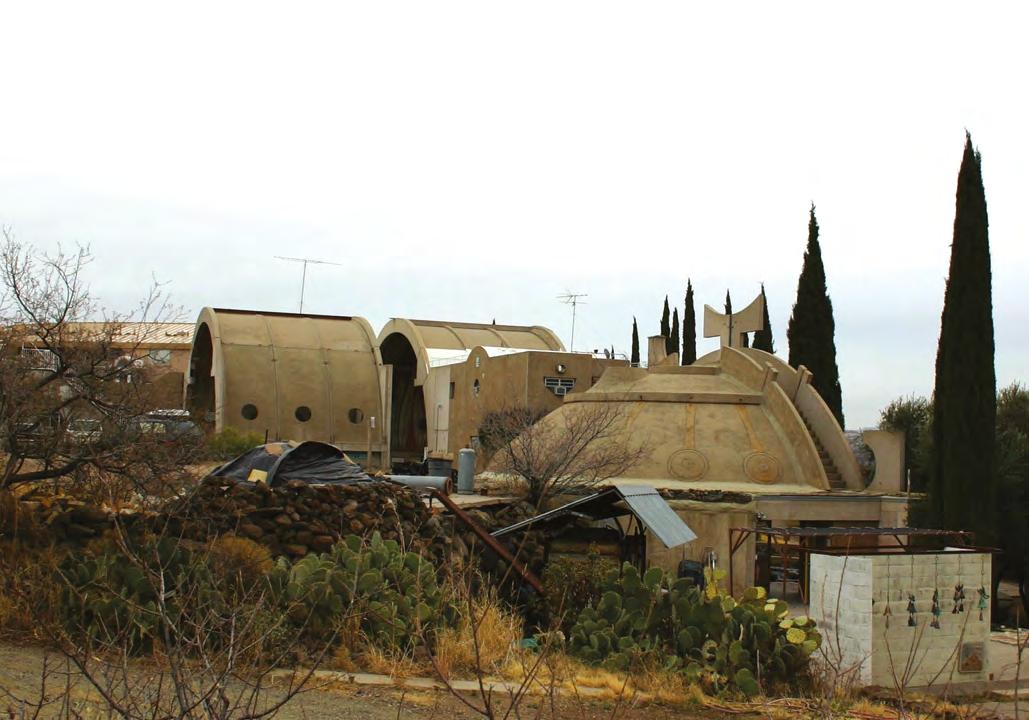
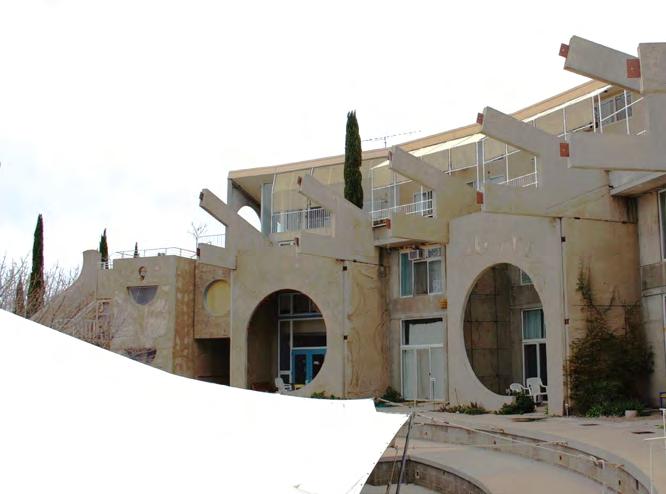
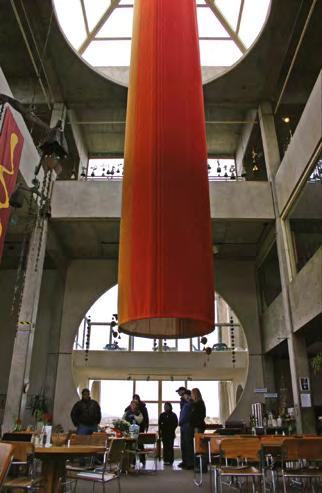
La sezione Immersioni di OFFICINA* esamina due esperienze urbane (in)compiute nel cuore dei deserti americani: la città aperta di Amereida, in Cile, e il lavoro di Paolo Soleri in Arizona, rispettivamente oggetto dei contributi di Santiago Gomez e Cristina Pallini. Seppur entrambe nutrite da uno spirito visionario e alimentate dalla ricerca di una stretta interdipendenza tra natura e artificio, i testi mettono in luce come esperienze simili divergano profondamente per intenzioni e risultati. Sull’utopia urbana di Soleri ritorna l’intervista di Laura Villa Baroncelli, Marco Manfra e Ivan Severi a Pete Seiter, ex Arconauta, le cui parole offrono uno sguardo critico sulla vita ad Arcosanti a più di mezzo secolo dalla sua fondazione.
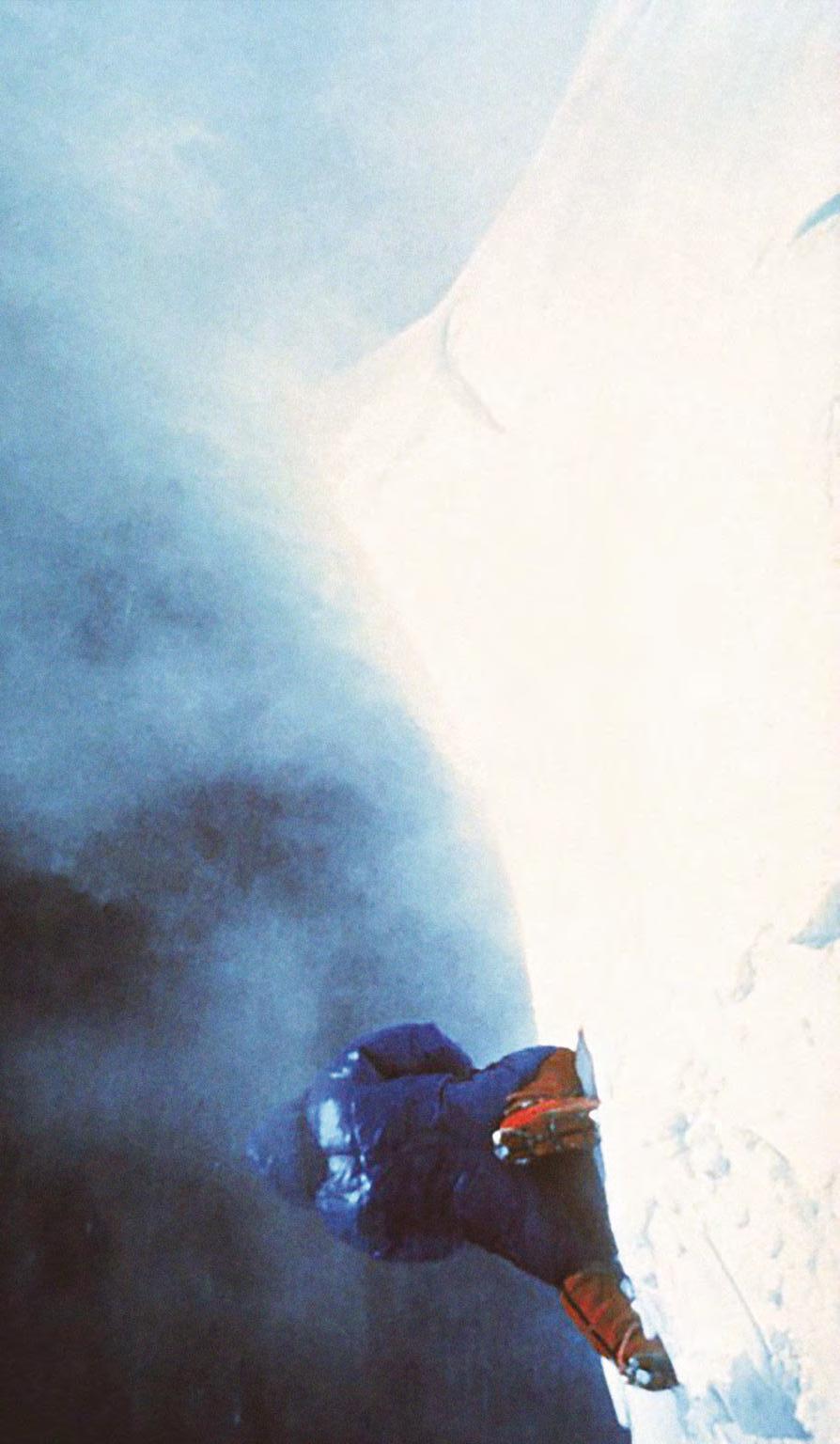
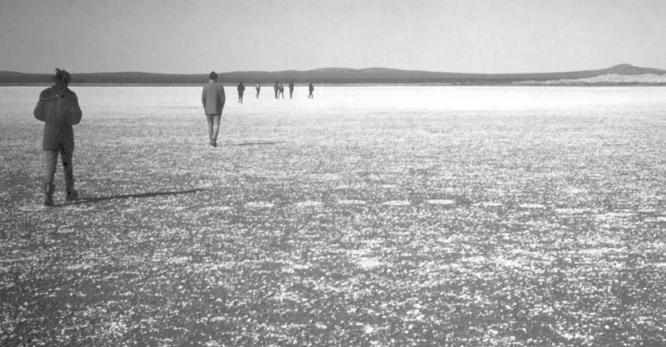
A due deserti altri, lontani da quell’immaginario consolidato di sabbia e roccia al quale il deserto è comunemente associato, sono dedicati I Corti di Viola Corbari e Benedetta Di Donato, Luca Reale e Francesco Tosetto, entrambi incentrati su esperienze e paesaggi desolati e disertati, l’uno nella pianura, spazzata dai venti, del Dungeness, l’altro nel deserto bianco del ghiaccio e dell’alta quota; ed entrambi opera di artefici di architettura non immediatamente o direttamente riconducibili allo specifico disciplinare.
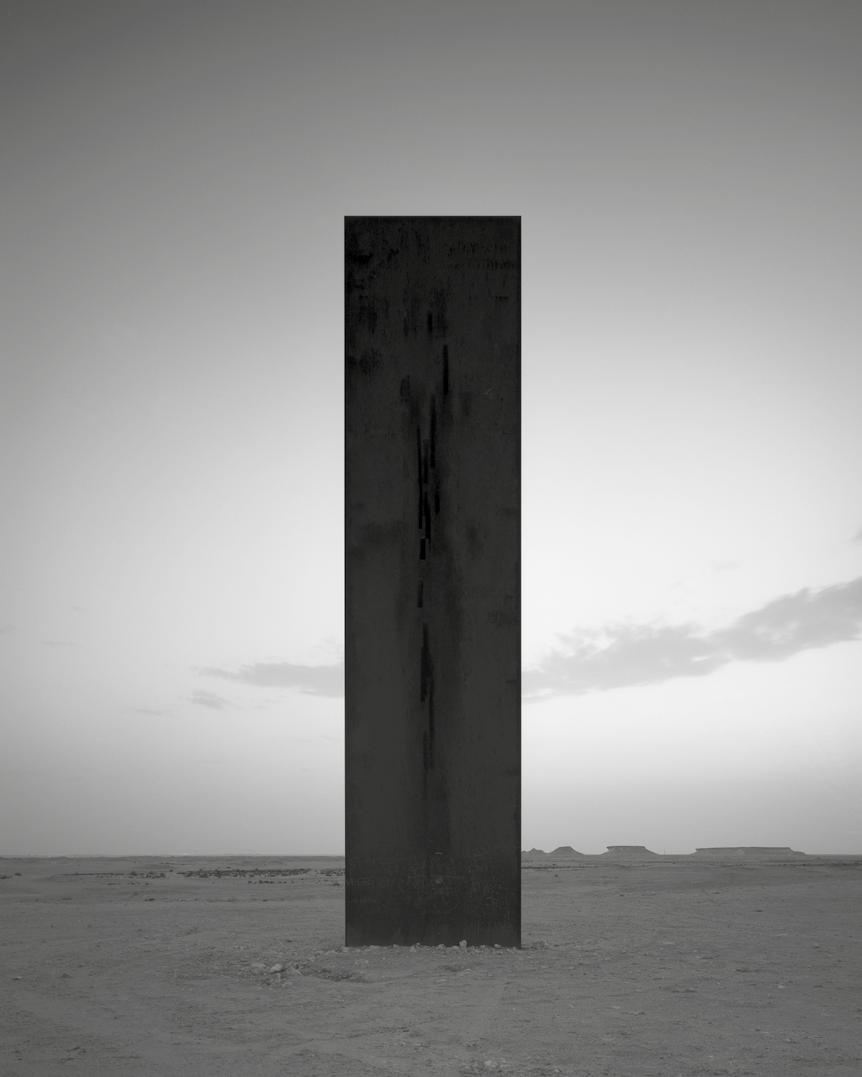
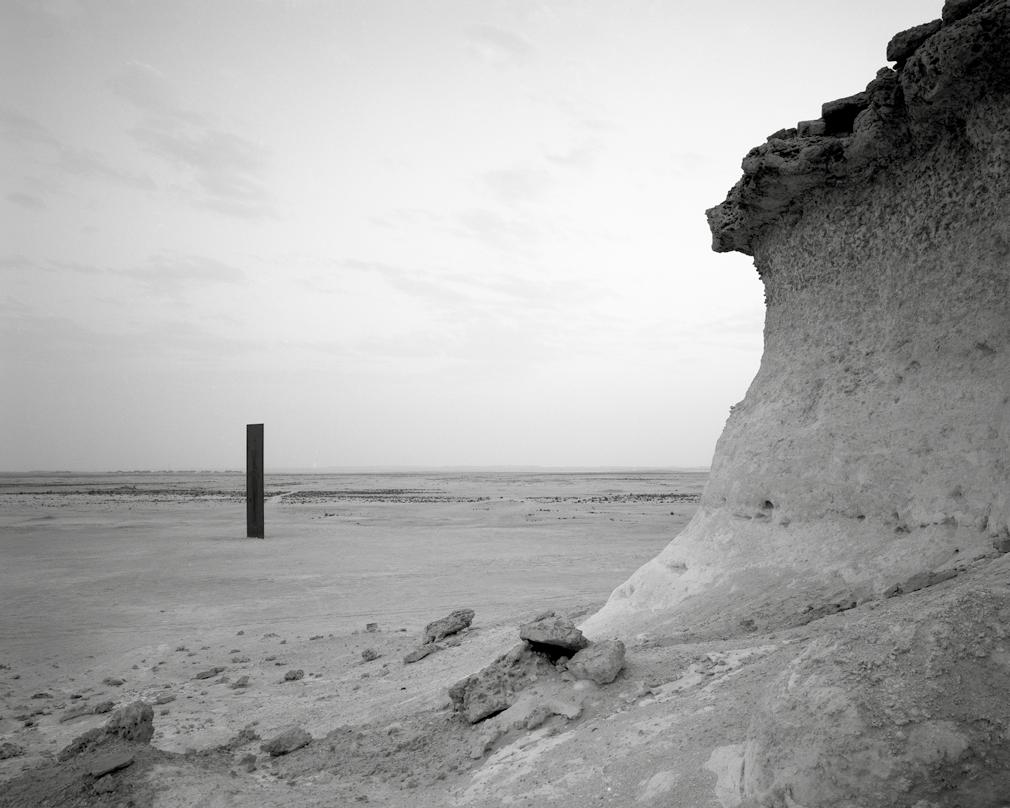
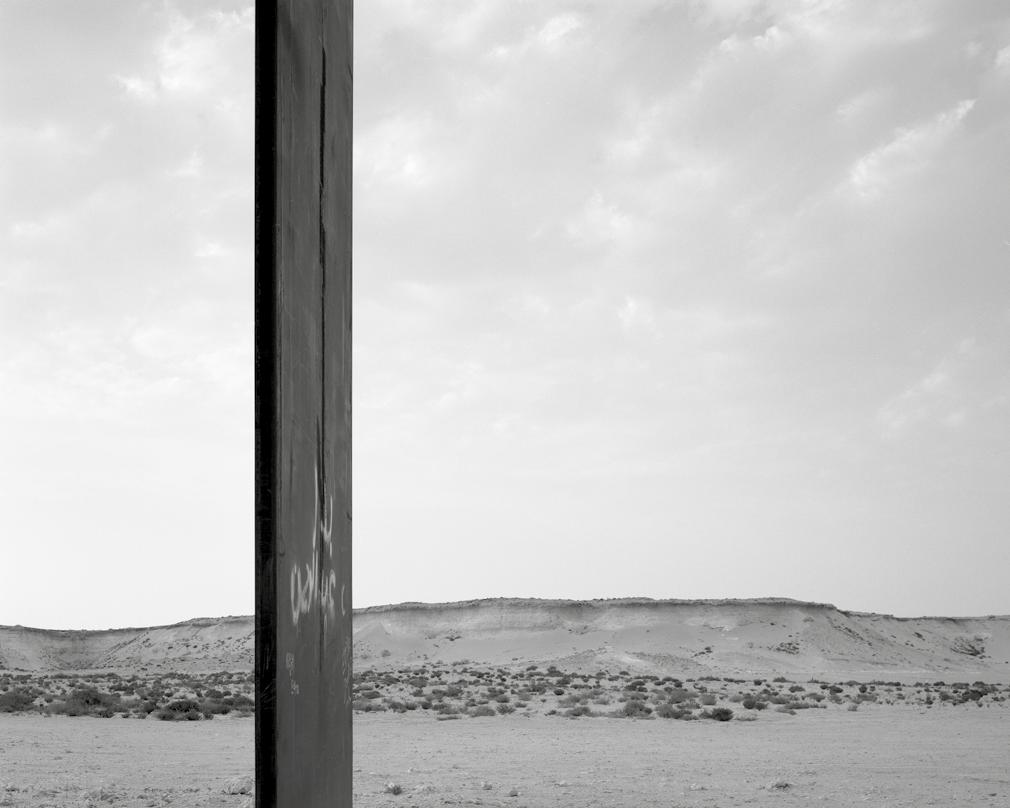
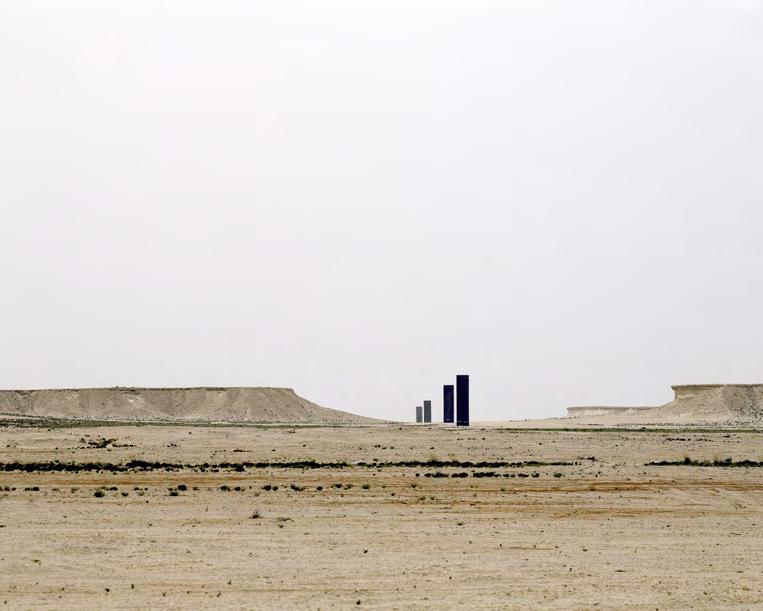
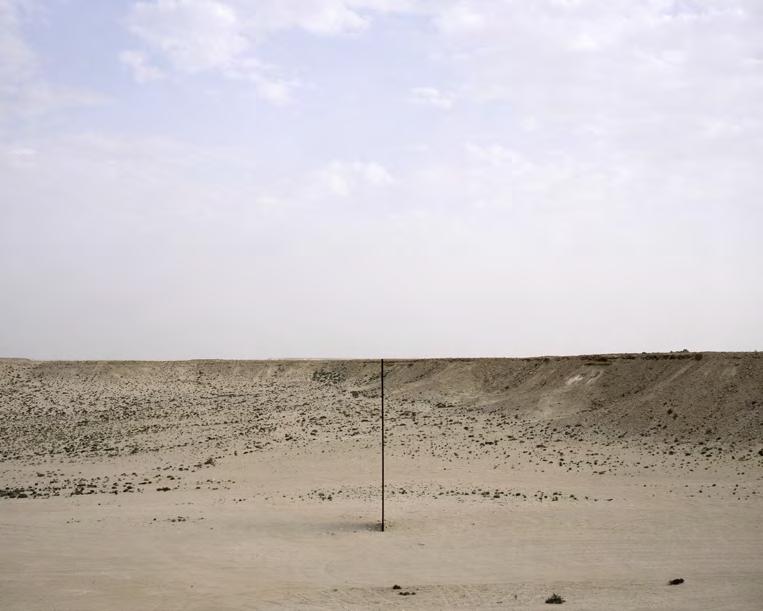
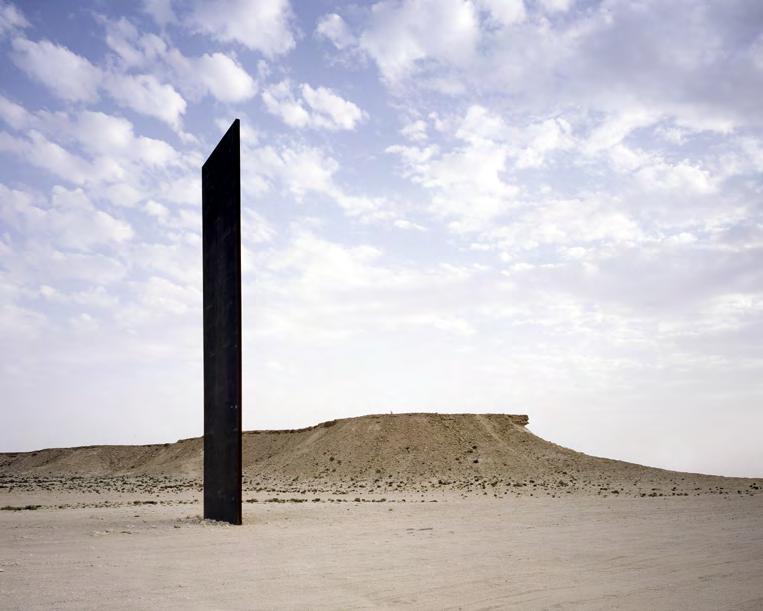
Il Portfolio di Matteo Benedetti completa, infine, il numero con un repertorio di immagini dedicate all’opera di Richard Serra East-West/West-East che, situata nel deserto del Qatar, “crea un luogo” anche laddove lo spazio, sconfinato e disteso, sembrerebbe rifiutare ogni possibile azione di razionalizzazione e misura.*
tion is most lush, discussing “physical and metaphorical desertification as a precondition for development” in the Congo Basin, and offering a deep investigation on the environmental consequences of unequal resource exploitation. Finally, the essay by Marina Tornatora and Giacomo D’Amico is dedicated to the desert as a proving ground for space architecture, proposing a dual reading of the desert environment as a space for experimentation in prefiguring architectural and settlement solutions outside the Earth, as well as a fertile terrain where cosmic imaginaries could take shape.
The Immersioni section examines two (un)completed urban experiences in the heart of the American desert: the open city of Amereida, in Chile, and Paolo Soleri’s work in Arizona, discussed respectively by Santiago Gomez and Cristina Pallini. Although both are driven by a visionary spirit and a search for a close interdependence between nature and artifice, the texts show how these experiences differ profoundly in their intentions and results. The interview with ex-Arconaut Pete Seiter, conducted by Laura Villa Baroncelli, Marco Manfra and Ivan Severi, revisits Soleri’s urban utopia and offers a critical perspective on life in Arcosanti more than half a century after its foundation.
The Corti by Viola Corbari with Benedetta Di Donato, and Luca Reale with Francesco Tosetto are dedicated to deserts which escape the consolidated images of sand and rock. The two contributions address desolate and deserted experiences and landscapes. While the former focuses on the wind-swept plains in Dungeness, the latter deals with the white desert of ice and high altitude: both, however, result from the work of people not trained in architecture.
Finally, The Portfolio of Matteo Benedetti completes the issue with a collection of images dedicated to Richard Serra’s East-West/West-East installation in the Qatar desert, which “creates a place” even where the vast and expansive space seems to reject any possible action of rationalisation and measurement.*
Opportunities in the emergence | V2. Jacopo William de Denaro
Salma
Samar Damluji
Professor of Architecture, Binladin Chair for Architecture in the Islamic World, Maroun Semaan Faculty of Engineering and Architecture, American University of Beirut. ssdamluji@btinternet.com
Cities of the Desert Route
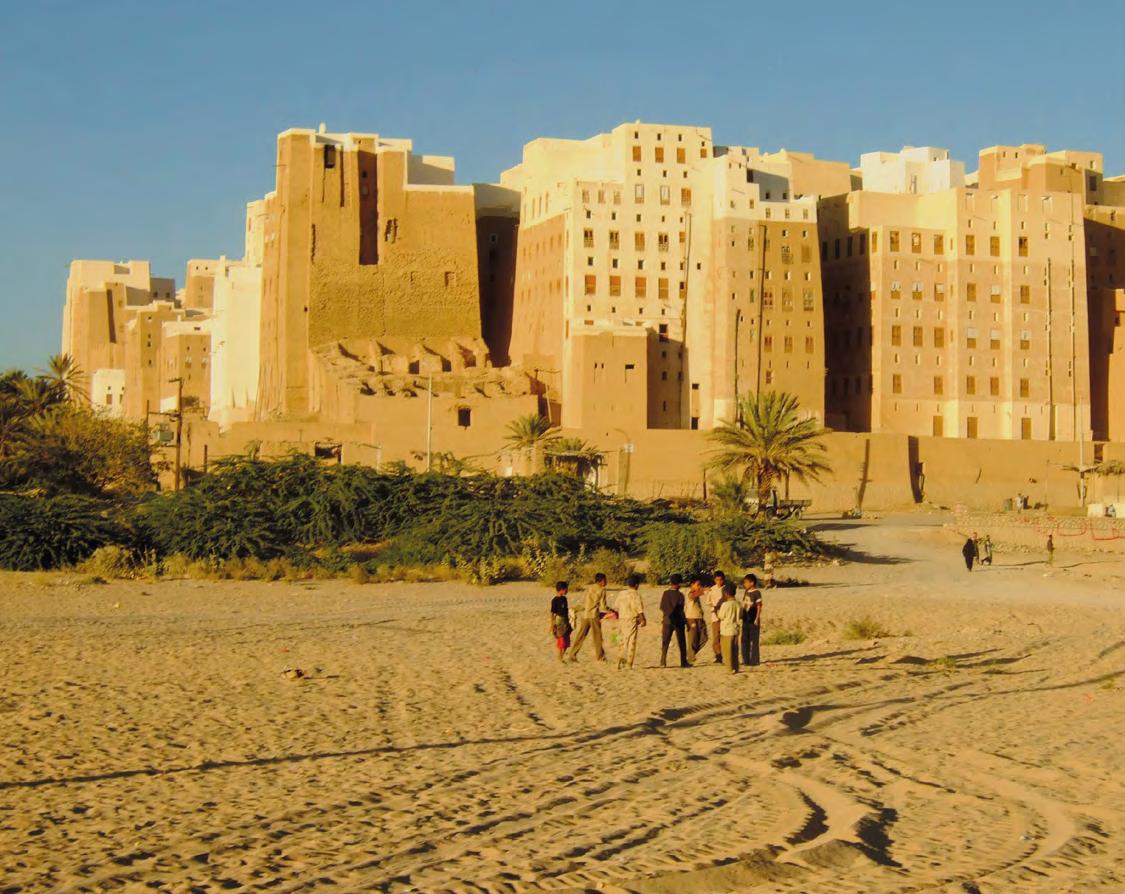
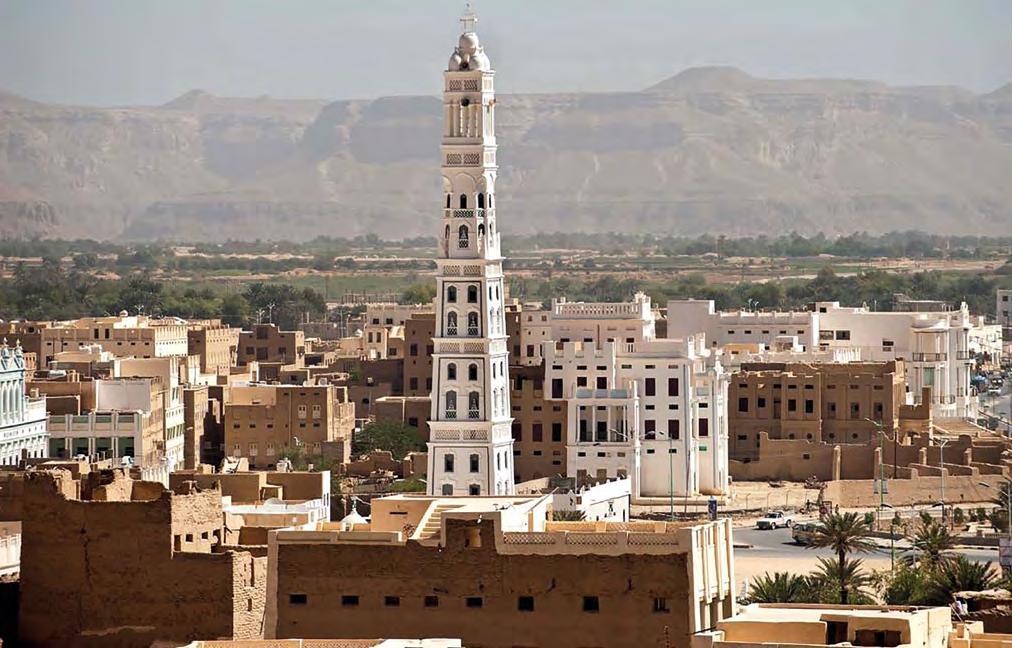
01. City of Shibam, Yemen | Città di Shibam, Yemen. N. Wil
Le città della rotta del deserto Esiste una lunga connessione, non adeguatamente affrontata, tra l’architettura della penisola arabica meridionale e quella del Nord Africa.
L’Alto Atlante marocchino e la provincia yemenita di Hadramut condividono una forte somiglianza nella forma, nel contenuto, nello stile e nella disposizione urbana, in particolare nella costruzione di edifici pluripiano rispettivamente di terra battuta e mattoni di fango. Ulteriori indagini rivelano che queste tecniche furono trasferite da un luogo all’altro via terra e via mare. L’architettura di paesi e città, costruiti lungo le rotte commerciali, dell’incenso e delle carovane, condivideva un linguaggio, i medesimi elementi costruttivi e uno stesso vocabolario, così come affinità nella topografia e nella distribuzione del tessuto urbano.*
There has been a long connection which has not been properly addressed between the architecture of the southern Arabian Peninsula and that of North Africa.
The Moroccan High Atlas and the Yemeni province of Hadramut, share a stark resemblance in the form, content, style, and layout particularly in the construction of several storeys of rammed earth and mudbrick respectively. Further investigation reveals that these techniques were transferred across land and sea. The function of the architecture shared the same language, elements, or vocabulary, and so did the topography and distribution of the urban fabric of towns and cities that were built along trade, incense, and caravan routes.*
A network of shared knowledge
he desert as a crossroad of people, trade, and culture
The cities and civilizations that made the Sahara habitable and populated include a desert route network that formed a crucial bridge between different cultures rendering the transmission of culture and knowledge possible. This connection, through caravan routes, encouraged and fostered the transmission of ideas, technical know-how and language, that is still visible and tangible. With trade transfer commerce, the spatial accommodation for lodging, shelter, storage and exchange of goods (Allaby, 2006, p. 134) contributed to the formation and typology of building that expanded since ancient times in areas along the desert route.
The desert/oasis route from Arabia to the High Atlas region identifies with prominent cities in Yemen, and a culture that flourished via Cairo, along the western oases of Egypt, the southern Libyan desert, best exemplified in Ghadames (Cousin, 2010), across the Algerian Saharan settlements’ tangible in the valle du Mzab, provinces of Ghardaia, Bechar, el Oud (Terki, 2009), spanning to the High Atlas region of Morocco1. This line prospered with caravan convoys that crossed towns forging associations and settlements along the way, to enhance and accommodate the movement of trade and exchange. This paper investigates the cultural context that contributed to the formation of this thread to present a relevant hypothesis for its material contribution and the impending challenges posed through desertification, with climate change, and political segregation through increased capitalist intervention.
Earth architecture, as a viable alternative resource for future construction and design, was advocated since the 1940s in the work and projects of Hassan Fathy in Egypt (1901-1989). His valuable research in upper Egypt, the villages of Aswan and Nubia (Damluji and Bertini, 2018, pp. 76-91), evolved into significant projects and living examples of contemporary earth architecture, most pertinent to the desert context particularly in the village of New Baris (1965) (Ivi, pp. 220-259).
As an alternative discipline, earth architecture involves the development of and investment in natural building materials and resources, in response to the erosion of ecological landscapes and urban environments. Reengaging the natural landscape flora, fauna, agriculture, and irrigation within the ultimate scope and vision of architecture and town building is a prerequisite. More important is the imperative understanding of the rehabilitation and reconstruction of desert landscapes, towns and cities that have been marginalised, or deserted due to abandonment with the obliteration of land trade routes, industrialisation, migration, displacement, natural disasters, climate change, or those destroyed through wars or inflicted conflict. Capitalist and colonial expansion notwithstanding, the successive occupation and segregation of geo-political land (or countries), for exploitation by industrial regimes (Karimi, 2023) in the war for geological resources, including phosphate, oil and gas in the Middle East, Arabia and Africa has resulted in segregating and isolating desert areas and settlements. This is further attested by the increasing interest in the current architectural narrative on deserts as a heightened point of reference and interest, with these centres or “places can no longer serve as abstracted intellectual landscapes approached with measured indifference to their particular histories” (Karimi, 2023).
The short scope of this article merely allows to touch the historical trail and connection that was inspired by an ideological and cultural narrative. In contesting the orientalist image of the desert as empty or devoid of life, culture or habitat, the narrative instead points out a fecund movement of encounters and lucrative exchange, with alliances and investments, and a political agency (Franz, 2011, pp. 12-13), that was practiced amongst the tribes, bedu and inhabitants, with the influx of movement and settlement across vast borderless train from east to west. During the Islamic period, the encounter between north Africa and Arabia, flourished from the 8th century CE well into the 14th century CE resulting in a spatial system and network of cities, towns and villages that coexisted and cultivated important economic and political centres.
Poetry, Kingdoms and Trade
The finest Arab poetry and literature of pre-Islamic Arab poets, originated in the environment of 6th century Arabia, culminated in the famous “seven odes” or Mu‘allaqat (Britannica, 2022a). The richness of the language, vocabulary and imagery remains unprecedented as a unique reference to early Arab poetry, literature and rhetoric. In these extensive generous poems are descriptions of the lives of the bedu (nomads), and account of hunting, wars, unrequited love, journeys and cities.
The Arabs were known to be either residents of cities villages (urban) or of tents (nomads), with a strong alliance and inter connection between them two. Arabia’s destination at the centre of the caravan route since the 1st century BCE between India and the Mediterranean, the Persians, Aramaeans, Nabatean, Romans and Egyptians. Civilisations and Kingdoms were set up, trade and commerce flourished in routes between the Kingdom of Himyar in the Yemen, renowned for the engineering sciences and irrigation systems, (as manifested in the Ma’rib dam destroyed in 115 BCE), the desert city of Petra that received all the trade between east and west, and Palmyra to the north. These cities included temples, palaces, forts, inscriptions, crafts and ornamentation. Trading in commodities that included highly sought incense, myrrh, perfumes, leather goods, Yemeni swords and weaved embroidered robes known as burd. During the 3rd century CE, the empires of the Sassanids in Persia (224-651), and Byzantium in Constantinople (3241453), were vying for the hegemony of Arab lands. The Arabs in turn had two competing states: the Christian Ghassanids (Britannica, 2022b) who immigrated from Yemen in south Arabia in the early 3rd century CE to Syria and formed their state that ruled from the 3rd-7th century CE, and the Lakhmids (Manadhirah) kingdom (late 3rd century to 602 CE) in south Iraq and east Arabia with their capital in Al-Hirah near Kufa. They forged alliance with the Persians and fought the Romans. In the middle of the 5th century the kingdom of Kindah in Najd (c. 450-540) current Saudi Arabia, by a tribal bedioun Yemeni dynasty who expanded north and overtook power from the Lakhmids in Hi-
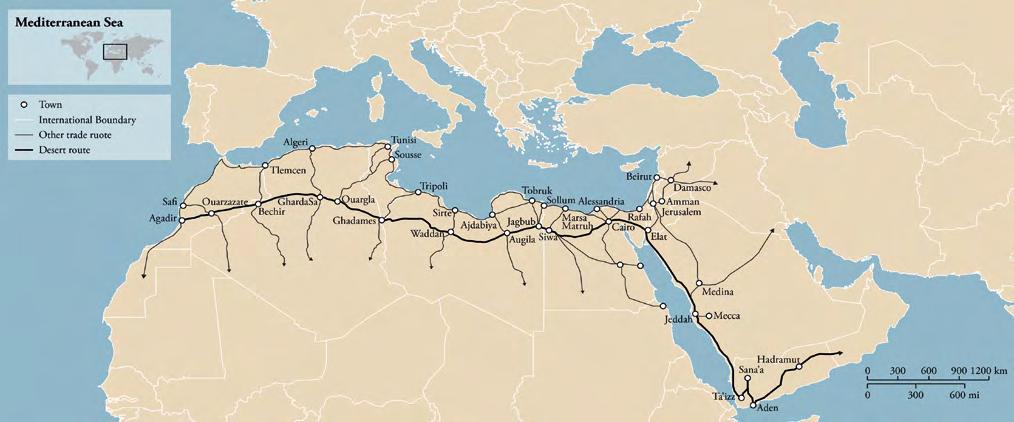
02. Illustration showcasing the desert route, derived from the maps in Petruccioli and Montalbano (2011, p. 30) and Michell (1995, pp. 8-9) | Illustrazione della rotta nel deserto, ricavata dalle mappe di Petruccioli e Montalbano (2011, p. 30) e Michell (1995, pp. 8-9). M. Kfoury, E. Vendemini
rah (Iraq) (Britannica, 2022c). Amongst the earliest and most distinguished of the famous poets in the 6th century was Imru’ al Qais (d. 500). The son of the last kings of Kindah whose poetry embodied memories of his beloved, descriptions of desert scenes, horses, and references to wine. He was expelled twice from his father’s court for writing erotic poetry (Al Fākhūry, 1989, p. 16). It was this historic context and fabric of cities and kingdoms, cultures and civilisations that inspired poets of the Jahliyah period (pre-Islamic Arabia before 609 CE), who created a solid structure and platform for Arab poetry that celebrated the desert life and journeys.
The Islamic expansion that was initiated between 628633 CE continued up to the 10th century (Franz, 2011, p. 25). Amongst the migrations of the 8th century were the Ibadis from Basra (Iraq) who developed a longdistance trade network, armed with learning and political ideology. “Out of the early, often violent, opposition of the seventh century originated one Basran group, the Ibadiyya, whose political moderation, doctrine and affinity for long-distance trade secured its future [...] Eighth century Ifriqiya, in North Africa, proved fertile ground for Ibadi missionaries, whose efforts fell in step with the almost rhythmic revolts of the indigenous Berbers and Christians”2 (Savage, 1990, pp. 5-13).
buildings in the High Atlas, Algerian Sahara and Ghadames in Libya, with those of the Yemen.
What is established, is that “as early as the ninth century, Berber speaking merchants settled in commercial centres in the Sahel belt where they acted as hosts and business agents for fellow Muslims who organised caravans in the corresponding entrepots along the northern rim of the desert” (Dunn, 2005, p. 293). The new centres of power in Islamic capitals demands expanded the African connection and acquisition of precious commodities. Earlier in his book on The Adventures of Ibn Battuta Dunn writes that “the founding of the Arab Empire and […] the High Caliphate created an ever-growing demand in the Islamic heartland for West African gold to make coins and finery. This demand impelled Muslim merchants and cam-
In contesting the orientalist image of the desert as empty or devoid of life, culture or habitat, the narrative instead points to a fecund movement of encounters and lucrative exchange
A significant migration in population is also attributed to the Banu Hilal tribes that had settled hailing from Najd in Arabia settling in Egypt, during the Fatimid period of 909–1171, and sent out to rule Tunis and eventually north Africa.
The role of Ibadis (who were present in Yemen and in Hadramut in particular) (Al-Azmeh, 198, pp. 215-222)3 along with the Banu Hilal tribes in the 11 CE points to the source of connection to consider in the migration of builders and craftsmen equipped with skills, and techniques from Arabia to the Maghreb, that attests to the parallels found between the
eleers of the Maghrib and the North Sahara to organise transdesert business and transport operations to an unprecedented level of sophistication” (Ivi, p. 291).
By the 11th century “[A] route of palm and cities that connects the Mediterranean Sea with Subtropical Africa through the Sahara” (El-Bekri, 1913) was the description provided by Abou Obeid El-Bekri, Muslim geographer of the that century offering a perspective and insight to the movement of cultural and economic exchange through trade that was active since the 8th century. This resulted in a map of destinations and encounters ruled by the expanse of miles and untold time, indifferent to the connotation inherent in the etymology of desert.
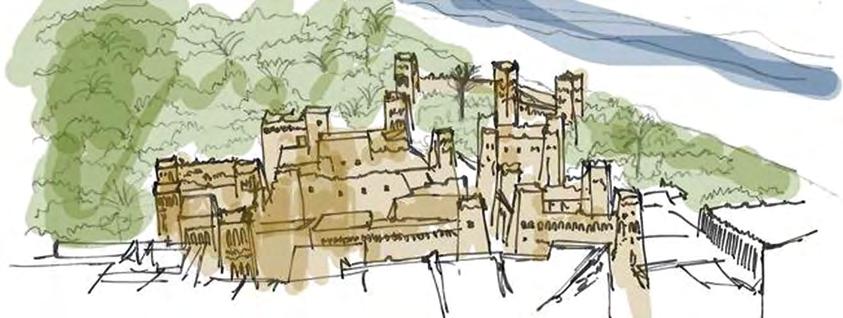
03. Sketch of Ait Ben Haddou | Schizzo di Ait Ben Haddou. M. Kfoury, 2019
The Arab geographer Muhammad al-Idrisi4 (Al-Idrisi, 1154) narrates in the 12th century that “the medieval iconography and the descriptions of merchants and voyagers of the time confirm this unusual view of the desert, densely populated and verdant oasis, so much that can be crossed from north to south and from the Atlantic Ocean to the Red Sea in the shade of trees”5 (Laureano, 2001, p. 8).
The crossing of the desert would not have been possible without an in-depth knowledge of the routes and destinations, and without the experience of peoples who, despite the harsh climatic conditions, inhabited, and cultivated the oases across the miles of desert lands. The settlement of Arab merchants and tribes and the alliances with the Berber in the Maghreb, ensured the transfer of knowledge in culture, literature, science, and crafts, primary amongst which were architectural forms, and typologies in the construction of forts, mosques, villages and cities. “The Sahara as the Mediterranean has played a role of ‘internal sea’, a crossroads of society and economies. The immense desert separates but at the same time unites, selects, settles and, above all, forges”6 (Laureano, 2001, p. 8).
The commercial cities welcomed the caravans that came from the desert, since the same caravan did not carry out the entire crossing, and the exchange and repose occurred at these focal stops. These areas became centres of activity and wealth, located in strategic places in the territorial organisation that together form “a rigorous network: horizontal bands with similar geographical-climatic environments, and perpendicular axes along the trans-Saharan penetrants”7 (Laureano, 2001, p. 151). The most important cities were located at the intersection of the perpendicular axis of trans-Saharan trade and the range of horizontal routes that controlled eastwest communications.
The settlements that make up the heart of this structure were the gravitational centre of North-Western Africa. However, at the end of the 15th century, when the circumnavigation of Guinea Gulf and the new geographical discoveries created a different new itinerary for commerce, the desert routes fell
into disuse. With the decline of the economy, desert sands quickly swallow up entire cities, and vast irrigated regions were cancelled due to the abandonment of hydraulic works (Laureano, 2001, p. 10).
The above gives a glimpse of the history of the lucrative exchange and associations in the connection of the routes and transfer of culture and architecture particularly in desert landscapes, between the Sahara of Maghreb, west Africa and Yemen with Egypt as a focal point of connection, migration and transfer that mapped the trajectory of culture and architecture. Evaluating the typology of “desert architecture” based on the above hypothesis presents an analogy that can be read in the narrated discourse vis a vis the Hadramut and the Altas. This is not to exclude affiliated cities and towns on the desert route in Yemen, Egypt, western desert oases of Egypt including Siwa oasis, Ghadames in Libya and Matmata or Tataouine (Tittawīn) south and southeast Tunis receptively, across the Algerian Sahara, that lie beyond the scope of this paper (img. 02).
The Atlas region
The desert architecture of the Atlas region8 is defined and characterised by rammed-earth buildings, correlated with and connected to the Berber construction tradition, tangible in the large fortresses. The rammed earth techniques called zābūr was highly developed in the Yemen mountains of the northern province of Sa‘dah, in the Asir region (Saudi Arabi) and in Ma’rib, and remains in use in constructing several stories, as in previous vast and luxurious palaces still standing across the country. When the walls fortifying the capital city of Sanaa were reconstructed in the early 1990s, they were rebuilt in zābūr (img. 03).
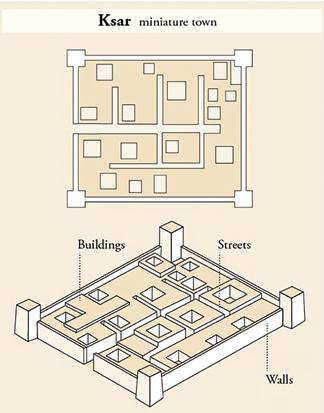
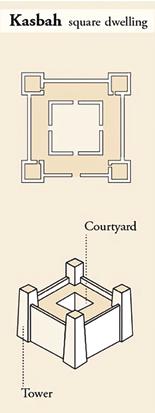
The Kasbah or Tighremt is a fortified castle built by local authorities in a strategic location (Michon, 1986): the one-square dwelling built around a courtyard towers, with several storeys, and a succession of enclosures. The Ksar (Ksour plural) is either several Tighremt or a small town surrounded by defensive walls with narrow alleyways and interior courtyards,
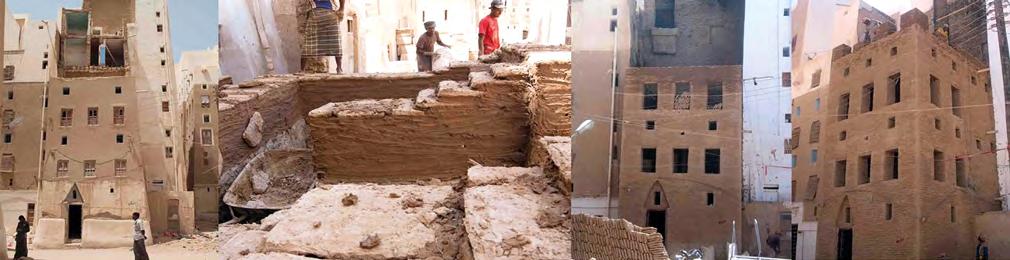
04. Earth Architecture in the Atlas Region | Architetture in terra nella regione dell’Atlante. E.Vendimini, 2020
“planned according to the classic Islamic standards with a strict separation of public and private areas” (img. 04).
As elaborated by Jean-Louis Michon’s report on earth architecture in southern Morocco for ICOMOS (1986), contrary to general belief, the cause of dilapidation and decay is not restricted to the fragility of the earth material. Other leading causes for dilapidation are interconnected, which he identified as “historical, socio-economic and cultural factors”. The deterioration of economic and social structure that supported these structures affected their long-term maintenance and durability. Consequently, these edifices fell out of use.
While the mountain dry-stone buildings almost merge with the rocky slopes, the rammed earth architecture melts with the landscape, affirming the impact of the local master builders and craftsmen. This architecture is nevertheless the product of the soil in deep harmony with its surrounding.
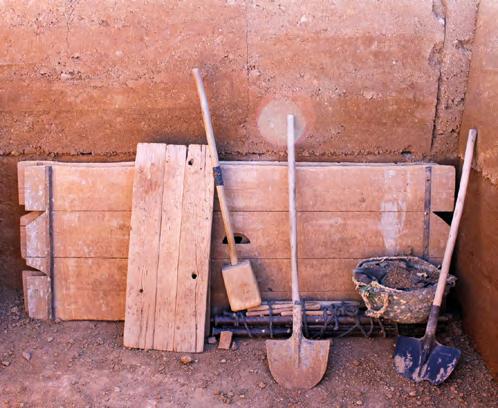
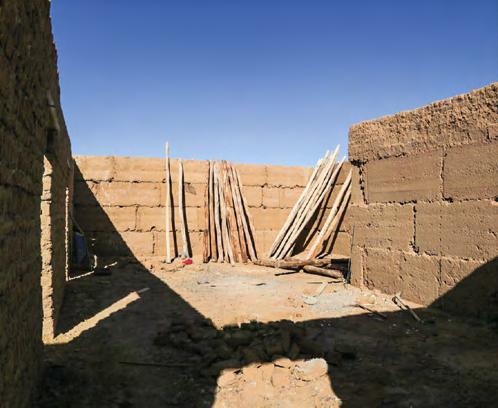
The landscape of southern Morocco is characterized by three elements scattered at regular intervals, for several kilometres, along ancient trade routes: “the river, the palm grove, and the architecture” (Filipovic and Troiano, 2013, pp. 172-179). Apart from the landscape, materials and architectural techniques are also similar and repetitive. The Atlas Mountain chain is a series of ranges separated by land areas and plateaus, separating the Mediterranean and Atlantic coastlines from the Sahara Desert. These different geographical areas depict different construction typologies and material usage. Dry stone constructions are available in mountainous areas, while riverbeds along the Draa and Dadès valleys reveal several typologies of rammed earth constructions (img. 05).
Yemen
Studying
where its most original and striking expression can be found in abundance, and – crucially – where highly specialized earth building practises still exist today. Whereas the context may be classified in the orientalist mind set as “desert” this is not valid since most of these settlements where constructed close to the Wadī Hadramūt one of the most fertile basins of Arabia. This notwithstanding the desertification creeping on Hadramut since the advent of cement urbanisation and transformation of agriculture lands to construction parcels for speculation.
Located in the southwestern corner of the Arabian Peninsula, bordering the Red Sea to the West and The Gulf of Aden to the East, Yemen’s geographical position placed it at the centre of a network of early urban civilizations (Damluji, 2021) and important incense trade routes. The challenges of its sub-tropical hot-arid climate, with fluctuating diurnal
desert
routes and
earth
construction techniques is essential for reimagining the sustainability and zero-carbon footprint future of our planet
The localized, contextual aspect of earth architecture’s vernacular character is perfectly represented in Yemen,
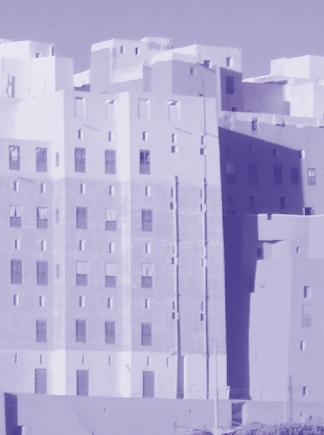
temperatures and variable rainfall (that causes drought and flash-flooding), and the limitations of its natural resources, necessitated the evolution of a distinct architectural institution that is characterized by its direct relationship to the local ecology, landscape, and natural materials, and by the ambition and ingenuity of its specialized building practises and design. In the walled city of Shibām (img. 01) (which in its current form dates to 1533) – that UNESCO describes as, “one of the oldest and best examples of urban planning based on the principle of vertical construction” – skyscrap-
05. Construction Sites 10 km from Erfoud, Draa-Tafilelt Region | Cantieri a 10 km da Erfoud, Regione Draa-Tafilelt. M. Kfoury, 2018
ers of mudbrick rise as much as twelve storeys high (UNESCO, World Heritage List).
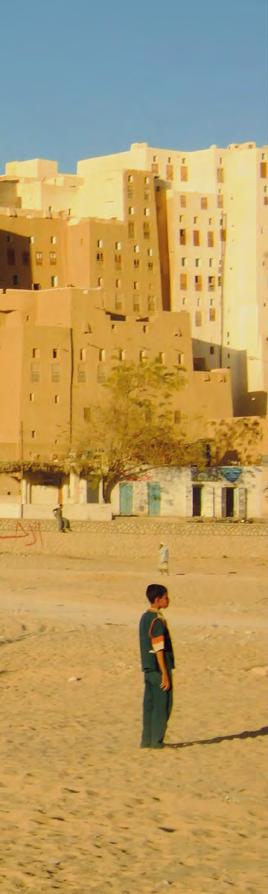
The city, with its surrounding landscape of spate irrigated agricultural land, comprises an integrated economic system of agriculture, mud generation, and the use of mud for building construction that no longer exists anywhere else in the region. In the town of Tarim, the mudbrick minaret of the Al Mihdhar mosque (completed in 1914) rises 53 m high with an internal staircase reaching all the way to its top. It is the tallest mudbrick structure in the world (img. 06). The Seiyun Hadhramaut Airport was constructed entirely in mud brick in the 1950s, proving how the earth construction tradition in Yemen has been put in practice also in the modern era.
The technological accomplishments that underly these impressive urban and structural examples result in fact from an unbroken earth architecture practise that has its origins thousands of years, but one that has continued to evolve in line with design ambitions and contemporary needs. However, currently this practise is endangered by speculation in land and quick cheap ready cement construction for commercial gains.
Conclusion
Studying desert routes and earth construction techniques is essential for reimagining the sustainability and zero-carbon
footprint future of our planet. Earth architecture technologies are important from two perspectives: environmentally, as a sustainable, energy-efficient building material; and as a valuable cultural heritage asset. From either perspective, their significance can be seen at both global and regional scales. At a global scale, earth architecture technologies are significant because of the wide availability of their natural resources, the simplicity of their production, limited transportation, and manual application or assembly (that are all both energy efficient and cost effective).
The ecological value of earth architecture cannot be overstated. The earlier work initiated by Fathy on natural energy and vernacular architecture cannot be undermined either (Fathy, 1986). The thermal properties that allow buildings to utilize their natural passive energy (or free energy), keeping interiors naturally cool when hot outside and warm when cold outside. Mud brick walls, for example, benefit from high thermal mass, low thermal conductivity, and become thermal buffer and high thermal capacity. The evolving technological developments in earth architecture, coupled with the ingenuity and creativity of their builders, manifested some of the world’s most unique and acclaimed cultural heritage sites, considered to be “a common heritage of humankind” (UNESCO, WHEAP). In 2011, more than 10% of UNESCO World Heritage properties incorporated earth architecture technologies.
06. Tarim Minaret of Al Muhdar Mosque | Minareto Tarim della Moschea Al Muhdar. R. Moukarzel, 2012
The wide availability of its materials, and their economic and ecological qualifications, give earth architecture technologies enormous potential to “contribute to poverty alleviation and sustainable development”. But earth architecture, its heritage and the accumulated knowledge of its technologies, are “increasingly threatened by natural and human impacts (e.g. floods and earthquakes, industrialization, urbanization, modern building technologies, disappearance of traditional conservation practices, etc.)” (UNESCO, WHEAP). About a quarter of sites included on the World Heritage List in Danger are earth architecture sites.*
NOTES
1 – The significant migration in population is attributed to the Banu Hilal tribes that had settled hailing from Najd in Arabia settling in Egypt, during the Fatimid period (909–1171), and sent out to rule Tunis and eventually north Africa.
2 – Trade relations between Basra and cities in Ifriqiya were active, so much so that quarters in Tahart (city in north-western Algeria), the Ibadi capital, were named after the resident Basran and Kufan merchants, some of whom were equally at home in the market and in the mosque (Savage, 1990, p. 2).
3 – The sizeable migration of Banu Hilal tribes from Arabia to Egypt and then through Al Maghreb is rather controversial as their reputation has been associated with destruction through invasions and plunder, as cited by historians Ibn Khaldun (1332-1406), and needs further research and scrutiny to qualify.
4 – Muhammad al-Idrisi was born in Sabtah (Cueta) Morocco in 1100 and began his travels at the age of 16, visiting Asia Minor, the southern coast of France, England, Spain, and North Africa. In 1138, Roger II (1097-1154), the Norman king of Sicily, invited him to his court in Palermo, and it was there that al-Idrisi composed The Book of Roger, which was completed in January 1154 (Resta, 2012).
5 – The text was published in Italian by Laureano P. and translated in English by Elisa Vendemini.
6 – English translation from Laureano P. by Elisa Vendemini.
7 – English translation from Laureano P. by Elisa Vendemini.
8 – The research in the Atlas region was conducted during a field trip in 2018-20 carried out by Mira Kfoury (AUB, Research Assistant) and Elisa Vendimini (Iuav) with a grant from the University Research Board (URB) at the American University of Beirut.
REFERENCES
- Al-Azmeh, A. (1981). Ibn Khaldun in Modern Scholarship, A Study in Orientalism. London: Third World Centre for Research and Publication.
- Al-Fakhury, H. (1989). Diwān Imrū’ Al Qaīs. Beirut: Dār al Jīl.
- Al-Idrisi, M. (1154). Nuzhat al-mushtāq fi’khtirāq al-āfāq. The Book of Pleasant Journeys into Faraway Lands. Palermo.
- Allaby, M. (2006). Deserts. New York: Chelsea House Publications.
- Britannica (2022a). Al-Mu’allaqāt (online). The Editors of Encyclopaedia. In britannica. com/topic/Al-Muallaqat-Arabic-literature (last access June 2024).
- Britannica (2022b). Ghassanid dynasty (online) In britannica.com/place/Ghassaniddynasty (last access June 2024).
- Britannica (2022c). Lakhmid dynasty (online) In britannica.com/topic/Lakhmid-dynasty (last access June 2024).
- Cousin, J.P. (2010). Ghadames. A City in the Libyan Desert. Beirut: Europia Productions, ECOU.
- Damluji, S.S., Bertini, V., (2018). Hassan Fathy Earth and Utopia. London: Laurence King Publishing.
- Damluji, S.S. (2021). Rethinking Architecture & Culture. In Derakhshani, F. (eds) The Philosophy of the Prince Claus Fund. Amsterdam: The Prince Claus Fund, pp. 97-107.
- Dunn, R.E. (2005). The Adventures of Ibn Battuta, A Muslim of the 14th Century. BerkeleyLos Angeles: University of California Press.
- Fathy, H. (1986). Natural Energy and Vernacular Architecture: Principles and Examples with Reference to Hot Arid climates. Chicago: The University of Chicago Press.
- Filipovic, A., Troiano, W. (2013). Strategie e programmazione della conservazione e trasmissibilità del patrimonio culturale. Roma: Fidei Signa Scientific Editions.
- Franz, K. (2011). The Bedouin In History Or Bedouin History? (online). Nomadic Peoples, 15(1), pp. 11–53. In jstor.org/stable/43123884 (last access June 2024).
- Karimi, A.I. (2023). Deserts Are Not Empty, edited by Samia Henni, explores the contested politics of supposedly empty terrain (online). In Henni, S. (ed), Architect’s Newspaper. In archpaper.com/author/ali-ismail-karimi/ (last access June 2024).
- Laureano, P. (2001). Sahara. Oasi e deserto. Un paradiso perduto ricco di storia e civiltà. Firenze: Giunti.
- Michon, J.L. (1986). Un patrimoine en danger : les architectures en terre du Sud Marocain. ICOMOS Information, 4, pp. 2-14.
- Resta, C. (2012). Geofilosofia del Mediterraneo. Messina: Mesogea.
- Savage, E. (1990). Survival through Alliance: The Establishment of the Ibadiyya (online). Bulletin (British Society for Middle Eastern Studies), vol. 17, n. 1, 1990, pp. 5-15, in jstor. org/stable/194826 (last access June 2024).
- Terki, Y. (2009). Terres, d’Afrique et d’ailleurs, A world of mud. Algérie : Ministère de la culture.
- UNESCO. World Heritage List. Old Walled City of Shibam (online). In whc.unesco.org/en/ list/192 (last access June 2024).
- UNESCO. World Heritage Earthen Architecture Programme (WHEAP) (online). In whc. unesco.org/en/earthen-architecture/ (last access June 2024).
07. Photos, drawings of the BaSwatayn House in Shibam | Foto e disegni della Casa BaSwatayn a Shibam. S.S. Damluji and Daw‘an Architecture Foundation & the Cultural Emergency Response, 2012-14
Il deserto come crocevia di popoli, commerci e culture
Le civiltà che hanno reso il Sahara abitabile hanno dato forma a una rete di rotte che costituiscono un ponte tra culture diverse rendendo possibile la trasmissione della conoscenza. Questo collegamento, attraverso le vie carovaniere, ha favorito la trasmissione di idee, di conoscenze tecniche e di un linguaggio ancora tangibile. La rotta del deserto si estende dall’Arabia alla regione dell’Alto Atlante, incontrando importanti città dello Yemen, la regione che fa capo a Il Cairo, le oasi occidentali dell’Egitto, il deserto libico meridionale, gli insediamenti sahariani algerini fino alla regione dell’Alto Atlante in Marocco.
Questo articolo indaga il contesto culturale che ha contribuito alla formazione di questa rotta per presentare un’ipotesi per la sua conservazione materiale di fronte alle sfide poste dalla desertificazione e dal il cambiamento climatico. L’architettura in terra cruda, come risorsa alternativa per la costruzione e la progettazione futura, fu sostenuta fin dagli anni Quaranta dal lavoro e dai progetti di Hassan Fathy (1901-1989). La sua ricerca nell’Alto Egitto, nei villaggi di Assuan e in Nubia (Damluji e Bertini, 2018, pp. 76-91), si è evoluta in progetti significativi di architettura contemporanea in terra cruda, fortemente pertinenti al contesto desertico, in particolare nel villaggio di New Baris (1965) (Ivi, pp. 220-259).
L’architettura in terra prevede lo sviluppo e l’uso di materiali e risorse da costruzione naturali. Un prerequisito per queste forme architettoniche è il reinserimento della flora, della fauna, dell’agricoltura e dell’irrigazione del paesaggio naturale nell’ambito di intervento. Ancora più importante è la comprensione del ruolo riabilitativo della ricostruzione dei paesaggi desertici, dei paesi e delle città che sono stati emarginati o abbandonati a causa della cancellazione delle rotte commerciali terrestri, dell’industrializzazione, della migrazione, dei disastri naturali dovuti al cambiamento climatico o della distruzione duvuta alle guer-
Salma Samar Damluji
Le città della rotta del deserto
Una rete di conoscenze condivise
re. Questo breve articolo consente semplicemente di accennare al percorso storico e alle coseguenze legate a una narrazione ideologica di queste aree. Nel contestare l’immagine del deserto come spazio vuoto, privo di vita, cultura o habitat, questo articolo punta invece a mostrare un fecondo movimento di scambi e incontri, con alleanze e accordi politici (Franz, 2011, pp. 12 -13), che si era instaurato tra le tribù di beduini e gli abitanti di queste regioni.
Poesia, regni e commercio
La più importante poesia e letteratura araba di poeti pre-islamici, originata nell’Arabia del VI secolo, culminò nelle famose “sette odi” o Mu’allaqat (Britannica, 2022a). La ricchezza della lingua, del vocabolario e delle immagini rimane un riferimento senza precedenti per la letteratura araba antica. In queste ampie e generose poesie ci sono descrizioni della vita dei bedu (nomadi) e resoconti di caccia, di guerre, di amore non corrisposto, di viaggi e di città.
L’Arabia è stata al centro delle rotte carovaniere tra l’India e il Mediterraneo fin dal I secolo a.C. Civiltà e regni, scambi e commerci fiorirono lungo queste rotte tra il Regno di Himyar nello Yemen, la città di Petra, che intercettava tutte le rotte conmmerciali tra est e ovest, e Palmira a nord. Tra le merci più preziose che passavano in questi luoghi possiamo ricordare incenso, mirra, profumi, articoli di pelletteria, spade yemenite e abiti ricamati intrecciati conosciuti come burd. Durante il III secolo d.C., gli imperi dei Sassanidi in Persia (224-651) e di Bisanzio a Costantinopoli (324-1453) erano in lotta per l’egemonia delle terre arabe. Gli arabi a loro volta avevano due stati in competizione: i cristiani Ghassanidi (Britannica, 2022b) che immigrarono dallo Yemen alla Siria all’inizio del III secolo d.C., e i Lakhmidi situati nel sud dell’Iraq e nell’Arabia orientale con la loro capitale ad Al-Hirah vicino a Kufa. A metà del V secolo venne inoltre fondato il regno di Kindah nel Najd (450-540 circa), l’attuale Arabia Saudita, da parte di una dinastia tribale yemenita che si espanse verso nord sottraendo il potere ai Lakhmidi (Britannica, 2022c). Tra i primi e più illustri poeti del VI secolo c’era Imru’ al Qais, figlio degli ultimi re di Kindah, la cui poesia parlava di ricordi della sua amata, e riportava scene del deserto, di cavalli e vino. Fu questo contesto storico ricco di città, regni e culture che ispirò i poeti del periodo Jahliyah (Arabia pre-islamica, prima del 609 d.C.), a creare una solida base per la poesia araba che celebrava la vita e i viaggi nel deserto.
L’espansione islamica iniziata tra il 628 e il 633 d.C. continuò fino al X secolo (Franz, 2011, p. 25). Tra le migrazioni dell’VIII secolo ci furono gli Ibadi da Bassora (Iraq) che svilupparono una rete commerciale a lunga distanza. Una importante migrazione demografica è attribuita anche alle tribù Banu Hilal che, provenendo da Najd in Arabia, si erano stabilite in Egitto durante il periodo fatimide del 909–1171, arrivando poi a governare Tunisi e infine il Nord Africa. Queste migrazioni furono motivo di spostamento dall’Arabia al Maghreb anche per costruttori e artigiani dotati di competenze e tecniche specifiche, come attestano i parallelismi riscontrati tra le costruzioni dell’Alto Atlante, del Sahara algerino e di Ghadames in Libia, con quelle dello Yemen. Ciò che è accertato è che “già nel IX secolo, mercanti di lingua berbera si stabilirono in centri commerciali nella cintura del Sahel dove fungevano da ospiti e agenti d’affari per i compagni musulmani che organizzavano carovane nei corrispondenti centri commerciali lungo il bordo settentrionale del deserto” (Dunn, 2005, p. 293). Sempre nel suo libro The Adventures of Ibn Battuta, Dunn scrive che “la fondazione dell’Impero arabo e […] dell’Alto Califfato creò una domanda sempre crescente di oro dell’Africa occidentale per produrre monete e ornamenti. Questa richiesta spinse i mercanti e i cammellieri musulmani del Maghreb e del Sahara settentrionale a organizzare affari e operazioni di trasporto attraverso il deserto a un livello di sofisticazione senza precedenti” (Ivi, p. 291).
Nell’XI secolo in geografo musulmano Abou Obeid El-Bekri descrive questa via commerciale come “[Una] rotta di palme e città che collega il Mar Mediterraneo con l’Africa subtropicale attraverso il Sahara” (El-Bekri, 1913), offrendo una visione approfondita del fermento culturale e commerciale di quest’area fin dall’VIII secolo. Il risultato è una mappa di destinazioni e luoghi di incontro a enormi distanze tra di loro ma estraneo alla connotazione di vuoto insita nell’etimologia di deserto. Il geografo arabo Muhammad al-Idrisi (Al-Idrisi, 1154) narra che nel XII secolo “l’iconografia medievale e le descrizioni di mercanti e viaggiatori dell’epoca confermano questa inconsueta visione del deserto, densamente popolato e verdeggiante di oasi tanto da poter essere attraversato da nord a sud all’ombra di alberi” (Laureano, 2001, p. 8).
L’attraversamento del deserto non sarebbe stato possibile senza una conoscenza appro-
fondita dei percorsi e delle destinazioni, e senza l’esperienza dei popoli che, nonostante le dure condizioni climatiche, abitavano e coltivavano le oasi nel deserto. “Il Sahara al pari del Mediterraneo, ha svolto una funzione di ‘mare interno’, crocevia di società e di economia. L’immenso deserto separa ma allo stesso tempo unisce, seleziona, sedimenta e soprattutto forgia” (Laureano, 2001, p. 8).
Le città commerciali accoglievano le carovane che provenivano dal deserto offrrendo loro ristoro. Queste aree divennero così centri di ricchezza, localizzati in luoghi strategici dell’organizzazione territoriale, formando “un reticolo rigoroso: fasce orizzontali dagli ambiti geografico-climatici simili, e assi perpendicolari lungo le penetranti transahariane” (Ivi, 2001, p. 151). Le città più importanti erano situate all’intersezione dell’asse perpendicolare del commercio transahariano e della rete di rotte orizzontali che controllavano le comunicazioni est-ovest. Gli insediamenti che costituiscono il cuore di questa struttura erano il centro gravitazionale dell’Africa nord-occidentale. Tuttavia, alla fine del XV secolo, quando la circumnavigazione del Golfo di Guinea e le nuove scoperte geografiche crearono un diverso itinerario per il commercio, le rotte desertiche caddero in disuso. Con il declino economico, le sabbie del deserto inghiottirono rapidamente intere città, e vaste regioni irrigue furono cancellate a causa dell’abbandono delle opere idrauliche (Ivi, 2001, p. 10).
Quanto sopra descritto offre uno spaccato sulla storia degli scambi commerciali e della relazione tra i percorsi carovanieri e il trasferimento di cultura architettonica, in particolare nei paesaggi desertici, del Sahara e del Maghreb, dell’Africa occidentale e dello Yemen (img. 02).
La regione dell’Atlante L’architettura desertica della regione dell’Atlante è caratterizzata da edifici in terra cruda, derivati alla tradizione costruttiva berbera, visbile nelle grandi fortezze. La tecnica della terra battuta chiamata zābūr era molto sviluppata sulle montagne yemenite della provincia settentrionale di Sa’dah, nella regione dell’Asir (Arabia Saudita) e a Ma’rib, e rimane in uso nella costruzione di edifici multipiano, come i lussuosi palazzi ancora esistenti in tutto il paese. Quando le mura che fortificavano la capitale Sanaa furono ricostruite all’inizio degli anni Novanta, furono ricostruite con la tecnica a zābūr (img. 03).
La Kasbah o Tighremt è un castello fortificato costruito dalle autorità locali in una posizione strategica (Michon, 1986). L’edificio a pianta quadrata è costruito attorno a un cortile con torri, su più piani, e una successione di recinti. Lo Ksar (Ksour al plurale) è formato da diversi Tighremt o da una piccola cittadina circondata da mura difensive con vicoli stretti e cortili interni, “progettata secondo i classici standard islamici con una rigida separazione tra aree pubbliche e private” (img. 04).
Come elaborato dal rapporto di Jean-Louis Michon sull’architettura in terra nel sud del Marocco per ICOMOS (1986), contrariamente alla credenza generale, la causa del decadimento di
queste strutture non è dovuta solo alla fragilità del materiale. Altre cause rilevanti del degrado sono i “fattori storici, socioeconomici e culturali”. Il deterioramento della struttura economica e sociale che sosteneva queste strutture ha influito sulla loro manutenzione e durabilità a lungo termine. Di conseguenza questi edifici sono caduti in disuso.
Mentre le costruzioni di montagna in pietra a secco quasi si fondono con i pendii rocciosi, l’architettura in terra si fonde con il paesaggio. Questa architettura è tuttavia il prodotto del suolo in profonda armonia con l’ambiente circostante. Il paesaggio del sud del Marocco è caratterizzato da tre elementi distribuiti a intervalli regolari, per diversi chilometri, lungo antiche rotte commerciali: “il fiume, il palmeto e l’architettura” (Filipovic e Troiano, 2013, pp. 172-179). Oltre al paesaggio, anche i materiali e le tecniche architettoniche sono simili e ripetitive. La catena montuosa dell’Atlante è formata da una successione di cime separate da altipiani, che dividono le coste del Mediterraneo e dell’Atlantico dal deserto del Sahara. Queste diverse aree geografiche descrivono diverse tipologie costruttive e l’utilizzo di diversi materiali. Le costruzioni in pietra a secco sono presenti nelle zone montuose, mentre gli alvei dei fiumi lungo le valli del Draa e del Dadès rivelano diverse tipologie di costruzioni in terra cruda (img. 05).
Yemen
L’aspetto locale e il carattere vernacolare dell’architettura in terra cruda è perfettamente rappresentato nello Yemen, dove la sua espressione più originale può essere trovata in abbondanza e, soprattutto, dove esistono ancora oggi pratiche di costruzione in terra altamente specializzate. Sebbene il contesto possa essere classificato come “deserto”, ciò non è del tutto vero poiché la maggior parte di questi insediamenti furono costruiti vicino al Wadī Hadramūt, uno dei bacini più fertili dell’Arabia. Ciò nonostante la desertificazione si sta diffondendo su Hadramut in seguito ai processi di urbanizzazione basata sul calcestruzzo e alla trasformazione dei terreni agricoli in terreni edificabili per la speculazione edilizia.
Situato nell’angolo sud-occidentale della penisola arabica, confinante con il Mar Rosso a ovest e con il Golfo di Aden a est, lo Yemen fu al centro di una rete di civiltà urbane (Damluji, 2021) e dell’importante commercio dell’incenso. Le sfide del suo clima subtropicale caldo-arido, con temperature diurne fluttuanti e precipitazioni variabili, e la scarsità delle risorse naturali, hanno reso necessaria l’evoluzione di una cultura architettonica specifica, caratterizzata dal rapporto diretto con l’ecologia locale, il paesaggio e i materiali naturali, e dall’ingegno delle sue tecniche edilizie. Nella città murata di Shibām (img. 01) (risalente al 1533) – che l’UNESCO descrive come “uno dei più antichi e migliori esempi di pianificazione urbana basata sul principio della costruzione verticale” – grattacieli di mattoni di fango si innalzano fino a dodici piani (UNESCO, Patrimonio dell’Umanità).
La città, con il suo paesaggio circostante di terreni agricoli irrigati dalle piene del fiume,
costituisce un sistema economico integrato di agricoltura, produzione di fango e utilizzo del fango per la costruzione di edifici che non esiste più in nessun’altra parte della regione. Nella città di Tarim, il minareto in mattoni di fango della moschea Al Mihdhar (completata nel 1914) è alto 53 m: è la struttura in mattoni di fango più alta del mondo (img. 06). L’aeroporto Seiyun Hadhramaut è stato costruito interamente in mattoni di fango negli anni Cinquanta, a dimostrazione di come la tradizione delle costruzioni in terra nello Yemen sia stata messa in pratica anche nell’era moderna. Tuttavia, attualmente questa pratica è messa in pericolo dalla speculazione edilizia e dalla costruzione rapida ed economica in calcestruzzo armato.
Conclusione
Lo studio dei percorsi desertici e delle tecniche di costruzione in terra cruda è essenziale per reimmaginare un futuro sostenibile per il nostro pianeta. Le tecnologie dell’architettura in terra cruda sono importanti da due punti di vista: ambientale, come materiale da costruzione sostenibile ed efficiente dal punto di vista energetico; e come bene prezioso del patrimonio culturale. Da entrambe le prospettive, il suo significato può essere visto sia su scala globale che regionale. Su scala globale, la tecnica dell’architettura in terra è significativa grazie all’ampia disponibilità della risorsa, alla semplicità della sua esecuzione, al trasporto limitato e all’applicazione o assemblaggio manuale. Il valore ecologico dell’architettura in terra non può essere sottovalutato, come neppure il lavoro precedente avviato da Fathy sull’energia naturale e sull’architettura vernacolare può essere ignorato (Fathy, 1986). Le proprietà termiche di questo materiale consentono agli edifici di utilizzare la loro naturale energia passiva per mantenere gli interni naturalmente freschi quando fuori fa caldo e caldi quando fuori fa freddo. I muri di mattoni di fango hanno infatti un’elevata massa termica, una bassa conduttività e diventano un cuscinetto termico a elevata capacità.
Gli sviluppi tecnologici nell’architettura in terra, insieme all’ingegno e alla creatività dei suoi costruttori, hanno dato vita ad alcuni dei siti del patrimonio culturale più acclamati al mondo, considerati “un patrimonio comune dell’umanità” (UNESCO, WHEAP). Nel 2011, più del 10% dei beni del patrimonio mondiale dell’UNESCO incorporavano tecnologie costruttive basate sull’uso della terra cruda. L’ampia disponibilità della risorsa naturale e le sue qualità economiche ed ecologiche conferiscono alle tecnologie in terra cruda un enorme potenziale per “contribuire alla riduzione della povertà e allo sviluppo sostenibile”. Ma l’architettura in terra, il suo patrimonio e la conoscenza accumulata nei secoli passati, sono “sempre più minacciati dagli impatti naturali e umani (ad esempio inondazioni e terremoti, industrializzazione, urbanizzazione, moderne tecnologie di costruzione, scomparsa delle pratiche tradizionali di conservazione, ecc.)” (UNESCO, WHEAP). Circa un quarto dei siti inclusi nella Lista del Patrimonio Mondiale in pericolo sono infatti opere di architettura in terra cruda.*
e urbana, DPIA, Università degli Studi di Udine. claudia.pirina@uniud.it
Sotto la buccia della terra
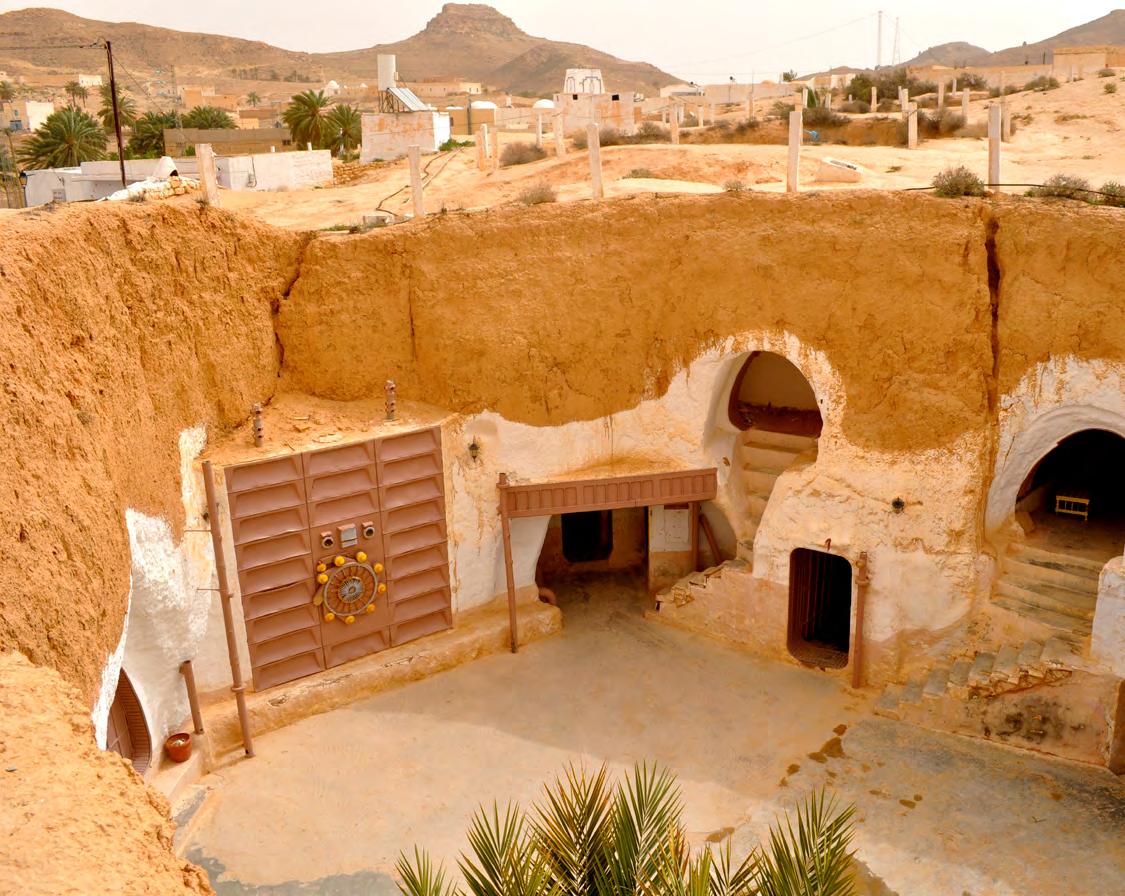
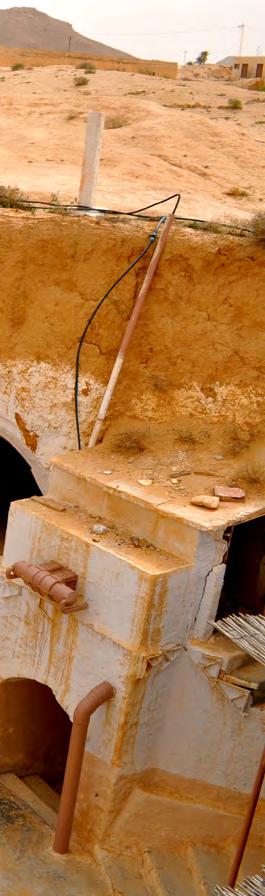
01. Matmata. Panegyrics of Granovetter, 2010
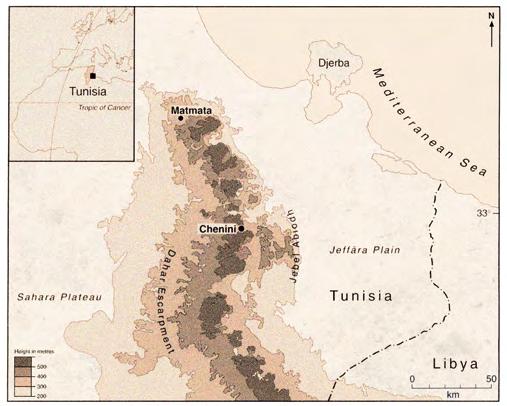
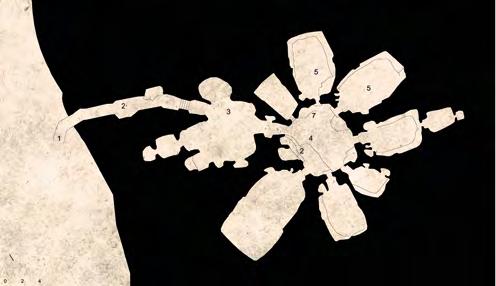
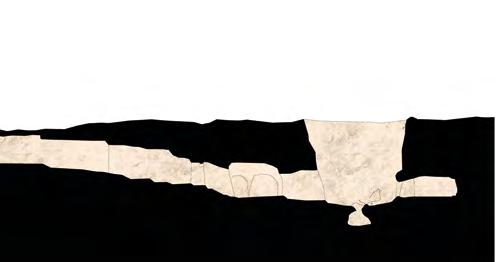
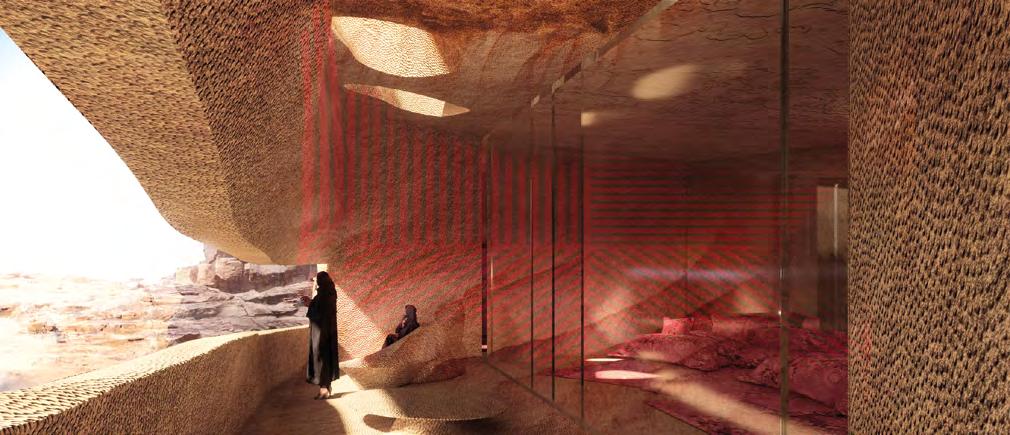
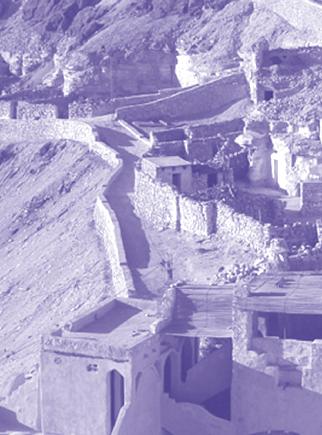
Under the Skin of the Earth This paper investigates the ancient architectural tradition of excavated and underground spaces capable of accommodating and making life possible in extreme climatic conditions. The vertical pit houses of Matmata or the horizontal cliff houses of Chenini provide some interesting ideas for reflecting on settlement models which, although in an abstract form and on a totally different scale, have become the reference for some contemporary underground architectures, building a symbiotic bond with the desert environment that generates them, and interpreting in a renewed form the relationship between nature and artifacts.*
Il testo indaga l’antica tradizione architettonica di spazi scavati e interrati capaci di accogliere e rendere possibile la vita in condizioni climatiche estreme. Le abitazioni a fossa verticale di Matmata o quelle a scogliera orizzontale di Chenini forniscono alcuni interessanti spunti per riflettere su modelli insediativi che, seppur in forma astratta e su scala totalmente differente, hanno costituito la referenza per alcune contemporanee architetture di scavo che costruiscono un simbiotico legame con l’ambiente desertico che le genera, interpretando in forma rinnovata il rapporto tra natura e artificio.*
Mito, forma, immaginario e percezione delle architetture scavate nel deserto tra tradizione e attualità
ieli di pietra1
Se l’immaginario sul deserto rimanda all’idea di uno spazio mutevole generato nelle forme dallo spostamento di masse di sabbia a opera del vento, e solcato da ripari temporanei ed effimeri, in tali luoghi, una delle antiche tradizioni architettoniche fonda la propria origine sulla costruzione di spazi scavati e interrati capaci di accogliere e rendere possibile la vita in condizioni climatiche estreme. Se le “viscere della terra” hanno infatti alimentato l’immaginario di scienziati e scrittori di tutte le epoche, per mano degli uomini e degli architetti, in differenti luoghi e condizioni hanno accolto spazi del mito capaci di fondere suoli, muri e tetti in un tutto caratterizzato dalla continuità tra supporto, materiale e costruito (Algarín Comino, 2006, p. 23). Rimandando a quel modo di vita ancestrale delle prime comunità descritto da Vitruvio2, in tali architetture il rapporto tra natura e artificio, tra contesto e opera dell’uomo, mostra una ricerca di adattamento e una volontà di simbiosi con il clima e il suolo, in un processo per cui “la necessità diventa simbolo e acquista valori estetici” (Picone, 2000, p. 91) traducendosi in vocabolari di forme che si trasformano in patrimonio comune.
Architetture scavate e forma del vuoto. Tradizione e contemporaneità
Raccontando di quella speciale condizione in cui l’architettura “si fa per forza di levare” più che “per via di porre”3 (Buonarroti, 1875), le architetture scavate incarnano a pieno titolo l’immagine che Bruno Zevi utilizza per descrivere l’architettura in contrapposizione alla pittura e alla scultura: includendo l’uomo nella sua tridimensionalità, l’architettura “è come una grande scultura scavata nel cui interno l’uomo penetra e cammina” (Zevi, 1993, p. 21).
Con tale immagine, l’intento di Zevi non era quello di riferirsi nello specifico alle architetture ipogee, quanto piuttosto di porre più in generale l’attenzione sulle qualità dello spazio interno dell’architettura, traslando l’immagine dello scavo in architetture “fuori terra” che ne mimano le qualità.
L’azione progettuale cui si riferisce può essere intesa come un atteggiamento costruttivo volto a togliere, scavare, cavare, estrarre, erodere e sottrarre materia, in opposizione a quello caratterizzato da composizioni di spazi in addizione, ottenuti “per aggiunta, sovrapposizione, contrapposizione, distribuzione, legame, unione di elementi, membrature, apparecchi e materiali” (Polano, 1998).
Se le analogie tra architetture “scavate” e spazi ipogei possono essere rintracciate negli spazi interni, le differenze riguardano il rapporto con il contesto e quella peculiare condizione di quest’ultime di limitare la loro immagine esterna, accentuando la condizione di rifugio e riparo. Nell’azione per sottrazione delle architetture ipogee, che rimanda all’archetipo della caverna, l’oggetto di attenzione è la forma del vuoto, che presenta una sorta di ordine spaziale capovolto che porta alla trasformazione da “extraterrestri” in “terrestri”4 Tali strutture percorrono la storia dell’architettura nel tempo e nello spazio, scavando i suoli secondo andamenti che operano talvolta in verticale, talvolta in orizzontale, più frequentemente combinando le due azioni.
Il mondo ipogeo ha così nel tempo sviluppato una poetica della costruzione in cui la forma dello spazio cavo si è trasformata in potenziale espressivo di specifiche tecniche costruttive legate inscindibilmente alle caratteristiche dei
e sensazioni che rimettono simbolicamente in connessione l’uomo con la terra.
Se la pianta di questi spazi è spesso caratterizzata da figure semplici, e/o di forma simbolica, è la sezione a poter essere considerata la generatrice, elemento principe per la definizione di spazi capaci di catturare la luce e di convogliare l’aria, dando vita a piccoli microcosmi. Talvolta gli spazi cavi si combinano con elementi o volumi, più o meno articolati, che emergono dalla terra, o presentano vere e proprie facciate giustapposte alla roccia a marcare l’ingresso.
Natura e artificio in alcuni insediamenti della tradizione tunisina
Quell’architettura “Without Architects”, “non-pedigree” (Rudofsky, 1964), consacrata da Bernard Rudofsky nella famosa mostra allestita al MoMa di New York tra la fine del 1964 e l’inizio del 1965, continua a esercitare un fascino e a rappresentare motivo di interesse e di studio per quel suo essere “frutto di un raro buon senso per il modo in cui sono trattati i problemi pratici” (Ibidem) e per le “molte soluzioni ‘di tipo primitivo’ decisamente audaci (che) anticipano la nostra ingombrante tecnologia” (Ibidem).
Spazi del mito capaci di fondere
suoli, muri e tetti in una continuità tra supporto, materiale e costruito
suoli nei quali l’opera si insedia. L’idea di riparo e rifugio si mescola inoltre con riti, forme e simboli più o meno preistorici, che enfatizzano il carattere sacro di luoghi. La successione di pieni e vuoti, di luce – penombra – ombra, di compressione e decompressione misura lo spazio e il tempo, e garantisce al fruitore una molteplicità di esperienze
Il riconosciuto valore di tali architetture è nel loro intrinseco rapporto con i luoghi, le culture e le comunità che le hanno generate, selezionando e affinando nel tempo forme, tecniche e materiali, che si sono evolute nell’intento di adattarsi a specifici ambienti per garantire agli abitanti il miglior comfort possibile. Tali architetture possono essere così interpretate come diretta espressione di un ambiente e una società che modella forme, costruendo legami con il paesaggio circostante.
Nell’arido altopiano di Matmata, a sud della Tunisia, le abitazioni a fossa verticale dell’omonimo abitato e quelle a scogliera orizzontale dell’insediamento di Chenini forniscono alcuni interessanti spunti per riflettere su modelli abitativi
02. Matmata e Chenini. Rielaborazione dell’autore da Hill, J. e Woodland, W. (2003). Subterranean Settlements in Southern Tunisia. Geography, vol. 88(1)
03. Matmata, pianta e sezione | Matmata, plan and section. Rielaborazione dell’autore
04. Matmata. Ahmedhamouda, 2013
che, seppur nelle loro differenze, hanno avuto l’obiettivo di fornire risposta ad ambienti aridi e marginali caratterizzati dalla scarsità di risorse (Hill e Woodland, 2003; Raslan e Saeed, 2023). A riprova della validità delle soluzioni adottate sono stati ininterrottamente abitati, anche se soffrono di un progressivo spopolamento5 (Louis, 1975; Hill e Woodland, 2003), originato da quelle politiche statali che, tra gli anni Sessanta e Settanta, hanno portato alla realizzazione di due nuovi centri abitati –Matmata Nouvelle e Chenini Nouvelle6 –nell’intento di modernizzare gli stili di vita di quelle comunità, ma proponendo modelli culturalmente lontani da esse. Matmata e Chenini condividono la loro fondazione nel XII secolo, scegliendo posizione e morfologia in funzione di scopi difensivi che necessitavano di diversa struttura insediativa a causa della specifica conformazione dei due siti (img. 02) e incarnano quell’immagine che Cesare Brandi ha restituito delle città del deserto: “ed ecco mi era sovvenuto il deserto per farmi intendere come la terra può […] mostrarsi in una forma anteriore alla vita […] la mancanza di limiti, che pure non è
Come risolvere il rapporto tra insediamenti turistici e vastità e grandezza del paesaggio desertico?
infinito, l’impossibilità di valutare le distanze e le grandezze, che pure non è perdita di misura interiore, l’assenza di ordine che non è disordine” (Brandi, 1990).
Apparentemente disperse in un paesaggio ondulato, le circa seicento case troglodite di Matmata, prevalentemente disposte nei pendii esposti a nord, si strutturano in quattro quartieri (Golany, 1988) scavati su suoli calcarei ricoperti di depositi di loess (Caro et al., 1996). La struttura abitativa è caratterizzata da un cortile di forma rotonda o ellittica che, scavato verticalmente, costituisce il centro della casa e della comunità familiare, offrendo un microclima intermedio tra l’esterno e gli ambienti scava-
ti della casa, posizionati a raggiera ai lati dello spazio centrale. Questo apparentemente semplice nucleo di base si completa con un articolato sistema di ingresso lungo anche oltre 10 m, e in pendenza, che spesso immette in un primo, e più piccolo, cortile di servizio sul quale affacciano una serie di depositi. Forma e posizione del sistema di accesso favoriscono la protezione e il controllo degli agenti atmosferici, oltre che un primo sistema di ventilazione che si completa con quello garantito dalla corte centrale e dalla struttura degli ambienti scavati che possono disporsi su uno o più livelli che presentano dei camini necessari alla ventilazione naturale (Traeger, 1906; Golany, 1988; Hill e Woodland, 2003; Raslan e Saeed, 2023; Sakr 2001) (imgg. 01, 03, 04). L’insediamento di Chenini, di forma compatta semicircolare, si dispone su due crinali separati da una sella. Le abitazioni “a schiera” occupano tre terrazzamenti principalmente rivolti a sud e a ovest, mentre una piccola parte affaccia a nord. A differenza di Matmata, lo scavo procede in orizzontale e il cortile, su cui affacciano gli ambienti, è ricavato attraverso la realizzazione di un muro alto circa 2 m. Le aperture che separano le stanze invece, come nell’abitato precedente, operano una compressione ottenuta attraverso la realizzazione di un varco stretto e profondo. In entrambi i casi l’interno delle stanze scavate presenta pareti e soffitti dipinti di bianco con l’intento di riflettere la luce naturale che penetra in forma filtrata (Hill e Woodland, 2003) (imgg. 05-06).
Una serie di studi, che si sono succeduti nel tempo fino ad anni recenti, si sono posti l’obiettivo di verificare e misurare le condizioni microclimatiche di questi insediamenti, dimostrandone numerose qualità: una stabilità termica delle temperature diurne e notturne anche in relazione all’umidità (img. 07-08); un’efficace ventilazione naturale; un buon controllo dell’ombreggiamento e della distribuzione luminosa; una protezione dai venti e dalla sabbia. A tali proprietà fanno tuttavia da contrappunto un forte isolamento e la difficoltà di senso di comunità dovuta alla scarsità di spazi comuni e collettivi7 .
07. Matmata: temperatura dell'aria (a) e umidità (b) registrati il 4-5 agosto 2000 |
Matmata: air temperature (a) and humidity (b) recorder on August 4-5th 2000. Da Hill, J. e Woodland, W. (2003)
Nonostante tali criticità, in questi territori, geologia e topografia hanno costituito la base su cui innestare abitazioni che si sono poste l’obiettivo di rispondere alle sfide poste dal clima, nel tentativo di ottimizzare le risorse disponibili e contemporaneamente di rappresentare le comunità.
Nella contemporaneità “Forgiato dalla natura, scolpito da Jean Nouvel” è il motto che chiude il video di presentazione del progetto per il Sharaan Resort di Jean Nouvel in Arabia Saudita. Nel cuore di quello straordinario patrimonio naturale e umano che è la riserva naturale di Sharaan, l’architetto francese progetta un resort scavato all’interno degli affioramenti rocciosi prossimi all’oasi culturale che ospita le dimore di pietra di AlUla. L’intervento prevede la realizzazione di quaranta suite, tre ville e quattordici padiglioni, una struttura che costituirà elemento chiave della strategia della Royal Commission for AlUla (RCU) per lo sviluppo come destinazione di interesse globale per cultura, storia ed eco-turismo del sito. Ispirato a quella cultura Nabatea che ha prodotto le monumentali Petra e Hegra, l’intervento di Nouvel si pone l’obiettivo di “non mettere a repentaglio ciò che l’umanità e il tempo hanno consacrato” (Nouvel, 2018) attraverso quello che l’architetto definisce “un vero e proprio atto culturale” (Ibidem). Inserendo l’architettura in forma di scavo all’interno della roccia attraverso una serie di perforazioni verticali e orizzontali, l’architetto progetta spazi che si propongono di mantenere intatte le peculiarità del sito e “preservare la sua attrattività che si basa in gran parte sul suo carattere remoto e a tratti arcaico” (Ibidem). I tagli nella roccia simulano le naturali faglie prodotte dalla caratteristica conformazione in piani orizzontali dei sistemi rocciosi e si com-
08. Chenini: temperatura dell'aria (a) e umidità (b) registrati il 11-12 agosto 2000 | Matmata: air temperature (a) and humidity (b) recorder on August 11-12th 2000. Da Hill, J. e Woodland, W. (2003)
pletano con la precisa e circolare figura dello spazio esterno di accesso (img. 09).
Alcuni interventi dello studio Oppenheim Architecture possono essere letti a partire dalla filosofia di progetto dello studio: “spirit of place, silent monumentality, the essential” (Oppenheim Architecture, 2016a e b; 2019). L’ambiente e la natura nella quale i progetti si collocano costituiscono il riferimento primario per architetture che esplorano “il potenziale di un sito come archeologi alla ricerca del codice che sbloccherà la visione di un progetto. Il suolo, i colori, il paesaggio, i venti e il movimento del sole sono tutti elementi che vengono scoperti, studiati e considerati mentre si dà forma alla progettazione e, soprattutto, all’esperienza di un edificio” (Ibidem). Nei progetti per il Wadi Rum Resort in Giordania, o per la Destination Spa & Resort nella penisola di Brooq – sede di uno dei più vasti siti archeologici neolitici del Qatar – o ancora per il più recente Desert Rock in Arabia Saudita, una serie di spazi scavati di diversa forma e natura si combinano con volumi dalle forme pure che si pongono l’obiettivo di ridurre all’essenziale linee e forme, per creare un’architettura “sensibile e reattiva al contesto e al clima” (Ibidem).
La difficoltà di senso di comunità
dovuta alla scarsità di spazi collettivi
Prospettive
I progetti contemporanei brevemente citati raccontano come l’architettura di scavo, mutuata dalla tradizione, possa ancora costituire riferimento fruttuoso ed efficace sia in relazione alle qualità tecniche degli ambienti realizzati, ma ancor più per la possibilità di fornire risposta alle necessità di sviluppo, spesso turistico, di siti fragili, conservando quella dimensione misteriosa, nobile e sacra di paesaggi che antiche civiltà hanno scelto come loro “maison éternelles” (Nouvel, 2018). Perdute numerose caratteristiche spaziali dei villaggi tradizionali, in forma astratta, e su scala totalmente differente, le contemporanee architetture di scavo costruiscono un simbiotico legame con l’ambiente desertico che le genera, interpretando in forma rinnovata il rapporto tra natura e artificio, in cui risiede il vero carattere di attualità.
Se la scelta di operare attraverso processi di sottrazione nel suolo sembra una possibile strada per risolvere il delicato rapporto tra nuovi insediamenti turistici di grande scala e luoghi caratterizzati dalla vastità e grandezza di un paesaggio con cui l’architettura si confronta, nei villaggi della tradizione l’introduzione di uno sviluppo turistico si è posta l’obiettivo di tentare di invertire lo spopolamento e abbandono di questi luoghi, mettendo in evidenza una critica condizione. Proprio a causa della riconversione degli spazi a fini turistici, infatti, negli antichi insediamenti di Matmata e Chenini si sta progressivamente perdendo quello stretto rapporto tra comunità e luogo. I cortili sorti come luoghi riparati, centro della famiglia, nei quali la donna senza velo poteva occuparsi della casa e dei figli, si sono trasformati sempre più in paesaggi del turismo o spot pubblicitari, in cui la minaccia delle culture esterne non sempre compensa la necessaria modernizzazione di queste comunità marginali, trasformandoli in vetrina o set cinematografico.
La fama turistica di questi luoghi nasce infatti anche dal loro essere stati utilizzati quale scenario per il film Star Wars, in cui mondi e futuri lontani hanno tratto ispirazione da tali architetture. Il visionario immaginario di George Lucas si è dimostrato tuttavia forse non così lontano dalla realtà, se consideriamo che nel 2018 l’Agenzia spaziale italiana (Askanews, 2018) ha diffuso un video in cui lo studio per la prima base umana permanente sulla luna ipotizza l’utilizzo di una serie di grotte che potrebbero fornire supporto per l’installazione di avamposti abitabili, consentendo un’adeguata protezione dalle escursioni termiche della superficie e dalle radiazioni. Tali sperimentazioni proseguono tutt’oggi (ASE, 2022) dimostrando come lo studio e la costruzione di legami profondi con il paesaggio in cui l’architettura si insedia, ancor più in condizioni estreme come nel caso di deserti (terrestri o extraterrestri), costituisca elemento di attualità e interesse.
Un sottile e precario equilibrio deve essere così ricercato al fine di mettere efficacemente in connessione passato e presente, interrogando nuove e antiche “geografie delle fate” (Calvino, 1984), che da un lato celebrano un atto primordiale, dall’altro nutrono l’anima e l’occhio dell’architetto.*
NOTE
1 – Il titolo del paragrafo prende a prestito un’immagine utilizzata da Maria Argenti in un articolo del 2016 (Argenti, 2016).
2 – In cui lo scavo di “spelonche sotto i monti” si contrappone all’azione di imitazione dei “nidi delle rondini e il loro modo di costruire” (Vitruvio, 15 a.C., p.121).
3 – Si mutuano le parole utilizzate da Michelangelo per descrivere la differenza tra scultura e pittura.
4 – “Vi fate chiamare terrestri, non si sa con che diritto: perché il vero nome vostro sarebbe extraterrestri, gente che sta fuori: terrestre è chi vive dentro, come me e come Euridice”. Nel racconto di Italo Calvino, Il cielo di pietra, 1968.
5 – I dati del censimento degli insediamenti sono incompleti, ma la letteratura pubblicata (Louis, 1972), insieme alle recenti stime degli abitanti dei villaggi, indicano che la popolazione di Matmata è scesa da un massimo di circa 5000 a 1000. Chenini ha sperimentato una riduzione di 600 famiglie, in 25 anni, a circa 120 di oggi.
6 – Rispettivamente a 15 e 5 km di distanza dai siti originari.
7 – Di diversa natura, anche medici. Un recente studio ha inteso valutare le prestazioni sanitarie delle case troglodite di Matmata secondo il sistema WELLV1 (Raslan e Saeed, 2023).
REFERENCES
–Algarín Comino, M. (2006). Arquitecturas excavadas. El proyecto frente a la construcción de espacio. Barcelona: Fundación Caja de Arquitectos.
– Argenti, M. (2016). A Stone Sky. Area, n.145, pp. 2-3.
– ASE (2022). Missione grotte lunari: Esa è la pioniera (online). In asitv.it/media/ (ultima consultazione giugno 2024).
– Askanews (2018). Spazio, la prima base umana sulla Luna potrebbe essere sottoterra (online). In stream24.ilsole24ore.com/video/ (ultima consultazione giugno 2024).
– Brandi, C. (1990). Città del deserto. Roma: Editori Riuniti.
– Buonarroti, M. (1875). Lettera a messer Benedetto Varchi, XVI secolo. In Milanesi G. (a cura di), Le lettere di Michelangelo Buonarroti pubblicate coi Ricordi ed i contratti artistici, Firenze. – Calvino, I. (1984). Collezione di sabbia. Emblemi bizzarri e inquietanti del nostro passato e del nostro futuro gli oggetti raccontano il mondo. Milano: Garzanti.
– Golany, G.S. (1988). Earth-sheltered Dwellings in Tunisia: Ancient Lessons for Modern Design. Cranbury (NY): University of Delaware Press.
– Hill, J., Woodland, W. (2003). Subterranean Settlements in Southern Tunisia. Geography, vol. 88(1), pp. 23-39.
– Louis, A. (1972). The “Berber” world of the Tunisian extreme south. Review of the Muslim Worlds and the Mediterranean Book, Year 11, pp. 107-125.
– Nouvel, J. (2018). Sharaan Desert Resort. AlUla (online). In jeannouvel.com/projets/ sharaan-desert-resort/ (ultima consultazione giugno 2024).
– Oppenheim Architecture (2016a). Destination Spa & Resort. Area, n. 145, pp. 126-129.
– Oppenheim Architecture (2016b). Wadi Rum Resort. Area, n. 145, pp. 130-133.
– Oppenheim Architecture (2019). Desert Rock (online). In oppenoffice.com/works/desertrock/ (ultima consultazione giugno 2024).
– Polano, S. (1998). L’architettura della sottrazione. Casabella, n. 659, p. 2.
– Raslan, H.M., Saeed, D.S. (2023). Re-evaluating the health performance of historical buildings using WELLV1 rating system. Computational Urban Science, 3:27. doi.org/10.1007/s43762-023-00103-z
– Rudofsky, B. (1964). Architecture without Architects. An Introduction to Non-Pedigreed Architecture. New York: Museum of Modern Art.
– Sakr, M.M. (2001). Learning Lessons from Matmata. Proceedings SB10 Amman: Sustainable Architecture and Urban Development Journal, pp. 284–294.
– Traeger, P. (1906). Die Troglodyten des Matmata. Zeitschrift für Ethnologie (ZfE) / Journal of Social and Cultural Anthropology (JSCA), n. 38, H. 1/2, pp. 100-114.
– Vitruvio Pollione, M. (15 a.C.). De arquitectura
– Zevi, B. (1993). Saper vedere l’architettura. Torino: Einaudi.
09. Jean Nouvel, Sharaan Resort. Deezen
Stone Skies
The imagery of the desert goes back to the idea of an ever-changing space generated in its forms by the movement of masses of sand by the wind, and dotted by temporary and ephemeral shelters. Yet, in such places, one of the ancient architectural traditions bases its origins on constructing excavated and underground spaces, capable of accommodating and making life possible in extreme climatic conditions. Indeed, while the "bowels of the earth" have nourished the imagination of scientists and writers of all eras, in different places and conditions, thanks to the work of men and architects, they have welcomed spaces of myth capable of merging soils, walls and roofs into one whole, characterized by continuity of supporting substrates, materials, and construction work (Algarín Comino, 2006, p. 23).
Harking back to that ancestral way of life of the ancient communities described by Vitruvius, these architectural solutions embody the relationship between nature and artifacts, between context and man’s work, as a quest for adaptation and a desire for symbiosis with climate and terrain. In this process, “necessity becomes a symbol and acquires aesthetic values” (Picone, 2000, p. 91), translating vocabularies into form transformed into a shared heritage.
Excavated Architecture and the Shape of the Void. Tradition and Contemporary Concepts
By telling about that special situation in which architecture “is made by removing” rather than “by way of placing” (Buonarroti, 1875), architecture by excavation fully embodies the image that Bruno Zevi uses to describe architecture in contrast to painting and sculpture: by including man in three-dimensionality, architecture “is akin to a great excavated sculpture, into which man penetrates and walks” (Zevi, 1993, p. 21).
Zevi's intent in using this image was not to refer specifically to underground architecture, but rather to draw attention, more generally, to the qualities of the internal space of architecture, translating the image of the excavation into “above ground” architecture, mimicking its
Claudia Pirina
Under the Skin of the Earth
Myth, form, imagery and perception of architecture dug in the desert, between tradition and the present day
qualities. The design action to which he refers can be understood as a constructive attitude aimed at removing, digging, quarrying, extracting, eroding and subtracting material, in opposition to that characterized by compositions of spaces, obtained “by addition, superposition, contrast, distribution, bond, union of elements and members, devices and materials” (Polano, 1998).
While the analogies between “excavated” architecture and underground spaces can be traced to the internal spaces, the differences concern the relationship with the context and the peculiar condition of the latter of limiting their external image, underscoring the feature of refuge and shelter. In the action by subtraction of underground architecture, which harks back to the archetype of the cave, the object of attention is the shape of the void, which presents a sort of inverted spatial order which leads to the transformation from “extraterrestrial” into “terrestrial” structures. These structures run through the history of architecture in time and space, digging the soil according to directions that sometimes operate vertically, sometimes horizontally, and more often combining these two actions.
Over time, the underground world has thus developed its poetics of construction, in which the shape of the hollow space has been transformed into the expressive potential of specific construction techniques, inextricably linked to the characteristics of the soil in which the work settles. The ideas of shelter and refuge also mix with more or less prehistoric rites, forms and symbols, which emphasize the sacred character of these places. The succession of full and empty spaces, of light - penumbra - shadow, of compression and decompression measures space and time, and offers the user a multiplicity of experiences and sensations that symbolically connect man with the earth. While the plan of these spaces often features simple figures and/or symbolic shapes, it is the cross-section that can be considered the generator, the main element for the definition of spaces capable of capturing light and conveying
air, giving birth to small microcosms. Sometimes the hollow spaces are combined with more or less articulated components or volumes emerging from the ground, or present actual façades juxtaposed to the rock to highlight the entrance.
Nature and Artifacts in some Settlements of the Tunisian Tradition
That “non-pedigree” architecture “Without Architects” (Rudofsky, 1964), extolled by Bernard Rudofsky in the famous exhibition held at the MoMA in New York between the end of 1964 and the beginning of 1965, still exudes fascination and represents a subject of interest and study for its being “the result of a rare common sense because of the way in which practical problems are treated” (Ibidem) and for the “many decidedly daring solutions ‘of a primitive type’ anticipating our cumbersome technology” (Ibidem). The recognized value of these architecture patterns lies in their intrinsic relationship with the places, cultures and communities that generated them, selecting and refining over time forms, techniques and materials, which have evolved with the aim of adapting to specific environments in order to guarantee the best possible comfort for the inhabitants. Such architecture can thus be interpreted as a direct expression of an environment and a society that shapes forms, building links with the surrounding landscape. In the arid Matmata plateau, in Southern Tunisia, the vertical pit dwellings of the town of the same name and the horizontal cliff dwellings of the Chenini settlement provide some interesting ideas for reflecting on housing models which, despite their differences, had the objective of providing a solution to arid and marginal environments characterized by a scarcity of resources (Hill and Woodland, 2003; Raslan and Saeed, 2023). The validity of the adopted solutions is proven by their having been continuously inhabited, even if they suffer from progressive depopulation (Louis, 1975; Hill and Woodland, 2003). This was caused by state policies that brought about, between the 1960s and the 1970s, the creation of two new inhabited centers – Matmata Nouvelle e Chenini Nouvelle
– with the aim of modernizing the lifestyles of those communities, but proposing models that were culturally distant from them.
Matmata and Chenini were both founded in the 12th century, their position and morphology being chosen based on defensive purposes which required a different settlement structure due to the specific conformation of the two sites (img. 02).
They embody that image that Cesare Brandi provided of the desert city: “and then the desert came to my mind to make me understand how the earth can [...] show itself in a form prior to life [...] the lack of limits, which is nonetheless not infinite, the impossibility of evaluating distances and sizes, which yet is not a loss of internal measure, the absence of order which is not disorder” (Brandi, 1990).
Apparently dispersed in an undulating landscape, the approximately 600 underground dwellings of Matmata, mainly located on the slopes facing north, are structured in four neighborhoods (Golany, 1988), excavated in calcareous soils covered with loess deposits (Caro et al., 1996). The housing structure is characterized by a round or elliptical courtyard, dug vertically, which represents the center of the house and of the family community. It offers an intermediate microclimate between the outside and the excavated rooms of the house, which are positioned radially on the sides of the central area. This apparently simple basic nucleus is complemented by a complex entrance system, even over 10 m long, and sloping, which often leads into a first, and smaller, service courtyard, giving access to a series of storerooms. The shape and position of the access system favor the protection from and control of atmospheric agents, as well as an initial ventilation system. This is then completed by the one guaranteed by the central courtyard and by the structure of the excavated rooms, which can be arranged on one or more levels, complete with shafts needed for natural ventilation (Traeger, 1906; Golany, 1988; Hill and Woodland, 2003; Raslan and Saeed, 2023; Sakr 2001) (imgg. 01, 03, 04).
The Chenini settlement, having a compact semicircular shape, is located on two ridges separated by a saddle. The "terraced" houses occupy three terraces mainly facing South and West, while a small number faces North. Unlike Matmata, the excavations proceeded horizontally and the courtyard giving access to the rooms was created through the construction of a wall, approximately two meters high. The openings that separate the rooms, however, as in the other settlement, operate a compression, obtained through the creation of a narrow and deep passage. In both cases the interior of the excavated rooms has walls and ceilings painted white, with the aim of reflecting the natural light that reaches in there in a filtered form (Hill e Woodland, 2003) (imgg. 05-06).
A series of studies, following one another over time until recent years, have had the objective of verifying and measuring the microclimatic conditions of these settlements. They demonstrated several qualities: thermal stability of day and night temperatures also in relation to the humidity (imgg. 07-08); effective natural ventilation; good control of shading and light distribution; protection from winds and sand. However, the counterpoints of these properties are
a strong isolation and the difficulty of a sense of community due to the shortage of common and collective spaces.
Despite these critical issues, the geology and topography of these territories have made up the basis on which to graft homes that have set themselves the objective of responding to the challenges posed by the climate, in an attempt to optimize the available resources and at the same time to represent the communities.
In Contemporary Times “Cast by nature, sculpted by Jean Nouvel” is the motto concluding the presentation video of the project by Jean Nouvel for the Sharaan Resort in Saudi Arabia. In the center of that extraordinary natural and human heritage site that is the Sharaan natural reserve, the French architect designed a resort dug inside the rocky outcrops, next to the cultural oasis that houses the stone residences of AlUla (img. 09). The works will amount to the construction of fourty suites, three villas and fourteen pavilions, a structure that will constitute a key element of the strategy of the Royal Commission for AlUla (RCU) for the development of the site as a destination of global interest for culture, history and eco-tourism. Inspired by the Nabataean culture that produced the monumental sites of Petra and Hegra, Nouvel's intervention aims to “avoid jeopardizing what humanity and time have consecrated” (Nouvel, 2018) through what the architect defines as “truly a cultural action” (Ibidem). By inserting the architecture as an excavation inside the rock through a series of vertical and horizontal drillings, the architect designs spaces meant to keep the peculiarities of the site intact and to “preserve its attractiveness which is largely based on its remote and at times archaic character”. The cuts in the rock imitate the natural fault lines produced by the characteristic conformation in horizontal planes of the rock systems and are completed with the precise and circular shape of the external access space. Some designs by the Oppenheim Architecture studio can be read starting from the studio's design philosophy: "spirit of place, silent monumentality, the essential" (Oppenheim Architecture, 2016a and b; 2019). The environment and nature in which the projects are sited constitute the primary reference for architectures that explore “the potential of a site as archeologists searching for the code that will unlock the vision of a project. The soil, the colors, the landscape, the winds, and the movement of the sun are all elements that are discovered, studied, and considered while shaping the design and, more importantly, the experience of a building” (Ibidem). In the projects for the Wadi Rum Resort in Jordan, or for the Destination Spa & Resort in the Brooq peninsula – one of the largest Neolithic archeological sites in Qatar – or also for the more recent Desert Rock in Saudi Arabia, a series of excavated spaces of different shapes and nature are combined with volumes having pure shapes that aim to reduce lines and contours to the essential, in order to create an architecture that’s “sensitive and responsive to context and climate” (Ibidem).
Perspectives
The contemporary projects briefly mentioned above show how excavation architecture, borrowed from tradition, can still represent a fruitful and effective reference both in relation to the technical qualities of the environments thus created, and even more for the possibility of providing an answer to the needs of development, often related with tourism, of fragile sites, preserving that mysterious, noble and sacred dimension of landscapes that ancient civilizations have chosen as their “maison éternelles” (Nouvel, 2018). Having lost numerous spatial characteristics of the traditional villages, the contemporary excavation architectures rely on an abstract form, and on a totally different scale, in order to build a symbiotic link with the desert environment generating them. They interpret in a renewed form the relationship between nature and artifact, in which one can find real actuality.
The choice to work through soil subtraction processes seems like a possible way to resolve the delicate relationship between new largescale tourist settlements and places characterized by the vastness and grandiosity of a landscape with which architecture is confronted. At the same time, in traditional villages the introduction of tourism development has set itself the objective of attempting to reverse the depopulation and abandonment of these places, highlighting their critical plight. Exactly because of the reconversion of spaces for tourism purposes, in fact, in the ancient settlements of Matmata and Chenini, the close relationship between the community and the site is gradually being lost. The courtyards that arose as sheltered places, the center of the family, in which veilless women could take care of the house and children, have been increasingly transformed into tourism or advertising backdrops, in which the threat of external cultures does not always compensate for the necessary modernization of these marginal communities, transforming them into showcases or movie sets.
Indeed, the reputation as tourism destinations of these places also arises from their having been used as a backdrop for the Star Wars movie, in which distant worlds and futures drew inspiration from such architecture. However, George Lucas' imaginary visions proved to be perhaps not so far from reality, if we consider that in 2018 the Italian Space Agency (Askanews, 2018) released a video in which the study for the first permanent human base on the moon hypothesizes the use of a series of caves. These could provide support for the installation of habitable outposts, allowing adequate protection from surface temperature variations and radiation. These experiments are continuing (ASE, 2022), demonstrating how the study and construction of deep links with the landscape in which architecture is installed, even more so in extreme conditions as in the case of deserts (terrestrial or extraterrestrial ones), is a topic of interest for current affairs.
A subtle and precarious balance must thus be sought in order to effectively connect past and present, by questioning new and ancient “fairy geographies” (Calvino, 1984), which on the one hand celebrate a primordial act, on the other nourish the soul and eye of the architect.*
Carmen Armenteros Puchades
PhD in Landscape and Environment, La Sapienza Università di Roma. carmen.armenterospuchades@uniroma1.it
Lucia Concetta Vincelli
PhD in Landscape and Environment, La Sapienza Università di Roma. luciaconcetta.vincelli@uniroma1.it
Tracciando una linea
01. Il Monumento Continuo nel deserto dell’Arizona (1969) | Monumento Continuo in the Arizona desert (1969). Superstudio, Centre Pompidou, Mnam-CCI
Drawing a Line The desert, furrowed with traces, is a transient space for artists, migrants, biodiversity and commerce. The lines carved all over it are testimony of time and use. This paper elaborates on different typologies of lines. Lines of economy, with infrastructures shaping productive areas, lines of ecology reflecting environmental migration, cinematic lines providing aesthetic experiences. Despite its harsh conditions, walking through the desert can offer a sublime encounter along the shortcuts of lines of desire, while trails purposefully wobble into art objects forming lines of diversion.*
Il deserto, solcato da tracce, è uno spazio transitorio per artisti, migranti, biodiversità e commercio. Le linee incise su di esso sono testimonianza del tempo e dell’uso. Il presente paper elabora diverse tipologie di linee. Le linee dell’economia, con le infrastrutture che modellano le aree produttive, le linee dell’ecologia che riflettono la migrazione ambientale, le linee cinematografiche che forniscono esperienze estetiche. Nonostante le sue dure condizioni, camminare nel deserto può offrire un incontro sublime lungo le scorciatoie delle linee del desiderio, mentre i sentieri sfociano intenzionalmente in oggetti d’arte che formano linee di deviazione.*
Una tassonomia non convenzionale delle linee nel deserto
ntroduzione
Tagliando il territorio a metà con una linea da est a ovest e che, notoriamente, attraversa i deserti del Colorado, Utah e Nevada, la Route 50 è considerata la strada più solitaria degli Stati Uniti. Ma cosa succederebbe se arrotolassimo questa strada e l’architettura che la circonda in una grande, densa spirale? Proprio come la Spiral Jetty di Smithson, ma intasata di infrastrutture stradali, questa città inventata sarebbe più grande di Manhattan1. È la forma a determinare gli usi o è il contrario?
I sentieri rettilinei sono venerati nella Bibbia, “Appianate ne’ luoghi aridi una strada per il nostro Dio!”, ordinò Isaiah (40:3). L’aridità e la morfologia del deserto consentono ogni tipo di linea; tuttavia, il movimento lungo una linea retta tende a essere la norma nei paesaggi vasti. Kandinsky descriverebbe la linea geometrica come la distruzione dell’autonomia statica del punto (Kandinsky, 1979). Il presente lavoro considera il paesaggio desertico come la tela di Kandinsky in cui la dinamica dello spazio è attivata dal punto in movimento2
Obiettivi
Questa ricerca intende far luce sulle lineari complessità dello spazio indefinito come il deserto. Si tenta di esplorare l’esistenza di una regola geometrica nell’occupazione dello spazio da parte di esseri sia umani sia non-antopici, ricorrente in aree dilatate. Si esaminerà, da un lato, come le caratteristiche fisiche modellano l’esperienza e il passaggio nel deserto e dall’altra, come gli immaginari estetici lineari modificano il paesaggio fisico del deserto. Questo testo indagherà e definirà la natura molteplice delle linee nel deserto, indicandone le tracce, nonostante l’apparente sterilità dell’ambiente, come un palinsesto di eventi nel tempo e nello spazio.
Approcci e metodi
Questo articolo delinea una tassonomia delle linee fisiche e metaforiche che attraversano il deserto: lines of economy,
lines of ecology, cinematic lines, lines of desire and lines of diversion. Il deserto a cui ci si riferisce non è quello sabbioso, dove le tracce vengono spazzate via, bensì quello arido, dove le tracce vengono conservate. Le accezioni romantiche della natura sublime hanno inquadrato il deserto come una categoria estetica spesso utilizzata per evocare un senso di non-luogo o di disorientamento (Tynan, 2020). Si riconosce il deserto come campo estetizzato, esasperato nel cinema, che contrasta con il suo carattere transitorio e il suo sfruttamento produttivo. Questo articolo rifletterà su come il bioma desertico e le sue caratteristiche influenzano il modo in cui viene vissuto, attraversato e abitato.
di “immaginare una rete di energia e informazione che si estendesse a ogni area propriamente abitabile [...] La rete si sviluppa come un nastro continuo che si estende sul territorio” (Superstudio, 1972). Il concetto di supersurface ridefinisce l’architettura come una piattaforma senza confini, equipaggiata, strutturata sul movimento permanente degli uomini e sulle loro relazioni.
In tal senso, la linea è un design ideale per conquistare terreno in nome dell’efficienza della produzione capitalista. Nello scenario postfordista o nel “postmodernismo flessibile” (Harvey, 1989), NEOM Linear City e in particolare
Il deserto è uno spazio per l’immaginazione di ciò che è stato attraversato, è rimasto e ha lasciato una traccia
Lines of economy
Da visioni utopiche a realtà distopiche, lines of economy invita a guardare i modelli lineari degli insediamenti umani come intrinsecamente determinati da organismi economici. La geometria lineare è stata spesso impiegata per delimitare territori inesplorati, dove il deserto è stato il terreno ideale di esperimenti architettonici per nuovi spazi domestici, attirando al contempo economie di estrazione e sfruttamento.
Il sistema lineare di Superstudio nei collage di Monumento Continuo (1969-1971) (img. 01) concepiva una griglia a coprire le complessità cittadine, come nella proposta per il deserto dell’Arizona. Appare come una dissoluzione dell’architettura, tramite un sistema diffuso che omogeneizza il territorio globale. Sviluppando ulteriormente l’idea negli esperimenti di Accampamento, Superstudio cercava
The Line, la smart city, sviluppata in lunghezza per 170 km e 200 m in larghezza nel deserto dell’Arabia Saudita in un’area scelta dalla Corona, è progettata sulla separazione delle funzioni e sull’impostazione antropocentrica dell’architettura. Nonostante i caratteri pubblicizzati di efficienza energetica e la presunta crescita economica generata, emergono aspetti controversi per le implicazioni sociali: lo sgombero dei villaggi nella regione di Tabuk e la conseguente evacuazione delle popolazioni indigene incidono sulla sostenibilità del progetto.
Un processo inverso lega questi esempi: le critiche di Superstudio all’architettura, proposte nell’avanzata nel deserto, contrastano con l’imposizione in The Line di una nuova architettura lineare di tecnologie portentose. Se in The Line lo spostamento è il fenomeno residuo di un’architettura imposta, per Superstudio rappresenta un’inedita visione dell’architettura, legato a un nuovo modo di vivere, permanentemente nomade.
Lines of ecology
Da geometrie organiche indotte3 a sentieri umani, la linea raffigura l’efficienza ecologica delle attività umane e di quelle non antropiche nell’ambiente esistente (Prandi,
02. Autolandscapes (1971). E. Mayes
2016). Lines of ecology indaga i segni lineari umani sul territorio come tracce di sostenibilità, in un ricongiungimento delle strutture economiche con i processi ecologici, evidenziando il loro terreno comune a partire da un’etimologia condivisa4.
In tale ipotesi, l’ambiente del deserto, sia nelle condizioni di sfida che nel contesto odierno della desertificazione, delinea l’adattamento come un fattore chiave per qualsiasi pratica inscritta in un sistema ecologico.
La tradizione del pascolo nomade nel deserto del Gobi in Mongolia rappresenta un sistema economico basato sull’attraversamento stagionale dei percorsi seguendo le mutazioni delle condizioni climatiche e vegetative dell’area. In una regione dove le temperature variano tra 45°C e -40°C, i pastori mongoli riescono a spostare il loro bestiame e le loro case (ger) verso le steppe forestali e i pascoli, attraverso migrazioni temporanee durante la siccità o movimenti diretti a una residenza permanente in una diversa regione amministrativa (sum).
Tuttavia, la trasformazione postsocialista nel sistema sociopolitico dopo il 1990 ha reso la gestione dei pascoli vulnerabile alla privatizzazione e ha portato il settore del pascolo verso un modello intensivo, che ha aumentato il consumo delle risorse naturali, come i punti d’acqua, e gradualmente ridotto le trame di migrazione.
Nel contesto dell’attuale desertificazione globale, con una frammentazione dei corridoi migratori dovuta alle nuove infrastrutture per l’estrazione mineraria e le città, le popolazioni indigene e la loro configurazione economica diventano “custodi efficaci della biodiversità e dei servizi ecosistemici” (WWF, 2021).
Sebbene minacciata, l’efficienza della tipologia lineare o del corridoio (Siggaard Andersen, 2023) risiede nel loro design contestuale, che accomoda vari elementi dell’ecosistema per una funzionalità prolungata, dove il deserto diventa un “territorio flessibile” (Frei Otto, 2009), definito dalla vita transitoria e ciclica di diversi assetti socioeconomici.
Cinematic lines
I paesaggi desertici non sono quasi più attraversati a piedi. Escludendo le migrazioni non antropiche e la transumanza, il deserto viene attraversato nel comfort di un veicolo, rendendo l’esperienza dei suoi paesaggi puramente visiva e panoramica. Cinematic lines mette in evidenza i paesaggi in viaggio, che vengono vissuti esteticamente, seppur con una certa distanza e velocità, come in un’inquadratura in movimento. Il cambiamento di ritmo introdotto dalle auto ha determinato che questi ambienti perdessero, agli occhi umani, la loro qualità geologica di lenta mutabilità.
Guidare attraverso il territorio desertico implica scoprire l’espansione architettonica nella sua vocazione lineare, con specifiche tipologie che si accumulano lungo le strade a richiamare visivamente alla fermata. Le Cinematic lines custodiscono le informazioni di chilometri di paesaggio, trasformate in una sequenza di butte, colline, stazioni di servizio, motel, diners e seduzioni istantanee di cartelloni pubblicitari. Il paesaggio inquadrato dal bordo nero del parabrezza rievoca lo schermo della TV che incornicia una ripresa in movimento. Allo stesso modo, Elaine Mayes, negli anni Settanta, usava il contorno della finestra per incorniciare le sue fotografie di paesaggi desertici. Viaggiando attraverso gli Stati Uniti, scattava foto ogni volta che il paesaggio cambiava, raccogliendo i risultati nella serie di Autolandscapes (img. 02). Come scatti di Driving Plates, le foto di Mayes congelavano i paesaggi in movimenti sfreccianti a 70 miglia all’ora. Alcune di esse includevano l’ombra proiettata dalla sua macchina, come un fantasma cinetico.
Nell’agosto 2017, durante un viaggio nello Utah, la serendipità e un’eclissi solare hanno portato chi scrive all’incontro con Larry Campbell. Il deserto si è oscurato alle 11:30 come se qualcuno avesse abbassato un interruttore. Larry lavorava nell’industria cinematografica costruendo auto per film, tra le quali una delle auto più iconiche del cinema, la Thunderbird turchese in Thelma & Louise5. Nel film, Thelma e Louise guidano attraverso alcuni dei paesaggi desertici americani più
03. Walking a Line in Peru. R. Long
suggestivi fino a lanciarsi, di fronte all’impossibilità di sfuggire alla polizia, da una scogliera nel fiume Colorado6. Per la pellicola, Larry dovette costruire quattro auto guidabili e un’auto sezionata, con due delle parti superiori tagliate e lanciate giù nell’abisso7. Questo film mette in risalto un paesaggio desertico romanticizzato vissuto attraverso la guida, lungo le sue infrastrutture lineari. Inoltre, il deserto sembra essere lo sfondo perfetto per la rappresentazione di una sottocultura delle marginalità contemporanee8. Fuorilegge ed esclusi sono stati tradizionalmente personaggi centrali nel genere western. In questo caso, e contrariamente al viaggio stereotipato del cowboy maschio, due donne rompono il sistema patriarcale normativo in cerca di libertà. Forti del paesaggio e della loro auto, sono in grado di decidere il proprio destino9
Gli insediamenti umani hanno
utilizzato la geometria lineare per stabilire le dimensioni spaziali in territori inesplorati
Lines of desire
“In Inuit custom, an angry person expresses his or her emotion by walking straight across the landscape. When all anger is spent, the stopping point is marked with an object, indicating the length or degree of the person’s rage” (Melloy, 1999). Al punto di partenza della linea, c’è l’ira, e alla fine, la testimonianza della sua scomparsa. Quando si parla di linee, i percorsi più brevi sono di massima desiderabilità. Lines of desire si riferisce alla linea fisica tracciata dal desiderio di raggiungere un luogo. Quel posto può essere una posizione fisica, da un punto A a un punto B, o una posizione metaforica, ad esempio, il punto di scomparsa della rabbia. La linea tracciata dagli Inuit è una materializzazione della furia e il desiderio di porre fine a essa; si cammina attraverso il pae-
saggio finché il calpestio non si dissolve in uno strascico. Le linee del desiderio tendono a essere diritte e particolarmente evidenti in paesaggi ininterrotti come i deserti. Questo andamento retto del cammino si rivela impossibile in altri tipi di biomi o aree urbane. Sfide come quella della Straight-Line Mission10, in cui due individui hanno attraversato la Scozia in linea retta, dimostrano la cruda lotta nel solcare altri paesaggi in questa modalità. Nel 1972, Richard Long, un artista concettuale britannico, ha creato una linea retta temporanea nel deserto del Perù camminando avanti e indietro ripetutamente per un anno (img. 03). “The walk itself was the sculpture, the artwork. The work could be as long as the walk. The emphasis was on making the walk itself, the experience of actually walking” (Malpas, 2007). Nelle aree desertiche sono presenti pochissimi ostacoli, permettendo un orizzonte visivo chiaro. La linea fisica in questo caso segue la linea di visione, la vista del desiderio lontano nel paesaggio.
Lines of diversion
Finora si è scritto principalmente di linee con proprietà rettilinea; tuttavia, lines of diversion si concentrano su quelle divergenti. Lines of diversion indica le pratiche culturali o estetiche come l’arte o i rituali quando deviano dal percorso lineare per creare un oggetto, un’opera d’arte o una dichiarazione. Intendiamo la divergenza come un modo per trasgredire la linea normativa. Lines of diversion non sono transitorie ma sono destinate ad “appartenere”, quindi possono riguardare opere d’arte site-specific e rituali culturali e spirituali che lasciano intenzionalmente tracce dietro di sé. Linee che si perdono, si confondono, si attardano, sono traballanti, circolari, incomplete o addirittura non sono linee. I disegni nel deserto hanno suscitato diverse teorie. I geoglifi sono colossali e così al di fuori della scala umana che è facile immaginare che siano stati prodotti da qualcosa proveniente da altrove nello spazio. In tutto il mondo, molti di tali disegni
04. Nazca Lines. Veduta aerea della parte centrale e SW del labirinto | Nazca Lines. Aerial view of the central and SW part of the labyrinth. C. Ruggles
sono stati scoperti specialmente con l’avvento dell’aviazione e dei satelliti. Le linee di Nazca (img. 04), scoperte nel 1926, sono tra le più studiate. Inizialmente considerate astronomiche, ricerche recenti suggeriscono scopi ritualistici e agricoli, particolarmente legati all’acqua e alla fertilità. L’uso di simbolismi animali, come ragni per la pioggia e colibrì per la fertilità, è diffuso, anche se nessuna teoria singola prevale (Ruggles e Saunders, 2012).
A partire dai disegni antichi, ci sono state interpretazioni più moderne della questione. Artisti del paesaggio come Richard Long, Robert Smithson e Jim Denevan hanno creato spirali. Michael Heizer ha intagliato ciò che considerava “negative forms” (Lippard, 1983) con una motocicletta, che essenzialmente erano segni di frenata in un lago prosciugato. Walter De Maria non solo ha creato forme geometriche nel deserto ma anche il Lightning Field, profilato lungo una griglia di un chilometro con 400 pali parafulmine di acciaio inox. Ci piace pensare che l’opera di De Maria crei linee, non di terra o pietre ma di particelle di gas incandescente che colpiscono il terreno (img. 05).
Conclusioni
Le linee hanno una loro tensione, vita e dinamica. L’articolo ha approfondito l’intricata tessitura delle linee che pettinano il paesaggio desertico, le quali fungono da conduttori di imprese umane e processi ecologici. Dall’architettura, passando per l’arte e il cinema, la ricerca ha esplorato la natura sfaccettata di tali linee, siano linee di profitto, piacere o d’estetica. Attraverso la classificazione e l’esplorazione di queste tracce ed esempi, si riscontra l’esistenza di una regola geometrica fisica e metaforica che prevale in biomi aperti e aridi come il deserto. Lines of economy evidenzia il ruolo duale del deserto in economie estrattive e in sistemi alternativi per l’abitare. Il deserto è largamente percepito come terra di nessuno, senza vita. Lines of ecology sottolinea l’integrazione dei sistemi lineari umani con l’ecosistema del deserto. Attraverso cinematic lines si analizzano paesaggi ultraestetizzati a distanza del finestrino. Le ampie distese incontaminate dei
biomi desertici offrono una visuale ininterrotta che connette scorciatoie e desideri. Nelle lines of diversion, si discute di come piccoli segni possano essere ricondotti a una ricca storia e di come il paesaggio del deserto giustapponga gli eventi nel tempo. Il deserto è lo spazio degli immaginari di ciò che ha attraversato, è sostato, e ha lasciato una traccia.*
NOTE
1 – Si calcolano i 657,93 km della Route 50 con circa 100 m di spazio lungo la strada.
2 – Le condizioni atmosferiche nel Parco Nazionale della Death Valley, in California, permettono che i sassi scivolino nel deserto, tracciando linee.
3 – Eco dal greco oikos, casa.
4 – Secondo J.D. Edmund, “travelling shot” fa riferimento a una specifica ripresa realizzata dalla prospettiva di un veicolo in movimento.
5 – Thelma & Louise (1991) è un road movie americano di Ridley Scott.
6 – Nel film si lanciano nel Grand Canyon, che è geograficamente scorretto nella realtà. La scena finale si svolge, infatti, nel Dead Horse Point State Park.
7 – Larry Campbell è amica di una delle autrici, queste informazioni sono state ottenute da conversazioni ed e-mail con una delle autrici.
8 – Desert Hearts (1985) e The Adventures of Priscilla, Queen of the Desert (1994) sono altri film che illustrano la libertà queer che uno spazio come il deserto conferisce.
9 – L’avvento delle auto è stato fondamentale per i diritti e l’emancipazione femminili. Il movimento suffragista negli Stati Uniti utilizzava “inviati per il suffragio” per fare campagna in tutto il Paese raccogliendo firme. Per approfondire questo argomento, vedi Nancy A. Nichols, Women Behind the Wheel. An Unexpected and Personal History of the Car 10 – GeoWizard, nella sua serie Mission Across, attraversa Paesi lungo una linea retta, indipendentemente dagli ostacoli.
REFERENCES
- Harvey, D. (1989). The Condition of Postmodernity. An enquiry into the origins of Cultural Change. Cambridge, Massachussetts: Blackwell Publishers.
- Kandinsky, V. (1979). Point and line to plane. New York: Dover Publications.
- Lippard, L. (1983). Overlay. Contemporary Art and the Art of Prehistory. New York: The New Press.
- Malpas, W. (2007). The art of Richard Long: complete works. Maidstone: Crescent Moon.
- Melloy, E. (1999). The Last Cheater’s Waltz. Beauty and Violence in the Desert Southwest. Tucson, Arizona: University of Arizona Press.
- Otto, P.F. (2009). Occupying and connecting, London: Edition Axel Menges.
- Prandi, E. (2016). L’architettura della città lineare. Milano: FrancoAngeli.
- Ruggles, C., Saunders, N. (2012). Desert labyrinth: lines, landscape and meaning at Nazca, Peru. Antiquity, Cambridge University Press.
- Siggaard Andersen, C. (2023). Corridors − designing linear infrastructure in a non-linear world. A research study. London: Hassel.
- Supestudio (1972). Description of the microevent/microenvironment, The New Domestic Landscape, MoMa.
- Tynan, A. (2020). The Desert in Modern Literature and Philosophy: Wasteland Aesthetics Edinburgh: Edinburgh University Press.
- WWF et al. (2021). The State of Indigenous Peoples’ and Local Communities’ Lands and Territories. Gland, Switzerland.
05. The Lightning Field by Walter de Maria 1977. J. Cliett, Dia Art Foundation, New York
Introduction
Route 50 is said to be the loneliest road in the States, cutting the country in half in a line that goes from East to West and that famously crosses deserts in Colorado, Utah and Nevada. But what if we coiled this road and its surrounding architecture into a big, condensed spiral? Just like Smithson’s Spiral Jetty but jammed with road infrastructure, this madeup city would be bigger than the size of Manhattan1. Does the form determine its uses or is it the other way round?
Straight paths are worshipped in the Bible, “Make straight in the desert a highway for our God,” commanded Isaiah (40:3). The aridity and morphology of the desert allow for all kinds of lines; however, moving in a straight line tends to be the norm for vast landscapes. Kandinsky would describe the geometric line as created through the destruction of the intense selfcontained repose of the point (Kandinsky, 1979). This paper views the desert landscape as Kandinsky’s canvas where the space’s dynamic is activated by a moving point.
Targets
This paper aims to shed light into the linear complexities of an unframed space like the desert. It seeks to explore the existence of a geometric rule of space occupation by human and non-human entities, common in open areas. It will examine on one hand, how physical features shape the way of experiencing and transiting the desert and on the other hand, how linear aesthetic imaginaries modify the desert’s physical landscape.
This text will explore and define the multifaceted nature of lines in the desert, arguing that traces, despite the setting’s apparent barrenness, are a palimpsest of happenings across time and space.
Approach and methods
This paper will create a taxonomy of physical and metaphorical lines running through the desert: lines of economy, lines of ecology,
Carmen Armenteros Puchades, Lucia Concetta Vincelli
Drawing a Line
An unorthodox taxonomy of lines in the desert
cinematic lines, lines of desire and lines of diversion. The desert referred to is not the sandy desert where traces are blown away but the arid one, where traces are conserved. Romantic notions of sublime nature have framed the desert as an aesthetic category often used to evoke a sense of placelessness or dislocation (Tynan, 2020). We recognize the desert as an overly aestheticized place featured in films contrasts with its transitory character and productive exploitation. The paper will reflect on how the desert biome and features influence the way it is experienced, transited and inhabited.
Lines of economy
From utopian visions to dystopian realities, “lines of economy” refers to linear patterns in human settlements intrinsically determined by economic systems. Linear geometry has frequently been employed to delimit unexplored territories, where the desert has offered the ideal ground for architectural experiments on new domestic spaces, while also attracting economies of extraction and exploitation. Superstudio’s linear geometry in Monumento Continuo collages (1969-1971) (img. 01), envisioned a grid covering city complexities, as proposed for the Arizona desert. It could be considered as a dissolution of architecture, with an ever-present system that homogenises the global territory. Further developed in Accampamento experiments, Superstudio tried to “imagine a network of energy and information extending to every properly inhabitable area […] The network is developed like a continuous ribbon extending over the territory” (Superstudio, 1972). The Supersurface concept redefines architecture as a boundaryfree, equipped floor, structured on human permanent movement and connection.
In this sense, the line is an ideal design to occupy land for capitalist production efficiency. In the post-Fordist scenario or the “flexible postmodernism” (Harvey, 1989), NEOM Linear City and particularly The Line, the 170 km long smart city with 200 m of width in the Saudi Arabia Desert in an area chosen by the Crown, is designed on compartmentalising functions and on the anthropocentric expression of architecture. Notwithstanding the energetic efficiency façade and the presumed economic growth, controversial aspects emerge regarding social implications: the clearance of villages in the Tabuk region and the consequent displacement of the indigenous people affect the project’s sustainability.
Between these examples, there is a reverse process: Superstudio’s critics of architecture, based on desert occupancy, contrasts with The Line imposition of a new linear architecture, making use of uncanny technology. The displacement is the residual phenomenon of dictated architecture in The Line, whilst for Superstudio it represents the new way to imagine architecture, linked to a new way of living, permanently nomadic.
Lines of ecology
From organic inducted geometry2 to humanconstructed pathways, the line embodies the ecological efficiency of human and non-human activities within the given environment (Prandi, 2016).
“Lines of ecology” insist on human linear signs on territories as traces of sustainability, reconciling the economic setups with ecology processes, highlighting their common ground since a shared etymology3
In this assumption, the environment of the desert, in both the challenging conditions and in the contemporary context of desertification, delineates adaptation as a key factor for any practice inscribed in an ecological system.
The tradition of nomadic herding in the Gobi Desert in Mongolia represents an economic system based on seasonal crossing of paths following the changing climate and vegetation conditions of the area. In a region where temperatures can range between 113°F and -40°F, Mongolian herders manage to move their livestock and their houses (ger) towards the forest steppes and pastures, through temporary migrations during drought or movements to a permanent living in a different administrative region (sum)
However, the post-socialist transformation in the socio-political system after 1990 made the pasture-land management vulnerable to privatisation and led the herding sector to an intensive model towards increased consumption of natural resources, like waterpoints, and gradually contained migration patterns.
In the context of current global desertification, with a fragmentation of migration corridors by new infrastructures for mining and cities, indigenous people and their economic configuration have become “effective custodians of biodiversity and ecosystem services” (WWF, 2021).
Although endangered, the efficiency of the linear or the corridor typology (Siggaard Andersen, 2023), lies in their contextual design, accommodating various ecosystem elements
for sustained functionality, where the desert becomes a “flexible territory” (Frei Otto, 2009), defined by the transient and cyclic living of different socio-economic assets.
Cinematic lines
Desert landscapes are hardly ever travelled by foot anymore. Barring non-human migrations and transhumance, the desert is crossed in the comfort of a vehicle, making the experience of its landscapes purely visual and panoramic. “Cinematic lines” highlight moving landscapes that are experienced aesthetically, albeit with some distance and speed, similar to a travelling shot4. The change of pace introduced through vehicles has forced these environments to lose their geological quality of slow mutability to the human eye. Driving through desertic territory also means that architectural development arises in a linear fashion, with specific kinds of architecture piling along the roads, hoping their visual appeal will trigger a car-pull. “Cinematic lines” hoard within them the information of kilometres of landscape, spread into a slideshow of buttes, mounds, gas stations, motels, diners and two-second billboards. The landscape framed by the frit around the windshield would parallel the TV square framing a travelling shot. Similarly, Elaine Mayes had, back in the 70s, used the window frit to frame her photographs of desert landscapes. She travelled across the United States taking pictures whenever the landscape changed, resulting in the series Autolandscapes (img. 02). Like extracting snaps from Driving Plates, Mayes’ pictures froze the moving landscapes that rushed by at 70 miles per hour. Some of them included the shadow projected by her car, like a kinetic phantom.
In August 2017, while travelling in Utah, serendipity and a solar eclipse led to meeting Larry Campbell. The desert went dark at 11.30 am as if someone had turned down a dimmer. Larry happened to be in the film industry making cars for movies, and it so happened that one of the all-time film car-throbs, the turquoise thunderbird in Thelma&Louise5, had been made for the film by Campbell himself. In the film, Thelma and Louise drive through some of the most stunning American desert sceneries, propelling themselves, faced with the impossibility of escaping the police, from a cliff into the Colorado River6. Larry had to build four drivable cars and a cut-up car for the movie, with two of the tops cut off and launched down the abyss7. This film highlights a romanticised desert landscape experienced through driving along its linear infrastructures. Moreover, the desert seems like the perfect backdrop for the depiction of a subculture of contemporary marginalities8. Outlaws and outcasts have traditionally been central characters in the Western genre. In this case, and contrary to the stereotypical male cowboy journey, two women break the normative patriarchal system in search for freedom. Empowered by the landscape and their car, they can decide their fate9.
Lines of desire
“In Inuit custom, an angry person expresses his or her emotion by walking straight across the landscape. When all anger is spent, the stopping point is marked with an object, indicating the length or degree of the person’s rage” (Melloy, 1999). At the starting point of the line, the anger, and at the end, the witness of its vanishing. When it comes to lines, shortcuts are of utmost desirability. When we talk about “lines of desire”, we refer to the physical line that is traced after a desire to get somewhere. That somewhere can be a physical location, going from point A to B, or a metaphorical location, for example, the vanishing point of anger. The line traced by the Inuit is both a materialisation of anger and the desire to put an end to it; they walk through the landscape until their stomping mellows down to a shuffling. “Lines of desire” tend to be straight and especially conspicuous in uninterrupted landscapes such as deserts. This kind of straight walking proves to be impossible in other kinds of biome or urban areas. Challenges like that of the Straight-Line Mission10 where two individuals crossed Scotland in a straight line prove the sheer struggle of crossing other landscapes this way. In 1972, Richard Long, a British conceptual artist, created a transient straight line in the desert of Peru by repeatedly walking back and forth for a year (img. 03). “The walk itself was the sculpture, the artwork. The work could be as long as the walk. The emphasis was on making the walk itself, the experience of actually walking” (Malpas, 2007).
Almost no obstacles are present in desertic areas, allowing for a clear sightline. The physical line in this case follows the line of vision, the sight of desire far ahead in the landscape.
Lines of diversion
We have hitherto written mostly about lines that have a straight quality; however, “lines of diversion” focus on the dissident ones. We refer to lines of diversion when cultural or aesthetic practices such as art or rituals divert from the linear path into creating an object, an artwork, or a statement. We understand diversion as a way of transgressing the normative line. They are not transient but meant to belong, therefore site-specific artworks or cultural and spiritual rituals that intentionally leave traces behind can be included. Lines that get lost, confused, that linger, are wobbly, circling, incomplete or not lines at all. Desert drawings have sparked many theories. The geoglyphs are colossal and so out of human scale that it is easy to imagine something from outer space producing them. All around the world many of these shapes have been discovered especially with the advent of aviation and satellites. The Nazca lines (img. 04) discovered in 1926, are amongst the most researched. Initially seen as astronomical, recent research suggests ritualistic and agricultural purposes, particularly linked to water and fertility. Animal symbolism, like spiders for rain and hummingbirds for fertility, abounds, although no single theory prevails (Ruggles and Saunders, 2012). Following these ancient drawings, there have
been more modern takes on the matter. Land artists like Richard Long, Robert Smithson and Jim Denevan created spirals. Michael Heizer carved what he regarded as “negative forms” (Lippard, 1983) with a motorcycle, which essentially were skid marks in a dry lakebed. Walter De Maria not only created many geometrical shapes in the desert but also the Lightning Field, lined along a one-kilometre grid with 400 stainless-steel poles that attract lightning. We like to think that De Maria’s oeuvre also creates lines, yet not out of dirt or stones but out of glowing gas particles striking the ground (img. 05).
Conclusions
Lines have their tension, life and dynamics. The paper delved into the intricate tapestry of lines that comb the desert landscape, serving as conduits for various human endeavours and ecological processes. From architecture to art and film, the paper explored the multifaceted nature of these lines be they for profit, pleasure, or aesthetics. Through the classification and exploration of these traces and examples we observe that there is indeed a geometric physical and metaphorical rule that prevails in open and arid biomes like the desert.
“Lines of economy” highlighted the desert’s dual role in exploitative economies and alternative living systems. Widely spread is the perception that the desert is a no-man’s land, with non-existent life. “Lines of ecology” emphasised the integration of human linear systems within the desert ecosystem. Through “cinematic lines” we observe the over-aestheticized landscapes through the distance of a window. The unobstructed expanses of desert biomes make for an uninterrupted line of sight that connects to shortcuts and desires. In “lines of diversion”, we argue how even small marks can be traced back to a rich history and how the desert landscape juxtaposes happenings through time. The desert is a space for imaginaries of what crossed, stayed, and left a trace.*
NOTES
1 – If we calculated the 657.93 km of Route 50 with approximately 100 m of space around the road.
2 – Weather conditions in Death Valley National Park, California, make the stones slide in the desert, creating lines.
3 – Eco from the Greek oikos – home.
4 – According to J.D. Edmund, “travelling shot” refers to a particular movie shot filmed from the perspective of a moving vehicle.
5 – Thelma & Louise (1991) is an American road film by Ridley Scott.
6 – In the film they launch themselves into the Grand Canyon, which is geographically incorrect in real life. The final scene’s gorge happens to be in Dead Horse Point State Park.
7 – Larry Campbell is one of the author’s friends, this information is retrieved from conversations and emails with one of the authors.
8 – Desert Hearts (1985) or The Adventures of Priscilla, Queen of the Desert (1994) are other films that illustrate the queer freedom a space like the desert empowers.
9 – The advent of cars was key to women’s rights and empowerment. The suffragette movement in the USA used “Suffrage Envoys” to campaign across the country gathering signatures. To expand on this topic check Nancy A. Nichols Women Behind the Wheel. An Unexpected and Personal History of the Car
10 – GeoWizard, in his series Mission Across, crosses countries in a straight line no matter the obstacles.
Caterina Padoa Schioppa
Professoressa associata, Progettazione architettonica e urbana, DiAP, Sapienza Università di Roma. caterina.padoaschioppa@uniroma1.it
Prove generali di vita comunitaria
01. Nudità e trasvetimento. Burning Man, 2018 | Nudity and costume. Burning Man, 2018. Angus McIntyre
Burning Man Festival nel deserto del Nevada
Rehearsal of Community Life A caravancity of 80 thousand people the Burning Man Festival in the Nevada desert is a nonbelonging community project whose initial good intentions have been undermined by its own popularity. Broken the spell of size, which allows the urban organism to self-sustain and self-regenerate, the temporary metropolis has shown its parasitic nature. The essay explores the complexities, contradictions and opportunities of this temporary oasis, potential form of human habitat based on specific and interspecific alliances.*
Città-carovana di 80 mila persone, il Burning Man Festival nel deserto del Nevada è un progetto di comunità della non-appartenenza le cui iniziali buone intenzioni sono state messe in crisi dalla sua stessa popolarità. Rotto l’incantesimo della misura, che consente all’organismo urbano di autosostenersi e autorigenerarsi, la metropoli provvisoria ha mostrato la propria natura parassitaria. Il saggio approfondisce complessità, contraddizioni e opportunità di quest’oasi temporanea, potenziale forma di habitat umano basato su alleanze specifiche e interspecifiche.*
ncipit
Tutto ebbe inizio con un falò irresistibilmente ipnotico e catartico. Era la sera del solstizio d’estate del 1986 e l’artista americano Larry Harvey dava alle fiamme un manichino nella Baker Beach di San Francisco: una morte simbolica capace di sprigionare un’energia libidica e di azionare un rituale laico, simile alle arcaiche feste del fuoco (Frazer, 1936). Nel 1990, alcuni membri della Cacophony Society organizzarono una “Zone Trip”, un progetto artistico di matrice situazionista1 nel deserto di Black Rock in Nevada e invitarono Larry Harvey a portare l’effigie del Burning Man – letteralmente l’Uomo che Brucia (img. 02). “Questa escursione è un’opportunità per abbandonare il proprio vecchio sé e rinascere attraverso i fuochi purificatori del deserto incontaminato e puro” era scritto nel manifesto. “Creare il vuoto” come condizione per “connettere ogni individuo al proprio potere creativo” divenne il motto del Burning Man, festival dedicato all’arte e alla comunità che, in pochi anni, avrebbe guadagnato una formidabile risonanza culturale e mediatica2
Deserti americani
Ad alcune decine di chilometri da Gerlach-Empire, uno di quei minuscoli census-designated place3 – oggi località “fantasma” dopo la chiusura degli stabilimenti minerari di estrazione del gesso – ogni anno il Burning Man Festival prende le sembianze di una città-carovana che, come la leggendaria città di Alessandro il Grande, non esiste se non nella dimensione del viaggio, dello spostamento e dello scambio. La scelta del Nevada non è casuale, lo stato che, con la presenza di Las Vegas, è la patria del liberismo, dello spirito yankee, del gioco e dell’azzardo, ma anche di un’inconsueta tolleranza. Senza la Sin City per antonomasia, probabilmente, non sarebbe esistito il mondo istrionico nella Playa del Black Rock Desert, espressione formale dell’arte pop, ma anche di quella forma di arte che usa i paesaggi desertici come materia per atti performativi de-
stinati a (con)fondersi con la sostanza naturale. La land art, che negli anni Sessanta ha posto la questione ambientale al centro del dibattito artistico e ha riconosciuto il valore epifanico dell’“estraniazione”, postulava il ribaltamento tra permanenza e impermanenza, trasformando il processo di accadimento dell’opera nell’opera stessa (Krauss, 1981). Usato come deposito, campo, parco, pattumiera, adatto a tutte le “esercitazioni” – emotive, corporali, militari, tecnologiche – il deserto americano, nel memorabile racconto di viaggio di Reyner Bahnam (1982), è, analogamente alla metropoli, territorio di immense contraddizioni e rivelazioni, meraviglie e coup de théâtre. Già scenario di fantasie urbane, modelli e stili di vita anticonformisti, e radicali esperimenti architettonici – tra i primi quelli di Frank Lloyd Wright e di Paolo Soleri situati in Arizona – il deserto rappresenta la disconnessione da tutto. Nel solco di tale consolidata tradizione, dunque, Black Rock City è un’utopia istantanea, una città della rêverie, un’opera d’arte effimera, collettiva, partecipativa, interattiva, che usa ogni mezzo espressivo per trasgredire i consueti habitus (Shister, 2019) (img. 03). “Welcome Nowhere” recita il cartello all’ingresso della città-accampamento, in antitesi al “Welcome to Fabulous Las Vegas”.
Un nome designa il tema che ogni anno si intende approfondire e che scontorna la narrazione dell’evento in termini storici oltre che artistici. Fertility (1997), The Body (2000), Hope and Fear (2006), Evolution (2009), Rites of Passage (2011), Carnival of Mirrors (2015), Radical Ritual (2017), I, Robot (2018), Animalia (2023) sono solo alcune delle eloquenti parole chiave che danno coerenza alla produzione artistica dei performer, premonitrici di quel cambio di paradigma che mette insieme, in modo equivoco, la svolta spirituale contemporanea – la “risorgenza religiosa” postulata da Jürgen Habermas (2015) – e il tramonto dell’Antropocene, ovvero l’eclissi del dominio incontrastato dell’umano sul mondo. Almeno sulla carta, il progetto del festival fa convergere il radicale abbandono dell’antropocentrismo, che la scelta
del deserto come ambientazione – fuori da ogni metafora – sembra incarnare, con un tenace umanesimo – che la simbolica anatomia della città solare svela in tutta la sua potenza. La forma urbana, da un lato, immortala la nozione di unità e di gerarchia – un corpo che convoglia al centro gli organi vitali – dall’altro, apre alla possibilità di frammentare lo spazio in parti autonome, fungendo da apparato astratto a cui le case mobili – caravan, roulotte, furgoni, tende – si ancorano in modo libero, discontinuo, disomogeneo. Del resto, al di là di ogni buona intenzione, uno degli imperativi del festival – Leave No Trace (LNT) ovvero non lasciare tracce dopo l’episodico passaggio – mette in luce l’imprudente semplificazione. L’assenza di suolo – che in geologia indica lo strato superficiale della crosta terrestre, saturo di sostanze organiche e inorganiche che costituiscono l’humus su cui attecchisce la vita – rende necessaria la pianificazione (White, 2013) e la definizione di un confine, letteralmente di un terminus. Il recinto geometrico, il pentagono che si estende per chilometri al di fuori dell’accampamento, come ultimo baluardo della base antropica che si addensa attorno al totem del Man e del Temple, sembra evocare il solco primigenio della città antica (Rykwert, 2002) – il temenos – che sacralizzava e ritualizzava il passaggio nel territorio della nuova comunità. La rete di un metro e sessanta di altezza però è prima di tutto una trash fence, un dispositivo che consente di trattenere i rifiuti portati via dal vento, circoscrivendo gli “effetti” indesiderati sull’ambiente. Come è noto, tuttavia, l’impronta ecologica si propaga nello spazio e nel tempo molto oltre le apparenze4
Pellegrinaggio
Black Rock City, in totale continuità con la figura epica e mitologica del Far West americano, è un elogio alla lentezza. Muoversi a piedi o in bicicletta nella vasta piana di un lago salato, prosciugato novemila anni fa, implica un costante ascolto del proprio corpo. Ogni diaframma tra il dentro e il fuori viene annullato, a favore di una “nudità” tanto
02. Il manichino di Larry Harvey nel Deserto del Nevada, 1990 | Larry Harvey’s effigy in the Nevada Desert, 1990. Judy Kokura
03. Black Rock City, nel deserto del Nevada. Burning Man, 2010 | Black Rock City in the Nevada desert. Burning Man, 2010. Christopher Michel
materiale quanto metaforica: un grado zero che ristabilisce “indifferenza” tra individui che condividono un senso profondo di “estraneità”, nell’accezione feconda che le ha dato Bernhard Waldenfels (2011). Una nudità a cui, peraltro, fa da controcanto l’uso del travestimento, insieme maschera per proteggersi dalla polvere desertica, e al contempo nascondimento carnevalesco che estetizza ogni possibilità di trasgressione e mutazione dell’identità (img. 01).
Con le sue insidiose ambiguità, la città del Burning Man, come l’eterotopia di Michel Foucault (1966), è uno spazio fuori dal tempo in cui vivere una condizione di ek-stasis, di estraniazione non coercitiva. Un luogo dove ogni singolarità può fare esperienza del “fuori” nei termini in cui ce ne parla Giorgio Agamben. “Fuori non è un altro spazio che giace al di là di uno spazio determinato, ma è il varco [...] la soglia [che] è l’esperienza del limite stesso, l’esserdentro un fuori” (Agamben, 2001, p. 56). Alla sorprendente “intempestività” dell’evento contribuisce la relativa emancipazione dalle forme più severe e pervasive di virtualità e di ubiquità. A Black Rock City i cellulari non funzionano, la socialità è fuori dalla medialità contemporanea, e con una sorta di balzo anacronistico, torna al centro lo spazio fisico, carnale, il corpo a corpo della casualità e dell’improvvisazione. Da fuori, la favolosa fiera di installazioni artistiche ricorda un circo di freaks, dove non c’è confine tra normalità e deviazione, tra verità e finzione, tra sacro e trash, tra bello e kitsch (img. 04). Qui si fa spettacolo attraverso l’allestimento collettivo delle opere (da cui il mantra “no spectators” che riecheggia nelle strade polverose del festival) a ribadire l’idea che ogni partecipante non solo è consumatore del progetto artistico, ma ne è una sua sensibile estensione (img. 04). Attraverso il crowdfunding, prendono vita ogni anno sculture zoomorfe, macchine mutanti, architetture immer-
sive, spazi comunitari, aperti a folle di anonimi, dove giorno e notte si svolgono laboratori ludici e pedagogici, pratiche spirituali, danze frenetiche, riti orgiastici (Guy, 2015), performance documentate in rete con fotografie, video, interviste e racconti (imgg. 05-06).
Similmente alle strutture per gli spettacoli circensi, le installazioni vengono concepite con sistemi di montaggio a secco, per facilitare il disassemblaggio e il rimontaggio in altri luoghi. L’uso di materiali naturali un tempo consentiva lo smaltimento di tutte le opere attraverso la combustione. Il grande raduno culmina ancora con il maestoso olocausto delle principali architetture – il Man e il Temple (img. 07) –ma si limita a queste per evitare inutili emissioni inquinanti.
Il progetto del festival fa convergere il radicale abbandono dell’antropocentrismo, incarnato dalla scelta del deserto, con un tenace umanesimo dato dall’anatomia della città solare
Nella sua radicale artificiosità, la città di Black Rock, come ogni altro insediamento antropico nei deserti, è bersagliata da tempeste di polvere. Per i burners, suoi abitanti temporanei, il deserto svolge un ruolo didattico cruciale. L’oasi è modello di coevoluzione in cui lo sviluppo della vita non avviene attraverso la competizione ma al contrario per mezzo di un’alleanza tra organismi che si organizzano, anche spazialmente, per trarre reciproco vantaggio dall’inclemenza del luogo. Pur non mancando forme plurali di solidarietà e di altruismo – il “dono” rappresenta anzi l’essenza della vita comunitaria5 – la sopravvivenza è affidata alla respon-
sabilità e all’autosufficienza di ogni partecipante. È dunque essenziale pianificare il viaggio attraverso un approvvigionamento adeguato di acqua (un minimo di 4 litri al giorno), di cibo, di medicine, ma anche bicicletta, torcia, batterie, nastro adesivo, kit di attrezzi, posaceneri, e ancora estintore, generatore elettrico, urinale portatile, e persino bombole di aria compressa6
Nel deserto sono nate le grandi religioni del mondo
Un po’ come l’isola descritta da Gilles Deleuze (2002), l’oasi diventa metafora di un’esistenza possibile. Esposti alle forze abrasive del vento, alla brutale disidratazione, gli abitatori in transito nel deserto sono costretti ad assottigliare i sensi ed entrare in contatto epidermico con le forze tenui, immateriali del luogo, con le forme di vita sommerse, le presenze
fossili che testimoniano, in questa immensa distesa arida, di un paradiso perduto: un tempo la Playa era certamente un ecosistema brulicante di vita. Nei segni che portano il ricordo della catastrofe naturale, si impara a conoscere il selvatico, il divino, e più in generale lo spazio interiore. Nel deserto sono nate le grandi religioni del mondo, forse perché, come ci rammenta Christian Norberg-Schulz, il suo genius loci – ammesso che esista – è l’incontro con l’Assoluto (Norberg-Schulz, 1998, p. 45). In questo senso, il deserto diventa topos astratto, usato come sfondo più che come meta del viaggio, per drammatizzare l’esperienza di spaesamento mentale, sensoriale e corporeo che precede un radicale cambiamento (Bonadei, 2007). Il Burning Man infatti si configura alla maniera di un pellegrinaggio laico che ripropone la struttura classica del rito iniziatico (Van Gennep, 1909): la rottura con la vita mondana (separazione), l’ingresso in uno spazio liminale
05. Galaxia Temple, progetto di Mamou-Mani Architects. Burning Man, 2018 | Galaxia Temple, design by Mamou-Mani Architects. Burning Man, 2018. Angus McIntyre
(margine) e un ritorno nel mondo familiare con impressi i segni di un cambiamento (aggregazione).
Collasso
Come altri fenomeni virali tipici della società dell’informazione, in pochi anni la città-carovana è cresciuta a dismisura, fino a diventare un artificio dalle dimensioni colossali, un organismo smontabile di 80 mila persone capace di mettere in crisi la salubrità, la sicurezza e l’armonia. Rotto l’incantesimo della misura, che consente a qualunque sistema urbano di autosostenersi e autorigenerarsi, la metropoli provvisoria ha esibito il proprio carattere parassitario, fragile e persino obsoleto. Che la radicalità di un progetto di comunità si misuri in funzione della capacità di azionare una strategia sistemica del ciclo produttivo era chiaro sin dal principio. Con la crescente consapevolezza della vulnerabilità del pianeta surriscaldato e degli effetti del cambiamento climatico, il campo di azione spazio-temporale del
Leave No Trace (LNT) ha acquisito nuovi significati e sembra oggi costituire il nodo di una spinosa controversia, che segna il futuro di Black Rock City.
Questioni apparentemente prosaiche, come lo smaltimento delle acque grigie e delle acque reflue, sono oggetto di continui dibattiti e hanno orientato le scelte culturali, politiche ed energetiche del festival7, scelte a cui gli stessi progetti artistici aderiscono quali empirici esperimenti. Ridurre al minimo gli effetti di dispersione energetica, di consumo di plastica e altri imballaggi, di produzione di scorie non pretrattate significa avvicinarsi all’autosufficienza non solo come codice comportamentale – già implicito nel principio di “autosufficienza radicale”– ma anche come traguardo politico ed economico (Braidotti, 2014). Raggiungere tale obiettivo nella città provvisoria, tuttavia, è oggettivamente complicato, se non addirittura paradossale. Quella “instabile permanenza” o “fissità mobile” del campo nomade, la cui variegata casistica è illustrata con
06. Costruzione partecipata del Temple. Burning Man, 2018 | Collective construction of the Temple. Burning Man, 2018. Angus McIntyre
solerzia da Charlie Hailey (2009), non consente di compiere fino in fondo il corso metabolico, di vedere gli esiti di un processo che pretende di ristabilire l’equità tra consumo e produzione delle risorse. Nonostante l’investimento degli organizzatori nel predisporre una capillare bonifica della Playa dopo l’evento, grazie anche a gruppi di volontari – tra i quali Recycle Camp, Earth Guardians, Collexodus – che mettono a disposizione la propria competenza per insegnare pratiche di riciclo e di riduzione dello spreco, ogni anno aumenta la mole di residui organici e inorganici che rimangono nel deserto, e per giunta non sono mancati atti di vandalismo ambientale. Per quanto sporadici, gli episodi di impudenza (lo smaltimento dei rifiuti e delle acque reflue nei laghi regionali, ad esempio) hanno inasprito lo spirito di accoglienza delle comunità locali. In ultimo, nel 2023 le avversità climatiche, la pioggia torrenziale e la trasformazione del campo in una vasta palude, hanno minac-
errante del nowhere in un luogo stanziale, un ranch situato ad alcune decine di chilometri a sud dell’attuale sito9.
Mutazioni
Cosa rimarrebbe della fisionomia rapsodica della città performativa con il necessario ritorno nelle maglie – seppur larghe – di un sistema di controllo amministrativo e normativo? Cosa si salverebbe dell’originario esperimento comunitario fondato sul dono e cosa andrebbe smarrito? La risposta non è affatto scontata. Se è vero che il compromesso scioglierebbe alcuni, forse la maggior parte, dei presupposti radicali del progetto, è altrettanto vero che il salto evolutivo porterebbe a rimodulare la radicalità in termini più sostanziali. “Imparare dal Burning Man” significa allora, come per la Las Vegas di Robert Venturi, Denise Scott Brown e Steven Izenour, “inventare” un’idea di città che non esiste ancora, a partire da ciò che si osserva nella sua instabile fenomenologia. Da metafora, insomma, l’oasi, in una prospettiva postantropocentrica, dovrebbe divenire un modello di vita possibile, e forse necessario, un habitat che incarna la natura complementare e interstiziale dell’utopia (Mumford, 1922), disvelata nelle geografie solide e nelle forme radicate di insediamenti umani.
Imparare dal Burning Man significa allora, come per la Las Vegas di Robert Venturi, Denise Scott Brown e Steven Izenour, inventare un’idea di città che non esiste ancora
ciato non solo la riuscita degli eventi culturali ma anche la vita delle persone, e causato una dispersione di scarti umani, seppur involontaria. Ragioni mediatiche, oltre che pragmatiche, alimentano il dissidio tra organizzatori e attivisti climatici che, in quanto ex-burners, da anni sollecitano un radicale ripensamento del progetto Burning Man8. Del resto, di fronte alle palesi contraddizioni e alle tante ambiguità, gli stessi organizzatori dal 2016 investono in un progetto alternativo, che sonda la dimensione nomade ed
Situare il Burning Man come “prova generale” che predispone un cambiamento esistenziale significa interpretarlo sia come “assaggio” di una vita possibile – i burners, dopo l’eccentrica transumanza a nowhere, tornano nelle proprie città più attrezzati al “cambiamento spirituale positivo nel mondo” – sia come forma di vita in divenire, che tollera e si adatta ai cambiamenti funzionali, materiali, formali e culturali del presente. Una sorta di “ontologia del non-ancora” già postulata da Ernst Bloch (1994) nelle pagine della suo libro sulla speranza, il Burning Man diviene un “laboratorio” dove fermenta una “coscien-
za anticipante” che fa convergere la dimensione ideale del nomadismo planetario con azioni concrete, apparentemente trascurabili, che hanno la forza di proiettare la visione di ogni singolo individuo in un orizzonte socialmente e politicamente aperto (img. 08). Dissolta la controversia sulla destinazione dell’erranza nella terra incognita, il deserto più docile del ranch si presta a questa metamorfosi, territorio del saturnale e del “nomadismo psichico” (Bey, 2007, p. 22), a lunga e forse persino lunghissima scadenza.
Valgono allora, in conclusione, le riflessioni che Fabio Dei conduce a proposito del “dono” per affrancarlo dalla facile e superficiale antinomia dono/merce, ma anche dalla sua presunta arcaicità ed eccezionalità: “rivendicare la ‘naturalità’ del dono, come quella del pensiero simbolico che sta alla base della magia, può essere un modo per liberare questi fenomeni dall’artefatto alone di mistero che li circonda” (Dei, 2008, p. 41).*
NOTE
1 – Il Movimento Situazionista, nato alla fine degli anni Cinquanta nel solco di una concezione anarchica, di stampo anticapitalista e marxista, postulava la “teoria della deriva”, letteralmente una tecnica dell’esplorazione psicogeografica, simile alla flânerie di Charles Baudelaire, che consente di “lasciarsi andare alle sollecitazioni del terreno e degli incontri” (Debord, 1958). Come pratica estetica, la deriva è occasione per nutrire comportamenti ludico-costruttivi in grado di affrancare da dispositivi ambientali percepiti come dispotici.
2 – Nel sito ufficiale (burningman.org) è conservato l’intero archivio degli eventi, sono trascritti i 10 principi fondativi e riportati aggiornamenti e notizie. Esiste inoltre una vasta bibliografia e sitografia di cui ci si limita ad accennare nel testo.
3 – Le cosiddette “aree non incorporate”, ovvero le località non inglobate in alcuna municipalità, presenti nei censimenti degli Stati Uniti d’America sin dal 1850, rappresentano l’ultimo livello della suddivisione territoriale. Nel censimento del 2000 è risultato che 35 milioni di statunitensi vivono in località catalogate come census-designated place
4 – Secondo alcune stime, l’impronta ecologica del Burning Man ammonterebbe a100 mila tonnellate di anidride carbonica, di cui oltre il 90 per cento rappresentato dai viaggi da e verso il deserto di Black Rock (per approfondire il tema si rimanda al sito: burningman.medium.com).
5 – Nel continente americano, tra le tribù dei nativi, il Potlatch (“dono” nella lingua chinook) è una cerimonia rituale basata sul dono di beni preziosi, denaro, cibo, utensili per la casa, opere di artigianato. Seppur vietato dal 1844 fu praticato fino ai primi decenni del XX secolo.
6 – Nel sito survival.burningman.org e in numerosi altri blog sono raccolte le Personal Survival Checklist e i “tips” per gli iniziati.
7 – Da alcuni anni si è messo in agenda un programma di radicale adattamento alle politiche di adattamento al cambiamento climatico, in una prospettiva di “climate equity and justice” (2030 Environmental Sustainability Roadmap è consultabile su burningman.medium.com). Per
quel che concerne lo smaltimento delle acque provenienti dagli scarichi fognari, a partire dal 2019 il Burning Man Project si affida ad aziende locali che adottano sistemi di biofiltraggio che le trasforma in fertilizzante per la coltivazione di erba medica e grano per l’alimentazione del bestiame.
8 – L’argomento è affrontato da Michelle Lhooq, Burning Man attendees roadblocked by climate activists: “They have a privileged mindset” (online), in The Guardian, 2023, August 29th. Disponibile su theguardian.com/culture/2023/aug/28/burning-man-protest-climatechange-environment (ultimo accesso maggio 2024).
9 – Il Fly Ranch, una superficie di 3.800 acri vicino a Black Rock City, è stato concepito (da Burning Man in partnership con Land Art Generator Initiative) attraverso diversi concorsi di architettura, allo scopo di progettare il futuro insediamento permanente.
REFERENCES
- Agamben, G. (2001). La comunità che viene. Torino: Bollati Boringhieri.
- Aria, M., Dei, F. (2008) (a cura di). Culture del dono. Roma: Meltemi.
- Banham, R. (1982). Scenes in America Deserta. Kaysville: Gibbs Smith.
- Bey, H. (2007). T.A.Z. Zone Temporaneamente Autonome. Milano: ShaKe Edizioni.
- Bloch, E. (1994). Il principio speranza. Milano: Garzanti.
- Bonadei, R. (2007). I sensi del viaggio. Roma: FrancoAngeli.
- Braidotti, R. (2014). Il postumano. La vita oltre l’individuo, oltre la specie, oltre la morte Roma: DeriveApprodi.
- Deleuze, G. (2002). L’Île déserte et autres textes: textes et entretiens 1953-1974. Paris: Les Editions de Minuit.
- Foucault, M. (2008). Utopie, Eterotopie (1966). Napoli: Cronopio.
- Frazer, J.G. (1984). Il ramo d’oro. Studio sulla magia e la religione (1936). Torino: Bollati Boringhieri.
- Guy, N. (2015). Art of Burning Man. Los Angeles: Taschen.
- Habermas, J. (2015). Verbalizzare il sacro. Sul lascito religioso della filosofia. Roma-Bari: Laterza.
- Hailey, C. (2009). Camps. A Guide to 21st-Century Space. Cambridge (MA): MIT Press.
- Krauss, R. (1981). Passages in Modern Sculpture. Cambridge (MA): MIT Press.
- Mumford, L. (1922). The story of Utopias. New York: The Viking Press.
- Norberg-Schulz, C. (1998). Genius Loci (1979). Milano: Electa.
- Rykwert, J. (2002). L’idea di città. Milano: Adelphi.
- Shister, N. (2019). Radical Ritual: How Burning Man Changed the World. Berkeley: Counterpoint.
- Van Gennep, A. (1981). I riti di passaggio (1909). Torino: Bollati Boringhieri.
- Waldenfels, B. (2011). Estraneo, straniero, straordinario Saggi di fenomenologia responsiva. Torino: Rosenberg & Sellier.
08. Il dono di un abbraccio. Burning Man, 2018 | The gift of hug. Burning Man, 2018. Curtis Simmons
Incipit
It all began with an irresistibly hypnotic and cathartic bonfire. It was the evening of the summer solstice in 1986 and the American artist Larry Harvey set a mannequin on fire in San Francisco’s Baker Beach: a symbolic death capable of releasing libidinal energy and triggering a secular ritual, similar to the archaic fire festivals (Frazer, 1936). In 1990, some members of the Cacophony Society organised a “Zone Trip”, a situationist art project1 in the Black Rock Desert in Nevada and invited Larry Harvey to bring the effigy of the Burning Man (img. 02). “This excursion is an opportunity to leave your old self and to be reborn through the cleansing fires of the trackless, pure desert” the manifesto read. “Creating emptiness” as a condition for “connecting each individual to his or her own creative power” became the motto of Burning Man, a festival dedicated to art and community that would gain a stunning cultural and media resonance within a few years2.
American Deserta
A few tens of kilometres from Gerlach-Empire, one of those tiny census-designated places3 –now a “ghost town” after the closure of the gypsum mining plants – every year the Burning Man Festival takes on the guise of a caravan-city that, like the legendary city of Alexander the Great, does not exist except in the dimension of travel, displacement and exchange. Nevada is not an accidental choice, the state that, along with Las Vegas, is the land of liberalism, Yankee spirit, gaming and gambling, but also of an unusual tolerance. Without the Sin City par excellence, the histrionic world in the Black Rock Desert would probably not have existed: a formal expression of pop art, as well as land art, namely that art that uses desert landscapes as material for performative acts meant to be blended with natural matter.
Land art, which in the 1960s placed the environmental question at the centre of artistic debate and recognised the epiphanic value of “estrangement”, postulated the reversal between permanence and impermanence, transforming the process of artmaking into the work itself (Krauss, 1981).
Used as a storage, a camp, a park, a dustbin, suitable for all “exercises” – either emotional, or corporal, or military, or technological – the American Deserta, in Reyner Bahnam’s memorable travel story (1982), is, just as the metropolis, a territory of immense contradictions and revelations, wonders and coup de théâtre. Former scene of urban fantasies, of non-conformist models and lifestyles, of radical architectural experiments – among the first those of Frank Lloyd Wright and Paolo Soleri in Arizona – the desert represents disconnection
Caterina Padoa Schioppa
Rehearsal of Community Life Burning Man Festival in the Nevada Desert
from everything. In the vein of such established tradition, then, Black Rock City is an instant utopia, a city of rêverie, an ephemeral, collective, participatory, interactive work of art that uses every expressive medium to transgress the usual habitus (Shister, 2019) (img. 03). “Welcome Nowhere” reads the sign at the entrance to the city-camp, in antithesis to “Welcome to Fabulous Las Vegas”. Each year a name designates the “theme”, which outlines the event’s narrative in historical and artistic terms. Fertility (1997), The Body (2000), Hope and Fear (2006), Evolution (2009), Rites of Passage (2011), Carnival of Mirrors (2015), Radical Ritual (2017), I, Robot (2018), Animalia (2023) are just some of the eloquent “keywords” that give consistency to performers’ artistic production, prefiguring that paradigm shift that equivocates the contemporary spiritual turn – the “religious resurgence” postulated by Jürgen Habermas (2015) – and the waning of the Anthropocene, that is, the decline of the uncontested dominion of the human upon the world. To paper at least, the festival’s project brings together the radical abandonment of anthropocentrism, which the choice of the desert as a backdrop, beyond any metaphor, seemingly embodies, with a robust humanism, which the symbolic anatomy of the solar city unveils in all its strength. On the one hand, the urban form perpetuates the notion of unity and hierarchy - a body channelling vital organs towards the centre - and, on the other, it offers the possibility of fragmenting space into autonomous parts, acting as an abstract device to which mobile units – caravans, vans, tents – are freely, discontinuously, unevenly anchored. Beyond good intentions, one of the festival’s mission statements – Leave No Trace (LNT) – highlights the unwise simplification. The lack of topsoil – in geology meaning the superficial layer of the earth’s crust, saturated with organic and inorganic substances that constitute the humus on which life is rooted – requires planning (White, 2013) and the definition of a boundary, literally a terminus. The geometric fence, that is the pentagon stretching for kilometres outside the campsite, as the last bastion of the anthropic base gathered around the totem of the Man and the Temple, seems to evoke the primordial furrow of the ancient city (Rykwert, 2002). The temenos indeed sacralised and ritualised the passage into the territory of the new community. The 1.60 metre high net, however, is first and foremost a trash fence, a device to retain the rubbish carried away by the wind, confining the undesirable “effects” on the environment. However, the ecological footprint is known to spread across space and time far beyond appearances4 .
Pilgrimage
Black Rock City, in total continuity with the epic and mythological figure of the American Far West, is a eulogy to slowness. Moving on foot or by bicycle across the vast plain of a salt lake, dried up nine thousand years ago, implies constant listening to one’s own body. Any diaphragm between inside and outside is removed, in favour of a “nakedness” that is as physical as metaphorical: a ground zero that re-establishes “indifference” between individuals sharing a profound sense of “strangeness”, according to the fertile meaning given by Bernhard Waldenfels (2011). A nakedness counterbalanced by the use of disguise, both as a mask to protect against the desertic dust, and as a carnivalesque concealment that aesthetises any possibility of transgression and identity mutation (img. 01). In its sinister ambiguities, the city of Burning Man, much like Michel Foucault’s (1966) heterotopia, is a timeless space in which to experience a condition of ek-stasis, a state of non-coercive estrangement. A place where each singularity can encounter the “outside” in the terms in which Giorgio Agamben describes it. “The outside is not another space that lies beyond a specific space, but is the gateway [...] the threshold [that] is the experience of the limit itself, the being-in-anoutside” (Agamben, 2001, p. 56). Contributing to the stunning “untimeliness” of the event is its relative emancipation from the most severe and pervasive forms of virtuality and ubiquity. In Black Rock City, mobile phones do not work, sociality lies apart from contemporary mediality. In a manner of anachronistic leap, physical and carnal space, the body to body of randomness and improvisation, comes back to the centre. From the outside, the fabulous fair of art installations is akin to a freak show, in which there is no boundary between normality and deviation, between truth and fiction, between sacred and trash, between beauty and kitsch (img. 04). Performances are made here through the collective display of works (hence the mantra “no spectators” echoing in the dusty streets of the festival) to reiterate the idea that each participant is not just a consumer of the art project, but a responsive extension of it. Each year, thanks to crowdfunding, zoomorphic sculptures, mutant machines, immersive architectures, community spaces open to crowds of anonymous people are built. Day and night, playful and pedagogical workshops, spiritual practices, frenetic dances, orgiastic rituals (Guy, 2015) and performances documented online through photographs, videos, interviews and stories come to life (imgg. 05-06).
Alike to circus events, installations employ dry assembly systems to facilitate disassembly and re-
assembly elsewhere. The use of natural materials once enabled all works to be burnt down. The great gathering still culminates with the majestic holocaust of the main architectures – Man and Temple (img. 07) – yet is limited to these in order to avoid unnecessary pollutant emissions. In its radical artificiality, Black Rock City, unlike any other anthropic settlement in the deserts, is lashed by dust storms. For the burners, its temporary inhabitants, the desert plays a crucial didactic role. The oasis is a model of co-evolution in which the development of life does not occur through competition, rather through an alliance between organisms that are organised, even spatially, to mutually take advantage of the harshness of the place. Although plural forms of solidarity and altruism are never lacking – indeed “gift” is the very essence of community life5 – survival relies on the responsibility and selfsufficiency of each participant.
Thus, it is essential to plan the trip with an adequate supply of water (at least 4 litres per day), food, medicine, as well as bicycles, duct tape, flashlights, spare batteries, repair equipment, ashtrays, and even fire extinguisher, power generators, portable urinal, cans of compressed air6
A somewhat like the island described by Gilles Deleuze (2002), the oasis becomes a metaphor for a possible existence. Exposed to the wind’s abrasive forces, to harsh dehydration, the desert dwellers in transit are forced to sharpen their senses and come into epidermic contact with the soft and immaterial forces of the place, with the hidden forms of life, the fossil remains that testify to a lost paradise in this vast dry land: once upon a time, the Playa was certainly an ecosystem teeming with life. In the marks that bear the memory of natural catastrophe, you learn about the wild, the divine and, more generally, the inner space. The world’s major religions were born in the desert, perhaps because, as Christian Norberg-Schulz points out, its genius loci – assuming it exists – is the encounter with the Absolute (Norberg-Schulz, 1998, p. 45). In this regard, the desert becomes an abstract topos, used as a backdrop rather than a destination of the journey, as a way of dramatizing the experience of mental, sensory and bodily disorientation that anticipates a radical change (Bonadei, 2007). In fact, Burning Man is shaped as a secular pilgrimage featuring the classic structure of the initiation rite (Van Gennep, 1909): the break with worldly life (separation), the entry into a liminal space (margin) and the return to the familiar world with the imprinted marks of change (aggregation).
Collapse
In common with other viral phenomena typical of the information society, in just a few years the caravan-city has grown to colossal size and has become an artefact of 80 thousand people, a dismountable body capable of undermining health, safety and harmony. Broken the spell of size, which allows the urban organism to self-sustain and self-regenerate, the temporary metropolis has shown its parasitic nature, fragile and even obsolete character. After all, it was clear from the outset that the radicality of the community project would be measured by its effectiveness in activating a systemic approach to the production cycle. Increased awareness of the vulnerability of the overheated planet and the effects of climate change gives Leave No Trace’s spatio-temporal scope new meanings, arguably becoming the fo-
cus of a thorny controversy that marks the future of Black Rock City. Seemingly trivial issues such as the disposal of grey water and waste water are the topics of an ongoing debate and have guided the festival’s cultural, political and energy policies7, to which the artistic projects themselves adhere as empirical experiments (img. 06). Minimising the effects of energy dispersion, the consumption of plastic and other packaging, and the production of untreated waste means addressing self-sufficiency not only as a behavioural code – implicit in the principle of “radical self-sufficiency” – but also as a political and economic goal (Braidotti, 2014). Achieving this goal in the temporary city, however, is objectively complicated, if not paradoxical. The “unstable permanence” or “mobile fixity” of the nomadic camp, whose varied typologies are carefully illustrated by Charlie Hailey (2009), does not allow to fully grasp the metabolic path, to see the outcomes of a process that claims to re-establish equity between resource consumption and production. In spite of the organisers’ investment in organising a thorough clean-up of the Playa after the event, supported by groups of volunteers –including Recycle Camp, Earth Guardians, and Collexodus – who make their skills available to teach recycling and waste reduction practices, every year the amount of organic and inorganic waste that remains in the desert increases. In addition, acts of environmental vandalism are on the rise. Albeit sporadic, incidents of impudence (such as the dumping of waste and sewage in regional lakes) have soured the welcoming spirit of local communities. Finally, in 2023, climatic adversities, such as torrential rains and the transformation of the camp into a vast swamp threatened not only the success of the cultural events, but also people’s lives, and caused an unintentional dispersal of human debris. Media reasons, as well as pragmatic ones, have fuelled dissent between the organisers and climate activists who, as former burners, have been calling for a drastic rethink of the Burning Man project for years8. Furthermore, in light of the evident contradictions and many ambiguities, the organisers themselves have invested since 2016 in an alternative project, which probes the nomadic and wandering dimension of nowhere at a permanent site, a ranch located a few dozen kilometres south of the current site9.
Mutations
What would remain of the rhapsodic features of the performative city with the inevitable restoration of the - nonetheless large - meshes of a normative and administrative control system? What would be saved of the original community experiment grounded in the gift and what would be lost? The answer is by no means predictable. Although the compromise would dissolve some, perhaps most, of the project’s radical assumptions, the evolutionary leap would lead to reshaping radicality in rather substantial terms. “Learning from Burning Man” thus means, as with the Las Vegas of Robert Venturi, Denise Scott Brown and Steven Izenour, “inventing” an idea of the city that does not yet exist, based on whatever is observed in its unstable phenomenology. In other words, from a metaphor, the oasis, in a post-anthropocentric perspective, should become a feasible, and perhaps necessary, model of life, a habitat that embodies the complementary and interstitial true character of utopia
(Mumford, 1922), revealed in the solid geographies and rooted forms of human settlements. Understanding Burning Man as a “test run” that prepares you for existential change has two different meanings: on one side as “taste” of a possible life, burners, after their eccentric transhumance to nowhere, return to their cities better equipped for a “positive spiritual change in the world”; on the other side, as a form of life in its becoming, it enables tolerance and adaption to the functional, material, formal and cultural changes of the present. According to Ernst Bloch’s “ontology of the not-yet” (1994), Burning Man would become a “laboratory” where an “anticipatory consciousness” breeds, merging the ideal dimension of planetary nomadism with concrete, apparently negligible actions that have the potential to carry the vision of each individual into a socially and politically open horizon (img. 08). Once the controversy over the destination of wandering in a terra incognita is resolved, the ranch’s more docile desert becomes the territory of saturnalia and “psychic nomadism” (Bey, 2007, p. 22), in the long and perhaps even very long-term. In conclusion, we can make our own Fabio Dei’s reflections on the “gift”, where he intends to release it from the easy yet superficial opposition between gift and commodity, but also from its presumed archaism and exceptionality: “claiming the ‘naturalness’ of the gift, like that of the symbolic thought underlying the magic, might be a way of removing these phenomena from the artificial aura of mystery that surrounds them” (Dei, 2008, p. 41).*
NOTES
1 – The Situationist Movement, born in the late 1950s in the wake of an anarchist, anti-capitalist and Marxist conception, postulated the “theory of drift”, literally a technique of psychogeographical exploration, comparable to Charles Baudelaire’s flânerie, which allows one to “let oneself go to the solicitations of the terrain and encounters” (Debord, 1958). As an aesthetic practice, drift is an opportunity to nurture playful-constructive behavior capable of liberating oneself from environmental devices perceived as despotic. 2 – On the official website (burningman.org) the entire archive of events is kept, the 10 founding principles are listed, and updates and news are reported. There is also an extensive bibliography and sitography, which is barely mentioned in the text.
3 – The so-called “unincorporated areas”, i.e. localities not incorporated into any municipality, existing in the US censuses since 1850, represent the last level of territorial subdivision. In the 2000 census it was found that 35 million Americans live in census-designated places.
4 – According to some studies, Burning Man’s ecological footprint amounts to 100.000 tonnes of carbon dioxide, more than 90 per cent of which is accounted for by the journeys to and from the Black Rock Desert (more on burningman.medium.com).
5 – On the American continent, among the native tribes, the Potlatch (“gift” in the Chinook language) is a ritual ceremony based on the gift of precious goods, money, food, household utensils and handicrafts. Although banned since 1844, it was practised until the first decades of the 20th century.
6 – Personal Survival Checklists and tips for initiates can be found at survival.burningman.org and in numerous other blogs.
7 – For some years now, a programme of radical adaptation policies to climate change has been on the agenda, with a view to “climate equity and justice” (“2030 Environmental Sustainability Roadmap” can be found at burningman.medium.com/ burning-man-project-2030-environmental-sustainability-roadmapc79657e18146). With regard to the disposal of water from sewage discharges, as of 2019, the Burning Man Project relies on local companies adopting bio-filtering systems that transform it into fertiliser for the cultivation of alfalfa and wheat for livestock feed.
8 – The topic is addressed in theguardian.com.
9 – The Fly Ranch, a 3,800-acre site near Black Rock City, was conceived by Burning Man in partnership with Land Art Generator Initiative through several architectural competitions in order to design the future permanent settlement.
Michele Tenzon University of Liverpool. michele.tenzon@gmail.com
Fare il deserto nella foresta
01. Rimozione della vegetazione. Sullo sfondo gli alloggi per i lavoratori della piantagione | Clearing of the forest, with houses for the plantation workers in the background. UAC/2/36/7/1, Unilever Archives
Making Deserts in the Forest In the Belgian Congo, the colonial government exploited the fetishized notion of inexhaustible natural resources to replace the declining wild rubber industry. When the initial strategy to exploit natural palm groves failed, a new plan was initiated to establish plantations. This involved clearing large tracts of land, which were incinerated, levelled, and terraced. On this tabula rasa, regular grids were created, defining the productive and social dimensions of the plantation’s operability. The failure highlighted that the colonial narrative of progress was incompatible with a model requiring integration with the socio-environmental context, relying instead on physical and metaphorical desertification.*
Nel Congo belga, il governo coloniale sfruttò la nozione feticizzata dell’inesauribilità delle risorse naturali per sostituire l’industria in declino della gomma naturale. Quando la strategia iniziale di sfruttare i palmeti naturali fallì, un nuovo piano fu avviato per creare piantagioni. Ciò comportava la deforestazione di ampie porzioni di terreno, che venivano incenerite, livellate e terrazzate. Su questa tabula rasa, reticoli regolari ridefinivano le dimensioni produttive e sociali dell’operatività della piantagione. Questo fallimento evidenziò che la narrativa coloniale del progresso era incompatibile con un modello che richiedeva l’integrazione con il contesto socio-ambientale, basandosi invece su una desertificazione fisica e metaforica.*
Miraggi ambientali nelle piantagioni del Congo
ome fare deserto
Le fasi iniziali della realizzazione di una piantagione in una porzione di territorio ricoperta da foresta – scrive André-Bernard Ergo in un manuale dedicato alla produzione dell’olio di palma nel bacino del fiume Congo, nell’Africa centrale (Ergo, 1987) – prevedono innanzitutto il tracciamento degli assi di base. Questi assi, attraversanti da parte a parte l’area della concessione e perpendicolari l’uno all’altro, uno in direzione nord-sud, l’altro in direzione est-ovest, sono tracciati aprendo dapprima uno stretto passaggio nella vegetazione per mezzo di squadre di 8 o 10 uomini. Questi, orientandosi per mezzo di una bussola, tagliano la vegetazione a livello del suolo, evidenziando la traiettoria da seguire con appositi marcatori infissi nel terreno. I due assi principali, uno dei quali attraversa il punto nevralgico della piantagione, sono poi ampliati fino a una larghezza di 6 m.
Successivamente, si delimitano i blocchi e le parcelle. Su terreno piatto, a partire dagli assi, si creano strade principali parallele a distanza di 1 km e larghe 4 m. Poi, strade secondarie larghe 3 m, ogni 200 m, con orientamento E-O. Infine, si tracciano assi intermediari larghi 4 m con orientamento N-S. In questo modo, si ottengono parcelle rettangolari di 500 m per 200 m, ovvero 10 ha ciascuna. Su terreni accidentati, le parcelle sono invece determinate in modo che lo sgombero dei materiali di scarto avvenga perpendicolarmente alla pendenza.
In parallelo al tracciamento delle strade, si procede all’abbattimento e rimozione della vegetazione. Queste operazioni avvengono con modalità diverse a seconda del tipo di foresta. Nella foresta primaria, quindi “pesante”, si procede in tre fasi: rimozione del sottobosco; abbattimento della vegetazione media; abbattimento degli alberi maggiori. Per foreste “medie” o “leggere”, l’abbattimento avviene invece in un’unica fase. I tronchi di grande dimensione sono rimossi singolarmente. Il restante materiale vegetale viene raccolto procedendo con rigore all’andanatura dei detriti di abbatti-
02. Studio planimetrico, Principes Generaux de l’Etabilissement et de la Gestion des Plantations | Survey plan, Principes Generaux de l’Etabilissement et de la Gestion des Plantations. Ergo (1987)
03. Blocchi numerati di una concessione, Principes Generaux de l’Etabilissement et de la Gestion des Plantations | Block numbering in a concession, Principes Generaux de l’Etabilissement et de la Gestion des Plantations Ergo (1987)
mento del legno e degli strati organici del suolo forestale e non prima di essere stato, se necessario, incenerito. Il manuale redatto da Ergo nella metà degli anni Ottanta raccoglieva pratiche e stime affinate sulla base della sua vasta esperienza sul campo come tecnico per la compagnia Unilever in quello che, all’epoca, era denominato Zaire. Sorprendentemente, il testo è pubblicato dal Musée Royal de l’Afrique Centrale di Tervuren, in Belgio, che continuava a produrre volumi sulla valorizzazione delle risorse naturali nei territori ex coloniali a quasi 30 anni dall’indipendenza del Congo. Ergo presenta questa successione di operazioni con il tono pragmatico e preciso di chi sta offrendo una sistematizzazione di pratiche largamente consolidate da decenni di applicazioni sul campo. Il pubblico di un tale manuale non doveva perciò rimanere sorpreso né dal grado di generalizzazione di tali procedure né dalla tabula rasa che ne risultava e che faceva da necessaria premessa all’inizio di qualsiasi attività di sfruttamento.
Eppure, non è difficile immaginare che un altro pubblico, quello che alcuni decenni prima si radunava con regolarità nella Gladstone Hall della cittadina di Port Sunlight, sarebbe probabilmente rimasto sorpreso da un tale modo di operare. Il pubblico di funzionari della celebre fabbrica di sapone Lever (successivamente Unilever), riunito nella company town costruita a pochi chilometri da Liverpool dalla stessa dinastia di magnati dell’industria al cui successo Ergo aveva in qualche modo contribuito dedicandovi larga parte della sua carriera professionale, avrebbe forse colto la contraddizione tra i propositi così lucidamente espressi da Ergo e l’immagine di quel particolare angolo d’Africa che veniva loro presentato da geografi, esploratori, missionari ed avventurieri che si alternavano sul palco del teatro locale. Questi ultimi, infatti, senza lesinare i superlativi, esponevano al pubblico ammirato resoconti appassionati delle enormi ricchezze naturali del bacino del fiume Congo. Racconti di viaggio corredati da immagini di foreste immaco-
late e popolazioni esotiche, e intrisi dei cliché propri della letteratura coloniale, che rendevano evidenti le enormi possibilità di sviluppo economico e progresso sociale che le ricchezze inesplorate della nuova colonia belga in Congo promettevano di regalare a chi avesse avuto il coraggio di raggiungerle armato di buona volontà, spirito imprenditoriale, e una buona quantità di capitale. Qualità e mezzi che, a loro dire, non mancavano all’illuminato imprenditore dell’industria saponiera di Liverpool.
Palms – whereverforest, palms1
Il diario del capitano Langdale, pubblicato sulle pagine di Progress, uno dei maggiori organi di comunicazione della compagnia, offre un colorito resoconto del viaggio che, assieme a Sidney Edkins e Henri Joseph Leon de Keyser, compì per per-
lustrare le aree destinate ad accogliere le vaste concessioni forestali della compagnia. Nel racconto offerto da quelli che furono tra i primi funzionari della neonata società controllata anglo-belga Huileriesdu Congo Belge, la concessione di Leverville, il più rappresentativo degli avamposti fondati dalla
L’entusiastico resoconto di Langdale riporta le lunghe perlustrazioni in cui si vedono per miglia e miglia palme da olio ricche di frutti in tutte le direzioni
compagnia nel bacino del fiume Congo, è descritta come una successione di spazi ampi e luminosi come quelli di un par-
04. Proposta di suddivisione per una concessione, Principes Generaux de l’Etabilissement et de la Gestion des Plantations | Proposed layout for a concession, Principes Generaux de l’Etabilissement et de la Gestion des Plantations Ergo (1987)
co, di distese erbose su colline ondulate cosparse di gruppi di alberi e di palme (News, 1911). L’entusiastico resoconto di Langdale riporta le lunghe perlustrazioni in cui si vedono per miglia e miglia palme da olio ricche di frutti in tutte le direzioni. Non c’è il minimo dubbio, secondo questi resoconti, che Leverville si trovi nella migliore posizione possibile: al centro di un ricco distretto di palme e strategicamente posizionato alla congiunzione di tre corsi d’acqua che ne permettono il collegamento continuo con i principali porti del Paese. Resoconti come quelli di Langdale, De Keyser, e Edkins avevano contribuito a convincere William Hesketh Lever, il fondatore dell’omonima compagnia, dell’urgenza di accogliere l’appello lanciato dal ministro belga delle colonie Jules Renkin. Renkin sperava di attirare investimenti stranieri per rimpiazzare la decadente industria della gomma naturale e si era spinto a definire, trascinato dall’entusiasmo retorico, il bacino del Congo come “una terra intrisa d’olio” (Robins, 2021). In effetti, l’olio di palma africana cresceva nelle lati-
tudini tropicali nella cosiddetta “cintura dell’olio di palma”, che si estendeva in modo disomogeneo, nel continente africano, su vaste regioni dal bacino del Congo fino all’Africa occidentale. Il motivo per cui questa pianta ha giocato un ruolo così importante nella storia africana e globale è che dalla sua spremitura si ottiene una sostanza oleosa, l’olio di palma, che, dopo diversi trattamenti, è utilizzato sia come alimento che per una moltitudine di utilizzi industriali. A partire dalla rivoluzione industriale, infatti, questo veniva ampiamente impiegato come lubrificante, per il trattamento superficiale dei metalli, nonché come ingrediente fondamentale nella produzione del sapone. Per Lever, che stava costruendo un impero commerciale grazie al successo di prodotti come il sapone Sunlight, assicurarsi il rifornimento di olio di palma a prezzi stabili e competitivi, appariva, nei primi decenni del ’900 come una priorità (Jackson, 2024).
Ed infatti, dopo brevi contrattazioni, il 14 aprile 1911 il Ministero delle colonie belghe e Lever Brothers firmarono
05. Abbancamento o andanatura dei tronchi seguente all’incenerimento: creazione di un filare al centro del corridoio | Skidding after incineration of remaining trees. Formation of a windrow in the center of the corridor. 5030, INERA, Central library, Yangambi
una convenzione che stabiliva la nascita di una società, con sede ufficiale in Belgio, per la produzione di oli vegetali: la Société anonyme de Huileriesdu Congo Belge. L’intenzione di Lever era di avviare nel minor tempo possibile la produzione di olio di palma erigendo piccoli complessi industriali per l’estrazione e la raffinazione. Questi, come stabilito dalla convenzione, dovevano essere strategicamente realizzati nel mezzo di zone che, secondo le stime, erano ricoperte da milioni di ettari di palme da olio lasciate perlopiù non sfruttate dalle comunità native. La convenzione concedeva lo sfruttamento di terreni situati nel bacino del fiume Congo e scelti dalla società entro i confini di cinque aree con un raggio di 60 km per un totale di 750.000 ha. Queste valutazioni facevano da base a una scommessa ecologica basata sulla stima che le risorse spontaneamente disponibili fossero in tale sovrabbondanza da permettersi di ridurre al minimo l’investimento iniziale evitando il costoso e lungo processo di costituzione di una piantagione vera e propria.
Tabula Rasa
Nei primi vent’anni di esistenza della compagnia, questa ha sfruttato esclusivamente i raggruppamenti di palme già presenti all’interno delle concessioni prestabilite. Tuttavia, se, come vivacemente descritto da Langdale, le concessioni contenevano palme da olio già parzialmente sfruttate dalla popolazione locale secondo modelli di gestione che vennero perlopiù ignorati dall’amministrazione coloniale a vantaggio degli interessi dei concessionari europei, la loro densità e distribuzione variava largamente da zona a zona. Secondo Edmund Laplae, queste non contavano, in nessun caso, nemmeno il più prolifico, più di un centinaio di palme per ettaro (Leplae, 1939). Alcuni decenni dopo, lo stesso Sidney Edkins a cui verrà chiesto di redigere, retrospettivamente, una storia della compagnia, ammetterà che le perlustrazioni fatte consistevano per lo più in esplora-
zioni non sistematiche in non più di tre siti, integrate con l’aggiunta di informazioni vaghe raccolte da commercianti e funzionari della colonia belga (Edkins, 1939).
Per far fronte all’incompatibilità di una distribuzione a bassa densità delle palme da frutto cresciute spontaneamente nella foresta con la necessità di organizzare razionalmente la raccolta e la raffinazione dell’olio, la compagnia implementò una strategia di “gestione e miglioramento” della foresta. In pratica, questa strategia consisteva nella rimozione di alberi e arbusti non produttivi e nella piantumazione di nuove palme da olio negli spazi così liberati. Tuttavia, tale processo, oltre a essere lento e dispendioso, implicava la coesistenza nella stessa area di alberi di età differenti tra loro, rendendo la gestione dei cicli produttivi particolarmente complessa. Inoltre, l’ottimizzazione solo parziale delle varietà botaniche rendeva questo sistema produttivo solo marginalmente più produttivo.
All’inizio degli anni Trenta, la scarsa competitività del modello perseguito nel bacino del Congo, che ricalcava, nella sostanza, quello del sistema di sfruttamento della gomma naturale sotto il regime di Leopoldo II, mostrò chiaramente la propria inadeguatezza a confronto con i rispettivi concorrenti nell’Africa occidentale e, soprattutto, con il Sudest asiatico, l’attore emergente nel panorama globale della produzione di olio di palma. Il fallimento delle aspettative ini-
Una necessaria desertificazione fisica e metaforica come premessa allo sviluppo
ziali nel cercare di imporre un ordine alla selvaggia natura tropicale aveva bruscamente evidenziato che la narrazione insita nel programma capitalistico di Lever era incompatibile con un modello che implicasse l’integrazione con il contesto ambientale e sociale. Il modello adottato dagli anni Trenta in
poi si baserà su di un assunto opposto: quello di una necessaria “desertificazione” fisica e metaforica come premessa allo sviluppo. Come dettagliato da Ergo nella seconda parte del suo manuale, una volta delimitati gli assi, tracciate le suddivisioni in blocchi e parcelle, rimossa con taglio e incenerimento la vegetazione, la piantumazione ordinata, equidistante, e omogenea è la sola strategia, con buona pace delle esoticizzanti narrazioni dell’inizio del secolo a permetterne l’inquadramento nel sistema del capitalismo globale.
Epilogo
La narrazione avanzata nel contesto del cambiamento d’approccio allo sfruttamento delle risorse forestali e agricole nel bacino del fiume Congo dipingeva le piantagioni come nodi emergenti all’incrocio delle fantasie esotiche sul “selvaggio” dell’Africa centrale e il desiderio del suo razionale sfruttamento. Come sottolinea Henriet, l’iniziale idea di sfruttare le risorse che si presumevano naturali, ovvero la presenza di palme da olio spontaneamente cresciute tra la varietà vegetale della foresta congolese, presupponeva che una parte sostanziale dell’organizzazione di questo sistema estrattivo avvenisse al di fuori del controllo del concessionario europeo (Henriet,
alla incontaminata natura tropicale. La piantagione, che accoglie una natura interamente artificiale, è quindi, secondo questa visione, una entità autosufficiente su cui il concessionario e l’apparato burocratico che ne permette l’operatività può esercitare un potere indiscusso, o, prendendo in prestito la definizione di Anna Tsing, il prodotto di una congiuntura tra la semplificazione ecologica e la disciplina tanto quanto delle piante che degli esseri umani che le lavorano (Mitman, 2019). È quindi solo su questo deserto artificialmente creato che la visione di progresso poteva dispiegarsi, sovrapponendo al paesaggio ridotto al suo grado zero un quadrillage che permetta di ridefinire le dimensioni produttive e sociali della piantagione.
A contribuire a questo decadimento furono certamente anche fattori
2021). Dietro all’immagine della piantagione come sistema di organizzazione e razionalizzazione delle risorse che ha nella tabula rasa la sua premessa necessaria si celava invece l’idea della piantagione come avamposto del progresso in mezzo
Eppure, ancora una volta, tale visione, che nel racconto pacato di Ergo si presenta come di una oggettività inevitabile, fallì il suo obiettivo principale: predire il soddisfacente rendimento (per il concessionario) di un investimento con un tale impiego di capitale. La meccanica applicazione delle procedure descritte nel manuale, come largamente dimostrato dalla storia della concessione di Leverville, non ne garantirono né la sostenibilità economica, né la ricaduta positiva sul contesto locale decantata dagli ottimistici, oltreché opportunisti, propositi del governo coloniale. E se tale fallimento non è del tutto imputabile a chi ne aveva ideato gli aspetti botanici e logistici, è innegabile che, perlomeno per Leverville, il programma di rilancio della piantagione attuato a partire dagli anni Trenta ha prodotto risultati modesti e non ha impedito il progressivo abbandono della concessione nei decenni che seguirono la traumatica e irrisolta transizione decoloniale degli anni Sessanta.
A contribuire a questo decadimento furono certamente anche fattori esterni, quali l’instabilità politica e le fluttuazioni del prezzo dell’olio di palma nel mercato globale. Eppure, la chiave per comprendere l’evoluzione storica di Leverville,
oggi conosciuta come Lusanga, sembra dover essere ricercata soprattutto nella mancata comprensione di fondamentali fattori legati al contesto ambientale e sociale. Un recente rapporto presentato alla World Bank Conference on Land and Poverty mostra come le caratteristiche climatiche, topografiche e pedologiche dell’area di Lusanga la collochino al penultimo gradino della scala del potenziale teorico per la produzione di olio di palma nel bacino del fiume Congo (Feintrenie, 2016).
La lunga storia della relazione conflittuale tra le popolazioni locali e i concessionari stranieri, che per Lusanga ha il primo episodio assurto alle cronache dell’epoca nella rivolta Pende degli anni Trenta e che, per le altre ex piantagioni Unilever nella regione equatoriale, persiste tutt’oggi, arricchisce ulteriormente il quadro. Le condizioni naturali e sociali, il persistere di conflitti basati sull’assunto dell’illegittimità di accordi concessionari che violavano i più basilari diritti delle comunità stanziate in quegli stessi territori mostrano la fondamentale contraddizione dell’operazione congiunta del governo coloniale e degli investitori europei.
Quando nel 2017 la compagnia colombiana-congolese Strategos Plantation ha rilevato la concessione di Lusanga, con l’obiettivo di rilanciarne la piantagione e lo stabilimento industriale, divenne presto evidente che i palmeti erano diventati troppo vecchi per essere produttivi e che una nuova, completa ripiantumazione sarebbe risultata un processo troppo lungo e costoso2. Ancora una volta, il miraggio di ricchezza, sviluppo e progresso trainati dall’olio di palma veniva schiacciato da vincoli ambientali e botanici elementari, e anche Strategos ha finito per abbandonarne il progetto. Mai come nella sofferta storia di Lusanga emerge con forza come l’immagine del deserto, o della sua creazione, come vuoto fisico e sociale, sia una costruzione culturale, derivante dall’imposizione di una narrazione dei luoghi piuttosto che da una descrizione oggettiva. Il deserto ricreato che era servito come premessa per lo sviluppo del modello di piantagione nella foresta congolese non era e non poteva essere vuoto, ed è in questa constatazione che risiede la risposta, almeno parziale, al perché del suo fallimento.*
NOTE
1 – Parte di questa ricerca è stata condotta all’interno del progetto di ricerca The Architecture of the United Africa Company: Building Mercantile West Africa (Ewan Harrison, Iain Jackson, Michele Tenzon, Claire Tunstall, Rixt Woudstra).
2 – Tratto dall’insieme di interviste informali condotte dall’autore a Lusanga nel 2022 e 2024.
REFERENCES
- Edkins, S. (1939). Notes on the History of the H.C.B.. Unilever Archives: UAC/1/11/14/1/11.
- Ergo, A.B. (1987). Principes Generaux de l’Etablissement et de la Gestion des Plantations Applications a l’Elaeiculture. Tervuren, Belgio: Royal Museum for Central Africa.
- Feintrenie, L., Gazull, L., Goulaouic, R., Miaro, L. (2016). Spatialized production models for sustainable palm oil in Central Africa. Choices and potentials. Washington DC: World Bank Conference on Land and Poverty.
- Henriet, B. (2021). Colonial impotence: virtue and violence in a Congolese plantation. Berlin: De Gruyter.
- Jackson, I., Harrison, E., Tenzon, M., Woudstra, R. (2024). Architecture, Empire and Trade: the United Africa Company. London: Bloomsbury.
- Leplae, E. (1939). Le palmier à Huile en Afrique: Son Exploitation au Congo Belge et en Extrême-Orient. Bruxelles: Institut Colonial Royal Belge.
- Mitman, G., Haraway, D., Tsing, A. (2019). Reflections on the Plantationocene. Madison (WI): Edge Effects.
- Robins, J. (2021). Oil palm: a Global History. Chapel Hill: University of North Carolina Press.
- The Progress (1911). News from Leverville. The Progress, 12, n. 105, pp. 11-12.
- The Progress (1911). Foundation of Leverville. The Progress, 12, n. 106, p. 53.
- The Progress (1911). Notes from the Congo: Native Labour at Leverville. The Progress, 12, n. 107, pp. 75-81.
06. Riduzione dell’andana dopo l’incenerimento | Reduction of the windrow after incineration. 5033, INERA, Central Library, Yangambi
On making deserts
The initial phases of establishing a plantation in a forested area – writes André-Bernard Ergo in a manual dedicated to palm oil production in the Congo River basin in Central Africa (Ergo, 1987) – first involve laying out the main axes. These axes, crossing the entire concession area and perpendicular to each other, one running North-South and the other East-West, are marked by first opening a narrow passage through the vegetation with teams of 8 to 10 men. These men, guided by a compass, cut the vegetation at ground level, marking the path to follow with specific poles placed in the ground. The two main axes, one of which passes through the central point of the plantation, are then widened to a width of 6 m.
Subsequently, blocks and plots are delineated. On flat terrain, starting from the axes, main roads are created parallel to each other at a distance of 1 km and 4 m wide. Then, secondary roads 3 m wide are made every 200 m, oriented East-West. Finally, intermediate axes 4 m wide are traced with a North-South orientation. In this way, rectangular plots of 500 m by 200 m are obtained, each measuring 10 hectares. On uneven terrain, the plots are instead determined so that the clearing of waste materials occurs perpendicular to the slope. In parallel with the laying out of the roads, the vegetation is felled and removed. These operations are carried out differently depending on the type of forest. In the primary, or “heavy,” forest, the process occurs in three phases: removal of the undergrowth; felling of the medium vegetation; felling of the larger trees. For “medium” or “light” forests, the felling is done in a single phase. Large trunks are removed individually. The remaining vegetative material is gathered by rigorously windrowing the felling debris and the organic layers of the forest soil, and, if necessary, it is incinerated.
The manual drafted by Ergo in the mid-1980s gathered refined practices and estimates based on his extensive field experience as a technician for the Unilever company in what was then called Zaire. Surprisingly, the text is published
Michele Tenzon
Making Deserts in the Forest Environmental
Mirages in Congolese Plantations
by the Royal Museum for Central Africa in Tervuren, Belgium, which continued to produce volumes on the exploitation of natural resources in former colonial territories nearly 30 years after the independence of the Congo. Ergo presents this succession of operations with the pragmatic and precise tone of someone offering a systematization of practices widely established through decades of field applications. The audience for such a manual was therefore not expected to be surprised either by the degree of generalization of these procedures or by the tabula rasa that resulted from it, which served as a necessary premise for the beginning of any exploitation activity.
Yet, it is not difficult to imagine that another audience, the one that gathered regularly a few decades earlier in the Gladstone Hall of the town of Port Sunlight, would probably have been surprised by such a way of operating. The audience of officials from the famous Lever soap factory (later Unilever) gathered in the company town built a few kilometers from Liverpool by the same dynasty of industrial magnates whose success Ergo had somehow contributed to by dedicating a large part of his professional career to it, might have perceived the contradiction between the purposes so clearly expressed by Ergo and the image of that particular corner of Africa that was presented to them by geographers, explorers, missionaries, and adventurers who alternated on the stage of the local theater.
These latter, indeed, without sparing superlatives, exposed to the admiring public passionate accounts of the immense natural riches of the Congo River basin. Travel tales accompanied by images of pristine forests and exotic populations, steeped in the clichés of colonial literature, which made evident the enormous possibilities of economic development and social progress that the unexplored riches of the recently created Belgian colony in Congo promised to bestow upon those who had the courage to reach them armed with goodwill, entrepreneurial spirit, and a good amount of capital. Qualities and means that, according
to them, were not lacking in the enlightened entrepreneur of the soap industry in Liverpool.
Palms – wherever forest, palms
Captain Langdale’s diary, published in the pages of Progress, one of the main communication organs of the company, offers a vivid account of the journey he undertook with Sidney Edkins and Henri Joseph Leon de Keyser to explore the areas intended to accommodate the vast forest concessions of the company. In the narrative provided by these early officials of the newly created Anglo-Belgian controlled company, Huileries du Congo Belge, the Leverville concession, the most representative of the outposts founded by the company in the Congo River basin, is described as a succession of spacious and brightly lit areas like those of a park, with grassy expanses on rolling hills dotted with groups of trees and palms (News, 1911). Langdale’s enthusiastic account recounts the long explorations where palm oil trees rich in fruit stretch for miles in all directions. According to these reports, there is no doubt that Leverville is in the best possible position: in the center of a rich district of palms and strategically positioned at the junction of three watercourses that allow continuous connection with the country’s main ports.
Accounts like those of Langdale, De Keyser, and Edkins had contributed to convincing William Hesketh Lever, the founder of the eponymous company, of the urgency to heed the appeal launched by the Belgian Minister of Colonies, Jules Renkin. Renkin hoped to attract foreign investment to replace the declining natural rubber industry and had gone so far as to describe, swept up in rhetorical enthusiasm, the Congo Basin as “a land soaked in oil” (Robins, 2021). Indeed, African palm oil grew in tropical latitudes in the so-called “palm oil belt,” which unevenly stretched across the African continent from the Congo Basin to West Africa. The reason this plant has played such a significant role in African and global history is that its pressing yields an oily substance, palm oil, which, after various treatments, is used both as food and for a multitude of industrial purposes. Since the Indus-
trial Revolution, it has been widely employed as a lubricant, for metal surface treatment, as well as a fundamental ingredient in soap production. For Lever, who was building a commercial empire on the success of products like Sunlight soap, securing a stable and competitive supply of palm oil appeared, in the early decades of the 1900s, as a priority (Jackson, 2024).
And indeed, after brief negotiations, on April 14, 1911, the Belgian Ministry of Colonies and Lever Brothers signed a convention establishing the creation of a company, headquartered in Belgium, for the production of vegetable oils: the Société Anonyme de Huileries du Congo Belge. Lever’s intention was to start palm oil production as quickly as possible by erecting small industrial complexes for extraction and refining. These, as stipulated by the convention, were to be strategically located in the midst of areas which, according to estimates, were covered by millions of hectares of oil palms largely left untapped by native communities. The convention granted the exploitation of lands located in the Congo River basin and chosen by the company within the boundaries of five areas with a radius of 60 km for a total of 750,000 hectares. These assessments formed the basis of an ecological gamble based on the estimation that naturally available resources were in such abundance as to allow minimizing the initial investment by avoiding the costly and lengthy process of establishing a plantation from scratch.
Tabula Rasa
In the first twenty years of the company’s existence, it exclusively exploited the clusters of palm trees already present within the predetermined concessions. However, if, as vividly described by Langdale, the concessions contained oil palms already partially exploited by the local population according to management models that were largely ignored by the colonial administration in favor of the interests of European concessionaires, their density and distribution varied widely from area to area. According to Edmund Laplae, these did not count, in any case, even the most prolific, more than a hundred palms per hectare (Leplae, 1939). Several decades later, Sidney Edkins himself, who would be asked to retrospectively compile a history of the company, admitted that the explorations mainly consisted of non-systematic explorations in no more than three sites, supplemented by vague information gathered from traders and officials of the Belgian colony (Edkins, 1939).
To address the incompatibility of a low-density distribution of spontaneously grown fruit palms in the forest with the need to organize the collection and refining of oil efficiently, the company implemented a strategy of “forest management and improvement”. In practice, this strategy involved removing unproductive trees and shrubs and planting new oil palms in the spaces thus freed. However, this process, besides being slow and costly, implied the coexistence in the same area of trees of different ages, making the management of production cycles particularly complex. Furthermore, the only partial optimization of botanical varieties made this production system only marginally more productive.
In the early 1930s, the lack of competitiveness of the model pursued in the Congo River basin, which essentially mirrored the exploitation system of natural rubber under Leopold II’s regime, clearly demonstrated its inadequacy compared to respective competitors in West Africa and, especially, Southeast Asia, the emerging actor in the global palm oil production landscape. The failure of the initial expectations to impose order on the wild tropical nature had sharply highlighted that the narrative inherent in Lever’s capitalist program was incompatible with a model that implied integration with the environmental and social context. The model adopted from the 1930s onwards will be based on the opposite assumption: that of a necessary physical and metaphorical “desertification” as a premise for development. As detailed by Ergo in the second part of his manual, once the axes are delimited, subdivisions into blocks and plots are traced, vegetation is removed by cutting and burning, and orderly, equidistant, and homogeneous planting is the only strategy, despite the exoticizing narratives of the early century, to enable its integration into the global capitalist system.
Epilogue
The narrative advanced in the context of the changing approach to the exploitation of forest and agricultural resources in the Congo River basin depicted plantations as emerging nodes at the intersection of exotic fantasies about the “wild” Central Africa and the desire for its rational exploitation. As Henriet emphasizes, the initial idea of exploiting presumed natural resources, namely the presence of spontaneously grown oil palms among the plant variety of the Congolese forest, presupposed that a substantial part of the organization of this extractive system occurred outside the control of the European concessionaire (Henriet, 2021). Behind the image of the plantation as a system of organization and rationalization of resources, which has tabula rasa as its necessary premise, lay instead the idea of the plantation as an outpost of progress amidst pristine tropical nature. The plantation, which hosts an entirely artificial nature, is therefore, according to this view, a self-sufficient entity upon which the concessionaire and the bureaucratic apparatus that enables its operation can exert undisputed power, or, borrowing Anna Tsing’s definition, the product of a juncture between ecological simplification and discipline, as much of the plants as of the humans who work them (Mitman, 2019). It is only on this artificially created desert that the vision of progress could unfold, overlaying the landscape reduced to its ground zero with a “quadrillage” that allows the redefinition of the productive and social dimensions of the plantation.
Yet, once again, this vision, which in Ergo’s narrative appears as an inevitable objectivity, failed its main goal: to predict satisfactory returns (for the concessionaire) on an investment with such a capital deployment. The mechanical application of the procedures described in the manual, as widely demonstrated by the history of the Leverville concession, did not ensure its economic sustainability or the positive impact
on the local context extolled by the optimistic, albeit opportunistic, intentions of the colonial government. And while this failure cannot be entirely attributed to those who conceived its botanical and logistical aspects, it is undeniable that, at least for Leverville, the plantation revitalization program implemented from the 1930s onwards yielded modest results and did not prevent the progressive abandonment of the concession in the decades following the traumatic and unresolved decolonial transition of the 1960s.
To contribute to this decline, external factors such as political instability and fluctuations in palm oil prices in the global market certainly played a role. Yet, the key to understanding the historical evolution of Leverville, now known as Lusanga, seems to lie primarily in the failure to understand fundamental factors related to the environmental and social context. A recent report presented at the World Bank Conference on Land and Poverty shows how the climatic, topographic, and soil characteristics of the Lusanga area place it at the second-to-last step of the theoretical potential scale for palm oil production in the Congo River basin (Feintrenie, 2016). The long history of conflictual relations between local populations and foreign concessionaires, which for Lusanga had its first episode chronicled in the Pende revolt of the 1930s and which persists today for other former Unilever plantations in the equatorial region, further enriches the picture. The natural and social conditions, the persistence of conflicts based on the assumption of the illegitimacy of concession agreements that violated the most basic rights of the communities settled in those territories, demonstrate the fundamental contradiction of the joint operation of the colonial government and European investors.
When in 2017 the Colombian-Congolese company Strategos Plantation took over the concession of Lusanga, with the aim of revitalizing the plantation and the industrial facility, it soon became evident that the palm groves had become too old to be productive and that a new, complete replanting would have been too lengthy and costly. Once again, the mirage of wealth, development, and progress driven by palm oil was crushed by elementary environmental and botanical constraints, and Strategos too ended up abandoning the project. Nowhere does the image of the desert, or its creation, as a physical and social void emerge as strongly as in the painful history of Lusanga, showing how it is a cultural construct, stemming from the imposition of a narrative of places rather than from an objective description. The recreated desert that had served as a premise for the development of the plantation model in the Congolese forest was not and could not be empty, and it is in this realization that lies the answer, at least partially, to why it failed.*
NOTES
1 – Part of this research was conducted within the research project The Architecture of the United Africa Company: Building Mercantile West Africa (Ewan Harrison, Iain Jackson, Michele Tenzon, Claire Tunstall, Rixt Woudstra). 2 – Section from the set of informal interviews conducted by the author in Lusanga in 2022 and 2024.
Marina Tornatora
Professore associato, Progettazione architettonica e urbana, Università degli Studi Mediterranea di Reggio Calabria. mtornatora@unirc.it
Giacomo D’Amico
PhD Student, Università degli Studi Mediterranea di Reggio Calabria. giacomo.damico@unirc.it
Abitare l’inabitabile
01. Lo spazioporto di Arrakeen nel film Dune (2021) | Arrakeen spaceport in Dune (2021). Deak Ferrand, artstation.com
Inhabiting the Uninhabitable The contribution draws attention to those analogies between the desert and celestial bodies that have always fuelled the construction of the imaginary cosmic landscape. The study of design proposals for extraterrestrial habitats and settlements enables the identification of recurring settlement models where the desert continues to serve as a laboratory for experimentation in space architecture. The dialogue between design and exceptional environmental conditions becomes an expression of a “natural” idea of ecology which, going beyond the mere search for technical solutions, frees itself from the “superfluous” and becomes a theoretical tool and operational material.*
Il contributo riflette su quelle analogie tra deserto e corpi celesti che da sempre hanno alimentato la costruzione dell’immaginario del paesaggio cosmico. Lo studio delle proposte progettuali di habitat e settlement extraterrestri consente di tracciare una lettura dei modelli insediativi ricorrenti dove il deserto rappresenta ancora un laboratorio di sperimentazione dell’architettura spaziale. Il dialogo tra progetto e condizioni ambientali eccezionali diventa espressione di una “naturale” idea di ecologia che, superando la sola ricerca di soluzioni tecniche, si libera dal “superfluo” e diventa strumento teorico e materiale operativo.*
I deserti dello Spazio
bitare “l’inabitabile“, abitare tutti quei luoghi con condizioni estreme, come il deserto e le calotte polari, esplorare nuovi mondi oltre il pianeta Terra, in orbita e su altri corpi celesti come la Luna e Marte, rappresentano il desiderio di superare frontiere sempre più complesse.
Il contributo riflette su quelle analogie tra deserto e Spazio extraterrestre che non solo consentono la sperimentazione di soluzioni progettuali e possibili modelli insediativi, ma da sempre hanno alimentato la costruzione dell’immaginario del paesaggio cosmico. Letteratura e cinema hanno attinto dal deserto elementi, atmosfere e condizioni per immaginare la vita sui pianeti, diventando lo spazio ideale per ambientazioni e narrazioni.
Il paesaggio brullo di sabbia rossa del deserto di Wadi Rum, detto anche Valle della Luna, nel sud della Giordania, veste i panni di Marte nel film The Martian (2015) di Ridley Scott, tratto dall’omonimo romanzo di Andy Weir (2011) (Porretta, 2020). Nella stessa location sono girate alcune scene della celebre saga Star Wars che dal 1977, insieme a Star Trek, hanno diffuso una iconografia degli habitat extraterrestri. Nei grandi classici fantascientifici, come la serie Foundation (1951-1993) di Isaac Asimov e Dune (1965) di Frank Herbert, i deserti terrestri diventano il teatro per le ambientazioni dei pianeti.
Totalmente diversa da quella ipertecnologica di David Lynch (1984), la versione cinematografica (2021 e 2024) di Dune di Denis Villeneuve veste il pianeta desertico di Arrakis attraverso una combinazione di colori, forme e architetture brutaliste (Niola, 2024). Il colore della terra si mischia a quello del costruito, esaltando il rapporto tra deserto e abitare (img. 01) con evidenti riferimenti all’architettura araba contemporanea.
Le condizioni ambientali e paesaggistiche degli aridi deserti, dove sono assenti flora e fauna, il silenzio si misura con le forti escursioni termiche e qualsiasi forma di vita si confronta con l’impossibilità di reperire le risorse vita-
li, hanno alimentato la sperimentazione di forme, materiali e modelli. In tali contesti il progetto affida all’architettura la responsabilità di dialogare con condizioni eccezionali, diventando espressione di una “naturale” idea di ecologia, cioè quella che, superando la sola ricerca di soluzioni tecniche, si libera dal “superfluo” e diventa strumento teorico e materiale operativo.
L’habitat della Polvere d’oro dei deserti (Al-Koni, 1990) si rivela essere un laboratorio naturale tanto per le architetture terrestri quanto per le analog missions1, consentendo di costruire spazi che simulano le condizioni degli astronauti, studiando i comportamenti, gli effetti psicologici e antropologici.
Un celebre esempio di analog è Biosphere 2, realizzato a Oracle, nel deserto dell’Arizona, struttura di ricerca scientifica pensata per essere un “sistema ecologico chiuso” artificiale. Biosphere 2 riproduce la Terra in miniatura, portando al suo interno flora e fauna e modellando lo spazio per sviluppare ricerche sulla mitigazione dei cambiamenti climatici e dell’inquinamento atmosferico. La struttura introversa, ricca di vegetazione e vita, si contrappone al paesaggio che la circonda, caratterizzato dal clima arido e dalle forti escursioni termiche tipiche dell’Arizona.
consentendo di perfezionare il modello virtuale e simulare le condizioni esistenti sulla Luna e su Marte.
Concepito come un rifugio sicuro, autosufficiente, altamente compatto, SHEE è dotato di tutti i comfort per garantire benessere fisico e mentale a un equipaggio di due persone, articolato in aree funzionali distinte per vivere e lavorare, spazi comuni e privati, privi di aperture verso l’esterno, senza relazione o visione sul paesaggio.
Progettare nei deserti terrestri
Tali sperimentazioni si iscrivono nella più ampia e storica tensione alla esplorazione dello Spazio da parte dell’uomo, che già a partire dagli anni Trenta è alimentata tanto dagli scienziati quanto da scrittori e divulgatori, dal cinema al fumetto, al cartone animato. Lo Spazio è visto come un’opportunità, come possibilità di superare una “barriera” e raggiungere nuove frontiere alimentando quella che è stata definita la Space Age (Catucci, 2019).
La corsa alla Luna, dall’allunaggio della missione Apollo 11 (1969), apice della prima Space Race (1955-1975) conclusasi con l’Apollo-Soyuz Test Project (ASTP)2 , rappresenta un evento straordinario che dà slancio alla ricerca per la conquista dello Spazio e per rendere la vita possibile oltre la Terra.
Le analogie tra deserto e corpi celesti da sempre alimentano la costruzione dell’immaginario del paesaggio cosmico
Il Self-Deployable Habitat for Extreme Environments (SHEE) è il primo habitat modulare europeo pensato sia per ambienti estremi che per situazioni emergenziali e calamità naturali (Doule et al., 2014) il cui prototipo fisico è stato testato nell’area del parco minerario di Rio Tinto in Spagna,
Sebbene la conquista dell’orbita terrestre e della superficie lunare sia stata il risultato degli obiettivi militari delle grandi potenze (USA e URSS) e non un’impresa mossa solo dalla curiosità scientifica, gli effetti sono stati enormi, rappresentando il catalizzatore del progresso tecnologico. La Luna è stata il laboratorio di una nuova forma di esperienza che ha permesso di sviluppare una diversa visione della Terra, non più unico teatro dell’uomo ma piccolo pianeta della Via Lattea. La Space Race è stata portatrice di un sogno di futuro che ha trasformato lo Spazio cosmico in paesaggio, ma ha anche inaugurato una nuova fase storica,
quella Spaziale, per l’effetto dell’impatto delle numerose innovazioni in campo informatico ed elettronico, come anche nei settori della comunicazione, dei materiali e dell’alimentazione, che segnano la crisi dell’industria pesante.
L’allunaggio ha anche “delunarizzato” la Luna, cioè, ha in qualche modo portato al superamento del mito storico della conquista dello Spazio (Catucci, 2019), che ha continuato ad alimentare la cooperazione internazionale delle agenzie governative. Nel 2017, a distanza di mezzo secolo, la NASA (National Aeronautics and Space Administration) ha presentato il programma Artemis, in partenariato con altre agenzie spaziali — tra le quali l’ESA (European Space Agency) e l’ASI (Agenzia Spaziale Italiana) — e in collaborazione con società private. La nuova missione intende tornare sulla Luna con “la prima donna e la prima persona di colore, usando tecnologie innovative per esplorare una parte della superficie
lunare mai vista prima” (NASA, 2020), rendere possibile una permanenza a lungo termine con abitazioni e laboratori, acquisire, dunque, quelle conoscenze per il grande salto: inviare i primi astronauti su Marte (Benacchio, 2024).
Si assiste oggi a un intensificarsi della corsa mondiale per la ricerca di un pianeta alternativo alla Terra. Cina e Stati Uniti puntano alla Luna, dove si concentra anche la missione Chandrayaan dell’India, e contemporaneamente gli studi si allargano verso altri pianeti come Marte e Giove. Un’accelerazione che sicuramente porterà a una ulteriore rivoluzione, che segna uno slittamento dall’approccio puramente tecnologico verso una visione più olistica nella quale sono coinvolte molte discipline con ricadute sugli aspetti costruttivi, ergonomici, psicologici, sociologici e antropologici.
In questo contesto si inserisce nel 2002 la Space Architecture3, riconosciuta come disciplina per la progettazione
02. Diagramma comparativo dei diciotto casi studio | Comparative diagram of the eighteen case studies. Giacomo D’Amico
e la costruzione di ambienti e strutture nello Spazio (Howe e Sherwood, 2009; Bannova, 2021). Una sfida complessa che mette in discussione i metodi progettuali ordinari per la sperimentazione di nuove dimensioni spaziali, capaci di rispondere a una diversa forza di gravità, ad agenti atmosferici violenti e alla difficoltà di reperire le materie prime sui pianeti.
L’articolata e multiforme progettazione degli habitat extraterrestri si misura per piccoli passi, le diverse proposte rappresentano dei tentativi, degli esperimenti in laboratorio di soluzioni, forme e idee che si confrontano con la difficoltà di lavorare in condizioni estreme, testando materiali, anche quelli da reperire in loco (come regolite4 o ghiaccio), verificando la relazione tra bisogni umani e tipologie abitative e costruttive (Fallacara e Netti, 2021). Ecco che la progettazione sviluppata nei deserti terrestri diventa un valido e fondamentale supporto per la capacità della forma architettonica di dialogare con la natura, diventando dispositivo per la vita, sistema di ventilazione e ombreggiamento, ga-
rantendo l’approvvigionamento e la gestione delle risorse naturali, senza rinunciare alla bellezza e alla qualità dell’abitare (Testoni, 2022). Forme e geometrie si dichiarano all’esterno mentre si riflettono all’interno tentando di fornire un rifugio sicuro e confortevole.
Sofisticate strumentazioni consentono un avanzamento continuo della conoscenza dei pianeti, di cui si possiedono dati geomorfologici, chimici, ortofoto dettagliate e informazione su condizioni e fenomeni. Se sulla Luna ci si confronta con l’assenza di atmosfera e con l’impatto di microasteroidi e di radiazioni cosmiche, su Marte sono frequenti le tempeste di sabbia.
Atlante di architetture oltre la Terra
Lo studio sulle eterogenee proposte progettuali di habitat5 e settlement6 extraterrestri, che ormai si susseguono sempre più frequentemente, consente di tracciare una lettura sulle ipotesi di modelli insediativi ricorrenti. Non
03. Ridisegno della pianta e del prospetto del 3D Printed Mars Habitat di Hassell Studio | Redraw of the 3D Printed Mars Habitat floor plan and elevation by Hassell Studio. Giacomo D’Amico
esistono ancora pubblicazioni monografiche che restituiscano una sintesi organica dei numerosi progetti sviluppati, mentre gli articoli in riviste scientifiche e i database digitali consentono di elaborare una prima selezione di 45 progetti, tra i quali 18 dei più documentati sono stati assunti come caso studio e analizzati con maggiore dettaglio (img. 02).
La ricerca (D’Amico, 2021) propone, dunque, un atlante di architetture oltre la Terra, organizzate per invarianti assumendo la classificazione sviluppata per la NASA da Kriss J. Kennedy, che prende in esame l’evoluzione storica dei primi habitat spaziali — dal Progetto Mercury (1958-63) alla stazione russa Mir (1986-1996) — e organizza in classi, secondo il sistema costruttivo, le tipologie strutturali e la durata delle missioni (Kennedy, 2002). La prima classe corrisponde alle unità cosiddette “pre-integrate”, assemblate e verificate prima del lancio, per missioni di breve durata (giorni-settimane), come il modulo dell’Apollo 11 o le navicelle Soyuz; la seconda classe è costituita da sistemi “prefabbricati”, strutture realizzate sulla Terra ma assemblate nello Spazio, pensate per missioni di media durata (settimane-mesi); e, infine, la terza classe comprende quegli habitat costruiti in situ e realizzati con uso di risorse locali, in particolar modo la regolite, lunare o marziana, e successivamente integrati con componenti preassemblati, per missioni di lunga durata (mesi-anni). Seppur la classificazione di Kennedy parte dallo studio di strutture orbitali, le recenti proposte di habitat planetari non hanno trovato una precisa corrispondenza rispetto a queste tre classi. La ricerca ha dunque introdotto una quarta classe che comprende i sistemi cosiddetti “ibridi”, che combinano più tipologie.
binazione di queste. Aspetto comune è la pressurizzazione interna per garantire il comfort necessario e contrastare gli stress strutturali dati dalle forze esterne. Infatti, se la Luna non presenta alcuna atmosfera, quella di Marte è tanto sottile da richiedere scelte progettuali specifiche, che in molti casi si risolvono con il cosiddetto “doppio guscio”, scudo protettivo per la struttura interna con una forte “elasticità” da potersi espandere e contrarre all’occorrenza.
La resistenza alle forti escursioni termiche e alle tempeste di sabbia marziane, che tanto ricordano quelle desertiche, gli standard di modularità e assemblaggio, la necessità di scrutare il paesaggio riducendo al minimo le uscite all’esterno, rappresentano quei fattori che inevitabilmente influiscono sulle geometrie degli habitat. È possibile circoscrivere alcune tipologie ricorrenti: “torre”, in cui lo spazio interno è distribuito verticalmente, con la copertura semitrasparente
L’architettura per condizioni estreme diventa espressione di una naturale idea di ecologia
La lettura analitico-interpretativa delle scelte costruttive, formali e ambientali per i progetti selezionati consente di individuare tra le tipologie ricorrenti quelle a guscio rigido, prefabbricate, gonfiabili, stampate in 3D con approccio ISRU (In Situ Resource Utilization), o derivate da una com-
per scrutare il cielo e il paesaggio; “bunker”, in cui la distribuzione degli ambienti avviene su un unico piano orizzontale coperto da un guscio protettivo senza rapporto con l’esterno; “cupola”, simile alla tipologia bunker, con superfici trasparenti nei casi di strutture gonfiabili pressurizzate; “toroidale”, con la configurazione di una corte interna, nella quale è innestata un sistema a cupola; e, infine, la tipologia “ipogea”, che si inserisce nelle insenature o nei crateri inattivi delle superfici dei pianeti, per una protezione naturale dalle minacce esterne, come è avvenuto nella Valle di Pasabag, in Cappadocia, nei cosiddetti “Camini delle Fate”.
La combinazione tra classe, tipologia strutturale, sito, forma e geometria di un habitat determina l’aggregazione in settlement più o meno estesi, fino a ipotesi di città o me-
tropoli capaci di ospitare fino a un milione di abitanti (Detrell et al., 2021). Dei diciotto progetti approfonditi nella ricerca, si propongono alcuni di essi, esemplificativi delle principali questioni trattate, per le analogie con i modelli
Immaginare
nuovi mondi,
come in un esercizio circolare, rappresenta un ritorno alla Terra
architettonici terrestri, preferendo le ipotesi su Marte per le similitudini con i deserti terrestri.
La prima ipotesi progettuale è il 3D Printed Mars Habitat (Hassell, 2018), di Hassell Studio + EOC, che è un habitat di classe ibrida composto da nuclei modulari prefabbricati e gonfiabili, protetti da un guscio esterno in regolite mar-
ziana da realizzare con stampa 3D (img. 03). Formalmente il progetto si configura come l’intersezione tra la capanna africana e i sistemi a volta catalani, dove l’architettura si fa sintesi tra forma, materiale e clima e la cui modularità consente un’aggregazione in settlement completo di tutte le parti necessarie e replicabili su larga scala.
Il paesaggio desertico diviene protagonista nel secondo progetto selezionato, Mars Science City, a firma di BIG (Bjarke Ingels Group) e commissionato dal Governo degli Emirati Arabi nel 2017: una città sotto una cupola geotecnica trasparente pressurizzata, capace di proteggere dagli agenti atmosferici e accogliere un complesso urbano di circa 71.000 m2. Un “cupolone” che ha molti riferimenti con il progetto di Buckminster Fuller per la città di New York (1960) a protezione dai rischi atomici e dall’inquinamento, e ancora alla città immaginaria
04. Ridisegno della pianta e del prospetto longitudinale di Mars Dune Alpha di ICON e BIG | Redraw of the Mars Dune Alpha floor plan and longitudinal elevation by ICON and BIG. Giacomo D’Amico
di Chester’s Mill del romanzo The Dome (2009) di Stephen King.
Mars Science City simula Marte, proponendo un modello di città compatta e autosufficiente su grande scala, dove la copertura rende possibile la presenza di luce naturale e un dialogo con il paesaggio, favorendo il mantenimento del ciclo circadiano e riducendo lo stress psichico. I volumi interni, che includono residenze private, aree pubbliche e commerciali, nonché zone museali, sono pensati per essere stampati in 3D con sabbia del deserto.
Realizzato in un hangar della NASA è il Mars Dune Alpha (img. 04) di ICON e BIG, per CHAPEA. Il prototipo, stampato in 3D, è stato pensato per essere replicato sui corpi celesti, in particolare su Marte (Yashar, 2023), di cui la missione ne simula l’ambiente desertico.
La superficie di 160 m 2 è progettata per accogliere quattro astronauti e fornire aree private, comuni, relax e laboratori di ricerca. La struttura, priva di superfici trasparenti, presenta geometrie curvilinee per contrastare le condizioni di forte stress strutturale tipiche degli ambienti extraterrestri. Questi habitat potrebbero essere realizzati anche per abitazioni a basso costo nei Paesi in via di sviluppo.
Il confronto tra le diverse progettualità rivela come i colori, i paesaggi aridi, le tempeste di sabbia dei deserti terrestri rappresentano le condizioni di riferimento per verificare i numerosi “esperimenti” architettonici pensati per i corpi celesti. Che si tratti di una visione fantascientifica o di sperimentazioni scientifiche, il deserto si rivela essere il teatro di posa più congeniale per la sperimentazione così come è avvenuto per Arcosanti (img. 05) di Paolo Soleri, dove l’architettura si fa nuova ecologia. Una importante eredità che forse sintetizza il senso più profondo delle sfide dell’uomo, sperimentare come tentativo di immaginare nuovi mondi che, come in un esercizio circolare, rappresentano un “ritorno alla Terra”. *
NOTE
1 – Test sul campo in luoghi che hanno somiglianze fisiche con gli ambienti spaziali estremi.
2 – Prima missione congiunta USA-URSS.
3 – La Space Architecture è la teoria e la pratica della progettazione e della costruzione di ambienti abitati nello spazio, rispondendo alla profonda propensione umana di esplorare e occupare nuovi luoghi. L’architettura organizza e integra la creazione e l’arricchimento dell’ambiente costruito (SATC-AIAA, 2002).
4 – L’insieme eterogeneo di sedimenti, polvere e frammenti di materiale, che compongono lo strato più esterno della superficie dei pianeti rocciosi come la Terra o Marte e dei corpi celesti come le lune e gli asteroidi.
5 – Volume pressurizzato all’interno del quale gli esseri umani vivono e lavorano, comprese le relative strutture per il supporto vitale.
6 – Gruppo di habitat abitati in modo permanente, installati l’uno vicino all’altro, eventualmente interconnessi.
REFERENCES
- Al-Koni, I. (1990). Gold dust. Cairo: American University in Cairo Press.
- Bannova, O. (2021). Space Architecture: Human Habitats Beyond Planet Earth. Berlin: DOM Publishers.
- Benacchio, L. (2024). Corsa alla Luna. Milano: Il Sole 24 Ore.
- Catucci, S. (2019). Imparare dalla Luna. Macerata: Quodlibet.
- D’Amico, G. (2021). Space Habitat: Architetture per lo Spazio. Tesi magistrale in architettura, relatrice prof.ssa Marina Tornatora, Università Mediterranea di Reggio Calabria.
- Detrell, G. et al. (2021). Nüwa, a self-sustainable city state on Mars – development concept, urban design and life support. 50th International Conference on Environmental Systems. Lubbock: Texas Tech University.
- Doule, O. et al. (2014). Self-Deployable Habitat for Extreme Environments – Universal Platform for Analog Research (AIAA 2014-4195). In AIAA Space and Astronautics Forum and Exposition. arc.aiaa.org/doi/10.2514/6.2014-4195
- Fallacara, G., Netti, V. (2021). Abitare Marte. Architettura oltre il pianeta Terra. Hive Mars: progetto di un insediamento, di classe ibrida, sulla superficie marziana. Roma: Gangemi Editore.
- Irawan, J. et al. (2020). A Reconfigurable Modular Swarm Robotic System for ISRU (In-Situ Resource Utilisation) Autonomous 3D Printing in Extreme Environments. In Impact: Design With All Senses, 2019. doi.org/10.1007/978-3-030-29829-6_53
- Howe, A.S., Sherwood, B. (2009). Out of this World: The New Field of Space Architecture Reston: AIAA.
- Kennedy, K.J. (2009). Vernacular of Space Architecture. In Howe, A.S., Sherwood, B., Out of this World: The New Field of Space Architecture. Reston: AIAA. pp. 7-9.
- National Aeronautics and Space Administration (2020). NASA’s Lunar Exploration Program Overview (NP-2020-05-2853-HQ), nasa.gov (ultima consultazione maggio 2024).
- Niola, G. (2024). L’architettura di Dune (online). In domusweb.it/it/ architettura/2024/02/28/larchitettura-di-dune.html (ultima consultazione maggio 2024).
- Porretta, D. (2020). L’altra Terra. L’utopia di Marte dall’età vittoriana alla New Space Economy. Rome: Luiss University Press.
- Space Architecture Technical Committee AIAA (2002). The Millennium Charter. Space Architecture Mission Statement. Reston: AIAA.
- Testoni, C. (2022). Architetture nel deserto: abitare l’inabitabile (online). In domusweb.it/it/ architettura/gallery/2022/09/14/abitare-il-deserto.html (ultima consultazione maggio 2024).
- Yashar, M. et al. (2023). Mars Dune Alpha: A 3D-printed habitat by ICON/BIG for NASA’s Crew Health and Performance Exploration Analog (CHAPEA). In Earth and Space 2022 ascelibrary.org/doi/10.1061/9780784484470.082
05. Arcosanti, Arizona USA. Dave Pape, 2010
Inhabiting “the uninhabitable”, inhabiting all those places with extreme conditions, such as deserts and polar caps, exploring new worlds beyond planet Earth, in orbit and on other celestial bodies such as the Moon and Mars, represent the desire to overcome increasingly complex frontiers.
The contribution reflects on the analogies between the desert and extraterrestrial space that not only allow the experimentation of design solutions and possible settlement models but have also historically fuelled the construction of the imaginary cosmic landscape. The desert has been a source of inspiration for literature and cinema, providing elements, atmospheres and conditions that have been used to imagine life on planets. This has made the desert an ideal space for settings and narratives.
The arid red sandscape of the Wadi Rum Desert, also known as the Valley of the Moon, in Southern Jordan, serves as the backdrop for the planet Mars in Ridley Scott’s film The Martian (2015), based on Andy Weir’s 2011 namesake novel (Porretta, 2020). In that same location, scenes from the renowned Star Wars saga were filmed, which, since 1977, has been accompanied by Star Trek in the dissemination of extraterrestrial habitats iconography. In science fiction classics, such as Isaac Asimov’s Foundation series (1951-1993) and Frank Herbert’s Dune (1965), terrestrial deserts serve as the stage for planetary settings. In contrast to David Lynch’s hyper-technological interpretation of Dune (1984), the film version (2021 and 2024) by Denis Villeneuve presents a different representation of the desert planet of Arrakis in a combination of brutalist colours, shapes and architecture (Niola, 2024). The colour of the earth is blended with that of the constructed environment, emphasising the relationship between the desert and inhabiting (img. 01) with clear references to contemporary Arab architecture.
Where flora and fauna are absent, silence is measured by extreme temperature ranges and any form of life is confronted with the impossibility of finding vital resources, the environmental and landscape conditions of the arid deserts have fuelled experimentation with forms, materials and models. In such contexts, the project entrusts architecture with the responsibility of dialoguing with exceptional conditions, becoming an expression of a “natural” idea of ecology,
Inhabiting the Uninhabitable
The Deserts of Space
that it the one the frees itself from the “superfluous” and becomes a theoretical tool and operational material, going beyond the mere search for technical solutions.
The habitat of the “Golden Dust” of deserts (Al-Koni, 1990) turns out to be a natural laboratory for both terrestrial architectures and analog missions1. This enables the construction of spaces that simulate the conditions of astronauts, allowing the study of behaviours, psychological and anthropological effects.
A notable example of an analogue is Biosphere 2, a scientific research facility designed to be an artificial “closed ecological system” constructed at Oracle in the Arizona Desert. It is designed to replicate the Earth in miniature, incorporating flora and fauna and shaping the space to develop research into the mitigation of climate change and air pollution. The introverted structure, rich in vegetation and life, contrasts with the surrounding landscape, characterised by Arizona’s arid climate and extreme temperature fluctuations.
The Self-Deployable Habitat for Extreme Environments (SHEE) represents Europe’s first modular habitat designed for extreme environments, as well as for emergency situations and natural disasters (Doule et al., 2014). Its physical prototype was subjected to testing in the Rio Tinto Mining Park area in Spain, thereby allowing the virtual model to be refined and simulations of existing conditions on the Moon and Mars to be conducted. Conceived as a safe, self-sufficient, highly compact “shelter”, SHEE is equipped with all the comforts to guarantee physical and mental wellbeing for a crew of two people, articulated in distinct functional areas for living and working, common and private spaces, with no openings to the outside world, and no relationship with or view of the landscape.
Designing in Earth’s Deserts
These experiments form part of a broader historical tension towards human exploration of space, which has been fuelled since the 1930s by scientists as much as by writers and popularisers, from cinema to comics and cartoons. Space is perceived as an opportunity to overcome a perceived barrier and reach new frontiers, which has led to the naming of the period since the 1950s as the Space Age (Catucci, 2019). The race to the Moon, from the lunar landing of the Apollo 11 mission (1969), the culmination of the first Space
Race (1955-1975) that ended with the Apollo-Soyuz Test Project (ASTP), 2 represents an extraordinary event that gives impetus to the quest to conquer Space and make life possible beyond Earth. Although the conquest of the Earth’s orbit and the lunar surface was driven by the military objectives of the USA and USSR, rather than being an endeavour driven solely by scientific curiosity, the effects were enormous, representing the catalyst for technological progress. The Moon served as a laboratory for a new form of experience that facilitated the evolution of a distinct perspective on the Earth, no longer the sole theatre of man but a small planet in the Milky Way. The Space Race was the catalyst for a vision of the future that transformed cosmic space into a landscape, but also initiated a new historical phase, the Space one, due to the impact of numerous innovations in information technology and electronics, as well as in communication, materials and food, which marked the crisis of heavy industries.
The Moon landing also “delunarised” the Moon; it somehow led to overcoming the historical myth of the conquest of Space (Catucci, 2019), continuing to fuel international cooperation between government agencies. In 2017, half a century later, NASA (National Aeronautics and Space Administration) presented the Artemis Programme, in partnership with other space agencies, including ESA (European Space Agency) and ASI (Italian Space Agency), and in collaboration with private companies. The objective of the new mission is “to return to the Moon with the first woman and the first person of colour, utilising innovative technologies to explore a previously uncharted region of the lunar surface. This endeavour will facilitate a prolonged stay on the lunar surface, including the construction of living quarters and laboratories. Furthermore, it will provide the necessary knowledge to enable the next significant leap: the sending the first astronauts to Mars (Benacchio, 2024).
The global race to identify an alternative planet to Earth is intensifying. China and the United States are focusing their efforts on the Moon, where India’s Chandrayaan mission is also concentrated, while studies are expanding towards other planets such as Mars and Jupiter. This acceleration will undoubtedly result in a further revolution, marking a shift from a purely technological ap-
proach towards a more holistic vision in which many disciplines are involved, with repercussions on constructive, ergonomic, psychological, sociological and anthropological aspects. In this context, Space Architecture3, which was first recognised in 2002 as a discipline for the design and construction of environments and structures in space (Howe and Sherwood, 2009; Bannova, 2021), was introduced. It is a complex challenge that questions ordinary design methods for experimenting with new spatial dimensions, capable of responding to a different force of gravity, violent atmospheric agents and the difficulty of finding raw materials on planets. The articulated and multiform design of extraterrestrial habitats is measured by small steps. The different proposals represent “attempts”, laboratory “experiments” of solutions, forms and ideas that are confronted with the difficulty of working in extreme conditions, testing with materials, even those to be found on site (such as regolith4 or ice), and verifying the relationship between human needs and housing and construction types (Fallacara and Netti, 2021). In this light, the design developed in terrestrial deserts becomes a valid and fundamental support for the capacity of the architectural form to dialogue with nature, becoming a device for life, a ventilation and shading system, and a guarantee of the supply and management of natural resources (Testoni, 2022), without renouncing the beauty and quality of living. Shapes and geometries declare themselves on the outside while reflected on the inside, attempting to provide a safe and comfortable shelter.
Sophisticated instrumentation enables the continuous advancement of knowledge about planets, of which geomorphological and chemical data, detailed orthophotos, and information on conditions and phenomena are available. While on the Moon we are confronted with the absence of an atmosphere and the impact of micro-asteroids and cosmic radiation, sandstorms are frequent on Mars.
Atlas of Architectures Beyond Earth
The study of heterogeneous design proposals for extraterrestrial habitats5 and settlements,6 which are becoming increasingly frequent, allows for a reading about the hypotheses of recurring settlement models. To date, there are no monographic publications that provide an organic synthesis of the numerous projects developed. However, articles in scientific journals and digital databases allow the initial selection of forty-five projects to be made, of which eighteen of the most documented have been taken as case studies and analysed in greater detail (img. 02).
The research (D’Amico, 2021) proposes an Atlas of architectures beyond Earth, organised by invariants assuming the classification developed for NASA by Kriss J. Kennedy, who examines the historical evolution of the first space habitats, from Project Mercury (1958-63) to the Russian Mir station (1986-1996), and organises them into classes according to construction system, structural types and mission duration. The first class corresponds to the so-called “pre-integrated” units, which are assembled and tested before launch and are designed for missions of short duration (days-weeks), as the Apollo 11 module and the Soyuz spacecraft. The second class consists of “prefabricated” systems, which are structures built on Earth but assembled in Space, designed for missions of medium duration (weeks-months). Finally, the third class en-
compasses habitats constructed in situ and assembled using local resources, particularly lunar or Martian regolith, and subsequently integrated with pre-assembled components, for missions of long duration (months-years). Although Kennedy’s classification begins with the study of orbital structures, recent proposals for planetary habitats have not aligned with the three-class system he established. Consequently, research has led to the introduction of a fourth class, which includes so-called “hybrids”, which combine several types. The analytical-interpretative reading of the construction, formal and environmental choices for the selected projects allows for the identification of recurring typologies. These include hard-shell, prefabricated, inflatable, 3D-printed structures with an ISRU (In Situ Resource Utilisation) approach, and structures derived from a combination of these. A common feature is the use of internal pressurisation to ensure the necessary comfort and to counteract the structural stresses caused by external forces. In fact, while the Moon has no atmosphere, that of Mars is so thin as to require specific design choices that, in many cases, are solved with the so-called “double shell”, a protective shield for the internal structure with a strong “elasticity” that can expand and contract if necessary.
The necessity to withstand extreme temperature fluctuations and Martian sandstorms, which are reminiscent of deserts, as well as the modularity and assembly standards, the need to scan the landscape while minimising “exits” to the outside, inevitably influence the geometries of habitats. It is possible to circumscribe some recurring typologies: the “tower”, characterised by a vertical distribution of interior space, with a semi-transparent roof that allows the observation of the sky and surrounding landscape; the “bunker”, with the distribution of rooms occurring on a single horizontal plane, covered by a protective shell that has no relationship with the outside; the “dome”, similar to the bunker typology but with transparent surfaces in the case of pressurised inflatable structures; the “toroidal” type, with an inner courtyard configuration into which a dome system is grafted; and, finally, the “hypogean” typology, which is inserted into inlets or inactive craters on the planets’ surfaces for natural protection from external threats, as already happened in the Pasabag Valley in Cappadocia, in the so-called “Fairy Chimneys”. The combination of class, structural type, site, form and geometry of a habitat determines its aggregation into more or less extensive settlements, with the potential for hypotheses of cities or metropolises capable of housing up to 1 million inhabitants (Detrell et al., 2021). Out of the eighteen projects explored in the research, some are proposed as examples of the main issues addressed, for their similarities to terrestrial architectural models, preferring the Mars hypotheses for its similarities to terrestrial deserts.
The first design hypothesis is the 3D-printed Mars Habitat (Hassell, 2018), by Hassell Studio + EOC, which is a hybrid-class habitat composed of prefabricated and inflatable modular cores, protected by an outer shell made of Martian regolith to be 3D printed (img. 03). Formally, the project takes the form of an intersection between the African hut and the Catalan vaulted systems, where the architecture is a synthesis of form, material and climate, and its modularity allows for a complete settlement aggregation of all necessary and replicable parts on a large scale.
The desert landscape becomes the protagonist in the second project selected, Mars Science City, designed by BIG (Bjarke Ingels Group) and commissioned by the Government of the United Arab Emirates in 2017: a city under a transparent, pressurised geotechnical dome capable of protecting against atmospheric agents and accommodating an urban complex of ca. 71,000 m². The design references Buckminster Fuller’s 1960 proposal for a protective dome over New York City to shield against atomic hazards and pollution, as well as the fictional city of Chester’s Mill in Stephen King’s 2009 novel The Dome. The Mars Science City project proposes a model of a compact and self-sufficient city on a large scale, where the roof allows for natural light and a dialogue with the landscape, thus favouring the maintenance of the circadian cycle and reducing psychic stress. The interior volumes, which include private residences, public and commercial areas, as well as museum zones, are designed and constructed using 3D printing technology with desert sand.
The Mars Dune Alpha (img. 04) was constructed within a NASA hangar by ICON and BIG for CHAPEA. The 3D-printed prototype is designed to be replicated on celestial bodies, in particular on Mars (Yashar, 2023), which its desert environment the mission simulates. The surface area of 160 m2 has been designed to accommodate four astronauts and to provide private, communal, relaxation and research laboratory areas. The structure, devoid of transparent surfaces, features curved geometries to mitigate the high structural stress conditions typical of extraterrestrial environments. Furthermore, these habitats could be implemented as low-cost housing solutions in developing countries.
The comparison between the different projects reveals how the colours, arid landscapes and sandstorms of the Earth’s deserts represent the reference conditions for testing the numerous architectural “experiments” conceived for celestial bodies. Whether it is a science-fiction vision or scientific experimentation, the desert proves to be the most congenial theatre for experimentation, as was the case with Paolo Soleri’s Arcosanti (img. 05), where architecture became a new ecology. An important legacy that perhaps synthesises the deepest sense of man’s challenges, experimenting as an attempt to imagine new worlds that, as in a circular exercise, represent a “return to the Earth”.*
NOTES
1 – Field tests in locations that have physical similarities to the extreme space environments.
2 – First USA-USSR joint mission.
3 – Space Architecture is the theory and practice of designing and building inhabited environments in space, responding to the deep human propensity to explore and occupy new places. Architecture organises and integrates the creation and enrichment of the built environment (SATC-AIAA, 2002).
4 – A heterogeneous collection of sediments, dust and fragments of material that make up the outermost layer of the surface of rocky planets such as Earth or Mars and celestial bodies such as moons and asteroids.
5 – Pressurized volume within which humans live and work, including relevant facilities for life support.
6 – Group of permanently inhabited habitats installed near each other, possibly interconnected.
Il fascino dell’oblio
Guerre, disastri nucleari, eventi naturali e declino economico: sono molti i motivi che spingono gli abitanti a lasciare le proprie città, condannandole a diventare delle ghost town. Che siano stati abbandonati all’improvviso o con gradualità, anche se spopolati, questi luoghi, posseggono il fascino della loro caducità intrinseca e per questo spesso sono entrati nel mito, nella memoria, nella storia vera e in quella del cinema, nonché un’attrattiva turistica di nicchia.
L’Istat ha calcolato che sono oltre mille su tutto il territorio nazionale, mentre solo negli Stati Uniti se ne contano circa 3.800. Numeri che secondo i ricercatori dell’Università dell’Illinois sono destinanti a salire come conseguenza del calo demografico e dei possibili scenari climatici futuri, investendo metropoli e grandi centri abitati che potrebbero perdere tra il 12 e il 23% della loro popolazione.* Stefania Mangini
Burj Al Babas, Turchia
Kolmanskop, Namibia
Varosha, Cipro
Villa Epecuén, Argentina
Khara Khoto, Mongolia
Oradour-Sur-Glane, Francia Belchite, Spagna
Isola Di Hashima, Giappone
Houtouwan, Cina
Bodie, California
Borgo di montagna in abbandono dal 1968, è raggiungibile attraverso 2 800 gradini Ci vive un unico abitante e solo in estate torna a essere abitato dai vecchi residenti, che durante l'anno scelgono la valle
SAVOGNO (SO)
Abbandonato nel 1976 in seguito a una frana, il borgo, dove vivevano circa 300 persone, racconta la storia di un sogno finito male: la visione realizzata di un imprenditore ambizioso che si è scontrata con la natura e le sue interferenze.
CONSONNO (LC)
Questo borgo fino all’Ottocento ha vissuto un periodo di splendore con 500 abitanti: in seguito all’industrializzazione degli anni Sessanta, si è accentuato il flusso verso le grandi città, ed è arrivato a contare soli 3 abitanti (2019).
TOIANO (PI)
CIVITA DI BAGNOREGIO ( VT)
Per tutti è “il Paese che muore”, emblema di un lungo, lento ma inesorabile declino, dovuto all’aumentare dell’erosione della piccola collina sulla quale sorge.
MONTERANO (RM)
Questo borgo non lontano dal lago di Bracciano, ha vissuto una decadenza accelerata a causa di un’epidemia di malaria e al saccheggio da par te delle truppe napoleoniche alla fine del Settecento. Oggi a comandare è la fitta vegetazione, che s’insinua tra le rovine e ne fa un set naturale a cielo aper to: qui sono stati girati film come Ben Hur e Il marchese del grillo
POVEGLIA ( VE)
Isola della laguna veneta usata per lungo tempo a scopo sanitario come lazzaretto. Dal 1968 è in completo abbandono dopo la chiusura dell’ospedale geriatrico.
FABBRICHE DI CAREGGINE (LU)
Questo paese è stato abbandonato nel 1947 perché sommerso dalle acque del lago di Vagli, che contribuisce all’approvvigionamento di acqua per una centrale idroelettrica.
UMBRIANO (AN)
Nonostante uno spopolamento già compiuto all’indomani della Seconda guerra mondiale, il borgo conserva il suo castello e un museo delle mummie.
Il borgo medievale, come suggerisce il suo stesso nome, sorge proprio su uno sperone di gesso. Di gesso sono anche le costruzioni residue, i ruderi delle chiese e degli antichi palazzi.
GESSOPALENA (CH)
BUONANOTTE (CH)
Il borgo, un tempo conosciuto con il nome di Malanotte, sorge sul crinale del Monte Vecchio che, con le sue frane, è la causa del suo definitivo abbandono, avvenuto tra il 1950 ed il 1960.
CAMPOMAGGIORE VECCHIO (PZ)
ROCCHETTINE (RI)
Il nome è un diminutivo con dentro un vezzeggiativo: richiama il fratello maggiore, il paesino di Rocchette che invece ha mantenuto una vitalità minima, nonostante i progressivi, inesorabili spopolamenti.
ROMAGNANO AL MONTE (SA)
GAIRO (NU)
Paesino non lontano da Nuoro che dal 1951 è stato abbandonato dai suoi abitanti a causa di una for te alluvione.
Il borgo viene abbandonato e, come spesso accade, ricostruito poco distante in seguito al terremoto del 1980.
ROSCIGNO VECCHIO (SA)
I continui smottamenti del terreno, iniziati nel Cinquecento, hanno costretto gli abitanti di Roscigno a ricostruire la propria vita altrove. Ma nemmeno le due ordinanze del Genio Civile (1907-1908) sono riuscite a scoraggiare qualche famiglia, tanto che ancora negli anni 2000 il borgo contava un solo abitante.
POGGIOREALE ANTICA (TP)
Come il nome suggerisce, il riferimento va alla par te distrutta dal terremoto nel 1968, i cui ruderi sono accessibili solo durante visite guidate.
Sviluppato sull’area di un accampamento militare romano, la sua storia si è interrotta nel 1885 per una violenta frana. Dopo l’abbandono, oggi vive una rinascita simbolica: il borgo è diventato la città dell’utopia, grazie a un evento che riaccende il sogno di ricostruzione.
CRACO (MT)
Il borgo è stato colpito da frane, alluvioni e infine dal terremoto del 1980, che ha sancito il suo definitivo abbandono.
PENTIDATTILO (RC)
Una scossa di terremoto, un progressivo spopolamento, gli echi di una guerra tra famiglie nobiliari che ha lasciato – almeno così si racconta – presenze vagabonde in cerca di pace.
MONTERUGA (LE)
Borgo nato durante l’era fascista e completamente abbandonato nei primi anni Ottanta in seguito alla privatizzazione dell’azienda agricola omonima, di cui ancora oggi, visitando questo luogo dall’atmosfera spettrale, si può leggere l’insegna.
el racconto I due re e i due labirinti, contenuto ne L’Aleph, Borges specula sulla relazione tra labirinto e deserto (Borges, 1998). Emblemi di artificio e natura, eccesso e mancanza di riferimenti, ridondanza e assenza, i due elementi alla fine coincidono. Il deserto è un labirinto. Metafora che decade nel momento in cui il deserto si insedia, con un semplice oggetto, un manufatto, un’architettura. Se per Baudrillard i deserti “costituiscono la frontiera mentale sulla quale vengono ad arenarsi le imprese della civiltà” e dunque “bisogna sempre appellarsi ai deserti contro l’eccesso di significato, d’intenzione e di pretese della cultura” (Baudrillard, 2000, p. 73), viene naturale circoscrivere le azioni interpretative riguardanti il deserto, e le operazioni umane su di esso, nel perimetro di significati diretti, ancestrali, primari. Nell’intervento di Richard Serra EASTWEST/WEST-EAST nel deserto del Qatar è custodita l’essenza spaziale che l’artista ricerca in ogni sua opera: “The rhythm of the body moving through space has been the motivating source of most of my work” (Serra e Foster, 2018). L’opera, immersa nel silenzio del deserto, costituisce un antipolo, geografico e concettuale, della città di Doha posizionata sulla costa opposta della penisola. La condizione profonda delle sculture di Serra è da un lato atopica, dall’altro fortemente radicata al luogo specifico su cui sorge. I quattro monoliti, opportunamente distanziati, compongono sofisticate risonanze con le piccole alture in cui sono incastonati, con la geologia della terra. Danno un significato spaziale al territorio del deserto, creano un luogo. Oscillano tra una concezione dello spazio come Urphänomen, con tutti i significati connessi, e il minimali-
smo concettuale dell’epoca artistica alla quale Serra appartiene. Nell’interpretare i processi compositivi di questa opera territoriale si comprendono i meccanismi alla base dell’intuizione dell’artista nel segnare e definire l’indistinto desertico in una visione, come intende Jan Patočka, di spazio concreto (Patočka, 2014). Spazio fisico e psicologico che si collegano a un’esperienza dello spazio mitica e ancestrale. Accompagnano questo breve testo una selezione di immagini appartenenti a una campagna fotografica sull’opera di Richard Serra da me realizzata nel 2017. Le fotografie, realizzate su pellicola in grande formato con camera a corpi mobili, svelano la natura relazionale degli oggetti con il paesaggio desertico. Sono costruzioni prospettiche che riconducono l’opera a una interpretazione di spazio astratto, geometrico, relazionale, strutturale.*
The Rhythm of the Desert Richard Serra’s EAST-WEST/WEST-EAST in the Qatari desert holds the spatial essence that the artist seeks in each of his works, “The rhythm of the body moving through space has been the motivating source of most of my work”. The work, immersed in the silence of the desert, constitutes an antipole, geographic and conceptual, of the city of Doha positioned on the opposite coast of the peninsula. The profound condition of Serra’s sculptures is on the one hand atopic, on the other strongly rooted in the specific place on which it stands.*
REFERENCES
- Baudrillard, J. (2000). America. Milano: SE.
- Borges, J.L. (1998). L’Aleph. Milano: Adelphi.
- Patočka, J. (2014). Lo spazio e la sua problematica Milano: Mimesis Edizioni.
- Serra R., Foster H. (2018). Conversation about Sculpture New Haven: Yale University Press.
Il deserto è un labirinto.
Metafora che decade nel momento in cui il deserto si insedia, con un semplice oggetto, un manufatto, un’architettura
Matteo Benedetti PhD in Composizione architettonica, Università Iuav di Venezia. info@matteobenedetti.com
Il ritmo del deserto
I quattro monoliti, opportunamente distanziati, compongono sofisticate risonanze con le piccole alture in cui sono incastonati, con la geologia della terra
(Le fotografie) Sono costruzioni prospettiche che riconducono l’opera a una interpretazione di spazio astratto, geometrico, relazionale, strutturale
Federico Di Cosmo
Ricercatore RTDA, Architettura del paesaggio, DASTU, Politecnico di Milano. federico.dicosmo@polimi.it
De deserti dignitate Decostruire e ricostruire paesaggi vuoti
De deserti dignitate Deserts are perceived as barren places, devoid of life and history, where nature reigns supreme and human presence is considered primitive or irrelevant. Samia Henni’s book, however, says exactly the opposite: the desert is full, overflowing with lives, economies, rights and landscapes! It highlights how the instrumental representation of a geographical environment can trigger socio-spatial relationships and foster dominance dynamics. When a landscape is perceived as empty, in fact, it fosters a social acceptance of appropriative and transformative processes chains that would otherwise be unacceptable.*
inquanta milioni di chilometri quadrati è la superficie occupata dai deserti sul nostro pianeta. Un’area grande approssimativamente quanto Russia, Canada, USA, Cina e Brasile messe insieme. Nell’immaginario collettivo quest’immensa parte di mondo è percepita come un insieme di luoghi inospitali, aridi, privi di vita e di storia. Genericamente si proietta su di essa una visione semplicistica, quasi “ontologica”, per dirla con le parole di Lowe (2006), la cui esistenza è definita da (poche) specifiche condizioni naturali e identitarie determinabili a priori, come ad esempio i regimi pluviometrici. Nelle mappe, e forse nelle nostre menti, tutto ciò si configura come un “vuoto”, uno spazio piatto e uniforme, dove la natura regna incontrastata e la presenza umana è considerata primitiva o irrilevante.
Il libro di Samia Henni, invece, dice esattamente il contrario: il deserto è pieno, straripa di vite, climi, economie, storie, diritti e paesaggi!
I deserti non sono vuoti, è “un testo che disorienta […] perché mina le nostre consapevolezze, certezze e sicurezze su ciò che i regimi del vuoto costituiscono per un immaginario del territorio e dello spazio” (Di Campli e Boano, 2024, p. 7). Disorienta soprattutto perché decostruisce l’apparato ideologico con il quale abbiamo legittimato azioni sistematiche di colonizzazione e appropriazione indebita su
larga scala, di devastazione ambientale, in nome della modernità e dello sviluppo. A ragione, Danika Cooper (2024, p. 131) scrive che “il vuoto non è una categoria geografica né una caratteristica ecologica; è uno strumento politico, costruito culturalmente” solo per essere successivamente occupato. Lo si capisce bene nelle pagine di Paulo Tavares sull’ambizioso progetto “autocoloniale” del Brasile, nelle quali l’autore srotola più di cinque secoli di storia, smontando l’idea perniciosa che nella colonizzazione portoghese del Sud America possa esserci stato un modello positivo e più umano di colonizzazione (Corossacz, 2016), soffermandosi su come l’urbanizzazione coatta e la geoingegnerizzazione della foresta pluviale - i “deserti verdi” dell’Amazzonia - abbiano giocato un ruolo determinante nella costruzione della sovranità nazionale, a scapito di una miriade di popolazioni indigene che l’ideologia di frontiera moderna ha sistematicamente oscurato dietro l’epiteto di “vuoto demografico”. Un espediente comune nelle innumerevoli conquiste occidentali dell’Est, dell’Ovest, del Sud, che risuona in tutta la sua drammatica attualità nel testo di Ariella Aisha Azoulay, dove parole, immagini e perfino poesie forniscono al lettore una retrospettiva che inquadra i continui tentativi di piegare la complessa geografia palestinese ad un’immagine nuova e “pulita”. Un mon-
I deserti non sono vuoti
Samia Henni, Antonio di Campli, Camillo Boano LetteraVentidue, 2024
Quando un paesaggio è percepito come vuoto, si favorisce un circuito di legittimazione di
processi appropriativi e trasformativi che altrimenti sarebbero inaccettabili
do appiattito, “pronto per essere fatto fiorire”, ancora una volta con un’ecologia imperiale, disegnata dal Piano Nazionale Generale per Israele, dal quale nascono i programmi per la dispersione della popolazione ebraica, su un territorio decretato appartenente al passato, anche se “è ancora lì, dove è sempre stato”.
Il libro mette in evidenza quanto la rappresentazione strumentale di un particolare ambiente geografico possa innescare specifiche relazioni socio-spaziali e favorire dinamiche di
potere (Cooper, 2024, p. 129). Quando un paesaggio è percepito come vuoto, quindi senza particolari vincoli o elementi a cui prestare attenzione, si favorisce un circuito di legittimazione di processi appropriativi e trasformativi che altrimenti sarebbero inaccettabili. Un meccanismo di pensiero che ha guidato la costruzione sistematica dell’immaginario ambientale del deserto saudita, “presentato come arcaico, arretrato e bisognoso dell’abilità tecnologica degli Stati Uniti” (Alsayer, 2024, p. 87), presto addomesticato con architetture e forme urbane fedeli alla linea dell’“Anyware USA”, che invece di portare sviluppo e progresso hanno spazializzato gerarchie raziali e fratture sociali.
Evidentemente, nel libro di Sania Henni (p. 34) “l’architettura non è solo ciò che viene progettato e costruito, ma anche ciò che viene indebitato, distrutto, smantellato, contaminato, sepolto e sprecato”. È un modo di guardare, misurare l’ambiente e le nuove ecologie della “grande battaglia contro la terra”, di cui l’imbrigliamento delle dune sabbiose in Tripolitania raccontato da Palumbo (2024, p. 42) ne offre, fra tutti, un fermo immagine particolarmente interessante. Le operazioni di infrastrutturazione spaziale su larga scala vengono rilette come soluzioni “impiegate attivamente per controllare i conflitti politici”, in grado di giustificare violenze, ricollocazioni forza-
te e saccheggi (Tavares, 2024, p. 166). Emblematici i casi della base nucleare Reggeau-Plateau e dei siti destinati ai test nucleari francesi degli anni Sessanta nel Sahara algerino, immortalati dal servizio fotografico di Bruno Barillot come testimoni silenziosi della tossicità prodotta dai processi del tardo colonialismo occidentale.
Insomma, I deserti non sono vuoti è un libro che fa riflettere. Suggerisce di mettere da parte perbenismi e retoriche edulcorate, rivedere il nostro pensiero cartografico per riconcettualizzare quell’immensa parte del mondo ancora piena di stereotipi coloniali e pregiudizi cognitivi.*
REFERENCES
– Azoulay, A.A. (2024). Effetto deserto imperiale – la Palestina è li, dove è sempre stata. In Henni, S. (a cura di) I deserti non sono vuoti. Siracusa: LetteraVentidue, pp. 58-83.
– Cooper, D. (2024). Disegnare deserti. Creare mondi. In Henni, S. (a cura di) I deserti non sono vuoti. Siracusa: LetteraVentidue, pp. 124-149.
– Corossacz, V. R. (2016). Una decolonizzazione mai terminata. Il modello portoghese di colonizzazione in Brasile e la costruzione dell’Altro/a africano/a nell’immaginario razzista. Altre Modernità, n.16. Milano: Università degli Studi di Milano, pp. 134-147.
– Di Campli, A., Boano, C. (2024). La lettura migliore è la lettura incerta. In Henni, S. (a cura di) I deserti non sono vuoti Siracusa: Lettera Ventidue, pp. 6-18.
– Henni, S. (2024). Contro i regimi del vuoto. In Henni, S. (a cura di) I deserti non sono vuoti. Siracusa: LetteraVentidue, pp. 20-35.
– Lowe, E. G., (2006). The Four-Category Ontology: A Metaphysical Foundation for Natural Science. Oxford: Clarendon Press.
– Palumbo, M. (2024). Le dune, i ribelli, e la stagione turistica. In Henni, S. (a cura di) I deserti non sono vuoti. Siracusa: LetteraVentidue, pp. 36-57.
– Tavares, P. (2024). La politica coloniale-moderna della desertificazione. In Henni, S. (a cura di) I deserti non sono vuoti. Siracusa: LetteraVentidue, pp. 150-177.
REFERENCES –Charlesworth, M. (2015). Derek Jarman’s garden at Prospect Cottage, Dungeness, and his Averbury paintings. Studies in the History of Gardens & Designed Landscapes , n. 35, vol. 2. London: Routledge, pp. 172-182. –Del Re, G. (2005). Derek Jarman (ed. aggiornata). Milano: Il castoro cinema. –Jarman, D. (2019). Il giardino di Derek Jarman . Milano: Nottetempo. –Jarman, D. (1992). Modern Nature: diario 1989-1990. Milano: Ubulibri. –Steyaert, C. (2010). Queering Space: Heterotopic Life in Derek Jarman’s Garden. Gender, Work and Organization , n. 17, vol. 1, Special Issue: Sexual Spaces. Hoboken: John Wiley & Sons Ltd, pp. 45-68. –Wollen, R. (1996). Facets of Derek Jarman. In Wollen, R. (a cura di), Derek Jarman: A Portrait. London: Thames and Hudson, pp. 15-31.
Prospect Cottage è lo sfondo degli avvenimenti del film The Garden (Del Re, 2005), dove Derek Jarman denuncia l’oppressione subita dagli omosessuali nella Gran Bretagna di Margaret Thatcher. Nel film, uno dei protagonisti è il vento. Il vento spazza la pianura desolata del Dungeness segnata da elettrodotti, fa correre veloci le nuvole, alza le onde del mare, sbatte un lenzuolo bianco appeso vicino al cottage abitato da Jarman. È in questo luogo aspro e battuto dai venti –dove la ghiaia sostituisce la terra e che, a causa delle scarse precipitazioni, è considerato il solo deserto della Gran Bretagna –che pochi anni prima Jarman ha iniziato a realizzare il suo giardino. In alcune sequenze del film lo si vede mentre ci lavora; annaffia le piante, sparge terra di coltivo, costruisce piccole sculture. La sua passione per i giardini risale all’infanzia e accompagna tutta la produzione dell’autore (Wollen, 1996) di cui Prospect Cottage rappresenta l’atto finale. Poco dopo aver saputo di aver contratto l’HIV, nel dicembre del 1986, Jarman infatti acquista questa casa di pescatori vicino alla costa, immersa nel paesaggio orizzontale del Dungeness: non ci sono alberi, né recinzioni che delimitano le diverse proprietà. L’unico elemento che disegna l’orizzonte è il profilo della centrale nucleare, visibile anche dall’abitazione. Il giardino inizia a prendere forma in modo quasi casuale, raccogliendo piante durante le passeggiate solitarie e recuperando sassi e oggetti lasciati dalle maree lungo la riva. Jarman si impegna giorno dopo giorno nella costruzione di un luogo che gli possa sopravvivere scavando nella ghiaia lo spazio necessario per le piante, “semplicemente ficcate nel buco e abbandonate al loro destino in balìa dei venti” (Jarman, 2019 , p. 14). Prospect Cottage diviene così un luogo di resistenza tanto alle condizioni ambientali quanto alla malattia: la lotta delle piante contro i venti sferzanti e il sole diviene un tutt’uno con la lotta del corpo. La vita del giardino è registrata in un diario in cui Jarman racconta l’azione quotidiana che ne asseconda i cambiamenti in modo da organizzare lo spazio secondo i bisogni delle piante, e non viceversa (Jarman, 1992). Nel tempo, il retro del cottage accoglie specie selvatiche che crescono spontaneamente nel Dungeness, mentre il fronte viene pensato come un giardino formale. Qui, l’autore definisce lo spazio attraverso ghiaia colorata e ciottoli disposti in geometrie circolari che reinterpretano la dimensione figurale “dei parterre del giardino alla francese” (Jarman, 2019, p. 25). I parterre minerali e le sculture lapidee che li costellano sono al tempo stesso un omaggio all’architettura ancestrale di dolmen e menhir (Charlesworth, 2015) e raccontano una ricerca spirituale che si costruisce reinterpretando gli archetipi del giardino. Prospect Cottage , alla maniera anglosassone, rifiuta l’idea del recinto. Jarman sottolinea la relazione tra giardino e paesaggio allineando di volta in volta gli elementi lapidei e i pali che conficca nel terreno con i tralicci che punteggiano la pianura circostante. La connessione del giardino con l’intorno è ribadita anche dall’uso di molte piante infestanti autoctone del Dungeness, che per Jarman “sono uno spettacolo” (Jarman, 1994): cavoli marini, piselli di mare, papaveri rossi selvatici, ginestroni. Il giardino diviene così un luogo di resistenza fisica e civile (Steyaert, 2010), dove Jarman non resta da solo, non si sente escluso (Charlesworth, 2015). Pur costruendo relazioni e rimandi con l’ambiente circostante, Prospect Cottage è un luogo che marca una sottile discontinuità, un’oasi abitata solo da piante e segni capaci di resistere, dove la dimensione figurale degli elementi che lo compongono si carica di significati simbolici, rifondando il senso del giardino come luogo di cura dell’anima. *
Il giardino come oasi di resistenza
The Garden as an Oasis of
Resistance
Viola Corbari
Assegnista di ricerca, Architettura del paesaggio, DAP, Sapienza Università di Roma. viola.corbari@uniroma1.it
Benedetta Di Donato
Ricercatrice, Architettura del paesaggio, DAP, Sapienza Università di Roma. benedetta.didonato@uniroma1.it
Fotogrammi tratti dal film The Garden, Derek Jarman, 1990. Frames from the film The Garden, Derek Jarman, 1990. Collage delle autrici
Tali esperienze si potrebbero anche tradurre come “conseguenza di un modo di intendere noi stessi, come parti della natura nel senso più ampio del termine. Questo modo è tale che più piccoli arriviamo a sentirci nei confronti della montagna più ci avviciniamo a partecipare della sua grandezza” (Næss, 2021, p. 80). Si tratta di quella che Næss definisce “modestia nelle relazioni umane con le montagne”, una forma particolare di esistenzialismo, dove l’esperienza è comandata dalla più primordiale volontà vitale, dove l’azione nichilistica di controllo e conoscenza, giocoforza, cessa in favore di una fluidità percettiva attraverso la quale non solo sopravvivere al deserto, ma risultarne indissolubilmente cambiati (Næss, 2021, p. 79). *
REFERENCES –Foucault, M. (1963). Storia della follia nell’età classica Milano: Rizzoli Editore. –Messner, R. (1980). Il limite della vita . Bologna: Zanichelli. –Messner, R. (2010). Razzo rosso sul Nanga Parbat . Milano: Corbaccio. –Næss, A. (2021). Siamo l’aria che respiriamo. Saggi di ecologia profonda . Prato: Piano B.
Nel 1970
Reinhold Messner, alla sua prima esperienza su una delle quattordici vette oltre gli 8.000 m della Terra, compie senza ausilio di ossigeno l’ascensione della Parete Rupal, nella controversa spedizione organizzata dal Dottor Karl Maria Herrligkoffer. Il raggiungimento, assieme al fratello Gunther, della vetta del Nanga Parbat, coincide tuttavia con un’immensa tragedia personale: impossibilitati a ridiscendere per il versante di salita e a essere aiutati dal resto della spedizione, i due intraprendono la discesa sul versante Diamir, sullo sperone Mummery, mai scalato prima e mai più salito negli anni a venire. “Notte. Grida da lontano: Günther! Günther!”, tuttavia nessuna risposta, solo una realtà: “Ero solo, io con le mie grida”.
La morte del fratello sopraggiunge, all’improvviso, a causa di una valanga, e per Reinhold è la prima volta solo in un deserto bianco (Messner, 2010, p. 225). “Non sono mai caduto, ma sono stato spesso vicino alla morte; almeno una volta sono già “morto”. Io stesso” (Messner, 1980, p. 11). Messner narra che la via di fuga attraverso i seracchi dello sperone gli viene più volte indicata da una figura, una voce inudibile, una guida che lo rende capace di navigare attraverso inconsistenti punti di riferimento. “All’improvviso ci fu una terza persona, che arrampicava regolare alla mia destra. […] Ero sicuro che ci fosse qualcuno. Lo sentivo che era lì. […] Era come se una specie di uomo stesse prendendo forma al mio fianco” (Messner, 2010, p. 197). L’esperienza di una figura altra, capace di interpretare il paesaggio in maniera trasfigurata, per poter sopravvivere alla forza della natura, prende corpo attraverso “il vuoto delle verticali pareti di roccia, l’aria rarefatta nella zona della morte [che] rivelano una nuova dimensione non solo dal punto di vista ottico e della fatica ma anche da un punto di vista psichico” (Messner, 1980, p. 13). La cosiddetta “sindrome del terzo uomo”, processo di alterazione per il quale un essere umano proietta all’esterno un’immagine di sé, può aprire all’individuo una visione della vita completamente nuova generando, in uno stato di massimo pericolo, una condizione “più ricettiva nella percezione di sé”. A tal riguardo Messner concentra i suoi interessi su esperienze di caduta che gli alpinisti hanno vissuto “apparentemente ‘per caso’” e sui racconti visionari della letteratura alpinistica minore che ne sono derivati. Questi autori narrano di essere stati guidati –in una follia ragionata –da qualcuno che li ha resi capaci di sopravvivere al deserto che li circondava: “nell’attimo della presa di coscienza della morte al momento della caduta c’è libertà dalla paura, la vita che scorre davanti ad un occhio spirituale, la perdita del senso del tempo […] la sensazione di essere al di fuori del proprio corpo” (Messner, 1980, pp. 10, 13, 14). In queste specifiche circostanze, al di là della traduzione di quanto percepito, risulta significativo analizzare in che consista il rapporto esperienziale tra individuo e paesaggio. Se in una condizione di “normalità” quest’ultimo –anche se estremo –viene registrato e percepito principalmente dall’interno verso l’esterno di ogni singolo, la “sindrome del terzo uomo” trascina l’individuo in uno stato alterato, che Foucault definirebbe “delirante o allucinatorio”, nel quale il rapporto con il paesaggio diventa transitivo, portando entrambe le parti su uno stesso piano gnoseologico, generando così una consapevolezza ampliata, tipica delle esperienze-limite, che induce “una forte sensazione cosmica, una capacità di comunicare senza dover parlare” (Foucault, 1963; Messner, 1980, p. 14).
Il deserto bianco di Reinhold Messner
Reinhold Messner’s
White Desert
Luca Reale
Professore associato, Composizione architettonica e urbana, DiAP, Sapienza Università di Roma. luca.reale@uniroma1.it
Francesco Tosetto
Dottorando di ricerca, Paesaggio e ambiente, DiAP, Sapienza Università di Roma. francesco.tosetto@uniroma1.it
Peter Habeler durante la prima salita senza l’ausilio di ossigeno supplementare al Monte Everest, compiuta assieme a Reinhold Messner, l’8 maggio 1978. Peter Habeler on the first ascent of Mount Everest without supplemental oxygen on 8th May 1978, with Reinhold Messner. Archive Peter Habeler
Santiago Gomes Architetto,
PhD, ricercatore in Composizione architettonica e urbana, Politecnico di Torino. santiago.gomes@polito.it
Amereida The Open City of Amereida, built in the dunes of Ritoque, 20 km north of Valparaíso, is one of the most significant experiences in 20th century Latin American architecture due to its radicality and originality. Amereida is a poem. It is a journey through the territories and identities of the American continent, its lands, and its peoples. This article contributes to the strand of studies that aims to rethink the history and theory of disciplines from a decolonial perspective. It focuses on the Chilean experience and highlights concrete and alternative possibilities for rethinking architectural and urban design in a non-peaceful synthesis between territory and settlement, between environment, individuality and collectivity.*
l continente americano è stato (e in qualche modo è ancora) un deserto sul quale l’Europa ha plasmato un suo programma culturale. Le “Leyes de Indias” che regolavano la vita politica, sociale ed economica delle colonie spagnole hanno segnato con forza la forma del territorio (della sua organizzazione, sviluppo e strutturazione), determinato l’assetto proprietario, le modalità di sfruttamento e lavorazione dei suoli, ma anche influenzato le sue società, le forme e le gerarchie con cui esse si sono organizzate.
La realizzazione di Brasilia – in quanto materializzazione dell’utopia moderna colonizzatrice del deserto – costituisce, in tal senso, il culmine di un processo che, avviato con l’arrivo dei conquistadores spagnoli si era andato consolidando con caratteristiche similari su tutto il continente, dagli USA di Thomas Jefferson (Reps, 1965; Yuln, 2012) all’Argentina di Roca e Sarmiento (Martínez, 2013). Significativamente, negli stessi anni in cui il progetto di Lúcio Costa fisicizzava una certa idea di progresso e sviluppo, interpretazioni e visioni alternative cominciano ad affacciarsi nel panorama disciplinare, alimentando il dibattito sull’antiurbanism in Nordamerica ma, soprattutto, dando origine a esperienze che con originalità e sofisticazione provano a interrogarsi
sulla relazione tra architettura e luogo a partire da una visione situata che incorpora identità e specificità locali e mette in discussione gli statuti della disciplina (Liernur, 2015), ragionando sul modo di intenderla, esercitarla, insegnarla e sulla definizione delle modalità “appropriate” di abitare il singolare “deserto” americano.
Su questa linea si collocano i lavori di Luis Barragán in Messico (Molina y Vedia e Schere, 2001), l’attività progettuale, didattica, teorica e militante del gruppo Arquitetura Nova in Brasile (Ferro, 2006; Koury, 2003), l’opera scritta, disegnata e costruita di Claudio Caveri e l’esperienza della Comunidad Tierra in Argentina (Gutiérrez, 2002; Petrina, 2003; Montaner, 2011) e la fondazione, nel 1970, della Ciudad Abierta
Amereida Una città (altra) nel deserto
01. Prima Travesía. Viaggio alla scoperta del “mare interno” del continente americano | First Travesía. Journey to discover the “inland sea” of the American continent. 1965. Archivo Histórico José Vial
Ogni modificazione del territorio, ogni edificio o spazio aperto rappresenta
l’espressione della conciliazione tra didattica, ricerca, e pratica
di Ritoque (Cile), nata in seno alla Scuola di Architettura di Valparaiso.
Esito della riforma pedagogica avviata nel 1952 con il trasferimento all’Università Cattolica di Valparaiso (UCV) dell’architetto Alberto Cruz e del poeta argentino Godofredo Iommi, la Ciudad Abierta costituisce la traduzione materiale di una radicale trasformazione del modo di insegnare e produrre architettura che, nella ricerca di un equilibrio tra metodologie scientifiche radicate nell’osservazione e nell’analisi empirica e un approccio sperimentale basato sul desiderio di dissolvere i confini tra arte e vita (Carranza e Lara, 2015) rivendica il ruolo sociale dell’architettura e assume il paesaggio territoriale (sia fisico che simbolico) quale luogo per la sperimentazione e l’azione (Crembil, 2014).
A Ritoque, infatti, ogni modificazione del territorio, ogni edificio o spazio aperto rappresenta l’espressione della conciliazione tra didattica, ricerca, e pratica operativa. Il perseguimento di tale sintesi avviene mediante l’attivazione di tre dispositivi metodologici che, nel corso degli anni, si sono andati attualizzando e consolidando: la “phalène”, la “ronda” e le “travesías”.
La phalène è un atto poetico che precede il progetto e viene eseguito per ogni nuova costruzione. Si tratta di eventi che includono esercizi fisici,
03. Agorà di Tronquoy | Agorà of Tronquoy. 1972. Archivo Histórico José Vial
02. Vestale dell’Agorà di Tronquoy | Vestal of the Agora of Tronquoy. 1972. Archivo Histórico José Vial
Alla conoscenza e all’interpretazione del territorio si arriva mediante il fare e l’operare su di esso
05.
coreografie spaziali e letture di poesie e sono destinati a definire le relazioni iniziali da instaurare tra il corpo, il sito e lo spazio immaginato, spiritualmente connesso da queste performance. Il lavoro en ronda è inteso quale metodo di lavoro collettivo – in cerchio – applicato a tutte le fasi del processo architettonico, e quale esclusiva forma di imparare, investigare, progettare e costruire (De Arce e Oyarzún, 2003). Si tratta di un metodo di progettazione collettivo e dialogico che consente di superare il soggettivismo individualista (Fernández, 2013)
Le travesías, traversate, viaggi, peregrinaggi, sono spedizioni compiute alla scoperta del “mare interno” dell’America Latina, delle sue aree remote, meno sviluppate e meno urbanizzate, costituiscono esplorazioni finalizzate a riaffermare l’identità sudamericana sulla base dell’esperienza vissuta, anche attraverso la realizzazione di piccole costruzioni in cui alla conoscenza e all’interpretazione del territorio si arriva mediante il fare e l’operare su di esso. Se la phalène cristallizza il desiderio di “liberare l’architettura dalla sua dottrina, sepolta nella matematica e nei formalismi, e di ricentrarla nella parola poetica” (Pendleton-Jullian, 2000) e se il lavoro en ronda definisce i confini e le caratteristiche entro cui si sviluppa la pratica e l’insegnamento del progetto (Andrade Castro, 2021), è nei viaggi, nelle travesías, che è possibile rintracciare la genesi dell’articolazione dei meccanismi compositivi e interpretativi della Ciudad Abierta.
È nel corso della prima travesía del 1965, infatti, che attraversando il conti-
“Travesía de los nombres”, Casa de los nombres in costruzione | “Travesía de los nombres”, Casa de los nombres under construction. 1992. Archivo Histórico José Vial
04. Prima travesía. Godofredo Iommi seduto a terra nel deserto patagonico sotto lo sguardo di Alberto Cruz e altri compagni di viaggio | First travesía, Godofredo Iommi sitting on the ground in the Patagonian Desert under the gaze of Alberto Cruz and other fellow travellers. 1965. Archivo Histórico José Vial
nente sudamericano, da Punta Arenas, nell’estremo sud del Cile, fino a Santa Cruz de la Sierra, in Bolivia, una decina di docenti al seguito di Alberto Cruz e Godofredo Iommi elaborano Amereida, poema epico collettivo illustrato, il cui nome, sorto dalla combinazione delle parole “America” ed “Eneide”, si propone quale atto poetico fondativo del continente e contemporaneamente quale manifesto programmatico della Scuola di Valparaiso. Durante il viaggio numerosi atti poetici vengono eseguiti e improvvisati nei luoghi lungo il percorso, dando inizio alla costruzione di un segno fisico, un’architettura, da offrire al luogo (Pendleton-Jullian, 2000), anticipando le dinamiche di produzione dello spazio che caratterizzano l’esperimento di Ritoque in cui l’azione del costruire si intreccia con la comprensione del territorio e dei luoghi naturali e culturali da abitare, a partire da una visione alternativa, locale, collettiva e integrale, nel tentativo di ridare fondamento di pensiero ai gesti dell’edificare (Vitale, 2004), del modificare con mezzi e identità propri la realtà.
Così, gli edifici, le Hospederías, le Agorà e ogni installazione performativa temporanea della Ciudad Abierta traducono tangibilmente l’idea di un’architettura basata su relazioni non formali, geometriche o prospettiche (Cruz, 1954), in cui le tecniche adoperate e la forma finale non rappresentano che la circostanza esterna di un atto. L’atto dell’abitare, scoprire e interpretare un luogo specifico, unico, particolare: il continente americano e il suo “mare interno” (Iommi et al., 1967) di cui le dune desertiche di Ritoque costituiscono al tempo stesso metafora e desiderio. In tal senso, la persistenza della Ciudad Abierta di Amereida – in quanto espressione materiale dinamica di un manifesto programmatico operativo che si ancora nelle relazioni che gli uomini e le donne stabiliscono con i loro territori – sembra offrire, soprattutto oggi, in mezzo al deserto dei meschini pensieri che travisano i concetti di identità e appartenenza a un luogo, una via altra per l’articolazione e la sintesi della contrapposizione dialettica tra diversi, tra ambienti e culture, tra architettura e vita.*
06. Ciudad Abierta, Atto di apertura poetica dei terreni | Ciudad Abierta, Act of poetic opening of the land. 1971. Archivo Histórico José Vial
NOTE
Le foto sono state fornite da: Archivo Histórico José Vial Armstrong, Escuela de Arquitectura y Diseño, Pontificia Universidad Católica de Valparaíso.
REFERENCES
– Andrade Castro, O. (2021). Ronda: Architectural education and practice from the construction of a milieu in common . Delft: A+BE.
– Carranza, L., Lara, F. (2015). 1969-a. Inventing new educational paradigms, Alberto Cruz Covarrubias and Godofredo Iommi (poetically) found the Ciudad Abierta in Chile. In Modern Architecture in Latin America: Art, Technology, and Utopia. New York, USA: University of Texas Press, pp. 257-261.
– Crembil, G. (2014). Walking Away: Alternative Practices in South America Southern Cone in the 1960s and Their Legacy. In Palleroni, S. Cavanagh, T., Hartig U. (a cura di), Working Out: Thinking While Building: Paper Proceedings. ACSA 2014 Fall conference Proceedings New York: ACSA Press.
– Cruz, A. (1954). Proyecto para una Capilla en el Fundo Los Pajaritos. In Anales UCV N. 1, Valparaíso: Universidad Católica de Valparaíso, pp. 235-242.
– De Arce, R. P., Oyarzún, F. P. (2003). Valparaíso School: Open City Group. (Rispa, R. ed.). Basel: Birkhäuser.
– Fernández, R. (2013). Inteligencia proyectual: un manual de investigación en arquitectura. Buenos Aires: Teseo.
– Ferro, S. (2006). Arquitetura e trabalho livre . São Paulo: Cosac Naify.
– Gutiérrez, R. (2002). Arquitectura y urbanismo en Iberoamérica. Madrid: Cátedra.
– Iommi, G., Cruz, A., Cruz, F., Deguy, M., Simons, E., Boulting, J., Tronquoy, H., Fédier, F., Pérez Román, J., Girola, C., Eyquem, M., Mello Mourão, G. (1967). Amereida Santiago: Editorial Cooperativa Lambda.
– Koury, A.P. (2003). Grupo Arquitetura Nova. Flávio Império,
Rodrigo Lefèvre e Sérgio Ferro. São Paulo: Romano Guerra.
– Liernur, J.F. (2015). Architectures for progress: Latin America, 1955-1980. In Bergdoll, B., Comas, C. E., Liernur, J.F., del Real, P., Latin America in Construction: Architecture 1955 – 1980, New York: Museum of Modern Art, pp. 68-89.
– Martínez, M. (2013). Los pueblos del desierto: conquista, urbanización y puesta en producción del territorio de La Pampa, Argentina (1879-1930). In Seminario Internacional de Investigación en Urbanismo. “V Seminario Internacional de Investigación en Urbanismo, Barcelona-Buenos Aires, junio 2013”. Barcelona: DUOT, p. 139-160.
– Molina y Vedia, J., Schere, R. (2001). Luis Barragán. Paraísos / Paradises. Buenos Aires: Kliczkowski Publisher.
– Montaner, J.M. (2011). Arquitectura y crítica en Latinoamérica. Buenos Aires: Nobuko.
– Pendleton-Jullian, A.M. (2000). Autopoetic Architecture: The Open City, Ritoque, Chile. In Read, R. (a cura di), Architecturally Speaking: Practices of Art, Architecture, and the Everyday, London, New York: Routledge.
– Petrina, A. (2003). Americanismo, Mestizaje y Mito en el Pensamiento de Caveri. In Méndez, P. (a cura di), Casas Blancas. Una Propuesta Alternativa . Buenos Aires: CEDOAL, pp. 87-90.
– Reps, J.W. (1965). The Making of Urban America: A History of City Planning in the United States. Princeton, N.J.: Princeton University Press.
– Vitale, D. (2004). Messaggio di una scuola. In Vitale, D., Angelini, A., Lorenzi, A (a cura di), Per una costruzione poetica dell’architettura. La scuola di Valparaíso , Laurea specialistica in architettura e Dottorato in Composizione Architettonica, Facoltà di Architettura Civile, Politecnico di Milano, pp. 7-10.
– Yuln, M. (2012) El territorio cuadriculado. La adaptación de un modelo territorial estadounidense en Argentina, 18501890 (online). In Nuevo Mundo Mundos Nuevos (ultima consultazione: maggio 2024).
Cristina Pallini
Professoressa associata, Progettazione architettonica e urbana, ABC, Politecnico di Milano. cristina.pallini@polimi.it
Over there in Arizona Paolo Soleri, unlike many European architects after the Second World War, chose to move to the Arizona desert in the United States. Though he was free from pre-existing conditions and the burden of history, Soleri still trusted certain ancestral architectural forms. He was constantly experimenting with new modes of settlement and construction. Even where there was no pre-existing built environment to contend with, the role of history in prefiguring the future city still resurfaced. The desert was, for him, a testing ground that did not escape the disciplinary domain of architecture.*
a sequenza iniziale di Psycho, girata tra la fine del 1959 e l’inizio del 1960, ritrae le strade perpendicolari di Phoenix con vecchi e nuovi grattacieli sullo sfondo di Camelback Mountain. Il sole sorge tra le sue gobbe nella valle dove Frank Lloyd Wright incontrò il deserto per la seconda volta nel 1927, quando affiancò Albert Chase McArthur nel progetto del Biltmore Hotel. L’Arizona, secondo Wright, invocava un’architettura ad hoc (Wright, 1932, p. 288), certo non la modernità glamour prediletta dai divi di Hollywood. Nell’aprile 1959, prima che Hitchcock iniziasse le riprese, il vecchio maestro si spegneva nel deserto a nord-ovest
di Phoenix. Taliesin West era il suo rifugio dagli inverni freddi del Winsconsin e anche un laboratorio di architettura: affiorava dal terreno come il sito di un’antica città le cui vestigia lapidee erano abitate da sovrastrutture lignee. “Si andava a Taliesin, si arava la terra, si disegnava all’ombra del genio: poi nasceva qualche motivo di dissenso, oppure un bisogno di libertà dall’atmosfera monastica e dalla sovrana, paralizzante figura del maestro” (Zevi, 1984, p. 349). Paolo Soleri arrivò a Taliesin nel 1948. Era partito per l’America dopo la laurea in archi-
tettura al Politecnico di Torino dove era stato allievo di Giovanni Muzio. L’Arizona fece di lui un altro “messia del deserto” (Banham, 2006, p. 72). Diversi aspetti della sua personalità — come il pensiero filosofico — non mancano di suscitare un rinnovato interesse (Cavallo, 2015). Nel 2000 Soleri ha ricevuto il Leone d’Oro alla Biennale di Venezia Città: Less Aesthetics, More Ethics curata da Massimiliano Fuksas. Più recentemente Irene Bignardi (2018) ha incluso Arcosanti tra le utopie realizzate del Novecento e, nel giugno 2023, Vittorio Bongior-
Laggiù nell’Arizona Archetipi e figurazione nelle architetture di Paolo Soleri
no ha dedicato a Soleri il film-documentario Ask The Sand. Tutta l’opera di Soleri si contrappone al progetto come prodotto e mera immagine, propugnando una dimensione ecologica del costruire sintetizzata dal neologismo arcology (Soleri, 1969). In questa prospettiva, Soleri conduce una ricerca costante sugli archetipi e le figure dell’architettura.
Nel giugno del 1951, The Architectural Forum pubblica la Dome House realizzata nel 1947 con Mark Mills — un compagno di Taliesin — a Cave Creek nel deserto dell’Arizona (Soleri e Mills, 1951, pp. 150-152). L’edificio è fatto da due ambienti complementari per il modo in cui reagiscono ai cambiamenti di temperatura. Questa sorta di simbiosi garantisce il comfort climatico in tutte le stagioni e le ore del giorno. I due ambienti corrispondono alla zona poligonale più bassa, scavata nella collina e circoscritta da pareti in muratu-
ra, e allo spazio di relazione circolare collocato a un livello più alto sotto una doppia cupola di vetro. Si tratta di uno sferoide che risolve le economie strutturali e può essere aperto ruotando ogni metà sul proprio binario circolare. D’inverno il sole entra nelle aperture della cupola e scalda le pareti in muratura che ne trattengano il calore. D’estate il tetto poligonale in cemento viene bagnato e la cupola circondata da un velo d’acqua nebulizzata, in modo che la notte si possa dormire sotto il cielo stellato. I riferimenti, dichiara lo stesso Soleri, spaziano dalla casa Dymaxion di Buckminster Fuller ai villaggi degli indiani Kopi (Lima, 2000, p. 115). Charles Jenks invece associa la Dome House alla Bavinger House di Bruce Goff (1957) e alla Prairie House di Herbert Greene (1961) citando il noto aforisma di Oscar Wilde “essere naturali è una posa così difficile da mantenere” (Jenks, 1985, pp. 193-195).
02. Pianta di Cosanti del 1973 | Plan of Cosanti in 1973. Architectural Plus, vol.1 n. 2, March 1973, p. 15
03. Pianta e sezione della Dome House con evidenziata la “geometria latente” | Plan and section of the Dome House with highlighted “latent geometry”. Elaboration by the author from The Architectural Forum, June 1951, p. 151
Nell’ottobre del 1954 Soleri acquista cinque acri di deserto con un ranch. Due anni dopo, su questa proprietà — così lontana da Phoenix da non avere neanche l’indirizzo — costruisce la Earth House utilizzando il suolo come stampo, opportunamente rinforzato da una rete metallica prima di gettare il cemento (Soleri, 1984, p. 4). Così Soleri avvia una nuova fase di sperimentazione, afferma “Il punto di partenza è stato la colatura di oggetti ceramici in cui gli stampi erano tagliati nel terreno: partendo da frazioni di un piede quadrato fino a molti piedi quadrati e dall’argilla liquida al cemento l’estrapolazione è semplice. Ciò che era un vaso è diventato un tetto” (Vargas, 2010, p. 38). La Earth House è il primo nucleo di un insediamento per la vita quotidiana e il lavoro artigianale di una
piccola comunità. Si tratta di uno spazio quadrangolare illuminato dall’alto in corrispondenza della massa scultorea del camino, il primo di molti edifici realizzati con tecniche artigianali sulla base di schizzi (Meyer, 2016, pp. 14-19). Soleri sfrutta le proprietà intrinseche delle forme geometriche per ottenere una compattezza spaziale in grado di favorire la concentrazione di attività e sperimenta diverse modalità di aggregazione tra le singole unità spaziali/ strutturali. La sua ricerca si concentra sulla forma e il carattere di ogni singolo spazio e sul rapporto tra le diverse unità. A meno di vent’anni dalla Earth House, Cosanti viene descritta come “un’oasi di piante e belle forme” popolata da giovani provenienti da tutto il mondo, attratti dallo stile di vita del suo ispirato progettista (An oasis called Soleri,
1973, pp. 14-19). Molto più vicina a Phoenix di Taliesin West, Cosanti appare a Banham come una fabbrica dismessa. Dopo la prima impressione dissacrante, il luogo gli rivela tutto il suo incanto: una sequenza di piccole corti incassate nel terreno, alcune coperte, altre absidate e ombreggiate dagli alberi (Banham, 2006, p. 73). Soleri scolpisce spazi nella terra ispirandosi all’architettura vernacolare italiana e agli insediamenti indiani del Sudovest (Sabbadino, 2010, pp. 184-185). Le zone coperte e quelle all’aperto sono come scenografie concatenate. Entrando nel North Studio (1961), che molti hanno associato alle opere di Antoni Gaudì, si ha l’impressione di trovarsi all’interno dello scheletro di un grande dinosauro, mentre il Cat Cast (1965-1967) ricorda vagamente gli interni delle case ottomane.
04. Cosanti, South Apse, 1965. Cristina Pallini, febbraio 2005
Nel 1965, Soleri
annuncia la costruzione di un insediamento sperimentale nel deserto che avrebbe dimostrato la possibilità di minimizzare l’impatto umano sull’ambiente attraverso l’architettura
Nel 1965, Soleri annuncia la costruzione di un insediamento sperimentale nel deserto che avrebbe dimostrato la possibilità di minimizzare l’impatto umano sull’ambiente attraverso l’architettura. Il sito si trova a un’ora di macchina a nord di Phoenix, dove, già all’inizio degli anni Settanta, una settantina di apprendisti scavano le fondamenta e lavorano alla produzione di elementi prefabbricati in cemento.
Nonostante le apparenti similitudini dovute alla fase iniziale del cantiere, “Arcosanti vuol essere tutto ciò che Cosanti non è” (Banham, 2006, p. 74): una città per 5.000 abitanti concentrati in grandi strutture absidate affacciate sul paesaggio, il contrario di Broadeacre City. Nato in un paese trapuntato da città murate come l’Italia, Soleri propone un’alta densità abitativa e la netta distinzione tra città e campagna in alternativa alle disorientanti metropoli del Sudovest americano.
I grandi edifici, per i quali Soleri si ispira agli insediamenti rupestri e ai
pueblo indiani come Mesa Verde, sono disposti in una calibrata sequenza articolata nel paesaggio. Anche se il progetto originario è stato realizzato in minima parte, il ricorso agli archetipi emerge da subito nelle grandi volte a botte prefabbricate, nelle absidi con lacunari abitabili, come nell’emiciclo del teatro circondato da una teoria di unità abitative per gli ospiti. Sono molti anche i riferimenti all’architettura contemporanea (Lima, 2000, pp. 242-249). Per restituire l’effetto d’insieme, Marco Biraghi cita i commenti spaesanti di Banham, che associa Arcosanti a un campeggio tra antiche rovine o addirittura al set cinematografico abbandonato di un colossal in cui luogo e leggenda sono ormai indissolubili (Biraghi 2013). Pur riconoscendo a Wright e Soleri una grande onestà intellettuale, Bahnam mette in dubbio l’appropriatezza delle loro opere: “Se il deserto libera dalle falsità e accentua la verità, come sostengono i suoi devoti, allora in architettura sembra rivela-
06. Assonometria dell’East Crescent (dal 1978) | Assonometry of the East Crescent (since 1978). Lima, A.I. (2000). Architecture as human ecology. Milan: Jaca book, p. 256
05. Pianta, prospetto e sezioni della CeramicApse (1971-1973) | Plan, elevation and sections of the CeramicApse (1971-1973). Lima, A.I. (2000). Architecture as human ecology. Milan: Jaca book, p. 256
07. Prospettiva d’insieme di Arcosanti | General Perspective of Arcosanti. Wilson, M. (1999). ArcosantiArchetype. Fountain Hill (AZ): Freedom Editions
“Invece di avere una teoria e di cercare di applicarla, ho sviluppato un processo e poi ho scoperto che alla sua base c’era una teoria”
08. Arcosanti, le Volte | Arcosanti, the Vaults. Cristina Pallini, 2005
re delle verità molto strane” (Banham, 2006, pp. 76-77).
Ai suoi occhi il fiore del deserto è l’accampamento di Ocotillo, il miglior progetto di Frank Lloyd Wright realizzato nel 1927 su una lunga collina ricurva affacciata sul letto di un fiume asciutto. L’epica di quell’esperienza risuona nell’Autobiografia: “Arrivati a Chandler, scoprimmo che un alloggio adeguato […] sarebbe costato diverse migliaia di dollari […] Avevo sempre desiderato accamparmi in quella regione. Perché non ora? Perché non spendere i soldi dell’affitto per un campo confortevole e sufficientemente spazioso da poter essere utilizzato non solo durante la progettazione dell’edificio, ma anche durante la costruzione? Portai l’idea al Dr. Chandler dicendo che se mi avesse dato un posto, avremmo costruito il campo da soli. Prese il cappello, ci fece strada verso la piccola Ford coupé grigia che guidava intorno alla mesa a una media di cinquanta miglia all’ora e ci dirigemmo verso Salt Range. A dieci miglia di distanza ci imbattemmo in un basso, esteso monticello roccioso che si ergeva dal grande pia-
no del deserto, lontano da tutto, ma a portata di mano del sito del nuovo resort. “Che ne dici di questo?”, disse lui. “Questo – intendi dire che ci possiamo costruire sopra?”, dissi io (Il terreno, dalle mie parti, era difficile da trovare). Annuì” (Wright, 1932, p. 272).
Si potrebbe dire che Ocotillo stia a Taliesin come Cosanti sta ad Arcosanti. Nel programma di fondazione, Soleri afferma che Cosanti sorgerà in Arizona, nel New Mexico o in California, purché in un sito isolato, sufficientemente grande da consentire successivi ampliamenti fino a configurare “il nucleo di un villaggio come centro per le arti” (Soleri, 1964). Alla domanda “concepisce il progetto come una concezione totalizzante?” Soleri risponde: “Io ho cominciato con il mattone e sono finito dove sono adesso. Quindi invece di avere una teoria e di cercare di applicarla, ho sviluppato un processo e poi ho scoperto che alla sua base c’era una teoria. Questo in un certo modo conferma la mia idea che la divinità non è al principio, ma che potrebbe essere alla fine: non c’è un creatore, ma c’è la possibilità di una creatura” (p. 44).*
REFERENCES
– An oasis called Soleri (1973). Architectural Plus, vol.1 n. 2, marzo, pp. 14-19.
– Banham, R. (2006). Deserti Americani. Torino: Einaudi (1982).
– Bignardi, I. (2018). Le piccole utopie. Milano: Feltrinelli
– Biraghi, M. (2013). Soleri. Once upon a time in the West (online). Doppiozero, 26 aprile. In doppiozero.com/solerionce-upon-time-in-west (ultima consultazione giugno 2024).
– Burkhardt, F. (1999). Trentacinque anni dopo. Una visita a Cosanti. Domus, n. 812, febbraio, pp. 44-48.
– Cavallo, C. (2015). Paolo Soleri (1919-2013): una ricerca in architettura tra arte e filosofia. Tesi di laurea magistrale in Architettura per il restauro e valorizzazione del patrimonio, relatore G. Montanari, Politecnico di Torino.
– Jenks, C. (1985). Modern Movements in Architecture Harmondsworth: Penguin Books.
– Meyer, J.A. (2016). Crafting Utopia: Paolo Soleri and the Building of Arcosanti. MA Thesis, UCLA.
– Sabbadino, M. (2010). Pride in Modesty. University of Toronto Press.
– Soleri, P., Mills, M. (1951). Desert House, Cave Creek. The Architectural Forum, giugno, pp. 150-152.
– Soleri, P. (1964). The Development by Paolo Soleri of the Design for the Cosanti Foundation, Arizona, U.S.A. School of Design, North Carolina State University.
– Soleri, P. (1969). Arcology, The City in the Image of Man Boston: MIT Press.
– Soleri, P. (1984). Paolo Soleri’s Earth Casting: For Sculpture, Models, and Construction. Salt Lake City: Peregrine Smith.
– Vargas, D. (2010). Le cose raccontano gli spazi domestici di Paolo Soleri: quello frugale di Cosanti, dal 1956, e quello operativo di Arcosanti, dal 1979. Domus, n. 942, pp. 34-43.
– Wilson, M. (1999). Arcosanti Archetype. Fountain Hill (AZ): Freedom Editions.
– Wright, F.L. (1932). An Autobiography. New York: Longmans Green.
– Zevi, B. (1984). Storia dell’architettura moderna. Torino: Einaudi.
11. Arcosanti, Visitors’ Centre | Arcosanti, Visitors’ Centre. Cristina Pallini, 2005
10. Arcosanti, Le case per gli ospiti intorno al teatro dell’East Crescent | Arcosanti, The guest houses around the East Crescent theatre. Cristina Pallini, 2005
Il cavallino immobile
Spiaggia libera, Pesaro (Capitale della cultura 2024), Marche, Italia, 2023
Da dove era giunto? Di chi era? Nessuna creatura, da moltissimi anni – se non forse qualche corvo o biscia – si era avventurata in quei luoghi. Ora invece era apparso un cavallo e si capiva subito che non era selvatico, ma una bestia scelta, un vero cavallo da militari (forse solo le gambe erano un po’ troppo sottili) […]
Quel cavallo spezzava la regola, riportava le antiche leggende del nord, coi Tartari e le battaglie, riempiva della sua illogica presenza l’intero deserto […]
Intanto le ore si consumavano, il sole continuava il suo viaggio verso l’occidente, le sentinelle si davano il cambio al tempo giusto, il deserto risplendeva più solitario che mai, il cavallino se ne stava al posto di prima, per lo più immobile, come se dormisse, o andava in giro cercando qualche filo d’erba (Dino Buzzati, Il Deserto dei Tartari, 2010).*
The Immobile Horse
Free beach, Pesaro (Capital of Culture 2024), Marche, Italy, 2023
Where had it come from? Whose was it? For years and years no living thing, unless it were a raven or snake, had ventured there. But now a horse had appeared and you could see at once that it was not a wild one, but a picked beast, a real charger—except perhaps that the legs were a little too thin […] It broke the rules, this horse, and brought back the legends of the north, of Tartars and battles and filled the entire desert with its illogical presence […] Meanwhile the hours passed, the sun continued its journey towards the west, the sentries relieved each other punctually, the steppe gleamed, more solitary than ever; the pony stood where it had stood before—usually without moving, as if it were asleep, or wandered about looking for a blade of grass (Dino Buzzati, The Tartar Steppe, Trad. Stuart C. Hood, 1940).*
Letizia Goretti
Laura Villa Baroncelli
Dottoranda in Architettura, storia e progetto, Politecnico di Torino. laura.villabaroncelli@polito.it
Marco Manfra
Dottorando in Architecture, design, planning, Università di Camerino. marco.manfra@unicam.it
Ivan Severi
PhD, antropologo professionista e docente, ISIA Faenza. ivan.severi@email.com
Questa non è una comune
In dialogo con Pete Seiter
La topografia di un’arcologia si presenta come un nucleo denso e a misura d’uomo. Nel 1965, sulla rivista L’Architecture d’Aujourd’hui, Soleri annuncia la sua intenzione di creare un prototipo di arcologia su un terreno desertico a 60 miglia da Phoenix, in Arizona, e nel 1970 inizia finalmente la costruzione di Arcosanti. Oggi, quella che si immaginava essere Tesla Soleriana, appare come un luogo incompiuto, abitato da una società strutturalmente temporanea: gli “Arconauti”. In questo contesto, si propone un’intervista a Pete Seiter, architetto di 33 anni che ha vissuto ad Arcosanti, per offrire al lettore uno sguardo critico sulla vita contemporanea in quel luogo, a oltre 50 anni dalla sua fondazione, nella sua attuale configurazione sociale e spaziale.
Ad Arcosanti, l’urban effect si basa sull’idea che l’essere umano in qualità di essere sociale, abbia bisogno di vicinanza per prosperare, e che quindi la città, non la periferia, sia il luogo migliore in cui egli possa vivere. Tuttavia, come evidenzia l’architetto e storico James Graham, in un provocatorio parallelo alla “unruly nature” del romanzo distopico di Ballard, High-Rise, spesso i progetti deviano dalla loro intenzionalità teorica.
This is no Commune. In conversation with Pete Seiter The topography of an Arcology is presented as a dense, people-sized core. In 1965, in the journal L’Architecture d’Aujourd’hui, Soleri announced his intention to create a prototype of Arcology on desert land 60 miles from Phoenix, Arizona, and in 1970 construction of Arcosanti finally began. Today, what was imagined to be Solerian Tesla appears as an unfinished place, inhabited by a structurally temporary society: the “Arconauts”. In this context, we propose an interview with Pete Seiter, a 33-yearold architect who has lived in Arcosanti, to offer the reader a critical look at life in Arcosanti today, more than 50 years after its foundation, in its current social and spatial configuration.*
Arrivando ad Arcosanti, un cartello informa che si sta entrando in un “Laboratorio urbano”, eppure “non è l’urbanità ma una sorta di quiete che ti accoglie” (Graham, 2019). Ricordi quando sei arrivato lì?
Ricordo che sembrava tutto molto vuoto, ma tranquillo. Era tardo pomeriggio e quello era l’ultimo tour della giornata. Eravamo le uniche persone in giro. Alla fine del tour ero talmente affascinato dal luogo e dall’idea che ne era alla base, che ho preso da parte la guida e l’ho bombardata di domande. Melissa, che è poi diventata una delle mie migliori amiche, mi ha invitato a rimanere per cena. Quella sera c’era un potluck al Camp, la zona più antica, storica, di Arcosanti, quella in fondo alla collina, nascosta tra gli alberi, costruita come campo base agli inizi degli anni Settanta e accessibile solo ai residenti. Appena esci dalle zone turistiche, più di facciata, trovi una realtà completamente diversa. Tanto la collina sembra tranquilla, quanto il Camp è vivo. Erano tutti gentili e accoglienti. Da lì a decidere di trasferirmi è stato un attimo. Città e periferia sembrano quasi invertite qui. È piuttosto ironico che sia la zona informale e nascosta di Arcosanti il luogo con forse più effetto urbano di tutto l’esperimento.
Decisamente ironico ma, in un certo senso, anche comprensibile. Non dimentichiamo che al centro di questo desiderato effetto, c’è la semplice idea che la
01. East crescent. L’ultimo grande progetto di costruzione di Arcosanti (1979-2008). In basso a destra si intravede la serra, mentre la finestra circolare centrale era l’appartamento e studio di Soleri. Lo spazio è collegato, sia fisicamente che visualmente tramite delle finestre interne, agli uffici del dipartimento di Planning situati al piano sottostante | East crescent. Arcosanti’s last major construction project (1979-2008). The greenhouse can be glimpsed below right, while the central circular window was Soleri’s flat and studio. The space is connected, both physically and visually via interior windows, to the Planning department offices located on the floor below. Laura Villa Baroncelli
città favorisca incontri significativi, scambi di idee ed esperienze tra gli individui. In che modo? Prima di tutto la densità, e il Camp è in un certo senso la zona più densa di Arcosanti. Poi, c’è anche bisogno di diversità, di complessità. Appena arrivi è tutto nuovo, quindi a quella parte lì non ci pensi. Tranne casi particolari, negli Stati Uniti l’abitare è tutto molto “diviso”, spazialmente e socialmente. Sono cresciuto in Indiana, in una tipica zona residenziale estesa. In genere, non siamo particolarmente abituati alla densità. Per me era tutto estremamente eccitante¹.
La densità, nonché la sua percezione, è un concetto complesso. Possiamo affermare che geograficamente Arcosanti è piuttosto isolata, l’area costruita poco estesa, e la popolazione non ha mai raggiunto più di un centinaio di abitanti. Dal tuo punto di vista, può essere considerato un luogo di inclusione, di accoglienza e di apertura, oppure un luogo di segregazione, difficilmente permeabile, del “naufragare”?
Entrambe le cose. È un luogo isolato e, se non ti integri bene nella comunità, può diventare isolante. E allora inizi a percepire lo spazio come un relitto abbandonato occupato da predoni ed emarginati. Personalmente, a differenza di altri, mi sono sentito accolto fin dall’inizio e ho pensato che il luogo potesse offrire uno stile di vita più libero e significativo. Tuttavia, col passare del tempo, lo scopo si offusca, la sensazione di inclusione inizia a dissolversi e la novità degli incontri a svanire, lasciando spazio alla noia, che si trasforma in auto-isolamento. La verità è che non ci sono abbastanza persone.
Non è l’urbanità ma una sorta di quiete che ti accoglie
Col tempo i sistemi che volevo sfuggire sono stati implementati nella struttura organizzativa
Nelle nostre ricerche su Arcosanti, il testo di Graham è probabilmente una delle letture critiche più obiettive che abbiamo mai incontrato. L’idea, del laboratorio come luogo “che attira coloro che hanno il lusso di potersi permettere di essere sorpresi dallo stato della politica americana” (Graham, 2019), sembra implicare che si debbano avere i mezzi, sia finanziari che sociali, per scegliere un percorso diverso e cercare comunità alternative come Arcosanti. Tu che ne pensi?
Dipende su cosa ti concentri. La struttura sociale ad Arcosanti è frammentata e c’è un’evidente differenza tra la popolazione transitoria o quella più recente, sicuramente più privilegiata, e quella più stanziale, di lunga data, più marginale. In generale, Arcosanti non è così diversificata come potrebbe apparire. Certo, c’è diversità di età, di istruzione, di religione e di origini, ma la maggior parte delle persone tende a essere bianca, per esempio. Questo riflette la percentuale nazionale? Non mi sembra, ma potrei sbagliare.
Cioè, oltre alla quantità, manca anche la diversità?
Diciamo che ci sono molte altre prospettive che potrebbero essere incorporate, sì.
Nel volume Arcologia: la città a immagine d’uomo (Soleri, 1972), viene sottolineata l’importanza del mixed use, dove luoghi di lavoro e spazi residenziali, di scambio e di tempo libero coesistono e interagiscono. Come pensi che questa coabitazione di diversi tipi di spazi, ciascuno con i propri ritmi e modi, possa influenzare la vita comunitaria?
Sicuramente il fatto che tutti gli spazi sono raggiungibili a piedi consente un ritmo di vita più fluido, permettendo maggiore spontaneità e immediatezza, rispetto a uno stile di vita incentrato sull’automobile. Poi, il ritmo e le modalità specifiche dipendono dalle persone che occupano lo spazio. Mi viene in mente l’analogia usata da Paolo Soleri, secondo cui l’architettura è lo strumento, e le persone fanno la musica. Il punto che credo sfugga a molti quando si progettano gli spazi è che si può progettare con tutte le intenzioni d’uso che si vogliono: tuttavia le persone useranno, occuperanno e modificheranno lo spazio sempre a modo loro. Penso a Lloyd Wright, che progettava ogni minimo dettaglio di una casa, persino l’abbigliamento degli occupanti, e una volta si arrabbiò con un cliente perché indossava le pantofole sbagliate nella stanza sbagliata. Il progettista non può essere un dittatore della vita delle persone. Credo che questo Paolo l’avesse capito nella teoria, anche se non tanto nella pratica. Nel suo libro The Bridge Between Matter and Spirit is Matter Becoming Spirit (1973) discute l’architettura attraverso la lente dell’evoluzione. Egli afferma che non c’è alcuna intenzione dietro le mutazioni che avvengono attraverso l’evoluzione. La forma fisica viene prima, e poi la funzione è de-
02. Uno degli studi privati (art studio) messi a disposizione dei residenti. È uno dei pochi posti all’interno di Arcosanti in cui i residenti sono relativamente liberi di apportare modifiche agli spazi
alla base si presentano con semplici strutture di cemento grezzo | One of the private studios (art studio) made available to residents. It is one of the few places within Arcosanti where residents are relatively free to make changes to the spaces, which are basically simple rough concrete structures. Laura Villa Baroncelli
03. Anfiteatro, 2018. Usato principalmente per eventi pubblici come concerti, rappresentazioni teatrali, proiezioni e conferenze. Il resto del tempo l’area è solo zona di passaggio. Nello scatto, i residenti si dirigono in palestra (le due porte aperte), un open space condiviso con la biblioteca | Amphitheatre, 2018. Used mainly for public events such as concerts, plays and conferences. The rest of the time the area is just a transit area. In the shot, residents head to the gymnasium (the two doors open), an open space shared with the library. Laura Villa Baroncelli
04. CeramicApse. Struttura iconica di Arcosanti, costruita tra il 1972 e il 1974. Inizialmente utilizzata come spazio abitativo per i workshop, a partire dal 1975, diventa il centro di produzione delle campane di ceramica, una delle prime tre fonti di reddito della Fondazione Cosanti. Nell’immagine due residenti guardano l’incendio scoppiato due giorni prima non lontano da Arcosanti. Il Goodwin Fire ha bruciato circa 115 km², in 16 giorni dal 24 giugno al 10 luglio 2017 | Ceramic Apse. Arcosanti’s iconic structure, built between 1972 and 1974. Initially used as a living space for workshops, from 1975 it became the centre for the production of ceramic bells, one of the first three sources of income for the Cosanti Foundation. In the picture, two residents look at the fire that broke out two days earlier not far from Arcosanti. The Goodwin Fire burned about 115 km², in 16 days from 24th June to 10th July 2017. Laura Villa Baroncelli
terminata dalla creatura in cui si è verificata la mutazione. Credo che questo accada spesso ad Arcosanti, dove gli spazi hanno avuto molti usi diversi grazie a gruppi di persone con idee diverse.
Diverso è quando è la forma a mancare. Questo ha un’influenza non trascurabile sulla vita delle persone. Per esempio, una cosa che ho notato è la mancanza, ad Arcosanti, di uno spazio centrale, di aggregazione, a misura d’uomo. Nel Camp c’è il fuoco attorno al quale tutti si ritrovano, ed è quello ciò che unisce, che crea comunità. Lloyd Wright considerava il camino il cuore della casa e io credo che riunirsi intorno al fuoco sia la cosa più umana che possiamo fare. Su in collina non c’è nessun luogo così. E forse ha senso se pensiamo che per Soleri, Arcosanti, in fondo, non era, e non voleva essere, una comunità.
L’assenza di automobili, le forme di riuso e le pratiche Do It Yourself, raccontano di un luogo isolato, in una terra estrema e povera di risorse. Oggi, la lean hypothesis – l’ipotesi frugale – caldeggiata da Paolo Soleri, e profusamente descritta nei suoi scritti già a partire dal 1970, è ancora ricercata e voluta, oppure è incidentale e subita?
La seconda. Per molti, me per primo, vivere ad Arcosanti vuol dire allontanarsi dalla cultura consumistica, e questo è intenzionale. Tuttavia, la “snellezza” è anche accidentale a causa delle scarse risorse di Arcosanti, che non ha altra scelta se non quella di essere frugale.
04. Fonderia, 2016. Uno dei lavori più prestigiosi e duri, la fonderia rappresenta la prima entrata della Fondazione. Il 90% di chi lavora in fonderia vive al Camp | Foundry, 2016. One of the most prestigious and hardest jobs, the foundry represents the Foundation’s first income. 90% of those who work in the foundry live at Camp. Laura Villa Baroncelli
04. Down the hill, 2017. Nascosto tra gli alberi in fondo alla collina ai piedi di Arcosanti, il Camp rappresenta il nucleo originario del progetto. Creato nel 1970 come base per la costruzione dell’insediamento principale, è un’abitazione diffusa composta da alcune unità cubiche singole costruite con pannelli modulari prefabbricati in cemento di circa 2.5 x 2.5 m. Gli spazi funzionali come la cucina e i bagni sono strutture separate e condivise, mentre il soggiorno a cielo aperto si dispiega intorno al fuoco, fulcro di convivialità e socializzazione. Zona esclusivamente residenziale non aperta al pubblico, nel tempo il Camp è diventato la parte informale e libera di Arcosanti, vista dalla Fondazione come un elemento di disordine da occultare o rimuovere. La scarsità di risorse e l’autonomia limitata nella gestione hanno condotto a un progressivo declino strutturale e a un’auto-selezione dei suoi abitanti. Di recente, è stato avviato un processo di demolizione | Down the hill, 2017. Hidden among the trees at the bottom of the hill at the foot of Arcosanti, the Camp represents the original core of the project. Created in 1970 as a base for the construction of the main settlement, it is a diffuse dwelling composed of a few individual cubic units built from prefabricated modular concrete panels measuring approximately 2.5 x 2.5 metres. Functional spaces such as the kitchen and bathrooms are separate and shared structures, while the open-air living room unfolds around the fire, the focus of conviviality and socialisation. An exclusively residential area not open to the public, over time the Camp has become the informal and free part of Arcosanti, seen by the Foundation as an element of disorder to be concealed or removed. The scarcity of resources and limited autonomy in management led to a progressive structural decline and self-selection of its inhabitants. Recently, a process of demolition has been initiated Laura Villa Baroncelli
Nonostante il fascino delle teorie soleriane, la popolazione di Arcosanti si è dimezzata negli ultimi anni. Cosa pensi che spinga le persone ad andare via? Quali sono le principali criticità nella configurazione degli spazi di Arcosanti, e come influiscono sulle relazioni comunitarie e sulle tensioni abitative in città?
Ci sono molte ragioni che portano le persone ad allontanarsi. In generale, soggiacente, c’è sempre un sottofondo di drammi umani: le persone sembrano trovare ogni occasione per schierarsi e, in alcuni casi, ciò può portare all’isolamento delle voci dissonanti. Questa mentalità da branco può diventare stancante. Inoltre, ci sono carenze di risorse, di persone e dei servizi cittadini di base, nonché di alloggi adeguati. Dal momento che non è stato costruito nulla di nuovo da anni, ogni volta che si libera uno spazio si creano grandi tensioni. A chi spetta questo spazio?
Recentemente, l’organizzazione no-profit proprietaria di Arcosanti ha preso alcune decisioni che hanno causato profondi cambiamenti strutturali e allontanato molte persone, me compreso². A un certo punto, sembrava che la Fondazione fosse più interessata a mantenere sé stessa in funzione attraverso l’attività delle windbell – le campane di bronzo prodotte in loco – piuttosto che a sostenere il progetto e il lavoro ad Arcosanti. Inizialmente, la Fondazione era stata creata per servire Arcosanti, ma al momento della mia partenza sembrava il contrario. Arcosanti per me rappresentava un luogo dove esplorare nuove modalità di vita, ma col tempo i sistemi che volevo sfuggire sono stati implementati nella struttura organizzativa. La visione originale ha iniziato a sbiadire.*
NOTE
1 – La traduzione in italiano dell’intervista a Pete Seiter è a cura degli autori.
2 – Tra agosto e settembre 2019 per far fronte ai debiti accumulati negli anni, la Fondazione si è detta obbligata a rinnovare gli organi direttivi, vendere alcuni beni inutilizzati e licenziare circa il 30% del personale. Poiché lavorare ad Arcosanti è condizione per vivere sul posto, i residenti senza una posizione, retribuita o meno, sono stati costretti ad andarsene.
REFERENCES
– Graham, J. (2019). Narrating Arcosanti, 1970. In Hannah, D. (a cura di), A Year Without a Winter. New York: Columbia University Press, pp. 71-99.
Il deserto val bene una messa
tamattina ci siamo svegliati presto perché dovevamo attraversare per arrivare in chiesa. Di solito, la domenica, papà tiene la funzione nel salotto e nel tinello di casa nostra. È un pastore battista, e anche se non tutte le persone che abitano dentro le mura del nostro quartiere sono battiste, quelle che sentono la necessità di andare in chiesa sono felici di venire da noi. In questo modo non devono arrischiarsi di avventurarsi all’esterno, dove la situazione è così pericolosa e folle. Già è abbastanza pesante che alcuni – mio padre, per esempio –debbano uscire per lavorare almeno una volta alla settimana. Nessuno di noi esce per andare a scuola. Gli
sullo scaffale
La parabola del seminatore
Octavia E. Butler
Edizioni Sur 2024
adulti non si fidano di mandare i ragazzini all’esterno.
Ma quella di oggi era un’occasione speciale [...] Papà una volta aveva una chiesa poco fuori dalle mura. L’aveva messa su prima che di mura ce ne fossero così tante. Ma col tempo avevano cominciato a dormirci dentro [...], era stata svaligiata e vandalizzata più volte, qualcuno ci aveva versato dentro e intorno della benzina e le aveva dato fuoco [...] Ma in un modo o nell’altro, l’amico di papà, il reverendo Robinson, è riuscito a impedire che la sua chiesa venisse distrutta. Stamattina ci siamo andati in bicicletta: io, due dei miei fratelli, altri quattro ragazzini del quartiere che erano pronti per essere battezzati, più mio padre
a cura di
e qualche altro adulto del quartiere ad accompagnarci. Tutti gli adulti erano armati. È questa la regola. Uscire in gruppo e girare armati. L’alternativa era farsi battezzare nella vasca da bagno di casa. Sarebbe stato più economico, più sicuro, e io non avrei avuto nientre in contrario [...] Per gli adulti, uscire per andare in una vera chiesa era come tornare ai bei vecchi tempi in cui c’erano chiese dappertutto e troppe luci, la benzina serviva ad alimentare le automobili e i camion invece che ad appiccare gli incendi. Non si lasciano mai scappare un’occasione per rivivere i bei vecchi tempi o dire ai più giovani quanto sarà bello quando il paese si rimetterà in piedi e i bei tempi ritorneranno.*
L’età del fuoco
John Vaillant Iperborea 2024
Sirene
Laura Pugno Marsilio 2017
Cose vive
Munir Hachemi
La Nuova Frontiera 2024
Falsi miti
“Vieni a vivere nella mia testa, sopra ad una duna gigantesca E lo vuoi sapere che ho scoperto, che di notte è freddo anche il deserto” Coma Cose, Deserto, Fondamenta, 2019 [singolo 2017]