September / Meán Fómhair 2016
www.anphoblacht.com
17
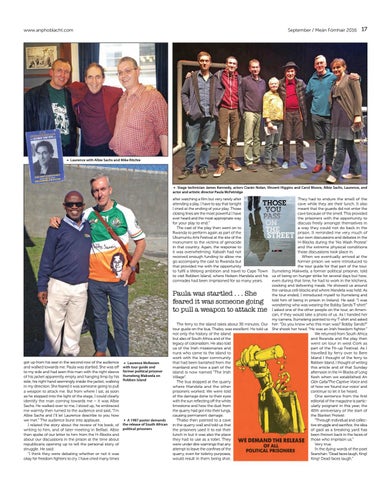
5 Laurence with Albie Sachs and Mike Ritchie
5 Stage technician James Kennedy, actors Ciarán Nolan, Vincent Higgins and Carol Moore, Albie Sachs, Laurence, and actor and artistic director Paula McFetridge
after watching a film but very rarely after attending a play. I have to say that tonight I cried at the ending of your play. Those closing lines are the most powerful I have ever heard and the most appropriate way for your play to end.” The cast of the play then went on to Rwanda to perform again as part of the Ubumuntu Arts Festival at the site of the monument to the victims of genocide in that country. Again, the response to it was overwhelming. Kabosh had not received enough funding to allow me go accompany the cast to Rwanda but that provided me with the opportunity to fulfil a lifelong ambition and travel to Cape Town to visit Robben Island, where Nelson Mandela and his comrades had been imprisoned for so many years.
Paula was startled . . . She feared it was someone going to pull a weapon to attack me
got up from his seat in the second row of the audience 5 Laurence McKeown and walked towards me. Paula was startled. She was off with tour guide and to my side and had seen this man with the right sleeve former political prisoner of his jacket apparently empty and hanging limp by his Itumeleng Makwela on side, his right hand seemingly inside the jacket, walking Robben Island in my direction. She feared it was someone going to pull a weapon to attack me. But from where I sat, as soon as he stepped into the light of the stage, I could clearly identify the man coming towards me – it was Albie Sachs. He walked over to me, I stood up, he embraced me warmly then turned to the audience and said, “I’m Albie Sachs and I’ll let Laurence describe to you how we met.” The audience burst into applause. 4 A 1987 poster demands I related the story about the review of his book, of the release of South African writing to him, and of later meeting in Belfast. Albie political prisoners then spoke of our letter to him from the H-Blocks and about our discussions in the prison at the time about republicans opening up to tell the personal story of struggle. He said: “I think they were debating whether or not it was okay for freedom fighters to cry. I have cried many times
The ferry to the island takes about 30 minutes. Our tour guide on the bus, Thabo, was excellent. He told us not only the history of the island but also of South Africa and of the legacy of colonialism. He also told us of the Irish missionaries and nuns who came to the island to work with the leper community that had been banished from the mainland and how a part of the island is now named “The Irish Village”. The bus stopped at the quarry where Mandela and the other prisoners worked. We were told of the damage done to their eyes with the sun reflecting off the white limestone and how the dust from the quarry had got into their lungs, causing permanent damage. Thabo then pointed to a cave in the quarry wall and told us that the prisoners used it to eat their lunch in but it was also the place they had to use as a toilet. They were under dire warnings that any attempt to leave the confines of the quarry, even for toiletry purposes, would result in them being shot.
They had to endure the smell of the cave while they ate their lunch. It also meant that the guards did not enter the cave because of the smell. This provided the prisoners with the opportunity to discuss freely amongst themselves in a way they could not do back in the prison. It reminded me very much of our own discussions and debates in the H-Blocks during the ‘No Wash Protest’ and the extreme physical conditions those discussions took place in. When we eventually arrived at the former prison we were introduced to the tour guide for that part of the tour. Itumeleng Makwela, a former political prisoner, told us of being on hunger strike for several days but how, even during that time, he had to work in the kitchens, cooking and delivering meals. He showed us around the various cell-blocks and where Mandela was held. As the tour ended, I introduced myself to Itumeleng and told him of being in prison in Ireland. He said: “I was wondering who was wearing the Bobby Sands T-shirt!” I asked one of the other people on the tour, an American, if they would take a photo of us. As I handed her my camera, Itumeleng pointed to my T-shirt and asked her: “Do you know who this man was? Bobby Sands?” She shook her head. “He was an Irish freedom fighter.” We returned from South Africa and Rwanda and the play then went on tour in west Cork as part of the Fit-up Festival. As I travelled by ferry over to Bere Island I thought of the ferry to Robben Island. I thought of writing this article and of that Sunday afternoon in the H-Blocks of Long Kesh when we established An Glór Gafa/The Captive Voice and of how we ‘found our voice’ and continue to let it be heard. One sentence from the first editorial of the magazine is particularly poignant in this year, the 40th anniversary of the start of the Blanket Protest: “Through individual and collective struggle and sacrifice, the idea of gaol as a breaking yard has been thrown back in the faces of those who imprison us.” Very true. In the dying words of the poet Seanchan: “Dead faces laugh, King! King! Dead faces laugh.”