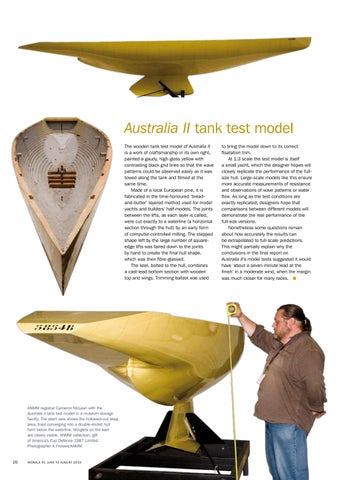
Australia II tank test model The wooden tank test model of Australia II is a work of craftsmanship in its own right, painted a gaudy, high-gloss yellow with contrasting black grid lines so that the wave patterns could be observed easily as it was towed along the tank and filmed at the same time. Made of a local European pine, it is fabricated in the time-honoured ‘breadand-butter’ layered method used for model yachts and builders’ half-models. The joints between the lifts, as each layer is called, were cut exactly to a waterline (a horizontal section through the hull) by an early form of computer-controlled milling. The stepped shape left by the large number of squareedge lifts was faired down to the joints by hand to create the final hull shape, which was then fibre-glassed. The keel, bolted to the hull, combines a cast-lead bottom section with wooden top and wings. Trimming ballast was used
ANMM registrar Cameron McLean with the Australia II tank test model in a museum storage facility. The stern view shows the hollowed-out skeg area, lines converging into a double-ended hull form below the waterline. Winglets on the keel are clearly visible. ANMM collection, gift of America's Cup Defence 1987 Limited. Photographer A Frolows/ANMM
20
Signals 91 June to august 2010
to bring the model down to its correct floatation trim. At 1:3 scale the test model is itself a small yacht, which the designer hopes will closely replicate the performance of the fullsize hull. Large-scale models like this ensure more accurate measurements of resistance and observations of wave patterns or water flow. As long as the test conditions are exactly replicated, designers hope that comparisons between different models will demonstrate the real performance of the full-size versions. Nonetheless some questions remain about how accurately the results can be extrapolated to full-scale predictions. This might partially explain why the conclusions in the final report on Australia II’s model tests suggested it would have ‘about a seven-minute lead at the finish’ in a moderate wind, when the margin was much closer for many races.