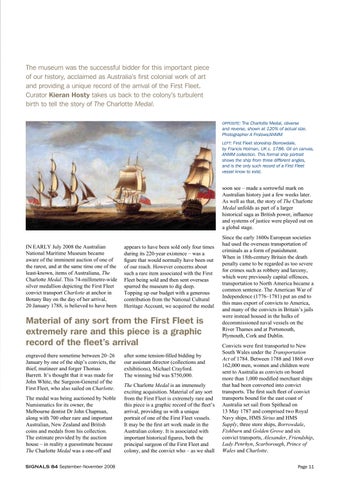
The museum was the successful bidder for this important piece of our history, acclaimed as Australia’s first colonial work of art and providing a unique record of the arrival of the First Fleet. Curator Kieran Hosty takes us back to the colony’s turbulent birth to tell the story of The Charlotte Medal. OPPOSITE: The Charlotte Medal, obverse and reverse, shown at 120% of actual size. Photographer A Frolows/ANMM LEFT: First Fleet storeship Borrowdale, by Francis Holman, UK c. 1786. Oil on canvas, ANMM collection. This formal ship portrait shows the ship from three different angles, and is the only such record of a First Fleet vessel know to exist.
soon see – made a sorrowful mark on Australian history just a few weeks later. As well as that, the story of The Charlotte Medal unfolds as part of a larger historical saga as British power, influence and systems of justice were played out on a global stage. IN EARLY July 2008 the Australian National Maritime Museum became aware of the imminent auction of one of the rarest, and at the same time one of the least-known, items of Australiana, The Charlotte Medal. This 74-millimetre-wide silver medallion depicting the First Fleet convict transport Charlotte at anchor in Botany Bay on the day of her arrival, 20 January 1788, is believed to have been
appears to have been sold only four times during its 220-year existence – was a figure that would normally have been out of our reach. However concerns about such a rare item associated with the First Fleet being sold and then sent overseas spurred the museum to dig deep. Topping up our budget with a generous contribution from the National Cultural Heritage Account, we acquired the medal
Material of any sort from the First Fleet is extremely rare and this piece is a graphic record of the fleet’s arrival engraved there sometime between 20–26 January by one of the ship’s convicts, the thief, mutineer and forger Thomas Barrett. It’s thought that it was made for John White, the Surgeon-General of the First Fleet, who also sailed on Charlotte. The medal was being auctioned by Noble Numismatics for its owner, the Melbourne dentist Dr John Chapman, along with 700 other rare and important Australian, New Zealand and British coins and medals from his collection. The estimate provided by the auction house – in reality a guesstimate because The Charlotte Medal was a one-off and SIGNALS 84 September–November 2008
after some tension-filled bidding by our assistant director (collections and exhibitions), Michael Crayford. The winning bid was $750,000. The Charlotte Medal is an immensely exciting acquisition. Material of any sort from the First Fleet is extremely rare and this piece is a graphic record of the fleet’s arrival, providing us with a unique portrait of one of the First Fleet vessels. It may be the first art work made in the Australian colony. It is associated with important historical figures, both the principal surgeon of the First Fleet and colony, and the convict who – as we shall
Since the early 1600s European societies had used the overseas transportation of criminals as a form of punishment. When in 18th-century Britain the death penalty came to be regarded as too severe for crimes such as robbery and larceny, which were previously capital offences, transportation to North America became a common sentence. The American War of Independence (1776–1781) put an end to this mass export of convicts to America, and many of the convicts in Britain’s jails were instead housed in the hulks of decommissioned naval vessels on the River Thames and at Portsmouth, Plymouth, Cork and Dublin. Convicts were first transported to New South Wales under the Transportation Act of 1784. Between 1788 and 1868 over 162,000 men, women and children were sent to Australia as convicts on board more than 1,000 modified merchant ships that had been converted into convict transports. The first such fleet of convict transports bound for the east coast of Australia set sail from Spithead on 13 May 1787 and comprised two Royal Navy ships, HMS Sirius and HMS Supply, three store ships, Borrowdale, Fishburn and Golden Grove and six convict transports, Alexander, Friendship, Lady Penrhyn, Scarborough, Prince of Wales and Charlotte. Page 11