SIGNALS quarterly

COMING FROM SWEDEN Vikings, more than just superb seafarers
AMERICA’S CUP LEGEND
That epic victory 30 years later
RAN FLEET CENTENARY
100 years of pride in our fighting ships
NUMBER 104 SEPTEMBER • OCTOBER • NOVEMBER 2013 ANMM.GOV.AU
Bearings
FROM THE DIRECTOR
RELOCATING TO AUSTRALIA AFTER several years working at the National Maritime Museum in the UK brings with it an exciting sense that we are a part of the world’s most dynamic emerging region, the Asia-Pacific. Most of you will have heard of the Australian Government’s white paper Australia in the Asian Century, which canvasses the strategic possibilities that brings. This museum has always had strong interests in the region through Australia’s many historic links with it. Our recent exhibition East of India – Forgotten trade with Australia, several years in the making, is just one of many examples of that.
We look forward to contributing to more Asian cultural projects while knowing there’s much to be learned in return
That engagement and commitment are going to be even more important under the new historical master-narratives that I have commissioned from our staff, to shape the way our collection and galleries develop in the coming years. Some of that focus will, naturally, be on the region’s emerging giant, China, with whom the museum’s links are already strengthening.
The internationally renowned architectural firm responsible for our own superb museum building, Cox Richardson, has recently won a global contest to create the massive new National Maritime Museum of China, to be located in the metropolitan port of Tianjin. This is China’s largest coastal city, gateway to the national capital Beijing. It’s part of a wave of ultra-modern museums emerging in China to showcase the depth of their culture and history, which in the case of maritime and navigational achievements is profound indeed.
I’m delighted that the Australian National Maritime Museum will be involved in the project in Tianjin, since Cox Richardson have asked me to review and guide the new
museum’s approach to interpretation and exhibition structures. For that I’ll draw, in part, on experience developing the modern new Sammy Ofer wing at NMM Greenwich.
The approaches and challenges of working in China, and understanding its unique cultural environment, were very much on the agenda during the time I spent in the middle of this year at Cambridge University, undertaking the residential component of an advanced leadership program I had begun during my recent years in the UK. In fact one of the world authorities on China whom I met there in June this year, Professor Peter Williamson, will be visiting us soon for further discussions.
Some readers may remember an article in Signals on the opening of the China Maritime Museum in Shanghai in 2010, another major project to which our museum had also contributed its expertise. In January this year I was invited to the opening of another impressive new Chinese cultural facility, the Hong Kong Maritime Museum located at the site of the Star Ferries terminal, a gateway to mainland China. Like our own museum and the one in Tianjin, this is another example of a major redevelopment of old waterfront infrastructure featuring a maritime museum.
The Hong Kong Maritime Museum brings together a number of private and public collections, with new digital technology used cleverly to interpret fragile old documents – such as an extraordinary Qing Dynasty scroll recording the way that Chinese authorities dealt with the region’s notorious plague of pirates that we mostly hear about through the filter of colonial histories. Interestingly, that new museum’s director is the expatriate Australian heritage expert Richard Wesley.
We look forward to contributing to more cultural developments in Asia – while knowing there’s much for us to learn from their innovations.
Kevin Sumption
Not the first but the most famous – and most often misunderstood – of Europe’s seafarers
International Fleet Review celebrates a naval centenary on Sydney Harbour
What winning the America’s Cup 30 years ago meant to Australia’s national identity
From the museum’s collection and library come excerpts of voyagers’ recollections
A strange tale from the 1930s emerges from the museum’s Samuel J Hood Studio Collection
Your calendar of activities, tours, lectures and excursions afloat
The
in our galleries this
First contact memorial; tall ship
cover: Appearing in our exhibition
AUSTRALIAN NATIONAL MARITIME MUSEUM 1 ANMM.GOV.AU Contents SPRING 2013 2 VIKINGS – BEYOND THE LEGEND
10 ONE KING, ONE FLEET, ONE NATION
16 THE LEGACY OF AUSTRALIA II
22 SHIPS’ DIARIES, THE BLOGS OF YESTERYEAR
30 THE THREE MYSTERIES – A FILM, A VOYAGE, A DISAPPEARANCE
38 MESSAGE TO MEMBERS From the Members
40 MEMBERS SPRING EVENTS
program coordinator
46 SPRING EXHIBITIONS
latest exhibitions
season 48 MARITIME HERITAGE AROUND AUSTRALIA Treasures from the Maritime Museum of Tasmania 54 AUSTRALIAN REGISTER OF HISTORIC VESSELS
Queensland’s
Norman R Wright & Sons 58 COLLECTIONS The whale cure,
moment in medical history 62 TALES FROM THE WELCOME WALL English rose, Dutch sailor 66 READINGS A Savage History – Whaling in the Pacific by John Newton 68 CURRENTS
With a focus on
famous boatbuilders
a bizarre
research benefactor
docking;
–
of
coastal
river vessel found
Bulverket on the Swedish island
Gotland.
Vikings
Beyond the legend will be this reconstruction
a
and
at
of
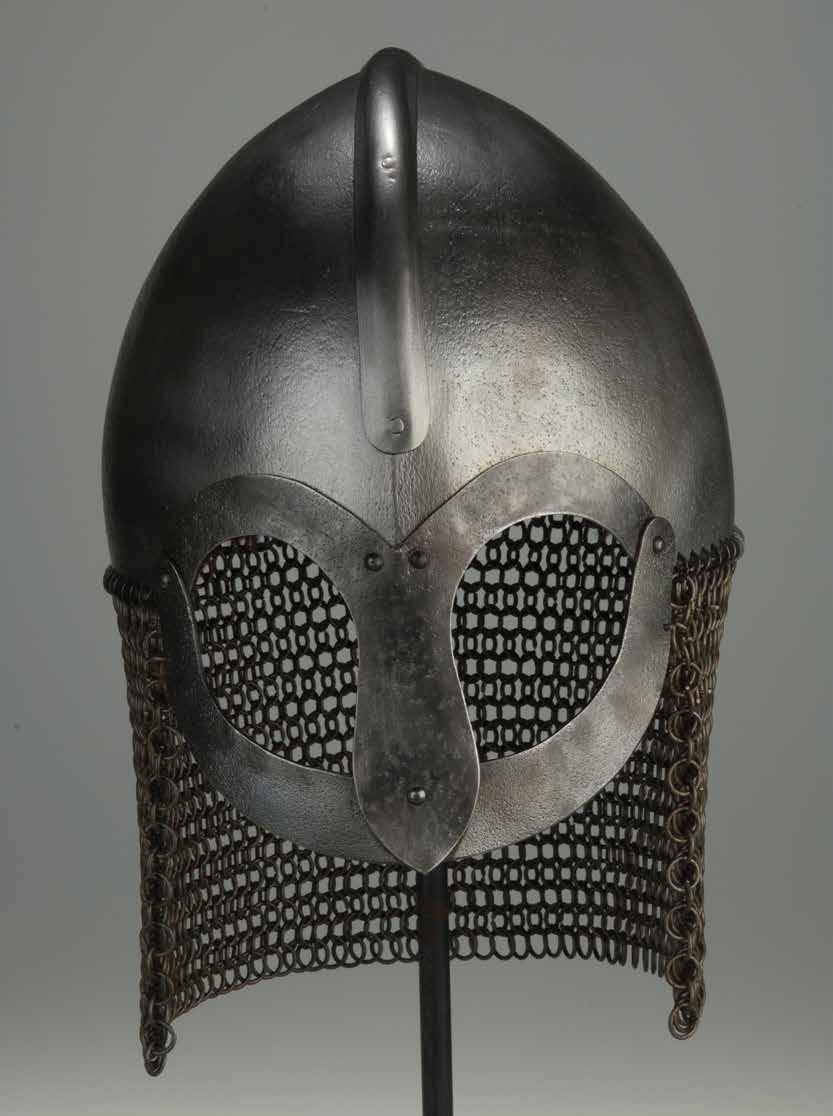
The only example of a complete Viking helmet in existence, this is a replica of the so-called Gjermundbu helmet, named after the farm from which it was excavated in Ringerike in central Norway. All photographs reproduced courtesy of the Swedish History Museum, unless otherwise specified.
This exhibition prompts us to look beyond the stereotypical image of Vikings as marauding plunderers, to the domestic, cultural, artistic and mercantile side of Viking-age cultures
Vikings Beyond the legend
WORSHIP, WEAPONS AND WATERCRAFT
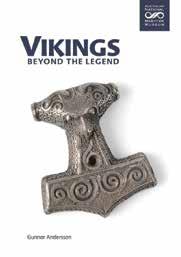
From 19 September 2013, we host Vikings – Beyond the legend, a superb international exhibition from the Swedish History Museum, Stockholm, that explores the fascinating cultures of the Viking age. This glimpse of the exhibition’s attractions comes from ANMM curator Dr Stephen Gapps, who’s been investigating diverse aspects of Viking life.
FROM SEPTEMBER, DARLING HARBOUR will be home to three Viking vessels when the exhibition Vikings – Beyond the legend arrives at this museum. One is the reconstruction of a small, two-oared craft, the Årby boat. The second is a reconstruction of a larger vessel that went under sails as well as oars. Both are part of an exhibition developed by the Swedish History Museum, Stockholm, with the support of MuseumsPartner, Austria.
The third vessel to be displayed at the museum will be an Australian interpretation of the famous Gokstad ship, the longship that was recovered from a Viking-age burial mound in the late 19th century and is now on display at the Viking Ship Museum in Oslo, Norway. The operational reconstruction built in Western Australia will be in the water and available for inspection at the museum wharves.
As its title suggests, this exhibition prompts us to look beyond the stereotypical image of Vikings as marauding plunderers, to the domestic, cultural, artistic and mercantile side of Viking-age cultures. Recent archaeological finds (many of which will be seen in the exhibition) show that these cultures were not homogenous; there were distinct variations in regions now known as Norway, Sweden, Denmark, Russia and Eastern Europe, Iceland and Greenland as well as other places.
In fact, we should not really be calling them Vikings at all! The real meaning of the Norse word ‘viking’ referred to those ‘going a-viking’, perhaps best translated as ‘adventuring’. In fact the vast majority of Scandinavians during the Viking age stayed at home working on farms, or lived and worked in towns and villages. It was only later that all Scandinavian peoples
AUSTRALIAN NATIONAL MARITIME MUSEUM 3
from that period between the 8th and 11th centuries were labelled ‘Vikings’. At the time they were most often referred to as ‘the people from the north’, or Norsemen.
The exhibition explores the lives both of the people who ‘went a-viking’ and those who stayed at home. It has more than 500 archaeological artefacts from the Swedish History Museum collection, many of which have never been seen in Australia before. They include finely crafted silver and bronze jewellery, and simple domestic items made from animal bone such as combs, flutes and even a pair of bone ice skates.
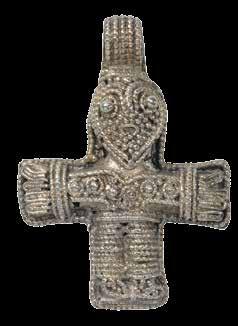
One of the highlights for me is the oldest-known Scandinavian crucifix. While there’s a strong association of Vikings with paganism, in fact for much of the Viking age many were converts in an increasingly Christianised Europe. At the beginning of the Viking age, around 750 to 800 CE (Common Era, the equivalent of ‘AD’), Scandinavian cultures practised an indigenous religion known as the Aesir Faith. By around 1100, this had been replaced by Christianity, although some older pagan practices survived, merged with the new beliefs. Archaeologists have found increasing evidence of the fusion of the two religions during this period, such as the silver pendant shown opposite in the form of a crucifix.
The Old Norse religion was characterised by cult worship and ritual involving a pantheon of gods and goddesses that reflected a cultural focus on family and lineage. When the first Norse rulers took up Christianity, with its focus on a single
god and universal system of salvation, it provided a model for a supreme king that strengthened local rulers’ positions of power. Religious change was accompanied by social change, towards a more patriarchal and hierarchical, feudal structure.
The set of 35 gilded pendants and abox-shaped brooch on display in the exhibition show this fusion of religious iconography. The fish-head shaped pendants are all adorned with crosses, while the matching brooch displays the gripping-beast style of imagery common to the Old Norse traditions.
While the exhibition emphasises the often-neglected aspects of Scandinavian Viking-age stories, this was a period of massive expansion in Norse trading and settlement that often included the violent seaborne raids for which the Norsemen became so well known. Included in the exhibition are typical arms of the Viking-age warriors. While a common image has Viking warriors wielding swords and long-handled ‘Dane axes’, in fact the warrior’s primary weapon was more likely to be a spear. The tactics of shield-wall fighting are most effective with spears protruding from interlocking shields. They have a greater reach than swords and can be thrown as well. Odin, the Norse god of war, is portrayed in sagas and images with his spear named Gugnir, suggesting the importance of spears at the time. Swords were less common as they were costly to make. They were pattern-welded, a technique in which strips of iron and steel
The Old Norse religion was characterised by cult worship and ritual involving a pantheon of many gods and goddesses that reflected a cultural focus on family and lineage
are twisted and forged together, giving the blade a band of patterning. Swords were a sign of social status and could also be elaborately decorated.
When it comes to Viking ships, the longship full of armed warriors springs first to mind. However, in the spirit of the exhibition – to go beyond the legend – the museum will have three different styles of Viking-age vessels on display. Watercraft in the Viking age comprised a diverse array of types suited for different purposes such as fishing, transport and trade. The longship was but one example.
As noted by Gunnar Andersson, the Swedish History Museum’s curator of this exhibition, boats and ships were important to Vikingage cultures ‘as a form of transportation in real life as well as a symbolic and psychological gesture’. Boat funerals – both buried beneath mounds and the remnants of funerary pyres – have been found by archaeologists throughout Scandinavia. Many Viking-age burial finds include masses of iron nails that were used to fasten wooden planks, suggesting the boat had been burnt during a cremation and all that was left for archaeologists were the iron nails.
Importantly, boat burials were not just for warriors and kings, but for men and women, young and old, and from all levels of society. The widespread ritual practice of boat burials seems to be part of a belief in the ship as a form of transport ‘to the other side.’ It may also promise a return from the world of the dead, as described in the Scandinavian Prose Edda story where
4 SIGNALS 104 SEPTEMBER–NOVEMBER 2013

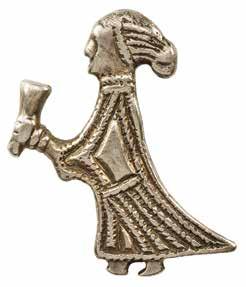
01 Set of women’s jewellery made from bronze, gold and silver: 35 pendants shaped as fish heads and a brooch. It was found in a hoard from Krasse, in Gotland, Sweden.
02 Silver figure of a Valkyrie with a drinking horn. Valkyries were the mythological female creatures who decide which warriors die in battle and which live, and then choose which of the slain to convey to Valhalla where the war god Odin rules the afterlife. Found at Klinta, Köping, Öland, Sweden.
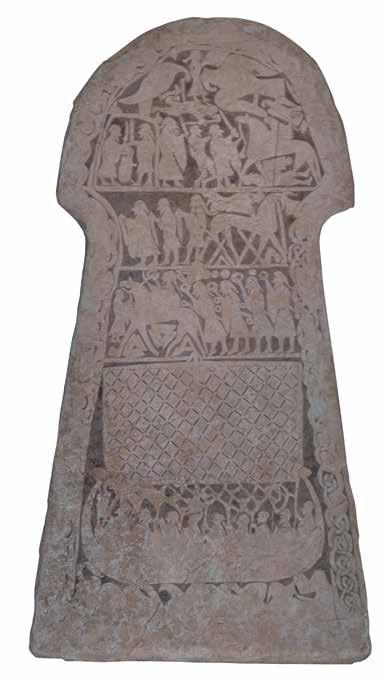
03 Viking picture stones were found exclusively on Gotland, Sweden’s largest island, in the Baltic Sea. The stones show mythological scenes – here, a warrior’s journey to Valhalla. The vessel depicts a fascinating sail structure with complex control lines. 8th–9th century CE, Tängelgårda, Lärbro, Gotland.
04 This silver pendant is the oldest known representation of a crucifix found in Sweden, from the rich Birka site in Adelso, Uppland. It has never before been seen in Australia.
AUSTRALIAN NATIONAL MARITIME MUSEUM 5
03 02 01 04
The picture of watercraft in the Viking age is one of a diverse array of types suited for different purposes such as fishing, transport and trade; the longship was but one example
01
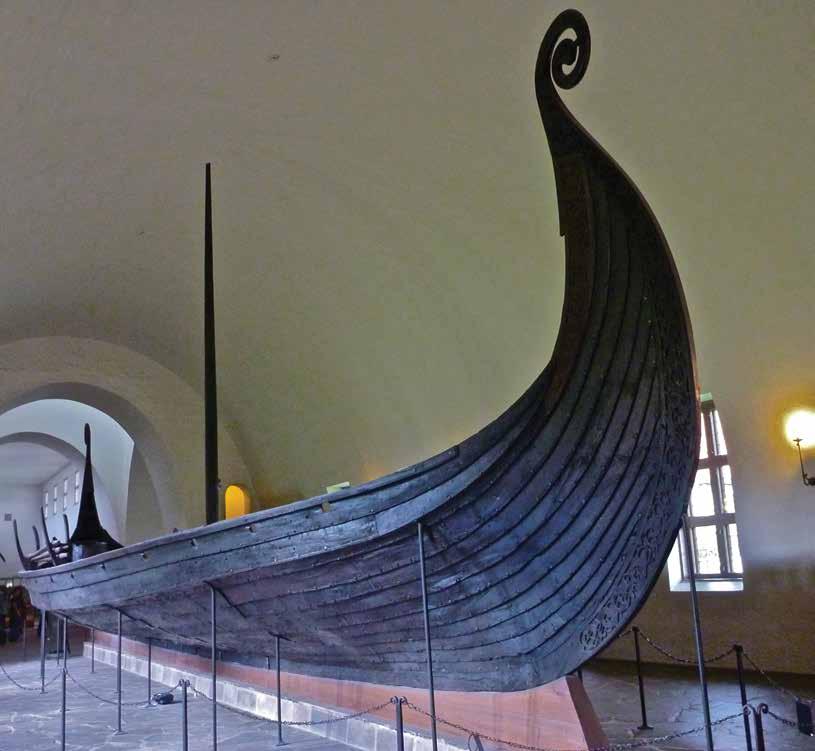
01 The Oseberg ship, built c 800 CE, displayed in the Viking Ship Museum, in Bygdoy, Norway. Photographer David Payne/ANMM
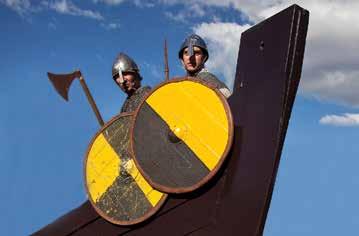
02 Jorgen Jorgenson, the Western Australian reconstruction of the Gokstad ship, goes on display at the museum during Vikings – Beyond the legend Enthusiastic historic re-enactors are the author (left) and marketing manager Jackson Pellow. Photographer A Frolows/ANMM
the much-loved god Baldr – deceitfully slain by the jealous Loki – was cremated in his ship. Baldr was mourned by all the gods in their home Asgard, and Odin’s son Hermod was sent to retrieve him from Hel, mistress of the realm of the dead. Hel promised that if the whole world wept for Baldr, she would release him. All the world did weep, except the sinister Loki – and so Baldr could not return.
The exhibition includes two replica vessels from Sweden. A reconstruction of the small, two-oared fishing or transport craft known as the Årby boat reminds us that both small and large boats were important in Viking-age maritime contexts, as well as in burials. The original was found in 1933 in a grave dating from 850 to 950 CE, while the reconstruction was made by the eminent maritime historian and ethnologist Dr Basil Greenhill of the National Maritime Museum, Greenwich.
The other vessel is larger – eight metres in length – and was designed for both the Baltic Sea and the riverways of Eastern Europe. It has a large, braided square sail, three rowing stations and can take a crew of 10 or 11. Named Krampmacken, it’s a reconstruction of a vessel found at Bulverket on the Swedish island of Gotland. In 1983 the reconstruction was sailed, rowed and portaged from Gotland to Istanbul (or Miklagard, as the Norse called this great city) in Turkey. This re-enacted the Vikings’ great eastward migrations through the rivers of Europe as far as the Middle East – less well known to many of us than the westward voyages that led to settlements in the Faroe Islands, Iceland, Greenland and North America.
The third vessel representing the Viking age at the museum was actually made in Perth, Western Australia, in 1987. It is a reconstruction inspired by the famous
Gokstad ship, which was unearthed from a burial mound in Sandefjord, Norway, in 1880. The Gokstad ship was a Viking type called a karvi, a coastal ship that was smaller than the longship used for raiding overseas. This was an immensely important find that stimulated some of the earliest experimental archaeology projects to reconstruct and learn about the forms and performance of Viking vessels. The karvi from Perth, named Jorgen Jorgenson, demonstrates how far the fascination with Viking seamanship has spread. While it is not a faithful replica, and is built with locally available timbers and modern fastenings, it is an evocative reconstruction that gives us a good understanding of the workings and capabilities of a Viking vessel.
It was named after the Danish adventurer Jorgen Jorgenson (1780–1841) who led a fascinating life with notable connections to Australian history. Some can be gleaned from the title of his autobiography: The Convict King: Being the Life and Adventures of Jorgen Jorgenson, Monarch of Iceland, Naval Captain, Revolutionist, British Diplomatic Agent, Author, Dramatist, Preacher, Political Prisoner, Gambler, Hospital Dispenser, Continental Traveller, Explorer, Editor, Expatriated Exile, and Colonial Constable
The vessel Jorgen Jorgenson had a mixed life too, operated for a period as a charter vessel licensed to carry 76 passengers and crew. It was the rather down-at-heel green Viking ship that readers may have seen moored under Sydney’s Anzac Bridge in recent years. Its refurbishment has been a community outreach plan driven by the Pyrmont Heritage Boating Club, which operates just along the harbour from the museum. The club was established in 2005 to ‘revive inner city boating,
engage youth in heritage, community and maritime industry and to provide community access to harbour culture’. Their Longship Project engages long-term unemployed, disabled and disadvantaged people in restoring the vessel to sailing condition. It aims to operate the vessel as a mentoring, sail-cadetship and leadership training enterprise for the local community.
The Australian National Maritime Museum has established a collaboration with the Pyrmont Heritage Boating Club to assist in completing much-needed restoration and major work on the vessel above and below the waterline. A mast is being stepped so that it can be easily raised and lowered, a feature of Viking-age vessels. A sail, rigging, oars and shields lining the gunwales will complete the picture and Jorgen Jorgenson will become an attraction at the museum wharves for the duration of the exhibition Vikings – Beyond the legend. It will introduce visitors to aspects of Viking ships and to the legacy of the Gokstad vessel and the reconstructions that it inspired.
The Gokstad find was a remarkable early archaeological discovery that, along with other ship finds at Oseberg and Tune, has added immensely to our picture of Viking-age ships. It was discovered in 1880 when the sons of the owner of the Gokstad farm in Sandefjord, Norway, were inspired by other late-19th-century discoveries in their region to dig into the knoll that had long been locally known as the Kongshaugen or king’s mound. They uncovered the bow of a boat, and shortly after the antiquarian Nicolay Nicolaysen took over and began a controlled archaeological investigation.
Although the barrow had been looted in the past – no weapons and few objects remained in the burial chamber – the grave
AUSTRALIAN NATIONAL MARITIME MUSEUM 7
02
The exhibition includes more than 500 archaeological artefacts from the Swedish History Museum collection, many of which have never been seen in Australia before

robbers had not destroyed the burial ship, which was extremely well preserved in the blue clay used to build the mound. The Gokstad vessel was painstakingly recovered and moved to the University of Oslo. By the early 1900s three large Viking-age vessels had been recovered remarkably intact and a dedicated Viking ship museum was constructed.
The Gokstad vessel was built around the late ninth century at the height of Norse expansion in Dublin, Ireland and Jorvik (York), England. It is clinker built, and made almost entirely of oak. It has 16 pairs of oars requiring 32 oarsmen for a complete complement, but could have carried around 70 people if required. It is 23.24 metres between the extreme points, the maximum beam is 5.2 metres, the height from the bottom of the keel to the gunwale amidships is 2.02 metres and the estimated weight is 20.02 tonnes.
Viking-age vessels were famed for their versatility, speed and ability to sail across seas or travel along rivers. The wide beam and relatively flat bottom meant such ships could easily be beached – perfect for a lightning raid.
The Gokstad ship is stunningly beautiful with its elegant lines and sculptural form. It has been described as ‘severe simplicity combined with well-nigh functional perfection’. Unlike the earlier (circa 800) Oseberg ship find, which was highly decorated and has wonderful carved, scrolled finial ornaments scarfed onto the stem and stern, the Gokstad has no figurehead – and certainly no dragon’s head, so familiar to us all from popular culture.
Three ship finds – Gokstad, Oseberg and Tune – are all relatively similar in size and shape and belong to a class of ship described in the sagas as karvi – small vessels for the use of chieftains and their warriors and retinues for cruising along the coast. The Gokstad is more sturdily constructed and less ostentatious than the Oseberg ship; it was probably more functional, with a greater seagoing ability. A reconstruction of the Gokstad ship built in 1893 was sailed across the Atlantic from Europe to North America for the
Iron sword found in a grave from Bengtsarvet and Härvadsarvet, Sollerön, Dalarna, Sweden. Swords were a sign of social status and could also be elaborately decorated.
8 SIGNALS 104 SEPTEMBER–NOVEMBER 2013
The illustrated exhibition catalogue is on sale at The Store. Vikings – Beyond the legend by exhibition curator Gunnar Andersson, originally published by the Swedish History Museum. $19.95 (Members $17.95)
World Exhibition at Chicago. It became a great hit, despite taking the gloss off the quadricentennial celebrations of Christopher Columbus’s ‘discovery’ of the New World by adding weight to the growing evidence that Vikings had crossed to North America well before him.
The 1893 reconstruction proved most seaworthy and its captain, Magnus Andersen, paid high tribute to it. Part of the reason for this is the strength of the keel, cut from one massive oak tree, and its higher sides – with 16 strakes compared to 12 on the Oseberg ship. The two upper strakes are above the oar holes, which could be closed with shutters when sailing. The top strakes are relatively thin and were supported by dedicated top ribs. Here, a shield rack was fixed inside the ship and two shields per oar could be hung, overlapping, outboard along the gunwale and fastened by straps. Remnants of all 64 shields were recovered from the Gokstad find, each about one metre in diameter, built of thin, planked wood and painted black and yellow.




Over 175 years of heritage

Intriguingly, we know more about Vikingage vessels than some important, later types of European ship … more, for example, than we know about the caravels of the Portuguese explorers who began the global expansion of the West from the 15th century. As well as the preservation of ships in Viking burials, a notable find of five ships that were scuttled and preserved in silt at the bottom of Roskilde Fjord in Denmark has added immensely to our knowledge of Viking ship design. They included two longships, a ferry, a coastal trader and a deep-sea trader, or knarr
The knarr was the robust, seaworthy trader that enabled the Vikings’ North Atlantic colonies to be settled. Knarrs had long been known from Norse sagas, but no-one knew what they looked like … until the Roskilde finds gave a template for their exact form and proportions. Another of the Roskilde vessels, built around 1025, was the longest Viking-age ship yet discovered. It would have measured 36 metres and had about 40 pairs of oars, with 80 oarsmen to serve them.



There are many very good reasons why Viking ships and cultures capture our imaginations, as an early but now wellunderstood episode of northern European seafaring. Their legacy is rich, but I’ll end with one small but profound example. Our terms port and starboard derive directly from Norse ship design. Viking ships were steered by an offset rudder that was always mounted on the right-hand side of the hull, attached and pivoting on a rawhide thong that passed through the shaft of the rudder and the hull. The name of that side of a vessel, ‘starboard’, comes from the Norse term for steering board. In port a ship always tied up with its left-hand side to the dock, to avoid damaging the rudder and its mounting. That side was thus known as ‘port’.

Partner Museums




The name Viking has always been synonymous with exploration, leading the way where others follow. Sail with the world’s leading river cruise line to experience inspiring destinations, beautifully crafted itineraries, expert tour guides, revolutionary ships, fine cuisine, excellent service and remarkable value.





Partner
the Australian National
Embark on a journey with Viking. Visit www.vikingrivercruises.com.au Major
of
Maritime Museum
.museumspartne
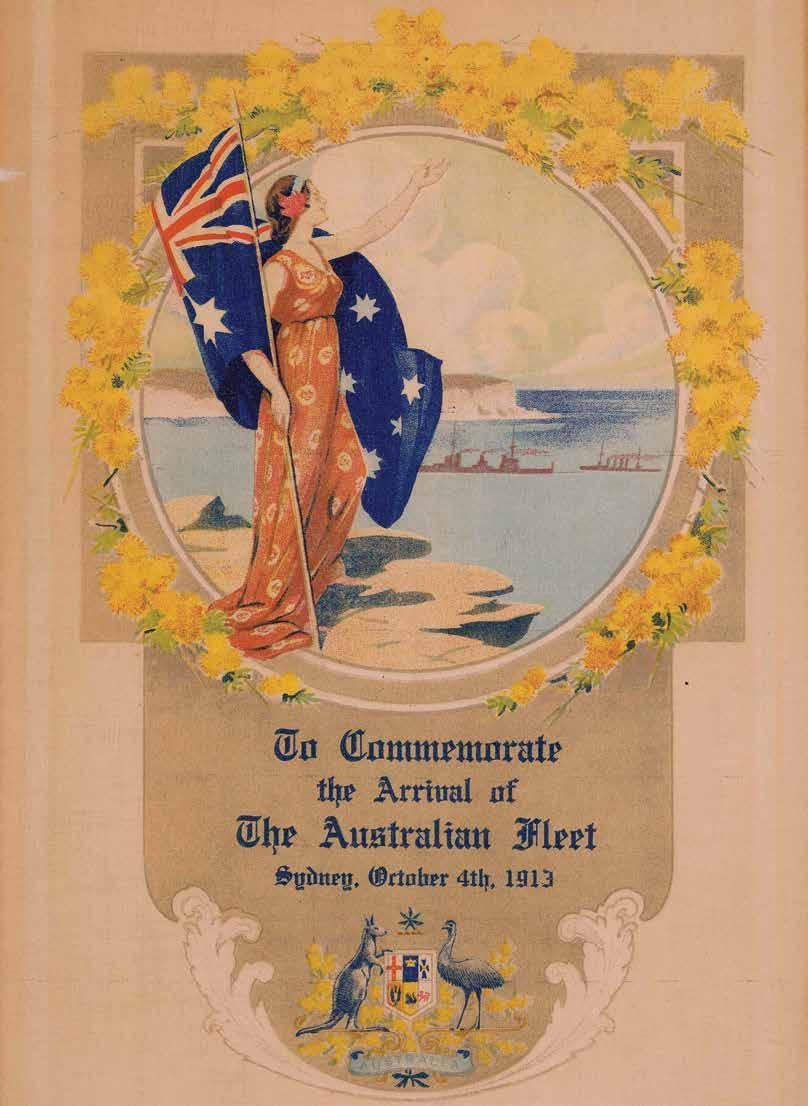
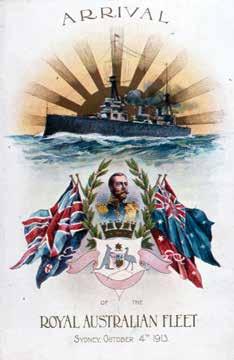
Australian symbols, including sprigs of the national flower wattle, abound on this souvenir program recording the celebratory events when the nation’s new fleet of warships made its first entry into Sydney Harbour. It features the female personification of Australia draped in the national flag. ANMM Collection
One King, oneFleet, one Nation
THE BIRTH OF AN AUSTRALIAN NAVY
This October marks 100 years since the Royal Australian Navy’s first fleet of warships was welcomed into Sydney Harbour with pomp and fanfare. This centenary will be commemorated in similar fashion with the International Fleet Review, a spectacular week-long program of events from 3–11 October. Senior curator Lindsey Shaw – who, after 27 years of service to the museum, retired in July this year – examines the origins of our navy.
R EACHING 100 YEARS IS A MILESTONE in anyone’s life, and our own Royal Australian Navy is no exception. A century ago this October, the Australian Fleet Unit – the nucleus of the Australian Navy – was loudly and emphatically welcomed into Sydney as a sign of both our nationhood and a strong future as an independent member of the Dominion.
To remind Australians and an international public of the significance of this occasion, the Royal Australian Navy (RAN) will hold a series of commemorative events and activities over a nine-day period on the harbour and around Sydney, under the banner of the International Fleet Review. From 3 to 11 October, Sydney will be hosting navies from around the world. Alongside our 20 RAN ships there will be at least 23 international warships, 17 tall ships and an aviation program featuring more than a dozen types of helicopters and other aircraft. Sydney
will be abuzz with sailors and ships, bands and parades, flypasts and fireworks. It’s going to be bigger than the 1988 Bicentennial celebrations, so don’t miss it!
Sydney will be abuzz with sailors and ships, bands and parades, flypasts and fireworks
The formation of the Australian navy didn’t happen overnight. The idea of an Australian fleet of warships had been much discussed in naval and political circles since the Federation, in 1901, of the Australian colonies into a single nation. At the Imperial Defence Conference of 1909 in London, it was decided that one battle cruiser, three second-class cruisers, six destroyers and three submarines would be constructed to form an Australian Fleet Unit.
The purpose of this unit was to defend Australia and to support the rest of the British Empire as and when required.
At Federation the various, ageing naval ships from the colonial state governments were known collectively as the Commonwealth Naval Forces; however, while adequate for coastal defence, they fell short of being a naval force with which to be reckoned. A squadron of Britain’s Royal Navy was stationed in Sydney for the protection of both Australia and New Zealand, with £200,000 being contributed annually –and somewhat grudgingly – towards the maintenance of this fleet. But at any time this British squadron could be removed, leaving Australia without naval protection. It was time to have our own modern navy.
‘First-born of the Commonwealth navy, I name you the Parramatta. God bless you, and those who sail in you. May you uphold the glorious traditions of the British navy in the dominions overseas.’ With these
AUSTRALIAN NATIONAL MARITIME MUSEUM 11
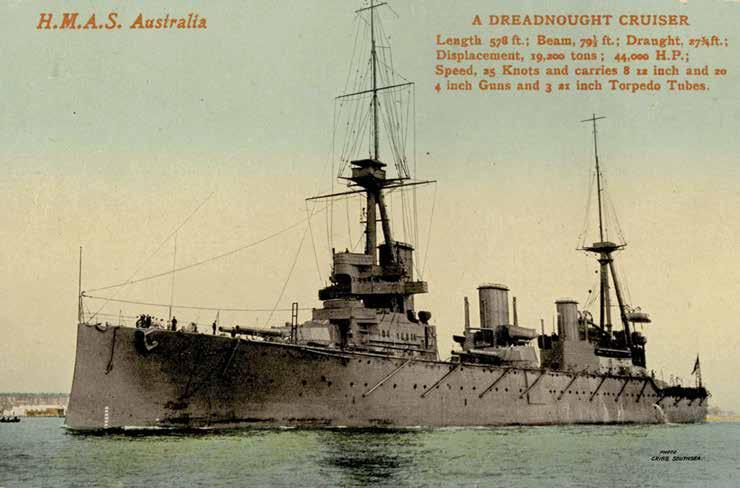
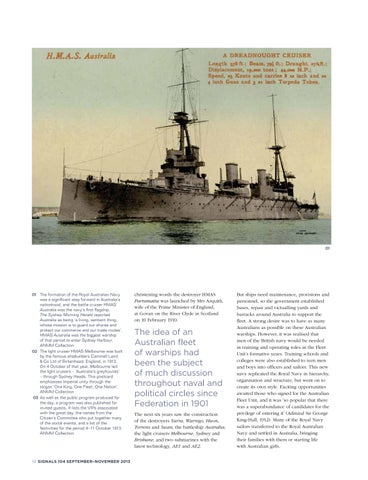
01 The formation of the Royal Australian Navy was a significant step forward in Australia’s nationhood, and the battle cruiser HMAS Australia was the navy’s first flagship. The Sydney Morning Herald reported Australia as being ‘a living, sentient thing, whose mission is to guard our shores and protect our commerce and our trade routes’. HMAS Australia was the biggest warship of that period to enter Sydney Harbour. ANMM Collection
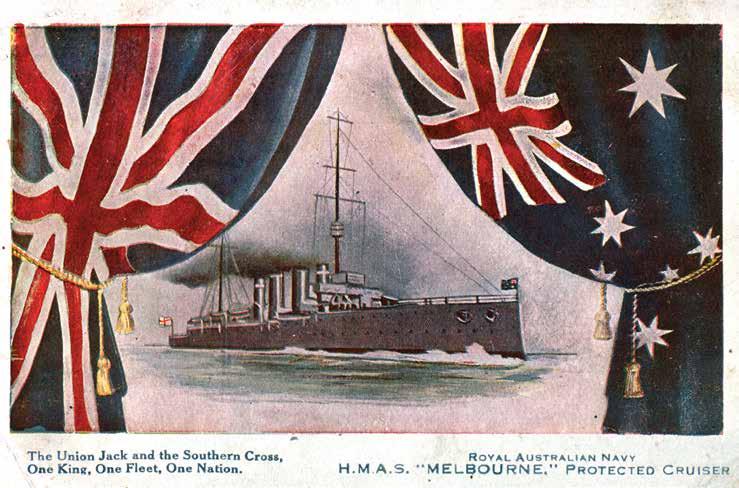
02 The light cruiser HMAS Melbourne was built by the famous shipbuilders Cammell Laird & Co Ltd of Birkenhead, England, in 1913. On 4 October of that year, Melbourne led the light cruisers – ‘Australia’s greyhounds’ – through Sydney Heads. This postcard emphasises Imperial unity through the slogan ‘One King, One Fleet, One Nation’. ANMM Collection
03 As well as the public program produced for the day, a program was also published for invited guests. It lists the VIPs associated with the great day, the names from the Citizen’s Committee who put together many of the social events, and a list of the festivities for the period 4–11 October 1913.
ANMM Collection
christening words the destroyer HMAS Parramatta was launched by Mrs Asquith, wife of the Prime Minister of England, at Govan on the River Clyde in Scotland on 10 February 1910.
The idea of an Australian fleet of warships had been the subject of much discussion throughout naval and political circles since Federation in 1901
The next six years saw the construction of the destroyers Yarra, Warrego, Huon, Torrens and Swan; the battleship Australia; the light cruisers Melbourne, Sydney and Brisbane ; and two submarines with the latest technology, AE1 and AE2
But ships need maintenance, provisions and personnel, so the government established bases, repair and victualling yards and barracks around Australia to support the fleet. A strong desire was to have as many Australians as possible on these Australian warships. However, it was realised that men of the British navy would be needed in training and operating roles in the Fleet Unit’s formative years. Training schools and colleges were also established to turn men and boys into officers and sailors. This new navy replicated the Royal Navy in hierarchy, organisation and structure, but went on to create its own style. Exciting opportunities awaited those who signed for the Australian Fleet Unit, and it was ‘so popular that there was a superabundance of candidates for the privilege of entering it’ (Admiral Sir George King-Hall, 1912). Many of the Royal Navy sailors transferred to the Royal Australian Navy and settled in Australia, bringing their families with them or starting life with Australian girls.
12 SIGNALS 104 SEPTEMBER–NOVEMBER 2013
01
The official arrival of the Australian Fleet Unit into Sydney on 4 October 1913 was received enthusiastically by Sydneysiders and visitors alike. Thousands lined every vantage point along the harbour shores and boats of all kinds were on hand to watch as the fleet entered in formation, with the battlecruiser HMAS Australia leading. It was followed by the light cruisers Melbourne, Sydney and Encounter (which had been transferred on loan to the Australian navy from the Royal Navy), then the destroyers Warrego, Parramatta and Yarra. They were greeted by the governor and premier of New South Wales and a roaring crowd of citizens, and these warships entering through the early morning mist must have been a profound sight. A deafening salute from the 12-inch guns of the flagship HMAS Australia reverberated up and down Port Jackson, and the stately procession was loudly and proudly cheered on as it made its way to Garden Island naval dockyard and Farm Cove.
The entry of the ships marked the start of week-long celebrations. Schoolchildren played their part in the great event with a massed schools’ display at the Sydney Cricket Ground, the highlight of which was a formation of 8,000 boys and girls into a living shield within a map of Australia. Special tours of the flagship HMAS Australia were a highlight for some 3,000 children.
A formal banquet was held to welcome the new fleet and its officers, and the Prime Minister, Andrew Fisher, and Leader of the Opposition, Joseph Cook, both delivered speeches punctuated by cheers from the audience. The Sydney Morning Herald reported: ‘they were at one in their assertion that in the hour of danger the Australian unit will be found where it can do the greatest service’. And indeed that is what happened a mere 10 months later, when Australia declared its support of Great Britain and the country went to war against Germany. The Royal Australian Navy was quick off the mark, taking German New
AUSTRALIAN NATIONAL MARITIME MUSEUM 13
02 03
While the public tends to view World War 1 more as a soldiers’ war, Australia’s navy served across the globe in this ‘war to end all wars’
Guinea in a matter of weeks. The first Australian casualty of the war was a sailor
– Able Seaman William Williams, fatally wounded on 11 September 1914.
While the public tends to think of World War 1 more as a soldiers’ war, Australia’s navy served across the globe in this ‘war to end all wars’:
• The Australian Naval & Expeditionary Force (AN&MEF) launched Australia’s first land engagement of the war, seizing stations and winning control of the seas of our north and routing Admiral Graf Spee’s fleet
• HMAS Australia sank the German auxiliary Eleanore Woermann in the North Pacific
• Warships successfully escorted troopships to the Middle East and beyond
• HMAS Sydney soundly defeated the German raider SMS Emden in battle off the Cocos Islands in November 1914
– Australia’s first naval fight
• At Gallipoli the navy was the ‘first in, last out’, with the RAN Bridging Train building bridges, jetties and pontoons for the landing and evacuation of the troops
• Our ‘Navy Blue ANZACS’ were at the forefront of naval attack, with the submarine AE2 being the first allied vessel to successfully navigate through the dangerous Dardanelles Straits and disrupt Turkish and German shipping
• In the North Sea and the Mediterranean, our ships joined the British Fleet in countless months of patrolling and sweeping the seas in search of German submarines and mines
• In the Atlantic our ships monitored neutral ports for signs of enemy activity and patrolled the waters leading to the Panama Canal, safeguarding it from any German interference or use
• In Africa HMAS Pioneer (transferred to the Australian navy in 1913 from the Royal Navy) took part in the bombardment and disarmament of the German colony of Zanzibar (Tanzania)
• When the German High Seas Fleet capitulated, HMAS Australia was given the privilege of leading the port column of the allied Grand Fleet as the two divisions steamed out to meet the Germans at Scapa Flow in Orkney, off northern Scotland.
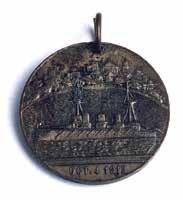
01 This bronze medalet was issued to all New South Wales children. As a bonus they were granted the day off school to take part in this important historic event. Thousands of young spectators dressed in red, white and blue to welcome the national fleet. ANMM Collection, gift from D Coffey
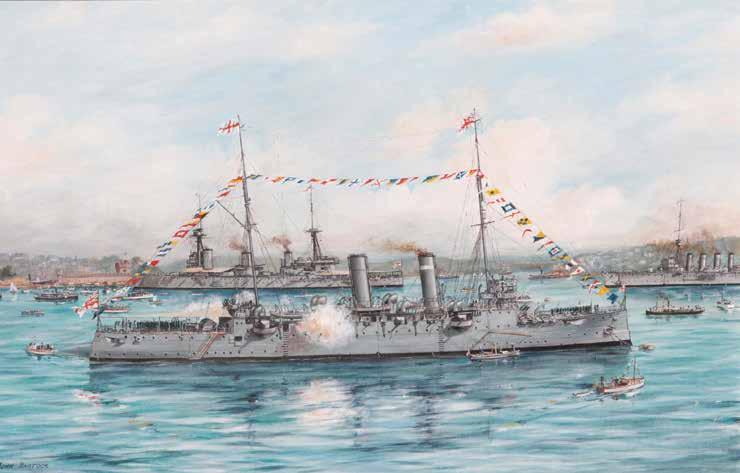
02 The last flagship of the Australia Station HMS Cambrian, by John Bastock. This second-class protected cruiser is dressed overall saluting the arrival of the Australian Fleet Unit. Cambrian fired a 13-gun salute to Rear-Admiral Sir George Patey on board HMAS Australia ANMM Collection, gift from John Bastock.
03 Australian and British sailors and officers of the flagship HMAS Australia, commissioned in Portsmouth in June 1913. King George V had just inspected it before the ship’s departure for Australia. ANMM Collection, gift from Olive Wilks
By war’s end the Royal Australian Navy counted its losses – 15 officers and 156 sailors had died for their country, including the entire complement of the submarine AE1
This year, 2013, marks the centenary of the Australian Fleet Unit’s arrival as a cohesive naval force, and as we approach the centenary of World War 1 it is an opportune moment to reflect on 100 years of cooperation between Australia and other world navies, especially the interoperability of the Commonwealth navies in the 20th century.
The formation of Australia’s own formidable naval force at the beginning of the 20th century is celebrated here at the museum with our own ‘fleet unit’ – the Daring class destroyer HMAS Vampire, the Oberon class submarine HMAS Onslow, the Attack class patrol boat HMAS Advance, and the officers’ motor launch MB172
Make a special visit to the museum during the International Fleet Review and help us celebrate the RAN’s contribution to the nation in the past, the present and far into the future.
See the Members events pages (page 40ff) for details of International Fleet Review events.
14 SIGNALS 104 SEPTEMBER–NOVEMBER 2013
01

AUSTRALIAN NATIONAL MARITIME MUSEUM 15 02 03
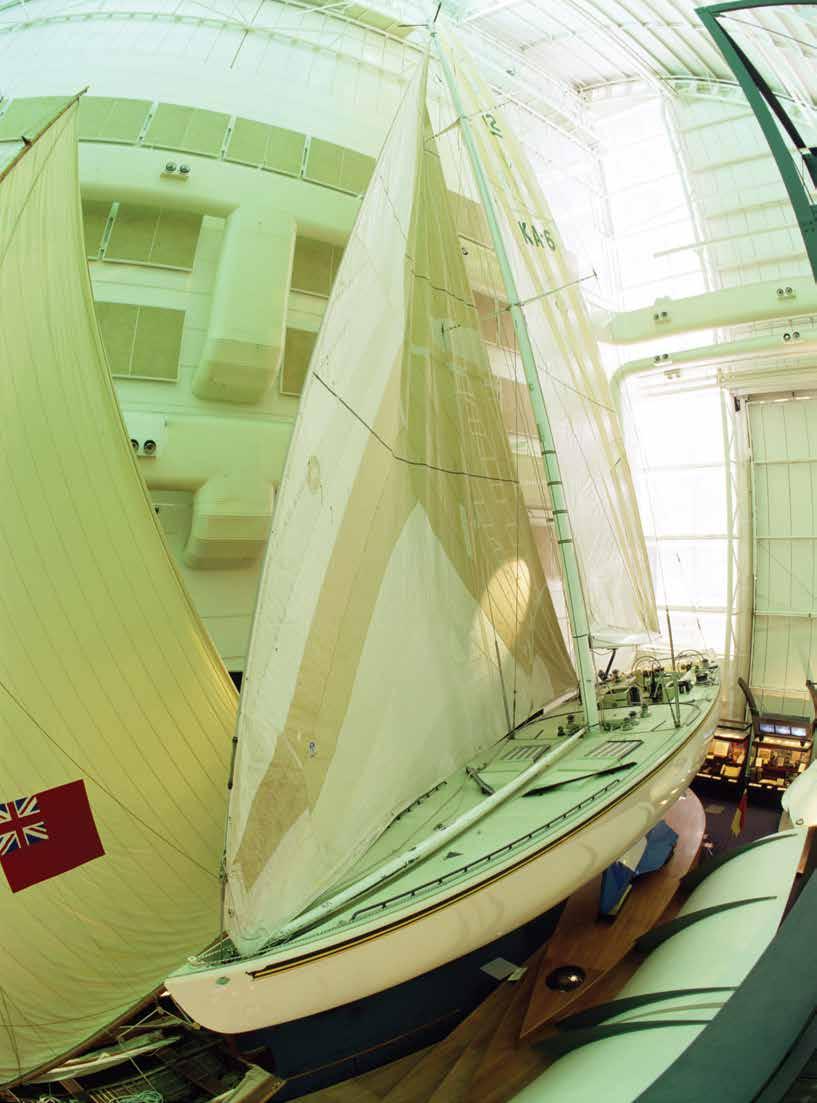
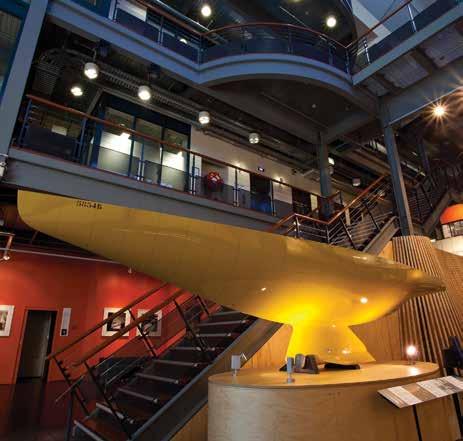
Australia II was purchased for the nation by Prime Minister Bob Hawke’s government, after the yacht’s return from winning the America’s Cup in 1983. It was displayed at the Australian National Maritime Museum (left) from its opening in 1991 until 2000. The famous 12-Metre yacht then returned to its hometown Fremantle as the centrepiece of a redeveloped Western Australian Maritime Museum. Photograph A Frolows/ANMM
The legacy ofAustralia II
SAILING AND AUSTRALIAN CULTURAL IDENTITY
Thirty years ago, Australia’s victory in the 1983 America’s Cup caused an outpouring of nationalist sentiment. Sailor and historian Carlin de Montfort looks at the place of sailing and yachting in the Australian identity.
I REMEMBER SEEING THE YACHT
Australia II towering in the gallery of the Australian National Maritime Museum when I was a young sailor. I would run up and down the stairs to see the winged keel, the sails and the pale-green deck from different angles. A poster of Australia II took pride of place on my bedroom wall. It was a close-up of the cockpit with the crew ready for action in their green-and-gold jerseys as the yacht surged through the water. The image was always close and familiar to me.
The posters were presented to the junior sailors at the Middle Harbour Yacht Club in Sydney at the end of my first sailing season, but I was too young to remember the event that they depicted. A decade had passed since Australia II defeated the American yacht Liberty to win the America’s Cup in September 1983. The campaign was funded by Western Australian businessman Alan Bond and culminated in spontaneous displays of national celebration as the New York Yacht Club’s monopoly of this event was brought to an end. Many Australians had sat up until 2 am watching or listening to the live broadcast from Newport,
Rhode Island. Celebrating the victory, the then Prime Minister Bob Hawke famously stated: ‘Any boss who sacks a worker for not turning up today is a bum’. The context of 1980s nationalism, and later the failed defence of the trophy in 1987 and the eventual bankruptcy of Alan Bond, meant little to me. Instead, the America’s Cup victory simply meant that Australians were the best sailors in the world.
My experiences growing up engrossed in sailing culture informed my PhD thesis on the cultural history of sailing and yachting in Australian waters. I studied the rise of recreational sailing that included the navigation and handling of small boats, and yachting, which was more often associated with wealth and status. Events such as the 1983 America’s Cup convinced me that sailing and yachting were significant components of Australian culture. Researching and writing my thesis, which included using the resources of the Australian National Maritime Museum and its Vaughan Evans Library, I reconsidered the myths and legends of the sport that had been so important to my identity.
The poster of Australia II stayed on my wall for the best part of a decade. For me it came to signify how pervasive the legend of the America’s Cup is, how quickly the complexities and context of the campaign were forgotten, and how easily the simple stories of the race can be communicated across generations.
The wealth associated with yachting, particularly highprofile competitions such as the America’s Cup, sat uneasily next to the popular images of Australian identity
The 1983 America’s Cup remains a landmark in Australian sporting successes. When Cadel Evans won the 2011 Tour de France cycling race, Peter FitzSimons compared it to a number of Australian
AUSTRALIAN NATIONAL MARITIME MUSEUM 17
victories in a Sydney Morning Herald opinion piece. Speaking of the America’s Cup, he said that ‘back then we knew little and cared less about sailing per se – a fairly dreary sport for the spectator, after all – but we knew that the Americans cared deeply about it, had held it for no fewer than 132 years, and were convinced that no one would ever take it from them. And that was good enough for us.’
In comparing the Tour de France to the America’s Cup, FitzSimons also revealed the underlying ambivalence regarding the yacht race in Australian culture. The wealth associated with yachting, particularly highprofile competitions such as the America’s Cup, sat uneasily next to the popular images of Australian identity. FitzSimons argued that the Tour de France has a greater sense of history and is more widely coveted than the America’s Cup, but: ‘More importantly, while the America’s Cup was pursued by millionaires and billionaires, Cadel Evans is the “little Aussie battler,” writ large’. The idea that yacht racing is an elitist sport and therefore ‘un-Australian’ was reinforced by some of the online comments. ‘Drew’ wrote: ‘The America’s Cup … is for “fat rich” and is way off the radar of your average Aussie’s interests’. ‘Biggles’ from Brisbane said: ‘Yacht racing – well it is a comedy piece isn’t it’. Other commentators defended the victory from criticism. ‘Jaffa’ claimed that the America’s Cup was still Australia’s ‘greatest sporting conquest’ and that it ‘brought together people from many walks of life’. And ‘Will B’ argued that the sailors who claimed victory were not millionaires: ‘They [the crew] earned $10 a day in expenses and dedicated years
of hard work and pain to achieve their goal. Let us not diminish that achievement in the short sweep of an ill informed sentence.’
The same divisions were evident in 1983 when the Australian journalist Bruce Stannard claimed the ‘battler’ status for the America’s Cup crew. He explained in the Sun-Herald why Australia II ranked alongside Donald Bradman and Phar Lap in uniting the nation. Defending the America’s Cup from the criticism that it was ‘a rich man’s toy, a plaything for the idle, decadent upper crust’, Stannard claimed that ‘the men who crew Australia II are about as representative a mob of Australians as you might find on the 7.30 express from Hornsby to the City any weekday’. The editorial neatly articulated the mythology of the America’s Cup victory. It was the ‘men’ crewing Australia II, not Alan Bond, who ‘galvanised their fellow countrymen’. And the contest gave the ‘entire nation a sense of unity that had implications far beyond a boat race’; it showed that Australians were still capable of working as a ‘world class’ team despite differences within the nation.
Academic accounts of the 1983 America’s Cup revealed the way that politicians, the mass media and entrepreneurs appropriated the outpouring of nationalist sentiment. University of Queensland academic Jim McKay critiqued Australian sport in the 1991 book No pain no gain: sport and Australian culture. He used a case study of the America’s Cup victory to demonstrate how dominant groups such as government and the media can ‘frame’ sport to legitimise their values. This argument was repeated in a number
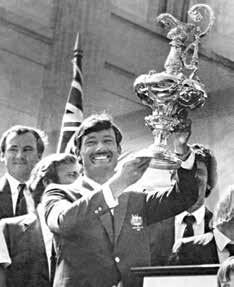
01 Australia II ’s skipper John Bertrand holding the 100-Guinea Cup, aka the America’s Cup.
Courtesy Fairfax Photos
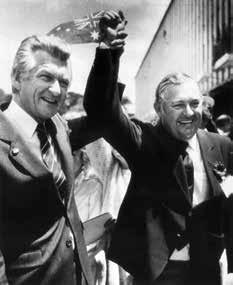
02 Then Prime Minister Bob Hawke and Alan Bond, the wealthy entrepreneur and yachtsman who financed the 1983 America’s Cup campaign. Courtesy Fairfax Photos
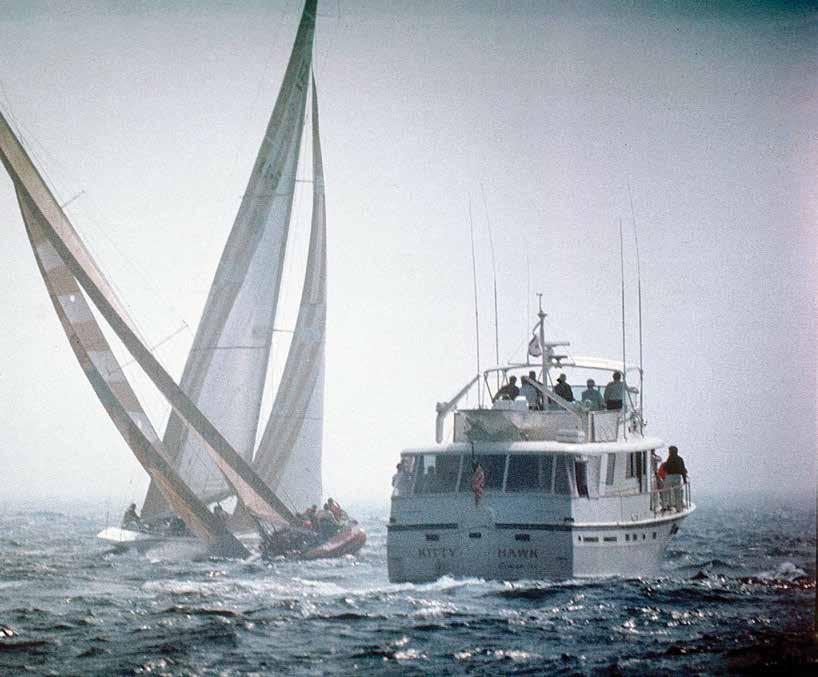
03 Australia II tacking ahead of the American yacht Liberty during Australia’s successful 1983 America’s Cup campaign.
Photographer Sally Samins, ANMM Collection
of sport histories where the temporary nature of the celebrations in 1983 are pointed out. In One-eyed: a view of Australian sport, published in 2000, historians Douglas Booth and Colin Tatz noted that: ‘Like all sporting moments, the yacht euphoria faded, quickly: it couldn’t, for example, sustain the nearly four million struggling on benefits’.
One outcome of McKay’s thesis is that sailing and yachting have been dismissed as Australian sports. McKay claimed that: ‘Sailing is one of the most unpopular sports in Australia’. He cited a recreational participation survey conducted by the Department of Sport, Tourism & Recreation in Canberra to demonstrate that less than one per cent of the population participates in sailing, and stated that America’s Cup sailing is one of the most exclusive and expensive sports in the world. McKay wrote: ‘So, in a nation where tall poppies are cut down, it seems odd that such an esoteric and costly activity generated such attention’.
Critics should not have been surprised by the patriotic sentiment that victory in the America’s Cup generated.
Australian challenges for the trophy were associated with ideas of progress and achievement from the first campaign, sponsored by Sir Frank Packer through the Royal Sydney Yacht Squadron in 1962. This campaign dominated the yacht club’s centenary year and P R Stephensen wrote about it in the club history. He argued that ‘this was an event which would add to Australia’s renown, and proclaim to the world, as the holding of the Olympic Games had done in Australia six years previously, and as many other achievements in sport,
18 SIGNALS 104 SEPTEMBER–NOVEMBER 2013
01 02
Australian challenges for the trophy were associated with ideas of progress and achievement from the first campaign in 1962
03
The
people of the ‘Great South Land’, in their island continent – ‘the last sea-thing dredged by Sailor Time from space’ – had developed to maturity among the nations of the world
in the arts, in commerce, and in the grim tasks of war had proclaimed, that the people of the “Great South Land”, in their island continent – “the last sea-thing dredged by Sailor Time from space” – had developed to maturity among the nations of the world.’
In Stephensen’s words, the campaign was in the spirit of ‘giving it a go’, ‘characteristic of Australian temperament, win or lose’ and the donations of materials and cash from Australian business were justified as ‘representative of Australian achievement’. Looking back in 1980, yachting journalist Lou d’Alpuget recalled a moment of success in that 1962 challenge where Australians captured the attention of the world. The challenger Gretel surfed on a wave downwind in a gusty 28-knot wind, ‘a feat never before achieved by a heavy deep-keeled vessel of her 12-Metre class’. Gretel passed the American rival to win the race. D’Alpuget wrote: ‘It was a spectacle that astonished and delighted thousands of people on the wind-driven stretch of the Atlantic Ocean off Newport, Rhode Island, USA. Millions more saw it on television. It was to inspire a cascade of words of praise in a dozen languages for the men who had created and sailed the boat that almost flew downwind. It was also to establish Australia firmly as one of the world’s greatest yachting nations and as the USA’s major rival in a field of sophisticated sailing to which even countries with a dozen times our technical, scientific and industrial resources had never dared to aspire –challenging for the America’s Cup.’
Exploring the geopolitical dimensions of Packer’s 1962 challenge, media historian Bridget Griffen-Foley revealed similar connections between the America’s Cup and Australian status. She explained that after Gretel ’s ‘surge to the finish’ the Australian contingent sang ‘Waltzing Matilda’ and their unofficial theme song ‘Beer is Best’. Reports of the win made front-page news throughout the world, and the publicity convinced the Australian government that ‘the challenge could boost both Australia’s profile abroad, and the Australian people’s confidence to strut on the world stage’. After more unsuccessful challenges for the cup, Packer eventually sold his 12-Metre yachts to the English migrant Alan Bond, ‘who was, ironically, reinventing himself as a media tycoon’.
20 SIGNALS 104 SEPTEMBER–NOVEMBER 2013
The attention awarded to the Australian challenges for the America’s Cup since the 1960s suggested two things to me: that the national sentiment identified in accounts of the 1983 victory was part of a longer process and more deeply ingrained in the culture of yachting than first thought, and that sailing and yachting were not such anomalies in Australian culture.
Links between sailing and yachting, progress, and aspects of Australian identity developed in the mid-19th century at the same time as the America’s Cup was established. The competition began as an adjunct to the Great International Exhibition of 1851, held in London. A fast American yacht named America, built along shallow, sleek lines, defeated the yachts of the Royal Yacht Squadron, based in Cowes on the Isle of Wight, and claimed the trophy – the ornate silver ‘100-Guinea Cup’. Paul James argued that the America’s Cup became a symbol of the vigour of competitive capitalism and the surpassing of the old by a ‘new nation’. It became a competition between nations that drew upon the aristocratic tradition of yachting while reformulating it in a modern context.
Sailing and yachting were already popular public sports in the Australian colonies. They commanded great status as respectable activities distinguished from the rowdy and sometimes violent pastimes of the colonial society, and from 1837 they were conspicuous features of the Anniversary Day holidays that celebrated British colonisation. Sailing and yachting were described in accounts of the ‘progress and history’ of the Australian colonies during the 1888 centenary. Sometimes they were the only sports mentioned and in other cases they were given their own sections over and above other sports, including cricket, football and horse racing. Regattas also took place in Sydney, Melbourne, Hobart and Fremantle during the year.
The Victorian International Regatta, held in conjunction with the Centennial International Exhibition in 1888, had some of the hallmarks of the initial America’s Cup. Both events were associated with exhibitions and international contests. Competitors from the ‘great yachting centres of the world’ were invited to Port Phillip to take part the Victorian regatta. The Australian National Maritime Museum’s
oldest vessel, the cutter Akarana, built that year by Robert Logan to represent the Auckland Yacht Club, joined competitors from Sydney and Hobart to make up the ‘international’ contingent and race for the ‘honour of New Zealand’.
At the same time in 1888, Walter Reeks, a naval architect from Sydney, travelled to America and England on behalf of a syndicate of Sydney yachtsmen to study the feasibility of a challenge for the America’s Cup. He studied the Volunteer, Mayflower, Puritan and other fast American yachts and planned to build a 90-foot (27.4-metre) yacht for the challenge.
A sense of colonial pride motivated Reeks. In an article on sailing and yachting published in the Illustrated Sydney News, he described an innovative yacht designed and built in Sydney during the 1850s by Richard Harnett. With the patriotic name Australian, the yacht influenced local design for some time. Reeks claimed that with ‘Australia’s honour as our reward’, we shall ‘cease to speak of the American type and the English type, and have a type of our own, which other countries will look at with envious eyes, and call Australian’.
Another local yacht, Xarifa, was an example of this ‘Australian type’ that defeated the imported English yacht Chance in a race from Sydney to Newcastle and back. The match was described by Stephensen in the history of the Royal Sydney Yacht Squadron. In a strong southerly breeze that was developing into a gale, Xarifa carried away its topmast and Chance disappeared ahead into the distance. With no sign of the English yacht, Xarifa continued on as the crew made repairs for the sail back to Sydney, which would be ‘in the teeth of a gale which showed no signs of abating’. At 8 pm the yacht reached Newcastle, made a clean manoeuvre in the dangerous seas and began the return journey: ‘Throughout the night … the gallant little vessel thrashed into the teeth of the gale and against an evil sea’. The crew of Xarifa supposed that Chance was in the lead. But they had passed their competitor in the night as Chance struggled in the seas, and Xarifa soundly won the race.
Stephensen noted that ‘It was memorable too, because it had some of the elements of an “international” contest in which Australian yacht building and yachting
skill won the acknowledgement of well-earned cheers’. Lou d’Alpuget also described the race as a contest between types. ‘It was a two-boat challenge match arranged to test the qualities of Xarifa, a Sydney-designed-and-built woodenhulled cutter of 30 tons, against Chance, an English-designed-and-built iron-hulled schooner of 71 tons’. Of course, ‘Charles Parbury’s Xarifa thrashed the daylights out of William Walker’s Chance ’. In hindsight, the race had become yet another legend of Australian sporting victory.
A tradition of yachting as an international sport underpinned Australian challenges for the America’s Cup from the 1960s and it was not unusual for the challenge in 1983 to be associated with Australian success. Although the celebrations in 1983 were ‘fleeting’, the symbolic connections between sailing and yachting and Australian identity were well established. The connections are ongoing. For example when Jessica Watson joined Australian sailors Kay Cottee and Jesse Martin as a record-breaking solo circumnavigator in 2010, the then Prime Minister Kevin Rudd stated: ‘Here you have a young Queenslander, young Australian who has shown great courage, great determination … I believe she’s an inspiration to all Australians’.
Carlin de Montfort grew up racing and cruising on the waters of Sydney Harbour, Pittwater and Georges River. He recently completed a PhD in history at the University of New South Wales with a thesis titled ‘Sailing traditions: a cultural history of sailing and yachting in Australian waters, 1888–1945’. He has been published in the International Journal of the History of Sport, Sydney Journal and Dictionary of Sydney
The 1:3 tank test model of Australia II on display at the museum’s Wharf 7 Maritime Heritage Centre. It was one of several scale models built in The Netherlands to undertake rigorous tank testing and computer analysis for the innovative and controversial winged-keel design developed by the Australian yacht designer Ben Lexcen (formerly Bob Miller). Photograph Andrew Frolows/ANMM
AUSTRALIAN NATIONAL MARITIME MUSEUM 21
Ships’ diaries
THE ‘BLOGS’ OF YESTERYEAR
Personal diaries written by all manner of travellers to and from Australia can now be accessed via the internet, giving fascinating glimpses into past lives. The museum’s technical services librarian Jan Harbison delves into some of them and finds vivid accounts of adventures, exploration and everyday activities at sea.
01
A ship draws near. All hands on deck to get a peep … How very pleasing to meet & speak with those exposed to the same dangers as ourselves
tough it must have been for an immigrant in the 1800s relocating to a new country on the other side of the world, and the dangerous journey to be completed to get there. The diaries tell both personal and social histories of immigration, the gold rush, ocean travel, settlement and much more. For historians they are a valuable resource, and for the general public they are incredibly entertaining. When reading them I sometimes feel transported to the time, and can almost feel the roll of the ship and the wind in my hair. Sometimes I even feel that I know these people, and am privy to their thoughts and feelings.
Requests for copies or access (where copyright law allows) have increased enormously in recent years, as a basic Google search for the name of a ship can lead the researcher to our library’s holdings. As technical services librarian, I catalogue all of the diaries onto the Australian National Bibliographic Database, where they appear in the National Library’s Trove database under ‘Diaries, letters, archives’: http://trove.nla.gov.au/collection
Wednesday 9 January 1884. Still in the Cape de Verde latitude … early in the forenoon a steamer was espied on the horizon & coming towards us. As it drew near it became apparent that a chance of getting away letters was at hand, but this was made known too late to enable anyone to prepare a proper & full letter, and although I had commenced one it was but indifferently advanced and so almost useless: however off it went.
Sometimes when another captain came on board, gifts would be exchanged between the ships, as a passenger on the Renown writes in 1876:
… both ships exchanged several little things with each other, for instance potato for some bottles of chutney & curry powder … but the most thankful [sic] was cigars and tobacco.
This narrative is dedicated to my dear wife and children for their amusement and my employment and as it is most agreeable to me to sometimes hold converse with them, it is only intended for their eyes or those akin to them.
So begins the diary of Captain John Buttrey of the brig Dart in 1865. He could not know that nearly 150 years later, his diary might be accessed by a worldwide audience through the Internet, as are the blogs of today.
The museum’s public research facility, the Vaughan Evans Library, has many diaries written by travellers, immigrants, crew members, sea captains, naval men, ships’ surgeons, whaling captains, a captain’s wife, a matron and a convict. Some are very brief and factual, while others are beautifully descriptive and often very personal accounts revealing emotions and humour. Some have been donated by family members who might have found the diary in an attic; others have been purchased by or donated to the museum. All of the library’s manuscript diaries are unpublished copies or transcripts. Many published diaries also exist, some of which the library holds.
Of all primary sources, diaries must be the richest mine of information about life at the time. It is hard to comprehend how
I write a quite detailed summary for each diary. Some requesters are interested because their own relation came to Australia on that particular ship, or even that actual voyage. We have also had requests by diarists’ descendants. Reading such diaries gives them some insight into their ancestors’ experiences.
In this age of email and Twitter, contact and information exchange are instant. We sometimes forget that letter writing was once a necessity, communication was primarily by beautiful copperplate handwriting, and it could be weeks or months before a letter was received.
People often wrote diaries to pass the time, or as a kind of long letter to their loved ones, as did Captain Buttrey. So did a crew member on the Parma in 1936:
Dear Mother, I have decided to write this letter in diary form, that is, I will start it now and add to it from time to time. It will save me writing half a dozen long letters on arrival in England and besides, I can give a better description of the trip as things happen
At other times letters would be hurriedly written when a homeward-bound vessel was seen nearby, as related by a passenger on the Loch Moidart to Sydney:
Even ‘chatting’ to a passing ship using signals was a treat, as a passenger on the Alfred noted on a voyage to Plymouth from Sydney in 1864:’ A ship draws near. All hands on deck to get a peep. Our Capt. asks her name. Betty Jones from Liverpool to Demerasa ... How very pleasing to meet & speak with those exposed to the same dangers as ourselves.’
Signalling was also done to report to the authorities. In Lloyd’s List, the daily newspaper of shipping movements, there is a column of ‘Vessels spoken with’ or ‘Speakings’, with the date, location and names of the ships that spoke, such as ‘Laguna (ship), London to Sydney, 78 days out, 30th Oct., off King’s Island by the Eliza Corry, [Capt.] Slater, at Adelaide’. In the case of the grain clippers, this was vital to their business; their location would indicate their expected arrival date, so they relied on passing steamships to read their signal saying ‘Please report us to Lloyd’s’.
Not everyone wanted to ‘speak’ to other vessels. Henry Downes, captain of the whaler Terror, says: ‘We had a ship in sight this forenoon but I do not propose speaking any vessel until we get [something] to report … No. No. if possible I’ll [not] send word home until I am in a position to advise the capture of a whale.’
The diary quoted at the beginning of this article is a wonderful one. Captain Buttrey commanded a brig that travelled to the South Sea Islands in 1865 to collect bêchede-mer (sea cucumbers) and tortoiseshell. As well as writing letters home to his
24 SIGNALS 104 SEPTEMBER–NOVEMBER 2013
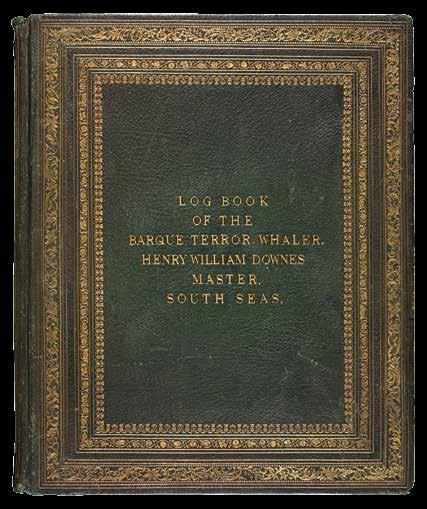
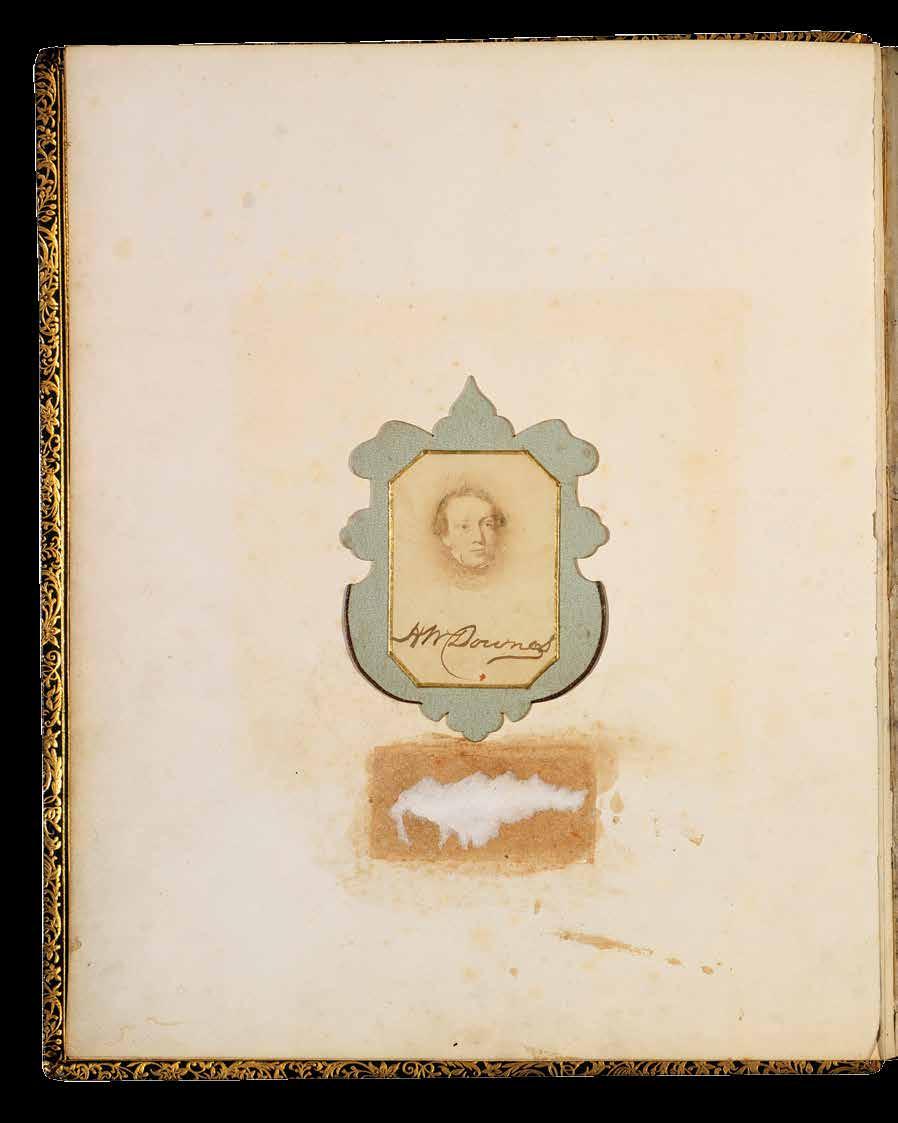
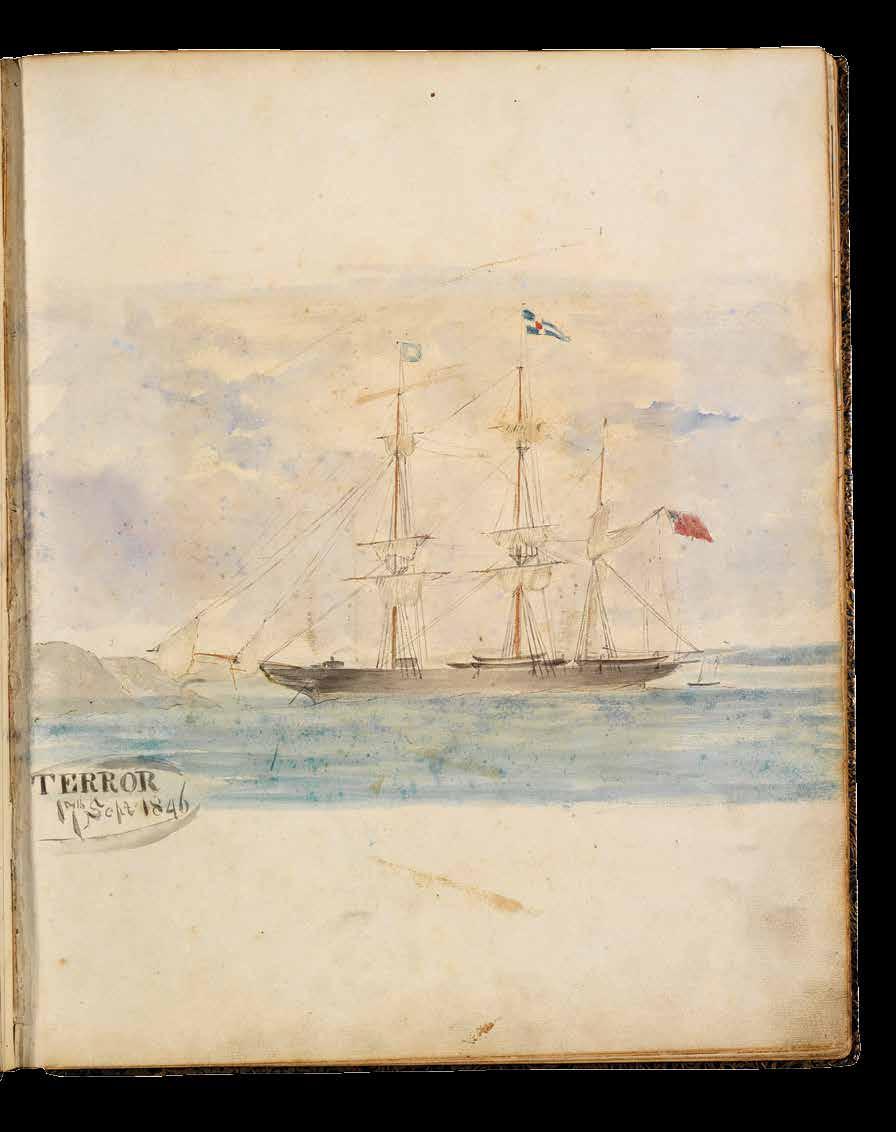
01 Previous pages: A watercolour portrait of the whaling barque Terror and a photo of the artist, Captain Henry Downes, appear at the front of the ship’s log book.
02 The cover of the Terror log book.
03 On a 10-month journey out of Sydney, Captain Henry Downes filled the log book of the whaling barque Terror with lively descriptions and accomplished illustrations. All photographs by A Frolows/ANMM

03
Captain lowered a boat today for the purpose of a little shooting … shot missing bird, but shot striking a few of the passengers

family, he kept the diary, which gives an insight into life at sea, interactions with the islanders, and his life at home, with frequent references to what his wife and four boys would be doing at that time of day.
It is a diary full of affection for his family. He looks at their ‘likenesses’ every day:
I have [been] looking at your likenesses again today and have been pictureing [sic] you all at home. Our time is about 10 minutes in advance of Sydney so I say now they are at breakfast.
goods and tobacco, their appearance and canoes. The original diary includes some sketches and watercolours of people, canoes and landscapes. He doesn’t appear to have been a very talented artist, especially when depicting people (although his son William Lister became a famous landscape painter, winning the Wynne prize seven times)
01 Some ships issued passengers with customised diaries for their voyage.
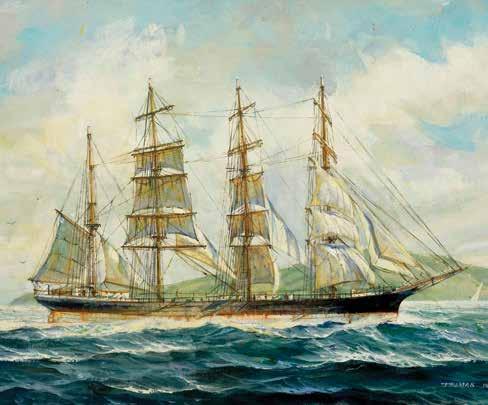
02 Four-mast steel bark Archibald Russell, built in Scotland in 1905, subject of the diary opposite. This oil on canvas is by American merchant mariner and marine artist Thomas W Wells (1916–2004), painted in 1939 when he was serving on the windjammer Passat and was anchored alongside Archibald Russell, Moshulu and Lawhill in Spencer Gulf, South Australia, loading grain for Europe. ANMM Collection, purchased with USA Bicentennial Gift funds.
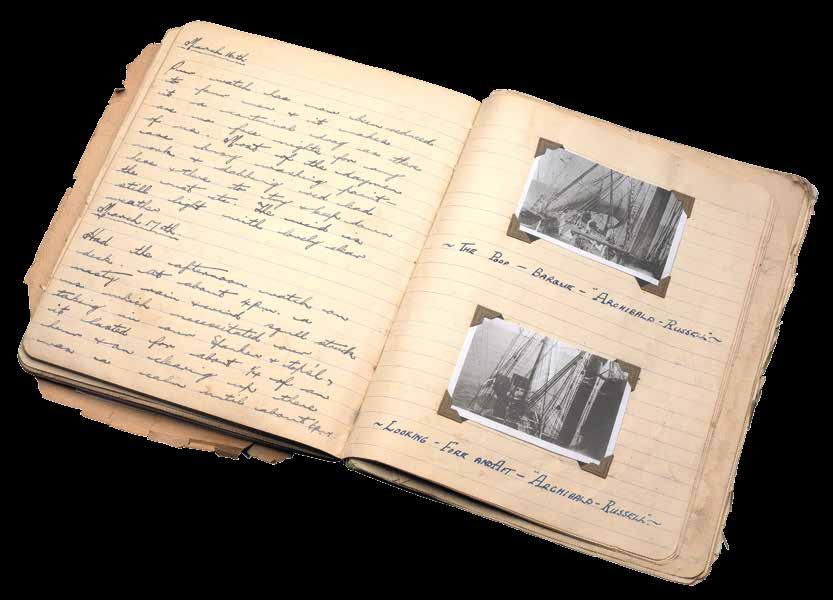
03 This diary, illustrated with photographs and magazine clippings, traces the experiences of Raymond Oswald Poole, a seaman working on the barque Archibald Russell
Baby looks as if he was trying to imitate Lister with his mouth – Bateson looks as if he were brim full of mischief … Marshall appears as a staid gentleman & one of deep thought. The principal one Mama looks indescribably loveable.
He even plays imaginary games with his sons:
It is Marshall’s turn to guess today –Guess what I saw today Marshall? –A Whale, no, a flying fish, no; a ship, no –Do you give up – Yes Papa I give it up –a Portuguese Man of War.
Apart from these personal observations, he provides the historian with a wealth of information about the South Sea Islands, writing about employing islanders and the difficulties in doing so, paying them in
Captain Buttrey also talks of collecting specimens for his ‘Good friend the curator of the Museum’, and he occasionally makes sketches of his finds. His collecting was not always successful – ‘We brought out of one of the canoes a sand crab, but before I could get it among my collection the Elea boys had cooked & eaten it’ – but later he reports, ‘I am picturing my dear [Bateson] going with me to the Museum to see the Curator when I present my various specimens … many of them are very rare I should imagine’.
The beauty of the internet age is that a simple search on Buttrey’s name in the Trove newspapers website retrieves an article from the Sydney Morning Herald for 11 April 1866, which tells us which museum he was referring to:
List of donations to the Australian Museum during January and February, 1866 … Reptiles, fishes, molluscs and crustacea, from the South Sea Islands, By Mr J A Buttrey.
26 SIGNALS 104 SEPTEMBER–NOVEMBER 2013
02
England in 1868. A search of the English census for 1871 shows the family settled in Bedfordshire, with another child born there. Two servants are also listed, and at the age of 52 Buttrey is listed as ‘retired merchant’, so it seems his endeavours in Australia and the South Seas were reasonably lucrative.
The journey covered by Buttrey’s diary took more than three months. Such a separation from one’s family was nothing to whaling men, however, who might be away from their families for years on end – the author of the Terror diary, Captain Henry Downes, noted in 1846 that one whaling captain had been away for seven years, and another was home only one out of every nine years.
Downes worked for Ben Boyd, a famous and flamboyant Sydney businessman. His diary is another entertaining one, in which he speaks not only of his frustrating search for whales, but also of his bad moods, anxiety, and some reminiscences of his life on land.
Downes is also a talented artist, and many beautiful paintings are interspersed through the diary, yet he says: ‘Such a view as I have sketched … if this log was intended for anything but private use I would be ashamed of such a daub’.
Whales, dogs & madmen are said to feel her influence & should we continue without oil [ie whales] for many months more I fear becoming one of the latter’; then the excitement of spotting one –lowering the boats, the frantic activity of the kill, then cutting up the whale and collecting the oil. He sarcastically compares it with what he calls the ‘more fashionable sport of fox hunting’:
I can only say there may be some slight shadow of a resemblance provided one could hunt a whale in a smooth water bay & when he was killed, row quietly home and sit down to a rump [steak] and Dozen [clarets or oysters], hearing no more of the matter save that after his servants had boiled the flesh and sold the oil his portion of the prize came to a considerable sum … When close to land, islanders would bring alongside ‘elegantly shaped boats… ornamented with shells & feathers …’ and sell the whalers fresh fruit and vegetables: ‘… such a scene in Sydney would attract no few spectators’, Downes comments. Another canoe he deems tasteful enough for his employer, Ben Boyd: ‘One in particular was ornamented with much taste having
pieces of shell and mother of pearl inlaid so as to form birds etc. round the sides … She would have suited our Owners Yacht the “Wanderer” nicely.’
I always imagine sailing ships alone on the ocean, but many of the diaries indicate that a few vessels might travel together for weeks before one would move ahead out of sight. A crew member on the Khimjee Oodowjee in 1878 says, ‘It is dead calm & very very hot, the crew have been overboard bathing … there are no less than 16 vessels in sight’. This must have been quite a spectacle, on a glassy sea with the creaking of timbers and the occasional flapping of sails.
When becalmed the captain might lower a boat for shooting – apparently a dangerous pastime, as a passenger on the Renown noted in 1876: ‘Captain lowered a boat today for the purpose of a little shooting … shot missing bird, but shot striking a few of the passengers’.
A favourable wind was vital for sailing ships, and superstitions abound about the wind. A passenger on the Alfred from Sydney to Plymouth in 1864 wrote: ‘A very fine morning but a head wind … the ladies & gentlemen is busy throwing old hats overboard. An old custom for a fair wind to spring up’.
AUSTRALIAN NATIONAL MARITIME MUSEUM 27
03
The diaries tell both personal and social histories of immigration, the gold rush, ocean travel, settlement and much more
In unfavourable winds the ships would have to tack frequently, so a long distance might be travelled without making much progress.
‘Our ship has made 160 “miles” in the last 24 hours,’ recorded a passenger on the Alfred, ‘but this is not all to our advantage as the Capt. has had to tack a good deal’.
On the Suffolk in 1863 a passenger talks about the difficulty of sleeping in a ship that was tacking:
We are falling off to sleep when a breeze springs up and the ship is put about so that we have to change our pillows to what was the foot of the bed, that being the highest. About 2 in the morn my spouse wakes me up to change the pillows again the ship having tacked again and when we awake in the morning we find our heads lower than our heels, so they must have put the ship about once more whilst we were asleep … Slept well last night in spite of the ship being on the obnoxious tack.
Some people, it seems, will complain about anything: ‘Crossed the 180 degree Meridian [the international date line] early in the evening so we will have two days in succession much to our disgust’, grumbles a crew member on the Archibald Russell in 1933.
Others find humour in small things, with a passenger on the Hereford talking about crossing the equator, which was commonly known as ‘the line’: ‘… at last we have reached the Equator … some of the passengers are having others on finely. They have fastened a hair across the telescope & are telling them it is the line we have crossed.’
When looking back from 2013 it appears that human nature has not changed much since the 1800s and 1900s, with the same social issues faced, the same humour, the same gossip and nastiness. On the Renown in 1876 there is one entry that in today’s language would almost equate to a Twitter or Facebook post, with ‘likes’, ‘re-tweets’ or ‘flames’:
… there is a young lady on board who has taken a great fancy to one of our Mess Mates who turns out to be a married man … all her companions have cautioned her but all to no effect, the sailors are there fore writing placards & sticking them up in several places about this man concerning his affairs … so this is causing a great bit of fun with all concerned.
Another entry, from a young female passenger in 1847 on the Tasmania, could be likened to today’s schoolgirl bullying:
… Miss Palmer. For description, comely face, excessively good-natured, and says the most extraordinary things, she is extremely fat, short and thick, not the slightest degree of grace, wears no bustle so of course can have no style about her.
The only difference is that in 2013, we know our blogs and tweets can be read by anyone at all. These diarists could never have imagined our world of social media, yet it’s a world in which their very private scribblings can be read by an audience interested in the small similarities – and vast differences – between life then and now.
Author Jan Harbison, technical services librarian for the museum’s public research facility the Vaughan Evans Library, is retiring as this article is published. So too is her colleague, library manager Frances Prentice; both were founding staff of the library and among the museum’s longest-serving employees.
Quote from the Parma diary is from The search for the Kobenhaven and other true sea stories of the Depression years, published by Graeme K Andrews Productions, Epping, NSW, 1984. Reproduced with permission.
Quote from the Suffolk diary is from From England to Australia: the 1863 shipboard diary of Edward Charlwood, published by Burgewood Books, Warrandyte, Vic, 2003. Reproduced with permission.
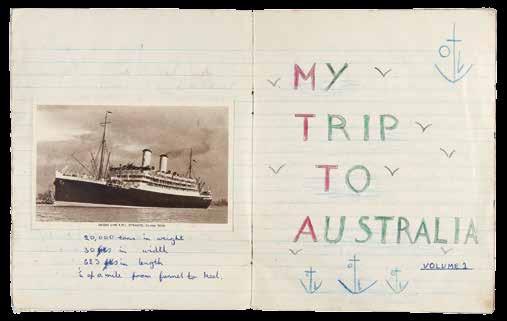
01 This child’s diary records Maureen Mullins’ experiences in 1952 when she sailed unaccompanied from Britain to Australia, to take up a new life in a Fairbridge Farm School in country New South Wales. The diary was borrowed for display in the museum’s travelling exhibition On their own – Britain’s child migrants
28 SIGNALS 104 SEPTEMBER–NOVEMBER 2013
01

M Y T O S H I B A C O M A U THAT’S TOSHIBA THINKING A T V THAT
CONNECTS WITH YOUR OTHER DE VICES
The three mysteries
A FILM, A VOYAGE, A DISAPPEARANCE
Lord Howe Island was the exotic locale for an early Australian ‘talkie’, and the launching place for a disastrous voyage that claimed two of its actors. Museum researcher Nicole Cama drew on our Samuel J Hood Studio Collection, and records of the National Film and Sound Archive, to reconstruct the last voyage of the aptly named Mystery Star
W HY DO THEY DO IT ? Is it the promise of adrenaline-pumping adventure that draws sailors to defy the odds? Or is it the prospect of the finish line crowded with admirers eagerly awaiting their arrival that spurs them on? Perhaps it is the attraction of the unknown, or an irresistible desire to explore a deep blue expanse that promises all manner of peril to those brave enough to sail across it.
On 5 September 1936, crowds gathered at Wharf 10 in Walsh Bay, Sydney, to farewell the cast and crew of a new Australian ‘talkie’, Mystery Island. Among those about to board the Burns Philp liner SS Morinda was actor Brian Abbot (real name George Rikard Bell), who was recorded by commercial photographer Samuel J Hood farewelling his wife, Grace Rikard Bell. In his photo, in the museum’s collection, they happily embrace, completely unaware that this would be the last time they would see each other. Over a month after this photograph was taken, Brian Abbot and fellow castmate Desmond Hay (real name Leslie Hay Simpson) set off to cross the ‘stormy Tasman’ from Lord Howe Island back to Sydney – and were never seen again.
For months preceding Morinda ’s departure, newspapers had reported that the film would be shot in an exotic South Sea location. The all-Australian cast and crew were to sail to Lord Howe to work on the Commonwealth Film Laboratories’ first feature-length film with sound. Articles also profiled the film’s leading lady, Jean Laidley (real name Jean Angela Laidley Mort), greatgranddaughter of Thomas Sutcliffe Mort, industrialist and founder of Mort’s Dock in the Sydney harbourside suburb of Balmain. Laidley was tall, slim and golden haired,
with a movie-star air that matched Abbot’s dashing good looks. Sam Hood captured the excitement and glamour of the emerging sound-film industry in photographing the cast. Laidley was Audrey Challoner, the archetypal beautiful damsel in distress, and Abbot was the handsome hero, Morris Carthew. As they waved goodbye that day, while streamers were thrown over the side of Morinda, it is easy to imagine that the passengers were eagerly anticipating the next few weeks.
Reports trickled back home of life filming on the island. In one story, Laidley’s ‘fortitude’ was tested as she picked up a bird which ‘proved so wild that it pecked her arm and hand severely’. Another dramatic report described how one evening, after filming on the Admiralty Group of islets, the cast and crew had been unable to return to their base on Lord Howe as the seas were too rough. The filming was fraught with other complications due to variable weather. It rained six days a week on average, poor electricity meant make-up had to be applied by candlelight and the sound crew were constantly plagued by noise interference from the crashing waves.
The most fascinating and mysterious parts of this story are an article published in The Australian Women’s Weekly on 24 October 1936 and the events that unfolded after filming wrapped. Brian Abbot wrote a letter to the magazine that contained these ominous sentences: I shall be attempting a very dangerous voyage in October … However, I have strong personal reasons for no word of this trip of mine to be published until it has actually begun.
‘I shall be attempting a very dangerous voyage in October … However, I have strong personal reasons for no word of this trip of mine to be published until it has actually begun’
AUSTRALIAN NATIONAL MARITIME MUSEUM 31
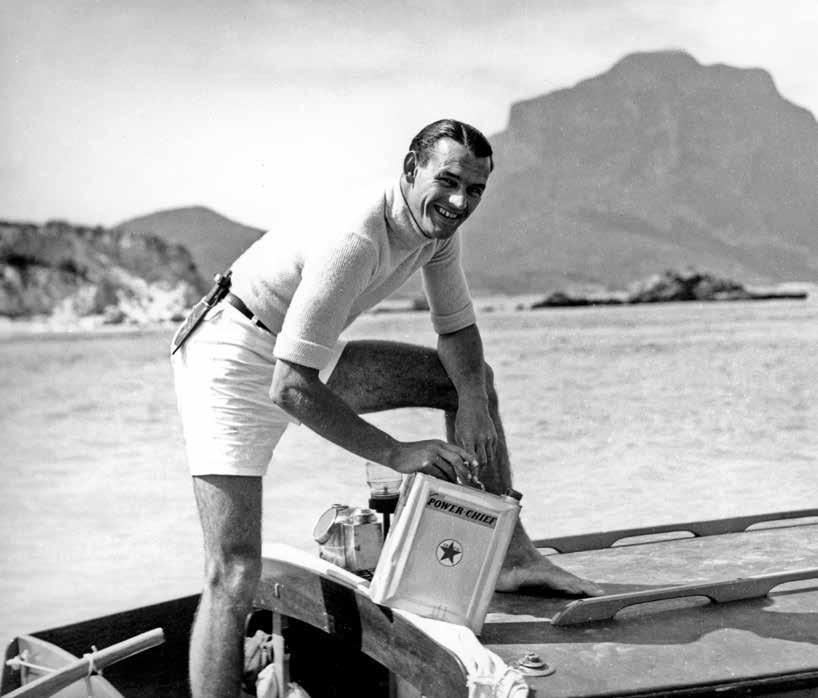
Brian Abbot standing at the stern of Mystery Star Image courtesy National Film and Sound Archive
01 An ad in Australian Motor Boat and Yachting Monthly from 1 July 1927, page 32, for the company that built Mystery Star’s engine. Vaughan Evans Library, Australian National Maritime Museum
02 Brian Abbot and his motor launch Mystery Star in Lord Howe Island lagoon. Image courtesy National Film and Sound Archive
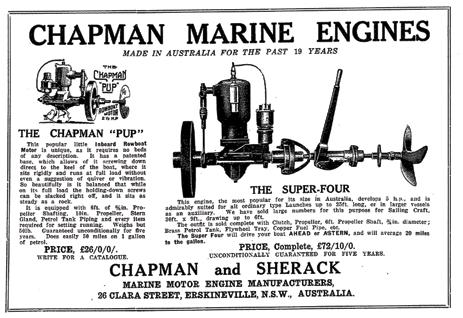
No hint was given as to why the trip should be shrouded in secrecy; nor is much known of why Brian Abbot chose to attempt such a risky venture. The film’s producer, George D Malcolm, claimed that the voyage was undertaken as an ‘adventure’. Despite Abbot’s dramatic words, it is clear that the voyage was not decided on a whim. Abbot had taken his motor launch, Mystery Star, from Sydney to Lord Howe, reportedly with a view to making the 725-kilometre return trip in that vessel rather than Morinda Whatever Abbot and Hay’s reasons were, however, newspaper reports and witness statements appear unanimous about one crucial detail – that the two men were ill equipped and unprepared for rough conditions.
On 6 October 1936, as Morinda returned to Sydney, Abbot and Hay were still on Lord Howe Island preparing for their dangerous voyage. Abbot posed for publicity shots under the bright sky pretending to sail away while waving to a crowd of onlookers. Hay is noticeably absent from the photographs. At 10.15 pm, however, the real journey commenced. The pair set off in the 16-foot (4.88-metre) launch, reportedly equipped with a two-and-a-half-horsepower engine, 40 gallons (180 litres) of water, two cooked legs of mutton, biscuits and chocolate. Abbot claimed they would reach Sydney in six to eight days.
As the eighth day came and went with no sign of the two actors, concerns for their safety trickled through the press.
It rained six days a week, make-up had to be applied by candlelight and the sound crew were plagued with noise interference from the crashing waves
At least two newspapers noted that these ‘grave fears’ were being eased by the ‘definite information’ that the launch was ‘unsinkable’. This claim was outweighed by most reports, which focused on the precarious nature of the adventure and on information that the two men were relying almost completely on the engine. In a bid for self-preservation as much as to reassure ‘anxious relatives’, Mr G Chapman of Chapman and Sherack, the Sydney company that manufactured the engine for the launch, told the press that the vessel had been fitted with two buoyancy tanks, which would ensure that the vessel would ‘float with a foot [30 centimetres] of freeboard even
when completely swamped’. A ‘waterproof canvas apron’ had also been designed to securely cover the opening of the cockpit. Chapman said that Abbot had previously visited their factory to understand how their engines were made and even took a test trip on the ocean off the coast of Sydney in a craft similar to Mystery Star. According to Chapman, ‘the only possible source of danger which could be foreseen … was that the boat might take a large quantity of water aboard, and that the magneto might be put out of action’.
Despite Chapman’s assurances, anxiety began to dominate reports of the ‘hazardous voyage’, and damning questions were raised concerning the pair’s preparedness for such a journey. By noon on 14 October, the craft was declared overdue and an aerial search commenced. Over the next five days, three aeroplanes covered the area off the east coast of Australia. In the meantime, requests for assistance were made by the two men’s relatives, including Grace Rikard Bell and Desmond Hay’s mother, brother and sister. They appealed to the minister for defence, Sir Archdale Parkhill, to aid in the rescue of their loved ones through the use of the Royal Australian Air Force (RAAF). In addition, Captain Norman G Roskruge, deputy director of navigation and lighthouses, requested that all coastal stations and vessels keep a look out for
32 SIGNALS 104 SEPTEMBER–NOVEMBER 2013
01
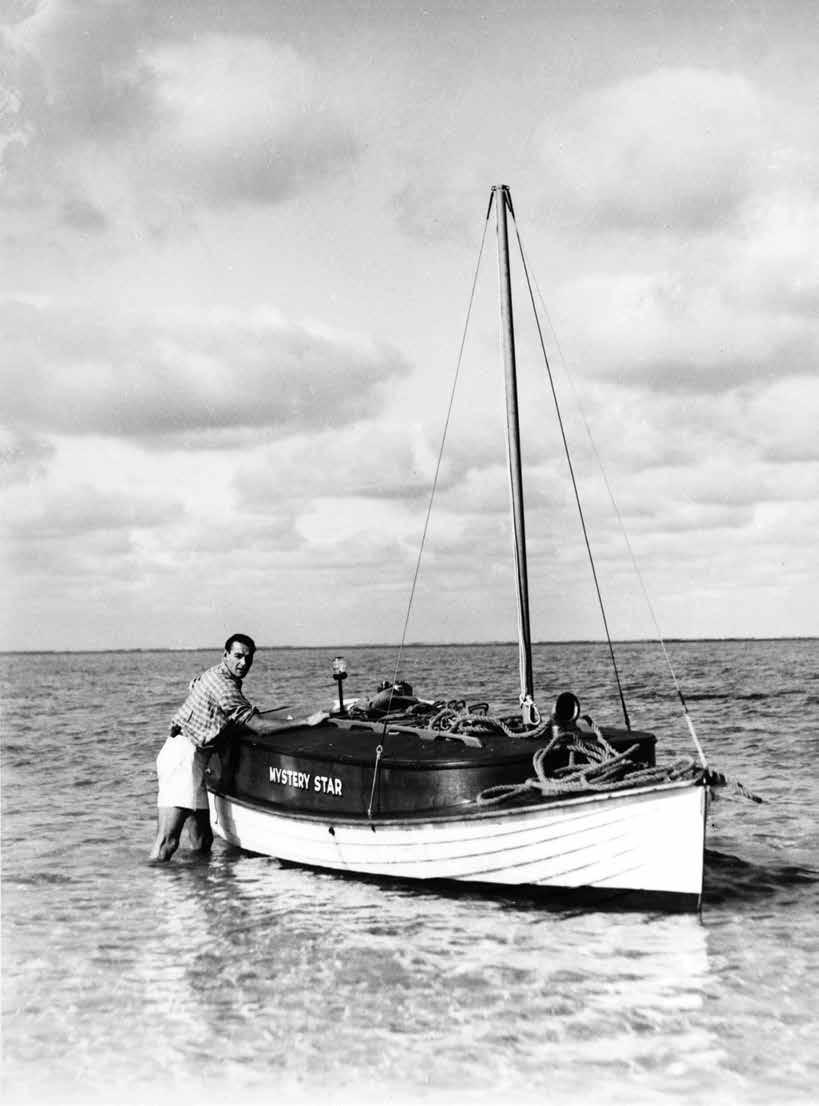
02
Jean Laidley said that Mystery Star was so small that she had declined to sail in it during filming, even to a small island near Lord Howe
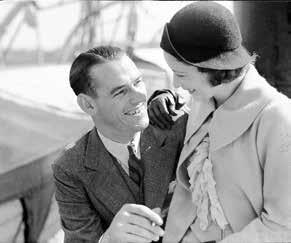
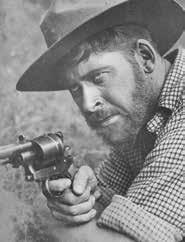
the ‘missing mariners’. Eventually, the Royal Australian Navy’s HMAS Waterhen was tasked with searching the enormous stretch of sea between Lord Howe and Sydney by both day and night. The Richmond (Sydney) squadron of the RAAF also pledged assistance.
As is usual in such grave cases as these, contradictory reports were published and various ‘experts’ were quoted at length in the media. The pilot conducting an aerial search, Ernest Collibee, claimed that the men had only carried sufficient petrol and food for 10 days. A certain ‘Sydney motor boat proprietor’ told The Sydney Morning Herald that the engine would run for approximately five hours per gallon (4.5 litres) of petrol, that the launch would reach speeds of up to two knots, unless it was assisted by favourable winds, and that it would take nine days to reach Sydney.
To curb the rumours, Hay’s relatives had sent a wire message to Lord Howe to confirm the details. Alarmingly, contrary to early reports and according to those
who saw the adventurers depart, Abbot and Hay left with a compass as their only piece of navigational equipment, plus food provisions for 10 days, 12 gallons (55 litres) of water and 48 gallons (218 litres) of petrol. They also had a complete spare engine, shafting, a propeller, a small leg-of-mutton sail, one paddle and a sea anchor.
They estimated that the petrol would last for eight and a half days. Others said that amount of petrol would last 10 days.
Added to the realisation that the provisions and equipment were insufficient were constant morbid weather updates. Though the voyage started out in clear conditions with a moderate north-west wind, the next day saw the wind increase and the seas roughen. By day two, the wind was described as a ‘half a gale from the northwest’, which may have put the craft in danger of capsize. On day three, a strong southerly developed, which may have created heavy swells. The crew of Waterhen had to use lifelines to move around on deck and stated that the launch would have had ‘no chance’ in those same conditions.
Faced with discouraging reports from the rescue teams, Hay’s relatives pinned their hopes on the possibility that the vessel had been swept southward, beyond the area patrolled. Grace Rikard Bell ‘would not dream of giving up hope’ and Abbot’s father added, ‘seafaring men have told me … that sometimes a small boat can come through much better than a larger one’.
On 22 October, the search comprising Waterhen and the RAAF – which had allegedly cost more than £1000, or the equivalent of about $86,000 today –was abandoned.
During the days that followed, details came to light which make their story all the more intriguing. On 19 October, Jean Laidley was quoted as saying that the skiff was so small that she declined to sail in it during filming, even to a small island near Lord Howe. Another tragic detail was relayed by Chapman, who said that when the waterproof canvas cover was designed, only one opening had been provided and it had been Abbot’s intention to make the voyage alone. On 27 October, a Mr R Alott
34 SIGNALS 104 SEPTEMBER–NOVEMBER 2013
01 02
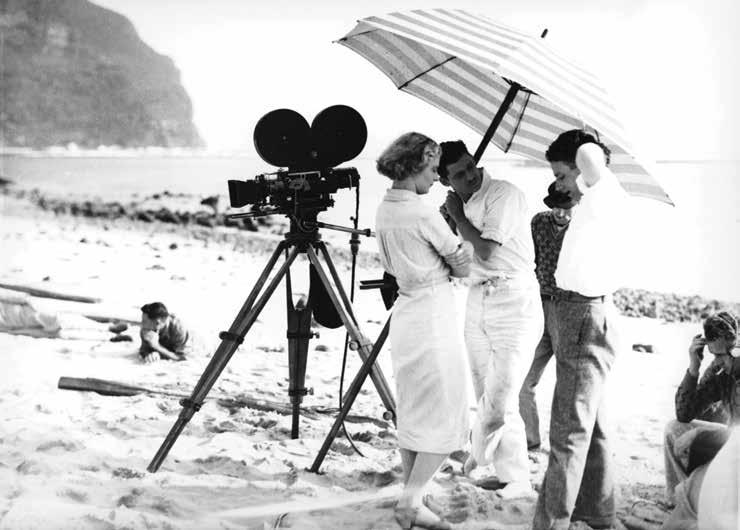
of Sydney, who witnessed the pair sailing from Lord Howe, claimed:
Abbot seemed satisfied that he would complete the journey … [Hay] did not seem so sure. Most of the islanders seemed to think that it was a foolhardy idea. The Mystery Star looked a little cockle shell. There seemed to be only about nine inches [23 centimetres] of freeboard at the stern when it was fully loaded. Nearly everyone present when it departed advised the two men against the trip, but Abbot decided to set out.
(‘Missing skiff’, The Sydney Morning Herald, 27 October 1936, page 11)
If only Abbot and Hay had heeded those warnings. Abbot’s stubborn insistence to press on is particularly poignant when one considers that this was not, in fact, his first dangerous undertaking. His father had stated he had ‘implicit faith in his son’s resource in the face of danger … in addition to having experience at sea’, Abbot was ‘a keen yachtsman, and was seldom without a boat of some description’. As a young boy, he allegedly ran away from school
and hid in a cave at Ben Buckler in Bondi, Sydney, where he existed on sardines and condensed milk. Finding that this was more than he could handle he eventually returned to school, but left for good at the age of 15 to take a job as a jackaroo in Queensland before discovering his ‘love of the sea’.
Abbot’s adventures earned the newspaper headline ‘Hazardous voyage’ no less than three times: in the Kalgoorlie Miner on 9 October 1936, in connection to the Mystery Star trip, and, five years before, in The Sydney Morning Herald on both 2 September and 13 October 1931. That earlier voyage was attempted by Abbot, under his original name George Rikard Bell, and Charles Boswarva in a 16-foot (4.88-metre) canvas canoe named Ker-wee-ah. On 25 May 1931, they departed Indooroopilly in Brisbane, Queensland, in an attempt to paddle the 700 miles (1,127 kilometres) up the coast to Rockhampton ‘to win a small bet’. The canoe, which was barely 2 feet 8 inches (80 centimetres) wide, encountered rough seas and ‘persistent sharks’. The vessel capsized near Coolum Beach on the
01 A last farewell: Brian Abbot and his wife Grace Rikard Bell on board SS Morinda before its departure from Sydney. This photograph was also published on page 2 of The Australian Women’s Weekly on 24 October 1936. Samuel J Hood Studio, ANMM Collection
02 Desmond Hay in the role of Ned Kelly in the 1934 film When the Kellys Rode. Image courtesy National Film and Sound Archive
03 Production shot of cast and crew on Lord Howe Island: Jean Laidley (starring as Audrey Challoner), Desmond Hay (starring as Packer), George Malcolm (producer) with hands on head, and Jack Bruce (production supervisor) with earphones on. Image courtesy National Film and Sound Archive
AUSTRALIAN NATIONAL MARITIME MUSEUM 35
03
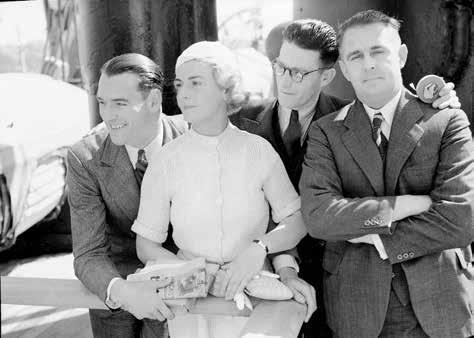
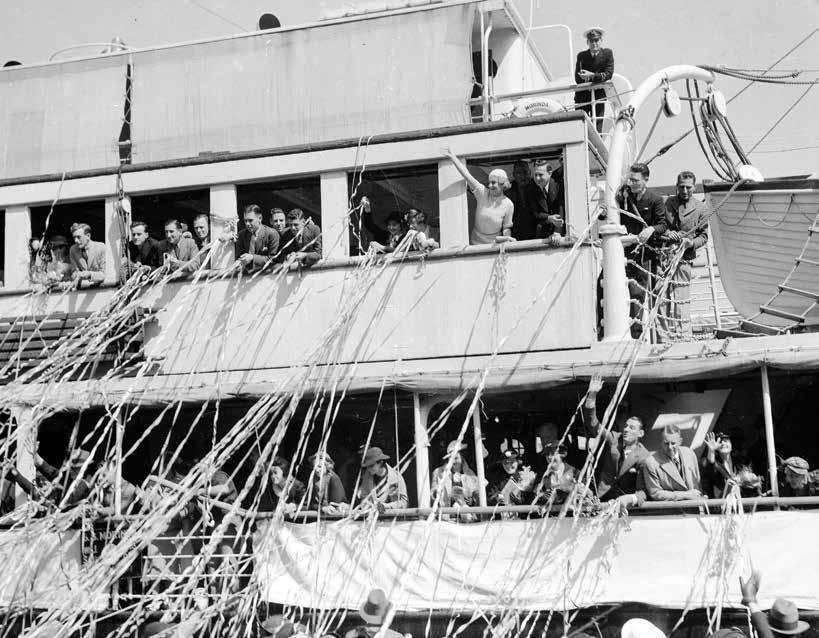 01 Mystery Island cast and crew Brian Abbot, Jean Laidley, George D Malcolm (producer), George Doran (actor). Samuel J Hood Studio, ANMM Collection
01 02
02 The film cast and crew leaves Sydney for Lord Howe by SS Morinda; leading lady Jean Laidley (in white) waves at the top right, and ill-fated actor Brian Abbott waves from the deck below her. Samuel J Hood Studio, ANMM Collection
The all-Australian cast and crew were to sail to Lord Howe to work on the Commonwealth Film Laboratories’ first feature-length film with sound
Sunshine Coast and most of their gear was lost. George (not yet known as Brian Abbot) spent a month in Gympie Hospital with a poisoned leg, having injured it scrambling over sharp rocks as they swam ashore to safety. By this point, the canoe had 22 patches, but the pair continued northward on 23 August.
They were forced to make their way on foot for the last seven days of their journey, as the canoe had been smashed beyond repair. They had gone without drinking water for three days before they arrived in Rockhampton on 18 October 1931.
After the canoe trip, George Rikard Bell worked on TSS Kanowna and SS Christina Frazer, then began pursuing a career in acting under the name Brian Abbot. The Sydney Morning Herald concluded on 14 July 1936, ‘As Mr Abbot didn’t believe in setting for the third time to prove that fate was against him, he promptly decided that there were other adventurous jobs to be had which didn’t carry the risk of drowning’. Ironically, this article appeared three months before Abbot set sail for the last time.
For all Abbot’s ‘iron nerve, uncanny endurance, and unfailing resource’, he ignored a detail that seemed so glaringly obvious to all else on the island but him: that to sail Mystery Star across the Tasman was tantamount to suicide. Yet he was a man ‘born with a thirst for adventure’ and his overpowering inclination to tempt fate was, and continues to be, shared by many. Just two weeks after Abbot and Hay set off, Gower Chase Wilson, a resident of
Lord Howe Island, set off with his son Jack and three others on the same voyage in reverse, on board the 32-foot (9.75-metre) launch Viking. They met the same fate.
We will probably never know exactly what happened during Abbot and Hay’s journey. Based on the newspaper reports, statements from those present, and what we know of an area notorious for its ferocious conditions, we can form an idea of what they may have faced. ANMM curator David Payne believes that despite the enclosed cabin the craft could have been overturned in rough conditions and then swamped. Although an experienced sailor, Payne stated that he would be wary of taking the launch even into close offshore waters. The northern part of the Tasman, where Abbot and Hay would have been, may be less wild then the southernmost areas, but it is just as changeable. Calmer conditions can be interrupted, quite dramatically, by the convergence of weather patterns that create savage storms, winds up to 60 knots and swells that can reach up to 10 metres.
Coupled with the fact that the pair were ‘not skilled navigators’, this would have made a deadly combination.
It’s as if Brian Abbot the actor, still in character as Morris Carthew the hero, had decided that this was his chance to prove himself and achieve the impossible; or that Carthew had materialised in the form of Abbot, with no trace left of the foolhardy young George Rikard Bell, who almost drowned attempting to paddle up the Queensland coast. That had been
five years earlier. This voyage was so much more. There is an eerie parallel between Abbot and Hay’s voyage and the plot of Mystery Island, which concerns the survivors of a shipwreck – among them a detective and a killer – stranded on a deserted island. Except Mystery Island was make-believe and Mystery Star cost them their lives. In a way, the film morphed into a nightmarish reality. As Abbot eerily articulated in his letter to the Women’s Weekly :
In our own ways each of us has become a part of this, our own ‘Mystery Island,’ and our work to date has already shown that … [w]e don’t need to imagine ourselves in our parts on an imaginary island; we live the characters we play, and ‘Mystery Island’ IS ‘Mystery Island.’ (The Australian Women’s Weekly, 24 October 1936, page 37)
In a case of life imitating art, they paid the ultimate price. Their voyage remains a sharp reminder of what can go horribly wrong in the pursuit of adventure.
The author would like to acknowledge the assistance of Simon Drake and the Access team at the National Film and Sound Archive of Australia in researching this story.
Excerpts of Mystery Island appear on the NFSA Australian Screen portal aso.gov.au/titles/ features/mystery-island/clip1. View the entire film by appointment at an NFSA access centres.

AUSTRALIAN NATIONAL MARITIME MUSEUM 37
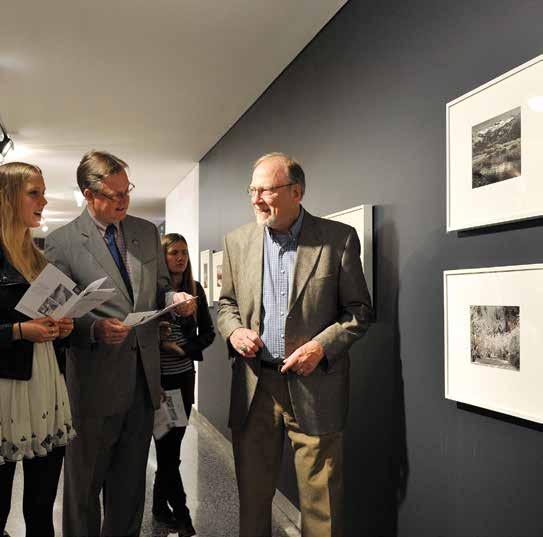
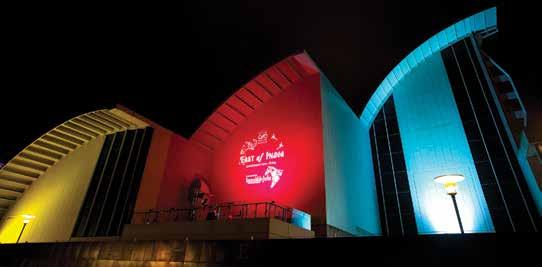
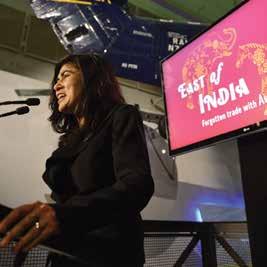
01 02 05 06 04 03
A spring in our step
MESSAGE TO MEMBERS
SPRING, WITH THE International Fleet Review and the new Vikings exhibition, promises a happily hectic schedule to cater for our ever-growing Members’ interests. See our bumper program on the following pages, and I look forward to sharing all the adventures with you.
First, though, some farewells. This is the last Signals to be edited by that special friend of our Members, Jeffrey Mellefont, who is retiring after a long career at ANMM. Jeffrey came on board as a consultant when the museum was first mooted, and then joined the staff in 1988 as a maritime writer. He founded Signals which became the Members magazine from the museum’s opening in 1991. Since then he’s written and edited countless articles and publications for the museum, while developing your Signals into the world’s leading maritime museum magazine. Drawing on his special interests in Asian maritime cultures, Jeffrey has led a series of exclusive overseas Members tours to exotic destinations – and there may be more of those to come, while he continues to travel and write on Asian topics.
Members will also miss senior curator Lindsey Shaw, our guru for all things naval, whose latest article appears on page 10. One of several founding staff members currently retiring, Lindsey will kindly join us as guest commentator for Members cruises during the International Fleet Review, and hopefully return for many more events over the coming years!
We have had a busy and very wellsupported winter program, with many new faces appearing at our events. East of India – Forgotten trade with Australia, our very own ANMM-generated exhibition, was the
cornerstone for many colourful events over winter. We love it that our members enjoy taking to the water with such enthusiasm, with all of our on-the-water activities and cruises filled to capacity. This spring there are even more on-water events!
The spring program sees the advent of our new exhibition from the Swedish History Museum, Vikings – Beyond the legend with a great range of supporting programs and a special Members’ Viking-themed anniversary lunch. Members can meet its Swedish curator Gunnar Andersson at their exclusive introduction to this fascinating exhibition just prior to opening.
To launch the RAN fleet centenary that’s being marked by the International Fleet Review, we will have an opening night for an exhibition of commissioned artworks commemorating this anniversary. These works by members of the Australian Society of Marine Artists will be displayed in the Members Lounge until December, another good reason to visit.
Two other special anniversaries also fall in this period: the 30th anniversary of Australia winning the America’s Cup –remember what you were doing and what PM Bob Hawke said when that happened? – and the 70th anniversary of Krait ’s attack on Singapore in World War 2. Both are marked by curatorial talks and behind-the -scenes peeks at associated objects.
Our Book Group will attract detectivethriller enthusiasts when Australia’s award-winning novelist Peter Corris –‘the godfather of Australian crime fiction’ – becomes our special guest when we look at his latest work The Dunbar Case Crime fiction meets maritime history! And we’ll take a walk to explore the spectacular new park created on the old Caltex waterfront industrial site in Balmain, with a local campaigner who helped defeat the developers to keep this waterside land available for people to enjoy.
Diane Osmond, Members programs
01 At the opening of Ansel Adams –Photography from the Mountains to the Sea, the great American photographer’s former assistant Alan Ross (right) meets US Consul General in Sydney, Neils Marquardt, and daughter Torin Marquardt.
02 Miss India Australia 2013, Zenia Starr, and Rocky Starr at the opening of our winter exhibition East of India – Forgotten trade with Australia
03 The museum was lit up for this year’s Vivid Festival, Sydney’s annual winter spectacular of lights, which expanded this year from Circular Quay to include sites in Darling Harbour.
04 Special guest Professor Veena Sahajwalla of UNSW spoke of the opportunities she found upon migrating to Australia, at the opening of East of India – Forgotten trade with Australia
05 Delicious and colourful Indian cuisine was among the many treats for Members to enjoy as part of our exhibition program.
06 Retiring Signals editor Jeffrey Mellefont (centre) with his crew after the 2013 ANMM staff regatta, sailed each year in yachts lent by Sydney By Sail. Incoming editor Janine Flew is second from left. All photographs ANMM
AUSTRALIAN NATIONAL MARITIME MUSEUM 39 MEMBERS SPRING 2013
Members events
SPRING 2013
SEPTEMBER
Meet the curator
Behind the Vikings exhibition
2–3.30 pm Wednesday 18 September
Meet Gunnar Andersson, creator of the museum’s summer blockbuster exhibition
Theatre performance
So you think you’re a Viking?
10.30, 12.30 and 2.30 pm daily
21–27 September
Bring the kids to this whimsical, acrobatic comedy about Viking family life
70th anniversary talk
Men of Krait
11 am–12.30 pm Tuesday 24 September
Join assistant curator and researcher Penny Hyde for tales of this daring wartime raid
Curator talk
Australia’s triumph at the America’s Cup, 30 years on 11 am–1 pm Thursday 26 September
A review of Australia II ’s landmark victory
Book launch and author talk
Spices, gunpowder and opium:
East Indies with Ian Burnet
2–4 pm Sunday 29 September
The story of the 200-year struggle for trade supremacy in the eastern seas
Bookings and enquiries
Booking form on reverse of mailing address sheet. Please note that booking is essential: online at anmm.gov.au/membersevents or phone (02) 9298 3646 (unless otherwise indicated) or email members@anmm.gov.au before sending form with payment. All details are correct at time of publication but subject to change.
OCTOBER
Cocktail opening
International Fleet Review Art Exhibition
6.30–8 pm Tuesday 1 October
Australian Society of Marine Artists
Naval celebrations
International fleet review
Thursday 3–Friday 11 October
Exciting activities on and around the harbour to mark 100 years of the RAN’s fleet
On the water Cruise and photographic workshop
10 am–2.30 pm Wednesday 16 October
Tour Ansel Adams, then take a photography workshop cruise on Parramatta River
Lecture and exhibition tour
Vikings – Raiders, traders, culture makers
2–4.30 pm Sunday 20 October
Cultural legacies of the Vikings
Family fun Sundays
Scandiinavian Sunday!
Family fun day
11 am–3 pm Sunday 20 October
Family fun inspired by our exhibition Vikings – Beyond the legend
On the water: ‘island’ tour
Visit Garden Island
10 am–2 pm Thursday 24 October
A behind-the-scenes guided tour of Garden Island heritage precinct
Members book group
Peter Corris: The Dunbar Case
4–6 pm Sunday 27 October
Join author Peter Corris at our book group
NOVEMBER
Book launch and author talk Voyage to Gallipoli
2–4 pm Sunday 3 November
How events at Gallipoli on 25 April 1915 could have been very different
Naval tradition
HMAS Vampire mess dinner
6– 9.45 pm Saturday 16 November
Our annual traditional navy dinner in the destroyer’s wardroom
Curator talk
Meet the Vikings
2–4 pm Sunday 17 November
Curator Dr Stephen Gapps explores the world of the Vikings
Felt-making workshop
Craft like a Viking 2–5 pm Sunday 24 November
Renowned artist Anita Larkin teaches felt making inspired by Viking artisan crafts
For your diary
Members Yule fest
11.30 am–2.30 pm Saturday 30 November
Book early for our annual festive Members lunch; this year it’s Viking themed
For your diary
Visit Ballast Point Park
Wednesday 4 December
Explore Ballast Point Park on the site of the old Caltex Site in Balmain
Festive fun
Family Viking Christmas party
11 am–2 pm Saturday 14 December
A special pre-Christmas Viking family day for Members and their families
40 SIGNALS 104 SEPTEMBER–NOVEMBER 2013
01 Women aboard Chilean naval vessel General Baquedano, Circular Quay, July 1931. Samuel J Hood Studio Collection
02 Artist’s impression of a Viking longship
03 Krait off Sydney. Photo J Mellefont/ANMM
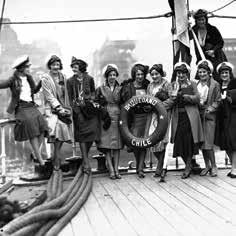
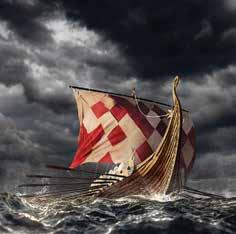
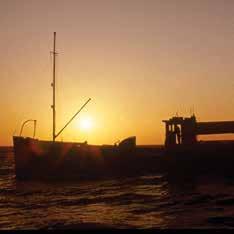
History Week panel discussion From glass plate to cyberspace
6–8 pm Wednesday 11 September
Explore how cultural institutions are using digital community platforms to share their photographic collections and unlock social and family histories. A lively panel discussion will feature Paula Bray, Powerhouse Museum; Lisa Bray, City of Sydney; Geoff Hinchcliffe, State Library of NSW; Bernard Di Broglio, Mosman Council; Mitchell Whitelaw, author of The Visible Archive; and the museum’s online collection-share experts Penelope Hyde and Nicole Cama. Presented in partnership with Inside History magazine. Members and concessions $15 Guests $20. Includes refreshments and after-hours viewing of exhibitions. Bookings essential
Meet the curator
Behind the Vikings exhibition with Gunnar Andersson
2–3.30 pm Wednesday 18 September
Meet curator Gunnar Andersson, creator of the museum’s summer blockbuster exhibition from Sweden. Hear the stories behind the exhibition and the most unusual artefacts. We will also get a pre-opening glimpse of the exhibition.
$10 Members $15 Guests. Includes refreshments
Commemorative talk
Men of Krait
11am–12.30 pm Tuesday 24 September
To commemorate the 70th anniversary of Krait’s bold attack on Singapore Harbour, join assistant curator and researcher Penny Hyde as she shares tales of some of the heroes involved: Ivan Lyon, Bill Reynolds, Hubert Carse and Horrie Young. We will be able to view some of the objects associated with these stories and afterwards go on board Krait for a special tour. This is a rare opportunity to learn about perhaps the most daring operation of World War 2.
Members $20 Guests $25. Numbers are limited; bookings essential. Includes a light sandwich lunch
Family fun Sundays Pirates ahoy!
10 am–3 pm Sunday 15 September
Join the ‘International talk like a pirate day’ celebrations at the museum. Dress in pirate costume, follow a treasure trail around the galleries, enjoy a swashbuckling family film and a special pirate performance, and have your face painted. Visit Kids on Deck to decorate a pirate hat or make a flag, a paper tall ship or a mermaid shadow puppet. See www.anmm.gov.au/kids for more event details. Free for Members. Includes prizes and giveaways
Free Members family theatre
So you think you’re a Viking?
10.30, 12.30 and 2.30 pm daily 21–27 September
Come along to this fun-filled, whimsical, acrobatic comedy about Viking family life, to celebrate the opening of Vikings – Beyond the legend. Performed by Unhinged Entertainment.
Curator talk
What cup? Australia’s triumph at the America’s Cup, 30 years on 11 am–1 pm Thursday 26 September
Join senior curator Daina Fletcher and curator and yacht designer David Payne to explore the build-up, technical triumph and tactics for Australia II ’s landmark victory and its legacy 30 years on. Afterwards take a behind the scenes tour of Wharf 7 and the museum stores to view artefacts relating to the America’s Cup campaigns and the innovative A2 tank test model.
$10 Members $15 Guests. Includes refreshments
01 02 03
MEMBERS SPRING 2013
Members events
SPRING 2013
East Indies
East Indies
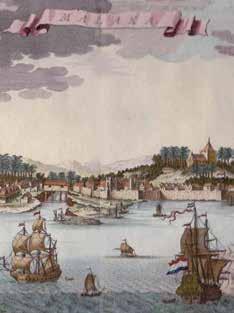
Book launch and author talk
Spices, gunpowder and opium:
East Indies with Ian Burnet
2–4 pm Sunday 29 September
A fascinating talk about the spice trade and its little-known associated social and military impacts. Historian and author Ian Burnet documents the 200-year struggle between the Portuguese crown, the Dutch East India Company and the English East India Company for trade supremacy in the Eastern Seas. He discusses the rise of the world’s first joint stock and multinational trading companies and their conversion to huge colonial states ruling over millions of people in Indonesia, India and Malaya.
Members $20 Guests $25. Bookings essential. Includes refreshments
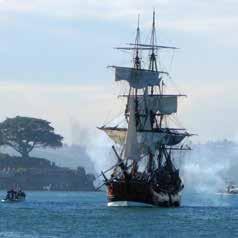
Navy celebrations
International Fleet Review
Thursday 3–Friday 11 October
More than 40 nations are sending a warship or tall ship for the International Fleet Review, to commemorate 100 years since the first ships of the Royal Australian Navy sailed into Sydney. We’re is offering exciting activities as part of this unique navy spectacular, with HMB Endeavour the most prestigious berth from which to view the action on the harbour. Get out on the water for your chance to be part of the celebrations, or see the ships up close at the open days.
Please note: Times may change due to event updates by the RAN; check anmm. gov.au. Bookings essential 9298 3777 or email bookings@anmm.gov.au
International Fleet Review
Welcome the warships aboard HMB Endeavour
9.30 am–1.30 pm Friday 4 October
Join Endeavour and greet the warships as they enter Sydney Harbour in formation. Experience the 21-gun salute and ceremonial fleet entry at Bradleys Head. Watch the spectacle unfold!
Members $180 Member children $135 Member families $360. Guests $200 Children $150 Families $400. Includes refreshments, full commentary and entertainment. Bookings essential 9298 3777
Cocktail opening
International Fleet Review Art Exhibition
6.30–8 pm Wednesday 2 October
The Australian Society of Marine Artists will exhibit a significant collection of paintings to celebrate the arrival of the first ships of the RAN, from Stan Stefaniak’s magnificent depiction of the fleet entry in 1913 to Robert Carter’s vision of the 2013 review, along with pictures of many other vessels involved. The exhibition will be opened by museum chairman Peter Dexter and remain on display in the Members’ Lounge until 1 December.
Members $25 Guests $35. Includes refreshments. Numbers limited; bookings essential 9298 3644 or email bookings@anmm.gov.au
International Fleet Review
Tall ships welcome aboard MV Proclaim
10 am–1 pm Thursday 3 October
Welcome HMB Endeavour and the tall ship fleet as they enter the harbour. See the gun salute and follow the tall ships to Darling Harbour. Bring your cameras and binoculars for an unforgettable spectacle.
Members $70 Member children $40. Guests $85 Children $50. Includes buffet lunch cruise with full commentary aboard MV Proclaim; cash bar. Bookings essential 9298 3646
International Fleet Review
Ceremonial fleet review cruise aboard HMB Endeavour
9.15 am–1 pm Saturday 5 October
Join us aboard HMB Endeavour as we dress ship and take up position to watch the ceremonial fleet review by Her Excellency the Governor General of Australia, Quentin Bryce. Watch ceremonial flypasts and aerobatic displays, including massed helicopters, by the Australian Defence Forces, as well as displays by visiting military aircraft.
Members $180 Member children $135 Member families $360. Guests $200 Children $150 Families $400. Includes refreshments, full commentary and entertainment. Bookings essential 9298 3777
42 SIGNALS 104 SEPTEMBER–NOVEMBER 2013
02 03 01
Indies
Ian Burnet 02
and around Sydney Harbour 03
ANMM
Cover of East
by
Navy celebrations on
Endeavour under sail. Photograph
The 200 year struggle between the Portuguese Crown, the Dutch East India Company and the English East India Company for supremacy in the Eastern Seas Ian Burnet In 1497 Vasco da Gama rounded the Cape of Good Hope, his small Portuguese fleet reached India and became the first Europeans to sail the Eastern Seas. Over the next 100 years the Portuguese spread their trading network in search of spices, sandalwood, silks, gold, silver, porcelains and other oriental goods. This trading network extended from Goa in India as far east as the Moluccas and Timor in Indonesia, and as far north as China and Japan. In 1595 and 1601 respectively, the first Dutch and English trading expeditions rounded the Cape of Good Hope and the trading monopoly of the Portuguese Crown was being challenged by the Dutch East India Company and then the English East India Company, the world’s first joint stock and multi-national trading companies. For the next 200 years the struggle for trade supremacy between the Portuguese, the Dutch, and the English ranged across the Eastern Seas and in the settlements of Goa, Malacca, Ambon, Macao, Canton, Nagasaki, Batavia, Macassar, Johor and Singapore. Until by the end of the 19th century the Portuguese had almost vanished from the Eastern Seas, and the Dutch and the English East Indies Companies had been transformed from trading companies into colonial powers ruling vast territories in Indonesia, India and Malaya. This book follows the trade winds, the trade routes and the port cities across the East Indies and the Orient. Beginning in Malacca which was one of the world’s largest trading ports in the 16th century and finishing with the founding of Singapore and Hong Kong which became some of the world’s largest trading ports in the 19th century.
Ian Burnet
04 HMAS Melbourne, Sydney Heads, 4 October 1913. ANMM Collection
05 HMAS Australia in Portsmouth, England, 1913. ANMM Collection
06 The last flagship of the Australia Station HMS Cambrian, John Bastock. ANNM Collection, gift from John Bastock.
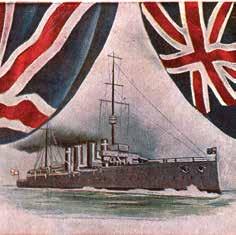
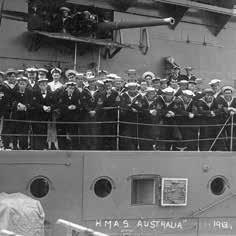
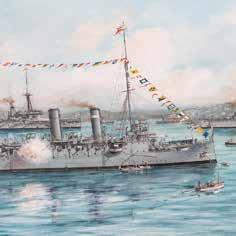
International Fleet Review Fireworks and light show spectacular
5–9.15 pm Saturday 5 October
Join us aboard luxury vessel Reef Trekker for a special Members-only cruise. Sail among the tall ships and navy vessels and admire the thrilling fireworks.
Members $70 Member children $45 Member families $220. Guests $85 Children $50 Family $300. Includes barbecue and full commentary. Bookings essential 9298 3646, 9298 3644 or email bookings@anmm.gov.au
International Fleet Review Day sail aboard HMB Endeavour
11 am–pm Wednesday 9 October
Your last chance to see the visiting warships.
Members $180 Member children $135 Member families $360. Adult $200
Child $150 Family $400. Includes refreshments, full commentary and music. Bookings essential 9298 3777
International Fleet Review Farewell ferry cruise aboard MV Proclaim
9.30 am–12.30 pm Thursday 10 October
Enjoy a buffet lunch with tea and coffee provided as you farewell the tall ships and see the start of the race to New Zealand.
Members $70 Member children $45 Member families $220. Guests $85 Children $50 Family $300. Includes barbecue and full commentary. Bookings essential 9298 3646, 9298 3644 or email bookings@anmm.gov.au
International Fleet Review
Endeavour two-hour sailing program
10 am–12 noon or 1–3 pm
Tuesday 8 October
Enjoy the Navy Centenary vibe aboard HMB Endeavour, with morning or afternoon tea and full commentary provided.
Members $90 Member children $70. Guests $100 Child $75. Includes refreshments and full commentary. Bookings essential 9298 3777
International Fleet Review
Tall ships farewell
9.30 am–12.30 pm
Thursday 10 October
Farewell the tall ships as they depart for the race to New Zealand. Follow them to Sydney Heads on HMB Endeavour and experience all the excitement and spectacle.
Members $180 Member children $135 Member families $360. Guests $200
Child $150 Family $400. Includes picnic lunchboxes, drinks and full commentary. Bookings essential 9298 3777
International Fleet Review
HMB Endeavour’s final sail for 2013
Thursday 10–Monday 14 October
Join Endeavour for a five-day offshore voyage. On 10 October, the ship will join manoeuvres on the start line of the tall ships race to Auckland, and sail offshore with the fleet until late afternoon. It will then turn north to Port Stephens or south to Jervis Bay, depending on conditions. Crew may encounter the various warships returning overseas after the Fleet Review, or other Australian tall ships returning to their own states.
Voyage Crew $1500 Supernumeraries $3000. 5% discount for Members and previous voyage crew
AUSTRALIAN NATIONAL MARITIME MUSEUM 43 04 05 06
MEMBERS SPRING 2013
Members events
01 Detail from the cover of Voyage to Gallipoli
02 Scandinavian family fun
03 Detail from the cover of The Dunbar Case SPRING 2013
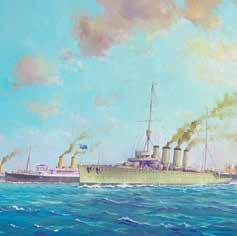
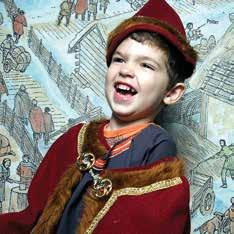
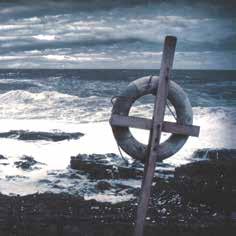
Book launch and author talk
Voyage to Gallipolli by Peter Plowman
2–4 pm Sunday 3 October
Most of the events leading up to the landings by Australian and New Zealand troops at Gallipoli on 25 April 1915 are little known. Had the original plans for these troops been followed, the New Zealand and Australian contingents would have travelled in separate convoys that would have gone to England. HMAS Sydney would not have destroyed the German cruiser Emden, and ANZAC would not have been formed. These plans changed due to a series of largely unforeseen events which are the subject of this illustrated talk.
$25 (Members $20). Includes refreshments. Bookings essential 9298 3646, bookings@anmm.gov.au or book online at www.anmm.gov.au/events
Cruise and photographic workshop
Ansel Adams photography
10 am–2.30 pm
Wednesday 16 October
Join expert tutor Michael Waite from the Australian Centre for Photography and the museum’s USA Gallery Curator Richard Wood for an insight into the life and work of renowned American photographer Ansel Adams. Tour the exhibition Ansel Adams –From the mountains to the Sea. Bring your camera for a photography workshop as we cruise down Parramatta River.
Members/Concessions $65 Guests $70. Includes entry to Ansel Adams exhibition, workshop equipment, and morning and afternoon tea. Bookings essential 9298 3655, email bookings@anmm.gov.au or book online at www.anmm.gov.au/events
Lecture and exhibition tour
Vikings – Raiders, traders, culture makers
2–4.30 pm Sunday 20 October
Raiders, ravagers, despoilers – our popular conceptions of the Vikings often forget their master craftsmanship, literary culture and sophisticated trading networks. Delve into the cultural legacies of the Vikings with the University of Sydney’s Professor Margaret Clunies Ross for a lecture followed by a curator-led tour of the exhibition Vikings – Beyond the legend
$45 (Members/concessions $40).
Includes museum entry, exhibition tour and afternoon tea. Bookings essential 9264 2781 or book online at WEA Sydney www.weasydney.com.au
On the water: ‘island’ tour
Visit Garden Island
10 am–2 pm Thursday 24 October
Enjoy a behind-the-scenes guided tour of Garden Island heritage precinct with representatives of the Naval Historical Society of Australia. We will tour the secure area of Garden Island, including the chapel, the top of the Captain Cook Dock and the Kuttabul Memorial. Bring a picnic lunch to share on the hill at the end of the tour, before returning to Circular Quay.
$20 Members $25 Guests. Meet at Circular Quay Wharf 4 to catch the 10.05 am ferry to Watson’s Bay. Reasonable level of fitness required
Family fun Sundays
Scandinavian Sunday!
11 am–3 pm Sunday 20 October
Join in a day of family fun inspired by our exhibition Vikings – Beyond the legend Enjoy saga-telling, family games and performances. Make Viking shields and amulets and write your name in runes in Kids on Deck.
See www.anmm.gov.au/kids for more event details
Members book group
Peter Corris: The Dunbar Case 4–6 pm Sunday 27 October
What a mix – a detective story based on Australia’s most famous shipwreck, written by the ‘godfather’ of Australian crime fiction, Peter Corris, who will be with us to answer your questions about his sleuth Cliff Hardy, hero of 38 crime fiction novels which in 2009 earned Peter the Ned Kelly award for Best Fiction by the Crime Writers Association of Australia. Weigh this against the real story as told by author and curator of maritime archaeology, Kieran Hosty, who will help uncover the mysteries of this 19th-century shipwreck.
Members $5, Guests $10. Includes, wine refreshments and book signing. Bookings essential for catering purposes
44 SIGNALS 104 SEPTEMBER–NOVEMBER 2013
01 02 03
04 Dinner in HMAS Vampire’s wardroom. Photograph A Adam/ANMM
05 Members enjoy a Yuletide lunch. Photograph Jeffrey Mellefont/ANMM
06 Ballast Point Park
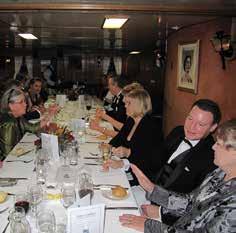
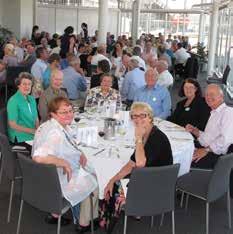
Naval tradition HMAS Vampire wardroom mess dinner
6 pm–9.45 pm Saturday 16 November
Celebrate HMAS Vampire’s naval service with our annual, traditional Navy dinner in the destroyer’s wardroom. Your dinner president will be a former commanding officer of Vampire, Captain Paul Martin. Experience the passing of the port, the loyal toast and more – all in the best RAN traditions.
$120 Members $160 Guests. Civilians and partners welcome. Includes pre-dinner cocktails and canapés on the deck and a three-course meal. Dress: black tie and miniatures. Bookings essential: places are limited due to the size of the wardroom
Members lunch
Yule fest Anniversary lunch
11.30 am–2.30 pm
Saturday 30 November
Book early for our special annual festive Members’ lunch, this year themed to our Vikings exhibition. Join director Kevin Sumption, council chairman Peter Dexter and special guest speaker our fondly remembered ex director, Mary Louise Williams as she shares with us tales from her favourite maritime museums around the world.Enjoy the company of fellow members and a hearty Viking inspired three course lunch accompanied by specially chosen wines. A not-to-be-missed convivial event!
Members $90. Guests $105. Meet in the museum foyer beforehand
Meet the neighbours Visit to Ballast Point Park
Wednesday 4 December
Explore Sydney’s newest and most spectacular harbour side park: Ballast Point Park on the site of the old Caltex site in Balmain with our guide, Roger Parkes. Members can either drive or take a ferry from the museum to meet at the Thames Street wharf at 11 am. Bring a picnic lunch in the park or a pub lunch is available at the nearby William Wallace Hotel. Wear comfortable walking shoes and explore this many-layered site that was rescued from development by a group of visionary residents.
Meet at the museum 9.30 am.
Members $5 Guests $7.50
Curator talk
Meet the Vikings
2–4 pm Sunday 17 November
Were they really blond gods in bearskins, and was their culture in fact a turning point in Western civilisation? What did Vikings wear into battle and what did they wear to bed? Join our museum curator Dr Stephen Gapps and some of his Vikingreenactor friends as they explore the world of the Vikings and examine these questions as depicted in our exhibition Vikings –Beyond the legend
Members $20 Guests $25. Includes Viking-style refreshments
Craft workshop
Craft like a Viking – Felt making
2 pm–5 pm Sunday 24 November
Join renowned artist Anita Larkin for an afternoon of felt making inspired by the traditions of Viking artisan crafts. Learn to create felted accessories and sculptural forms.
$45 (Members/concessions $40).
Includes museum entry and afternoon tea. Bookings essential 9298 3655, bookings@anmm.gov.au or book online at www.anmm.gov.au/events
Festive fun
Family Viking Christmas party
11 am – 2 pm Saturday 14 December
Come along to a special pre-Christmas Viking family day for members. There will be a taste of the Vikings summer holiday program, entertainment, and Viking fare such as raider hotdogs, glacier snow cones and plunderers’ popcorn will be served. Big Vikings can enjoy mulled wine, and little ones Viking surprise! Guest speaker is Mary Louise Williams, former ANMM director. In addition there will be discounted Christmas shopping in The Store so come along to get some Viking loot!
Member families $25 Guest families $50
AUSTRALIAN NATIONAL MARITIME MUSEUM 45 04 05 06
MEMBERS SPRING 2013
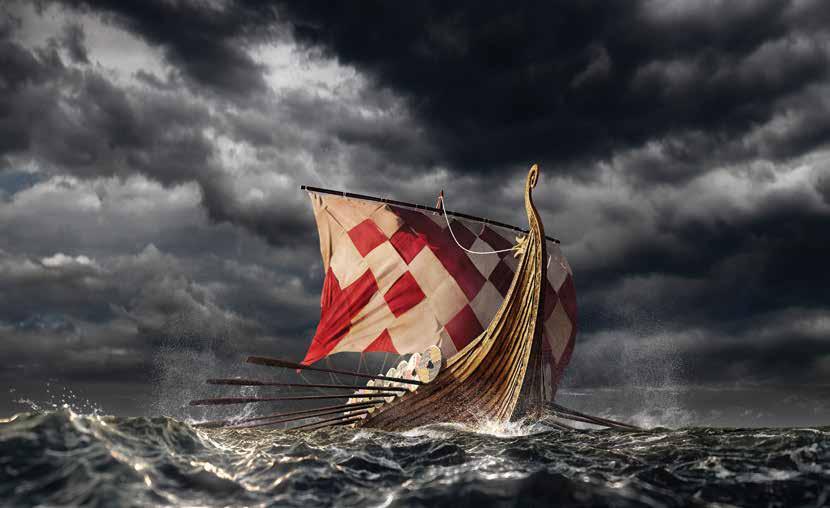
Vikings
BEYOND THE LEGEND
Vikings – Beyond the legend
Opens 19 September
Vikings capture our imagination in a way that few other cultures do, but what do we really know about the people we call Vikings?
Gain insight into the Scandinavian cultures of the Viking age from 1000 years ago in this fascinating exhibition from the Swedish History Museum.
Stereotyped then and now as fierce raiders, Vikings were also traders, farmers and skilled artisans. Based on new archaeological discoveries, the exhibition explores Viking domestic life, religion, death rituals, mythology, arts and crafts and the importance and symbolism of Viking ships.
Vikings – Beyond the legend brings the Viking story alive through interactive exhibits, films, sound installations and unique objects, many of which are rarely shown outside Scandinavia.
A joint venture by the Swedish History Museum, Stockholm, and MuseumsPartner, Austria.
Entry free with Big Ticket, and for Members.
anmm.gov.au/vikings
#vikingexhib
Viking vessel Jorgen Jorgenson
From 19 September
Also on display at the museum’s wharves is the Jorgen Jorgenson, a newly restored reconstruction – one of only four in existence – of the 9th-century Gokstad Viking ship. One of the most famous finds in Scandinavian archaeology, the Gokstad ship was a fully seaworthy sailing and rowing vessel with 32 oars. Made of oak, it could carry 70 people. It was then used as a burial chamber for a powerful Viking chieftain around 900 AD.
On loan from the Pyrmont Heritage Boating Club
Entry free with Big Ticket
01 This dramatic image of a Viking ship was commissioned by the ANMM marketing team for the new exhibition. It’s a hybrid, drawing on elements from a number of archaeological finds or reconstructions of Viking maritime technology.
46 SIGNALS 104 SEPTEMBER–NOVEMBER 2013
www .museumspartne r. co m Partner Museums
01
02 The Tetons and the Snake River, Grand Teton National Park, Wyoming, 1942. Photograph by Ansel Adams, Collection Center for Creative Photography, University of Arizona. © The Ansel Adams Publishing Rights Trust 03 Totem (detail), Jordan Terare, Year 12. Photograph Marinco Kojdanovski. Reproduced courtesy of the Powerhouse Museum Sydney 04 Yathikpa II (detail) by Bakulanay Marawili 1998. ANMM Collection

Ansel
Adams – Photography from the Mountains to the Sea
Until 8 December
Water was one of the favourite subjects of the great American photographer Ansel Adams (1902–84), best known for his detailed black-and-white landscapes that capture the epic spaces of the US continent. Full of energy and dynamism, Adams’ photographs of mountains, clouds and waterfalls, seascapes, bays and tide pools provide a fresh perspective on a celebrated artist.
Organised by the Peabody Essex Museum, Salem, Massachusetts. Support for the exhibition was provided by David H Arrington, and the Center for Creative Photography, University of Arizona. Funded by the USA Bicentennial Gift Entry free with Big Ticket, and for Members. Exhibition only: Adult $15 Child & Concession $10 anmm.gov.au/anseladams #anseladams
Koori art expression
15 November 2013–16 February 2014
Be inspired by artworks produced by students in Public Schools NSW across Sydney (K–Y12) exploring the 2013 NAIDOC Week theme, We value the vision: Yirrkala bark petitions 1963. In this annual arts program, students and teachers aim to develop an understanding of Aboriginal culture and heritage, the unique connection Aboriginal people have to their country and how past achievements affect hopes and plans for the future.
anmm.gov.au/kooriart
Saltwater Visions
Until 6 October
These important bark paintings, from the museum’s Saltwater Collection, document the spiritual and legal basis of the Yolngu people’s ownership of saltwater country in north-east Arnhem Land.
anmm.gov.au/naidoc #naidoc
Elysium Antarctic Visual Epic
Until 3 November
In 2010 a team of wildlife photographers, filmmakers and scientists embarked on an expedition from the Antarctic Peninsula to South Georgia. This stunning visual record of the expedition captures the fauna and flora, glaciers, and the magnificent land and seascapes of this great wilderness. anmm.gov.au/elysium #elysium
Main expedition sponsor Supporting sponsors


ANMM travelling exhibitions
Waves and Water
10 October–9 November 2013
Whitehouse Arts Space, Box Hill, Victoria
25 November 2013–23 February 2014
National Wool Museum, Geelong, Victoria
Iconic photographs from the Australian National Maritime Museum’s collection capture Australian beach culture from the 1930s to 2000: sunbathers, swimmers, surfers, surf lifesavers and ocean pools, by Max Dupain, Jeff Carter, Ray Leighton, Ian Lever, Roger Scott, Anne Zahalka, Trent Parke and Narelle Autio.
This exhibition is supported by the National Collecting Institutions Touring and Outreach Program, an Australian Government program aiming to improve access to the national collections for all Australians

AUSTRALIAN NATIONAL MARITIME MUSEUM 47 EXHIBITIONS SPRING 2013
02 03 04
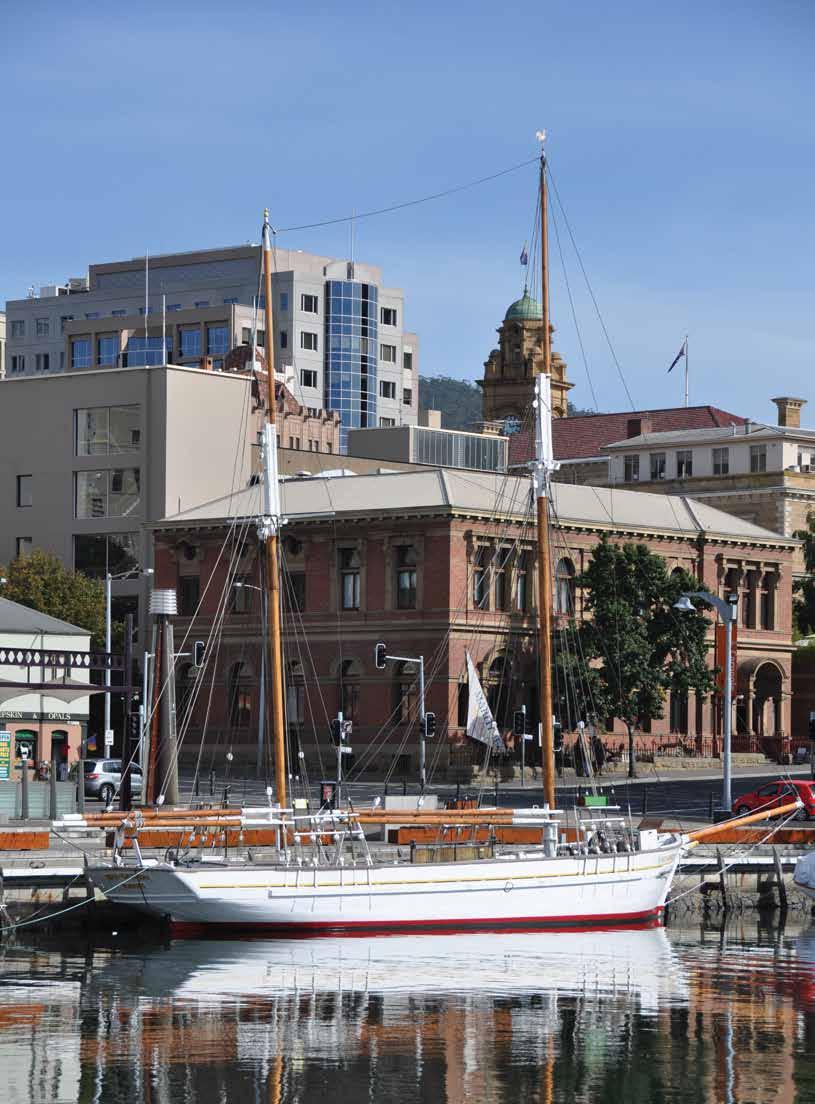
MARITIME HERITAGE AROUND AUSTRALIA HOBART
The Maritime Museum of Tasmania is housed in the Carnegie Building in Hobart. The historic 1867 trading ketch SV May Queen, owned by a separate trust, normally moors in nearby Constitution Dock, with museum volunteers managing public access to the vessel
Tasmanian treasures
MARITIME MUSEUM OF TASMANIA
The island state is rich in maritime history, from Aboriginal cultures, early European explorers, whalers, sealers and traders to modern maritime stories. Colin Denny, curator at the Maritime Museum of Tasmania, traces its development and tells some of the tales behind its collection.
TASMANIA’S CAPITAL, THE PORT OF Hobart on the Derwent estuary, is an ideal setting for one of Australia’s finest small museums. Here in the Carnegie Building next to Constitution Dock, stories of exploration, settlement, seafaring and trade are revealed in the galleries of the Maritime Museum of Tasmania (MMT).
Tasmania became separated from the mainland when sea levels rose and flooded the Bassian Plains perhaps 12,000 years ago.
The Aboriginal population had walked to Tasmania from the northern landmass more than 25,000 years earlier, but the wild waters of Bass Strait now isolated them from the mainland and the rest of the world.
The Tasmanian Aborigines constructed canoes from bundles of stringybark, paperbark or reeds tied together with a mesh of grass or bark cord in order to negotiate coastal waters and offshore islands in search of food.
The first recorded European to come to the island was Abel Janszoon Tasman, an employee of the Dutch East India Company. In 1642 he was given two ships, the Heemskirk and Zeehaen, to sail from Batavia (now Jakarta, Indonesia) on a voyage of exploration in search of trading opportunities. On 25 November, Tasman
sighted a barren, windswept coast but continued on an easterly course seeking shelter in a south-eastern bay that lies in the region of today’s Hobart. On 3 December a carpenter swam ashore to plant the flag of the House of Orange, tying it to a stake in which he cut the company’s mark. Tasman named the region Van Diemen’s Land in honour of his governor general in Batavia.
The Dutch charted the south coast of Tasmania over a period of several days and recorded that adverse weather prevented further exploration. Heemskirk and Zeehaen then sailed for New Zealand and it would be 140 years before another European, French explorer Captain Marion du Fresne, arrived in Tasmania. From 1772 the southern bays of Van Diemen’s Land became a place for re-watering and a haven for explorers sheltering from the stormy ocean. They included, among others, Tobias Furneaux in the Adventure, James Cook in the Resolution, William Bligh of the Bounty, John Henry Cox in the Mercury and Bruni d’Entrecasteaux in the Recherche
In 1798 sealers began working in Bass Strait following reports of seal colonies from the survivors of the merchant vessel Sydney Cove, which had been wrecked in the Furneaux Group of islands at the eastern
end of the strait. In the same year George Bass and Matthew Flinders circumnavigated Van Diemen’s Land in the sloop Norfolk, proving it was an island. Then in 1803, when Governor King in New South Wales became nervous about the intentions of Nicolas Baudin and other French explorers in the region, a convict settlement was commissioned on the Derwent River to ward off foreign territorial interests.
Over subsequent years the convict colony grew and commercial interests developed among the free settlers. Outlying farming communities were serviced by sea and the ever-increasing population relied on regular coastal transport for both local commerce and shipping services to the outside world. Hobart Town evolved from a convict settlement to a prosperous trading port when sealers and whalers made Tasmania their base. A lively maritime trade became established and instilled in Tasmanians an affection for ships and the sea.
Very little was achieved in preserving Tasmanian maritime history until the formation of the Shiplovers’ Society in 1931. Their efforts kept maritime memories alive in the minds of Tasmanians, preserved the relics of the island’s maritime past and laid the foundations for the MMT.
AUSTRALIAN NATIONAL MARITIME MUSEUM 49
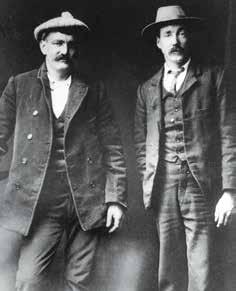
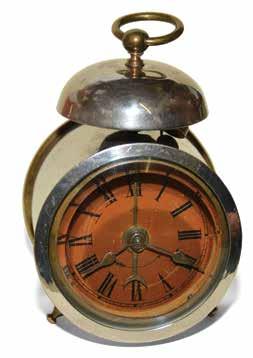
01 Oscar Larsen, sole survivor of the wreck of the barque Brier Holme, with his rescuer, Edward Noye, owner-master of the fishing cutter Britannia (MMT glass slide collection)
02 A small alarm clock without maker’s name was Larsen’s gift to Noye as a memento of the rescue
03 Two fishermen with their baggage on Franklin Wharf, Hobart, in the 1930s
04 A Tasmanian ’couta fishing boat pictured in Constitution Dock about 1910 with the Carnegie Building in the background
The present museum dates from 1972, when a group of six enthusiasts with maritime interests first met and resolved to establish an independent maritime museum. They pooled their private collections and sought public contributions. By 1973 the group had secured two schoolrooms for displays at the rear of St George’s Church in the Hobart suburb of Battery Point. It was an apt location – St George’s is the Mariners’ Church, close to the historic 19th-century shipyards.
A lively maritime trade became established and instilled in Tasmanians an affection for ships and the sea
The MMT officially opened to the public in December 1974 with 43 foundation members: the Shiplovers’ Society, the National Trust, four Hobart yacht clubs, eight commercial organisations and 29 individual members. The initial collection comprised the Shiplovers’ accumulation of photographs, paintings and models, augmented by donations and loans from other members. The museum flourished and was soon open every afternoon of the week and all day on Saturday with an admission charge of 50 cents per adult.
When St George’s Church advised that the lease on the rooms would not be renewed, the state government offered a lease
of historic Secheron House, also in Battery Point, whose larger premises could house the MMT’s expanding collection. The Governor of Tasmania, Sir James Plimsoll, opened the Secheron House galleries in May 1983. Here the MMT’s important role of answering research enquiries developed, and volunteers began offering educational tours. Opening hours increased and the entry fee doubled to $1. However, an active policy of acquisition and collection once again resulted in the need for more space.
The museum spent 16 years at Secheron House before the government decided to sell the property. Fortunately Hobart City Council offered the MMT the ground floor of the Carnegie Building for galleries and an upstairs space for administration. This imposing building had been funded by Scottish-American millionaire Andrew Carnegie and constructed in the first decade of the 20th century as the Tasmanian Public Library. Its central location adjacent to the heritage-listed Constitution Dock and the port area of Sullivans Cove made it an ideal site for the museum. MMT members and specialist advisers set to work creating display galleries and by March 2000 the work was complete, just in time for Her Majesty Queen Elizabeth II to officially open the museum during her visit to Tasmania.
The collection predominantly comprises artefacts donated by benefactors from Tasmania and places further afield. The MMT’s policy is to collect and display objects of maritime historical or educational significance, especially – but not exclusively – relating to Tasmania. In addition to physical artefacts the MMT
has a collection of more than 70,000 images, many historic documents and a well-stocked research library.
Volunteers are working to catalogue the vast collection on a cloud-based eHive museum database. The records are progressively released online and can be accessed from the website as part of the public outreach program. Responses to the database have been rewarding, with useful comments about objects and photographs coming from as far away as the United Kingdom.
The MMT galleries are introduced by a recently built Aboriginal rolled-bark canoe followed by exhibits telling stories of early European exploration. Displays highlight the place played by whaling in the early settlement of Tasmania and highlight the importance of maritime trade to Tasmania’s contact with the rest of the world.
Stories from naval history, maritime misadventures and local commerce are all interpreted with models and artefacts. A small temporary exhibitions gallery explores varying maritime themes.
On some occasions acquisition and de-accession policies are inadvertently overlooked. During the MMT’s first year it accepted a donation of the fire-damaged wheel from the 1848 ketch Huon Chief In 1938 a petrol explosion had caused a fire aboard the ketch and flung the master, Captain Watty Richardson, from the companionway onto the wheel, which saved his life. The wheel went into storage at the museum and during a clean-up volunteers who were unaware of its provenance loaded it along with
50 SIGNALS 104 SEPTEMBER–NOVEMBER 2013
01 02
Stories from naval history, maritime misadventures and local commerce are all interpreted with models and artefacts
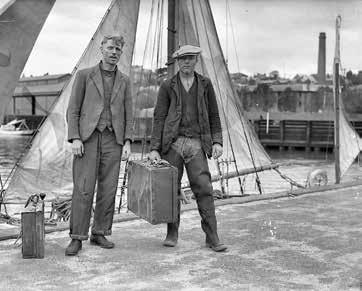
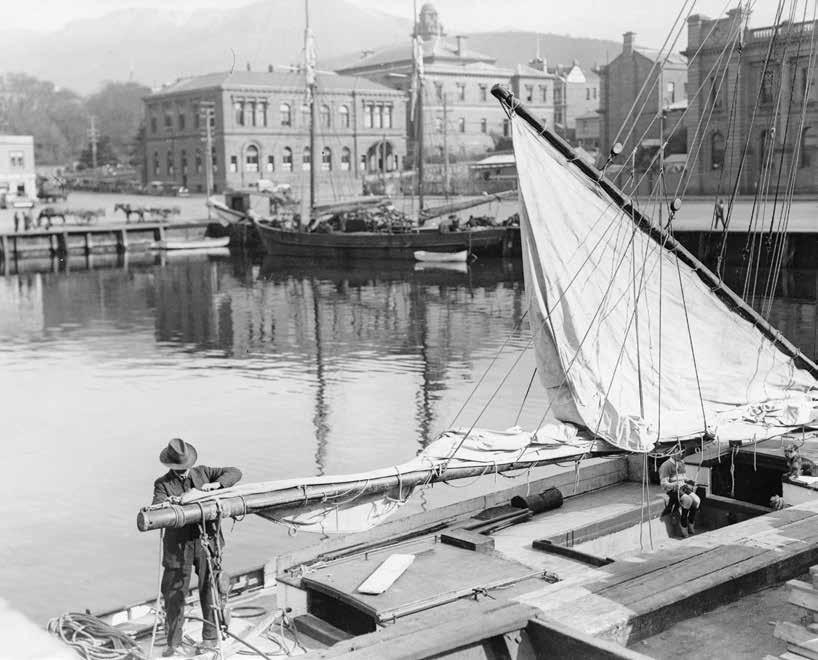
03 04
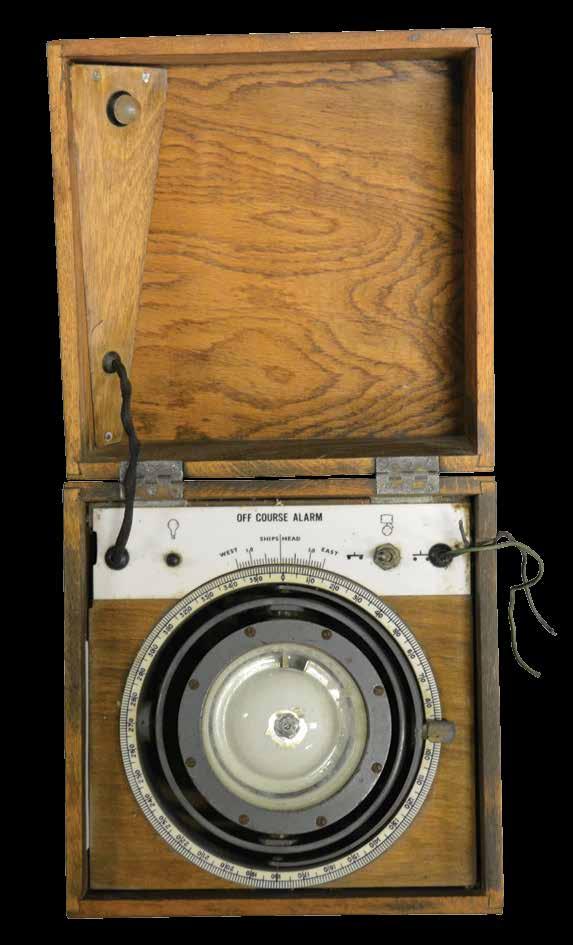
other bits and pieces for disposal.
A sharp-eyed member of the Shiplovers’ Society recovered the wheel on the way to the tip and displayed it in his own collection. Fifteen years later he donated the wheel back to the MMT in memory of Captain Richardson, so it can be used once again to interpret the Huon Chief story.
The historic 12.8-metre celery-top pine cutter Westward, moored in Constitution Dock, is the only floating exhibit owned by the museum. Battery Point shipwright the late Jock Muir designed and built Westward in 1947 as a recreational fishing cutter with a wet fish-well. Yachtsman George Gibson acquired the vessel when the original buyer defaulted. With Muir’s help he sailed the yacht to victory in the 1947 Sydney to Hobart race. They won again in 1948 and Muir recalled in his book Maritime Reflections, ‘I like to remember that she must be the only yacht with a fish-well to win the big race’.
Westward lies close to the 1867 trading ketch SV May Queen, which is believed to be Australia’s oldest sail trading vessel still afloat. MMT volunteers oversee public visits to the May Queen on behalf of the owners, May Queen Trust.
The MMT documents include the Lamprell Collection of early charts and maps owned co-operatively with the Tasmanian Museum & Art Gallery. Many of the charts were reproduced in Exploring the South Land: Tasmania emerges from Terra Australis Incognita by Libby and John McMahon, published in conjunction with 40 Degrees South in 2006 as a contribution to the ‘Australia on the Map’ celebrations marking
52 SIGNALS 104 SEPTEMBER–NOVEMBER 2013
01
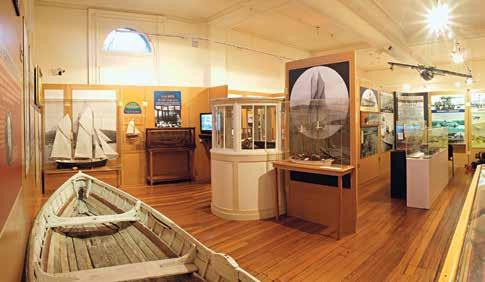
The museum relies on its volunteers and their wide range of skills to undertake most of the work required to stay open seven days a week
400 years of European charting of Australia. The book includes remarkable charts produced by French hydrographer Louis de Freycinet, who accompanied Nicholas Baudin of the Géographe and Naturaliste to Van Diemen’s Land in 1802.
Every day at the MMT produces surprises. Recently a retired fisherman donated a seemingly insignificant alarm clock, saying it had come from the survivor of a shipwrecked barque. The Brier Holme had sailed from London for Hobart in July 1904 with nearly 1,600 tons of general cargo. Nothing was seen of the barque until January 1905, when a fisherman identified wreckage from the Brier Holme that had washed ashore on the west coast of Tasmania. Extensive searches by the Sea Bird and Breone found the body of a seaman and more wreckage, but no survivors.
In February Edward Noye, master of the cutter Britannia, was fishing north of Port Davey when he heard a cry from the beach. He went ashore and found 29-yearold Norwegian Oscar Larsen, the sole
survivor of the Brier Holme. The barque had foundered three months earlier and Larsen survived on tinned food washed ashore from the wreck. Noye visited the wreck site before bringing Larsen to Hobart where he was given the small clock Larsen had salvaged as a memento.
The provenance of the clock provides an interesting link to a glass slide of Noye and Larsen held in the collection. In addition, a deadeye salvaged from the Brier Holme is on display, and the artefacts combine to illustrate the story of a maritime tragedy.
Another such tragedy is remembered in the shipwreck gallery, which displays a large model of the Tasman Bridge showing MV Lake Illawarra sunk at the foot of a bridge support pylon. In January 1975 the bulk carrier, loaded with zinc concentrate, lost steerage and hit the bridge east of the navigation span. The impact brought down 127 metres of roadway, killing four motorists and seven of the crew. The poignant exhibition includes the ship’s off-course alarm recovered by a diver from the sunken Lake Illawarra
The disaster severed the main link between Hobart and its eastern dormitory suburbs, causing disruption for more than two years. In spite of the tragedy there were some positive developments, including a resurgence of Tasmanian shipbuilding. Commuter demand for river ferries resulted in the operators building more vessels, a catalyst for the growth of International Catamarans, whose high-speed aluminium ships can be seen all over the world. [Its founder, Robert Clifford ao, is now a member of ANMM’s governing council – Ed.]
Tasmanians maintain a strong bond between land and sea, so active volunteers can readily be drawn from the community. The MMT receives no direct financial help and relies on the volunteers and their wide range of skills to undertake most of the work required to stay open seven days a week. They are supported by an administration officer and two professional curatorial staff. The Hobart City Council provides the Carnegie Building accommodation for a peppercorn rental and recently offered additional space for displays and education.
The MMT expects to grow and continue to promote an understanding of the maritime heritage of Tasmania and its significance to people’s lives through its research, interpretation and presentation of maritime history to the community. In achieving this goal it will highlight the future of Hobart as a significant maritime hub and successful tourist destination.
01 The off-course alarm from the ill-fated bulk carrier MV Lake Illawarra. The ship still lies at the bottom of the Derwent River.
02 The museum’s school holiday program underway in gallery two.
03 A panorama of gallery one in the MMT. The dinghy in the foreground was a wedding present from shipbuilder John Wilson to his wife Dinah in 1872. During their early years of marriage Dinah rowed it every Monday and Friday between Port Cygnet and Walter’s shipyard at Esperance, a distance of 10 kilometres. She was still rowing it 65 years later, aged 88
AUSTRALIAN NATIONAL MARITIME MUSEUM 53
02 03
The Wright generations
AUSTRALIAN REGISTER OF HISTORIC VESSELS
WWW.ANMM.GOV.AU/ARHV This online, national heritage project devised and coordinated by the Australian National Maritime Museum reaches across Australia to collate data about the nation’s existing historic vessels, their designers, builders and their stories.
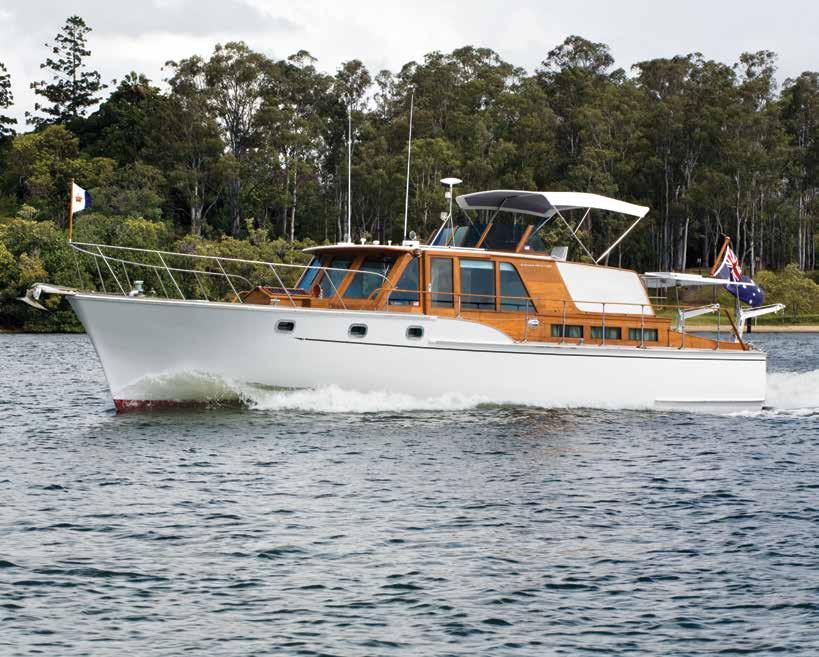
01
Norman Wright is a household name in the Sunshine State, known for the style and quality of working and leisure craft produced by this renowned family of Queensland shipwrights and designers. Two of their output were among 15 heritage vessels approved for listing on the ARHV this winter, writes its curator David Payne.
THE SHIPWRIGHTING FIRM OF
Norman R Wright & Sons Pty Ltd is an institution in Brisbane and Queensland, where three generations of the family have maintained a longstanding boatbuilding business on the Brisbane River. It was established in 1909 by Norman R Wright who had learnt his trade through an apprenticeship with W H Whereat, another renowned name in the Queensland boatbuilding trade. Establishing a yard on the river at Bulimba, his business soon flourished and in time was building luggers, skiffs, pleasure yachts, ferries and small cargo boats. Most were designed by Wright, who worked from his own hand-carved hull models to shape the form, take offsets and create the mould patterns to build around.
Jannett is a six-metre-long launch built by Norman Wright around 1911. It is the earliest extant example of a vessel built by him.
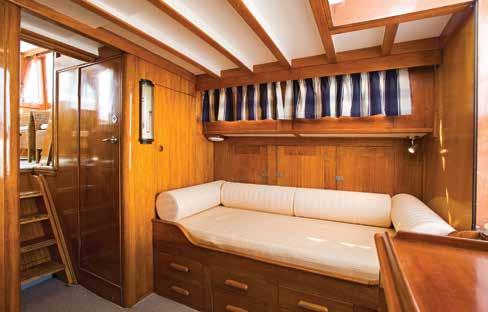
The launch is 2.45 metres wide, carvel planked with a hollow heel planked down to the keel, a method in favour at that time until replaced by the solid deadwood keel now common to many small motor launches. It has a rounded half-cabin (known as a cuddy) over the foredeck, the cabin sides extending aft as coamings around the cockpit. Jannett is pictured (number 14) on page 56.
Even though Jannett has had many owners over a century, it is remarkable that it has been used nowhere else but the Noosa River. In 1912 it was owned by a Colonel Reid; in 1930s it belonged to the Parkyn brothers and by the late 1940s it was owned by local man Bernie Bowden. In 1953 Max Walker bought the craft and sixty years on it remains with the Walker family.
Jannett ’s use has been varied. In the 1930s it was involved in tourism and worked as a ferry, while in the 1940s and 50s it was a recreational fishing launch. The current owner believes that Jannett has survived for over 100 years because it is ideally suited to the Noosa River environment, and has always had owners prepared to do the required maintenance to keep it operating. Included in that work have been an estimated 13 different motors representing the gamut of 20th-century small-craft technology; the current one is a Yanmar 2GM15 diesel installed in 2010.
The other Wright craft taken into the ARHV this winter is the luxury motor cruiser Kohi, built by Norman R Wright & Sons in 1964. It is one of the few craft built by this wellknown Brisbane firm for the Sydney market,
ordered by a private owner from Sydney, William Marr, and launched in December 1964 from the Wrights’ Quay Street yard at Bulimba. The 13.4-metre-long Kohi (above and opposite) was designed by Ronald Wright, one of Norman Wright’s sons, and working in the yard on the construction was his other son, Norman Jnr. Kohi was motored down the coast to Sydney, arriving on 10 January 1965. It was designed as a bridge-deck cruiser and has a flying bridge on the cabin top. The raised-deck hull is carvel-planked in Oregon with splined seams; it has a laid beech deck with teak margins and teak cabin planking. The original engines were BMC Sealord diesels, but they were replaced by Volvo engines during the late 1980s.
Kohi became one of the Wright company’s show boats for the 1960s and was used extensively to promote the design skills and workmanship of Norman R Wright & Sons at boat shows and yacht club events, competing for a share in the market that was dominated in Sydney by vessels from Lars Halvorsen Sons. Kohi was later renamed Manihi, but in 2007 reverted to its original name when it was bought by Bill Wright, one of two sons of the vessel’s designer Ronald Wright. Bill and his brother Ian are now managing the firm.
Norman R Wright & Sons have an impressive resume of craft built over the last 100 years, and a detailed archive has been created by Ian and Bill Wright, housed in a fire-rated room dedicated to storage of plans and documents. The yard has moved around the corner from Quay Street, having relocated
AUSTRALIAN NATIONAL MARITIME MUSEUM 55 NEW ARHV ENTRIES SPRING
01 Luxury Norman R Wright & Sons motor cruiser Kohi, designed by Ronald Wright and built in 1964 for a private owner from Sydney, William Marr. All photographs are courtesy of ARHV vessel owners.
02
02 Kohi’s warm interior is a showcase of fine Austalian joinery.
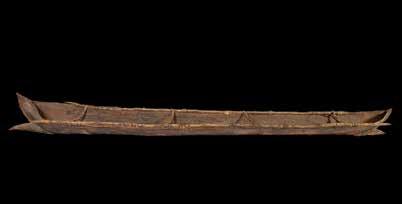
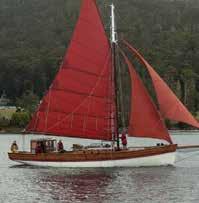

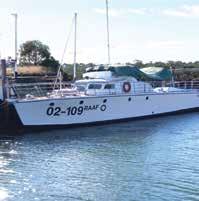
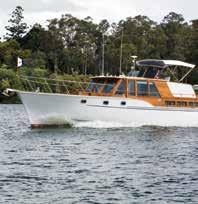
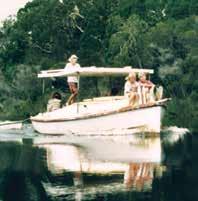
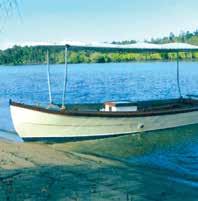
01 05 09 13 02 06 10 14 07 11 15 04 08 12
to bigger premises in the 1990s when Lloyds Ships closed. The 22.85-metre-long (75 ft) schooner Francois was one of the outstanding vessels from the yard, a distinct contrast to their many championshipwinning 18-foot skiffs such as Taree and the Jenny series (I to VI). A number of the Queensland 21-Foot Restricted Class yachts from the 1920s and 30s were built at Wrights, but these were Whereat designs, making a true ‘state of origin’ collaboration between the two leading Queensland shipwright firms in the business at that time.
During World War II Wright construction shifted to help the war effort, with four of the British-designed Fairmile patrol, rescue and harbour-defence launches among the many craft they built. Following the war the Wright family returned to their previous trade and continued to make a variety of vessels for pleasure and commercial use, particularly craft for the Great Barrier Reef tourist resorts.
Norman Jnr, the second generation Wright shipwright, was born into the business and learnt the trade from his father and co-workers. He designed 18-foot skiffs, sail and power pleasure boats, workboats for tug companies and boats to service flying boats. His sons joined the firm too, Ronald becoming a naval architect and taking charge of the design work, while Norman Wright III was a shipwright. Norman Snr gradually handed over the
business to his sons, but disagreements between the two Normans, senior and junior, ended with Norman Jnr leaving the company. Full control was assumed by Ronald when Norman Snr died in 1970.
The current generation managing the family yard, Ronald’s sons Bill and Ian, are once again sharing the work with Bill leading the design side and Ian the shipwrights. Their work has included ferries, police boats, pilot boats and luxury motor yachts.
An interesting period in the firm’s history was when Norman Jnr employed Bob Miller (the famous yacht designer who later changed his name to Ben Lexcen) as a sail maker in the late 1950s. While in Brisbane Miller designed and built the breakthrough, single-chine, plywood 18-foot skiff Taipan in 1959, followed by his 1961 World Championship-winning skiff Venom Taipan has been extensively restored by the Australian National Maritime Museum, and is on display at our Wharf 7 Maritime Heritage Centre. Other craft associated with Norman R Wright & sons that are on the ARHV are Taipan and the sistership pearling luggers from the mid-1950s, Antonia and Anniki, designed by Ron Wright.
Western Australia seminar for Australian Register of Historic Vessels – 15 November 2013
We’re holding a seminar Fishing, pearling, sailing or trading: stories of Western Australia’s seagoers and their craft at the Western Australian Maritime Museum. From 2 pm 5 November 2013 at the Fremantle museum’s auditorium there will be presentations, stories and histories about WA craft, its maritime industry and community. Convened by the national council of the Australian Register of Historic Vessels (ARHV) and Western Australian Maritime Museum, the seminar will include a session on preservation practice to invite discussion about the work and methodology of ARHV. Certificates will be presented to Western Australian owners of historic craft on the register.
The seminar is followed by a reception and the Australian Association for Maritime History’s annual Vaughan Evans Lecture, delivered this year by John Longley, one of the Australian team that won yachting’s ‘holy grail’, the 1983 America’s Cup. John will reflect on the 30th anniversary of the historic win. The event includes presentation of the biennial Frank Broeze Maritime History Book Prizes jointly funded by the Australian Association of Maritime History and the Australian National Maritime Museum.
For information contact Daina Fletcher, senior curator, Australian National Maritime Museum, dfletcher@anmm.gov.au 02 9298 3777
AUSTRALIAN NATIONAL MARITIME MUSEUM 57 Search the complete Australian Register of Historic Vessels at anmm.gov.au/arhv NEW ARHV ENTRIES SPRING
NAME DATE BUILDER TYPE CODE 01 BJ 1949 Alf Jahnsen Tug HV000563 02 Imp 1886 Jimmy Davey Yacht HV000564 03 Freydis 1935 Charlie Peel Yacht HV000566 04 Melville Island sewn-bark canoe Unknown Indigenous watercraft HV000567 05 Bincleaves 1943 Lars Halvorsen Sons Torpedo recovery vessel HV000568 06 Royal 1924 Mitch Lacco ’Couta fishing boat HV000569 07 DJV 1917 Bayes Brothers Fishing boat HV000570 08 Imogen 1902 Donnyland Shipbuilding Co Motor cruiser HV000571 09 Love and War 1973 Cec Quilkey Racing yacht HV000572 10 ML Egeria’s tender Reg Fazackerey Tender HV000573 11 Air View 1944 Miami Boat Building Company, USA Air-sea rescue vessel HV000574 12 Kohi 1964 Norman R Wright & Sons Motor cruiser HV000575 13 The Mayfly 1973 Reg Fazackerley Dinghy HV000576
Jannett c 1912 Norman R Wright & Sons Motor launch HV000577
O-Dear 1961 Jack Abodine Motor launch HV000578
14
15
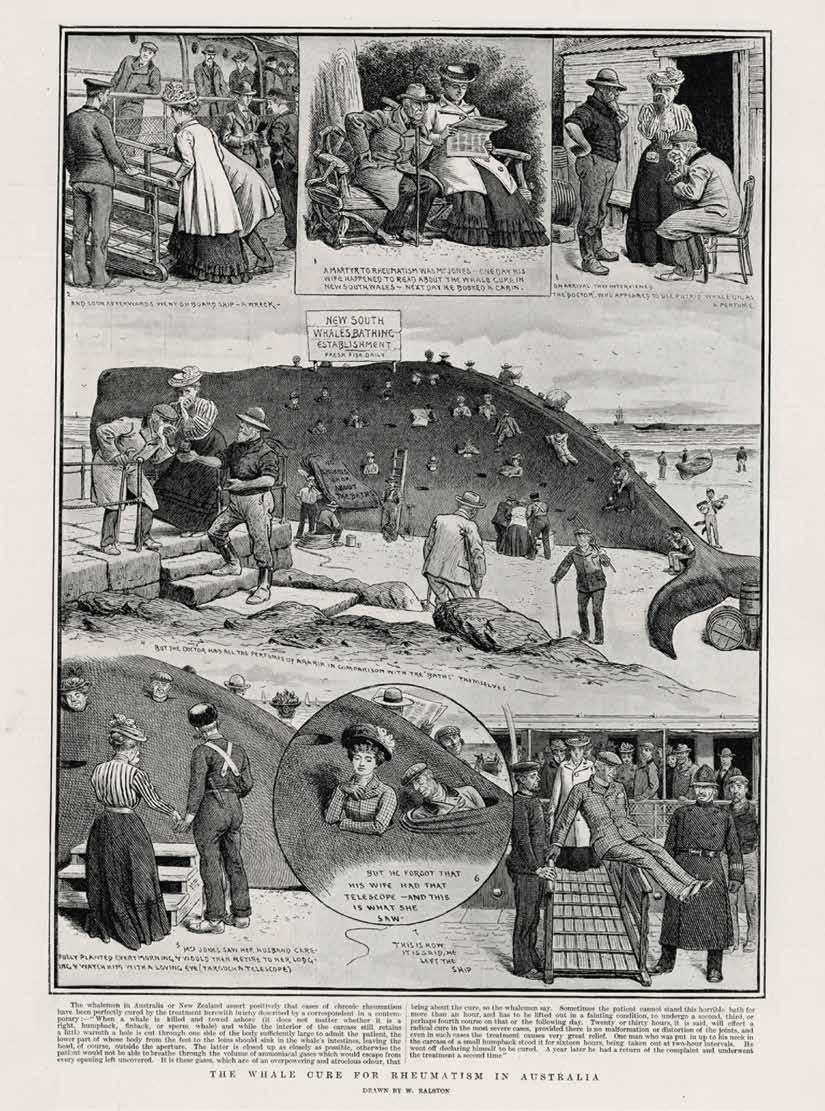
01
A curious cure
A BIZARRE MOMENT IN MEDICAL HISTORY
The
phrase ‘the cure is worse than the complaint’ might well describe a treatment that was briefly the rage a century ago. Curatorial assistant Penny Hyde delves into our collection to find a very strange use for a dead whale.
IN THE 1890S, REPORTS OF A CURIOUS new cure for rheumatism began surfacing in Australian newspapers. Details of the unorthodox treatment were repeated with astonishment, and often a touch of irony, as the cure was both highly unusual, and not for the fainthearted.
When a whale is killed and towed ashore and while the interior of the carcass still retains a little warmth a hole is cut through one side of the body sufficiently large to admit the patient, the lower part of whose body from the feet to the loins should sink in the whale’s intestines, leaving the head, of course, outside the aperture. The latter is closed up as closely as possible, otherwise the patient would not be able to breathe through the volume of ammoniacal gases which would escape from every opening left uncovered
This description appeared in an illustrated feature of The Graphic in 1902 titled ‘The Whale Cure for Rheumatism in Australia’. The instructive caption follows a series of illustrations that depict a chronic rheumatism sufferer undergoing the whale cure after taking advice from his doctor. The slightly facetious tone of the pictures (including a scene in which the man leans amorously from his position in the carcass towards a young lady nearby) appears to be mocking the remedy, but the treatment was not without its credibility.
It was believed that the gases produced, along with the heat generated by the decomposing mammal, created a kind of ‘sweat box’ environment that relieved the pain of rheumatic disorders, including rheumatoid arthritis. The patient was expected, if he or she could stomach it, to remain within the carcass, at intervals, for 20 or 30 hours, after which they could expect relief from their ailments for up to 12 months. Whale products were not a new element in the treatment of rheumatism and other common Victorian ailments, and according to the whalemen themselves the greatest proof of the whale cure’s effectiveness was that no man who worked at flensing a whale or processing whale oil ever suffered from rheumatism.
The earliest reports of the whale cure appear in Australian papers in 1894, with the news quickly spreading to neighbouring New Zealand and even as far as America and Europe. In 1896 the Dublin Journal of Medical Science devoted an entry to the curious treatment, as did the renowned American publication Medical Record the following year, likening it to a Turkish bath where the decomposing blubber closes around the patient’s body, ‘acting as a huge poultice’.
In both the national and international reports, however, all stories regarding the practice of the whale cure were synonymous
with one place: the Australian town of Eden, at Twofold Bay on the border of New South Wales and Victoria.
Eden had been settled since the mid-1800s, and by the latter half of the 19th century supported a prosperous whaling industry. At Twofold Bay the local whalers came to specialise in bay whaling, a method of hunting migrating whales in small boats out of shore stations. This method reached its peak in Australia between about 1805 and 1845; though its prevalence declined elsewhere around the country, it remained in use at Twofold Bay well into the 20th century.
The patient was expected, if he or she could stomach it, to remain within the carcass for 20 or 30 hours
In Eden, peculiarly, this type of whaling resulted in an astonishing relationship between whalers and a local pod of killer whales which, similar to sheepdogs, would often herd and harass the whales into the bay, where the men would finish the kill. The killer whales would take then take their
AUSTRALIAN NATIONAL MARITIME MUSEUM 59
SPRING
COLLECTIONS
All stories regarding the practice of the whale cure were synonymous with one place: the Australian town of Eden
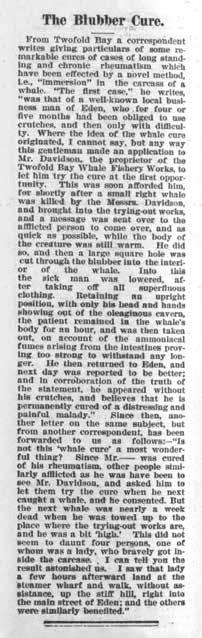
reward by eating their favourite parts of the whale, the lips and tongue, leaving the rest of the body for the whaleboat crews to tow back to shore for processing.
These shore-based whaling operations in Twofold Bay, where whale carcasses were taken on land so the messy task of stripping the blubber could be performed, provided ample opportunity for those seeking a chance to experience the famous whale cure. During whaling season the hotels of Eden filled with hopeful rheumatoid sufferers, many of whom had travelled from interstate to partake of the treatment.
But how did such a cure originate – why and when did that first person climb into a whale carcass to discover its olfactory-assaulting but healing qualities? Several different stories arose as to the origins of this unusual treatment.
An 1894 story in the Australian Town and Country Journal claims that the ‘first case’ was that of a well-known businessman of Eden, who originally suggested the treatment to the Davidsons, a prominent local whaling family. When the next whale was brought to shore the Davidsons sent for the man, who spent a day buried to his neck within an ‘oleaginous cavern’ of the whale, after which he was able to discard his crutches and walk as a new man.
Another often-told story was that the whale cure was discovered by a drunken man who was strolling after dinner with friends along the beach near the whaling station at Twofold Bay. They came across a dead whale which had already been cut open by whalers, and in a moment of drunken hilarity the man plunged into the body of the whale, where the heat and smell proved too overpowering for his friends to attempt a rescue. Providentially, the man became comfortable in his predicament and did not emerge for another two hours, at which point he was not only very sober but cured of the rheumatism he had been suffering for years.
The real foundation of the whale cure, however, goes beyond European settlement to the older practices of the indigenous peoples of the Twofold Bay area. Whales and other sea creatures feature strongly in the spiritual beliefs of the local Yuin people, who were familiar with beached whales and had different uses for the washed-up remains. The flesh provided food, the oil was used for medicinal
and ritual purposes, and the bones in constructing shelters. After the establishment of a whaling industry in Eden in the 1800s, the connection continued and the skills of Aboriginal whaleboat crews were highly regarded by local businesses. In fact, the hunting relationship with the killer whales of Eden also pre-dates European settlement:
When the natives observe a whale, ‘murrira’, near the coast, pursued by ‘killers’,mananna, one of the old men goes and lights fires at some little distance apart along the shore, to attract the attention of the ‘killers’ ... If the whale … is washed up on the shore by the waves, some other men … make their appearance and run down and attack the animal with their weapons
R H Mathews in his 1904 ‘Ethnological notes on the Aboriginal tribes of New South Wales and Victoria’, Journal of the Royal Society of New South Wales, Vol 38: 252–253
Mathews also observed the Aborigines of Eden undertaking the whale cure for rheumatism. After the meat and blubber were removed, he wrote, the Aboriginal people would lower themselves into the body and cover themselves with whale fat to treat their pain. It was not long before knowledge of this treatment was transferred to their European neighbours, and Eden’s local businesses were more than happy to accommodate those willing to pay for the experience.
Rheumatism is a common and painful ailment, and the interest in the whale cure could not have been due merely to its stomach-churning novelty; it must also have been thought effective. The cure was, thankfully, relegated to historical fad when it ceased to be practised by about World War 1. This coincides with the beginning of a decline in the whaling industry in Eden, but perhaps the whale cure disappeared for a more socially practical and malodorous reason, as The Lone Hand noted in July 1908:
The after-effects are not so pleasant; the patient for a week or so gives off a horrible odour, and is abhorrent to man and beast, and a fit subject for prosecution under the ‘Diseased Animals and Meat Act’
Images of Aboriginal rock carvings thought to depict the ‘whale cure’ are available at: www.atnf.csiro.au/people/rnorris/ SydneyRockArt/sites/BallsHead/index.htm
60 SIGNALS 104 SEPTEMBER–NOVEMBER 2013 02
01 Previous pages: The Whale Cure for Rheumatism in Australia, published by The Graphic, illustrator William Ralston, 31 May 1902. ANMM Collection
02 The Australian Town and Country Journal of 24 November 1894 enthusiastically reports on the benefits of the whale cure.
03 A cure for rheumatism; Bob Wiles in the carcass of a whale, Twofold Bay Photograph Charles Eden Wellings. National Library of Australia
The real foundation of the whale cure lies in the practices of the Indigenous peoples of the Twofold Bay area
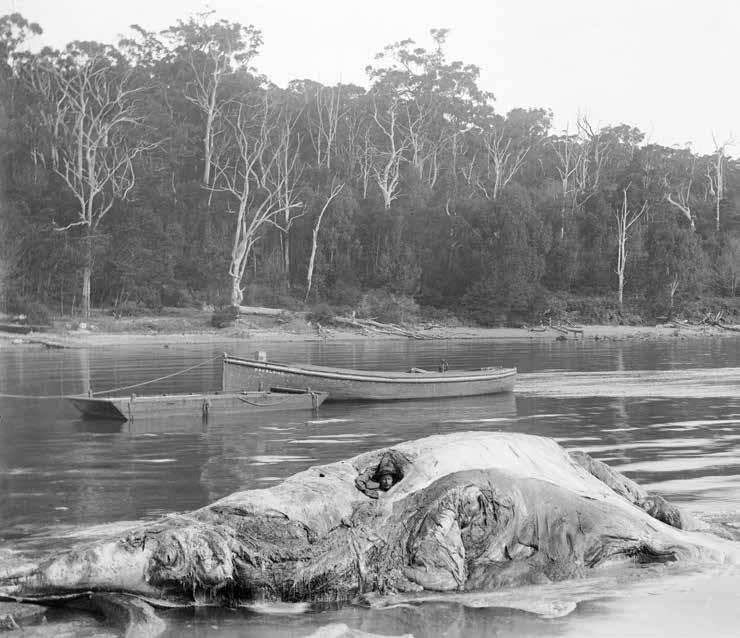
AUSTRALIAN NATIONAL MARITIME MUSEUM 61
03
COLLECTIONS SPRING
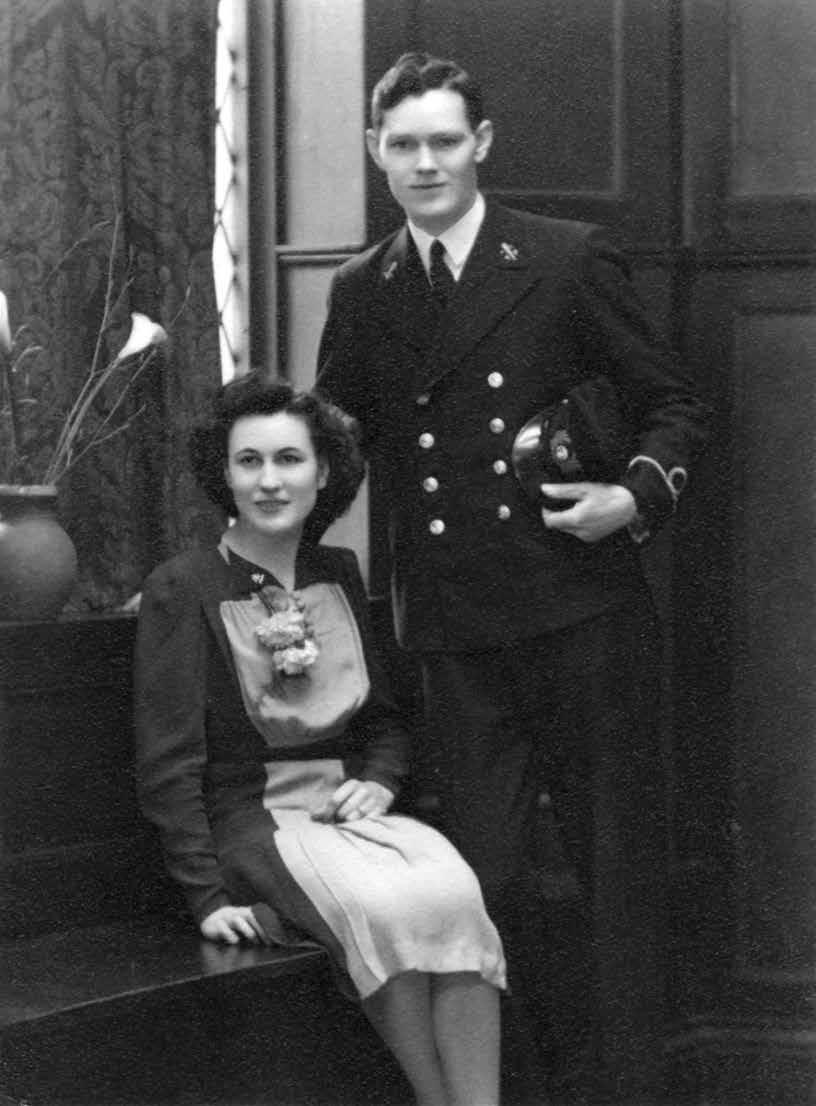
English rose Phyllis Warren and dashing Dutch seaman Hendrik Kooyman in 1944. All photographs reproduced courtesy of the Kooyman sisters.
In one of history’s great migrations, over six million people have crossed the seas to settle in Australia. The museum’s tribute to all of them, The Welcome Wall, encourages people to recall and record their stories of coming to live in Australia
English rose,Dutch sailor
AND THE LIFE OF A BOY CALLED BRIAN
The descendant of early Western Australian boatbuilders and convicts, and of postwar European migrants, Welcome Wall historian Veronica Kooyman shares her own family’s story. It’s a tribute to both her late father and her migrating grandparents from England and Holland, who voyaged out to make new lives in Australia and who now appear on the Welcome Wall.
IN 1940 AN ELEGANT ENGLISH ROSE fell for a tall and dashing Dutchman in the uniform of the Netherlands merchant marine, at a dance in the port city of Bristol, England. Hendrik Kooyman loved jazz music and dancing, visiting dance halls when he came ashore. He struck up a romance with Phyllis Warren, exchanging love letters throughout the war as he sailed the world. Before the war, Phyllis had worked as a secretary for an archaeologist, but her hopes of travelling to a dig in Egypt were thwarted by the outbreak of hostilities.
Holland’s hopes for neutrality were ended in May 1940 by Nazi Germany’s terror-bombing of Rotterdam. With that strategic port city flattened and the threat of rapidly advancing German forces, the Netherlands surrendered on 15 May. Nazi occupation followed and the Dutch government and royal family went into exile in London.
Rotterdam was Hendrik’s home. He was at sea when it was attacked, and for five years he had no knowledge of the fate of his parents and four siblings. He later learned that the bombing ended a block from the family home. The Dutch
merchant marine was subsumed into the Allied merchant navy, convoying loads of munitions and soldiers to various theatres of war.
Once an idealistic young socialist, Hendrik’s views changed when his ship was frozen into the harbour at Murmansk in communist Russia. He saw political prisoners marched past the docks, severely punished and sometimes executed for begging cigarettes or food from the Dutch sailors. He almost starved when the ship’s supplies ran out. The sailors got little from the Russian regime, whose own civilians and soldiers were starving. When he returned to Britain he weighed a little over 40 kilos and Phyllis walked past him in the street, unable to recognise him.
Phyllis now had a position timetabling trains on the strategic route through Temple Meads Station in Bristol, another vital port city with many supplies and soldiers passing through daily. Like Rotterdam, it suffered heavy German bombardment. One evening the air-raid sirens pealed when she was travelling home. The sky filled with German planes so quickly she barely
had time to move off the street, and a man threw her into the gutter for whatever protection it offered. She survived but tragically the kindly man, only a few feet away, did not.
Hendrik and Phyllis married in 1945, just before the end of the war, while he had a short period of leave. He returned to Bristol and in 1948 their only child, Brian, was born. A devastated Europe was struggling to recover, and both parents knew it could not offer their son many opportunities.
During the war Hendrik had met many Australian soldiers, ferrying them to war in the Pacific. He had enjoyed their larrikin nature, and found Sydney an interesting city during those war-torn years. He was in Sydney Harbour during that notorious night – 31 May 1942 – when World War 2 came to its shores. His convoy was still fully laden with munitions when Japanese midget submarines infiltrated the harbour. As the alarm was raised and torpedoes and depth charges exploded, his ship weighed anchor and raced out to sea before it became a target.
AUSTRALIAN NATIONAL MARITIME MUSEUM 63 WELCOME WALL SPRING
A devastated Europe was struggling to recover, and both parents knew it could not offer their son many opportunities
01 Brian’s first steps at Leighton Beach, Fremantle, 1949, en route from Bristol.
02 Hendrick, Phyllis and Brian at Taronga Park Zoo in 1949, shortly after their first arrival in Sydney.
03 Brian Kooyman and Jenny Mews on their wedding day, April 1974.
Hendrik, Phyllis and Brian first sailed from Bristol to Australia in 1949, aboard the Ridderkerk. Phyllis found her asthma severely affected by Sydney’s atmosphere and they briefly returned to Europe. But, determined to carve a better life, they came out again in 1951 for the cleaner air of the Blue Mountains. They lived first in a single room that Hendrik built on a small block of land he’d bought in Blackheath. He now worked as a supervisor in the Lithgow Small Arms Factory and in his spare time he began to build their simple 1950s fibro home. It took over four years, while they struggled on living in what became the garage.
Their son Brian thrived, quickly losing his English accent and going bush. He and his band of close friends played war games with their air rifles in the surrounding valleys and bushlands of the Blue Mountains. A favourite amusement was riding their bicycles down the steep, winding track to Megalong Valley, with only a rubber thong for brakes. Brian excelled at sport and was the local swimming champion. To his parents’ relief his academic abilities surfaced and led to a cadetship to study architecture at the University of New South Wales, where he was known both for sporting prowess and his bright-red 1955 MG TF1500. At a college party at UNSW Brian met a smart young library student, Jenny Mews. She came from a long-established West Australian line that included the first boat
builders on Perth’s Swan River, who arrived on the ship Rockingham in 1830. Also in her ancestry were convicts from that colony’s brief penal period between 1850 and 1868. Jenny often recalls the moment at this infamous college party when the doorway was suddenly filled by an incredibly tall, fit and loud man who promptly declared his friendship with every person there. ‘Don’t worry,’ someone told her, ‘it’s only Brian.’ Soon she had a friendship with Brian that developed into something special.
Jenny returned to Western Australia to tend her father in his final illness, and for 16 months was separated from Brian by 4,000 kilometres. But he, ever-inventive, had found a public phone in Marrickville that could be jiggled to make free interstate calls. It was popular among long-distance truck drivers, some of whom became an audience when he chose one evening to formalise his relationship with Jenny. The truckies insisted he kneel in the booth while proposing, and then took him out to celebrate. The couple enjoyed 39 years of marriage and raised two daughters.
Brian worked in the NSW Government Architect’s Office, and then in the emerging field of construction project management. He spent 35 years with Tracey, Brunstrom and Hammond on projects that included the Darling Harbour redevelopment for the 1988 Bicentennial and the 2000 Sydney Olympics, becoming director of global business and managing director. Brian was a founding
member of the Australian Institute of Project Management and received national and international industry awards. He was an advisor with the Warren Centre at the University of Sydney, and adjunct professor at the University of Technology, Sydney, and Curtin University, WA.
Brian mentored many of his company’s junior staff and PhD students, taking great joy in their achievements, and many young people viewed him as their second father.
‘Bigger than life’ is a phrase that has been applied to my father, in every sense. His presence in a room could never be ignored, and he befriended just about every person he met. He combined the larrikin with an incredibly high work ethic, loyalty and moral compass. I am sure that the successes of Brian and my own generation make the sacrifices of his migrating parents, Phyllis and Hendrik, worthwhile. After all, isn’t that every migrant’s hope and desire?
Vale Brian 26 April 1948–1 June 2013.
The Welcome Wall
It costs just $105 to register a name and honour your family’s arrival in this great country! We’d love to add your family’s name to The Welcome Wall, cast in bronze, and place your story on the online database at www.anmm.gov.au/ww. So please don’t hesitate to call our staff during business hours with any enquiries on 02 9298 3777.
64 SIGNALS 104 SEPTEMBER–NOVEMBER 2013
01 02
WELCOME WALL SPRING 03
Spouting
fish
AND CAMELS AND HIPPOPOTAMI
A Savage History: Whaling in the Pacific
Author John Newton. Published 2013 by NewSouth Publishing, University of New South Wales. Hardcover, 310 pp, illustrations, bibliography, index.
RRP $49.95 (Members $44.95)
DID YOU KNOW THAT MODERN molecular taxonomy tells us that whales are related to pigs, deer, goats and camels? And that their closest living relative is the hippopotamus? Herman Melville, on the other hand, gives us this delightfully shorthand description of the cetacean family: ‘To be short, then, a whale is a spouting fish with a horizontal tail. There you have him.’
You get all this information and much more in writer, novelist and teacher John Newton’s recently published volume, A Savage History: Whaling in the Pacific. There is no doubt that John admires the grace, intelligence and fragility of these giant creatures, which until 20 or so years ago were threatened with extinction. He is also quite clear about the fact that, despite some improvements to the numbers of some species, the threat remains today.
When I was a child growing up in the ’60s, seeing whales off the east coast of Australia was unthinkable. Now of course it’s quite common to see whales cruising back and forth from Antarctica, even close in to Sydney beaches and, occasionally, uncomfortably close to swimmers. And we’ll never forget the time, about a decade ago, when Sydney office workers including this museum’s staff were stunned by the rather audacious visit of two Southern Right whales that steamed past the Opera
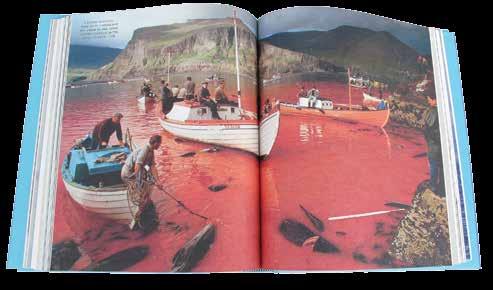
House, into Darling Harbour and right up to the museum’s basin. They are magnificent creatures and it’s hard for us to imagine anyone wanting to kill them. But kill them we did – and some countries still hunt whales.
John Newton is clearly on the side of the whale. Nonetheless he skilfully guides us to an understanding of just how important the whaling industry was to people in the 18th and 19th centuries, and to the development of the very early Australian economy. It’s easy to be appalled at whale hunting – inescapably brutal and violent whether in its modern, mechanised practices or by hand-held harpoon and lance as it was in the past. But at that time whale products were essential. In the days before gas and electric lights, before the production of petroleum and the development of plastics, whale products provided much of the world with a staggering range of goods – some common and some not so common.
Whales were like giant, swimming department stores. Among the many things they gave us were buttons and buckles, umbrella ribs, ramrods, fishing rods, buggy whips, carriage springs, hoops, sewing needles and spindles, and perfume. But the most lucrative product of all for whale hunters was the oil that powered street lights and domestic lamps all over the world.
The very best of it was sperm-whale oil, which has extraordinary properties. It burns at a very steady rate, very brightly and with little smoke. It was used in the manufacture and lubrication of sensitive machinery, and was even used in 20th-century spacecraft for its superior qualities when compared to modern oils.
In my years at the Australian National Maritime Museum, whaling was naturally a major subject of interest, particularly in relation to the museum’s large collection of engraved and carved whale teeth and bone – now highly collectable examples of the whalers’ art of scrimshaw.
Curators have also collected and displayed a diverse range of materials illustrating the social history of the industry, the techniques of hunting, killing and processing, and the end of whaling in Australia with its political and ecological themes.
Among the museum’s fine collection of whale-related artefacts, two stand out in my memory. One is a mid-19th-century clock running on whale oil, known for its reliability and accuracy, and prized like the whale-fuelled lamps of its day. The second is a lampshade made from the tanned foreskin of a whale’s penis. We featured a striking colour photograph of this unusual artefact, as an example of a recent acquisition, in a governance report that
66 SIGNALS 104 SEPTEMBER–NOVEMBER 2013 01
was to be tabled in the nation’s Parliament. Our departmental colleagues in Canberra thought it a little too startling for the sensitivities of Australian politicians, however, and it didn’t make it into the final printed publication!
There are many books on whaling: some are historical or academic accounts, others are more scientific, and others recall the hard, long struggle to save the whale. And looming over all of them is Herman Melville’s great American novel Moby-Dick, with its extraordinary compendium of whaling natural history taken from countless sources both ancient and contemporary.
John Newton’s A Savage History with its rich selection of illustrations has quite a different approach.
At one level it provides a wide-ranging and fascinating account of just how important the whaling industry was to the development of the Australian colonies in the 18th and 19th centuries. As he writes, ‘There is probably no country on earth whose early history is so intimately involved with whaling. In Australia the whaling industry was directly responsible for first settlement in some areas, and often provided the first European view of the coastal areas of what was then New Holland.’
Whales were like giant, swimming department stores, stocking buttons and buckles, ramrods and fishing rods, buggy whips and carriage springs, sewing needles and spindles
To that he adds a historic and regional context for the wider industry. It’s an intelligent, even-handed account, often very witty, of why the industry was lucrative, and it’s as much a social history of the people involved in the business as it is about the industry itself. That’s what gives the book its wider readability – all the stories of the extraordinary characters involved, from American and English captains and sailors to escaped convicts from the
colonies, Maori and Aboriginal whalers and their lives on board and in whaling communities throughout the Pacific.
Among some highly entertaining events in whaling history, he relates the determination of the English to get into the action in the Pacific in the 16th century, to elbow out the Spanish and Portuguese with their trade bases in the Spice Islands. Featuring in this tale is a company with one of the best corporate names I’ve heard: The Mystery, Company and Fellowship of Merchant Adventurers for the Discovery of Regions, Dominions, Islands and Places Unknown. Once this distinguished company of gentlemen found whales they forgot all about spice, and these early, lucrative beginnings of whaling would affect the later development of an Australian industry.
Another, unattributed anecdote relates the adventures of a Yankee whaler, Captain Roland Coffin, separated from his ship in a whaleboat, who landed with a few of his men on a small Pacific island. They were welcomed by an American woman, the sole survivor from an earlier shipwreck – apart from the ship’s rats, which had thrived and multiplied as castaways. She fed Coffin and his crew a stew that she only later revealed had rats among its ingredients. They lived on rats ‘roast, fried, fricasseed and stewed’ until Coffin’s ship finally located and rescued them. It’s one of several takes on dietary matters from an author who’s written much on the subject of food.
I liked this entertaining book very much. The only thing that lets it down is the rather poor quality of the paper it’s printed on. I imagine this reflects the increasing nervousness of the book publishing industry, anxious to reduce their costs in an increasingly uncertain publishing world that’s switching rapidly to digital products. This is a book that really needed a better quality of paper to reproduce its many well-chosen photographs and illustrations.
But notwithstanding that, there is something in this volume for everyone, as well as history: the economics of whaling; whaleography; whaling life, food, booze and sex; tales of women who went whaling; Quakers and sinners; artists and entrepreneurs; and what a better future for whales might look like.
Mary-Louise Williams AM Director ANMM 1999–2012
01 Confronting double-page spread of a cetacean harvest in the Faroe Islands in 1968. Photographer Robert Harding
02 Manufacturer William F Nye’s whale-oil product, around 1840. ANMM Collection
03 Whale-oil lamp and clock. The lamp flame in the spout burned oil so steadily that the level of the reservoir fell with clock-like reliability, counting down the hours. ANMM Collection
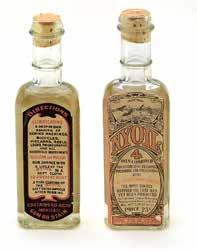
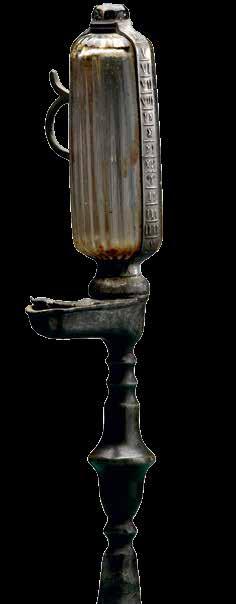
READINGS SPRING
02 03
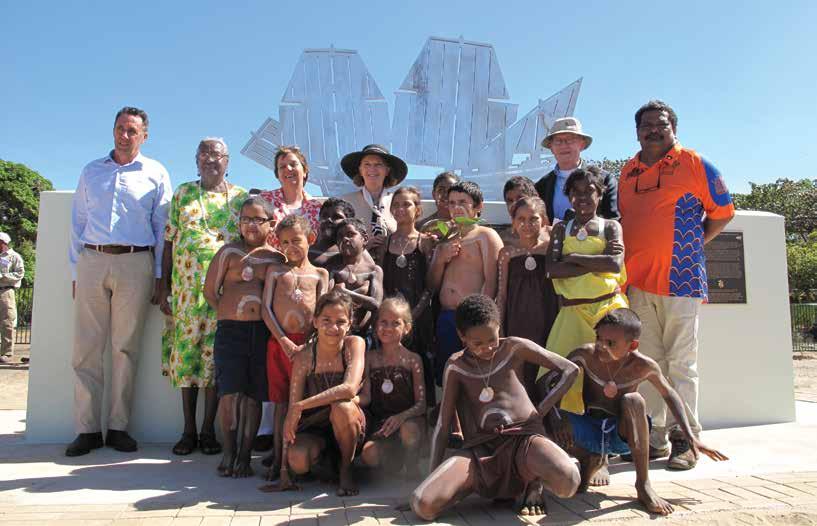
First contact memorial
ON A REMOTE NORTHERN COAST
FOUR HUNDRED AND SEVEN YEARS after the event, a brand new monument in far north Queensland at last commemorates the first recorded contact between Indigenous Australians and Europeans. The event it marks occurred in the wet season of early 1606, when a small jacht (or scout ship) of the United Dutch East India Company (VOC), under the command of Willem Janszoon, sailed along the western shore of what today is known as Cape York Peninsula, on the Gulf of Carpentaria.
On the ship called Duyfken (‘Little Dove’), Janszoon and his men made the first recorded European landfall on an Australian shore. Somewhere near today’s monument there was a skirmish between the Aboriginal people of that shore and the men of Duyfken, and one of Janszoon’s men was speared to death.
The Dutchmen, sent from a VOC trading post in Java to explore for trade opportunities, returned with no news
of spices or gold – just the report that the occupants were willing and able to defend their country. It would be 17 years before another Dutch ship returned. But what those visitors on Duyfken took with them was the first ever chart of an Australian coastline, recording several hundred kilometres of that flat and relatively featureless shore, more than a century and a half before the first European settlement of the continent. That original chart, along with Janszoon’s log, can no longer be found, but a copy of the chart made about 1670 survives.
In May this year the Australian National Maritime Museum sent a representative to a ceremony on that same shore, for the inauguration of a monument commemorating those events of 1606. The memorial stands of the land of the Tjungundji people near the small community of Mapoon, some 80 kilometres north of the bauxite mining centre of Weipa in tropical north Queensland. On a perfect dry-season
morning around 200 guests and dignitaries – some from the other side of the world –saw the memorial dedicated with ceremony, song, dance and prayer, and reflections upon the great signficance of those distant events and that first troubled encounter between two very different cultures. Unveiling the memorial with the elders and traditional owners of Mapoon that morning was the Governor of Queensland, Her Excellency Ms Penelope Wensley ac She was joined by Holland’s Ambassador to Australia Mrs Annemieke Ruigrok and the President of the Senate of the Kingdom of the Netherlands, Mr Fred de Graaf. Representing the Queensland Government was Mr David Kempton MP, Minister for Aboriginal and Torres Strait Islander Affairs. The guests were welcomed by an honour guard from Bravo Company, 51st Battalion, Far North Queensland Regiment, one of the few Australian units drawn from the very territory it is tasked to defend.
68 SIGNALS 104 SEPTEMBER–NOVEMBER 2013
01
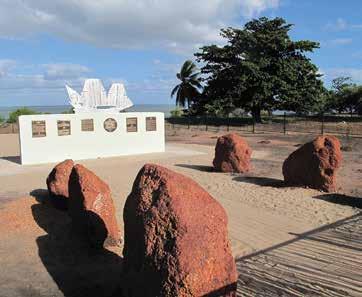
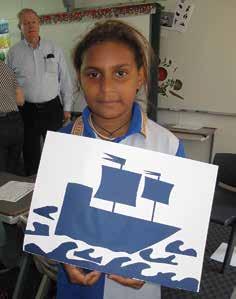
Mayor of Mapoon, Councillor Peter Guivarra, spoke of the generosity and good will of his small community of 250 people in supporting the project and allocating a part of their lands to it. His people were forcibly removed in the 20th century but have returned to reclaim their land in recent decades, building a tidy hamlet with a school and community, land and sea management centres.
The commitment and financial support of the Netherlands Government to the monument project began seven years ago during events marking the 400th anniversary of the Duyfken voyage. It was then that the lack of any existing memorial, or a geographical focus for this historical encounter, was noted.
The coast traversed by Janszoon in Duyfken is remote and mostly far from roads or inhabitants. That’s true of his first landing place at the Pennefather River between Weipa and Mapoon, and of Cabo Keerweer (Cape Turnaround), the southernmost point of his chart and the oldest European place name in Australia.
Mapoon is near the Wenlock River where it’s believed Janszoon also tried to land, and where the fatal skirmish occurred. We have an indirect record of this incident in the log
of the second Dutch explorer on this coast, Jan Carstenszoon, who in 1623 located the place where Janszoon had reported his crewman killed.
The memorial is erected with a cyclonestrength plinth on the casuarina-fringed coast at the end of the road from Mapoon township, near a small camping ground for fishermen and tourists. Within a landscaped enclosure, six ironstone boulders representing the main tribes of the area flank the entrance pathway. Bronze plaques instruct visitors of the events and the people being remembered.
Also drawing support from the mining gaint Rio Tinto Alcan, the monument is surmounted by a silhouette of Duyfken laser-cut from a plate of aluminium, the end product of the bauxite that gives this landscape its distinctive red hue. The shape of the ship and its rig is taken from plans prepared by Nick Burningham, who researched the form of the Duyfken replica built in Western Australia in the 1990s to retrace the original ship’s voyages. The replica has been displayed at our museum on a number of occasions.
Reflecting the rising and setting sun, the Duyfken silhouette features a bird cut into its mizzen, both the ‘little dove’ of the ship’s
name and the Torresian imperial pigeon, the hero bird of local peoples. From a certain angle it sits on the sea’s horizon, reminding a viewer of the extraordinary vision that once greeted the ancestors of today’s Mapoon community, heralding unimaginable change.
Jeffrey Mellefont
01 Official party and children of the Descendance Dance Company at the First Contact Memorial opening ceremony. Standing in the back row, left to right, are Mr David Kempton MP, Queensland Minister for Aboriginal and Torres Strait Islander Affairs; Mapoon elder Zoe de Jersey; Ambassador of the Kingdom of the Netherlands, Mrs Annemieke Ruigrok; Governor of Queensland Ms Penelope Wensley ac; Mr Fred de Graaf, President of the Senate of the Netherlands; Mayor of Mapoon, Councillor Peter Guivarra.
Photographer J Mellefont/ANMM
02 The First Contact Memorial, laser-cut from alumininium, stands on the western shore of Cape York peninsula looking across the Gulf of Carpentaria in which Willem Janszoon sailed in 1606.
03 Senior student of Mapoon Campus Western Cape College, Bessie Ling, with her shipportrait of Duyfken
AUSTRALIAN NATIONAL MARITIME MUSEUM 69
CURRENTS SPRING 02 03
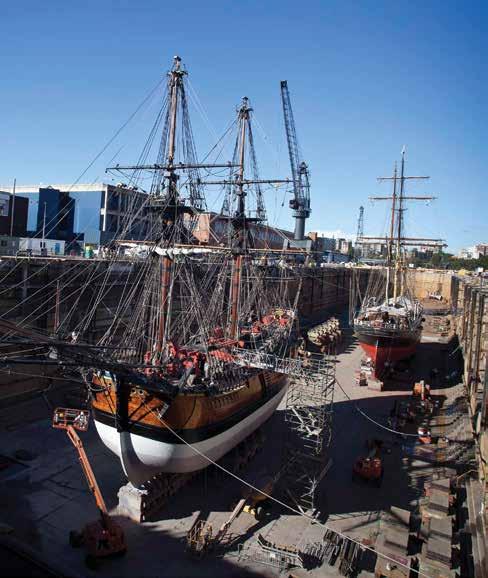
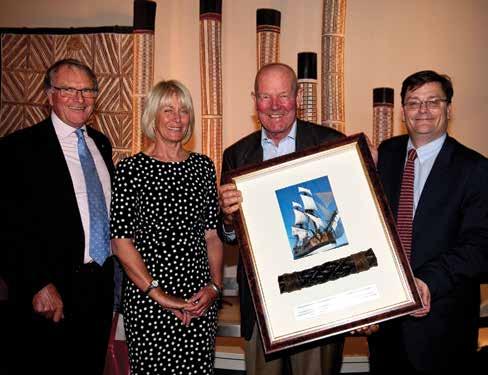
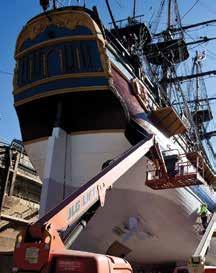
01 Museum Members and other visitors to the Captain Cook Dock at Sydney’s Garden Island last June witnessed the unusual conjunction of two spectacular tall ships dry-docked together. The museum’s replica of James Cook’s HM Bark Endeavour was antifouled and underwent other works necessary to keep her in operational survey, in time to become a major participant in the International Fleet Review on Sydney Harbour this October 2013. With her was Sydney Heritage Fleet’s 1874 iron-hulled barque James Craig, restored over 30 years and fully operational for the past decade. Sydney Heritage Fleet is a community not-for-profit organisation, with facilities and berthing for James Craig provided by ANMM at its Wharf 7 Maritime Heritage Centre.
Photographer A Frolows/ANMM
02 Museum benefactors Sid Faithfull and Christine Sadler (centre) were recently presented with this plaque in appreciation of their generous sponsorship of research into Indigenous cultures of the Torres Strait area. Mr Faithfull was the founder of Australia’s largest privately owned shipping company, Cairns-based Sea Swift. Presenting the plaque, which features a sample of standing rigging from the HM Bark Endeavour replica, are ANMM chairman Peter Dexter am (left) and director Kevin Sumption (right).
Photographer A Frolows/ANMM
ERRATUM
In the article ‘Wooden boatbuilding – not a dying art’ in the last issue of Signals (No 103 June–August 2013 page 40), the author and heritage boatbuilder John Young, who delivered the 2013 Phil Renouf Memorial Lecture, was mis-named as John Wood. The editor apologises for this unfortunate error which demonstrates that it is high time for him to retire, and does so forthwith.
70 SIGNALS 104 SEPTEMBER–NOVEMBER 2013 CURRENTS SPRING
01 01 02

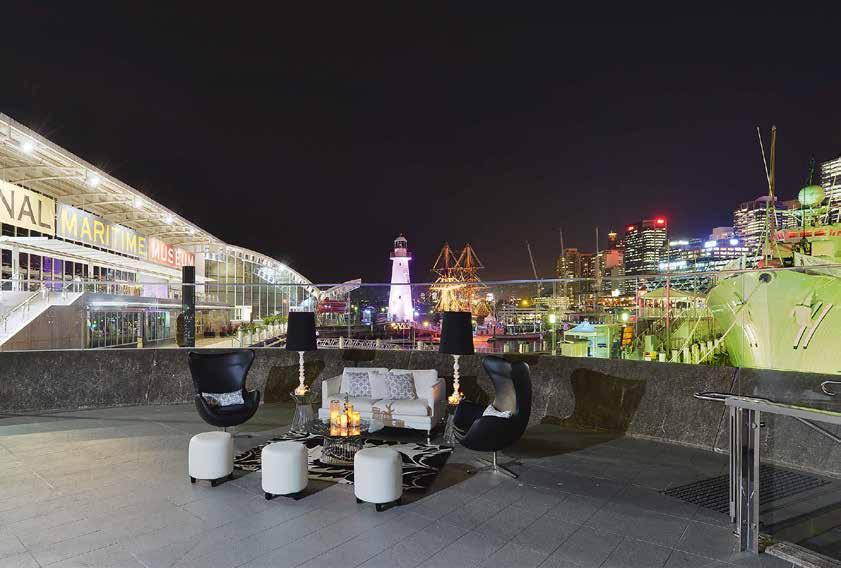
The perfect location for any event
anmm.gov.au/venues | venues@anmm.gov.au | 02 9298 3625
SEA WHAT’S IN STORE
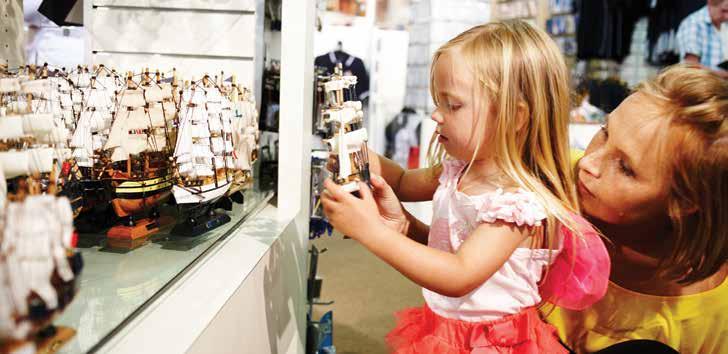
ANSEL ADAMS
Autobiography of one of America’s best known 20th-century photographers. Looks back at his legendary six-decade career as a conservationist, teacher, musician.
$35.00 / $ 31.50 Members
ANSEL ADAMS
A catalogue to accompany our current exhibition of this famous American landscape photographer’s visions of water, rivers, lakes and the sea.
$79.95 / $71.96 Members
DVD VIKINGS
The Vikings legend is brought to life in a dramatic program set in the 10th century on the Norwegian island of Karmoy, home of the first Kings
$39.95 / $35.95 Members
CELTIC BROOCH
This beautiful silver plated Celtic-knot brooch has been inspired by treasures from our Vikings exhibition.
$59.95 / $53.95 Members
Books DVDs & CDs Brassware Models Gifts Prints Posters Toys Shirts Hats Scarves Souvenirs
orders
3675
Members discounts
Friendly service
Shop online at www.anmm.gov.au/thestore 9.30 am–5 pm 7 days a week | 02 9298 3698 / fax
to 02 9298
thestore@anmm.gov.au |
|
ADVERTISEMENT
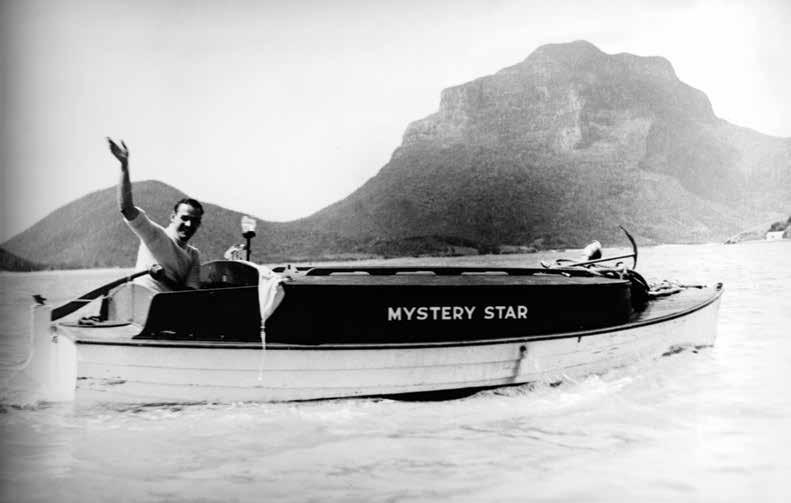
CONNECT
With us online
Comments or questions about Signals content?
Call the editor 02 9298 3777 email signals@anmm.gov.au
Signals is online
Search all issues from No 1, October 1986, to the present at www.anmm.gov.au/signals
Signals magazine is printed in Australia on Sovereign Satin
250 gsm (cover) and 128 gsm (text) using vegetable-based inks on paper produced from environmentally responsible, socially beneficial and economically viable forestry source
Australian National
Maritime Museum
Open daily except Christmas Day
9.30 am to 5 pm (6 pm in January)
2 Murray Street
Sydney NSW 2000 Australia
Phone 02 9298 3777
ANMM council
Chairman Mr Peter Dexter am
Director Mr Kevin Sumption
Councillors
Mr Paul Binstead
Mr Robert Clifford ao
Mr John Coombs
Rear Admiral T W Barrett am csc ran
Mr Peter Harvie
Mrs Robyn Holt
Dr Julia Horne
Mr Shane Simpson am
Ms Eva Skira
Mr Neville Stevens ao
Signals
ISSN 1033-4688
Editor Jeffrey Mellefont
01 Dashing Australian actor Brian Abbott sails from Lord Howe Island in 1936 … never to be seen again! Full story on page 30. Photo courtesy of National Film & Sound Archive
Assistant editor Janine Flew
Staff photographer Andrew Frolows
Design & production Austen Kaupe
Printed in Australia by Pegasus
Print Group
Editorial and advertising enquiries
Janine Flew 02 9298 3777 signals@anmm.gov.au
Deadline mid-January, April, July, October for issues March, June, September, December
Signals back issues
Back issues $4 10 back issues $30
Extra copies of current issue $4.95
Call Matt Lee at The Store 02 9298 3698
Material from Signals may be reproduced, but only with the editor’s permission. The Australian National Maritime Museum is a statutory authority of the Australian Government.
Foundation partner ANZ
Major partners
Australian Maritime Safety Authority
Caltex Australia
Nine Entertainment
Southern Cross Austereo
Lloyds Register Asia
Toshiba Australia Pty Ltd
Viking river Cruises
Project partners
Australian Pacific Touring Pty Ltd
APN Outdoor
Destination NSW
Erco Lighting Pte Ltd
History Channel
Incredible India
oOh!media
OSRAM Australia Pty Ltd
Rose Publishing Co Pty Ltd
Royal Wolf Holdings Ltd
Silentworld Foundation
Sydney by Sail
Sydney Catchment Authority
Founding patrons
Alcatel Australia
ANL Limited
Ansett Airfreight
Bovis Lend Lease
BP Australia
Bruce & Joy Reid Foundation
Doyle’s Seafood Restaurant
Howard Smith Limited
James Hardie Industries
National Australia Bank
PG, TG & MG Kailis
P&O Nedlloyd Ltd
Telstra
Wallenius Wilhelmsen Logistics
Westpac Banking Corporation
Zim Shipping Australasia
ANMM GOV AU
Cert no SGS-COC-006189
01