
Number 144 September to November sea.museum $9.95 Spring 2023 Finding the Montevideo Maru Sunk by ‘friendly’ fire Indonesian watercraft An unusual shipbuilding style Winning the America’s Cup 40 years on
WELCOME TO THE SPRING edition of Signals.
Spring has certainly sprung early in Sydney and at the museum we have been taking advantage of the weather to do some seasonal cleaning.
We took the opportunity to refresh things around the museum with coats of paint and splashes of colour. If you haven’t been in lately, please come and see us –we are all fresh and sparkling!
This is all in preparation for the exciting things planned over the next few months. From November we start rolling out our summer program, which this year we have called Wonderwater.
Wonderwater, as the title indicates, celebrates our love of the ocean, and through our exhibitions and other activities we want to be a cool, calming but also exciting oasis in the heat of summer.
We are proud to host the world-first exhibition Ocean Photographer of The Year – a global photographic competition with the ocean and ocean life at its heart. We are pleased to be working with competition founders Oceanographic magazine to bring these amazing underwater photographs to life for the first time as an exhibition.
We also are proud to showcase the life and work of pioneering conservationist, photographer and filmmaker Valerie Taylor in the exhibition Valerie Taylor: An Underwater Life. It will feature fascinating objects and will be the museum’s first exploration of the Valerie Taylor archive of more than 10,000 images and many other fascinating objects that chronicle her storied life below and above the water.

Wonderwater will also feature films, activities, LEGO® play spaces and interactives – we will be all things wonder and all things water! There is so much more, and the full program will be in the next Signals, but I wanted to give you a taste of what is planned as we head towards our busiest season of the year!
I am always delighted to hear from the museum family about what matters to you, so please, if you have any ideas, drop me a line to thedirector@sea.museum Different voices are both welcome and encouraged and we’ll make every effort to respond directly.
Daryl Karp AM Director and CEO Ocean Portfolio Award, 3rd place, Ocean Photographer of the Year 2022. Jake Wilton (Australia), Ningaloo Reef, WA. A humpback whale rises from the Indian Ocean into the golden glow of a Western Australia sunrise.The Australian National Maritime Museum acknowledges the Gadigal people of the Eora nation as the traditional custodians of the bamal (earth) and badu (waters) on which we work.
We also acknowledge all traditional custodians of the land and waters throughout Australia and pay our respects to them and their cultures, and to elders past and present.
The words bamal and badu are spoken in the Sydney region’s Eora language.
Supplied courtesy of the Metropolitan Local Aboriginal Land Council.
Cultural warning
People of Aboriginal and Torres Strait Islander descent should be aware that Signals may contain names, images, video, voices, objects and works of people who are deceased. Signals may also contain links to sites that may use content of Aboriginal and Torres Strait Islander people now deceased.
The museum advises there may be historical language and images that are considered inappropriate today and confronting to Aboriginal and Torres Strait Islander peoples.
The museum is proud to fly the Australian flag alongside the flags of our Aboriginal, Torres Strait Islander and Australian South Sea Islander communities.


Cover Projections on the museum’s rooftop and HMAS Vampire as part of Vivid Sydney 2023. Image courtesy Artists in Motion
2 The search for Montevideo Maru
How science found a lost underwater war grave
10 Indonesian prahus
The museum is promised a unique archive
16 Beach builders
Traditional skills may be lost as Sulawesi shipwrights modernise
20 In a pickle
The Queen of Nations shipwreck: An accident or negligence?
28 Remembering and conserving
Preserving the remains of a 166-year-old shipwreck
34 It’s in the genes
A profile of Sydney Heritage Fleet’s Ray Jenkinson
36 The winged keel triumphs
The controversy over Ben Lexcen’s revoutionary design
42 Making a difference
Foundation news: preserving our Edwardian steam yacht, Ena
44 Vivid Sydney
The museum as a canvas for an amazing light show
48 Beneath the Surface
Free online and onsite talks and tours by our curators and conservators
50 Members news and events
Spring’s talks and tours
54 Exhibitions
What to see in spring and beyond
58 Maritime Museums of Australia Project Support Scheme
Support for the La Perouse Museum
62 Australian Register of Historic Vessels
Recording significant vessels for the future
66 National Monument to Migration
A special panel for migrants from the Greek island of Kythera
70 Settlement Services International
Refugee Week is celebrated with a fair
72 Collections
Treasures found in the museum’s Vaughan Evans Library
74 Readings
The Naturalist ; Belitung: The afterlives of a shipwreck
80 Currents
USS Canberra commissioning; vale Sir James Hardy and John Ferguson
Twenty-first-century science solves a World War II mystery

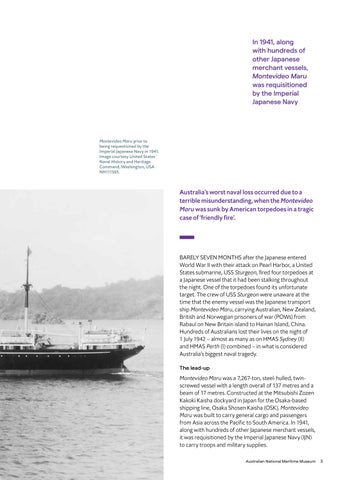
Montevideo Maru prior to being requestioned by the Imperial Japanese Navy in 1941. Image courtesy United States Naval History and Heritage Command, Washington, USA NH111585.

In 1941, along with hundreds of other Japanese merchant vessels, Montevideo Maru was requisitioned by the Imperial Japanese Navy
Australia’s worst naval loss occurred due to a terrible misunderstanding, when the Montevideo Maru was sunk by American torpedoes in a tragic case of ‘friendly fire’.
BARELY SEVEN MONTHS after the Japanese entered World War II with their attack on Pearl Harbor, a United States submarine, USS Sturgeon, fired four torpedoes at a Japanese vessel that it had been stalking throughout the night. One of the torpedoes found its unfortunate target. The crew of USS Sturgeon were unaware at the time that the enemy vessel was the Japanese transport ship Montevideo Maru, carrying Australian, New Zealand, British and Norwegian prisoners of war (POWs) from Rabaul on New Britain island to Hainan Island, China. Hundreds of Australians lost their lives on the night of 1 July 1942 – almost as many as on HMAS Sydney (II) and HMAS Perth (I) combined – in what is considered Australia’s biggest naval tragedy.
Montevideo Maru was a 7,267-ton, steel-hulled, twinscrewed vessel with a length overall of 137 metres and a beam of 17 metres. Constructed at the Mitsubishi Zozen Kakoki Kaisha dockyard in Japan for the Osaka-based shipping line, Osaka Shosen Kaisha (OSK), Montevideo Maru was built to carry general cargo and passengers from Asia across the Pacific to South America. In 1941, along with hundreds of other Japanese merchant vessels, it was requisitioned by the Imperial Japanese Navy (IJN) to carry troops and military supplies.
In March 1941 – due to the growing military threat posed by Japan (which had entered a military alliance with Germany and Italy in September 1940) – an Australian Army group known as ‘Lark Force’ was established and sent to New Britain and New Ireland in New Guinea. Its objective was to defend the strategically important harbours and airfields at Rabaul and Kavieng and to hold, for as long as possible, an air observation line operating out of those airfields. Given the small size of Lark Force, the inexperience of the soldiers and their obsolete equipment, they were woefully ill-prepared for the task of withstanding a Japanese invasion.
After a bombing campaign of several weeks, the invasion came on 23 January 1942 and, as the month progressed, it became obvious that the Australian forces, outnumbered more than five to one, could not hold. Rabaul, the administrative capital of the Australian Mandated Territory of New Guinea, fell to Japanese forces and Lark Force’s commanding officer, Colonel John Scanlan, issued the order to withdraw, declaring that it was ‘every man for himself’. The lack of a controlled retreat strategy meant that unorganised groups of Australian soldiers took to the jungle to evade capture by the Japanese. Several hundred were able to get off the island and escaped to Australia, but the Japanese forces captured many others. Some were summarily executed, while others were imprisoned along with European civilians from Rabaul.
The prisoners were set to work under appalling conditions, but as the number of Japanese troops increased it became difficult to house the prisoners and it was decided to move them to Japanese-occupied Hainan Island off China. Montevideo Maru arrived at Rabaul on 9 June 1942 and was allocated the task. On 22 June 1942, hundreds of POWs were loaded onto the ship, along with military supplies such as vehicles and aircraft fuselages.
Montevideo Maru departed Rabaul on the same day. Initially the vessel was escorted by two submarine chasers but the ship then continued the passage, alone, to the north of Luzon Island, Philippines. Exiting the Babuyan Channel on 30 June, it headed west towards Hainan where, according to USS Sturgeon ’s War Patrol Report, it was sighted at 10.30 pm on a calm and moonlit night. The submarine gave chase but at first could not keep up with the transport. Around midnight, USS Sturgeon was able to overhaul Montevideo Maru, dive and close in to a firing position. At 2.28 am on 1 July it fired a spread of four torpedoes and achieved a hit.
USS Sturgeon fired a spread of four torpedoes and achieved a hit on Montevideo Maru
The force of the explosion may have caused some of the hatch covers to be blown off, allowing some of the prisoners to escape. The Montevideo Maru took on a list to starboard and after 11 minutes assumed a steep bow-up angle and then slipped stern first beneath the surface. Despite the short time, the crew were able to lower three of the ship’s boats, of which two were serviceable. According to the owner’s report, of the 122 Japanese crew, ship’s and army guards, 102 made it to shore but only 26 survived skirmishes with Philippines forces as they trekked through the jungle of Luzon to reach the Japanese occupying forces in Manila.
Until recently, there was no clear indication of the exact number of Australians killed in the sinking of Montevideo Maru. However, a 2012 translation of Japanese manifest records indicated that approximately 979 Australians were probably lost with the ship. Of this number, around 852 were military personnel, primarily members of Lark Force. There were also 127 Australian civilians, as well as 74 other civilian prisoners, including 27 crew from the Norwegian defensively equipped merchant ship (DEMS) MV Herstein, which sank at Rabaul during the Japanese invasion.
Given the depth of the water, as well as wartime secrecy and possible government embarrassment at having ‘abandoned and sacrificed’ Lark Force and the citizens of Rabaul to the Japanese Army, up until 2021 no attempt had been made to locate the remains of the ship.
That changed in April 2023, when Silentworld Foundation (a Sydney-based not-for-profit organisation), supported by Unrecovered War Casualties – Army, teamed up with Fugro, a leading geo-spatial deep-sea survey specialist company based in Netherlands. Equipped with permits from the Philippines Government, they began searching for the last resting place of Montevideo Maru
The three Turner brothers from New South Wales. They served with the 1st Independent (Commando) Company at Kavieng, New Ireland, before being captured by the Japanese, taken to Rabaul and put on board Montevideo Maru. All three died when the vessel sank in 1941. Image Australian War Memorial
02
Three members of the AntiAircraft Battery Rabaul in the back of the battery’s Ford utility truck: Gunner Thomas Gordon, Bombardier Francis James Heriot and Gunner Peter Biden. They, too, died when Montevideo Maru sank. Image Australian War Memorial P02312.003.jpg


01 Preparing the Autonomous Underwater Vehicle (AUV) for deployment to gather sonar imaging data.
02
Images Max Uechtritz, Silentworld Foundation
The survey team developed an identificational matrix that used a ‘preponderance of evidence’ approach
According to War Patrol Reports kept by officers on board USS Sturgeon, Montevideo Maru sank approximately 112 kilometres northwest of Cape Bojeador, which is on the Philippine Island of Luzon. However, as position fixing at sea during the Second World War was relatively inaccurate, due to the technology of the day, these co-ordinates had to be treated with caution by any search team. Other sources of positional information included a second report from the submarine, which was at variance with the first report, and the owners’ report on the loss of Montevideo Maru. These were supported by eyewitness statements taken after the event in September 1941, October 1945 and April 1947, although these were also problematic due to perceived self-interests, transcription and translation errors and the passage of time.
Faced with these issues in 2021, Silentworld Foundation assembled a small team of ex-naval officers, submariners, maritime archaeologists, Japanese and American naval historians, and representatives from the Rabaul and Montevideo Maru Society, to develop a historical research and survey strategy that would consider as many locational variables as possible.
These variables included offsets to allow for the torpedo track, residual way of the ship and subsequent shifts in chart datums. Allowances were also made for surface and ocean currents, the glide pattern of Montevideo Maru as it sank, fixing and dead-reckoning errors, as well as rounding errors of the reported latitude and longitude positions of both Sturgeon and Montevideo Maru. Once these variables were identified and analysed, the conclusions of this research were presented to Unrecovered War Casualties – Army for review before several possible search areas with approximate positions for the wreck were calculated.
As well as positional and historical analysis, in late 2022 the survey team developed an identificational matrix that used a ‘preponderance of evidence’ approach. This involved using ship plans, registration papers and photos of Montevideo Maru to compile into a single document potential identification information, such as length, beam, depth of hull, positioning and size of superstructure, along with structural features such as derricks, masts, cargo holds and combings, ventilation cowlings, funnels, deck stanchions and portholes.
Any wreck site located within the search area (11 ships of a similar age were known to have been lost within 30 nautical miles of the presumed position of Montevideo Maru) would then be compared to the identification matrix and its identification assessed and its probability of being Montevideo Maru calculated.
In early 2023, Fugro Equator departed the Philippines with the Silentworld survey team on board, and the hunt for Montevideo Maru commenced off Cape Bojeador.
The Silentworld Foundation team in the operations room on board Fugro Equator. From left: John Mullen, Andrea Williams, Captain Roger Turner (Retd), Neale Maude and Commodore Tim Brown (Retd).
The technical equipment
The equipment carried on board Fugro Equator was impressive. The ship’s hull-mounted multi-beam echo sounder (MBES) system was capable of mapping the sea floor in waters deeper than 4,000 metres (almost 400 metres deeper than RMS Titanic). This provides a topographical map which can then be used to program the Hugin Autonomous Underwater Vehicle (AUV) Echo Surveyor VIII so that it can ‘fly’ a mission at a set ‘altitude’ above the sea floor. As it does this it gathers sonar imaging data from its Kongsberg High Resolution Interferometric Synthetic Aperture Sonar (HISAS) along with its downward-looking MBES. The AUV was also fitted with a CathX flash camera capable of taking high-resolution photos every three seconds.
Arriving in the search area, Fugro Equator employed its hull-mounted MBES to map the topography of the sea floor of an 18-nautical-mile square, centred on the most probable position of the sinking, as calculated from historical information. The MBES data not only mitigated against the $15 million AUV colliding with sea floor obstacles, such as wreck material or geology, but also allowed the team to plan the AUV mission for maximum efficiency regarding safe survey altitude, beam width and track spacing.
Following the MBES survey, the AUV was then deployed on a series of 48-hour missions – the time limited by the life of the vehicle’s batteries – with each mission covering a 5 x 5 nautical mile area. Although called ‘autonomous’ (meaning it is not commanded by the ship via a tether,
in the way that a Remotely Operated Vehicle is directed), the AUV was under constant supervision from the ship via an acoustic link transmitted by two High Precision Acoustic Positioning Systems [HiPAP].
As the MBES data showed the sea floor to be relatively flat and the maximum possible height of the wreck was 37 metres, the height chosen for the initial AUV missions was set at 100 metres.
After searching more than 40 square nautical miles of ocean floor on the seventh AUV survey mission, the team located significant amounts of wreckage on the sea floor, including relatively intact bow and stern sections, along with an associated debris field. Working initially with the AUV’s MBES and HISAS images, the team were able to take measurements (length, beam, profile and other features) of the wreckage which, when compared with the archival data, was within a few percentage points of those expected for the Montevideo Maru
The AUV – which was already at 4,000 metres on the eighth survey mission – was reprogrammed to complete a 45-metre altitude run over the wreck and further out to the west to ensure that the entire debris field was covered. While Mission 8 was under way, as many details and images as possible from Mission 7 were downloaded and sent to the onshore team back in Australia for additional analysis and peer review.
With Mission 8 completed, the AUV was recovered, and the data downloaded. As well as fully mapping the debris field, the data revealed a second wreck located in two sections some 1,500 metres west-northwest of the first target.

This vessel was significantly smaller than the first wreck and it had similar dimensions (96.7 metres length and 17.4 metres beam) and profile as that of MV Arizona, a general cargo vessel known to have foundered in this area in 1999, as reported in Lloyd’s World Casualty Statistics 1999
Over subsequent missions, the AUV’s MBES provided clear three-dimensional representations of the first wreck’s hull showing a distinctive three-island structure, along with damage from a torpedo strike in the precise position described in USS Sturgeon ’s report on the sinking of Montevideo Maru
Further to this, the HISAS images offered additional structural and dimensional information, such as positioning and size of derricks and length, breadth and layout of internal compartments. These, when compared with archival records, allowed the ship and shore teams to independently identify the wreck as Montevideo Maru – the gravesite of more than 1,000 men.
Although the wreck has been found, the stories of Montevideo Maru, Lark Force and the people lost on board remain to be told. Given the wreck’s depth, it is unlikely the site will ever be disturbed. But there is still more work to be done, including surveying the wreck in more detail and, importantly, formally remembering those who died in 1942, in a tragic case of ‘friendly fire’, caused by a misunderstanding.
Position fixing at sea during the Second World War was relatively inaccurate
01
The operations room on board Fugro Equator showing detailed historic photographs of Montevideo Maru along with HISAS imagery of the stern and bow sections of the wreck on the seabed.
02
High-resolution AUV photo of a truck tray with motorcycle, side car and air horn.
Images Fugro 2023, © Silentworld Foundation
Authors
Captain Michael Gooding Operations Manager, Silentworld Foundation
Heather Berry Conservator, Silentworld Foundation
Captain Roger Turner, RN (Retd) Montevideo Maru Project Director
Kieran Hosty Maritime Archaeology Program, ANMM
Acknowledgments
The discovery of Montevideo Maru would not have been possible without the valuable assistance of many organisations and individuals. The Silentworld Foundation would like to thank the Australian Department of Defence, in particular Unrecovered War Casualties –Army; the Embassy of the Philippines (Canberra); the Royal Norwegian Embassy (Canberra); and the Embassy of Japan (Canberra). Also, the National Museum of the Philippines; the Rabaul and Montevideo Maru Society; Fugro Australia; John and Jacqui Mullen; Commodore Timothy Brown, RAN (Retd); Andrea Williams; Commander Mick de Ruyter, RAN; Max Uechtritz; Neale Maude; Irini Malliaros; Paul Hundley; Nami Otani; Lesley Howlett; and Dr Ian D MacLeod.
Further Reading
Bloomfield, D, 2001. Rabaul diary: Escaping captivity in 1942 Australian Military Publications, Loftus, NSW.
Gamble, B, 2006. Darkest hour: The true story of Lark Force at Rabaul Zenith Publications, Quarto Publishing Group, USA.
Gamble, B, Invasion Rabaul: The epic story of Lark Force, the forgotten garrison, January–July 1942. Zenith Publications, Quarto Publishing Group, USA.
Napier, David, 2009. The Tragedy of the Montevideo Maru, History Channel, Montevideo Maru Pty Ltd Production, Sydney.
Spurling, K, 2017. Abandoned and sacrificed. The tragedy of the Montevideo Maru. New Holland Publishers, London.
An unusual scholar recorded the world’s largest and most diverse sailing fleet on Australia’s northern doorstep – just before it vanished. Honorary Research Associate Jeffrey Mellefont explains.
IN 1975 THE CHIEF SCIENTIST representing Australia on a US oceanographic research ship called Alpha Helix, exploring the deep Banda Sea in the remote Moluccan province of Indonesia, became fascinated by the unfamiliar trading and fishing craft he saw working under sail in these tropical waters. He photographed them and, when he returned to the Australian National University (ANU) in Canberra, he asked the librarians for anything they could find about these strange and exotic Indonesian sailing vessels. There was almost nothing. None of the university’s Asian specialists knew much about them, either. And so, over the next decade, he returned to Indonesia whenever he could, to investigate what turned out to be the world’s largest and most diverse fleet of working sailing vessels, right on Australia’s northern doorstep. These prahus, as they are called, ranged from outrigger dugouts and planked fishing and transport craft to large sail-traders, which had survived because they served the needs of an underdeveloped, post-colonial economy spread across the world’s largest archipelago. He studied these little-known vessels that were built on beaches using only hand tools, meeting their builders and sailors, and learning about their processes, customs and rituals. He published the first systematic, analytical accounts of this unique cultural tradition of shipbuilding and seamanship.


He investigated what turned out to be the world’s largest and most diverse fleet of working sailing vessels

Most of those sailing craft are gone now. Recently, this retired ANU professor has offered the museum his extensive research archive and collection, including thousands of his fieldwork photographs, a library of books and manuscripts that he compiled during his research, and some Indonesian boat models and local boatbuilding tools he acquired along the way.
Professor of Behavioural Biology, Adrian Horridge FRS, was not, at first glance, the scholar you might expect to become the leading expert in the specialised field of Indonesian maritime ethnology. With a Cambridge doctorate on the nervous systems of coelenterates (jellyfish, corals and anemones), and elected as a Fellow of the Royal Society for ground-breaking discoveries in invertebrate neurophysiology, he had been recruited by ANU in 1969 as a founding professor of its School of Biological Sciences. Heading up a small Australian team on the research ship Alpha Helix in 1975, under a grant from the Whitlam government, Adrian Horridge was busy studying the vision of rare mantis shrimps of the genus Odontodactylus. But then, walking into a boatbuilding village on the island of Banda Neira –
the expedition’s land base – he realised that he was looking at construction techniques completely different from those of Western wooden vessels.
Adrian had sailed yachts on the North Sea between Britain and Scandinavia, and dinghies on Canberra’s Lake Burley Griffin with his wife and children after they moved to Australia for him to take up his post at ANU.
Significantly, though, he credits some of his insights into the unique designs of Indonesian sailing craft to his period of national service in post-World War II Britain, when he worked for the Royal Aircraft Establishment, Farnborough. See the following article on pages 16–19 for Adrian’s explanation why.
Adrian did a crash course in the national language, Bahasa Indonesia, equipped himself with a brace of 35-millimetre and larger-format cameras, and visited Indonesia whenever his professorial travels, sabbaticals and vacations allowed. On his way to international conferences or to recruit doctoral students in Europe or America, he would stop in Bali, stow his suit and tie at a friend’s hotel, and travel by bus and inter-island ferry to Java, Madura or further afield.

He found that there wasn’t just one Indonesian maritime tradition. Many of the different culture and language groups that make up today’s Indonesia had their own distinctive designs and styles of sailing vessels. Among them were the Buginese, Makassarese and Butungese people from the island of Sulawesi; the Javanese, the Madurese and the Balinese from their own islands; and the nomadic Sea Gypsies or Bajau people, who could be found in many parts of the archipelago.
These boatbuilding traditions included unique, culturally specific designs and construction techniques of hulls and sailing rigs, which were very different from European, Arab and Chinese naval architecture. They are cultural markers of both Indonesians and the wider Austronesian linguistic family to which they belong. Austronesians are a distinctively maritime people who spread by sea throughout the islands of South-East Asia some thousands of years ago, and sailed on to become the first human settlers of Micronesia, Polynesia and Madagascar. Their sea craft were central to the ancient Asian and Indian Ocean maritime trade networks that distributed spices, ceramics, silks and other high-value Asian luxury goods – the very things that lured Europe into its 500-year rise and expansion.

On his way to Europe or America, Adrian would stop in Bali, stow his suit and tie and travel by bus and inter-island ferry 01
A Javanese mayang fishing boat called Djati Mekar (Teak Blossom) enters Jakarta harbour under sail and oar. Photograph Adrian Horridge 1979, film AH00157
02
Adrian Horridge in Makassar harbour, South Sulawesi, inspecting a patorani fishing boat. Photograph Audrey Horridge 1979, film AH00107
03
A dugout outrigger fishing craft, termed jukung in Javanese and Balinese, launches into the Bali Strait from Rajekwesi, Java.
Photograph Adrian Horridge 1984, film AH00187
01
Inter-island cargo transportation in a developing economy: dozens of pinisi, the largest of Indonesia’s sailing fleet, in Surabaya. Photograph Adrian Horridge 1977, film AH00139
02 A janggolan sail trader from Madura, sailing off Gresik harbour, Java. Photograph Adrian Horridge 1979, film AH00172
Adrian was looking at construction techniques completely different from those of Western wooden vessels


Adrian’s archive will be of immense value to an emerging generation of Indonesian maritime historians
At the time of Adrian’s fieldwork, very few Indonesian scholars were recording its workaday maritime traditions. Back then, it was a developing nation battling widespread poverty, and it had other priorities. The previous colonial powers’ records of these ‘native’ boatbuilding traditions were also few and fragmentary. Adrian translated into English some key documents that he uncovered, written in Dutch, Spanish, French and Indonesian. He also studied and photographed old ethnographic boat models held in museum collections of former colonising powers in the Netherlands, Germany, the UK and the USA. They provided insights into the development of Indonesian maritime traditions.
Despite being a busy professor of biology, Adrian immediately set to writing a prodigious output of scholarly essays, papers and monographs, as well as books for the general reader – most are now held in this museum’s Vaughan Evans Library. That work established him as the pre-eminent authority in this field of maritime studies, a reputation that endures today. A small number of specialist researchers (including this writer) have subsequently expanded on his work and published in the field of Indonesian maritime ethnology.
When my own interest in Indonesia’s maritime traditions was blossoming in the early 1980s, I was able to consult Adrian’s earliest publications, which were an invaluable guide for my own adventures sailing with these fascinating mariners. I met Adrian in person in 1987, when we were both advising the new and yet-to-be-opened Australian National Maritime Museum on how it could present the history of early contacts between Indonesian mariners and First Nations communities of Australia’s northern coasts.
By the 2000s, most of these Indonesian fleets that Adrian studied had modernised, with the loss of many distinctive and significant vessel types, as motors and non-traditional designs and materials were adopted. That makes his research archive – particularly its extensive fieldwork photography – an important record of a complex, multi-faceted maritime tradition at one of its historical peaks, one that has now largely vanished. The archive will be of immense value to an emerging generation of Indonesian maritime historians and archaeologists, and indeed to any scholars studying the human-maritime story of Australia’s wider Asia–Pacific oceanic region.
Adrian, at 95, lives in Yarralumla in the ACT and is still writing and publishing in his primary field of invertebrate neurophysiology, being a world authority on the vision of honey bees. I visit him regularly as a guest in his home where I am working my way through his Indonesian maritime material, collating, sorting and cataloguing it, in the hope of its eventual inclusion in the National Maritime Collection.
Jeffrey Mellefont was a founding museum consultant and staff member, 1987–2014, and on retirement became one of its first Honorary Research Associates.
Professor Adrian Horridge FRS recounts his first journey to study the prolific timber shipbuilders of South Sulawesi in Indonesia – descendants of early voyagers to northern Australia, whom we know as ‘Makassans’.

THE YEAR IS 1976. I catch an early morning minibus from Rantepao in the Toraja highlands of Sulawesi, past miles of jungle-covered hills and green valleys filled with padi fields, palm trees and tiny village houses. We arrive hours later at a bus terminal somewhere in the regional capital of Makassar, a busy, crowded town full of rickshaws and pedestrians getting in their way. I am taken by a ragged little urchin, who wants a tip, to another overcrowded minibus that will carry me to the far southern cape of Sulawesi. I tell the driver that I want to see boatbuilding at Tana Beru, and he seats me beside him.
A Frenchman called Philippe, who is building his own dream boat on the beach at Benoa in Bali, had told me to go to Tana Beru when he learned that I was interested in the designs and construction of traditional boats. This little-known topic has been one of my leisure-time interests since I first encountered a wonderful, huge fleet of outrigger canoes fishing in the Lombok strait, while on a stopover in Bali.
As a young British graduate after World War II, I was a scientific officer at the Department of Structures in the Royal Aircraft Establishment at Farnborough, in lieu of military service. My boss, Jim Gordon, had been in the wartime team that designed and built the Mosquito fighter-bomber made of balsa wood. Later, they designed disposable troop-carrying gliders built of cardboard and plywood that were used for one-way trips over the German lines. He taught me a lot about making strong, light structures from natural materials. Now I was interested in how effective Indonesian boats could be built with bits of timber fastened by wooden pegs and bindings of rattan, a strong tropical-forest vine. It is getting late by the time the minibus drops me near Tana Beru. Looking unsuccessfully for a place to sleep, I learn that visitors can stay at the police chief’s house.
A near-complete hull; the dowels fastening internal frames are yet to be trimmed flush with the planking.
All photographs: Adrian Horridge 1976, film AH00082
A long line of shelters roofed with woven palm leaf contained boats in all stages of construction
His wife welcomes me, as a paying customer. At dinner I meet her husband and an inspector from the provincial governor’s office, also staying there. Neither seems happy in this primitive, isolated place with no electricity, television, running water or sewage system. The police chief complains that he has to deal with traffic accidents, but is relieved that the Kepala Desa, the village chief for adat or customary law, takes on the greater burden of suicides, murders, cattle theft and losses at sea.
Next morning I wake to an unfamiliar world. Where coconut palms reach the limits of extreme high tides stands a long line of shelters roofed with woven palm leaf, their open fronts facing the beach. They contain boats of all sizes in all stages of construction, being slowly constructed as timber becomes available. These range from small pajalas for local transport or fishing, to huge hulls for the great fleet of sail traders called pinisi, of 100 tons or more.
The pajala is the traditional type of hull for South Sulawesi. Matthew Flinders’ artist recorded a fleet of big pajala anchored off Arnhem Land in 1803, on their annual trips to Australia to gather trepang (sea slugs), a valuable seafood delicacy they traded to China. These were the South Sulawesi sailors whom historians call ‘Makassans’.1
At both ends, the pajala ‘s keel curves gracefully into curved stem and stern timbers. In the opposite order to Western boatbuilding, the hull planks are assembled first, fastened edge to edge by hidden dowels, before any reinforcing frames are added. There is an unvarying plank pattern that can be seen on very old ship models, with ten ribs as in human anatomy. Every component is carved to shape by hand; there are no sawn planks in the whole hull.
This is the way they built interisland transport in a country where timber and labour were cheap
01
The ship’s mainmast is a tripod mounted in tabernacles so it can be quickly lowered.
02
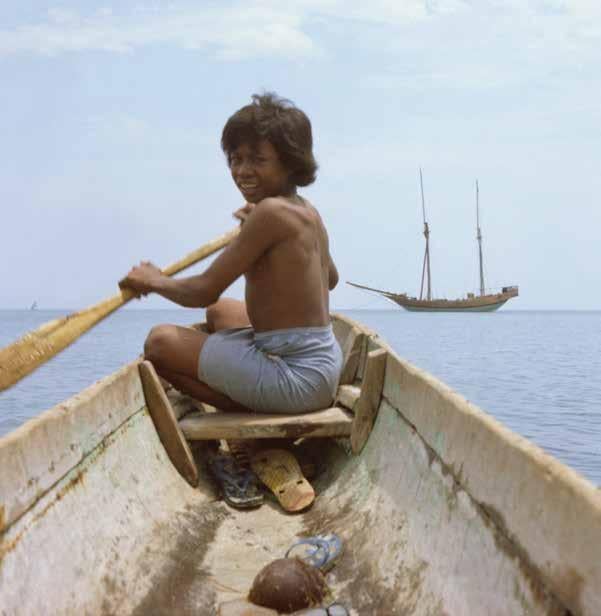
A young boy ferries the author out to inspect a new pinisi that’s being fitted out at anchor.

Men sitting on the ground chip away at large timbers with a hand adze. The blade is bound to the haft with rattan, just as in Neolithic times. The harder you hit, the tighter it grips the blade, which is forged of excellent steel from pieces of broken bus suspension springs. One commonly used timber is called nyamplong , a widespread coastal tree (Calophyllum inophyllum) found wherever Pacific people have built boats or canoes. The shipwrights work to no plans but remember the desired proportions, with units of measurement taken from different parts of the human body. The hulls are launched at high tide over coconut-palm log rollers, pulled by ropes and the power of a hundred villagers.
I work my way along the shore, photographing various stages of construction, and climb inside some of the largest hulls. When I inquire about an unfinished pinisi floating out at sea, looking very graceful with two remarkably tall masts but no ballast or sail, a small boy with a mop of black hair pops up and tells me that he can take me out in his dugout. I cannot resist. Clearly he has a small business as a ferry to the ship. I climb on board, and help him paddle.
On the ship, cut timber and shavings lie about everywhere. At one end are bowsprit structures and a windlass that will be essential for lifting heavy anchors. At the other end supports are already taking shape to mount the twin, stern-quarter rudders. The masts are stepped between timbers protruding through the deck, so they can be quickly lowered when a ship is beached for maintenance. There will be a gaff main and mizzen sail, two topsails and three jibs. I’m impressed by the warm glow of unpainted, newly cut timber, the massive strength of components and the superb fitting of plank to plank.
The shipwrights work to no plans but remember the desired proportions
This is the way they built inter-island transport in a country where timber and labour were cheap. In 1976 there were many hundreds of these pinisi, carrying sawn timber to Java for house building and returning with sacks of cement and rice, household goods, fabrics, bicycles, anything. They were owned and crewed by local families and served small ports in the islands spread far and wide across this huge archipelago. They showed what could be achieved by wind power, bringing memories of the days of sail. They were an Indonesian icon, marking the two best-known seafaring clans of Sulawesi: the Makassarese as boat builders, and the Buginese as sailors and traders.
The sailing pinisi rapidly dwindled from the late 1970s, when aid programs offered cheap new diesel engines. I once received a letter from Lloyd’s of London asking if I could explain the large numbers of ship losses in the Java Sea. The old pinisi hulls were literally shaken to bits by the unaccustomed vibrations of the new engines they had fitted. They have been replaced by wooden ships designed to have engines, built of sawn planks, reinforced by steel bolts, with modern navigation equipment and life-saving gear unlike their simple forebears, the large sailing pinisi shown here.
See Adrian Horridge’s The Prahu: Traditional sailing boat of Indonesia, Oxford in Asia, Singapore, 1st edition 1981, 2nd Edition 1985, held in the museum’s Vaughan Evans Library, 632.822 HOR.
1 ‘Macassans’ is an Anglicised spelling. The author uses the Indonesian spelling of ‘Makassar’ and ‘Makassarese’.
Adrian Horridge, Fellow of the Royal Society, was founding professor of the Australian National University’s Neurobiology Department 1969–1993.
What caused the loss of a recently refitted barque in 1881 – a reduced crew, bad weather, or a drunken captain seduced by his cargo of alcohol?
Dr Peter Hobbins weighs the evidence.
BEACHCOMBERS AT TOWRADGI POINT, north of Wollongong, occasionally uncover an unexpected find. Glinting beneath the sand, jars of pickled vegetables or still-stoppered brandy bottles have been recovered from the shoreline. Delivered into the custody of the nearby Illawarra Museum, these relics hint at a shipwreck beneath the surf. Indeed, despite substantial looting when it was exposed by a storm in 1991, this site contains one of the most intact 19th-century maritime cargoes along Australia’s eastern coast.1
Yet the Queen of Nations shipwreck is notorious for another reason: it was alleged that the captain was drunk when his vessel ploughed backwards up Towradgi Beach in the early hours of 31 May 1881.2 While accounts of the ship’s loss regularly refer to the copious amounts of alcohol aboard, was the master really pickled when this fine barque foundered?
In command that night was 38-year-old Captain Samuel Bache. His charge belonged to George Thompson Jr’s White Star Line, based at Aberdeen in Scotland. Known universally as the Aberdeen Line, its greenhulled vessels were typically constructed at the nearby yards of Walter Hood. ‘No ships that ever sailed the seas presented a finer appearance than these little flyers’, remarked maritime historian Basil Lubbock. 3
Specialising in the Australasian trade, the company was renowned for the soundness of its fleet, the safety of its voyages and the sobriety of its crews.4
So what calibre of officer was Samuel Bache? Born in the English port town of Bristol in 1843, he had gone to sea aged 17 and was no stranger to long hauls; the 1881 voyage was his 15th to the Australian colonies. Indeed, the Bache family bred capable seafarers, with Samuel earning his master’s ticket in London in 1873 and his younger brother Edwin following suit in 1874.5 Their Germanic surname created pronunciation quandaries for British contemporaries, being variously rendered as ‘Batch’ or ‘Barke’. Although the literal translation of Bache was ‘Baker’, it was probably later anglicised to ‘Barker’ – all adding complexity for today’s historical researcher!
By 1881 Samuel Bache had served as master for four antipodean round-trips, primarily commanding the Aberdeen Line’s 1,011-ton Strathdon (I). He first sailed this ageing barque to Sydney in 1877; the following year it achieved an impressive 78-day transit from London. Arriving on 19 January 1878, mainly in freight, the vessel landed seven passengers and one stowaway.6 After a lengthy layover, Strathdon cleared for London on 16 April. Among the crew was an Irish ‘apprentice’ who claimed to have absconded from another vessel.
Aged 18, this new sailor proved popular until the captain received a startling tip-off toward the end of May.
The Illawarra Museum is the legal repository for relics recovered from the Queen of Nations shipwreck, including several bottles of pickled vegetables (left and centre) and brandy (right). These items were conserved by the Australian National Maritime Museum before being returned to the Illawarra Museum. Images ANMM TBS_4239, TBS_4238, TBS_4237
02 Its back now broken, Queen of Nations was stripped of cargo from the upper decks, but substantial material culture remains on the protected shipwreck site today. Image Wollongong Reference Library P09_P09126 v2


On being confronted by Bache, the ‘would-be tar’ confessed that she was a young lady. Immediately provided with women’s clothes, she was accommodated well away from her former shipmates. When Strathdon docked in London in mid-July, Bache promptly conveyed her to the Thames Police Court. Before magistrate Franklin Lushington, the young ‘apprentice’ explained that she had left home near Dublin a year earlier and sailed to Queensland, working first as a barmaid and then – disguised as a man – as a steward on a Sydney-based steamship. Since newspaper accounts emphasised her ‘considerable personal attractions’, Bache was eager for her subterfuge to be formally attested. It was incumbent on the captain to convince the pious Aberdeen Line directors of his innocence, given the long maritime tradition of officers sailing with wives or mistresses masquerading as boys. In the meantime, the company discreetly offered the young lady free passage to reunite with her parents in Ireland.7
Given the era’s high-handed morality, Bache was fortunate to keep his job. He sailed Strathdon back to Sydney in late 1878, before being given Queen of Nations in 1879. Launched at Hood’s yard in 1861, this 878-ton barque already boasted several esteemed White Star Line captains, including Thomas Mitchell and Archibald Donald. Highly praised by those who sailed with him, on 2 August 1879 Captain Donald tragically fell overboard in appalling weather en route from Sydney to London.8 His drowning was a grim reminder that the poop deck was not immune from the hazards of the high seas.9
The cargo included 3,000 cases of brandy, spirits and ale
Queen of Natio ns was one of the Aberdeen Line’s characteristic green-hulled vessels, famed for their soundness. This 1870 oil painting is by Richard Ball Spencer. Image Aberdeen Maritime Museum AG008005
Moreover, the pressures of command and the incessant demands of managing a full rig often told on clipper captains. ‘Few endured the strain for many years’, insisted one British author.10
After an extensive refit and survey under Bache’s supervision, in early 1880 Queen of Nations was judged to be in good condition.11 On 14 January it departed Plymouth for Brisbane, safely delivering 291 migrants on 14 April.12 Together with the ship’s surgeon, Dr Raphael Joseph, Captain Bache ensured the safety and propriety of his passengers, including barriers to preclude unsupervised mixing of the sexes.13 Dr Joseph trusted his skipper sufficiently to join the return voyage, shipping out in ballast with 46 crew.14
British emigrants, however, were increasingly choosing more reliable steamships over full-sailed clippers. When Queen of Nations next embarked from London on 25 February 1881, it bore no passengers. Instead, Bache was responsible for £22,700 of cargo, from blank headstones to railway tracks, alongside manufactures such as hardware, furniture, fencing, glass, china, earthenware, stationery, clothing and drapery. Pickled and preserved goods featured prominently, as did 3,000 cases of brandy, spirits and ale.15
The vessel also carried a complement of just 24 – half its usual number. This parsimony likely escalated workloads and strained relations, especially between officers and crew.

Bache selected Scots for most of the senior roles, including first mate Rohan Whyte Anderson, second mate Charles Smith, carpenter John Reid and boatswain David McMillan. The third mate, James Hennessy, was a fellow Bristol mariner. The polyglot sailors, meanwhile, hailed from Brittany in France, Jutland and Elsinore in Denmark, Gothenburg and Gävle in Sweden, Hamburg in Germany and even the remote South Atlantic island of St Helena. The remainder came from Irish, Scottish and English home towns.16
Despite the minimal crewing, all went well on the outward voyage. But after a slow passage of 94 days, the weather worsened as the barque reached the New South Wales coast. While the crew had not sighted land since passing the Madeira archipelago off north Africa, by 30 May 1881 Queen of Nations was nearing Wollongong. It was a dark night and conditions were thick, making it impossible to take a position by the stars. Nevertheless, the weary crew and captain alike were hopeful of approaching Sydney the next day.
But the proximity of their destination was not the only tension permeating Queen of Nations. Bache was summoned to adjudicate on an altercation between Reid and McMillan. The captain sided with his bosun and ordered Reid to be put in irons, also noting his infraction in the ship’s log. First mate Anderson was reportedly so brutal in subduing the carpenter that Reid later testified to being ‘so much injured’ that he was unable to keep his 4 am watch.17
It was a bad night to be down even a single crewman. Bache retired but was regularly recalled up top, eventually taking the watch of his unwell second mate. All on deck were searching for the red beacon of the Wollongong lighthouse, mounted low on the harbour’s breakwater. Eventually, around 2 am, McMillan spied a white light to the northwest. At the wheel, able seaman George Ramage attested that ‘there was a bright light in sight at 4 am a point or 2 points off the Port bow’, adding ‘I was given to understand that it was the Sydney light’.18 He was referring to the Hornby lighthouse on South Head, at the entrance to Sydney Harbour. But if the tired mariners felt that safe haven would soon be theirs, events rapidly dashed their hopes.
Strung out – or seduced?
Captain Bache ordered the helm northwest half west, heading landward to better distinguish the light source. Turning to port, Queen of Nations made barely 5 knots despite occasional squalls. At just after 5 am the night remained dark and hazy, when Anderson sang out ‘Breakers on the port bow’ and called all hands on deck.19 Now they were in a pickle. Bache ordered the helm hard down, but it was too late. Even as the barque heeled over, broadside to the waves, its keel hit the bottom. A second impact tore off the rudder and, in Bache’s own words, ‘the wheel flew into pieces’. 20 The mainmast collapsed and Queen of Nations stranded fast ashore, stern first.
Easily identifiable during daylight hours thanks to its red and white vertical stripes, at night the white light of Hornby Lighthouse at South Head promised the safe haven of Sydney Harbour. This lithograph dates to 1888. Image ANMM 00001102
The White Star Line of Aberdeen was renowned for the sobriety of its crews


Although the crew were unsure of their location, they had grounded just off Towradgi Point, approximately five kilometres north of Wollongong and some 65 kilometres south of Sydney Heads. Able seaman John White offered to swim ashore with a line, but was overwhelmed by the surf and drowned. As the sky lightened, the proximity of the beach led the crew to launch a boat and establish a lifeline, landing everyone except Anderson and Bache, who had fallen and injured himself.
Locals soon arrived, offering assistance and helping themselves to the cargo, which was washing ashore. As the number of visitors swelled, boats ventured out to the wreck, where Bache and Anderson were rushing about, emitting strange noises and – by some accounts – brandishing a pistol. They later claimed that their primary focus was to secure the cargo, but newspaper reporters on shore elicited a different explanation from the crew: the captain was drunk. 21
The Marine Board of New South Wales hastily issued a barrage of telegrams and summonses. Led by President Francis Hixson, the board had recently reported to the colonial parliament on the 230 shipwreck and misconduct cases it had investigated since 1872. Although a verdict of drunkenness was uncommon, it typically resulted in suspension of a mariner’s certificate for six months or more. 22
Hearings held at the board’s offices in Sydney on 16 and 23 June 1881 painted a damning picture. At the wheel as Queen of Nations struck, able seaman Godfrey Symmers attested that when Bache ‘gave me the orders to alter the course … the captain was under the influence of drink’.23 Sailmaker Lewis Bremer, also on deck, agreed that Bache ‘was not sober at 5 am’.24 ‘I was alongside him when she struck’, stated Ramage. ‘I am sure he was drunk and incapable of handling the ship properly’. 25 Coming on deck immediately after the grounding, second mate Smith observed that Bache was inebriated, asserting that ‘the vessel was lost through drunkenness and carelessness on the part of the captain’.26
Anderson sang out ‘Breakers on the port bow’ and called all hands on deck
The red light of the Wollongong Lighthouse, with Mount Keira in the background, is still prominent in this 1950s advertisement.
Image ANMM 00044243

Bache, however, insisted that he was sober throughout the night, but took responsibility for making an ‘error in judgement’. 27 His account was supported by Hennessy and Anderson, who suggested that ‘the vessel was lost by a current which drove the ship ashore’. 28 The officers proposed that a strong south-flowing current led them to overestimate their progress, such that they mistook a fire at the mines on Mount Keira, behind Wollongong, for the white Hornby light. Despatched from Sydney to survey the scene, master mariner Joseph Amora agreed with this version, noting two other vessels that had nearly foundered under similar circumstances.
The board’s decision was swift. Hixson castigated Bache for directing his vessel landward in poor weather and without a confirmed position. Queen of Nations was lost, the verdict read, ‘by the wrongful act or default of Samuel Bache, the master, in having improperly navigated the said vessel by reason of drunkenness and carelessness’. 29 Although Bache subsequently produced a medical opinion that he was not ‘a confirmed drunkard’, his master’s certificate was suspended for 12 months. 30 In late August he was granted the clemency of a mate’s certificate, but his service with the august Aberdeen Line was over. Bache later returned to command steamships on the Atlantic run and eventually retired at the age of 60 in 1903.
Given his considerable experience, why did Bache turn to drink so close to port? Was he ‘strung out’ by a protracted voyage with insufficient sleep, or simply seduced by his intoxicating cargo? While this one voyage tarnished Bache’s reputation, his mistake has left a substantial legacy in the sands off Towradgi Point. Now considered one of the most significant shipwrecks in New South Wales, Queen of Nations continues to preserve the material culture of a profoundly maritime age. 31
Dr Peter Hobbins is the museum’s Head of Content. He thanks Kieran Hosty, David Nutley, Museums of History NSW, the Illawarra Historical Society and the Vaughan Evans Library staff for their assistance in researching this article.
1 Timothy Smith, ‘The Queen of Nations : one hundred and twelve years on’, Bulletin of the Australian Institute for Maritime Archaeology 16, no 2 (1992), p 14; David Nutley and Tim Smith, ‘Queen of Nations (1861–1881): Conservation Management Plan’, Revised (Parramatta: NSW Heritage Office, 2000), pp 6–16; David Nutley, ‘The Queen of Nations : a shipwreck with influence’, in Underwater Cultural Heritage at Risk: Managing Natural and Human Impacts , ed Robert Grenier, David Nutley and Ian Cochran (Paris: ICOMOS, 2006), pp 11–13.
2 Peter Hobbins, ‘The captain was drunk”: navigating wrecks and reputations’, Traces , no 18 (2022), pp 20–2.
3 Basil Lubbock, The Colonial Clippers , 4th ed (Glasgow: Brown, Son & Ferguson, 1975), p 131.
4 Peter H King, The Aberdeen Line: George Thompson Jnr’s Incomparable Shipping Enterprise (Stroud: The History Press, 2017), p 105.
5 Lloyd’s Captains Register, 1851–1947.
6 David Savill and Duncan Haws, The Aberdeen and Aberdeen & Commonwealth Lines of George Thompson (Hereford: TCL Publications, 1989), p 41; ‘Strathdon of Aberdeen, Samuel Bache, Master, Burthen 1010 Tons’, 19 January 1878, Mariners and Ships in Australian Waters, www.marinersandships.com.au/1878/01/061str.htm, accessed 23 July 2023.
7 ‘An ocean romance’, Lloyd’s Illustrated Newspaper, 14 July 1878, p 12.
8 Richard Rendle, ‘Immigration Agent report – Queen of Nations ’, 22 September 1876, Queensland State Archives, ITM846956 letter 76/2301.
9 ‘Shipping’, Evening News , 3 January 1880, p 4.
10 L Cope Cornford, The Sea Carriers 1825–1925: the Aberdeen Line (Aberdeen: Aberdeen Line, 1925), p 45.
11 ‘Report of survey for repairs, &c; half time survey for Queen of Nations ’, 5 January 1880, Lloyd’s Register Foundation Heritage & Education Centre, LRF-PUN-LON664-0123-R.
12 ‘Register of passengers on immigrant ships arriving in Queensland –No 3’, Queensland State Archives, ITM18478, pp 329–38.
13 Frances Annie Moore, ‘Memoirs’, State Library of Victoria, MS 9187, p 1.
14 ‘Ship: Queen of Nations ; official number: 29238’, 1881, UK National Archives, BT 99/1304/83.
15 ‘The wreck of the barque Queen of Nations and cargo’, Sydney Morning Herald, 6 June 1881, p 7.
16 ‘Ship: Queen of Nations ; official number: 29238’, 1881, UK National Archives, BT 99/1304/82.
17 ‘Ship – Queen of Nations , location of incident – Wollongong, date of incident – 31 May 1881’, Museums of History New South Wales (hereafter MHNSW), NRS-9851 [2/10554], minutes, 16 June 1881, p 2.
18 MHNSW NRS-9851 [2/10554], minutes, 16 June 1881, p 8.
19 Ibid, 23 June 1881, p 18.
20 Ibid, 23 June 1881, p 19.
21 ‘[By Telegraph]’, Sydney Morning Herald, 1 June 1881, p 6.
22 ‘Report to the Legislative Assembly re enquiries held by the Board’, 1880, MHNSW NRS-9799 [2/10561.4], pp 1–4.
23 MHNSW NRS-9851 [2/10554], minutes, 16 June 1881, p 11.
24 Ibid, 23 June 1881, p 5.
25 Ibid, 16 June 1881, p 9. Emphasis in original.
26 Ibid, 23 June 1881, p 1.
27 Ibid, 23 June 1881, p 20.
28 Ibid, 23 June 1881, p 22.
29 Francis Hixson, ‘Board of Trade Wreck Report No. 1108. “Queen of Nations”’, 23 June 1881, Southampton City Council.
30 ‘Rough minute books’, MHNSW, NRS-9797 [6/5053], 25 July 1881.
31 Mark Dunn and David Nutley, Thematic Study: New South Wales Shipwrecks (Croydon: Comber Consultants, 2020), p 35.
On 30 June 1857, an 800-ton Dutch fregat, Koning Willem de Tweede, wrecked near Robe in South Australia. Silentworld Foundation’s Heather Berry and the museum's Dr James Hunter were in Robe for a service to remember the wreck that claimed 16 lives and to advise locals on how best to preserve shipwreck artefacts.
IN LATE JUNE, we travelled to Robe, South Australia, for a memorial service to mark the 166th anniversary of the loss of Koning Willem de Tweede. The service was followed by a public presentation and conservation workshop showing how local communities can best care for shipwreck artefacts in their possession.
At the invitation of the Robe History Group (RHG), we attended the service on the evening of 30 June at a memorial erected in 2020 to commemorate Koning Willem de Tweede ’s lost crew. In an eerie coincidence, strong winds were blowing from the southwest and created large swell and breakers in Guichen Bay reminiscent of the conditions that led to the vessel’s loss on that same date in 1857. However, the squally weather cleared as the service commenced and we were treated to a glorious display of clouds and colour as the sun began to set. The service concluded with attendees passing a seaweed and kelp wreath, from person to person, to the cliff edge. Sixteen sprigs of rosemary – one for each crewman lost – were woven into the wreath by memorial attendees before it was cast into the bay.
Following this moving ceremony, James presented an update on our initiative to locate and identify Koning Willem de Tweede ’s wreck site.

Silentworld Foundation’s maritime archaeological conservator Heather Berry conducts a conservation assessment of an iron capstan on the grounds of Robe’s Customs House Maritime Museum. Image James Hunter
In many cases, these objects were washed ashore or exposed on the beach after years immersed in the ocean

In an eerie coincidence, strong winds were blowing, reminiscent of the conditions that led to the vessel’s loss on that same date in 1857

The following day, Heather led a conservation workshop at the Robe Customs House Maritime Museum. During previous visits to Robe, we had noted the large amount of shipwreck material in private collections, as well as those of the maritime museum and the Robe Branch of the National Trust of South Australia (NTSA), and this led us to create a conservation booklet – specifically catering to the Robe community – that addresses the materials most likely to be in their collections, including glass, metals, timber, and ceramics. In many cases, these objects were washed ashore or exposed on the beach after years immersed in the ocean. The booklet – as well as ongoing conversations with community members, the RHG and NTSA – spurred creation of the conservation workshop to showcase some practical ways of conserving and storing archaeological objects in non-museum environments.
During previous visits, we had shared conservation advice about larger iron objects stored in Robe’s former police stables, including an iron trident and a harpoon. NTSA kindly lent these items to be conserved as part of the workshop. They were chosen because they were evocative of the area’s history and would hopefully attract interest in the workshop, but also because the only ‘interventive’ treatment discussed in the booklet we had prepared was for iron objects, whose treatment can be quite dramatic.1 We wanted to show community members the results they could expect while undertaking these treatments. Conservation treatments of shipwreck artefacts can be intensive and require specialised experience, chemicals and facilities, while basic iron corrosion stabilisation can be performed successfully anywhere, with limited object-handling skills and chemicals. Further, most treatment materials can be purchased from hardware stores and supermarkets.
01
The wreath used in the commemoration sits at the base of the Koning Willem de Tweede memorial.
02
Robe community members pass the wreath to the edge of Guichen Bay, where it was cast into the water.
Images Heather Berry
02
Sixteen sprigs of rosemary – one for each crewman lost –were woven into the wreath before it was cast into the bay


The only ‘interventive’ treatment discussed in the booklet we had prepared was for iron objects, whose treatment can be quite dramatic
01
The iron trident before treatment with tannic acid solution.
Image Heather Berry.
02
The iron trident after treatment with tannic acid solution.
Image Heather Berry.
03
Heather Berry shows a Robe community member how to apply tannic acid solution to a harpoon during the conservation workshop at the Customs House Maritime Museum. Image James Hunter
With this in mind, we set up a trestle table inside the maritime museum to showcase conservation at work, and we focused on tannic acid application to iron objects that had only basic surface corrosion. Tannic acid is found in plants, and considered a ‘green’ conservation product, because it is derived from natural sources and does not cause significant environmental contamination. We adopted a step-by-step method. Attendees were first shown best-practice methods for preparing corroded iron artefacts – including what corrosion smells like, how it behaves, and how to perform initial cleaning with steel wool and toothbrushes. Participants were then shown how to apply a tannic acid solution using a variety of tools. They were encouraged to try multiple forms of application, including with toothbrushes, cotton swabs and microfibre cloths, to get a feel for the method they were most comfortable with. When applied to iron, tannic acid solution can dramatically change the iron’s appearance, and participants were advised to first consider the aesthetic quality they wanted for their collection. Did they want an object to appear new or old? In the latter case, tannic acid solution may not be appropriate, as the chemical reaction it generates converts the typical rust colour most of us are familiar with to a smooth blue-black surface coating. This in turn can make objects appear less ‘rustic’.
In scientific terms, tannic acid solutions convert corroded iron ions into ferric tannate, which forms a passivated corrosion layer across the object.2 With proper storage, this will help mitigate further corrosion. However, tannic acid treatment does not eliminate chlorides or other dissolved salts that artefacts – especially those recovered from marine environments – may have accumulated. The process for removing salts (known as desalination) ideally commences the moment an artefact is recovered, and should be undertaken by a professional conservator.
Once the workshop participants had seen the effects of treatment, they were advised on the best storage methods for iron objects. Ideally, this requires an environment with low relative humidity and temperature fluctuations, to prevent further corrosion. Participants were also advised to always consult a professional conservator for more comprehensive treatments.
Before our departure, we walked Long Beach to the spot where archival and archaeological information suggest Koning Willem de Tweede wrecked. Robe had recently endured a spate of foul weather, which led to significant shoreline erosion in several areas, and we thought the recent sand movement might have uncovered artefacts on the beach. While we didn’t see any shipwreck material, we did find something among the seaweed and flotsam that was quite unexpected and moving: a sprig of rosemary from the wreath cast into the bay two days earlier.
Heather Berry is a conservator at the Silentworld Foundation. Dr James Hunter is the museum’s Curator of Naval Heritage and Archaeology.
1 An interventive treatment is, broadly defined, a conservation treatment that introduces a new substance to the object, or takes something away from it.
2 A passivated corrosion layer is a coating on an object that prevents further oxidisation of the material underneath; in this case, the converted corrosion product protects the underlying metal from corroding further, within certain limitations.
This project is being undertaken as an initiative of the Kingdom of the Netherlands’ Shared Cultural Heritage Program and is supported by the Dutch Ministry of Foreign Affairs, through the Embassy of the Kingdom of the Netherlands in Australia, and the Cultural Heritage Agency of the Netherlands.
For more information on Koning Willem de Tweede, see Signals 140 (September 2022).
Fourth-generation mariner still at the helm
The Sydney Heritage Fleet is a volunteer-based organisation established to preserve examples of historically significant vessels. Jane Dargaville tells the story of one of its volunteers.


AS EXECUTIVE MASTER of Sydney Heritage Fleet’s motor launch Berrima, built in 1955, 83-year-old Sydney Heritage Fleet volunteer Ray Jenkinson’s background is as rich in maritime history as the staunch little vessel he commands and maintains.
Berrima is one of three historic motor launches operated by the Sydney Heritage Fleet (SHF). The other two are former passenger ferry Protex (1908) and Harman (1943), an ex-naval vessel. Each is a rare surviving example of working watercraft from bygone eras on Sydney Harbour and Port Botany.
Ray’s great-grandfather was a sailor in the British Royal Navy, making Ray the fourth-generation mariner in his family. His grandfather, Thomas, ran a fleet of launches from a slipway and shipyard at the maritime industrial hub of Mort Bay (known then as Waterview Bay) in the 1920s and 1930s. ‘One of the jobs he had was towing barges of meat from Homebush abattoir to ships in the harbour’, Ray says.
At age 14, Ray’s father Percy – born in Glebe and raised in Balmain – ‘ran away to sea … on real sailing ships … they had no engines’. As a young child, Ray wondered at the tattoo of a fully rigged sailing ship on his father’s chest. ‘It signified he’d sailed around Cape Horn,’ Ray said. ‘He did it twice.’
01
is kept busy plying Sydney Harbour.
02
When Ray’s grandfather got sick in 1931, in the middle of the Great Depression, his father was called home to run the family business, and when his grandfather died in 1935, the family walked away from the shipyard, unable to pay a £500 debt.
Percy got a job working for Nicholson’s, the marine service company that dominated maritime operations on Sydney Harbour for more half a century until the late 1960s, and was skipper of Protex for several years.
Nicholson Bros Harbour Transport Pty Ltd was famous for naming its vessels with the prefix ‘Pro’. Protex ferried workers to and from the Colgate-Palmolive factory at Balmain and is nicknamed ’The Soap Boat’ after the popular soap produced there.
Later, Ray’s father worked for the Maritime Services Board as master of the tug Bennelong and of Lady Hopetoun, the former NSW government VIP launch and now Sydney Heritage Fleet’s flagship.
‘He didn’t like that much because he had to wear a white uniform, but we liked it because on those occasions he would bring home cakes,’ Ray remembers.
Ray didn’t pursue a maritime career, but 17 years ago he joined the SHF as a volunteer and was delighted to be made ‘ship’s husband’ (in charge of maintenance) of his father’s old boat Protex. He became skipper of Berrima eight years ago.
Built at La Perouse in 1955 as a service vessel for the now-defunct Caltex oil refinery at Kurnell on Botany Bay, Berrima was originally named, prosaically, A.O.R.1.
In the early 1960s it was bought by Stannard Bros, who changed its name to Berrima, from the Gandangara language meaning either ‘southward’ or ‘black swan’.
Stannards provided marine services to the oil refinery and Berrima continued as an oil refinery work boat and was also used as a Botany Bay pilot cutter.
Since its acquisition by the SHF in 1990, Berrima has mostly been a work boat and is a familiar sight on Sydney Harbour with Ray at the wheel. It recently came into survey and is now also used for public cruises.
Jane Dargaville is a volunteer with Sydney Heritage Fleet.
Berrima Volunteer Ray Jenkinson is the proud skipper of Berrima. Images Michelle Bowen
Down three races to one, Australia II came from behind to win 4–3 in dramatic fashion
The winged keel, Australia II ’s secret weapon, was kept hidden from view for the duration of the America’s Cup campaign. Image Sally Samins ANMM Collection 00000397
Australia II won the America’s Cup in 1983, and 40 years later Australia is still celebrating. Veronica Dominiak and David Payne look at the background narrative and some of the social stories that came from the win.
FORTY YEARS AGO, on 26 September 1983, the sailing world was joined by the rest of the world as everyone focused on the extraordinary climax of a sporting event. The America’s Cup dominated world news that day, because Australia had done what no one else had been able to do in 132 years: they had beaten the Americans. Through the New York Yacht Club (NYYC), the Americans had defended the cup resolutely since 1851, when their schooner America won the silver trophy in a race around Cowes in the UK. The NYYC then created what we know as the ‘America’s Cup’ (or, colloquially, The Auld Mug) by inviting challengers to come to New York to try to win the cup themselves. It soon became a symbol of US supremacy in yachting and, eventually, the longest winning streak in sporting history.
It took our small nation to break that chain, but it began with a false start, way back in 1889. Sydney-based naval architect Walter Reeks got as far as designing a yacht that fulfilled the Deed of Gift requirements, including the ability to sail to the venue from Sydney, but it ended when the backers were unable to secure the funds. So the road finally began in earnest with a
challenge in 1962 that managed to win only one race, but made a statement: We can rise to the occasion, just give us a bit more time. Twenty-one years later, with four more challenges gradually building the momentum and experience, that time finally arrived. Down three races to one, Australia II came from behind to win four to three in dramatic fashion. It’s a story that is inspiring and well known, and some related items are on display in the museum’s Wharf 7 foyer. The National Maritime Collection holds objects that highlight different aspects of what led to that day in 1983, and how this memorable event had a trickle-down effect on society.
The two construction drawings help tell the story of one of the foundation blocks for the challenge, the construction of the yacht. The pair of plans are part of the bigger picture – the essential layout of the aluminium hull – and the necessary detail comes later with numerous very specific drawings for individual parts and fittings. They are the culmination of spending long hours on the draughting board or computer to produce a highly optimised design, built on experience combined with new ideas and technology.
Lloyd’s Rules ensured a reasonably level playing-field for construction, among the different designs


01
The 1:3 scale tank test model of the famous Ben Lexcen-designed 12-Metre yacht Australia II is an important artefact in the museum’s collection Gift of America’s Cup Defence 1987 Limited. Image Andrew Frolows/ ANMM
02
One of the first concept plans Ben Lexcen developed as they began testing and developing the winged keel. It includes his cartoon reference to Darth Vader as the nickname for the radical design they were preparing. ANMM Collection ANMS1543[368]
A particular point to note on the Construction Profile and Plan drawing is a reference beside the right-hand margin to ‘Lloyd’s Construction for Metal’. The scantlings for the hull’s construction have to satisfy Lloyd’s Rules for Yacht Construction, which specify minimum dimensions for the various parts that make up the hull and deck. These dimensions come from a series of calculations defined by Lloyd’s Rules, which designers and engineers use to determine their best option for a yacht’s structure. It’s a balance of strength versus weight, and the application of Lloyd’s Rules ensured a reasonably level playing-field for construction among the different designs of America’s Cup contenders.
However, the scope for the yacht’s design is wide open for development in other areas, and the excitement this freedom offers comes to the fore with the next plan, a combination of technical drafting, free-hand lines and a cartoon. It’s also the story of Ben Lexcen, a genius at understanding the technicalities and engineering of a yacht, and a man with a gift for visualising what he wanted in a simple, flowing image, mixed with his larger-than-life, fun-loving character.
On display is probably one of the earliest plans Lexcen drew as he developed the radical winged keel, the part of the story that still seems to dominate the 1983 America’s Cup. It’s a piece of lateral thinking, but it didn’t happen in just one moment of thought or in one drawing. The concept started as simple winglets attached to the end of a conventional keel profile, which then grew in steps. Next, the profile was turned upside down, which then made the cross sections larger at the base. This is shown on the plan, partly drawn with accurate outlines combined with freehand section curves, and its nickname ‘Darth Vader’ is exposed thanks to Ben’s cartoon sketch of the character from the Star Wars movies. The Empire Strikes Back came out in 1980, so Ben must have been influenced by the film and by Vader’s helmet and its distinctive flared-out sides. This was the first concept put through the tank testing facility at the Netherlands Ship Model Basin in 1981. It was a pivotal moment in the narrative of the challenge, and it was all captured, including the references to American pop culture, in a message Ben sent to the syndicate head, Warren Jones, back in Perth on 22 May 1981:
NEED TO CONVERSE ON DOG AND BONE
KEEL III A BIG ADVANCE
ABOUT TO TAKE YACHT DESIGN INTO THE SPACE AGE
DARTH VADER LOOKS GOOD IN COMPUTER IN 3 DIMENSION WILL TEST ON WEDNESDAY 10TH JUNE.
[SIGNED] BEN SKYWALKER

The June test was a success and from there, with further testing and refinement, the design grew into the larger wings that are visible on the display model of Australia II and the one-third-scale tank test model, both also part of the display.
On the side, as an appendix if you like, the concept of a winged keel became a patent application that was first revealed in August 1983, just prior to the final series of races. The application document was then available in the British Library, but went unnoticed until after the final race when the keel was revealed in an act of theatre back at the dock. The patent’s schematic drawings, which have a Spirograph feeling about them, show exactly what was under the yacht and the words accompanying the application then explained how it worked. This opened up the idea to the rest of the yacht design world, where it was widely embraced.
Meanwhile, sitting with all of this, quietly on display, is a ‘planimeter’, which brings us back to that foundation – the sometimes tedious but necessary calculations and drawings to develop the design. The keel had to weigh a certain amount, so it was necessary to calculate its volume. By measuring a series of cross-section areas
and the span between them, it is possible to calculate this, but the rounded shape of each section makes this measurement more difficult. The planimeter, developed in the 1850s, does the work for you with accuracy, by tracing around the perimeter of each section. A hard-to- read note above Darth Vader on the keel plan refers to ‘Planimeter Reading’ and how it is calibrated to give the section area relative to the scale of this plan.
The planimeter could be described as an analogue computer, a mechanical means of accurately computing an otherwise long-handed calculation. It fits neatly as a reminder of this period of design. Australia II was developed at a time when computer-based design and drafting was becoming established, but hadn’t completely replaced the traditional hand-drawn plans and manual calculations. The full set of plans in the museum’s collection is a combination of both, and tells a story from behind the scenes, hidden by a smokescreen of dramatic events, intrigue, rumours, money and characters.
A key character that has since become an indispensable part of Australian sporting culture when a national team takes to the international stage is the Boxing Kangaroo.

01
The hull construction plan that shows the profile and plan view of the vessel, the details are then covered in many individual plans prepared by Ben and his team of designers and draughtsmen, including John King whose name is on this plan. ANMM Collection ANMS1543[310]
02
Damian Fewster, Australia II ’s bowman, hoisting the Boxing Kangaroo flag after crossing the line to win the America’s Cup in 1983. Image courtesy of Bruce Stannard

A gold kangaroo wearing red gloves on a green background, the boxing kangaroo character that was created in 1983 was originally designed by Steve Castledine. The notion of boxing kangaroos had already been part of our folklore for many generations, but Alan Bond had this version trademarked, and it became such an iconic logo that it was later bought by the Australian Olympic Committee.
In the meantime, the ’roo soon jumped off the flag and into the shops in all manner of ways, from tee shirts to tea towels to bumper stickers, even inflatable life-sized animals. This win created that moment when it was truly seized by the public, and like a child with its favourite soft toy, we have never let go of it.
The win inspired something else that fits into one of contemporary society’s addictions: video games. Back when university student Steve Wang got together with some other university friends and created a game around the America’s Cup, they then formed their own company, Micro Forte, with this as their first published game. EA Sports marketed it, but they were in their early days too, and the packaging represents that period of genesis before video games became ubiquitous.
The February 1987 edition of Computer and Video Games magazine states: ‘if you’re into the intricate details of sailing yachts then America’s Cup Challenge could be of interest to you’. Nowadays we’d appreciate it for the retro 80s graphics.
Also engraved in our folklore is the moment on the morning after the win, when then-Prime Minister Bob Hawke declared live on TV, ‘I tell you what, any boss who sacks a worker for not turning up today is a bum!’ The moment was made even more colourful by what he wore, the outrageous tourist jacket emblazoned with a pattern of national flags interspersed with ‘Australia’ –a crass fashion item at any other time, but now an iconic piece of clothing. The museum’s replica of the original that belonged to Perth architect Paul Burnham brings us back to the start of the celebrations that engulfed the country throughout the day, catalysed in part by our popular prime minister.
David Payne is an Honorary Research Associate of the museum. Veronica Dominiak is Temporary & Touring Exhibitions Coordinator.
Signals 136 has an article by John Longley on the Boxing Kangaroo flag.
With your help, the museum’s Foundation can preserve history
Over the last year the Australian National Maritime Museum Foundation has hosted a range of events to showcase the difference that our supporters make to the museum, and to express our thanks. By Dr Kimberley Webber.
RECENTLY, THE FOUNDATION FOCUSED on raising funds to support the conservation and interpretation of material from the 1857 sinking of the Dunbar near the entrance to Sydney Harbour. In June, members and supporters were joined by Kieran Hosty, the museum’s Manager of Maritime Archaeology and Research, on a tour of the key sites connected with one of Sydney’s worst maritime disasters. Having dived to the wreck and researched objects retrieved from it, Kieran shared his experiences and spoke of the cause of the disaster amid stories of those who perished. The excursion was so well received that another tour is planned for September.
The 1900-built steam yacht Ena – designed by renowned naval architect Walter Reeks – is one of the treasures of the Museum’s collection and has benefitted from the financial support of Museum Ambassadors Dr David and Mrs Jennie Sutherland and the Ena Sanctum. This special group has committed to providing assistance to ensure that Ena remains an operating vessel on Sydney Harbour. Over the last year, Ena ’s supporters have had the opportunity to inspect the vessel while it was in dry dock and to join one of its regular cruises on the harbour.
In November we are planning two special SY Ena sailings to see the jacarandas in flower along the harbour foreshores.
The Chair’s Circle is another means of supporting the museum and is open to donors who commit to giving $1,000 a year over three years. Members of the Chair’s Circle enjoy special ‘behind-the-scenes’ access to the collection and to the museum’s curators and researchers, as well as other VIP events, including harbour cruises on heritage vessels. A highlight in April was the opportunity to see the replica 1820 ‘Sydney Punchbowl’ that was recently donated to the National Maritime Collection by Mrs Alison Carr, and to learn about the research that went into its production from the Director of Hordern House, Derek McDonnell OAM Museum Chair and co-founder of the Silentworld Foundation, John Mullen AM, spoke to us about the recent discovery of the Japanese World War II ship, Montevideo Maru. In April 2023, the Department of Defence announced that as a result of its work with the Silentworld Foundation, the Fugro Equator had found the wreck of this Japanese transport vessel.
01
A highlight in April was the opportunity to see a replica of this 1820 ‘Sydney Punchbowl’ that was recently donated to the National Maritime Collection by Mrs Alison Carr. The original belongs to the State Library of NSW. Image reproduced courtesy of Mitchell Library, State Library of NSW, SAFE / XR 10
02
The relatives of Edwin Malcolm Abbott at the presentation to supporters: Rosemary Neal, Stuart Neal, Helen Humphreys, Alison Meldrum, John Mullen, Elizabeth Neal and Richard Neal. Image Matt Lee
Almost a thousand Australian prisoners-of-war and 210 civilians died when it was mistaken for a Japanese cargo ship and torpedoed by a United States submarine on 1 July 1942. All on board had been captured in New Britain, and among them was Edwin Malcolm Abbott, the superintendent of the Seventh Day Adventist Mission in New Guinea. One of our valued members, Richard Neal, is a relative of Edwin Malcolm Abbott and his presence, along with that of his family, gave added meaning to the story. (See page 2 for an article on the discovery of the wreck.)
A further means of support is through making a bequest to the museum. This can be done by donating to the museum’s Foundation, to support its overall priorities, or you can specify which areas of activity you would like to help.
Dr Kimberley Webber is the museum’s Project Officer –National Encyclopedia of Maritime Objects (NEMO).


Please donate by
• entering details online at sea.museum/donate
• depositing funds directly into the Foundation’s account with your name as reference: BSB 062 000 Account number 16169309
• completing the enclosed form and mailing it to the museum
• or phoning Matt Lee on 02 9298 3777. All donations are tax deductible.

VIVID SYDNEY ’S 2023 theme was Sydney, Naturally, which came to life at the museum in May and June when our site became the canvas for an ornate artwork called Harbour Life.
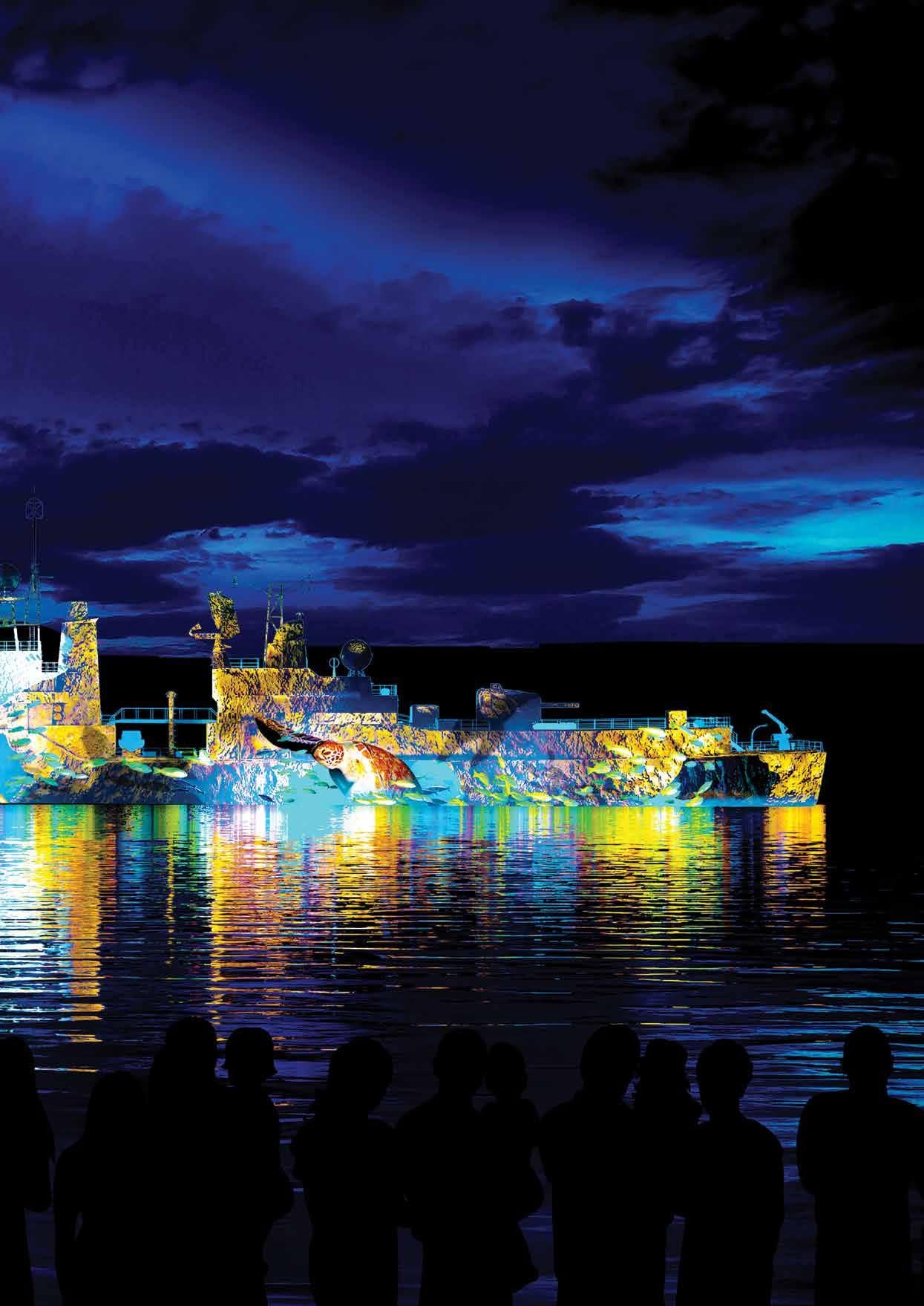
BUILDING ON THE SUCCESS of previous Vivid projections, the museum collaborated with the award-winning Sydney-based creatives Artists in Motion. In 2023, for the first time, artworks were projected onto HMAS Vampire as well as the museum’s rooftop.
The development of Harbour Life was a collaborative affair. Curator of Ocean Science and Technology, Emily Jateff, and Manager of Indigenous Programs, Matt Poll, both assisted in building the narrative in consultation with stakeholders and the wider community.
Presenting the museum’s messages to a huge Vivid audience was a wonderful opportunity. Destination NSW was responsible for the light projection onto HMAS Vampire, in what was described as their most intricate challenge of the Vivid festival. The reach of Harbour Life was amplified by the social media footprint of the artwork. Imagery from the projections received overwhelmingly positive feedback from viewers and was enthusiastically shared across a number of online platforms.
The project can be considered a major success, informing our continued participation in the Vivid festival for years to come.
Harbour Life imagined underwater environments seen through the eyes of a turtle. Image courtesy Artists in Motion
Harbour Life is a seven-minute animation that takes the audience on a journey into Australia’s harbour environments through the eyes of a turtle. It explores Indigenous maritime management, the arrival of colonists and our shared future, focusing on conservation and management of this fragile ocean ecosystem. It is a celebration of nature, Indigenous knowledge, creativity, culture, ocean science and the latest technology –all working with a shared passion for helping our oceans thrive into the future.
All images courtesy Artists in Motion


Online talks and tours for spring

Explore the inner workings of the museum in our monthly talk and tour series, Beneath the Surface, when you can join our museum curators and conservators as they delve deeper into our current exhibitions, research projects and collection.
IN KEEPING WITH OUR AIM to engage both national and local audiences with key and current content areas for the museum, our spring program offers both onsite tours and online talks that cover a range of topics, including Australian heritage, the museum’s historic fleet, and conservation. All our talks and onsite tours as part of this series are free to the public and advertised on our Eventbrite page and social media channels. Online talks will be recorded and uploaded to our website for you to access any time.
September: Camp X
Commemorate the 80th anniversary of Operation Jaywick and gain valuable insights into the operation’s history with this engaging online talk by archaeologist Stirling Smith. Stirling will take you on a virtual tour of Camp X, the historical New South Wales site that served as a crucial training ground for the Z Special Unit in their preparations for the pivotal 1943 Operation Jaywick.

October: Ships’ plans and planning ships
Learn about the process of drawing ship plans and how they transform into a fully functional vessel in this captivating online conversation between former Curator of Historic Vessels, David Payne, and Dr Roland Leikauf, Curator of Post-war Immigration.
November: Reinterpretation and conservation of the Cape Bowling Green Lighthouse
Learn the history and significance of one of our museum’s most prized collection items, the Cape Bowling Green Lighthouse. Curator Inger Sheil and Conservator Nick Flood will take you on a behind-thescenes tour, as they discuss the lighthouse’s design, its historical importance and the intricate processes involved in conserving such a monumental artefact.
December: To be confirmed
Keep an eye on our social media pages and website for an update on the December talk or tour.
Emily Jateff, Curator of Ocean Science and Technology
IT’S BEEN A BUSY PERIOD in the Members Department, with a wide variety of talks and events to keep our members engaged over the winter months. As well as our usual Speaker Talks, our members Vivid cruise was back, allowing us to enjoy the colourful sights of the Vivid festival from a specially chartered boat away from the crowds.
We also launched our Meet the Neighbours tours with a trip to the Coal Loader Centre of Sustainability in Waverton to learn about this fascinating part of Sydney’s maritime history. We also had a curator-led tour of sites relating to the Dunbar shipwreck, one of Australia’s worst maritime disasters. This included visiting the Dunbar memorial anchor in Watsons Bay and the Camperdown Cemetery, where many of the victims are buried.
Both these trips proved so popular that we are repeating them this spring, and you can find more details in the Members Events listings that follow.
As well as our popular Speaker Talks, we will be holding more author events, on-water cruises and trips and tours to places of interest around Sydney.
I’m also now finalising the details for this year’s Members Anniversary Lunch, being held on Saturday 2 December, and will be announcing the guest speakers shortly.
You can keep up-to-date with all our member events at our new events page, sea.museum/members-events. Alternatively, scan the QR code below.
And remember to stop by the Members Lounge for a tea or coffee when visiting the museum. Our refreshed lounge now features items from the museum’s collection, which have been purchased or conserved with the support of our members.
And if you would like to join our team of volunteers who are hosts in the Members Lounge, and welcome fellow members, please get in touch.
As always, if you have any questions about the museum or your membership, do not hesitate to call the Members office on 02 9298 3777 or email us at members@sea.museum
Hope to see you at the museum in the near future.
Matt Lee, Manager – VIP Relations & Membership


Author talk
Sisters in Captivity
2 pm Wednesday 13 September
Join author Colin Burgess as he talks about his new book, Sisters in Captivity
This is the incredible account of Sister Betty Jeffrey OAM and the Australian war nurses who survived the bombing of evacuation ship SS Vyner Brooke in February 1942, and subsequently spent three years in Japanese prison camps in Sumatra.
Free for all guests
Speakers talk
40th anniversary of Australia II winning the America’s Cup
2 pm Tuesday 26 September
In 1983 Australia won the America’s Cup – the first time any nation had wrested it from the United States. The New York Yacht Club had successfully defended the cup for 132 years against all challengers. Australia II was designed by Ben Lexcen and owned by Alan Bond. The skipper was John Bertrand. Do you remember their ‘secret weapon’? Noel Phelan of the museum’s Speakers Group will tell the story of the planning – and psychology –surrounding this groundbreaking yacht.
Free for museum members
Meet the Neighbours tour
The Anzac Memorial
9.45 am Thursday 14 September
The Anzac Memorial is one of our most significant cultural and commemorative institutions – as a war memorial and a place of commemoration, remembrance, education and reflection. This museum members tour will cover the building’s history and its collection of objects, and will include the 11 am Remembrance Service and a Star ceremony.
Meet at the Pool of Reflection, next to the Anzac Memorial in Hyde Park, by 9.45 am for a 10 am tour, which will last between 90 minutes and two hours.
$25
Talk and tour
Lisa Blair sails the world
2 pm Wednesday 4 October
On 25 July 2017, Lisa Blair became the first woman to sail solo around Antarctica in a record 183 days. She very nearly didn’t live to tell the tale. In a ferocious storm the mast of her boat Climate Action Now came crashing down. Lisa battled massive waves and gale-force winds, fighting through the night to save her boat – and her life.
Join us at the museum as Lisa gives us a tour of Climate Action Now, followed by an account of her experience.
Free for museum members; $10 for non-members
Image Corrina+RidgewayMeet the Neighbours tour
The Coal Loader Centre for Sustainability
9–10 am Wednesday 11 October
The Waverton coal loader used to operate as a coal transfer depot. Now, it has a keen focus on sustainability within its foreshore park, community garden, Aboriginal sites, nursery and studio space. Join us on this expert-led tour as we explore the site and learn about its history.
Meet at the Members Lounge at the museum between 9 am and 10 am, before setting off by mini-bus at 10 am. We will return to the museum at about 1 pm.
$40
Image North Sydney Council
2 pm Saturday 14 October
Mary Bligh was as strong-willed as her bloody-minded father, the newly appointed colonial governor, William Bligh. The pair scandalised Sydney with their personalities, his politics and her pantaloons. When 300 armed soldiers of the Rum Rebellion marched on Government House to depose him, the governor was nowhere to be seen. Instead, Mary stood defiantly at the gates, fighting them back – her only weapon her parasol!
Join author Sue Williams as she talks about her new book That Bligh Girl Free for all guests


talk
The 18-foot skiffs of Sydney Harbour
2 pm Thursday 19 October
A hundred years ago, the biggest sports during a Sydney summer were cricket and 18-footer sailing. Thousands flocked to the shores, and a fleet of ferries followed the race. This presentation covers the history of the boats and of some of the people in the sport in more recent times – such as Ben Lexcen, who invented the famous winged keel for Australia II, which won the America’s Cup for Australia. Presented by Neville Turbit from the museum’s Speakers Group.
Free for museum members
Taipan on Sydney Harbour. A Frolows/ANMM
Author talk
Dr Rip’s Essential Beach Book
2 pm Saturday 28 October
How do waves break and what makes good surfing conditions? Why does the colour of sand vary between beaches? What are dangerous rip currents and how do you spot one – and what should you do if you are caught in a rip?
Rob Brander’s Dr Rip’s Essential Beach Book is filled with practical information on how to use the beach, from keeping your family safe in the surf to what to do in the event you find yourself swimming with a shark.
Free for all guests
Author talk
The Talented Mrs Greenway
2 pm Saturday 4 November
Join author Tea Cooper as she talks about her new book The Talented Mrs Greenway
This compellingly realised novel brings to life the story of an enigmatic figure, wife to feted colonial architect Francis Greenway, and asks, whose hand really shaped Sydney? Who is the talented Mrs Greenway?
Free for all guests
Curator talk
A fashion for travel: Titanic style
6 pm Thursday 26 October
Take a voyage through Edwardian style as Assistant Curator Inger Sheil discusses the interiors of liners such as the White Star Line’s RMS Titanic and the attire worn by passengers in the golden days of trans-Atlantic travel. Immerse yourself by dressing in Edwardian-era finery.
Before the talk, there will be cheese and fruit platters and a cash bar.
Enter your promo code to get your members’ discount.
Members $30; non-members $40 White Star Line publicity brochure 1911 (public domain)

Book launch
Flinders, by Grantlee Kieza OAM
2 pm Wednesday 1 November
Together with his Aboriginal interpreter and guide, Ku-ring-gai man Bungaree, and his beloved cat, Trim, Flinders explored the furthest reaches of Australia and meticulously recorded its rugged coastlines on maps so accurate they are still used today. He also gave our vast island continent its name, turning the centuriesold title ‘Terra Australis’ into ‘Australia’.
Flinders is a rollicking adventure tale of a man who loved the sea – and pushed himself to the limits of human endeavour.
Free for all guests
Shipwreck tour Dunbar
9.30 am Thursday 16 November
On 20 August 1857, Dunbar was caught by a massive storm near the cliffs at Sydney’s South Head and smashed to pieces on the rocks. All but one of the 123 passengers and crew perished.
Join us as we travel around Sydney to tell the story of one of Australia’s worst shipwrecks. Meet at the museum at 9.30 am to visit the Dunbar Memorial at South Head, followed by a visit to Camperdown Cemetery where most of the Dunbar victims are buried.
Includes a light lunch and a copy of the book Dunbar 1857 – Disaster on our doorstep
$64.00
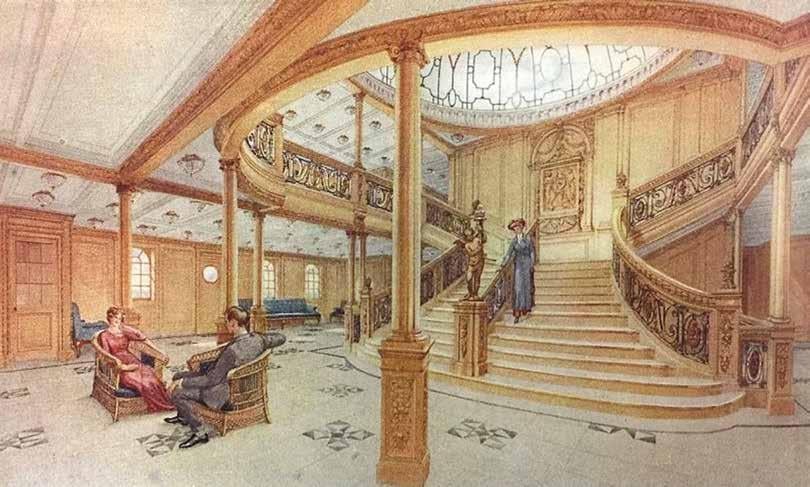
Elizabeth & Elizabeth
2 pm Saturday 18 November
Elizabeth Macquarie, the wife of the new governor, Lachlan Macquarie, nudged him towards social reform. Elizabeth Macarthur is credited with creating Australia’s wool industry and was married to John Macarthur, an enemy of the establishment. They came from strikingly different backgrounds and their husbands held sharply conflicting views, but this fictionalised story by Sue Williams is about two courageous women thrown together in impossible times.
Free for all visitors
Image courtesy Sue Williams
talk
The Sydney–Hobart yacht race – a water-level perspective
2 pm Wednesday 22 November
Lindsay May is a 48-year veteran of the Sydney–Hobart Yacht Race. His first two races were as a forward hand but he soon became a navigator. Up until 1983 navigation was by sextant and mathematical calculations. Lindsay will talk about the changes he’s observed over the years and some of the highlights of this world-renowned ocean racing classic. Presented by Lindsay May OAM from the museum’s Speakers Group.
Free for museum members
11.30 am Saturday 2 December
Join the museum’s Chairman John Mullen AM and Director Daryl Karp AM for pre-lunch drinks and canapes followed by a three-course meal by award-winning caterers Sydney Restaurant Group on our stunning Ben Lexcen Terrace. You will enjoy the company of fellow members and friends of the museum and hear from our special guest speaker, to be announced soon.
Members $130; non-members $150
Thirtieth anniversary of the Endeavour replica
2 pm Wednesday 6 December
This talk will explore the construction of the replica of James Cook’s ship HMB Endeavour, and what life was like on board for his crew of sailors and marines. Ron Ray oam, of the museum’s Speakers Group, will discuss how the ship was operated and sailed in the 18th century, the fate of the original HMB Endeavour and how the museum now preserves the history of the ship and operates the replica on sailing adventures.
Free for museum members
Mess deck, Endeavour replica. ANMM image

Unless otherwise noted, talks are free for members and one guest. Book launches are free for all guests. Bookings are essential. To book members events, email memberevents @sea.museum and tell us which event you wish to attend, and who is coming. Alternatively, book through Eventbrite, phone us on 02 9298 3777, or scan the QR code below.
For all other events, please see sea.museum/whats-on/events for further details and how to book.
For children’s and family programs, please check sea.museum or sea.museum/kids .


OCEAN PHOTOGRAPHER OF THE YEAR celebrates our beautiful blue planet as well as highlighting the many plights it faces. Photographers of all disciplines and experience levels – amateurs and professionals alike –submit entries in eight categories:
Young Ocean Photographer of the Year
Human Connection: People & Planet Ocean
Ocean Fine Art
Ocean Adventure
Ocean Wildlife
Ocean Conservation (Impact)
Ocean Conservation (Hope)
Ocean Portfolio Award.
A ninth category, the Female Fifty Fathoms Award, comprises public nominations for pioneering and inspiring women photographers.
The overall winner, the Ocean Photographer of the Year, is selected from all category submissions and is awarded to the person who most successfully translates our species’ love and fascination of life in, on and around the ocean. This compelling collection of 118 photographs reveals the ocean at its most beautiful and its most bruised.

From
This small display is a celebration of innovation and the success of Australia’s America’s Cup win in 1983. It presents the story of the masterminds behind the revolutionary engineering of avantgarde boating design and the passion and dedication that went into the challenge campaign. The display also celebrates the outcomes of Australia claiming the cup from the Americans – who had not been defeated in 132 years.
From the Natural History Museum in London, this exhibition features over 100 exceptional images that capture fascinating animal behaviour, spectacular species and the breathtaking diversity of the natural world. Using photography’s unique emotive power to engage and inspire audiences, the images shine a light on stories and species around the world and encourage a future of advocating for the planet.
This exhibition features the winners and a select number of the other entries from the 2022 competition.
sea.museum/whats-on/exhibitions/ wildlife
© Justin Gilligan Wildlife Photographer of the Year
Brickwrecks – Sunken ships in LEGO® bricks
Until 17 September
Featuring large-scale LEGO® models, real shipwreck artefacts, interactives and audiovisuals, Brickwrecks explores some of the world’s most famous shipwrecks, including Batavia, Titanic, Terror and Erebus
Developed and designed by the Western Australian Museum in partnership with the Australian National Maritime Museum and Ryan McNaught.
sea.museum/whats-on/exhibitions/ brickwrecks
Image courtesy The Brickman Team
Now showing
This small display brings together artefacts associated with Lieutenant James Cook’s famous HM Bark Endeavour In June 1770, 48 tonnes of material, including six iron cannons, were jettisoned from Endeavour in a successful attempt to save the ship after running aground on the Great Barrier Reef.
The cannon is on loan to the museum courtesy of the NSW National Parks & Wildlife Service.
sea.museum/whats-on/exhibitions/ endeavour-cannon
ANMM image

Mäna and Bäru: The Sea Country of Guykuda Munuŋgurr
Now showing
An installation of 19 sculptures of fish and other marine creatures by Guykuda Munuŋgurr, representing species found in his Garrthalala homeland in northern Australia. He crafts his shapes out of the bush timber that surrounds his remote homeland. Many of the species represented in these works are depicted in the museum’s internationally significant Saltwater Bark paintings. Protecting Sea Country is an important message aligned with the museum’s commitment to the United Nations Ocean Decade.
sea.museum/whats-on/exhibitions/ mana-and-baru
Crocodile Bäru. Jasmine Poole/ANMM
Now showing
On display in the Sydney Harbour Gallery are two splendid Chinese porcelain punchbowls painted with two different views of Sydney from the time of Governor Lachlan Macquarie (1810–1821). One has the view from Dawes Point looking east, and was donated to the museum in 2006. The other has the view from east Sydney Cove looking west, and was donated by Mrs Alison Carr in 2022.
The exhibit explores the mystery who commissioned them and why.

For the first time since it was donated in 1997, the entire Wharfies’ Mural is on display at the Australian National Maritime Museum in the Tasman Light Gallery.
The mural was painted from 1953 to 1965 on the walls of the lunchroom at the old Waterside Workers Federation (WWF) headquarters on the ‘Hungry Mile’, now Barangaroo. It expresses the history and political philosophy of the WWF and other maritime trade unions. Its subjects include the struggle for the eight-hour day, anti-conscription, the general strike, the spread of Communism on the waterfront and the fight against Fascism. sea.museum/whats-on/exhibitions/ wharfies-mural
Museum of Tropical Queensland, Townsville From 16 September
Earth’s oceans were home to some of the largest, fiercest and most successful predators ever. While dinosaurs ruled the land, giant reptiles and sharks hunted the depths.
What can their fossilised bones tell us about how they lived? How do they compare to today’s top ocean predators? Discover the secrets of these monsters of the deep in this exhibition that will delight all ages!
sea.museum/whats-on/exhibitions/seamonsters-travelling
Science World, Vancouver, Canada Until 31 January 2024
Visitors will encounter the deep-ocean discoveries, technical innovations and scientific and creative achievements of underwater explorer James Cameron. Supported by the USA Bicentennial Gift Fund. Produced in association with Avatar Alliance Foundation and toured internationally by Flying Fish.
sea.museum/whats-on/exhibitions/ james-cameron-travelling
Travelling exhibitions
Mariw Minaral (Spiritual Patterns)
Queen Victoria Museum and Art Gallery, Launceston, TAS Until 29 October
This beautiful exhibition brings together some of the finest examples of Zenadth Kes (Torres Strait Islands) artist Alick Tipoti’s unique and intricate linocut printmaking practice. The exhibition also contains his award-winning sculptural works, contemporary masks and film. QVMAG is the first venue to host this exhibition on its domestic interstate tour. sea.museum/whats-on/exhibitions/ mariw-minaral-travelling
Orange Regional Museum, NSW From 4 November
An exhibition that pulls back the curtain and shines a light on life at home in World War II as captured by famous American photo-journalist Dorothea Lange and Australian photographers Samuel Hood, William Cranstone, Hedley Keith Cullen and Jim Fitzpatrick.
Reading Public Museum, PA, USA From 23 September
Based on French author Jules Verne’s 1870 classic, Twenty Thousand Leagues Under the Seas , the exhibition brings to life the adventures of Captain Nemo and his fantastical Nautilus submarine. Kids can venture through the world below the waves, including the octopus’s garden, a giant squid to slide down and a maze of seaweed to wander through in the kelp forest.
sea.museum/whats-on/exhibitions/ voyage-to-the-deep


The ‘Lapérouse Anchor’ embodies a fascinating tale of exploration, tragedy, mystery and recovery

The ‘Lapérouse Anchor’ embodies a fascinating tale of exploration, tragedy, mystery and recovery, which spans more than 200 years. And it’s not over yet. The anchor has finally been installed for permanent display in the La Perouse Museum courtyard after 171 years under water, 50 years in storage and a year being carefully conserved by one of the country’s premier conservation services. Written by La Perouse Museum.
THE ‘LAPÉROUSE ANCHOR’ – known technically as an ‘Admiralty old pattern long-shanked anchor’ – was one of the bow anchors used by L’Astrolabe, Lapérouse’s second ship, during the famous global voyage of 1785.
Lapérouse1 and his ships La Boussole and L’Astrolabe left France in 1785 on a voyage to complete James Cook’s mapping of the Pacific. They arrived in Botany Bay in January 1788, a few days after the British First Fleet. Lapérouse stayed for six weeks to rest his crew before departing in March. He was never seen again.
Anchored in place
Today, the mystery is solved, and the expedition’s successes and tragedies are widely known. A short film produced by the La Perouse Museum and Paper Cranes Productions details the history, construction, loss and significance of the anchor, and sheds light on the considerable efforts that went into salvaging and restoring it.
The film draws on everything from contemporary accounts to modern expertise in maritime archaeology.
From old to new, the history of the anchor is brought to light in a way that invites visitors into the story and encourages connections between places and cultures.
The film was supported by the 2021–22 Maritime Museums of Australia Project Support Scheme (MMAPSS), administered by the Australian National Maritime Museum. The funding was instrumental in allowing us to interpret the story of the anchor, and the input and expertise of the ANMM’s Dr James Hunter were invaluable to the project. Dr Hunter not only provided feedback on the research documents and script for the film, but very generously lent his time to the production itself, and shared his tips for investigating and interpreting what the anchor can tell us and how to portray that on the screen.
Less than 12 minutes long, the film celebrates the anchor’s importance, not just as a physical piece of history linking Lapérouse to the last place he was seen alive, but as a maritime artefact that reveals the technical practices of 18th-century French foundries. It is evidence of a dream to explore the unknown no matter the hardships, pitfalls and dangers that could – and did – befall even the best prepared of expeditions.
The anchor was given to the French community of Sydney in 1964 by the French navy


02
Dr James Hunter with the 1971
In 1959 the anchor was salvaged by a New Zealand diver named Reece Discombe
When in 1789 Lapérouse failed to pass through Isle de France (Mauritius) on his way home, as planned, the French grew worried. Over the next few years, French authorities sent out search and rescue missions, none of which was successful. It wasn’t until 1826, when an Irish merchant, Peter Dillon, discovered the wreckage of a French ship off a shallow reef of Vanikoro, one of the Solomon Islands, that the mystery of Lapérouse’s disappearance seemed finally to have been solved. The anchor remained amongst the sprawling wreckage at False Passage until 1959, when it was salvaged by a New Zealand diver named Reece Discombe. Discombe was also responsible for the 1964 discovery of the wreck of the flagship La Boussole, which had foundered further along the reef to the southeast.
The anchor was given to the French community of Sydney in 1964 by the French navy, and was displayed on the La Perouse headland until 1971, when it was vandalised and part of the shank broken off. The anchor was then put into storage at National Parks and Wildlife Service NSW, where it remained for the next 50 years.
When Randwick City Council took over the management of the La Perouse Museum in 2017, conserving the anchor and bringing it home for public display became a priority. But it was clear from almost the inception of the project that the complexity and significance of the anchor and its rich, layered history demanded more than a single interpretive panel. To bring the anchor’s story alive for a wider audience, and working with the assistance of MMAPSS, the La Perouse Museum produced this short film, in partnership with International Conservation Services, the French Consulate and the Australian National Maritime Museum.
After its conservation work was complete, the original anchor was returned to the La Perouse Museum in May 2023 for permanent display, and the MMAPSS-funded film concludes with this event. This relic now has a final anchorage, less than 500 metres from the first and last Australian site it visited more than 200 years ago.
The film can be found on the La Perouse Museum’s YouTube playlist via the La Perouse Museum’s website.
Alana Strong, Acting Head La Perouse Museum.
1

The Australian Register of Historic Vessels (ARHV) continues to identify and record significant Australian vessels of all types. David O’Sullivan tells the story of two of the new additions.
Derwent Hunter and the early days of oceanographic research practice
DERWENT HUNTER, a 90-foot (27-metre) topsail schooner, was constructed by prominent Tasmanian builder Walter Wilson at Port Cygnet in 1946. It was built for use as a local fishing vessel that provided catch to a restaurant at Wrest Point. When Derwent Hunter was purchased in 1949 under the newly formed CSIRO Division of Fisheries and Oceanography, it became Australia’s first oceanographic research vessel. Throughout its time at the CSIRO it undertook a combination of fisheries and oceanographic work. As FRV Derwent Hunter, it contributed in areas of oceanographic instrument testing, undertook pioneering research on barracouta, plankton, and school shark species, and achieved successes in the fishing practice of longlining. Now an eco-tourism vessel in the Whitsunday Islands, Derwent Hunter is continuing with its legacy of scientific research and conservation.
Australian Register of Historic Vessels
CSIRO physicist Bruce Hamon described his experience on Derwent Hunter during its sea trials in 1955:
I recall lying in the scientist’s bunk in a moderate seaway, listening to the tins of food on the galley shelves next door going clickety-clack to one end as she rolled to port then the same sound as she rolled back. And the cook’s unprintable comments when the whole meal hit the deck as a result of a particularly savage motion. The worst feature of the Derwent Hunter was that the only heads [toilets] on board were far forward and accessible only from the open deck.
Ningher and Tuylini – exemplary Tasmanian bark watercraft
These bark canoes are the traditional watercraft of the Indigenous Tasmanian Palawa community. They are unique, functional and significant to their local environment. There are examples of this canoe in the collections at the Tasmanian Museum and Art Gallery, the Australian National Maritime Museum and the Spring Bay Maritime & Discovery Centre at Triabunna, TAS.
Ningher canoes are constructed of local material, including juncus reed to provide buoyancy, and swamp grass bindings that lash the canoe together. Materials used vary depending on the region: stringybark is common in the south, paperbark in the northwest and reeds in the east.
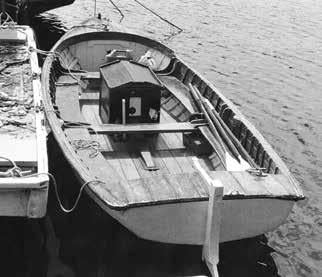


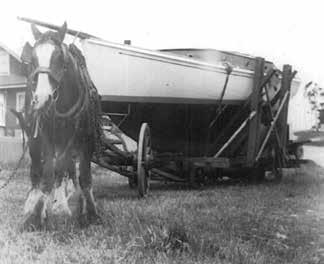


Naming conventions for the canoes follow the material type, ‘ningher’ generally denoting paperbark and ‘tuylini’ stringybark, but the approach to construction is the same. Three to five bundles of bark or reed are lashed together with fibre cord and tapered at the ends so that the bow and stern rise high out of the water. Fire can be carried on a bed of clay and the canoe propelled by a pole, or by a person swimming alongside.
There are many early European depictions of ningher canoes, such as the engraving by French naturalist François Péron held in the ANMM collection. During his 1807 voyage with Captain Nicolas Baudin in the corvette Géographe, Péron identified two canoes in Tasmania laid up on the shore, describing them as ‘made of three rolls of bark, bound together with string, each was equipped with a clay hearth containing a smouldering fire’.
These canoes were used by Palawa communities to journey to offshore islands to hunt food, such as mutton birds and seals. An 1831 account from Aboriginal leader Wurati (Woorrady) notes long and dangerous voyages to islands as far as Eddystone Rock and Pedra Branca, up to 25 kilometres offshore.
Australian Register of Historic Vessels
Their catamarans was large, the size of a whaleboat, carrying seven or eight people, their dogs and spears. The men sit in front and the women behind (as told to colonial official George Augustus Robinson).
The stringybark tuylini canoe at ANMM was made by Sheldon Thomas, from the Bunurong community in southeastern Victoria, who built it in Southport, Tasmania, in 2022. It was made for use in the museum’s exhibition Shaped By the Sea and is now part of the National Maritime Collection. The paperbark ningher canoe at Spring Bay was constructed during an Indigenous boatbuilding workshop held in 2014 at the Museum of Old and New Art (MONA) in Hobart, as part of the Australian Wooden Boat Festival.
Both canoes have been the subject of photogrammetry projects to help digitally preserve the design of the vessels, to be incorporated into future conservation and interpretation initiatives. In July 2022, both vessels were approved to join the ‘exemplary class’ vessel category on the Australian Register of Historic Vessels.
David O’Sullivan, Community Outreach Program Coordinator
This online, national heritage project, devised and coordinated by the Australian National Maritime Museum in association with Sydney Heritage Fleet, reaches across Australia to collect stories about the nation’s existing historic vessels and their designers and builders. Search the complete Australian Register of Historic Vessels at sea.museum/arhv


A special dedication to our immigrants from Kythera
In May, the National Monument to Migration added 879 names to the 32,000-plus existing honourees, including a special panel of 305 new names for migrants from the Greek Island of Kythera. The museum hosted celebrations over two joyous events, which were attended by more than 1,500 guests, writes Kate O’Connell.
TO COMMEMORATE THE CENTENARY of the Kytherian Association of Australia, the museum worked with the Kytherian community to create a dedicated panel honouring those who migrated to Australia from the Greek island of Kythera.
SBS journalist Virginia Langeberg once again hosted the morning event, which included guest speaker, Anyier Yuol, a South Sudanese refugee who grew up in Kenya, and who is the winner of the 2023 SBS Les Murray Award for Refugee Recognition. Speakers from Malaysia, Poland, Lebanon and Greece, and musical performances from Australia’s First Nations, Ireland and Greece, delighted the crowd of family, friends and community members soaking up the welcome winter sunshine.
The afternoon event honouring the Kytherian inscriptions was hosted by Barbara Zantiotis, President of the Kytherian Association of Australia, and included three eminent speakers, whose intergenerational stories brought the migration experience to life. From early milk bars and cake shops, fish-and-chip shops and grocers, to the zenith of Western civilisation’s culture, science and philosophy, the stories revealed the extent of enrichment Kytherian migrants brought to the social and cultural fabric of the ‘lucky country’.
01
02
Peter Poulos with family members. Image Marinco Kojdanovski/ANMM
03
Helen Laliotis, Angelique Laliotis and Faye Psaltis at the Kytherian ceremony of the National Monument to Migration.
Image Nick Bourdaniotis/ Greek City Times
The National Monument to Migration is really a celebration of all who have come to build a life here


Peter Panagioti Magiros, owner and managing director of Frutex Australia
As a young man of 24, I arrived on the shores of Sydney Harbour, on the 25th of August 1964. Sydney was a new and exciting place, far away from peaceful beautiful Drymona, Kythera. I left my family, my home, my new job, my father Spiro Magiros.
I am proud to have been a part of the ‘lucky country’'s great migrant story, perpetuating the values of hard work, tremendous sacrifice and believing in a great dream. The harder you worked, the luckier you got.
I believe that the Kytherian Greek migrants helped to shape the Australian story. Not only for the first generation, but our children for the second generation – from the back of the milk bar, fish-and-chip shops and cafés came the next generation of doctors, lawyers, barristers, businessmen: proud, hard-working Greek–Australians.
Peter Poulos, Poulos Bros Seafood
Greece was left destitute from the Great Depression, by the Second World War, the occupation by the Nazis from 1941 to 1945, followed immediately by the Greek Civil War from 1946 to 1949. Twenty years of the hardest, most difficult times ever experienced by these people led to one of the greatest mass migrations in human history and Australia was one of the greatest beneficiaries of that migration.
Not only did these migrants give up their homes, but also their names – their identities - to strive for a better life. My uncle went to Gympie to work in the banana plantations and cane fields. My father Con arrived in 1952 and disembarked in Sydney, to work in cafes –and he lived in Redfern, in a room covered with soot from the steam trains of the Eveleigh workshops.
Hunger was their motivation. Poverty was their drive. Hope was their dream.
We stand on the shoulders of giants, which is why we can see so far and climb so high.

Kayla Cassimatis, Secretary of the Kytherian Youth Association (KYA)
The story of my grandparents' migration has profoundly influenced my life. Their story has taught me the value of hard work, determination and persistence, and I am immensely proud of the sacrifices they made for our family. They have inspired me to embrace my heritage and never forget my roots.
The National Monument to Migration can be further explored at the museum’s digital hub, Faces of Migration, which shares some of the stories behind the people whose names have been inscribed on the monument, adding new stories each year as it continues to grow.
The museum’s Deputy Director, Michael Baldwin, said in his address:
The monument is really a celebration of all who have come to build a life here, whose journeys to these shores have helped to shape our nation. Their families, hopes and aspirations have contributed to the making of the success story that is multicultural Australia.
The Australian National Maritime Museum hosts and manages the National Monument to Migration. The team wishes to thank and acknowledge the Consul General of Greece in Sydney, Yannis Mallikourtis; representatives from the Consulate of Ireland and the Consulate of Lebanon; Ted Egan AO; George Souris AM; Councillors of the museum and Directors of the Foundation Board; Frutex Australia on behalf of Peter Magiros; Pallion on behalf of the George E Cochineas Family; Poulos Bros Seafood on behalf of the Poulos family; and media supporters SBS, the Greek Herald and the Mytilenian Brotherhood of Sydney & NSW, who continue to help shape the future by honouring our nation’s shared migration stories.
Kate O’Connell is the museum’s former Communications Manager.
For further information go to sea.museum/support/national-monument
contributions
More than 100 million people were forced from their homes in 2022. Museum partner Settlement Services International helps those who come to Australia to find new lives. Hannah Gartrell explains how.
Travelling through Queensland and New South Wales, this arts roadshow was a poignant showcase of works made by artists with refugee experiences. Through live music, a light show, short films, visual artworks and dance, the event celebrated the artists whose stories, perspectives and work contribute to a much richer society. Twelve artists from refugee backgrounds shared their cultural and artistic contributions with more than 200 people across the tour.
REFUGEE WEEK IS A CHANCE to honour the strength of people who have been forced to leave their homes behind to live lives that are safe and free from conflict and persecution. Here we take a look at some of the ways – big and small – this important week was marked in June.
The United Nations High Commission for Refugees (UNHCR) estimates that more than 108 million people were forcibly displaced by violence, conflict and persecution in 2022 – up more than 19 million people on the prior year, making it the largest yearly increase since UNHCR began keeping records.
Museum partner Settlement Services International is Australia’s largest refugee resettlement provider and a key sponsor of Refugee Week, when it brought together refugees and everyday community members for a number of different celebratory and advocacy-focused events across Australia.
Spirit of Welcome Festival
The Spirit of Welcome was a family-friendly cross-cultural art festival that included music, dance, workshops and food. Held in the picturesque Callan Park on the edges of Sydney Harbour, the festival epitomised a communityled event. From workshop facilitators to performers, 90 per cent of festival contributors were from refugee backgrounds – entertaining more than 250 inner-west locals and fellow refugees.
The World Refugee Day Fair took the celebrations to Canberra to showcase the rich skills and contributions of refugees on the lawns of Parliament House.
Hosted in partnership with the Federation of Ethnic Communities Councils, the Settlement Council of Australia and Community Corporate, the fair involved over 20 stall-holders, musical performances and a variety of speakers, including those with refugee experience as well as employers and politicians. It was also a forum for the launch of a new report, The Billion Dollar Benefit, which sets out a roadmap for unlocking the economic potential of refugees and migrants – and inviting all Australians to help refugees and migrants achieve their full career potential. More than 40 organisations – including IKEA Australia and the Diversity Council of Australia – joined forces to back the report and its five barrier-breaking recommendations.
From the big events to the small, every year Refugee Week is an important time to come together to celebrate the contributions of refugees and Australia’s rich history of welcoming those who have come from afar to make Australia home.
We thank all Australians for their support in making refugees feel more welcome, during Refugee Week and beyond!
Hannah Gartrell is the Head of Executive Communications and Media at Settlement Services International.
Refugee Week is an important time to come together to celebrate the contributions of refugees 01 Performers at the World Refugee Day Fair in Canberra. 02 Volunteers support the fun at the Spirit of Welcome Festival. Images courtesy of Settlement Services International


Sea Noises is a poignant reminder of the human stories behind such maritime adventures
As one of the few maritime libraries of international fame, the Vaughan Evans Library in the Australian National Maritime Museum contains many unusual, precious and irreplaceable items. Library coordinator Karen Pymble and curator Dr Roland Leikauf highlight a couple of these unique treasures, some of which were hidden in plain sight.
NAMED FOR THE LIBRARY’S FOUNDING PATRON, Vaughan Evans OAM, who in 1986 donated his personal library to the museum, the Vaughan Evans Library is Australia’s premier research institution of maritime history and culture. Lauded by national and international researchers, and devoted to supporting the staff, members and volunteers of the Australian National Maritime Museum, the library’s collection was recently valued at almost $1,800,000 … and some gems were rediscovered.
The library’s rare first editions – like Thomas Griffith Taylor’s With Scott: The Silver Lining – are indeed treasures. Taylor, an Australian geographer and anthropologist, joined the Terra Nova expedition to the South Pole from 1910 to 1913 to research the impact of Antarctic weather on Australia’s climate.
Thankfully, for him and for history, he did not join the ill-fated attempt to reach the South Pole that spelled doom for Robert Falcon Scott and his team.
Another highlight of the library’s collection is a booklet called Sea Noises, produced for the occasion of the voyage of the cruiser HMAS Canberra in 1933, which drew large crowds in all the cities it visited. The booklet contains a unique collection of ten songs written by and for the crew. Sometimes racy and full of double entendre, the songs offer a unique glimpse into the shared shipboard culture of a journey that otherwise left us with few personal sources. It is a poignant reminder of the human story behind such maritime adventures.
The library welcomes visits (by appointment), research inquiries and suggestions for books to add to the collection. Contact library@sea.museum
01
With Scott: The silver lining by Griffith Taylor, whose account of his travels with Robert Falcon Scott is a colourful report about a legendary, ill-fated expedition. Vaughan Evans Library RARE 998.09041 TAY
02
Sea noises was printed at sea on HMAS Canberra. Song and music are essential tools to survive long sea journeys, and documented examples such as this provide rare insights into the lives of the crew. Vaughan Evans Library 784.686238 JWN
Images Jasmine Poole/ANMM


ALLAN McCULLOCH lived for just 40 years, yet spent 27 of them at the Australian Museum. He collected thousands of its specimens, published and illustrated prolifically, was an accomplished photographer and cinematographer, threw himself into fieldwork and is remembered in the names of numerous Australian species.
A precocious child with an interest in natural history but no formal schooling, Allan Riverstone McCulloch joined the Australian Museum in 1898, a few days before his 13th birthday, as a volunteer cadet. After three years, he was on the payroll. By 17, he had a professional ability with illustration. By 21, he was curator of fishes, a post he held until his death.
Author Brendan Atkins also had a career at the Australian Museum, as editor of its magazine. He frequently encountered McCulloch’s name around the place and even inhabited his former office. His desire to know the man behind the name has resulted in this fine biography that explores both McCulloch’s life and the frequently turbulent early history of the Australian Museum.
The book is arranged thematically rather than chronologically, with an engagingly discursive narrative that pokes into odd corners of museology in the way McCulloch himself did.
Renowned as a top ichthyologist, or fish biologist, he also worked with other natural history collections at the museum and applied his artistic flair to designing many of its exhibitions. He presented popular public lectures, mentored junior colleagues and was always on the lookout for interesting specimens.
McCulloch’s colleagues and associates liked and respected him for his good humour, enthusiasm and can-do attitude. Frank Hurley, whom McCulloch accompanied on a six-month expedition to Papua New Guinea, called him ‘a jovial spirit, a good fellow, and one to whom no work, difficult or easy, is arduous’. McCulloch’s career came towards the end of the age of gentlemen naturalists and collectors, however, and Atkins does not skip over the darker corners of the colonial-era practices then still prevalent, such as collecting specimens using poison and blasting, as well as theft and other acts of deliberate cultural disrespect.
In the last years of his life, McCulloch began to unravel. Professional dissatisfactions and personal disappointments, combined with his workaholic nature, led to several periods of poor physical and mental health. The result was a total breakdown and his eventual decision, in September 1925, to take his own life. One of the museum’s trustees posthumously described McCulloch as ‘a martyr to his own enthusiasm’. Recognition was all that McCulloch ever wanted, Atkins notes, but his dedication to the museum was not always reciprocated, both during his life and for decades after. This meticulously researched and sympathetically written book helps to redress the balance, painting an insightful portrait of a troubled and enigmatic renaissance man.
See Signals 140, ‘Finding Lord Howe’s Nemo’, for an article on Lord Howe Island and the endemic McCulloch’s anemonefish ( Amphiprion mccullochi ), named after McCulloch.
Reviewer Janine Flew is the editor of Signals

The Naturalist: The remarkable life of Allan Riverstone McCulloch By Brendan Atkins, published by NewSouth Publishing, Sydney, 2022. Softcover, 208 pages, illustrations, references, index.
ISBN 9781742237756
RRP $35.00 Vaughan Evans Library 508.0994 ATK

‘The reef that grows jars’
1,000-year-old shipwreck that keeps giving
IN THE NINTH CENTURY CE, a ship from the Indian Ocean, probably built on the shores of the Arabian peninsula or Persia, sank near Belitung island off Sumatra in what are now the waters and Exclusive Economic Zone of the Republic of Indonesia. Its spectacular cargo included gold and silver, lead ingots, strings of bronze coins, bronze mirrors, amber and star anise – and more than 60,000 Chinese Tang Dynasty export ceramics, mostly from the Changsha kilns of China’s Hunan province. We may presume, then, that the ship had voyaged all the way to China, loaded the ceramics and could have been on a return voyage along the maritime silk route. From the wreck’s location, it may also have had some dealings with the mighty Srivijaya empire of nearby Sumatra and Java.
‘More than a thousand years since it was wrecked, [it] continues to cause ripples’, writes author Natali Pearson, a teacher and researcher at the Sydney Southeast Asia Centre at the University of Sydney. ‘This shipwreck and its commercially salvaged cargo have come to represent some of the most contested and controversial terrains in the display of underwater cultural heritage.’
It was one of several ancient shipwrecks discovered in recent decades in Southeast Asia by local fishermen, whose nets sometimes bring up things that they can sell to local antique dealers. The Belitung wreck lay in shallow water on what local fishermen called ‘the reef that grows jars’.
In 1998 the Indonesian government, lacking the expertise and/or inclination to scientifically document the find, engaged a commercial salvager, as it had done with some previous ancient shipwrecks. These deals usually gave Indonesia a share of profits from a public auction of the ancient cargo, while keeping some artefacts for its own museums.
Pearson sums up these complex cross-border affairs:
Ancient ships, and the wrecks they become, travel across generations and geographies. They are not only transnational but pre-national, predating the formation of the very power structures that claim these submerged objects and stories for their own purposes … Belitung with its multiple identities incorporating many cultures, meant it could be used by different nations to tell different stories – not only about the past, but, more crucially, about each nation’s vision of the future.
Pearson notes the strong criticism by archaeology and heritage professionals of Indonesia’s 20th-century treatment of ancient shipwrecks as ‘legalised salvage for profit’, albeit in accordance with the nation’s own laws and regulations. She also highlights positive outcomes of the Belitung case.
In 1999 the commercial salvage company engaged Mike Flecker, a highly experienced Australian freelance maritime archaeologist, to capture as much scientific data as possible during the hurried salvage period.
Tang Dynasty Changsha export ceramics from the shipwreck, with a model of the reconstructed Belitung ship, in the Khoo Teck Puat Gallery of the Asian Civilisations Museum, Singapore. Photograph Jeffrey Mellefont

Belitung: The afterlives of a shipwreck
By Natali Pearson, published by University of Hawai’i Press, 2023. Hardcover, 238 pages, illustrations. ISBN 9780824892944 RRP US$40.80. Vaughan Evans Library 910.4520959819 PEA

More than a thousand years since it was wrecked, the Belitung ship continues to cause ripples
Dr Flecker has published academic papers on the shipwreck, while his record of its surviving structures led to a credible re-creation of this 9th-century trading ship. Designed and supervised by another Australian team, Nick Burningham and Tom Vosmer, Jewel of Muscat was built in and funded by the Sultanate of Oman which sought national prestige by re-enacting a maritime silk route voyage. The ship sailed to Singapore where it became the crown jewel of a new maritime museum.
Crucially, the hugely significant cargo of the Belitung shipwreck was kept largely intact rather than being auctioned off piecemeal. Indonesia was at this time distracted by the fall of the autocratic Soeharto regime and a transition to democracy. Passing up the opportunity of using the collection to highlight its own central historical role in these ancient sea trades, Indonesia allowed the salvage company to find a buyer. China showed interest in acquiring it, realising it could legitimise its modern Belt and Road initiative as a continuation of the ancient maritime silk route.
Ultimately it was the Singapore government that in 2005 paid US$32 million for the 53,277 artefacts of the Tang Shipwreck Collection. Singapore’s agenda – Pearson calls it ‘the $32 million question’ – was to bask in some of the glory of those ancient trades, since the island was geographically a pivot point of the old maritime silk route and of course is a pre-eminent modern sea hub. Parts of the collection were displayed both in Singapore and abroad. In one major collaboration, Singapore co-curated a planned international travelling exhibition with the US Smithsonian Institution, called Shipwrecked: Tang Treasures and Monsoon Winds. Here, though, the artefacts struck another reef.
UNESCO’s Convention on the Protection of Underwater Cultural Heritage of 2001 (postdating the Tang ceramics’ salvage) included ‘a ban on commercial exploitation and a preference for preserving underwater heritage in situ’. In 2011, supporters of these principles pressured the Smithsonian, along with potential participating museums including the Australian National Maritime Museum, not to display the Tang ceramics as this would condone their commercial salvage and sale for profit. Opinions were divided, but in what could be deemed an early episode of cancel culture, the Smithsonian withdrew support for the exhibition. The artefacts have never visited Australia.
Pearson’s detailed research into every facet of this story uncovers a dizzying but entertaining tale of chicanery and self-interest, from ancient storms to buccaneering salvagers and into the equally stormy waters of archaeological orthodoxy and museum ethics in the 21st century. She navigates them confidently and with balance, identifying some significant dilemmas.
Had the Indonesian government not licensed the salvage, the easily accessible cargo would certainly have been pillaged and lost. ‘Commercial salvage was the least destructive option available at the time’, she writes. Both the UNESCO Convention and the International Council of Museums (ICOM) Code of Ethics have ‘exception’ provisions for displaying unethically sourced objects if they offer outstanding contributions to public knowledge. ‘Museums must risk being brave’, Pearson suggests wryly.
This was certainly reinforced when I visited the breathtaking display of the Tang Shipwreck Collection at Singapore’s marvellous Asian Civilisations Museum. This shipwreck has added much to our knowledge of the great oceanic trade routes that for millennia spanned the Old World from Asia to the Mediterranean, their wealth inspiring Europe’s maritime expansion into Asia and the Americas 500 years ago. It would have been a great shame to have missed what these artefacts tell us. Natali Pearson’s book completes the picture.
ReviewerJeffrey Mellefont is an Honorary Research Associate of the museum.

EACH MONTH WE ADD NEW WORKS to our library across a wide range of topics, including naval history, immigration, diverse local cultures, ocean science, river stories, Australian history, school textbooks and titles for kids. We also offer a variety of maritime, genealogical and general research databases. Check our library catalogue, schedule a visit and enjoy our wonderful new books. Visit sea.museum/collections/library
Georgina Banks
Back to Bangka 940.5476092
Ian Brand
Escape from Port Arthur 365.3099464 BRA
Joy Damousi
The humanitarians: Child war refugees and Australian humanitarianism in a transnational world, 1919–1975 305.230869140904 DAM
Janet Dickinson, Historical Society of the Northern Territory
Refugees in our own country: The story of Darwin’s wartime evacuees 940.53159 DIC
Catherine Dyson
Swing by sailor 306.8450941 DYS
RA Fletcher
Steam-ships: The story of their development to the present day 623.8204 FLE
Peter Charles Gibson
Made in Chinatown 684.1 GIB
Philip Goad, Ann Stephen, Andrew McNamara et al Bauhaus diaspora and beyond: Transforming education through art, design and architecture 707.1094 GOA
Bernard AN Green
Spies in Vung Tau, 1915–1920: Photos of Vietnam 959.703 GRE
Lindon Haigh
Riawe – Lady Pam: a remarkable maritime history from 1912 623.820709946 HAI
Brian Hutchison Thorpe’s trainees: History of sailing training in Queensland 797.12409943 HUT
Clive Moore Hard work: Australian South Sea Islander bibliography with a select bibliography on the sugar industry and the Pacific labour trade 305.89950194 MOO
Lin Poyer
The Ngatik massacre: History and identity on a Micronesian atoll 996.5 POY
James Riley
An authentic narrative of the loss of the American brig Commerce , wrecked on the western coast of Africa, in the month of August, 1815 916.1 RIL
V Veedam and CB Wall
Sailing to freedom 910.45 VEE
Edward Wilson-Lee
The catalogue of shipwrecked books: Christopher Columbus, his son, and the quest to build the world’s greatest library 010.92 WIL
ON 22 JULY, STAFF FROM THE MUSEUM attended the commissioning of USS Canberra (LCS-30), the United States Navy’s newest Littoral Combat Ship (LCS). It was a historic event – the first time that an American warship was commissioned in a foreign country. The ceremony was attended by a number of dignitaries, including the Deputy Prime Minister; United States Ambassador to Australia; Australian Ambassador to the United States; United States Secretary of the Navy; United States Chief of Naval Operations; and Australia’s Chief of Navy. This article discusses the lineage of Canberra ’s name and the links it has forged between the American and Australian navies.
The Littoral Combat Ship is a relatively small surface vessel, designed for operations in littoral (near-shore) waters and comparable to corvettes in other navies. It is slightly smaller than the US Navy’s earlier Oliver Hazard Perry-class frigate but larger than a Cyclone-class patrol ship. Designed with the capabilities of a small assault transport, an LCS features a flight deck and hangar for housing two SH-60 or MH-60 Seahawk helicopters, a stern ramp for operating small boats, and the cargo volume and payload to deliver a small assault force with fighting vehicles to a roll-on/roll-off port facility. Its air defence and surface warfare capabilities are less than those of destroyers, emphasising instead speed, agility, stealth, a shallow draft and flexible mission modules.
Two variants of LCS are currently used by the United States Navy: the Freedom-class and Independenceclass. Canberra is the newest example of the latter and utilises an innovative trimaran design that is highly manoeuvrable and enables it to reach a speed of 44 knots (81 kilometres per hour). The vessel was constructed in Mobile, Alabama, by Austal USA, a subsidiary of the Australian shipbuilding firm Austal Ltd.
It was christened on 5 June 2021, accepted into the US Navy on 21 December of that year, and arrived at its homeport of Naval Base San Diego in California on 22 June 2022. As part of a personnel exchange program with the US Navy, a Royal Australian Navy officer will always serve aboard Canberra for the duration of its commission.
LCS-30 is the second American warship named Canberra The first was a Baltimore-class cruiser (CA-70), launched on 19 April 1943 in Quincy, Massachusetts. Originally named USS Pittsburgh, the vessel was rechristened Canberra at the request of President Franklin Roosevelt, who wished to commemorate the loss of the Australian County-class heavy cruiser HMAS Canberra (I) at the Battle of Savo Island on 9 August 1942. Canberra (I) operated as part of a combined Allied force supporting the American landings at Guadalcanal and Tulagi in the Solomon Islands and was attacked and sunk during a surprise night-time attack by a large force of Japanese cruisers. The first USS Canberra was sponsored by Lady Alice Dixon, the wife of Sir Owen Dixon, Australia’s then-ambassador to the United States and was the first American warship named for a foreign capital. In a reciprocal tribute, the Australian government named its newest Tribal-class destroyer, HMAS Bataan, in honour of the courageous stand by American troops during the Battle of Bataan in early 1942.
USS Canberra served with distinction during the Second World War, participating in the Pacific theatre in such places as Eniwetok, Palau, Chuuk, Wake and the Mariana Islands. Towards the end of 1944, it supported operations against Okinawa and Formosa (modern-day Taiwan), during which it was struck by an aerial torpedo. The resulting explosion tore a massive hole in Canberra ’s side and killed 23 crewmen, but did not sink the ship. The war ended while Canberra was undergoing repairs in Boston, and in late 1945 it returned to the American west coast, where it was placed in reserve two years later.
Canberra was converted into a Boston-class guided missile heavy cruiser, reclassified CAG-2, and recommissioned into the US Navy on 15 June 1956. Two years later, it was designated a ceremonial flagship to transport the remains of unknown servicemen to the United States for interment at the ‘Tomb of the Unknowns’ at Arlington National Cemetery. In 1960, the vessel conducted a goodwill cruise around the world, and stopped at Iron Bottom Sound in the Solomon Islands, where its crew paid homage to HMAS Canberra (I). In the autumn of 1962, CAG-2 participated in the naval blockade of Cuba during the Cuban Missile Crisis. It joined the US Pacific Fleet the following year and made five deployments to Vietnam between 1965 and 1969. At the conclusion of its second tour of duty to Vietnam in April 1967, the cruiser visited Melbourne and was in Australian waters the following month for 25th anniversary commemorations of the Battle of the Coral Sea.
Canberra was decommissioned on 2 February 1970, stricken from the Navy List on 27 April 1978, and sold for scrap in April 1980. Only two items survived disposal: a propeller that was put on display at the Los Angeles Maritime Museum, and the ship’s bell, which was placed in storage. Although American legislation prevents other nations from possessing US Navy artefacts, Canberra ’s bell was an exception, and was presented to Prime Minister John Howard by President George W Bush to commemorate the 50th anniversary of the ANZUS Treaty. It was loaned to the Australian National Maritime Museum in 2001 and has been exhibited here ever since (see Signals 83). At the recent commissioning ceremony for LCS-30, the bell had pride of place in front of the dais and stood as tribute to the ongoing partnership between the American and Australian navies.
Author Dr James Hunter is the museum’s Curator of Naval Heritage and Archaeology.
This was the first time that an American warship was commissioned in a foreign country
01
Left to right: Dr Catie Gilchrist (Exhibitions Research Officer, Anzac Memorial Hyde Park), Dr Peter Hobbins (Head of Content, ANMM) and Dr James Hunter (Curator of Naval Heritage and Archaeology, ANMM) stand in front of the first USS Canberra ’s bell prior to the commissioning ceremony for the new USS Canberra (LCS-30). Image James Hunter
02
USS Canberra (LCS-30) approaches Fleet Base East at Sydney’s Garden Island before being commissioned on 22 July 2023. Image POIS Peter Thompson/Royal Australian Navy


Vale Sir James Hardy OBE
(20 November 1932–14 June 2023)

WHEN 90-YEAR-OLD SIR JAMES HARDY died peacefully in Adelaide in June, Australia and the world lost one of our best-known and most distinguished sporting figures.
The following lines from Alfred, Lord Tennyson’s poem ‘Ulysses’ were among the favourites of the many reams of stirring poetry often quoted by Sir James Hardy to inspire, to rally or simply to amuse his race-weary crews as they pushed themselves and their ocean-racing boats:
That which we are, we are;
One equal temper of heroic hearts, Made weak by time and fate, but strong in will To strive, to seek, to find, and not to yield.
Tennyson’s words might have been composed for Sir James himself, the gentleman-seafarer who, in the course of his long and distinguished life, came to epitomise the very essence of the quest for on-water excellence. Hardy was, without doubt, our most successful racing helmsman and I am proud to have cherished Jim as a dear friend and shipmate for 56 years – a time in which, despite his international acclaim, he never once assumed even so much as a hint of high-handedness or conceit. Softly-spoken, humble and unfailingly courteous, Sir James Gilbert Hardy was that rarity: a gentle man.
We came to know each other under literally painful circumstances, racing aboard the classic 12-Metre class yacht, Vim, the trial-horse for Sir Frank Packer’s second potential America’s Cup challenger, the re-vamped Gretel, back in 1967. I was on the foredeck while Jim trimmed the mainsheet. Setting a spinnaker in a black nor’-easter on Sydney Harbour, I was able to secure only one turn around the halyard winch before a sudden, powerful gust filled the kite halfway up the 30-metre mast and lifted me well clear of the deck. Bravely, Jim seized the flailing tail of the halyard as the spinnaker ballooned out to leeward and went overboard like a giant sea-anchor. We both ended up with severe rope burns seared into our palms. No amount of burn cream could ease the pain, but Jim’s calm ‘she’ll be right, mate’ stoicism was just what I needed to help me regain my composure. When our skipper Gordon Ingate bellowed, ‘Are you blokes alright?’ Jim replied, ‘Good as gold’. There was no room for self-pity. We quickly bandaged each other’s hands, climbed back on deck and went on with it.
Jim was proud that his family’s distinguished seafaring roots go back to Sir Thomas Masterman Hardy, the captain of Admiral Lord Nelson’s flagship, HMS Victory, at the decisive Battle of Trafalgar in October 1805.
The Hardy family emigrated from Devon in 1850 and were among the earliest settlers in the newly emerging colony of South Australia, where they established successful vineyards that survive to this day. One of four children born to Tom Mayfield Hardy and his wife Eileen, Jim grew up at Seacliff on the coast of the Gulf of St Vincent near Adelaide. He was only six when his father was killed in an aeroplane crash in October 1938, and he was raised by his mother and his aunt Madeline. The women ensured that he was brought up as a gentleman: polite, well-spoken, well-mannered and always considerate of others – traits that were to set him apart and become the hallmarks of his life. Whenever he was asked about his courtly, old-fashioned manners, Jim’s response was always to smile benignly and say: ‘Well, it’s a poor family that can’t afford at least one gentleman.’
Jim attended St Peter’s College in Adelaide but it was at Seacliff that he became passionately keen on sailing. Working in local market gardens after school and at weekends, he earned the money to build his first racing boat, a 12-foot (3.6-metre) Cadet dinghy he named Nocroo, and he never looked back.
Jim was Australian champion in the 12-square-metre Sharpie class in 1959 and the Flying Dutchman class in 1964. He represented Australia in two Olympic Games, first as a reserve for the Tokyo games in 1964 and then at the Mexico City Olympics in 1968, where he finished seventh in the 5.5-metre class. In between, in 1966 he won the 505-class World Championships in Adelaide, a victory in which he defeated Paul Elvstrøm, the multiple-medallist renowned throughout the sailing world as ‘the Great Dane’. He then embarked on a 13-year association with the America’s Cup, in which he skippered three challengers –Sir Frank Packer’s Gretel II in 1970, Alan Bond’s Southern Cross in 1974 and Australia in 1980. He competed in four Admiral’s Cups, the infamous 1979 Fastnet race in which 15 sailors died and five yachts were lost, and 13 Sydney–Hobart races.
Jim’s vast experience was essential to the eventual success of designer Ben Lexcen’s breakthrough boat, the winged-keel Australia II, in 1983. After initially joining the crew as reserve helmsman, Jim stepped up to take the helm after skipper John Bertrand suffered a pinched nerve in his neck. Jim sailed faultlessly to score a phenomenal 10 wins from 11 races in the international challenge elimination series, securing Australia II her place in the historic final against the New York Yacht Club’s defender, Liberty. No one needs reminding that Australia II went on to win the America’s Cup by taking that heart-stopping best-of-seven series, four races to three.
Jim continued to compete in major offshore races, mainly in his own yachts Nyamba and Police Car, but also sailing as helmsman for other owners in local and international events. When he convinced Hardy’s Wines to buy and restore his father’s 1933 classic gaff cutter Nerida, Jim described her re-launch as one of the greatest moments in his life.
Jim Hardy was awarded an OBE in 1973 and was knighted by Queen Elizabeth II in 1981 for services to yachting and the community. He was made Australian Yachtsman of the Year in the same year. In 1994 he was inducted into the America’s Cup Hall of Fame and in 2000 he was awarded the Australian Sports Medal. In 2017 he was an inaugural inductee to the Australian Sailing Hall of Fame, and was a founding member of the museum’s Council from December 1997 to December 1999.
Jim is survived by his wife, Lady Joan Hardy, sister Pamela, and sons, David and Richard.
Author Bruce Stannard is a journalist and member of the museum’s inaugural Council.
JOHN FERGUSON, who died in June, was a born publisher. His great-grandfather George Robertson founded Angus & Robertson, and members of every generation since have played leading roles in connection with Australian books. But John had another lifelong commitment: to boats and ships – particularly if they were made of wood and had sails.
Beginning with a dinghy kit when he was 12, he usually owned or shared some boat or other. Favourites included the Huon pine Stor Dragon, a 1912-built gentleman’s day boat from Perth, and the ‘bird boat’ he restored after moving to San Francisco in 2000 with his wife and daughters. Wherever John lived, the wind and waters called. In England he went to Greenwich, and obtained complete plans of Flinders’ Investigator, which later enabled him to build an exquisite scale model. He taught sailing with Sydney’s Pacific Sailing School. In San Francisco he worked at Myron Spaulding’s old boatyard.
John Ferguson’s career combined striking high points – such as taking Australian books and publishing into Europe, Britain and Asia – but also low points, one of which was a hostile takeover in 1973, which squeezed him
out of Angus & Robertson, another being the winding up of John Ferguson Pty Ltd after the recession of the late 1980s. But everywhere he worked, John established a pattern of publishing books on nautical history, ships and boats. Among the many authors he championed were Matthew Flinders, published by Halstead Press; Rob Mundle, by HarperCollins; and Antonia MacArthur, by the Australian National Maritime Museum. A fan and occasional publisher of nautical art, he befriended artists including Dennis Adams and Oswald Brett.
There were publishers last century who would knock off early on the odd afternoon and go with staff or colleagues to the golf course. Working with John Ferguson offered brighter prospects – on Sydney Harbour. With a good breeze, John’s antique vessel would take an early lead in races … and quickly lose it coming home. One vessel we sailed together was the Endeavour replica’s three-masted pinnace, left in his care in Sydney during the ship’s Atlantic voyage. We learnt why Captain Cook liked to take a large shore party: pinnaces surely rowed better with plenty of sailors sharing the oars than a few grumpy book editors, who were propelled towards the clubhouse more by thirst than stamina.
Wise of Pacific Sailing School.
02
In the 1970s John Ferguson and his sons lived in The Rocks, where he also had his publishing office. This was taken there in 1979.
courtesy Ferguson family collection

John had a mystical faith in his ‘instinct’, but a combination of effrontery and good luck counterbalanced every misfortune

John crewed on the Endeavour replica on its 1993 trials in the Indian Ocean. In reminiscences written for his friend Tas Bull (former chief of the Waterside Workers’ Federation) he recalled some of that experience: Suddenly some quarter mile off the port bow a whale surfaced and blew; then another and another. We had fallen in with a pod of about forty humpbacks . . . as the sun came up two of these magnificent creatures came to inspect the ship. They lay alongside and we could look them in the eye from the quarterdeck. They dived under and swam around us for nearly an hour.
When the ship encountered a submarine near the Abrolhos Islands, Endeavour ’s gunner answered with one of his four-pounders, armed with rubbish and old oranges. ‘With a very satisfying explosion we shot a great deal of scraps in the direction of Her Majesty’s Australian submarine [and] some wag appeared on her conning tower waving a white sheet.’
Endeavour held its fascination for John, and in his book Sailing Endeavour, with Ron McCleod’s photographs, he explains the operations and rig of the prototype and replica of Endeavour
Recordings of nine hours of interviews of John Ferguson by Neil James are held by the State Library of New South Wales, in the Angus & Robertson Oral History Collection. 02
Mystical faith in his ‘instinct’ sometimes led John up the garden path, but a legendary combination of effrontery and good luck counterbalanced every misfortune. When parking spots in easy reach were all taken, he’d drive straight to the front door. Normally, someone parked nearby would drive off as he arrived. In another example of his ingenuity, the most exclusive yacht club on the US west coast had rather more noughts to its entry fee than his budget allowed, so he joined by building them a model of the antique boat which was the pride of their fleet. After returning to Australia in 2016 he went on into his 80s building and restoring models.
John is survived by his wife Ginny, children Anthony, Peter, Kathryn and Nell, seven grandchildren and eight great-grandchildren.
Author Matthew Richardson is publisher at Halstead Press.
The Australian National Maritime Museum acknowledges the support provided to the museum by all our volunteers, members, sponsors, donors and friends.
The museum particularly acknowledges the following people who have made a significant contribution to the museum in an enduring way or who have made or facilitated significant benefaction to it.
Honorary Fellows
Peter Dexter AM
John Mullen AM
Valerie Taylor AM
Ambassadors
Norman Banham
Christine Sadler
Dr David and Jennie Sutherland
Major Donors
The Sid Faithfull and Christine Sadler
Acquisition Program
David & Jennie Sutherland Foundation
Honorary Research Associates
Rear Admiral Peter Briggs AO
John Dikkenberg
Dr Nigel Erskine
Dr Ian MacLeod
Jeffrey Mellefont
David Payne
Lindsey Shaw
Major Benefactors
Margaret Cusack
Basil Jenkins
Dr Keith Jones
RADM Andrew Robertson AO DSC RN
Geoff and Beryl Winter
Honorary Life Members
Yvonne Abadee
Dr Kathy Abbass
Robert Albert AO RFD RD
Bob Allan
Vivian Balmer
Vice Admiral Tim Barrett AO CSC
Lyndyl Beard
Maria Bentley
Mark Bethwaite AM
Paul Binsted
David Blackley
Marcus Blackmore AM
John Blanchfield
Alexander Books
Ian Bowie
Colin Boyd
Ron Brown OAM
Paul Bruce
Anthony Buckley AM
Richard Bunting
Capt Richard Burgess AM
Kevin Byrne
Sue Calwell
RADM David Campbell AM
Marion Carter
Victor Chiang
Robert Clifford AO
Helen Clift
Hon Peter Collins AM QC
Kay Cottee AO
Vice Admiral Russell Crane AO CSM
Stephen Crane
John Cunneen
Laurie Dilks
Dr Nigel Erskine
John Farrell
Dr Kevin Fewster CBE AM FRSA
Bernard Flack
Daina Fletcher
Sally Fletcher
Teresia Fors
CDR Geoff Geraghty AM
John Gibbins
Anthony Gibbs
RADM Stephen Gilmore AM CSC RAN
Paul Gorrick
Lee Graham
Macklan Gridley
VADM Mark Hammond AM
RADM Simon Harrington AM
Jane Harris
Christopher Harry
Gaye Hart AM
Janita Hercus
Robyn Holt
William Hopkins OAM
Julia Horne
Kieran Hosty
RADM Tony Hunt AO
Marilyn Jenner
John Jeremy AM
Vice Admiral Peter Jones AO DSC
Hon Dr Tricia Kavanagh
John Keelty
Richard Keyes
Kris Klugman OAM
Judy Lee
Matt Lee
David Leigh
Keith Leleu OAM
Andrew Lishmund
James Litten
Hugo Llorens
Tim Lloyd Ian Mackinder
Stephen Martin
Will Mather
Stuart Mayer
Bruce McDonald AM
Lyn McHale
VADM Jonathan Mead AO
Rob Mundle OAM
Alwyn Murray
Martin Nakata
David O’Connor
Gary Paquet
David Payne
Prof John Penrose AM
Neville Perry
Hon Justice Anthe Philippides
Peter Pigott AM
Len Price
Eda Ritchie AM
John Rothwell AO
Peter Rout
Kay Saunders AM
Kevin Scarce AC CSC RAN
David Scott-Smith
Sergio Sergi
Ann Sherry AO
Ken Sherwell
Shane Simpson AM
Peter John Sinclair AM CSC
Peter R Sinclair AC KStJ (RADM)
John Singleton AM
Brian Skingsley
Eva Skira AM
Bruce Stannard AM
J J Stephens OAM
Michael Stevens
Neville Stevens AO
Frank Talbot AM
Mitchell Turner
Adam Watson
Ian Watt AC
Jeanette Wheildon
Hon Margaret White AO
Mary-Louise Williams AM
Nerolie Withnall
Cecilia Woolford (née Caffrey)

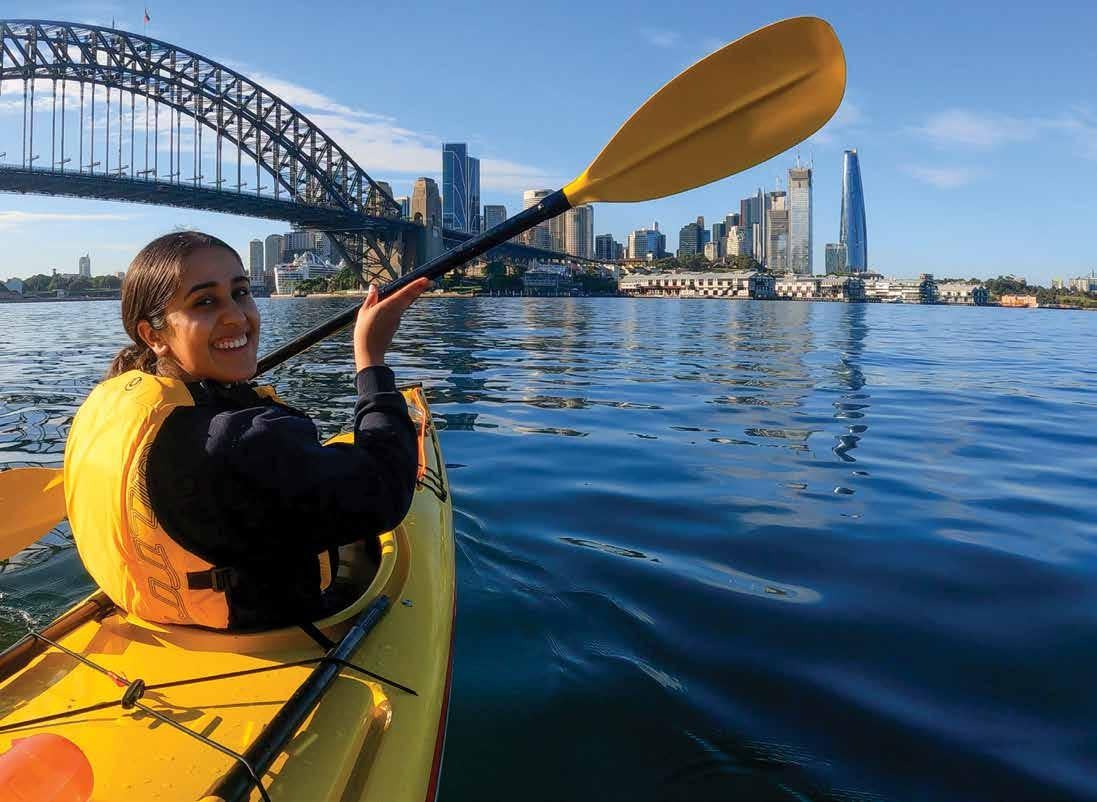
Signals
ISSN 1033-4688
Guest editor Randi Svensen
Staff photographer Jasmine Poole
Design & production Austen Kaupe
Printed in Australia by Pegasus Media & Logistics
Material from Signals may be reproduced, but only with the editor’s permission.
Editorial and advertising enquiries signals@sea.museum
Not a museum member?
Receive Signals via iSubscribe: www.isubscribe.com.au
Signals back issues
Back issues $4 each or 10 for $30
Extra copies of current issue $4.95
Email theshop@sea.museum
Search all issues at sea.museum/signals
Australian National Maritime Museum
2 Murray Street Sydney NSW 2000 Australia. Phone 02 9298 3777
Our opening hours are 10 am–4 pm.
The Australian National Maritime Museum is a statutory authority of the Australian Government
ANMM Council
Chairman Mr John Mullen AM
Ms Daryl Karp AM
Councillors
Hon Ian Campbell
Hon Justice SC Derrington AM
Ms Gisele Kapterian
Mr John Longley AM
Mr Nyunggai Warren Mundine AO
Ms Alison Page
Ms Judy Potter
RADM Christopher Smith, AM, CSM, RAN
Ms Arlene Tansey
Australian National Maritime Museum Foundation Board
Mr Daniel Janes, Chairman
Mr John Mullen AM, ex officio Chair
Ms Daryl Karp AM, ex officio
Mr Simon Chan
Mr Peter Dexter AM
Mr David Mathlin
Dr Jeanne-Claude Strong
Ms Arlene Tansey
American Friends of the Australian National Maritime Museum
Mr Robert Moore II
Mr John Mullen AM
Ms Daryl Karp AM
Foundation sponsor ANZ
Explore Australia’s stories of the sea by becoming a museum member. Options for individuals, families and people who live interstate or overseas offer a great range of benefits, such as unlimited entry to our museum, vessels and exhibitions, as well as special discounts.
Visit sea.museum/members
Signals is printed in Australia on Sovereign Silk 250 gsm (cover) and Sovereign Silk 113 gsm (text) using vegetablebased inks.






Major sponsors
Commonwealth Superannuation Corporation
Port Authority of New South Wales
Sponsors
Australian Maritime Museums Council
Lloyd’s Register
Maritime Union of Australia
Nova Systems
Schmidt Ocean Institute
Smit Lamnalco
The Glen Grant
Supporters Australian Government Frutex
Mytilenian Brotherhood of NSW
Pallion
Poulos Bros
Royal Wolf
SBS
Settlement Services International Silentworld Foundation
@seamuseum_ /sea.museum
#seamuseum/ sea.museum/blog


Get ready for spring with our great selection of sun protection gear and products.
Why aren’t men wearing SPF?
Skin cancer rates among young men are rising –however, sunscreen use is not. We encourage men and boys to introduce sunscreen into their daily lives to build healthier habits. We’ve got sunscreen, zinc and lip balm for you and the men in your life.
RRP $19.95–$32.95 | Members $17.95–$29.95
Quality sun-protecting fashion
Our hats from Rigon Headwear are made in Australia and continue to deliver bestselling styles for the whole family. They’re travel friendly, lightweight and durable, and maintain both their shape and brims for great protection from the Aussie sun. Choose from our stylish hats or baseball caps.
RRP $39.95–$99.95 | Members $35.95–$89.95.
The power of vitamin C
Spring is here! Which means giving our skin some extra TLC to ensure a healthy and radiant complexion. Kakadu plum extract is high in vitamin C, a powerful ingredient for skin care. Try our Kakadu Plum Body Milk and Lip Balm.
RRP $19.95–$32.95 | Members $17.95–$29.95

Open 7 days a week
Email us at theshop@sea.museum Shop online sea.museum/shop
Follow us on Instagram instagram.com/seamuseum_shop

