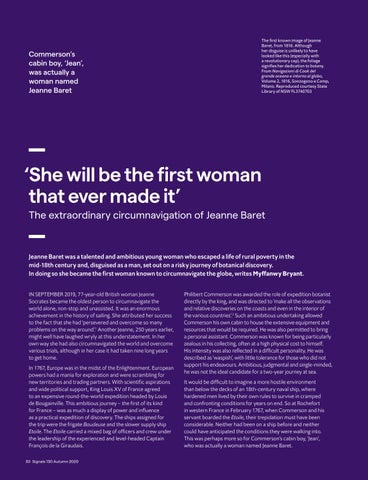
Commerson’s cabin boy, ‘Jean’, was actually a woman named Jeanne Baret
The first known image of Jeanne Baret, from 1816. Although her disguise is unlikely to have looked like this (especially with a revolutionary cap), the foliage signifies her dedication to botany. From Navigazioni di Cook del grande oceano e intorno al globo, Volume 2, 1816, Sonzogono e Comp, Milano. Reproduced courtesy State Library of NSW FL3740703
‘She will be the first woman that ever made it’ The extraordinary circumnavigation of Jeanne Baret
Jeanne Baret was a talented and ambitious young woman who escaped a life of rural poverty in the mid-18th century and, disguised as a man, set out on a risky journey of botanical discovery. In doing so she became the first woman known to circumnavigate the globe, writes Myffanwy Bryant. IN SEPTEMBER 2019, 77-year-old British woman Jeanne Socrates became the oldest person to circumnavigate the world alone, non-stop and unassisted. It was an enormous achievement in the history of sailing. She attributed her success to the fact that she had ‘persevered and overcome so many problems on the way around’.1 Another Jeanne, 250 years earlier, might well have laughed wryly at this understatement. In her own way she had also circumnavigated the world and overcome various trials, although in her case it had taken nine long years to get home. In 1767, Europe was in the midst of the Enlightenment. European powers had a mania for exploration and were scrambling for new territories and trading partners. With scientific aspirations and wide political support, King Louis XV of France agreed to an expensive round-the-world expedition headed by Louis de Bougainville. This ambitious journey – the first of its kind for France – was as much a display of power and influence as a practical expedition of discovery. The ships assigned for the trip were the frigate Boudeuse and the slower supply ship Etoile. The Etoile carried a mixed bag of officers and crew under the leadership of the experienced and level-headed Captain François de la Giraudais. 30 Signals 130 Autumn 2020
Philibert Commerson was awarded the role of expedition botanist directly by the king, and was directed to ‘make all the observations and relative discoveries on the coasts and even in the interior of the various countries’.2 Such an ambitious undertaking allowed Commerson his own cabin to house the extensive equipment and resources that would be required. He was also permitted to bring a personal assistant. Commerson was known for being particularly zealous in his collecting, often at a high physical cost to himself. His intensity was also reflected in a difficult personality. He was described as ‘waspish’, with little tolerance for those who did not support his endeavours. Ambitious, judgmental and single-minded, he was not the ideal candidate for a two-year journey at sea. It would be difficult to imagine a more hostile environment than below the decks of an 18th-century naval ship, where hardened men lived by their own rules to survive in cramped and confronting conditions for years on end. So at Rochefort in western France in February 1767, when Commerson and his servant boarded the Etoile, their trepidation must have been considerable. Neither had been on a ship before and neither could have anticipated the conditions they were walking into. This was perhaps more so for Commerson’s cabin boy, ‘Jean’, who was actually a woman named Jeanne Baret.