02
Bound for South Australian South Australia’s oldest known shipwreck found ‘A very heavy gale with a tremendous sea’
Nearly 200 years after its loss, the barque South Australian was relocated by a research consortium that included the museum’s maritime archaeology team. Dr James Hunter and Kieran Hosty share the story of South Australia’s oldest recorded European shipwreck, and the effort to find, document and preserve it.
01
SHORTLY AFTER 5 AM ON 8 DECEMBER 1837, Captain J B T MacFarlane peered into the grey dawn with a growing sense of dread. From the weather deck of the barque South Australian, he could just make out the lee shore of Rosetta Harbour, a short distance to the north and west. Located along the southern coast of the Fleurieu Peninsula in the fledgling colony of South Australia, Rosetta Harbour was the anchorage for three shore-based whaling stations and the watercraft that supplied and supported them. South Australian was one such vessel, and had been moored in the harbour for about a week as its crew prepared to load the whaling stations’ takings for the season. The harbour was suitable when seas and winds were calm, but completely open to the south and southeast, and susceptible to the worst weather the Southern Ocean could throw at it.
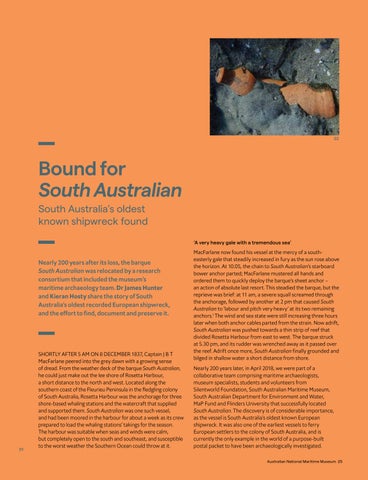
MacFarlane now found his vessel at the mercy of a southeasterly gale that steadily increased in fury as the sun rose above the horizon. At 10.05, the chain to South Australian’s starboard bower anchor parted; MacFarlane mustered all hands and ordered them to quickly deploy the barque’s sheet anchor – an action of absolute last resort. This steadied the barque, but the reprieve was brief: at 11 am, a severe squall screamed through the anchorage, followed by another at 2 pm that caused South Australian to ‘labour and pitch very heavy’ at its two remaining anchors.1 The wind and sea state were still increasing three hours later when both anchor cables parted from the strain. Now adrift, South Australian was pushed towards a thin strip of reef that divided Rosetta Harbour from east to west. The barque struck at 5.30 pm, and its rudder was wrenched away as it passed over the reef. Adrift once more, South Australian finally grounded and bilged in shallow water a short distance from shore. Nearly 200 years later, in April 2018, we were part of a collaborative team comprising maritime archaeologists, museum specialists, students and volunteers from Silentworld Foundation, South Australian Maritime Museum, South Australian Department for Environment and Water, MaP Fund and Flinders University that successfully located South Australian. The discovery is of considerable importance, as the vessel is South Australia’s oldest known European shipwreck. It was also one of the earliest vessels to ferry European settlers to the colony of South Australia, and is currently the only example in the world of a purpose-built postal packet to have been archaeologically investigated. Australian National Maritime Museum 25