
Consignors
STARBRIGHTSHORTHORNS
Rena Nelson
Box 7846, Bonnyville, AB T9N 2J2
Cell: 780-201-2785


Email: nelson.ericrena@gmail.com
CROOKEDPOSTSHORTHORNS
Kirk Seaborn
Box 8, Site 11, RR #3
Rocky Mountain House, AB T4T 2A3
Phone: 403-729-2267 Cell: 403-322-0142
Email: crookedpostshorthorns@hotmail.com
Facebook: Crooked Post Shorthorn


SHAROMSHORTHORNS
Tom & Shari Barto & Family




Box 1001, Thorhild, AB T0A 3J0
Phone: 780-398-2093 Cell: 780-307-4043
Email: tsbarto@mcsnet.ca
Web: sharomshorthorns.com
POPLARCREEKFARM
Sean & Michelle Thompson

Box 642, Cremona, AB T0M 0R0
Phone: 403-681-8316
Email: seancthompson811@gmail.com
Web: poplarcreekfarm.ca
JANELLSHORTHORNS

Melanie Barkley & Michelle Duncan
Box 1473, Stettler, AB T0C 2L0

Phone: 403-740-4958
Email: mel.barkley@yahoo.com
PAINTEARTHSHORTHORNS
• Albert & Susan Oram

Box 939, Castor, AB T0C 0X0
Phone: 403-882-2253
Email: a_soram@telus.net

• Chad Oram
Box 33, Meeting Creek, AB T0B 2Z0
Phone: 780-781-9747
Email: paintearthshorthorns@gmail.com
Tom & Sharon Seaborn
Rena Nelson & Family
Tom, Shari, Evan, Amber & Eric Barto
The Thompson Family
The Oram Family
Kirk & Brandie Seaborn
Melanie Barkley & Family
UPDATES ON FACEBOOK Western Prime Shorthorn Bull & Female Sale
Tanner & Michelle Duncan & Family
PM
Featuring Top Canadian Genetics
• 2 Year Old Bulls
• Yearling Bulls
• Shorthorn Influenced Open Replacement Heifers

All bulls will be semen tested prior to the sale
SALE LOTS AVAILABLE FOR VIEWING ON FRIDAY & SATURDAY MORNING AT VJV WESTLOCK
SALEDAYPHONES
Kirk Seaborn403-322-0142
Tom Barto780-307-4043
Rena Nelson780-201-2785
Bob Scott780-689-9203
Travis Sekura780-621-6841
Darcy Sheets780-336-6485
SALELOCATION
VOLD,JONES&VOLDAUCTIONCO.LTD.WESTLOCK


9004-110th Street, Westlock, AB T7P 2N4
Western Prime Rep: Bob Scott 780-689-9203
Operations Manager: Craig Jacklin 403-783-1453
ONLINE BIDDING: VJVAUCTION.COM
SALESTAFF
Darcy Sheets, Auctioneer780-336-6485
Bob Scott 780-689-9203
Travis Sekura 780-621-6841
ACCOMMODATIONS
Westlock Wyndham Ramada Phone: 780-349-2245
11311 100 St., Westlock, AB T7P 2R8
Westlock Inn and Convention Centre Phone: 780-349-4483
10411 100 St., Westlock, AB T7P 2G7
INSURANCE
Canadian Farm Insurance Corp. Suite 205, 101 Riel Drive, St. Albert, AB T8N 3X4

Tel: 1-780-447-3276 Fax: 780-733-7724
info@cdnfarmins.com

General Information
TERMS OF SALE: Are cash or cheques at par, payable to the clerks of the Sale on sale day. US funds will be accepted at the current rate of exchange. No release will be given until satisfactory settlement has been made. Full payment shall constitute a final sale and then registration papers will be transferred.
HEALTH: All Sale cattle meet Canadian Health standards. Foreign buyers are responsible for knowing the current Health standards of their country.
GUARANTEE: All Sale cattle are guaranteed under the terms and conditions of Sale as recommended by the Canadian Shorthorn Association.
PHONE BIDS: If you are unable to attend the Sale, but wish to make a purchase, please feel free to contact any of the sale staff or consignors and your order will be handled in a professional manner.
INSURANCE: Ownership commences to the purchaser as soon as the animal is sold. Insurance agents will be present sale day to look after your insurance requirements. Although every precaution will be taken to protect the safety and comfort of the buyers neither VJV nor the consignors assume any responsibility in these matters and disclaims any liability, legal or otherwise, in the event of an accident or loss of property.
COFFEE&DONUTSSUPPLIEDBY WESTERNPRIMECONSIGNORS
The Loft Restaurant on site - cash only
PAGE 1 Saturday APRIL1
2023
1
MDT Vold, Jones & Vold Auction Co. Ltd. Westlock, Alberta, Canada
Welcome to the 5th Annual Western Prime Shorthorn Bull and Female Sale! We are celebrating a 5th anniversary and would like to extend our thanks and appreciation to all previous buyers, bidders and consignors. Success does not stand alone and we appreciate those who have put their confidence and trust in our programs as well as the Shorthorn genetic influence. Benefits of using Shorthorn bulls is gaining momentum as many first time customers have begun to cross Shorthorn bulls on their commercial cows and are very impressed with the outcomes. Vigorous calves at birth, better gains on their steers, valued carcass traits, docility and highly maternal replacement females who go on to be outstanding mama cows are a few of the highlight markers a Shorthorn bull can bring into your program. Consignors to the Western Prime Sale are dedicated to breed excellence and promotion. You can be confident they are continually improving on genetics, and are willing to stand behind their programs and cattle. Years of dedicated breeding and culling produces the quality bulls you will find on offer here.

In the offering this year are yearling and 2 year old sire prospects. Whether you are seeking a calving ease heifer bull or a powerful performance based cow herd prospect, the consignors are dedicated to meet your needs. As well, we have on offer Shorthorn influence open heifers. These females are hard to find and everyone knows the benefit of a Shorthorn mama cow. If you don’t, here is an opportunity to find out for yourself. These heifers will be vet checked and ready for your breeding program. These commercial females are an excellent opportunity to showcase Shorthorn influence genetics. Come on out on sale day and enjoy coffee and donuts, meet the breeders and see the bulls for yourself. They will have changed significantly from picture day in January to April sale date. They say a picture is worth a thousand words but when it comes to bull shopping, a personal visual is always best! We look forward to meeting new guests and visiting with old friends. See you on sale day!
Sincerely
The Western Prime Sale Group


BIRTH WEIGHT & CALVING EASE
University studies in Wyoming and data from Montana and Colorado lend credence to the following conclusions:
1.The birth weight Itself Influences calving ease by 65%.
2.The female has 60-70% influence on birth weight of her calf.
3.The bull has 30-40% Influence on birth weight of his progeny.
4.Pelvic measurement and angle as well as the shape of the calf have 35-40% influence on calving ease.
5.Length of gestation greatly affects birth weight. A fetus can gain over one pound per day In the last days of gestation.
6.Weather and temperature the last 30 days affect the length of gestation.


7.Size and maturity of the cow Influence calving ease.
Most commercial producers do not take birth weights. Guessing is as inaccurate as driving with a broken speedometer - what's thought to be 55 mph may In fact be 65 or 70 mph, and what's thought to be 70-80 lb. may actually be 80-90 lb.
Remember, everything Is relevant. Increased growth, frame and performance will increase BW. A longer-bodied calf will weigh more. If a calf is expected to have genetics for growth, it will display this prior to birth as well as after. As a rule of thumb, It takes a calf weighing 85 lb. at birth to finish at 1200-1250 lb. A cow should easily give birth to a calf weighing 8% of her own body weight. Thus a 1200 lb. cow should give birth to a 96 lb. calf with ease.
Continued selection for light birth weights will ultimately reduce the mature sizes and performance of your cattle.
PAGE 2 Welcome to the Sale Western Prime
UPDATES ON FACEBOOK Western Prime Shorthorn Bull & Female Sale
Expected Progeny Differences
CANADIAN SHORTHORN EPDs
Expected progeny differences (EPDs) are a very important tool used in genetic selection. EPDs are used to compare the differences in predicted performance of animals’ offspring for specific traits.
Calculation of EPDs is driven by pedigree, progeny, and individual performance data. The American Shorthorn Association offers 12 different EPDs for specific traits. Additionally, ASA provides three economic ($ Value) indexes, providing a single value for the selection of breeding stock that optimizes selection on a number of traits that define profit in a particular production scenario.

Definitions for traits found in this catalog are:

Calving Ease Direct(CED): The most important EPD in sire selection for use on heifers. This value is expressed as a percent of unassisted births; the more positive a number is the more desirable.
Birth Weight(BW): An indicator of birth weight and calving ease. Larger BW EPDs typically, but not always indicate more calving difficulty.
Weaning Weight(WW) : Weaning weight measures the differences in weight of calves at weaning, and is also reported in pounds. A higher WW EPD indicates an expected higher weaning weight.
Yearling Weight(YW) : Like other weight traits, YW measure the differences in weight of animals at yearling, and is also expressed in pounds. Higher YW EPDs indicate a higher expected yearling weight.
Milk (MK) : the expected differences in a bull’s daughters’ calves at weaning weight due to their milking ability. Milk is looking at how well daughters milk and how that translates to the weaning weights of their calves. A higher MK EPD indicates a higher weaning weight due to the bull’s daughters’ milking ability.
Total Maternal (TM): TM predicts the total difference in weight of a bull’s daughters’ calves at weaning. A portion of this difference in weight comes from the milking ability of the bull’s daughters (MK EPD), and a portion comes from the genes for growth passed from the bull to his daughters and then on to their calves. The TM EPD is calculated by taking ½ of a bull’s WW EPD + his MK EPD.
Calving Ease Maternal (CEM): Reflects a bull’s ability to sire daughters who calve unassisted. The value is expressed as a percentage of unassisted births, with a more positive number being more desirable. Stayability(ST): The newest addition to the Shorthorn EPD lineup, Stayability is a measure of the percentage
of a bull’s daughters that will still be in the herd at six years old. Like CED and CEM, Stayability is expressed as a percentage. A higher ST EPD indicates a higher percentage of daughters staying in the herd.
Calving Ease Direct($CEZ): This index assumes a bull will only be mated to heifers, not cows. The potential profitability of the sire is measured by the incidence of live calves at birth. Moderate mature size is also emphasized in the index, but performance is not a priority.
British Maternal Index($BMI) : This multi-trait selection index attempts to measure a bull’s potential profitability when complimenting the British cow base (Angus, Red Angus, Hereford, etc.). Shorthorn females can likewise be gauged at adding value to British or British-composite bulls of other breeds. A balance of growth and carcass traits is desired with a strong maternal component aimed at optimum reproductive efficiency and cow longevity.
Feedlot($F) : $Feedlot places strong emphasis on growth and carcass traits. This multi-trait index assumes the sire will be mated to a mix of heifers and cows and attempts to measure profitability when progeny are sold on the fed market. On the female side, mature size should be monitored closely when selecting for $F.
AVERAGE CANADIAN SHORTHORN EPDS (non-parents)
PAGE 3
92.14873244851630.84116.6450.50
CEDBWWWYWMKTMCEMST|$CEZ$BMI$F
Western Prime GENOMICALLY ENHANCED EPDs
1STARBRIGHTJEDD60J
GOOSE 10G
GAYLE 17G
22/01/2021 | ERN 60J | X-[CAN]*29617
RETURN 13R
VANILLA’S ECHO 2E
9E
A flashy red neck roan Starbright Goose son out of a first calf heifer that goes back to Six S Leah. I used a Goose son on my heifers last year with zero calving problems and lively vigorous calves. Jedd was used last year on a group of commercial heifers. Quiet tempered and easy to have around a bull ready to go to work for you.
RED WITH WHITE MARKINGS POLLED BULL


2STARBRIGHTLEGEND10J

STARBRIGHT GERONIMO 1G
15A
23/01/2021 | ERN 10J | X-[CAN]M484796
STARBRIGHT EDDIE 6E
H J NITRON DELILAH 24D
Legend is a bull that has impressed me in many ways. He has power, length, style and moves out well on a good foot. He is a maternal brother to Starbright Ferdinand who was used very successfully in the Paintearth herd. Ferdinand consistently produced outstanding progeny, in particular exceptional replacement females. I have purchased several from Albert and they are just flat out good. Legend was pulled from the 2022 sale due to a poor semen evaluation. However he went on to breed and settle on the first cycle a group of my own females. I am eagerly anticipating their arrival as this catalogue is being put together. He will be tested, guaranteed and have progeny on the ground by sale date.
RED POLLED BULL
3STARBRIGHTKEEF6K

STARBRIGHT SUPREME 20H
SIX S BESS 27B
BW:85ADJ.WW:706


24/01/2022 | ERN 6K | X-[CAN]M485942

LEHNE SUPREME 216C
STARBRIGHT DIXIE 20D
SIX S YELLOW JACKET 13Y
LAZY H J MAC DAFFODIL 14W
CEDBWWWYWMKTMCEMST|$CEZ$BMI$F 131.14260264661947.68132.4647.63
These dark cherry red performance bulls are an excellent cross with most breeds producing uniformity, predictable performance and exceptional growth. Shorthorn bulls will enhance carcass traits on your calves that the feedlots are striving for.

ROAN POLLED BULL
HC MIST’S
STARBRIGHT
STARBRIGHT
STARBRIGHT
STARBRIGHT
STARBRIGHT
BW:84 CEDBWWWYWMKTMCEMST|$CEZ$BMI$F 100.74765275061736.07131.8349.49
EXTREME
LEAH 8D
LAZY
DIAMOND
SILVERWILLOW
CEDBWWWYWMKTMCEMST|$CEZ$BMI$F 41.15484285521510.81107.9349.98
SERGEANT YORK 10Y STARBRIGHT ARIEL
TRANS JULIE 5Y BW:93ADJ.WW:617
SHORTHORNBULLSALE PAGE 4
Western Prime
Starbright Shorthorns
Rena Nelson | Bonnyville, AB | Cell: 780-201-2785 | nelson.ericrena@gmail.com
LOT2
LOT1
LOT3
Starbright Shorthorns


WHITE POLLED BULL
4STARBRIGHTKING2K
SIX S BRIGHT BOOK 41G ET
STARBRIGHT QUEEN 9Y
BW:100ADJ.WW:647
05/01/2022 | ERN 2K | X-[CAN]M485939
WAUKARU ORION 2047 ET
HC FL SPARKLE DELIGHT 1X
MATLOCK SHOTGUN 2S
DIAMOND MELBA NIAM 48L
CEDBWWWYWMKTMCEMST|$CEZ$BMI$F
77.164101154731119.10111.6358.41

Beef bull out of a quiet, productive dam with the color genetics to produce the highly sought after blues. His sire was purchased at the Western Prime Sale in 2021 by Ed Wolff and is working well in his commercial herd producing quality feedlot calves. This is a bull who is maturing nicely and will have changed significantly from picture day to sale date. Be sure to check him out on sale day.
ROAN POLLED BULL


5STARBRIGHTKADE7K
STARBRIGHT SUPREME 20H
STARBRIGHT EDEN 1E
BW:94ADJ.WW:771
27/01/2022 | ERN 7K | X-[CAN]M485947
LEHNE SUPREME 216C
STARBRIGHT DIXIE 20D
SASKVALLEY PIONEER 126P
STARBRIGHT QUEEN 9Y
CEDBWWWYWMKTMCEMST|$CEZ$BMI$F
83.15681204821025.87119.4853.50
This dark purple roan calf weighed up at the top of his contemporary group for wean weights (850 lbs. )and was in a pasture with no creep available. His dam is a wide topped, feminine Pioneer daughter with excellent feet and udder.
RED POLLED BULL
6STARBRIGHTKAVEN11K


BELL M EDITOR 30F
STARBRIGHT LADY 18F
BW:92ADJ.WW:797


05/02/2022 | ERN 11K | X-[CAN]M485949
CLYTHE MANE BOOMER 11B
BELL M BROOK’S BINNIE 74D
LEHNE SUPREME 216C
RIVER ACRES LADY 10C
CEDBWWWYWMKTMCEMST|$CEZ$BMI$F
81.84770285131626.64112.4246.75
11K is an impressively powerful performance based bull calf who just seems to get better and better. His dam is a Supreme daughter and I am very pleased with their productivity and maternal abilities.
SHORTHORNBULLSALE PAGE 5
Western Prime LOT5 LOT6 LOT4
SIX S BRIGHT BROOK 41G ET - SIRE OF LOT 4
RED POLLED BULL

7STARBRIGHTKILO15K


ARBUTUS MERCURY 1E
STARBRIGHT DIXIE 20D
BW:90ADJ.WW:726
06/02/2022 | ERN 15K | X-[CAN]M485946
KCSF RED MERCURY 1B
CROOKED POST LASSIE 27U
GLENFORD TURBO 25B
LEHNE JENNIFER 4A
CEDBWWWYWMKTMCEMST|$CEZ$BMI$F 11-0.54363244561939.41113.9646.36
Starbright Dixie, dam of 15K, is that female that just never misses. She has all the characteristics of a herd matron. Good feet, udder, highly maternal, feminine and consistently a top producer. A maternal brother to Kilo was purchased back from a customer for in herd use, which speaks volumes about what I think of this cow and her offspring. Replacement females or pounds on your steers, this guy will get the job done.
ROAN HORNED BULL


8STARBRIGHTROBERT17K
MURIDALE ROBERT 35U
STARBRIGHT SUSIE SUE 11F
BW:82ADJ.WW:698


12/02/2022 | ERN 17K | [CAN]M485948
SASKVALLEY BONANZA 219M
MURIDALE ROBBY 12P
STARBRIGHT MIST’S STORM 1D
MURIDALE SB SUSIE SUE 25A
CEDBWWWYWMKTMCEMST|$CEZ$BMI$F 12-1.23653274582044.79114.4344.71
Robert on the top. Bonanza on the bottom. Some real beef genetics translating here to a bull who is moderate enough to be heifer safe while not lacking in his ability to flesh. A bull that was considered here for in herd use, as I think highly of his genetic makeup.
9STARBRIGHTKAIN32K
BELL M EDITOR 30F
LAZY HJ BP LEA SCARLET 21E
BW:98ADJ.WW:790
ROAN POLLED BULL

01/03/2022 | ERN 32K | X-[CAN]M485956
CLYTHE MANE BOOMER 11B
BELL M BROOK’S BINNIE 74D
LAZY H J BLUEPRINT 24C
LAZY H J NITRON LEA SCARLET 4C
CEDBWWWYWMKTMCEMST|$CEZ$BMI$F 14-1.13248264281552.18118.6542.68
A roan bull that has been a standout here since his birth for his length of spine and style. He is an Editor son. Editor has been our heifer go to bull for several years producing some outstanding replacement females. We decided to try him on some cows too and as you see here, with impressive results.
LOT7 LOT8 LOT9 SHORTHORNBULLSALE PAGE 6
Shorthorns Western
Starbright
Prime
Catalog available online
on our websites • on Facebook
@ VJVAuction.com
MURIDALE ROBERT 35U - SIRE OF LOT 8
•
•
Crooked Post Shorthorns
Crooked Post Shorthorns would like to welcome all to the Western Prime Bull & Female Sale and to thank all those who have taken the time and consideration to study the genetics, data, and to evaluate the bulls. An exciting time to be in the Shorthorn business as our breed continues to gain ground as a significant maternal British breed alternative. The Shorthorn breed is so commercially relevant whether you're looking to build on the strengths of maternal, growth, carcass or the numerous convenience traits. In addition to all that the Shorthorn is documented to be able to offer, the power of heterosis effect using Shorthorn is incredible high and it is free for the taking!!


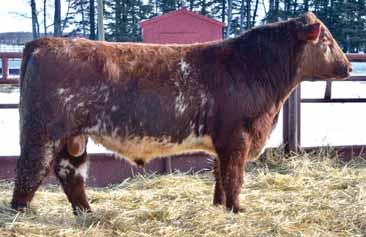
Crooked Post remains very disciplined and dedicated in the breeding of our cattle, we've certainly enjoyed the successes of others who are using our genetics locally and internationally but our relentless quest to improve and do a better job with the cattle remains stronger than ever, the quest for the 'next step' requires endless study of Shorthorn genetics globally. We demand a cow that is structurally sound, easy fleshing, fertile and raises a top calf every year. Our culling protocol is severe, we don't accommodate poor udders, bad feet, bad attitudes or inferior productivity in general, the bulls offered are from strong solid females. Our breeding selections and decisions are derived from our management and environment that dictates high roughage diets with limited energy supplementation. No creep feed through the grazing season, weaned bulls are introduced to a winter of free choice grass hay and limit fed whole oats. It's essential for us to develop the bulls on a moderate diet, enough to grow out and demonstrate their abilities without sacrificing the longevity as sound productive breeders. We'd be most pleased to talk Shorthorns with you, if you have any questions about the bull offering please don't hesitate to call.
Kind regards,
Kirk & Brandie, Tom & Sharon Seaborn
In the quest for improvement and providing Shorthorn breeding stock that are backed up with knowledge and solid data that accurately demonstrates the potential of the genetics, Crooked Post has taken a vested interest in feed efficiency testing over the last 4 years. Selection of a top bull from a large RFI test group in Kansas and proud to announce that we are two years into testing our bulls through the Grow Safe Residual Feed Intake Trials at Olds College of Agriculture and Technology!! The results are encouraging, providing a well lit trail ahead as we continue to develop efficient, profitable Shorthorn cattle.
Until the freely talked about claims about feed efficiency can be backed up with actual figures, that's all it will be, talk! The goal of doing more for less makes great economic sense, reducing feed expenses and getting more done with feed efficient cattle. The Crooked Post and Arbutus Shorthorn bulls in this offering are Grow Safe tested and noted extracts of that data may be mentioned in the footnotes. If you'd like to learn more about any of the bulls or the program behind them, please don't hesitate to ask.
10CROOKEDPOSTCURFEW35J
CROOKED POST CURFEW 8F
CROOKED POST ORANGE 19C
BW:90ADJ.WW:751


15/02/2021 | SLU 35J | X-[CAN]*29478
SASKVALLEY CURFEW 41C
CROOKED POST SAM 8D
CROOKED POST STOCKMAN 4Z
SBF ORANGE B 53X
CEDBWWWYWMKTMCEMST|$CEZ$BMI$F


52.164106316321910.19128.4158.94
A strapping Crooked Post Curfew son out of the jaw dropping Crooked Post Orange 19C cow who has held an average rebreeding interval of 361 days over 7 breeding seasons. We've retained three daughters from this dam, she's held an average lifetime calving interval of 361 days over 6 seasons so far. Curfew 35J is ranked in the upper limits of the breed for Growth, Carcass, $Value British Maternal and $ Feedlot.
SHORTHORNBULLSALE PAGE 7
ROAN POLLED BULL
LOT10
Western Prime Kirk Seaborn | Rocky Mountain House, AB | Phone: 403-729-2267 | Cell: 403-322-0142 | crookedpostshorthorns@hotmail.com | crookedpost.ca
CROOKED POST ORANGE 19C - DAM OF LOT 10
Crooked Post Shorthorns

LOT11
RED WITH WHITE MARKINGS POLLED BULL 11CROOKEDPOSTCURFEW39J
18/02/2021 | SLU 39J | X-[CAN]M484985
SASKVALLEY CURFEW 41C
CROOKED POST CURFEW 8F
CROOKED POST SAM 8D CROOKED POST STOCKMAN 4Z CROOKED POST MINNIE 30C CROOKED POST MINNIE 34W
BW:88ADJ.WW:716


CEDBWWWYWMKTMCEMST|$CEZ$BMI$F
72.36089326231821.25135.9357.15
Sound made and rugged, another Curfew / Stockman combination who rose to the top for feed efficiency and rate of gain. Top 20% of the breed for Stayability, Growth, Maternal, REA, $BMI, $F. His dam Crooked Post Minnie 30C has held a 368 day average calving interval over 6 seasons. Carcass Ultrasound Scans found Curfew 39J carrying more rib and rump fat cover than his pen mates (indexing 103 and 109), pen average for marbling and muscle mass. A robust built bull, expect weaning weight growth power, high heifer replacement value with longevity. His dam Crooked Post Minnie 30C is one of our finest Stockman daughters, she's held an average calving interval of 368 day over 6 years production.


RED WITH WHITE MARKINGS POLLED BULL
12CROOKEDPOSTRANCHMAN48J
CROOKED POST RANCHMAN 40G
CROOKED POST MINNIE 2E
BW:80ADJ.WW:703

24/02/2021 | SLU 48J | X-[CAN]M484994
CROOKED POST DROVER 29D
CROOKED POST MINNIE 45D
KCSF RED MERCURY 1B
CROOKED POST MINNIE 24C
CEDBWWWYWMKTMCEMST|$CEZ$BMI$F 110.95687336162033.30139.1853.56
On foot or on paper, Ranchman 48J is an impressive beast. When we select towards more productivity and growth we are in turn challenged with the antagonisms of fertility and reproductive traits and our ability to keep cows productive for more years. "Stayability", a mulitrait-index that provides an estimate of the ability to keep breeding daughters productive for more years; fertility, soundness and efficiency being essential factors in this estimation. With this in mind we see that Ranchman 48J clears the table on aspects of Stayability, $ value indexes, growth and maternal; he's planted in the top 50% of the breed population for 15/16 of the indicator traits. He's sound and round, free big striding, moderate frame sized bull with lots of real volume capacity, big topped and great footed. Tremendous heifer replacement value here with his calving ease direct and the calving ease maternal in his daughters. His dam is a hard working KCSF Red Mercury daughter with other sons sent across Alberta and into Wyoming.
LOT12
Western Prime SHORTHORNBULLSALE PAGE 8
CROOKED POST MINNIE 30C - DAM OF LOT 11
CROOKED POST MINNIE 2E - DAM OF LOT 12
LOT13
RED POLLED BULL
13ARBUTUSJASPER5J
CROOKED POST CURFEW 8F
ARBUTUS LASSIE 16D
BW:90ADJ.WW:643


03/02/2021 | COW 5J | X-[CAN]M485005
SASKVALLEY CURFEW 41C
CROOKED POST SAM 8D
CROOKED POST STOCKMAN 4Z
CROOKED POST LASSIE 27U
CEDBWWWYWMKTMCEMST|$CEZ$BMI$F 101.45686285641729.90126.8252.60
I find the stew to be a little thin if the claims made about an animal can't at least be supported with relevant measured data. In addition to his physical soundness and design a lot can be said about Arbutus Radish 19J, his Grow Safe Data results indicate he's at the top of the pen for feed efficiency, for ADG, and Feed:Gain Ratio. Genome
Enhanced EPD profile lands him in the top portion of the breed for 15 of the 16 indicated trait fields. Ultrasound carcass scan indexed Radish 19J at 107 in his group for ribeye area. He covers off a lot of territory from calving ease, growth, maternal, carcass, $ value indexes and feed efficiency, it's quite difficult for an individual to dominate on so many relevant and important factors. His dam is no surprise to us, a powerful Yamburgan Tobermorey F90 daughter, she brings it home every fall, average lifetime calving interval of 368 days over 7 calving seasons to date.

LOT14
RED POLLED BULL


14ARBUTUSRADISH19J
CROOKED POST CURFEW 8F
ARBUTUS LASSIE 6C
BW:90ADJ.WW:692


09/02/2021 | COW 19J | X-[CAN]M485004

SASKVALLEY CURFEW 41C
CROOKED POST SAM 8D
YAMBURGAN TOBERMOREY F90
CROOKED POST LASSIE 27U
CEDBWWWYWMKTMCEMST|$CEZ$BMI$F 92.46394275861727.70144.3857.81
Another cookie cutter calving ease, profit designed Curfew son out of a mainstay Stockman mother. Her daughters are automatically drafted back into the herd and her sons sell well with her last one being sent to River Valley Ranches at Omak, Washington. Average calving interval of 371 in 6 years production.
SHORTHORNBULLSALE PAGE 9 Crooked Post Shorthorns Western Prime
ARBUTUS LASSIE 16D - DAM OF LOT 13
ARBUTUS LASSIE 6C - DAM OF LOT 14
Ultrasound carcass scan finds Jackpine 28J well above the rest for marbling (index 108), rib fat (120) and rump fat (114) and still pen average for ribeye area (99). His EPD profile pins him near the top of the breed for Stayability, WW, YW, $BMI and $F. His sweet little mother continues to build onto the 'Lassie Legacy' at Crooked Post and Arbutus Shorthorns. The first anchor female of that family was set in at Crooked Post Shorthorns 27 years ago and the qualities we hoped to acquire back then are the same qualities we selfishly expect nowadays, so persistent they are.
Western Prime - Top Canadian Shorthorn Genetics

Thank You

To all the buyers from the 2022 Western Prime Sale

Richard Bilski
Schryver Farms
Tina Luciak
Rick MacKenzie
Heather Hockley
Brian Schryver
Les and Anna-Marie Kochan
Ivin Potts
Glen Felske
Double Arrow Stock Farm
Hattie Lake Shorthorns
Todd Langevin
Wolff Land and Cattle
Kevin Langevin
Shay-D Corral Cleaning
Six-O Enterprises
Scott Cattle Co.
Starbright Shorthorns
Acadia Ranching

Keith Gilchrist
Avenir Cattle Co.
Alvin Johnson
George Schaffers
Justin Fox
Leo Meckelburg
Double Star Farm
Jon McCaughey
Poplar View Cattle Co.
Peavine Ridge Farms
Gordon Holt
SHORTHORNBULLSALE PAGE 10 RED WITH WHITE MARKINGS POLLED BULL 15ARBUTUSJACKPINE28J 11/02/2021 | COW 28J | X-[CAN]M485006 SASKVALLEY CURFEW 41C CROOKED POST CURFEW 8F CROOKED POST SAM 8D SASKVALLEY CURFEW 41C ARBUTUS LASSIE 2F ARBUTUS LASSIE 16D BW:84ADJ.WW:688 CEDBWWWYWMKTMCEMST|$CEZ$BMI$F 101.666104265952029.02128.8958.75
Western Prime
LOT15 Crooked Post Shorthorns
Tom & Shari Barto & Family
Thorhild, AB | Phone: 780-398-2093 | Cell: 780-307-4043 | tsbarto@mcsnet.ca | sharomshorthorns.com


As always, we are excited to be a part of the Western Prime Bull and Female Sale. This year we have again selected a group of bulls we feel will work with purebred or commercial herds alike.
Our bulls are grown on free choice hay and a grain ration. The bulls will all be semen tested prior to the sale day with a satisfactory rating. All of our cattle are vaccinated yearly on a program designed by our veterinarian Dr. Collin Lawrence of the Westlock Veterinary Center. We use Bovi-Shield products and Vision 8 way. Ivomec pour on is used in the fall.
Our bulls have genomic enhanced EPDs which gives our buyers a clear picture of the genetic potential of the bulls.
If you have any questions regarding our bulls or our program, please feel free to call.
Tom & Shari Barto & Family
RED POLLED BULL 16SHAROMJALAPENO46J

MATLOCK DURAMAX 25D
SHAROM CALICO 46C
BW:101
19/03/2021 | STB 46J | X-[CAN]M484596
MATLOCK TORNADO 32Y
PROSPECT HILL WINDY 3W
PAINTEARTH ACE 37A
SHAROM ALITA 159X
CEDBWWWYWMKTMCEMST|$CEZ$BMI$F
114.75583235171834.49130.5854.61
This is a big, stout, dependable herd sire prospect. We used him as a clean up bull last summer and will have calves on the ground by sale day. His dam is a consistent producer in our herd.
RED WITH WHITE MARKINGS POLLED BULL 17SHAROMKENWORTH2K
GLENFORD MR.CRIMSON 51H
SHAROM CAMBER 2C
BW:100


19/02/2022 | STB 2K | X-[CAN]M485667
GLENFORD CRIMSON 29D
GLENFORD HELEN 42A
SHAROM ATLAS 25A
SHAROM AMBER 255A
CEDBWWWYWMKTMCEMST|$CEZ$BMI$F

92.84877224662128.36109.0648.50
Kenworth is from the first calf crop off of Glenford Mr. Crimson 51H. This young herd sire in the making is long in the spine with correct confirmation. He should put performance in his offspring.

SHORTHORNBULLSALE PAGE 11
LOT16 LOT17
Western Prime
Sharom Shorthorns
GLENFORD MR. CRIMSON 51H - SIRE OF LOT 17
LOT18
RED POLLED BULL
18SHAROMKOWBOY5K
PAINTEARTH GUARDIAN 7G ET
PAINTEARTH CARAMEL 5H
BW:100


13/02/2022 | STB 5K | X-[CAN]M485681
SASKVALLEY PIONEER 126P
BUTTERFIELD MAIDEN 18S
PAINTEARTH FINDER 39F
SHAROM CARAMEL 11C
CEDBWWWYWMKTMCEMST|$CEZ$BMI$F
73.84159234341427.19107.2246.38
This bull was bought in dam from Paintearth Shorthorns from the 4’s Company Sale. He is solid red with good muscling making him a good candidate for any group of cows.


LOT19
ROAN POLLED BULL
19SHAROMKNIGHT46K
GLENFORD MR.CRIMSON 51H
SHAROM CALICO 46C
BW:99
24/02/2022 | STB 46K | X-[CAN]M485669
GLENFORD CRIMSON 29D
GLENFORD HELEN 42A
PAINTEARTH ACE 37A
SHAROM ALITA 159X
CEDBWWWYWMKTMCEMST|$CEZ$BMI$F
113.55481224982134.16123.9851.34
This is a half brother to our two year old on offer. It is easy to see what he will grow into when you see them side by side. A soft roan hair coat compliments his masculine attributes. He will put pounds on your calves come fall.
LOT20
RED POLLED BULL
20SHAROMKICKSTART89K

SHAROM GOLD MINE 4G
SHAROM DEBORAH 89D
BW:97
16/02/2022 | STB 89K | X-[CAN]M485671
SASKVALLEY YESTERDAY 116Y
SHAROM ELENOR AMY 4E
MATLOCK LSR RJ 59Z
SHAROM ADELE 246A
Kickstart has been a standout in the bull pen all winter. His sire, Sharom Goldmine 4G, was used on heifers for 2 seasons here with good results. A lot of boxes are checked off for this bull. Check him out sale day, don’t pass him up.
LOT21
ROAN POLLED BULL
21SHAROMKONG100K
SHAROM GOLD MINE 4G


SHAROM GRAND LASS 100G
17/03/2022 | STB 100K | X-[CAN]M485677
SASKVALLEY YESTERDAY 116Y
SHAROM ELENOR AMY 4E
PAINTEARTH CASH 16C
PAINTEARTH LASS 36D
BW:101 CEDBWWWYWMKTMCEMST|$CEZ$BMI$F 120.94874214581740.85122.0751.59
Our youngest offering this year. Kong is filled with potential to develop into a consistent producing herd sire. Another Goldmine son with a roan coat.
SHORTHORNBULLSALE PAGE 12 Sharom Shorthorns Western Prime
CEDBWWWYWMKTMCEMST|$CEZ$BMI$F 131.75072255081742.62131.7751.74
22SHAROMKNICK-KNACK117K
SHAROM HIGHJACKER 27H

SHAROM HASHBROWN 117H
BW:80

RED POLLED BULL
02/02/2022 | ALB 117K | X-[CAN]M485685
SHAROM CRAFTSMAN 87C
PAINTEARTH EVITA 27D

SHAROM MICKEY 36F
SHAROM FLAURETTE 35F
CEDBWWWYWMKTMCEMST|$CEZ$BMI$F
140.64974244891548.32136.9449.89


This is a bull that we considered keeping back for ourselves. His sire, Sharom Highjacker 27H, ranks high in calving ease as does his son. We used Highjacker for 2 seasons on heifers and this year he will graduate to mature cows. We believe this bull will follow in his sire’s footsteps as a heifer bull.
LOT22
23SHAROMKIRBY120K
SASKVALLEY YESTERDAY 116Y
SHAROM HOLLY 120H
BW:85
RED POLLED BULL
06/02/2022 | STB 120K | X-[CAN]M485680
SASKVALLEY WHOLESALE 114W
SASKVALLEY ROSE 43W
SHAROM CRAFTSMAN 87C
SHAROM MARY 202Z
CEDBWWWYWMKTMCEMST|$CEZ$BMI$F 93.24976265141429.43115.8151.07
Our only AI progeny in this year’s offering. Saskvalley Yesterday 116Y is known as a calving ease bull. Kirby will put more performance into his calves than Yesterday with his maternal grandsire Sharom Craftsman 87C adding that extra oomph.


RED POLLED BULL

24SHAROMKORBIN284K
GLENFORD MR.CRIMSON 51H
SHAROM BRIDE 284B

BW:96
22/02/2022 | STB 284K | X-[CAN]M485666
GLENFORD CRIMSON 29D
GLENFORD HELEN 42A
SHAROM WOLVERINE 38W
SHAROM TWINKLES 78T
CEDBWWWYWMKTMCEMST|$CEZ$BMI$F 82.05076234851826.15116.5148.47
We think a lot of this young prospect, with his smooth head and shoulders. The Crimson bulls are all stamped alike with good feet and sound skeletal structure. His dam is a no miss cow that has been in our herd for several years.

SHORTHORNBULLSALE PAGE 13 Sharom Shorthorns Western Prime
LOT23
LOT24
SASKVALLEY YESTERDAY 116Y - SIRE OF LOT 23
All Western Prime bulls breeding soundness & semen tested prior to the sale
Poplar Creek Farm

Sean & Michelle Thompson
Cremona, AB | Phone: 403-681-8316 | seancthompson811@gmail.com | poplarcreekfarm.ca
Poplar Creek Farm is proud to consign another strong group of bulls to this year's Western Prime Shorthorn Bull Sale. With our second calf crop since relocating the herd to Alberta, you will find bulls suitable for use on both heifers and cows, and each stamped with the same traits from our current herd sires, JT Houston 6H and Saskvalley Boston 223B.

In our herd we emphasize functionality, performance, and sound feet and legs. Ultimately, this will all lead to longevity while remaining productive, something you will see a lot of when touring through our herd. All of our bulls are halter broke, have been 100K tested, are free of myostatin variants and defects.
Sean & Michelle Thompson
JT HOUSTON 6H
LOT25
LOT26
RED POLLED BULL
01/03/2022 | SCT 1K | X-[CAN]M485778
JT PRESIDENT 5B
JT CLIPPER 83F
SASKVALLEY BOSTON 223B
ST BETSY 98E ST BETSY 52X
BW:86ADJ.WW:685


CEDBWWWYWMKTMCEMST|$CEZ$BMI$F 18-1.729452539101464.86117.1542.59
Kronos 1K has been our top bull prospect since last spring. The very first calf born from JT Houston 6H did not disappoint. He is long-bodied with tremendous muscle expression, all while retaining the calving ease traits from both Houston and his grandsire, JT President 5B. His dam is a moderateframed, perfect-uddered cow who has produced great calves regardless of the mating.
ROAN POLLED BULL

26STKEANU21K
JT HOUSTON 6H
26/03/2022 | SCT 21K | X-[CAN]M485781
JT PRESIDENT 5B
JT CLIPPER 83F
SASKVALLEY BOSTON 223B
ST BETSY 60G ST BETSY 81T
BW:96ADJ.WW:670
CEDBWWWYWMKTMCEMST|$CEZ$BMI$F 120.74371224461740.86112.6548.38
Another strong Houston 6H son, Keanu 21K is as smooth-made as they come. Clean fronted and long as a rope, this heifer-safe bull will work well in either a purebred or commercial (blue-roans!) herd. His dam is a moderate framed fouryear old who has more than earned her keep already.
SHORTHORNBULLSALE PAGE 14
Western Prime
25STKRONOS1K
Poplar Creek Farm Herdsires
ROAN POLLED BULL
27STKING5K
SASKVALLEY BOSTON 223B
ST BETSY 6A
BW:94ADJ.WW:600


05/03/2022 | SCT 5K | X-[CAN]M485770
JT TRANS X 28X
SASKVALLEY JENNY 80Z
SASKVALLEY TRANSPORT 399T
ST BETSY 1W
CEDBWWWYWMKTMCEMST|$CEZ$BMI$F
140.14367234561847.77112.8247.64
Dark roan and deep bodied, this Boston 223B son exudes performance. His dam is one of our most prominent cows, whose offspring can be found on operations across the prairies. A full-brother to King sold in last year's sale to Tamarack Shorthorns, while two maternal sisters are producing well in the Crooked Post and Muridale herds. Bid with confidence on this herd bull prospect.
28STKARL13K
SASKVALLEY BOSTON 223B
ST BETSY 81T
BW:92ADJ.WW:601


ROAN POLLED BULL


15/03/2022 | SCT 13K | X-[CAN]M485769

JT TRANS X 28X
SASKVALLEY JENNY 80Z
GOLDWIN BURWASH 4H

JT BETSY 47L
CEDBWWWYWMKTMCEMST|$CEZ$BMI$F
11-0.54062224241740.32106.0245.61
Karl 13K is a flashy, sure-footed Boston son. He carries the same attractive redshoulder roan colouring from his sire, which seems to pass on to his offspring more often than not. Several maternal brothers have made their mark in both purebred and commercial herds across Canada, and Karl 13K will undoubtedly follow in their footsteps.
SHORTHORNBULLSALE PAGE 15 Poplar Creek Farm Western Prime LOT27 LOT28 Online Bidding @ www.VJVAuction.com For help call Craig Jacklin 403-783-1453 SALE LOTS AVAILABLE FOR VIEWING FRIDAY, MARCH 31 & SATURDAY MORNING, APRIL 1 AT VJV WESTLOCK
JT HOUSTON 6H
SASKVALLEY BOSTON 223B
Melanie Barkley & Michelle Duncan Stettler, AB | Phone: 403-740-4958 | mel.barkley@yahoo.com
We are very excited to be a part of the Western Prime Bull sale once again. This year we are offering some top notch bulls. Mel and I are proud and honored to be continuing the tradition of quality Shorthorns, that our Grandfather Jerry Bignell Started 50+ years ago. We always raise our cattle for longevity and reliability.


Thank you to all of the buyers over the last 4 years, we are looking forward to another great year of cattle.
Melanie Barkley - Michelle Duncan
LOT29
LOT30
29JANELL’SKARVER8K
MURIDALE ULTRA LAD 20G
JANELL’S FALLON 78F



RED WITH WHITE MARKINGS POLLED BULL
05/02/2022 | CCV 8K | X-[CAN]M486042
EIONMOR ULTRA 8C
MURIDALE WHITE JAY 3Y
BELL M BOB 72C
JANELL’S CHARLOTTE 15C

BW:88ADJ.WW:718ADJ.YW:1187
CEDBWWWYWMKTMCEMST|$CEZ$BMI$F 103.25688245241232.24116.5253.55
Janell’s Karver is very pleasing to the eye. He’s sure to add color to herd. Karver is a docile, good tempered bull. He is one of favorites this year.
30JANELL’SKNIGHT9K
MURIDALE ULTRA LAD 20G
STARBRIGHT BELLE 1F
RED WITH WHITE MARKINGS POLLED BULL
05/02/2022 | CCV 9K | X-[CAN]M486045
EIONMOR ULTRA 8C
MURIDALE WHITE JAY 3Y
LEHNE SUPREME 216C
SHAROM SNOWBELLE 308B
BW:105ADJ.WW:719ADJ.YW:1227
CEDBWWWYWMKTMCEMST|$CEZ$BMI$F 36.559962554-1167.1499.2154.66
This bull is a powerful, deep barreled prospective herd sire. He has caught our eye since birth with his flashy markings. We are proud to offer this bull.
Janell Shorthorns Western Prime
SHORTHORNBULLSALE PAGE 16
Can’t attend sale day? Bid online @ VJVAuction.com or contact any consignor/sale staff
Janell Shorthorns


RED POLLED BULL
31JANELL’SKING15K
MURIDALE ULTRA LAD 20G
JANELL’S LEEANN 81B
13/02/2022 | CCV 15K | X-[CAN]M486043
EIONMOR ULTRA 8C
MURIDALE WHITE JAY 3Y
BELL M STIHL 22Z
JANELL’S LILLIAN 45Z

BW:95ADJ.WW:607ADJ.YW:1021
CEDBWWWYWMKTMCEMST|$CEZ$BMI$F
101.53346183452137.5195.6541.20
He truly is a King, this bull is Branson’s best friend (Mel’s son). He has a quiet temperament, and a smaller, easy fleshing frame. His dam comes from a strong line in the Janell herd.
32JANELL’SKD16K
MURIDALE ULTRA LAD 20G
JANELL’S EVA 48E
RED WITH WHITE MARKINGS POLLED BULL
14/02/2022 | CCV 16K | X-[CAN]M486041
EIONMOR ULTRA 8C
MURIDALE WHITE JAY 3Y
BELL M BOB 72C
JANELL’S ELIZABETH 9C
BW:95ADJ.WW:641ADJ.YW:1006
CEDBWWWYWMKTMCEMST|$CEZ$BMI$F
101.73954173642137.23104.6047.26
Janell’s KD will throw some nice growth and performance into your herd. His dam is a consistant producer for us. Don’t miss out on this bull.
33JANELL’SKODIAK22K
MURIDALE ULTRA LAD 20G
JANELL’S DIANE 2C
RED AND WHITE POLLED BULL
05/03/2022 | CCV 22K | X-[CAN]M486039
EIONMOR ULTRA 8C
MURIDALE WHITE JAY 3Y
MURIDALE TRADITION 115Y
JANELL’S MISSY 18U
BW:81ADJ.WW:665ADJ.YW:1110


CEDBWWWYWMKTMCEMST|$CEZ$BMI$F
12-1.24064224361843.99106.8747.65
This quiet red bull has potential to be a great heifer bull. He is of a smaller stature just like his dam. But don’t let this fool you – he packs a punch!
SHORTHORNBULLSALE PAGE 17
LOT32 LOT33
Western Prime
LOT31
Albert and Susan Oram | Castor, AB
Phone: 403-882-2253 | a_soram@telus.net
Chad Oram | Meeting Creek, AB
Phone: 780-781-9747 | paintearthshorthorns@gmail.com

34PAINTEARTHJACKPOT112J
PAINTEARTH FARO 45F
SHAROM DORIS 66D
BW:90
RED POLLED BULL
14/02/2021 | CHAD 112J | X-[CAN]M484947
SASKVALLEY RAMROD 155R
PAINTEARTH DUCHESS 34C
MATLOCK LSR RJ 59Z
SHAROM MARY 202Z
CEDBWWWYWMKTMCEMST|$CEZ$BMI$F 92.15077224761629.70117.4550.94
Here’s a bull we thought highly enough of to use on our show heifers last summer for a clean up bull. He comes from a strong producing Sharom cow, and his sire is a bull we are proud of. Jackpot is a strong footed bull, smooth made bull and yet has that added power that we are looking to put into our program.


35PAINTEARTHJUNIOR40J
STARBRIGHT FERDINAND 15F
PAINTEARTH SINDY 43D
BW:90ADJ.WW:620
RED POLLED BULL
12/02/2021 | HAS 40J | X-[CAN]M484536
LEHNE SUPREME 216C
STARBRIGHT ARIEL 15A
PAINTEARTH JIMMY 80Z
PAINTEARTH SINDY 43B
CEDBWWWYWMKTMCEMST|$CEZ$BMI$F 82.85480255221526.72120.6952.81
Super thick bull sired by Starbright Ferdinand. Polled.
36PAINTEARTHJACKSON96J
PAINTEARTH FARO 45F
PAINTEARTH PEARL 96E
BW:85ADJ.WW:646


RED POLLED BULL
05/02/2021 | HAS 96J | X-[CAN]M484539
SASKVALLEY RAMROD 155R
PAINTEARTH DUCHESS 34C
PAINTEARTH CHESTER 64Z
PAINTEARTH PEARL 96A
CEDBWWWYWMKTMCEMST|$CEZ$BMI$F 83.36498235471620.82128.8256.69
Out of one of our best cows. Super quiet. Polled.
Shorthorns Western Prime SHORTHORNBULLSALE PAGE 18
Paintearth
LOT34
LOT35
LOT36
RED POLLED BULL
37PAINTEARTHKEEPER31K
SASKVALLEY PRIMO 40P
PAINTEARTH LADY LOMOND 58B
BW:80ADJ.WW:632


14/01/2022 | HAS 31K | X-[CAN]M485727
SASKVALLEY ULTRA 12J
SASKVALLEY PATSY 250M
LEHNE BRIGGS 62Z
PAINTEARTH LADY LOMOND 22P
CEDBWWWYWMKTMCEMST|$CEZ$BMI$F
111.65382295661735.77127.9253.67
Sired by Saskvalley Primo. Red, thick and good. Polled.


38PAINTEARTHKNACKER46K
PAINTEARTH FARO 45F
PAINTEARTH TINA 82D
BW:92ADJ.WW:652
RED POLLED BULL

18/02/2022 | HAS 46K | X-[CAN]M485733

SASKVALLEY RAMROD 155R
PAINTEARTH DUCHESS 34C
PAINTEARTH JIMMY 80Z
PAINTEARTH TINA 21B
CEDBWWWYWMKTMCEMST|$CEZ$BMI$F
102.45179275251631.01122.1151.29
A complete package.
SHORTHORNBULLSALE PAGE 19 Paintearth Shorthorns Western Prime
LOT38
LOT37
Shorthorn Influenced Open Replacement Heifers –
All heifers are Shorthorn or Shorthorn influenced. All open females will be vet palpated for breeding soundness.
Consignors
• SHAROM SHORTHORNS

Tom 780-307-4043 - Thorhild, AB
• SHRYVER FARMS
John 780-349-9788 - Jarvie, AB
• SCOTT CATTLE CO.
Bob 780-689-9203 - Lac La Biche, AB

Commercial Females Western Prime SHORTHORNBULLSALE PAGE 20
–
Bull Breeding Guarantee
All guarantees are between the buyer and the seller. All bulls offered and sold, except calves at side, are guaranteed breeders irrespective of age. All bulls after reaching the age of 15 months must be capable of settling 7 head or 75% of the eligible normal healthy breeding age females he is running with for a 90 day period, whichever is the lesser. No guarantee regarding the freezing ability of a bull’s semen is made or implied in the sale of a bull unless covered specifically in a written contract. In the case of a complaint regarding a bull’s breeding guarantee the buyer wishes to enforce the provisions of the Code shall report the same in writing to the seller enclosing a report prepared by a licensed veterinarian within 6 months of purchase or the time the bull reaches the age of 15 months whichever occurs later. The bull shall be returned to the seller at the buyer’s expense. The seller may replace the bull with a bull of equal quality or refund the purchaser’s price of the bull or he may attempt to prove the bull a breeder under the terms of this clause within 6 months. If the bull is proven to be a breeder within the 6 months provided he shall be returned by the seller to the buyer and the buyer’s expense. If he is not proven to be a breeder then replacement or at the option of a seller a refund is mandatory. Under no circumstances will a seller be liable for more than the purchase price of the animal sold.


Thank You To all buyers & bidders See you again next year!


