ISSUE 27 OUTSIDE COVERS2:Layout 1
21/8/09
12:10
Page 1
European Trainer ISSUE 27 – AUTUMN 2009
European
ISSUE 27 – AUTUMN 2009 £5.95
www.trainermagazine.com
THE QUARTERLY MAGAZINE FOR THE TRAINING AND DEVELOPMENT OF THE THOROUGHBRED
The Absolute Insurer Rule
Should trainers be ultimately responsible for the actions of their vets?
Equine Neurology Is it that complicated? Publishing Ltd
Richard Gibson Why training in France makes sense
ISSUE 27 INSIDE COVERS:Layout 1
20/8/09
22:56
Page 1
INTRO issue 27.qxd:Jerkins feature.qxd
21/8/09
11:49
Page 1
Introduction Giles Anderson
BAD news is looming on the horizon: bookmakers. British racing has been stunned by the decision of major high street bookmaking firms to move their credit and inter net businesses “off shore”. The result of this move will result in a fall in the amount of income which these bookmakers pay back to British racing through both the levy scheme and tax paid to central government.
Yes, these bookmaking firms have a responsibility to their shareholders but what about their responsibility to racing? Yes, they sponsor races – predominately major handicap races – because the monetary value of the PR generated coupled with their percentage of revenue from betting gives them a clear chance of making a profit. If it didn’t, they wouldn’t sponsor these races so heavily! Under the existing game rules, British racing has developed a grudging sense of co-operation but with the move off shore is about to kick this into touch. The bookmakers do have a good point in the unfairness of the rules governing betting exchanges, which pay even less to racing. But think ahead. It’s the same bookmakers who are investing their resources into getting their product into mainland Europe. This autumn, the French senate is going to vote on changes in gambling legislation which is set to see these bookmakers able to take online bets only. But the actions of the bookmakers in the United Kingdom haven’t gone unnoticed. The politicians are now adamant, if you take bets in France, you’re going to have to pay tax in France. No ifs or buts, no threats to the industry. Thankfully for the French system, if the bookmakers want to move offshore in the future, they can, but they won’t be able to take bets from France. Other European governments need to have a clear understanding as to the way these bookmakers are behaving in the United Kingdom, and then ask themselves this simple question: would they want the racing and breeding industries treated in the same manner in their own countries? If the bookmakers can go “off shore” in the United Kingdom, what’s going to stop them from behaving the same way in mainland Europe? For the sake of racing, let’s hope these governments have the foresight to follow in the footsteps of the French. Anyone passionate about the future growth of racing across Europe should share in the responsibility of getting this “what if” scenario across to their local politician. It’s a safe bet that the bookmaking industry will be investing time and money into lobbying the politicians too. We, as an industry, simply can’t afford not to. This issue of the magazine explains the scenario, highlighting two systems in place. On the one side is a major article on racing in Belgium which shows that the downturn in that country’s racing accelerated with the growth of bookmaking interests. Representing the other model is our interview with Richard Gibson, which clearly shows the confidence he and the majority involved in the French racing and breeding industries have in the French system – an industry flourishing without the interest of bookmakers. Wherever your racing takes you this autumn, good luck! I ISSUE 27 TRAINERMAGAZINE.com 01
C HEAD issue 27.qxd:Jerkins feature.qxd
20/8/09
22:25
Page 1
Chairman’s message
CRIQUETTE HEAD Summer is a time of good weather, top class meetings and the beginning of the yearling sales season. Despite the sunshine we trainers are far from being on holiday with a good deal of travel involved in attending meetings such as Vichy and Deauville.
T
HE yearling sales add to a very busy period, but this is a time of year which I love. It is a moment of hope as we discover the new generation and although it is time-consuming to visit yearlings prior to the sales this is a task which I enjoy very much. These youngsters represent the future and it is always fascinating to try and find those which will win good races later in their careers. In France ARQANA have done some remarkable work and put together the best Deauville catalogue I have seen since I started attending the yearling sales I can’t remember how many years ago! Some clients may have been put off by such a strong catalogue but it is important to always go to the sales, whether in France, England, America or elsewhere as
fortunately everyone sees horses differently and it is always possible to find a horse to buy. Still in Deauville, the executive committee of the ETF met on 19th August to discuss current matters of importance to trainers. It was as always a busy morning of work as we tried to advance on subjects such as the harmonisation of racing rules, VAT and the admission of new countries into the Federation. Progress is slow but we are making headway on all these and other issues. It is always encouraging to see horses from minor racing countries coming to compete in France, England or Ireland and this can be a positive experience for smaller trainers. They have an opportunity to observe how we work and return to their countries with a certain notoriety and experience if they are successful. A growing
number of trainers from abroad are currently basing themselves in France to take advantage of our racing system which works so well. Finally I would like to congratulate Sir Michael Stoute for his exploit in training the first three home in the King George VI and Queen Elizabeth Stakes at Ascot. This would be a dream come true for any trainer and his accomplishment has marked the summer season. I am also full of admiration for JeanClaude Rouget’s domination of the French scene over the first semester and he leads the French trainers’ table. Sir Michael Stoute is at the head of the British championship and Aidan O’Brien leads the Irish list and these three are the spearheads of the training profession in their respective countries and provide us all with examples to follow. I
“In France ARQANA have done some remarkable work and put together the best Deauville catalogue I have seen since I star ted attending the yearling sales” 02 TRAINERMAGAZINE.com ISSUE 27
C HEAD issue 27.qxd:Jerkins feature.qxd
20/8/09
22:25
Page 2
Contents issue 27.qxd:Jerkins feature.qxd
21/8/09
11:15
Page 1
CONTENTS ISSUE 27
12 TRM Trainer of the Quarter
Peas And Carrots’ trainer Lennart Reuterskiöld.
14 Richard Gibson
Fanny H. Salmon talks to the Englishman about living and training in France and winning races around the world.
24 Optimal Conditioning
How the use of technology can determine a horse’s ideal fitness and training schedule, by Bill Pressey.
28 Belgian Racing
A downturn in betting turnover and its widespread effects have made Belgium the example not to follow in Europe, by Katherine Ford.
36 Withdrawal Times
Mark Dunnett examines the move to standardise drug withdrawal times across Europe.
44 The Absolute Insurer Rule
Repercussions to trainers of a positive test from a prohibited drug or medication, by Larry Bortstein.
28
04 TRAINERMAGAZINE.com ISSUE 27
14
Contents issue 27.qxd:Jerkins feature.qxd
21/8/09
11:15
Page 2
Contents issue 27.qxd:Jerkins feature.qxd
21/8/09
11:15
Page 3
CONTENTS ISSUE 27
50 Hemp
Catherine Dunnett explores the nutritional values of this versatile plant.
52 Neurology
An in-depth look at the diagnosis and treatment of the different neurological ailments in horses, by James Tate
60 Hyperbaric Oxygen Therapy
Does it do more than treat lower limb wounds? By Margaux Thomas
68 Transport
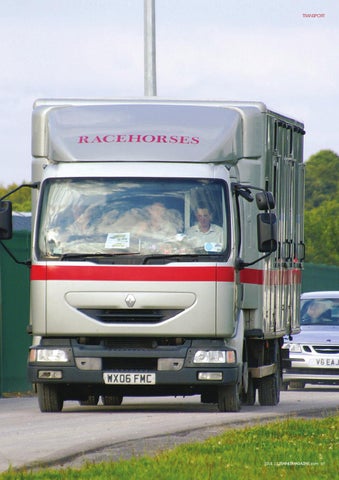
Katherine Ford explains why racehorses should not be treated in the same way as other horses when it comes to transport regulations.
72 Product Focus 76 Stakes Schedules
Forthcoming stakes races from Europe and around the world.
80 Frances Karon’s Comment
68 06 TRAINERMAGAZINE.com ISSUE 27
60
52
Contents issue 27.qxd:Jerkins feature.qxd
21/8/09
11:15
Page 4
Contributors issue 27.qxd:Jerkins feature.qxd
20/8/09
19:58
Page 1
CONTRIBUTORS
Publisher & Editorial Director Giles Anderson Assistant Editors Frances Karon, Sophie Hull Design/Production Neil Randon Website Gary Pinkett Advertising Sales Giles Anderson Executive Assistant Alexandra Summerfield Circulation Pippa Anderson Photo Credits
APRH, Klampenborg, Brent Pressey, Lamia Leclercq, Jean-Charles Briens, Thoroughbred Photography, Professor Ulf Bondesson, Dr Scott Stanley and Ken Maddy Laboratory at UC-Davis, Rex Miller, James Tate, University of Tennessee College of Veterinary Medicine, Fiona Boyd, Horsephotos, Shutterstock
Cover Photograph APRH
Trainer Magazine is published by Anderson & Co Publishing Ltd. This magazine is distributed for free to all ETF members. Editorial views expressed are not necessarily those of the ETF. Additional copies can be purchased for £5.95 (ex P+P). No part of this publication may be reproduced in any format without the prior written permission of the publisher. Printed in the European Union For all editorial and adver tising enquiries please contact Anderson & Co Publishing Ltd Tel: +44 (0)1380 816777 Fax: +44 (0)1380 816778 email: info@trainermagazine.com www.trainermagazine.com
08 TRAINERMAGAZINE.com ISSUE 27
Larry Bortstein has been a sportswriter for more than 40 years and has covered horse racing for more than 25 years. He was a staff writer with the Orange County Register in Santa Ana, Cal., for 17 years.
Dr Catherine Dunnett BSc, PhD, R.Nutr. is an independent nutritionist registered with the British Nutrition Society. She has a background in equine research, in the field of nutrition and exercise physiology, with many years spent at The Animal Health Trust in Newmarket. Prior to setting up her own consultancy business, she worked in the equine feed industry on product development and technical marketing. Dr Mark Dunnett BSc, PhD, MChromSoc. has worked in the field of equine sciences for over 15 years, both at the Animal Health Trust and Royal Veterinary College. A chemist by qualification, he has applied his expertise to the fields of exercise physiology and pharmacology and has direct experience within the field of equine drug testing. Mark’s current research interest lies in the use of equine hair analysis for dr ug detection, poisoning and evaluation of nutritional status. Katherine Ford was brought up in a hunting and point-topointing environment on a far m in North Yorkshire. Following a year working in a racing yard in Middleham, she studied Modern Languages at Sheffield University, with a semester studying French in Pau. After University, Katherine completed the BHB Graduate Programme in 2000, and in 2001 started work for the Inter national Racing Bureau’s Paris office. Three years later she moved to Equidia, France’s horseracing television channel, for which she has had the oppor tunity to travel to some of the world’s major racetracks, including those of Dubai, Hong Kong, Japan, several Breeders’ Cups, Cheltenham and Pardubice. Katherine currently works part-time for Equidia and as a freelance jour nalist and translator.
Bill Pressey holds a Bachelor of Science degree in Exercise Physiology and is based in Louisville, Kentucky, where he monitors the training of racehorses for his clients. Bill grew up in a family that owned racing Thoroughbreds for decades and also has experience training professional athletes and Olympic gold medal winners. He is the Senior Exercise Physiologist with ThoroEdge Equine Performance. Fanny H. Salmon is a freelance producer who has been a broadcast journalist for over 14 years, covering international events on five continents. Based in France, where she directs documentaries through her Full Field Media LLC, she is a paddock presenter and interviewer for major races on French tv and an international correspondent on HRTV. Margaux Thomas spent her early years in South Africa, had a French education in Italy and graduated from the Royal Agricultural College with a BSc (Hons) in International Agriculture and Equine Management. Her dissertation, which explores the use of Hyperbaric Oxygen Therapy , was inspired by lear ning about this novel technique while treating thoroughbreds at the Kentucky Equine Sports Medicine and Rehabilitation Center. Margaux has travelled extensively and speaks four languages. She plans to develop her skills further in rehabilitation and per formance enhancement though unobtrusive therapy wherever the opportunity arises. James Tate BVMS MRCVS qualified as a veterinary surgeon from Glasgow University and his career started with mixed practice in Cumbria. He is from a family steeped in horseracing. His father, Tom Tate, is a dual purpose trainer, his father-in-law, Len Lungo, is a National Hunt trainer, and his Uncle, the legendary Michael Dickinson, has just retired from the training ranks. James is cur rently the resident senior vet for leading flat trainer Mark Johnston, a position which he has held since the star t of 2006.
Contributors issue 27.qxd:Jerkins feature.qxd
20/8/09
19:58
Page 2
EFT REPS issue 27.qxd:Jerkins feature.qxd
21/8/09
11:02
Page 1
EUROPEAN TRAINERS’ FEDERATION AIMS and OBJECTIVES of the ETF:
a) To represent the interests of all member trainers’ associations in 3Europe. b) To liaise with political and administrative bodies on behalf of European trainers. c) To exchange information between members for the benefit of European trainers. d) To provide a network of contacts to assist each member to develop its policy and services to member trainers.
ETF REPRESENTATIVES Chairmanship:
Criquette Head-Maarek Association des Entraineurs de Galop 18 bis Avenue du Général Leclerc 60501 Chantilly FRANCE Tel: + 33 (0)3 44 57 25 39 Fax: + 33(0)3 44 57 58 85 Email: entraineurs.de.galop@wanadoo.fr
Vice Chairmanship:
Max Hennau FEDERATION BELGE DES ENTRAINEURS Rue des Carrieres 35 5032 - Les Isnes BELGIUM Tel: Fax: +32 (0)81 56 68 46 Email: max.hennau@mobistarmail.be
GERMANY
Vice Chairmanship:
Jim Kavanagh IRISH RACEHORSE TRAINERS ASSOCIATION Curragh House-Dublin Road Kildare-Co.Kildare IRELAND Tel: +353 (0) 45 522981 Fax: + 353 (0) 45 522982 Email: irishrta@eircom.net www.irta.ie
ITALY
NORWAY
Erika Mäder Jentgesallee 19 47799 Krefeld Tel: +49 (0)2151 594911 Fax: +49 (0)2151 590542 Mobile: +49 (0)173 8952675 Email: trainer-und-jockeys@netcologne.de
Valfredo Valiani Renzetti Viale delle Cascine 153 - 56122 Pisa, ITALY Tel: +39(0)50 53 24 34 Fax: +39(0)50 52 66 51 Mobile: +39(0)34 88 29 39 43 Email: v.valiani1@virgilio.it
CZECH REPUBLIC
UNITED KINGDOM
Roman Vitek ASOCIACE ČESKÝCH PROFESIONÁLNÍCH TRENÉRŮ CVALOVÝCH DOSTIHOVÝCH KONÍ Zhoř 124, Zhoř u Jihlavy, 588 26 Tel: +42 (0)567584713 Mobile : +42 (0)606620591 Fax : +42 (0)567584733
SPAIN
Mauricio Delcher Sanchez AZAFRAN, 5- 3ºM MAJADAHONDA 28022 Madrid Spain Tel: +34 (0)666 53 51 52 Email: mdelcher@hotmail.com
10 TRAINERMAGAZINE.com ISSUE 27
Treasureship:
Maria Lamm Dåntorp, 136 50 Haninge Sweden Tel: +46 (0)8500 20938 Fax: +46 (0)8500 25250 Mobile: +46 (0)70 7560 769
Rupert Arnold NATIONAL TRAINERS’ FEDERATION 9 High Street - Lambourn - Hungerford Berkshire RG17 8XN Tel: +44 (0)1488 71719 Fax: +44 (0)1488 73005 www.racehorsetrainers.org
Sven-Erik Lilja Eventyrveien 8, 1482 Nittedal Norway Tel: +47 (0) 67 07 14 12 Mobile: +47 (0) 91 12 88 96 Email: svelilja@nokab.no
SWEDEN
Mrs Jacqueline Henriksson Swedish Trainers Association South Notarp 3228 S-243 92 Hoor Tel: +46 (0)413 55 00 65 Fax: +46 (0)413 55 04 95 Mobile: +46 (0)70 731 26 39 Email: jacqueline.henriksson@home.se Mr Claes Björling Swedish Trainers Association North Karlaplan 10 115 20 Stockholm Sweden Mail: worldracing@hotmail.com Tel: +46 (0)8 662 46 79 Mobile: +46 (0)708 756 756
EFT REPS issue 27.qxd:Jerkins feature.qxd
21/8/09
11:02
Page 2
TRM issue 27.qxd:Jerkins feature.qxd
21/8/09
11:00
Page 1
Lennart Reuterskiöld with Peas And Carrots who has won six Pattern races and is being aimed at the Prix Dollar at Longchamp
The TRM Trainer of the Quarter award has been won by Lennart Reuterskiöld. Lennart and his team will receive a TRM product pallet worth in excess of €2000. The pallet will consist of TRM tack bags and saddle pads as well as a large selection of the world famous TRM product range. As well as the TRM pallet they will receive a bottle of fine Irish whiskey.
TRM Trainer of the Quarter
LENNART REUTERSKIÖLD 12 TRAINERMAGAZINE.com ISSUE 27
TRM issue 27.qxd:Jerkins feature.qxd
L
21/8/09
ENNART Reuterskiöld and his wife Linda started training in 1998 and in that time have grown their stable to a team of 40 horses from their base at the racecourse in Malmo, in southern Sweden. Training both Flat horses and jumpers, they have won many of Scandinavia’s main races over the last decade. Their horses compete on this circuit and will typically travel six hours if competing in Stockholm or Oslo but only 45 minutes if running in Copenhagen. It was at Copenhagen where their star horse Peas And Carrots became the first Danish-bred to win the Group 3 Scandinavian Open Championship on
11:00
Page 2
August 2, further cementing himself as one of the most popular and enduring horses in Scandinavian racing. Originally purchased by former trainer and bloodstock agent Lars Kealp, Peas And Carrots won his first major race as a two-year-old in the Tattersalls Norsk Criterium at Ovrevoll. He was then sold to his current owner Omar Zawawi, but as part of the deal remained in training with Kealp. Victory in both the Danish Derby Trial and Danish Derby followed early in his three-year-old season but disaster struck that July when Peas And Carrots fractured a hind leg and was off the track until the following spring. During this time Kealp retired from training and Reuterskiöld was given the job of
bringing Peas And Carrots back to racing. On his return to action he won the prestigious Danish Breeders race and he hasn’t looked back since. Over the last two years, from September 2007 through August 2009, six-year-old Peas And Carrots has run in no less than 14 Pattern races; with stats of six wins, six seconds, one third and one fourth, with two of his victories coming at Group 3 level. All being well, after competing in the Marit Sveaas Minnelop (Gr.3) at the end of August in Norway, Peas And Carrots will be pointed towards a first run outside Scandinavia, with the Prix Dollar at Longchamp during the Arc weekend his main autumn target. I
ISSUE 27 TRAINERMAGAZINE.com 13
GIBSON ISSUE 27.qxd:Jerkins feature.qxd
21/8/09
11:07
Page 1
PROFILE
English roots, French home, Global ambition 14 TRAINERMAGAZINE.com ISSUE 27
GIBSON ISSUE 27.qxd:Jerkins feature.qxd
21/8/09
11:07
Page 2
RICHARD GIBSON
ISSUE 27 TRAINERMAGAZINE.com 15
GIBSON ISSUE 27.qxd:Jerkins feature.qxd
21/8/09
11:32
Page 3
PROFILE
Having spent his student days in France learning the language and experiencing racing life in the provinces, Northumberland-born Richard Gibson then spent six years as assistant to Pascal Bary, before setting up as a trainer in Chantilly. Fanny H. Salmon talks to him about his horses and how he has turned his stable into a successful business.
F
AR from his native Northumberland, Richard Gibson decided to set up shop in France. His Chantilly-based operation boasts a strong international flavour, with owners from around the globe and the recently-retired Doctor Dino as world-class flag bearer. Just shy of his 40th birthday, the Englishman looks back at his career, a country he calls home and a racing product he judges to be second to none. Gibson first experienced the thrills of racing at a young age while following his father, a point-to-point rider, around the north of England. “I was a six-year-old boy and it was very exciting for me and my three other brothers to go point-to-pointing. It was a dream to lead up a horse of my father’s; it was the true definition of amateur
16 TRAINERMAGAZINE.com ISSUE 27
racing. In those days people did it for fun so when my father was riding he would be up against six of his friends. There was great camaraderie.” The introduction to what he himself calls ‘proper racing’ came in 1989 when, as a student, he went to Newmarket for the Guineas. Nashwan was running, “We were all students with overdrafts and we all backed Nashwan to win… that was my first major experience of the flat!” Young Richard had wanted to be a vet but he soon realised he wasn’t motivated enough to put in all the study. He started business school but, again, the interest really wasn’t there. So in 1991 he set off for France with the sole objective of becoming bilingual. “Through an exceptionally vague contact I arrived at the Lad’s hostel in Chantilly and
started to work for a small English trainer called Stewart Cargeeg. Then, through another contact, I went to work for [Henri-] Alex Pantall as a pupil assistant. I knew I had little experience and I said to him, “If, after a month, you think I’m useless, not a problem, you can send me to the nearest train station.” He stayed for four years, experiencing life in the provinces and their racing circuits. Since Pantall trained for both Khalid Abdullah and Sheikh Mohammed, Gibson’s language skills proved useful. After four years of hard work and long hours in the Loire Valley, Gibson took his “enormous appetite to learn” across the Atlantic. In America, he spent time with Bill Mott and Gary Jones. He recalls the time spent around Cigar as an enormous privilege for anyone interested in this business. He was even there when Cigar made history with his 16th win from 16 starts. On his return to France, he became assistant to Pascal Bary whose stable sent out two French Derby winners, in 1994 and 1996, while Gibson worked there. It was during this period that Gibson was preparing himself to quit student life. “I guess there comes a time when you start feeling confident in your ability as a horseman. It’s that naiveté, most likely.
GIBSON ISSUE 27.qxd:Jerkins feature.qxd
21/8/09
11:07
Page 4
GIBSON ISSUE 27.qxd:Jerkins feature.qxd
21/8/09
PROFILE
You’re young and you have nothing to lose. I wasn’t married. In my mind, it seemed a realistic goal.” In reflective mood and wearing that ‘if-Iknew-then-what-I-know-now’ smile, he adds, “It is not difficult to be a trainer. Anybody can get a licence. The question is – can this fascinating, motivating job be a viable career for you? There’s a big difference.” Leaving the office to follow the next lot through the Chantilly gallops, Gibson’s passion for the historic training centre becomes evident. While other ex-pats might have left to start up back home, the English handler was never prepared to leave it all behind. “After doing all this groundwork in France where I had learned the language and come to understand the racing system, it wasn’t really an option to start off from zero again in the UK. “We are incredibly lucky,” he reflects, making his way through the woods, “We don’t have to worry about maintenance. We can order a special gallop anytime we need to. When we had to teach Doctor Dino to go left-handed, at one point we were doing left-handed gallops around Chantilly racecourse itself, which is incredible when you think of it. Chantilly is head and shoulders above anything else in the world.” And so, six years after he first set foot in France, Gibson started training on his own. Success came quickly, perhaps too quickly. Two years on he saddled Lady of Chad on Arc Day. The two-year-old Last Tycoon filly had made a winning debut just one month previously. She made that rare step up from maiden to Group 1: the Prix Marcel Boussac. She subsequently stormed home winning by three lengths, a moment which, to this date, remains Richard Gibson’s best memory. “It was an incredible release of emotion after so many years of being an assistant trainer. Your hard work has been rewarded.” And yet… “When it comes this early in your career, you take things for granted because you are young and naïve. We already had four Group 1 winners in the first four years of training. Perhaps, in retrospect, we didn’t have the right structure in place to continue at such a level.” This has changed. Gibson went back to the drawing board and designed a new model. Make no mistake; while he loves training, he still sees it as a commercial enterprise. “Like everyone owning a business, you have the pressure of maintaining a solid client base, managing an efficient workforce, and you can’t let those crucial issues get in the way of your job, which is to be around you horses 24/7.”
18 TRAINERMAGAZINE.com ISSUE 27
11:08
Page 5
GIBSON ISSUE 27.qxd:Jerkins feature.qxd
21/8/09
11:08
Page 6
GIBSON ISSUE 27.qxd:Jerkins feature.qxd
21/8/09
11:08
Page 7
PROFILE
We just happen to be around his two-year-olds, “the best bunch I have had since I started training.” The juvenile division now represents more than two thirds of his operation. “2008 was the first year we invested in a top team of yearlings. “ He singles out Ladoga, a chestnut Exceed And Excel filly bought in Deauville last August for €160,000. “She’s already a winner and is stakes-placed. She has earned €50,000 from just two starts.” He then moves on to a bay colt by Anabaa, “Anzas is a great example of what French racing has to offer. Three runs, two wins, one second place and €60,000 in earnings. We bought him at ARQANA for just €45,000.” The next two-year-old, Chantilly Creme, did not come from Deauville however. She was a $40,000 RNA from last year’s Keeneland September sale. Sending her to France has already proved lucrative for her American owner Lansdon Robbins. Now a Listed winner in the provinces the Johannesburg filly has generated €60,000 in earnings with two wins and a place under her belt. “The difference in France is that we really believe in our product and we have faith in the system. Prize money is becoming more and more attractive. Winning your maiden in Paris pays the annual training fees. There is a very attractive black type programme. There is a sensible financial argument to having horses in training in France. I don’t think I could do my job if I didn’t have so much faith in the product that we’re working with. How can you tell someone to spend thousands of pounds on a yearling if there is no earning expectancy?” What about the economy though? In troubled times, luxury expenditures such as racehorses are often the first ones to go. “France as a country has held up really well. There is no credit culture in France,” he explains, “so the country wasn’t hit as hard. In fact, the biggest investors in the breeze-up sales this year were successful French businessmen. The big difference here is that a modest horse has a higher earning capacity even though they may only be winning low-grade races. People in England and Ireland are starting to realise that. We see more new owners than we did three years ago, for example.”
Gibson with his secretary Patricia Mérienne
Gibson’s personal website shows off thirty different sets of colours comprising a very international group of owners. “We are very lucky to have a solid base of owners, ranging from Saudi Arabia to Russia, to Ireland… We have people from Japan, Australia, America, but again, I think they are more interested in the model of French racing than in … Richard Gibson racing! The results of French-trained horses proved that our system works. Horses are allowed time to develop; here you can afford to be patient with the horses. You don’t need to pressure them at two. When you think about it, a three-year-old maiden in April at Longchamp, where you are likely to face some classic prospects, offers the same prize money as the same maiden in September.” Patience… He also credited for the longevity of the outstanding Doctor Dino, the racing machine that campaigned across the world, becoming an international star as an older horse. “Doctor Dino was my best two-year-old. He won first time out in Deauville which is no mean feat. Doctor Dino was my best three-year-old. He was beaten a nose in his [French Derby] trial, then he ran a good race in the Jockey-Club and was probably only beaten six or seven lengths. We were
“There is a sensible financial argument to having horses in training in France. I don’t think I could do my job if I didn’t have so much faith in the product that we’re working with” 20 TRAINERMAGAZINE.com ISSUE 27
very lucky that we had such patient owners. It was probably that patience which allowed the horse to blossom. It was clear that he had had a tough Derby; he wasn’t up to that standard. That patience just allowed the horse to mature into an even more impressive athlete a year later.”
O
MNIPRESENT on the international circuit, a consistent Doctor Dino knocked on the door repeatedly, collecting Group 1 places and frequent flyer miles in Dubai, Singapore, England, Canada and the United States until September of 2007 when he struck gold and clinched victory in the Grade 1 Man O’War Stakes at Belmont Park, left-handed. “I was his biggest fan! Doctor Dino was an exceptional athlete. In all fairness I would say any trainer could have enjoyed the same success with him, because he had so much natural ability.” The chestnut powerhouse went on to win back-to-back editions of the Hong Kong Cup, carefully monitored by Eric Gandon, Gibson’s assistant. “Doctor Dino helped to boost our stable’s reputation on the major league circuit again. He was one of the most well-travelled thoroughbreds, ran around the world twice and picked up three million dollars on the way. I very much hope I am going to train more Group 1 winners but I think the Doctor Dinos come only once in your career.” When a tendon injury signalled it was time to retire the globetrotter, the stable received fan mail from as far away as Australia, South Africa and even Algeria. “Doctor Dino carried the stable on his back for two seasons. But we knew it
GIBSON ISSUE 27.qxd:Jerkins feature.qxd
21/8/09
11:08
Page 8
GIBSON ISSUE 27.qxd:Jerkins feature.qxd
21/8/09
11:08
Page 9
PROFILE
Gibson congratulates jockey Olivier Peslier after Doctor Dino wins the Cathay Pacific Hong Kong Vase
wouldn’t last forever, so particularly after winning in Hong Kong last December, my priority was to focus on new horses.” As the group of juveniles stretch their legs in front of us, Gibson reflects on natural ability, which he believes is at the core of the business. “Training is to allow the horse to thrive on his training programme and produce the goods in the afternoon. And when you see natural talent, it’s extremely motivating and exciting. Natural ability is the essence of training. “Pascal Bary uses the words ‘réceptif à l’entrainment’, receptive to training. I guess, as a trainer, one of the most exciting things I have noticed is when after work, at the evening stable or the next day, the horse looks better for that exercise.” Bary has had a profound impact on Gibson’s way of thinking. “He has been a huge mentor in my career. What sets him apart from many other major league trainers is that he has trained several exceptionally talented horses and has managed to preserve their talent so well.” It may have been Doctor Dino that brought Gibson on a world tour but it was Varevees that took him to Flemington for the Melbourne Cup. Her participation, although unplaced, left a legacy: she earned the mantle of first French-trained horse to compete in the historic race and her trainer earned the nickname Borat. Always up for a challenge, the Englishman had previously sent out Fracassant to win the inaugural President’s Cup in Kazakhstan. Gibson describes it as a surreal experience where jockeys were short of hard hats, the track was like asphalt and the starting gates were held together with baling
22 TRAINERMAGAZINE.com ISSUE 27
“Doctor Dino carried the stable on his back for two seasons. But we knew it wouldn’t last forever, so particularly after winning in Hong Kong last December, my priority was to focus on new horses” twine. The US$250,000 to the winner took much of the sting out of the trip for him but the irony that it was to Kazakhstan, the country made famous by Sacha Baron Cohen’s fictional journalist, Borat, did not go unnoticed by the Aussie press. An article written about Gibson in the Herald Sun even touts a picture of him with the caption Richard “Borat” Gibson. When asked about races he would still like to win, Gibson smiles; “I am not really into pipe dreams. I am quite a realistic
person. Any big race success can bring immense professional satisfaction but I remember how Pascal Bary used to tell me ‘the most difficult thing to do is to last.’” So a focus is set on the maintenance and development of the client base. Among Gibson’s more notable owners are Michael Tabor, Mme Paul de Moussac and Ecurie Skymarc. More recently he has welcomed to his yard a handful of horses from Queensland mining tycoon Nathan Tinkler and presently has ten in training for the Aga Khan. Realistically Gibson knows his yard is built on sound foundations. “We have a good selection policy and I am very fortunate to train for some clients whose horses can reach a very high standard of racing, whose horses have the physique and pedigree to achieve ‘greatness’.” The yard’s foundations are remarkably strong in another sense: it was owned by the legendary François Boutin. It took Gibson three attempts and much persuasion to purchase the house and stables from Boutin’s widow, Lucy. Gibson lives on the historic site with wife Cybille and two young children. The next generation of Gibsons do have an interest in horses although “My six-year-old daughter, Camille, has the best taste for the slowest horses… as for my five-year-old, Thomas, he wants to be Christophe Soumillon!” To date, Gibson has won six Gr.1 races, including the Prix Saint Alary with Marotta and the Darley Lydia Tesio with Lune d'Or (as well as with Marotta when that Classic was a Group 2 event); seven Gr.2s; eight Gr.3s; and an impressive 30 Listed contests but to better this he readily admits, “It's just a case of getting the right horses.” I
GIBSON ISSUE 27.qxd:Jerkins feature.qxd
21/8/09
11:08
Page 10
OPTIMAL CONDITIONING ISSUE 27.qxd:Jerkins feature.qxd
20/8/09
20:15
Page 1
TRAINING
Am I galloping enough? Or too much? When is my filly ready to work five furlongs safely? Does my colt race better when worked three furlongs a week prior to the start? How quickly does each horse in my stable recover from the last race?
Train with more precision You can now learn more about your horses, in three weeks of training, than you traditionally learn over three months of racing, simply by monitoring speed, intensity, and recovery during every gallop and piece of work. By Bill Pressey
I
MAGINE tailoring the workout to the specific fitness level of each horse – instead of “gallop her two miles” you can now order: “after warm up, go first mile in 3:45, second mile in 2:40” – knowing that those paces are EXACTLY what she needs to come back stronger. Every horseman knows that each horse in his care is an individual, yet too often the training stimulus is not adapted to this fact. With the recent advances in GPS technology, along with on-board heart rate monitoring, trainers can now receive objective data that serves as a fitness monitoring system to reflect the efficacy of the training process on each equine athlete in his care. You will not find long scientific explanations here – those have been written elsewhere, what follows is practical information you can use to fine tune your training decisions immediately – which results in better performances on the track and more peace of mind for all involved. A Quick Note on Exercise Physiology The whole purpose of training is to provide an exercise stimulus that results in the horse coming back stronger and fitter in the days that follow. The baseline (diagram 1) represents time – if we perform the appropriate training load – after recovery from fatigue, when the athlete bounces back to a state of greater fitness (overcompensation). By monitoring the physiological response
24 TRAINERMAGAZINE.com ISSUE 27
1 Overcompensation
Training load
Fatigue Recovery
2 A
B
C
OPTIMAL CONDITIONING ISSUE 27.qxd:Jerkins feature.qxd
20/8/09
20:15
Page 2
OPTIMAL CONDITIONING
to each training session, we can determine what workload (gallop speed, breeze distance, etc.) is necessary to elicit the largest conditioning response, demonstrated by Line B (diagram 2). Line A depicts a state of under-training, where fitness levels return to baseline between exercise demands, and Line C shows over-training, where too much work causes excess fatigue and ultimately injury. There are three variables to control in order to achieve the perfect workout regimen: speed, distance, and frequency – or how fast, how far, and how often. Using GPS and heart rate monitoring will help you discover the best combination of the three for each horse in your barn. That’s it, no more science – onwards to practical applications. Good and Bad Works Defined Both of these charts (right) are of half-mile works in 50 seconds on the same day from two different mares. To the trainer and the exercise rider, as well as the stopwatch, both seemed equal. Good work – she then went on to win her next three races, the rider was instructed that she had a good four furlongs of run in her, so she could be started a bit earlier than the three furlongs marker if necessary. Bad work – this mare broke to the lead at the six-furlong distance, but came up short down the lane, then was off with general soreness issues after two out of the money efforts. Notes The ‘good work’ mare showed very low heart rates during the warm up walk to the gallops, as well as during the jogging phase, while the ‘bad work’ mare showed an obvious elevated heart rate throughout. Heart rate is the best indicator of intensity. The actual half-mile work portion is indicated by the ‘peak’ of the blue line; although both times were in the :50 range, the first finished much stronger than the last, who tired noticeably, yet reached a higher peak velocity. Heart rate response, in red, was abnormal in the second example. In the first example, heart rate moved in lockstep with velocity, which is common in all fit athletes. A trainer presented with this information could then decide that #1 was ready to race, or ready to work five furlongs next time out. Mare #2 could then be moved back to the three furlongs distance, or sent to the vet for a check-up, as she certainly is not in race-shape and risks injury going forwards. The most important conclusion to draw is: if your horse cannot recover near 100% from a rolling half-mile work in :50 during training, he/she has little left in the tank when a race goes in :46 for the half.
GOOD WORK
LEGEND: The bottom line/baseline is elapsed time in minutes The red line is hear t rate response The blue line is gallop velocity
BAD WORK
SUMMARY #1 – good #2 – bad
Distance (miles) 0.5 0.5
Time (sec) 50.3 50.1
Peak speed 37.9mph 40.4mph
HRrecovery 94% 59%
Notes will race 6F well very poor, see vet
ISSUE 27 TRAINERMAGAZINE.com 25
OPTIMAL CONDITIONING ISSUE 27.qxd:Jerkins feature.qxd
20/8/09
20:15
Page 3
TRAINING
Determining Ideal Gallop Paces Just as winning and losing horses exhibit specific physiological responses to half-mile training works, they also have vastly different gallop charts. Notes The ‘good gallop’ shows a horse moving at an average pace of 2:26 min/mile, or 18.3 sec/furlong, with an average HR of 191bpm. In contrast, the ‘bad gallop’ horse moves at a 2:38 pace, 19.8 sec/furlong, but with an average HR of 221 bpm. Horse #2 gallops slower and works harder than horse #1 – a bad combination. The result is that horse #1 spends much more time in sub-maximal heart rate zones (4min 31sec) which elicit a host of physiological improvements, whereas horse #2 is mostly in the maximal zone (all except for 55 seconds), which fosters more of a state of survival within the body, as opposed to an environment where the internal systems can grow stronger and thrive. Here we get an introduction to the shaded areas of the chart, which correspond to intensity zones as indicated by heart rate. From the bottom of the chart moving up:
GOOD GALLOP
LEGEND: The bottom line/baseline is elapsed time in minutes The red line is hear t rate response The blue line is gallop velocity
BAD GALLOP
(BLUE) RECOVERY ZONE (60-70% of maximum heart rate):
Ideal for active recovery and flushing out of lactic acid post work Jogs meant to improve recovery should take place here (GREEN) AEROBIC ZONE (70-80% of maximum heart rate):
Maximises effectiveness of respiration and lung function Increases body’s ability to use oxygen and remove carbon dioxide Increases growth of capillaries Lasix-like effect on horses, decreases blood pressure via vasodilation (YELLOW) THRESHOLD ZONE (80-90% of maximum heart rate):
Maximises ability to run relaxed at race pace Increases body’s ability to perform with significant lactic acid present Training in this zone delays the onset of fatigue in a race TCO2/Milkshake effect on horses, naturally buffering lactic acid (RED) MAXIMAL ZONE (90-100% of maximum heart rate):
Fatigue comes on quickly at this level of work Main benefit is that of neuromuscular coordination Sub-maximal gallops should NOT spend a lot of time here Works/races will always elicit this type of heart rate response
26 TRAINERMAGAZINE.com ISSUE 27
In just one gallop, horse #1 experiences five times more exposure to the GREEN and YELLOW intensity zones and their beneficial effects than does horse #2. How do the horses in your care gallop? Great like #1, or poorly as with #2? Interestingly enough, winning horses train themselves when it comes to gallops, whereas poor performing horses are in essence ‘allowing their outsides to outrun their insides.’ What I mean by this is that their musculature and fight or flight nature is carrying them too fast for their internal systems such as lungs, blood chemistry, ligaments/tendons, etc. at this moment in time. The good news is that we can use this data to compute which gallop paces horse #2 needs to perform today in order to place himself in these zones. As a matter of fact, we can do that for every horse in the barn as indicated below: Here V200 indicates the velocity at which a heart rate of 200 is reached. This can be likened to aerobic capacity or stamina, as numbers of over 25mph are necessary to be competitive. Racing with V200 values in the low 20s definitely puts you at a higher likelihood of injury.
As you can see, we can now customise the gallop paces to allow each horse to benefit from the sub-maximal heart rate intensity levels. This is a constant moving target, as horses should improve weekly and move up to faster training paces. Your stock will now separate itself according to performance ability on the training track. In the group above, the first three are consistent winners, the middle group can hit the money, but not consistently, and the last group is not yet race-ready. GALLOPS
V200 Threshold mph Lick
Charlie Green Forest Duty Free Dry River Lilly Doctor Know Donna G Aged Tattoo Zen Master Punky One Danny Boy
26.2 26.1 25.5 24.9 24.3 23.7 23.4 23.3 23.3 20.6 19.1 16.3
2:28 2:30 2:33 2:37 2:41 2:45 2:47 2:48 2:48 3:10 3:24 4:00
*the names above are fictional*
Aerobic Recovery Lick Lick
3:33 3:35 3:37 3:41 3:42 3:43 3:44 3:45 3:45 4:19 4:50 5:07
4:40 4:42 4:50 4:55 4:56 4:57 5:00 5:02 5:02 5:30 5:55 6:15
OPTIMAL CONDITIONING ISSUE 27.qxd:Jerkins feature.qxd
20/8/09
20:15
Page 4
OPTIMAL CONDITIONING
Application of technology With the advent of this type of technology owners and trainers will be better positioned to monitor their investments. Every heart beat before/during/after exercise is being monitored and analysed for early warning signs of illness or injury. Additionally, this will allow trainers to use this data to construct ideal training plans for each individual equine athlete. This is not a new way to train, simply a way to provide objective data to pair with subjective information that comes from the riders and grooms. Traditional methods give a great picture from the outside of the horse, but monitoring vital signs during training can fill in those missing pieces found on the inside – from the lungs, the heart, the muscles, skeletal system and blood.
“Every heart beat before/during/ after exercise is being monitored and analysed for early warning signs of illness or injury”
ISSUE 27 TRAINERMAGAZINE.com 27
BELGIUM ISSUE 27 v2.qxd:Jerkins feature.qxd
BUSINESS
Ostend racecourse is currently closed for renovation with little urgency for re-opening
28 TRAINERMAGAZINE.com ISSUE 27
21/8/09
12:25
Page 1
BELGIUM ISSUE 27 v2.qxd:Jerkins feature.qxd
21/8/09
12:26
Page 2
BELGIAN RACING
BELGIUM The poor relation of Europe’s racing fraternity by Katherine Ford
ISSUE 27 TRAINERMAGAZINE.com 29
BELGIUM ISSUE 27 v2.qxd:Jerkins feature.qxd
21/8/09
12:26
Page 3
BUSINESS
B
ELGIUM’S racing industry has the dubious claim to fame of being the model for other European countries not to follow. This was not always the case. The sport flourished in Belgium from the early 19th Century and the racecourses of Brussels and Ostend were regularly visited by important foreign stables, while Belgian horses experienced success abroad. Nowadays Belgian horses still travel abroad, but the destinations are usually small claimers in France or occasionally Germany, as trainers are forced to cross the border to find opportunities and, most importantly, prize money for their charges. The decline in Belgian racing began in the mid-1980s with devastating effects across the board, from training and breeding to racecourses and betting. Until this time the industry had worked well in the same way as many other continental countries, including France, financed predominantly via a pari-mutuel system. But a downturn in betting turnover proved implacable. Belgian Jockey Club President Philippe Casier explains, “It’s the famous vicious circle. There is less betting turnover, which means less prize money, then lesser quality horses, less good racing, less punters and then we start all over again.” The Belgian PMU was ill-prepared for competition from sports betting and lotteries in the latter part of the 20th Century and with hindsight was not managed in the best interests of racing. Faced with declining turnover, the organisation made agreements with outside operators for communal betting sites and subjects, with the end result that the PMU lost its role as financer of the racing industry and became a general betting operator. Casier adds, “Now we have let ourselves be outpaced and Belgian racing is in the worst possible position.” According to a memorandum prepared in April by the Belgian racing authorities concerning the financing of racing in the country, the contribution from betting to the racing sector is almost zero, which is “unique in Europe and catastrophic”. Oncourse betting through the pari-mutuel and bookmakers generates around €1million for the racing authorities, while the Belgian PMU contributes around the same amount to racecourses, a little less to the state in taxes and just €300,000 for the racing sector itself. The majority of turnover on horserace betting in Belgium is created by other operators which make no contribution to the racecourses or racing federations. The direct result of this is a sharp drop in prize-money and Belgium now stagnates at the bottom of the European league for owners’ return on investment with an average of just 13%. The average horse in training in Belgium can hope to win a paltry
30 TRAINERMAGAZINE.com ISSUE 27
The racecourse at Ostend held a popular two -month summer meeting until the racing authority went out of business
BELGIUM ISSUE 27 v2.qxd:Jerkins feature.qxd
21/8/09
12:26
Page 4
BELGIAN RACING
Mons-Ghlin in Wallonia is currently the only active racecourse for Flat racing in Belgium
some work experience in France and when I saw how badly things were going at home I decided it wasn’t worth going back so I took the plunge and set up here in Chantilly in 1992.” John van Handenhove has trained six winners and 38 placed horses for a total of €138,230 winnings in the first semester of 2009 so he is unlikely to regret his decision, while compatriot Jean-Marc Capitte, who has been licenced in France for 12 years, currently lies in 11th place in the French trainers’ table with over €700,000 in prize money. But these are the exception rather than the rule. A trainer since 1969, Max Hennau had 60 horses under his care in his heyday and has won over 700 races including his domestic Triple Crown with Commodore in 1972. However, 2009 will be his last year as a professional. He says, “I still train four horses but it is difficult to find staff and it’s no fun driving five or six hours to France to pick up a 12th place.”
A
“It would only take a little spark to set us back on track, to help with the renovations of Ostend, redeem the training track at Groenendael, and re-open Boitsfort… We will just have to keep fighting” Philippe Casier – Belgian Jockey Club President €1,289 in a season, while this figure is €13,258 in France and €6,852 in Britain (source, Belgian memorandum). In 2009 there are 168 races in the programme book, for a total value of €400,900 in win and place prize money. Following the logic of the vicious circle, numbers of horses in training have also dropped dramatically, from 2000 in 1980 to some 350 today, while the breeding industry is also in crisis with 35 foals registered as born in 2008, compared to 325 in 1990. Trainer numbers have followed suit with some handlers going out of business altogether and others plying their trade abroad. Chantilly-based John van
Handenhove is an example of the latter and he tells this story: “I began following racing with my father who was a punter, and like many Belgian professionals I started riding in pony races at the age of ten. One day my father, who was a pilot, took some owners to Doncaster horse sales and he was the only one to return with any horses! He trained them himself and once I graduated from pony racing, I took out my amateur licence and rode my father’s horses.” Rather than progress naturally to join his father in training, van Handenhove went abroad and found that the grass was greener on the other side of the fence. “I left Belgium to do
NDI Schouteet recorded between 30 and 40 wins as a trainer in Belgium before losing his battle to balance the books. “I had a licence for three or four years but handed it in about a year ago as I didn’t have any more horses, and with the costs of training and the lack of prize money it was impossible to continue. It is difficult for Belgian trainers to win in France as we have very moderate facilities and the French professionals have much better training centres. I didn’t consider trying my luck in France as the competition is so tough. I don’t think Belgian owners would follow a Belgian trainer to France as the training fees are so much higher there and you need more expensive horses to succeed.” Today 20 trainers hold a professional licence in Belgium, a figure which has halved in 20 years. There are also around 40 owner/trainers, similar to permit holders, who train their own horses. There are no training centres, with one handler based at the racecourse of Mons while the rest all operate privately. Belgian racecourses have gone the same way as the country’s horses and trainers. As John van Handenhove remembers, “we had four beautiful racecourses which welcomed good crowds: Boitsfort, Sterrebeek and Groenendael, and a two-month summer meeting at Ostend. Now they are all closed.” Philippe Casier agrees. “The racecourses are in a miserable situation too. Ostend was built in the reign of King Leopold II (opened in 1883) and is charming like a little Deauville. The racing authority of Ostend went out of business and the course
ISSUE 27 TRAINERMAGAZINE.com 31
BELGIUM ISSUE 27 v2.qxd:Jerkins feature.qxd
21/8/09
12:26
Page 5
BUSINESS
More than 35,000 people come to see the Grand Steeple- Chase at Waregem, of which 4,500 are VIP guests of commercial sponsors
now belongs to a property company which has built a golf course and a cinema complex. However, contractually they are obliged to keep at least one of the tracks and the grandstand which is a Listed building.” The racecourse is currently closed for renovation, and there seems little urgency for re-opening. “There is no racing planned for this year and probably next year either,” concludes Casier. Casier and the Belgian Jockey Club do have ambitious plans for Brussels’ track Boitsfort, which still exists in a dilapidated state with a golf course in the centre. “Brussels is the capital of Europe and as racing represents agricultural activity, the racecourse would make a perfect shop window for the industry in front of the European Commission. In alliance with the major racing countries such as France, England and Ireland we could revive the racing in Brussels and put together an international programme at a racecourse where members of the international community could meet. This could restore interest in racing and allow us to show a good image of the sport. Of course there are a lot of obstacles but it’s not an idiotic idea. The main infrastructures are already there and as we have no other racing in the region, ruling could adapt to those of the organising country, whether France,
32 TRAINERMAGAZINE.com ISSUE 27
“At Waregem we offer good prize money so the races attract a lot of runners. As we have just one meeting per year, it is an important event for the local area, and is even televised on a regional channel” Thierry Storme – Director Waregem Koerse England or elsewhere and the track of nearby former racecourse Groenendael could serve for training.” This proposition does seem a little idealist but it is worth noting that the only active racecourse for flat competition in Belgium was opened around a decade ago. Mons-Ghlin organises flat and trotting meetings and its existence is largely due to the Belgian particularity of separate systems for Flemish-speaking Flanders and Wallonia, the Francophone area of the country. “The people of Wallonia bet much more than those of Flanders, and the tax on betting is superior, however there were no racecourses in Wallonia. There was a political move to create a racecourse from
scratch with public funding and so Mons was born”, says Casier. In 2009 there are seven flat, 16 trotting and 24 mixed cards programmed, and while the €172,500 Group 1 Grand Prix de Wallonie is the highlight of the harness racing calendar, the flat equivalent is worth just €10,000 to the winner. This year’s flat Grand Prix went to champion trainer Léo Braem’s six-year-old Sir Rique, who had earlier earned €10,360 (including French-bred premiums) when taking a claimer in Northern France in March. Christian van der Recke is always one to seize an opportunity and his Super Flight outclassed the opposition in the Belgian Derby on the same card, taking
BELGIUM ISSUE 27 v2.qxd:Jerkins feature.qxd
21/8/09
12:26
Page 6
BELGIUM ISSUE 27 v2.qxd:Jerkins feature.qxd
21/8/09
12:26
Page 7
BUSINESS
the region of €750,000 and we have 60% on-course tote betting and 40% bookmakers.” The steeplechase and hurdle courses of Waregem serve on just this one occasion each year, and the Grand Steeple-Chase meeting is a mixed card with four jumps contests and four trotting races. The racecourse organises around 20 trotting meetings per year and the site also has an equestrian centre which holds competitions on a cross-country course in the centre of the track.
T Thierry Storme (left) and Philipe Casier (centre, with cap) at the trophy presentation of the Grand Steeple-Chase
The annual Kennesse – Waregem’s week-long beer and sausage festival – has helped make the Belgium Grand National meeting the place to be
€6,000 back to Germany for this ‘classic’ victory. €60,000 were distributed during this Sunday afternoon in June, a record for the past decade in Belgium. A stark contrast to the dwindling interest and enthusiasm for racing in the country is offered by the Belgian Grand National meeting at Waregem. Coinciding, although it is certainly no coincidence, with the annual Kermesse – the town’s week-long beer and sausage fuelled fête, Waregem Koerse is renowned throughout Flemishspeaking Belgium as the place to be on the first Tuesday following the last Sunday in August. Director Thierry Storme explains, “All the problems in Belgium come from a lack of investment. At Waregem we offer
34 TRAINERMAGAZINE.com ISSUE 27
good prize money so the races attract a lot of runners. As we have just one meeting per year, it is an important event for the local area, and is even televised on a regional channel. Over 35,000 people come to the Grand Steeple-Chase and of these, 4,500 are VIP guests of commercial sponsors who organise prestigious receptions at the racecourse.” It is these sponsors which allow Waregem Koerse to go against the grain in terms of prize money, and the two-mile seven-furlong feature contest is worth a total of €100,000. “We receive no financial support from the Belgian racing authorities and our prize funds come mainly from sponsors, with a little from on-course betting. Betting turnover for the day is in
HE state of Belgian racing means that locally-trained jumpers are virtually unheard of nowadays, and almost all of the participants in the four jumps races on the card travel across the border from France, with other raiders from Germany or the Czech Republic. “Historically French horses have always done well at this meeting, and our course resembles some of the good French provincial tracks.” Thierry Storme and his Waregem colleagues are determined not to get caught up in the vicious circle of Belgian racing’s decline and have made changes to this year’s event to appeal to better quality horses. “In collaboration with the French handicapper we have changed the format of the two steeplechases, which used to be a divided handicap. Now the feature race will be a +3kg reference handicap, which should be more favourable for better horses and we hope to attract some English and Irish participants.” Better quality racing from abroad may just be the key to saving the Belgian racing industry as Casier reveals another project. “A solution to our problems could be to take mutuel betting on French racing and take out a percentage of the turnover to finance our sector. This is already a successful practice in French-speaking Switzerland and would allow us to relaunch our racing thanks to the quality of the sport in France. “The Belgian Racing Federation and Jockey Club have proposed this plan to the parliament but they are not cooperative. Parliament is not against the idea in principal but they will not authorise bets to be taken in the newsagents where Belgian betting takes place, so we have no outlets. This blockage is incomprehensible as it would only take a little spark to set us back on track, to help with the renovations of Ostend, redeem the training track at Groenendael, and re-open Boitsfort… We will just have to keep fighting.” Determination is the most important attribute left within Belgian racing and organisers and trainers alike will require it in abundance if they are to escape the downward spiral. I
BELGIUM ISSUE 27 v2.qxd:Jerkins feature.qxd
21/8/09
12:26
Page 8
WITHDRAWAL TIMES ISSUE 27:Jerkins feature.qxd
21/8/09
13:35
Page 1
VETERINARY
There has been a growing awareness recently that racing needs to have more uniform regulations when it comes to performance-enhancing substances and treatments. In this section of the magazine we have one article on the efforts to standardise the recommendations on drug withdrawal times across Europe, and one article on the evolution of rules in America, which are moving away from placing all blame squarely on the trainers’ shoulders, and taking into account the actions of the vets.
I
NTERNATIONALLY, racing’s regulatory authorities take a clear and firm stance on the presence of prohibited substances in the horse at the time of racing. European “Doping control” applies the so-called “Zero Tolerance” approach for substances having no therapeutic effect that are used with the intent to affect performance. Most jurisdictions additionally practice “medication control” for legitimate veterinary medicines, and beyond this, many state racing authorities
36 TRAINERMAGAZINE.com ISSUE 27
in the US allow horses to race on “permitted medications” such as phenylbutazone (“Bute”) and furosemide (“Salix”). European countries currently require that all horses race free from the direct effect of any medication, although there is a trend towards medication control based on measurement of “irrelevant” levels of veterinary medicines. Prohibited substances are often considered to be synonymous with drugs (pharmaceutical medication). However, this is not the complete picture. There are a
variety of substances of differing origins that will be regarded as prohibited under the Rules of Racing including but not restricted to: Approved equine veterinary drugs Veterinary drugs approved for species other than horses Human drugs Herbal products (human and animal) ‘Natural products’ Dietary supplements Pharmacologically active dietary constituents and contaminants Endogenous substances In contrast to other sports-governing bodies such as the International Olympic Committee (IOC) and the Federation Equestre Internationale (FEI) (policies are under review), European racing authorities do not have a definitive list of banned drugs. They do have an essentially generic list that identifies prohibited substances according to the physiological systems upon which they act, for example “substances acting on the nervous system; substances acting on the cardiovascular system; substances acting on the musculoskeletal system”. In almost all instances, any substance (see list above) administered to a horse by any means or route, beyond normal nutrition, is prohibited where there is the intention to attempt to alter the animal’s racing performance. Indeed, the mere presence of
WITHDRAWAL TIMES ISSUE 27:Jerkins feature.qxd
21/8/09
13:45
Page 2
WITHDRAWAL TIMES
Developments in drug testing in European racing
By Mark Dunnett BSc, PhD, MChromSoc and Catherine Dunnett BSc, PhD, R,Nutr
most substances, beyond normal nutrients and natural body constituents at normal levels, at the time of racing is prohibited. (There are a small number of specific exceptions including approved wormers –
anthelmintics – and some, but not all, antibiotics.) Furthermore, it has been internationally agreed that “nobody shall bring into the stables of a racecourse on a raceday either a prohibited substance or any
means of administering such a substance.” There is also international agreement to recognise and specifically list a number of so-called “threshold substances” that are endogenous to the horse, ubiquitous within
ISSUE 27 TRAINERMAGAZINE.com 37
WITHDRAWAL TIMES ISSUE 27:Jerkins feature.qxd
21/8/09
13:35
Page 3
VETERINARY
A comparison of the incidence of positive post-race tests over three-year periods in two decades. (Data from the annual reviews of the BHA and its predecessors).
the environment or non-removable feed contaminants such as testosterone and hydrocortisone, arsenic, salicylic acid and theobromine, respectively. Ascribed to these substances are threshold levels for urine and/or blood, below which no regulatory action is taken. Policy relating to prohibited substances has evolved over time through organizations such as the International Federation of Horseracing Authorities (IFHA), the European Horseracing Scientific Liaison Committee (EHSLC), the Association of Official Racing Chemists (AORC) and more recently the Racing Medication and Testing Consortium (RMTC), although the latter operates within North America with only some international influence. The ethical stance and resultant policies adopted by IFHA in relation to prohibited substances are defined and set out in Article 6 of their International Agreement on Breeding, Racing and Wagering. IFHA’s objectives are to guide individual national regulators in protecting the integrity of racing (and the related breeding industry) and to enhance public confidence in the sport, and to protect the welfare and safety of horses and jockeys. Specifically, the aim is to maintain the integrity of racing by detecting and deterring the use of any substance that may advantage or disadvantage a horse beyond
38 TRAINERMAGAZINE.com ISSUE 27
its inherent physical merits. The regulators view prohibited substances from the perspective of their ability to affect performance not only at the time of racing, but for some substances, also in training. In 1992 the major European racing authorities decided the time had come to strive for harmonisation in the technical and regulatory strategies aimed at challenging the illegitimate use of prohibited substances. They judged that to effectively tackle this issue into the future, international cooperation and collaboration in anti-doping research would be necessary, and consequently they formed the European Horseracing Scientific Liaison Committee (EHSLC) to promote, coordinate and oversee these processes. The EHSLC is now an incorporated organisation that brings together British, French, Irish, German, Italian and Scandinavian regulators and comprises various working parties with focused remits, and although the exact number fluctuates to accommodate specific contemporary issues, there remain three principal groups. The Analysts Working Party comprises representatives from the member countries’ regulatory laboratories. They propose and appraise, and seek to harmonize sampling and testing procedures. The CVO Working Party
EHSLC delegates dining in the Jockey Club Rooms
consists of the Chief Veterinary Officers from member countries whose focus is veterinary issues, particularly prioritizing drugs for study. The Combined Working Party is an amalgamation of the above groups plus additional advisory pharmacologists, and together they have several roles that include reviewing drug studies to establish detection time information for veterinarians and trainers. These groups report to racing administrators who sit together as the directions of EHSLC. However, decisions are not binding and must be adopted individually by each racing authority. The fundamental intention of the EHSLC is to “… create a common environment, to best practice standards, such that, in whichever of the member countries a horse is raced, the horse and its connections are treated in all key matters of principle, in the same way.”
WITHDRAWAL TIMES ISSUE 27:Jerkins feature.qxd
21/8/09
13:35
Page 4
WITHDRAWAL TIMES
“Horseracing in Europe is widely held to be a ‘clean’ sport and the available data over many years seems to support this belief” The EHSLC’s formal objectives are to harmonise technical doping control policies and procedures; to engender co-operation between its member national horseracing regulatory authorities in research underlying the suppression of doping; to provide a forum for the exchange of information relating to doping control; to seek to unify the views of member national horseracing regulatory authorities on matters concerning doping control in order to advance a uniform European stance on doping control in the
worldwide arena; to act in the joint interests of the member national horseracing regulatory authorities who are members of the EHSLC Clearly, it is not the intention of the racing authorities to prevent, discourage or hinder proper veterinary care for racehorses. However, they do not want horses to race whilst undergoing treatment or too soon afterwards, when there is the likelihood of the therapeutic effects or side effects of drugs persisting and potentially influencing performance.
Over the last decade, for example, the UK regulator has annually tested around 10% of all runners which has resulted in an incidence of post race positives of about 1-2 per month. However, this needs to be seen in the proper context. Whereas two in every 10,000 runners test positive for inadvertent carry-over of medication, only one in every 100,000 runners test positive for a substance that could be regarded as a doping agent. Thus, the majority result from careless use of veterinary medicines or inadvertent feed contamination, rather than deliberate doping attempts. The Rules make it clear that in-training treatments should be withdrawn in advance of racing to avoid the risk of a positive postrace test. Such withdrawal times historically have proven difficult to define and it had fallen upon the attending veterinary surgeon to provide the appropriate guidance. An eight-day withdrawal period
ISSUE 27 TRAINERMAGAZINE.com 39
WITHDRAWAL TIMES ISSUE 27:Jerkins feature.qxd
21/8/09
13:35
Page 5
VETERINARY
was advised in the past, particularly for treatment with non-steroidal antiinflammatory drugs (NSAIDs) such as ‘Bute’ and flunixin. However, this practice is becoming increasingly unreliable. New drugs are being introduced into veterinary practice which can remain in the horse’s body for longer periods, such as carprofen and eltenac (e.g. Rimadyl™ and Telzenac™, respectively). When added to the increasing sophistication and sensitivity of testing techniques it can be seen that the risks of legitimate veterinary treatment causing positives remains. Consequently, there is an increased need for more detailed information on the clearance times from the horse’s system for commonly used veterinary drugs. The EHSLC in conjunction with racing laboratories, and increasingly in cooperation with other jurisdictions such as Hong Kong and South Africa, have initiated an ongoing programme of research to establish accurate detection times for commonly used veterinary medications. In this experimental process, veterinary drugs are administered by the prescribed routes at normal clinical doses to groups of horses maintained under conditions intended to mimic a real training situation as closely as possible. Urine and blood samples are subsequently collected repeatedly and the declining drug levels are monitored over time (using harmonised screening procedures according to EHSLC recommendations), until the levels of drugs and/or breakdown products are no longer detectable above an agreed international screening limit (ISL). Therefore, a Detection Time can be defined as the time elapsed between the final dose of medication and the time at which levels measured in the urine (and blood) fall below the so-called ISL. The ISL is a product of international consensus and it is used by Racing Authorities to ensure their laboratories set appropriate sensitivities for the testing methods. The purpose is to ensure not only that drugs commonly employed in veterinary treatment are used in a clinically approved manner, but also that
Currently available detection times as published on websites of the EHSLC member countries. (Note this information is indicative only and information from www.ehslc.com should be used when treating horses) Drug
Drug type
Trade name examples
Detection time / days (hours)
Phenylbutazone Flunixin Carprofen Ketoprofen Meloxicam Eltenac Dipyrone Vedaprofen Furosemide Mepivacaine Meclofenamic acid Dembrexine Detomidine Naproxen
NSAID NSAID NSAID NSAID NSAID NSAID NSAID NSAID Diuretic Local anaesthetic NSAID Mucolytic Sedative NSAID
Equipalazone Finadyne Rimadyl Ketofen Metacam Telzenac Vetalgin Quadrisol Dimazon Intra-Epicaine Dynoton Sputolysin Domosedan Naprosyn
7 (168) 6 (144) 11 (264) 4 (96) 3 (72) 8 (192) 3 (72) 4 (96) 2 (48) 2 (48) 5 (120h) 5 (120h) 2 (48h) More than 15 days
the enhanced sensitivity of today’s ‘state of the art’ testing methods do not cause ‘positives’ to be declared where drug residues are clearly below therapeutically effective levels. When setting an ISL, specific risk factors for each drug are taken into account. These include the detection time, the extent to which the drug is used in equine veterinary practice, and its potential to impact on the welfare of the horse or to affect race performance. Thereby, a drug with a high risk of abuse or significant potential to alter performance will be more strictly regulated, and vice versa. This is a fundamentally different approach to simply permitting medication or particular drugs, but still allows horse welfare and treatment needs to be considered whilst assuring the integrity of racing. This programme, which has already lasted several years, has led to the publication of Europe-wide harmonised Detection Times for a range of medications. Further research is being undertaken to extend the number of drugs for which data can be published. Established detection times are published on the EHSLC website and referenced on websites of each of the
“An eight-day withdrawal period was advised in the past, particularly for treatment with non-steroidal anti-inflammatory drugs such as ‘Bute’ and flunixin. However, this practice is becoming increasingly unreliable” 40 TRAINERMAGAZINE.com ISSUE 27
individual member racing authorities within the EHSLC. This information should be used by racing veterinarians as an aid to best advise trainers on setting ‘withdrawal times’ following treatment. It must be emphasised that detection times, as published by the EHSLC, and withdrawal times are not the same thing. A Withdrawal Time for the purposes of medication control in racehorses is a recommendation made with the professional judgement of the treating veterinarian as to how much time should be allowed to elapse between the last treatment dose and the horse’s first race. The Withdrawal Time set should be longer than the published Detection Time. The Detection Time should be taken as a starting point with a suitable time safety margin added to account the possible variability of the particular horse and the individual circumstances. This approach is essential as an individual horse may take much longer to clear medication from its system than the “average horse”. A variety of factors can unexpectedly prolong clearance of medication: unlike the experimental horses to establish detection times, for those in need of clinical treatment the illness itself can prolong drug clearance Age and sex of the horse Diet fitness (training status) and racing distance (speed) inaccurate dosing (for medicines given orally by yard staff) formulation of the medication duration of treatment dosing frequency, e.g. once per day, twice, etc. body weight dehydration Feed contamination is an issue with
WITHDRAWAL TIMES ISSUE 27:Jerkins feature.qxd
21/8/09
13:35
Page 6
WITHDRAWAL TIMES ISSUE 27:Jerkins feature.qxd
21/8/09
13:35
Page 7
VETERINARY
EHSLC delegates inspecting new test facilities in Newmarket
similar regulatory consequences but one which can be tackled by an additional strategy. Feed contamination from naturally occurring prohibited substances (NOPS) can arise, for example, from the presence of particular weeds such as Nightshades and Thorn Apple or Jimson Weed in harvested cereals, or storage and transport contamination of raw materials by coffee and cocoa by-products. The most commonly encountered contaminants encompass caffeine, theobromine, morphine, and to a lesser extent atropine, hyoscine and hordenine. Historically, racing has seen many postrace positives for theobromine (and caffeine) which led to the designation of theobromine as a threshold substance. The incidence of post-race caffeine and theobromine positives has decreased dramatically but the risk continues, albeit greatly reduced. Morphine presents a more recent and ongoing risk with post-race positives occurring each year between 2005 and 2008, with an earlier spate in 2002/2003. A new initiative involving a number of UK and Irish horsefeed manufacturers is
42 TRAINERMAGAZINE.com ISSUE 27
“Feed contamination from naturally occurring prohibited substances can arise, for example, from the presence of particular weeds such as Nightshades and Thorn Apple or Jimson Weed in harvested cereals� underway to further reduce the potential for inadvertent feed contamination to cause post-race positives. This process is being developed and coordinated by the Feed Committee of the British Equine Trade Association (BETA) with input from both the British Horseracing Authority (BHA) and the National Trainers Federation (NTF), and a similar parallel process is taking place in France under the auspices of CNEF. The ultimate aim is to create a set of risk management protocols and procedures to be appended as approved guidelines to an existing legal code for feed manufacture; the
United Kingdom Food Assurance scheme (UFAS). The benefits of this approach are already being noted by the British Horseracing Authority (BHA). All the valuable work done on establishing harmonised accurate detection times and changes to risk management in feed production do not create a panacea for the future absence of post-race positives, but when applied appropriately they should significantly reduce the incidence of inadvertent failures during post-race drug testing whilst continuing to allow the treatments that are required for horses during training.
WITHDRAWAL TIMES ISSUE 27:Jerkins feature.qxd
21/8/09
13:35
Page 8
Absolute Insurer issue 27.qxd:Jerkins feature.qxd
20/8/09
20:34
Page 1
BUSINESS
North American Trainer published this article earlier in its Spring 2009 issue. We are presenting it here for our European readers to gain insight into the rules in place in the U.S. and into how new regulations are changing the way the system works.
The Absolute Insurer Rule
“The trainer is responsible for the condition of horses entered in an official workout or race and is responsible for the presence of any prohibited drug, medication or other substance, including permitted medication in excess of the maximum allowable level, in such horses. A positive test for a prohibited drug, medication or substance, including permitted medication in excess of the maximum allowable level, as reported by a Commission-approved laboratory, is prima facie evidence of a violation of this rule. In the absence of substantial evidence to the contrary , the trainer shall be responsible.” Association of Racing Commissioners International
I
T’S known as the “absolute insurer rule” and has been part of national horse racing law for decades. Though racing commissions long have agreed that implementation of the rule denies trainers the concept of due process as spelled out in the U.S. Constitution, acceptance of the rule remains a condition for licensing of trainers. “Whether or not you agree with it, you have to accept it,” said Ron Ellis, who has trained Thoroughbreds in Southern California since 1980, when he was 22 years old, and was the conditioner of 2004 twoyear-old champion Declan’s Moon and recent Grade 1 Hollywood Gold Cup winner Rail Trip. “That’s not entirely a bad thing. Without the rule, there would be chaos every time a horse tested positive for anything. There’d be denials and people pointing fingers and things could drag on and on.”
44 TRAINERMAGAZINE.com ISSUE 27
By Larry Bortstein Four-time Eclipse Award-winning trainer Todd Pletcher, who won the 2007 Belmont Stakes with the filly Rags to Riches, has strings of horses all over the country. “I accept the rule even if it means I might get charged with a positive test on a horse that’s in New York and I’m in California,” Pletcher said. “Ultimately, someone has to be responsible for every horse under his care and I expect it to be me.” The absolute insurer rule presumes guilt and makes a trainer prove innocence, a reversal of the generally accepted canon of justice that holds an individual innocent until proven guilty. There are precedents for conferring liability without proof of individual fault, points out Robert Forgnone, a semi-retired Los Angeles attorney and former Thoroughbred owner who for at least 30 years represented several trainers in absolute insurer cases.
“In a seminal 1948 case, the California Supreme Court noted several analogous situations, such as railroad liability for fires, liability for damages by mobs or riots, and injuries to workmen on the job. The manufacturers of food and pharmaceutical products are also liable for contamination in those products. “The classic example is blasting. While the activity has social utility, it is dangerous and some might be injured. If they are, the blaster is liable even in the absence of any evidence of culpability.” In the past few years, modifications in the absolute insurer rule have been proposed in several major racing states, including California. Instead of a trainer having absolute liability in all cases, there has been a move toward “strict liability” with mitigating circumstances affecting penalties in cases involving positive tests for drugs.
Absolute Insurer issue 27.qxd:Jerkins feature.qxd
20/8/09
20:34
Page 2
ABSOLUTE INSURER RULE
state’s duty to maintain the integrity of horse racing.” Vienna practiced law from 1994-1997 while also training horses. Though he no longer has an active practice, he continues to follow trainer liability issues and for several months worked as a consultant for the California Horse Racing Board (CHRB), suggesting possible revisions in the their rules of racing. He views as significant the move toward “strict liability” from “absolute liability” in interpreting drug violation cases. “For a long time the states have had the mentality of winning these cases, even when there is sufficient proof there is no case, or not as big a case as it looks,” Vienna said. “If it can be proved right away that a trainer can’t be liable, a case shouldn’t have to go to a hearing. A few years ago I went to Boston to help some trainers at Suffolk Downs who had horses test positive for Lidocaine. It turns out they had given the horses a drug whose manufacturer said had no Lidocaine. Is a trainer liable when the drug in question is marketed wrong?”
T
A February meeting in Las Vegas between the Racing Medication and Testing Consortium (RMTC) and several racing bodies, including California Thoroughbred Trainers (CTT), and Dr. Rick Arthur, longtime practising veterinarian and now California’s equine medical director, was a major step toward revising penalties for trainers. “Assistant trainers, grooms, other stable personnel, as well as owners and veterinarians, may now be held liable in drug positive cases,” said Dr. Scot Waterman, the executive director of the RMTC, based in Lexington, Kentucky. “There was a case in Kentucky several years ago, when an owner, who also was a medical doctor, gave Prozac to one of his horses, without the trainer’s knowledge. He thought it would calm the horse down. “Though Prozac isn’t known to have any performance-enhancing qualities, it’s not
supposed to be in a horse’s system. The trainer was suspended for a short time, but under the old guidelines, a trainer might have a stricter penalty. If new guidelines are used, there might not be any penalties for a trainer in a case like that.” Darrell Vienna, who has trained on the Southern California circuit since 1976 and won the 1992 Breeders’ Cup Juvenile at Gulfstream Park with Gilded Time, also has a law degree from Loyola School of Law in Los Angeles. He researched the history of the absolute trainer rule in California and wrote a paper on the subject in 1992 for his law school project. In the paper, he wrote, “The state, as the beneficiary of millions of dollars provided by horse racing, has a duty to actively supervise and police activities at the race track. The passing of this burden through the trainer insurer rule constitutes a breach of the
HE concept of mitigating circumstances has existed in California racing rules for 19 years. Section 1887 of the California racing rules requires that a trainer be notified of a positive drug test within 18 days of the race. Otherwise the trainer is deemed not responsible for the positive test. Section 1888 further guarantees the due process rights to notice, representation of counsel and the introduction of evidence. Additionally, the section provides that the trainer may “defend, mitigate or appeal the charge if he shows, by a preponderance of the evidence, that he made every reasonable effort to protect the horses in his care from tampering by unauthorized persons.” Until 1995, however, California stewards had minimal guidance in interpreting the trainer insurer rule or the defenses to it. Even when trainer liability could be strongly placed in doubt, there was little recourse. Bob Hess Jr., the son of a trainer, who has had his own stable since 1987, was charged with a morphine positive in 1995. “It turned out that a groom, who had a history of drug addiction and was later barred from the tracks, had been eating poppy seed muffins,” recalled Hess, who has won such races as the Hollywood Futurity (River Special, 1992) and Hollywood Park’s Californian (River Keen, 1997). “There’s morphine in that. The case eventually was settled, and I was fined and
ISSUE 27 TRAINERMAGAZINE.com 45
Absolute Insurer issue 27.qxd:Jerkins feature.qxd
20/8/09
20:34
Page 3
BUSINESS
“It turned out that a groom, who had a history of drug addiction and was later barred from the tracks, had been eating poppy seed muffins” Bob Hess Jr suspended. But it cost me $40,000 in legal fees. What was worse was the loss of business. I started with 70 horses and within weeks I was down to 28. Some big owners took their horses away because they thought I was giving horses morphine. “Even when it could be proved I wasn’t doing that, I was still guilty. The groom involved was also working for other trainers and was on the verge of being fired. The whole thing could have been an attempt by him to sabotage people’s barns in retaliation. We’ll never know.” The year 1995 also saw a landmark in the history of trainer liability regulations. Under new provisions developed by the CHRB, three trainers were exonerated by the stewards, but only after the trainers and their attorneys endured lengthy legal proceedings. The first was Vladimir Cerin, who had five horses – two of them twice – test positive for caffeine. Cerin, who won the 2008 Breeders’ Cup Dirt Mile with Albertus
46 TRAINERMAGAZINE.com ISSUE 27
Maximus, still bristles when he discusses the case. “I was giving the horses Cytomax, a herbal supplement I had used for two years,” he recalled. “We ordered a new shipment from the manufacturer and it came with the label saying that no caffeine had been added. It turned out that, despite the label, there WAS caffeine. The fault was with the factory, but it took 40 hours of testimony to get it settled.” Gary Jones, who won two runnings of the Santa Anita Handicap (Best Pal, 1992, and Stuka, 1994) and is now retired, also was exonerated in 1995 after a filly he trained tested positive for phenylpropanolamine, an over-the-counter decongestant, prohibited for racehorses. It later was discovered that the legal food supplement Spinach Octocosanol, which he had fed to his horses, had been contaminated with the prohibited substance at the factory. Hall of Fame member Bobby Frankel was the third trainer exonerated in 1995 after he and his counsel proved a positive morphine test could have been the result of poppy seed contamination from pastry consumed by a groom. Frankel’s case was bolstered when a study conducted at his request at the University of Davis veterinary laboratory – one of the most respected in the world – found scientific grounds backing his claim of possible contamination. The adjudications of the Cerin, Jones and Frankel cases remain relatively rare. In 2006, a Texas circuit court upheld rulings by stewards at Lone Star Park and the Texas Racing Commission that owner-trainer James Hudson had given a winning horse a prohibited substance – despite evidence that
“Assistant trainers, grooms, other stable personnel, as well as owners and veterinarians, may now be held liable in drug positive cases” Dr. Scot Waterman
Absolute Insurer issue 27.qxd:Jerkins feature.qxd
20/8/09
20:34
Page 4
Absolute Insurer issue 27.qxd:Jerkins feature.qxd
20/8/09
20:34
Page 5
RACING
Mitigating circumstances Under Racing Medication & Testing Consortium code of recommended regulations on veterinary practices, mitigating circumstances and aggravating factors in penalties for medication violations include, but are not limited to: 1 The past record of the trainer, veterinarian and owner in drug cases
6 The probability of environmental contamination or inadvertent exposure due to human drug use
2 The potential of the drug(s) to influence a horse’s racing performance
7 The prize-money of the race
3 The legal availability of the drug 4 Whether there is reason to believe the responsible party knew of the administration of the drug or intentionally administered the drug 5 The steps taken by the trainer to safeguard the horse
8 Whether the drug found was one for which the horse was receiving a treatment as determined by a Confidential Veterinarian Report Form 9 Whether there was any suspicious wagering pattern in the race 10 Whether the licensed trainer was acting under the advice of a licensed veterinarian
Vets (above) visit the backstretch ever y morning. Advances in testing laboratories (right) are a major aspect of the evolution of liability rules
Hudson could not have administered the drug. Among the mitigating circumstances adopted in strict liability guidelines is the question of a trainer’s prior record. “If a trainer has no history of drug positives, that should be taken into consideration,” said John Shirreffs, the trainer of Zenyatta, winner of a 2008 Eclipse Award as North America’s outstanding older filly or mare. Vienna is not so sure. “A trainer with a clean record could use that as an excuse to do something against the rules,” he said. “The question of a trainer’s record should only come into play after a case has moved forward, not as a reason for a case not moving forward.” He also cites the ongoing controversy involved in excessive allowable medication such as furosemide (Salix) and
48 TRAINERMAGAZINE.com ISSUE 27
phenylbutazone (Bute). “Like humans, different horses have different metabolisms,” Vienna pointed out. “Some horses are highBute, meaning the drug is in their systems much longer than it is with other horses. Maybe if a guy has 23 Bute overages, that’s a problem. But if there’s one and the horse is a high-Bute horse, that should be looked at differently.” Advances, both pharmacological and in
the testing laboratories, are a major aspect of the evolution of liability rules. “More and more sophisticated drugs come on the market all the time, like synthetic drugs which change molecular content and for which there are no existing tests,” Vienna said. As executive director of the CTT, Ed Halpern, a trainer who also is an attorney, spends much of his time investigating ways to modernise liability rules in this era of rapidly growing testing technology. “Drugs can be detected in smaller and smaller traces all the time,” Halpern said. “Withdrawal times even for permitted drugs are a big issue. We ask our members to use a withdrawal period longer than required – 45 days, instead of 30, 60 days instead of 45.” Scott Chaney is a state steward at California tracks who once was an assistant trainer to Vienna. Like Vienna, he has a law degree – from the University of Southern California – and also like his mentor, he chose a study of the absolute insurer rule as the subject for his required law school paper, in 1997. “The earliest reported case involving a positive drug test in California was in 1937, when the winner of a race at Santa Anita was found by the state chemist to have an alkaloid in his system which resembled strychnine,” Chaney said. “Only saliva samples were taken in those days and the rules in those days were that the owner, trainer and horse be ruled off for life. That didn’t happen. And the rules have changed a lot since then and probably will keep changing.” March of 2009 provided a timely example of how much things are changing. In what is believed to be a precedent-setting use of the new RMTC guidelines, Southern California trainer Mike Mitchell was fined $500 and Joseph Dowd, Edwin Simpson and Jennifer Finley, who jointly operate the veterinary practice Equine Medical and Surgery Group, were fined $4,500 for a procaine positive in Scat Thief at Del Mar on August 3, 2008. “Under the old rules, Mitchell could have been fined $5,000 or more,” Dr. Arthur said. The Scat Thief positive was the result of one of the veterinarians giving the wrong horse the medication. The procaine was supposed to be administered to Specalist Morgen J, a chesnut horse occupying the stall next to Scat Thief, also a chesnut. “He was a pretty sick horse who needed penicillin,” Mitchell said of Specalist Morgen J, “but they gave it by mistake to Scat Thief, who wasn’t supposed to have it. “At the hearing they admitted it was their mistake. It was very fair. They found me responsible for not paying better attention, which was probably true.” Arthur said Mitchell would not be cited for the positive test on Scat Thief. I
Absolute Insurer issue 27.qxd:Jerkins feature.qxd
20/8/09
20:34
Page 6
HEMP ISSUE 27 v2.qxd:Jerkins feature.qxd
21/8/09
11:41
Page 1
NUTRITION
Will hemp change the way we feed horses? An ideal bedding material for horses, hemp is also used in clothing, paper and even insulation in the construction industry. Importantly, it is also increasingly popular as a food ingredient. Catherine Dunnett BSc, PhD, R,Nutr looks into its possible beneficial qualities as an equine food stuff.
H
EMP has been synonymous with horse bedding for many years, as its fibrous properties give these products good cushioning and absorptive properties. The fibrous properties of hemp also make it attractive for other diverse uses outside of the equine industry including in the manufacture of clothing, garden mulch and paper and it has even been used in the construction industry within insulation material. Latterly, hemp has become popular as a food ingredient for people, being associated with well-known brands such as ‘The Food Doctor’ and ‘Ryvita’. It has also been investigated as a feed ingredient for farm animals including laying hens and dairy cows. Hemp is primarily an oilseed crop like soya, linseed and rapeseed and it is the grain or seed that contains the majority of the nutritional value. In comparison to other oilseed crops, hemp produces a very high yield (~25 tonnes of dry matter per hectare per year) and therefore it is not surprising that in recent years it has become a good economic crop for farmers in some parts of the world. Hemp is reputed to contain minimal allergens Hemp is a relatively environmentally friendly crop, as its requirement for pesticides and herbicides is apparently minimal. It is also reputed to contain minimal potential allergens. For horses in training that are prone to dietary-induced urticaria or hives, or where dietary sensitivity contributes to chronic loose droppings, hemp offers a possible alternative to traditional protein sources. Hemp is free
50 TRAINERMAGAZINE.com ISSUE 27
from gluten, which is a particular type of protein found associated with starch in many cereal grains. Gluten is known to be problematic in the diet of some people. Hemp is available as a feed ingredient in a number of forms including: G Shelled hemp seed (where the oil is retained) G Hemp oil, where the oil is extracted through cold pressing techniques G Hemp flour/cake, which is the residual material following oil extraction Hemp is regarded as being a good quality source of protein Hemp has an interesting nutritional profile and in its raw state is somewhat similar to linseed. The different forms of hemp offer a varying nutritional profile (see table, below), but generally it is high in oil and offers a good source of omega 3, 6 and 9 fatty acids. It is also relatively high in protein and soluble fibre, and contains a range of vitamins and minerals. Hemp is regarded as a relatively high-quality source of protein, thus providing a good profile of both essential and non-essential amino acids compared to traditionally used soya. Additionally, hemp contains large amounts Nutritional value of hemp Shelled Hempseeds
Energy (DE MJ/kg) Carbohydrate % Protein % Oils & Fat % Minerals Fibre
25.4 47.0 34.4 50.6 6.1 7.6
Hemp flour/cake
11.1 50.7 27.9 8.9 6.3 22.0
* Analysis supplied by the Yorkshire Hemp Company
of the proteins edestin and albumin, which due to their globular structure are both reported to be highly digestible. The relative digestibility of hemp protein in horses is largely unknown to date. A good protein source must be digested efficiently in the small intestine in order to allow absorption of the released amino acids. Any protein that escapes digestion in the small intestine reaches the hindgut where it can be fermented by the resident bacteria. Although these ‘escaped’ amino acids can be utilised to support the resident bacterial population, their nutritive value to the horse is greatly reduced due to little or no absorption from the hindgut. Hemp oil provides a balance of omega 3, 6 and 9 fatty acids Hemp oil is dominated by the omega 6 fatty acid alpha-linoleic acid, which accounts for about 50% of the oil present, but unlike many other traditional oil sources in the horse’s diet, hemp oil also has a high content of the omega 3 fatty acid alpha-
HEMP ISSUE 27 v2.qxd:Jerkins feature.qxd
21/8/09
11:41
Page 2
HEMP
linolenic acid (20% of the oil present) and also about 15% of the omega 9 fatty acid oleic acid. For horses in training where access to grazing is reduced, supplementation with omega 3 containing ingredients or feeds can be advantageous. Hemp also contains appreciable amounts of gamma-linolenic acid GLA (1-4% of total oil present), which is more commonly associated with evening primrose oil. In human nutrition, GLA is reputed to have anti-inflammatory properties and is associated with complementary use for eczema and pre-menstrual tension in women. Likewise, in horses GLA has previously featured in calming products and also those targeted at coat condition and skin health. Like most vegetable-derived oils, the stability of the constituent fatty acids in hemp is supported by its natural antioxidant content that consists predominantly of gamma-tocopherol, a natural form of vitamin E. The oil content of hemp can be extracted by a process known as cold-pressing, which
retains the integrity of the constituent fatty acids. Where the majority of the oil has been extracted from hemp seeds, the residue remaining is hemp flour or cake, which is often the material that finds its way into the animal feed sector. This material may be useful as a source of quality protein, but it also retains a reasonably high oil content. Tetrahydrocannabinol (THC) levels are generally very low in hemp Hemp technically belongs to the same family as marijuana, Cannabis sativa. However, apart from physically looking very different, hemp does not contain any appreciable levels of the psychoactive substance tetrahydrocannabinol (THC). The level of THC found in the varieties of hemp cultivated commercially is very low, typically less than 0.3% as opposed to the 720% in the psychoactive plant. The THC, which stimulates the nervous system, is predominantly found within the leaves, with very little present within the harvested seed, where the greatest nutritional value is found.
The varieties of hemp that can be grown under Home Office licence within the UK or within the EU for human or animal consumption must legally contain THC levels below a threshold of 0.02% or 200mg/kg. However, there is no doubt that THC would be considered a prohibited substance under the rules of racing within EU member states. Despite the very low level of THC present in the seed and extracted oil, there have previously been some concerns relating to the presence of these minute quantities of THC in human hemp-based foodstuffs and the likelihood of ‘testing positive’ during work-based drug testing. Previously, individuals have cited their consumption of such foods as a defence against a positive employmentbased urine test for THC, where marijuana use is suspected. Studies were subsequently carried out to establish whether this was valid or not. An assessment of the effect of regular consumption of hemp containing foods on urinary levels of THC was undertaken in people in the USA. This study compared four doses of THC (ranging from 0.09 to 0.6 mg/day) as being representative of the typical levels found in hemp seed products and reflecting common consumption. Following 10 days of supplementation, in this study, only one urine sample of the 15 tested was reported as positive as it was found to be above the 50 ng/ml urine threshold. However, in a subsequent study, where the urine collection protocols were more rigorous but the intake of THC similar, a greater number of ‘positives’ were found, although a large amount of variation between individuals was noted. While it was concluded that it was unlikely that the regular consumption of hemp-containing foods would elicit a positive urine test above the reporting threshold, the situation with respect to athletic competition may be different. The rules of racing, for example within the member states of the European Horseracing Scientific Liaison Committee (UK, Ireland, France, Germany, Italy), would certainly consider THC to be a prohibited substance and as there is no published threshold for THC, where THC was present in urine a positive test would largely depend upon the sensitivity of the analytical protocols of the regulatory laboratories, which may well be very high. So whilst the level of THC in hemp seed or oil is likely to be extremely low, if present at all, the lack of information on the effect of regular feeding in horses currently acts as a cautionary barrier to its widespread use in racing. However, with the growing interest in hemp as a feed ingredient and the growth of the hemp industry in Europe, appropriate research could be undertaken to ease its passage into the equine feed sector. I
ISSUE 27 TRAINERMAGAZINE.com 51
NEUROLOGY ISSUE 27.qxd:Jerkins feature.qxd
21/8/09
13:26
Page 1
VETERINARY
EQUINE NEUROLOGY Do you have to be a brain surgeon to understand it?
This article covers the complex topic in a straightforward manner to aid the reader’s understanding of some of the most common neurological conditions of the racehorse, such as the ‘wobbler syndrome’, Equine Protozoal Myelitis (EPM), ‘stringhalt’ and the neurological consequences of head and neck trauma. By James Tate BVMS MRCVS
N
EUROLOGICAL problems in racehorses are not uncommon and when they do occur, they can be hugely significant. Horses suffering from neurological disease are often not
52 TRAINERMAGAZINE.com ISSUE 27
diagnosed that quickly because trainers have a tendency not to consider a neurological problem unless it becomes glaringly obvious. The complaint is often vague – an unusual lameness or gait, a history of clumsiness or falling, or a blow to the head.
The neurological examination and localisation of the problem The primary aim of the veterinary neurological examination is to establish whether a neurological problem is present. It is only after this that the veterinary
NEUROLOGY ISSUE 27.qxd:Jerkins feature.qxd
21/8/09
13:26
Page 2
NEUROLOGY
surgeon can begin to analyse all the signs in an attempt to localise the problem, for example, to the brain or spinal cord. The physical examination begins with assessment of the horse’s general behaviour and mental status before examining the nerve reflexes of the head, most of which can be easily tested with a polo mint. The horse hears the rustle of the polo mint wrapper, before smelling the mint and seeing it, taking it with its lips and tongue, using its facial muscle to chew it before finally swallowing. The next time readers feed a polo mint to a horse, they now know that they are actually testing many complex neurological pathways! The veterinary surgeon may then proceed to examining the horse’s body – starting with the neck before moving on to the fore limbs, the back, the hind limbs and finally the tail and perineal area. Horses are then assessed at walk and trot before being asked to perform some more demanding tests such as the ‘tail-pull’ test, turning the horse in tight circles, or asking the horse to walk while blindfolded. Once the neurological examination is complete, the results are analysed by the veterinary surgeon who may then be able to localise the problem. The presence or absence of different reflexes can tell the examiner a great deal about the exact location of the problem, whether it is in the
in the spinal cord between the head and the withers.
Anabaa was diagnosed as a ‘ wobbler’ when he was two years old but recovered to become a champion racehorse and a very successful sire before dying in July this year
brain or the spinal cord. For example, if a horse shows hind limb incoordination but its front limbs appear unaffected, then the problem lies in the spinal cord behind the withers but ahead of the tail. On the other hand, if the head reflexes are normal but the horse shows front and hind limb incoordination, then the problem must lie
Wobblers Perhaps the most common and important neurological condition of the racehorse is the ‘classical wobbler syndrome’. The term ‘wobbler’ describes exactly what such horses look like – they are uncoordinated and wobbly. It is more accurately described as ‘cervical vertebral malformation’ as it is produced by bony abnormalities in the horse’s neck vertebrae putting pressure on the spinal cord and so causing the horse to be uncoordinated. There are two main types of bony abnormality – narrowing of the vertebral canal through which the spinal cord runs, which causes problems for the horse whichever way the neck is positioned, and instability of the neck vertebrae, which mainly causes problems for the horse when its neck is flexed upwards. However, determining the specific problem in a horse’s neck is often academic unless surgery is being considered and so the level of incoordination shown by the horse is the most important piece of information. The exact cause of why a horse should develop bony changes in its neck vertebrae and become a wobbler is unknown. There is some evidence that it might be genetic; however, successful stallions such as Anabaa, who was diagnosed as a wobbler in
Having been diagnosed as a ‘ wobbler’ when he was a foal, Shamardal defied the odds and became a champion, winning the Group One Darley Dewhurst as a two-year-old, before going on to score in three fur ther Group One contests as a three-yearold (pictured opposite winning the Prix du Jockey-Club). Now at stud, his progeny are already making their presence felt in the winners’ enclosure.
ISSUE 27 TRAINERMAGAZINE.com 53
NEUROLOGY ISSUE 27.qxd:Jerkins feature.qxd
21/8/09
13:26
Page 3
VETERINARY
A sequence of photographs illustrating an uncoordinated horse being asked to turn in a tight left-handed circle
his youth, have gone some way to showing that genetics can only be part of the picture. It has also been suggested that the wobbler syndrome develops as a result of a developmental bony disorder similar to osteochondritis dissecans (OCD). This does fit in well with the fact that wobblers are most commonly seen in fast growing male thoroughbreds and that nutrition of the growing horse also seems to play a part. Essentially, the spinal cord is tightly held in a small bony canal formed by the horse’s vertebrae and any tiny bony change to these vertebrae can put significant pressure on the spinal cord and hence cause incoordination. A fall or stumble almost always instigates the first veterinary examination and the appearance of a wobbler is quite characteristic. Flexion of the neck is often painful whereas back pain is unusual. Wobblers show equal incoordination on both sides and the hind legs are always affected while the front legs can be normal in some horses. Wobblers often show something called ‘hypermetria’, which is also known as ‘goose stepping’, where the horse over-flexes its leg, walking in an exaggerated way. Suspected wobblers are usually asked to perform some demanding tests, which are designed to highlight any incoordination. This often begins with asking the horse to turn in tight circles, where it may find it hard to place its feet correctly and often ends up standing on the other foot, stumbling and stopping in an abnormal position. Having assessed the horse turning, many will then ask the horse to reverse, which also shows off incoordination as moving backwards requires more coordination than moving forwards.
54 TRAINERMAGAZINE.com ISSUE 27
A horse being asked to reverse, which requires more coordination than moving for wards
The list of manipulative neurological tests is nearly endless but many of these are very useful when assessing a potential wobbler. For example, the ‘tail-pull test’ reveals hindlimb weakness, the ‘hop test’ reveals any front leg incoordination, and asking a wobbler to walk when holding its head up
high can cause increased incoordination in horses with neck vertebrae instability. The incoordination of a wobbler can be graded using a number of different classifications, most of which vary from zero to five, with zero being normal and five being a severely uncoordinated horse that
NEUROLOGY ISSUE 27.qxd:Jerkins feature.qxd
21/8/09
13:26
Page 4
NEUROLOGY ISSUE 27.qxd:Jerkins feature.qxd
21/8/09
13:27
Page 5
VETERINARY
A horse being asked to walk with its head held up high. This is an important test for a wobbler because the horse is being asked to move while maintaining upward flexion of its neck, which is the site of the problem. Most wobblers show incoordination when performing this test but horses with neck vertebrae instability can often be much worse. The ‘hop test’. When carrying out this test, the veterinary surgeon usually holds up a front leg and asks the horse to hop using its other front leg. Severe wobblers have been known to fall during this test but most just struggle to perform it, stopping in an abnormal position. The photograph illustrates a horse struggling to perform the test.
The ‘tail pull test’. The horse is ask ed to walk in a straight line while the veterinar y surgeon pulls the horse’s tail to the side. Whereas a nor mal horse weighing about 500kg should easily be able to resist the pull of a human who is only about a tenth of its weight, a wobbler is quite easily pulled to the side, as it has neither nor mal hind leg coordination nor normal hind leg strength. The horse being tested is easily pulled to the side.
cannot stand let alone walk. This scale is useful for monitoring progress and for insurance purposes. Some insurance policies do pay out if a horse is diagnosed as a wobbler of a certain grade, but as with most types of insurance, wobbler clauses are not always straightforward. Wobblers are usually diagnosed using a
56 TRAINERMAGAZINE.com ISSUE 27
combination of clinical signs and x-rays. The neck is x-rayed and abnormalities are searched for that might explain the incoordination. It is usually possible to find small bony changes associated with some of the neck vertebrae and if so, this will be the most likely site of the spinal cord compression that is causing the
incoordination. It is also possible to inject a dye into the spinal column that shows up brightly on x-ray – something that is known as a myelogram. When performed, this shows very clearly where any compression may be. However, this is not commonly carried out because it is a dangerous procedure for a number of reasons – the dye is an irritant, and any injection here is dangerous, with the uncoordinated horse then expected to get up smoothly after the anaesthetic without injuring itself further. Unfortunately, little can be done to aid the recovery of a wobbler. Wobblers are often treated with long courses of antiinflammatories and rested for up to six months in the hope that the problem may settle. However, this is not straightforward as the horses often become very fresh. Another issue with wobblers is that even if they recover, how safe are they to ride? If their incoordination has been blamed on changes seen on neck x-rays, then the problem could recur. Neck surgery is sometimes attempted but success is far from guaranteed. All of these concerns and thoughts come together to make the diagnosis of a wobbler a damning one in so many cases, which makes the fairytale stories of Anabaa and Shamardal even more extraordinary. Equine Protozoal Myelitis (EPM) There is a disease that is relatively common in the USA which causes very similar signs to those shown by a wobbler but can have a considerably better outcome. EPM is thought to be caused by a small protozoal organism called Sarcosytis neurona, and it is common in North and South America. The Sarcosytis lifecycle must involve its definitive host or carrier, the Virginia Possum. For a horse to become infected, it may accidentally pick up the Sarcosytis from possum faeces when, for example, grazing in a field. The horse does not pass on Sarcosytis and so becomes infected with the organism, which targets its brain and spinal cord resulting in an uncoordinated horse. The disease is only seen in Europe if the horse has been imported earlier in its life. The most common difference between the signs of EPM and that of a wobbler is that the incoordination is usually worse on one side than another. However, diagnosis is not entirely straightforward as a blood test only shows that a horse has come into contact with the disease (not necessarily become infected with it) and although a spinal fluid sample can confirm the disease, it is still possible to get false positive and false negative results. Nevertheless, perhaps the biggest difference between EPM and the classical wobbler syndrome is that EPM is treatable in quite a lot of cases. Several different types of drug have to be given to the horse for a
NEUROLOGY ISSUE 27.qxd:Jerkins feature.qxd
21/8/09
13:27
Page 6
NEUROLOGY ISSUE 27.qxd:Jerkins feature.qxd
21/8/09
14:10
Page 7
VETERINARY
long period of time, but horses can recover and race successfully. Stringhalt ‘Stringhalt’ is an involuntary, repetitive, exaggerated flexion reflex of the hock. As the horse walks, it flexes its hock in an exaggerated manner with every stride. Some horses have a mild form of the condition in which it is only noticeable at walk and has no effect on the horse’s athletic ability. However, horses with a severe form of the condition can actually touch their belly with their hoof on every stride and the stringhalt can limit their athletic ability. Treatment is often ineffective but when the condition first becomes apparent, rest and antiinflammatories are usually initiated to try and resolve the problem or at least limit its severity. There is a surgery in which a specific tendon is cut, which can abolish the condition in some horses but this is not often attempted unless the condition is preventing the horse from being an athlete. The stringhalt described above is often referred to as ‘classical stringhalt’ in order to differentiate it from ‘Australian stringhalt’, which is seen in the southern hemisphere. Australian stringhalt causes affected horses
Shotgun Willy (right) winning the Grade II A ON Chase at Newbury. He was quite severely affected by ‘stringhalt’ but this did not stop him from being a ver y successful racehorse. He is not the only successful National Hunt horse to have the condition, with Native Upmanship and Aran Concer to being other examples.
to walk with the same strange gait described above but it often affects both hind legs. It is caused by the ingestion of plant toxins and so is usually found in several horses grazing on a specific pasture.
Acute Head or Neck Trauma Horses bang their heads with alarming regularity; however, if a horse receives a blow of sufficient strength in a specific place, it can result in severe neurological
The lifecycle of Sarcosytis neurona The organism is accidentally passed on to the horse via possum faeces
58 TRAINERMAGAZINE.com ISSUE 27
NEUROLOGY ISSUE 27.qxd:Jerkins feature.qxd
21/8/09
13:27
Page 8
NEUROLOGY
A post-surgery x-ray showing a metal implant called a ‘kerf cut cylinder ’, which is stabilising a neck ver tebra in an attempt to reduce the horse’s incoordination.
consequences. When the neurological signs do not disappear immediately, the attending veterinary surgeon will perform a thorough neurological examination which attempts to localise the problem to a specific part of the brain, or at the very least to establish whether the problem is in the brain or the spinal cord. Head and neck x-rays are carried out and sometimes the cause becomes clear so the required treatment is obvious. However, more commonly, the xrays show no significant abnormalities, making deciding upon a treatment plan difficult. For many years, both human and veterinary surgeons administered the strongest type of anti-inflammatory at their disposal – the corticosteroids. However, new extensive research carried out in human patients was recently presented at the British Equine Veterinary Association Neurology workshop in December 2008, which surprisingly revealed that not only do patients not seem to improve for the administration of corticosteroids but that these drugs actually seem to be potentially harmful. While some veterinary surgeons still give
An x-ray showing a severe fracture of a horse’s neck ver tebra. Horses with such injuries show obvious incoordination as a result of compression on the spinal cord and recovery from such an injur y is highly unlikely.
corticosteroids to horses who suffer from acute head or neck trauma, this human research has encouraged many of them not to use this type of drug. As a result, treatment now comprises of good management of the situation, such as maintaining breathing, reducing swelling using other drugs, preventing secondary injury and good nursing. The prognosis for horses following head trauma and neurological signs is variable and highly unpredictable. Other neurological conditions There is a long list of equine neurological conditions but there are a few more that are worthy of mention particularly with regard to racehorses. Equine Herpesvirus (EHV-1) is best known for causing respiratory
problems in horses or abortion in pregnant mares but it can also cause neurological disease. Treatment is not easy and hence many vaccinate against the disease. There are also a number of conditions that result from damage to specific nerves with perhaps the best example being ‘Sweeney’. This condition results from damage to the suprascapular nerve that is usually caused by trauma, for example, a collision with another horse or a solid object such as a fence. The nerve damage then slowly leads to marked muscle loss of the shoulder, and a few months after the incident the amount of muscle loss can be quite alarming. Fortunately, the condition usually resolves with rest but the muscles often require up to 18 months to regenerate. I
ISSUE 27 TRAINERMAGAZINE.com 59
OXYGEN THERAPY.qxd:Jerkins feature.qxd
21/8/09
11:37
Page 1
VETERINARY
Hyperbaric Oxygen Therapy
60 TRAINERMAGAZINE.com ISSUE 27
OXYGEN THERAPY.qxd:Jerkins feature.qxd
21/8/09
11:37
Page 2
HBOT
ISSUE 27 TRAINERMAGAZINE.com 61
OXYGEN THERAPY.qxd:Jerkins feature.qxd
21/8/09
11:37
Page 3
VETERINARY
Hyperbaric Oxygen Therapy (HBOT) is a relatively modern practice in medicine which involves the administration of oxygen in an environment where the ambient pressure has been increased (Ronald and Larry, 1994) to two-to-three times the normal atmospheric pressure at sea level. Here, we explore this therapy which is experiencing significant expansion, particularly in the US, though it is still somewhat unknown in Europe. By Margaux Thomas
T
HE technique has been applied to humans for more than 30 years but used in equine veterinary medicine since approximately 2000 (Coyle, 2006). Experience with human medicine is important, as extensive clinical experiments show that equine skin and normal wounds in horses behave similarly to those in humans, another mammal. Interest in HBOT by the equine industry is due to its ascribed beneficial effects on the healing of lower limb wounds, which remain a major health problem to man and horses worldwide. Slow-healing wounds or those that fail to heal can result in prolonged hospitalisation, numerous surgical interventions and timeconsuming wound care. Slow healing is particularly inconvenient and challenging for high-performance human and equine athletes. Whether or not horses are “wild” or “elitist” they will always by nature be flight animals prone to soft tissue injuries such as abrasions, puncture wounds, lacerations and bruises (Thomas, 2001), most frequently experienced as lower limb wounds (Slovin, 2008). Such wounds, including skin wounds, take longer to heal due to greater wound retraction, slower rates of epithelialisation and earlier cessation of contraction (Jacobs et al, 1984), which frequently leads to more serious conditions such as proud flesh and infection. They are subject to considerable tension during movement as the lower leg of the horse has no muscles below the knee or hock and no buffering tissues between the skin and the tendons, ligaments, joints or bones (Thomas, 2001). Lower limb wounds contribute to the loss of performance and potential loss of commercial value of the affected horse (Cochrane, 2003), and are thus dangerous for horses and horse owners, particularly those part of the elite equine industry such as racing. In human medicine HBOT is provided to the patient through a variety of mechanisms. The most common is the walk-in (multi-place) chamber, compressed to depth with air while the patient breathes 100% oxygen with a head tent, face mask, or endotracheal tube. Alternatively, the patient may be treated in a one-person
62 TRAINERMAGAZINE.com ISSUE 27
(monoplane) chamber pressurised to depth with oxygen. Horses are treated in large hyperbaric chambers which provide ample moving space during long treatments and reduce the likelihood of them panicking. Cameras enable visual monitoring of the therapy in the case of an emergency. Wound healing is a complex orchestration of interaction among various groups of cells. In order to successfully complete the healing process, cells must communicate with each other as well as with the wound environment. To do so, two conditions are required: adequate perfusion and sufficient blood supply (Clark and Price, 2004). It is considered that HBOT improves the healing process by facilitating such interaction. Its beneficial effect is
Well Armed was sent to a HBOT chamber after winning the Dubai World Cup
probably due to the fact that the technique increases oxygen supply to the wound area by increasing the concentration of oxygen in the blood and in the blood plasma. It does this by subjecting patients to an enriched oxygen environment under higher-thannormal atmospheric pressure, which helps oxygen penetrate the wound environment. Increased oxygen concentrations can persist for up to four hours after each treatment. More specifically, scientists generally believe that wounds heal more quickly when their environment is enriched in oxygen because of the beneficial effect of oxygen on the following conditions: Hypoxia relief Hypoxia – a broad term meaning
OXYGEN THERAPY.qxd:Jerkins feature.qxd
21/8/09
11:37
Page 4
HBOT
diminished availability of oxygen in body tissues – occurs as an insufficient supply of oxygen which prevents the healing process from proceeding (Write, 2001). It is caused by disrupted vasculature and has been described by Khanna et al (2002) to be a key limiting factor to wound healing. However, non-excessive hypoxia initiates healing by providing an important stimulus for neovascularisation in the wounded tissue. HBOT increases the amount of oxygen in the bloodstream thereby reducing the intensity of swelling and infection which maintains the wound environment until proper blood flow is re-established (Sen et al ,2002). Reducing infection Along with hypoxia, infection is the main challenge faced in wound healing. Over the years it has been observed in both humans and horses to occur mainly in the lower limb wounds and requires secondary intention healing. Infection is greatly enhanced by the absence of supporting deep musculature and low vascular support. These render the damaged tissue environment highly fragile and thus prone to contamination. Oxygen is a vital factor in the prevention of infection. Collagen deposition and wound tensile strength An important step in wound healing is collagen deposition, which is vital for the build-up of angiogenesis and tissue remodelling (Gordillo and Chandan, 2003).
Angiogenesis, the complex chain of events by which the cellular metabolic need translates into mature blood vessels (Gimbel and Hunt, 2004), is animportant component of the proliferative phase in wound healing. It mainly involves the formation of new blood vessels from preexisting ones and enhances the activity of endothelial cells in the wound space. Most importantly, collagen deposition promotes the tensile wound strength. Ongoing studies have shown that many steps in collagen synthesis are dependent on the provision of oxygen, suggesting that HBOT has the potential to improve both collagen deposition and tensile strength during the remodelling phase, thus helping to promote the entire wound healing process. Reactive oxygen species (ROS) The processes of wound healing and even more so HBOT are being researched in equine and human science. A recent discovery in this regard seems significant. Sen (2003) states that almost every cell in the wound micro-environment is bound to a specialised enzyme in order to produce reactive oxygen species (ROS). Oxygen is thus believed to assist healing via the production of these oxygen species in the wound environment. According to Gordillo and Chandan (2003), these appear to act as cellular messengers which then enhance the healing process. These species have been shown to enhance processes such as
ISSUE 27 TRAINERMAGAZINE.com 63
OXYGEN THERAPY.qxd:Jerkins feature.qxd
21/8/09
11:37
Page 5
VETERINARY
cytokine action, angiogenesis, cell motility, and extracellular matrix formation (Sen, 2003). This provides another important reason why oxygen is so important in equine wound healing. Practical experience at the Kentucky Equine Sports Medicine and Rehabilitation Center (KESMARC) has shown that “HBOT is effective for many types of wounds including massive developing injuries to the lower leg, large surface wounds from trauma, etc. It decreases tissue swelling and therefore salvages damaged tissues when used in the case of acute traumatic injuries. In the case of chronic wounds, HBOT assists the epithelium covering the wound and stimulates fibroblast production of collagen (Equine Oxygen Therapy, 2008). A distinctive advantage of HBOT is that it causes no pain and probably little stress to horses. In general HBOT is described as an effective and safe therapy. In the USA, it is FDA-approved. However, HBOT is known to produce occasional side effects which appear to be more prevalent when this therapy is used for wound healing in humans. These include: Oxygen toxicity; Ear and sinus barotrauma; Myopia; Aggravation of congestive heart failure; Oxygen seizures; Pulmonary barotraumas.
64 TRAINERMAGAZINE.com ISSUE 27
“Growing attention is being paid to HBOT by research scientists, veterinarians and rehabilitation experts, and increasing numbers of facilities are being installed to treat horses” Little is known about such or other side effects in horses which according to Slovin (2008) may include untreated pneumothorax, high fevers, emphysema and upper airway occlusions. Those applying HBOT to horses should therefore be particularly alert to its possible side effects and should share their experience with other specialists and scientists. It has been argued that HBOT increases the amount of oxygen in the bloodstream thus creating hyperoxygenated tissues. As a result, swelling and infection are reduced both in wounds and in compromised grafted tissues until adequate blood flow is established. However, Dr Steve Adair (Associate Professor of equine surgery at the college of Veterinary Medicine, University of Tennessee) states that it is possible that HBOT reduces the signal for tissues to create new blood vessels and a slower rate of new blood vessel formation will decrease the
overall rate of healing. Therein lies another apparent contradiction in the use of HBOT for healing horse wounds which needs to be resolved. It has been suggested that HBOT is best used as an adjunct to traditional wound healing therapies such as skin grafting, maggot debridement therapy, low-level laser therapy and vacuum assisted closure. However, the most appropriate time to associate HBOT with such therapies remains to be determined. More research is needed in this area. While using HBOT on its own to heal human wounds is still under investigation, the treatment is increasingly recognised by scientists as prone to saving compromised skin grafts or skin flaps in humans. There is still little evidence about the positive effects of HBOT on the healing of grafts on horses, with and without complications. It seems that the negative effect experienced in
OXYGEN THERAPY.qxd:Jerkins feature.qxd
21/8/09
11:37
Page 6
OXYGEN THERAPY.qxd:Jerkins feature.qxd
21/8/09
11:38
Page 7
VETERINARY
illustrated by the purchase and use of hyperbaric chambers for use on animals. This is enabled by the Canadian company Equineox Technologies which is the first company in the world to develop, manufacture and install hyperbaric oxygen chambers in small and large animal veterinary clinics. In 2004 it was known that 14 chambers were being operated in Canada and the United States in a number of veterinary clinic, colleges, private horse farms, and rehabilitation clinics (Equineox Technologies, 2004).
Albertus Maximus had HBOT during the lead up to his Breeders’ Cup Dir t Mile victory
some cases may be due to appropriate protocols not yet having been developed for horses, so this is another important area for research. Is HBOT economical? The economics of any therapy are usually a good indicator of its effectiveness and value. Indeed, the increasing use of this therapy by trainers, clinics and breeders worldwide suggests strongly that it is effective. Equine hyperbaric chambers were first used in America in 2000, followed by Australia in 2004. Because HBOT is an expensive therapy, owners use it essentially on valuable horses. The cost per horse varies according to the facility and the number of treatments needed, which ranges from two to 25 depending on the ailment. Chronic wounds, particularly those located on the lower limbs, do not recover at the same speed as a fresher injury caught in its early stages, thus increasing the cost. The price of treating a horse ranges from €230 to €700. Shelena Hoberg of the KESMARC rehabilitation centre considers HBOT to be a profitable form of therapy for both the service provider and the owner but acknowledges that the cost of treatment in relation to the value of the horse is invariably a major consideration for owners. It should also be borne in mind that HBOT costs about a third of an average surgery.
66 TRAINERMAGAZINE.com ISSUE 27
Studies with humans have shown that the extra cost of HBOT is offset by reduced hospitalisation and treatment time, which also applies to horses. The above suggests that, for horse owners, HBOT is financially viable when applied to the right wound and in the right circumstances. The main obstacle to the wider use of HBOT is a lack of awareness and knowledge by horse owners of its advantages. Potential users tend to mainly consider its high cost when choosing what therapy to apply. Such prejudice will have to be overcome by providing potential users (horse owners, clinics, rehabilitation centres) with sound information on the use of HBOT including its benefits, drawbacks and financial costs. Global expansion Growing interest in and use of HBOT for treating horse wounds is reflected in growing attention being paid to this technique by research scientists, veterinarians and rehabilitation experts, and the increasing number of facilities being installed to treat horses. The latter is occurring mainly in the USA but is also happening gradually in other countries. While a number of veterinary faculties worldwide are keen to explore the use of HBOT, shortage of funds remains a major constraint. Growing interest and expansion is
Other uses Besides being beneficial in wound-healing treatment, HBOT can also aid in recovery after a hard race or in preparation for an upcoming start. Vladimir Cerin treated Albertus Maximus in a chamber in the weeks leading up to the Breeders’ Cup Dirt Mile, which he won, while Eoin Harty sent his Dubai World Cup winner Well Armed for therapy after his return from Dubai. There are questions whether hyperbaric treatment could give a racehorse an advantage similar to performanceenhancing drugs. At the end of July, the New York State Racing and Wagering Board imposed unique restrictions on the use of HBOT, wherein a horse cannot receive treatment in a hyperbaric chamber for seven days before a race in that state. This is much longer than most governing bodies have suggested, with many having no restrictions specific to HBOT at all. Two Florida racetracks, including Gulfstream Park, announced their house rules on the therapy, stating that usage must be no closer than 72 hours out from a race, but the state of Florida has yet to take an official stance. Although the restrictions have caused debate among some trainers who believe there is nothing untoward in the therapy, most are accepting of the need to monitor its use, as with any treatment or medication. Even its supporters might agree that the treatment is self-restrictive in any case, as it has been occasionally noted to cause lethargy in horses, which would be counter-productive going into a big race. Conclusion The elite horse industry and racing in particular is in constant progress and is continuously attempting to improve the welfare and performance of its equine athletes. Consequently, as standards improve, better therapies and techniques are required. It is vital to raise questions which will trigger the scientific research needed to enable the appropriate use of new techniques such as Hyperbaric Oxygen Therapy in wound care.
OXYGEN THERAPY.qxd:Jerkins feature.qxd
21/8/09
11:38
Page 8
TRANSPORT ISSUE 27.qxd:Jerkins feature.qxd
21/8/09
12:34
Page 1
WELFARE
T
HIS season’s provincedominated first semester of French flat racing, along with an ultra-international Royal Ascot, serves as proof that travel is no obstacle to top-level success. French man-of-the-moment Jean-Claude Rouget sent each of his quartet of individual Group 1 winners on a journey of over 750km each way from his Pau base to achieve glory at the Paris tracks of Longchamp and Chantilly, while Royal Ascot Group 1 honours went as far afield as Australia, France and Ireland, not forgetting a pair of trans-Atlantic juvenile triumphs in slightly lesser contests. Travel is not a new phenomenon in the pursuit of winners and horses have been transported the length and breadth of Europe and beyond for well over a century in the hope of being acclaimed as the best in the world. Long gone are the days of walking horses from track to track or loading them on trains to journey to racecourses further afield. Nowadays, efficiency is the maitre-mot. But in addition to state-of-the-art horse transport vehicles for road, sea and air, the modern era has also seen the advent of Europe-wide bureaucracy and animal welfare concerns. When current European Commission animal welfare in transport legislation was first drawn up, the equine measures were aimed primarily at protecting horses and ponies to be transported for slaughter. Derogations were negotiated for registered racehorses and these include no time limits on travel, no statutory rest periods or delays between consecutive journeys, and no satellite navigation systems to record a log of journeys. However, within the agreed timescale of this legislation, the derogations are due for review. In a letter to the European Federation of Thoroughbred Breeders’ Associations dated 27 March 2009, the European Commission reassured the industry that it has “no intention to modify the derogation applicable to registered equidae.” While the Commission officials are supportive at this time, they are nevertheless under pressure to simplify the system and apply uniform rules for all horses. Indeed the Federation of Veterinarians of Europe has published their policy position as being against registered horse derogations, saying that all horses should be treated equally. Tim Morris, director of Equine Science and Welfare at the British Horseracing Board, believes otherwise. “Racehorses and horses produced for slaughter may be members of the same species but their purpose of being is fundamentally different. Taxonomic convenience is not a way to create sensible regulations. It’s like proposing the same regulations for a Formula 1 car and a transit van.”
68 TRAINERMAGAZINE.com ISSUE 27
The Long Road to Freedom
Why trainers should retain their liberty to transport horses as they wish. By Katherine Ford
TRANSPORT ISSUE 27.qxd:Jerkins feature.qxd
21/8/09
12:34
Page 2
TRANSPORT
ISSUE 27 TRAINERMAGAZINE.com 69
TRANSPORT ISSUE 27.qxd:Jerkins feature.qxd
21/8/09
12:34
Page 3
WELFARE
For trainer Jean-Claude Rouget, travel is part of everyday routine for his stable in South West France, with horses regularly journeying both to the prestigious Paris tracks and also to provincial courses across the country. For him, horses’ wellbeing comes first and foremost, “It’s important that horses arrive at the track in the best physical condition to race. It is a nine-and-a half-hour journey from Pau to Chantilly and my experienced staff makes a minimum of stops en-route, just to fill up with fuel. The horses arrive no later than the morning or lunchtime of the day preceding a race and they never leave the racecourse straight after a race. We always travel home the next morning or later.” Rouget adds that he allows horses a couple of extra days between races if they have had to travel a long distance to run, while his filly Stacelita is the most recent living proof of the absence of adverse affects from transport. The threeyear-old has been unperturbed by three return trips to Paris from March to June this year, and on the latter two she proved invincible in the Gr.1 Prix Saint-Alary at Longchamp and the Gr.1 Prix de Diane at Chantilly. Likewise the same trainer’s Classic winners Le Havre and Elusive Wave, as well as Gr.1 scorer Never On Sunday, were presented at 100% for their respective Parisian tasks, and raced better than any locally trained participants. Similar scenarios can be seen daily at racecourses across Europe, and it is an interesting paradox that the greater the value of the horse and the contest he is to participate in, the further connections are prepared to travel. As Tim Morris sums up, “The basic principal to understand is that these are valuable horses and it is in the interests of those who keep them to travel them in the best possible standards. There is a gross self-interest to get it right.” Seasoned traveller Christian von der
Recke says, “Two years ago it was calculated that my horses had made over 500 starts, in 16 different nations during one year. I think that the furthest we travelled was to Mijas in Southern Spain, a distance of 2500km away.” Unlike many of his European counterparts, the difficult state of the German racing industry means that von der Recke is regularly forced to look outside his own national boundaries for opportunities for his horses. “Travel is very important for us as we have to send the horses further away in search of prize money or to sell. I like to transport my horses overnight; for example when they go to Italy for a Sunday race they leave the yard on Friday at about 10pm when they’ve eaten up their evening feed, they arrive at the course on Saturday morning and then set off home again on Sunday night.” The handler is a great believer in ‘horses for courses’ and adapts his travel routine to suit individual horses and circumstances. “It all depends upon the horse. If I have a nervous horse or a box walker I like to arrive quite late so he doesn’t go up the walls in the racecourse stables, but sometimes we want to arrive early for instance to school over particular fences or round a bend. Ground-wise it can be helpful not to travel too far in advance as if we arrive three days before a race and the state of the going changes , then what do I say to the owner? The same is true for injuries; if a horse hurts himself while training at home, that can happen, but if I send a healthy horse to the races early and he injures himself there, the owners will ask why I did that.” Trainers are already faced with mountains of administration and any changes to the current regulations would only add to these. Christian von der Recke comments, “Life would certainly be more difficult and we would maybe not be able to race so far away, or have to organise our racing differently, for
Trainer Jean-Claude Rouget (pictured with Christophe Lemaire) frequently transpor ts horses a long way from his yard in the south west of F rance
70 TRAINERMAGAZINE.com ISSUE 27
instance with a satellite yard. When we went to Mijas we worked out the logistics and stayed over one night on a racecourse and another in a riding school.” While the solutions are out there to be found if changes were to enter the current regulations for racehorse transport, this seems a classic case of the European Commission trying to fix something which is not broken. Kevin Needham, managing director of BBA Shipping and a council member of the Racehorse Transporters Association, is of this opinion and emphasises the need for racing to maintain its independence and the existing derogations. “Once we start letting committees decide upon rules for us, we are creating a rod for our own back. As soon as the European Commission commits a number to paper we could be subject to rules designed for a lowest common denominator while racehorse transport is right up there at the top of welfare standards.” Indeed there is a world of difference between the five-star horseboxes designed for racehorse transport, with padded panels and partitions matched by the protection worn by the horses themselves, and the basic vehicles used for moving slaughter horses at a minimum cost. “The EU doesn’t want to see horses transported from Kazakhstan by road to the EU border and of course the racing industry agrees that this is unacceptable, but these are meat horses and racehorses would never be transported in the same conditions. However, the journey time would be the same as a horse taking a 26 hour flight to
TRANSPORT ISSUE 27.qxd:Jerkins feature.qxd
21/8/09
12:34
Page 4
TRANSPORT
“The EU will run out of things to legislate and apply the same rules to air transport. If that happened, equine travel to Hong Kong, Japan and Australia would be finished.” Kevin Needham – BBA Shipping managing director New Zealand with a couple of hours either side to travel from stable to stable”, says Needham. “We have done this type of journey regularly and the horses have arrived in the best of health. Like is not being compared with like. Putting the example into human terms, it’s like comparing a person travelling to the Far East on a business class flight, where he can relax in comfort, sleep, and arrive as fresh as paint, with a journey of the same length standing up on a double decker bus where the traveller would arrive in a state of exhaustion.” While regulations for air travel are not part of the current review, Needham feels that they could be next in line, “if the industry accepts that horses can’t travel beyond a certain time, at some point the EU will run out of things to legislate and apply the same rules to air transport. If that happened, equine travel to Hong Kong, Japan and Australia would be finished.” Needham reiterates the idea that trainers have a vested interest in their horses travelling as smoothly and efficiently as possible, with an argument which could help
to convince the EU of the excellent welfare of racehorses in transit. “The European Commission love statistics and if we look at the number of horses travelling to Italy to race against their successes, and same for horses travelling from Newmarket to race in Warwick, the figures would prove that going to Italy is beneficial for horses. But we all know that in reality if a trainer is ready to send a horse to Italy, it is because he thinks he has a good chance of winning and wants the horse to arrive at 100%.” Expense is another considerable factor to take into account as the more time racehorses are away from their home stable, accompanied by at least one member of staff, the higher the bill will be for owners who can ill afford to pay in these times of economic crisis. Additional paperwork would also add to the workload of trainers’ offices or increase prices of professional transporters. BHA veterinarian Tim Morris feels that there are two areas for the European Commission to address before considering imposing further restrictions. “Firstly,
enforcement is a live issue upon which racing and welfare organisations are in agreement. If the effort which was put into revision was put into the enforcement of current regulations, horses would certainly benefit. Secondly, the definition of registered equidae needs to be understood across the board.” Registered racehorses are identified in Directive 90/427/EEC “by means of an identification document issued by the breeding authority or any other competent authority of the country where the animal originated which manages the studbook or register for that breed of animal or any international association or organization which manages horses for competition or racing.” Contrary to common misunderstanding, this does not include any horses with an ID document, especially as from July 2009 all equidae moved within the EU must have a passport. Morris goes on to suggest that this issue should fall under the EU’s Best Regulation agenda, by which the Commission decides upon the appropriate need for legislation to achieve an objective or whether selfregulation is the best means of achieving the desired result. The signs are positive that common sense will prevail and that the European Commission will recognise that racing professionals are the best placed to judge the way to transport their horses. It would seem contrary to the raison d’être of the European Union and its Commission if superfluous legislation were to prove detrimental to exchanges and competition between member countries and beyond. I
ISSUE 27 TRAINERMAGAZINE.com 71
PRODUCT FOCUS issue 27.qxd:Jerkins feature.qxd
21/8/09
00:09
Page 1
PRODUCT FOCUS
Therapy Rugs, Leg Wraps and Lasers from FMBs FMBs offer a range of pulsed electromagnetic field (PEMF), massage, laser, magnetic and hot/cold + compression therapy products suitable for horses in training or on rehabilitation. Safe and practical, these therapies can be used for conditions including muscle tension, soft tissue damage, slow healing bones, sport injuries and arthritis plus pre warm up and post exercise. The new Activo-Med Combi Pro (pulsed electromagnetic and cyclonic massage rug) treats from the top of the neck to the tip of the tail and now also the shoulders and stifle. Its newly launched little sister, the
Combi Sport, is a traditional rug shape and also offers both pulsed electromagnetic and cyclonic massage therapies. It is also available with either massage only or
European Trainer Suppliers’ Guide
revitalize your horses’ health ? help fight infection ? maintain gastric health ? revitalize joints ? maintain muscle action ? support pulmonary function
www.horsecare.net We go to exceptional lengths to give you the most complete, potent and affordable products to help keep your horses fit and healthy. American Thoroughbred Products Ltd T: 01985 844589/844613 F: 01985 844002
72 TRAINERMAGAZINE.com ISSUE 27
pulsed electromagnetic only components. Activo-Med Magnetic/ Massage front and hind leg wraps are available as well as the combined pulsed electromagnetic and laser handheld unit. Ideal for knocks, strains, tweaks, stiffnesses and prevention before and after exercise. Paul Nicholls says: “Since using the ActivoMed Combi rug on the horses I have noticed an improvement in their ability to get over muscle problems. They come out looser after treatment and look better in themselves generally.” For further information call or visit www.fmbs.co.uk. (Picture courtesy of Horses Inside Out)
Top Performing Joints When hard working joints are under pressure, you need a hard working supplement like TopFlex HA. This unique product is designed specifically for elite performance horses, and therefore contains a superior specification when compared to mainstream supplements. Utilising a combination of the purest forms of glucosamine, chondroitin and hyaluronic acid it provides optimum nutrition to maintain the structure of cartilage and viscosity of the synovial fluid. This allows the joint to absorb the concussive forces of galloping and therefore helps prevent the long term effects of hard work. Choosing TopFlex HA Liquid, where the active ingredients are already dissolved, speeds up the process of absorption so that the key ingredients can be transported straight to the joints for faster action. What’s more, this new liquid formulation has a delicious flavour to tempt even the most notoriously fussy feeders and mixes in easily with any feed. TopFlex HA has already proven a winner with top trainers in Dubai with outstanding results in joint improvement. The new unique dispensing bottle which is simple to use, mess fr ee and guarantees accurate dosing every time, gives peace of mind to all who use it. Per 100ml dose, which is the recommended loading rate, TopFlex HA Liquid provides 12,000mg of pure MSM, 10,000 mg of Glucosamine HCl (the purest form), 1000mg of high grade, low molecular weight chondroitin sulphate and 40mg of hyaluronic acid. Also included are manganese and copper chelates, fruit extracts and anti-oxidants to help combat joint degeneration and speed the recovery process. TopFlex HA Liquid is the latest product to join the elite ProRange, designed specifically for racehorses and competition horses worldwide. For further information contact Brinicombe Equine on 08700 606206 or visit www.brinicombe-equine.co.uk
PRODUCT FOCUS issue 27.qxd:Jerkins feature.qxd
21/8/09
00:09
Page 2
European Trainer Suppliers’ Guide ALWAYS IN FRONT WITH EQUIFORM “Equiform’s Equicell maintains my horses performance” ROBIN BASTIMAN “Xtrolyte Blue works really well on my horses” ALAN SWINBANK “Our horses thrive on Equiform. I trust Equiform to keep my horses in top condition and they all find it so palatable” ALAN MCCABE
A complete range of vitamin and mineral supplements for all racing and breeding stock New Day House, First Avenue, Weston Road, Crewe CW1 6BE T +44 (0)1270 530930 F +44 (0)1270 251197 E sales@equiformnutrition.co.uk W www.equiformnutrition.co.uk
Call 011 44 1608 644 988 or visit www.duralock.com As approved by racing authorities and equestrian associations worldwide.
• Hurdles/Double Sided Hurdles • Steeplechase Fences • Point to Point Aprons • Stable Matting & Anti-Cast • Walker Tiles Persse Business Park, Ballinasloe, Co. Galway Ph:+353 (0) 9096 43344 Fax: +353(0) 9096 43345 www.easyfix.ie info@easyfix.ie
9 - 2009
R AT
ING 100
S
190
CE
EB
L
EquineFX.com is a specialist London-based Foreign Exchange broker that provides the Thoroughbred industry with market leading exchange rates when making or receiving payments from overseas. Trainers and Owners can save money when running horses internationally, buying or selling horses abroad, paying for transport, international entry fees, everyday living costs abr oad, transferring prizemoney or paying nominations fees in other currencies. Some of the world's leading thoroughbred, polo and sports horse owners, breeders, agents, trainers and managers trust EquineFX.com to provide the most competitive rates and best service when they make any transactions internationally. Don't assume that you will receive the best possible exchange rate from the High Street banks at which you hold your personal or business account. As a large part of many banks' profit margins is made by charging above the most competitive commercial rate for foreign currency exchange and by adding their own charges and commissions it is often not the best sour ce of Foreign Exchange for the customer. By offering direct access to the foreign exchange market and a best rate guarantee, EquineFX.com enables its clients to save considerable amounts compared to the currency rates offered by High Street banks. To ensure safety and peace of mind, the company is registered with HM Revenue and Customs and ensures that all its customers' funds for transfer ar e placed into segregated secure client accounts. In many cases same-day transfers can be arranged, and the company char ges no commission or bank transfer fees. Most importantly, Equine FX has market-leading knowledge and understanding of the bloodstock industry, they are unmatched by any other bank or foreign exchange provider. Combined with the highest standards of client confidentiality, these ensure the very highest standards of customer service whether you are buying or selling from Fasig-Tipton to Deauville, Goffs to Tatts, running at Longchamp or Dubai Carnival and everywhere in between. “Many owners and riders simply send money through their high street bank or building society not realising that this could be costing them thousands” says Antony Lemon of EquineFX.com “we aim to provide a quick secure service that will save money at a time when most trainers are reducing their outgoings wherever possible.” Trainers interested in finding out more can now save cash whenever they are buying, competing or selling abroad by using EquineFX.com rather than the banks or other outlets. For further information please call Antony on +44 (0) 2031787446 or visit www.equinefx.com.
With a range of PVC-u systems to suit specific areas, Duralock is the natural choice for equestrian fencing.
AR
Owners and trainers get the best exchange rates with EquineFX
YE
108&3 t 1"$& t 13&$*4*0/ For our full range visit
www.lister-shearing.com
For sales information ring
+44 (0) 1453 544 833
ISSUE 27 TRAINERMAGAZINE.com 73
PRODUCT FOCUS issue 27.qxd:Jerkins feature.qxd
21/8/09
00:09
Page 3
PRODUCT FOCUS
Having Ramp Problems? Coinciding with the launch of their new informative web site, JSW Coachbuilders Ltd are reminding all horsebox owners and users that they have a duty to maintain their transport, and one major recurring problem with many horseboxes is the lifting of a ramp. There are so many ‘builders’ who simply fail miserably when making and balancing a horsebox ramp – we get numerous phone calls from horsebox owners with ramp problems, as the original maker simply cannot rectify their problem. ‘Proper balanced ramps are one of our specialities, and particularly on our new builds’ says Emma Watkinson of JSW. ‘We focus on a simplified manual ramp which is perfectly balanced for ease of lift and drop, cutting out the added weight and complexity of hydraulics if not managed and maintained correctly’. ‘It is also vital to have this part serviced annually to ensure you get the best lift and drop time after time. A ramp hinge is prone to
European Trainer Suppliers’ Guide
74 TRAINERMAGAZINE.com ISSUE 27
collecting debris, and requires cleaning and lubrication, as well as having the spring serviced’. We also repair other branded horseboxes, for example: skirt and tack locker replacements, re-skinning of ramps, accident damage work and re-sprays to horseboxes. Our team of experienced coachbuilders tackle the most complex of jobs with an excellent feedback and satisfaction from customers – getting you back on the road as fast as we can. For further information please call JSW Coachbuilders on +44 (0) 1609 772449 or visit www.jswhorseboxes.co.uk.
PRODUCT FOCUS issue 27.qxd:Jerkins feature.qxd
21/8/09
00:10
Page 4
European Trainer Suppliers’ Guide
Relieve Stress with Nupafeed MAH® Nupafeed MAH ® (Magnesium Aspartate Hyrocloride) is a unique magnesium liquid formula developed by the German pharmaceutical company Verla Pharm. The secret to Nupafeed MAH’s® success lies in its ability to be absorbed through the gut wall and into body tissue. Other compounds are far less effective because the horse is unable to fully utilise the magnesium given. Supplying adequate levels of magnesium means the normal nerve and muscle function in the horse is maintained thus combating behavioural problems. Stress greatly increases magnesium requirement, this combined with already reduced levels in the modern diet means that magnesium deficiency is very common. A large range of behavioural problems can be associated with a lack of magnesium, from those that are generally difficult to manage to specific problems such as: box walkers, weavers, aggression, bad travellers, non starters, muscle tension, gastric ulceration, poor eaters, parade ring excitement etc. All of which can be easily helped with Nupafeed MAH®. By managing prerace excitement the horse will greatly reduce energy wastage and improve concentration, whilst giving Nupafeed MAH® to horses and youngstock going through the sales will keep them calm and relaxed and able to achieve their best possible price! Nupafeed MAH® contains no herbs or L-tryptophan, it is in no way a sedative and will not compromise performance. All Nupafeed products are manufactured under the strict laboratory conditions of Verla Pharm, eliminating any chance of contamination and ensuring they remain totally legal for all levels of use. For further information please contact Nupafeed UK on 01438 861 900 or visit www.nupafeed.co.uk
ISSUE 27 TRAINERMAGAZINE.com 75
RACES
STAKES SCHEDULES
Races are divided by distance and the relevant surface is indicated as follows: AWT - All Weather Track D - Dirt T - Turf European counties covered in this issue are: Denmark, France, Germany, Ireland, Italy, Norway, Sweden and United Kingdom. The indexes also include Grade 1 races fr om North America as well major races from Australia, Japan and Hong Kong.
CLOSING DATES
Closing dates for all Irish races are set for international entry dates. For cer tain races, Irish trained horses, may be able to enter after the published dates. Please check dates with the relevant issue of The Racing Calendar. All main French races have been given an eight day closing date with provincial races set to a ten day closing date. The Italian authority (UNIRE) do not publish closing dates for Listed races but we have been advised to set each race closing date ten days in advance of the race.
COPYRIGHT
Under Copyright law, no part of this publication may be reproduced or transmitted in any form or by any means. This includes but not limited to; photocopying for commer cial redistribution and or facsimile recording without the prior permission of the copyright holder, application for which should be addressed to the publisher.
DISCLAIMER
Whilst every effort has been made to publish correct information, the publishers will not be held liable for any omission, mistake or change to the races listed in all published indexes.
Always a Winner! Country GB GER GB GB GB GB GB ITY FR SWE IRE IRE JPN GER FR GB GB GB GB ITY FR GB GB GB GB USA GB ITY GER FR JPN GER FR GB GB GB IRE FR GB ITY IRE GER GB ITY GB ITY FR FR USA GB FR FR GB GER JPN HK JPN
Track Salisbury Baden-Baden Haydock Park Kempton Park Doncaster Doncaster Goodwood Rome Longchamp Taby Galopp Curragh Curragh Hanshin Munich Chantilly Ayr Newbury Newbury Ayr Milan Maisons-Laffitte Ascot Newmarket Newmarket Newmarket Belmont Park Redcar Milan Hoppegarten Longchamp Nakayama Hannover Chantilly Ascot Ayr Ascot Curragh Chantilly Newmarket Milan Dundalk Baden-Baden Doncaster Rome Newmarket Rome Maisons-Laffitte Maisons-Laffitte Oak Tree at Santa Anita Doncaster Fontainebleau Fontainebleau Lingfield Park Bremen Kyoto Sha Tin Nakayama
Race Name & (Sponsor) Dick Poole St (EBF) Coolmore Stud - Baden-Baden Cup Sprint Cup (Betfred) Sirenia St (totesswinger) Scarbrough St Flying Childers St (Polypipe) Starlit St Divino Amore Prix du Petit Couvert (Qatar) Taby Open Sprint Championship Blenheim St Renaissance St Centaur Stakes Bayerischer Fliegerpreis Prix d’Arenberg Harry Rosebery St World Trophy (Dubai Duty Free) Mill Reef St (Dubai Duty Free) Firth of Clyde St (Laundr y Cottage Stud) Cancelli Saraca Diadem St (John Guest) Rous St Middle Park St (Shadwell) Cheveley Park St Vosburgh Stakes Two-Year-Old Trophy (totescoop6) Eupili Sprint-Cup Prix de l’Abbaye de Longchamp (Qatar) Sprinters Stakes Hannoverscher Herbst-Stutenpreis Bonneval Cornwallis St (Willmott Dixon) Rockingham St Bengough St (Willmott Dixon) Waterford Testimonial St Prix Eclipse Boadicea St (EBF) Premio Omenoni Mercury St Flieger-Preis Doncaster St (Racing Post) Pandolfi Ubaldo Bosra Sham St (EBF) Premio Carlo & Francesco Aloisi Prix de Seine-et-Oise Criterium de Maisons-Laffitte BC Sprint Wentworth St (totesportgames.com) Zeddaan Contessina Golden Rose St Bremer Sprint-Cup Keihan Hai Cathay Pacific Hong Kong Sprint Capella Stakes
Class L L Gp 1 Gp 3 L Gp 2 L L Gp 3 L L Gp 3 Gr 2 L Gp 3 L Gp 3 Gp 2 Gp 3 L L Gp 2 L Gp 1 Gp 1 Gr 1 L L L Gp 1 Gr 1 L L Gp 3 L Gp 3 L Gp 3 L Gp 3 L L L L L Gp 3 Gp 3 Gp 2 Gr 1 L L L L L Gr 3 Gp 1 Gr 3
Race Date 3-Sep-09 4-Sep-09 5-Sep-09 5-Sep-09 9-Sep-09 11-Sep-09 12-Sep-09 13-Sep-09 13-Sep-09 13-Sep-09 13-Sep-09 13-Sep-09 13-Sep-09 13-Sep-09 17-Sep-09 18-Sep-09 19-Sep-09 19-Sep-09 19-Sep-09 20-Sep-09 25-Sep-09 27-Sep-09 1-Oct-09 2-Oct-09 2-Oct-09 3-Oct-09 3-Oct-09 3-Oct-09 3-Oct-09 4-Oct-09 4-Oct-09 4-Oct-09 6-Oct-09 10-Oct-09 10-Oct-09 10-Oct-09 11-Oct-09 12-Oct-09 16-Oct-09 18-Oct-09 23-Oct-09 23-Oct-09 24-Oct-09 25-Oct-09 30-Oct-09 1-Nov-09 3-Nov-09 3-Nov-09 7-Nov-09 7-Nov-09 16-Nov-09 19-Nov-09 21-Nov-09 22-Nov-09 28-Nov-09 13-Dec-09 13-Dec-09
5f to 6.8f (1000m to 1360m) Value £35,000 €20,000 £300,000 £50,000 £40,000 £80,000 £40,000 €61,600 €80,000 SEK 800,000 €50,000 €65,000 $1,420,000 €20,000 €80,000 £35,000 £65,000 £80,000 £80,000 €61,600 €55,000 £100,000 £45,000 £170,000 £170,000 $400,000 £150,000 €61,600 €20,000 €250,000 $2,240,000 €20,000 €52,000 £55,000 £30,000 £65,000 €45,000 €80,000 £45,000 €88,000 €45,000 €20,000 £40,000 €61,600 £30,000 €88,000 €80,000 €190,000 $2,000,000 £50,000 €55,000 €52,000 £40,000 €20,000 $960,000 HK$12,000,000 $925,000
+353 599 775 800 Country GER USA USA FR USA USA FR ITY USA USA GB GB GB IRE GB GB
Track Baden-Baden Del Mar Saratoga Longchamp Del Mar Saratoga Longchamp Florence Saratoga Del Mar Goodwood Doncaster Doncaster Curragh Newbury Doncaster
76 TRAINERMAGAZINE.com ISSUE 27
Race Name & (Sponsor) Zukunfts-Rennen Darley Debutante Forego Handicap Prix La Rochette Pat O’Brien Handicap Spinaway Stakes Prix du Pin Toscana Three Chimneys Hopeful Stakes Del Mar Futurity Stardom St Sceptre St (JRA) Champagne St National St Cup (Dubai Duty Free) Park St
Class Gp 3 Gr 1 Gr 1 Gp 3 Gr 1 Gr 1 Gp 3 L Gr 1 Gr 1 L L Gp 2 Gp 1 L Gp 2
Race Date 04-Sep-09 05-Sep-09 05-Sep-09 06-Sep-09 06-Sep-09 06-Sep-09 06-Sep-09 06-Sep-09 07-Sep-09 07-Sep-09 08-Sep-09 10-Sep-09 12-Sep-09 12-Sep-09 12-Sep-09 12-Sep-09
Age 2F 3+ F&M 3+ 2 2+ 2 3+ 2 3+ 3+ 2 3+ 3+ 3+ 2 2 3+ 2 2F 3+ 2 3+ 3+ 2C 2F 3+ 2 2 3+ 2+ 3+ 3+ F&M 3+ 2 2 3+ 3+ 2 3+ F&M 3+ 2+ 3+ 2 2F 2F 2+ 3+ 2 3+ 3+ 2 3+ 3+ 3+ 3+ 3+ 3+
Surface T T T AWT T T T T T T T T T T T T T T T T T T T T T D T T T T T T T T T T T T T T AWT T T T T T T T AWT T T T AWT T T T D
Distance (m) 1200 1200 1200 1200 1000 1000 1200 1000 1000 1150 1200 1200 1200 1300 1100 1000 1000 1200 1200 1000 1300 1200 1000 1200 1200 1200 1200 1200 1300 1000 1200 1300 1100 1000 1200 1200 1200 1200 1200 1000 1000 1000 1200 1200 1200 1200 1200 1200 1200 1200 1200 1200 1200 1200 1200 1000 1200
Distance (f) 6 6 6 6 5 5 6 5 5 5.75 6 6 6 6.5 5.5 5 5 6 6 5 6.5 6 5 6 6 6 6 6 6.5 5 6 6.5 5.5 5 6 6 6 6 6 5 5 5 6 6 6 6 6 6 6 6 6 6 6 6 6 5 6
Closing 28-Aug-09 21-Jul-09 07-Jul-09 31-Aug-09 03-Sep-09 05-Sep-09 07-Sep-09 03-Sep-09 26-Aug-09 06-Jul-09 04-Sep-09 05-Aug-09 04-Aug-09 01-Sep-09 02-Sep-09 12-Sep-09 14-Sep-09 28-Jul-09 14-Sep-09 10-Sep-09 17-Sep-09 25-Aug-09 25-Sep-09 21-Jul-09 21-Jul-09 19-Sep-09 21-Apr-09 23-Sep-09 22-Sep-09 26-Aug-09 18-Aug-09 22-Sep-09 28-Sep-09 05-Oct-09 05-Oct-09 05-Oct-09 02-Oct-09 23-Sep-09 10-Oct-09 17-Sep-09 16-Oct-09 13-Oct-09 19-Oct-09 15-Oct-09 24-Oct-09 01-Oct-09 21-Oct-09 21-Oct-09 26-Oct-09 02-Nov-09 09-Nov-09 12-Nov-09 16-Nov-09 10-Nov-09 13-Oct-09 16-Oct-09 27-Oct-09
7f to 7.5f (1400m to 1500m) Value €50,000 $300,000 $300,000 €80,000 $300,000 $300,000 €80,000 €61,600 $300,000 $300,000 £30,000 £40,000 £100,000 €250,000 £40,000 £160,000
Age 2 2F 3+ 2 3+ 2F 3+ 2 2 2 2 3+ F&M 2 C&G 2 CF 3+ 3+
Surface T AWT D T AWT D T T D AWT T T T T T T
Distance (m) 1400 1400 1400 1400 1400 1400 1400 1500 1400 1400 1400 1400 1400 1400 1400 1400
Distance (f) 7 7 7 7 7 7 7 7.5 7 7 7 7 7 7 7 7
Closing 21-Jul-09 05-Jun-09 22-Aug-09 19-Aug-09 27-Aug-09 22-Aug-09 19-Aug-09 26-Aug-09 22-Aug-09 05-Jun-09 02-Sep-09 04-Sep-09 21-Jul-09 27-May-09 12-Sep-09 21-Jul-09
www.redmills.com Country ITY GB IRE GER GB GB GB FR ITY FR IRE IRE FR GB GB GB FR GB GB GER IRE JPN IRE FR USA ITY ITY FR FR ITY GB JPN
Track Rome Ascot Curragh Cologne Newmarket Newmarket Redcar Longchamp Milan Longchamp Tipperary Dundalk Chantilly Newmarket Newmarket Newmarket Longchamp Newbury Newbury Baden-Baden Leopardstown Kyoto Leopardstown Maisons-Laffitte Oak Tree at Santa Anita Milan Rome Saint-Cloud Deauville Pisa Kempton Park Hanshin
Race Name & (Sponsor) Repubbliche Marinare October St (Miles & Morrison) Park St (CL Weld) Preis des Union Gestuts (ex Berberis-Rennen) Somerville St (Tattersall) Oh So Sharp St (Shadwell) Guisborough St Prix de la Foret (Qatar) Coolmore Prix Jean-Luc Lagardere-Grand Criterium Concorde St (Coolmore Stud Home of Champions) Star Appeal EBF St Saint-Cyr Rockfel St Dewhurst St (Darley) Challenge St (VC Bet) Herod Horris Hill St (Mountgrange Stud) intercasino.co.uk St Badener Sprint-Cup Killavullan St Mainichi Broadcasting System Sho Swan Stakes Knockaire St Prix Miesque BC Filly & Mare Sprint Premio Chiusura Criterium Femminile Ceres Luthier Criterium di Pisa Sunbury St Hanshin Cup
Class L L Gp 3 L Gp 3 Gp 3 L Gp 1 L Gp 1 Gp 3 L L Gp 2 Gp 1 Gp 2 L Gp 3 L Gp 3 Gp 3 Gr 2 L Gp 3 Gr 1 Gp 3 L L L L L Gr 2
Race Date 13-Sep-09 26-Sep-09 27-Sep-09 27-Sep-09 01-Oct-09 02-Oct-09 03-Oct-09 03-Oct-09 03-Oct-09 04-Oct-09 04-Oct-09 09-Oct-09 15-Oct-09 17-Oct-09 17-Oct-09 17-Oct-09 18-Oct-09 24-Oct-09 24-Oct-09 25-Oct-09 26-Oct-09 31-Oct-09 01-Nov-09 03-Nov-09 06-Nov-09 07-Nov-09 08-Nov-09 24-Nov-09 03-Dec-09 13-Dec-09 16-Dec-09 20-Dec-09
7f to 7.5f (1400m to 1500m) Value €61,600 £45,000 €75,000 €50,000 £60,000 £50,000 £40,000 €250,000 €61,600 €350,000 €75,000 €65,000 €55,000 £80,000 £300,000 £100,000 €55,000 £50,000 £30,000 €50,000 €65,000 $1,420,000 €45,000 €80,000 $1,000,000 €88,000 €61,600 €55,000 €52,000 €61,600 £40,000 $1,660,000
Always a Winner! Country FR IRE GB GB ITY FR FR GB IRE USA GER IRE ITY JPN SWE GB FR FR FR GER CAN FR FR GB GB GB ITY GB GER GER ITY IRE GB FR GB FR FR FR FR USA GB USA USA USA USA USA ITY SWE ITY ITY IRE GER IRE IRE ITY GER GER GB FR JPN GB ITY GER FR GB GB GB FR GER FR FR
Track Chantilly Leopardstown Haydock Park Haydock Park Milan Longchamp Craon Doncaster Curragh Belmont Park Hannover Curragh Rome Nakayama Taby Galopp Sandown Park Chantilly Lyon-Parilly Longchamp Dusseldorf Woodbine Craon Saint-Cloud Ascot Ascot Ascot Milan Ascot Koln Cologne Milan Curragh Newmarket Longchamp Newmarket Longchamp Bordeaux Saint-Cloud Saint-Cloud Keeneland Ascot Keeneland Keeneland Belmont Park Belmont Park Keeneland Milan Taby Galopp Milan Milan Curragh Dusseldorf Cork Naas Milan Cologne Koln Pontefract Deauville Tokyo Doncaster Rome Baden-Baden Nantes Lingfield Park Newmarket Newmarket Saint-Cloud Hannover Saint-Cloud Saint-Cloud
Race Name & (Sponsor) La Cochere Matron St (Coolmore Fusaichi Pegasus) Ascendant St Superior Mile (Betfredpoker) Del Piazzale Prix du Moulin de Longchamp Criterium de l’Ouest May Hill St Flame of Tara EBF St Ruffian Handicap September Stuten-Meil Solonaway Stakes Rumon Keisei Hai Autumn Handicap Nickes Minneslopning Fortune St Prix d’Aumale Criterium de Lyon Prix des Chenes Junioren-Preis Woodbine Mile Point du Jour Coronation Rosemary Handicap Fillies’ Mile (Meon Valley Stud) Queen Elizabeth II St (Sony) V. Riva (ex del Dado) Royal Lodge St (Juddmonte) Grosse Europa-Meile Preis der Spielbank Bad Neuenahr Bessero P. Beresford St (Juddmonte) Joel St (Nayef) Prix Daniel Wildenstein (Qatar) Sun Chariot St (Kingdom of Bahrain) Prix Marcel Boussac (Qatar) Grand Criterium de Bordeaux Ranelagh Prix Thomas Bryon Darley Alcibiades S Autumn St (Deloitte) Shadwell Turf Mile First Lady S Champagne Stakes Frizette Stakes Breeders’ Futurity Premio Vittorio di Capua Lanwades Stud St Gran Criterium Premio Sergio Cumani Silken Glider St Grosser Preis der Landeshauptstadt Dusseldorf Navigation St Garnet EBF St Premio Dormello Weidenpescher Stutenpreis Preis der Winterfavoriten Silver Tankard St (totepool) Prix des Reservoirs (Haras d’Etreham) Saudi Arabia Royal Cup Fuji Stakes Trophy (Racing Post) Nearco Preis der Winterkonigin Sablonnets Fleur de Lys St (EBF) Ben Marshall St (bet365) Montrose St (bet365.com EBF) Criterium International Neue Bult Herbst Stuten-Meile Prix Perth Isola-Bella
Class L Gp 1 L L L Gp 1 L Gp 2 L Gr 1 L Gp 3 L Gr 3 L L Gp 3 L Gp 3 L Gr 1 L L L Gp 1 Gp 1 L Gp 2 Gp 2 L L Gp 2 Gp 3 Gp 2 Gp 1 Gp 1 L L Gp 3 Gr 1 Gp 3 Gr 1 Gr 1 Gr 1 Gr 1 Gr 1 Gp 1 L Gp 1 Gp 3 L Gp 3 L L Gp 3 L Gp 3 L Gp 3 Gr 3 Gp 1 L Gp 3 L L L L Gp 1 L Gp 3 L
Race Date 04-Sep-09 05-Sep-09 05-Sep-09 05-Sep-09 06-Sep-09 06-Sep-09 07-Sep-09 10-Sep-09 12-Sep-09 12-Sep-09 13-Sep-09 13-Sep-09 13-Sep-09 13-Sep-09 13-Sep-09 16-Sep-09 17-Sep-09 18-Sep-09 19-Sep-09 20-Sep-09 20-Sep-09 21-Sep-09 24-Sep-09 26-Sep-09 26-Sep-09 26-Sep-09 26-Sep-09 26-Sep-09 27-Sep-09 27-Sep-09 27-Sep-09 27-Sep-09 02-Oct-09 03-Oct-09 03-Oct-09 04-Oct-09 08-Oct-09 09-Oct-09 09-Oct-09 09-Oct-09 10-Oct-09 10-Oct-09 10-Oct-09 10-Oct-09 10-Oct-09 10-Oct-09 11-Oct-09 11-Oct-09 11-Oct-09 11-Oct-09 11-Oct-09 11-Oct-09 17-Oct-09 18-Oct-09 18-Oct-09 18-Oct-09 18-Oct-09 19-Oct-09 20-Oct-09 24-Oct-09 24-Oct-09 25-Oct-09 25-Oct-09 27-Oct-09 29-Oct-09 31-Oct-09 31-Oct-09 01-Nov-09 01-Nov-09 01-Nov-09 04-Nov-09
Age 2F 3+ F&M 2F 2F 2 C&G 2F 3+ 3+ 2F 2 CF 3+ 2 3F 2F 2 C&F 3+ 2 2 C&G 2 3+ 2 3+ 3+ 2F 3+ F&M 2+ 2F 3F 3+ 2 3+ 3+
Surface T T T T T T T T T T T AWT T T T T T T T T T T T T AWT T T T AWT T AWT T
Distance (m) 1500 1400 1400 1500 1400 1400 1400 1400 1500 1400 1490 1400 1400 1400 1400 1400 1400 1400 1400 1400 1400 1400 1400 1400 1400 1400 1500 1400 1500 1500 1400 1400
Distance (f) 7.5 7 7 7.5 7 7 7 7 7.5 7 7.4 7 7 7 7 7 7 7 7 7 7 7 7 7 7 7 7.5 7 7.5 7.5 7 7
Closing 03-Sep-09 21-Sep-09 22-Sep-09 31-Mar-09 25-Sep-09 26-Sep-09 28-Sep-09 26-Aug-09 23-Sep-09 26-Aug-09 26-Aug-09 02-Oct-09 07-Oct-09 12-Oct-09 04-Aug-09 22-Sep-09 09-Oct-09 19-Oct-09 19-Oct-09 15-Sep-09 21-Oct-09 15-Sep-09 23-Oct-09 21-Oct-09 26-Oct-09 08-Oct-09 29-Oct-09 16-Nov-09 25-Nov-09 03-Dec-09 10-Dec-09 10-Nov-09
8f to 8.9f (1600m to 1700m) Value €55,000 €225,000 £35,000 £40,000 €61,600 €400,000 €55,000 £80,000 €70,000 $300,000 €20,000 €65,000 €61,600 $960,000 SEK 500,000 £40,000 €80,000 €55,000 €80,000 €20,000 CAN1,000,000 €52,000 €55,000 £45,000 £200,000 £250,000 €61,600 £125,000 €65,000 €20,000 €61,600 €120,000 £65,000 €130,000 £200,000 €300,000 €55,000 €52,000 €80,000 $500,000 £50,000 $600,000 $400,000 $400,000 $400,000 $500,000 €297,000 SEK 300,000 €297,000 €88,000 €50,000 €55,000 €45,000 €65,000 €121,000 €20,000 €155,000 £35,000 €80,000 $960,000 £200,000 €61,600 €105,000 €55,000 £40,000 £40,000 £30,000 €250,000 €20,000 €80,000 €55,000
Age 3F 3+ F&M 2 3+ 3+ 3 + CF 2 2F 2F 3+ FM 3+ F&M 3+ 2C 3+ 3+ 3+ 2F 2 2 CG 2 3+ 3+ 3F 3+ F&M 2F 3+ 2C 2 C&G 3+ 3+ F&M 3+ F&M 2 3+ 3+ 3+ F&M 2F 2 3+ 2 2F 2 3+ 3+ F&M 2 2F 2 3+ 3-5 F&M 2 C&F 3+ F&M 2F 3+ 3+ 3+ F&M 2F 3+ F&M 2 2 2F 3+ 2 C&F 3 2F 2 3+ F&M 3+ 2F 2 CF 3+ F&M 3+ 3F
Surface T T T T T T T T T D T T T T D T T T T T T T T T T T T T T T T T T T T T T T T AWT T T T D D AWT T T T T T T T T T T T T T T T T T T AWT T T T T T T
Distance (m) 1600 1600 1600 1600 1600 1600 1650 1600 1600 1700 1600 1600 1600 1600 1600 1600 1600 1600 1600 1600 1600 1650 1600 1600 1600 1600 1600 1600 1600 1600 1600 1600 1600 1600 1600 1600 1600 1600 1600 1700 1600 1600 1600 1600 1600 1700 1600 1600 1600 1600 1600 1700 1600 1600 1600 1600 1600 1600 1600 1600 1600 1600 1600 1600 1600 1600 1600 1600 1600 1600 1600
Distance (f) 8 8 8 8 8 8 8.25 8 8 8 1/16 8 8 8 8 8 8 8 8 8 8 8 8.25 8 8 8 8 8 8 8 8 8 8 8 8 8 8 8 8 8 8 1/16 8 8 8 8 8 8 1/16 8 8 8 8 8 8.5 8 8 8 8 8 8 8 8 8 8 8 8 8 8 8 8 8 8 8
Closing 27-Aug-09 01-Jul-09 31-Aug-09 31-Aug-09 26-Aug-09 19-Aug-09 31-Aug-09 04-Sep-09 04-Sep-09 29-Aug-09 01-Sep-09 05-Aug-09 03-Sep-09 04-Aug-09 06-Jul-09 10-Sep-09 02-Sep-09 10-Sep-09 02-Sep-09 08-Sep-09 02-Sep-09 14-Sep-09 16-Sep-09 21-Sep-09 21-Jul-09 21-Jul-09 16-Sep-09 21-Jul-09 18-Aug-09 15-Sep-09 17-Sep-09 19-Aug-09 26-Sep-09 26-Aug-09 28-Jul-09 26-Aug-09 30-Sep-09 01-Oct-09 23-Sep-09 30-Sep-09 05-Oct-09 30-Sep-09 30-Sep-09 26-Sep-09 26-Sep-09 30-Sep-09 10-Sep-09 24-Aug-09 10-Sep-09 10-Sep-09 02-Oct-09 01-Sep-09 09-Oct-09 09-Oct-09 17-Sep-09 06-Oct-09 15-Dec-08 13-Oct-09 07-Oct-09 15-Sep-09 11-Aug-09 15-Oct-09 15-Dec-08 19-Oct-09 23-Oct-09 26-Oct-09 26-Oct-09 14-Oct-09 20-Oct-09 14-Oct-09 27-Oct-09
ISSUE 27 TRAINERMAGAZINE.com 77
+353 599 775 800 Country USA USA USA JPN USA ITY GER FR IRE JPN FR USA GB ITY ITY USA HK USA
Track Oak Tree at Santa Anita Oak Tree at Santa Anita Oak Tree at Santa Anita Tokyo Oak Tree at Santa Anita Rome Krefeld Toulouse Dundalk Kyoto Saint-Cloud Aqueduct Kempton Park Siracusa Siracusa Hollywood Park Sha Tin Hollywood Park
Race Name & (Sponsor) BC Juvenile Fillies BC Dirt Mile BC Mile Tokyo Chunichi Sports Hai Musashino Stakes BC Juvenile Premio Ribot Herzog von Ratibor-Rennen Criterium du Languedoc Cooley EBF St Mile Championship Isonomy Hill ‘n’ Dale Cigar Mile Handicap Hyde St Criterium Mediterraneo (ex Ippodromi e Citta) Criterium Aretuseo Hollywood Starlet Cathay Pacific Hong Kong Mile CashCall Futurity
Class Gr 1 Gr 1 Gr 1 Gr 3 Gr 1 Gp 2 Gp 3 L L Gr 1 L Gr 1 L L L Gr 1 Gp 1 Gr 1
Race Date 06-Nov-09 07-Nov-09 07-Nov-09 07-Nov-09 07-Nov-09 08-Nov-09 08-Nov-09 11-Nov-09 13-Nov-09 22-Nov-09 24-Nov-09 28-Nov-09 29-Nov-09 06-Dec-09 06-Dec-09 12-Dec-09 13-Dec-09 19-Dec-09
Value $2,000,000 $1,000,000 $2,000,000 $925,000 $2,000,000 €154,000 €50,000 €55,000 €45,000 $2,360,000 €55,000 $300,000 £40,000 €61,600 €61,600 $500,000 HK$16,000,000 $750,000
Always a Winner! Country GER USA IRE IRE GER USA FR FR USA FR IRE JPN GB SWE GB GB FR JPN GER JPN GB FR IRE NOR FR IRE USA FR USA USA GER JPN ITY FR ITY FR FR USA JPN USA ITY SWE GER GB GB USA GB CAN JPN FR FR GER JPN AUS FR ITY IRE FR FR GB IRE ITY JPN USA ITY GB USA IRE FR ITY FR FR FR FR ITY GER FR JPN GB USA JPN JPN FR FR
Track Baden-Baden Saratoga Leopardstown Leopardstown Baden-Baden Del Mar Longchamp Marseille Borely Belmont Park La Teste de Buch Curragh Hanshin Goodwood Taby Galopp Yarmouth Ayr Longchamp Hanshin Frankfurt Niigata Goodwood Maisons-Laffitte Gowran Park Ovrevoll Strasbourg Dundalk Belmont Park Longchamp Belmont Park Belmont Park Hoppegarten Hanshin Rome Longchamp Rome Chantilly Saint-Cloud Belmont Park Tokyo Keeneland Milan Taby Galopp Frankfurt Newmarket Newmarket Keeneland Newmarket Woodbine Tokyo Longchamp Longchamp Munich Kyoto Moonee Valley Longchamp Rome Leopardstown Lyon-Parilly Saint-Cloud Newmarket Leopardstown Rome Tokyo Oak Tree at Santa Anita Milan Doncaster Oak Tree at Santa Anita Dundalk Le Croise-Laroche Rome Toulouse Marseille Borely Marseille Borely Saint-Cloud Rome Frankfurt Fontainebleau Fukushima Lingfield Park Aqueduct Hanshin Hanshin Deauville Deauville
78 TRAINERMAGAZINE.com ISSUE 27
Race Name & (Sponsor) Furstenberg-Rennen Woodward Stakes Kilternan St Irish Champion St (Tattersalls Millions) Preis der Peter Deilmann Reederei (ex JRA Trophy) Pacific Classic Boulogne Coupe de Marseille Garden City Stakes Occitanie Blandford St (Irish National Stud) Asahi Challenge Cup Select St (Racing UK On Sky 432) Matchmaker St (Coolmore) John Musker (attheraces.com Best Odds EBF) Doonside Cup Prix du Prince d’Orange Kansai Telecasting Corp Sho Rose Stakes Euro-Cup Elm Stakes Foundation St La Coupe de Maisons-Laffitte Denny Cordell Lavarack & Lanwades Stud Fillies St Semb Hovedgard Hoppelop Grand Prix de la Region d’Alsace Diamond St Beldame Stakes Prix Dollar (Qatar) Flower Bowl Invitational Stakes Jockey Club Gold Cup Invitational Stakes Preis der Deutschen Einheit Sirius Stakes Villa Borghese Memorial F. Cadoni Prix de l’Opera (Qatar) Archidamia Charles Laffitte Tantieme Jamaica Handicap Mainichi Okan Juddmonte Spinster S Premio Verziere Songline Classic Frankfurter Stutenpreis Darley St Severals St (Lanwades Stud) Queen Elizabeth II Challenge Cup S (by invitation only) Champion (Emirates Airline) E P Taylor S Fuchu Himba Stakes Prix de Conde Le Fabuleux Nereide-Rennen Shuka Sho Tattersall’s Cox Plate Casimir Delamarre Premio Lydia Tesio Trigo St Prix Andre Baboin Prix de Flore James Seymour St (bet365) Eyrefield St Premio Guidi Berardelli Tenno Sho (Autumn) BC Ladies Classic Campobello Gillies St (totesport EBF) BC Classic Carlingford St Grand Prix du Nord Premio Roma Prix Fille de l’Air Delahante Grand Prix de Marseille Criterium de Saint-Cloud G, Valiani (ex Buontalenta) Hessen-Pokal Solitude Fukushima Kinen Churchill St Gazelle Naruo Kinen Japan Cup Dirt Petite Etoile Lyphard
Class Gp 3 Gr 1 Gp 3 Gp 1 L Gr 1 L L Gr 1 L Gp 2 Gr 3 Gp 3 L L L Gp 3 Gr 2 Gp 3 Gr 3 L Gp 3 Gp 3 L L Gp 3 Gr 1 Gp 2 Gr 1 Gr 1 Gp 3 Gr 3 L Gp 1 L L L Gr 1 Gr 2 Gr 1 Gp 3 L Gp 3 Gp 3 L Gr 1 Gp 1 Gr 1 Gr 3 Gp 3 L L Gr 1 Gp 1 L Gp 1 L Gp 3 Gp 3 L L Gp 3 Gr 1 Gr 1 L L Gr 1 L L Gp 1 Gp 3 L L Gp 1 L Gp 3 L Gr 3 L Gr 1 Gr 3 Gr 1 L L
Race Date Value 02-Sep-09 €50,000 05-Sep-09 $500,000 05-Sep-09 €75,000 05-Sep-09 €1,000,000 06-Sep-09 €20,000 06-Sep-09 $1,000,000 06-Sep-09 €52,000 11-Sep-09 €55,000 12-Sep-09 $300,000 12-Sep-09 €55,000 12-Sep-09 €120,000 12-Sep-09 $960,000 13-Sep-09 £65,000 13-Sep-09 SEK 300,000 16-Sep-09 £40,000 19-Sep-09 £60,000 19-Sep-09 €80,000 20-Sep-09 $1,230,000 20-Sep-09 €50,000 21-Sep-09 $925,000 23-Sep-09 £40,000 25-Sep-09 €80,000 26-Sep-09 €90,000 27-Sep-09 NOK 200,000 27-Sep-09 €60,000 02-Oct-09 €65,000 03-Oct-09 $600,000 03-Oct-09 €130,000 03-Oct-09 $600,000 03-Oct-09 $750,000 03-Oct-09 €50,000 03-Oct-09 $925,000 04-Oct-09 €61,600 04-Oct-09 €250,000 04-Oct-09 €61,600 06-Oct-09 €55,000 09-Oct-09 €52,000 10-Oct-09 $300,000 11-Oct-09 $1,530,000 11-Oct-09 $500,000 11-Oct-09 €88,000 11-Oct-09 SEK 300,000 11-Oct-09 €55,000 16-Oct-09 £65,000 16-Oct-09 £45,000 17-Oct-09 $500,000 17-Oct-09 £400,000 17-Oct-09 CAN1,000,000 18-Oct-09 $925,000 18-Oct-09 €80,000 18-Oct-09 €55,000 18-Oct-09 €20,000 18-Oct-09 $2,100,000 24-Oct-09 AUS$3,050,000 25-Oct-09 €55,000 25-Oct-09 €297,000 26-Oct-09 €45,000 27-Oct-09 €80,000 28-Oct-09 €80,000 31-Oct-09 £40,000 01-Nov-09 €45,000 01-Nov-09 €88,000 01-Nov-09 $3,120,000 06-Nov-09 $2,000,000 07-Nov-09 €61,600 07-Nov-09 £40,000 07-Nov-09 $5,000,000 07-Nov-09 €45,000 07-Nov-09 €55,000 08-Nov-09 4297,000 11-Nov-09 €80,000 14-Nov-09 €55,000 14-Nov-09€60,000 €60,000 €60,000 14-Nov-09 €250,000 15-Nov-09 €61,600 15-Nov-09 €50,000 19-Nov-09 €55,000 21-Nov-09 $960,000 21-Nov-09 £40,000 28-Nov-09 $300,000 05-Dec-09 $960,000 06-Dec-09 $3,080,000 09-Dec-09 €55,000 10-Dec-09 €52,000
8f to 8.9f (1600m to 1700m) Age 2F 3+ 3+ 3+ 2 C&G 3+ 2 2 3+ F&M 3+ 2 3+ 3+ 2 C&G 2F 2F 3+ 2
Surface AWT AWT T D AWT T T T AWT T T D AWT T T AWT T AWT
Distance (m) 1700 1600 1600 1600 1700 1600 1700 1600 1600 1600 1600 1600 1600 1600 1600 1700 1600 1700
Distance (f) 8 1/16 8 8 8 8 1/16 8 8.5 8 8 8 8 8 8 8 8 8 1/16 8 8 1/16
Closing 26-Oct-09 26-Oct-09 26-Oct-09 29-Sep-09 26-Oct-09 08-Oct-09 18-Aug-09 03-Nov-09 06-Nov-09 13-Oct-09 16-Nov-09 14-Nov-09 23-Nov-09 26-Nov-09 26-Nov-09 15-May-09 16-Oct-09 15-May-09
9f to 10.75f (1800m to 2150m) Age 3 3+ 3+ 3+ 3F 3+ 4+ 3 3F 3F 3+ F&M 3+ 3+ 3+ F&M 3+ F&M 3+ 3 3F 3+ 3+ 3+ 3+ 3+ F&M 3+ F&M 3+ 3+ 3+ FM 3+ 3+ FM 3+ 3+ 3+ 3 3+ F&M 3+ F&M 3F 4+ 3 3+ 3+ F&M 3+ F&M 4+ 3+ F&M 3+ 3+ F&M 3F 3+ 3+ F&M 3+ FM 2 3 3+ F&M 3F 3+ 3F 3+ F&M 3+ 3+ 3+ F&M 3+ 2 2 3+ 3+ F&M 2 3+ F&M 3+ 3+ 3 3+ 3+ F&M 2 3+ 2 CF 3+ F&M 3+ 3F 3+ 3+ 3F 3+ 3+ 3F 3+
Surface T D T T T AWT T T T T T T T T T T T T T D T T T T T AWT D T T D T D T T T T T T T AWT T D T T T T T T T T T T T T T T T T T T T T T AWT T T AWT AWT T T T T T T T T T T AWT D T D AWT AWT
Distance (m) 2000 1800 2000 2000 2000 2000 2000 2000 1800 1900 2000 2000 1900 1950 2000 2000 2000 1800 2000 1800 1800 2000 1890 1800 2100 2000 1800 1950 2000 2000 2000 2000 2000 2000 2000 2000 2100 1800 1800 1800 2000 2000 2150 1800 2000 1800 2000 2000 1800 1800 1800 2000 2000 2040 1800 2000 2000 2000 2100 2000 1800 1800 2000 1800 1800 2000 2000 2000 2100 2000 2100 1800 2000 2000 2000 2000 1800 2000 2000 1800 1800 1800 1900 1900
Distance (f) 10 9 10 10 10 10 10 10 9 9.5 10 10 10 9.5 10 10 10 9 10 9 9 10 9.4 9 10.5 10 9 9.5 10 10 10 10 10 10 10 10 10.5 9 9 9 10 10 10.75 9 10 9 10 10 9 9 9 10 10 10 9 10 10 10 10.5 10 9 9 10 9 9 10 10 10 10.5 10 10.5 9 10 10 10 10 9 10 10 9 9 9 9.5 9.5
Closing 21-Jul-09 22-Aug-09 29-Jul-09 01-Apr-09 21-Jul-09 27-Aug-09 28-Aug-09 03-Sep-09 29-Aug-09 04-Sep-09 05-Aug-09 04-Aug-09 07-Sep-09 06-Jul-09 10-Sep-09 14-Sep-09 02-Sep-09 04-Aug-09 11-Aug-09 04-Aug-09 17-Sep-09 09-Sep-09 19-Aug-09 27-Jul-09 18-Sep-09 26-Aug-09 26-Aug-09 11-Aug-09 18-Aug-09 24-Sep-09 26-Aug-09 24-Sep-09 28-Sep-09 01-Oct-09 26-Sep-09 01-Sep-09 30-Sep-09 10-Sep-09 24-Aug-09 18-Aug-09 10-Oct-09 10-Oct-09 04-Aug-09 30-Sep-09 01-Sep-09 30-Sep-09 09-Oct-09 08-Sep-09 01-Sep-09 03-Aug-09 16-Oct-09 24-Sep-09 19-Oct-09 14-Oct-09 14-Oct-09 26-Oct-09 23-Oct-09 01-Oct-09 15-Sep-09 26-Oct-09 28-Oct-09 02-Nov-09 26-Oct-09 30-Oct-09 30-Oct-09 08-Oct-09 28-Oct-09 06-Nov-09 06-Nov-09 28-Oct-09 05-Nov-09 06-Oct-09 12-Nov-09 13-Oct-09 16-Nov-09 14-Nov-09 27-Oct-09 13-Oct-09 01-Dec-09 02-Dec-09
www.redmills.com Country JPN HK JPN GB
Track Chukyo Sha Tin Chukyo Lingfield Park
Race Name & (Sponsor) Chunichi Shimbun Hai Cathay Pacific Hong Kong Cup Aichi Hai Quebec St
Class Gr 3 Gp 1 Gr 3 L
Race Date 12-Dec-09 13-Dec-09 19-Dec-09 19-Dec-09
9f to 10.75f (1800m to 2150m) Value $960,000 HK$20,000,000 $925,000 £40,000
+353 599 775 800 Country FR GB GER FR FR GB FR FR FR SWE GB ITY CAN FR FR GB SWE JPN GB GER FR GB USA FR FR JPN IRE CAN AUS GB FR ITY FR GER GB FR GER GB USA USA ITY SWE JPN JPN FR FR JPN GB FR ITY ITY HK JPN GB
Track Chantilly Kempton Park Baden-Baden La Teste de Buch La Teste de Buch Chester Longchamp Longchamp Longchamp Taby Galopp Newbury Milan Woodbine Chantilly Saint-Cloud Ascot Jagersro Nakayama Ascot Koln Toulouse Newmarket Belmont Park Longchamp Longchamp Kyoto Curragh Woodbine Caulfield Newmarket Longchamp Milan Deauville Baden-Baden Newbury Nantes Hannover Kempton Park Oak Tree at Santa Anita Oak Tree at Santa Anita Milan Jagersro Tokyo Kyoto Lyon-Parilly Fontainebleau Tokyo Kempton Park Toulouse Siracusa Pisa Sha Tin Nakayama Epsom Downs
Race Name & (Sponsor) Tourelles September St (totesport.com) Grosser Preis von Baden (Mercedes Benz) Grand Prix Inter Regional de 3 Ans Grand Prix du Sud-Ouest Stand Cup (Carlsberg) Prix du Niel (Qatar) Prix Vermeille (Qatar) Prix Foy (Qatar) Stockholm Cup International Arc Trial (Dubai Duty Free) Premio Federico Tesio Northern Dancer BC Turf Turenne Joubert Princess Royal St (Pricewaterhousecoopers EBF) Skanska Faltrittklubbens Jubileumslopning Sankei Sho All Comers Cumberland Lodge St (Grosvenor Casinos) Preis von Europa (IVG) Panacee Godolphin St (Shadwell) Joe Hirsch Turf Classic Invitational Stakes Prix Royallieu (Qatar) Prix de l’Arc de Triomphe (Qatar) Kyoto Daishoten Finale St Pattison Canadian International BMW Caulfield Cup Pride St Prix du Conseil de Paris Gran Premio del Jockey Club e Coppa d’Oro Vulcain Baden-Wurttemberg-Trophy (Heel) St Simon St Grand Prix de la Ville de Nantes Neue Bult Stuten Steher-Preis Floodlit St BC Filly & Mare Turf BC Turf Falck G. Jockeyklubbens Avelsopning Copa Republica Argentina Queen Elizabeth II Commemorative Cup Grand Camp Belle de Nuit Japan Cup Wild Flower St Max Sicard Mediterraneo - Memorial Faraci Andred (ex Regione Toscana) Cathay Pacific Hong Kong Vase Arima Kinen Derby (Investec)
Class L Gp 3 Gp 1 L L L Gp 2 Gp 1 Gp 2 Gp 3 Gp 3 Gp 3 Gr 1 L L L L Gr 2 Gp 3 Gp 1 L L Gr 1 Gp 2 Gp 1 Gr 2 L Gr 1 Gp 1 Gp 2 Gp 2 Gp 1 L Gp 3 Gp 3 L L L Gr 1 Gr 1 L L Gr 2 Gr 1 L L Gr 1 L L L L Gp 1 Gr 1 Gp 1
Track Baden-Baden Longchamp Doncaster Curragh Doncaster Longchamp Newmarket Milan Longchamp Dortmund Chantilly Longchamp Lingfield Park Milan Saint-Cloud Rome
Race Name & (Sponsor) KABA Badener Steher-Cup Prix de Lutece Park Hill St St Leger (Irish Field) St Leger (Ladbrokes) Prix Gladiateur (Qatar) Noel Murless St Duca d’Aosta Prix Chaudenay (Qatar) Grosser Preis von DSW 21 - Deutsches St Leger Scaramouche Prix Royal-Oak River Eden St (EBF) St Leger Denisy Roma Vecchia
Class L Gp 3 Gp 2 Gp 1 Gp 1 Gp 3 L L Gp 2 Gp 3 L Gp 1 L L L L
Race Date Value 02-Sep-09 €52,000 05-Sep-09 £65,000 06-Sep-09 €250,000 12-Sep-09 €55,000 12-Sep-09 €52,000 12-Sep-09 £40,000 13-Sep-09 €130,000 13-Sep-09 €300,000 13-Sep-09 €130,000 13-Sep-09 SEK 1,100,000 18-Sep-09 £65,000 20-Sep-09 €88,000 20-Sep-09CAN100K (BC)/CAN650K 22-Sep-09 €55,000 24-Sep-09 €55,000 25-Sep-09 £45,000 25-Sep-09 SEK 300,000 27-Sep-09 $1,500,000 27-Sep-09 £65,000 27-Sep-09 €155,000 01-Oct-09 €52,000 02-Oct-09 £45,000 03-Oct-09 $600,000 03-Oct-09 €130,000 04-Oct-09 €4,000,000 11-Oct-09 $1,530,000 11-Oct-09 €50,000 17-Oct-09 CAN2,000,000 17-Oct-09 AUS$2,550,000 17-Oct-09 £100,000 18-Oct-09 €130,000 18-Oct-09 €297,000 22-Oct-09 €55,000 24-Oct-09 €50,000 24-Oct-09 £65,000 27-Oct-09 €60,000 01-Nov-09 €20,000 04-Nov-09 £40,000 06-Nov-09 $2,000,000 07-Nov-09 $3,000,000 07-Nov-09 €61,600 08-Nov-09 SEK 200,000 08-Nov-09 $1,370,000 15-Nov-09 $2,140,000 21-Nov-09 €52,000 27-Nov-09 €52,000 29-Nov-09 $5,920,000 29-Nov-09 £40,000 06-Dec-09 €60,000 08-Dec-09 €61,600 13-Dec-09 €61,600 13-Dec-09 HK$14,000,000 27-Dec-09 $4,260,000 05-Jun-10 £1,250,000
Race Date 02-Sep-09 06-Sep-09 10-Sep-09 12-Sep-09 12-Sep-09 13-Sep-09 01-Oct-09 03-Oct-09 03-Oct-09 04-Oct-09 06-Oct-09 25-Oct-09 29-Oct-09 31-Oct-09 14-Nov-09 15-Nov-09
Track Doncaster Ascot Longchamp Newmarket Flemington Nakayama
Race Name & (Sponsor) Doncaster Cup Fenwolf St (SIS) Prix du Cadran (Qatar) Jockey Club Cup Emirates Melbourne Cup Sports Nippon Sho Stayers Stakes
Class Gp 2 L Gp 1 Gp 3 Gp 1 Gr 2
Race Date 11-Sep-09 27-Sep-09 04-Oct-09 17-Oct-09 03-Nov-09 05-Dec-09
Distance (m) 2000 2000 2000 2000
Distance (f) 10 10 10 10
Closing 27-Oct-09 16-Oct-09 10-Nov-09 14-Dec-09
Age 3+ F&M 3+ 3+ 3 4+ 3+ 3 CF 3+ F&M 4+ CF 3+ 3+ 3+ 3+ 3 C&G 3F 3+ F&M 3+ 3+ 3+ 3+ 3+ F&M 3+ 3+ 3+ F&M 3+ CF 3+ 3+ 3+ 3+ 3+ F&M 3+ 3+ 3 3+ 3+ 3+ 3+ F&M 3+ 3+ F&M 3+ 3+ F&M 3+ F&M 3+ 3+ FM 3+ 3+ F&M 3+ 3+ 3+ 3+ 3+ F&M 3+ 3+ 3 C&F
Surface T AWT T T T T T T T T T T T T T T D T T T T T T T T T T T T T T T T T T T T AWT T T T D T T T T T AWT T T T T T T
Distance (m) 2400 2400 2400 2400 2400 2400 2400 2400 2400 2400 2200 2200 2400 2400 2400 2400 2400 2200 2400 2400 2400 2400 2400 2500 2400 2400 2400 2400 2400 2400 2400 2400 2500 2200 2400 2400 2200 2400 2200 2400 2400 2400 2500 2200 2400 2500 2400 2400 2400 2300 2200 2400 2500 2400
Distance (f) 12 12 12 12 12 12 12 12 12 12 11 11 12 12 12 12 12 11 12 12 12 12 12 12.5 12 12 12 12 12 12 12 12 12.5 11 12 12 11 12 11 12 12 12 12 1/16 11 12 12.5 12 12 12 11.5 11 12 12 1/16 12
Closing 25-Aug-09 31-Aug-09 16-Jun-09 04-Sep-09 07-Sep-09 26-Aug-09 26-Aug-09 26-Aug-09 06-Jul-09 12-Sep-09 20-Aug-09 02-Sep-09 14-Sep-09 16-Sep-09 19-Sep-09 10-Aug-09 18-Aug-09 21-Sep-09 07-Jul-09 23-Sep-09 26-Sep-09 26-Aug-09 06-May-09 01-Sep-09 02-Oct-09 30-Sep-09 03-Aug-09 22-Sep-09 30-Sep-09 17-Sep-09 14-Oct-09 15-Sep-09 19-Oct-09 19-Oct-09 20-Oct-09 29-Oct-09 26-Oct-09 26-Oct-09 28-Oct-09 14-Sep-09 29-Sep-09 13-Oct-09 13-Nov-09 19-Nov-09 13-Oct-09 23-Nov-09 27-Nov-09 27-Nov-09 03-Dec-09 16-Oct-09 10-Nov-09
13f to 15.9f (2600m to 3100m) Value €20,000 €80,000 £100,000 €275,000 £500,000 €80,000 £45,000 €61,600 €130,000 €55,000 €52,000 €250,000 £40,000 €61,600 €52,000 €61,600
+353 599 775 800 Country GB GB FR GB AUS JPN
Surface T T T AWT
11f to 12.5f (2200m to 2500m)
Always a Winner! Country GER FR GB IRE GB FR GB ITY FR GER FR FR GB ITY FR ITY
Age 3+ 3+ 3+ FM 3+
Age 3+ 3 3+ F&M 3+ 3 C&F 4+ 3 3+ 3 3+ 3+ 3+ 3+ F&M 3+ 3+ 3+
Surface T T T T T T T T T T T T AWT T T T
Distance (m) 2800 3000 2800 2800 2920 3100 2800 2800 3000 2800 3000 3100 2600 2800 3100 2800
Distance (f) 14 15 14 14 14.6 15.5 14 14 15 14 15 15.5 13 14 15.5 14
Closing 25-Aug-09 19-Aug-09 04-Sep-09 01-Apr-09 30-Jun-09 26-Aug-09 25-Sep-09 23-Sep-09 26-Aug-09 11-Aug-09 28-Sep-09 07-Oct-09 23-Oct-09 21-Oct-09 06-Nov-09 05-Nov-09
16f to 20f (3200m to 4000m) Value £100,000 £45,000 €250,000 £65,000 AUS$5,650,000 $1,500,000
Age 3+ 3+ 4+ 3+ 3+ 3+
Surface T T T T T T
Distance (m) 3600 3200 4000 3200 3200 3600
Distance (f) 18 16 20 16 16 18
Closing 05-Sep-09 21-Sep-09 26-Aug-09 12-Oct-09 03-Aug-09 27-Oct-09
ISSUE 27 TRAINERMAGAZINE.com 79
FRANCES issue 27.qxd:Jerkins feature.qxd
I
HAVE been reading about the “radical proposals” in Britain, as put forth by the Racing for Change panel, and I have to say that I am very confused as to how this “rebranding exercise” is a) radical; and b) designed to “[widen] the appeal of horseracing”. The suggestions with which the Racing Enterprises Ltd (REL) think tank has come up are certainly creative, but for me they don’t go to the root of the problem. Roughly, the changes that may be addressed in the UK as early as 2011 are: a Flat championship season that finishes earlier, in late-September; more Group 1s moved to Saturdays; a team-based handicap series strung throughout six summer Saturdays; more premier fixtures with higher prize money; change the Jumps season, to strengthen the link between Cheltenham and Aintree; and win-and-you’re-in style events (à la Breeders’ Cup) for the Cheltenham Festival. Another Breeders’ Cup-like implementation would be a “showcase finale which could crown the Flat season’s champions”. Crowning champions before the main Championship days of Arc Day, Champions Day, Breeders’ Cup, etc.? Does that sound strange to anyone else? So is the way to fix British racing seemingly to separate it from the rest of European racing? But doesn’t the racing calendar work across Europe pretty well? We’d be foolish to believe that the problems with horseracing are as easily
21/8/09
11:14
Page 1
FRANCES KARON’S COMMENT It’s the horse that’s at the heart of horseracing. Sometimes we forget this!
remedied as tinkering around with the racing calendar. How will this make fans or punters become more interested? What does the average punter care about a Group 1 with four entrants, two of which are pacemakers?! Rod Street, the Project Director at REL, has said: “As recently highlighted, what we call racing is a collection of diverse businesses, organisations and associations, each with different priorities.” Different agendas along the way, perhaps, or disagreements on how to achieve the main priority; but the priority is, or should be, the same across the board: the flourishing of our industry. Worldwide this season, we’ve seen the return of Goldikova in Europe and Zenyatta in the US. We have a great product – the horse – but our challenge is to market it. After all, it’s the horse that’s at the heart of horseracing. Sometimes we forget this! The Wertheimers and the Mosses, respectively, have done racing a great service by keeping their champions in
training, and in the process they’ve given our media a tremendous opportunity: if we can’t get people interested in the likes of Goldikova and Zenyatta then we’re never going to win over any new fans. Wouldn’t it be marvelous to see such three-year-olds as Sea the Stars, Mastercraftsman and Rachel Alexandra return as stronger, more mature fouryear-olds in 2010? By showing their owners that we’re inordinately interested in their horses, by creating a media firestorm about them – let’s show them that if they give racing something to promote by allowing us another year of these amazing racehorses, we can take up the gauntlet. There is a saying that a good salesman can sell ice to an Eskimo; how good of a salesman does racing need to be to sell Sea the Stars to the public? Respect is due to the Racing for Change board for looking for a solution, and even more respect to them for asking for feedback instead of deciding to implement these ideas. So if you’ve got an opinion on the future, be sure to have your say! I
“Wouldn’t it be marvelous to see such three-year-olds as Sea the Stars, Mastercraftsman and Rachel Alexandra return as stronger, more mature four-year-olds in 2010?”
80 TRAINERMAGAZINE.com ISSUE 27
ISSUE 27 INSIDE COVERS:Layout 1
20/8/09
22:56
Page 1
ISSUE 27 OUTSIDE COVERS2:Layout 1
21/8/09
12:10
Page 1
European Trainer ISSUE 27 – AUTUMN 2009
European
ISSUE 27 – AUTUMN 2009 £5.95
www.trainermagazine.com
THE QUARTERLY MAGAZINE FOR THE TRAINING AND DEVELOPMENT OF THE THOROUGHBRED
The Absolute Insurer Rule
Should trainers be ultimately responsible for the actions of their vets?
Equine Neurology Is it that complicated? Publishing Ltd
Richard Gibson Why training in France makes sense