Degree Shows Guide/2023
Est. 1998 25 years supporting student artists
 Anita Furlong, Sofi Multitasking 80x100cm, oil and charcoal on canvas, 2023
Everything
• Insurance to cover your work as an artist
• Jobs and opportunities listings
• Resources, guides and toolkits to support your art practice and career
• Invitations to members-only events
• 24/7 Legal and tax helpline support
• A monthly mailing with art news and insights
*For
you need to make the transition from student to professional artist:
a-n today for £19*
Join
institution
title
To redeem your discount, email membership@a-n.co.uk with your
name and course
students graduating in 2023.
October
off a-n
Offer valid until 31
2023. Full details a-n.co.uk/about/graduate-offer 50%
Artist membership for graduating students
23 – 29 JUNE, FREE ENTRY
Innovative, dynamic and impactful - our graduates showcase their creative perspectives for a changing world in this year’s Arts University Plymouth Summer Shows.

aup.ac.uk
@artuniplym
Image: Oliwia Nowotnik, BA (Hons) Fashion
Design, Class of 2022
Discover the next generation of creatives
May - July 2023

BA Hons Photography
BA Hons Contemporary Art Practice

BA Hons Design Practice
photographycogc
artcogc
designpracticebacogc
City of Glasgow College
City Campus
190 Cathedral Street Glasgow G4 0RF
Open 9.00am—8.00pm (closed on weekend)
creativeindustries@cityofglasgowcollege.ac.uk
photograph by Karyn Priestley
Anna-Marie

2

Kite

6 3 2 1
1
Mallares, degree show work in progress, 2023. See page 24
Myers, its me, 90cm tall, needle felted, 2023. See page 18
3 Anita Furlong, Breakfast with Maja and a Love Letter to Goldsmiths Cafe, 80x100cm, oil and charcoal on canvas, 2023. See page 12
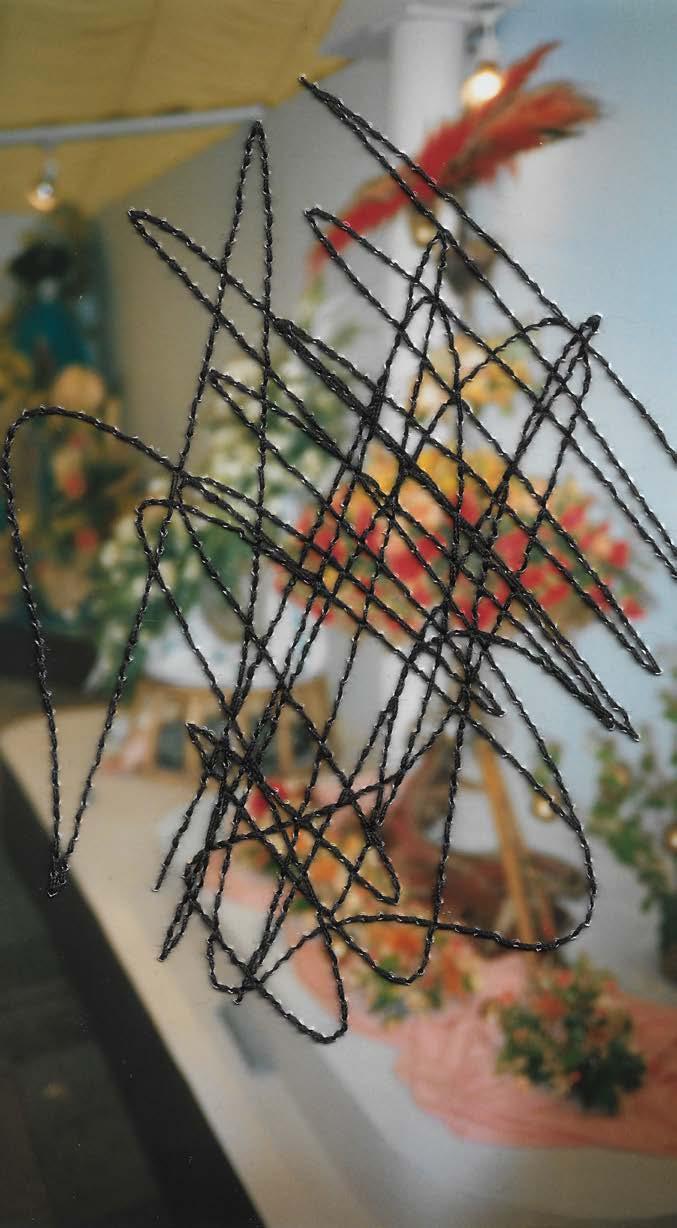
4 Connie Stewart, Plastic Flowers, embroidery on photograph, 2022. See page 55
5 Samantha Jackson, Scottrail, watercolour and collage on found paper, 2023. See page 34
9
WELCOME TO OUR 25TH GUIDE
An introduction from a-n CEO Julie Lomax
11-43
CLASS OF 2023
Our largest-ever selection of students’ work, featuring 31 artists across 28 UK art schools
12-13
COVER STORY: GROWING PAINS AND PLEASURES
Goldsmiths student Anita Furlong captures the uncertainty of youth in her character-filled oil and charcoal paintings

18-19
MUSHROOM PEOPLE
Kite Myers from Staffordshire University uses needle felting to create strangely captivating mushroom-like figures
24-25
MOVING MEMORIES
For her University of Sunderland show, Anna-Marie Gallares draws on vivid memories of emigrating from the Philippines to the UK as a child
34-35
PAPER TRAILS
For Glasgow School of Art student Samantha Jackson, everyday objects such as receipts and tickets provide rich material for critiquing harmful systems
42-43
DIASPORIC EXPERIENCES
Leeds University’s Kalisha Piper-Cheddie mines her own family history to make collage-like films exploring stories from the Caribbean diaspora
51-56
NEXT STEPS
Short Supply’s Mollie Balshaw provides five tips for life after graduation, while 2022 Degree Shows Guide cover star
Connie Stewart shares how things are going 12 months after leaving Gray’s School of Art
More Next Steps at a-n.co.uk/degree-shows
7
4 5
Contents

(Hons), Gestures of Entanglement. Edinburgh C ollege of Art Graduate Show Lauriston Campus Friday 2 June to Sunday 11 June 10am – 4pm daily Wednesday 7 June & Thursday 8 June Late opening until 8pm ART / DESIGN / LANDSCAPE / ARCHITECTURE / MUSIC #ecashows #ecagraduateshow www.eca.ed.ac.uk FREE! Book tickets for all our events on Eventbrite. csofa@colegsirgar.ac.uk DEGREE SHOW 22 - 26 M AY 2023
Bronwen Barnes Archer, Sculpture BA
Welcome to this 25th anniversary edition of the a-n Degree Shows Guide
Every a-n Degree Shows Guide is special for one simple reason – the art and artists featured in it. But in the process of putting the 2023 guide together we realised this year’s edition was notable for another reason: it sees the guide celebrating a landmark 25th anniversary.
Most – but, it should be noted, by no means all – of the 31 graduating students featured here would not have been born when a-n first published a degree shows supplement in what was then a monthly print magazine. A lot has changed in the intervening years, much of it involving life-altering digital technologies. But while higher education in the UK has been transformed, the degree show remains integral to the final-year experience. It is a vital, energising, unmissable and deeply visceral moment of new and inspiring creativity.
The a-n Degree Shows Guide, with students again selected by open call, has its own important role in that moment. For many, it is the first professional endorsement of their work outside the confines of their course. For the 12 artists selected for interview – a tough decision for the team, which is why we’ve chosen more this year while also increasing the overall number of students featured in the guide – it’s an opportunity to explain their practice to a new and curious audience. It is part of the ‘real world’ process of turning personal ideas into work that communicates with a public – an early step on a long journey that a-n is dedicated to supporting artists on at every stage.
Of course this guide can only offer a snapshot of the amazing work coming out of UK art schools this year, a nudge in the ribs towards the bigger picture. The featured students work in a wide range of media, from painting to video, photography to print, ceramics to needle felting. The art being made tells stories of migration and resistance, of personal struggles and community action, of consumer culture and alternative ways of living. It is thrillingly of this moment – just like it was 25 years ago.
Julie Lomax, a-n CEO, May 2023
a-n.co.uk/degree-shows
www.a-n.co.uk/degree-shows
Editor: Chris Sharratt
Editorial contributors: Jack Hutchinson and Ellen Wilkinson
Advertising: Jessica Murphy
Marketing: Jessica Roper
Design: founded.design
© writers, artists and a-n The Artists Information Company 2023
ISBN: 978-1-907529-32-0
Published by a-n The Artists Information Company
Registered in England, Company No. 1626331
Issuu: ANartistsinfo
Download the Issuu app for IOS and Android for best reading experience on phone or tablet
an_artnews

ANartistsinfo
anartistsinfo
Cover: Anita Furlong,
9
Sofi Multitasking, 80x100cm, oil and charcoal on canvas, 2023
Degree Shows Guide/2023 Est. 1998 25 years supporting student artists


CLASS OF 2023
Open for art
Features, Q&As and profiles of graduating students from across the UK, selected via open call
 Sophie Lloyd, Twin Gullets, 35x30x12cm isomalt, food colouring, lead came, 2023
11
ANITA FURLONG, BA (HONS) FINE ART AND ART HISTORY, GOLDSMITHS, LONDON
Captured moments
Argentinian student Anita Furlong makes paintings that explore the “cruel optimism” of growing up. By
ORLA FOSTER
Anita Furlong doesn’t like their subjects to pose for portraits. They prefer instead to catch unguarded moments as people muddle through life. “Friends always say, ‘I can’t believe you chose such an irrelevant moment to paint!’ laughs Furlong, “but they aren’t irrelevant for me.”
Originally from Buenos Aires, Furlong is finishing a degree in Fine Art and Art History at Goldsmiths – an ambition since childhood. “In South America there’s this idea of Europe as the place where you’re gonna make it,” they note, wryly. “I wanted an opportunity to separate myself from my context, and always romanticised the idea of London.” It turned out to be more of a comingof-age tale than anticipated.
Furlong found London incredibly isolating in the early days, to the point of creative paralysis. “I couldn’t make a painting on canvas the whole first term. I went to the studio every day for discipline, but didn’t like anything I was doing.” Left to their own devices, they went through a phase of making only melancholy self-portraits.
Four years and many friendships later, Furlong’s paintings now focus on human connections and the “cruel optimism” of growing up. For example, Sofi Multitasking (2023) – this guide’s cover image – shows a fatigued young woman skimming notes over a bowl of ramen. Incidental details, like an unspooled kitchen roll and keys flung down in a haze of multi-tasking, allow an unvarnished glimpse into coping with responsibility.

Inspired by Argentinian painters like Carlos Alonso and Antonio Berni, this spontaneous quality is central to Furlong’s practice. “I like immediate painting that captures peoples’ essence, without having to be hyperrealistic. I love it when you just draw two eyes, a mouth and a nose, and suddenly you have a gesture of someone you know.” But there’s a layer of anxiety too. Committing memories to canvas might preserve them, but it’s also a form of procrastination, staving off the unknown by trying to remain in the moment.
“My dad once said he liked my paintings but that I needed to grow up,” Furlong reflects. “This probably has a lot to do with having left where I’m from, like I froze that moment of my life.” People in these paintings cling onto youth, never quite complying with the demands of adulthood. So, what’s the story behind the portrait of the person crouched by a bed, wearing just one sock?
“Everyone thinks that’s a child, but it’s my best friend! He was sad because we were having a tense moment and were also hungover – I think you see it in his face.”
1 12
Hangovers have provided an unexpectedly effective way for Furlong to explore themes of intimacy and trust. Their artist statement describes “laying in bed at seven in the morning after a rave, three of us staring at one phone watching funny TikToks, dreading the comedown but knowing we will tightly hold each other through it”. These are cherished moments of togetherness; friendship offering a protective refuge from the unforgiving outside world.
The pressure to savour each moment is heightened by being on the brink of the degree show, though Furlong is trying not to buy into the make-or-break narrative. “It’s being sold to us as this big opportunity to get recognition from the art world. But for me, it’s a chance to see what everyone’s been doing. The course is so independent that unless you’re really close with people, you don’t know what they’re working on.”
Plans for the exhibition include selecting paintings with recurring figures (“so you get a sense they’re part of my everyday”), constructing a small inner room where visitors can view the work without distraction. Postdegree show, Furlong is exploring options such as the

2
Royal Drawing School’s postgraduate programme, or returning to Buenos Aires to recalibrate. “I’m really scared of the prospect of being in London with a bar job and no time to make work, running all the time.” While feeling uneasy about this chapter of their life ending, fear also feeds into the work. “When anxiety kicks in, it forces me to paint and record the most. It actually helps, because it makes my life feel well-lived.”
What would they like visitors to take from the show? “I want them to connect with the sentimentality,” Furlong concludes. “We’re finishing this stage where we’re meant to be grown-up and have stuff figured out, but I don’t know anyone who does.” But rather than surrendering to nostalgia, the work celebrates the here-and-now. “Even if you feel you’re hanging off a cliff, maybe looking at my paintings can remind you of all these really sweet moments – that you only get when you don’t have everything figured out.”
Degree show: 23-26 June (PV 22), Goldsmiths, University of London, New Cross, London SE14 6NW. gold.ac.uk/degree-shows
“I love it when you just draw two eyes, a mouth and a nose, and suddenly you have a gesture of someone you know”
1 Anita Furlong, Miru and Joaco scrolling on tiktok to save our lives at 7am, 40x60in, oil and charcoal on canvas, 2023
2 13
Anita Furlong, Getting ready, hungry and hungover, 40x60in, oil and charcoal on canvas, 2023
JOSS COPEMAN, BA (HONS) PHOTOGRAPHY, UNIVERSITY OF SOUTH WALES, CARDIFF
Playful with politics
Joss Copeman uses a range of photographic approaches to create conversations around queer identity.
By JACK HUTCHINSON
Southampton-born Joss Copeman spent his childhood in Devon before starting his BA Photography course at the University of South Wales in 2020. His work explores queer politics and notions of the self, using primarily lens-based and vernacular photography, and computer scans. Copeman places himself at the centre of his work, bringing into question and mocking the way we present ourselves.

What themes are you addressing in your work?
My work touches on ideas of the self and specifically my experiences. I tend to explore representatio n, gender and sexuality politics. My current project 21 Years –titled because I am 21 years old! – looks at a piece of legislation called Section 28 which came into effect in 1988 and prohibited the “promotion of homosexuality” by local authorities in Britain. I was born shortly before it was repealed in 2003, and my work examines the way in which it has cast a shadow over people my age who have grown up being part of the LGBTQ+ community.
Do you ever find dealing with such weighty themes problematic?
I try to make it as playful as possible, while still highlighting the importance of the issues. There’s a disposability to some of my work, for instance an image where I’ve literally printed out the Section 28 legislation, scrunched it up and rescanned it. Humour or playfulness
is actually a way of drawing people in and then allowing them an opening to the conversation.
How does your work fit within the democratisation of photography?
There has been an odd development over the last 1015 years whereby people use photography to frame themselves on social media. It’s very much a persona that I present and I think that speaks to the way people present themselves now online. I wouldn’t say I made a conscious decision to do this in my work, but I recognise there are those connotations. It is something I’ve been trying to figure out how to address, and I still don’t think I’ve really mastered it.
How comfortable are you being the focal point of your photography?
One thing I’ve been trying to grapple with is the fact that my work is potentially too inward facing. It does centre around me and my face is featured heavily within it. I would say that the way I choose to present myself is slightly removed from everyday life – I obviously wouldn’t normally go out wearing a shirt that says “It’s All About Me”!
What technical processes do you use when making your photographs? Do you have a collaborator helping to produce the self portraits?
I use multiple approaches. Some images are more staged, where the studio is specifically lit how I want it to be. Then there are some that are more vernacular photography where I just point and shoot. Recently I’ve been introducing abstract images as well, which I think are the more personal ones. But typically I’ll be in the studio, set up the lights and camera how I want, and then work with my collaborator and fellow student Holly. We normally do all that stuff together, bouncing ideas off each other. I get her to stand where I’m going to be in order to get the lighting just right. I try to capture everything in shot, rather than doing much post-shoot editing. But equally I’m not one of those people that takes forever trying to get everything perfect. I like to trust my instincts.
What was it about photography that attracted you?
I have just always been drawn to photography. It is something that I’m really trying to experiment with but I haven’t necessary had the time to really do so. But I wouldn’t say I am limited to that medium. After I graduate I would love to experiment more with sculpture and mixed media and video. I think because I’ve studied photography throughout my time in education there’s been a focus on pure photography, but through doing this course I’ve definitely expanded my horizons and that’s something I want to take forward.
Degree show: 16-22 June (PV 15), BayArt Gallery, 54 Bute Street, Cardiff CF10 5AF. instagram.com/uswphotography
14
1 Joss Copeman, self portrait (it’s all about me me me) 304.8x381mm, archival inkjet print, 2023
Connecting cultures
Savannah du Quercy’s practice combines sculpture, collage and photography to investigate interconnected cultures. In works such as Uprooted I,II, place and memory are explored through an ongoing engagement with the artist’s own mixed heritage/itinerant upbringing between Europe and the Middle East. Explaining how the work was created, du Quercy comments: “I worked with cardboard, paint, photographs, staples, and brass pins. I am interested in the associations we have with the material and the relationship with the preparations one makes for travel.” The result is work that juxtaposes, assembles and connects materials through systems of geometry, repetition and seriality. Jack Hutchinson
Degree show: 24-30 June (PV 23), City & Guilds of London Art School, 124 Kennington Park Road, London SE11 4DJ.
cityandguildsartschool.ac.uk/ degree-show

SAVANNAH DU QUERCY, BA (HONS) FINE ART, CITY & GUILDS OF LONDON ART SCHOOL
1
15
Savannah du Quercy, Uprooted I,II dimensions variable, found cardboard boxes, cardboard, paint, photographs, staples, brass pins, 2022
ABIGAIL ROSE DOWNEY, BA (HONS) FINE ART PAINTING, UNIVERSITY OF BRIGHTON
Finely balanced
In the work of sculptor and performance artist Abigail Rose Downey, broken and reconfigured vases act as a stand-in for the human body. “When I smash a vase, I metaphorically smash a version of myself,” they explain. Downey uses the fragments of floral and patterned ceramics to create something new, such as a wearable headpiece with absurdist, large flopping ears that will form part of An almost tragic story of a Broken Bunny, one of three pieces in Downey’s degree show installation. Also featured will be gold painted ceramic carrots, as seen here in the standalone sculpture, 24 Carrots, a tottering tower of root veg that both plays with words and goofs around with our perceptions. Ellen Wilkinson
Degree show: 3-11 June (PV 2), University of Brighton, 58-67 Grand Parade, Brighton BN2 OJY. brighton.ac.uk/summer-shows/index.aspx
 1
1
16
Abigail Rose Downey, 24 Carrots, 39x16x10cm, 24 carrots, ceramic sculpture, 2023
Christie Lau, BA (Hons) Fine Art, Chelsea College of Arts
UAL, London
Personal experience of navigating ‘a duality of culture and contexts between Hong Kong and the UK’ combine with collective histories in Christie Lau’s poignant paintings.

Degree show: 9-17 June (PV 8), Chelsea College of Arts, 16 John Islip Street, London SW1P 4JU. arts.ac.uk/colleges/chelsea-college-of-arts/whats-on/show
Dhama
Thanigasapapathy, BA (Hons) Painting, Open College of the Arts
Drawing on memory, imagination and cultural unease, Dhama Thanigasapapathy creates ghostly, semi-figurative landscapes of “future possibilities” in which “remnants of the past linger”.
Degree show: Already completed, 12-31 Jan 2023, The Questors Theatre, London W5 5BQ. oca.ac.uk 1
 Dhama Thanigasapapathy, Sentinel, 12x16 inch, oil on canvas board, 2022.
1 2 2
17
Christie Lau, HMS Cornwallis, 1842, 16x24cm, acrylic and pastel on paper, 2023
Mycelial networking
Kite Myers’ ‘mushroom people’ explore our capacity to empathise with the non-human.
By JAMIE LIMOND
A gaggle of small humanoids explore a gallery space. Genderless and practically featureless, they are capped at the head like overgrown mushrooms. They could be the stranded crew of an alien spaceship, if their ruddy noses and probing fingers didn’t suggest something more like a group of infants in a crèche. Reversing the body horror of Godzilla director Ishiro Honda’s 1963 cult classic Matango – in which a group of humans transform into fungi due to radiation poisoning – these figures are mushrooms in the process of becoming human. They seem a little lost and confused, but not unhappy. The work of final-year Staffordshire University student Kite Myers, the mushroom figures explore our capacity to empathise with non-human beings and things. “I’ve always liked the idea of mushrooms being so connected to everything in the natural world,” Myers tells me over Zoom. “Yet they also function outside of the animal and plant kingdoms. I wondered what would happen if I combined that ambiguity with the human form.”

For Myers, sculpture is the art form most innately relatable on a human level. “I’ve always been quite connected to figurative sculpture specifically, even as a kid going to museums and galleries. My favourite artists, people like Ron Mueck and Patricia Piccinini, get into a really close connection with the audience through their manipulations of the human figure. I enjoy painting, but when it comes to something I really want to get across, sculpture is the best medium I can use.”
It’s very hard to look at the mushroom figures and see only needle-felted sculptures. I wonder at what point in the making they become ‘people’ more than raw materials. “There’s a moment right at the end when they’re just plain unprocessed wool and I take some soft pastels and add some colour to the cheeks, the face, the hands and elbows, and somehow those slight touches of colour breathe life into them. For me, that’s when they change from being sculptures into these things that feel very alive and tangible.”
Scale also plays a big part in how we respond to them, Myers points out. “The first few were intentionally child-height and childlike in their build. We have this natural protectiveness over children, but then some people’s responses would harken back to creepy children in horror movies. Some people find them freaky. A couple of children were pretty terrified of them just because they shared an eyeline, which I hadn’t considered! I started to think about how adults might react to them if they were the same height and now the tallest work in the degree show is 7ft. The smallest ones
are just a cap with little stumpy legs, so in the space the audience will begin to understand how they develop. When you see them together it becomes apparent that there’s a kind of growth there.”
While Myers has created a backstory for the beings, as well as a full life cycle, she prefers to leave this implied rather than explicit. “I think a lot of the audience’s personal instincts and biases will dictate how they respond. One interpretation I had from a gentleman last year was that it felt like an invasion, like they were immigrants. I thought, ‘Interesting, that tells me more about you than about the work!’.”
That gentleman’s lack of imagination – or its vividness, depending on how you look at it – speaks of the role imagination plays in how far we extend our empathy within and beyond our own species. A telling quotation from Hayao Miyazaki on Myers’ website reads: ‘Reality is for people that lack imagination’. The irony is that there’s often a pressing environmental reality to Miyazaki’s fantasy films, wherein questions of nonhuman empathy and ecology go hand in hand.
“Environmentalism has always been quite close to my heart and it impacts how I make the work as well,” Myers reflects. “Because they’re made of wool, if you were to bury one of the figures it would decompose similarly to a real body. The aluminium skeleton would take a lot longer but eventually it would also break down into the earth.”
Without being explicitly environmental, Myers’ work speaks of a radical empathy that can expand to include the planet itself. “My dissertation was about empathy and about how art can invoke empathy. I think if people can draw on their empathetic responses to the work it can create an environment for conversations about empathy in other forms and for other beings and things.”
Degree show: 3-10 June (PV 2), Staffordshire University, Cadman Studios, College Road, Stoke-on-Trent ST4 2EF. instagram.com/staffsfineart
KITE MYERS, BA (HONS) FINE ART, STAFFORDSHIRE UNIVERSITY
18
1 Kite Myers, Human Nature, sculptures range from 13cm to 115cm tall, needle felted, 2022

“If people can draw on their empathetic responses it can create an environment for conversations about empathy in other forms and for other beings”
19
2 Kite Myers, Jeremy and Charlie 2, 106cm tall, needle felted, 2022 and 2023. Photo: Catherine Dineley
ZAN ATKINSON, BA (HONS) FINE ART, UNIVERSITY OF SALFORD
Work with mettle
Returning to art education as a mature student, Zan Atkinson has embraced the physicality of welding to create works that address trauma and survival.
By VALERIE ZWART
Mature student Zan Atkinson returned to tertiary education to do a Fine Art degree after a 30-year hiatus. Despite a rocky start, she is finishing her course with the highest mark in 10 years for her dissertation and enough work to mount a solo show. And did we mention she’s a single mother to three primary-school-aged children?
What are you making for the degree show?
I’m not sure if I’ll be able to finish it in time. Workshop access has been a problem due to train and university staff strikes. My back-up plan is to expand A Castle in the Air – a rudimentary house made from lottery ticket paper on an Acrow-prop plinth – with two more houses constructed from paper derived from mortgage applications and tenancy agreements.

Why did you return to university?
I didn’t really have a choice. I had a successful career in hair, make-up and photographic styling and teaching, but it effectively ended when I was diagnosed with two conditions that disrupt pain messaging in my nervous system. Unfortunately, brain surgery also left me with permanent nerve damage and no feeling in my hands. I could no longer trust them; I was worried I’d injure someone.
What have you enjoyed most at Salford?
I took every available workshop before discovering welding. It’s an out-of-body experience: with gauntlets you lose all sense of touch and temperature – which is something I live with anyway. The mask plunges you into darkness and you can’t hear much of anything.
Was there a particular part of your course you found very challenging?
I could have done without the pandemic lockdowns. My ex-partner started court proceedings for access, and I was home-schooling my three children. My mother had recently died, so I had no childcare in place. I was unable to complete a single module before the end-of-year deadline, when all six were due. Everyone around me told me to drop out. I didn’t sleep much. But I’m so glad I continued.
What kept you going?
I would rather my children see me fail than give up, because failure is how we learn.
Can you talk a bit more about your process?
Initially, I looked inward for subject matter. My first work in steel, Mettle, is about the fragility and strength of the human body. I did all the processes by hand: drilling holes, cutting and two weeks’ worth of hammering the metal. For Vestige, I used the same forms – scars, nerves, the spine – but rendered them in acrylic. It’s about the invisibility of disabilities and scars and how bodies can encapsulate traumas. I work in different media, and I can still draw, but it’s frustratingly slow for me. I work from a maquette when I can.
What is different about how you make work now?
I’m trying to arrive at a more reactive process, to provoke comment on social issues such as disparities in wealth, class and opportunity. For example, School Run was triggered by a sensationalist online article claiming that the 3–4pm surge in traffic volume is ‘needless’ road use by mothers who could cycle or walk. I painted a motorway barrier in school-tie colours to express the reality of working mothers’ curtailed working hours and career ambitions.
So, what is the ‘Plan A’ degree show work?
Exit Wound is a rendering (in approximately 87,000 stitches) of a bullet-through-glass exit mark on a survival blanket, which will be stretched across a steel armature. It’s about how recovery goes on much longer than the initial trauma. The work’s bullet hole is four to five inches, but the striations made on the glass – the recovery – are much, much bigger.
What’s been the biggest change during your course?
I’m not sure yet, but I can’t believe I’ve gone from doing finely detailed work on faces to... welding.
Degree show: 25 May – 3 June, The University of Salford, New Adelphi Building (Level 6), University Road, Salford M5 4BR. instagram.com/fineartsalford
20
1 Zan Atkinson, A Castle in the Air, 150x90cm, Lottery tickets, Acrow prop, 2023
Devine interpretation
The New Devine is a photography project by Greek multidisciplinary artist Maria Touloupa that represents her interpretation of divinity through female saints. “I aim to combine my interest in religious art and symbolism with visual communication, by merging photography and design,” she comments.

The portraits focus on female beauty and divinity in a fantasised world of human decay and AI. “This project will be exhibited in my degree show, and aims to integrate traditional concepts with modern concerns about humanity, feminism, political and societal issues.” Jack Hutchinson
Degree show: 20-28 May (PV 19), Duncan of Jordanstone College of Art and Design, University of Dundee, Matthew Building, Perth Road, Dundee DD1 4HT. dundee.ac.uk/graduate-showcase
MARIA TOULOUPA, BA (HONS) FINE ART, DUNCAN OF JORDANSTONE COLLEGE OF ART AND DESIGN, DUNDEE
21
1 Maria Touloupa, The New Devine photography, 2023
Recycled resistance
Britney Fraser draws on her own mining heritage to make works that highlight the “untold, overlooked and undervalued within Northumberland working communities”. With everyday materials including dish cloths, bin liners, tarpaulin and high visibility workwear, she creates wall-based and sculptural works using a repetitive process known as ‘Proggy’ –traditionally used by women to make rag rugs with small clippings of recycled materials.
Fraser’s degree show will include another aspect of the history of women’s work within mining culture: language. “Inspired by the dialect I heard growing up in my family,” Fraser explains, the sculptural installation will feature various northern slang words such as ‘divvent’, meaning ‘do not’, “positioned so they are in conversation with each other.”
Ellen Wilkinson
Degree show: 3-17 June (PV 2), Hatton Gallery, Kings Road, Newcastle University, Newcastle upon Tyne NE1 7RU.
instagram.com/newcastlefineart
 BRITNEY FRASER, BA (HONS) FINE ART, NEWCASTLE UNIVERSITY
22
1 Britney Fraser, Blown Vinyl, 21x30cm, towel and tarpaulin, 2023
Emmalene Maguire, BA (Hons) Fine Art, University of Suffolk, Ipswich
Memories of a childhood ‘entwined with magic, chaos, and transience’ reverberate in Emmalene Maguire’s layered, text-annotated works which strive to create ’a visual language for the invisible’.

Degree show: 23-30 June (PV 22), University of Suffolk, Waterfront Building, Neptune Quay, Ipswich IP4 1QJ. uos.ac.uk/content/arts-degreeshow-2023
Melanie Woodward, BA (Hons) Fine Art, University of Brighton

Centring on her Motswana identity, Melanie Woodward explores issues of food production in Botswana and the country’s trade relationship with neighbouring South Africa.
Degree show: 3-11 June (PV 2), University of Brighton, 58-67 Grand Parade, Brighton BN2 OJY. brighton.ac.uk/summer-shows
2
1 Emmalene Maguire, Small, 30x40cm, photocollage and fumage, 2023
1 2 23
Melanie Woodward, A1 or A1?, 13x25cm, digital collage inkjet print, cardboard, pulped cardboard, acrylic paint, 2023
ANNA-MARIE GALLARES, BA (HONS) FINE ART, UNIVERSITY OF SUNDERLAND
A rich tapestry
Anna-Marie Gallares is creating a tapestry-sized painting exploring her life since moving aged seven from the Philippines to the UK.
 By ISAAC NUGENT
In medieval Europe, wall hangings were used to bring warmth to draughty rooms, delighting viewers with stories from the Bible, pagan mythology and everyday life. Anna-Marie Gallares, a final-year BA Fine Art student at the University of Sunderland, plans to breathe new life into this ancient artform for her degree show. She is making an ambitious tapestry-sized painting, 18ft by 4.5ft, recording her memories of arriving in the UK as an immigrant from the Philippines.
“When I came here, it was all very exciting and new,” she explains, recounting the highs and lows of her immigrant journey. Her mother, a healthcare worker, migrated to the UK first, seeking better employment prospects in the NHS. When Gallares was seven she joined her mother, travelling via Dubai with her father and younger sister. The family settled in New Milton in southwest Hampshire, which Gallares describes as “a small town in the middle of nowhere”.
With only a limited grasp of English, it was a struggle to adapt to her new life in the UK. “When I arrived at school, it became relevant that no-one looked like me,”
Gallares recalls. She remembers her class photo, where she stood out as the only minority ethnic student, and how difficult it was to make friends. “It was a struggle to stay true to being a Filipino, whilst trying to fit in and become more British. It didn’t feel like I belonged anywhere.”
Now, Gallares speaks of her pride about being able to portray her experiences of being a young migrant to the UK in her degree show installation. “I’ve never shared my story before,” she tells me, speaking on Zoom from her brightly-lit corner studio. When the painted tapestry is completed, it will include 20 figurative elements. These will represent moments in her journey that have become especially meaningful for her. Rendered in a colourful graphic style, many of the images Gallares plans to include will be warm and appealing, reflecting long-cherished memories of childhood. One depicts the artist with her family, set within a wintry landscape. It is based on a photograph taken the first time they saw snow. Another shows her smartly dressed in a blue cardigan and black skirt, the first school uniform she wore after arriving in the UK.
Not all of the images Gallares will include evoke positive memories. A close-up shot of an open lunchbox recalls an upsetting incident at school, when the other students taunted her for the food she ate. Another depicts her sat cross-legged with head in hands, expressing her despair at being unable to communicate in English. The painted tapestry will also include patterns inspired by the tattoo designs of Whang Od, the oldest surviving traditional
1 24
1 Anna-Marie Gallares, My Family Portrait, 146x178cm, acrylic paint and oil pastel on canvas, 2020
Kalinga tattooist from the Butbut people in the northern Philippines, as well as abstract swirls and blocks of colour. These non-figurative areas will be built up through layers of acrylic, oil pastel, gouache and paint pen, Gallares explains, adding depth to the story she is trying to tell.
Gallares credits her experience of being a youth worker at Projects4Change, a charity that organises youth-led activities for young people in the North East, as being particularly influential on her approach to making art. “My story is unique to myself,” she says, “but you don’t have to be an immigrant to understand… a lot of young people I have spoken to from low-income backgrounds had the same problems as me.” After university, she plans to become a community arts organiser, helping more young people access the arts. “Not every young person is going to come out as an artist,” she says, “but the important thing is that they have a chance to try it.”
Through depicting her own journey in such an honest and unflinching manner, Gallares highlights how challenging life can be for child migrants. This is at a time when the number of young people migrating to the UK continues to rise. According to the Migration Observatory at the University of Oxford, in 2019 almost 900,000 children under 18 in the UK were born abroad. Gallares’ story is therefore becoming an increasingly common one. Her work asks us to reflect on how we might all be more tolerant of those different to ourselves.

Degree show: 10-18 June (PV 9), University of Sunderland, Sunderland Creatives Gallery, The National Glass Centre, Liberty Way, Roker SR6 0GL. sunderland.ac.uk/student-experience/explore/ arts-creative-industries/degreeshows

“My story is unique to myself, but you don’t have to be an immigrant to understand”
2
Anna-Marie Gallares, First Snow Family, 30x130cm, acrylic paint and oil pastel on canvas, 2023
3 2 25
3 Anna-Marie Gallares, A Year In My Life, tapestry in progress, 2023
Collage of possibilities
Jade Evans’ work primarily involves creating acrylic paintings that explore themes such as popular culture, contemporary society, consumer culture, the everyday and her own personal experiences. She uses collage as part of her process, incorporating her own images with those found in magazines and online, before manipulating the imagery and finally painting the work in often bright and saturated colours.
In works such as Untitled (pictured), Evans likes to “experiment with expanded field painting, bringing elements of the work into my environment using materials such as paint, clay and MDF to explore the possibilities of my practice”. Jack
 Hutchinson
Degree show: 3-10 June (PV 2), Staffordshire University, Cadman Studios, College Road, Stoke-on-Trent, ST4 2EF staffs.ac.uk
JADE EVANS, BA (HONS) FINE ART, STAFFORDSHIRE UNIVERSITY
1
26
Jade Evans, Untitled, 50x35cm, acrylic on MDF, 2023
Route finder
French artist Aurélie Meriel draws on intergenerational memories to create work with an uncanny physicality.
By JOANNA BYRNE
Aurélie Meriel works across sculpture, painting, photography and film. Originally from France, her work as an actor took her to Los Angeles, before motherhood brought her to London. Her work is performative and surreal, and explores generational transmission, motherhood, domesticity, female representation and gender politics. Tell me more about your practice.
I start by making something, usually an object. The objects often become something else in performance, I interact with the work and make photographs or film. I like to repurpose materials from the domestic realm. In My Social Ladder (2022) I created a soft ladder made of textile that would not hold itself up. I was playing with the idea of being trapped somewhere and that your escape route is not reliable, like the sensation that your legs are failing you. Physicality is very important to my work: the ladder is almost like a body – a floppy body. Performance seems really important – does your background in acting inform what you make?
I used to think acting and fine art were two completely different things, but it became more obvious to me that they link together. I was a dancer first and then an actress, but becoming a mother really changed things for me. I moved from LA to London. I became a mother at the same time as #Metoo [around 2017], and had an awakening about the film business – I needed to get my power back. There’s something so liberating for me to make films, because before I thought ‘I can’t write or direct, I’m only an actress.’
What’s the relationship between text and textiles?
Textiles bring me back to joyful moments in my childhood because my mother and grandmother sewed a lot. I have memories of the three of us with lots of fabric on the floor, making and bonding the generations together. I sometimes include my child in my making. In the past, I sewed words into my work. For 3 Women (2021) and Displaced (2021), I made quilts incorporating quotes from others, but in my new multidisciplinary piece, Witches, Stitches and Other Itches (2023), I used my own words for the first time.
Tell me more about this new piece.
I made a structure that looks like bone, but padded with soft textiles, reminiscent of flesh. I wrote on it with paint and then half washed it off so some words are visible but not everything can be read; it’s like hearing bits of words from the past or voices that are whispering. On it I wrote recipes for making crêpes, in French, a strong memory linked to my grandmother. I started writing down other recipes from my great grandmother, written down on old
papers my mother had kept. I was thinking about witches and recipes; the passing down through generations.
You’ve described your work as dealing with the idea of intergenerational transmission?
Witches… taps into a certain intuition of the past. This concept that even if we’re not conscious of it, we carry information from past generations: it’s printed in our DNA. In your performance of Witches…, the textiles you’ve created are brought to life. Can you tell me more about the film you’re making?
In the film, I perform the building of the textile structure: three parts coming together like a house, again symbolic of the body, or a skeleton. At the base of the structure are my feet, cast in plaster. After finishing building, I begin to transform, putting curtains on like a robe, applying makeup and playing with imagery linked to the feminine. I then put on a magical textile headpiece, a mask inspired by archetypes from the Tarot, that reflects the realm of power and playfulness that women like witches were exploring. There was this sentence that kept coming back to me while I was making: ‘We are the granddaughters of the witches you couldn’t burn’.
Degree show: 8-15 June, Middlesex University, The Burroughs, Hendon, London NW4 4BT. mdx.ac.uk

27 AURÉLIE MERIEL,
UNIVERSITY,
BA (HONS) FINE ART, MIDDLESEX
LONDON
1 Aurélie Meriel, My Social Ladder, textile, film and performance, 2022

28
Fading memories, imagined landscapes

In the photographic series Blue-tailed Bee-eater’s Dreams Lakruwan Rajapaksha presents hazy, atmospheric images of country lanes, fields, woodland and car parks in rural Britain. Since moving to the UK in 2007 the artist has visited his native Sri Lanka only twice. “My memory of certain locations, particularly my village, is fading,” he says. His landscapes, characterised by dark, dramatic skies and low lighting, challenge the cliched views of a bucolic British countryside, and are, he explains, “an attempt to recollect memories and feelings of my disappearing Sri Lanka”.
Walking around the English village where he lives with his cameras at “that special time when the night becomes a dawn” he describes the transporting effect of silence, solitude and place: “The photographs become dream paintings, simultaneously real and imagined. Although it can be a bitter-sweet process, it calms me down for a moment.” Ellen
Wilkinson
Degree show: 21 June – 1 July (PV 20), London Metropolitan University School of Art, Architecture and Design, 16 Goulston Street, London E1 7TP. ldnmetarts.photography
LAKRUWAN RAJAPAKSHA, BA (HONS) PHOTOGRAPHY, LONDON METROPOLITAN UNIVERSITY
29
1 Lakruwan Rajapaksha, Blue-tailed Beeeater’s Dreams, photograph, 2022-23
Sarah Grounds, BA Documentary Photography and Visual Activism, UWTSD Swansea College of Art

Ideas of isolation, freedom and connection are explored in Sarah Grounds’ The Links Project, an ongoing body of work incorporating installation, still image and performance.
Degree show: 19 May – 19 June, UWTSD Swansea College of Art, Alexandra Road, Swansea SA1 5DU; 6-9 July, Copeland Gallery, London SE15 3SN. overlyblueish.com
1
Sophia Kisielewska-Dunbar, BA (Hons) Fine Art, The Art Academy, London

Multidisciplinary artist and researcher Sophia Kisielewska-Dunbar combines painting, soft sculpture and installation to examine issues of representation in the Western art canon.
Degree show: 23-25 June (PV 22) The Art Academy, 165A Borough High Street, London SE1 1HR. artacademy.ac.uk/aalgradshow2023
Sarah Grounds, The Links Project, photography, 2022
2
2 1 30 30
Sophia Kisielewska-Dunbar, Mostro | Mostrare, 11x7x6cm, terracotta with hand-painted blue and white glaze detail (one part of a 36-piece installation), 2023
Cultural appreciation
Informed by her Sicilian, Greek and Pakistani heritage, Yasmin Shah creates work enriched by food, family and a warm orange glow.
By ANNEKA FRENCH
Yasmin Shah’s work examines identity and culture through photography, digital media, painting and sculpture. Drawing on her own family and personal archives, she uses lived experience as someone of Sicilian, Greek and Pakistani descent to make work that is distinctively vibrant and celebratory. “I was raised in the UK and I’ve grown up with a lot of different cultural influences from my parents,” she explains. “This gave me a feeling of not knowing where I fit in. In my work, I want to shed light on a mixture of cultures, particularly in the works that feature food. The food is mainly of a Pakistani influence, for example, though these images are usually taken in Greece.”
A student at Norwich University of the Arts (NUA), Shah’s most significant work to date is The Orange Project (2023), which is the primary focus of her degree show display. Key components of The Orange Project include two suites of photographs shot in Sicily and Corfu. One element is specifically focused on food prepared by her family, while the other comprises images taken in and around homes, streets and the coast, featuring young children, washing lines, people gathered around tables, a swimmer in bright sunlight and community processions.
The photographs are imbued with a hazy slowness, sensory qualities enriched because they have been taken intuitively rather than using staging or pre-planning. They act as a “mini sketchbook”. The works possess an evident sense of joy which Shah enhances with an orange tint she overlays afterwards. Shah is keen to emphasise this emotion, and colour plays a role in a zine she is developing, which uses colour as an avenue for conversation and is informed by a friend’s experiences with synaesthesia. “Orange is mainly, for me, associated with sun and heat; it reminds me of where my parents are from and our visits. I almost want people to look through an orange lens, to feel the heat and the energy that I get from these moments.”
Shah additionally plans to display a collection of paintings that incorporate orange brushwork on an orange wall. These paintings include My Brother at Home (2023), a sensitive portrait of her brother Max based on a photograph in a restaurant, and My Yiayia’s Lemons (2023), in which Shah’s grandmother tenderly cradles the fruit and branches of a lemon tree. She is working on new paintings, made, like these, using photographic starting points of moments that have emotional significance to her and which “make her smile”. Shah is a
self-described fan of portraiture. A painting of her sister will feature, again with an orange effect to the overall palette.
These works will be accompanied by a series of painted clay sculptures, her inspiration derived from visits to produce markets in Corfu and evocative of these personal experiences. Initially conceived as a side project, brightly coloured peppers, tomatoes, limes, olives, figs and chillies will be placed on shelving within her degree display. Speaking to and symbolic of broader ideas of growth, nourishment and cultural identity, these sculptures offer an accessible take on Shah’s themes. Memory is a cornerstone of the artist’s work. Places and people change, and photographic documentation remains a crucial way in which to capture and retain transient events and emotions. “Every photo taken is a memory in itself. Candid, natural moments have not necessarily been documented so easily in the past,” she observes. “I find a lot of joy in these small moments of my life, where my family will sit together and enjoy food, especially. I can tell you whose hands are whose and where exactly we are in each image.”

Such experiences have universal appeal. The artist’s work offers intimate and refreshingly warm and positive glimpses into her specific cultural experiences and their legacies. “There’s a mixture of cultures within me,” Shah continues. “I definitely didn’t appreciate them when I was younger. I hope my work gets people to consider belonging, to think about where they’re from and to appreciate the different cultural influences in their lives.”
Degree show: 16-22 June, Norwich University of the Arts, St Georges Building, St Georges Street, Norwich NR3 1BB. nua.ac.uk/events/all/grad-fest-2023
THE
YASMIN SHAH, BA (HONS) FINE ART, NORWICH UNIVERSITY OF
ARTS
31
1 Yasmin Shah, Market, terracotta clay and acrylic, 2023
Getting inside the object
Multidisciplinary artist Belinda Wong is interested in how the everyday things that surround us are mostly taken for granted. Her studies at Wirral Met College have resulted in an interest in theories such as object-orientated ontology, which is keenly advocated by the American philosopher Graham Harmen and commonly known as OOO. She explains: “This has stirred these interests in the direction of the perspective of the object itself, without interference of a human viewpoint.”
Wong’s installation Getting to Know the Washing Machine (2023) is an invitation for participants to “come inside the installation and endeavour to imagine what sensations a washing machine would experience, asking how does a washing machine understand its world?”
Degree show: 11-27 May 2023, The Williamson Art Gallery, Slatey Road, Birkenhead CH43 4UE. instagram.com/wirralmetcollege
 BELINDA WONG, BA (HONS) FINE ART, WIRRAL MET COLLEGE IN PARTNERSHIP WITH CHESTER UNIVERSITY
1
BELINDA WONG, BA (HONS) FINE ART, WIRRAL MET COLLEGE IN PARTNERSHIP WITH CHESTER UNIVERSITY
1
32
Belinda Wong, Washing Machine Drum screenprint, 2023.
STONE, BA (HONS) FINE ART, UWE BRISTOL
Seasonal working
Environmental activism, the importance of community, and the uniqueness of her own menstrual cycle are all key touch points for Holly Stone’s practice.
By JESSICA RAMM
Holly Stone works in ceramics and traditional folk construction techniques. She builds nests and shelters as a way of exploring contemporary society’s preoccupation with individualism. Her work is very much influenced by Bristol’s vibrant social life, particularly the strong culture of collectivism and community surrounding the city’s community farms.

What are you planning to present for your show?
I’m going to create a structure out of cob with a screen inside showing a film that I’m going to make of me building my personal shelter. It’s about security and safety from a personal point of view, but also trying to create safety and stability and other ways of living in light of the environmental crisis. It’s going to be quite raw. I’m using a microphone to pick up my breathing.
What will people see?
They’ll see a wide shot in a field of me building the sculpture around me and then cut to a winding, neverending journey through a cave, and shots of multiple hands on the cob, but then it cuts back to just a single person on a screen. It’s about the exhaustion of trying to do things on your own and the innate need to create security.
I’m also going to create lots of coins with pigs on them which I’m going to invite people to take away with them. Firstly, because I like there to be a bit of an exchange when people come and see my work, secondly as a comment on excessive farming. The more the coins are taken away the less there is, so it becomes more valuable to have one. By taking something away it’s engaging with the work differently.
What is your making process?
Absorbing and experiencing is the majority of my process. I spend a long time gathering ideas and materials. I’ve been volunteering on lots of organic community farms recently. I go to a lot of talks and experience a lot of things and I find writing really helpful too; writing and making come at the same time.
Yesterday I cycled with eight-foot withies [willow stems] on my back – it’s always a mission to collect everything I need. Once I have everything, I’m very focused on my making and I have quite a high intensity period of just bringing things together. I try in my practice to work with my menstrual cycle seasons, so my making varies depending on the different times of the month. That’s an unusual way of working. Tell me more about it?
For example, in the spring part of my cycle I’ll be very physically making. I’ll be in the studios a lot, the same
for summer, and then in the autumn part I’ll be tying up projects and coming up with ideas. In the winter part of the cycle I’ll rest and not make, taking time to absorb things rather than put things out into the world.
Would I be right in thinking vulnerability is a theme in your work?
Yes, or the lack of. The structures are built around vulnerability. I want to make a difference and I want to create a better world but also feel the limitations of doing things alone – individualist culture and capitalism and the glorified meritocracy, ‘everything I’ve done is mine,’ that sort of thing. I also have my own personal narratives around isolation and coming out of that, I’m recognising the value of community. It’s a reflection on that. At the time you can think you’re keeping yourself safe by being alone, but it’s a bit of an illusion. It’s always been a coping mechanism, to rely on myself.
Can you talk more about why isolation and individuality are such important issues for you?
The reason why I’m making work about isolation is actually because I’m so interested in community. It is related to the pandemic and having to experience things alone. Now I’m really excited to work with other people, but because of the way my degree works I’m making my work by myself. That’s why I’m leaning in to it, or critiquing working as an individual, because that’s how it’s structured.
Degree show: 10-15 June (PV 9), Spike Island, 133 Cumberland Road, Bristol BS1 6UX. uwe.ac.uk/events/degree-show
HOLLY
33
1 Holly Stone, Personal Farm, variable dimensions, straw, soil, sugar, clay, 2022
SAMANTHA JACKSON, BA (HONS) PAINTING AND PRINTMAKING, GLASGOW SCHOOL OF ART
Systems of being
Through her painting and photography, Samantha Jackson introduces humanity and care into the everyday paper trail of capitalism.
By LYDIA ASHMAN
Old mattresses and payslips. Morrisons’ receipts and expired bank cards. Samantha Jackson uses these everyday objects to make work that she hopes critiques harmful systems, while also serving as “small, captioned moments of gratitude”. Washed with colour and featuring sketches, paintings and printouts of photos she’s taken with her phone, these transformed objects reveal intimate details of her life and, in the process, also reflect something of our own. “I like the idea of autofiction, of using my own experiences to get to something fundamental and relatable,” she says. “I just want to explore being.”

Your work juxtaposes harm and care. What got you interested in these themes? Harm came from the experience of not being able to find a flat for six months. My partner and I lived in five or six different places. We experienced dodgy landlords, mould issues and unaffordable rent and deposits – despite us both working full-time. I’m a very privileged person in many ways, but that really affected me. The work started from me trying to process that experience.
Generally, I’ve found all these barriers to being a human, whether in the form of bills, the cost of living crisis, the climate crisis. All these crises are particular to this moment and I thought were worth exploring as they’re happening. I don’t want my work to just be about critiquing harmful systems, though. I don’t think that’s the whole human experience. My work’s also about all the hope and care and humanity that you can find within that.
Found objects are integral to your work. Are you gathering these all the time?
Literally, all the time. Nine times out of ten, they naturally come into my life. I have a drawer where I stuff things like receipts, tax codes, voting registration, energy bills and university accommodation letting agreements. Other objects have appeared in really funny ways. Bus Stop (SO CUTE) cost of life was a bus stop ad that a friend brought home after a night out.
What about the photos that appear in your work? Are they more intentional?
I take photos of things I appreciate either aesthetically, or because they’re meaningful in some way.
Compositions that feel, I use the word ‘gestural’, which is based on a poem by [Rainer Maria] Rilke that [Michel] de Certeau mentions in his book, The Practice of Everyday Life, where he talks about people being like ‘trees of gestures’. If you love someone or something, they become like a gesture and I’m trying to capture these with my camera phone. This forms a digital sketchbook. From there, I’ll draw or paint things. And that’s where all the colour, the fun, comes from: the painting.
34
1 Samantha Jackson, Untitled, series of three, 60x90mm, watercolour on tickets and cards, 2023
I was surprised at how much detail and depth emerges from a Morrisons’ receipt or a payslip when you change the colour or conceal certain parts. They really build up a picture of your life. I’m interested in your process of transforming found objects to show this humanity. That’s exactly the point. If I were just to show an object, it would be too didactic, too harsh a critique. What I’m trying to showcase and understand is the humanness, the everydayness. All those bits and bobs on their own are a reminder of consumption and capitalism; things that are quite harmful. But we use them. A person’s life isn’t measured by their receipts, but you can get these glimpses, these gestures, of humanity weaving through them.

I wondered about the speed at which you work. The small pieces in The Memory Collection look quite quick – the sketches, the watercolour washes – compared to the larger pieces.
The receipts and stuff are quite quick and instinctive, like writing or a stream of consciousness. I’m quite a skittish person, and I get all that fidgety energy out with the small works. But with an object that’s harder to come by, I will sit and stare at it in my studio for so long, maybe a month. The visual components of the object
will mishmash at the back of my head and eventually come out in my drawing.
With Aegis [a watercolour on a single mattress], I wanted to be really careful about how I painted on it. When I did, it came from a really cathartic place. It’s a selfportrait, with personal themes around mental health and resting. It’s about caring for yourself but also needing care from wherever you live, wherever you’re sleeping.
How are you planning to present your work?
I have a space on the fourth floor by a window, like a little room. I want a clash of the internal and external. I’m going to try to make the space a bit more domestic by using wallpaper on some of the walls. There’ll be a new work on a mattress, and also things that point to bus shelters and those anti-homeless benches you can’t lie down on. I’m still considering how I’m going to show some of the smaller works. I’m planning to respond to the space, but these ideas of domestic versus institution, harm versus care, personal versus impersonal space, they will tie all the pieces together thematically. Degree Show: 2-11 June, Glasgow School of Art, Stow Building, 43 Shamrock Street, Glasgow G4 9LD. gsashowcase.net
35
1 Samantha Jackson, Aidan, watercolour and collage on found paper, 2023
Sweet but sickly
Sophie Lloyd’s sugar-glass sculptures are a fairground-like critique of consumer culture and how it harms us.
By ELLEN WILKINSON
Sophie Lloyd is recalling a childhood memory of a family picnic. “We’re on a beach and I hear this strange sound. A seagull has stolen my brother’s sausage roll, is eating it whole and choking.” The image of a bird trying to eat too much is one that continues to resonant for an artist whose work deals with “things we consume and how they consume us”.
Humans and animals with gaping mouths populate Lloyd’s work, which is made of sugar, icing, isomalt (an engineered sugar that doesn’t caramelise when melted), fondant icing, vinegar, glucose, food colouring and lead. The sculptures resemble figures from fairground games, waiting for balls to be thrown through their mouths, and she describes her cast sugar technique as a “shoddy facade” of stained glass. Each figure is flatly three dimensional: viewed from the side they almost disappear.
Among the numerous characters we meet is a chef with red-rimmed eyes and dark bags dragging down his face, like he’s done too many double shifts in a windowless kitchen. There’s a clown with lank black hair as if he’s just removed a sweaty wig, and cheeks and ears that match the colour of his round, red nose. There are pairs: a horse and jockey, an adult and a baby wearing bibs, and a kissing couple, mouths united into one hole.

Where do these characters come from? “They’re caricatures based on people I see in media and entertainment, but there’s also an element of selfportraiture,” Lloyd explains. “It’s an algorithmic self rather than a real self. Some figures are taken from emojis.” Lloyd is a self-confessed telly addict and in part her work refers to overconsumption of social media and TV, and how we are lured in “despite knowing its harmful, addictive effects and false promises”. The work references another form of excess: Renaissance sugar sculptures that were created as elaborate table centrepieces. “They were displays of wealth, not to be eaten. If you tried you’d crack your teeth.”
Acts of gluttony frequently appear in Lloyd’s work: a contorted woman eats her own leg, and three chicks wait with open beaks for a parent to return and regurgitate something slimy down their gullets. Working from her kitchen through lockdown during her first year, she made a sculptural cake and, inspired by seeing Bake Off contestants creating sugar windows, began experimenting with sugar stained glass. “I love the sickly sweetness of sugar. It’s delicious but en masse it’s disgusting. Stained glass lead is a poisonous material. Paired with sugar it becomes mischievous.”
Lloyd’s work is considerably shorter-lived than the stained glass you might come across in a medieval church, and she’ll be keeping an eye on the weather forecast in the lead up to her degree show. “The sculptures are fussy. They complain if it’s too hot or humid. I’m not sure exactly how they’ll look at my show; if it’s a heatwave I’ll have a lot of puddles.” Many artists would be anxious about the possibility of their whole degree show melting. Lloyd, however, embraces this instability and the effects it produces: cracked, distorted faces, changes in texture and colour. “It’s about letting the sugar do its thing. I might have fresh sculptures in the show that I’ve poured the night before the opening, alongside ones that have been affected by conditions.” Whatever physical state the figures are in, they will be displayed on a long banqueting-style table. There’s another façade here, as it will be held up by wallpaper table supports – “cheapskate looking” as Lloyd puts it. Each figure will have its own space in the crowd, and she compares this effect to Instagram. “I want them to have their individual moment but there’s a uniformity, they’re all conforming to the game they’re participating in. As you walk around them, they’re individual but blurring into one.”
Are Lloyd’s characters willing participants in this game? “I think they maybe were once. Consumers are manipulated but somewhat willing participants. Some of my figures might be undergoing an awakening. They have half open eyes like they’ve been woken from a deep sleep. I think they’re self aware and maybe questioning their willingness.”
Degree show: 24-30 June (PV 23), City & Guilds of London Art School, 124 Kennington Park Road, London SE11 4DJ. cityandguildsartschool.ac.uk/degree-show
SOPHIE LLOYD, BA (HONS) FINE ART, CITY AND GUILDS OF LONDON ART SCHOOL
36
1 Sophie Lloyd, Little Chef, 35x29x12cm, isomalt, food colouring, lead came, 2023
Niamh Hawes, BA (Hons) Fine Art, Teesside University, Middlesbrough
Aspects of female form are explored in Niamh Hawes’ fragile works. Wax is used to give structure to wool, while blood and violence is evoked through the colour red.

Degree show: 17-19 May (PV 16), Teesside University, Waterhouse Building, Middlesbrough TS1 3BB. tees.ac.uk/artschool/
Nikki Romanik, BA (Hons) Fine Art, University of Derby
Vibrant, carefree colour is to the fore in Nikki Romanik’s abstract paintings, created with a mixture of “unconscious and purposeful gestures” and drawing on memories of a Caribbean childhood.
Degree show: 10-17 June (PV 9), University of Derby, Britannia Mill Studios, Mackworth Road, Derby DE22 3BL. instagram.com/19_degrees_derby/
 1 Nikki Romanik, Submerged in Familiarity, detail of acrylic on canvas painting, 2023
2 Niamh
37 1 2
Hawes, Untitled, wax on wool, 2023
GUY UNDRILL, BA (HONS) FINE ART, UWE BRISTOL
Performative patterns
Guy Undrill works across print, photography, installation, video, sound and performance, the latter sometimes involving direct interaction with viewers. For The Ash Augury Project, participants burned a piece of their own art. He explains: “For this Halloween performance, after an incantation the ashes of the work were placed in a paintball gun and fired at paper. The patterns produced were used to make predictions of the participants’ future.”
While Undrill sees his work as multi-layered and serious, it’s important that “it is also accessible. Maybe even fun...”
Degree show: 10-15 June (PV 9), Spike Island, 133 Cumberland Road, Bristol BS1 6UX. uwe.ac.uk/events/degree-show

38
1 Guy Undrill, The Ash Augury Project, installation/performance, ash, paintball gun, paintballs, rifle range, paper, 2022
Foraging for meaning
Leilani June’s porous textile, drawing and performance work takes shape as much in the rituals, foraging and natural cycles of their daily life as in the studio.
By ELLEN WILKINSON
For interdisciplinary, socially engaged, queer artist Leilani June “fabrics are vessels” that can hold a multitude of material and meaning. Working with foraged objects, plants and scents, their degree show will bring together textiles, rotting food and more in an intuitive display drawing on pagan witchcraft, rituals and a need to create “different ways to hold things”. Your work energievaten en portalen is a hanging made from a duvet and an intriguing list of materials that evoke bodily and natural cycles, including plants, period blood, full moon sea water and baby’s breath. How did this work come about? This work was made over one moon cycle [the 29.5 days it takes for the moon to orbit the earth] last December. I often work with sheets of fabric, using them to cook on, eat on, carry out rituals on, dance on, live on. I’m drawn to materials that are porous, like muslin, that can take on dyes and absorb energy: fabrics are vessels. A lot of my work involves practices that I also use in my life, like rituals, witchcraft, energy transfer, foraging, harnessing the power of nature, symbiotic living and leaning into the seasons.
A duvet suggests comfort, but this one has a hole in the middle – it’s ragged, a void, there are sharp sewing needles embedded in the fabric, but it’s also inviting the viewer to step into or through it… The title means ‘energy vessels and portals’ in Dutch [June is Belgian on their mother’s side]. With this piece I worked with materials that I could gather in winter, and the duvet tied in with the slumbery nature of that season. The work became an accidental portal, but when I look back at drawings I made earlier in my degree, there are lots of figures with circles around or through them.

Many of your materials have sensuous qualities, especially relating to scent – herbs like rosemary, mint, eucalyptus, bay leaves; foods and spices including garlic, onion and ginger. Also dog piss. What is the significance of these materials?
It’s partly tied to their magical properties in pagan witchcraft practices. Also in my ability to gather them – most days I go out foraging on my bike. I’ve built up a mental map of where I can find certain plants and materials. Though half of it is me collecting things from people’s front gardens – like my neighbour’s magnolia –and calling it urban foraging!
You can smell the work to this day. Some of the living components are still living. You can’t smell dog piss but I
have a dog and I’d had this duvet for years, so let’s be honest, some will have got on it at some point.
Together with materials like candle wax and incense, they read like a list of items for carrying out a ritual…
Acquiring materials in this way is ritualistic. I spend time in nature, give thanks and leave offerings. If I’m collecting flowers I’ll spread their seeds. I also work with kitchen magick: I use fabric as tablecloths for eating on, cooking on, and I rub natural dyes into the fabric, like turmeric, pomegranate, beetroot and bread dough. These kitchen spreads are also like social or bodily landscapes – they record interactions between people.
What will your degree show look like?
Hanging textiles will create a kind of room, with an in-process piece on a table or the floor – covered in foraged materials, cooked food, rotting food and plates; the fabric is being dyed and in front of you.
You talk about fabric as a vessel. Are bodies also vessels in your work?
I visualise chambers in the body; different zones where we feel things. The whole body is a vessel for intuition. Sometimes I’ll try to describe how I feel about an experience and I’ll say ‘oh I just feel it in my elbows!’ It’s funny but there’s also a lot to learn about what those feelings mean. My work is about finding different ways to hold things.
Degree show: 30 June (PV 29) – 7 July, Arts University Bournemouth, North Light Studios, Poole BH12 5HH. aub.ac.uk/latest/undergraduate-summershows-2023
LEILANI JUNE,
(HONS)
ART,
UNIVERSITY BOURNEMOUTH
BA
FINE
ARTS
1
39
Leilani June, energievaten en portalen, 200x200cm, materials include double duvet, pomegranate, period blood, tears, dog piss, bay leaves, eucalyptus, mint and oranges, 2023
TYRONE VERA, BA (HONS) 3D DESIGN CRAFTS, ARTS UNIVERSITY PLYMOUTH
Working with play
Tyrone Vera’s project Play is an interactive/conceptual installation that is based on ‘play’ and the theory that surrounds this. He says: “My multidisciplinary work is a response heavily inspired by industrial sites focusing on form and colour to evoke a playfulness and sensorial enquiry not often associated with these spaces.”
The results are a discipline that crosses the lines of fine art, craft, and textiles. Vera also hopes that there will be scope for his work “to be used for an academic or learning environment as a physical toolkit towards haptic educational tools”.
Degree show: 23-30 June, Arts University Plymouth, Tavistock Place, Plymouth PL4 8AT. aup.ac.uk

40
1 Tyrone Vera, Celebrating Play, 2023
Heera Gul, BA (Hons) Fine Art and History of Art, Goldsmiths, University of London
Hybrid identity and mixed heritage are explored in Heera Gul’s work, utilising a range of different media, including painting, drawing, collage, print and oil pastel on paper.

Degree show: 23-26 June (PV 22), Goldsmiths, University of London, New Cross, London SE14 6NW. gold.ac.uk/degree-shows
Kyra Agraan, BA (Hons) Ceramics and Glass, University for the Creative Arts, Farnham

Showcasing a series of blends created from extruding coloured porcelain, Kyra Agraan describes her work as a “collection of gestures and marks interpreted from my paintings”.
Degree show: 8-21 June (closed Sundays), University for the Creative Arts, Falkner Road, Farnham GU9 7DS. gradshows.uca.ac.uk
1 Heera Gul, Swaddled, 28x42cm, oil pastel on paper, 2022
1 2 41
2 Kyra Agraan, Untitled series, varying dimensions, porcelain, 2023
KALISHA PIPER-CHEDDIE, BA FINE ART WITH CONTEMPORARY CULTURAL THEORY, LEEDS UNIVERSITY
Conversations through time
Inspired by Stuart Hall, bell hooks and John Akomfrah, Kalisha Piper-Cheddie makes films exploring the Caribbean diaspora experience.
By LAURA DAVIDSON
At the beginning of the film Somewhere Between Hope and Mourning (2022) Kalisha Piper-Cheddie's mum is holding a bracelet between her fingers. It spells out L-O-N-D-O-N, but she is unsure when the original owner received it. Later, as her voice plays over a display of black and white photographs and religious paraphernalia, she observes: “This is curated specifically by me, in terms of what I have collected, because obviously there was a whole flat and I don’t have the whole flat. So, this is a kind of curated archive which in more ways reflects me, more than it does her.”
The person being talked about is Piper-Cheddie's recently deceased grandmother, who moved to England from St Lucia in her early twenties. Both women feature centrally in the Leeds University student’s films inspired by her family archive. With a background as an academic, her mum comes across as a reflective narrator which, Piper-Cheddie says, is also how she is off camera, too. The film became a way to capture this having “bugged” her mum to “have these conversations so many times!”
Although she always appreciated film as a medium, Piper-Cheddie didn’t necessarily see it is as something that would become a part of her practice. However, in the first year of her BA in Fine Art with Contemporary Cultural Theory, artist-filmmaker Onyeka Igwe gave a talk which changed that. "Her processes are amazing because she does so much research, and she looks at so many different thinkers. It's just very considered the way that she makes films.” Taking a lead from Igwe, other sources of inspiration she mentions include theorists Stuart Hall and bell hooks, and artists Rita Keegan and John Akomfrah.
However, even now, Piper-Cheddie will begin the process of making a film by recording conversations. This will usually involve her mum and uncle, who have different experiences of being part of the Caribbean diaspora in Britain. From there she will build a film around the stories they tell. Using film gives the freedom to add her own voice when she is telling someone else’s story, using moving image as way to curate her family archive from her own perspective and interrogate what the stories mean.
The voice of her grandmother in A New Caribbean Self (2021) is the only recording that exists. Her grandmother’s story of moving to England as a young person and gaining a sense of independence illuminates the family archive, taking it from an intimate or domestic setting to something that has wider social and cultural meanings. Her family, of course, love hearing her grandmother’s voice, but at the same time Piper-Cheddie wants these stories to connect with a larger audience.

42 1
The question of who the audience are is something her tutors have asked on many occasions during PiperCheddie’s studies. She is still mulling over the answer. “People who have similar family backgrounds to me, who are second and third generation, come up to me and say I really resonated with this, and it makes so much sense to me. That's obviously amazing! But I also think whether, if you don't have that family background, is this still engaging for you? Is this still interesting? So, it's working out that balance between speaking to people who have similar experiences and speaking to audiences in general.”
For her degree show she is re-editing Somewhere Between Hope and Mourning to make it longer – it’s currently just over seven minutes – because there is more to tell. Ideally, she would like it to be multi-screen, in the same style as John Akomfrah, but she is waiting to see how it will work out technically. So far, it’s looking positive thanks to the supportive technicians at the university. She intends to show it with a backdrop of ‘70s wallpaper that she will print herself, using images of colonial

botany, such as hibiscus and peacock flowers which were imported into the Caribbean by European colonisers.
After graduation, Piper-Cheddie is hoping to curate an exhibition in Leeds with a friend which would bring together artists of colour who work in different mediums. “The art scene in Leeds is great. It's really good and there's always a receptive audience.” Beyond this Piper-Cheddie is keen to make more films and is still collecting archival material. Alongside filmmaking, she has been experimenting with making an artist’s book as another way to interpret the family archive. “You can have all the objects in the world, but if you don't have that person there to talk to, or if you haven't lived that experience, it's really difficult to understand or empathise with what happened. A lot of my process is about trying to work through that."
Degree show: 7-18 June, University of Leeds, School of Fine Art, History of Art and Cultural Studies, University Road, Leeds LS2 9JT. ahc.leeds.ac.uk/design-showcase
2 Kalisha Piper-Cheddie, Waves Crashing on Concrete Streets, video, colour, captions, 5.53mins, 2022
2 43
1 Kalisha Piper-Cheddie, Somewhere Between Hope and Mourning, video, colour, captions, 7.23mins, 2022


Showcasing graduate creative work, performance, writing, and more. ARU, Cambridge and online 9 -23 June 2023 creativeshowcase.aru.ac.uk/graduate-showcase


creative community IoA Degree show 2023: www.cumbria.ac.uk @uocdegreeshows www.uocdegreeshow.uk Ba (hons) film & Tv, Ba (hons) Fine art, Ba (hons) Games design, Ba (hons) Graphic design, Ba (hons) illustration, Ba (hons) photography, Ba (hons) wildlife media, Ba (hons) theatre and performance 2 June | 4:00pm –7:00pm 5 –9 June | 10:00am –4:00pm 10 June | 10:00am –2:00pm preview open
GRADUATE SHOW 2023
Private View 22nd June 6pm to 9pm


Exhibition runs 23rd to 25th June
www.artacademy.ac.uk
Art Academy London Mermaid Court 165a Borough High Street London SE1 1HR
University of Sunderland

Art and Design Degree Shows 2023

BA (Hons) Fine Art

BA (Hons) Photography, Video and Digital Imaging
Priestman Building, 6 Green Terrace, Sunderland SR1 3PZ
10 June 10am-3pm Saturday
12 - 16 June 10am-5pm Monday-Friday
BA (Hons) Artist Designer Maker: Glass and Ceramics
National Glass Centre, Liberty Way, Sunderland SR6 0GL
10 June – 18 June 10am-5pm daily
BA (Hons) Animation and Games Art
BA (Hons) Graphic Design
BA (Hons) Illustration and Design
BA (Hons) Fashion Design and Promotion
Sunderland Museum and Winter Gardens, Burdon Road, Sunderland SR1 1PP
17 June – 12 August Monday-Saturday
10am-4pm
go.sunderland/art-shows

UNDERGRADUATE DEGREE SHOW 2023

Bath School of Art, Film and Media
Bath School of Design
Creative Arts Practice
Creative Computing
Digital Animation




Fashion Design
Film, Television and Digital Production
Fine Art
Furniture and Product Design
Graphic Communication
Interior Design Photography
Textile Design for Fashion and Interiors
Saturday 10 June 2023 —
Saturday 17 June 2023

10:00am — 6:00pm
Bath Spa University
Locksbrook Campus
Locksbrook Road
Bath BA1 3EL


13 — 16 JULY copeland gallery Unit 9I, Copeland Park 133 Copeland Rd, London SE15 3SN Open 12pm-6pm 1 — 7 JULY summer show west dean college West Dean, Chichester, PO18 0QZ Open 10am-5pm by all westdean.ac.uk/events | @westdeanfineart | @westdeancollege means @graysschoolofartaberdeen Garthdee Road Aberdeen AB10 7QD
Five tips for life after graduation
Are you a soon-to-be art graduate wondering what’s waiting for you on the other side of education? Enjoy these top tips from somebody who’s been there, done that and got the (fine art degree certified) t-shirt.
 By MOLLIE BALSHAW
NEXT STEPS
1 Eve Gittins, Red Mask, 2021. Exhibited at Made It 2021. Courtesy: Short Supply 51
1. Embrace learning
Your degree has helped to lay the groundwork for your creative career and send you on your way, but as you gain experience and come into your own, you’ll find there’s a lot of learning left to be done. There’s no denying most university courses do not teach you everything there is to know about entering the industry, and this is because much of your journey postgraduation will centre around figuring out what direction you want to take for yourself, forging your own path. There is no one correct or linear journey. Make mistakes, try new things, take risks, learn! Great things can happen outside of the lines.

2. Drop the things that do not serve you
You don’t need to cling to everything university or industry professionals have told you to do to be successful. Nobody can do everything. In identifying the things that are important to you, it’s also useful to identify the things that aren’t. There are lots of elements to a creative career that can feel like signifiers of being on it – a nice studio, lots of followers on social media, a slick website, industry connections – but do these things serve you? Do they mean anything to what you’re trying to achieve? Maybe they do, but if they don’t, drop ‘em!
3. Keep in touch

“It’s not what you know, it’s who you know” is a phrase most of us are familiar with, but it’s commonly misconstrued to mean “you have to know the big shots in the industry to be successful”. Since I left university in

NEXT STEPS 1 2 3
1 2 3 52
Made It 2022 exhibition, Rogue Artists’ Studios, Manchester. Courtesy: Short Supply
2019, that isn’t my take. You may think you don’t know anybody ‘important’, but if you shift your thinking you’ll see how important the people around you actually are. Pester your tutors, get your mates on your mailing list, invite the people who already love and support you to your openings. You don’t need to see networking as this big, scary thing that requires smooth talking at private views. We all have people around us that we can turn to for support, and we can be that person for others too.
4. What have you already got?
Don’t waste precious time or energy obsessing over things you don’t have. Maybe you don’t have a connection at an amazing art gallery that you want to exhibit in, but you work in a pub with a really good wall that might show your art for a month. Maybe you have a friend in a band who needs some cool t-shirt designs. Aim for the sky if you want to, but the road getting there is slow and paved with things that are right under your nose. Eyes forward – what have you got?
5. There’s always disappointment (and why that’s okay)
Pandemic or not, there will always be disappointment. University fills you with so many expectations, and you fill yourself with them too. You put a huge amount of
work in, you want to feel like it paid off, but if you’re anything like me, there’s always going to be this niggling little voice saying “was that it?” To combat this, I focused on the things that made me angry, the things I felt I had the energy to change, and tackled them. Embrace those niggling thoughts, call them out and use the energy they give you to power you forwards.
If you take nothing else from these tips, in my view, the most crucial part of sustaining yourself after graduation is to find what lights a fire under you, and hold onto that energy. Every graduate’s path is their own. Nobody else is on your journey, even if some of the stops along the way seem familiar. Trust the process, and trust yourself. You’ll get there.
Mollie Balshaw is an artist, curator and director of Short Supply, a bridge between emerging artists and art organisations and organiser of the annual Made It exhibition for new graduates in the North West of England. Mollie is also a member of the a-n Artists Council

4 Jasmine Gardner, Take your Chinese and shove it up your ass, you chinky pig, 2021. Exhibited at Made It 2021.
Courtesy: Short Supply
4 53
Supplying opportunities
Mollie Balshaw set up artist-led organisation Short Supply and annual graduate exhibition Made It during their final-year of art school.
By CHRIS SHARRATT
Mollie Balshaw graduated with a BA (Hons) Fine Art degree in June 2019. But even before they had left the institutional embrace of the University of Salford, the question of what to do next was a top priority. “It was a few months before graduation, and me and my partner Rebecca were having those, ‘What do we do now?’ moments. We came up with the idea of a graduate art prize. We’d curated exhibitions but wanted to do something more ambitious, to develop networks and opportunities as a curatorial collective.”
From that initial idea and while Balshaw was still a student the organisation Short Supply was born. Its first major project was 2019’s Made It exhibition, open to graduating students from art schools in North West England. For Balshaw, post-graduation life was bound up in both personal ambition and collective responsibility. “It was about what we wanted to do and achieve, and also what we felt was lacking in the region. We had this feeling that these kinds of horizontal opportunities were in short supply.”
Crucially, by acting as a collective rather than battling away as individuals, it was that little bit easier to be noticed by established arts organisations and exhibition spaces – as Balshaw puts it, it gave them “credibility”. Originally funded from their own money and helped out by favours from friends and colleagues, despite the major disruption of the pandemic, Short Supply has
found its feet as an organisation dedicated to supporting new artists in the North West.

That regional, rather than city-focused approach is important, Balshaw stresses. “A lot of what Short Supply does revolves around trying not to be city-centric,” they say. “Opportunities and money often get funnelled into city centres, when actually what we want to do is open up doors more broadly for artists across the region.” It’s an approach informed by the experience of being at university in Salford rather than its more high-profile close neighbour Manchester, and by the Short Supply team all coming from North West towns – Blackburn, Warrington and St Helens – rather than cities.
Now in its fourth year of activity and with National Lottery funding support from Arts Council England, Short Supply is currently building up to the next Made It exhibition. It follows on from a 2022 collaboration with Manchester’s HOME arts centre and Rogue Artists’ Studios, which saw 25 new graduates from the North West selected by curator Mariama Attah and The White Pube. Details for this year’s exhibition will be announced soon.
Balshaw believes that an experience like Made It benefits artists in many more ways than just getting exposure for their artwork. “It’s as much about pushing the net out a little bit, of growing your connections beyond the people who you’ve studied with. We also try and bring great sponsors to it and create further opportunities.” The idea of professionalism is also important. “I think it can feel like you have to wait a long time before you’re a ‘professional’, but for us it’s like, you’re a student or graduate but you’re also a professional. So how do you treat yourself like a professional, and how does that elevate your work in the way that it’s perceived?”
MADE IT 2023
The open call for Made It 2023 will go live this month. Stay tuned on Short Supply’s social media @shortsupplymcr for the announcement and sign up to their mailing list to get early access to the form. You can sign up directly here or at shortsupply.org
1
Made It 2022 exhibition, HOME, Manchester. Courtesy: Short Supply
54
Finding space and time to learn
Gray’s School of Art graduate Connie Stewart made the Degree Shows Guide cover in 2022. One year on from completing a BA Contemporary Art Practice, JAMIE LIMOND catches up with her in Aberdeen to talk about work, freedom and taking your time post-art school.
When we spoke for the 2022 guide you were embroidering face-recognition patterns on very old photographs, but you were also considering a more interactive element for your final presentation. How did that turn out? It worked out really well. I presented working facial recognition software along with the photographs and it definitely created the discomfort I was reaching for. People were almost reluctant to move into the space when they saw themselves on the screen. I’m still learning how to get deeper into programming so I can experiment more, but I’ve stepped back from the more digital processes to focus on the analogue. That’s where I’ve found the most enjoyment in my work, through the physical object.


At the time you said you wanted to reach a level of understanding with the machine, but it sounds like that’s left you re-embracing the human?
At the moment anyway. A lot of the developments around artificial intelligence have been quite gloomy and draining. I’m still interested in looking at
2 2022 Degree Shows Guide cover
2022 Recognising talent: New art in the frame creative ideas and ambitions of this year’s graduates 1 2 55
1 Connie Stewart, Double-edged Sword, photograph and embroidery, 2022
surveillance practices and technological uncertainty, but they’re heavy subjects. They can bring you into quite a dark place. It’s been important to give myself a break from that and to take some time to refocus in a more positive mind-space.

There’s more colour in the work now, and the photography is also from the more recent past. How did that come about?
I’ve been looking at ideas of placelessness and liminal spaces, but also my own upbringing and background. So the images are very ‘British culture’, old ‘90s photos from disposable cameras etc.
That little lurch forward in time gives the newer works a very different feel. The embroideries are also much freer than the face-recognition patterns. How did the scribbles develop?
The scribbles could relate to a memory or a certain atmosphere in the space of the picture, but it’s also about exploring childhood, drawing like a kid would draw on them. When you scribble on something you get lines overlapping everywhere, and if you overlap too much it becomes very hard to embroider without ripping the photograph. You have to control it, but at the same time the point is to lose that control. It’s about finding a balance.
How has it been adapting to life on the outside?
It’s been really good actually. After art school it can be very difficult to push yourself to continue the way you did when you had deadlines and someone checking on you. But there’s also this weight off your shoulders. You don’t have to keep producing, producing, producing. You can actually take time to really figure things out. Just because you aren’t producing constantly doesn’t mean you’re not an artist.
Do you have a studio?
I work from home in Aberdeen. I can get most of the things done here that I want to. I keep close contact with the people I graduated with, I don’t feel isolated as an artist whatsoever. But some isolation also helps my process when I’m actually working. I find not being in a studio full of people quite beneficial sometimes.
Will you return to education?
At some point. It’s been important to step into the real world for a while, the world of work (I’m a stock processor at Cancer Research UK). I’ve always liked the thought of going to DJCAD, University of Dundee (Dundee is my hometown). But I’d only do an MA for a specific reason and not just because I can do it.
conniestewart.net
“You don’t have to keep producing, producing, producing. You can actually take time to really figure things out.”
1 56
1 Connie Stewart, The Black Sheep, vintage photograph and embroidery 2022
https://showcase.oca.ac.uk/

 Image: Alison McCoy
14 – 30 July 2023
OPEN COLLEGE OF THE ARTS DEGREE SHOW SHOWCASE
Higher Education and Further Education membership with a-n
Offering all students and staff access to a-n through a JISC licence, plus:
• Free student memberships
• Unlimited access to resources and research
• Invitations to members-only events
• A professional development talk for students
• 20% off advertisements with a-n
• Exclusive membership offers
From £293 per year
For further information or to speak to someone about HE and FE membership, email membership@a-n.co.uk
more
Find out
