Issue 15
Building a green aerospace cluster in South Yorkshire
Also in this issue: Smells like team spirit Smart way to cut emissions Get cyber security savvy
INTRODUCTION
Summer of survival Let’s just put it out there. It has been a tough few months for the UK. In many ways, it has felt like the summer of survival before the long winter of discontent in the face of scandals, strikes and sweltering heat. Boris Johnson stepped down as prime minister; transport, postal and legal unions held industrial strikes; and unprecedented temperatures scorched a country already feeling the heat with a cost-of-living and energy crisis. And we now have a new prime minister, the fourth in six years. Despite all of this, we always try to look for the gold in the dirt. A recent Make UK and BDO Manufacturing Outlook regional survey was one of the more positive editions to be published in a long while, with manufacturers said to be ‘pushing back’ against challenging headwinds where ‘higher costs, longer lead times, and uncontrollable external challenges make this year one of the most difficult yet’. It reported that the North East was the top performer for output growth; the South East and London led the way for investment intentions; Yorkshire and the Humber manufacturers had the most widespread growth in order books; and the South West saw the most expansions in employment. That regional report may have offered some comfort having followed the bitter pill that was the Manufacturing Outlook quarter two survey. Headlines from that showed confidence had dipped; production had fallen ten per cent; UK orders were down 16 per cent; export orders declined by four per cent and employment dipped by nine per cent with vacancies at an ‘all time high’. Investment was also down, slumping five per cent as businesses continued to backtrack on investment plans. The message in the Q2 survey was clear: ‘Ministers must do whatever it takes to support businesses and protect jobs if our economy is to avoid another annus horribilis.’ We’ve seen flashes of promise with bold plans from the government to grow the manufacturing sector through its hydrogen, innovation, net zero and levelling up strategies. And there have been major funding announcements in recent months to advance low-carbon aerospace innovation; pioneering new space technologies to cut carbon emissions, improve
energy security and enhance the UK’s reputation as a science superpower; and grants for projects that can increase the UK’s domestic nuclear fuel sector. But it didn’t go unnoticed that during the Conservative leadership battle, neither candidate gave much airtime to their pledges on the climate crisis or green policy beyond top-line commitments to net-zero. It may not have been top of the agenda during the leadership battle but it certainly is for us. Now, more than ever, we need to maintain momentum and focus on delivering a greener future. The AMRC, alongside the University of Sheffield and wider High Value Manufacturing Catapult network of research centres, is already supporting manufacturing to drive and thrive in a low-carbon economy. This issue points to some of that work. In the following pages you can read about our trailblazing Low Carbon Smart Building Demonstrator project to help manufacturers slash emissions by retrofitting digital technologies onto legacy shop floors. You can learn how our digital capabilities have been brought to bear in a cyber security risk assessment for manufacturers, and hear how we are leading on a blueprint for future factories that aims to boost productivity and cut emissions. If there’s one takeaway from this issue, it is that manufacturing and innovation have a crucial role to play in delivering a better future. Done right, the green industrial revolution presents huge opportunities for the economy, growth, jobs and skills. Here’s hoping the new PM doesn’t put the green agenda in the corner. Katia Harston Editor
Want to know more on the latest innovations, news and insights from the AMRC? Sign up to our newsletter: amrc.co.uk
2
CONTENTS
‘Future problem solvers’ celebrated at AMRC Training Centre awards p56-59
Tomorrow, done better
4-5
AMRC CEO Steve Foxley reflects on the organisation’s economic impact and influence through manufacturing and innovation.
Smells like team spirit
17-21
We put the spotlight on the people at the heart of the AMRC story, recognising long-service award staff and the team behind many successful years of composites research at the AMRC.
Battery of the future
p26
24-25
AMRC engineers prototype a novel rechargeable battery as part of a huge investment into green technology in South Yorkshire.
Smart way to cut emissions
26-29
p32
A UK first to help manufacturers slash emissions by retrofitting digital technologies onto legacy shop floors.
Get cyber security savvy
32-33
A step-by-step guide for the risk analysis of operating technology to keep equipment available, operating correctly and secure.
Innovation done write AMRC expertise supports a germ-resistant stationery business in bringing new products to market.
40-42
p40
3
FROM THE CEO
TOMORROW, DONE BETTER. Telling the story of the AMRC’s impact has been a key part of my role since I took up the position as CEO. It is a story that makes me glow with pride. I have done it many times now for a range of visitors, from senior national politicians to school groups. I have a few set phrases and stories to draw from ready to set loose on our guests. Each time, through conversation and the contribution of colleagues, I learn something fresh: a new way of looking at a piece of innovation; the value of the impact of a project we have completed; a sector we have undertaken some work in. It is a constant journey. The story is rich in detail and the picture is big in impact. Data is key to the story; it forms the spine helping to make the point and serves to make comparisons. Data alone is not sufficient, but is a necessary part of our story as it conveys the potent transformation in South Yorkshire and the game changing technology shifts we have supported our partners and collaborators with. If what we do is the day-to-day push and shove of our projects, then the why is the impact that we have over a generation.
4
People are listening. We are repeatedly asked to contribute to lessons learned exercises by think tanks, committees and government departments. If our story was a sauce, we should bottle it. Our recent Economic Impact Analysis report by Lichfields is a real step forward (see pages 10-15). It captures our journey to date and gives us external validation for our claims. It serves to invigorate pride in our purpose and our impact. It tells us our gross value added
By Steve Foxley.
(GVA) impact and how we are leveraging private investment to drive greater amounts of innovation in the UK, which is a key objective for the government. It tells us more familiar elements, such as the amount of foreign direct investment we have magnetised; the number of apprentices the AMRC Training Centre has supported; and how those apprentices are having an impact in their communities. But the report does more than describe
FROM THE CEO
a past done well. It sets us a challenge for the future; a tomorrow, done better. In short, how can we do more in the next ten years than we have in the last 20 years? Given the challenges we are collectively facing, anything less than doing more is not enough. Whether on productivity, net-zero or regional economic imbalance to name just a few, the role of innovation and manufacturing anchored in our places are critical parts of a progressive, future oriented solution. A question I hear often from government officials and regional businesses alike is: given all the investment on the Advanced Manufacturing Park at Rotherham, why is South Yorkshire still in the wrong place on the productivity league tables? There are many ways of responding to that question. I could point to the smaller size of the total private sector in South Yorkshire; I could be defensive and point to the higher than national average productivity per hour on the Advanced Manufacturing Park; I could point to less than adequate transport services. The best response though, is for it to sharpen our ambition and to redouble our efforts. There remains a significant journey ahead of us in Lancashire, Wales and South Yorkshire where we and the wider High Value Manufacturing Catapult have a continuing role to play as engines of opportunity, in particular, for how we can deepen and diversify industrial clusters. We have a lot to be proud about. Looking backwards is important as we take our step forward, but we also learn from the past so we can be better. We can be the architects of a tomorrow that is done better.
“How can we do more in the next ten years than we have in the last 20 years? Given the challenges we are collectively facing, anything less than doing more is not enough.”
These are the four areas which I think will help us to have that concerted impact regionally and nationally: Supply chain resilience and productivity This is a core part of our strategy and a primary focus of our work on our flagship 5G Factory of the Future project, and with Nuclear AMRC on the Zero Carbon Humber programme. Here we are helping manufacturers unlock the potential of 5G technology through our open-access testbed alongside industrial and academic leaders from the global and UK manufacturing and telecommunications sectors. With Zero Carbon Humber, we are part of a partnership looking to build the world’s first net zero industrial region. Working alongside our sister centre, we are applying our expertise in developing the UK supply chain for the low-carbon energy sector.We know we can do this: Nuclear AMRC has a brilliant track record of supporting British companies to access procurement opportunities in the nuclear energy sector. Our team in AMRC North West, through an European Regional Development Fund (ERDF) business support programme for Lancashire’s manufacturing community, has resulted in real gains. A recent impact study found that for every £1 of investment, it generated £4.51 of impact. This is a fantastic result we can build on.
Skills The importance of the role of the AMRC Training Centre and our work on STEM cannot be overstated. We all know of the gap for skilled people in the manufacturing workforce, which is even more acute in particular sectors. If we take nuclear energy for example, the gulf between the demand for skilled engineers and technicians and their supply is significant, hence the importance of the work that Nuclear AMRC is doing in Derby to support RollsRoyce Submarines with a new academy dedicated to nuclear training. It is part of its initiative to boost nuclear capability in the UK and the engineering giant will introduce an extra 200 apprenticeships each year for at least the next ten years to create a pipeline for nurturing talent.
Digital We know that adoption of digital technologies by a firm is a driver of productivity gains and competitiveness. Many SMEs in the UK lag behind international competitors in terms of productivity and investment in innovation. We regularly work with SMEs on their digital journey and have a strong track record supporting their decision making through analysis and testing. But there is more to do. Through our Digital Meet Manufacturing Commission we have created the AMRC Data Cloud, which will provide a resource for manufacturing firms to understand their data and demonstrate best-of-breed technology to deliver competitiveness and productivity gains. Alongside this, we know that culture and skills within a firm are perhaps more important than the technology; to this end we are partnering with the Ey-Up Data Skills Academy which will help manufacturing technicians and engineers to learn real world data science skills.
Sustainability At the same time, we also know that the climate crisis points to the need for firms to move towards more sustainable, low carbon ways of operating if they are to continue to thrive. This will be the critical decade. Digitisation has a considerable role to play alongside a range of other technologies that can help firms to make the transition to digital and sustainable modes of operating, while similarly driving their productivity forwards. This is what the Enterprise Research Centre calls the ‘Triple Transition’. Our Low Carbon Smart Building Demonstrator, which utilises digital technologies to help existing facilities to make better carbon-based decisions, is a brilliant project with direct lessons for many legacy factories and shop floors to learn from.
5
THE INTERVIEW
Securing the smart shop floor Narcisa Pinzariu tells James Crossling about job interviews, inspiring female engineers, and why cyber security must keep pace with digital transformation. As recently as ten years ago, shop floor security meant setting the alarm on your way out and locking the door behind you. If you kept prying eyes away from your factory - your products, processes and intellectual property were safe. Not today. The manufacturing sector’s digital transformation has been underpinned by the convergence of operational technology (OT) and information technology (IT) allowing them to integrate, communicate and interoperate. Efficiency, productivity and safety standards have all been raised, but so have the cyber stakes. Shop floor security has taken on a completely new meaning. “The advent of Industry 4.0 has led to a prodigious increase of digital systems and hardware in global manufacturing; but the potential for harm, either malicious or accidental, is equally on the rise,” said Narcisa Pinzariu, technical lead for computer vision at the University of Sheffield Advanced Manufacturing Research Centre (AMRC). “It’s not just a bug in the system that slows down your emails, cyber issues can compromise operations and jeopardise safety.”
6
THE INTERVIEW
UNDERSTANDING THE SYSTEM
THREATS IDENTIFICATION
VULNERABILITIES IDENTIFICATION
RISK QUANTIFICATION
THREAT REMEDIATION AND RISK MANAGEMENT
7
THE INTERVIEW
Cyber security experts Narcisa Pinzariu and Walter Bassage on the shop floor at Factory 2050.
In March 2022, automotive superpower Toyota suspended operations on 28 production lines across 14 plants for at least a day after a cyber-attack in its supply chain, halting the production of 13,000 vehicles. In the UK alone, the cost of cybercrime is estimated to be £27bn a year; £9.2bn of that relates to intellectual property theft. As the digital transformation of the shop floor gathers pace, the vulnerabilities inevitably multiply - manufacturers face the twin peril of either being left behind if they do not embrace Industry 4.0 or opening themselves up to cyber-attacks if they cannot do it safely. It was with this risk in mind that Narcisa led the creation of the Cyber Security Risk Assessment for Advanced Manufacturing report for the High Value Manufacturing (HVM) Catapult, the first step-by-step guide of its kind that allows manufacturers - of any size - to complete a cyber security risk assessment of their operations. “It is a starting point for manufacturers,”
8
said Narcisa. “In sectors like aerospace and rail, there are strict guidelines in place when it comes to cyber security. That is not there for the wider manufacturing industry, so we decided to create them ourselves by building our own framework using current standards, practical guides and technical documentation.” The risk assessment has been written as a checklist, designed so that any engineer can assess their own operations, identify threats and vulnerabilities, and put a plan in place for additional security controls. Narcisa said: “We can’t provide a custom solution for every organisation; but this framework is that first step to understanding the cyber security risks and vulnerable points in any environment, whether it is a global corporation with thousands of employees, or a two-person operation.” The cyber security report was written by
engineers based at the AMRC’s flagship Factory 2050 facility where, since 2017, the team there has built a formidable reputation in helping manufacturers incorporate digital technologies onto their shop floors and unlock the potential of Industry 4.0. This paper has been the launch pad for greater emphasis on the topic at Factory 2050 with a new cyber security cell being established, driven forward by a full-time member of staff now dedicated solely to cyber security, supported by another part-time staff member. Narcisa says the benefits of digitalisation are well known, but the impact that has on the threat landscape is less apparent. She said: “We are used to telling manufacturers about the advantages of connectivity such as increased productivity, faster remediation of quality defects, better collaboration; but we also know that potential vulnerabilities multiply. “We have a duty to help manufacturers understand the risks when you go
THE INTERVIEW
through a digital transformation but do not have the right procedures in place, whether that is unauthorised access, intellectual property theft or operational disruption.” A combination of cyber security threats will be demonstrated in the cyber security cell at Factory 2050. Visitors to the shop floor will see a live demonstration of a universal robot being ‘attacked’ with the instructions hacked and the resultant disruption to its process; there will also be an illustration of the monitoring of data and detection of malicious events. Narcisa said: “We want to show our partners the importance of cyber security and at the same time debunk some of the misconceptions. “The most common one is ‘We are a small company, why would anyone want to attack us?’, but you cannot think like that - with the move towards smart factories and digital manufacturing, every aspect of production has become a valuable secret that could be stolen. “Often, it is not until we speak to manufacturers that they realise the need for cyber security; before that conversation they had not even considered it applied to them.” Writing a cyber security risk assessment was perhaps not what Narcisa had in mind when she moved to the UK from Galati in Romania in 2012 to study chemical engineering at the University of Sheffield. After graduating with a master’s degree in 2017, she started as a project engineer at Factory 2050, her first full-time job.
detection using X-ray diffraction. “There are five people in my team who focus on research involving visual components with the use of artificial intelligence (AI), mainly for the aerospace industry,” said Narcisa. “One project is looking at the automation of visual inspection of aerospace components and defect detection using machine learning. Another is looking at automating the measuring process of an aerospace component using 3D scanning.” In a manufacturing sector dominated by men, Narcisa is also one of the AMRC’s trailblazing female engineers, dedicating a significant amount of her time to STEM and outreach activities to encourage young women into the industry. She said: “My biggest inspiration is Elisa Leonida Zamfirescu. She was the first Romanian woman to graduate with a degree in engineering and one of the first female engineers in the world. Elisa was born in Galati as well and overcame so much adversity. She paved the way for myself and other women to pursue their dreams and I have taken that motivation into my career, knowing that the only way to achieve what I want is through hard work and dedication.” That passion is now being applied to helping build the AMRC’s cyber security capabilities. “Manufacturers are digitising, some faster than others, and their cyber security needs to keep pace,” said
Narcisa. “There are occasions when manufacturers plug in a new piece of equipment, connect it to their operating systems and expect it to be secure. That is a very dangerous mindset and opens you up to all kinds of risks. “You could buy a new industrial robot, for example, be told it is protected with a password and conclude that if you keep that password secure, the robot is secure. But what if the robotics company you bought it from has given all its robots exactly the same password? It is so dangerous: anyone could access your robot, compromise your operations and potentially steal your data. “Manufacturers need to be aware of threats like this and that is why the Cyber Security Risk Assessment for Advanced Manufacturing is so valuable.” The AMRC’s work in this field has now caught national attention with a project starting alongside the Government Communications Headquarters (GCHQ), the UK’s intelligence, security and cyber agency. “We are looking at the current threats in manufacturing,” said Narcisa. “The project is assessing the most common threats right now and then how to mitigate them.” From artificial intelligence with aerospace giants to cyber security with GCHQ. Elisa Leonida Zamfirescu would be proud.
“At the interview, they told me I would be working specifically on turbine blades. With no knowledge at all in this field I thought they meant wind turbines– I even told my mum all about how I would be working on these huge wind turbine blades. “Then, on my first day, I was shown one of the jet engine blades I would be working on, and I remember thinking ‘this is so small’.” Now familiarised with every dimension of a turbine blade through a series of projects with a leading aero-engine manufacturer, Narcisa exemplifies how talented engineers rise fast at the University of Sheffield AMRC, now leading the computer vision team alongside studying for a PhD in anomaly As smart factories gather pace, manufacturers need to be cyber security savvy when it comes to protecting their digital shop floors.
9
AMRC
Impact and influence: why the AMRC matters to manufacturing
Some of the biggest private sector investments into UK advanced manufacturing over the last 15 years ‘would not have happened without the AMRC’, according to a new report confirming it as a ‘signature asset’ that has brought more than £260m in capital investment and 600 jobs to South Yorkshire. Katia Harston writes.
10
AMRC
The 30-plus page Economic Impact Analysis report by Lichfields, seeks to capture the fullest possible range of economic benefits attributable to the University of Sheffield Advanced Manufacturing Research Centre (AMRC) during its first 20 years of operation, taking into account the direct, indirect and catalytic impacts generated by the centre’s activities. The report looks at the impact made through innovation, research and development (R&D), education and skills, high-value employment, levelling up, and a model that can be ‘exported’
to other regions to stimulate economic regeneration. It sets out how the AMRC has become a magnet for capital investment, a lever for improved social mobility, and a valued employer supporting a 520-strong workforce that contributes more than £55m to the economy. It uses three key metrics to map and measure these benefits: direct impacts, which account for the total R&D spend and private sector leverage, business and university engagement, the number of apprenticeships delivered, employment, wages and economic
output; indirect impact is made up of the role Sheffield and Rotherham play as a regional focus for R&D and the creation of business spin-outs; with catalytic impact looking at the levels of inward investment attracted. It is the first time the AMRC, which is part of the High Value Manufacturing Catapult national network of research centres, has directly commissioned analysis into its impact since being founded in 2001 by Prof Keith Ridgway and local businessman Adrian Allen, with critical support from the University of Sheffield and aerospace giant Boeing.
11
AMRC
The AMRC’s contribution to improved economic outcomes includes:
120
The AMRC has almost 120 industrial members, ranging from internationally renowned manufacturers to local SMEs
1,100 Engagements with private sector businesses per annum (2017/18 to 2019/20)
1,700 46% Total number of apprenticeships delivered since 2013
AMRC workers earn 46% more (on average) than the average full-time worker in South Yorkshire
£260m Located at the heart of the Advanced Manufacturing Park in Rotherham on the former slagheaps of the Orgreave Colliery and Coking Works, the AMRC has played a ’key role in transforming the site into an attractive location for advanced manufacturing businesses’, the report says. It has drawn major inward investors such as Rolls-Royce and McLaren, which have built facilities in the area, and helped the local economy to emerge from the decline of its traditional industrial strengths of coal and steel.
12
£55.8m Annual contribution to economic growth (Gross Value Added)
80% South Yorkshire residents account for 80% of all apprenticeships delivered
The AMRC has helped to attract more than £260m of investment to the Advanced Manufacturing Park and Sheffield Business Park, creating over 600 jobs
Innovation and R&D The AMRC makes a significant contribution to the innovation efforts of some of the UK’s most strategically important and high value sectors, says the report, including aerospace, automotive and transport, energy and nuclear. It shows that in 2019/20, the value of innovation activity undertaken by the AMRC - supporting industry by delivering step changes in productivity, increasing competitiveness, and developing new
products and processes - rose more than ten per cent on previous figures, totalling £32.1 million. This comprised £13.7m in commercial income from both the AMRC’s membership model and discrete R&D projects commissioned by commercial operators; £12.2m of High Value Manufacturing (HVM) Catapult revenue to invest in skills and technology capabilities, with a clear industrial application which generate additional opportunities to capture both commercial and grant funded work;
AMRC
and £6.2m of grant funding linked to individual projects the AMRC is involved in to support specific technology elements, or through leveraging its networks with industry. In addition, the centre unlocked a further £55.6 million of private sector leverage or match funding, supporting the UK government’s aim to double the value of private sector investment in R&D by 2030. Rachel Clark, director of trade and investment at the South Yorkshire Mayoral Combined Authority, points to the AMRC’s investment pulling power in the report, saying: “The AMRC is a key attractor of foreign direct investment (FDI) and an important part of South Yorkshire’s pitch to prospective investors. Some of the biggest investments into the area over the last 10 to 15 years would not have taken place without the AMRC.” Data shows that on average, the AMRC provided manufacturing innovation and technology support to more than 1,100 businesses each year between 2017/18 and 2019/20, and 42% of those were small to medium-sized enterprises (SMEs). It also identified the AMRC as ‘an important employer’, supporting 520 high-value, high-productivity jobs in 2021/22 - generating a Gross Value Added (GVA) equivalent of £55.8m per annum. It shows that the average salary at the AMRC exceeds the South Yorkshire level by 46 per cent, identifying it as a clear indicator of ‘the high productivity of AMRC workers is being reflected in high salaries’. Rotherham Council leader, Coun Chris Read, believes the AMRC has been critical to securing major private sector investment in the borough, providing training, opportunities, and remarkable careers for our young people. “From its iconic location on the former site of the Orgreave Coking Works, the University of Sheffield AMRC is not only a tremendous example of successful regeneration, but it is part of the fabric of our community, sitting at the heart of the flagship series of investments which are writing the next chapter of Rotherham’s economic history,” he said. “It is a partnership that we value highly and with the AMRC’s knowledge and expertise, we can build on the growing cluster of green manufacturing in the
Investment in skills is creating a pipeline of future talent.
region and support industry to drive and thrive in the low-carbon transition, creating the modern manufacturing economy of the future. We look forward to seeing it go from strength-to-strength over the years to come.”
Education and skills development A jewel in the research centre’s crown is the AMRC Training Centre, which provides the manufacturing industry in South Yorkshire and beyond with access to a pipeline of highly skilled workers needed to drive growth. The centre’s strong ties with industry and tailored approach to delivery ensure that courses respond to the sector’s evolving needs, the report says, with findings showing that since opening in 2013, more than 1,700 apprentices have been trained by the centre, working with 400 manufacturing firms. Companies interviewed by Lichfields said the added value offered by the AMRC Training Centre is underpinned by a ‘flexible approach to recruitment’, bolstered by the profile and credibility of the AMRC, and develops ‘learners with a high level of maturity and professionalism’. Of the 1,700 apprentices equipped with knowledge and practical skills, data shows that 80% were residents in South Yorkshire, demonstrating the important contribution the AMRC makes to upskilling local people and ensuring local businesses have access to a pipeline of skilled workers. “In addition, the centre helps to support improved social mobility and
inclusion, with 50% of all learners from South Yorkshire living in areas of high deprivation during their apprenticeship,” the report states. Tribosonics, which develops sensing technology for use in challenging industrial environments, says partnering with the AMRC Training Centre has been ‘game-changing’. The business, based in Sheffield, employs 30 full-time staff. Apprentices on its ‘Future Leader’ programme account for more than a third of the workforce, with those on a technical pathway all being trained in partnership with the AMRC Training Centre. It typically takes on two new apprentices each year, but doubled its intake in 2022. In the report, Mark Wallace, chief operations officer at Tribosonics, says: “Partnering with the AMRC Training Centre has been a game-changing decision in developing our world-leading team. Our future leaders progressing through this route are remarkable and add so much value to our business and our customers.”
Partnerships with industry A ‘holy trinity’ of collaboration sits at the heart of the AMRC model: collaboration with business, collaboration with academia and collaboration with government - each working to drive productivity growth through innovation. With almost 120 member organisations, ranging from global household names like Boeing, Airbus and Rolls-Royce to local SMEs, the report found the AMRC unlocks innovation activity ‘that could
13
AMRC
which the report drills into. It found that spin outs across all departments at the University of Sheffield are shown to have increased in recent years, from two in 2017/18 to seven in 2020/21, having previously been ‘constrained by difficulties in accessing early capital’.
Image: McLaren
HRH Prince of Wales and the Princess of Wales officially opened McLaren Automotive’s new Composites Technology Centre in Rotherham in 2018.
not otherwise take place’ according to those industrial partners, and adds value by de-risking innovation; improving the leverage of R&D expenditure; providing access to dedicated R&D space and an unrivalled breadth of industrial expertise; and accelerating the commercialisation of research. The report points to a number of case studies as evidence of this, drawing on the successes of projects with a multinational organisation headquartered in Germany, Heraeus, to hand tool manufacturer Footprint Tools, based at Hillsborough in Sheffield. “The AMRC’s links to industrial partners have allowed us to commercialise our new technology more quickly than expected,” says Dr David Williams, a composites consultant at Heraeus. The centre also prides itself on its partnership with academia, which is ‘shaped by a desire to engage with the best and most interesting research that is material to the challenges faced by history’. With its strong research ties with the University of Sheffield, it works with universities from across the UK and internationally. Latest available data shows the AMRC worked with 29 UK universities and five European universities in a single academic year.
Levelling up with inward investment “The AMRC’s profile and reputation positions it as a signature asset for South Yorkshire, supporting the area’s efforts to attract inward investment from advanced manufacturers. This, in turn, has helped to create high value, high
14
productivity jobs in the local economy,” says the report. “The benefits of locating close to the R&D, innovation and training capabilities offered by the AMRC have attracted a cluster of advanced manufacturing occupiers to the Advanced Manufacturing Park in Rotherham, and the neighbouring Sheffield Business Park. This includes globally significant businesses with strong ties to the AMRC including Boeing, McLaren and Rolls-Royce. “In total, it is estimated that £260m of capital investment has been attracted across both sites - at least in part - by the presence of the AMRC, resulting in the creation of 600 jobs.” This is bolstered by the recent announcement from ITM Power’s proposals to build a new gigafactory in Sheffield, representing a £55m investment and creating 300 hi-tech manufacturing jobs. Ultimate Battery Company also intends to establish a site in South Yorkshire, creating a further 500 jobs. In both instances, the report points to the presence of the AMRC and its research capabilities as playing an important role in helping to attract investment. The benefits of innovation is a thread that runs right through the report, which doesn’t shy away from the AMRC’s contribution and important role in unleashing innovation to drive improved economic performance at a local, regional and national level. Supporting growth in productivity and in the business base through AMRC ‘spin outs’ are two of the key mechanisms
A change in university strategy now places greater emphasis on commercialisation of Intellectual Property (IP), and coupled with the establishment of Northern Gritstone an investment company to increase the pipeline of university spin outs, founded by the Universities of Leeds, Manchester and Sheffield - is already seeing positive impacts. There were several spin out businesses as a result of research projects led out of the AMRC - all in 2020/21 - which include FourJaw and Productive Machines. Chris Iveson is founder and chief executive officer of the hugely successful FourJaw, which has developed and brought to market a manufacturing analytics hardware/software platform. Its services provide factories with realtime visibility of their shop floor, allowing them to reduce downtime and boost productivity. Iveson said: “FourJaw would not exist without the AMRC.”
Exporting the AMRC model The success of the AMRC to stimulate regeneration and growth has seen it become a model that can be ‘exported’ to other areas of the UK. AMRC North West was established to catalyse investment and development on the Samlesbury Enterprise Zone (EZ) near Preston. It had operated from temporary facilities before moving to a purpose-built research centre in March this year, supported by £34million of funding from the Lancashire LEP and Lancashire County Council, with the ambition of creating 6,000 jobs on the wider EZ site by 2035. Fifty miles south of Lancashire in Broughton, North Wales, is AMRC Cymru. The £20m facility is located next to Airbus UK’s wing assembly site. It was developed to leverage the AMRC’s technical expertise to support delivery of Airbus’s ‘Wing of Tomorrow’ programme to reduce its environmental footprint by developing the next
AMRC
Boeing:
Rolls-Royce:
McLaren:
investment,
investment,
investment,
£40m
75 jobs
£110m
150 jobs
Nikken:
X Cel Superturn:
investment,
investment,
£10m
£2.5m
40 jobs
100 jobs
British Steel: generation of wings. It was seen as critical to safeguarding 6,500 jobs at Airbus and tens of thousands more in the supply chain. Following a review of potential research partners, the AMRC was selected as ‘the only organisation with the requisite skills, technology and resources to lead the project’, the report says. In addition to safeguarding existing jobs at Airbus, the expectation is that AMRC Cymru’s research capabilities will act as a catalyst for the neighbouring Hawarden Business Park. This investment into other regions is already bearing fruit. A recent independent assessment carried out into a programme run by AMRC North West, which supported 207 SMEs with access to advanced manufacturing expertise and equipment, showed that for every £1 invested in delivering the project, £4.51 was generated in the economy. The programme, paid for through the European Regional Development Fund,
£50m
200 jobs UK Atomic Energy Authority:
£22m
investment,
40 jobs
£24m investment
also helped create nine new jobs and safeguard 40 others, and helped drive innovation and commercialisation, with 68% of SMEs reporting making progress towards bringing to market a new-tofirm product or service as a result of support through the programme.
Raising the game AMRC CEO, Steve Foxley, has welcomed the report and its findings but knows the AMRC has more to give - and more to do if it is to shift the dial on productivity for SMEs, particularly in South Yorkshire. He said: “It is fantastic to see, in black and white, the impact the AMRC has had over the last two decades. This Economic Impact Analysis perfectly demonstrates our strengths: driving national innovation, magnetising investment into South Yorkshire and creating a pipeline of manufacturing talent.”
manufacturers in the regions in which we operate. If we are to maintain our impact we must commit to helping companies on our doorstep improve their processes, upskill their workforces and cut their carbon footprint. “We should see this Economic Impact Analysis report as a hinge point for the AMRC: it confirms how well we have done in the past and illustrates how we can do even better in the future. We have a great story to tell, but we can raise our game.”
Take me to the report
“However, the report similarly highlights where we must improve and that is in moving the productivity dial for
15
AMRC
‘A truly national collaboration’
to accelerate innovation A national network to boost innovation is being led by the University of Sheffield, bringing together leading universities, the Catapult Network and regional innovation ecosystems. The Innovation Launchpad Network+, headed up by Dr Pete Osborne at the University of Sheffield Advanced Manufacturing Research Centre (AMRC), has been set up to help refresh the pipeline of new ideas and knowledge coming into the UK’s nine Catapult’s by tapping into emerging research coming from academia. The £6.75 million Innovation Launchpad Network+ has been funded by the Engineering and Physical Sciences Research Council (EPSRC). It builds on the successful Catapult Fellows and Researcher in Residence programmes with a goal to create a truly inclusive and integrated Catapult-led innovation community, and deliver world-class Researchers in Residence (RiR) projects. Dr Osborne said a key aim of the programme is to foster new links between individuals and groups who are yet to engage with the Catapult Network and will focus on the themes of net zero, healthcare and wellbeing, and resilience. “It’s truly an honour to have been asked to lead the network and I look forward to working with all of the stakeholders to make it happen, driving innovation and knowledge through our collaborations,” he said. “This will create a truly inclusive and integrated Catapult-led innovation community and provide around 80 new opportunities for academics and researchers to work with the centres across the entire Catapult Network.” The programme will support two complementary pathways for research residencies, both of which aim to place the right researcher in the right Catapult at the right time but differ in
16
focus. The first pathway aims to support residencies that contribute directly to delivery of the Catapults’ strategic roadmaps, which are near-term industry needs. The second aims to leverage the capability of the Catapults to accelerate the translation of science, in partnership with higher education institutions (HEIs) and regional innovation ecosystems, which can include other non-Catapult research and technology organisations (RTOs) and incubators. Dr Osborne said the Innovation Launchpad Network+ is a ‘truly national collaboration’, involving the Universities of Sheffield, Leeds, Strathclyde, Warwick, Bristol and Exeter, and the entirety of the UK’s Catapult Network. There are currently nine Catapults, each established by and working in partnership with Innovate UK. They support businesses across healthcare, energy, emerging technologies and manufacturing in transforming great ideas into valuable products and services. The AMRC, which is part of the High Value Manufacturing (HVM) Catapult, was set up 20 years ago to translate the work being done within the University of Sheffield into ‘real impact’, said Dr Osborne. Since then, the AMRC has built a global reputation for helping companies overcome their
manufacturing problems and become a model for collaborative research involving universities, academics, and industry, worldwide. Dr Osborne’s career at the AMRC began 16 years ago as a researcher within the machining group. Since then, he has seen the organisation grow from a team of about 40 people into one with more than 500 staff and facilities across the UK. He said: “Quite quickly we realised that it was important not to stand still and that we needed to continually refresh the pipeline of new knowledge and ideas coming through the centre. “Tapping into emerging research coming from academia has always been part of that process and we rapidly made links with academics and researchers working in complementary areas who could add to our understanding in each of our competencies.” Applications for the new Researcher in Residence scheme opened in October. Additional funding for travel and feasibility studies will also be available to support the co-creation of research residencies. The Innovation Launchpad Network+ includes previously successful academics, who will offer their support and mentoring to new applicants.
“This will create a truly inclusive and integrated Catapult-led innovation community and provide around 80 new opportunities for academics and researchers.” Top: Dr Pete Osborne, director of the Innovation Launchpad Network+ and senior research fellow at the University of Sheffield AMRC.
AMRC
Smells like team spirit By Simon Collingwood, head of external affairs, marketing and communications
At the heart of the AMRC story is the people. We know the founders who plotted our success, drove and steered the aspiration and who will be long remembered for their achievements. Seen less often are the people who deliver the projects; the ones who reconcile challenge with solution; those who steadily manage multiple moving parts of the project; the people who ensure our work environment is safe and effective. It is the collection of the parts where we are at our best; where our best delivers the impact that gets written about time and again. I’ve worked at the AMRC for almost two years. One of the abiding characteristics that has stood out for me is the pride of the people. We wear the identity on our chests and shirt sleeves; many of us spend our days representing the organisation. It is often said that people are the greatest assets of any organisation; people are not really assets, like a Kuka robot or CNC machine; they are a body of hopes, fears, passions and pride. As we move forward, as the world becomes ever more unprecedented and volatile, it is the people and their unique set of qualities and pride that will make the difference. This spirit comes alive through our STEM outreach work. In recent months, our team has engaged with 39 schools, supported tours for more than 1,500
young people and a series of other set pieces designed to illuminate what a career in technology might look like. Similarly our work to support an advanced manufacturing exhibition at the National Science Museum due to open later in the year, brings out a pride both in ourselves as individuals and the privilege of being part of a group that is having an real positive impact; whether it is on digitalisation of a factory floor, decarbonisation of propulsion systems or the lightweighting of key parts of a jet fighter. We are very good at tapping into the numbers, the facts, and the reasoning behind what we do. We do this through our communications channels and activities. We talk well of why we do what we do to drive impact across the
industry and the places we operate. An area for further exploration is how we draw to the fore all our people who bring their full selves to our operations and are daily driving a difference and unfurling the technology roadmaps we channel. In this issue we take a closer look at some of the people who bring pride to our place, recognising some of our staff who have received long-service awards and shining a light on the team who have contributed to many successful years of composites research at the AMRC.
17
AMRC
AMRC composites: the wonder years and next steps By Chloe West Composites at the University of Sheffield Advanced Manufacturing Research Centre (AMRC) began life in 2006 as a team of just four, with no workbenches in sight and little more than a laptop to work with. Fast forward to 2022 and it’s now transformed into one of the UK’s most renowned composites teams, with an employee base of more than 50 and boasting some of the best composite technology and machinery in the business.
Dr Clara Frias, head of composites
To mark the centre’s 16-year anniversary, we’re looking back at some of the people who helped make the world of composites at the AMRC the success it is today, from collaborations with global brands such as Boeing and McLaren; to notable highlights and plans for the future. Dr Clara Frias, who heads up the composites team, said she’s reached the pinnacle of her career after six-anda-half years at the AMRC. She is a keen advocate for this sector of work, which
18
she describes as ‘beautiful’ and wants to push composites to the forefront of UK manufacturing in any way possible. “Composites to me, means a lot in many different ways and is a job I am very passionate about,” Clara said. “Each day is different and the impact we’ve been making in the industry means a lot to our team. I believe that success in this industry is all about taking on a team approach. “Our unique, multi-cultural workforce pulls together vital knowledge from
both industry and academia. Everyone has a passion to deliver new and unique composite techniques and we’re always on the lookout for that next big challenge. I feel extremely lucky and proud to work in composites and believe we have some of the best engineers and researchers in the business.” In 2006, six years after the AMRC was first formed by Prof Keith Ridgway, John Baragwanath and local businessman Adrian Allen, with backing from the University of Sheffield and Boeing,
AMRC
“For me, the best parts of the job are that no one day is ever the same.” Conrad Sdao.
Conrad Sdao, composite centre factory manager
composites began in Vector 31, an interim facility close to the AMRC, housed in a then new warehouse on an emerging industrial estate in a small village between Rotherham and Sheffield. It’s a world away from today’s fullyequipped composites arm of the AMRC housed within a dedicated extension of Factory of the Future (FoF), which was built in 2012 and sits on the Advanced Manufacturing Park in Rotherham. Composite centre research engineers work to solve manufacturing challenges across a range of sectors and businesses from aerospace, automotive and energy to hydrogen pressure vessels and deepsea recovery.
John Halfpenny, composites technical lead
Engineers Conrad Sdao and John Halfpenny formed part of the initial team brought in to the AMRC to start a composites offer. Conrad and John, who joined the AMRC just months apart, brought with them a strong composites background, with the pair having previously worked together for a small composite firm in Derby, which supplied Formula One team parts and automotive composite components. Conrad, the AMRC’s composites factory manager, said it was the ‘lure of research and development’ with the likes of Boeing that got him interested in
working for the AMRC. “Over the years, I’ve done a bit of everything in the centre, from project kick-off meetings, buying machines and materials to health and safety, as well as overseeing the three sites where our equipment is based,” he said. “For me, the best parts of the job are that no one day is ever the same and having come from an apprentice-led background myself, it’s great to be able to work with such a talented set of engineers, being able to pass on my experience to them and to watch them grow during their careers at the AMRC. To say that we started with nothing, it really is amazing to see how the composites capabilities at the AMRC have grown over the years and the amount of equipment we now have.” John, who is the composite technical lead for the manufacturing side of the team, recalls what it was like to work at the AMRC in the early years. “When I started, there were only four people working on just one project, an integrated wing landing gear component which was led by company Messier Dowty, working together with Airbus and other project partners,’’ he said. “Most of the work we did, we had to ‘sub contract’ to local composite manufacturing companies, the AMRC was still in the process of purchasing new equipment, all we had were basic laptops and not a workbench in sight. “An aerospace company, Boeing, were keen for us to do composites research
19
AMRC
Jody Turner, composites technical lead Richard Scaife, regional development director at the AMRC
“I have never encountered such diversity in one sector as we pull from chemistry, physics, materials, textiles, research and academia.” Richard Scaife.
for them, which helped push forward with our overall AMRC composites offer. Over the years, we’ve gone from working on one, two, three and four projects at a time to now having about 50.” John said his favourite part of the job is making the composite components and seeing them come to fruition, which can sometimes take up to one or two years, and showing these completed components to the rest of the team who worked on them too. In 2008, Richard Scaife was employed by the AMRC as head of the composite centre to help commercialise the composites capabilities of the AMRC, make active partnerships, create collaborative working relationships as well as making it financially viable for the future. Richard, who is now regional development director for the AMRC, said: “Part of my job role was to install equipment and get everything set up and started, which was a very exciting prospect. I worked with Keith Ridgway for 18 years - he brought me to the AMRC. He was looking for someone to come in and make the composite centre happen and we literally had to start from scratch with no track record. “Ridgway, Baragwanath and Allen were integral to the success of the composites centre proposition and its creation. Working with Emma Hutton, the then projects development manager, funding applications were made and approved, enabling the purchase of equipment, a
20
new factory and funding for staff and associated costs. “Our talented pool of engineers and our ability to engage with industry in a manner where we can develop industry-relevant solutions on industrial timescales is what makes our composites offer great – and I have never encountered such diversity in one sector as we pull from chemistry, physics, materials, textiles, research and academia.” Jody Turner, composites technical lead, started at the AMRC in 2009 and recalls the big move the composites team made in 2012 from the AMRC’s Design Prototyping and Testing Centre (DPTC) to Factory of the Future. It happened while Jody was on maternity leave and she remembers how daunting it seemed and that it felt like she was starting a new job from scratch. “Another revolutionary year for composites came in 2014 when the opportunity opened up for us to get involved with the textile side of composites preform manufacture; we got our first bit of textiles kit, the 2D weaving machine,” Jody said. “It was a completely new and exciting avenue for us to explore. Later in 2018, we also acquired a raft of new machinery in the forms of a 3D weaving machine, a braiding ring and a tailored fibre placement machine - these pieces of equipment were a game-changer for our dry-fibre technology research.” Jody says the AMRC is a fantastic place
to work, and the composites team has ‘a real family feel to it’. Her favourite part of the job is the hands-on work they get to undertake. With 16 successful years under its belt, composites at the AMRC is going from strength-to-strength, says Clara, who is excited for the future that lies ahead. “Compared with when I first started at the AMRC six-and-a-half years ago, we’ve had a massive growth in our footprint, skills and capabilities – but there is always space to grow and that is always on our minds,” she said. “Going forward, we are hoping for further big growth that will help us revolutionise the old manufacturing processes and how we break that chain, alongside working through environmental challenges. The UK is a leader in composite technology, and must continue to push the capabilities, research and technologies the AMRC provides so the UK remains at the top of this field in the future, alongside helping to provide a composite legacy the country can be proud of.”
AMRC
Factory 2050 service awards Factory 2050 has recognised the contribution of its staff by presenting a series of awards in recognition of service to customers, partners and the University of Sheffield AMRC. Factory 2050, in Sheffield, is the UK’s first fully reconfigurable collaborative research facility, dedicated to digital assembly and flexible component manufacturing. We asked some of the recipients what their AMRC working highlight has been.
Dr Phil Yates, SME project manager
Adrian Hirst, Tech fellow (automation)
“There have been so many good experiences, from meeting the Queen and Prince Philip to collecting a supplier award from Boeing. The actual highlight is enjoying working with some clever and inventive people during the day and enjoying their company while socialising at night.”
“My highlight was the F-35 countersinking work we did for BAE Systems. It was challenging, highprecision work that we saw through from initial idea, to execution on the shop floor at BAE Samlesbury. I really felt like the work we had done was making a difference in UK manufacturing.”
Sarah Parker, Assistant project manager
John Egginton, Assistant engineering manager
“One of the many highlights for me so far whilst working for the AMRC was us moving over from Waverly 2 into the Factory 2050 building in 2015, it felt like a great achievement for the whole team.”
“I joined the AMRC in 2006 as an apprentice and the whole department consisted of around 30 people. Since then I have witnessed it become a worldleading research centre with the opening of state-of-the-art buildings such as Factory 2050, and expand across the country, opening sites in the North West and Wales. It has been a real privilege to have been here from the start.”
21
FUTURE PROPULSION
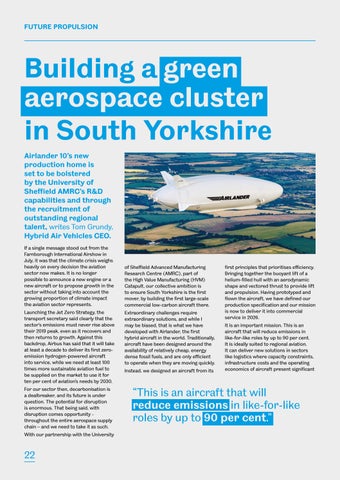
Building a green aerospace cluster in South Yorkshire Airlander 10’s new production home is set to be bolstered by the University of Sheffield AMRC’s R&D capabilities and through the recruitment of outstanding regional talent, writes Tom Grundy, Hybrid Air Vehicles CEO. If a single message stood out from the Farnborough International Airshow in July, it was that the climate crisis weighs heavily on every decision the aviation sector now makes. It is no longer possible to announce a new engine or a new aircraft or to propose growth in the sector without taking into account the growing proportion of climate impact the aviation sector represents. Launching the Jet Zero Strategy, the transport secretary said clearly that the sector’s emissions must never rise above their 2019 peak, even as it recovers and then returns to growth. Against this backdrop, Airbus has said that it will take at least a decade to deliver its first zeroemission hydrogen-powered aircraft into service, while we need at least 100 times more sustainable aviation fuel to be supplied on the market to use it for ten per cent of aviation’s needs by 2030. For our sector then, decarbonisation is a dealbreaker, and its future is under question. The potential for disruption is enormous. That being said, with disruption comes opportunity throughout the entire aerospace supply chain – and we need to take it as such. With our partnership with the University
22
of Sheffield Advanced Manufacturing Research Centre (AMRC), part of the High Value Manufacturing (HVM) Catapult, our collective ambition is to ensure South Yorkshire is the first mover, by building the first large-scale commercial low-carbon aircraft there. Extraordinary challenges require extraordinary solutions, and while I may be biased, that is what we have developed with Airlander, the first hybrid aircraft in the world. Traditionally, aircraft have been designed around the availability of relatively cheap, energy dense fossil fuels, and are only efficient to operate when they are moving quickly. Instead, we designed an aircraft from its
first principles that prioritises efficiency. Bringing together the buoyant lift of a helium-filled hull with an aerodynamic shape and vectored thrust to provide lift and propulsion. Having prototyped and flown the aircraft, we have defined our production specification and our mission is now to deliver it into commercial service in 2026. It is an important mission. This is an aircraft that will reduce emissions in like-for-like roles by up to 90 per cent. It is ideally suited to regional aviation. It can deliver new solutions in sectors like logistics where capacity constraints, infrastructure costs and the operating economics of aircraft present significant
“This is an aircraft that will reduce emissions in like-for-like roles by up to 90 per cent.”
FUTURE PROPULSION
problems. It can deliver the economic benefits of aviation to underserved markets, while breaking the link between growth and emissions. For example, in a landmark agreement this June, Air Nostrum - one of Europe’s largest regional airlines - announced that it would reserve ten of the first Airlander 10 hybrid aircraft to be built. Each aircraft will be configured for 100-seat passenger operations, offering domestic passengers what may be the world’s first opportunity to fly in a large, consumeraccessible aircraft, guilt free. Extraordinary solutions require extraordinary people and institutions to deliver, which we have found in South Yorkshire. In part thanks to the AMRC, the region is already home to outstanding aerospace talent and research capabilities. The University of Sheffield has already helped us research aspects of the large, composite structures used by Airlander. Now we are setting out to be the first new whole-aircraft assembly line in the UK for many years, and the first in the world to achieve rate production of an aircraft incorporating lighter-than-air technologies. The AMRC’s expertise, connections and capabilities will be vital to achieving our goals – high value manufacturing of the world’s most
efficient large aircraft. So, we have made clear that we hope to build Airlander in South Yorkshire, working with an outstanding cluster of partners that includes the AMRC, the wider University of Sheffield, educational institutions such as Doncaster UTC and our flight operations partner 2Excel Aviation, based at Doncaster Sheffield Airport. We are in active discussions on our plans with the South Yorkshire Mayoral Combined Authority (SYMCA), and we have received vocal support from a cross-party coalition that includes local politicians, as well as the current and previous SYMCA mayors, Oliver Coppard and Dan Jarvis MP. We are also in active discussions with government around its own role in this story. Taken as a project in isolation, manufacturing Airlander in South Yorkshire will change lives. We expect to create in excess of 1,200 jobs directly, and hundreds more in the wider supply chain. Those jobs will be highly skilled, creating opportunities for people to train and enter the aerospace industry at its cutting edge. Due to the size and scale of what we are trying to do, we also anticipate many of our suppliers will choose to invest in South Yorkshire.
“Manufacturing Airlander in South Yorkshire will change lives. We expect to create in excess of
1,200 jobs directly, and hundreds more in the wider supply chain.” Zooming out, this will also catalyse a green aerospace cluster for the South Yorkshire region.
Airlander is an inspirational project. It is going to be the first large-scale lowcarbon aircraft, and by establishing the region’s foothold in the technologies that will define the future of aerospace, it will become a natural home for new businesses, suppliers, research and jobs that are associated with this transition. And when the sector looks in future to find the answers to the questions it is being asked, the natural answers will be available in South Yorkshire, in the cluster that we help build with the AMRC and our other regional partners.
23
FUTURE PROPULSION
Battery of the future By James Crossling AMRC engineers have proved out a manufacturing process for the Ultimate Battery Company’s (UBC) novel, rechargeable, meta-technology battery as part of an investment into green technology by UBC in South Yorkshire, which is set to create almost 500 jobs and put the region at the front of the low-carbon transition. The University of Sheffield Advanced Manufacturing Research Centre (AMRC) was chosen by UBC to work on tooling implementation and manufacturing design for its breakthrough green energy technology - a battery that provides lithium-like performance at a significantly reduced cost and weight, with improved energy storage capacity and faster charging rate.
“To achieve all the goals, these revolutionary batteries needed to be manufactured in a completely new way that needed to be developed,” said Stephen Bowles, theme lead for knowledge exchange at the AMRC. “The Ultimate Battery Company partnered with the AMRC because we have the production expertise
to help develop the most effective manufacturing process. We have now proved that the production process works; our next steps are to work together to optimise this as much as possible, thereby reducing costs and time to market.” Ultimate Battery Company said the AMRC has been ‘a phenomenal asset’ in
Pictured (left to right): Luke Dashfield, Maurizio Cunningham-Brown, Yousef Bhacker, Tace Morgan, Malcolm Earp, Michael Macdonald, Keith Ellis, Nacho Blanco and Stephen Bowles.
24
FUTURE PROPULSION
helping mature the technology, which will create 495 jobs in South Yorkshire at the new production plant for lightweight, eco-friendly batteries. UBC, which reduces CO2 emissions through its transformative new technologies and energy storage solutions, will anchor its manufacturing base in the region following a pledge of financial support from the South Yorkshire Mayoral Combined Authority (SYMCA), along with help and assistance from the Department of International Trade (DIT). Maurizio Cunningham-Brown, CEO of Ultimate Battery Company, says existing traditional battery technology is ‘inherently inefficient, very costly, heavy and environmentally unfriendly’. “For all batteries, including stop/ start and lithium-ion electric vehicle batteries, this translates to shorter run times and limited travel range, as well as a substantial cost for the customer,” said Maurizio. “Our aim is to deliver a new battery that provides Lithium-like performance at 35 per cent of the cost, enables twice the energy to be stored in the same physical space and provides a faster charging rate. These batteries can also significantly reduce weight by up to 15kg per vehicle, driving down CO2 emissions and manufacturing costs, while increasing energy densities. “To achieve production and development of these products, we needed to find a location that would help make the process as smooth as possible and provide our business the support needed to get our plans in motion.” The research cell at Factory 2050 in Sheffield has been the template for the Ultimate Battery Company production plant, with AMRC engineers now starting work with UBC to train new staff on how to manufacture the batteries. Richard Gardiner, senior innovation fellow at the University of Sheffield
“35 per cent of the cost, enables twice the energy to be stored in the same physical space and provides a faster charging rate.” Maurizio Cunningham-Brown, Ultimate Battery Company.
AMRC said it has been hugely rewarding to work with Ultimate Battery Company in the development of its innovative battery technology. He said: “To take a design concept and collaboratively work with them to mature their concept such that the results have facilitated inward investment, will bring future economic benefit to the region, and ultimately make a positive environmental contribution to net zero targets is what the AMRC is here for. I am excited to be working with UBC and look forward to seeing where our future collaboration leads.” Steve Foxley, CEO of the University of Sheffield AMRC, welcomed the investment news as another vote of confidence in South Yorkshire’s capabilities for future energy systems. He said: “It has been a great pleasure to work with Ultimate Battery Company around its manufacturing innovations for energy storage technology. We are delighted to see they are now building on that collaboration with inward investment into South Yorkshire, close to the research expertise of the AMRC. “It further adds to the growing cluster around the manufacture of sustainable energy systems that we are seeing in the region. This will be hugely important for
South Yorkshire’s future and our national mission to drive and thrive in the low carbon transition.” As well as continuing to work alongside the AMRC, the Ultimate Battery Company also has its sights set on making the switch to electric vehicles easier for manufacturers. “For both manufacturers and consumers, one of the major reasons for not adopting the use of electric vehicles is the increased cost compared with a traditional combustion engine motor vehicle. Our new battery will change the equation,” said Maurizio. “The demand for these products is out there and has already been confirmed by a wide range of leading automotive manufacturers and other related industries. As such, we are confident that with the resources we will have in place at our new facility, and the technology we are looking to bring online, we can support the drive to move to electric vehicles long before the 2040 target. “In the meantime, we’re looking forward to being located in South Yorkshire to make these exciting plans a reality and working with SYMCA, the AMRC and DIT to get our new facility up and running and push the start button on what will be the new car battery of the future.”
“We’re looking forward to being located in South Yorkshire to make these exciting plans a reality and push the start button on what will be the new car battery of the future.” Maurizio Cunningham-Brown, Ultimate Battery Company.
25
SUSTAINABILITY
The smart way to cut carbon emissions By James Crossling
AMRC North West is driving Lancashire’s low-carbon transition after securing £2.5m to deliver a UK first that will help manufacturers slash their emissions by retrofitting digital technologies onto legacy shop floors. The Low Carbon Smart Building Demonstrator project, supported by the Lancashire Enterprise Partnership (LEP) through the government’s Getting Building Fund (GBF), will create a road map for manufacturers of all sizes that will enable them to cut the carbon footprint of older facilities and achieve net zero by 2050. “There is nothing like this available in the UK,” said Ben Smith, low carbon building specialist at AMRC North West. “I have yet to see a facility that has such a broad spectrum of digital technologies on display at one time, and all of it being aligned to reducing a facility’s carbon footprint.
26
SUSTAINABILITY
“It’s not about telling manufacturers to buy the latest equipment to reduce their emissions, but rather demonstrating how they can make their existing infrastructure greener and more efficient by retrofitting digital technologies.” AMRC North West sits at the heart of the Samlesbury Enterprise Zone in Preston
and has been built using a £20m grant from the LEP Growth Deal. It officially opened in March 2022 and is the newest facility in the University of Sheffield Advanced Manufacturing Research Centre (AMRC)’s cluster of world-class research and development innovation centres. Commercial director, Melissa Conlon, says the £2.5m grant will
transform AMRC North West into a ‘living and breathing’ demonstrator and the project will be a flagship programme of interest to anyone with a building who is looking to lower their cost of ownership and reduce carbon emissions. The building will be equipped with a suite of smart factory technologies including: building management systems
27
SUSTAINABILITY
(BMS) that integrate with machines; occupancy and asset tracking to ensure shop floor space is being best used; manufacturing execution systems to improve productivity; environmental sensors to understand how efficiency can be affected by changes in temperature; digital work instructions using augmented reality (AR) and virtual reality (VR) headsets; and novel renewable energy sources and energy storage for manufacturing facilities. Melissa said: “The manufacturing sector knows it needs to reduce its carbon emissions if the UK is to reach the target of net zero by 2050, but there is very little knowledge for manufacturers about how the industry as a whole can become
more sustainable. We will plug that gap. “There are more than 3,000 manufacturing small and medium-sized enterprises (SMEs) in Lancashire, so we have a real opportunity to make a significant difference to help the manufacturing industry become lowcarbon using digital technologies. In this, Lancashire can lead the UK and our manufacturers to be an exemplar for the rest of the sector.” Debbie Francis OBE, chair of the Lancashire Enterprise Partnership, said: ‘’I am delighted the AMRC has secured funding for this project. By working closely with our partners, we have successfully secured a total of £34.1m from the Getting Building Fund for investment in quality projects which will drive economic recovery and create jobs. “This scheme will enable Lancashire manufacturing businesses to adopt more energy efficient operations through the use of new low-carbon technologies, which will reduce costs and improve their competitiveness. The project will enhance the existing AMRC offer on the Samlesbury Enterprise Zone and will have a significant impact on the capabilities of our manufacturers, ensuring they are positioned to drive growth, increase productivity and remain at the forefront of innovative and cutting-edge technologies.’’ Ben says the project has funding to work with 120 SMEs and 20 large companies in
28
SUSTAINABILITY
the region over the next three years. He said: “The first stage is educating manufacturers about why a carbon footprint matters and why they need to care about sustainability. Then, we want to support them through lean manufacturing processes and principles; we recognise that a lot of smart factory technologies will be outside the reach of many companies, so we’re creating that profit margin by helping them embed lean methodologies. “The proviso is that the bottom line is used to invest in low-carbon technologies, because that is what will give manufacturers the sustainable business model going forward. “The final step is throwing open the doors to AMRC North West as an openaccess demonstrator with a full range of smart factory technologies so we can showcase different solutions. The smart factory will give us an incredible amount of data to measure and analyse; that means we can make informed decisions on how to cut AMRC North West’s own carbon footprint and provide our customers with detailed recommendations for their specific use case.”
The technologies are being supplied by three companies: Vodafone, Control 2K and IoT Horizon. Vodafone is the market leader for Internet of Things (IoT) and smart factory technologies and is supplying the most cutting-edge solutions; Control 2K is providing similar solutions on a smaller budget; and IoT Horizon is delivering affordable versions of the occupancy and asset tracking technology.
Vodafone is at the forefront of 5G technology and plans to link its technologies to AMRC North West’s existing 5G network. The facility is also the primary site for the Department for Digital, Culture, Media & Sport (DCMS) funded 5G Factory of the Future programme, giving Lancashire manufacturers a prime opportunity to harness the potential of 5G on their journey toward decarbonisation.
“We intentionally approached this in a holistic, almost scattergun, way,” said Ben. “We are installing both the highestperforming solutions on the market alongside solutions that could be 20 per cent of the cost. That means we can demonstrate the entire range of technologies available to manufacturers, help them choose which one is right for them and then support the implementation.”
The Getting Building Fund (GBF) is a £900 million investment to deliver jobs, skills and infrastructure across the country, targeted in areas facing the biggest economic challenges as a result of the pandemic. It is supporting the delivery of shovel-ready infrastructure projects, agreed with mayors and Local Enterprise Partnerships to boost economic growth, and fuel local recovery and jobs.
“We have a real opportunity to make a significant difference to help the manufacturing industry become low-carbon using digital technologies.” Melissa Conlon, AMRC North West.
29
SUSTAINABILITY
A Welsh blueprint to boost productivity and cut emissions By James Crossling An innovative research and development project to improve the productivity and environmental performance of businesses in the aerospace and food and drink sectors is taking place at AMRC Cymru in Broughton. Ffatri 4.0 is a collaboration between the University of Sheffield Advanced Manufacturing Research Centre (AMRC) Cymru, Airbus and food and drink companies. The aim is to create a blueprint for future factories, improving business resilience, productivity and sustainability while increasing the capacity for collaborative research with industry, and increased R&D investment in Wales. Backed by the Welsh Government, the project will create six new research positions at AMRC Cymru. The food businesses taking part in the project are The Pudding Compartment from Flintshire and Hensol Castle Distillery from the Vale of Glamorgan. The project will look at how businesses can continue to increase productivity, while meeting net-zero carbon emissions targets through smart technologies. It is based on the premise that the sustainability and productivity goals of the manufacturing sector can be accelerated through the successful adoption and integration of digital manufacturing technologies. Lessons learned from the project will be used to help other companies. Minister for Economy, Vaughan Gething, said: “Ffatri 4.0 is an innovative project, which supports research
30
and development in Wales, while also carrying out important work to advise the factories of the future. Businesses want and need to increase productivity but must do so while taking the environmental impacts into account. “It’s great to see AMRC Cymru being used for this important research, which will be of particular benefit to the aerospace and food and drink sectors. It fits in with the wider aims of our Manufacturing Plan of creating the right environment for businesses to succeed.” Minister for Rural Affairs and North Wales, Lesley Griffiths, said: “I’m pleased to see food and drink companies taking advantage of the excellent facilities at AMRC Cymru. The work carried out will be of benefit for the future productivity of the sector, while boosting Wales’ reputation for research and development. “The lessons learned as part of this project will be of benefit to businesses across Wales and further afield. It’s particularly positive to see sectors collaborating on research in this way, which is one of the aims of AMRC Cymru.” AMRC Cymru operations director, Jason Murphy, said: “We are excited by the opportunity that this project brings for knowledge transfer and the sharing
of ideas across these two incredibly important sectors to the Welsh economy. “Ffatri 4.0 will make a significant contribution to the aims of the ‘Well Being of Future Generations (Wales) Act’, ‘Wales 4.0 – Delivering Economic Transformation for a Better Future of Work‘ and ‘The Decarbonisation Framework for Wales’. “The lessons learned will be shared widely across the Welsh manufacturing sector to improve productivity, boost business resilience, and reduce greenhouse gas emissions and waste.” AMRC Cymru opened in 2019. It is managed by the University of Sheffield and the £20m construction was fully funded by the Welsh Government. Airbus is a tenant as part of its Wing of Tomorrow project.
SUSTAINABILITY
Jargon buster: sustainability Do you know your upcycling from your recycling? Unsure of the difference between net zero and absolute zero? The AMRC has got you covered with our sustainability jargon buster, containing definitions of all the key terms you need to know.
Download the guide here
31
DIGITAL
The first steps to cyber security During 2021, more than a third of UK businesses were hit by a cyberattack; a third of those saw attempts made at least once a week. According to the government’s Cyber Security Breaches Survey, an influential research study for UK cyber resilience, just 54 per cent of companies assessed their cyber risks in the last year, 43 per cent have a cyber security insurance policy, and only 23 per cent have a strategy in place. While large organisations are likely to have invested heavily in cyber security, many small and mediumsized enterprises (SMEs) either don’t have the resources, don’t believe they would be a target, or don’t find time to consider the risks.
32
DIGITAL
“With so much complicated information out there, it is no wonder that many businesses simply don’t know where to begin.” Harry Burroughes, Head of Factory 2050, AMRC.
It was with those statistics and that alarming outlook in mind, that the High Value Manufacturing (HVM) Catapult commissioned the Cyber Security Risk Assessment for Advanced Manufacturing, a step-by-step guide for manufacturers of any size to complete a risk analysis of their operating systems.
step framework for the risk analysis of operating technology to keep equipment available, operating correctly and secure.
they have considered the full breadth of implications for their business and identify any gaps that need addressing.
The five steps are: understanding the system; threat identification; vulnerabilities identification; risk quantification; and threat remediation and risk management.
Take the first step to securing your business and scan the QR code to download the Cyber Security Risk Assessment for Advanced Manufacturing.
Written by engineers at the University of Sheffield Advanced Manufacturing Research Centre’s (AMRC) Factory 2050, with support from HVM Catapult colleagues, the guide aims to help anyone creating, growing or managing a business in the advanced manufacturing sector to understand why cyber security poses a threat and how they can tackle it. The document provides a basic five-
For those with little or no knowledge of cyber security, the guide offers a starting point from which to consider potential threats to their company, whether they can be tackled by existing in-house expertise, and, if not, how to frame any additional hiring or outsourcing. For those with existing knowledge of cyber security, it offers a way to check
Harry Burroughes, Head of Factory 2050, AMRC Cyber security threats are one of the greatest dangers facing businesses today. Cyber-attacks were nearly fatal for 87 per cent of organisations who experienced one last year – and at the same time, the number of cybercrime incidents increased by 50 per cent.
For manufacturers of all shapes and sizes, getting digital defences in place is essential. But with so much complicated information out there about cyber security, it is no wonder that many businesses simply don’t know where to begin and that’s why we have created this document and
built a new dedicated cell at Factory 2050, which will be a safe environment on our shop floor to develop cyber security solutions. The shop floor of the future will be digital and connected, but it must be secure as well.
33
DIGITAL
AMRC spin out: the FourJaw journey so far By Chris Iveson, co-founder, FourJaw It feels like yesterday that Robin and I spun out FourJaw Manufacturing Analytics from the University of Sheffield Advanced Manufacturing Research Centre (AMRC), but we actually incorporated on September 8, 2020. Armed with equal amounts of ambition and enthusiasm, plus a vision to change the world of manufacturing, we left our full-time positions at the AMRC to build an exciting business together.
We’re now celebrating our two-year birthday, and what a ride it’s been so far. In those two years, we have raised a cumulative £1.7m investment and grown an awesome team of more than 15 exceptional staff. Today, we are serving up productivity gains to more than 50 manufacturing businesses spanning countless industries, including oil and gas, aerospace, motorsport and automotive, consumer goods, and even textile manufacturing. Just as importantly, we have made so many friends along the way. Despite all this progress, our little dent in manufacturing productivity is a long way off changing the world. We are at the start of our journey. So, when I was asked to write a piece around our journey so far, I thought it important to discuss how we got the business off the ground, but also how manufacturers are
34
Above: Belief and ambition: Robin Hartley-Willows and Chris Iveson, co-founders of FourJaw pictured at the AMRC’s Factory of the Future. Top: How it works: The plug-and-play MachineLink hardware that collects utilisation data from machines and feeds it into FourJaw’s cloud services for analysis.
DIGITAL
A ‘fitbit’ for manufacturing: FourJaw helps manufacturers understand the health and performance of production machines to deliver transformative productivity gains.
getting value from the existing FourJaw platform and give a sneak peek at where we plan to take it in the future. How FourJaw started In my view, there are three key ingredients needed to create a successful start-up:
• A cool bit of tech that solves a real-world problem;
• People with belief and ambition; • The right blend of complementary skills. FourJaw started within the AMRC, which everyone knows is awash with amazing and cool tech. The other two ingredients needed to come from myself and my co-founder, Robin Hartley-Willows. My background was as a mechanical design engineer, but I studied an executive master’s in business administration alongside moving into the commercialisation manager role at the AMRC; building business cases around manufacturing research to translate the research into industry. Robin was (and still is) a technically brilliant engineer with an entrepreneurial streak in him. He had already set up and run a small business designing, manufacturing and selling computer automation keypads.
I was introduced to Robin when he worked within the process monitoring and control team, he was working to develop integrations with the control systems of the AMRC’s Computer Numerical Control (CNC) machines. At the time, the use case was to extract the machining data to inform the cutting trial research going on at the AMRC. When the software was presented to manufacturing industry leaders, there was significant interest, and time and again, they would ask if it was for sale. The answer at the time was ’no’, because it was proof-of-concept research software. Integration was done on a per-machine/per-control system basis; we didn’t have a way to deploy it into machine shops at scale; the software was buggy (sorry Robin, but it was); the features and benefits were not well developed for manufacturers; and there wasn’t a commercial model built around it - which is so important to deliver a product that can be maintained and continually improved well into the future. However, Robin and I were given enough confidence in a market need, that we decided to start building a business around the software. Working together, we won some small
amounts of funding from the University of Sheffield’s internal commercialisation funds, plus a Royal Academy of Engineering Enterprise Fellowship to free up Robin from the day job to focus exclusively on developing the business. We also met some amazing business advisors, whose guidance and support was - and still is - incredibly valuable. Long story short, we launched FourJaw on September 8, 2020. Yes, it was the middle of a Covid lockdown - perhaps not the best time to leave your job and start a business, but we had the belief and ambition (or perhaps stupidity?) that we would succeed. Robin and I set about raising investment while also working with some friendly local manufacturers who were willing to be trial customers of ours. Throughout 2020, we pitched our business idea to around 100 investors, of which we got 99 ‘no thanks’ responses. But we learned from every discussion and refined our pitch while growing our customer base to demonstrate traction. We finally managed to secure a ‘pre-seed’ investment on Christmas Eve of 2020 -
35
DIGITAL
we were up and running. At the time, we were still integrating with the machines control systems, but the world of CNC machines is extremely fragmented. There are countless combinations of machines, types, ages and control system brands. Connecting to all of them was impossible to do at scale, some couldn’t be connected to at all. Throw into the mix that we were at the mercy of Covid lockdowns, which meant we couldn’t physically visit factories, we needed an alternative solution. So, we took a step back and set ourselves a challenge: how do we develop a bit of hardware that is low cost, machine agnostic, and so simple to install that we can ship it to customers to install it themselves. We worked with our tech partners, The Curve Consulting Services, who are brilliant by the way, to develop this product. We called it MachineLink and launched it on May 10, 2021. Since then, we have accelerated the business growth, which has enabled us to close a second ‘seed’ investment round. We continue to develop our team, our product and scale our customer base beyond CNC machine shops and into every manufacturing industry where machine productivity is vital to the prosperity of the business. It’s an exciting place to be. What actually is FourJaw? FourJaw has been described in the media as a ‘fitness tracker for manufacturing’. In the same way that your fitness tracker helps you understand your body metrics to inform general health and sporting performance, we do the same for production machines to deliver transformative productivity gains. The average machine we connect to registers utilisation below 20 per cent, and because manufacturers are only earning when their machines are in use, this figure represents a huge opportunity to turbocharge growth, an opportunity most manufacturers don’t even know they have. The way we do it is with a combined hardware and software product. The hardware takes the form of our plugand-play MachineLink, plus an off-shelf Android tablet. The MachineLink sends passively collected utilisation data into our cloud services for analysis. The
36
The team: The FourJaw crew at their office space in Oxo House, Sheffield.
tablets add to this data by working with the machine operators to collect contextualised information such as work order start/finish times, setup/teardown times, run times and quantified downtime reasons. All this data is processed through our multi-layered analytics platform and presented in a beautiful, easy-to-use, intuitive dashboard, accessible on any device. For the first time, manufacturers have visibility of what’s going on throughout their factory, in real-time. Production teams can communicate electronically via FourJaw to raise issues that are preventing them from getting the most out of their machines, so that these issues can be solved as soon as they arise. Effective communication is key to a high performing team. Our hardware is affordable, only a couple of hundred pounds per machine and we can have it in your hands and ready for install within 48-hours. Our software is subscription based, on a per-machine-per-month basis and pays for itself within only two hours of gained productivity in that month. Our contract lengths are flexible starting monthly rolling, so we have completely de-risked it. If you don’t like it, cancel it (although no-one really does). The huge benefit about our software being cloud hosted, is that our software development team seamlessly pushes updates and improvements on an almost daily basis, building ever increasing amounts of power into the platform. At the time of writing, our current developments are focused around building a streamlined way to integrate
with all types of Enterprise Resource Planning (ERP) systems, a market which is as fragmented as the CNC machines. This means we can push and pull our highly accurate work-booking data from our tablets into the ERPs, which is a key part of enabling manufacturers to accurately cost their jobs. It also means we can use our historical data to deliver what we call the world’s most accurate production scheduler, giving manufacturers the confidence to plan, and balance their order book with their production capacity. Our aim is to help manufacturers solve their two biggest problems: how do I find more work, and how do I manufacture that work on time, to spec, and within budget. If we can solve those issues, we get close to changing the world of manufacturing, which is something we’re very excited about. Change your future with FourJaw We have covered a lot of ground over the past 24-months and have made a great start. We wouldn’t have been able to make so much progress without key partners, such as the AMRC, who have supported us along the way. Our product has developed significantly since we started out and is now delivering huge productivity gains to manufacturers up and down the country. We also have an exciting roadmap ahead of us and are enthusiastically forging ahead to achieve our vision of changing the world of manufacturing. To maximise your manufacturing productivity with FourJaw, contact sales@fourjaw.com
DIGITAL
Factory+: a connected, smart factory driven by data Lindsay Lee, technical fellow for data science at the University of Sheffield AMRC, explains how experts like her are working side-by-side with engineers at the AMRC’s Factory 2050 to show manufacturers how to get the most out of big data. ‘So, what data do you want?’ When a data scientist enters a new field, this is often the first question they are asked. The most common response? Often, it is simply: ‘Well, I don’t know.’ The truth is, data scientists do not just enjoy working with data for data’s sake, but rather relish problem solving – the answers to which are usually found in the data. Without knowing what problem is waiting to be solved, how can we understand what data we need? I am new to the field of manufacturing and my first six months at the University of Sheffield Advanced Manufacturing Research Centre (AMRC) has mostly involved understanding how data is captured, collected and stored, and what sort of data-related problems engineers are facing. Working in the technology readiness level (TRL) scale between academia and industry means that everything the AMRC does has to work in production. For a data scientist, this puts a huge emphasis on the emerging field of safe and ethical artificial intelligence (AI), especially where high-risk decisions are to be made. We have a basic ethical understanding that everything we do has to be fair and unbiased - this means we consider the data that has not been collected as well as the data that has and recognise the implications of this. We are all aware that if you ‘collect’ the right
Lindsay Lee, technical fellow for data science, in front of the Factory+ wall at Factory 2050.
data you can manipulate the results as you wish but, as a data scientist, we have an ethical obligation to make sure that the results are not simply a result of the data collection method. Data scientists are also trained in a number of analysis techniques and are able to code this up so that we are not at the mercy of the available software and the limited options this can bring. For me, an interesting part of the safe and ethical movement is the push to move away from ‘black box’ analysis and ensuring that there is some
sensible interpretation of the analysis, so that even a right answer hasn’t been found for the wrong reason. Ensuring interpretability of results is important for every step of the process. Why have we collected the data we have? What data can’t we collect? What different analyses have been conducted? How can the results be interpreted? What happens when things go wrong and how do you identify it? As far as I am aware, there is currently no piece of software used in industry that completely covers this, only people.
37
DIGITAL
Data science experts at Factory 2050, like Lindsay Lee, are working with digital engineers to demonstrate how manufacturers can get the most out of their data.
Those people are us, the data scientists. At the AMRC we are trying to tackle this with the Factory+ project. Factory+ is an open-access digital architecture for manufacturing shop floors that simplifies the way data can be handled across an organisation. Factory+ aims to provide a synthesised way for machinery to capture and use data to solve problems; to make manufacturing more sustainable, efficient and ready for Industry 4.0 - or even 5.0. It is a truly collaborative project of Internet of Things (IoT) engineers, robotic engineers, software engineers and data scientists. Data scientists are considered the users of the Factory+ architecture and need to be able to pull data for any project. The value of having data scientists involved in this is that, while we don’t have the domain knowledge of an engineer, we do know what should be considered when collecting useful data for an array of problems without simply trying to collect and store all available
38
data; an endeavour quickly curtailed by storage limitations. It is likely that high-resolution data will be needed when the project involves monitoring of equipment for a quick response. However, this sort of data does not need to be stored long-term and the analysis may be performed at the edge, requiring little or no recording of historical data. We can also do interim analysis to identify markers of any problems and store only the relevant
data for the long-term monitoring of equipment and future prediction of upcoming issues. For long-term storage, it is very important that there is meta-data available to explain the data, its resolution, its units and any extra useful information. Data scientists are embedded within the Factory+ project to help define what that useful information might be. Factory+ is much more than a data science project. In fact, data connectivity
“We hope to provide the ultimate blueprint for a connected, smart factory as well as the blueprint for a successful collaboration.”
DIGITAL
is the main aim of the first phase. Its longevity lies in the continued collection of useful data; increased connectivity throughout the AMRC and further afield; and, of course, the data science applications and how their results can be fed back into the machinery. Continued collaboration between the IoT experts and data scientists will one day lead to data science tools both using data and being a connected data stream. While the data we collect will be used to reveal features to machine users and allow process monitoring on a continuum, another goal is to use the data to allow machines to update and improve without the need for a costly pause in production and human intervention. With such lofty goals it is clear that the data scientists need to work closely with the domain experts to understand the implications of reducing costly interventions and to work with the engineers for error prevention and further process improvements. It is always important to remember that a data scientist doesn’t just need data, we need domain experts to have real-life impact. Our first AI goals with Factory+ are to improve robot cutting by optimising
“Without knowing what problem is waiting to be solved, how can we understand what data we need?” the feed rate using machine learning algorithms with data from the first robots connected to Factory+. The problem identified by the robotic engineers at the AMRC’s Factory 2050 facility is that the robot slows down more than necessary when turning corners, most likely related to the number of steps it is allowed to consider at once. Working with the engineers, we have been able to understand how the robot works, understand the design codes that make the robot move, and even help connect the robot data stream to Factory+. Now the data scientist has a data stream that can be used as an output to a machine learning algorithm; all the design data required as an input to the algorithm; and the knowledge to find an optimisation of the feed rate that
the robotics engineer can implement. More widely, alongside the specific AI projects, we will produce generalised data science workflows and codes so that when Factory+ is up and running across the wider AMRC, there are consistent methods for using the data that is produced and the most common analyses can be easily applied in different settings. So, what data do I want? I want data that can let me use data science tools to have impact and improve manufacturing processes. By including data scientists in the Factory+ team, we hope to provide the ultimate blueprint for a connected, smart factory as well as the blueprint for a successful collaboration.
A selection of the data available to data scientists from Factory+.
39
SME SUPPORT
Innovation done write for bacteriaresistant stationery By Katia Harston Engineers from the University of Sheffield AMRC unleashed their design and development expertise to support a germresistant stationery business in bringing new products to market, which has since secured a deal with one of the UK’s largest suppliers to schools and universities.
40
SME SUPPORT
Sketch to reality: The ‘superhero’ design which the AMRC helped turn from a paper drawing into a 3D model.
Bio 5 is a Sheffield-based start-up, which specialises in stationery products that boast antimicrobial properties. Its product range includes a triform pencil, a sharpener and eraser combo, and a folding ruler. As part of Bio 5’s growth plans, the company wanted to bring forward new product ideas but limited resources meant they weren’t able to develop them to the stage where they could be manufactured and marketed. The company turned to the AMRC for help, which as part of the national High Value Manufacturing (HVM) Catapult network of research centres, provides funded support to small and mediumsized businesses (SMEs). Over the course of two years, research engineers from the AMRC delivered product development to Bio 5 through 3D modelling and prototyping, helping the company take its brilliant ideas for new stationery and turn sketches into 3D models that could be manufactured. Bio 5 now has a contract with YPO, which supplies products to schools,
colleges, universities and councils to name a few; and has a store on Amazon. The company also has eyes on the wider retail sector with negotiations underway that include a luxury department store. Alistair Wheatley, co-founder of Bio 5 and managing director of the business, said the AMRC was a huge support and ‘the catalyst to making the project work’ in its early stages. He said: “We asked for help on our product development and the AMRC jumped on it straight away and were magnificent. They were a huge support and couldn’t do enough to help us with lots of help and advice. They were the catalyst to making the project work in the early stage, and we hope they will help out in the future also with further product design. “The AMRC was the first platform to turn our ideas and paper drawing concepts into reality. The impact of this has meant we have been able to show the physical product before it is even manufactured,
41
SME SUPPORT
Innovative design: The antimicrobial pens developed by Bio 5.
Germ-resistant: The robot eraser and pen holder prototype developed by Bio 5 with the help of design and prototyping engineers at the AMRC.
“The impact of this has meant we have been able to show the physical product before it is even manufactured, and helped capture the customers’ imaginations with a physical product they can touch, feel and use.” Alistair Wheatley, Bio 5.
and help capture the customers’ imagination with a physical product they can touch, feel and use. Also it has helped us show other manufacturers what we are looking for in terms of their support.” On securing the deal with YPO, Alistair said: “Considering the reach and size of YPO, we are super proud to be in their catalogue and see so many people children and adults alike - benefit from our products. We are also proud of the fact we have an Amazon store too, and we’re now making inroads into the European market.” John Spencer, senior project manager at the AMRC, explained that Bio 5 had two areas of need, which it didn’t have the capability to undertake in-house. The first was the design of an antimicrobial pen; the second was to create a superhero ‘robot’ character able to hold a pencil and rubber that would deliver a double hit of appealing to schoolchildren and raising awareness of the importance of hygiene - a key part of the company’s marketing strategy. “Bio 5 approached the AMRC with some great product ideas but limited resources to develop them to the stage where they could be manufactured and marketed,” said John. “The AMRC was able to provide a High Value Manufacturing (HVM) Catapult-funded, five-day design assist and further ad-hoc support to help the team with product development, which would otherwise have been inaccessible
42
to the business. “We are delighted that Bio 5 has been able to secure deals to stock their stationery and that we have been able to help another Sheffield-based start-up.” AMRC design engineer Valdis Krumins, who worked on the project, added: “It has been wonderful to see and support the growth of the Bio 5 brand. We had the opportunity to contribute in converting some of the artwork into manufacturable 3D models which have helped the brand to reach its constantly growing fan base.” Bio 5 was born out of a chance discussion between co-founders Wayne Leigh, a creative visionary with a longstanding experience in the stationery sector, and Alistair who at the time was managing a business which made artificial joint replacement. That conversation - which was about the antimicrobial qualities of using silver in joint replacements and how those same principles could potentially make the humble school stationery set more hygienic - changed everything. The two gents’ germ of an idea set them on the path to creating ‘a stationery company with a difference’ - one that would use patented silver biocide technology to give all of its products lifetime antimicrobial surface protection. Furthermore, its products are made using innovative and environmentallyfriendly materials and are designed and manufactured in the UK.
SME SUPPORT
AMRC Cymru tests revolutionary new safety rein Engineers at AMRC Cymru have helped to develop and test a revolutionary new rein for horse riders, that could drastically improve safety in equestrian sport. Writes James Crossling. Free Reins’ quick-release connector is the only rein on the market designed to unclip automatically when sufficient force is applied, allowing the reins to come apart - releasing horse or rider and preventing them becoming dangerously entangled. Once the connector, which replaces the traditional rein buckle, has activated and the risk to horse and rider has been avoided, the reins can simply be reassembled and are safe to ride in again. “There is no doubt in my mind there is a need for Free Reins,” said Free Reins founder, Laurie Williams. “It was on observing a fall where a child became caught in their reins that I came up with the concept and so started three years of development. “I’m so delighted with the product. It is really important to me to make riding as safe as possible for both the rider and the horse without compromising on style, the Free Reins connector is helping make riding safer, and adding a little style.” The Free Reins safety system has been subject to extensive testing at
AMRC Cymru, part of the University of Sheffield Advanced Manufacturing Research Centre’s network of cuttingedge research and development facilities. AMRC engineers tested the safety product using mechanical testing apparatus at its state-of-the-art facility in Broughton. Dr James Allum, senior manufacturing research engineer at AMRC Cymru, said: “Through a combination of product development, design for manufacture and testing expertise at AMRC Cymru, we were able to support Free Reins through the development of bespoke benchmarking and testing methodologies to inform product development. “Working alongside our manufacturing partners, this enabled us to develop an innovative clip design, which could be fine-tuned to adjust the mechanical performance to accommodate specific riding needs. It’s been a privilege to be involved in the development of a device which supports a local company with ambitions to improve horse riding safety.”
The Free Reins quick-release connector is designed to unclip automatically when sufficient force is applied, releasing horse or rider and preventing them becoming entangled.
Equine scientist, Dr David Marlin, said: “Safety is incredibly important when it comes to being around or riding horses. Some things happen rarely but may take less than a second for something to go badly wrong. A horse or rider getting caught in its reins is one of those events. We support innovation and sciencebacked products and this appears to be a well-designed product that we hope will decrease injury risk for both horses and riders.” Mark McCourt GB, one of only two Elite show jumping coaches in the UK, added: “This innovation will solve safety issues for both horse and rider - safety is paramount. Over the years I’ve seen a lot of accidents of riders falling off, they keep hold of the reins or pull off the bridle. “It’s really important that we have safety devices, like Free Reins, which will help protect the riders and prevent accidents. Free Reins is a great product for every level of horse rider, especially for those who hack and are young or inexperienced.”
Laurie Williams, founder of Free Reins.
43
SME SUPPORT
Digital manufacturing experts help IT firm boost productivity and reduce waste By Chloe West A Burnley-based IT business has received a boost in ‘confidence and financial security’, after engineers from the AMRC North West used digital support to help transform its work processes and shop floor layout to expand its capabilities and output quality. Rapid IT is a fast-growing firm which works within IT asset disposal, data destruction and is a hardware recycling specialist. The company’s growth had been impeded by the space available within its facility and called on the support of AMRC North West to look at ways to increase overall efficiency, reduce waste and increase productivity across its range of services, recycling and production processes. Victor Giannandrea, non-executive CEO for Rapid IT, said thanks to help from the AMRC North West, which is part of the University of Sheffield Advanced Manufacturing Research Centre (AMRC), the firm is now a more secure business, adding: “There’s a lot of happiness going around the place which we never had before.” Through its RADAR programme, AMRC North West, based on the Samlesbury Enterprise Zone in Preston, offers a range of fully-funded manufacturing support projects and collaboration opportunities designed
44
to boost competitiveness and productivity for Lancashire’s small and medium-sized enterprise (SME) manufacturing community. Victor added that the funded project benefitted the business directly after they were able to bring in expert advice to assist with a number of challenges, including process mapping, assessing the factory layout and creating extra space to allow for the additional business they were looking to secure. “We were helped out immensely in
terms of getting us sorted with where we wanted to be,” he said. “It gave us the confidence to go out and look for new business – and from that, we’ve secured two major customers.” Iain Martin, senior engagement manager at AMRC North West, part of the High Value Manufacturing (HVM)Catapult, said the automation team worked with Rapid IT over the course of two European Regional Development Fund (ERDF) funded projects. “Our project team helped to analyse
SME SUPPORT
and map out Rapid IT’s processes which helped to identify opportunities to smooth out their production flow and increase productivity,” said Iain. “They also produced a comprehensive set of process flow charts, intuitively laid out and can be modified in the future as Rapid IT grows, and can help support process improvements and the understanding of key decisions made. “This solution led onto the second support assist, which involved producing a 2D and 3D model of the premises and a virtual fly through of its workshop, enabling the business to optimise space usage, plan equipment positioning and future equipment acquisition, as well as being able to increase the efficiency of product movement through each process stage.”
improvements since the project had been the increased speed and efficiency in processing assets from receipt at goods in; processing, including data sanitisation, through to resale/recycling, and that these enhancements had created reduced wait times for customers. “The warehouse design has also been beneficial for our cash flow, as we are now able to process IT assets for resale
quicker, enabling a faster turnaround to be able to replenish our funds and we’ve also seen a reduction in our carbon footprint.” The project was delivered through the University of Sheffield Advanced Manufacturing Research Centre (AMRC) North West’s European Regional Development Fund (ERDF) funded projects.
Co-founder and managing director of Rapid IT, Jack Banister, said the project proved to be ‘a real eye opener’, adding: “It has made us realise how complex our company is and gave us an opportunity to step back and think in greater detail about our processes, and has helped us become more critical of our operations.” Jack said the company’s biggest
“Our project team helped to analyse and map out Rapid IT’s processes, which helped to identify opportunities to smooth out their production flow and increase productivity.” Iain Martin, senior engagement manager, AMRC North West.
45
SKILLS
Superheroes of film, health and manufacturing AMRC engineers will stand shoulder-to-shoulder with heroic key workers from the NHS and the geniuses who make the magic happen in Marvel superhero movies in a new exhibition at the Science Museum in London celebrating the vital role of technicians.
Image: JAC Studios
46
Technicians: The David Sainsbury Gallery will bring the often overlooked but crucial world to life, with visitors able to try one-of-a-kind interactive exhibits which mimic tasks performed every day in four key areas: advanced manufacturing, creative industries, health science, and energy networks. They will also be able to meet real-life technicians. The Science Museum has announced four of the organisations it is partnering with for the unique gallery: Marvel, the
National Health Service, the National Grid and the University of Sheffield Advanced Manufacturing Research Centre (AMRC). Visitors can experience the work of technicians at the AMRC, part of the High Value Manufacturing (HVM) Catapult, by testing innovative designs using computer-aided design (CAD) and experimenting with simple coding to optimise the movement of a robotic arm, watching it in action in a task inspired by the use of robotics in recycling facilities.
The gallery will also allow visitors to hear the inspirational stories of realworld technicians, including Rebecca Wright from Sheffield, a former engineering technician at the University of Sheffield AMRC. She said: “As a technician at the AMRC I helped make other people’s jobs easier and less time-consuming; it’s a role that was constantly challenging and I was forever learning new skills. This gallery is such a fantastic idea because now other people can see what technicians do and
47
Image: JAC Studios
SKILLS
understand why their work is so important. “It feels amazing to know that others might be inspired by what I have done; I hope that young people look at me and realise they can achieve something regardless of what they look like or their background. In some ways it’s overwhelming to think my face is going to be seen by thousands of people in a public gallery, but it’s certainly a real privilege.” Elsewhere in the gallery, visitors will be able to see the work of technicians in the creative industries who make the incredible scenes from blockbuster movies possible. Thanks to a close collaboration with Marvel, a centrepiece of the new Technicians gallery will be the reconstructed film set for Shuri’s Lab from the hugely successful Black Panther film. Visitors can re-enact the role of a film-set lighting technician, tasked with adjusting the lighting brightness, colour and intensity to correctly light the set, work as a post-production sound technician to seamlessly match sound and dialogue to a Black Panther scene and use the precision of a visual effects technician to skilfully integrate virtual object into Black Panther film footage. Although an estimated 1.5 million technicians currently work in the UK – from archaeological technicians
48
to veterinary nurses and welding technicians – too few young people aspire to be technicians or know about these roles and the pathways to them. Opening on November 3, 2022, the free gallery seeks to change perceptions of technical careers and inspire tomorrow’s technicians. Steve Foxley, AMRC CEO, says inspiring the next generation of technicians and engineers is critical to the future of manufacturing. He said: ‘None of the manufacturing sector’s ambitions - whether they be better productivity, greater profitability, or improved sustainability - can be achieved without a skilled workforce, and if we are to attract the brightest minds to solve our grandest challenges, it’s crucial that we encourage people to engage with engineering at a young age. “This gallery is a fantastic opportunity to inspire young people from across the world to pursue a career as a technician - a career in which you can work in truly trailblazing environments and make a lasting impact on peoples’ lives. It’s a real privilege for the AMRC to be asked to contribute to this exhibition and an honour for our engineers to stand next to inspiring colleagues from the NHS, Marvel and National Grid.” With a design inspired by the exterior of The Royal London Hospital, the health
science section of Technicians: The David Sainsbury Gallery will focus on the role of pharmacy technicians who create bespoke drugs for patients in NHS hospitals. Visitors will be able to try out their analysis and measurement skills through interactive exhibits which mimic the life-saving tasks – such as preparing an IV bag, checking medicines for contaminants and pipetting – something NHS technicians must perform daily with exceptional accuracy. A huge wind turbine model will greet visitors to the energy networks section of the gallery, which reveals the technicians, often working outdoors or in extreme environments, who build, maintain and repair the energy networks which power our world. Visitors can take on the role of a wind turbine maintenance technician, diagnosing and solving problems then checking their fix has succeeded with a virtual wind turbine model, or pilot a remotely operated vehicle on the ocean floor, studying multiple camera feeds and weather charts while operating a range of piloting controls to successfully clear obstructions from an underwater trench. Technicians: The David Sainsbury Gallery opens to the public on November 3, 2022.
SKILLS
Industry heads join forces to create new AMRC Training Centre advisory board By Chloe West Bridging the gap between employment and education and influencing future training needs for industry requirements are key goals of the newly-formed AMRC Training Centre Industry Advisory Board. The Industry Advisory Board (IAB) was initially established in 2016 to ensure the University of Sheffield AMRC Training Centre’s apprentice programmes stays relevant and meets ever-evolving industry needs.
should meet.” Nikki Jones, director of the AMRC Training Centre, said employer involvement is vital for the training centre to keep in touch with industry
needs. “Our board is very wellrepresented in terms of industry heads, and it is fantastic to see all the different types of businesses now involved, which span from mechanical
Anne Griggs, head of business development and contracts for the AMRC Training Centre, took up the post as chair at the start of 2022. She wanted to overhaul the board and appoint new members to ensure it is representative of the training centre’s employer base. New members include representation from Rotherham, Sheffield, Doncaster and Barnsley - as well as both an SME, a large employer and businesses which already employ degree, advanced and welding apprentices. Anne said: “The board provides a way for employers to be fully involved in the programmes we offer apprentices at the training centre and are able to provide an input on development, improvement, the training centre’s curriculum offer, as well as creating relevant working groups to provide industry intelligence and requirements. “We believed the board needed a complete overhaul in order to keep up with the demands of industry, and we asked for views from all of our current apprentice employers for advice on the role, format and frequency of when it
Members of the University of Sheffield AMRC Training Centre’s Industry Advisory Board.
49
SKILLS
seals and support systems, mobile elevating work platforms and hydrogen energy solutions, to aerospace forming and fabricating, as well as precision engineering and energy-efficient ventilation systems,” she said. “I am excited to see this board evolve and discover what contributions it can provide over the coming months.” A new appointment to the board is Lee Firth academy manager at electrolyser manufacturer ITM Power, which is based in Sheffield and is a key player in the green hydrogen revolution. Lee said: “ITM is delighted to be invited to be a member of the industrial board. This further strengthens our relationship with both the University of Sheffield and the AMRC Training Centre. “This collaboration will not only build on the excellent standards the AMRC offers, but will allow us to influence the future training needs linked alongside local and national business requirements.” Sophie Robinson, HR director for Radius Aerospace, which has UK bases in both Sheffield and Shrewsbury, and specialises in the fabrication and manufacturer of aircraft structures, components, subassemblies and systems, said she’s delighted to have been invited onto the board. “This opportunity is not only a great privilege for myself, but for the business as a whole, we are passionate about our partnerships into education to ensure we are supporting the growth of young talent in the South Yorkshire region into STEM - and the opportunities we can offer to build careers for the future striving to be an employer of choice,” she said. “I will be able to contribute to the board by sharing our company strategies and insights to the challenges we face as a business coming out of the pandemic, Brexit, the cost-of-living crisis and how
“We believed the board needed a complete overhaul in order to keep up with the demands of industry.” Anne Griggs, University of Sheffield AMRC Training Centre. these impacts will shape our training and development strategy going forward.” Jeremy Booker, director at Hedley Hydraulics based in Wakefield, passionately believes in having high quality education which attracts the best students and employers to use the services of the AMRC Training Centre. He said: “The AMRC Training Centre represents one of the best in the industry for the provision of apprentice technical training, and we need to nurture and encourage young adults to develop into skilled and engaged individuals. “Being part of the Industry Advisory Board, I want to provide an industry perspective, bridging the gap between employment and education to focus on the best available resources.” David Tuckwood, operations manager for Niftylift, based in Barnsley, said: “To be given the opportunity by the AMRC Training Centre and then selected to become a member of the advisory board is a huge privilege. “To represent Niftylift and the wider welding and heavy engineering community, and the Barnsley area, is a great opportunity to provide feedback to the AMRC Training Centre of our training needs, and to communicate the advantages it can provide to local school leavers through family members at Niftylift and the local community. “My aim is to bring my current knowledge and experience to support any challenges, debates and ultimately
“Being part of the Industry Advisory Board, I want to provide an industry perspective, bridging the gap between employment and education to focus on the best available resources.” Jeremy Booker, Hedley Hydraulics.
50
define solutions with the team to support the AMRC Training Centre and ultimately the students who are building their skills for the future.” Employers who wanted to join the board were asked to express an interest and were then selected by the training centre’s senior leadership team. The board held its first meeting in April and will meet on a quarterly basis.
The AMRC Training Centre Industry Advisory Board’s function is to: • To provide advice, guidance, support and challenge the quality of provision delivered by the AMRC-TC, including selfassessment, preparation for and participation in inspections; • To provide advice, guidance, support and challenge the development of the AMRC-TC’s strategic action plan; • To provide advice, guidance, support and challenge the AMRC-TC curriculum offer so that it meets the needs of the manufacturing sector; • To participate in, where possible, relevant working groups to provide industry intelligence and requirements; • To receive and feedback on quarterly reports on the overall quality of provision, including success data and feedback on apprentice and employer views.
SKILLS
Racing ahead with McLaren partnership By Chloe West The University of Sheffield AMRC Training Centre has secured pole position to become the new apprenticeship provider for McLaren Racing’s Formula 1 Team, driving in more than 170 applications of budding engineers all vying for a place on the grid to start a career in motorsport. McLaren Racing - globally renowned for being a pioneer in the competitive world of F1 - has formed a partnership with the AMRC Training Centre to provide level-three apprenticeships in metallic machining, which started in September. The lucky apprentices will divide their study time between the AMRC Training Centre in Rotherham, with on-site experience at the McLaren Technology Centre (MTC) in Woking, Surrey. It originally only had two spots available but having received more than 170 applications for the prized places, and after unlocking additional budget, McLaren confirmed another position was created, meaning it will take on three new apprentices who will start their training this year. McLaren Racing said apprentices are a ‘pivotal future talent pipeline for the machine shop’, and it wanted to invest more into the programme.
metallic and additive manufactured components and be able to operate various manual and computer numerical control (CNC) machine tools within the manufacturing departments at the MTC. Anne Griggs, head of business development and contracts at the AMRC Training Centre, says bringing more opportunities with high-profile employers to South Yorkshire is an exciting step forward. “Securing the delivery of an apprenticeship for a major player like McLaren Racing is fantastic news and provides us with opportunities to collaborate with some of the most wellrespected companies, not only within South Yorkshire, but across the UK and the world. “We already have an existing relationship working with luxury supercar maker
McLaren Automotive and their McLaren Composites Technology Centre in the Sheffield region, and we are excited to extend our partnership further with McLaren Racing’s Formula 1 Team - helping them to create the skilled engineers of tomorrow - and providing them with the knowledge and skills required for them to continue their ride into the world of motorsport. “It is a privilege to become a part of the apprentices’ journey and we look forward to welcoming them to the AMRC Training Centre in September.” The full-time positions will be based at McLaren’s HQ in Woking, with the apprenticeship training taking place at the University of Sheffield AMRC Training Centre.
Piers Thynne, McLaren Racing’s executive director of F1 operations, said: “The AMRC not only provides the best machining apprenticeships in the country, but has the best set-up to help grow the machinists of the future. I am excited to see this partnership develop the next generation of apprentices who will join us at McLaren and I look forward to welcoming our first cohort.” Apprentices will learn all the aspects involved with the manufacture of
Image: McLaren
51
SKILLS
Celebrating National Manufacturing Day Members of the public were able to discover what makes the University of Sheffield Advanced Manufacturing Research Centre (AMRC) so special when it opened its doors as part of National Manufacturing Day. The AMRC’s flagship buildings in South Yorkshire, Lancashire and North Wales, joined a cluster of first-class companies from across the country to celebrate the national event organised by manufacturing trade body Make UK. This year’s inaugural event was a UK-wide open house to encourage all age groups, from school leavers to experienced workers looking at reskilling or upskilling, to consider the possibilities of a career in manufacturing, as well as
52
SKILLS
“It was great to be able to give our local communities the chance to step inside our state-of-the-art facilities.” Steve Foxley, CEO, AMRC.
53
SKILLS
helping local communities understand more about the industry and businesses on their doorstep. Free tours ran across all three AMRC sites throughout the day, which saw almost 100 people, including Welsh Government economy minister, Vaughan Gething, step through the doors to see first-hand the difference it makes to industry, and how the AMRC’s research and innovation puts the AMRC at the forefront of UK manufacturing. Visitors also had the chance to chat with engineers to learn more about the exciting research the AMRC undertakes, discuss future career opportunities and learn more about its apprentice programme. On the day, Mr Gething said: “It was great to see the innovative and exciting projects taking place at AMRC Cymru, especially on National Manufacturing Day. “The facility plays an important role in the cutting-edge research and development activity in the region, and
“The facility plays an important role in the cutting-edge research and developement activity in the region.” Vaughan Gething, Government economy minister.
54
SKILLS
Wales as a whole, and we want to see that not only continue, but prosper into the future.” Steve Foxley, CEO of the AMRC, said: “We were delighted to have been given the opportunity to take part in National Manufacturing Day and enjoyed welcoming local residents and school students to our sites for the day so they could experience what makes the AMRC so special. “It was great to be able to give our local communities the chance to step inside our state-of-the-art facilities and for them to discover what we really mean when we say we’re working on the cutting-edge of manufacturing innovation and showcase our impressive buildings, technologies and projects that are transforming industry and supporting manufacturing on the journey to net zero.”
“We’re working on the cutting-edge of manufacturing innovation.” Steve Foxley, CEO, AMRC.
55
SKILLS
‘Future problem solvers’ celebrated Chloe West reports on the celebration event for the seventh annual AMRC Training Centre awards. “These apprentices are the future leaders of their businesses and their talents will change the region and change the world,” said South Yorkshire Mayor, Oliver Coppard at the University of Sheffield AMRC Training Centre’s apprentice celebration evening. The event, held at the university’s stunning Grade II-listed Firth Court, marked the first time in two years that apprentices, their employers, teachers and proud parents were able to come together in person to recognise their tremendous achievements, which are charging change for the future
56
of industry.
due to the pandemic.
The special evening was dedicated to honouring the AMRC Training Centre Apprentice of the Year awards winners and finalists from both the 2020 and 2021 AMRC Training Centre Apprentice of the Year awards ceremonies who were not able to celebrate at the time
Host for the night was Steph McGovern, presenter of Channel 4’s daytime hit TV show Steph’s Packed Lunch, who is a former engineering apprentice of the event’s headline sponsor - iconic toolmaker Stanley Black & Decker.
SKILLS
“Starting out as an apprentice myself and now being here to celebrate such a talented set of individuals and fellow apprentices doing what I think, is such a great and fulfilling career is very special,” said Steph. “They are literally our future problem solvers and I think what they are doing is the best path for a successful career in industry. Despite the Covid setbacks, they have still smashed it and I can guarantee they will have a very rewarding career ahead of them.” The event saw Bethany Cousins, project engineer for the University of Sheffield AMRC, win the Apprentice of the Year award for 2020 and Kate Todd-Davis took the title for 2021. Kate also won “Degree Apprentice of the Year.” Kate, a manufacturing engineering apprentice at global engineering giant Rolls-Royce, recently graduated from AMRC Training Centre with a firstclass honours degree in Manufacturing Technology. She had already completed a Level 2 NVQ in Fundamental Engineering, and is now working towards a Level 4 NVQ in Engineering and Advanced Manufacturing, both delivered
57
SKILLS
by the Sunderland Engineering Training Association (SETA). She summed up her double whammy of wins as being ‘overwhelming, humbling and unexpected’, adding: “To receive not just one award, but two is a massive achievement for me and is a great honour I did not expect. “Being the overall winner is certainly my biggest career highlight to date and was a big shock considering there were so many strong and impressive applications. I hope it makes others consider an apprenticeship, gets more women in engineering and takes away the stigma it carries.” Michelle White, apprentice development leader at Rolls-Royce, said Kate is ‘one to watch’, adding: “I am so proud of Kate’s achievements and as her apprenticeship
58
SKILLS
is coming to an end, I believe now is the time that she will really fly within the company. “She is destined for big things and I hope she remains to be a strong female ambassador for engineering and she proves that anything is achievable in a male-dominated industry.” Mayor of South Yorkshire Oliver Coppard, was thrilled to be at the event and marked out the up-and-coming talent in the room as the change makers the world needs. He said: “Sheffield is my home, I was born and raised here. I know the talent we possess in this region is equal to any industrial challenge we must overcome. “We have a huge range of exciting and innovative companies in South Yorkshire, and the apprentices here are the future leaders of their businesses. Their talent will change the region and change the world. They are the ones who will get us to net zero.”
Nikki Jones, director of the AMRC Training Centre, praised the apprentices for their passion, adding: “Seeing our apprentices up on stage filled me with pride and reminded me why I chose to work for the AMRC Training Centre - it is them who make this literally the best job in the world. “As a team we are committed to continue our efforts in pushing these individuals to be the best versions of themselves and to help them become our engineers of tomorrow. Without them, none of us would be here at this celebration event and I would like to congratulate each and every one of them for their hard work, dedication and commitment.” Professor Koen Lamberts, President and Vice-Chancellor of the University of Sheffield, said: “We are very proud of our apprentices and I am delighted that we were finally able to celebrate their achievements in person. They have an
extraordinary impact on their employers - in many cases, improving processes, making them more sustainable or finding new and innovative ways to do things that save time and money. “They are an important part of our University and we are pleased to provide both academic and vocational education of the very highest quality.” This year’s festivities followed a virtual awards ceremony held in 2021, announced by Nuclear AMRC researcher and Great British Bake Off winner, Dr Rahul Mandal, who also attended the in-person event. Now in its seventh year, the awards are a firm favourite in the AMRC Training Centre calendar and put a spotlight on both the apprentices and their employers who together, are the brave and bold, breaking the mould to innovate, inspire and impact the way industry in the UK continues to evolve.
59
New partners at the AMRC Castings Technology International is the world’s leading provider of production, innovation, technology, expertise and services to the cast metals sector.
Marshall Slingsby Advanced Composites produce complex composite structures that are predominantly used to manufacture vital parts on ships, submarines and aircraft.
Immerse enable enterprises to create, scale and measure virtual reality (VR) training content and programmes.
Events at the AMRC November 23-24, 2022
November 29, 2022
December 14-15, 2022
RECOMP - Reuse and Recycling of Composites
5G - Factory of the Future
Engineering Digital Twins in Practice
at AMRC North West
at the AMRC Knowledge Transfer Centre
at AMRC Factory 2050
Go to amrc.co.uk/events for the most up-to-date AMRC events information
CPD courses at the AMRC Training Centre To book your place on any of the courses, email cpd@amrctraining.co.uk or call 0114 222 9958 November 1, 2022 November 3, 2023
ILM Level 3 Certificate in Leadership & Management
For more information visit
November 29-30, 2022
January 10-11, 2023
Non-Ferrous Alloy
Metallography and Microscopy
Online
Online
December 20-21, 2022
November 7-10, 2022
Online
Online
Quality and Quality Control
Metallurgy for Non-Metallurgists Online
Latest news from the AMRC @TheAMRC
AMRC
@the_amrc
AMRC
The University of Sheffield AMRC, Factory of the Future, Advanced Manufacturing Park, Wallis Way, Catcliffe, Rotherham, S60 5TZ e: enquiries@amrc.co.uk
t: +44 (0)114 222 9588
amrc.co.uk