

INTRODUCING THE NEW YZ®450F
Fresh off consecutive pro Motocross & Supercross titles, Yamaha took the class leading YZ450F and made it even better—more powerful, lighter, slimmer, and more agile than ever! And with Yamaha’s updated and revolutionary Power Tuner App, the ability to dial in the perfect power delivery is right at your fingertips. Introducing the all-new 2023 Yamaha YZ450F, because the best don’t rest.


6 PERSPECTIVES

JANUARY 2023 VOLUME 77, NUMBER 1
Editorial Director Mitch Boehm
8 FROM THE PRESIDENT


42 MOTORCYCLIST OF THE YEAR
U.S. Motocross of Nations team
44 RISKY BUSINESS
AMA President and CEO Rob Dingman
10 BACKFIRES
Membership feedback on recent issues
12 BACK IN THE DAY
Where the photos are blurry but the memories are clear!
14 THE GOOD FIGHT
A review of 2022 AMA Government Relations actions, and what’s coming in 2023
24 MALCOLM’S MOMENTS
Jumping into the bike-shop business with Kenny and Norm of K&N Motorcycles
26 COVER STORY: AMA SUPERCROSS BACKSTAGE
What happens behind the scenes during an AMA Supercross weekend?
In 1975, Suzuki gambled on the rotary-engined RE-5…and lost
64 AMA GARAGE
Tips, tweaks, fixes and facts: The motorcycle ownership experience, explained
66 LAST PAGE
Remembering Ricky Graham, 25 years later

ON THE COVER:
Like some modern — and moveable — Roman circus, AMA Supercross events are pinnacle examples of competition and entertainment for the populace, with motorcycles taking the place of the chariots and horses of yore. What goes into putting on a Supercross event? A lot! Check page 26 for the scoop. Photo by Jeff Kardas.


EDITORIAL AND COMMUNICATIONS
Mitch Boehm Editorial Director
Todd Westover Chief Creative Consultant
Joy Burgess Managing Editor
Kerry Hardin Senior Graphic Designer
Keaton Maisano Associate Editor
Eliza Mertz Digital Content Manager
submissions@ama-cycle.org
Michael Kula Business Development Manager (949) 466-7833, mkula@ama-cycle.org
Lynette Cox Marketing Manager (614) 856-1900, ext. 1223, lcox@ama-cycle.org
All trademarks used herein (unless otherwise noted) are owned by the AMA and may only be used with the express, written permission of the AMA.
American Motorcyclist is the monthly publication of the American Motorcyclist Association, which represents motorcyclists nationwide. For information on AMA membership benefits, call (800) AMA-JOIN or visit AmericanMotorcyclist.com. Manuscripts, photos, drawings and other editorial contributions must be accompanied by return postage. No responsibility is assumed for loss or damage to unsolicited material.
Copyright© American Motorcyclist Association, 2021.
AMA STAFF
EXECUTIVE
Rob Dingman President/Chief Executive Officer
James Holter Chief Operating Officer
Jeff Wolens Chief Financial Officer
Donna Perry Executive Assistant to President/CEO
Danielle Smith Human Resources Manager/Assistant to COO
RACING AND ORGANIZER SERVICES
Mike Pelletier Director of Racing
Bill Cumbow Director of International Competition
Michael Burkeen Deputy Director of Racing
Ken Saillant Track Racing Manager
Alexandria Reasoner Program Manager
Connie Fleming Supercross/FIM Coordinator
Olivia Davis Sanctioned Activity Coordinator
MUSEUM
Paula Schremser Program Specialist
Ricky Shultz Museum Clerk
Kobe Stone Museum Clerk
AMA BOARD OF DIRECTORS
Contact any member of the AMA Board of Directors at americanmotorcyclist.com/ama-board-of-directors
Russ Ehnes Chair
Great Falls, Mont.
Gary Pontius Vice Chair
Westfield, Ind.
Byron Snider Assistant Treasurer
Newbury Park, Calif.
Jerry Abboud Executive Committee Member Thornton, Colo.
Brad Baumert Louisville, Ky.
Hub Brennan E. Greenwich, R.I.
Christopher Cox Florence, S.C.
Mark Hosbach Franklin, Tenn.
Tom Umphress Jordan, Minn. Faisel Zaman Dallas, Texas
(800) AMA-JOIN (262-5646) (614) 856-1900
AmericanMotorcyclist.com
@AmericanMotorcyclist @ama_riding
GOVERNMENT RELATIONS
Michael Sayre Director of Government Relations
Nick Haris Western States Representative
Tiffany Cipoletti Government Relations Manager, On-Highway
Peter Stockus Government Relations Manager, Off-Highway
Erin Reda Grassroots Coordinator
MARKETING AND MEMBER SERVICES
Amanda Donchess Director of Membership Marketing and Services
Lauren Kropf Marketing and Advertising Coordinator
Tiffany Pound Member Services Manager
Joe Bromley Program Development Manager
Pam Albright Member Fulfillment Coordinator
Bob Davis Program Volunteer Specialist
Stephanie McCormick Member Services Representative
Vickie Park Member Services Representative
Charles Moore Member Services Representative
Kelly Anders Member Services Representative
Sarah Lockhart Member Services Representative
Taylor Fluck Member Services Representative
John Bricker Mailroom Manager
INFORMATION TECHNOLOGY DEPARTMENT
Shaun Holloway Director of Information Technology
Joey Brown Application Developer
Ed Madden Systems and Database Analyst
Rob Baughman Support Technician
American Motorcyclist magazine (ISSN 0277-9358) is published monthly (12 issues) by the American Motorcyclist Association, 13515 Yarmouth Drive, Pickerington, OH 43147. Copyright by the American Motorcyclist Association/American Motorcyclist 2021. Printed in USA. Subscription rate: Magazine subscription fee of $19.95 covered in membership dues.
Postmaster: Mail form 3579 to 13515 Yarmouth Drive, Pickerington, OH 43147. Periodical postage paid at Pickerington, Ohio, and at additional mailing offices.


While watching football this past weekend from the comfort of my couch, I glanced to my right and took in the full measure of the 1979 Honda CBX I have parked against the wall in my living room — about three feet away. It’s the Candy Glory Red version with a two-digit VIN, the impossible-to-get sport kit bars and controls, and very few miles on the clock after a restoration from the “CBXperts” at TIMS CBX in the early 2000s.
I have bought and sold five or six of these six-cylinder works of twowheeled art over the years, and while I’ve scaled down my collection of late, I couldn’t bear to part with this one. So there it sits, looking Empress-like and fulfilling my dream of displaying a legendary motorcycle or two in my house (there might be an XR75 somewhere else), but probably hoping to get back on the road at some point. We talk about it occasionally when no one’s around.
HITS ’N’ MISSES, AND A LIVIN’-ROOM MISSUS
BY MITCH BOEHM
lasted only two years, ’79 and ’80 (the ’81 and ’82 versions are totally different motorcycles, and they didn’t last, either), but it’s reached legend status since then. Its linkage with Honda’s five- and six-cylinder GP bikes and Honda engineer Shoichiro Irimajiri, who designed all of them, certainly has a lot to do with it, but even more than that is the CBX’s jaw-dropping beauty and pure sex appeal. Those spindly fork legs, wooden brakes and the lack of a proper frame make it a bit of a nightmare at speed, but none of that matters. The CBX is awesome in look, sound and, back then, at least, straight-line performance.
A few of the latter that came to mind were Suzuki’s early-’80s V4-engined Madura, which was designed to (hopefully) compete with Honda’s popular and powerful Magna models; Cagiva’s Pantah-engined Ducati Indiana of the late ’80, which was the answer to a question no one asked — though it may qualify for Ahead Of
Speaking of Honda, it built a load of bikes in the late 1980s that fit pretty nicely in the aforementioned “Ahead Of Its Time” category...
Of course, as I took in the CBX’s billboard-sized cylinder bank, 35mm fork tubes (who decided that?), Comstar wheels and pristine paint, I flashed on the Suzuki RE-5 I’d just written about for this issue, and then began to consider a whole range of functionally-decent motorcycles that never, for whatever reason, managed to gain acceptance in the U.S. market.
And there’s some irony there, as some of these failures are remembered fondly (and are even legendary), while others are mostly forgotten.
The Six is a good example of the former. Like the RE-5, the first-gen CBX
Its Time honors; Kawasaki’s late ’80s Voyager big-rig, which was up against a little-known bike called the Gold Wing. The list goes on and on.
Speaking of Honda, it built a load of bikes in the late 1980s that fit pretty nicely in the aforementioned Ahead Of Its Time category. The very cool — and very naked — 400cc CB-1 is a perfect example; Honda couldn’t give the things away, and ended up selling most of them back to Honda Europe, which had plenty of interested buyers. The GB500 is another; try finding one on the cheap today and you’ll know. The Pacific Coast bombed at first,

Mid-Century
Modern meets 24 valves and six cylinders… gotta love it.
and then made a comeback once folks realized how truly functional it was despite its vanilla styling.
And then there was the Transalp, another highly competent short-timer that went away far too quickly and for far too long. Shame on U.S. buyers for not understanding and recognizing these very cool and very good Hondas at the time, but on the other hand, I cannot fathom why it took three decades to reintroduce the Transalp to the U.S. market given the state of adventure touring here. Ditto the Africa Twin.
But hey, that’s just armchair quarterbacking from an ex-Honda product-planning guy. Still, I gotta admit: Remembering and writing about all these wonderful bikes is damn fun… especially when there’s a perfect example three feet away.

Mitch Boehm is the Editorial Director of the AMA
Protect your escape with Progressive. Progressive knows that the best part of any event is leaving on your bike. That’s why we offer comprehensive and collision coverage for your bike and more. See if you could save by switching to America’s #1 motorcycle insurer.



PTA MEET AND GREET


Maybe it’s because the end of the year tends to sneak up on me, but New Year’s resolutions are not something that I usually make. Each year I generally resolve to ride more, though that is typically less of a New Year’s thing and more of a commitment to improved mental health by spending more time on two wheels.
I don’t know that I was successful in riding more in 2022, but the quality of my riding experiences during the year was certainly higher than usual. One of the highlights was definitely the ride with AMA Board members at a Montana ranch managed by AMA Board Chair Russ Ehnes, which I wrote about in this space last October. There is truly nothing like trail riding in Big Sky Montana.
The main highlight, however, was the Mid-Atlantic Backcountry Discovery Route ride that AMA COO James Holter wrote about in the December issue (Plan It…And They Will Ride). The MA BDR was everything I thought it would be and more. Riding a BDR was definitely a bucket list item and I’m hoping there will be another one in my near future.
Even if 2022 wasn’t filled with more riding, it certainly was filled with more motorcycle activity. As you can see in the Up to Speed section starting on page 14, it was a very eventful year for the AMA in the area of government relations.
One of my chief concerns in this area remains the proliferation of autonomous vehicles that have not been adequately tested for their ability to detect motorcycles before being allowed to share the roadways with us. We even had an audience (at least virtually) with the U.S.
From the President and CEO TURNING THE PAGE
BY ROB DINGMAN

Secretary of Transportation during which we discussed this issue, and we will certainly stay on top of this issue in the coming year — and keep members in the loop.
Last year was filled to the brim with motorcycling events. From the start of the AMA Supercross season in Anaheim, Calif., to AIMExpo in Las Vegas, to all the events that take place at Daytona Bike Week, to the MotoGP at Circuit of the Americas, to the Americade touring rally, to AMA Vintage Motorcycle Days, to the Motocross of Nations held last year in the U.S., to the AMA Motorcycle Hall of Fame Induction Ceremony, and lots more in between, I found myself on the road (or actually in the air) quite a lot.
Add to those events a number of AMA — as well as FIM — Board meetings, and now I realize why a New Year’s resolution to ride more is often impractical. Even when not riding, though, I am never very far from the motorcycle lifestyle that the AMA works so hard to promote and protect, and I’m looking forward to doing much of the same again this year.
As you’ll see on page 42, we’ve
once again highlighted our yearly pick for the AMA Motorcyclist of the Year, an award that recognizes the profound impact that an individual — or in this case, individuals — had on motorcycling during the past year.
Given the dry spell experienced by the U.S. Motocross of Nations team over the last 11 years, it is significant that the 2022 team, which consisted of Eli Tomac, Chase Sexton and Justin Cooper, with five-time World Champion and AMA Motorcycle Hall of Famer Roger DeCoster as team manager, won the 2022 Motocross of Nations on home soil at Red Bud Track’N’Trail in Buchanan, Mich., and returned the Chamberlain Trophy to the U.S.A.
It is for this reason that the AMA Board of Directors has recognized the U.S. Motocross of Nations Team as AMA Motorcyclists of the Year for 2022. Congratulations to Team U.S.A. not only for its historic victory, but for being named AMA Motorcyclists of the Year!
Rob Dingman is the President and CEO of the AMA, and a Charter Life Member

U.S. MXoN Team left to right: Chase Sexton, Eli Tomac and Justin Cooper.

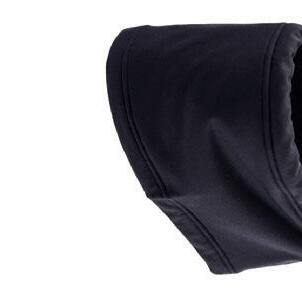
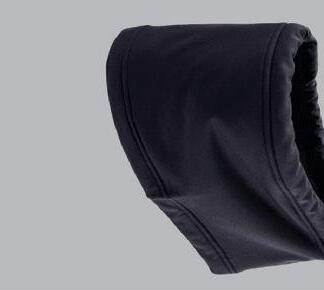
Japanese baselayer brand Zero t has arrived in North America with a collection of game-changing products that ensure plummeting temperatures won’t stop motorcyclists getting out on the road or track this Fall and Holiday season. Designed by a passionate team of innovators and baselayer specialists, the Zero t Heatrub Ultimate is the most technically advanced baselayer on the planet and completely di erent to any other product you’ve ever worn before.
WHAT MAKES IT SO GOOD?
1. It’s ve times warmer than a standard baselayer
That is quite a claim, but it’s a fact. Tested at the iconic Boken Institute in Osaka, the Heatrub Ultimate baselayer recorded a Heat Retention Rating of 0.78; a standard baselayer would have a rating of between 0.1 to 0.14. And for reference, a sweater would typically have a rating of 0.3. The Ultimate performs best in a temperature range of 14° Fahrenheit thru 50° Fahrenheit – so even in the coldest of conditions and most biting of winds, you’ll still be nicely heated.
2. Instant warmth the minute you put it on
A standard baselayer traps body heat between your skin and the material, so it takes a little time before you feel the bene ts. With Zero t, ve separate fabrics, along with a patented knitting process, create instant warmth as soon as you pull it on. And, because of the construction of the garment, this heat is retained for the duration of your time on the bike, making it an essential piece of clothing for motorcyclists this winter.
3. On bike heating from top to toe
The Ultimate is perfect for motorcyclists who hate traditional tight baselayers, because unlike many brands we don’t use ‘compression for heat’ as a technology. Instead, innovative ‘Heat Threads’ on the inside of the garment gently rub against your skin to create positive warmth across your body. We also produce Ultimate Leggings and Socks that are made from the same material and work in the same way, so you can have top-to-toe warmth.


4. Ride free with fewer layers and greater warmth
Over the years, you may well have ‘layered up’ in order to combat the e ects of cold weather. This is where we are changing the game. The Heatrub Ultimate is so good at keeping you warm, you won’t need multiple additional layers. In short, fewer layers yet greater warmth. And unlike other baselayers, because it doesn’t need to be super tight in order to work, it’s incredibly comfortable too on even the longest of trips.


Instant warmth the moment you put it on


Comfortable and durable fabric mix

ZEROFIT HEATRUB MOVE - ADAPTABLE WARMTH ON THE GO
The Ultimate baselayer is perfect for the coldest of conditions, but it is complemented by the Heatrub Move ($76), which is twice as warm as a standard baselayer and ideal for milder temperatures of between 23° and 53° Fahrenheit. It features a 45% polypropylene construction on the inside of the baselayer and a hollow polyester shell that combine for ‘Adaptable Warmth’, keeping you cosy when you’re at a standstill yet regulating temperature and ensuring you don’t overheat as your ride progresses. The construction removes sweat from the skin and evaporates it o the surface of the baselayer quickly, so that nasty feeling of ‘cold sweat’ never materialises.















BACKFIRES
SOLO? OR NO?
In response to Brian Hennessey’s “Solo or No?” letter in the November issue: Many of us have been conditioned to believe that “being social” is required for happiness, but I’ve not found that to be true. I had an occasional riding buddy in my early twenties but haven’t desired any company besides my bride for all of my riding since. We like to start and end our rides when we want, choose routes on a whim, and leave riding days to spontaneity. After a working career full of office hours it’s pure pleasure to ignore the clock and be free of obligations to others. My advice to Brian is to do what’s fun and satisfying, and not worry about what society dictates.
Lee Gross Visalia, Calif.
I’m now 85 years old and still like to ride even though I don’t do singletrack anymore. I mostly ride dual sport on the backroads of Eastern Utah. Most of the people I used to ride with have quit and sold their motorcycles, though some are now riding electric bikes. I rode and helped put on enduros for over 20 years and never had a problem finding people to ride with. Now, all are younger and I feel like I don’t want to hold them up or be a bother. I like riding by myself. I can stop when I want, change my route, and go home when I feel like it. I’ve had people ask me why I ride solo, and my answer is, “Because I’m the only one I can keep up with!” PS: I really enjoy the new format of magazine.
Eldon “Cap” Kuney Fruita, Colo.
Obviously, it all depends on who you’re riding with! Ride with guys or gals that mesh well with your on-road skills, political affiliations, sports team favs or general outlook on life and
you’ve got a better chance of enjoying yourself. Ride with know-it-alls, those who want to prove how “fast” they are, egomaniacs or armchair political pundit/idiots and you’re bound to be driven into the “solo or nothing” camp — which can be loads of fun, of course. I do a little of both these days, but I’m really picky when it comes to group rides. I’m nearing 50 and figure I’ve earned that right.
Greg Lanham Nashville, Tenn.
I’m 62 and have found I prefer riding by myself unless it’s with family. I had a neighbor (15 years older) I enjoyed riding with for years until he traded his XR200 for a WR450 Yamaha. He was only 5’7” and spent most the ride crashing. It got to be more work than fun pulling him and that big 450 out of the holes he managed to fall into. I have met up with folks out on the trail, but usually end up not enjoying the ride all that much and usually leave to go out on my own.
Mike Anderson
Brian Hennessy’s letter about riding solo really hit home. I’m 63 years young, and about to gain another orbit around the sun next week. I used to ride solo back in the late ’70s because I didn’t like to work my riding schedule around other people who didn’t take it seriously, and I now find myself riding alone for the same reason. I use a Personal Locator Beacon, so people know where I am, but I like to cover ground at my own pace. I podiumed in a couple of NHHA Hare and Hounds last year, so I can still make it go if I want. But solo I can go as fast or as slow as I like and use my chainsaw to do some trail maintenance while I’m out there. The key is staying within your ability level and riding smart. I don’t have anything to prove anymore.
Mike Nield Richmond, Utah

At 69 years old, I share the exact feelings as Brian Hennessy. Twentytwo years ago I answered an ad placed in a local off-road publication by a 70-year-old guy looking for an off-road riding partner. We ended up logging approximately 9,000 miles off-road over the years, and it was the best time I’d had in 53 years of riding. He felt the same, but sadly, he recently passed away. I’ve thought about placing an ad, but have decided to just ride solo. I figure if I enjoy it, that’s what I’ll do. I just prepare a little more than usual by writing down the area or route I’ll travel and leaving it with my wife. I still carry a cell phone, spares, tools, and first aid. If I meet an interested rider along the way, I’ll give it a try. And if I meet my fate riding solo, it was doing what I love, satisfied at my age that I’ve lived a fuller life than most.
Edward Frank AMA Life Member
At 50 I’m not quite as seasoned as some, but I do like riding solo off-road. It’s tough to find someone who’s available for an impromptu jaunt, and sometimes I just want to do what I want without worrying if the trail choice is up to someone else’s skills or liking — and on my own timeline. When I got my 2011 Husky TE449 (now a double-orphaned relic of the turbulent history of the brand that I call HusCagivaBeemer) I started doing solo day rides through the glorious
dual-sport USFS roads and local trails from home. My family staged an intervention and decided that my wandering ways were dangerous even though I always carried a phone, so they bought me a satellite device. I love riding and racing, and meeting new friends on the trail, but with the freedom and confidence of having good comms with the family, I can get my crusty, don’t wanna deal with anyone solo days in anytime.
Jeremy Howard
In addition to Mr. Hennessy’s reasons, I like the ability to stop when and where I want, resume when I want, and enjoy the peace and solitude that comes with enjoying the ride and the scenery at whatever pace
LETTER OF THE MONTH
SECRET DESIRE?
I feel like that day, rather than having to accommodate and watch out for the habits or pace of other riders. Riding, by its very nature, is a solitary activity. Add in the group aspect and much is lost, for me anyway. I gave group riding a long try quite a few years ago, and quit because of the competitive spirit that seemed to always take over the rides, having to stick to the others’ ride plan and scheduled start times and destinations, etc. As with everything, to each their own…
Gregory Mitchell Jefferson City, Mo.
My answer to Brian Hennessy’s letter would be to suggest he try trials riding. Most of the folks riding trials

N
ovember issue, Alps Challenge touring story, small inset photo on page 45: A belt-fed machine gun aimed rather blatantly at a typewriter. Hmmmm.
Jack
Bellinoff
Georgetown, Texas
Pretty sure that wasn’t intentional, Jack, but we do get to feeling that way at times. Deadlines can be ugly. —Ed.
Letters to the editor are the opinions of the AMA members who write them. Inclusion here does not imply they reflect the positions of the AMA, its staff or board. Agree? Disagree? Let us know. Send letters to submissions@ama-cycle.org or mail to American Motorcyclist Association, 13515 Yarmouth Drive, Pickerington, OH 43147. Letters may be edited for clarity and brevity.
these days are longtime off-road riders that now enjoy riding slow. Unlike motocross, where if you fall down you’re likely to get run over and used for traction, trials folks will stop to help if you have a problem during a ride or competition. Truly a gentleman’s (or gentlewoman’s) sport!
Mike Roccanti
I’m in pretty much the same place as Mr. Hennessey. After a lifetime of racing off road the switch flipped when I was about 52. When I go riding with friends I’ll take my vintage trials bike and go putting in the woods while they’re out hard charging. I have no interest in searching out challenges or riding black trails, and I get annoyed when they start “billy goating.” I’ll be 60 in a month.
Jeffrey Brady AMA Life Member
I’m 72, and over the past few years I’ve pretty much stopped riding with others altogether, and I’ve pondered why. Obviously, I have changed. Someone once wrote that Harley-Davidson riders dress like pirates and sportbike riders dress like armadillos. Nowadays, I don’t care to dress like either. So I guess that’s part of it. I just no longer identify as a part of either group. I still love riding, but I don’t care to present myself in any way other than just myself.
Bill Johnston Fountain Inn, S.C.
If you want the social connection but don’t want to ride with others, try a ride to a specific destination, such as a restaurant or scenic area. Pick a time to meet and then enjoy some time with others without having to ride together.
Steven Whitman Danville, N.H.
The best of both worlds, Steven! Good advice. —Ed.

BACK IN THE DAY
Where the photos are blurry but the memories are clear!

y first bike was a Honda CL175, possibly a 1972 model but don’t hold me to that. The picture was taken in Orlando, Fla., in 1977 while I was in training at the Navy base. Only kept it a few months before I upgraded to an RD350. Alas, I have no surviving pictures of that.
—Michael Spangler

6I used to ride my ’71 Kawasaki
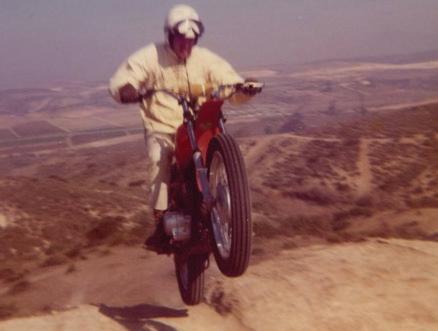
250 F8 from Naval Air Station North Island, where I was stationed just south of Imperial Beach, Calif., to an off-road area just north of the Mexican border. I’d stop and strip the headlight and taillight off the bike, hide them in a bush and proceed to thrash the bike though the miles of trails all day. Then, I’d put it back together and ride back to the base. The picture is of me conquering a hill called “Bear Killer” in 1972!
—Sonny Bulla

Sometime in 1970, puttering around on my then-new Penton Berkshire 100. I belonged to the North Jerry Motorcycle Club, and we were running a trials competition at the Mountain Rest in West Milford, N.J.
—Hans Segboer


Growing up in Las Vegas, my brother and I rode our dirt bikes every day in the desert surrounding our house. We were lucky to have very cool parents who supported our love of motorcycles. Dad had an RT-1 360. Little brother had an HT-1 90. That is me on my 1971 CT-1 175 in my first MRAN (Motorcycle Racing of Nevada) Hare Scramble. I won the 250 Novice class that day. Two years later I was racing a 250 Husky in the 1973 Barstow to Vegas Hare and Hound. I can still remember all the sights and sounds of 3,000-plus bikes starting all at once. Little did I know then it was going to spark a lifetime passion of riding and racing in the desert. I still compete today in the Masters Over 60 Class.
—Geff Grossan

As the story goes, my daddy would ride around the yard with me on his bike to get me to stop crying when I was a baby. Photo circa late ’70s; me and Daddy on his Honda. The sound of an engine has a calming effect to this day. I’m proud to say I’m now in my late 40s and still riding!
—Amanda Johnson

The year was 1974, I was 20 years old, and I’d gotten my first street bike — a 1974 Suzuki GT750 Water Buffalo with a Windjammer fairing. This was my first trip from East Texas to Big Bend National Park, approximately 800 miles. I had all the latest motorcycle camping gear, an alloy-frame backpack, a two-man tent, and on the back an ice chest — I had to have my bacon and eggs in the morning. The bike was a little squirrely when the ice melted, but I made out there and back.
—Ricky Morgan

Not my first bike but an early one. My brother and I went to different tracks that day and each was proud to show the other our success. This is from early ’70s, and the car is my 1972 Dodge Demon. When people ask who’s who I tell them I’m the one with the bigger trophy. So many memories…from showing up at a track and seeing the Pentons there and knowing we would not trophy that day, to Frank Piasecki whistling for me to move over just before he flew by as I was going as fast as I thought humanly possible in the woods!
4
I love seeing all the Back In The Day photos in your publication! Here is me on my very first motorcycle...I was 15 years old and had a late-’60s Yamaha 250 Street 2-stroke. Loved this bike! My best friend had a new Honda 350 Scrambler. We would race up and down a country road, and that 2-stroke Yamaha would eat him up. What memories. I have been riding all my life on many machines. I am 65, soon to be 66, and I now ride a Harley Nightster, BMW Stiletto with Sidecar, Yamaha 250 Morphous, Honda Helix, and a Yamaha Zuma 125. Many thanks to you for all you do, especially AMA Vintage Motorcycle Days. Love the new magazine layout, too.
—Randall Rucker

—Gary Duden

3I was 16 in this photo, riding a Southern California desert enduro on my 1968 Greeves 250 Challenger. I took my younger brother (who was 13) out to ride his first enduro on his Hodaka, and when he didn’t show up at the finish, I had to ride the second loop over again to look for him. That was a long, 120-plus-mile day in the saddle, but I saved having my dad kill me for losing the kid by finding him along the route. He and I are still riding together constantly. My current steed is a 2018 KTM 300XC. Two-strokes forever!
—Don Brunson


up to speed
News, notes, insight and more from the motorcycling universe
The Good Fight
A 2022 review of the AMA Government Relations Department’s actions, and a look at what’s coming in 2023
BY JOY BURGESS
rotecting motorcyclists’ rights is one of the ways the AMA fulfills its mission of promoting the motorcycle lifestyle and protecting the future of motorcycling, and the AMA’s Government Relations Department (GRD) is a key player in that effort.
PComprised of Director Michael Sayre, Western States Representative Nick Haris, On-Highway Manager Tiffany Cipoletti, Off-Highway Manager Peter Stockus, and Grassroots Coordinator Erin Reda (all of whom ride themselves, we must add), the GRD team, along with AMA members and other motorcycling advocates, works hard day in and day out, wading through local, state and federal legislation to identify the most critical items that affect motorcyclists — and then, when necessary, takes action.
Throughout 2022, the team tackled many issues affecting riders across the country, and they’re already planning for 2023 by identifying key areas where they need to engage to protect your rights. While we’ve covered plenty of GRD news and updates in these pages throughout the past year, we’ve put together here a review of some of the significant actions, and added a look at what you need to know for 2023.
Review 2022
E15 FUEL
The Biden administration announced an emergency waiver allowing summertime sales of E15 in the late spring of 2022, a move the AMA strongly opposed along with thousands of AMA members who wrote the White House in opposition to the move. The White House also stated that the EPA would consider working with states to expand the availability of E15 and modify labeling at the fuel pump.

make those repairs…”
Dozens of states have introduced Right to Repair legislation to apply the same rules that currently apply to cars to all consumer products, including both on- and off-road motorcycles.
The AMA continues to support the REPAIR Act at the federal level and similar state legislation put forward, while encouraging all motorcyclists to tell their elected officials to support this type of legislation.
assistance systems (ADAS) tech on cars’ ability to detect motorcyclists.
On the positive side, NHTSA did begin tracking AV and ADAS crashes, releasing that data monthly starting this past summer, giving road safety organizations a clearer idea of how widespread the problem is. NHTSA also increased its scrutiny over Tesla’s Autopilot system, upgrading their probe into the 18 incidents of Tesla vehicles striking stopped emergency vehicles.
LANE FILTERING
“E15 has been shown to damage carbureted and fuel-injected motorcycles, reduce gas mileage and decrease the shelf life of gasoline,” AMA Director of Government Relations Michael Sayre said. “The fact that it is illegal to use in motorcycles, and that clear labeling at the pump is not required, poses a significant risk for misfuelling.”
The AMA opposes removing or weakening labels at the pump that would leave consumers without critical information, and instead advocates for stronger labeling at the pump to ensure the potential dangers of E15 are clear.
RIGHT TO REPAIR
The AMA increased its engagement on motorcyclists’ right to repair their motorcycles, with action ramping up after the Federal Trade Commission took action against Harley-Davidson for illegally restricting customers’ right to repair their motorcycles.
“The AMA represents motorcyclists, the consumers of the motorcycle industry” Michael Sayre wrote in the October issue, “and the position we must take is clear: motorcyclists have the right to repair their own motorcycles, as well as the right to seek out an independent shop to
DISTRACTED DRIVING
The AMA continues to participate in the StopDistractions.org coalition that aims to reduce distracted driving through advocacy and educational material. Currently, 48 states have distracted-driving laws on the books, and 18 other states worked to stiffen these laws during the 2022 legislative session. The AMA recognizes that distracted or inattentive driving has become a major concern to the motorcycling community and continues to engage on these legislative efforts.
AUTONOMOUS VEHICLES

In 2022, autonomous vehicles (AV) and the potential danger they and their drivers pose to motorcyclists have been hot topics within our magazine pages as the AMA’s fight to ensure the safety of semi-autonomous vehicles became more critical than ever. The National Highway Traffic Safety Administration (NHTSA) did release a proposed update to the New Car Assessment Program, but it failed to include procedures to test the performance of advanced driver
In 2022, nine states pursued lanefiltering legislation. Arizona passed SB 1273 — with ABATE of Arizona leading the charge — resulting in the state becoming the fourth to legalize lane filtering.
Utah passed HB 10, which extended the current sunset on lane filtering for an additional five years.
Other than Utah and Arizona, California and Montana are the two other states that have already legalized lane filtering.
MOTORCYCLIST PROFILING

Seven states pursued motorcyclistprofiling legislation in 2022. New Hampshire became the fifth state to pass this type of legislation, preventing law enforcement officers from initiating traffic stops on the pretext of riding or wearing motorcycle apparel. The AMA continues to actively work with a group of like-minded riders in California seeking to raise the issue through a legislative resolution in the 2023 session and welcomes the opportunity to engage on this topic with other states/groups when possible.
ELECTRIC VEHICLES
The Inflation Reduction Act signed by President Biden not only failed to revive the electric motorcycle tax credit that expired at the end of 2021, but it also went a step further by

up to speed
removing the program entirely. The AMA and the motorcycle industry worked hard to prevent this, and are now engaged to revive the program entirely.
On the state level, SB 2940 passed in Illinois, ensuring electric motorcycles are now included in the state rebate program. Electric motorcycle owners are now eligible to get a $1,500 state tax rebate with the purchase of an electric motorcycle.
• The Hoit Road Marsh OHV ban was repealed in New Hampshire, allowing motorcyclists to ride on the ice once again.

• The AMA GRD department was invited to present at the West Virginia Trail Days legislative event, and the team spoke on the economic benefits of motorized recreation to state and federal legislators.
ADDITIONAL WINS:
• AMA President and CEO Rob Dingman and AMA GRD Director Michael Sayre — along with the MIC’s Senior VP of Government Relations Scott Schloegel — met with U.S. Secretary of Transportation
• The AMA worked with the Quaboag Riders Club in Monson, Mass., successfully fighting local zoning overreach to protect their annual hillclimb event.
• The AMA fought against Maryland HB77 — a bill that would have established prison time for offhighway vehicle use on-road, despite no prison time being suggested for reckless driving — and succeeded.

Pete Buttigieg in February. That meeting gave the AMA the opportunity to discuss issues like AV/ ADAS and motorcycles, getting the next Motorcyclist Advisory Committee started, Recreational Trails Program and more.
State Legislative Tracking
…by the numbers
Off-Highway
• 317 bills tracked
• 79 became law
On-Highway
• 817 bills tracked
• 137 became law
• The GRD team attended the National Conference of State Legislators annual conference, engaging state legislators face-to-face on the legislative issues that are most important to motorcyclists around the country.
2023: WHAT TO WATCH
• The AMA will spend a lot of time in 2023 working to protect motorcycles from the dangers of ADAS vehicles, and pushing NHTSA and others to move forward on this work.
• In 2023 the GRD team will continue to address Right to Repair at the state and federal level, hopefully engaging the industry on some type of compromise between manufacturers and their consumers/ independent repair shops.
• It’s expected that additional
congressional efforts to expand E15 in the market will occur, and while that’s not new, the AMA will take additional action against that move, and continue its support of clearer labeling at the pump.
• According to Off-Highway Manager Peter Stockus, the AMA expects to see state legislatures across the country address the influx of outdoor recreation in the post-COVID world, and the AMA will continue to lobby for motorized trails in all recreation plans.
• The AMA plans to continue pushing for additional Recreational Trails Program funding.
• Work will continue with locals on the ground to navigate and protect motorized access with recent monument designations, such as Colorado’s Camp Hale.
• The 2023 legislative year will likely see an increase in lane-filtering legislation introduced around the country. On-Highway Manager Tiffany Cipoletti noted that “Lane filtering is gaining momentum, with more and more states inquiring about a path to introduce legislation in 2023.” Texas, Louisiana and Virginia are prepared to pursue lane filtering, and groups in Washington, Oregon, Maryland, Idaho, Massachusetts, Rhode Island, Pennsylvania, New Jersey and Idaho are laying the foundation for a legislative push.
YOU CAN MAKE A DIFFERENCE!
While the AMA Government Relations team works tirelessly to protect the rights of motorcyclists by supporting beneficial legislation and fighting misguided, dangerous legislation, we also need your help. Making your voice heard is critical to the AMA’s efforts. Stay updated with the latest information on the big issues and learn how you can take action by signing up for action alerts at AmericanMotorcyclist.com/actioncenter/

up to speed Racing Roundup
What’s what in the world of AMA amateur competition
BY KEATON MAISANO
Shirey Shines
By a margin of more than 2 minutes, 3 Bros Hatch Husqvarna Racing’s Dalton Shirey clinched the 2022 AMA National Hare and Hound Championship at Round 7, which took place Sept. 24-25 in Lovelock, Nev.
“I had a pretty good start,” Shirey
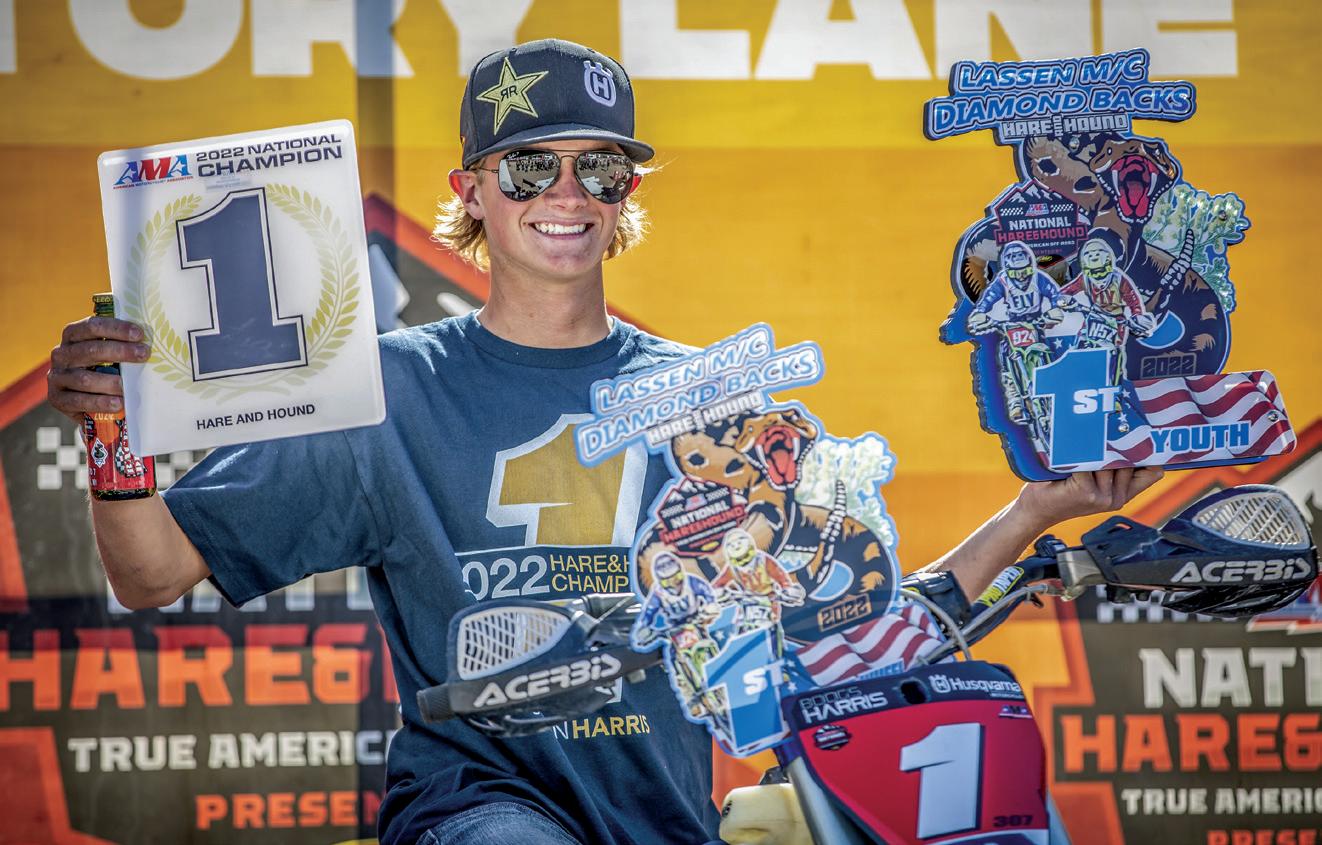
said, “but the dust was so bad and everyone was going in every different direction, so the first 10 miles were chaos for me, and I told myself I need to stay calm and collected. Once we started filing into line, I was fourth behind Jacob [Argubright] and I could see two other dust clouds ahead. I found Joe [Wasson] just sitting there broken down, and from there on I

told myself I have to keep it on two wheels, finish and do my job. Wrapping up the championship a round early was really cool. I haven’t been in that situation before, so that was really neat.”
The win gave Shirey an insurmountable 54-point lead ahead of the season finale held at the end of October.
Baylor Breakthrough
While Grant Baylor’s fifth win of the year came by less than a second, his claim to the championship was far less contested.
Growing his lead to an insurmountable 44 points at the penultimate round of the 2022 AMA National Enduro Championship in Sand Spring, Okla., the Oct. 16 event proved to be the stage for REV Motorsports GASGAS’ Baylor to clinch the crown. The title marked the first for GASGAS USA.
Baylor started Round 9 strong by winning the opening test, but five-time champion – and brother –Steward Baylor stayed close behind on his Yamaha. Despite his brother’s valiant effort, Grant Baylor held on to the win by 0.7 seconds to be crowned champion for the second time in three years.
“I knew Steward was coming on strong,” Baylor said, “and I decided if I didn’t do something different, he was going to beat me, and I wanted to get the championship wrapped up at this race so it didn’t have to go down to the last race of the season. So I went into that last test and just gave it everything I had.”
SHAN MOORE
Racing ROUNDUP up to speed


Trials and Tribulations
The U.S. Trials des Nations team competed at the 2022 FIM Trial des Nations, which took place in Monza, Italy, in September.
Organized by the American Motorcyclist Association and the North American Trials Council, the U.S. men’s team was composed of Daniel Blanc-Gonnet, Alex Myers and Josh Roper, with Will Myers serving as the team’s alternate. Courtney Allison, Madeleine Hoover, Kylee Sweeten and alternate Hailey Glueck made up the women’s team.
U.S. ATVMX Team Dominates
Team USA ATVMX claimed the Quadcross of European Nations title in the Czech Republic in September 2022. That marked the fourth championship for the U.S. team. Joel Hetrick tallied 1-1 moto finishes, while teammate Bryce Ford went 1-2. Unfortunately, Chad Wienen went 29-2 after experiencing a disastrous issue in his first moto.
“[It was] a great performance from all three of our athletes,” said Team Manager Mark Baldwin. “We couldn’t be prouder of them. Even though we had a setback in moto
Unfortunately, both teams had a disappointing finish, with the men’s team placing sixth and the women’s team finishing seventh.
“I am super proud of both of our teams this year,” said Team Manager Todd Roper. “They knew they could achieve better results, but it wasn’t to be this time. The men’s team had a couple mistakes the first loop that took them off podium. They were a bit disappointed because they knew they could win the event, especially with such easy sections. They are looking at it as a learning experience to come back stronger next year.”
“Our women’s team,” Roper continued, “rode strong especially on their second loop. It was a pleasure to watch how much they worked as a team while they were riding together. We very much enjoyed getting to see all of our friends from around the world again and joining them in healthy competition. Next year we will try to step our game up once again to achieve better results. Every one of our team members loves to have this opportunity to represent the USA in international competition and want to thank all of those who supported us financially and with encouraging words.”
—Joy Burgess

one that got us behind the eight ball right away, it never showed on or off the track following it.
Chad’s quad was ready to go within an hour following the incident, with time to spare prior to the
start of moto two. It was definitely a team effort. I cannot thank everyone involved enough.”
Faster Than the Rest
ith everything at stake at the final round of the AMA National Speedway Championship on October 8 at Fast Friday’s Motorcycle Speedway, a decorated racer and a defending champion battled it out for the 2022 title.
Ultimately, Billy Janniro reigned victorious as he edged out 2021 AMA National Speedway Champion Max Ruml to collect the 11th title of his career.
Janniro entered the final round clinging to a 37-36 lead over Ruml, who rode a late-season hot streak to position himself to grab the title. However, Janniro matched Ruml’s 19 points in the final round with 19 of his own to maintain the slimmest of margins for the win.


Alessandro’s Ascent
A
s the leaves turned colors and fell softly from the trees, Alessandro Di Mario and his promising career continued to blossom at the AMA Road Race Grand Championship, held Oct. 21-23 at Barber Motorsports Park in Birmingham, Ala.
Di Mario’s strong showing at the event earned him the prestigious 2022 AMA Nicky Hayden Road Race Horizon Award — an award given to the rider best suited to excel at the professional level based on attitude, enthusiasm and performance.
“When I got the award, it was pretty cool because not many people get it,” Di Mario said. “I’ve looked up to [former winners] Eric Wood and Anthony Mazziotto. They’re cool people and fast. I want to be like them.”
Additionally, Florida native Landen Smith was presented with the AMA Amateur Road Racer of the Year award, and William Posse of Moncure, N.C., was named the AMA Vet/ Senior Road Racer of the Year.
SARAH CHAPPELL PHOTOS
MICHAEL KIRBY
up to speed

RIDING ROUNDUP

Roots and Rapport
Toward the end of September, three members of the Yellow Jackets Motorcycle Club visited the AMA Motorcycle Hall of Fame Museum looking to uncover information about their club’s mysterious origins, which have known roots back to at least the late 1940s.
While they did not find their eureka moment in the AMA’s archives, Rob “Spock” Barron, Matt “Relic” Richardson and “Wild Bill” Hayes — all donning their unmistakable black and
yellow jackets — were living proof of the pride and togetherness within the Yellow Jackets club.
“Everyone who rides a motorcycle wants to belong to something,” Bar ron said. “They feel like they belong to the motorcycling community, but belonging to a club is much more about the brotherhood and a much tighter bond.”

chapters, the Yellow Jackets Motorcycle Club provides members with a friend to call upon for help in many parts of North America.
Spread across the United States and Canada in the form of many
“I can call up any of my members and say, ‘Hey man, I broke down and need help,’” Barron said, “and someone will drop what they’re doing and come and get me. No questions asked, and it doesn’t matter where I am.”
The strong culture built on brotherhood can be traced back nearly 80 years to the Los Angeles chapter and to Bob “Mack” McMillen, a man who was a Yellow Jacket in Gardena, Calif., back in the late 1940s. While he did not establish the club, McMillen passed on the core values to the next generation so the Yellow Jackets could be reborn and thrive today.
“We gathered when Bob was still alive,” Barron said. “We picked Bob’s brain for all he knew and could remember. We try to carry on in the ways that he wanted and the ways he felt the club had been to him.
He saw it as an opportunity for men to gather and share camaraderie around motorcycles.”

Despite the continued hunt for facts — largely led by Richardson — that could piece together the Yellow Jackets murky roots, the club has found solid footing today. As for its future? Richardson is confident in the positive effects the club has on its members and the motorcycling community. “We represent some really solid facts when it comes to motorcycles and the motorcycle clubs,” Richardson said. “Our future looks really bright.”
Keaton Maisano






malcolm’s moments
KENNY AND NORM
The guys I got into the bikeshop business with had an interesting thing for air filters…
BY MALCOLM SMITH
fter returning to the So Cal racing scene after my horrific accident when I was 18, I happened to meet Kenny Johnson and Norm McDonald, who owned a shop in nearby Riverside called K&N Motorcycles. They raced BSA Gold Stars, sold a few British brands in their shop, and would soon be selling a new Japanese import called Yamaha. They were good riders, too. Kenny was a bit faster, but boy could Norm nail starts; he was always getting holeshots.
AOur relationship was casual for months, but one Sunday Norm asked if I’d be interested in working for them. Norm, who was the marketing/ sales half of the equation (Kenny was the engine-building other half), said, “Look Malcolm, you love motorcycles, and I can’t see you as a diesel or aircraft mechanic. Come be our service manager. We’ll pay you $5 an hour, and you’ll be surrounded by what you love.”
Compared to Mott’s (Pappy was probably 75 at the time), K&N was a younger, more up-and-coming shop, and I think my reputation as a racer and mechanic was something they wanted. The opportunity was immediately attractive to me; the money was good, the more raceoriented shop was right up my alley, and McDonald was right…I was a motorcycle guy through and through. Quitting college to work there
was not popular with my Mom and stepdad (my dad had recently passed away), but once they realized I loved motorcycles and the motorcycle business, they grudgingly accepted my decision.
I enjoyed working there right away and could log as many hours as I wanted. I usually made $200 a week, even more than the mechanics. And we were racing, too. A lot. I built plenty of racing engines, for us and for customers, and developed the “Dr. Motor” nickname for my handiwork. I also began racing a BSA Gold Star, which was a better racebike than the Matchless, with more performance potential from its higher-revving fourstroke single.
then on I was a full-on convert to the two-stroke cause, even getting a little bit of sponsorship help from the Greeves importer.
I won a lot of races on that bike, especially at Ascot Park, where Gene Romero was a hotshot rider. He and I would battle every race meeting, with me winning one month and he the next.
PART NINE
While all that racing and wrenching was going on, Kenny and Norm bought a tiny air filter company from a guy in New Mexico. It wasn’t much; just a new idea, a few machines and some newfangled air filters. No one paid much attention at first, but of course that would change in a major way in a few short years.
At some point Norm bought a Greeves Square Barrel, a British two-stroke with a funky cantilever/shock front end. It wasn’t as fast as a well-prepped Gold Star, but it was lighter, and the bike interested me enough to take it on a test one afternoon. I wondered how it would stack up laptime-wise vs. a Gold Star, so I rode both and timed the result. Whoa! I went faster on the Greeves, and a light went on immediately in my head: lightness and handling were more important than pure power. Others knew this, especially Husqvarna in Sweden. But it was far from common knowledge, and from
The following year I was to move up to the Amateur division (from Novice) and start racing Class C stuff on the bigger bikes — twins. But twins were expensive to buy, build and maintain, much more so than the two-strokes I’d become accustomed to riding and racing, so I decided to quit the Class C scene, keep my singles and continue racing them where I wanted. A rider didn’t get that

much riding time doing scrambles and flat track stuff anyway, while out in the desert I could ride for hours on end…and that appealed to me quite a bit.
Pappy Mott, in his late 70s by this point, was finally ready to retire, and offered me the opportunity to buy Mott’s Cycles. I was very interested, especially with the Honda thing beginning to take off, but when Kenny and Norm caught wind of the idea they offered me a partnership in K&N, a third of the company, to keep me around. The offer was plenty attractive, so I accepted and became a part owner of K&N Motorcycles.
Unfortunately, this arrangement generated conflicts, at home and at work. My new wife Ruthie couldn’t understand how we could trade the security of $200-per-week income for the chance of starving or losing our home if the business-

ownership venture didn’t work out.
Things got a bit uncomfortable with Kenny and Norm, too, at least as co-owners. We’d gotten along well as team members, but ownership involved a whole range of things, some of which we didn’t agree on. So we worked out a deal whereby I’d own the service department outright and become a lessee to their shop, pay them
rent and handle all their service work, plus what I generated from my main service business — which worked out well for everyone.
Things were moving along pretty smoothly, and one Thursday afternoon while I was working away, an older gentleman with a funny French hat walked into the back of the shop and asked if he could see Malcolm Smith. I distinctly remember seeing his head pop around the corner and look my way as he asked the question.
“I’m Malcolm Smith,” I said, wondering who this nicely-dressed guy was.
“I’m Edison Dye,” he said. “I’m importing Husqvarna motorcycles into the U.S. I hear you’re one of the fast guys in Southern California, and I’d like to know if you’d be interested in riding Huskys.”
My life was about to change in dramatic ways, and I had not a clue. More on this in my next installment.
Above: Me, messing around in the K&N lot. Left: The Greeves 2-stroke was cobby, but it changed my way of thinking about racing motorcycles, and led me to a certain Swedish brand.


supercross back stage
BY MITCH BOEHM
PHOTOS BY THE AUTHOR AND JEFF KARDAS

What happens behind the scenes during an AMA Supercross weekend?
Glad you asked….
he old idiom “There’s more than meets the eye” is cliché, for sure. But like most sayings that are woven inextricably into our lexicon and culture, there’s almost always quite a bit of truth to them.
TAnd in the motorcycling universe, there’s perhaps no better example of this than the 17 AMA Supercross events that happen each year between January and May in stadiums and superspeedways across the country.
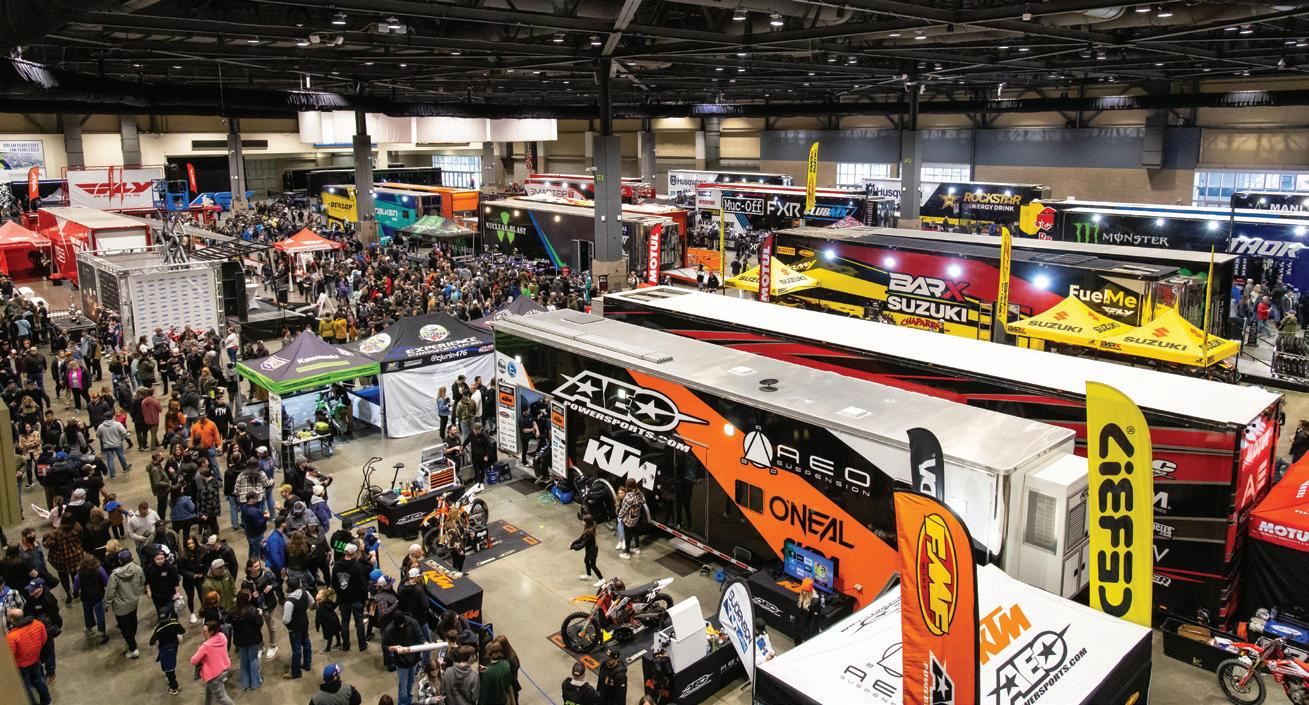
Attend one and you’re almost guaranteed to have a smooth and seamless blast — from the fan- and family-friendly attractions happening pre-race in the paddock and parking lots, to the excellent seating and viewing arrangements, to the convenient food and beverage options, and to the high-flying racing action and pure spectacle that is AMA Supercross.
Despite the $14 beers, nachos and chili dogs, it all comes off like some carefully curated two-wheeled circus, a several-hour visual and aural extravaganza that mesmerizes young and old, male and female, Democrat and Republican, veteran enthusiast and motorcycling newbie, and everyone in between.
This is precisely why AMA Supercross is motorcycling’s Full Monty happening, and why it’s been that since the early 1970s when it debuted to wild enthusiasm at places like Daytona International Speedway and the LA Coliseum.
Of course, as on TV, in the movies and on a concert stage, you only see what you’re supposed to see. But if you really think about it, you get the feeling there’s a lot going on behind the scenes…and you’d be right, because what goes on backstage is literally shocking in both depth and breadth to anyone not intimately involved…which is 99.9% of us.
“I remember my first
race
as Director,
sitting up high in the stadium with responsibility for what was going on down on the floor,
and thinking, ‘Holy smokes! This is big!’” MIKE PELLETIER
I’ve been to a lot of AMA Supercross events over the decades, and I’ve even been on the floor to photograph a couple. But like most fans, I showed up not too long before things started happening ontrack, which is basically like showing up for the warmup band (Susan Tedeschi, anyone?) for an Allman Brothers Band show back in the 1990s. You get all the great music, which is why you came, and there’s not a lot of waiting around…but you do miss a glimpse (or more) of the thought, planning, blood, sweat and tears that actually produced the show.
And when it comes to a single round of AMA Supercross, there are metric tons of all that…and I’m not just talking about dirt.
UTAAAH!
Salt Lake City, Utah, is my hometown these days, and I’m lucky that not only is there an AMA Supercross at the University of Utah’s Rice-Eccles stadium, but for the last few years it’s hosted the series finale — which is always good for an extra Bubba Scrub or two of championship excitement.
Earlier last year as the 2022 series was winding down, I told my colleague AMA Director of Racing Mike Pelletier that I wanted to get a more in-depth look at what it took to put on an AMA Supercross weekend, and could I follow him around Friday and Saturday during the SLC round to see what was what?
He agreed, and a month or so later I found myself sitting in the AMA HQ trailer on a Friday morning at the finale with an all-access pass around my neck chatting with Pelletier and a couple of his deputies — AMA Race Steward Tim McAdams and AMA Rider Rep Jeremy Albrecht. The trio make up the AMA’s Race Direction group, which is tasked with rules enforcement and decision making during a weekend.

Pelletier chats with a couple of riders early Saturday at the SLC finale.
“It’s important to have good communication with the paddock,” he said, “but they’re not always going to like our decisions.”

The three have extensive experience in the sport.
Albrecht, who joined the AMA for the ’22 Supercross season, had previously held the Team Manager post for the Joe Gibbs Racing (JGR) MX team and was a factory mechanic for AMA Hall of Famers James Stewart (inducted in 2022) and Jeff Emig (2004). McAdams was also a factory mechanic with Team Suzuki.
Pelletier, 35, grew up riding and racing in New England, won some regional titles, and held a pro license. But when he decided he wasn’t going to be the next Ricky Carmichael he earned a business degree with a minor in communications, joined the AMA as amateur MX coordinator, and after proving himself in the Director of Supercross role was promoted to Director of Racing in 2020, with responsibility for all racing, including Motocross

and Supercross, Road Racing, Off Road and more.
“I’m a motocross guy through and through,” he told me, “but Supercross is my baby, so it’s wonderful that this job covers both disciplines. I remember my first race as Director, sitting up high in the stadium with responsibility for what was going on down on the floor, and thinking, ‘Holy smokes! This is big!’ [Laughs]”
Given the impact Supercross has on our industry, big doesn’t even come close.
SUUUUUPERCROSS
“All of this,” Pelletier said pointing toward the door of the trailer, “is super important to our sport: what happens each weekend; the relationship with our promoter, Feld Motorsports; our relationship with the teams, riders,

Main image: Pelletier (right) and Jeff Canfield in the Race Control booth high above the stadium floor. Insets, top to bottom: Pelletier chatting with the Dirt Wurx crew; between-race track maintenance; and watching the goings-on behind Jett Lawrence.


OEMs and sponsors; the experience the fans have; all of it. I’m a bit younger than some who’ve come before me, and because the riders and team personnel are mostly younger, I think that helps with communications and credibility.”
“When I first got here and sat in meetings with the teams and heard what they were seeing and feeling, I listened. When they’d ask questions I didn’t know the answer to, I admitted it – and told them I’d find out and let them know. Which I did. That helped credibility, too. And along with Jeremy and Tim and the rest of our really great crew, the teams and riders seem generally happier. They don’t always like our decisions on things, but we’re trying to being consistent and up front, and I think they appreciate that.”
While we grabbed an elevator and headed up to the race direction booth at the very top of the grandstand, which is where Pelletier would watch and monitor practice, qualifying and the actual racing, I asked him to boil down his primary job during a race weekend.
“There are a ton of moving pieces, lots of players, and plenty of it all happening at once,” he said, “but from 30,000 feet, I’m the main contact between the AMA and Feld. At an event I deal primarily with Mike Muye, who’s Feld’s Senior Director of Operations – Supercross, and for future and strategic planning my contact is Dave Prater, who’s Feld’s VP of Supercross.”
“Our side deals with things like tech inspection, the rulebook, anti-doping, riders and teams, staging for practice and racing, qualifying, timing and scoring, all
on-track activity, penalties, timing with TV, etc. Before the season starts, which is during the fall months, our AMA staff is deep into rider licensing and entries and such, so there’s a lot happening before we even get to a venue.”
GETTIN’ DIRTY
The venue, yes. AMA Supercross events take place in football and baseball stadiums as well as superspeedways, and unless you’ve seen a track build in person (few ever do) or on video (plenty of those online) you simply cannot believe what goes into transforming places like MetLife, Lucas Oil, Anaheim, AT&T, Daytona International Speedway and RiceEccles Stadium from perfectly manicured turf to

“if some riders are tripling something that maybe wasn’t designed to be tripled...or maybe where they’re landing is too close to a corner or something, we’ll see it.”
MIKE PELLETIER
gnarly racetrack.
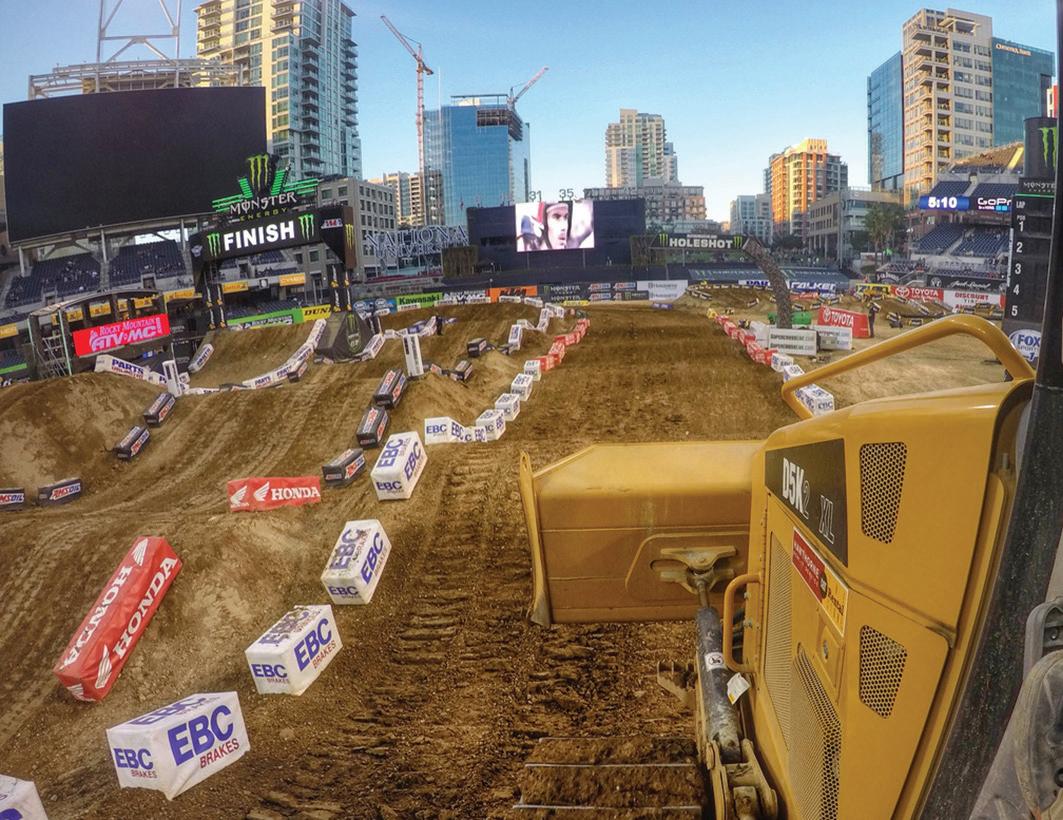
Dirt Wurx U.S.A. has been working with AMA Supercross forever and has the process down to a very detailed and blueprinted science, though you’re still talking about four solid days of work for a substantial crew, plus 450 dump truck loads of locally sourced and stored dirt; miles of protective plastic sheet and plywood for the base; a dozen haulers and smaller scoop bulldozers for dirt movement and sculpting; more miles of below-dirt piping for electrical and water; sponsor signage, barriers and tuff blocks to place; a starting gate, victory stage, webbed catch fences and start/finish tower to erect; whoops, doubles, triples and rhythm sections to build, and much more.
And then, between late Saturday night and Sunday afternoon (the crew works all night), it’s all gone, the venue clean as a whistle, the dirt trucked back into storage nearby, and all the aforementioned track stuff — towers, starting gates, lights, stages, tuff blocks, signage, etc. — packed into several of the 25 or so big-rig trailers Feld uses to carry the AMA Supercross circus from city to city and venue to venue. Yes, 25 big rigs. And that doesn’t include all the factory team big-rigs and privateer trailers and box vans.
“The track-build and set-up process is pretty amazing,” Pelletier told me. “It’s hard to believe they get that much stuff done in so little time, especially when the weather’s bad and it gets messy.”
“Alex Gillespie is Dirt Wurx’s owner and key player, and he and I are in touch all weekend long; my phone is never off. We’ll have seen a computer-generated track map before the season, and we’ll talk about the weekend’s track as it’s coming together, too; potential safety stuff, areas of concern, specific sections, whatever. We’ll talk more after it’s built, and after the track walk, too, especially if the riders or team managers have anything to say, and of course during practice, when we can see how the riders are actually negotiating the layout.”
“For instance,” Pelletier continued, “if some riders — I won’t name names here [laughs] — are tripling something that maybe wasn’t designed to be tripled…maybe where they’re landing is too close to a corner or something…we’ll see it, me or Mike Muye up in the skybox, or the AMA’s

Jeff Canfield from show control, or Tim from the finish-line tower. We’ll then radio down to Alex, and if necessary, he’ll have his guys tweak things during a break. We’ll talk after practice, too, and during qualifying and racing, of course — though we have to get things pretty much final layout-wise before qualifying, for obvious reasons of safety and also fairness between qualifying groups. Alex’s group keeps busy; they’re working on 2024 season layouts now, in fact.”
FRIDAY ON MY MIND
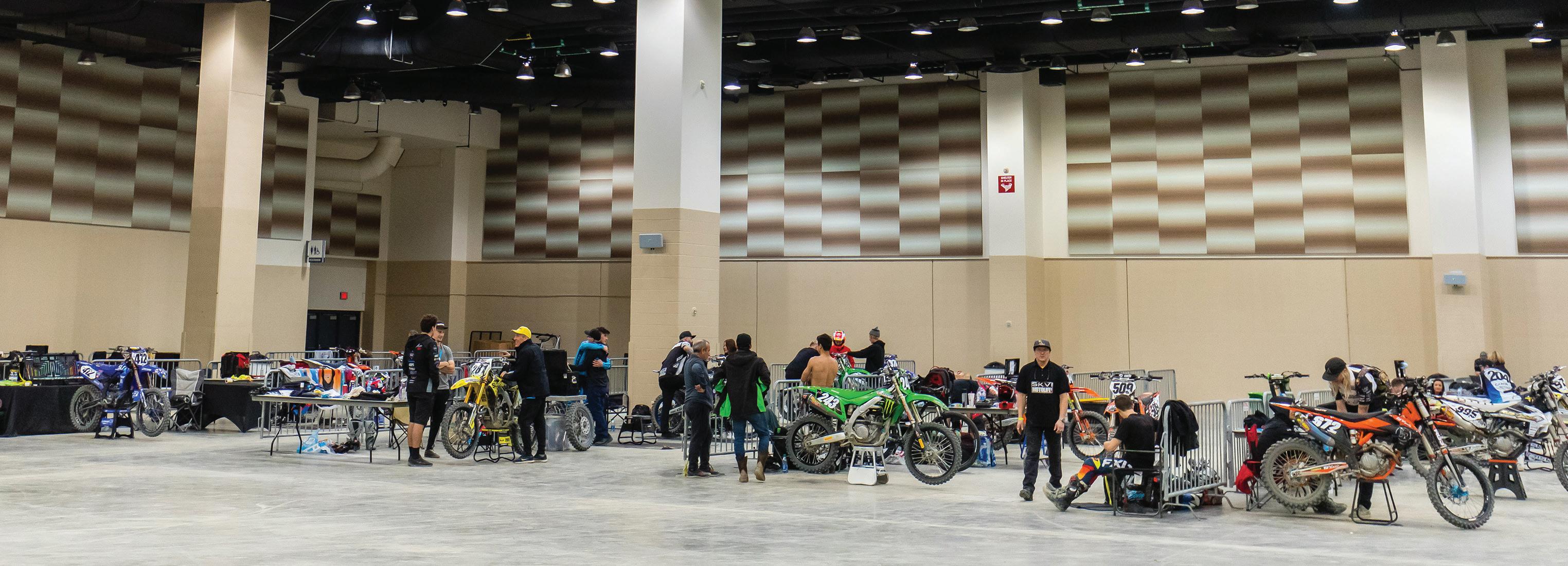
On Saturday I’d see this process up close and personal as I sat in the crow’s nest and watched Pelletier, McAdams, Muye and Canfield monitor practice and keep a running dialog with the folks on the ground — the medical crew, AMA officials and Dirt Wurx personnel alike. But before all that came a lot of Friday preparation, including Tech Inspection and a late afternoon Operations Meeting that included essential on-site AMA officials, key people
The Daytona round is unique in many ways and is the only AMA Supercross event not promoted by Feld Motorsports. Far left: Pelletier surveying things early in the day at the SLC finale.
from Feld and Dirt Wurx, the Alpinestars Medical Team and venue security.
“Tim [McAdams] oversees Tech,” Pelletier told me, “which happens at the AMA rig. Post-race we’ll impound the top three finishers in each class for 30 minutes for possible protests and occasional teardowns. There’s no set schedule on teardowns and technical checks, and we can do them anytime. We have every homologated part in the truck, cylinders, heads, swingarms, etc., which help us determine if a bike is legal.”
“During that Ops meeting I’ll connect with Chief Medical Officer Dr. John Bodnar, who’s stationed with the Alpinestars medical crew on the floor during all on-

track activity; whenever there’s action out there, he and I are in direct contact. He lets me know if anyone’s unfit going in, or if someone gets hurt during the event. He’s got a good relationship with the paddock, and the riders and managers know they can trust him.
Pelletier and crew will also touch base with the 20 or so AMA officials who handle a myriad of tasks during a race weekend, from practice and race organization to staging to timing and scoring and everything in between. “We have about a dozen core members who attend every
race,” Pelletier explained, “and there are another 10 or 12 who are regional and fluctuate depending on schedules and the city we’re in. Scheduling all this can get pretty crazy, but our staff does a great job with it.”
SATURDAY IN THE PARK
Saturday, of course, is showtime, and things got moving early at Rice-Eccles. Pelletier and crew arrived at 7 a.m. sharp, and you could feel — even if you’re a journalist watching all this happen — the air was heavy with


Top to bottom: Pelletier (right) and Feld’s Mike Muye chat in the crow’s nest during early-Saturday practice; the two are joined at the hip for most of the day. Pelletier with Adam Enticknap (who’s 6’2”) and Malcolm Stewart during Saturday’s program. Main image: It’s more than amazing to see a football stadium transformed into an AMA Supercross track over the course of a few days.

urgency. Pelletier and McAdams did a working official’s meeting at the truck at 8 a.m. to review the day’s schedule and the specifics of what each group was tasked with on a more granular level, and when that broke up it was time for the track walk, which gave riders and crew a closer look at the track and layout.
“The track walk is no substitute for riding the course,” Pelletier told me, “but it does help riders see the layout for themselves, and give them and their team the opportunity to voice concerns or thoughts to us and the Dirt Wurx crew. There’s a bit of goofing off, which you always expect, and lots of coffee and team colors and social media going on, but it’s usually pretty serious. It used to include too many people, but



Insets, clockwise from top: Pelletier (right), McAdams and Albrecht (left) make up the AMA’s Race Direction group. Pelletier chatting with the GOAT — Ricky Carmichael — and then presenting the 250 West championship trophy to 2022 champion Christian Craig in SLC.
during qualifying,” Pelletier told me as we watched from the crow’s nest, “and we check for track and safety issues like hawks the whole time. We also use practice and qualifying selfishly as dry-run shakedown rehearsals for the evening. Are medical folks, flaggers and officials in the right place? Do all communications work as needed? Is everyone on the same page? Are we conscious of potential areas on the track that might generate an aggressive passing controversy at, say, the end of a heat or main? [Stay tuned] As we have a wide range of riders and skill levels, are some not quite up to speed — which could cause a safety hazard? Sometimes there are difficult discussions.”
“Also, if we’re going to make track modifications over and above basic maintenance — ‘basic’ meaning smoothing out corner ruts, restoring jump and whoop faces, etc. — we have to do it during free practice, because once we’re into qualifying we’re pretty much locked in to keep things consistent from group to group within each class.”

After qualifying, and before the fireworks- and light show-enhanced opening ceremonies, Pelletier met with McAdams, Albrecht, Muye and Canfield to final-check a wide range of items leading into the evening’s festivities… timing and scoring, the TV schedule, medical crew positioning, and assorted other elements.
One of those elements was potential “situations” involving certain riders, as the SLC finale would determine the 250cc West title — which Hunter Lawrence and Christian Craig were in contention for — and runner-up and third-place finishing positions for the 450 series. Eli Tomac had wrapped up the 450 championship a round earlier, but Malcolm Stewart and Justin Barcia were gunning for follow-up spots behind Tomac in the championship. Would Hunter’s brother Jett get aggressive with Craig in order to help out his brother? Might Barcia or Stewart tangle for final series spots?
WELCOME TO THE SHOW
Once racing got underway after opening ceremonies, I watched Pelletier and Muye monitor the goings-on through their video monitors and a 10-foot-high plate-glass window from high above the floor. McAdams was on the intercom from the start/finish tower, and as I listened to all the back and forth and absorbed the decision-making and calls they made during the proceedings, a lot of what Pelletier had told me earlier about this phase of the evening began to make sense.
“During practice and qualifying I split my time between the floor and Race Control up high,” he told me, “but once the racing starts I’m up here full-time until post-race, when I sometimes have to present a championship plate or deal with an issue.”
“One of the key issues is monitoring crashes and injury situations during racing with Doc Bodnar and his medical team. Tim or I make the calls on red flags after quickly consulting with


Doc and the medical team, as they’re on the floor and can quickly determine if someone’s badly hurt and/or creating a safety situation. Most crashes happen at the beginning of a moto, when they’re bunched together, or at the end, when they’re tired.”
“It’s impossible to watch 22 guys at once, and everyone’s focused on the leaders, so I tend to watch mid pack, where there’s always a lot going on. We’ve been using this very cool instant-replay video system for the last two years, and as soon as something happens during the race I can quicky replay it to see what transpired. Tim and Jeremy’s monitor is tethered to mine, so they

can see what I’m seeing and we can talk about it in real time, and that helps when we need to make a decision on something.
Christian Craig’s 8th-place finish in the 250 Main after an early crash netted him his first-ever AMA Supercross championship over Hunter Lawrence, and the idea of brother Jett causing mayhem with Craig never materialized due to a qualifying injury, which kept Jett out of the race.
There was mayhem in the 450 Main, however, with Barcia and Stewart going at
it in the race’s middle laps, and Barcia ramming Stewart from behind in a corner to grab third overall for the night behind Chase Sexton and winner Jason Anderson.
From the beginning of the race I’d been listening to Pelletier and company mention the possibility of controversy, but when Stewart passed Barcia on lap 10 or 11 and the two were neck and neck, the small talk turned more urgent, with Barcia making an overly aggressive pass on Stewart a few turns later. “It’s gonna be a long night,” Pelletier said with a weary smile, understanding he’d likely be issuing a penalty and/or a fine to Barcia later that evening.
“When this sort of thing happens,” Pelletier

told me later, “the three of us — Tim, Jeremy and myself — get together as soon as we can, review all the footage, get both sides of the story from the riders, and make a ruling…that night. This case was pretty easy; we ended up penalizing Barcia 10 points and fining him $10,000.”
Even without the point penalty, Barcia would still have finished 4th overall for the season behind Stewart, though the subtracted points did end up dropping him to 5th overall for the season behind Marvin Musquin. Barcia admitted to the aggressive move on the podium, which was admirable despite the boos raining down from the crowd, and for his part, Malcolm Stewart said very little in the aftermath, perhaps plenty happy with his top-three achievement in what was his best season ever.
As always, there’s a lot more than meets the eye in an AMA Supercross season. And in just a few short weeks we’ll be doing it all over again. You go, Mike P. and crew! AMA
“One of the key issues is monitoring crashes and injury situations during racing with Doc Bodnar and his medical team. Most crashes happen at the beginning of a moto, or at the end, when they’re tired.”
MIKE PELLETIER


U.S. Motocross of Nations Team
BY JOY BURGESS
PHOTO: MiCHAEL ANTONOVICH
ach year the AMA — its Board of Directors and staff — presents a special award to an individual or group that’s had a profound impact on the world of motorcycling over the past 12 months.
EAnd last year you definitely had to be blind not to recognize the U.S. Motocross of Nations Team’s monumental achievement in the annual Motocross of Nations competition.
It had been 11 years since the U.S. brought home the MXoN Chamberlain Trophy, and Team USA — which included Eli Tomac, Chase Sexton and Justin Cooper, with five-time World Champion and AMA Motorcycle Hall of Famer Roger DeCoster as Team Manager —claimed the win in front of thousands of American
Left to Right: Justin Cooper, Eli Tomac, Team Manager and AMA Motorcycle Hall of Famer Roger DeCoster, and Chase Sexton.
THE YEAR
fans at Red Bud Track ’N’ Trail in Buchanan, Mich., on Sept. 25, 2022. (You can read the full story in the December 2022 issue of American Motorcyclist if you missed it.)
After a long day of qualifying on Saturday, heavy rain came in that night and into Sunday morning, leaving the team to compete in muddy conditions that made the track super tricky, with chaotic starts, brutal roost and plenty of riders going down in the mess.

champagne sprayed and thousands of fans cheered for the red, white and blue.

At the end of the mud-fest, Tomac finished 1-6 in the MXGP class, Sexton finished 2-3 in the Open class, and Cooper finished 9-4 in the MX2 class. That was enough to take the U.S. team to the top of the podium as
“It’d been 11 years, and [we’d] been so close many times and [hadn’t] gotten it done,” Tomac said after the win. “We got it done; we made it happen… and it was epic!”
It was epic, which is why the entire team was selected to receive one of motorcycling’s most prestigious honors — AMA Motorcyclist of the Year.
“Eli Tomac, Chase Sexton and Justin Cooper accomplished something extraordinary at Red Bud this year,” said AMA Board of Directors Chairman Russ Ehnes. “Bringing the Chamberlain Trophy back to American soil after 11 years was a feat worthy of recognition, which is why we selected the team as the 2022 AMA Motorcyclist of the Year. We’re proud of these riders’ stellar example of American greatness, and we’re proud to have them as AMA members.”
IN 1975, A YEAR BEFORE ITS GS750 FOUR-STROKE STORMED THE SCENE, SUZUKI GAMBLED ON THE ROTARY-ENGINED RE-5...AND LOST

RISKY

BY MITCH BOEHM PHOTOS: JIM DOHMS
technically successful, but it was also reasonably complex, at least to the average motorcyclist.

Many of you are probably in the same boat here, but every once in a while I stumble onto a motorcycle I know of, but not well and of course I can’t help but take a closer look. And Suzuki’s 1975 RE-5 rotary is definitely one of those.
It’s a bike I’ve known and read about (a little, at least) since the middle 1970s, when I was reading every motorcycle
magazine I could get my grimy little hands on. But I’d never really gotten up close and personal with one or dug into its history to any serious degree. So when I stumbled onto an amazingly clean example at a Riding Into History concours event in St. Augustine, Fla., in 2016 (I’d somehow been asked to be Grand Marshal), I grabbed my shovel.
We’d stopped at an old church during the event’s
Grand Marshal’s ride, and under a lovely canopy of Spanish Moss I spied from 70 or 80 feet the metalflake orange paint and funky, beer can-shaped instrument cluster and taillight, which I knew could only belong to a Suzuki rotary. The thing was seemingly original and had just 5,000 or so miles on the clock. Nice. I asked the owner — Todd Haifley — if the bike would be at the RIH
concours the following day, and could I photograph it for a story I was writing for one of the big monthlies? “Sure thing,” he said. Then I asked if I could maybe ride it. “Of course,” he replied with a smile. Even nicer! I knew very little about the RE-5. Only offered for two years — ’75 and ’76 — and thus a sales and reputational disappointment, the RE-5 seems to only exist on fringes of retro enthusiasts’
Suzuki’s take on the Wankel/ NSU rotary design was unique and
psyches. “RE-5, eh? Hmmm…Suzuki, right? Didn’t Norton and Hercules build them, too?”
The foundation of the rotary design can be traced to the birth of its creator Felix Wankel in the early 1900s. It’s said the German came up with the idea when he was 17, though it wasn’t until he was working with the Nazi party’s Aeronautical Research Establishment during WWII, and later with Germany’s NSU Motorenwerk AG in the 1950s, that an actual
be heard.
The obvious way forward was four-strokes, but other makers were already doing them successfully, and for Suzuki upper management, the rotary design could be an option. Might this engine set Suzuki apart from Honda and everyone else? It might, management thought, and engineers were put to the task.
Suzuki had a singlerotor prototype engine up and running by 1973, and a handful of patents and new technologies to go

running prototype was built. NSU debuted the Wankel engine to the world in the 1950s, and in the years to come several companies would license the technology. One of those, in 1970, was Suzuki.
At the time, Suzuki was strictly a builder of 2-stroke motorcycles. Its sales in the then-exploding U.S. market were good, but Suzuki knew that to continue to be a serious player here it had to expand into other powerplant designs, especially with Honda’s quiet and reliable four-strokes dominating the market, and early rumblings from the EPA beginning to
Yamaha teased its 660cc RZ201 prototype at the late-’72 Tokyo show but decided against producing it for several reasons.
with it. Displacing 497cc, the engine was both liquidand oil-cooled, as rotary engines tend to run hot. Extreme wear on — and the actual production of — the rotor housing’s inner surface became an issue, but Suzuki dealt with the issue by using and advancing surfacetreatment technology developed by Platecraft of America, Inc., though Suzuki had to build its own production facility to do so. Advanced tech also extended to the two-stage carburetor, the vented, dual-pipe/twin-shell exhaust system (to cool the superheated exhaust


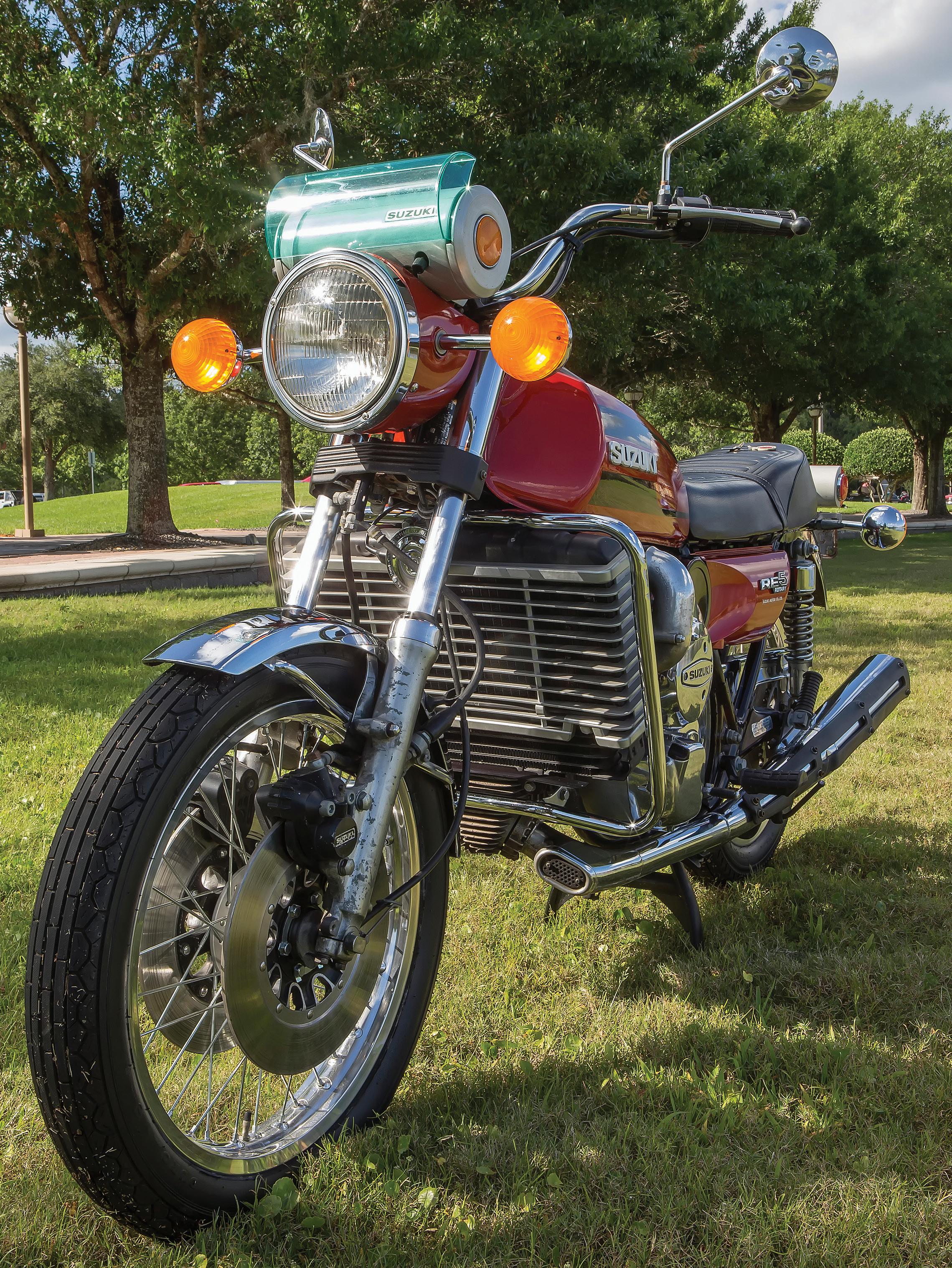
While the RE-5 generated a lot of buzz during late 1974 and into ’75 via sales literature and in the magazines, very little of it translated into retail sales.
“I really do think Yamaha’s actions, and the overall buzz surrounding rotary engines at that time, led Suzuki to push forward with maybe a little more urgency and excitement than was prudent.” JESS STOCKWELL


gases), and the use of what Suzuki called a Peripheral Port design, which used three ports — one large, and two small — with a butterfly valve to make maximum power and still preserve low-rpm throttle response and rideability.
Styling-wise, the RE-5 ended up being pretty traditional — or mostly so. The twist would be a futuristic instrument cluster and taillight drawn


up by noted Italian stylist Giorgetto Giugiaro. The pieces were cylindrical in shape, apparently to remind everyone of the round ’n rotational heart beating within.
As Suzuki readied its prototypes for testing during ’72 and ’73, and the concept’s eventual debut at the Tokyo Motor Show, things were changing in both the world and within the motorcycling universe. The first was the Arab Oil

Embargo of 1973, which basically doubled the price of crude oil and, thusly, gasoline…and rotary engines were not known for being fuel efficient.
Secondly, Suzuki was not alone in developing rotary engines. Honda and Kawasaki had already built prototypes by that point, but it was Yamaha that shocked the world — and especially Suzuki, given what it was up to on the rotary front — at the Tokyo
show in late ’72 with its twin-rotor rotary prototype called the RZ201. Rumors had the 660cc RZ being nothing more than a balsawood design exercise, a way to showcase potential new technologies. But the truth is that Yamaha came very close to building the RZ for production.
“We’d actually begun to build production tooling,” said longtime Yamaha product-planning guru Ed Burke, “and I even got to
ride one of the prototypes. It was very fast, and really smooth.”
But Yamaha shut down the RZ660 project despite the bike’s goodness.
Yamaha knew it was primarily a “statement machine,” and a bike that would “say a lot about Yamaha technology, but maybe not sell that many units,” according to Burke. But Yamaha also recognized the obstacles. “We saw the oil and gasoline situation,” he continued, “and we knew rotary engines had belowaverage mileage. But also, rotary engines were ugly. In cars no one cared, because you can’t see the engine. But a motorcycle engine is part of the aesthetic, and it’s very difficult to make a rotary not look like pump or compressor engine.”
Of course, Suzuki was blind to Yamaha’s — or Honda’s, or Kawasaki’s — plans or outlook, so it pushed ahead, and very likely with added competitive urgency…all of which may have either a) blinded the company to the various obstacles, or b) made it believe it could overcome them.
“I really do think Yamaha’s actions, and the overall buzz surrounding rotary engines at that time,” said RE-5 and rotaryengine guru Jess Stockwell, “led Suzuki to push forward with maybe a little more urgency and excitement than was prudent. Suzuki certainly went all-out on the project.”
And boy, did they. Not only did Suzuki come up with new technologies

page color brochure that appeared when the bike debuted. “We believe this achievement marks the beginning of a new age in [motorcycling] history.”
Two items are interesting to analyze here. One was
prototyped and tested on separate development tracks, and just a year apart.
Generally speaking, the RE-5 was greeted with lukewarm kudos by media, dealers and customers when it debuted. There
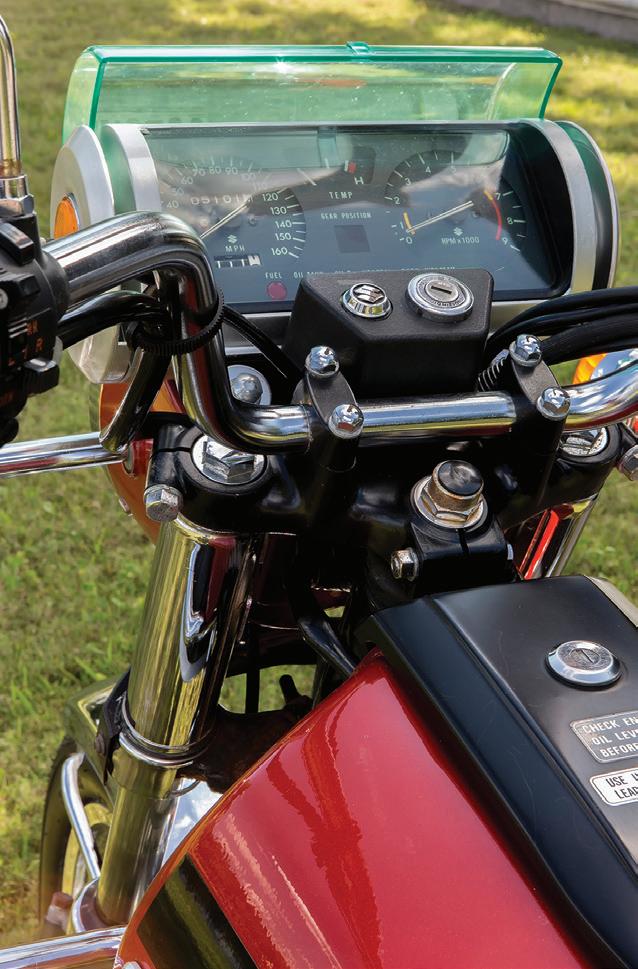
the appearance of Honda’s GL1000 at the very same time (late ’74), which in many ways was nearly as radical a departure for Honda as the rotary was for Suzuki…and we know how the GL turned out for Honda.
The other was Suzuki’s development of the GS750, in late-prototype stage by early 1975 and less than a year from production. Suzuki’s fortunes and permanency in the U.S. and the world would turn on that big, fine-handling inline-four GS of ’76 (and the GS1000 two years later), so it’s fascinating to wonder about the dichotomy of thinking and decision-making that must have gone on inside Suzuki while the RE-5 and GS were being drawn,

were some fans in both camps, and road tests pointed out the bike’s strengths — smoothness, above-average handling and comfort, and excellent build quality.
But over time the detractors multiplied, and despite the lush rollout, the money spent, the explanations of features and benefits, the magazine advertisements and the colorful, well-done brochures handed out at dealerships and bike shows, the RE-5 — despite all its new technology and uniqueness — never generated much excitement or retail sales energy over its two-year production span. Dealers had new bikes on the floor well into the late ’70s.


“I’m a sucker for ahead-of-their-time failures. It’s fun to ride a piece of history. If Suzuki had kept with it, they might have been successful. Hey, remember, the first wristwatches were called ‘ladies bracelets with a clock attached’ by men, but look how they turned out!”
JAY LENO
MAKE IT YOURS
The AMA offers a variety of card types and designs for members. In addition to our standard card, we offer a number of themed cards that identify you as belonging to a specific group or speak to your passion as a motorcyclist.
Call (800) AMA-JOIN (2625646) to request an affinity card at any time, at no additional cost.



DEALS AND DISCOUNTS
THE ESSENTIALS

Lodging


AMA Roadside Assistance Roadside assistance coverage for eligible members.
Car Rentals
PRODUCT DISCOUNTS

ADVMoto 20% discount. Use code AMADV20
AMA Motorcycle Hall Of Fame Free admission to the AMA Motorcycle Hall of Fame in Pickerington, Ohio.



AMA Supercross Tickets 10% discount on tickets at supercrosslive.com Use code AMA23
Anthony’s Leatherworks
10% discount. Use code AMADISCOUNT
Blendzall
AMA members can save 20% at blendzall.com. Use code AMA20 at checkout.

Bohn Body Armor 10% AMA Member Exclusive Discount. Visit bohnarmor. com and use code AMA18 at checkout.
Butler Maps
AMA members receive a 20% discount at butlermaps.com. Use code AMAMEMBER


Cardo Systems
20% discount online with valid AMA membership card.
Colorado Motorcycle Adventures
10% discount with valid AMA membership card.

The Dirt Bike Academy 10% exclusive discount on instruction. Learn more at thedirtbikeacademy.com
Dowco Powersports 20% discount. Use code AMA20
EagleRider For Club EagleRider AMA members receive 2 free rental credits



Up to 25% off at any Avis or Budget. Avis Code: D388100 Budget Code: Z942000 Motorcycle Shipping Call
AMA Gear Find patches, pins, T-shirts, hats and more.
Edelweiss
AMA members save on standard bike tour. Use code 21AMA-EBT03 at checkout.
Evans Cooling System 25% discount on Evans Coolants and Prep Fluid. Use code AMAFUN at evanscoolant.com.
EVS Sports 10% discount and free shipping on all orders. Use code AMAEVS20
Haynes Save an additional 15% on all Haynes & Clymer print and online repair manuals. Use code AMA15
Heli Bars
Use code AMAM2020 for a 10% AMA Member Exclusive Discount at helibars.com.
Helite Moto
AMA members get 15% off every order at helitemoto.com. Use code HELITEAMA
International Motorcycle Shows
Save on advanced adult oneday general admission. Use code AMA20
Legacy Track Dayz 15% discount on Legacy Track Dayz events. Use code AMARideLTD
Liberty Sport Eyewear
30% discount on all “motorcycle collection” frames. Discount code AMA30.
MAD Maps
Save 15%. Use code AMA15
Matrix Concepts
AMA members receive a 25% discount on most products for shop, garage & track necessities at matrixracingproducts.com Use code AMA25

Motorcycle Shippers AMA

® Medjet
Air medical transport and travel security protection – visit Medjet.com/AMACycle or call 1.800.527.7478, referring to American Motorcyclist Association.Annual rates are reduced by 20% and start at $235.
MotoAmerica 20% off 2-day and 3-day passes at select MotoAmerica events. Use discount code AMA20
Motool
AMA members can save 10% at motool.co. Use code AMAVIP at checkout.
MX Boot Repair 10% discount. Use code AMADISCOUNT


MYLAPS 20% discount off MSRP or current sales price on weborders or orders coordinated by the AMA. Use code AMA-789HJK

Nelson Rigg 20% AMA Member Exclusive Discount on all products! Use promo code AMA-NR20

The Quail MC Gathering AMA members recieve a discount on tickets using the code QL22AMA

Quin Design Helmets 10%


&

ARIZONA
COMING EVENTS
Be sure to check the event website or call the organizer for the latest information, including postponements or cancellations.
Motocross: Jan 13-15. Prescott. AMA Arenacross Championship Series, Findlay Toyota Center, www.arenacrossusa.com
CALIFORNIA
Trail Ride: Jan. 1. Santa Margarita. CCMA New Year’s Day Ride, Central Coast Trail Riders Association 805-801-8829 dennisdlaw1@gmail.com, www.pozoriders.com
Motocross: Jan. 27-28. Anaheim. Supercross Futures Premier Qualifier, Feld Motorsports 800-844-3545 sxfinfo@feldinc.com, www. supercrossfutures.com.
Enduro: Jan. 28-29. Lucerne Valley. 100s MC Sprint Enduro, 100’S MC, desertracer411@ gmail.com, www.100smc.org
Hare Scrambles/Cross Country: Jan 28-29. Elk Creek, Richmond Ramblers MC, Old Mill Hare Scrambles/Cross Country, 510-761-6115
COLORADO
Motocross: Jan. 6-8. Loveland. AMA Arenacross Championship Series, AX Promotions, www.arenacrossusa.com
FLORIDA
Hare Scrambles/Cross Country: Jan. 21-22. Okeechobee. Florida Trail Riders, Palm Beach Track & Trail Riders, Inc. 954-562-2500, jim@ agatemortgage.com, www.floridatrailriders.org
MARYLAND
Hare Scrambles/Cross Country: Jan. 8. Charlotte Hall. SXCS - Round 3 Hangover Hare Scramble, Trail Pros 301-751-0006
OKLAHOMA
Motocross: Jan. 20-21. Guthrie. AMA Arenacross Championship Series, AX Promotions, www.arenacrossusa.com W
Motocross: Jan. 22. Guthrie. AMA Arenacross Championship Series, AX Promotions, www. arenacrossusa.com
Motocross: Jan. 27-28. Guthrie. AMA Arenacross Championship Series, AX Promotions, www.arenacrossusa.com
Motocross: Jan. 29. Guthrie. AMA Arenacross Championship Series, AX Promotions, www. arenacrossusa.com
SOUTH CAROLINA
Dual Sport: Jan 15-16. Ehrhardt. Dual-Sport The Rooster Run at Broxton Bridge, Family Riders MTC, 843-708-0886, bduc515@ comcast.net, carolinadualsporters.com
WISCONSIN
Recreational Event: Jan. 1. Madison. New Year’s Day Ride, Madison Motorcycle Club, 608-225-5001,madisonmotorcycleclub@gmail. com, http://madsonmotorcycleclub.org
Ice Race: Jan. 29. Fond Du Lac. Steel Shoe Fund 3 Hour Endurance Race, Southeastern Short Trackers, LTD, 414-303-1331, kikid48@gmail.com, www.steelshoefund.org
SUPERCROSS
2023 Monster Energy AMA Supercross Championship supercrosslive.com
Round 1: Jan 7. Anaheim, Calif. Angel Stadium
Round 2: Jan 14. Oakland, Calif. RingCentral Coliseum
Round 3: Jan 21. San Diego, Calif. Snapdragon Stadium
Round 4: Jan 28. Anaheim, Calif. Angel Stadium
Round 5: Feb 4. Houston, Texas. NRG Stadium
Round 6: Feb 11. Tampa, Fla. Raymond James Stadium
Round 7: Feb 25. Arlington, Texas. AT&T Stadium
Round 8: March 4. Daytona Beach, Fla. Daytona Int’l Speedway
Round 9: March 11. Indianapolis, Ind. Lucas Oil Stadium
Round 10: March 18. Detroit, Mich. Ford Field
Round 11: March 25. Seattle, Wash. Lumen Field
Round 12: April 8. Glendale, Ariz. State Farm Stadium
Round 13: April 15. Atlanta, Ga. Atlanta Motor Speedway
Round 14: April 22. East Rutherford, N.J. Metlife Stadium
Round 15: April 29. Nashville, Tenn. Nissan Stadium
Round 16: May 6. Denver, Colo. Empower Field at Mile High
Round 17: May 13. Salt Lake City, Utah. Rice-Eccles Stadium
Supercross Futures AMA National Championship supercrossfutures.com
May 13. Salt Lake City, Utah. Rice-Eccles Stadium
Supercross Futures Premier Qualifying Events supercrossfutures.com
Jan. 28. Anaheim, Calif. Angel Stadium of Anaheim.
Feb. 25. Arlington, Texas. AT&T Stadium. April 8. Glendale, Ariz. State Farm Stadium.
April 22. East Rutherford, N.J. MetLife Stadium.
MOTOCROSS
2023 Pro Motocross Championship promotocross.com
Round 1: May 27. Pala, Calif. Fox Raceway
Round 2: June 3. Sacramento, Calif.
Hangtown Motocross
Round 3: June 10. Lakewood, Colo. Thunder Valley Motocross Park
Round 4: June 17. Mount Morris, Pa. High Point Raceway
Round 5: July 1. Buchanan, Mich. RedBud MX
Round 6: July 8. Southwick, Mass.
The Wick 338
Round 7: July 15. Millville, Minn. Spring Creek
MX Park
Round 8: July 22. Washougal, Wash.
Washougal MX Park
Round 9: Aug 12. New Berlin, N.Y.
Unadilla MX
Round 10: Aug 19. Mechanicsville, Md.
Budds Creek Motocross Park
Round 11: Aug 26. Crawfordsville, Ind. Ironman Raceway
NATIONAL
CHAMPIONSHIPS
AMA Arenacross National Championship Series arenacrossusa.com
Round 3: Jan. 6-8. Loveland, Colo.
Round 4: Jan. 13-15. Prescott, Ariz.
Round 5: Jan. 20-22. Guthrie, Okla.
Round 6: Jan. 27-29. Guthrie, Okla.
Round 7: Feb. 3-5. Reno, Nev.
Round 8: Feb. 10-12. Denver, Colo.
Round 9: Feb. 24-26. Hobbs, N.M.
Round 10: March 3-5. Amarillo, Texas.
Round 11: March 10-12. Tulsa, Okla.
Round 12: March 17-19. Salem, Va.
Round 13: March 24-26. Little Rock, Ark.
Round 14: March 30-April 2. Lexington, Ky.
TRACK RACING
2023 MotoAmerica Superbike Championship motoamerica.com
March 9-11: Daytona Beach, Fla. Daytona 200. Daytona International Speedway
Round 1: April 21-23. Atlanta, Ga., Road
Atlanta
Round 2: May 19-21. Leeds, Ala. Barber Motorsports Park
Round 3: June 2-4. Elkhart Lake, Wis. Road
America
Round 4: June 23-25. Shelton, Wash. Ridge Motorsports Park
Round 5: July 7-9. Monterey, Calif. Weathertech Raceway Laguna Seca
Round 6: July 29-31. Brainerd, Minn. Brainerd International Raceway
Round 7: Aug. 18-20. Wampum, Pa. Pittsburgh International Race Complex
Round 8: Sept. 8-10. Austin, Texas. Circuit of the Americas
Round 9: Sept. 22-24. Millville, N.J. New Jersey Motorsports Park
2023 Progressive American Flat Track americanflattrack.com
Round 1: March 9. Daytona Beach, Fla.
DAYTONA Flat Track I. Short Track
Round 2: March 10. Daytona Beach, Fla.
DAYTONA Flat Track II. Short Track
Round 3: March 25. Senoia, Ga. Senoia Raceway. Short Track
Round 4: April 1. Phoenix, Ariz. TBA (Arizona Bike Week) Track type TBA
Round 5: April 22. Mesquite, Texas. Devil’s Bowl Speedway. Half-Mile
Round 6: May 6. Ventura, Calif. Ventura Raceway. Short Track
Round 7: May 13. Sacramento, Calif. Cal Expo. Mile
Round 8: May 27. Lexington, Ky. The Red Mile. Mile
Round 9: June 3. TBA, Va. Virginia. Half-Mile
Round 10: June 17. Du Quoin, Ill. Du Quoin State Fairgrounds. Mile
Round 11: June 24. Lima, Ohio. Allen County Fairgrounds. Half-Mile
Round 12: July 8. Middletown, N.Y. Orange County Fair Speedway. Half-Mile
Round 13: July 22. Bridgeport, N.J. Bridgeport Speedway. Half-Mile
Round 14: July 30. Peoria, Ill. Peoria Motorcycle Club. TT
Round 15: Aug. 6. Sturgis, S.D. Buffalo Chip. TT
Round 16: Aug. 12. Castle Rock, Wash. Castle Rock Race Park. TT
Round 17: Sept. 2. Springfield, Ill. Illinois State Fairgrounds. Mile I
Round 18: Sept. 3. Springfield, Ill. Illinois State Fairgrounds. Mile II
NATIONAL CHAMPIONSHIPS
AMA Ice Race Grand Championship – GP steelshoefund.org
Jan. 29: Fond Du Lac, Wis. Sunset on the Water
AMA Ice Race Grand Championship – Oval Youth Motorcycle/ATV/Sidecar Classes: Feb. 4: Alpena, Mich. Long Lake
Amateur Motorcycle Classes: Feb. 11: Fond Du Lac, Wis. Sunset on the Water dairylandclassic.com
2023 Mission Foods AMA Flat Track Grand Championship americanmotorcyclist.com/flat-track-racing
June 14-20. Du Quoin, Ill. Du Quoin State Fairgrounds


OFF-ROAD
COMING EVENTS
Be sure to check the event website or call the organizer for the latest information, including postponements or cancellations.
FEATURED EVENTS OR SERIES
AMA Florida Enduro Championship Series floridatrailriders.org
Feb. 26, 2023: Richloam, Fla. Central Florida Trail Riders, (407) 929-2114, president@ centralfloridatrailriders.org.
March 9, 2023: Ormond Beach, Fla. Daytona Dirt Riders (386) 615-0722 , secretary4ddr@ gmail.com.
June 4, 2023: Greensboro, Ga. Cherokee Enduro Riders, (678) 572-7260, hill6164@ bellsouth.net.
STATE CHAMPIONSHIPS
AMA Florida State Hare Scrambles Championship Series floridatrailriders.org
Jan. 7-8, 2023: Brooksville, Fla., Suncoast Trail Blazers, (727) 635-6228, suncoastbiz1@ gmail.com.
Jan. 21-22, 2023: Okeechobee, Fla., Palm Beach Track & Trail, (954) 931-5709, motodadfla19@aol.com.
Feb. 4-5, 2023: Indiantown, Fla., Treasure Coast Trail Riders, (772) 801-9777, luisabx@ hotmail.com.
March 18-19, 2023: Dade City, Fla., Nature Coast Trail Blazers, (813) 731-0619, rswann222@gmail.com.
Apr. 1-2, 2023: Okeechobee, Fla., Big “O” Trail Riders, (863) 532-1952.
NATIONAL RECREATIONAL
2023 AMA National Adventure Riding Series americanmotorcyclist.com/nationaladventure-riding
March 4-5. Santa Rosa National Adventure Ride. Milton, Fla. Appalachian Trail Riders. (704) 309-3271, usdualsporters.com
April 21-23: Perry Mountain Tower Run. Stanton, Ala. Perry Mountain Motorcycle Club. (334) 327-5086 perrymountainmotorcycleclub.com
May 5-7: Shasta ADV Rally. Redding, Calif. Redding Dirt Riders. (530) 227-1581 reddingdirtriders.com
May 20-21: Show Me 500. Bixby, Mo. Midwest Trail Riders Association. (314) 409-6936 ridemtra.com
June 3-4: Durty Dabbers Great Adventure. Lock Haven, Pa. Durty Dabbers Motorcycle Club. (570) 748-9456 durtydabbers.com
June 10-11: Ride for Research. Wabeno, Wis. Wisconsin Dual Sport Riders. (920) 350-2030 widualsportriders.org
Sept. 9-10: Blue Ridge. Pineola, N.C. Appalachian Trail Riders. (704) 309-3271 carolinadualsporters.com/2023-pineola-blue-ridge-adventureride
Sept. 16-17: Buffaloe 500. Columbus, Ind. Stoney Lonesome Motorcycle Club. (812) 3424411 stoneylonesomemc.com
Sept. 23-24: Big Woods 200. Wabeno, Wis. Wisconsin Dual Sport Riders. (920) 350-2030 widualsportriders.org

Oct. 28-29: Cross-Florida Adventure. Daytona Beach, Fla. Dixie Dual Sport. (727) 919-8299 dixiedualsport.com
2023 Beta AMA N ational Dual Sport Series americanmotorcyclist.com/nationaladventure-riding
March 3-5: Devil’s Creek. Brooksville, Fla. Dixie Dual Sport. (727) 919-8299 dixiedualsport.com
April 21-23: Perry Mountain Tower Run. Stanton, Ala. Perry Mountain Motorcycle Club. (334) 327-5086 perrymountainmotorcycleclub.com
May 5-7: Shasta ADV Rally. Redding, Calif. Redding Dirt Riders. (530) 227-1581 reddingdirtriders.com
May 20-21: Show Me 200. Bixby, Mo. Midwest Trail Riders Association. (314) 409-6936 ridemtra.com
June 3-4: Durty Dabbers Great Adventure. Lock Haven, Pa. Durty Dabbers. (570) 7489456 durtydabbers.com
June 10-11: Ride for Research. Wabeno, Wis. Wisconsin Dual Sport Riders. (920) 350-2030 widualsportriders.org
July 15-16: Copperhead. Logan, Ohio. Hocking Valley Motorcycle Club. (614) 425-1943 hockingvalleymc.com
Sept. 16-17: Buffaloe 500. Columbus, Ind. Stoney Lonesome Motorcycle Club. (812) 3424411 stoneylonesomemc.com
Sept. 23-24: Mountain Madness. Flagstaff, Ariz. Coconino Trail Riders. (928) 225-5365 coconinotrailriders.org
Sept. 23-24: Big Woods 200. Wabeno, Wis. Wisconsin Dual Sport Riders. (920) 350-2030 widualsportriders.org
Nov. 4-5: Howlin’ at the Moon. Prescott Valley, Ariz. Arizona Trail Riders. (602) 692-9382 arizonatrailriders.org
Nov. 4-5: Hammer Run. Port Elizabeth, N.J. TriCounty Sportsmen M.C. Inc. teamhammer.org


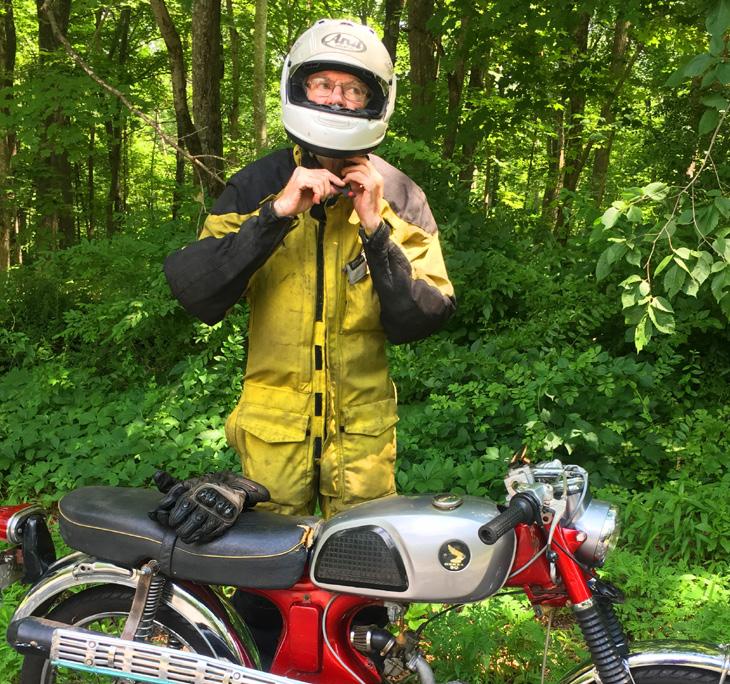


Photo of Dave Roper by Bill Burke ©2022

MARKETPLACE


AMA Trademarks
The following represents active, registered trademarks,trademarks and service marks of American Motorcyclist Association, Inc. (AMA). Usage of any AMA trademark or registered trademark without our permission is prohibited. Please contact jholter@ama-cycle.org for more information or assistance, (800) AMA-JOIN® • AMA Dragbike® •AMA Endurocross® • AMA Motorhead® • AMA Pro Grand National Championship® • AMA Pro Racing® • AMA Race Center™ • AMA Racer® • AMA Racing® • AMA Racing Land
AMA U.S. ISDE Team™
AMA U.S. Jr. Motocross Team™ • AMA U.S. Motocross Team™ Amateur National Motocross Championships® • American Motorcyclist Association® Arenacross® • ATV Hare Scrambles National Championship Series® • ATV Motocross National Championship Series® • Flat Track Grand Championships™ • Grand National Enduro Championship® • Gypsy Tour® Hare & Hound National Championship Series® • Hare Scrambles Championship Series® • Hare Scrambles National Championship Series® • Kids Just Want To Ride® • Motorcycle Hall of Fame® • Motorcycle Hall of Fame Museum® • Motorcyclist of the Year® • Motostars® • National Adventure Riding Series® • National Dual-Sport Series® National Enduro Championship Series® • Protect Your Right to Ride® • Protecting Your Right to Ride® • Ride Straight® • Rights. Riding. Racing.® • Road Race Grand Championships® • Vintage Grand Championships® • Vintage Motorcycle Days® • Vote Like A Motorcyclist®


Garage
Tips,Tweaks, Fixes and Facts: The two-wheeled ownership experience, explained
Winter Battery Care
The basics of protecting your bike’s electron flow during the deep freeze
If you happen to live in a southern-tier state, you’re not too worried about winterizing your bike. But for those of us who must put our bikes into hibernation during the below-freezing months (or suffer the consequences come Spring), the process is important — and battery care is at the top of the winter-pickling list.
BATTERY TYPES
Before diving into winter battery care, it helps to be familiar with the types of batteries used in motorcycles — unless you’re riding an electric motorcycle, that is.
Motorcycle batteries are divided into two basic types: lead-acid and lithium-ion batteries. For lead-acid batteries, you’ve got both open and maintenance-free options. The open or conventional lead-acid battery is the old standard most long-time riders will be familiar with, and they’re designed so you’re able to open the battery lid to monitor (and refill, if necessary) battery fluid.
Absorbed Glass Mat (AGM) batteries, often called “maintenance-free” or “sealed” batteries, are basically more advanced lead-acid batteries that can’t be opened. There’s such
a small reduction in battery fluid that there’s no need to refill them. Because they are sealed, it’s possible to mount these batteries in more flexible locations, and they’re more resistant to vibration, too, which means they’re ideal for V-twins (that shake a lot) or bikes ridden on rough roads, or off-road.
Lithium-ion batteries have become more popular over the last decade. You’ll find them in your smartphone, but they’re in many modern motorcycles, too. Their light weight, longevity and performance make them a popular choice, and they don’t self-discharge easily, but they do have specific charging needs.
BATTERY TIPS AND TRICKS
Conventional lead-acid batteries lend themselves to all kinds of problems during the winter months if your bike just sits in a cold garage.

As they discharge, the resulting lead sulfate begins coating electrode plates, eventually causing the battery to fail. Leaving them in a discharged state also allows the acid to turn to water, and if it’s cold enough, that water can freeze and rupture your battery case. Not good.
You can avoid these problems by removing or disconnecting lead-acid batteries from your bike and placing them on a trickle or maintenance charger designed for motorcycle applications. But don’t

use any old automotive charger, as it’ll overwhelm a motorcycle battery.
Lithium-ion batteries better resist self-discharge compared to leadacid batteries, and they can hold a charge for several months. However, if there’s any drain present — and most modern motorcycles, especially those with radios, alarm systems and other electronic gadgetry, do have some — they’ll discharge quickly over time.
According to Full Spectrum, it’s a good idea to disconnect their lithium-ion batteries if you won’t be riding your motorcycle for more than a month. Other manufacturers recommend charging every couple of weeks when you’re not riding.
You can put your lithium-ion battery on a maintenance charger. But think twice before grabbing just any battery tender you have in your garage. These batteries usually require specific chargers because standard chargers may not be able to read battery voltage correctly and may supply more voltage than the cells can absorb — a big problem.
Look for chargers specifically designed for lithium-ion batteries, or one of the few available options that will charge both lead-acid and lithium-ion batteries safely.
—Joy Burgess

TESTED AM ZEROFIT BASE LAYERS
Think of them as a synthetic second skin for colder climes
f you’re a skier or outdoor enthusiast you probably know about “base layers” and their ability to keep you warm and dry in colder conditions. A lot of motorcyclists are familiar with ’em, too, all of which leads us to a motorcyclespecific group of base layers we’ve come across lately from Zerofit. And since it’s cold outside for many of you, we figured we’d give them a try.
IHARLEY-DAVIDSON Footwear
These Milwaukee-designed boots were meant for ridin’…
Ihave worn — and worn out — a lot of motorcycle boots over the years, but full disclosure here, almost all have been either roadrace-oriented or sporty-flavored touring boots. Of course, that’s until I got this pair in the mail from my friends at Harley-Davidson after I bought my XR1200X Sportster a couple years ago.
This particular boot has been replaced in the lineup by the very similar Renshaw ($187 on the Harley-Davidson website, or via your local H-D dealer), but I have to say I have loved wearing them over the last 24 months. The look is casual but rugged, the build is bulletproof, they’re comfortable on and off the bike, they’re easy to slip on my feet thanks to the inside entry zipper (you can keep them laced up), and I can wear them with jeans even when I’m not on the bike.
A great buy and a good look. Can’t beat it. HarleyDavidson.com.
—Mitch Boehm
Zerofit’s products come in several iterations, from mock-turtlenecks and leggings to socks and hoodies, all of which are built from the company’s proprietary blend of synthetic fibers. Designed to be worn next to the skin, the idea here is to keep you warm and wick away moisture.
I sampled a few of Zerofit’s products — its Heatrub Move and Heatrub Ultimate mocks, along with a hoodie and a pair of socks — during the early winter here in Utah aboard my Ducati Multistrada and was impressed with all of them. The mock shirts aren’t bulky at all and were especially good at keeping me toasty in the mid30s/40s temperatures I occasionally rode in up in the mountains. On one particularly chilly morning ride I distinctly remember feeling like I had a warm and windproof barrier between my upper body and my KLIM jacket — a good thing.
This stuff works. Check their products out at ZeroFitUSA.com.
—Mitch Boehm

rembering
RG...
25 Years later

Ricky Graham: Three-time Grand National Champion, HOFer, and a helluva nice guy
It’s hard to believe because it all feels like yesterday to me, but this January marks 25 years since three-time Grand National Champ and AMA Hall of Famer Ricky Graham passed away in a house fire in his Salinas, Calif., home.
Seems like yesterday RG and I were riding dirt bikes at a place called Clear Creek, just south of Salinas. Seems like yesterday that we first met, in the middle ’80s when he was a member of Team Honda’s dirt track squad, and I was but a junior scribe at Motorcyclist. Seems like just yesterday we met and talked and worked on a feature story on his dramatic 1993 comeback for Cycle World when I was Managing Editor there.
Two things stick out most prominently about RG. One was pure, un-
adulterated riding talent, which anyone who ever rode with him — friend and competitor alike — knew firsthand. Watching him ride his CR250 Honda at Clear Creek used to blow my mind, and of course he was unreal on the dirt tracks.
But Ricky was also one of the nicest guys I’ve ever met, a humble, downto-earth soul who always seemed friendly and earnest and good-natured. Anyone who knew him would say the same. They still do.
It’s no secret he battled alcohol and drugs during his career, but that was one of the reasons his spectacular 1993 season resonated so strongly with fans and the racing community. When he won his third Grand National title on the Team Undo Racing RS750 Honda partnering with the Landes

family, Danny Malfatti and tuner Johnny Goad that year, he’d beaten the demons back, at least for a while. The joy that amazing season generated within Ricky, his team and race fans was palpable. And remains so. So a tip of a Camel Pro hat to you, Ricky Graham. We’re still thinking about you. —Mitch Boehm
RG at speed at the legendary Lima, Ohio, Half-Mile during the mid-1980s when he was teamed with fellow HOFer Bubba Shobert on the Team Honda dirt-track squad. The guy was positively magic on a motorcycle.


