THE NSW
VOL 09 - N 03 -SPRING 2026
doctor
THE OFFICIAL PUBLICATION OF THE AUSTRALIAN MEDICAL ASSOCIATION OF NSW
FAULT LINES
Can voters save NSW’s health system? - Page 8 AI IN HEALTHCARE: THREAT OR OPPORTUNITY - PAGE 20
WHAT’S INSIDE
FEATURES A system under strain, and an election with no safe seats
8
Supporting doctors before problems escalate
29
Call for future-proofing
8
Workplace Relations
Reducing the risk of a data breach Why governance matters
Policy and advocacy
Buckle-up, it’s time to fund our future AI in healthcare
Member Focus
Two dreams, one discipline
My Practice
Removing the uncertainty of setting up a practice
32
24
12
15
18
20
32
34
REGULARS President’s word
5
From the CEO
6
In the News
40
Member benefits
43
34 amansw.com.au I 3
THE NSW
doctor
THE OFFICIAL PUBLICATION OF THE AUSTRALIAN MEDICAL ASSOCIATION (NSW)
The Australian Medical Association (NSW) Limited ACN 000 001 614 STREET ADDRESS 69 Christie Street ST LEONARDS NSW 2065 MAILING ADDRESS PO Box 121, ST LEONARDS NSW 1590 Telephone (02) 9439 8822 Outside Sydney Telephone 1800 813 423 Email news@amansw.com.au members@amansw.com.au www.amansw.com.au
The NSW Doctor is the quarterly publication of the Australian Medical Association (NSW) Limited.
Views expressed by contributors to The NSW Doctor and advertisements appearing in The NSW Doctor are not necessarily endorsed by the Australian Medical Association (NSW) Limited. No responsibility is accepted by the Australian Medical Association (NSW) Limited, the editors or the printers for the accuracy of the information contained in the text and advertisements in The NSW Doctor. The acceptance of advertising in AMA (NSW) publications, digital, or social channels or sponsorship of AMA (NSW) events does not in any way indicate or imply endorsement by the AMA. AMA (NSW) BOARD Dr Fred Betros, president Dr Theresa Ly, vice president Dr Michael Bonning Dr Kathryn Austin Dr Brian Fernandes Dr Costa Boyages Dr Ashish Agar Dr Alan Pham Dr Ben Maudlin
Editor Kate Benson kate.benson@amansw.com.au Design Cally Browning cally@barecreative.com.au Advertising enquiries Jacob Gormley Jacob.gormley@amansw.com.au
news@amansw.com.au www.linkedin.com/company/ama-nsw www.facebook.com/amansw
At MDA, medical defence is everything We bring expertise that comes from experience, with over 100 years of unbroken success Talk to our specialists about protecting your career Call 1800 011 255 or scan the QR code to apply today
The MDA National Group is made up of MDA National Limited ABN 67 055 801 771 and its wholly owned subsidiary, MDA National Insurance Pty Ltd (MDA National Insurance) ABN 56 058 271 417 AFS Licence No. 238073. Insurance products are issued by MDA National Insurance. Before making a decision to buy or hold any products issued by MDA National Insurance, please consider your personal circumstances and the relevant Product Disclosure Statement, Policy Wording and any supplementary documentation available at mdanational.com.au. AD672
4 I THE NSW DOCTOR I SPRING 2026
PRESIDENT’S WORD
THE WARNING LIGHTS CAN NO LONGER BE IGNORED
W
ith fewer than 200 days until NSW voters go to the polls, the health system is sending a message no government can afford to ignore. The latest Bureau of Health Information report is a dashboard full of warning lights. Ambulance responses reached a record 395,042 between April and June, while fewer than one in three admitted or transferred patients left an emergency department within six hours. In western and south-western Sydney, where I work as a surgeon, worsening surgery performance and growing waiting lists are not abstract figures. They mean patients waiting longer in pain and doctors being asked to do more with less. There have been welcome announcements. Expanding high-volume short-stay surgery can get patients into theatre sooner, and the Preventative Health Summit is an opportunity to put prevention firmly on the political agenda. But a summit is not a strategy. An additional 2,300 procedures cannot be delivered without the surgeons, anaesthetists, nurses and theatre teams required to provide safe care. The NSW Government has promised 9,000 additional health workers, but we still do not know how many will be doctors, where they will work and when they will arrive. Nor can pressure be relieved by fragmenting care. The September expansion of pharmacist prescribing risks weakening general practice and compromising patient safety. In the urinary tract infection trial, antibiotics were supplied in more than nine in ten episodes, while only 7.3 per cent were referred to a GP or emergency department. Symptoms such as vomiting, non-healing wounds and ear pain can mask serious disease. Proper diagnosis, continuity and follow-up are not optional extras. We are also hearing serious concerns from doctors about governance, workplace culture and whether
AMA (NSW) president Dr Fred Betros
it is safe to speak up. A draft secondary employment policy that adds more bureaucracy and reaches into doctors’ private interests will not help retain an already stretched workforce. As the election approaches, our asks are practical: dedicated prevention funding, a comprehensive medical workforce strategy, more doctor-led public outpatient and rapid access clinics, sustainable hospital funding, and full implementation of the Special Commission of Inquiry’s recommendations. AMA (NSW) will support good policy wherever it comes from, but we will not confuse announcements with delivery. I also congratulate former AMA (NSW) president Dr Michael Bonning on his election as federal AMA president. His leadership will strengthen our profession’s voice when cooperation between state and federal governments has never mattered more. amansw.com.au I 5
Avant for practices
Leading practice insurance protection Flinders St Dermatology
Wollongong, NSW
Running a medical practice is a big job. Risks can come from patient privacy, Medicare rules, staff and property, not just patient care. Avant’s practice, cyber and business insurance cover legal, employment, digital and property risks.
Three ways Avant protects your practice: Avant Practice Medical Indemnity Cover for the clinical risks of running your practice.
Avant Cyber Insurance
Avant Business Insurance
Cover for data breaches and cyber attacks. Included with Avant Practice Medical Indemnity for eligible practices.
Cover for the practical risks of running a practice, from property to business interruption.
Find out how we can protect your practice avant.org.au/practiceinsurance 1800 128 268
IMPORTANT: Professional indemnity insurance products are issued by Avant Insurance Limited (ACN 003 707 471, AFSL 238765). Please read the relevant Product Disclosure Statement or policy wording (available at avant.org.au) before deciding whether to acquire, or continue to hold the product. Practices need to consider other forms of insurance including directors’ and officers’ liability, public and products liability, property and business interruption insurance, and workers compensation. Avant Cyber Insurance cover is available to eligible Avant Practice Medical Indemnity Policy holders up to the cessation of their policy and is provided under a Group Policy between Liberty Mutual Insurance Company (ACN 086 083 605) and AIL. Avant Insurance Limited (ACN 003 707 471, AFSL 238 765) arranges Avant Business Insurance as agent of the insurer Allianz Australia Insurance Limited (ACN 000 122 6(Liberty) I THE NSW DOCTOR I SPRING 2026 850, AFSL 234 708) and may receive a commission on each policy arranged. MIM-2406 08/26
CEO’S WORD
BUSY START, STRONG FOCUS
I
t has been an incredibly busy and productive few months since I took over as CEO and I would like to thank everyone for their ongoing support.
From day one, my focus has been on strengthening our advocacy, growing our influence, and ensuring we deliver tangible outcomes for members. I have been impressed by the passion, expertise, and commitment of our team – on staff and across the board and council - and I am pleased with the momentum we have built together in a relatively short period of time. I have already met with Health Minister Ryan Park and Opposition Health spokesperson Sarah Mitchell to advocate for our members, and I attended this year’s AMA26 national conference to meet with our counterparts across Australia and share ideas on how we can improve the health system. One of our most significant priorities has been the AMA (NSW) VMO arbitration which was the first of its kind in 30 years, and featured evidence from 62 witnesses over 32 hearing days. This remains a critical matter for our members and for the future of specialist medical services across NSW and we look forward to an outcome this year which recognises the value, expertise, and contribution of VMOs to the public health system. I will continue to keep members informed as this important work progresses.
CEO Dominique Egan
We have also made substantial progress in preparing for the NSW election in March. Our election strategy is focused on ensuring the concerns of doctors, patients, and the broader healthcare system remain front and centre in public policy discussions. We must change the conversation on health and we must have leaders with courage to plan health services and workforces for decades ahead – not just the next news or election cycle.
Our media presence has also remained consistently strong in the past few months. We have secured significant coverage across television, radio, print, and digital platforms, recently, ensuring our members are represented in public debate, while our social media channels are growing at a rapid rate. Our LinkedIn page now has more than 13,000 followers from NSW and across the nation.
Growing our membership has been another key focus. A strong membership base enhances our influence and strengthens our ability to advocate effectively on behalf of the profession. Over the next 12 months, we will continue to be out and about meeting members and prospective members, and honing our services and offerings.
The achievements of these first few months provide a strong foundation for the future. I am excited about what lies ahead and confident that, together, we can continue to strengthen our organisation, advocate effectively for our members, and deliver meaningful outcomes for the medical profession and the communities we serve. amansw.com.au I 7
ELECTION 2027
A SYSTEM UNDER STRAIN, AND AN ELECTION WITH NO SAFE SEATS NSW votes in March in the most fragmented political environment in decades, with its hospitals under record pressure. Jacob Gormley examines what the numbers mean for the doctors who staff them.
O
n a Tuesday night this winter, somewhere in Sydney’s west, a patient with chest pain was triaged as a category 2 and waited longer than the clinically appropriate 10 minutes to be seen. They were not alone. About 40 per cent of patients in that category had the same experience. Meanwhile, more than 66,000 people left an emergency department last quarter without completing their care. Almost 25,000 did not wait for treatment to start. Nearly 37 per cent of those incomplete visits were triage category 3 patients, needing urgent care. AMA (NSW) president Dr Fred Betros finds this alarming. “Those are people who came to us and gave up,” he says. “Some of them will have been fine. Some of them will not.” The Bureau of Health Information quarterly performance report, released this month, describes a system in which everything is growing except the room to absorb it. NSW Ambulance dispatched 395,042 responses in the quarter, the highest number since reporting began in 2010. The median time a patient spent in an 8 I THE NSW DOCTOR I SPRING 2026
AMA (NSW) president Dr Fred Betros outside NSW Parliament House
ELECTION 2027
emergency department stretched to three hours and 49 minutes. For the longest waiting 10 per cent, it was 12 hours and 35 minutes. “Behind every one of those numbers is a person who waited too long,” Dr Betros says. “Our members are not failing. They are working inside a system that does not have the beds or the staff to move people through it.” There were improvements, and Dr Betros is careful to acknowledge them. More patients started treatment on time. Elective surgery timeliness improved to 85.6 per cent. But the average overnight stay lengthened to 6.4 days, and non-acute patients stayed two full days longer than a year earlier, at 20.3 days. “You can improve triage and still have patients spending 12 hours in a corridor,” he says. “Capacity is the whole story. If there is nowhere for a patient to go, every other number in the report is describing a queue.” South-western Sydney general practitioner Dr Ken McCroary says disadvantaged communities in his area are suffering due to the systemic pressures. Writing in AusDoc, he points to practice closures and doctors leaving the region. “Practice owners tell me they cannot afford to provide the quality of service they want to while bulkbilling patients at current rebate levels,” he writes. “Consequently, doctors are moving east, to Sydney’s CBD, inner west, eastern suburbs and northern suburbs, where practice economics are more sustainable.”
If there is nowhere for a patient to go, every other number in the report is describing a queue.” ~ Dr Fred Betros
It is against that backdrop that NSW goes to the polls on March 13, and the election is not one anyone expected two years ago. In 2023, Labor won 45 seats to the Coalition’s 36, with 12 on the crossbench. Its two-party preferred vote was 54.27 per cent. One Nation’s primary vote in NSW that year was 1.8 per cent. By February this year, Roy Morgan had One Nation on 30 per cent of the state primary vote, ahead of Labor on 25 and the Coalition on 19. A DemosAU poll in June put One Nation seven points clear of the Coalition. Polls this far out are volatile, and no single number should be over-read, but the direction has been consistent across pollsters for most of the year. What that does to the seat count is the part that matters for health. Psephologist Kevin Bonham’s post-election analysis found the Coalition needs a uniform swing of only about 3.7 per cent to become the largest party again, but 8.87 per cent to govern alone. Labor holds just six marginal seats. The Coalition holds many more. A modest shift in the vote can therefore move a lot of seats, and on present numbers the likeliest result is a bigger crossbench and a parliament where nobody can assume they govern by themselves. “A parliament without a clear
majority is a parliament where health policy gets negotiated seat by seat,” Dr Betros says. “That makes it more important, not less, that the profession is precise about what the system needs. We will be talking to everybody, because we may have to.” Some of that crossbench growth could come from the Northern Beaches, where Pittwater and Wakehurst have already fallen to community independents. Elouise Massa, known locally for her advocacy on Northern Beaches Hospital, will now contest Manly as an independent after Liberal MP James Griffin announced he would not recontest. A win there would add another crossbench voice with a direct stake in the hospital, where AMA (NSW) is still pressing for certainty on private services, guaranteed only until June 2027. Members have been asking what a larger One Nation presence would mean for health in this state. The honest answer is that the party has not said, other than a recent announcement that they would ban abortion which was then retracted. Federally, One Nation proposes three-year contracts for newly qualified doctors, with their HECSHELP debt paid in full in return for regional service. In February, One Nation MP Barnaby Joyce went further, floating a requirement amansw.com.au I 9
ELECTION 2027
profession harder to enter. Tying service to a provider number is a coercive answer to a problem that needs training places, supervision and the conditions that make people want to stay.” The Queensland and South Australian platforms suggest how a NSW version might look. Both propose handing budget control back to regional health authorities and country hospital boards, expanding telehealth, reopening downgraded regional facilities, and measures aimed at ambulance ramping. Queensland’s would remove payroll tax from general practice. South Australia’s would lift remaining sanctions on staff who declined COVID-19 vaccination. Prevention appears in both, but as a minor line. “Prevention is the one thing that reliably reduces demand, and it is reliably the first thing cut,” Dr Betros says. “Every party in this election will promise to fix emergency departments. The ones worth listening to will explain how they intend to keep people out of them.”
Dr Ken McCroary with NSW Member for Campbelltown Greg Warren.
that doctors complete a period of regional service before they could obtain a Medicare provider number, with the term varying by remoteness. Rural health researchers at Charles Sturt University argued it would backfire three ways. Compelling graduates into the bush tells them rural practice is a penalty rather than a choice. Doctors without 10 I THE NSW DOCTOR I SPRING 2026
a provider number cannot bulk bill, so costs shift to rural patients. And another hurdle at the front of a career deters students from general practice when GP numbers are already short. “We share the goal. Rural and regional NSW does not have enough doctors, and that is a real failure,” Dr Betros says. “But you do not fix a shortage by making the
AMA (NSW) vice president Dr Theresa Ly, a pathologist, sees the other end of that equation every day. By the time someone reaches an emergency department, the opportunity for an earlier, less costly intervention has often already been missed,” Dr Ly says. “As a pathologist, I see the evidence every day. Every specimen, blood test and biopsy that crosses my bench tells a story about whether a patient accessed care at the right time. Pathology sits at the heart of prevention and early diagnosis, whether that’s identifying cancer through
ELECTION 2027
screening programs, monitoring diabetes before complications develop, supporting healthy pregnancies through first-trimester testing, or detecting disease before symptoms become severe. AMA (NSW) has identified 28 seats held on margins under 8 per cent. Look at where they sit and a pattern emerges. They cluster in the parts of the state where the quarterly data is worst. Western Sydney holds Penrith, Riverstone and Parramatta, all of which changed hands or came close in 2023. Nepean Hospital had 3,937 patients waiting for elective surgery in the quarter, up 8.3 per cent, and across the Nepean Blue Mountains district the list reached 5,555. Westmead recorded 20,273
emergency presentations. South western Sydney holds Camden, East Hills and Holsworthy. Liverpool Hospital saw 23,773 emergency presentations, the highest of any principal referral hospital in its peer group. At Campbelltown, elective surgery performed on time fell to 63.4 per cent. At Bankstown-Lidcombe it fell nearly 10 points, to 56.8. At Fairfield, the median time to be treated and sent home from emergency rose by 28 minutes.
Southern NSW Local Health District, where distance is the constraint rather than volume.
Southern Sydney has Oatley and Miranda, served by St George and Sutherland. The Central Coast has Terrigal, and with it Gosford and Wyong. South Coast and Kiama take in Wollongong and Shoalhaven. Further out, Monaro, Goulburn and Bega sit across
AMA (NSW) is contesting the election on four fronts: preventative health, sustainable hospital funding, the consultant workforce and the retention of junior doctors. None of them is new. All of them are now measurable, and the BHI measures them four times a year.
“These are the electorates where a doctor’s account of their own hospital carries the most weight,” Dr Betros says. “Not because the politics there is special, but because both sides need those seats and both sides know it. When a consultant at Liverpool or a registrar at Nepean says what a shift actually looks like, people listen.”
For Medical Students’ Council of NSW chair Jacques FletcherCauchi, those workforce pressures are already shaping where students plan to begin their careers. He says pay and working conditions are prompting students to consider interstate internships, while limited specialty training places are adding to uncertainty about their future. “It’s very confronting to see that there’s not proper long-term planning being put in place by the federal and state governments,” he says.
AMA (NSW) vice president Dr Theresa Ly.
But Dr Betros is not asking any party to adopt our politics. “We are asking every party to explain how it will staff a hospital, fund a bed and keep a doctor in this state. On March 13, our members will vote as clinicians who know exactly what those answers are worth.” amansw.com.au I 11
WORKPLACE RELATIONS
REDUCING THE RISK OF A DATA BREACH
Medical practices hold sensitive information and healthcare remains one of the most targeted sectors for cyber attacks in Australia. Senior legal officer Anastasia Wall outlines what the law requires of practices and the practical steps that reduce the risk of a breach.
H
ealthcare remains one of the most targeted sectors for cyber attacks and data breaches in Australia. As medical practices increasingly rely on digital systems and cloud-based technologies to store and manage patient information, new vulnerabilities have emerged, which are increasing the risk of security and data breaches. A data breach occurs when health information is accessed, disclosed, modified or is lost without authorisation. Data breaches can happen in many ways, ranging from malicious cyber attacks, such as hacking to accidental disclosure caused by human error. Protecting the privacy, confidentiality and security of the health information you hold is both a professional responsibility and a legal obligation. In NSW, all medical practitioners must comply with State and Federal laws when handling health information. Key legislation includes: • Privacy Act 1988 (Cth), which establishes the 13 Australian Privacy Principles (APPs) governing the handling of personal information by
12 I THE NSW DOCTOR I SPRING 2026
Australian Privacy Principle entities, including medical practices. • Health Records and Information Privacy Act 2002 (NSW) (HRIP Act), which contains 16 Health Privacy Principles (HPPs) regulating the management of health information in New South Wales. Both the APPs and HPPs require medical practitioners to take reasonable steps to protect patients’ health information from misuse, interference, loss and unauthorised access, modification, use or disclosure. When health information is compromised, medical practitioners may have obligations under the Privacy Act’s Notifiable Data Breaches Scheme, including notifying affected individuals and the Office of the Australian Information Commissioner (OAIC) if a data breach is likely to result in serious harm to any person whose information has been compromised. A data breach can have serious consequences for medical practitioners and medical practices. In addition to exposing medical practitioners and
medical practice to complaints and investigations by the OAIC, a breach may result in regulatory scrutiny or disciplinary action. Data breaches may also disrupt clinical operations, affect access to medical records and result in significant costs associated with investigation, remediation and system recovery. Equally important is the impact on patient trust and confidence. Breaches of privacy can damage relationships with patients, and harm a medical practice’s reputation. Given the sensitive nature of health information, it is essential that medical practices take proactive steps to prevent data breaches and respond effectively when they occur. These steps can include: 1. Foster a strong cyber security culture Every member of a medical practice is responsible for protecting health information. Medical practices should promote cyber security awareness through regular staff training, and guidance on
WORKPLACE RELATIONS
recognising phishing emails and suspicious links. Privacy and information security should be embedded within everyday business operations and reviewed regularly to address emerging threats and changes in technology. 2. Implement technical security measures Regularly back up health information and ensure electronic and physical files are stored securely. Keep all software and security systems up to date. Set reminders to check for updates and ensure they are implemented. Store data through encrypted databases, enabling multifactor authentication to provide an additional layer of protection. In addition, medical practices should maintain regular backups of critical systems and information, with backup copies stored securely off-site or in a separate location. Reliable backups can help minimise disruption and support a faster recovery if a cyber attack, such as ransomware, prevents access to your systems and patient records. Regular testing of backup and recovery processes can also help ensure information can be restored when needed. 3. Reduce data breaches caused by human error Human error accounts for a large number of data breaches.
Common errors include sending health information to the wrong recipient due to typing errors, sending information to inactive email addresses, or leaving devices containing health information unlocked when unattended. Medical practices should ensure that patient contact details are updated regularly and that security settings on devices, such as office computers are configured with appropriate security settings. Implementing effective access controls and device security measures helps protect health information from unauthorised access and potential cyber threats. 4. Control access to health information Access to health information should be restricted to staff members who require it to perform their roles. Limiting access on a need-to-know basis helps protect patient privacy and reduces the risk of unauthorised disclosure. Strong authentication measures are also essential for safeguarding sensitive information. Staff should be required to use unique, complex passwords or passphrases, with login credentials never shared between individuals. Where available, multi-factor authentication should be implemented to provide an additional layer of security. To further minimise risk, employees should ensure they log out of all software applications and systems when they have finished using them, particularly at the end of each working day.
5. Monitor third-party software Third-party software plays an important role in medical practice, helping to streamline administrative and clinical workflows, facilitate the secure exchange of health information, and support services such as electronic prescribing. However, because these applications often connect to practice networks and systems, they can also introduce cyber security risks if not properly managed. Before implementing third party software, medical practices should undertake appropriate due diligence including reviewing the provider’s security controls, data storage arrangements, privacy practices and contractual obligations relating to data protection. 6. Develop an incident response plan Despite implementing strong security measures, no practice is immune to the risk of a cyber attack or data breach. Having a documented incident response plan in place ensures the medical practice can respond quickly and effectively if an incident occurs. All staff should be familiar with the response plan and understand their roles and responsibilities. The plan should clearly outline the steps for identifying and containing a security incident, reporting the breach internally and externally where required, managing amansw.com.au I 13
WORKPLACE RELATIONS
communications, and escalating decisions through appropriate lines of authority. It should also include contact details for IT support and cyber security specialists needed to assist with the response and recovery process. As technology continues to evolve, so do the risks facing medical practices. Taking proactive steps to safeguard health information is not only a legal obligation but also an important part of protecting patients’ privacy. By embedding strong cyber security practices into everyday operations
14 I THE NSW DOCTOR I SPRING 2026
and ensuring your medical practice is prepared to respond effectively to an incident, you can reduce the risk of a data breach and minimise its impact, should one occur. If you have questions about privacy obligations, managing a data breach, or developing procedures to protect health information, contact AMA (NSW) Workplace relations team on (02) 9439 8822 or via workplace@amansw.com.au
Despite implementing strong security measures, no practice is immune to the risk of a cyber attack or data breach.”
WORKPLACE RELATIONS
WHY GOVERNANCE MATTERS Most staff are honest, but a medical practice runs on delegated authority and wide access to billing, records and funds. AMA (NSW) Workplace Relations advisor Kain Hourn sets out where the risks sit, the controls that reduce them, and what to do when a concern is raised.
R
unning a busy medical practice requires significant delegation and doctors often rely heavily on trusted employees to manage administrative, financial and operational responsibilities. Most employees perform their duties honestly and professionally, and incidents of employee dishonesty are relatively uncommon. However, because medical practices often operate on a high degree of trust and provide staff with access to financial systems, patient information, and billing processes, even isolated incidents can have significant consequences. Appropriate oversight should not be viewed as a sign of mistrust. Rather, it is an important governance measure. Effective controls can reduce the risk of errors, deter dishonest conduct, and assist in identifying issues before they become more serious. This article outlines common risk areas, practical control measures to reduce risk and the steps practices should take when concerns arise. What is dishonest conduct? In practice settings, dishonest conduct often involves the misuse of delegated authority, financial systems, patient records or billing processes for their own or someone else’s
benefit. Understanding the types of conduct that can arise is an important first step in identifying risks and implementing effective safeguards.
When potential dishonest conduct is identified
Examples can include: • Misuse of access to patient records for personal benefit • Misuse of delegated authority or practice resources for personal benefit • Unauthorised financial transactions, claims, or handling of practice funds • Misrepresentation of work performed, attendance,
If potential dishonest conduct is reported or identified, the practice should take prompt steps to assess the allegation and minimise ongoing risk. Depending on the circumstances, this may involve a formal investigation to determine if the alleged misconduct occurred and ensure a procedurally fair process prior to taking disciplinary action.
entitlements, or other employment-related matters
amansw.com.au I 15
WORKPLACE RELATIONS
Before you commence the investigation, consider the following: • Are there regulatory, contractual, or reporting requirements that you must adhere to? • Do you have a workplace policy that you must follow? • Is there sufficient evidence and/ or specific incidents to put to the employee? • Are immediate measures required to prevent further risk, such as restricting access to billing, financial, or patient management systems? • Does the employee’s access to practice systems need to be removed? • Does the employee need to be 16 I THE NSW DOCTOR I SPRING 2026
suspended with pay while you investigate? The role of a workplace investigation An investigation objectively assesses the allegations and the relevant employee’s response drawing on available evidence such as witness statements, emails CCTV and any other relevant documentation. The investigator must determine, on the balance of probabilities, whether the allegations can be substantiated and the extent of the alleged conduct. In matters involving employee dishonesty, an investigation should establish the
nature and scope of the conduct, identify those involved, quantify any improper claims or financial loss, and identify the weaknesses that contributed to the issue. The findings of the investigation will inform the practice’s response. If substantiated it may include recovery of funds, reporting to relevant authorities, and disciplinary action up to and including termination of employment for any implicated staff. More broadly, the practice should address staff training, strengthening risk controls, improvements to policies and procedures, and enhanced monitoring and governance measures to reduce the risk of future incidents.
WORKPLACE RELATIONS
If you are considering a workplace investigation, please contact the AMA (NSW) Workplace Relations team for assistance. Is it serious misconduct? Whether dishonest conduct amounts to serious misconduct will depend on the circumstances. Relevant considerations include whether the conduct was deliberate, the level of trust involved, the financial or reputational impact on the practice, and the risk posed to patients, staff, or the business. Serious misconduct generally involves wilful or deliberate conduct that is incompatible with the continuation of the employment relationship. In a medical practice, fraud, theft, falsification of records, unauthorised access to patient information, and deliberate misuse of Medicare billing systems may constitute serious misconduct and, in some circumstances, justify termination of employment. Practices should ensure any allegations are properly investigated before disciplinary action is taken. How can you prevent or minimise the risk of misconduct? Preventing misconduct is far easier than responding to it after the fact. While practices must rely on trusted employees to perform a range of functions, this should be supported by oversight and control measures that reduce the risk of dishonest behaviour and other misconduct. Consider taking the following measures:
Appropriate oversight should not be viewed as a sign of mistrust. Rather, it is an important governance measure.” Clear reporting lines and responsibilities: Clearly define the roles, responsibilities, and reporting relationships. Reducing role ambiguity can help prevent mistakes, and minimise opportunities for misconduct, intentional or unintentional. Policies and procedures: Effective policies and procedures provide guidance on expected standards of conduct, financial processes, billing requirements, and reporting obligations. In the event of an issue, they should outline how concerns, grievances, and allegations of misconduct will be reported and managed. Training staff and awareness: Ensure staff understand their responsibilities, the importance of ethical conduct, and the consequences for noncompliance. Staff should be aware of how to identify red flags and report concerns appropriately. Segregation of duties: Where possible, key processes should not be controlled by a single employee. If responsibilities for billing, banking, payroll, approvals, and reconciliations are separated or managed by multiple senior staff, this can reduce opportunities for misconduct and increase accountability. Regular reconciliations and audits: Regularly reconcile banking, payroll, billing, and medical records to identify
discrepancies early. In addition, periodic audits of the practice’s systems can help verify compliance, identify weaknesses in the practice, and detect theft, fraud, inappropriate claiming practices, or other dishonesty before they become more significant. Stay up to date: Practices must stay up to date with employment relations, medico legal and other regulatory developments. While the AMA (NSW) Workplace Relations team provides updates on relevant changes, practices should also have their own processes to ensure they remain compliant. In summary Practice owners rely on their employees to ensure the practice runs smoothly, but it’s important that this trust is underpinned by good governance and internal controls. By implementing clear processes, regularly reviewing systems, and responding promptly to concerns, practices can minimise the risk and impact of dishonest conduct.
For help with any questions or concerns about managing employee misconduct please contact the AMA (NSW) Workplace relations team on 02 9439 8822 or via workplace@amansw.com.au.
amansw.com.au I 17
POLICY AND ADVOCACY
BUCKLE UP, IT’S TIME TO FUND OUR FUTURES
Prioritising prevention through a dedicated preventive health fund is an essential investment not an avoidable cost, writes policy assistant Jasmine Digges.
I
n 1970, Victoria became the first jurisdiction to mandate wearing a seatbelt. By 1972, it was adopted across Australia, with other nations soon to follow. As technology improved, seatbelts kept pace. Pretensioners, alerts, and government campaigns have continued to strengthen the equipment’s effectiveness in the context of modern motoring. Today, the humble seatbelt is more likely considered a mindless function of daily routine than one of Australia’s most successful preventive health measures, responsible for a 78 per cent reduction in lives lost on NSW roads. Seatbelts are just one example of what governments can achieve when they invest in prevention. Vaccinations, tobacco control, cancer screening, hand hygiene campaigns, gun law reform and sun protection initiatives tell a similar story. Frightening forecasts While these historical successes exemplify the power of preventive health, they sadly do not reflect the reality of our government’s broader approach to healthcare. In 2023-24, just 2.9 per cent of total government health expenditure was directed to public health and preventive activities. Our populations are changing and 18 I THE NSW DOCTOR I SPRING 2026
ageing. Already, one in five NSW residents is aged 65 or over. That figure is projected to grow by more than a third over the next 15 years. About 70 per cent of total disease burden is now due to chronic conditions and at least 36 per cent is linked to modifiable risk factors. Australians are living for longer, both in periods of ill health and overall, and the cost to our health system is only set to augment. Forecasts like these promise challenging decades ahead - for NSW people and those responsible for their care. That is unless the seesaw swings. Continuing to fund and resource NSW as a reactive system will see forecasts come to fruition, but being proactive has the power to shift the needle. At AMA (NSW), we are calling for the establishment of a Preventive Health Investment Fund to be a core commitment ahead of the 2027 NSW election. To put it bluntly, we are urging the NSW Government to prioritise the future prosperity of Australian people before it is too late. Prevention at every stage Growing evidence shows that there are important opportunities for prevention at each and every stage of life.
The First 2000 Days framework acknowledges that a child’s experiences from conception to age five affect lifelong health outcomes. Even before birth, antenatal screening and maternal health programs can identify or reduce risks. Targeted interventions in childhood can address leading contributors to disease, namely abuse and neglect, and overweight (including obesity) for the current child cohorts. During adolescence, critical development is still underway. Research shows that 65 per cent of adult disease burden is driven by behaviours which emerge in adolescence, including smoking, alcohol and drug use, mental health conditions and risk-taking. Strong public health programs can help identify risk factors early and shape healthier habits before they become entrenched. By mid-life, there is still time for impactful prevention to occur. For example, almost 50 per cent of dementia cases could be negated by addressing modifiable risk factors in mid-life, particularly high cholesterol, depression, physical inactivity and hearing loss. Other leading contributors to disease burden in this life stage include tobacco and alcohol use, overweight (including obesity), dietary risks and high blood glucose.
POLICY AND ADVOCACY
Investment in preventive health across every life stage promises high returns by compounding the benefits delivered over time. Further, many modifiable factors are interconnected, meaning one effective intervention can improve multiple health metrics simultaneously. For example, a sugar levy would directly address dietary risks whilst also targeting interrelated conditions such as overweight, type 2 diabetes and high blood glucose. Funding the future Funding is needed to implement a prevention focus. AMA (NSW) is advocating for a dedicated Preventive Health Investment Fund of $55 million annually over at least four years, modelled against VicHealth. The fund would provide every local health district with resources
Thousands of lives have been saved because leaders chose prevention over complacency.” to deliver prevention initiatives tailored to local needs while helping NSW move closer to the National Preventive Health Strategy target of allocating 5 per cent of health expenditure to prevention by 2030. Importantly, a quarantined funding structure also aligns with multiple recommendations from the NSW Government’s own inquiry into healthcare funding, which ultimately urges that preventive care become a whole-ofgovernment priority. The evidence in favour of preventative healthcare has been served to our state and Federal governments on a silver-platter.
Now we need strong leaders, who recognise their decision-making power and have the confidence to wield it with a vision of the future. More than 50 years ago, governments backed a simple preventive measure that changed the trajectory of road safety in Australia. Thousands of lives have been saved because leaders chose prevention over complacency. Investment in preventive health must keep pace with the public health challenges of today and the ones we know will arise in years to come. Future generations deserve to benefit from today’s decisions without even thinking twice, just like you do each time you buckle-up your seatbelt.
amansw.com.au I 19
POLICY AND ADVOCACY
AI IN HEALTHCARE: DYSTOPIAN THREAT OR THERAPEUTIC OPPORTUNITY The integration of artificial intelligence into healthcare is well and truly upon us. Openness and caution must come hand-in-hand, writes policy assistant Jasmine Digges.
The Matrix (1999) remains one of the most influential science fiction films ever made. It tells a harrowing story of humanity falling under the control of machines evolved from its own technological creations. By gaining access to the human brain and consciousness, machines manipulate perception and construct a false reality indistinguishable from the truth. Were it not for the intervention of the film’s hero, humanity would have been doomed. Although clearly fictional, The Matrix asked a question that resonates today. What happens in a future where the boundary between human intelligence and artificial intelligence begins to blur? Twenty-seven years later, that future is upon us and we find ourselves with the opportunity to decide the answer. Striking resemblance In 2023, researchers at the University of Technology Sydney developed a “portable, noninvasive system” capable of reading minds. Powered by an AI model called DeWave, the 20 I THE NSW DOCTOR I SPRING 2026
technology reads EEG signals through the wearer’s scalp, identifies patterns and converts them into written language. The university described it as enabling “seamless communication between humans and machines”.
ability to communicate due to conditions such as stroke, paralysis or neurological injury.
At first glance, it sounds like something lifted directly from a science-fiction script, yet there is an important distinction. This technology was not developed to manipulate minds or replace human agency. Its purpose is to help people who have lost the
Success stories
It is a timely reminder that the AI technologies that appear most confronting can also hold some of the greatest therapeutic promise.
Technology has long driven advances in healthcare, from MRI scanners to robotic surgery and modern prosthetics. AI is the latest chapter in that story. No longer confined to research laboratories,
POLICY AND ADVOCACY
One promising example is SAFEWAIT, a real-time AI prediction model designed to identify sepsis in emergency department waiting rooms. Following a successful pilot at Westmead Hospital, the technology is due to be expanded across five additional hospitals in western Sydney. Sepsis is a medical emergency where every minute matters. The SAFE-WAIT algorithm analyses data collected during nurse triaging and computes a trafficlight risk score indicating a patient’s likelihood of developing sepsis. During trials, the technology helped identify high-risk patients up to 90 minutes before symptoms became detectable through conventional diagnostic methods. High-risk patients also received antibiotics an average of 83 minutes earlier, potentially improving outcomes for a condition that claims approximately 12,000 Australian lives annually. AI is also enhancing cancer detection. At BreastScreen NSW, radiologists using AI-assisted mammography achieved an 18 per cent improvement in cancer detection accuracy among women with extremely dense breast tissue, alongside 8 per cent gains across other breast density categories. Importantly, the technology does not replace clinical judgement. It is trained to predict the likelihood that a lesion is cancerous, not its severity, clinical implication or treatment outcome. Those assessments lay
with the radiologist. Every image is still reviewed by a clinician, only now, they are aided by technology which is proven to enhance diagnostic accuracy. Sensitivity %
AI is increasingly being deployed in clinical settings to support patient care and reduce pressure on overstretched health professionals.
100
90
80
70
0
5 10 1-Specificity %
Radiologist
15
20
Lunit
A similar story is emerging at St Vincent’s Hospital, where AIpowered MRI monitoring tools for patients with multiple sclerosis are helping clinicians detect disease activity while reducing the burden of repetitive image analysis. The technology enhances sensitivity almost two-fold without removing the human expert from the process. Beyond diagnosis, AI may also help tackle one of the profession’s most persistent frustrations - paperwork. The NSW Government’s 2026-27 Budget committed $38.7 million toward AI scribe technology, reflecting growing recognition of AI’s potential to reduce administrative burden. Companies such as Heidi Health already offer AI-driven documentation tools integrated into clinical practice software, allowing doctors to spend less time typing and more time with patients.
Approaching AI in healthcare The integration of AI into healthcare can be exciting and frightening, but most certainly, it is inevitable. While it is important to celebrate the successes, recognising and being open to the evolving therapeutic potential of AI should never come at the expense of caution. If The Matrix gets anything right, it is that AI can change as it learns. A tool that appears safe in one context may introduce unforeseen risks in another as its capabilities expand or as clinical reliance grows. Patient privacy, algorithmic bias, misinformation and overreliance on automated outputs remain legitimate concerns requiring ongoing scrutiny. Adoption of AI in NSW healthcare must be accompanied by robust regulation, regular safety reviews, ethical oversight and rigorous quality assurance. Appropriate regulation must be built on a strong evidence base, take advice from leading experts and be adequately supported by government. Anything less will not do. Most importantly, responsibility for clinical decision-making must remain firmly with medical practitioners. AI can assist and recommend but it cannot replace professional judgement. When approaching AI in healthcare, it is not a choice between the red pill and the blue pill. Fear and optimism are not mutually exclusive. What matters is ensuring that the clinician remains firmly in the pilot seat as we navigate the journey. Only then will we have the power to re-write the story. amansw.com.au I 21
22 I THE NSW DOCTOR I SPRING 2026
amansw.com.au I 23
MEDICAL STUDENTS
CALL FOR FUTURE PROOFING
Ahead of the NSW election in March, medical students are calling for urgent action on placement poverty, junior doctor conditions and specialist training bottlenecks. Jacob Gormley speaks with NSW Medical Students’ Council chair Jacques Fletcher-Cauchi and vice-chair Josh Gaul on what is needed.
NSW Medical Student Council committee (L to R) vice chair Josh Gaul, treasurer Elena Song, chair Jacques Fletcher-Cauchi and secretary Nevin Johnson.
M
edical students across NSW are approaching the March state election with a clear message for all sides of politics: increasing university places is not enough without a plan for what happens during training and after graduation. 24 I THE NSW DOCTOR I SPRING 2026
The NSW Medical Students’ Council is calling for greater financial support during clinical placements, fair pay and conditions for junior doctors, and a coordinated expansion of accredited specialist training positions.
Council chair Jacques FletcherCauchi says medical students must be included in decisions about the health system they are already training and working within. “Medical students are not blind. We can see how politicians vote on
MEDICAL STUDENTS
healthcare and the health system,” Jacques says. “It would be a missed opportunity not to engage with us because we are the future of the healthcare workforce.” Jacques is the first person in his family to study medicine and only the second to attend university. He studied human biology at Macquarie University and nursing in Dubbo before entering Charles Sturt University’s School of Rural Medicine. Having trained in Orange and Port Macquarie and worked across metropolitan and regional settings, he has seen how geography affects access to care. Vice-chair Josh Gaul initially expected to become a plumber or engineer. His path to medicine took him through biomedicine at Monash University and law in Melbourne before he gained entry to the University of Sydney. “I truthfully did not know that you could enjoy studying as much as I have during the past four years,” Josh says. A former president of the Sydney University Medical Society, Josh has focused his work as the council’s first vice-chair on advocacy and medical workforce planning. Among the council’s most immediate election priorities is addressing placement poverty. Medical students complete thousands of hours of mandatory clinical placement, often while paying for travel, accommodation and everyday living expenses. The hours required can leave students
“We have medical students who are delaying their studies or dropping out, not because they cannot do the work, but because they cannot afford to complete their placements.”
with little opportunity to undertake paid work. “We have medical students who are delaying their studies or dropping out, not because they cannot do the work, but because they cannot afford to complete their placements,” Jacques says. He has heard from students with children who are ineligible for Centrelink assistance and must work overnight before attending placement the following day. “That is unsafe, but those students do not necessarily have the time to advocate for themselves,” Jacques says. “The council provides a platform for their stories to be heard.” Josh says medical students’ continued exclusion from the Commonwealth Prac Payment program has added to frustration about the financial burden of training. “Medical students are suffering through the cost-of-living crisis like everyone else, but with the burden of the most placement hours of any degree,” he says. “It makes it hard to balance working, studying, placement and rest.” While the Commonwealth Prac Payment is a federal initiative,
the council believes the next NSW Government can provide greater support for the travel, transport and accommodation costs associated with clinical placements, particularly for students undertaking training in rural and regional communities. The council’s election priorities extend beyond university. Students are also concerned about the pay and conditions they will encounter as junior doctors in NSW. Jacques says students are watching the experiences of interns and junior doctors and questioning whether NSW will remain the best place to begin their careers. Some are already considering completing their internships interstate. Losing locally trained graduates would further undermine the substantial investment made in educating them and place additional pressure on a health system already struggling with workforce shortages. “These issues do not only affect medical students and doctors,” Jacques says. “They affect the entire healthcare system and patients’ access to care.” For many students, uncertainty also extends beyond internship and the prevocational years. amansw.com.au I 25
MEDICAL STUDENTS
(L to R) NSW Medical Students’ Council chair Jacques Fletcher-Cauchi and ANU student president Mitchell Dodds.
Josh says the expansion of medical school places and international recruitment has not been matched by a proportionate increase in accredited registrar training positions. “Students do not feel confident at all,” he says. “Most are worried about ever getting onto a training program, let alone their first choice.” He points to the decline in the proportion of prevocational doctors progressing into specialist training, from 52 per cent in 2018 to 36 per cent in 2024. “The fact this has been allowed to 26 I THE NSW DOCTOR I SPRING 2026
occur, and that most organisations and decision-makers are not making this their number one priority, is alarming to us,” Josh says. Competition for limited training places is also contributing to what students describe as a “CV arms race”, with aspiring specialists spending years in unaccredited positions while attempting to gain the experience, research credentials and professional references needed to enter training. Josh says many people outside medicine do not understand the length and complexity of the pathway between medical school
and specialist qualification. “Many people think that you specialise within medical school or shortly after, which we all know is not the case,” he says. “Fewer understand that it can take years of unaccredited registrar work, CV building and references to obtain a training position.” The council wants the next NSW Government to work with the Commonwealth, health services and specialist medical colleges to ensure growth in medical school places is matched by internship capacity and accredited training positions.
MEDICAL STUDENTS
It is also calling for graduates of Australian medical schools, including international students trained in Australia, to be prioritised for accredited training positions.
Council representatives are meeting regularly with politicians and other stakeholders to raise these concerns and will intensify their advocacy as the election approaches.
Jacques and Josh emphasise that this is not about diminishing the contribution of international medical graduates, who remain essential to Australia’s health system. Rather, it is about planning the entire medical workforce pipeline and providing clearer pathways for those already studying and working in Australia.
The council’s relationship with AMA (NSW) will be important in ensuring medical students are represented within the broader profession’s election advocacy.
“We know there will be shortages of specialists, but at the same time there is a bottleneck of doctors trying to enter specialist training,” Jacques says. “There needs to be a long-term plan.”
“Our relationship with AMA (NSW) is excellent,” Josh says. “They provide a lot of support to us, through sponsorship and funding, all the way to casual advice and personal support from their team to ours.” Josh hopes the relationship will continue to grow through closer collaboration on medical student advocacy, mentoring opportunities and forums where students and doctors can exchange ideas and experiences. “As a profession, we are so much stronger when we have a united front and combine our resources,” he says. “The more visible our collaboration is, the more of today’s medical students will become tomorrow’s AMA members.” For Jacques, listening to medical students is not simply about improving their university experience. It is about safeguarding the future of healthcare in NSW. “We are the investment of the Australian community,” he says. “There must be a plan that allows us to complete our training, enter the workforce and become the doctors our communities need.”
NSW Medical Students’ Council vice-chair Josh Gaul.
The next NSW Government will inherit a health system facing serious workforce pressures. Medical students want a commitment that it will plan beyond the next university intake and support them throughout the long journey from the lecture theatre to independent practice. amansw.com.au I 27
NEW LEADERSHIP
A UNITED VOICE FOR MEDICINE
Former AMA (NSW) president Dr Michael Bonning will become federal AMA president in November. Jacob Gormley speaks with the Sydney GP about protecting the value of medical expertise and turning advocacy into meaningful change for doctors.
D
r Michael Bonning’s involvement with the AMA began as a medical student, when he saw decisions about training and workforce being made without enough consideration of their impact on young doctors. More than 20 years later, the former AMA (NSW) president has been elected federal AMA president and remains convinced of the power of organised medicine. “I used to think the job was winning arguments in Canberra,” Dr Bonning says. “That still matters, but it is not enough.” “Advocacy that never reaches where you work is just noise. Members judge us on whether their day got better.” Dr Bonning brings broad experience to the role. He is a Sydney GP who served for 12 years as a Royal Australian Navy medical officer, including on border protection operations and deployments to the Middle East. He also operated a respiratory and vaccination service during the COVID-19 pandemic. He says the Navy taught him to prepare thoroughly, make difficult decisions with incomplete information and remain responsible to the people working alongside him. 28 I THE NSW DOCTOR I SPRING 2026
Former AMA (NSW) president Dr Michael Bonning. As incoming federal president, Dr Bonning wants the AMA to unite doctors around the issues on which the profession overwhelmingly agrees and more forcefully assert the value of excellent medical care. His priorities include sustainable public hospital funding, specialist training pathways for medical graduates, a fairer private health system, Medicare reform and greater investment in prevention. He also wants the AMA to confront the devaluation of medical expertise through task substitution, misinformation and administrative interference in clinical decisions. “We must take charge of that narrative across the country as a united voice for the profession,” he says.
Doctors’ health will remain another priority. Dr Bonning says wellbeing is still too often treated as an individual responsibility rather than a consequence of workplace conditions. “Resilience training does not fix an unsafe roster, an unsupported doctor in training, or a practice struggling with huge increases in costs.” Amid rapid changes in technology and models of care, Dr Bonning says doctors must help shape reform, particularly the development and regulation of clinical artificial intelligence. His motivation is ultimately one of stewardship. “I am compelled to make sure the next generation of doctors and patients inherit a better system, built and informed by the collective wisdom of the AMA.”
NEW LEADERSHIP
SUPPORTING DOCTORS BEFORE PROBLEMS ESCALATE AMA (NSW)’s Workplace Relations team helps members navigate some of the most complex moments in their careers. Jacob Gormley speaks with new Director of Workplace Relations Anastasia Livanova about her career and the importance of seeking advice early.
A
strong sense of justice and a desire to help people first drew Anastasia Livanova to law. After initially studying visual arts and design, Anastasia changed direction in her mid-20s to pursue a legal career. She found her place in employment law, an area combining complex legislation with a deeply human dimension. “Employment law is about legislation and regulation, but there is also a significant human element,” she says. “That was something I really enjoyed.” Anastasia began as a paralegal at Gorval Lynch Lawyers before progressing to graduate lawyer and employment lawyer. She later joined Barry Nilsson as an employment lawyer. Across these roles, she represented both employees and employers, giving her an understanding of the different pressures and responsibilities that arise in the workplace. She joined AMA (NSW) as a workplace relations adviser in June 2024, was promoted to senior workplace relations adviser in
September 2025 and became director of Workplace Relations in July 2026. Working closely with doctors and practice managers has given Anastasia an appreciation of the commitment behind patient care. “Doctors care enormously about their patients, but they also care about their practice managers and staff, and that care goes both ways.” Workload, workforce shortages, funding pressures and infrastructure remain major concerns for doctors, while private practices face increasingly complex compliance and regulatory responsibilities. While her team supports members through serious workplace disputes, Anastasia encourages doctors and practice managers to contact AMA (NSW) before concerns escalate. “It is not always about calling us when you are already in trouble,” she says. “We can provide a sense check, a second pair of eyes over a contract or simply a confidential conversation about what you are experiencing.”
Director of Workplace Relations Anastasia Livanova Anastasia is focused on strengthening the team’s preventive and educational support, including practical resources and individualised guidance for private practices. She says the recent Visiting Medical Officer arbitration demonstrates the strength of AMA (NSW)’s workplace advocacy. “It is a major milestone and shows what AMA (NSW) is capable of,” she says. “We are willing to roll up our sleeves and fight for better conditions and entitlements for doctors.” amansw.com.au I 29
FINANCIAL PARACETAMOL
Could your practice survive a cyber attack? Cyber attacks are no longer just a big business problem, healthcare practices are firmly in the firing line. With sensitive patient data, cloudbased systems and the need for uninterrupted care, even a single breach can cause major financial, operational and reputational damage. Cyber insurance can help cover costs such as business interruption, data recovery, legal fees, patient notifications, ransomware events and crisis support. It is not a replacement for strong cybersecurity, but an important safety net when prevention fails. Reviewing your cover now could help protect your
Welcome to the latest
practice, your patients and your cash flow if the unexpected suddenly happens tomorrow.
edition of Financial
The cyber attack cost spiral
Paracetamol. As always, if you have any questions relating to anything in this edition, please don’t hesitate to get in touch with
Systems down
our award-winning team.
Appointments cancelled
Stuart Chan, Partner
Patient data exposed Legal & recovery costs
1800 988 522 medical@cutcher.com.au cutcher.com.au
SYDNEY | MELBOURNE | BRISBANE | NEWCASTLE
30 I THE NSW DOCTOR I SPRING 2026
Reputation damage Long-term effects
How to start a medical practice: Key financial considerations for success Starting your own medical practice offers greater control, flexibility and long-term wealth creation opportunities, but success depends on getting the foundations right. Choosing the right structure, understanding tax obligations and building a realistic budget can prevent costly mistakes later. Strong systems, quality staff and experienced advisors help keep your practice running efficiently, while appropriate insurance protects what you're building. With setup costs often exceeding hundreds of thousands of dollars, planning ahead is essential. Most importantly, think beyond launch day. Help turn your practice into a sustainable and valuable business with:
Wealth planning for healthcare professionals with young families For healthcare professionals, young family years are a critical time to build strong financial foundations.
A clear growth strategy
Effective wealth planning starts with understanding cash flow, managing debt and creating a financial buffer before focusing on investments. Protecting your income through appropriate insurance, making smart superannuation decisions and balancing debt with
Strong referral networks
wealth-building opportunities can significantly improve long-term outcomes. As careers and family priorities change, your financial strategy should evolve too. With the right advice and structure, healthcare professionals can create greater financial security, protect what
The right location
matters most and build the flexibility to adapt to life’s changing demands with confidence.
Cross the threshold of your first home sooner. Our complimentary First Home Buyer’s Guide
Download Now >
takes the guesswork out of the process.
Liability limited by a scheme approved under Professional Standards Legislation.
amansw.com.au I 31
MEMBER FOCUS
TWO DREAMS, ONE DISCIPLINE Commonwealth Games gold medallist and AMA (NSW) member Dr Mackenzie Little is balancing elite javelin with a career in surgery. She talks to Jacob Gormley about medicine, resilience and pursuing two demanding careers at once.
Mackenzie has continued to build two careers that each demand enormous commitment. She is now working as an ENT registrar at Northern Beaches Hospital, drawn to a specialty that offers extraordinary variety, from paediatric tonsillectomies and head and neck cancer surgery to treating nosebleeds, swallowed fishbones and foreign objects lodged in ears.
AMA (NSW) member Dr Mackenzie Little
F
or Dr Mackenzie Little, medicine came before javelin. Growing up as the eldest of four children, she naturally gravitated towards caring for her younger brothers and the natural sciences. With both parents working as doctors, medicine was always familiar territory. “I have wanted to do medicine for much longer than I’ve wanted to throw javelin,” she says. Her other career began almost by accident. Having joined Northern Suburbs Little Athletics as an under-six, Mackenzie initially followed her mother into hurdling. Then, in Year 7, rain forced hurdles to be cancelled and she tried javelin instead. 32 I THE NSW DOCTOR I SPRING 2026
She never looked back. That decision eventually took her to Stanford University, where she studied human biology while competing at the highest level of college athletics. She won two National Collegiate Athletic Association javelin titles, but says the experience gave her much more than sporting success. Living and studying in such a diverse environment challenged her academically and athletically, built her independence and developed a resilience that continues to shape both sides of her life. After returning to Sydney to complete her medical degree,
She also values ENT’s highly collaborative nature and the opportunity to work alongside specialties including emergency medicine, anaesthetics, plastic surgery and neurosurgery. Alongside hospital life, Mackenzie has become one of Australia’s most accomplished javelin throwers. Five consecutive Australian titles, Olympic finals in Tokyo and Paris and multiple international campaigns were followed this year by a major milestone: Commonwealth Games gold in Glasgow. Her winning throw came with her first attempt. Within days, she was back in Australia and on the wards. Mackenzie says returning to medicine quickly after major championships has always
MEMBER FOCUS
helped keep her grounded. Whether a competition ends in disappointment or success, the hospital provides a familiar environment and a supportive group of colleagues. It is also a reminder that achievement can take many forms. On the field, she carries the responsibility of representing Australia. In hospital, she feels a similar sense of responsibility when a patient places their trust in her. For Mackenzie, both are privileges that demand preparation, humility and an understanding that the person relying on you deserves your best. Balancing the two is rarely straightforward. Most working days begin around 7am and finish near 6pm, leaving evenings for the gym or track. Saturdays are reserved for major technical sessions with her coach, while on-call shifts sometimes mean training with one ear on the phone and being prepared to leave immediately for hospital. Rather than adding to the pressure of medicine, she says training often provides an escape from it, offering exercise, friendship, emotional regulation and a space away from the intensity of clinical work. The two careers have also taught her similar lessons: consistency matters, conditions will rarely be perfect and success comes from learning to enjoy the process rather than focusing entirely on the final result. That perspective is helping Mackenzie navigate the next stage
of both careers. In medicine, she is building the experience and referees needed to pursue an accredited ENT training position. In athletics, another World Championships lies ahead, with the Los Angeles 2028 Olympics further on the horizon. Her experience has also reinforced the importance of advocacy for doctors. Mackenzie says medicine is an enormously fulfilling profession, but the strength of doctors’ connection to their work can mean they do not always advocate for themselves or demand better conditions, even when standards would not be accepted in other industries. For
her, organisations such as AMA (NSW) have an important role in ensuring doctors have a collective voice. Despite the intensity of her own schedule, her advice to junior doctors is not to allow medicine to become their entire world. “Filling life with meaningful things outside of medicine makes you more well rounded and happier, and allows you to relate to more of your patients,” she says. “Curiosity and joy are just as important as any clinical skills for you, your loved ones, and your patients.” amansw.com.au I 33
MY PRACTICE
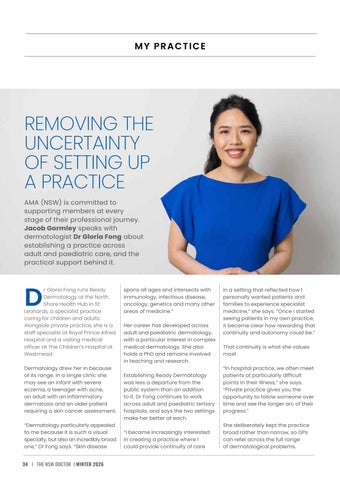
REMOVING THE UNCERTAINTY OF SETTING UP A PRACTICE AMA (NSW) is committed to supporting members at every stage of their professional journey. Jacob Gormley speaks with dermatologist Dr Gloria Fong about establishing a practice across adult and paediatric care, and the practical support behind it.
D
r Gloria Fong runs Ready Dermatology at the North Shore Health Hub in St Leonards, a specialist practice caring for children and adults. Alongside private practice, she is a staff specialist at Royal Prince Alfred Hospital and a visiting medical officer at The Children’s Hospital at Westmead. Dermatology drew her in because of its range. In a single clinic she may see an infant with severe eczema, a teenager with acne, an adult with an inflammatory dermatosis and an older patient requiring a skin cancer assessment. “Dermatology particularly appealed to me because it is such a visual specialty, but also an incredibly broad one,” Dr Fong says. “Skin disease 34 I THE NSW DOCTOR I WINTER 2026
spans all ages and intersects with immunology, infectious disease, oncology, genetics and many other areas of medicine.” Her career has developed across adult and paediatric dermatology, with a particular interest in complex medical dermatology. She also holds a PhD and remains involved in teaching and research. Establishing Ready Dermatology was less a departure from the public system than an addition to it. Dr Fong continues to work across adult and paediatric tertiary hospitals, and says the two settings make her better at each. “I became increasingly interested in creating a practice where I could provide continuity of care
in a setting that reflected how I personally wanted patients and families to experience specialist medicine,” she says. “Once I started seeing patients in my own practice, it became clear how rewarding that continuity and autonomy could be.” That continuity is what she values most. “In hospital practice, we often meet patients at particularly difficult points in their illness,” she says. “Private practice gives you the opportunity to follow someone over time and see the longer arc of their progress.” She deliberately kept the practice broad rather than narrow, so GPs can refer across the full range of dermatological problems.
MY PRACTICE
Timely correspondence and being approachable when a GP has a question are central to how she wants it to work. Communication with patients is treated with the same seriousness. Skin disease, she says, is routinely underestimated by everyone but the person living with it. “It can have a profound impact on sleep, confidence, schooling, work and family life,” Dr Fong says. “For parents in particular, there can also be considerable anxiety and sometimes guilt when a child has a chronic skin condition.” Clear written treatment plans and practical education, she says, often determine whether a treatment really works at home. Running a practice, however, brings challenges that clinical training does not prepare doctors for.
says. “For someone establishing a practice, the difficulty is often not knowing what you don’t know.” That is where AMA (NSW) has been valuable. “AMA (NSW) has been wonderful and a genuinely invaluable support system as we established the practice,” Dr Fong says. The Workplace Relations team worked through staffing and employment awards with the practice, and later assisted in putting together its privacy policy. “We were never rushed,” she says. “The team took the time to explore what was possible, clarify where the boundaries were, and patiently answer and confirm every single question we had. It left us with so much
confidence in our employment arrangements.” She says the tailored nature of the advice is what makes the difference. “Having access to expert support where every question was carefully answered has been unbelievable,” she says. “When you are establishing a practice and balancing clinical care, having reliable, patient advice removes so much uncertainty.” It is also the advice she passes on to doctors considering a practice of their own. “You don’t need to know everything before you start, but you do need to recognise what you don’t know and be willing to seek advice,” Dr Fong says. “A practice does not have to be fully formed on day one.”
“One of the biggest surprises has been discovering just how much happens behind the scenes before a single patient walks through the door,” she says. “Establishing a practice suddenly requires you to understand employment, Medicare, privacy, IT systems, cybersecurity, billing, equipment, sterilisation, insurance and countless operational details.” None of it is why anyone enters medicine, but collectively it determines whether a practice runs safely. The burden falls hardest on smaller practices, and workforce pressures compound it. “Finding and retaining good staff is critical because the quality of a practice depends enormously on the people around the doctor,” she amansw.com.au I 35
DOCTORS-IN-TRAINING
SUPPORTING DOCTORS FROM TRAINING TO THE FRONTLINE
From exploring specialty pathways to tackling fatigue, recruitment and workplace violence, AMA (NSW) is supporting doctors-in-training throughout their careers and advocating for safer, better-supported workplaces, writes Sean Crotty.
DIT webinar Last month RMO1, RMO2s and medical students joined webinar moderator Dr Alan Pham to hear from a panel of doctors in training and non-GP specialists on their lived experience in different specialties - the issues they deal with daily, their responsibilities, and challenges. With panellists across surgery, palliative care, pathology, public health, paediatrics and subspecialities, the recording is available for AMA (NSW) members to watch in their member portals. NSW Health JMO Fatigue Management Committee AMA (NSW) Doctors-in-Training Committee Member Dr Heath Darrant is informing NSW Health’s new JMO Fatigue Management Committee on practical interventions to combat rising fatigue amongst the state’s junior medical officers. “Without appropriate interventions” he says, “the rate at which our doctors burn out will only increase, affecting not only us, but patients as well.” Discussion thus far has centred around the need for improved access to on-call rooms and transport options, monitoring oncall activity and recall frequency, and developing safe on-call roster ratios. Dr Darrant will continue liaising with the DIT Committee 36 I THE NSW DOCTOR I SPRING 2026
for input as the JMO Fatigue Management committee runs over the next 2 years. AMA (NSW) remains committed to holding the Ministry and LHDs accountable to any recommendations made. Training Pathways Project With chronic shortages of rural and remote doctors, Dr Darrant’s national Rural Pre-vocational Training Survey is now live and open to all medical students and doctors-in-training who have not yet completed specialty training,
Without appropriate interventions, the rate at which our doctors burn out will only increase, affecting not only us, but patients as well.” ~ Dr Heath Darrant including accredited registrars. With findings feeding into the Rural Prevocational Training Project, “this survey gives a voice to JMOs across Australia to show how long-term placements are not only statistically more effective, they’re the opportunity people actually want” Dr Darrant says. Take the survey here:
JMO recruitment NSW Health has committed to an ongoing review of current JMO recruitment processes following it’s meeting with AMA (NSW) and Doctor-in-Training Committee representatives Doctors Alan Pham and Kate Willmot. Responding to AMA (NSW)’s probe, the Ministry has since reported their internal work to improve these recruitment processes is ongoing, whilst the Doctors-in-training committee will continue gathering feedback following conclusion of the current recruitment round. Workplace related violence In a recent Doctors-in-Training Committee meeting, Dr Kate Willmot has highlighted increasing levels of violence being directed at healthcare workers, especially in the state’s under-resourced emergency departments. “As outlined in the recent ACEM report ‘Breaking Point’, overcrowding and bed block have been identified as key contributors, underscoring the need for systemic solutions.” she says. AMA (NSW) is pressuring the government to tackle this problem ahead of the March state election with more staffed beds and greater preventative health investment to help ease pressures in the system.
DOCTORS’ HEALTH ADVISORY SERVICE
WHEN CARING TAKES ITS TOLL Witnessing suffering is an unavoidable part of medicine, but its psychological impact on doctors is too often overlooked. Dr Jane Barker examines the signs of vicarious trauma and why self-awareness, reflection and support are essential throughout a medical career.
I
n our first week at medical school, we met our cadavers in the anatomy dissecting room, richly perfumed with formalin. Were they trying to harden us up for what was coming, rather than teaching us how to care for ourselves?
We are trained to manage illness, emergencies, mental health problems and human suffering, but are less prepared for the impact on us.”
We are trained to manage illness, emergencies, mental health problems and human suffering, but are less prepared for the impact on us. Vicarious trauma is the psychological reaction in clinicians to patients’ traumatic experiences. It matters when caring for patients who have experienced violence, serious accidents, abuse or serious illness. It may present with intrusive memories, disturbed sleep, cynicism, emotional detachment or a heightened sense of threat. It may take the form of moral injury, with the doctor questioning their view of the world or even their faith. It may lead to burnout or depression. Vicarious trauma is more likely in emergency medicine, critical care, oncology and paediatrics, but can occur in any setting. It is never professional weakness, but a consequence of the empathy integral to good clinical practice. While we may associate it with extreme situations, it can occur at any level, depending on a doctor’s
Dr. Jane Barker.
past experience. Medical students and young doctors may be traumatised by death, especially the death of a child. Working on an oncology ward may be confronting. Senior staff and educators need to take vicarious trauma into account, making debriefing and reflection part of supporting students and younger colleagues. It is not unusual for medical students and doctors to ring us at Doctors’ Health NSW to discuss trauma they have witnessed. The distress is compounded when they are already overworked or unsupported. At times, psychological support may be needed. While we cannot protect doctors from witnessing patient trauma,
caring for our clinicians is vital to good medicine. Awareness of the impact of patients’ experiences on ourselves, our students and colleagues - and supporting selfawareness, self-care and reflection throughout training - contributes to doctors’ wellbeing. Above all, be kind - to your patients, your fellow workers and yourself.
Doctors’ Health Advisory Service (DHAS) is a confidential, 24hour support service for medical professionals across Australia, including doctors and medical students. Support is available via the national helpline on (02) 9437 6552.
amansw.com.au I 37
RURAL DOCTORS’ NETWORK
TURNING EVIDENCE INTO ACTION
RDN’s new Australian Centre for Health Access is bringing together communities, health professionals, researchers and policymakers to turn evidence into practical solutions.
and policymakers nationally and internationally to turn research and evidence into practical, realworld impact. In a busy first year, ACHA collaborated on the launch of the CREATE Global Site, bringing together six sites, working across diverse health systems in Canada, Australia and the US. In July, it presented at the Australasian Association for Academic Primary Care Annual Research Conference and, in August, the Towards Unity For Health Conference in the Philippines. Some of RDN’s ACHA team with Charles Sturt University vice-chancellor and president Professor Renee Leon (centre) at the National Rural and Remote Health Awards.
T
he Rural Doctors’ Network traces its origins to 1988 and the vision of NSW rural family doctors who wanted to bridge the gap in health access between city and bush. Nearly four decades later, the network operates as a social enterprise of RDN - The Charity for Health Access, a group charity working to achieve “health access for all” by partnering with communities, professionals, industry and government across Australia and internationally. RDN’s work is based on the understanding that healthcare services are essential, but on their own are not enough to
38 I THE NSW DOCTOR I SPRING 2026
create healthy communities. Apart from individual “whole of person” considerations, a range of other factors shape health outcomes, including housing, education, employment and social connections. To help deepen and share the well of knowledge around such factors, RDN has launched a new enterprise, the Australian Centre for Health Access (ACHA), which aims to bridge the gap between evidence and real-world health service delivery by translating research, data and community insights into practical solutions. It works with communities, health services, universities, researchers
Locally, it assisted NSW Health to allocate specialist ADHD training opportunities where they were needed most and provided a submission for the consultation on the draft Australian Medical Research and Innovation Strategy 2026 to 2031 and Australian Medical Research and Innovation Priorities 2026 to 2028. ACHA is actively looking for collaborators, including medical professionals, who are interested in participating, promoting or partnering on research and evidence initiatives to drive positive change. By converting research into action, the centre aims to help communities achieve better health outcomes. To learn more or explore collaboration opportunities, please visit www.ac4ha.org.
MEDICAL BENEVOLENT ASSOCIATION
A CALL TO SUPPORT DOCTORS IN NEED
For 130 years, the Medical Benevolent Association NSW-ACT has supported doctors and their families through illness, hardship and crisis. President Dr Andrew Wines AM explains how the profession can help ensure colleagues in need continue to receive vital financial, social and practical support.
I
n 1896 the NSW Medical Benevolent Association was formed to support all doctors and their families in difficult times. Our work continues to this day, in recent years with record numbers of doctors seeking urgent help, often with limited family support and catastrophic illness or circumstance. Many are suddenly homeless, escaping violence or other calamity. Others need education and advice from our financial counsellors or career support advisers. All receive the benefit of our amazing social workers, whose pragmatic relentless kindness, makes our group tick. At times we find ourselves without the ability to organise the most basic things, and our social workers, led by Carolyn Robertson, quite literally save careers and lives with their sage and practical support. Since the 1890s, we have survived thanks to the generosity of donations (almost all from doctors) and our Board are all volunteers, many of whom have served for decades. We remain hugely grateful to AMA (NSW), particularly former CEO Fiona Davies, current CEO Dominique Egan and all presidents for their constant support. We ask three things: • Firstly, if one of our doctors in
Dr Andrew Wines AM, president, Medical Benevolent Association NSW-ACT. need requires a consultation, we have curated a list of friends who will bulk bill or offer reduced rates to their colleagues in need – please let us know if you can offer that support and we will add you to the list (info@mbwnsw.org.au). • Secondly, remember us in your personal giving if you can, but also in groups – your practice morning teas or Christmas parties or staff golf or social days or anything you do – would mean that we can continue providing urgent support for our colleagues. Donate - MBA NSW-ACT. • And third, if you need help, whether it’s financial, social or otherwise, and need advice –
please, Contact Us - MBA NSW-ACT. Medicine to me, more than anything, has been a family. Let’s help each other through this wonderful, busy, rapidly changing journey together. If you want more information please get in touch with our wonderful CEO, Mark Fraser at mark.fraser@mbansw.org.au.
For confidential, free support from the Medical Benevolent Association social work team, please call 02 9987 0504. To learn more, or to make a donation, visit www.mbansw.org.au.
amansw.com.au I 39
IN THE NEWS IN THE NEWS
RACISM DIRECTED AT IMGS Dr Michael Bonning ABC Radio Newcastle July 14
WINTER SPIKE IN ED PRESENTATIONS
APRIL - JUNE BHI REPORT
Dr Fred Betros 2GB August 5
Dr Fred Betros Smooth FM September 9
HORROR NIGHT FOR SYDNEY’S EMERGENCY DEPARTMENTS Dr Fred Betros The Sydney Morning Herald August 4
PATIENT SURVEY EXPOSES WORST PERFORMING NSW HOSPITALS
Dr Fred Betros The Daily Telegraph August 14
40 I THE NSW DOCTOR I SPRING 2026
IN THE NEWS
IN THE NEWS
PATIENTS CANNOT KEEP PAYING THE PRICE FOR HOSPITAL BED BLOCK Dr Fred Betros Australian Associated Press September 9
NEW PHARMACY PRESCRIBING EXPANSION A ‘SLAP IN THE FACE’ Dr Fred Betros The Medical Republic September 10
BULK-BILLING RATES IN HUNTER NEW ENGLAND AND CENTRAL COAST LHD’S Dr Fred Betros Newcastle Herald August 11
RISE IN BOWEL CANCER AMONG YOUNG PEOPLE
Dr Kenneth McCroary WIN Wollongong August 25
amansw.com.au I 41
IN THE NEWS IN THE NEWS
RSV VACCINATION RATES HALVE NSW HOSPITALISATIONS Dr Michael Bonning ABC News online July 17
GAMBLING REFORM IN NSW
KELLIE SLOANE BUDGET IN REPLY SPEECH Dr Fred Betros The Sydney Morning Herald June 26
AMA (NSW) The Quicky podcast August 5
PHARMACY PRESCRIBING EXPANSION PROPOSAL
MORE BEDS ALONE WON'T SOLVE THE CRISIS AT WESTMEAD HOSPITAL
Dr Kenneth McCroary 7 News, Tamworth June 30
Dr Fred Betros The Daily Telegraph July 8
42 I THE NSW DOCTOR I SPRING 2026
CO OR RP PO OR RA AT TE C E B B EE N N EEFFIITTSS
EXCLUSIVE MEMBER BENEFITS You can find a comprehensive list of benefits and more information at www.amansw.com.au or email members@amansw.com.au AUTOMOTIVE
Alfa Romeo
Porsche Centre Willoughby
Jeep
BMW
Lexus
FINANCE AND INSURANCE
Avant
Cutcher & Neale Accountants/Tax Advisers
Chubb
AMEX
Miga
MYOB
NobleOak
Doctors Health by Avant
MediFinancial
Westpac
TRAVEL AND LIFESTYLE
Avis Budget Group
Hertz
Hello Fresh
Urban Rest
Qantas Club
Endota Spa
Bijoux
Chateau Architects + Builders
My Muscle Chef
The Royal Exchange Sydney
Blue Light Card
TECHNOLOGY AND EDUCATION
AMA WA
Booktopia
AMA Victoria
Samsung
AMA CPD Home
Therapeutic Guidelines
Dell Technologies
Officeworks
Tyro Health
PRACTICE SUPPORT
AEK Media
Piper Health
VistaPrint
Medihost Solutions
SUPPORT THAT REPRESENTS YOU Policy and advocacy
A trusted voice shaping health policy
Workplace support
Specialist legal and industrial expertise
Career development
Support throughout your medical career
JOIN NOW
amansw.com.au