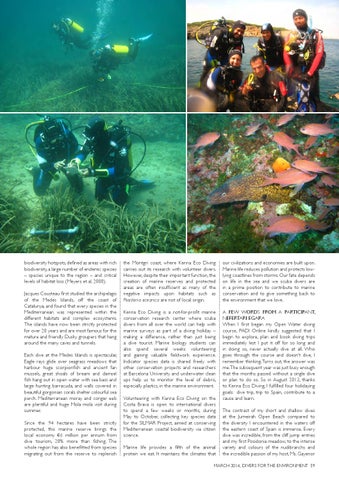
biodiversity hotspots, defined as areas with rich biodiversity, a large number of endemic species – species unique to the region – and critical levels of habitat loss (Meyers et al. 2000). Jacques Cousteau first studied the archipelago of the Medes Islands, off the coast of Catalunya, and found that every species in the Mediterranean was represented within the different habitats and complex ecosystems. The islands have now been strictly protected for over 20 years and are most famous for the mature and friendly Dusky groupers that hang around the many caves and tunnels. Each dive at the Medes Islands is spectacular, Eagle rays glide over seagrass meadows that harbour huge scorpionfish and ancient fan mussels, great shoals of bream and damsel fish hang out in open water with sea bass and large hunting barracuda, and walls covered in beautiful gorgonian corals shelter colourful sea perch. Mediterranean moray and conger eels are plentiful and huge Mola mola visit during summer. Since the 94 hectares have been strictly protected, this marine reserve brings the local economy €6 million per annum from dive tourism, 20% more than fishing. The whole region has also benefitted from species migrating out from the reserve to replenish
the Montgri coast, where Kenna Eco Diving carries out its research with volunteer divers. However, despite their important function, the creation of marine reserves and protected areas are often insufficient as many of the negative impacts upon habitats such as Posidonia oceanica are not of local origin.
our civilizations and economies are built upon. Marine life reduces pollution and protects lowlying coastlines from storms. Our fate depends on life in the sea and we scuba divers are in a prime position to contribute to marine conservation and to give something back to the environment that we love.
Kenna Eco Diving is a not-for-profit marine conservation research center where scuba divers from all over the world can help with marine surveys as part of a diving holiday – making a difference, rather than just being a dive tourist. Marine biology students can also spend several weeks volunteering and gaining valuable fieldwork experience. Indicator species data is shared freely with other conservation projects and researchers at Barcelona University and underwater clean ups help us to monitor the level of debris, especially plastics, in the marine environment.
A FEW WORDS FROM A PARTICIPANT, NEFERTARI EGARA When I first began my Open Water diving course, PADI Online kindly suggested that I begin to explore, plan and book diving trips immediately lest I put it off for so long and in doing so, never actually dive at all. Who goes through the course and doesn’t dive, I remember thinking. Turns out, the answer was me.The subsequent year was just busy enough that the months passed without a single dive or plan to do so. So in August 2013, thanks to Kenna Eco Diving, I fulfilled four holidaying goals: dive trip, trip to Spain, contribute to a cause and learn.
Volunteering with Kenna Eco Diving on the Costa Brava is open to international divers to spend a few weeks or months, during May to October, collecting key species data for the SILMAR Project, aimed at conserving Mediterranean coastal biodiversity via citizen science. Marine life provides a fifth of the animal protein we eat. It maintains the climates that
The contrast of my short and shallow dives at the Jumeirah Open Beach compared to the diversity I encountered in the waters off the eastern coast of Spain is immense. Every dive was incredible, from the cliff jump entries and my first Posidonia meadow, to the intense variety and colours of the nudibranchs and the incredible passion of my host, Ms. Gayenor
MARCH 2014, DIVERS FOR THE ENVIRONMENT 59