


. . . a huge thanks to our long-standing partners JANUARY-FEBRUARY 2023 NEW YEAR, NEW HOPE Working wonders! getting people mobile A lifetime p14-15 p3 p4 p17 p23 p21 NEW GEORGE MUSICAL SPRING IS ON THE WAY BBC DISABILITY BOOST PLEASE, SEE IT OUR WAY John’s new Paralympian mission NEW YEAR, NEW HOPE NEW YEAR, NEW Inside
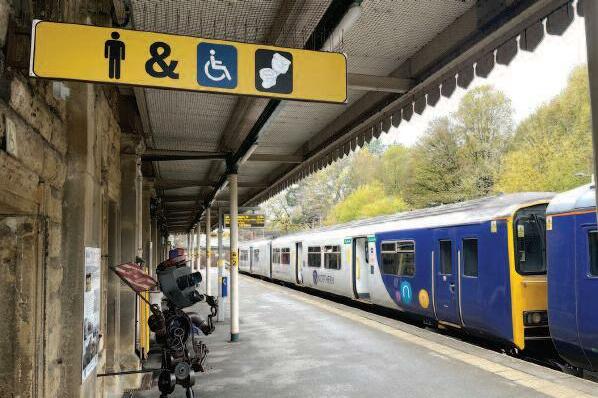
Signs looking good!
NORTHERN Rail go into the new year with plenty to celebrate
Their first “dementia-friendly” train station signage – with clear toilet symbols – was unveiled at Buxton
And the company scooped an award for its computer-generated train journey that allows people to overcome their anxieties before they even get near the real thing
The new Accessible Travel Simulation game was developed to build confidence in people who are anxious or need assistance when travelling by rail, including disabled passengers and those with hidden conditions
Northern Rail developed the technology, which
is the first of its kind and landed the Gold Award for Innovation at the UK Customer Experience Awards,
The virtual reality game can be used on phones, tablets, PCs or in Virtual Reality headsets
Users can choose a character and scenario that fits their needs and experience trains and stations
Mark Robinson, who led the project, said: “Our vision is that someone who has never had the confidence to take the train before could arrive at the station for the first time and feel like an experienced traveller – to have all the information they need, know what support to expect, and what to do if anything goes wrong ”
Anger as travel changes blocked
TRANSPORT campaigners have slammed
Government ministers and MPs for blocking a move to improve access at all of England’s railway stations.
A proposed amendment to the Government’s levellingup bill would have placed a new duty on the Transport Secretary to ensure railway stations meet national accessibility standards
But the move, proposed by former Liberal Democrat leader Tim Farron during the bill’s committee stage, was rejected after eight Conservative MPs outvoted Farron and Labour members of the committee Disability rights campaigner Tony Jennings said the vote would result in “social exclusion for disabled people for decades to come”
“The amendment, if passed, would have given disabled people hope As it is, I now have no confidence that the barriers will be removed in a reasonable timescale to deliver an inclusive accessible railway that is fit for purpose
Suffer
West Derby Waste Lands Charity is an ancient charitable body that today still provides financial support and assistance for individuals, groups and other charities within the West Derby Waste Lands area


That area includes part but not all of Liverpool post codes L7, L11, L12, L13 and L14
Our purpose is to improve the lives, health, welfare and general wellbeing of people within the West Derby Waste Lands area, and to that end we provide grants to qualifying individuals, families, community groups and charities within the defined area
We help the young, old, and infirm, and support those in difficult financial circumstances as well as a wide range of community-based activities

If you are a community group or charity and want to apply, please do so in writing to the Secretary with as much information as possible about the purposes for which a grant is sought
“The next generation will suffer the consequences of the Government not taking accessibility seriously ” Emily Yates, co-founder of the Association of British Commuters, said: “At current rates of investment, full station accessibility will take 100 years
“It is outrageous this issue is being left out of both levelling up legislation as well as plans for rail reform ”
Cumbria MP Farron called for the Access for All fund to be “quadrupled in size”, and told the committee: “There are stations throughout our country, but particularly in my community, that are totally inaccessible ”
One of the stations he referred to was Staveley in the Lake District, which has 41 steps up to station and so has “zero accessibility”, which he said was “outrageous”
Lee Rowley, the housing and planning minister, told him the Government’s rail reforms “seek to transform the railway industry’s understanding of the approach to accessibility”
NEWS p2-6 STEVE MORGAN FOUNDATION p7 NEWS p8 UNITED UTILITIES p9 MOTORZONE p10-11 INDEPENDENT LIVING p12-13 WORKING WONDERS: VN ROSS p14-15 CONTACT BOARD p16-17 HEALTHZONE p18-19 THEATREZONE p20-22 HOROSCOPE p22 GARDENING p23 PUZZLEZONE p24-25 FLASHBACK p26 Editor: Tom Dowling 0151 230 0307 email: news@alltogethernow.org.uk Editorial Support: Gerry Corner A d v e r t i s i n g / s p o n s o r s h i p 0 1 5 1 9 2 9 3 9 1 2 email: helen@alltogethernow org uk IT Support: Ken Almond Website: Pharos Design www alltogethernow org uk NEXT EDITION Monday March 6 All Together NOW! is published by All Together Now! Ltd, The Bradbury Centre, Youens Way, Liverpool L14 2EP Registered Charity No 1106387 Company No 5096931 Can YOU help? n All Together NOW! is a registered charity set up to provide a tip top news service for anyone whose life is affected by disability, long-term health condtions or age n The charity – the only one of its kind in the UK – relies entirely on support from its sponsors, advertisers, subscriptions and donations 0 1 5 1 2 3 0 0 3 0 7 2 All Together NOW! JANUARY/FEBRUARY 2023 www.alltogethernow.org.uk NEWS FOCUS: Improving access to our railway stations should be top priority What’s inside
from individuals will require proof of identity, and full disclosure of the income, expenditure and assets of the applicants and household members. In certain cases we may require an application to be sponsored by an approved organisation For
information about
our
www westderbywastelands co uk Alternatively, further information
form may be obtained
the Secretary: Lawrence Downey MA (Oxon) West Derby Waste Lands Charity Ripley House 56 Freshfield Road Formby, Liverpool
3HW Tel
01704 879 330 email: Lawrence@westderbywastelands.co.
Applications
more
please go to
website
and an application
from
L37
:
uk
O UR VI SI ON OUR VISION
AVery Happy New Year to everyone who is helping to keep this great FREE charity newspaper alive and kicking!
Despite extremely tough times, we are managing to stay afloat – thanks to the magnificent support of our long-standing partners, the Steve Morgan Foundation and United Utilities, generous donations from various charitable trusts and readers, plus, of course, our loyal advertisers
But stormy seas lie ahead Ongoing costs continue to spiral
And while we remain as determined as ever to keep publishing and helping the huge numbers of readers who are unable to access the internet for
information, we have to find more financial support
If you have connections with a company that might like to be associated with our work, then please get in touch


Meanwhile, I hope you enjoy this edition as much as we have producing it! It’s bursting with great info and inspirational stories– including Gerry Corner ’s brilliant centrespread on how Vincent Ross at DaVinci Mobility has spent a lifetime helping others following an accident that left him paralysed almost 50 years ago We’re back in March See you then TOM DOWLING, editor Tel 0151 230 0307
Covid jabs: good news if you have symptoms
IF YOU had a bad reaction to your Covid19 jab – fever, headache, even vomiting –you should maybe count yourself lucky! It might not have felt like it at the time, but new research backs up the theory that the worse your Covid vaccination makes you feel, the more you will be protected from the virus
With Covid now responsible for just 3 3% of deaths, testing expert Dr Quinton Fivelman said the findings should be reassuring to those who suffer a severe reaction to the jab
Paralympian ‘parastronaut’
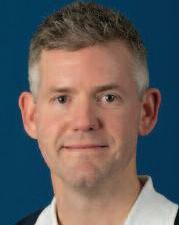
NOT that long ago, Paralympian John McFall was blasting off from the starting blocks
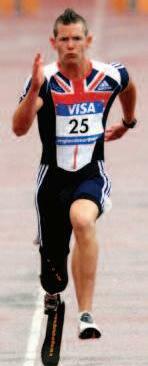
Now, the 41-year-old athlete-turned surgeon, is focused on helping someone with a disability to blast off into space
John, has become the first ever person with a physical disability to be included in the European Space Agency’s latest training programme
It doesn’t mean he will go into orbit, but he will be part scheme to see what the requirements would be f that to be possible
John said: “When the advert for an astronaut with a physical disability came out, I thought, wow, this is such a huge, interesting opportunity “I thought I would be a very good candidate to help answer the questio can we get someone wit physical disability into sp
John’s training involve g g g p with space flight, survival training and spacewalking, as well as specialised skills, such as remotely operating a robot, docking with spacecraft and learning Russian
message I would give to nerations is that science is for d space travel, hopefully, can also be for everyone ”
The ESA received 257 applications specifically for the role of “parastronaut”, which the agency restricted to people with either a single or double-foot deficiency

through the ankle or below the knee, a pronounced leg length difference or a height below 130 centimetres
ESA director-general Josef Aschbacher said: “This selection was about talent and about capabilities to be a fantastic astronaut, but I’m also very proud that it happens to be a very good distribution of genders ”
Dr Fivelman, chief scientific officer at London Medical Laboratory, added: “Research by scientists at Columbia University Medical Center showed that irrespective of sex, age or weight, people who had post-vaccination symptoms categorised as systemic – fever, chills, muscle pain, nausea, vomiting, headache, and/or moderate to severe fatigue – had a greater antibody response than those with only localised symptoms This was the case for both the Pfizer and Moderna jabs
“These findings should reassure those who develop more noticeable symptoms after their inoculation It’s likely to be a signal of the vaccine’s effectiveness and a good immune reaction ”
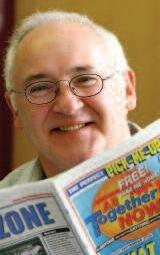
Thanks for being there
A HUGE thank you to all the team at All Together NOW!

Your efforts to maintain the ongoing production of this vital newspaper is outstanding, especially as we emerge from the pandemic
Your work in providing this free publication provides a lifeline to the one in four of the population who are living with a disability or long-term health condition
It would be easy to follow many of the publications that are now available online only, but this would exclude so many of your readers.
– Dave Thompson MBE DL, Founder and Chief Executive, Warrington Disability Partnership

www.alltogethernow.org.uk JANUARY/FEBRUARY 2023 3 01744 602602 Call Us On: Also At: Council Approved Contractor & Suppliers Covering The Northwest Free Home Demonstrations SALES, REPAIR & SERVICING OF ALL MOBILITY & DISABILITY PRODUCTS Widnes Mobility Supercentre (Largest in Northwest) 62 Victoria Road, Widnes, Cheshire WA8 7RA 0151 423 3738
A WORLD where people affected by disability, and others who are disadvantaged, can enjoy the same opportunities as everyone else
EDITOR: Tom Dowling
n DUBBED one of the fastest men in the world over 100 and 200 metres in the class of above-the-knee amputees, John won bronze at the 2008 Summer Paralympics in Beijing
REACH
THE SKY! REACH FOR THE SKY!
FOR
Making a difference in your community
COUNCILS across the North West are facing even tougher times – and more cutbacks for disabled people are again on the horizon.
So, do you want to take up the fight for a better deal and have your say on what goes on at your local council?
If so, make sure you get hold of a new guide that gives you the best chance of becoming a councillor
The Local Government Association, which represents more than 350 councils in England and Wales, has launched the guide in a bid to encourage disabled people to become councillors and bring new experience into local government
It comes as the LGA’s most recent Councillor Census found that disabled people are consistently underrepresented on councils
In 2022, 15.5% of councillors declared a disability or long-term impairment This is despite just over 20% of the population having a limiting long-term illness, condition or impairment
The LGA’s guide; Improving access to local government elected office for disabled people, is accompanied by practical support for councils which aims to improve awareness, accessibility and inclusion at every stage of becoming a councillor.
n Tel 0333 103 1928

n www local.gov.uk/be-councillor
Benefits fast-tracked
THOUSANDS of people nearing the end of their lives are to have disability benefits fast-tracked
Speeded up access to Personal Independent Payments, Disability Living Allowance and Attendance Allowance will be extended to people thought to be in their final year of life –six months earlier than previously
Those who are eligible will not be required to atte a medical assessment, an the majority of cases they receive the highest rate of benefits
NEW research finds that 12,000 people in the UK become unpaid carers every day
Data from the University of Sheffield also says of the 4 3m people starting caring roles for older, disabled or seriously ill relatives, more than 1 9m are in paid employment; 2 3m new carers are women and 2m are men
Helen Walker at Carers UK, said: “It is imperative we have a National Carers Strategy in place, and carers are fasttracked to the support they need ” n Helpline: 0808 808 7777
BEEB’S NEW T V RESOLUTIONS
One in 3 now can’t afford vital care
DISABLED people have been “effectively abandoned” as the cost of living crisis leaves one in five unable to afford essentials
That’s the conclusion of new research which found many forced to rely on food banks and having to reduce how much they eat Disabled people surveyed by Greater Manchester Disabled People’s Panel reported skipping meals, being forced to stop receiving social care support, and even having to be brought leftovers by a neighbour
THE BBC has pledged to significantly improve opportunities for disabled people on and off screen
BBC iPlayer is also creating a dedicated collection, entitled Count Us In, that celebrates disabled programming and talent
The announcement comes after a damning report highlighting the media’s under-representation of disabled actors
More roles for disabled hit shows people on

Hit shows like Eastenders, Coronation Street and Killing Eve reflect diversity in terms of ethnicity, gender and sexuality, but fall way short when it comes to portraying disabled characters, claimed streaming service WatchTVAbroad com
Their Diversity in UK TV study revealed that an average of 1 6% of the characters had a disability, compared with 21 7% of the UK population
Carolina Beltramo, TV analyst at WatchTVAbroad com, said: “While we accept that not all disabilities are visible, the fact 10 times more people in the UK consider themselves disabled than are seen in these influential hit shows is a huge and damning discrepancy ”
The main casts of 10 of the most popular shows on terrestrial channels – Eastenders, Coronation Street, All Creatures Great and Small, Killing Eve,
Line of Duty, Vigil, Gavin and Stacey, Peaky Blinders, Derry Girls and Mrs Brown’s Boys – were studied to see how closely they reflect British society
Of the 10, six had no disabled characters in their regular cast and only Coronation Street had more than one
BBC’s new commitments
l The portrayal of disabled people must be authentic, inclusive and reach across all our programmes and recognise that disability can be apparent or non-apparent
l We commit to improving opportunities and accessibility across our productions so that no one is ever excluded
l Within scripted programmes we will look to include authentic and meaningful representation of disability in all new commissions
l We will endeavour to cast those with lived experience of disability for disabled roles – as well as seeking disabled actors for roles not specifically written to be disabled
l And within unscripted programmes portrayal of disability we will endeavour to include at least one contributor, presenter or performer with a disability per series and in one-off programmes
Spring blow for unpaid carers
UNPAID carers with part-time jobs will be forced to reduce their working hours for the fourth consecutive year
Carer ’s Allowance is set to rise with inflation to £76 25 in April The earnings threshold for claiming the allowance will increase by 5 5% to £139 per week
However, the National Living Wage is also due to rise at far higher rates – by 9 7% to £10 42 per hour
This means the number of hours unpaid carers will be able to work
receiving the National Living Wage, while also claiming Carer ’s Allowance, will decrease from 13hrs 53 mins at present to 13hrs 20 mins in April
Over the last four years, the number of hours carers have been able to work alongside receiving Carer ’s Allowance has shrunk from just under 15 hours a week in 2019 to roughly 13hrs and 20 mins from next April
This represents a loss of 1 hr 40 mins a week Over a year, this amounts to a loss of 12 days of

paid work The low earnings threshold is forcing carers to work fewer hours in order to keep claiming Carer ’s Allowance
Currently, the benefit has no taper and is not pegged to the National Living Wage
Carers UK is calling for the earnings threshold to be raised to at least 21 hours per week and for increases to be set in legislation to automatically rise along with increases to the National Living Wage
Michele Scattergood, cochair of the panel and chief executive of Breakthrough UK, said the results – based on responses from nearly 2,000 disabled people – were “shocking”
She said: “This is poverty beyond a scale that we have ever seen, certainly in my lifetime ”
One in five people who responded said they could not afford essential items, while another 28% said they could afford essentials but nothing else
Mayor of Greater Manchester, Andy Burnham, said: “The current crisis is having a dramatic and detrimental effect on the lives of disabled people now, and the severity of it, of the situation, can’t be overstated
Great risk
“People are living at great risk and that risk will only intensify as we go through the winter ”
The panel’s report says that one in four of the disabled people responding to the survey had been forced to use a food bank or rely on others to get food
A third could not afford to pay all their bills, with more than half of them (54%) eating less as a result, and 70% making less use of heat and light
And nearly a third (29%) of disabled people had not received the care and support they needed because they could not afford it
The panel’s report concludes: “The cracks between services are so large and deep and people are being forgotten and effectively abandoned ” The report calls for wideranging action on the cost of living crisis, social care, housing, accessible transport, mainstream education, and other areas
4 JANUARY/FEBRUARY 2023 www.alltogethernow.org.uk
with
the
. . .
Connecting
250,000 people across
region
FALLING SHORT: Hits like Killing Eve must give disabled actors a more of a look-in
12k new carers daily Find YOUR local Carers Centre – p19
MORE than a billion teenagers and young adults worldwide may be at risk of hearing loss from listening to music at unsafe levels, a new study says
KATIE OGDEN, from hearing aid technology specialists ReSound, suggests some easy ways to protect hearing from long-term damage
ANY sound over 85 decibels can be harmful to the ears, especially if exposed to it for a long time.

Listening to music through headphones at a maximum volume of 100 to 110dB for an extended period can lead to significant hearing loss
The warning feature on Apple iPhone, iPod touch or Watch will alert listeners when they have exceeded a seven-day exposure limit
while wearing headphones The aim of these notifications is to give users more awareness of their listening habits to help protect their hearing
Your Apple device will prompt you to turn down your volume and will continue to warn you if notifications are ignored
After receiving a notification, the next time listeners plug in their headphones or connect them via Bluetooth, the music volume will automatically be set to a lower level
Although these notifications may become irritating, it is advised not to listen with headphones for more than an hour at a time and ensure that 15-minute breaks are taken Stay in control: The simplest way to protect your ears from noise-induced damage is to keep control of the volume Noise of 80 decibels can be listened to for over 25 hours

straight without risk of hearing damage
Use safety features: Most phone devices and iPods, iPads, and smart watches have settings that allow you to set a maximum volume so you don’t exceed a safe listening limit Navigate to the settings menu to search for this safety feature, or look it up online
Cut it out: If you are listening to music in a noisy environment, such as on public transport, it is tempting to turn your volume up in order to drown out the background noise Instead, opt for noise-cancelling headphones that help keep background sound at bay Set a limit: If you are an avid music fan and like it loud, it is best to limit your exposure and reduce the amount of listening time
n For a free online hearing test go to www resound com/en-gb/online-hearing-test

WORKERS taking early retirement are often doing so only because they feel they have no choice.
Many people with mental or physical health conditions want to stay in work but feel powerless and under-supported. Some felt the decision had been taken out of their hands, the think tank Demos revealed.
One of those taking part in Demos focus groups said: “My decision to leave work was devastating. I was resentful about having to leave, but felt I had no other option.”
Andrew Phillips, from Demos, said many workers aged 50 to 64 “aren’t taking early retirement for lifestyle purposes.
“The reality is that a range of physical and mental health conditions are causing older people to leave work and not return, leading to record numbers of vacancies even as unemployment remains low.”
In a new report, Understanding Early Exiters, Demos calls for an Ageing Workforce Strategy, and recommends lower National Insurance contributions for small and medium sized firms that provide access to occupational health services for those who need it.
charity spotlight series
charity spotlight series
www.alltogethernow.org.uk JANUARY/FEBRUARY 2023 5
More support could keep older workers in jobs
SOUND
SOUND tunes and Enjoy the save your hearing Call Helen NOW! . . . 07511 83939 g g Promote your services in our company /
Promote your services in our company /
Reach 250,000 readers right across the WE CONNECT WITH PEOPLE WHO ARE DIGITALLY EXCLUDED WE CONNECT WITH PEOPLE WHO ARE DIGITALLY EXCLUDED
ADVICE
MS helper Lyndsay is a true Champion
A TEAM of “MS Champions” are helping to keep people with advanced multiple sclerosis out of hospital
The pilot scheme, set up by the MS Trust and operating in six areas across in the UK, prevented 79 hospital admissions in Salford alone during 2018-2020, saving the NHS almost £250,000 Now the charity wants to see Advanced Multiple Sclerosis Champions in all NHS Trusts
Lindsay Lord, the AMSC in Salford, said: “This role has helped me to deliver care and support to the people who need it most
“I wanted to show people with advanced MS that they matter, that even small changes can make a difference, that we have not given up on them and they should not give up on themselves ”
David Martin, CEO of the MS Trust, said: “The pilot has shown that the AMSC role has significant cost savings for the NHS, and has been greatly welcomed by other health and social care professionals
“Crucially, the role helped to free up much needed hospital beds in each of the six areas
“These Champions are game changers for the NHS ” n MS Trust helpline 0800 032 38 39 or email ask@mstrust org uk or mstrust org uk
‘Incredible’ bionic arm on the NHS A hold new world
AMPUTEES across the country will be able to access lifechanging bionic arms through the NHS
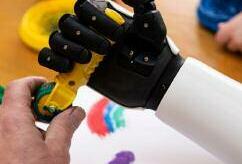
People with limb loss over the age of nine will be eligible for the prosthetics, hailed as “incredible” by health chiefs
Controlled by brain signals, they have multi-grip capabilities, enabling a greater range of movements to make day-to-day tasks easier
The NHS will make the technology available to every patient across England who needs it, following two independent reviews into their use and the successful rollout for veterans
Previously, the cutting-edge prosthetics were only available on the NHS to military veterans injured in service
Prosthetics offered by the NHS previously were basic models, with limited open and close gripping motions, or others were cosmetic with no function
Eligible patients must have enough residual upper arm muscles to send signals that create intuitive movements, but children as young as nine can use them, allowing them to improve their play and learning Each patient is carefully assessed to find
the right type of prosthetic for them depending on their requirements and capabilities
NHS chief executive Amanda Pritchard said: “These incredible multi-grip prosthetics have already made a huge difference to veterans and so it is fantastic to be able to offer them to all patients in England who need them
“The arms, for both children and adults, use the very latest tech which will boost peoples’ independence and change the lives of dozens across the country
“The NHS is at the forefront of medical innovation and this rollout is the latest example of how we are adopting the best medical advances for patients”
‘This will be like Christmas again’
He said: “This will massively change people’s lives They have amazing functionality I can hold a paint brush and paint, or pick up a glass and drink
As we reported in All Together NOW! in 2020, Daz lost his right hand and forearm in 2008 in a mortar ammunition explosion while serving in the Parachute Regiment in Helmand Province, Afghanistan.
In 2020, the NHS Veterans’ Prosthetics Panel funded a bionic arm which has changed his life – enabling him to do things he once took for granted.
“It also lets me do a lot more with my daughter, Sky, such as helping her with her arts and crafts
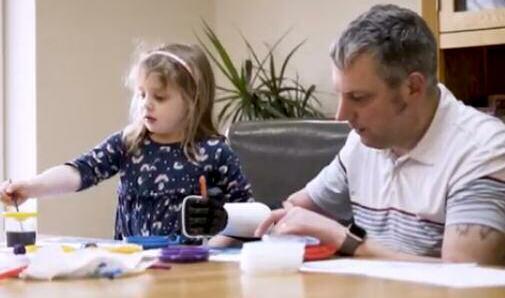
“I no longer feel excluded from any part of her life and there’s not much I can’t do with her
“This will be like Christmas again for those people who are eligible ”


6 JANUARY/FEBRUARY 2023 www.alltogethernow.org.uk
NEWS FOCUS:
MILITARY veteran Darren ‘Daz’ Fuller saus the hi-tech prosthetic has transformed his relationship with his daughter
LENDING A HAND: Sky, 7, gets some welcome help from Dad, Daz, who is benefiting from his bionic arm
Liverpool libraries are transforming the way ideas grow into successful businesses. Visit us online or at your local library:
for every brIght Idea, everywhere!
liverpool.gov.uk/bipc
@BIPCLiverpool
Amy Yarker and Sam Watson Liverpool, founders of The Fermentation Station
Kirsty Wilson has been able to go out with her children for the first time in two years after receiving a specialised wheelchair from the Steve Morgan Foundation
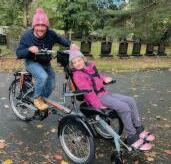
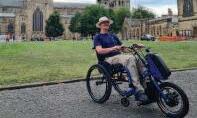

She said: “Thank you so much to the Steve Morgan Foundation for changing my life I have some of my independence back and allowed me to spend more time with my children ”
A YEAR IN THE LIFE A YEAR IN THE LIFE
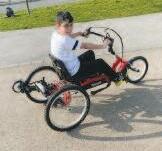
There’s no stopping 10-yearold Malik, from Blacon, since the Steve Morgan Foundation paid for his Tomcat bike to be battery-powered.
THREE thousand

The Steve Morgan Foundation joined forces with Hungarian airline Wizz Air and three other organisations, Choose Love, The Shapiro Foundation and Ukraine Sponsorship Pathway UK to fly 10,000 Ukrainians to the UK free-ofcharge


It
The

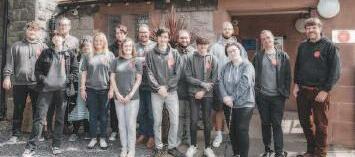
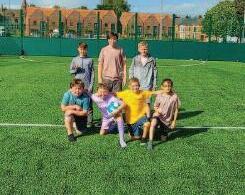
Target Football CIC, Toxteth were awarded £124,000 from the Department for Digital, Culture, Media and Sport and match-funded by the Steve Morgan Foundation, to pay for the

www.alltogethernow.org.uk JANUARY/FEBRUARY 2023 www.alltogethernow.org.uk 7 www.stevemorganfoundation.org.uk Tel 01928 706555
@stevemorganfdn stevemorganfoundation Enable grants info .... Contact: enable@stevemorganfoundation.org.uk or hello@stevemorganfoundation.org.uk
Steve Morgan Foundation
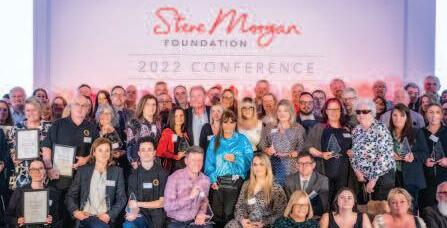
The Steve Morgan Foundation 20th Anniversary Conference and Awards 2022 were held at Carden Park Hotel
A record 337 entries were submitted from charities across Cheshire, Merseyside and North Wales all vying for a share of nearly £200,000 in prize money.
Philanthropist Steve Morgan CBE, who founded the Steve Morgan Foundation in 2001, announced on the day that all finalists would receive £1,000 as part of the 20th anniversary celebrations, swelling the total prize money to £198,000
JANUARY
2022
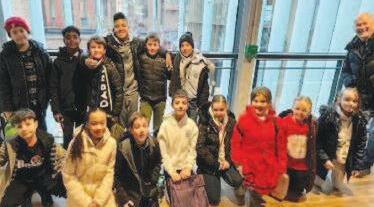
A total of 384 children and carers from 16 groups and charities that the Foundation support watched an unforgettable Christmas showing of The Snow Queen at the Storyhouse, in Chester
As well as being treated to ice creams and drinks, the audience were given a Christmas selection box and Steve Morgan Foundation teddy bear
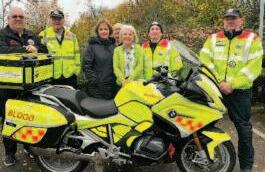
The Wrexham group of Blood Bikes Wales was left devastated after one of their three bikes was involved in an accident and written off by the insurers
The insurers met half the cost of a replacement bike – and the Steve Morgan Foundation agreed to pay the shortfall of £8,000
Ruby Grimshaw can now go out for family bike rides after the Steve Morgan Foundation bought her a £8,500 tandem tricycle
Andrew Farr, 58, says his life has been transformed, thanks to the Steve Morgan Foundation and a new powered wheelchair
TAPE, the charity that supports people by teaching them creative skills, has been handed an £67,000 ‘lifeline’ by the Steve Morgan Foundation
installation of 3G pitches
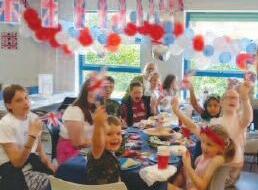
was party time at Deysbrook Village Centre with five parties during the Queen’s Platinum Jubilee.
events were organised by community development officer Tilly Johnson, whose role was funded by a £57,000 grant from the Steve Morgan Foundation in 2019
Ukrainian refugees booked flights to the UK in an initiative backed by philanthropist Steve Morgan
The Inclusive Hub in Kirkdale were handed £60,000 in funding over two years by the Steve Morgan Foundation to cover a portion of staff costs.
FEBRUARY 2022 MARCH 2022 APRIL 2022 MAY 2022 JUNE 2022 JULY 2022 SEPTEMBER 2022 OCTOBER 2022 NOVEMBER 2022 DECEMBER 2022 AUGUST 2022
Classroom doors shut as students reach 16
BLIND and partially sighted students are finding themselves locked out of education once they hit 16.
Despite a legal responsibility for local authorities to provide support up to the age of 25, a shock report says it either drops off or vanishes at 16.
The report, Give me Access to College, shows a fragmented and unreliable system of support for blind and partially sighted students as they leave secondary education.
One local authority admitted: “We do not support students in a mainstream college. They access their own support, such as from charities.”
Tara Chattaway, Head of Education at Thomas Pocklington Trust, said: “Urgent action is needed. Blind and partially sighted young people must leave compulsory education with the skills and knowledge they need to use mainstream and assistive technology.”
All Together NOW! is a great paper full of interesting topics, stories and information.

Despite your free paper being published for 17 years, I only discovered it last year after cancelling my TV licence and looking for things to do and read I’ll now be looking out for future issues!
Thank you – Carol
Don’t judge a bloke by his cover
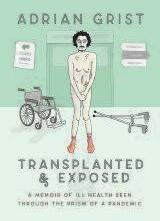
ADRIAN GRIST is the author of Transplanted & Exposed, a memoir-cum-anti-ableist rant that serves as a window on life with hidden disabilities He has undergone a kidney-pancreas transplant, six surgeries to save some of his eyesight, and lives with a chronic bone condition.
IN my day to day life, I don’t feel like I get dressed every morning: I feel like I am putting on a disguise
And I’ve got pretty good at mastering my camouflage Over the years, I have figured out that a turn-up on my jeans helps hide my foot deformities – caused by a combination of a badly-healed Lisfranc fracture and Charcot foot – and what tops to wear to help disguise my new kidney which freakishly protrudes from my lower abdomen
No one looks at me and quietly ponders with pity, How does he live like that? How does he sleep/eat/pee? And as someone with a number of disabilities and significant health issues, I know how very, very fortunate I am to be able to say that
But here are some things you cannot see: you cannot see the transplant scars, so glaringly
huge I can jovially pass them off as shark bites; cannot see the bullet-lik wounds where various tubes have been stuck for months on end, or th mysterious hernia-looki bump which I have no clue about, but it doesn worry the doctors, so it doesn’t worry me
You cannot see my wheelchair that I dread I will have to use again It’s currently on loan to a family friend who probably dreaded needing it in the first pla cannot see any of that, but then, I cannot see you either, at least I cannot see you very well, as my partial-sightedness puts paid to that

But I look healthy Healthy enough, anyway And that’s just great, but here’s the thing For the better part, my outward

appearance comes with a sense of “got away with it”, and how very empowering that can feel Yet the physical disabilities lurking beneath the scars and lumps are never far from the surface: If I walk too far, my feet are screaming for help via the agonising medium of neuropathic pain; entering a dimly-lit shop or restaurant is akin to being in the furthest reaches of a cave with a broken torch, and if I see an oncoming flailing-limbed infant I instinctively and subtly shield myself in fear that a stray fist to the kidney will put me back onto the least desirable of waiting lists
On top of that, I’m permanently weakened by my once-shredded stomach muscles – when I help friends move house, I’m on holding doors open and lampshade carrying duties only
And it is when those physical ailments expose themselves that my fraudulent healthy exterior comes crashing down and is transformed into a curse, of sorts
How do people judge the empty-handed man casually strolling home on a Saturday afternoon, while his wife adopts the role of pit pony and lugs two bags of grocery shopping in each hand by his side?
What about the seemingly able-bodied passenger who makes a beeline for the last available seat on the bus, a seat reserved for the elderly or disabled? And what about the fortysomething who collapses in a heap after miscalculating
the steps while exiting a bar at midnight?
Eyes roll, mutters are breathed and disapproving or mocking glances are fired from every angle By blending in with the “healthy”, I have to blend in with those who display acts of selfishness, laziness, social ineptness and drunkenness

But putting the oh-woe-is-meism aside, online transplant forums are littered with such frustrations, and I’m sure the issue of perceived good health extends well beyond those living off recycled body parts
And it is not just the cynical judging strangers; while our nearests and dearests are still painfully aware of our limitations, it is the extended circles of friends with their “blimey, last time I saw you, you were in a wheelchair” comments, followed by their “wanna join me and some mates for a hike up Snowdonia?” suggestions that prompt us to reluctantly reel off lingering symptoms and medication side-effects
Once you’re off your drip, your dialysis, your chemo, your whatever it was that kept you alive long enough for successful treatment, you’re perceived once again as a fully functioning adult Sadly, the reality for many of us is that what has not killed us has made us weaker; the ghosts of past ailments and conditions can still haunt us
n


read more about the book Transplant & Exposed, available via Amazon, or at adrian gristwrites com

8 JANUARY/FEBRUARY 2023 www.alltogethernow.org.uk
I ditched telly and found YOU!
You
STORY: What cynical strangers in the street don’t see
can
MY
. . .
There’s never been a more important time to start planning early to get Christmas 2023 sorted. Pay off your order bit by bit every month and get it back as vouchers or gift cards in plenty of time for the big day. Get that early bird feeling for Visit getpark.co.uk and start planning Christmas 2023 today.
We all have times when if you’re either 0800 072 6765 0345 672 2888 Here to help with your water bill www.alltogethernow.org.uk JANUARY/FEBRUARY 2023 www.alltogethernow.org.uk 9
York parking fight X

A PROTEST outside a council HQ has been hailed as an important step in the year-long fight to overturn a city centre ban on blue badge holders

Reverse the Ban, a coalition of disabled-led organisations and allies, held the demonstration outside a full council meeting

Protesters handed City of York Council members more than 2,700 signed postcards, each of them calling on the council to reverse the blue badge ban

Disabled campaigner Flick Williams, who played a key role in organising the protest, said: “It went fabulously well It was very important in terms of showing the council the strength of feeling out there about the discriminatory actions of this council ”
The ban prevents vehicles, including those with blue badges, from entering the city’s pedestrian “footstreets” zone from 10 30am to 5pm every day of the week


Introduced initially to create more space for pedestrians amid the pandemic, the exclusion zone was made permanent a year ago to to allow anti-terror bollards to be installed

10 All Together NOW! JANUARY/FEBRUARY 2023 www.alltogethernow.org.uk
THE UK’S FAVOURITE WAV SUPPLIER NEW NEARLY NEWUSEDHIRE Call Now to Book Your Home Demonstration 0800 916 3028 or visit alliedmobility.com/home-demo Ford Connect Freedom™ Sleek and Modern Design 5 Seats Advance Payment From £5,395 Volkswagen Caddy Maxi Vista™ Plus Luxurious Quality & Style 5 seats • EasyGo™ lightweight ramp • Easy-use electric winch • Front & rear parking sensors • 8.25” colour touchscreen • Bluetooth® • Air conditioning HomeStay™ Service Mobile Service Vans UK-Wide • EasyGo™ lightweight ramp • Easy-use electric winch • Front and rear parking sensors • 8.25” colour touchscreen with Applink • Air conditioning • Bluetooth® Advance Payment From £5,195 NEW MODEL Titanium Spec Peugeot Rifter Horizon™ The UK’s Most Popular WAV 3-5 Seats • EasyGlide™ lightweight ramp • Easy-use electric winch • Rear parking sensors & 180° reversing camera • 8” colour touchscreen • Air conditioning • 16” Taranaki alloy wheels Advance Payment From £4,895 Plus model available for additional space Advance Payment From £5,895 Ford Tourneo Independence™ The Perfect Family WAV 4-7 seats • EasyFold™ or FlatFold™ lightweight ramp • Easy-use electric winch • Front & rear parking sensors • 8” colour touchscreen with AppLink & MP3 • Bluetooth® • Front & rear air conditioning
‘A New Car for the Disabled and Others’

FLASHBACK to 1946 – and a convertible car that has heads turning

Here’s what they were saying about the innovative Larmar Disabled Vehicle – the world’s narrowest car, measuring just over two feet wide
“The single-seater Larmar car, expressly designed in the first instance for disabled persons to obviate the existing discomforts which they have hitherto experienced, will also be of value to the general public, particularly the shopper, where a bigger or more expensive car is not practicable


“The car has an economical 2 5hp engine developing 8-b hp, and will cruise at 35mph, giving a petrol consumption of approximately 65mpg ”
The body was made of plywood and aluminium, and it had a side door.
A single-cylinder, two-stroke engine from BSA with 249cc displacement and 8hp was mounted in the rear and drove one of the rear wheels via a chain.
From 1950, a two-cylinder four-stroke engine with 350cc displacement and 10hp was available.
n

www.alltogethernow.org.uk JANUARY/FEBRUARY 2023 www.alltogethernow.org.uk 11
Larmar Engineering built cars for disabled drivers between 1946 and 1951
DISABLED people face daily frustration when trying to buy the goods or services they need


Nine out of 10 said a lack of choice and too little information, often poorly presented, all made making a purchase more difficult, new research has found And more than two out of five consumers said they had abandoned a shopping task without making a purchase, according to the Business Disability Forum


Diane Lightfoot, head of the BDF, said: “Businesses cannot afford to overlook the needs and spending habits of disabled consumers.
“Yet, too often, disabled people face limited choice, increased costs, or even difficulty finding the goods and services they want and need ”
Among other findings were:
n When making in-person purchases, barriers most commonly mentioned were access into the shop (40%), insufficient sales staff available to help (54%), space to move around (52%), and placement of items (47%)
And for those shopping online, the barriers included:

n Confusing routes through the website or app (45%)


n Accessibility issues (42%)


Read lips through masks face
Now hear this
THE next generation of hearing aids could “read” lips through face masks

An international team of engineers and computing scientists has developed the technology, which pairs radio-frequency sensing with artificial intelligence for the first time


The system could also help tackle the “cocktail party effect” – a common issue with traditional hearing aids
Currently, hearing aids amplify all ambient sounds around them, which can


be helpful in many aspects of everyday life However, in noisy situations, like a party, it can be hard for hearing aids users to focus on conversation with a particular person
One potential solution to the cocktail party effect is to make “smart” hearing aids, which combine conventional audio amplification with a second device to collect extra information
While other researchers have had success using cameras to aid lip reading, collecting video footage of people without their consent raises privacy concerns Cameras are also


unable to read lips through masks, an everyday challenge as people wear face coverings for cultural, religious or health purposes

The University of Glasgow-led team’s system preserves privacy by collecting only radio-frequency data, with no accompanying video footage
The team’s leader, Dr Qammer Abbasi, from the university’s James Watt School of Engineering, said the technology “could be another major step in improving hearingimpaired people’s quality of life”

Read All Together NOW! on PressReader with enhanced accessibility features. Enlarge the font, listen on-demand, and browse with just a few taps. about.pressreader.com/accessibility Lifehouse Liverpool, 0151 709 0121
12 All Together NOW! JANUARY/FEBRUARY 2023 www.alltogethernow.org.uk
All we want to do is give you OUR money!
MAJOR STEP: The next generation of hearing aids
Easy-use computer the way’ vision ‘on
.
now see this
WORK is under way on a device that could improve the lives of up to a billion visually impaired and older people worldwide
UK experts have received £1 7million to help develop easy-to-use computer vision that will allow people to overcome mobility challenges – from catching the right bus to navigating the busiest streets
Those leading the work say it has the potential to enhance the lives of up to 250m visually impaired and 700m older people globally by improving access to the

spaces where we live, work, and play UK company WeWALK has joined forces on the project with sight loss charity RNIB and Imperial College London
Professor Washington Ochieng, from Imperial College, said the project “will enable us to turn the dream of a seamless fully automated navigation system into a reality and transform the quality of life for visually impaired and elderly people
“Throughout this project, we will be using some of the most sophisticated sensing and analytics technology ”
WeWALK’s software-enabled products have already improved mobility for people with visual impairments The Smart Cane uses a front-mounted ultrasonic sensor that detects obstacles and warns users with vibration feedback

Kürsat Ceylan, co-founder of WeWALK, said: “Computer vision has limitless potential in solving mobility problems experienced by visually impaired and older people ” n The funding has come from UK Research and Innovation, a Government body.

How we can help YOU to start or grow your business
HAVE
EXPERT
Do you need help to grow and existing business?
Did you know that you can access a huge range of resources at the Business & IP Centre (BIPC) in Liverpool Central Library?
BIPCs are a free service designed to support anyone who wants to start or grow a business Many people with disabilities run successful enterprises –some are not for profit, some are charities, others are small business or sole trading operations right through to multi-million-pound companies
BIPCs offer a wide range of resources and a comfortable, welcoming space with free wi-fi in which to work on your business
If you have an idea and you want to protect it, you can access professional legal advice around copyrights, trade marks or patents
For anyone writing a business plan or researching a market there are free databases providing up-to-theminute market trends and information
You can download industry guides and explore all sorts of opportunities such as running your own pub, consultancy, café or restaurant or starting up an online business

There are how-to guides on everything from fashion, art, wellbeing and personal fitness to food, music, technology, hospitality and much more
n Liverpool Central Library is a fully accessible venue
n The BIPC team is friendly and approachable with a genuine passion for helping entrepreneurs
n Since being set up in 2015 over 6,000 people have benefited from BIPC support
n There are weekly drop-in advice clinics in the library and a fantastic programme of online and physical events take place on a wide range of topics which are all free
n BIPC Liverpool is part of a national network led by the British Library in London and part-funded by the Department for Digital, Culture, Media and Sport Last year BIPC Locals were opened across Liverpool and in St Helens, Sefton, Knowsley, Wirral and Halton
n If you would like to find out more about how BIPC Liverpool can help you with your business idea, email libraries enquiries@liverpool gov uk or call 0151 233 5835 / 0151 351 1735

n Twitter @BIPCLiverpool
n liverpool gov uk/bipc
. .
VISION: Left, Jean Marc Feghali, WeWALK’s head of research and development, with founder and CEO Gökhan Meriçliler
www.alltogethernow.org.uk JANUARY/FEBRUARY 2023 www.alltogethernow.org.uk 13
help and advice all at your fingertps
BUSINESS SPOTLIGHT
Business & IP Centre, Liverpool City Region
you got an idea to start a business? Are you wondering what’s involved in being self-employed?
ERRY CORNER meets a man who turned his life aro
just got to make the most of what you have...’
MIRROR
In the weeks following a road accident that abruptly reshaped his future, the reflected images of lively wheelchair basketball games were pretty much all that passed for entertainment
But while the 22-year-old lay on his back, immobile, and came to terms with a body damaged beyond repair, that mirror allowed him a glimpse of something else too – the mindset he would need for life in a wheelchair “I was in a bit of a dark place after the accident,” recalls Vinny, from Liverpool and now 70, of his time at Southport Spinal Unit
“A lot of people were coming in while I was there, who had psychological problems, who had just not got over it, and they died
“But I noticed the ones involved in wheelchair sports were far more positive They would come and have a chat with you, whereas the others were in a bad way “I gradually realised there were only two ways to go And the only thing to do was make the best of what you’ve got ”
He’s done that all right As a two-time Paralympian, with a bronze medal to his name; as an adventurer, whose wheelchair exploits include paragliding, skiing, handbiking from Land’s End to John O’Groats and across Japan, and solo trips to Vietnam and China; and as an inventive, award-winning entrepreneur, supplying equipment to the likes of sporting superstar Tanni Grey-Thompson, and devoting himself to improving the lives of other wheelchair users
WORKING W WORKING
Recovering in the spinal unit, the spirit of those wheelchair basketball players, fresh back from their exploits in the New Zealand Commonwealth Games, galvanised the young Vinny and has infused everything he has achieved since
At 22, Vinny was a newly-qualified toolmaker with a penchant for motorcycles and “just getting on with my life I was motorbike mad, rode everywhere and did a bit of racing ”
Car crash
One day in January, 1974, he was the front passenger in a car that ran out of control on Queens Drive, Liverpool, and rolled onto its roof
Vinny sustained a compression dislocation of the spine The driver – “my best mate” – came out with cut fingers
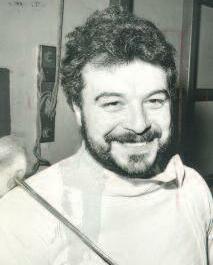
“The roof collapsed on the back of my shoulders and I was folded over him in the front seat “It wasn’t his fault Well, I say it wasn’t his fault; he was driving the car, so it was his fault But we’d done all sorts of things together
“I had hit the back of a car on my motorbike, he went right over my head and landed on the bonnet Fortunately, he wasn’t seriously hurt ”
Focusing on what can be done, and not what can’t “I’d had a pretty positive outlook on life anyway, a glass half full person ”
He was back at work in little more than seven months and by now an enthusiastic wheelchair basketball player himself, extraordinarily finding himself in the GB team for the Montreal Olympics less than two years later
“We didn’t do very well But if you did two sports you had more of a chance of going So, I was also fencing and won a bronze medal
“From having no sort of direction in what I was doing, getting involved in wheelchair sport completely changed my life ”
The GB wheelchair basketball team’s efforts at the 1974 Games were not helped by having to compete in crudely functional chairs That changed with Vinny’s involvement
“It was the same sort of chair that wheelchair services gave out: very high back rest, push handle sticking out the back, they had immoveable footrests,
they folded up – all the things you don’t want on a chair for sport
“I noticed the Americans had gadgets to make their chairs more useable; a gizmo that moved the wheels further forward to make it more manoeuvrable, some of them had a camber on the wheels, which makes it much more stable and turn a lot faster, “Because I was working in a massive factory with all the equipment, I started fiddling about with my chair to make it more useable
Paralympics
“Then when we went to another tournament I noticed some of the Americans actually had chairs made out of aluminium tubing so when I came back I made one of them and then I made one for one of the other lads in the team, and then another one By the time we got to the 1980 Paralympics, the whole team was playing in chairs that I’d made ”
More recent Paralympians also have reason to be grateful for Vinny’s mantra that “it can always be better” Wheelchair racer Hannah Cockroft (eight golds at London, Rio and Tokyo), table tennis star Jack Hunter-Spivey (bronze in 2020), and legendary athlete turned Parliamentarian, Tanni Grey-Thompson, have all benefited from his expertise
In the couple of decades s one of the UK’s most respec and quietly gone about the b countless disabled people’s

Along the way they have c vehicle allowing a paralysed had never seen before; ano Cornwall “perfect for getting beach”; and proving wrong who insisted an 18-month-o would never be able to push
“She was terrified when sh sat in a tiny chair, and by th later she was chasing me ro
For many, Vinny and his d are the difference between a standard, NHS-provision wh man with a spinal injury note the house all day”) and a life
Vinny said: “Most people w


14 All Together NOW! JANUARY/FEBRUARY 2023 www.alltogether
After his experiences with basketball squad, Vinny beg wheelchairs – first from the while working for a charity, a DaVinci Mobility with friend Gilmoss Industrial Estate in
Afixed to his hospital bed allowed Vincent Ross a view of the hubbub in the courtyard behind him.
‘You’ve
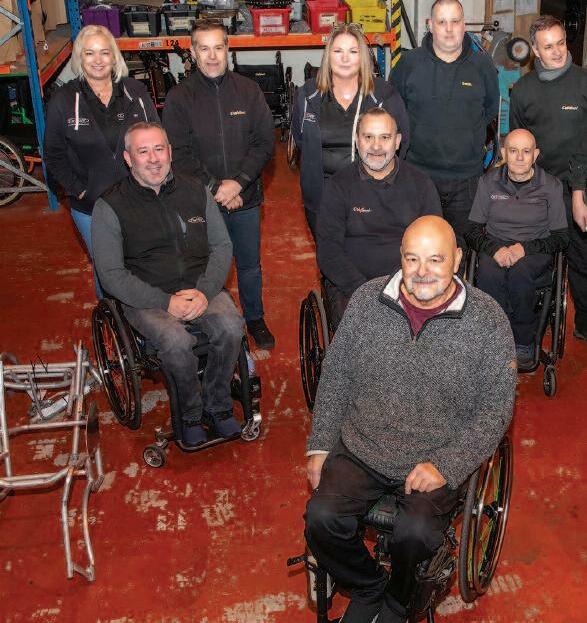
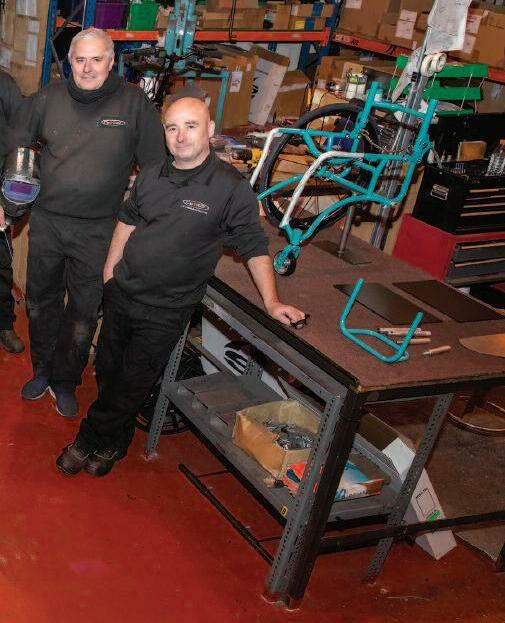
TEAM EFFORT: Vinny and his team at DaVinci Mobility
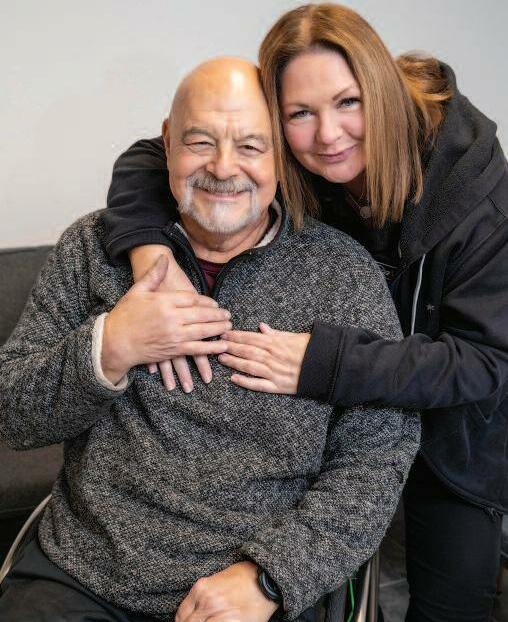
RIGHT: with wife Mary.
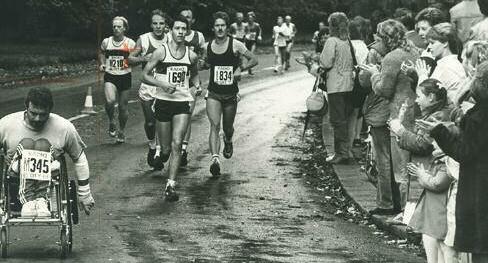
INSETS: Vinny, the young Paralympian fencing medallist and wheelchair marathon man
MAIN PICTURES: JASON ROBERTS
mean really crazy things I’ve had a paragliding licence, raced all kinds of cars, put hand controls on to a car in the snow in Denver and drove into the Rockies to go skiiing ”
Despite some hairy moments along the way, “it never bothered me, I loved it in fact”
ound 50 years ago – and has been helping others ever since WONDERS WONDERS
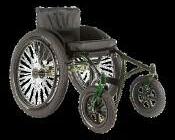
the GB wheelchair gan creating custom-made garage of his home, later and then, in 2001 launching John Ingram, at the Fazakerley ince, DaVinci has become cted wheelchair makers, business of improving lives constructed a special d farmer to reach fields he ther for a 92-year-old in him up the hills from the he occupational therapist ld girl with cerebral palsy h a chair he saw me, but we got her e time I left about an hour ound the room in it ” edicated team at DaVinci, a life making do in a bog heelchair (“enough,” one es, “for someone sitting in e that is active and fulfilling who need a wheelchair
need something that’s tailored to their needs because every person with a disability is different, the disabilities affect them in different ways, they are all different sizes, and their requirements from the chair are completely different
“Even millimetres can make a big difference and give you access to a lot more places ”
His methods, the attention to detail, each chair a oneoff, means he is never going to “make millions” Instead, his motivation is “purely to make life better for anybody else that’s in my situation or similar
Problem solvers
“Basically we solve problems for people When they come in and they want to be able to do something then, yes, we can do it it might take a bit of time, and we might have to fiddle about with it for a while, but usually we can make it work for people And, yeah, if we can make a living while we’re doing it, great ”
While other companies producing totally bespoke wheelchairs perished, DaVinci survived lockdown, with Vinny insisting throughout on making up the difference between furlough and the rest of the wages for his workforce, many with a disability of their own
At 70, he has reduced the time he devotes to
DaVinci: “I’m working to keep this place going basically, If there are any grants or anybody out there who’s interested in what we’re doing, and they’re interested in helping out, I’d like to reach out and have a talk with them ”
Looking ahead, he hopes to develop DaVinci’s relationship with Alder Hey Children’s Hospital, providing wheelchairs for muscular dystrophy patients But, as always, the funding is hard to come by “There is a brief window in the life of a muscular dystrophy patient when they can use a wheelchair But then if you apply to a charity, it goes on and on and on and sometimes it can take a year or more, by which time these kids can’t use it anymore ”
Back in 1974, barely into adulthood, Vinny was told he would not make it to middle age, and would never have children
Wrong on both counts Vinny has been married to Mary (a fellow director of DaVinci) and the couple have two children, twins – Nat and Nell – aged 16 Meanwhile, he has long surpassed the lifespan predicted for him “After the accident my insurance company and the doctor who advised them, gave me 15 years’ life expectancy
“So, it was always in my mind that I wasn’t going to live that long, and I did some pretty crazy things I
An adventurous lifestyle has come at a cost and he faces two shoulder operations “Pushing a wheelchair takes its toll over the decades, plus pushing to the limits physically ”
He does not consider what might have been had he not found himself being carried in a car along a Liverpool ring road 48 years ago “I don’t dwell because what can I get out of it?”
Get on with life
“Besides,” he adds, “I think everything that I’ve wanted to do I’ve actually done
“One of the worst things about being in a wheelchair is that there is always this carrot, dangling on a string, of a potential cure They have talked about it since I was in a chair
“That is so frustrating If it happens, ok, but the best thing I can say to anybody is, please, get on with your life
“A lot of people feel like they’ve lost everything, but at the end of the day you’ve got to rebuild it
“And the only way to do that is to have a positive outlook on things and find something that you CAN do, and enjoy doing, and follow that path ”
rnow.org.uk JANUARY/FEBRUARY 2023 www.alltogethernow.org.uk 16
HELPLINES
n Personal Budgets
Helpline

Tel 0330 995 0404
Opening hours: 9 30am-1 30pm, Tues and Thurs
personalbudgets@di sabilityrightsuk org


n Disabled Students
Helpline Tel 0330 995 0414
Opening hours: 11am-1pm on Tues and Thurs students@disabilityri ghtsuk org

n Scope’s Disabilty Information and Advice Line (DIAL) Freephone 0808 800 3333
MUDDYMARVELS!
uneven
in towns across the UK is tough going for many wheelchair users – especially as councils continue to tighten their belts
But imagine the problems for disabled people in rural areas of South Africa
Well, if things go according to plan, there will soon be a new style chair on the market that can cope with all sorts of rugged terrain
That’s the target for a team of researchers from Aston University, Birmingham, and the Central University of Technology in Bloemfontein, South Africa
Dr Timothy Whitehead, who is leading the project at Aston University, said: “This project will help improve life for African people who use wheelchairs and help boost employment opportunities for disabled people

“We are supporting two upcoming wheelchair manufacturers to improve their designs, while also creating educational and workshop materials for future disabled entrepreneurs ”
Able Manufacturers has created a threein-one chair with adaptable wheels for off-roading in the many rural areas that have limited paved roads
Standard wheelchairs can’t cope with mud, holes and overgrown vegetation, but a removable third wheel helps users overcome rough terrain
As a result, disabled people can travel to areas that were previously inaccessible, increasing opportunities for and access to potential employment Company owner Schalk van de Merwe said: “It is fantastic to work with the team on this project
“These chairs are a lifeline for so many people living in rural communities – if we
can iron out the issues, they will be even better ”
The team is also working with Real Steel Wheelchairs to develop a new, more affordable rugby wheelchair to encourage more disabled athletes and children into the sport
Currently, importing these chairs to Africa is costly, resulting in an automatic barrier to a sport which can support physical and mental health and rehabilitation
Real Steel Wheelchairs was started by Jared McIntyre, a disabled wheelchair rugby player who is working with skills providers to train disabled people to make the chairs and offer them valuable employment
The project has been funded through the British Council’s Innovation for African University scheme, which aims to improve Africa’s entrepreneurial skills
SHOPMOBILIT Y n ALTRINCHAM Tel 0161 929 1714 n ASHTON-UNDER-LYNE Tel 0161 339 9500 n BARROW Tel 01229 434039 n BIRKENHEAD Tel 0151 647 6162 n BLACKBURN AND DARWEN Tel 01254 690566 or 07757 502217 n BLACKPOOL Tel 01253 349427 n BOLTON Tel 01204 392946 n CARLISLE Tel 01228 631564 n CHESTER Tel 01244 312626 n CHORLEY Tel 01257 260 888 n COLWYN BAY Tel 01492 533822 n CREWE Tel 01270 580 031 n ELLESMERE PORT Tel 0151 355 1420 n KENDAL Tel 01539 740 933 n LEIGH, Wigan Tel 01942 777 985 n LIVERPOOL Tel 0151 707 0877 n MANCHESTER Trafford Centre Tel 0161 747 2684 n MANCHESTER Arndale Centre Tel 0161 839 4060 n NELSON Tel 01282 692 502 n NORTHWICH, Vale Royal Tel 01606 288820 n OSWESTRY Tel 01691 656882 n PENRITH Tel 01768 895 438 n PRESTON Tel 01772 204 667 n RHYL Tel 01745 350665 n ROCHDALE Tel 01706 865 986 n RUNCORN, Halton Lea Tel 01928 710144 n SHREWSBURY Tel 01743 236900 SKELMERSDALE Tel 01695 550066 n ST HELENS Tel 01744 613 388 n STOCKPORT Tel 0161 666 1100 n WARRINGTON Tel 01925 240064 n WARRINGTON Birchwood Tel 01925 822 411 WIDNES: 0151 511 8833 n WIGAN Tel 01942 776 070 n WINSFORD Tel 01606 557550 n WREXHAM Tel 01978 312390 MIDLANDS n BIRMINGHAM Snow Hill Railway Station Tel 0121 236 8980 Level 2, Centre Car Park, Bullring Tel 0121 616 2942 n STAFFORD Tel 01785 619456 n STOKE ON TRENT Tel 01782 233333 n SUTTON COLDFIELD Tel 0121 355 1112 n TAMWORTH Tel 01827 HELP AT THE END OF A PHONE n ANGLESEY: TARAN Tel 01407 721933 n BLACKPOOL Disability Information and Support Tel 01253 472 202 Textphone 01253 476 450 n CHESHIRE CIL Tel 01606 331853 n CHESTER Dial House Tel 01244 345655 n DENBIGHSHIRE Tel 01745 354445 n ELLESMERE PORT DICE Tel 0151 355 1420 n HALTON Disability Service Tel 01928 717222 n KNOWSLEY DISABILITY CONCERN 0151 480 4090 n LANCASTER DISC Tel 01524 34411 n ACSIL (Amputees and Carers), Tel, 0151 261 1166 n THE BRAIN CHARITY Tel 0151 298 2999 n MANCHESTER (GTR) Coalition of Disabled People Tel 0161-273 5154 n MOLD Flintshire Disability Tel 01352 755546 n NELSON: Pendle Pakistan Welfare Association Tel 01282 603 616 n PRESTON DISC: Tel 01772 558 863 Text 01772 204 787 n RHYL Tel 01745 350665 n STOCKPORT: Disability Stockport 0161 480 7248 n WARRINGTON Disability Partnership 01925 240064 n WIRRAL WIRED Tel 0151 670 1500 n WEST LANCS HELPLINE Freefone 0800 220676 n ST HELENS DASH Tel 01744 453053 MIDLANDS n BIRMINGHAM Disability Resource Centre Tel 0121 789 7365 n Disabled People’s Network Solihull Tel 0121 788 1544 n STOKE: Disability Solutions Tel 01782 683800 n WOLVERHAMPTON Elder and Disabled Group Tel 01902 448552 n WEST MIDS Amputee Group 07891 794733; 07585 958322; 07557 228154 16 All Together NOW! JANUARY/FEBRUARY 2023 www.alltogethernow.org.uk COPING with
pavements
WHEEL DEAL: The team who are changing people’s lives in South Africa
Her story’s historic!
ALL of us can read a bedtime story to children – even if you are blind
That’s the message Liverpool’s Paralympian cyclist Lora Fachie is determined to get across Lora, blind since the age of five, used braille to read The Secret Code in the TV series CBeebies Bedtime Stories
She said: “I was over the moon to read a CBeebies Bedtime Story for the first time in braille


“I have always enjoyed reading and hope this will encourage everyone to want to read whether they use their eyes, their ears, their fingers or a secret code ”
How those with sight loss view the world
UNDREDS of conversations have helped to create one the richest and most in-depth picturs yet of life with a visual impairment

More than 800 people took part in the study which reveals those things that most help – and hinder – people with sight loss
Blind charities Royal National Institute of Blind People (RNIB), Guide Dogs and Thomas Pocklington Trust jointly produced the VI Lives study, which found:
n Improving public awareness, understanding and empathy is considered by blind and partially sighted people to be a priority for improving their quality of life
It was felt that public understanding of
sight loss is poor, and that general ignorance has led to negative encounters
n Diagnosis of sight loss is a critical moment for most, but there’s not enough information, guidance and empathy More practical and emotional support, better signposting and quicker referrals are needed
n Better accessibility to transport and public places is the most important factor to improve quality of life A quarter of people affected by sight loss feel they are not getting out as much as they would like n People affected by sight loss often feel cut off from employment opportunities and that little support is offered to them, and nearly a third have difficulty stretching their household budget
The 34-year-old, whose son Fraser,was born in October, added: “Reading feeds the imagination and I will be reading to my little one ”
David Clarke, chief operating officer at the Royal National Institute of Blind People, added: “Our in-depth research tells us the main barrier faced by blind and partially sighted people in the UK is public misconceptions
“This is just one myth that is being busted by Lora We want to spread the message that blind and partially sighted parents can absolutely read bedtime stories to their kids ” n RNIB Helpline: 0303 123 9999
n Smart technology such as smart speakers, smart watches and virtual assistants is a key enabler, helping blind and partially sighted people to access information and digital services However, there are disparities in awareness and access Many are unaware of the available apps, specialist equipment and technology that can make their lives easier
Matt Stringer, chief executive of RNIB, said: “We are committed to using this research to help drive change for all organisations and give them the insight they need to help shape services, products and policies that enable people affected by sight loss to participate in society and lead independent lives ”
n ACCRINGTON Tel 01254 387 444 n BLACKBURN with DARWEN Tel 01254 688 www bwdcarers org n BLACKPOOL Blackpool Borough Council, Tel 01253 477 716 nCUMBRIA Carlisle Tel 01228 542 156 Penrith Tel 01768 890 280 Barrow-in-Furness Tel 01229 822 822 Kendal Tel 01539 732 927 Whitehaven, Tel 01946 592 223 n CHESHIRE & WARRINGTON Helpline:0300 102 0008 n KNOWSLEY Tel 0151 549 1412 n LANCASTER Tel 01524 66475 nLIVERPOOL Tel 0151 705 2307 n MANCHESTER Tel 0161 835 2995 n MORECAMBE Tel 01524 833456 n PRESTON Tel 01772 200173 n RUNCORN Tel 01928 580182 n WIDNES Tel 0151 257 9673 n SALFORD Tel 0161 833 0217 n SEFTON Tel 0151 288 6060 n ST HELENS Tel 01744 675 615 n STOCKPORT Tel 0161 442 0442 n WARRINGTON (WIRED) Tel 01925 633 492 n WEST LANCS Tel 01695 711243 n WIGAN & LEIGH Tel 01942 705959 / 486923 MIDLANDS n BIRMINGHAM Tel 0121 675 8000 n SOLIHULL Tel 0121 788 1143 n WALSALL Tel 01922 610 810 NORTH WALES n ANGLESEY Tel 01248 722828 n BANGOR Tel 01248 370 797 n CONWY Tel 01492 533714 n DENBIGHSHIRE: NEWCIS, Tel: 0845 603 3187 nDOLGELLAU Tel 01341 421167 n FLINTSHIRE: NEWCIS, Tel: 01352 751436 n WREXHAM CARERS SERVICE Tel: 0800 276 1070 CARERS’ CENTRES VISUAL PROBLEMS n ACCRINGTON Tel 01254 233332 n BARROW Tel 01229 820698 n BIRMINGHAM Action for Blind Tel 0121 665 4200 n BLACKBURN Tel 0125 554143 n BLACKPOOL: N-Vision Tel 01253 362696 n BURY Tel 0161 763 7014 n BURNLEY Tel 01282 438507 n CARLISLE: Action for Blind People Tel 01228 595121 n CHESHIRE & N WALES: Vision Support Tel 01244 381515 n CUMBRIA (West) Tel 01946 592474 n CUMBRIA (Sth Lakeland) Tel 01539 726613 n GUIDE DOGS Tel 0118 983 5555 n HENSHAW’S 0161 872 234 or 0151 708 7055 n LIVERPOOL: Bradbury Fields Tel 0151 221 0888: Action for Bind Tel 0151 298 3222 n MANCHESTER: Action for Blind Tel 0161 787 9252 n PRESTON: Action for Blind People Tel 01772 320550 n OLDHAM Tel 0161 682 8019 n ROSSENDALE Tel 01706 873256 n SIGHTLINE (North West) Tel 0800 587 2252 n WIGAN Tel 01942 242891 n WIRRAL Tel 0151 652 8877 HEARING ISSUES n BIRMINGHAM Institute for Deaf Tel 0121 246 6101 n CHESHIRE Deaf Society Tel 01606 47831 n CUMBRIA Deaf Society Tel 01228 606434 n LANCASHIRE (EAST) Deaf Society Tel 01282 839180 n MANCHESTER Deaf Centre Tel 0161 273 3415 Genie Networks Tel 0161 941 4549 Text 18001 0161 941 4549 n MERSEYSIDE Society for Deaf Tel 0151 228 0888 n SOUTHPORT Centre for the Deaf Tel 01704 537001 n ST HELENS: Deafness Resource Centre Tel 01744 23887 n WOLVERHAMPTON Centre for Deaf Tel 01902 HELP AT THE END OF A PHONE H
www.alltogethernow.org.uk JANUARY/FEBRUARY 2023 www.alltogethernow.org.uk 17
MEDICAL NOTES
Signs you may need help with hearing
DO YOU feel worn out after talking with others? If so, there could be more to it than simply needing a good night’s sleep
When you don’t hear all of the sounds of speech, your brain has to fill in the gaps and help make sense of what people are saying
This requires extra focus and makes the brain work harder, leading to extreme tiredness, says hearing expert KATIE OGDEN, who outlines five other signs of hearing loss to look out for
Asking you to repeat yourself
Everyone can mishear things, but if you or your loved one is constantly asking for things to be repeated, or muttering the phrase “what did you say?” this could be a sign you’re lacking the sounds and signals needed to process speech properly
Complaining about mumbling
Those struggling with hearing loss often complain that people aren’t speaking clearly or are mumbling This can be due to people with hearing loss not being able to hear high-pitched speech frequencies –hearing the vowels, which is the sound of words, but not the consonants, which is the clarity and meaning of words

Trouble with phone conversations
Notice if your loved one has their mobile phone volume set to maximum or is having to use the speakerphone to hear

Having the TV at a high volume Television shows with fast-paced dialogue or a substantial amount of background noise can be hard for those with hearing loss to follow, as crucial dialogue can be drowned out, leading people to listen at a volume uncomfortable for others
Appearing withdrawn, or becoming quiet Individuals with hearing loss often become quieter or appear to become withdrawn in social situations or noisy environments
How to get help
Treating hearing loss can not only improve the health of the person suffering but also those around them, having a dramatically positive effect on their social relationships and love life
If you recognise a number of these signs in your loved one, it may be time to consult a professional audiologist and see if they could benefit from a hearing aid
There are also online hearing tests for those not comfortable going straight to an audiologist
ROBOTS JOIN WAR ROBOTS JOIN WAR ON ANTIBIOTICS ON ANTIBIOTICS
AI to spot ills and cut pills ‘Silent pandemic’
ROBOTS and artificial intelligence are being developed to spot one of the world’s most common infections earlier – and cut the number of antibiotics prescribed as a precaution
Every year, urinary tract infections, or UTIs, affect 150 million people globally When diagnosed early, they can be treated with antibiotics If left untreated, UTIs can lead to sepsis, kidney damage and even loss of life Now UK researchers are aiming to reduce both the number of serious adverse outcomes resulting from late or misdiagnosis of UTIs, and the amount of antibiotics prescribed while doctors wait for test results
The FEATHER project, involving the University of Edinburgh and the city’s Heriot-Watt University, has been awarded £1 1m of Government money to carry out ground-breaking research Robotic devices will be used to gather information about people’s daily activities in their homes Behaviour changes like kettle use, a change in walking pace, cognitive function
through interaction with a socially assistive robot, or a change to sleep patterns will all be analysed and could help flag up a potential infection before an individual or carer is even aware there is a problem
Professor Kia Nazarpour, from the University of Edinburgh, said: “This unique data will help individuals, carers and clinicians to recognise the signs of potential urinary tract infections far earlier, helping to prompt the investigations and medical tests needed ”
UTIs can be difficult to diagnose, particularly in people receiving formal care, for whom there is significant antibiotic overtreatment while clinicians wait for lab results to return “Earlier detection makes timely treatment possible, improving outcomes for patients, lowering the number of people presenting at A&E, and reducing costs to the NHS,” added Professor Nazarpour
“We also believe it will help to minimise the amount of antibiotics that are necessarily prescribed as a cover while waiting for lab results ”
The North West is experiencing a particular problem as the overuse of antibiotics results in more and more infections becoming resistant to them
Every year thousands of people die due to infections caused by antibiotic-resistant bacteria
And the North West has the second highest rate of resistant bloodstream infections in the country.
In 2022 there were 3,276 estimated resistant bloodstream infections in the region, according to the latest report from the UK Health Security Agency.
An expert in health protection at the agency warned that unnecessary use of antibiotics risks them failing to work against life-threatening conditions
Dr Will Morton said: “In the absence of effective antibiotics, cancer treatments and common surgeries like caesareans would become very high-risk procedures and, for many people, could lead to infections that cannot be treated and may become fatal.
“Taking antibiotics when you don’t need them puts you and your family at risk of developing infections which in turn cannot be easily treated with antibiotics ”

. . .
. . . 18 All Together NOW! JANUARY/FEBRUARY 2023 www.alltogethernow.org.uk
reaching people who are digitally excluded
n Katie Ogden is training manager at ReSound North-West Europe
TAKING antibiotics for illnesses they won’t help is adding to what health experts are calling the “silent pandemic”
Nathan
Hall,
23, on being diagnosed, relapsing, and life after leukaemia
TWO months after my 15th birthday, in March 2015, I was diagnosed with acute myeloid leukaemia.
When I began feeling worn out from walking upstairs, I went to my GP
The following night, I was called and told to go for further tests Within 48 hours of diagnosis, I was transported to Royal Manchester Children’s Hospital, not knowing this is where I would spend the next four months battling cancer
I quickly become accustomed to hospital life, placing myself into a positive mindset I was unfortunate to have been dealt a bad card, so I dealt with it and used it as a means of building myself as a person
By mid-summer 2015, I had battled through four rounds of intense chemotherapy which wiped me out – I was underweight, tired and, primarily, bald But finally I was declared in remission and allowed home
The next few months were scary, constantly worrying if my cancer would return But a whole year had passed when our family planned a break in sunny Florida
Around a week before the holiday, I began feeling a little more lethargic than usual, so, decided to err on the side of caution
I biked two miles to the hospital, walked into the ward, and asked them to take a blood test
A week later, I was on a train to the airport, suitcase overhead, earphones in, when I got a call from the hospital telling me I needed more tests Back at Royal Manchester Children’s Hospital came the news I suspected, the cancer had returned
MEDICAL NOTES
Look after your gut and it will look after you
THAT “gut feeling” we’ve all experienced is genuine and based on the connection between brain and gut.
Known as the “gut-brain axis”, it is responsible for sending signals between the heart and brain, influencing your mood, appetite, immunity, and ability to think clearly.
Health and well-being company, Westfield Health, shows how to ensure your guts are healthy and sending the right signals to your brain.
Why is gut health important?
OUR guts are home to billions of fungi and bacteria – perhaps not a pleasant thought, but the reality of being human.
A healthy gut can positively affect our mood and mental well-being. The stomach produces around 90% of our body’s serotonin, a neurotransmitter that affects our social behaviour, mood, appetite, and sleep.
A long road

The next few weeks were relatively easy for me as I was already accustomed to the process and symptoms, but the news took a toll on my family Everyone thought I was in the clear, but life screws you over somehow Professor Rob Wynn and his team proposed I undergo a bone marrow transplant and I began conditioning chemotherapy in preparation
During this time, my lungs were affected by a fungal infection and filled with fluid, impairing my breathing, putting me in intensive care under the influence of a lot of painkillers and drugs
I then had severe, life-changing hallucinations from an allergic reaction to an antibiotic drug used to treat my infection
After recovering, I was moved into a room with its own controlled climate For six months I was given food devoid of flavour due to the intense heat needed to sterilise it
On December 23, the Anthony Nolan charity delivered my new bone marrow and by the end of the day I officially had the immune system of a new-born Fast forward to 2019, aged 20, I went back to college and secured a place at the University of York to study biomedical sciences, fulfilling my passion to understand more about the human body, disease and advancing treatments
I will be forever grateful for my family and the support and sacrifices they have made
–
–
but A long road
but at last I could at last I could follow my passion follow my passion
Two days before Christmas Day, I marked seven years in remission
Everyone around me has been supportive and caring I was self-conscious about my lack of hair, and reluctant to go outside without a beanie hat This continued until my wonderful girlfriend gave me the courage to be happy with myself and not care what others think
Catching leukaemia in its early stages is the key to effective treatment If it was not for the quick reactions of both my GP, hospital and consultants (Professor Wynn, Dr John Grainger and Dr Denise Bonney), I don’t think my outlook would have been so great I owe them my life, literally
Knowing the signs is key to getting better
SPOTTING leukaemia early saves lives and means a better quality of life for those with the disease.
But new research shows only 1% of people surveyed in the North West could identify the most widely reported symptoms – fatigue, bruising, unusual bleeding and repeated infections.
Every day in the UK, 28 people are
diagnosed with leukaemia, a form of blood cancer that can affect people of all ages.
Overall survival for the disease stands at just over 50% – making it one of the deadliest forms of cancer, and one often diagnosed too late.
Fiona Hazell, chief executive of Leukaemia UK, said: “People
underestimate their risk by thinking that leukaemia is a childhood disease. In reality, both incidence and mortality rates rise sharply after the age of 55.

“Raising awareness in this age group is critical in order to treat it early and effectively; and ultimately to improve survival rates overall.”
n Leukaemia UK: Tel. 0207 299 0722.

Signs of an unhealthy gut
AN imbalance in gut bacteria can heavily impact your overall health.
An upset stomach, digestion issues. migraines and skin irritation can all be signs of an unhealthy gut.
How to feed your gut
There is no denying the symptoms of an unbalanced gut can be rather unpleasant. If you’re experiencing severe gut problems, such as abdominal pain, diarrhoea, or constipation, you must visit your GP
These could be signs of a more severe problem, such as irritable bowel syndrome or celiac disease
But prevention is better than cure, which in this case is eating the right food
So, what should you add to the menu?
l Fibre: Fruits, vegetables, nuts, and whole grains work wonders for gut bacteria and keep them healthy A diet low in fibre can increase bloating
l Probiotic food: Probiotics are naturally found inside the gut and have a range of digestive benefits such as helping irritable bowel syndrome Live yoghurts are a great source and can actively encourage more good gut bacteria to develop
l Antioxidant-rich foods: Antioxidants are compounds that help to protect cells from damage Foods rich in antioxidants include berries, dark chocolate, and green tea
l Healthy fats: Healthy fats, such as those found in olive oil, avocados, and nuts, are essential for gut health They help to keep the gut lining strong and prevent inflammation
. . .
. . . www.alltogethernow.org.uk JANUARY/FEBRUARY 2023 www.alltogethernow.org.uk 19
reaching people who are digitally excluded
Until Jan 21: The Scouse Jack & The Beanstalk Royal Court, Liverpool
Until Mar 11: Disney’s The Lion King Palace, Manchester Set against the majesty of the Serengeti Plains and to the evocative rhythms of Africa, Disney’s multi award-winning musical is a unique theatrical experience that you will remember forever
Jan 10-14: An Inspector Calls The Lowry, Salford When Inspector Goole arrives unexpectedly at the prosperous Birling family home, their peaceful dinner party is shattered by his investigations into the death of a young woman
Jan 13-14: Brennan Reece: Crowded The Lowry, Salford
Jan 13: Rhiannon: Tribute to Fleetwood Mac The Brindley, Runcorn
Jan 14: Showaddywaddy. Lyceum, Crewe
Jan 14: Luther Floral Pavilion, New Brighton Luther Vandross tribute show
Jan 14: Swan Lake Grand, Blackpool
Jan 14: Rain Dance Colour Festival – Raise the Roof. Opera House, Manchester
Jan 15: Soul Train The Lowry, Salford
Jan 15: Guz Khan The Lowry, Salford Comedy
Jan 15: Jack Carroll: Walking Funny The Lowry, Salford Comedy
Jan 15: The Nutcracker Grand, Blackpool
Jan 15: Cirque – The Greatest Show Lyceum, Crewe
Jan 15: Fastlove – A Tribute to George Michael Empire, Liverpool
Jan 15: Glenn Miller Orchestra Philharmonic Hall, Liverpool
Jan 15: The Carpenters Experience The Brindley, Runcorn Tribute show
Jan 17: The Cher Show Empire, Liverpool Tribute show
Jan 17 Queen Extravaganza Venue Cymru Tribute show
Jan 18-21: Noughts & Crosses The Lowry, Salford Gripping Romeo and Juliet story A captivating drama of love, revolution and what it means to grow up in a divided world
Jan 18: Spirit of the Dance Grand, Blackpool
Jan 18: Thick & Thick present Tits & Teeth
The Lowry, Salford Dance, mime, satire, drag and lip syncing to create portraits of famous and infamous characters Appearing this time are Miss Havisham & Queen Victoria, Winston Churchill, Marlene Dietrich and Dame Margot Fonteyn
Jan 18: Lil’ Jimmy Reed. Philharmonic Hall, Liverpool
Jan 19-21: Pride and Prejudice* (*sort of)
The Lowry, Salford Unique and audacious retelling of Jane Austen’s most iconic love story Men, money and microphones will be fought over in this irreverent but affectionate adaptation, where the stakes couldn’t be higher when it comes to romance Audio described / touch tour Jan 20; Signed Jan 21
Jan 19: Jon Richardson: The Knitwit Venue Cymru
Jan 19-20: Swan Lake Opera House, Manchester
Jan 20-22: Frozen Light – Fire Songs The Lowry, Salford An immersive sensory sound experience for audiences with profound and multiple learning disabilities performed with a local choir
Jan 20: Queen: A Dazzling Tribute Floral Pavilion, New Brighton
Jan 20: Waterloo – The Best of Abba. Grand, Blackpool Tribute show Jan 21-22: The Classic
BOX OFFICE CONTACTS
BLACKPOOL
Grand Theatre: 01253 290190
BOLTON
Octagon: 01204 520661
CHESTER
Storyhouse: 01244 409 113
CREWE Lyceum: 01270 368 242
LIVERPOOL
Empire: 08444 999 999 Everyman & Playhouse: 0151 709 4776
Philharmonic Hall: 0151 709 3789 Royal Court: 0870 787 1866 Unity 0151 709 4988
LLANDUDNO
Venue Cymru: 01492 872000
MOLD: Theatr Clwyd: 0845 3303565
MANCHESTER
Opera House: 0870 401 9000 Palace: 0870 401 3000
SALFORD
The Lowry: 0843 208 6000 Access line: 0333 320 2838
NEW BRIGHTON Floral Pavilion: 0151 666 0000
RHYL: Pavilion: 01745 330 000
RUNCORN
The Brindley: 0151 907 8360

ST HELENS: Theatre Royal: 01744 756000

STOKE: Regent Theatre: 0844 871 7627 CHESTER: Storyhouse: 01244 409 113
SAS hero Jason tells all
FORMER SAS tough guy Jason Fox tells the remarkable story of his daring exploits in a distinguished career as an elite operator in the UK Special Forces
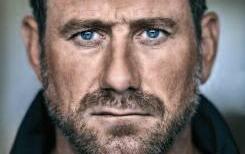
A breathtaking tale of gunfights, hostage rescues, daring escapes and heroic endeavours to a very different battle that awaited him at home
Jan 22, Venue Cymru, Llandudno Jan 25: Philharmonic Hall, Liverpool Jan 26: The Lowry, Salford
World Cup wisdom
WORLD Cup winner Sir Geoff Hurst talks about his illustrious football career with West Ham and England

And he shares his thoughts about England’s other World Cup exploits Feb 9: Theatre Royal, St Helens
Make a date
Rock Show Philharmonic Hall, Liverpool See panel, above
Jan 21: You are my Sunshine Unity, Liverpool What it’s like to be a young carer

Jan 21: Vampires Rock – Ghost Train 2023. Grand, Blackpool
Jan 21: The Smooth Rock Show Floral Pavilion, New Brighton
Jan 21: Fanny Galore’s Big Bingo Party. Lyceum, Crewe
Jan 21: Bowie Experience Lyceum, Crewe Tribute show
Jan 21: The Nutcracker Opera House, Manchester
Jan 22-27: Buffy Revamped. The Lowry, Salford Fast-paced new production based on the hit 90s TV show Buffy the Vampire Slayer, as told through the eyes of the one person who knows it inside out Spike
Jan 22-23: Jon Richardson: The Knitwit Regent, Stoke
Jan 22: The International Classic Ballet Theatre Lyceum, Crewe
Jan 22: Jason Fox – Life at the Limit Venue Cymru See panel, above
Jan 22: Harry Hill The Lowry, Salford
Jan 23: Varna International Ballet – Giselle Empire, Liverpool
Jan 23: Buffy Revamped Lyceum, Crewe
Jan 24: The Best of Frankie Valli and the Four Seasons Grand, Blackpool Tribute show
Jan 24: The Psychology of Serial Killers. Lyceum, Crewe Join expert forensics lecturer Jennifer Rees to explore one of forensic psychology’s most troubling topics
Jan 24: Varna International Ballet – Swan Lake. Empire, Liverpool
Jan 24: Dreams of the Small Gods The Lowry, Salford
Jan 24: Materia The Lowry, Salford Circus
Jan 25: The Classic Rock Show The Lowry, Salford See panel, above.
Jan 25: Psychic Sally Lyceum, Crewe
Jan 25: The Psychology of Serial Killers Venue Cymru
Jan 25: Varna International Ballet – The Nutcracker. Empire, Liverpool
Jan 25: Jason Fox: Life at the Limit Philharmonic Hall, Liverpool See panel, above
Jan 25: I’m Still Standing – The Music of Elton John The Brindley, Runcorn
Jan 26: The Simon & Garfunkel Story Philharmonic Hall, Liverpool
Jan 26: The Magic of the Beatles Empire, Liverpool Tribute show
–
and
Jan 26: Magic of Motown Lyceum, Crewe Jan 26: NT Live: The Crucible (filmed live) Venue Cymru Raised to be seen but not heard, a group of young women in Salem suddenly find their words have an almighty power As a climate of fear, vendetta and accusation spreads through the community, no one is safe from trial
Jan 26: Ellen Kent’s Madama Butterfly Opera House, Manchester
Jan 26: Jason Fox – Life at the Limit The Lowry, Salford See panel, above
Jan 26: Pink Floyd Experience Theatre Royal, St Helens tribute show
Jan 27: Dire Streets. Theatre Royal, St Helens Tribute show
Jan 27: Giovanni Pernice – Made in Italy The Lowry, Salford
Jan 27: Elle Kent’s La Boheme Opera House, Manchester
Jan 27: A Country Night in Nashville Floral Pavilion, New Brighton
Jan 27: David O’Doherty: whoa is me Lyceum, Crewe

Jan 27: Swan Lake Regent, Stoke
Jan 28-29: Tales from Acorn Wood The Lowry, Salford Packed full of songs, puppetry
Jan 28-29: Jacqui Dankworth & Charlie Wood Philharmonic Hall, Liverpool
20 All Together NOW! JANUARY/FEBRUARY 2023 www.alltogethernow.org.uk To advertise, contact . . .
helen@alltogethernow.org.uk
THE new music show highlighting the incredible talent of the late Beatle George Harrison is on its way to Merseyside

Something About George – The George Harrison Story arrives at the Theatre Royal, St Helens, on February 24, followed by a very special performance at Liverpool’s Philharmonic Hall on the 25th, which would have been George’s 80th Birthday West End musician Daniel Taylor performs George’s biggest hits like My Sweet Lord, Something, Here Comes The Sun and and Handle With Care
Something About George celebrates a life that was anything but quiet
Feb 24: Theatre Royal, St Helens
Feb 25: Philharmonic Hall, Liverpool Feb 26: Octagon, Bolton
TO
THE Classic Rock Show is back on the road, celebrating the very best of classic rock Top musicians pay tribute to their favourite rock heroes, thundering through performances from the likes of Led Zeppelin, Dire Straits, The Who, Eric Clapton, AC/DC, Queen, The Eagles, Fleetwood Mac, and many more
Jan 21-22: Philharmonic Hall, Liverpool Jan 25: The Lowry, Salford
George would have been 80 on February 5
Feb 4: Best of Queen: Break Free Tour
Theatre Royal, St Helens Tribute show
Feb 5: Catherine Cohen: Come for Me. The Lowry, Salford Comedy
Feb 5: The Glenn Miller & Big Band
Spectacular Lyceum, Crewe
Feb 6-11: Bugsy Malone Empire, Liverpool Prohibition era, New York
Feb 6: John Cale Philharmonic Hall, Liverpool
Feb 6: Come What May Lyceum, Crewe Travel back in time as the children of the revolution take you on a non-stop journey to the glamorous underworld of Paris Feb 7-11: Death Drop Back in the Habit Playhouse, Liverpool The Sound of Music meets Scary Movie in this jam-packed, riotous comedy/thriller Feb 7-11: The Verdict Floral Pavilion, New Brighton Powerful best-selling courtroom thriller
Feb 7: Tap Factory Grand, Blackpool Explosive high-octane show
Feb 7: Giovanni Pernice – Made in Italy
Theatre Royal, St Helens
Feb 8: Glenn Miller and Big band
Spectacular Grand, Blackpool
Feb 8: Tap Factory Lyceum, Crewe
Feb 9: Vampires Rock Lyceum, Crewe
Feb 9: An Evening with Sir Geoff Hurst. Theatre Royal, St Helens
Feb 10-25: Two of Us Royal Court, Liverpool Tom Connor and Mark Newnham perform the music of Lennon and McCartney
Feb 11: Buffy Revamped Grand, Blackpool
Feb 11: Fern Brady – Autistic Bikini Queen Unity, Liverpool
Feb 11: Dinosaur Adventure Live Theatre Royal, St Helens
Feb 12: One Night in Texas Grand, Blackpool Country music tribute show
bookyour seats
Jan 28: The Nutcracker Regent, Stoke
Jan 28: The Adult Panto: Cinderella Lyceum, Crewe
Jan 28: Ellen Kent’s Aida Opera House, Manchester
Jan 28: Guz Khan Playhouse, Liverpool The Coventry comic brings his big-screen persona and BAFTA-nominated hilarity to Liverpool
Jan 28: An Evening with Manchester United Legends The Lowry, Salford
Jan 28: Jen Brister: Optimist The Lowry, Salford Comedy
Jan 29: The Psychology of Serial Killers Empire, Liverpool Join forensics lecturer Jennifer Rees
Jan 29: Queen Extravaganza The Lowry, Salford Tribute show
Jan 29: the Smartest Giant in Town Lyceum, Crewe
Jan 30-31: The Nature of Forgetting The Lowry, Salford Tom is living with early onset dementia We meet him as he prepares for his 55th birthday party and past memories come flooding back Life-affirming journey into a weakening mind, where broken does not have to mean defeated
Jan 30: Tales of Acorn Wood Theatre Royal, St Helens Packed full of songs, puppetry
Jan 30: Giovanni Pernice – Made in Italy Lyceum, Crewe
Jan 31-Feb 11: Mamma Mia! Opera House, Manchester The ultimate feel-good factor at the world’s sunniest and most exhilarating smashhit musical!
Jan 31: All Singing All Swinging – Starring Ray Quinn The Brindley, Runcorn
Jan 31: War of the Worlds presented by Don’t Go Into the Cellar Theatre Company The Brindley Runcorn Jonathan Goodwin’s oneman show
Jan 31: Gareth Gates – The Best of Frankie Valli. Lyceum, Crewe
Feb 1-4: Edith The Lowry, Salford In January 1923, Edith Thompson was executed for the murder of her husband 100 years on, in this recreation of her sensational trial will we see her differently?
Feb 1-2: Rush – A Joyous Jamaican Journey The Lowry, Salford
Feb 1: Come What May Grand, Blackpool Musical

Feb 1: What’s Love Got to Do With It? Regent, Stoke Tribute show
Feb 2: Tony Blackburn’s Sounds of the 60s Floral Pavilion, New Brighton
Feb 2: Alpine Symphony Philharmonic Hall, Liverpool
Feb 2: The Magic of Motown Theatre Royal, St Helens
Feb 2: Prue Leith: Nothing in Moderation
The Lowry, Salford
Feb 2: Puccini’s La Boheme Grand, Blackpool
Feb 3-18: Faustus: That Damned Woman Storyhouse, Chester Gripping drama based on the legend of Faust, who sells his soul to the devil in return for unlimited knowledge and pleasure, only to squander both Feb 3-4: Spring and Port Wine Octagon, Bolton Starring Mina Anwar and Les Dennis Rafe Crompton’s attempts to preside over his family with an iron fist But it all goes so wrong
Feb 3-4: Jon Richardson: The Knitwit Grand, Blackpool
Feb 3: Oh, What a Night Pavilion, Rhyl Feb 3: Mind Mangler. Empire, Liverpool Join the “Mind Mangler” as he returns to the stage following a reasonably good two-night run at the Luton Holiday Inn conference centre, suite 2b His new solo spectacular is predicted to spiral into chaos as he attempts to read your mind Feb 3: The Smartest Giant in Town Floral Pavilion, New Brighton Feb 4-11: 023 Dance: Our Planet Regent, Stoke
Feb 4: Think Floyd Lyceum, Crewe Tribute show
Feb 4: The ELO Show Philharmonic Hall, Liverpool Tribute show
Feb 12: The Legends of American Country Show Pavilion, Rhyl
Feb 12: Menopause The Musical 2 Empire, Liverpool
Feb 13-19: Sister Act The Musical. Venue Cymru
Feb 13-18: The Rocky Horror Show Grand, Blackpool
Feb 14: Ellen Kent’s Aida Regent, Stoke
Feb 14: Aida Floral Pavilion, New Brighton
Feb 14: Queen Extravaganza. Philharmonic Hall, Liverpool Tribute show
Feb 15: Mike Oldfield’s Tubular Bells
Philharmonic Hall, Liverpool
Feb 15: Bloody Mary Lyceum, Crewe

Feb 16: Northern Ballet’s Ugly Duckling. Regent, Stoke
Feb 16: The Death of King Arthur The Lowry, Salford
Feb 17-18: Dara O’Brien The Lowry, Salford
Feb 17: Totally Tina Lyceum, Crewe Tribute show
Feb 17: Come What May Floral Pavilion, New Brighton Travel back in time as the children of the revolution take you on a thrilling non-stop journey into the sexy, and glamorous underworld of Paris
Feb 17: The ELO Experience. Empire, Liverpool Tribute show
Feb 17: An Evening with Kate Bush Philharmonic Hall, Liverpool
Feb 18: Mozart’s Requiem Philharmonic Hall, Liverpool
Feb 18: Hello Again – The Neil Diamond Songbook Floral Pavilion, New Brighton
Feb 18: Whitney – Que
Night Lyceum, Crewe Tribute show
. . .
. . .
reaching people who are digitally excluded
www.alltogethernow.org.uk JANUARY/FEBRUARY 2023 www.alltogethernow.org.uk 21
Continued Page 22
READY
ROCK HERE COMES THE SUN! HERE COMES THE SUN!
n Continued from Page 21
Feb 18: Mozart’s Requiem Philharmonic Hall, Liverpool
Feb 18: Hello Again – The Neil Diamond Songbook Floral Pavilion, New Brighton
Feb 18: Whitney – Queen of the Night Lyceum, Crewe Tribute show

Feb 18: The ELO Experience Regent, Stoke Tribute show
Feb 18: Some Guys Have All The Luck – The Rod Stewart Story Opera House, Manchester
Feb 19: Chicago Blues Brothers. Grand, Blackpool The band are back together!
Feb 19: Troy Hawke – Sigmund Troy’d Lyceum, Crewe
Feb 20-25: The Rocky Horror Show. Opera House, Manchester Feb 20-25: The Shawshank Redemption Regent, Stoke
Feb 21-26: The Smartest Giant The Lowry, Salford
Feb 21-25: Steel Magnolias The Lowry, Salford Six women come together in a smalltown beauty salon in the American South and prove that female friendship conquers all Audio described / touch tour Feb 22; signed Feb 25
Feb 21: The King and I Empire, Liverpool
Feb 22: Fern Brady – Autistic Beauty Queen The Lowry, Salford
Feb 23: Ray Bradshaw: Deaf Com 1 The Lowry, Salford

Feb 23: NT Live: Othello Venue Cymru
Feb 23: The Jungle Book Pavilion, Rhyl Feb 23: Shape of You – The Music of Ed Sheeran Floral Pavilion, New Brighton
Feb 23: My Sweet Lord: The Spiritual Journey of George Harrison Philharmonic Hall, Liverpool Feb 23-26: Around The World in 80 Days Lyceum, Crewe
Feb 23-25: When Darkness Falls Theatr Clwyd Inspired by true events, this powerful new productiondraws us into dark pasts, reveals disturbing truths and explores the power of stories
Feb 24: Ginny Lemon & Sister Sister: You Keep Me Hangin’ On Tour Storyhouse, Chester
Feb 24: Concert for George Film Philharmonic Hall, Liverpool
Feb 24: ELO Again Floral Pavilion, New Brighton Tribute show
Feb 24: Something About George: The George Harrison Story Theatre Royal, St Helens See panel, page 21
Feb 25: Something About George Philharmonic Hall, Liverpool The George Harrison story See panel, page 21
Feb 26: Patsy Cline & Friends – 60th Anniversary Show Theatre Royal, St Helens
Feb 26: The Chicago Blues Brothers – The Cruisin’ For a Bluesin’ Tour Opera House, Manchester The band are back!
Feb 26: Something About George Octagon, Bolton Musical biopic of George Harrison Feb 27-Mar 4: The Bodyguard Regent, Stoke Feb 27-Mar 4: The Rocky Horror Show Storyhouse, Chester Feb 27-Mar 4: The Shawshank Redemption Theatr Clwyd Audio described/touch tours Mar 1; captioned Mar 4 44.
ARIES (March 21st-April 20th)
If you’ve been thinking of leaving a dull position, go for it A social gathering is worth attending; a friendship could quickly develop into a romance A professional opportunity could unexpectedly raise your income by quite a bit Don’t be surprised if a relative makes a happy announcement An important message you’ve been awaiting will suddenly arrive , filling you with relief Early February brings a financial upset that forces you to make last-minute changes to a cherished plan Don’t panic; a bigger and better opportunity will emerge A professional talk will go extremely well on the 10th The New Moon on the 20th is perfect for taking a well-deserved break
TAURUS (April 21st-May 21st)
It’s time to start looking at ways that could transform your life for the better; it’s an opportune time to expand your horizons If you get a chance to learn something new, seize it with both hands Beware of contradicting an authority figure on the 15th, even if you know you are right Inconsistent behaviour will do you no good in February If you make a promise, stick to it, even at the risk of taking a temporary financial hit The Full Moon on the 5th prompts you to walk away from a domestic problem that is draining your energy Find a living situation that allows more freedom Friendship could quickly turn to romance on the 15th; trust your intuition in this matter It won’t steer you wrong
GEMINI (May 22nd-June 21st)
Your expertise turns you into a love magnet Someone who is impressed by your depth and breadth of knowledge will want to get closer A financial matter will be resolved to your satisfaction Taking the initiative with a love interest is strongly advised; your confidence paves the way to a passionate encounter February brings unexpected developments that will throw a monkey wrench in travel plans Instead of getting upset at this change of events, assume that the revised plan will be even better than the original The Full Moon on the 5th brings in a surprising communication about a test or application Remember that whenever one door closes, another opens
CANCER (June 22nd-July 23rd)
A powerful romantic or professional alliance allows you to do more of what you want Don’t hesitate to ask your partner to help you achieve a cherished dream Reaching a fitness goal, landing your dream job, or finishing a creative project are among the lovely possibilities Your hard work will get praise from some surprising sources A friend’s instability wreaks havoc with your finances It’s time to stop bailing out this troublemaker; let them accept the consequences of their actions February’s Full Moon on the 5th makes you yearn for more money Cultivate a sense of abundance instead of dwelling on feelings of loss A conversation with a business or romantic partner will change things for the better on the 10th
LEO (July 24th-August 23rd)
2023 begins on a highly romantic note for you An unusual opportunity falls into your lap, but remember to take time to rest and relax There’s good news about your health; your decision to break bad habits is paying off handsomely On the 20th, the New Moon invites you to team up with a highly innovative person Tension between your personal and professional lives will rear its ugly head Have a blunt conversation with your romantic partner or best friend about your priorities now February’s Full Moon finds
close relationship; don’t let your loved ones spoil an alliance that brings much-needed excitement to your life February sees a close partnership causing strife with your home life It’s time to decide whether this relationship is worth disturbing your inner peace and personal space You’re making bold strides for the sake of your own happiness; give yourself a handsome reward for this bravery
SAGITTARIUS
(November 23rd-December 21st)
A big windfall could change the entire course of the year This is a wonderful time to land to expand your horizons The Full Moon creates an emotional breakthrough with someone who has been closed off and indifferent This begins a beautiful new phase in your relationship Let an admirer pursue you; playing hard to get will yield the results you desire Anxious thoughts take a toll on your health Take this opportunity to release a stressful situation, even if it means taking a temporary financial loss February’s Full Moon on the 5th illuminates some beliefs that have been working against you Instead of obeying conventional wisdom, adopt a liberating philosophy Wonderful news is on the way
RUSSELL
GRANT CALLING
VIRGO (August 24th-September 23rd)
The year begins on a romantic note when a secret admirer confesses their love for you This could be the beginning of a beautiful relationship It’s possible you’ll be travelling to see someone special If someone invites you to dinner or a party, you should accept February’s Full Moon on the 5th forces you to come to terms with a nagging fear Instead of sticking to a dull but familiar situation, venture into new territory Someone will express romantic interest in you on the 10th; it’s nice to be appreciated for your distinctive allure A heartfelt declaration on the 15th could prompt you to embark on a relationship, make a romantic commitment, or renew sacred vows
LIBRA (September 24th-October 23rd)
Start spending quality time with your nearest Your love life gets a tremendous boost; don’t be surprised when someone who was once indifferent becomes obsessed with you Be prepared or a turning point in your life Joining a prestigious company, or starting your own business are among the possibilities It’s a good time for connecting with someone who admires your expertise and shares your love of the arts If you’re having trouble making ends meet, make a list of all the blessings you enjoy, both material and spiritual February’s Full Moon causes a rift in your social circle Walking away from a manipulative person will cause you to breathe a massive sigh of relief
SCORPIO
(October 24th-November 22nd)
Someone could melt your heart with warm praise and lavish compliments Let these loving communications uplift and inspire you Support from a surprising source arrives After a long period of waiting, you can finally purchase a high-ticket item that makes life much easier Your family will express disapproval about a
CAPRICORN (December 22nd-January 20th)
Your commanding personality draws admirers from every corner, and your finances get a considerable boost It’s the perfect time for making a romantic commitment or taking a creative risk – it will pay off handsomely February’s Full Moon causes you to end an emotional or financial association that feels suffocating Advancing your financial and emotional interests is strongly favoured for the 10th when people will be impressed by your intelligence and charisma The 16th is one of the best days of the year to increase your fees, ask for a pay rise, or interview for a lucrative job The New Moon on the 20th will pave the way for a lovely pleasure trip
AQUARIUS
(January 21st-February 19th)

Your natural good looks turn heads; it’s easier than ever to attract the romantic attention you want Happy news about a domestic matter arrives; this marks a new phase of security for you Beware of lashing out at a loved one on the 15th when tempers will be running high Commanding the spotlight becomes effortless on the 20th Beware of imposing your will on a relative or close friend February’s Full Moon on the 5th triggers an intense talk about a business or romantic alliance You may decide it’s time to go your separate ways Connecting with an audience should become much easier; this is a good time to try something new Finding your dream is a distinct possibility on the 15th
PISCES (February 20th-March 20th)
There’s a happy turning point in a relationship
Stalled negotiations about a domestic matter will surge forward on the 12th, much to the relief of everyone involved; patience and persistence pay off in mid-January On the 21st, the New Moon allows you to get some much-needed relaxation Don’t hesitate to spend a little more money than usual on a restful getaway Beware of blurting out secrets February’s Full Moon gives you the chance to sample greener pastures The best way to find a fresh work opportunity is to network, especially on the 10th Attending a party or social gathering on this day could be very profitable for you The 15th will be an especially romantic day Prepare to turn heads wherever you go

22 All Together NOW! JANUARY/FEBRUARY 2023 www.alltogethernow.org.uk
Sign up for our FREE our newsletter - visit
www.alltogethernow.org.uk
you breaking away from a restrictive role Give yourself permission to pursue something that allows you to flourish and grow
. . .
PETUNIAS, although discovered by the Spanish in South America, acquired the name by a roundabout route


It’s derived from French petun, from Portuguese petum, from pety, in a native Paraguayan language – all words meaning tobacco, to which petunias are related, along with potato, pepper and tomato
In relatively modern times –around 1830 – they were introduced to Britain by the great Scottish botanist and explorer John (James) Tweedie Of the many species of
petunia, Petunia tweedia was named after him, though its name has since been changed.
Tweedie endured numerous gruelling experiences on his plant-hunting expeditions including a trek of many miles hacking through ferocious thistles and being shipwrecked twice, nearly starving to death on both occasions
He died in South America aged 87 but by then had introduced several outstanding garden plants to Britain, including verbena, pampas grass and, of course, petunias.

NEW VEGGIES FOR THE NEW YEAR
Most can be grown successfully in large pots and tubs:
l An improved Little Gemtype lettuce, Pasatiempo.
BRIGHT ‘n’ BEAUTIFUL
BRIGHT ‘n’ BEAUTIFUL


COLOURFEST:
l Two kinds of carrot –Topweight, a whopper that’s said to be Australia’s most popular variety, and Mercurio, which is quick to grow but slow to bolt (go to seed)
Others include:


l Sprouting broccoli Burgundy for summer and autumn harvesting if sown with heat in February or March
l Sweet pepper Big Ben, producing bell peppers weighing up to 350g (12oz)
l French dwarf bean Atlanta.
l Cucumber Lunchbox, which has numerous mini cucumbers
l Pea Champion of England, a heritage variety, growing to 2m-3m (6ft-10ft) and yielding a huge number of pods
l And an unusual Asian variety of melon, Budgie, said to be suitable for maturing and ripening in a warm outdoor spot if sown with heat from February to April – and gradually acclimatised to outdoor conditions in May
THERE’S more than a grain of truth in the old country saying: “As the days grow longer, the cold grows stronger ” That’s a warning of what to expect through January into February, even allowing for global warming
But gardeners need not despair – we can enjoy snuggling down indoors with the seed catalogues which are packed with glorious flowers and tasty vegetables to grow later this year
For flowers, I’m concentrating on petunias this year, mostly the Grandiflora types, with huge, trumpet-shaped, luminescent blooms in a spectacular range of colours, from pure white through orange and scarlet to pink, purple and even sky-blue Many have contrasting veins, stripes or centres The best are vigorous, long-
flowering and weatherresistant
These are a tribute to painstaking plant breeders, who have produced modern varieties from a few wild species from South America, one white and a couple which are purple They are now so genetically mixed up they are known as Petunia x hybrida and by the names of their varieties and series
As well as Grandifloras, there are multiheaded Multifloras, coloured and frilled-edged Picotees, trailers for pots, boxes and hanging baskets, and even frilly doubleflowered forms

Each of the many series has some special
quality Among them are Daddy series –Sugar Daddy, Blue Daddy, etc – which are very early-flowering Ultra-types include some with striped petals, giving a star-like appearance; Dream series, in shades of red, are extra weather-resistant And Wave petunias are superb for large pots or ground cover because of their spread – Tidal Wave can stretch to a metre wide New varieties are being tested continually by major seed firms such as Mr Fothergill’s Seeds, based in Suffolk (pictured)
Many petunias can be grown from seeds but the Surfinia series, one of the most successful ever, can only be grown from cuttings because the flowers do not set seed
For the best results, that means sending for plug plants by mail order or buying them from a garden centre in March or April and nurturing them with heat until reliably warm weather arrives
Many petunias can also be grown from seeds, which are very tiny – almost dust-like – so it’s easier to sow thinly and evenly on the surface of gritty compost and covering with a very thin layer of moist horticultural vermiculite or with cling-film to keep the compost moist until germination starts Then provide plenty of light
Don’t plant out in the garden until you’re absolutely sure the frosts are over Pick a sunny spot and feed, water and remove dead flower heads regularly until wintr weather
Donate to the All Together NOW! charity - visit www.alltogethernow.org.uk www.alltogethernow.org.uk JANUARY/FEBRUARY 2023 www.alltogethernow.org.uk 23
returns
HOW PLANTS GOT THEIR NAMES . . . . . . Petunia OUTSTANDING: Striking pink petunias with their yellow centres
Petunia trials bed at Mr Fothergill’s Seeds. Inset left, Purple-veined petunia Below, Red petunia variety g many people cultivating their own produce in the recession, here are some top crops to try.
E ach question has four possible answers and is worth from one to 15 points. Circle your chosen answers and keep a record of your points total. Maximum total points 120.
QUESTION 1 – for 1 point:
Approximately how long does it take to boil an egg so that the white is hard and the yolk still runny?
A One minute
B Two minutes
C Four minutes
D Eight minutes
QUESTION 2 – for 2 points:
Which symbol is the Royal badge of England?
A A dragon
B A red and white rose C A harp D A thistle
QUESTION 3 – for 3 points:
Which of these is used to support house floorboards?

A Bressummer
B Lintel
C Bargeboard D Joist

QUESTION 4 – for 4 points:
What was the name of René’s wife in the sitcom ’Allo, ’Allo?
A Yvette B Helga C Edith D Maria
QUESTION 5 – for 5 points:
Which character had a feathered friend called Woodstock?
A Snoopy
B Huckleberry Hound C Postman Pat D Wallace
QUESTION 6 – for 6 points:
Lactobacillus bulgaricus is used to create which product?
A Yoghurt
B Crème fraiche C Cottage cheese D Rennet
QUESTION 7 – for 7 points:
In which East Midlands town was former prime minister Margaret Thatcher born?
A Stamford B Corby C Grantham D Retford
QUESTION 8 – for 8 points: What was the name of Captain Cook’s most famous vessel?
A Explorer B Endeavour C Endurance D Equator
QUESTION 9 – for 9 points:
In which country did the 2011 uprisings known as the ‘Arab Spring’ start?
A Egypt B Tunisia C Jordan D Libya
FILL in the blank squares in the grid with numbers so that each horizontal or vertical line adds up to the total given in the box either to the left or above it. Horizontal totals are given in the top right corners of the shaded boxes; vertical totals in the bottom left corners. You can use the numbers 1 to 9, but may not use the same number more than once in any run. The number may be used again, however, in the same row or column but as part of another run.
QUESTION 10 – for 10 points: What name is given to the soft skin on a deer’s antlers?
A Chevrette
B Down C Moss D Velvet
QUESTION 11 – for 11 points: Which character in children’s literature lived at Puddleby-on-the-Marsh? A Mr Toad
Dr Dolittle C Rupert Bear D Christopher Robin
QUESTION 12 – for 12 points: Which of these football clubs avoided relegation in 2015 from the English Premier League?
A Queen’s Park Rangers B Burnley C Hull City D Leicester City
QUESTION 13 – for 13 points: What is a rivière?
A A resident of the South of France B A jewelled necklace C A flood plain D A lance with an axe head
QUESTION 14 – for 14 points: Actor Derek Jacobi was artistic director of which theatre from 1995 to 1998? A Chichester Festival
Globe QUESTION 15 – for 15 points: In which county is the Isle of Athelney?
24 All Together NOW! JANUARY/FEBRUARY 2023 www.alltogethernow.org.uk
B
B
C
D
A
B
C
D
See Question 14 1. Large marsupial (8) 5. Assist (4) 7. Diving bird (9) 9. Way of walking (4) 10. Fruit tree (4) 11. Eject (5) 14. Nasal sound (5) 15. Equipped with weapons (5) 16. Happen again (5) 17. Gnat-like fly (5) 18. Ocean (anag.) (5) 19. Tithe (5) 22. Annoy (4) 24. Famous public school (4) 26. Costly (9) 27. Sharpen (4) 28. Study of religion (8) 1 9 11 14 17 22 27 11 7 26 2 23 11 16 19 3 20 28 12 26 4 21 5 8 13 15 18 5 10 20 24 8 6 28 25 ★★ ★ ★ ★ ★ ★ ★ ★★ ★ 1. Monarch (4) 2. Surfeit (4) 3. Take it easy (5) 4. Overweight (5) 5. Croquet arch (4) 6. Breakfast dish (8) 7. Revolving firework (9) 8. End (9) 11. White heron (5) 12. Hickory nut (5) 13. Coniferous tree (5) 14. Day after today (8) 20. Incident (5) 21. Flavour (5) 23. Way out (4) 24. Wicked (4) 25. Marine force (4) Can you find the celebrity name hidden in this Starspot Crossword? Complete the crossword in the normal way then make a note of the letters contained in all the squares which are marked with shaded stars. These letters will make an anagram of the name you are looking for. A CROSSDOWN The Accumulator Quiz STARSPOT CROSSWORD SUDOKU 45 2 817 3 54 9 6 1 6 5 8 9 1 59 4 12 9 1 628 1 35 6 1 8 THERE is just one simple rule in Sudoku. Each row and each column must contain the numbers 1 to 9, and so must each 3 x 3 box. This is a logic puzzle, and you should not have to guess. EASYDIFFICULT
Royal Shakespeare
National
Northumberland
Wiltshire
Somerset
Cumbria Actor Derek Jacobi.
20 4 14 29 6 7 8 21 31 15 7 9 10 7 13 6 34 13 17 5 MEDIUM
5 67 4 8 3 64 2 3 1 356 1 82 68 9 9 7 5 8 4 5 3 9
KAKURO
WORD WIZARD
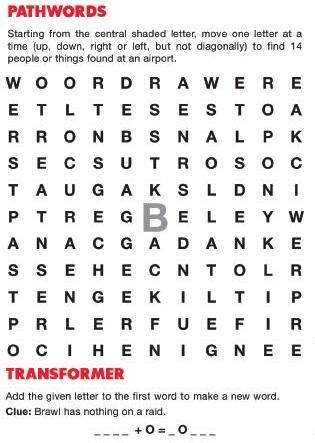

255 Seabank Road, New Brighton, Wallasey, Merseyside, CH45 1HE. Tel: 0151 638 0412 Email: ken@42multimedia.co.uk Portraits Weddings Commercial Print sales Tuitian Picture Framing Photo Restoration Studio Hire. Can you place the six dominoes (right) into the grid below in such a way that the number of spots in all four rows across and all four rows down totals 9? A B C DF E 12 34 56 CROSS CODE SPOT CHECK W O O R D R A W E R E O tarting from the central shaded letter, move one letter at a time (up, down, right or left, but not diagonally) to find 14 DIALLING CODES ROMAJI Here is an unusual word with three definitions, only one
which is correct. Can you identify the right definition?
1)
2)
3)
Telephone dialling pads combine several letters on one key. Here we have encoded several sets of words or items by using numbers rather than letters. Then we have divided them into groups of three characters and run all the names one after another to make your task a little more difficult. Can you crack the codes? 1. male first names 742 427 317 285 124 747 867 437 176 237 815 646 164 242 351 274 261 263 739 132 843 162 884 391 738 371 252 619 455 426 123 261 253 926 337 727 764 712 338 766 812 285 435 693 717 682 861 732 123 537 912 277 681 276 226 541 222 224 316 646 617 746 224 126 874 388 315 335 179 333 4 vegetables 2. means of transport 872 461 226 631 242 925 318 261 237 675 263 178 262 746 315 677 912 271 826 336 143 542 678 371 337 791 468 372 723 818 726 122 743 166 733 336 847 818 322 437 122 268 682 681 362 867 176 542 486 712 724 483 281 787 436 617 878 396 717 654 236 261 364 463 371 687 731 542 727 426 5 professions 3. surnames of English novelists 353 646 417 363 355 127 243 714 663 719 284 419 665 312 474 784 318 765 567 312 437 837 866 137 222 531 937 539 147 336 314 895 391 748 83 787 753 167 264 316 243 682 125 225 193 556 918 877 864 731 746 514 733 612 769 619 448 314 634 461 234 431 473 918 465 381 722 753 812 583 6 colours 1 [ ] ’ –2 ABC 3 DEF 4 GHI 5 JKL 6 MNO 7 PQRS 8 TUV 9 WXYZ Spaces and any punctuation marks are represented by 1. Each pair of words has a missing word between them that acts as a link to both (e.g. FRONT – DOOR – MAT). The initial letters of the six answers (reading downwards) will spell out a small creature. TURN – – – – GRAPES IN – – – – – – AGE LONDON – – – – – STEW AFTER – – – – HORSE DOUBLE – – – – – PHONE MOUNTAIN – – – – – – BID MISSING LINK In which year did all three of these significant historical events take place? 1. Spanish explorer Vasco de Balboa becomes the first European to see the
Ocean. 2. King
Scotland is
3. Giovanni
Florentine
Pope and takes the title of Leo X. WAS IT? a) 1453; b) 1473; c) 1493; d) 1513; e) 1533. MAKE A DATE _ _ _ _ + O = _ O _ _ _ Accumulator Quiz 1 – C; 2 – B; 3 – D; 4 – C; 5 – A; 6 – A; 7 – C; 8 – B; 9 – B; 10 – D; 11 – B; 12 – D; 13 – B; 14 – A; 15 – C. Starspot Crossword Across – 1 Kangaroo; 5 Help; 7 Guillemot; 9 Gait; 10 Pear; 11 Expel; 14 Twang; 15 Armed; 16 Recur; 17 Midge; 18 Canoe; 19 Tenth; 22 Rile; 24 Eton; 26 Expensive; 27 Whet; 28 Theology. Down – 1 King; 2 Glut; 3 Relax; 4 Obese; 5 Hoop; 6 Porridge; 7 Girandole; 8 Terminate; 11 Egret; 12 Pecan; 13 Larch; 14 Tomorrow; 20 Event; 21 Taste; 23 Exit; 24 Evil; 25 Navy. Star Name: MAGGIE
Word Wizard No 2 is correct. Romaji is a system of writing Japanese. Dialling Codes 1. Richard; Paul; Christopher; Robert; John; Michael; Brian; Andrew; David; Matthew; Peter; Alan; William; Adam; Alexander. 2. train; canoe; bicycle; van; aeroplane; submarine; lorry; car; tandem; helicopter; ferry; hovercraft; tram; barge; moped. 3. Fleming; Rendell; Archer; Innes; Waugh; Woolf; Christie; Trollope; Chesterton; Drabble; Wesley; Greene; Huxley; Shute. 4. parsnip; beetroot; ower;caulifl potato; pea; celery; carrot; broccoli; cabbage; onion; spinach; courgette; leek; swede. 5. dentist; teacher; accountant; doctor; solicitor; architect; surgeon; surveyor; policeman; engineer; nurse; librarian. 6. purple; orange; magenta; black; yellow; turquoise; pink; green; brown; white; indigo; beige; grey; violet; scarlet; blue. Spot Check A = 1; B = 4; C = 2; D = 3; E = 6; F = 5. Missing Link sour; person; Irish; dark; entry; rescue. Creature: spider. Make a Date The year was 1513. Transformer Fray + O = Foray. 58 42 697 31 6934 172 58 2173 589 64 4 2 8 5 9 3 6 1 7 3596 714 82 7618 425 93 9 7 2 1 8 5 3 4 6 8369 241 75 1457 368 29 4965 723 81 8179 632 54 2531 489 76 1 6 2 7 3 5 8 4 9 7482 195 63 5394 867 12 9 8 1 3 5 4 6 2 7 6248 971 35 3756 214 98 SUDOKU EASY SUDOKU DIFFICULT CROSS CODE 20 4 14 29 6 7 8 21 31 15 7 9 10 7 13 6 34 13 17 5 2 1 4 7 1 4 3 9 2 8 5 3 5 4 1 2 4 9 1 2 5 9 1 4 9 8 7 4 6 2 5 1 KAKURO MEDIUM
baggage; check-in desk; trolley; windsock; aeroplane; stewardess; bus; control tower; restaurant; passenger; fuel tanker; pilot; refi engine; helicopter. ALL THE ANSWERS EACH number in our Cross Code grid represents a different letter of the alphabet. You have three letters in the control grid to start you off.
the appropriate squares in the main grid, then use your knowledge of words to work out which letters should go
the missing squares.
fill
squares with the
grid and control grid.
letters
you identify them. A B C D E F G H I J K L M N O P Q R S T U V W X Y Z www.alltogethernow.org.uk JANUARY/FEBRUARY 2023 www.alltogethernow.org.uk 25
of
An Afrikaans nickname for an Englishspeaking person;
A system of writing Japanese using the Roman alphabet;
An American fish of a family related to the sea perches.
Pacific
James IV of
defeated by the English at the Battle of Flodden Field.
de’ Medici, a member of the ruling
family, is elected
SMITH
Pathwords:
Enter them in
in
As you get the letters,
in other
same number in the main
Check off the alphabetical list of
as
SLUM KID TO A SLUM KID TO A JA ZZ SUPERSTAR JA ZZ SUPERSTAR
AGROUP of boys temporarily escape their slum homes in north Liverpool to bathe their feet in the city’s famous Steble Fountain.

Little would they have imagined that one of them would go on to become a top international jazz star, working with the likes of music hall legend Josephine Baker, and movie greats Charlie Chaplin and Carmen Miranda
It may never have happened had William Gordon Masters succumbed to the pneumonia that made him severely ill aged four
Life was already tough for the boy of mixed Jamaican and Irish heritage, living in shabby court housing, suffering prejudice, and whose father – the son of a slave – had died at sea when William was a toddler He survived pneumonia and a year later his fabulous musical journey began when he sneaked into a show at Liverpool’s Haymarket Music Hall
As he sang along, he was spotted in the crowd and asked to perform William was so good that the manager invited
KEN PYE, managing director of Discover Liverpool, looks at the life of Liverpool jazz legend William Gordon Masters
n Ken has also just published his latest books – Beastly Merseyside, about the roles that animals have played in our local history; and Even More Merseyside Tales, the third volume in his collection of bizarre and unusual, but true, stories n The books are available in all good bookshops or from Ken directly,
him to join the troupe His mother gave permission and for the next three years he toured the North-West, singing and dancing at theatres and music halls
The young William suffered more tragedy when his mother died when he was aged
six He was then brought up by relatives in a very musical family, who encouraged him to keep touring

At the age of 17, and fast becoming an expert drummer and instrumentalist, he returned to Liverpool where, in 1904-5, he appeared in pantomime with American star, Billie Burke, who would go on to play Glinda the Good Witch in The Wizard of Oz
By 1908, at the age of 21, William was touring Britain as a leading member of the Jamaica Native Choir They appeared in many venues around Britain, including Liverpool’s St George’s Hall
He began performing as a jazz drummer from around 1910, but had already been a backing singer with Charlie Chaplin, who, before his break into films, was then a boy member of the Eight Lancashire Lads Clog Dancing Troupe They toured music calls and theatres around the country, including in Liverpool
Changing his name to Gordon Stretton, he was soon performing in jazz bands, appearing in venues in London and Paris In the French capital he met the legendary singer and dancer Josephine Baker Gordon not only performed in her shows but helped with her choreography In 1921,
he performed in New York, where he recorded as a member of the Syncopated Jazz Band, also known as The Syncopated Six
It was in that year that Gordon married his Irish wife, Mary Agnes, the pair eventually settling in Argentina’s capital city, Buenos Aires

By then an outstanding, world-renowned musician leading his own jazz orchestra, he was touring all over South America, and still performing in New York and Paris
He would later go on to write songs for Vera Lynn, broadcast regularly on the radio, play for Britain’s future King Edward VIII, teach Carmen Miranda how to sing and dance, and become known as “the man who brought jazz to Latin America”
Gordon died in 1982, aged 95, a long way from that barefoot boy at the Steble Fountain in Liverpool Indeed, shortly before his death he was singing in a show in Buenos Aires
While Gordon’s pioneering might not have directly affected Liverpool and its people, his story does show that anyone, regardless of background or heritage, who has the drive, ambition, and talent to make a real difference, can do so
FLASHBACK 26 All Together NOW! JANUARY/FEBRUARY 2023 www.alltogethernow.org.uk www.discover-liverpool.com Ken Pye – 0151 427 2717
FOUNTAIN OF YOUTH: 1865 A group of barefooted boys, including the budding international jazz star (fourth from the left) have fun at Liverpool’s famous Stable Fountain
DRM ROLE: William was an expert instrumentalist
BOY WONDER: Young William
Together NOW! is a valuable link to hundreds of thousands of disabled people We have used this free charity newspaper to promote the services of our mobility shops and the annual Disability Awareness Day and know that it is reaching huge numbers of people who otherwise would go uniformed ”

Dave Thompson Warrington Disability Partnership

“OF ALL the marketing that United Utilities puts into the community, nothing generates as much feedback and response as All Together NOW! It is a great platform that’s helping us to get our messages to our vulnerable customers ”

Louise Beardmore, Customer Services Director United Utilities

“WE’VE advertised in All Together NOW! for the past 14 years – and haven't missed a single issue It's a fantastic publication that does a brilliant job of presenting disability interests and issues in a positive and inclusive manner We get a great respons to our advertising –and the team is always great to deal with.”
– Donald Pow, MD, Allied Mobility



“WE HAVE proudly advertised in All Together NOW! for over 12 years It is an excellent newspaper, with endless, interesting and helpful facts for all readers
We have always received great responses to our advertisements



The newspaper is freely available to so many people throughout the North West and is appreciated by so many.
Heather Maddox, A-Line Mobility
“WE HAVE supported All Together NOW! for the past 14 years and are proud to be one of the charity’s main sponsors – recognition for the way in which the newspaper helps bring together so many people and organisations There is no doubting the importance of this excellent publication All Together NOW! makes a unique contribution to improving the quality of life of disabled people and their families We are delighted with the huge progress the paper has made, and we know from the number of telephone calls we receive from people who have read the paper that distribution is on the increase and is reaching the right audience ”
Steve Morgan CBE, chairman Steve Morgan www.alltogethernow.org.uk
ADVERTISING ADVERTISING
Registered Charity: 1106387 @ATNnews facebook.com/ AllTogetherNews/
. . . BRINGING PEOPLE TOGETHER You can benefit from our in-paper and online audiences with cost-effective advertising and sponsorship. Your advertisement will be seen by 250,000 local, and highly relevant readers – don't let your business miss out on our huge audience! Contact me now Helen McLoughlin Tel 0151 929 3912 07511 839397 helen@alltogethernow org uk All Together NOW! has been a real help to us We’ve been involved with the paper since its launch in 2004 and always get a great response to our adverts Here’s wishing the paper every success Steve Curran, co-director, DaVinci Mobility 250,000 250,000 “WE HAD a brilliant response to your article about our Atrial Fibrillation Ambassador programme –and lots of people phoned us to find out how they could become an AF Ambassador Thanks to All Together NOW! many more people with an irregular heart rhythm will now be detected, get the right medication and this will prevent them from having strokes ”
READERS
Agency “All
NHS Innovation
More than a newspaper – the key to independence COST-EFFECTIVE COST-EFFECTIVE
www.alltogethernow.org.uk JANUARY/FEBRUARY 2023 www.alltogethernow.org.uk 27












28 All Together NOW! JANUARY/FEBRUARY 2023 www.alltogethernow.org.uk Be part of this great paper, contact helen@alltogethernow.org.uk or call 07511 839 397 Want to be our friend? All Together NOW! is a charity newspaper, part-funded by kind donations from a wide-range of businesses and charitable We are extremely grateful for all the support we receive and could not continue to do what we do without it. Are you involved with a business that would benefit from brand exposure in front of our 250,000 readers, while at the same time showing your support for our multi awardwinning charity newspaper For an annual donation of just £500 (or more if you can afford it!), your organisation is invited to become a FRIEND of All Together NOW! Your logo will feature on our new FRIENDS of All Together NOW! page in six consecutive issues, alongside our other supporters At no extra cost, your logo and hyperlink will also be featured on our website and via our social media platforms. This is an ideal opportunity if you are a business that would like to show support to your community – and benefit from engaging with our readers This opportunity can also complement your advertising campaign, strengthening your presence in the newspaper For more information, email helen@alltogethernow.org.uk Well, now you can!
l UKH Foundation l Lee and Bakirgian Family Trust l Pilkington Charities Fund
l Geoffrey and Pauline Martin
Charitable
Trust l W O Street Foundation
