MAGAZINE
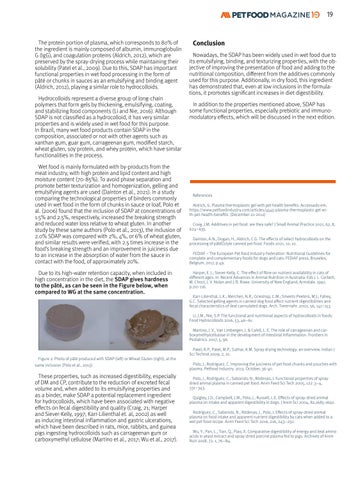
The protein portion of plasma, which corresponds to 80% of the ingredient is mainly composed of albumin, immunoglobulin G (IgG), and coagulation proteins (Aldrich, 2012), which are preserved by the spray-drying process while maintaining their solubility (Patel et al., 2009). Due to this, SDAP has important functional properties in wet food processing in the form of pâté or chunks in sauces as an emulsifying and binding agent (Aldrich, 2012), playing a similar role to hydrocolloids. Hydrocolloids represent a diverse group of long-chain polymers that form gels by thickening, emulsifying, coating, and stabilizing food components (Li and Nie, 2016). Although SDAP is not classified as a hydrocolloid, it has very similar properties and is widely used in wet food for this purpose. In Brazil, many wet food products contain SDAP in the composition, associated or not with other agents such as xanthan gum, guar gum, carrageenan gum, modified starch, wheat gluten, soy protein, and whey protein, which have similar functionalities in the process. Wet food is mainly formulated with by-products from the meat industry, with high protein and lipid content and high moisture content (70-85%). To avoid phase separation and promote better texturization and homogenization, gelling and emulsifying agents are used (Dainton et al., 2021). In a study comparing the technological properties of binders commonly used in wet food in the form of chunks in sauce or loaf, Polo et al. (2006) found that the inclusion of SDAP at concentrations of 1.5% and 2.5%, respectively, increased the breaking strength and reduced water loss relative to wheat gluten. In another study by these same authors (Polo et al., 2013), the inclusion of 2.0% SDAP was compared with 2%, 4%, or 6% of wheat gluten, and similar results were verified, with 2.5 times increase in the food’s breaking strength and an improvement in juiciness due to an increase in the absorption of water from the sauce in contact with the food, of approximately 20%. Due to its high-water retention capacity, when included in high concentration in the diet, the SDAP gives hardness to the pâté, as can be seen in the Figure below, when compared to WG at the same concentration.
Años
19
Conclusion Nowadays, the SDAP has been widely used in wet food due to its emulsifying, binding, and texturizing properties, with the objective of improving the presentation of food and adding to the nutritional composition, different from the additives commonly used for this purpose. Additionally, in dry food, this ingredient has demonstrated that, even at low inclusions in the formulations, it promotes significant increases in diet digestibility. In addition to the properties mentioned above, SDAP has some functional properties, especially prebiotic and immunomodulatory effects, which will be discussed in the next edition.
References Aldrich, G. Plasma thermoplastic gel with pet health benefits. Accessado em: https://www.petfoodindustry.com/articles/4545-plasma-thermoplastic-gel-with-pet-health-benefits. (December-21-2012) Craig, J.M. Additives in pet food: are they safe? J Small Animal Practice 2021, 62, 8, 624–635. Dainton, A.N., Dogan, H., Aldrich, C.G. The effects of select hydrocolloids on the processing of pâté‐style canned pet food. Foods 2021, 10, 10. FEDIAF – The European Pet food Industry Federation. Nutritional Guidelines for complete and complementary foods for dogs and cats. FEDIAF press, Bruxeles, Belgium, 2017, p.49. Harper, E. J.; Siever-Kelly, C. The effect of fibre on nutrient availability in cats of different ages. In: Recent Advances in Animal Nutrition in Australia. Eds J. L. Corbett, M. Choct, J. V. Nolan and J. B. Rowe. University of New England, Armidale. 1997, p.110-116. Karr-Lilienthal, L.K.; Merchen, N.R.; Grieshop, C.M.; Smeets-Peeters, M.J.; Fahey, G.C. Selected gelling agents in canned dog food affect nutrient digestibilities and fecal characteristics of ileal cannulated dogs. Arch. Tierernahr. 2002, 56, 141–153. Li, J.M., Nie, S.P. The functional and nutritional aspects of hydrocolloids in foods. Food Hydrocolloids 2016, 53, 46–61. Martino, J. V., Van Limbergen, J. & Cahill, L. E. The role of carrageenan and carboxymethylcellulose in the development of intestinal inflammation. Frontiers in Pediatrics. 2017, 5, 96.
Figure 2: Photo of pâté produced with SDAP (left) or Wheat Gluten (right), at the same inclusion (Polo et al., 2013).
These properties, such as increased digestibility, especially of DM and CP, contribute to the reduction of excreted fecal volume and, when added to its emulsifying properties and as a binder, make SDAP a potential replacement ingredient for hydrocolloids, which have been associated with negative effects on fecal digestibility and quality (Craig, 21; Harper and Siever-Kelly, 1997; Karr-Lilienthal et. al, 2002) as well as inducing intestinal inflammation and gastric ulcerations, which have been described in rats, mice, rabbits, and guinea pigs ingesting hydrocolloids such as carrageenan gum or carboxymethyl cellulose (Martino et al., 2017; Wu et al., 2017).
Patel, R.P., Patel, M.P., Suthar, A.M. Spray drying technology: an overview. Indian J Sci Technol 2009, 2, 10. Polo, J., Rodríguez, C. Improving the juiciness of pet food chunks and pouches with plasma. Petfood Industry. 2013. October, 36-40. Polo, J., Rodríguez, C., Saborido, N., Ródenas, J. Functional properties of spraydried animal plasma in canned pet food. Anim Feed Sci Tech 2005, 122 ,3–4, 331–343. Quigley, J.D., Campbell, J.M., Polo, J., Russell, L.E. Effects of spray-dried animal plasma on intake and apparent digestibility in dogs. J Anim Sci 2004, 82,1685-1692. Rodríguez, C., Saborido, N., Ródenas, J., Polo, J. Effects of spray-dried animal plasma on food intake and apparent nutrient digestibility by cats when added to a wet pet food recipe. Anim Feed Sci Tech 2016, 216, 243–250. Wu, Y., Pan, L., Tian, Q., Piao, X. Comparative digestibility of energy and ileal amino acids in yeast extract and spray-dried porcine plasma fed to pigs. Archives of Anim Nutr 2018, 72, 1, 76–84.