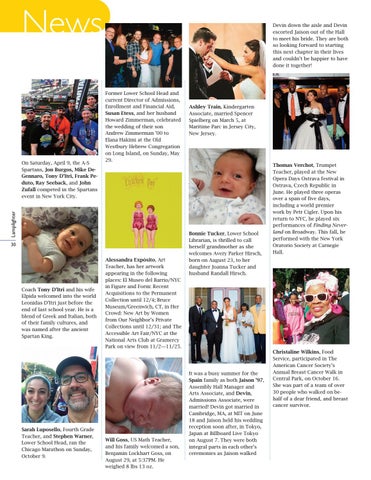
lamplighter
THE ALLEN-STEVENSON SCHOOL
Winter 2016
Leadership 2016-2017
THE ALLEN-STEVENSON SCHOOL
Board of Trustees
Mark I. Greene, President Ronald S. Rolfe ’60, President Emeritus Joshua Harris,Vice President & Treasurer Lisa Pagliaro Selz, Secretary David R. Trower h’95, Headmaster Dana B. Cowin Alexandra Wallace Creed Paquita Y. Davis-Friday Kerianne Flynn Kenneth M. Garschina
Alumni Council
Executive Committee Jamie Magid ’91, President Alfred Burger ’87,Vice-President Van Furniss ’91,Vice-President Tom Zipser ’99,Vice-President
Van Furniss ’91, Chair, Alumni Annual Fund Tom Zipser ’99,Vice-Chair, Alumni Annual Fund Alex Klaris ’06, Young Alumni Chair, Alumni Annual Fund
Ian Adler ’87 Theodore D. Agbi ’10 Charles W. Allen ’91 Paul E. Alshooler ’03 Basil L. Anderson ’08 Zach T. Axelrod ’95 Neil E. Bader ’79 Jackson Baker ’13 Anthony P. Bonan ’93 Pierre A. Bonan ’89 Robert B. Buehler ’78 Robert D. Burge ’76* Andrew A. Burger ’59 John T. Carr III ’76 Kai Cedeño ’16 Erik A. Cliette ’81 Brooke B. Connell ’86
Parents Association
Fredda Goldberg* Stephanie Drescher Gorman George Hall Monica Keany Peter B. Kellner ’84 Alexander Klabin Michael S. Klein Rashida LaLande Daniel Lascano Paul A. Leff Jamie Magid ’91* Greg Mondre Metin Negrin
Charles Domash ’04 Adam J. P. Donaldson ’05 Maurice F. Edelson ’78 Kerim Eken ’00 Hugh Esterson ’15 Alexander C. Faherty ’98 Jason M. Farkas ’97 Michael Feinberg ’84 Andrew Galant ’14 Alexander G. Gellert ’79 Andrew Gellert ’16 David Goldberg ’14 Harlan E. Goldberg ’90 Evan R. Goldfischer ’81 Christopher S. Goodman ’86 Michael H. Grady ’91 Christopher J. Hallows ’87 Christopher W. Hamilton ’96 Schuyler Havens ’88 Michael W. Hedges Jr. ’77 John C. Henry Jr. ’84 Cannon Lyell Hersey ’92 John B. Hersey ’09 David W. Herzberg ’89 David R. Hirschfeld ’99 Patrick D. R. Horan ’85 Tristan Howard ’96 C. Andrew Hughes ’98 Alex A. Ingram ’03 Andrew A. Janko ’95
Fredda Goldberg, President Liz Steinberg,Vice President Kate Krieger and Shilpa Gupta, Co-Treasurers Bethan Willis, Class Representatives Coordinator
Lara Oboler Anupama Poole
*member ex officio
Trustees Emeriti Mildred J. Berendsen Marian R. Bicks Jane Phillips Donaldson Richard N. Foster D. Ross Hamilton John J. Hannan Susan B. Hirschhorn
Jasper H. Jarecki ’12 Clinton V. P. Johnson ’79 Timothy Johnson ’04 Stephen H. Judson ’76 William H. Judson ’78 Devon Kalsi ’15 A. Reed Katz ’03 Cameron A. Koffman ’12 Kenneth LaFreniere ’90 Dean I. Landis ’78* Teddy Landis ’13 Ethan A. Leff ’11 Davis Lister ’15 Hale Macdonald ’13 Paul J. Mancuso ’03 Brian A. Margolis ’75 Timothy C. McCabe ’94 Kenneth J. McCauley ’93 Elijah McNally ’14 Alex Melnitzky ’02 Liam R. Millhiser ’96 Ross R. Millhiser IV ’94 Max Morris ’13 Richard C. Perry ’70* Christopher Persley ’88 Vincent Peterson ’74 Philip N. Pilmar ’01 Roger Raines ’80 Harlan Reinhardt ’83 Marc N. Rice ’84 Ronald S. Rolfe ’60*
Administrative Team
Karen T. Hughes John R. Hupper '40 E. William Judson Robert J. Katz George A. Kellner David H. Koch Robert Liberman '58 Thomas H. Lister Peter de F. Millard Richard C. Perry '70 Joe L. Roby Andrew P. Steffan Leonard A. Wilf
Eric Rosas ’06 Berton Rose ’97 John Rose ’90 Louis Rose ’86* Henry J. Rosenwach ’04 Eric E. Rothstein ’81* Dean E. Sanborn ’61 Alessandro M. Santoro ’07 Matthew Schnitzer ’13 Yoshiki Shimada ’75 Alexander B. Shipper ’02 Denton A. Smith ’94 Wesley Stanton ’92 Sebastian Stern ’14 Jake Taub’12 Khalid A. Taylor ’10 Michael Tiedemann ’86 Andrew W.Vogelstein ’81 Noel E.Volpe ’85 Alexander von Furstenberg ’85 Mark Wasserberger ’82 Simon D. Wasserberger ’85* Matthew Wayland ’13 Michael Weiss ’02 Dewey S. Wigod ’77 Hans L. Wydler ’81 Clifton G.York ’78 Jared Zelman ’16 Andrew E. Zimmerman ’00
* President Emeritus
David R. Trower h’95, Headmaster Stephen Warner, Lower School Head Kimberly Kyte, Middle School Head Neal Kamsler, Upper School Head Winnie Barnes, Director of Strategic & Learning Initiatives Anne Russo Meyer, Director of Learning Resources Richard Alifano, Director, P.E. and Athletics Hydee Bressler, Director of Finance & Operations Casper Caldarola, Director of Communications Michelle Demko, Music Department Head Susan Etess, Director of Admissions, Enrollment and Financial Aid David Smith, Director of Development Andy Zevon CCA.CCT.CNE, Director of Technology
lamplighter THE ALLEN-STEVENSON SCHOOL
Director of Communications Casper Caldarola
Associate Director of Communications Sarah Woods
Contributing Writers Rich Alifano Fredda Goldberg Sarah Kresberg Anne Meyer Samara Spielberg Mary Meeley Terry David Trower h‘95 Photographers Nancy Mitchell Tara Parsons Al Pereira Louisa Wells
Designer Mase Kerdel-DeMarco
Cover photo of the All School Picinic by Louisa Wells Back cover photo of Founders Day 2016 by Louisa Wells
The Allen-Stevenson School admits students of any race, color, religion, nationality, or ethnic origin to all the rights, privileges, programs, and activities generally accorded or made available to students at the School. It does not discriminate on the basis of race, color, religion, nationality, ethnic origin, or sexual orientation in the administration of its educational policies, admissions policies, employment policies, financial aid program, or any other programs administered by the School.
Winter 2016
Headmaster’s Message
2
Around A-S
4
Welcome New Members of Our Community Features:
Library Tech Commons Vision
Why We Have STEAM at Allen-Stevenson
Striking the Right Balance
The Evolution of Athletics and Physical Education
10 16
18 21
at Allen-Stevenson
23
The PA Keeps Learning
25
News
30
One Language, One Community Faculty Grants
Closing Exercises 2016
24 26 31
Alumni Events and News
39
Did You Know?
48
The Lamplighter is published biannually by The Allen-Stevenson School and is sent to alumni, parents, and other friends of the School.
Printed on paper containing 20% post-consumer recycled content.
Lamplighter 2
David Trower and his Book Group
M E S S A G E
“It is no longer enough simply to read and write. Students must also become literate in the understanding of visual images. Our children must learn how to spot a stereotype, isolate a social cliché, and distinguish facts from propaganda, analysis from banter, and important news from coverage.”—Ernest Boyer, former President, Carnegie Foundation for the Advancement of Teaching This past summer I had the delightful opportunity to participate in a seminar at the Harvard Graduate School of Education that was grandly entitled “The Future of Learning.” Though in fact it was inconclusive about learning’s future, the seminar was intellectually quite stimulating. We had excellent presenters, including the legendary Howard Gardner and David Perkins, among a number of other luminaries. Even more interesting were some of the learning strands: the influence of globalization on schools, the disruptive impact of technology and social media on how children learn, and the powerful insights that the field of neuroscience is documenting about how the human brain works.
As I listened to various perspectives on “The Future of Learning,” it occurred to me that Allen-Stevenson is well served by its “enlightened traditional” approach to education. For decades we have balanced the three A’s—academics, athletics, and the arts— in our educational program. Put into relation with each other, these domains represent many ways to be successful and many ways to be a boy. Nevertheless, even within this framework, there are countless examples of how our educational program has changed over time. To this point, I usually explain the concept of “enlightened traditional” by noting that we care about what Allen-Stevenson has taught in the past and always want to think about how best to educate boys to prepare them for their futures. This issue features articles that illustrate how education at Allen-Stevenson continues to evolve, even after 134 years of the School’s history. Several pieces describe new courses like STEAM or fresh emphases in the curriculum, while others pose challenges to balance the old and new or to use technology most effectively. Further, the article about our vision for the new Library Tech Commons actually blends all of these strands to build on the past and educate for the future. The possibilities are endless, and the results are
exciting! We hope that you will enjoy these articles and share your thoughts about them with us. As we develop new, much needed facilities in our ambitious construction project, this thinking and planning process has accelerated. It has been exhilarating to develop the facility requirements that can support what we do educationally. The task includes anticipating such flexibility as to enable Allen-Stevenson to continue to evolve its program in an “enlightened traditional” manner for a long time to come. That said, however, I still employ a strategy we adopted years ago. It says: Our collective challenge is to prepare for the future. As an elementary school for boys, the School will continue to offer an excellent, comprehensive education to a diverse population of qualified students. As we continue to assess both our internal program and the external environment, we will identify opportunities to strengthen the School, to meet the needs of New York City families, and to sustain an outstanding faculty. Today schools like Allen-Stevenson face many new tasks and opportunities, while the resources of time, money and space are not unlimited. No school can do everything, of course, but the key is to provide such a variety of experiences and challenges that each student develops a firm intellectual and personal foundation to navigate the chapters that will follow through life. So it is often continuity with the past that grounds the changes we think we should make. In this sense, school may perhaps best be thought of as “practice” for the rest of every student’s life, so the balance of academics, athletics and the arts can make all the difference in fostering grit and resilience. Such “practice” gets at the skills and habits of mind that Ernest Boyer describes in the quotation above. Thanks to all of you for your support and encouragement in this endeavor. Fortiter et Recte!
David Trower h’95 Headmaster
Winter 2016
message
H E A D M A S T E R ’ S
3
around A-S Lamplighter
In & out of the classroom >
4
Celebrating Hispanic Heritage Month in the Lower School
The third graders picked up their Kindergarten buddies and walked them to the Assembly Hall hand-in-hand. All Lower School grades were seated in concentric circles on the floor creating a welcoming space for all. This arrangement was newly introduced to the Lower School at the start of the year under the guidance of Lower School Assembly Coordinator, Erik Resurreccion. The assemblies are building on the theme of “Making Room for Everyone at the Table,” as presented by the storyteller Bill Gordh at an assembly earlier in the year.
“The goal in adopting this new format is to make all members of our community feel welcome and celebrated as part of the Allen-Stevenson family. Celebrating Hispanic Heritage Month was a natural extension of this theme,” said Mr. Resurreccion.
As is the tradition, two third graders, in this case, Dylan Bird ’23 and Sebastian Irausquin-Petit ’23, were the emcees for the morning. They began by asking those whose birthdays were in October and those who speak Spanish at home to stand. Everyone gave them a hearty Allen-Stevenson cheer!
In honor of Hispanic Heritage Month, Mr. Resurreccion taught the Lower School boys two new Spanish songs, “De Colores” and “Al Tambor,” with guitar accompaniment by him, Ginny Rowe, Second Grade Teacher, and Chris Brozyna, Third Grade Teacher. Ian Taggart, Lower School Music Teacher, played the drums, with a suitable highlight in “Al Tambor,” which means “to the drum.” Sebastian led the Lower School in a spirited singing of “Che Che Koolay,” a West African song most of the boys knew and sang with gusto! The morning closed with another favorite, “In the Very Middle,” and The Allen-Stevenson School Song.
Lower School Community Assembly
Paul Boorady ’22, William Tighe ’22 and Oliver Willis ’22 using the hand drill in woodshop
The fourth grade boys in woodshop classes with teachers, Tara Parsons and Dr. Rob McCallum, begin their unit on pinball machines by taking a field trip to The Museum of Modern Pinball to learn the science behind these machines. Modern Pinball’s Dr. Steve Marsh, a scientist with a doctorate in science and engineering, explains to the boys the physics involved in a pinball machine, describing the concept of electromagnetics and the fact that gravity is the main force in a pinball machine.
Tara Parsons said, “Since we started including the field trip as an introduction to this project a couple of years ago, we have found that all the boys immediately understand the mechanics of the machine and recognize that to make the pinball machine work it has to be built on a slant.” The boys take this knowledge back to the woodshop as they work in small groups, problem-solving to create
their own simple pinball machines. Designing and planning on paper, measuring and sawing the various sized pieces of wood, drilling the correct size holes for the ball launch and the kickout holes, and analyzing the mechanics for the launch and flippers are all steps in the creation of these unique and fullyfunctional pinball machines.
Winter 2016
Fourth Graders Design Working Pinball Machines
5
Dr. Steve Marsh explains the physics of pinball machines.
around A-S Lamplighter
In & out of the classroom >
6
English Teacher Anne Rawley explains prepositional phrases.
Kahoot! Provides Excellent Grammar Test Review A large number of enthusiastic seventh grade boys, seeking a fun and innovative way to review for their grammar test, logged in to a Kahoot! quiz on their computers during a morning study hall. Anne Rawley,
Seventh Grade Teacher, worked with Luke Jovanovic ’19, who had used this format for review in other classes and thought it would be a fun way for him and his classmates to prepare for their upcoming grammar test. Luke showed Ms. Rawley the technical aspects of the program; then she set up the questions and the plan for playing and scoring.
Grammar review using Kahoot!
After each question was scored, Ms. Rawley talked to the boys about that particular part of speech. Tricks for remembering rules were reiterated, including the singing of a song about what constitutes a helping verb. Sentences used in the questions were pulled from stories and books the boys have read so far this year. Ms. Rawley said, “Having a contest to help the boys review was definitely appealing and seemed to be effective. We will know for sure tomorrow!”
Alec Barrett ’04
He is a native of New York City who first developed a passion for the intersections of social injustice and education reform at The Allen-Stevenson School. Alec, who went on to graduate from Dalton and Harvard, can trace many of his classes and extracurricular activities in high school and college back to his days at A-S. His fondest memories include playing the flute in the orchestra and studying French. After graduating with a Master’s of Education, Alec became a data analyst at a non-profit organization and joined his local community board. Alec seeks to use his education at top schools to affect public policy to combat structural inequality worldwide.
SPEECH By ALEC BARRETT ‘04
Good morning. Thank you, students, teachers, staff, and administrators, for being here today, and thank you Mr. Trower and Mr. Kersey, for extending the invitation to me to be your Founders Day speaker. It’s great to be back at A-S, and I’m happy to see so many friendly, familiar faces who were here when I graduated 13 years ago, and some who were even here when I started 22 years ago.
When I was asked to speak today, a flood of memories came back to me. Some of the most joyful moments of my life happened at Allen-Stevenson. I could talk about that all day, but I’ll share just a few of them.
I remember discovering a love for maps when, in Mr. B.’s class, we created a clay world of peninsulas, archipelagos, and, unforgettably, the Isthmus of Christmas.
Winter 2016
Founders Day >
Under Ms. Demko’s direction in Middle School, I felt the thrill of singing on stage as a lovesick maiden—lovesick all against my will—in that year’s G&S, Patience. I remember the excitement of learning to build complex structures in shop -- a cabinet with a sliding drawer, a box with a hinged top -- and the privilege of being allowed to use machine tools like the band saw.
In eighth grade, Mr. Schrade gave me the honor of playing the piccolo solo in “Stars & Stripes Forever”, which I pulled off after months of practice with Ms. Lakota’s help.
Of course, I had plenty of embarrassing moments here, too. In 7th grade we put on the play Inherit the Wind, which tells the story of a trial. I was the judge, and during one performance I completely forgot one of my lines. The line I forgot wasn’t just casual conversation; it came at a really important part of the play. I was supposed to ask the jury for its verdict—instead I went straight to the sentencing. Mr. Kersey was pretty annoyed, but he expressed it in the form of a history lesson: he said, “What is this, Alec, the Soviet Union??” (If you don’t understand that joke, ask your social studies teacher to explain it to you.) I remember once in Middle School sitting on stage and being asked to spell “Australia”. I can’t remember if it was a geography question in the Spelling Bee or a spelling question in the Geo Bowl. But regardless, I confidently buzzed in, only to get it wrong. So now I’ll never forget: it’s “Australia” not “Austraylia”; there’s no extra “y”.
7
around A-S Founders Day
But those were learning experiences, too. Sometimes making a mistake teaches you more than never messing up. By the time I graduated from Allen-Stevenson, all of those experiences, the joyful ones and the awkward ones, the victories and mistakes, left me ready to take on high school and college.
After graduating from 8th grade I went to Dalton, then Harvard. They were great schools that required a lot of hard work to be successful. In college I majored in government and minored in history, and I met some of the smartest and most interesting people I know.
Lamplighter
Throughout my education, from A-S to Dalton to Harvard, I didn’t just learn to answer the questions “who,” “what,” and “when”: facts and formulas, grammar rules and chemical equations. I also learned “why” and “how,” like when Mr. Herschenhous told a story about giraffes to explain why on evolution—spoiler alert!— Lamarck was wrong and Darwin was right.
8
Brandon Poole ’24 and Austin Greene ’19 create an A-S birthday card for alumni.
And perhaps most of all, I learned how to learn. Believe it or not, after all these years of school, I still find myself in situations when I need to teach myself something new. I have had two jobs since college, and both of them required different kinds of learning.
My first job was teacher. I spent two years teaching math in Mississippi (that’s one place whose name I can spell!). Teachers have so many different responsibilities, from preparing lessons every day to keeping track of how each student is progressing throughout the year, which take tremendous energy and skill. Those two years gave me new appreciation for my own phenomenal teachers, many of them in this room. I didn’t go to school to become a math teacher, so I spent a lot of time learning by practicing the lessons I would give and observing other teachers. I was trained by an organization called Teach for America, which prepares college graduates to work in public schools across the country. TFA teachers work in schools that usually don’t have beautiful buildings, cutting edge technology, or wonderful arts programs the way A-S does.
Now I am a data analyst, which means I collect lots of pieces of information and look for interesting patterns or conclusions. I work with public schools here in New York City. I take data about students—everything from attendance to grades to test scores—to help principals answer questions about their school. Principals are some of the busiest people in the world, so I write computer programs to produce graphs and summaries that can quickly give them the information they need. I didn’t go to school to become a data analyst or a computer programmer. Honestly, if I could do it over again, I would take more computer science classes. I’m glad that you start studying robotics and coding in Lower School; we didn’t do that twenty years ago. Even without much formal training, I was able to take what I already knew from math class and resources at my fingertips, especially online videos, to acquire a brand new skill. I was grateful that, even though I didn’t learn coding in school, my education prepared me to absorb new information years later.
I think about education both on a personal level—the education I received—and on a system-wide level—how the public school system works in this country. Unlike Allen-Stevenson, which is an independent school, public schools are managed by the government. I was very fortunate to receive the education I did; my family sent me to great independent schools. In fact, everyone I knew growing up went to a great school, including some outstanding public schools. In parts of this city and this country, though, many kids don’t have that same privilege. An independent school might be too expensive, and the nearby public school might not be very good. When I lived in Mississippi, and worked in a not-so-great school, I saw firsthand that this is a big problem. It’s a problem that a lot of kids in this country can’t get a great education, even if they come to school every day, ready to work hard. A lot of kids don’t have the opportunity to reach their highest potential in the classroom, on stage, or on the field. All because of what neighborhood they happen to live in, and what kind of school their family can send them to. It’s sad and
unfair that these kids might not get to discover their talents. This is a challenge for our city and our country, and it’s why I do the work that I do.
The way I think about fixing this problem is based on something Mr. Kamsler used to say...and I’m guessing he still says it. We learned about bullies, victims, bystanders, and upstanders. We learned that if you see someone picking on a classmate, or saying something behind his back, or doing something that you knew wasn’t right, you could choose to watch and say nothing—be a bystander—or you could choose to stand up, tell the bully that what they did was wrong, and help improve the situation.
I think we can approach problems we see in the world the same way. Sometimes we see things that are wasteful, or unfair, or just wrong. In a lot of cases, like the fact that some kids don’t have the opportunity to go to a great school, there isn’t a clear bully who caused the situation. (It’s not like the Mayor or the President made some schools good and some schools bad.) But there are definitely victims—like kids whose schools don’t have shop, or soccer, or even a library in their building, and who graduate without receiving a great education. And there is definitely a choice about whether you want to be a bystander or an upstander. Making public schools better is a very complicated problem that can’t be fixed by one person. Instead, it’s the kind of thing that can only change if lots of people pay attention to it and recognize opportunities to do something about it when given the chance. And that’s actually why it’s so important to do something, especially if you can’t fix it by yourself. A bystander thinks, “someone else will fix this.” An upstander thinks, “we all need to fix this.” It’s also easy to think, if you are a bystander, that this isn’t your problem. But we forget that even if we are not the victim in this situation, we may still be getting hurt indirectly. And when you choose to be an upstander, it’s important to work with the victim or victims, and understand how they feel, so that they too will be empowered to stand up to right the wrongs.
Winter 2016
These schools also don’t have enough great teachers. TFA looks for smart, energetic people and helps them to become teachers any student would be lucky to have.
I see our education system as the place where I want to be less of a bystander and more of an upstander. Now I want you to think about a problem that you see in this city, this country, or around the world. Some problems are hard to recognize when you can’t tell who or what is causing it. You might feel like it’s not worth trying because it’s too big or complicated for one person to solve. Just because you can’t fix a problem doesn’t mean you can’t make a difference. And your impact has a ripple effect: when other bystanders see you take action, they will take action, too. I found a cause I care about, and I choose to stand up, make it known that things should be better, and do my part to make it that way. I hope you will too.
Daniel Simmons ’18 and Daniel Cocklin ’26 drawing together
9
Welcome
WELCOME NEW TRUSTEES
Greg Mondre
Lamplighter
Greg Mondre is a Managing Partner and Managing Director of Silver Lake, a private equity firm focused on technology investments. Prior to joining Silver Lake in 1999, Greg was a principal at Texas Pacific Group, where he focused on private equity investments across a wide range of industries, with a particular focus on technology. Earlier in his career, Greg worked as an investment banker in the Communications, Media and Entertainment group of Goldman, Sachs & Co. He currently serves as a director of Avaya, Inc., Fanatics, Inc., GoDaddy, Inc., Motorola Solutions, Red Ventures, Sabre Holdings and Vantage Data Centers.
10
Greg grew up in Ft. Lauderdale, Florida, and attended Pine Crest Preparatory School. He graduated from The Wharton School of the University of Pennsylvania with a B.S. in Economics. Greg’s wife, Alex, joined the Board of Trustees at The American Museum of Natural History in 2015. They have two sons, Jake (1st Grade) and William.
Rashida LaLande
Rashida LaLande is a partner in the New York office of the law first Gibson, Dunn & Crutcher. Rashida’s areas of practice include mergers and acquisitions and leveraged buyouts. She represents companies and private equity sponsors in the consumer products, retail, financial services and technology industries. Rashida received her Bachelor of Arts from Harvard/Radcliff College and her JD from Columbia University School of Law. She is on the Board of Democracy Prep Endurance Charter School in Harlem, the Board of the Boys Club of New York and the Brotherhood/SisterSol. Rashida is also an Ambassador for the Smithsonian Museum of African American History and Culture.
Rashida’s husband, Derrick Diggs, is the President and Director of Business Development for Diggs Construction. He manages strategic planning and business development for the company and is responsible for marketing, public relations and new business nationwide. Rashida and Derrick have one son at Allen-Stevenson, Dechen (4th Grade), a daughter at Dalton and two younger children.
Susane Etess, Director of Admissions, Enrollment and Financial Aid
CC: Not only are you in a new position, but the title for the
position has changed. Please explain the new title: Director of Admissions, Enrollment and Financial Aid.
SE: The role of admissions director has changed a great deal in the last 7 to 8 years. In 2008 when the financial crisis hit, admissions at independent schools was also affected. Admissions offices could no longer wait for applicants; they needed to be more proactive. Now, the role I have is one of steward. We look for great candidates and once accepted, we monitor their experience throughout their time at AllenStevenson and use this information to strategically assist the family and the School. The goal is a successful experience and relationship for the boy, the parents and the School. CC: What are your goals for your first year?
SE: I want to make sure each prospective family is welcomed,
feels good about the admissions process, and knows their experience at Allen-Stevenson is personalized. We are also reaching out to new pre-schools through admissions fairs and preschool directors. I have already been to several school fairs and preschools this year, and have represented Allen-Stevenson on a few panels for Admissions Directors. I am also invested in our current parents being our admissions ambassadors and recommending exemplary families.
CC: What questions do you hear most during interviews?
SE: It’s fascinating to hear why prospective parents have come to Allen-Stevenson. I have heard that our website is “enlightened / traditional” with the addition of all the videos and the news stories. The most asked question so far is, “What is the school thinking about for the future?” And the most complimentary question I’ve heard is, “Why would anyone turn down this school?” I couldn’t agree more! It has truly been so enjoyable meeting and spending time with these families. CC: What are your hopes for your first admitted class?
SE: I am very excited to put together my first class and I hope to attract and enroll a broad group of boys and families to Allen-Stevenson. There is no doubt bringing in families from different geographic areas, many different cultures, religions, family structures and races enriches our community and enhances the education all Allen-Stevenson boys receive. AllenStevenson has always been an incredible school dedicated to educating well-rounded boys through the 3 As—academics, athletics and the arts—to become scholars and gentlemen!
CC: What changes are you bringing to the boys in the curriculum or in events?
SW: One major change we have made is to the Assembly
Program. We will continue to have each class have a dedicated performance. One of the hallmarks of an A-S boy’s education is his ability to speak confidently in public. In addition, whenever we don’t have a play, storyteller or musical performance, we plan to push back the seats and sit on the floor in concentric circles for what we are calling “Community Time.” The goal is for the boys to literally see each other and embrace the Lower School community. Each third grade boy has a kindergarten buddy, and they enter holding hands and sit together.
CC: What changes have you asked faculty to be open to and consider?
SW: I’ve asked faculty to take a critical look at everything we do with fresh eyes. As I said in our opening meetings, I have the utmost admiration for the job they do, and we have many time-honored traditions that are wonderful.
On our October Professional Development Day we came together as a Lower School faculty and I asked each person to join one group and spend time exploring what they like about what we do and, more importantly, make suggestions as to how we might make improvements.
CC: What changes have you introduced to the parents?
SW: I know our parents appreciate the work of the homeroom teachers and often that is the focus of their attention on curriculum night since this is where their sons spend the majority of the day. This year, I wanted to also highlight the wonderful work of our specialists and have the parents “meet” them all. The video that was created showcased each specialist and went a long way towards helping parents see what an integral part of the program these teachers play.
I plan to take a critical look at all events that involve families to see how, if at all, we might improve the experience for everyone. I also am considering the idea of incorporating some additional ones, including an event for the all-important caregivers to help introduce them to our faculty and programs since they are instrumental in the work we all do in raising Allen-Stevenson boys.
CC: What are your thoughts about your first Kindergarten class as Lower School Head?
SW: I have thoroughly enjoyed spending time in each
Kindergarten class. I have made it a goal to try to be in each room for an extended period of time as often as possible so I can get to know the boys.
This Kindergarten class will be a special one for me, as we will grow up together at Allen-Stevenson.
Winter 2016
Allen-Stevenson is fortunate to have two seasoned professionals taking on new roles this year. Susan Etess is now the Director of Admissions, Enrollment & Financial Aid, and Stephen Warner is now the Head of the Lower School. Director of Communications Casper Caldarola sat down with each to hear about their goals and vision for their new roles.
Stephen Warner, Head of Lower School
11
Welcome WELCOME NEW SIBLINGS & LEGACIES
Beau ’25, Oliver ‘26 and Nathaniel ’23 Bisceglie
Lamplighter
Oliver ‘26, Liam ‘26 and Ethan ‘24 Aina-Wilson
12
Nicholas ’26 and Sebastian ’26 Bral
Derek ’25 and Daniel ’26 Cocklin
Cameron ‘26 and Kai ‘22 Gosebruch
Ben ‘24, Kris ‘95 and Sidney ‘26 Harris
Maximilian ‘25 and Sebastian ‘26 Colvin
Trey ‘24 and Will ‘26 Patrick
Benji ‘26 and Stanley ‘85 Shashoua
Winter 2016
Trevor ‘26 and Tyler ‘24 Parrot
13
Harrison ‘26 and Marshall ‘23 Smith
Maurya ‘23 and Agastya ‘26 Srivastava
Welcome W E L C O M E N E W F A C U L T y A N D S TA F F
Lamplighter
Studies from Hunter College in New York City. Outside of school, Jonathan enjoys anything fitness related and participates regularly in obstacle course races. He also enjoys experimenting in the kitchen, playing the guitar, and furthering his knowledge on fitness trends.
14
Christopher Brazee joined Allen-Stevenson as Technical Support Specialist in April 2016. Chris’s past experience includes nine years as an Apple Genius, where he provided support on Mac computers, iPhones and iPads, mentored and trained new hires and existing team members across the New York City market. Chris has also performed and toured with the band Milagres. Chris has a B.A. in Music Business and Technology from Millersville University. In his spare time, Chris likes writing and recording music, playing with gadgets, and reading.
Jonathan Burgos joins AllenStevenson as Athletics Associate. Jon has been an Athletics Coach at Allen-Stevenson for the past three years, coaching track & field, wrestling and soccer. Concurrently, he has served as a Certified Personal Trainer, specializing in strength and conditioning, as well as a wrestling coach for Grapplin’ Gorillas and an Associate Teacher at the Pono Learning Center. Jon has a B.A. in English and Media
Ceramics from Rhode Island College and a M.Ed. Educational Technology from Lesley University. In 2013, Peter was chosen to help a team of volunteers decorate The White House for the holidays. Peter enjoys outdoor activities, exercise and spending time with his partner Jon, son Oliver and their dog Rufus.
Clarissa Crowley joins Allen-
Fabricia Calcavecchia joins Allen-Stevenson as a Spanish Teacher. Fabby was born and raised in Rio de Janeiro, Brazil, and is fluent in Portuguese, Spanish, Italian and English. She has taught Spanish in a number of schools in the New York City area, including Kew Forest School, Trevor Day School, British International School and the Epiphany School, and was most recently the head teacher at the Summer Immersion Program at Avenues: The World School. Fabby has a B.A. in Spanish from SUNY, Albany, and an Ed.M. in Teaching and Curriculum Secondary Education from the College of Saint Rose in Albany, N.Y. In her free time, Fabby likes to read, workout, take long walks and go to out to brunch with her friends.
Stevenson as a Learning Resource Specialist. Clarissa has four years of teaching experience with students in Grades K-4 at the West End Day School in New York City, establishing daily routines and procedures for a diverse population of students. At the same time, she is a private tutor at LREI (Little Red Elizabeth Irwin) High School. Clarissa holds a B.S. in Childhood Inclusive Education from State University of New York at Fredonia and an M.S. in Special Education from Hunter College. In her free time, Clarissa likes to spend time with friends and family, cook and practice yoga.
Peter Fletcher joins Allen-
Stevenson as the Academic Technology Integrator. Peter served as a Technology Integrator at The Mandell School in New York City for the past five years. In the 10 years prior to that, he was an Art/Technology Specialist at the Aaron School in New York City and was Director of the Arts Program at the Paul Cuffee Charter School in Providence, R.I. Peter has both a B.S. in Art Education and a B.A. in Studio Arts—
Jasmine Greene comes to Allen-
Stevenson as a Third Grade Associate and Co-Director of Alligator Soup. Jasmine was most recently an Assistant Teacher at Brooklyn Friends School. She is also the founder and CEO of a successful summer camp, afterschool and tutoring program called AGAPE Education Group. Jasmine has a B.A. in Elementary Education from Eastern Michigan University. In her spare time, Jasmine likes to write poetry, read a good book, and eat!
Brad Grimmer joined Allen-
Brenna Kelly joins Allen-
Stevenson as Director of Annual Giving. Most recently, Brenna was Development Associate at The Brearley School in New York City and prior to that Development Assistant at Cambridge in America. Brenna has a B.A. in English from Davidson College in North Carolina. In her free time, Brenna is an avid reader, fitness enthusiast and a golf neophyte.
Ryan Strong joins the Allen-
Natalie Lopez joins Allen-
Stevenson as a Spanish Teacher. Natalie has a B.A. in Spanish Adolescent Education from SUNY at Geneseo and completed an intensive summer Spanish course at Universidad de Oviedo in Oviedo, Asturias. Natalie was most recently a Student Teacher for the Canandigua City School District and the Webster Central School District, with additional field experience in the Mount Morris Central School District, all in New York State. In her free time, Natalie enjoys, cooking, playing the piano and spending time with family and friends.
Stevenson Development Office as the Manager of Alumni and Special Events. Prior to joining the School, he worked as a development assistant at his alma mater, Sarah Lawrence College, where he studied literature. During his free time he is an aspiring author. As such, he spends the bulk of his weekends in Brooklyn working on his first novel.
Kimberly Weber comes to AllenStevenson as a Fifth Grade Teacher. Kim is expected to complete her M.S. in Education Administration in March 2017 from Fort Hays State University in Fort Hays, KS. She has a B.S. in Human Development from Caly Poly State University in San Luis Obispo, CA, and has completed a Multiple Subject Teaching Credential Program from San Francisco State University in California. Kim’s sixteen years of teaching experience includes serving as a Fourth Grade Head Teacher at The Mandell School in New York City and teaching Grades 3-5 in the Nevada City School District in California. In her spare time, Kim likes to go running, backpacking, and salsa dancing.
Louisa Wells joins Allen-
Stevenson this year as Communications Coordinator. After receiving her B.A. in Communication Studies from Vanderbilt University, Louisa moved to New York where she worked in e-commerce and digital marketing in L'Oreal's Luxury Division. Most recently, she worked at womenswear design studio, Tanya Taylor, helping to launch the website and online business from scratch. Earlier this year, she was featured by Instagram and in the NY Post for her Instagram consultation work. Louisa enjoys staying up-to-date with social media technology and trends, photography, taking hip hop dance classes in the city, and slowly crossing New York's best restaurants off her bucket list.
Winter 2016
Stevenson in January as Campaign Coordinator. Brad was previously with Trinity School as Advancement Associate for Special Events. He graduated from Lawrence University with a Bachelor of Music in Choral and General Music Education. After college, he spent five years performing as a lead vocalist for Celebrity Cruise Lines. Outside of work, Brad enjoys going to the gym, spending time in Central Park and seeing Broadway shows. His interests include traveling, scuba diving, swing dancing, cooking and good wine.
15
Features
Allen-Stevenson planning and thinking
On the following pages of the Features Section, you will read about several important curricular initiatives at future
. In addition, you will also begin to see . What will our new Library space
look like? How has STEAM grown over the past 10 years? How do we balance technology and traditional forms of learning? Why did we modify our athletics and physical education program? Why did our Spanish team of teachers choose project-based learning? These questions among others will be answered.
Lamplighter
L I B R A Ry T E C H C O M M O N S V I S I O N by Sarah Kresberg, Library Director
16
Of all the wonderful changes that the current construction project is making possible, the one I am most excited about, naturally, is the Library Tech Commons. Part library, part technology powerhouse, it promises to be a space unlike any we have ever had at Allen-Stevenson and as such will afford us new opportunities, some of which we have yet to imagine. I predict it will call to our boys like a siren song.
In order to understand the significance of this new space, it would help to appreciate the evolution of our Library at Allen-Stevenson. When I arrived at the school to take the position of Library Director in 2001, the library was a charming, wood paneled room, a cozy space that was beloved by alumni and boys alike. We promoted books and taught research there, but we were struggling to grow. Our ability to process our materials efficiently, build our physical collection and add the technology needed at the dawn of the information age, were all seriously curtailed. Within months of my arrival I was approached by our Assistant Headmaster, John Pariseau, and tasked with beginning to formulate a plan for creating a new library space. What an extraordinary opportunity! Furthermore I was in the fortunate position of being in a school that was determined to take all the steps necessary to ensure that our Library would not simply be beautiful, but also a truly functional space that would be the hub of the Allen-Stevenson community.
Ten years have passed; boys and parents flock to our Library. Although aesthetically it is a big departure from our previous space, we hear from many community members that it is a place that is special to them. Although ten years is a very short time in the life of a library, much has changed in the world. At AllenStevenson we have kept pace with these changes, which means that we are teaching and communicating in ways we never could have anticipated a decade ago. Many new technologies have permeated the School and digital tools are the primary means of obtaining information and creating products that reflect student investigation. As a result, the Library and Technology Departments have found that, increasingly, our work with the boys overlaps. Of course we still have our separate spheres of influence; the curation and promotion of reading materials and the teaching of research skills for the one department and the maintenance of the technology infrastructure and the
Bell Library
teaching of computer science for the other. However we all play a part in teaching our boys how to use technology to learn and to create projects, as well as how to be safe and productive citizens in a digital age. In response to this, the two departments, while remaining distinct, have also begun to function as a single team. Several years ago we began meeting bi-weekly to coordinate our work. Last year, we starting co-planning and teaching a digital fluency curriculum and this year we launched a series of Tech Tuesday talks for parents. We learn from each other, support each other and have begun to dream big together!
Due to the current construction, most of the technology department has been relocated into what used to be the Library Classroom. Although we are currently short of space, this has enabled us to interact much more efficiently and to have the kinds of serendipitous conversations that lead to exciting changes. Interestingly, the colocation of the Library and Technology Departments was something we had originally planned in our last construction project. Ultimately, however, there was not enough space to make it possible. We are therefore thrilled this time around we will gain enough additional space to turn our temporary colocation into a permanent reality.
Winter 2016
Current Tisch Library Media Center
For now we are calling this newly expanded space the Library Tech Commons. I’d like to describe it to you. The current Library will be largely unchanged and will feature some upgrades. For example, we will be swapping some of our fixed furniture for moveable furniture that can be reconfigured for different learning situations. The major changes begin to the left of the circulation desk because the Library Tech Commons will expand all the way across the two brownstones. Along a wide passageway will be a new Maker Resource area where groups can convene to play with tools and materials or check them out to take to classrooms. Bookshelves will line this area as well as chairs with built in desks that can be moved around to enable boys to read or study independently or with classmates. At the end of the passageway will be three rooms. In the back corner will be a technology office and repair center that will serve as home base for the Technology Department. Next to that will be two more rooms, both large enough to hold a whole class. The wall between these two rooms, however, will open and close, allowing us to create a much larger space when needed. The Library Tech Commons will be spacious, colorful and highly adaptable, featuring furniture that is ergonomically sound, to promote healthy workplace habits. As yet, we don’t know exactly how we will equip the Library Tech Commons. With changes in educational technology happening so quickly, it makes sense to wait until closer to our opening date before making firm decisions. We do know there will be multiple writable and projectable surfaces, as well as access to the latest presentation and creation tools. That description gives you a sense of what the Library Tech Commons will look like but I also want to share with you how we want it to feel and what we want to do in it. The Library Tech team has put a lot of thought into this because it should add up to so much more than just the addition of rooms and the co-location of the two departments. We want it to be a friendly and inviting environment where members of the community feel comfortable and welcome at all times. We hope it will offer opportunities for boys to reflect and relax, and that it will function as a safe haven or simply as an escape from the pressures of the school day.
Rendering of the new Learning Commons
17
Features (cont.)
Lamplighter
We know the type of learning we want to facilitate; boys and teachers collaborating, being creative and sharing what they learned from the process. Learning that is driven by passion, where risk taking is encouraged and where mistakes are regarded as growth opportunities. Here, boys are the architects of their education. They are free to follow their inspiration by thinking, reflecting, experimenting, discovering, and taking ownership of their chosen work, supported by a faculty with expertise in all forms of literacy and educational technology. In fact, teachers don’t have all the answers and don’t even pose all the questions. You might even consider the Library Tech Commons a kind of test kitchen. With this model it is easy to meet the needs of all kinds of learners and every boy can shine.
18
The Library Tech Commons will be a busy place that must serve many different purposes at once. We will foster an environment in which individuals who want to read in a quiet atmosphere, groups who want to collaborate to make something and whole classes that want to research can share the same space simultaneously, without disturbing each other. Collaboration is a cornerstone of the Library Tech Commons and it will serve as a place to encourage crosscurricular partnerships that will promote critical and creative thinking, decision-making and problem solving. The Library Tech Commons will also enable cross-divisional work. This is something we will plan for but, since it is a space where boys of all ages regularly cross paths, we hope inter-age endeavors will also arise organically. By making these connections across the curriculum and grades we will strengthen our learning community. We will also be looking for new ways to connect our boys with people and places in the world beyond.
We intend the Library Tech Commons to be a place where reading thrives and technology competencies evolve. In fact, in order to build skills, the Learning Commons team will be offering multidisciplinary methods of inquiry and “play,” including video and sound recording/ editing, library orientation, “making,” literature studies, research, engineering technology, reading promotion, electronics/circuitry, book talks, 3-D design and printing, laser production, and computer programming. Of course, is important that the boys communicate about the work they are creating so we will be curating electronic and physical displays of student work that is done in the space. In addition, we hope to develop the library website into a 24/7 virtual learning commons. As you can see, the Library Tech Commons is going to be so much more than the sum of its parts. It will facilitate a new style of teaching and learning, one we are already moving towards as a school but has yet to become fully realized due to the limitations of our space. In our new Library Tech Commons, in addition to the boys, we plan to integrate as many members of the faculty, staff and parent body as possible into discovering the joy of learning. In our dream everyone is a learner, everyone is a teacher and we are eagerly anticipating the day when our dream becomes reality.
W H y W E H A V E S T E A M AT ALLEN-STEVENSON By Dr. Mary Meeley Terry Our story began over 10 years ago when Ioannis Miaoulis, Director of the Boston Museum of Science, visited Allen-Stevenson (his nephew was then attending A-S). Dr. Miaoulis spent time with Headmaster David Trower and other faculty and administrators, and discussed the importance of engineering. He was eloquent in his description of engineering and its focus on problem solving in the man-made world resulting in new technology — as distinct from discoveries in the natural world that result from science exploration. Dr. Miaoulis explained that engineering was now a centerpiece in the mission of the museum and vital to education of young children in
Sebastian Ross ’19 and Ty Katz ’19 explaining their Valley Forge Project to Dr. Mary Terry
Adam Gall ’21 and Danny Gall ’21 working on their prototype
the US and worldwide (https://vimeo.com/135664069). His message was so compelling that it became the keynote in establishing engineering in elementary curricula within the Commonwealth of Massachusetts, states all across the country, and soon around the entire globe.
These challenges required designing and building things with very limited supplies. For example, to mimic “plane siding” and a “tarp” from the wreckage, partners of boys were given one piece of oddly shaped aluminum foil and wax paper – and they loved it!! Solving an example of a real world problem with limited materials and constraints was not something they had often faced in a school with so many resources available.
A STEAM V waterside home created by Lincoln Williams ’20 and Leo Nir ’20
Winter 2016
After our exchange with Dr. Miaoulis, we began to pilot his ideas into our own best practices here at A-S. In my own Fifth Grade science program, I began by making room for one of the Boston Museum’s educational outreach units called “Stranded.” The real-world premise or storyline was suspenseful and perfect for our boys: a plane on its way to New Zealand for a field trip to the set for Lord of the Rings has to make a forced landing near an uninhabited island in the Pacific. With a storm approaching, the “passengers” must complete three steps: 1. make a shelter from very limited materials.; 2. acquire fresh water for drinking; and 3. cooperate with the Maoris, who agree to attempt a rescue of all the passengers once their narrow wooden canoes have been successfully loaded and balanced.
In 2010, a team of teachers started to meet on Friday afternoons to discuss whether engineering had a real place at Allen-Stevenson. STEM (Science, Technology, Engineering, Math) learning was gaining traction in school programs nationwide, partly because of anticipated changes in the economy and our workforce. Our own explorative discussions, research, and outside school visits lasting more than a year began to amplify the School’s commitment to the arts as well as academics and athletics, and the role that design plays alongside engineering. In addition, a truly integrated approach – rather than a piecemeal patchwork of two or so content areas per project so prominent even at “STEM” schools – moved to the forefront of our vision. Thus, STEAM (Science, Technology, Engineering, the ARTs and Math) with its own mission statement was born at Allen-Stevenson.
Shortly thereafter, the STRANDED unit in a fifth-grade science class mutated into a year-long STEAM class based on the direct experience and all-too-real problems revealed by Superstorm Sandy and consequences of climate change. The storyline of devastated waterside communities like Breezy Point and the Rockaways became the setting for an engineering and design challenge of rebuilding an energy-neutral waterside home that could withstand extreme weather conditions (STEAM V). A team of fifth grade teacher-facilitators worked tirelessly to design this student-centered experience with a new kind of transdisciplinary educational value. The class was launched in 2013 and continues with great acclaim from our boys, parents, and visiting professional engineers and architects to this day!
Students and parents immediately became interested in how a STEAM thread would stay relevant to learning at A-S. We all wanted more, so we created more.
A once a week, open-ended project time in Third Grade became a perfect place to incorporate STEAM into the ongoing and now-bilingual study of Central America. By this time, the Boston Museum had helped to create a number of Engineering Is Elementary story-based explorations for very young “engineers” that were being marketed to schools all over the country. Our talented faculty extended, redesigned and incorporated one of these EiE packages into what has become STEAMmods.III, three sequential modules centered on the story of a Central American girl who is handicapped but can swim, though not deep enough to retrieve a favorite item of her cousin’s from a nearby ocean bed. Cristina and her cousin must design and build a “submersible” that will actually do the job! Our boys rotate through three challenges connected to the story: 1. experimenting with sinking, floating, density, ocean floor formations, learning
19
Features (cont.)
about sonar, and culminating in prototyping and testing a hand-built submersible (EiE and Lego); 2. incorporating materials and budget constraints into the problem of creating a prototype manipulator arm for a submersible that can be tested with various objects using a 3D math/ engineering tool (Intooba, developed by Rob McCallum and company); and 3. learning computer engineering coding and sequential thinking (Scratch) to create a complex weaving pattern used by Cristina’s mother for her wheelchair that appears as part of the narrative.
Lamplighter
To bring this rotating series of modules to a close in the spring, Third Grade boys will engage in a live Q&A Skype session with Dr. Nathalie Goodkin, an ocean engineer working off the coast of Singapore. She is doing research using an unmanned submersible to study paleoclimates and ocean chemistry. Ms. Vermont-Davis will host this exciting event and help make the real world come alive in our own classrooms!
20
In Sixth Grade, STEAM work continues with a real world story line outside of time for us: from an historical novel entitled Forge, by Laurie Halse Anderson. The famous winter of 1777 at Valley Forge certainly posed many real and life-threatening problems for inexperienced Revolutionary War soldiers. Within a ten-day “immersion” cycle, the boys learn how to pull away fact from fiction, carry out primary source research to establish engineering criteria and constraints relevant to the times and, with a partner, hone in on solutions to one problem they encounter that may help them to survive! An open-ended approach to their choice of a survival problem represents a more advanced mindset to STEAM work than their Fifth Grade challenge.
This year, a wilderness survival specialist will join our Forge work to provide an exciting modern day “primary” source for some of the age-old problems boys choose to solve or improve: protective shelter and clothing, water availability and quality, waste control and disposal, food resources, illness and frostbite, and so on. STEAM learning (albeit without a direct storyline) is alive and embedded in various places in the Upper School, particularly in the problem solving found in our science fairs and the manmade worlds of art/ design, woodshop, robotics and other technology electives and projects (remember Dr. Miaoulis?). Many of the older boys’ choices in prototype design exemplify the multiple criteria, constraints on materials, and cost and time availability found in the real world, and also adhere to best practices in sustainability -- Reduce, Reuse and Recycle.
STEAM has become a part of our school’s culture. Is it unique to Allen-Stevenson? If you search around, you may find that other schools do exceedingly well with problem-solving paradigms in the various STEAM “disciplines,” sometimes singularly, sometimes in a spiraling sequence, and sometimes with an interdisciplinary flair. And sometimes a connection to the real man-made world of high and low technology/ engineering is readily evident. Yet it is rare indeed to come upon a growing program that espouses and implements all of these aspects in quite the way we do here at A-S. If you connect with the storyline, cannot quite discern where the math skills end and the technology or art skills begin, if the discoveries of the natural world of science are woven directly into the solutions to the problem, then you have the trans-disciplinary, real-life experience we are committed to striving toward here at A-S.
And that’s why I love this work—and all connected with it, especially the deeply memorable experience for our boys!
The “Stranded” Project from 2008
STEAM Mission Statement
The Allen-Stevenson School recognizes the importance in today’s world for every
student to think critically, clearly define problems of all kinds, and create logical
solutions. A STEAM approach is integrated, project-based learning in the disciplines
of science, technology, engineering, the arts and mathematics, that depends upon
collaboration among teachers and students alike. To accomplish this, we will be using engineering and its five-step Engineering Design Process (EDP see to the left) as a centerpiece for STEAM projects. Life long learning and deeper understanding are at the core of our STEAM curriculum.
Inherent to our mission at Allen-Stevenson, we seek to educate the whole child as we “use the best tools and insights available” to us. Today, as the world becomes increasingly driven by digital technologies, educators are faced with a challenge: how to balance old technologies with new ones. Unquestionably, the young student’s academic life has been made easier to navigate thanks to the proliferation of technology during the past 20-25 years. But, in a world where students applying for kindergarten admission demonstrate more comfort with an iPhone than with a crayon, there can be a real risk of children missing out on a formative window to develop strong motor skills afforded by some of the older methods. As such, our instructional practices must help our students pair these new technologies with old ones.
Calendars & Agenda Planning
In the early years, we teach skills that help the boys learn to organize their assignments using paper planners. Teachers model for students how to track work in a planner, space out long-term assignments, and organize and prioritize work. A well-maintained planner becomes a great tool for helping students prioritize and deliver assignments punctually. In these early years, the planner serves as a tangible manifestation of organization and the boy’s ability to master it will serve him well as he makes the transition to digital planning systems in later years.
However, modern calendar and agenda planning technology can have a role in these early years too. Technological aides—like Canvas, our learning management system (LMS)—are helping the boys communicate with teachers and stay on top of deadlines. These aides can serve as a helpful complement to the paper planner system and, used together, can help ensure each boy has the tools at his disposal to meet his own unique set of learning needs.
Note Taking & Study Skills
Studies suggest that taking notes by hand seems to embed information more deeply into memory. Writing by hand encourages students to process and reframe which can lead to stronger and more lasting understanding. Writing by hand is an unbelievably powerful way to memorialize thinking. Handwritten notes allow for creativity and freedom that typed note taking does not afford (think arrows that crisscross the page to connect thoughts that didn’t occur chronologically).
Handwriting and Digital Note Taking
Paper planner
Lately, there is much written about cursive writing: do we need to teach it or can we leave it behind for more modern technologies of the 21st century? Some researchers have taken this on and suggest that cursive should not be a thing of the past. Current research tells us that handwriting is an important skill because it connects to other formative skills such as “language learning, reading development and working memory.” Susan M. Cahill (2013) suggests that handwriting has more “ties to academic achievement than educators may realize.”
Winter 2016
New iPad with note taking capabilities
STRIKING THE RIGHT BALANCE by Anne Meyer, Director of the Learning Resource Center
21
Features (cont.)
Lamplighter
Practicing legible handwriting and keeping notes in a notebook can prove invaluable when it comes time to prepare for a test, write a research report, or brush up on material before class. Yet, to reach an even deeper level of understanding, some students find that transcribing notes into Evernote—a digital note taking application—affords tremendous organizational benefits and makes it easier to return to their notes later in the year when they may be expected to synthesize a variety of far-reaching ideas taught throughout the semester. For this reason, we teach both! Apps like Quizlet—which helps generate digital flashcards—can help round out a suite of study tools and serve as helpful supplements to students for whom a well-kept notebook is insufficient.
22
Research & Essay Writing Where technology really excels is in the space of research and report writing. Having access to a computer provides students with the ultimate research tool. In this capacity, the Internet becomes an unparalleled window into the world as students explore curiosities, learn new information and take in different points of view.
When researching, a student can literally, have the world at his fingertips and, while there is still great benefit to reading and annotating physical documents, the computer makes the research process more manageable and far less cumbersome for the boys. Other emerging technologies— such as the iPad Pro or the Microsoft Surface Pro – offer the ability to digitally highlight and annotate, which gives much of the benefit of highlighting text and taking notes in the margin, but can reduce the risk of lost papers.
The essay or report becomes a wonderful place to manipulate the deep thinking that earlier note taking or research annotating has facilitated. Further, with desktop publishing software, boys can compose their thoughts on a page as quickly as the thoughts come. Writing an essay or a report becomes a great way for the student to not only hone his typing skills, but to practice organizing disparate thoughts into a coherent story. The ease of copying and pasting keeps the stakes low and helps students learn how to craft a narrative that is logical and coherent without feeling committed to the initial order in which the thoughts came to them.
Other Areas Tech tools can play a strong role in subjects that aren’t writing-intensive. In Spanish, we leverage technology as each boy practices and records his Spanish dialogue; still, the rote practice of writing out verb conjugations as students work to commit them to memory plays a role. In Math, our students are taught traditional methods for computation and are simultaneously exposed to the benefits of using an Excel spreadsheet, which is extremely useful for organizing data and information. Similarly, in Science, technology is used to record and track data.
Technological tools can augment skills, but they do not replace them. One can’t argue the benefits of a tool like Canvas, yet some students will still prefer paper planners. Digital notes are often preferred because they leave a trail of agendas or meeting notes that can easily be accessed or archived. Still you often see when digital outlines are shared, there is room left for handwritten notes in the margins so the note taker can add more, call attention to or reinforces particular ideas. We often ask students to re-write notes or make study guides so that they can paraphrase, summarize ideas and make them their own. As a K through 9 school, we must offer our students opportunities to explore and practice both systems, handwriting and paper planners as well as the digital work for writing and research. In this world of diverse learners, we must be sure we are teaching different techniques and strategies so our boys can choose what works best for them as they pair new technologies with old.
Student’s Canvas calendar
Sebastien Chesse ’18 playing flag football
T H E E V O L U T I O N O F AT H L E T I C S A N D P H y S I C A L E D U C AT I O N AT A - S by Rich Alifano, Director of Athletics The balance between academics, athletics, and the arts has been paramount to our focus and critical in our approach to an evolving curriculum. To that end, the athletics and physical education curriculum has been modified to better serve our boys and their learning.
In the Upper School, we have long since known that our boys participate in one of the most competitive leagues in the city. As a result, the boys require a great deal of preparation and training in order to successfully compete each season. Therefore, we now have practice five days a week, twice in the morning and three days after school. The morning practices serve the needs of our travel players as well as the academic learning of each boy. While the five days a week approach allows both coaches and players to ready themselves for a competitive game schedule.
There were three main reasons why we chose to modify our program at this point in time.
First, research has found that children who have ample amounts of physical activity during the school day have an improved ability to concentrate and work for longer periods of time without interruption. Physical activity has an impact on cognitive skills, attitudes, and academic behavior, all of which are important components of improved academic performance. Recent studies have shown that children’s scores in math and reading test scores rise if they exercise beforehand, regardless of a child’s fitness level.
Fifth and sixth graders playing soccer at Thomas Jefferson Park
Second, the competition for players between schools and travel programs has increased greatly over the past decade. Everyone involved; players, parents, and coaches feel the strain as they attempt to find balance in an already overscheduled life. Our morning practice session has brought the travel player back into the fold. As a result, our team dynamics are better and our practice sessions are more focused and intense. There is a greater sense of school pride and spirit amongst the boys.
Third, our morning practice session allows us to maximize the time spent on fitness, skill development and game strategy.
This modification to our program would not have been as successful if it weren’t for the use of the Dwight Athletic Center and the outdoor fields located between 111th and 113th Streets and First Avenue. The indoor facility has a full size gymnasium, swimming pool, turf field, and multi-use space. While the outdoor park space includes two softball fields and a turf soccer field surrounded by a running track.
Moving forward, we envision the continued use of the outdoor space and the integration of our new athletic facility. As many of you know, we will have two gymnasiums, a multi-purpose room/wrestling room, two fitness centers (strength training and cardio-vascular training), a covered roof with a synthetic turf surface, a new locker-room, offices, and storage space. All of which will allow our coaches to ramp up the training and development of our boys as athletes.
Winter 2016
Boys in grades five and six now have physical education in the morning three days a week. They no longer have an interscholastic schedule. We believe that young boys should engage in a broad range of physical activity rather than pushing performance in a specific sport. Therefore, our boys will have the opportunity to develop skills, strategies, and team chemistry in a variety of sports throughout the school year. This we believe will limit over use injuries, support a sustained participation in sports by eliminating much of the “burn out factor”, and promote a greater sense of fun.
23
Features (cont.)
ONE LANGUAGE, ONE COMMUNITy From a discussion Spanish Teacher Samara Spielberg had with Sarah Woods, Associate Director of Communications
Lamplighter
Language and cultural understanding are the two most integral tools necessary to be able to communicate and connect with others in this vast and varied world in which we live. Whereas language classes used to be centered on the traditional notions of grammar, memorization and rote drills, in the twenty-first century we have begun to explore the different ways in which we teach, learn, share and acquire knowledge. We don’t want our boys just to know how to conjugate verbs, rather they should learn how to interpret, use, and produce language in different ways to further strengthen their language skills and cultural competency. Through the lens of language learning, students hone in on their ability to work well with others, communicate effectively and thoughtfully, and to become risk takers. They become strong leaders with the interpersonal skills necessary to become future change makers!
24
With a team of progressive-thinking Spanish teachers we are able to be creative and interactive in the classroom. Our program is designed around project-based learning, which allows students to evaluate and challenge themselves, crafting small, achievable, and measurable personal goals. Every student is at a different level in Spanish, so while we have a baseline for achievement, each boy can set his own goals, which are discussed before each activity and before each term. Through such a process, boys are encouraged to look to their progress and growth, rather than simply just their numeric grade, in order to succeed. Students work together by using each boy’s individual strengths to contribute to the collective whole, an integral understanding for the growth of a strong community. The power of choice is also huge in language learning. For example, we might analyze a movie trailer, a work of art, or a news article. We might push back the desks and create dance moves to Spanish music, or role-play in skits. We might choose a particular verb tense and have the boys write their own stories in that tense. The choices are endless.
Zale Peart ’18 explains his Spanish fairy tale to Alex Vlodarczak ’22.
Because acquiring a new language also opens the doors to new perspectives, the boys' ability to be independent thinkers and advocate for others is fortified. The Upper School boys have written skits, all in Spanish, from different viewpoints. One particular project had them base their skits on a music video that had gone viral entitled “Soy Yo” in which a girl overcomes obstacles and decides in the end that it’s okay to be herself. A unit on bullying, in which the boys took on the roles of the bully, the victim and the upstander, after hearing the story of a bullied Argentinian rapper, provided for much discussion.
Boys in KB speak Spanish to Jesús Parra and Pedro Pez.
Above all, language is living and breathing and meant to be spoken and shared! Therefore, the Spanish Department seeks out many ways in which the boys can interact, communicate, and grow together through their acquisition of Spanish. For example, the seventh graders wrote fairy tales in Spanish from a feminist perspective and then shared them with the third graders. The seventh graders broke the story down into ten parts; then they put corresponding images together to provide a sort of check for understanding. The Upper School boys visited the third graders in their classrooms and became the teachers, sharing their stories with the third graders, ending by asking them what their favorite part of the story was. Both grades of boys said this was one of their most memorable moments of the year and are keen to have more shared learning time in the future.
After many years of moving toward a more progressive approach to language learning in a community that specializes in one sole language, the evidence of its benefits is quite palpable. The Spanish Department has every intention of growing these roots even deeper here at AllenStevenson by finding ways to involve both the staff and parent community to come take part.
T H E PA K E E P S L E A R N I N G By Fredda Goldberg, PA President
This year we are excited to launch two new events and a deeper commitment to a community service endeavor: Documentary Screenings, a Book Group and Think Pink Day. We vetted many documentaries and will screen “The Mask You Live In” in February 2017. This film follows boys and young men as they struggle to stay true to themselves while negotiating America’s narrow definition of masculinity. We will follow the evening’s screening with a Community Life + Diversity Parent Chat two days later allowing parents to debrief the film.
Winter 2016
It’s inspiring to see Allen-Stevenson grow and take on new initiatives. So much so, the Parents Association is inspired to keep up and offer new events for parents. Parenting has changed a lot and the Parents Association would like to be a resource for Allen-Stevenson parents.
We will also screen “Screenagers” in the spring. This film probes into the vulnerable corners of family life, including the director's own, and depicts messy struggles, over social media, video games, academics and Internet addiction. We hope with the introduction of the School’s Tech Tuesday discussion, this film will work in conjunction and be an additional resource for parents.
The PA Executive Committee: (left to right): Liz Steinberg, Fredda Goldberg, Shilpa Gupta, Bethan Willis and Kate Krieger
In addition to these screenings, we have launched a yearlong Book Group discussion about the novel “Waking up White” written by Debby Irving. She shares her struggle to understand racism and racial tensions, and offers a fresh perspective on bias, stereotypes, manners, and tolerance. This book was one of the faculty and staff summer book choices and sparked a thoughtful discussion. Casper Caldarola, who facilitated the faculty and staff discussion, is also facilitating the parent Book Group discussion.
October was Breast Cancer Awareness Month and we designated October 21 Think Pink Day. Students in grades 4-9 and faculty and staff wore something pink. One teacher even wore a pink wig. Unfortunately, our school has been touched by cancer and we thought this was a meaningful way to bring awareness to the boys. The PA’s School Store designed a special pink tee shirt and tie, but wearing anything pink was encouraged. The creativity was fun to see. Maybe we can inspire schools across the country to have a Think Pink Day too. We hope parents are taking advantage of some of our new events this year. And as always, we welcome new ideas. Please feel free to stop by the PA Office or email me at: pa@allen-stevenson.org
25
Features (cont.)
F A C U LT y G R A N T S The Kellner Great Teacher Award was initiated by a
gift from George and Bicky Kellner, parents of Peter ’84. It
recognizes outstanding achievement by an Allen-Stevenson
teacher. The 2016 recipient was Phil Amplo, Coordinator of
Lamplighter
Health Services for Physical Education.
26
“I am extremely honored to have received the The Kellner Great Teacher Award. It came as a total shock to me and having David announce my name was the highlight of my year. I am humbled by the honor and thrilled to be forever acknowledged as a great teacher alongside so many who have won the award in the past, many of whom I have had the privilege of working with. I was even more humbled by the wonderful applause and accolades that I received from the Upper School boys and their parents, which validates everything I do here at AllenStevenson. It is a great feeling to know that I get to teach at such a wonderful school and get to be a part of this terrific community. I want to thank everyone in the community for this outstanding honor.” — Phil Amplo
Phil Amplo and David Trower
The first Riklis
Grant was established in 1999 by Marcia Riklis,
a former trustee and mother of David Hirschfeld ‘ 99, to provide
one teacher an opportunity for professional and/or personal
renewal. The original award was established through the Betty
and Pinhas Riklis Faculty Fund.
In addition, over the last 18 years, members and former mem-
bers of the Board of Trustees have contributed 181 more Riklis-
Inspired Grants. Teachers can apply for projects, trips or other
experiences that they believe will provide such special opportu-
nities. Last year’s recipients were:
Rich Alifano, Blaise Bulfair, Jean Colebank, Billy Dransfield, Meghan Gelling, Will Goss, Jeffrey Herschenhous, Camilla Iturralde, Sarah Kresberg, Mary Leonard, Glenn Lieberman, Susan Lukas, Sarah Luposello, Jesse Montero, Jesus Parra, Lori Popkowski, Anne Rawley, Samara Spielberg, Grace Sur, Jennifer Vermont-Davis, Chap Warren
Several of the recipients used their grants this summer and have described their experience:
Rich Alifano: I used my Riklis Grant to spend time this summer
with my dad. We attended a Yankees game, the first he had been to in more than twenty years, and made a day of it at the stadium. It was very enjoyable going over old memories and talking about how the team and stadium had changed over his lifetime.
We traveled to New Jersey for a baseball tournament that my youngest son, Matthew, participated in with his team. It was nice family time and a chance to bring the generations together through baseball. We went to the aviation museum. Dad was able to share his love for planes and his experience as an aircraft flight line inspector for Fairchild/Republic. We took in some nice dinners and just spent father-son time together. This was a great summer and the grant really afforded the opportunity for a special time with my dad.
Blaise Bulfair: It was so thrilling for me to receive the honor
of a Riklis Grant for the summer of 2016. And this year, I knew exactly how I wanted it to be used. Let it be known that a piece of my heart will always reside in Vermont, where my late mother eventually called home herself, after moving up to the town of Bradford to open a community theater. In a way, it's always felt to me like going home too when I went up there for my summer visits, a cherished routine that lasted over thirty years.
How fortunate that I was able to use the grant to continue my annual tradition, and go home again.
Greg and I rented a car and a cabin at The Silver Maple Lodge for a week and basked in the green mountain bliss of Vermont. We visited some of my mom's friends, saw a show at the Old Church Community Theater, ate lots of fresh Vermont veggies and ate a daily ice cream cone, because after all, we were in cow country. We also swam at Lake Fairlee and did our ample share of flea marketing too. But most of all, we were able to luxuriate in the lush green of a sprawling countryside by day, and lift our heads 180 degrees across a wide star speckled sky at night. And our cynicism was left far behind in the squalid city, oh city. My profound gratitude to all for making my summer sing.
Billy Dransfield: The best part for me was enjoying the Long Island Sound and learning how to sail. I am very grateful for the Trustees support and appreciate their kindness to allow me the opportunity to do an activity I have wanted to do for so many years. Meghan Gelling: I used my Riklis Grant to travel to the upstate town of Ithaca, NY, where I spent 3 days fishing, kayaking, hiking, and enjoying the quiet outdoors. It was peaceful and serene and reminded me how beautiful the world is.
Will Goss: My wife Sarah and I, along with our three-year-old Leah, took a ten-day road trip around New York State. First we spent six days with family friends at their summer home in Fleischmanns doing a variety of outdoor activities. From there we went to Cooperstown for three days to visit the Baseball Hall of Fame. And finally, we spent a day at Leah Goss enjoying the carousel Bear Mountain State Park so that Leah could ride the carousel over and over and over again, before returning home. It was a fabulous ten days and I appreciate the generosity of the Board for making it possible. Jeffrey Herschenhous: I used the grant to study the tides in
the Fire Island Inlet near Robert Moses State Park in Suffolk County. I sail through that inlet often and the direction of the tide, as well as the strength of the current, are important factors that must be considered when passing through. I now have a much better understanding of how these tides move through the Great South Bay, and, as a result, I sail with a bit more confidence.
Allen-Stevenson is an exceptionally supportive school and provides an immeasurable amount of help to its students, families, and teachers. The Riklis Grant is just one of the more public ways Allen-Stevenson provides support to its faculty, and I appreciate the sense of rejuvenation it helped provide for me.
Camilla Iturralde: Words cannot express the gratitude I have
towards being awarded the Riklis Grant. It is such a wonderful opportunity that is given to teachers and staff at The Allen-Stevenson School. We are truly lucky to have a Board that supports our desires to travel, relax, and enjoy our summers.
As you know, I used the grant to travel to Spain where I was able to immerse myself in the culture, eating delicious tapas, meeting wonderful individuals, Camilla Iturralde and Samara and walking, a lot of walking! I Spielberg on the Camino traveled to the North of Spain in the Galicia region and embarked on a five-day walk covering about 80 miles. I have never felt such tranquility as I did during these five days. All I had to do was walk and take in my surroundings. I was also very fortunate to have met some incredible individuals who shared
their stories with me. People from all walks of life come to Spain to complete the Camino de Santiago. To my surprise, a great number of the people I met were on their second or third Camino! Something about this walk brings people back. It is beyond special. The Camino holds a huge place in my heart now and was a life changing experience for me. I feel as though I have bettered myself as a person and see things in a different way. I learned so much in a short amount of time, not only about myself, but others, and also Spain! I was so touched by the people I met and each one transcended a message or lesson to me that I can use in different parts of my life. I think I too will be returning to do another Camino. The pull is certainly there.
Sarah Kresberg: I used the
Riklis Grant to go on a family trip to South Korea for three weeks. I adopted my two children, Simon (13) and Alice (12), from Korea when they were five months old. We have not been back to visit and they let me know that this was something they wanted to do. The Riklis Grant made it possible Sarah Kresberg with family in to explore far and wide! We Korea spent time in Seoul, Jeju Island, Busan, and Gyeongju. The trip was a mix of city and country, ancient and modern. We ate as many kinds of foods as possible (nearly all delicious) and interacted as much as possible with the people there in our halting Korean. It's hard to pin down this down to just one thing since it was really a trip of a lifetime! One thing I loved was how we came together as a family to problem solve. Since we had much to learn about the Korean culture and language we did get into some jams sometimes but my children were able to be really helpful in navigating and figuring things out. Another highlight of the trip was how well we were treated in Korea. People went out of their way to welcome us, explain things to us and help us find things. They sometimes expressed how happy they were that the children had returned to see where they were born. It's really touching, actually, and I want to thank the Board. It makes me feel that the Board sees teachers as whole people whose lives outside of the classroom matter. This adds to my feeling that we are really a strong community. When teachers are able to have uplifting or transformational experiences beyond the classroom, we bring back what we learn to the boys and it makes me happy that the Board really understands this.
Mary Leonard: It is with a sense of accomplishment and many fond memories that I am writing to express my gratitude to you and the entire Allen-Stevenson Board for the Riklis Grant that I received in the spring of this year. I used the grant to arrange a bike
Mary Leonard in France
Winter 2016
I feel extremely appreciated, and I am so grateful that the Board supports the Riklis Grant so wholeheartedly. It is such a special opportunity and it shows the true colors of our community here at Allen-Stevenson. I still cannot believe I have been given this gift of rest and relaxation. The generosity is overwhelming and I wish I could say thank you a million times!
27
Features (cont.)
tour in Provence, a trip I had wanted to experience for several years. As you said during the commencement exercises, the grant gave me the impetus to plan the trip, and the ability to enjoy a first-rate tour.
The tour began in Avignon, a medieval city in the south of France. From there I biked through several small towns in the region. Cycling gave me the opportunity to enjoy the beautiful scenery of olive and wine groves that dot the countryside. In addition, I was able to tour a few historic abbeys and landmarks in some of the smaller towns and villages, sites that I may have bypassed were it not for the ability to experience the region on a bicycle.
After cycling, I journeyed to Nice for a few days of rest and relaxation after the challenge of cycling through the hilly region. While there, I had the opportunity to visit the memorial site of the tragic terrorist attack that took place on July 14 and pay my respects.
The tour was both memorable and fun, and it was a wonderful summer opportunity that I wholeheartedly enjoyed.
Lamplighter
Glenn Lieberman: Over the summer with the help of a Riklis
28
Grant, I stayed in the village of Tranvanca do Monte in the north central region of Portugal. During my two and a half week visit, I photographed homes, roads, paths, surroundings, and the people who live and work the fields and tend to the animals.
The time spent wandering through this tiny medieval village, stopping to meet the inhabitants, sharing conversation (in whatever ways possible, using whatever bits of physical or oral language one had), recording life in a place so different from New York City, was instructive, invigorating, and just plain fun. The experience continues as I begin work on a book of photographs documenting Travanca do Monte. I've been asked by colleagues, "How was your summer?" "Great" is the immediate response. And great, too, was the gift provided by the Board. The extra funds helped alleviate some concern. But, perhaps more importantly, the help to fulfill vacation plans or, for some, enabling new plans, was a show of kindness Palmira works the fields and gratitude for the job done that I, and has chickens and and I know others, accept with much goats. Temporarily incapacitated by a broken appreciation.
leg, she was one of the central figures in town.
Susan Lukas: This summer the Riklis Grant didn’t help me go
abroad. It didn’t help me rent a cottage on the ocean. It didn’t even make it possible for me to get in shape and buy new running shoes for that marathon I didn’t run. Instead, it made it easy for me to bring my oldest grandson to my apartment and treat him to “Finding Neverland” on Broadway and the opening of “The BFG” at the movies.
It made two weeks of wonderful family fun, when my California daughter and her family stayed with my Connecticut daughter and her family, even more special than it might otherwise have been. That first night out by the swimming pond at Katie’s home, sitting around the fire pit eating lobsters and clams while the 4 older boys (there are five grandsons all together) played Hide-and-Seek and toasted marshmallows and the baby dozed in my lap—well, no trip abroad could beat that night.
And the Riklis Grant helped make it a little more special than it otherwise would have been. And then in early August one of my oldest friends joined me in New York for four days of theater, movies, museums, and great food, which the Riklis Grant made easy for me. What did I do with the Riklis Grant this year? I made memories for my family, friends, and me. It was a perfect summer.
Sarah Luposello: This summer, I was generously awarded the
Riklis Grant, which was truly a gift. After my first year of homeroom teaching, my mind was swirling with possibilities for the following school year, but before I could truly implement change and ways to prepare for my next group of boys I needed a break. That is precisely the opportunity the Riklis Grant gave me. Over the Fourth of July Weekend, I traveled to Punta Cana for 5 quiet days of relaxation and reflection. While I ended the school year in mid-June, I helped run the STEAM and Robotics Summer Program until the end of June. With graduate courses starting up in early July, I was eager to escape the city even if it was for a brief time.
For me, the best part of this experience is that the grant gave me the means and comfort of not only recharging, but exploring a small corner of the world I typically would not had I not received the support. Though my trip was short, the best part was simply having a beautiful place to unwind because I came back not only recharged, but truly excited to begin the new school year.
Having the support of the Board of Trustees is simply incredible. The spirit of the support from the Board and support for the grant is precisely the reason why I am so appreciative of this community. It speaks to the support teachers receive in so many capacities here, and what makes AllenStevenson incredibly unique, and for that I am so grateful.
Sarah Luposello’s favorite spot at the resort
Anne Rawley with two of her sons at Dead Horse Park in Utah
Our final leg of our adventure was to a wedding in Boulder, Colorado. Visiting Colorado was the highlight of the summer for me. Not only did I get a chance to visit another MLB ballpark, I also had a chance to truly understand the beauty of this country.
At this point I was endlessly grateful and thankful to AllenStevenson for providing me with this unique and priceless opportunity. I am truly lucky to be at an amazing school like A-S that provides these wonderful opportunities. The Riklis Grant definitely allows me to recharge and refuel for another school year. I thank you and everyone involved in the Riklis Grant for Teachers here at Allen-Stevenson.
Jesús Parra: I used the Riklis Grant to expand and explore two
different cities on our tour around Asia. The first one was Chiang Mai, a city located in the northern part of Thailand and the second one was Kyoto which is located southwest of Tokyo, Japan.
The best part was that I had the chance to learn more about the culture in both countries and immerse myself in the traditions. In Chiang Mai, I tried many new meals, and visited around twenty temples, an orphanage, and an elephant sanctuary, where they rescued Jesús Parra in Japan many of these beautiful animals that were victims of animal abuse in Thailand. In Kyoto, I had the chance to stay in a ryokan (traditional Japanese guest house) and enjoy a full day following the Japanese custom (wearing a kimono, taking a Japanese bath, sleeping on the floor, etc.).
It means a lot to me. The Riklis Grant gives us a chance to grow as a person and develop and improve skills that are difficult to accomplish when we do not have the budget for it. Also, it’s another sign of trust and of our exceptional school community.
Anne Rawley: This summer, I took two awesome classes— Native American Literature and Shakespeare Across Media—at Saint John’s College in Santa Fe through The Bread Loaf School of English. Besides having a chance to be a student again, I went on beautiful hikes through desert landscapes and ate delicious spicy green chile over blue corn enchiladas. I was also fortunate to include a week-long road trip exploring the four
corner states with my family. Thank you for supporting me as I took time to explore a place I have never been but have always wanted to go.
Samara Spielberg: At the end of June, Camilla Iturralde and I set out to do a part of the Camino de Santiago, a pilgrimage in northern Spain, where we spent five days traversing about 80 miles of the most breathtaking and varied terrain. Along the way, we met many people from all over the world who immediately gifted us with their unique and deeply personal stories and shared with us their purpose for walking the Camino. While my heart was happy, my knees were not, particularly around mile 50, but my determination to push through coupled with the relentless patience, love, and support I found from Camilla helped me to climb and descend those final 30 miles.
One particularly noteworthy woman, who at the age of 76 was on her third Camino de Santiago (nearly 500 miles each time) after fighting breast cancer, asked me what the Camino had taught me. I told her that as a person who most often is fiercely focused on an end goal (arrive at the church at the end of day 5, for example), the Camino taught me that it is whom you meet along the way and how you get there rather than when you get there that really matters. She looked at me with a twinkle in her eye and said, "Yes Samara, you're close but missing the big picture. Look down." So I looked down at my knees, covered in an intricate pattern of blue kinesiology tape that a lovely Italian physical therapist helped me with two nights before, and I looked back at her, thirsty for the wisdom that I knew this particular woman had. She said, "the Camino has taught you to slow down - it has physically forced you to slow your pace." I got chills when I heard it out loud- she had nailed me within knowing me for 30 minutes.
I will never forget, even when I have one hundred things on my to do list, what it felt like to slow down. I will never forget the crunch of Camilla's boots in harmony with the clanking of the customary Camino seashell decoration as it smacked against my book bag. I will never forget the intoxicating scent of oak wood forest after eucalyptus forest. I will never forget looking out at lush green hills dotted Camilla Iturralde and Samara with wind turbines under a crystal Spielberg after walking part of the Camino blue sky. I will never forget the hours upon hours of laughter so deep and real that my abs ached. Most of all, I will never forget the incredible feeling of having no thoughts in my mind, the calm buzzing of total peace I felt during those five days. Grateful doesn't even begin to describe it.
Winter 2016
Jesse Montero: I began my adventure in northern-Wisconsin on a cabin just off a wonderful lake called High Like. I had a chance to go fishing, kayaking, and hiking. The time was spent with my wife and her parents and family. We then headed off to visit my parents in Florida. My wife's cousin, who has been diagnosed with autism, accompanied us on our trip. His biggest wish was to visit Disney World and meet the Disney characters. This was an amazing experience not only for him but for me as well.
29
News Former Lower School Head and current Director of Admissions, Enrollment and Financial Aid, Susan Etess, and her husband Howard Zimmerman, celebrated the wedding of their son Andrew Zimmerman ’00 to Elana Hakimi at the Old Westbury Hebrew Congregation on Long Island, on Sunday, May 29.
Lamplighter
On Saturday, April 9, the A-S Spartans, Jon Burgos, Mike DeGennaro, Tony D’Itri, Frank Peduto, Ray Seeback, and John Zufall competed in the Spartans event in New York City.
Devin down the aisle and Devin escorted Jaison out of the Hall to meet his bride. They are both so looking forward to starting this next chapter in their lives and couldn’t be happier to have done it together!
30
Coach Tony D’Itri and his wife Elpida welcomed into the world Leonidas D’Itri just before the end of last school year. He is a blend of Greek and Italian, both of their family cultures, and was named after the ancient Spartan King.
Sarah Luposello, Fourth Grade Teacher, and Stephen Warner, Lower School Head, ran the Chicago Marathon on Sunday, October 9.
Alessandra Expósito, Art Teacher, has her artwork appearing in the following places: El Museo del Barrio/NYC in Figure and Form: Recent Acquisitions to the Permanent Collection until 12/4; Bruce Museum/Greenwich, CT, in Her Crowd: New Art by Women from Our Neighbor’s Private Collections until 12/31; and The Accessible Art Fair/NYC at the National Arts Club at Gramercy Park on view from 11/2—11/25.
Will Goss, US Math Teacher, and his family welcomed a son, Benjamin Lockhart Goss, on August 29, at 5:37PM. He weighed 8 lbs 13 oz.
Ashley Train, Kindergarten Associate, married Spencer Spielberg on March 5, at Maritime Parc in Jersey City, New Jersey.
Bonnie Tucker, Lower School Librarian, is thrilled to call herself grandmother as she welcomes Avery Parker Hirsch, born on August 23, to her daughter Joanna Tucker and husband Randall Hirsch.
It was a busy summer for the Spain family as both Jaison ’97, Assembly Hall Manager and Arts Associate, and Devin, Admissions Associate, were married! Devin got married in Cambridge, MA, at MIT on June 18 and Jaison held his wedding reception soon after, in Tokyo, Japan at Billboard Live Tokyo on August 7. They were both integral parts in each other’s ceremonies as Jaison walked
Thomas Verchot, Trumpet Teacher, played at the New Opera Days Ostrava festival in Ostrava, Czech Republic in June. He played three operas over a span of five days, including a world premier work by Petr Cigler. Upon his return to NYC, he played six performances of Finding Neverland on Broadway. This fall, he performed with the New York Oratorio Society at Carnegie Hall.
Christaline Wilkins, Food Service, participated in The American Cancer Society’s Annual Breast Cancer Walk in Central Park, on October 16. She was part of a team of over 30 people who walked on behalf of a dear friend, and breast cancer survivor.
Closing Exercises
On Wednesday, June 8, the Upper School held its Closing Exercises.
The featured speaker was Lincoln Paine '74, author of five books and more than fifty articles, reviews and lectures on maritime history. His books include The Sea and Civilization: A Maritime History of the World, Down East: A Maritime History of Maine, and Ships of the World: An Historical Encyclopedia, and Beyond the Dead White Whales: Literature of the Sea and Maritime History.
Also speaking at the ceremony were: Welcome and Closing Remarks by Neal Kamsler, Head of the Upper School; Remarks by Mark Greene, President of the Board of Trustees; Blessing by Headmaster David Trower h’95; and the Class of 2016 Farewell speech by Gabriel Dumont-Roldan '16, who said, "Our community thrives and we can learn because we are all different. Our one similarity is Allen-Stevenson. That so many differences can come out of one school should be celebrated."
Alex Chin ’17
Ryder Henry ’17
31
Musical performances were featured throughout the ceremony. The chorus delighted everyone as they sang: "Festival Santus," a traditional Latin piece by Victor Johnson; "Her Voice," text based on poems by Richard LeGallienne and T.K. Hervey, music by Lara Farnell; and "Dodi Li" (Israeli Song), by Doreen Rao, with soloists Jonah Nir ’18, Jake Silpe ’18, and Daniel Simmons '18. Instrumental soloists impressed the audience as follows: Masatomo Shiiki '17 played "St. Anthony’s Choral and Rondo," by Franz Joseph Haydn, on the trombone; Ryder Henry ’17 played "Horn Concerto No. 1, K412 2nd Movement," by W.A. Mozart, on the French horn; and Alexander Chin ’17 played "Fantasie, Opus 79," by Gabriel Fauré, on the flute.
Awards were presented to the following boys during the morning:
Desmond Cole Fortiter et Recte Award—James Burge '17 Charles E. Horman Award—Henry Suchite '16 The Robby Zuckert Honor—Jordan Woods '17 Athletic Award—Matteo Ragusa '17 Alumni Medal—Gabriel Dumont-Roldan '16
Certificates were given to all of the graduating boys, and this year’s Kellner Great Teacher Award was presented to Phil Amplo, Coordinator of Health Services for Physical Education.
Congratulations to all the graduating boys!
Winter 2016
In his speech, Mr. Paine explained to the boys that "Education is always incomplete, and one benefit of getting your start at a school like Allen-Stevenson is that it prepares you to become lifelong learners." He went on to say, "As you head out from AllenStevenson today, remember to create your own memories; respect the advantages your education has given you; and keep a balance between the discipline of school and the importance of finding your own way."
Masa Shiiki ’17
Closing Exercises
F E AT U R E D S P E A K E R L I N C O L N D. PA I N E , J R . , ’ 7 4
Many thanks to Mark Green, David Trower, Mr. Kersey, faculty, families, and, of course, you gentlemen, the graduates.
First of all, as an historian I have to say that it’s pretty great that you get to tie your memory of graduation to such an historic event as a woman securing the presidential nomination of a major political party for the first time in history.
Lamplighter
It’s a great and unexpected honor to be here today, and one that certainly never crossed my mind forty-three years ago, when I was sitting more or less where you are sitting now. In fact, it never crossed my mind until Mr. Kersey called last year to ask if I would like to be here, doing this, today.
32
So here I am, if not a complete outsider, still a total stranger dropping into a momentous and intimate occasion for you and your families and your teachers, and I thank you for your warm welcome. The practice of inviting unknown speakers to ceremonies like this is a curious one, but it helps prepare you for a reality of life, which is that you are going to spend a lot of time listening to random people for no apparent reason. And sometimes, you will find that you are one of those random people. And for that eventuality, there’s no preparation like the kind of liberal education you’ve gotten here at Allen-Stevenson.
Schools like this don’t teach us what to think, but how to think and that we can think. They make us deliberate and thoughtful and able to dissect complex problems. Pondering Mr. Kersey’s invitation, for instance, I realized I had little idea of what you might want to hear from me. So I got in touch with a nephew and a niece—one in the eighth grade, the other in ninth—to ask their advice. They are on different branches of the family tree and don’t know each other, but their responses were nearly identical. Basically, “You’re going to bomb, but don’t take it personally.”
Well, then, Gentlemen, bombs away. Here we are at your closing exercises—a wonderful name for such an occasion, because you are closing an important chapter in your life. Most people call this a graduation, because you are moving up a step, or a commencement exercise, because you’re embarking on a new path. Both terms seem to rush you on to the start of the next thing. But a closing exercise allows us to reflect on what you have already accomplished, which is quite a lot.
Calling this a commencement would be a misnomer anyway, because your start began when you got to this remarkably fine school, with its commitment to teaching and its commitment to
you as students and as individuals. Most schools and teachers share this dedication to their students, of course. What distinguishes Allen-Stevenson is the capacity of its alumni and families who can ensure that you have access to some of the best teachers and most up-to-date resources available. And that sets you apart from many, many people your age.
This has always been the case. My own memories of AllenStevenson are disjointed, because I was here so long ago and I have a terrible memory. But the memories I do have are bound up with the things that made my grade-school education different from that of many of my friends in high school, college, and beyond. These included learning about iguanas in the science lab, and programming in BASIC, back when we stored our efforts on ribbons of paper tape with holes punched in them, which were in essence the thumb drives of the early 1970s. We had a wonderful library, which I discovered was not all that common, the school newspaper, access to the fields on Randall’s and Wards Islands, and a phenomenal orchestra that Randy Schrade actually played in when I was here. I did, too. I played the triangle, which helps explain why he teaches music and I do not. And of course we had Gilbert and Sullivan, which is also fairly uncommon once you step off East 78th Street.
We all knew there was another world out there. We passed through a small sliver of it every day on our way to field. But most of us had little or no experience of school life different from what we knew here. And in that respect our education was incomplete.
Education is always incomplete, and one benefit of getting your start at a school like Allen-Stevenson is that it prepares you to become lifelong learners. Don’t worry. This does not mean you will be taking tests for the rest of your lives. But you are being prepared to explore the world in all its intricacies, to ask questions, and to challenge assumptions, especially your own. That is what true learning is all about. Lifelong learning is important not only because it helps you participate in the world more fully, but because you’ll need to keep learning new things to make up for all the old things you’re going to forget—probably starting with my talk here this morning. This may sound unlikely, but it’s perfectly normal, and I wish someone had told me that when I was your age. Or maybe they did and I forgot. Regardless, the lesson didn’t stick until I discovered it for myself the day my older daughter started college, when the faculty paraded by in their academic gowns, their academic specialty identified by color: white for liberal arts, gold for science, copper for economics, and so on.
Lincoln D. Paine, Jr. ’74
I didn’t find my passion until my late thirties. I had lots going for me personally and professionally, but I only found my groove when I started writing maritime history. I don’t regret the work I did before that, and I have never regretted assuming the part of historian when I finally realized that that was my calling.
Think about that for a moment. Ahead of you lie four years of high school and four years of college, or as many years as it’s been since you were in first grade. For many of you, this is your academic hump day. But looking at that college faculty, I realized that if I asked someone in the French department about, say, Newtonian motion or radical algebraic equations, chances were good that they would stare at me with a look of blank incomprehension, not because they had never learned it, but because they had forgotten.
Even though we forget much of what we learn, we retain the things that make us good at what we do, whether we have to do it or, better yet, because it’s our passion. Some things you will learn in the classroom, but most of your learning will come from practice, repetition, and your observation of friends and family and mentors.
Some things you may be naturally good at. Others you will have to work at really hard. But if you love it, it won’t feel like work.
There are two lessons to take from this. Your liberal education is not just about facts. It’s about stimulating curiosity about the world, and about learning how to learn. This is why my Allen-Stevenson schoolmates include doctors, lawyers, and businessmen, but also theater producers, a professor of Catholic history, and a man who after careers in investment banking and real estate development, very recently found himself as a bassist for The Kinks. This is amazing because The Kinks were, along with The Beatles and The Rolling Stones, part of the British Invasion of 1964, before we even entered first grade.
It’s as though one of you found yourself playing with Bruno Mars or the Arctic Monkeys in the year 2059. And if one of you is doing that, please come play at my hundredth birthday.
Even as you start to forget some of the equations and conjugations you’ve learned here, you are going to remember the school, and it will tug at you. I spent four years at boarding school before returning to New York for college. A week before the start of my freshman year at Columbia, I found myself at Micon’s, a hole-in-the-wall pizzeria about where MamaGyro is, and where we used to pile in after school on Fridays to shell out 20 cents for a slice. The only other customer there that afternoon looked familiar. He was two grades ahead of me and I hadn’t seen him in years. It turned out that he was also at Columbia and studying the same thing I planned to. Our meeting was an odd, serendipitous occurrence, and one that has a lot to do with our being friends ever since.
But why were we at Micon’s? It wasn’t the closest pizza to where we lived. It wasn’t the cheapest. And it wasn’t the best. But Micon’s was familiar and it was across the street from this place. In our own ways, I think we were checking in with the mother ship. It wasn’t a sentimental journey or a homecoming, but an instinctive way to recharge and find our bearings. Brief though the encounter was, that memory of an afternoon when I was eighteen has stuck with me, and it has been a portal to other memories I have of Allen-Stevenson: the orchestra, computer punched paper tape, classmates in the Knickerbocker Greys who came to school in full dress, with their swords. As you head out from Allen-Stevenson today, remember to create your own memories; respect the advantages your education has given you; and keep a balance between the discipline of school and the importance of finding your own way.
Two final pieces of advice: Always treat girls with respect, and listen to your parents, because they are way smarter than you think they are. Congratulations and best of luck to all of you!
Winter 2016
As I looked at these professors, it struck me that they—and I— had all studied the same subjects in grade school and high school and at least part of college. And that education is basically the same one you are midway through today.
The point is, when you find what it is you love, embrace it and make time for it, because success and happiness are hard to achieve under the best of circumstances. If you try to succeed at something you’re not passionate about, you might as well try pushing water uphill. And who knows, if you make time for it, someday you just might find yourself jamming with one of your favorite childhood bands.
33
Closing Exercises
Lamplighter
NINTH GRADE SPEECH G A B R I E L D U M O N T- R O L D A N ’ 1 6
34
Good morning everyone. First and foremost, on the behalf of the entire graduating class, I would like to thank literally everyone who had any sort of role in making this graduation possible and who supported us along this journey of a school year. There are too many people for me to list off, but I believe that all of us graduating today would like to sincerely thank all of you. We would not have made it here without you. Secondly, I would like to congratulate the eighth graders who made the wise decision to spend their Ninth grade year at AllenStevenson. As an A-S ninth grader I can say that it is without a doubt worth every second. Now that I’ve said what I feel need to be said, I would like to start by telling you all a piece of a story. When I learned that I would have the honor of speaking in front of you all today, I was elated. After all, how often does one get such a wonderful opportunity? Then, after the idea had lost a bit of it’s immediate splendor, another feeling hit me: Responsibility. How could I, just one person, possibly speak on behalf of so many students? I wasn’t even in the same grade as many of these people. Not to mention the sheer differences between this group of students was astonishing. This graduating class is full of so many different people who have so many different interests. Some of us like soccer, or wrestling, or lacrosse, or even card games. It’s also possible to love all of those things at once. Some of us live nearby, others commute. Some of us like math, or English, or science, while some of us would prefer less traditional ways to spend the day, like getting in some extra hours of sleep. In our school we have athletes, actors, musicians, public speakers, comedians,
Gabriel Dumont-Roldan ’16
comic-book lovers, human rights activists and just about everything else a person can be. Would it even be possible to speak for so many groups of people? After pondering this for quite some time, I was struck by yet another feeling; realization. Of course our school had so many groups of students. This was the exact thing that should be celebrated about this graduating class. Our differences make us unique. They show us for who we are; individual, young men, with bright futures. We are not all the same. We are not all likeminded. And we shouldn’t be. Our community thrives because of the way we can all help each other grow and learn by simply being different. And even though we are all different, we are all similar at the same time because we are all proud to be Allen-Stevenson students. The fact that we can be different in so many ways and yet share this one similarity is truly remarkable. We are different. And yet we share something that runs deep in all of us. All of us are part of a larger community of boys and men that has been around for well over a century, and we will continue to be for the rest of our lives. Our differences should be celebrated, and the fact that so much difference was born out of one school is truly a beautiful thing. Even now, as we all move on to the next phase of our lives, the blue and gold of the school will forever be in our minds. Now don’t get me wrong. We aren’t perfect. We screw up, and do dumb things sometimes. But we all cherish this school, and want nothing more than to see it thrive in the hands of other young, dopey, and marvelously unique students. This school taught us all much more than the academics. The bonds of community and friendship we forged here will continue with us long after we graduate today. And I know that as we start down new, separate paths into the future, the lamplight of Allen-Stevenson will always lead our way. On these paths I am confident that we will all strive to live life strongly and rightly, as scholars and gentlemen. And in spite of the fact that today many of us will be adopting a new mascot, the unicorn will always be in our hearts. So on behalf of the graduating eighth and ninth grade class, thank you, AllenStevenson. Fortiter et Recte.
ONGOING SCHOOLS
High School
College
We extend our heartfelt congratulations to the Classes of 2016 and 2017 as they take this next step in their academic careers. They are attending the following high schools, among others:
After celebrating with the class at the Back to 78th Street Party in June, we’ve learned that the graduates of the Class of 2013 are attending the following colleges, among others:
Andover Berkeley Carroll Brooklyn Tech Choate Collegiate Columbia Prep Dalton Dwight Dwight-Englewood Eaglebrook Elisabeth Irwin Fieldston Friends Seminary Grace Church Hill Horace Mann
Adelphi University Boston College Boston University Brandeis University Brown University Bucknell University Columbia University Connecticut College Cornell University Dartmouth College Fordham University Gettysburg College Harvard University
Hotchkiss Léman Loyola Packer Collegiate Polytechnic Prep Regis Repertory Comp. Riverdale Rye Country Day St. Ann’s St. Mark’s St. Paul’s Stuyvesant Trevor Day Trinity Westminster
Winter 2016
Allen-Stevenson students are always well served in the secondary school placement process. The goal of the process is to find the right “match” for every boy. Each boy should be looking for the school that will best serve his needs as he moves onto high school, inspiring him to grow and develop into the best possible student and person. For some boys that is a boarding school, for others a day school with a campus, and for others a more urban setting. Some of the factors that boys consider when looking at schools are size, location, academic program, extracurricular offerings, and approach to teaching. Our boys are known for their wide range of interests and their willingness to contribute to a wide variety of school activities. As such they are highly sought after by ongoing schools. Below is a list of schools that last year’s graduates are attending.
Lewis and Clark College Northwestern University Rice University Trinity College University of Pennsylvania University of Southern California University of St. Andrews University of Wisconsin Washington University in St. Louis Wesleyan University
If you are a member of these classes and have not updated the Alumni Office about where you are attending high school or college, please send us an email at alumni@allen-stevenson.org.
35
Closing Exercises
UPPER SCHOOL HONORS 2015-2016 Daughters of the American Revolution
William A. Hanway Memorial Prize
Society of Colonial Wars
Tunney Creative Writing Award
Mayflower Compact Award
Mary B. Helm Award
Harry Niles ’18
Addeson Lehv ’18 David Porges ’18
History Award David Trower with James Burge ’17
Caleb Dando-Haenisch ’17
Science Award
Conrad Dobbs ’17 Simon Logan-Sankey ’17
Greatest Improvement Award 7th Grade: William S. Camp,
Bradford A. Warner Shop Award
George Hall ’18
Francis Keally Gilbert & Sullivan Award
Lamplighter
Spanish: Alexander Ross ’17, Jackson Sohn ’17
Mathematics Prize
Computer Art Award
Jordan Woods ’17
Nicholas Meister Armington Theater Prize Lincoln Paine ’74 with Gabriel Dumont-Roldan ’16
Oliver Schlesinger ’17
Thomas Triedman ’17
Francis Keally Art Award
36
Ian Henderson ’17
Thomas Triedman ’17 Simon Logan-Sankey ’16
Jack P. Greff, Kai H. Stevens, Lucas M. Villamil
8th Grade: Jackson C. Sohn
9th Grade: Gabriel J. Dumont-Roldan
Caleb Dando-Haenisch ’17 Noah Lascano ’17 Bernard von Simson ’17
Chorus Prize
Noah Lascano ’17 Alexander Ross ’17
William L. Landis Drama Prize Khalil Abebreseh ’16
Stanley D. Gauger Music Prize Steven Claffey ’17 Ryder Henry ’17 Alexander Ross ’17
Kim Sklow with Addeson Lehv ’18
Coaches’ Award
Oliver Schlesinger ’17
Rookie Award
Alexander Smith ’18
Neal Kamsler with Simon LoganSankey ’16
Dance Award
Ian Henderson ’17
Wellness Award
Noah Lascano ’17
Public Speaking Prize
Jordan Woods ’17
Rich Alifano with Matteo Ragusa ’17
Class of ’18:
Samara Spielberg with Alexander Ross ’17 and Jackson Sohn ’17
Ryan A. Bird, William S. Camp, William E.B. Clark, Oliver L.W. Copplestone, Maxwell C. Esterson, Aidan C. Gellert, Ethan R. Gilbert, Harrison S. Goldberg, Jack P. Greff, Justin F. Grier, George E. Hall, Thomas G. Harris, Grey A. Holmen, Jack W. Klein, Addeson B. Lehv, Kush Malhotra, Sebastian E. Morris, Harry G. Niles, Jonah M. Nir, William B.D. Palmer,Revel H. Phan, David R. Porges, Jonathan D. Poss, Zachary N. Rahaman, Myles E. Ringel, David L. Rosen, Neilesh Shrotri, Jake R. Silpe, Daniel J. Simmons, Nicholas J. Simonian, Alexander G. Smith, Kai H. Stevens, Santiago Vargas, Lucas M. Villamil
Class of ’17:
Steven Cohen with Henry Suchite ’17
James W. Benacerraf, Ethan T. Brous, James R. Burge, Alexander H. Chin, Conrad E. Dobbs, Jagger C. Fleissig, Jacob H. Greene, Federico H. Gruson, Lawrence I. Heller, Ian B. Henderson, J. Ryder Henry, Edward D. Jagannath, Thomas L. Kagan, Noah S. Lascano, Matthew D. Lopez-Balboa, Leo E. Rose, Alexander H. Ross, Elden F. Santana, Oliver J. Schlesinger, Masatomo M. Shiiki, Philip H. Tinker, Thomas G. Triedman, Akanimo A. Umanah, Jordan J. Woods
Class of ’16:
Khalil R. Abebreseh, Simon D. Logan-Sankey, Henry I. Suchite, Nigel C. Thompson
Mary Leonard and Jean Colebank with Thomas Triedman ’17
Honor Student
Simon Logan-Sankey ’16
Desmond Cole Fortiter et Recte Award James Burge ’17
Charles E. Horman Award Henry Suchite ’16
Robby Zuckert Honor Jordan Woods ’17
Athletic Award
Matteo Ragusa ’17
Alumni Medal David Trower with Jordan Woods ’17
Gabriel Dumont-Roldan ’16
Riklis & Faculty Development Grant Recipients
Rich Alifano, Blaise Bulfair, Jean Colebank, Billy Dransfield, Meghan Gelling, Will Goss, Jeffrey Herschenhous, Camilla Iturralde, Sarah Kresberg, Mary Leonard, Glenn Lieberman, Susan Lukas, Sarah Luposello, Jesse Montero, Jesus Parra, Lori Popkowski, Anne Rawley, Samara Spielberg, Grace Sur, Jennifer Vermont-Davis, Chap Warren
Kellner Great Teacher Award Phil Amplo
Award of Certificates
Graduates of the Class of 2016 & Graduates of the Class of 2017
Student Council President Khalil Abebreseh
Alumni Secretary Class of ’17:
James Burge, Ian Henderson, Ryder Henry, Alex Ross
Class of ’16:
Kai Cedeño, Andrew Gellert, Jared Zelman
MIDDLE SCHOOL PRIZES–2016 Bradford A. Warner Award Raam Melvani ’20
Anthony G. Couloucoundis II Memorial Award Beckett McKee ’19
Adam and Elan Benjamin Memorial Award Vivek Laddha ’20
Winter 2016
Honor Roll:
37
THERE ARE MANY WAYS TO BE A BOY... AND THE ANNUAL FUND SUPPORTS THEM ALL Please make your gift today and support the Allen-Stevenson Annual Fund!
Questions? Contact Brenna Kelly, Director of Annual Giving, at 212-933-5240.
LOST ALUMNI IN REUNION yEARS
The Alumni Council is looking for mailing addresses and contact information for the following alumni who are celebrating reunions this year. Please help us ensure your classmates receive the invitation to Alumni Reunion Weekend by contacting Alumni Manager Ryan Strong with information at rstrong@allen-stevenson.org or 212-933-5238.
1957 Henry Curtis Blackiston III James Meady Bozeman Charles Butler Orland Campbell Howard E. Cox, Jr. Donald Griswold Cummings Frank John Hale, Jr. Michael Balfe Howard John Kempf John Alfred Robertson Michael R. Sesit Paul R. Strauss Frederick B. Vanderbilt, Jr. Richard L. Weil Richard W. Wilson, Jr. 1962 Christopher Bandler Frederic Reuel Dryer Peter Hazzard Nicholas C.D Kempf Marshall Charles Robin 1967 James Clement Cowan Peter Gill Clifford Mickle Joseph F. Schmidt Charles Louis Tate 1972 John Carson Gary Bruce Cook Joseph Valentine D’Avray Charles Thomas Dunbar Frederick B. Graf David Carr Holbrook Emmanuel George Kapsambelis Charles Ogilvie Jan Rene Parker Stephen H. Plum Paul Andrew Unwin 1977 Peter Leland Amory William Bulter Timothy Campbell Constantino Christie Philippe de Gautret Edward W. Green Bradley W. Kabbash Jeffrey Chen Smith
1982 Cedric Berry Robert D. Bulkley John T. Duguette Kenneth R. Hyde Alexander Winfield Jaffee Michael James Warren Morden Jocko Metcalfe Mortimer Nicholas Myers Danny Schwartz Ian Robert Living Sinclair Jeffrey Mann Tausend 1987 Robert Ashton Robert L. Fogel John A. Landy Harold Matthew Marshall Christopher C. Morrison Michael Deryck Murray Alexander Paul Napack Zebediah Rice Eric Christopher Senis Faisal Mahmud Sipra Seido Terasawa Nicholas Moorhead Trimble 1992 Jason K. Angell Gordon Crisler Zachary Feder Sande Slutsky Zachary Turner William Von Werz Brian Walter 1997 T. Sean Durkin John Scott Krauss, Jr. Stephen Donghoon Lowrance James Salvesen Seltzer Christopher James Walker Dylan Joseph Wooters 2002 Alexander Ross Bonetti Hunter Gregory Heri 2007 Hamad Ahmad Al-Khamees Tyron McGill King Alejandro Pellejero Sebastian Swain 2012 Noah Anthony Fisher William E. Fisher Thomas Lee Searing Leaycraft Benjamin Dowden Salander
Winter 2016
1952 Anthony J. Ayer James A. Block Guy Thomas Connelly Richard Stuart Hornbeck Clement H. Moore John Frelinghuysen Talmadge
39
Our Alumni Community in Action EVENTS 2015-2016
Lamplighter 40
Benjy Sarlin ’00 and Will Rahn ’02 Assist in Election Issue Discussion at Allen-Stevenson
On Monday, September 26, the day on which the first of the debates by the presidential nominees for the November 2016 election was due to take place, the Middle and Upper School boys participated in a morning of research, discussion and debate around a variety of political issues. The morning's discussions concluded with the boys having the pleasure of meeting Benjy Sarlin '00 of NBC and Will Rahn '02 of CBS, political reporters on the national scene, and asking them questions about campaign topics they were interested in and had researched and talked about during group brainstorming sessions earlier in the day.
This completely new project began with the boys choosing an election issue in which they were interested in
exploring. Topics covered Second Amendment Rights, National Security, Climate Change, Immigration, Health Care, Education Reform, Racial Justice, Renewable Energy, Military and Defense and Tax Policy. Groups were then formed and were comprised of boys ranging from Fourth Grade to Ninth Grade.
In the Assembly Hall, the boys and faculty convened ready to ascertain facts about the issues and the election from Mr. Sarlin and Mr. Rahn. The two men opened by describing their paths to becoming political reporters, which was inspired by teachers like Mr. David Kersey in American history class, performing in plays centered on political scenarios such as Shakespeare’s Julius Caesar,
and eventually writing about the news. Mr. Sarlin and Mr. Rahn spent over an hour expertly answering questions from the boys, covering everything from "How do you poll Hispanic voters?" and "What do you think the candidates will do about solar energy?” to "How do you know how a candidate really feels about a topic if they keep switching their opinions and stands?"
The boys came away from this exercise well informed about their issues as they prepared to watch and carefully listen to the evening’s debate on television!
”
Each boy, using a graphic organizer, listed what he already knew about his topic as well as what else he wanted to know. As a group, they developed three to five research questions, with the support of a faculty facilitator. The boys then split into research teams, with each team assigned one specific question to research. From the research they had to explain what they had learned and what questions came out of their research that they could ask the visiting alums.
June 6 marked the return of the Allen-Stevenson Class of 2013 to 78th Street.
At a party in celebration of their achievements since leaving Allen-Stevenson, nearly half the class gathered in the Assembly Hall with parents and faculty to reconnect and toast their next adventures.
Ms. Matthew and her amazing kitchen team catered the event, serving elevated versions of some of the boys' favorites from their days at A-S. Mr. Kersey gave the class a warm welcome, and all enjoyed the opportunity to visit their beloved elementary school.
Alumni Architects and Designers Gather at Grimshaw
Nikolas Dando-Haenisch '82 hosted a networking breakfast for alumni in architecture and design on Thursday, June 2. Ten alumni of Allen-Stevenson gathered downtown at Grimshaw Architects for the first of what we hope will be many meetings of the AllenStevenson Architecture & Design affinity group. Nikolas Dando-Haenisch '82 and Kerim Eken '00 facilitated a discussion about current trends, and alumni shared stories about their current projects, including Hagen Scutt '84 who is design director for several projects associated with New York's Hudson Yards.
Winter 2016
Class of 2013 Returns to 78th Street
41
�
Bill Hanway ’76
alumni NEWS
1963
Maurice Hakim - mch-123@comcast.net
James Whitlock - jowhitlock@gmail.com
Jeff Guiler '63 says he has retired from college academic administration, but he is still teaching, using the skills copied from Mr. Hayden, Mr. McGrath and Mr. Landis.
1976
Robert Burge, Class Representative
John Carr, Class Representative
Lamplighter
Stephen Judson, Class Representative
42
Robert Burge '76 writes that his classmate, "Bill Hanway '76 has been instrumental in the success of the 2016 Rio Olympics. As Architect and “Executive Vice President and the leader for Global Sports” at AECOM (architecture, design, infrastructure and construction services firm), Bill and his large team were responsible for planning and building the Rio venues. Despite numerous naysayers, the venues were spectacular and completed on time. Bill and his firm are also continuing to work with the mayor of Rio and Brazilian politicians to transform the Olympic Park venues after the games (when many see little use) into public buildings (such as schools, hospitals, housing...) that will benefit the local community in positive ways. "Perhaps the most thrilling moment came as a shock. Exhausted, after days of hard work in Rio (and weeks, months, years leading up to the games), Bill slumped into his airplane seat only to realize that his seatmate was none other than Usain Bolt.
"For young, aspiring artists and architects at Allen-Stevenson, please know that Bill is hard at work now on helping to secure the 2024 Olympics Games for the city of Los Angeles."
1977
Bradley Kulman Michael Hedges Dewey Wigod
Artemis Joukowsky ’77 recently co-directed Defying the Nazis: The Sharps’ War. A film about the rescue of World War II refugees.
Roger Mincheff ’83
Kevin Koplin ’84
1981
Erik Cliette, Class Representative
Evan Goldfischer, Class Representative
Eric Rothstein, Class Representative
Andrew Vogelstein, Class Representative
Hans Wydler, Class Representative
Frederick W. Wahlers ’81 writes to say that he and his wife, Simone, are so proud of their daughters. Ella and Amelia, age 13 and 11, participated in the Sky Rise theater group’s production of The Little Mermaid. He says, “They get their talent from their mother.”
1983
Harlan Reinhardt, Class Representative
Roger Mincheff '83, a film producer who helped found Fox Digital Studio and was president of MySpace Entertainment, recently launched Big Boots, a new-media company. Big Boots recently purchased the entire library of MEDL Mobile, which includes code, platforms and 120 apps. The acquisition is the second for Big Boots after having recently purchased several platforms from Sony Music. Read more on The Hollywood Reporter or Variety.
1984
Michael Feinberg, Class Representative
John Henry, Class Representative Marc Rice, Class Representative
Kevin Koplin '84 is pleased to announce the launch of Superchat, the first social media app that allows you to connect with your friends even if they aren't also using the app. Kevin has been working over the past two years to help build the app, and is excited about offering it to the world. Superchat enables you to chat with friends on other major messaging platforms without having to leave Superchat, and has additional cool features like CoView, which allows you to watch YouTube, Vevo or Twitch videos with your friends in sync and in real time. Check it out on iTunes.
Geoff Feder ’89
Andrew Zimmerman ’00
1989
Pierre Bonan, Class Representative
David Herzberg, Class Representative
Geoff Feder '89 says, "After 20 years as a sculptor and blacksmith I've started a custom knife business in Westchester, NY, called Feder Knives. I specialize in making chef knives and outdoor knives. Business has been crazy and you can see my work at Federknives.com or Feder Knives on Instagram."
2000
Timothy Kirby ’00
Jonathan Salik ’02
2002
Alexander Melnitzky, Class Representative
Alex Shipper, Class Representative
Michael Weiss, Class Representative
Matt Levinson '02 (stage name Matt Butler) released a new album, ‘Reckless Son’, on September 9. The 12 track album will be available on iTunes, Spotify, Amazon, Google Play and all other major music platforms.
Kerim Eken, Class Representative
Winter 2016
Andrew Zimmerman, Class Representative
Andrew Zimmerman '00 married Elana Hakimi on Sunday, May 29, 2016, at Old Westbury Hebrew Congregation in Old Westbury Long Island. Andrew graduated from Dalton and Washington University in St. Louis and is now an architect.
Timothy Kirby '00 married Chelsey Lutz at the home of the groom's father and stepmother. Mr. Kirby, 31, is a corporate associate in the Manhattan office of law firm Latham & Watkins, from which his father retired as a partner. The couple met on a blind date in Manhattan in August 2013.
2001
Philip Pilmar, Class Representative
Peter Nicolardi ’01 got engaged this past Sunday (the 16th) to my girlfriend of 3 years Oksana Miller, at the top of Bear Mountain. And we actually bumped into Neal Kamsler and his wife on the way down the mountain!
43
Dr. Jonathan Salik '02 married Dr. Hilary Meredith Haimes on September 10, at the Mount, the summer home of Edith Wharton in Lenox, Mass. The couple met at Amherst College, from which they graduated. Dr. Salik is a second-year resident in internal medicine at Massachusetts General Hospital in Boston. He received a medical degree from Columbia.
2003
Paul Alshooler, Class Representative
Alex Ingram, Class Representative Reed Katz, Class Representative
PJ Mancuso, Class Representative
alumni NEWS
2004
Charlie Domash, Class Representative
Tim Johnson, Class Representative
Henry Rosenwach, Class Representative
2005
Lamplighter
Adam Donaldson, Class Representative
44
2006
Eric Rosas, Class Representative
Timothy Sacks '06 married Tracy Dansker on September 24, at the Roundhouse, an event space in Beacon, NY. Timothy Sacks, 35, is the director of Riverdale Country’s Lower School Admissions and also the dean of the Lower School. He graduated from Bowdoin College and received a master’s degree in studies in education at the Bank Street College of Education.
2007
Alessandro Santoro, Class Representative
2008
Basil Anderson, Class Representative
Theophilus Agbi ’08 recently joined the World Wrestling Entertainment (WWE). After graduating from Allen-Stevenson, Theo went on to Phillips Exeter Academy and Amherst College where he graduated this year with a Bachelor of Arts degree, majoring in French, as well as Law, Jurisprudence and Social Thought. Theo wrestled in college and was on the NCWA All-American team in 2013 and 2015.
2009
John Hersey, Class Representative
Theophilus Agbi ’08
Timonthy Sacks ’06
2010
Theodore Agbi, Class Representative
Khalid Taylor, Class Representative
2011
Ethan Leff, Class Representative
2012
Jasper Jarecki, Class Representative
Cameron Koffman, Class Representative
Jake Taub, Class Representative
2013
Jackson Baker, Class Representative Teddy Landis, Class Representative
Hale Macdonald, Class Representative Max Morris, Class Representative
Matthew Schnitzer, Class Representative
Matthew Wayland, Class Representative
2014
Andrew Galant, Class Representative
David Goldberg, Class Representative
Elijah McNally, Class Representative
Sebastian Stern, Class Representative
2015
Hugh Esterson, Class Representative Devon Kalsi, Class Representative
Davis Lister, Class Representative
2016
Kai Cedeño, Class Representative
Andrew Gellert, Class Representative
Jared Zelman, Class Representative
NETWORKING EVENTS BUILD CONNECTIONS AND O P P O RT U N I T I E S
I am the new Alumni and Special Events
Manager at Allen-Stevenson. I graduated from Sarah Lawrence College with a
degree in literature. Before joining A-S,
I worked on the development staff in
alumni relations at a private liberal arts
college in Upstate New York. I am very
excited to join the A-S community and
look forward to meeting all of the
students, past and present.
Please send your alumni updates to rstrong@allen-stevenson.org Legacy Admissions
We are delighted to note an increase of interest in AllenStevenson among alumni who have sons of school age. Because of this, the School has developed a policy to handle Legacy Status: alumni may request an early admissions decision although Legacy Status does not mean an automatic or guaranteed acceptance. Alumni who are interested in applying their sons for Kindergarten 2016 should call the Admissions Office at 212-606-0884.
Contact one of our organizers to learn more about upcoming events:
Alumni in Advertising, Marketing & Digital Media Geoff Sanders ’92 gsanders@alum.mit.edu
Alumni in Architecture & Design Kerim Eken ’00 kerimeken@gmail.com
Nikolas Dando-Haenisch ’82 nikolas.dando-haenisch@grimshaw-architects.com
Alumni in Entertainment Christopher Moscato ’98 chrismoscato@yahoo.com
Alumni in Finance
Larry Glassberg ’93 lglassberg@maximgrp.com
Alumni in Real Estate
Simon Wasserberger ’85 simon.wasserberger@ll-holding.com
Don’t see your field represented? Learn how to start an affinity group by contacting the Alumni Office at alumni@allen-stevenson.org.
Winter 2016
Ryan Strong
Are you taking advantage of the vast network of alumni who have careers in everything from finance, real estate and medicine to the arts, the movie business and architecture? Allen-Stevenson boasts alumni affinity groups for all professionals and at every level, whether you are just starting your job search, or seeking to expand your knowledge after years in your field.
45
Calendar Alumni Events
Tuesday, November 22 Young Alumni Day 4:00pm—6:00pm Gym
Tuesday, February 7, 2017
Alumni Council Seeking Nominations for the Ron Rolfe '60 Distinguished Alumni Service Award
Tuesday, May 9, 2017
The Distinguished Alumni Service Award, the highest accolade reserved solely for alumni of The Allen-Stevenson School, recognizes outstanding alumni who are pillars in their chosen field, and have shown exceptional civic leadership or made significant contributions benefitting their community, nation or school. The award was established in 2014, and named for Ronald S. Rolfe ’60 in recognition of his unwavering commitment, leadership and service to education.
Alumni Council Meeting 6:30pm Library
Lamplighter
Alumni Council Meeting 6:30pm Library
46
Friday, March 10–Saturday, March 11, 2017 Alumni Reunion Weekend 6:30pm School
Monday, June 5, 2017
Back to 78th Street Party for the Class of 2013 6:00pm - 8:00pm Landis Assembly Hall
The award aims to recognize exceptional individuals who exemplify The Allen-Stevenson Code in their daily lives through service to their community, nation or school.
New Alumni Breakfast 9:45am - 11:00am Dining Room
Please nominate your peers by submitting a written nomination to alumni@allen-stevenson.org. All nominations should include biographical and other pertinent information about the nominee. Letters supporting nominee achievements are strongly encouraged.
Wednesday, June 7, 2017
For more information about these events or to RSVP, please contact Ryan Strong Alumni Manager 212-933-5238 or rstrong@allen-stevenson.org.
In Memoriam Leigh Alexander Fischbein '07
July 6, 1992 - September 3, 2016.
He was a fabulous son, just beginning his life--The whole world before him, he adored his family and they adored him. His thirst for knowledge was boundless. His love of his dog Sam was immeasurable. He was just starting to spread his wings. Had he lived, he would have been a giant. His life was cut short too soon. Leigh is survived by his parents Richard and Mimi, and his brother Ethan.
Edmund W. Peaslee '42
April 7, 1928 - April 18, 2016
A graduate of Lynchburg College, Ed chose to pursue a career in the Madison Avenue advertising world. He studied history, culture, and literature and passionately translated many poems from Chinese to English. Ed was also an artist who was accomplished in oil painting and various drawing techniques. He loved geology, astronomy, gardening, travel and his family.
Thomas Steinbeck ‘60
August 2, 1944 -August 11, 2016
Thomas Steinbeck, the eldest son of the novelist John Steinbeck and, later in life, a fiction writer died at his home in Santa Barbara, California. He was 72. Born in Manhattan, Thomas spent much of his childhood after Allen-Stevenson in East Coast boarding schools. Thomas Steinbeck published his first fiction, a collection of stories called “Down to a Soundless Sea,” in 2002. He said that many of the stories, about settlers on the California coast in the late 19th and early 20th centuries, were derived from folk tales and legends he heard growing up.
He later published two novels, “The Silver Lotus” and “In the Shadow of the Cypress,” which also took place on the Northern California coast near Monterey, the setting for his father’s novels “Cannery Row” and “Tortilla Flat” written works that they said rightfully belonged to the author’s direct descendants.
He studied film at the University of California, Los Angeles, and then served during the Vietnam War, first as a helicopter gunman and then as a producer with the American Forces Vietnam Network.
After returning to the United States, according to his website, he worked in film and television and wrote screenplays, including adaptations of some of his father’s work.
His wife is his only immediate survivor.
PLANNED GIVING An Allen-Stevenson Legacy
There may be no more meaningful gift than that made through a bequest or legacy. Such gifts, representing a lifetime of experience, testify to one’s deepest beliefs, concerns and affections. Donors help secure the longterm financial health of the School through gifts that come in the future or over a period of years.
“In order to continue the tradition of providing such a strong foundation for young men, Allen-Stevenson needs and is deserving of our ongoing support. I am ever grateful for what Allen-Stevenson has given to me, and I am pleased to have supported the school with a planned gift as part of my estate plans.” —Victor Lyman ’58
To learn more about how you can support Allen-Stevenson through a planned gift, visit www.allen-stevenson.org/plannedgiving or contact David Smith, Director of Development, at 212-933-5240.
Winter 2016
Edmund Witherbee Peaslee, Jr. (Ed) passed away at Texas Health Presbyterian Hospital in Plano, Texas, on April 18, 2016. Ed was born on April 7, 1928, to Edmund Witherbee Peaslee and Emily Wyeth Delafield in New York, New York. Ed attended The AllenStevenson School in New York and The Pomfret School in Connecticut. He went on to study at Yale University and graduated Phi Beta Kappa in just three years. He earned his MBA at Columbia University and graduated Summa Cum Laude. In 1956, the Alpha of New York Chapter elected Ed member of Beta Gamma Sigma. On June 27, 1953, he married Sally Dunn of Shanghai, China.
47
Lamplighter
Did You Know? is now a column that highlights our many interesting parents. If you’d like to submit information for our spring issue, please email it to Casper Caldarola.
48
I believe in the value of sports. As the mother of three boys, I have seen how participation and competition can build confidence and teach teamwork. As an orthopaedic surgeon, I have the privilege of helping restore athletes' ability to compete. Over the years, I have had the opportunity to work with the Pittsburgh Steelers and Penguins, both Olympic and Paralympic athletes at the U.S. Olympic Training Center, and recreational athletes like many of us. In addition to a sports practice at Mount Sinai, I am Chief Medical Officer for the United States Tennis Association. I also serve as a doctor at the US Open each year and travel with the US Fed Cup team, which is composed of the top U.S. women tennis players. I hope and believe the lessons I learn working with professional athletes translate into better care for all my patients, and I especially hope to pass along a love of sports to my sons.
Alexis Colvin P’25 and ’26
My professional journey began as a Graduate Teaching Assistant at the University of Michigan—Ann Arbor, where I earned a Bachelor of Business Administration and Master's degrees in both Accounting and Economics. After
becoming a CPA and working for Deloitte's Taxation and Assurance practices, I completed a Ph.D. in Business Administration, also at the University of Michigan, and began a career in academia at the University of Notre Dame. After ten years in South Bend, Indiana, and being appointed a KPMG National Instructor, I joined the faculty in the Stan Ross Department of Accountancy at the City University of New York's Baruch College in 2006. In April of 2013, I was appointed Executive Director of Graduate Programs in the Zicklin School of Business, where I am responsible for almost 1,700 MBA and MS students. On April 1, 2016, I had the pleasure of escorting 20 Zicklin students to Omaha, Nebraska to visit Berkshire Hathaway and three of its subsidiaries. The highlight of the visit was a question and answer session with Warren Buffett followed by lunch at his favorite Omaha steakhouse, Anthony's. While meeting Mr. Buffett was an opportunity all of us will remember, the most memorable part of the trip for me was seeing the awe on the faces of my students as they interacted with Mr. Buffett. Paquita Davis-Friday P’20
I was born and raised in Venezuela. I came to the U.S. at 17 to go to college. I studied Graphic Design at the University of the Arts in Philadelphia, PA graduating with a BFA. I worked for various design and marketing firms such as Richard Danne and Associates, Capital Vectors Inc, Designthing and Grey Advertising for a number of years, until I decided to open my own: MKERDEL Design in 2003, after the birth of my daughter. Having tackled projects big and small, from conception to production, and all kinds—annual reports, logo & identity systems, web design, applied merchandise, collateral materials, to editorial— (hint: noticed the revamped Lamplighter as of last year?) I was confident my work could speak for itself. Fortunately, I have been
able to grow and run my business while being a stay-at-home mother to my children (Isabel 13 and Charlie 11 yrs. old respectively) and partner and wife to my husband Chris. I set high standards for my work and maintain a small firm, hands-on approach. Nothing gets me more excited than great design, traveling abroad, meeting new people, and embarking on new projects. My motto is: "love what you do" and I hope that is evident in my work and in my life.
supporting this great art, giving it a wider audience while helping women get a better night’s sleep.
I feel fortunate I have been able to combine so many loves in my life in this venture—India, design, art and being a lady boss! Mo Shome P’19 Founder and Head of Creative PyJAMA Pyjamawallahs.com
Mase Kerdel-DeMarco P’21 MKerdelDesign.com
I’ve always been a champion napper. So it is not surprising that I find myself today as CoFounder of PYJAMA. I didn’t plan on launching a pajama brand but, as with most women run companies, I wanted to fix a problem. When my kids were small, we would spend summers in India and my friends would beg me for the pj’s I found there. After years of hearing this I realized there was a need—women wanted chic comfortable pajamas but couldn’t find them here. So, along with two partners, I founded a line of pajamas: ethically sourced from India, made with the finest soft cotton and block printed with our own designs. The word pajama comes from the Urdu word pyjama meaning clothing (jama) for your legs (py).
We are especially proud to support the block print industry, an ancient art that has been around since the 18th century, passed from generation to generation. Sadly, it is dying art as the younger generations are just not interested. At PYJAMA we have allocated a portion of our proceeds to help sustain the block print communities. We feel hopeful in a small way we are
Like many, I grew up playing Atari. Who knew that someday I would not only be its CEO, but turn it around and sell it. Interestingly, Atari is based in Paris, one of my favorite cities. My games career started after Harvard Business School when I launched Atari at Universal Studios. I have made games all over the world, including Marvel, Dungeons & Dragons, Lord of the Rings, Star Trek and the game that became Skylanders. Much to my three son’s dismay, I have only been advising game companies since Atari. After that I became COO of a digital music company that was sold last year before joining TEGNA to lead an “Overthe-Top” video channel business (think Apple TV) as its President. I always strive to be at the forefront of technology and thus am also a co-founder and board member of G-DII, a groundbreaking company that builds solutions for companies and institutions to measure, assess and action investments in talent, diversity, inclusion and culture. As a father in a same sex family, executive leader, foster care agency board member and part of the CL+D committee, I am having a lot of fun and grateful for all of it. Jim Wilson P’24, ’26, and ’26
Save the Date!
ALUMNI REUNION WEEKEND March 10-11, 2017
Classes of 1952, 1957, 1962, 1967, 1972, 1977, 1982, 1987, 1992, 1997, 2002, 2007 and 2012 will be celebrating milestone reunions in 2017. Contact your Class Representative or the Alumni Office for details. Weekend festivities will include: Private parties for milestone reunion classes All-Alumni Party Open House Rehearsal of Gilbert & Sullivan Alumni & Faculty Basketball Game and more!
www.allen-stevenson.org/reunion
If you are interested in serving on the Reunion Planning Committee, or helping with your Class Party, contact Ryan Strong at rstrong@allen-stevenson.org.
THE ALLEN-STEVENSON SCHOOL 132 East 78th Street, New York, NY 10075-0381
Non-Profit Organization U.S.Postage Paid New York, NY Permit No. 8048