


ART
DIRECTORS AINSLEY MCRAE & PARKER BELL
PHOTOGRAPHED BY PARKER BELL
LISA JACOBS, ALVIN LEVIE & ELIOT CORRELL
MODELS
DIRECTORS AINSLEY MCRAE & PARKER BELL


Dear reader,
What a privilege it is to write this letter for you all. I joined Align as a freshman when everything was operated over Zoom and worked my way through the digital department up to here. This is my first issue as Editor-in-Chief and I could not be more grateful. Specifically for Kaeleigh James and Payton Alonzo, the former EICs who paved the path for me today. VENGEANCE is an extra special issue for Align because it marks the first time ever that we are guaranteed to print all three terms.
We chose to explore vengeance as a concept in how it’s used in media, pop culture and fashion. In this issue, we discuss breaking familial cycles, finding ways to cope while growing up in a world that wasn’t set up for us to succeed, and more. As you might expect from the title of this issue, we are exploring a darker concept this term. We want to make it clear that Align does not condone or encourage violence of any kind. Our goal with this theme is to focus on vengeance as a concept and to analyze the complexities of human emotions, not to glorify individuals or organizations that perpetuate harm. Much of our exploration on vengeance is rooted in breaking down harmful structures and systems. Please be aware that there may be content that is not suitable for all readers, and we recommend reading at your own risk.
To every single person who participated in this issue, you make Align run and we are so incredibly thankful to have such a talented and dedicated team. Extra thanks to the blog department and the music department who work tirelessly to keep Align breathing all year long. I hope you enjoy this very special issue of Align Magazine.
Love forever, Ainsley
McRae


Dear Align Reader,
The Spotify team for Align has carefully crafted a playlist for your experience as a reader.
Open your camera app, scan the code, and begin your journey reading this term’s issue of: VENGEANCE. Each song has been carefully selected so that as you flip through the pages, the music follows along with you. Turn your cross fade to 7 seconds, press play without shuffling, and allow the music to take you away.

For more playlists, follow Align Magazine on Spotify!
Love, The Align Music Team ♥
The Perfect Girl .........................................................Mareux
Cherry Bomb..................................................The Runaways
Washing Mashine Heart Mitsky
Судно (Борис Рижий) Molchat Dorma
Stargirl Interlude .................The Weeknd, Lana Del Rey
Be Quiet and Drive (Far Away)....................Deftones
Little Dark Ages MGMT
Always Forever Cults
Dark Red .................................................................Steve Lacy
Raingirl ................................................................................Yaeji
GASLIGHT .INJI
FEMININE ENERGY ........................................COBRAH
Walkie Talkie - Medley ...................................DJ Shadow
You Don’t Know Me Armand Van Helden, Duane Harden
Mama Said Knock You Out LL COOL J
When A Fire Starts to Burn...........................Disclosure
Step into a World (Rapture’s Delight) ......KRS-One
Smack a Bitch Rico Nasty
Slam Onyx
La Haine .....................................................................Cut Killer
They Reminisce Over You........Pete Rock, C.L Smooth
Intergalactic Beastie Boys lacy.......................................................................Olivia Rodrigo
Maneater ...........................................................Nelly Furtado
Esacpism Raye, 070 Shake
Dead to Me Kali Uchis
God is a woman ...........................................Ariana Grande
Promiscuous ................................Nelly Furtado, Timbaland
Sex With Me Rihanna
Buttons The Pussycat Dolls
Bitch ..................................................................................Allie X
212 ....................................................Azaealia Banks, Lazy Jay
Crazy Girls TOOPOOR
Don’t Cha .....................The Pussycat Dolls, Busta Rhymes
Ain’t Shit ....................................................................Doja Cat
Streets
Bitch Better Have My Money
Doja Cat
Rihanna
Paint It, Black .........................................The Rolling Stones
Paper Bag.............................................................Fiona Apple





Revenge is a dish best served cold, but what if you’ve never dished it out? I’m someone who has never gotten revenge on anyone. I always play nice and hope that it will work out for the best. There are times I’ve wanted to get revenge (and almost did), but ultimately held myself back. I know I don’t partake in revenge because I’m worried people will look down on me or think I’m mean and nasty. However, I do wonder how others view revenge and if they ever got revenge themselves. Do they care about people judging them or do they just want to feel better and get vengeance? It’s interesting to me that some people might genuinely not care what others think if they were to get revenge.
When discussing revenge with two University of Oregon students, Bella Bolong and Grace Messenger, I didn’t know what to expect from their experiences. I asked both students if they had ever gotten revenge on anyone and their responses varied. Bolong answered, “I’ve done things out of spite.” She went on to discuss how there have been times she made a decision to spite someone such as her dad, but she didn’t necessarily consider that revenge. Messenger, on the other hand, had a different definition of revenge. “I feel like revenge is usually getting back at [people] by being better or doing better…I think it’s a great thing in those terms.” Messenger talked about how she got revenge on exes and old friends by living her life and showing
“I FEEL LIKE REVENGE IS USUALLY GETTING BACK AT [PEOPLE] BY BEING BETTER
that she was better off without them. I believe this is a form of getting revenge, however it’s not traditional. Traditional revenge is pulling a prank, using something someone has said against them, or doing something directly to the person. Messenger’s definition works as a form of revenge, but there’s more to it.
While neither of these students got “traditional revenge” they knew people who had gotten that type of revenge. Bolong said she has “had friends go through breakups and get with their best friend.” She discussed how she felt this was sort of common and didn’t think too much of it. It seems so classic to get with someone’s close friend after a breakup, and I think that’s because of the media, specifically tv shows and movies. I’ve seen quite a few shows that involve the main girl character getting with her best friend’s brother or ex-boyfriends best friend. It seems to be normalized, but when I think about it, I don’t actually know someone who has done that. I thought it was interesting that this form of revenge was pretty normalized considering how I don’t hear a lot of talk about revenge in general. It’s thought provoking how some forms of revenge are acceptable and others aren’t. Who gets to determine what’s acceptable and what’s not?
This made me wonder how societal norms affect our choices on

participating in revenge. When posed with this idea Bolong responded, “You have [not participating in revenge] instilled in you from a young age.” Bolonge emphasized how she was “taught to turn the other cheek” and never questioned those types of rules. On a different note Messenger stated, “I definitely used to think that [stooping to someone’s level] was the way I would go about things.” The very few times she stooped to someone’s level ended up regretful, and that’s how she learned that traditional revenge just didn’t make her feel good. I can relate to this as there have been times I wanted to get revenge, but didn’t because I knew that I would feel guilty after. While it makes me feel good in the moment, I know I would feel remorse after which sort of defeats the whole purpose of getting revenge.
Both of these interviews allowed me to reflect on my own practice of saying “no” to revenge. I relate with Bolong’s feeling of being a goodytwo-shoes. The very few times I almost did something vengeful I either

I think that this feeling of guilt and anxiety is louder in my head as I’m always trying to be a decent person and take the high road.

had a mental setback such as guilt or anxiety, or I had a setback in my plan to get revenge. I think the idea of revenge seems like a fantastical way to take out my anger, however I think that this feeling of guilt and anxiety is louder in my head as I’m always trying to be a decent person and take the high road. Messenger’s personal definition of revenge made me realize I have actually gotten revenge in a “healthy way.” In fact, her stance on revenge has helped me realize not only have I gotten revenge, but I’ve gotten closure too. Revenge can be a lot of different things, and personally I think revenge is a way to combat unfavorable feelings that someone else brought upon you. Whether that means getting “traditional revenge,” doing better on your own, or something completely different, they’re all ways of combating these thoughts and feelings.


Every person has had the desire to seek vengeance at some point in their life. But what if I told you that you didn’t need to? That if you leave it up to the universe, it will be taken care of? Both of these things are completely true, and that’s all thanks to karma. Karma is the idea that whatever energy you put out into the universe will eventually come back to you. By this definition, not only is karma a cosmic force that restores balance, but it is also a form of revenge in itself. When somebody does something harmful to us, the urge to retaliate is natural, but putting this negative energy into the world will eventually catch up to you. It’s better to put out positive energy instead, and invest in yourself.
Karma is non-transferable. It’s not something you can just push onto someone else. The only person that is able to experience your karma is yourself. You must face the consequences of your own actions–or instead, reap the benefits. These actions won’t disappear, though it is easy to believe that they may have. Karma has no timeline, in fact, it can take years before one experiences the karma of a certain action. They say that revenge is a dish best served cold, and this still rings true in the context of the karmic cycle.
Karma doesn’t only show up in our personal lives, but it also permeates popular culture–especially in the music industry. Take Taylor Swift, for example. Back in 2009, Swift was accepting an award for Best Female Video at the VMAs when Kanye West got up on stage and interrupted her speech, saying that Beyoncé should have won the award. Swift was only 19 years old when this happened, so one could imagine how nerve wracking that would have been. In an interview after the show, Swift was asked if there were any hard feelings against Kanye. Instead of bashing him, she simply said she didn’t know him and that she didn’t want to start anything. Years went by and it seemed as if the feud had subsided, until Kanye released a song in 2016 called Famous. In the song, he says “I made that bitch famous,” referring
to Swift. After the song came out, Swift claimed she never approved that lyric, but Kanye’s wife, Kim Kardashian released a video of a phone call in which Swift said she liked the song. What many people failed to realize is that Swift only approved of the line that was before the lyric, which was “I feel like me and Taylor might still have sex.” This line in itself is degrading enough, so for West to then demean her even more in the following line without her approval was a bad move in terms of his own karmic cycle. Kim Kardashian labeled Swift as a snake, and many people followed suit. Swift once said “a man does something, it’s strategic. A woman does the same thing, it’s calculated.” This sexist phenomenon is quite true, especially in the industry. In society, men are praised for doing the same things that women are scrutinized for, so it is likely that Swift chose to stay quiet because she knew she would receive backlash if she stood up for herself. Swift went into hiding for a couple years, but she eventually made her comeback with her album “reputation,” and her reputation stadium tour, in which she embraced the image of a “snake” and turned Kim and Kanye’s attempt at bringing her down into her own success. It has been over six years since reputation was released, and Swift has continued to tour and put out new music. She is currently doing The Eras Tour, which is predicted to bring in almost 5 billion dollars, making Swift arguably one of the most successful artists in the industry. She even released a song last year called “Karma” where she sings about the many ways in which karma has helped her. Swift achieved all of these amazing things just by investing in herself and her music instead seeking revenge on Kanye, whereas Kanye invested his time into bringing Swift down, which only resulted in his own downfall in the end. Now, there is no debate as to who is more successful because Swift would win that debate by a landslide. This is one of the many examples of karma in action.
Many people that believe in karma have the notion that good
deeds lead to good outcomes. While this idea is generally true, you must also ensure that you are still putting time and energy into yourself, and not always putting others over yourself. It is a slippery slope when you start doing things for others because you have to make sure that you are still doing things for yourself. At the end of the day, you are the most important person in your life so it is important to make sure that you are able to put time into yourself while also being good to others.

Most actions are not fundamentally good or bad, and it is difficult to group them into two concrete categories. This is where intentions come in. There are many times where one may do something with good intentions; let’s say one of your friends is going through something, and you give them advice, but what they really wanted was for someone to just listen to them. Your intentions in giving that advice were good, but the friend may have not perceived them in that way. When things like this happen, you may think that it is harming your karma, but don’t fret. What matters most is that you know what the intentions behind your actions are, and as long as those intentions are good, there is nothing to worry about.
Trust in the universe, and just remember that karma’s a bitch.
WRITTEN BY LILY MOCK
ILLUSTRATED BY MADELINE DUNLAP DESIGNER HAILEY RYDMAN


Princess Diana was many things. She was graceful, poised and had a presence of elegance both inside and out. She was also a true badass.
Once Diana entered the British Royal family, it was not easy for her to ensure everyone liked and respected her. But nonetheless, all eyes were on the princess as the media adored her “darling” persona due to her charity work. Diana was also well known for her world-renowned fashion style. She always sported classy and put-together outfits for every event throughout her life as a Royal, and the media was completely captivated by that aspect of her.
In June 1994, Diana debuted a look that was deemed as the most iconic of all. Her intent was to “look like a million dollars,” according to her stylist, former British Vogue editor Anna Harvey. The newly rebellious princess flaunted an off-the-shoulder, slinky, silk, black dress which fit her like a glove, paired with black sheer tights, black pumps, and a seven-strand pearl and sapphire brooch choker donning her neck.
During this time, the Royal family started to unravel. On the same fateful evening of Diana attending a fundraising dinner hosted by Vanity Fair in her daring black dress, news broke through a nationally-televised
documentary that Prince Charles was having an affair with Camilla Parker-Bowles.
After his separation from Diana, the prince’s intent of the documentary was to place him back in the good light of society. But when he was asked about his faithfulness to the princess during his Highgrove interview, the prince answered that he was faithful, “until it became irretrievably broken down, us both having tried.” At that moment, Prince Charles’ chance at redemption was destroyed..
Diana knew the media would ask her how she is dealing with her husband’s unfaithfulness, with the intent of portraying her in a sympathetic light. However, she decided to go to the fundraising event, where she let the public know that she doesn’t need sympathy by premiering her most scandalous fashion statement to date… the famous revenge dress. She needed to let society know that she is a strong and powerful independent woman who exudes confidence instead of pity in the face of ruin.
Since Diana’s dawn of the revenge dress, fashion icons across the world have taken their own spin on the revolutionary look throughout the past few decades. According to Marie Claire, “the revenge look refers
to any jaw-dropping dress or outfit worn immediately after news of a breakup, with the aim of showing your ex partner what they’re missing.”
Revenge dresses can be a symbol of regaining freedom from one’s possession such as Mariah Carey’s 1997 MTV VMA’s look— a long black skirt and crop bra. The outfit was worn after news released about her split from her ex-husband, the sony music executive who controlled her image for the last seven years.
The revenge dress exudes courage, power and adult femininity through a variety of materials such as silk, lace, sheer coverage, leg slits and off the shoulder sleeves. As for accessories: rose chokers, multithousand dollar diamonds and pearls, stilettos, a red lip, and a cat eye sharp enough to kill a man. As Taylor Swift wrote in Vigilante Shit, “I don’t dress for women, I don’t dress for men, lately I’ve been dressing for revenge.”
Speaking of Miss Swift, you may recall back in April, it was announced via social media that the music artist unexpectedly parted ways with her boyfriend of six years and her inspiration for love songs on her past five albums. During that time, Swiftie’s hearts around the world were broken. To them, it meant that love was dead and many speculated how hard this must be for Swift to lose the love of her life. One might assume she was devastated and needed time to grieve… Nope!
Shortly after news of her and Joe Alwyn’s relationship-split broke the internet, Swift brought the revenge look back with a modern-day revamp which proved she is reborn. She stepped out to dinner with her good friends in NYC, rocking a pair of bejeweled butterfly jeans. According to her go-to style guide Instagram account @taylorswiftstyled, “revenge denim is the new revenge dress.” The butterfly could also be symbolized as a sign of rebirth and renewal. Some fans even interpreted that the neckline of her The Row black top is in reference to the OG revenge dress itself.
Women are usually adored by the media because of their good nature, good influence, and good fashion sense. Media darlings are well behaved professionals who capture the hearts of their audience through their personalities and actions. But when damage is done, these women break the stereotypes by donning the revenge dress. Suddenly “darling” is turned to daring, sexy and ravenously jaw-dropping. Pastel tweeds become lacy dark delicates, maxi skirts become minis, and princesses become rebels. Because how dare a woman act just fine when her significant other no longer loves her? How dare she prove the opposite of what society speculates during a shocking time in her life? How dare she go out-on-the-town, attracting attention in her hot-as-hell outfit when she should be at home mourning the loss of love? Blame it on the revenge dress.

WRITTEN BY SYLVIA
DAVIDOW
PHOTOGRAPHED BY LULU DEVOULIN
ART DIRECTOR JILLIAN PEFFER
MODEL SALLY FINNIN
DESIGNER STELLA RANELLETTI
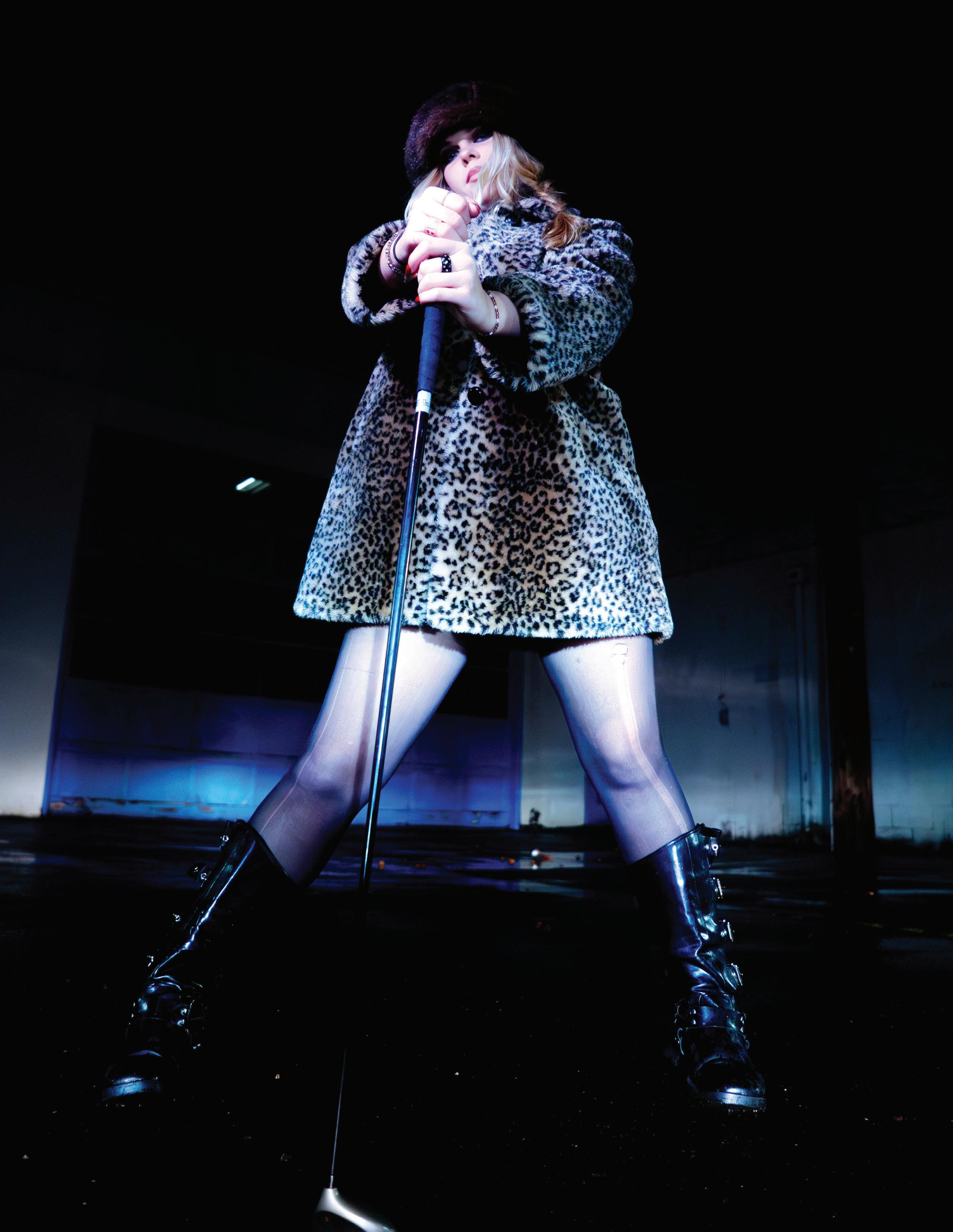
DISCLAIMER: THIS SHORT STORY IS INSPIRED BY PERSONAL EVENTS AND DEDICATED TO ANYONE WITH A SHITTY EX. THAT BEING SAID, ITS CONTENTS ARE FICTITIOUS.
IAnd maybe waffle cones too. Laced with laxatives in your lawn (both in the front and back if I have any say about it) so with any luck a couple of pigeons will pick it up and you'll be scraping shit off your driveway for the next week. I hope it reminds you of our first date, when we were sitting on that park bench eating ice cream and I told you about my dreams to fly. You laughed and asked if I wanted to be a flight attendant. I was too nice. I explained it to you, my ten year plan, culminating in a jet streaking across the sky and me in the cockpit. That should have been a massive red flag, a sign of the terrible things to come. I told you I wanted to touch the sky. I told you my ambitions, my goals, my vision for the future. And you weren’t listening. You obviously didn’t know who you were getting involved with. I wasn’t going to wait on you hand and foot like your mommy. You obviously knew nothing at all.
Pink glitter.
I’ll spread it along the bed of your fancy little Ford and throw it through the passenger window. You always did have a nasty habit of leaving it cracked open. And in your locker, because you made the mistake of giving me the code, I’ll leave pink bow ties, just like the one you wore to homecoming. When you picked me up in that damn truck, the floorboards were covered in papers and McDonald’s wrappers and your old gym clothes, but I looked the other way. That’s what I was used to at that point. I asked you if you liked my dress, a long pink number with sequins on the bust and the hem. You said you were surprised; I usually wear blue. That wasn’t the question I asked, but I got my answer when you were playing Halo on your phone while I tried to include you in a conversation with my friends. I tried not to care. I wanted us to enjoy ourselves. I told myself it didn’t bother me. But that’s what I was used to. A trashy car. A trashy attitude.
WRITTEN
BY
MAKENA ADAMS
Posters.
With your face on them. They'll read “Lost Dog: Spoiled Sexist Narcissist. If found, do not return. Will harass you, make derogatory comments, and refuse to acknowledge any criticism.” Posted where everyone can see them, your neighbors, your parents, your friends, so anyone who thinks they know you will be warned. I didn’t hate you when we broke up. But I do now. The things I heard you say. The things I saw you do. It was absolutely revolting. You can’t come back from being the uneducated, insensitive, unapologetic bigot you proved yourself to be. Shock. That is the only way I can describe my reaction when I heard the words “the tits, hips, ass revolution” leave your mouth. And you were talking about a goddamn cartoon character. How did I not see it before? How did you hide it from me? Your mutilated view of women. How did you see me? I feel sick thinking about it.
For some horrible, illogical reason, I feel responsible for what you became. Because once I finally saw you for the jackass you always were, you started hitting on my friends, three of them in quick succession. I saw how you crept close to them, touched them; shoulders, arms, hands, legs, thighs. Just barely, not enough to get in trouble but enough to convey what you wanted. It made me sick with rage and sorrow. You loomed over us. We hated you. We feared you. But you said you didn’t mean any harm. You said you didn’t do anything wrong. You said you didn’t know what you were doing. So people stopped holding you accountable. They chose to forget what you did. But I didn't.
I hate you. I didn’t know hate until I knew you. I am incapable of forgiving you because some twisted, damaged part of me still wants to protect everyone from you. That doesn’t mean I won’t try to forget. Forgetting you will be slow, painfully slow, but I don’t see the point in hurting myself by holding onto all the pain you caused. Don’t get me wrong, I’m sure as hell not going to take the high road. I’m not above giving you what you deserve. I’m not above revenge.
DESIGNER SOFIA LENTZ
ILLUSTRATED BY SIERRA BAKER


Amovie’s visual aesthetic is often more important than the actual plot. The demand for interesting imagery has resulted in filmmakers relentlessly aestheticizing the story being told. That being said, filmmakers also rely on controversy to provoke emotional engagement. This makes revenge the perfect story to tell. Revenge narratives often feature beautiful cinematography that can distract us from questioning the moral implications of the main character’s blood-lusted actions in their pursuit of vengeance. The hyper-aestheticization of actions like revenge is damaging because, as viewers, we internalize the narratives that we entertain ourselves with. Ultimately, the glamorization of the revenge narrative in popular cinema indirectly makes us more vengeful people.
Movies with intense cinematography draw attention away from the plot, and redirect it to the visuals. “Kill Bill” is an example of a captivating aesthetic. The outfits, set design, cast, and imagery captivate the viewer through vivid visuals. In one of the first few scenes the main character infiltrates a house and kills one of her arch nemeses. The daughter of the enemy appears in the doorway shortly after and discovers her mother on the floor. Before there is time for viewers to morally evaluate the scene, the main character exits the kitchen, each step crunching upon rainbow cereal that had spilled during the fight. She gets in her car, painted a vibrant red and yellow and reads “pussy wagon” on the back bumper. The vivid imagery shifts our focus from the contents of the story to the cinematography without time to question the morals of the narrative being told.
Distracted by the pretty colors and appealing aesthetics, viewers dismiss controversy and can misinterpret the main messages of a movie. Excessive glamorization draws our attention from the substance of the story, which can result in harmful internalizations of the wrong themes. The movie Fight Club is a prime example of how good cinematography can cause people to miss the point.
Fight Club is an attempt to critique violent and toxic masculinity through irony. It romanticizes male violence in hopes of highlighting the extent to which unhealthy masculinity is glamorized in society. The result of the film’s commentary was not profound introspection among adolescent males about violence in masculinity, but rather: “duudee… we should start a fight club.” The imagery in the film completely overpowered the message, recirculating to this day in the form of Tyler Durden edits on TikTok, while the film’s critique is largely ignored.
“Batman” encapsulates the glamorization of questionable morals. Batman’s dark, brooding aesthetic instills fear into the heart of his enemies, a violent vigilante that not only seeks vengeance but claims to be the physical embodiment


of it. In the film “The Batman” made in 2022, Batman says: “I’m vengeance.”. His violent methods of attaining justice are driven by the painful murder of his parents, which “justifies” his anger towards the criminals of Gotham.
The widespread acceptance of Batman as a superhero exemplifies the justification and acceptance of what was intended to be a controversial topic. The Batman franchise intentionally refrains from ever calling Batman a hero. Instead, they refer to him as a “vigilante” because of the violent, personally biased methods that he uses to seek his “justice.” Yet, he is idolized by men universally. Young boys wear Batman merchandise before they have even seen any of the Batman movies. In the idolization of such a flawed protagonist there is a widespread failure to consider what it means for a child to wear the bat symbol on their chest.
The perception of Batman as a superhero elicits extremely unhealthy ideas of how to cope with grief and loss. Superheroes are supposed to be the physical embodiment of justice. With superior senses of morality, their every action illustrates ultimate good. The exemplary values and moral code of the protagonist is frequently glamorized. Batman refuses to use a gun in his encounters with evil because his parents were killed by one. As he delivers a ruthless beating, however, few people stop to sympathize with the lowly criminals of Gotham. The consequence of aestheticizing revenge is that we justify the actions of the protagonist even if they are flawed or controversial.
Determining the repercussions someone deserves or justifying the act of vengeance to oneself are moral assertions that were once unscathed by the influence of the film industry. The narratives of revenge, justified through glamorous imagery in film, seep into our psyche. We see ourselves as the protagonist, and begin to navigate our story under this influence. Revenge stories inspire us, illustrating that vengeance is a justified response to harm or loss.
The portrayal of revenge as a fulfilling solution is strengthened by the absence of forgiveness and sympathy in film. A revenge story does not exist if the main character is capable of forgiving and forgetting. As a viewer, it is important to remember the fulfillment and peace of mind that we can attain through practicing forgiveness in the real world. Although it may look cool on the big screen, revenge does not have to be a part of our own personal stories. I think it’s important to remember that this is a choice that we get to make.

WRITTEN BY CASS MORRISON
ART DIRECTOR EVA ROSE BRAZFIELD
PHOTOGRAPHED BY MARY GROSSWENDT
MODELS MADDY YEN, UCOBY HARDY, CAMERON THEUS & SCOTT ROBINSON
DESIGNER HAILEY RYDMAN


If you’re anything like me, your wavering stream of consciousness is spewed out on random pages of your notes app, journals, and Google Drive folders. Ranging from feelings of euphoria, depression, anger, or confusion, it’s all written out. I find myself writing most in times of betrayal or heartache. When I’m deeply hurt I constantly play out the scenarios of everything I should’ve said in my head; all the words I hold back out of respect for the other person, even if they are the last to deserve it. My pinky’s stained with ink from all the words I wish I could say. Putting these pent-up thoughts on paper helps me to get out of my own head. It feels cathartic to release my thoughts onto something physical. Although I may never get to actually verbalize these emotions, I can leave them imprinted on the paper rather than suppressed in my brain.
I’d like to believe this is a universal experience and we’ve all had times where our true feelings were too unhinged to articulate. I’ve always been taught to take the high road and follow the golden rule, to treat others the way I would want to be treated. I find this extremely difficult to uphold sometimes, especially going through breakups, friend problems, bullies, etc. and I find it wildly disappointing how it appears many people must have missed the day in second grade when we were taught that if you don’t have anything nice to say, don’t say anything at all. Regardless, it becomes disheartening to spend so much time thinking about others’ feelings, when seemingly people don’t really consider your own. Not to say that I am perfect by any means. There are times when I have lost sight of the high road and found myself in an alleyway with my friends devising plans to egg my ex’s house or siphon his gas, planning the moment I’d get my revenge.
Do you ever want to go up to the person who caused you so much heartache and let them know how much they SUCK? I know I do. This is where I would usually turn to my pen and paper or my notes app and write it all out. Looking back through my notes, most of the entries don’t really make a lot of sense or have any sort of sentence structure to it. There are usually a lot of capital letters, question marks, and exclamation points that can only be deciphered as hot-tempered gibberish. Or, they are quick one-liners with absolutely no context. Other times, I come across a mini novel which usually consists of some pretty gnarly, unfiltered commentary. I usually write these feelings out like it’s a letter I will eventually send. I’ll address them and make sure they understand all the ways in which they made me miserable and that they are the worst and should feel as such, because how do we go from fantasizing about our honeymoons to resonating a little too closely with Olivia Rodrigo and All Too Well (10-minute version)? How
do we go from bridesmaid talk to awkward hugs and fake niceties next year? Or thinking that one situationship will finally follow through, but then, like always, falls short? These failed relationships, while extremely hellish, can simultaneously be a beautiful thing. Life brings us people that will open our eyes to what we once couldn’t see, and show us parts of ourselves we were blind to. While we eventually come around to being thankful for these people and the lessons that accompanied them, we must first feel all the strong urge for revenge.
They say that living well is the best revenge. Despite the lousy hand dealt and all the feelings of resentment and misery, coming out on the other side a badass bitch is the sweetest of revenge plots. While it may feel best suited to try to get back at someone, sometimes it is best to let karma run its course. Giving precious time and energy to someone who has hurt you, is exactly what they want. Not giving them the time of day is the best way to prove you’re better off without them. This is much easier said than done. If you’re anything like me, biting my tongue is a next to impossible task which is why being able to write everything out has always been my most helpful tool for releasing emotional energy. A lot of the time, things are better left unsaid, but that doesn’t mean all those emotions should go unattended. It is vital to the healing process to be angry, sad, confused, numb, etc. It is important that we plan revenge over shots of tequila with the girls, scream female-rage breakup songs with our whole hearts, shed a few tears, and make a few mistakes.
Being able to look back on some of these old journals and notes pages is not only a little entertaining but also a visual representation of healing. Seeing the ways I once let someone make me feel serves as a reminder as to why that person is no longer in my life and to never undercut my worth ever again. Although you may dream of the day you muster up the courage to rain hellfire on your enemies, being able to keep your side of the street clean is the true prize. Tears may be shed, songs may be screamed, and regrets might show up in your dreams. But, walking away with your head held high and unscathed, even with


Who is the ‘greatest of all time’? When this debate came into question during an ESPN interview for Serena Williams, the tennis superstar said, “I think if I were a man, I would have been in that conversation a long time ago.” And it’s true. The media tends to be more interested in the way a female athlete looks rather than how she plays. When comparing two magazine covers, one with a female athlete and one with a male athlete, the difference in how both individuals are portrayed is drastic. Male athletes pose in a way that emphasizes their athletic ability while female athletes are usually shown in revealing clothes, which only emphasizes their physique. It is no secret that many sports fans take male athletics more seriously than female athletics. All too often, female athletes become underestimated in their athletic abilities and oftentimes their sport gets put on the back burner by the general public.
Female athletes aren’t just underestimated by the media— it can happen on college campuses too. Lately, Title IX lawsuits have popped up all over the news, especially in correlation to American universities. Title IX is a federal civil rights law in the United States that prohibits sex discrimination in any government-funded education program or school. The law requires athletes should be treated equally with regards to their gender.
The University of Oregon is one of several universities to face a Title IX lawsuit. The news of this lawsuit broke in September. However,the accusations against the University of Oregon have been building for the past decade. For example, the women’s beach volleyball team has been given fewer facilities than the male athletes since the team was created.
The women’s beach volleyball team practices at Amazon Park in South Eugene where there is one restroom which is public and has no stalls. According to Equity in Athletics Data Analysis, female athletes at U of O are being deprived of $800,000 a year in equal athletic financial aid. Instead, this money is given to the male athletes. During the 2021-2022 school year, the University spent over $60 million on male athletes and only $20.4 on its female athletes, according to the report ‘Equity in Athletics Disclosure Act’.
The list of accusations in the lawsuit go on— womens’ club rowing hasn’t been given an opportunity to compete on varsity level for 20 years. This is because when given the opportunity to upgrade the rowing team to varsity status in 2003, University of Oregon chose women’s lacrosse instead.
Additionally, if the women’s club rowing team became a varsity sport, the gender gap between the number of female and male athletes would lessen. There is a huge disparity
between the number of male athletes and female athletes. According to a lawyer for Bailey & Glasser, in order for there to be an even number of male and female athletes, U of O would have to add 94 more female varsity athletes.
When asked to complete a gender equity plan, U of O lawyers stated that there was “no need”. A gender equity plan would help establish justice for female athletes because it would be a commitment by the University to advance gender equality through systematic change.
This Title IX lawsuit is overdue, and hopefully something that will cause the University to pay attention to the inconsistency in how their athletes are treated. Title IX is a way for the female athletes to make a comeback from the way they have been treated. It’s a way for the beach volleyball team to say, “We deserve more than the resources we’ve been given.” It’s also a way for the club rowing team to ask for the opportunities they deserve.
“It just seems like the school has just put us in a position where suing is our only choice,” said beach volleyball athlete Ashley Schroeder in an interview with the Daily Emerald.
Suing your own school is daunting. But when is it established that enough is enough? There is a point when it is necessary to demand what you have earned.

WRITTEN BY FIONA ENGLISH
PHOTOGRAPHED BY ISABELLA SNYDER
DESIGNER SOPHIE BRYAN
ART DIRECTOR KAYLA CERVANTES
MODELS AVA DUFER & SAVANNA HALE

Take a dopamine detox if:
You avoid being alone with your thoughts
You’re uncomfortable with feeling bored
You need multiple things to hold your attention (like playing video games while simultaneously watching TV and scrolling on TikTok)
You want to form healthy habits
You want to be more intentional with how you spend your time
Throughout childhood I’d turn to my dad multiple times a day whining, “I’m boredddd.” It became such a routine that simply saying “I’m…” would prompt my dad to roll his eyes, then mockingly and exaggeratedly mouth “boooored.” Eventually, he’d recognize my expression of impending boredom, catching my half-grunt, half-sigh of despair before I could voice it. Inevitably, my next question would be, “What should I do?” To which he’d respond with a list of activities that seemed worse to me than the state of boredom itself. Boredom freaked me out when I was younger. I hated being bored; I wanted nothing to do with it. The minute I was bored, I needed to find something enjoyable to do.
To indulge is to enjoy the pleasure of something. Too much pleasure can lead to pain. Therefore, the key to indulgence is balance. As a kid, I didn’t know this. I’d cure any inkling of boredom by indulging in a distraction, which for me often meant either playing Minecraft or pulling out my Nintendo DS to play Pokemon. Now that I’m aware of how susceptible we are to overindulgence and overconsumption and their consequences, I’m working on maintaining a healthy balance when it comes to indulgence.
We can indulge in pretty much anything these days. Some of us binge-watch shows and overeat. Some buy impulsively. Some sports bet and gamble. Some of us take pills, smoke, and drink. Some read romance novels while others watch porn. Some of us play video games all day. Some can’t walk to class without our phones in hand. In this technologicalcentric society, advances in social media, entertainment media, and technological devices, have only amplified the access and the ability to overindulge.
In her novel, “Dopamine Nation,” psychiatrist and medical director of Stanford Addiction Medicine, Dr. Anna Lembke said, “...we’ve transformed the world from a place of scarcity to a place of overwhelming abundance,” and in turn we have become vulnerable to “compulsive
overconsumption” (Lembke 1). We are living in the age of unprecedented access to dopamine boosters: drugs, food, sex, news, gambling, gaming, tweeting, TikToking, Snapchatting, etc. Lembke dubbed the era, “The Age of Indulgence.” It’s a period where there is an emphasis on self-indulgence, consumerism, materialism, personal pleasure, and instant gratification. Compulsive overconsumption of everything from food to sex is explained by the “feel good” neurotransmitter responsible for reward processing and motivation: dopamine. Dopamine plays a large role in the wanting of reward, rather than the actual liking. The urge for a dopamine hit is why we play just “one” more game, grab another cookie from the jar, and spend too much time scrolling.
Lembke also found that too much pleasure can lead to pain. She refers to the opponent-process theory, created by scientists Richard Solomon and John Corbit in the 1970s, suggesting that any prolonged or repeated deviations from a neutral emotional state come with a cost. This cost manifests as an “after reaction” opposite to the original stimulus. As the saying goes, what goes up, must come down. Consequently, the craving for pleasure intensifies following an initial experience, and if we give into that urge, we start to build tolerance. This leads to a diminishing sense of satisfaction and causes us to need more of a substance, ultimately fostering addiction.
What does overindulgence imply about the kind of world we live in now? What about the world we’re leaving to our children? Will future generations seek vengeance if we don’t stop overindulging?
It’s important to build a society free from excessive indulgence not only for the future of our generation but for future generations as well. It’s also important to think about the broader consequences of overconsumption. Overconsumption depletes natural resources and pollutes the Earth, contributing to environmental degradation and reduced ecosystem
health. This proves overindulgence is not sustainable; finding balance is essential to a healthy lived experience for us and future generations.
In 2019, the dopamine fast emerged as a self-improvement trend. It suggests that contemporary entertainment and dopamine-boosting activities rewire the brain so that slower-paced, leisurely activities are less pleasurable. By taking a break from addictive behavior, it can make someone less dominated by unhealthy stimuli like drugs, alcohol, gambling, porn, social media, etc. This doesn’t imply depriving anyone of any fun; it means sitting in the feelings of boredom and finding pleasure in simple and more natural activities to regain control over compulsive behaviors. Dopamine detoxes can last for a few hours, days, weeks, or months. The goal is to rewire the brain’s reward pathways and be okay with walking to class in silence, unplugged from devices, and watching the trees.
In a dopamine detox, engage in more natural dopamine boosters: checking things off on a to-do list, going on a walk, and taking some deep breaths. Start doing things one-mindfully: do one thing at a time and be completely present. When gaming, don’t watch TV at the same time. When eating, just eat. When talking to a friend, put the phone away. When listening to music, just listen.
Above all, a dopamine detox will make it easier to tolerate boredom in the future. Boredom is necessary to confront questions of meaning and purpose and create a space for new thoughts to form and things to discover. Instead of giving into the child-like tendency to immediately cure discomfort by indulging and distracting, sit with the boredom and see what happens.


Traditionally, women in film are seen as docile, nurturing, reasonable and endearing. She can be an overbearing mother, a loving wife or the typical “damsel in distress.” These are all common female archetypes. Women are often seen as the voice of reason for their hostile, violent and physically dominant male counterparts. These stereotypical roles for women drive the action of the film by affecting other characters rather than portraying their own feelings and developments. Yet, when these roles are flipped, and women ignite violence, an entirely new narrative is created.
The femme fatale archetype can be defined as, “an attractive and seductive woman, especially one who is likely to cause distress or disaster to a man who becomes involved with her,” according to Oxford Languages. Said distress is typically enacted through sexuality. Society is critical of violence instigated by women in film because violence juxtaposes stereotypically feminine qualities, while violent men are considered typical. Thus, the femme fatale is typically viewed as a deviant antagonist for defying preassigned gender roles.


Jennifer from “Jennifer’s Body” is a prime example of a modern femme fatale. At the start of the film, Jennifer is kidnapped by a band that attempts to use her as a human sacrifice in hopes of furthering their popularity. Rather than dying, Jennifer becomes demonic and hungry for the flesh of men. Jennifer, played by Megan Fox, uses her sexuality to lure men in. She is cunning and seductive. She uses what has been weaponized against her, her sexuality, to achieve her femme fatale status.
Jennifer is constantly objectified both before and after she becomes possessed, mirroring Fox’s status in Hollywood as a sex symbol. The actress has expressed in interviews that while she doesn’t think her status as a sex symbol is negative, she has found that it creates a false narrative that puts her sexuality above other qualities such as intellect and humor. However, Jennifer’s revenge is sought through sex and an ultimately bloody demise for her victims. This violence leaves audiences shocked yet

intrigued based on the gory violence ignited by a woman. While the film outwardly appeals to the male gaze by playing into male fantasies, that notion is quickly dismissed as Jennifer is revealed to be a flesh-eating demon.
One modern femme fatale that took the world by surprise is Amy Dunne from the thriller, “Gone Girl.” The film follows a woman in a seemingly loveless marriage who goes missing on her 5th wedding anniversary. There appears to be foul play and many blame her husband, until it is revealed that she faked her own death in order to frame him. Amy does not fit into the patriarchal idea of how a woman should be because she is classified as manipulative, violent, and controlling. Among those qualities, she is able to use her sexuality to manipulate men for her own benefit.
The film initially follows a patriarchal structure as the audience

engaging in violent acts because it is deemed to be in their nature as dominant and assertive. When women are seen engaging in violence they are immediately considered crazy and irrational. Yet, the femme fatale archetype breaks this stereotype. Through the use of her sexuality and intelligence, the contemporary femme fatale ironically juxtaposes typical feminine qualities such as being submissive and nurturing, while also using her feminine sexuality to her advantage.

sympathizes with a desperate husband searching endlessly for his missing wife. Once the audience recognizes that Amy framed her husband, two different responses form for male and female viewers. While male viewers are expected to elicit anger towards Amy, female viewers feel a sense of empowerment and independence because violent women are rarely depicted. Whether Amy can be classified as a “psychopath,” is ultimately up to the discretion of the viewer. Thus, Amy not only directly manipulates her husband by relying on his confinement to the patriarchy, she also manipulates the world around her. Patriarchal views limit society into believing that a woman could not do something as violent and prepared as faking one’s own death.
Deeply rooted patriarchal structures lead audiences to either consciously or subconsciously believe that women are inherently not violent characters. Men in film are often seen

PHOTOGRAPHED BY SAMANTHA JOH
WRITTEN BY BAILEY MEYERS
ART DIRECTOR KAELIN ACKEN
MODELS JOSE CARILLO, KE’ALI MCCARTER & MELODY MOSES
DESIGNER AVA WISDOM
WRITTEN BY RILEY KENNON
ILLUSTRATED
BY ELLA NOTDURFT
DESIGNER STELLA RANELLETTI
None of us asked to be here.
I’ve reverted back to this notion through different phases of my life. And, frankly, it’s a fair concept to consider. We must surrender to the circumstances that we’re given, because they’re fixed. We can’t change our father’s drinking habits, or mend the hurt that our mother inherited.
Succumbing to the environment that we’re placed in can be frustrating, because nothing about the place we come from is fair. It’s a gamble. We’re blindly thrown into the middle of our own unique and unfamiliar maze, and spend our lives learning how to steer through. The shroud of comparison can weigh on us as we navigate our own course, but we must trust our capacity to evolve.
Our early circumstances are indelible. They leave an impression. And growing up, like many, I struggled with mine. I watched in innocent wonder as my friends’ dads tied their shoes and doublebounced them on the trampoline, and listened with envious ears as their moms knew all the right ways to comfort them. I craved it–the sense of solace and escape my friends seemed to have amidst their families. All the while I was escaping mine. I spent many hours of my transitionary years away from my house, wedged into the homes of others. I wanted a taste of something I never had. A familial community: an imperishable bond that makes the world seem less chaotic. Not more.
It would be easy for me to be mad at my situation, and mad at the universe for not planting me somewhere more “ideal.” Because, fundamentally, it sucks. We’re not only subject to comparison of our peers, but also representations in the media of how the “ideal” or “nuclear” family should interact and react. I learned, however, that I must break free from the weight of comparison. Because what may seem to glitter isn’t always gold. I never saw what was behind closed doors, and generational baggage wasn’t written into the character description for that perfect mom archetype.
I learned that we must look inward.

Many of us believe that we didn’t experience a proper upbringing, or the upbringing that we deserved. Though we’re able to acknowledge this, it may stop here. When we stop this investigation there, however, it leads us to embed our wounds so deep into our subconscious that we become unaware of them. And though we may not be able to see them, they’re there. Deep wounds can’t properly heal unless we tend to them. Without looking at this hurt face to face, it can still manifest throughout the rest of our lives, and we can inflict these wounds onto others later–continuing a cycle.
Ultimately, everything we see is an extension of ourselves. We perceive the world through the lens of our personal experience. If we’re not in tune with how these experiences skew our perceptions, however, we can fall into patterns of projecting our hurt outwards, unfamiliar of which parts of ourselves need tender

care. Since the world is uniquely designed by the individual, we have the ability to work with ourselves to create our own bright, colorful world. We must embrace our brokenness and grow through it.
We begin our lives resembling a lattice. Their foundation–a combination of different wooden fragments, is preceedingly fastened together and embedded into the earth. They patiently await the english ivy to engulf their empty spaces and fill them with greenery and character. The vines grow through and
up the gaps with time and care–until you can’t see the skeleton anymore. We must be the ivy that flourished through the lattice that was built for us.
Honing in on our unique experience allows us to understand our circumstances and create beauty from what we’re given. Our parents are people too–brought into the world with their own baggage. It would be nearly impossible for our parents to hand us the perfect conditions on a silver platter. Some of our lattices may be cracked or weathered, and some

may contain more holes than others, but it’s up to us to water ourselves as best we can to entangle our foundations with magnificent ivy. With magnificent life.
So–Yes, I didn’t ask to be here, and I didn’t get to choose how I got here. But I am here. We are here. And though we didn’t ask for it, we were given the greatest gift we could ever receive–life. And though we were thrown into this sacred chaos in unique and arbitrary ways, we are irrevocably in control of who we are and who we become.

Rage and anger have become humanity’s birthright. It’s a truth that is as terrifying as it is comforting. But women are not granted this form of expression. Feminine rage has often been seen as a threat to the order of society. Women who dared to express these emotions were punished, silenced, or demonized. Mythology is full of stories that reflect the fear and hatred of feminine power. Women who challenged the social order were portrayed as monsters or temptresses who deserved to be slayed or shunned. These stories not only pushed a monstrous narrative, but also denied women the right to be fully human.
In mythological stories, Sirens— half-woman and half-fish creatures, weaponized their beauty as well as their musicality. They were compared to sex workers
in the Roman Christian interpretation of mythology, as they used looks and temptation to lure sailors to their spiritual and physical deaths. Other Homer-era poets said the sirens would die when their victims fought their song. Odeysseus famously fought the power of the siren’s song by using beeswax in his ears, thus resisting the siren’s temptation. Sirens represented the danger of female seduction, which was seen as a weapon against men. By killing them, heroes asserted their control over women and reinforcing the idea that women couldn’t control men.
Not even mermaids, the benevolent siren counterpart escaped the patriarchal criticism. Often described as ‘beautiful,’ their looks were held against them. Their beauty was considered a sign of vanity and pride, as

they were often shown with a mirror and a comb in depictions of them. Men were encouraged to enjoy their beauty and allow themselves to be entertained by siren’s stories, but still criticize their frivolity. The mermaids symbolized the idealization of female beauty and seduction, which was also a source of oppression and objectification for women.
In Hans Christien Anderson’s telling of “Little Mermaid,” the story went as far as to establish the idea that a woman’s role is self-sacrifice. In this version, the little mermaid trades her fins for legs and an eternal soul if she can convince the Prince to fall in love with her. The consequence of failing was death.The Prince ends up choosing another and on the last day of the little mermaid’s deal she is offered the option to kill
the prince to get her fins back and survive. She instead throws herself and the dagger into the water. The story ends with the little mermaid being applauded for her self-sacrifice while still acting as a warning of silly female ideation.
But the most prominent mythological female antagonist was Medusa, the once beautiful priestess of Athena who was turned into a monster after sleeping with Poseidon in Athena’s temple. Her hair was transformed into snakes, and her gaze could turn anyone who looked at her into stone. She became feared for turning the men who hunted her into stone. She was a creature with vengeance and a powerful force to be recon with, a force that drew fear into men. Her existence was a challenge to them. In modern interpretations, Medusa is a feminist


symbol. For example in contemporary literature like “Female Rage: Unlocking Its Secrets, Claiming Its Power,” “Gorgons: A Face for Contemporary Women’s Rage,” and “They Will Know Me by My Teeth,” women resonate with Medusa’s rage and the allegory she represents. Medusa represented the wrath of female revenge, which was seen as a curse and a terror for men. She was a woman who didn’t take her punishment, but used it as an expression of her rage for her mistreatment. She was the most terrifying thing yet, a woman who owned her rage.
WRITTEN BY GABBY PFEIFFER
ART DIRECTOR & PHOTOGRAPHER SNEHA CHOPRA
MODEL SACHIKO NISHIKAWA
DESIGNER PEYTON MCQUAIN
From sirens to Medusa, these myths show how women’s anger, rage, and sexual expression were demonized and suppressed by patriarchal societies. Women who expressed these emotions were punished or killed for their actions, which were considered unforgivable crimes. Women’s rage became mythical, a work of fiction that served to justify their oppression and dehumanization.
It’s a feeling we are all familiar with. A pit in your stomach, a bubble in your throat, your head fills with warm blood suddenly rushing to your cheeks: Rage.
Triggering a fight or flight response, rage is a powerful emotion that compels even more powerful results. For centuries, men have used their rage as a driving factor in decision making., tearing down nations, starting wars and exploiting innocence. Conversely, women have been told to compose themselves, not to be too brash all at the risk of seeming “unlady-like.” You feel it again ;the pit, the bubble, the rush of heat to your face. Now stop;
It’s not ladylike.
The power of female rage has been building for centuries, decades of emotional neglect is finally proving to be enough. Further, it is women of color who are especially subjected to society’s fear of female rage, staining powerful emotion with racist apprehension. We observe this societal fear of “angry” women and its manifestations in art, music, film, and other entertainment media. The power of feminine rage has molded culture for centuries. It is our time now to listen to the stories of these women and feel the magnitude of their intensity, of their rage.
White women have historically been praised for their participation in emotional disobedience, claiming them as heroes, revolutionaries, and pioneers of freedom. The women’s liberation movement throughout the 1920’s advocated for white women’s right to vote and the bodily freedom of white women. Awarded for their efforts white women were in turn free to participate in elections and women’s liberation had begun, or so it is taught. Similar sentiments from women of color in the 1960’s and 70’s were met with systematic and societal dissonance, claiming “anger is never the answer”, and advocacy in the form of protest and marches
were almost immediately deemed threatening by white onlookers.
It returns, that feeling, the chasm growing in your stomach, feeling like you’ve swallowed an apple, your blood is now at a rolling boil. The feeling of screaming but no noise ever escapes your lips.
Observed in the popularization of emotional art, this movement has begun to gain platforms, igniting the spark revolutionaries have been guiding on the perception of collective rage. Beyoncés award winning “Lemonade” album, released in April of 2016, depicts the story of her husband’s infidelity in their marriage. Struck with fear and sadness, Beyoncé does what women have always been told to avoid, she gets angry. Critics of her work, like Fox News reporter Keith Ablow, ridiculed the blatant displays of anger towards her husband, rapper Jay-z, claiming it drained the message from the story and only highlighted violence. It is remarks such as these that have fueled the racist stereotypes surrounding Black women. These same rageful sentiments have been displayed in music for decades by white women. Claiming their stake as strong bootstomping women who aren’t afraid to resort to violence in a vendetta, and in turn praised for their unyielding lyrics. Carrie Underwood’s “Before He Cheats” shares the same sentiments as Beyoncés “Lemonade,” public response, however, could not have been more contradicting.
This is not the first instance of the repression of women of color’s emotions, artists like Erykah Badu and Lauryn Hill have been speaking on this discrimination for decades, yet little has seemed to change. With the rise of the “Riot Grrl” in the late 80’s and early 90’s female rage was no foreign concept to the pop music scene. Met with its own unique form of sexism, the “Riot Grrl” movement aimed for the liberation of women’s bodily autonomy and freedoms, led almost exclusively by white women. Asking the same questions and screaming

the same thoughts, women of color were not given the same respect or platforms as their white counterparts, forcing many to adopt passive attitudes towards the liberation movement, as it was made to work only for a specific demographic of women. Artists like Hill and Badu however, saw this as an opportunity to proudly display their femininity and their culture as women of color and refused to censor the ways in which they expressed themselves, even if it meant rage. Hurt is a powerful feeling, how else are marginalized individuals expected to be heard, Badu inquires. It is through her self expression, wearing traditional braids, playing to soulful R&B tracks and screaming the lyrics, Badu is a revolutionary. Similarly, Hill has consistently been vocal in her disdain for the recognizable women’s liberation movement, as it was only the liberation of white women that was given a platform.
That feeling, that bubbles inside, that turns in your stomach possesses potential power. It’s time to let it out, it’s time to listen to their shouts. Art lends a canvas for the smattering masterpieces born from rage. It can change the world and it is time to listen, it’s time to enjoy its gallery.

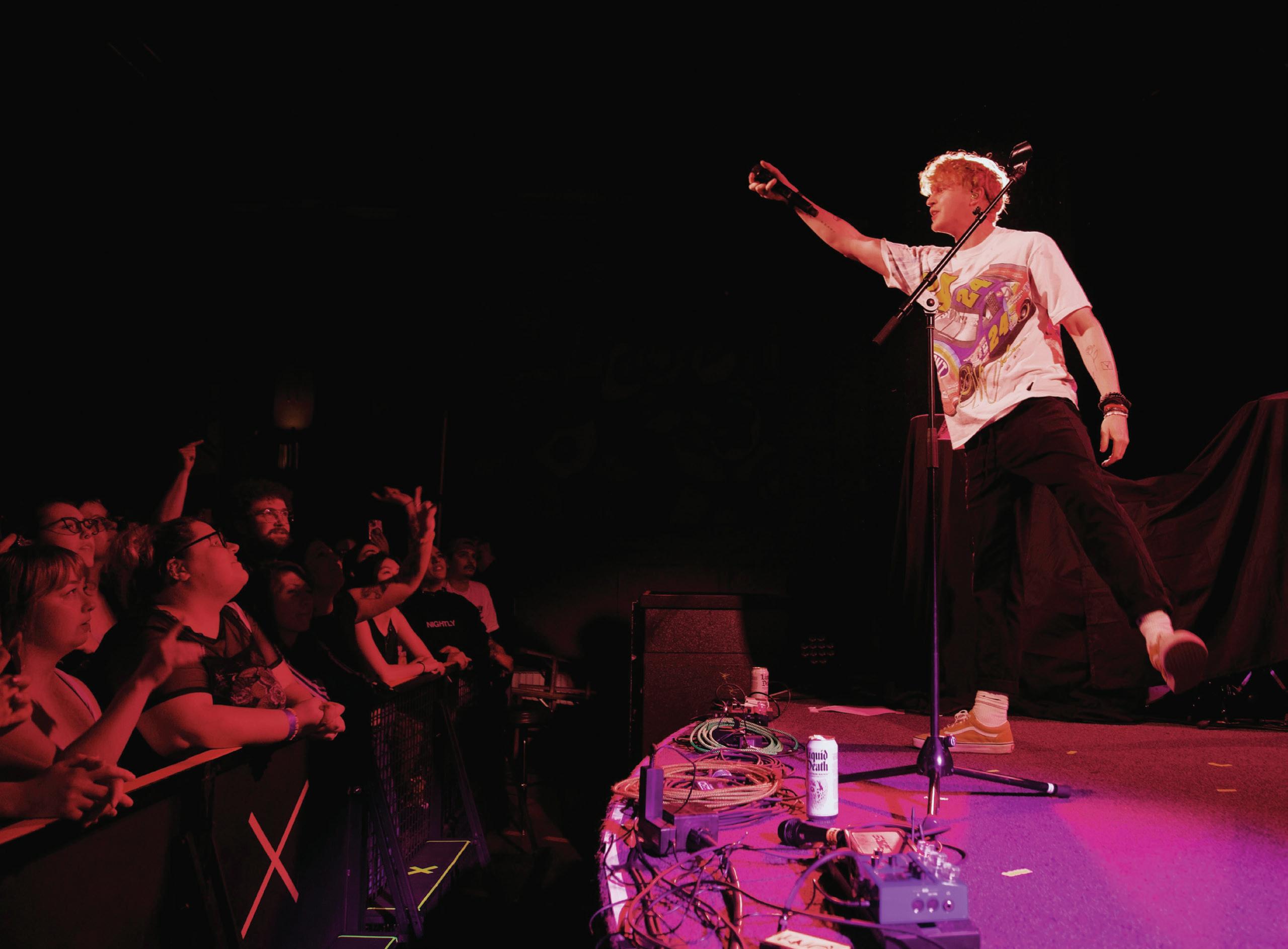
Knox is a singer-songwriter based in Nashville, Tennessee whom I got to sit down with backstage at his show in Portland, Oregon. Signed with Atlantic Records, under Warner Music Group, Knox is currently on a 22-stop US tour with the band nightly. The summer before he started at Ohio University, Knox picked up a guitar and began singing at open mic nights. Knox signed a publishing deal in 2022 but had the urge to record a collection of songs he had been working on.
The final result was “How to Lose a Girl in 7 Songs,” Knox’s debut EP that was released in February. To build a fanbase, Knox began filming TikToks featuring his song “Sneakers”, amassing nearly two million views overnight which has since reached over 15 million streams. Knox has since started to get on the road, opening for the band CAMINO and Boys Like Girls. I got to talk to him about songwriting, getting signed, being on the road, and everything in between.
CAN YOU EXPLAIN WHY THAT OPEN MIC NIGHT CHANGED YOUR VIEW ON BECOMING A MUSICIAN?
It was one of those things where I felt like when I started doing it, I felt like I could. When I started singing at open mic nights, I was like, I think I could figure this out if I kept working at it. When playing in front of 5 people it was always those 5 people you were trying to win over, and I feel like I did a good job of doing that. So it was like what if I could turn those 5 people into 25 and those into 100 and keep growing from that. Those open mic nights made it feel possible in a way.
HOW IS YOUR NEWEST PROJECT “I’M SO GOOD AT BEING ALONE?” DIFFERENT FROM YOUR DEBUT “HOW TO LOSE A GIRL IN 7 SONGS”?
I feel like on “How to Lose a Girl” it was a certain sound where it was all very much in the same similar genre. Whereas “I’m So Good at Being Alone?” we pushed the boundaries from the last record. Songs like “Love Letter” and “Man Down” are full-blown punk rock songs, but then “Miss When You Missed Me” and “I’m So Good at Being Alone” are where we went in the opposite way.

YOU STATED THAT THIS NEW RECORD IS ABOUT MOVING ON AFTER “LOSING A GIRL IN 7 SONGS.” WHAT WAS IT LIKE CONTINUING THIS STORY AND NAVIGATING IT IN REAL LIFE?
I’m not one that typically writes songs from feeling. What my music is encapsulating isn’t really where I’m at as a person but places I’ve been before. I feel like I’m telling the story in a way, but from 2 years ago and I’m looking back. I love how the project and the title of the album have a question mark, but the song doesn’t. The project is all about am I so good at being alone? I don’t know, But then you listen to all the songs with that one at the end and it’s like I am so good at being alone and it’s going to be okay.
I SAW THAT YOU WERE FRONT ROW AT A BAND CAMINO SHOW AND KNEW ALL THE WORDS TO THEIR SONGS. WHY DO YOU THINK IT’S IMPORTANT FOR ARTISTS TO BE FANS OF OTHER ARTISTS?
You can learn so much from everybody. Even the people who aren’t bigger than you. Everybody can teach you something and [you can take something away from everybody.] I opened that show so after that show I went to the front row with my sisters who are big Band CAMINO fans. And now I’m friends with the members of that band now too, it was a core memory for sure.
WHO IS YOUR DREAM COLLABORATION EITHER IN SONGWRITING OR WITH MUSICAL RELEASES?
I have a basic one and then one that’s out there. The basic one is that I would love to work with Ed Sheeran. I’ve looked up to him for so long, I got a tattoo of all his albums a couple of days ago. One that is out there and not in my genre that I would love to even write a song for, is Lil Nas X. I love him. I think he’s so sick.
I KNOW NIGHTLY HAS BEEN ONE OF YOUR FAVORITE ARTISTS AND INSPIRATIONS, HOW HAS IT BEEN TOURING WITH THEM?
It’s so cool. I’m so stoked and grateful to be here. Like you said they’ve been one of my favorite bands and now I get to sing a song on stage with them. They’re my friends and it’s something I’ll never take for granted. If the Knox version of me 3 years ago could see now he would be super proud it’s a pretty surreal thing.
WHAT ARE THINGS YOU PRIORITIZE ON THE ROAD TO MAKE SURE YOUR MENTAL HEALTH IS STAYING IN A GOOD PLACE?
Honestly, I feel like the biggest thing is keeping your body healthy, if you have a healthy body, your mind is going to be healthier. Getting plenty of rest and making sure my voice is good to go since I have a fragile voice since I’ve never done this before. I’ve never learned how to sing with a vocal coach, so I’m still in the learning process of things.
I KNOW YOU LOVE MARVEL, SO WHAT IS YOUR FAVORITE MARVEL CHARACTER, AND WHAT HAS BEEN YOUR FAVORITE MCU MOVIE?
My favorite character is Spiderman, it has to be. Spiderman is just the best, I think Peter Parker and everything they encompass as a young dude just trying to figure it out is so cool, I relate to that. My favorite movie has to be Thor Ragnarok. I think it’s a perfect combination of badass and funny.


If one thing has become clear from the music female artists have released since 2020, it’s that women are ready to speak authentically about all aspects of womanhood: the good, the bad, and the ugly. Trending music has never been so raw. We hear Renee Rapp talk about her experience being drugged in “Snow Angel,” Boygenius speak about suicidal ideation in “Anticurse,” and Gracie Abrams discuss unrequited sapphic desire in “Amelie.” Olivia Rodrigo’s newest album, GUTS, follows suit by speaking unapologetically about the complexity of female emotion.
When GUTS was released, a friend and I spent hours picking it apart, raving about Rodrigo’s authenticity and how much we related to the songs’ ability to capture the multifaceted intricacies of womanhood. When deciding which song resonated with us the most, we both gravitated toward the fourth track, “Lacy.” “Lacy” details Rodrigo’s experience with feeling jealous of another woman, speaking both about her admiration of Lacy and the selfhatred she feels when comparing herself to Lacy. About the song, my friend said, “I think it’s so sad because it’s hard to admit those gross feelings. It’s borderline embarrassing to admit feeling that way about someone else. It felt so grossly envious and like [Rodrigo’s] ashamed to view someone like that for doing nothing wrong, but maybe I’m projecting.”
That was profound to me. I was speaking to one of my closest friends; we’ve always told each other everything, and yet I had no idea that she felt this way. Of course, I’ve never spoken to anyone about the fact that I also experience intense feelings of envy, either. Since I was young, I’ve been preached to about how I’m perfect just the way I am and that comparison is the thief of joy, yet I still find myself dissatisfied with my looks, my lifestyle and my personality. Growing up while hearing those affirmations over and over made me believe that I was the only one still struggling to be content with myself.
In recognizing that at least two other girls felt the same way I did, I wondered how other women experience envy. I wanted to know what their relationships with jealousy were, so I sent out an anonymous survey to 20 women to gain more perspective.
I started by asking, “What singular words do you associate with feelings of jealousy?” The words “insecurity,” “inadequacy,” “guilt,” and “greed” came up in over a quarter of the responses, along with “shame,” “prettier,” and “rage.” Additionally, 85% of respondents said they primarily felt jealous of people they don’t know: influencers, celebrities, and peers they’ve never met.


On how jealousy affects personal relationships, multiple girls spoke about how it made them feel insecure and reserved in social settings. Many girls also reported a difference in the way they interacted with the people they felt jealous of. Some girls noticed that they had a tendency to love-bomb: to shower someone with gifts, affection and constant attention to establish a sense of ownership over them. Others would purposely ignore or avoid the person they envy. One respondent said, “I want to say [I don’t interact with them differently,] but as I reflect, I realize that isn’t really honest. If I am jealous of a certain situation, I may feel like I don’t like a person just because I am jealous.”
Additionally, I asked, “Do you talk to other people about jealous feelings you have, or do you tend to keep them to yourself?” Every respondent said that they keep them to themselves. It was eyeopening to see just how many women were walking around with intense, complicated feelings of shame and inadequacy bottled up.
One respondent spoke honestly about her experience with the same comparison that Rodrigo spoke about in “Lacy.” She said, “The two biggest things I find myself always working on are my appearance and personality. I always have goals of being prettier, skinnier, dressing better, working out more, being more outgoing, making myself more likable, etc.”
In “Lacy,” as Rodrigo explains her comparison of herself to Lacy, she ends up showering Lacy with compliments. She says, “skin like puff pastry,” “smart, sexy Lacy,” and “it’s like you’re made of angel
dust.” It isn’t until these lines are placed in context with the rest of the song that they begin to take on a more negative connotation. Rodrigo makes it evident in the last line that she feels no resentment toward Lacy herself, saying “I despise my rotten mind and how much it worships you.” She voices very clearly that she actually idolizes Lacy; it’s herself that she despises.
At its core, jealousy isn’t a malicious emotion as we’ve been conditioned to believe. Instead, it’s one of admiration. Women feel like they have to bottle up their envy of others because of the belief that girls must support other girls, and envy must be in direct opposition to that. Reframing jealousy as an expression of praise rather than one of denouncement allows for women to speak openly and honestly about those emotions without feeling as though they’re degrading the women they envy.
Despite how much progress society has made in allowing women to be their authentic selves, certain topics are still taboo for women to speak about, and envious longing is one of them. Dominant expectations of how women should feel and behave don’t include jealousy, so women are taking matters into their own hands by refusing to conform. Female artists continue to use their platforms and their art to speak up about these taboo emotions because they’ve been suppressed for so long. Starting dialogues and speaking honestly about taboo topics forces society to evolve past outdated expectations of what emotions are considered appropriate to speak about, and that’s exactly what women like Olivia Rodrigo are aiming to do with their music.


Coming from a girl who has undoubtedly seen, heard, and experienced the trials and tribulations of college flings, I’d like to share a few of my personal insights so you can start this new year off on a positive foot. Let me preface, this is not my place to tell you what you can and cannot do. I’m just a 21-year-old girl, what do I even know? However, I can speak on my knowledge and what I’ve picked up over the last four years.
I never thought I would have experienced the dramatized effects of playing games, the manipulation of others, feelings of jealousy, ect. to an extent before entering college. During my freshman year, I felt like I had an overall sense of immaturity when it came to creating and maintaining friendships and relationships. But not necessarily in a negative way. For me, it was a way that was very formative in the development of toxic behaviors which for the most part, were very out of character.
At the end of the day, it was beneficial because I learned so much from them. I get it. It’s hard being young and in college where there is so much pressure and desire to be friends with everyone in your path. We are expected to welcome all these new relationships into our lives so suddenly, which don’t get me wrong, can be great, but some may not be right for you. It’s funny to look back now, and you will eventually see why.
I was listening to “When Toxic Becomes Trendy,” a podcast episode from Anything Goes, hosted by Emma Chamberlain. This episode initially got me thinking about toxic behaviors and using them as a tactic in “getting back” or seeking revenge on others. Emma was going into detail about these behaviors and how she has seen them impact her and her friends’ lives. When something may not go your way in a relationship, the automatic response is to act out in a way that may be so out of character, we honestly can’t help it.
But why can’t we help it? Why is seeking revenge in a negative way often the answer to get someone to like you? We’ve all been there, thinking we have all the power just from words typed out on our phones, or the tension between our fingers and the block buttons. These were actions instilled in my brain because it was what I always thought was the normal thing to do. They were deemed
‘trendy’ but not because they were healthy or even morally correct… because a lot of people participated in the trend so they became incredibly popular.
I went into my freshman year of college during COVID. What was supposed to be such a vast change in my social life coming from high school turned into a continuous reliance on screens and technology for social interaction. Yes, our attention spans grew shorter, we were constantly bored, and dating apps seemed to grow more popular by the year. So this explains a lot of the behavior that was going on between my friends and my screens. Technology changed my perspective on new relationships when entering my life in college because it was fun for us to mess around on our phones and joke with others on these apps. Although it may explain some behaviors for me personally, I don’t think COVID is the one to blame for the results that stem from revenge.
But where did this sense of needing revenge stem from? For me, revenge is emotional. It’s letting your intrusive thoughts win. It’s seeking a feeling that may be so out of character it’s empowering. You’ll find that the romanticization of hurting other people’s feelings is so casual freshman year. I have seen and experienced countless scenarios of heartbreak, when at the end of the day, these situations were so avoidable by just a few silly choices. Jealousy is as contagious as a cold and playing games with people’s hearts is fun. We’re crazy and bold and we let these thoughts become actions when later we come to find out that we don’t even mean it.
I’ll let you in on a little secret, you may never get it totally right. I don’t think I ever have either. But that’s okay because you are going to mess up and you might do or say something you regret but that’s what learning is for. Especially entering college as a first year, you are allowing yourself to experience a huge change of habits that are so unfamiliar, it can be overwhelming. These toxic trends may seem fun but can affect you in your later years of balancing new relationships. However, by simply acknowledging their existence, you’ll find yourself more aware of not participating in them. Freshman year is about these “mistakes” that allow your maturity to grow. But next time you think about acting out on your revenge, take some advice from this letter and learn from me. It’s not always trendy to act toxic.
Revenge is a feeling that many of us don’t dare act upon (lest we end up making a fool of ourselves by allowing our rational minds to give into our irrational emotions). Therefore, without any way to express these primal, boiling feelings of inner rage, we decide instead to channel them into something fictitious, something to escape into, something to use as an outlet: the quintessential revenge plot-line.
Although revenge plot-lines today are ubiquitous in popular media, their origins have often been overlooked. Many scholars would credit the structure of the revenge plot-line as having originated during the Elizabethean era with Shakespeare’s “Hamlet”, or even centuries before in Ancient Greek theater with Sophocles’ “Oedipus Rex”.
All revenge plot-lines, regardless of time period, share the same impetus: that of a personal wrong. In essence, to have been personally wronged is to have been deprived of your dignity, and in order to make it right, you must reclaim your lost pride. This is the rule of revenge.
However, when it comes to enacting revenge – that is, actually delivering sufficient punishment – where does one start? In 14th century Florence, the poet Dante Alighieri conceived of a solution to this exact question: the perfect punishment should be based on a poetic principle of contrapasso, or translated from Italian, “opposite suffering”.
It’s the year 1308, and Dante, after being exiled from Florence on false charges of corruption, takes to writing what would become his seminal poetic masterpiece, “The Divine Comedy”. The first (and most famous) part of the “The Divine Comedy”, the “Inferno”, chronicles Dante’s journey through the nine circles of Hell, guided by the Roman poet Virgil. “The Divine Comedy” is ostensibly an extension of Dante’s own personal emotions (he writes himself into the poem, after all!), and also serves as a way for him to reckon with the unjust separation from his homeland. Due to this, it becomes hard to differentiate the poet Dante from the character Dante. As a result the two are often conflated, creating a rare instance where the art truly cannot be “separated” from the artist, as their identities largely blur together. It can be argued, then, that a vindictive Dante channeled his bitter desire for revenge against the powers who had exiled him into the writing of “The Divine Comedy.” As such, poetry in the “Inferno” serves as a potent form of punishment for Hell’s inhabitants, many of whom were inspired by figures in Dante’s own life.
Take the Eighth Circle for example, wherein a real-life Roman Catholic pope, Pope Nicholas III, burns in a molten coffin in the realm of simony; buried head-first, with nothing but a pair of feet protruding from the flaming ground, in a position akin to a reverse baptism. Dante chooses to criticize the corruption of the Church in
this manner, by condemning its highest official to be ingested by the fiery maws of Hell; the corrupt Pope, who lined his pockets and gorged himself on bribes, is now doomed to be gorged upon by the mouth of the underworld. This is Dante’s principle of contrapasso in full effect: for every sinner’s crime there must be an equal and poetically fitting punishment.
Now, consider the instance of contrapasso for the lustful in the Second Circle, who in death are fated to be tossed by a hellish whirlwind, just as in life they submitted to the whirlwind of their carnal desires. Or the instance of contrapasso for the fortune tellers in the Eighth Circle, who in life claimed to see forward into the future, but in death are fated to walk with their heads twisted backwards, forever denied a forward view.
In the “Inferno”, Dante uses contrapasso to express the relationship between sin and punishment. Each punishment suffered in Hell is a reflection of a corresponding sin committed in life –in other words, a matching retribution. It’s easy to see how our modern conception of revenge enlists similar ideas to this Dantean poetic device. To inflict so severely a pain on another as was inflicted upon you is the foundation of all forms of retribution. Therefore, the thread connecting Dante’s contrapasso with modern revenge plot-lines is exactly that: retributive justice.
One thing’s for sure: Dante was doing revenge, writing about revenge,
methodically devising systems of revenge, before revenge was deemed cool. Arguably, the revenge plot-line we see today effectively represents an evolved version of the contrapasso narrative framework employed in “Inferno” –in short, Dantean contrapasso is the blueprint for the modern revenge story. After all, what holds the fabric of “Inferno” together if not its seams of vengeance?
It’s easy to imagine that in the 1300s, Dantean contrapasso may have appeared as nothing more than the manifestation of a cruel-hearted poet. But today, modern audiences have universally come to recognize contrapasso as something else entirely, and hint, it’s a dish best served cold.
DANTE APPROVED: Modern films whose blood runs so coldly with revenge they deserve an honorary Dantean seal of approval.
OLDBOY (2003)
AUDITION (1999)
MS. 45 (1981)
CARRIE (1976)
IRREVERSIBLE (2002)
LADY SNOWBLOOD (1973)
WRITTEN BY EMESE
BRACAMONTES VARGA
ART DIRECTOR & PHOTOGRAPHER
EVAN SUSSWOOD
MODEL LUCA MORRIGAN-HAINES
DESIGNER AINSLEY MCRAE


he idea of “vengeance” might seem to reflect the revenge plotline from “John Tucker Must Die” but in reality, it has many layers and sometimes a positive outcome. Let’s talk about friend groups. We have all had our fair share of friend groups. From the partiers who helped you make bad decisions, to the overbearing ones, to the #bestfriendsforlife who ended up not making it to the life-altering events. Then there are the friend groups full of laughter, movie nights, football Sundays, and core memory trips. Also, friends that you grew up with and have been in your life for a long time. What happens when personalities conflict and drama erupts?
Merriam-Webster dictionary defines vengeance as a purposeful retaliation against an individual as a punishment for something that that individual has done. In other words, vengeance is purposely inflicting some sort of pain on an individual or group in order to get revenge for a wrongdoing. Revenge is common and something we have all experienced. In every group of friends, personality conflicts can cause gossip and secrets, leading to acts of vengeance.
What happens when a friend group has a falling out?
Maybe someone slept with another person’s significant other, exposed your darkest secrets, or simply Jenna
and Andy left Susie out of their dinner plans, which pissed Susie off. Every individual has a boundary that can get crossed when they are bent out of shape over something, whether it be a big deal or a minor inconvenience. With this comes some form of lashing out that can involve snide remarks, passive-aggressive behavior, negative confrontation, et cetera. All of this has some sort of vengeance in it. To do all those negative things that I have listed, you are consciously aiming to bring down a friend. No one unconsciously makes jabs at individuals without intending to make their own ego feel better. Vengeance is often viewed as inflicting pain on another but in reality, there is a larger aspect of personal gain when it comes to revenge on a friend. Vengeance involves moving oneself up in the hierarchy and bringing someone else down. There is always a hidden competition going on between people: who has a better style, who can snatch the hottest person, who is better at playing sports. This competitive side of friendships is always ongoing, though it sometimes is not evident.
Getting revenge on a friend gives the one seeking revenge a moral boost that can be more powerful than the negative impact the revenge has on the other
WRITTEN BY
MADISON DOOHEN
PHOTOGRAPHED BY KY MYERS
ART DIRECTOR EMMA BALLMAN
MODELS YING THUM, SYDNEY LACKEY & MOLLY MATHISEN
DESIGNER MORIAH ALLEN
person or people involved. We all lose friends at one time or another but the next step is always an interesting endeavor. If it is a bad falling out, this idea of vengeance often comes in the form of revenge. Revenge is a combination of the actions one takes to get vengeance. This is when someone’s so pissed off about the situation that they are going to be on the hunt for a more popular, hotter group of people to befriend to get revenge on the original group that did them dirty.
They will befriend these new people to boost their ego, make themselves look good, and bring down whoever just unfairly treated them. The concept of showing off these new friends, whether genuine connections or just for popularity, brings someone a sense of superiority; “Look at me, I’m doing so much better without you guys” is essentially the message you are sending. This brings someone a powertrip, a high that they run on for a while. I ask you as a reader, how long can that high last? Will the come down be hard?
Social media has taken this whole concept to another level because now, as you scroll on your Instagram or view your Snapchat stories, all you see is what certain groups of friends are up to. You are constantly aware of what your peers are doing if you are a social media user. There is already so much revenge in a simple post, so much jealousy and hurt can be brought on an individual simply based on an Instagram story. A prime example of this is spring break from a college student’s perspective. Whether the group is in Palm Springs or Cabo, you already know that their social media presence is going to be through the roof. A blend of posts from an ex-
friend group can spoil a whole vacation for an individual.
Let us look at all sides of this; do they even care that you are making these new friends? Is it wrong to want revenge against your ex-friends? I mean, think about it, at one point that friend or those friends were a part of your hot girl walks and your nine o’clock tee times on Sundays. Or what about those high school friends who spent countless nights at your house and hitched rides with your family to Friday night football? Is befriending a group of people based on popularity better in the long run rather than finding genuine friendships? Or, would better vengeance come from finding a group of friends that will lift you up and bring out all of the best sides of you?

Repeatedly, human behavior shows that people are attracted to revenge plotlines. This theme of friend group glow-ups is a real thing. “Glow-up” as in a noticeable change in a group of friends from looks to personality changes and the whole nine yards. These glowups are often highlighted on social media profiles to spark envy that showcases a sort of rivalry amongst ex-friends. Your high school friend group fell apart when you went to college? Show off your college spirit and those new friends to show them up. The boys kicked you out of their intramural flag football team? Recruit better players and beat them, then show it off. You were a part of the “popular crowd”? Who cares, go find another group of even more popular people to befriend. The real question is: will these vengeful actions bite you in the butt? Maybe vengeance is not your answer. Maybe the negative feedback that you will get will outweigh the powertrip that revenge brings you. That is up to you to decide.


As the year of “Barbie” comes to a close, I’ve been reflecting on the conversations about femininity, girlhood, and feminism that have erupted this year both online and in private as women across the globe have been in dialogue about their universal experiences. It’s been beautiful to watch, and inspiring to see people begin to educate themselves and become impassioned to educate their less contemporary relatives and community members. Discussions about social progress and attempts to educate our communities are more important than ever as attacks on various channels of civil rights have permeated news feeds in the past several years with events like the overturn of Roe v. Wade, the attacks against trans youth in school, the agenda against Critical Race Theory in lower education.
Mattel Films’ bombshell debut film “Barbie,” a sparkly, pink, and nostalgic fantasy, brought feminism into the forefront of pop culture conversations this past July. Even though Mattel executives disagree, producer and star Margot Robbie and director Greta Gerwig both pride their movie as a feminist film. “Barbie” gives women a picture of an ideal, feminist world: one where women are present at the top of every food chain in society. In Barbieland, we see female lawyers and
presidents, surgeons and reporters. We even get a quick look at Construction Barbie and Sanitation Barbie working happily, waving to our protagonists as they pass by. It’s a beautiful, sheen and vivid utopia that becomes drastically contrasted with reality as Margot Robbie’s Barbie explores the pitfalls of the real world.
Much of the discourse surrounding the movie concerns how difficult it is to be a woman in contemporary society, and how many systemic structures are not built for women to succeed. There’s been an overwhelming surge of unity in online conversations on womanhood and femininity, and the desire to be a “good” feminist in the wake of these discussions. Much of this discourse has been focused on goals of personal growth and corporate success. Being a “good” feminist, to many people, means becoming successful enough to break off a piece of the glass ceiling. These are core ideas of liberal feminism, the most mainstream school of feminist thought, which focuses primarily on achieving gender equality in terms of legal autonomy and representation.
With feminism taking the spotlight in pop culture discourse, it’s important to evaluate what social progress means to us as a society as well as


individually. Often, the end goal of this mainstream level of feminism focuses on the corporate world, with an objective of equal representation of genders in higher level corporate positions. In 2023, just 10% of Fortune 500 companies are led by female CEOs, while women make up 66% of minimum wage workers, according to the U.S. Bureau of Labor Statistics. Corporate feminism seeks to bridge this gap, preaching that the epitome of gender equality would manifest in half of CEOs being women. And this sounds great! We all love supporting womenowned businesses for good reason. However, most mainstream feminism tends to end there, though the conversation is far from over. We must make sure that the feminism we partake in is one that will truly benefit all women. Often, this sort of mainstream, corporate feminism can lack nuances that lead to the omission of entire demographics of women from the conversation.
We have to dig deeper than mainstream feminism by asking what kind of women would likely be rewarded these higher roles? Would there be an even distribution among women, or would rewards be distributed by class, race and ability? Which women would then make up the 50% of minimum wage jobs, and would they be happy to stay in those jobs? How would our female CEOs treat our female minimum wage workers? Would it be a scene out of Barbie, with every worker, regardless of level, treated with respect and rewarded with a dream house?
Clearly, no. This is because simply “fixing” gender inequality still leaves the rest of systematic structures of oppression, including racism and classism, to profit off of exploiting other vulnerable groups
without protection. Solely focusing on gender inequality will only uplift women who are already privileged in other societal hierarchies, leaving marginalized women to take on their discrimination. Oppression isn’t dismantled, it’s outsourced.
As we continue to discuss themes of girlhood, oppression, gender equality and progress both online and in person, we must center our discussions on the idea of intersectionality. Intersectionality is a common framework in academic circles that addresses the interactions of various social identities and hierarchies, and how oppression layers itself, creating interdependent systems of discrimination. This framework, instead of only uplifting women who are already privileged, seeks to uplift all demographics of women to equal liberation. Intersectionality provides feminist perspectives with the nuance and empathy required to be effective for all women.
The unification of women across cultures is a beautiful phenomenon, but it’s integral to real progress to prioritize uplifting women of all intersectionalities. In a society that was built on colonization, if inclusion isn’t prioritized, erasure is the default, even in feminism. The only way to ensure that all women are included in liberation is to prioritize the demographics of women most likely to be erased. “Barbie” provides us with a sense of gendered utopia, where all demographics of women are present, a future that we all must continue to strive for. Yes, the future is pink, but there is much work to be done!
WRITTEN BY KELLY KLEINBERG DESIGNER STELLA RANELLETTI
a girl!

but i'm just

There are hot girls, messy girls, strawberry girls, lazy girls, clean girls, and tomato girls. Girls taking hot girl walks, doing girl math, having hot girl summers, and eating girl dinners. It seems this year “Girl” is everywhere. The craze around “girl’ started back in 2019 when Megan Thee Stallions hit song “Hot Girl Summer” kick-started a resurgence of the “girl”. As women aimed to have their own ‘hot girl summers’ largely revolving around having fun with other girl-friends. This year, the use of “girl” erupted back on TikTok and spread quickly to other social media sites. The #girlmath has 1.5 billion views on TikTok and is filled with women rationalizing costs. For example, buying and then returning clothing is now earning money, or buying something for 100 dollars then using it 20 times is only paying five dollars per use. While #girldinner has 2.5 billion views on TikTok and is filled with women sharing meals they put together for themselves. The meals range from cheese boards to mac-and-cheese, pickles, and hot-dog combo plates. As time progressed “girl” has taken on a multitude of uses. Trends such as “Strawberry Girls”, which centered around Hailey Beiber’s makeup look and encouraged the purchase of her brand Rhode, used aesthetics as a means of hyper-individualism and consumerism. Yet, the hyper-specification of “Girl” also
comes from women online creating different girl personas exactly like themselves in hopes of being understood by other women.
As the use of “girl” has seen a serious uptick in use, the new cultural definition in media clues to a larger change in societal norms. There’s been a shift as women identify more with the perceived meaning of “girl” as opposed to “woman”. Such as women online proclaiming they are, “twenty-five-year-old teenage girls” or live in girl apartments and girl homes. Despite being a literal regression in age, the switch in identification has become a symbolic progression of the societal definition of “woman”. The very use of the word has space in part due to past feminist terms such as “Girlboss” which empowered women to take on leadership roles but has been criticized for only allowing a woman to be powerful if she adopts male traits. Then, “Bimbo Feminism”, adopted the message of empowerment but embraced the femininity and frivolity of being a woman that “girl” heavily draws from.
Because of the lack of age-old societal expectations that come with being a woman, being a “girl” has been given the ability to be all-encompassing. It can mean
messy, complex, feminine, both put-together and torn apart. And because of its multidimensional ability, there is an understanding that what ‘type’ of girl someone is can be fluid. A self-proclaimed “clean girl” who opts to follow a healthy routine can have days that they instead identify more as “lazy girl” or “messy girl” days. Which are recognized more as days screaming in the mirror with snot running down your face and a messy bedroom that you shudder in horror when thinking of another person witnessing it. “Girl” in this way acts as a more socially acceptable way for women to identify with aspects of the human experience without the constraint of the socially constructed idea of womanhood.
By identifying with these girl trends, women have built a community online. They can signal to others on the internet how they want to be perceived due to the underlying information attached to these different types of “girls”. In doing so a community is fostered online as women see themselves reflected in other women who all identify as “girls”. This is a pivot from the popular saying, “I’m not like other girls”, which was built largely around male attention. Women and girls wanting to be like other girls subtly undermine the expectation of competition for male attention while cultivating a sense of belonging.


Yet as the use of the “girl” only gains popularity, criticisms have grown. The fun “girl dinner” trend has also seen a multitude of videos depicting incredibly small portions that have been criticized for encouraging unhealthy eating habits. Also, the increase of “girl” aesthetics has contributed to the cultural obsession with individualism and can be used to turn a profit. There are constantly new “types of girls”, strawberry, blueberry, tomato, downtown, and star girls have all been types of girls with specific aesthetics. These videos encourage those who identify with the traits of this girl to become this persona. More often than not advising the required consumption of certain brands or music that must be bought.
The resurgence of “girl”, even with its baggage, is an easy avenue for women to share what being a woman and girl is like with others. Due to this a sense of community quickly grew around different uses and continues to. Even as some girl trends plunged into harsh expectations, individualism, and consumption, the use of “girl” allows women to identify with each other about multiple facets of womanhood. As “girl” changes and adapts, the women who identify with it will alter the societal definition right along with it. Melding “woman” and “girl” further into one.
WRITTEN BY CORA CALLAHAN
PHOTOGRAPHED BY SOPHIA GREENE
ART DIRECTOR LINDSAY RODGERS
MODEL LAUREN BAUMER
DESIGNER MORIAH ALLEN

WRITTEN BY MAYA MCLEROY
ILLUSTRATED BY TAYLOR JONES
DESIGNER ALEX VINTON
Living a full, meaningful life—one that is filled with laughter with your friends, coffee rings on your table, a dream or two, and inevitable messes—requires vulnerability. Most of the time, this vulnerability will pay off tenfold. But moments and relationships can’t last forever, and sometimes, people will leave you with shards of hurt that poke at your heart’s edges until the memories spill out. Maybe a friendship ended quicker than you thought it would, or you ran into the guy you’ve been talking to with his arm slung around somebody else. The pain they caused can turn into anger. And anger leads to one thing. Revenge.
In every revenge arc is a fork that diverges into two possibilities. One possibility is to hurt the person who hurt you, which often won’t turn out pretty but god is it tempting.
I used to believe vengeance was only possible by focusing on another person. It wasn’t until this summer when my mom told me, “The best revenge is massive success.” Frank Sinatra was the first to say that, and while I’m not a man who croons about New York and a love that takes you to the moon, I was experiencing one of the first heartbreaks of my life. I wanted revenge, and those words served as a balm, a guide that switched my focus from proving someone else wrong to believing in myself.
Eight is the universal number of success. Here’s an eight step guide to achieving success.
Step 1: Whatever anger, sadness, betrayal you’re experiencing? Feel that. Nothing comes from suppression. The memory of the last thing they said to you that makes your hands curl into fists? Let them curl. Lean towards the resentment and pain until you feel like you may fall into it.
Step 2: So you’ve stewed in your anger for an amount of time you’ve deemed reasonable. Or maybe you think that day will never come, that you’ll be angry forever. There will come a day when you decide you want a different light, one that’s bigger than this pain. When this day comes, rip out a page from your notebook and write out what happened to you. You don’t have to make it look pretty, because it isn’t pretty. I laughed when I should have stood up for myself which taught this person how to treat me. Or, They made fun of my outfits but always took my clothes. Write it down. The second step to success is awareness.
Step 3: The person who hurt you, who at the thought of them your face grows red? They don’t exist in step three. They’ve actually shrunk to the size of a miniature tumbleweed and the wind is blowing them away. In step three, you must get clear on how you want to move forward from this. What’s a dream you’ve always had? Do you want to start collecting postcards and ticket stubs of where you’ve been? Maybe you want to take up bread making. In my revenge arc, I took up pickleball. This is the transformative step, the one where you dream and your new life takes shape in front of you.
Step 4: So you spent a few days or weeks or months or years angry at someone else. Look in front of you. Days, weeks, months, and years roll forward. That anger wasn’t wasted, because now you can nurse it until it burns. Like a spark to a flame, watch how what you once felt transforms and propels you forward.
Step 5: The first step was to lean into any uncomfortable feelings. Now, you reach. Past who hurt you, past the street they live on, past the restaurant you’d sit at the stoop of and share a sandwich and what happened to you that week. Reach towards something hidden but always real: the belief that you can reinvent any piece of yourself at any given moment.

Step 6: Now that you’ve identified your goal, the sixth step is to break that goal into smaller steps. How will you start collecting memories of where you’ve been? On Sunday, maybe you will take yourself to a museum and find a painting that speaks to you and be sure to keep your ticket. If your goal was to learn pickleball like me, then you should probably hit the courts.
Step 7: If you ever need a push to keep going—and maybe wiser, more mature people around the world are rolling their eyes as I write this—remind yourself of those who have hurt you and imagine how you will prove them wrong. If you need to envision their face as you complete your goal of running a 10K, then do that.
Step 8: Someday, you will reach that goal—of being kinder, of saying yes to more things, of wearing clothes you want to wear or spending more time outside or writing about what you’ve been through—and you’ll completely forget why you had set off to do it in the first place. The final step is feeling, again, but this time, revel in your sweet success. Someday, you will meet your goal and transform your life, even if it was a small piece of it. You may still catch a glimmer of the person who hurt you—the smell of their perfume, the slope of a name, a shared song, but maybe this time when you think of them, you won’t be angry. Maybe this time, you’ll understand that the best revenge is massive success.

An Eye for an Eye. The human tendency towards natural balance and harmony can be easily confused with a personal, desperate call for retribution. While it is natural to want to restore balance to our lives, women and men are socialized into handling conflicts differently. Women are taught to diffuse situations with grace and compassion which often manifests into passivity. Women who desire vengeance have become well acquainted with the “crazy, emotional, b*tch” label. On the other side of the same coin, men are praised for their endless pursuit of justice. Year after year, the film industry fuels portrayals of the psychotic woman and yet, seldom are men condemned for the casualties that come with seeking revenge. In fact, men seeking revenge is largely seen as a noble act. Partially at fault for this is the deeply rooted misunderstanding of what “masculinity” can be defined by. Historically, manhood has been tied to notions of respectability, strength, intelligence, and wealth. At the heart of what “be a man” implies is to be strong and do the right thing but what does this really mean for men and what are the ramifications of such demands?
“The Equalizer” is a fan favorite vigilante film in which the protagonist, Robert McCall, embarks on several justice-seeking missions often ending in murder for the sake of doing good. McCall begins by exacting revenge on those who hurt someone he cares about, female protagonist, Alina. McCall might have gotten away with saying that killing these men was to protect someone in trouble—had he stopped there. This film poses a big question to its viewers: McCall might have saved this woman, but does it justify the crime committed in the process?
McCall commits crimes only to better society and rid it of its evils. McCall is vengeance seeking but always in the
name of fairness and of doing what is right. Why does Alina thank McCall at the end of the film? Why do the directors end this movie on an inspirational note? Why not instead take the time to remind viewers the damage that can be done by a person driven by vengeance? Maybe it is easy to admire someone who can begin to right the wrongs we see in the world, but this should raise questions. What gives McCall the right to justify playing God and deciding what crimes are worth paying for with your life?
While women who seek vengeance are tacked with harsh labels, men are usually glorified righting wrongs. Media has led men to believe that seeking revenge is simply in their nature, pressuring them into committing harmful acts in the name of fairness. “The Equalizer” automatically resorts to meeting violence with more violence. The atrocities committed by McCall go largely unpunished and are of his own volition. His own skewed sense of ethics is the result of the belief that it is his duty to take matters into his own hands.
A more iconic example is a film buff’s favorite, “The Godfather.” This film centers on the head of an Italian mafia family, Don Vito Corleon and his sons Sonny and Michael. The Godfather sends one of his men, Luca Brasi, on an espionage mission on which he ends up being killed. This sends the family into a war with a rival family. The Godfather and his sons are placed in sticky situations and choose to seek revenge on those who wish them harm. The Godfather is portrayed as a respectable figure doing what is best for his loved ones. The Godfather loves his family, he would die for his family, which seems to make him a more complex figure. This mafia boss is a man full of adoration for his family who also happens to have very few moral qualms about the brutality with which he and his sons solve conflict.

Both of these films excuse the vengeful acts of these men because they are multifaceted and layered characters. It would be easier to hold them responsible for what they have done had they been more dislikable and one dimensional, but that is not reflective of the truth. The truth is people are complex. People usually have more than one reason for making decisions, but The Godfather would not be such a revered figure had he let people get away with disobeying him, or disrespecting the established hierarchy.
“The Equalizer” would not be the “Equalizer” (restoring justice, bringing balance to the corrupt) had these deeds been dealt with diplomatically. Men are praised when they handle matters logically, without being “clouded by emotions” like women are said to fall victim to.
So what does this teach men? It tells men that to exist in this world they must be objective in their decision making, to be respected is to demand respect, violence is justifiable as long as the reasons sound good enough. Most dangerously, it reinforces the idea that to inhabit this world as a man is to have the courage to make the world bend to your will, as it was made for you. This indoctrination does not only feed stereotypes and reshape ideas of masculinity, but it has taught men that their own definition of justice is owed to them and should be fought for by any means necessary. Through no fault of their own, society has set up men to be able to do just about anything in the name of balancing the scales without repercussions.
CALONJE
The leaves have fallen, the wind is unsympathetic, and the passion and restlessness of summer flings have vanished. Gone are late night flirtations and airy dresses. Some may accept the closing of a season and welcome the crisp autumn leaves under knee-high boots. Others may hold on to their summer crushes for as long as possible. When summer and the hope it represents is embraced too much, one can be disillusioned by reality. Love, or lack thereof, is an essential component of vengeance. One must possess high levels of passion to carry out an act of vengeance. More often than not, literature teaches readers that in order to properly execute vengeance, one must dress the part. Florentino Ariza, a fictional character in “Love in the Time of Cholera,” held on to youthful love and its romanticized ideals. His faulty understanding of love encourages him to pursue vengeance through fashion.
Readers first meet Florentino Ariza as he wears a “dark suit with a vest, a silk bow tie and a celluloid collar” (Garcia Marquez, 66). A gendered divide is created, as Florentino is a man seeking unrequited love, ultimately changing his appearance as a mask for his ‘feminine’ desires. The dark ensemble is “how he always dressed,” A direct contrast is created between his typical black attire and his final outfit, a white ensemble on a cruise.

WRITTEN BY BEATRICE KAHN
PHOTOGRAPHED BY SALLY FINNIN
ART DIRECTOR LISA JACOBS
MODEL EMILY ROGERS
DESIGNER AVA WISDOM


Vengeance, a desire for a warped form of justice, is ubiquitous in its timelessness. Readers of “Love in the Time of Cholera” first meet Florentino Ariza from the perspective of his soon-to-be lover, Fermina Daza. Through lengthy love letters, Florentino poetically describes his passion for Fermina. The contrasting dynamic between appearances allows Florentino’s descent into vengeance to occur under the unnamed town’s watchful eye. Perhaps the anonymous nature of the setting represents the universal themes of male characters seeking vengeance for what they believe is rightfully theirs.
Whether his lover is near or far, Florentino maintains his image, prepared for the moment his lover becomes his. He pays close attention to his graying hair, his maturing skin. His vengeance takes decades, yet it is not a vengeance rooted in retribution and negative intentions. Florentino views his scheming for the moment to reunite with Fermina as hopeful. This hope is kept under disguise, as Florentino’s uniform of black attire fit for a funeral remains unchanged. Finally, the occasion arises for his black-clad presence. The man always one step ahead, one class above, in his path to a happy ending, falls off a tree trying to catch a fly-away parrot.
A man seeks the love of a woman. That love is unrequited, even shunned. Naturally, the man who married the woman of his dreams lives a long and prosperous life. Florentino befriends his enemy, while planning revenge.
Still in his black outfits, mourning the love and life that could have been.
Now, dressing for revenge conjures images of women finding their individual styles, seeking a look apart from the identity they developed with their partner. Florentino masked his individuality, wearing black to mourn the love of his lost youth. The ultimate moment of vengeance and vindication is the apex of Florentino’s plot for marrying Fermina.
Years pass and decades mature. Florentino Ariza does not. He purposefully walks down a disastrous path of vice and promiscuity. The armor of black clothing was worn in the hopes of protecting his pious image as a businessman and respectable community member.
Reading the novel was like watching a seagull try to consume detritus from the sandy beach. After circling the food for minutes, the abandoned fish skeleton may not even be the dinner the seagull imagined. For Florentino Ariza, the skeleton of his lover satisfied his appetite. His satisfaction was demonstrated by a stark change in attire: he wears a crisp white linen suit, akin to a bride. He tarnished his values, lost in the passion for unrequited love, yet ultimately presented himself as pure. The primary way to exhibit vengeance is through clothing – a vehicle to mask or present the passion of proving oneself as the one that got away.
WRITTEN BY LAUREN
BAUMER
ILLUSTRATED BY KAITLYN CAFARELLI
DESIGNER STELLA RANELLETTI

Did Nick Dunne deserve to be framed for his wife’s murder, by her, in “Gone Girl”? Those who seek vengeance want to get even, to right a wrong, to teach a lesson. Amy Dunne believed that her duplicitous, unfaithful husband deserved the ultimate punishment: the death penalty for her own feigned demise. But, Amy’s perspective of their marriage is different from Nick’s. How can she objectively decide what he deserves?
We often discuss “deserve” in familiar terms. We say that the hardworking student deserves to succeed and the cheating, slacking student deserves to fail. We may seek revenge for a seemingly un-deserved outcome, or treat ourselves to a well-deserved drink after a long day. But one’s perspective on deserving is subjective, after all. We all have our own moral standards that guide our actions and how we perceive the actions of others. So what does it really mean to deserve something?
These are questions I’ve contemplated for some time now. In a futile search for answers, I turned to the great philosophers.
Aristotle would argue that what one deserves depends on their commitment to a virtuous life. Those who possess virtuous character traits— generosity, courage, justice, and temperance, to name a few— and act in accordance with them deserve positive outcomes in life. But this isn’t ancient Greece, and measuring deserving on the basis of Aristotle’s philosophy of virtue ethics is impractical. Immanuel Kant would say that one deserves things based on the morality of their actions and whether they are motivated by a sense of duty or self-interest. Kant measured morality based on the formula of universal law: act only by rules that everyone could follow without society collapsing. Considering most people don’t think of
the potential universal implications of their every action, using Kantian ethics to decide what one deserves is unrealistic. Jean-Paul Sartre would likely believe that no person inherently deserves anything, but his existentialist philosophies don’t neatly prescribe a standard of deserving. Friedrich Nietzsche would say that the concept of deserving is artificially constructed by society and ultimately means nothing. Could this be right? Does the concept of deserving really mean nothing?
Suppose we became nihilists like Nietzsche. We would have no loyalties, no purpose, and believe in nothing. We would ravage the streets in a Purgeesque state, taking what we desire at any and all costs. We would live in total anarchy with complete apathy. No one would deserve anything, but we would feel entitled to everything. All that would matter is satisfying our own urges, however cruel they may be.
Maybe we don’t need to become nihilists to change our view on deserving. Maybe we don’t need a moral philosophy to subscribe to. We can embrace the subjectivity of the human experience and with it, the subjectivity of deserving. We can drop the concept of deserving without destroying the world as we know it. If we erase “deserve” from our mentality, maybe we can cast less judgment on ourselves and others. We can stop measuring our lives in comparison to those around us. We can eat junk food because we want to without having to justify it as “deserving”. We can focus on personal growth rather than plotting perceived “deserved” vengeance.
However, maybe Nick Dunne did deserve to be framed for his wife’s death. Because he was a f***ing a**hole.
We hire right before every term and publish three issues per year. Follow us on socials and keep up with the website to know when applications release.
Follow us @align_mag on IG
Read our blog and find past issues at alignmaguo.com
Listen to our playlists on Spotify at Align Magazine
