Policies & Strategies
53
Number of cargo trains using CIM/SMGS increases [ by Elena Ilie ] -3-
Shipping freight by railways between Europe, Russia and Asia has a significant transport However, only 2.4 Scenario 1 – potential. Bilateral ECN data exchange 1% of this potential is exploited at present, says the International Rail Transport Committee (CIT). 2.4.1 Example
All informational messages (grey arrows) have been agreed upon in bilateral contrac carriers.
L
2.4.1.1
ong-distance transport using the common CIM/SMGS consignment note is more and more attractive, especially due to the reduced time spent in traffic and environment protection reasons, as well as the contractual responsibility for the shipped cargo. CIT data show that the common CIM/ SMGS consignment note is used for more than fifty traffic flows over four TEN corridors, three quarters of this traffic consists of containers, at less than 5% single wagonload traffic plays a minor role. The use of the common CIM/SMGS consignment note leads to a saving of some forty minutes per wagon or eight to ten hours in the total transit time of a train. Discontinuing the transcription of CIM and SMGS consignment notes provides a saving of some EUR 40 per consignment. Within the project to make the CIM and SMGS consignment notes legally interoperable, the International Rail Transport Committee (CIT) and the Organisation for Cooperation of Railways (OSJD) are accordingly working as fast as they can on the implementation of a comprehensive contractual framework to allow these new traffics to be moved simply in administrative terms but with complete legal certainty. The CIT and OSJD are coordinating
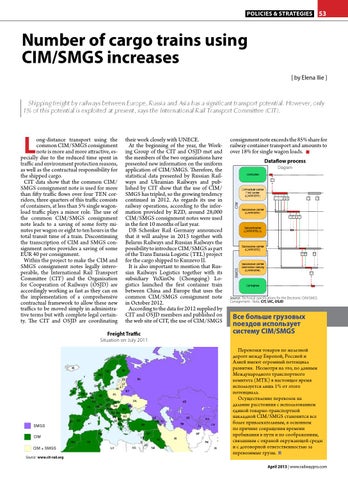
Freight Traffic Situation on July 2011
• • •
their work closely with UNECE. consignment note exceeds the 85% share for At the beginning of the year, the Work- railway container transport and amounts to ing Group of the CIT and OSJD met and over 18% for single wagon loads. the members of the two organizations have 2.4.1.2 Dataflow process Dataflow process presented new information on the uniform Diagram application of CIM/SMGS. Therefore, the statistical data presented by Russian Railways and Ukrainian Railways and published by CIT show that the use of CIM/ SMGS has tripled, so the growing tendency continued in 2012. As regards its use in railway operations, according to the information provided by RZD, around 28,000 CIM/SMGS consignment notes were used in the first 10 months of last year. DB Schenker Rail Germany announced that it will analyse in 2013 together with Belarus Railways and Russian Railways the possibility to introduce CIM/SMGS as part of the Trans Eurasia Logistic (TEL) project for the cargo shipped to Kunzevo II. It is also important to mention that Russian Railways Logistics together with its subsidiary YuXinOu (Chongqing) Logistics launched the first container train between China and Europe that uses the common CIM/SMGS consignment note Source: Technical specifications for theDiagram Electronic2CIM/SMGS Consignment - Note, CIT, UIC, OSJD in October 2012. According to the data for 2012 supplied by CIT and OSJD members and published on Все больше грузовых the web site of CIT, the use of CIM/SMGS
поездов использует систему CIM/SMGS
Freight Traffic Situation on July 2011
Перевозки товаров по железной дороге между Европой, Россией и Азией имеют огромный потенциал развития. Несмотря на это, по данным Международного транспортного комитета (МТК) в настоящее время используется лишь 1% от этого потенциала. Осуществление перевозок на дальние расстояния с использованием единой товарно-транспортной накладной CIM/SMGS становится все более привлекательным, в основном по причине сокращения времени пребывания в пути и по соображениям, связанным с охраной окружающей среды и с договорной ответственностью за перевозимые грузы.
SMGS CIM CIM + SMGS Source: www.cit-rail.org 18.04.2011
Assumption
Contractual carrier is the first carrier Subcontractor is receiving a subset of the ECN from his orderer. Due to the existence of a subcontractor in the transport only the direction CI possible.
1
April 2013 | www.railwaypro.com