Ground Squirrels?
Fish Stocking in Alberta

A publication of Alberta Conservation Association
That
There's a Hawk for
the
Others Get a Free
tRedd Lightly Brown Trout Spawning Success Along
Raven River Are We Paying to Play While
Ride?
It’s time to talk about the birds and the bees

It’s a perfect match.
While providing habitat for waterfowl and wildlife, wetlands near canola crops and alfalfa fields are also home to bumblebees and other pollinators. On the Canadian Prairies, these small but mighty species have an important role as they increase pollination which makes agricultural crops more productive.
At Ducks Unlimited Canada, our research scientists are discovering how even the smallest wetland can support a diverse community of pollinators on Canada’s prairie landscape. To learn more, visit our research wing, the Institute for Wetland & Waterfowl Research, at iwwr.ducks.ca.
Taber Pheasant Festival
October
17-24, 2020

Canada’s BIGGEST Hunting Festival

ONLINE REGISTRATION for reserved site draws: JUNE 1-12
taberpheasantfestival.com


• 5,100 pheasants
• Reserved sites
• Novice shoot
• Game to Gourmet culinary event
• Scotch and wings night
• Raffles and silent auction
• Door prizes
PLUS Special 10 th anniversary details to be announced!
photo: ACA, Colin Eyo
NATURE DEFINES US

Our country is filled with some of the most amazing natural habitats in the world. It’s what makes Canada, Canada – and it’s why we’ve spent more than 50 years protecting our irreplaceable natural spaces and the wildlife that they sustain.
www.natureconservancy.ca/ab
Get Involved
Get outdoors:
Find out which NCC properties you can visit in your area. connect2nature.ca
Spend a day in the field: Become a Conservation Volunteer conservationvolunteers.ca
Help lead the way: Become a Leader in Conservation natureconservancy.ca/ab-lic
1-877-262-1253
Photo by Brent Calver




5 SPRING SUMMER 2020 CONSERVATION MAGAZINE 22 Working to Recover the Species Ferruginous Hawk 14 Be(e)autiful Putting a Price on Pollinators content Site Seeing Timber Ridge Conservation Site 28 Conversations Melissa Jenkins 36 Little Bird, Big Impact 40 Footenote When Too Much is Just Enough 42 Conservation Works 8 tRedd Lightly Brown Trout Spawning Success Along the Raven River 12 A Generous and Meaningful Gift 18 Not Just for Diamonds The New 4Cs 20 A sHell of a Mystery Chinese Mystery Snail 26 Contact us for your FREE subscription to Conservation Magazine: Click SUBSCRIBE on any page of our website ab-conservation.com Download electronic copies online at ab-conservation.com/mag Phone 780-410-1999 or call us toll free 1-877-969-9091 SUBMISSIONS: Guidelines for writers and photographers are available online at www.ab-conservation.com/article. Please submit proposals in writing. The magazine is not responsible for unsolicited manuscripts or images provided for editorial consideration. 38 Are We Paying to Play While Others Get a Free Ride? 30 Fish Stocking in Alberta 12 tRedd Lightly

Our Vision
An Alberta with an abundance and diversity of wildlife, fish, and their habitats; where future generations continue to use, enjoy, and value our rich outdoor heritage.
Our Mission
ACA conserves, protects, and enhances fish and wildlife populations and their habitats for Albertans to enjoy, value, and use.
Follow our work on:
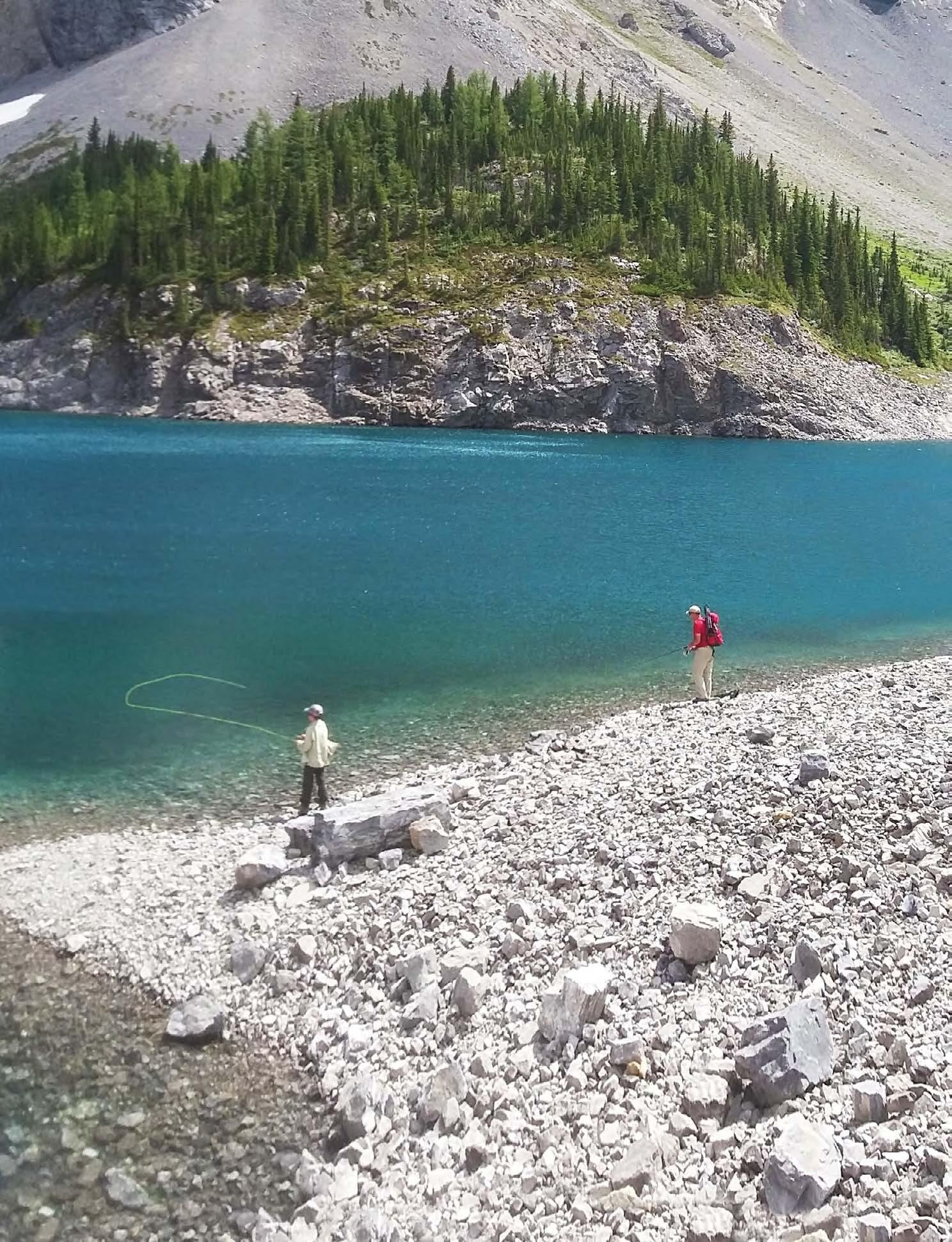
Photo: Fly fishing in Kananaskis Edmonton and Area Land Trust, Sheila Campbell
From the President
As I am writing this letter, I am on day 35 of the COVID-19-caused, working-from-home requirement. So like many of you, I have had to come up with my own personal home office policies:
1. Regardless of what is going on, every Wednesday is “something other than pajama bottoms day.”
2. Even if the video call is just an internal office call, a clean shirt must be worn. A clean housecoat is NOT acceptable.
3. The peanut butter from breakfast must been cleaned from your face before you sit down at the computer, or you will forget it is there at 1:00 p.m. when you have that important video call.
4. At least once a week a shower and shave is required, even if you if you don’t have video calls that week.
5. Regardless of how frustrating the day is, it is not acceptable to start drinking margaritas while at your computer working.
Who would have believed working from home would have so many pitfalls? Who would have believed a couple months ago that the entire world would be turned upside down and many of us would be forced to work from home? While I am not enjoying this new reality, I am grateful that I still have the opportunity to work, as I know many others do not have the option. I am also grateful that my organization allows me to practice social distancing in a home with my family. At least I can have face-to-face interaction with my loved ones without the risk of becoming infected or infecting them. I am sure I speak for everyone reading this when I say that words cannot express the appreciation we all have for those who are still working to take care of others in our hospitals and care homes and other locations around the province.
Despite the turmoil over the last few months it does appear that there is light at the end of the tunnel. While we may not be able to go to the Calgary Stampede this year, it is looking like we will be able to enjoy other outdoor activities in family groups, as long as we keep up with the precautions that have allowed us to get to this point. I look forward to getting out to do some spring snow goose hunting an hour from my home. As things continue to warm up, I hope boat launches will open and I will be able to access some of our local lakes and rivers to enjoy some family fishing days.
Hunting, fishing, and getting outdoors are things that many of us do on a yearly basis. Personally, I have never had to consider, “what if I can’t go hunting or fishing or exploring this year?" The COVID-19 crisis has really highlighted the kinds of things I have taken for granted, mostly because I could never imagine a situation that would result in a fishing season being cancelled or restrictions that limit my ability to travel around the province. Now I can conceive of what could happen; I think we all can. So as some of the restrictions start to relax across Canada, take the opportunity when it arrives to enjoy the outdoors like you never have before. Make sure you follow all the appropriate precautions to avoid spreading COVID-19, but also make sure you enjoy your experience like you are not taking it for granted.
If you are looking for unique ideas for things to explore this summer, have a read through this edition of Conservation Magazine. From snow geese to bull trout, bees to pheasants, there’s a little bit of everything in this issue. Who knows, you may find an article to inspire you to explore something in nature you had never previously considered.
Stay safe, play safe, and enjoy the outdoors.
Sincerely,
Conservation Magazine
Project Lead: Don Myhre
Editor: Elize Uniat
Contributing Editors: Don Myhre, Tara Holmwood and Mary McIntyre
Contributing Writers: Ken Bailey, Andrew Clough, Marco Fontana, Dr. Lee Foote, Tara Holmwood, Janet Kanters, Kris Kendell, Paige Kuczmarski, Mary McIntyre, Sheri Monk, Mike Rodtka, Ariana Tourneur, Elize Uniat
Design: Charmaine Brunes
Photo Credits: Rolf Albert, Provincial Archives of Alberta, Robert Anderson, Leah Breitkreuz, Melissa Buskas, Sheila Campbell, Andrew Clough, Colin Eyo, Gilles Gonthier, Shane Hansen, Melissa Jenkins, Mike Jokinen, Pagenkopf Family, Marco Fontana, Julie Landr y-DeBoer, Kris Kendell, Patty O'Hearn Kickham, Ken Kranrod, Garret McKen, Alberta Environment and Parks, Roth and Ramberg Photography, Mike Rodtka, Diana Rung, Zachar y Spence, Mike Verhage, Sam Vriend, Rhianna Wrubleski
Illustration Credits: Danielle Erickson
ACA Board of Directors Executive
Bill Abercrombie, Chairman
Alberta Trappers' Association
Rober t Gruszecki, Vice Chair
Alberta Hunter Education Instructors’ Association
Sandra Mellon, Treasurer Public At Large, Northwest Region
Greg Shyba, Secretary Public At Large, Central Region
Directors
Ken Ambrock - Northern Board Liaison
Tom Bateman - Director Emeritus
Dr. Mark Boyce - ACA / University of Alberta Chair in Fisheries and Wildlife
Fred Calverley - Trout Unlimited Canada
Randy Collins - Alberta Fish & Game Association
Robert Grandjambe - Public At Large, Indigenous Board Liaison
Dr. Brian Joubert - Nature Alberta
Patrick Long - Director Emeritus
Matthew Mellon - Wild Sheep Foundation Alberta
Perry McCormick - Pheasants Forever
Chuck Priestley - Public At Large, Northeast Region

Travis Ripley - Minister’s Representative
Jeana Schuurman - Alberta Professional Outfitters Society
Richard Stamp - Public At Large, Southern Region
Brent Watson - Alberta Bowhunters Association
Vacant - Public At Large, Academic Representative
Vacant - Public At Large, Business Representative
Vacant - Treaty 8
Conservation Magazine
(ISSN 1488-6235) is the official biannual publication of Alberta Conservation Association.
Charitable Registration Number: 88994 6141 RR0001
Todd Zimmerling President and CEO Alberta Conservation Association
7 SPRING SUMMER 2020 CONSERVATION MAGAZINE For advertising sales information please contact: Ken Kranrod: 780-410-1989 ken.kranrod@ab-conservation.com PUBLICATIONS MAIL AGREEMENT NO. 41260556 RETURN UNDELIVERABLE CANADIAN ADDRESSES TO: 101-9 Chippewa Road Sherwood Park, Alberta T8A 6J7
Todd Zimmerling sturgeon fishing on North Saskatchewan river with family Photo: Shane Hansen - North Saskatchewan River Guide

Trout on Film: A Window into the Creek
Fall Creek is important.
As a tributary to the Ram River, Fall Creek is a critical spawning area for the bull trout population. This creek lies in the North Saskatchewan River watershed, between the Bighorn Dam and Rocky Mountain House.
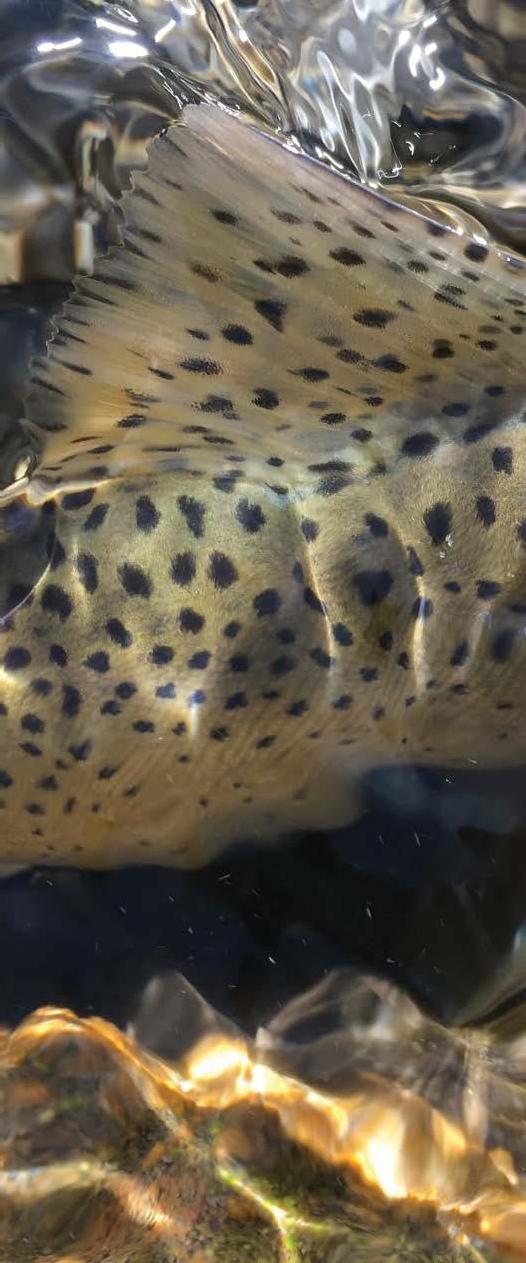
Alberta Conservation Association (ACA) is learning just how impactful this area is with data collected using instream cameras. That’s right—underwater cameras record swimming bull trout, and then we count them via the footage (there are over 1,000 hours recorded)!
“This way, we can avoid handling the fish during their spawning migration,” explains ACA senior biologist Mike Rodtka. The camera is a repurposed fish trap that funnels the fish through a box in the river to capture the video. “From what I know, the use of this type of camera to monitor bull trout spawner numbers is fairly new for Alberta,” he says.
Last fall ACA began analyzing the footage and will compare it to our initial redd (fish nest) counts to see if the numbers align and provide an actual representation of

the creek’s fish population. This is the pivotal point in an ambitious project—redd surveys began in 2007, making it one of the longestterm bull trout datasets in Alberta.
Final results will help Alberta Environment and Parks monitor the health of the Ram River bull trout population, and the effectiveness of the recent closure of an off-highway vehicle trail that ran up the Fall Creek valley. Recovery actions, including closures like these, are a government-led initiative to recover native trout and whitefish in the central and northern East Slopes of Alberta. The North-Central Native Trout program includes the Kakwa, Berland, Pembina, Clearwater, Red Deer, and Lower Ram/North Saskatchewan river watersheds, as well as Pinto Lake.


CONSERVATION MAGAZINE SPRING SUMMER 2020 8 conservationWORKS
photos above: submitted by ACA, Kevin Gardiner background: ACA, Mike Jokinen
conservationWORKS
photo: ACA, Mike Rodtka
Who’s Looking for Brown Trout?
The North Raven River and Raven River are already known for worldclass brown trout fishing, and with ACA’s Riparian Conservation Program, it’s getting even better. Participating landowners have taken on projects that improve riparian habitat, while contributing to angling opportunities on these streams.
What makes this initiative accessible for everyone is…a digital map! Revolutionary, we know, but by simply clicking on a highlighted area on the map, users can see access requirements and contact information for these private locations.
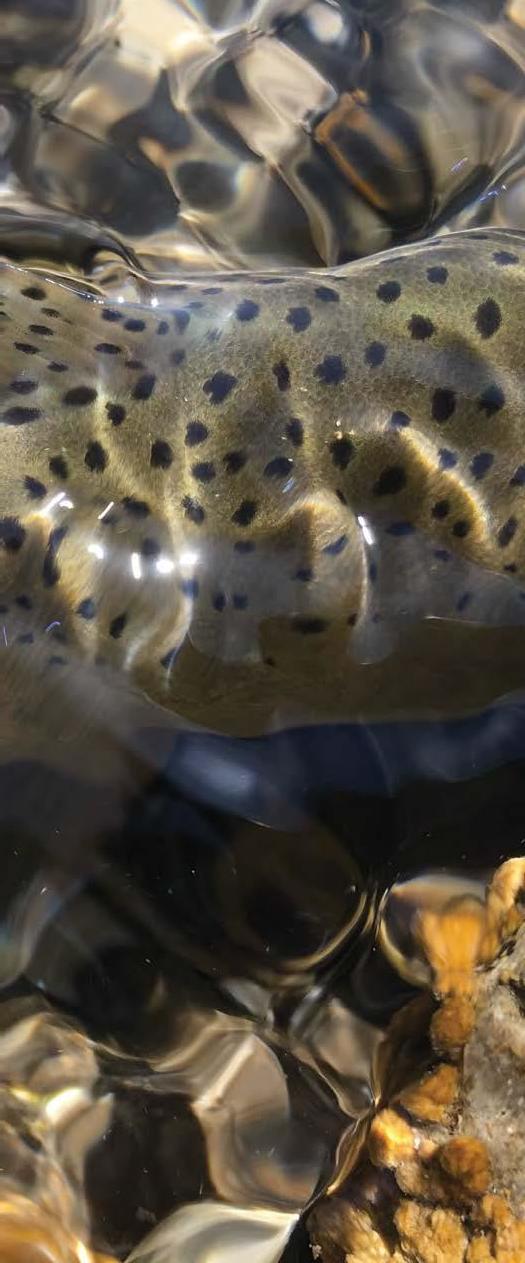
“This online map gives anglers additional opportunities to access these popular fisheries, all while respecting private lands,” explains Erin Vandermarel, biologist with ACA. “Just make your selection, and you’ll see who wishes to be contacted and who doesn’t before you fish specific areas. We think it’s a win-win for both landowners and anglers.”
Want to check the potential for brown trout yourself? Visit our website: www. ab-conservation.com/RavenAngling.
Be sure to thank a landowner if you get the chance!

Scientists: They’re Everywhere
Creative solutions born out of need have staying power, and this conservation tactic is no exception.
When it comes to monitoring amphibians, wildlife managers have extremely limited resources to obtain the data they need. Citizen scientists fill that gap. Anyone can look or listen for amphibians, and in the places you might already go in nature. Too busy? Kris Kendell, lead of the Alberta Volunteer Amphibian Monitoring Program (AVAMP), acknowledges the crunch for time: “That’s possibly the best part; how much time and effort you put into the program is entirely up to you.”
Sharing what you’ve found is not just a novelty. “Voluntary data is truly essential— helping biologists better understand the distribution and status of Alberta’s amphibian populations,” says Kendell. And it’s often a first step to many amphibian conservation initiatives in the province. Understanding where amphibian populations are found, and then their general population trend, is how we can help prevent species from becoming rare. Early detection of declines allows time for smaller management decisions to help conserve the species, before getting into intense recovery actions.

Did you know...?

Of Alberta’s amphibians, only three species are considered secure with large and healthy populations, with the remaining seven species being assessed as requiring special attention or protection to prevent their decline. Recording your observations will help conserve amphibian populations—get started at www.ab-conservation.com/avamp.
Alberta’s amphibians:
At Risk - Northern Leopard Frog
May Be At Risk - Canadian Toad and Plains Spadefoot
Sensitive - Columbia Spotted Frog, Great Plains Toad, Western (Boreal) Toad and Long-toed Salamander
Secure - Tiger Salamander, Boreal Chorus Frog and Wood Frog
9 SPRING SUMMER 2020 CONSERVATION MAGAZINE
Northern Leopard Frog photo: ACA, Mike Verhage
photo: ACA, Kris Kendell


Fishing in the Forest?
A stream may be small and hidden, but it can still play an important role in watershed health. Here, ACA biologists are captured electrofishing a small tributary to the lower Ram River, as part of the Ram River Bull Trout Assessment project. At the request of Alberta Environment and Parks, ACA began monitoring the lower Ram River watershed in 2017 (part of the North-Central Native Trout program). Support for this project also comes from our partner, Tom Wiseman.

conservationWORKS
Photo: ACA, Zachary Spence
tRedd Lightly
Brown Trout Spawning Success Along the Raven River
► by Andrew Clough
There is something special about brown trout. Even as an introduced species, this fish gets the utmost respect from Alberta’s anglers. Brown trout grow big, are colourful, live in beautiful places, and many anglers agree: they are one of the toughest of the trout species to catch.
Originally introduced from Europe, these fish don’t come without controversy. Outside Alberta, they’re considered one of the world’s top 100 worst invasive species. However, thanks to their ability to coexist with other Alberta fish species, they don’t seem to impact our ecosystems too much. Nor do they hybridize with any of our native fish. Add their notoriety among anglers and they start looking a lot like a perfect addition to the cool streams of Alberta’s east slopes. The streams that contain these special fish are beautiful and clean, but also located primarily on private land. If brown trout are to continue their success within these watersheds, landowner and public assistance is essential.
A perfect pairing
Along the Raven River, east of Caroline, the Drake and Porter Conservation Sites lie side by side. There, almost four kilometres of river flow through 288 acres of prime wildlife habitat. Alberta Conservation Association (ACA)—through generous donations from Alberta’s hunters and anglers, Alberta Fish & Game Association, an anonymous oil and gas company, Edmonton Trout Fishing Club, Environment and Climate Change Canada – Habitat Stewardship Program, Northern Lights Fly Fishers, Red Deer River Naturalists, and Trout Unlimited Canada— acquired these two properties between 2015 and 2018. Securing them guarantees that Albertans, for generations to come, can enjoy the fishing, hunting, and outdoor escape these properties provide. As part of the agreement, ACA has been monitoring trout spawning activity there.
Drake and Porter have quickly become popular with anglers looking for worldclass, big brown trout fishing. Fish over 20 inches are quite common, and fish over 25 inches are not unheard of. But the increased angling pressure and more site users merit extra concern over the viability of fertilized trout eggs—the trout population’s success depends on it.
Code redd
When a trout spawns, the female digs a nest, called a redd, in gravel. These fish nests are easily identified—we can see a cleaned pit of gravel and the subsequent spill downstream from the pit. Males will fertilize the eggs in the nest and the trout will cover the fertilized eggs with fine gravel to allow them to incubate. Brown trout, the most popular sport fish species within the Raven River, spawn in the fall, from September to November, each year. With more users come more boots in the water and more stakeholders who are concerned about the health of the fish and the ecosystem. With a little knowledge, you can protect these fish during one of their most sensitive times.
Help a trout out!
Watch for redds – Know how to identify a redd and don’t step into the cleaned gravel. One of the biggest concerns for egg survivability is sedimentation smothering incubating eggs. Walk well upstream or downstream to avoid sedimentation stirred up by your steps settling onto the nests.
Don’t catch fish off redds – During the spawning season, you are likely to see fish on a redd. They can be very large and oh so tempting to catch. But: catching a fish off a redd now will increase the stress of that fish and potentially lower their success of spawning later. Sit back and watch instead.
Handle fish with care – If you fish during this time of year, limit handling time. Use barbless hooks and a landing net, and don’t fight the fish to exhaustion. Keep the fish in the water as much as possible and release with care.
Respect the land – Keep chemicals and wheels out of the water. Cross the stream at bridges or through a built-up ford to avoid sedimentation.
Clean + Drain + Dry your gear –Whirling disease has been confirmed throughout south and west-central Alberta. This disease affects trout and whitefish species, both found within the Raven River system. Always clean + drain + dry your gear between watersheds, even if the previous drainage does not have confirmed cases of whirling disease.
Don’t let it loose – Aquarium fish and other non-native species can be extremely detrimental to the sensitive ecosystems that are home to brown trout. Do not release live fish into rivers, streams, or ponds—prevent another Prussian carp invasion. And never move fish between waterbodies.
It’s important to note that spawning occurs in the spring and fall. Rainbow trout and cutthroat trout are spring spawners, while char species like brook trout, brown trout, bull trout, and lake trout spawn in the fall.

CONSERVATION MAGAZINE SPRING SUMMER 2020 12
Future fishers
The future of these fish depends on us all, especially when a little knowledge and care go such a long way. Having fish and wildlife for our kids and grandkids to enjoy is vital to keeping people engaged in the world’s wild places. And more people caring about these resources equal more chances for our fish and wildlife to thrive.
So, take someone out fishing or hunting. Heck, take them to the Drake and Porter sites to check out some spawning trout or to fill a white-tailed deer tag! Engaging youth early can create lifelong stewards of our ecosystems. Even better, sharing these moments create memories that last a lifetime.

 photo: Marco Fontana, a biologist with ACA, records a brown trout redd on the North Raven River in early October ACA, Andrew Clough
Be(e)autiful
Putting a Price on Pollinators
 ► by Elize Uniat and Tara Holmwood
The farmers farm, the bees buzz, and the world’s human and animal populations eat the results. But actually, it’s much more complicated than that. There are native pollinators and non-native pollinators. There are crops that need pollinators to succeed and crops that don’t. There are perfect-for-crops fields—large square blocks with no trees or wet areas— and “messy” fields, dotted with wet spots that have a bad rap for getting farm equipment stuck and generally making seeding and harvesting harder.
Are messy fields really worse, though? Is there room for small wetlands in the field? The jury is still out, but new research suggests there may be value for farmers to conserve these potholes for native pollinators.
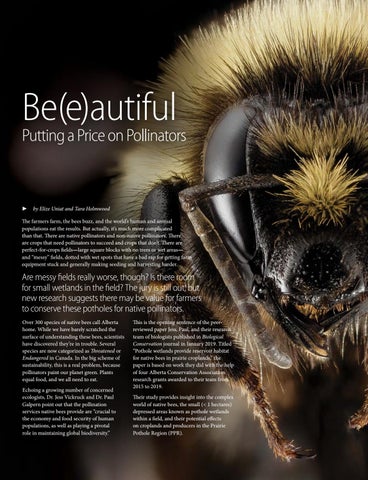
Over 300 species of native bees call Alberta home. While we have barely scratched the surface of understanding these bees, scientists have discovered they’re in trouble. Several species are now categorized as Threatened or Endangered in Canada. In the big scheme of sustainability, this is a real problem, because pollinators paint our planet green. Plants equal food, and we all need to eat.
Echoing a growing number of concerned ecologists, Dr. Jess Vickruck and Dr. Paul Galpern point out that the pollination services native bees provide are “crucial to the economy and food security of human populations, as well as playing a pivotal role in maintaining global biodiversity.”
This is the opening sentence of the peerreviewed paper Jess, Paul, and their research team of biologists published in Biological Conservation journal in January 2019. Titled “Pothole wetlands provide reservoir habitat for native bees in prairie croplands,” the paper is based on work they did with the help of four Alberta Conservation Association research grants awarded to their team from 2015 to 2019.
Their study provides insight into the complex world of native bees, the small (< 1 hectares) depressed areas known as pothole wetlands within a field, and their potential effects on croplands and producers in the Prairie Pothole Region (PPR).
“ During the last ice age, kilometre-high glaciers scraped across Nor th America. When the ice melted, millions of shallow pools were left behind. ” – Ducks Unlimited Canada (DUC)
What and where is the Prairie Pothole Region?
The PPR stretches across southern Alberta, Saskatchewan and Manitoba, and down into North Dakota, South Dakota, Iowa, Minnesota, and Montana. According to DUC’s website, “The number of potholes fluctuates from two million to eight million, depending on seasonal moisture levels.”
The usefulness of these potholes is multifaceted. On a basic level, they provide great habitat for insects, birds, and amphibians. They filter nutrients and other pollutants, keeping them out of waterways. And they help absorb water in wet years, which means less flooding, and release it in dry years, benefitting plants and animals, including our troubled native pollinators.
Name that bee
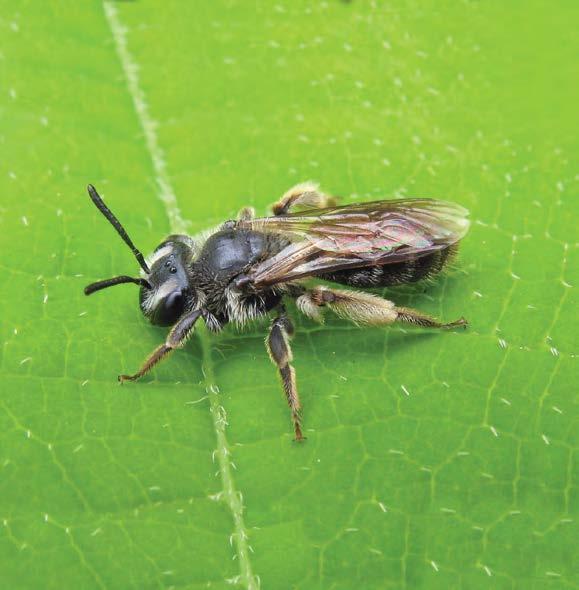
Native bees have neat names! Jess, Paul, and their team included five families in their study. The names of these bees often derive from where and how they nest.
1. Mining bees (Andrenidae): a solitary bee, they dig (“mine”) into the soil to make their nests.
2. Bumble bees (Apidae): these familiar bees are social (they live in a nest with other bees, but in much smaller groups than European honey bees) and usually construct nests underground in rodent burrows or under rocks and tree roots. Some species will build their nests above ground in bird nests or tree cavities.
DUC estimates that the cumulative effect of over a century of draining potholes to make way for production and development is a loss of up to 40 percent of the PPR’s wetlands. Before we were concerned about things like sustainability, biodiversity, and climate change, it only made sense that a farmer would want a nice square, flat field without wet spots. Farming is no easy gig, and common wisdom suggests a level field simplifies the work.
But now we are faced with declining biodiversity and pollinator populations— who hasn’t read a bee colony collapse disorder headline in the last few years?— and it has become urgent to suss out the complex interrelationships between crops and pollinators.

3. Plasterer bees or polyester bees (Colletidae): these solitary bees secrete a waterproofing substance (the “polyester”) that they use to coat the inside of each cell in their nest.
4. Sweat bees (Halictidae): these sometimes social bees are attracted to perspiration, hence their name. Most nest in the ground, but a few will nest in wood.
5. Mason bees and leafcutter bees (Megachilidae): another solitary bee family, leafcutters create nest cells with leaves, and mason bees use mud to construct nests in small dark cavities (e.g., holes or cracks in trees, cracks in rocks, or hollow plant stems).
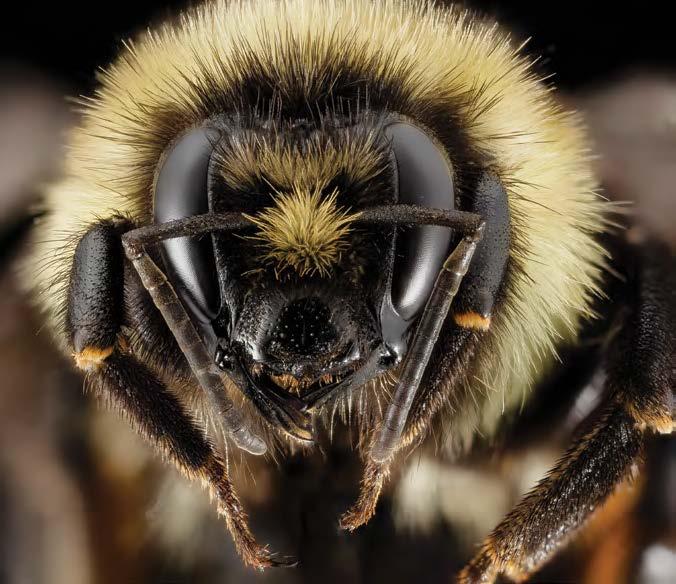
bumble bee (Bombus ternarius) photo: USGS Native Bee Inventory and Monitoring Program, Sam Droege
Tri-coloured

Connecting pothole wetlands, pollinators, and croplands
Of all the causes of pollinator declines— pesticides, parasites, climate change, and habitat loss—researchers have determined that habitat loss is “perhaps the most pervasive issue of all” (Vickruck, Best, et al.). If pollinators don’t have a place to feed and nest, they can’t recharge or reproduce. However, in order to build a case for conservation, there has to be proof.
Up until recently, very little work has been done about pothole wetlands’ role as habitat for native pollinators. Jess and Paul’s research asked whether pothole wetlands play an important part in providing critical resources for native bees in the PPR. They hypothesized that if these wetlands are left alone, nearby
native bees would benefit, which could spill over into benefits for the surrounding crop. And indeed, the field work holds up their hypothesis.
The bees most of us think about are busy making delicious honey, but honey bees are not native to North America. One of the most-studied insects out there, they came from Europe, are managed by humans to nest in convenient-for-us hives, and are often brought in to pollinate crops that stretch across large swaths of pothole-free fields where native bees, as Jess and Paul’s paper discusses, do not thrive. They can’t, because there are not enough consistent food sources or undisturbed nesting areas available. Research published by Paul in 2017 suggests that canola, which blooms for about three weeks, attracts bumble bee queens, but the colony soon gets in trouble because the flowers they were relying on disappear and is not replaced by anything else as it would be in an undisturbed ecosystem. When the canola flower feast fades, the bumble bee workers find themselves in a bee food desert.
But if there were a humble pothole nearby, the bumble bee story—and that of other native pollinators as well—may have a better ending. As Jess and Paul explain, remaining wetlands in the PPR are often inside large croplands, and “in many cases, wetland margins represent the primary locus of undisturbed habitat for native bees in annual croplands.”
The PAULinator: Dr. Paul Galpern
Dr. Paul Galpern is a passionate landscape ecologist. As a researcher and an associate professor with the Department of Biological Sciences at the University of Calgary, Paul studies the resilience of pollination ecosystem services in Canadian prairie agricultural systems.
BEEhind the study: Dr. Jess Vickruck
Dr. Jess Vickruck is an enthusiastic ecologist and evolutionary biologist. Over the last few years, this researcher focused her interest on the connections between the benefits of insect behaviour (mainly native bees) and conservation in agroecosystems. Excited to delve deeper into her research, Jess is exploring new landscapes and taking on new projects in Fredericton, New Brunswick.
CONSERVATION MAGAZINE SPRING SUMMER 2020 16
Sweat bee (Halictid family) photo: Patty O'Hearn Kickham
Mining bee (Andrenid family) photo: Gilles Gonthier
So what’s a pollinator and a producer to do?
If bees and food production in the Canadian prairies were dating, their Facebook relationship status would say, “It’s complicated.” It comes back to habitat and the kind of crops we grow here.
Firstly, we’ve established that native bees need those pesky potholes (or other suitable nearby habitat) to reproduce in significant enough numbers to efficiently pollinate crops. Which, by the way, they can do. Research has shown that native bees are capable of offering similar pollination services as managed hives of the European honey bee (Morandin and Winston). But you would need enough habitat within the cropland to make it work.
Secondly, the vast majority of the crops we grow in Alberta actually do not need pollinators to be successful. Paul points out that, “At present, most crop production as measured per unit area does not require insect pollination. Wheat, barley, and peas do not benefit from bees, and canola only minimally. Seed production of canola and alfalfa does rely on pollination. But typically they truck in managed pollinators such as honey bees or alfalfa leaf cutter bees to do the job.”
While it would be great if we could pin a dollar figure on the value native pollinators bring to the farming industry, the reality isn’t that simple. All the data collected thus far “suggests that the service native pollinators provide in terms of increased yield is positive,” according to Paul, “but how much that is worth to a farmer probably depends on the crop, and whether they are growing seeds for other farmers to use or grain for market.”
There is the idea of social licence to operate, which Paul suggests could be quite valuable to farmers because it is more and more measurable in dollars and cents. He cites canola buyers overseas, “who are increasingly demanding evidence that the product they are buying (i.e., from Canada as a whole) is produced sustainably. Minimizing harm to bees is one dimension of sustainability and is part of this social license.”
Did you know…?
• Agroecosystem (or agricultural ecosystem): A complex system designed by humans based on experience and experiments.
• There are over 970 different bee species native to Canada.
• These species are also considered pollinators: wasps, flies, butterflies, moths, and beetles.
• Get connec ted with the BumbleBeeWatch or iNaturalistapps.

• While Jess and Paul’s study focused on small in-field wetlands, there are many other nonproductive areas in agricultural landscapes that can also benefit pollinators. These include pivot corners, shelterbelts, “low” spots, ditches, fence lines, in-field willow-ring wetlands, remnant treed areas, roadsides, areas around buildings and corrals, hay and pasture lands, forested areas, habitat along streams, unused inaccessible areas, and even flower gardens.
Economic benefits aside, there is a clear conservation benefit for pollinators and other wildlife when agricultural producers leave low productivity farmland out of production. Problem is, we don’t yet know if that’s an affordable option. Will that result in better crop production for crops that need pollination? Or if we go one step further, is there any economic value in managing native pollinator habitat in a farming context? Put a different way, what would happen if farmers managed their low productivity lands to be great pollinator habitat? Or will nature take care of it without management? The relationships, economic and otherwise, between pollinators, “unproductive” natural areas in farmed land, croplands, and producers require more research and analysis.
The good news is that we are asking these questions. We are becoming more aware of the importance of how all the different parts of our ecosystems fit and work together. Plus, conserving wetlands in this context is easy— just let them be(e)!
While the world has a long way to go before bees will thrive as they once did, dedicated biologists like Paul, Jess, and their team are out there gathering the evidence and information we all need. What we know for sure is that native pollinators can thrive around prairie potholes, and that finding ways to co-exist instead of continuing our practice of whack a wetland is the price of a sustainable future.


Bibliography
“Prairie Pothole Region.” Ducks Unlimited Canada. Accessed February 25, 2020. https://www.ducks.ca/places/prairie-pothole-region.
Morandin, Lora A., and Mark L. Winston. “Pollinators provide economic incentive to preserve natural land in agroecosystems.” Agriculture, Ecosystems & Environment. September 2006: Vol. 116, Issue 3 – 4. 289–292. https:// doi.org/10.1016/j.agee.2006.02.012.
Vickruck, Jess L., Lincoln R. Best, Michael P. Gavin, James H. Devries, and Paul Galpern. “Pothole wetlands provide reservoir habitat for native bees in prairie croplands.” Biological Conservation. April 2019: Vol. 232. 43-50. https:// doi.org/10.1016/j.biocon.2019.01.015.
17
Tri-coloured bumble bee (Bombus ternarius)
photo: USGS Native Bee Inventory and Monitoring Program, Sam Droege
Illustrations: Danielle Erickson
SPRING SUMMER 2020 CONSERVATION MAGAZINE
 ► by Marco Fontana
A Generous and Meaningful Gift
“Buy land, they’re not making it anymore.”– Mark Twain
A simple truth yes, but crucial from a conservation perspective. Another simple truth: without habitat there can be no wildlife or fish. So, we must secure land to ensure we continue to have valuable wildlife and fish resources for the generations to come. Many current pressures on the land contribute to habitat loss and fragmentation: agricultural conversion, urban expansion, and industrial use, just to name a few. Left unchecked, these growing pressures lead to fewer fish and wildlife populations, less biodiversity, losing sensitive species at risk, and other stresses on ecosystem integrity. If you’re reading this magazine, you probably already understand the importance of habitat and want to keep wild places on the landscape. Like me, you might feel an intrinsic connection to these natural places and the inherent need to conserve the land and its ecological values.
I’m lucky to be able to put my passion for habitat to work through Alberta Conservation Association’s (ACA’s) Provincial Habitat Securement Program. Our active land securement program has a strong track record of managing conservation land to ensure important habitat is maintained into the future. Occasionally, the land we’re able to secure has lessthan-pristine habitat when we get it, and that’s okay. We work hard to restore those lands and enhance the habitat, which we then continue to protect through careful management.
CONSERVATION MAGAZINE SPRING SUMMER 2020 18
For the wildlife and for Albertans: 300,000 acres
The land we secure also provides Alberta’s outdoor enthusiasts with sustainable recreation options like hunting, fishing, foraging, wildlife viewing, and nature photography. We’ve partnered with many like-minded conservation groups, government agencies, and industry partners to bolster our securement program and help achieve our conservation goals. Currently, ACA and/or our partners manage over 780 conservation sites across Alberta.
These sites cover more than 300,000 acres, and you can find information about all of them in the Alberta Discover Guide and at www.albertadiscoverguide.com.
How ACA secures land
One thing I’ve learned is that it’s important to stay flexible when you’re working to secure conservation land. Each new project can be as different as the individuals you work with. That could pose challenges, but it also presents exciting opportunities to be creative. Sometimes purchasing land or accepting a land donation is straightforward. Other times, it means negotiating complicated partial donation and partial sale arrangements, sensitively and respectfully assisting landowners with estate planning and planned giving, or developing conservation agreements with landowners, municipalities, or other governments. Whatever the case may be, we at ACA strive to find innovative solutions that meet everyone’s goals.
As a land trust, ACA has a variety of securement tools in its toolbox. But, unlike any other organization, we’re in a unique position to help complete creative, habitatfocused subdivisions that wouldn’t otherwise be approved through normal administrative channels. This gives ACA even more flexibility to develop innovative securement projects. And this was the case when I had the good fortune of working with Joseph and Laura Di Santo.
Lead by example
The Di Santos were selling a house on 160 acres of beautiful forested habitat near the James River. They had offers but weren’t satisfied that the potential buyers would continue to steward their beloved land as well as they had. That’s when they approached
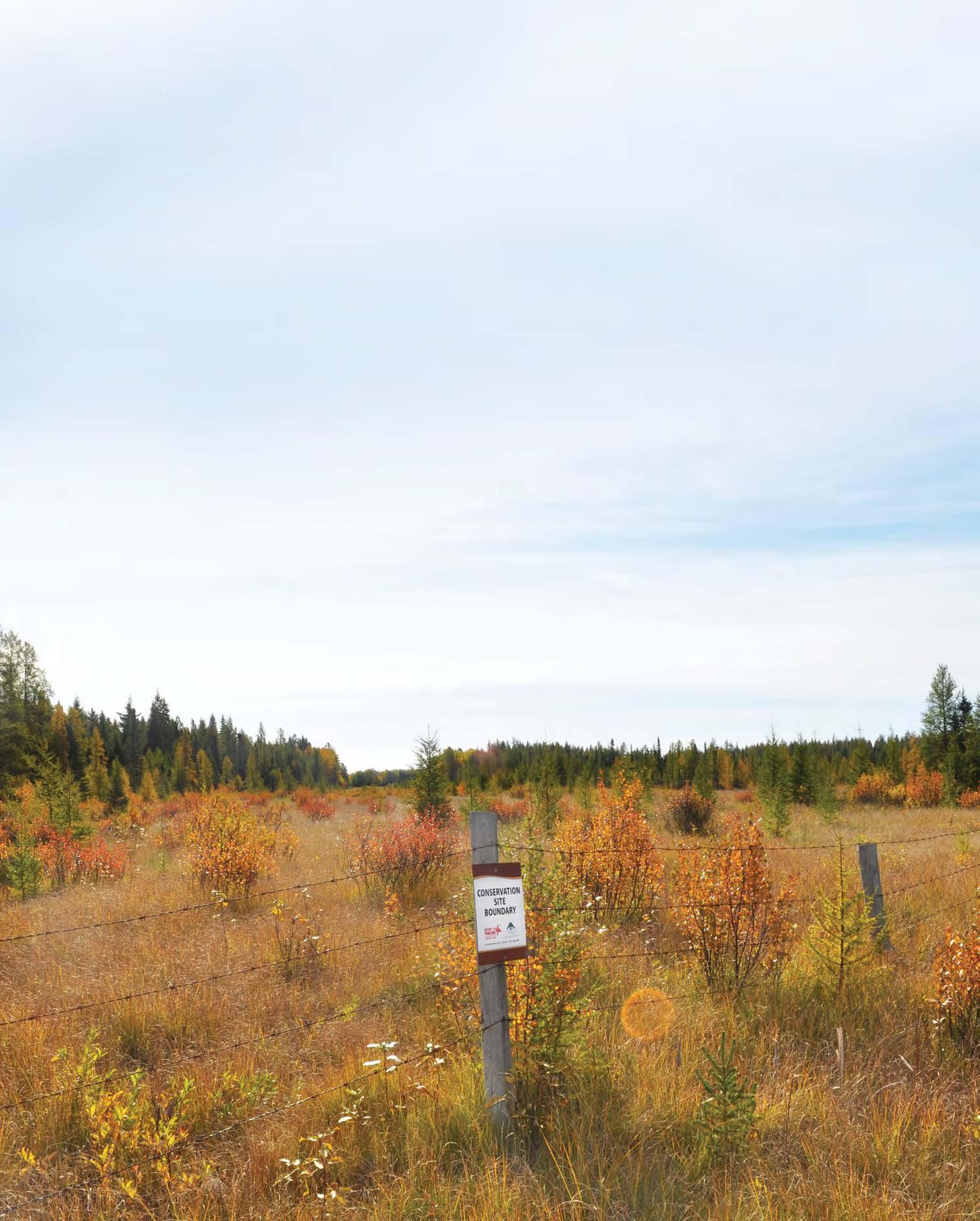
ACA. For us, securing and managing the habitat was a high priority, but buying a house with it wasn’t very appealing. So, with the support of Clearwater County, we subdivided the habitat lands from a 12-acre lot containing the house. The Di Santos then sold the house parcel separately, putting them in a position to donate most of the remaining habitat lands to ACA.
It was a real win for the Di Santos and for all of Alberta’s outdoor enthusiasts. The Di Santos named the site “Larches”—after the tamarack forest where they loved to spend time—and their gift of land was further recognized by ACA with a dedication to the memory of their beloved dogs. This parcel is just one of over 30 land donations that have been made to ACA, each with its own unique story.
At ACA, we enjoy working with people who are passionate about conserving the land they’re strongly connected to. Accepting land donations is an amazing opportunity for us to secure important habitat for all Albertans to enjoy. It’s also a meaningful service we gladly provide to landowners who want to create a legacy by protecting the natural environment for future generations.
Thank you to all the donors who have gifted land to ACA. I speak for everyone at ACA when I say that working with you and seeing your commitment to conserving the land you love is an inspiration and an honour.
The benefits of giving back
An additional benefit of giving land to a charitable organization like ACA is the tax receipt you’ll receive for the value of your gift. Your land donation to ACA may qualify for Environment and Climate Change Canada’s Ecological Gifts Program. This federal program encourages the giving of ecologically sensitive lands by providing extra tax benefits to donating landowners. Benefits include a reduction in taxable capital gains realized on the disposition of the property, an increase in the proportion of a tax credit that can be used against the donor’s annual income, and the extension of these benefits carried forward for 10 years. For more information, visit the Ecological Gifts Program website.
If you are considering donating land, consult with family and a financial advisor. It’s important to consider your financial needs, especially with respect to taxes, and to be very clear with your intent and desires for the land—what do you want to see happen or not happen to your land after gifting it to ACA?
If you or someone you know are thinking about conserving a piece of land, we would be honoured to work with you. Get in touch!
Toll Free: 1-877-969-9091
Email: darren.dorge@ab-conservation.com

19 SPRING SUMMER 2020 CONSERVATION MAGAZINE
photos: Larches Conservation Site near Sundre, Alberta ACA, Marco Fontana

Not Just for Diamonds
The New 4Cs
► by Mike Rodtka

At first glance, it's hard to imagine jewellers and conservation biologists having anything in common but, surprisingly, they do.
If you have ever bought a diamond, you have likely heard of the 4Cs of diamond quality: cut, colour, clarity, and carat. Jewellers use this simple mnemonic to convey the complex interplay of characteristics that determine a diamond’s value. Conservation biologists take a similar approach—though the vocabulary is different—when describing the fundamentals of native trout habitat. The best trout habitats also rely on 4Cs: cold, clean, complex, and connected.
Cold: Our native trout are cold-water specialists, exquisitely adapted to life in frigid waters. Water temperatures above 19⁰C are stressful; temperatures above 25⁰C are fatal.
Clean: Native trout depend on clean water free of pollutants for their survival. Unnaturally high levels of sedimentation can smother incubating trout eggs, which female trout deposit in a gravel nest on the stream bottom called a redd. (Read more about redds in “tRedd Lightly” on page 12.)
Complex: Streams with a mixture of gravel and cobble bottoms, abundant woody debris, and well-vegetated banks provide the diversity of forage and shelter growing trout require.
Connected: Native trout need unimpeded access to suitable spawning, rearing, and overwintering habitats to fulfill their lifecycle. These three habitats differ and are often separated by dozens or even hundreds of stream kilometers.
The 5th C: Conservation
No discussion of healthy stream habitats for trout would be complete without mentioning the importance of conserving riparian areas. These are the lands next to streams and other waterbodies, where the vegetation and soils are strongly influenced by the presence of water. The productivity of riparian areas, along with their proximity to water, make them attractive for development and degradation, which directly impacts the 4Cs.
Healthy riparian areas are often heavily vegetated. The shading provided by streamside trees and shrubs helps keep the water cool in summer. By slowing and filtering overland runoff, riparian vegetation also reduces soil erosion and captures pollutants, ensuring the stream runs clean. Undercut banks and abundant woody debris are a feature of healthy riparian areas and contribute to stream complexity. Stream connectivity is reduced when unhealthy riparian areas result in “dead zones” of severely degraded stream habitat that may impair or even block trout migration.
The future of native trout in Alberta depends on our willingness to protect the 4Cs and redress past wrongs. Much like a single occlusion may render an otherwise perfect diamond worthless, degrading any of the 4Cs of habitat quality may spell the end of a stream’s trout population. Thankfully, most of the damage people have done to native trout habitat is reversible. Through its Riparian Conservation Project, Alberta Conservation Association works with private landowners, watershed groups, government, industry, and other stakeholders across Alberta to protect the 4Cs. To date, over 1,000 acres of riparian habitat have been conserved.
Our society cherishes diamonds for their beauty and symbolism. As glittering jewels of our streams and a potent symbol of the wild, clean waters that sustain us, Alberta’s native trout are no less worthy of our appreciation.
21 SPRING SUMMER 2020 CONSERVATION MAGAZINE
photo: Castle River ACA, Fisheries
► by Janet Kanters
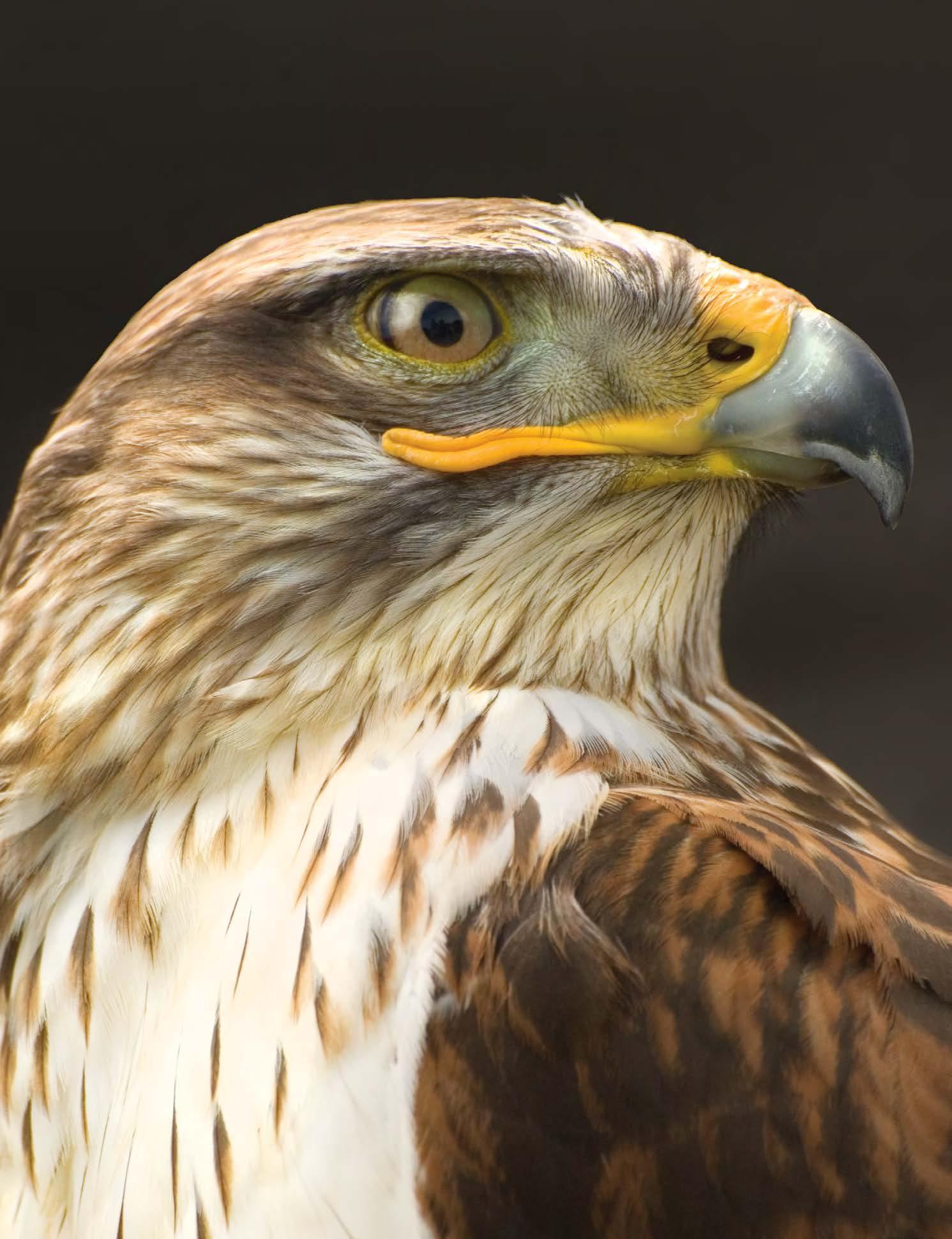
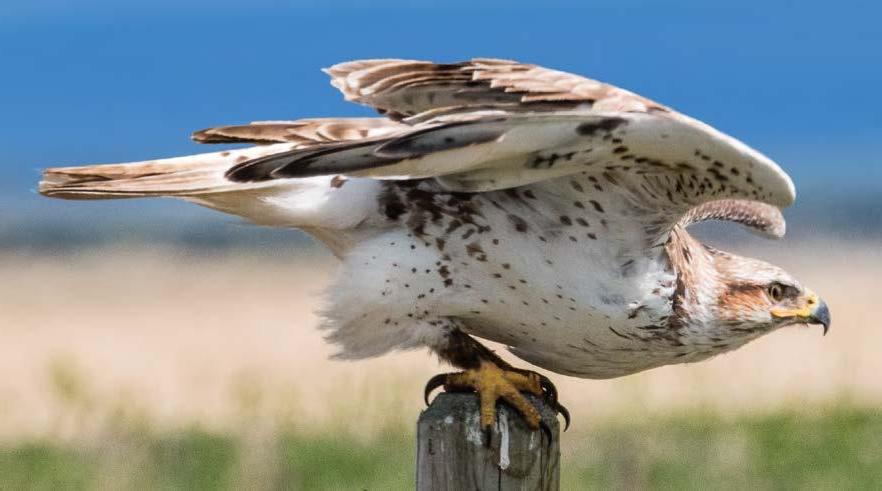
The largest of the North American hawks, the ferruginous hawk (Buteo regalis) is a bird of the open prairie, soaring at great heights in search of prey to feed its ever-hungry nestlings.
Between March and mid-October in Alberta, this at-risk species is limited to the Grassland Region, which extends west from the Saskatchewan border to the Highway 2 corridor, and from the United States border as far north as Stettler.
The ferruginous hawk is listed as an Endangered species under the Alberta Wildlife Act and a Threatened species under Canada’s Species at Risk Act (SARA). According to Brandy Downey, species at risk biologist with Alberta Environment and Parks (AEP), the ferruginous hawk population has been monitored in Alberta since 1982. They discovered that between 1992 and 2000, the estimated number of nesting pairs in the province dropped significantly.
“This led to the listing of the species as Endangered in 2006,” said Downey. “Key threats for the species include habitat changes or loss of habitat, human disturbance at the nest site, human-caused mortalities, loss of nest site availability, and environmental issues.”
As part of Alberta’s management of the ferruginous hawk, a population inventory is completed every five years. The results of these inventories determine if a review of the species status is warranted.
“Within the Alberta Species at Risk Program, species status is a key factor in determining a species priority,” Downey said. “As the ferruginous hawk is listed as an Endangered species under the Alberta Wildlife Act, it is a high priority species for the province of Alberta.”
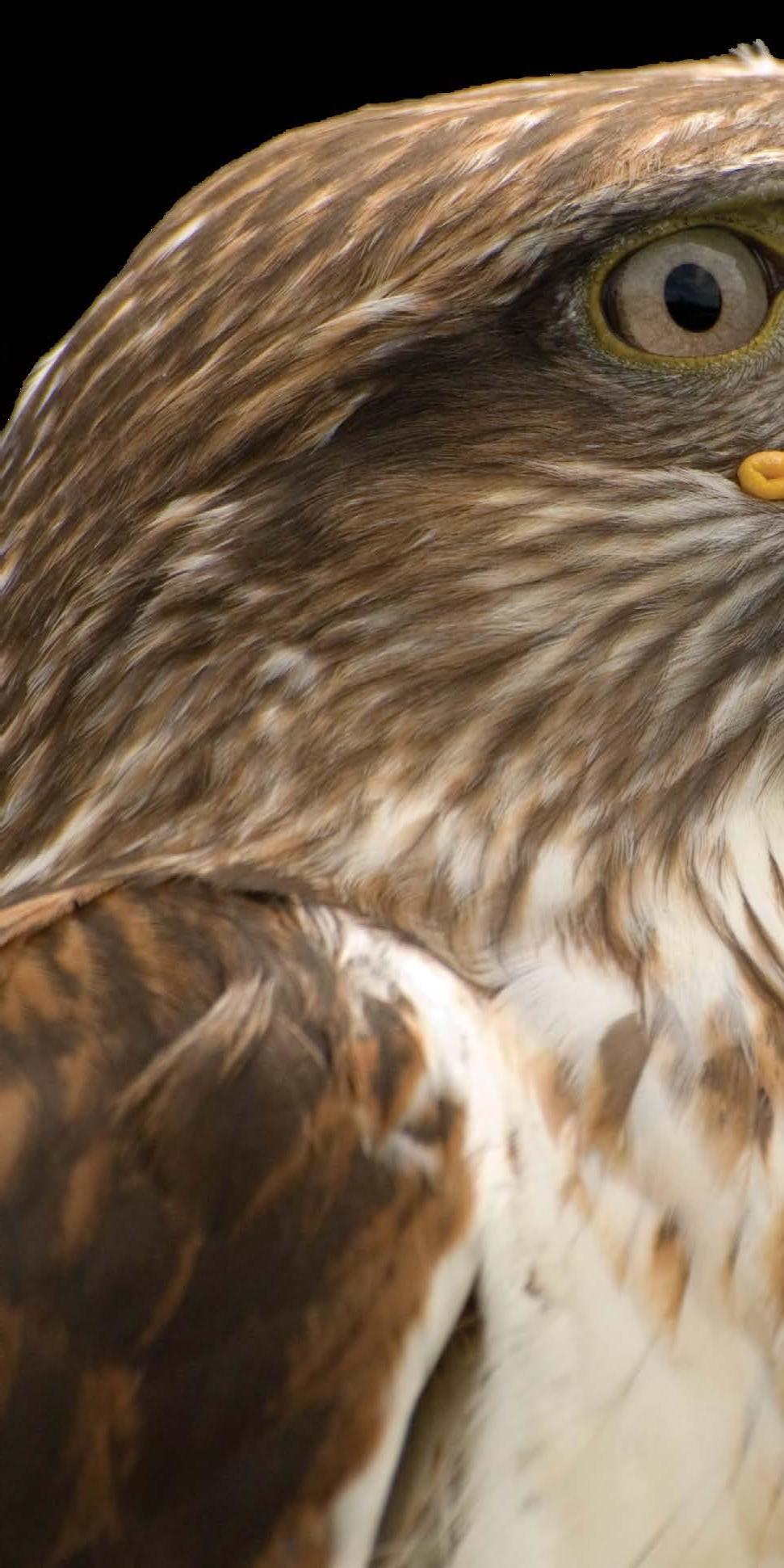
FERRUGINOUS Working to Recover the Species

How ferruginous hawks are counted: The ferruginous hawk population estimate is based on the number of active ferruginous hawk nests identified within 150 survey blocks that are spread out across the provincial range of the species. Trained observers survey each block, which are four miles by four miles in size, to identify all active ferruginous hawk nests inside each block. The resulting population estimate is extrapolated from the number of active nests identified during the survey.
22 CONSERVATION MAGAZINE SPRING SUMMER 2020
photo: ACA, Sam Vriend
FERRUGINOUS
Endangered,now what?
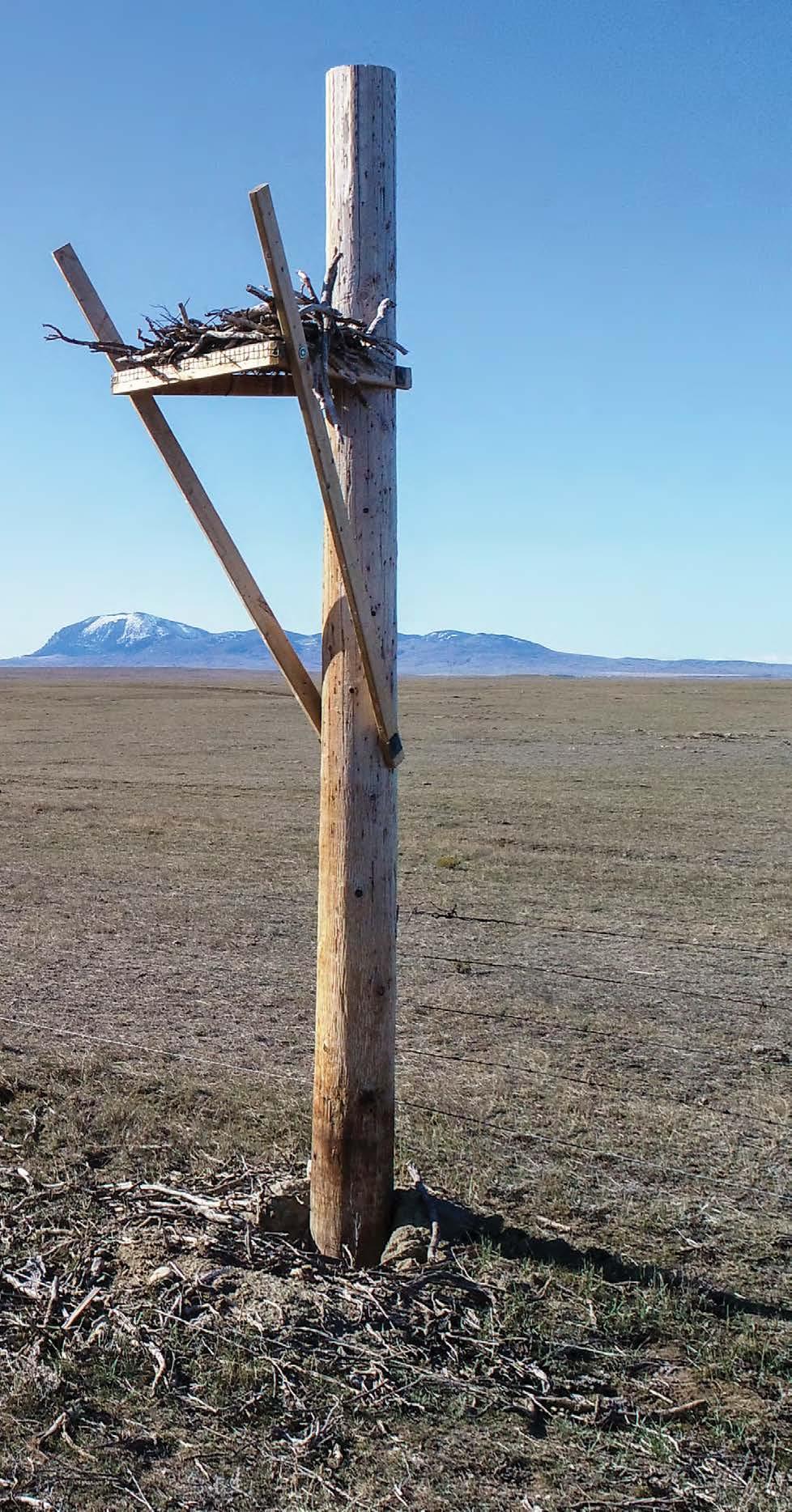
The province released a Ferruginous Hawk Recovery Plan in 2009. Over the past 10 years, a number of recovery actions have been implemented, including nest site availability. Historically a ground-nesting raptor, research has shown that ferruginous hawk nests on above-ground structures have increased success. But above-ground features are limited in the hawk’s range.
“A number of recovery partners, including Alberta Conservation Association (ACA), have implemented an artificial nest platform program,” said Downey. “Through this program, artificial nest platforms have been installed in areas where natural ferruginous hawk nest site features have been lost.”
Habitat stewardship is another focus the province has worked on. For instance, private landholders manage the majority of ferruginous hawk habitat. Stewardship programs, such as Multiple Species at Risk (MULTISAR), work directly with private landholders to support continued good management of ferruginous hawk habitat.
According to Downey, the ferruginous hawk is sensitive to human activity around their nest sites. As part of the recovery plan, the Government of Alberta has developed standard mitigations for industrial development to conserve the ferruginous hawk and their nest sites from human disturbance. Industrial proponents operating in the ferruginous hawk range implement these standards.
Additionally, research by the University of Alberta (U of A) Raptor Ecology and Conservation Team (REACT) has modelled
important habitat, measuring the impacts of human development on nesting/fledging success and migration return rates. This research is ongoing and was used in the development of the new Draft Alberta Ferruginous Hawk Recovery Plan.
“The new plan should be released in the next 12 months,” noted Downey. “As part of the government’s management of the species, the 2020 inventory will be completed in cooperation with our partners to determine the population trends in the province and provide an overall population estimate. The 2020 inventory field work will be completed in the spring and summer, and the results will be available in late 2020.”


 ACA staff install a ferruginous hawk nest pole photo: ACA, Julie Landry-DeBoer
Life cycle, habitat, and threats
Ferruginous hawks are migratory, arriving in Alberta in late March to early April to pair and then nest, laying anywhere from two to six eggs. Following fledging in mid-July, the young and adults remain near the nest for about one month. The young begin their southward migration to the southern United States and northern Mexico in August. Adults leave as late as mid-October.
The ferruginous hawk prefers mammalian prey and primarily focus on the Richardson’s ground squirrel, commonly referred to as gophers. A pair of ferruginous hawks can consume roughly 500 ground squirrels in a single nesting season. However, they will opportunistically prey on birds, amphibians, and other mammals.
“It takes a lot to feed a family of ferruginous hawks, and therefore they have to take

MULTISAR and monitoring programs
MULTISAR is a large part of ferruginous hawk recovery in Alberta. The organization partners with landholders (mainly ranchers) and is comprised of Prairie Conservation Forum, ACA, AEP, Cows and Fish: Alberta Habitat Management Society, Canadian Cattlemen’s Association, Alberta Beef Producers, and the Canadian Roundtable for Sustainable Beef. The goal is conserving species at risk through habitat stewardship while maintaining viable ranching operations in Alberta’s native grasslands. The program covers 514,593 acres in the Grassland Natural Region of Alberta.
Besides MULTISAR, “the conservation and recovery of the ferruginous hawk
full advantage of all potential feeding opportunities,” said Downey. “There’s a year where we had lots of toads in the province. When the ferruginous hawk young got to a certain size, the parents were getting desperate for food and they kept bringing toads back [but the young] just didn’t like them. University of Alberta researchers would walk up to the nest to band the young, and they would find hundreds of toads underneath the nests.”
In Alberta, two other hawk species primarily compete with the ferruginous hawk—the Swainson’s hawk and red-tailed hawk. Both these species compete for nest sites and food resources.
But the species that is in most direct conflict with the ferruginous hawk is the great horned owl. “Great horned owl populations appear to be increasing in the Grassland Natural Region,” noted Downey. “This species not only competes for nest sites and food resources but are also the primary predator of ferruginous hawk nestlings.”
There are areas within the province that are a stronghold for the population. For instance, there is a very high population of ferruginous hawks around the Milk River area. But moving north and west, the population is smaller. According to Downey, the main threat is habitat changes.
“I think it’s more habitat changes than people pressure around, for instance, the Calgary area. We have very few if any ferruginous hawks in those areas,” she said. “There’s lots of people, there’s lots of disturbances, and it’s also very heavily cultivated. Ferruginous hawks can live in cultivated areas, but they need some level of grassland.”
U of A research found ferruginous hawks do best in the “50-50 zone,” where there is 50 percent native grasslands and 50 percent cultivation. In these areas, the hawks have opportunities for above-ground nesting structures, but also for foraging.
involves a number of conservation groups, industrial partners, and multiple levels of government,” noted Downey. “This includes but is not limited to ACA, Operation Grassland Community, Altalink, Fortis Alberta, Equs, Nature Conservancy of Canada, Environment and Climate Change Canada, Government of Alberta, Canadian Association of Petroleum Producers, Alberta Wildlife Society, and private landholders (ranchers and farmers).”
Downey added that there are several ways landholders/producers can get involved in the recovery of the ferruginous hawk. These include maintaining existing ferruginous hawk nests and woody areas on their property, including dead trees, shelterbelts, and especially lone trees. It also means tolerating Richardson’s ground squirrels if they’re not causing excessive damage, and
managing grasslands to maintain habitat for ferruginous hawk and their prey species. Lastly, landowners/producers can help by reporting ferruginous hawk nest sites to the Government of Alberta or conservation partners, and allowing reasonable access when requested to conduct ferruginous hawk population surveys.
ACA has installed two cameras in 2020 to continue monitoring ferruginous hawk populations. In addition, the Government of Alberta is in the process of organizing the 2020 provincial inventory (mentioned above), with fieldwork initiated in May of 2020.
EDITOR'S NOTE: Work to support the new Ferruginous Hawk Recovery Plan will be delayed to 2021 due to COVID-19 restrictions.
CONSERVATION MAGAZINE SPRING SUMMER 2020 24
FERRUGINOUS
Ferruginous hawk Alberta timeline
1987 1,791 pairs estimated
1992 1,702 pairs estimated
2000 731 pairs estimated—down about 1,000 pairs in eight years.
2005 618 pairs estimated
2006 Listed as Endangered in Alberta and Threatened in Canada
2009 Alber ta Ferruginous Hawk Recovery Plan released
2010 618 pairs estimated
2015 865 pairs estimated—up almost 250 pairs in 10 years; bringing the overall number to almost half of 1987’s estimation
2020 New sur vey launches in May; Alberta Ferruginous Hawk Recovery Plan update slated for publication in late 2020
How are the hawks?
The 2009 Ferruginous Hawk Recovery Plan has been in action for 10 years now. So, is it working?
According to Downey, the last ferruginous hawk population estimate was in 2015. “The estimated number of birds was 865, plus or minus 23 percent. So, 865 plus or minus 200 birds; somewhere between 665 to about 1,000 is where we’re sitting in Alberta.”
Downey said the number has increased from when the bird was listed as Endangered. “Our highest population that we ever had was 1,791, and that was in 1987. Between 1992 and 2000, it’s estimated we lost 1,000 pairs of birds,” she noted.
“At the time, we actually thought the species was doing okay, so we didn’t do the inventory at the right time.
[But] we repeated it in 2005 and the population dropped again. And that’s when it was listed as Endangered.”
Ideally, the 2020 inventory will show that the population is stable or has increased, as it did from 2010 to 2015. That would suggest that ferruginous hawk recovery efforts are having a positive impact.
Raptor…Camera…Action!
► by Adam Moltzahn and Tara Holmwood
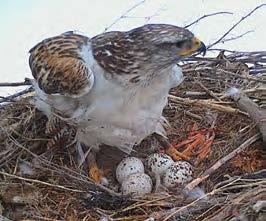
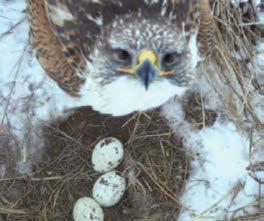
In 2018, ACA and the MULTISAR program launched a hit summer series about the ferruginous hawk. We mounted two cellular trail cameras above two known ferruginous hawk nests on artificial nesting platforms to showcase their otherwise secret lives. The cameras help ACA and AEP biologists better understand the habitat, migratory patterns, and development of these impressive raptors, plus provide dynamic photos.
Want to see photos in real time? Check out the regular updates on ACA’s Ferruginous Hawk Trail Camera webpage and social media platforms at www.abconservation.com/wildlife-cameras/ferruginous-hawk/.
With two successful seasons under its belt and three more cellular trail cameras this year, ACA is looking to generate spinoffs for other species. Stay tuned for more dramatic stories of the sky: American kestrel, great horned owl, and bats.
A special shoutout to ACA’s Corporate Partners in Conservation, AltaLink, and participating landowners. Their generous support makes the hawk camera project possible.



25 SPRING SUMMER 2020 CONSERVATION MAGAZINE
photos: (left) ACA, Colin Eyo; (above) ACA Ferruginous Hawk Trail Cameras

A SHell of a Mystery
► by Paige Kuczmarski
The evidence is clear: next to habitat loss, invasive species are the largest threat to biodiversity worldwide. Multiple non-native organisms have been brought to Alberta. It's a problem because non-native species harm our environment, economy, and human health as they become established outside their natural range. Alberta is on the lookout for 52 of the most unwanted (prohibited) species, listed in the Fisheries (Alberta) Act. However, this particular case is specific to one species that we had yet to encounter in the province: the infamous Chinese mystery snail (Cipangopaludina chinensis).

Snail Stakeout
It was a cold and cloudy afternoon at Lake McGregor. A few unsuspecting students from the University of Alberta were casually strolling along the shoreline, when suddenly they stopped dead in their tracks. Hundreds of unusual shells were scattered along the waterline in front of them.
“This cannot be,” thought the students, but alas, the crime scene spoke for itself. The students collected a shell as evidence for their professor to consider, which was then further investigated by Alberta Environment and Parks biologists. Before anyone fell into a vicious spiral, a task team rapidly assembled.

The team determined that the shell belonged to the prohibited and invasive Chinese mystery snail. The clues didn’t entirely add up—how did the shells get there? How long have they been there? Who is responsible for such an incident? It was a mystery! It warranted a snail stakeout.
To catch a criminal in the act, identification is crucial.

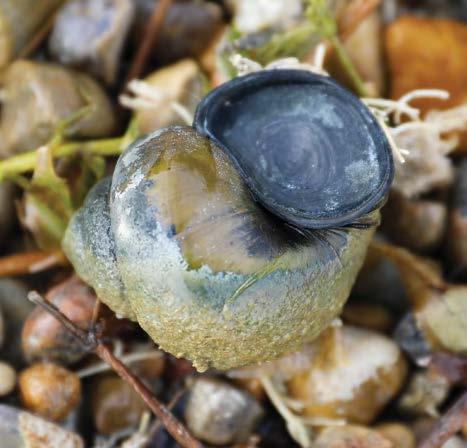
Luckily, this snail is not the most inconspicuous of Alberta’s invasive snail suspects: they possess a large, globular shell that can reach up to six centimeters. Furthermore, distinct sutures and fine growth lines on a brown to olive-coloured shell help when picking out this mysterious mollusc from a lineup. Chinese mystery snails can be found buried in soft mucky or sandy substrates of freshwater lakes, streams, and rivers. This snail can tolerate less-thanideal conditions and survive out of water for up to four weeks due to the protection provided by its operculum or “trap door”—this ability alone warrants concern for its spread to additional locations by hitching a ride on unsuspecting watercraft.
our detectives built a full case and determined this snail was guilty on all accounts. Guilty of giving birth to fully developed juvenile snails. Guilty of impacting the growth and abundance of native snail species by stealing habitat and resources. Guilty of affecting water intake pipes and other submerged equipment by leaving behind multiple large shells that clog and stop water flow. And if those charges weren’t enough to put this criminal behind bars, then this surely would: Chinese mystery snails, although edible and often sold in food markets, often carry parasites that can impact human health.
So, the scene was set, the charges laid; our detectives had enough evidence to conclude that Lake McGregor harboured invasive Chinese mystery snails. The problem now is how to stop this nefarious creature from spreading. Could there be more accomplices of these slimy characters in other Alberta lakes? How far has this criminal spread across our province?
Alberta investigators are on the case and will continue monitoring the situation, but we need your help with our investigation to make sure they aren’t hiding anywhere else! Sleuthing leads investigators to believe that the Chinese mystery snail has been on the run since 2016.
Be aware: the suspects, although unarmed, are considered dangerous… to ecosystems!
CONSERVATION MAGAZINE SPRING SUMMER 2020 26
photos: provided by Alberta Environment & Parks
CRIME S C E NE





Charges:
0 Gives birth to fully developed juvenile snails
* Impacts the growth and abundance of native snail species by stealing habitat and resources
• Affects water intake pipes and other submerged equipment by leaving behind multiple large shells that clog and stop water flow
⁰ Carries parasites that can impact human health


REMEMBER:
Avoid SNAIL mail !
Always report your aquatic invasive species findings through EDDMapS Alberta (online or via the smartphone app), directly through email at aep.ais@gov.ab.ca, or by phone: 1-855-336-BOAT (2628).
Don’t be SHELL-fish!
Don’t let it loose—never release live animals, plants, or aquarium water into the environment. It’s criminal!
EVIDENCE SUSPECT
Take a look and take it SLOW!
Always Clean, Drain, Dry your gear before moving between waterbodies.

Guilł� Guilt�
Gu ilt�
Guilty
site seeing
CONSERVATION MAGAZINE SPRING SUMMER 2020 28



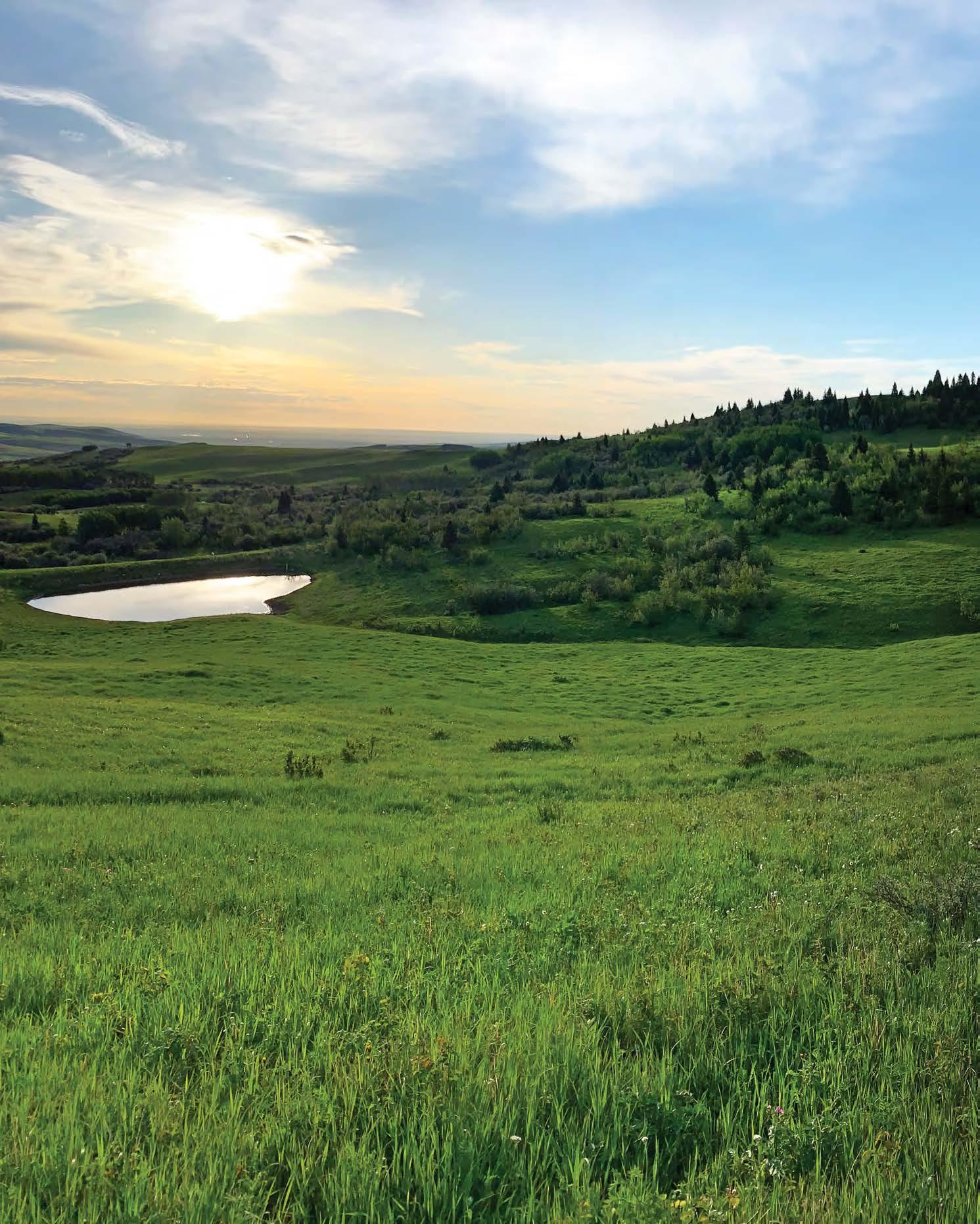
Timber Ridge Conservation Site: F3-36
Glen and Kelly Hall first fully embraced conservation and stewardship when they partnered with Alberta Conservation Association (ACA) to create the Timber Ridge Conservation Site in 2011. This spring, another opportunity appeared, and their first move was to contact us. It was their reputation as sustainable ranchers that gave them the opportunity to purchase 320 acres next to the original site. Their partnership with ACA and funding from Environment and Climate Change Canada helped secure the additional land. “With Glen and Kelly Hall’s contribution and dedication to habitat protection, we were able to expand the valuable Timber Ridge Conservation Site,” said ACA Biologist, Tyler Johns. The site’s growth from 800 acres to 1,120 acres is significant to conservation and wildlife. The additional acres of diverse grassland, mixed forest, and riparian habitats are home to several wildlife species including moose, elk, grizzly, and black bear.
29 SPRING SUMMER 2020 CONSERVATION MAGAZINE
photo: ACA, Amanda MacDonald
Fish Stocking in Alberta

In January 2020, the Honourable Jason Nixon, Alberta’s minister of environment and parks, announced an investment of $43 million to upgrade and refurbish the province’s fish hatchery facilities. In making the announcement, the minister said, “Replacing and upgrading fish hatcheries enables us to increase our stocking programs, while ensuring these facilities operate more efficiently and are better protected against disease. The result will be
a fishery that is strong, healthy, vibrant, and sustainable for generations to come.”

The recreational fishing community generally received the announcement with enthusiasm and optimism. Many of them see stocking fish as a necessary and integral component of the province’s fisheries management. However, others dismiss this notion, suggesting that a more strategic use of the funds would be an increased investment in fisheries habitat restoration and protection,
► by Ken Bailey

particularly on waters with populations of native trout. These polarized views are not new. Since the inception of artificial fish propagation in Alberta more than a century ago, governments and the angling community have displayed a variable appetite for a provincial fish stocking program.
Rainbow trout were, and remain, the primary species reared in Alberta’s hatcheries, but over the years an interest in increasing the diversity of game fish available to anglers
CONSERVATION MAGAZINE SPRING SUMMER 2020 30
has led to the introduction of several other species. In the hacheries’ earliest days, brook, brown, cutthroat and lake trout along with splake were reared. Golden trout, a fish of high mountain lakes, were stocked into the Barnaby Ridge Lakes, north of Waterton Lakes National Park, and in a couple other nearby waters in 1959. Ten years later, eggs from Barnaby Lakes fish were used to stock other alpine waters, including Rainy Ridge Lake in the Castle River system.
Other notable introductions were not as successful. Landlocked sockeye salmon, known as kokanee, were introduced to a handful of Alberta lakes in the 1960s, but didn’t take. Coho salmon were introduced in Cold Lake in 1970, and like the kokanee, the population was never self-sustaining and the experiment soon ended. Later that decade, smallmouth bass were released into Island Lake, north of Smoky Lake. A remnant population hung on for a while, but no restocking occurred and the population ultimately disappeared.
Beyond the species already named, northern pike, perch, arctic char, atlantic salmon, bull trout, lake whitefish, arctic grayling, tiger trout, and several minnow species were also
stocked in Alberta waters. Some introductions were successful; others were not. Some were conducted by private operators, and others through the provincial program.
Why stock fish?
Managing Alberta’s fisheries is a daunting task. Our population continues to grow, and with it the number of recreational anglers. Meanwhile, industrial development, urban sprawl, and agricultural expansion put increasing pressure on fragile lakes and streams. This increased demand for recreational fishing opportunities and angler success, coupled with a continually eroding habitat base, makes management decisions difficult. The challenge is only exacerbated in the face of diminishing budgets.
Fish stocking has long been a polarizing issue in Alberta. There are few fence-sitters; anglers either love the program or hate it.
Those opposed to stocking suggest that unmanaged stockings in the past have contributed to a degradation of our native fish populations. They have ammunition on their side. For example, it’s hard to

deny that rainbow trout hybridizing with native cutthroats and competing with them for limited habitat have contributed to the westslope cutthroat’s decline in our province. Further, in the earliest days of fish introductions, bull trout were seen as a threat to more preferred trout species, and fisheries managers had a vested interest in their elimination. It’s difficult not to wonder what influence the persistence of those managers’ opinion has had on the bull’s current status. Beyond the ecology of the fish, critics of stocking are quick to suggest that the significant outflow of limited money would be much better spent elsewhere.
Supporters of a stocking program, meanwhile, tend to see it as a remedy, the answer to all that ails our fish populations. Their arguments are simple—more fish stocked means more fish available to catch, and more diversity of species means more fishing excitement and challenge.
As with most contentious issues, there is no one truth.
31 SPRING SUMMER 2020 CONSERVATION MAGAZINE
photos opposite: (left) ACA, Ken Kranrod; (center) Alberta Environment and Parks; (right) ACA, Diana Rung photos (this page): Provincial Archives of Alberta
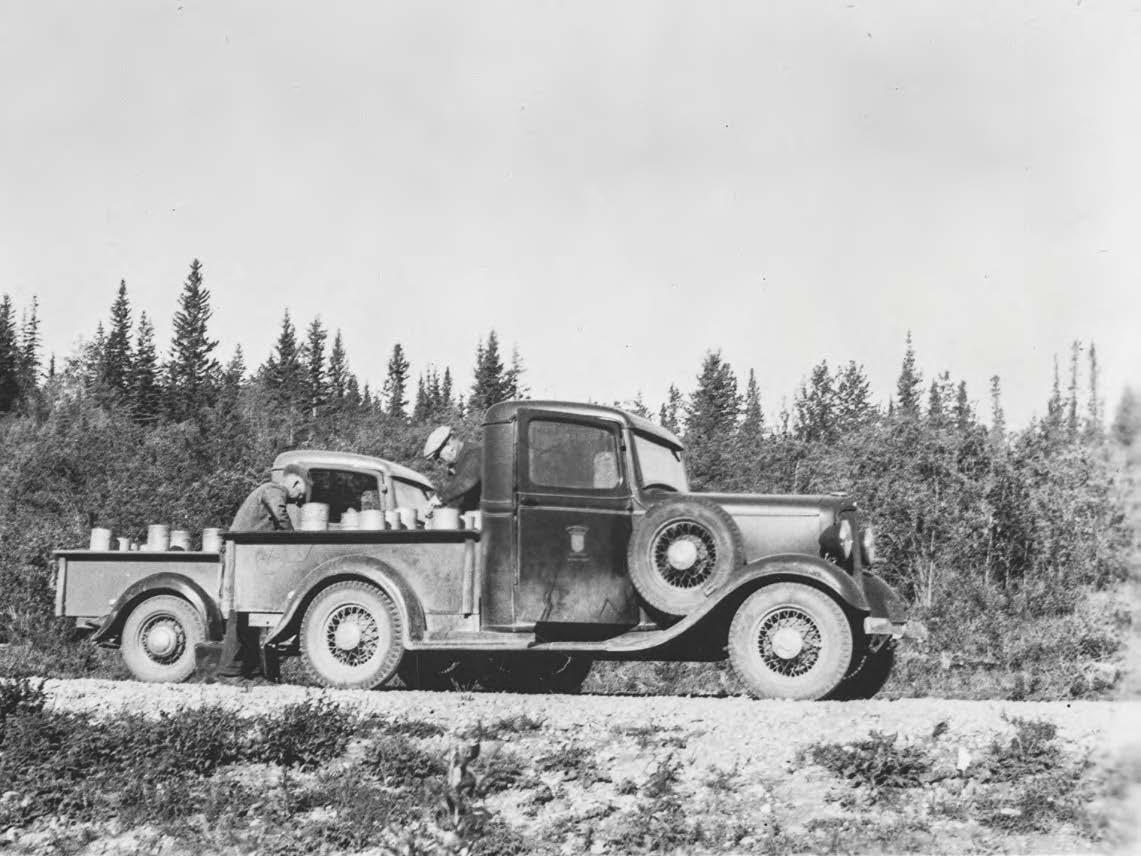
Stocking rainbow trout in Prairie Creek, west of Edson – between 1935 and 1936


At the onset, fish stocking in Alberta was an attempt to diversify angling opportunities through the introduction of new species. Demand for recreational fishing opportunities was on the rise, and the many new Albertans arriving from Europe welcomed the introduction of species they were familiar with. Over time, as expertise in artificial propagation increased, fisheries managers recognized the potential of stocking as a means to help recover native fish populations. The aggressive walleye stocking efforts of the 90s and early 2000s are a prime example of that strategy.
Another related driver of stocking is the demand for fish that can be caught, kept, and eaten. This desire is the basis for what are commonly referred to as “put and take” stocking initiatives. In Alberta, put and take has most commonly revolved around the introduction of rainbow and brook trout into lakes and ponds with no inlet or outlet stream (closed systems), and with no expectation of natural reproduction. The big advantage to put and take programs is the introduction of game fish into waterbodies that previously had no recreational fishing available.
Even when the decision has been made to stock fish, the program doesn’t come with an ironclad guarantee of success. The process of rearing fish in captivity carries considerable risk, not the least of which is the potential for disease outbreaks within the culturing system. An infectious virus (IPNV) originating from wild lake trout eggs invaded Alberta’s hatchery system in 1989, forcing the province to destroy all fish in the Sam Livingston Hatchery. On two occasions the Cold Lake Fish Hatchery
was contaminated by a viral disease. Most recently, in 2017, whirling disease was detected in a provincially-licensed facility. Alberta’s provincial hatchery system has among the most vigorous biosecurity available for reducing the risk of disease outbreaks, but no system is fool-proof.
Dave Park, Alberta Environment and Parks (AEP) director of fisheries management policy, states, “It’s important that we understand the limitations of fish stocking and those elements over which we have no control. Success in stocking programs means we must have cooperation from Mother Nature, and we can never be assured of that.”
Beyond the biological risks and challenges of a stocking program, there’s no escaping the economics. Propagating fish at the scale required to make a difference on the landscape is expensive. But is it worth the cost?
Well, according to Craig Copeland, AEP’s manager of fish culture programs, for every dollar invested in Alberta’s fish stocking program there is an $18–$20 return to the province’s economy. “The stocking program helps stimulate the economy,” he says. “It’s good bang for the buck.”
By that standard it’s hard to argue that investment in the stocking program does not make economic sense. However, to those opposed, the focus is not the economic return on investment, but rather the opportunity cost. What else could we have spent those dollars on that might provide even greater benefits to the sustainability of Alberta’s fisheries?
There are no easy answers.
CONSERVATION MAGAZINE SPRING SUMMER 2020 32

The current situation
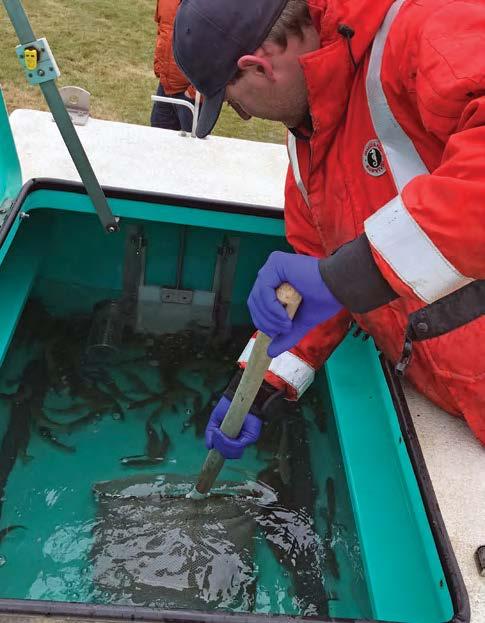
Right now, AEP manages four facilities within the fish culture program.
The Allison Brood Trout Station provides rainbow, brook, brown, cutthroat, and tiger trout eggs for the province’s two hatchery facilities. Built in the 1980s, it is currently undergoing a $4 million modernization of its water systems. By the fall of 2020, it’s expected to be fully up and running. This facility’s focus is on brood fish production and it does not raise many fish for release.
The Raven Brood Trout Station began operating in the 1930s. Most of the current infrastructure dates back to the 1970s and needs upgrading. The government has earmarked $26 million for the modifications, which are expected to be completed by 2023. The upgrades will increase the number of fish available for stocking in Alberta by 10 percent.
The majority of the eggs produced at the Raven facility are rainbow and tiger trout.
According to Craig Copeland, the province also has the option to raise arctic grayling and westslope cutthroat trout at the facility.
The Sam Livingston Fish Hatchery in Calgary dates back to the 1970s. It’s a production facility that receives eggs from the brood stations, then raises them to release size.
Species reared here include rainbow, brook, brown, and cutthroat trout. The facility is currently undergoing $12.6 million in
upgrades, which are largely complete. Among the improvements is the incorporation of new water treatment technology that will bring increased efficiencies. Moving forward, the hatchery will be able to raise fish for stocking right through the summer months, meaning more fish available for fall stockings.
Further north sits the Cold Lake Fish Hatchery, which opened in 1987. It and the Sam Livingston Fish Hatchery are two of the five largest hatcheries in Canada. The Cold Lake hatchery raises rainbow, brook, brown, and tiger trout from the eyed-egg stage for release across the province (brood stock eggs come from the Raven Brood Trout Station). Originally, Cold Lake hatchery reared walleye to aid in recovering depressed populations, but when the initial objectives for that program were largely met, walleye production ceased.
Currently this hatchery is the source of all tiger trout stockings in Alberta. Production for these fish, a sterile cross between male brook trout and female brown trout, arose in response to demands from anglers seeking more diverse angling experiences, and is an opportunity to experiment with a fish that’s been stocked successfully elsewhere without having to bring in extra fish. Production began in 2012; three lakes were stocked with tigers in 2015, 16 in 2019, and plans are to stock as many as 30 lakes in 2020.

33 SPRING SUMMER 2020 CONSERVATION MAGAZINE
photos opposite (from top): ACA, Colin Eyo; ACA fisheries; Melissa Buskas; ACA, Garret McKen photos this page (from left): ACA, Diana Rung; ACA, Communications; ACA, Staff


Into the future
Where is Alberta’s fish stocking program headed from here? The options are considerable, and to a large extent, according to Dave Park, driven by angler desire. AEP hosted a series of public consultation forums recently seeking opinion on the province’s fisheries management, including the stocking program. Where possible and practical, says Park, stocking decisions are made by adopting the desires of the angling community. As Craig Copeland points out, “Those of us at the hatchery are merely the cooks; the biologists create the menu based upon what fishermen want.”
Unfortunately, anglers are not always in agreement about what they want. As Park explains, when considering any individual lake, his department simply can’t satisfy everybody; some anglers might want a lake to hold large trout, while others, seeking a more family-oriented fishery, want an abundance of fish. Generally speaking, you can’t have both in one lake. As such, Park and his team try to keep regional and provincial perspectives in mind when making decisions.
Angler demand isn’t always the trigger. While AEP recognizes the role stocking can play in providing new or additional fishing opportunities, the need and opportunity for restoration of native fish populations
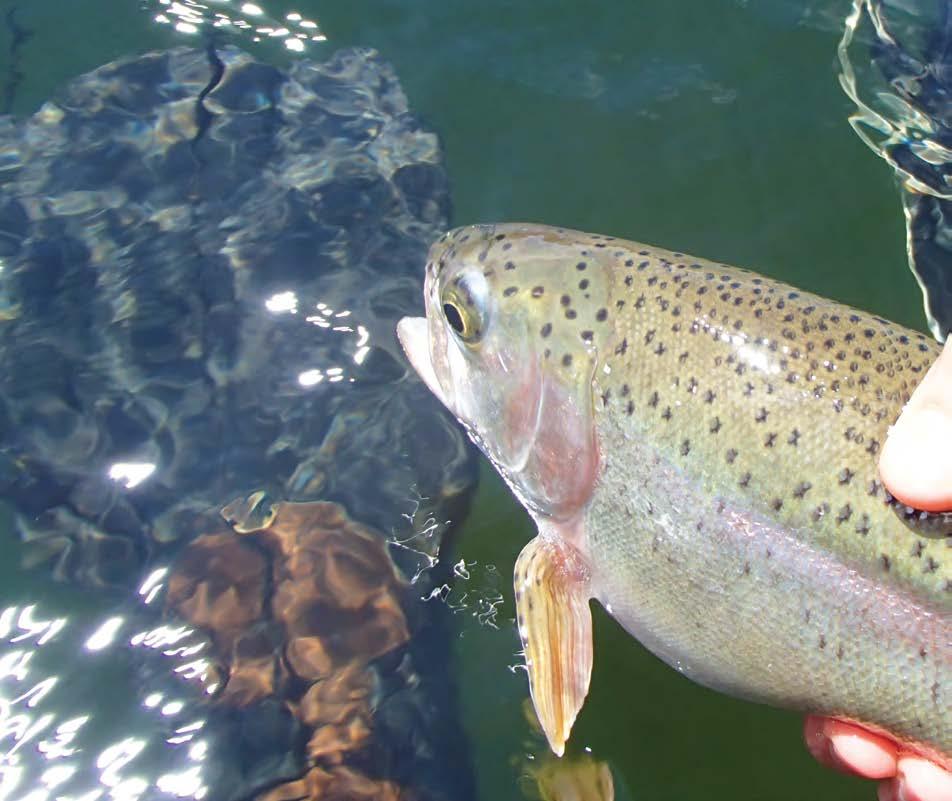
(conservation stocking) is also key in decision-making. In the years ahead, the province will have to make decisions about rearing and stocking westslope cutthroat trout, arctic grayling, bull trout, and native Athabasca rainbows, among others. The choices won’t be easy.
We may also see the return of walleye stocking, says Park, cautioning that they’re not as easy to culture as trout.
“With walleye it’s a matter of quantity over quality. We don’t culture walleye inside our facilities as we do trout. Instead, we have to trap wild fish, strip and fertilize their eggs, then ship them to the hatchery. Once the fry hatch, we have to move them to rearing ponds or they’ll eat each other. Within eight days we stock them into lakes; they’re still very small at that point and mortality is high. Unlike trout, which are released as 19 or 20 cm catchable fish, it takes several years before we have walleye that are catchable.”
Fish stocking doesn’t always guarantee success; it’s just one tool in the kit of our fisheries managers, and it’s continually evolving. Consider that in the 1980s, Alberta annually released five million 7–8 cm trout; currently, we release just 2.1 million into some 240 waterbodies, but these fish are near 20 cm and instantly available to anglers. Science and technology evolves with time,
too. Fisheries managers envision portable hatchery systems and instream incubators as two potential means that may be available to them down the road.
Fisheries managers will also have to consider the future of Alberta in the wake of expected population growth and a changing environment. If, as many predict, our climate warms, some species may become viable in Alberta that weren’t previously, further diversifying our stocking options. As to our provincial population, now at 4.4 million people, projections are that it could grow by near 50 percent, to 6.6 million, over the next 25 years. Undoubtedly there will be a corresponding increase in demand for fishing opportunities. Should that come to pass, we’ll have to ask if stocking is the only practical answer to meeting that increased demand.
For now, the province’s announcement of the injection of new funds into our fish hatchery system signals a meaningful move towards increased stocking, and by and large the angling community is supporting that decision. It’s hard for many not to be shortsighted; they simply want to catch, and eat, a fish or two. We must remember, however, that every decision comes with a trade-off. In the case of stocking, that trade-off may be a reduction in available resources for other fish management options and activities.
CONSERVATION MAGAZINE SPRING SUMMER 2020 34

A brief history of Alberta’s fish stocking programs
Banff National Park was the home of Alberta’s first fish hatchery. Federal fish managers, seeking to establish recreational fishing opportunities in mountain lakes without populations of native trout, started the hatchery in 1913. They primarily produced rainbow, cutthroat, and brook trout over the years, along with lesser numbers of lake trout, brown trout, and splake. Splake, (male brook trout crossed with female lake trout) were in fact originally developed in Alberta—sometime in the 1940s. Not long after the establishment of the Banff facility, Jasper and Waterton Lakes National Parks followed suit, and by the mid-1930s, an annual stocking program was well-established.
Fish propagated in these facilities ended up in waters beyond the national parks. Anecdotal evidence suggests that shortly after the establishment of the Banff facility, avid anglers took rainbow trout fry produced from national park facilities and released them into streams and beaver ponds within the Oldman and Castle River systems.
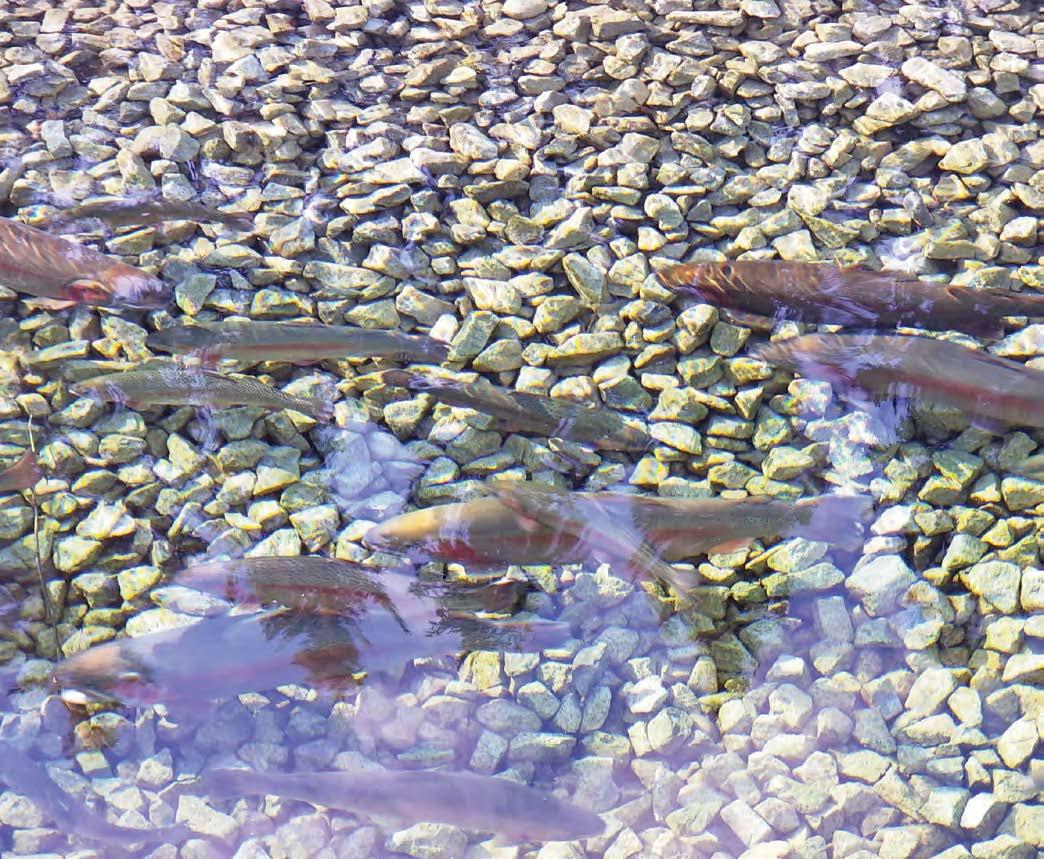
The provincial government’s first foray into stocking was a public-private partnership with the Calgary Brewing and Malting Company. The business wanted a meaningful way to use the water they used in their plant before it was discharged back into the Bow River. The brewery built and maintained the propagation facilities, while the province supplied eggs and workers. By 1940, fish reared here were being released across the province. Two years later, this was the largest fish hatchery in Canada. To assist in the production process, rearing and brood ponds were utilized, including the establishment of the Raven River Rearing Station in 1937 and the Allison Brood Trout Station in the 1970s.
1973 saw a major provincial investment in fish propagation with the opening of the Sam Livingston Fish Hatchery in Calgary. The plan was to have the hatchery produce up to five million fish annually, to be stocked at some 200 locations province-wide. It was the first fully enclosed North American fish hatchery, allowing for efficient temperature control plus year-round production capabilities in a predator-free environment.
The last significant provincial investment in fish hatchery infrastructure occurred in 1987 with the opening of the Cold Lake Fish Hatchery. It was the only provincial hatchery designed to raise walleye. Large numbers of walleye raised there were released to help recover depressed populations through the late 80s and 90s.
35 SPRING SUMMER 2020 CONSERVATION MAGAZINE
photos (clockwise from bottom left): ACA, Diana Rung; ACA, Rhianna Wrubleski; ACA, Robert Anderson; ACA, Ken Kranrod; Provincial Archives of Alberta
Checking heath trays in the trout egg incubation room at the Sam Livingston Fish Hatchery – 1975


Adventure More Worry Less
You probably don’t know Melissa Jenkins, but you should. As an adventureseeker and Albertaadvocate, she truly abides by the phrase “live wild, eat wild” as captioned in her Instagram bio. She documents the day-to-day beauty of our province through the lens of her outdoor pursuits, and her inspiring yet real photos suggest: life should always be a busy adventure.


conversations Melissa Jenkins Eat Wild @adventure_more_worry_less
► by Ariana Tourneur
Interestingly, you’re not an Alberta native!
It’s true—I moved to Alberta from Thunder Bay, Ontario over four years ago now. I actually have a friend who moved here before I did. I came to visit and she took me to the mountains. I fell in love.
Were you feeling ready for a change?
I was working a lot and barely making ends meet. When I came to visit, I was so in awe of the landscape—the towering mountains and the colour of the water—it actually brought tears to my eyes. For a minute I forgot about all that was troubling me, and just stood there and took it all in.
There must be influences in your life that encouraged you to appreciate outdoor beauty like that.
My dad! We were always outside. I was born in Chapleau, Ontario, in the middle of nowhere, where it was a regular occurrence to see a bear, fox, or wolf in our yard. My dad went fishing and hunted moose and grouse. He would take all four of us kids along.
That’s commitment!
I don’t think we were ever quiet! We never really shot a lot—we all had our blaze orange on, making noise, and throwing moose poop at each other. But those are some of my best memories, just being outdoors and hanging out with everybody, especially my dad.
When did you first show an interest in hunting?
As a kid, I just wanted to tag along. I took my hunter safety course and in high school did a northern outdoor studies class, which was a super cool experience. But after that, I moved away for college and work, and took a hiatus from hunting. I did fish a lot though!
So, in a way, you were reintroduced to hunting here in Alberta.
When I moved to Alberta, my boyfriend took me grouse hunting. It was then I decided I wanted to get into hunting more, and most of all go on my own schedule and not depend on my dad or boyfriend to take me! So, I filled out my paperwork, got my PAL, and bought myself a rifle.
What’s your “why” when it comes to hunting?
It gets me outside. Whether it’s cold or raining or sunny, the landscape is beautiful. I love to watch sunrises and sunsets. I just watch the animals, the birds and squirrels, and try to understand them and how they move. I think I never fully will.
And of course, hunting puts food on the table. The animal was wild and free, and the meat is organic and fresh.
You must like preparing the food you harvest. I love preparing the food I harvest. It’s such an accomplishment—I harvested my most recent deer, skinned, gutted, butchered, and packaged it myself. I grab it straight from the freezer and know exactly what I’m cooking and where it came from.
What makes Alberta different from other places?
Alberta is very diverse. From whitetail to elk to bear to sheep to grouse, it seems like there’s something for everyone. From mountains to pasture to woods, to rolling hills, flatlands, and rivers…I feel there are more opportunities and places to hunt here than back home.
You’re obviously driven—you must have more goals up your sleeve?
There’s so much more I want to do! I really want to harvest an elk. I’ve been within 50 yards of one and it was crazy. It was early September and I heard it bugling, so I played a cow call off my phone on the iHunterapp. It came just close enough to check me out then ran away. What huge, evasive, smart, and beautiful animals. I’d love to go on a backcountry elk hunt, spending a week or two in the middle of nowhere. I think I’d really be able to explore and challenge myself.
Maybe we’ll see that on your Instagram one day.
I hope so! I just want my sharing to inspire people to get out and enjoy the outdoors. Whether it’s hunting, hiking, fishing, or simply exploring…let’s enjoy what we have.
I just want my sharing to inspire people to get out and enjoy the outdoors. Whether it’s hunting, hiking, fishing, or simply exploring... let’s enjoy what we have.

Rapid Fire Q’s
Favourite animal to hunt?
White-tailed deer and grouse. Hoping to get that elk one day, but I’m still learning my way around Alberta!
Favourite wild game dish?
I make a mean home-style grouse and biscuits. With whitetail I keep it simple: take any cut, season it lightly and add a bit of olive oil. Sear it and then bake it in the oven until it’s medium rare. It’s to die for!
What else is on the outdoor bucket list?
I’d love to learn to bow hunt. And fly-fishing—combining my love of backpacking and hiking with my love of fishing sounds perfect.
Where can we find you?
My Instagram handle is: @adventure more worry
 photos: provided by Melissa Jenkins
Are We Paying to Play While Others Get a Free Ride?
 ► by Sheri Monk

CONSERVATION MAGAZINE SPRING SUMMER 2020 38
Among some hunters and anglers in the province, there’s a perception that our community pays for more than its fair share of the cost of wildlife conservation. But do we? And if we do, should we?
significant in comparison to other provinces and states. Active hunters are increasing in Alberta in recent years, which bucks the North American trend, and that’s great news for the whole province—and its wildlife.
Nonetheless, hunters and anglers are still the minority, and that means that the vast majority of Albertans trust us to be science-based and ethical as we harvest a resource that belongs to everyone. Having a robust licensing, monitoring, and enforcement system in place serves us, serves wildlife, and serves the public.
officers in the field. I’ve had to produce my licence. And I am happy to contribute because I recognize Arizona Game & Fish's contribution to conservation throughout the state.
Perhaps most importantly, I recognize that my hobby is not without harm.

Last year, more than half of the revenue from hunting and fishing licence sales ($14 million) was directed to Alberta Conservation Association (ACA) for conservation programming. The remaining revenue was directed to the delivery of licensing services, $2.5 million went to Fish and Wildlife for inventorying fish and ungulate populations, and the rest went into the government’s general revenue fund.
Pat yourself on the back, hunters and anglers, because that’s a lot of money, and it’s doing a lot of good!
So, what do the nonhunting folks pay for?
Revenue through Alberta Environment and Parks (AEP) from things like camping and tours generated $33.4 million in 2018–19, and that was invested back into the parks system for recreation, conservation, programs, and services. And of course, money is allocated from general tax revenue into the environment and wildlife portfolios as well, so all Albertans contribute, whether they ever leave their own backyards or not.
The provincial government has also committed to introducing a mandatory $30 off-highway vehicle (OHV) registration and random camping trailer fee to pay for restoring and creating OHV trails, and to hire additional enforcement officers.
Less than three percent of Albertans hunt, and only six percent fish—but that’s actually
Most of us happily pay our licensing fees every year for the privilege and pleasure of a traditional fish fry by the lake or a moose in the freezer. In fact, I would say that historically, and by and large, us hunters and anglers take a great deal of pride in our contribution to the science of conservation. And we should.
That said, it’s not just hunters and anglers who “consume” wildlife and habitat. The public consumes wildlife and habitat in other ways—many people get outdoors to bike, hike, swim, photograph, and camp—and the case can be made that they should also contribute. And especially in places with declining hunting numbers. After all, the money for conservation work needs to come from someone’s pocket.
Let me explain. My outdoor passion is for rattlesnakes, and I only hunt them with a camera. I spend most of my leisure time (and money) hiking for them, travelling to see different species, and trying to stop their widespread persecution.
One of my favourite rattlesnake destinations is Arizona, and every year, I pay US$160 for a non-resident hunting permit. Why? Because of how Arizona Game & Fish defines hunting, essentially. “Take” means pursuing, shooting, hunting, fishing, trapping, killing, capturing, snaring, or netting wildlife—and believe me, I pursue their 13 rattlesnake species up mountains and through cactus all over the state. And I have encountered their wildlife
Granted, there aren’t that many people who share my interest, but birdwatching is very similar and has huge numbers behind it. In Canada, estimates are upwards of 20 percent of the population. Of course, birders are probably the most numerous and important contributors to citizen science in the world, tracking populations and migrations in real time. But could they kick in more? A small, annual fee in each province or state they visit to watch birds, perhaps?
And with the advent of digital cameras and now drones, wildlife photography has become a huge pastime—and also a burden on wildlife, particularly in grizzly country. Some wildlife photographers don’t employ a lot of ethic, becoming highway hazards, baiting wildlife, and disrupting the activity of animals in their natural environment. It is a real bone of contention within the community, as members of the Facebook group Alberta Wildlife Photography can attest. Clearly, wildlife photographers as a group are in need of an accepted code of ethics, monitoring system, and method of licensing.
As the world changes—mostly because of our growing footprint on it—we all need to adapt and adjust. More than ever, we all need to invest in conservation if we want our grandchildren to see any wild animal outside a zoo. The hunting and fishing community has led by example for decades. Maybe it’s time to inspire other groups to join the conversation—and not because hunters and anglers resent the burden, but because we embrace the responsibility.
More than ever, we all need to invest in conservation if we want our grandchildren to see any wild animal outside a zoo.
39 SPRING SUMMER 2020 CONSERVATION MAGAZINE
Little Bird, Big Impact
► by Ariana Tourneur
Build the pens. Throw the bales. Shovel the…
Yep. Certain expectations come with being a 4-H kid.
Chores of a champ
Not only is it about physical chores with a capital C (middle-of-the-night animal checks are no joke), but it’s also about the big Bs: brainpower and building confidence. Learning to take initiative, problem solve, and manage time are just as much part of the program as the gnarly task of cleaning out pens.
Challenges like these shape the 4-H Raise & Release Pheasant Program. With guidance from Alberta Conservation Association (ACA) biologists, young participants plan and execute every detail it takes to raise day-old chicks into 14-week-old thriving birds.
“The partnership with ACA is vital to the success of this project,” says Ginny Smith, 4-H Specialist for the South Region. “Since 2014, they’ve been providing chicks to the 4-H members, and offering assistance, information, and support so the young people can raise their birds and gain a better understanding of wildlife and habitat needs.”
At the conclusion of the annual project, 4-H’ers release their pheasants into the wild— helping to improve populations while bringing awareness to Alberta’s habitat needs.
Not just for pheasant lovers
Alberta’s pheasant populations have seen a steady decline since the 1990s (see sidebar), and as 4-H’ers learn, much of it comes down to the availability of quality habitat. Participants take on heavier questions, and find the answers lie in our past, in farming, and what habitat looks like today. After all, bird populations are a broader indicator of habitat availability and quality—a factor that affects much more than just pheasants.
Big projects, big plans
Alex Pagenkopf is learning just that. He’s a sixteen-year-old who has spent the past three years with the Crowfoot Multi 4-H in Wheatland County.
He shares how releasing pheasants back into good habitat has changed his perception. “At first, my sister and I were just looking for a new project to do; now it’s become something that we can actually see is making a difference.”
Leah Breitkreuz remembers first reading about pheasants in the 4-H magazine. She’s another teen invested in the project with the RQB Rancheros 4-H Club: “I didn’t really know about pheasants and their population being down before I started raising them. I’ve learned so much since about their habitat and what they need.”
Brag when you know ag
Not only are these young participants contributing to conservation, they are also picking up agriculture business along the way. After all, farmers are smart. They are problem solvers, and must have good business sense to be successful.

“It’s been hard for me to keep up with the record books and logging every detail,” admits Leah. “I had to record every time I bought a bag of feed. But, I understand I’m learning by doing that.” Maintenance and feed expenses, animal checks, arising issues—it’s all accounted for, with the kids acting as the managers. The upside? “I do get paid for every one I successfully release,” says Leah, “so that’s been a bonus!”
Chick challenges
Also, not unlike farmers, participants find that challenges bring the greatest opportunity for learning. ACA biologists guide 4-H’ers and teach them what habitat resources will help their pheasants make it in the “real world.” They learn about balancing the needs of pheasants with modern farming practices, and all the nuances that come with it.
“The first days after receiving the chicks, I had to get up in the middle of the night—around 2:30 a.m.—to check the heat lamp,” says Leah. “By the fifth day they've gained more independence, but are still cute, so that’s the perfect age!”
CONSERVATION MAGAZINE SPRING SUMMER 2020 40
Alex Pagenkopf releasing pheasants photo: provided by the Pagenkopf family

And Alex? “The biggest challenge is how fragile the chicks are and how the temperature has to be consistent in the brooder house.”
The work is worth it though. “I’ve learned a lot about habitat selection and predator control. We put the time in and now we’re looking forward to seeing pheasant numbers increase in our area. That’s rewarding,” says Alex.
Day to day, it’s about keeping tabs on the pheasants and figuring out solutions—and fast. Leah remembers when one of her chicks was just a few days old: “He couldn’t walk very well; his legs kept doing the splits! I went back to my 4-H guidebook, added a hair elastic to keep its legs together for a few days, as recommended. After that, he walked just fine.” If only improving habitat was that easy!
Numbers count
The partnership between 4-H clubs and ACA has created a bridge into the future— with farmers, conservationists, landowners, biologists, parents, and of course, the kids—all working alongside to achieve a major goal.
“When we started, 20 members from three clubs in southern Alberta received 1,400 dayold chicks,” says Smith. “Now the project has grown to over 115 4-H members registering annually from across the province.”
Did you know?
Alberta was once a famous destination for pheasant hunting! Thousands of people, including Hollywood stars Bob Hope and Bing Crosby, descended on southern Alberta to hunt. It brought a major economic boost for decades.
But with changing farming practices, pheasants lost their remnant patches of grass, wetlands, and shrub-lined edges. Add in a few bitterly cold winters, and survival was bleak for many of these birds.
The good news? Pheasants are very adaptable, and with the right tactics, can thrive again.
As the number of participants grows, so does the number of pheasants. At last count, 4-H’ers have successfully raised and released 4,687 hens and roosters into quality habitat. In southern Alberta, the female pheasants are released into suitable habitat with the hope some will live out the year to raise chicks of their own. In northern Alberta, where potential for survival is more remote, participants raise roosters to create recreational hunting opportunities.
That’s real life, kids
Even if participants like Leah and Alex don’t choose a major like agronomy or biology, they can still enter business, mechanics, or another area with an overall advantage— understanding—Alberta’s habitat and its needs.
As for the immediate future, Alex is excited to see some of his pheasants again this spring, after releasing around 65 birds last fall. “It’s quite something to see the first true flight,” he says.
Leah backs that up: “One of the most memorable moments was at the end. I opened the door, and watched them fly out right on our acreage. They were really pretty. I even saw some after, in the fall, and a couple the following spring too.”
Of course, this 4-H project is about pheasants and their habitat. But, it’s also about creating leaders who will never forget moments like these.


41 SPRING SUMMER 2020 CONSERVATION MAGAZINE
Leah Breitkreuz tending to pheasants photos: provided by Leah Breitkreuz
When Too Much is Just Enough
► by Dr. Lee Foote

In the 1950s in Canada, snow geese were uncommon and highly valued; however, many now see them as crop raiders, park pests, and fertilizers of golf greens. The rationale for 50-bird limits and spring seasons is ultimately snow goose population reduction.

Simplicity is elegance. My waterfowl hunting is often sitting slough-side with a dog, a shotgun, and a pocket full of shells. My goal? Gather enough birds for a family meal of mallards, green-winged teal, whitefronted geese, and the occasional Canada goose. This effort rarely brings me the highly gregarious white geese (snow and Ross’s geese) because flocks are large and contain old wise geese.
So to really hunt spring snow geese, we shopped for a guided hunt near Edmonton, Alberta. A mob of 100,000+ snow geese had been filtering their way north, from Brooks to Taber, and now were massing near Beaverhill Lake, home of the regional Snow Goose Festival. We found goose outfitter Andrew Dath. I liked that Andrew had been a waterfowl researcher before becoming sole proprietor of Alberta’s Fall Flight. He knows his waterfowl ID, ecology, and behaviour. Plus, none of us had 1,200 decoys handy, a good electronic caller, big speakers, rotarywinged goose decoys, excellent blinds, and an assistant to scout the night before the hunt. Except Andrew, of course. Use of his gear alone was worth the price of the hunt.
I guided duck hunters in my youth, and yet I have mixed feelings about hiring my own guide. Hunting seems interwoven with selfreliance; successes and failures are owned. I don’t want to be a tenderfoot. For this hunt though, my ambivalence was unnecessary: we helped set decoys, hunted over my retriever, and cleaned our own birds— metaphorical and literal skin in the game.
Our eclectic group contained a professional hockey announcer, a champion arm wrestler and farmer, a government biologist, an industrial engineer, a university professor, and a retiree who hunts and fishes. On the day, we’re up at 3:30 a.m., drive for an hour, set up 1,200 dekes on frozen ground, then lie still, me with Roxy, the vibrating Labrador, sharing my blind and warming my side. Against a backdrop of dawn’s red and yellow, our eyes flicker at hurried flocks of mallards cupping hungrily down, drake pintails in nuptial plumage gliding past at chandelier height, and noisy family groups of white-
fronted geese landing in our decoys. Yet we study the undulating vees of white geese moving to feed. They are understandably wary since they have been hunted at stopover fields in a half dozen states and provinces by now. Occasionally, a cautious group drifts into range, Andrew (sitting behind us) barks, “Light ‘em up!” and we strain our barrels to pull a few to the ground. We drop 15 geese in the morning and another 13 in the evening. The high point is probably a flurry of six birds down from one low flock. Paltry to some; thrilling to me.
While Roxy was incredulous at live, unshot ducks in the decoys, she was steady and ultimately got plenty of feathers in her mouth. Two wounded birds made it to water, where Roxy’s swimming abilities were helpful. While a dog is not essential in field shoots, the speed of retrieves allows more concealed hunting time with no trudging out to pick up birds. Plus, there are few sights prettier than a coal black lab with a pristine white goose coming back through the field.
Hunting the spring flight produces great outings and healthy lean protein, and with no apparent downside. I learned a lot, such as field decoys face into the wind; our ability to hear incoming goose noise is masked by high volume speakers; a dead snow goose splayed outside the spread frightens incoming geese; frost-covered decoys are obviously decoys; doubles require shooting the rear birds first; quick shooting helps when six guns erupt because flock departures are rapid; and spring snow geese are butterball fat from a smorgasbord of corn, peas, wheat, rice, and barley. No wonder these spring birds are tasty, tender, and yield great pans of delicate, snow-white fat.
We connect with geese by sharing time in their haunts, photographing them, training dogs, practicing field skills, planning trips, hunting them, cooking them, and dreaming about them. Waterfowling brings these beautiful birds to relevance in our lives, fuelling the passion down the generations. The spring snow goose season brings a breath of fresh air to a hunter’s annual cycle. It’s worth doing.
CONSERVATION MAGAZINE SPRING SUMMER 2020 42 footenote
photo: Roth and Ramberg photography


www.shell.ca/conservation Shell has worked closely with conservation groups to protect over 31,000 acres of land across Canada. CONSERVING LAND IS A GIFT FOR FUTURE GENERATIONS R07287-ACA Advert Half Page AWv2.indd 1 16/02/2016 15:28 sponsored by: You lookin’ at me? Watch Now! Cams stream live 24/7. ab-conservation.com/peregrinecam
More fishing. More family.

Why not fish where you live?
People can’t always drive two hours for a half hour of fishing— that’s why Alberta Conservation Association works with a growing number of municipalities across the province to make fishing accessible and close to home. Each year, with help from our partners, we stock over 100,000 catchable-sized trout for “put-and-take” fisheries. Creating more fishing opportunities is one of the best ways to get families and neighbours outside and strengthen our communities.
Want to get involved?
Visit www.ab-conservation.com/cpic
City
City
City
City
Saddle
Town
Town
Don
Lake - Beaumont
ACA, Colin Eyo
of Beaumont
of Fort Saskatchewan
of Lacombe
of Medicine Hat
Hills County
of Cochrane
of High River
Sparrow
photo: