
Charities Commission Number: CCC29446 KEEPING ON KEEPING THE OFFICIAL VOICE OF AGE CONCERN CANTERBURY Vol 122: WINTER 2024 Phone (03) 366-0903, Fax: (03) 365-0639, Email: team@ageconcerncan.org.nz, www.ageconcerncan.org.nz The colours of winter


The weather is getting cooler and it is time to think about warming soups and casseroles, using cheaper cuts of meat and slow cooking
with extra vegetables. Make larger amounts to freeze meals for later use.
From the beginning of May, the Government winter warmer payments started and continue until the beginning of October. Use it for the purpose it is meant for, to keep you warm and use your heat pump wisely.
That does not mean that you should not be out in the sunshine exploring the city and continuing to have picnics in the parks. Use the buses - they are free to SuperGold Card holders after 9.00am on weekdays and all day weekends. Go somewhere different to explore and stop for a coffee; encourage a friend to go with you. In the last issue I suggested that it was time to check on your important papers, updating your will and other documents which need attention. Make sure that your family and
loved ones know where to find these documents in the case of emergency. Leave information about how to access your computer, cell phone, bank accounts and other accounts that you subscribe to, if you are the only one who knows what they are and whose name they are in. Age Concern Canterbury are in the process of producing a book that will help with all this information in one place.
The Annual Meeting for Age Concern Canterbury was held at the office in Papanui. This meeting gives the opportunity to meet the board who govern the organisation, meet some of the staff and look at the financial papers. This is also a time when you can ask questions about the strategic plan for the future of Age Concern Canterbury.
Chief Executive Greta, Stephen Phillips and I went to Wellington to represent Canterbury at the Age Concern New Zealand Annual meeting and conference. It is always a great opportunity to meet other CEOs and board members and to discuss any new projects developed by all Age Concern organisations. Look after yourselves, keep safe.
Trish Adams President


Page 14 and 15,
Page 17-20, A Year in Review 2023
Page 23, Invercargill, not to be laughed at
Page 26, Getting to know our volunteers
Page 28, Letter to the Editor
Page 31, Is there Life Without A Car?
Page 33, Winter Chit Chat
Page 36, My two cents by June Peka

At the time of writing, I am preparing my oral submission on the Christchurch City Council Long-term Plan. To be honest, it’s a bit nerve-wracking. Each submitter is allocated a five-minute time slot to talk to councillors. This would be ample time to discuss my position on many things (dogs on buses, for example) but seems like the mere blink of an eye when trying to represent the importance of considering our older population in all areas of city planning.
Where to start?
Christchurch City has a number of strategic documents already in place, for example, a Financial Strategy, a Community Housing Strategy, a Major Events strategy - even a skateboarding strategy - all of which are important documents to guide decision-making and future planning by the mayor and councillors, and for everyone who lives here. However, unlike many other areas in New Zealand, Christchurch is missing a dedicated Positive Ageing Strategy, which is a document that encapsulates how we intend to support the wellbeing and dignity of our older people into the future.
We do have an excellent “Strengthening Communities Together Policy”. This is organised around four pillars that promote a culture of equity and inclusion, in an environment that is protected, where everyone is enabled to participate, and we are prepared for emergencies and whatever the future may bring. I recommend reading this policy if you haven’t – it’s a blueprint for a bright

future. It makes for inspiring reading, and older people are obviously included within that.
So should we be agitating for a Positive Ageing Strategy in Christchurch? Is it even necessary?
Maybe it is easier to think about what could happen if we don’t have one. We don’t have to look too far - the rebuild of Christchurch after the earthquakes gave us a oncein-a-lifetime opportunity to create an age-friendly (and disabilityfriendly) new city. Instead, we have rebuilt inaccessible infrastructure - everywhere there are stairs! Pavements are in poor repair, with no curb cuts in many places making navigating as a pedestrian difficult. Affordable rental housing suitable for seniors is currently at a premium in Christchurch and yet our draft strategic plan dedicates more money to finishing the stadium than the whole social housing budget. In addition, we have a predicted rates rise coming of 15% which could be disastrous for those homeowners who are getting by solely on government superannuation.
A Positive Ageing Strategy in itself will not magically solve these complicated problems – but it could ensure that the needs of older people are kept in mind when decisions are made.
My challenge to our town planners will, in the end, be quite simple: no decisions should be made in Christchurch without considering the needs of older people. In addition, we should keep in mind the tremendous value that older people bring to Christchurch - an absolute goldmine of experience and knowledge. One in 5 people living in this city will be over 65 by 2048. Let’s be prepared to support, appreciate and make the most of this valuable resource.
Greta Bond Chief ExecutiveKeeping On is distributed by Age Concern Canterbury to Christchurch Malls, Senior Citizen Clubs and Groups, Libraries, Medical Centres, Rest Homes, Hospitals and Institutions, Housing Complexes and Agencies working with older people and individuals. Keeping On is published quarterly in February, May, August and November each year. Written contributions for consideration can be emailed to the Editor at dmcgrath@ageconcerncan.org.nz or contact Deirdre on (03)366-0903. The Keeping On Team: Deirdre McGrath - Editor, Mike Crean - Journalist, June Peka - Journalist, Anna-Marie Hunter - Advertising Representative/Design. Keeping On is printed by Inkwise, Rolleston. Age Concern Canterbury is very grateful for the support we receive from our advertisers. Without advertisements this publication could not survive. Some of our advertisements are the traditional type and others include advertorial (an advertisement that’s written in the form of editorial content). To be transparent to our readers each of these advertorial pieces is labelled with the symbol A. Views and opinions expressed in Keeping On are not necessarily those of the Editor or Age Concern Canterbury. Neither does publication of an advertisement imply endorsement by Age Concern Canterbury.
Book your advertising for Keeping On August 2024. Deadline for ad bookings is Friday, 26th July 2024. Contact Anna-Marie on 331-7804.
Trees: our past, present, and future.
Trees continue to define the area known as Papanui and have been a focus of the Papanui Heritage Group (PHG) founded in 2001. Timber Town to City Suburb an illustrated history of Papanui by Murray Williams with Christine Grant and David O’Malley, published by Papanui Heritage Group in 2016, explores human activity in Papanui, beginning with Ngāi Tahu mahinga kai trails, gathering food and resources for Kaiapoi.
“Papanui” has been defined as ‘a cloud of mist covering the sky’ and given that much of the area was well known as a swamp, the name may refer to the miasma that would have risen from this natural feature. However, the term ‘papa’ also in a more general sense connotes flatness and could simply mean a large flat plain (nui meaning big). There has also been a suggestion that ‘Papanui’ could be a specific reference to platforms constructed under trees by Māori to assist in the trapping or spearing of birds.” (Williams p11).
It is likely that the Papanui trade route fell into disuse following the devastating destruction of Kaiapoi Pa, the economic and political stronghold of Ngai Tahu in 1831, yet the ancient track was eventually used by surveyors to determine the course of Papanui Road.
The Papanui Bush, an area of approximately 70 acres, was the only local source of timber available to English settlers who arrived in the 19th century and built the houses which were to develop into the city of Christchurch. Such was the demand for the totara and kahikatea that the Papanui block was cut out by 1857. Although a small group, PHG, have maintained a committed interest in developing and presenting submissions to the City Council on
by Defyd Williams
issues which affect their suburb. The definition of Papanui has changed over the last 150 years and the 2022 redrawing of the ward boundaries for the local body election excised parts of South Papanui while extending the new northern boundary of the ward to the Styx River between the Main North Road and the Northern Arterial.
The PHG, in general, supported and endorsed the Christchurch City Council’s ‘Our Urban Forest Plan’, yet in their submission raised some issues of concern around the level of protection for existing trees in Papanui, especially those on private land, the trees on the 15 memorial avenues in Papanui, plus the treelined streets which adjoin them. Trees as well as being the green lungs of a city can play a vital role in mitigating climate change. Experiments done in Sydney streets showed how tree lined streets compared to streets without trees could be up to five degrees cooler. Trees also play a role in improving drainage. Councils need to consider trees as infrastructure when planning for ‘living streets’.
The City Council objective is for the Papanui Ward to have 20 per cent of its area in tree coverage. PHG is concerned about the loss of mature trees in the older part of Papanui, often as the result of building development, and supports the proposal to require financial contributions from developers who
remove trees. Loss of trees on private land is a concern, yet there is public land in the ward where more trees could be planted; for example the replanted Papanui Bush area (Bridgestone Drainage Reserve); the Papanui Domain; Marble Wood Reserve and Edgar Macintosh Park.
PHG has a particular interest in Papanui’s 15 memorial avenues, each of which is indicated with a bronze plaque which proclaims: ‘Papanui Memorial Avenue, To the fallen, 1939-45’. Janet Tillman, a member of the PHG, is the wife of Mark Tillman, grandson of Harry Tillman who initiated this important heritage project. In September 2022 the PHG was delighted to learn that the City Council had recognised the 15 Papanui Memorial Avenues (trees and plaques) by adding them to the District Plan’s Schedule of Significant Historic Heritage for protection.
Denis McMcMurtrie, a member of PHG has played a significant role in developing partnerships, participation, and community involvement from schools, council, voluntary groups and individuals. It is pleasing to note that 160 years after the loss of the ‘Papanui Bush’ its partial regeneration is underway thanks to his vision and energy and the muscle and enthusiasm of the local Rotary club. Initially the whole project was made possible by the donation of the land by the

Bridgestone Tyre Company. Denis has also worked through schools with students being invited to learn about the trees and participate in weeding and planting. (See article p.11 in November 2023 edition of Keeping On, Age Concern Canterbury).
“This is a great example of partnership, participation, and community involvement and one which the PHG is proud to have played a small part in,” said the PHG in a submission to Christchurch City Council).
This group extends a warm welcome to attend our meetings which are held monthly (excluding January) at 2pm on the first Saturday of the month, The venue is the Reese Room at the Methodist Church on the corner of Harewood Road and Chapel Street.
The group will gratefully accept donations of documents, memorabilia or photographs relating to Papanui. Alternatively, we can scan this material and return the original to you. We can be contacted at: papanuiheritage@gmail.com
Apart from the monthly meetings we are involved in the following activities:
* providing assistance for interest groups to carry out their research.
* taking part in community events such as Heritage Weeks and planting.
* making available our publications and research files from our dedicated space at the Papanui Public Library.
* keeping a watchful brief on developments that may impinge on the built heritage and environment of Papanui. We have experience in representing our point of view to the Community Board, Christchurch City Council, and Independent Panel Hearings.
For further details contact: Defyd Williams chair Papanui Heritage Group: phone 027-3894-179. defydjoan@xtra.co.nz


Do you ever flinch when you see the price of petrol? You’re not alone, but you can save yourself money by checking the price boards outside petrol stations for the cheapest fuel prices and talking to others about where the best prices are on the day. Discounts can save you money on petrol or diesel, typically 6 to 7 cents per litre off the price you pay for your petrol. But beware, as even with a discount you may be paying more for your petrol than if you had shopped at a competitor site down the road.
Anna and Mark have over 40 years podiatry experience between them and operate the original mobile shoe service in Canterbury. After frequently seeing clients from rest homes and retirement villages who struggle to find comfortable shoes or slippers, they decided to act on this need.
If you would like them to visit your rest home or village, speak with your own activities co-ordinator or manager and ask them to arrange a pop-up day with 'The Shoe People'.
A pop up sees tables and stands set up in a club room, atrium or lounge, offering residents the chance to look at the footwear and try on something that appeals. Although we aren't there to offer any Podiatry services, our knowledge is helpful when fitting shoes, especially if bunions or other common conditions are present. 'Most villages host us for a couple of hours, however, special orders can be made on the day, then delivered by us; as are any exchanges or returns,' states Anna.
The Shoe People believe in good service and will go that extra mile to try and help our customers. 'Having two podiatrists at the pop-ups is
great for customers and gives them confidence in their purchases,' mentions Mark.
Specially selected footwear options cover width, depth, velcro, diabetic or arthritic friendly and slippers. The service is no rush, no pushy sales or gimmicks. Although most events are for two hours, Anna and Mark often stay longer on busy days.
Shoes and accessories can be paid for on the day by eftpos or cash. The service is aimed at rest homes and villages from Ashburton, Christchurch, Nelson and Blenheim. 'We have visited about 30 villages now across the South and have hundreds of happy customers' states Anna.
Every month the Shoe People have a pop-up on a Friday evening at their clinic on 390 Memorial Avenue, Burnside.
'There is no charge for the event or obligation to buy, but we prefer people to book in so we can manage numbers,' Mark says. 'These pop-ups are great for people not in villages who need specialist shoes'.
It pays to shop around for the best price.
The Commerce Commission has responsibilities for monitoring and regulating the fuel markets to promote competition for the long-term benefit of consumers. This regime was set up by the Government in 2020 in response to the cost of living crisis and the relatively high price of fuel.
As part of our work, we have asked companies to explain why there are large price variations across the country and within cities, as we cannot explain these differences by looking at costs. Our most recent monitoring report has case studies that shine a light on different types of discounts and which ones offer the best value for consumers. This work tells us that shopping around for the cheapest price is key. Here are some things you can do:
Are you using the correct type of fuel for your car?
Regular 91 is generally cheaper than Premium fuel, so if your car can run on Regular 91 using that fuel will save you money at the pump.
You are often best off simply
choosing the petrol station with the lowest board price or the site with a one-off ‘discount day’.
Consider changing your shopping habits. If a competitor site down the road has cheaper prices why not support them and save yourself money.
Consider buying petrol on a day when discounts are larger.
Loyalty programme benefits can be complicated, with minimum and maximum purchases required, and rules around accumulating discounts. Most consumers are unlikely to get the most benefit from these programmes.
There is a really useful smartphone application called Gaspy which helps you find the cheapest prices in your area that day. If you are not comfortable using a phone app perhaps you have a friend, neighbour or family member who can look up the prices. This is something that you could do as a community, spreading the word on which petrol station has the cheapest prices. You can also add information to Gaspy on the prices you see to help others.
The 50s Up Brass Band is unique in the world, having around 40 retired musicians with many of them being ex NZ Army Band and National band members. Musical Director, Alex Morton, plays with the Christchurch Symphony Orchestra.
50s Up Brass concerts have featured artists such as Dame Malvina Major, The Topp Twins and other prominent artists.
will be shaped together in the expert hands of personality, Paul Van Uden. Alongside bringing wonderful music the concert will donate all concert proceeds to the Christchurch Charity Hospital, to further the amazing work they do in providing FREE medical, surgical, and dental services to the people of Canterbury and the West Coast.
AThe Shoe People – 03 669 2506 or mark@solecarepodiatry.co.nz

In September the Band will be presenting the “Into Spring Family Variety Concert”, featuring the wonderful voice of Suzanne Prentice. Suzanne has wide experience with many international stars in concerts across the world.
The concert will also feature the magical Southern Cross Irish Dance troupe and McAlpines Pipe Band. It
50s Up Brass Band presents the “Into Spring Family Variety Concert” in aid of the Christchurch Charity Hospital at the Isaac Theatre Royal on Sunday September 1st at 2.00pm. Book now at Ticketek or Isaac Theatre Royal Box Office. Enquiries to Noeleen 03 384 3953 or 027 2284 191.
www.facebook.com/50supbrass orchestrated

For the past three months, Age Concern Canterbury has been working with an organisation called Flourish, which helps culturally and linguistically diverse (CALD) migrants to find work in New Zealand. The Ministry of Social Development has financed a number of NGOs including Age Concern Canterbury to hire CALD people for up to three months so as to gain work experience in NZ.
We have been very fortunate to employ three people who have engaged with older people and their families from the Muslim community in Christchurch. They have run
focus groups and conducted a survey of their elders to discover what services they might need and want. This was done with a view to being able to better incorporate this community’s older members in Age Concern Canterbury’s existing services, or perhaps develop new services with them. The idea is to ensure that we’re serving our wider community, including those who are sometimes hard to access.
The team has also produced an information sheet about the Muslim culture which Age Concern Canterbury will share with other agencies so all can have better understanding.

Amberley Country Estate is a unique retirement village located at the gateway to the Hurunui District, just 35-min from Christchurch. When completed, it will have 250 homes with views of the surrounding hills. With well-spread-out two and threebedroom villas, Amberley Country Estate looks more like a subdivision than a typical retirement village. A wide range of single-level homes, from 94m2 to 185m2, means each street is unique and villas don’t all look the same. Some have shared, cul-de-sac-like settings, but, with
rural people in mind, many homes have private driveways, double garages and spacious yards. Streets are beautifully landscaped with colourful plantings.
Our 330m2 Clubhouse features a pool table, bar, library, gym, spa pool, pétanque, croquet and a men’s shed. A resort-style Resident’s Centre, 5 times that size, will be the heart of the village, with a café, restaurant, pool tables, dance floor, library, gym, indoor pool and spa, movie room, men’s shed and bowling green. Regular happy hours, van
excursions and other activities and events will allow residents to be as social as they please. For residents’ peace of mind, the village will have a modern hospital and medical centre with comprehensive care facilities, including memory care.
The villas at Amberley have been built with energy efficiency in mind and feature ducted centralheating, deeper walls with thicker insulation, thermally-broken, argonfilled, double-glazed windows and even industry-leading insulated foundations, so the home is cool/
warm and comfortable year-round, with power bills that are extra low. Their quality and fit-out is of an exceptionally high standard. Each has its own patio, garden area (lawns and gardens are maintained by village staff) and garage.
With extra warm homes, villas that are larger than typical, low weekly fees and a layout that features beautiful streetscapes with distinctive yards, Amberley Country Estate is a very special place to live. www. amberleycountryestate.co.nz
A


Discover Amberley Country Estate, an exciting new 250 home Retirement Village, just 35-min from Christchurch, at the gateway to Canterbury ’ s wine region. Uniquely designed, like a residential subdivision in layout and feel, here you ’ll find spacious yards with landscaped gardens, well spread out, generously-sized, 94-185m2 north-facing 2 & 3 bedroom villas and a 330m 2 Clubhouse. A $12M resort-style facility is planned and modern medical and care facilities are coming too. If you seek an active lifestyle with laidback country estate living, call today to find out more about a retirement village with space to live a life you ’ll love. Visit our website, or phone free 0800 573 573.


Low weekly fees, just $135/week
Single and Double Garages available
330m2 Residents Clubhouse now open
Full Medical and Care Facilities planned

There is no question that many contact sports carry the increased risk of knocks to the head. Chronic Traumatic Encephalopathy (CTE) is the term used to describe changes in the brain that are plausibly caused by repeated injuries to the head. Experts are still exploring how repeated head injuries and other factors might contribute to the changes in the brain that might bring about CTE. Brain changes have been found in people who have played contact sports such as rugby, football, and boxing. The same is true for military personnel who have been exposed to explosive blasts Now, with more professional sportspeople sharing their stories, we are hearing, to a greater extent, about the impact of concussion and sub-concussive incidents on their brain health, sometimes several years later.
Signs and symptoms of CTE are thought to include:
Cognition difficulties, involving difficulty thinking, memory loss and problems with organisation, planning and carrying out tasks.
Emotional difficulties, including depression, apathy, emotional liability, substance abuse, and suicidal thoughts.
Behavioural difficulties, including impulsive behaviour and aggression. Motor Symptoms, including Parkinsonism and Motor Neuron Disease.
CTE may take years, or even decades, to develop after repeated head knocks, but once it appears it certainly packs a punch. It appears that CTE symptoms appear in two forms.
Younger people, in their 20s or

30s may develop the first form of CTE, causing mental health and behavioural issues. Problems that are likely to progress on to dementia.
The second form of CTE is thought to develop in later life, (over 60 years) These signs and symptoms include memory loss and difficulties with thinking.
TVNZ’s Sunday programme had a segment in 2023, on head knocks and how they relate to Chronic Traumatic Encephalopathy, (CTE) and Dementia. Research has shown that head injury is a significant risk factor when it comes to dementia. It has also come to light that having more head injuries is also associated with a greater risk of developing dementia. New research has also shown that a single head injury could also lead to dementia in later life. * The risks are high. It, therefore, stands to reason that altering behaviour to mitigate the risk of head injury will have a positive effect on minimising the risk of CTE and dementia.
Former All Black, Carl Hayman has been diagnosed with early onset dementia. He believes that not just his concussive episodes but also his sub-concussive incidents that have
occurred during his rugby career have had a large effect on his brain health. CTE is a progressive brain condition, largely associated with former sports people such as rugby, WFLplayers, football players and boxers.** Injuries do happen in sports, but they happen in many aspects of daily life- so the key lies in reducing the risk.
Ways to
There are steps we can take to help reduce the risk of head knocks. Change will come as more and more people are aware of the risks and put steps in place to minimise them. Here are some ideas: Wear appropriate head gear. Helmets protect your head from injury in any “fast paced” activity. Protective head gear that is too tight or loose can do more harm than good when we are dealing with brain injuries and concussion. You need to ensure that they are well fitting - it pays to have them fitted by a professional.
Sports teams need to consider limiting “full contact” practices. Players do need to be prepared for the physical game, but not every practice needs to be a “full contact” practice.
Head injuries in sport generally occur from contact with either the ground or another player. If we reduce the incidence of contact with other teammates, we reduce the likelihood of a head injury.
Sports coaches know that they must take responsibility to ensure that the game is as safe as possible, so that parents are happy for their children to participate.
Train to keep your balance. Keeping your balance will do much to keep you on your feet. It is important, therefore, not to ignore balance training as you prepare for sporting activities. Again, coaches will be keen to see that this training occurs.
Use the techniques you have been taught.
Coaches teach these techniques for a reason. Correct techniques will help you make a safe tackle and make safe contact when on the playing field.
Injury recognition.
Good injury management from players, coaches and training staff will help to prevent traumatic brain injuries.
Resist the urge to “play on” if you have sustained an injury- a second injury when the brain is already injured can magnify the problem. Those responsible for players need to be informed about the signs and symptoms of a head injury so that injuries are spotted and treated quickly.
Robert Pelton, a Canadian journalist, and documentary maker, once said, “Tomorrow is your reward for working safely today.” The same goes for playing sport. Minimizing the risk of knocks to the head is well worth the effort now to reduce the risk of CTE and dementia in later life.
“Let’s be careful out there!” Hill Street Blues.
*Andrea L.C. Schneider, MD, PHD Associate Professor of Neurology, University of Pennsylvania.
**Stuff Sports Reporters, November 2021.
Having the right armchair may make the difference between staying independent or not.
If you find it hard to get out of a chair once you’re in it, you're less inclined to get out of it, until you have to. Getting in and out of chairs helps keep our legs strong, assists us to keep our sense of balance and encourages exercise, which is good for most of our bodily functions. When choosing an armchair consider:
a) Height: For comfort and ease of getting out of:
• allow a 90° angle at the hip, between the thigh and body.
• feet rest comfortably on the floor.
• have heel space under the chair for standing.
b) Width: Have a space of 2-3 fingers either side of your body to allow wriggle room and to ensure the armrests are comfortable.
c) Depth: For good upright posture
and ease of standing have the:
• user’s bottom at the back of the chair with feet on the ground.
• seat edge slope down slightly.
• space between chair and back of the knees 2-3 fingers apart to avoid pressure behind the legs.
d) Back Rest: Needs to:
• support the lower spine, neck and head.
• be wide enough to support shoulders.
• lean back slightly.
e) Arm rests: Need to:
• support the forearms and hands without raising the shoulders.
• allow a 90°angle at the elbow, between forearm and upper arm.
• be firm enough for standing.
f) Chair surface: Needs to be:
• comfortably firm, for ease of standing.
• easily cleaned.
• a fabric that won’t cause sweating. Have the main user sit in the chairs
for some time and have them stand and sit a few times before deciding which to purchase.
Need advice on a suitable chair?

Our friendly therapists can help, contact us: Phone 03 377 5280 Email: admin@tpl.nz, Website: www. therapyprofessionals.co.nz A
Therapy Professionals Ltd’s physio, speech language, music and occupational therapists and dietitians can make life easier.
We can help. We come to you. For more information contact:
Telephone: (03) 377 5280 Fax: (03) 377 5281 admin@tpl.nz
An old saying goes – if there were no such thing as cook-books, most houses would have no books.
“That is frighteningly true,” says Christchurch book seller, Dave Cameron. He adds that it still applies as much as it did 60 years ago. Dave should know. Books are his life. He has been the owner and director of unique retail outlet, Scorpio Books, for 48 years.
Dave looks lean and relaxed. His abundant beard would fit him in the category of refined hippy. He chose the name Scorpio’s, star sign for loyalty and devotion, continuing the theme of star signs, after having named his previously owned bookshop that way.
Christchurch’s inner-city commercial district has changed in recent years. Many shops have moved to outlying areas. Scorpio’s has stoically stayed, at Five Lanes, just a stone’s throw from Cathedral Square.
Enter the main shop (one of three) and you find yourself in an Aladdin’s Cave of bookcases stacked with colourful volumes of every sort and price. Make your choice and staff will serve you cheerfully.
“Out the back” is a small room with shelves climbing to the ceiling, loaded with books, and tables where staff do their work. This crowded space is called “the office”. It looks more like a human beehive as workers buzz about in bumpity style. In a corner is Dave’s desk. He shares his space with two large, well-behaved, dogs. Running a books’ business hasn’t been entirely easy, Dave says. The trade has faced challenges in his time. One is the common belief that schools are failing to teach reading properly. Dave scoffs at this. He says shops around the city are busily catering for every age.
“All sorts come in here, and always, women more than men,” he says.
The earliest challenge he faced was the sudden popularity of television in the 1960s when viewers switched to “Coronation Street” rather than read a book. Next, a tight government budget caused increased cost-of-living and forced shops to raise prices. Neither TV, nor poverty, could stymie the books trade.
Then electronics made its mark. Youth in particular popped computer buttons and played with cell phones, disregarding books. Next came
by Mike Crean
e-books that could be bought online from Australia and elsewhere. Again, books still sold locally in enough volumes for shops to carry on.
The most severe challenge for Christchurch shops was earthquakes. Not only did Dave ensure the safety of staff and customers in the shattered city, he had to negotiate with bureaucracies of various sorts. Some invented obstacles to repairing and rebuilding shattered shops. However, he saw it through. His present store was the first permanent inner-city shop to resume trading when the earth ceased shaking. In more recent times Dave has opened two further shops. All three stand together in the enclosed square between Hereford Street and Cashel Mall. Forty employees attend to hundreds of customers every day.
Not everything is rush and bustle. The original store has leather armchairs to sit in and read. Opposite it is Telling Tales – Scorpio’s children’s books. Nearby is Scorpio’s Next Door – for travel books mainly.
In his mid-70s, Dave keeps an acute eye on the
world’s books trade. All his life he has loved books. As a Form 6 (Year-12) student at Otago Boys’ High School he couldn’t handle maths, so he skipped it and used the extra time to work in a Dunedin bookshop. He loved the business so much he opted to miss Year 13 and became a fulltime, permanent worker in the shop in 1965. There he learned all facets of the job, from packing orders to organising annual stocktakes; from dealing with publishing company agents to ensuring staff members’ wellbeing.
Life in Dunedin was not all work. With a wry smile Dave hints at his enjoyment of the southern city’s student parties. He mentions his early marriage, his thrill in driving fast cars, his rackety riding of motor-bikes. But he did not stay in Dunedin long. Working for Whitcombe and Tombs and for University Book Shops, in various New Zealand cities, he was attracted to Christchurch. He settled here in his mid-20s and bought the shop he named Scorpio in 1976.
Dave does not read every book. He says his wide interests and ability to evaluate a book with a quick scan (ignoring the blurb) have served him well. He moved upward in the business with the help of his astute wife, now deceased.
Obdurate businessmen could be a problem. “I was not fond of corporates,” he says, and cites his difficulty in getting his car out from under a badly damaged building after the earthquakes. He managed it.
Dave declares his lack of interest in numbers, yet quotes figures off the top of his head, such as: the shop receives 100 new titles per week, 22,000 titles are in stock at one time, an average of 2 copies of each title is on the shelves. He recalls some customers who spent thousands of dollars a year on hardback books.
“But it’s not all about money; good lives matter most,” he says. “I sit in the back room now. Not hands-on. I’ve got good young people at the counter.”
He gives no indication of retirement, possibly because “the future seems healthy”. He reads fiction and claims: “Good novels increase empathy”. Surprisingly he adds: “Horror books can improve readers’ resilience and ability to react to danger. Horror seems to help.”


Drivers and drivers’ assistants needed for our well-loved Social Outings Service.
Drivers transport clients in our minivans to a morning or afternoon tea in and around Christchurch, supporting them to make new friends. No special licence required. Casual basis.
Drivers’ assistants support the drivers and help clients.
Please contact Robynn on 331 7801, email robynn.walsh@ ageconcerncan.org.nz or Debbie on 331 7814 , email dgarraway@ageconcerncan.org.nz for more information.
You never know what might be around the corner and that’s what makes Enduring Power of Attorney’s (EPOA’s) so important.
Yet despite their importance, research shows that only 17% of New Zealanders have an EPOA in place. So, what exactly is an EPOA?
In New Zealand there are two types of EPOA’s, one is in respect of your property and the other concerns your personal care and welfare.
Whoever you decide to appoint as your Property EPOA will be able to make decisions relating to your personal property and assets once you become mentally incapable or from the moment you appoint them as EPOA, the decision is yours to make and the team at FM Legal are happy to advise you when it comes to making this incredibly important decision.

Your Personal Care & Welfare EPOA only comes into effect if or when you are deemed mentally incapable of making decisions about your care and welfare by a qualified medical practitioner. If activated, your Personal Care & Welfare EPOA will be responsible for making important decisions around your treatment, health, welfare and living situation. Failing to have your EPOA in place, can result in a large amount of stress, hassle and fees for your family or friends as they will need to apply to the court to be appointed as your Property Manager or Welfare Guardian. All the stress and cost of this arduous process can be avoided by having your EPOA’s in place. If you haven’t already, give the team at FM Legal a call today and they will be happy to prepare these very important documents for you. A

Did you know that the Citizens Advice Bureau website www.cab. org.nz has everything you may wish to know, but didn’t know who to ask. It has thousands of questions and answers based on common enquiries to CAB. Recent queries include:
Does my bank have to reimburse me if I lost money from my account from a scam? (https://www.cab.org. nz/article/KB00044104)
I want to gift a large sum of money to my child. Will I have to pay gift duty on it? (https://www. cab.org.nz/article/KB00001871)
I am leaving my house to my children when I die. Will they have to pay estate duty? (https://www. cab.org.nz/article/KB00001872)
What is a reverse mortgage? (https://www.cab.org.nz/article/ KB00043124)
Is there financial assistance to help with the cost of residential care? (https://www.cab.org.nz/ article/KB00001602)
Who can get a Community Services Card? How do I get one? (https://www.cab.org.nz/article/ KB00001717)
How do I make a complaint about my health provider? (https://www. cab.org.nz/article/KB00001539)
My neighbour’s tree overhangs the shared driveway, blocking my access. What can I do about it? (https://www.cab.org.nz/article/ KB00001155)
What should I do if someone is harassing me? (https://www.cab. org.nz/article/KB00001086)
I am turning 75, and I want to carry on driving. What do I have to do to renew my licence? (https://www.cab.org.nz/article/ KB00001506)
What is a pink licence? (https://www.cab.org.nz/article/ KB00044090)
Unlike Dr Google, these answers are NZ-based, verified, ad-free and tracking-free. But some of us can’t be faffed with computers. Because life’s complex, right? Life isn’t zeros and ones. Life isn’t straightforward, even though we all prefer it when it is.
Anxiety pings unwanted into our brains, like a software update. The google-given answer may be as useless to your particular situation as a Sudoku cheat-sheet.
Maybe, your mum’s doing okay in her own little world – seems quite bright and relaxed, and talking a lot, but sadly nothing you can understand. And you want advice. Maybe someone has become so accustomed to leaning on you that they’re unable to stand on their own two feet. And you need information. Maybe you’d like help with some irksome bureaucracy and formfilling.
Sometimes you need to talk things through with a real person. A good listener ready to stand beside you, work through your issue(s) and help you to find a pathway out that works for you.
Without being showy-offy, that is CAB Christchurch’s raison d'être. We’re here to provide a supportive ear and nuanced answers. So very human.
We don’t have all the answers but we know people who know people who might be able to help you or your loved ones. Places like Christchurch Budget Service, Community Law Canterbury, and, ahem, Age Concern Canterbury. If you need it, we can connect you to a multi-lingual CAB volunteer or a trained interpreter.
And – ta da! – it’s absolutely free. What question would you like to ask?
Recently retired, Vera Larsen still works from home three or four hours a day, usually in the morning. Later in the day you might see her enjoying a leisurely coffee or strolling about town, (she’s the one with a faraway look in her eyes) but in fact she’s still working. She goes everywhere with “part of (her) brain and one eye looking for inspiration”, for the current project at home, or another in the near future. Vera is a romance writer, with, so far, sixteen sizzling books under her belt, and in short time too. “Beguiling The Duke” her first title, was printed by Harlequin/ Mills & Boon in 2019, under the nom-de-plume Eva Shepherd. Vera/ Eva doesn’t call herself an overnight success though.
“It was something I‘d thought about for a while. When I looked into it as a way to make some extra income in retirement, I felt I could do it. I enjoy reading romance myself and it wasn’t hard to settle on a category, as I’m interested in history, late Victorian in particular. That was a period when women became more liberated and adventurous. If they wanted to smoke a cigarette they would. They were looking at education and careers, they had opinions. There’s good material in that.”
Vera says that as with any fiction writing, the typical romance story sets the scene and introduces characters in its beginning chapters. Her history degree and new Artificial Information technology comes into its own at this first stage, as she believes correct detail is vital to make the story believable.
“If I’m writing about a meeting for example, I’ll research the building or venue. I can ask AI for a description of the stairs leading up to interior of a lobby, and how it is or was furnished. This is a positive side of AI. Clothing is another important detail. If it’s mentioned, the period has to be correct. Knowing what materials and colours and accessories were fashionable or even available is vital too. And how people should be addressed. I was corrected on that once and now I know the difference between Graces and Lords and Ladies and Barons and Viscounts and the others.”
Once scene and characters are established there’ll be obstacles and problems of varying difficulty for the characters to navigate, but everything will be sorted out in the final chapters. That’s the difference between a romance and a love story. A love story can end sadly or even tragically, but a romance has a positive end, and Vera loves a happy ending. Getting the words out isn’t a big deal for her. With a degree in Political Science and a background
by June Peka
and ‘Beguiling
in copywriting and journalism, writing is just something Vera does. She just sits down and commits to the work.
“I can’t imagine ever not writing. My house and bag are full of notebooks and pens – at the bottom and top of the stairs, beside the bed and even in the bathroom. In the car too. It’s far less chaotic than the scruffy bits of paper I used to have everywhere. Ideas come at me at all times of the day or night.”
Inspiration comes in numbers too – the group of 20 or more writers Vera meets regularly to bounce ideas around, give and get input from, update progress reports, and enjoy coffee. Many of the group have families, most work, at home or away, and they’re almost all romance writers, across all categories which include Contemporary, Historical, Paranormal, Suspense, Young Adult and Romance with religious or spiritual elements.
“We discuss plots and the writing process but in the end it’s down to us

individually. I sit down and start with the plot that’s in my head. I’ll work around that for a week or so, throwing out the barf stuff, before it becomes a more detailed plot, with structure. Sometimes it’s not till this stage that I know where it’s going. Then there’ll be more weeks of polishing and rewrites before I’m happy to send it off to the publisher. There can still be more work after that, but that’s getting less as I gain experience. “Beguiling The Duke” took a year to write, and the next one just four months. And it’s getting even easier now I know I have followers waiting for a new title. My books are published in quite a few languages. “Beguiling The Duke” sells well in Italy.”
Vera’s not sure if she’d call herself a romantic. “If you asked me if Mills & Boon reflect real life and real relationships, I'd have to say no, but of course love and passion is real and that’s one of the reasons romance novels are so popular. Falling in love is an intense, emotional experience,

355 6555
fdaldin@cowdy.co.nz
Licensed Agent REAA 2008

and that intensity is what romance novels attempt to capture. I suspect along with the escape, a lot of people read them to relive those feelings.”
Previous to writing this genre Vera’s “escape reading” had been mysteries and murders. “A friend mentioned she was going to write a romance novel, and I thought, yes, I'm going to do that too. That's when I started reading them. I also have to admit that before then I had many prejudices against romance novels, but I discovered it was an enormous genre that ranged from books that are really intense and angst-filled to those which are light and funny, and, as with every genre, there are authors I don't care for and ones I absolutely love.”
She hasn’t read or written romance which features seniors.
“They’re probably out there but in most books the main characters are young. My guess is it's to get maximum readership. Older people will read about young people, but it perhaps doesn't work the other way around. Perhaps that's because older people can look back to when they were young and falling in love, but younger people are unlikely to look forward to the thought of falling in love again when they're older. My oldest characters have been in their thirties.”
As well as the local group, Vera belongs to the Christchurch chapter of Romance Writers of NZ. The membership of approximately 400 enjoys regular competitions, peer support and help with writing, and an annual conference, this year named “The Colours Of Love” 9 – 11 August at The Chateau in The Park. Contact romancewriters.co.nz for details.

This is a wonderful story set in Florence, Italy - full of art, humour and characters you'll grow to love like family!
It was a perfect summer read for our book group as I could slow down and immerse myself in the beautiful Florence setting and invest in these larger-than-life characters. I loved the different settings, contrasted between a community around the local pub in London and then life centred around a peaceful square in Florence. This story has two main threads which follow Ulysses Temper, a young British soldier and Evelyn Skinner, a 64-year-old art historian who have a brief chance encounter in Italy towards the end of WWII. Both go their separate ways and return to their very different lives but throughout the book you see how their friendship was forged and all the close encounters that lead them to be happily reunited in the end. The characters in this book were my absolute highlight! This interesting group of friends - ranging from some complete hot heads, (including a talking parrot), to some calming, insightful souls and how they all relied on each other and became like a family. So full of life and humour, and so beautifully described, I could imagine all of them and was definitely emotionally invested! I also enjoyed the historical details included, like the terrible flood of 1966 in Florence and the impacts of the flood and of war on art history and the loss

and restoration of many Italian Renaissance masterpieces.
Our book group didn't enjoy the very final part of the book as much as the rest, (based on Evelyn's back story) but it did inspire us to read A Room with a View as our next classic book. Which to me is a sign of a good book - inspiring you to get stuck into the next one! Some in my group found the pace a little slow - and it is definitely a big read - so don't try to rush this book, but if you have the time it's well worth its beautiful writing and fantastic characters.
Some comments from other BDS book groups:
“Four of the group (me included) absolutely loved this book. I read half of it in two days, and then had to put it
aside as I didn't want it to end.”
“Our Group absolutely loved this book. One of the best [we’ve read]. Beautifully crafted. Highly recommended.”
“Most members who read the book loved it - the characters, the parrot, descriptions of Florence and the links with real events such as the Florence floods. Great research. Two were unable to 'get into' the book, but generally a great read. We'll be looking for more by Sarah Winman.”
About Aimee
Aimee likes to read a variety of genres and styles and this is reflected in her book group's choices: Each year they try to include a mix of fiction and nonfiction, a New Zealand author and a classic. Aimee’s book group has been running for more than ten years and uses Book Discussion Scheme to source their books and discussion questions each month.
Book Discussion Scheme (BDS) provides enough copies for your club to read the same book at the same time, as well as professionally-prepared discussion notes. Membership starts from $70 per person for a year’s membership and includes delivery. Find a group to join (or find members to start your own) at www.bds.org.nz/join.

Foot soldiers in the War on Error, They’re here to save us from ourselves, With Fowler’s Modern English Usage (first edition, nineteen twelve).
They scrutinise each word we write For typos, gaffes, et cetera, Correcting all the dumb mistakes To make our grammar betterer.
They sigh and tut and tell us off For the rules we have forsaken And chart this nation’s steep decline By the care we should have taken.
Custodians of the King’s English, They merely serve to keep it pure And restrict, they hope, the ignorant To three mistakes or less.
And in doing so, they hold no fear They will deprive a thing of life: for it’s not important what is said what matters is that it’s right.
Brian Bilston



Our group is sitting around a dining table having a dinner gathering. One Kiwi man shares his experience of being annoyed by a fly. The fly was buzzing around when he meditated quietly one night. “I cannot get it away! It’s so quiet, but the buzzing of flies makes it noisy!” Wow, can you imagine, a persistent fly plus a meditation session! What a conflict, and funny!
That reminds me of my experience of playing TaiChi in Sydney last September. It’s springtime, the right season for flies to reproduce. We were all in a public park. We were supposed to move slowly and gently with TaiChi music. But, no, not at all for this fly season. A fly was landing on my nose, I flicked it away. Then another fly was on my neck, I shook my head. You could see every person have their own new and strange movements during TaiChi practice those mornings.
Traveling always brings you lots of new and fantastic experiences. I have practiced TaiChi in New Zealand for over ten years. But I have never had this kind of “dancing with flies” TaiChi session before!
One day a Kiwi man asked me why we practise TaiChi outdoors. “Kiwis normally exercise indoors”, he said. Yes, it’s true! There are lots of big parks in Christchurch. But they are normally very quiet most of the time. In my home country Taiwan, it’s a completely different scene, especially in the morning.
My father exercised at a park near my home for years. If you stroll around the park, you can still meet the TaiChi group, different QiGong groups, folk dance groups, social dancing groups….
They are open to the public, you can join in or out anytime you like. After finishing his exercise, my father would normally get some vegetables
by Harmony
and fruits around the park’s corner on his way home. In Taiwan, many older people start their day by exercising in the parks in the morning.
But why? Why do Taiwanese older people prefer to exercise outdoors?
I don’t know! Maybe it’s a habit. Maybe to get fresh air to start a day. Maybe it makes you feel connected with nature. And, the social chatting and the exercise music from different groups requires an open space to coexist and get along with peace.
Compared to Yoga classes, TaiChi sessions are not so popular in New Zealand. I see a small number of Kiwi people come over to the TaiChi sessions in the past years. Most of them disappear after several sessions. Some keep on doing it, not caring too much about their achievement in the group. They survived! And it is correct! It takes time to practise TaiChi well, even just practise it right! Maybe 5 years, maybe 10. And after 20 years, you may find out there is still a tiny error in your TaiChi practise.
TaiChi focuses on slowness! The
most common mistake in TaiChi practise is to be too fast. I think you would never hear a running coach ask their students “Slowly, slowly, not too fast!” But it happens quite often during TaiChi practise. For the people living in a modern fast lifestyle, the slowness requirement should be
getting harder, I suppose. TaiChi also requires softness. Hard and straight movement means there is still lots of tension in your body. The soft movement of your body with TaiChi will decrease tension in your muscles. When I practise TaiChi, I think of Chinese Dao philosophy which is telling me the highest form of goodness is like water. No wonder it is called TaiChi. I suppose that the founder of TaiChi Quan must have had Dao’s thinking in his mind when he created this last long set of practise.
Is TaiChi always very difficult? No, not really! It can be funny! I have shown the lighter version of TaiChi with some Kiwi friends. I asked them to stand up with two knees a little bit twisted. Then I said “One big watermelon” with two hands drawing a big circle. Then I said “cut it in half” with two hands cut from top to bottom. And then “half for you, half for me”, so your two palms push out sideways and push back. You can try it now!
Kai2You is a family run Ready Meal business servicing the Christchurch area run by husband and wife team Adam and Jamie Pack.
Kai2You delivers Ready Made Meals fresh to your door twice a week, Tuesdays and Fridays, or you’re welcome to pick up your meals from our shop at 86 Harris Crescent Papanui, (our menus change weekly). All meals cost $14 and $8 for our puddings. We also sell delicious gourmet handmade pies.
Both Adam and Jamie are
passionate about delivering great nutritious food and service to people who are unable to cook, are time poor, in need of a little extra help in the kitchen, or just want a night off cooking.
The best way to order is via our web site www.kai2you.co.nz Alternately you phone 0223891166 or email us at orders@kai2you.co.nz
Our shop is located at 86 Harris Crescent in Papanui with plenty of parking out the front. We look forward to hearing from you.
A



CLUES: (Legend: = ¶ combo due; * = optional cryptic due; §=sounds like; oo=anagram)
Across:
1. Respond (6), 5. Rings (6), 5. ¶ Records messages (6, 6), 11. Bought (7), 12. Kinds of Mollusks (7), 13. Triples (6), 15. Shame (6), 16. Chart (3), 17. Annoy (4), 21. Image (4), 23. oo So drawn (7), 24. Surface 4), 26. Entrance (4), 30. Not in (3), 32. Turn into (6), 33. Droopy skin (6), 33. oo Led with Paw (5), 36. In accord (7), 37. Ruler (7), 38. Exhilarated (3), 39. Jumper (6), 40. Bird type (6), 40. oo Astern
Down:
2. Unengaged (7), 3. Alerted (6), 3. oo Raw den (6), 4. Fishing poles (4), 5. Scheme (4), 6. Starts (6), 7. Came into view (7), 8. Overcome (6), 9. Lubricate (3), 10. Attack (6), 14. Brave (Nepal) (7), 18. Writing fluid (3), 19. Singular (3), 20. Sum up (3), 22. Poetic frequency (3), 24. Group of demons (6), 25. Slope (7), 27. Aircraft controller (7), 28. Knows it all (6), 29. Corrects (6), 31. Folk (6), 34. Uneasy (4), 35. Musical settings (4)
SEE ANSWERS ON PAGE 28.
The team at MegaTest are one of the only companies in Christchurch offering a full 3-point comprehensive electric blanket testing service. Most other testing services of this kind only do a 2-point test. Kevin explains, “the first 2 parts of the test only really tells us what is happening from the plug to the controller, this is called the Test & Tag, visual and insulation test. For us the thermal image part of the test gives us the full diagnostic results we are looking for to be confident that the blanket is performing well” he said. There has been some media recently with Kevin from MegaTest, being interviewed by the NZ Herald and TV One News saying our company is proud to offer this service. This media coverage has also mentioned that an electric blanket should be replaced every 5 years, Kevin admits that if you are not checking your blankets regularly then this is a great rule of thumb

However, other factors to consider are if the blanket is left on the bed year around or if it is left on during sleeping. “It is, however, strongly advised that you shouldn’t sleep with an electric blanket operating, “ said Kevin. MegaTest recommends having your blanket tested every year.
MegaTest offers a few ways to have this inspection done. “We have a dropbox at our home in Woolston where you can leave the blanket and we will test and usually have it ready the next day, or most evenings we run a drop-in service between 4 and 5 pm where you can rock up and have it tested while you wait,” explains Kevin.
MegaTest can also arrange visits to care villages where multiple blankets can be testing at the same time.
The tests are reasonably priced for peace of mind, please give as a call to discuss 027 22 33 446.
Osteoporosis is the most common bone disease which affects both women and men.
The skeletons of people living with osteoporosis become fragile, which can result in fractures occurring because of a minor fall or a slight bump.
Osteoporosis affects all bones in the body, with fractures occurring most frequently in the hip, spine, wrist or shoulder.
Fracture begets fracture: People who suffer a first fracture are considerably more likely to suffer further fractures.
Fractures caused by osteoporosis exert a tremendous burden on older New Zealanders, and in consequence our national economy, health, and social care system. Half of those who suffer a hip fracture will require long-term care, and a quarter
will suffer an early death. In 2007, the total cost of osteoporosis was over NZ$1 billion, with hip fracture care alone costing NZ$105 million. Every day, NZ$325,000 is spent on treating fractures caused by osteoporosis and 300 people recovering from fractures occupy vital hospital beds. As New Zealand’s 1 million baby boomers retire and age, this burden is set to increase rapidly.
The good news is that osteoporosis can be treated, and fractures prevented. Osteoporosis NZ is continuously working to improve the systems of care across our country to ensure that people living with osteoporosis receive the help that they need. The organisation provides information and guidance for people with concerns about osteoporosis to enable them to take ownership of their bone health. A
Our vision is better bones and fewer fractures for New Zealanders.
* MegaTest will inspect your blanket and do a full 3-point check to ensure safety.
* AS/NZS 3760 Insulation Test.
* Thermographic image inspection.
Thermal imaging allows us to visually identify hot spots or breakages to give you complete peace of mind. A

Our mission is to make this happen by engagement with the public, health professionals, policymakers and the private sector, through programmes of awareness, advocacy and education, to prevent fractures caused by osteoporosis.

Normally we don’t accept unsolicited contributions to Keeping On, but recently a story came through my email that caught my attention. It had come from England and I immediately contacted the writer to find out a bit more about him and to discuss publishing the story in this magazine. I hope you enjoy this story…
Life has departed like the sun. Rows of summer hats, Panama, Fedora, Flat top, Trilby, floppy wide brimmed, or snugly fitting ribboned Boater or the French vintage are on display. It’s like a mythical elephant graveyard where they’ll all end up eventually in this charity shop. Let’s look closely at this array in this shop and try to match hats to former owners.
Perhaps, we need to go further and realise each wearer has a story to tell. Take that hat for instance, fairly pristine, probably bought for a cruise to the Mediterranean with 5,000 other people on board. Let’s call the wearer Pam and she’s retired, with a modest nest egg to compensate for forty years work. Now it’s her time to sip Margaritas or Daiquiris and enjoy the high life with her partner. On this trip, they’ll disembark at Alexandria, then on to Rome. A few days later, it’s Ephesus where they’ll be offloaded in droves. Both Pam and her partner will try to follow the guide’s small red flag as they are jostled along by the surging crowd and hope their saviour will reappear soon.
by John GreevesApparently, today three cruise ships disgorged all their passengers at Ephesus. She has only a fleeting glance of the famous Celsus Library. She can’t lift her arm to take a photograph because the human current is too strong as it sweeps all along. She’s more concerned about her new footwear rubbing, the thought of getting separated terrifies her as she clings on helplessly, hoping she can remember the ship’s name by the end of the day.
Of course the details will change when she gets home, no mention of blisters, crowds and stress, only an account which matches, almost word for word the highlights of the cruise brochure in all its glory.
Let’s assume, the hat next to it, belonged to Colin who wore it to the bowling green, along with his olive club blazer. Look how far he’s come, from his simple origins with his semi-detached in Chorleywood. He became club secretary for ten years, but wished his mother hadn’t named him Colin, or god forbid Col when he was younger. It smacks of the Council House estate. How much better if she’d called him Charles or a Sebastian; then his mother wasn’t known for her subtleties. At his funeral they said “He was a pillar of the community,” and other fleeting euphemisms. No one mentioned how many of us are like Colin, living our lives under an illusion, until we hang up our hat.
But let’s move on, what about the third hat along - a real sun lover’s hat, with a large floppy brim that would sit well with sunglasses. Marilyn perhaps once owned it, at a time when she covered up more than she exposed. She hated growing old. More than that, she felt the shame old age brings and blamed herself for her cellulite, liver spots, varicose veins and bingo wings to boot. She remained resilient to the end, even when her memory failed her. Throughout life, she remained comforted in belief that the sixties are the new fifties and so on. “With a little Botox and rejuvenating surgery thrown in, anyone today can believe in Peter Pan’s Never Never Land,” she’d say.
The secret too is to never tell anyone your age. Not because you’re a woman, but because people treat you differently as soon as they know. Meanwhile, she hopes the floppy sun hat with designer sunglasses and of course that one piece swimsuit all in black with an attractive diaphanous patterned sarong skirt and top will still catch the eye when she leaves the beach.
Here’s another hat, remember the Spaghetti Westerns, the guy who wore this must have been a Clint Eastward fan. He probably smoked a cheroot in his youth and chewed on the end. Like most of us he quit finally and now he likes to swagger when he puts on this hat. “It’s ridiculous Dad
at your age,” he hears. He hates being lectured, treated like a child. Nowadays he’ll do as he likes. Fifty years of bending to other people’s will is quite enough. His hat gesture is like the poem ‘Warning: When I am an Old Woman I Shall Wear Purple,’ except he’s a guy and he intends to buy a Honda motorbike, so they can all whistle.
Hats off to him...and at his funeral. Perhaps he shouldn’t have bought that motorbike, but what a way to go. He went with a bang and not a whimper. However, it didn’t take the family long to depose of his hat to hang alongside the others who made the best they thought of their lives. That’s all we can do, with a short journey waiting just around the corner.

Writer John Greeves originally hails from Lincolnshire, UK. He gained a master’s degree at Cardiff University and in 2010 a fellowship. Greeves taught Lifelong Learning at Cardiff University part-time for twelve years. He believes in the power of poetry and writing to change people’s lives and the need for language to move and connect people to the modern world. Since retiring from Cardiff University, Greeves works as a freelance journalist who is interested in an eclectic range of topics.
Getting out and about and doing the things you have always done are important parts of keeping independent. Freedom Drivers offer a safe, trustworthy and caring service that is about much more than just transport.
While we are well-known in the North Island, we have expanded into the South Island. Dean Stewart has been very busy running the Christchurch North franchise for 3 years and Priya Arora has recently launched our Rolleston franchise servicing the Selwyn area. They both provide a friendly, reliable service offering standard transport as well as Wheelchair Accessible Vehicles capable of transporting both manual and larger power wheelchairs.
“We love to support the local community and our service is designed to provide personalised transport and assistance to anyone needing a bit of extra help getting from A to B. We specialise in driving seniors and the trips cover a wide range of outings including the usual medical and business appointments
as well as shopping or just a nice afternoon out with a friend or two.
Our wheelchair accessible vehicle is a larger hoist model with plenty of headroom for taller passengers to travel in comfort,” says local owner Dean.
Priya says “Our Nissan Serena is fitted out to take both a manual and power wheelchair, and we ensure all your transport requirements are met”.
“Travelling with Freedom is like riding with trusted friends or family. You can enjoy building a relationship with a very small team of drivers who you will get to know and trust,” adds Dean.
Freedom prices are competitive and comparable to other options or standard taxi services.
Our service is highly personalised to your needs with a convenient pick up and drop off at your front door. We always escort you to the car and to your destination and we always go ‘the extra mile’.
We take Total Mobility cards (TM) and we are ACC Registered Vendors. All our drivers are fully licensed, have
Our service is pre-booked and prequoted.


Elder Abuse and Neglect is a single or repeated act, or lack of appropriate action, occurring within any relationship where there is an expectation of trust, which causes harm or distress to an older person1. This internationally agreed definition is used in New Zealand too. It recognises that elder abuse is a violation of Human Rights. Yet it usually occurs behind closed doors and is seldom noticed in public, so raising community awareness is crucial.
Each year World Elder Abuse Awareness Day campaigns in many countries put the spotlight on the abuse, neglect, and exploitation of older people. These include outdoor

events such as meetings, walks, discussions, tree planting ceremonies and demonstrations. These help to challenge the ageist views common in many societies, that devalue older people.
What does Age Concern do to prevent elder abuse and neglect?
Used under feet and hands, the Aircycle exerciser is a simple way to relieve joint pain, increase circulation, reduce swollen ankles and cramps, help restless legs, strengthen muscles, and improve balance and mobility. It also aids in the prevention of blood clots when sitting for long periods.
Aircycle provides gentle exercise without weight-bearing or strenuous activity. It’s simple to use, soft on feet and hands and easily deflated for carrying in a pocket or purse. Use it from the comfort of your chair while sitting – reading, having coffee, watching TV or travelling.
A woman from Te Horo invented this simple device to help relieve her husband’s severe arthritic pain and swollen ankles. His arthritis carers were so impressed with the relief and increased joint mobility he experienced they asked her to make more for other sufferers.

Gay from Rotorua says, "Aircycle is better than the information says. The pain in my knees has gone and, although I use a walker, I don’t need it around the house anymore. I can move more freely and have much less pain in both my hands and feet. My feet are warmer too and now I don’t need bed socks which I’ve worn for years."
Sam from Oraki wrote, “I’ve suffered for years with sciatica. It’s gone completely when I use the Aircycle.”
Mrs Cooksley from Wellington advised, “I’m diabetic and had an ulcer on my leg which wouldn’t heal.
After 7 weeks using my Aircycle it was gone! My Doctor is recommending it to other patients. The pumping motion is addictive and comforting. I use it while knitting.”
Includes lifetime warranty and listed with Medsafe. A wonderful gift for yourself or loved ones!

Age Concern offers free, confidential, specialist Elder Abuse Response Services throughout most regions of New Zealand. We work with older people and their family and whānau to stop abuse, reduce the damage caused, and increase understanding to keep all family members safe.
Age Concerns work hard to reduce the harmful effects of elder abuse.
World Elder Abuse Awareness Day
helps to shine light on this oftenhidden issue in our communities. We emphasise that anyone can call us at Age Concern with a question about the safety of an older person. Even if you are unsure, you have a hunch, or an inkling that something may be amiss with an older person, we would rather you call us sooner, than wait until you have definite proof. The longer elder abuse goes on, the more harm is caused, and the harder it becomes to untangle the effects on older people and within their family or whānau.
Age Concerns works alongside many other agencies such as health services, needs assessment services, the police, banks, residential care facilities, iwi and other community agencies, to ensure the best possible outcome for older people.
It’s a crowded restaurant, cutlery clatters and chatter clouds the air. Your friend sits across the table from you but you can’t hear what on earth they’re saying!
That’s all changed with Resonate Health. Resonate Health was proud to open its ninth Studio at Merivale in October 2023. Unlike traditional audiology clinics, Resonate Health offers an holistic approach to hearing health. “We’re standing back and taking a broader view of what other things your hearing impacts. As well as what other things are affected because of hearing loss,” says audiologist of 36 years, Alison Feeney. Resonate Health’s unique and exclusive product Ear360 is a ten-point assessment that provides an encompassing overview of your ear and hearing health. “It looks at people’s quality of sleep; potential
cognitive decline, like memory loss; balance and fall risk, which may be associated with hearing; and we talk about tinnitus because that’s a close cousin of hearing loss.”
“When testing we go beyond the normal pitch range of hearing because those extra high frequencies are actually really important for hearing in background noise. We are finally picking up hearing losses that aren’t tested for in traditional audiology.”
Resonate Health are offering half price off their Ear360 assessment for Age Concern Canterbury Keeping On readers, just mention the article when you book in. The best-in-class hearing aids are also available for $90 monthly payments.
“We want to take time with clients to get the full story…it’s not just about hearing. It’s about what else?” A




When Rita* first met Mike* at a local Club in late 2010 she thought he was lovely. They got on well and had fun together and it wasn’t long before he moved in with her. The rent was “going up” on the home he was living in, and he didn’t think he would be able to afford to keep living there. Rita now wonders if this was true as she can now see how she was manipulated and psychologically abused by the man she thought she would spend her future with.
The couple were living in Christchurch when the February 2011 earthquake struck, and even today, Rita struggles to talk about her experience. Her home was badly damaged, and she struggled to cope with the stress of dealing with EQC and insurers, so Mike stepped in and took over all the paperwork and her finances.
When she received her insurance pay out, she was able to purchase a new home, but unbeknown to her, Mike had ensured that his name was also on the title. To help cope with the stress of the earthquakes and recovery, the couple enjoyed many local and overseas holidays together – all paid for by Rita.
Mike persuaded Rita to buy a

new car, even though she was no longer able to drive because of eyesight issues. The car and car insurance were both put in Mike’s name. As time went on friends, family and acquaintances noticed and commented on some of Mike’s controlling tendencies, including refusing to drive her to places and suggesting that she had dementia. Eleven years into the relationship Rita decided to take her daughter’s family on a South Pacific cruise, much to Mike’s annoyance. The family (without Mike) had a wonderful time away together but only a short
Saturday, 15th June 2024

Age Concern Canterbury will have a stall at Cashel Mall from 10.00am to 2.00pm providing
time after her return, Rita was issued with legal papers from Mike saying he wished to separate and was entitled to 50% of her home, car, and her investments. Rita was devastated but this was only the beginning. He refused to move out of the house, refused to speak to her or when he did, he implied again that she was suffering from dementia. Rita’s health suffered badly from stress and worry and she was admitted to hospital twice. It was during one of these hospital visits that a Social worker referred Rita to the Elder Abuse Response Service (EARS) at Age Concern Canterbury.
While the legalities of the situation were resolved, EARS clinician and registered nurse Diane Matthews worked closely with Rita to help her cope. Diane suspected that Rita was suffering from some trauma,
initially from the earthquakes and exacerbated by the ongoing situation with Mike. She had lost weight and was not interested in eating, but it amazed Diane that while sad and depressed Rita never showed any anger towards Mike, but the 12-year relationship cost her much more than money.
Diane encouraged Rita to talk through her worries and concerns and helped her become socially connected with the community, by attending Age Concern activities and other events.
And as for Mike (who apparently has been in at least three previous relationships with similar outcomes), the courts determined that he gets to keep the car and $150,000 of Rita’s KiwiSaver, but fortunately she gets to keep her house.
*Not their real names
If you are considering moving into a smaller home, perhaps a retirement village or residential care and you feel you could use some help Mature Moves could be your answer.
It is a Christchurch based company with local people helping older people to downsize and move when the need arises.
They understand that sometimes your family are not positioned to help as they might like to or have time restraints. True to their motto ‘to treat you like they treat their own families’, the team at Mature Moves can pack up, declutter and move all of your belongings and furniture to your new home.
Then they unpack and set up your new home to the very last detail, just the way you like it.
Decluttering can be a bit overwhelming. However, it is made much easier with some understanding help. Step-by-step you can have

things sorted and organised with minimal fuss and stress.
Along with this wonderful service, they can also organise selling things you no longer require, or if you desire gifting them to family or charities. They can also clean homes inside and out, and complete the gardening to get houses ready for sale.
Mature Moves is about helping people. You let them know what help you need and they will set about showing you just what they can do to help you.
A visit and consultation is free of charge, with no obligation to use their services. However, if you feel they may be of assistance a quotation can be provided for your consideration.
You can phone Mature Moves on 0800 777 214 to talk about your move. We are sure Mike and the team can help you to lighten the load and make your move a smooth transition.
A

When I first started driving over four decades ago, an AA driving instructor visited our school to teach us how to drive. During those lessons, it became clear to me that not everyone is cut out for driving. I vividly remember my fellow learner causing our instructor to repeatedly hit the brake pedal as we swerved to avoid the kerb that seemed to leap out at us.
Thinking I was progressing well, I had a reality check during open road training with my parents. I failed to notice a car approaching from behind, which startled me as it passed. That's when I learned the value of rear vision mirrors.
Even now, as the person overseeing Road Policing in Christchurch, I see similar issues among drivers of all experience levels. It's a reminder that we must continuously familiarise ourselves with the rules of the road and our own capabilities. Today, it's essential to recognize that most
by SenIor Sergeant Mike Jones, Road Policing
accidents happen at intersections, so it's important to be aware and stick to the relevant road rules.
Another main cause of accidents in Christchurch is following too close, whether due to misjudging the following distance or being distracted - remember the two-second rule!
There are training programmes for drivers at every stage of their journey.
Age Concern Canterbury is a charity and relies on the generosity of our community to raise over 60% of the funding required to deliver our essential services and support. Any bequest left to us, no matter how small or large, has a lasting impact and helps ensure that we can continue supporting all those older people needing our help. A bequest to Age Concern Canterbury allows you to leave a legacy long after you are gone. It is the ultimate act of kindness and caring you can show towards your community.
Leaving a bequest is easy. After taking care of your loved ones, the simplest way to leave a gift in your will to Age Concern Canterbury is to speak with your solicitor, who can ensure that your estate is distributed in a way that honours your wishes. To leave a bequest to Age Concern Canterbury we recommend the

FREE Staying Safe Refresher Driving Courses
10.00am to 2.00pm. Light lunch provided (donation welcome)
2024 Friday, 31st May, Ashburton. Monday, 1st July, Burwood, Christchurch. Wednesday, 10th July, Leeston.
The Staying Safe Refresher Driver Course designed for older drivers is an excellent opportunity to refresh your skills and reinforce safety practices for yourself and others on the road.
Take the opportunity to come along, refresh your knowledge and enjoy the day.
Wednesday, 17th July, Spreydon, Christchurch. Tuesday, 23rd July, Halswell.
Course dates are continually being updated so please phone 03 366 0903 to register or to enquire about future courses.

wording: “I give Age Concern Canterbury Incorporated the sum of $XXX (or the residue of my estate, or a percentage of my estate) for its general purposes. I declare that the official receipt of Age Concern Canterbury will be sufficient receipt and discharge for my trustees.”
If you would like to leave us a bequest in your will, these are the official details you will need: Legal Charity Name: Age Concern Canterbury Incorporated Charity Registration No:29446
If you would like to talk to us further about leaving a bequest to Age Concern Canterbury and the difference it will make, please contact Peter Gwynne 03 331 7087 Also please let us know if you are making a bequest so we can personally thank you. Our special thanks to all those who have remembered us in their wills.
TAKE OR SEND TO YOUR LEGAL ADVISER FOR INCORPORATION INTO YOUR
I GIVE TO Age Concern Canterbury Inc, 24 Main North Road, Papanui, Christchurch 8053, for its general purposes the following amount:
OR, Percentage/Portion of my estate:
OR , Description of Assets, Property, Shares:
and the receipt of the Chief Executive or other authorised officer shall be a sufficient discharge to my executor.
Name: Mr/Mrs/Miss/Ms
Address:
you personally.





For the year ended 31 December 2023
To be the recognised organisation in Canterbury that connects, supports, empowers, celebrates and respects all older people in an inclusive community.
Age Concern Canterbury works to achieve wellbeing, rights, respect and dignity for older people.
“Age Concern Canterbury has always supported me and my friends. It is a great organisation.”
The Visiting Service team in Canterbury, the West Coast and Timaru continue to co-ordinate thousands of volunteer visits to socially isolated people: 5,861 volunteer visits in 2023.
1,577 calls were made to check on oher socially isolated people.
Across the three regions, 39% of the volunteers are under 65.
There are currently 204 volunteers registered for the visiting service.
“Thank you very much for my home visitor, she’s absolutely delightful and you couldn’t have chosen anyone better.”


“Joining the outings service has been life changing ... I feel like I am part of the community again.”


The Social Connection Co-ordinators utilised our 3 mini buses to facilitate 4,887 outings for socially isolated people.
There are currently 131 volunteers helping to operate this service.


Age Concern Canterbury delivers the Elder Abuse Response Service across Canterbury, the West Coast and Timaru.
594 referrals were received
from 40 different sources. The majority of referrals were from Family/Friend (Whānau) (123/21%) people known to the referred clients; by Social Workers (80/13%); Selfreferrals (57 /10%): GP or other practice Staff (53/9%); other concerned people or businesses in the Community (46/8%) and the remainder of referrals came from a range of source including St John Ambulance staff, Police and 0800 Elder Abuse Response Service.


The Community Connector Service supports older people living independently in the community. Clients are assisted or guided through WINZ/MSD and local government processes, and are connected with services that enable them to continue to live in their homes. Our advocacy with government agencies, health providers, family and community members enables and strengthens the clients' abilities to live as they wish.
There were 2,886 referrals to our Community Connector Service (a 15% increase on last year). The Connectors had 4,463 interactions with 1,270 individual clients.


The largest categories of abuse were financial (118), psychological (127) and physical (44). There were also 165 cases of self-neglect. Referrals to the Elder Abuse Service have increased in all our delivery areas, including Ashburton, Timaru, and the West Coast.
2,456 clients were assisted with home help, a trade/ handyman or gardener from our database.
All service providers on our database are police checked and interviewed.
“Kevin (service provider) is so nice and was an absolute gentleman to have in the house.”
Kevin has a real respect and affinity with older people, our clients really enjoy his attentive manner and efficient service.


There are currently 48 regular SAYGo classes across Christchurch and North Canterbury. 17 of these classes have waitlists.
“I feel safer and stronger on my feet.”


In 2023 volunteers contributed 26,397 hours to improving the lives of older people (number of Visiting Service visits x 1 = 5,861 + number of outings x 2 volunteers x 2 hours = 20,536). This figure refers to the calculation of value based on minimum wage ($23.15 x 26,397 = $611,090.55).
Volunteers enable us to deliver on our vision of being the lead agency that connects, supports, empowers, celebrates and respects all older people in an inclusive community.
Keeping On is published four times a year: February, May, August and November. We have 12 volunteer writers plus regular contributors. Printing of Keeping On is enabled by the support of our advertisers.
51,000 copies of Keeping On were printed and distributed throughout Christchurch and the South Island.
From May 2022 a digital version of Keeping On was available to read as a flipbook at www.ageconconcerncan.org with 1,095 online reads.
“Another
great issue of Keeping On ... lots of great reading and information from cover to cover.”
We currently have 1,486 followers on our Facebook page and this is growing daily, with an increased focus on connecting with people via this medium. The most viewed post receiving 1,976 views. Total Facebook shares were 10,718. Posts about driving courses and scams are most often shared by other agencies.
Kahukura Kaumatua, a day programme for older Maori people will be held in the Birdlings Flat Community Centre, in partnership with Te Whatu Ora Waitaha, Ryman Healthcare and Nurse Maude.
We have delivered over 20 information sessions/talks to community groups.





Age Concern Canterbury wishes to acknowledge with thanks the financial assistance of:
Te Whatu Ora
Age Concern New Zealand
Christchurch City Council
Ministry of Social Development
New Zealand Community Trust
Kiwi Gaming Foundation
Z Energy Ltd
The Robert & Barbara Stewart Charitable Trust
Jones Foundation
Bruce and Merle McIntosh
Estate of Shirley Allen
Estate of Margaret Burns
Estate of Gwendolyn Fenton
Estate of Kathleen O’Malley
Estate of G&B Davies
Estate of Mary Granger
Estate of Robin Smith

Imagine sitting in the comfort of your living room and being able to travel to Italy, dive in the Great Barrier Reef, and ride a rollercoaster. All of this (and more) is possible using the power of virtual reality. Virtual reality lets us be completely immersed in a different world - a "virtual" reality instead of our "real" world as we know it. But what is virtual reality, and how can it be used to benefit our daily life?
What is virtual reality?
Virtual reality is when you experience a 3D computer-generated world through a headset. It's like watching a movie, except the screen completely surrounds you. In the virtual reality environment, no matter whether you look left, right, up, down, or spin completely around, the virtual world moves with and adapts to you. This makes it feel like your mind and body are truly in a different place. Who can use virtual reality?
Virtual reality isn’t just for kids playing video games. An increasing number of companies are designing experiences tailored for seniors.
At Nurse Maude, we have been using one of these programmes with our care home residents since March 2023 with great success.
Activities Coordinators Jill Clark and Evette Griffiths have been pleasantly surprised by everyone’s enthusiasm and willingness to give it a go. All participants have managed the headsets well during the weekly sessions without nausea. Sessions are completed sitting down, preventing dizziness and reducing risk of falling.
At Nurse Maude, swimming with whales is made possible with the power of virtual reality.
Why use virtual reality?
Increase social interaction: With five headsets, residents in a group
by Dr. Karen Ng, Research Advisor at Nurse Maude
session can see and hear the travel video at the same time, generating conversation and interaction over a shared experience. Participants often open up and reminisce about cherished memories such as their honeymoon in Australia or trips to the Colosseum in Rome.
Research shows that virtual reality can promote conversation and strengthen bonds between residents, staff, and family.
1. Jill and Evette recall one resident with dementia who enjoyed the session so much that she remembered the next morning to tell her family about it. Instead of staying in her room, the resident struck up conversations with other residents and staff. “She kept saying it was amazing.”
Experience new things: When Service Innovation Analyst Jonathan Sibbles implemented the virtual reality programme, he thought the travel experiences through calm landscapes would be the most popular, but soon realised that residents were itching for a bit of a

thrill. “I offered them the opportunity to do a skydive, and they loved it,” he says.
Virtual reality gives residents the opportunity to tick experiences off their bucket list, such as flying in a helicopter or sitting with gorillas in Africa. Jimmy, a resident of the care home, says he most enjoys learning about different cultures and seeing things he otherwise would never get to see in person. Trying new and meaningful activities can help with alleviating boredom and loneliness, says Jonathan. “When you’re stuck inside the four walls, virtual reality can take you outside.” Christine, another resident, agrees: “it’s like travelling without a passport.”
Improve well-being: Besides increasing social interaction (and just being plain fun), research shows that virtual reality can improve balance, memory, and emotional well-being.
2. One study found that after a 6-week virtual reality travel programme, participants reported reduced anxiety and fatigue, and
improved quality of life.
3. Being immersed in a different world may promote relaxation and even distraction from physical pain.
However, Jill and Evette say that it’s important to be aware that some experiences can “bring up emotions that they weren’t expecting,” such as grief associated with realising one’s physical limitations around travel. Keeping VR sessions short and with small groups means that staff can quickly adapt the experiences to suit the person’s individual needs and also support residents to process their emotions.
As with any technology, virtual reality needs to be tailored to each person’s interests and abilities for it to be successful. When used thoughtfully, virtual reality has the potential to be an invaluable tool for strengthening social, physical, and emotional well-being.
References
1.Baker S, Waycott J, Robertson E, et al. Evaluating the use of interactive virtual reality technology with older adults living in residential aged care. Information Processing & Management. 2020;57(3):102105. doi:10.1016/j.ipm.2019.102105
2. Lee LN, Kim MJ, Hwang WJ. Potential of Augmented Reality and Virtual Reality Technologies to Promote Wellbeing in Older Adults. Applied Sciences. 2019;9(17):3556. doi:10.3390/app9173556
3. Fiocco AJ, Millett G, D’Amico D, et al. Virtual tourism for older adults living in residential care: A mixed-methods study. PLoS ONE. 2021;16(5):e0250761. doi:10.1371/ journal.pone.0250761

Do you love to sing? Have you ever thought of joining a choir? Join us and experience the joy of singing in a welcoming and supportive environment.
We are a women's choir with around 20 members of all ages and walks of life who come together to share our love of music through singing. We sing a variety of world, folk and popular music in 3 part harmony. No previous choir
experience is needed, nor is the ability to read music.
Our rehearsals are relaxed, friendly and fun. We meet at Kohinga, St Albans Community Centre on Thursdays in primary school terms, 7.30pm to 9.30pm, with a tea break in the middle!
To learn more, please email women.in.harmony.nz@gmail. com.

Energetic and reliable cleaners are required to clean houses for older adults living in the community.
Needed in all areas
what are
Retirement villages have hit the news quite a bit recently in relation to the contract that they have with their residents. So what's the deal?
The deal is that the intending resident purchases an Occupation Right Agreement (ORA) which gives them a licence to occupy a villa or unit in the retirement village. They pay an agreed sum of money, usually now well in excess of $500,000. The resident gets to enjoy the security, companionship and facilities of the retirement village and in return the village will deduct between 25% and 30% of the price paid for the ORA over a period of years.
The controversy around this is that when a resident terminates an ORA
they usually get no benefit from any increase in value of the unit since they purchased it. Often this is only a problem for the family of the resident when the resident has passed away. However it can also be a problem for a resident who decides they want to move to another retirement village but finds that they have insufficient funds.
Importantly, an ORA requires the intending resident have independent legal advice. Our job is to explain the ins and outs of the ORA, make sure that the intending resident understands what they are signing up to before they get locked in.
Real people. Real solutions. Real good knowledge.
1. We are locally owned and independent - Bradi (our audiologist) owns 100% of the clinic.
2. We are a small and permanent team of 3 - you see the same clinician each time.
3. We have flexible appointment times, including weekends.
4. We are fully qualified in all our services and can claim any Ministry of Health/ACC/Veterans Affairs Funding you may be eligible for.
5. We are a comprehensive clinic - no need to be referred to another provider for earwax removal or infection treatment.
7. We service and fit all makes and models of hearing devices and have no commercial ties to any particular manufacturer.
8. We give only honest recommendations and have ethical pricing - we do not ‘upsell’.
9. We think outside the box - if you have hearing devices from another clinic that you don’t think are working to the best ability, come and see us! We love problem-solving.
10. We are fun and friendly! Come and see Emma’s jokes - she has a whole wall dedicated to ear jokes!
We look forward to seeing you in our clinic!
Bradi, Emma and Jo

 Senior Associate
6. We’re the only clinic which performs tympanometry (middle ear health checks) with all ear hygiene appointments – this tells us if there is a problem behind the eardrum (e.g fluid/glue-ear, or a eustachian tube disorder).


A
Invercargill is not to be laughed at. Sure, it hangs onto the bottom of Te Waipounamu. The Rolling Stones gave it a naughty name after playing there. That was 50 years ago; times have changed.
The temperatures in Invercargill often equal, or are warmer than, Christchurch’s. North Islanders shift there, extolling the city’s benefits, including cheaper housing.
Here’s an anecdote. I was driving a tour bus with 48 Australian passengers around the South Island. We passed through Bluff and, nearing the end of the road, I announced over the microphone that, if they looked out to the left they might see some icebergs in the Southern Ocean (just a joke). Well, you know what Ozzies are like – the whole gullible lot crammed the left side and the bus nearly tipped over.
For many years people have regarded the Far South as cold and dreary. Indeed, a few years ago an iceberg did drift up to Southland – but it continued northwards to be about level with Oamaru. That’s halfway to Christchurch.
I love Invercargill and all of Southland. Thanks in part to former Mayor Tim Shadbolt, the city is, and looks, prosperous. I recommend you take a trip there and stay a while. Southerners are friendly and hospitable.
by Mike Crean
Taking Highway 1, the first Southland town you reach is Gore. It is not gory at all. It is the sentry at Southland’s gate. Gore is a pleasant town about the size of Oamaru. The range of hills on its west side is famous for the legendary whisky distilling plants that operated illicitly in bush-clad valleys. The museum in Gore has a wonderful exhibit on the so-called Hokonui Hills.
On Gore’s east side the Mataura River rolls on, down to the sea. Upstream the river is regarded by rich American anglers as the best trout fishing waters in the world.
Approaching the town of Mataura you will see a sign indicating Cardigan Bay Road. This name commemorates the great standardbred pacer Cardigan Bay, who was born here.
Florentine Gold All Natural Harmony Body and Joint Rub (topical lotion) is an amazing product with so many uses and benefits. You can purchase this online by visiting our website www.florentinegold.co.nz or email us at info@florentinegold.co.nz
* Made with all natural mineral crystal salts and essential oils.
* Excellent for sensitive skin - no harmful additives.
* Contains Omega 3 and Omega 6.
* Easy absorption, non greasy, biodegradable, ozone friendly.
* Vegan and cruelty free certified.
The All Natural Harmony Body and Joint Rub is wonderful for all types of pain relief including peripheral neuropathy sensory ataxia, gout, neck and shoulder pain and stiffness, headaches, migraines, pulled and strained muscles and tennis elbow and much much more. Also gives relief to some skin conditions including acne, eczema and psoriasis. It is excellent for sore throats and toothache (for external use only), speedy recovery from migraine headaches, for the relief of sunburn and takes the itch from mosquito bites.
“With a dose of scepticism I tried the Body and Joint Rub for
my damaged cervical spine and carpal tunnel and joint problems. It freed up and alleviated the pain and increased mobility almost immediately. With Allodynia, a nerve condition, and head injury symptoms, I then tried it on my scalp and to my joy and surprise it stopped the nerve over stimulation. I am now using it daily. Indebted to Florentine Gold for providing such a great product.”
John S. Canterbury. 1st July 2022
IMPORTANT NOTICE
Due to ongoing manufacturing, freight and courier price increases we can no longer absorb these costs. As from the 1st April 2024 there will be a price increase in our Florentine Gold products. You can be assured the quality of the products and the service will remain at the same high standard. The 200ml Body & Joint Rub will now be $48.50 the 100ml will remain the same $36.50. Courier postage is included in these prices however, the cost for rural delivery will increase to $7.00 (which must be paid separately into our bank account as our website does not allow for this cost. Thank you for your ongoing support FGNZ Ltd.
After winning everything on New Zealand tracks, he raced mostly in the USA.
Next town is Edendale. It relies on milk production, for lower Southland is cow country. A highway bypass recently opened at Edendale to allow its giant milk factory to expand even further.
Invercargill then awaits you, 20 minutes away. Like Christchurch, it is flat and its streets system is mostly rectangular. When you read the street names you may think this is Kindergarten City. For many of the names are single syllables: Tay, Dee, Leet, Don, Spey, Forth, Tyne, Tweed, Jed, Doon. These came from Scotland, as most of Invercargill’s pioneers did.
Among the city’s attractions are
Queens Park, seafoods to attract gourmets, an airport from which you can take a return flight to Stewart Island, the smooth sands of Oreti Beach where Southland’s motorcycle speedster Burt Munro, practised before breaking the world speed record at nearly 370kmh, on the America’s salt flats in 1967. During this dash he hit 410kmh. Southlanders are not slow.
Southland has wonderful vistas: bush, lakes, bays, mountains, rivers. But if you must come back to Canterbury, you don’t have to take Highway 1 all the way. Options are: 1. Lumsden, Cromwell, Lindis Pass etc. 2. Tapanui, Roxburgh, Alexandra, Palmerston etc. 3. The Catlins, Balclutha, Dunedin etc.

Great for all manner of joint and muscle stiffness, sprains and strains and dry flaky skin.
EXCELLENT FOR SENSITIVE SKIN Phone: 027 517 2347

Natural Harmony Body & Joint Rub is $48.50 for 200ml and $36.50 for 100ml and includes delivery. However, for rural deliveries the cost is $7.00 which must be paid directly into our bank account. You can purchase by visiting our website www.florentinegold.co.nz, by emailing us at info@florentinegold.co.nz or by phoning us on 0275172347.
TESTIMONIAL
“OMG This stuff is MAGIC! I have been suffering tremendous lower back pain for the last few days (nerve pinch I think?) In tears with the pain, can’t sleep, hurts to walk, hurts to sit. My husband handed me his bottle of Florentine Gold & I am a different person. I simply can’t believe how this stuff has turned my pain away by 99%. I can’t use the normal anti inflammatory drugs due to medication I am on. Florentine Gold you are a life saver. I will be ordering a second bottle tomorrow! Diane Stockley Te Aroha on Jan 26, 2024
The All Natural Harmony Body & Joint Rub would make a wonderful present for family and friends.
If you’re a ‘for’ you might be a developer, living above the chaos of Poverty Flat, with garage space for a Porsche, and all the boys’ toys you ever wanted. You might enjoy the trappings of private jet travel, holidays to the Antibes and have your name branded on public facilities. You could spend your working hours in the poshest penthouse in Christchurch. Or maybe you’re an investor? That can be a very lucrative second income stream. One smart young man made a cool $300,000 in the last three years, land banking a residential section in St Albans. Builders do alright from it too, if their vehicles are an indication. And our council has to be ecstatic with the massively increased rate-take on each section.
The ‘agins’ include communities and neighbours - folk who live in the older, leafy, character suburbs being overtaken by very ordinary “architecture”, and increased demands on parking, roading and infrastructure. Count birds and bees in the ‘agins’ - they lose food and habitat every time a section is clear-felled. Tenants must be in this group too. It’s hard to believe they’re settling in for the long haul in their allotted 70sqm, happily paying $500$600 each week to investors. Yearly figures tell us that around 75% of these intensive housing blocks are owned by investors.
After we lost our elderly neighbours of 40 years, we watched as their patch of mature natives was destroyed, and we endured almost a year of the clamour and shudder of excavation and building, flashing lights, radios blaring, loud yelling, 3am generator noise, and some of our own trees, to an apparent boundary change. Our iron fence was stable, fit-for-purpose and capable of seeing us out, but we were rigorously pursued for the partial cost of the third grade paling fence which replaced it. The five apartments are bunkerish and featureless but on the upside, the tenants are no problem at all. Thankfully none (except for the female exhibitionist who was in Flat 2 for the first few months) have felt a need to look down into our house from the skinny slit windows. Bearing all this in mind, we sold the long-term rental house on our western boundary to a chap who lived next door the other side, and
by June Pekawho intended to build two more single-storeyed homes like his own. He was even happy to promise me the lovely lead-light porch windows at demolition time. Three years later we found, quite by accident, he’d on-sold for a huge profit and made a bit extra by selling my windows separately. This man works as a sales consultant for the North Canterbury branch of a well-respected NZ building company. The woman who bought his own house did so on the understanding she wouldn’t be overshadowed by a multi complex. Now we’re both facing another monster block of white and brown between us, and not a tree in sight.
Dear friends in Phillipstown were awarded costs against a shady developer a few weeks ago, just before he bought a Porsche and went into liquidation. A Richmond friend wishes she’d never sold to the developer who has made her elderly ex-neighbour’s life a misery.
As I write, we have recently lost another 60cm from our western boundary. We were advised of this on the day our likeable new developer’s workmen felled our 50 year-old native beech and hacked to the ground a number of plants, on our side of the boundary, which were special to us. The quaint Wendy house, a present to me when I had cancer, was wrecked, with plants, tools, craft supplies, storage, and manures heaved into a pile. I can’t get in there to put it straight. All this within a week of the developer “reaching out” in the interests of neighbourliness. Now I’m in heart failure and there’s a huge tidy-up ahead for us both. We’ve got a new fence though, free, and far superior to the one on the other side.
The lot who put up the pile on our eastern boundary drop notes in our letterbox regularly, wanting to buy our lovely old character home. This feels like harrassment – or gross insensitivity at least. They know exactly where we stand. We note they have appointed Bill R to the role of national aquisitions manager and investor relations, and PR Julian C advises he has “researched our property (yes, our address noted) and believes it aligns perfectly with his search criteria”. Both have “reached out” to share this information with us. Julian invites us to “reach out” back to him.
But is anyone “reaching out” to look after those of us left behind, on the margins of chaos? Particularly the elderly? We don’t line pockets unfortunately. So how do we protect ourselves from being pushed around like this? Our council doesn’t require developers to tell us what’ll be going on next door, and it’s true we don’t need to know a great deal, but do they need a code of conduct at least?
Something as basic as an introduction and contact details would be a good place to start. Is it too much to expect
a little respect and mannerliness? I asked a couple of developers for their comments. JBL developer Jordan Joyce currently on our western boundary, didn’t respond, despite a couple of prompts.
Vinny Holloway did. His company Brooksfield Townhouses is making hearts flutter in the older suburbs, by taking on board the communities’ concerns not only around aesthetics and the environment, but with an eye to the future including input from the ageing population.
In Brooksfield’s early ventures Vinny and partner Ollie Hitchen “went along with the crowd” in the construction of look-alike blocks, often referred to as “cookie cutter” housing (amongst other less flattering epithets).
“We’re not particularly proud of our early work. It’s warm and liveable and fit-for-purpose, but there’s more to happy living than that. We took on board the general mood which was saying enough is enough. There’s a place for that style of course, but there’s not a lot of attractiveness in the numbers we are seeing now. And we were hearing too that that those left living in the older suburbs were feeling the squeeze in other ways too. They wanted to see something more appealing and in keeping.”
Brooksfield’s updated package, with the help of London architect Ben Pentreath, still addresses the needs of younger people and small families, but there’s now more emphasis on seniors as well, from those bordering developments to those selling their older homes, contemplating downsizing (or even upsizing) and looking for less maintenance. Size, and bedroom numbers can be whatever the buyer requires. The company has always had a no-charge policy for any new fence it wants to erect, having moved a number of vines from existing fences, laying them safely on the ground till they can be reattached. Vinny says there will always be noise on a building site but he will deal quickly with any complaints which might arise.
Brooksfield offers houses which not only look the part in our older suburbs, with sash windows, verandas, especially crafted bricks, and heritage colours, but they can be internally fitted with wider doorways, showers with ramps and wheelchair access.




Arts Centre U3A has a new home. Formerly meeting at St Marks Presbyterian Church, Withells Road, Avonhead on Friday mornings, we are now meeting at the new Riccarton Community Centre on Clarence Street in Riccarton.
Our decision to move was based around our concerns over a falling roll of members and, with five U3A groups meeting in Avonhead on different days, this area was over subscribed. In Riccarton we are centrally located once again and in an area that has no other U3A group 'operating within the vicinity. There is also ample car parking next to the Community Centre and a regular bus service through Riccarton Road from many areas of the city.
Arts Centre has as its foundation ongoing learning for anyone in their senior years above the age of fifty five. Our group meets each Friday morning for five consecutive weeks, from 10-30am to 11-30am. Currently we are midway through a series of lectures on the Life and Works of Alexander Pope.. This will be followed by a two week break. Starting on April 5th for five weeks we are looking at the developments in various cultural sites in the city. On May 24th we have the theme 'the
Criminal Justice System here in NZ'. We try to vary our topics to serve all our members' interests.
You are warmly invited to come along to any of our lectures to see the group in action. We are a fairly small group looking to increase our membership so you will be warmly welcomed. Please phone me on 022 0905982 (Wendy) if you are interested. Alternately you may contact us on our email at arts. centre.u3a@gmail.com
Should you decide to join us, our annual fee is $90, or for each series we charge $20. These fees are necessary to cover the costs of hall hire and to pay our speakers.
We have many members who can attest to the enjoyable and stimulating lectures that are presented as part of our programme. Infact one new member who joined us this year is now thinking of ways she can cancel her bowling club committee meeting next Friday since she doesn't want to miss a U3A lecture.
If you are looking for some stimulation in your retirement years, we encourage you to think seriously about U3A. Arts Centre U3A is part of a larger growing organisation for retirees.
“Just one small positive thought in the morning can change your whole day.” Dalai Lama
Make no mistake, Wills can and do, get contested all the time, so make sure you get yours right!
A Will is not a simple document. There’s a lot to consider - family dynamics, blended families, the list goes on. To be valid, a Will must be created correctly and thoroughly so that your property is dealt with how you want it to be and if it does get challenged, your wishes are able to be defended.
Take the time to consider
Are there any family members who you don’t get along with? If so, what is the reason and how are you related? Are there any other relationships like adoption or stepchildren who need to be considered?
Blended families can be tricky. Is one partner more likely to die before the other? How do you want to split/ protect the assets for that person and their children? Does one partner stand to receive a windfall?
While there is a moral duty to provide for close family members e.g. partners/spouses, children, or other dependent family members, let’s be clear, you cannot rely on your partner to provide for your children if you die first. If a Will is not drafted properly and you were to die first, your children could lose out on their inheritance.
Making a Will as a couple
This can be a hard one. Do both partners’ instructions and wishes match? Is one person more dominant than the other? Are they willing to

meet separately with their lawyer? Is the person making the Will under anyone’s control?
Sometimes we come across cases where one partner is exerting influence over the other. It’s important that as the Will-maker you can give clear instructions in your own words. A solicitor will ensure anyone present who is going to benefit from the Will is not influencing the other person. An alarm bell could be that the Will-maker is deferring to another person to guide them on how to answer the questions.
Are there rules about changing your Will?
Wills get changed all the time. It’s a scary thought, but you don’t have to tell anyone - including your partner or spouse - if you change your Will.
Unlike a Contracting Out Agreement where both parties need to mutually consent, one partner could easily change their mind and alter their Will down the line.



A





Card games: Rummikub and 500s.
First Friday of every month: from 10.00am to 12.00 noon.
Age Concern Canterbury, 24 Main North Road, Papanui.
Complimentary tea, coffee, water & biscuits.

You are not alone! These are uncertain and unsettling times for all of us.
A listening ear - if you are stressed, worried or uncertain about your future, it can be very helpful to discuss the challenges you face with someone who listens well for understanding first of all, with no assumptions or judgements. Someone who will work in partnership with you to create solutions that are individually tailored, and a framework and plan for the future that you can imagine. Small steps moving forward at your pace lead to positive and beneficial changes and the creation of new healthy habits and lifestyle.
Dr Murray Cameron, Counsellor, is a Gold Card holder and senior, who works with people of all ages to create the future they want to have. Developing individual plans and goals, encompassing all of the important aspects of a healthy, happy and positive life including physical,
mental, family, spiritual, financial, work, leisure and pleasure aspects, leads to a happy and fulfilling future. This can be particularly important when contemplating retirement or realising that your retirement is unsatisfying making you unhappy and disappointed. One definition of retirement is “to withdraw from life, withdraw from view”. It might be more useful and satisfying for your health and wellbeing to redefine your place and role as a positive and contributing member of society and your community, including part-time work and volunteering if desired. This benefits both you and the community, contributing your skills, talents, knowledge and wisdom in new ways that also provide personal meaning and purpose in this next stage of your life.
If this sounds interesting and useful, please contact me. My details are in the advertisement below. A


Do you have problems, worries, challenges as an older person, that you would like to talk about confidentially? Are you feeling stressed, anxious or depressed and would like to work together with a trained, professional counsellor towards a positive future? Would you like to plan for a happy, healthy, fulfilling retirement/new phase of life?
I work with kindness, care and compassion and can come and meet with you where you live if necessary. My fees are negotiable and affordable and related to your financial situation.

Phone Dr Murray Cameron, Counsellor MSc (Distinction), PhD, DipMH, MEd Counselling (Hons) on 027 694 5275 or email: murray@afterhourscounselling.co.nz for further information or to make an appointment.
You've heard it before: "The busier the person, the more they get done." Well, that's certainly true for our amazing volunteers at Age Concern Canterbury. They are always on the go, helping us with our various activities and services. So how do we get to know them better? By asking them some fun and fast questions, of course! This is a popular way to interview famous people, like movie stars, sports heroes, and politicians. We think our volunteers are just as awesome and deserve some spotlight too. This time it’s volunteer driver Gordon Osten who faces the questions and gives his answers that are brief and to the point – very fitting for a retired accountant.
When did you begin volunteering for Age Concern Canterbury and why?
In April 2021. I retired then and was looking for a way to give something back to the community.
If you could travel to any country in the world, where would you go and why?
The USA especially New York and the East Coast including the Great Lakes
What is the best advice you ever received?
My father advised me to study hard to achieve
What is your guilty pleasure? Savouries
If you could have dinner with any three people, dead or alive, who would they be and what would you talk about?

general, The Queen her life and how it changed over her reign, My Dad to show how my life has progressed
What is something you are proud of but never get to brag about?
My two children and how they have achieved. My son is a development engineer at Tait electronics and my daughter is a water scientist (and the mother of my grandchildren).
Tea or Coffee?
Coffee especially cappuccino
What is something you wish you knew how to do but never learned?
A musical instrument
Favourite movie, book, or song?
Oppenheimer
What do you enjoy most about volunteering at Age Concern Canterbury?
Meeting people and getting to know there stories.


Could you spare a little time to become a volunteer visitor?
Many older people in your community are lonely and isolated as they receive few or no regular visitors. Age Concern Canterbury’s Visiting Service helps reduce the loneliness by providing friendship and companionship through a volunteer visitor.
Visitors are needed in Templeton, Kaiapoi, Hornby and Selwyn District.
We provide full training and support and ask that you commit for at least 12 months, one hour per week.

The Parklands Café Group was formed in 2017 and still has one original member. There are 10 current members in this group with an age range from 68 to 89. Every fortnight the participants are collected in an Age Concern Canterbury van from their own homes and taken to a cafe somewhere in the city for morning tea.
The members of this group enjoy each other’s company so much that they have swapped phone numbers, and if their regular outing is cancelled for some reason, they always meet up for their regular morning tea. They usually arrange to go to their favourite café “The Clubhouse” at Waimairi Beach Golf Club. One client said she loves the group’s camaraderie, and she wouldn’t miss an outing with this group unless she is sick or away. The Group also treasure their regular volunteer driver and driver’s
assistant. Gordon and Gaynor always turn up to collect them and drop them home and engage with the group wonderfully.
Age Concern Canterbury’s Social Outings comprise 24 Café Groups and 21 Host Groups with socially isolated clients aged over 65 collected fortnightly from their own homes and taken in Age Concern Canterbury vans to a variety of cafes and host venues for morning and afternoon teas.
There are also monthly Kaiapoi and Rangiora groups and monthly men’s groups in North and South Christchurch. These outings help to reduce social isolation and bring people back into the community. They help to and give people a purpose again by being part of a regular group and giving them an opportunity to make new friends.

What does the role of ‘executor’ in my Will entail?
When preparing a Will, you will be asked to appoint one or more people to act as your executor. The executor’s role is to carry out the terms of your Will, and where possible, see to it that your wishes are complied with.
Your executor is responsible for taking care of your assets until they are distributed to the beneficiaries of the Will, as well as ensuring the debts of the estate are paid. If an application for probate is required, the executor will, with the assistance of your estate’s lawyer, be the one who makes the application to the High Court.
If your nominated executor (and/ or any successors named in your Will) is unable or unwilling to act as your executor, then an administrator will be appointed. This is usually the person who has the greatest beneficial interest in your estate. So, it is important that you take into consideration your chosen executors’ age and circumstances when nominating them in your Will.
Often you will nominate a family member or friend to act as executor, however in some cases it might be

wise to appoint a trusted professional advisor such as a lawyer or an accountant (either on their own, or jointly with your family member or friend). This is often useful where there is a blended family, or complicated family dynamics.
The role of an executor is one of great responsibility. Your executor must account to the beneficiaries of your estate with regards to the administration and distribution of your estate, deal with any disgruntled beneficiaries and family members, and deal with any claims against your estate, so a suitably responsible person is required for this appointment.
The friendly and experienced Seniors Team at Harmans specialise in estate planning and can assist you in making a Will, or reviewing your existing Will to make sure not only that it still accurately represents your wishes, but that you have appointed the best people for the position of executor.
Phone Victoria Agnew on 03 550 2854, or email victoria.agnew@ harmans.co.nz for more information or to discuss further. A
Hosts provide a morning or afternoon tea at their own venue to a group of 5 to 9 clients.
Monthly or casual basis.
For more information please contact: Debbie Garraway on 331 7814 or email dgarraway@ageconcerncan.org.nz: Robynn Walsh on 331 7801 or email robynnwalsh@ageconcerncan.org.nz

CLUES: (Legend: ¶ = combo due; * = cryptic due; §=sounds like; oo=anagram
Across:
I. Answer (6), 5. Phones (6), 5. ¶ Answer phones (6, 6), 11. Aquired (7), 12. Oysters (7), 13. Threes (6), 15. Stigma (6), 16. Map (3), 17. Rile (4), 21. Idol (4), 23. oo Onwards (7), 24. Skin (4), 26. Gate (4), 30. Out (3), 32. Become (6), 33. Dewlap (6), 33. oo Dewlap (5), 36. Aligned (7), 37. Emperor (7), 38. Gay (3), 39. Jersey (6), 40. Stema (6), 40. oo Sterna
Down:
2. Neutral (7), 3. Warned (6), 3. oo Warned (6), 4. Rods (4), 5. Ploy (4), 6. Onsets (6), 7. Emerged (7), 8. Master (6), 9. Oil (3), 10. Assail (6), 14. Bahadur (Nepal) (7), 18. Ink (3), 19. One (3), 20. Add (3), 22. Oft (3), 24. Sabbat (6), 25. Incline (7), 27. Aileron (7), 28. Expert (6), 29. Amends(6), 31. People (6), 34. Edgy (4), 35. Keys (4)


WesleyCare Rest Home and Hospital in Papanui is a place where comfort, care and community come together to create a fulfilling experience for residents. For WesleyCare Manager Donna Coxshall, it is a source of pride to work for an aged care provider that prioritises compassionate care, affordability, and high-quality services.
“Returning to the not-for-profit sector after many years running a private residential facility has been a very welcome change for me,” Donna says. “I’m proud to be part of the WesleyCare tradition of compassionate care and of ensuring that quality services are accessible to all elderly people, not just those with substantial assets.”
WesleyCare is a modern home which was totally rebuilt in 2017. Established over 60 years ago, it is a division of CMM (Christchurch Methodist Mission), one of the South Island’s largest not-for-profit organisations.

“At WesleyCare we continue to work hard to place our service within reach of elderly people with limited or no savings through an affordable premium room charge,” Donna says. “I’m grateful for the foresight of supporters who remember CMM in their Will and those that make donations in response to fundraising appeals. Their gifts enable us to offer affordable residential care without compromising service range or quality.”
WesleyCare offers 108 large en suite rooms in a serene setting, with

I’m recently retired. February 22 to be exact. I’m taking it slowly. I’ve been reading Keeping On, the Official Voice of Age Concern Canterbury. It’s a mine of information for those older folk and their families, but surely I’m not there yet? Maybe soon.
I’ve rejoined the library, after not reading a book for many a year. It wasn’t my intention. I only went looking for a JP to get some papers authorised, certified and declared. I sat in the queue until the chair next to me vacated and I moved along. It’s like being on Millionaire Hot Seat, with no quiz and no prizes. The seat I move into is warmer than the one I warmed briefly.
The queue winds past large print, new books on the end of the stand, within fingertip reach. I stretch forward and take one, I read the back cover, then the first chapter. I move a seat. Read some more. Move a seat, read some more, repeat.
hospital, rest home and palliative level care available. Feedback from residents shows that WesleyCare’s reputation for providing personalised, one-on-one care and its high staff-toresident ratio were among their top reasons for choosing it as their home.
“It's our shared mission to foster a sense of belonging and to create a vibrant community,” says Donna. “Residents and their loved ones regularly tell me that WesleyCare is a kind and friendly place–I’m told this is what sets us apart.” Find out more at www.wesleycare.nz. A

For over 60 years, we’ve provided professional, compassionate care in a serene setting.
These are different seats my posterior tells me.
“A little narrow,” the young woman next to me, from somewhere Oriental, says.
“Imagine we’re in economy class, flying off somewhere,” I reply.
“Very friendly,” she says. “Yes I am, and there’s no rush, I’m retired.” I’d love to chat more but I’m in a bind. My first book is an excellent find.
One seat at a time, move, read, and repeat.
I’m Keeping On. One step at a time.
Lynn Morris

Thinking of downsizing? Want help sorting your possessions? Make life easier and more enjoyable Neat Spaces Canterbury offers experienced in-your-home decluttering and home-organising services

Irene was frankly fed up to the back teeth with Sunny Days lifestyle village!
It was a complete mystery to her why on earth she’d let her daughter persuade her to move from her lovely sunny unit in Bishopdale!
Tina, her daughter had said, “Mum you’ll make a lot of new friends and I’ll feel so much happier knowing that there are people keeping an eye on you”.
At the time Irene had just taken a tumble crossing the carpark at the shopping mall and she’d ended up in hospital overnight. Tina had shot down from Auckland which of course Irene really appreciated. She knew how busy Tina was.
For quite a few months Tina had been trying to persuade her to move up to Auckland with her, but Irene was a Christchurch girl – anyway she loathed Auckland – but she could never tell Tina that!
When Tina took her to see a brand new 2 bedroom villa garden unit at Sunny Days Lifestyle Village, Irene was smitten. Just like her own place, the sun streamed in and the gardens were an absolute picture. The kitchen was white, sleek and modern and the glistening bathroom wouldn’t have looked out of place in a 5 star hotel. Irene was so grateful to Tina for having come to the rescue and she realised that it would make her daughter very happy if she agreed to make the move. Within no time, here she was at Sunny Days.
To start off with it was all very exciting getting her new place set up just how she wanted it. Irene even splashed out on some new modern furniture and said goodbye to some things that had actually belonged to her mother. She felt quite energised and she loved having her very own gardener who kept everything looking so neat and trim. Everyone was so friendly and all the staff, even though they were completely overworked, were so obliging.
Everything was perfect in so many ways except for one thing. If she was totally honest Irene found the daily conversations with the other residents repetitive and dull.
Lovely Max in unit 12 would always talk about the weather and if it was raining he would say “the ducks will be happy”. He would then give a silly little laugh as though he’d never said it before.
Ever so sweet Lucy, across the way, always wanted to talk about her granddaughter, who is undoubtedly a very talented ballet dancer but struggles with repetitive ankle injuries.
Hard of hearing Pete at No. 21 loves the horses with a passion and presumes that everyone at Sunny
by Mark Walton
Days knows the blood lines of every horse on the New Zealand race circuit.
Sonya at number 23 at least keeps abreast of world events but does have a fixation with American politics. Irene really doesn’t want to hear her mention that nasty Donald Trump’s name one more time!
These conversations were suffocating!
Until now, Irene had always prided herself on being a bright resilient person which is how she’d survived a lifetime of primary school classroom teaching.
What on earth could she do? She suddenly remembered back to her teaching days how she started every Monday morning. She would ask her young students to take turns to stand up and talk about what had happened to them over the weekend.
That wasn’t exactly going to work at Sunny Days because nothing much happens on the weekdays and even less on the weekends. Then Irene thought … I know I will set up a conversation club.
She immediately put on her old school teacher’s hat and typed up a list of three rules. Next she drew up a list of 6 random topics which she hoped no-one would know anything about.
Irene felt very pleased with herself, but she knew the next stage was going to be hard - to recruit members for her new club. She decided that she would write something for the Sunny Days newsletter that came out every Thursday.
The Sunny Days Conversation Club to hold its first meeting.
Irene from Unit 7 would like to invite any Sunny Days residents to meet next Thursday at 10.30 in the Club Room for morning tea and some interesting conversation. If you are interested in learning something new about an unlikely subject, phone Irene who will allocate you one of the following topics. You will need to research your topic and share with us on the day what you have found out. Since this is the inaugural meeting Irene promises to supply chocolate brownies!
Conversation topics for our first meeting.
1: The history of the sewing machine.
2: Everything to know about Fuchsias.
3: Why did Charles Dickens send his son to Australia?
4: Did Eiffel live in his Tower?
5: Early Days in Temuka.
6: Buying a bicycle in NZ in 1868. Conversation Club Rules
1. No-one is allowed to talk for more than three minutes.
2. You are allowed to use notes.
3. You have to speak with a loud clear voice so everyone can hear you.
Before Irene could change her mind she walked over to the main building and gave her typed up announcement to Ken the manager. Ken read it and said “this is absolutely fantastic. Can I come and talk about the Eiffel Tower”? Irene smiled and said “no –you’re far too young for our club!”
Ken laughed and said “I can’t wait until I’m old enough then. Can I come along and listen?”
Irene looked at Ken quizzically as she knew his type and asked “is it the chocolate brownies you’re interested in or the conversation?”
Ken replied “I’ve always had a passionate lifelong interest in the history of Temuka but to earn one of your chocolate brownies I’ll set up a microphone for everyone to use.”
Well, Thursday came along and the newsletter was delivered midmorning. By 4pm Irene had six speakers signed up and a waiting list with three more. All the topics were allocated and to Irene’s surprise noone really minded what topic they were going to talk on.
Over the next few days there was quite a buzz among the club members. It was clear that people were taking this seriously. Doug was at the library finding out about the early New Zealand bicycles and Pete had enlisted the help of his granddaughter to research the history of fuchsias. Other residents said they didn’t want to speak but could they come along and watch. There were offers of a fruit slice, some mini muffins and some cheese scones. This was obviously going to be quite a party.
Just as planned, at 10.30am the next Thursday Irene stood up in front
of an excited group of Sunny Days residents and declared the meeting open and announced that Sonya was going to talk about Charles Dickens’ sons going to Australia.
Sonya stood up and walked over to the microphone and started her intriguing story.
…Dickens was so convinced of the redeeming qualities of antipodean emigration that he sent two of his sons, Alfred and Edward, to settle in Australia. Both, in their father’s opinion, lacked application and staying power, which would be remedied by a colonial experience.
Dickens’ persistent advocacy of Australia as a suitable destination for the failed and impoverished is also evident in his novels, for he dispatched a number of his characters there.
Sonya could have carried on talking for much longer but she had her eye on the clock.
Next Pete stood up and asked everyone “Hands up who knows how many different varieties of fuchsias there are”?
Well, there were lots of guesses but Pete went on to explain that there are about 110 different varieties and most originate from South America although there are some that actually originate from New Zealand. He explained that the fuchsia was named after a German doctor, Professor Leonhart Fuchs who lived from 1502 until 1556 but much more importantly there was actually a thoroughbred horse born in the United Kingdom in 2017 called Fuchsia!
At this point everyone burst into guffaws of laughter and Pete looked as proud as punch.
Everyone was amazed that Eiffel did have a 100 square meter apartment at the top of his tower, but although he had a grand piano, a couch, 3 desks and thankfully a toilet, he didn’t have a bedroom. Alison explained it was used for entertaining important guests.
The time sped by so quickly and when everyone had spoken Ken, the manager stood up and said “I think we need to say a very big thank you to Irene for coming up with this great idea. We’ve all learnt so many interesting and surprising things and the only thing that could make this morning even better would be one of Irene’s chocolate brownies”!
Over the cups of tea and coffee there was a babble of excitement and everyone wanted to know when the next Conversation Club meeting was going to be held?
As Irene walked back to her lovely sunny unit, she thought she must phone her daughter this evening and thank her.
for people with neurological conditions such as stroke, brain injury, Parkinson’s & MS.
We aim to improve or maintain voice and communication through singing and socialising

Age Concern Canterbury has begun a fortnightly outreach service for clients based in North Canterbury.

Every two weeks one of our Community Connectors and a Social Worker will work from the War Memorial Hall (24 High Street) in Rangiora.
Enquiries: gm@therapychoirs.org.nz
Every Tuesday 1.30pm - 3.15pm term times
Location: Woodend Come for a visit or join us
How long ago was your wood burner installed?
Under the Canterbury Air Regional Plan, compliance on low-emission burners expires 20 years from the date of building consent approval. Once consent expires, the LEB must be removed and replaced by an ultra low-emission burner, a pellet fire or a heat pump.
According to ECAN (Environment Canterbury) studies, “across the region, there are an estimated 12,400 non-compliant wood burners, with over 10,000 of those in the Christchurch airshed. Thousands more domestic burners will become non-compliant by the end of 2027.”
Help is here
Community Energy Action Charitable Trust (CEA) has partnered with ECAN with the goal of helping homeowners in the Clean Air Zones of Christchurch, Ashburton, Kaiapoi
and Rangiora to replace their noncompliant wood burners. The project, aimed at reducing air pollution in the region, provides financial assistance for those who would otherwise be unable to afford to update.
CEA is also an approved wood burner and insulation provider under EECA’s Warmer Kiwi Homes programme, which has heating funding of up to $3,000 (gst inclusive) available for eligible homeowners who meet the EECA criteria.
In partnering with ECAN, CEA can now access up to $5,000 of additional subsidies for low-income households, which can be used in conjunction with ECAN funding.
If you live in a Clean Air Zone and you have a wood burner that is 20 years old, or nearing 20 years old, get in contact with CEA on (0800 438 9276) or ECAN (0800 765 588) today to discuss your next steps. A

They will be available for advice, advocacy, assistance, referrals, and support. The staff have a wide knowledge of the needs of older people and their whanau, and work closely with other services to resolve any problems and concerns.
Anyone wishing to use the service will need to make an appointment through Age Concern Canterbury on 03 366 0903 or by email to team@ageconcerncan.org.nz. While the staff will be working from the Rangiora office they will also be out and about in the community during their time in the district.
Aspire Canterbury has moved to The new BrainTree Wellness Centre at 70 Langdons Road, Papanui, Christchurch.
Aspire supports a broad range of people with disabilities and impairments. A charitable trust established in 1982, Aspire assists children and adults living with neurological and/or physical disabilities and impairments. It provides the following services:
• Disability Information Services: Connecting people to community services and navigation of disability and health care systems.
• Total Mobility Scheme: Discounted taxi fares for those eligible.
• Shop and hire of mobility equipment: Over 400+ mobility products to remove barriers for everyday living.
• Mobile Service: Taking services out to you in the community.

Aspire makes a difference to the communities it serves through helping people to live a life full of purpose and meaning. You are very welcome to come into Aspire Canterbury, visit the shop, try out the electric armchairs, the various walkers, crutches, wheelchairs and the huge range of other items they have. Aspire stocks many different versions of the same item, so you can compare between brands.
Within the BrainTree Wellness Centre, you will also find Multiple Sclerosis & Parkinson’s Canterbury, Dementia Canterbury, Stroke Foundation, and Southern Music Therapy. The BrainTree building has seminar rooms, a studio, gym and a subsidised café allowing individuals to have an experience while they visit the charitable organisations. There is also lots of free parking
A

Older people stop driving for a variety of reasons. Age Concern Canterbury understands that this can be a distressing and emotional time. To help with this transition we run a unique course that provides information about keeping connected when we no longer drive.
Not driving doesn’t have to limit activities or prevent people from enjoying life. Adjusting to life without a car doesn’t mean losing independence or freedom.
The Life Without a Car Course:
* enables you to stay connected to whānau/family, friends, and places.
* highlights a range of possibilities to remain mobile.
* offers alternative ways of getting about in the community.
* suggests many options to keep involved and enjoying activities.
* gives valuable insights into adapting our lifestyle and planning for the future.
* encourages living positively without driving.
Hi! We are David and Linda. Together we take pride in supporting David’s Mum (who is in her 90s and living a good life in her own home). Sometimes though we can’t always help out when she needs a lift; at times we’ve struggled to find the right kind of transport that suits her needs and budget. We realised there were many people like her who needed a wee bit of extra help getting out to social events or appointments. That's when Companion Wheels was born!
We're all about making journeys around Christchurch and Lyttelton a breeze. Whatever the journey, we'll get you where you need to be on time and feeling relaxed.
Here's what we offer:
● Evening Adventures: Want to go to a show or out for dinner but need a lift? We'll get you there and back safely, right to your door.
● Shopping Sprees: Let's tackle
those grocery runs together! We'll help you push the trolley and even unload everything at home.
● Doctor Duties: Got a checkup? We'll whisk you there without worrying about parking, and we'll stick round till you're done.
● Airport Ease: Heading out of town? No sweat. We'll get you to the airport on time, help with your bags, and see you off stress-free.
Safety's our priority, so rest assured we're licensed, insured, and background-checked. Plus, we're doing our bit for the planet with our hybrid cars.
We know it’s hard when you have to rely on family to help you out especially when you know they are busy with work or they live far away. We are here to take the pressure off! An added bonus is that we are really economical. Call us on 03 341 5057 or email hello@companionwheels.nz. A

Social events Companion Wheels are available for any journey!
Shopping trips
Help to get to the airport
Medical appointments
Our services are also available in the evening and the weekend.
Navigating Christchurch for fun or business...Companion Wheels have got you covered!


With the approach of winter our focus turns from outdoor pursuits to indoor activities. Our Term 2 and 3 programmes have a wide variety of lectures, classes and workshops. Topics include arts, crafts, culture, music, movement as well as history, philosophy and science. Our rooms are bright, warm and the kitchen is a hub where our community gather for a cuppa and chat before or after their session. On crisp afternoons join folk on the deck, a lovely spot to gather and soak up some vitamin D.
Term 2: 29 April – 21 June, Term 3: 22 July – 15 September Tuesday, 11 June, 1.00-2.30pm Lianne Dalziel: The more things change, the more they stay the same. Koha entry please. Former Member of Parliament for 23 years including Cabinet Minister duties. Then the city's Mayor, for 9 years until October 2022. After a 'gap year', Lianne has now returned to university after 40 years to do a master's degree in international law and politics. Monday, 10 June, 1.00-2.30pm, 3 weeks, $27.00
Kazuko Iwai: Furoshiki and Kimono
From gift wrapping to person wrapping - experience some of

Japan’s finest wrapping traditions. Furoshiki is a traditional, sustainable way of wrapping gifts using recycled cloth. While Kimono literally means "thing to wear on the shoulders". Join Kazuko to learn more of these cultural practices.
Friday, 14th June, 2 Fridays, 10.00-11.30am, $19.00
Dr Simon D Pollard: Grasshoppers dressed as Gladiators.
Why did Simon’s arrival on a remote subantarctic island remind him of The Beatles? Join award-winning author of natural history, Dr Simon Pollard to hear how he approaches his many varied writing projects, whether it’s the jungle in his backyard or the biggest bat cave in Borneo. He’s twice won the LIANZ non-fiction book of the year award.
Book courses online at Courses Christchurch adult education, courses and events (cwea.org.nz) or visit us at 59 Gloucester Street from 9.30am - 3.00pm, Monday to Friday to sign-up.
We also have affordable central city room hire for meetings and events see Hire Rooms Christchurch adult education, courses & events (cwea. org.nz). A


Contrary to popular belief, age alone is not a determinant of poor mental health. While it's true that certain mental health conditions become more prevalent with age, such as dementia and depression, they are not synonymous with aging itself. Numerous factors contribute to mental health outcomes in older adults, including biological, psychological, and social factors.
Age-related changes in the brain, such as decreased neurotransmitter function and alterations in brain structure, may contribute to an increased risk of certain mental health disorders. However, these changes do not universally result in poor mental health outcomes. Genetics and underlying medical conditions also play significant roles in determining an individual's mental health as they age.
Psychological resilience and coping mechanisms developed over a lifetime can also influence how individuals adapt to life's challenges as they grow older. While older adults may face unique stressors such as loss of loved ones, retirement, or declining physical health, many possess remarkable resilience and are able to maintain good mental well-being despite these challenges. Social isolation and loneliness are significant risk factors for poor mental health among the elderly. As individuals age, social networks shrink. However, fostering social connections through community engagement, volunteering, or participation in social activities can mitigate these risks and promote mental well-being.
Aging should not be viewed solely through a lens of decline and deterioration, instead should be seen as a multifaceted transitional journey encompassing growth, wisdom, and resilience. Like our physical health, people's mental health can also float

like a continuum between good, not so good, and bad depending on many circumstances, age being just one piece of the puzzle. Socioeconomic status, access to healthcare, social support networks, lifestyle choices, and genetic predispositions all play significant roles. While some agerelated changes, such as cognitive decline, may impact mental health, they don't automatically lead to poor outcomes.
Human beings are remarkably resilient creatures, capable of adapting to life transitions such as retirement, loss of a loved one or declining physical mobility but, often seen at Petersgate, older adults often demonstrate incredible emotional strength in the face of adversity, drawing on decades of life experience to cope with challenges.
It is also recognised that physical health significantly impacts mental well-being therefore regular exercise, nutritious diet, adequate sleep, and stress management techniques are taught as essential components of mental health maintenance at any age.
After all, coping with aging is a journey, and with the right support systems in place, it can be a fulfilling and rewarding one.
What happens when you are unable to attend to your affairs during your lifetime? Who will make important decisions for you if you do not have the mental capacity to do so?
What are Enduring Powers of Attorney (“EPOA”) documents?
EPOAs are legal documents that allow a trusted person appointed by you (your “Attorney”) to step into your shoes and make important decisions on your behalf in the event that you lose your mental capacity.
There are two types of EPOAs:
1. Property – for decisions relating to all your property affairs including real estate, bank accounts, insurance policies, investments, etc.
2. Personal Care and Welfare – for decisions relating to your health and lifestyle, including medical decisions and rest home decisions.
EPOAs may only be signed by you if you are deemed to have the full mental capacity required to make this important decision. Your lawyer may ask you to visit your doctor who can
provide a certificate stating that this is the case.
What happens if I lose my mental capacity without EPOAs in place?
If you lose your mental capacity, you are no longer considered able to understand the effects and implications of entering into legal documents, including EPOAs. In these circumstances, the only option available is an application to be made to the Family Court for a property manager and welfare guardian under the Protection of Personal and Property Rights Act 1988. This is not a simple exercise and is much more costly than having standard EPOA documents prepared and witnessed.
It involves a number of documents being prepared, and can take upwards of three months for the eventual Court orders to be granted. If you would like to prepare EPOAs, or need to apply for PPPR orders for a family member or friend, please contact us at Saunders & Co. A


When the cold, rainy days of winter arrive, and the chill seems to creep into our bones, it can be especially hard as we age to find the motivation to stay active. We all know that exercise is good for us, but when it’s cold and dreary, the thought of extra physical effort can feel somewhat uninspiring. During winter, it can be very tempting to stay wrapped up in blankets on the sofa, warm, snuggly, and protected from the encroaching cold weather. However, please remember that it’s especially important to make the extra effort to exercise in winter for both the physical aspect (retain and improve current levels of bone density, muscle mass, and mobility) and the mental health benefits, too. The cold, wintery weather should never be a hindrance to maintaining a healthy and active life, remembering that whatever the weather might be doing outside, exercises can be performed from the comfort and warmth of your own home.
One of the easiest exercises is simply doing some indoor walking, and it can be done at any time of the day. Just plan a route around your home, perhaps put on some music you like, and walk around at a pace suited to you. Place different objects around the home, such as a hairbrush in the kitchen or your toothbrush in

the living room. Make your indoor walking focus around getting all the objects back to their rightful places. Practise keeping your feet apart a little, making your base a bit wider. Once you have moved all the objects back into the right places, carefully turn around and using the same route, change your walking pattern, either marching, taking long steps or high steps, (or practising them all!) turning carefully at the end of each loop.
While the chilly weather can definitely put a damper on our spirits, it need not stop us from living life to the fullest, moving freely, and building strength. Staying active as an older person during winter can help maintain and improve balance, coordination, and cognitive ability and ultimately enhance the quality of life. If you find that exercise is something you would like to start or you are not sure what would be suitable for you, please give me a call and have a chat to me about our community based Steady As You Go classes. A weekly class might be just the right thing for you. As always, happy exercising, and I look forward to hearing from you with any queries or suggestions. Email: anna.tillman@ageconcerncan.org.nz or phone: 03 331 7811.
Falls Prevention – Exercise Classes in Canterbury (May 2024)
Mon 10.00am St Albans (Waitlist) St Albans Community Centre, 1049 Colombo Street. Mon 10.00am Redcliffs Port Hills Uniting Church, Augusta St, Recliffs.
Mon. 10.00am Redwood (Waitlist) Redwood Library, 339 Main North Road, Redwood.
Mon 10.30am Wainoni Celebration Centre, 81 Bickerton Street, Wainoni. Mon 10.30am Hei Hei Wycola Ave Community Centre, Hei Hei, Christchurch.
Mon.10.30am Parklands (Waitlist) Gym, Parklands Community Centre, 77 Queens Park Drive.
Mon 1.00pm Harewood (Waitlist) St James Church Hall, Harewood Road, airport end
Mon 1.00pm Halswell Te Hapua, Halswell Service Centre & Library, 341 Halswell Rd
Mon 2.00pm Harewood (Waitlist) St James Church Hall, Harewood Rd, airport end
Tues 9.30am Papanui (Waitlist) Age Concern Canterbury, 24 Main North Road, Papanui.
Tues. 10.00am South New Brighton (Waitlist) South Brighton Community Centre, Beattie Street.
Tues. 10.00am St Albans (Waitlist) Lamb of God Community Centre, 21 Thames Street, St Albans.
Tues. 10.00am Fendalton (Waitlist) St Barnabas Church Hall, Fendalton. Christchurch.
Tues 10.30am Bryndwr Bryndwr Chapel, 179 Idris Road, Bryndwr.
Tues. 1.00pm Burnside (Waitlist) Wairakei Road Bible Church, 392 Wairakei Road, Burnside.
Tues 1.30pm Hornby (Waitlist) Community Care Centre, Goulding Avenue, Hornby.
Tues 2.00pm Waltham Waltham Community Cottage, 201 Hastings St East.
Wed 11.00am Halswell (Waitlist) Te Hapua, Halswell Service Centre & Library, 341 Halswell Rd.
Wed 1.30pm Lincoln Lincoln Community Care, Lyttelton St, Lincoln.
Wed. 2.00pm Papanui (Waitlist) Age Concern Canterbury, 24 Main North Road, Papanui.
Thurs 10.00am Heathcote Malt Works Villa Hall, Port Hills Rd, Heathcote.
Thurs 9.30am St Albans St Albans Community Centre, 1049 Colombo Street, St Albans.
Thurs. 9.30am Papanui (Starts 16th May) Village Church, Cnr Papanui Road and Frank Street, Papanui.
Thurs 10.30am Avonside/Linwood (Waitlist) Holy Trinity Church, 168 Stanmore Road, Avonside/Linwood.
Thurs. 11.00am Avonhead (Waitlist) St Christophers Church, 244 Avonhead Road, Avonhead.
Fri 9.30am Hoon Hay (Waitlist) Hoon Hay Presbyterian Church Lounge, 5 Downing St.
Fri 10.00am New Brighton (Waitlist) New Brighton Library – in the Pay and Display Room
Fri 10.00am Opawa Opawa Community Church, cnr Opawa Rd and Aynsley Tce.
Fri. 11.00am Opawa Opawa Community Church, cnr Opawa Rd and Aynsley Tce.
NORTH
Tues 10.00am Rangiora (Waitlist) RSA Hall, Victoria Street, Rangiora.
Tues. 11.00am Rangiora RSA Hall, Victoria Street, Rangiora.
Wed 10.00am Rangiora (Waitlist) Ballarat Retirement Village, 21 Ballarat Road, Rangiora.
Wed 11.00am Amberley Amberley Library, RSA Room, Amberley.
Wed. 10.00am Waikuku Beach Waikuku Beach Hall, 1 Bridge Street, Waikuku.
Thurs 10.30am Rotherham Rotherham Hotel, 42 George St, Rotherham.
Thurs 10.00am Oxford Jaycee Hall, 56 Main Street. Oxford.
Thurs 1.30pm Rangiora RSA Hall, Victoria Street, Rangiora.
Thurs 1.30pm Pegasus Pegasus Community Centre, Cnr Pegasus Main and Tahuna St.
Thurs. 1.30pm Kaiapoi ($3.00) Anglican Church, 23 Cass Street, Kaiapoi
Thurs 4.00pm Rangiora Ballarat Retirement Village, 21 Ballarat Road, Rangiora

From Here on the Ground, opening on Saturday 18 May, brings together works by twentieth-century New Zealand artists exploring urban, suburban and industrial landscapes.
From factories, railway stops and quake-damaged buildings to small town settlements, sprawling neighbourhoods and pensive nighttime cityscapes, the paintings featuring in the latest exhibition to open at Christchurch Art Gallery Te Puna o Waiwhetū highlight many fascinating aspects of our art and social history, says curator Ken Hall.
From Here on the Ground includes works spanning sixty years from 1909 - a period that included two World Wars, the 1931 Napier earthquake and the early 1930s Great Depression.
“Among the most influential, Christopher Perkins’ Taranaki is a standout icon, which showed other artists new ways to respond to industrial forms and familiar landscape,” Mr Hall says.
“Gasworks sites, seemingly unlikely subject-matter, are portrayed in three works, one by Rita Angus and two by Doris Lusk, revealing the artists’ ability to create memorable works from initially unpromising material.”
In addition, there are also ‘interior landscapes’ focused on productivity and technological advancement, including Industry (1936) by John
Weeks, Addington Workshops (c. 1940) by Louise Henderson and Oil and Grease (1952) by Ivy Fife, featuring a car mechanic’s workshop.
“Meanwhile, the realities of industrialisation loom large in a smoking factory chimney behind the old wooden houses in Juliet Peter’s Poorer Christchurch (c. 1938).
“Artists were sparking off what other artists were doing throughout this period,” Mr Hall says, “and the focus on human-modified spaces became a strong vein in New Zealand painting, which has been generally overlooked in the acknowledged history.”
From Here on the Ground is the first comprehensive investigation of this aspect of New Zealand art and features 70 works, both from the Gallery’s collection and loans from private and public lenders around Aotearoa.
“It is both fascinating and moving to see this history from the perspective of the artists who lived through a period of extraordinary change and were motivated to put it down in paint with such honesty and invention. This is an exhibition with great appeal across the generations. We would encourage everyone to come along,” Mr Hall says.
Opening at Christchurch Art Gallery Te Puna o Waiwhetū on Saturday 18 May with a curator talk, From Here on the Ground runs until 17 November 2024.

Our 2024 concerts will be as follows:
Rangiora Show Grounds, Ashley St, Rangiora
Monday, 29th July
Monday, 23rd September
Monday, 25th November

St Albans Uniting Church, 36 Nancy Ave, St Albans
Tuesday, 30th July
Tuesday, 24th September
Tuesday, 26th November
All concerts start at 1.45pm and finish a little after 3pm.
Welcome to Nazareth Community of Care, a place where we trust you will feel a sense of warmth and belonging.
Nazareth has been providing residential aged care to the Canterbury community for over one hundred years and in 2015 we expanded our offering to include a state of-the-art Retirement Village.
Nazareth is a values-based organisation. We understand everybody’s need to be treated with respect, dignity and cared for with comfort and love.
We welcome all people, regardless of faith or background, as we strive to be an inclusive home for all. You will experience a sense of belonging, enabled by our caring team, and notice a sense of community reflected in the ongoing laughter.
We offer spacious, medically equipped rooms, ample open spaces including lounges, a movie theatre and cafe.
Nazareth Care, via its hospital/ rest-home, is a well-designed, environmentally sensitive 80-bed facility. Our experienced and highly skilled team deliver exceptional care. We strive to provide consistency of
care and carer, with a team focus to support care needs, lifestyle and wellbeing.
Our Retirement Village consists of 65 two and three bedroom villas, supporting independent living with a modern community centre.
“Our pledge is to improve all residents’ quality of life through accountability, compassion and good leadership, ensuring residents remain independent for as long as possible and live their lives to the full potential.”
Book your tour today!
220 Brougham Street, Sydenham, Christchurch 8023.
Phone: (03) 374 1900
Email: reception.christchurch@ nazarethcare.com.
For more information, please scan our QR code or visit www.nazareth. co.nz/contact-us/ A


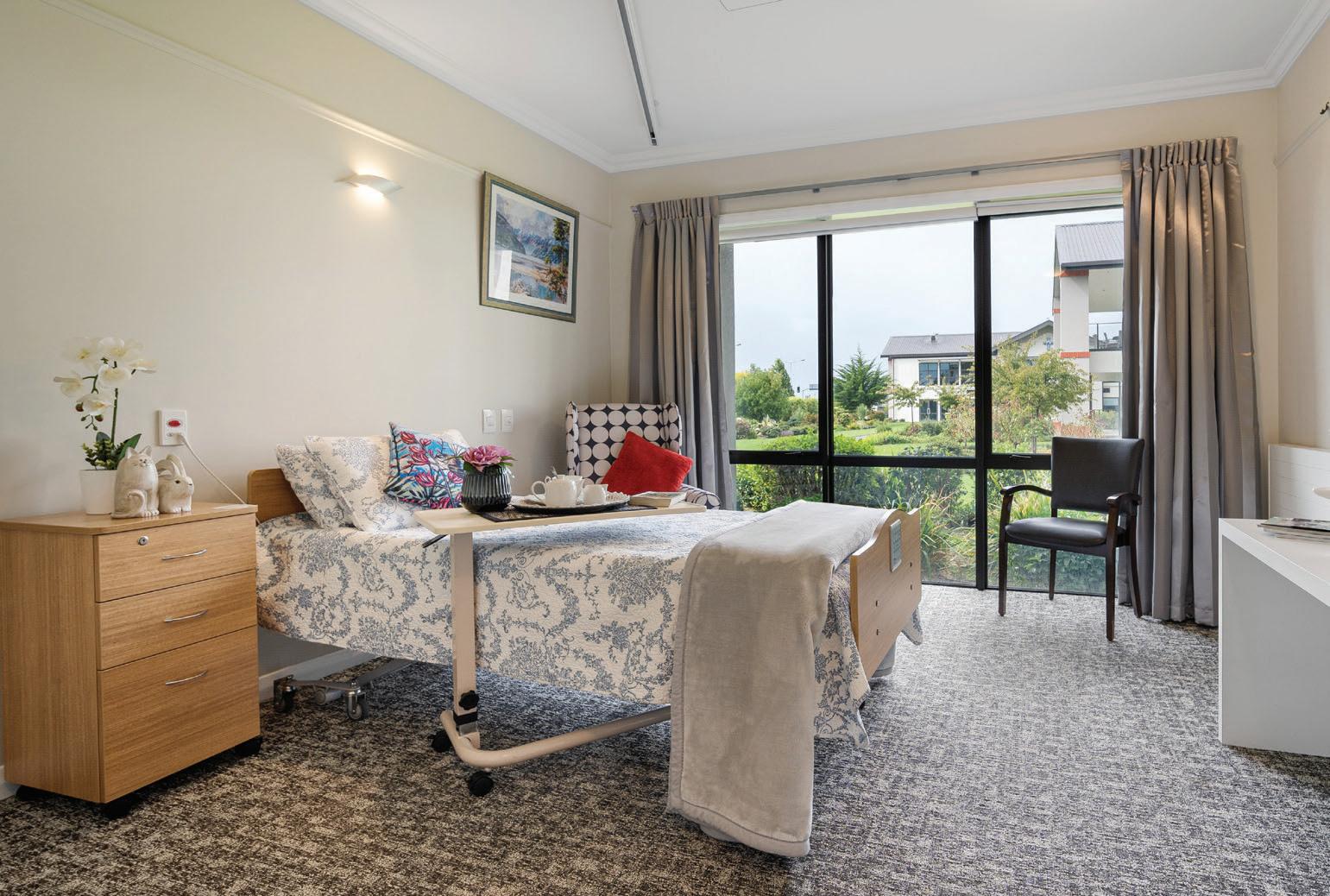

An
Payment is on an hourly rate. Needed in all areas.
Casual work only.
As mornings become cooler and evenings are darkening earlier, home heating is front of mind for most of us. If your wood burner is getting older, you may need to replace it with a cleaner form of heating, such as an ultra-low emission burner (ULEB) or efficient heat pump, to help clear the air in our region.
In Canterbury, low-emission burners can be used for 20 years from installation (or 15 years in Timaru), after which they become non-compliant and can no longer be used. The exception is some pellet burners that have been granted a resource consent by Environment Canterbury. Low-emission burners are still allowed in the Geraldine and Waimate Clean Air Zones.
To check what information we hold about your burner, visit the Solid Fuel Burner Database at ecan.govt.nz/ solidburner or call us on 0800 324 636.
Help is available
Subsidies are available to help low-income homeowners replace
their expired wood burners. If you meet the criteria, you may be eligible for up to $5000 towards the cost of a new heat pump or ULEB and its installation through Environment Canterbury’s subsidy scheme (visit ecan.govt.nz/financialhelp).
You may also be eligible for financial assistance and insulation upgrades through the government’s Warmer Kiwi Homes subsidy (visit www.eeca.govt.nz).
We recognise that some households are facing difficult circumstances. In some instances, we grant temporary waivers to enable use of an expired burner for another winter. This has been referred to as a “leniency” in the past and generally applies to those over 80 years of age and those with serious health concerns. Contact us on 0800 324 636 to ask about this option.
Many people in Canterbury have already switched to cleaner home heating options, and, with all of us playing our part, we can reduce pollution and breathe easier.


The Amberley Friendship Club has around 90 members. A recent monthly trip has included a visit to the Cheviot Museum in March. April’s outing was to the Gunyah Country Estate near Windwhistle and lunch at Oxford. The Club’s main speaker for April was a Physiotherapist advising us on mobility, balance and movement. Each month we hold a coffee morning at a local cafe. Age Concern Canterbury has organised a Refresher Driving Course for our Club in July; being held in Amberley. Come and visit our friendly Club! Meet: Third Tuesday of each month at the Tin Shed, Amberley Domain. Contact: Kaye (President) on 027 544 1907 or our Secretary Jan on 027 449 5984
Christchurch Red Hatters Club No set meetings but the Club has ‘gatherings’ which includes monthly events such as luncheons, dinners and an outing/activity. Contact: Iris Cousins on 021 0209 3598.
Club 55 Ten Pin Bowling League meet to enjoy Ten Pin Bowling and the company of people around our age. We get to meet new people while participating in physical exercise to our individual ability. Whether you have bowled before or not, this could be a new fun thing to do. We have 47 members at present, all over 50 years of age, and we are a friendly mixed bag from all walks of life. If you are interested, do give me a call and I’ll tell you all you need to know so you can decide if this would suit you. Meet: Every Thursday at 9.45am to approx. midday at Zone Bowling Garden City, 15-21, Iversen Terrace, Waltham. Christchurch. Contact: Beth Lomas 0272610493 or 3882375.
Lincoln Area Senior Citizen Club members had a speaker from Aspire Canterbury and afternoon tea at their May meeting. A birthday lunch and entertainment was enjoyed in June at The Bridge, Prebbleton. In July Phylis Harris is the speaker with an afternoon tea to follow. Meet: First Tuesday of the month at 1.30pm at the Lincoln Event Centre. New members are very welcome. Contact: Evelyn on 027 712 7195 or Gloria on 027 434 6554.
Papanui Rebus Club (formerly Papanui Probus Club) Meet: First Tuesday of the month at 10.00am at the Morrison Avenue Bowling Club, 30 Morrison Avenue, Papanui, Christchurch. Contact: Gillian on 03 352 6697 or Sian on 03 359 0057.
Age Concern Canterbury will be hosting a series of law seminars over the next few months. The seminars will be delivered by Catherine Thwaites a legal educator at Community Law Canterbury. Catherine is part of the team that is dedicated to empowering the community through legal education.

The team focuses on educating the community on a diverse range of topics, spanning from employment, family, and housing issues to criminal matters, human rights, and Māori land.
Catherine is currently studying for a Law and Health Science Degree, which is fueled by her passion for health law. Her goal is to contribute to improving healthcare access for everyone as a lawyer within the healthcare system.
Community Law offers free legal information and initial advice across a wide spectrum of issues.
Age Concern Canterbury is pleased to be able to support Community Law in making legal insights accessible to everyone, and so contributing to a better informed.
If you wish to attend one of the seminars listed below, please register by phoning Age Concern Canterbury 03 3660903, or email team@ageconcerncan.org.nz.
Thursday, 27th June 2024 from 11.00am to 12.00 noon
Tenancy Laws for Older Tenants
Thursday, 25th July 2024 from 11.00am to 12.00 noon
Register by phoning Age Concern Canterbury on 03 3660903 or email team@ageconcerncan.org.nz
Seminars to be held at Age Concern Canterbury, 24 Main North Road, Papanui. Christchurch 8053.

Estate Matters is the go-to service for individuals and families planning to move into retirement. We offer a unique blend of expertise, professionalism, and care.
Moving to a new home can seem daunting, knowing what to take, how to move, and what to do with items no longer needed.
Our expertise and professionalism can effectively alleviate the stress and anxiety that often accompany a move, making your next transition a smooth and worry-free experience.
As your 'one-stop shop', we simplify the moving process by arranging an initial consultation to discuss your needs and provide a free, noobligation estimate, all in one place. This comprehensive service ensures that all your moving needs are met, leaving you with one less thing to worry about.
Our dedicated team, affectionately
known as the 'Christchurch Daughters’, is more than just a service provider. We become your local family, offering the care, understanding, and knowledge to sort out your new home. We recognise that family members may not always be available to assist with the move, and we're here to fill that gap.
Before your house goes on the market, we prepare it for sale by decluttering. We can also clean the house and carpets, tidy the gardens, and prepare the home for sale.
We arrange transport and packing of household items to the retirement village and help unpack and set-up your new home.
Once you have moved, the next step is to sort the household items that are no longer required by selling; all proceeds go directly to the client. We donate items to local charities. Finally, we will clean the house, and
it will be ready


Our new writer Mark Walton should have waited until he met me before writing in that other publication (The Press) last year, about the delights of Burwood Hospital. I could’ve given him another truckload of fuel for the plaudit pile. In fact, I could’ve given him the scoop of the century. A miracle, no less.
If the health crisis is alive and well in Christchurch, I don’t believe the average oldie who attends Burwood would know much about it. I was first taken under its wing a few years ago after a mental health wobble, and thanks to a wonderful team and group participants, endless cuppas and fresh baking, story times, crafts, guided meditations, and a switchedon occupational therapist, here I am loving my voluntary work on this super little paper.
More recently, three years of everyday nerve pain led me back - to the hydrotherapy pool twice weekly

We’re needing to plant a couple of replacement trees along the western boundary, but I have some misgivings. When we last dug in that area, to replace some EQ shattered pipes, we found what was definitely not an inch worm, but rather a denizen of the deep. Two in fact, one measuring approximately 46 centimetres long and the other only slightly shorter. We put them back where they came from. How much bigger might they be now?
If, as we suspect, they’re Spenceriella gigantea aka the North Auckland worm, the largest one found in NZ measured in at 1.4metres or four feet seven inches. In 2022 a monster measuring one metre was found in the creek bed of a Christchurch garden. They’re amongst more than 170 types of worm endemic to New Zealand. Once thought to be rare outside of native bush, since our discovery we’ve heard that many others have found them in suburban gardens. Perhaps, like mushrooms, they’re spreading at a great rate of knots, beneath our very feet!
My brother remembers they were once prized as eel-bobbing bait, and he’d heard they had the added attraction of glowing, even after they were threaded on to teased flax and tied to a manuka pole. Bug man Ruud Kleinpaste confirms that scintillating snippet. I wonder what a Waimakariri river mouth kahawai might make of such a visual feast.


for four months, surrounded by dozens of oldies in varying stages of decrepitude and injury, and a surprising number of banged-up and post-operative young’uns too. A team of marvellous young physiotherapists is charged with getting us back up to
speed. They churn us through in onehour sessions, 15 to 20 at a time, all day long. They devise our personal plans and join us in the pool to check we’re doing it with maximum effort.
Chit-chat is OK, but concentration brings bigger, faster rewards.
When I reviewed Ruth Shaw’s The Bookseller At The End Of The World (Keeping On Vol 118) I wrote that if a follow-up eventuated I’d be up for that. It happened, I was, and was enthralled all over again. Ruth has effortlessly picked up the bookshops thread, weaving in engaging stories of dogs past and present,and adding interesting asides about their owners, as well as giving us more insight into her social work days.
This woman has been there, done that, in inimitable can-do Kiwi-style, and writes honestly of it all. My trusty BS detector could not even get a whiff of artifice. Ruth is a WYSIWYG. For those needing interpretation BS is what the bull does, and WYSIWYG is “what you see is what you get.” The families of everyone and their dogs who have a chapter in this book will always have a copy at hand ensuring it’ll go down in history, as a “real” New Zealand book. Prospective dog owners will also find breed and temperament information useful.
I hear book #3 is already in the pipeline, and I’ll have my hand up

for that too, although once again I can’t imagine what Ruth might come up with next. I’m agog at her energy and time management skills; what an inspiration she is. The library waiting list is long, get your name down now for Bookshop Dogs if you can’t count on it for your next birthday.
For 18 weeks Sophie Baldwin has nudged me through my programme with in-pool supervision and encouragement and on-land checkups. It’s been so good for me I didn’t want it to end, but despite my bribery (eggs, vegies, and herbs from the garden) and blandishments, Sophie declined to sign me up for more. She could see me getting better she said, with a knowing look in her eye. Then, just as our sessions were coming to an end, and Sophie confided she was about to return to the UK, the miracle occurred. For the first time in three years, I became pain-free. Just as good, I’m almost drug free too, back in the un-Zombie world, rediscovering and having more daylight hours in the garden.
Now it’s up to me to continue the good work. Give me a wave or a thumbs-up if you spot me doing weird stuff in the Graham Condon aqua jogging pool.
Following the serious house fire in a two storey unit opposite The Palms in New Brighton Rd in February, FENZ spokespeople have offered advice to people who live in this type of home. FENZ must know that many of these units with non-opening, doubleglazed windows, and smaller ones on rigid stays, offer no escape route whatsoever, except in the few homes with balconies, yet they suggested planning and practising not one, but THREE separate escape routes. They advised having glass smashing tools in upstairs rooms, buying a rope ladder and fire extinguisher and looking about for a tree or garage roof on which to cushion one’s fall. Firemen no doubt will have the fitness to smash windows, force stays and squeeze out of small spaces, but how many elderly people, or large younger people, would manage? Since that fire, in which a young mother and baby were lucky to escape with their lives, many older people have spoken to Keeping On of their fire safety concerns even in single storey accommodation. One, hard of hearing has been refused an upgraded warning alarm and others have chosen to sleep in their lounges rather than bedrooms, for easier egress in an emergency. Take a look around your home and if you feel unsafe in any way, contact your accommodation provider. If you own your own home, talk to your family about making the necessary changes. Contact your community board, FENZ, your local MP, but make it happen.