2026-2027
ENGINEERED TO ELECTRIFY 720 Bourke Street Melbourne DATA-DRIVEN TECHNICIAN-LED 25 Martin Place Sydney PROVEN BY DESIGN Nyaal Banyul Geelong STRONGER TOGETHER Creating Social Value
Chair’s Message I am delighted to introduce this year's edition of Building Efficiency, showcasing the outstanding achievements of the A.G. Coombs Group and the exceptional people whose expertise, commitment and innovation continue to drive our success. This year marks the release of Perpetuating the Vision, an updated history book celebrating the people, values and achievements that have shaped A.G. Coombs over the past 80 years. Throughout that time, our industry has undergone remarkable change, yet the values that have underpinned the success of our organisation have remained constant. Technical excellence, innovation, integrity, teamwork and long-term thinking have guided A.G. Coombs for eight decades and continue to shape our future. These enduring principles have enabled the organisation to evolve, embrace new opportunities and respond to changing market needs while remaining true to its purpose.
The projects, partnerships and innovations featured throughout this edition of Building Efficiency demonstrate how A.G. Coombs continues to build on this strong foundation. They reflect our commitment to creating lasting value for our clients, our people and the communities we serve, while helping shape a more sustainable, resilient and high-performing built environment. The A.G. Coombs Group Board remains committed to strong governance, responsible stewardship and the long-term success of the organisation. Thank you for your continued support. We look forward to the next chapter in the A.G. Coombs story.
Murray Coleman OAM Non-Executive Chair A.G. Coombs Group
Cover image: Metcalf Crane Services
2
Building Efficiency 2026-2027
Managing Director’s Message The built environment is becoming increasingly complex. Buildings are expected to be low carbon, connected, resilient and responsive to the needs of occupants and communities. At the same time, owners and operators face expectations around operating costs, performance, sustainability, compliance and long-term asset value.
In this environment, confidence matters. Confidence that critical systems will perform as intended. Confidence that investments will deliver meaningful outcomes. Confidence that trusted partners have the expertise, experience and capability to navigate complexity and the commitment to achieve lasting results. In this edition of Building Efficiency, we showcase the breadth of the A.G. Coombs Group and the exceptional work of our people in delivering that confidence through innovation, technical excellence and a whole-of-life approach to building services. Our people remain our greatest strength and the defining feature that continues to distinguish A.G. Coombs within the industry. Across Australia, our teams continue to deliver and support some of the nation’s most significant and technically demanding facilities. From healthcare, transport and major public infrastructure to commercial property, education, advanced manufacturing and hyperscale data centres, we are helping create buildings that perform today while remaining ready for tomorrow. Our whole-of-life approach remains a defining strength of the A.G. Coombs Group. By integrating advisory, engineering, prefabrication, installation, commissioning, maintenance and technical facility management expertise, we support clients across the entire
lifecycle of their assets. This approach delivers deep insights, strong collaboration and valuable long-term outcomes. Many of the stories featured in this edition demonstrate the growing role of data, digital technologies and building intelligence. Through innovations such as the Virtual Buildings Information System® (VBIS), Data Driven Maintenance, artificial intelligence, advanced analytics and commissioning excellence, we are helping clients transform information into practical insights that deliver superior building performance, reliability and sustainability. The transition to a lower-carbon future is accelerating. Electrification, energy optimisation, circular economy initiatives and high-performance building operation are increasingly shaping decisions across the built environment. We remain committed to helping clients navigate this transition through practical engineering solutions that deliver measurable environmental, operational and asset investor outcomes. Innovation continues to be central to our success. Our investment in artificial intelligence, digital engineering, integrated prefabrication and emerging technologies is enhancing productivity, safety, quality and certainty of delivery.
Through Murrungar, our capability partnerships with Indigenous businesses and communities, our support for organisations such as Guide Dogs Victoria, First Peoples’ Health and Wellbeing and Softball Australia, and our continued focus on diversity and inclusion, we are helping create opportunities that strengthen our industry and the communities we serve. The safety and wellbeing of our people, their ongoing development and a strong culture of collaboration are fundamental to our shared success. Our commitment to maintaining incident and injury-free workplaces is unwavering. As we celebrate 80 years of A.G. Coombs, we are proud of the values, partnerships and people that have shaped our journey. Looking ahead, the opportunities for our industry are exceptional. With trusted relationships, unmatched capability and a long-standing reputation for leadership, innovation and delivery excellence, the A.G. Coombs Group is well positioned to deliver with confidence outstanding outcomes for our clients and the communities they serve.
Russell Telford Managing Director A.G. Coombs Group
Equally important is our commitment to creating positive outcomes beyond the built environment.
agcoombs.com.au
3
4
Building Efficiency 2026-2027
06.
Engineered to electrify 720 Bourke Street Melbourne
12.
Critical connections Royal Melbourne Hospital
14.
Data-driven Technician-led 25 Martin Place Sydney
16.
Proven under pressure Townsville University Hospital
18.
Capital advice Canberra Advisory
21.
Knowledge Insight Delivered Subscribe
22.
Trusted guidance 25 years of Advisory Notes
24.
Proven by design Nyaal Banyul Geelong Convention & Event Centre
28.
AI with intent Artificial Intelligence
30.
Wired for hyperscale STACK Infrastructure Data Centres
32.
Built before it’s built Design for Manufacture & Assembly
34.
Stronger together Capability Partnership
36.
Shared vision Guide Dogs Victoria
38.
Predict prevent protect Fire protection systems
40.
Building a data ecosystem VBIS Data Ecosystem at 101 Collins
42.
Global peers Shared innovation International Peer Group
44.
In The News AMCA recognition Murrungar Softball Australia Industry recognition 20 years of Building Efficiency Perpetuating the vision
50.
Contact us
Image: Mannix
Engineered to electrify 720 Bourke Street Melbourne
Image: Tatjana-Plitt
Critical connections Royal Melbourne Hospital
Image: Mannix
Image: VisitCanberra
Capital advice Canberra Advisory
Proven by design Nyaal Banyul Geelong Convention & Event Centre
Image: Daniel Waack
Built before it’s built Design for Manufacture & Assembly
Image: Paul Adcock
Global peers. Shared innovation International Peer Group
agcoombs.com.au
5
Engineered to electrify Developed by leading national integrated property investor and developer, Cbus Property, 720 Bourke Street is a landmark 16-level, premium-grade office building in Melbourne's Docklands precinct. Positioned alongside Marvel Stadium, it provides a key link between Docklands, the Melbourne CBD and Southern Cross Station.
6
Building Efficiency 2026-2027
agcoombs.com.au
7
Images: Mannix
Previously occupied by Medibank, the building will be the new home for a large corporate tenant. The transition between two large-scale occupiers provided the opportunity for one of the nation’s largest commercial building electrification projects, transforming the property into an all-electric building powered by 100% renewable energy. A.G. Coombs was engaged by Cbus Property, with MRS Property as independent project manager to carry out the electrification works. The brief was as ambitious as it was unambiguous: remove the three gas boilers and install a fully electric, future-ready heating plant of equal thermal output, and with no tenant disruption.
Smarter path to electrification The original design specified 14 new air-source heat pumps and six new water-source heat pumps with a total heating capacity of 3,360 kW, which would require a significant electrical supply upgrade for the added electrical load. A.G. Coombs offered a re-engineered hybrid alternative: eight Trane heat pumps; four air-source on the level 18 roof and four water-source in the adjoining plant room,
8
Building Efficiency 2026-2027
delivering the same heating hot water thermal output and within the capacity of the existing electrical supply. “The Trane platform gave us direct control over the power draw of each unit, so aggregate demand at peak capacity stayed within the electrical supply submains’ design rating,” says Mitchell Ryan, Engineer at A.G. Coombs. “This design removed the need for electrical supply cable replacements, switchboard upgrades and the associated project complexity and additional capital cost.” The change will also deliver improved system operability. The air-source and water-source units operate in a cascade arrangement; the air-source units lift the cooled heating water returning from the water-source units to an intermediate temperature, and the water-source units
take it through to the 75°C temperature required by the heating system. With all elements of the cascade from a single manufacturer and sequenced through the building management and control system (BMCS), the result is seamless operation. Both the air-source and water-source heat pump units operate on next generation low global warming potential (GWP) refrigerant blends ahead of the government phase-down schedule for higher GWP refrigerants now reshaping the refrigeration industry. To mitigate any refrigerant leakage, the new plant is equipped with refrigerant leak detection systems that meet the requirements of Australian Standard AS/NZS 5149 Refrigerating systems and heat pumps – Safety and environmental requirements.
Heat Pumps Explained Heat pumps transfer existing thermal energy rather than generating it. Air-source heat pumps absorb energy from or reject to ambient outside air to heat or cool water to condition indoor spaces. Water-source heat pumps rely on the stable temperature of a piped water system to heat or cool water to condition indoor spaces. Air-source and water-source heat pumps have different operating and performance characteristics.
agcoombs.com.au
9
Image: Metcalf Crane Services
10
Building Efficiency 2026-2027
Image: Alexander Cimbal Alamy
Crane day in Docklands
Whole-of-life capability
The crane lift for the new plant presented the single largest installation challenge. A 500-tonne crane with an extended boom was needed to lift the new equipment onto level 18, and the three-day permit window had to coincide with suitable weather in a notoriously windy precinct.
A.G. Coombs Advisory had earlier delivered a Building Energy Optimisation Program® (BEOP) for the 14-year-old building, assisting in the achievement of a 5 star NABERS Energy rating.
“Docklands offers very narrow program windows for crane lifts of that scale. Typically, only one day in five aligns with suitable weather, traffic conditions and site access,” reflects Darren Hill, Project Manager at A.G. Coombs. “Our three-day permit opened on 23 March 2026, and the team, working with MRS and Knight Frank as the Facility Manager, completed the road closures, tenant access and the lift itself on schedule.”
For Johan Muller, A.G. Coombs Manager, Special Contracts Division (VIC), the electrification project is another chapter in a deeper engagement. “With the heating plant now operational and in commissioning, A.G. Coombs has been awarded the mechanical services fit-out for the incoming 14 floor corporate tenancy, with completion programmed for mid-2027,” Johan says.
under live load in readiness for the building to welcome its new tenants. “A.G. Coombs was Cbus Property’s trusted partner for the electrification of 720 Bourke Street, bringing the engineering skills and installation rigour this project required,” states Peter Bartucca, National Manager, Investment Operations, Cbus Property. “The team’s continued involvement through the tenant fit-out reflects the whole-of-life capability A.G. Coombs can bring to building assets with this profile.”
Seasonal commissioning of the new heating plant will run alongside the tenant fit-out through 2027, capturing a full winter
agcoombs.com.au
11
Critical connections A.G. Coombs has spent decades shaping how hospital plant and equipment is maintained — not from the outside looking in, but as an extension of the in-house teams that keep critical care running every hour of every day.
Healthcare maintenance sits in a category of its own. The buildings are never closed, the systems never stop, and the people inside are often at their most vulnerable. Every task is performed quietly, cleanly and around clinical operations that cannot be interrupted. “What we’re really maintaining is the environment around people’s family members and the staff looking after them,” says Chris Milgate, Contract Manager at A.G. Coombs Service. “Every decision we make about plant and equipment comes back to keeping patients comfortable and clinical teams supported.”
Precinct presence A.G. Coombs’ healthcare footprint stretches across Australia’s largest health precinct — anchored along Flemington Road and taking in Royal Melbourne Hospital (RMH), the Royal Women’s Hospital, the Royal Children’s Hospital and the Royal Dental Hospital with adjacent involvement at the Peter Doherty Institute, the Walter and Eliza Hall Institute and the University of Melbourne.
12
Building Efficiency 2026-2027
Beyond the precinct, the A.G. Coombs Service health footprint serves communities across Victoria including the New Bendigo Hospital, Peninsula Hospital, Box Hill Hospital and the Austin Hospital. Together, these engagements build a critical mass of sector experience and technical capability. “Hospitals depend on specialist partners,” adds Chris. “We bring the technical depth in-house teams can call on when it matters.” The model demands capability across mechanical, electrical, fire protection and controls systems, bringing to bear advisory and system commissioning disciplines, and providing scalability to mobilise the right expertise quickly when something critical needs attention.
Life safety first A standout requirement is maintaining and ensuring regulatory compliance of essential safety systems – the technologies that control smoke exhaust, support evacuation and ensure safe egress in a fire emergency. Hospitals are inherently complex, often layered with extensions and additions that – over the
years – can create multiple zones and operational sensitivities. “Servicing and maintaining is the baseline. Delivering it alongside the highest level of compliance, in environments as complex as these, is what sets the work apart,” says Gareth Whitfield, Executive General Manager, A.G. Coombs Service.
Old plant, new pressures Hospitals have shifted decisively from reactive servicing to proactive maintenance to improve system availability and reliability — and that shift is increasingly underpinned by well-structured and detailed data on the technical assets being maintained including asset condition and costs to maintain or replace. A.G. Coombs has worked alongside the Royal Melbourne Hospital’s engineering team to structure that data in alignment with the Virtual Buildings Information System (VBIS) asset classification standards – endorsed by the Victorian Government including the Victorian Health Building Authority (VHBA). This data foundation provides detailed information to support equipment upgrades and replacements, to ensure
Image: Tatjana Plitt
reliable ongoing operation of critical systems. Decarbonisation is reshaping healthcare portfolios, but the path is rarely straightforward. A.G. Coombs has led electrification programs across diverse sectors and A.G. Coombs Advisory is increasingly engaged by hospitals to identify, quantify and sequence the gains. “Facilities need both the funding and the electrical capacity to make electrification happen, and the existing infrastructure isn’t always ready for it,” adds Gareth.
operations. A.G. Coombs consistently provides the technical capability, responsiveness and collaborative mindset needed to maintain these challenging environments.” Across its entire hospital and healthcare portfolio, the work undertaken by A.G. Coombs Service is more than maintenance. It’s a convergence of clinical sensitivity, technical depth and long-view stewardship, keeping critical care running where it matters most.
The upside is real. Hospitals operate some of the largest, most energy-intensive plant in the built environment, where well-targeted intervention is delivering outsized returns. “As one of Australia’s largest trauma hospitals, RMH relies heavily upon its strong partnership with A.G. Coombs,” says Adam Steegstra, Engineering Services Manager, Royal Melbourne Hospital. “The hospital’s complex HVAC systems are critical to patient safety, infection prevention and clinical
agcoombs.com.au
13
Image: Aran Anderson
Data-driven Technician-led
14
Building Efficiency 2026-2027
For decades, building maintenance has relied on fixed schedules. While essential for compliance, statutory obligations and asset reliability, scheduled maintenance does not always reflect actual condition, operational risk or performance. A.G. Coombs’ DDM approach adds intelligence that helps clients prioritise effort, validate performance and direct resources to where they have the greatest impact. “We use the operational data with asset condition and maintenance history to identify poorly performing equipment and emerging risk,” says Andrew Smith, National DDM & Analytics Leader at A.G. Coombs. “Rather than relying only on periodic servicing, we can target and prioritise the assets and systems where intervention will make the greatest operational difference.”
A structured DDM framework A.G. Coombs applies DDM through an integrated maintenance framework that combines foundation maintenance, asset analytics and performance analytics, supported by practical engineering judgement. • Foundation maintenance provides industry-leading compliance, planned servicing, statutory inspection and essential maintenance disciplines that underpin safe and reliable building operation. This establishes the baseline from which data and analytics can be used to enhance maintenance outcomes. • Asset analytics uses asset registers, condition assessments, maintenance history and lifecycle modelling to support maintenance planning and capital decisions based on evidence rather than theoretical replacement ages. • Performance analytics uses an Automatic Fault Detection and Diagnostic (AFDD) platform to analyse live operational data from the Building Management and Control System (BMCS), meters, IoT devices and other connected building systems. The platform applies rules, algorithms and engineering logic to identify performance drift, emerging faults,
abnormal operating patterns and optimisation opportunities that may not be visible through conventional maintenance activities. • Engineering judgement combines analytics with practical maintenance experience, technician input and engineering judgement. Outputs are validated against site knowledge, asset history, system design intent and operating conditions, enabling our teams to filter noise, prioritise action and focus expertise where it delivers the greatest operational value. Together, these elements connect maintenance effort to the outcomes that matter most – improved reliability, reduced energy waste, better occupant comfort and more informed lifecycle planning. The same data that identifies underperforming assets also reveals issues contributing to energy waste, comfort complaints and equipment stress, supporting energy optimisation, carbon reduction, NABERS outcomes and improved indoor environmental quality. While many clients initially focus on energy optimisation, better-controlled systems can also extend asset life by up to 20%, while improving comfort and performance.
Industry best-practice focus At 25 Martin Place, the Dexus-owned tower in Sydney, A.G. Coombs delivers Data Driven Maintenance through separate service arrangements for the commercial tower and retail precinct. The site demonstrates the ability to deploy bestpractice analytics platforms suited to the customer’s objectives, building complexity and maintenance strategy. “The platform itself is only one part of an effective DDM solution,” says Andrew. “The real value comes from combining analytics platforms with A.G. Coombs’ engineering expertise, fault detection rules, maintenance workflows and technician engagement to convert data into practical outcomes.”
One example at 25 Martin Place in Sydney highlighted this approach in practice.
Several floors were experiencing persistent temperatures above design expectations. Using analytics data, the team quickly determined the issue was linked to a tenant fit-out not aligned with original engineering intent, rather than a base building system fault. “Diagnosing this manually would have required multiple service visits and a broader investigation,” says Michael Smith, A.G. Coombs (NSW) Service Technician at 25 Martin Place. “The DDM approach helped us narrow the investigation, validate the likely cause and develop a rectification strategy.”
More than the platform Making the value of DDM visible to decision-makers is equally important. A.G. Coombs quantifies the cost impact of outstanding faults, helping facility managers and building owners prioritise rectification based on risk, operational impact and financial consequence. When the cost of inaction is clearly understood, performance data becomes a powerful decision-making tool rather than simply another set of technical information. “Whilst the AFDD platform identifies potential faults, the real value lies in the expertise behind the analytics,” says Joseph El-Haiby, Contract Manager at A.G. Coombs (NSW). “Validating the data, refining rules, prioritising what matters and embedding findings into day-to-day maintenance is where A.G. Coombs delivers value.” “DDM gives us a clear, evidence-based view of where the building needs attention, and the information and confidence to act on it,” concludes Andrew Smith, A.G. Coombs National DDM & Analytics Leader. “A.G. Coombs brings a valuable combination of data, engineering rigour and practical maintenance delivery to 25 Martin Place.” This combination enables A.G. Coombs to turn maintenance data into targeted action that improves reliability, comfort, energy performance and long-term asset outcomes.
agcoombs.com.au
15
Proven under pressure A.G. Coombs delivered the mechanical services installation for an exceptional hybrid operating theatre at Townsville University Hospital. One of the first of its type in Australia, this state-of-the-art medical facility represents a quantum leap in surgical capabilities for North Queensland, combining surgical procedures with advanced medical imaging in a single, integrated environment.
A year on, inside a hospital that never stopped operating, that engineering has performed without disruption or a single callout. For the clinical teams at Townsville University Hospital, the hybrid theatre has reshaped the choreography of complex surgery. Procedures that once required patients to be moved between an operating theatre and a separate imaging suite now take place in a single integrated room. “The challenge wasn’t just building a hybrid operating theatre. It was delivering highly specialised mechanical systems inside a hospital that never stopped operating, while maintaining the environmental conditions and services clinicians rely on every day,” explains Rob Shepherd, Project Manager, Special Contracts Division, North Queensland at A.G. Coombs (QLD).
16
Building Efficiency 2026-2027
The theatre now supports complex trauma and emergency services, vascular and cardiothoracic procedures, interventional radiology and neurosurgery, and has enabled a significant uplift in the number of these procedures.
Engineering clean air At the centre of the operating theatre ceiling sits an UltraSuite® highefficiency particulate air (HEPA) plenum that departs from conventional single-grille systems, integrating filtration, surgical lighting and medical equipment mounting in one structure. A.G. Coombs developed a 3D model that located more than 80 precision mounting points for the plenum. The associated fixings were accurately cast into the new concrete slab above before the theatre fit-out commenced, a process that had zero margin for error.
Image: Ashley Beckett COX Architecture
The sophistication of the ventilation systems extends beyond the operating theatre to establishing and maintaining precise pressure differentials across multiple zones around the theatre. Each room in the suite serving the hybrid theatre operates under carefully calibrated pressure regimes lower than the theatre itself so air always moves outward from the cleanest space. Lose those differentials and dust and contamination find their way into the one room that must stay sterile.
Right first time The project’s most exacting moment came not in the theatre but in the adjacent corridor. A cut-in connection into the hospital’s live chilled-water main had to be completed in a single weekend. Theatres were stood
down for a five-hour window and there was no fallback if anything failed. A fault would have taken the chilled-water system and air-conditioning systems it supplied offline across the entire hospital.
upgraded one at a time. Each bay was sealed behind a negative-pressure hoarding while patients recovered in adjacent bays just metres away.
A foundation in the north “An alternative approach was not possible,” adds Rob. “The cut-in sequence was engineered to work the first time, and it did.” Access shaped many decisions. With new air-handling units (AHUs) on a long delivery lead time, a plan to crane them through the roof was abandoned. Instead, the AHUs were delivered to the loading dock, dismantled to their constituent parts, carefully catalogued and photographed, carried up by lift and meticulously rebuilt inside the plant room several levels above. Similar discipline applied to works in the Recovery Ward, where seven post-anaesthesia care bays were
Delivered locally from Townsville, the project’s success also relied on A.G. Coombs’ ability to mobilise specialised resources from a national pool of engineers and technical specialists. “Across the first year of operation we’ve had virtually no issues and no callouts to the hospital,” states Russ Sampson, A.G. Coombs (QLD) Regional Leader, North Queensland. “Nothing speaks to the quality of the work more clearly than that.”
and commissioning challenges inside a live tertiary care hospital and achieving the precise air quality and pressure regimes essential for surgical safety,” says Mitch McMahon, Project Manager at Hutchinson Builders. “The result is a new surgical capability for the communities we serve across North Queensland.” The Townsville hybrid operating theatre is more than a surgical facility. It is a new capability for northern Australia’s only tertiary referral hospital — one serving some 700,000 people from Cape York and the Torres Strait to the Gulf of Carpentaria.
“A.G. Coombs played a central role in delivering one of Australia’s first hybrid operating theatres, navigating installation
agcoombs.com.au
17
Capital advice Canberra is unlike any other property market in Australia. A dense concentration of federal and territory government tenants, nationally significant institutions and heritage assets shapes a built environment with its own rules and an appetite for low-energy, electrified performance.
Daniel De Valentin Leader (ACT) A.G. Coombs Advisory
Building Efficiency (BE) spoke with Daniel De Valentin, Leader (ACT) at A.G. Coombs Advisory about the shape of the Canberra market, the rise of electrification and the synergy that sets the Advisory team apart.
BE: Paint a picture of the Canberra team and what it does. De Valentin: We’re a tight-knit local engineering team working across independent commissioning, building technologies and technical advice. Independent commissioning is the capability we’re best known for in Canberra and it anchors how the streams work together.
18
Building Efficiency 2026-2027
We also closely connect into the national Advisory team of over 50 engineers and technical specialists.
BE: Provide an example of that technical advice in action. De Valentin: One of the universities in Canberra was undertaking a competitive tender for a central cooling plant upgrade. A.G. Coombs (NSW) was successful in securing the project and, during collaborative discussions with the client, engaged the Advisory team to review the broader opportunity.
Images: Aran Anderson
We identified a strategy that would allow for the central chilled water plant upgrade while at the same time electrifying the building’s heating hot water system, all within the client’s budget constraints. The solution was adopted by the university, demonstrating how A.G. Coombs Advisory, Service and Projects expertise can achieve better long-term, whole-of-life outcomes for our clients.
BE: How would you characterise the current state of the Canberra market? De Valentin: A large proportion of buildings are home to federal or ACT Government tenants and this drives an appetite for efficient, low-energy and now electrified buildings with strong NABERS ratings. Recent A.G. Coombs Advisory projects include the Australian War Memorial, Canberra Institute of Technology Woden
BE: How do Canberra’s nationally significant assets shape the work undertaken by A.G. Coombs?
De Valentin: Electrification has been a priority focus more recently. We’ve completed feasibility studies across many facilities, aligned with Australian Government decarbonisation policies that encourage all-electric buildings for office accommodation.
De Valentin: Integrated Technical Management (ITM) has provided technical facility management and maintenance services at many of Canberra’s highprofile facilities for well over 20 years. These currently include the National Museum of Australia, National Portrait Gallery and Old Parliament House.
Demand for building efficiency reviews is also increasing through the A.G. Coombs Carbon Roadmap® tool. Its value is the technical rigour behind each recommended measure, engineered for the specific building and its actual operations rather than drawn from generic advice.
This experience has given us a deep understanding of these facilities and their unique requirements, enabling us to consistently deliver high-quality technical outcomes.
BE: Are any regulatory shifts reframing your advice?
(pictured above), University of Canberra (pictured next page), Canberra Hospital and the new Canberra Lyric Theatre.
BE: What problems are clients most often asking you to solve?
De Valentin: Regulatory shifts sharpen our advice rather than change it. Industry rating schemes also drive change. NABERS (National Australian Built Environment Rating System) remains the primary
agcoombs.com.au
19
Aerial view of the University of Canberra’s Bruce campus in Canberra, ACT.
measure of a building or tenancy’s energy efficiency and environmental impact.
BE: Name a project that captures the Advisory team at its best.
NABERS Energy is evolving to reflect changes in Australia’s electricity grid and to maintain a strong focus on energy efficiency as buildings transition to all-electric operation.
De Valentin: The Canberra Theatre Redevelopment captures the Advisory team at its best. As the client-side Compliance and Commissioning Agent, we’re providing leadership across a broad team of technical specialists, overseeing design compliance, construction quality and commissioning across all major engineering disciplines.
The nation’s target to reduce greenhouse gas emissions to net zero by 2050 is driving the development of net-zero pathways for buildings. Electrification of buildings to run on power from renewable sources is delivering the emissions outcome the public service mandate calls for. We assess the impact on both NABERS Energy performance and emissions reduction outcomes, ensuring efficiency and decarbonisation objectives are considered together to identify the most effective upgrade pathway for each building.
20
Building Efficiency 2026-2027
It’s a role that goes well beyond compliance and reflects the trusted adviser relationship we’ve built with the project team. Clients value our ability to combine deep technical expertise with practical delivery experience, providing clear, timely advice and resolving issues before they become project risks.
BE: Why does A.G. Coombs Advisory’s presence in Canberra matter? De Valentin: Advisory is the fusion between the practical project capability of A.G. Coombs and the Group’s advanced technical facility management and maintenance expertise. The three go hand in hand. When we work with our clients, we bring the knowledge and understanding that only comes from being a whole-of-life technical services specialist with engineering and trade-based capabilities. It is practical, industry-leading technical advice and services that can be relied on.
Knowledge Insight Delivered Stay informed with expert technical guidance from Australia’s Leading Building Services Specialist.
For more than 25 years, A.G. Coombs Advisory Notes and, for the past 20 years, BE – Building Efficiency have delivered trusted technical guidance to building owners, facility managers and industry professionals.
Free Subscription
Subscribe free to receive:
Advisory Notes Practical technical guidance written by A.G. Coombs engineers and specialists.
BE – Building Efficiency magazine Projects, innovation, technologies and industry trends shaping the built environment.
Scan now to receive future Advisory Notes and Building Efficiency straight to your inbox.
Industry Updates Insights on building performance, electrification, sustainability and emerging technologies.
agcoombs.com.au
21
Trusted guidance For more than 25 years, A.G. Coombs’ Advisory Notes have provided the people who run buildings with something valuable and increasingly rare — clear, trusted answers to important questions, writtenby the engineers and technical specialists who know the subject best.
Long before email became the norm, a building owner might have opened the mail to find a single printed page beneath a signed cover letter from A.G. Coombs. The letter may have explained the significant change to the rules governing cooling towers; the attachment set out what it meant and what to do next. No pitch, no sell, just clear, useful advice from people who understood the regulation and could explain it in non-technical terms. That was one of the first Advisory Notes. What began as a printed update delivered by post has evolved into a digital library of more than 70 Advisory Notes, continually updated and expanded to help building owners, property professionals and facility managers navigate change with confidence. Their purpose remains unchanged – to turn technical complexity into clear, practical advice.
22
Building Efficiency 2026-2027
Education as foundation
Made to be read
A.G. Coombs Strategic Development Director Bryon Price has championed the Advisory Notes series from the beginning. Guided by the conviction that better-informed clients make better decisions, the series reflects a commitment to sharing knowledge openly and building trust through insight.
A discipline behind every Advisory Note is respect for the reader’s time.
“Our goal has always been well-informed clients,” says Bryon. “We want the people we are assisting across the detail, so our focus is to give them clarity, not a sales pitch.” Advisory Notes have always been written for the people responsible for keeping buildings running. As facility management has matured into a profession of its own and buildings have become more complex, the value of clear, trusted guidance has only grown.
“Every Advisory Note answers the same three questions,” explains Bart Taylor, General Manager of A.G. Coombs Advisory. “What’s the issue and why is it important? What do you need to know? And what should you do next?” For the specialists who write them, the greatest challenge is restraint. Given a subject they know deeply, the discipline lies in distilling complex technical knowledge into practical guidance that an experienced but possibly non-technical facility manager can absorb and action. That discipline does not come at the expense of expertise. Every Advisory Note is authored by an A.G. Coombs building services specialist, giving readers confidence in the advice and a direct connection to the expertise behind it.
“The result is an executive summary rather than a thesis,” adds Bart. “Together, the Advisory Notes provide concise, practical guidance from specialists across mechanical, electrical, building technologies, hydraulic and fire services.”
Global impact The clearest demonstration of the Advisory Notes’ value came when readers needed them most. As COVID-19 spread and the building industry searched for guidance, A.G. Coombs published an Advisory Note titled ‘HVAC and COVID-19’. Written from the engineer’s perspective, it explained what happens when an infected person coughs or sneezes and how a properly maintained heating, ventilation and air conditioning (HVAC) system could help limit the spread of infected droplets. Issued in March 2020, it became the most widely read Advisory Note ever, attracting 180,000 global downloads within ten days, and was one of the first
public references to airborne, or aerosol SARS-CoV-2 transmission and the role that building HVAC systems can play.
that the virus could spread through the air in poorly ventilated indoor spaces.
Trusted over time The Advisory Note and subsequent COVID-related topics quickly became trusted industry references, shared widely as organisations sought reliable guidance during a period of unprecedented uncertainty. Building owners, facility managers and tenants used them to understand the issue and what to do next to help keep their properties operating safely. A.G. Coombs had reached that view ahead of the broader consensus. “If we claim to be an industry leader, then we have to lead,” says Bryon. “We believe we were among the first in the world to say, publicly and formally, that as the virus was capable of spreading by aerosol transmission, building HVAC systems had a role.” Soon after the ‘HVAC and COVID-19’ Advisory Note was published, the World Health Organization (WHO) confirmed as much, acknowledging
For 25 years, Advisory Notes have helped building professionals understand complex issues, navigate change and make better-informed decisions. The distribution has evolved and the topics have changed, but the purpose remains the same: to turn complexity into clear, practical guidance that helps readers make confident decisions. If you are not already receiving A.G. Coombs Advisory Notes, you can subscribe by scanning the QR code. Alternatively, visit the A.G. Coombs website or follow A.G. Coombs on LinkedIn to receive future editions.
Subscribe to receive Advisory Notes
agcoombs.com.au
23
Proven by design Construction of Nyaal Banyul Geelong Convention and Event Centre is now complete, with the precinct opening its doors in July 2026 as a new centrepiece for Victoria’s second-largest city.
The name Nyaal Banyul means ‘open your eyes to the hills’ — a name gifted by Wadawurrung Traditional Owners Aboriginal Corporation (WTOAC) to encourage people at the site to take time to appreciate the landscapes of Wadawurrung Country. The precinct is a purpose-built convention and event space, offering a range of contemporary and flexible spaces, including a 1,000 seat theatre, exhibition and conference facilities, meeting rooms and breakout spaces, food and beverage offerings and Gheringhap Plaza. The Plenary Conventions consortium transformed the 1.6-hectare waterfront car park site into a precinct that welcomes locals and visitors alike as part of the precinct partnership. The consortium comprised Plenary Group as sponsor and investor as well as hotel and commercial office developer, Built as builder, Woods Bagot as architect and BGIS as facilities management services contractor. A.G. Coombs was among
24
Building Efficiency 2026-2027
its key partners — responsible for mechanical design and installation, and for the building’s control philosophy. A.G. Coombs developed the functional description governing how the building operates, engaging JCI to deliver its building management and control system (BMCS) and energy management system (EMS).
Electric ambition Designed to be certified carbon neutral under the Australian Government’s Climate Active program, and to achieve 5 Star Green Star Buildings V1 Certification, the centre is fully electric. The project team achieved a 30% reduction in energy demand against a Green Star reference case, including a 10% reduction in heating and cooling energy use. The mechanical services solution combines water-cooled chillers, air-cooled heat pumps, chilled water
Images: Nic Stephens
agcoombs.com.au
25
storage and extensive air-to-air heat recovery through the air handling units (AHUs). Comprehensive electrical and thermal metering allows the facility operators to account for energy use across the elements of every major energy system. “Being fully electric brings its own challenges including a larger plant footprint and more complex control systems,” says Franc Bot, Senior Project Manager at A.G. Coombs. “On the primary side, water-cooled chillers, air-cooled heat pumps, and separate chilled water and hot water storage tanks all work together to minimise and manage energy use while feeding a secondary water distribution system to air conditioning systems throughout the building – a far more sophisticated solution than a conventional chiller-andgas powered boiler arrangement.”
Form & function align Engineering design was led by consultants WSP, with A.G. Coombs
26
Building Efficiency 2026-2027
Projects contributing throughout the design stages. The mechanical scheme evolved over three formal design stages, with engineers across A.G. Coombs’ Melbourne and Sydney teams investing thousands of hours before construction began. Heatload modelling proved especially complex, driven by high occupant loads, open volumes and high outsideair demands of a convention venue. To validate the design, A.G. Coombs engaged Deakin University’s School of Engineering for computational fluid dynamics (CFD) modelling, working with the university’s engineers to define the scenarios and interpret the results. “CFD modelling, undertaken with Deakin University for the Plenary Hall, informed the precise engineering of the air conditioning system to deliver occupant comfort without compromising the architectural design,” says Andrew Fletcher, Project Engineer at A.G. Coombs.
A circular lens Victoria has been an early adopter of circular economy principles in public infrastructure and Nyaal Banyul was among the first projects to carry circularity into its delivery requirements — aligning with A.G. Coombs’ own Circular Initiative. In practice, that meant new reporting obligations — tracking material use, waste streams and reuse across the build. Circularity entered the project not as an aspiration but as something contractually measured, a shift that is beginning to reshape how major public projects are specified and delivered. Prefabrication is central to that thinking, cutting waste and rework by building elements off site, while the finished facility operates a sophisticated waste and recycling regime.
Images: Mannix
By the Numbers
Hard targets, real outcomes
The A.G. Coombs scope at Nyaal Banyul Geelong Convention and Event Centre included:
Creating social value was an important contractual objective. The GEESP program embeds equity into this major development’s delivery.
• 10.5 km of pipework installed • 24,800 m² of sheet metal in ductwork • 4,500+ hours of GEESP apprentice and trainee labour through gforce — significantly beyond the contracted minimum and stretch target
Co-designed by Development Victoria, the Give Where You Live GROW initiative and gforce employment + recruitment, it was delivered for the project by Built.
• 11% of contract hours dedicated to apprentices, trainees and cadets under the Major Project Skills Guarantee
As part of its role, A.G. Coombs delivered 4,500+ apprentice and trainee hours, alongside other commitments under the Social Procurement Framework.
• 70% local content delivered under the Local Industry Development Plan
Delivered with precision
• Victorian Government Social Procurement Framework targets met for Victorian social enterprise spend and Victorian Aboriginal business spend
Much of the installation sat more than 20 metres above the floor, yet was delivered safely, to program, and has since proven itself in operation.
“As a PPP of this scale, the project relied on partners who could match technical expertise with practical adaptability,” reflects Josh Pozzebon, Project Director at Built. “A.G. Coombs delivered both, helping bring an important public asset to life for Geelong.” As delegates, performers and visitors begin to fill its spaces, Nyaal Banyul takes its place as a new civic landmark for Geelong — one designed to support major events, strengthen the local economy and celebrate the region’s connection to Country.
• Targeting Climate Active carbon neutral status and Green Building Council of Australia 5 Star Green Star Buildings V1 Certification.
agcoombs.com.au
27
AI with intent As artificial intelligence (AI) rapidly reshapes industries, workplaces and professions, one question dominates the construction sector: What will it mean for its workforce? A.G. Coombs is crafting its own answer — one where technology unlocks new levels of potential for its people.
28
Building Efficiency 2026-2027
On a recent project, an engineer faced a familiar task, reconciling close to 500 airflow dampers between an equipment schedule and a set of drawings. Historically, that meant hours of manual cross-checking. Using an AI tool, the same engineer extracted both datasets, compared them and narrowed the task to a targeted review that surfaced previously overlooked inconsistencies in a fraction of the time. “Artificial intelligence doesn’t remove engineering judgement,” says Madeleine Moratti, Project Engineer at A.G. Coombs. “It removes the repetitive work and provides focused insights so we can apply that judgement where it matters.”
connecting building assets – the chillers, pumps, fans, switchboards and other equipment that keep a building running – so data can be located and connected across separate systems. “If VBIS is the foundation that organises these assets, AI is becoming the engine that generates intelligence from that structure,” adds Madeleine. “We’re able to unlock the value in data A.G. Coombs has collected for decades.” For Bryon, that accumulated data enables foresight. “It allows us to read live data flows against years of records so we can act on a problem before it lands, rather than manage it afterwards.”
Capability & capacity
Whole-of-life advantage
That line between taking on the repetitive work and displacing the people who do it sits at the centre of how A.G. Coombs approaches AI.
This adoption strategy has been very deliberate. Before scaling AI capabilities, A.G. Coombs laid the groundwork – AI use policy, data-loss-prevention controls, training and ‘test and learn sandboxes’ where teams can trial the technology safely, away from live systems and real project data. Those environments build the confidence for people to embrace a technology that keeps evolving.
Where much of the application of AI in the business sector has been framed as an efficiency or headcount play, A.G. Coombs also sees it as a way to amplify the capability and capacity of its skilled people. This approach reflects both company values and competitive strategy. “The implementation of AI is about unlocking the potential of our valued people,” says Bryon Price, Strategic Development Director at A.G. Coombs. “Behind that amplification sits a single, vital ingredient – data.”
Built on data Over two decades, A.G. Coombs has been migrating paper-based buildingservices design and installation information and maintenance records to data-rich models that contain millions of structured data points. Alongside this journey, it built the systems to make the data usable, including VBIS, the Virtual Buildings Information System®. VBIS is a shared standard for naming and
For many A.G. Coombs employees, AI capability arrives through a familiar door – Microsoft 365 Copilot. As the company’s primary AI platform, Copilot works across everyday software tools in a protected environment where company information remains ring-fenced.
than guesswork. That same instinct – standardising what can be standardised – is where AI will make a big mark.
Forward with intent Design for Manufacture and Assembly (DfMA) is a clear case for AI standardisation in practice at A.G. Coombs. Repeatability and standardisation play directly to AI’s pattern-recognition and learning strengths, and the technology is already accelerating A.G. Coombs’ shift towards increased off-site prefabrication and automation across virtual design and construction. A.G. Coombs is also weaving AI literacy into its Graduate Engineering Program, building AI fluency across the next generation of engineers. “AI won’t replace our engineers,” says Madeleine. “But our engineers using it will be at a significant advantage to others who don’t.” The company is treating AI as it has treated technology before it – as a means of empowering its people. By combining deep technical expertise, decades of structured data and a whole-of-life approach to building services, A.G. Coombs is using AI to help its people work more efficiently, solve problems faster and deliver better outcomes for clients.
The value builds over time. Because A.G. Coombs engages with clients across the whole-of-life of their building assets — from concept and design through construction, operation, maintenance, change, renewal and beyond — AI enables data captured at each stage to generate value throughout the asset lifecycle. One example is a building that reaches practical completion with a comprehensive digital record. It can be operated more efficiently and refurbished later using reliable data insights rather
agcoombs.com.au
29
Image: Mannix
Wired for hyperscale Across STACK Infrastructure’s MEL01 and MEL02 campuses in Truganina, Butler Electrical is delivering specialist mechanical electrical works for one of Australia’s largest hyperscale data centre (DC) developments — at a tempo and scale that is reshaping expectations of the electrical trade.
Butler Electrical has completed the mechanical electrical scope across MEL01A, MEL01B and MEL01C and is currently delivering the same package on MEL02A and MEL02B. The project work places the A.G. Coombs Group, including Butler Electrical, at the forefront of Australia’s hyperscale data centre expansion — a sector where the computing power density of a typical data cabinet has increased tenfold in just three years.
A focused field The Butler Electrical scope is deliberately specialised. While other contractors deliver each building’s primary electrical infrastructure, Butler Electrical is responsible for every electrical system connected to the mechanical plant and environmental control equipment. That work spans every area of each building — data halls, battery rooms, front-of-house and administration areas, the industrial water processing plant and the rooftop plant deck. It includes the design, manufacture and installation of
30
Building Efficiency 2026-2027
more than 30 switchboards per building, along with the cable pathways distributing power to mechanical equipment. Field installation extends to the cabling and connections for industrial water pumps, variable speed drives and data hall cooling systems including coolant distribution units (CDUs) for liquid-to-chip cooling of high-density AI server racks.
Indoor advantage A defining feature of the delivery model is the volume of work executed off site at the 8,000 m² A.G. Coombs Integrated Prefabrication Facility in Keysborough. Switchboards are designed, built and tested in a controlled environment before being transported to site. “At hyperscale tempo, delivering a substantial share of the work in a controlled off-site environment is no longer an advantage — it is essential to maintaining program certainty,” says Darren Blake, Business Development Manager Electrical Services at A.G. Coombs Group. Off-site prefabrication allows multiple facets of the project to advance in parallel, improving efficiency and reducing delays from external influences. Completing complex, detail-oriented work in a controlled environment also increases safety and reduces material waste, fuel and transport impacts associated with on-site fabrication.
cantilever brackets directly onto the prefabricated pipe and duct modules — an example of the collaborative, coordinated engineering approach hyperscale DC projects demand. With the adoption of artificial intelligence (AI), data centre construction is proceeding at an unprecedented pace. Each successive stage is larger, more complex and expected to be delivered faster than the last, placing increasing demand on coordination, prefabrication and site execution. A review at the completion of each critical phase identifies the process and engineering improvements carried into the next. Where site constraints are most demanding, switchboards are manufactured to bespoke requirements — factoring in size, cable entry positions, clearances and access. Where possible, Butler Electrical will prewire modules to further accelerate completion and handover.
Trade for tomorrow The data centre sector demands that critical infrastructure be designed, built and operated to the highest standard. The A.G. Coombs Group answers that with a whole-of-life approach – engineering and design, project delivery through A.G. Coombs and Butler Electrical, and the ongoing technical management and maintenance of the built facility through its Integrated Technical Management and A.G. Coombs Service businesses.
Speed to need On site at Truganina, spatial constraints are real and lessons from MEL01 are shaping the design of MEL02. Working closely with other trades and stakeholders, Butler Electrical is using 3D virtual design and digital-led coordination to plan cable pathways and mechanical switchboard locations — maximising the use of space and reducing clashes and rework. The same modelling increases the share of work prefabricated off site, delivering material and labour savings while improving quality and safety by integrating Safety in Design principles early. Prefabricated modules built at Keysborough arrive on site with pre-installed mounting points, allowing Butler Electrical and other trades to bolt
“Building hyperscale facilities requires engineering expertise, prefabrication capability and trusted collaboration. Butler Electrical and the wider A.G. Coombs Group consistently bring all three, delivering at the pace our hyperscale customers require,” says Jamie Dunbar, Senior Vice President, Delivery (Australia) at STACK Infrastructure. As Australia’s digital infrastructure continues to expand, projects like MEL01 and MEL02 are setting new benchmarks for scale, speed and technical coordination. The lessons learned today are already shaping the next generation of hyperscale delivery.
agcoombs.com.au
31
Built before it’s built As building services systems have grown more complex, A.G. Coombs has spent years industrialising them, applying Design for Manufacture and Assembly (DfMA) concepts to turn on-site work into off-site, factory-built products – faster to install, safer to build and right the first time.
The building services systems that air condition and ventilate, reticulate electrical power, illuminate and provide fire protection in modern buildings are more sophisticated, efficient and tightly regulated than ever. Yet a century after the motor industry replaced the workshop with the production line, much of the construction sector still delivers them as bespoke on-site installations. The cost, explains John VanCuylenberg, A.G. Coombs Virtual Design & Construction Leader, is measured in time, risk and lost productivity. “Our approach to DfMA is not a revolution but a correction, moving work upstream from site to design, from drawings to digital products and from one-off construction to repeatable systems,” explains John.
“DfMA delivers its greatest value when we are engaged early,” says Daniel Waack, A.G. Coombs Integrated Prefabrication Leader. “Early involvement allows us to help shape how the building is constructed. We can contribute to decisions about structure, buildability and build sequence.” 1.
A.G. Coombs focuses DfMA where it delivers the greatest value – repeatable elements, complex installations and critical path work. Rooftop plant rooms are a good example. Often among the final packages before topping out, they can significantly affect construction schedules. Factory-built modules can remove weeks from the program.
design of fabrication-ready ductwork, pipework, steelwork and equipment directly to manufacturing and procurement through Informed Design and the Virtual Buildings Information System (VBIS) classification framework.
Valued engineered
Behind every prefabricated module, whether it’s a services module, plant room or multi-service assembly, lies a sophisticated digital process that builds the assembly virtually, long before a single component reaches site.
Manufacturing complete modules off site also provides greater flexibility in how projects are delivered. Assemblies produced in dedicated factory facilities can be transported thousands of kilometres for installation wherever they are needed, reducing dependence on labour availability near the project. This helps address workforce and capacity constraints that can challenge major projects.
DfMA’s full value begins with early engagement. The sooner A.G. Coombs joins a project, the better it can help resolve key decisions before construction begins.
That digital process extends well beyond conventional building information modelling (BIM). A.G. Coombs has developed workflows that connect the
“These digital models are no longer expressions of design intent; they are fabrication-ready assemblies,” states Nicholas Walsh, Integrated Prefabrication
Applied with discipline, DfMA can take months out of a construction program, reduce hazardous tasks and increase the circularity of materials use.
32
Building Efficiency 2026-2027
Digital to fabrication pipeline
3.
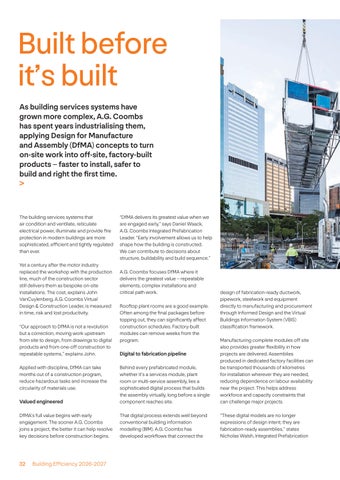
2. (1. & 2.) More than a decade ago, prefabricated services risers designed and manufactured by A.G. Coombs were lifted into place at Barangaroo South on Darling Harbour. (3.) Today, A.G. Coombs is helping drive the digital industrialisation of construction and building services.
Modelling Coordinator at A.G. Coombs. “Once resolved in the virtual model, an assembly is ready for manufacture and can be reproduced consistently. Much of the redesign, checking and handover work that traditionally separates design from delivery disappears.”
Safer before site The safety benefits are equally compelling. Installing vertical services conventionally demands sustained work at height, floor by floor up through a building. “A services riser module is built and assembled at ground level in a controlled factory environment, then transported and lifted into place as a single unit,” explains Daniel. “Many are the size of a semi-trailer. Completing the work before the module reaches site eliminates most work-at-height
activities and moves the risk well down the Hierarchy of Hazard Controls.”
Circular by construction Treating building services as products rather than bespoke one-offs replaces a linear, build-and-discard model with a more circular approach. Material use becomes measurable, factory offcuts are minimised and embodied carbon can be quantified consistently across identical assemblies. That thinking extends beyond construction. Designing modules for disassembly, using bolted rather than welded frames and creating recoverable assemblies supports circularity throughout a building’s life.
productised,” advises John. “Lead with the problem, not the technology. Define what needs to be solved and the pathway to delivering it at scale becomes much clearer.” For A.G. Coombs, DfMA is not just a faster way to build but a more certain one. Every element is proven and manufactured before reaching site, reducing variability and increasing confidence in the outcome. By bringing together digital engineering precision and manufacturing techniques, DfMA is helping drive construction’s long-overdue transition towards the industrialisation of building services.
“Start with a single, highly repeatable element, something well understood and frequently delivered that can then be
agcoombs.com.au
33
Stronger together Social value is often treated as something a business does on the side — a donation, a sponsorship, a line in a report. A.G. Coombs takes a different view. That the everyday work of a leading enterprise, redirected with intent, can build lasting value for communities and the business alike.
Until the First Peoples’ Health and Wellbeing (FPHW) centre opened in Frankston, one of Victoria’s fastest-growing Indigenous communities had no dedicated healthcare facility of its own. Where previously Indigenous patients had not been to a medical clinic in years, they are now seen regularly by the same medical team. Consultations run longer than a standard appointment, ensuring that management of health conditions are addressed with care, attention and personalisation.
establish in 2025 – will assist in procuring the mechanical, electrical, fire and plumbing services, and ongoing facilities maintenance at the new centre. “This A.G. Coombs partnership is very different to a typical corporate donation model,” says Michelle Gurry, Manager, Quality Assurance and Communications of First Peoples’ Health and Wellbeing. “When you work together and learn from each other, the relationship runs much deeper with real-world outcomes.”
Leverage & legacy Beyond transactions The FPHW centre is a living example of how value compounds. When the original builder ceased trading, A.G. Coombs stepped in through its supply chain to help bring the stalled project to completion, as well as generate a charitable donation back to the FPHW. That funding helped establish the on-site Blak Fig café and the Indigenous jobs that followed. A year on, FPHW has secured capital funding for a second, larger facility across the road. Due to open in 2028, the integrated children’s centre combining childcare, kindergarten and maternal health will be the largest of its kind in Victoria dedicated to First Nations families. A.G. Coombs and Murrungar – the Indigenousowned and led enterprise A.G. Coombs helped
34
Building Efficiency 2026-2027
A.G. Coombs describes itself as a capability partner rather than a sponsor or specialist contractor – a distinction that matters. Rather than corporate donations, A.G. Coombs redirects business-as-usual spend through Indigenous and all-abilities enterprises, then lends its engineering and project expertise to help them thrive. “We don’t simply arrive, do the work and leave,” adds Aaron Clark, Executive Leader – Social Procurement, Inclusion & Engagement at A.G. Coombs. “There is a legacy component to everything we do.”
Image: Kane Multimedia
A.G. Coombs Group Managing Director Russell Telford frames it as a deliberate arrangement that strengthens the business and the communities it works alongside in equal measure. "It’s work we’re already doing, simply redirected. Channelled through an Indigenous partner, that same activity returns far more than its commercial value."
Purposeful connections This same intentional approach scales across a growing assembly of operational partners.
A.G. Coombs recently contributed to the warehouse fit-out for a First Nations social enterprise, Game Time Coffee. This support helped Game Time Coffee win a contract with Melbourne’s metro rail network and take on its first employees. Behind those jobs, Aaron says, are lives, stories and families. “People ask me what a building services company has to do with coffee," he adds. "But the places where people gather and connect are where wellbeing begins — and that connection happens over a coffee."
Interest to involvement Where feasible, A.G. Coombs replicates the model by directing transport, logistics and catering work to Wallara. As an employer for people of all abilities, Wallara has partnered with A.G. Coombs on projects such as the recently completed Nyaal Banyul Convention Centre in Geelong.
What began with personal relationships is becoming a replicated model, and the industry has noticed. “The conversation has shifted from ‘tell me more’ to ‘how do I get involved?’, with suppliers and tier-one head contractors asking to take part,” adds Russell.
A.G. Coombs is also the facilities maintenance partner for the Melbourne Indigenous Transition School (MITS), where approximately 120 students board while completing their early secondary years.
Central to this shift is Murrungar. More than a supplier, Murrungar acts as a connector, embedding First Nations businesses into the building-services supply chain and into projects they might not otherwise
reach. The long-term success of the FPHW centre stands as a primary case study for this model. “Our relationship with A.G. Coombs has been built steadily over several years and having a partner engaged for the long term is what makes a true difference,” says Kate Brocker, Manager, Major Projects and Events, First Peoples’ Health and Wellbeing. At A.G. Coombs, social value is woven into everyday operations. More than corporate goodwill, it is a considered merging of commercial discipline, community benefit and shared purpose — creating stronger outcomes, deeper partnerships and lasting social impact across the projects and communities it serves.
agcoombs.com.au
35
Shared vision Founded in 1957, Guide Dogs Victoria has been transforming lives, providing independence and mobility to vision impaired Australians for almost 70 years by matching thousands of visionimpaired people with their canine companions.
Supporting this vital mission requires robust technical infrastructure that operates flawlessly around the clock. When Guide Dogs Victoria completed the $34 million redevelopment of its Kew campus in 2024, it faced a critical consideration: How to maintain a comprehensive array of state-of-the-art facilities that must remain operational at all times. The answer came through an innovative partnership with A.G. Coombs that integrates technical excellence with measurable shared value.
Canine conundrum Guide Dogs Victoria’s redeveloped 8-acre campus presents one of the most diverse facilities management challenges in the state. The facility operates as a complete ecosystem supporting every aspect of guide dog development and client training, requiring 24/7 operational reliability across multiple critical systems. At the heart of the campus sits a leading-edge veterinary clinic run by Advanced Vetcare that rivals major
36
Building Efficiency 2026-2027
hospitals in its sophistication. Equipped with a CT scanning machine, surgical suites and advanced diagnostic equipment, this facility provides life-saving care to domestic animals, as well as care for guide dogs. This technical complexity extends throughout the campus. The facility includes climate-controlled puppy nurseries where future guide dogs begin their development, specialised dog kennels with ventilation and hygiene systems, teaching facilities equipped with assistive technology and residential accommodation for clients learning to work with their new companions. Each building presents unique heating, ventilation and air conditioning (HVAC), electrical, hydraulic and fire safety requirements that demand specialised expertise.
An integrated answer Traditional facilities management often fragments responsibility across multiple contractors — an approach that creates
coordination challenges and potential gaps in accountability. Recognising this challenge, A.G. Coombs proposed an integrated solution through its subsidiary, Integrated Technical Management Pty Ltd. Rather than managing a wide range of separate providers, Guide Dogs Victoria now works with Integrated Technical Management to coordinate technical services while maintaining accountability for the interdependencies between systems. “We lead the suite of maintenance services at Guide Dogs Victoria, recognising the vital interdependency between every system on the campus,” explains Terri Hosking, General Manager at Integrated Technical Management. “Our integrated model allows us to draw upon specialist capabilities from across the A.G. Coombs Group – delivered as one team, through a single strategic management lens.” Integrated Technical Management’s technical service delivery at
Image: Constantine Films
Leaders, partners and panellists gather to mark the launch of the A.G. Coombs Group and Guide Dogs Victoria partnership. Pictured from left: Aaron Clark, Paul Viney, Tiffany Cherry, Meredyth Pettit, Nicky Long, CEO, Guide Dogs Victoria, Russell Telford, Managing Director, A.G. Coombs Group, and Terri Hosking.
Guide Dogs Victoria operates across multiple dimensions, each calibrated to the facility’s unique requirements. Working closely with the resident Guide Dogs Victoria Facility Manager, this approach includes preventive maintenance programs for all major services, 24/7 emergency response and asset management.
The Partnering Agreement sets out six shared value initiatives spanning immersive learning, structured staff volunteering, co-promotion and storytelling, employment pathways for people with low vision or blindness, an accessibility and inclusion advisory exchange, and shared events that connect A.G. Coombs staff and clients with the work of Guide Dogs Victoria.
Beyond the contract The arrangement between A.G. Coombs Group and Guide Dogs Victoria is structured as two parallel agreements. “The Facilities Maintenance Agreement, which commenced in April 2025, governs the commercial delivery of services through Integrated Technical Management,” says Paul Gilmore, Executive Manager Group Business Development at A.G. Coombs. “Alongside it sits a separate Partnering Agreement that formalises a strategic relationship around shared value — distinct from the commercial contract but designed to reinforce it.”
“This is about the value both organisations bring to each other,” explains Russell Telford, Managing Director at A.G. Coombs Group. “Pairing a rigorous Facilities Maintenance Agreement on its own commercial terms with a separate Partnering Agreement around shared value is what makes it work – for a charity accountable for every dollar, and for us as a business committed to inclusion and a social value partnership.”
for the company’s ‘People of All Abilities’ pathway program and creating tangible opportunities and a sense of belonging to bring vision impaired Australians into the A.G. Coombs Group workforce. “Our partnership with A.G. Coombs demonstrates how technical expertise, properly applied, creates value that extends far beyond operational efficiency,” says Nicky Long, CEO, Guide Dogs Victoria. “By ensuring that Guide Dogs Victoria’s facilities support our mission without compromise, Integrated Technical Management is positively impacting the independence and freedom that Guide Dogs Victoria brings to thousands of vision impaired Australians.”
The structure also gives practical effect to A.G. Coombs’ Environmental, Social and Governance commitments in its Diversity & Inclusion Action Plan — providing a measurable framework
agcoombs.com.au
37
Predict prevent protect Fire protection systems in buildings have long been subject to a simple assessment, pass or fail at test and inspection. Walker Fire Protection and A.G. Coombs Advisory are adding to that simple measure, bringing technology, data analytics and engineering to provide insights, reduce risks and improve the management of these important systems.
Fire protection systems operate inside a tight regulatory framework. Compliance is the focus, supported by a stringent inspection and maintenance regime. But a system that is fully compliant on the day it is checked and tested can still be quietly deteriorating between inspections. Walker Fire Protection and A.G. Coombs Advisory are working to change that, applying proven technologies from the mechanical services world to the fire systems that protect Australian buildings and their occupants.
From reactive to proactive “Fire protection has traditionally been a reactive discipline. The first sign of a problem is often system water leakage and building disruption and damage, or, in the worst case, non-performance in a fire event,” says Andrew McGregor, General Manager at Walker Fire Protection. “The shift we’re driving is towards prevention – identifying early signs from the system and intervening before a fault becomes a flood, a tenant evacuation or worse.”
38
Building Efficiency 2026-2027
The shift is less about reinventing fire services design and more about adopting what already works elsewhere. “We’re adapting proactive approaches that have been applied successfully in mechanical services and bringing them to the fire services world,” adds Marcus Royle, Leader – Fire, A.G. Coombs Advisory. “The compliance framework remains paramount. We’re providing a layer of value-adding services alongside the compliance regime, not in place of it.” Three examples of this new approach to fire services systems management include:
a fire. During this time, pipes deteriorate internally due to corrosion, bacteria and mineral build-up, creating a hidden risk of restricted water flow during sprinkler activation, leakage or potentially significant failure and flooding. The technique detects the thinning or pitting of the pipe wall caused by corrosion. Applied during tenancy change projects when there is ready access, it is an inexpensive and effective insurance policy, particularly in buildings with regular occupancy changes such as retail shopping centres. A quick and low-cost check before new ceilings go up can prevent a flooded fit-out later.
1. Pipe health check A standout example is ultrasonic pipe thickness testing, a readily applied nondestructive technology that can track how a sprinkler system pipe wall thickness changes through corrosion without cutting it open. Fire sprinkler systems sit idle, often for years, ready to be activated and suppress
“We can measure the same points on the pipes year-on-year and track pipe deterioration, identifying if and where replacement is needed,” explains Andrew. “From the outside, the pipe looks unchanged. The damage is all on the inside.”
2. Asset monitoring and analytics
3. Finding a way to manage pressure
This approach involves added monitoring that does not touch the fire indicator panel itself. Sensors, meters and reed switches sit alongside the certified fire system, with data fed into the building management or analytics system.
Some buildings suffer an intractable fire hydrant system overpressure condition with water pressures at or beyond desired limits, creating a long-term leakage risk to pipework, fittings and fire system equipment throughout the building. Excessive hydrant pressures may also increase fire hydrant hose reaction forces during firefighting operations, potentially affecting firefighter safety and operational effectiveness.
Changes in jockey pump cycling frequency, a water tank level drifting low or a fire hose reel being used after hours are warning signals that the system has shifted from its established baseline. Monitoring these conditions provides an opportunity to investigate and intervene before a minor issue develops into a costly incident. “Unlike mechanical systems, where you can usually identify operational issues, it’s very hard to know how fire systems will operate until they are actually required,” says Marcus. “Establishing a benchmark of normal operation allows non-routine behaviour to become meaningful information, helping identify potential issues before they escalate.”
Walker Fire Protection delivers purposedesigned and built pressure-regulating valve stations that restore hydrant systems to compliant, safe operating conditions. The system incorporates redundant pressure regulating valves, integrated pressure monitoring, safety relief protection and provision for adjustability.
Andrew McGregor. “Walker Fire Protection and A.G. Coombs Advisory bring the technical depth and coordination to deliver these outcomes with minimal disruption to building operations.” These innovative approaches, now applied across hospitals, heritage buildings, commercial towers and retail precincts, add to the required compliance regime with insights into the actual condition of systems. They are leading to a significant shift in how asset owners and facility operators think about fire services system management.
“Resolving persistent, longstanding hydrant overpressure conditions requires engineering innovation and a willingness to adopt a solution new to the Australian market in a live building,” states
agcoombs.com.au
39
Building a data ecosystem At one of Melbourne CBD’s most prestigious towers, A.G. Coombs has consolidated more than three decades of building data, giving the building’s engineering team the clarity to decide what to repair, replace or renew.
40
Building Efficiency 2026-2027
A modern office tower runs on thousands of separate pieces of equipment (chillers, pumps, fans, lighting, lifts and fire systems among many others) installed and often modified over decades by various contractors and documented to different conventions. Virtual Buildings Information System (VBIS) addresses that challenge. A freeto-market, open standard included in the Victorian Government’s Digital Asset Strategy, the VBIS Standard provides owners, operators and contractors in the built environment with a common language, allowing organisations to describe assets uniformly across projects, systems and stakeholders. The VBIS Standard assigns a unique and consistent classification name to every building asset and, according to Nathan Semos, VBIS Executive Manager at A.G. Coombs, this naming convention is the all-important foundation. “The VBIS Data Ecosystem connects information from multiple data sets into a single integrated view that enables facility teams to make quick, on-the-spot decisions about whether to repair or replace an asset.” The VBIS Standard now spans more than 11,500 naming tags across 37 disciplines, one for every asset type from fire protection and air conditioning to lifts, lighting and security.
Rebuilding the record The 57-storey premium-grade tower at 101 Collins Street was built in 1991 and is home to more than 50 tenants. Its scale and longevity made it a demanding proof-of-concept challenge for a fully integrated VBIS Data Ecosystem. Having integrated 3D models with asset data at another building, 101 Collins’ senior engineering manager recognised the operational and strategic value of a VBIS Data Ecosystem and set out to extend the approach. The tower was already well into a modernisation programme, including energy upgrades delivered with A.G. Coombs, and its records needed to match.
“101 Collins is being progressively modernised to meet the professional standards its tenants expect,” explains TK Wang, VBIS Account Manager at A.G. Coombs. “Consolidating three decades of asset records into a consistent and recognised standard makes the next stage possible.” A.G. Coombs reassessed every asset in the tower, rebuilding the dataset with the 101 Collins engineering team and contractors.
Verified value The rebuilt dataset has already proven its value. When a fire pump room upgrade required Fire Rescue Victoria sign-off, the regulator initially sought additional works costing hundreds of thousands of dollars. Designers from A.G. Coombs Advisory used 3D models from the VBIS Data Ecosystem to show the extended scope was not required, securing an approval that would otherwise have stalled the project. The dataset also underpins capital planning. Drawing on asset age, condition and replacement costings, it helps the engineering team secure upgrade funding from the building’s owners.
Seamless connectivity What sets the VBIS Data Ecosystem apart is its open architecture. Rather than relying on fragile, oneoff connections between systems, it draws every source into one consistent environment built on standard Microsoft tools, robustly linked and delivering insights to the engineering team, contractors, facility managers and building owners.
the building’s automated fault-detection system, and an online landing page displaying its NABERS Energy dynamic performance rating at a glance. Each module can be tailored to a client’s needs and key performance indicators, across a single building or an entire portfolio.
Consistent data, consistent results As a VBIS Enabled partner, 101 Collins has embedded the framework into its data architecture, and as a VBIS Accredited project, its Data Ecosystem is certified to the VBIS Standard. “Partnering with A.G. Coombs and VBIS, we set out to turn three decades of fragmented records into one decisionready picture,” says Selva Thiru, Senior Engineering & Sustainability Manager at 101 Collins Street. “The VBIS Data Ecosystem provides my engineering team with the insights needed to confidently weigh up a repair against replacement, asset by asset, and a dependable basis for the capital decisions we put to our stakeholders.” For Nathan, the lesson is one of sequence. “Standardisation is powerful,” he says. “Get the foundation right and everything that follows becomes possible. Every future system can build on the same data, instead of each one being engineered from scratch.” At 101 Collins, the building’s data now operates within a single connected system. Standardised data, integrated systems and engineering expertise draw on one trusted, accessible record – a template that buildings across Australia can follow.
“It’s a readily maintainable system not limited to specialist vendors,” adds TK Wang. “That eases the IT challenges that can often compromise the setup of system integrations.” The result is configurable, module by module. Examples include a live schematic replaying energy and water flows over a chosen period, a feed from SkySpark®,
agcoombs.com.au
41
Global peers Shared innovation In an industry defined by competition, A.G. Coombs chose a different path — building a small, trusted group of international peers across Australia, the United States and the United Kingdom to openly share knowledge, challenge thinking and learn from one another.
The International Peer Group began in 2017 with a simple conversation. At an industry innovation conference in Sydney, A.G. Coombs Group Managing Director Russell Telford met Tim Moormeier, then President of U.S. Engineering. They quickly recognised strong alignment – similar privately owned businesses, comparable technical capability, customer focus and a shared commitment to quality and continuous improvement. Based in Kansas City, U.S. Engineering had already experienced the value of working with non-competing peers, where openness replaces guardedness and practical insights are shared freely. That principle resonated. What began between two organisations soon expanded. In 2019, NG Bailey in the United Kingdom – a business well known to A.G. Coombs, with comparable heritage, capability and values – was invited to join. Today, the International Peer Group is a working relationship built on trust, openness and shared intent, focused on learning, improving and applying innovation in a practical way.
42
Building Efficiency 2026-2027
“It’s about looking at global best practice and bringing in fresh ideas,” says Russell Telford. “But doing that in a way where people are prepared to share and contribute openly.”
Why it works Mark Mitchell, Executive General Manager at A.G. Coombs, affirms that openness is fundamental to the peer group’s success. “Not being in direct competition with our international peer partners has allowed for trust and honesty since day one,” he says. The benefit runs three ways. An early example of this was when A.G. Coombs drew on U.S. Engineering’s hyperscale data centre prefabrication experience while sharing its own service-growth tactics – NG Bailey later brought genuine mechanical and electrical depth in return. This equity of exchange keeps the trilateral relationship grounded, practical and mutually beneficial.
A step ahead The hyperscale data centre boom has made the International Peer Group especially relevant. The data centre
Image: Paul Adcock
In their words “Benchmarking what we do against international best practice underlines that A.G. Coombs is a world-class building services specialist provider.” Paul Adcock, A.G. Coombs Project Engineer – U.S. Engineering peer exchange alumni
“This was a priceless opportunity to step outside the A.G. Coombs business, challenge my thinking and return with fresh ideas, international relationships and broader perspectives.” Nick Skarvellis, A.G. Coombs Finance Manager – NG Bailey peer exchange alumni
“What stayed with me was how deliberately safety and planning are built into everything they do. It reinforced how powerful clarity and consistency are at scale.” Gareth McCrystal, A.G. Coombs SCD Team Leader – U.S. Engineering peer exchange alumni
“I’m not the same person who left for the United States. I’ve come back with more confidence, richer knowledge and a deeper appreciation for our industry.” Jenna Comazzetto, A.G. Coombs Draftsperson – U.S. Engineering peer exchange alumni
construction wave reached the United States first and is now building momentum in Australia and the UK, a timing difference that has worked in A.G. Coombs’ favour.
were strikingly diverse, some through apprenticeships or from professions beyond engineering,” Emily says. “It reminded me that we can build diversity through many different pathways.”
Well before large-scale prefabricated pipe modules for data centre construction became common in Australia, A.G. Coombs teams had already seen them being built while walking the factory floor at U.S. Engineering prefabrication facilities.
For Daniel De Valentin, Leader (ACT) at A.G. Coombs Advisory, a week embedded with NG Bailey’s facilities team at Wembley Stadium stood out, preparing the venue for a National Football League (NFL) game in London, with Australians, Britons and Americans side by side for a sell-out crowd.
That firsthand exposure provided a clear view of what was coming, enabling A.G. Coombs to plan ahead and scale up with greater confidence.
Peer exchange The International Peer Group extends well beyond leadership meetings. Through the Peer Exchange Program, employees from A.G. Coombs, U.S. Engineering and NG Bailey spend time alongside their international peers, gaining firsthand exposure to different projects, cultures and approaches. Emily McKernan, Senior Engineer at A.G. Coombs and among the first peer exchange alumni from the program, quickly saw how the experience broadened her view of the industry.
From insight to impact After years of what Mark describes as mutual self-discovery, the Peer Group is entering a new phase, building together on that foundation. Shared projects on common opportunities such as artificial intelligence (AI) will continue to convert candid exchange into tangible outcomes. Now well established, the International Peer Group continues to strengthen capability across three continents, proving that even in a competitive industry, the most valuable ideas are often those shared openly.
“Over ten weeks across Manchester, Leeds and London, I was introduced to peers whose journeys into the industry
agcoombs.com.au
43
AMCA Recognition for A.G. Coombs People A.G. Coombs team members were recognised at the 2025 AMCA National Industry Excellence Awards, presented by the Air Conditioning and Mechanical Contractors Association (AMCA). The awards celebrate achievement, leadership and professional development across Australia's HVAC industry.
From left: Madeleine Moratti, Ben O’Brien, Rainbow McIntosh, Ethan Jones, John VanCuylenberg and Jarryd Baffico.
A.G. Coombs was represented across four award categories, with two team members receiving national honours. Virtual Design & Construction (VDC) Leader John VanCuylenberg won the Management & Leadership Award, while Technical Support – ESM Specialist Ben O’Brien received the Trades & Technicians Award. Four additional team members were recognised as national finalists: Ethan Jones, Service Technician, in the Trades & Technicians category; Jarryd Baffico, Trainee Draftsperson and Rainbow McIntosh, Apprentice
44
Building Efficiency 2026-2027
Mechanical Plumber, in the Trainee/Apprentice category; and Madeleine Moratti, Engineer, in the Future Leader category. Their recognition highlights the contributions A.G. Coombs people make across technical, operational and leadership disciplines and reflects the Group's commitment to Excellence Through People. Congratulations to all six on this outstanding achievement.
Building Opportunity Through Capability Partnership Murrungar continues to gain momentum, creating new pathways for Aboriginal economic participation across the built environment sector.
A launch on Country that brought culture, community and industry together. Murrungar marked its official launch on 26 Feb 2026 at the Melbourne Cricket Ground for an afternoon grounded in place, story and intention.
Meaning Build Grow Nurture, Murrungar is a majority Indigenous-owned and Indigenous-led Capability Partnership with A.G. Coombs, connecting clients, contractors and suppliers to opportunities that deliver lasting social, cultural and economic outcomes. Murrungar is focused on increasing Indigenous supplier participation, supporting employment pathways and strengthening representation across the building services supply chain. Its longterm vision includes creating opportunities for Aboriginal people to build careers in technical and professional roles throughout the industry. The initiative has attracted growing industry attention, following its official launch at the Melbourne Cricket Ground (MCG) and recognition in Facility Management magazine’s May 2026 edition, which profiled Murrungar's approach to turning reconciliation
commitments into practical outcomes through procurement, capability development and partnership. By combining industry expertise with Indigenous knowledge and perspectives, Murrungar is demonstrating how Capability Partnerships can create shared value for businesses, communities and Country while contributing to a more inclusive built environment. Learn more at www.murrungar.com.au.
agcoombs.com.au
45
A.G. Coombs & Softball Australia Champion Women Leaders A.G. Coombs is proud to partner with Softball Australia, supporting pathways that help female athletes and leaders thrive both on and off the field.
Images: WBSC
By connecting women from sport, business and the built environment, A.G. Coombs’ partnership with Softball Australia helps build leadership capability, broaden perspectives and support the next generation of women leaders. Built on shared values of inclusion, excellence and community impact, the partnership aligns closely with our Advancement of Women Leadership Academy Event Series and broader commitment to increasing female participation and leadership across the building services industry.
46
Building Efficiency 2026-2027
Delivered in Melbourne, Sydney, Brisbane and Canberra, the series brought together current and emerging leaders to learn, connect and grow. A highlight was the Brisbane event, where Softball Australia CEO Sarah Loh (pictured left) shared insights from her leadership journey.
Industry Recognition
Image: Peter Bennetts for JPW
A.G. Coombs Group received a number of significant industry awards during 2025 and 2026, recognising achievement in organisational leadership, innovation, engineering excellence, sustainability, project delivery and diversity. These achievements reflect the contribution of our people and teams in delivering outstanding outcomes for clients, communities and the building services industry.
Accepting the 2025 FM Industry Award for Leadership in ESG for Advancing Women are (from left) Bryon Price, Strategic Development Director; Jodi Whelan, Executive Manager Customer Engagement; Russell Telford, Managing Director; and Kerry Ryan, Non-Executive Board Member and Diversity & Inclusion Committee Chair. A.G. Coombs was recognised with the 2025 FM Industry Award for
2026 Harry Marryatt Fire Protection Company of the Year, one of the
Leadership in ESG for Advancing Women: An Industry in Transition,
industry’s highest honours.
acknowledging the Group’s commitment to advancing gender equity and supporting increased participation of women across the industry.
Walker Fire Protection was also recognised at the 2025 NFIA National Awards
The business also received the
2026 ARBS Industry Award for Major Project Excellence for its contribution to the landmark Sydney Metro Martin Place development (pictured above), a project recognised for innovation, engineering excellence and sustainability. Within the fire protection sector, Walker Fire Protection was named
of Excellence with the Champion in Diversity Award and the Women in Fire Protection Award, and received the Outstanding Member Project: Refurbishment Award at the 2025 NFIA Victorian State Awards of Excellence. Together, these achievements demonstrate the Group’s commitment to Excellence Through People, innovation and delivering outstanding outcomes for clients, communities and the industry.
agcoombs.com.au
47
20 Years of Building Efficiency First published in 2006, BE – Building Efficiency has now reached 20 years of continuous publication, documenting the projects, people and ideas that have helped shape A.G. Coombs and the broader building services industry. Scan to discover 20 years of BE.
BE has showcased landmark projects, emerging technologies, sustainability initiatives and industry trends, while providing insight into the technical expertise behind some of Australia’s most complex and significant buildings. From early editions featuring the landmark Council House 2 and the new Royal Children's Hospital to recent issues exploring major precinct developments, building electrification,
48
Building Efficiency 2026-2027
data centres, diversity and inclusion, reconciliation and social value initiatives, BE has reflected the evolution of the built environment, our industry and the contribution of A.G. Coombs people. Twenty years on, BE continues to document the projects, ideas and people that shape our business and industry. We acknowledge the many contributors who have helped build the publication over that time and ensure its ongoing success.
New 80th Anniversary Book Marks Continuing A.G. Coombs Story A.G. Coombs has released a new commemorative publication celebrating 80 years of innovation, people and progress across the Australian building services industry.
Members of the Coombs family pictured with the first A.G. Coombs truck in 1946.
Perpetuating the Vision: A.G. Coombs – Bringing Buildings to Life, written by author and historian Marcella Hunter, continues the story first documented in the company’s 70th anniversary publication, A Singular Vision. The new edition revisits key moments from the company’s history while exploring the transformative decade from 2015 to 2025. The book reflects on A.G. Coombs’ growth as a national technical leader, its role in delivering some of Australia’s most significant projects and the resilience demonstrated during the COVID-19 pandemic. It also highlights the company’s focus on innovation and sustainability, professional development, and diversity and inclusion.
Importantly, the publication is more than a corporate history. Through personal stories, archival imagery and project milestones, Perpetuating the Vision captures the people, values and collective contribution that continue to shape A.G. Coombs today. While the book reflects on 80 years of history, it is equally focused on the future, reinforcing the values, innovation and shared commitment that continue to define A.G. Coombs as an employee-owned and progressive Australian company. The contribution of today’s teams will ultimately help shape the next chapter in the A.G. Coombs story.
80 years later, A.G. Coombs teams drive a fleet of some 400 diesel and electric utility vehicles across the Group.
Scan to explore online edition of Perpetuating the Vision.
agcoombs.com.au
49
A.G. Coombs Group Melbourne | Sydney | Canberra | Brisbane | Townsville Head Office: 26 Cochranes Road Moorabbin VIC 3189 Australia The A.G. Coombs Group is a privately owned Australian group of companies that provides an integrated range of technical services for all systems in buildings, from design through to installation, commissioning, maintenance and ongoing operation and management. Established in 1945, A.G. Coombs has a national capability with major operations on Australia’s eastern seaboard. Melbourne +61 3 9248 2700 | Sydney +61 2 8020 6000 | Canberra +61 2 6217 5600 Brisbane +61 7 3648 0500 | Townsville +61 7 4431 1000 | agcoombs.com.au
A.G. Coombs Advisory A.G. Coombs Advisory provides quality advice and consulting services across numerous disciplines including mechanical, electrical, hydraulic and fire protection services and building technologies. A.G. Coombs Advisory is Australia’s leading provider of Green Star Independent Commissioning Agent (ICA) services for projects requiring Green Star Certification. +61 3 9248 2700 | agcoombs.com.au/advisory
A.G. Coombs Projects A.G. Coombs Projects leverages a National Centre of Excellence approach, where teamwork and project management skills set the company apart. This approach also provides high-end engineering, project management and site personnel to deliver successful projects throughout Australia. +61 3 9248 2700 | agcoombs.com.au/projects
A.G. Coombs Service A.G. Coombs Service is a specialist provider of air conditioning, mechanical services, building controls and bundled services maintenance. Delivering 24/7 building support, the company is a preferred supplier to the facilities management industry and provides professionally managed, highly qualified technical staff to achieve improved reliability, lower costs and regulatory compliance in commercial, retail and industrial buildings. +61 3 9676 4600 | agcoombs.com.au/service
Walker Fire Protection Walker Fire Protection provides a range of fire protection and detection services, from high-end project engineering advice and consultancy through to concept and detailed design, installation of all types of fire detection and suppression systems, and ongoing inspection, testing, maintenance and regulatory compliance support. +61 3 9279 7100 | agcoombs.com.au/walkerfire
Butler Electrical Butler Electrical provides comprehensive mechanical electrical, commercial electrical, industrial electrical, data and communication installation, and switchboard fabrication supported by its engineering design services. +61 3 9555 7400 | butlerelectrical.com.au
Integrated Technical Management Integrated Technical Management is a high-quality provider of technical facilities management specialising in technically complex and critical facilities such as data centres, major commercial complexes, museums and cultural facilities. +61 3 9248 2700 | agcoombs.com.au/itm
This publication is printed on FSC certified paper and elemental chlorine free pulps. AGC Butler Pty Ltd T/A Butler Electrical Victoria. REC 17632. All trademarks and registered trademarks are the property of their respective owners. © 2026 A.G. Coombs Group and all related entities. All rights reserved.
This artwork is about connection and growth. It speaks to the lands and communities coming together, where the people come to meet, trade and grow with one another. This connection is key to the success of its peoples, the ground you walk on and the spirits that have come before you. These pathways have always been here. They are rooted in the ground. It’s now time for the next mob to travel on them. They are sacred.
The story of A.G. Coombs is reflected in this piece. It tells the stories of all the spirits and souls that live, breathe and work in these spaces. Everyone far and wide, but all connected. It’s for the people, by the people. The pathways have always been there, but are always growing.
More Than One Story by Michelle Kerrin
agcoombs.com.au
51
BE – Building Efficiency 2026-2027 A.G. Coombs Group Melbourne | Sydney | Canberra | Brisbane | Townsville +61 3 9248 2700 agcoombs.com.au
52
Building Efficiency 2026-2027