Effortlessly seamless and secure payment and banking experiences
Join us at Money/2020 Asia to learn how we’re shaping the future of finance.
Your customers shop, pay, and bank with the tap of a finger, and expect a fast, safe, and seamless experience every time.
From secure onboarding and digital wallets to eCommerce checkout journeys—G+D enables financial institutions all around the world to create human-centered journeys to win loyalty, outpace fraud, and lead in a competitive digital world.
Drawing on our over 170 years of PayTech expertise, more than 5000 banks and issuers and over 160,000 thousand merchants rely on us—worldwide.
Scan the QR to explore how we’re making payments and banking secure, convenient, sustainable, and accessible for everyone.
DISCOVER SIBOS MAGAZINE
6 SHOW SPOTLIGHT
The ambiguity of progress
The Sibos conference is a meeting point for addressing some of the most pressing issues and opportunities in finance today. But if you want to explore tomorrow, head for the Discover section of the show
8 ARTIFICIAL INTELLIGENCE Planning for AI
Whether it’s buried deep in the operational heart of an organisation or powering customer-facing chatbots, AI is a tool that requires careful preparation and a clear sense of what you want it to achieve, says Finastra
10 CORPORATE BANKING Tomorrow’s treasury today
A rigorous focus on the needs of clients and their customers shapes BNY’s approach to technology adoption and development, as Carl Slabicki explains
12 BUSINESS BANKING Putting small business first
What would it take for mainstream banks to win back Britain’s small businesses? We spoke to BankiFi’s Mark Hartley about how fintech is combining data, ‘pragmatic AI’, and engagement banking to do just that
14 THOUGHT LEADER
The advantage of ancient errors
Evolutionary hindsight reveals the hidden value of organisational ‘mistakes’, and it shows that timing, not novelty, determines competitive advantage, says Tony Fish
THEEDITOR’S VIEW
There were two massively anticipated events poised to take place as we went to print.
One moves the world a step closer to the holy grail of truly global instant payments. The other sees many of those involved in that crusade gathering to consider the next frontiers in finance at Sibos.
Go-live for SEPA Instant – the final implementation for both receivers and issuers under the Instant Payment Regulation – marks a profound change for payment service providers in Europe. They can no longer choose to offer instant payments, they must – and, crucially, at the same price as transactions that use the slower SEPA Credit Transfer rail.
Ultimately, it will be users who drive demand and determine how successful it will be. And adoption is still hard to predict. Nearly half of Brazil’s transactions were instant within four years of launching Pix. Roughly the same percentage now goes through India’s UPI.
But the UK, which has been chipping away at it since 2008, still only sees 10 per cent of transactions over its Faster Payments Service.
Confidence in the system’s ability to protect payments made at the speed of light will likely be a determining factor… although a frightening spike in financial crime didn’t seem to damage the love for Pix.
Fast and fraudproof. We really need to breach that frontier.
Sue Scott, Editor
This issue's spinetingler quote comes from legendary fashion designer and businessman Georgio Armani, who died in September 2025, aged 91
16 INFRASTRUCTURE FOR ONE, FOR ALL Europe’s new Instant Payment Regulation poses challenges for financial services companies, SEPA-wide. And they’re just the sort of pain points that Italy’s CBI has been building a utility to address
Rebranding is tricky for a company as established and respected as Smartstream. But with AI broadening the customer base and transforming its relationships with existing clients, CEO Akber Jaffer has decided it’s time for change
20 SEPA INST Instant connection
The heavy lifting has been done. Now the moment of truth. SEPA Instant Credit Transfer is about to go live. Bank of America considers what the reality might be for banks and their corporate clients
24 REGTECH
Rewriting the rules
Eastnets’ Hazem Mulhim and Daoud Abdel Hadi on why they’re convinced AI is the enabler for effective compliance and enhanced fraud prevention
26 PAYMENTS Passion project
We don’t just want to buy ‘stuff’ any more. We want to experience it. And Mastercard’s vision for an agentic future can help deliver that for consumers
29 DATA
Sharing is caring Bank of Ireland’s payments data analytics team produces information that’s useful to the bank, its customers and the wider economy. But could it play an even more important role?
32 A2A PAYMENTS
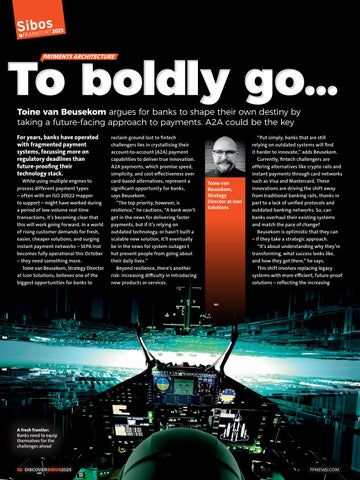
To boldly go
Toine van Beusekom of Icon Solutions argues for banks to shape their own destiny by taking a future-facing approach to payments. A2A could be the key
35 THOUGHT LEADER
Stable and secure?
Simone Loefgen from Commerzbank addresses three of the big questions occupying banks’ minds at Sibos 2025
37 BRANCH BANKING
Face the truth
Restoring in-branch banking to thousands of UK communities is not just possible – it’s happening, with or without the banks, says Ron Delnevo
Helping banks drive their digital agendas
At CGI, we help banks adapt to change, future-proof, and outperform the competition, achieving strategic outcomes, including customer value and continuous growth. That’s why our top 10 banking clients have partnered with us for over 27 years.
Learn more at cgi.com/banking
THE AMBIGUITY OF PROGRESS
The Sibos conference is a meeting point for addressing some of the most pressing issues and opportunities in finance today. But if you want to explore tomorrow, head for the Discover section of the show
Where do you find an opera singer whose dress changes colour according to the emotion in her arias, alongside live speakers interacting with AI-generated past and future versions of themselves?
Or a high-tech ‘treasure hunt’ for digital tokens that can be exchanged for prizes ranging from a Meta VR headset to, errmmm, a dachshund plush?
They are all at this year’s Sibos, the annual conference run by Swift, the international money messaging service, held in Frankfurt over four days and attracting up to 12,000 delegates from the global financial industry.
Since the very first Sibos, held back in 1978, only five years after Swift’s formation, the conference has prided itself on hosting some of the world’s foremost experts to give their take on the future of finance.
This year’s overall theme is ‘the next frontiers of global finance’. But the coolest kids in fintech will be hanging out at in the Discover space. Described as a conference within a conference, a
Innes Macleod, Innovation Event Manager for Swift Innotribe
third of the participants here are fintechs and at its heart is Innotribe, Swift’s blue-sky-thinking lab, which brings together stakeholders from across the financial ecosystem to drive collaborative innovation.
Here, at the intersection of philosophy and tech, presenters and visitors will probe the ‘what if’ questions of tomorrow.
Innes Macleod, Innovation Event Manager for Swift Innotribe, says the whole point is to challenge conventional thinking.
Speaking ahead of the conference, Macleod told us: “We have this mantra that if you come to a session with questions and you leave with better questions, then we’ve done what we set out to do.
“It’s a place for learning. It’s a place for being inspired. It’s a place for gaining wisdom, insight, knowledge. We just look at things from a different perspective.”
Hundreds of experts at Sibos are addressing the transformative
forces reshaping the financial ecosystem and the drivers needed for greater connectivity, interoperability and resilience to successfully adapt to them. And the pace of those changes is continually accelerating. The show has been witness to that.
QUANTUM LEAP of IMAGINATION
“We used to talk about stuff that was really ‘out there’,” says Macleod. The gap between what was being talked about in Innotribe and more mainstream technology that was being talked about in the main conference was quite significant. In the 2000s that gap just started getting smaller and smaller.
“That means people who are now in their 20s or 30s are going to go through multiple radical changes whereas people who are now in their 70s and 80s would maybe have seen just one. You never know what’s going to happen tomorrow that could fundamentally change everything. And we’re seeing this happen time and time again in a much shorter space of time than we would have done, 10 to 15 years ago.”
That frantic pace can also spell dangers, such as the rapidly evolving threats from cyber criminals. So far in 2025, several major brands in the UK alone, including Jaguar Land Rover and Harrods, have all suffered disruption after hackers infiltrated their IT systems.
If you come to a session with questions and you leave with better questions, then we’ve done what we set out to do
‘White hat’ hacker Jamie Woodruff is among the expert speakers. In a world where hackers have used music editing software to synthesise the voice of a bank’s CEO, allowing them to transfer millions to an offshore account, Woodruff’s overriding advice is that industries must work together to thwart future threats.
Elsewhere in the Discover programme a filmmaker from Africa will be giving her perspective on the power and the jeopardy of AI. While two teams will argue contrarian views on the technology’s ‘right’ to free agency. Meanwhile, you can geek out admiring a real quantum cryostat – an ultra-low temperature
fridge for maintaining qubits at temperatures near absolute zero – displayed near the main Innotribe stage.
It’s these experiences and conversations that define the Discover area of the show.
As Macleod says: “There are so many reasons just not to be elsewhere!”
FRIENDS or RIVALS?
Planning for AI
Whether it’s buried deep in the operational
heart of an organisation or powering customer-facing chatbots, AI is a tool that requires careful preparation and a clear sense of what you want it to achieve, says Adam Lieberman
THE FINTECH MAGAZINE: With so much investment going into AI today, what advice would you give financial services organisations to help them maximise their return on AI initiatives?
ADAM LIEBERMAN: The desire to deliver efficiency and automation with AI is understandably the key driver of adoption, but projects will fail to deliver return on investment (ROI) when there is a lack of solid objectives from the outset. Setting the parameters of success, such as well-defined metrics and KPIs, is crucial.
An organisation with a mature AI roadmap will have clearly defined strategic objectives, against which AI implementation and integration is mapped, so that the technology directly supports organisational goals. Jumping straight into adoption, without considering the technological and cultural limitations and challenges, will almost certainly lead to poor ROI.
Banks and financial institutions are full of legacy technology, and with that comes a culture that leans towards legacy practices and ways of working. In this regard, AI projects that support internal workflows, such as those underpinned by generative AI tools, require a shift in the organisation’s mindset that prioritises upskilling employees and updating security and governance frameworks to achieve ROI. For more advanced projects, such as those that relate to the development and delivery of products and services, bottlenecks may occur that can also affect ROI. For example, in industries in which sensitive data are commonplace, gaining access to datasets may take some time or new regulations may emerge that restrict or limit access to data. Being aware of potential restrictions from the outset will help to protect against these bottlenecks.
Adam Lieberman, Chief Artificial Intelligence Officer at Finastra
TFM: Chief artificial intelligence officers are still a relatively new addition to the C suite. Speaking as a CAIO yourself, how important is effective leadership when it comes to implementing and developing AI initiatives?
AL: Leaders can be well-intentioned, but if they do not involve all stakeholders from the inception of AI initiatives, successful projects will elude them.
Success relies on buy-in and validation of AI use cases from internal stakeholders and delivery teams, from product owners, data science teams and developers, to the C-suite, with all agreeing on KPIs and the wider roadmap. This ensures a critical mass of investment and resource bandwidth, and ensures everyone is working towards the same goal.
As well as stakeholder management, AI leaders should be familiar with the core principles and ethical concerns that will govern the development and use of AI-powered solutions across the organisation. Across financial services, there has been a rise in the number of AI-related leadership roles. This is evidence that AI maturity is an increasing priority for the C-suite.
TFM: How should financial services firms measure their level of AI maturity?
AL: AI maturity can be measured against a number of factors, from educational initiatives and skills development programmes, to ensuring the right talent and leadership is in place across technical roles. Measuring how often employees are using the available AI tools is also a good way to assess the general state of enterprise fluency with the technology.
When it comes to the development and delivery of AI-powered products and services, maturity is measured by the business’s approach to defining use cases, so that a robust AI roadmap can be
determined, incorporating architectural best practices and frameworks, so that systems are able to adapt and scale as the technology advances.
A crucial point for financial services firms is that data infrastructure must be mature enough to ensure organisational data is AI-ready. If this is not in place, the focus must be on data transformation and the modernisation of systems.
TFM: How can organisations upskill their employees and increase AI maturity?
AL: AI maturity will ultimately mean different things for different employees. For example, developer teams will already likely be working with AI coding tools and applications regularly, while marketing teams will still be experimenting with generative AI to assist with content development. There is no one-size-fits-all approach to advancing users from low-maturity to high-maturity, but looking at the requirements of departments and teams across an organisation can help leaders establish bespoke frameworks for upskilling and increasing engagement with AI-powered tools. Identifying AI evangelists and superusers within departments and teams is another way to help advance other employees’ understanding and engagement with available AI tools, enabling them to deliver efficiencies within their own workflows. Creating a collaborative culture around skills development comes back to leadership, as employees must be given the space and opportunity to upskill and share their learnings and expertise with peers.
TFM: What does the future hold for AI in financial services?
AL: AI is poised to supercharge the industry across multiple tiers. Enhanced and streamlined customer support will
be a primary focus, with AI-powered chatbots and virtual assistants providing instant, accurate responses to customer inquiries. These systems will handle complex interactions, from account management to support issues, freeing up human agents to focus on more nuanced issues. In-product assistance will enable users to navigate traditional financial products through natural language interactions. This will make complex financial tools more accessible and provide a seamless UI/UX experience.
productivity and enjoyment factor of software development. As AI continues to evolve, its impact will strengthen, creating a future of more efficient, personalised, and intelligent financial services.
TFM: Talk us through some use cases for AI in areas such as payments and lending.
AL: We’re exploring AI to solve some of the real-world challenges facing banks. This includes providing instant assistance to operational staff in areas such as trade finance,
The realisation of fully autonomous agentic AI systems is where we are heading, and banks and fintechs need to understand how they
can incorporate them into their service offerings
Agentic workflows will represent the next evolution, with AI systems connecting to tools and functions, capable of executing complex tasks autonomously, assisting users with their daily tasks. By automating routine tasks and providing data-driven insights, AI will significantly boost productivity for financial institutions, enabling employees to focus on high-value activities.
AI will also continue to drive developer productivity – serving as a first-line assistant to auto-complete code, streamline the documentation process, provide better test coverage, and overall improve the
lending and payments processing.
Trade finance is complex, and it’s notable that the industry faces a significant talent gap. AI tools can help new team members learn and become productive much more quickly through prompt-based assistance. They can navigate processes much more easily without having to sift through extensive documentation. Payments teams can also benefit in using AI, particularly in relation to data. The power to analyse vast amounts of complex payment data through natural language processing drives more robust insights for banks, particularly around payment activity and, in turn, about the
best products and services to offer. It’s clear that AI can remove time-consuming, low-value work across the board.
Significant efficiency gains can be realised using AI for transcription, for translation and for digitising paper-based contracts. For lending teams, the ability to digitise, query and manage high volumes of complex loan documentation at scale, and to incorporate the data in downstream applications, is transformational.
TFM: What emerging AI technologies should financial services firms be paying close attention to right now?
AL: The rise of AI agents is leading to the development of many business use cases for AI. One of the main reasons behind this is that agents are able to plug into the investment most organisations have made over the last two years in generative AI tools.
By extending the capabilities of chatbots, for example, organisations can revolutionise customer experience, as well as deliver advanced knowledge and data search and discovery for internal teams. Through combining agents with frameworks like LangChain, agents can connect LLMs to external data and APIs, allowing them to provide further context and detail when responding to prompts.
The realisation of fully autonomous agentic AI systems is where we are heading, and banks and fintechs need to understand how they can incorporate them into their service offerings. Payments and retail are both areas where use cases for agentic AI systems will be delivered in a meaningful way, with experts believing agentic commerce will account for a significant portion of all commerce by 2030.
Connected to this is the use of different protocols for agents and LLMs to connect and communicate with one another. In simple terms, agent-to-agent (A2A) protocols are frameworks that enable them to communicate and collaborate with one another, creating larger, more dynamic AI systems. The Model Context Protocol (MCP) is another framework that allows LLMs to access other databases, APIs, and tools, such as agents, extending the capabilities of the LLM to the systems organisations prefer to interact with.
These protocols are supporting the rapid evolution of agentic systems and should be key investments for financial services organisations and fintechs alike.
n Adam Lieberman will be at Sibos from 29 September to 2 October. If you’d like to speak to the Finastra team at Sibos, visit booth #H036
CORPORATEBANKING
Tomorrow’s treasury today
A rigorous focus on the needs of clients and their customers shapes BNY’s approach to technology adoption and development, as Carl Slabicki explains
A significant force in global banking, Bank of New York (BNY) processes digital payments at a rate of $3trillion a day in around 130 different currencies.
Its banking-as-a-service infrastructure fuels almost 2,500 organisations that are operating in a vast number of markets globally, by facilitating local and cross-border transactions, including US dollar payments into and out of local regions.
BNY’s Executive Platform Owner for Treasury Services, Carl Slabicki, is at the heart of that fast-paced, rapidly evolving operation, responsible for providing ‘really deep, integrated working capital through the entire life cycle’ – from payments, cash management and trade finance to bank, broker-dealer, fintech and money service business clients globally.
We asked him what developments, opportunities and threats he believes are currently foremost in financial services players’ minds.
THE FINTECH MAGAZINE: What does the day-to-day look like for BNY’s Treasury Services division?
CARL SLABICKI: We’re involved in facilitating global money movement and giving clients access to foreign exchange (FX) markets, letters of credit and trade finance and receivables financing, as well as cash management capabilities to help safeguard their assets.
It’s about working with bank treasurers, corporations, CFOs, accounts payable and receivable managers, or the
financial services product managers who are serving their own clients, providing them with services to help them offer better products downstream to their customers.
This gives us a great sense of what’s going on across these markets, the trends our clients are seeing, what they need to do to stay competitive, what’s really important to their businesses. Ultimately, how our services can help them achieve those goals.
The main theme is both financial services and the broader business ecosystem moving into more of a 24/7, always-on operating model.
It means payments need to be able to move instantly, not just within specific regions but cross-border, too. We’re doing that in a lot of markets
worldwide using our direct clearing or correspondent network partners to connect into instant payment rails and facilitate real-time money movement.
We’re also looking to help our clients analyse and manage their cash flow, balances and liquidity. Then there’s seven-day accounting and interest calculations for always-on FX services.
TFM: How do you deliver true always-on capability in a world where doing so 99.99 per cent of the time isn’t, ultimately, good enough?
CS: Knowing how important this is to our clients, we’ve invested in the infrastructure to ensure they can provide a resilient offering to their clients, including rotation between data centres.
Carl Slabicki, Executive Platform Owner, Treasury Services, Bank of New York
APIs help us and them stitch together multiple capabilities for a more seamless real-time workflow – including third-party partner capabilities for real-time processing of things like sanctions screening, fraud anomaly detection, checking for balances and updates and funds control, to support their millisecond-driven service level agreements.
We have lots of great data, and also bring in components from partners to offer our clients better value. So, they might take pieces of our API workflow to validate a data point, a beneficiary or an account number before a transaction process. Then they might use another API to get a status for that transaction,
This concentrates the leadership, technology, skill sets, tooling and processes into a once-and-best owner – often through APIs – so every use case has a single, best-in-class source. That’s helped us move faster and deliver repeatable components to a higher standard.
Then, in terms of technology, strategy and architecture, we’re also looking at AI in areas including engineering to accelerate our output. We can use it to supplement the people writing user stories within product management, or help our engineers draft code as a starting point to then finish and put into deployment.
Then, once the code’s written, we can use AI to write and run more robust test cases to assist our testers with deployment – adding quality and speed along that lifecycle. These two things together are positioning us well for the future.
TFM: How do you ensure your digital transformation delivers real strategic value and substance to clients?
CS: There’s always a hype cycle around new technologies – buzzwords and investment going in to chasing technology that’s maybe not grounded directly in a problem.
Our approach is to look at what our clients are trying to do – like the moving to always-on operation in multiple currencies, globally, including FX. In this example, we work that back to the fact that this means they need a seven-day operating calendar for their accounts, investments, working capital, and interest on balances, investments and lending – which means their systems need to be able to consume our APIs continuously.
we’re thinking and what proof-of-concepts we’re building. It means they can drive the products that we either build, deploy, pivot or, ultimately, scrap and move on from
We take the same approach to our interactions with peer banks and market infrastructure providers, like The Clearing House, Federal Reserve and Swift, where there are investments to be made.
There’s a lot of work and proof-of-concept going on around blockchain, stablecoin and tokenised deposit infrastructure, for example. These are all technical tools for helping bridge legacy infrastructure and enable our clients to achieve round-the-clock capability. We ask ‘what do we need to do to make that infrastructure more available, resilient and digitised to meet the modern demands of this evolving market?’. We’ll support and lead on those things that are going in the right direction, strategically, and let our clients know where the market is headed, what the benefits could be for their business and what that means for them.
We always try to represent their voices in deciding where we place our bets in both the short and long term.
TFM: Finally, what excites you most about the future of financial services technology and its potential to transform not just the client experience but how you best equip your internal teams to deliver that?
which they share with their client through a mobile or web interface.
Essentially, our clients can merge pieces of their ecosystem into a workflow for a customer to offer an instantaneous front-end experience, whereas much of the treasury ecosystem used to be an afterthought, a batch process that happened end-of-day or next day.
TFM: All of this clearly improves external processes, but can it also help internal stakeholders deliver more?
CS: We’re considering what common capabilities we can do once and best to remove duplication, a proof point being the platform operating model we have deployed across our entire enterprise for dealing with core requirements like know-your-customer, billing, onboarding and risk management across multiple lines of business and products.
Lots of financial ecosystem layers need to come together through technology solutions that help us and our clients make the jump from legacy infrastructure.
With digital transformation, I always ask ‘what is it helping our client do?’. For example, is it helping them move assets more efficiently than the legacy model? Is it helping them exchange assets more seamlessly, or improving fraud and anomaly detection and cash forecasting? If the answer is yes, and it usually is, we can continue to test the benefit for the end user, i.e. is it helping them function faster, safer or more autonomously?
We don’t want to build tools because they sound cool or make a nice headline. We want things that help businesses and consumers, at scale, to move their assets more efficiently.
Some investments are short-term, some are mid-term and some long-term and, if we’re pairing a new technology, model or capability, we always bring our clients into that journey. We showcase things, let them know what
CS: Collectively managing the future will involve being able to navigate the intersection of evolving legacy technology and expanding its operating hours to 24/7. It’s also about building associated fraud controls, speeding up the infrastructure’s money-moving capabilities, connecting assets together from an exchange perspective, and bridging some of the newer technology being built by private banks.
It involves things such as the tokenised deposit models that banks are rapidly deploying, evolving market infrastructure, new technologies, instant payments ecosystem, leveraging AI as an acceleration tool, and increasing fraud controls.
And then you have to consider how you deploy all this to make a difference to what the consumer at the end of it all actually cares about. It’s important to ensure we’re leveraging the tools that are growing at a very rapid pace to funnel things in the right way.
There’s a lot of opportunity and potential to harness the momentum of what’s coming across the industry, and to maximise that for all the users at the end of that workstream, whoever they might be.
BUSINESSBANKING
Putting busınesssmall first
What would it take for mainstream banks to win back Britain’s small businesses? We spoke to BankiFi’s Mark Hartley about how the fintech is combining data, ‘pragmatic AI’, and engagement banking to do just that
Technological shifts, like open banking – which surpassed 15 million users in the UK in July – and the inexorable march towards cloud-based services, have redefined what’s possible in banking. Regulatory developments, meanwhile, including Consumer Duty, have intensified the focus on better customer outcomes.
Add to this the pressures of a world-changing pandemic and enhanced customer expectations in a digital-first world where people can order anything at the click of a button, and the picture looks very different to a decade ago.
However, one constant has remained. Small businesses – the backbone of the UK economy – continue to be underserved by traditional financial institutions. This is due to a range of factors, such as heightened risk aversion mog banks, outdated processes, and an overreliance on rigid credit scores and underwriting criteria.
“Cost-to-serve is another reason given by mainstream financial institutions when they’re asked why they haven’t serviced small business requirements particularly well,” says Mark Hartley, Founder and CEO of BankiFi, a rapidly growing fintech that provides a platform and integrated services to help banks better meet the needs of their small business customers.
“Historically, banks have struggled to foster the relationship that SMEs want from them.”
This neglect is damaging to a bank’s prospects – and baffling, when you consider that SMEs are estimated to account for more than 99 per cent of private sector businesses. It has also paved the way for Monzo, Starling, Revolut, and a host of other agile challengers to penetrate deep into the market and set new expectations.
As highlighted in recent research by BankiFi, of the 846,000 new UK businesses formed in 2024 – the second-highest number on record –half (48 per cent) opened accounts with digital challengers. This is up from just two per cent in 2016. So what can mainstream banks do in response? They will need to move beyond banking.
Mark Hartley, Founder and CEO of BankiFi
Leaning into the next frontier
The term ‘beyond banking’ first emerged in the 2010s, driven by fintechs. The first major shift happened in retail banking, with neobanks introducing innovations like real-time payment alerts, savings pots, and spend categorisation – features which were later adopted by the mainstream banks.
This concept has now been translated into business banking, with entrepreneurs and other business owners looking for digital-first
propositions as standard. There are a growing number of features that UK businesses now see as table stakes from online and mobile banking, whether it’s intuitive dashboards that summarise their financial position, integrated invoicing capabilities, or automated bill payments. Without such features, a bank’s digital proposition will quickly fall behind – and this should act as a call to action for traditional banks looking to recapture market share. The good news for
mainstream banks is that doubts have been cast about the ability of digital challengers to retain growing businesses, who may prefer a move to a larger, established name as their business scales and their needs grow.
While nimble neobanks may have speed to market, incumbent banks have their own advantages, such as lakes of data to draw on and more advanced compliance competencies.
This is where BankiFi comes into play. It works with banks like The Co-operative Bank and Metro Bank to help them better anticipate needs, personalise engagement, and grow small business relationships. Its propositions are powered by small business insights and flexible, bank-grade technology that teams live behavioural data with embedded AI.
“The neobanks have done a great job in revolutionising what a banking experience can look like, but it’s not rocket science,” says Hartley. “What they’ve done provides a great blueprint for the mainstream financial institutions to almost use as a proof of concept – and they’re now doing that.”
A growing appetite for pragmatic AI
A recent study by Juniper Research found that UK banks will invest £1.8billion in genAI by 2030 as they seek to increase productivity, reduce operational costs and adapt to changing customer expectations.
Hartley agrees that AI will have a huge role to play – but not simply as an add-on, rather as a trusted orchestration layer that makes small business banking data more actionable and human. The first step is defining the right use cases.
“In our conversations with banks, it’s clear they’re looking through a lens of what AI can be used for, what it should be used for, and what it shouldn’t be used for,” says Hartley.
There’s a hunger for what BankiFi classes as ‘pragmatic’ use cases where AI augments humans. “For example,” explains Hartley, “it can be applied to data sets to improve efficiencies in areas like KYC/KYB, where some of the neobanks haven’t been doing the things they should be doing, resulting in hefty fines.”
Banks can also use AI to pull together reports and track industry trends, helping them to better understand – and then service – the evolving needs of the UK’s small business community.
“If you’ve got the appropriate data, you can ask lots of interesting questions – and that’s something we’ve built for our bank partners,” he adds. “We’ve aggregated data from across the whole of our SME network so banks can ask real-time questions utilising real-time data. This challenges the static model used by credit bureaux, which yields answers based on historical data that may well have changed.”
In
our conversations with banks,
it’s clear they’re looking through a lens of what AI can be used for, what it should be used for, and what it shouldn’t
be used for
In what Hartley refers to as a ‘virtuous circle of engagement’, by building data repositories to understand their business customers better, banks can create more tailored propositions as well as market them more effectively.
Unlocking added value
BankiFi believes applications of AI should be rooted in educational, support, and engagement-based use cases. Think of a virtual assistant with real-world benefits to the end user.
One example is using agentic AI to help small businesses identify overdue invoices and then send out a reminder of that invoice to the relevant customer. Other examples include support queries turned into searchable AI responses, as well as plugging AI into knowledge bases to facilitate customer self-learning.
“With impending legislation coming up for Making Tax Digital (MTD) for the self-employed, having a bank-branded agentic AI agent to answer questions about what it is, who it applies to, and the obligations it entails, is an appealing proposition for business owners,” says Hartley.
AI also has a role to play when it comes to inclusion and accessibility. Business owners with impaired vision, for instance, can use agentic AI through speech prompts, making their financial lives considerably easier.
“You can access our products through a Chrome or Copilot plug-in without the need to stop what you’re doing and log into your banking interface,” explains Hartley. “You can just have it running in the background and do your banking through voice commands, or through a natural language interface that has the same security and authentication measures as a banking app but more seamlessly integrates into your daily activities.”
Reimagining the trusted bank manager
Ultimately, SMEs want a great digital experience but still value human interaction –or more accurately, a human-like conversation.
Pragmatic use of AI provides a route for banks to make this a reality, delivering deeper interactions without the associated headcount costs. By structuring their vast lakes of data, and layering the latest AI models on top of it, mainstream banks can create new customer experiences that catch the eye.
“Agentic AI can now be trained to understand sentiment, and essentially develop personality traits to empathise with customers,” explains Hartley. “It can then more effectively address their concerns about borrowing money, which is the biggest decision many business owners will ever make.
“The obvious area many people jump on is that it can be used to automate lending, but what we’re hearing is that while AI can be used to inform decisions, it shouldn’t be making them. Traditional banks are typically risk-averse, and they certainly don’t want the next PPI scandal on their hands.”
“This isn’t particularly expensive for financial institutions to implement, because you’re not talking about extra hires or additional office space. But it is a great opportunity to reinvent relationship banking for the 21st century.”
n At Sibos, BankiFi will be launching its new white paper exploring how mainstream banks can apply pragmatic uses of AI to take back their share of the business banking market.
THOUGHTLEADER
The advantage of ancient errors
Evolutionary hindsight reveals the hidden value of organisational ‘mistakes’, and it shows that timing, not novelty, determines competitive advantage, says Tony Fish
In December 2019, some humans possessed genetic variants that made them naturally resistant to a virus that didn’t yet have a name.
These weren’t new evolutionary responses; they were ancient adaptations to long-forgotten pathogens, carried silently for generations as apparent biological junk.
When COVID-19 emerged, these seemingly ‘useless’ mutations suddenly became life-saving advantages. An echoing pattern played out in boardrooms worldwide, too. Companies that had maintained ‘excessive’ remote working infrastructure discovered it was essential for survival.
Organisations with ‘redundant’ supply chains found them to be a competitive advantage.
Risk management processes that felt ‘bureaucratic’ became the difference between continuity and collapse. We’ve been thinking about advantage entirely backwards. We obsess over building the next innovation when the capabilities that save us are probably already here, hidden in plain sight, waiting for their moment.
Evolution operates on a principle that would horrify most management consultants: it hangs on to apparent mistakes. The human appendix, dismissed for decades as an evolutionary leftover, serves as a bacterial safe house, repopulating your gut microbiome after illness. What appeared to be redundant architecture was, in fact, a sophisticated biological backup system.
Tony Fish, board advisor, pioneer, polymath and author
But here’s what should make leadership pause: we’re making the same recognition errors in reverse. While evolution preserves ‘useless’ diversity, businesses systematically eliminate it in the name of efficiency.
Consider Kodak’s digital imaging capabilities, developed in the 1970s but shelved because they threatened film profits. When digital photography exploded, Kodak possessed the foundational technology but had abandoned the organisational capability to deploy it. Their ancient error could have been their salvation, but they’d performed an organisational appendectomy on themselves.
Pharmaceutical companies that maintained ‘unprofitable’ vaccine production capabilities during the
2000s were the ones actually able to respond rapidly to COVID-19.
Companies that had streamlined away these ‘inefficiencies’ found themselves entirely dependent on competitors who’d preserved what appeared to be wasteful diversity.
Organisations that survive disruption don’t just have better capabilities; they recognise which of their existing, often overlooked capabilities have suddenly become relevant. They don’t need to develop new advantages; they need to activate dormant ones.
Evolution doesn’t optimise for current efficiency; it maintains optionality for unknown futures. And it isn’t random.
Researchers at the University of Nottingham analysed thousands of bacterial genomes and proved that certain genetic capabilities cluster together in predictable patterns, while others mutually exclude each other.
This has profound implications for organisational strategy. Instead of blindly preserving all dormant capabilities and hoping some become valuable, companies should map which capabilities tend to activate together during disruption. The research reveals that some genes ‘never turned up in a genome when a particular other gene family was already there’, while others are ‘very much dependent on a different gene family being present’.
For business leaders, this means developing capability cluster maps. Which of your dormant capabilities work together? Which conflict? When environmental conditions shift, which portfolio of ‘ancient errors’ should be activated simultaneously for maximum advantage?
The age of hoping preserved inefficiencies will prove valuable at some point is giving way to predicting which combinations will create compound advantages when circumstantial change has begun. What seemed like evolutionary wisdom is becoming evolutionary engineering.
Most organisations approach innovation expecting immediate returns, writing off failures as learning experiences. But what if those discontinued products, abandoned features, and underutilised capabilities aren’t failures at all? What if they’re options waiting for their context to arrive?
Touchscreen interfaces existed decades before the iPhone made them essential. Video calling was available long before remote work made it ubiquitous. Electric vehicles were invented alongside petrol cars but waited over a century for their moment. The technology wasn’t the constraint; timing is (was) everything. This reframes how we should evaluate innovation portfolios. Instead of measuring
success by immediate adoption, we need to consider the breadth of future possibilities that our capabilities create. The question isn’t ‘will this work now?’ but ‘does this give us options when circumstances change?’.
The human resistance to preserved ‘waste’
But there’s a profound human challenge embedded in this approach. People have emotional relationships with their projects and deep resistance to maintaining what appears wasteful. Finance teams pressure for efficiency. Shareholders demand streamlined operations. Board members question redundant capabilities.
The Netflix streaming technology sat dormant for years while the company focussed on DVD delivery, with internal teams advocating to abandon the ‘distraction’.
Netflix’s co-founder Reed Hastings later credited the company’s survival to maintaining streaming capabilities even when they seemed irrelevant to the core business. But imagine the internal resistance to that resource allocation during the DVD boom years.
This creates a leadership paradox. The capabilities that provide future advantage often look like present waste. The people who champion preserving ‘useless’ capabilities often appear to resist necessary efficiency. The teams working on dormant projects can feel undervalued and disconnected from organisational success. Managing this tension
Instead of framing unused capabilities as failures or inefficiencies, leaders need to position them as strategic options
requires a different kind of organisational storytelling. Instead of framing unused capabilities as failures or inefficiencies, leaders need to position them as strategic options.
Instead of measuring their success by current utilisation, organisations need metrics that capture option value and future readiness.
The advantage becomes even more powerful when we consider how ancient errors interact across organisational boundaries. Your company’s dormant capability might combine with a partner’s overlooked asset to create compound advantages that neither could achieve alone.
During the early pandemic, companies with underutilised logistics capabilities partnered with organisations that had excess digital marketing reach, creating new service offerings that neither had planned. Supply chain
relationships that seemed purely transactional revealed hidden collaborative possibilities when circumstances demanded rapid adaptation.
This network dimension transforms how we think about ecosystem strategy. Instead of just evaluating partners based on their current capabilities, we need to understand their portfolio of ancient errors. What dormant capabilities do they possess? How might our overlooked assets combine with theirs when market conditions shift?
The most resilient business ecosystems aren’t those with the most efficient partnerships; they’re those with the most diverse portfolio of dormant capabilities distributed across multiple organisations. The critical gap between possessing dormant advantages and deploying them is recognition speed. Just imagine what AI can do in this area?
Organisational peripheral vision is the ability to sense when dormant capabilities have become valuable. It needs someone whose job includes scanning for environmental changes that might make overlooked capabilities essential. Most organisations assign this responsibility to no one. Efficiency is therefore not optimising for survival, growth or thriving. The advantage of ancient errors demands different questions about competitive strategy. What capabilities do we currently consider non-essential that might become valuable if market conditions shifted? What would need to change for our overlooked assets to become competitive advantages?
Who in our organisation has responsibility for recognising when dormant capabilities become relevant? What early warning systems do we have for detecting contextual changes that make previously irrelevant capabilities essential? And perhaps most critically: what ‘inefficiencies’ are we eliminating that might be strategic options in disguise?
The advantage of ancient errors isn’t about preserving everything or avoiding difficult resource allocation decisions. It’s about recognising that in a world where change is accelerating, the capabilities that save organisations are probably already there, waiting in the wings of our current operations.
The question isn’t whether you have ancient errors that could become tomorrow’s advantages. The question is whether you’re paying enough attention to recognise them when their time comes, and whether you have the organisational courage to maintain diversity in an efficiency-obsessed world.
The future may belong not to whoever sees truth most clearly, but to whoever builds the most effective fictions.
For one, for all
Europe’s new Instant Payment Regulation poses challenges for financial services companies, SEPA-wide. And they’re just the sort of pain points that Italy’s CBI has been building a utility to address
October 2025 is the deadline for the EU’s Instant Payment Regulation (IPR), when banks and other payment services providers (PSPs) must be in a position to both issue and receive instant payments in a fully compliant way. Electronic money institutions (EMIs) have until 2027 to get fully in line.
As well as offering instant credit transfers around the clock, IPR’s four other obligations for providers are offering verification-of-payee (VoP) for every transaction; ensuring equal charges for all payment types; upholding sanctions screening rules through daily service user checks; and reporting annually on credit transfer and account charges, as well as their share of sanctions-related rejections. Clearly, there is a lot for organisations to do to comply with this rule change, designed to enhance the efficiency and
Liliana Fratini Passi, Managing Director at CBI Scpa
security of payments taking place within the Single Euro Payments Area (SEPA), as well as in the UK and other countries that are not fully (or at all) part of the EU, like Switzerland.
These face the same requirements but have potentially greater challenges to meet them.
Italy’s financial industry utility company CBI is among the organisations coming to their rescue, with solutions to some of the key pain points around IPR readiness, such as VoP capability. It has launched its new Name Check functionality for this purpose, as well as leading on the development of alternative payment mechanisms via Request to Pay (RTP).
CBI serves more than 400 institutions and PSPs, representing in excess of 80 per cent of the Italian market, and through them extends its payment services to around three million Italian corporates and more than 11 million
consumers, helping them settle their bills as well as public administration payment notices.
This major industry influencer has contributed its experience to the process of developing the IPR itself, participating in the regulatory sandbox organised by the Bank of Italy as the national competent authority, as well as designing practical solutions for facilitating the regulation’s widespread adoption.
It is clearly working hard to ensure readiness among the many organisations it represents. And it’s able to do that because MD Liliana Fratini Passi has radically reshaped CBI’s offering since joining in 2011.
Describing it now as ‘the industry utility’ for Italian financial services, she explains what she believes the organisation is bringing to IPR integration, and outlines her wider vision for the organisation.
“We define ourselves as a fintech with 30 years of history, serving our customers via a business-to-consumer approach,” she says. “Our mission is to develop centralised infrastructures and innovative services that promote digital financial ecosystems, supporting our PSPs with digital transformation and promoting open banking and open finance functionalities. This is not only to comply with regulations but also to be able to offer new, secure functionalities to their customers, which include public administrations, corporates and consumers.”
One of the biggest challenges to achieving universally instant payments across the SEPA region is ensuring they arrive safely at their intended destinations while screening for financial crime. That’s something Name Check is designed to tackle.
“Fully compliant with the European Payment Council VoP scheme under the IPR, Name Check consists of a centralised, multi-bank platform that enables us to act as a routing and verification mechanism, ensuring secure and efficient data exchange between all PSPs and financial institutions across Europe,” explains Fratini Passi.
“Already live, it has been adopted by a growing number of PSPs, as a ready-to-use, compliant solution that significantly reduces the time and costs associated with regulatory adaptation. It allows them to verify payments in real time, making the correct association between the IBAN code and the beneficiary name before the payer processes the payment.
“That provides greater assurance that payments will go to the correct recipient and gives more protection against fraud.”
Another major barrier to IPR adoption is sketchy payment rails in some parts of the SEPA, for which Request To Pay is one potentially powerful foil, using existing payments rails as a bridge to achieve the necessary interconnectivity of payments where more sophisticated capability is lacking.
CBI helped spot the potential of this technology early on and has led extensive innovation around it, says Fratini Passi. She sees it being used to support the wider industry transformation that’s heralded by both the IPR and the third revised Payment Services Directive (PSD3).
RTP scheme to access pan-European platforms and use the solution en masse through a single access point for sending and receiving requests to pay. Our aim is to efficiently enable all PSPs to do this by delegating responsibility to CBI for guaranteeing connection, for the harmonisation of standards, technical rules and regulatory compliance, and for interfacing between the various actors involved.
“It will leverage existing infrastructures to optimise investments already undertaken by PSPs, through partnerships with other key players like SEPA Mail, Swift and EBA Clearing. It has the potential to reduce the cost of IPR adherence and builds on our involvement in shaping the RTP service from the outset in 2008.”
The SEPA Mail tie-up is an anti-fraud solution enabling secure cross-border payments, initially between France and Italy, through a reliable pan-European VoP solution in readiness for IPR. As well as offering API solutions like this through its marketplace, CBI has its own foundations on which to build RTP capability.
“CBI cash management, for example, is already used daily by three million corporates, so RTP can be integrated for electronic invoices in the B2B space,” says Fratini Passi.
Back in 2019, it launched CBI Globe, its API-powered platform designed to help organisations achieve PSD2 compliance and facilitate open finance in Italy. Further innovations have included its Check IBAN cross-border payment verification capability –also highly relevant for IPR – which minimises fraud by matching IBANs with VAT codes, as well as improving payment success rates.
CBI’s Safe Trade initiative, meanwhile, collects data on advance invoices from a multi-bank, multi-channel perspective, to check they have not already been paid.
“We differentiate ourselves by our collaborative approach to developing digital transformation and new services,” adds Fratini Passi. “Through this, we constantly promote and guarantee interoperability, standardisation and reachability between PSPs, infrastructures and countries, making our effort not just local but pan-European.
“Our solutions enhance transaction banking, open banking and open finance, fostering seamless interconnection between all stakeholders within ecosystems.”
The CBI MD is as internationally active as the organisation she represents. She is vice-chair of the UN’s Centre for Trade Facilitation and Electronic Business, which has a specific mission to simplify and harmonise global trade procedures and electronic business standards. She is also the Italian representative on the ISO 20022 Registration Management Group.
“In the B2C space, specifically the government-to-citizen payments use case in Italy, we are currently also contributing, together with major Italian PSPs, to the development of a proof of concept around the active involvement of the pagoPA centralised electronic payment system for making payments to public administrations. This will make it easier for corporates and other users to pay in all the central public administrations. We see this as a starting point for further channel investment in RTP. At the same time, there is a great interest in RTP among banks, especially in the B2B area, for integrating invoicing.
CBI’s strategic vision embraces a B2B2C model, positioning Request to Pay (RTP) as a pivotal enabler of seamless connectivity among financial institutions, corporate entities and public administrations
“We strongly believe the effort needs to be put not only into creating innovative use cases, but also into ensuring these are massively adopted so that the whole community benefits from the advantages of the network economy, where the more users a service has, the greater value it offers everyone,” she says.
The latter is imminent for 2026/7 and will catalyse a rapid shift towards truly open banking through increased data sharing.
“We’re working on the definition of the service proposal to foster adoption of RTP for domestic and cross-border payments,” explains Fratini Passi. “All PSPs will be able to join our
“CBI’s strategic vision embraces a B2B2C model, positioning Request to Pay (RTP) as a pivotal enabler of seamless connectivity among financial institutions, corporate entities and public administrations.”
Such developments top off a long track record of innovation, through which CBI aims to ensure its end users can solve the ultimate paradox of rising to the increasing demand for instant payment gratification while managing historic levels of fraud risk.
“That’s why we constantly engage with international standardisation bodies, stakeholders, national competent authorities and the Italian Treasury Association, to ensure that our services meet all requirements and evolve in a way that benefits banks, corporates and consumers alike.
“At a national level, we have demonstrated that collaborative ecosystems are the most powerful, efficient and effective tools for achieving both compliance and continuous innovation.”
When Akber Jaffer took over as CEO of data solutions provider Smartstream in 2023, its reputation as a global financial technology giant among more than 2,000 clients – including the majority of Tier 1 institutions – was already firmly cemented.
Understandable, therefore, that the new boss wouldn’t rush to shake things up. Instead, he invested time listening to colleagues, clients, and the market, before starting to chart a bold new strategic course for delivering automation and operational excellence with AI at its core. And he is signalling that intent through a rebrand designed to reflect both Smartstream’s evolution into a more agile, AI-driven partner to its existing financial services clients while raising its profile in other data-driven industries and markets.
There’s a change to the Smartstream domain, refreshed messaging, a new website and a product naming strategy whereby each solution now carries the ‘Smart’ prefix.
We asked Jaffer to talk us through the rationale behind the new visual
identity, with its interlocking links representing an industry shift from the transactional provision of software-as-a-service (SaaS) bolt-ons to relationship-based interconnectivity, and his broader vision for Smartstream as he takes it into a new era.
THE FINTECH MAGAZINE: Tell us about the journey that’s brought you to this rebrand, and what it means for Smartstream’s strategic direction.
AKBER JAFFER: Smartstream is widely recognised as a mission-critical part of our clients’ business operations, unlocking insights from very complex data for them. We wanted to reflect the value we were providing with the right narrative.
The rebrand has been about making sure there’s a clear articulation and understanding of our business, what we stand for, the value we deliver, how we should be perceived and the kind of relationship we want to have with our clients and the relationship they want to have with us.
Akber Jaffer,
Chief Executive Officer at Smartstream
I’ve been CEO for just under two years now, so this change isn’t something that happened straightaway. It’s been percolating in the background and resulted from having conversations internally and talking to customers about the core value of what Smartstream provides. We consulted internally, too, to make sure all views were reflected, which is why it took a little time to complete – and our people feel really good about it. So, the end result you see is a reflection from multiple stakeholders, including our own folks.
It’s also important to recognise we come from a place of having done some really great work with great brands – particularly in the capital markets, financial services and investment management space, both buy side and sell side – as well as on a broader basis with insurance and other corporates.
TFM: So, you’ve obviously taken the time to really understand not just Smartstream but its stakeholders, too. How
Smarter Decisions.
Stronger Operations.
Rebranding is tricky for a company as established and respected as Smartstream. But with AI broadening the customer base and transforming its relationships with existing clients, CEO Akber Jaffer has decided it’s time for change
has that period of reflection impacted on your view of future priorities?
AJ: There are shifts going on in the market, in terms of how insights are garnered from data, and we’re seeing a marrying of human intelligence with artificial intelligence (AI). As consumers, we can see the real value of that and, increasingly, business is acknowledging it, too.
That’s certainly the focus of the technology evolution as it stands today. There’s real opportunity for connected, frictionless enterprises where data is connected, clean and capable of being used to not only improve operations, but also decrease costs, get more efficient, move people to higher-value activities and generate more revenue.
This is potentially empowering for Smartstream as we already have real credibility in this space, and we also see the next technology evolution that’s coming as a massive opportunity for our clients and, therefore, for us.
So, we wanted to make sure we made the adjustments in our business strategy and investments to reflect that narrative and then work back from that.
We launched AI Reconciliations, our SaaS product, and major features of that in the middle of last year and it’s really resonating in the market. That’s not the only thing we do – we have a number of services and product offerings – but, ultimately, what ties it all together is fusing that human intelligence with our AI to maximise value for our customers.
TFM: How would you summarise the message behind the new logo and how will you reflect that in tangible activities and in which regions?
AJ: One of the messages we’re trying to get across is how we’re helping our enterprises connect the dots, part of which is taking disparate data, connecting it and providing insight and intelligence from that. We’re investing a lot in research and development to support our proposition.
Another shift is anchoring everything in customer success and what I call postcustomer success, because we’re seeing our relationship with them evolve.
Where, historically, people used to have solution sets, and enterprises would procure them, now enterprises subscribe to them, which is a commercial model as well as a usage model.
Our very high customer retention rates show we’re delivering for them, but we want to ensure that continues.
For example, North America is obviously a very large market, but I don’t think we were set up perfectly to capture that, so we’ve really re-energised and reformatted the way we look at North America.
We’re investing significantly to maintain the spirit of our business globally by ensuring the solutions customers take from us are continually delivering value for them.
Then, we continue to invest in our existing products – not just in things like Smartstream Air, but others, too, to make sure they’re using the latest technologies, which ensures our clients are able to scale with their customers much more easily, with much more agility and ability to adapt and change.
TFM: New logos can be really powerful in driving growth for companies when they’re correctly aligned to business strategy, Amazon’s ‘smiley arrow’ launch in 2000 being a great example. How does your new logo change or reflect your ambitions?
AJ: It reflects that enormous opportunity I’m talking about. Historically, we’ve really focussed on capital markets and financial services, but we also see wider opportunity in other segments facing the same issues, and our solutions can be applied to those as well.
The rebrand has been about making sure there’s a clear articulation of what we stand for, the value we deliver, and the kind of relationship we want to have with our clients
Our history means we are very referenceable with key brands in the market and the changes we’re making to support the rebrand in terms of geography, technology, product and how we talk about ourselves – form the pillars which will ensure we can really capitalise on that opportunity going forward.
TFM: Two years into the job, are there things you’ve discovered from the various consultations you’ve done that have blown your expectations out of the water?
AJ: Before I joined as CEO, obviously I checked around to see how the business was perceived and, I have to say, Smartstream had a really good reputation in the market – customers would say things like ‘these guys really
understand their business and are able to deliver value for us’.
What constantly amazes me is the deep subject matter expertise we have in the business, because, ultimately, good customer service, customer success and technology improvements come down to having people in the organisation that really understand – that’s what shifts the needle. Also, my management team are deep thinkers and doers, in terms of how we can constantly enhance customer value.
We’re not a new kid on the block, we’ve been serving customers for a long time, which is a testament to our investments in continuous improvement. Years ago, we established a data science, machine learning and innovation lab in Austria, and we’re still making such investments today, which continue to pay dividends.
TFM: AI is the buzz phrase of the moment, with a perception that you sprinkle a bit of AI on something and it turns to gold. Looking at some of your tangible improvements in product delivery, experience and execution, how is this embracing of AI, by individuals and businesses, impacting how you bring products to market?
AJ: There are two aspects to this, and the first relates to how we operate the business. There are technologies and applications we use that provide what I call productivity boosts for our people, so that they can get more things done, to a higher quality, at a faster pace.
But maintaining our customer focus also ensures we focus this on providing a better service with much more specific responses, and we’ve seen good use cases for that.
For customers, we’ve been producing new capabilities within our technology and services that leverage machine learning and AI, and we continue to see customer take-up for these. Now, they do have challenges in terms of ensuring they have all the components to get maximum productivity from these tools, like making sure their data sets are centralised and clean, but they’re gradually overcoming those and we really are seeing some good use cases and feedback.
We’ll see what the next phase of evolution brings for these technologies, but we believe it’s combining our exceptional human expertise with artificial intelligence in our tools, products and services that will ensure we continue to deliver for this and future generations of clients.
The heavy lifting has been done. Now the moment of truth. SEPA Instant Credit Transfer is about to go live. What will be the reality for banks and their corporate clients?
When visitors go back to their banks from Sibos, they’ll walk into a new, always-on world of instant payments in Europe. They can rightly congratulate themselves on having got everything in place in time – the heavy lifting has been significant. But it’s not until Europe pulls that big switch on SEPA Instant Credit Transfer on October 9 that we’ll see the true impact on liquidity and treasury teams.
From that date, all banks are mandated to both issue and receive instant payments. But is it a catalyst for a revolution or an evolution? Specifically, are corporates ready to take advantage of the opportunities that instant payment transfers bring?
We asked Chris Jameson and David Voss of Bank of America’s Global Payments Solutions (GPS) team in EMEA to give their insights into what SEPA Instant payments means for their corporate clients who are dealing both inside and with the European bloc.
THE BACKGROUND
For Jameson, Head of Product Management for GPS EMEA, the October deadline marks a ‘hugely important development’ for the banking industry that creates ‘an important change for us and our clients’.
“What we and corporates need are resilience, convenience and security, and the SEPA Instant infrastructure provides all of these things,” he says.
Chris Jameson,
Head of Product Management
for Global Payments Solutions EMEA at Bank of America
David Voss, Head of Payments and Receivables for Global Payments Solutions EMEA at Bank of America
“Up until now, we’ve seen instant payments used in sectors such as ecommerce, where there’s a retail element to the payment flow. Now, we’re going to see that open up to other sectors, with SEPA Instant becoming more mainstream.”
Voss, Head of Payments and Receivables for GPS EMEA, adds: “What the regulation essentially does is make SEPA Instant payments just as accessible as SEPA Credit Transfers. It’s put them on equal terms with classical payment methods.
“While we may not see an overnight avalanche [in increased usage of instant payments], clearly, for the industry, it’s a very important milestone, and we see it as a potential inflection point for instant payments to grow.
“It’s a call to action for corporate treasuries to think about what an increase in volume of instant payments means for them. From a treasurer’s perspective, we need to be prepared for scenarios that didn’t exist before.”
CORPORATE TREASURIES
With the emergence of national real-time payment systems in the EU, starting with the UK in 2008, the European Payments Council developed SEPA Instant to facilitate flows across the economic area.
It was launched in November 2017 but was only available to businesses and consumers whose banks chose to support it – many charged a premium for using it, and some subsequently withdrew. Mandating instant capability, charged at the same price as credit transfers, breathes new life into the framework.
October’s deadline for all EU banks and payment service providers to be able to send instant payments follows January’s deadline for them all to be set up to receive payments. At the start of 2025, the proportion of credit transfers made via instant payments
in the EU was below 20 per cent – so the potential for growth is huge. But a key implication is the need for banks to have an increased liquidity buffer to cope with money being withdrawn from accounts outside traditional office hours. Conversely, businesses can take advantage of faster money flows that arrive around the clock.
Voss says new payment scenarios include ‘large volumes of instant payments that are coming in out-of-hours – it could be receiving payments in patterns that they’re not typically used to seeing, in terms of liquidity, and that may require them to be more flexible to have different approaches to pooling and payments’.
He adds: “In a digital world, speed is key to our clients, their users and end-users. There is an opportunity now for corporates to differentiate themselves by using speed of payment as a way of more actively managing their liquidity line, and, ultimately, building new kinds of client experience.
“So, we think this is potentially a big change for corporates over time, and one that our corporates will need to look at from both a technology and staffing perspective.”
Jameson says new instant payment use-cases could include wage payments to staff or the settlement of invoices between businesses.
But just because payments can be made at any time, he doesn’t believe firms will necessarily switch overnight.
“Despite us being really bullish about instant payments and SEPA Instant, at the outset, many of our clients will continue to be focussed on ‘on time’,” he says. “Based on their own infrastructure and payments landscape, the clients they have and counterparties they need to pay, they’ll be considering what’s best for them.
“Many large companies have run their treasury organisations in a certain way for many years. They will be
INSTANT CONNECTION
using batch processing structures, and using instant payments would be a material shift from a process and technology perspective for many corporates.
“Some of the newer companies that have grown in the last 10 years will be digitally native, API native and will be ready to move quickly, and some are already using SEPA Instant, for example, with us, via API.
“But, for other companies, this will require a lot of effort. They will need to evaluate their current processes and infrastructure and consider whether the benefits outweigh the costs of making a change.
“Some will want to move to instant collections. From a working capital perspective, that definitely makes sense. Corporates could collect money faster and perhaps pay money slightly later, so that could be a first step, and it’ll be a gradual process for clients to move along that continuum.
“When you start to make payments 24/7, your treasury team and your accounts payable
teams may also need to align their availability accordingly. How do you build out the talent within your corporate treasury organisation that can facilitate that across time zones and 24/7? There’s a lot for clients to think about.”
Jameson also points out that the data richness offered by SEPA Instant will allow for more automation of reconciliation processes, and thereby reduce administrative costs. It could even result in lower prices all round – for both SEPA Credit Transfer payments, which typically clear in one day, and SEPA Instant payments, which cannot cost more than its slower cousin under the regulation.
“A treasury team may be able to leverage SEPA Instant to solve a new challenge or opportunity within their business, and doing that would help them justify the technology
From a treasurers’ perspective, we need to be prepared for scenarios that didn’t exist before David Voss
build and dip their toe in the water from a SEPA Instant perspective,” he suggests. “Then, if there is an opportunity for them to shift some of the core SEPA Credit Transfer activity and move that across, that will come over time.”
Regarding use cases that suit SEPA Instant payments in the near term, Voss and Jameson can draw on what they’ve witnessed in other regions when instant payment systems were rolled out.
Jameson suggests insurers could use it to forward cash to policyholders in the process of making a claim – for example, someone with injuries who needs to pay for care in a foreign hospital. Likewise, emergency payments of social security benefits is another ideal candidate for SEPA Instant.
Voss adds: “Logistics, cash-on-delivery and anything that’s related to movement of goods is a key place to look at. If you l ook at the finance area, beyond insurance, things like high-value deposits, auto deposits, mortgage deposits. These kinds of use-cases come into play as well.”
A
CONNECTION
point of inflection: SEPA Instant Credit Transfer is a game-changer
FRAUD AND LIABILITY
Under the EU Instant Payments Regulation, a SEPA Instant payment must be received, with funds available to the payee and confirmation sent to the payer’s payment service provider, within 10 seconds.
In an effort to mitigate against criminal activity, from the October 9 deadline, EU banks must screen all customers daily against EU sanctions lists. Banks are managing potential fraud threats with a range of screening systems to flag problems and reduce volumes of false positives.
Payment service providers must also facilitate SEPA Instant’s Verification of Payee feature from October 9 [see also CBI’s Name Check tool, page 16], which cross-checks the payee’s account name and IBAN. If they don’t match, the payer is alerted.
focus on fraud risk. That was certainly seen in Brazil with Pix.”
Instances of ‘lightning kidnappings’, where people were forced, often at gunpoint, to initiate a Pix transfer, soared in Brazil within a year of the payment system’s introduction, and the government was forced to take measures to limit its use.
Real-time payments mean the money goes out of the door in real-time, and that equates to real-time fraud, too.
“In the UK, a 50-50 liability split [between the respective payment service providers involved in an authorised push payment fraud] was brought into play.
“There was a high [liability value] cap, which ultimately came down because that would have been extremely restrictive for some smaller PSPs to operate in the market – the
parties outside the SEPA zone via its One Leg Out Credit (OCT) Instant scheme, which can allow payments from across the globe to arrive in participating EU bank accounts in seconds, 24/7, via an entry-payment service provider within the SEPA zone.
Voss says: “There are clear opportunities for cross-border real-time payments to really take off. That is something that many of us in the industry have been working on for many years, and for which there is a lot of client demand.
“They are looking to manage their liquidity position for all of their trade, including complex supply chains, so this becomes something that is really high value.
“As the SEPA scheme goes live and matures, we have to think how we can help move money cross-border in a real-time fashion. As a global bank that has witnessed and participated in many of these schemes in other parts of the world, we realise there remain challenges, but we’re already seeing good examples of collaborations, whether that’s between India and Singapore, or in the Middle East, based on ISO 20022 or other standardisation.
“There are also other initiatives, from Swift, or, in the SEPA space, there’s the OCT Instant initiative, largely used at the moment by banks in Spain and Andorra, but there’s an ongoing consultation about potentially expanding that.”
For Jameson, the fact that SEPA Instant payments feature ISO 20022 messaging standards gives him hope that global connectivity isn’t too far away.
It's a small world: Will regulation see global instant payments become the norm rather than the exception?
Ultimately, much of the responsibility to minimise fraud is carried by payment service providers. But once money is transferred to a payee’s account, it’s gone, and consumers and businesses don’t have the consumer protections offered by a credit card payment, for example.
While Jameson and Voss believe Verification of Payee will go a long way to boost confidence in SEPA Instant payments, they say more will continue to be done at an industry level.
“As a global bank, we’ve benefited from insights from other parts of the world.”
says Jameson. “So, if you think about Brazil and its Pix infrastructure, or India with UPI, where some of these payment systems have grown rapidly, there’s been an increased
liabilities would have been so significant for any payment that they initiated.
“For the EU, Verification of Payee is really being pushed as the main protection tool as we go into the real-time payments era. But I do think there’s more work needed around that liability piece.”
GLOBAL INSTANT PAYMENTS
After decades of navigating labyrinthine global payment systems, the holy grail for instant payments is surely integration that allows money to flow in real-time between continents.
The latest milestone for SEPA Instant Credit Transfer mandates access to the system for all EU bank customers. But more than that, the European Payment Council provides access for
The huge body of work the industry has done around ISO 20022 will be a core foundation to build on for that interoperability we’re all looking for Chris Jameson
He says: “The huge body of work the industry has done around ISO 20022 will be a really firm foundation. It won’t be a silver bullet that ties all of these infrastructures together, but it’s certainly a core foundation to build on for that interoperability that we’re all looking for.
“From an interoperability perspective, the ISO layer underneath SEPA Instant will be a major facilitator. And all of this is tied into what the G20 was trying to achieve by 2027 in terms of faster, cheaper, more resilient cross-border payments which will come about by tying these real-time payment schemes together.”
REGTECH
Rewriting therules
Eastnets’ Hazem Mulhim and Daoud Abdel Hadi on why they’re convinced AI is the enabler for effective compliance and enhanced fraud prevention
“The fight against financial crime is no longer just a regulatory obligation; it is central to preserving trust in the financial system. As criminals adopt advanced technologies, banks and regulators must move just as fast, if not faster. At Eastnets, we believe artificial intelligence is not simply another tool, but a turning point: it enables compliance teams to move from chasing alerts to preventing crime before it happens. This is why AI must be embedded at the heart of the compliance model, explainable, scalable, and always aligned with global regulatory expectations.”
Hazem Mulhim, CEO, Eastnets
Our CEO is right. Financial crime is evolving at a rapid pace, and we’re seeing an explosion in sophisticated new fraud tactics.
According to a 2024 Regula survey, nearly half (49 per cent) of businesses worldwide reported experiencing deepfake or AI-related scams, which resulted in losses per company reaching $600,000.
The creation of synthetic identities, cross-border mule networks co-ordinated via the dark web, and the use of privacy coins and decentralised mixers in crypto laundering are all on the rise. For banks and institutions, tackling these tactics is one thing, but they must do it against an increasingly complex regulatory environment. It requires a new approach to both fraud and compliance – one that goes beyond the traditional models in use today.
Legacy systems rely on fixed rules that often lack the nuance to distinguish between suspicious and benign activity, leading to high false positive rates, operational inefficiencies, overwhelmed compliance teams, and ballooning compliance costs. More critically, these rigid systems also divert attention away from complex, high-risk cases that demand deeper investigation.
The result is a compliance model that’s reactive, inefficient, and increasingly unsustainable. And this is where artificial intelligence (AI) comes in. It’s revolutionising how banks and financial institutions meet today’s challenges, not by replacing human judgment, but by enhancing it.
AI offers a smarter, more scalable alternative. By learning from vast historical datasets, AI models can identify patterns of both legitimate and illicit behaviour across thousands of variables – something static rules simply can’t do.
Automated systems can detect subtle anomalies and evolving fraud tactics, and prioritise high-risk alerts with greater precision, reducing false positives and operational overhead. AI not only increases the accuracy of alerts but also enables compliance teams to focus on what matters most: investigating genuinely suspicious activity and staying ahead of emerging threats.
And, of course, AI can continuously adapt with new data, which is vital in an evolving ecosystem with ever-more sophisticated scammers and fraudsters.
If you want to move compliance and fraud detection from a reactive burden
Hazem
Mulhim,
Chief Executive Officer at Eastnets
Daoud
Abdel Hadi, Data Science Lead at Eastnets
to a proactive intelligence-driven function, AI is now a must-have.
Making the change
But the transition to AI can seem daunting for banks and institutions. That’s why we, as a global provider of financial crime compliance and payment solutions, implement AI using a three-step phased approach, enhancing what institutions already use and gradually building trust rather than a one-and-done switch-over from legacy systems.
First, using an institution’s existing transaction data, we insert our Calibration Module, which works on refining the existing rule thresholds. It does this by simulating various rule settings and scenarios before recommending the optimal thresholds to use, each tailored to specific customer segments.
There is no one-size-fits-all approach to this, and by segmenting clients into more homogeneous groups, banks and institutions can significantly reduce false positives.
Next, with an optimised rule system in place, we deploy AIDa (AI Detection Advisor), a machine learning engine that predicts which alerts are likely to be false positives. AIDa is able to do this by analysing and learning from past alert outcomes, intelligently suppressing low-value alerts and sharpening its focus on truly risky transactions.
With a strong AI foundation now established, we introduce an advanced deep learning model that is able to identify when an entity’s actions
diverge from historical patterns, flag when a client behaves significantly differently from others in their segment, and map suspicious clusters and relationships within financial networks.
These insights provide compliance teams with much richer, smarter and more informed views of risk, empowering them to spot sophisticated laundering schemes and hidden financial crime networks. A human member of the compliance team can then investigate further, knowing that the due diligence has been completed beforehand.
Boxing clever
In a regulated industry, black-box solutions won’t suffice. In accordance with the EU AI Act, any AI system used in credit scoring and fraud detection is subject to stringent requirements. And this is why our suite of AI solutions offers, as standard, everything needed to be explainable and auditable.
We embed explainability into every single AI-generated alert, offering clear, plain-language justifications and visual tools, like link analysis and behaviour charts. Before deployment, we provide comprehensive documentation, outlining the model’s design, methodology and intended use.
During an in-depth, pre-deployment analysis phase, our data scientists run simulations using the bank’s historical data, fine-tuning the model to align with the institution’s specific risk profile and operational realities.
This process ensures the bank has a clear, upfront understanding of how the model will perform in day-to-day scenarios, fostering trust and accountability from day one.
Predicting the future
As AI capabilities continue to evolve, the next major leap lies in agentic AI; intelligent systems that are capable of acting as digital compliance assistants and operate beyond simple question-answering.
They can ingest multiple large data sources and use third-party applications to independently answer your queries, analysing challenges, developing strategies and executing tasks.
Imagine an AI agent being alerted by the transaction monitoring system after a particular entity is flagged. Instantly, it initiates a comprehensive investigation, gathering and synthesising data from both internal and external sources. Within moments, it produces concise, coherent, and actionable insights, enabling
the investigator to make a well-informed decision about whether the entity’s activity is genuinely suspicious.
And it doesn’t stop at surface-level checks. The agent can autonomously review the outputs of related rules and models, analyse historical alerts, and assess transaction patterns over time. Simultaneously, it scours external data sources such as news articles or public databases to uncover any additional context that could inform the case.
The result is a thorough, context-rich narrative that brings clarity to even the most complex scenarios, saving valuable time and effort for human investigators. When it’s time to file a suspicious activity report (SAR), that too can be just a click away. The agent can generate a detailed and well-structured write-up, incorporating all relevant findings and insights, streamlining the reporting process while enhancing its quality and completeness. All from a single user query.
Agentic AI will free up human officers, allowing them to transition into strategic oversight roles. They can then use their expertise for high-value decision-making rather than time-consuming reviews.
It promises to revolutionise the world of compliance, allowing banks and institutions to work with speed, precision and scalability.
AI promises to revolutionise the world of compliance, allowing banks
and institutions
to work with newfound speed, precision and scalability
And Agentic AI is closer to reality than many think – we’ve already embedded large language models (LLMs) into key compliance workflows, enhancing sanction screening and detecting trade-based money laundering risks such as
over- and under-invoicing. For example, we’ve built a lightweight AI agent that’s capable of browsing the web to validate the market pricing of goods and services, an early demonstration of autonomous, real-world decision support.
But this is just the beginning. By the end of 2025, we will launch a fully capable agentic AI copilot designed to support investigators across sanction screening, AML, and KYC.
This next-generation assistant will allow compliance teams to interact with the AI through natural language, enabling it to retrieve relevant data, summarise alert histories, and provide contextual insights to support human decision-making.
And we’re actively developing the core agent framework, validating use cases with clients, and conducting rigorous evaluations on real-world data. Our focus is on delivering transparent, explainable, and regulation-ready agentic AI that works seamlessly within existing compliance ecosystems.
Financial crime and regulatory complexity mean that banks and institutions can no longer stay static; they have to move with the times. Compliance doesn’t have to be a burden. With the right AI strategy, it truly becomes a strategic advantage.
“What gives me confidence is that this is not a distant future; it is happening now. Institutions that embrace AI today will not only cut costs and reduce risk, they will also gain a strategic advantage in speed, precision, and resilience. At Eastnets, we are committed to ensuring that this transformation is safe, transparent, and built on trust. Compliance is evolving from a burden into a source of competitive strength. And AI is the catalyst.”
Hazem Mulhim, CEO,
Eastnets
Special agents: By transforming legacy systems, agentic AI can help banks stay ahead of fraudsters
It’s been a tough few years. A world-changing pandemic, followed by fierce economic volatility, has prompted many people to reassess what’s truly important to them.
And that’s manifested in a trend towards experiential consumption. Rather than stacking up material possessions, consumers are seeking enjoyment, pleasure, or emotional satisfaction from their purchases.
This focus on intentional living is reshaping how banks serve their customers, too. Financial institutions are tapping into consumers’ desire to share unforgettable moments and forge connections with their loved ones.
“Consumers have changed,” says Brice van de Walle, Executive Vice President – Core
Brice van de
Walle, Executive Vice President – Core Payments Europe at Mastercard
Payments Europe at Mastercard. “Especially since the COVID-19 pandemic, people are interested in trying to live their passions more intensely.”
The payments technology and global card scheme provider is committed to blending these experiences with new AI-led ways to execute payments that prioritise personalisation and convenience.
Curating a compelling collection
The company recently introduced The Mastercard Collection, a suite of carefully curated, elevated benefits aimed at its most affluent cardholders.
It straddles three central pillars: Dining, offering priority reservations at sought-after restaurants and specially crafted menus and experiences; Entertainment, with presale
ticket access and premium seating for in-demand sporting and music events; and Travel, including streamlined airport experiences, such as access to fast-track security lanes and more than 1,350 airport lounges at major international airports across nearly 150 countries, as well as Mastercard-exclusive dining spaces.
Passion project
The Mastercard Collection, which is accessible through a dedicated channel called priceless.com, hones in on what people value most and is informed by Mastercard’s extensive consumer research.
It revealed that three-quarters of cardholders feel at their best when spending time on their passions, including culinary exploration, artistic endeavours, and cultural immersion.
It also showed that around two-thirds are becoming more intentional about how they spend their time, focussing on the relationships that matter most.
While this shift is reflected across all demographics, it’s especially true among the top 30 per cent of earners, who spend more than twice that
We don’t just want to buy ‘stuff’ any more. We want to experience it. And Mastercard’s vision for an agentic future can help deliver that for consumers
of the average cardholder. For financial institutions, capturing this audience’s attention and building long-term relationships is key.
Further expanding its portfolio for high-spending cardholders, Mastercard has also released the World Legend card – which it refers to as its ‘most prestigious consumer card to date’. Designed for those who want access to the most exceptional and exclusive experiences, World Legend will be available to banks globally and has just debuted to cardholders in the US.
Some voice-activated agents even allow users to shift their investments around while at the wheel of their (soon-to-be driverless) cars. But it’s fair to say Mastercard, and the other major networks, are now betting big on an agentic future for us all.
“Agentic payments are going to be the next big thing,” believes van de Walle. But that raises some equally big questions.
The pivotal role of partnerships Mastercard is busy collaborating with the likes of Microsoft and IBM to scale agentic commerce, as well as to accelerate B2B use cases. This could see AI agents handle sourcing, optimise payment terms, and manage logistics with international suppliers, before completing cross-border purchases using a Mastercard virtual corporate card token.
These new propositions complement issuing banks’ own benefits and rewards programmes, explains van de Walle, and enable them to create more differentiated products that drive loyalty and brand affinity. Through priceless.com and Mastercard’s integrated partner channels, cardholders can browse, book, and enjoy curated experiences.
“We’ve seen from our conversations with issuers that they’re constantly looking for things that can provide more benefits to consumers,” van de Walle adds. “So, we’re helping our banking partners provide specific benefits around the three passions we’ve specifically identified.”
Thanks to developments in AI, finding and paying for such ‘priceless’ experiences is also becoming effortless.
The age of agentic payments McKinsey & Company, among others, has highlighted how customer experience is set to change even more drastically, with every home page and app expected to look very different over the next few years. Each touchpoint, it says, will become conversational, and there may well be a personal AI agent doing most of the talking.
“Over time, the normal website you’re using to purchase your trip may not be the first destination anymore,” says van de Walle. “Consumers will just use their AI agent to look for the best options for a holiday or business trip, and everything will be done automatically, from confirming the recommendation, selecting the hotel, and actually paying – potentially managing chargebacks or complaints, too.”
The high-net-worths of the world have likely already experienced a flavour of this. A number of wealth management firms have already embraced an early form of agentic AI to give their clients the ability to interrogate and execute investment decisions.
“AI relies on a tonne of data, so we will leverage that data but always with consumer consent,” he says. “Consumers remain in the driving seat – they can let us know if they want us to customise their purchasing experience using all the data attached to their card number or not.”
Earlier this year, Mastercard revealed new agentic AI capabilities that enable smarter software to make purchases on behalf of consumers. It own solution, Agent Pay, will deliver more secure, personalised payments experiences to consumers, merchants, and issuers.
Mastercard’s pioneering agentic payments technology is rooted in tokenisation, based on the system it introduced a decade ago, which replaces sensitive card credentials with secure, merchant-specific tokens. As of June 2025, almost half of Mastercard’s e-commerce transactions in Europe were tokenised, but the company wants to go further.
“Tokenisation is simply replacing a card number with a cryptographic number that nobody can crack,” says van de Walle. “It’s not just encrypted at the merchant level or the PSP level, it’s also encrypted along the whole network, from the merchant to the acquirer, all the way to the issuer.
Additionally, the company is working with acquirers and checkout players like Braintree and Checkout.com to enhance the tokenisation capabilities they are already using with merchants to deliver safe, transparent agentic payments.
“It’s all about creating an ecosystem,” says van de Walle. “We have merchants who work with PSPs on one hand, and on the other, we have cardholders who work with banks, fintechs, and other issuers.
“At the end of the day, you want to make sure everybody is on the same page, in order to create that ecosystem. You need to talk to everybody – we appreciate we're no one without our partners.”
In 2022, Mastercard added to its suite of services by acquiring Dynamic Yield, a state-of-the-art optimisation platform and decision engine that helps retailers use their data to make personalised recommendations to consumers at speed.
Agentic payments
are going to be the next big thing
“We’ve seen huge improvements in terms of the approval rate for tokenised transactions because issuers now feel very confident about them. This is why we want to make sure the whole ecosystem is going to be leveraging tokens, and our ambition is that by 2030, all of our online transactions will be tokenised.”
With Agent Pay, this approach is extended to allow trusted AI agents to transact without ever exposing real payments data – a critical guardrail in an environment without direct human oversight, which will allow both consumers and businesses to transact with greater confidence.
This hints at what an agentic future actually means. An affluent influencer, for example, perhaps approaching a landmark birthday, will be able to rely on their AI agent to proactively curate the perfect experience, from choosing exclusive seats at an upcoming concert from The Mastercard Collection, to bolting on a premium dining experience, and even drawing on personal data to select the right outfit for the occasion, based on the venue’s ambience and weather forecasts!
Informed by their preferences and feedback, the agent can execute all the payments, leaving the customer to enjoy the experience.
“Things will become simpler,” concludes van de Walle. “What we need to ensure, though, is that the principle of excellent user experience sits at the centre of the shift, along with a focus on security.”
And that really will be priceless.
DATA
Sharing is caring
Bank of Ireland’s payments data analytics team produces information that’s useful to the bank, its customers and the wider economy. But could it play an even more important role?
According to the Central Bank of Ireland, the epidemic of payment fraud spreading across mainland Europe, has reached Irish shores. Its Behind the Data paper, revealed fraudulent payments rose by 26 per cent to €126million in 2023 – the most recent year for which it has statistics. Online card payments made up 86 per cent of the total value of card fraud, totalling €37.4million, while the value of money remittance frauds more than tripled between 2022 and 2023 to reach €8.2million. The report also showed that about 60 per cent of the total fraud during 2022-2023 involved cross-border payments, amounting to €77million. Banks everywhere are under pressure to keep customers safe from criminals – but also from themselves. The same payments data analysis that can raise a red flag on suspicious transactions made with or without a customer’s knowledge, could also identify self-harming behaviours, such as
problem gambling. In both scenarios banks face legal, moral and commercial arguments around what to do with that information. And, in the case of fraud, that’s made even more complex by the fact that the regulations designed to keep customers safe prevent banks from sharing the very data that could stop bad actors. It’s a Catch-22 that technology providers, regulators and banks are trying urgently to address.
Jamie Renehan is head of the Behavioural Insights team for the high street Bank of Ireland. He’s acutely aware of how compliant payments data analysis by responsible organisations such as his own can deliver huge advantages for customers, the bank and wider society. But also of the inherent conflicts surrounding it – which can impact a bank’s technology choices.
“There are a lot of amazing tools out there that can increase the speed of analysis and personalisation of data.
Large language models, such as ChatGPT have incredible capability. But right now, is it safe to put our customers’ data through these models, albeit, they will provide rapid insight at scale?
“That’s the question holding many banks back,” he says. “That said, the same technology is available to those who want to take advantage of consumers, so there is an onus on financial institutions to try to use them to protect our customers.”
Renehan’s team provides higher-level strategic analysis to the bank. But, elsewhere, categorisation engines can
Jamie
Renehan, Head of the Behavioural Insights team at the Bank of Ireland
help colleagues communicate products and services to individual customers at key points in their lives. “They might be looking to buy that first home or getting engaged or starting their first job,” says Renehan. “Customers in those different categories have different financial needs as well.”
They are all benign events around which it’s possible to create greater engagement. There is one instance, though, in which Bank of Ireland uses customer data to stop that engagement – and that’s in relation to gambling. It’s worked with Visa and the new Gambling Regulatory Authority of Ireland to introduce a voluntary payment block on debit cards that can be applied across all betting, gaming and lottery sites licensed in the Republic. The bank’s own data for the first quarter of this year revealed that 90 per cent of bets took place online, with 99 per cent funded by debit cards. Tackling financial fraud is a much bigger problem that unilateral action won’t solve. But there are winds of change in Europe, propelled by the latest Anti-Money Laundering Directive (AMLD6), which must be fully implemented by European institutions by 2027. It’s based on four central tenets: consistent application of AML rules across the EU; holding more individuals and entities accountable; incorporating emerging risks like cybercrime into the AML framework; and, crucially, facilitating better information sharing and collaboration between authorities.
The National Crime Agency (NCA), which is the UK’s lead agency against organised crime, has already announced a data sharing partnership with seven UK banks – Barclays, Lloyds, Metro Bank, NatWest, Santander, Starling Bank, and TSB. The project involves the banks voluntarily sharing customer and transactional data with the NCA, with the aim of tackling crime and preventing the flow of dirty money through the UK’s financial system. Initial results, announced in January 2025, revealed that eight new criminal networks have already been confirmed. A further three suspicious networks have been referred to the NCA’s intelligence division, while new leads have been uncovered related to 10 of the agency’s largest ongoing investigations.
Roseman Labs’ work is especially interesting, in relation to encouraging collaboration across the ecosystem to support the fight against financial crime. Indeed, the Central Bank of Ireland’s Deputy Governor, Derville Rowland, said in February of this year that: “The lack of an ability to share such information has long been pointed to as a real weak link in the system, which could allow someone who had an account closed by one bank on money laundering/terrorist financing grounds to seek to open an account in another.”
Roseman Labs has partnered with spotixx, a leading fintech in AI-powered financial crime detection, to develop Qorum. This encrypted computing platform allows financial institutions to jointly investigate suspicious activity while
In January 2025, the Central Bank of Ireland created its first regulatory sandbox on combating financial crime, with the stated aim of using ‘innovative technology, foster(ing) and develop(ing) innovative solutions that minimise fraud, enhance KYC/AML/CFT frameworks, and improve day-to-day transaction security for consumers’.
Thirty-eight applications were received to join the initial cohort, which were whittled down to seven startups, scaling firms, partnerships and established financial services organisations.
Among the participants, which all come at the problem from different fincrime and fraud vulnerability points, is AMLYZE, headquartered in Lithuania, which is building an AML/CFT information-sharing framework that uses structured taxonomies and synthetic data to simplify detecting and preventing fraudulent activities, and Roseman Labs, which is enabling secure, GDPR-compliant collaboration and analysis on sensitive data for regulated industries.
maintaining strict privacy safeguards.
For instance, Qorum facilitates banks in detecting whether a client flagged for suspicious activity at one institution is connected to alerts at others, whilst helping identify potential mule accounts early by checking if a new client has opened multiple accounts across institutions in a short time frame.
Renehan acknowledges that the industry is at something of a crossroads.
“Fraud and financial crime are increasing at pace, so we need a solution that uses the technology at our disposal, whilst ensuring it is a safe process. It certainly requires fresh thinking and collaboration within the industry,” he says.
Collaboration is key
The Bank of Ireland already partners with particular vendors and experts in the fincrime space that have capability and experience in other markets. Their input, says Renehan, helps ‘arm’ the bank when working to combat fraud.
“Technology partners and vendors bring a unique experience. It’s not just their product; they have relationships with a lot of the large banks across Europe and the world, and they understand the key things that banks are working on. They can, in a subtle way, translate a little bit. They can understand the problem you have, recognise that another financial institution in the UK market or in the US market, for example, has had a similar experience, and communicate that to us. This approach has worked well for our business.”
Renehan believes the wider financial environment could benefit from the same pooling of experience. Indeed, that will be encouraged by the Payment Services Regulation, which will be introduced as part of the PSD3 reforms next year. The Regulation allows payment service providers to exchange, on a voluntary basis, personal data of their users, such as unique identifiers of a payee. A similar arrangement already exists in the Netherlands, where five of the biggest banks set up a Transaction Monitoring Netherlands, an initiative to flag unusual patterns in payments traffic that individual banks cannot identify.
“Banks sharing information is not something that has been looked at en masse before,” says Renehan. “But for the greater good, it might just work.
Banks sharing information is not something that has been looked at en masse before. But for the greater good, it might just work
“The connectedness of banks across Europe could be a valuable asset for them to work together in combating crime because, individually, the technology stocks available to those in financial crime is immense, and they obviously don’t have to worry about not wanting to use a technology because of ethics.
“So we have to be really careful that the right tools are used, which are strong enough to combat that.
“The power of technology is there to serve our customers’ needs and wants, but to also protect them from those that wish to do them harm. Working together across institutions is a logical way to achieve that goal.”
The shared data conundrum:
The same customer information that’s shared inside one bank, could help prevent crime if accessible to others
Power instant FX and multi-currency accounts – built for g aming, money service, and digital asset companies ready to scale without the slog.
Toine van Beusekom argues for banks to shape their own destiny by taking a future-facing approach to payments. A2A could be the key
For years, banks have operated with fragmented payment systems, focussing more on regulatory deadlines than future-proofing their technology stack.
While using multiple engines to process different payment types – often with an ISO 20022 mapper to support – might have worked during a period of low-volume real-time transactions, it’s becoming clear that this will work going forward. In a world of rising customer demands for fresh, easier, cheaper solutions, and surging instant payment networks – SEPA Inst becomes fully operational this October – they need something more.
Toine van Beusekom, Strategy Director at Icon Solutions, believes one of the biggest opportunities for banks to
reclaim ground lost to fintech challengers lies in crystallising their account-to-account (A2A) payment capabilities to deliver true innovation. A2A payments, which promise speed, simplicity, and cost-effectiveness over card-based alternatives, represent a significant opportunity for banks, says Beusekom.
“The top priority, however, is resilience,” he cautions. “A bank won’t get in the news for delivering faster payments, but if it’s relying on outdated technology, or hasn’t built a scalable new solution, it’ll eventually be in the news for system outages t hat prevent people from going about their daily lives.”
Beyond resilience, there’s another risk: increasing difficulty in introducing new products or services.
“Put simply, banks that are still relying on outdated systems will find it harder to innovate,” adds Beusekom. Currently, fintech challengers are offering alternatives like crypto rails and instant payments through card networks such as Visa and Mastercard. These innovations are driving the shift away from traditional banking rails, thanks in part to a lack of unified protocols and outdated banking networks. So, can banks overhaul their existing systems and match the pace of change?
Beusekom is optimistic that they can – if they take a strategic approach.
“It’s about understanding why they’re transforming, what success looks like, and how they get there,” he says.
This shift involves replacing legacy systems with more efficient, future-proof solutions – reflecting the increasing
A fresh frontier: Banks need to equip themselves for the challenges ahead
Toine van Beusekom, Strategy Director at Icon Solutions
trend towards rebundling by allowing banks to regain control and compete on innovation rather than just commodity-level payments.
Icon’s approach centres on building permanent payment systems inside banks, replacing patchwork legacy systems with flexible, future-ready infrastructures, prioritising this giant task, piece-by-piece.
“We’re going head-to-head with ‘as-a-service’ solutions as well as traditional engine providers,” Beusekom notes. “We want to ensure banks have the capability to manage their payments ecosystems independently, rather than relying on external vendors.”
Out with the old
Founded in 2009 and headquartered in London, Icon Solutions boasts a breadth of expertise across banking, consultancy and tech. It is redefining payment systems by focussing on resilience first and helping its clients boldly build out from there.
“We offer something bespoke, based on open standards,” Beusekom explains. “Our goal is to help customers avoid getting stuck with the next legacy system. We use state-of-the-art technology, creating a library of functionality to enable future-proof payments. We’ve majored on orchestration technology because we know that the rails – whether SEPA Instant, FedNow, or ISO – are just a small part of a bank’s problem.
“The real challenge lies in integration, architecture, and technology stacks, where 80-90 per cent of banks’ transformation costs are spent. We set out to make that part lightweight and scalable.”
Banks must shift their focus from modernisation to transformation, urges Beusekom. While the former involves upgrading outdated systems to newer technologies, the latter requires rethinking payment ecosystems entirely and focussing on value-added services that generate revenue.
“Banks can no longer just be order takers,” Beusekom argues. “They need to reimagine their role in the payments value chain.”
A key aspect of this transformation involves a shift in mindset: from a tactical, horizontal approach, to a strategic, vertical one. This allows banks to focus not just on compliance, but on creating value for customers and monetising payments.
“Banks need to start thinking about their payment systems not as a cost, but as a business opportunity. If they can’t make money on payments directly, where else can they generate revenue?” he says.
This will also help them lobby for budget in an environment where the regulatory imperative has receded and finance directors require further convincing. Icon’s approach encourages this kind of strategic thinking. By helping banks optimise customer journeys and create value-added services, they can unlock new revenue streams. For example, they could offer services like ESG payment checks or liquidity management as part of their suite of solutions. These services are more than just ‘nice-to-haves’ – they’re potential profit centres that banks can charge for.
“If banks don’t bake these services into their ecosystems now, it’ll be much harder to introduce them later,” Beusekom warns. “By failing to modernise, they risk becoming dependent on external parties.”
Larger banks are increasingly seeking to break free from this potentially costly and limiting interdependency. Some are even exploring processing payments for smaller banks, effectively becoming payment service providers themselves.
Despite the complexities involved – many banks have hundreds of applications in their payments ecosystems – Icon helps banks consolidate their systems into a cohesive
The real difference between A2A and card payments is that with cards, consumers get insurance, credit and dispute handling.
Imagine if banks could offer similar services with A2A payments
whole. But how do these often huge, incumbent institutions get to the point where they’re ‘future-ready’? It starts with identifying inefficiencies and areas of fragmentation.
“We help banks prioritise and tackle these issues step by step, ensuring they don’t waste money on non-strategic initiatives,” says Beusekom.
The need for speed
With customer expectations rising, innovation is the name of the game.
“I’ve heard the same conversations about payments for the last 20 years,” Beusekom says. “Having effective rails for clearing and settlement is now just table stakes. To succeed
in today’s competitive environment, banks must be able to integrate new products and ways to clear and settle into their ecosystem quickly.”
While ISO 20022 took up much of the spotlight in recent years, Beusekom argues that banks can’t afford to let innovation that’s not forced by regulation to take a back seat.
“ISO 20022 is more than 20 years old, and it’s just a data structure. It’s essential, but it’s not enough. Banks must be thinking beyond compliance and looking for ways to innovate on top of that framework,” he adds.
This is where A2A payments come in because they offer them the chance to differentiate in a space that’s still up for grabs. And it naturally sits with banks as established clearing houses. “The real difference between A2A and card payments is that with cards, consumers get insurance, credit and dispute handling. Imagine if banks could offer similar services with A2A payments.”
But if they want to offer a true alternative to the card rails, banks must shift away from the current product management approach, Beusekom adds.
“The product owner’s job is often limited to ticking boxes for compliance, negotiating vendor contracts, and getting a 10 per cent discount,” he says. “That’s not the mindset needed for creating value.”
Instead, Beusekom advocates for a vertical strategy, built on value-added services and data monetisation. It encourages banks to ask questions like, ‘how do I make money on this? What’s the cost?’. There are banks that don’t even know how much money they’re losing on payments, he points out.
“They dismiss it as a cost of doing business. But if they could reframe their approach, they could find opportunities to generate revenue.”
Emulating the speed and agility of newer fintech rivals like Revolut is also crucial.
“Incumbent banks must learn from these challengers and become more creative,” Beusekom says. “Otherwise, they risk becoming just the rails, while others build the products.”
By thinking strategically, he believes that banks can reimagine their role in the payments ecosystem.
“It all starts with the ‘why?’,” Beusekom concludes. “Once they understand their end goal, they can make decisions that guide their organisation toward what effectively becomes a North Star, and get everyone aligned.
“Our name, Icon, could also stand for ‘I control.’ It’s about enabling banks to control their own destinies.”
Stable secure?
Simone
Loefgen from Commerzbank addresses three of the big questions occupying banks’ minds at Sibos 2025
THE FINTECH MAGAZINE: Are we now moving closer to mainstream adoption of cryptocurrencies, stablecoins and central bank digital currencies (CBDCs)?
SIMONE LOEFGEN: For years, we’ve seen the industry discuss the potential of digital money, be that cryptocurrency, stablecoins or CBDCs.
The prominence of cryptocurrency in these discussions often varies, according to the market cycle. From our point of view, crypto has become more of an investment asset class than a payment solution – it’s primarily traded and held for value appreciation.
On stablecoins, it is a different story, and we are seeing interesting progress often coming from the US. CBDCs have been prohibited in the US, which has opened the market for stablecoin solutions that can potentially act as a new rail for cross-border payments.
Overall, the payments landscape is becoming more complex, and it may be the case that we move towards a more ‘multi-polar’ world with different rails available – Swift, stablecoins, perhaps even a digital Euro.
The demands from clients are simple – they want fast, secure and stable solutions at an affordable price.
The name of the game for banks is being flexible and receptive to innovation, whilst keeping safety controls intact. We always want a very robust, secure payments infrastructure, yet additional rails will add complexity. It’s a bit like a game of Jenga – the more layers you add on top, it can start to get unwieldy.
TFM: From October 9, the next milestone of the Instant Payments Regulation comes into force.
How is Commerzbank
assisting clients with the implementation of Verification of Payee (VoP) as part of that regulation?
SL: At all the industry conferences I visit, there isn’t one event where verification of payee isn’t discussed. The value-add for retail banking customers is quite clear, but for corporates, the view of this particular regulation is more nuanced. Corporates are naturally concerned about the implications of the changes for their own systems, and we have been running a series of sessions to provide helpful advice and expertise –some of these sessions have received thousands of registrations.
Communication and collaboration are the keys to an effective transition here. In a way, there are parallels with the migration to ISO 20022. We are prepared to help our clients adjust, meeting them where they are.
TFM: AI is regarded as a likely game-changer. In which ways are you seeing practical implementation of AI within payments?
SL: The payments landscape has always been at the forefront of technological change, and the rapid advancement of AI is another example of how change can happen quite quickly.
There is a huge amount of excitement around AI, and the banking sector is consistently looking for new uses for this technology. For example, we were one of the first banks in Germany to implement an AI agent into our retail banking app. Our virtual colleague, Ava, is already able to respond and execute some smaller operational tasks. However, we must remember that there are also risks from a payments
Simone
Loefgen, MD, Global Head of Payment Platforms, at Commerzbank AG
perspective. Such risks mainly revolve around fraud, cybercrime and the continued risk of deepfakes. AI has made video and voice emulation much easier.
We are also increasingly seeing a battle of the AIs, so to speak. On one side, there are fraudsters and criminals. On the other side, banks are using AI for fraud prevention, where it can be very powerful through tools like pattern recognition. At Commerzbank, we
It may be the case that we move towards a more ‘multi-polar’ world with different rails available – Swift, stablecoins, perhaps even a digital Euro. The demands from clients are simple – they want fast, secure and stable solutions at an affordable price
launched a feature called FraudAI, for instance, which detects attempted fraud on account opening, and we continue to collaborate with EBA Clearing on their fraud pattern anomaly detection initiative.
In a sense, there is an AI arms race between good and bad actors, so it’s essential to stay on top of technology, understanding the opportunities, but also the risks, to ensure you don’t fall short on your processes.
BRANCHBANKING
Facethetruth!
Restoring in-branch banking to thousands of UK communities is not just possible – it’s happening, with or without the banks, says Ron Delnevo
Among the speakers at a financial services event I chaired earlier this year was a senior member of staff from a major UK bank. During his presentation, he remarked that nostalgia should be avoided in financial services.
A few months later, I attended the brilliant play Make It Happen, which fully exposed the disastrous reign at Royal Bank of Scotland of CEO Fred ‘the Shred’ Goodwin.
It only took Goodwin 10 years to destroy a bank that had been part of the fabric of Scotland since 1727. He is also credited by some as having played a significant role in the world banking collapse of 2008.
The audience was on its feet at the end of the play, roaring, as Goodwin was deposed from his throne at the Palace of Gogarburn, the bank’s global headquarters. How fitting that Gogarburn was built on the former site of a hospital for the mentally unwell.
Talking to people after the show, what came across was how the Scots in the audience wanted their bank back –as it was before Goodwin and his dismal top management team destroyed it.
That experience confirmed to me that there is absolutely nothing wrong with nostalgia, when it simply reflects the public wanting something that has been stolen from them returned.
UK branch banking has largely been ‘stolen’ from the British public, particularly in the last decade.
Once upon a time – actually, as recently as the 1980s – there was only one kind of UK banking and that was face-to-face in every community.
In 1950, there were 10,000 bank and building society branches for 50.4 million people. At their peak, in 1986, there were 21,643 branches, covering a population of 56.7 million.
In 36 years, the population of the UK increased by 12.5 per cent, whilst the number of branches exploded by 116 per cent. Why? Partly because, in the 1950s, the vast majority of UK workers were paid weekly in cash, which meant they rarely went to bank branches. However, from 1960, wages began to be paid directly into bank accounts. Workers were forced to go to branches to get their cash, and those deposits also facilitated a massive increase in bank lending, encouraged by the end of rationing in 1954 and a marked increase in advertising, including via the newly-created ITV.
Wages did not increase significantly to fund this demand, but debt did. Two of the biggest areas of credit were for cars and housing. And how were the finances of such purchases – and many others – negotiated? Mostly via face-to-face visits to bank or building society branches.
Ron
Delnevo, Chair of the Payment Choice Alliance
Whether it was to open an account, withdraw or deposit cash, obtain a personal loan, negotiate a mortgage, or make any banking arrangement for a business startup, in the 1980s, a visit to the bank or building society was both necessary and expected.
A branch manager was a local person of stature and authority, with a significant discretion to take decisions to assist people and businesses in the local community.
So what happened to face-to-face banking? A good place to start is the 1986 Building Societies Act, which provided an easy route for demutualisation.
In 1986, there were 161 building societies in the UK, with more than 6,500 branches. Today, there are 42 building societies, with around 1,300 branches. Every building society that demutualised has GONE, except when retained as a brand by one of the Big Five UK banks.
This decimation was definitely NOT implemented to satisfy the wishes of the British public.
How do I know? Because in 2025, there are 26 million building society members, more than at any time in the 250-year history of the UK mutual movement. And both they and the societies that serve them, value face-to-face contact.
The growth of the UK’s biggest building society – Nationwide –illustrates what can be achieved by a financial services organisation that genuinely gives the British public what they want.
Nationwide had seven million members in 1986. Having avoided demutualisation by a few thousand votes in 1997, it had more than 16 million members by 2025. With Nationwide’s acquisition of Virgin Money in 2024, it increased its total customers to around 24 million.
Within two years, based on current growth, Nationwide will become the biggest building society and bank in the UK, measured by customer numbers, overtaking the likes of Barclays, HSBC and Lloyds Bank Group.
Nationwide has committed to keeping all of its more than 600 branches open until at least 2028, providing community financial services countrywide. A mutual, with a stable branch network, delivering what its customers want.
The UK banks have been trying since 1986 to get rid of face-to-face banking – not to give customers what they want, but to earn even fatter profits by diminishing service standards.
recent years, still has more than 11,500 branches across the country.
Perhaps one result of the consultation could be to revive the 2020 Labour manifesto pledge to launch a 3,000-branch Post Office bank, offering a more comprehensive range of financial services than the Post Office currently offers, including current accounts.
At the very least, most commentators agree that the Post Office branch network must be safeguarded to meet, at a minimum, the basic financial needs of the public and businesses in thousands of communities around the UK that don’t have a bank.
It was in 1997 that Royal Bank of Scotland (RBS) became the first UK bank to launch internet banking services. In 1997, RBS had more than 600 UK branches and added a further 600 in 2000, when it acquired NatWest Bank. Out of that 1,200 total, fewer than 500 will remain by the end of this year.
In 1997, Nationwide became the first building society to launch internet banking services. In 1997, it had 150 branches. Today it has more than 600. Is any more proof required that the launch of internet banking was not the driving force behind branch closures?
Nationwide is giving its customers what they want, which is the choice of using both branches and the internet. The UK banks have suited themselves. Period.
There has been numerous research done by the likes of Accenture, Deloitte and PwC, which show that many financial services customers still want face-to-face contact, especially for more complex transactions.
A User Testing survey in 2023 found that 83 per cent of respondents preferred traditional banks, largely due to a preference for speaking face-to-face. So how can their wishes be met?
Certainly not by urging the Big Five UK banks to keep branches open, because that’s been going on for at least two decades. Their strategy for what remains of the branch network is to serve only those communities with more than 60,000 residents. But I think there are several reasons to be optimistic that face-to-face banking will be restored more broadly. Firstly, the UK Government is currently engaged in a public consultation on the future of the Post Office, which, despite losses over
It’s good to talk: Customers continue to value personal interaction
Nationwide is giving its customers what they want, which is the choice of using both branches and the internet
Then there are banking hubs. These are meant to stabilise community financial services provision where the last bank branch has been closed. However, though the UK has lost around two bank branches every day since 2017 – around 7,000 closures – so far, only 350 banking hubs have been promised by 2029.
Harriett Baldwin, the Conservative MP for West Worcestershire, in a debate on bank branch closures held in the House of Commons in June 2025, called for a banking hub to be provided in every community that loses its last bank branch. And, according to a YouGov survey, 98 per cent of MPs agree with her.
It would mean providing between 1,200 and 1,500 hubs, mostly covering communities with fewer than 50,000 residents. The UK
Government response to this is still awaited. The expansion of the building society branch network continues to provide reason for hope, too. And these new branches are increasingly using innovations, including opportunities provided by open banking, to deliver even better services.
And, finally, there are new organisations, which are planning to repopulate many high streets with their own branches that go beyond single brand services. It seems likely that these market entrants will concentrate on communities of between 40,000 and 60,000 residents, and offer more comprehensive access to financial services than banking hubs or Post Offices.
One example of these new entrants is banxlocal, due to open its first branches in the latter part of 2025. Its mission is to become the next new ‘bank’ on the high street, but as a non-bank player.
There are more than 1,500 financial services providers registered with the Prudential Regulation Authority (PRA). Banxlocal plans to provide many of them with a high street presence, giving the public access to multiple banks and services in a single shared location and allowing them to seamlessly switch from branch services to digital and digital to branch services, under one roof. This will allow many of those providers to extend their reach and market share.
The banxlocal model is sustainable via a fair revenue share with PRA-registered partners, across multiple services and revenue streams, including retail savings, investments, lending and insurance. Its aim, ultimately, is to serve 400-plus UK communities and that will include cash services.
Kevin Smith, CEO and Founder of banxlocal, has spent around 30 years in UK retail banking.
“For the last 18 years, I’ve worked as an outsourced branch agent for a UK challenger bank,” he says. “That’s given me a unique insight into the demand for face-to-face branch services. And the narrative the Big Five banks have created to justify branch closures has painted a false picture. Tens of millions of British adults want branch access and definitely prefer to have their financial services needs met face-to-face.”
So, what do we conclude? That, between a reimagined Post Office, expansion of building society branches, banking hubs, and innovators such as banxlocal, there are multiple opportunities to deliver the face-to-face community financial services that the British public wants. And do it profitably.
Stay ahead in a fast changing world by making operations smarter and more streamlined through data insights.