living his word
d r o c e r ind re
with wayne boehm Lessons from eden
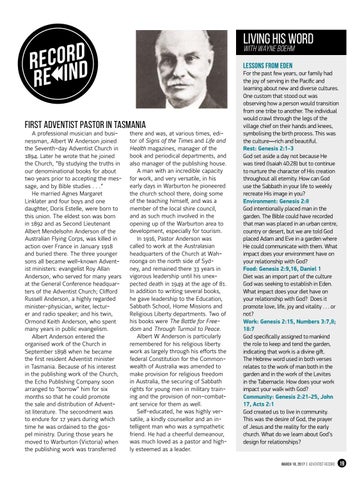
First Adventist Pastor in Tasmania A professional musician and businessman, Albert W Anderson joined the Seventh-day Adventist Church in 1894. Later he wrote that he joined the Church, “By studying the truths in our denominational books for about two years prior to accepting the message, and by Bible studies . . .” He married Agnes Margaret Linklater and four boys and one daughter, Doris Estelle, were born to this union. The eldest son was born in 1892 and as Second Lieutenant Albert Mendelsohn Anderson of the Australian Flying Corps, was killed in action over France in January 1918 and buried there. The three younger sons all became well-known Adventist ministers: evangelist Roy Allan Anderson, who served for many years at the General Conference headquarters of the Adventist Church; Clifford Russell Anderson, a highly regarded minister-physician, writer, lecturer and radio speaker; and his twin, Ormond Keith Anderson, who spent many years in public evangelism. Albert Anderson entered the organised work of the Church in September 1898 when he became the first resident Adventist minister in Tasmania. Because of his interest in the publishing work of the Church, the Echo Publishing Company soon arranged to “borrow” him for six months so that he could promote the sale and distribution of Adventist literature. The secondment was to endure for 17 years during which time he was ordained to the gospel ministry. During those years he moved to Warburton (Victoria) when the publishing work was transferred
there and was, at various times, editor of Signs of the Times and Life and Health magazines, manager of the book and periodical departments, and also manager of the publishing house. A man with an incredible capacity for work, and very versatile, in his early days in Warburton he pioneered the church school there, doing some of the teaching himself, and was a member of the local shire council, and as such much involved in the opening up of the Warburton area to development, especially for tourism. In 1916, Pastor Anderson was called to work at the Australasian headquarters of the Church at Wahroonga on the north side of Sydney, and remained there 33 years in vigorous leadership until his unexpected death in 1949 at the age of 81. In addition to writing several books, he gave leadership to the Education, Sabbath School, Home Missions and Religious Liberty departments. Two of his books were The Battle for Freedom and Through Turmoil to Peace. Albert W Anderson is particularly remembered for his religious liberty work as largely through his efforts the federal Constitution for the Commonwealth of Australia was amended to make provision for religious freedom in Australia, the securing of Sabbath rights for young men in military training and the provision of non-combatant service for them as well. Self-educated, he was highly versatile, a kindly counsellor and an intelligent man who was a sympathetic friend. He had a cheerful demeanour, was much loved as a pastor and highly esteemed as a leader.
For the past few years, our family had the joy of serving in the Pacific and learning about new and diverse cultures. One custom that stood out was observing how a person would transition from one tribe to another. The individual would crawl through the legs of the village chief on their hands and knees, symbolising the birth process. This was the culture—rich and beautiful. Rest: Genesis 2:1-3 God set aside a day not because He was tired (Isaiah 40:28) but to continue to nurture the character of His creation throughout all eternity. How can God use the Sabbath in your life to weekly recreate His image in you? Environment: Genesis 2:8 God intentionally placed man in the garden. The Bible could have recorded that man was placed in an urban centre, country or desert, but we are told God placed Adam and Eve in a garden where He could communicate with them. What impact does your environment have on your relationship with God? Food: Genesis 2:9,16, Daniel 1 Diet was an import part of the culture God was seeking to establish in Eden. What impact does your diet have on your relationship with God? Does it promote love, life, joy and vitality . . . or not? Work: Genesis 2:15, Numbers 3:7,8; 18:7 God specifically assigned to mankind the role to keep and tend the garden, indicating that work is a divine gift. The Hebrew word used in both verses relates to the work of man both in the garden and in the work of the Levites in the Tabernacle. How does your work impact your walk with God? Community: Genesis 2:21-25, John 17, Acts 2:1 God created us to live in community. This was the desire of God, the prayer of Jesus and the reality for the early church. What do we learn about God’s design for relationships?
march 18, 2017 | Adventist record
19