The Role of Nonprofits in Supporting Veterans Since 9/11
Midway Commemorates the Heroes of Sept. 11
From 9/11 to Today:
Understanding the Lasting Impact of Trauma and the Urgent Need for Effective PTSD Treatment
Preventing veteran SuicideS
Career Strategies & Resources
How to Translate Your Experiences from Combat to Corporate
Cybersecurity
JOB READINESS
Unveiling Veterans’ Potential in Franchise Ownership
Mental Health Resources in the Workplace
One Suicide is Too Many
Empowering soldiers with the mental health skills and tools to reinforce suicide protection
Fight Stigma
Open a Flagship credit card, and you can earn 40,000 bonus points (a $400 value) when you spend $3,500 within 90 days of opening your account.¹
Plus, you’ll get a free year of Amazon Prime®2 (a $139 value)—on us. 3
You’ll also enjoy:
Hurry—offer ends January 1, 2025 Apply today! Visit navyfederal.org/flagship
www.SanDiegoVeteransMagazine.com
Welcome to San Diego Veterans Magazine!
SDVM is a veteran-focused magazine throughout ALL San Diego & Southern California. It serves to assist all veterans, active military as well as their spouses and families.
It is the leading veteran magazine emphasizing resources & support and focusing on topics and issues facing today’s veteran community. SDVM focuses on resources, support, community, transition, mental health, inspiration and more...
The content is the driving force behind our magazine and the connection it makes with our veterans, service members, military families, and civilians.
The magazine is supported by the city of San Diego and a distinguishing list of veteran organizations & members, resource centers, coalitions, veteran advocates, and more. We are honored to share the work of so many committed and thoughtful people.
Despite all the challenges, our team has upheld their focus and let not one opportunity go to provide resources and support to our veterans & military personnel.
On behalf of our team, we wanted to take this moment to say THANK YOU to the readers and our military-veteran community for supporting our magazine. With that support we aim to make a difference and continuing to make a profound impact on the quality of life for our veterans, military personnel and their families.
If you want to catch up on the current and past issues, please visit: www.sandiegoveteransmagazine.com/archives
In 1979, President Jimmy Carter signed a proclamation establishing National POW/MIA Recognition Day. The day is commemorated on the third Friday in September. Today, more than 81,000 Americans remain missing or unaccounted for from WWII, Korean, Vietnam, Cold, and Gulf Wars plus other conflicts. According to the Defense POW/MIA Accounting Agency, the missing Americans include 72,404 missing from WWII; 7,555 from the Korean War; 1,584 from the Vietnam War; 126 from the Cold War; and 5 from the Gulf Wars. The Agency continues the search for the missing, fulfilling the nation's promise to leave no service member behind.
Ceremonies can be found across the United States and no matter where they are held, these National POW/ MIA Recognition Day ceremonies share the common purpose of honoring those who were held captive and returned, as well as those who remain missing.
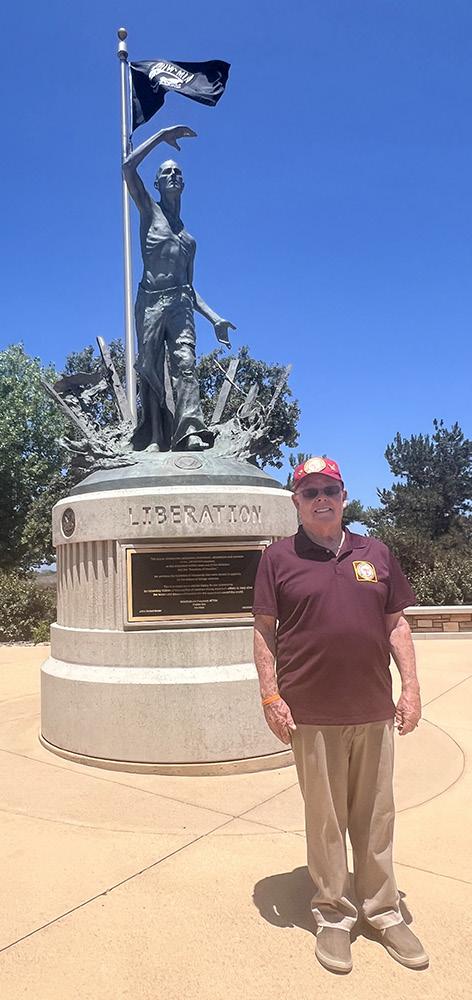
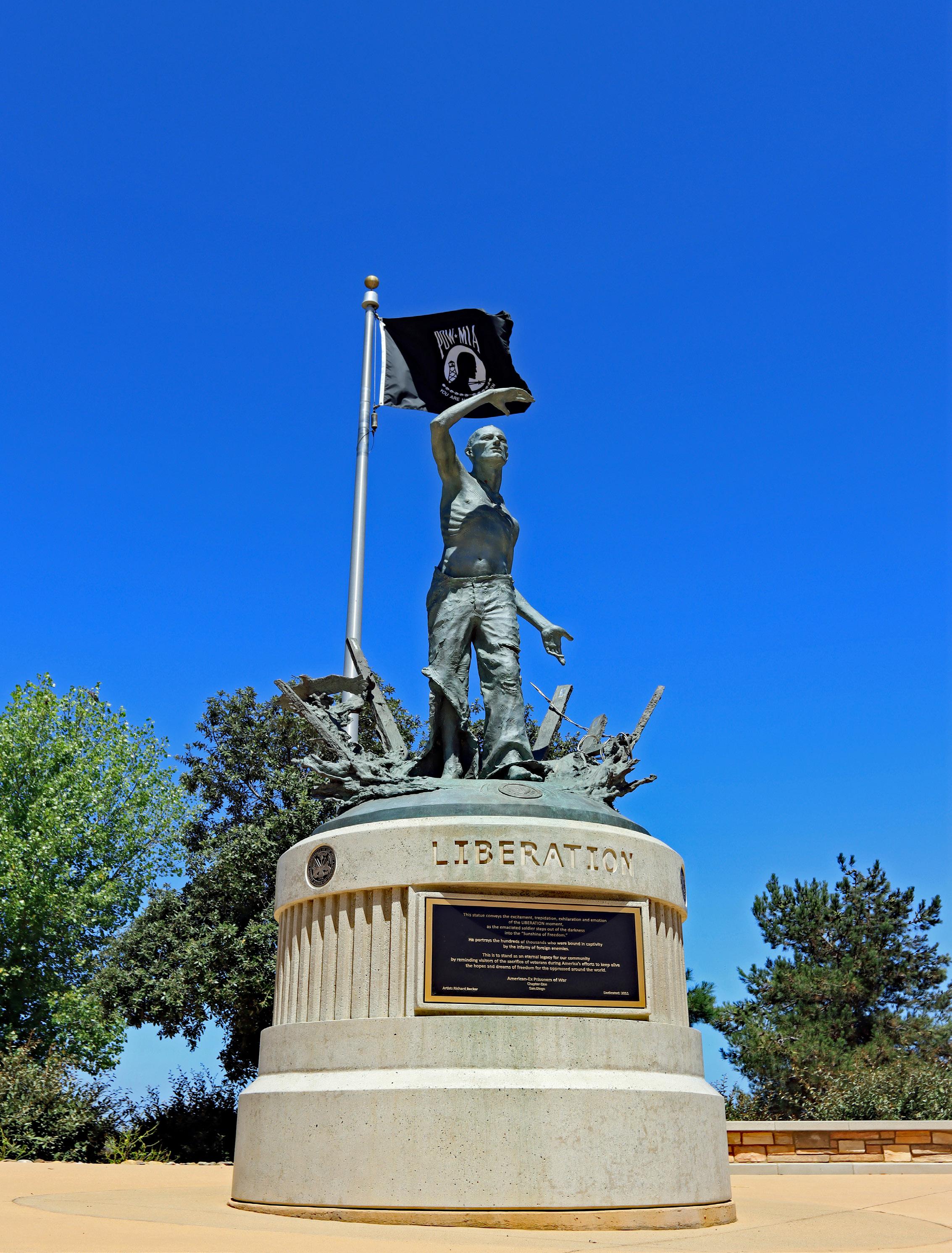
In San Diego, there is a POW Liberation Memorial located at Miramar National Cemetery that is open to the public. Tom Crosby (right) was just 10 years old in 1943 when he and his family were held captive at the Santo Tomas Internment Camp in the Philippines. He was held prisoner until the Army’s 1st Calvary liberated the camp in February 1945 - just before Japan’s “KILL ALL” order could be carried out.
National POW/MIA Recognition Day - Remember and honor -
GOLD STAR MOTHER'S day
Gold Star Mother's Day is observed on the last Sunday in September, which will be Sunday, Sept. 29, 2024.
Gold Star Mother's Day honors the families of service members who have died while serving their country. The day recognizes the pain and sacrifice of the families, and the country's pledge to support them and remember the lives of the fallen.
The term "Gold Star" originated during World War I, when families would display flags with a blue star for each family member serving in the military and a gold star for each who died.
In 1928, 25 mothers who lost sons or daughters in the war formed American Gold Star Mothers, Inc. to honor their children, support veterans, and heal together. The organization's membership has since expanded to include mothers of those who died in other conflicts, as well as adoptive mothers.
Tom joined the U.S. Navy and served during the Korean War. He also located his WWII U.S. Army Liberator, Lou Berger, and they remained friends until Lou’s passing.
The Liberation Memorial was constructed by local sculptor Richard Becker and commemorated in 2011 on National POW Day. Tom’s grandson was the model for the emaciated soldier breaking free of the barbed wire and darkness and into the Sunshine of Freedom.
President Carter’s proclamation still resonates today - “All Americans should recognize the special debt we owe our fellow citizens who, as prisoners during wartime, sacrificed their freedom so that we might enjoy the blessings of peace and liberty.”
Today, the United States military presents a Gold Star Lapel Pin to the immediate family of a deceased service member.
While all mothers of fallen service members are considered Gold Star Mothers, there's a veterans service organization they can join for support, known as the American Gold Star Mothers.
www.americangoldstarmothers.org
The group was started in 1928 by one woman -Grace Darling Seibold. Her son disappeared fighting in World War I, so she spent years working at veterans hospitals in hopes of finding him.
Seibold eventually learned of her son's death but continued her community service, organizing a group of mothers of the fallen so they could comfort each other and care for those veterans confined to hospitals far from home.
Photo by Dave Ellrod Ellrod Images
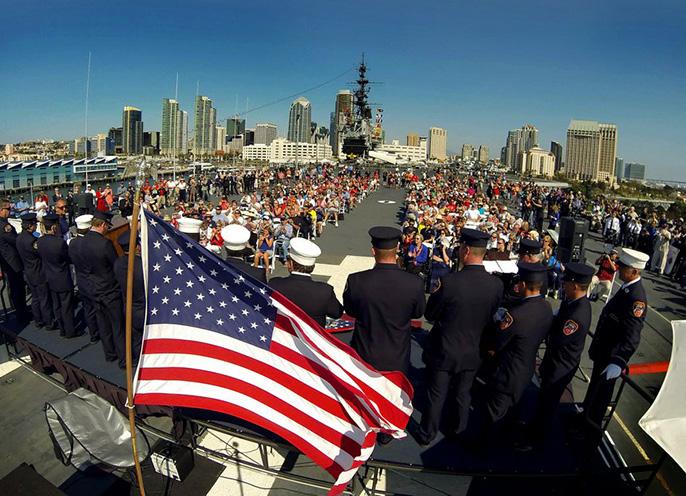
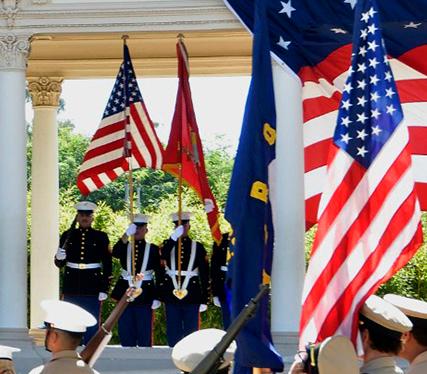
Midway Commemorates the Heroes of Sept. 11
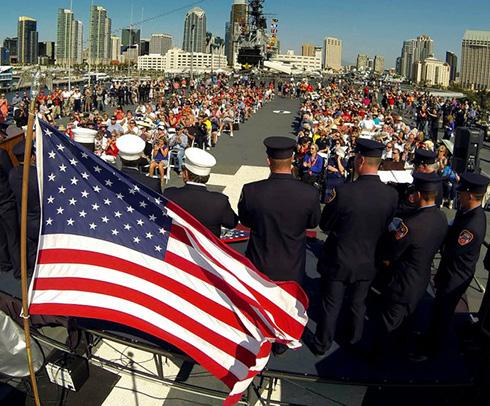
9.11 ceremony on Midway (courtesy of the San Diego Union-Tribune).
He wasn’t working the day the commercial airliners hijacked by terrorists slammed into the World Trade Center towers on Sept. 11, 2001, but he went in anyway. He had no intention of dodging the dangers of that moment, instead, he was driven by doing all he could to help those in peril.
Ron Svec was one of “The Harbor View Boys” of Engine Company 162-Ladder Company 82 on Staten Island. For weeks following the 9-11 attacks, he was one of the hundreds of New York City’s finest working on the “pile” at Ground Zero searching for survivors. The following year, he was diagnosed with cancer as the result of exposure to noxious materials. He passed away in 2018.
Each year, on Sept. 11, Joanne Matzas, attends the memorial service on the flight deck of the USS Midway Museum that honors the fallen heroes who died that day 23 years ago and those, like her brother Ron, who have succumbed to illnesses over the last two decades.
“I think it’s a matter of remembering what these first responders do for us,” said Matzas, whose brother served as a New York City firefighter for 20 years. “They really put their lives on the line for us.”
There were 343 firefighters, police officers and other first responders who perished on that tragic September day in New York City, and, as of the end of 2023, more than 340 other emergency response personnel have died as a result of the illnesses and injuries they suffered.
Since 2005, Midway has been the location of this sobering 9-11 commemoration, one of the largest on the West Coast. The Fire Department New York (FDNY) Retirees of San Diego, the primary organizers of the event, believe the carrier’s flight deck is the most appropriate site for the ceremony.
“It’s the best ceremony outside Ground Zero in New York City,” said Bob Allen, a retired New York City fireman and the president of the FDNY retiree group in San Diego. “I can remember showing up at the first memorial and being stunned at the majesty of the venue. There isn’t a year that goes by that some attendees, especially military and first responders, have not told me that the ceremony was incredible, heart-warming and unforgettable."
Midway has been honored to host the remembrance ceremony for nearly 20 years and is proud to continue its support well into the future. Along with former New York City firefighters, the event is also attended by current and former American and United Airlines flight crews, local emergency responders and city officials, and those who just feel it’s important to pay their respects in person to those who gave their lives attempting to save others.
“The tragic events of Sept. 11 were assaults on all of America,” said Karl Zingheim, Midway’s staff historian and a graduate of the U.S. Naval Academy. “The annual commemoration on Midway honors Americans from across the country who not only died that day, but fought back against the terrorists and labored to save lives in New York City and in Washington."
During the somber tribute, the names of all of the first responders who died on Sept. 11, as well as the names of the flight crews from American Airlines Flight 11 and United
Airlines Flight 175, are read aloud before hundreds of attendees gathered on the ship’s bow. The ceremony also includes the tolling of the bells, a 21-gun salute and a flyover by a helicopter from the San Diego Fire Department.
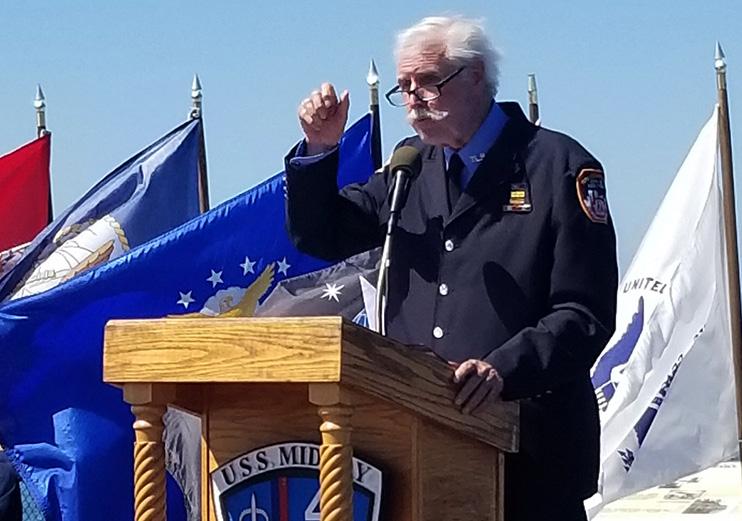
“It’s important that we remember the heroic sacrifices of all those people on 9-11,” said Dan Noonan, a retired New York City firefighter living in Carmel Valley who returned to his old fire station after the terrorist attack to help search for survivors. “Still to this day, it’s difficult to analyze and accept what we were looking at. It was a wasteland, a smoldering wasteland.”
Along with the former New York City firefighters, many of the museum’s veteran volunteers agree that Midway is the only place to hold the observance. Several of them lost colleagues when American Airlines Flight 77 was crashed into the west side of the Pentagon.
“Captain Larry Getzfred was an outstanding naval officer who started his Navy career as an enlisted antisubmarine warfare technician,” said Jack Gale, a retired Navy command master chief petty officer and one of Midway’s volunteer docent managers. “I first met him when we served together in Patrol Wing Ten at Naval Air Station Moffet Field. He was at his desk in the Pentagon when the terrorist attack occurred. It was a couple of days before I heard that Capt. Getzfred was one of those killed. I was shocked that the terrorists had killed a great naval officer. Midway, as our living symbol of freedom here in San Diego, commemorates the memory of Capt. Getzfred and all of the victims and first responders that lost their lives that day.”
The significance of conducting the ceremony on Midway is something the retired New York City firefighters to hold dear to their hearts.
“I love it and wish more firefighters could be part of it,” said Allen. “Thanks to the generosity of all those at the Midway, we may continue to remind Americans to never forget.”
www.midway.org/contact/volunteer-opportunities
Retired NYC firefighter, Dan Noonan, speaks at the 9.11 ceremony
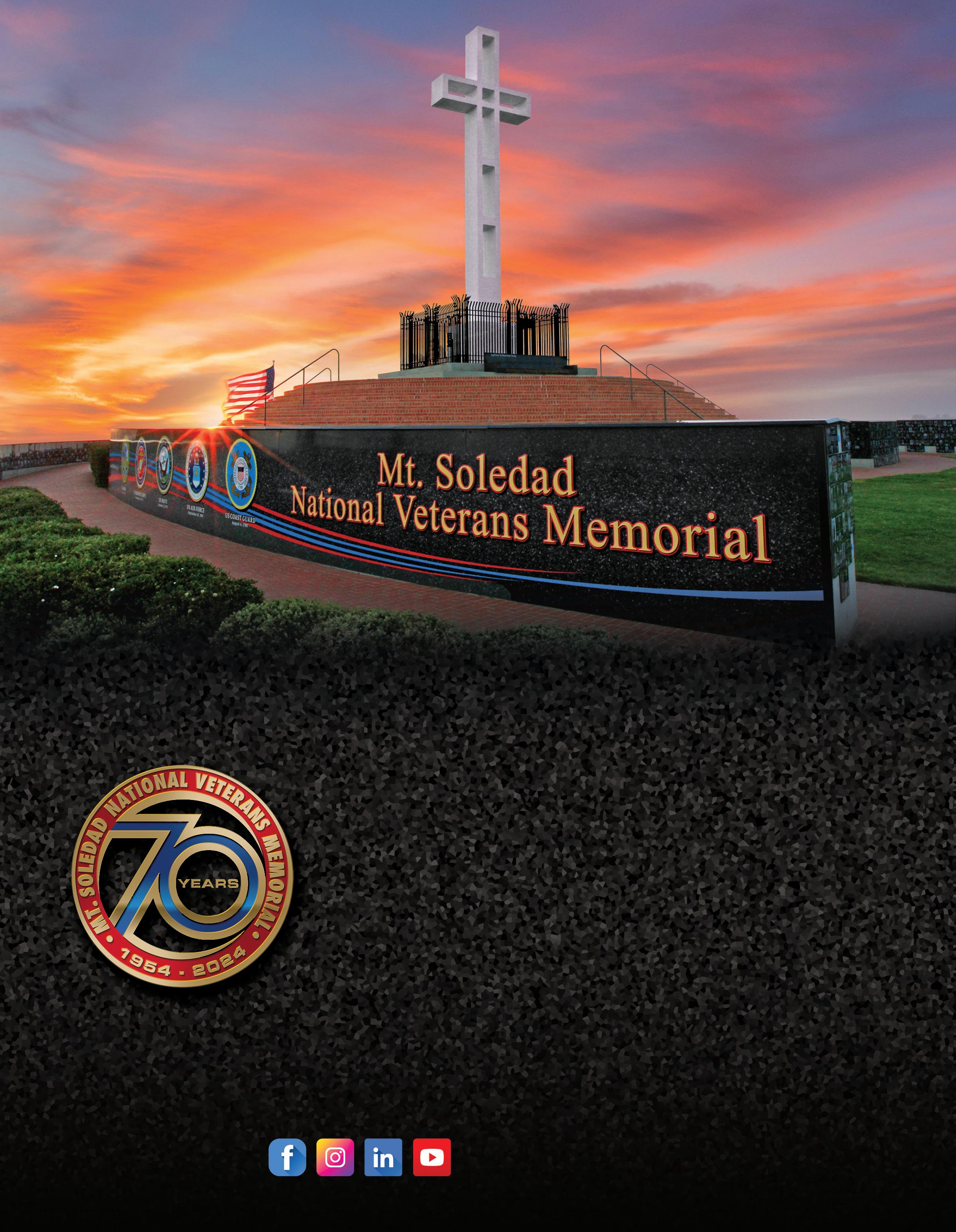
MT. SOLEDAD NATIONAL VETERANS MEMORIAL
COMMEMORATING 70 YEARS OF COMMITMENT TO VETERANS AND THEIR FAMILIES
For seven decades, the Mt. Soledad National Veterans Memorial has stood as a solemn testament to the bravery, sacrifice, and dedication of the men and women who have served in the United States Armed Forces. Perched atop Mt. Soledad in La Jolla, California, this iconic memorial is more than just a physical structure; it is a living monument to the countless stories of heroism and valor that have shaped the nation's history.
A Legacy of Honor and Remembrance
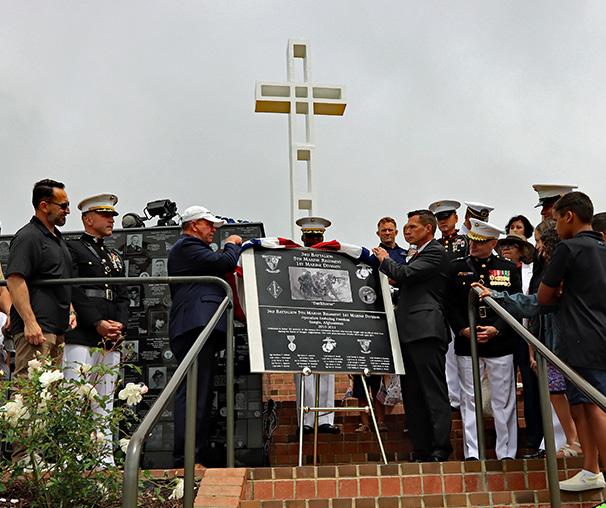
Established in 1954, the Mt. Soledad National Veterans Memorial was conceived to honor the memory of those who served in the military. What began as a simple cross and a vision to remember fallen heroes of World War II and the Korean War, has grown into a comprehensive memorial honoring Veterans from every branch of the military, from the Revolutionary War to the present Global War on Terror. The site now includes 18 walls home to 6,600 black granite plaques, each inscribed with the names, images, and stories of individual Veterans.
This year marks the 70th anniversary of the memorial, a milestone that underscores its enduring relevance and the deep connection it fosters between veterans, their families, and the broader community. Over the decades, the memorial has evolved, not just in physical size but in its significance as a national symbol of remembrance. It has become a place where the past meets the present, where the sacrifices of yesterday inspire the freedoms of today.
Honoring the Past, Inspiring the Future
The Mt. Soledad National Veterans Memorial is unique in that it does not only commemorate those who have passed away but also recognizes living Veterans. This inclusive approach allows families to celebrate their loved ones while they are still here, offering a powerful way to connect generations and instill a sense of pride and history in younger family members.
A Community's Commitment
The Mt. Soledad National Veterans Memorial is maintained by the Mt. Soledad Memorial Association, a nonprofit organization that has been instrumental in preserving the site and its mission. The association works tirelessly to ensure that the memorial remains a place of dignity and respect, where families can come to reflect on the service and sacrifice of their loved ones.
Over the years, the association has hosted numerous events, ceremonies, and dedications, each a testament to the San Diego community's unwavering commitment to its Veterans. The annual Memorial Day and Veterans Day ceremonies are particularly significant, drawing attendees from across the country to honor those who have served. These events are a vital part of the memorial's mission, providing a space for collective remembrance and gratitude.
Looking Ahead
As the Mt. Soledad National Veterans Memorial looks toward the future, its commitment to honoring Veterans remains as strong as ever. Plans are underway to expand the memorial further, adding more plaques and ensuring that the stories of all Veterans can be told. The association is also exploring new ways to engage with the community, including educational programs that aim to teach future generations about the importance of military service and the sacrifices made to preserve freedom. As the memorial continues to grow and evolve, it will remain a place of honor, reflection, and inspiration for all who visit.
In a world where the significance of history can sometimes be overshadowed by the demands of the present, the Mt. Soledad National Veterans Memorial ensures that the contributions of America's Veterans are remembered and revered. As it marks 70 years, the memorial's enduring legacy is a powerful testament to the nation's gratitude and respect for those who have given so much in the service of their country.
There is no fee to visit the memorial. It is open daily from7 a.m. to 10 p.m., located at 6905 La Jolla Scenic Drive South in La Jolla, CA. Visit www.soledadmemorial.org to learn more or call 858-384-3405
HONORING VETERANS BY PRESERVING THEIR LEGACY
Far more than the cross.
Since 1954, the Mt. Soledad National Veterans Memorial has been honoring veterans from the Revolutionary War to the current war on terror. Beneath the 29-foot tall cross, more than 6,600 black granite plaques commemorate those who have proudly served our nation and helped preserve our freedoms.
70 years later, we remain committed to our mission. 70 years later, we remain 100% privately supported.
Help us continue to be a Beacon of Freedom for the next 70 years, high atop San Diego’s most iconic coastal peak.
(858) 384 - 2405 • www.soledadmemorial.o r g https://soledadmemorial.org/donate/
THE SAN DIEGO VETERANS COALITION IS A COALITION OF OVER 150 UNIQUE NON-PROFITS, BUSINESSES, GOVERNMENT AGENCIES AND EDUCATIONAL ENTITIES ALL UNITED BY THE GOAL OF SUPPORTING MEMBERS OF OUR COMMUNITY WHO SERVED OUR COUNTRY IN THE ARMED FORCES, THEIR FAMILIES, AND THEIR CARETAKERS.
SAN DIEGO VETERANS COALITION
The San Diego Veterans Coalition was organized in 2009 and incorporated as a non-profit on May 24, 2011. Using the Collective Impact Model, SDVC is a premier San Diego County-wide monthly convener of over 150 unique member and participating organizations, businesses, and agencies, as well as convening many of that body in our four action groups, and other activities and events. The Collective Impact Model is based on leveraging relationships with other veteran and family serving organizations so that we may provide veterans and their families with a complete array of services and other opportunities.
Many of the organizations that belong to SDVC specialize in one field (education, housing, employment, healthcare). Knowing what services each other provides, we can offer comprehensive support to our local Veteran community. We are proud to work alongside a wide variety of non-profit and for-profit organizations, as well as governmental agencies and individuals. The SDVC is a catalyst that inspires collaboration and cooperation among service partners to deliver premier support for Veterans in the San Diego region and beyond.
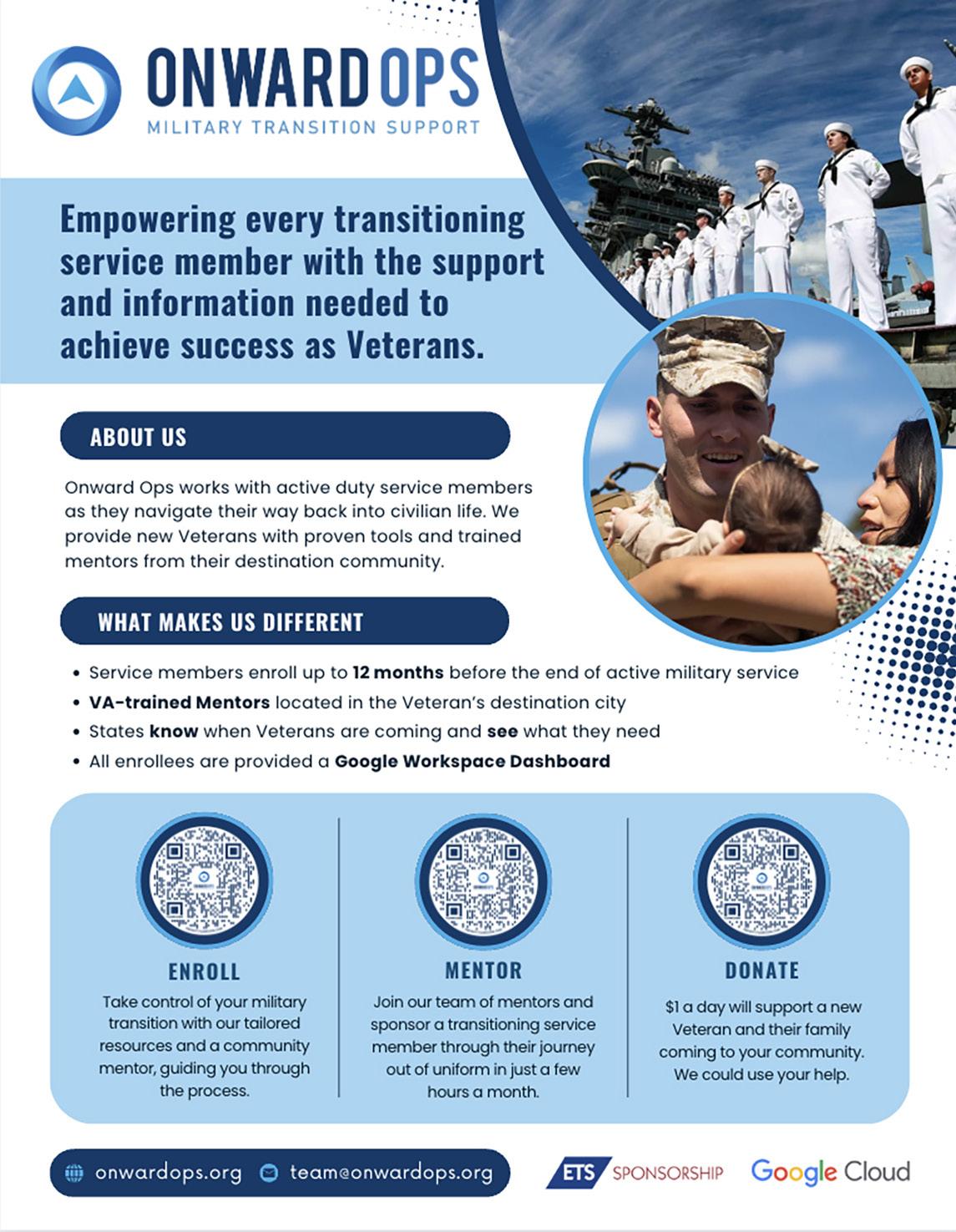
SDVC is proud to have partnered with ONWARD OPS, which has partnered with the Veterans Administration, the Department of Defense, and local communities to support service members through the process from military to civilian life by matching them with one-on-one sponsors in their specific community.
ONWARD OPS Sponsors all complete a VA-Certified Sponsor Training Course and the Community Integration Coordinators are all validated as best-in-class, trusted, and capable partners in their local region. Our national network, working with the department of defense, the department of veterans affairs, and the department of labor, brings a team together in one common mission: to securely provide the information and relationships needed to help every transitioning service member successfully make the journey out of the military and into civilian life.
MOWW San Diego Chapter
A strong America dedicated to preserving and advancing American Ideals and Founding Principles.
The Military Order of the World Wars serves our nation and local communities by providing and supporting activities that promote and encourage responsible citizenship, patriotism, youth leadership, military and public service, veteran support, and strong national security.
The Military Order of the World Wars (MOWW), founded in 1919, is a non-political, patriotic Veterans Service Organization (VSO).
We are a group of patriotic commissioned officers from all uniformed services, our spouses, and descendants. We believe in America and live our motto, “It is nobler to serve than to be served.”. Our tag line is “Serving Youth, Community, and Nation”. We love and continue to serve our nation and all of its peoples. We do this through our outreach programs including Patriotic Education, Veteran Affairs, Scouting, JROTC/ROTC, Public Safety/Law and Order, Homeland Security, and National Security.
“It is nobler to serve than to be served.”
We have been serving the San Diego area since 1926. Our chapter has sponsored many events that have become constant in community life in San Diego. The San Diego chapter has also been quite active on the MOWW national stage. We are quite proud that the first female MOWW Commander-in-Chief, Capt. Debbie Kash, USAF (Ret), is a member of our chapter. We have also provided MOWW with two other Commanders-in-Chief.
Outreach events and activities
• Annual free Youth Leadership Conferences for high school students. Student teams and Staff interactively explore, learn, and practice leadership, patriotism, American government, American history, and free enterprise.
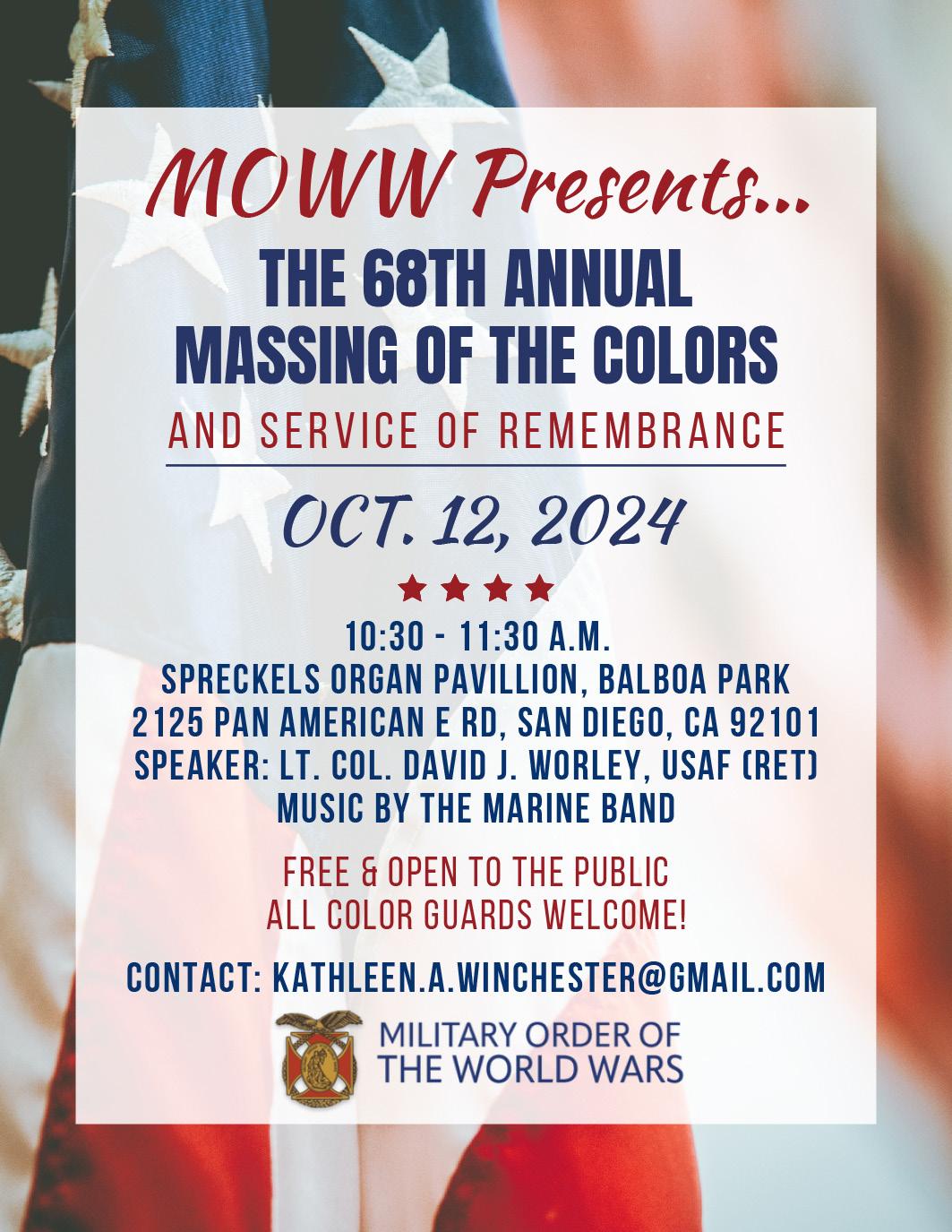
• Massing of the Colors and Service of Remembrance. Recognizing our youth, community, and nation through honoring our country, flag, active military and veterans, their families, and community patriotism.
• Wreaths Across America. Honoring our deceased veterans through co-sponsoring an annual patriotic ceremony.
• Recognizing youth leadership and sponsoring JROTC, ROTC, and Scouting events.
• Partnering with many community veteran groups.
For more information please visit our website at: https://moww.org/ Facebook: The Military Order of the World WarsMOWW-San Diego Chapter
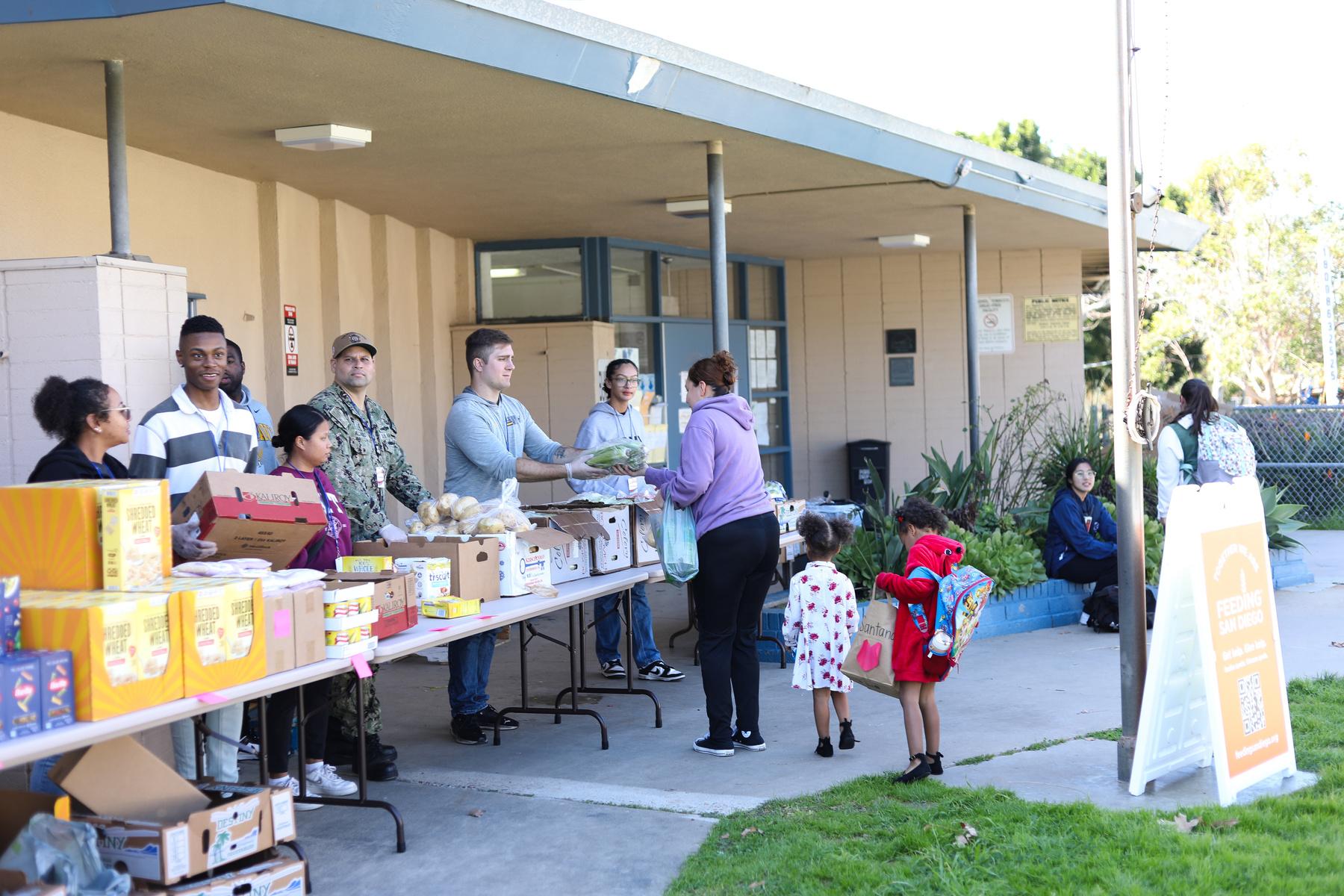
To recognize Veteran's Day, in support of our military families and veterans, VFW, Humana, and Feeding San Diego invite you to support the Uniting to Combat Hunger Food Drive.
From September 1 to November 11, 2024, bring non-perishable food items to participating locations or donate through our virtual food drive!
For a list of participating locations, scan the QR code or visit feedingsandiego org/utch
Visit feedingsandiego org/utch or scan the QR code to donate today! Every $1 donated helps provides 2 healthy meals to people facing hunger in San Diego County
For every pound of food or dollar donated by participating VFW posts, the VFW Foundation with Humana will donate $1 to the post, up to $1,500 per post.
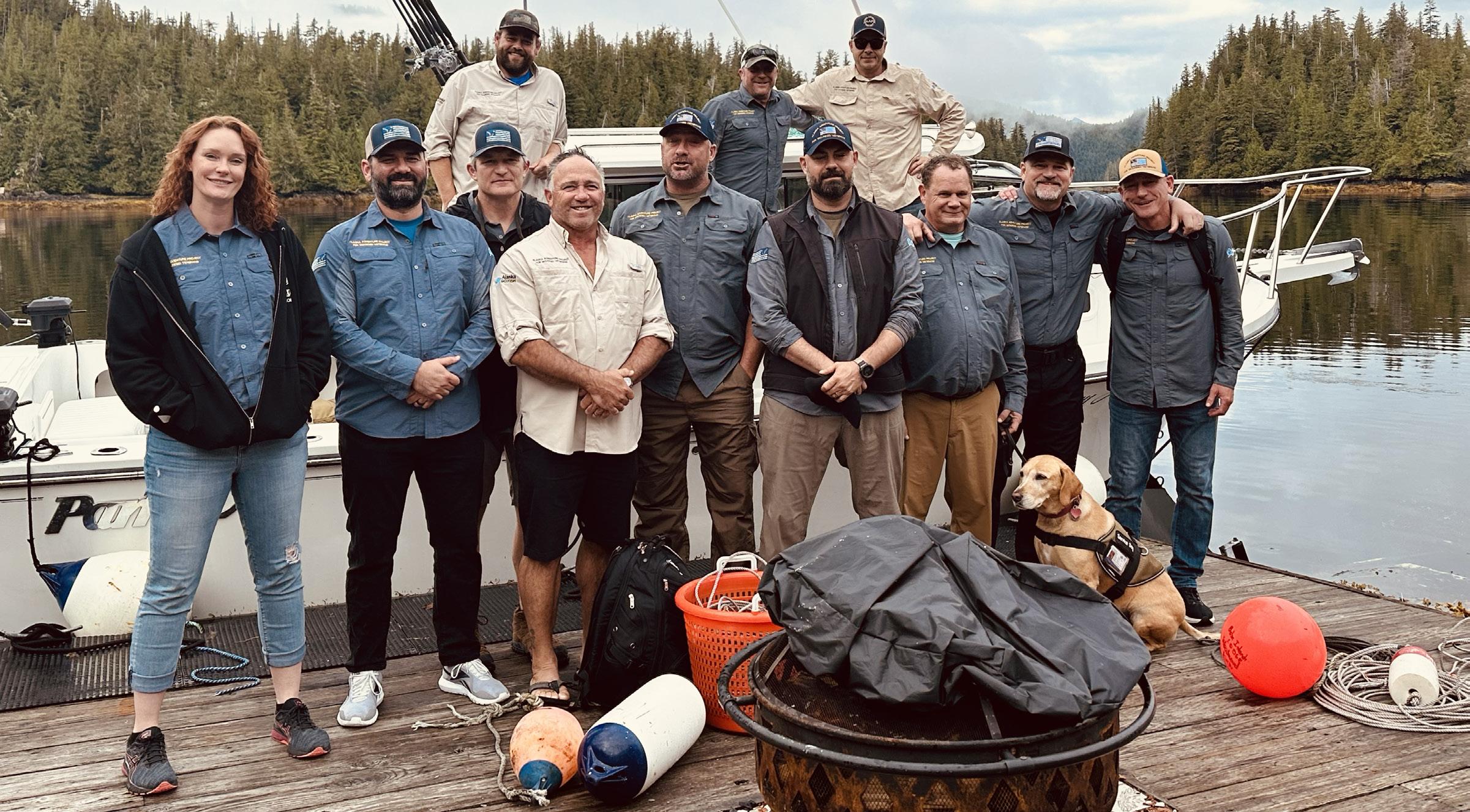
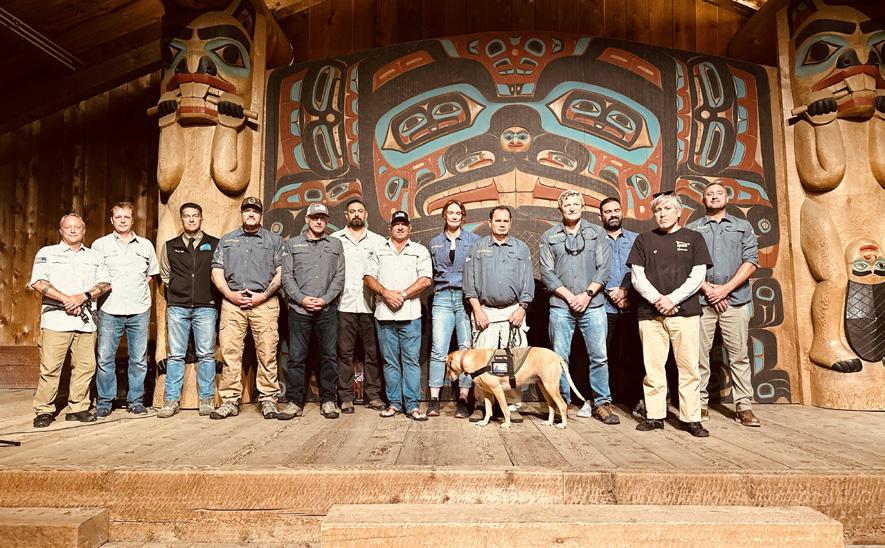
Alaska Adventure Project
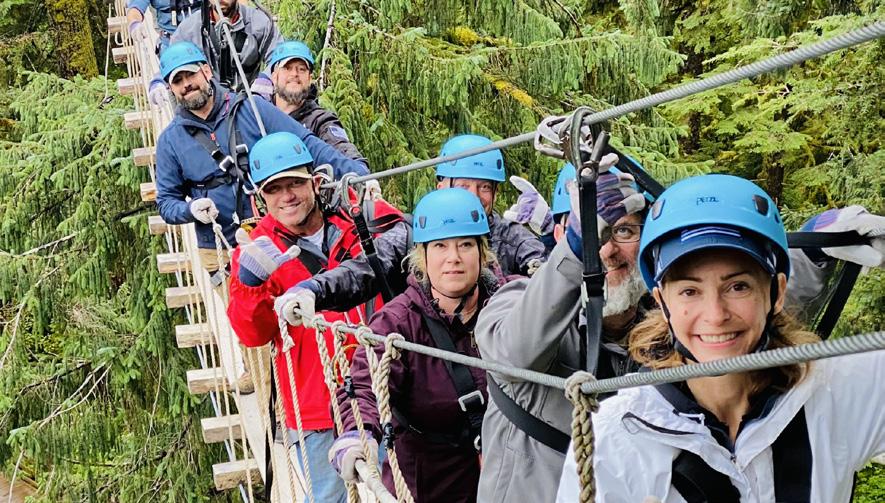
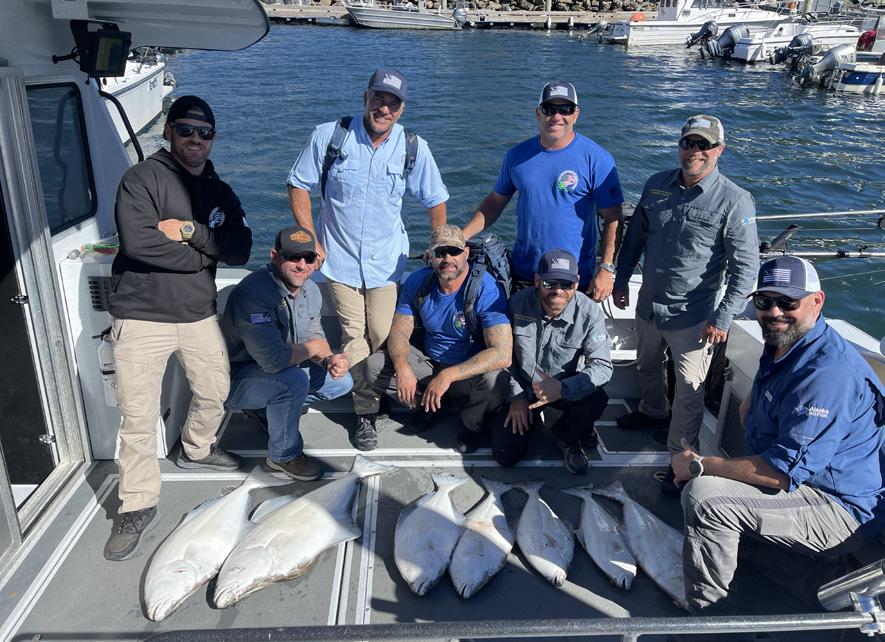
Be a part of a Hero’s Journey! We provide therapeutic support to veterans and their families through outdoor adventures in the rugged beauty of Alaska.
About Alaska Adventure Project:
Founded in 2017 by U.S. Marine Combat Veteran and Native Alaskan William Boulton. Alaska Adventure Project (AAP) is a 501c3 non-profit dedicated to supporting military veterans and their families.
Our Adventure program entails:
• Therapeutic support for veterans and their families suffering with PTSD and TBI.
• Veterans helping veterans through shared experiences.
• Outdoor activities provide atmosphere’s of reflection, discovery, meaning of service, camaraderie,
• New network of resources, a new extended family, connecting veterans with veterans, establish lifelong bonds, and promote healing.
WOUNDS WE CANNOT
Post Traumatic Stress Disorder does not always allow the affected to seek help. Lend a hand and provide them with methods of help, listen and be a friend.
San Diego Veterans Magazine works with nonprofit veteran organizations that help more than one million veterans in lifechanging ways each year.
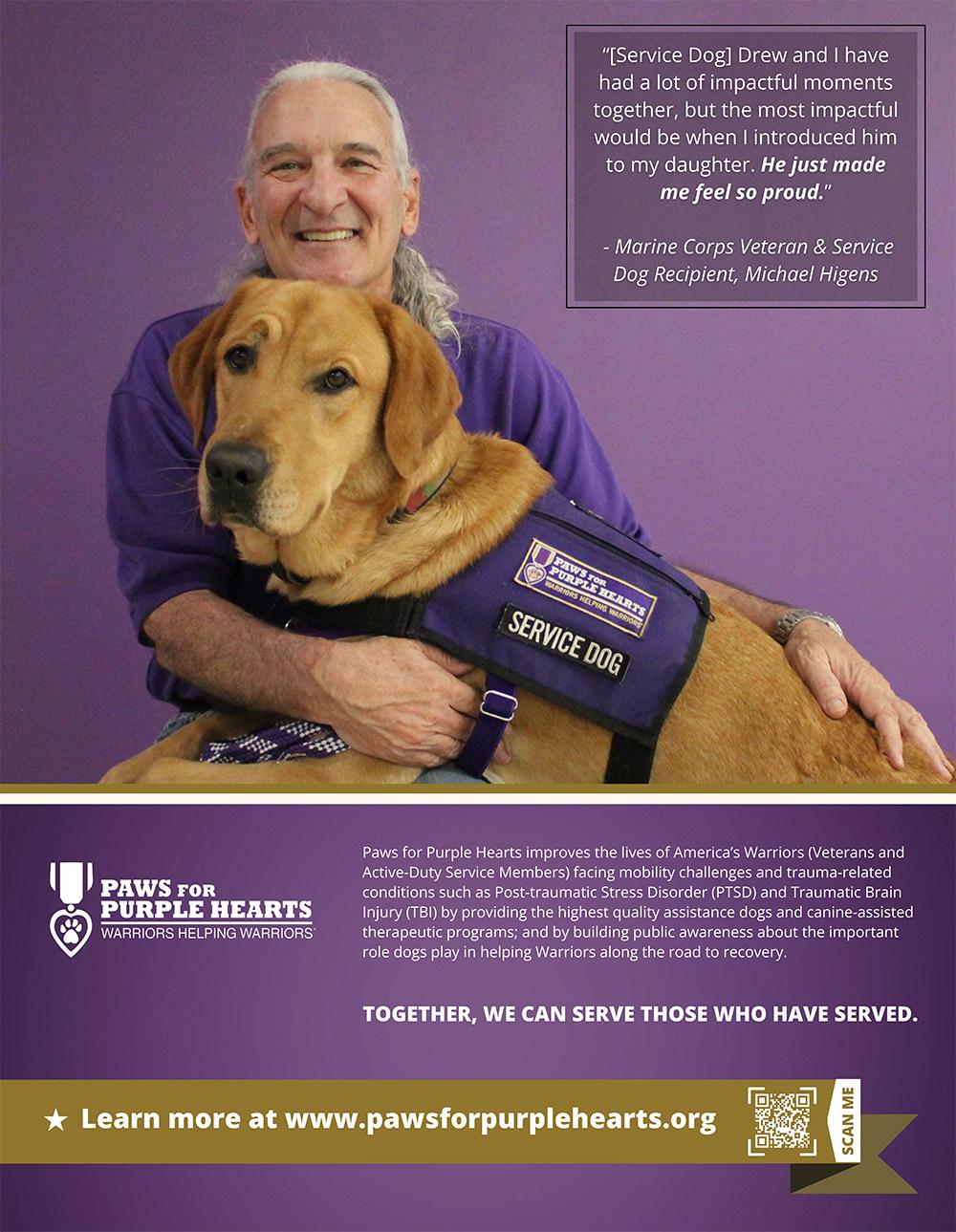
“ I knew immediately that I was supposed to be there and Riley was the dog for me. Honestly, he and I won the lottery the day we met each other. He is a fantastic listener who never judges me.”
—TODD M., US ARMY
SERVICE DOG
• Post-9/11 Combat Veteran — OR
MST Survivor August 1990 – Present
Mental Health Diagnoses • Rated By The VA
Letter of Recommendation
• US Veteran, Active Duty Military, or Gold Star Family
Letter of Recommendation
Real Talk: Mental Health
By Jolene Balancio, Clinic Director
The Steven A. Cohen Military Family Clinics at VVSD www.vvsd.net/cohenclinics
Mind the Gap
Life involves many significant transitional periods, such as those familiar to us this time of year, a Permanent Change of Station (PCS) to a new community. Or there could be more abrupt periods of change such as sudden job loss. Much like these, for someone who is transitioning out of the military into the civilian world, unique challenges can arise. This particular period of time is crucial to the trajectory of an individual’s life.
One day, your routine is known, the environment is familiar, and your identity as a service member is intact – then, the next day, all of that has changed. There is no more putting on the uniform, camaraderie amongst
fellow service members is lost, support can feel scarce, and it appears as if no one understands what you are going through. Ruminating thoughts can start to occur: “What happens next?”... “Who am I, if I’m no longer in the service?”...“How will I provide for myself and family?” and it goes on and on.
The separation from military service can be challenging. The transition can bring overwhelming feelings of uncertainty and hopelessness, a sense of being lost or displaced, and even lead one to question their own existence. In fact, the year after leaving military service has been called the “Deadly Gap,” a period in which the veteran suicide rate is 2.5 times the rate among active duty military personnel.
How You Can Help
During September’s Suicide Prevention Month, we are joining Cohen Veterans Network (CVN), a national notfor-profit network of mental health clinics for post-9/11 veterans, service members and their families, to launch Mind the Gap: Preventing Suicide After Service. The public awareness campaign highlights the challenges veterans face during their transition from the military and provides strategies and resources for suicide prevention. One such resource is a new interactive tool, which provides suggestions about what to say and do if a loved one is exhibiting signs of emotional distress related to hopelessness, a lack of belonging, guilt, and other difficulties.
When we see our friends or loved ones struggling through this transition period, it can be hard to find the right words to say. We may feel that nothing we say would be helpful or we worry we will not be able to handle the conversation once it starts. However, the best thing we can do to show our love and support is to speak up and the best way to do that is to prepare. Here are some helpful tips when reaching out to friends or loved ones who may be struggling with their mental health:
• Ask how they are doing and mention any changes you noticed:
- How are you? I have noticed you have not been wanting to talk much since you got out of the military.
• Show your friends and loved ones that you care:
- I wanted to check in because I care about you, and I know a time like this can be challenging.
• Encourage help:
- Have you ever thought about talking to someone about what you are going through?
- If someone is in acute crisis or expresses thoughts of suicide, they should call, chat or text 988 to reach the Suicide or Crisis Hotline. If they need emergency services call 911.
Talking about suicide with someone in crisis may seem scary. The uncertainty about what to say and do can be a barrier for some, keeping them from engaging with critical support. But knowing the facts and practicing prevention can go a long way in providing support to someone who is experiencing thoughts of suicide.
We can all help and support our loved ones. I encourage you to visit CVN’s interactive resource tool at www.cohenveteransnetwork.org/suicideprevention for additional resources.
The more we talk about our mental health and practice suicide prevention, the more chances there are for our veterans to experience the beautiful transitions that life has to offer.
PTSD: Reclaiming Control
By: Robert ‘Bob’ Cuyler, PhD Psychologist and Trauma Expert
From 9/11 to Today: Understanding the Lasting Impact of Trauma and the Urgent Need for Effective PTSD Treatment
This month’s theme, "9/11 Never Forget," offers a sobering opportunity to reflect on the mass trauma of the Twin Towers and examine two decades of research on the impact of the events. While we often think of 9/11 as a source of nationwide trauma, it created concentric circles of impact. Intensive studies of the aftermath show that those with the closest connection to the terrorist attacks are at the greatest risk of developing PTSD: surviving occupants of the towers and those nearby, first responders, and individuals who lost loved ones. While those of us who were horrified, scared, and glued to our screens for news were certainly affected by the trauma, it’s important to distinguish between exposure to trauma and PTSD. A follow-up study of the 70,000 people most closely affected by 9/11 (in the "close circle" of exposure) showed that about 20% developed PTSD and half of those continued to have significant symptoms 20 years later. Depression, flashbacks, substance use, and emotional numbing are the most common persistent problems.
For many veterans, 9/11 was a turning point, even for those not most closely affected by the attacks. Enrollment in the armed services surged in response to the attacks, leading to the long wars in Afghanistan and Iraq. Soldiers already in service mobilized for war, with our all-volunteer force typically facing multiple deployments to combat zones. The nature of those wars also heightened the risks of service-related trauma: lack of clear battle lines, ambushes, IEDs, enemy combatants mixed with civilians, and exposure to traumatic brain injury.
I believe this combination of circumstances has brought the reality of post-traumatic stress to the public eye in a new way. The collective trauma of 9/11 heightened awareness and stimulated sorely needed research, including long-term follow-up of individuals exposed to trauma . We still have much to learn about why
the majority of individuals exposed to trauma do not develop the persistent symptoms we call PTSD. Absence of prior losses and trauma, social support, economic stability, and protective genetics appear to be factors. The process of identifying at-risk service members has significantly improved, with regular screenings now conducted during service, post-deployment, and retirement.
As prior columns have addressed, real problems remain for both access to and availability of treatment for veterans and civilians. The most widely accepted therapies (exposure-based psychotherapy and antidepressants) are hard to tolerate for many and have high rates of treatment dropout and non-response. We've been discussing a variety of emerging treatments in recent months, so please review these prior Homeland & San Diego Veterans Magazine columns as you look for options for yourself, a loved one, or a friend. One thing is becoming more clear: one size does not fit all. What may be acceptable, tolerable, and effective for one person may not work well for someone else. The demand for safe, accessible, and effective PTSD treatments is urgent. While new options are being developed, those affected by PTSD should explore available treatments, seek recommendations from trusted sources, and take proactive steps toward finding effective care.
Dr. Cuyler is chief clinical officer of Freespira, an FDA-cleared nonmedication treatment that helps people with panic and PTSD manage their symptoms by learning how to regulate their breathing. www.freespira.com
www.freespira.com/veterans
WOundS We cannOt See
Post-Traumatic Stress Disorder does not always allow the affected to seek help. Lend a hand and provide them with methods of help, listen and be a friend.
Veteran Resources
Navigating the resources available to veterans can be confusing, but San Diego Veterans Magazine no veteran should have to go it alone.
At San Diego Veterans Magazine you can find Veteran organizations and private nonprofits with resources for veterans that can help ease the process of attaining earned benefits, coping with the lasting effects of service-connected injuries and finding programs and services that meet your specific needs.
Resources & Support available at: www.SanDiegoVeteransMagazine.com
San Diego Veterans Magazine works with veteran organizations & for-purpose institutions that help more than one million veterans in life-changing ways each year.
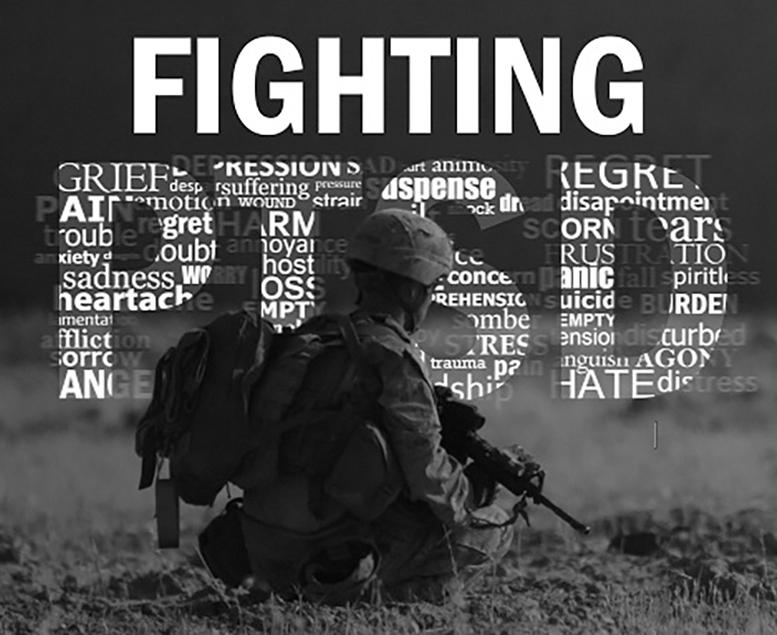
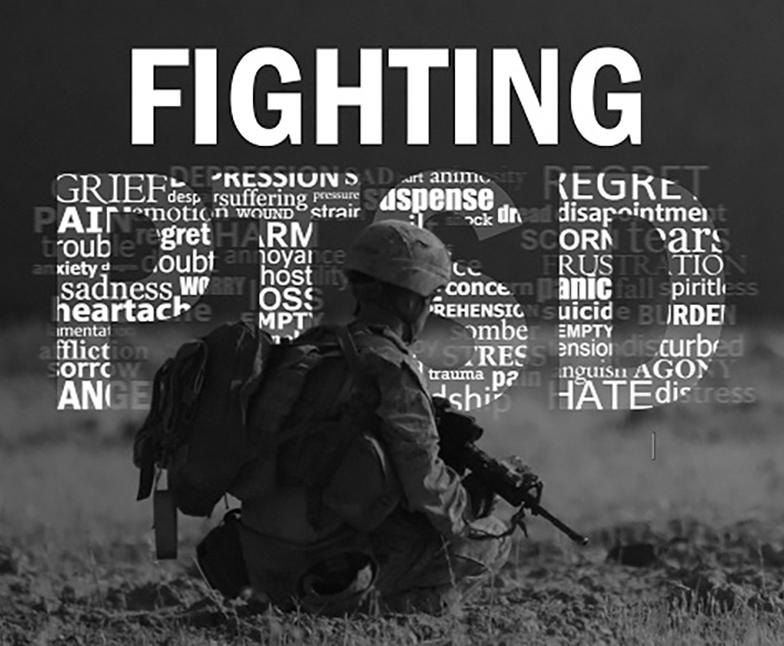
At San Diego Veterans Magazine you can visit our website for all “Fighting PTSD” columns, and featured articles relating to mental health, symptoms, therapy and resources.
Inspiration
.
Columns & Articles available at: San Diego Veterans Magazine - Fighting PTSD Resources.
You are at the end of your rope and you can’t take it any much longer. You are in pain and you feel there is no hope.
The first step you need to do is to seek treatment for your mental health issues. Do not make the decision to end your life when you are in these kinds of fearful situations.
With this in mind, here are seven reasons why suicide is not an option regarding your problems.
1. Things change over time:
Regardless of your circumstances, events do not stay the same. Everything changes over time. Knowing that your situation will improve will help give you the confidence that things are not as bad as they seem. In addition, your loneliness will not last.
2. There are always other options:
You may feel lost and confused, but the answers to your specific problems are out there. The key is that you have to find the answers; the answers to your anxieties and depression will not come to you. As mentioned before, the first step in finding the solution to your problem is to seek help from a qualified professional.
3. You can’t predict the future:
Remember that no one can predict the future with one hundred percent certainty. Even if the thing that you are afraid of does happen, there are circumstances and factors that you can’t predict which can be used to your advantage.
For instance, you miss the deadline for a project you have been working on. Everything you feared is coming true. Suddenly, your boss tells you that the deadline is extended and that he forgot to tell you the day before. This unknown factor changes everything.
4. Focus on the facts of your situation and not your thoughts:
When people are depressed, they rely on their fearful and depressing thoughts. Your fearful thoughts are exaggerated and are not based on reality. When you are depressed, focus on the facts of your current situation and not on what you think. Do not assume anything regarding your current situation.
5. Worrying makes things worse:
A lot of times, our worrying can make the problem even worse. All the worrying in the world will not change anything. All you can do is to do your best each day, hope for the best, and when something does happen, take it in stride. The key is not to get upset and learn how to manage your negative thoughts.
6. Go to the hospital when it is that bad:
If things are so bad that you are unable to function, drop everything and go to your local hospital or crisis center immediately. The people at the hospital or crisis center will take care of you right away.
7. No situation is hopeless:
There are many people and organizations that are willing to help you, but you must be willing to take advantage of this help. Regardless of your situation, take advantage of the assistance that is around you. Every problem has a solution. You just have to find it.
Preventing Veteran Suicides
According to the latest data from Veterans Affairs, in 2022, 6,146 veterans died by suicide in the United States. San Diego County has one of the largest military populations globally, with 110,000 active-duty service members. As of November 2023, the U.S. Census Bureau estimates that over 240,000 veterans reside in San Diego County, comprising approximately 6% of the county's population. Many active or veteran military members may be grappling with thoughts of suicide— our neighbors, family members, and loved ones—could be facing feelings of hopelessness. As a community, educating ourselves about suicide prevention can support those who protect our country.
The San Diego County Suicide Prevention Council (SPC) is a community-driven initiative dedicated to achieving a vision of zero suicides in our area. Our mission is to prevent suicide and mitigate its devastating effects on our community. We uphold core values that emphasize a public health approach to prevention, collaborative partnerships, evidence-based practices, and cultural and linguistic sensitivity.
The SPC offers free training on suicide prevention and intervention throughout San Diego County. One of our most popular programs is the Question, Persuade, Refer (QPR) training. This training equips participants with three simple steps anyone can learn to potentially save a life. Just as people are trained in CPR to save lives, QPR teaches individuals how to recognize the warning signs of a suicide crisis and how to question, persuade, and refer someone to appropriate help. Participants learn to identify critical warning signs such as expressions of hopelessness, depression, giving away valued possessions, talking about suicide, and securing lethal means. This training can be conducted both virtually and in person, and the SPC has already trained over 15,000 San Diegans in QPR.
Additionally, the SPC offers First Responder Suicide Prevention training, which parallels QPR but is tailored to the unique experiences of first responders. Given their daily encounters with mental health crises, it is essential that they are equipped to engage effectively with those in need. The First Responder ,
Suicide Prevention Training also assists First Responders to recognize the warning signs of suicide in and support their fellow colleagues.
The SPC partners with many community organizations that provide resources to Veterans such as Courage to Call, who is dedicated to improving mental wellness for Veterans, Active Duty, Reservists, National Guardsmen and their families via countywide outreach and education. They have a peer line that is open from 8am – 8pm as well as individual short-term, solution focused prevention oriented plans. The SPC also collaborates with the Steven A. Cohen Clinic which has several locations all around San Diego County. Their vision is to provide quality and affordable mental health care services for Veterans, Active Duty Military, and their families. They offer a wide variety of services such as childcare, education, employment, financial assistance, healthcare, housing, and more.
In addition to our free suicide prevention trainings, the SPC holds general meetings open to the public on the fourth Tuesday of every month and facilitates nine active subcommittees focused on various aspects of suicide prevention. These subcommittees include:
- Assessment and Evaluation: Reviewing and analyzing new suicide data.
- Higher Education: Addressing suicide prevention on college campuses.
- Means Reduction: Discussing strategies to reduce access to lethal means for suicide.
- School Collaborative K-12: Focusing on suicide prevention for school-aged youth.
- Postvention: Supporting families, loved ones and community after a suicide.
- Media: Promoting responsible suicide prevention messaging in the media.
- Training and Education: Enhancing our suicide prevention training programs.
- Faith: Addressing suicide prevention across various faith communities.
- Priority Populations and Communities: Tailoring prevention efforts to diverse and highly impacted communities.
The Priority Populations and Communities Subcommittee acknowledges that race, ethnicity, gender, culture, religion, and personal experiences profoundly shape how suicide prevention is perceived and addressed.
You are not alone
This subcommittee promotes dialogue among diverse communities to create tailored strategies for suicide prevention in San Diego County.
The Suicide Prevention Council is developing resource guides specifically designed for various populations, including a Military/Veterans Resource Guide. We are in the process of creating additional resource guides for Asian Pacific Islander, Latinx, and Lived Experience communities, among others.
Suicide prevention is a shared responsibility, and we can all help be part of the solution. It’s up to us to help save lives. Join the SPC efforts to help save lives, reach out to SPC staff at www.spcsandiego.org
CAREGIVING TLC
By Kie Copenhaver CSA, RHIA, SHSS, RCFE www.agingwellpartners.com
“Why Am I Still Here?”
So many of my aging clients ask this question aloud to friends, family, and/or anyone else within earshot. And I never know quite how to answer this very personal and probing question. It’s a big question. It’s a haunting question. And to me, it’s a question that lies at the heart of “what is my purpose here on earth”. The answer differs for each of us and continues to change and morph as we age. What was our purpose in our 30s and 40s may no longer be what drives and fulfills us in our 70s and 80s.
According to the National Council on Aging, of the 46,000 suicides per year (in 2020), over 9,100 were attributed to those over the age of 65. Older adults tend to plan suicide more completely and carefully and are thus more likely to succeed (versus their younger counterpart). And aging men are more likely to commit suicide than aging women.
Suicide in older adults has been linked to a number of causes, such as episodes (often multiple) of grief caused by the loss of friends and family members, the loss or perceived loss of independence and/or autonomy, chronic illnesses and the pain or stress these can cause, declining cognitive ability, and financial stressors.
Any one of these things can cause stress and strife in an individual’s life and as we age, often these stressors come in multiples. My mother will often call or text me with the most recent obituary notice of a friend or acquaintance she has lost, complete with a photo from the local newspaper. It’s the first place she looks when she opens the paper. And it hurts her heart to know that many of her peers, colleagues, and friends are dying before she does. Furthermore, it’s likely a reminder of her own mortality, prompting her to silently ask why she is still here.
As the old saying goes, dying isn’t the hard part – it’s the living that’s the hard part. Those of us left behind have the hardest part, saying goodbye and remaining here to live out our years without that person by our side.
Suicide is a tough topic to talk or write about…yet this issue is partially dedicated to just that – suicide awareness and prevention. And while there are numerous warning signs of suicide – loss of interest in things previously enjoyed, avoiding social situations, giving away prize possessions, neglecting self-care such as grooming, bathing and taking medications, and becoming preoccupied with death – I think we all can internally sense when something is “off” with a close friend or loved one.
I think we all have an internal compass that signals us when something is not quite right for ourselves and others. And if we can stop and listen to what that inner voice is telling us, maybe we can begin to ask the kinds of questions necessary to get to the heart of what is making another sad. Ask the kinds of questions that probe into what is making another feel like they no longer want or need to be of this world.
Ask the kinds of questions that may feel hard and uncomfortable but are oh so necessary. And maybe, just maybe, we can help another find an answer to the question “why am I still here” that rings true and feels purposeful.
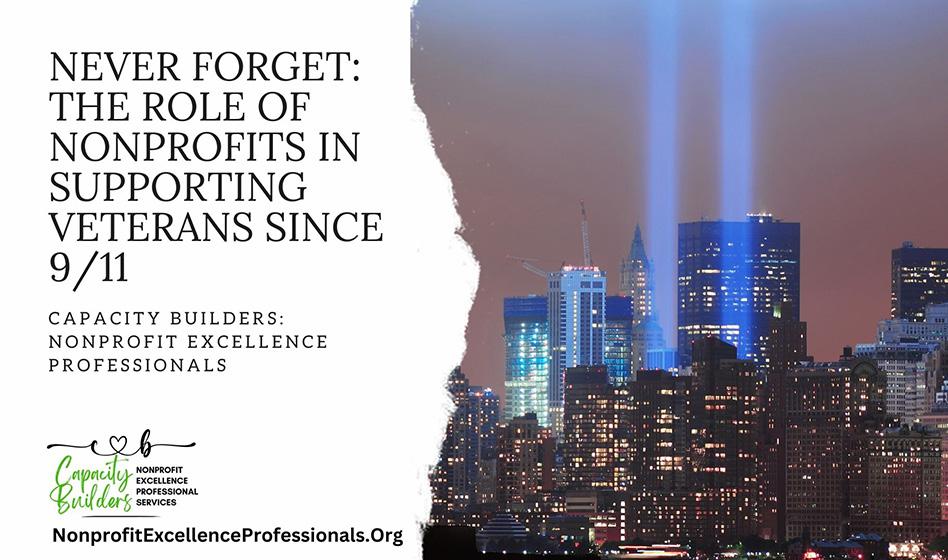
Never Forget: The Role of Nonprofits in Supporting Veterans Since 9/11
By Lori Noonan, Capacity Builders
As we approach the anniversary of September 11, 2001, we reflect on the bravery and sacrifices of our veterans. The events of 9/11 inspired many to serve, and today, over two decades later, we remain committed to supporting those who have given so much. Nonprofits, like those empowered by Capacity Builders, are at the forefront of this mission, providing vital support to veterans as they navigate life after service.
September, with its focus on “Never Forget,” is a time to honor the memories of those lost and recognize the ongoing needs of our veterans. It is also Suicide Awareness Month, an important moment to highlight the mental health challenges faced by many veterans and to showcase the work nonprofits do to offer hope and healing.
The Critical Role of Nonprofits
Since 9/11, nonprofits have expanded their efforts to address the diverse needs of veterans, providing services ranging from mental health support to employment training and housing assistance. Capacity Builders supports these organizations by helping them enhance their impact, ensuring they can deliver comprehensive care and resources tailored to the unique challenges veterans face.
Organizations like Veterans Bridge Home connect veterans with essential services, fostering a sense of community and belonging. By building networks of support, these nonprofits help veterans and their families find stability and purpose after their service.
Addressing Mental Health and Preventing Suicide
The psychological toll of military service, particularly in the post-9/11 era, is significant. Many veterans face challenges such as PTSD, depression, and anxiety. Nonprofits play a crucial role in suicide prevention by providing access to mental health services, crisis intervention, and peer support. They work to reduce stigma and encourage veterans to seek help, creating safe environments where they can share their experiences and find understanding.
Inspiring Hope and Building Resilience
Despite these challenges, there is hope. Nonprofits provide not just immediate assistance but also
opportunities for veterans to rebuild their lives. Programs that encourage community engagement and meaningful activities help veterans for veterans to rebuild their lives. Programs that encourage community engagement and meaningful activities help veterans find new purpose, fostering resilience and healing. Capacity Builders is proud to support these initiatives, ensuring every nonprofit can maximize its impact.
A Call to Action
As we commemorate 9/11 and recognize Suicide Awareness Month, we are reminded of our collective responsibility to support veterans. “Never Forget” is a call to action, urging us to support the nonprofits dedicated to serving those who have served us. Capacity Builders is committed to enhancing the efforts of these organizations, ensuring they can provide the care and resources needed for veterans to thrive.
This September, let us honor our veterans by supporting the nonprofits that stand by them. Together, we can build a future of resilience, compassion, and unwavering support
Never forget, always support.
Veteran Resources
Navigating the resources available to veterans can be confusing, but San Diego Veterans Magazine believes no veteran should have to go it alone. At San Diego Veterans Magazine you can find Veteran organizations and private nonprofits with resources for veterans that can help ease the process of attaining earned benefits, coping with the lasting effects of service-connected injuries and finding programs and services that meet your specific needs.
Resources & Support available at: www.SanDiegoVeteransMagazine.com
San Diego Veterans Magazine
September 2024 Issue
- ONWARD OPS: Military Transition Support
- San Diego's Thriving Cybersecurity Sector
- What’s Next: Combat to Corporate.
- Mental Health in the Workplace
- Franchise Dreams: Service to Success
- Sales is NOT an evil word
- Legal Eagle - Registered Trademarks
- Cybersecurity - Job Readiness
- Careers in Law Enforcement
VETERANS IN TRANSITION
For editorial & monthly columns regarding transition, career advice, tips, workshops, transition to education, entrepreneurship, straight-forward legal tips for military and veteran business owners and more, visit Veterans In Transition . sandiegoveteransmagazine.com/category/veterans-in-transition https://sandiegoveteransmagazine.com/category/veterans-in-transition
Senior Enlisted Leaders: Your Gateway to San Diego's Thriving Cybersecurity Sector
By Maurice Wilson, MCPO, USN (Ret) - President/ Executive Director, National Veterans Transition Services, Inc. aka REBOOT
As the President and Executive Director of NVTSI.org and a proud retired Navy Senior Enlisted Leader (SEL), I am honored to help facilitate the transition of fellow SELs into civilian life. The path to selecting a new career and discovering a renewed sense of purpose is a profound journey. It’s about more than just securing a livelihood; it’s about embracing a new mission that carries the same weight and significance as serving our nation.
This profound understanding inspired the creation of the Monthly SEL Industry Networking Breakfast. In partnership with San Diego Veterans Coalition (SDVC) and a host of community allies, we convene a monthly event that has become a pivotal touchstone for those poised to navigate the waters of a new professional endeavor. The Monthly SEL Industry Networking Breakfast transcends the traditional networking event; it is a lighthouse of opportunity, illuminating the path for our veterans as they chart a course toward a future filled with promise and potential.
Our breakfasts are not merely gatherings but strategic forums designed to connect transitioning SELs with the heart of San Diego’s thriving industries. Each session is an immersive experience, offering a deep dive into one of the many dynamic sectors that fuel our city’s economy. It’s a chance for our soon-to-be veterans to align their vast expertise with the needs of the civilian workforce, ensuring their next career move is both strategic and fulfilling.
September 2024: Spotlight on Cybersecurity
Mark your calendars for September 27, 2024, as we turn our focus to San Diego’s burgeoning cybersecurity industry. With over 1,000 notable employers offering cybersecurity positions, our city stands as a beacon of opportunity for SELs planning their post-military careers.
San Diego’s cybersecurity sector is not just thriving; it’s leading the charge in protecting our digital frontiers. From safeguarding critical infrastructure to developing cutting-edge security technologies, the opportunities are as diverse as they are abundant. Whether your expertise lies in network security, threat analysis, or cybercrime investigation, San Diego has a place for you.
Why Attend the SEL Breakfast?
• Industry Insights: Gain first-hand knowledge about the cybersecurity landscape in San Diego from industry leaders and experts.
• Networking Opportunities: Connect with potential employers and fellow SELs transitioning to civilian life.
• Career Planning: Learn about the skills and certifications most valued in the cybersecurity field.
• Local Opportunities: Discover how your military experience translates to high-demand civilian roles.
Looking Ahead: October is Cybersecurity Awareness Month
As we move into October, recognized nationally as Cybersecurity Awareness Month, we’re excited to announce that our featured speaker for September will be a representative from the Cyber Center of Excellence (CCOE). This presentation will offer deep insights into the latest trends, challenges, and opportunities in the cybersecurity field.
Your Next Career Move Starts Here
The transition from military to civilian life is a significant step, but you don’t have to navigate it alone. Our SEL Monthly Industry Networking Breakfasts are designed to equip you with the knowledge, connections, and confidence needed to embark on your next career adventure.
San Diego’s cybersecurity industry offers more than just jobs; it offers careers where your skills, discipline, and leadership honed in the military are not just valued – they’re essential. From startups to multinational corporations, the opportunities to contribute to our nation’s security in the digital realm are vast and rewarding.
Join Us and Secure Your Future
We encourage all retiring SELs to attend our next breakfast. It’s never too early to start planning your postmilitary career, and there’s no better place to begin than in the company of industry leaders and fellow veterans who understand your journey.
Take the first step towards your exciting new career in cybersecurity. Join us 0700 to 0900 at the Admiral Baker Clubhouse for our September 2024 SEL Monthly IndustryNetworking Breakfast. Your skills are needed, your experience is valued, and your future in San Diego’s cybersecurity sector is bright.
Don’t miss this opportunity to connect, learn, and plan for a fulfilling civilian career in one of the most dynamic and important industries of our time. We look forward to seeing you there and being a part of your successful transition to civilian life.
WHAT’S NEXT
Transition to Civilian Life
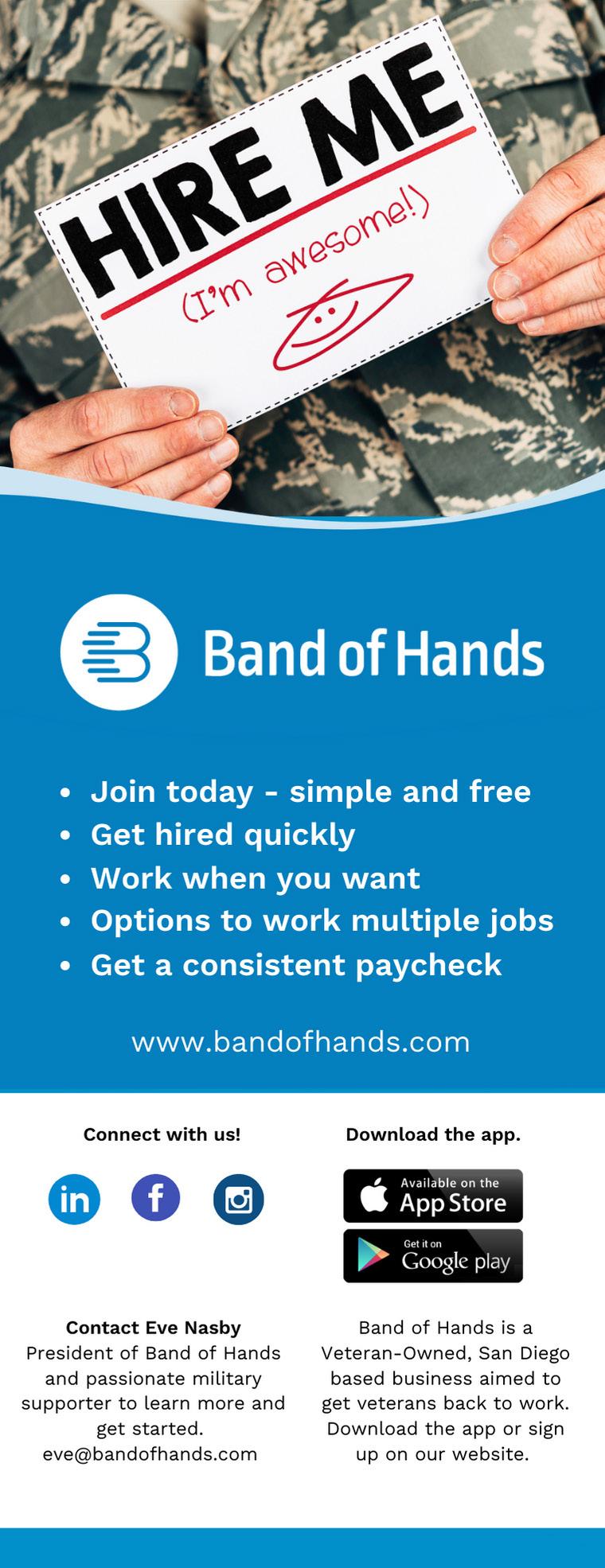
By Eve Nasby & Kristin Hennessy www.bandofhands.com
How to Translate Your Experiences From Combat to Corporate
Transitioning from the military will undoubtedly be one of your most challenging tasks. You may feel a myriad of emotions including confusion, humility, frustration, and satisfaction, all in the same day. This is normal. Mike Ragsdale a Navy Veteran, can relate. He says, “I’ve been there too, and will probably be there again at some point. You’re not the first to feel these things, and you definitely won’t be the last. While this doesn’t make it any easier, hopefully it provides comfort.”
The transition process can be confusing and bureaucratic, and it may not even seem fair. However, if you want to transition successfully, you need to understand the private sector and help them understand you. Nix the mindset of, “I don’t owe an explanation to someone who’s never served” or, “I don’t need to prove myself to anyone.” While it’s great to be proud, this mindset will not get you anywhere.
To make your journey smoother, Ragsdale offers three pieces of advice.
1. The private sector has no idea what you’ve done or what you’ve seen.
When you sit across from a recruiter or hiring manager from the private sector, it’s important to recognize that they probably won’t fully understand what you’ve been through. Maybe they read books or watched movies about the military, but they haven’t experienced what you have. They haven’t smelled cordite after a machine gun just cut loose on a target or flown into Ramadi on New Year’s Eve with tracer rounds flying up in the distance. The fine, talcum powder-like dirt that’s everywhere and the feeling of never being clean are things they haven’t had to deal with.
You’ve been through crazy experiences that they can’t completely comprehend, and that’s okay. Just don’t downplay what you’ve been through just because it’s hard to explain. It’s important to own your experiences and recognize that they’re a big deal, even if others don’t fully understand. This leads to his next point.
2. Ask for help.
In the military, you’re taught to gut it out. You’ll figure it out on your own, right? If you ask for help, you’re weak. Flush this from your mentality. Ragsdale urges, “Ask for help. You don’t get bonus points for extra suffering. By doing this, you’re only hurting yourself. There are people out there who would absolutely love to help you figure this out. Trust me.”
Also, networking is not a scary word. There’s no need to suffer in silence when there are people who would be happy to lend a hand. It’s always beneficial to bounce ideas off of others and get their perspective, even if it feels like it might not lead anywhere.
Even when you don’t feel like having yet another conversation with someone, that may or may not go anywhere, DO IT! Because you never know when that will lead to your next “A-HA!” moment or your next opportunity. So, keep reaching out. And if someone doesn’t respond to your meeting request, it could be a red flag indicating what they’re like to work with, or suggest a negative culture. Don’t be afraid to keep asking for help and get as many perspectives as possible.
3. Get creative and translate your experience into the role you want at the company you want.
Unfortunately, companies don’t need someone who can kick doors down, interrogate a terrorist suspect, put a GBU-12 through the window of a house from 30,000 feet, or drive a Navy warship. While these are all incredible things, the companies you’re speaking with likely don’t need these skills. What they do need are the soft and hard skills that you possess that went into these feats, such as attention to detail, project/program management, operations, strategy development and implementation, influencing without authority, and leadership.
So, think about what you’ve done and how that translates into the role you are applying for at the company.
Here are some examples:
1. Let’s say you were a Marine Corps infantry NCO, and you were solely responsible for the care and the care and feeding of all your Marines. You had to man, train, equip, motivate, and mentor. This means you were like a COO running a small business unit! That’s how you translate your experience. You had to make sure everyone had everything they needed to successfully accomplish goals and objectives.
2. What if you were in Intelligence? You were surveying the battlefield to ascertain where the enemy was, what they looked like, and based on your findings, worked to determine attack strategy. This is sales and marketing! You’ve now translated your experience into relatable and desirable skills! Companies use these same concepts to “attack” their competition and increase their market share.
3. Were you in IT? Well, this one is pretty obvious. You’re valuable!
In closing, YOU GOT THIS! Trust your instincts, ask for help, and think! You’ve proven you’re successful in austere environments where the stakes don’t get much higher. If you’ve done it there, you can certainly do it when you’re talking to a hiring manager on a Zoom call in your bedroom with no one shooting at you.
Need help with your transition? Have questions? Link up with Eve on Linked In today www.linkedin.com/in/eve-nasby-given-hiring-expert
www.bandsofhands.com
Transition to Business HUMAN RESOURCES
By Paul Falcone PaulFalconeHR.com
Mental Health Resources in the Workplace
Our September issue highlights Suicide Prevention Month, and it’s important that you’re aware of the conversations that private sector employers are having right now regarding the state of mental health in the workplace.
First, know that employers take this seriously. Mental health support tops the list of concerns that many employers have, especially during this time of postCOVID reintegration, where remote and hybrid work continues to create loneliness and isolation for many workers—especially the Gen Z “Zoomer” population (i.e., those 25 and under).
Gen Z continues to test out as the loneliest, most isolated, and most depressed generational cohort on the planet—even more so than retirees in retirement homes. The first truly “digital generation,” Gen Z members have lacked the social interaction exposure that all previous generations have benefited from, and the pandemic and remote work have only exacerbated the problem.
Further, employers are beginning to realize that multicultural and multigenerational workers from diverse backgrounds can face greater anxiety from
lack of representation, unconscious bias, and other stressors that impact their mental health and psychological safety at work. For example, a Forbes study during the pandemic showed that:
• Minorities tend to feel less included at work, especially in the areas of race, gender, and sexual identity.
• Millennials (45 & under) were 3.5 times more likely than Boomers (60 & over) to say that their work environment contributed to their mental health symptoms.
• 90% of transgender employees, 75% of Gen Z, 50% of Millennial, and 47% of both Latinx and Black employees have left a previous role due, at least in part, to mental health reasons, compared to 34% of all respondents overall.
• Asians are 51% less likely to use mental health services than Whites. Source: https://bit.ly/3NyD1bB
Similar studies conducted today reveal parallel trends and patterns, as the impact of this once-in-amillennium pandemic continues to affect us all.
Employers’ Responses
Mental health and workplace stress tie into the DEI&B—Diversity, Equity, Inclusion, and Belonging— movement well because such programs attempt to identify and mitigate the effects of isolation and “otherness” that plague many U.S. workers. Employers and their DEI&B committees continue to create inclusion strategies with greater nuance, specificity, and intentionality to enforce conduct and behaviors that ensure that:
1. Everyone treats everyone else with respect.
2. Managers appreciate the unique characteristics of everyone on their team.
3. Leaders do what’s right and are trained in identifying symptoms or concerns that may require greater attention or resources.
Note: You may have heard that the whole DEI&B movement has been caught up in the political sausage grinder where state attorneys general are threatening
to sue companies with DEI&B programs for excluding whites from full participation in workplace opportunities (i.e., reverse discrimination).
Unfortunately, this is sheer political weaponry: the DEI&B movement shouldn’t be confused with the affirmative action programs of the 1970s where numbers and quotas of diverse workers or vendors of color needed to be “represented” in the workplace (i.e., limiting opportunities for their white counterparts). DEI&B is all about inclusion and belonging, and yes— equality of opportunity. But not to the exclusion of anyone to employment or contracting opportunities. It’s about being valued, feeling included, and doing your best work every day with peace of mind.
Other employer interventions that you may learn of include mentorship and buddy programs, mental health training for managers to provide “mental health first aid,” the creation of “Employee Resource Groups,” or ERGs, for workers to come together voluntarily and according to particular affiliations, including veteran status, disability, working mom, race, gender, sexual identity, and other associations. ERGs’ messages confirm, “You’re welcome here. You’re safe here. And we’re all in this together.”
Remember that the Suicide and Crisis Lifeline is available 24/7 by calling or texting 988. You can find their website at https://bit.ly/4fRt1sZ.
The 988 Lifeline provides “free and confidential support for people in distress, prevention and crisis resources for you or your loved ones, and best practices for mental healthcare professionals in the United States.” Services are likewise tailored to specific support groups, including veterans and service members as well as loss and disaster survivors. Make use of this resource and refer it to others immediately should the need arise.
Paul Falcone (PaulFalconeHR.com) is a consultant specializing in management & leadership training, keynote speaking, and executive coaching.
His bestselling books on hiring, performance management, and leadership development are available at amazon.com/author/paulfalcone
www.HarperCollinsLeadership.com
Veterans Make Great Entrepreneurs FRANCHISE DREAMs
By Doug Dwyer doug.dwyer@dreammakerbk.com
From Service to Success: Unveiling Veterans’ Potential in Franchise Ownership
Have you ever considered franchising as you transition from military service? Do you think your skills may not transfer? Do you think direct business experience is the most important factor? Think again.
I’ve been in franchising for over 35 years. In my experience, veterans are some of the best franchise owners. By leveraging their unique skills, experiences, and values from military service, veterans can excel as franchise business owners and make valuable contributions to their communities.
Here are some of the unique characteristics that make veterans great franchise owners:
Leadership Skills: Veterans often possess strong leadership skills developed through their military service, which can be invaluable when managing a franchise business and leading a team of employees. Teamwork and Collaboration: Military experience fosters a deep understanding of the importance of teamwork and collaboration. Veterans can leverage these skills to build cohesive and efficient teams within their franchise.
Process-oriented: Franchising offers proven processes and systems. Veterans tend to maximize detailed processes for marketing, sales, hiring, technology, production, and financial systems.
Discipline and Work Ethic: Veterans are known for their discipline, work ethic, and ability to thrive in highpressure environments. These qualities can translate well to the demands of running a franchise business, especially during challenging times.
Problem-Solving Abilities: Military training hones veterans' problem-solving abilities, adaptability, and resilience. These skills are essential for navigating the complexities of business ownership and overcoming obstacles that may arise.
Attention to Detail: Military training emphasizes attention to detail and adherence to standard operating procedures. Veterans can apply this
meticulous approach to ensure compliance with franchise guidelines and deliver high-quality services to homeowners.
Resourcefulness: Military service often requires veterans to be resourceful and innovative in finding solutions to challenges with limited resources. The better franchise organizations provide peer groups where franchisees can exchange ideas and best practices.
Integrity and Trustworthiness: Veterans are typically held to high standards of integrity and trustworthiness in their military roles. These values can enhance the reputation and credibility of a franchise business, fostering trust among homeowners and employees.
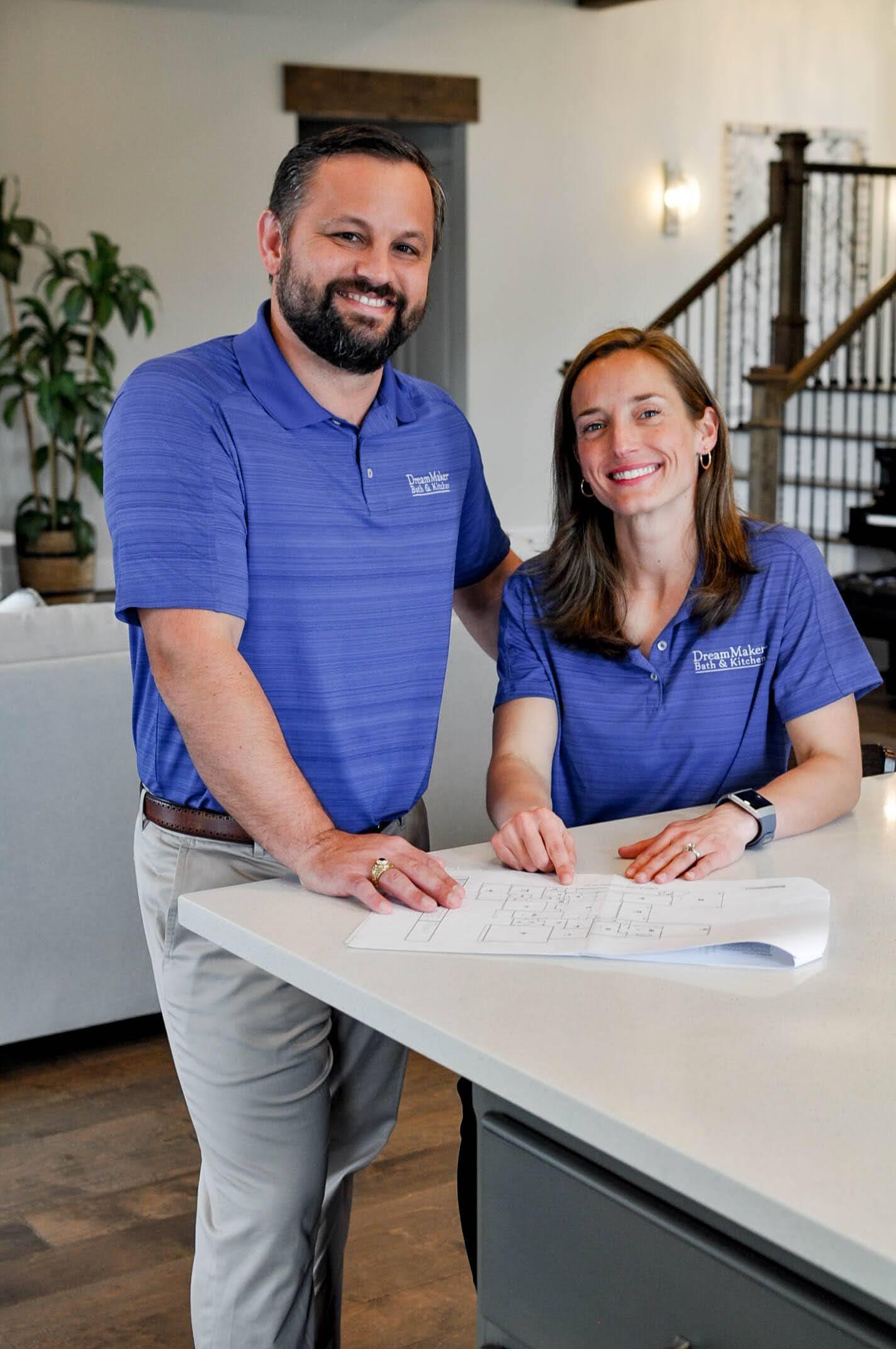
At DreamMaker Bath & Kitchen, we offer prospective franchisees the opportunity to own a kitchen, bath, and interior remodeling business. Over half of our franchisees joined us with little to no experience in business or remodeling. Like other franchisors, we can teach marketing, sales, design, project management, and financials; however, the best franchisees are ones who match our DreamMaker culture and follow our proven processes and systems.
I truly believe that Veterans have the innate characteristics to perform at a high level in franchising.
As you transition from the service to civilian life, I encourage you to explore franchise opportunities. You have so many valuable skills, character traits, and the leadership experience to succeed.
Doug Dwyer is the President & CSO of DreamMaker Bath & Kitchen, a company dedicated to helping its remodeling franchisees achieve Strong Margins and a Quality of Life.
doug.dwyer@dreammakerbk.com
BUSINESS FOR VETERANS
By Barbara Eldridge www.mindmasters.com
Sales is NOT an Evil Word
How are you at selling or is selling a concept that you tend to shy away from? You are not alone, but resistance to it shows up in how consistently your business grows.
Perhaps you find marketing tactics more fun, you know postcards, email newsletters, brochures, social networking, but sales tactics are essential to every business and can be learned. In fact, sales is a function of marketing and requires a process and tactics.
When you walk into a department store, their salespeople are assigned to a particular department so they can answer your specific questions about colors, or sizes or is it available at another store. They generally can’t answer your questions about pots and pans if you are in the electronics area. Try and ask the cosmetics lady about shoes.
Delivering value is what selling is all about, so that you can help people understand what you can do for them and communicate how you can make a difference. To be ready to sell you need to know who your ideal client/ customer is, and what their concerns, issues or needs are. With that you can design your solution and the various ways your product or service benefits them.
Armed with this information you can begin to get beyond your resistance and engage more confidently with each prospect by asking the questions that help you meet their expectations.
Here’s some tips to set the stage:
1. Create the sales process ahead of time, (an appointment script, a list of qualifying questions, a presentation script and your closing question).
2. You need a lead management system, (know who your A, B and C prospects are).
Do you keep good Metrics and Measurements that give you the facts and help you stay accountable? What are your critical numbers? These numbers tell you what is going on. You make decisions based on complete knowledge and hard facts. If you don’t know your numbers, take action and track your results, (know your appointment to call ratio, presentation to sales ratio so you can work on the areas that need improvement).
One last thing, always work toward improving, read some books on sales.
Jeffrey Gittomer has “The Sales Bible” and “The Little Red Book of Selling”, Harvey McKay’s “Swim with the Sharks”, Russell Granger, “The Seven Triggers to Yes” are always a good start.
Your Challenge: Find one sales skill that you need to improve on and practice it for the next 7 days.
Barbara Eldridge President/ Founder of Mind Masters where business owners tap the synergy of energy, commitment and excitement for each other to raise the bar for each other’s goals, brainstorm ideas, create solutions, and offer mutual support. Checkout how a Group help you create personal, professional and financial growth. www.mindmasters.com
legal Eagle
Straight-forward legal tips for Military and Veteran Business Owners
By Kelly Bagla, Esq.
CAN YOUR REGISTERED TRADEMARK BE CANCELLED?
Registered trademarks are granted by the United States Patent and Trademark Office (“USPTO”).
Registered trademarks can also be cancelled by the USPTO for various reasons. A cancelled trademark is a trademark that for one reason or another has been deemed invalid. When a trademark’s registration has been terminated that means it can be registered by another person or business. Once a trademark has been cancelled, it is considered dead. The owner of this trademark is no longer protected by any of the benefits of a registered trademark.
TRADEMARK CANCELLATION WITHIN 5 YEARS
If the petition to cancel a registered trademark is filed with the Trademark Trails and Appeals Board within 5 years of the trademark registration date, the grounds for the petition are more expansive and provides for a mechanism for addressing any potential issue with the trademark registration that might not have been discovered during the examination process. This could include situations where the registered trademark should not have been granted due to factor such as:
NON-USE is defined as if the trademark owner has not made a genuine use of the registered trademark in connection with the goods or services for which it was registered for a specific period of time.
ABANDONMENT is defined as if the trademark owner has abandoned the use of the trademark, effectively rendering it inactive.
FRAUD is defined as if the trademark registration was obtained through fraudulent or deceptive means.
GENERICNESS is defined as if the trademark has become generic and no longer serves as a distinctive identifier of the source of goods.
LIKELIHOOD OF CONFUSION is defined as if the registered trademark is likely to cause confusion with another existing trademark.
PRIOR RIGHTS is defined as if the registered trademark infringes on prior rights.
TRADEMARK CANCELLATION AFTER 5 YEARS
After the initial 5 year period following trademark registration has passed, grounds for canceling a trademark may still exist, but the procedures and requirements for seeking cancellation may differ from those within the 5 years. The grounds for cancellation include the grounds for cancellation stated above with the exception of including:
BAD FAITH, which is defined as if the registered trademark owner acted in bad faith to obtain the registration.
There are other reasons for cancellation, which include but are not limited to: the trademark may be deceptive, scandalous, or immoral, or it may consist of a living person’s name, portrait, or signature without their consent.
were
• Zipper
It’s never too late to trademark your assets, including but not limited to your company logo, company names, product names, slogans, and much more.
Schedule your consultation with the Queen of Business Law® Kelly Bagla, Esq. today and secure your trademark for exclusive use under law.
For more information on how to legally start and grow your business please visit my website at www.BaglaLaw.com
Disclaimer: This information is made available by Bagla Law Firm, APC for educational purposes only as well as to give you general information and a general understanding of the law, and not to provide specific legal advice. This information should not be used as a substitute for competent legal advice from a licensed professional attorney in your state.
Bagla, Esq., and her team at Bagla Law Firm, APC, a Business Formation and Asset Protection firm, have over twenty years of experience protecting real estate for rental owners. They customize your asset protection plan to ensure that your rentals are protected in case of a lawsuit.
Veterans Chamber of Commerce
By Joseph Molina www.vccsd.org
Cybersecurity - Job Readiness
Cybersecurity is a rapidly growing field with high demand for skilled professionals.
Positions range from security analysts and engineers to security architects and consultants. Salaries are generally competitive, and there are opportunities across various sectors including finance, government, and tech.
Here are some options on how to be Job-Ready if you are interested in this Industry.
University Degrees
1. Bachelor's Degree in Cybersecurity: This is a common starting point. Programs typically cover topics such as network security, cryptography, and ethical hacking. Look for programs that offer hands-on labs and practical experience.
2. Master’s Degree in Cybersecurity: If you already have a bachelor’s degree and want to advance, a master's in cybersecurity provides deeper knowledge and often focuses on management and strategic aspects of security.
3. Master’s Degree in Computer Science with a Focus on Security: Combines advanced computing skills with specialized knowledge in security.
Certifications
1. CompTIA Security+: A great entry-level certification that covers a broad range of security topics.
2. Certified Information Systems Security Professional (CISSP): An advanced certification ideal for those looking to specialize in security and take on managerial roles.
3. Certified Ethical Hacker (CEH): Focuses on offensive security techniques and ethical hacking.
4. Certified Information Security Manager (CISM): Emphasizes management and governance aspects of information security.
5. Certified Information Systems Auditor (CISA): Suitable if you’re interested in the auditing and compliance aspects of cybersecurity.
6. Cisco Certified CyberOps Associate: Focuses on security operations and Cisco network technologies.
7. Offensive Security Certified Professional (OSCP): Known for its hands-on and challenging approach, it’s great for those interested in penetration testing.
8. GIAC Security Essentials (GSEC): Covers the practical aspects of security and is a good intermediate-level certification.
9. Certified Cloud Security Professional (CCSP): Ideal if you’re focusing on cloud security.
Practical Experience
• Internships: Seek out internships or co-op programs related to cybersecurity. They provide hands-on experience and help build a professional network.
• Labs and Projects: Engage in practical labs, simulations, and projects. Many degree programs offer labs or virtual environments where you can practice.
• Hackathons and Competitions: Participate in cybersecurity competitions or hackathons. These can be a great way to challenge your skills and stand out to employers.
Skills to Develop
• Technical Skills: Proficiency in programming languages (like Python), network security, encryption, and system administration.
• Analytical Skills: Ability to analyze and interpret data, detect patterns, and respond to incidents.
• Soft Skills: Communication, problem-solving, and critical thinking are essential, especially when explaining technical issues to non-technical stakeholders.
Networking and Professional Development
• Join Professional Organizations: Groups like (ISC)², ISACA, and the Information Systems Security Association (ISSA) offer networking opportunities and resources.
• Attend Conferences and Workshops: Stay updated on the latest trends and technologies in cybersecurity.
Job Opportunities:
If you have any specific interests in this Industry the National Veterans Chamber can help you land a job in this field Just send us an email at veteransccsd@gmail.com (Subject line Cybersecurity)
Disclaimer: The information provided is for educational purposes only. Make sure to consult with a real estate financing Loan expert who can provide valuable guidance in navigating these decisions and finding the right solution for you.
Insurance Info & Risk Management Tips
By Hadley Wood www.hlinwood-insurance.com
Social Media Risk
Small business owners wear many hats. Sometimes we perform inventory control, vendor negotiation, employee coach and cheerleader and at the end of the day behind our computers - head of marketing and social media outreach. The problem is that most of us are not professional marketers and may not know some of the risks associated with social media marketing. In this challenging market it can be tempting to get a one-up on your competition by making claims that your product or services are better than the ‘other guys’. This is very risky and can lead to an expensive and lengthy lawsuit!
Defamation of Character is a common legal term that has become more prevalent now that information spreads quickly and can affect more people in real time and cause deeper damage. Libel and Slander are both forms of defamation of character, but they differ in the ways the information is distributed.
Libel is defined as the act of making a derogatory statement about another in a form of print which could damage another’s reputation or character and cause harm to their person or business. Slander is the act of speaking about another person or business in a false and malicious way that would cause damage to another person or business. You just never know who might be sitting next to you at the coffee place or bar when you are speaking negatively about another person or another company. They might overhear you and start recording! Now, everyone has a right to their own opinion but knowingly spreading false and malicious
information about another person or business can leave you exposed to an ugly outcome.
Did You Know? If you share and/or distribute information that is blatantly false and knowingly harmful about another person or business – even if you did not create the information – you can be at fault too! Perhaps you shared a bad review about your competitor on social media and the information was just not correct. It might be a tough lawsuit to prove BUT if a business owner believes you did this to cause financial hardship and they can point it back to your actions, it could be a problem for you.
The good news is that if you carry a General Liability policy for your business there may be coverages for these actions of Libel and Slander under the Personal and Advertising Limits of coverage. But you will want to read your policy to look for the exclusions to these coverages and remember you likely have a deductible to pay out AND having a claim on record for this does not help your future rates.
Michael Kidd
I think the take-away is a simple one and something we all learned in grade school. If it isn’t nice or helpful don’t say it; if it is gossip and hurtful, don’t pass it along and being a bully is never the right way to act.
If you have any Business Insurance questions, please reach out to me. www.hlinwood-insurance.com
Welcome to the Veterans Association of North County
HERE FOR YOU WHEN YOU NEED US
Here you will find several resources, programs, services and opportunities for Veterans, Service Members and their families. Our goal is to be your one stop shop for all things, so don’t hesitate to contact us at any time. Programs and services vary, and include additional information for each. We have two Veteran Services Representatives (VSR) here at VANC, read all about them below in Addtional Services at: (www.vanc.me/services-programs)
OUR MISSION
VANC is a 501(c)(3) non-profit organization created and operated by Veterans as a one-stop resource center for all active-duty military, Veterans, and their families. We centralize services from diverse agencies to assist with jobs, education, finances, health, and wellness.
OUR VISION
We seek to honor and support those who have served our country, bridging the past, present, and future. VANC is a vibrant gathering place in North San Diego County, where all Veterans, active-duty military, and their loved ones can reach out for help and community. VANC engages and informs local Veterans organizations, service providers, and individuals, helping them work together. VANC seeks to be a model for other organizations that serve the military community.
JOIN US FOR AMAZING UPCOMING EVENTS
There’s always engaging things happening at VANC and with our partners. Check our calendar here for regularly scheduled events, meetings and opportunities here at VANC (www.vanc.me/events#calendar)
WE LOVE OUR ASSOCIATION MEMBERS AND THEY’RE HERE FOR YOU TOO. VANC is open to all military, veterans and friends of the military. If you would like to become a Veterans Association member, Contact Lori at lori@vanc.me to learn more.
www.vanc.me
SPORTS MANAGEMENT CERTIFICATE
Our sports managements program supports professionals striving to become leaders in the exciting athletics field. Enrolled students can complete coursework entirely online while receiving guidance from high level coaches, retired pros, and sports industry experts.
Launching your business in Sports
Leadership Principles in Sports
Strategic Communication in Sports Ethics in Sports Game within the Game
NIL basics
This program is transferable with our University partners for credit. For more info email synergylearninginstitute@gmail.com
Evangel University: Here to serve those who serve
We believe that the sacrifice and commitment of our nation’s service members should be recognized and rewarded. Evangel University has a connection with the military dating back to World War II. In fact, the very grounds upon which Evangel is built served as the O’Reilly General Hospital, an Army facility that opened in 1941 and treated more than 50,000 wounded soldiers. Serving our nation’s military members is a proud part of our heritage and a privilege we continue today.
Educational opportunities designed with you in mind
We are dedicated to thoughtfully supporting service members in their academic pursuits. Convenient fully online degrees are available, with multiple start dates throughout the year. Courses are delivered in five-week block formats with one course offered at a time. This flexible schedule is great for working adults with a busy life schedule.
Graduate and seminary degrees are also available, including the premier Chaplaincy program offered through a Master of Divinity degree at the Assemblies of God Theological Seminary (AGTS), embedded at Evangel University. This popular program has provided chaplaincy training to over 200 active duty service members.
“AGTS is committed to preparing students for the next stage of their careers or ministries,” said Chaplain J.P. Smith, a 2016 AGTS graduate. “As a chaplain candidate at AGTS, I had the opportunity to conduct practical military training at Fort Jackson, South Carolina, West Point, New York, and Fort Gordon, Georgia while gaining elective credits toward my degree program.”
Smith reflects, “I have spoken with countless chaplain candidates who attended other seminaries, and one thing is evident – AGTS chaplain candidates were significantly ahead of their peers from other seminaries. AGTS provides the best training, support, and education.”
Customized support
We also recognize the extensive training that active and veteran service members have received and as such, we award credit for armed services education and training from the Joint Services Transcript (JST), according to the recommendations of the American Council on Education. Our driving focus is to provide for the needs of service members as they pursue education in their area of choosing.
The Admiral Vern Clark Veterans Center provides focused support to military families, including help with keeping track of required federal paperwork, connecting them with peers and mentors, and offering a comfortable place in which they can relax.
The center provides a wide-open door for service members and their families to feel at-home and cared for while pursuing their educational goals.
The Veteran’s Center Coordinator, Dane Moore, is a retired Master Sergeant and has used both Tuition Assistance and VA GI Bill benefits for many years.
“When I first started the VA process, I did not know where to start.” Moore said. “This is why we made easy to follow checklists that give veterans or dependents a step-by-step method to getting their well-deserved education benefits.”
Affordable and flexible options
As a yellow ribbon approved school, Evangel’s goal is to make the process of receiving an education both affordable and flexible. Our online courses maintain the same level of rigor as any classroom-setting course, while providing students with a flexible schedule and setting.
We accept military tuition assistance, and the Veterans Center coordinator is available for one-on-one customized support to help service members streamline the Veteran’s Administration (VA) and active-duty Tuition Assistance processes.
We have a long history of training military chaplains and providing a wide range of educational degrees to service members. We are here to help you with your education goals.
To learn more about Evangel’s military benefits or to apply, visit our website at www.evangel.edu/military.
OPPORTUNITIES IN LAW ENFORCEMENT
You’ve served your country, now serve your community!
Military and law enforcement have had a longstanding relationship with overlaps in training exercises, equipment, and, most important, personnel.
It is not uncommon for a service member to make the jump from the military to law enforcement as both professions look for the same characteristics; leadership, fidelity, chain of command, and teamwork are all common themes in both professions.
Quite understandably, many American military veterans often gravitate to a career in law enforcement when the time comes to rejoin the civilian workforce.
The two professions have many fundamental similarities; from the uniforms they wear with pride, to the firm command structure they serve under, to great personal risk they endure while protecting those who cannot protect themselves.
VETERANS IN LAW ENFORCEMENT
The following agencies are actively hiring & proudly support our veterans, active military and the families that keep together.
“Veteran life in CBP”
U.S. Customs and Border Protection’s (CBP) San Diego Field Office (SDFO) has established the Employee Wellness & Engagement (EWE) Unit to foster a workplace that promotes all-inclusive health – physical, mental, social, and spiritual. This unit is dedicated to helping the whole employee and one of the unit’s primary focuses is the wellbeing of military veterans.
CBP understands the need to relate to its workforce and that is why the driving force behind the SDFO Veteran Support Program (VSP) initiative to serve military veterans is a military veteran who served in the U.S Army.
The attack on U.S. soil on September 11th, took place during VSP Coordinator Edwin Diaz’s sophomore year at Morse High School. This attack amplified his desire to serve and protect our nation. After graduating, he enlisted in the U.S Army as a 11B, Infantryman with intention to deploy and engage in combat. VSP Coordinator Diaz attended basic training in Ft. Benning, GA, the ‘Home of the Infantry,’ received orders to Ft. Hood, TX, 1st Cavalry Division (1-8 CAV Mustangs), and deployed to Operation Iraqi Freedom (OIF) in East Baghdad, Combat Outpost Hope and Forward Operating Base in Rustamiyah (2006-2008). After Diaz completed his contract, he was honorably discharged, returned home to San Diego, CA, and continued to serve by gaining employment with CBP in 2011 at the San Ysidro Port of Entry.
VSP Coordinator Diaz has led SDFO in its mission to support military veterans and their families by bringing them resources such as benefit awareness, equine therapy, alternative mental health programs, CBP resources, and local community programs.
The EWE Unit believes in uniquely helping each employee; and in this case, the VSP Coordinator has spread educational materials for Veteran Affairs (VA) educational benefits, Military buy-back, and Disabled Veteran Leave to assist veterans during their transition into their career with CBP.
This positive work environment that is built on wellness and education has been established for SDFO’s 655 veteran preference employees and has led to a healthier CBP community. This vast network has made SDFO a prime location for military veterans and has become a recruitment tool to promote more veterans to apply to CBP’s SDFO and to be served while they serve.
Also, SDFO has 5 onsite clinicians in which 2 of these clinicians has extensive experience helping military veterans and 1 being a veteran herself. The EWE unit also utilizes its Chaplains and Peer Support Members (PSM) to walk alongside military veterans and their families through various life transitions. Chaplains and PSMs participate in routine training (i.e., CBP Safe Harbor, Suicide Prevention Training, Copping Strategies, Self-care, etc.) to better serve the workforce and CBP SDFO military veterans.
VSP Coordinator Edwin Diaz is supported by Peer Support Program Coordinator Enrique Rodriguez, Honor Guard Program Coordinator Rene Munoz, and Chaplaincy Program Coordinator Robert May.
This specialized team tirelessly collaborate with their programs to help employees, veterans, and their families.
The views expressed are the authors’ own and do not necessarily reflect the views of U.S. Customs and Border Protection, the Department of Homeland Security, or the U.S. Government.”
(L) to (R) Enrique Rodriguez, Edwin Diaz, Robert May, Rene Munoz
From Navy Sailor to San Francisco Police Officer
By Holly Shaffner
Changing careers can be exciting, exhilarating, and filled with trepidation. Meet Officer Cindy Ovares who has made the transition numerous times – from active-duty service member, to student, massage therapist, teacher, and now police officer.
The life experience she gained in those previous longterm jobs set her up to be successful today. She is doing what she’s always wanted to do – have a career that is challenging and rewarding.
Cindy was like many seniors in high school as she contemplated what she would do after graduation. When the Navy recruiter called the house looking for her brother, the recruiter instead got an eager, independent 17-year-old woman who wanted to find adventure. Just a few months later, she was off to “see the world” and start her first career.
As an Aviation Machinist’s Mate, Petty Officer Ovares was a jet engine mechanic. It was a male-dominated job, and she wanted to prove that anything a man could do, she could do better. She attended military schools in Florida and Virginia to learn her trade, and was later stationed in Lemoore, California. She was attached to VFA-22, an F/A-18 Super Hornet squadron, that deployed on ships. After serving four years on active duty, she earned Post 9/11 GI Bill education benefits, and chose to leave the Navy to attend college.
After completing her bachelor’s degree in Secondary Education and being a fluent Spanish speaker, she was hired to be a high school Spanish teacher. The job was gratifying; but also, under resourced, understaffed, and had little room to grow professionally. She wanted something new and challenging, was drawn to the community where she grew up, so, in her late 30s she applied to be a police officer.
“Being able to talk to people, figure out what they are going through, and what they need is a huge portion of the job. I enjoy interacting with the public, and engaging in what I call verbal judo.”
- Officer Cindy Ovares
Officer Ovares was accepted to the San Francisco Police Academy and has been an officer for the last three years. She is a foot patrol officer working in the Tenderloin District – a 50-block area that has a storied history, and has been known for homelessness, drugs, and crime.
“Being able to talk to people, figure out what they are going through, and what they need is a huge portion of the job. I enjoy interacting with the public, and engaging in what I call verbal judo,” said Officer Ovares.
For Officer Ovares, the parallels between serving in the military and serving in law enforcement made the transition go smoothly:
• Routine – You know what to expect before your shift begins (what time to report, what uniform to wear, the structure of the day).
• Camaraderie – The bond between fellow officers is like the bond between your fellow military brothers and sisters.
• Variety – Every day is different with different assignments and duties, so the job is never boring.
• Benefits – Include a competitive salary, paid vacation days, floating holidays, and sick days, healthcare, retirement, and special pay for certain assignments and being bilingual.
As a Latina giving back to her community, she admits that the job comes with highs and lows. Officer Ovares recommends a career in law enforcement for those military members looking to make a smooth transition to a new chapter.
To learn more about the San Francisco Police Department, or to connect with recruiter, go to: www.sanfranciscopolice.org/your-sfpd/careers
SDPD Ride Along: A Story of Two Marines
By Amber Robinbson San Diego Veterans Magazine
When I asked to go on a ride along with the San Diego Police Department, making a special request for any veterans-turned-cops, I expected a really serious, possibly dangerous, afternoon of shadowing our city’s toughest crime fighters.
What I got was an afternoon of heartfelt service to our San Diego community, honorable humility and a lot of respect.
When I asked whether former Marine Sergeant Major, Mark Wright, and his partner, former Marine Staff Sergeant, Sean Bunch, had rank or titles he said their titles were just San Diego police officers. They are relatively new partners, but act like they’ve known each other for years, which is usually the case when you get Marines together.
Wright is a newer addition to the force, coming on board two years ago, with Bunch only having two years left.
Currently, these brothers-in-arms spend their days patrolling the entirety of Balboa Park.
Although neither men are taking fire or kicking in the enemy’s door on this beat, like during their time in Iraq or Afghanistan, they still work hard to serve their local community. Service which can range from tracking down criminals to answering questions from lost pedestrians, to giving out stickers to kids and never backing down from a chance to turn on those flashing red and blues just to make one of them smile.
Most of our particular day was cruising around beautiful Balboa Park running car tags to see if they were current, from cars not displaying proper plates and placards to those double parked. Bunch says they often catch parole violators or even stolen cars doing just this. I was struck as I watched both officers go out of their way to look in and around vehicles to find plates or disability placards not displayed correctly so as to avoid issuing superfluous tickets.
“We try to give everyone the benefit of the doubt,” said Wright. “We’re not out to get anybody.”
Although, both officers confirm that enforcing even the most basic of park rules can yield large payoffs. During a recent patrol Bunch spotted an individual smoking in the park, which is illegal. As he circled back round, the individual turned and rapidly tried to walk away, which activated immediate suspicion. He was detained and came back with a warrant for numerous kidnapping and child molestation charges.
Both men say a lot of what they do is talk with museum owners and those living in the neighborhoods surrounding the park about their concerns. A shared concern by all is the park’s homeless population.
Bunch says their posture towards the homeless is mostly that of assistance, adding there are many resources available for those who would take them.
Officer Sean Bunch
Officer Mark Wright
The city spends a lot of money on resources,” said Bunch. “The biggest problem we run into is whether or not the [homeless] people want them, and a lot of them don’t.”
Thus, the men tend to run into the same issues with the same people pretty often. Although frustrating, they have learned that respect goes a long way when challenged with these repeat offenders. Bunch recalls spotting one such offender in the park, who was in violation of his parole and wanted on warrant. He was unable to get to the offender immediately, but still apprehended him with a verbal request. The parolee waited patiently to be hand-cuffed and arrested, simply out of the respect he held for the law man.
“Being respectful of everyone despite their lot in life goes a long way in this job,” said Wright.
Both men say a huge part of their work is being able to connect and communicate with the myriad of people they meet daily.
Bunch says he feels he and Wright are lucky to come to the force later in life, given it means they have a wider frame of reference for those they meet and serve daily. “We deal with people who are going through all kinds of things in life,” said Bunch. “And it’s helpful to be able to say, ‘hey I know what you are going through, I’ve been there.”
As the day progressed, I realized that both gentlemen definitely had a long list of tough and unique life experiences to pull from. Both proudly served the United States Marines for years, traveling to war and all over the world, experiences that yield much wisdom as well as many a story.
Bunch, for instance, did not come to the force straight from the Marines, but from Hollywood. Surprisingly, he is a member of the Screen Actors Guild, working as a military advisor on various productions, like Lonestar 911, and appearing in some as well, such as one of the most recent Men in Black movies.
“I grew up outside of LA,” said Bunch. “So, I’ve always just kind of been around the business and found a place for myself there with all my military experience.”
Bunch hopes to return to work in Hollywood after he leaves the force, bringing with him a new level of experience and respect.
Wright, who retired from the Marines as a Sergeant Major never worked in Hollywood, but he does have plenty of stories about being a proud grandfather, father and new amputee. When I entered the Central Division Station and met him, he said he was just getting back to work after some time off after losing his leg.
Wright remained unscathed during his over-20-years in service, overseas deployments and endless combat train ups. It wasn’t until after service that he lost his leg in a motorcycle accident late one foggy night a little over a year ago. Wright says it had been an eventful second watch and he was leaving the station about 2 AM on his motorcycle when it happened.
“It was only about two minutes from work,” said Wright. “I was coming around a curve and entered into what I thought was fog, and as I’m entering, I see a headlight and side mirror in my lane.”
That headlight and mirror became an entire car that was blocking Wright’s entire side of the road.
“I was a heuy crew chief in the Marines and reverted to my training from that, grabbed my shoulders, braced for impact and went flying like a human lawn dart over my handlebars,” said Wright.
Wright landed in the ditch on the side of the road. He says he realized immediately that he had a back and leg issue. He learned that a bystander had called 911, but he requested they call back and state that the injured motorcycle rider was a policeman with the San Diego Police Department and expedite services. This one request would become pivotal in saving Wright’s life.
Continued on next page >
“What I didn’t know at that time was that I had severed two arteries in my leg, and I was bleeding out,” said Wright.
What Wright would learn later is his heel had also been torn off on the wrecked car as he sailed past it into the ditch. After much pain and many surgeries, Wright would finally lose his leg from the knee down. says he doesn’t let it get him down, though. He’s proud to continue to serve as one of our city’s finest.
Both he and Bunch take much pride in their time as Marines and as San Diego Police Officers. Each officer comes from strong military stock, with Wright’s grandfather being a World War II veteran and Prisoner of War and Bunch’s father a decorated veteran of Vietnam.
All in all, this Army vet’s afternoon with two Marines was an impressive one. Both seasoned public servants, these honorable men have discovered you must give respect to get it, that violence is often not the answer and the most important thing to keep in mind along the way, is a good, human dose of empathy.
more information visit www.joinSDPDnow.com or email us at SDPDrecruiting@pd.sandiego.gov
Officer Sean Bunch - Amber Robinson (SDVM) - Officer Mark Wright