Homeland
Vol. 13 • Number 11 • November 2026
MAGAZINE
1978-2026
VETERANS DAY Commemorative Posters
HONORING ALL WHO SERVED
VETERANS DAY NOVEMBER 11th
Military-Veterans
IN TRANSITION Careers & Education
Why Career DNA Matters After Military Service Beyond The Uniform:
Military Transitions Through the Eyes of Veterans and Military Spouses
Taking Care of the
Caregiver
Green Berets on the Water
MENTAL HEALTH HomelandMagazine.com / November 2026
1
T U R N I N G PA I N I N T O P U R P O S E
Healing our nation’s heroes through nature, connection and community.
W H I T E H E A RT. O R G WHITEHEART.ORG
teamstepusa.org
2
HomelandMagazine.com / November 2026
RESILIENCY. GROWTH. BELONGING. Led by veteran facilitators, MOSAIC experiences blend physical activity, mindfulness, and resiliency education to rediscover strength, purpose, and connection in everyday life. Weekend programs open to all service members including active-duty, reservists, and veterans. https://tinyurl.com/apply-mosiac Apply today.
themosaicfoundation.org HomelandMagazine.com / November 2026
3
EDITOR’S LETTER
Publisher Editor-In-Chief
Mike Miller mikemiller@homelandmagazine.com
Monthly Columns
What’s Next In Transition Eve Nasby Human Resources Paul Falcone
Veterans in Business Barbara Eldridge
www.HomelandMagazine.com Welcome to Homeland Magazine! Homeland is a veteran-focused magazine throughout the country. It serves to assist all veterans, active military as well as their spouses and families. It’s the leading veterans magazine emphasizing resources, support and focusing on topics and issues facing today’s veteran community. Homeland focuses on resources, support, community, transition, mental health and inspiration for our veterans, & military personnel. The content is the driving force behind our magazine and the connection it makes with our veterans, service members, military families, and civilians. The magazine is supported by a distinguishing list of veteran organizations & members, resource centers, coalitions, veteran advocates, and more. We are honored to share the work of so many committed and thoughtful people. Despite all the challenges, our team has upheld their focus and let not one opportunity go to provide resources and support to our veterans & military personnel.
Risky Business Hadley Wood
Real Talk: Mental Health Hope Phifer
PTSD: Reclaiming Control Robert ‘Bob’ Cuyler, PhD Aging & End of Life Care Shelly Dew Legal Eagle Kelly Bagla, Esq. Midway Magic David Koontz
Cartoons For Veterans Jerry King Contributing Writers
Wounded Warrior Project Disabled American Veterans (In-House) Correspondents Holly Shaffner CJ Machado Lori Noonan
Homeland Magazine 9528 Miramar Road, #41 San Diego, CA 92126
On behalf of our team, we wanted to take this moment to say THANK YOU to the readers and the military and veteran community for supporting our magazine. With that support we aim to make a difference and continuing to make a profound impact on the quality of life for our veterans, military personnel and their families.
(858) 275-4281
If you want to catch up on the current and all past issues please visit: www.homelandmagazine.com/archives
Homeland Magazine is published monthly. Submissions of photographs, Illustrations, drawings, and manuscripts are considered unsolicited materials and the publisher assumes no responsibility for the said items. All rights reserved
Mike Miller
Editor-In-Chief mikemiller@homelandmagazine.com www.homelandmagazine.com 4
HomelandMagazine.com / November 2026
mikemiller@homelandmagazine.com
NOVEMBER 2026 INSIDE THIS ISSUE 8 Veterans Day Commemorative Posters 13 Veterans Day - Memorial Day 14 Veterans In Transition (November 2026) 16 What's Next? Forget What You Knew 18 Why Career DNA Matters 20 Iron Sharpens Iron 22 Lead Your Company 24 Business for Veterans 26 Misconceptions About Franchising 28 Journey of Purpose 30 From Service to Success 34 Local Networking Groups (LNG) 36 Legal Eagle - Cook Islands Trusts 38 Real Talk: Beyond The Uniform 40 PTSD: Green Berets on the Water 42 Taking Care of the Caregiver 45 PTSD and the Military 46 Honoring the Hidden Heroes 48 Our Military Kids 52 Military Bringing in Thanksgiving 54 Veterans Guiding Veterans Forward 56 Is Your AI-Created Content Insured? 60 Careers in Law Enforcement HomelandMagazine.com / November 2026
5
Alaska Adventure Project Be a part of a Hero’s Journey! We provide therapeutic support to veterans and their families through outdoor adventures in the rugged beauty of Alaska. About Alaska Adventure Project: Founded in 2017 by U.S. Marine Combat Veteran and Native Alaskan William Boulton. Alaska Adventure Project (AAP) is a 501c3 non-profit dedicated to supporting military veterans and their families. Our Adventure program entails: • • • •
Therapeutic support for veterans and their families suffering with PTSD and TBI. Veterans helping veterans through shared experiences. Outdoor activities provide atmosphere’s of reflection, discovery, meaning of service, camaraderie, New network of resources, a new extended family, connecting veterans with veterans, establish lifelong bonds, and promote healing.
learn more
Visit our website for more info about our program:
donate
Contribute toward a Hero’s Journey:
Contact us
Reach out to us with any question:
AlaskaAdventureProject.org | info@AlaskaAdventureProject.org
6
HomelandMagazine.com / November 2026
Your service inspires ours Serving those who served is our privilege. As a member-owned, not-for-profit credit union, we’re committed to helping Veterans earn and save through better rates, lower fees and exclusive products and services.1
See your special offers2 navyfederal.org/Veterans navyfederal.org/veterans
Navy Federal is federally insured by NCUA. Value claim based on Navy Federal’s 2025 Member Giveback Study. 2Message and data rates may apply. Visit navyfederal.org for more information. Image used for representational purposes only; does not imply government endorsement. © 2026 Navy Federal NFCU 14566 (8-26)
1
HomelandMagazine.com / November 2026
7
1978 - 2026 Commemorative Veterans Day Posters The U.S. Department of Veterans Affairs and the Veterans Day National Committee started the commemorative Veterans Day poster tradition in 1978 to increase public awareness and honor the sacrifices of military service members. Each year, VA and the Veterans Day National Committee (VDNC) work together to select a poster to help tell the story of service, sacrifice and gratitude on Veterans Day. The poster serves as the visual centerpiece for the Nation’s Veterans Day observance and reflects the pride and patriotism Americans share in honoring those who wore the uniform.
VETERANS DAY November 11, 2026
HONORING ALL WHO SERVED
The poster that will represent Veterans Day this year brings together the enduring symbols of our Nation’s history with thecontinued legacy of military service, and recognizes America’s 250th anniversary. This year’s design combines the modern American flag with an early American flag, visually connecting the founding of the United States with the generations of Veterans who have defended its freedoms. www.va.gov
www.va.gov 1978
8
HomelandMagazine.com / November 2026
1979
1980
1981
1982
1983
1984
1985
1986
1987
1988
1989
1990
1991
1992
1993
1990
1995
1996
1997
HomelandMagazine.com / November 2026
9
10
1998
1999
2000
2001
2002
2003
2004
2005
2006
2007
2008
2009
2010
2011
2012
2013
HomelandMagazine.com / November 2026
2014
2015
2016
2017
2018
2019
2020
2021
2022
2023
2024
2025
1978 - 2026 Commemorative Veterans Day Posters Key Facts About the Poster History
• Creation: The Veterans Day National Committee began the national poster series in 1978.
VETERANS DAY November 11, 2026
HONORING ALL WHO SERVED
• Selection Process: Each year, artwork is submitted by artists nationwide, and a winning design is chosen to capture the spirit of service and gratitude. • Distribution: More than 20,000 physical copies are distributed globally to VA facilities, military bases, federal agencies, and municipal buildings. • Official Program Cover: The chosen artwork always serves as the cover of the official program for the national Veterans Day ceremony at Arlington National Cemetery.
2026
www.va.gov HomelandMagazine.com / November 2026
11
VETERANS DAY - MEMORIAL DAY
What’s The Difference
Veterans Day: Honoring All
Memorial Day: Honoring Those
Veterans Day, a federal holiday that falls on November 11th, is designated as a day to honor the more than 21 million men and women who have served in the U.S. military.
Memorial Day, which is celebrated on the last Monday in May, honors service members who have died in military service to the nation. The holiday has roots dating back to the post-Civil War era, when citizens would informally place spring flower memorials on the graves of fallen soldiers.
Those Who Served in the Military
It was first observed on November 11, 1919, as Armistice Day in honor of the first anniversary of the end of World War I, which officially ended on the “eleventh hour of the eleventh day of the eleventh month” in 1918. In 1926, Congress called for an annual observance of the anniversary and by 1938 it was an official federal holiday. A few decades later, in 1954, President Dwight D. Eisenhower officially changed the name of the holiday from Armistice Day to Veterans Day, as it is currently known today. Thanks to the Uniform Holiday Act of 1968, the holiday was moved from its November 11 date to a less-defined “fourth Monday in October” so workers could enjoy a long weekend. However, this move didn’t last long. In 1975, President Gerald Ford returned the solemn day back to its original November 11 to honor the global historical significance of the day. While it is important to thank all those who have served or are serving on a regular basis, on Veterans Day it’s especially important to take an extra moment to show military members gratitude for their sacrifice. 12
HomelandMagazine.com / November 2026
Who Died in Military Service
On May 20, 1868, over 5,000 first-ever National Decoration Day participants decorated the graves of the 20,000 Union and Confederate soldiers buried at Arlington National Cemetery. By the late 1800s, cities and communities across the United States began to observe the day and several states declared it a legal holiday. Over the next few decades, the day transitioned from being called Decoration Day to its current name of Memorial Day. In 1968, Congress passed the Uniform Monday Holiday Act, which established Memorial Day as the last Monday in May instead of a set calendar day. By 1971, the threeday weekend for federal employees went into full effect. Today, Memorial Day is often associated with the start of summer, discount sales and cookouts with friends. But you have the power to educate those around you and take a few moments to pay tribute to the fallen while still enjoying the sunshine and outdoors.
HomelandMagazine.com / November 2026
13
Your next mission starts here. Whether you're pursuing a new career, higher education, entrepreneurship, or trusted legal resources for veteran business owners, you'll find the support, insights, and practical guidance you need from successful transitioning service members, veterans, military-friendly employers, and schools. Visit Veterans In Transition and take the next step with confidence. https://homelandmagazine.com/category/veterans-in-transition
Military-Veterans
IN TRANSITIO 14
HomelandMagazine.com / November 2026
VETERANS IN TRANSITION
Homeland November 2026 ISSUE 16 What's Next? 18 Why Career DNA Matters 20 Iron Sharpens Iron 22 Lead Your Company 23 HealthStaff Training Institute 24 Business for Veterans 25 Knauss School of Business USD 26 Misconceptions- Franchising 27 Southern CT State University 28 Journey of Purpose
29 LAPU / Azusa Pacific 30 From Service to Success 32 Warrior Scholar Project 32 Land-Based Learning 33 Workshops for Warriors 34 Local Networking Groups (LNG) 35 ICOHS College 36 Legal Eagle - Business 37 Infused: Recruiting. Simplified 38 Beyond the Uniform: Transition 60 Careers in Law Enforcement
ON HomelandMagazine.com / November 2026
15
WHAT'S By Eve Nasby eve@infused.work
What’s Next? Forget What You Thought You Knew Most military transition stories begin with a date. You attend Transition Assistance Program classes, update your résumé, and think about where you will live and what job comes next. Chelsey Gray’s story did not happen that way. Her transition was what she calls a “perfect storm.” Chelsey says that while serving in the Marine Corps, she experienced circumstances involving drugs, sexual exploitation, and sexual assault. Her military career ended under conditions she never imagined. Instead of leaving prepared for civilian life, she left carrying trauma and uncertainty. It was May 2020. COVID had shut down much of the country, and many veteran organizations were operating differently or had closed. Chelsey and her husband were suddenly navigating civilian life, employment, finances, and their future without a Plan B. Years later, she does not pretend the pain disappeared. What changed was what she built from it. “I had to forget everything I thought I knew,” she said. You Are More Valuable Than You Think
The military teaches you how to function inside a system. You know the mission, chain of command, 16
expectations, and what success looks like. Civilian life can feel strangely unstructured. With finances being uncertain, Chelsey moved toward sales while her husband pursued estimating. Surely this would be a significant income opportunity for them both. Along the way, she began studying something she believes that every transitioning service member should understand: how businesses work. Her recommendation is practical. Learn sales, marketing, and operations. Understand how a company makes money, finds customers, keeps its promises, and grows. Find civilian mentors who can help explain how your military experience creates value. Service members often underestimate what employers see in them: accountability, discipline, leadership, mission focus, and performance under pressure. Employers, however, cannot value what you cannot communicate. Chelsey encourages transitioning service members to answer four questions: Who are you? What do you do? Why should someone
HomelandMagazine.com / November 2026
work with you? What are you asking for? Practice answering before you separate and notes that finding a transition buddy who will let you test your answers until they are clear and confident is the secret to success. Build Your Network Before You Need It Chelsey is adamant that service members should not wait until their last day in uniform to start meeting people. If you know where you are going to live, begin building relationships in that community while you are still serving. Use LinkedIn and attend business events. Meet veterans who transitioned before you. Talk with employers, find mentors, and ask people how their industries work. When you need help, make a clear request. “I’m getting out earlier than I anticipated. Can you introduce me to three people in this industry?” is more effective than hoping someone notices your need. Transition programs teach networking because relationships matter, but no program can build your network for you. You have to show up.
NEXT? Resources Are Not Enough
Know Your Core Values
San Diego has an extraordinary network of organizations serving veterans, including employment programs, educational opportunities, mentors, benefits assistance, and community organizations. Yet Chelsey describes veterans as sometimes “drowning in a sea of goodwill.” She warns that a long list of resources does not automatically equal effective help.
Chelsey recommends writing down your own personal set of core values before your next interview, then asking the employer about theirs. Do they match? The interview is not only about whether they want you. You are also deciding whether you want to build your next chapter with them.
She recommends that you research organizations. Ask other veterans about their experiences. Learn what each program provides, then advocate for yourself. Chelsey eventually attended resource fairs and helped junior enlisted Marines understand what was available because she wanted service members to know before separation what she had been forced to learn afterward. Her experience also carries an important message for veterans with complicated discharge circumstances: do not assume you are automatically ineligible for every benefit or service. Ask questions, seek qualified help, and have your circumstances reviewed.
Her approach is pretty straightforward: Educate. Equip. Empower. Communicate who you are, what you can contribute, and what you need. Operate with integrity, passion, and accountability. She also is a passionate advocate of reading relentlessly and finding a mentor. Most importantly to her, study the Bible.
Chelsey’s story is not tidy and that is why it matters. Transition does not always follow the checklist. She reflects that if she could begin again, she would stop worrying so much about what other people think, forgive herself and others faster, let go of fear sooner, find a mentor, build her network, and act on what she was learning much faster. How does this resonate with you? You spent years being trained for the mission someone else gave you. Now comes a different challenge: define the mission for yourself, then move. Got questions? Reach out. Chelsey Gray
Faith became central to Chelsey’s recovery. During one of the darkest periods of her life, she and her husband found a church that was open during COVID. She says that journey led her to a deeper understanding of Jesus and changed the direction of her life.
HomelandMagazine.com / November 2026
17
Consider a hypothetical military logistics professional who excels at coordinating people but wants to leave warehouse operations. A search limited to familiar job titles could overlook project coordination, healthcare operations, or workforce development. Exploring interests and transferable strengths creates more possibilities. Checking credentials, local demand, pay, and working conditions then separates an appealing idea from a practical career path. For aspiring entrepreneurs, this discovery also helps distinguish enthusiasm for a business idea
Why Career DNA Matters After Military Service This Veterans Day, honoring service includes helping those who served build a future they can sustain. For transitioning military members, veterans, and spouses, choosing civilian work affects household income, identity, relationships, and long-term opportunity. A successful transition begins with a question that deserves more attention: What work fits who I am and the life I want to build? At National Veterans Transition Services, Inc. (NVTSI), home of REBOOT, we call that discovery your Career DNA. It brings together your interests, strengths, values, personality preferences, experience, and purpose. As we emphasized at the October San Diego Military Summit, understanding this combination provides a foundation for choosing your next mission with intention. Career DNA is a metaphor, not a genetic test or a permanent label. Assessments can start useful conversations, but no score determines your future. The goal is to understand what energizes you, how you contribute, which environments help you succeed, and what you need from work. Your military specialty supplies valuable evidence; your full story includes much more. The business case begins at the kitchen table. Accepting an unsuitable position can mean another job search, interrupted earnings, additional training, and pressure on the family budget. Choosing education without a clear occupational goal can consume time and benefits while leaving the employment question unresolved. Discovering fit early helps you evaluate those commitments before making them. 18
HomelandMagazine.com / November 2026
from the daily responsibilities of serving customers and managing operations. Employers have a stake in this process, too. Recruiting, onboarding, and training require investment. When candidates understand their strengths and can explain why a role fits, employers gain a clearer basis for assessing potential. Better conversations about expectations, workplace culture, and growth can help prevent mismatches. Hiring veterans becomes a deliberate talent strategy with value beyond recognition of service. For individuals, career survival means developing the capacity to remain useful, adaptable, and employable. Our summit presentation challenged participants to prepare for work shaped by artificial intelligence. The practical response is to examine how technology affects a chosen occupation, build relevant digital skills, and strengthen judgment, communication, and problem solving. Career DNA helps focus that learning on work worth pursuing. Purpose belongs in the equation. Military service often provides a shared mission and a clear place within a team. Civilian life asks people to make those choices more independently. Exploring what you enjoy, what you do well, whom you want to help, and what can support your household connects meaning with economic reality. Purpose needs a workable plan. November also recognizes Military Family Appreciation Month and National Family Caregivers Month. Spouses and caregivers deserve space in every transition conversation. Their careers, ambitions, and responsibilities help determine whether a household can thrive. A promising salary may lose its appeal when weighed against childcare, commuting, unpredictable
hours, or caregiving obligations. Career fit must account for the life surrounding the job For a spouse whose employment history reflects repeated moves, Career DNA can help reveal capabilities that a chronological résumé obscures. Organizing volunteers, completing education between relocations, managing projects, or returning to paid work may offer evidence of strengths. Those experiences should be examined thoughtfully and translated into specific examples an employer can understand, alongside any required training or credentials. NVTSI approaches transition at its human roots. Through REBOOT, we help participants examine identity, rebuild purpose, and define a civilian direction. REBOOT Lite introduces that work through a three-day reverse boot camp. VeteranMatch.org extends career exploration by connecting strengths and interests with potential pathways, job matches, coaching, and learning resources. These tools support informed decisions and continued action. Start before separation whenever possible. Identify your strengths and the conditions your household needs. Explore several occupations, speak with people doing the work, and compare actual opportunities where you intend to live. Test your assumptions through a small project, job shadow, or relevant learning experience. Then build a plan that connects preparation, income needs, and your next realistic step. Veterans already understand the value of preparation before a mission. Civilian career decisions deserve that same discipline. Employers, educators, and community partners can help by making room for discovery before steering someone toward an opening or credential. This Veterans Day, let us honor military service by helping people turn experience into a sustainable future. Discover your Career DNA, put it to work, and keep refining it as life changes. Learn more at NVTSI.org and begin exploring your next mission at VeteranMatch.org/welcome.
Maurice D. Wilson, MCPO, USN (Ret) Pres/ED National Veterans Transition Services, Inc. aka REBOOT Cell: 619-602-2577 | Office: 619-822-2704 Fax: 866-535-7624
E-mail: Maurice@nvtsi.org | Website: www.nvtsi.org
Mission: To REBOOT the Lives & Careers of Transitioning Military, Veterans, and Spouses Schedule a Meeting: https://calendly.com/maurice-nvtsi Stay Informed: Join our Mailing List https://lp.constantcontactpages.com/sl/3k3zpLP .
Did you know? Your military discipline, leadership, and unique skills are highly valuable assets, not just memories; focus on transferring that mission-driven mindset, building new habits, and actively seek out a renewed sense of purpose, and remember, you are well-equipped to thrive.
HomelandMagazine.com
Transitioning out of the Military into the Civilian Workforce? Finding a job in the civilian workplace may seem easy at first. After all, you have learned skills, practiced leadership and demonstrated initiative that will make you successful wherever you go. The reality, though, is that In fact, it can be downright depressing, demotivating, and you may feel totally disillusioned. We can help. In our Veterans In Transition archives you will find helpful and informative articles about what’s next in transition, veterans in business, career, advice, tips, workshops, transition to education, entrepreneurship, veteran franchises, legal tips & resources for veteran businesses and much more...
For assistance in your journey please visit:
Veterans-In-Transition https://tinyurl.com/vet-in-transition
homelandmagazine.com/category/veterans-in-transition
VETERANS IN TRANSITION HomelandMagazine.com / November 2026
19
‘IRON SHARPENS IRON’ Veteran entrepreneurship program depends on key ingredient: a supportive community By Elizabeth DePompei
K
atherine Pratt has long felt called to serve veterans in unique ways, inspired by her own military family and her husband’s time as an Army Ranger. As a driven problem-solver, Pratt naturally combined her calling with her more than two decades of experience in the corporate financial sector. In 2025, Pratt retired from what she called her “big girl” job and founded Synergistic Credit Union Solutions, a consulting firm with a mission to empower credit unions to best understand and serve the veteran community. Soon after, she discovered DAV Patriot Boot Camp, an entrepreneurship program designed specifically for veterans and their spouses. The program’s flagship offering consists of a three-day boot camp packed with hours of learning, mentoring and networking. Through her cohort, she met two veterans and founders who helped her expand her reach through another venture, a nonprofit called National Credit Union Coalition for America’s Heroes. The goal is to connect veterans to financial literacy and wellness resources, something Pratt sees as critical to overall well-being and suicide prevention. One of Pratt’s fellow alumni now sits on the nonprofit board, and one of her cohort mentors, a licensed therapist, serves as the mental health liaison. Plus, Pratt said, she stays in regular contact with other alumni and mentors.
20
HomelandMagazine.com / November 2026
“I would say Patriot Boot Camp really invigorated me to double down—like really double down,” Pratt said about her mission. Pratt’s experience highlights the most essential ingredient of DAV Patriot Boot Camp: community. Through the program, founders meet dozens of people from across the country representing various industries and levels of expertise, including mentors who donate their time to help them succeed.
DAV Patriot Boot Camp inspired Army spouse Katherine Pratt to “double down” on her mission to reach more veterans with financial literacy and wellness resources.
“We put months of work into DAV Patriot Boot Camp’s educational and training opportunities,” said program director Matthew Feldhaus. “But time and again, it’s the community built through each cohort that proves to be the most powerful asset for our founders.” Kisiah Cole, an Army National Guard veteran and founder of Calming Souls Massage, said that kind of community is the foundation for navigating what can often be the roller coaster life of an entrepreneur. Cole learned about DAV Patriot Boot Camp through Aviatra, a Cincinnati-area nonprofit dedicated solely to helping women succeed as business owners. Aviatra founder Jill Morenz is a regular mentor for the program. In 2025, DAV sponsored the Woman Veteran Entrepreneur of the Year Award as part of Aviatra’s annual awards, for which Cole was a finalist. That ultimately funneled Cole into DAV Patriot Boot Camp, where she found yet another vibrant community. “A lot of women vets, or a lot of women that are military members, tend to get overlooked, unfortunately,” Cole said. “And so, it’s nice to know that there is a space for us.” Cole, whose first experience diving into a community of founders was with Aviatra, said both programs have pushed her to let more people into her community so she never has to go at it alone. “Partnerships like the one we have with Aviatra are crucial to the diversity and reach of our community,” Feldhaus said. The program also works closely with the Robert Irvine Foundation, Owners In Honor and others. Mika Cross learned early in the Army that “you’re only as good as your weakest link.” “And sometimes that was me, and sometimes that might be someone else, and your role is to bring up somebody else,” she said. Cross is the founder of Strategy@Work, a company that provides consulting and training to help organizations build healthier, high-performing workplace cultures. The venture is a culmination of a long career spanning enlisted and commissioned military service, the federal workforce, and the private sector. It’s also a reflection of Cross’ passion to make teams and communities the best they can be—including the veteran community. When Cross attended DAV Patriot Boot Camp, she had just started partnering with a Virginia-based company dedicated to equipping veterans, spouses and caregivers with AI tools that allow for economic autonomy. Cross was developing a program called AI Mission Ready. During her cohort, she met Jason Brooks, founder of Innovo AI, an intelligent automation company serving healthcare, finance and commercial enterprises.
Army National Guard veteran Kisiah Cole found community at DAV Patriot Boot Camp after going through a partner organization’s program for female founders.
Their passions, missions and expertise aligned. Cross brought Brooks on as a founding faculty member. She also invited a fellow cohort alumna based in Virginia to participate in the first class of AI Mission Ready. “On Demo Day, she really built an AI agent and assistant to help leverage her own business,” Cross said. The results illustrate what Pratt believes: “Iron sharpens iron.” “Watching our program alumni collaborate and make even greater impacts by working together is incredibly rewarding,” Feldhaus said. “That sense of community is critical to the success of our program and the larger veteran entrepreneur space.” n
Learn More Online
Learn more about DAV Patriot Boot Camp and sign up for the community newsletter at patriotbootcamp.org.
The connections that Army veteran Mika Cross made at DAV Patriot Boot Camp helped build another community empowering veterans, spouses and caregivers with AI tools fostering economic autonomy.
dav.org HomelandMagazine.com / November 2026
21
Lead Your Company the Way You Led Your Unit By Alok Chanani, Co-Founder & CEO, BuildOps and former U.S. Army Captain Every veteran knows what it means to be handed a mission. You know the objective and why it matters, and you're expected to accomplish it even when the plan changes. I learned that as a commander in the Army, and it has shaped how I've led every team since, including the company I co-founded. Leading a unit and running a small business have a lot in common. Your people need to know the mission and why it matters, and they need room to act on it when you're not there to give the order. For veterans starting or growing a business, the leadership they practiced in uniform is one of the most useful things they bring. The difference is that in uniform, the mission came down the chain of command. As a founder, it's on you to define it and make sure everyone understands it. Define it, then make sure they understand it
Defining the mission starts with the same two things you were given in uniform: the objective and the reason behind it. No unit gets a playbook for every situation it will face, and no small business can write one either. A rulebook can only cover the situations you saw coming. mission people understand and believe in helps them handle the ones you didn't. And that's how I lead my company. In a small company, getting everyone to understand the mission and care about it is even more important. There's no middle management to catch a mistake before a customer sees it. Every person's judgment counts, because they're making decisions on their own all day, whether you planned for it or not. What matter is whether those decisions are guided by your mission or by guesswork. The military has a simple way to check. After an order is given, leaders have their people brief it back: what they were told to do and why. If the answer doesn't match, the leader fixes it before anyone moves. A small business can do the same. Ask someone on your team to explain the mission in their own words. If what you hear isn't what you meant, go back and make it clearer. Give them room to act on it
Once your team understands the mission, trust them to act on it. In any unit, the people closest to the ground see problems first, and good leaders set them up to act on what they see. That has held true at my company too. 22
HomelandMagazine.com / November 2026
We open our internal hackathons to anyone who wants to take part and give people across the company AI tools to build with. The employee who leads our customer onboarding works outside engineering, and for years he had watched new customers get stuck in the same places. At one of those hackathons, he built the fix himself. It became Smart Deploy, a tool customers now use to get up and running in a fraction of the time it took previously. He had the view from the front line and the room to act on it. You don't need a hackathon to do the same. Ask the people who work with your customers every day what challenges those customers experience, give them the time and tools to help, and let them run with it. Not every idea will work the first time, and that’s what the after action review is for. In uniform, it's an honest look at what was supposed to happen, what actually happened and why, so the next attempt goes better. When someone on your team takes initiative and falls short, review it together and keep giving them room. They own the solution, and you still own the outcome.
Run your team like your unit
This Veterans Day, remember that you've already carried out a mission alongside people you trusted. Building a company asks you to do that again, except this time the mission is yours to set. Define it clearly and trust the people closest to the work to carry it out. The same trust that got the mission done in uniform will get it done in your company. Alok Chanani is co-founder and CEO of BuildOps, the AI-native platform for commercial contractors. He served as a U.S. Army officer, commanding a unit in Iraq that transported U.S. currency to fund critical infrastructure projects, and was awarded the Meritorious Service Medal https://buildops.com
Attention Attentionveterans veterans&& military militaryspouses spouses PROGRAMS
CLINICAL & ADMINISTRATIVE MEDICAL ASSISTANT CLINICAL MEDICAL ASSISTANT ADMINISTRATIVE MEDICAL ASSISTANT PHARMACY TECHNICIAN PHLEBOTOMY TECHNICIAN MEDICAL BILLING & CODING DRUG & ALCOHOL COUNSELING
www.hsti.com/mycaa (951) 694-4784 WE PROUDLY HONOR YOUR SERVICE BY ACCEPTING VA BENEFITS AND MYCAA
HomelandMagazine.com / November 2026
23
BUSINESS FOR VETERANS By Barbara Eldridge www.mindmasters.com
What Can the Numbers Change about Your Business? Having clients with good backgrounds and education in areas that all businesses need to focus on, often helps me pick brains for their perspective. In my most recent case, Mary Jo Ray, an independent CFO with RCR Financial spoke about what business owners need to prepare toward the end of each year. In addition to pushing to reach your goals for this year, you need to look at what you learned this year to set the foundation for a more profitable 2027. She suggests spending time looking at your financial statements and figure out what brought in money and how profitable it was. Look at how much money each service or product brought in and all the related costs. The related costs include the marketing dollars you spent and the time you and/or your staff spent. Start by evaluating what worked this year and what didn’t work. Be brutally honest with yourself here. • Is the product or service bringing in enough revenue that you want to focus on it again next year? Are you seeing a trend related to the marketing that could increase the revenue? Are you seeing that the time spent by staff is supported by the revenue? Should you consider increasing your marketing revenue or your staff time? Should you consider increasing the sales price? Is there something you can do to reduce the costs? • Do you have a new product or service you are considering? Can you use any of the current costs to figure out how to price the new product/service for maximum profitability? What do other providers charge and how does your product/service compare? If you price it at/above/below the market price, would it be profitable? • Is any particular product or service becoming less popular than in the previous year? Does it need tweaking? Or should you stop spending marketing dollars or time promoting it and just accept the revenue that walks in the door? Or, are the costs so high, you need to no longer offer this product or service? Remember, our clients’ tastes change, and we need to change in order to stay profitable. Once you have figured out what worked and didn’t work, you get to put numbers to your goals for next year. How much do you want to grow your business? 10%? 50%? 100%? Knowing where money came from this year, what can you do to grow your business? A 10% growth rate will not require as much planning as anything over 25%. 24
HomelandMagazine.com / November 2026
If you want to grow more than 25%, you are going to have to review your resources. • What tools do you need to grow your business? • Do you have the technology and space to support your desired growth? • Will you need more staff? If you need more help, should you hire someone, or should you keep the level of staffing and outsource some activities? Mind Masters is a good resource for finding answers. • Do you have the cash for the marketing to support the growth you desire? • Do you have the technology to support the growth you desire? Not only do you need to look at the resources you will need, you need to look at the timing. Don’t market for more business until you have the resources in place, and this includes your time. To make 2027 more profitable, start now so you can get off to a running start.
Barbara Eldridge has built a solid reputation as a Results strategies specialist, within industry and business over the past 40 years. Her unique message, since starting Mind Masters 35 years ago for entrepreneurs and small business owners, continually stresses vision, purpose and values as the key elements of business philosophy. Her undying compassion for the entrepreneur’s journey, her tireless capacity to listen, and her sincere enthusiasm for other’s success have insured her growing influence and her own mastery with MIND MASTERS.
www.mindmasters.com
Flexible programs,
100% COVERED FOR MOST MILITARY
Ready for your next career step? The Knauss School of Business at the University of San Diego offers flexible graduate programs to help you advance your career, bring your values to enterprise and prepare you for a lifetime of impact. And as a 100% Yellow Ribbon School, tuition is fully covered for most military-connected students.
LEARN MORE
www.sandiego.edu/business sandiego.edu/business
HomelandMagazine.com / November 2026
25
FRANCHISE DREAMs
Veterans Make Great Entrepreneurs By Doug Dwyer doug.dwyer@dreammakerbk.com
Misconceptions About Franchising: Insights for Veterans Franchising presents a unique opportunity for veterans transitioning from military service to civilian life. The structure, support, and established systems can make it an appealing option for those accustomed to discipline and teamwork. However, several misconceptions about franchising can deter veterans. I’d like to take a moment to debunk some of the most common myths, specifically from a veteran's perspective. Myth 1: Franchising Guarantees Success A prevalent myth is that franchising guarantees business success. While franchises often have higher success rates than independent startups due to established brand standards and support systems, they are not a guaranteed ticket to prosperity. Veterans, familiar with rigorous training and strategic planning, understand that success depends on several factors such as location, market conditions, and their management skills. The military's emphasis on preparedness and adaptability can be crucial in navigating these variables. Myth 2: Franchises Are Easy to Run Some believe that franchises are simple to operate because they come with a set operational model. This misconception can be misleading. Managing a franchise requires effort in areas like staffing, marketing, and customer service. Veterans, who excel in leadership and operational excellence, are well-suited to handle these challenges. The franchisor provides a framework, but veterans must apply their discipline and leadership to execute the business plan effectively. Myth 3: Franchises Are Mainly for Fast Food When people think of franchises, they often picture fast food chains like McDonald's. However, franchising spans numerous industries, including healthcare, education, home services, and even kitchen and bath remodeling. Veterans, with their diverse skill sets and experiences, can explore a wide array of franchise opportunities that align with their interests and strengths. This opens possibilities that allow veterans to find a niche that suits their passions and career goals. 26
HomelandMagazine.com / November 2026
Myth 4: Franchisees Lack Independence Another common misconception is that franchisees are merely extensions of the franchisor with little independence. Franchisees are independently owned and operated, providing you with significant control over your business operations, from staff management to local community involvement. Veterans, who are used to making decisions in high-stakes environments, can thrive in this model. The structure provided by the franchisor ensures consistency, but the day-to-day operations and local adaptations are in the hands of the franchisee. Myth 5: Franchising Is Only for Large Investors Many veterans might believe that franchising requires a substantial financial investment. While some franchises do have high entry costs, many are affordable and offer financing options. There are also specific programs and incentives designed to assist veterans in franchise ownership. Organizations like VetFran (go to VetFran.org to learn more) provide resources and discounts to help veterans transition into franchising, making it accessible to those with varying budget levels. At DreamMaker, we’re proud to offer veterans a 20% discount on their franchise fee. For veterans considering franchising, understanding these misconceptions is crucial. Franchising offers a structured yet flexible path to entrepreneurship, blending the benefits of proven processes and systems with the autonomy of running a business. With realistic expectations and the right approach, veterans can find a rewarding and prosperous career in franchising.
Doug Dwyer is the President & CSO of DreamMaker Bath & Kitchen, a company dedicated to helping its remodeling franchisees achieve Strong Margins and a Quality of Life.
doug.dwyer@dreammakerbk.com
Your service matters at Southern. So does your future. Graduate Study at Southern Returning to the classroom or pursuing graduate study while balancing work, family, and other commitments can feel like a big step. For veterans, it can also mean translating valuable military experience into new academic and career opportunities. At Southern Connecticut State University, student veterans and the military-connected community are part of a longstanding tradition. Since 1975, Southern’s Veterans’ Services has helped veterans navigate the college experience, access the education benefits they’ve earned, and connect with a community that understands their unique perspectives and goals. Discover the support available to you. n Refunded Graduate Application Fee n Supportive Veterans’ Services n Dedicated Veterans Center n Free Professional Development Course n Challenge Coin Upon Graduation Learn more at: SouthernCT.edu/gradveterans
100+
nationally-ranked Master’s, Sixth Year, Doctorate and postgraduate programs HomelandMagazine.com / November 2026
27
FROM SERVICE TO SMOOTHIE KING: BRANDI ACKERMAN’S JOURNEY OF PURPOSE San Diego Veterans Magazine sat down with Brandi Ackerman, a Navy veteran and Smoothie King franchisee in South Alabama, to explore how her military service shaped her leadership, her path to business ownership, and her commitment to giving back. SDVM What inspired you to join the Navy? Brandi: I joined the Navy after nearly a year of college because I was looking for direction and a stronger sense of purpose. I’ve always wanted to be part of something bigger than myself. I chose navigation because I wanted to be aboard a ship, and I was intrigued by the work. It was an important job, and it gave me the opportunity to travel. SDVM: How did your time in the Navy shape you, and what experiences or lessons have stayed with you most? Brandi: The Navy taught me to show up, pay attention to the small stuff, and take pride in the outcome. It also taught me how to work with a team and build one. My chief believed in me and gave me the opportunity to attend an exercise and nutrition school in Virginia so I could serve the ship as its aerobics instructor. I also served as the ship’s photographer and took part in service projects overseas, including painting playgrounds at orphanages. I was fortunate to travel throughout the Mediterranean and visit many different ports and countries. Seeing so many places firsthand broadened my perspective and helped me appreciate how much of the world I had never seen. Working in navigation also showed me how much teamwork it takes to get a ship where it needs to go. Those experiences shaped how I lead today.
SDVM: You now own three Smoothie King locations in Alabama. What drew you to franchising and Smoothie King? Barandi: I began my Smoothie King journey with a business partner and opened my first store in Daphne in 2014. After years in the weight-loss industry, Smoothie King felt like a natural fit. The brand’s mission, “Inspire people to live a healthy and active lifestyle,” matched what I cared about. I also connected with the idea of “Smoothies With A Purpose,” helping guests choose blends that fit their goals. Today, I own and operate three Smoothie King locations in South Alabama. SDVM: How do you make an impact in your community through your business? Brandi: During Smoothie King’s Cleaner Blending Initiative, my store served as an R&D test store. We gathered guest feedback on recipes, and I welcomed high school students to learn about the brand, try recipes, and share their opinions. I was also honored to join the Smoothie King R&D team to help develop the Daily Warrior Smoothie in partnership with the American Cancer Society. I blended different recipes and brought them to local cancer centers for feedback. I also partner with local high schools by offering discounted smoothies to their teams, giving students a healthier option, and helping with fundraisers. My locations give teenagers and college students a chance to build confidence and skills they can use beyond work. I’m proud of the ways my locations give back to the community. SDVM What advice would you give veterans considering entrepreneurship or franchise ownership? Brandi: My advice is to learn what the day-to-day work really involves and choose a business whose purpose matters to you. For me, Smoothie King connected with my background in wellness and lets me serve guests, support local schools, and help my team grow. My philosophy is simple: “Don’t talk about it, BE about it!”
SDVM: How did you find your next sense of purpose after leaving the Navy? Brandi: After the Navy, an opportunity came up in the weight-loss industry, and I decided to take it. I spent just over six years helping people work toward their health goals. The habits I built in the Navy, like showing up, working as part of a team, and taking pride in my work, helped me serve people in a new way. I found a new sense of purpose in that work, and I still carry those lessons into how I lead today. 28
HomelandMagazine.com / November 2026
www.smoothieking.com
Your Mission Doesn’t Pause. Your Education Shouldn’t Either. 100% Online. Flexible. Built Around Your Life.
Now becoming APU Global, in partnership with Azusa Pacific University. Los Angeles Pacific University Is Becoming Azusa Pacific University Global. New Name with Expanded Opportunities. Same Christ-centered Mission.
W
hether you’re balancing deployments, PCS moves, family responsibilities, or a busy work schedule, your education can move with you. Earn your degree online with the flexibility to learn when and where it works for your life—while making the most of the benefits and credits you’ve already earned. 100% Online & Flexible
Transfer What You’ve Earned
Learn from anywhere*, on a schedule that fits your life.
Maximize eligible transfer credits toward your degree.
Maximize Your Benefits
Faith-Based & Supportive
Use GI Bill®, tuition assistance, and spousal benefits.
Get dedicated Success Coaches who are invested in helping you reach your goals.
Turn Experience Into Credit
Accredited Education
Military training and experience may qualify for college credit through CLEP, DSST (DANTES), and AARTS/JST.
Earn an accredited associate, bachelor’s, master’s, or certificate credential.
apuglobal.edu ♦ 855.527.2768 *At this time, APU Global is unable to offer distance programs or courses to students residing in the following states and districts: Alabama, Arkansas, Connecticut, the District of Columbia, Indiana, Kansas, Maryland, Minnesota, New Mexico, New York, North Carolina, Oregon, Wisconsin, and Wyoming.
HomelandMagazine.com / November 2026
29
From Service to Success: How One British Army Veteran Turned Setbacks Into a Mission to Give Back Globally After serving in the British Army, Alex traded military life for entrepreneurship, navigating bankruptcy, uncertainty and the challenges of starting over. Today, as the founder of Tillo, he is using those experiences to help consumers stretch their dollars further, including the global military community he remains passionate a bout serving. What inspired you to join the military, and how did your service shape who you are today? I wasn’t particularly good at school. I struggled to understand how education translated into opportunities or financial independence. But my grandfather, who served in the military for 24 years, was one of my biggest heroes. Seeing his dedication inspired me to follow a similar path. At 16, I joined a military junior leader’s school, where I discovered my competitive spirit and desire to succeed. I went on to serve nearly seven years in the British Army’s Household Cavalry, specifically the Blues and Royals, as part of 16 Air Assault Brigade. My service took me around the world, including deployments to Bosnia and Iraq, and taught me discipline, resilience and the importance of pushing myself beyond my comfort zone. What led you to leave the military and pursue entrepreneurship? After Iraq, my perspective changed. I’d initially considered becoming an officer but realized I wanted something different. I had this burning desire to build something from scratch. My father, who immigrated to the United Kingdom from Iran, was an entrepreneur. He owned small restaurants, and growing up, I saw firsthand how hard he worked to create opportunities for himself and our family. After he and my mother separated, my mum brought us up alone. Seeing the struggle firsthand, inspired me to the core, not to mention the entrepreneurial spirit stuck with me. When I left the military in 2006, I decided to launch an online luxury gifting business. Unfortunately, things didn’t go as planned. I took out a loan equivalent to $35,000, eventually went bankrupt, and spent time relying on government assistance. It was an incredibly difficult chapter, but it taught me lessons I couldn’t have learned any other way. 30
HomelandMagazine.com / November 2026
What were some of the biggest challenges you faced transitioning into civilian life? Beyond the financial struggles, I quickly realized how much I didn’t know about running a business. I had to learn everything from managing cash flow and developing business plans to attracting customers and leading employees. Even communicating effectively in a professional environment was a learning curve. The military provides an incredible support system. You’re paid consistently, your basic needs are met and there’s a structure surrounding you. When you leave, that safety net disappears. I wasn’t prepared for that reality, but those experiences ultimately pushed me to grow, adapt and find a new direction. Using your learnings, what advice would you give veterans considering entrepreneurship? Build your network. That’s probably the biggest advice I wish someone had given me. When I left the military to become a civilian, I didn’t have connections to entrepreneurs, investors or people who understood the challenges I was facing. I had to build those relationships myself. Over the past two decades, I’ve developed a network that’s become one of my greatest assets. It’s important to surround yourself with people who have accomplished what you’re trying to achieve and be engaged with them. Ask questions, be vulnerable and learn from their mistakes.
I’d also encourage transitioning service members to educate themselves about personal finances, taxes and the practical realities of civilian life. Those fundamentals can make an enormous difference. How did your entrepreneurial journey eventually lead to Tillo? Tillo started because we saw an opportunity to modernize the fragmented gift card and rewards industry. Initially, our focus was helping businesses reward employees and customers more efficiently. But around COVID-19, we recognized something bigger: Digital gift cards could help everyday consumers get more value from purchases they were already making. Today, we’re building technology that allows consumers to access rewards and savings through their everyday spending. Many of these consumers don’t qualify for premium credit cards with generous rewards programs, and we’re helping make those kinds of benefits more accessible. At its core, Tillo (tillo.com) is about creating value for consumers, brands and the communities connecting them. How is Tillo giving back to the military community through partnerships with Military Connect and GOVX? Having served myself, these partnerships are close to my heart. We previously partnered with Blue Light Card in the UK, which provides exclusive benefits to military personnel and frontline workers. Seeing the incredible value that platform created inspired us to pursue similar opportunities around the globe. Through govx.com and militaryconnect.com we’re helping service members, veterans and their families stretch their paychecks further by enabling them access to rewards and savings from brands they already love. We’re also working directly with brands to develop exclusive promotions for these communities, particularly around holidays and other meaningful occasions. Our technology makes accessing those benefits easier, including the ability to reload gift cards and earn rewards on everyday purchases. For me, it’s about more than technology or business growth. It’s about recognizing the sacrifices military families make and finding tangible ways to thank them. If we can help someone who has served their country get more value from their everyday spending, that’s something I’m incredibly proud of.
Did you know? Transitioning service members and veterans are well-suited for entrepreneurship and franchising, leveraging their militaryhoned skills like leadership, discipline, and strategic thinking.
HomelandMagazine.com
Transitioning out of the Military into the Civilian Workforce? Finding a job in the civilian workplace may seem easy at first. After all, you have learned skills, practiced leadership and demonstrated initiative that will make you successful wherever you go. The reality, though, is that In fact, it can be downright depressing, demotivating, and you may feel totally disillusioned. We can help. In our Veterans In Transition archives you will find helpful and informative articles about what’s next in transition, veterans in business, career, advice, tips, workshops, transition to education, entrepreneurship, veteran franchises, legal tips & resources for veteran businesses and much more...
For assistance in your journey please visit:
Veterans-In-Transition https://tinyurl.com/vet-in-transition
homelandmagazine.com/category/veterans-in-transition
VETERANS IN TRANSITION HomelandMagazine.com / November 2026
31
Boot camp prepared you for the military. We prepare you for college.
Just like boot camp molded you into the service member you would become, our free on-site and virtual programs mold you into the college student you strive to be.
Scan the code to learn how our programs help enlisted veterans succeed in college
landbasedlearning.org 32
HomelandMagazine.com / November 2026
BEFORE SERVED HONORABLY.
Workshops for Warriors is a nonprofit school that provides veterans and transitioning service members with hands-on training and nationallyrecognized credentials in CNC machining, CAD/CAM programming, and welding. Our students earn credentials that open doors to jobs anywhere in the U.S. Call us at (619) 550-1620.
AFTER EARNED A CAREER IN JUST 4 MONTHS. ENROLL NOW AT WFW.ORG CAD/CAM Programming CNC Machining Welding DoD SkillBridge Organization HomelandMagazine.com / November 2026
33
Veterans Chamber of Commerce By Joseph Molina veteransccsd@gmail.com www.nationalveterans.org
Local Networking Groups (LNG) For veteran entrepreneurs, traditional advertising is only part of the equation. Business networking through Local Networking Groups (LNG) is the most effective way to promote a veteran-owned business because it translates the core values of military service—loyalty, teamwork, and shared values—directly into commercial visibility and market growth providing a personal connectivity that other means of marketing may be lacking. Utilizing a Coast-to-Coast Local Chambers Network The most profound advantage of networking within the Veteran ecosystem is the immediate bond shared within regional military communities. Whether you plug into established chapters on the mainland or unique regional divisions like the San Diego Veterans Chamber, you are not just pitching a service; you are building an authentic partnership. The LNG framework relies on a nationwide network system where local leaders spearhead regional projects, allowing veterans to collaborate as "One-Unit" regardless of their home state. Fellow veterans and community partners seek those who have served, transforming chapter interactions into highly reliable customer pipelines. Growth Through Targeted National Programs Unlike static marketing campaigns, the LNG offers specialized, trademarked programs designed to accelerate small business management and economic mobility across the country. • Entrepreneurship & Small Business Management: This core curriculum connects veteran owners with essential training, micro-loans, and resource toolkits to refine operations from any location. • V.E.T. Connect & CEO Connect: These structured integration initiatives bridge the gap between regional corporate entities and veteran-owned small firms, ensuring your brand gets directly in front of community stakeholders. 34
HomelandMagazine.com / November 2026
• Government & Local Contracts: Networks provide direct pathways and education on how to navigate the complex procurement landscapes, helping you leverage your status for Government contracting. A Compounding Marketing Asset Effective networking operates as a compounding marketing asset. Local networking builds connections opens relationships and cultivates long term business partnerships. By actively participating in Local chapter events and utilizing available professional credentials— such as the Veteran-Owned Business Certificate— you validate your company's credibility and create a dedicated community of advocates who actively promote your brand. Learn more about Local Networking. Within these groups is less about transactional sales and more about expanding your unit. For a veteran entrepreneur anywhere in the nation, leveraging these Local Networking Groups and business incubation programs is the fastest path to build a community of resources, loyal customers and allows you to support the local community. The National Veterans Chamber of Commerce Joseph Molina, National Director/Founder josephmolina@nationalveterans.org www.nationalveterans.org
READY TO TAKE CHARGE OF YOUR CAREER? Talk to our friendly veterans admissions counselor today! admissions@icohs.edu (858)581-9460 www.icohs.edu Become a certified IT professional in 15 weeks with no prior experience necessary!
Why ICOHS College?
Career Outcomes:
• GI Bill & MyCAA Approved
• Technical Support Specialist
• Flexible Schedule
• IT Support Technician
• Online & In-person Hybrid Classes
• Network Administrator
• Small Class Size
• Network Analyst
• Hands-on Training
• Systems Administrator
• Lifelong Job Placement and Career
The median IT job salary in the US was about $88,000 last year.
Counseling
HomelandMagazine.com / November 2026
35
legal Eagle
Straight-forward legal tips for Military and Veteran Business Owners By Kelly Bagla, Esq. www.BaglaLaw.com
WHY REAL ESTATE INVESTORS SET UP COOK ISLANDS TRUSTS? Real estate investors carry substantial liability. Tenants slip and fall, contractors get injured on the job sites, properties have environmental issues, and development projects can go bankrupt leading to litigation. A single incident on one property can threaten the entire portfolio. Most real estate investors rely on limited liability companies (LLCs) to separate property liability. This is a good start, but LLCs alone are not airtight protection, and they do nothing to shield the liquid wealth that real estate investors accumulate over years of successful investing. REAL ESTATE INVESTOR LIABILITIES The most common real estate liabilities that generally attach to real estate investors are liabilities from construction and contractor claims, environmental liability, partner disputes, and a lot of tenant claims. The standard approach taken by real estate investors is to place a property in an LLC to avoid a judgment from one property attaching to other properties. This is sound practice and is the right foundation for any real estate investor. The problem is that the LLC only protects the real property from being attached. It does not protect the following: • The equity accumulated in the LLCs;
• Your liquid investments outside the real estate holdings; • Cash distributions you have already received and accumulated personally; and
• Other personal assets unrelated to the real estate. A Cook Islands trust adds a layer above the LLC structure, protecting the wealth that flows out of the real estate operation and accumulated as liquid personal assets. BEST STRUCTURE FOR REAL ESTATE INVESTORS The most effective structure for real estate investors is a combination of both domestic and offshore planning. Here are the steps to consider: 1. Each property should be held in a separate LLC.
2. A holding company should be formed in a businessfriendly state to own the membership interest of all the individual LLCs. 36
HomelandMagazine.com / November 2026
3. Create a Cook Islands trust that owns the holding company. The trustee will hold the ownership interest, placing your entire ownership behind strict Cook Islands law. Under this type of planning, if a real estate investor received a judgment, the creditor would have to first penetrate the LLC holding the property. Then reach through the holding company, and then reach the Cook Islands trust, which requires litigation in the Cook Islands, under Cook Islands law, with a beyond a reasonable doubt burden of proof. This combined structure makes it very difficult, and time consuming, for judgments to attach in addition to deterring frivolous lawsuits. TIMING Like all asset protection strategies, a Cook Islands trust is most effective when it is in place before a specific creditor threat materializes. A real estate investor who funds the trust during a successful stretch, before a problem occurs, is in a much stronger position than one who transfers assets after a specific incident has occurred. The 2-year Cook Islands statute of limitations on fraudulent transfer claims run from the date of transfer. Transfers made 3 years ago, before any specific claim existed, are in the strongest possible position. The time is now! If you need help determining the best asset protection strategies, we can help. Timing is NOW. Click here https://baglalaw.com/contact to schedule your consultation. Becoming a business owner, you control your own destiny, choose the people you work with, reap big rewards, challenge yourself, give back to the community, and you get to follow your passion. Knowing what you’re getting into is smart business because the responsibility of protecting your business falls on you.
Disclaimer: This information is made available by Bagla Law Firm, APC for educational purposes only as well as to give you general information and a general understanding of the law, and not to provide specific legal advice. This information should not be used as a substitute for competent legal advice from a licensed professional attorney in your state.
infused.work
HomelandMagazine.com / November 2026
37
Real Talk: Mental Health By Giselle Vallejo & Tami Brown The Steven A. Cohen Military Family Clinic at VVSD
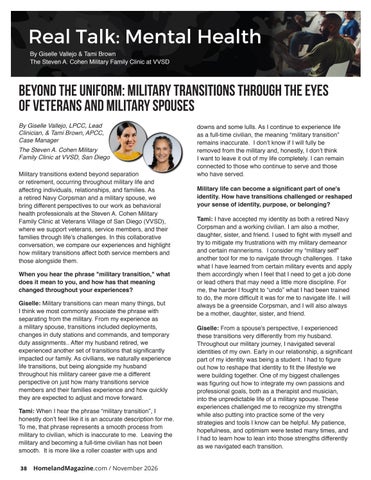
Beyond The Uniform: Military Transitions Through the Eyes of Veterans and Military Spouses By Giselle Vallejo, LPCC, Lead Clinician, & Tami Brown, APCC, Case Manager
The Steven A. Cohen Military Family Clinic at VVSD, San Diego Military transitions extend beyond separation or retirement, occurring throughout military life and affecting individuals, relationships, and families. As a retired Navy Corpsman and a military spouse, we bring different perspectives to our work as behavioral health professionals at the Steven A. Cohen Military Family Clinic at Veterans Village of San Diego (VVSD), where we support veterans, service members, and their families through life’s challenges. In this collaborative conversation, we compare our experiences and highlight how military transitions affect both service members and those alongside them. When you hear the phrase "military transition," what does it mean to you, and how has that meaning changed throughout your experiences? Giselle: Military transitions can mean many things, but I think we most commonly associate the phrase with separating from the military. From my experience as a military spouse, transitions included deployments, changes in duty stations and commands, and temporary duty assignments.. After my husband retired, we experienced another set of transitions that significantly impacted our family. As civilians, we naturally experience life transitions, but being alongside my husband throughout his military career gave me a different perspective on just how many transitions service members and their families experience and how quickly they are expected to adjust and move forward. Tami: When I hear the phrase “military transition”, I honestly don’t feel like it is an accurate description for me. To me, that phrase represents a smooth process from military to civilian, which is inaccurate to me. Leaving the military and becoming a full-time civilian has not been smooth. It is more like a roller coaster with ups and 38
HomelandMagazine.com / November 2026
downs and some lulls. As I continue to experience life as a full-time civilian, the meaning “military transition” remains inaccurate. I don’t know if I will fully be removed from the military and, honestly, I don’t think I want to leave it out of my life completely. I can remain connected to those who continue to serve and those who have served. Military life can become a significant part of one's identity. How have transitions challenged or reshaped your sense of identity, purpose, or belonging? Tami: I have accepted my identity as both a retired Navy Corpsman and a working civilian. I am also a mother, daughter, sister, and friend. I used to fight with myself and try to mitigate my frustrations with my military demeanor and certain mannerisms. I consider my “military self” another tool for me to navigate through challenges. I take what I have learned from certain military events and apply them accordingly when I feel that I need to get a job done or lead others that may need a little more discipline. For me, the harder I fought to “undo” what I had been trained to do, the more difficult it was for me to navigate life. I will always be a greenside Corpsman, and I will also always be a mother, daughter, sister, and friend. Giselle: From a spouse's perspective, I experienced these transitions very differently from my husband. Throughout our military journey, I navigated several identities of my own. Early in our relationship, a significant part of my identity was being a student. I had to figure out how to reshape that identity to fit the lifestyle we were building together. One of my biggest challenges was figuring out how to integrate my own passions and professional goals, both as a therapist and musician, into the unpredictable life of a military spouse. These experiences challenged me to recognize my strengths while also putting into practice some of the very strategies and tools I know can be helpful. My patience, hopefulness, and optimism were tested many times, and I had to learn how to lean into those strengths differently as we navigated each transition.
How do you think the experience of transitioning differs for service members and their spouses, and where do you see similarities? Tami: The experience differs for service members because we have been trained to respond and react to a multitude of different scenarios. From responding to someone yelling at you from across the grinder because you have your hands in your pockets while in uniform to having to think on the spot in the middle of chaos on how to medivac Marines out of the line of fire while trying to stop their bleeding. Spouses and family members have to transition from having shared responsibilities and take on all previously shared to doing everything without help at times. Similarities I see would be the fact that everyone has to make adjustments and then overcome them. There are no ifs, ands, or buts about it. Giselle: I think there are many similarities in how service members and spouses experience transitions, including changes in identity, rebuilding support systems, adjusting to new environments, and finding a sense of belonging. However, some of the biggest differences are in the day-to-day responsibilities and sacrifices. For example, during deployments, a spouse with children may suddenly take on all parenting responsibilities while continuing to manage work, finances, and the household. There is often less support available at a time when responsibilities are increasing. Additionally, many military spouses put their careers or personal goals on hold because Additionally, many military spouses put their careers or personal goals
duty station or deployment. Although both experience the transition, the challenges and adjustments can look very different. Although both experience the transition, the challenges and adjustments can look very different. What advice would you give to veterans and military spouses who are currently navigating a major life transition? Tami: My advice would be to listen to what others who have left the military are saying. I know a lot of times when we hear what others are sharing, we may think “this doesn’t apply to me.” At the very least, the common denominator between the military member transitioning from the services to the person providing the information is someone who has been in the exact same moment, leaving the military. Ask as many questions as you can. Even the questions you feel may be scary to say out loud or ones that seem menial, ask anyway. Giselle: Be comfortable with the uncomfortable. This phrase has helped me navigate many challenges throughout my life. Transitions often bring uncertainty and require us to have difficult or uncomfortable conversations. My advice is to be patient with yourself and others, remain open to different perspectives, and be willing to communicate honestly and respectfully with those around you. We may not always have control over the changes happening in our lives, but we can be intentional about how we navigate them. vvsd.net/cohenclinics
our
Therapy for Veterans, Service Members, and their Families Cohen Clinics provide therapy to post-9/11 veterans, service members, and their families, including National Guard / Reserves. CVN Telehealth, face-to-face video therapy available statewide.
LEARN MORE vvsd.net/cohenclinics
CALIFORNIA locations
San Diego 8885 Rio San Diego Dr. Suite 301 Oceanside 3609 Ocean Ranch Blvd. Suite 120 Los Angeles 20800 Madrona Avenue, Suite C-100, Torrance, CA HomelandMagazine.com / November 2026
39
PTSD: Reclaiming Control By: Robert ‘Bob’ Cuyler, PhD Psychologist and Trauma Expert
Green Berets on the Water
immediately connected to a new tribe, and you tend to go inside yourself. I get to work with veterans and that fulfills that connection for me.” J., a veteran Green Beret, took time from his peers to visit with me. “It’s about being around other GB’s, and people that support us. People who go out of their way to donate money, resources. I was away for the birth of all of my 3 kids. When appreciation is given back, like today, I’m ok with what I did. When you leave, there’s nothing for you, I promise you that. It’s a very hard transition. I spent 10 hours on a boat today, with guy’s I’d never met before.
This month I turn again to outdoor events aimed at supporting and fundraising for veterans. I just completed a great weekend participating again in the Green Beret Foundation’s annual fishing tournament in Port O’Connor, Texas, which brings together GB veterans, fishermen like me who see a way to support great individuals and a great cause, and donors who help raise funds for the variety of purposes including health and wellness programs, scholarships, and support for surviving families. I had the honor of conversation with a number of veterans. I spent time with Elizabeth Hash from the Foundation, who was boots on the ground making this event the success it is. Elizabeth, a 19 year veteran, described her own background, which included fishing and the outdoors: “It was always a place I felt most calm. The outdoors are where I go to refresh my soul. In the military, the bonds you develop are so instant. It’s very hard to find something like that when you get out. Events like this give you a shared experience, high highs or low lows, but you’re together. Fishing opens the doors for deeper conversations. Events like this gets the Green Berets out of the house. We have programs to offer veterans and their families. With veterans, you have a tendency to isolate. You get out and you’re not 40
HomelandMagazine.com / November 2026
Getting around the community, that’s what matters to me. I don’t care about the fish, or winning the tournament, it’s about people that care about you.” From the several events I’m a part of, there are a few consistent take-aways. We need experiences beyond the health care system to give back to our veterans. The outdoor experiences can be a nucleus for sustaining connections and making new ones. The fishing event seems to provide a safe starting place, with no demand to go beyond wetting a line unless you choose to go beyond. Over and over, I heard from veterans and volunteers that ‘going beyond’ was much easier with simple outdoor time and shared experiences on the water. I hope I’ve sparked some interest among veterans and their families to look into the events and organizations I’ve featured.
Dr. Cuyler is chief clinical officer of Freespira, an FDA-cleared non-medication treatment that helps people with panic and PTSD manage their symptoms by learning how to regulate their breathing. www.freespira.com
Available to eligible veterans through their VA benefits.
PTSD Isn’t Weakness.
Trusted by 1,000+ veterans.
it’s a wound. we treat it.
A medication-free option to overcome PTSD symptoms.
”
“I am shocked and surprised that this treatment worked. When I think about PTSD, I think about the brain and this being a brain problem… There is no denying the calming effect this treatment had on me. This has made a significant difference in my personal life. This treatment is remarkably effective.” — Kevin, US veteran whose symptoms included social anxiety and monthly panic attacks before he found Freespira
PTSD and panic symptoms are not signs of failure. They’re signs of impact. At Freespira, we offer a proven, medication-free treatment designed to help veterans reclaim peace of mind and control over their lives. No stigma. No judgment.
a
Get relief today See if you’re eligible at freespira.com/relief freespira.com/relief or 1-800-735-8995. Or ask your VA or VA CCN clinician for a Freespira referral.
Just science-backed support. 06378 REV A | ©2025 FREESPIRA, INC. ALL RIGHTS RESERVED.
HomelandMagazine.com / November 2026
41
Taking Care of the Caregiver
For Jennifer Jenkins, supporting her family means learning how to support herself
By Cynthia Weiss Wounded Warrior Project
Since he was just 17, she encouraged him to finish school. But the family legacy called.
“I’m proud of my roots,” says Jennifer, who comes from a long line of military veterans, part of a legacy of service that traces back to the American Revolution
James met with an Army recruiter and decided to graduate early so he could serve his country. As his legal guardian, Jennifer signed the papers allowing him to enlist.
Growing up in Indiana, she learned about service and patriotism at a young age and was prepared for a life in uniform, following in the footsteps of generations before her. An untimely accident shattered her plans. Jennifer was devastated not to carry on her family’s tradition of military service. Years later, another incident would change her life again. This time, leading her back to the military — and down a path to become an advocate for military caregivers and their families. Keeping the Legacy Alive As the oldest of three siblings by more than a decade, Jennifer stepped into caregiving early. When her younger brother, James Smith, was 13, he moved in with her after their parents could no longer care for him. At the time, Jennifer was also raising her own son, Grant. “I was 26, and I was raising my son and my brother,” she says. “I became more than his sister. I became his mom.” She credits faith and lessons from her grandmother for helping her navigate. “I learned both nurturing and coping skills from her,” she says. For the next few years, life was hectic but stable. Jennifer juggled work with the demands of family. Then 9/11 happened. “James came home from school on Sept. 11, and he was ready to join the military,” Jennifer recalls.
42
HomelandMagazine.com / November 2026
“It was bittersweet. I was proud of him but also feared the unknown.” The Call That Changed Everything
In 2004, James deployed to Iraq with a Stryker brigade combat team. Communication was sparse. Jennifer, like many Americans, had limited information. Driving to work one day in early 2005, a call came from a number she didn’t recognize. “It had a plus sign on the caller ID. I thought it was spam. I almost didn’t answer,” she admits. The connection is poor. The words come in fragments. “… brother … explosion … IED ...” Her mind went to the worst scenario. “I thought he was dead.” Suddenly, James was on the line. “He said, ‘I’m sorry. I got hit.’” A New Identity
James’s injuries were severe, including a traumatic brain injury (TBI), spine injury, partial hearing and vision loss, and internal organ damage. He had other wounds, too, both visible and invisible. “He survived the blast, but from that moment on, his future was vastly different,” Jennifer says. As his next of kin, Jennifer was thrust into a new role. Overnight, she became a military caregiver and advocate. “When you’re thrown into it, it really shocks your system,” says Jennifer. “It made me fear the future, tested my limits, and forced me to confront my vulnerabilities.” Every day was different, but also the same. Jennifer struggled to make sense of a system that wasn’t easy to access, especially as a sibling. “People didn’t recognize me as a caregiver because I wasn’t James’ spouse or parent,” she recalls.
Pushing Away Support
Caregiving was all-consuming as Jennifer navigated seemingly endless paperwork, appointments, and medications. She tried to manage the day-to-day realities of James’ recovery, all while trying to juggle work, motherhood, and cope with guilt. “I was angry at myself. I kept thinking, ‘What if I hadn’t signed those papers for him?” Jennifer held on to hope that life would return to the way it was, but as years passed, the routine remained. The demands of caring for her brother took an emotional toll. Over time, she pulled away from coworkers. From church. From friends. “I slowly descended into isolation,” Jennifer says. “I had a whole life before this. Now, I didn’t know who I was.” Being Open to Something More
Jennifer and James were introduced to Wounded Warrior Project® (WWP) while her brother was still in the hospital. But neither engaged at the time. WWP® stayed in touch through mailers, phone calls, and invitations to events with other warriors and their loved ones. “They continued to offer support. I kept saying, ‘I’ve got this. I’m strong.’ Clearly, they knew something we didn’t,” she recalls. It would take almost seven years before the family finally attended a WWP event. Seeing her brother and son connect with other warriors and their families, Jennifer began to understand the value of WWP. She joined an online community and started helping James connect with other warriors. One winter night, James fell, and in the aftermath of trying to get him care, Jennifer shared her frustration with a virtual peer support group. “Isolation magnifies challenges. I was juggling a lot — raising my son, caring for my brother, trying to work when I could. I was overwhelmed, exhausted, and couldn’t put into words what I was feeling,” she relates. “I got to a place where I couldn’tdo it anymore.” A fellow warrior recognized her post as a cry for help. “He came and stayed with us at the hospital to help us both, and he contacted Wounded Warrior Project’s mental health team, who immediately went to work to get me connected with support,” she says. The Magic of Connection
WWP helped Jennifer realize she wasn’t alone. “I was introduced to peers, to other caregivers, and their warriors. That connection was magic,” she says. “That saved my life.”
Jennifer also learned more about what she was feeling: caregiver burnout. “I was exhausted all the time, but it was more than fatigue,” she says. “I was empty. I didn’t have a job. I didn’t have support. I didn’t know what I needed, but I knew I had to make big changes.” With support from WWP experts and other caregivers, Jennifer gained tools to help manage things she’d never prioritized before — her sleep, her mental health, nutrition, movement, and respite time. She leaned on the Warriors to Work program to find employment that fit around her caregiver schedule, and the family engaged with WWP’s Independence Program, which helped create a personalized care plan for James. “I was the leader of this family. I had to learn how to ask for help — and how to accept it if we were going to thrive,” she says. Jennifer admits there were still challenges, but WWP helped her better carry the weight. Forming deep friendships with other caregivers helped. “Connection fosters resilience and healing,” she says. Advice for Caregivers
Jennifer encourages caregivers to take small, intentional steps to care for themselves and maintain balance. She recommends: • Make time for rest and recovery. “I’m intentional about setting aside time for myself. When I focus on myself as an individual, I am a much better caregiver.” • Don’t let caregiving become your identity. “A caregiver is part of who I am; it is not what I am. I am many things. I’m a wife, writer, mom, gardener, and sister.” • Set boundaries and define roles. “Some days, I need to focus on being a spouse or a sibling, not a caregiver or family support member.” • Maintain connections. “The caregiving lifestyle can be isolating, but you don’t have to do this by yourself.” A Backpack of Lessons
“When you’re thrown into trauma, you forget all your coping skills. You’re trying to fit chaos into your world. Wounded Warrior Project helped me learn coping skills again and how to better navigate uncertainty,” Jennifer says. Those tools became critical when Jennifer’s son Grant joined the military and was injured during training. Continued on next page > HomelandMagazine.com / November 2026
43
“I could’ve been pulled back into crisis. But I wasn’t,” she says. “I knew where my tools were. I always have them in my backpack.” Wearing both her mom and caregiver hats, she helped Grant navigate his recovery — but this time, she sought support from WWP early on. “They were with us every step of the way,” she says.
Redefining Support and Caregiving
Jennifer’s experiences with her brother opened the door to a new passion: changing people’s understanding of who caregivers are. “Caregivers aren’t just spouses,” she says. “They’re siblings. They’re parents. They’re children. They are the reason our loved ones can live the lives they deserve.” In 2016, Jennifer joined Wounded Warrior Project as part of its national speaker team, traveling across the country to bring awareness to the challenges veterans — and their caregivers — face. Today, she advocates for broader recognition and support systems for those who don’t fit the traditional definition of a caregiver and often face gaps in services and resources. She relies on her lived experiences serving as a guardian, caregiver, and family support member. “My story matters,” she says. “And it can help someone else.” To learn more, visit woundedwarriorproject.org or call 888.997.ALUM (2586) to connect with the WWP Resource Center.
44
HomelandMagazine.com / November 2026
PTSD and the Military: Overcoming Stigma to Find Hope in Recovery By Lt. Cmdr. William Reynolds, USN, (Ret.), PA-C
with coping strategies and support systems, facilitating their return to duty or transition to civilian life. It’s also important to look at underlying physical comorbidities. Some programs, like the Sierra Tucson Red, White, and Blue Program, start with a physical examination complete with appropriate lab work which is essential to identifying physical issues that may mask as psychological problems. Hypothyroidism, for example, often presents as depression. There is Strength in Surrender and Acknowledging a Problem
Military personnel face significant mental health challenges, including post-traumatic stress disorder (PTSD), depression and substance use disorders. In 2022, approximately 17.6% of active-duty service members sought treatment for psychological health concerns. Servicepeople, though, often encounter significant stigma when seeking mental health treatment. This stigma, deeply rooted in a military culture that emphasizes resilience and self-reliance, leads many to perceive seeking help as a sign of weakness. It takes tremendous courage to ask for help, but recovery is possible, and veterans and military personnel do not need to live with PTSD symptoms. Going To Treatment Is Not Necessarily a Career-Ender The military emphasizes the importance of mental readiness and resilience, recognizing that untreated mental health issues can adversely affect an individual’s performance as well as military unit cohesion. The Department of Defense has implemented policies to encourage mental health care while minimizing career repercussions. The Brandon Act, for example, was enacted in May 2023 and aims to improve access to mental health services, encouraging early intervention and allowing service members to seek help confidentially without fear of negative career impacts. Residential Treatment is Akin to a Wellness Retreat Residential mental health treatment provides a structured, 24/7 environment for individuals requiring intensive care beyond outpatient services. These programs incorporate therapies addressing trauma and stressors specific to military service and are tailored to the unique needs of those whose lives have been disrupted by various mental and behavioral health concerns. This comprehensive, personalized approach aims to equip service members
Recognizing the existence of a mental health problem is a crucial first step toward successful treatment and recovery. Denial often serves as a barrier, preventing service personal from recognizing the severity of their condition and ultimately delaying the necessary help. By confronting the reality of their struggles, military members can move beyond denial and open the door to therapeutic support systems. Acceptance also enhances the effectiveness of treatment by increasing an individual’s commitment to the recovery process. When veterans and military personnel acknowledge their problems, they are more likely to participate actively in therapy, adhere to prescribed treatments, and implement coping strategies. Plus, this acknowledgment also plays an important role in reducing the stigma associated with mental health and addiction issues. For additional resources, active duty and veteran members of the military are encouraged to visit: the National Center for PTSD (www.ptsd.va.gov), Military OneSource (www.militaryonesource.mil), and the U.S. Department of Veterans Affairs Mental Health websites (www.mentalhealth.va.gov). PTSD is a diagnostic code that the healthcare industry uses, but the word “disorder” in Post Traumatic Stress Disorder stigmatizes a very normal, human response to abnormal situations. PTSD has also been with us since the invention of warfare. Fortunately, with advances in mental health care, treating this potentially debilitating condition is highly effective. There is hope for active duty and military veterans to return to living well in recovery.
Lt. Cmdr. William Reynolds, USN, (Ret.), PA-C, is Director of the Military and First Responder Trauma Recovery Program at Arizona-based mental health treatment facility Sierra Tucson. For more information, visit: www.sierratucson.com/programs/military HomelandMagazine.com / November 2026
45
AGING & END OF LIFE CARE By: Shelly Dew, CFRE, CDE Director of Philanthropy Hospice of the North Coast www.hospicenorthcoast.org
Honoring the Hidden Heroes: Family Caregivers of Our Veterans National Family Caregiver Month is a time to recognize the extraordinary individuals who provide daily care, comfort, and support to loved ones facing serious illness. From a hospice perspective, we see firsthand the profound impact family caregivers have on the quality of life of our nation's Veterans. Many Veterans who come to hospice have spent their lives serving others. When illness progresses, it is often a spouse, son, daughter, sibling, or close friend who steps forward to serve them in return. These caregivers manage medications, coordinate appointments, provide transportation, assist with personal care, and offer emotional support. Most importantly, they help Veterans maintain dignity and comfort while remaining connected to the people and places they love. Caregiving can be one of life's greatest honors, but it can also be physically and emotionally demanding. Family caregivers frequently balance their caregiving responsibilities with careers, family obligations, and their own health needs. It is common for caregivers to experience stress, fatigue, and feelings of isolation as they navigate the challenges of a loved one's declining health. Hospice care is designed not only for the patient, but for the entire family. Our interdisciplinary teams work alongside caregivers to provide education, symptom management, emotional support, respite resources, and guidance through difficult decisions. We help families understand what to expect, empowering them with the knowledge and confidence to care for their loved one while ensuring they do not carry the burden alone. For Veteran families, hospice also offers unique opportunities to honor military service. Through Veteran recognition ceremonies, legacy activities, and specialized support programs, we help acknowledge the sacrifices Veterans have made and create meaningful moments for families to share together. These experiences often bring comfort, pride, and a sense of closure during a deeply personal journey. This National Family Caregiver Month, we encourage our community to recognize and thank the caregivers in their lives. A simple expression of gratitude, an offer to help with errands, or a few hours of respite can make a meaningful difference. 46
HomelandMagazine.com / November 2026
To every family caregiver supporting a Veteran: your compassion, dedication, and sacrifice matter. You may not wear a uniform, but your service is no less significant. As hospice professionals, we are honored to walk beside you, providing care, guidance, and support every step of the way. Together, we can ensure that our Veterans receive the dignity, comfort, and respect they deserve, while also caring for those who care for them.
Shelly Dew serves as Director of Philanthropy and Community Outreach at Hospice of the North Coast, a community-based nonprofit dedicated to compassionate end-of-life care, comfort, and support for patients sdew@hospicenorthcoast.org | hospicenorthcoast.org
hospicenorthcoast.org HomelandMagazine.com / November 2026
47
Access, Flexibility, and Opportunities: Nonprofit Releases Research Sharing Positive Outcomes for Military Kids with Disabilities This fall, national nonprofit Our Military Kids (OMK) released a new report highlighting the many positive and interconnected outcomes their programming has for children with special needs. www.ourmilitarykids.org/2026whitepaper
While OMK annually releases research highlighting the overall impact that activity awards have on recipients and their families, “The Impacts of Our Military Kids on Children with Disabilities” is its first stand-alone report focusing on a particular demographic of beneficiaries. OMK funds activities for the children (ages 1-18) of deployed Reserve or National Guard service members and the children of Veterans and service members in all service branches receiving care for their post-9/11 combat-related injuries and illnesses. This funding (called “activity awards”) can be applied to a wide variety of activities. Real Stories, Real Outcomes
At the heart of the research are family beneficiary interviews conducted by researcher and author of the paper, Erica Hawvermale, OMK’s Program Evaluation and Research Advisor. Hawvermale’s analysis found that the impacts of OMK-funded activities on children with disabilities are positive, extensive, and interrelated. “Participation in these activities both mediates disability symptoms and facilitates positive impacts on academics, physical health, emotions, behaviors, and social engagements,” the report notes. “Our Military Kids provides activity awards to between 200 and 250 children reported to have a disability each year (roughly 14% of all awards). However, the impact of military service on children with disabilities, particularly among the populations OMK intentionally serves,is not well researched. Understanding these families’ experiences is an exciting next step in better serving this population,” said Hawvermale. For some families, finding activities that are developmentally and/or physically appropriate for their children is difficult. Waitlists may be long, and the distance to participate may be prohibitive, especially for families living in rural or remote areas. OMK funding allows children to pursue their interests in their own communities and on their own terms. Additionally, the funding reduces or eliminates the financial burden that often comes with activities. Access, Flexibility, and Opportunities
Hawvermale’s research found that, beyond offering improved access and flexibility for extracurriculars, OMK activity awards presented opportunities that children may not have otherwise experienced. One mother explained that OMK-funded swim lessons gave her daughter the skills and confidence that set her up to become a lifeguard and eventually work her way 48
HomelandMagazine.com / November 2026
through college. “OMK did something in that they set her up to become a lifeguard and eventually work her way through college. “OMK did something in that they set her on this path without even realizing it,” “Pamela” said. “Talk about making a life change and a life difference.” “Patricia,” a mother whose son used OMK activity awards for day camp at a botanical garden, shared that his interests expanded because of his experiences. Prior to attending day camp, he was only interested in LEGO. “... With nature camp and all the stuff that he learned, he's now actually more [engaged] with me and [tries] to help me and be more involved,” “Patricia” said. The research also found that overall child wellbeing— including the mediation of disability-related symptoms— improved through participation in OMK-funded activities. One mother noticed a change in her child’s behaviors after his jiu-jitsu class: “His behavior in general seems to improve after he has jiu-jitsu, and he seems calmer and less fidgety.”
Beyond the Research
Kara C. Dallman, Executive Director of OMK, sees this paper as confirmation of the work OMK has done as well as an exciting invitation for specific improvements to the organization’s processes. “This research illuminates the importance of meeting families and children where they are and supporting their goals,” she said. “It’s particularly powerful to hear from parents that their children with special needs are also finding success and belonging through OMK-funded activities.” The report comes at an important time for the 22-year-old organization. In the first half of 2026, OMK experienced a 16% increase in activity award applications over the same time last year. Additionally, the organization recently released its five-year strategic growth plan. “We know that when military children are given opportunities to pursue their interests on their terms, amazing things happen,” said Dallman. “We are proud of our progress, and we look forward to exploring the report’s suggestions to further improve access and empower these families.”
About Our Military Kids
Our Military Kids® is a national 501(c)(3) nonprofit offering extracurricular activity awards to children ages 1-18 of deployed National Guard, deployed Reserve, or Veterans/Service Members receiving care for combatrelated injuries or illnesses. Learn more and apply at ourmilitarykids.org. HomelandMagazine.com / November 2026
49
teamstepusa.org
50
HomelandMagazine.com / November 2026
You can help the children of military heroes
REACH NEW HEIGHTS
Help send a child to camp: campcorral.org/donate Camp Corral transforms the lives of children of wounded, ill and fallen military heroes
www.campcorral.org HomelandMagazine.com / November 2026
51
How Military Efforts Helped Bring About Thanksgiving By Katie Lange DOD Historical Collection www.defense.gov Thanksgiving is a hallowed American tradition filled with family, food, football and fun, but did you know we can attribute its creation largely to the military?
Thanksgiving Day proclamation for the U.S. when he was president, setting the date for Nov. 26, 1789.
While conventional wisdom dates the first Thanksgiving back to 1621, when pilgrims in Plymouth, Massachusetts, joined in with local Native Americans to celebrate the fall harvest, it wasn’t a celebration that continued from year to year.
While that date fell around that of our current-day holiday, Thanksgiving still failed to become an annual tradition until about 75 years later – when President Abraham Lincoln decided to renew the celebration in 1863, during the height of the Civil War.
In fact, Thanksgiving didn’t really become any kind of tradition until we were trying to unify the nation during two of our biggest early struggles – the Revolutionary War and the Civil War.
Even as war raged across the country, Lincoln called for a day of thanks to be held on the last Thursday in November. The day would be known as Thanksgiving – and the tradition finally became official.
Inspiring Our Troops, Bringing Unity
For many years, the presidents who came after Lincoln kept Thanksgiving on that final Thursday of the month. But during World War II, there were two years in a row in which November had five Thursdays, confusing a lot of people and causing a lot of arguments about which date Thanksgiving would fall on.
During the revolution, the Continental Congress decided to declare several days of thanksgiving to help inspire our troops to victory. The first such day fell on Nov. 1, 1777, when news of some victories against the British reached their ears. Gen. George Washington also called for a day of thanksgiving on Dec. 18,1777, as a victory celebration for the colonial army’s win during the Battle of Saratoga that October. He later issued the first formal
In 1942, Congress passed a resolution to clarify that every fourth Thursday of November would be Thanksgiving Day.
No matter where you’re celebrating Thanksgiving this year, know that the tradition grew out of your predecessors’ efforts to bring unity to the United States. We can all be thankful for that!
52
HomelandMagazine.com / November 2026
HUNG DING ER EN
E
T
HR OU CU GH FOOD RES
Feeding San Diego is proud to support military and veteran families across San Diego County feedingsandiego.org
858.452.3663
info@feedingsandiego.org
— NONPROFIT PARTNER —
HomelandMagazine.com / November 2026
53
A New Chapter for The Harmonetiks Project: Veterans Guiding Veterans Forward When San Diego Veterans Magazine last shared our story in December 2025, The Harmonetiks Project was a small group of early adopters demonstrating how a simple practice, The Easy Breath, could help veterans manage pain and stress. This Veterans Day, we return with news about the people carrying that work forward and the communities it is reaching. New Leadership, Same Mission
This fall, The Harmonetiks Project 501(c)(3) completed a leadership transition designed to extend the mission beyond its founders. John Ireland, M.Ed., our Executive Director, was elected board chair and continues as Executive Director while the board determines the role’s future. Two new members have joined the board. Ken Caputo brings experience building sustainable learning communities, while Michale Matthews has supported Harmonetiks since its 2023 launch, participating in classes and opening doors across New York as member of the Staten Island PPS and co-chair of The Staten Island Veterans and Families task force. They join continuing board members Mike Williams and Paul Liebmann. Founders Dr. Jeffrey Zimmerman, L.Ac., O.M.D., whose four decades of private practice inspired Harmonetiks, and Jay Van Schelt, who developed The Easy Breath training programs with him, now serve as Founders Emeritus, advising the board. Jay also mentors and trains the next generation of guides. "A mission like this can't depend on the people who started it," said Van Schelt. "It needs a board that understands the purpose and can hold the vision as it grows. That is what we have now." The Three Legs of the Stool
Dr. Zimmerman envisioned three foundations for Harmonetiks: group programs for veterans, training veterans to guide others, and creating opportunities for trained veterans to earn a living helping their peers. The Easy Breath is the first leg. It builds on a skill many service members know well: finding the breath amid chaos to steady the body. Through a simple three-step process practiced anytime and anywhere, participants bring attention to the present, connect body and breath, and release tension. This self-care skill helps veterans ease pain and related stress. The other two legs are now taking shape. 54
HomelandMagazine.com / November 2026
Veterans Guiding Veterans
We use the word "guide" rather than "teacher." A guide helps someone navigate unfamiliar ground through a "trellis of awareness," allowing each person to find their own path. Guides emerge from our classes as veterans who connect with the practice and want to share it. Those who continue can become paid apprentices, co-teaching alongside trained guides through three levels of training. All guides also complete QPR suicide-prevention training. Four apprentices are currently training across Connecticut, Maryland, and Florida, with one approaching Level One. Our new Bristol, Connecticut, office is equipped for video classes, allowing us to train guides and reach veterans wherever they live. Building in Connecticut
Our outreach continues to open doors. In September, we introduced The Easy Breath to veterans at a stand down event in Bridgeport, Connecticut, where Jay met Jason Culbreth, founder and lead therapist at Cadence Wellness, a trauma-informed therapy center. Harmonetiks has also been invited to contribute to the Veterans Regional Priority Council convened by the office of U.S. Senator Chris Murphy.
Toward Stronger Integrative Care
Our clinical program, Acupuncture Plus The Easy Breath, pairs a licensed acupuncturist with a trained, certified Harmonetiks guide. Veterans receive treatment while learning a self-care practice they can use independently.
What Veterans Are Telling Us
Across our early classes in 2023 and 2024, 152 people participated, including 116 veterans. Between 73 and 89 percent completed their programs. participants reported an average of 80 % reduction in their reported pain at end of class the final week. These self-reported results do not include a comparison group. We are developing stronger ways to measure outcomes as the program grows. Behind every number, however, is a veteran who found greater ease in daily life.
Cadence Wellness, a Danbury, Connecticut, therapy practice led by Jason Culbreth, a Navy veteran and licensed professional counselor (LPC), is in discussions to collaborate with Harmonetiks Warriors Inc., the veteran-led company delivering Harmonetiks programs. The organizations have progressed from strategic conversations to working through practical details toward stronger integrative care for veterans.
Join Us
This Veterans Day, we invite you to join this movement of early adopters. A gift of $360 supports one veteran for a full quarter of classes. To learn more, donate, or bring Harmonetiks to your community, visit www.theharmonetiksproject.org.
HomelandMagazine.com / November 2026
55
RISKY BUSINESS Insurance Info & Risk Management Tips By Hadley Wood www.hlinwood-insurance.com
Is Your AI-Created Content Insured? If your business uses AI to write blog posts, design social graphics, draft product descriptions or answer customer questions, you’re in good company. Most small businesses now use some form of generative AI. But here’s a question worth asking before your next renewal: if that content gets you sued, will your insurance pay? The honest answer is: Maybe? The end of “silent AI” coverage For the past few years, most business policies simply didn’t mention AI. Insurers call this “silent AI.” With no exclusion on the books, a claim involving AI-generated content was handled like any other claim.
Ask for the endorsement list. At renewal, ask your agent for every AI-related endorsement on your general liability, business owner’s, E&O and cyber policies. Don’t assume no news means no change.
That’s changing quickly. In January 2026, the Insurance Services Office (ISO), which writes the standard language most U.S. carriers build on, released optional generative AI exclusions for commercial general liability (CGL) policies. The broadest version removes coverage for bodily injury, property damage and “personal and advertising injury” arising out of generative AI. A narrower version targets only advertising injury, the part of your policy that typically responds to claims of copyright infringement, trademark misuse or defamation in your marketing.
Inventory your AI use. Make a simple list of the tools you use and what they produce: marketing copy, images, chatbot responses, code. This helps your agent spot gaps.
Several major carriers have adopted these forms or their own versions, and some have added even broader AI exclusions to professional liability (E&O) and directors and officers policies. Why this matters to you “Arising out of” is broad language. AI doesn’t have to be the main cause of a problem, just a link in the chain. If an AI-generated image resembles a photographer’s copyrighted work, or AI-written copy makes a misleading claim about a competitor, an insurer with one of these exclusions may decline to defend you. Remember - even before AI, intellectual property coverage in a standard CGL policy was limited. AI exclusions narrow an already slim door. What you can do?
The good news is that you have options. 56
HomelandMagazine.com / November 2026
Keep a human in the loop. Review AI content before it’s published and document that review. Insurers increasingly reward good governance and showing you did your due diligence is favorable to you. Explore Alternate or Extended coverage. A growing number of insurers now offer AI liability coverage or endorsements designed to fill these gaps, including for copyright claims tied to AI content. A media liability policy may also help. Read your AI vendor’s terms. Some providers offer indemnification for copyright claims; many limit or exclude it. The bottom line
AI can be a terrific tool for your business, but your insurance policy may not have kept pace with how you use it. A twenty-minute conversation with your agent today could save you an expensive surprise tomorrow. Thank you to all the Veterans that have honorably served our Country on this Veterans Day! If you want to learn more about this subject or have questions about business insurance, please reach out to me at hadley@hlinwood-insurance.com
www.identityiq.com/veterans
HomelandMagazine.com / November 2026
57
www.lightheadedhelmets.com 58
HomelandMagazine.com / November 2026
As the nation marks 250 years of independence, Liberty Station stands as a powerful reminder that America was forged by bravery and remains anchored in liberty. To learn more, please visit libertystation.com/events/250th-anniversary
www.midway.org/contact/volunteer-opportunities
www.midway.org HomelandMagazine.com / November 2026
59
www.c6securityacademy.com 60
HomelandMagazine.com / November 2026
Be the
CHANGE
Veterans! Join Our Team
SFPD Salary
https://tinyurl.com/vet-in-transition
Earn $119,262 to $164,164/year
TEXT “JoinSFPD” to
(415) 704-3688
www.JoinSFPD.com HomelandMagazine.com / November 2026
61
www.joinSDPDnow.com SDPDrecruiting@pd.sandiego.gov
62
HomelandMagazine.com / November 2026
JoinCDCR.com
HomelandMagazine.com / November 2026
63
Feeding San Diego is proud to support local heroes by providing nutritious meals to military families and veterans. Thank you for your service. To learn more about our Feeding Heroes program, scan the QR code or visit feedingsandiego.org.
64
HomelandMagazine.com / November 2026